The New Age (Butte)
Saturday, October 25, 1902
Butte, Montana
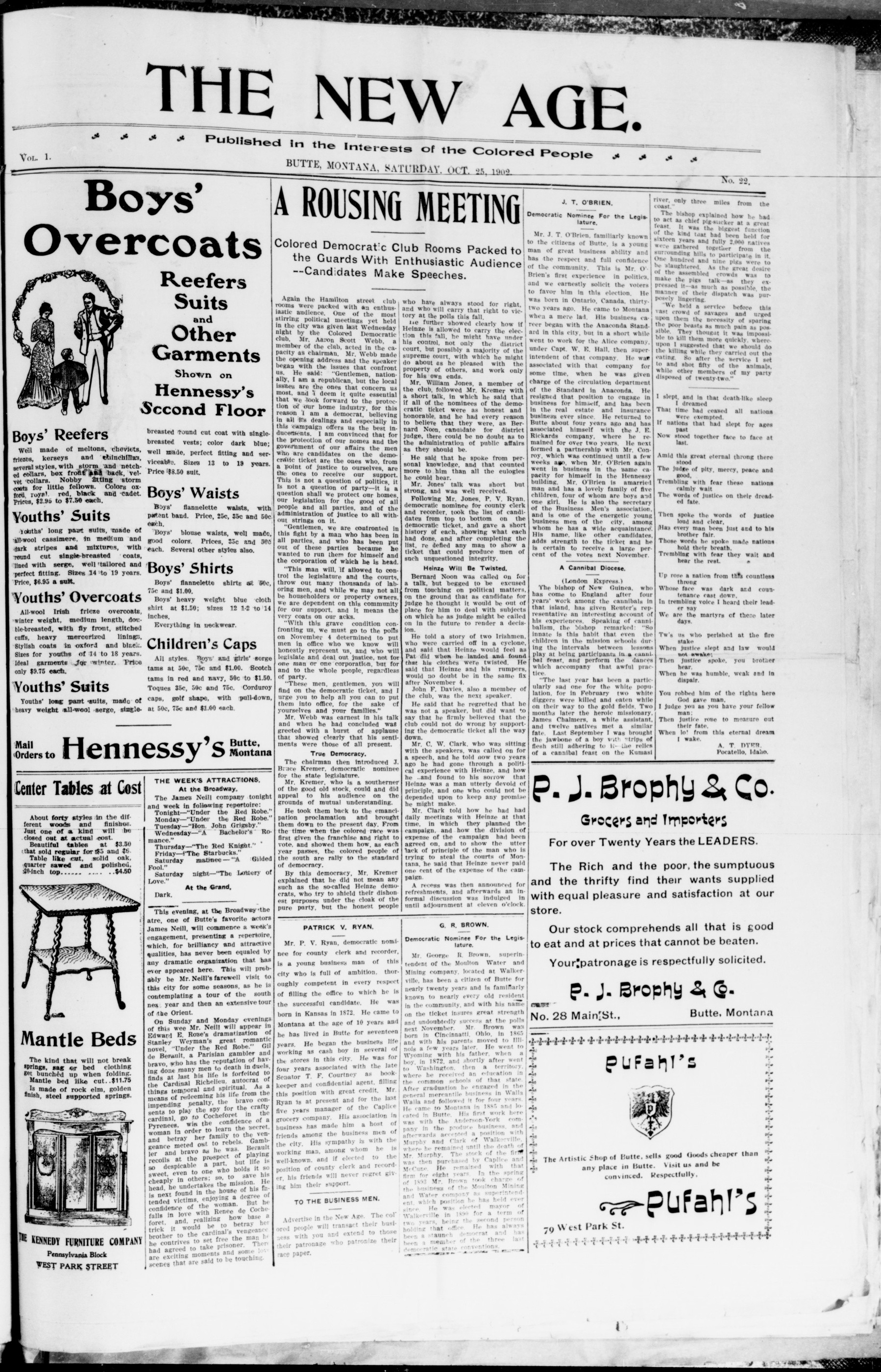
Page text (machine-generated)
Boys' Overcoats
Mail Orders to Hennessy's Butte, Montana
A
Boys' Reefers
Weil made of meltons, chevets, friezes, kerseys and calinchillas, several styles, with storm, and mesh ed collars, box front and back, velvet collars. Nobby fitting storm trousers for little fellows. Colors oxford royal; red, black and cadet. Prices: $2.95 to $7.50 each.
Vouths' Suits
Youths' long pant suits, made of wool-wool cassiimere, in medium and dark stripes and mixtures, with round cut single-breasted coats, lined with serge, well tailored and perfect fitting. Sizes 14 to 19 years. Price, $6.95 a suit.
Vouths' Overcoats
All-wool Irish frieze overcoats
winter weight, medium length, double-breasted, with fly front, stitched cuffs, heavy mercerized linings
Stylish coats in oxford and black
Sizes for youths of 14 to 18 years.
Ideal garments for winter. Price only $9.75 each.
Youths' Suits
Youths' long pant suits, made of heavy weight all-wool serge, single-
Mail Orders to Henne
Center Tables at Cost
About forty styles in the different woods and finishes.
Just one of a kind will be closed out at actual cost.
Beautiful tables at $3.50
that sold regular for $5 and $9.
Table like cut, solid oak,
quarter sawed and polished.
$4.50
$4.50
$4.50
A
Mantle Beds
The kind that will not break springs, sag or bed clothing get bunched up when folding. Mantle bed like cut..$11.75 Is made of rock elm, golden finish, steel supported springs.
THE KENNEDY FURNITURE COMPANY
Pennsylvania Block
WEST PARK STREET
THE NEW AGE.
breasted round cut coat with single
breasted vests; color dark blue;
well made, perfect fitting and ser-
viceable. Sizes 13 to 19 years.
Price $8.50 suit.
Bovs' Waists
Boys' flannelette waists, with patent band. Price, 25c, 35c and 50c each.
Boys' blouse waists, well made, good colors. Prices, 35c and 50c each. Several other styles also.
Boys' Shirts
Boys' fannelette shirts at 50c;
75c and $1.00.
Boys' heavy weight blue cloth
shirt at $1.50; sizes 12 1.2 to 14
inches.
Everything in neckwear.
Children's Caps
All styles. Boys' and girls' sorec
tams at 50c, 75c and $1.00. Scotch
tams in red and navy, 50c to $1.50.
Toques 35c, 50c and 75c. Corduroy
caps, golf shape, with pull-down,
at 50c, 75c and $1.00 each.
THE WEEK'S ATTRACTIONS,
At the Broadway.
At the Broadway.
The James Neill company tonight
and week in following repertoire:
Tonight—"Under the Red Robe."
Monday—"Under the Red Robe."
Tuesday—"Hon John Grigsby."
Wednesday—"A Bachelor's Romance."
Thursday—"The Red Knight."
Friday—"iThe Starbucks."
Saturday matinee—"A Gilded Fool."
Saturday night—"The Lottery of Love."
This evening, at the Broadway theatre, one of Butte's favorite actors James Neill, will commence a week's engagement, presenting a repertoire, which, for brilliancy and attractive qualities, has never been equaled by any dramatic organization that has ever appeared here. This will probably be Mr. Neill's farewell visit to this city for some seasons, as he is contemplating a tour of the south next year and then an extensive tour of the Orient.
On Sunday and Monday evenings of this wee Mr. Neill will appear in Edward E. Rose's dramatization of Stanley Weyman's great romantic novel, "Under the Red Robe," Gil de Berault, a Parisian gambler and brave, who has the reputation of having done many men to death in duels, finds at last his life is forfeited to the Cardinal Richelieu, autocrat of tapes temporal and spiritual. As a means of redeeming his life from the impending penalty, the bravo consents to play the spy for the crafty cardinal, go to Cochetore in the Pyrenees, win the confidence of a woman in order to learn the secret, and betray her family to the grace meted out to rebel. Gambler and bravo as he was. Berault recoils at the prospect of playing so despicable a part, but life is sweet, even to one who holds it so cheaply in others; so, to hold his head, he undertakes the mission. He is next found in the house of his intended victims, enjoying a degree of confidence of the woman. But he falls in love with Renee Cocheforet, and, realizing he does base a trick it would be to betray his brother to the cardinal's vengeance he contrives to set free the man he had agreed to take prisoner. There are exciting moments and some low scenes that are said to be touching.
A ROUSING MEETING
Colored Democratic Club Rooms Packed to the Guards With Enthusiastic Audience --Candidates Make Speeches.
Again the Hamilton, street club rooms were packed with an enthusiastic audience. One of the most stirring political meetings yet held in the city was given last Wednesday night by the Colored Democratic club, Mr. Aaron Scott Webb, a member of the club, acted in the capacity as chairman, Mr. Webb made the opening address and the speaker began with the issues that corroon us. He said: "Gentlemen, nationally, I am a republican, but the local issues are the ones that concern us most, and I deem it quite essential that we look forward to the protection of our home industry, for this reason I am a democrat, believing in all its dealings and especially in this campaign offers us the best inducements. I am convinced that for the protection of our nomes and the government of our affairs the men who are candidates are the ones who, from a point of justice to ourselves, are the ones to receive our support. This is not a question of politics, it is not a question of party—it is a question shall we protect our homes, our legislation for the good of all people and all parties, and of the administration of justice to all with our strings on it.
"Gentlemen, we are confronted in this fight by a man who has been in all parties, and who has been put out of these parties because he wanted to run them for himself and the corporation of which he is head.
"This man will, if allowed to control the legislature and the courts, throw out many thousands of laboring men, and while we may not all be householders or property owners, we are dependent on this community for our support, and it means the very coats on our acks.
"With this grave condition confronting us, we must go to the polls on November 4 determined to put men in office who we know will honestly represent us, and who will legislate and deal out justice, not for one man or one corporation, but for and to the whole people, regardless of party.
"These men, gentlemen, you will find on the democratic ticket, and I urge you to help all you can to put them into office, for the sake of yourselves and your families."
Mr. Webb was earnest in his talk and when he had concluded was greeted with a burst of applause when he heard that the hammers were those of all present.
True Democracy.
The chairman then introduced J. Bruce Kremer, democratic nominee for the state legislature.
Mr. Kremer, who is a southerner of the good old stock, could and did appeal to his audience on the grounds of mutual understanding.
He took them back to the emancipation proclamation and brought them down to the present day. From the time when the colored race was first given the franchise and right to vote, and showed them how, as each year passes, the colored people of the south are rally to the standard of democracy.
By this democracy, Mr. Kremer explained that he did not mean any such as the so-called Heinze democrats, who try to shield their dishonest purposes under the cloak of the pure party, but the honest people
PATRICK V. RYAN.
Mr. P. V. Ryan, democratic nominee for county clerk and recorder, is a young business man of this city who is full of ambition, thoroughly competent in every respect of filling the office to which he is the successful candidate. He was born in Kansas in 1872. He came to Montana at the age of 10 years and he has lived in Butte for seventeen years. He began the business life working as cash boy in several of the stores in this city. He was for four years associated with the late Senator T. F. Courtney as bookkeeper and confidential agent, filling this position with great credit. Mr. Ryan is at present and for the last five years manager of the Caplice grocery company. His association in business has made him a host of friends among the business men of the city. His sympathy is with the working man, among whom he is well-known, and if elected to the position of county clerk and recorder, his friends will never regret giving him their support.
TO THE BUSINESS MEN.
Advertise in the New Age. The col- ored people will transact their business with you and extend to those their patronage who patronize their race paper.
who have always stood for right, and who will carry that right to victory at the polls this fall.
He further showed clearly how if Heinzle is allowed to carry the election this fall, he might have under his control, not only the district court, but possibly a majority of the supreme court, with which he might do about as he pleased with the property of others, and work only for his own ends.
Mr. William Jones, a member of the club, followed Mr. Kremer with a short talk, in which he said that a talk of the nominees of the democratic ticket were as honest and honorable he had every reason to believe that they were an ordered Noon, candidate for district judge, there could be no doubt as to the administration of public affairs as they should be.
He said that he spoke from personal knowledge, and that counted more to him than all the eulogies he could hear.
Mr. Jones' talk was short but strong and was well received.
Following Mr. Jones, P. V. Ryan, democratic nominee for county clerk, and recorder, took the list of candidates from top to bottom on the democratic ticket, and gave a short history of each, showing what each had done, and after completing the list, re defied any man to show a ticket that could produce men of such unquestioned integrity.
Heinze Will Be Twisted.
Bernard Noon was called on for a talk, but begged to be excused from touching on political matters, on the ground that as candidate for judge he thought it would be out of place for him to deal with subjects on which he as judge might be called on in the future to render a decision.
He told a story of two Iriahmen, who were carried off in a cyclone, and said that Heinze would feel as Pat dled when he landed and found that his clothes were twisted. He said that Heinze and his rumpers would no doubt be in the same fix after November 4.
John F. Davies, also a member of the club, was the next speaker.
He said that he regretted that he was not a speaker, but did want to say that he firmly believed that the club could not do wrong by supporting the democratic ticket all the way down.
Mr. C, W. Clark, who was sitting with the speakers, was called on for a speech, and he told now two years ago he had gone through a political experience with Heinz, and how he .and found to his sorrow that Heinz was a man utterly devoid of principle, and one who could not be depended upon to keep any promise he might make.
Mr. Clark told how he had had daily meetings with Heinz at the time, in which they informed the campaign and how the division of the campaign had been agreed on, and to show the utter lack of principle of the man who is trying to steal the courts of Montana, he said that Heinz never paid one cent of the expense of the campaign.
A recess was then announced for refreshments, and afterwards an informal discussion was indulged in until adjournment at eleven o'clock.
G. R. BROWN.
Democratic Nominee For the Legis
lature.
Mr. George, R. Brown, superintendent of the Moulton Water and Mining company, located at Walkerville, has been a citizen of Butte for nearly twenty years and is familiarly known to nearly every old resident in the community, and with his name on the ticket insures great strength and undoubtedly success at the polls next November. Mr. Brown was born in Cincinnati, Ohio, in 1865 and with his parents moved to Illinois a few years later. He went to Wyoming with his father, when a boy, in 1872, and shortly afterward to Washington, a territory, where he received an education in the common schools of that state. After graduation he engaged in the general merchant business in Walla Walla, where followed it for four years. He came to Montana in 1885 and located in Butte. His first work here was with the Anderson-York company in the produce business, and afterwards accepted a position with Murphy and Clark of Walkerville, where he remained until the death of Mr. Murphy. The stock of the first was then purchased by Capilla and McCune. He remained with that firm for eight years. In the spring of 1892 Mr. Brown took charge of the business of the Moulton Mining and Water company as superintendent, which position he has held ever since. He was elected mayor of Walkerville in 1890 for a term of two years, being the second owner holding that office. He has always been a stanch office and has been a member of the three last democratic state conventions.
J. T. O'BRIEN.
Democratic Nominee For the Legis
lature.
Mr. J. T. O'Brien, familiarly known to the citizens of Butte, is a young man of great business ability and has the respect and full confidence of the community. This is Mr. O'Brien's first experience in politics, and we earnestly solicit the voters to favor him in this election. He was born in Ontario, Canada, thirty-two years ago. He came to Montana when a mere lad. His business career began with the Anaconda Standard in this city, but in a short while went to work for the Alice company, under Capt. W. E. Hall, then superintendent of that company. He was associated with that company for some time, when he was given charge of the circulation department of the Standard in Anaconda. He resigned that position to engage in business for himself, and has been in the real estate and insurance business ever since. He returned to Butte about four years ago and has associated himself with the J. E. Rickards company, where he remained for over two years. He next formed a partnership with Mr. Conway, which was continued until a few weeks when Mr. O'Brien again went in business in the pacy for himself in the Hennessy building. Mr. O'Brien is amarried man and has a lovely family of five children, four of whom are boys and one girl. He is also the secretary of the Business Men's association and is one of the energetic young business men of the city, among whom he has a wide acquaintance His name, like other candidates adds strength to the ticket and he is certain to receive a large per cent of the votes next November.
A Cannibal Diocese
(London Express.)
The bishop of New Guinea, who has come to England after four years' work among the cannibals in that island, has given Reuters' representative an interesting account of his experiences. Speaking of cannibalism, the bishop remarked: "So innate is this habit that even the children in the mission schools during the intervals between lessons play at being participants in a cannibal feast, and perform the dances which accompany that awful practice.
"The last year has been a particularly sad one for the white population, for in February two white diggers were killed and eaten while on their way to the gold fields. Two months later the heroic mission, James Chalmers, a white assistant, and twelve natives met a similar fate. Last September I was brought the jawbone of a boy with strips of flesh still adhering to it—the relics of a cannibal feast on the Kumasi
P. J. Brophy & Co.
Grocers and Importers
For over Twenty Years the LEADERS.
The Rich and the poor, the sumptuous and the thrifty find their wants supplied with equal pleasure and satisfaction at our store.
Our stock comprehends all that is good to eat and at prices that cannot be beaten.
Your patronage is respectfully solicited.
P. J. Brophy & Co.
No. 28 Main St., Butte, Montana
Pufahl's
The Artistic Shop of Butte, sells good Goods cheaper than any place in Butte. Visit us and be convinced. Respectfully.
Pufahl's
79 West Park St.
river, only three miles from the coast."
The bishop explained how he had to act as chief pig-sucker at a great feast. It was the biggest function of the kind toat had been held for sixteen years and fully 2,000 natives were gathered together from the surrounding hills to participate in it. One hundred and nine pigs were to be slaughtered. As the great desire of the assembled crowds was to make the pigs talk—as they expressed it—as much as possible, the manner of their dispatch was purposely lingering.
"We held a service before this vast crowd of savages and urged upon them the necessity of sparing the poor beasts as much pain as possible. They thought it was impossible to kill them more quickly, whereupon I suggested that we should do the killing while they carried out the eating. So after the service I set to and shot fifty of the animals, while other members of my party disposed of twenty-two."
I slept, and in that death-like sleep I dreamed
That time had ceased all nations were exempted.
If nations that had slept for ages past
Now stood together face to face at last.
Amid this great eternal throng there stood
The words of pity, mercy, peace and trembling with fear these nations calmly wait
The words of justice on their dreaded fate.
Then spoke the words of justice loud and clear.
Has every man been just and to his brother fair.
Those words he spoke made nations hold their breath.
Trembling with fear they wait and hear the rest.
Up rose a nation from this countless throng
Whose face was dark and countenance cast down.
In trembling voice I heard their leader say
We are the martyrs of these later days.
Tw's us who perished at the fire stake
When justice slept and law would not awake;
Then justice spoke, you brother hear.
When he was humble, weak and in dispair.
You robbed him of the rights here God gave man.
I judge you as you have your fellow man.
Then justice rose to measure out their fate.
When lo' from this eternal dream I wake.
A. T. DYER.
Pocatello, Idaho.
2
THE NEW AGE
Entered October 2, 1902, at Butte,
Mont., as second-class matter under
act of congress of March 3,
1879.
published weekly by the New Age
Publishing Company, office, 220 South
Idaho street.
Subscription price, $2.00 a year. Six
months, $1.10. Three months, 60
cents, invariably in advance. Tele-
phone 862-B.
Application made for entry at the
postoffice at Butte as second-class
matter.
SATURDAY, OCTOBER 25, 1902.
A Nation's Defense.
One of the younger poets of England has written:
Get ye the sons your fathers got.
And God will save the queen.
The idea of these lines comes out graphically in a story told by Mr. Harry de Windt in his book, "Finland as it Is."
Years ago an Englishman made the acquaintance of a Finnish schoolmaster in the town of Oulu. The traveler expressed surprise that Russia should have allowed Finland to keep her currency.
"Russia dare not take it from us!" was the reply.
"Dare not! Why, you could not fight Russia."
"Oh, yes, we could. We make guns, and very big guns, right here in Oulu. We have an important foundry. Do you care to see it?"
The Englishman followed his host with doubtful curiosity until they reached the gates of a large brick building, from which came running a troop of children.
"There," said the Finn, pointing to the building, a schoolhouse, "there is our foundry, and there are our guns, at present on their way home to dinner. The weapons of my country, sir, are civilization and humanity, and they will be victorious over the deadliest engines forged at Kronstadt."—Youth's Companion.
Rural Courting.
On the shores of the Moray firth—the spot need not be more specifically localized—there is a flourishing little village of some 1,400 inhabitants, consisting chiefly of fisher folk. The young man and maiden do not court in the orthodox fashion. Their method is much more proscale, and what is characteristic of one case may generally be accepted as characteristic of them all. There is or course an occasional instance of genuine old fashioned courtship, but that is a rather rare exception.
"Mother," said one young man on his return from a successful herring fishing, "I'm goan to get meridr." "Weel, Jeems, a' think ye sh'd just gang an ask yer cousin Marack." And as he had no particular preference, he went straight away to ask her.
"Wull ye tak me, Marack?" was the brusque and businesslike query which he put to the young woman in the presence of her sister Bella.
But Mary had promised her hand to another that same evening. "I canna tak ye, Jeems," was her reply, and then, turning to her sister, "Tak ye 'im, Bellak." And the sister took him,—Chambers' Journal.
His Luck.
Mr. Botts—I think, my dear, I have at last found the key to success.
Mrs. Botts—Well, just as likely as not you'll not be able to find the key-hole.
A Cat's Love For a Donkey.
In the bowels of the earth, says a correspondent, I was a witness to one of the most pathetic friendships that ever existed between animals. In this certain mine there was a cat which had lived in the underground stables for a great number of years. It was always to be found in the stall belonging to an old donkey when the animal was resting from its labors and would very often accompany the donkey in its working journeys a mile underground.
One day, owing to the carelessness of its driver in unlonding it, the poor little animal suffered a severe strain and was unable after to do its daily work. For nearly a couple of weeks the donkey lay in agony in its stable and during that time the cat scarcely ever left its friend. Sometimes the lads would drive it away, but it would stealthily steal back again, and when the donkey died as a result of its injuries the cat began to howl plitfully and would not be comforted.
But the climax came when they were taking the donkey's carcass to the surface. The cat began to scratch and fly at the men who were removing it to such an extent that it had to be killed.
A Pig Race.
Some years ago, in celebration of the jubilee of the International club at Baden-Baden, a pig race was held on the Iffzheim race course. The pigs were trained by being fed once daily for a fortnight at a certain spot on the race course. On the day of the event the animals were let loose by the starter (alias swinecher) a few hundred paces from the feeding troughs and scampered toward the goal in wild confusion, emitting loud grunts of satisfaction. The prizes were arranged according to the regulations of the turf, and each pig was painted its own color-red, green, blue body and yellow head, etc. The sight was intensely amusing and one not easily forgotten.
Violet
By HELEN WOOD
Copyright, 1901, by Helen Wood
Edith Dean entered her Aunt Marcy's room with a great bunch of violets on her jacket. They filled the room with their perfume and seemed the spirit of their wearer, a slender girl with deep blue eyes and a pretty, pensive way of carrying her head. Mrs. Murray greeted her niece affectionately. They were strikingly alike—the same eyes, lips and wavy hair and the same quick, nervous way of speaking.
"How beautiful your violets are!"
"Oh, yes," replied the girl carelessly.
"Jimmy always sends me lovely flowers, but I'm getting so tired of violets, I don't see why he didn't get American Benuties lasted today."
She tossed her coat carelessly on the couch, crumpling and crushing the violets. Her aunt looked up quickly and then drew the girl to the stool at her side.
"Edith, your words remind me of a story. May I tell it?"
The girl nodded her head delightedly. "It was in the spring of 1861. I was a gay, spoiled girl, like you, and Langdon Murray, to whom I had been engaged for several months, was my helpless slave. While our social pleasures differed slightly from those of the present day we, too, loved pretty gowns and flowers, so when Langdon promised to send me, for a certain dance, the prettiest flowers he could find I naturally expected something quite handsome in the way of a bouquet. Instead of the roses I had hoped for there came only a bunch of violets, not violets de Parma, like yours, but the simplest of fragrant blossoms. I was in a fine temper, tossed them aside and went to the dance unadorned with any flowers. If Langdon felt hurt, he showed no sign, and his very self restraint annoyed me the more. I was disgracefully pettish all evening and on the way home had little to say to my long suffering escort.
"The next evening he called us usual, and in the meantime mother had rescued the discarded violets and placed them in a vase. He crossed to the piano and touched the half faded flowers whimsically. Then he turned to me with unusual gravity and tenderness.
"So you didn't like my violets, Marcy, dear?"
"Childishly I shook my head.
"I thought, dearest, they were the reflection of your eyes. That's why I
A
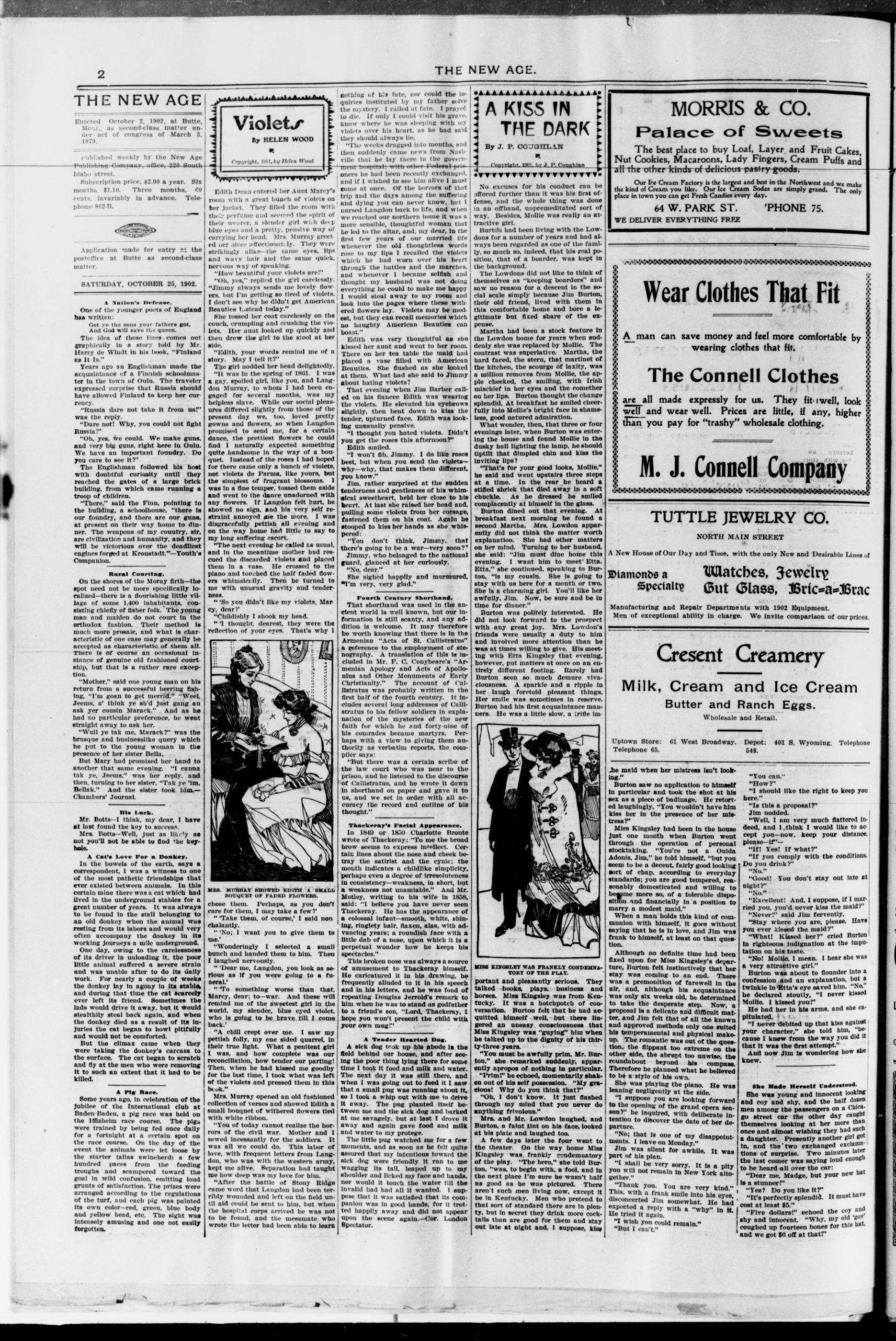
MRS. MURRAY SHOWED EDITH 'A SMALL BOUQUET OF FADED FLOWERS.
MRS. MURRAY SHOWED EDITH A SMALL BOUQUET OF FADED FLOWERS.
chose them. Perhaps, as you don't care for them, I may take a few?'
"Take them, of course," I said non chalantly.
"No; I want you to give them to me."
"Wonderingly I selected a small bunch and handed them to him. Then I laughed nervously.
"Dear me, Langdon, you look as serious as if you were going to a funeral."
"To something worse than that, Marcy, dear; to-war. And these will remind me of the sweetest girl in the world, my slender, blue eyed violet, who is going to be brave till I come back."
"A chill crept over me. I saw my pettish folly, my one sided quarrel, in their true light. What a penitent girl I was, and how complete was our reconciliation, how tender our parting! Then, when he had kissed me goodbye for the last time, I took what was left of the violets and pressed them in this book."
Mrs. Murray opened an old fashioned collection of verses and showed Edith a small bouquet of withered flowers tied with white ribbon.
"You of today cannot realize the horrors of the civil war. Mother and I sewed incessantly for the soldiers. It was all we could do. This labor of love, with frequent letters from Langdon, who was with the western army, kept me alive. Separation had taught me how deep was my love for him.
"After the battle of Stony Ridge came word that Langdon had been terribly wounded and left on the field until aid could be sent to him, but when the hospital corps arrived he was not to be found, and the messmate who wrote the letter had been able to learn
THE NEW AGE.
nothing of his fate, nor could the inquiries instituted by my father solve the mystery. I railed at fate. I prayed to die. If only I could visit his grave, know where he was sleeping with my violets over his heart, as he had said they should always lie.
"The weeks dragged into months, and then suddenly came news from Nashville that he lay there in the government hospital, with other Federal prisoners he had been recently exchanged, and if I wished to see him alive I must come at once. Of the horrors of that trip and the days among the suffering and dying you can never know, but I nursed Langdon back to life, and when we reached our northern home it was a more sensible, thoughtful woman that he led to the altar, and, my dear, in the first few years of our married life whenever the old thoughtless words rose to my lips I recalled the violets which he had worn over his heart through the battles and the marches, and whenever I became selfish and thought my husband was not doing everything he could to make me happy I would steal away to my room and look into the pages where these withered flowers lay. Violets may be modest, but they can recall memories which no haughty American Beauties can boast."
Edith was very thoughtful as she kissed her aunt and went to her room. There on her tea table the maid had placed a vase filled with American Beauties. She flushed as she looked at them. What had she said to Jimmy about hating violets?
That evening when Jim Barber called on his fiancee Edith was wearing the violets. He elevated his eyebrows slightly, then bent down to kiss the tender, upturned face. Edith was looking unusually pensive.
"I thought you hated violets. Didn't you get the roses this afternoon?" Edith smiled.
"I won't fib, Jimmy. I do like roses best, but when you send the violets—why—why, that makes them different, you know."
Jim, rather surprised at the sudden tenderness and gentleness of his whimical sweetheart, held her close to his heart. At last she raised her head and, pulling some violets from her corage, fastened them on his coat. Again he stooped to kiss her hands as she whispered:
"You don't think, Jimmy, that there's going to be a war—very soon?" Jimmy, who belonged to the national guard, glanced at her curiously.
"No, dear."
She sighed happily and murmured, "I'm very, very glad."
Fourth Century Snorland.
That shorthand was used in the ancient world is well known, but our information is still scanty, and any addition is welcome. It may therefore be worth knowing that there is in the Armenian "Aces of St. Callistratus" a reference to the employment of stenography. A translation of this is included in Mr. F. C. Conybeare's "Armenian Apology and Acts of Apollonius and Other Monuments of Early Christianity." The account of Callistratus was probably written in the first half of the fourth century. It includes several long addresses of Callistratus to his fellow soldiers in explanation of the mysteries of the new faith for which he and forty-nine of his comrades became martyrts. Perhaps with a view to giving them authority as verbatim reports, the compiler says:
"But there was a certain scribe of the law court who was near to the prison, and he listened to the discourse of Callistratus, and he wrote it down in shorthand on paper and gave it to us, and we set in order with all accuracy the record and outline of his thought."
Thackeray's Facial Appearance
Thackeray's Facial Appearance. In 1849 or 1850 Charlotte Bronte wrote of Thackeray: "To me the broad brow seems to express intellect. Certain lines about the nose and check betray the satirist and the cynic; the mouth indicates a childlike simplicity, perhaps even a degree of irresoluteness in consistency—weakness, in short, but a weakness not unamabile." And Mr. Motley, writing to his wife in 1888, said: "I believe you have never seen Thackeray. He has the appearance of a colossal infant—smooth, white, shining, ringlety hair, flaxen, alas, with advancing years; a roundish face with a little dab of a nose, upon which it is a perpetual wonder how he keeps his spectacles."
This broken nose was always a source of amusement to Thackeray himself. He caricatured it in his drawing, be frequently alluded to it in his speech and in his letters, and he was fond of repeating Douglas Jerrold's remark to him when he was to stand as godfather to a friend's son, "Lord, Thackeray, I hope you won't present the child with your own mug."
A Tender Hearted Dog.
A sick dog took up his abode in the field behind our house, and after seeing the poor thing lying there for some time I took it food and milk and water. The next day it was still there, and when I was going out to feed it I saw that a small pug was running about it, so I took a whip out with me to drive it away. The pug planted itself between me and the sick dog and barked at me savagely, but at last I drove it away and again gave food and milk and water to my protege.
The little pug watched me for a few moments, and as soon as he felt quite assured that my intentions toward the slick dog were friendly it ran to me wagging its tail, leaped up to my shoulder and licked my face and hands, nor would it touch the water till the invalid had had all it wanted. I suppose that it was satisfied that its companion was in good hands, for it troted happily away and did not appear upon the scene again.-Cor. London Spectator.
Fourth Century Shorthand.
A Tender Hearted Dog
A KISS IN THE DARK
By J. P. COUGHLAN
No excuses for his conduct can be offered further than it was his first offense, and the whole thing was done in an offhand, unpremeditated sort of way. Besides, Mollie was really an attractive girl.
Burton had been living with the Lowdons for a number of years and had always been regarded as one of the family, so much so, indeed, that his real position, that of a boarder, was kept in the background.
The Lowdons did not like to think of themselves as "keeping boarders" and saw no reason for a descent in the social scale simply because Jim Burton, their old friend, lived with them in this comfortable home and bore a legitimate but fixed share of the expense.
Martha had been a stock feature in the Lowdon home for years when suddenly she was replaced by Mollie. The contrast was superlative. Martha, the hard faced, the stern, that martinet of the kitchen, the scourge of laxity, was a million removes from Mollie, the apple cheeked, the smiling, with Irish mischief in her eyes and the comether on her lips. Burton thought the change splendid. At breakfast he smiled cheerfully into Mollie's bright face in shameless, good natured admiration.
What wonder, then, that three or four evenings later, when Burton was entering the house and found Mollie in the dusky hall lighting the lamp, he should tiptilt that dimpled chin and kiss the inviting lips?
"That's for your good looks, Mollie," he said and went upstairs three steps at a time. In the rear he heard a stifled shriek that died away in a soft chuckle. As he dressed he smiled complacently at himself in the glass.
Burton dined out that evening. At breakfast next morning he found a second Martha. Mrs. Lowdon apparently did not think the matter worth explanation. She had other matters on her mind. Turning to her husband, she said: "Jim must dine home this evening. I want him to meet" Etta. Etta," she continued, speaking to Burton, "is my cousin. She is going to stay with us here for a month or two. She is a charming girl. You'll like her awfully. Jim. Now, be sure and be in time for dinner."
Burton was politely interested. He did not look forward to the prospect with any great joy. Mrs. Lowdon's friends were usually a duty to him and involved more attention than he was at times willing to give. His meeting with Etta Kingsley that evening, however, put matters at once on an entirely different footing. Rarely had Burton seen so much demure vivaciousness. A sparkle and a ripple in her laugh foretold pleasant things. Her smile was sometimes in reserve. Burton had his first acquaintance manners. He was a little slow, a rifle im-
M
MISS KINGSLEY WAS FRANKLY CONDEMNATORY OF THE PLAY.
portant and pleasantly serious. They talked books, plays, business and horses. Miss Kingsley was from Kentucky. It was a hotchip of conversation. Burton felt that he had acquitted himself well, but there lingered an uneasy consciousness that Miss Kingsley was "guying" him when he talked up to the dignity of his thirty-three years.
"Prim!" he echoed, momentarily shaken out of his self possession. "My gracious! Why do you think that?"
"Oh, I don't know. It just flashed through my mind that you never do anything frivolous."
Mrs. and Mr. Lowdon laughed, and Burton, a faint tint on his face, looked at his plate and laughed too.
A few days later the four went to the theater. On the way home Miss Kingsley was, frankly condemnatory of the play. "The hero," she told Burton, "was, to begin with, a fool, and in the next place I'm sure he wasn't half as good as he was pictured. There aren't such men living now, except it be in Kentucky. Men who pretend to that sort of standard there are in plenty, but in secret they drink more cocktails than are good for them and stay out late at night and, I suppose, kiss
The best place to buy Loaf, Layer and Fruit Cakes, Nut Cookies, Macaroons, Lady Fingers, Cream Puffs and all the other kinds of delicious pastry goods.
Our Ice Cream Factory is the largest and best in the Northwest and we make the kind of Cream you like. Our Ice Cream Sodas are simply grand. The only place in town you can get Fresh Candies every day.
Wear Clothes That Fit
A man can save money and feel more comfortable by wearing clothes that fit.
The Connell Clothes
are all made expressly for us. They fit well, look well and wear well. Prices are little, if any, higher than you pay for "trashy" wholesale clothing.
M. J. Connell Company
NORTH MAIN STREET
and Time, with the only New and Desirable Lines of
Watches, Jewelry
Gut Glass, Bric=a=Brac
Air Departments with 1902 Equipment.
Quality in charge. We invite comparison of our prices.
Event Creamery
Cream and Ice Cream
Water and Ranch Eggs.
Wholesale and Retail.
Broadway. Depot: 401 S. Wyoming. Telephone
548.
ess isn't look-
"You can."
on to himself
"How?"
A New House of Our Day and Time, with the only New and Desirable Lines of
Manufacturing and Repair Department
Men of exceptional ability in charge
Cresent
Milk, Cream and
Butter and
Wholesale
Uptown Store: 61 West Broadway.
Telephone 65.
Manufacturing and Repair Departments with 1902 Equipment. Men of exceptional ability in charge. We invite comparison of our prices.
Cresent Creamery
Milk, Cream and Ice Cream Butter and Ranch Eggs. Wholesale and Retail.
Uptown Store: 61 West Broadway. Telephone 65. Depot: 401 S. Wyoming. Telephone 548.
he maid when her mistress isn't looking."
Burton saw no application to himself in particular and took the shot at his sex as a piece of badinage. He retorted laughingly, "You wouldn't have him kiss her in the presence of her mistress?"
Miss Kingsley had been in the house just one month when Burton went through the operation of personal stocktaking. "You're not a Oulda Adonis, Jim," he told himself, "but you seem to be a decent, fairly good looking sort of chap, according to everyday standards; you are good tempered, reasonably domesticated and willing to become more so, of a tolerable disposition and financially in a position to marry a modest maid."
"You can."
"How?"
"I should like the right to keep you here."
"Is this a proposal?"
Jim nodded.
"Well, I am very much flattered indeed, and I, think I would like to accept you—now, keep your distance, please—if?"
"If! Yes! If what?"
"If you comply with the conditions. Do you drink?"
"No."
"Good! You don't stay out late at night?"
"No."
"Excellent! And, I suppose, if I married you, you'd never kiss the maid?"
When a man holds this kind of communion with himself, it goes without saying that he is in love, and Jim was frank to himself, at least on that question.
Although no definite time had been fixed upon for Miss Kingsley's departure, Burton felt instinctively that her stay was coming to an end. There was a premonition of farewell in the air, and, although his acquaintance was only six weeks old, he determined to take the desperate step. Now, a proposal is a delicate and difficult matter, and Jim felt that of all the known and approved methods only one suited his temperamental and physical makeup. The romantic was out of the question, the flippant too extreme on the other side, the abrupt too unwise, the roundabout beyond his compass. Therefore he planned what he believed to be a style of his own.
She was playing the piano. He was leaning negligently at the side.
"I suppose you are looking forward to the opening of the grand opera season?" he inquired, with deliberate intention to discover the date of her departure.
"No; that is one of my disappointments. I leave on Monday."
Jim was silent for awhile. It was part of his plan.
"I shall be very sorry. It is a pity you will not remain in New York altogether."
"Thank you. You are very kind." This, with a frank smile into his eyes, disconcerted Jim somewhat. He had expected a reply with a "why" in it. He tried it again.
"But I can't."
---
Diamonds a Specialty
"I wish you could remain."
"You can."
"How?"
"I should like the right to keep you here."
"Is this a proposal?"
Jim nodded.
"Well, I am very much flattered indeed, and I think I would like to accept you—now, keep your distance, please—if"—
"If! Yes! If what?"
"If you comply with the conditions. Do you drink?"
"No."
"Good! You don't stay out late at night?"
"No."
"Excellent! And, I suppose, if I married you, you'd never kiss the maid?"
"Never!" said Jim fervently.
"Stay where you are, please. Have you ever kissed the maid?"
"What! Kissed her?" cried Burton in righteous indignation at the imputation on his taste.
"No! Mollie, I mean. I hear she was a very attractive girl."
Burton was about to flounder into a confession and an explanation, but a twinkle in Etta's eye saved him. "No," he declared stoutly, "I never kissed Mollie, I kissed you!"
He had her in his arms, and she capitulated.
"I never debited up that kiss against your character," she told him, "because I knew from the way you did it that it was the first attempt."
And now Jim is wondering how she knew.
She Made Herself Understood.
She was young and innocent looking and coy and shy, and the half dozen men among the passengers on a Chicago street car the other day caught themselves looking at her more than once and almost wishing they had such a daughter. Presently another girl got in, and the two exchanged exclamations of surprise. Two minutes later the last comer was saying loud enough to be heard all over the car:
"Dear me, Madge, but your new hat is a stunner!"
"Yes? Do you like it?"
"It's perfectly splendid. It must have cost at least $5."
"Five dollars!" echoed the coy and shy and innocent. "Why, my old 'gov' coughed up fourteen bones for this hat, and we got $6 off at that!"
Jobbing, Cabinet and Office Fixtures a Specialty.
216 WEST BROADWAY
Overland Rye
THE
Troy Laundry Go.
Will call for and Deliver that Laundry.
Ring Up 'Phone 2
Remember
ATTROY LAUNDRY
2. 232 South Main
itte Floral
The Leading Decorators and
Florists of Montana
Cut Flowers and Plants
ations and Designs a Speci
...Ring Up 'Phone 2...
TROY LAUNDRY Phone 2. 232 South Main Street
The Leading Decorators and Florists of Montana
Cut Flowers and Plants Decorations and Designs a Specialty
Salesroom, 107 West Broadway.
een Houses at Gregson Springs. Telephone
A large supply of beautiful carnations and roses and owers are always carried. All orders receive prompt attention
For a real swell, up-to-date suit of clothes, at very moderate prices, call on
The Fashionable Tailor 305 North Main St., Butte
101 W. Granite St., Cor. Alaska
Ladies' and Gents' Garments C'eaned, Dyed
Pressed and Repaired, Equal to New
Goods Called for and Delivered. ALBERT BARCLAY.
Telephone 826M. Proprietor.
Now that the warm days are here, Drink only Butte Brewing Co.'s
PHONE... IF YOU WANT A COOL ...252 INVIGORATING STIMUMANT
THE NEW AGE.
Juliet sat by the window with her hands folded in her lap. She was waiting for Mr. Barnard. Kathleen smiled as she passed through the room. "Juliet always wears white and violet when somebody is going to propose to her," she said to Jerry as she joined him on the veranda of the log camping house. "It's so fetching with her violet eyes and hair. I've seen her wear the combination just three times in the last month. It makes her look remarkably young and innocent, doesn't it? Jerry laughed.
"I should say so! She can make twenty-five show for seventeen better than any one I ever saw. But does she always refuse her offers, doesn't she ever accept anybody? Just for a little while, you know!"
"No, but she refuses men so tenderly, so tentatively that they hardly realize it at first. She would love them so dearly, you know, but for that
A
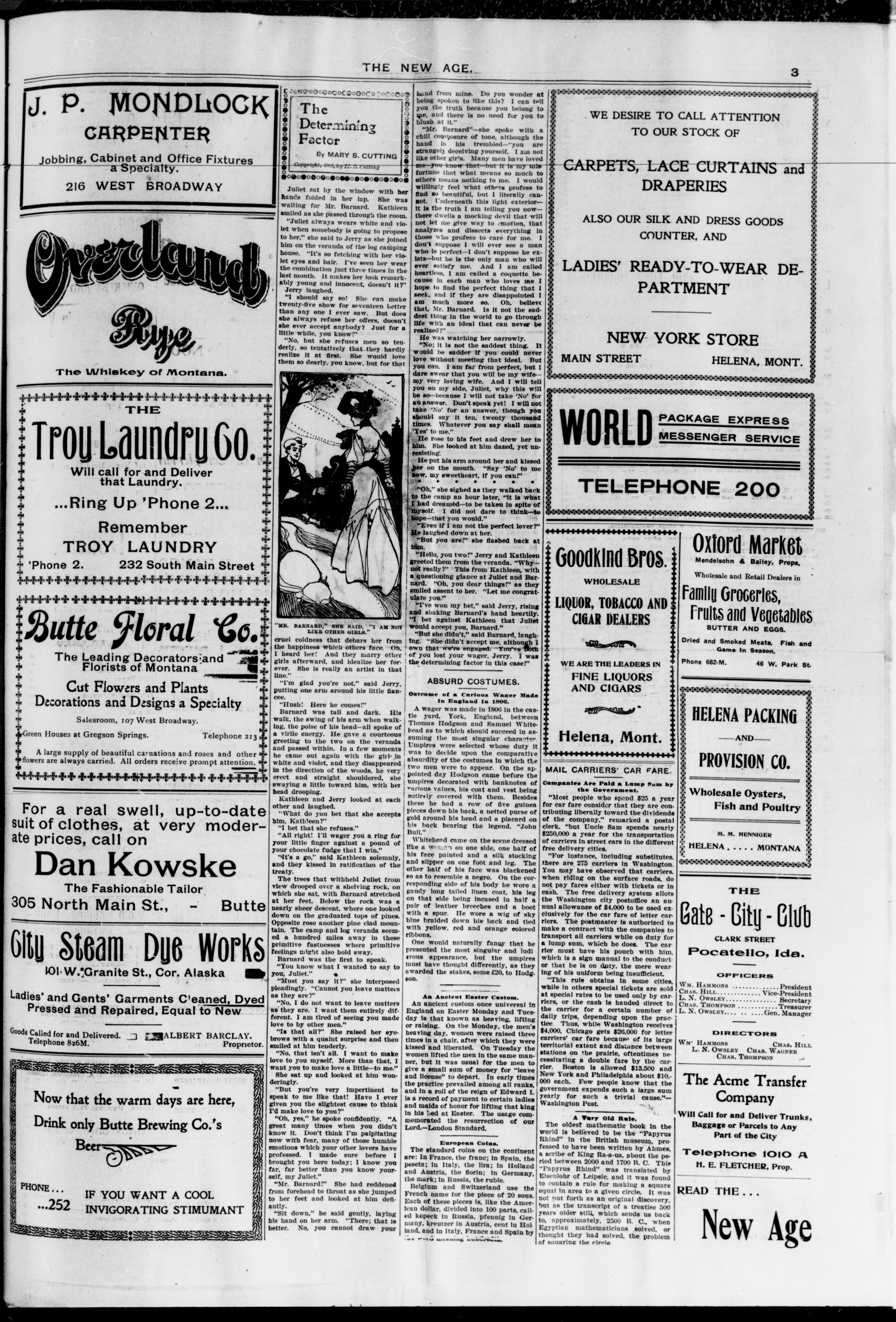
"MR. BARNARD," SHE SAID, "I AM NOT LIKE OTHER GIRLS."
cruel coldness that debars her from the happiness which others face. Oh, I heard her! And they marry other girls afterward, and idealize her forever. She is really an artist in that line.
"I'm glad you're not," said Jerry, putting one arm around his little flancee.
"Hush! Here he comes!" Barnard was tall and dark. His walk, the swing of his arm when walking, the poise of his head—all spoke of a virile energy. He gave a courteous greeting to the two on the veranda and passed within. In a few moments he came out again with the girl in white and violet, and they disappeared in the direction of the woods, he very erect and straight shouldered, she swaying a little toward him, with her head drooping.
Kathleen and Jerry looked at each other and laughed.
"What do you bet that she accepts him, Kathleen?"
"I bet that she refuses."
"All right! I'll wager you a ring for your little finger against a pound of your chocolate fudge that I win."
"It's a go," said Kathleen solemnly, and they kissed in ratification of the treaty.
The trees that withheld Juliet from view drooped over a shelving rock, on which she sat, with Barnard stretched at her feet. Below the rock was a nearly sheer descent, where one looked down on the graduated tops of pines. Opposite rose another pine clad mountain. The camp and log veranda seemed a hundred miles away in these primitive fastnesses where primitive feelings might also hold sway.
Barnard was the first to speak.
Barnard was the first to speak.
"You know what I wanted to say to you, Jullet."
"Must you say it?" she interposed pleadingly. "Cannot you leave matters as they are?"
"No, I do not want to leave matters as they are. I want them entirely different. I am tired of seeing you made love to by other men."
"Is that all?" She raised her eyebrows with a quaint surprise and then smiled at him tenderly.
"No, that isn't all. I want to make love to you myself. More than that, I want you to make love a little—to me."
She sat up and looked at him wonderingly.
"But you're very impertinent to speak to me like that! Have I ever given you the slightest cause to think I'd make love to you?"
"Oh, yes," he spoke confidently. "A great many times when you didn't know it. Don't think I'm palpitating now with fear, many of those humble emotions which your other lovers have professed. I made sure before I brought you here today; I know you far, far better than you know yourself, my Juliet."
"Mr. Barnard!" She had reddened from forehead to throat as she jumped to her feet and looked at him defiantly.
"Sit down," he said gently, laying his hand on her arm. "There; that is better. No, you cannot draw your
"Hush! Here he comes!"
"I bet that she refuses."
hand from mine. Do you wonder at being spoken to like this? I can tell you the truth because you belong to me, and there is no need for you to blush at it."
"Mr. Barnard"—she spoke with a chill composition of tone, although the hand in his trembled—"you are strangely decelving yourself. I am not like other girls." Many men have loved me—you know that, but it is my misfortune that what means so much to others means nothing to me. I would willingly feel what others profess to find so beautiful, but I literally cannot. Underneath this light exterior—it is the truth I am telling you now—there dwells a mocking devil that will not let me give way to emotion, that analyzes and dissects everything in those who profess to care for me. I don't suppose I will ever see a man who is perfect—I don't suppose he exists—but he is the only man who will ever satisfy me. And I am called heartless, I am called a coquette because in each man who loves me I hope to find the perfect thing that I seek, and if they are disappointed I am much more so. Oh, believeth that, Mr. Barnard. Is it not the saddest thing in the world to go through life with an ideal that can never be realized?"
He was watching her harrowly.
"No; it is not the saddest thing. It would be sadder if you could never love without meeting that ideal. But you can. I am far from perfect, but I dare swear that you will be my wife—my very loving wife. And I will tell you on my side, Juliet, why this will be so—because I will not take 'No' for an answer. Don't speak yet! I will not take 'No' for an answer, though you should say it ten, twenty thousand times. Whatever you say shall mean 'Yes' to me."
He rose to his feet and drew her to him. She looked at him dazed, yet unresisting.
He put his arm around her and kissed her on the mouth. "Say 'No' to me now, my sweetheart, if you can!"
"Oh," she sighed as they walked back to the camp an hour later, "it is what I had dreamed—to be taken in spite of myself. I did not dare to think—to hope—that you would."
"Even if I am not the perfect lover?" He laughed down at her.
"But you are!" she flashed back at him.
"Hello, you two!" Jerry and Kathleen greeted them from the veranda. "Why—not really?" This from Kathleen, with a questioning glance at Juliet and Barnard. "Oh, you dear things!" as they smiled assent to her. "Let me congratulate you."
"I've won my bet," said Jerry, rising and shaking Barnard's hand heartily. "I bet against Kathleen that Juliet would accept you, Barnard."
"But she didn't," said Barnard, laughing. "She didn't accept me, although I own that we were engaged. You've both of you lost your wager, Jerry. I was the determining factor in this case!"
ABSURD COSTUMES.
Outcome of a Curious Wager Made In England In 1806.
A wager was made in 1806 in the castle yard, York, England, between Thomas Hodgson and Samuel Whitehead as to which should succeed in assuming the most singular character. Umpires were selected whose duty it was to decide upon the comparative absurdity of the costumes in which the two men were to appear. On the appointed day Hodgson came before the umpires decorated with banknotes of various values, his coat and vest being entirely covered with them. Besides these he had a row of five guinea pieces down his back, a netted purse of gold around his head and a placard on his back bearing the legend, "John Bull."
Whitehead came on the scene dressed like a woman on one side, one half of his face painted and a silk stocking and slipper on one foot and leg. The other half of his face was blackened so as to resemble a negro. On the corresponding side of his body he wore a gaudy long tailed linen coat, his leg on that side being incased in half a pair of leather breeches and a boot with a spur. He wore a wig of sky blue braided down his back and tied with yellow, red and orange colored ribbons.
One would naturally fancy that he presented the most singular and ludirous appearance, but the umpires must have thought differently, as they awarded the stakes, some £20, to Hodgson.
An Ancient Easter Custom.
An ancient custom once universal in England on Easter Monday and Tuesday is that known as heaving, lifting or raising. On the Monday, the men's heaving day, women were raised three times in a chair, after which they were kissed and liberated. On Tuesday the women lifted the men in the same manner, but it was usual for the men to give a small sum of money for "leave and license" to depart. In early times the practice prevailed among all ranks, and in a roll of the reign of Edward I. is a record of payment to certain ladies and maids of honor for lifting that king in his bed at Easter. The usage commemorated the resurrection of our Lord.—London Standard.
European Coins.
The standard coins on the continent are: In France, the franc; in Spain, the peseta; in Italy, the lira; in Holland and Austria, the florin; in Germany, the mark; in Russia, the ruble. Belgium and Switzerland use the French name for the piece of 20 sous. Each of these pieces is, like the American dollar, divided into 100 parts, called kopeck in Russia, pfennig in Germany, kreutzer in Austria, cent in Holland, and in Italy, France and Spain by the same means successively.
WE DESIRE TO CALL ATTENTION TO OUR STOCK OF
CARPETS, LACE CURTAINS and DRAPERIES
ALSO OUR SILK AND DRESS GOODS COUNTER, AND
LADIES' READY-TO-WEAR DEPARTMENT
NEW YORK STORE
TREET HELENA, MONT.
WORLD PA
ME
TELEPH
Goodkind Bros.
TELEPHONE 200
Goodkind Bros.
WHOLESALE
LIQUOR, TOBACCO AND
CIGAR DEALERS
Oxford Market
Mendelsohn & Bailey, Props.
Wholesale and Retail Dealers in
Family Groceries,
Fruits and Vegetables
BUTTER AND EGGS.
Dried and Smoked Meats, Fish and
Game In Season.
Phone 682-M. 46 W. Park St.
HELENA PACKING
AND
PROVISION CO
WE ARE THE LEADERS IN FINE LIQUORS AND CIGARS
Helena, Mont.
MAIL CARRIERS' CAR FARE.
Companies Are Paid a Lump Sum by the Government.
"Most people who spend $25 a year for car fare consider that they are contributing liberally toward the dividends of the company," remarked a postal clerk, "but Uncle Sam spends nearly $250,000 a year for the transportation of carriers in street cars in the different free delivery cities.
"For instance, including substitutes, there are 275 carriers in Washington. You may have observed that carriers, when riding on the surface roads, do not pay fares either with tickets or in cash. The free delivery system allots the Washington city postoffice an annual allowance of $4,000 to be used exclusively for the car fare of letter carriers. The postmaster is authorized to make a contract with the companies to transport all carriers while on duty for a lump sum, which he does. The carrier must have his pouch with him, which is a sign manual to the conduct or that he is on duty, the mere wearing of his uniform being insufficient.
"This rule obtains in some cities, while in others special tickets are sold at special rates to be used only by carriers, or the cash is handed direct to the carrier for a certain number of daily trips, depending upon the practice. Thus, while Washington receives $4,000, Chicago gets $26,000 for letter carriers' car fare because of its large territorial extent and distance between stations on the prairie, oftentimes necessitating a double fare by the carrier. Boston is allowed $13,500 and New York and Philadelphia about $10,000 each. Few people know that the government expends such a large sum yearly for such a trivial cause."—Washington Post.
The oldest mathematic book in the world is believed to be the "Papyrus Rhind" in the British museum, professed to have been written by Ahmes, a scribe of King Ra-a-us, about the period between 2000 and 1700 B. C. This "Papyrus Rhind" was translated by Eisenlohr of Leipse, and it was found to contain a rule for making a square equal in area to a given circle. It was not put forth as an original discovery, but as the transcript of a treatise 500 years older still, which sends us back to, approximately, 2500 B. C., when Egyptian mathematicians solved, or thought they had solved, the problem of squaring the circle.
---
---
MAIN STREET
WHOLESALE
---
A Very Old Rule
PACKAGE EXPRESS
MESSENGER SERVICE
Wholesale Oysters Fish and Poultry
CLARK STREET Pocatello, Ida.
WM. HAMMONS ..... President
HAM. HILL ..... Vice-President
L. N. OWSLEY ..... Secretary
CHAS. THOMPSON ..... Treasurer
L. N. OWSLEY ..... Gen. Manager
The Acme Transfer Company
Will Call for and Deliver Trunks,
Baggage or Parcels to Any
Part of the City
Telephone 1010 A
H. E. FLETCHER, Prop.
READ THE... New Age
4
Contracting Painters and Paperhangers
PHOTOGRAPHS AND KODAK
WORK
FLASH LIGHT WORK AND PHOTO
BUTTONS.
221 South Arizona Street.
PHONE 845-B
BUTTE.....MONTANA
LOCAL NOTES
Mrs. E. J. Brown has been confined to her bed this week.
Mr. Jas. Collins was confined to his room for two days last week.
Subscribe for the New Age, the leading race journal of the intermountain region.
Mr. Chas. Campbell of Ogden, Utah, is in the city this week with a view of locating.
Mrs. Ella Allen has been indisposed this week. We wish for her a speedy recovery.
For Rent—Three furnished rooms for light housekeeping, 1231 W. Granite, Mrs. H. Johnson.
There will be a grand democratic rally Wednesday night at the Colored Democratic club on Hamilton street. Members and candidates are requested to attend.
Mr. John C. Allen, the genial secretary of the colored democratic club, was unable to be at his post last Saturday from the effects of an ague.
Mr. Chris Dorsey returned Saturday from an extended tour of the state. He also visited the national park while in that vicinity, and while in the western portion of the state he took a short run over to Spokane.
The Citizens' Coal company, dealers in Kemmerer, Rock Springs, Rocky Fork and Trail Cree coal, also good dry pine and fir wood. We give 2000 pounds to the ton. No. 4 East Broadway. Telephone 538.
Mrs. Birthright was on the sick list last week from the effects of a severe cold. She is, however, able to be at her post at her commodious hair dressing parlors on West Broadway. We wish her a speedy recovery.
Mr. F. W. Green and Wm. Jones were initiated into the Odd Fellows lodge last Monday evening. We failed to see the goat. However, if he looks as thin as those two boys, he will not be ready for service for several weeks hence.
Mrs. Alice Sager entertained Mrs. S. A. Smith and J. W. Duncan at dinner Sunday evening. Mrs. Smith, who has been the guest of Mrs. Sager for several weeks, has moved to her home on West Broadway.
Mr. A. D. Griffen and Mr. Lucas, both of Portland, were in the city this week. Mr. Griffen is a newspaper man and Mr. Lucas is an attorney. Both gentlemen are stopping at the Southern, while in the city.
The infant son of Mr. and Mrs. James died last Thursday. The funeral took place Saturday afternoon at 2 o'clock, from the family residence, No. 517 West Galena street.
Wanted—Colored cotton field hands to grow cotton in west Africa. Comfortable homes and just treatment guaranteed. Deserving applicants please write to New Cotton Fields Limited, 43 Devonshire Chambers, Bishopsgatestreet, London, England.
There will be a ball given by the ladies of the Eastern Star chapter Wednesday evening, Oct. 29, 1902, at LaFord's dancing academy, 317 Dakota street. Admission 75 cents per couple. Ladies unaccompanied by gentlemen 25 cents. Refreshments served. Yourself and friends are invited to attend.
Born—To Mr. and Mrs. E, J. Brown, a fine 14-pound boy; but to the dismay of the parents the little infant had hardly revived until it fell asleep, never to awake again. The condition of Mrs. Brown was considered very dangerous, however at this writing she is resting easy and doesn't seem to suffer any alarm. We wish for her a speedy recovery.
The Tom Thumb wedding which was scheduled to take place last Monday evening. October 20, was pulled off on time and old Tom and Miss Minnie Warren are now enjoying the blessings of matrimony. The affair was conducted by Mrs. Ennis Bell, who deserves great credit for the successful manner in which the wedding was carried out. The attendance was good, which rendered it a financial success.
Quite a large crowd attended the Silver Bow literary meeting at Shaffer's chapel last Thursday evening. Again the issues of the day were brought up for discussion, Mr. A. S. Swift on hand in defence of the democracy and made quite an interesting talk about the candidates on the Clark ticket.
A number of other speakers were in evidence and made things whoop up for awhile, but as usual, the Clark delegation made the other parties look like thirty cents.
The Afro-American Woman's club enjoyed an interesting meeting Tuesday afternoon. Mrs. John Tate entertained the club. Current topic was in discussion, including appointing a few officers: Mrs. J. Bullet, chairman of literature; Mrs. J. A. Scott, treasurer; Mrs. I. Hayes, financial treasurer; Miss Lee Bell, journalist; Mrs. Sell Reeves, correspondent secretary. Mrs. Tate served chocolate and cake, and a few minutes of pleasure was enjoyed. Mrs. Tate presented each lady with a pen nut, with a saying of her own composition, which caused much merriment. The meeting adjourned to meet with Mrs. Ike Hayes, No. 11 Gold street, November 4th.
Mrs. Griffin of Franklin avenue, is very sick at St. Marks hospital.
Mr. Stewart was removed to the poor house recently.
Mr. and Mrs. White left for Denver, Colorado, this week.
Mr. L. K. Steele has been quite sick for several days.
We are glad to note that Mrs. A. Thompson is gaining her health rapidly.
Mr. Thomas Sutners, headwaiter of The Tavering, and family left for Pocatello Tuesday.
Mrs. J. W. Durham entertained Mr. and Mrs. W. D. Powell at luncheon Sunday evening last.
Mrs. Wm. Robinson and Mrs. Hodges were entertained at dinner last Sunday by Mrs. E. Smith.
Brother E. D. Washington spoke at the Cavalry Baptist church last Sunday night. The theme of the discourse was the "Third Angel's Message," of Revelation 14:6, which was listened to with much interest by a large congregation.
Tuesday, after quite an extended trip, Among the cities he visited are Portland, Seattle, Omaha, Chicago and New York City.
Mrs. Susan Blanchard is very sick under the doctor's care, at her residence, 250 south 3rd street west. Let us not forget to visit our sick. Remember, that a friend in need is a friend in deed.
Mr. Bruce Kenney, the general missionary, was at the Baptist church last Sunday night, and was much interested with the progress I made by the Cavalry church under the pastoralship of Rev. J. W. Washington.
Rev. J. W. Washington will celebrate his first pastoral anniversary at Cavalry Baptist church, corner of Second South and Fifth East, on the evening of the first of November. There will be an interesting program rendered. Every one should endovor to be present. While they will enjoy the program they will also show their appreciation of the good work done by Rev. Washington, since he has been in the city.
Mr. W. A. Wright returned last We are glad the coal strike seems to be settled, and the unrest manifested among the people of the country is like the caining of the sea after a mighty storm. This is the first time in history that the president was called upon to settle trouble between capital and labor. But President Roosevelt's method receives congratulations, not only from different parts of this country, but from other countries as well, and we believe the appointment of the commissions has laid the foundation for all like trouble to be settled in the future by arbitration. While the findings of the commission will not be made known for several days, every one looks forward to it with great satisfaction.
HELENA DEPARTMENT
Mrs. Harry Simmons is able to be out again.
Mrs. Emma Simpson was indisposed a few days last week.
Mrs. E. G. Cole is suffering from a heavy cold.
There will e an Halloween entertainment at the church Friday week.
Mr. Louie Hawkins from California, is in our city.
Mrs. C. Bramble will entertain Mr. Hawkins, from California, this evening.
The swellest event of the week was that of the first grand annual ball and reception given by the Knockers' Social club at Central park Tuesday night, which proved to be a success in every way. It excelled and far exceeded anything of its kind ever given in Helena among the colored people. It was largely attended, even if there were no cars running and the city was in darkness. A 'bus left the corner of Main street and Sixth avenue at 9 o'clock sharp, which held fully thirty people. They reached the park in time for the grand march, which was at 9:30. Invitations had to be presented at the door, and the committee saw that the everyone was treated equally alike. A delicious lunch was served during the evening, consisting of ham sandwiches, ice cream and cake and claret punch. The boys in blue were
THE NEW AGE.
very sociable and did everything in their power to make it pleasant for everyone, which was appreciated by the citizens of Helena. If asked how they enjoyed the dance the answer is "It is the best time I ever had in my life." The music was furnished by the Fort Harrison orchestra. The officers of the club are Joseph H. Tucker, supreme knocker; Chas, Ecton, first assistant supreme knocker; Samuel Copeland, second assistant supreme knocker; William Turner, supreme chrente; Joseph A. Marshall, chief bag holder; George Smith, chief hammer swinger, and John Nichols, and George Washington, grand bouncers. The men behind the gun, James C. Pinkston and James Young.
W. W. Mc D
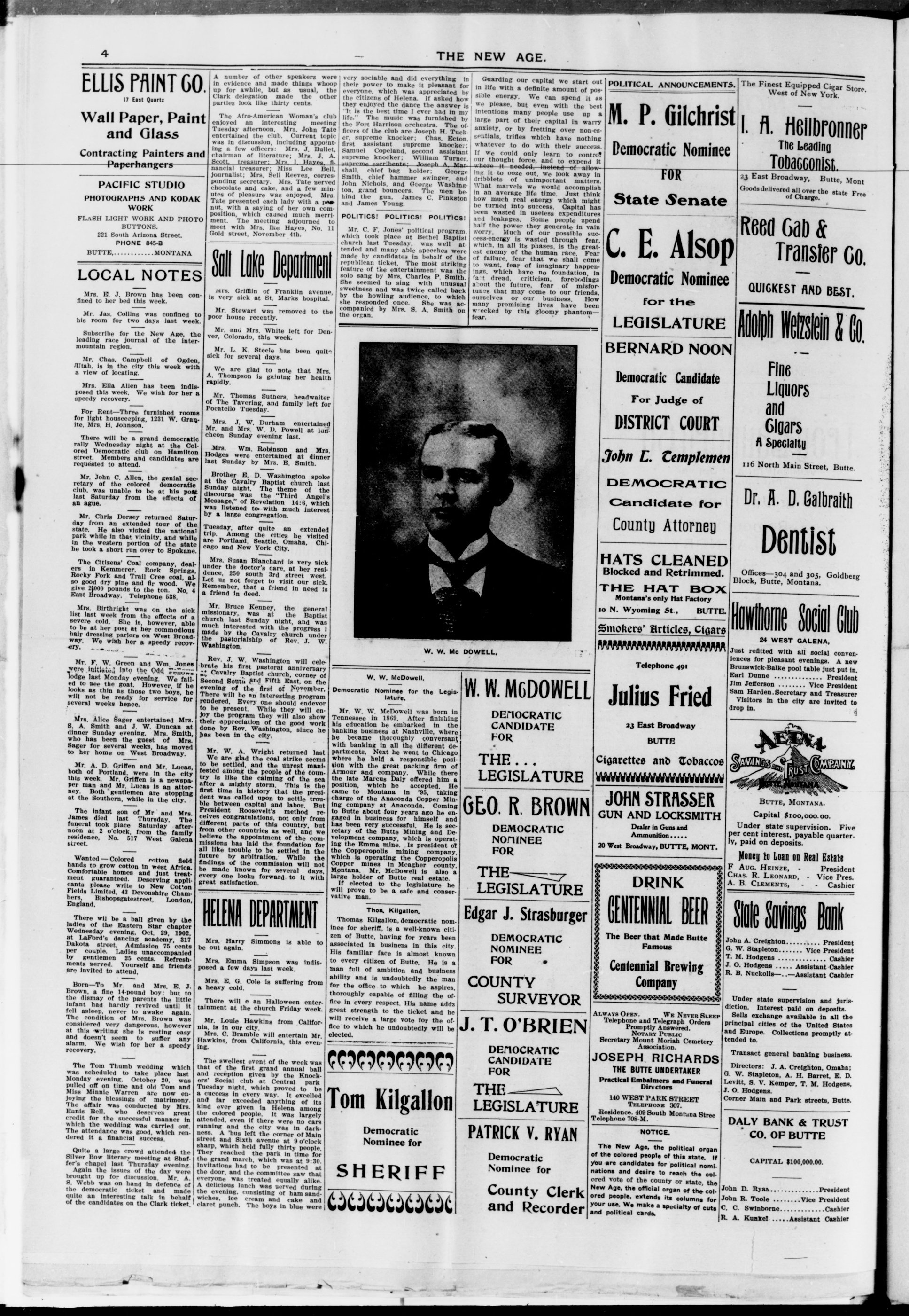
W. Mc DOWELL.
M.
ed. He taking er Min- Coming he en- iff and GEO. R. BROWN
Tom Kilgallon
SHERIFF
---
POLITICS! POLITICS! POLITICS!
Mr. C. F. Jones' political program which took place at Bethel Baptist church last Tuesday, was well attended and many able speeches were made by candidates in behalf of the republican ticket. The most striking feature of the entertainment was the solo sang by Mrs. Charles P. Smith. She seemed to sing with unusual sweetness and was twice called back by the howling audience, to which she responded once. She was accompanied by Mrs. S. A. Smith on the organ.
W. W. McDowell.
Democratic Nominee for the Legislature.
Mr. W. W. McDowell was born in Tennessee in 1869. After finishing his education he embarked in the bankins business at Nashville, where he became thoroughly conversant with banking in all the different departments. Next he went to Chicago where he held a responsible position with the great packing firm of Armour and company. While there the late Marcus Daly offered him a position, which he accepted. He came to Montana in '95, taking charge of the Anaconda Copper Mining company at Anaconda. Coming to Butte about four years ago he engaged in business for himself and has been very successful. He is secretary of the Butte Mining and Development company, which is operating the Emma mine. Is president of the Copperopolis mining company, which is operating the Copperopolis Copper mines in Meagher county, Montana. Mr. McDowell is also a large holder of Butte real estate.
If elected to the legislature he will be to be a safe and conservative man.
Thos, Kilgallon.
Thomas Kilgaillon, democratic nominee for sheriff, is a well-known citizen of Butte, having for years been associated in business in this city. His familiar face is almost known to every citizen of Butte. He is a man full of ambition and business ability and is undoubtedly the man for the office to which he aspires, thoroughly capable of filling the office in every respect. His name adds great strength to the ticket and he will receive a large vote for the office to which he undoubtedly will be elected.
Democratic Nominee for
Guarding our capital we start out in life with a definite amount of possible energy. We can spend it as we please, but even with the best intentions many people use up a large part of their capital in warry anxiety, or by fretting over non-essentials, trifles which have nothing whatever to do with their success. If we could only learn to control our thought force, and to expend it where it needed, instead of allowing it to ooze out, we look away in dribblets of unimportant matters. What marvels we would accomplish in an average life time. Just think how much real energy which might be turned into success. Capital has been wasted in useless expenditures and leakages. Some people spend half the power they generate in vain worry. Much of our possible success-energy is wasted through fear, which, in all its phases, is the greatest enemy of the human race. Fear of failure, fear that we shall come to want, fear of imaginary happenings, which have no foundation, in fast dread, criticism, forebodings about the future, fear of misfortunes that may come to our friends, ourselves or our business. How many promising lives have been wrecked by this gloomy phantom—fear.
W. W. MGDOWELL
DEMOCRATIC CANDIDATE FOR THE... LEGISLATURE
DEMOCRATIC
NOMINEE
FOR
THE
LEGISLATURE
Edgar J. Strasburger
DEMOCRATIC
NOMINEE
FOR
COUNTY
SURVEYOR
J. T. O'BRIEN
DEMOCRATIC
CANDIDATE
FOR
THE
LEGISLATURE
PATRICK V. RYAN
Democratic Nominee for County Clerk and Recorder
POLITICAL ANNOUNCEMENTS.
M. P. Gilchrist
Democratic Nominee
FOR
State Senate
C. E. Alsop Democratic Nominee
LEGISLATURE
BERNARD NOON
Democratic Candidate
For Judge of
DISTRICT COURT
John L. Templemen
DEMOCRATIC
Candidate for
County Attorney
HATS CLEANED
Blocked and Retrimmed.
THE HAT BOX
Montana's only Hat Factory
10 N. Wyoming St., BUTTE.
Smokers' Articles, Cigars
Telephone 491
Julius Fried
23 East Broadway
BUTTE
Cigarettes and Tobaccos
JOHN STRASSER
GUN AND LOCKSMITH
Dealer in Guns and
Ammunition .....
20 West Broadway, BUTTE, MONT.
DRINK
GENTENNIAL BEER
The Beer that Made Butte
Famous
Centennial Brewing
Company
ALWAYS OPEN. WE NEVER SLEEP
Telephone and Telegraph Orders
Promptly Answered.
NOTARY PUBLIC
Secretary Mount Moriah Cemetery
Association.
THE BUTTE UNDERTAKER
Practical Embalmers and Funeral
Directors
140 WEST PARK STREET
TELEPHONE 307.
Residence. 409 South Montuna Stree
Telephone 708-M.
NOTICE.
The New Age, the political organ of the colored people of this state. If you are candidates for political nominations and desire to reach the colored vote of the county or state, the New Age, the official organ of the colored people, extends its columns for your use. We make a specialty of cuts and political cards.
The Finest Equipped Cigar Store. West of New York.
I. A. Heilbronner
The Leading Tobaccoist.
23 East Broadway, Butte, Mont
Goods delivered all over the state Free of Charge.
Reed Gab & Transfer Co.
QUIGKEST AND BEST. Adolph Wetzstein & Co.
Fine
Liquors
and
Gigars
A Specialty
116 North Main Street, Butte.
Dr. A. D. Galbraith
Dentist
Offices—304 and 305, Goldberg Block, Butte, Montana.
Hawthorne Social Club
24 WEST GALENA,
Just refitted with all social conveniences for pleasant evenings. A new Brunswick-Balke pool table just put in. Earl Dunne ..... President
Jim Jefferson ..... Vice President
Sam Harden.Secretary and Treasurer
Visitors in the city are invited to drop in.
AETNA
SAVINGS AND TRUST COMPANY.
BETT, ARKANSAS
Under state supervision. Five per cent interest, payable quarterly, paid on deposits.
Money to Loan on Real Estate
F AUG. HEINZE, - President
CHAS. R. LEONARD, - Vice Pres.
A. B. CLEMENTS, - Cashier
State Savings Bank
John A. Creighton.....President
G. W. Stapleton.....Vice President
T. M. Hodgens.....Cashier
J. O. Hodgens.....Assistant Cashier
R. B. Nuckolls---Assistant Cashier
Under state supervision and jurisdiction. Interest paid on deposits. Sells exchange available in all the principal cities of the United States and Europe. Collections promptly attended to.
Transact general banking business.
Directors: J. A. Creighton, Omaha; G. W. Stapleton, A. H. Barret, E. D. Levitt, S. V. Kemper, T. M. Hodgens, J. O. Hodgens.
Corner Main and Park streets, Butte.
DALY BANK & TRUST
CO. OF BUTTE
CAPITAL $100,000.00.
John D. Ryan.....President
John R. Toole .....Vice President
C. C. Swinborne.....Cashier
R. A. Kunkel .....Assistant Cashier