The New Age (Butte)
Saturday, November 22, 1902
Butte, Montana
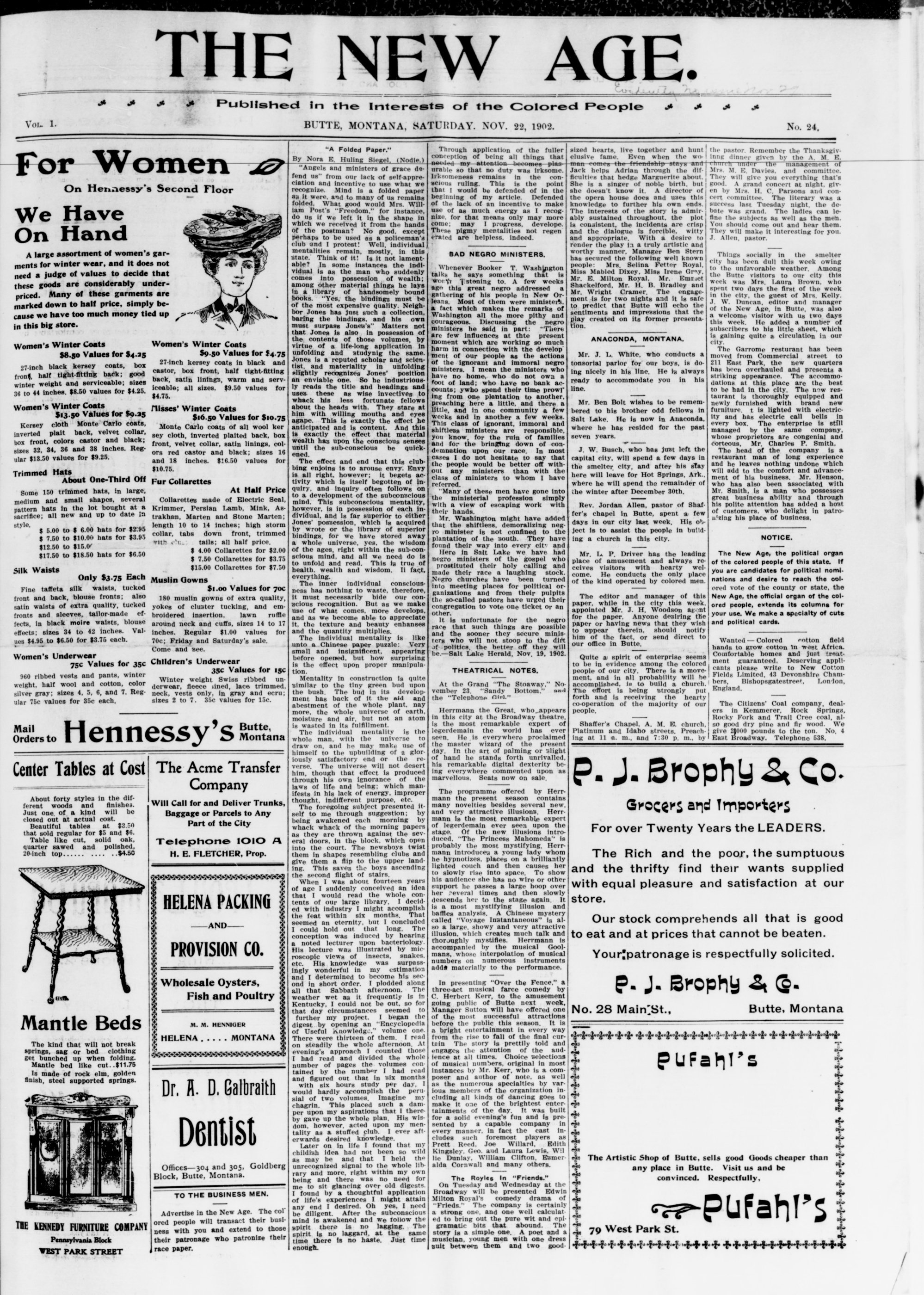
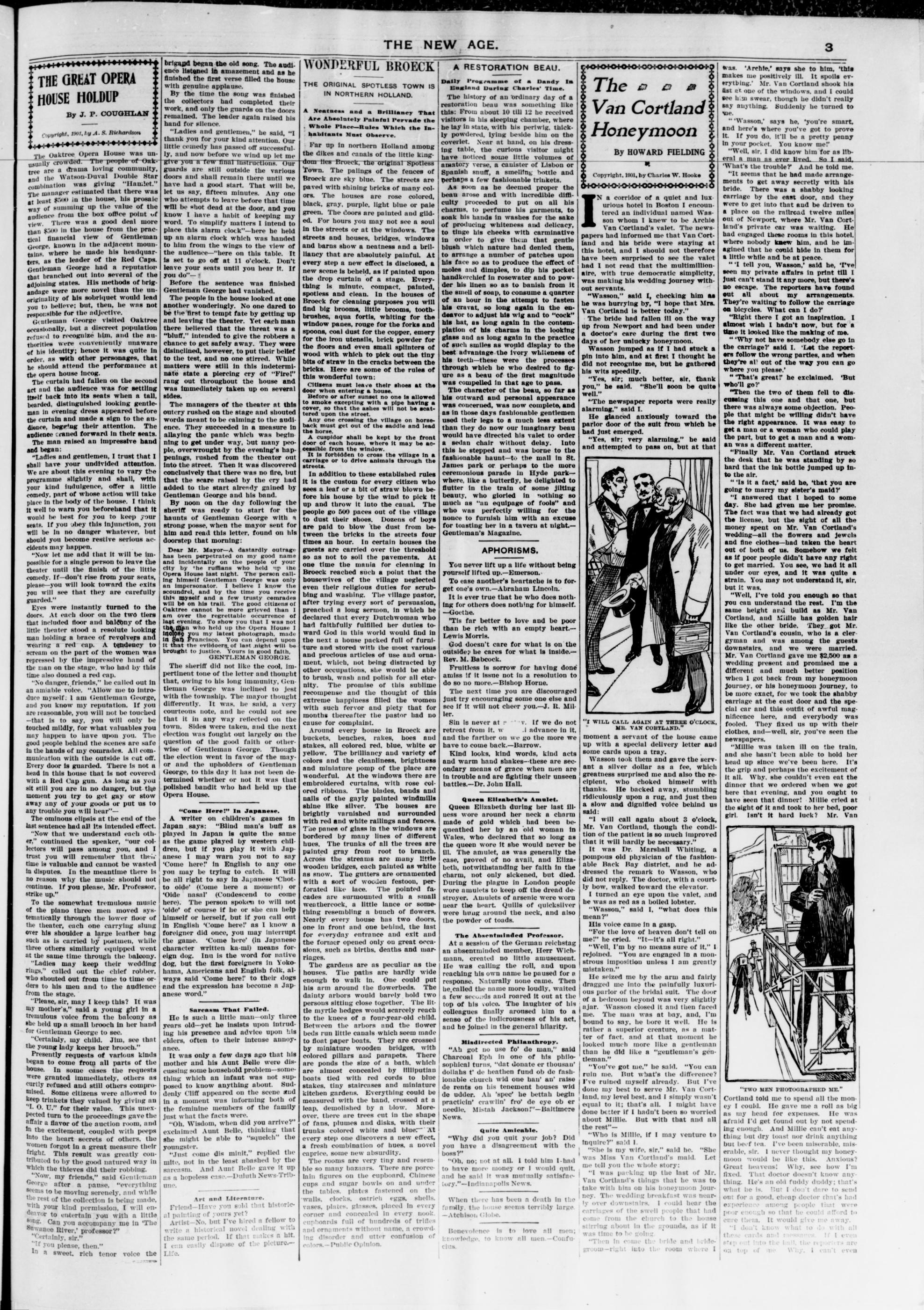
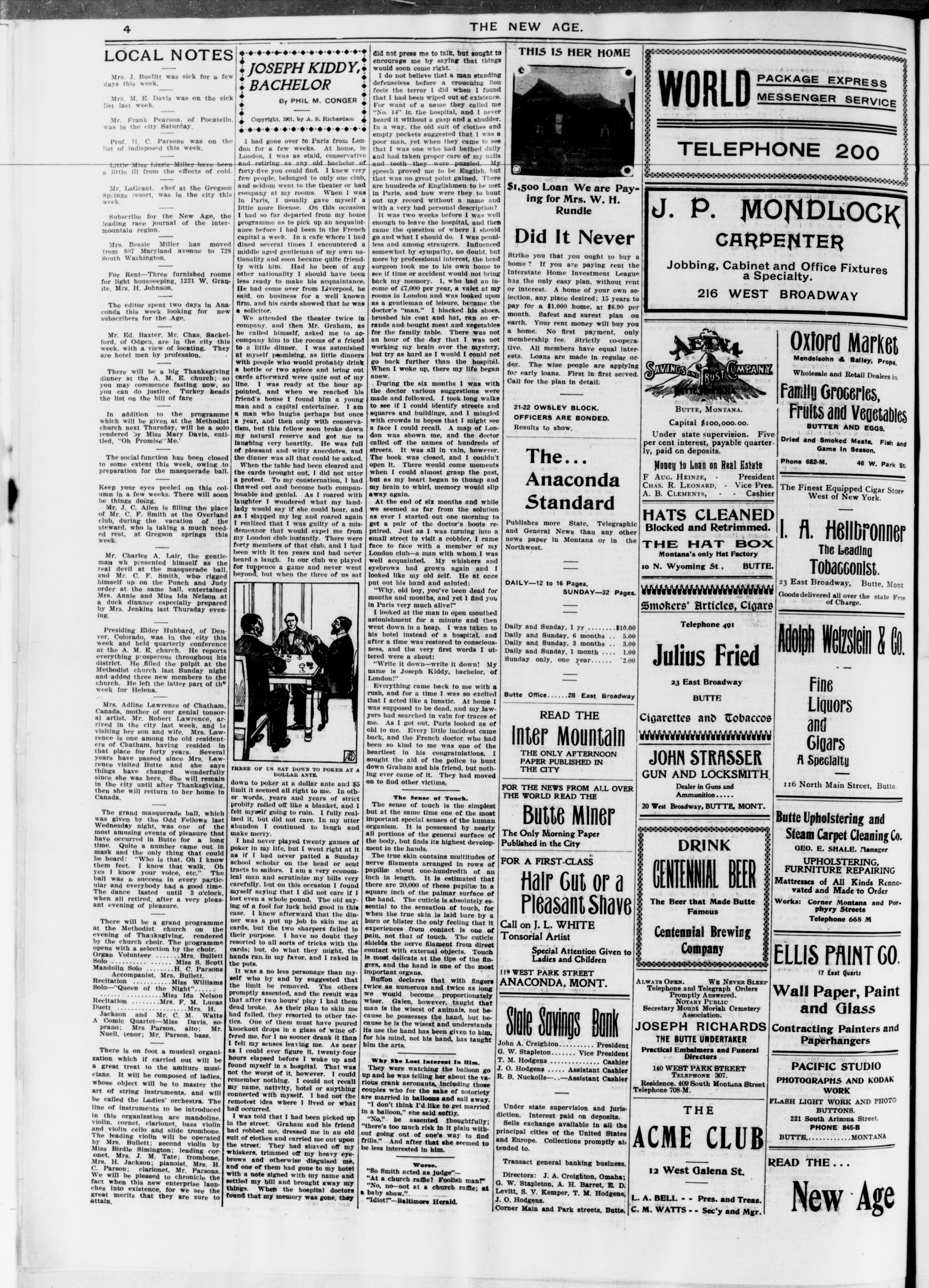
Page text (machine-generated)
On Hennessy's Second Floor
We Have On Hand
A large assortment of women's garments for winter wear, and it does not need a judge of values to decide that these goods are considerably underpriced. Many of these garments are marked down to half price, simply because we have too much money tied up in this big store.
27-inch black kersey coats, box front$, half tight-fitting back; good winter weight and serviceable; sizes 36 to 44 inches. $8.50 values for $4.25.
Women's Winter Coats
$13.50 Values for $0.25
Kersey cloth Monte Carlo coats, inverted plait back, velvet collar, box front, colors castor and black; sizes 32, 34, 36 and 38 inches. Regular $13.50 values for $9.25.
Trimmed Hats About One-Third Off
Some 150 trimmed hats, in large, medium and small shapes, several pattern hats in the lot bought at a sacrifice; all new and up to date in style.
$ 5.00 to $ 6.00 hats for $2.95
$ 7.50 to $10.00 hats for $3.95
$12.50 to $15.0/
$17.50 to $18.50 hats for $6.50
Fine taffeta silk waists, tucked front and back, blouse fronts; also satin waists of extra quality, tucked fronts and sleeves, tailor-made effects, in black moire waists, blouse effects; sizes 34 to 42 inches. Values $4.95 to $6.50 for $3.75 each.
960 ribbed vests and pants, winter weight, half wool and cotton, color silver gray; sizes 4, 5, 6, and 7. Regular 75c values for 35c each.
Mail Orders to Hennes
Center Tables at Cost
About forty styles in the different woods and finishes. Just one, of a kind will be closed out at actual cost.
Beautiful tables at $3.50 that sold regular for $5 and $6.
Table like cut, solid oak, quarter sawed and polished, 20-inch top..... $4.50
1747
The kind that will not break springs, sag or bed clothing get bunched up when folding. Mantle bed like cut...$11.75 Is made of rock elm, golden finish, steel supported springs.
THE KENNEDY FURNITURE COMPANY
Pennsylvania Block
WEST PARK STREET
Women's Winter Coats
Women's Winter Coats
Silk Waists
Women's Underwear
THE NEW AGE.
A
$9.50 Values for $4.75
27-inch kersey coats in black and castor, box front, half tight-fitting back, satin linings, warm and serviceable; all sizes. $9.50 values for $4.75.
Misses' Winter Coats
$10.50 Values for $10.75
Monte Carlo coats of all wool ker
sey cloth, inverted plaited back, box
front, velvet collar, satin linings, colors
red castor and black; sizes 16
and 18 inches. $16.50 values for
$10.75.
Fur Collarettes
At Half Price
Collarettes made of Electric Seal,
Krimmer, Persian Lamb, Mink, Astrakhan, Marten and Stone Marten;
length 10 to 14 inches; high storm
collar, tabs down front, trimmed
with clips; all half price.
$ 4.00 Collarettes for $2.00
$ 7.50 Collarettes for $3.75
$15.00 Collarettes for $7.50
Muslin Gowns
$1.00 Values for 700
180 muslin gowns of extra quality, yokes of cluster tucking, and embroidered insertion, lawn ruffle around neck and cuffs, sizes 14 to 17 inches. Regular $1.00 values for 70c; Friday and Saturday's sale. Come and see.
Children's Underwear
Winter weight Swiss ribbed underwear, fleece cined, lace trimmed neck, vests only, in gray and ecru; sizes 2 to 7. 35c values for 15c.
Will Call for and Deliver Trunks, Baggage or Parcels to Any Part of the City
Telephone 1010 A
H. E. FLETCHER, Prop.
Wholesale Oysters Fish and Poultry
Offices—304 and 305. Goldberg Block, Butte, Montana.
Advertise in the New Age. The col- ored people will transact their business with you and extend to those their patronage who patronize their race paper.
BUTTE, MONTANA, SATURDAY. NOV. 22. 1902.
"A Folded Paper."
By Nora E. Huling Slegel, (Nodie.)
"Angels and ministers of grace defend us" from our lack of self-appreciation and incentive to use what we recognize. Mind is a folded paper as it were, and to many of us remains folded. What good would Mrs. William Post's "Freedom," for instance, do us if we left it in the shape in which we received it from the hands of the postman? No good, except perhaps to be used as a policeman's club and I protest! Well, individual mentalities remain, mostly, in this state. Think of it! Is it not lamentable? In some instances the individual is as the man who suddenly comes into possession of wealth; among other material things he lays in a library of handsomely bound books. "Yes, the bindings must be of the most expensive quality. Neighbor Jones has just such a collection, baring the bindings, and his own must surpass Jones's" Matters not that Jones is also in possession of the contents of those volumes, by virtue of a life-long application in unfolding and studying the same. Jones is a reputed scholar and scientist, and materiality in unfolding slightly recognizes Jones' position an enviable one. So he industriously reads the title and headings and uses these as wise invectives to whack his less fortunate fellows about the heads with. They stare at him with willing mouths and eyes agape. This is exactly the effect he anticipated and is content. And this is exactly the effect that material wealth has upon the conscious senses until the sub-conscious be quickened.
The effect and end that this clubbing enjoins is to arouse envy. Envy is all right, however; it begets activity which is itself begotten of inquiry, and inquiry often follows on to a development of the subconscious mind. This subconscious mentality, however, is in possession of each individual, and is far superior to either Jones' possession, which is acquired by wrote or the library of superior bindings, for we have stored away a whole universe, yes, the wisdom of the ages, right within the sub-conscious mind, and all we need do is to unfold and read. This is true of health, wealth and wisdom. It fact, everything.
The inner individual consciousness has nothing to waste, therefore, it must necessarily bide our conscious recognition. But as we make use of what comes, more develops, and as we become able to appreciate it, the texture and beauty enhances and the quantity multiplies.
The individual mentality is like unto a Chinese paper puzzle: Very small and insignificant, appearing before opened, but how surprising is the effect upon proper manipulation.
Mentality in construction is quite similar to the tiny green bud upon the bush. The bud in its development has back of it the aid and abestment of the whole plant, nay more, the whole universe of earth, moisture and air, but not an atom is wasted in its fulfillment.
The individual mentality is the whole man, with the universe to draw on, and he may make use of himself to the upbuilding of a gloriously satisfactory end or the reverse. The universe will not desert him, though that effect is produced through his own ignorance of the laws of life and being; which manifests in his lack of energy, improper thought, indifferent purpose, etc.
The foregoing subject presented itself to me through suggestion; by being awakened each morning by whack whack of the morning papers as they are thrown against the several doors, in the block, which open into the court. The newsboys twist them in shapes resembling clubs and give them a flip to the upper landing. This saves the boys ascending the second flight of stairs.
When I was about fourteen years of age I suddenly conceived an idea that I would read the whole contents of our large library. I decided with industry I might accomplish the feat within six months. That seemed an eternity, but I concluded I could hold out that long. The conception was induced by hearing a noted lecturer upon bacteriology. His lecture was illustrated by microscopic views of insects, snakes, etc. His knowledge was surpassingly wonderful in my estimation and I determined to become his second in short order. I plodded along all that Sabbath afternoon. The weather wet as it frequently is in Kentucky, I could not be out, so for that day circumstances seemed to further my project. I began the digest by opening an "Encyclopedia of Useful Knowledge," volume one. There were thirteen of them. I read on steadily the whole afternoon. At evening's approach I counted those I had read and divided the whole number of pages the volumes contained by the number I had read and figured out that in six months
with six hours study per day, I would hardly accomplish the perusal of two volumes, Imagine my chagrin. This placed such a damper upon my aspirations that I thereby gave up the whole plan. His wisdom, however, acted upon my mentality as a stuffed club. I ever afterwards desired knowledge. Later on in life I found that my childish idea had not been so wild as may be and that I held the unrecognized signal to the whole library and more, right within my own being and there was no need for me to sit glancing over old digests. I found by a thoughtful application of life's experiences I might attain any end I desired. Oh yes, I need be diligent. After the subconscious mind is awakened and we rollow the spirit there is no lagging. The spirit is no laggard, at the same time there is no haste. Just time enough.
Through application of the fuller conception of being all things that needed my attention becomes plausible so that no duty was irksome, Irksomeness remains in the conscious ruling. This is the point that I would be defended of in the beginning of my article. Defended of the lack of an incentive to make use of as much energy as I recognize, for that means only may more come; may I progress, develop. These pigmy mentalities not regenerated are helpless, indeed.
BAD NEGRO MINISTERS.
Whenever Booker T. Washington talks he says something that is worry! "listening to. A few weeks ago this great negro addressed a gathering of his people in New Orleans. Most of them were ministers, a fact which makes the remarks of Washington all the more pithy and courageous. Discussing the negro ministers he said in part: "There are few influences at the present moment which are working so much harm in connection with the development of our people as the actions of the ignorant and immoral negro ministers. I mean the ministers who have no home, who do not own a foot of land; who have no bank accounts; ywhe spend their time prowl'ing from one plantation to another, preaching here a little, and there a little, and in one community a few weeks and in another a few weeks. This class of ignorant, immoral and shiftless ministers are responsible, you know, for the ruin of families and for the bringing down of condemnation upon our race. In most cases I do not hesitate to say that the people would be better off without any ministers than with the class of ministers to whom I have referred.
"Many of these men have gone into the ministerial profession simply with a view of escaping work with their hands.
Mr. Washington might have added that the shiftless, demoralizing negro minister is not confined to the plantation of the south. They have found their way into every city and Here in Salt Lake we have had negro ministers of the gospel who prostituted their holy calling and made their race a laughing stock. Negro churches have been turned into meeting places for political organizations and from their pulpits the so-called pastors have urged their congregation to vote one ticket or an other.
It is unfortunate for the negro race that such things are possible and the sooner they secure ministers who will not stoop to the dirt of politics, the better off they will be.—Salt Lake Herald. Nov 19, 1902.
THEATRICAL NOTES.
At the Grand "The Stoaway," November 23, "Sandy Bottom," and the "Telephone Girl."
Herrmann the Great, who appears in this city at the Broadway theatre, is the most remarkable expert of legerdemain the world has ever seen. He is everywhere proclaimed the master wizard of the present day. In the art of palming or slight of hand he stands forth unrivalled, his remarkable digital dexterity being everywhere commented upon as marvellous. Seats now on sale.
The programme offered by Herrmann the present season contains many novelties besides several new, and very attractive illusions. Herrmann is the most remarkable expert of legerdemain ever seen upon the stage. Of the new illusions introduced. "The Princess Mahomeda" is probably the most mystifying. Herrmann introduces a young lady whom he hypnotizes, places on a brilliantly lighted couch and then causes her to slowly rise into space. To show his audience she has no wire or other support he passes a large hoop over her several times and then slowly descends her to the stage again. It is a most mystifying illusion and baffles analysis. A Chinese mystery called "Voyage Instantaneous" is also a large, showy and very attractive illusion, which creates much talk and thoroughly mystifies. Herrmann is accompanied by the musical Goolmans, whose interpolation of musical numbers on numerous instruments adds materially to the performance.
In presenting "Over the Fence," a three-act musical farce comedy by C. Herbert Kerr, to the amusement going public of Butte next week, Manager Sutton will have offered one of the most successful attractions before the public this season. It is a bright entertainment in every way from the rise to fall of the final curtain. The story is prettily told and engages the attention of the audience at all times. Choice selections of musical numbers, original in most instances by Mr. Kerr, who is a composer and author of note, as well as the numerous specialties by various members of the organization including all kinds of dancing goes to make it one of the brightest entertainments of the day. It was built for a solid evening's fun and is presented by a capable company in every manner, in fact the cast includes such foremost players as Prett Reed, Joe Willard, Edith Kingsley, Geo. and Laura Lewis, Will Dunlay, William Clifton, Esmeralda Cornwall and many others.
The Royles In "Friends."
The Royes friends.
On Tuesday and Wednesday at the Broadway will be presented Edwin Milton Royal's comedy drama of "Friedes." The company is certainly a strong one, and one well calculated to bring out the pure wit and epigramatic bits that abound. The story is a simple one. A poet and a musician, young men with one dress suit between them, and two good-
P. J. Brophy & Co.
For over Twenty Years the LEADERS.
The Rich and the poor, the sumptuous and the thrifty find their wants supplied with equal pleasure and satisfaction at our store.
Our stock comprehends all that is good to eat and at prices that cannot be beaten.
Your patronage is respectfully solicited.
P. J. Brophy & Co.
No. 28 Main St., Butte, Montana
Pufahl's
The Artistic Shop of Butte, sells good Goods cheaper than any place in Butte. Visit us and be convinced. Respectfully,
Pufahl's
79 West Park St.
sized hearts, live together and hunt elusive fame. Even when the woman comes the friendship stays and Jack helps Adrian through the difficulties that hedge Marguerite about. She is a singer of noble birth, but she doesn't know it. A director of the opera house does and uses this knowledge to further his own ends. The interests of the story is admirably sustained throughout, the plot is consistent, the incidents are crisp and the dialogue is forcible, witty and appropriate. With a desire to render the play in a truly artistic and worthy manner, Manager Ben Stern has secured the following well known people: Mrs. Selina Fetter Royal, Miss Mabled Dixey, Miss Irene Gray, Mr. E. Milton Royal, Mr. Emmet Shackelford, Mr. H. B. Bradley and Mr. Wright Cramer. The engagement is for two nights and it is safe to predict that Butte will echo the sentiments and impressions that the play created on its former presentation.
ANACONDA. MONTANA.
Mr. J. L. White, who conducts a tonsorial parlor for our boys, is doing nicely in his line. He is always ready to accommodate you in his line.
Mr. Ben Bolt wishes to be remembered to his brother odd fellows in Salt Lake. He is now in Anaconda, where he has resided for the past seven years.
J. W. Busch, who has just left the capital city, will spend a few days in the smelter city, and after his stay here will leave for Hot Springs, Ark., where he will spend the remainder of the winter after December 30th.
Rev. Jordan Allen, pastor of Shaffer's chapel in Butte, spent a few days in our city last week. His object is to assist the people in building a church in this city.
Mr. L. P. Driver has the leading place of amusement and always receives visitors with hearty welcome. He conducts the only place of the kind operated by colored men.
The editor and manager of this paper, while in the city this week, appointed Mr. J. H. Woodson agent for the paper. Anyone desiring the paper or having news that they wish to appear therein, should notify him of the fact, or send direct to our office in Butte.
Quite a spirit of enterprise seems to be in evidence among the colored people of our city. There is a movement, and in all probability will be accomplished, is to build a church. The effort is being strongly put forth and is receiving the hearty co-operation of the majority of our people.
Shaffer's Chapel, A. M. E. church, Platinum and Idaho streets, Preaching at 11 a. m., and 7:30 p. m., by
No. 24.
the pastor. Remember the Thanksgiving dinner given by the A. M. E. church under the management of Mrs. M. E. Davies, and committee. They will give you everything that's good. A grand concert at night, given by Mrs. H. C. Parsons and concert committee. The literary was a success last Tuesday night, the debate was grand. The ladies can define the subjects as well as the men. You should come out and hear them. They will make it interesting for you. J. Allen, pastor.
Things socially in the smelter city has been dull this week owing to the unfavorable weather. Among the Butte visitors to our city this week was Mrs. Laura Brown, who spent two days the first of the week in the city, the guest of Mrs. Kelly, J. W. Duncan, editor and manager of the New Age, in Butte, was also a welcome visitor with us two days this week. He added a number of subscribers to his little sheet, which is gaining quite a circulation in our city.
The Garrome restaurant has been moved from Commercial street to 211 East Park, the new quarters has been overhauled and presents a striking appearance. The accommodations at this place are the best to be had in the city. The new restaurant is thoroughly equipped and newly furnished with brand new furniture. t is lighted with electricity and has electric call bells in every box. The enterprise is still managed by the same company, whose proprietors are congenial and corteous, Mr. Charles P. Smith. The head of the company is a restaurant man of long experience and he leaves nothing undone which will add to the comfort and advancement of his business. Mr. Henson, who has also been associated with Mr. Smith, is a man who possesses great business ability and through his polite attention has added a host of customers, who delight in patronizing his place of business.
NOTICE.
The New Age, the political organ of the colored people of this state. If you are candidates for political nominations and desire to reach the colored vote of the county or state, the New Age, the official organ of the colored people, extends its columns for your use. We make a specialty of cuts and political cards.
Wanted — Colored cotton field hands to grow cotton in west Africa. Comfortable homes and just treatment guaranteed. Deserving applicants please write to New Cotton Fields Limited, 43 Devonshire Chambers, Bishopsgatestreet, London, England.
The Citizens' Coal company, dealers in Kemmerer, Rock Springs, Rocky Fork and Trail Cree coal, also good dry pine and fir wood. We give 2000 pounds to the ton. No. 4 East Broadway, Telephone 538.
THE NEW AGE
published weekly by the New Age Publishing Company, office, 220 South Idaho street.
Subscription price, $2.00 a year. Six months, $1.10. Three months, 60 cents, invariably in advance. Telephone 862 B.
Entered October 2, 1902, at Butte, Mont., as second-class matter under act of congress of March 3, 1879.
SATURDAY, NOV. 22, 1902.
Salt Lake Department
Salt Lake Department
Lionel, the son of Mr. and Mrs. Seth Young, has the mumps.
Mr. Josh Durham is very sick. He is stopping with Mrs. Thompson, residence 414 State street
Mr. Thomas Tram has been confined to his room for several days. We should not forget our sick.
We are glad to announce that Miss Edith William is improving slowly.
Rev. J. W. Washington has been hindered in his work on account of sickness. Glad to say he is better at this writing.
Mr. Bogan and Mr. J. G. Smith have opened a first-class cafe on Commercial avenue, and are said to give any kind of service. So give them a trial.
When the Salary club gives an entertainment you are shure of a treat if you attend the one given for the benefit of Rev, B. F. McIntyre was a success in every way.
Quite a sociable evening was enjoyed at the gumdrop surprise party on Mrs. Fannie Barker, given in honor of her recent birthday. Slie received a number of useful as well as ornamental presents, and gumdrops enough to last almost to her next birthday.
The Sunshine band met last Tuesday afternoon. The topic of the meeting was "The Wonderful Cupboard," which though small, has numberless little shelves that cannot be filled. The cupboard is the brain or mind, and the things put upon the shelves are the things taken into our mind. The motto of the Sunshine band is to put something good upon the shelves each day.
Mr. W. H. Barker, who went to South America writes that he is very much impressed with the country. He is doing nicely. Says it is a good country, plenty of money in circulation. His greatest draw back is that he doesn't speak Spanish. He also says in the town where he is located there are forty Catholic churches and one protestant church. That would be a good place for some of the Presbyterian ministers of this country, who are without a charge.
What Some Names Mean.
The following gives the meaning of the names of the principal highland clans in Scotland:
McOmechy or Duncan, the son of Brown Head.
McGregor, the son of a Greek man.
McCulthert, the son of the Arch Druld.
Stewart, His Stay or Support.
A Correction.
When President Blanco's administration in Venezuela was overturned, that official, who, report said, had accumulated great wealth while in office, went to Paris. He was strolling in a boulevard in the French capital when a passing pedestrian arrested the pace of his companion and said: "See that man? He stole $3,000,000 when his government was overthrown." Quick as a flash Senor Blanco turned. "Beg pardon, sir," he said easily, "but it was $5,000,000."
The Real Thing
"Is this your writing?" asked the merchant as he gianced over a written list of goods wanted.
"No," replied Mr. Meeker; "my wife wrote the list."
"Well, she certainly knows how to handle a pen," said the merchant. "Her diction is absolutely perfect."
"Yes, I suppose her diction's all right," replied Meeker, with a deep sigh. "but it's nothing when compared with her contradiction!" — Chicago News.
Rough Diamonds
There is a popular notion to the effect that rough diamonds are not bright, but this is a mistake. Even in that condition they are very bright, with a peculiar "adamantine luster," as it is called, which no other substance possesses. However, the crude diamond crystal is not transparent. One cannot see through it.
That Was What Annoyed Him.
Mrs. Homeligh—There is one thing about our girls—the are always self possessed.
Papa Homeligh (grimly)—Yes, they are too self possessed. I wish they'd get some one else to possess them.—Stray Stories.
PIKE AND MUSKELLUNGE.
How You May Easily Tell Them Apart by Their Markings.
In the muskellunge the upper half of cheek and gill cover is scaled, the lower half being maked. The pike has a gill cover scaled like the 'lunge', but the entire cheek is scaled. The eastern and grass pickerel have cheek and gill covers scaled all over. Hence, if only the upper half of the fish's cheek is scaled, it is a 'lunge'; if the entire cheek and half the gill cover show scales, the specimen is a great northern pike.
Young muskellunge are distinctly spotted with blackish on a greenish or grayish ground. The mature fish shows less distinct markings, although they usually are discernible in the region of the tail. I have, however, seen big, old fish upon which the eye could detect no spot, the general color being grayish green, with a few dim reflections. Again I have seen fine fish of a nondescript tint, as like that of an old, dry rubber boot as anything I can think of. The young and old of the great northern pike have the sides marked with oval whitish or yellowish spots several shades lighter than the ground color; hence a fish with spots darker than the ground color is a 'lunge'; with lighter spots, a northern pike.-Edwyn Sandys in Outing.
The Oldest British Game.
In one form or another football, the oldest British game, has existed for centuries. Some see it in the game "harpaston," played by the Greeks, the name of which, they say, by derivation, suggests that the ball might be seized and carried into goal. No trace of the game, as now understood, is found outside of Britain, but in England it has flourished for centuries. Shrove Tuesday, in olden times, was the great annual football day, when the fun was fast and furious, shops and houses being closed for fear of damage and both sexes and all ages taking part.
Fitzstephen in his "History of London, 1175" makes the earliest mention of the game in England. He tells us of young men of the city annually going into the fields after dinner to play at the well known game of ball on Shrove Tuesday. Traditions of Chester and Derby bear this out, where it was long the custom to do the same, Chester's first ball being the head of a Dane.-Pearson's Weekly.
What He Wanted to Know.
It may not be generally known, but a certain prominent resident belongs to a family in which he is one of twenty-four brothers and sisters, sixteen of whom are now living. There were two mothers in the family, the first having eleven children and the second thirteen. The man in question belongs to the second group. One of his sisters grew to maturity, married, had seven children and died before he was born. He was an uncle before birth and a great-uncle at five years of age. It is said that when the latter event came to pass and the youngster was informed that he was now really and truly a great-uncle he who had been an uncle for five long years cocked his features into an expression of sadness and replied, "That may be all right, but when am I going to be a gran'pa?"—Ann Arbor Times.
An Institution.
It was a warm Sunday morning in church. Fans were fluttering, hymnals flopping, handkerchiefs mopping streaming faces, and the minister thought his audience a little lax in attention. Finally he led up to a rebuke for its lack of consideration for sacred and important things. Said he: "People are prone to attend to the unimportant things of life." And he gave a few examples to illustrate his idea. Presently he made his pertinent application. "Now," said he, "you are attentive to your own comfort this morning, to the sinful neglect of the holy word. Take no thought for the heat," he said dramatically, "for you may be dead tomorrow."—Detroit Free Press.
Influence of Chess.
If a Scottish scientist is to be believed, the people of those countries in which chess is most frequently played are invariably more civilized than those who inhabit countries in which little attention is paid to this great game.
The best chess players in the world, he points out, were to be found in Spain during the period of its splendor and in Italy during the renaissance, whereas today there are few persons in those countries who care for the game.
Nolsy Fish.
Many fish can produce musical sounds. The red gurnard has earned the name of seacock from the crowing noise which it makes, while another species is called the piper. Others, notably two species of ophidium, have sound producing apparatus, consisting of small movable bones, which can be made to produce a sharp rattle. The curious "drumming" made by the Mediterranean fish known as the maigre can be heard from a depth of thirty fathoms.
The Bee's Market Basket
Every bee carries his market basket around his bind legs. Any one examining the body of a bee through a microscope will observe that on the hind legs of a bee there is a fringe of stiff hairs on the surface, the hairs approaching each other at the tips so as to form a sort of cage. This is the bee's basket.
There is nothing more expensive than experience and nothing of which there is more sold.—Atchison Globe.
There are 25,000 pores in the band of a man.
THE NEW AGE.
DOESN'T TRUST HORSES.
Part Maniac and Part Idiot Is What
One Man Calls Them.
I have spent much of a long life in the observation of horses. I have reared them, broken them, trained them, ridden them, driven them in every form from the plow to four-in-hand. The result of these years of study is summed up in one sentence—I believe the horse to be part maniac and part idiot. Every horse at some time in his life develops into a homicidal maniac. I believe any man who trusts himself or his family to the power of a horse stronger than himself to be lacking in common sense and wholly devoid of ordinary prudence, writes a Kentuckian to Harper's Weekly. I have driven one commonplace horse every other day for six years over the same road and then bad him go crazy and try to kill himself and me because a leaf fluttered down in front of him. I have known scores of horses, apparently trustworthy, apparently creatures of routine, go wild and insane over equally regular and recurring phenomena. No amount of observation can tell when the brute will break out. One mare took two generations of children to school over the same quiet road and then in her nineteenth year went crazy because a rooster crowed alongside the road. She killed two of the children. If any one can tell me of one good reason why man should trust a horse, I should be glad to know.
The value of singing. From the medical standpoint singing is a most important exercise both by virtue of its influence on the emotions, on the respiratory movements and on the development of the lungs. Nothing better shows the beneficial effect of singing in developing the chest and warding off the lung diseases than the great pulmonary development and freedom from pulmonary disease among professional singers. Their general health, moreover, is exceptionally good, and this is probably in a large measure attributable to the mere exercise of the calling. It is especially useful in defective chest development and in chronic heart disease. Provided the patient can sing with comfort there is no condition in which singing is contraindicated unless it be a tendency to tuberculosis or aneurismal hematoptysis. It is scarcely necessary to say that the singer should be so clad as to allow absolute freedom of the chest movements, there should be no constriction of the neck or waist, the collar should be low and ample and the stays, if worn, ample and loose.
A German lady in a town in Ventura county had a daughter who was her mother's pride. The mamma bears somewhat of a reputation as a Mrs. Malaprop and is also a prosperous merchant. On one occasion the daughter, who assists her mother in the store, was by dint of hard work among relatives and friends chosen as queen of a street carnival to be held in the town. Maternal pride ran riot in the elder woman's breast. To a friend she burst forth in this ecstatic strain:
"Oh, mein Mollie! She vas so peautiful as neffer vas! Dere vas no gerrel so peautiful as mein Mollie! Und she vas sooch a goot cook—mein gracious, she vas sooch a goot cook! Und she vas sooch a goot tressmaker! Oh, dere vas no gerrel like mein Mollie! Und she vas de best clerk vet I effer haf in mein sthore! Und she vas a goot musiclaner! Oh, mein Mollie vas de greatest gerrel vat effer vas! She vas just a jack of all rabbits!"—Los Angeles Herald.
Probably the oddest and most precious autograph album that has ever existed lies in an almost unknown corner of western New Mexico.
More than two centuries before our Saxon forefathers penetrated the desert of the southwest the Spanish piloners, wandering through those lonely wilds, found a rock so noble and so remarkable, even in a country of wonderful stone monuments, that they called it "El Morro" (The Castle).
Wishing to leave some record for future generations, they traced with the points of their swords their names upon its rough surface. Those names are there, with dates of their inscription—in nearly every instance the early part of the seventeenth century.
Landlord—In one word, when are you going to pay your arrears?
Hard Up Author—I will satisfy your demands as soon as I receive the money which the publisher will pay me if he accepts the novel I am going to send him as soon as the work is finished which I am about to commence when I have found a suitable subject and the necessary inspiration.
The interior bark of trees was formerly used to write upon, and its Latin name (fiber, a bark) seems to intimate that its use was as ancient as the art of writing itself. In one respect the bark was superior to the leaf. It could be rolled into a volume, while the leaf would crack if subjected to such a process.
The teacher asked the boy in the geography class whose French grammar is the one bane of his life:
"What separates France from England?"
"The irregular ve.bs," answered the boy earnestly.
Invalid—I understand it is quite dry out here!
Broncho William—Dry? Why, stranger, it's so dry here that the rain is wet only on one side.—New York Times.
The Value of Singing
Mixed Metaphors
Rocky Autograph Album.
Promising.
Paper of the Anclents.
The Unbridged Channel
Dry.
FOOD AND THE SEXES.
The Male Human Needs to Eat More Than the Female.
According to a writer in the Lancet, the male human needs more food than the female not only on account of his larger stature, but also because he is the more katabolic of the two. The man tends to expend energy and the woman to store it up in the form of fat; he burns the faster. This sexual difference shows itself in the very blood. The man has a larger percentage of chromocytes than the woman, showing that he needs a proportionately larger quantity of oxygen in order to maintain his more active combustion, a fact which one may associate with his comparative freedom from chlorosis. Moreover, weight for weight, his pulmonary capacity is greater than that of the woman, whose smaller respiratory need is further shown by the facility with which she can without discomfort diminish her breathing power by means of the corset.
"The great contrast between the metabolic activity of the two sexes," continues the writer, "was forcibly brought home to me by a military display given by a troop of dusky amazons, with whom were also a few male warriors. The women, in spite of their daily exertions, were all rounded and plump, some very much so, no single muscle showing through the skin, and it was noticed that their movements, though full of grace, lacked energy and 'go.' The men, on the other hand, were spare, their muscles standing out plainly under the shiny skin, and they, in further contrast with the women, displayed a truly amazing agility, bounding about and whirling round in a most astounding fashion. The women, in short, were essentially anabolic, and the men were katabolic. I may here draw attention to the fact that men are apt to be larger meat eaters than women, just as they are, possibly in consequence of this very fact, more prone to drink alcohol and to smoke tobacco."
SLEEPING HEROES.
Mighty Men of the Past That Are Expected to Return.
Is there any race that has not its sleeping hero? A correspondent recently pointed out that the time for the fulfillment of the prophecy that the tenth of Krishna will restore to India her independence is near at hand, and every nation has some such savior to whom the people look. West country rustics still believe that Arthur did not die, but sleeps in Avalon, and that in the hour of Britain's need he will awake, deliver the land and restore the golden age. In Germany it is a popular belief that Charles V will some day wake from his enchanted sleep to reign over Germany, Spain, Portugal, Denmark, Belgium and Holland. Thousands of French peasants hold that Napoleon is only sleeping and that at some future time he will reappear and rule. And Mr. Newbott has enshrined the Devon legend that Drake is only listening for the drum.
The Irish peasantry steadfastly refuse to believe that Mr. Parnell is really dead. They assert that his death was a ruse, that he was an interested spectator of his own funeral and that when the time comes he will emerge from retirement to give Ireland her independence. Every true Moslem believes that when antichrist appears Mohammed Mohadi will awake and conquer him. A Moorish legend declares that Bobadil el Chico sleeps spellbound near the Alhambra and that one day he will awake to re-establish the Moors as rulers of Granada. The Servians look to King Lager, slain by the Turks in 1839, as their final hope, and should Switzerland be again threatened by tyrants Swiss folklore declares that the three members of the Tell family who are sleeping at Rutili, near the Vierwald-Staten-See, will rise from their enchanted slumber and maintain the freedom of the land.—London Chronicle.
Hopi Courtship.
When a Hopi maiden decides which of the eligible young men of the tribe she wishes to marry, she goes and sits in his house and grinds corn until he is sufficiently impressed by her industry to marry her.
After the ceremony, which is an elaborate one, the couple go to live in the wife's house. If she tires of her husband, she can obtain a divorce by merely throwing his saddle out of the house. After marriage the house, fields and all their property except the herds belong to the wife.
The Hopis are indulgent parents. The right of the children to do as they please is never questioned.
How a Woman Gets a Seat.
"I will tell you how to work it," said a woman, whose figure showed she would be tired by standing, to a companion in a Broadway car. "When there is no vacant seat, watch for two men who are in conversation and stand right in front of them.
"Each one will want his friend to think he is very polite, so both of them will jump right up and offer their seats. That's the way I do, and it never fails."-New York Herald.
An Effective Way.
"They say," said the young dramatist, "that I shall have to cut my play down, but I really don't know where to begin."
"Why not start at both ends," his candid friend asked, "and work toward the middle?"—Chicago Record-Herald.
"Cleave" is the best instance of an English word with two opposite meanings. "Nervous." "let" and "propugn" are other instances.
The best place to buy Loaf, Layer and Fruit Cakes, Nut Cookies, Macaroons, Lady Fingers, Cream Puffs and all the other kinds of delicious pastry goods.
Our Ice Cream Factory is the largest and best in the Northwest and we make the kind of Cream you like. Our Ice Cream Sodas are simply grand. The only place in town you can get Fresh Candies every day.
Wear Clothes That Fit
A man can save money and feel more comfortable by wearing clothes that fit.
are all made expressly for us. They fit well, look well and wear well. Prices are little, if any, higher than you pay for "trashy" wholesale clothing.
M. J. Connell Company
TUTTLE JEWELRY CO.
NORTH MAIN STREET
Our Day and Time, with the only New and I
Watches, Jewel
Quality Gut Glass, Brid
and Repair Departments with 1902 Equipment
nal ability in charge. We invite comparis
verland
Rye
the Whiskey of Montan
THE
by Laundry
A New House of Our Day and Time, with the only New and Desirable Lines of Diamonds a Watches, Jewelry Specialty Gut Glass, Bric=a=Brac Manufacturing and Repair Departments with 1902 Equipment. Men of exceptional ability in charge. We invite comparison of our prices.
Overland
Rye
The Whiskey of Montana.
THE
Will call for and Deliver that Laundry.
Ring Up 'Phone 2
Remember
ATTROY LAUNDRY
2. 232 South Main
itte Floral
the Leading Decorators and
Florists of Montana
Cut Flowers and Plants
ations and Designs a Spe
...Ring Up 'Phone 2...
The Leading Decorators and Florists of Montana
Cut Flowers and Plants
Decorations and Designs a Specialty
Salesroom, 107 West Broadway.
Sen Houses at Gregson Springs. Telephone
A large supply of beautiful carnations and roses and other are always carried. All orders receive prompt attention.
THE GREAT OPERA HOUSE HOLDUP
By J. P. COUGHLAN
Copyright, 1901, by A. S. Richardson
The Oaktree Opera House was unusually crowded. The people of Oaktree are a drama loving community, and the Watson-Duval Double Star combination was giving "Hamlet." The manager estimated that there was at least $500 in the house, his prosicay of summing up the value of the audience from the box office point of view. There was a good deal more than $500 in the house from the practical financial view of Gentleman George, known in the adjacent mountains, where he made his headquarters, as the leader of the Red Caps. Gentleman George had a reputation that branched out into several of the adjoining states. His methods of brandage were more novel than the unoriginality of his sobriquet would lead you to believe; but, then, he was not responsible for the adjective.
Gentleman George visited Oaktree occasionally, but a discreet population refused to recognize him, and the authorities were conveniently unaware of his identity; hence it was quite in order, as with other personages, that he should attend the performance at the opera house Incog. The curtain had fallen on the second act and the audience was for settling itself back into its seats when a tall, bearded, distinguished looking gentleman in evening dress appeared before the curtain and made a sign to the audience, begging their attention. The audience craned forward in their seats. The man raised an impressive hand and began:
"Ladies and gentlemen, I trust that I shall have your undivided attention. We are about this evening to vary the programme slightly and shall, with your kind indulgence, offer a little comedy, part of whose action will take place in the body of the house. I think it well to warn you beforehand that it would be best for you to keep your seats. If you obey this injunction, you will be in no danger whatever, but should you become restive serious accidents may happen.
"Now let me add that it will be impossible for a single person to leave the theater until the finish of the little comedy. If--don't rise from your seats, please--you will look toward the exits you will see that they are carefully guarded."
Eyes were instantly turned to the doors. At each door on the two tiers that included floor and balcony of the little theater stood a resolute looking man holding a brace of revolvers and wearing a red cap. A tendency to scream on the part of the women was repressed by the impressive hand of the man on the stage, who had by this time also donned a red cap.
"No danger, friends," he called out in an amiable voice. "Allow me to introduce myself: I am Gentleman George, and you know my reputation. If you are reasonable, you will not be touched—that is to say, you will only be touched mildly, for what valuables you may happen to have upon you. The good people behind the scenes are safe in the hands of my comrades. All communication with the outside is cut off. Every door is guarded. There is not a head in this house that is not covered with a Red Cap gun. As long as you sit still you are in no danger, but the moment you try to get gay or stow away any of your goods or put us to any trouble you will hear"—
The ominous ellipsis at the end of the last sentence had all its intended effect, "Now that we understand each other," continued the speaker, "our collectors will pass among you, and I trust you will remember that the time is valuable and cannot be wasted in disputes. In the meantime there is no reason why the music should not continue. If you please, Mr. Professor, strike up."
To the somewhat tremulous music of the piano three men moved systematically through the lower floor of the theater, each one carrying slung over his shoulder a large leather bag such as is carried by postmen, while three others similarly equipped went at the same time through the balcony. "Ladies may keep their wedding rings," called out the chief robber, who shouted out from time to time orders to his men and to the audience from the stage.
"Please, sir, may I keep this? It was my mother's," said a young girl in a tremulous voice from the balcony as she held up a small brooch in her hand for Gentleman George to see.
"Certainly, my child, Jim, see that the young lady keeps her brooch."
Presently requests of various kinds began to come from all parts of the house. In some cases the requests were granted immediately, others as curtly refused and still others compromised. Some citizens were allowed to keep trinkets they valued by giving an "I. O. U." for their value. This unexpected turn to the proceedings gave the affair a flavor of the auction room, and in the excitement, coupled with peeps into the heart secrets of others, the women forgot in a great measure their fright. This result was greatly contributed to by the good natured way in which the thieves did their robbing.
"Now, my friends," said Gentleman George after a pause, "everything seems to be moving serenely, and while the rest of the collection is being made, with your kind permission, I will endeavor to entertain you with a little song. Can you accompany me in 'The Swance River,' professor?"
"Certainly, sir."
"If you please, then."
In a sweet, rich tenor voice the
brigand began the old song. The audience listened in amazement and as he finished the first verse filled the house with genuine applause. By the time the song was finished the collectors had completed their work, and only the guards on the doors remained. The leader again raised his hand for silence.
"Ladies and gentlemen," he said, "I thank you for your kind attention. Our little comedy has passed off successfully, and now before we wind up let me give you a few final instructions. Our guards are still outside the various doors and shall remain there until we have had a good start. That will be, let us say, fifteen minutes. Any one who attempts to leave before that time will be shot dead at the door, and you know I have a habit of keeping my word. To simplify matters I intend to place this alarm clock"—here he held up an alarm clock which was handed to him from the wings to the view of the audience"—here on this table. It is set to go off at 11 o'clock. Don't leave your seats until you hear it. If you do"—
Before the sentence was finished Gentleman George had vanished.
The people in the house looked at one another wonderingly. No one dared to be the first to tempt fate by getting up and leaving the theater. Yet each man there believed that the threat was a "bluff," intended to give the robbers a chance to get safely away. They were disinclined, however, to put their belief to the test, and no one stirred. While matters were still in this indeterminate state a piercing cry of "Fire!" rang out throughout the house and was immediately taken up on several sides.
The managers of the theater at this outey rushed on the stage and shouted words meant to be calming to the audience. They succeeded in a measure in allaying the panic which was beginning to get under way, but many people, overwrought by the evening's happenings, rushed from the theater out into the street. Then it was discovered conclusively that there was no fire, but that the scare raised by the cry had added to the start already gained by Gentleman George and his band. By noon on the day following the sheriff was ready to start for the haunts of Gentleman George with a strong posse, when the mayor sent for him and read this letter, found on his doorstep that morning:
Dear Mr. Mayor—A dastardly outrage has been perpetrated on my good name and incidentally on the people of your city by the ruffians who held up the Opera House last night. The person call-call Gettier the gentleman George was on an impersonation and I believe you knew the scoundrel, and by the time you receive this myself and a few trusty camerads will be on his trail. The good citizens of Oaktree cannot be more grieved than I am over the regrettable occurrence of the show you that I was not the man who he had taken to infilogue you my latest photograph, made in San Francisco. You can depend upon it that the eviduoers of last night will be brought to justice. Yours in good faith.
The sheriff did not like the cool, impertinent tone of the letter and thought that, owing to his long immunity, Gentleman George was inclined to jest with the township. The mayor thought differently. It was, he said, a very courteous note, and he could not see that it in any way reflected on the town. Sides were taken, and the next election was fought out largely on the question of the good faith or otherwise of Gentleman George. Though the election went in favor of the mayor and the upholders of Gentleman George, to this day it has not been determined whether or not it was that polished bandit who had held up the Opera House.
"Come Here!" In Japanese.
A writer on children's games in Japan says: "Blind man's buff as played in Japan is quite the same as the game played by western children, but if you play it with Japanese I may warn you not to say 'Come here!' in English to any one you may be trying to catch. It will be all right to say in Japanese 'Chot-oide' (Come here a moment) or 'Oide nasal' (Condescend to come here). The person spoken to will not 'oide' of course if he or she can help himself or herself, but if you call out in English 'Come here' as I know a foreigner did once, you may interrupt the game. 'Come here' (in Japanese character written ka-mi) means foreign dog. Inu is the word for native dog, but the first foreigners in Yokohama, Americans and English folk, always said 'Come here' to their dogs and the expression has become a Japanese word."
Sarcasm That Failed.
He is such a little man—only three years old—yet he insists upon intruding his presence and advice upon his elders, often to their intense annoyance.
It was only a few days ago that his mother and his Aunt Belle were discussing some household problem—something which an infant was not supposed to know anything about. Suddenly Cliff appeared on the scene and in a moment was informing both of the feminine members of the family just what the facts were.
"Oh, Wisdom, when did you arrive?" exclaimed Aunt Belle, thinking that she might be able to "squeel" the vomester.
"Just come dis minit," replied the mite, not in the least abashed by the sarcasm. And Aunt Belle gave it up as a hopeless case.—Duluth News-Tribune
Art and Literature.
Friend—Have you sold that historical painting of yours yet?
Artist—No, but I've hired a fellow to write a historical novel dealing with the same period. If that makes a hit.
I can easily dispose of the picture.—Life.
THE NEW AGE.
WONDERFUL BROECK
THE ORIGINAL SPOTLESS TOWN IS IN NORTHERN HOLLAND.
A Neatness and a Brilliance That Are Absolutely Paintful Pervade the Whole Place-Rules Which the Inhabitants Must Observe.
Far up in northern Holland among the dikes and canals of the little kingdom lies Broeck, the original Spotless Town. The palings of the fences of Broeck are sky blue. The streets are paved with shining bricks of many colors. The houses are rose colored, black, gray, purple, light blue or pale green. The doors are painted and gilded. For hours you may not see a soul in the streets or at the windows. The streets and houses, bridges, windows and barns show a neatness and a brilliancy that are absolutely painful. At every step a new effect is disclosed, a new scene is beheld, as if painted upon the drop curtain of a stage. Everything is minute, compact, painted, spotless and clean. In the houses of Broeck for cleaning purposes you will find big brooms, little brooms, toothbrushes, aqua fortis, whitening for the window panes, rouge for the forks and spoons, coal dust for the copper, emery for the iron utensils, brick powder for the floors and even small splinters of wood with which to pick out the tiny bits of straw in the cracks between the bricks. Here are some of the rules of this wonderful town:
Citizens must leave their shoes at the door when entering a house.
Before or after sunset no one is allowed to smoke excepting with a pipe having a cover, so that the ashes will not be scattered upon the street.
Any one crossing the village on horseback must get out of the saddle and lead the horse. A cuspidor shall be kept by the front door of each house, where it may be accessed by the window. It is forbidden to cross the village in a carriage or to drive animals through the streets.
In addition to these established rules it is the custom for every citizen who sees a leaf or a bit of straw blown before his house by the wind to pick it up and throw it into the canal. The people go 500 paces out of the village to dust their shoes. Dozens of boys are paid to blow the dust from between the bricks in the streets four times an hour. In certain houses the guests are carried over the threshold so as not to soil the pavements. At one time the mania for cleaning in Broeck reached such a point that the housewives of the village neglected even their religious duties for scrubbing and washing. The village pastor, after trying every sort of persuasion, preached a long sermon, in which he declared that every Dutchwoman who had faithfully fulfilled her duties toward God in this world would find in the next a house packed full of furniture and stored with the most various and precious articles of use and ornament, which, not being distracted by other occupations, she would be able to brush, wash and polish for all eternity. The promise of this sublime recompense and the thought of this extreme happiness filled the women with such fervor and plethy that for months thereafter the pastor had no cause for complaint.
Around every house in Broeck are buckets, benches, rakes, hoes and stakes, all colored red, blue, white or yellow. The brilliancy and variety of colors and the cleanliness, brightness and miniature pomp of the place are wonderful. At the windows there are embroidered curtains, with rose colored ribbons. The blades, bands and nails of the gayly painted windmills shine like silver. The houses are brightly varnished and surrounded with red and white railings and fences. The panes of glass in the windows are bordered by many lines of different hues. The trunks of all the trees are painted gray from root to branch. Across the streams are many little wooden bridges, each painted as white as snow. The gutters are ornamented with a sort of wooden festoon, perforated like lace. The pointed facades are surmounted with a small weathercock, a little lance or something resembling a bunch of flowers. Nearly every house has two doors, one in front and one behind, the last for everyday entrance and exit and the former opened only on great occasions, such as births, deaths and marriages.
The gardens are as peculiar as the houses. The paths are hardly wide enough to walk in. One could put his arm around the flowerbeds. The dainty arbors would barely hold two persons sitting close together. The little myrtle hedges would scarcely reach to the knees of a four-year-old child. Between the arbors and the flower beds run little canals which seem made to float paper boats. They are crossed by miniature wooden bridges, with colored pillars and parapets. There are ponds the size of a bath, which are almost concealed by illipitation boats tied with red cords to blue stakes, tiny staircases and miniature kitchen gardens. Everything could be measured with the hand, crossed at a leap, demolished by a blow. Moreover, there are trees cut in the shape of fans, plumes and disks, with their trunks colored white and blue. At every step one discovers a new effect, a fresh combination of hues, a novel caprice, some new absurdity.
The rooms are very tiny and resemble so many bazaars. There are porcelain figures on the cupboard. Chinese cups and sugar bowls on and under the tables, plates fastened on the walls, clocks, ostrich eggs, shells, vases, plates, glasses, placed in every corner and concealed in every nook, cupboards full of hundreds of trifles and ornaments without name, a crowding disorder and utter confusion of colors - Public Opinion.
A RESTORATION BEAU.
Daily Programme of a Dandy In England During Charles' Time.
The history of an ordinary day of a restoration beau was something like this: From about 10 till 12 he received visitors in his sleeping chamber, where he lay in state, with his periwig, thickly powdered, lying beside him on the coverlet. Near at hand, on his dressing table, the curious visitor might have noticed some little volumes of amatory verse, a canister of Lisbon or Spanish snuff, a smelling bottle and perhaps a few fashionable trinkets.
As soon as he deemed proper the beau arose and with incredible difficulty proceeded to put on all his charms, to perfume his garments, to soak his hands in washes for the sake of producing whiteness and delicacy, to tinge his cheeks with carminative in order to give them that gentle blush which nature had denied them, to arrange a number of patches upon his face so as to produce the effect of moles and dimples, to dip his pocket handkerchief in rosewater and to powder his linen so as to banish from it the smell of soap, to consume a quarter of an hour in the attempt to fasten his cravat, so long again in the endeavor to adjust his wig and to "cock" his hat, as long again in the contemplation of his charms in the looking glass and as long again in the practice of such smiles as would display to the best advantage the ivory whiteness of his teeth—these were the processes through which he who desired to figure as a beau of the first magnitude was compelled in that age to pass.
The character of the beau, so far as his outward and personal appearance was concerned, was now complete, and as in those days fashionable gentlemen used their legs to a much less extent than they do now our imaginary beau would have directed his valet to order a sedan chair without delay. Into this he stepped and was borne to the fashionable haunt—to the mall in St. James park or perhaps to the more ceremonious parade in Hydie park—where, like a butterfly, he delighted to flutter in the train of some jilting beauty, who gloried in nothing so much as "an equipage of fools" and who was perfectly willing for the nonce to furnish him with an excuse for toasting her in a tavern at night.—Gentleman's Magazine.
You never lift up a life without being yourself lifted up.—Emerson.
To ease another's heartache is to forget one's own.—Abraham Lincoln.
It is ever true that he who does nothing for others does nothing for himself.—Goethe.
'Tis far better to love and be poor than be rich with an empty heart.—Lewis Morris.
God doesn't care for what is on the outside; he cares for what is inside.—Rev. M. Babcock.
Fruitless is sorrow for having done amiss if it issue not in a resolution to do so no more.—Bishop Horne.
The next time you are discouraged just try encouraging some one else and see if it will not cheer you.—J. R. Miller.
Sin is never at a risk. If we do not retreat from it, we advance in it, and the farther on we go the more we have to come back.—Barrow.
Kind looks, kind words, kind acts and warm hand shakes—these are secondary means of grace when men are in trouble and are fighting their unseen battles.—Dr. John Hall.
Queen Elizabeth's Amulet.
Queen Elizabeth during her last illness wore around her neck a charm made of gold which had been bequeathed her by an old woman in Wales, who declared that so long as the queen wore it she would never be ill. The amulet, as was generally the case, proved of no avail, and Elizabeth, notwithstanding her faith in the charm, not only sickened, but died. During the plague in London people wore amulets to keep off the dread destroyer. Amulets of arsenic were worn near the heart. Quilts of quicksilver were hung around the neck, and also the powder of toads.
The Absentminded Professor.
At a session of the German rechstag an absentminded member, Herr Wichmann, created no little amusement. He was calling the roll, and upon reaching his own name he paused for a response. Naturally none came. Then he called the name more loudly, waited a few seconds and roared it out at the top of his voice. The laughter of his colleagues finally aroused him to a sense of the ludicrousness of his act, and he joined in the general hilarity.
Misdirected Philanthropy.
"Ah got no use fo' de man," said Charcoal Eph in one of his philosophical turns, "dat donate er thousand' dollahs t' de heathen fund ob de fashionable church wid one hann' an' raise de rents on his tenement houses wid ud duder. Ah 'spec' he bettah begin practicin' crawlin' fro' de eye ob er needle. Mistah Jackson!"—Baltimore News.
Quite Amicable.
"Why did you quit your job? Did you have a disagreement with the boss?"
"Oh, no; not at all. I told him I had to have more money or I would quit, and he said it was mutually satisfactory."—Indianapolis News.
When there has been a death in the family, the house seems terribly large.—Atchison Globe.
Benevolence is to love all men knowledge, to know all men.—Confucius.
APHORISMS.
Quite Amicable.
The Van Cortland Honeymoon BY HOWARD FIELDING
Copyright, 1901, by Charles W. Hooke
N a corridor of a quiet and luxurious hotel in Boston I encountered an individual named Wasson whom I knew to be Archie
Van Cortlandt's valet. The newspapers had informed me that Van Cortland and his bride were staying at this hotel, and I should not therefore have been surprised to see the valet had I not read that the multimillionaire, with true democratic simplicity, was making his wedding journey without servants.
"Wasson," said I, checking him as he was hurrying by, "I hope that Mrs. Van Cortland is better today."
The bride had fallen ill on the way up from Newport and had been under a doctor's care during the first two days of her unlucky honeymoon.
Wasson jumped as if I had stuck a pin into him, and at first I thought he did not recognize me, but he gathered his wits speedily.
"Yes, sir; much better, sir, thank you," he said. "She'll soon be quite well."
"The newspaper reports were really alarming." said I.
He glanced anxiously toward the parlor door of the suit from which he had just emerged.
"Yes, sir; very alarming," he said and attempted to pass on, but at that
THE WORLD'S MOST FOLLOWING MAN
"I WILL CALL AGAIN AT THREE O'CLOCK, MR. VAN CORTLAND."
moment a servant of the house came up with a special delivery letter and some cards upon a tray.
Wasson took them and the servant a silver dollar as a fee, which greatness surprised me and also the recipient, who choked himself with thanks. He backed away, stumbling ridiculously upon a rug, and just then a slow and dignified voice behind us said:
"I will call again about 3 o'clock, Mr. Van Cortland, though the condition of the patient is so much improved that it will hardly be necessary."
It was Dr. Marshall Whiting, a pompous old physician of the fashionable Back Bay district, and he addressed the remark to Wasson, who did not reply. The doctor, with a courtly bow, walked toward the elevator.
I turned an eye upon the valet, and
"Wasson," said I. "what does this mean?"
His voice came in a gasp.
"For the love of heaven don't tell me!" he cried. "It—it's all right."
"Well, I'm by no means sure of it," I rejoined. "You are engaged in a monstrous imposition unless I am greatly mistaken."
He seized me by the arm and fairly dragged me into the painfully luxurious parlor of the bridal suit. The door of a bedroom beyond was very slightly ajar. Wasson closed it and then faced me. The man was at bay, and, I'm bound to say, he bore it well. He is rather a superior creature, as a matter of fact, and at that moment he looked much more like a gentleman than he did like a "gentleman's gentleman."
"You've got me," he said. "You can ruin me. But what's the difference? I've ruined myself already. But I've done my best to serve Mr. Van Cortland, my level best, and I simply wasn't equal to it; that's all. I might have done better if I hadn't been so worried about Millie. With with that and all the rest"—
"Who is Millie, if I may venture to inquire?" said I.
"She is my wife, sir," said he. "She was Miss Van Cortland's maid. Let me tell you the whole story:
"I was packing up the last of Mr. Van Cortland's things that he was to take with him on his honeymoon journey. The wedding breakfast was nearly over downstairs. I could hear the carriages of the swell people that had come from the church to the house stirring about in the grounds, as if it was time to be going."
"Then in come the bride and bridegroom—right into the room where I
was. 'Archie,' says she to him, 'this makes me positively ill. It spoils everything.' Mr. Van Cortland shook his fast at one of the windows, and I could see him swear, though he didn't really say anything. Suddenly he turned to me.
"Wasson,' says he, 'you're smart, and here's where you've got to prove it. If you do, it'll be a pretty penny in your pocket. You know me."
"Well, sir, I did know him for as liberal a man as ever lived. So I said, 'What's the trouble?' And he told me.
"It seems that he had made arrangements to get away secretly with his bride. There was a shabby looking carriage by the cast door, and they were to get into that and be driven to a place on the railroad twelve miles out of Newport, where Mr. Van Cortland's private car was waiting. He had engaged these rooms in this hotel, where nobody knew him, and he imagined that he could hide in them for a little while and be at peace.
"I tell you, Wasson,' said he, 'I've seen my private affairs in print till I just can't stand it any more, but there's no escape. The reporters have found out all about my arrangements. They're waiting to follow the carriage on bicycles. What can I do?"
"Right there I got an inspiration. I almost wish I hadn't now, but for a time it looked like the making of me."
"Why not have somebody else go in the carriage?" said I. "Let the reporters follow the wrong parties, and when they're all out of the way you can go where you please."
"That's great!" he exclaimed. "But who'll go?
"Then the two of them fell to discussing this one and that one, but there was always some objection. People that might be willing didn't have the right appearance. It was easy to get a man or a woman who could play the part, but to get a man and a woman was a different matter.
"Finally Mr. Van Cortland struck the desk that he was standing by so hard that the ink bottle jumped up into the air.
"Is it a fact," said he, "that you are going to marry my sister's maid?"
"I answered that I hoped to some day. She had given me her promise. The fact was that we had already got the license, but the sight of all the money spent on Mr. Van Cortland's wedding—all the flowers and jewels and fine clothes—had taken the heart out of both of us. Somehow we felt as if poor people didn't have any right to get married. You see, we had it all under our eyes, and it was quite a strain. You may not understand it, sir, but it was.
"Well, I've told you enough so that you can understand the rest. I'm the same height and build as Mr. Van Cortland, and Mille has golden hair like the other bride. They got Mr. Van Cortland's cousin, who is a clergyman and was among the guests downstairs, and we were married. Mr. Van Cortland gave me $2,500 as a wedding present and promised me a different and much better position when I got back from my honeymoon journey, or his honeymoon journey, to be more exact, for we took the shabby carriage at the east door and the special car and this outfit of awful magnificence here, and everybody was fooled. They fixed us up with their clothes, and—well, sir, you've seen the newspapers.
"Millie was taken ill on the train, and she hasn't been able to hold her head up since we've been here. It's the grip and perhaps the excitement of it all. Why, she couldn't even eat the dinner that we ordered when we got here that evening, and you ought to have seen that dinner! Millie cried at the sight of it and took to her bed, poor girl. Isn't it hard luck? Mr. Van
A man in a suit stands on a balcony, looking down at two women walking in the street.
"TWO MEN PHOTOGRAPHED ME"
Cortland told me to spend all the money I could. He gave me a roll as big as my head for expenses. He was afraid I'd get found out by not spending enough. And Millie can't eat anything but dry toast nor drink anything but beef tea. I've been miserable, miserable, sir. I never thought my honeymoon would be like this. Anxious? Great heavens! Why. see how I'm fixed. That doctor doesn't know anything. He's an old fuddy duddy; that's what he is. But I don't dare to send out for a good, cheap doctor that's had experience among people that were poor enough so that he could afford to cure them. It would give me away.
"I don't know what to do with all these cards and messages. If I even step out into the hall, the reporters are on top of me. Why. I can't even
4
LOCAL NOTES
Mrs. J. Bueltt was sick for a few days this week.
Mrs. M. E. Davis was on the sick list last week.
Mr. Frank Pearson, of Pocatello, was in the city Saturday.
Prof. H. C. Parsons was on the list of indisposed this week.
Little Miss Lizzie Miller have been a little ill from the effects of cold.
Mr. LaGrant, chef at the Gregson Springs resort, was in the city this week.
Subscribe for the New Age, the leading race journal of the intermountain region.
Mrs. Bessie Miller has moved from 807 Maryland avenue to 728 South Washington.
For Rent—Three furnished rooms for light housekeeping, 1231 W. Granite, Mrs. H. Johnson.
The editor spent two days in Ana-conda this week looking for new subscribers for the Age.
Mr. Ed. Baxter, Mr. Chas, Sackelford, of Odgen, are in the city this week, with a view of locating. They are hotel men by profession.
There will be a big Thanksgiving dinner at the A. M. E. church; so you may commence fasting now, so you can do justice. Turkey heads the list on the bill of fare
In addition to the programme which will be given at the Methodist church next Thursday, will be a solo rendered by Miss Mary Davis, entitled, "Oh Promise Me."
The social function has been closed to some extent this week, owing to preparation for the masquerade ball.
Keep your eyes peeled on this column in a few weeks. There will soon be things doing.
Mr. J. C. Allen is filling the place of Mr. C. F. Smith at the Overland club, during the vacation of the steward, who is taking a much needed rest, at Gregson springs this week.
Mr. Charles A. Lair, the gentle man wh presented himself as the real devil at the masquerade ball and Mr. C. F. Smith, who rigged himself up on the Punch and Judy order at the same ball, entertained Mrs. Annie and Miss Ida Nelson at a duck dinnner especially prepared by Mrs. Jenkins last Thursday evening.
Presiding Elder Hubbard, of Denver, Colorado, was in the city this week and held quarterly conference at the A. M. E. church. He reports everything prosperous throughout his district. He filled the pulpit at the Methodist church last Sunday night and added three new members to the church. He left the latter part of the week for Helena.
Mrs. Adline Lawrence of Chatham, Canada, mother of our genial torsional artist. Mr. Robert Lawrence, arrived in the city last week, and is visiting her son and wife. Mrs. Lawrence is one among the old residents of Chatham, having resided in that place for forty years. Several years have passed since Mrs. Lawrence visited Butte and she says things have changed wonderfully since she was here. She will remain in the city until after Thanksgiving, then she will return to her home in Canada.
The grand masquerade ball, which was given by the Old Dellows last Wednesday night, was one of the most amusing events of pleasure that have occurred in Butte for a long time. Quite a number came out in mask and the only thing that could be heard: "Who is that, Oh I know them feet. I know that walk. Oh yes I know your voice, etc." The ball was a success in every particular and everybody had a good time. The dance lasted until 3 o'clock, when all retired, after a very pleasant evening of pleasure.
There will be a grand programme at the Methodist church on the evening of Thanksgiving, rendered by the church choir. The programme opens with a selection by the choir.
Organ Volunteer ..... Mrs. Bullett Solo ..... Miss S. Scott Mandolin Solo ..... H. C. Parsons
Recitation ..... Miss Williams
Solo—"Queen of the Night" ..... Miss Ida Nelson
Recitation ..... Mrs. F. M. Lucas
Duett ..... Mrs. H.
Jackson and Mr. C. M. Watts
A Comic Quartet—Miss Davis, soprano; Mrs Parson, alto; Mr. Nuell, tenor; Mr. Parson, bass.
There is on foot a musical organization which if carried out will be a great treat to the amature musicians. It will be composed of ladies, whose object will be to master the art of string instruments, and will be called the Ladies' orchestra. The line of instruments to be introduced in this organization are mandoline, violin, cornet, clarionet, bass violin and violin cello and slide trombone. The leading violin will be operated by Mrs. Bullett; second violin by Miss Birdie Simington; leading coronet, Mrs. J. M. Tate; trombone, Mrs. H. Jackson; pianoist, Mrs. H. C. Parson; clarionet, Mr. Parsons. We will be pleased to chronicle the fact when this new enterprise launches into existence, for we see the great merits that they are sure to attain.
By PHIL M. CONGER
I had gone over to Paris from London for a few weeks. At home, in London, I was as staid, conservative and retiring as any old bachelor of forty-five you could find. I knew very few people, belonged to only one club, and seldom went to the theater or had company at my rooms. When I was in Paris, I usually gave myself a little more license. On this occasion I had so far departed from my home programme as to pick up an acquaintance before I had been in the French capital a week. In a cafe where I had dined several times I encountered a middle aged gentleman of my own nationality and soon became quite friendly with him. Had he been of any other nationality I should have been less ready to make his acquaintance. He had come over from Liverpool, he said, on business for a well known firm, and his cards showed that he was a solicitor.
We attended the theater twice in company, and then Mr. Graham, as he called himself, asked me to accompany him to the rooms of a friend to a little dinner. I was astonished at myself promising, as little dinners with people who would probably drink a bottle or two apiece and bring out cards afterward were quite out of my line. I was ready at the hour appointed, and when we reached his friend's house I found him a young man and a capital entertainer. I am a man who laughs perhaps but once a year, and then only with conservatism, but this fellow soon broke down my natural reserve and got me to laughing very heartily. He was full of pleasant and witty anecdotes, and the dinner was all that could be asked.
When the table had been cleared and the cards brought out, I did not utter a protest. To my consternation, I had thawed out and become both companionable and genial. As I roared with laughter I wondered what my landlady would say if she could hear, and as I slapped my leg and roared again I realized that I was guilty of a misdemeanor that would expel me from my London club instantly. There were forty members of that club, and I had been with it ten years and had never heard a laugh. In our club we played for suppence a game and never went beyond, but when the three of us sat
4D
THREE OF US SAT DOWN TO POKER AT A DOLLAR ANTE.
down to poker at a dollar ante and $5 limit it seemed all right to me. In other words, years and years of strict probity rolled off like a blanket, and I felt myself going to ruin. I fully realized it, but did not care. In my utter abandon I continued to laugh and make merry.
I had never played twenty games of poker in my life, but I went right at it as if I had never patted a Sunday school scholar on the head or sent tracts to sailors. I am a very economical man and scrutinize my bills very carefully, but on this occasion I found myself saying that I did not care if I lost even a whole pound. The old saying of a fool for luck held good in this case. I knew afterward that the dinner was a put up job to skin me at cards, but the two sharpers failed in their purpose. I have no doubt they resorted to all sorts of tricks with the cards; but, do what they might, the hands ran in my favor, and I raked in the pots.
It was a no less personage than my self who by and by suggested that the limit be removed. The others promptly assented, and the result was that after two hours' play I had them dead broke. As their plan to skin me had failed, they resorted to other tactics. One of them must have poured knockout drops in a glass of wine offered me, for I no sooner drank it than I felt my senses leaving me. As near as I could ever figure it, twenty-four hours elapsed before I woke up and found myself in a hospital. That was not the worst of it, however. I could remember nothing. I could not recall my name, nativity, hotel or anything connected with myself. I had not the remotest idea where I lived or what had occurred.
I was told that I had been picked up in the street. Graham and his friend had robbed me, dressed me in an old suit of clothes and carried me out upon the street. They had shaved off my whiskers, trimmed off my heavy eyebrows and otherwise disguised me, and one of them had gone to my hotel with a note signed with my name and settled my bill and brought away my things. When the hospital doctors found that my memory was gone, they
THE NEW AGE.
am I was
kers and
and I
at once
dead for
find you
mouthed
and then
taken to
total, and
conscious-
dies I ut-
wn! My
mhelor, of
e with a
DAILY—12 to 16 Pages.
SUNDAY—32 Pages.
Daily and Sunday, 1 yr ..... $10.00
Daily and Sunday, 6 months ..... 5.00
Daily and Sunday, 3 months ..... 3.00
Daily and Sunday, 1 month ..... 1.00
Sunday only, one year ..... 2.00
READ THE Inter Mountain
FOR A FIRST-CLASS Hair Cut or a Pleasant Shave
State Savings Bank
Corner Main and Park streets, Butte.
did not press me to talk, but sought to encourage me by saying that things would soon come right.
I do not believe that a man standing defenseless before a crouching lion feels the terror I did when I found that I had been wiped out of existence. For want of a name they called me "No. 14" in the hospital, and I never heard it without a gasp and a shudder. In a way, the old suit of clothes and empty pockets suggested that I was a poor man, yet when they came to see that I was one who had bathed daily and had taken proper care of my nails and tooth they were puzzled. My speech proved me to be English, but that was no great point gained. There are hundreds of Englishmen to be met in Paris, and how were they to hunt out my record without a name and with a very bad personal description?
It was two weeks before I was well enough to leave the hospital, and then came the question of where I should go and what I should do. I was penniless and among strangers. Influenced somewhat by sympathy, no doubt, but more by professional interest, the head surgeon took me to his own home to see if time or accident would not bring back my memory. I, who had an income of £7,000 per year, a valet at my rooms in London and was looked upon as a gentleman of leisure, became the doctor's "man." I blackened his shoes, brushed his coat and hat, ran on erands and bought meat and vegetables for the family table. There was not an hour of the day that I was not working my brain over the mystery, but try as hard as I would I could not go back further than the hospital. When I woke up, there my life began anew.
During the six months I was with the doctor various suggestions were made and followed. I took long walks to see if I could identify streets and squares and buildings, and I mingled with crowds in hopes that I might see a face I could recall. A map of London was shown me, and the doctor called off the names of hundreds of streets. It was all in vain, however. The book was closed, and I couldn't open it. There would come moments when I could almost grasp the past, but as my heart began to thump and my brain to whirl, memory would slip away again.
At the end of six months and while we seemed as far from the solution as ever I started out one morning to get a pair of the doctor's boots repaired. Just as I was turning into a small street to visit a cobbler, I came face to face with a member of my London club—a man with whom I was well acquainted. My whiskers and eyebrows had grown again and I looked like my old self. He at once put out his hand and saluted:
"Why, old boy, you've been dead for months and months, and yet I find you in Paris very much alive."
I looked at the man in open mouthed astonishment for a minute and then went down in a heap. I was taken to his hotel instead of a hospital, and after a time was restored to consciousness, and the very first words I uttered were a shout:
"Write it down—write it down! My name is Joseph Kiddy, bachelor, of London!"
Everything came back to me with a rush, and for a time I was so excited that I acted like a lunatic. At home I was supposed to be dead, and my lawyers had searched in vain for traces of me. As I got out, Paris looked as of old to me. Every little incident came back, and the French doctor who had been so kind to me was one of the heartiest in his congratulations. I sought the aid of the police to hunt down Graham and his friend, but nothing ever came of it. They had moved on to find other victims.
The Sense of Touch.
The sense of touch is the simplest but at the same time one of the most important special senses of the human organism. It is possessed by nearly all portions of the general surface of the body, but finds its highest development in the hands.
The true skin contains multitudes of nerve filaments arranged in rows of papillae about one-hundredth of an inch in length. It is estimated that there are 20,000 of these papillae in a square inch of the palmar surface of the hand. The cuticle is absolutely essential to the sensation of touch, for when the true skin is laid bare by a burn or blister the only feeling that it experiences from contact is one of pain, not that of touch. The cuticle shields the nerve filament from direct contact with external objects. Touch is most delicate at the tips of the fingers, and the hand is one of the most important organs.
Buffon declares that with fingers twice, as numerous and twice as long we would become proportionately wiser. Galen, however, taught that man is the wisest of animals, not because he possesses the hand, but because he is the wisest and understands its use the hand has been given to him, for his mind, not his hand, has taught him the arts.
Why She Lost Interest In Him.
They were watching the balloon go up and he was telling her about the various crank aeronauts, including those couples who for the sake of notoriety are married in balloons and sail away.
"I don't think I'd like to get married in a balloon," she said softly.
"No," he assented thoughtfully; "there's too much risk in it plain without going out of one's way to find frills." And after that she seemed to be less interested in him.
"So Smith acted as judge"—
"At a church raffle? Foolish man!"
"No, not—not at a church raffle; at
a baby show."
"Idiot!"—Baltimore. Hold
$1,500 Loan We are Paying for Mrs. W. H. Rundle
Did It Never
Strike you that you ought to buy a home? If you are paying rent the Interstate Home Investment League has the only easy plan, without rent or interest. A home of your own selection, any place desired; 15 years to pay for a $1,000 home, at $6.90 per month. Safest and surest plan on earth. Your rent money will buy you a home. No first payment, only membership fee. Strictly co-operative. All members have equal interests. Loans are made in regular order. The wise people are applying for early loans. First in first served. Call for the plan in detail.
21-22 OWSLEY BLOCK.
OFFICERS ARE BONDED.
Results to show.
The... Anaconda Standard
Publishes more State, Telegraphic and General News than any other news paper in Montana or in the Northwest.
Butte Office.....28 East Broadway
THE ONLY AFTERNOON
PAPER PUBLISHED IN
THE CITY
FOR THE NEWS FROM ALL OVER
THE WORLD READ THE
The Only Morning Paper Published in the City
Call on J. L. WHITE
Tonsorial Artist
Special Attention Given to
Ladies and Children
119 WEST PARK STREET
ANACONDA, MONT.
John A. Creighton..... President
G. W. Stapleton..... Vice President
T. M. Hodgens..... Cashier
J. O. Hodgens..... Assistant Cashier
R. B. Nuckolls——Assistant Cashier
Under state supervision and jurisdiction. Interest paid on deposits. Sells exchange available in all the principal cities of the United States and Europe. Collections promptly attended to.
Transact general banking business.
Directors: J. A. Creighton, Omaha; G. W. Stapleton, A. H. Barret, E. D. Levitt, S. V. Kemper, T. M. Hodgens, J. O. Hodgens.
ELEPHONE 200
P. MONDLOCK
CARPENTER
ing, Cabinet and Office Fixtures
a Specialty.
TELEPHONE 200
Jobbing, Cabinet and Office Fixtures a Specialty. 216 WEST BROADWAY
AETM
SAVINGS AND TRUST COMPANY
BUTTE, MONTANA.
Capital $100,000.00.
Under state supervision. Five per cent interest, payable quarterly, paid on deposits.
Money to Loan on Real Estate
F AUG. HEINZE, - President
CHAS. R. LEONARD, - Vice Press.
A. B. CLEMENTS, - Cashier
HATS CLEANED
Blocked and Retrimmed.
THE HAT BOX
Montana's only Hat Factory
10 N. Wyoming St., BUTTE.
Smokers' Articles, Cigars
Telephone 491
Julius Fried
23 East Broadway
BUTTE
E, MONTANA.
$100,000.00.
e supervision. Five
test, payable quarter-
posits.
Loan on Real Estate
ZE, President
Fruits and Vegetables
BUTTER AND EGGS.
Dried and Smoked Meats. Fish and
Game In Season.
Phone 682-M. 46 W. Park St
CLEANED and Retrimmed. HAT BOX only Hat Factory ing St., BUTTE. I. A. Hellbronner The Leading Tobacconist.
Telephone 491
Julius Fried
23 East Broadway
BUTTE
Cigarettes and Tobaccos
Adolph Wetzstein & Co.
Fine
Liquors
and
Cigars
JOHN STRASSER
GUN AND LOCKSMITH
Dealer in Guns and
Ammunition.....
20 West Broadway, BUTTE, MONT.
DRINK
CENTENNIAL BEER
The Beer that Made Butte
Famous
Centennial Brewing
Company
Centennial Brewing Company
ALWAYS OPEN. WE NEVER SLEEP
Telephone and Telegraph Orders
Promptly Answered.
NOTARY PUBLIC
Secretary Mount Moriah Cemetery
Association.
JOSEPH RICHARDS
THE BUTTE UNDERTAKER
Practical Embalmers and Funeral
Directors
ELLIS PAINT GO.
17 East Quartz
Wall Paper, Paint
and Glass
Contracting Painters and
Paperhangers
140 WEST PARK STREET
TELEPHONE 307.
Residence, 409 South Montana Street
Telephone 708-M.
THE
ACME CLUB
12 West Galena St.
L. A. BELL - - Pres. and Treas.
C. M. WATTS - - Sec'y and Mgr.
---
THE
PACKAGE EXPRESS
MESSENGER SERVICE
The Finest Equipped Cigar Store West of New York.
23 East Broadway, Butte, Mont Goods delivered all over the state Free of Charge.
Fine
Liquors
and
Gigars
A Specialty
116 North Main Street, Butte.
Butte Upholstering and Steam Carpet Cleaning Co.
GEO. E. SHALE. Manager
UPHOLSTERING,
FURNITURE REPAIRING
Mattresses of All Kinds Renovated and Made to Order
Works: Corner Montana and Porphyry Streets
Telephone 668 M
Wall Paper, Paint
and Glass
Contracting Painters and
Paperhangers
PACIFIC STUDIO
PHOTOGRAPHS AND KODAK
WORK
FLASH LIGHT WORK AND PHOTO
BUTTONS.
221 South Arizona Street.
PHONE 845-B
BUTTE.....MONTANA
READ THE... New Age