The New Age (Butte)
Saturday, December 6, 1902
Butte, Montana
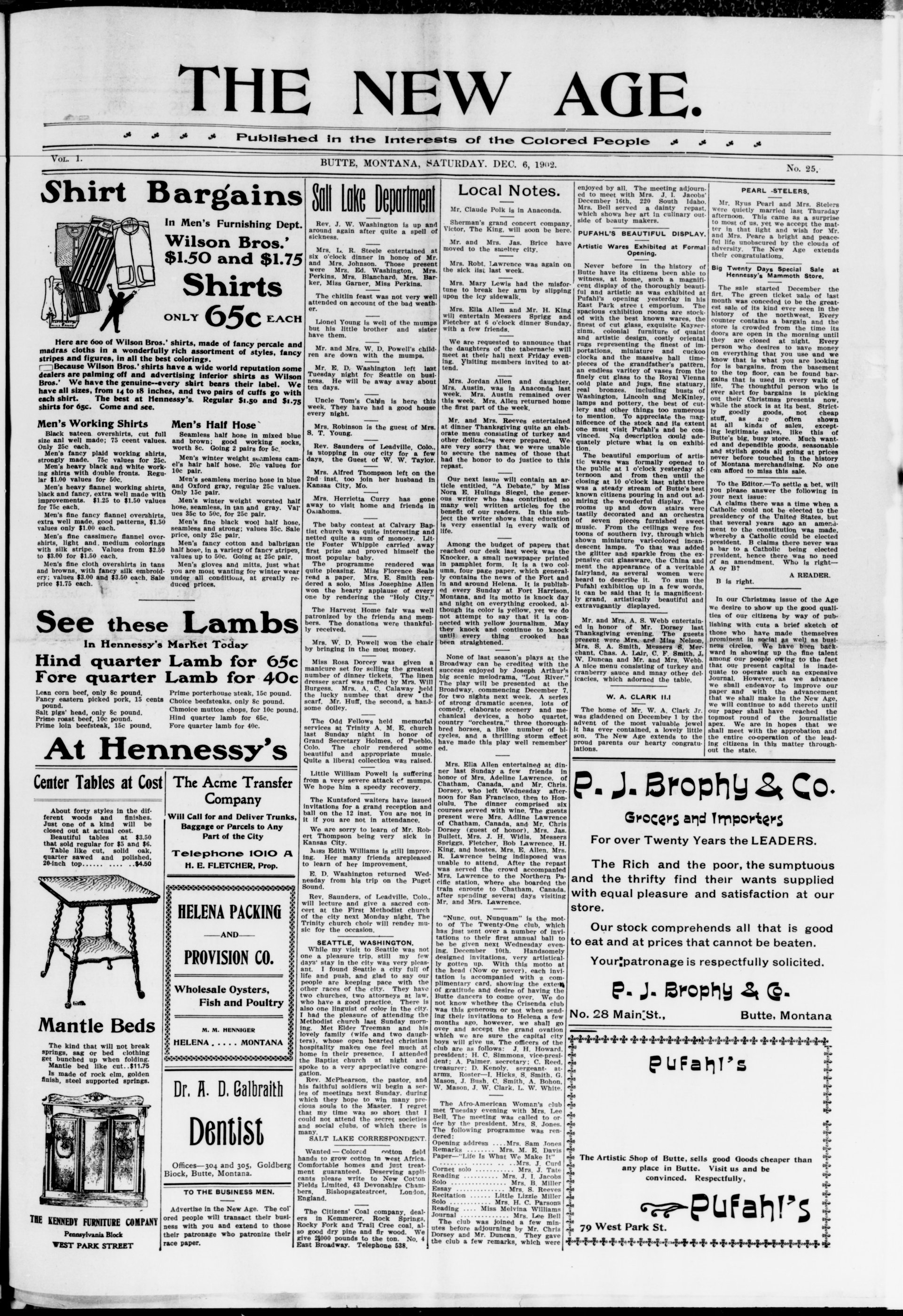
Page text (machine-generated)
Here are 600 of Wilson Bros.' shirts, made of fancy percale and madras cloths in a wonderfully rich assortment of styles, fancy stripes and figures, in all the best colorings.
Because Wilson Bros.' shirts have a wide world reputation some dealers are palming off and advertising inferior shirts as Wilson Bros.' We have the genuine--every shirt bears their label. We have all sizes, from 14 to 18 inches, and two pairs of cuffs go with each shirt. The best at Hennessy's. Regular $1.50 and $1.75 shirts for 65c. Come and see.
VOL. 1.
MILK CHANGE
Here are 600 of Wilson Bros. madras cloths in a wonderfully stripes and figures, in all the best Because Wilson Bros.' shirts dealers are palming off and adve Bros.' We have the genuine-eve have all sizes, from 14 to 18 inches each shirt. The best at Henri shirts for 65c. Come and see.
Men's Working Shirts
Black sateen overshirts, cut full size anl well made; 75 ceent values. Only 25c each.
Men's fancy plaid working shirts, strongly made. 75c values for 25c.
Men's heavy black and white working shirts with double fronts. Regular $1.00 values for 50c.
Men's heavy flannel working shirts, black and fancy, extra well made with improvements. $1.25 to $1.50 values for 75c each.
Men's fine fancy flannel overshirts, extra well made, good patterns, $1.50 values only $1.00 each.
Men's fine cassimere flannel overshirts, light and, medium colorings with silk stripe. Values from $2.50 to $3.00 for $1.50 each.
Men's fine cloth overshirts in tans and browns, with fancy silk embroidery; values $3.00 and $3.50 each. Sale price $1.75 each.
See these
In Hennessy's
Hind quarter
Fore quarter
Lean corn beef, only 8c pound.
Fancy eastern picked pork, 15 cents
pound.
Salt pigs' head, only 8c pound.
Prime roast beef, 10c pound.
Prime loin beefsteak, 15c pound.
At Hen
Center Tables at Cost
About forty styles in the different woods and finishes.
Just one of a kind will be closed out at actual cost.
Beautiful tables at $3.50
that sold regular for $5 and $6.
Table like cut, solid oak,
quarter sawed and polished,
20-inch top..... $4.50
10
Mantle Beds
The kind that will not break springs, sag or bed clothing get bunched up when folding. Mantle bed like cut..$11.75 Is made of rock elm, golden finish, steel supported springs.
THE KENNEDY FURNITURE COMPANY
Pennsylvania Block
WEST PARK STREET
THE KENNEDY FURNITURE COMPANY
Pennsylvania Block
WEST PARK STREET
THE NEW AGE.
In Men's Furnishing Dept. Wilson Bros.' $1.50 and $1.75 Shirts ONLY 65c EACH
s.' shirts, made of fancy percale and
only rich assortment of styles, fancy
best colorings.
Is have a wide world reputation some
advertising inferior shirts as Wilson
every shirt bears their label. We
hes, and two pairs of cuffs go with
unessy's. Regular $1.50 and $1.75
Men's Half Hose
Seamless half hose in mixed blue and brown; good working socks, worth 8c. Going 2 pairs for 5c.
Men's winter weight seamless camel's hair half hose. 20c values for 10c pair.
Men's seamless merino hose in blue and Oxford gray, regular 25c values. Only 15c pair.
Men's winter weight worsted half hose, seamless, in tan and gray. Values 35c to 50c, for 25c pair.
Men's fine black wool half hose, seamless and strong; values 35c. Sale price, only 25c pair.
Men's fancy cotton and balbrigan half hose, in a variety of fancy stripes, values up to 50c. Going at 25c pair.
Men's gloves and mitts, just what you are most wanting for winter wear under all conditions, at greatly reduced prices.
Lambs
Market Today
Lamb for 65c
Lamb for 40c
Prime porterhouse steak, 15c pound.
Choice beefsteaks, only 8c pound.
Chmoice mutton chops, for 10c pound.
Hind quarter lamb for 65c.
Fore quarter lamb for 40c.
The Acme Transfer Company
Will Call for and Deliver Trunks,
Baggage or Parcels to Any
Part of the City
Telephone 1010 A
H. E. FLETCHER, Prop.
HELENA PACKING
AND
PROVISION CO.
Wholesale Oysters,
Fish and Poultry
M. M. HENNIGER
HELENA . . . MONTANA
Dr. A. D. Galbraith
Dentist
Offices—304 and 305, Goldberg Biock, Butte, Montana.
TO THE BUSINESS MEN.
Advertise in the New Age. The coloured people will transact their business with you and extend to those their patronage who patronize their race paper.
BUTTE, MONTANA, SATURDAY, DEC. 6, 1902.
Salt Lake Department
Rev, J. W. Washington is up and around again after quite a spell of sickness.
Mrs. L, R. Steele entertained at six o'clock dinner in honor of Mr. and Mrs. Johnson. Those present were Mrs. Ed. Washington, Mrs. Perkins, Mrs. Blanchard, Mrs. Barker, Miss Garner, Miss Perkins.
The chitlin feast was not very well attended on account of the bad weather.
Lionel Young is well of the mumps but his little brother and sister have them.
Mr. and Mrs. W. D. Powell's children are down with the mumps.
Mr. E. D. Washington left last Tuesday night for Seattle on business. He will be away away about ten days.
Uncle Tom's Cabin is here this week. They have had a good house every night.
Mrs. Robinson is the guest of Mrs. S. T. Young.
Rev. Saunders of Leadville, Colo., is stopping in our city for a few days, the Guest of W. W. Taylor.
Mrs. Alfred Thompson left on the 2nd inst. too join her husband in Kansas City, Mo.
Mrs. Herrietta Curry has gone away to visit home and friends in Oklahoma.
The baby contest at Calvary Baptist church was quite interesting and netted quite a sum of monoey. Little Foster Whipple carried away first prize and proved himself the most popular baby.
The programme rendered was quite pleasing. Miss Florence Seals read a paper. Mrs. E. Smith rendered a solo. Miss Josephine Allen won the hearty applause of every one by rendering the "Holy City."
The Harvest Home fair was well patronized by the friends and members. The donations were thankfully received.
Mrs. W. D. Powell won the chair by bringing in the most money.
Miss Rosa Dorcey was given a manicure set for selling the greatest number of dinner tickets. The linen dresser scarf was raffled by Mrs. Will Burgess. Mrs. A. C. Calaway drew the lucky number that drew the scarf. Mr. Huff, the second, a handsome dolley.
The Odd Fellows hold memorial services at Trinity A. M. E. church last Sunday night in honor of Grand Secretary Holmes, of Pueblo, Colo. The choir rendered some beautiful and appropriate music. Quite a liberal collection was raised.
Little William Powell is suffering from a very severe attack of mumps. We hope him a speedy recovery.
The Kuntsford waiters have issued invitations for a grand reception and ball on the 12 inst. You are not in it if you are not in attendance.
We are sorry to learn of Mr. Robert Thompson being very sick in Kansas City.
Miss Edith Williams is still improving. Her many friends are pleased to learn of her improvement.
E. D. Washington returned Wednesday from his trip on the Puget Sound.
Rev, Saunders, of Leadville, Colo., will lecture and give a sacred concert at the First Methodist church of the city next Monday night. The Trinity church choir will render music for the occasion.
SEATTLE. WASHINGTON.
SEATTLE, WASHINGTON.
While my visit to Seattle was not one a pleasure trip, still my few days' stay in the city was very pleasant. I found Seattle a city full of life and push, and glad to say our people are keeping pace with the over races of the city. They have two churches, two attorneys at law who have a good practice. There is also one linguist of color in the city. I had the pleasure of attending the Methodist church last Sunday morning. Met Elder Treeman and his lovely family (wife and two daughters), whose open hearted christian hospitality makes one feel much at home in their presence. I attended the Baptist church at night and spoke to a very appreciative congregation.
Rev. McPhearson, the pastor, and his faithful soldiers will begin a series of meetings next Sunday, during which they hope to win many precious souls to the Master. I regret that my time was so short that I could not attend the secret societies and social clubs, of which there is many.
SALT LAKE CORRESPONDENT.
Wanted—Colored cotton field hands to grow cotton in west Africa. Comfortable homes and just treatment guaranteed. Deserving applicants please write to New Cotton Fields Limited, 43 Devonshire Chambers, Bishopsgatestreet, London, England.
The Citizens' Coal company, dealers in Kemmerer, Rock Springs, Rocky Fork and Trail Cree coal, also good dry pine and fir wood. We give 2000 pounds to the ton. No. 4 East Broadway. Telephone 538.
Local Notes.
Mr. Claude Polk is in Anaconda.
Sherman's grand concert company,
Victor, The King, will soon be here.
Mr. and Mrs. Jas. Brice have
moved to the snelter city.
Mrs. Robt. Lawrence was again on
the sick list last week.
Mrs. Mary Lewis had the misfortune to break her arm by slipping
upon the icy sidewalk.
Mrs. Ella Allen and Mr. H. King
will entertain Messers Sprigg and
Fletcher at 6 o'clock dinner Sunday,
with a few friends.
We are requested to announce that
the daughters of the tabernacle will
meet at their hall next Friday evening.
Visiting members invited to attend.
Mrs. Jordan Allen and daughter,
Mrs. Austin, was in Anaconda last
week. Mrs. Austin remained over
this week. Mrs. Allen returned home
the first part of the week.
Mr. and Mrs. Reeves entertained
at dinner Thanksgiving quite an elaborate menu consisting of turkey and other delicacies were prepared. We are very sorry that we were unable to secure the names of those that had the honor to do justice to this repast.
Our next issue will contain an article entitled, "A Debate," by Miss Nora E. Hulings Siegel, the generous writer who has contributed so many well written articles for the benefit of our readers. In this subject the writer shows that education is very essential in every walk of life.
Among the budget of papers that reached our desk last week was the Knocker, a small newspaper printed in pamphlet form. It is a two column, four page paper, which generally contains the news of the Fort and in and around Helena. It is published every Sunday at Fort Harrison, Montana, and its motto is knock day and night on everything crooked, although its color is yellow, yet we do not attempt to say that it is connected with yellow journalism. May they knock and continue to knock until every thing crooked has been straightened.
None of last season's plays at the Broadway can be credited with the success enjoyed by Joseph Arthur's big scenic melodrama, "Lost River." The play will be presented at the Broadway, commencing December 7, for two nights next week. A series of strong dramatic scenes, lots of comedy, elaborate scenery and mechanical devices, a hobo quartet, country "orchestra," three thoroughbred horses, a like number of bicycles, and a thrilling storm effect have made this play well remembered.
Mrs. Ella Allen entertained at dinner last Sunday a few friends in honor of Mrs. Adeline Lawrence, of Chatham, Canada, and Mr. Chris Dorsey, who left Wednesday afternoon for San Francisco, then to Honolulu. The dinner comprised six courses served with wine. The guests present were Mrs. Adline Lawrence of Chatham, Canada, and Mr. Chris Dorsey (guest of honor). Mrs. Jas. Bullett, Mrs. J. H. Widis, Messers Spriggs, Fletcher, Bob Lawrence, H. King, and hosts, Mrs. E. Allen, Mrs. R. Lawrence being indisposed was unable to attend. After the repast was served the crowd accompanied Mrs. Lawrence to the Northern Pacific station, where she boarded the train enroute to Chatham, Canada, after spending several days visiting Mr. and Mrs. Lawrence.
"Nunc out, Nunquam" is the motto of *To the Twenty-One club*, which has just sent over a number of invitations to their first annual ball to be given next Wednesday evening, December 10th. Handsomely designed invitations, very artistically gotten up. With this motto at the head (Now or never), each invitation is accompanied with a compilatory card, showing the extent of gratitude and desire of having the Butte dancers to come over. We do not know whether the Crisenda club was this generous or not when sending their invitations to Helena a few months ago, however, we shall go over and accept the grand ovation which we are sure the capital city boys will give us. The officers of the club are as follows: J. H. Howard, president; H. C. Simmons, vice-president; A. Palmer, secretary; C. Reed, treasurer; D. Kenoly, sergeant-at-arms, Roster-I, Hicks, S. Smith, G. Mason, J. Bush, C. Smith, A. Bohon, W. Mason, J. W. Clark, L. W. White.
The Afro-American Woman's club met Tuesday evening with Mrs. Lee Bell. The meeting was called to order by the president, Mrs. S. Jones. The following programme was rendered:
Opening address ... Mrs. Sam Jones
Remarks ... Mrs. M. E. Davis
Paper—"Life Is What We Make It" ... Mrs. J. Curt
Cornet solo ... Mrs. J. Tate
Reading ... Mrs. J. I. Jacobs
Solo ... Mrs. B. Miller
Essay ... Mrs. S. Reeves
Recitation ... Little Lizzie Miller
Solo ... Mrs. H. C. Parsons
Reading ... Miss Melvina Williams
Journal ... Mrs. Lee Bell
The club was joined a few minutes before adjourning by Mr. Chris Dorsey and Mr. Duncan. They gave the club a few remarks, which were
P. J. Brophy & Co.
For over Twenty Years the LEADERS.
The Rich and the poor, the sumptuous and the thrifty find their wants supplied with equal pleasure and satisfaction at our store.
Our stock comprehends all that is good to eat and at prices that cannot be beaten.
Your patronage is respectfully solicited.
P. J. Brophy & Co.
No. 28 Main St., Butte, Montana
Pufahl's
The Artistic Shop of Butte, sells good Goods cheaper than any place in Butte. Visit us and be convinced. Respectfully,
Pufahl's
79 West Park St.
enjoyed by all. The meeting adjourned to meet with Mrs. J. l. Jacobs December 16th, 220 South Idaho Mrs. Bell served a dainty repast which shows her art in culinary out side of beauty makers.
PUFAHL'S BEAUTIFUL DISPLAY.
Artistic Wares Exhibited at Formal Opening.
Never before in the history of Butte have its citizens been able to witness, at home, such a magnificent display of the thoroughly beautiful and artistic as was exhibited at Pufahf's opening yesterday in his East Park stree t emporium. The spacious exhibition rooms are stocked with the best known wares, the finest of cut glass, exquisite Kayserzinn, colonial furniture of quaint and artistic design, costly oriental rugs representing the finest of importations, miniature and cuckoo clocks and the massive hall timepieces of the grandfather's pattern, an endless variey of vases from the finely cut glass to the Royal Vienna oold plate and jugs, fine statuary, real bronzes, including busts of Washington, Lincoln and McKinley, laurel and pottery, the best of cutlery and other things too numerous to mention. To appreciate the magnificence of the stock and its exquisite one must visit Pufahf's and be convinced. Nq description could adequately picture what is on exhibition.
The beautiful emporium of artistic wares was formally opened to the public at 1 o'clock yesterday afternoon and from then until the closing at 10 o'clock last night there was a steady stream of Butte's best known citizens pouring in and out admiring the wonderful display. The rooms up and down stairs were tastily decorated and an orchestra of seven pieces furnished sweet music. From the ceilings were festoons of southern ivy, through which shown miniature varied-colored incandescent lamps. To that was added the glitter and sparkle from the expensive cut glassware, the China and ment the appearance of a veritable fairyland, as several women were heard to describe it. To sum the Pufah exhibition up in a few words, it can be said that it is magnificently grand, artistically beautiful and extravagantly displayed.
Mr. and Mrs. A. S. Webb entertained in honor of Mrs. Dorsey last Thanksgiving evening. The guests present were Mrs. and Miss Nelson, Mrs. S. A. Smith, Messers S. Merchant, Chas. A. Lair, C. F. Smith, J. W. Duncan and Mr. and Mrs. Webb. A nice menu consisting of turkey and cranberry sauce and mray other delicacies, which adorned the table.
W. A. CLARK III
The home of Mr. W. A. Clark Jr. was gladdened on December 1 by the advent of the most valuable jewel it has ever contained, a lovely little son. The New Age extends to the proud parents our hearty congratulations.
No. 25.
PEARL -STELERS
Mr. Ryus Pearl and Mrs. Ste尔斯 were quietly married last Thursday afternoon. This came as a surprise to most of us, yet we accept the matter to the light and wish for Mr. and Mrs. Pearle a bright and peaceful life unobstructed by the clouds of adversity. The New Age extends their congratulations.
Big Twenty Days Special Sale at Hennessy's Mammoth Store.
The sale started December the first. The green ticket sale of last month was conceded to be the greatest sale of its kind ever seen in the history of the northwest. Every counter contains a bargain and the store is crowded from the time its doors are open in the morning until they are closed at night. Every person who desires to save money on everything that you use and we know that is what you are looking for is bargains, from the basement to the top floor, can be found bargains that is used in every walk of life. The thoughtful person who is ever alert for bargains is picking out their Christmas presents now, while the stock is at its best. Strictly goodly goods, not cheap stuff, as are often shown at all kinds of sales, excepting legitimate sales, like this of Butte's big, busy store. Much wanted and dependible goods, seasonable and stylish goods all going at prices never before touched in the history of Montana merchandising. No one can afford to miss this sale.
To the Editor.—To settle a bet, will you please answer the following in your next issue:
A claims there was a time when a Catholic could not be elected to the presidency of the United States, but that several years ago an amendment to the constitution was made, whereby a Catholic could be elected president. B claims there never was a ban on Catholic being elected president, hence there was no need of an amendment. Who is right—A or B?
A READER.
In our Christmas issue of the Age we desire to show up the good qualities of our citizens by way of publishing with cuts a brief sketch of those who have made themselves prominent in social as well as business circles. We have been backward in showing up the fine talent among our people owing to the fact that our present capital is inadequate to operate such an expensive Journal. However, as we advance we shall endeavor to improve our paper and with the advancement that we shall make in the New Age, we will continue to add thereto until our paper shall have reached the topmost round of the journalistic apex. We are in hopes that we shall meet with the approbation and the entire co-operation of the leading citizens in this matter throughout the state.
THE NEW AGE
published weekly by the New Age Publishing Company, office, 220 South Idaho street.
Subscription price, $2.00 a year. Six months, $1.10. Three months, 60 cents, invariably in advance. Telephone $62-B.
BLING PRINTING
TRADES COUNTY
BUTTERY COUNTY
Entered October 2, 1902, at Butte,
Mont., as second-class matter under
act of congress of March 3,
1879.
SATURDAY, DECEMBER 6, 1902.
THE GIRLS OF KASHMIR.
Why They Are Not as Beautiful as They Once Were.
The girls of Kashmir in former times were sold and carried away to the Punjab, in India. They commanded a large price, and parents in moderate circumstances for centuries past have been in the habit of parting with their daughters to place themselves in easier circumstances, and the daughters have generally been quite willing to escape from a life of penury and labor to one of opulence and ease.
A laboring man in this part of India cannot earn over $2 or $3 a month, while many receive for their daughters as high as $1,000. There are some cases where $5,000 was paid, but the usual price has been from $100 to $500.
The practice became so common as well as so damaging that a severe law was enacted prohibiting any one from removing any woman from the country, but it is said that the business goes on now as it has done for hundreds of years, and to that practice may be charged the fact that the women of Kashmir are not as beautiful as they once were.
The process of taking all the beautiful girls away, leaving only the ordinary and ugly ones to continue the race, has lowered the standard of beauty. Most of the women and girls perform field labor as much as the men, and their dress is of the coarsest and plainest materials, consisting of a garment like a nightgown made of white cotton. There is no effort to have it fit.
The condition of women in Kashmir is a very sad one, but one from which there does not seem to be any present escape. It is a constant struggle to live, without the least hope of any accumulation or of ever seeing better days. The men only receive about 5 cents a day and the women generally about 3 cents, and that will provide only the coarsest food. -Philadelphia Inquirer.
PICKINGS FROM FICTION.
There is nothing that is enough for a woman, but all.—"The Mississippi Bubble."
Overdone heartiness is nearly as nasty as underdone mutton.—"Comments of a Countess."
No man can be brave who considers pain the chief evil of life.—"The Heroine of the Strait."
We ought never to do wrong when people are looking.—"A Double Barreled Detective Story."
Occasion's everything, but the rub is to know an occasion when you see it.—"The Lady Paramount."
I'd be slow in advisin' anybody to crooked, but when ye feel ye're in the hands of sharpers it's the only way.—"Rockhaven."
The master poets love to deal with the victory of the vanquished, which the world's thinkers know to be greater than the victory of the victorious.—"Nathan Hale."
Be sure, before you give your love and your trust, that you are giving them not only to one who deserves them, but to one who really wants them—"Many Waters."
Useful Purposes of Rosin.
There are many useful purposes to which rosin can be applied outside of those of general practice. As a non-conductor of heat it is used in the protection of water pipes, particularly in crossing bridges, where the pipe is laid in the middle of a long box and the whole filled with melted rosin. Rosin is also used in supporting basement floors in machine shops, which may be laid over some dry material, as spent molding sand, which is carefully leveled off, and the planking laid upon temporary supports separating it about two inches above the sand.
Numerous holes about two inches in diameter being bored through these planks, melted rosin is forced through them by means of funnels until the whole space is solidly filled, and then the upper flooring is laid upon these planks. In case the floor is subjected to shocks sufficient to break the rosin it rapidly joins together again in much the same manner as the regulation of ice.
The Dragon Slayer.
At an English school a pompous youngster whose father, it was well known, had been a successful omnibus driver was one day fingering ostentiously a large seal which he is in the habit of wearing, representing St. George and the dragon, and, having drawn the attention of a school companion to it, remarked carelessly: "Ah, one of my ancestors is supposed to have killed the dragon, don't you know!" "Good gracious!" inquired the other, somewhat anxiously. "Did he run over it?"—London Answers.
CURES FOR TOOTHACHE.
Remedies That Do Not Appeal to the Ordinary Man Today.
The man in dental anguish sometimes curses with Burns "the venomed stang that shoots his tortured gums along." Sometimes, on the other hand, he prays. St. Augustine in his "Confessions" relates how he once suffered from "dolor dentium" (toothache), apparently in an aggravated form, for he could not speak. Thereupon he wrote on wax a prayer to God for the other brethren to repeat, and as soon as all were on their knees the pain went. "But what a pain" he says. "Never since my tender age had I experienced the like." Southey in his "Life of John Wesley" tells of that eminent preacher that when his own tooth ached he prayed and the pain left him.
Unfortunately ordinary men do not seem to have such efficacious faith. When the excruciation begins, they must bear it philosophically, and on Shakespeare's authority toothache finds out just the weak place in the philosopher's armor of patience. In the middle ages the devout who were racked with pain had a special patron to whom they could call for deliverance. St. Apollonia, a martyr under the emperor Philip, among other cruel indignities had her teeth pulled out. In consequence she became toothache's tutelary saint, as her emblems—one of which is "holding a tooth in pinchers"—sufficiently testify.
And there would seem to have been yet another martyr, St. Blaize, who took cognizance of the disease. He was honored in the little town of St. Blazey, in Cornwall, where candles offered upon his altar were supposed to be an infallible cure for toothache. Chambers' Journal.
GOUGH'S QUICK WIT.
A Retort That Silenced an Interruption In the Audience.
An effort of one of John B. Gough's tours of the west was to arouse his converts to a political movement in favor of prohibition, and in several states the politicians began to give consideration to the cry. The distillers and liquor dealers are said to have been so frightened that they employed men to follow the lecturer, sit among the audience and endeavor to confound him with questions. He had worked a Topeka (Kan.) audience up to a fine pitch of excitement and in his effective manner cried:
"Temperance! Temperance! Temperance! It will mean money in your pocket, clothes on your back, happiness in your home and God in your heart"
Unleashed one of the paid interrupter
Up leaped one of the pald interrupters and shouted to the audience:
"Money in your pockets! Why, fellow citizens, follow this man's ideas and we'll be all in the poorhouse! Think of the fields of tasseled corn that stretch on every side! Whisky is made from corn. We sell millions of dollars' worth of corn to the whisky makers. Stop the manufacture of whisky, and what'll we do?" Then, turning to Gough, we went on: "You, Mr. Smarty—what'll we do? Tell us, if prohibition comes, what'll we do with our corn?" "Raise more hogs, my friend," replied Gough without a second's hesitation—"raise more hogs!"—Philadelphia Times.
Sympathy.
Ted's mamma had a birthday recently and received as a present from one of her friends a ten dollar bill. Accompanying the money was a note in which the writer, after explaining that she couldn't think of anything tasteful to buy and had therefore sent the cash, made some tender references to bygone days and dear old scenes. While the recipient was sitting with the bill in one hand and the letter in the other and permitting tears to drip down upon both Ted went up to her and, putting his arms around her neck, tenderly asked: "What's the matter, mamma? Isn't the money good?"—New York Commercial Advertiser.
Proctor's Finest Speech.
Senator Proctor of Vermont once said the finest speech he ever made consisted of only four words. It was in retort to Senator Hoar's sarcastic little thrust in a speech directed at the Green Mountain senator. He said, "No man in Vermont is allowed to vote unless he has made $5,000 trading with Massachusetts people." Whereat Proctor said, "And we all vote."—Chicago Inter Ocean.
Merely a Joke.
Gusher—You may not believ' it, but I've never had an unkind word from my wife in all my life.
Henpeck—Oh, don't try to spring that old chestnut on me.
Gusher—What old chestnut?
Henpeck—You want me to say,
"How did you manage that?" and then
you'll say, "I never got married."—Detroit Free Press.
Mrs. Nexdore—My daughter was practicing her new concert piece last night. Did you hear her?
Mrs. Pepprey—Oh, yes.
Mrs. Nexdore—How was it?
Mrs. Pepprey—I simply couldn't get away; that's how it was.—Philadelphia Press.
Not Ready to Arbitrate.
"Stop! Don't fight, boys! Can't we arbitrate this thing?" asked one of the bystanders.
"Yes, sir," panted the fellow who was on top. "Just as soon as I've blacked his other eye!"—Chicago Tribune.
Fruit tarts and cakes are served out five times a week to the crews on board steamers trading between Australia and New Zealand. Tarts are toppless ples.
THE NEW AGE.
KISSING THE HAND.
ed or eaten by grown animals had been perfectly cleaned by the kits I was able to judge of their summer's diet. This had consisted mostly of minor game, rabbits, marmots, grouse and the like, with an occasional small deer. At least one whole family of badgers, old and young, had been served, pussy having probably lain for them at their hole until they were all in.-Franklin Welles Calkins in Outing.
The Practice Was Instituted by the Early Roman Rulers.
The practice of kissing the hands was instituted by the early Roman rulers as a mark of subjection as much as one of respect, and under the first Caesar the custom was kept up, but only for a time. These worthies conceived the idea that the proper homage due to their exalted station called for less familiar modes of obeisance, so the privilege of kissing the emperor's hand was reserved as a special mark of condescension or distinction for officers of high rank.
The Horse Is Useful Even If Dead.
The whale can be put to a great number of uses when dead, as can also the horse, the various parts of which are utilized as follows: Hair of mane and tail for haircloth, stuffing mattresses and making bags for crushing seed in oil mills, etc.; hide and skin tanned for leather for covering tables, etc.; tendons used for glue and gelatin; flesh for food for dogs, poultry and man; fat used for lamps, etc.; intestines used for covering sausages, making gut strings, etc.; heart and tongue for food; hoofs for gelatin, prusslate, fancy snuffboxes, etc.; bones for knife handles, phosphorus, superphosphate of lime and manure; blood for manure and shoes for reuse or for old iron.—Spare Moments.
No such restriction, however, was placed on the emperors themselves, who, if they wished to confer signal honor on any of their subjects, kissed either the mouths or the eyes of those they wished specially to favor, the kiss generally intimating some promotion or personal satisfaction for some achievement.
Roman fathers considered the practice of kissing of so delicate a nature that they never kissed their wives in the presence of their daughters.
Then, too, only the nearest relatives were allowed to kiss their kindred of the gentler sex on the mouth, for in those days, as now, kissing was not a mere arbitrary sign, but it was the spontaneous language of the affections, especially that of love.
"So you don't know whether you want to go to work or not?"
Under the Romans if a lover kissed his betrothed before marriage she inherited half of his worldly goods in the event of his death before the marriage ceremony, and if she died her heritage descended to her nearest relatives.
"Well, suh," answered Mr. Erastus Pinkley, "I'd like de refusal ob de job a little while."
"But I need somebody right away."
"In dat case I'll have to let it go by. Ize je's bought a policy ticket, an 'I'll hafter wait till attuh de drawin' to see whether Ize gwine to work at all or not."—Washington Star.
A PANTHER'S DEN.
Clean and Bright, In Decided Contrast to the Popular Idea.
It was my good fortune to discover the newly abandoned lair of a cougar family and further and to me new evidence of that fastidious cleanliness which is a marked characteristic of the animal. This retreat was not at all the typical "panther's den" of tradition, but a bush grown harborage under the edge of a rock with just enough of shelf to keep off the rain. I should not have found this breeding place but for a certain well gnawed array of bones scattered over a little smooth bench above a creek channel. From this honeyard there was a very traceable path leading through grass and brush to the retreat where the dam had housed her young. The evidence here told plainly of the cougar's long immunity from annoyance and attack and of a thoroughly cleanly habit of life. There was no bone or other sign of feasting about the lair. The dam had carried her kill to the creek bench in every instance, and the children had been called to the dining room. As bones which would have been crunch-
Once my sister Floy was sent on an errand for some things for my mother. There was a traveling man there who was selling carpet spankers, and he asked her:
"Has your mother got one of these spankers?"
"No, sir," she replied.
"What does she use?" he asked.
"Her hand," was the prompt reply.—Chicago Chronicle.
"I shruck a man yisterday an' he gave me a receipt for it,"—Ohio State Journal.
His Favorite Remedy.
"Mamma," said Tommy, "does sugar ever cure anybody of anything?"
"Why do you ask, my boy?"
"I thought I'd like to catch it," said Tommy.
CAR PROFIT
TWO MONTHS
young man, who, without any pre-
capital, undertook to represent us
"History, and in Citizenship"
ing him out as General Agent.)
qualled and surpassed by hundreds
e did—
$182.60 CLEAR
EARNED IN TWO MO
is the actual record of a bright young man,
vious canvassing experience or capital, und
in the sale of
"The Negro in Revelation, History, o
in his county. (We are now sending him out
This excellent record can be equalled and
of men and women. Begin as he did—
$182.60 CLEAR PROFIT
is the actual record of a bright young man, who, without any previous canvassing experience or capital, undertook to represent us in the sale of
in his county. (We are now sending him out as General Agent.) This excellent record can be equalled and surpassed by hundreds of men and women. Begin as he did—
FIRST FEW FRIENDS.
Their interest in you will lead them to give rather than criticise you. Show them how to tion, in History and in Citizenship" is an in ored man, woman and child. What the color accomplished, as set forth in the book, with ings, will excite the interest, wonder and ad men and black. You will surely succeed, a which this success begets you will be prepa
them to give you a hearing, to help them how "The Negro in Revela-
lap" is an inspiration to every col-
labor the colored race has actually
book, with 200 beautiful engrav-
ender and admiration of both white
y succeed, and with the confidence
will be prepared to
CAN.
men begin in a small way. We
is announcement can do as well
if he makes up his mind to do it.
active. We will help you in every
at you make a conscientious ef-
Their interest in you will lead them to give you a hearing, to help rather than criticise you. Show them how "The Negro in Revelation, in History and in Citizenship" is an inspiration to every colored man, woman and child. What the colored race has actually accomplished, as set forth in the book, with 200 beautiful engravings, will excite the interest, wonder and admiration of both white men and black. You will surely succeed, and with the confidence which this success begets you will be prepared to
NEXT TRY EVERYBODY YOU CAN.
The mass of successful business men begin know that everyone who reads this announce as the young man above noted if he makes The work is profitable and attractive. We way possible. All we ask is that you ma fort—give it a fair trial and
The mass of successful business men begin in a small way. We know that everyone who reads this announcement can do as well as the young man above noted if he makes up his mind to do it. The work is profitable and attractive. We will help you in every way possible. All we ask is that you make a conscientious effort—give it a fair trial and
THEN DECIDE FROM THIS EXPERIENCE
Whether it is not sufficiently attractive and your becoming our regular representative.
It will pay you to Investigate. A postal will lars concerning this great work.
THE NEGI
IN
Revelation, in History, and in
WHAT THE RACE HAS DONE AND
IN
ARMS, ARTS, LETTERS, THE PULPIT, SCHOOL, THE MARTS OF
A MESSAGE TO ALL MEN THAT HE IS SOLVE THE RACE PROBLEM FOR HIMS
By
REV. J. J. PIPKIN
With introduction by
active and profitable to warrant
presentative.
A postal will bring particu-
work.
NEGRO
j. and in Citizenship;
DONE AND IS DOING
THE PULPIT, THE FORUM, THE
ARTS OF TRADE
WHAT HE IS IN THE WAY TO
FOR HIMSELF.
By
J. PIPKIN
in by
Whether it is not sufficiently attractive and profitable to warrant your becoming our regular representative.
It will pay you to Investigate. A postal will bring particulars concerning this great work.
WHAT THE RACE HAS DONE AND IS DOING
IN
ARMS, ARTS, LETTERS, THE PULPIT, THE FORUM, THE
SCHOOL, THE MARTS OF TRADE
A MESSAGE TO ALL MEN THAT HE IS IN THE WAY TO
SOLVE THE RACE PROBLEM FOR HIMSELF.
GENERAL JOHN B. GORDON.
Former Major-General Confederate Army, United from Georgia, ex-Governor of Georgia, now United States Confederate Veterans, Autha Reminiscences," Etc.
Address N. D. THOMPSON PUBLISHING COMP.
State Army, United States Senator
Georgia, now Commander
Veterans, Author "War
scences," Etc.
LISHING COMPANY, 204 Olive
Louis, Mo.
Former Major-General Confederate Army, United States Senator from Georgia, ex-Governor of Georgia, now Commander United States Confederate Veterans, Author "War Reminiscences," Etc.
Address N. D. THOMPSON PUBLISHING COMPANY, 204 Olive Street, St. Louis, Mo.
In Suspense.
The best place to buy Loaf, Layer and Fruit Cakes, Nut Cookies, Macaroons, Lady Fingers, Cream Puffs and all the other kinds of delicious pastry goods.
Our Ice Cream Factory is the largest and best in the Northwest and we make the kind of Cream you like. Our Ice Cream Sodas are simply grand. The only place in town you can get Fresh Candies every day.
64 W. PARK ST. 'PHONE 75.
WE DELIVER EVERYTHING FREE
Wear Clothes That Fit
A man can save money and feel more comfortable by wearing clothes that fit.
The Connell Clothes
are all made expressly for us. They fit well, look well and wear well. Prices are little, if any, higher than you pay for "trashy" wholesale clothing.
M. J. Connell Company
TUTTLE JEWELRY CO.
NORTH MAIN STREET
our Day and Time, with the only New and I
Watches, Jewel
alty Gut Glass, Brid
and Repair Departments with 1902 Equip
nal ability in charge. We invite compari
verland
Rye
the Whiskey of Montan
THE
by Laundry
A New House of Our Day and Time, with the only New and Desirable Lines of Diamonds a Watches, Jewelry Specialty Gut Glass, Bric=a=Brac Manufacturing and Repair Departments with 1902 Equipment. Men of exceptional ability in charge. We invite comparison of our prices.
Overland
Rye
The Whiskey of Montana.
THE
Will call for and Deliver that Laundry. Ring Up 'Phone 2 Remember
...Ring Up 'Phone 2...
'Phone 2. 232 South Main Street $ ^{t} $
The Leading Decorators and Florists of Montana Cut Flowers and Plants Decorations and Designs a Specialty
A large supply of beautiful carnations and roses and other flowers are always carried. All orders receive prompt attention.
A GREAT ART.
The Rare Ability to Select Efficient Executive Heads.
Many men mistakenly think that because they work hard and try hard they must eventually succeed to some extent. This does not follow. Some men carry on great enterprises with little apparent effort. Their success is due to skill in selecting efficient executive heads.
Many a business man breaks down trying to supplement the work of incompetent heads of departments simply because he does not know how to choose the right men. A man of commanding ability does not worry himself over details. He makes out his programme and then selects men who can carry it out to the letter. Indeed it is a sign of weakness for the head of a concern to bother about little details. It shows that he lacks the insight, the business sagacity, the ability to select and to manage men who do things efficiently.
Many heads of large concerns spend little time in their offices. They travel or remain at home, but the businessoes on like clockwork simply because they know how to select men who can efficiently do the work assigned to them.
It is a great art to duplicate oneself on another and multiply oneself many times by selecting those who are vastly superior to ourselves, but who did not happen to have had our opportunity to do the thing themselves.—Suc-
A Careful Old Lady
An old lady applied at a registry office for a maid.
"I want a little girl, between eighteen and twenty-two years of age, who a fond of mushrooms."
"Fond of mushrooms." inquired the agent.
"That is something I never inquire about from my applicants. I don't understand."
"Well, I am very fond of mushrooms myself, and there are so many mistakes made. The idea came to me several years ago, and it was a dispensation of Providence that it did or I should have been killed. I make my maid eat a portion of all mushrooms brought to my house before any are served to me. I always require it," replied the old lady. "I have lost two excellent maids from toadstools during the last five years, and, of course, I could not think of taking the risk of eating mushrooms unless I had a maid to test them."—London Globe.
Marlory's Proviso.
Baby Marjory has been having her first experience of rural sights and sounds, of green things growing, of flowers hiding in the grass, of cows in the pasture, of horses in the stable. She was delighted with all but one of them, says a writer in the Philadelphia Telegraph.
The one exception was the big, surly dog that keeps watch and ward over the farm. She respected Hector in his own place, but that place is at a distance. She did not want him or his kind to approach near enough for intimate acquaintance.
Having been invited by a lady of the house to take a walk down to the village, Marjory hesitated a little. "Why, Marjory," exclaimed the lady, in an injured tone of voice, "don't you want to go with me?"
"Yes," replied the little mald, "I want to go, but p'ease don't let any dogs happen to me!"
Oldest Inn In England.
in the village of Norte St. Philip is the George inn. It claims to be the oldest licensed village alehouse in England, the license dating from 1397. Its appearance is eminently picturesque, each story overhanging that beneath, while the front is broken by bay windows, a porch and a flight of stone steps leading to a doorway in the wall. At the back are more quaint doors and windows, a turret built against the wall and inclosing an outside stair, while in the yard still remains a portion of the old gallery which in the middle ages was found in so many hostelries. Most of the front is timbered. Each gable is surmounted by a curious chimney. A curious feature of the interior is the upper floor, which is of plaster.
The Girl and Her Play.
Once upon a time there were a young lady and a young gentleman playing a two handed game of euchre.
"I offer you a solitaire diamond," said the young man as he played the ace of that suit.
"The best I can do is to give you my heart," the young woman answered as she played.
"Then your whole hand goes with it," he said.
"Yes, Charles, dear," she replied.
Curtles, dear," she replied. Moral—There is such a thing as playing into the other player's hand.—New York Herald.
Roman Gormands.
The ancient Greeks and Romans drank wine freely at their feasts. Wine was their beverage. Indeed Bacchus held high carnival among them, and the Roman would gorge himself with food and then empty his stomach by artificial means and resume his seat at table and eat and drink to his fill again.
Got It.
"Fact is," said the one man, "I married because I was lonely as much as for any other reason. To put it tersely, I married for sympathy." "Well," said the other man, "you have mine."
The Usual Kind.
Nodd-What do you mean by saying that my baby is just an ordinary baby? Todd-Why, he is precocious and beautiful and the best that ever lived, isn't he?-Life.
BYRON WAS BARRED.
Desa of Westminster Refused to Accept Statue of Poet.
Many years ago some admirers of Lord Byron raised a subscription for a monument to the poet, to be placed in Westminster abbey. Chantrey was requested to execute it, but on account of the smallness of the sum subscribed be declined, and Thorwaldsen was then applied to and cheerfully undertook the work.
In about 1833 the finished statue arrived at the custom house in London, but, to the astonishment of the subscribers, the dean of Westminster, Dr. Ireland, declined to give permission to have it set up in the abbey, and, owing to this difficulty, which proved insurmountable, for Dr. Ireland's successor was of the same opinion, it remained for upward of twelve years in the custom house, when (1846) it was removed to the library of Trinity college, Cambridge.
The poet is represented in the statue of the size of life, seated on a ruin, with his left foot resting on the fragment of a column. In his right hand he holds a style up to his mouth; in his left a book, inscribed "Childe Harold." He is dressed in a frock coat and cloak. Beside him on the left is a skull, above which is the Athenian owl. The likeness is of course posthumous. Thorwaldsen was born Nov. 19, 1770, and died on March 24, 1844.—Newcastle (Eng.) Chronicle.
A Model Surveyer.
The Kingman Leader-Courrier tells of an early day county surveyor in Kingman county, Kan., who neither possessed any instruments nor could have used them if he had. His method of measuring land was to tie his ankles together with a cord that was just long enough to allow him to step one-fifth of a rod each time, and thus hobbled he would strike out, counting his steps until he had made a sufficient number to cover the desired distance.
The cord or string used by him in fastening his legs together, says the Leader-Courrier, was made of rawhide, so that when he was traveling through the grass of a morning when the dew was on it would become wet and stretch nearly a foot, and so his steps were much longer of a morning than they were of an evening after the sun had dried the whang leather and shortened it. Consequently the man having his land surveyed in the morning would have much more in his quarter section than his neighbor who had his work done in the afternoon. These old surveys and corners then established cause annoyance even to this day.
The Kind of a Man He Was.
"I was in Washington once," said a man at the club, "when Tom Reed was the czar of the house of representatives. He was holding forth with earnestness on some theme to a group of friends when that man you see over there by the cigar counter pushed his way through the crowd, grasped Reed by the hand and said effusively: 'Hello, Tom, old boy! How do you do?'
"Reed responded in a manner that was more of a shake for the man than for his hand and went on with his talk. When our friend over there had hedged out of the crowd, some one said: 'You didn't seem to be happy over him, Reed. Who is your friend, anyway?'
"Reed drawled out, 'He's a fellow from New York who knows more men who don't want to know him than any other man in the United States.'" -Detroit Free Press.
Thrifty Squanderers.
When Napoleon entered Genoa in 1805, the rich patricians of the city exerted themselves to gain the favor of the conqueror by all sorts of flattering attentions. The most elaborate of these was a banquet patterned after the famous one offered by Antony to Cleopatra.
The tables were set in an artificial garden, floating on pontoons, which were towed out to sea during the progress of the feast. At the conclusion of the banquet—again in imitation of Antony and Cleopatra—all the costly gold and silver plate was funged into the sea.
This little tribute of honor to the emperor was not so expensive as it seemed, for the floating garden was surrounded with nets, and the plate was subsequently recovered.
What Men Like In Men.
Men like in men these traits: The honor that ennobles, the justice that insures the right, the reasonableness that mellows and makes plain, the courage that proclaims virility, the generous instinct that disdains all meanness, the modesty that makes no boast, the dignity that wins respect, the fineness and the tenderness that know and feel. But when one thinks of it more carefully may he not sum it up in just a single sentence and accept it as the truth that all men like a gentleman?—Cosmopolitan.
A Prescription:
A schoolteacher in Frome, England, sent this to the father of one of his pupils: "I beg to inform you that in my opinion your son is suffering from myopia, and his case requires prompt attention." The next day the boy brought back this written request: "Mister, please knock it out of Jim, as I ain't got time."
The Samoan Language
Speaking of the flexibility of the Samao language, Mrs. Isobel Strong says that the little word "ta" means I, we too, to beat with a stick, to play on a musical instrument, to reprove, to tattoo, to open a vein, to wash clothing by beating and to turn a somersault.
The world's coalfields cover at least 1,250,000 square miles.
THE NEW AGE
One Satisfactory Meal Grant Had After His Tour of the World.
"When General Grant stopped at the Palmer House in Chicago on his return from his tour of the world," said a man who was there at the time, "the steward was all but stupefied one noon at seeing the ex-president slide in at the kitchen door as though escaping from some one.
"I am sorry to trouble you,' he said, as though asking a great favor, 'but may I have a little corned beef and cabbage?
"Why, certainly,' the steward replied; 'but shan't I send it out to you in the dining room?
"No,' he answered; 'I'll eat it right here if you'll let me sit down.'
"So a place on the rough board table, where the cook had been fixing the meat, was cleared, and Grant drew up a stool and set to, and the way he got away with that corned beef and cabbage was a caution. When he had finished, he laid down his knife and fork with a funny sigh of satisfaction, put one hand on the steward's shoulder and said:
"Young man, I don't suppose you care for that at all, but if you had had to eat what I have for the past few months it would taste like a dinner for the gods. It tastes homey!
"The ex-president had dined with everybody from the queen down, but that cabbage and corned beef doubtless reminded him of the time when he was not so well known, but probably far happier—when people in St. Louis called him, 'captain' when they spoke to him and bought the wood he carted into town to sell."
An insignificant nose means an insignificant man. An open mouth is a sure sign of an empty head (keep yours closed). A projecting upper lip shows malignity and avarice. Pointed noses generally belong to meddlesome people. Large eyes in a small face betoken maliciousness. A retreating chin is always bad; it shows lack of resolution. A projecting under lip indicates ostentation, self conceit and folly. Fine hair generally betokens native good taste and intelligence. A dimple in the chin is pretty, but indicates weak mental organization. High cheek bones always indicate great force of character in some direction. Fullness of the temples is supposed to show powers of mathematical calculation.
A small mouth, with nose and nostril also small, shows indecision and cowardice. Half shut eyes show natural shrewdness, together with lack of sincerity. Slow moving eyes are always found in the heads of persons of prudence and ability—London Answers.
Possibly wheat was the corn so plenty in Egypt when famine drove thither Joseph's unnatural Llethren. Wheat went with other precious things into the mummy cases and sealed jars stored in royal tombs. Today acres by the thousand laugh in bearded grain said to have sprung from sparse kernels plundered by a ruthless explorer from a royal mummy's hand. Does it whisper now—this new-old Egyptian wheat—to its constant friend the sun, of Rameses and Pharoah—of Apls, the sacred bull—of Isis, Egypt's Ceres—of Osiris—the great sphinx—and Memnon's head, singing to hall the sunrise? If it would but speak aloud so mortals could comprehend, how our wisdom might be broadened! What a recasting of history must be wrought, and how we boasting moderns might hide diminished heads!—Everybody's Magazine.
Lord Roberts once found himself the center of a circle of new friends in a London club. There was a very tall gentleman present, who, evidently believing himself to shine as a wit, seized every opportunity to raise a laugh at the other people's expense. On being introduced to Lord Roberts the wit bent down patronizingly to his lordship and remarked:
"I have often heard of you, but"—shading his eyes with one hand as though the famous general, being so small, could be seen only with difficulty—"I have never seen you."
To this Lord Roberts promptly replied:
"I have often seen you, sir, but I have never heard of you."
Every one is aware that it is not wise to seek a tree's shelter in a thunderstorm; but, if you must take refuge there, then climb to the topmost branches. It has been proved that the upper boughs of trees during a storm would be the safest position, and it is said that birds in the branches are seldom killed. When the tree is struck by lightning, it is the trunk which, presumably from its greater dryness, is a bad conductor and which therefore suffers the most.
Special Inducements to Liberality.
"What are your rates?" asked the prospective victim of the lady fortune teller.
"I can't afford to tell you anything but disaster for 50 cents," repiled the lady, "but for $1 I'll agree to tell you a good fortune with no bad luck in it."—Ohio State Journal.
Parke-The other day I was in a kind of vision and saw my wife as the most perfect woman in the world.
Lane-Where were you?
Parke-In an intelligence office, describing her to a cook I was trying to engage-Judge.
Woman is a queer creation. She uses her smiles and tears alike for the vanquishment of man-Baltimore News.
DINED IN THE KITCHEN.
Character at a Glance:
Wheat In Fable and History.
A. Tort Retort:
The Safest Place In a Storm.
His Ideal Woman.
Lane—Where were you?
ALIASES OF THE PEANUT.
There Are Many Names For the Toothsome Palate Tickler.
Considering its universal popularity and excellent standing in agricultural circles, it is remarkable how many aliases there are under which the peanut travels. Whenever it is introduced to a new community the toothsome offering of the sod adopts a new name and comes forth with an additional sobriquet which makes it almost unrecognizable to its old acquaintances. If the "edible fruit"—as the dictionaries call it—had ever done anything to be ashamed of, the public might understand, but as things are the eccentricities of peanut nomenclature are absolutely astonishing.
Here in Virginia we designate our little friend principally as the peanut, but quite often we likewise allude to him as a "ground pea" and occasionally as a "goober." Over in England they call the same fruit ground nut, while it is variously known elsewhere as "earth nut," "Manilla nut," "Jurnut" and "pindar." The scientific patronymic, as we understand it, is Arachis pygopga, and the family belongs to the genus of leguminous plants.
But, be its name what it may, a peanut is a peanut the world over, so far as its virtues go, and few are the human palates which decline to receive an introduction to it.-Richmond Dispatch.
A Different Sort of Leather.
A Pennsylvania physician tells a story about his servant which reminds one in a vague way of the "skinny side out and the woolly side in" rhyme. He had just hired a servant who, says the Philadelphia Telegraph, had some of the "ouid dart" still clinging to her boots.
One morning he noticed his office windows were rather dirty, and, calling Bridget, he instructed her to clean them before he returned. At the same time he told her that he would stop and purchase a new chamois skin and send it home, and with this she was to clean the windows.
After he had gone his rounds he returned to his office. Glancing at the windows, he found them thickly streaked with grease. He called Bridget, and the following colloquy took place:
"Bridget, didn't I tell you to clean the windows?"
"And didn't I tell you to use the new chamols?"
"Yes, sor."
"Well, did you use it?"
"Sure, I did sor."
"Let me see the chamols," said the doctor, and Bridget promptly brought it. Then for the first time he learned that his wife had left the house a half hour before him and had sent home some tripe.
Black and White.
Every crow is said to think its own nestling the whitest, but a white cat that had four kittens, of which three were white and the fourth was black, gave the first place in her affections to Sooty. Once they were all brought into the drawing room to be "shown off." Besides the humans the room contained a great Newfoundland dog. Hitherto dog and dog had been on friendly terms, but now pussy showed much anxiety lest the dog might harm her black pet especially. At last she seized it by the neck and bore it beneath the lowest piece of furniture, where the dog could not possibly crawl, but she merely mewed to the others to follow her as best they could. The black kitten owed all this care to its color, more happy in this respect than the black sheep which is said to be in every flock—Exchange.
Holland.
Holland, known as North and South Holland, forms part of the northern part of the Netherlands. These provinces are composed of land rescued from the sea and defended by immense dikes. Holland was inhabited by the Batvi in the time of Cesar, who made a league with them. It became part of Gallia Belgica and afterward of the kindgom of Austria. From the tenth to the fifteenth century it was governed by counts under the German emperors. Holland was at one time a Dutch republic. It was created a kingdom in 1806, and Louis Bonaparte, father of Napoleon III., was declared king.
Diplomacy.
"It gives my wife a chance to prove me wrong, and this so delights her that I find her generously tractable in all the more important matters."—Chicago Post.
His Room.
"Mr. Diggles," said the boy with big ruffles on his shoulders, "I wish you would let me come and see where you live. I want to look at your room." "Why, certainly. But what made you think of that?" "My sister said it was better than your company, so I thought it must be something fine."
The National Game
"I hold a full hand," murmured the swain as he squeezed the lily white fingers of the fair maid.
Here a royal flush mounted to her brow.
A royal flush beats a full hand every time. (See Hoyle.)
She won.-Baltimore American.
It is not a waste to buy somebody a bunch of flowers, a box of candy or a new book when it is going to bring a smile to her face and happiness to her heart.-Exchange.
FIRING A SALUTE.
? the Way Two Naval Greenhorns Did It on a Warship.
"On one of Uncle Sam's warships once," said a naval officer, "we had enlisted among our able seamen two Irishmen, Mike and Barney. They had come aboard three days after they had landed in the country, but they learned some things so quickly that they had acquired a very definite idea of the meaning of the Fourth of July long before the day arrived, which was something like a month after we had sailed on our cruise. It chanced that the two were on an early morning watch together when Independence day dawned, and they at once began to plan for its proper welcome. They seemed to realize, you see, that there was necessity for an unusual display of patriotism.
"Barney suggested they fire a salute from one of the forward eight pounders, but Mike feared that would rouse the entire ship. 'Niver mound,' answered Barney. 'Do ye hold a bucket ferninst the muzzle, an' 'twill deaden the sound.' And three minutes later that gun went off with such a roar as brought every man of the crew out of the midst of peaceful dreams.
"I sent for Barney. 'Now, my man,' said I, 'tell me everything."
"Sure," he faltered, "it was only a bit uv a clibration because uv our indipindence."
"And where's Mike? I demanded.
"Captain, dear,' he groaned, 'he wint after a bucket uv wather, an' if he comes back as quick as he wint he's due roight now.' And then the officer closed his story with the simple statement, "But Mike was never recovered."
Sinister Motives.
Two men—William Jones and John Smith—were neighbors and deadly enemies. They often crossed swords in court and out of it, and Jones, being what might be called more clever than Smith, invariably got the better of the encounter. In the end so cowed was Smith that the slightest move on the part of Jones made him nervous and suspicious, and with the remark, "I wonder what object he has in this?" he called up all his reserve faculties to combat the fresh attack which poor Jones never contemplated.
One day a friend called on Smith and greeted him with:
"Well, old man, have you heard the news?"
"No," said Smith. "What news?"
"Jones is dead. He dled last night at midnight," replied the other. Smith painted, drew a hard breath, raised his hand to his forehead and thought, then blurted out: "Dead, did you say—Jones dead? Great heavens, I wonder what object he has in this?"
Bleeding by Bowshot
That all diseases can be cured by pleeding is still firmly believed by several savage tribes, and especially by the Papuan negroes.
When one of their physicians becomes convinced that it is necessary to bleed a patient, he goes several feet in front of him and, drawing his bow, he fits a sharp pointed arrow to it and after a careful aim fires the arrow into the vein which he desires to open. The arrow, it is said, invariably goes straight to the mark, and the thorn or splinter of glass with which it is tipped does the work as successfully as a lancet.
Moreover, the patients never show the slightest fear, since they are convinced that from the moment the arrows pierce their veins they will begin to recover.
Why Savages Turn In Their Toes.
In the first place, the foot naturally takes that position when it has never been confined by boots or the ankle distorted by high heels. Convenience is also on the side of the natural position of the foot in the case of the savage, for he has to do much walking through long grass and undergrowth in forests. Consequently his progress would be much impeded if he turned his toes out to catch these obstacles instead of brushing them aside and outward, as he now does. Lastly, the savage uses his foot much more as a help to his hands than we do, and it is obvious that in doing this he must turn his toes in.
European Arithmetic
At the custom house we were obliged to make a deposit of 8 francs 40 centimes on each wheel before entering Switzerland. Since that day faith in the advantages of higher education has wavered. There were nine bicycles, and the government official found the entire amount of our indebtedness by putting down 8.40 nine times and then adding up. Why should one vex one's self with the multiplication table when straight addition combined with unlimited time reaches the same result? -Caroline S. Donnett in Chautauquan.
Her Busy Business.
Towne—When Miss Gabbil told me she was in business, I couldn't help thinking she meant everybody else's business.
Browne—That's about right.
Browne—Well, yes; except that she retails scandals at wholesale rates. Philadelphia Press.
Familiarity.
"It it isn't true in all cases," said Uncle Allen Sparks, "that familiarity breeds contempt. The more you know about the hind feet of a mule the more respect you have for them."—Chicago Tribune.
"Centsitlve."
"An Albany man has sent a cent to the treasury conscience fund."
"Must have a centsitive conscience."
"Or a pennyurious one."—Cleveland Plain Dealer.
IGNORANT OF GEOGRAPHY.
How a German Put Posers to an American Girl.
"A thing about Americans which has surprised me more than anything else," said a German artist who has been visiting in New York city for six months past, "is that with all your patriotism you know so little about the geography of your own country, to say nothing of the rest of the world."
There were several Americans in the circle, and they looked rather surprised. None of the men spoke. They knew that they were weak in geography and that here was a challenge which would have to pass.
Not so a bright young woman of twenty, who rushed into the breach with her head in the air.
"We do know the geography of our country," she said decidedly. "Of course we do. Every child learns it in school."
"Might I ask you a question or two?" the foreigner said quietly. "The names of the capitals of some of your states, for instance?" "Certainly. I'll be glad to answer." And she nodded confidently at the young American man who was already beginning to fear for her. "What is the capital of Massachusetts?" was his first question. "Boston!" was the prompt answer from the girl.
"And of North Carolina?" That seemed to puzzle her a little, and it was a full minute before she answered "Charleston!" The foreigner smiled, but made no effort to correct her. "What is the highest mountain in the United States?" he asked. "It's not fair to ask about mountains," she protested. "You said I didn't know the capitals." "The capital of Illinois is?" "Chi- Springfield, I mean."
"Of Montana?"
For the life of her she could not think of a town in Montana. "It's been an age since I studied geography," she explained.
"Your answers were better than the average," said the man. "You got one right out of four. As I said, American geography surprises me."—New York Tribune.
ORCHARD AND GARDEN.
It is safer to prune too little than too much.
Moist earth and a cloudy day for transplanting.
Gooseberries and currants are two easily grown fruits, and there is seldom an oversupply.
The quality and size of fruit on old bushes is much improved by thinning of the fruit or severe pruning.
The cause of moss appearing on the stems of apple and other fruit trees is wet, cold, undrained land or an excessively humid climate.
In saving garden seed gather when ripe. Do not allow it to shell off. The first matured is the best, and the first matured will shell first.
A good mulch around fruit trees helps to keep down weeds, keeps the soil loose, moist and porous at all times, with little labor of cultivation.
The time of setting out of fruit trees is of far less importance than to see that the right varieties are selected, the soil prepared and transplanting well done.
Candles.
"I thought candles went with stagecoaches, but a good many people must use them yet," said a shopper who pointed to a collection of candlesticks, all of the utility sort, arrayed in a house furnishing department. There were big and little, ornamental and plain, practical and unpractical ones. Some had broad trays, and others had none at all, and some had devices for lifting the candle, while others were made with deep necks. There still remain people who cling to the traditions of their ancestors and will have none of the modern lighting inventions for their sleeping rooms. Certain women prefer a light in their bedrooms until they are asleep, and for this purpose a candle is just the thing, for it will put itself out at the time proportioned by its length.—New York Tribune.
Saw No Reason For Swearing.
General Grant was asked why he never swore. He replied: "Well, when a boy I had an aversion to swearing. It seemed useless, an unnecessary habit, and besides I saw that swearing usually aroused a man's anger. I early had a desire to have complete command of myself. I noticed when a man got angry his opponent always got the better of him. On that account also I determined to refrain from swearing. Then the swearing men of my acquaintance when a boy were not the best men I knew. I never saw any reasons for swearing. All were against it."
Home Life In England and America. The decay of the home life is to be attributed partially to the influence on society of the invasion of Americans.
In the United States home life is almost unknown. The meaning of the word "home," as understood to Britishers, is a mystery to Yankees. To a certain extent we have always envied you your home life, and I certainly agree with some of your correspondents that it would be disastrous for your country to lose the elevating and refining influences of the home—Anglo-American in London Mall.
To Improve the Horse
If some owners of horses would spend more for feed and less for whips, they would have more spirited animals.—Atchison Globe.
Edward I. was 6 feet 2 inches high, and it is said that the tips of his middle fingers extended below his knees.
LOCAL NOTES
Subscribe for the New Age, the leading race journal of the intermountain region.
Mr s. Adeline Lawrence, who has been visiting her son, Mr. Robert Lawrence and wife, left last Sunday night for her home in Chatham, Canada.
Mrs. Adeline Lawrence, late of St. Paul but now of Anaconda, was up Thanksgiving and had dinner with his brother, mother and sister at the residence of his brother, Mr. Robert Lawrence.
For Rent—Three furnished rooms for light housekeeping, 1231 W. Granite, Mrs. H. Johnson.
We would be pleased to have a word occasionally from our correspondent in Helena and Great Falls.
Among the visitors to our city this week was Mr. Ferguson, of Anaconda. He came over Saturday and spent the day and night among the boys, while here Mr. Ferguson paid our fashionable dressmaker a call. He has known the family for some years. He returned Sunday morning to the smelter city.
Mr. and Mrs. John F. Davis entertained a few friends at a dinner party on Thanksgiving night. The guests were Mrs. Freeman of Anaconda, Mrs. J. O. Scott, Mrs. F. Lewis, Mrs. A. Birthwright, Mrs. L. Jenkins, Miss Signora Scott, Mr. Alfred Davis, Milton Pearl, Mr. Frank Pearl, Quite a nice turkey dinner was set up and every one dined to their hearts content and departed after paying respects to the host and hostess.
Madam La Bonta, the woman in the case of the West Broadway lodging house scandle, a few weeks ago, which ended in the death of Dr. Cayley and caused the arrest of a newspaper man, was apprehended in San Francisco this week and will be brought back to Butte to answer for the charge of murder for which she was indicted by the courts.
Mr. E. J. Brown, with his wonderful Chinese impersonation can be seen at the Electric theatre on East Park street. Mr. Brown has a magnetic attraction with his comic songs and bottle performance, which is quite a material addition to the show. A few weeks ago he was in Anaconda with this same show, and the comments are quite commendable. We feel proud of the attention he receives from the amusement-going public.
Handsome as well as artistically designed invitations have been sent out from Helena this week announcing the fact that there will be a grand ball on December 10th. The Butte boys should remember their dance of a few months ago, and of the jolly crowd that came over from Helena, and not fall, under any considerations, to give them a nice representation. The gentlemen of the capital city are just the kind who will make everything pleasant as well as comfortable for you and in fact they are of that kind that believe if we be thoroughbreds here we will be thoroughbreds there.
Mr. and Mrs. Chas. Brown entertained last Monday evening in honor of Mr. Chris. Dorsey, who left Wednesday afternoon for Honolulu. The features of the evening were card playing, whist being the principal game. Mrs. Lawrence and Mr. Dorsey were the successful winners at the contest between M. Spriggs and Mrs. Ella Simmington. We failed to note the victors of the other contestants. Refreshments were served at a late hour, with a glass of the sparkling beverage. Music was furnished by Prof. Parsons and Riss and in the midst of the galey a little dancing was started, under the direction of Mr. Fletcher, after which a fresh round of rejuvenescence was passed around and all drank to the good luck of our departing friend. Mr. and Mrs. Brown availed themselves of every opportunity to see that the guests were comfortable and enjoying the evening. The guests present were Mr. and Mrs. Lawrence, Mrs. Ross, Mrs. Bullett, Mrs. E. Simmington, Mrs. S. Jones, Mrs. J. H. Wilds, Messrs. Dorsey, Fletcher, Dnucan, Spriggs, Wilson, Butler and Mr. Reeves and Parsons and Ross as musicians.
A very pleasing as well as entertaining program was presented to the audience at the Methodist church on Thanksgiving, after the turkey dinner had been indulged in, which was very toothsomely prepared by Mrs. Willis and Mrs. Davis. The program was rendered by the church choir under the leadership of Mr. and Mrs. H. C. Parsons, the program of which appeared in our last issue. Ye editor failed to be present to hear a aolo which was sung by his request, but we hope to be able to hear it repeated Christmas.
Mr. J. C. Wilson on the Jury.
There is a colored man named Charles Wilson on judge McClernan's jury panel, but so far he has not been retained on any of the cases tried. With the exception of the case of the state against Richard Hayes, who was tried Tuesday on a charge of burglary and convicted, Wilson has been called into the box in each case and excused by the defense every time. He is always the first one to be cut out. When the judge says "first challenge for the defense" the attorney for the prisoner always replies, "excuse Mr. Wilson," and Mr. Wilson goes away back and sits down. He is drawing $3 per day for his services just the same. So far every case in which he has been excused from the jury and a white man substituted has resulted in the conviction of the defendant.—Standard.
The Butte Floral Co. have on exhibition in their show window at their elegant floral store on West Broad-
Mr. W. E. Scott is in the city this week visiting his wife, Mrs. Scott.
Mrs. Jones, the aged citizen of Butte, has been taken to the poor farm to be cared for by the county. She is sick with pneumonia and her recovery is very doubtful.
We are indeed sorry to note that our correspondent in Helena has been quite ill for the past three weeks. We look forward for a speedy recovery. Then you may look for lots of news from the Capital city.
way, a new rose called the Baldwin. It is a very pretty rose, almost blood red. People desiring flowers or decorations should never pass this store up as they are the leading florists in Montana, and their prices the lowest.
Mr. C. F. Jones, who has been absent from our midst for a fortnight, came in Tuesday from a trip to the hills.
Mr. and Mrs. Lee Phillips have retired from the restaurant business and have moved to West Park street. Mrs. Slocum, their daughter, has also moved with them in the same house, by the Masonic temple.
Preaching at Shaffer's chapel, A. M. E. church, at 11 a. m., and 7:30 p. m., by the pastor. Sunday school at 2:30 p. m., Mrs. S. Austin, superintendent, Mrs. S. Reeves, secretary. For the Sunday school this year there will be Jacob's Ladder in place of a Christmas tree. The children are now being drilled for the occasion, and the little ones, now with bright anticipations are becoming interested.
The church literary will have a contest spelling bee next Thursday night. The captains are Mrs. Reilly Jackson on the ladies' side, and Mr. S. Reeves on the men's side. Mr. C. Davis will serve the supper, hence you may look for a grand time, for you know Mr. Davis generally does things right when he starts at it. So let everybody come and see the spelling contest.
Mr. Chris, Dorsey, who has been a resident of Butte for the past two years resigned his position with Mr. Heinze, which took effect on the 1st, and left Wednesday afternoon over the Oregon Short Line for Honolulu. It is Mr. Dorsey's intention to take up the study of law under his uncle, T. McCant Stuart, who is now enjoying a lucrative practice in the metropolis of the Hawaiian Islands. Mr. Dorsey was for several months associated with the New Age as its editor and as a token of the deep gratitude that we hold in store for him for his past affiliations with us. We pray the unlimited blessings of the devine providence and that he may succeed in his new undertakings and that good luck and prosperity may ever mark his progress and when he reaches the shining shores of that far away island he will think of his many friends in Butte and favor us occasionally with items for our readers.
Ye editor, in company with Mr. Chris, Dorsey, had the pleasure of being admitted in the elegant quarters of Mr. and Mrs. Lee Bell's, while the Woman's club was in session. It had never occurred to Mr. Dorsey or myself that women could band themselves together and conduct such a peaceable, intellectual, as well as interesting meetings without the assistance of some man. We were fortune enough to be in time to hear a part of their program, which contained reading, recitations, instrumental solos, vocal solos, essays, and the main feature is the journal, which gives all the local news that occurred between meetings. The generous president, Mrs. Jones, with a very small effort prevailed upon us to stay and partake of refreshments, consisting of shrimp salad, coffee and sherbet and cake, after which the ladies bid our friend, Mr. Dorsey, a fond good-bye, each one in turn planting the last farewell kiss and biding him God speed upon his journey to the far west. We would be pleased to show up the fine qualities that are brought out from time to time in the ladies' club meetings and we truly hope that their secretary will favor us with the proceedings of each meeting, as we shall take great pleasure in making favorable mention of their progress in clubdom.
In Joseph Arthur's "Lost River" the types of characters and the picturesque acency of Southern Indiana in the sunlit days are represented with perfect fidelity by author and artist alike, so that the whole play is a touching and harmonious realization of the humor, pathos and sin-
LOST RIVER
MY BLESSING
cerity of a simple people living in an isolated neighborhood far from man's cities but near God and capable of heroism, loyalty and courage which result in some superb dramatic scenes and pulse-quickening situations.
THE NEW AGE.
Many People Write Letters and Forget the Signature.
"Many people write letters that they forget to sign," said a postoffice clerk. "People come to us every day with such letters in the hope that they may be able to trace the writers. Sometimes we can do so, but not often. Of course only a small percentage of such letters are brought to our attention, so the total number must be very large.
"If the name of the writer is on the envelope or letter head, the lack of a signature is of less consequence, but it happens frequently that important letters cannot be traced to the writers.
"A certain business house in this city brought in a letter one day minus the signature and containing a ten dollar bill to pay for certain goods ordered. It came from a village in the interior of the state, and it was sent to the postmaster of the place, with the request that he ascertain the name of the writer, if possible. He failed to do so, and the matter rested for some time. One day we received a letter from the same town asking us as to the reliability of the firm to which the letter had been written, saying that the writer had sent the firm money for an order of goods and had received no reply. It turned out to be the person we were in search of, and the mistake was explained. But this was an exceptional case."—Chicago Inter Ocean.
"A long time ago, when trains traveled more slowly than they do now and 'way' trains were more common, two high railway officials got on a train at Philadelphia, intending to ride out about thirty miles," said an old railroad conductor. "They had a lot to say to each other, and the train, which stopped at every woodpile, worried them a good deal.
"A man recently landed got aboard a few miles out and added to their annoyance by his persistence in asking the name of every station that the train stopped at. After they had politely answered his questions for a dozen stations or so one of them became angry and said to him:
"See here, my friend, if you'll kindly tell me where you're going I'll see that you don't get carried by the place."
"The immigrant reached down to a capacious pocket and pulled up a ticket with about twenty coupons attached, the last of which read Omaha." -Philadelphia Telegraph.
read Omaha."
—
—
th.
s ago when
sitive kind
end of Long
ow, at other
morning or
ed, through-
DAILY—12 to 16 Pages.
SUNDAY—32 Pages.
It is not so many years ago when surf bathing of a very primitive kind prevailed at the eastern end of Long Island and, for aught I know, at other points. Every Saturday morning or afternoon, as the tide willed, throughout the summer big farm wagons trundled down to the beach and were swung around abreast of the line of breakers. Old fishhouses served the purpose of modern bathing pavilions, and the sea costumes were those of last year's village street. A long rope was drawn from under the seats and hitched to the wheel, and then some sturdy ex-wahler or life crew man, in red flannel shirt and old trousers tied at the ankles, slipped his wrist through the loop at the end of this primitive lifeline and, wading out, kept it as taut as circumstances permitted, while the women and children hung to it and revealed and wallowed and shrieked, rejoicing in their "Saturday tub."—Outing.
A long rope
the seats and
then some
new man, in
rouwers tied
rist through
___
___
Butte Office.....28 East Broadway
One of the strangest and most unexpected of the uses to which we could imagine a leg as being put is that of an organ of hearing. Yet such seems to be one at least of the functions of the fore legs in the cricket. On the outer side of the tibia a small oval space may be seen, in which the strong armature which covers the rest of the body is reduced to a thin and membranous condition, making thus a sort of window or drumhead. Communicating with this, inside the leg, are the ends of a nerve, and it can hardly be doubted therefore that the whole apparatus constitutes an auditory organ.
FOR A FIRST-CLASS Hair Gut or a Pleasant Shave
"There is just one thing I desire to know in order to be contented with my lot."
Corner Main and Park streets, Butte. C.
SIGN YOUR LETTERS.
Premature Anxiety.
The Old Surf Bath.
Legs That Hear:
"Well?" she returned, with some asperity.
"What is it?" she asked.
"Will you hold me up as a model to your third husband as you now hold your first husband up to me?"—Chicago Post.
Artificial Flymaking
The trade of artificial fymaking is the lightest fingered business in the world, and it is not one man or woman out of 5,000 who can learn to tie files. These tyers are remarkable for the beauty and delicacy of their hands, and only the cleverest of fingers can deal with the "niggling" work of knotting hairs that can hardly be seen.
Thoughtful.
"Well, he's a very thoughtful and good hearted fellow anyway."
"I can't see it. I was at his home yesterday, and it never occurred to him to ask me to stay to dinner."
"That's just the point; his wife is taking cooking lessons."-Exchange.
Willie's Query
Little Willie—Say, pa, this book says nature never wastes anything. Pa-I guess that's right, my son. Willie—Then what's the use of a cow having two horns when she can't even play on one?—Chicago News.
The first shipment of wheat from Chicago via the lakes was made in 1838. The shipment consisted of seventy-eight bushels.
$1,500 Loan We are Paying for Mrs. W. H. Rundle
Did It Never
Strike you that you ought to buy a home? If you are paying rent the Interstate Home Investment League has the only easy plan, without rent or interest. A home of your own selection, any place desired; 15 years to pay for a $1,000 home, at $6.90 per month. Safest and surest plan on earth. Your rent money will buy you a home. No first payment, only membership fee. Strictly co-operative. All members have equal interests. Loans are made in regular order. The wise people are applying for early loans. First in first served. Call for the plan in detail.
21-22 OWSLEY BLOCK.
OFFICERS ARE BONDED.
Results to show.
The... Anaconda Standard
Publishes more State, Telegraphic and General News than any other news paper in Montana or in the Northwest.
Daily and Sunday, 1 yr ..... $10.00
Daily and Sunday, 6 months ..... 5.00
Daily and Sunday, 3 months ..... 3.00
Daily and Sunday, 1 month ..... 1.00
Sunday only, one year ..... 2.00
READ THE
Inter Mountain
THE ONLY AFTERNOON
PAPER PUBLISHED IN
THE CITY
FOR THE NEWS FROM ALL OVER
THE WORLD READ THE
The Only Morning Paper Published in the City
Call on J. L. WHITE
Tonsorial Artist
Special Attention Given to
Ladies and Children
119 WEST PARK STREET
ANACONDA, MONT.
State Savings Bank
John A. Creighton..... President
G. W. Stapleton..... Vice President
T. M. Hodgens..... Cashier
J. O. Hodgens..... Assistant Cashier
R. B. Nuckells—..Assistant Cashier
Under state supervision and jurisdiction. Interest paid on deposits. Sells exchange available in all the principal cities of the United States and Europe. Collections promptly attended to. Transact general banking business. Directors: J. A. Creighton, Omaha; G. W. Stapleton, A. H. Barret, E. D. Levitt, S. V. Kemper; T. M. Hodgens, J. O. Hodgens.
TELEPHONE 200
Jobbing, Cabinet and Office Fixtures a Specialty. 216 WEST BROADWAY
AETN
SAVINGS AND TRUST COMPANY.
BUTTE, MONTANA.
Capital $100,000.00.
Under state supervision. Five per cent interest, payable quarterly, paid on deposits.
Money to Loan on Real Estate
F AUG. HEINZE, - President
CHAS. R. LEONARD, - Vice Pres.
A. B. CLEMENTS, - Cashier
HATS CLEANED
Blocked and Retrimmed.
THE HAT BOX
Montana's only Hat Factory
10 N. Wyoming St., BUTTE.
Smokers' Articles, Cigars
Telephone 491
Julius Fried
23 East Broadway
BUTTE
Cigarettes and Tobaccos
JOHN STRASSER
GUN AND LOCKSMITH
Dealer in Guns and
Ammunition .....
20 West Broadway, BUTTE, MONT.
DRINK
CENTENNIAL BEER
The Beer that Made Butte
Famous
Centennial Brewing
Company
ALWAYS OPEN. WE NEVER SLEEP
Telephone and Telegraph Orders
Promptly Answered.
NOTARY PUBLIC
Secretary Mount Moriah Cemetery
Association.
JOSEPH RICHARDS
THE BUTTE UNDERTAKER
Practical Embalmers and Funeral
Directors
140 WEST PARK STREET
TELEPHONE 307.
Residence. 409 South Montana Street
Telephone 708-M.
THE
THE
ACME CLUB
12 West Galena St.
L. A. BELL -- Pres. and Treas.
C. M. WATTS -- Sec'y and Mgr.
PACKAGE EXPRESS
MESSENGER SERVICE
HONE 200
MONDLOCK
carpenter
set and Office Fixtures
Specialty.
ST BROADWAY
Oxford Market
Mendelsohn & Bailey, Props.
Wholesale and Retail Dealers in
Fami ly Groceries,
Fruits and Vegetables
BUTTER AND EGGS.
Dried and Smoked Meats, Fish and
Game In Season.
Phone 682-M. 46 W. Park St.
The Finest Equipped Cigar Store
West of New York.
I. A. Hellbronner
The Leading
Tobaccoist.
23 East Broadway, Butte, Mont Goods delivered all over the state Free of Charge.
Adolph Wetzstein & Co.
Fine
Liquors
and
Gigars
A Specialty
116 North Main Street, Butte.
Butte Upholstering and
Steam Carpet Cleaning Co
GEO. E. SHALE. Manager
UPHOLSTERING,
FURNITURE REPAIRING
Mattresses of All Kinds Reno-
vated and Made to Order
Works: Corner Montana and Por-
phyry Streets
Telephone 668 M
ELLIS PAINT GO
Wall Paper, Paint
and Glass
Contracting Painters and
Paperhangers
PACIFIC STUDIO
PHOTOGRAPHS AND KODAK
WORK
FLASH LIGHT WORK AND PHOTO
BUTTONS.
221 South Arizona Street.
PHONE 845-B
BUTTE.....MONTANA
READ THE... New Age