New York Age
Saturday, January 14, 1922
New York, New York
Page text (machine-generated)
FOR QUALITY READ
The New York Age
THE HOME PAPER
VOLUME 25. No. 17.
The National Negro Weekly.
NEW YORK, N. Y.; SATURDAY, JANUARY 14, 1982.
Best Edited—Best Knows.
WHEN YOU SEE IT IN
The Age
YOU CAN DEPEND UPON IT
News That Is Informing.
PRICE, FIVE CENTS
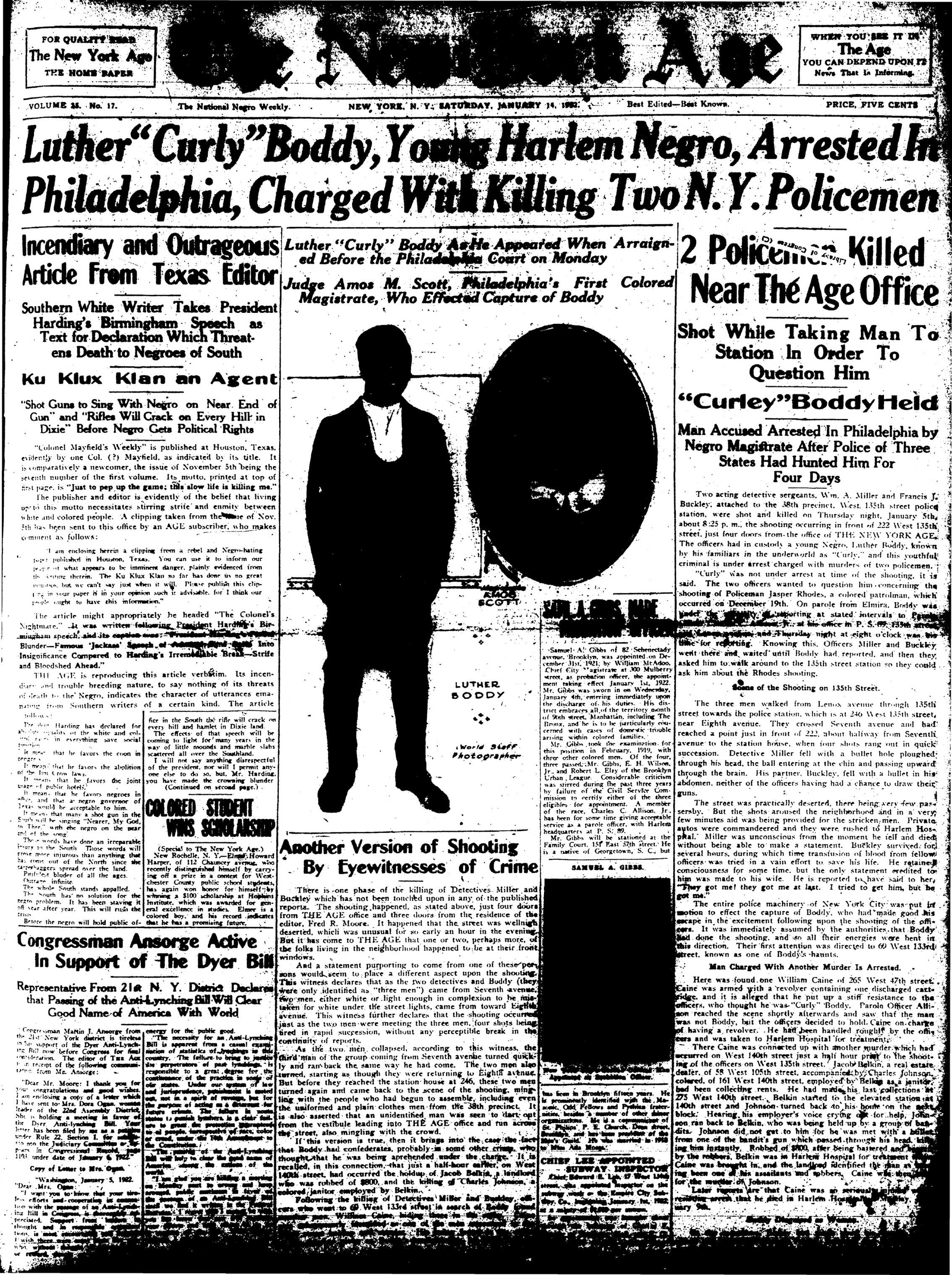
Luther"Curly"Boddy,Young Harlem Negro, Arrested In Philadelphia, Charged With Killing Two N.Y. Policemen
Southern White Writer Takes President Harding's Birmingham Speech as Text for Declaration Which Threatens Death to Negroes of South
"Shot Guns to Sing With Negro on Near End of Gun" and "Rifles Will Crack on Every Hill in Dixie" Before Negro Gets Political Rights
"Colonel Mayfield's Weekly" is published at Houston, Texas, evidently by one Col. (?) Mayfield, as indicated by its title. It is comparatively a newcomer, the issue of November 5th being the seventh number of the first volume. Its motto, printed at top of first page, is "Just to pep up the game; this slow life is killing me."
The publisher and editor is evidently of the belief that living up to this motto necessitates stirring strife and enmity between white and colored people. A clipping taken from the issue of Nov. 5th has been sent to this office by an AGE subscriber, who makes comment as follows:
I am enclosing herein a clipping from a rebel and Negro-hating paper published in Houston, Texas. You can use it to inform our people of what appears to be imminent danger, plainly evidenced from the writing therein. The Ku Klux Klan so far has done us no great damage, but we can't say just when it will. Please publish this clipping in your paper if in your opinion such it advisable, for I think our people ought to have this information."
The article might appropriately be headed "The Colonel's Nightmare." It was written following President Harding's Birmingham speech, and its caption was: President Harding's sudden Blunder—Famous 'Jackass' Speech of Authority and Grace Into Insignificance Compared to Harding's Irremediable Break—Strife and Bloodshed Ahead."
THE AGE is reproducing this article verbatim. Its incendiary and trouble breeding nature, to say nothing of its threats of death to the Negro, indicates the character of utterances emanating from Southern writers of a certain kind. The article
fice in the South the rifle will crack on every hill and hamlet in Dixie land. The effects of that speech will be coming to light for many years in the way of little mounds and marble slabs scattered all over the Southland.
The joint Harding has declared for abolition of the white and coloured races in everything save social function.
is near that he favors the coon in
tenure.
I will not say anything disrespectful of the president, nor will I permit anyone else to do so, but, Mr. Harding, you have made the crowning blunder. (Continued on second page)
It meant that he favors the abolition of the Jim Crow laws.
It means that he favors the joint usage of public hotels.
It means that he favors negroes in office, and that a negro governor of Texas would be acceptable to him.
COLORED STUDENT WINS SCHOLARSHIP
It mean that many a shot gun in the South will be singing "Nearer, My God, to Thee" with the negro on the near end of the song.
Those words have done an irreparable injury to the South. Those words will prove more injurious than anything that has come out of the North since the tarp-hoppers spread over the land.
Pitiful bluder of all the ages.
(Special to The New York Age.)
New Rochelle, N. Y.-Elmer Howard
Harper, of 112 Chaucey avenue, who
recently distinguished himself by carrying
off a prize in a contest for West-
chester County public school students,
has again won honor for himself by
winning a $100 scholarship at Hopkins
Institute, which was awarded for general
excellence in studies. Elmer is a
colored boy, and his record indicates
that he has a promising future.
The whole South stands appalled. The South has no solution for the negro problem. It has been staving it off year after year. This will rust the trus.
Congressman Ansorge Active In Support of The Dyer Bill
Congressman Martin J. Ansorge from the 21st New York district is tireless in his support of the Dyer Anti-Lynching Bill now before Congress for final consideration. The editor of Tinn Acus in receipt of the following communication from Mr. Ansorge:
energy for the public good.
"The necessity for an Anti-Lynching Bill is apparent from a casual examination of statistics of lynchings in this country. The failure to bring to justice the perpetrators of past lynchings, is responsible to a great degree for the continuance of the practice in some of our states. Under our system of law and jurisprudence, punishment is moved out, not in a spirit of revenge, but for the purpose of acting as a deterrent for future crimes. The failure in some states to punish lynchers is a clear failure to grant the protection interposed to all people, irrespective of race, color or creed, under the 19th Amendment to the Constitution."
"Dear Mr. Moore: I thank you for your congratulations and good wishes. I am enclosing a copy of a letter which I have sent to Mrs. Dora Organ, woman leader of the 22nd Assembly District. She is holding a meeting in favor of the Diver. Anti-lynching Bill. Your letter has been filed by me as a petition under Rule 22. Section I, for submission to the Judiciary Committee or its deputy in Congressional Records, page 193 under date of January 6, 1922."
The passing of the Anti-Lynching Bill will help to clear the good name of Americans among the victims of the war.
"I am glad you are building a movie on blossom next year and have arrived, public amenities. In typical of the process of an Arabian film that we had in writing in the past half-century, I must tell a story in this and now have more time to work on your movie and we are ready."
"Washington, January 5, 1922.
Dear Mrs. Ogun
I want you to know that your tireless efforts and cooperation in connection with the passage of an Anti-Lynding Bill in Congress, is thoroughly appreciated. Support from below in thought and in responsible action is most encouraging and helpful. I wish there were more time to think what, without thought, could be or should be done.
Luther "Curly" Boddy As He Appeared When Arraigned Before the Philadelphia Court on Monday Judge Amos M. Scott, Philadelphia's First Colored Magistrate, Who Effected Capture of Boddy
AMOS
SCOTT
SAPULA GROS MADE
Another Version of Shooting By Eyewitnesses of Crime
There is one phase of the killing of Detectives Miller and Buckley which has not been touched upon in any of the published reports. The shooting happened, as stated above, just four doors from THE AGE office and three doors from the residence of the editor, Fred R. Moore. It happened that the street was wellnigh deserted, which was unusual for so early an hour in the evening. But it has come to THE AGE that one or two, perhaps more, of the folks living in the neighborhood happened to be at their front windows.
And a statement purporting to come from one of these persons would seem to place a different aspect upon the shooting. This witness declares that as the two detectives and Buddy (they were only identified as "three men") came from Seventh avenue, two men, either white or light enough in complexion to be mistaken for white under the street lights, came from toward Eighth avenue. This witness further declares that the shooting occurred just as the two men were meeting the three men, four shots being fired in rapid succession, without any perceptible break in the continuity of reports.
As the two men, collapsed, according to this witness, the third man of the group coming from Seventh avenue turned quickly and ran back the same way he had come. The two men also turned, starting as though they were returning to Eighth avenue. But before they reached the station house at 246, these two men turned again and came back to the scene of the shooting, mingling with the people who had begun to assemble, including even the uniformed and plain clothes men from the 38th precinct. It is also asserted that an unidentified man was seen to start out from the vestibule leading into THE AGE office and run across the street, also mingling with the crowd.
If this version is true, then it brings into the case the fact that Buddy had confederates, probably in some other crime, who thought that he was being aphended under the charge. It is recalled, in this connection, that just a half-hour earlier, on West 140th street, had occurred the holdup of Jacob Beltja, a landlord who was robbed of $800, and the killing of Charles Johnson, a colored janitor employed by Belkin.
Following the killing of Detectives Miller and Buckley, officers who went to 60 West 133rd street in search of Buddy found another man, William Caine, hiding there in the alley. Caine was apparently bound on one of the men arrested in the investigation, with another. His body was found.
Samuel A. Gibbs of 82. Scheinectady avenue, Brooklyn, was appointed on December 1st, 1921; by William McAdoo, Chief City Magistrate at 300 Mulberry street, as probation officer, the appointment taking effect January 1st, 1922. Mr. Gibbs was sworn in on Wednesday, January 4th, entering immediately upon the discharge of his duties. His district embraces all of the territory month of 9th street, Manhattan, including The Bronx, and he is to be particularly concerned with cases of domestic trouble arising within colored families.
Mr. Gibbs took the examination for this position in February, 1919, with three other colored men. Of the four, three passed; Mr. Gibbs, E. H. Wilson, Jr. and Robert L. Elzy of the Brooklyn Urban League. Considerable criticism was stirred during the past three years by failure of the Civil Service Commission to certify either of the three eligibles for appointment. A member of the race, Charles C. Allison, Jr. has been for some time giving acceptable service as a parole officer, with Harlem headquarters at P. S.; 89.
Mr. Gibbs will be stationed at the Family Court. 15F East 57th street. He is a native of Georgetown, S. C., but
New York City Subway Official. The Appointment at Spadgett Officer.
has been in Brooklyn fifteen years. He is prominently identified with the Massonic, Odd Fellow and Pytheian fraternity, because a number of other dear organizations. He is a communicant of St. Philips' P. E. Church, Dunn street, Brooklyn, and has been president of the Sister's Guild. He was married in 1918 to Miss Ada Mooga.
CHIEF LEE APPPOINTED
SUBWAY INSPECTOR
Chief: Edward E. Ligh, 17 West 130th street, who appointed Inspector on the subway work or the Empire City Subway, Co., Spadgett January 1st, 1925, at a salary of $1,000 per annum.
For appointment, pay $1,000 per annum, residence with the bachelor of Charles E.
2 Policemen Killed Near The Age Office
Shot While Taking Man To Station In Order To Question Him
Man Accused Arrested In Philadelphia by Negro Magistrate After Police of Three States Had Hunted Him For Four Days
Two acting detective sergeants, Wm. A. Miller and Francis J. Buckley, attached to the 38th precinct, West. 135th street police station, were shot and killed on Thursday night, January 5th, about 8:25 p. m., the shooting occurring in front of 222 West 135th street, just four doors from the office of THE NEW YORK AGE. The officers had in custody a young Negro, Luther Boddy, known by his familiars in the underworld as "Curly," and this youthful criminal is under arrest charged with murders of two policemen.
"Curly" was not under arrest at time of the shooting, it is said. The two officers wanted to question him concerning the shooting of Policeman Jasper Rhodes, a colored patrolman, which occurred on December 19th. On parole from Elmira, Boddy was under the custody of reporting at stated intervals to
and Thursday night at eight o'clock was his time for reporting. Knowing this, Officers Miller and Buckley went there and waited until Buddy had reported, and then they asked him to walk around to the 135th street station so they could ask him about the Rhodes shooting.
The three men walked from Lenox avenue through 135th street towards the police station, which is at 246 West 135th street, near Eighth avenue. They crossed Seventh avenue and had reached a point just in front of 222, about halfway from Seventh avenue to the station house, when four shots rang out in quick succession. Detective Miller fell with a bullet hole ploughed through his head, the ball entering at the chin and passing upward through the brain. His partner, Buckley, fell with a bullet in his abdomen, neither of the officers having had a chance to draw their guns.
The street was practically deserted, there being very few passersby. But the shots aroused the neighborhood and in a very few minutes aid was being provided for the stricken men. Private autos were commandeered and they were rushed to Harlem Hospital. Miller was unconscious from the moment he self and died without being able to make a statement. Buckley survived for several hours, during which time transfusion of blood from fellow officers was tried in a vain effort to save his life. He retained consciousness for some time, but the only statement credited to him was made to his wife. He is reported to have said to her, "They got me! they got me at last. I tried to get him, but he got me."
The entire police machinery of New York City was put into motion to effect the capture of Boddy, who had made good his escape in the excitement following upon the shooting of the officers. It was immediately assumed by the authorities that Boddy had done the shooting, and so all their energies were bent in this direction. Their first attention was directed to 69 West 133rd street, known as one of Boddy's haunts.
Man Charged With Another Murder Is Arrested.
Here was found one William Caine of 265 West 47th street. Caine was armed with a revolver containing one discharged cartridge, and it is alleged that he put up a stiff resistance to the officers, who thought he was "Curly" Boddy. Parole Officer Allison reached the scene shortly afterwards and saw that the man was not Boddy, but the officers decided to hold. Caine on-charge of having a revolver. He had been handled roughly by the officers and was taken to Harlem Hospital for treatments.
There Caine was connected up with another murder which had occurred on West 140th street just a half hour prior to the shooting of the officers on West 135th street. Jacob Belkin, a real estate dealer, of 58 West 105th street, accompanied by Charles Johnson, colored, of 161 West 140th street, employed by Belkin as a janitor, had been collecting rents. He had made his last collections at 275 West 140th street. Belkin started to the elevated station at 140th street and Johnson turned back to his home on the next block: Hearing his employer's voice crying out for help, Johnson ran back to Belkin, who was being held up by a group of bandits. Johnson did not get to him for he was met with a bullet from one of the bandit's gun which passed through his head, killing him instantly. Robbed of 4000, after being battered and beaten by the robbers, Belkin was in Harlem Hospital for treatment. Caine was brought in, and the landlord identified the man as being been one of his assailants and robbers. Caine was then sent for the murder of Johnson.
Later reports are that Caine was an seriously injured resident suspect that he died in Harlem Hospital on Mondayuary 9th.
Molly Disguised as Woman
In the investigation this lady was found dead.
Crime has no allow to do with race and skin color than it has to do with height and hair color. And yet in our psychology we are constantly identifying crime and race. Why? Because of newspaper headlines and emphasis.
This was a super headline in the New York World, page-wide, and the very first thing on the front page, even superceding the name and date of the paper itself. Every human mind that read it, associated "Negro" and "crime," two ideas that have no more need to be associated than "red hair" and "crime" or "Fifth Avenue" and "crime," or any other two casually unconnected ideas.
This is exactly the damage that Southern newspapers have done to Southern psychology, caused it to conceive of race and crime as cause and effect. Northern newspapers can easily do the same thing—Well, what should the World have said in it sacre-head? This.
Then in the detailed account, among other irrelevant items and ideas, the reader could have found out that this particular criminal HAPPENED to be colored, just as, perhaps, he happened to have a wart on his nose or brown shoes on his feet. And there would have followed no impression that either the color or the wart or the shoes had any causal connection with the crime, but that they only designate and describe the individual criminal.
But we cannot play up RACE with the same display with which we play up CRIME, without causing the race of the criminal to be equally culpable with his crime,—in the psychology of the average man. This is what causes innocent Negroes or innocent Jews to be molbed when a crime is committed by a member of their race with whom they do not even have personal acquaintance. It is because the race itself has been mixed into the idea of the blameworthy.
The same thing happens in the mind of children (and older folk) when they see certain types of races depicted on the cinema screen exclusively and often as villains. Only last night when the screen was showing a Chinaman of the underworld wielding a great knife (to hepl one white man to rob another white man), we overheard a ten-year-old colored child of the audience remark: "Those old Chinese and things are always trying to kill somebody."
An accumulation of headlines like that in the World can produce a riot like that of Atlanta, or Chicago, or Tulsa.
in the public school, 135th street and Lenox avenue. I am through my parole. I am not on parole, contrary to newspaper reports, but I went to see the parole officer on some other business, and while I was there talking to him these two detectives came in. Well they waited until I got through talking and stood in the hall until I came and they started talking to me and asking me what I knew concerning this Rhodes shooting, so I told them I don't know anything about it, and they said 'How did this rumor get out that you done this shooting?' I told them, 'runners will get out.' I am across the street there every day in the bootblack parlor. If you wanted me why didn't you come after me before?
"So then they said, 'We are not going to lock you up; we just want to take you over to the station house and find out what you know about this.'
Of course, in New York City what they mean by taking you to the station house is, they take you over there and kick you around for two or three hours, and I had had that done to me several times, never have been wanted for anything, but just taken over and kicked around, and then go home and stay in bed a week and rest up. So I walked along with them, asking them not to take me over there, because I knew what was going to happen to me. They could come over to the bootblack parlor any day, but they insisted on taking me, and I walked along with them until we got within four or five houses of the police station, then I guess my temper suddenly flared up. Why should I always be bost up for nothing? It seemed everything was in a daze and I hired shots at the officers who had me under arrest. I don't remember even how many shots, and I ran."
As to his movements after the shooting, Boddy said he hid in a hallway close to the scene of the crime for nearly twenty-four hours. He got out of the city by way of the Hudson tubes to Jersey City. On the Plank Road he claims to have held up a man from whom he took $7 or $8. To Newark, to Elizabeth, to Montclair, to West Orange, back to Elizabeth and to Orange, then to Newark, when he began his wild taxi ride of Saturday night. After the taxi stopped near Glen Lake, and Boddy disappeared, he says that a passing motorist gave him a lift to the outskirts of Philadelphia. Here he boarded a trolley car and rode to the Rodman street boarding house where he was apprehended.
Magistrate Scott told very briefly of his share in the capture of Boddy. Reaching the house, he said,—
"We found the door open by the man who told the minister. We crept in. Boddy was asleep, the woman's clothes on the floor. Without waiting I shoved a gun into his stomach and woke him up. Bonner covered him.
"You're Luther Boddy, the man who killed two detectives in New York.' I said. He looked up at me and, I'm the man you want.' He didn't try to fight, although he said he would have got me if I didn't have the gun right in him.
"He pretended his shoes didn't fit him—the woman's shoes. So we just dragged him up and led him without shoes for six blocks, until a patrol wagon came and took him down to Police Headquarters."
The funeral of Detective Miller was held on Monday morning at 9:30 o'clock from the Roman Catholic Church of Our Lady of Victory, Throop avenue and McDonough street, Brooklyn, his home having been at 125 Decatur street, that Borough. Miller is survived by a widow and eight children. The funeral of his fellow officer, Buckley, was held on Tuesday morning at 10 o'clock, from the Church of St. Charles of Barromo, 214 West 141st street. The procession started from his late home at 269 West 136th street and proceeded through 86th avenue and 135th street, past the 38th precinct station and past 222, the spot where the police officer was shot down. Large details of police officers, headed by Police Commissioner Richard E. Enright, the police deputy commissioners, the five chaplains, and the police band of 125 uniformed men, which played dirges along the entire way of the funeral processions were in attendance.
In the funeral procession following the body of Detective Buckley were a group of colored women police reserves, and a group of Harlem colored citizens who thus expressed their sympathy with the bereaved family and their desire to cooperate with the authorities in enforcing the law. It was a noticeable fact that the crowds that thronged Harlem's street during the passing of the Buckley funeral contained many more colored people on bookers than white, and the general atmosphere was that of reverent respect. This was shown by the universal baring of heads while the hearse bearing the body was passing, and when the national and departmental flags were borne past.
Incentiary and Outrageous Article From Texas Editor
(Continued from first page.)
of your career.
You have encouraged us to bring of the negro hopes that will lead him to his grave.
The whole man and the negro may always have a great chance of confining themself to the most beautiful things in the world.
the hill in Manhattan, Montclair, N. J., where his mother lived and Belleville, N. J., where other relatives live. Then Monday morning's paper's brought a story, which told of Boddy's appearing near the Hudson Tube. Terminal in Newark, disguised in women's clothing and forcing a taxicab chauffeur, Adam C. Adalato, at point of pistel, to drive him towards Philadelphia. The taxi driver, it told, took advantage of an exhausted gasoline supply to stop at a point near Glen Lake, Pa., between Trenton, N. J., and Philadelphia.
This stop was made at about 4 o'clock Sunday morning, and the taxi driver had been piloting his machine over Jersey and Pennsylvania road since 9:30 o'clock Saturday night. He declares that Boddy, when informed of the gasoline situation, instructed him to stop the first car that passed. Adubato, in his statement, said that the first car wouldn't stop, but the next one that came along slowed up and stopped about twenty feet away from his car.
Adubato jumped on the running board of this car, he states, and cried to the driver, "For God's sake keep on going! I've got a murderer in my car and he is going to stick you up." The motorist quickly stepped on the gas and the car jumped forward, with Adubato climbing over the side into the tonnead. He reports that as Boddy realized what was happening, and the car shot away, a bullet from Boddy's revolver whizzed by, shattering a side lamp.
Colored Magistrate Captures Boddy.
driving to Oxford Valley, Adubato telephoned news of Boddy greabouts to the police at Langhorne. The local police State Constabulary then took up the chase, but when they were found, indicating that he was trying to make his way to Philadelphia.
It was in Philadelphia—in a house at 2030 Rodman street in Philadelphia—that he was captured on Monday morning. Ross Scott, Philadelphia's only Negro magistrate, who was to this office by the people at the November, 1921, elec-tive took office a little more than a week ago, on January the story coming from Philadelphia shows that members of the were altogether responsible for apprehension of the lady was looking for his aunt, Martha Hopkins, but could not see her. Then he went to the Rodman street place, a house, at about 8 o'clock Sunday night, and asked for the landlord assigned him a room on the second floor went immediately to bed. The woman's attire he had was wrapped up and put under the bed, she slipped off his hand and the woman's shoes he had been wearing, put his under his pillow and went to sleep.
Of the boarders, John Coleman, got a glimpse of Boddy suspicions were aroused. Early Monday morning Cole-ced up the Rev. Charles A. Tindley, pastor of the Calvary Episcopal Church and told him he believed this new at the Rodman street house was Boddy. Dr. Tindley likely went to the office of Magistrate Scott, relaying to information received from Coleman. This was aboutock on Monday morning.
Then in the ideas, the reader HAPPENED to a wart on his nose followed no impress- had any causal co- and describe the i- But we cannot we play up CRIM equally culpable wi- This is what ca- when a crime is they do not even itself has been mix- The same thing when they see cers exclusively and ology showing a Chimney hepl one white man year-old colored ch and things are alwa- An accumulation a riot like that of New York City.
in the public school, parole. I am not o fo see the parole off talking to him these
Driving to Oxford Valley, Adubato telephoned news of Boddy's whereabouts to the police at Langhorne. The local police and the State Constabulary then took up the chase, but when they reached the abandoned taxicab, Boddy had disappeared. Traces of him were found, indicating that he was trying to make his way into Philadelphia.
And it was in Philadelphia—in a house at 2030 Rodman street in South Philadelphia—that he was captured on Monday morning by Amos Scott, Philadelphia's only Negro magistrate, who was elevated to this office by the people at the November, 1921, election. He took office a little more than a week ago, on January 1st. The story coming from Philadelphia shows that members of the race were altogether responsible for apprehension of the fugitive.
Boddy was looking for his aunt, Martha Hopkins, but could not locate her. Then he went to the Rodman street place, a boarding house, at about 8 o'clock Sunday night, and asked for a room. The landlady assigned him a room on the second floor and he went immediately to bed. The woman's attire he had used was wrapped up and put under the bed, he slipped off his trousers and the woman's shoes he had been wearing, put his pistol under his pillow and went to sleep.
One of the boarders, John Coleman, got a glimpse of Boddy and his suspicions were aroused. Early Monday morning Coleman called up the Rev. Charles A. Tindley, pastor of the Calvary Methodist Episcopal Church and told him he believed this new boarder at the Rodman street house was Boddy. Dr. Tindley immediately went to the office of Magistrate Scott, relaying to him the information received from Coleman. This was about 9:30 p'clock on Monday morning.
Magistrate Scott Buys Revolver.
Distrate Scott telephoned the police station at Fitzwater antient streets, asking that all available men be sent him. He was in the station, Officer Charles E. Bonner. Magis-tt declared that as Boddy was such a desperate character, he should not go alone. "One man cannot capture himended, I'll go with you," said Mr. Scott. On the way to street the magistrate, who was unarmed, stopped in a car, and tried to borrow a revolver, showing his badge to owner. The pawnbroker refused, however, to furnish soon unless a deposit was left, so, fearful of delay, Mr. and $5 and received the pistol.
On the men reached the boarding house, they were in a whisper by the landlady that the man they suspected was asleep. Judge Scott and Policeman Bonner made their second floor, where the door to the room sn which kept had been quietly opened by Coleman, the man who Dr. Tindley. Creeping in, they found Boddy asleep. Like him up by shoving his pawnshop gun into Boddy's hand with lightning-like quickness, the hunted man attempt- with under the pillow for his automatic, but Scott told him all or be riddled with bullets.
Officers then took possession of Boddy's gun and forced the bed. The woman's shoes he had been wearing he put on, as his feet were swollen from tramping about so the officers had him slip on his trousers. He walked in the snow for six blocks—until the officers met a sign which had been sent for them. The prisoner was in Police Headquarters and the New York Police De- notified of his capture. Two New York officers, De- thomas Martin and Thomas Donohue, who were in Phila- dentified him as the wanted man.
His Crime Record.
though only twenty-two years old, has a considerable word, covering the past four years. According to the books, his record is as follows:
January 23, 1918—Arrested for burglary; discharged.
21, 1918—Arrested for unlawful entry; sentence suspended.
September 1, 1918—Arrested for burglary; discharged.
November 16, 1918—Sentenced to penitentiary for burglary.
March 1919—Sentenced on parole.
April 1919—Arrested for grand larceny; discharged.
September 1919—Arrested, Montclair, N. J., for burglary; sentenced to Reformatory.
December 10, 1920—Released from Elmira.
HIS OFFICIAL DESCRIPTION:
Five feet six inches.
One hundred and thirty-five pounds.
Maroon.
Kinky, long.
Dark brown.
His most distinguishing feature is a rigid, livid scar running base of the left ear to the chin.
Boddy's last Elmira sentence would have expired January 10th, it is said, and while he has been on parole, which he made on Thursday night, January 5th, to her Allison was the last he would be required to make. Dora Boddy, was at the time an inmate of Auburn a grand larceny charge, and she had been granted a took effect on Friday, January 6th, the next dayuble killing. She reached New York to find her hust-
Arrested in Philadelphia. Boddy acknowledged that he a custody of Detectives Miller and Buckley but dis- connection with their being shot. He declared at detectives had questioned him in connection with the Policeman Rhodes and that he had walked with them 35th street station. They had decided that he was they wanted and they had set him go. Boddy said.
New York detectives were present when he was and it was noticed that he avoided their eyes as much Later, it is alleged, after he was left alone in his for the local captain of detectives and informed him and the New York detectives and asked protection. He been taken before Magistrate Renshaw in the Cen- court and was being held without bail for the New ities.
Investment Accredited to Boddy.
As to his movement in a hallway close to the hours. He got out of Jersey City. On the from whom he took $ clair, to West Orange Newark, when he be- After the taxi stopped he says that a passing of Philadelphia. Her Rodman street boarding Magistrate Scott of Boddy. Reaching H.
We found the We crept in. Boddy Without waiting I sho Bonner covered him. You're Luther York. I said. He looked didn't try to fight, ally have the gun right in. He pretended his we just dragged him up a patrol wagon came.
Colored.
The funeral of De- ing at 9:30 o'clock from of Victory, Throop av- home having been at is survived by a widow fellow officer, Buckley, from the Church of St. The procession started street and proceeded to the 38th precinct station officer was shot down. Police Commissioner Emissioners, the five cha- ed men, which played processions were in.
In the funeral group of Harled color- pathy with the berthers the authorities in enforce the crowds that through the Buckley funeral co- ers than white, and the respect. This was show the hearse bearing the and departmental flags.
Magistrate Scott telephoned the police station at Fitzwater and Twentieth streets, asking that all available men be sent him. Only one was in the station, Officer Charles E. Bonner. Magistrate Scott declared that as Boddy was such a desperate character, one man should not go alone. "One man cannot capture him single-handed, I'll go with you," said Mr. Scott. "On the way to Rodman street the magistrate, who was unarmed, stopped in a pawnshop, and tried to borrow a revolver, showing his badge to the shop owner. The pawnbroker refused, however, to furnish the weapon unless a deposit was left, so, fearful of delay, Mr. Scott paid $5 and received the pistol.
When the men reached the boarding house, they were informed in a whisper by the landlady that the man they suspected was still asleep. Judge Scott and Policeman Bonner made their way to the second floor, where the door to the room in which Boddy slept had been quietly opened by Colleman, the man who informed Dr. Tindley. Creeping in, they found Boddy asleep. Scott woke him up by shoving his pawnshop gun into Boddy's stomach. With lightning-like quickness, the hunted man attempted to reach under the pillow for his automatic, but Scott told him to lay still or be riddled with bullets.
The officers then took possession of Boddy's gun and forced him out of the bed. The woman's shoes he had been wearing could not be put on, as his feet were swollen from tramping about in them, so the officers had him slip on his trousers. He walked barefooted in the snow for six blocks—until the officers met a patrol wagon which had been sent for them. The prisoner was then taken to Police Headquarters and the New York Police Department notified of his capture. Two New York officers, Detectives Thomas Martin and Thomas Donohue, who were in Philadelphia, identified him as the wanted man.
His Crime Record.
Boddy, though only twenty-two years old, has a considerable crime record, covering the past four years. According to the police books, his record is as follows:
Boddy's most distinguishing feature is a rigid, livid scar running from the base of the left ear to the chin.
"Curly" Boddy's last Elmira sentence would have expired Tuesday, January 10th, it is said, and while he has been on parole, the report which he made on Thursday night, January 5th, to Parole Officer Allison was the last he would be required to make. His wife, Dora Boddy, was at the time an inmate of Auburn Prison, on a grand tarceny charge, and she had been granted a parole which took effect on Friday, January 6th, the next day after the double killing. She reached New York to find her husband aigitive.
When arrested in Philadelphia, Boddy acknowledged that he had been in custody of Detectives Miller and Buckley but disclaimed any connection with their being shot. He declared at first that the detectives had questioned him in connection with the shooting of Policeman Rhodes and that he had walked with them towards the 135th street station. They had decided that he was the man they wanted and they had set him go. Boddy said.
two New York detectives were present when he was
and, and it was noticed that he avoided their eyes as much
stable. Later, it is alleged, after he was left, alone in his
sent for the local captain of detectives and informed him
he found the New York detectives and asked protection. He
already been taken before Magistrate Renshaw in the Cen-
Copyright © 2023 The New York Times Press. All rights reserved.
Government Accredited to Boddy.
New York from Philadelphia alleges that after
the cell for several hours he called for a guard
of the office of Captain Alfred L. Sonder, chief of
the General Life following account of what bap-
tance and Rackley was held.
(WILLIAM PICKENS)
"PAROLED NEGRO KILLS 2 DETECTIVES."
It was a super headline in the New York World, for every first tiling on the front page, even superseding the of the paper itself. Every human mind that read "Negro" and "crime," two ideas that have no more meaning than "red hair" and "crime" or "Fifth Avenue" and any other two casually unconnected ideas.
It is exactly the damage that Southern newspapers to their psychiology, caused it to conceive of race and Northern newspapers can easily do the same that should the World have said in it scare-head? This:
PAROLED MAN (or PRISONER, or CRIMINAL-KILLS 2 DETECTIVES.
in the detailed account, among other irrelevant in the reader could have found out that this particular man NED to be colored, just as, perhaps, he happened on his nose or brown shoes on his feet. And there were no impression that either the color or the wart or the causal connection with the crime, but that they only spoke the individual criminal.
We cannot play up RACE with the same display with up CRIME, without causing the race of the criminian to culpable with his crime,—in the psychology of the average is what causes innocent Negroes or innocent Jews to be crime is committed by a member of their race with not even have personal acquaintance. It is because it been mixed into the idea of the blameworthy.
same thing happens in the mind of children (and old) by see certain types of races depicted on the cinema and often as villains. Only last night when the sergeant a Chimman of the underworld wielding a great knife white man to rob another white man), we overheard a colored child of the audience remark: "Those old men are always trying to kill somebody." Accumulation of headlines like that in the World can be that of Atlanta, or Chicago, or Tulsa.
York City.
Public school, 135th street and Lenox avenue. I am through it am not on parole, contrary to newspaper reports, but a parole officer on some other business, and while I wait him these two detectives came in. Well they waited through talking and stood in the hall until I came and asked to me and asking me what I knew concerning this so I told them I don't know anything about it, and the this rumor get out that you done this shooting? those will get out. I am across the street there even black parlor. If you waaed me why didn't you come?
when they said, 'We are not going to lock you up; we just you over to the station house and find out what you know' course, in New York City what they mean by taking my house is, they take you over and kick you around three hours, and I had had that done to me several times, wanted for anything, but just taken over. there and then go home and stay in bed a week and rest up, along with them, asking them not to take me over there what was going to happen to me. They could come black parlor any day, but they insisted on taking me, along with them until we got within four or five hours, station, then I guess my temper suddenly flared up. Why be bent up for nothing? It seemed everything was in order these shots at the officers who had me under arrest. I even how many shots, and I ran."
New York City.
How He Got to Philadelphia.
his movements after the shooting. Boddy said close to the scene of the crime for nearly twenty got out of the city by way of the Hudson Toll. On the Plank Road he claims to have held up the took $7 or $8. To Newark, to Elizabeth, to St. Orange, back to Elizabeth and to Orange. Then he began his wild taxi ride of Saturday taxi stopped near Glen Lake, and Boddy dispatched a passing motorist gave him a lift to the orchia. Here he boarded a trolley car and rode to boarding house where he was apprehended. The Scott told very briefly of his share in the teaching the house, he said,—
He found the door open by the man who told the minin. Boddy was asleep, the woman's clothes on the fist. I shoved a gun into his stomach and woke him armed him.
The Luther Boddy, the man who killed two detectives in a kid. He looked up at me and, 'I'm the man you want,' to fight, although he said he would have got me if I didn't right in him.
Extended this shoes didn't fit him—the woman's shoes. Grogged him up and led him without shoes for six blocks, the came and took him down to Police Headquarters.'
Colored Men and Women at Funeral.
rial of Detective Miller was held on Monday clock from the Roman Catholic Church of Our Shroop avenue and McDonough street, Brooklys been at 125 Decatur street, that Borough. by a widow and eight children. The funeral Buckley, was held on Tuesday morning at 10 o'clock of St. Charles of Barromo. 214 West 141st on started from his late home at 269 West proceeded through 8th avenue and 135th street net station and past 222, the spot where the sat down. Large details of police officers, head assister Richard E. Enright, the police deputy five chaplains, and the police band of 125 unplaced dirges along the entire way of the
ANOTHER VERSION OF THE SHOOTING BY
ALLEGED EYE WITNESSES.
and his attempt at resisting arrest, all indicate the possibility of Caine, Boddy and others having been banded together in their lawless acts.
It has been advanced as an argument in support of this construction that it would have been practically impossible for Boddy, in the custody of two old and experienced officers who had full knowledge of his criminal record, and who were supposedly watching carefully for any sinister movement on his part, to have drawn his gun, and fired, first to the right into Miller's head, and then to the leit into Buckley's abdomen, before either of the men could draw and use a revolver.
Was Not a Dope Fiend.
If Boddy's confession is given may be playing the game as he panions who were making an act. In a number of the accounts it has been asserted that Boddy probably committed this crime of drug. In this connection, Paris is satisfied that Boddy is not a man reporting to Mr. Allison, released from Elmira, and the man was never any sign that would was the man given to use of intelligence. His one habit was smoking cigars ordinary fondness for the long, use by some smokers.
If Buddy's confession is genuine, it is still possible that he may be playing the game as he sees it and trying to shield companions who were making an effort to come to his rescue.
In a number of the accounts published in New York dailies, it has been asserted that Buddy was a dope fiend and that he probably committed this crime while under the influence of some drug. In this connection, Parole Officer Allison states that he is satisfied that Buddy is not a drug addict. The paroled man had been reporting to Mr. Allison at regular intervals since being released from Elmira, and the parole officer declares that there was never any sign that would indicate the use of drugs. Nor was the man given to use of intoxicants, according to Mr. Allison. His one habit was smoking cigarettes and he exhibited an extraordinary fondness for the long, slender cigarette holders seen in use by some smokers.
are easily led by the more educated members of their race general government could easily mobilize in one city and within a few
There is a perceptible growth in general restlessness among the colored people of this country. Time was when the colored man was content to flunkey in the back yard and wear the cast-off clothes of the white man. We have educated the negro, and taught him the higher things of life, while offering him no higher positions than to be porters, bell lions and elevator boys. He is chafing under the restraint.
Negro editors of incendiary publications all over this country are fostering the fires of race prejudice and foaming trouble between whites and blacks.
Your words will become the toesin of war in the papers of the negro editors.
The negroes of this country have been quietly organizing for several years. They have quietly handed into a miniature military machine.
In Houston, alone, there are 3700 members of a militant organization ready to respond to the call of some unscrupulous leader.
All over this country the Negroes are organized.
Your words will be placed into their ritual as a justification of any act they may attempt.
The negro problem is the Old Man of the Sea on the back of the South.
You have made it harder for the people who live in the South to deal with a situation that is becoming acute.
The negroes with the backing of the Persons Whose Streams Have Been Spotted By Heetch.
By the deadly fusel oil contained in crude, home-made spirits, by moonshine and home-brews of all kinds, should im-
mediately take Dr. Siegert's Angostura Bitters which has been recommended by the late Dr. W. C. Wile, former Vice-President of the American Medical Ass'n, as a stomachic, particularly valuable as a corrective for over indulgence in alcoholic beverages. Dr. Siegert's Angostura Bitters originated in 1854, contains only the most important ingredient, a corrective for most celebrated tonic of his kind in the world and a wonderful aid to digestion. From your dealer, Angostura Bitters Agency, Inc. 12 East 40th St, New York.
genuine, it is still possible that he he sees it and trying to shield come an effort to come to his rescue. Annals published in New York dailies,addy was a dope fiend and that he be while under the influence of some Parole Officer Allison states that he a drug addict. The paroled man had on at regular intervals since being the parole officer declares that there could indicate the use of drugs. Nor intoxicants, according to Mr. Allison, cigarettes and he exhibited an extrax. slender cigarette holders seen in
general government could easily mobilize in one city, and within a few months vote the possession of the city into their hands. Control the taxation and the expenditures of public monies. Right here in Texas, Galveston negroes lack about 120 votes of having a majority over the white citizens. An election could be easily swung with a full force of colored officials, making the council meeting look like Billy Kersand's minstrel. There is only one thing in the way—the determined white people of the South. That will be enough. The negro who starts to develop into action the words of the president will do well to purchase a shroud with his announcement cards. The South is not going to stand for it a minute. There is one great barrier between the negro and his political ambitions in Texas and that is the KU KLUX KLAN.
That organization, composed of the best blood in the South stands ready to assemble at a moment's notice to check and put down any uprising on the part of the negro.
There is a negro editor in Houston who constitutes your message to mean social intermingling. Who is now preaching social intermingling of the races as a result of the miserable speech you made in Birmingham. He is inciting the negroes of this community into the belief that social intermingling is dawning and that colored incumbents of political offices will soon be in evidence in Texas.
Mr. Harding you have wrought untold injury to the South and you have accomplished nothing.
The Ku Klux Klan's membership is growing by leaps and bounds all over the South since the publication of your speech.
The words "white supremacy" is spoken by a million determined lilies. The best blood of Texas, of the South, is moving into the Klan to be prepared for any emergency that may arise as the result of your ill-advised, untimely and appalling utterance. The boys of the cities, and of the country are streaming into the Klu Klu Klan tonight. They are going to be ready if your word precipitates anything in this country. The very fact of this preparedness may offset plans of ambitious darkies already on foot. Every man in the South, eligible should join the Klan. The president has practically driven you into it. Honto it boys!
A WONDERFUL INVESTMENT
A party needing cash will Sell a Mortgage on a N.Y. City Residential Property at a Substantial discount.
K. L. M. care of N. Y. Age
12-31-3 Mo.
220 W 125th St.
THE STAR HAIR GROWER
A Wonderful Hair Dressing and Grower.
1,000 AGENTS WANTED.
Good Money
Made
We went agents in every city and village to sell
THE
STAR HAIR GROWER.
This is a wonderful preparation. Can be used with or without straightening irons and by any person.
One 25 pound box proves its value. Any person that will use a 250 box will be convinced.
No matter what has failed to grow your hair, just give it
THE
STAR HAIR GROWER
a trial and be convinced.
Seed 250 for full also box.
If you wish to become an agent for this wonderful preparation.
THE STAR HAIR GROWER MF'R.,
Boston, Mass.
A WONDERFUL INVESTMENT
A party needing cash will Sell a
Mortgage on a N.Y. City Residential
Property at a Substantial discount.
E. L. M. care of N. Y. Age
12-31-3 Mo. 220 W 1354th St.
S. C. ELECTS OFFICERS.
Aiken, S. C.-The annual communication of the N. W. Grand Lodge F & A. M., jurisdiction of South Carolina, marked the closing of a successful year. The following officers were elected for 1922: C. C. Johnson of Aiken, S. C., grand master, J. W. Washington of Beaumont, deputy grand master, Geo H. Pugh of Darlington senior grand warden; G. C. Williams of Columbia, junior grand warden; D. D. Davis of Sumter, grand treasurer; E. J. Sawyer of Bennettville, grand secretary; W. H. Thomas of Columbia assistant grand secretary; H. M. Moore of Columbia, grand chapman; B. F. McDowell of Greenwich grand lecturer; L. J. McCottrie of Corger town, senior grand deacon; R. H. Richardson of Edgefield, junior grand deacon; C. H. Simmons of Columbia senior grand steward; C. W. Lov, Cheraw, junior grand steward; C. H. Dannerly of Columbia, grand marshal H. B. Butler of Newberry, grand tyler.
District deities; 1st district, R. C. Davis of Greenville; 2nd district, R. Shaw Wilkinson of Orangeburg; 3rd district, J. C. Coln of Spartanburg; 4th district; B. H. Eaton of George town; 5th district; J. S. Dickson of Society Hill; 9th district, S. S. Fraser of Charleston.
Grand trustees: C. C. Johnson, ex-officio chairman; 3 year term—J. I. Washington, W. H. Thomas; 2 year term—C. E. Stewart, J. H. Fordham; 1 year term—E. J. Sawyer, T. A. McFall. Relief commission—C. C. Johnson, E. J. Sawyer, T. A. McFall. Standing committee on revision of constitution—R. S. Wilkinson, C. C. Johnson, I. D. Davis, J. H. Fordham, E. J. Sawyer, J. I. McCottrie, J. I. Washington.
The next annual communication will be held December 12th, 1922, at Cheraw, S. C.
NATIONAL Y. W. C. A. NOTES.
Cincinnati, Ohio, announces that larger quarters are to be provided within the year. A site has been purchased which is admirably located for Association activities. 1K000 colored people make their homes within a radius of one square mile of the new location.
St. Joseph, Mo., conducted a five days institute under the direction of Miss May B. Belcher, assisted by Miss Anna Reilly Neson, executive secretary of the Central Association.
Kansas City, Mo., conducted an institute for volunteer workers during October with a registration of 76 and an attendance of 333. Those assisting in the program were Miss Margaret Williamson, Miss Amanda Ne., n. of headquarters, and the Misses Erickson, Belcher and Reynolds of the field office.
Chicago, Ill.—After attending an industrial week end conference for colored girls, several of the girls were heard to remark that some of the things that they would take back to their respective clubs were "a better understanding, a greater desire to share, cooperation, love and loyalty, inspiration, the spirit of happiness." One girl said "I came out here at a great sacrifice, but it was worth all that I spet to come." Norfolk, Va. is repairing for its budget campaign January 30th, 1922.
Miss Frances Williams, Mount Hollyoke '19, and School of Social Work 1921, has been called to the national student staff.
Miss May B. Belcher, city field secretary, is invasiveless after an operation in St. Louis, Mo.
During Chicago's "Creme and See" week at the Indiana avenue branch over 425 visitors were shown the building, an investment among whom were Cyrus H. McMillan, Fordham, Mrs. McMillon, Mr. McMillan, Carl C. Bullock, and many others who seemed to be favorably impressed with the surroundings.
MINTOL VAPO CREAM
ELIZABETH, N. I.
ONE YEAR ..... 3.00
MONTHS ..... 1.25
WEEK MONTHS ..... 3.50
WEEK COP ..... 3.00
CANADA FOR ONE YEAR ..... 2.00
CANADA COUNTRIES 1 YEAR ..... 3.00
Telephone. Morningside NN.
GOV. MILLER'S FIRST YEAR.
Governor Miller's first year as the chief executive of the New York closed office, showing of the firm's commitment to the company. In his inauguration of the company, he made a master of finance and led the firm to earnor scored highly. In his more recent to statercraft and writing, he made a successful record in public than private firms and figures.
So far in the New Year's year of New York State, we have commenced the year of the Government's first year of reorganization, and we will participate with the city that may be most important to the State. We have committed to the institution that will be a national university located by the city that we commemorate. The fact that we are committed to the State of New York will be the Government best tells us that we are and as citizens of the city, we are members of the community and that their players, not the players, will be included. Whether the State will be suitable for our community, the State was taken into consideration as a possible reorganization.
This rule of the State administration to take notice of matters an element of party membership is not public notice to say this law. It is the law of the party in the state case in New York. It is thus that Congress shall be into this situation and bound himself if there exists any and reason for this ignoring it. I am bound to the State administration.
NEED OF POLICEWOMEN.
The need to protect women to its preventive criminal work among the Negroes of the United States is now apparent with great speed for women in the war and children in the war. Drives from the police are infiltrated that creep into the streets. State supervision is the necessary place of amusement and present resorts, where women and children are admitted "with care to their safety and dignity, shall be protected carefully."
There are a number of women of the race who are qualified to the physical and mentality, will work with the temperament and a capacity to tell the position of fellow women. They should be encouraged to apply to the commission and become qualified under the police service, rules for appointment to the position. The appointment of a competent number of the class of women would be in the nature of placing a moral insurance for the benefit of the community.
The prevention of crime is more effective than awaiting its commission and then inflicting a punishment for the offense. If the attempt to lead minor and those of worker wills into interactions of the law can be prevented by the vigilance of fellow women, then it would be a good investment for the community to multiply the activities of this class of gentlemen of the peace. That this has been the result of the enforcement of fellow women generally is universally admitted. Hence the need them in Harlem.
The majesty of the clered resident of Harlem are peaceful and brave, but there is a sufficient indulgence of a criminal class to demand that a watchful eye and a restraining hand be kept their civil ways. Then the contemptuous conditions gave brought about a sense of good and evil doors in such contact that demands the most urgent care in preventing evil commences from corrupting good manners. The appointment of a number of well trained and efficient policewomen is a necessary capacity for the Harlem dis-
POLICE PRECINCT.
There's a Day there was not a
occupied at the 30th Pre-
cinct located on West
East corner of the square. Prison
the first day of the year goes to show that this part of Harlem is not as black as it is painted. Lawlessness is not characteristic of the neighborhood comprised in this precinct, but is more of a sporadic nature, due to the influx of crime from outside sources. The majority of the Negro residents of Harlem are respectable and lawful. This does not prevent them from suffering from the effects of a criminal invasion, which has resulted in both robberies and murders. But the bulk of the may have nothing to do with these criminal operations, except that they have to share the slum incurred and not infrequently figure as the victims.
The commander of the 38th precinct, Captain Metrorath, is to be commended on his willingness to cooperate with the lawabiding citizens of the district, in maintaining the peace of the community and suppressing the lawless element, that seek protection others. His efforts toward making the precinct a model one have not been without results, as shown by the record of New Year's Day. The fact that several officers of the race have been detailed to duty in the precinct has demonstrated their usefulness in dealing with crime conditions in this section. Prompt and effective measures for the impression of vice and the protection of the community will result in making this a good police precinct.
A SUPERFICIAL PROSPERITY. Capital observers have been inclined to credit the statement that the West 15th Street Branch of the Young Men's Christian Association is prospering, from the fact that housing facilities are being utilized and the normal activities have been kept in motion. But it is impossible for an institution of this character to enjoy true prosperity when the fundamental conditions of its existence are infaired or suppressed.
It is just as important this year as it was last year that the Y. M. C. A. should stand for moral improvement and maintain the highest moral standards. The facility of making any such protection is manifest, so long as the membership of the Central Board of Deputies maintain in office an executive who has lost the confidence of the community. No one can dispute that the present secretary has lost his usefulness as the head of the local work. It is reported on good authority that Dr. J. E. Moorland, some time ago in discussing this annual told Col. William Jay Schiefert that Mr. Taylor ought to resign. The reasons that actuated this statement are just as good now as they were then.
Because of the bill that has ensued since this situation became acute, it is in the supposed for a moment that the people have petitioned or condoned the wrong done them by the retention of the present secretary to the detriment of the work of the association. These members of the board who have the goal of the organization at heart should take proper means to relieve the present situation. The longer it is allowed to continue the greater is the injury done to the work that it was created to perform.
A MILLION FOR SCHOOLS.
A MILLION FOR SCHOOLS.
According to the construction statistics of the Rosewald Rural schools for the ten years ending, last December, the Negroes of the country districts of the South have raised over one million dollars to aid in the building of school houses for their children. This is in addition to paying the regular county and state taxes for educational purposes. The statistics as summarized are as follows: 1120 school buildings, utilizing the services of 2578 teachers, have been built at a cost of $1,653,905. Of this amount Negroes contributed $1,024,537; whites, $200,702; public funds, $1,700,688; and Julius Rosewald of Chicago, $667,980.
Classified by types the buildings in-
clude 338 one-teacher schools; 429 two-
teacher schools; 170 three-teacher
schools; 101 four-teacher schools; 35
five-teacher schools; 41 six-teacher
schools; and 111 teachers' homes.
By States the number of Rosenwald
Rural Schools follows: Alabama, 235;
Arkansas, 48; Georgia, 50; Kentucky,
52; Louisiana, 124; Maryland, 14;
Mississippi, 119; North Carolina, 157;
Oklahoma, 12; South Carolina, 70;
Tennessee, 168; Texas, 42; and Vir-
gina, 97.
in 1912, on his fifteenth birthday, Julius Rosenwald contributed $25,000 to Tuskegee Institute, to be distributed among such schools of Tuskegee as Dr. Booker T. Washington should designate. Of this amount Dr. Washington asked permission to use $2,100 for an experiment in building in Alabama six rural schools for Negroes who had to raise in each community an amount-equal to or larger than the $300 assigned as Rosenwald aid.
The measure of racial interest indicated by the popular support given this movement in rural communities is encouraging. The principle of self-help has taken root among the people of the country districts and despite the fact that their earnings may not be large, they are willing to help build more schools.
THE NEW YORK AGE SATURDAY, JANUARY 14, 1922.
SOUTHERN ARGUMENT AGAINST THE DYER BILL.
Last Wednesday in the House of Representatives, the Dyer Bill came up for debate. Southern Democrats again resorted to their tactics of filibuster. They failed to prevent the consideration of the Bill, and their failure was more marked because of the fact that the Bill was debated on Calendar Wednesday. In order for this to be done it was necessary to suspend the calendar by a two-thirds vote. The supporters of the Bill were able to do this and thereby gave an indication of the real strength which the Bill has behind it.
Mr. Dyer led off for the passage of the Bill. He spoke about fifty minutes and made a splendid presentation of the facts which demand the passage of the measure. He secured consent to extend his remarks and was thereby able to place in the record a vast amount of data and statistics on lynching, together with a number of strong editorials from various newspapers in favor of the Bill.
The opposition led off with a speech by Mr. Sumners of Texas. Mr. Sumners spoke about an hour and a half and shot what appeared to be the heaviest bolt which the Democrats have, and the bolt proved to be not such a heavy one at that.
Mr. Dyer, by the emphasis which he put upon the authentic figures about lynching, robbed the Democrats of their stock argument regarding the cause of lynching. Mr. Dyer gave the figures to show that in the last thirty-five years there have been about 4,000 known cases of lynching and that out of that whole number there have been only 800 cases in which rape is alleged as the cause. These figures prevented Mr. Sumners from basing his argument, as he most likely would have done, on an appeal to passion.
Deprived of his stock argument, Mr. Sumners floundered around in a sea of absurdities. The following is an example of the silly reasoning to which the statesman from Texas was reduced:
Mr. Summers went on to say that when they lynch Negroes in the South they try to find out the individual man who was guilty and put him to death; that in the South they did not do as is done in the North, where dozens of innocent Negroes are killed in riots such as took place in Washington, Chicago and Omaha. He said that the proposed Bill would very likely bring about the same wholesale methods in the South.
Mr. Summers went on to say:
"That is the sort of thing we are afraid of. I believe we understand the situation are convincing to cut the cord that holds in leash the p in the South and bring to the South such traget St. Louis, in which almost as many people were in one not as are killed in the entire South by there then took place the following owners of Texas and Mr. Mondell, the Rep
"That is the sort of thing we are afraid of. We people who believe we understand the situation are convinced that you men are mixing to cut the cord that holds in leash the passion of race conflict in the South and bring to the South such tragedies as that of East St. Louis, in which almost as many people were killed in that one city in one not as are killed in the entire South by mobs in two years."
There then took place the following colloquy between Mr. Sumners of Texas and Mr. Mondell, the Republican floor leader:
Mr. MONDELL. Will the gentleman yield?
Mr. SUMNERS of Texas. Yes.
Mr. MONDELL. Do I understand it to be the gentleman's position that in order to keep down
Mr. SUMNERS of Texas. Just for a question.
Mr. MONDELL (continuing). The passions of race prejudice it is necessary to give them an occasional outlet of burnings and lynchings.
Mr. MONDELL. Do I understand it to be the gentleman's position that in order to keep down
Mr. SUMNERS of Texas. Just for a question.
Mr. MONDELL (continuing). The passions of race prejudice it is necessary to give them an occasional outlet of burnings and lynchings.
Mr. SUMNERS of Texas. I do not.
Mr. MONDELL. Then, I do not quite understand the gentleman's statement.
Mr. SUMNERS of Texas. Sit down and I will make you understand it. It is a hard job, but I can do it. Here is what I mean. Listen to me. Look at me and let me talk to you. I mean this: I mean that nobody on this earth can protect the black man who is in danger of mob violence, except the people in the community at the very time of the danger. I mean that if the Federal Government interposes its power, assumes responsibility now born entirely by the people, so that the man on the ground will feel it is not his duty to protect, but that the Federal Government has stopped in and will take care of the situation, then you are likely to turn loose the passions of race conflict in that community.
Let me tell you something. Suppose this other thing happens—and you can do it under this bill—suppose that a black man takes a little white child and drags her off into seduction where no voice can hear and no hand can help, and raps that child, and the father of that child and the brothers of the child come up on him and kill him, and the Federal Government takes them away in the face of public sentiment and places them in the Federal penitentiary, and then has a tax of $10,000 levied against the county for the benefit of the rapists family, a part of which sum might go to buy that family an automobile to ride by the home of the innocent victim, do you think, as a matter of common sense, with such a policy you could long prevent a condition in that country like those which developed in East St. Louis, Omaha, and Chicago?
Could anything be more abusrd than the conclusion reached by Mr. Sumners—that there is any Negro anywhere in the South either so ignorant or so brutal that when he hears that the Dyer Anti-Lynching Bill is a law he will decide upon having himself roasted alive in order that his surviving family may collect $10,000 and buy an automobile in which to ride around and make the white folks mad? We do not see how Mr. Sumners himself refrained from breaking out into a laugh after making such a statement.
Mr. Sumners also dwelt at length upon the purpose of the Bill to give immunity to persons accused of crime. Such a willful contortion of the truth is incredible when anyone who merely glances through the Bill knows that its purpose is to secure trial by due processes of law to persons accused of crime.
When Mr. Sumners arose to speak pages followed him down to the front with a stack of law books which, if piled one on top of the other, would have reached the height of four or five feet.
These books were apparently brought in only to make an impression, because Mr. Sumners did not during the course of his whole speech put them to any other use. He did, however, couch upon what he and all the opponents of the Bill consider to be its weakness constitutionally, and it is the point upon which a good many Republicans in favor of the Bill are stumbling. Mr. Sumners declared that if the Federal Government has the power to legislate for the punishment of lynching it also has the power to legislate for the punishment of murder and other crimes committed in the states.
We believe Mr. Sumners is right and that the thing for the supporters of the Bill to do is to meet him squarely on the grounds which he lays down. We believe that if the states prove themselves unable or unwilling to deal with, say, the crimes of murder, the Federal Government would have the power to stop in and legislate regarding the punishment for that crime.
But the analogy between murder and lynching is not a true analogy. In both cases, people in other cases have
State and it acts in place of due processes of law to move out death as a punishment to a person accused of crime. It is not only against the act of killing that the Federal Government seeks to exercise its power through the proposed law, but against the act of the mob in arrogating to itself the functions of the State and substituting its actions for the due processes of law guaranteed by the Constitution to every person accused of crime. In murder, the Murderer merely violates the law of the State. In lynching the mob arrogates to itself the powers of the State and the functions of government. The Dyer Anti-Lynching Bill is aimed against lynching not only as murder, but as anarchy—anarchy which the states have proven themselves powerless to cope with.
We believe that the opposition of the Southern Democrats to the Anti-Lynching Bill will show itself weaker and weaker each time the Bill is debated. Their argument of rape as the cause for lynching has already been exploded and shown to be groundless, and we believe that the constitutional quibbles which they have raised, and will raise, will meet the same fate.
The indications are that the Dyer Anti-Lynching Bill will pass the House at an early date by a large majority.
SOUTHERN BLOOD AGAIN.
We have received the following letter in comment upon "What Is Southern Blood," a recent article in this column:
"Editor of The New York Age:
"I read in your very, very great paper of December 17th a criticism of the South, under the caption, What Is Southern Blood? I do not mean to inform you or your contributor as to the literary productions of the South, but have you forgotten "Uncle Remus" by Joel Chandler Harris, of Atlanta; and "The Leopard's Spots" and "The One Woman" and "The Clanman" by a Rev. Mr. Dixon, D. D., of North Carolina? And mark you they have influenced the world too for his Satanic Majesty.
"I have the pleasure to be yours in God's name.
"J. E. PHILPOT."
From his letterhead we learn that Mr. Philpot is the pastor of the Pine Street Baptist Church of Scranton, Pa. And, further, we judge from the letter-head that the Pine Street Baptist Church is a colored church. We are not able to decide whether Mr. Philpot's letter is to be taken in a literal or an ironical sense. When he mentions "Uncle Remus" we are led to believe that Mr. Philpot is in eagerness; when he mentions "The Leopard's Spots" and other effusions of the Rev. Dixon it is only natural for us to feel that he is fooling.
On second thought we conclude that the mention of "Uncle Remus" compels a literal construction of the letter, for "Uncle Remus" is a literary production of the first order. It is a work which in all probability will remain an important and permanent piece of American literature. It appears evident that by including "Uncle Remus" in his list of literary productions of the South Mr. Philpot was not fooling, unless he is ignorant of the true value of the book and really does not class it with such pieces of third-rate melodramatic fiction as "The Leopard Spots," "The One Woman" and "The Clansman."
But the mention of "Uncle Remus" only strengthens the criticism which we made regarding Southern culture in our article of several weeks ago. "Uncle Remus" is a great book and Joe Chandler Harris was a Southerner, but Joe Chandler Harris was not actually the author of "Uncle Remus." The stories in the book had been told for generations by the slaves on the plantations of the South, they constitute the only folk lore that America has produced; Joe Chandler Harris was merely the collector and editor of the stories. Of course, he is entitled to great credit for what he did, but not to the credit of authorship.
And this brings to us anew the thought that what Joe Chandler did should have been done by some colored man. Just after the Civil War there were a number of colored men capable of doing the work, but most of them were bothering themselves about smaller jobs like going to Congress or something of that sort. If either one of the colored men capable of doing it had made the collection of The "Uncle Remus" stories he would have made his name immortal.
No, we cannot take back what we said regarding Southern culture nor shall we withdraw the quotation from Mr. Mencken. Indeed, we repeat that in all that civilization and culture mean the Southern white man has less to boast of than any group of white men anywhere on the face of the earth.
The greatest cultural hope in sight for the South is the Negro, and so far as the South is today making any claims to cultural achievement she is doing it through the Negro either directly or indirectly. There is no white composer in the South that can be ranked with two or three colored composers that could be named. There is no white artist in the South that could be ranked with two or three colored painters that could be named. In literature there is Cabell; but even so, it cannot be denied that the two greatest books to come out of the South since the Civil War were written by colored men: Up From Slavery, by Booker T. Washington, and The Souls of Black Folk, by W. E. B. DuBois.
What there is in "Southern Blood" which makes its possessors so vociferously, so pugilistically, so murderously boastful about it remains to us a mystery.
Why not remember the widow of the janitor, Chas. Johnson, 161 W. 140th st., who was brutally slain by William Caine for protecting his employer in the collections of rents? This widow is without means and is left with six children, the youngest just 3 years old. Subscriptions will be received by THE AGE for her benefit. THE AGE starts iist with $5.
"that we are not, after all, an infertion people; but simply a people who have been set back, a people whose progress has been impeded."
A TEXAS COLONEL'S RAVINGS
Colonel Mayfield's Weekly is the name of an incendiary sheet published at Houston, Texas, with this legend under the title: "Just to Pep Up the Game; This Slow Life Is Killing Me." Those who can recall the style of the Okolona States and Braun's Iconoclast can conceive the nature of this new sheet, which seems to have reached number Seven of Vol. I. This number which was dated November 5, 1921, devoted nearly two columns to a semi-barbarous yawping over what was called "President Harding's Pitiful Bluder," meaning thereby his Birmingham speech.
The spirit of lynch law and mob violence breathed through nearly every sentence of this pestilential diatribe. We extract a few terms, for example:
President Harding has declared for absolute equality of the white and colored races in everything save social functions.
It means that he favors the coom in Congress.
It means that he favors the abolition of the Jim Crow laws. It means that he favors the joint usage of public hotels.
It means that he favors Negroes in office and that a Negro governor of Texas would be acceptable to him. It means that many a shot gun in the South will be singing "Nearer, My God, to Thee," with the Negro on the near end of the song. Mr. Harding, the Negro problem is fast reaching a crisis in the South; your words will serve to hurry the throat-cutting. The Negroes of this country have been quietly organizing for several years. They have quietly banded into a miniature military machine. There is one great barrier between the Negro and his political ambitions in Texas and that is the Ku Klux Klan. Every man in the South, eligible, should join the Klan. The president has practically driven you into it. Hop to it, boys.
This is enough to show the combination of malicious lies and inciting to riot and bloodshed that constitutes Colonel Mayfield's nightmare. The editor of 'an illiterate South Carolina sheet called the Caucasian, of similar character, that lambasted and lampooned President Wilson, in addition to inciting lynchlaw, was put in jail and his paper suppressed by the Federal authorities. This should furnish a sound precedent for dealing with Colonel Mayfield's Weekly. His nightmare is a positive affliction that requires stern measures for relief. A quiet sojourn within the walls of the Atlanta Federal prison should restore the afflicted editor to sanity. His ravings reveal a mind unhinged by evil brooding.
The Cleveland Coll celebrated the closing of the old year by publishing a special "Who's, Who" edition, profusely illustrated by photographs of leading members of the race in Cleveland, who have achieved prominence in varied pursuits. Notable among those featured in this manner were Mme. Rachel Walker Turner, concert artist, and Charles Waddell Chestnut, lawyer and porcelist.
The editor of the Supreme Circle News, published at Albany, Ga., gives the following testimony as to the-effectiveness of prohibition enforcement in that section of Georgia:
The officers of the law are very active in running down the bootleggers and every other "leger" who has anything to do with "shine." They are getting rather uncomfortable in these parts.
Whether the "uncomfortable" part of the situation relates to those interested in the manufacture and consumption of forbidden beverages, or to the active officers of the law, is not quite clear. This forcible suppression of "moonshine" distilleries must be a severe blow to an ancient Southern industry.
PLEASURE IN THE AGE.
Editor of The New York Age:
I am enclosing herein check to cover one year's renewal of my subscription. I thank you very much for continuing my paper though past due for renewal. We always find pleasure in reading Titles Age, and I really would feel at a loss without it. Please remember that we have been reading it about nine years. So you imagine how much we appreciate its columns and weekly arrival.
NOTICE.
Subscribers to this paper are urged to pay their subscriptions. Those in arrears will be dropped 30 days from date of this notice. Due date of completion is on each paper. Filed payment will be made immediately.
Some Outstanding People of The Race in New Orleans In Business and Professional Life PHYSICIANS AND PHARMACISTS WHO HAVE ACHIEVED NOTABLE SUCCESS IN THEIR PROFESSION. New Orleans Has Distinguished Array of Capable and Well-Prepared Disciples of Esculapius, Who Are Building for Betterment of the Race—Pharmacists and Druggists Who Are Cooperating—Successful Hotel Man.
By V. P. THOMAS.
RIVERS FREDERICK, M. D.
Physician and Surgeon.
Here is a surgeon of international training—graduate, of thech College of Physicians and Surgeons, Medical Department, University of Illinois, class of 1900, four years in charge of the government hospital in Spanish Honduras, chief surgeon in Bolivia's revolution, speaking French, Spanish and Latin fluently, familiar with Portuguese, Italian and Mexican languages, so no indest about his knowledge of languages that he never lets it appear that he knows any but the tongue in which one may be speaking to him. Indeed, Dr. Frederick is a man of very few words under any circumstances. He is native of Louisiana.
Returning from Central America in 1963 where, by his skill, he rose to the position named above, Dr. Frederick Quinty took the examination required before to practice his profession and passed it of course, and was duly registered. He was no time in provoking his knowledge and skill in surgery and he is today recognized as one of the most successful surgeons in the city and one often called in consultation in surgery cases requiring advice on the part of the attending physician of his
Among his fellows of the profession,
Dr. Freedrick is regarded as very un-
amusing, really conscientious, very pa-
tient and painstaking, and unreserved in
the help he may be able to give the
constant and patient, and that he cares
not for the success of his work than
for the remuneration. He is local sur-
geon for the Southern Pacific Railroad
company. He is a member of the col-
ped medical and pharmaceutical asso-
sociation of this city as are most of the
other physicians, surgeons, dentists and
pharmacists here, and his success in his
growth is a pride in which every
member of the race in this city shares.
Father in a lovely family of
children, living, with their
in their own home, 4120 Clara
his city.
BURBRIDGE. M. D. PH G
T. Burbidge registered as a
and began practicing his pro-
his State in 1893. His study
in surgical chemistry and several
sent in compounding drugs and
scriptions; his earnest ambition
his knowledge of surgery
at school, by reading up on
literature on surgical practice
side of the art, which he car-
cry procuring for his study, in
laws, enabled him to practice
dine and surgery with more
library light and confidence
minus of the common run of
he could feel that he had got
him to get" of the science
school and always hoped each
day of study and practice
taken his views and add new
to the score of his under-
standing of the art. As a result of this,
years of practice on this line made him
a great magnetist and a thought-
ful writer of prescriptions, with a great
deal more work often than he can do.
He rankd second to none in his profes-
sion in this field.
He was a graduate of Straight Univer-
sity of the best mathematicians
of the college graduated as M. D., from
Melville College, Nashville, in 1891;
was married to one of them Deljoe
Davies. Profession, who departed this
life in five years ago, leaving three
and two daughters his present wife
Louisa on the Harrison girls of La
Louisa, who was for a time a
member of the faculty of New Orleans
University of Chicago and who is now the
master of a bouncing boy five months
after the test of the syllock.
He is the president of the Louisiana Industrial Life and Sick Benefit Insurance Company, one of the big concerns in kind financed and operated by such people of this state.
RUBIE I. VINING. M. D.
One of New Orleans fine specimens of the well fitted younger medical men, for ambition for successful service in the profession of medicine and surgery is R. J. Viming, who already had a good education when he decided to study medicine and surgery as his calling. Having very good health himself and for good appetite of a normal condition of body and mind through all of the days of school work he came out to practice his profession bristling with commendable ambition to do his part as a medical practitioner in 1907. fourteen years ago, with diploma from Flint Medical School, and a certificate from the Louisiana State Board of Health, believing that he had passed a satisfactory examination and was authorized to practice in the State. He has made good and is regarded as among the best of the profession in the city. He married one of the most intelligent young women of the city and has a brilliant young son about ten years old.
L. Beaconsfield Landry is a son of the late Rev. Pierre Landry, who was in Republican days of the State, one of the planters and leaders in politics in Ascension Parish and the old Third Congregational District. Beaconsfield graduated from Fisk University receiving the degree of A. B. in 1902, and finished the M. D., course at McMurry College, in 1908, was one of the company of Fisk niggers who sang for Prince Henry of Pyrenees on his visit to this country twenty years ago. Began practicing his profession of medicine in 1908 and in all the time one of the best teachers in Southern Browns County. His legacy
L. B. LANDRY. M. D.
Mary McGann, a prominent school teacher of St. Mary's Parish and has office and residence in Algiers.
. MARK GAINES, M. D.
If the measure of practicing physician's ability and skill is determined by his popularity, Dr. Mark C. Gaines holds second place to no other physician of the race in New Orleans in burden of work at his office. Dr. Gaines was so overworked and worn out that he found it necessary to take three months of vacation, from the month of July to the month of October of the past year, which he spent resting in New York, Philadelphia, Boston, Washington and other cities in the North.
He is a graduate of Bennett Medical College, Chicago, class of 1913, and passing the examination for practice of medicine before the Louisiana State Board of Health, began his practice in this city in 1913. In the eight year's practice which he has had he has built up for himself a popularity as great as any other physician of the race here ever enjoyed. The beautiful furnished and modest commodious home which he has built for himself and wife at Milan and Willow streets gives an idea of the money he has made in seven years.
One of the most active men of the race practicing medicine in this city is Dr. George W. Lucas, who was registered and began to practice his profession here in 1907. He is a leading member of a number of race organizations and gives much of his time to the affairs of these societies. He is head of the local branch of the N. A. A. C. P., and a member of the National Medical Association and attends the meetings of both national bodies. He is physician for several race fraternities of this city and is often called out of the city for professional services and to attend to affairs of fraternities with which he is connected. He has many friends and he is one of the most agreeable men to meet. He has a fine home at Magnolia and Belmont place, where friends visiting New Orleans are often made hospitably welcome as house guests.
Dr. Coker is a native of New Orleans who, as a youngster, was popular in the sixth district with the boys of his age on account of his intrepidity in getting fun out of the pranks and games that boys like to play, and who brought to his study a great deal of determination to achieve the purpose he had set to accomplish as a student of medicine. In 1910 he found himself prepared to take the examination before the Louisiana State Board of Health, took it and passed it, was registered and at once began practicing the profession. His work, especially in treating children, soon won him friends and later a place in the city's Child Welfare organization, which has called on him to read a paper on his experience in handling cases of children of his race.
Dr. Coker feels it a distinction to be so honored by members of the medical fraternity, all of the other race, in the Child's Welfare Society, and is not one of those of his race who thinks that the black man with ability and skill is not given a chance in the South to do his best. Down town where he and his wife live the whites are just as friendly to him as the colored people and he is doing well.
J. H. MURRAY, M. D.
Dr. J. H. Murray is a graduate of Straight College, class of 1901, and a graduate of Flint Medical College class of physicians and surgeons of 1907.
Practiced his profession for fourteen years in the Parish of St. Mary's, LA, with residence and office in the town of Patterson, coming to New Orleans in June of this year with his family and at once taking up a practice that has been a success from the start. He was given letters of strong endorsement by leading white people and physicians of St. Mary's Parish showing the kind regards they had for him as a physician and citizen.
He has succeeded Dr. John H. Lowery of Donaldsonville, as president of the Louisiana Committee for Better Railroad accommodation for colored people in the State. He has bought a home in this city and has office in the Mullon and Mullon drug store.
K. PALMER MULLON, PH. G.
E. Palmer Mullon, Ph. G., class of 1916 of Howard Medical School, Washington, D. C., is a son of Dr. I. E. Mullon and managing owner of the Mullon & Mullon's Pharmacy, Franklin and Erato street, opened for business in their own building last June with a full line of drugs and articles carried in connection with the business. Since opening has increased the patronage of the business right along and made a success.
Mr. Muller recently quietly married Miss Christelle Morris, a fine young lady of Biboxi, Miss. The couple live in the residential part of the building and are happy together. Mr. Muller has friends in New York, Boston, Washington, D. C., and other cities North and East, that will learn of his success in business and of his marriage to the charming young woman with admiration.
G. W. LUCAS, M. D.
R. I. COKER. M. D.
I. H. MURRAY, M. D.
THE NEW YORK AGE. SATURDAY, JANUARY 14, 1922.
Health and at once began drug store and prescription pharmacy in partnership with his father, brother and brother-in-law in this city, with himself as manager of the business. This was twenty-three years ago, when there was not much doing of pharmacy by colored people in New Orleans, but it was not long before the "Delio Drug Store" was known from one end of the city to the other and even in the country around, through Harry's successful managing of its business in every department. Most of the younger people practicing pharmacy in this city began their study of the practice of the profession under Mr. Dejoie and he is widely regarded here as dean of the profession. The success of Mr. Dejoie as a pharmacist has been an incentive to others to enter the profession as well as to inspire confidence in the public that others of the race could after proper preparation and training, be depended upon to know the business also.
About a year ago or so the building and lot in which the Dejoie pharmacy had been carried on for years on Dryades street became their own by a cash purchase price of $7,000, the owners then finally agreeing to sell. This property was burned to the ground in the big fire which levelled to sales nearly every building in the block about two months ago. Harry's loss by this fire was more than $5,000, but he is in temporary quarters in a couple of blocks up the street doing business and is even negotiating to buy the lot adopting his old place on which to erect a bigger place than he had before the fire. Isn't his an undaunted and inspiring spirit?
ENILE J. LABRANCHE, PH. G.
Few men born and bred in New Orleans since the Civil War have built themselves up as well as Emile J. La Branche. He is a scient of the proud Creoles of Louisiana who led in the fight made against jim crow cars and jimcrowism in its every form in this State.
Unlike some of the stock who are satisfied to rest upon the name and glory of their forbears, Emile, from a boy, looked forward to laurels, he would win for himself in life's battle and he has already won some. Graduating from the high school of Straight University in 1902, he decided that he would become a pharmacist, and to Meharry he went.
In 1905 he received his diploma as a Ph. G. from that school and coming back he looked about for a suitable spot in which to get to work for himself. After a while he got one on North Claiborne street, where he began to say the foundation of his success. He had a fine place there with a full supply of drugs, etc., usually handled in a pharmacy, but that place, as good a showing as it made, is not in the area with the one purchased and fixed up by him at the corner of Orleans street and Claiborne avenue.
To buy and equip the new pharmacy as it is now, it cost Mr. La Branche in the neighborhood of $30,000, money saved out of the proceeds and expenses of carrying on the business. His business and standing in the city only show what a young man of determination and business ability can do for himself. He married and is the father of a happy family.
WILLIAM A. WILLIS. D. D. S.
Dr. Willis is the brother of Dr. Joseph Willis, who died here mourned by thousands of friends in New Orleans three years or so ago. Like his brother, Dr. present dentist enjoys much popularity and a great deal of it is due to the workmanship of his dental office. Thoroughness is a term he ardently believes in and erics always to live up to in his work. Dr. Willie Willis graduated in dental surgery at Meharyan in 1910 and went to Galveston, Texas, the same year and opened an office there. The death of his brother brought him back to New Orleans, his native city, in 1918, where he has been since. He is a thorough race man with the right spirit toward others in all his dealings with them. He likes to see men of the race stand up for their share of the benefits of government and go forward and demand this share when it would be denied them.
He is married to the widow of George Geddes, who is a partner in the well-known Geddes and Moss firm of undertakers, embalmers and funeral directors, whose name spells efficiency all over the State. Mrs. Willis is one of the best known business women in the city.
Dr. Willis is planning to enlarge his dental offices in the near future, but as he likes to do things better than to talk about him he is not saying much about the plans. His profession keeps him busy, but work does him no harm and he is the very picture of health.
HENRY E. BRADEN, SR.
Hotel Man.
When it comes to successful business enterprises Henry E. Braden's is to be considered among the best that New Orleans can boast of among its colored citizens Ample proof of this assertion is clear in what Mr. Braden has to show of his enterprises in the Astoria Hotel and Restaurant, tonsorial parlor and billiard halls, with more than thirty employees, in the place that he paid $45,000 for about two years ago and would not consider an offer of $75,000 for as it stands today.
It has taken clear thinking and sound judgment as well as a lot of get-up for the attainment of the success Mr. Braden has made of his enterprise, but the results show that he has not been wanting in any of these respects. Mr. Braden could always from the beginning see how he could make the hotel business pay in New Orleans, so unlike other cities for this business on account of the custom here of home people to eat at their homes and of taking visitors to the city to their homes as guests.
The Astoria passes well every inspection in every department as regularly as the inspectors make their call. He keeps on the best terms with his help hot the help must not slack on their jobs.
"New Day In Race Relations" Declares Dr. J. E. Shepard
(Special to The New York Acr)
Hampton, Va.—Two thousand colored men, women and children of the Lower Peninsular of Virginia celebrated the fifty-ninth anniversary of Emancipation Day by holding public exercises in Ogden Hall, Hampton Institute, under the auspices of the Elizabeth City County Emancipation Association, of which C. H. Henderson is president. Dr. J. E. Shepard, president National Training School, Durham, N. C., was orator of the day.
Dr. James E. Gregg, in his address of welcome, declared that it was appropriate to link up the thought of freedom with the thought of education. "A school," he said, "is peculiarly appropriate place for the commemoration of the end of slavery and the beginning of full legal freedom—intellectual freedom, deliverance from the bondage of superstition and ignorance, moral freedom, deliverance from all the habits which ensham and ensolve a man and keep him from being his best and truest salt." "Hampton Institute belongs to the colored people. It is devoted to serving them and serving the young people of the Indian race."
U. N. I. A. HEAD URGES SUPPORT FOR DYER BILL
New Haven, Ct.-Arden A. Bryan high commissioner, U. N. I. A. State of Connecticut, with headquarters at Masson Hall. To Webster street, son on January 9th, the following message to members of his organization in this state:
To the members of the Universal Negro Improvement Association throughout the State of Cincinnati: Male and female voters are requested to write or telegraph your Congressmen in all States of Wach
Dr. Shepard in his address on the "Possibilities and Responsibilities of American Citizenship," paid a tribute to Gen. S. C. Armstrong, who founded Hampton Institute, to Dr. H. R. Fissell, his successor, and to the present principal. Dr. Shepard's mother was a product of Hampton Institute. He said: "The part that Hampton Institute has played in all phases of American life for the perpetuation, of the spirit of free institutions is continuing root of that fact that not a dollar which has been spent for or on the institution has been wasted, but that it will repay to the donors more than a thousandfold. The millions of dollars which have already been expended for its existence would not have been wasted, if it had turned out only Booker T. Washington, who put a new emphasis and therefore a new glory upon labor. It has also produced Dr. Robert R. Moton, a safe, conservative, strong friend and counsellor.
*Negroes in the United States today have 600,000 homes, and 260,000 farms valued at $250,000,000; operate 74 banks, two fire insurance companies, and a number of industrial life insurance companies. Negroes have over 50,000 business establishments and have accumulated wealth to the amount of $1,200,000,000. They have 35,000 school teachers and over 2,000,000 children attending public schools. Seven hundred young colored men and women have graduated from our highest colleges and universities. Negroes have 43,000 churches and church property valued at more than 188,000,000. These figures show the possibilities of the race in America.
New Day Is Dawning.
"I am not here to say that the race had a fair show in the race of life; but there is growing up in the Southland a large group of people who are seeking to give to the race a larger share of the blessings of life and of the rights of life—the things to which they are entitled and which they will eventually come into, if they patiently wait work and acquire education and serve as their fathers did. Let us encourage this feeling of love, men and women, whatever the differences have been, whatever the prejudices or limitations or heartaches or injustices, teach men to love, and the love which you teach will come stay some back to you. Let us not encourage any feeling of recruitment or any feeling of suspicion, for there is growing up in the Southland and in the Northland and in the East and in the West a large group of Christian white men and women who know that the Negro has not had a chance and who are determined to give to the Negro race a chance to advance"
Major Allen Washington, commandant of cadets at Hampton Institute, in introducing the speaker of the day, Dr. James E. Shepard, president of the National Training School at Durham, N. C., urged the colored people to purchase and support the local community center, so that their boys and girls may have a place for wholesome recreation. J. M. Pollard of the national headquarters of Community Service, Inc., made an appeal to the people to contribute to the fund for the purchase of the local Hampton community house.
The Emancipation Day program included. singing of "America" by the audience; Invocation by Rev. J. T. Johnson of Hampton. "Oh freedom," sung by audience; reading of the Emancipation Proclamation by Miss Lury C. Barrow of Pheohus; address, "The Essentials of a Democracy," by Arthur P. Davis, a Hampton Institute student; "Soldiers of Freedom," Hampton Glee Club; "Negro National Hymn," and words by James Weldon Johnson and music by J. Rosmaond Johnson, sung by Pheohus Glee Club; and benediction, Rev. John H. Gray of Hampton.
The Most Wonderful Discovery of the age
If you want a beautiful hair use
COCOA BALM
Auntie's Secret Kit Guest
It shows the help of dreadful steps tricking, stinging the hair from falling out of position off, breaking the roots and putting you in it. Every box has instructions.
colored men, women and chil-
of Virginia celebrated the fifty-
on Day by holding public exer-
cisture, under the auspices of the
tion Association, of which C. H.
E. Shepard, president National
was orator of the day.
U. N. I. A. HEAD URGES
SUPPORT FOR DYER BILL
New Haven, Ct.—Arden A. Bryan,
high commissioner, U. N. I. A., State
of Connecticut, with headquarters at
Massone Hall, 70 Webster street, sent
on January 9th, the following message
to members of his organization in this
state:
"To the members of the Universal Negro Improvement Association throughout the State of Connecticut: Male and female voters are requested to write or telegraph your Congressmen in St. Louis at Washington, giving him a support. To Dyer Ann Launching Bill we pending in Congress."
SLOAN'S RELIEVES NEURALGIC ACHES
SLOAN'S RELIEVES NEURALGIC ACHES
FOR forty years Sloan's Liniment has been the quickest relief for neuralgia, retinitis and rheumatism, tired muscles, lame bursa, spraina and strains, aches and pains.
Keep Sloan's handy and apply freely, without rubbing, at the first twinge.
It cases and brings comfort surely and readily. You'll find it clean and non-skin-staining.
Sloan's Liniment is pain's enemy. Ask your neighbor.
At all druggists—35c, 70c, $1.40.
Sloan's Liniment (Pain's enemy)
P
Titheman Ole.
Shakespeare, late
author of Othello,
Odysseus, and other plays.
Writing and then reading of Othello,
Odysseus, and other plays. There are fine
titles in the latter two.
Published in numerous editions.
L. C. Owen. It received the Honor
Lincoln Award. William and Mary carried
gowns given by Y. Black. It is just
another fine example of the kind of
the elegance of the dress. Whenever the
dress is worn, the beauty of each
central part is enhanced by the beauty of each
central part. Y. Black.
MADISON, MAKEUP.
Madam C.J. Walker
Preparations
If you want Beauty of
Completion and foretiness of
Hair, try None. C.J. Walker World
Renowned Toilet Preparations.
I PULL EXPLORING ON ANONY BOTTLES
```markdown
```
BANANA BANANA
Comments By The Age Editors On Sayings of Other Editors
"The Vamp and the Virgin" is the alterative title of a serial love story of Negro life by Parke Reed, which is running through, some of our colored exchanges. Curiously enough the "Virgin" of the plot is masculine while the "Vamp" of course is feminine.
The Western Appeal, published at San Francisco, in noting the success scored by the Hatter Electric Company, under the management of J. Davis, said:
Mr. Davis is an electrical engineer of marked "City and much experience. Since February 1, 1921, Mr. Davis has built up this business from a concern on one employee to one of eight. Their 35 jobs, involving over $100,000, have all been passed by the Department of Electricity. In the early part of January Mr. Davis intend to open a branch store in Berkeley.
It is such business enterprise as that denoted by the rapid progress of the concern. That helps the development of the case along industrial lines. To furnish employment for eight persons and do a business of over $100,000 inside of a building. The Cincinnati Union made an announcement, which will be of interest to those wrapped in religious work.
Mr. T. E. Bank, of his city, of the International Bible School, has been placed in charge of the colored work in the country. He has been affiliated with the society for the past twenty years. During his vacation this year he travelled about one thousand miles, preaching the present message hour, and praying by the service of "MILLIONS NOW LIVING WILL NEVER DIE." He has now the honor of being the first director of the Colored Branch and will keep for New York, his headquarters, about January 5, taking with him his secretary Son. Drew, the only married member of his family, which is so well and favorably known in this city.
This work is under the auspices of the Watch Tower Bible and Trait Societies, with offices at 124 Columbia Heights, Brooklyn, N.Y.
COCOTONE Skin Whitener
A Skin Bleach or Whitener: dark or known skin, removing all blotches and clustering awakey or mellow complexions and curing the skin to Grow Whitener. Don't envy a clear complexion, use Chunqing Skin Whitener home use
Chopperman Ch.
Chong-Jiang, II (should be called Gao'an)
Spain, Wallon's de lape et de lait,
(also, it has any used to call the
skin, and when your would call the
pro-luminous or complex
(allied) to the other)
1700 years, Ch.
Chapman Ch.
Dear Periander, Your Obstacle
It is Wallon's able to find things I
are seen. My plan was very dark
and the first box has been set to
simulated lighter, and our friends all
ask me what I have been using.
Enclosed you will find $8.00
Please send your six pages of skin
whisker and two cakes of cap.
Anna M.
THE COLOSTORY, COL.
M.B. (48) Mous.
The following lecture 'on stream
etouette appeared in the *Dearer Sle*
*Journal*
Why do we advertise our business others on the street car? It is one of the most impolite practices we can in. We were on the car a few ago and a bunch of young women in the car giggling and laughing so top of their voices. When they came a sacacant seat all four made a rush the one seat and fell upon top of other. When they get settled in the seats one of them spied - man on board and made frantic efforts to gain his attention while the car was in motion, in the most ridiculous of the whole pade was the awful conversation indulged in the entire trip to town. There were several colored people of the car and they hung their braces, shame while ignorance and lack of culture had the floor. Stop casting attention on the whole race by your mischievous. If you could see yourselves as others see you, you would learn how to respect yourselves upon the street.
Ignorance and lack of culture are
confined to colored passengers in
life convergences but these exhibit as
double duty a greater attention with
them as a racial characteristic in
an individual failing. The result
is the spread of more education and
cultivation of better manners in
school and in the home.
Referring to the labor troubles
Packington, the Oklahoma City Black
Dapathi expressed opposition to the
disposition of capital to rush the
Nroo in a triple trailer as soon
disagreements arise with white workers.
It said:
We want no more East St. Louis trouble here, (the direct result of our black men the strike breaker) and a wad to the Oklahoma City arsenal, we cannot get closer to the war in being on the scene as we are doing these brails between capitals and land. The eyes of the white laborers are slowly opening; he is beginning to see that he needs us. Let us help carry on the campaign of education in a peaceful way. Let's join them in peace and when they fight, let them fight alone.
This is undoubtedly the counsel of prudence. It is only the stress of economic necessity or the offer of special inducements disguising the facts of the situation, that place the Negro in the role of a strike breaker.
SEYMOUR CARROLL GIVE
EMANCIPATION ADDRESS
(Special to The New York Age.)
Princeton, S. C.—Seymour Carroll
director of the American Red Cross
recreation activities at the U. S. P.
the Health Service Hospital, No. 26,
Greenville, S. C. delivered the address
on the celebration of the 58th anniversary
days of the emancipation of the race.
In his address Mr. Carroll told the
winter to their faces that they were
cowards and brutes to lunch and beet
up poor race people. The auditorium
was crowded with both races.
Princeton is a small town in
Louisiana county, the home of Gov.
Ronald A. Cooper and U. S. Senator N. C.
Lind. Followed hisoration Mr. Carroll
left in company with Dr. T. H.
Holt Hall for Laurence where he boarded
a tram for Greenville. He pleaded
for better schools, better roads and
better treatment for the colored people
in the rural community.
B. A. Defers Action Against Teams Ignoring Amateur Rule
The exertment was created at the meeting when the preacher, Gerald Norman, offered his resignation to the body because of the learning clubs had not shown a sincere desire to receive it from the organization. A motion was made by Chan-
hooper of St. Christopher Club, requesting Mr. Norman to resign his resignation, which was unanimously passed by the Mr. Norman, in a short address; thanked the body for this confidence, and expresses a determination to carry out the of the association as they were written.
report of the registration committee was read by his chair. Dr. Smith, in which it was brought out that another player, Tall of Alpha, had deceased the committee about his amabilis, and that protest had been made by the Dumbat Club at his playing. This report was adopted by the body, and protest of the Dumbat Club.urophel. A resolution was sent by Alpha C. Club, which placed this club on record as taking notice of the same attitude as that taken by the Spartan field and the thorough Athletic Club, but after hearing the comments from the representatives of the various other clubs present the members of the press, the president of Alpha. Helen Copeland stated that his club had not really understood the facts she once said he was sure that this resolution would not have passed lead the case been put to them more clearly. He also stated that his club was behind the association and would support it. The special meeting of the association will be held at the P.C. Club on January 23rd.
of Royal Gardens, 69
8355th Street, Toxtell
Lending Reserve Archive at
digital library, July 7th
A very good midnight, on January
one hundred of the race was
conducted at the incarcerated world
capital, London, where the jockeys
would take care of West London,
take care of West London, and enjoy a
humble early that with a
fairy story, freedom, or a good
life, they would attend during the j
past.
The jockeys will be an information
service free per person and
with special annual rufines must be
available or rose to the
level of the highest position and
the best ten jockeys in the
world, have reserved a place
every available table for them.
Manchester jockeys who have more
information are announced in the
The bounty is 500 invitational
travels the guests and, Mr. Press,
presents the written letter his spouses
have to open to welcome
them to the hotel. The guests
all others who are interested
in the progress of the colored
programme it is arranged with
their own skillful writing and
will appear which will be of
their own gratia. The program will
with the personal superbism of
the guests. A reception, Green
Hotel, will be held and Jack
Charlie Thorpe will be teag
Maude, Triner Mapp, owner of
Cake Sale San, Franconia, cue of
caribettes, will be
presented of the night, with Most
of the staff.
Uncle hundred performer
Craig Miller, Mutter, & Lyles
Luke Moss & Prye, Glen
Glenlee
Hill (Dingdale), Greene
Kings, Jilent, Hill Wool-
& George, J. Rosaward,
Dancer & Green, Modern
Films, Milly Chopelle &
Cheryl O'Reilly, Expo.
Cheryl O'Reilly, Expo.
Fiefer, Fields & Blankets
Matthew, Cooper & Lane
Layton, Grosse Cocktail
Dottie Gee, Miller &
David & Clashburn, Marie
Gee Em, Lager, Seaport
Arlane, Worter, Gertrude
Trio, Brown & Demon, Jara
Kradlede, & Shagheen
Holly Hooker, Jebrows
Green, Harry Goblen, Jack
Pinkard, Gritty, Smith
Welker, Jenka, Jesse
Roherty, Jake Hurry
Shelley, Johnston, Holiday
AVETTE THEATRE
The principal attraction at the Douglas Theatre for Friday and Saturday, January 13 and 14th is William S. Hart in "White Oak" one of his most recent productions, the first gates of the jungle westward the princess made in the flask pail and pailly well done in this poetic. There is also a good sing-along. I am familiar with the Hall Roar loyal comedy and a Hall Roar Boy's Comedy concerts in the program.
Jersey Munson in "Heedless Mother" will be the principal attraction for Sunrise, Monday and Tuesday. This picture depicts the trail and pilgrimage that surround every step of an incumbent and the experience of Mrs. Munson as described recently in the New York American. The other pictures, on the program for three days include "On the Trail" a landmark Dollar Theater.
drama, and Willie Mack's in "Beachside
Vaity," there will also be K-2 player impressions and several singles and dancing acts in the evening.
Spartans' Deleon B. A. CS:
The Spartans' basketball team at Brooklyn was selected by the Spartan Royals basketball group at Manhattan Casinos in New York "year" night by an all of 28-14. The Brooklyn team wins, outweighed and was completely outclassed by the Spartans much larger and not entirely different although they were admitted by the Spartans in the half part of the second half. The score of the game was 23-14.
Spartan Lare To Longdale
Stirling Locke Lost to Lorenzo.
Digby's 10th win of New York were deserved by the Lions five in one of the most exciting games of the season on Friday night. Locke scored 21 points in a game was 27-16. Locke played a seven guard game and the Stormers were allowed only two fields goal with an extra Frankie Kubo and Jessica Dessoumier did best work for the New York team, while George Hall may the outstanding player on the Stormers team. The largest error, in the season,
On 18 day early, January 19th, a batting team will be played between these two teams at Malatlan Casio, where the Sarons were birthplace and in Tijuana. The Sarons will be defending León in this game.
Gortitude Saunders Three are playing
the Pattages Theatre, Calgary,
Canada.
BY 15TH REGT: BAND
Henryley, January 21st, 1811,
with the first public appearance of
the late Richard Patterson, infant
Will Valentine, which he made to
their parents, with vocal
compositions made with vocal
compositions by James Shire.
A unique feature of the evening will be
the introduction, chauping arrangement.
There will be a variety of musical
for various phonograph record
companies, in which Daisy Martin and
Liverer at the Okeh Cox, Chelsea
Woman at the Chelsea Cox, and
John W. Reed at the Chelsea Cox,
ready entered. The judge at this
case are to be Bert Williams, Ivan
bernin and AJ Johnson. A silver silder
month, is the fifteenth to be awarded the
associated contestant, and Irene
Castele, the famous dancer, window-of
the late Vernon Castle, Lily associated
with the great James Wess.
Europe has contributed to make the
presentation.
Sailor Burns K. O.'s Jee Decota.
Some Jones, knowingly, championed
of the National team, successfully
tended to tie in the weekly boxing
show of the 15th Regiment and Friday
many January with, by knocking out, Jee
decota's ticket round host, Decota
made a good showing in the first two
rounds of the night, but in the third
round, Jee's knocked out one of his
teeth with a straight job to the face,
and from the time on the fight was
in Jones' island, Decota weighed 185
pounds. 127. What item came to be a good
fruit?
The team ties its first regress on January 7 in New Rochelle where the Original Guard runs out played by and the Newster under 7-12 in Avon of the New York team. The New Rochelle team held too lightly by their opponents. The Dets had a streak of bad luck.
The Stage and Athletics
New $150,000 Building About Ready For Palmer Institute
Charlotte Hawkins Brown, Principal, Entertains Friends at Dinner at Sedalia School-Inspection of New "Stone Administration Building"
At The New Douglas, Friday & Saturday
NEW RACE PLAY FOR LOS ANGELES
(Special to The New York Age.)
Jos. Angeles, Calif.-With the same
thirty-five years of experience in the war
throughout the country who
during the past summer, erected
patriots to be supplied with colored tal-
l. Frank Egan is about to launch a
practicum that promises to be an
important local movement.
That the American Negro is rich in
music possibility has been fully demon-
strated by the work of such men as
Bryn Williams of the "Follies and Chas-
sion" whose work in "The Emperor
Kenneth Masgowan, after con-
tinue the difficulties he had to over-
rated as "the best among the
1920-1921."
New $150,000
Ready For Pa
Charlotte Hawhins Brow
Friends at Dinner at Se
of New "Stone Adm
By CHARLES H. MOORE.
N.Y. N.C.-Invitations were ex-
mained in a number of friends of Pal-
morial Institute, Sedalia, Guil-
loma, North Carolina, by the
presentation Mrs. Charlotte Hawkins
have be present at an informal
internation Thursday evening, January
11.
He dinner at this time of the year
has been an annual affair for the past
four years, made possible by
the presence of a lady who resides in
New York City and who is one of the
masters of the school. Each of the fifty
offers present was reminded by a
little souvenir card, with his
name written thereon and placed
on the plates, that they were guests
in the invitation of the school on this
guests had about all arrivals, ten miles from Greenswale, were invited by the principal of the capacious hallway, two bowls, where they might thirst by imbibing an immo-mentation, which "could cheer but not mastaking of the liquid re-menting the guests next repaired to the room called Bright Hall, where we served. This hall is named Mrs. Bright of New York, who has taken a hearty, personal helping to raise money, as a reward of her own, for the bene- school. The color scheme in this room was the Christmas red and green, and on each offer at which the guests sat in plants, containing ferns, amumus, etc. An enjoyment of a delightful, entertainment, consisting of together with all of its and delicious accompanying with demi-tasse, the
Brown, arose and, after her pleasure in having her set in motion the flow presenting Dr. A. M. chosen as one of the institute, the toastmaster The doctor acquired under the circumstances the guests were called upon who emphasized the in- of the great and won- brought by Mrs. Charlotte own during her twenty tenant, persistent and useless of the almost forget- of the race in the back- Old North State. Many the expressions of sympathy she had lingered for weeks in a Massachusetts hospital be- death, as the result of undergo a major operation complain
Hence we saw her there that even
around among her friends,
and radiant with her usual
restored to her normal
divinity again, grateful were
to the Almighty for His
was pushed the fight" for her people and has summoned to her everlasting reward. When the intellectual feast had ended, in for the guidance of the principal and her workers the guests were conducted through the different rooms and desks of the new administration which is named in honor of
At The New Douglas
the latest ability of the Negro taken chosen.
Africanates, written by Rhoe Bibb Thompson, former special contributor to the magazine section of the Los Angeles Sunday Tribune is said to be a play of tremendous possibility with emotional material great enough for the enthusiasm of any professional cast.
Gray Gray-Zacsek, under whose efficient direction the play is being rehearsed, has expressed herself as being particularly charmed with the possibilities offered to the actress in the character of "Ghwana," a part as fine as any she herself has had the opportunity thus far of appearing in.
Miss Gray has lately come from Detroit, where she not only started in Shakespearean and modern roles, but assisted in the production of several musical successes staged by Symphony Musical Drama company of Detroit.
In accord with the intrinsic merit of "Africanans," Mr. Egan plans to use futuristic settings and unusual light effects in its production, which is scheduled to take place in a downtown theatre at an early date in January.
Galen L. Stone of Hayden, Stone, & Co., financiers of Boston, Mass. Mr. Stone was the most generous of all the contributors towards the erection of the new building.
It is a three-story structure, built of red brick, with granite trimmings, 118 ft in length and 65 ft in width. On the first floor or basement are the quarers for domestic science and manual training, equipped with all the necessary and up-to-date facilities. The boiler room is also on this floor. On the second floor are the library, Bright Hall for drawing and art, reception rooms, the offices of the principal and other officials, and faculty, reception room, handsomely furnished and beautifully decorated by Mrs. Charles Guthrie of New York City at a cost of $1,500 in honor of her husband. On the third floor is a well appointed auditorium, which can be made to accommodate an audience anywhere from 200 to 600 by the operation of the folding door. The whole building is beautifully lighted by electricity and conveniently furnished with water, plants for such purposes being established on the grounds.
The Stone Administration Buildings, when completely furnished, which will be soon, will cost approximately $150,000.
Besides the Northern trustees of the school, there are a number of Southern white men and women who take a real and practical interest in the institution. Conspicuous among these is E. P. Wharton, president of the Greensboro National Bank. He is chairman of the board of trustees. Mr. Wharton not only stands ever ready and willing to respond to every call from the principal, Mrs. Brown, in the time of need, but not infrequently, he anticipates her wishes regarding the welfare of the school.
Then there are, also, Charles H. Ireland, president of the Oldill Hardware Company, the largest of its kind in the South, the former president of the board of trustees; and Mrs. Charles D. Melver, widow of the late Dr. Charles Melver, first president of the State Normal for white goals located in Greenbush, both of whom are well known as valuable and influential patrons of Palmer Memorial Institute, Greensboro, N. C., Jan 7, 1922.
OAK LEAF FIVE WANT GAMES
The Oak Leaf basketball quintet, a cav team in Harlem, is desirous of booking games with other lightweight teams in this vicinity. This quintet averages between 125 and 155 pounds and would prefer to play on their opponent's court. Charles Beese, 2nd West 129 street is manager of the team.
THE LINCOLN THEATRE
There is a wealth of romance and adventure, with daring feats of horsemanship and perilous escapades portrayed in "Fightin' Mad," a Metro release for William Desmond Productions which came to the Lincoln Theatre on Thursday.
There is never a draggy moment. The youthful hero gains the friendship of his comrades of the Border Patrol by his expert use of his fists and then proves that he is just as good a rider and fighter when they see out to rescue his sweetheart who has been captured by bandits.
In this screen adaptation of the original story of H. H. Van Loan, William Des
round once again demonstrates that his has few competitors as an all-around athlete. Virginia Brown Faire was excELLENT as the girl who found many strange happenings in the big outdoors. Rosemary Theby as the sweetheart of the bandich chief and William Lawnouch as the chief were both typical of their parts.
"Fightin' Mad" was directed by Joseph J. Frans and photographed by Harry A. Gerald.
- NEWS OF THE CHURCHES
St. James Presbyterian Church.
The revival is in full blast at Saint James Presbyterian Church. Twelve additions have been made to the membership of the church since Watch Night. Rev. Paris Daker is the preacher. The whole church is becoming interested in the meetings and the congregations are growing each night.
The pastor preached last Sunday at both services. One member joined the church at the morning service.
The Brotherhood and Christian Endeavor Society both had special programs at 4 p. m. and 6 p. m., which were well attended.
The annual sermon to the Friendly Brevoyoleng Society of New York was preached at the evening service by Dr. Hyder.
Rush Memorial A. M. E. Zion Church.
The 11 o'clock services were inspiring and uplifting. The sermon was preached by the presiding elder. Rev. L. G. Mason.
In the afternoon, the Missionary Society, under the leadership of Mrs. Nicholas, held a lively platform meeting.
The Lycosum had a good program. Miss Ruth Reid, the young pianist of Rush Memorial Church, was mistress of ceremonies.
In the evening, Dr. A. R. Cooper preached on the subject "What must I do to be saved?" Resival continues during the week. All are cordially invited to attend.
Union Baptist Church.
We began our annual revival meeting on Tuhrday evening, January 30th. The Rev. Benj. W. Wicka of Poughkeepsie, N. Y., is the preacher, and delivered able sermons each evening. Some one was converted each evening during the week.
Sunday morning at 11 a.m., the first part of the services were used in jubilee melodies under the direction of Prof. Calhoun, chorister. A special feature of the service was Miss Elsa Naumberg and a group of teachers and students who attended in a body. At the close of which Miss Nannie H. Burroughs of the National Training School at Washington, D. C., delivered an excellent address from the subject of "Finding Yourself." Our people always enjoy hearing Miss Burroughs.
The Sunday-school at 2:30 p. m., had a large attendance. At 3:30 Dr. W. W. Brown, pastor of the Metropolitan Baptist Church, was on hand and delivered an excellent sermon from the text "I will look up unto the hills from whence cometh my help." Dr. Brown preached a great sermon. The B. Y. P. U. occupied their space as usual in the gallery during the communion services. The hand of fellowship was extended to eleven preceding the communion.
Our pastor had charge of devotions at 8, after which he presented Dr. Wicks who preached a great sermon on "The Greatness of our Lord." Our revival service continues" on.
Collection for the day amounted to $160.49.
St. Mark's M. E. Church
On Sunday, January 8th, the morning and evening services of St Mark's M. E. Church were attended by a large congregation. The day was designated as "Decision Day" and was observed at all of the services during the day. The pastor, Dr. W. H. Brooks, was the occupant of the pulpit at the morning service and preached a powerful and eloquent sermon Text: Romans 8:11; Theme—The New Life in Jesus Christ.
Six infants and age child were baptised at the morning service and seventeen persons joined the church. At the conclusion of the service, Love Feast was held. In the evening, Holy Sacrament was administered by Dr. Brooks to five hundred and ninety three communicants. Six probationers received the right hand of fellowship and were admitted into full membership. The Sunday School was largely attended and the collection good. The exercises of the Epworth League were largely attended. The services were under the supervision of the class leaders Mrs. Carrie Griffin in charge of the program. Dinner was served in the church House by the Floral Ciclette Mrs. Archer in charge. At the morning and evening services, the choir under direction of E. A. Jackson, rendered appropriate selections, alternating in the singing with the congregation in the evening.
First immannel Church
On last Sunday morning, a large crowd was present at the 11 o'clock service. Pastor Bolden preached a deep and interesting sermon. "Blessed are the uri in heart for they shall see God" St. Matthew 5.8. Excellent music was rendered by the choir. Pastor Bolden christened a child at this service. Rev. Hogans assisting him.
The Sunday school was largely attended
Supt. Hogans, conducted the exercises.
Pastor Bolden made an earnest talk on "Right living." Kenneth Bough was presented with a watch from his former teacher, Mrs. Ellen Anthony, for efficiency in class work. Dennis Horns was highly compeled for his work. Pastor, priest, student and defenders are much pleased with the work of their scholars.
A good crowd was prepe: at the meeting of the Literary Society at 4:30 p. m. The program was presented by Mrs. H. Washington in behalf of the White Rose Working Girls Home. Rev. Geo. Allen, manager of the home, was master of ceremonies. Music was furnished by the Choral Society of Slem M. F. Church, Mme. Harvey, pianist. The following program was rendered: baritone; solo Arthur Lebbums; Harry H. Pace; was the principal speaker, subject: "Shall we take thought of tomorrow?"; solo Norman Fisher; remarker: Mrs. Geo. Allen; pastor: Holman Alm spoke. A liberal collection was given to the Home.
FAMOUS "BELL FIGHTERS" PICTURES AGAIN READY FOR THE AGE READERS
The Publisher of THE NEW YORK AGE, after many months, has again secured a supply of copies of the famous oil painting, "First To The Rhine," showing the Old 15th (New York) Regiment, the "Hell-Fighting Fifteenth," as the French called it, as it actually appeared in action, advancing through Alasse, France, as advance guard of the 161st French Division.
The painting by S. J. Woolf, one of America's leading portrait painters, shows the Old 15th with Col. William Hayward in command, accompanied by Regimental. Adjutant Ferguson and Lieut. Tessier, the French liaison officer. Many of the figures of the men are actually portraits.
The reproduction rights belong exclusively to THE AGE. It is printed on heavy calendared paper, 8 by 12 inches, by four-color process in the original colors and is a faithful replica of the manmoth oil original, which now hangs in the home of Col. Hayward.
Only subscribers to THE AGE can secure these copies. Send $2.25 for one year's subscription and cost of mailing, and the picture will be sent. Old subscribers, not in arrears, can get the picture by paying a year in advance, plus 25 cents for cost of mailing.
At 8 o'clock Pastor Bolden spoke from the same text used at the morning service. $2.50 was presented to the trustees by Mrs. M. Sherman, proceeds from the dinner served by members of the Missionary Society during the day. Sunday January 15th Holy Communion will be served at both services, all to the reception of new members.
Saturday night, the address being delivered by the pastor.
LYNCHBURG, VA.
Lynchburg, Va.-To the many former Lynchburg citizens now residing in the northern and western cities who are constantly writing us letters thank-
The Rainbow Circle which met on Thursday night, January 5th, had an excellent attendance. Pastor Bolden conducted the devotionals. Mme. De-Badet read from the tablets of Abdul Bahai. Remarks were made by Mrs. Copeland and Mrs. Tate. Pastor Bolden made a good talk. At the close of the meeting refreshments were served. The classes in Faperanto and in French are making good progress. Saturday night the members and friends of the Bahai cause held memorial exercises for their leader Abdul Bahai at St. Marks in the Rowerle. A service was also held Saturday night at the church conducted by Mrs. Copeland.
Salem Church and Lyceum
Rev. Gilbert Hughes of Baltimore, Md., preached a forceful sermon at the morning service last Sunday. Rev. Hughes text was, "To Him that Overcometh." Fifteen persons presented themselves as a result of earnest appeal. Five were converted and eleven connected themselves with the church. The Sunday-school Men's Bible Class and Epworth League were well attended and full instructive sessions. At four o'clock the annual men's meeting was held. Three hundred men attended one of the best men's meetings of the church. The singing was excellent and the address delivered by Rev. F. A. Cullen was instructive and helpful.
West St Church Brooklyn
Resival service, at Fleet Street, had its continuation Sunday in two timely sermons by the pastor, Dr. Brown. The morning theme was "A personal religion." The Christian Endeavor topic, "Lost opportunities" was an open channel to the "evening theme," "A timely warning." Dr. Brown preaches each evening during the revival.
Monday evening the Teachers Training School opened with a class of forty-eight under the personal supervision of Dr. D. Webster Wyle, author of "The Wyle Way." The class will be conducted through a term of twenty four weeks, and is open to all Sunday-school workers and members of the church.
The annual baby contest will be held February 3rd.
The church chronicles the sudden death on January 2nd of another faithful member in the person of the late MrS. Nancy Clark Doolly. Funeral services were held at the church Thursday January 5. Her death came as a shock to her family and many friends, as she appeared in perfect health until stricken on her way to visit friends in company with her husband. Several requests were made to the church, choir, sexton and pastor.
LYNN MASS
On Monday evening a gift laden and beautifully decorated Christmas Tree with the Scene, "Herod and the Wise Men" was presented by the Sunday school under the direction of the superintendent, C. B. Gaines.
Watch night services were held on
Saturday night, the address being delivered by the pastor.
LYNCHBURG, VA.
Lynchburg, Va.-To the many former Lynchburg citizens now residing in the northern and western cities who are constantly writing us letters thanks us for the news items for Lynchburg appearing in the leading colored newspapers weekly, I wish to suggest your turning over a new "Leaf" for the New Year by urging all your relatives of Lynchburg and other cities to purchase weekly the colored papers that are represented by the John's Agency.
Pride of Lynchburg Temple, Daughter Elks, No. 81, recently held a social session after its regular installation ceremonies with an unusually large attendance of the members in full regalia. While the delicious lunch was being served, the Daughters presented to their deputy, D. Katie B. Stewart, a beautiful electric lamp as a token of their appreciation for her long conspicuous services to the lodge and district. he presentation was made by Dr. Julia Russell in behalf of the lodge. The deputy was overwhelmed with surprise.
Lynchburg Chapter, O. E. S., held its annual election and installation meeting, last week at the Masonic Hall, completing the official rostrum as follows: W. Patrone Dr. A. N. Lushington; W. M. Mrs. Minnie Payne; Associate Mrs. Geneva Mayo; conductress, Mrs. Minnie Morton, Associate Conductress; Mrs. Serena Black; Secretary, Mrs. A. N. Lushington; Treasurer, Mrs. Eliza Mayo; Warden, Mrs. Rosa Ward; Sentinel, Silas Green Organist; Mrs. Cora Berry; Ada, Mrs. Katie Brew, Stewart, Ruth, Mrs. Mabel Brown; Esther, Frances Edley; Martha, Mrs. Mary Shaughter; Electa, Mrs. Elizabeth Tinsley. After the regular business refreshments were served.
Miss Bessie Shearer of Durham, N. C., spent the Christmas holidays in the city with her relatives. She has long held a responsible clerical position with the home office of the North Carolina Mutual Insurance Co. of Durham.
Mrs. Lelie Jackson spent the holidays in Washington, D. C., with Mr. and Mrs. Sandy Pannell.
The Swan Art Club was a dance at Humbell's Hall, Wednesday evening. The hall was beautifully decorated for the occasion and Prof. Stewart's Orchestra rendered the music. Mrs. Reeves of New York is the guest of her sisters-in-law, Mrs. Bertha Burton of Burton Pike Street. Mrs. Ruth Page of Detroit, Mich., is visiting her mother, Mrs. Hughes, on Wise Street. Miss Hall of Winston Salem, N. C., formerly connected with the local Y. W. C. A. Branch of this city as secretary of the Girl's Industrial Club, is visiting Miss Henrietta Patterson of Taylor Street. R. J. Merriman of this city spent the holidays with Mr. and Mrs. G. L. Merriman, his children, in Bluefield, W. Va. V Mrs. Minnie Lawson of Gary, W. Va., is spending the holidays with her sister, Mrs. R. J. Merriman, Jr., at 815 Second Street. Mrs. Luzzie Bell of Tazewell, Va., is visiting Mrs. Robert R. Merriman at 118 Jackson Street.
Dr. John Mitchell of Washington, D.C. spent the holidays with his mother. Mrs. Homer Mitchell, of 315 Polk Street. Dr. Mitchell is holding
WITH OUR GIRLS
Dear Mysteries and Wonders;
I am wishing you all the best and
nicest things for the New Year!
Seen at the Florida
"Seated as near the ring as I could, I waited eagerly for the battle, there they sat in their corners, the challenger and his opponent, the "Old Year" and the "New." Two strong men gazed at each other while they listened to the counsel of their trainers, the "Fast" and the "Future." The a responsible position at the Freedmen's Hospital of Washington, D.C., J. Royal Wright of Gradon, W. Va., is visiting his sister, Mrs. Ada Ginginhotham of 1010 Monroe street. Mrs. Katie Brackett of Charlottesville, Va., is visiting her foster Mother Mrs. Rosa F. Wilkinson, of 50 Polk Street. Among the following students who spent the holidays at their local homes were Miss Thelma Penn and Miss Ince Cheagle of Hartshorn College, Richmond, Va.
FORT VALLEY, GA
Fort Valley, Ga.—Both the A. M. E. and C. M. E. annual conferences have been held and the members of churches in our city are no longer in doubt about their pastor for the next year. Rev. A. A. Duncan was returned to Saint Peter's A. M. E. Church and has already laid plans to make the coming year the most successful of his ministry with that organization. Rev. D. L. Miller, for five years pastor of Usher's Temple C. M. E. Church, goes to Montesquia, touch to the regret of many of his members and other citizens as well. He carries with him best wishes from a large circle of friends for abundant success in his new field. Rev. Dr. Colclough of Mason, Ga., is be the new pastor of Usher's Temple and the members and citizens are awaiting his coming anxiously and with pleasant expectations of his work in this city.
Miss S. L. Hargrave, the public health nurse working under direction of the Circle for Negro Relief, with headquarters in New York City, makes her rounds of the city Gail, visiting the sick and ministering to their needs. Miss Hargrave's services are most valuable and greatly appreciated by those whom she serves. Last Sunday evening Miss Hargrave held a public health meeting at the Central Union Baptist Church. The principal addresses were made by Dr. W. A. Holmes and Dr. G. N. Woodward. An appreciative audience attended the meeting and a number of citizens expressed their appreciation of the information which they received from Miss Hargrave and the physicians and pledged themselves to follow directions given for prevention of disease and in the care of the sick. It is Miss Hargrave's purpose to hold meetings from time to time with the hope of improving the health conditions of our community.
O. S. Omeal, U. S. farm demonstration agent, Mrs. A. L. Stephens, Jeanes supervisor, Mrs. O. S. Omeal, maker club agent, and Rev. T. J. Crawford, Sabbath-school missionary, are laying plans for the next annual farmers' meeting and educational rally March 2nd and 3rd, 1922. They are beginning to advertise the meeting with the expectation of making this one of the most profitable meetings of the kind ever held.
Teachers and students of the Fort Valley High and Industrial School are busier this year than usual. The attendance is large and the authorities are insisting upon promptness. The teachers and boarding students planned for a Christmas tree and a jolly good time during the short holidays from December 24th to the morning of December 27th. Each class in school under direction of a teacher is waging a campaign to have every member make a contribution to the Student Friendship Fund for the relief of suffering among students and teachers in the war stricken countries of Europe. Principal Hunt attended the Y. M. C. A. Conference recently held at Cincinnati and since his return has urged every one to give to this fund. Those in charge of the campaign are striving to have every member of the school make a contribution. The senior class has already reported 100 per cent.
Mrs. F. L. Hunt wife of the principal is still in New York City where she has made a number of addresses in the interest of the school. Her work along this line has been more successful though have been expected in the present financial condition of the country.
whistle rounded, and early winged
from his corner; they shoot
in the corner of the ring.
The "Old Year," with wisdom in experience, looked at the "New Year," with eyes that bespoke a fighters' received a grip in return that him wince; and he saw in the eyes his young opponent a spirit that knews when it is licked. They wield fighters both standing, on either side of the gulf, "Youth." Each step back and became an alert piece of machinery, charged with caution and cunning.
FIRST ROUND—The "Old Year" struck out with his right and aimed a blow to the chin which the "New Year" blocked with his left, sending in a blow to the old man's chest with his right.
SECOND ROUND—The opponent approached each other warily, waiting for an opening. The "New Year" drew first blood by tapping the "Old Year" on the nose. The "Old Year" retaliated with a glaning bite to the head which made the "New Year" see stars coming before their time.
THIRD ROUND—Both were terminated in this round to finish the other. The "Old Year" cut loose with mighty punch that sent the "New Year" staggering to the rope. The youngster recovered quickly and the swift footwork eluded the battering fists of his older adversary. Taking advantage of an opening, the "New Year" hit the "Old Year" full on the point of the chin, lifting him out of the ring and over the ropes, where he had a huddled mass at the feet of the space tators. He lay there long after the referee, "Farther Time", had counted ten. The "New Year" was borne away on the shoulders of his admirers, or idol for the next three hundred and sixty-five days to come.
"ATALANTA."
Plainfield, N. J.
HAPPY NEW YEAR GIRLS:
I hope Santa has been good to all of you. He treated me better than I expected. "Bill" I was surprised to read your little letter; however I am glad you are with us again. Also "Dimples" and "Blossom." "Dimples did Santa bring you more things than "Blossom." Wonder Girls, I also am glad that "Ethel" returned to New York.
Mystery Girls, our next meeting will be the third Saturday in January. Please attend as Mr. Moore will be present. Lovingly. "BROWNIE."
Newark, N. J.
DEAR GIRLS:
As you haven't heard from me since last year, I thought I would write you just a few lines, "Gay," dear. I received your letter, and was glad to hear you are getting better, "Happiness," that don't you answer my letter? What girls, I have met "Pit-a-Pat" at the Sle she was to my church on Sunday night and I knew her immediately her walk, "Gay," "Brownie" is ready puzzled. I'll say no more-you know what I mean, and I must confess you have me puzzled a little bit. Plainly wake up, and show your colors. I have said too much already, pretty, now I'll be a regular Chatterbox. All right "Efibel." I'll take the name if the girls will let me? Closing with love to you all. Bye-Bye. SMILIE Newark, N. J.
CATARRH OF THE BLADDER
EASY TO USE
SANTA
MIDY
CAPSUL
SAFE AND SUCCESSFULL
So-called stomach troubles, such as indigestion, gas, sourness, stomach acid, and inability to retain food are in probably nine cases out of ten, simply because that excessive secretion of gas is taking place in the stomach creatinum formation of gas and acid indigestion. Gas distends the stomach and causes that full, oppressive, burning feeling sometimes known as heartburn, when the acid irritates and inflames the cate lining of the stomach. The troubles entirely in the excess development or secretion of acid.
of Greater New York
Now open to the ambitious of both sexes to learn
In the most Practical and up-to-the-minute School in the City.
BOOKS NOW OPEN. DONT DELAY
help this splendid opportunity, and in a few months become a skilled
technical Dentist. Double your pay-increase your earnings-leave the
stop drudging your life away. No book study-no previous knowledge
learned. We prepare you for a well paid profession. Easy terms. Par-
payments. Enroll now. Day and evening sessions. Call, write or
write for complete booklet and terms.
A. O. BRANSON & Co.
Arkansas Pioneer School of Mechanical Dentistry
HOME HARLEM 7953. 52 WEST 135TH ST. NEW YORK
If you are troubled with RHEUMATISM, PAINS and STIFFNESS
JOINTS and MUSCLES, try JOYZONE CAPSULES at once. You'll
appreciate how it helps your blood. No more STIFF, ACHING JOINTS,
the ECIATIAN, LUMBAGO, all the RHEUMATISM, NEURALGIC
GONE! Don't delay! Why suffer any longer? Send for this
mandatory at once! Special offer: 42 CAPSULES sent by mail
amount of one dollar. (In 2 cart stamps, cash or money ordered
or written your name and address plainly.
CHEMIST SAKSON
N. A. Box 47, Hamilton Grange Station
NEW YORK CITY
H. Roberts has returned to Savannah, Ga.
Joseph Proctor Johnson visited Savannah, Ga., for the
Brown P. Burke of Norfolk, Va.
the guest of her uncle in this city
on his holidays.
Joseph Lewis has returned to his
Houston, Texas, after several
months in New York City.
Joseph Matthews spent the hol-
liday in Baltimore, the guest of Mrs.
Maryson, 1017 Drum Hill avenue.
Benjamin Junney and children
the holiday season in Savannah,
the guest of Mrs. E. A. Quinney,
Emma Robinson, of 1023 Dr.
Baltimore, sent the hol-
iday season with friends in New York.
Louise Craig, of New York
schools, spent the holidays with
wives at Anacostia, District of Colum-
Joseph Slocum visited her
husband and sister in Savannah, Ga.
subjects in Augusta, her former
Mr. Lyda Johnson is assisting her
home, Savannah, Ga., stopping with
Mary Jackson, 600 West Park
Street.
Mr. and Mrs. S. R. McLeod, 139
Fifth street, were guests of Mr.
Mrs. Charles H. Daveport, Hert-
ton H. C.
Commander William H. Smith has been
being his old home, Houston, Texas,
making a royal welcome from old-
er friends.
Mr. Peyton, record clerk in the
department, Central Railroad of
New Jersey, spent the holidays in
Birmingham, Ga.
Ms. Corn Young spent the holidays
Baltimore. She was guest of honor
in lunch given Miss Sarah H.
Hanson's Sunday-school class.
Ms. Vivian Roberts of the New
public schools, was a holiday
part of her aunt, Mrs. Frank Simmons,
Draud Hill avenue, Baltimore.
Mr. Charlotte Hawkins, Brown, principal of the Palmer Memorial School, Richmond, N. C., is visiting in the city, and called at The Age office on Mon.-Tuesday. Mr. C. Parker of the real estate firm of Nail & Parker, made his annual visit to his old home, Rocky Mountain, N. C. during the holidays. He was the guest of his brother, J. W. Parker, and other relatives.
The mother of Mrs. Estelle Seachus of the West 124th street, who has been the guest of her daughter here during the holidays, left on Sunday for Philadelphia where she will visit another daughter, Mrs. Stevens. She will return to her home in Wyoming, Delaware, January 15th.
Charles White, of 4 Center street, Saratoga Springs, a deputy sheriff of Saratoga county, N. Y., was a caller at The Age office this week. He is around South for the winter and intends visiting Charleston, N. C., his old home, Saratoga City, and Palm Beach, Fla. Mr. White is spending the winter in New York, N. Y.
Mrs. J. Walter Brown entertained at a New Year's dinner in honor of her husband, Rev. J. Walter Brown. Thursday, January 16, 1922. The dining room was pretty decorated with cutlery and trims. The color scheme was gold and white. Invited guests were Bristol Davenport, Hopkins, Mr. Henderson, Gail Freeman and Chas. Davis. Out of the guests as Mother Zion Shop, among the holidays were Bishop George of Philadelphia; Bishop G. G. Clement of Louisville, Ky.; Bishop G. W. Blackwell and Dr. Bishop of Philadelphia, Mrs. W. Ruth of Washington, Mrs. Brown's sister-in-law, Mr. and Mrs. Geo Gibbs of Rochester, N. Y., and Mrs. Davenport, Philadelphia.
A may be of interest to the readers
of this Journal to know what on Sat-
saturday, January 7th, Miss Margaret
of 402 W. 138th street was mar-
ried to Walter Johnson, of 1000 Brook
Bronx at 10:30 a.m. Mr. and
Mrs. Johnson will reside with Mr. and
Mrs. Wm. M. Brown at 302 W. 138th
street.
First Class Southern Cooking
MEALS SERVED
From 7:30 a.m. to 11 p.m.
Regular Lunchroom 40c. Dinner 55c.
If you want Good Corn Bread and
Cotton, Come to 220 W. 136th St.
Sixth Class Lunchroom
June 31-June. Mrs. FAIDE, Prop.
CONTRIBUTIONS FOR
The, following additional contributions have been received for the Katy Ferguson Home, 102 West 130th street: David B. Costuma; $10; rummage sale, through Mrs. Edwin F. Horne, Brooklyn $3; Mr. and Mrs. Thomas H. Walker, Elizabeth, N. J. $2.
Manhattan Y, W. C. A.
Vesper services for the New Year are planned to be more interesting than ever before. Rev. W. W. Bawyn of the Metropolitan Baptist Church gave a most interesting 'New Year's talk on Sunday, January 1st. On Sunday, January 8th, Rev. J. D. Bushwell delivered the address at Vesper services in his usual interesting manner, and Miss Marguerite Avery rendered a very pleasing solo.
The annual members' meeting will be held Friday evening, January 18th, at eight o'clock. There will be selection of others and an interesting program.
The business and sewing classes of the educational department have returned their work and are meeting as usual.
During the holidays, the Jolly, Junior and Senior Clubs of the Girls' Reserves under the direction of Mrs. Rosa Gasson entertained the Wo-He-Lo Club at a beautifully appointed Christmas supper. Red candles and red rosebuds form the decorations. Covers were had for forty-two, and after supper the guests enjoyed some delightful group games.
The physical department is offering free introduction in social and aesthetic dancing every Thursday evenings from eight to ten, January 5th to Night.
At a recent meeting for swimmers, Helen Mason was elected captain of the senior women's team, and Miss Jane Humphrey of the junior women's team. The new organization known as the Women's Swimming League has a number of members who are practicing ardently for a swimming meet to be staged in March between the Metropolitan and Quaker city teams. Members will meet every Wednesday evening at nine o'clock for practice. Monday night is gala night in the physical department. Members have practice at eight p.m., followed by collisions at nine o'clock when women are permitted to invite their grifflen friends. New classes are now being formed in tennis and swimming. Entry is permitted, audition registration.
Visitors to the Y. W. C. A. since the last report are: Mrs. L. N. Callaway and Mrs. Mar McKenney of Washington, D. C. Mr. and Mrs. Gerald White, Roanoke, M.; Mr. and Mrs. Alan McKenzie, Charleston, W. Va.; Mrs. Cora Digget and Mrs. Mildred Diggs, Princeton, N. J.; Mrs. Raymond C. Dclancey, Cambridge, Mase; Mrs. Lucy W. Scott, Pittstown, Pa; Mrs. Charles M. Freeman, Oswego, N. Y.; Mrs B. Doreen Jolly, Salisbury, Mt.; J. B. Stubbs, director of the Thomas Garrett Settlement House, Wilmington, Del; Mrs Adrienne Moore, Lynn, Mase; Mrs Mayne P. Sirius and Mrs. Grace Boyd New York City, and Presley S. Wimfield, photographer, Oakland, Cali.
"FELLOWSHIP OF RECONCILA- TION" DINNER
On Tuesday night, January 3rd, the New York Society of the Fellowship of Reconciliation had its monthly dinner at which 200 guests were present to consider problems of race relations. The dinner was held at the Y. W. C. A. National Board dining room, 52nd street and Lexington avenue, New York City. The principal speakers were Eugene Kinkle Jones, executive secretary of the National Urban League; S Segara of the Cosmopolitan Club, and Hillingsworth Wood, who was also the disinguished officer. A frank and full discussion allowed in which the guests participated.
Among those present were Bishop Paul Jones, N. S. Saxre, editor of The World To-Mortor, John C. Dancy, Jr. James H. Hubert, and Charles S. Johnson of the Department of Research and Investigation of the National Urban League.
THE SUPPLEMENT TO THE LIST OF MEMBERS
FOR ACHIEVEMENT IN THE FIELD OF
MEDICAL SCIENCE
WITH A REFERENCE TO THE
REPORTS OF THE MEDICAL SCIENCE
SUPPLEMENT
The Fellowship of Representation is a group of persons with individually and collectively, seek more uncompromising practice of the principles of Christ in personal and social action, believing that in Him we have the satisfying solution of all the problems of our complex life.
Mother Zion Church.
Sunday morning, January 11, was the opening preaching service of the mid-winter revival. The church was taxed to its utmost capacity to hold the large congregation. The sermon was preached by the Rev. Nora Finder-Taylor evangelist, of Chicago, Ill. Mrs. Taylor is well known. For a number of years she has rendered valuable assistance to Dr. Brown in conducting these revivals. Mrs. Taylor preached a very interesting sermon. She revival has started off under very promising circumstances. A cordial invitation is extended to the public. Thirty-three persons were received into the church during the day.
At two o'clock the Sunday-school convened. This too was largely attended by the young people. There is great need of a larger number of adult members of the church to attend the Sunday-school. No greater opportunity is afforded to church members to acquire helpful bible knowledge than by regular Sunday-school attendance, where the Bible is both read and studied. At 3:30 p. m. Holy Communion was administered. The sermon preparatory to the Communion was preached by Rev. Alfred E. Piggott and 463 persons communed. The Varick C. E. Society held its regular weekly praise service at 6:30
WEDGES BARBARIL AND CYTOPHERS
MASSAGER BARBARIL AND
CYTOPHERS BARBARIL
Superior and Progressive Methods of Business Treatment, or I will Painfully Carry out Any Perforated Bone of Treatment which Your Family Physician may Prescribe.
If you are nervous, you can calm calm. If sleepy, you can be given healthy, natural sleep. If you have indigestion it can be dismissed. If troubled with constipation, it can be eliminated. If too tired your weight can be reduced. If too thin, healthy weight can be reduced. If faint and delicate, you can acquire insoluble food and commanding energy. If troubled with headache, insomnia, rheumatism, asthma, colds, weakness of the genitourinary organs—these handicaps can be overcome.
GINA MORRIS
9 to 12 a.m. and by appointment
2ND SEVENTH AVENUE
Phone Mortgage 2008 (64 180th St.)
July 16-3pm.
WHY NOT GET THE BEST?
When It Costs No More.
Benjamin F. Thomas, Prop.
213 WEST, 33rd ST. N. Y.
FONE CIRCLE 995 611-395
BESHEL A. M. & CHURCH
BEKIRTH, M. B., CHUKUM, M.
KEV, M. W., THERMANN, D.J., pastor, Seng
KEV, M. W., THERMANN, D.J., pastor, Seng
Boston Memorial A. M. B. Sage Church,
Boston Public School at May 4, M. Olive, D. M.
Prior, Resource Center at M. Olive, D. M.
Prior, Resource Center at M. Olive, D. M.
Service-Only, Luminary, every day
autumn, 3 P. P. Preaching to 10 P. P.
Boston Library and Historical Association,
January 4 P. P. M. Thursday, January 4
Boston Library and Historical Association,
January 4 P. P. M. Thursday, January 4
Boston Library and Historical Association,
January 4 P. P. M. Thursday, January 4
Boston Library and Historical Association,
January 4 P. P. M. Thursday, January 4
At 8 a clock Mrs. Taylor presides on a large audience. The central fire prevention group is in full glow. The council is in progress throughout the church.
Reported ship: Ella Carey, 220 West 130th street; Ella Wingman, Harlem Hospital, Ward S. Duffy Pauling, Harlem Hospital, Lula Harris, St. Joseph's Hospital; Mary James, 124 West 130th street; Margaret Mayo, St. Luke's Hospital; Peter Lawrence, 130 West 130th street; Mrs. Wilmington, 168 West 130th street; Mary A. Green, 168 West 130th street; Reginald Sankford, 361 West 130th street.
180th St. Library, Mason
Hubert Harrison will speak on January 21th on the subject, "Disarmament and the darker races." Open discussion will follow.
On January 8th, a plaster enlargement of Mrs. Fuller's statue, "Ethiopia awakening," was presented to the 15th Street Library at Mt. Olive Church. The statue was shown in the Negro section of "America's Making," where it caused much interest.
If through use your eyes have become so weakened or otherwise inefficient that they are calling for help, do not attempt to wear glasses that have not been properly prescribed for you. Glasses are made by us at moderate rices.
Quinade will help to beautify and improve the hair. It will soften harsh, kinky hair, making it easier to put up in any style its length will permit. Seeby's Quinade contains ingredients which are calculated to stimulate the scalp and roots of the hair, thereby encouraging its growth.
To obtain best results from the use of Quinade, cleanse the scalp regularly with Seeby's Quinaseap, the ideal shampoo. If unable to obtain Seeby's Quinade and Quinaseap, mail us the price, Quinade 35c, Quinaseap 25c, and we will send them to you.
Seeby Drug Company
10 Greene St.
New York City
oct.15-30
B. Glory Independent Methodist Church, Lafayette Hall, Moors 3 and 4, C. 7th Ave. 100 W. 10th St. D. P. Pastor. Order of Services: Sunday May 29, 1981. Morning Service, 10:43 6 p. m. School—2 p. m. Christian Indoors 6:30 p. m. Class meeting every Tuesday evening. Convocation, 7:43 6 p. m. The public is invited to attend our services. Good music by Monk, Calvary Independent Methodist Church, W. R. Lewton, B. D. Minister, Residence, 172 Wiburgley Street, Phone 304-3647. Convocation, If A. N. and B. P. M., Sunday School, 1 P. M., Christian Indoors, 7:10 P. M. Convocation, Last Friday to each month May 11:gr.
Washroom Congregational Church (Institutional) Herkimer Street and Troy avenue, R. Henry H. Practor, pastor, building every year, preaching 11 a. m. this school 9 A.C. 8. 2. Young People's Congress, 7 p. m. 2nd Week meeting, Wednesday, 8 p. m. Events; Boys, Monday evening and Girls' Friday afternoon. Open church. Pastor's office hours: 10 to 12 a. m. and 3 p. m. to telephone Department 502 to reach church from Nambattan Lake subway to New York Street, Brooklyn, and change to Pavilion "L" or "Surface cars" for Troy avenue would one block of church.
PLAT STREET MEN SALE RIMPA, M.R. EZION CHILCH, 41-30 Bridge St., Brooklyn, B.Y. C. Brown, D.D. Pastor, Passionage, W.C. Bridge St., Sunday Services, groscholand, 10th St., and 1st St., Central Commission, every third Sunday 5 p.m. Sunday School 1 p.m. and 8 p.m. Reported. Variety C. E. 550 p.m. Class meeting every Wednesday, Morning: Prayer meeting every Friday evening. Pastor's classes, New York State's Open Day, All are cardioRFL welcome.
```markdown
```
Miss Lilian Proctor was a dime guest on Christmas, Day of Mrs. W. Arthur Falls, Chicago.
James H. Hamilton of Norfolk, Va. visited his daughter, Mrs. George Noblott, during the holidays.
Mrs. Hattie Herbert was called to Sayannah, Ga., on business, and was the guest of Mr. and Mrs. J. M. Mooney, 454 Montgomery street.
Tha. L. Fulcher, stationed at Glen U. S. Navy Yard, spent five holidays with his family at 1018 Norfolk street, Lindonwood, Norfolk, W.
Chas. Benson, residing, at 48 Willoughby Street, is at his home suffering with double Pneumonia. His condition is considered very serious.
Miss Florence Readwell, of Flushing, L. L. Seen an enjoyable New Years, and the following Monday at the home of Mrs. Martina Thomas, 454 Herkimer street, Brooklyn.
Mrs. Henry Gantt of Ashburn street, Charleston, S.C. has returned home after spending several months in Brooklyn. She was accompanied by Mrs. Henry Gantt, Jr., who will make her home in Charleston.
APPEAL FOR AID FOR
FAMILY LEFT IN N
Claudius Springer, a shoe-maker, who lived at 166 Third avenue, Brooklyn, died on Friday morning, January 6th after an illness of only a few days. His business had become so poor that he was unable to make enough money for living expenses, and during his illness his wife was compelled to go out and do work by the day. For three days before his death, his house was without heat, and his five children had to go to bed in order to get warm, and were without sufficient food. Undertaker Allen Dillard saved the body from the Potter's Field, and his wife is making an appeal for his family, which is in despair circumstances. The family is without money, and the wife is in such delicate health she cannot support her five children. An other child is expected shortly.
The following contributions were made by members of a club of which Mrs. Dillard is a member; Mrs. S. Wilson, S1; Mrs. Allen Dillard, I; Mrs. Minnie Carrington 50c; Mr. Gustafa Hellburg 510; R. S. Smith 50c, Mr. and Mrs. C. Arthur Berry 51, and Kusel Thomas 41c.
Those who are interested in this case may secure further information from A. Dillard, 503 Quincy street phone Bushwick 3579, Brooklyn, N. Y.
Mrs. Hubert's Father Dead.
Mrs. Mrs. H. Hulbert, 339 Union Hall street, Jamestown, Long Island, Jeth Saturday, January 7, writes three children, for Georgetown town, to attend the funeral of her father, William Rentley, who died on January 6 after an illness of more than two years. Mr. Rentley was 55 years of age, and for a number of years had been the head trainer for the millionaire, William E. D. Stokes, in his extensive racing stable. In all matters pertaining to the racing of horses from the Stokes' estables, it is said that Mr. Rentley was the final authority. He was esteemed on the highest his employer and impressed his confidence and respect. Mrs. Hulbert is the only daughter.
Gladys L. C. Have hunted for you since June 21. Come home, or write, giving address. 'The mother nature,' N. B. C.
IN MEMORIAM
In sad but loving memory of my beloved father, Geo. W. Tice who died in Chapel Hill, N. C., Jan. 11, 1915. Home at rest, so sweetly sleeping. Where there is no pain or weeping; In thy Saviour's tender care Where there is no pain or weeping; None, on earth can harm you there. You shall sleep but not towever; There shall be no laughter. We shall meet to part, no never. On the resurrection more Gentiana Tice, Jackson, no daughter.
Georgiana Trice, Jackson, daughter,
S. Notwell, Conn
WRITERS ATTENTION
Do you write poetry, short stories or one act plays? If so, communicate with F. D. Hogan 112 Seventh avenue, City.
ROOMING AND BOARDING
205 Wettt 135th Street, New York
There is no better Service than ours
anywhere. First class in every respect.
De VAN & FANE, Props.
May 28.3mo.
"A BRIET PLACE FOR SIXT PEOPLE TO LOVE"
THE BRADFORD
REGULAR DINNER 28 CTS.
MEALS SERVED AT ALL HOURS
PUNISHED ROOMS TO GET
WASHED IN BATH
JOHN E. BRADFORD, PROP. PACE MARK, 1721
79 WEST 1342 ST. NEW YORK, NY 10024
Telephone Harlem 3552
HOTEL PRESS
19-21 West 155th Street
New York City
EUROPEAN AMERICA PLAN PLAN
Neatly furnished rooms, Private dining
Rooms and Parks for Recceptions
IN Populus Press
JAMES M. PEREA, Prop.
5668 Harlem 3458 Harlem
AMYUNIA & ALLEN HOUSE
W. 10th St. H. 11th St. 15th St.
Neatly furnished rooms from
snow show per week, with use
of kitchen, bath, private
bedrooms in the city plaza
day and up. P. B. Writte, Prop.
No copies admitted without
baggage.
The Laws House
BANDWAGING ICONIC RULES, FROM
BANDWAGING ICONIC RULES FOR PERSONAL
LIBRARY PURPOSE.
MARK L. V. LAW, FRO
AND W. OVERCROSS, ON 10 9 1914
The Arsenal House
40 SEVENTH AVENUE
Chest Mingle. From Farm. Station.
Mountain Apt. and Lake Gardens.
Jewish Community Council.
Bandwagging ICONIC RULES.
and is the office of the W. H. H.
honorary of the Army, the news press
secretary on the New York City
engagement with one at 225 East
Street.
Rhford Place, Braes Y. W. C. C.
Rector George Fraser Mather of St
Anastasine Episcopal Church will be the
spokesman of the cemetery on Sunday,
January 15th. On the following Sunday,
January 16th, the girls club will have
charge of the program.
Mr. Mrs. Philip Turner, chairman
of the industrial and development com-
puter united the Optimistic Circles
at her 308 Sixteenth street during
the holiday.
Miss Anna Rosset of Cheshire
institute spent the holiday at the W. H.
C. A. During her stay at an At-
home was given in her honor at the residence
of Mrs. Ridley Richard Metcalf.
The Flom de la Chic of which Miss Pauling Lord is president, gave us opening dance at the N. W. C. N. Friday, January 6th. The gimsonwood was beautiful, decorated and amorously gin is enjoyed the first affair given by the chic.
Miss. Freckman's second course in miltary begins Wednesday, January 18th. The class is open for more registrations.
Thursday, January 19th, will be membership social night. All members and friends are invited to enjoy this evening with us.
Mrs. M. E. G. Taylor, employment,
Mrs. M. E. G. Taylor, employment
mergency, has returned from her
Christmas vacation in the South, reporting a very pleasant trip.
Bethany Baptist Church.
The pastor occupied the pulpit at the morning service, spoke from the subject "The Church of the First Day." The outline and comparison of the early church, with the present church, as to conversion elevation, and the opportunities brought directly to the minds of the large audience, there had been some changes not all to the good of Christianity's humanity. J. H. Caldwell, organist character rendered excellent music. Mine Florence Holmes was violist, and played the audience in the spiritual "Heroes."
Siloam Presbyt
Lafayette Avenue, bet. Frankt
NEW Y
REY. GEORGE SHIPPER ST
Divine Worship with Sermon S
Mid-Week Service B
Holy Communion First
DIRECT
From Borough Hall-De Kalb Ave
Block S. to Lafayette-Lexington A
Franklin Ave., walk three blocks
Avenue Car to Lafayette Ave
Everybody Welcome at All Serv
Siloam Presbyterian Church
Lafayette Avenue, del. Franklin & Classen Ave., Brooklyn
NEW YORK
REY, GEORGE SHIPPER STARK, M. A., MINISTER
Divine Worship with Sermon Sunday 11 A.M. & 8 P.M.
Mid-Week Service Wednesday 8 P.M.
Holy Communion First Sunday 11 A.M.
DIRECTIONS:
From Borough Hall-De Kalb Ave., Car to Taefle Pl., walk one
Block S., to Lafayette-Lexington Ave. "L" or Gates Ave. Car to
Franklin Ave., walk three blocks North and one West. Franklin
Avenue Car to Lafayette Avenue, walk one Block West.
AGREAT OPPORTUNITY
For HEALTH, and BENEFITS to any and all men, women and children who become members of The Emmaus Fellowship Society. Prospective members and guests write for particular 105 WEST 1300 STREET. N. Y.
Business Property To Let
Store for rent $17. W. 29th street
outable any business, rent $200 inque-
nance, janitor of Bercovita and Caine
W. 29th street. Pubne Watking.
$20
FOR SALE
Furnished room house, in rooms, rent
$100, means $300, per month 3 days
straight lease. 254 W. 136th street.
OWNER. Jan 7.
215 West 49th street, apt. 5 E. East,
nearly furnished room, suitable for
light house keeping, hot water and bath.
A. Williams.
FURNISH ROOMS in a first class
private house, large and small, call
from 12 to 9. Thursday, 70 W. 12nd
street.
ROOM TO LET gentleman,
162
Lenox Ave. apt. 11, Emerson.
2 Working Girls Redroom, use parlor
and kitchen, call before 12 or 3-6-20
W. 14th St. 5th floor W
Jan 7 2t
Large and small room to let with use
of kitchenette, 214 W. 129th st
Jan 7 2t
Extra large front room, mirrored
dressing room, suitable for 2 or 3 Home
comforts. Edgecombe avenue. Phone
3212 Andubon
Jan 7 2t
Extra large, light, airy rooms, furnished
or unfurnished; select neighborhood.
Must be highly recommended.
217 West 19th St
Very pleasant furnished room for
respectable person, steam heat, electric
light, all conveniences. 133 W. 132 S.
Dec. 10L.
PROSPERITY GARMENT PRESR
The Most Modern Pressing Machine
on the Market
Webb Draper Agency
200 Wesley Street, New York, NY 10010
Webb Draper & Interiors
We are committed to providing all our customers with
well rounded, beautiful, easy, private
and comfortable living spaces.
Regional and domestic servants are
required. 7712 Chelsea.
UNDERTAKERS
W. DAVID BROWN
HIGH GRADE
UNDERTAKER AND
EMBALMER
Proposed Barrington Nileh, and Day
Shipment, Vienna and Ways Room
916 SEVENTH AVENUE
Saint John, New York
H. N. River of
at the top of
at the bottom
at the top of the
manning.
drew strenuous lessons from
on the tee trifles that we
the hall of Baldwin's cap-
they had lost consensu-
the meet that we keep on
the ice and so that we may
not lose good that we may
hold on the way of destruction.
Examining our drew lessons from
experience of Jacob at Luz-
man in many circumstances. God loves
great opportunity.
church. Mrs Amelie Brown,
Determined to unite with
Determined to unite with
Mrs Mason and Mrs
Granger Breaths.
The annual meeting of the
take place Monday evening at
clock when each member is asked
to respond to his name at the pol-
New officers will be chosen, and the
reports of the year be made. New
things will be served.
Tickets for the lecture by Dr. S.
Parke, Carlman on Norwich Lakes
Saturday evening, January 25, are
arranged rapidly.
The Rev. Hattie Kingle, A. C. Garner and Miread Luckey, were present at the meet-and-meet Wednesday evening and made addresses. Dr. Pender will speak at the Bendigo work avenue. Congregational Sunday Sunday, Sunday afternoon at J wickle. The Palace witnessed the arrival of Mr. and Mrs. Harry H. Pace, 25 Wentworth Street, Monday evening in the presence of a honouring party. She was invited to join the hole. Mr. Pender will be出席 of both services Sunday, speaking at the morning hour on "Get The Habit", and at the evening hour on "The Shepherd's Palm". Mrs. Berthar Tate Bailey, of Inwood, will sing "Lake Time to Be Holly" at the Wickle service.
Waterian Church
Baltimore & Classen Ave., Brooklyn
NYK
STARK, M. A., MINISTER
Sunday 11 A. M. & 8 P.M.
Wednesday 8 P.M.
First Sunday 11 A.M.
NOTIONS:
ave., Car to Taele Pla., walk one
Ave. "L" or Gates Ave. Car to
North and one West. Freelance
venue, walk one Block West.
Services --- Seats Free
Newest Achievement in
Sanitary Bridgework
The golden smile is no longer
considered in good taste. We
product perfect materials to
natural teeth in the new and
surpassing Percolent inter-
changeable bridges and
crows, both in shape and
color. Could nothing be find out?
D DONQERSO
Surgeon Dentist
Northeast Corner of
DR. CHAR. H. ROBERTS
DR. BENJ. T. WITHERS
DENTIST
347 LENOX AVENUE
Phone Morn. 2000 Near 2000 St.
Phone Morrisonville 6000
DR. J. R. MALLOW
Professional Orthodontist
Hours 9 to 8:30 a.m. M.
Specialist Orthodontist
AD. ARCHITECT OF THE WEST
122 WORLD AVE. N. WEST V. 2000
IF U DONT C
DR. HOPLIN
THE CURIOUS BOOK
BALLOON AND SUNSHINE
BOOK BOOK BOOK
OFFICE BOOK BOOK BOOK
H. ANALYSIS OF THE
INFLUENCE ON THE
ECONOMIC AND ECONOMIC
PERSONNEL IN THE
LIFE OF THE
JUNIOR YEAR OF THE
JULIAN JULIAN JULIAN
THE WORLD OF ECONOMIC AND ECONOMIC
PERSONNEL