New York Age
Saturday, December 30, 1922
New York, New York
Page text (machine-generated)
FOR QUALITY READ The New York Age THE HOME PAPER Read the Spanish Question The New York Age
mas Cheer For
used By Harlen
of Desolate Homes are
used Through Benevolence
Buses, Charity Bureaus and L
of Christmas Day in New York
is needy and deserving a rare and
various churches, individuals and
the day one to be remembered by
folks who otherwise would be
spirit which pervades all mankind.
outstanding celebrations is that
will by the Union Baptist Church
with the active aid and cooperate
the woman, who has given tang
eral heart and wide-flowing sy
Miss Jonas has given of her,
key of her friends, to provide
children on Columbus Hill.
Christmas distribution of food,
sum on Christmas Day. A com-
duty from that hour until 3
laden with gifts had been ere
dinners, each basket contain
and other necessaries. Other art
of shoes; 469 pieces of cloth
ages; 250 pounds of candy.
and a number of white friends
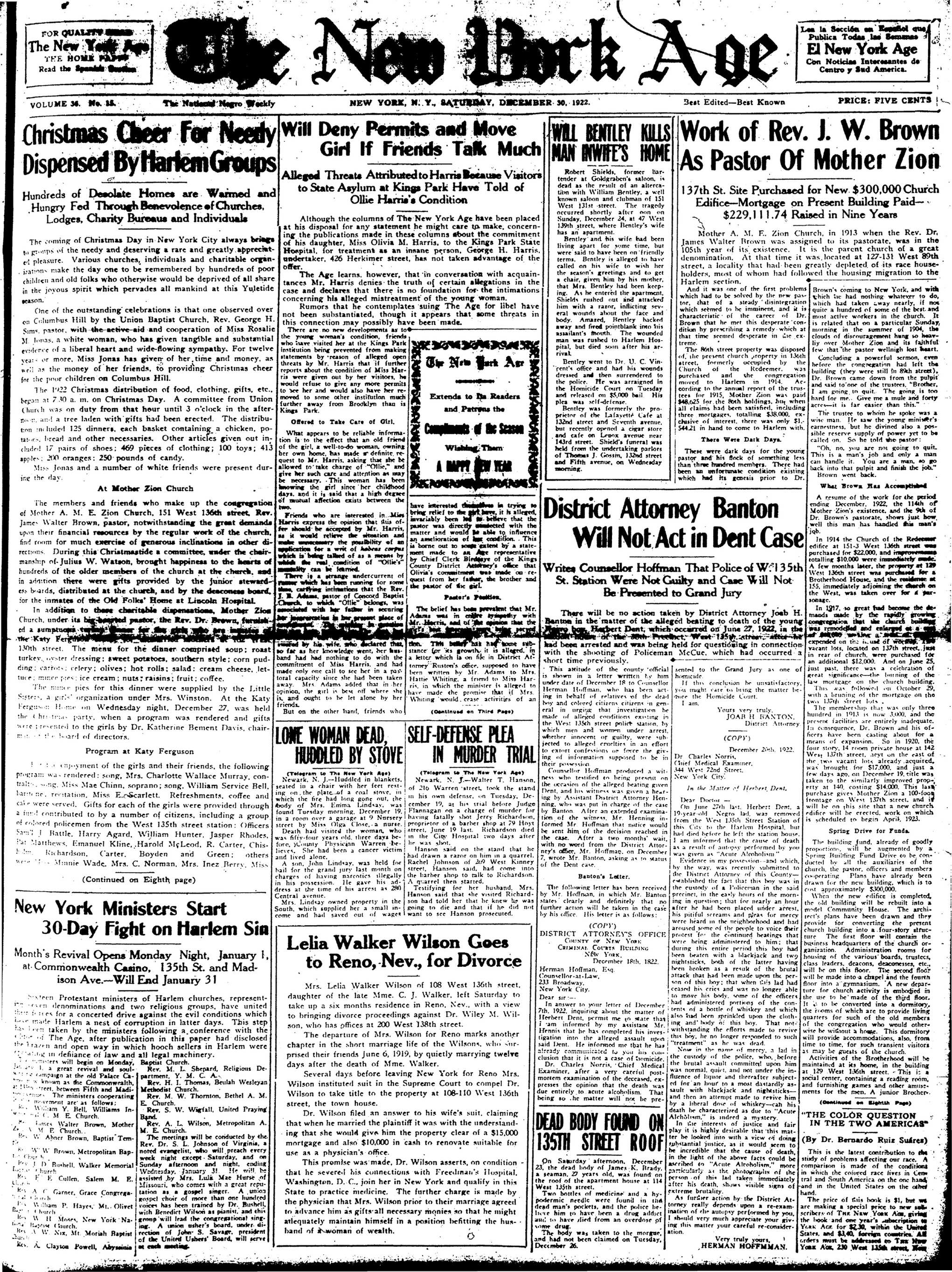
Christmas Cheer For Needy Dispensed By Harlem Groups
Hundreds of Desolate Homes are Warmed and Hungry Fed Through Benevolence of Churches, Lodges, Charity Bureaus and Individuals
The coming of Christmas Day in New York City always brings to groups of the needy and deserving a rare and greatly appreciated pleasure. Various churches, individuals and charitable organizations make the day one to be remembered by hundreds of poor children and old folks who otherwise would be deprived of all share in the joyous spirit which pervades all mankind at this Yuletide season.
One of the outstanding celebrations is that one observed over on Columbus Hill by the Union Baptist Church, Rev. George H. Sims, pastor, with the active aid and cooperation of Miss Rosalie M. Jonas, a white woman, who has given tangible and substantial evidence of a liberal heart and wide-flowing sympathy. For twelve years or more, Miss Jonas has given of her, time and money, as well as the money of her friends, to providing Christmas cheer for the poor children on Columbus Hill.
The 1922 Christmas distribution of food, clothing, gifts, etc., began at 7:30 a.m. on Christmas Day. A committee from Union Church was on duty from that hour until 3 o'clock in the afternoon and a tree laden with gifts had been erected. The distribution included 125 dinners, each basket containing a chicken, potatoes, bread and other necessaries. Other articles given out included 17 pairs of shoes; 469 pieces of clothing; 100 toys; 413 apples; 200 oranges; 250 pounds of candy.
Miss Jonas and a number of white friends were present during the day.
At Mother Zion Church
The members and friends of Mother A. M. E. Zion Chr. James Walter Brown, pastor, upon their financial resources find room for much exercise or receptions. During this Christmas manship of Julius W. Watson, hundreds of the older members in addition there were gifts less boards, distributed at the chic for the inmates of the Old Folk Church, under its big hearted piled a sumptuous turkey dinner the Katy Ferguson Home, 130th street. The menu for a turkey, oyster dressing; sweet piding; carrots; celery; olives; hutuce; mince pies; ice cream; nutcracker pies for this day. Sisters, a girl's organization under Ferguson Home on Wednesday the Christmas party, when a were presented to the girls by D. mat of the board of directors.
mrs and friends who make up
M. E. Zion Church, 151 West
Brown, pastor, notwithstanding the
special resources by the regular w
such exercise of generous incli
this Christmastide a committee
is W. Watson, brought happily
older members of the church
we were gifts provided by the
bated at the church, and by the
of the Old Folks' Home at Litt
to those charitable dispensate
a big hearted pastor, the Rev. I.
winter dinner for the girls
the menu for the dinner com-
ressing; sweet potatoes, souther-
ery; olives; hot rolls; salad;
ice cream; nuts; raisins; fruit;
ties for this dinner were supp
organization under Mrs. Wins-
ton Wednesday night, Decem-
urity, when a program was w
the girls by Dr. Katherine Be
of directors.
The members and friends who make up the congregation of Mother A. M. E. Zion Church, 151 West 136th street, Rev. James Walter Brown, pastor, notwithstanding the great demands upon their financial resources by the regular work of the church, find room for much exercise of generous inclinations in other directions. During this Christmastide a committee, under the chairmanship of Julius W. Watson, brought happiness to the hearts of hundreds of the older members of the church at the church, and in addition there were gifts provided by the junior stewardess boards, distributed at the church, and by the deaconess board, for the inmates of the Old Folks' Home at Lincoln Hospital.
In addition to these charitable dispensations, Mother Zion Church, under its big hearted pastor, the Rev. Dr. Brown, furnished a sumptuous turkey dinner for the girls who are inmates of the Katy Ferguson Home, a charitable institution at 130th street. The menu for the dinner comprised soup; roast turkey, oyster dressing; sweet potatoes, southern style; corn pudding; carrots; celery; hot rolls; salad; cream cheese, lettuce; mince pies; ice cream; nuts; raisins; fruit; coffee.
The mince pies for this dinner were supplied by the Little Sisters, a girl's organization under Mrs. Winston. At the Katy Ferguson Home on Wednesday night, December 27, was held the Christmas party, when a program was rendered and gifts were presented to the girls by Dr. Katherine Bement Davis, chairman of the board of directors.
Program at Katy Ferguson
In the enjoyment of the gift program was rendered: song, Mrs. traitt, song, Miss Mae Chinn, so bartone, recitation, Miss E. S. cake were served. Gifts for each a final contributed to by a numb of colored policemen from the V Saml J Battle, Harry Agard, Pat Matthews, Emanuel Kline, John Richardson, Carter, were Miss Munnie Wade, Mrs. C
ment of the girls and their fri
edered: song, Mrs. Charlotte W
Mae Chinn, soprano; song, W
on, Miss E. Scarlett. Refresh
Gifts for each of the girls wend
to by a number of citizens,
men from the West 135th street
Harry Agard, William Hunter
manuel Kline, Harold McLeod
on, Carter, Boyden and
Wade, Mrs. C. Norman, Mrs
The enjoyment of the girls and their friends, the following program was rendered: song, Mrs. Charlotte Wallace Murray, contralto, song, Miss Mae Chinn, soprano; song, William Service Bell, baritone, recitation, Miss E. Scarlett. Refreshments, coffee and cake were served. Gifts for each of the girls were provided through a fund contributed to by a number of citizens, including a group of colored policemen from the West 135th street station: Officers Sam J. Battle, Harry Agard, William Hunter, Jasper Rhodes, Pat Matthews, Emanuel Kline, Harold McLeod, R. Carter, Chis- lalm, Richardson, Carter, Boyden and Green; others were Miss Minnie Wade, Mrs. C. Norman, Mrs. Inez Berry, Miss
(Continued on Eighth page)
New York Mini-
30-Day Fight
Month's Revival Opens M
at Commonwealth Casi-
ison Ave.—Will
Eighteen Protestant ministers
in seven denominations and t
their forces for a concerted drive
have made Harlem a nest of co-
hors taken by the ministers.
Council of The Age, after public
the brazen and open way in wh
creating in defiance of law and
Park Ministers S
day Fight on Hate
Royal Opens Monday Night
Swealth Casino, 135th S
Ave.—Will End January
instant ministers of Harlem cl
nations and two religious gr
concerted drive against the evi
n a nest of corruption in latter
the ministers following a co
e, after publication in this pr
en way in which hooch seller
ence of law and all legal machi
New York Ministers Start 30-Day Fight on Harlem Sin
Month's Revival Opens Monday Night, January 1, at Commonwealth Caino, 135th St. and Madison Ave.—Will End January 31
Sixteen Protestant ministers of Harlem churches, represent seven denominations and two religious groups, have united their forces for a concerted drive against the evil conditions which have made Harlem a nest of corruption in latter days. This step has been taken by the ministers following a conference with the Council of The Age, after publication in this paper had disclosed the threat and open way in which hooch sellers in Harlem were exploiting in defiance of law and all legal machinery.
The ministers will begin on Monday, Rev. L. a great revival and soul campaign at the old Palace Caino, known as the Commonwealth, between Fifth and Madison Street, between Fifth and Madison Street. The ministers cooperating movement are as follows:
Rev. William Y. Bell, Williams Inwood C. M. E. Church.
Rev. James Walter Brown, Mother Zoe A. M. E. Church.
Rev. W Abner Brown, Baptist Temple.
Rev. W Brown, Metropolitan Baptist Church.
Rev. J D Bushell, Walker Memorial Lutheran Church.
Rev. E Cullen, Salem M. E. Church.
Rev. A C Garner, Grace Congregational Church.
Rev. M. L Shepard, Religious Department, Y. M. C. A.
Rev. H. I. Thomas, Beulah Wesleyan Methodist Church.
Rev. M. W Thornton, Bethel A. M. E. Church.
Rev. S. W Wigfall, United Praying Band.
Rev. A. L Wilson, Metropolitan A. M. E. Church.
The meetings will be conducted by the Rev. Dr. S. L Johnson of Virginia, a noted evangelist, who will preach every week night except Saturday, and on Sunday afternoon and night, ending Wednesday, January 31. He will be assisted by Mrs. Lulu Mae Horse of Missouri, who comes with a great reputation as a gospel singer. A union gospel choir of more than one hundred
Rev. William P. Hayes, Mt. Olivet
Baptist Church
Rev. W. H. Moses, New York Nat-
l. Baptist Church.
Rev. A. W. Nix, Mt. Moriah Baptist
Baptist
Rev. A. Clayton Powell, Abysesia
The National Negro Weekly
Creeer For Needy New Harlem Groups
Homes are Warmed and Benevolence of Churches, Sureaus and Individuals
Day in New York City always brings serving a rare and greatly appreciated, individuals and charitable organe remembered by hundreds of poor otherwise would be deprived of all share favades all mankind at this Yuletide
Celebrations is that one observed over on Baptist Church, Rev. George H. Said and cooperation of Miss Rosalie has given tangible and substantial wide-flowing sympathy. For twelve is given of her time and money, as ends, to providing Christmas cheer on bus Hill.
Distribution of food, clothing, gifts, etc., as Day. A committee from Union at hour until 3 o'clock in the afterts had been erected. The distribution basket containing a chicken, poaries. Other articles given out in pieces of clothing; 100 toys; 413 kinds of candy.
Of white friends were present dur-
who make up the congregation church, 151 West 136th street. Rev. notwithstanding the great demands by the regular work of the church, if generous inclinations in other distide a committee, under the chair-brought happiness to the hearts of of the church at the church, and provided by the junior steward-church, and by the deaconess board, 's Home at Lincoln Hospital.itable dispensations, Mother Zion pastor, the Rev. Dr. Brown, furnish for the girls who are in need of the dinner comprised soup; roast potatoes, southern style; corn pudot rolls; salad; cream cheese,lets; raisins; fruit; coffee. Inner were supplied by the Little Under Mrs. Winston. At the Katy night, December 27, was held program was rendered and gifts Dr. Katherine Bement Davis, chair-
girls and their friends, the following
rs. Charlotte Wallace Murray, conprano; song, William Service Bell, carlett. Refreshments, coffee and
of the girls were provided through
ber of citizens, including a group
West 135th street station: Officers
William Hunter, Jasper Rhodes,
Harold McLeood, R. Carter, Chis-
Boyden and Green; others
C. Norman, Mrs. Inez Berry, Miss
Misters Start
night on Harlem Sin
Monday Night, January 1,
no, 135th St. and Mad-
End January 31
of Harlem churches, represent-
two religious groups, have united
against the evil conditions which
eruption in latter days. This step
is following a conference with the
ation in this paper had disclosed
which hooch sellers in Harlem were
all legal machinery.
Baptist Church.
Rev. M. L. Shepard, Religious De-
partment, Y. M. C. A.
Rev. H. I. Thomas, Beulah Wesleyan
Methodist Church.
Rev. M. W. Thornton, Bethel A. M.
E. Church.
Rev. S. W. Wigfall, United Praying Band.
Rev. A. L. Wilson, Metropolitan A. M. E. Church.
The meetings will be conducted by the Rev. Dr. S. L. Johnson of Virginia, a noted evangelist, who will preach every night night except Saturday, and on Sunday afternoon and night, ending Wednesday, January 31. He will be assisted by Mrs. Lula Mae Hurse of Missouri, who comes with a great reputation as a gospel singer. A union gospel choir of more than one hundred voices has been trained by Dr. Bushell, with Benedict Wilson as pianist, and this group will lead the congregational singing. A union usher's board, under direction of John S. Savage, president of the United Usher's Board, will serve at each meeting.
NEW YORK, N. Y., SATURDAY, DECEMBER 30, 1922.
Will Deny Permits and Move Girl If Friends Talk Much
Will Deny Permits and Move Girl If Friends Talk Much
Alleged Threats Attributed to Harris Because Visitors to State Asylum at Kings Park Have Told of Ollie Harris's Condition
Although the columns of The New York Age have been placed at his disposal for any statement he might care to make, concerning the publications made in these columns about the commitment of his daughter, Miss Olivia M. Harris, to the Kings Park State Hospital, for treatment as an insane person, George H. Harris, undertaker, 426 Herkimer street, has not taken advantage of the offer.
The Age learns, however, that in conversation with acquaintances Mr. Harris denies the truth of certain allegations in the case and declares that there is no foundation for the intimations concerning his alleged mistreatment of the young woman.
Rumors that he contemplates suing The Age for libel have not been substantiated, though it appears that some threats in this connection may possibly have been made.
Lelia Walker Wilson Goes to Reno, Nev., for Divorce
Mrs. Lelia Walker Wilson of 108 West 136th street, daughter of the late Mme. C. J. Walker, left Saturday to take up a six months residence in Reno, Nev., with a view to bringing divorce proceedings against Dr. Wiley M. Wilson, who has offices at 200 West 138th street.
The departure of Mrs. Wilson for Reno marks another chapter in the short marriage life of the Wilsons, who surprised their friends June 6, 1919, by quietly marrying twelve days after the death of Mme. Walker.
Several days before leaving New York for Reno Mrs. Wilson instituted suit in the Supreme Court to compel Dr. Wilson to take title to the property at 108-110 West 136th street, the town house.
Dr. Wilson filed an answer to his wife's suit, claiming that when he married the plaintiff it was with the understanding that she would give him the property clear of a $15,000 mortgage and also $10,000 in cash to renovate suitable for use as a physician's office.
This promise was made, Dr. Wilson asserts, on condition that he severed his connections with Freedman's Hospital, Washington, D. C., join her in New York and qualify in this State to practice medicine. The further charge is made by the physician that Mrs. Wilson prior to their marriage agreed to advance him as gifts all necessary monies so that he might adequately maintain himself in a position befitting the husband of a woman of wealth.
There are no new developments as to the young woman's condition, friends who have visited her at the Kings Park institution being prevented from making any changes to her condition, threats by Mr. Harris that if further reports about the condition of Miss Harris were given out by her visitors, he would refuse to give any more permits to see her and would also have her removed to some other institution much further away from Brooklyn than is Kings Park.
Offered to Take Care of Girl.
What appears to be reliable information is to the effect that an old friend of the girl, a well-to-do woman, owning her own home, has made a definite request to Mr. Harris, asking that she be allowed to take charge of "Ollie," and give her such care and attention as may be necessary. This woman has been knowing the girl since her childhood days, and it is said that a high degree of mutual affection exists between the two.
Friends who are interested in Miss Harris express the opinion that this offer should be accepted by Mr. Harris, as it would relieve the situation and make unnecessary the possibility of an application for a writ of habeas corpus which is being called of as a means by which the real condition of "Ollie's" mortality can be learned.
There is a strange undercurrent of pastor which has been running for some time, carlyling intimations that the Rev. J. B. Adams, pastor of Concord Baptist Church, to which "Ollie" belongs, was associated with her father in securing her representation in her present place of employment. The pastor in question was sworn by his wife, who declared that, so far as her knowledge went, her husband had had nothing to do with the commitment of Miss Harris, and had made only one call to see her in a pastoral capacity since she had been taken away. Mrs. Adams added that in her opinion, the girl is best off where she is, and ought to be let alone by her friends.
But on the other hand, friends who
(Telegram to The New York Age)
Newark, N. J.-Huddled in blankets, seated in a chair with her feet resting on the, plate of a, coal stove, in which the fire had long gone out, the Body of Mrs. Emma Lindsay, was found Tuesday morning, December 19, in a room over a garage at 9 Nursery street by Miss Olga Close, a nurse. Death had visited the woman, who was fifty-four years old, three days before, County Physician Warren believes. She had been a cancer victim and lived alone. son, Mrs. Lindsay, was held for bail the grand jury last month on charges of having narcotics illegally in his possession. He gave his address at the time of his arrest as 280 Central avenue.
Mrs. Lindsay owned property in the South, which supplied her a small income, and had saved out of wages
District Attorneys
Will Not Ad
Writes Counsellor Hoffman
St. Station Were Not G
Be Presented
There will be no action take
Bantna in the matter of the alley
Harry ben, Harbert Dent, which
had been arrested and was being
with the shooting of Policeman
short time previously.
Writes Counsellor Hoffman That Police of W.135th St. Station Were Not Guilty and Case Will Not Be Presented to Grand Jury
There will be no action taken by District Attorney Joab H. Banton in the matter of the alleged beating to death of the young boy, Harbert Dent, which occurred on June 27, 1922, in the apartment of the 80th Precinct. West 135th street, after he had been arrested and was being held for questioning in connection with the shooting of Policeman McCue, which had occurred a short time previously.
This attitude of the county official is shown in a letter written by him under date of December 18 to Counsellor Hertman Hoffman, who has been acting in behalf of relatives of the dead boy and colored citizens in general in urging that investigation be made of alleged conditions existing in the West 135th street police station, by which men and women under arrest, whether innocent or guilty, were subjected to alleged crimes in an effort to extort confessions or force the giving of information supposed to be in their possession.
sented to the Grand Jury as one of homicide.
If this conclusion be unsatisfactory, you might care to bring the matter before the Homicide Court.
I am.
Yours very truly.
JOAB H. BANTON.
District Attorney
(COPY)
December 20th, 1922.
Dr. Charles Norris, Chief Medical Examiner.
Counsellor Hoffman produced a witness who testified to being present on the occasion of the alleged heating given Dent, and his witness was given a hearing by Assistant District Attorney Henning, who was put in charge of the case by Banton. After an extended examination of the witness, Mr. Henning informed Mr. Hoffman that notice would be sent him of the decision reached in the case. After a two months' wait, with no word from the District Attorney's office, Mr. Hoffmag, on December 7, wrote Mr. Banton, asking as to status of the Dent case.
The following letter has been received by Mr. Hoffman, in which Mr. Banton states clearly and definitely that no further action will be taken in the case by his office. His letter is as follows:
(COPY)
DISTRICT ATTORNEYS OFFICE
COUNTY OF NEW YORK
CRIMINAL COURTS BUILDING
NEW YORK.
December 18th, 1822.
Herman Hoffman, Esq.
Counsellor-at-Law,
233 Broadway,
New York City.
Dear sir.
Dear sir.... In answer to your letter of December 7th, 1922, inquiring about the matter of Herbert Dent, permit me to state that I am informed by my assistant Mr. Hennis that he has completed his investigation into the alleged assault upon said Dent. He informed me that he has already communicated to you his conclusion that it is not a case of homicide. Dr. Charles Norris, Chief Medical Examiner, after a very careful post-mortem examination of the deceased, expresses the opinion that the death was due entirely to acute alcoholism. That being so the matter will not be pre-
DEAD BODY FOUND ON 135TH STREET ROOF
On Saturday afternoon, December 23, the dead body of James K. Brady, a seaman, 27 years old, was found on the roof of the apartment house at 114 West 135th street.
Two bottles of medicine and a hypodermic needle were found in the dead man's pockets, and the police believe him to have been a drug addict and to have died from an overdose of some drug.
The body was taken to the morgue, and had not been claimed on Tuesday, December 26.
The New York Age
Extends to Ra Readers and Patrons the Compliments of the Season
Wishing Them
A HAPPY NEW YEAR
have interested themselves in trying to bring relief to the park have, it is alleged, invariably been had so believe that the pastor was directly connected with the matter and would be able to influence an amelioration of her condition. This is home out to some extent by a statement made to an Age representative by Chief Clerk Birchgate of the Kings County District Attorney's office that Olivia's commitment was made on request from her father, the brother and the pastor of the girl.
Pastor's Pentice
The belief has been prevalent that Mr. Adams was in entire sympathy with Mr. Harris, and of the opinion that the truth has been unquestioned being proved then. This belief has had some substance for its growth, it is alleged, in a letter which is on file in District Attorney Ruston's office, supposed to have been written by Mr. Adams to Mrs. Hattie Whiting, a friend to Miss Harris, in which the minister is alleged to have made the promise that if Mrs. Whiting would cease activities of an
(Continued on Third Page)
(Telgram to The New York Age)
Newark, N. J.-Walter T. Hanson, of 210 Warren street, took the stand in his own defense, on Tuesday, December 19, at his trial before Judge H Hannagan on a charge of murder for having fatally shot Jerry Richardson, proprietor of a barber shop at 79 Hoyt street, June 19 last. Richardson died in the City Hospital two days after he was shot. Hanson said on the stand that he had drawn a knife on him in a quarrel. Rachael Richardson of 209 West Kinney street, Hanson said, had come into the barber shop to talk to Richardson. A quarrel then started.
Testifying for her husband, Mrs. Hanson said that she visited Richardson had told her that he knew he was going to die and that if he did not want to see Hanson prosecuted.
District Attorney Banton Will Not Act in Dent Case
WILL BENTLEY KILLS MAN INWIFE'S HOME
Robert Shields, former hartender at Gokigaben's saloon, is dead as the result of an altercation with William Bentley, a well-known saloon and clubman of 151 West 131st street. The tragedy occurred shortly after con on Sunday, December 24, at 47 West 139th street, where Bentley's wife has an apartment.
Bentley and his wife had been living apart for some time, but were said to have been on friendly terms. Bentley is alleged to have called on his wife to wish her the season's greetings and to get a chair, given him by his mother, that Mrs. Bentley had been keeping. As he entered the apartment, Shields rushed out and attacked him with a razer, inflicting several wounds about the face and body. Amazed, Bentley backed away and fired pointblank into his assailant's mouth. The wounded man was rushed to Harlem Hospital, but died soon after his arrival.
Bentley went to Dr. U. C. Vincent's office and had his wounds dressed and then surrendered to the police. He was arraigned in the Homicide Court on Tuesday and released on $5,000 bail. His plea was self-defense.
Bentley was formerly the proprietor of the Lafayette Cafe at 132nd street and Seventh avenue, but recently opened a cigar store and cafe on Leopox avenue near 143rd street. Shield's funeral was held from the undertaking parlor of Thomas J. Gosim, 132nd street and Fifth avenue, on Wednesday morning.
Banton's Letter.
Work of Rev. J. W. Brown As Pastor Of Mother Zion
137th St. Site Purchased for New. $300,000 Church Edifice—Mortgage on Present Building Paid— $229,111.74 Raised in Nine Years
Mother A. M. E. Zion Church, in 1913 when the Rev. Dr. James Walter Brown was assigned to its pastorate, was in the 105th year of its existence. It is the parent church of a great denomination. At that time it was, located at 127-131 West 89th street, a locality that had been greatly depleted, of its race house- holders, most of whom had followed the housing migration to the Harlem section.
Work of Rev. As Pastor Of
137th St. Site Purchased
Edifice—Mortgage on
$229,111.74 Rai
Mother A. M. E. Zion Chr.
James Walter Brown was assign
105th year of its existence. It
denomination. At that time it w
street, a locality that had been
holders, most of whom had follow
Harlem section.
And it was one of the first problems
which had to be solved by the new pas-
tor, that of a steady disintegration
which seemed to be imminent, and it is
characteristic of the career of Dr.
Brown that he met this desperate con-
dition by prewriting a remedy which at
that time seemed desperate in the ex-
The 80th street property was disposed of, the present church property in 180th street, formerly occupied by the Church of the Redeemer, was purchased and the congregation moved to Harlem in 1914. According to the annual report of the trustees for 1915, Mother Zion was paid $48,625 for the 80th holdings, but when all claims had been satisfied, including three mortgages, totalling $38,000, exclusive of interest, there was only $1,442.1 in hand to come to Harlem with.
There Were Dark Daya
These were dark days for the young pastor and his flock of something less than three hundred members. There had been an unfortunate condition existing which had its genesis prior to Dr. Arney Banton Act in Dent Case
man That Police of W.135th Guilty and Case Will Not Need to Grand Jury
aken by District Attorney Joab H. neged beating to death of the young child occurred on June 27, 1922, in the street. West 135th street, after he held for questioning in connection with McCue, which had occurred a sentel to the Grand Jury as one of homicide.
If this conclusion be unsatisfactory, you might care to bring the matter before the Homicide Court.
Yours very truly,
JOAB H BANTON,
District Attorney
Dr. Charles Norris,
Chief Medical Examiner,
344 West 22nd Street,
New York City.
In the Matter of Herbert, Dent,
Dear Doctor —
On June 27th last, Herbert Dent, a
19-year-old Negro bad, was removed
from the West 153th Street Station of
this City to the Harlem Hospital, but
had died before he left the station house.
I am informed that the cause of death
as a result of autopsy performed by you
was given as "Acute Alcoholism"
Evidence in my possession—and which by the way, was recently submitted to the District Attorney of this County—established the fact that this boy was in the custody of a Policeman in the said precinct, in the early hours of the morning in question; that for nearly an hour after he had been placed under arrest, his pitiful screams and pleas for mercy were heard in the neighborhood and had aroused some of the people to voice their protest for the continued heatings that were being administered to him; that during this entire period this boy had been beaten with a blackjack and two nightsticks, both of the latter having been broken as a result of the brutal attack that had been made upon the person of this boy; that when this lad had ceased his cries and was no longer able to move his body, some of the officers had administered portions of the contents of a bottle of whiskey and which also had been sprinkled upon the clothing and body of this boy. That notwithstanding the efforts made to revive this boy, he no longer responded to such "treatment" as he was dead.
Now in the name of mercy, a lad in the custody of the police, who, before the brutal assault committed upon him was normal, quiet, and not under the influence of liquor and thereafter subjected for an hour to a most dastardly assault with blackjack and nightsticks—and then an attempt made to revive him by a liberal dose of whiskey—cah his death be characterized as due to "Acute Alcholism," is indeed a mystery.
In the interests of justice and fair play it is highly desirable that this matter be looked into with a view of doing substantial justice, as it would seem to be incredible that the cause of death, in the light of the above facts could be ascribed to "Acute Alcoholism," more particularly as the photograph of the person of this lad taken immediately after his death, shows visible signs of extreme brutality.
As further action by the District Attorney really depends upon a re-examination of the autopsy performed by you, I should very much appreciate your giving this matter your careful re-consideration.
Very truly yours,
HERMAN HOFFMAN
Lea la Sección en Repubilol que
Publica Todas las Semanas
El New York Age
Con Noticias Interesantes de
Centro y Sud America.
w. J. W. Brown of Mother Zion
ed for New. $300,000 Church on Present Building Paid—Raised in Nine Years
Church, in 1913 when the Rev. Dr. assigned to its pastorate, was in the It is the parent church of a great it was, located at 127-131 West 89th on greatly depleted, of its race house-followed the housing migration to the
Brown's coming to New York, and with which he had nothing whatever to do, which had taken away nearly, if not quite a hundred of some the best and most active workers in the church. It is related that on a particular Sunday, morning in the summer of 1904, the clouds of discouragement hung so heavily over Mother Zion and its faithful few that the pastor wellnigh lost heart.
Concluding a powerful sermon, even before the congregation had left the building (they were still in 80th street), Dr. Brown came down from the pulpit and said to one of the trustees, "Brother, I am going to quit. The going is too hard for me. Give me a mule and forty acres—it is far easier than this."
The trustee to whom he spoke was a wise man. He saw the young minister's earnestness, but he divined also a possible reserve supply of power yet to be called on. So he told the pastor: "Oh, no, you are not going to quit. This is a man's job and only a man can handle it. You are a man, so go back into that pulpit and finish the job." Brown went back.
What Brown Has Accomplished
A resume of the work for the period ending December, 1922, the 114th of Mother Zion's existence, and the 9th of Dr. Brown's pastorate, shows just how well this man has handled this man's job.
In 1914 the Church of the Redeemer edifice at 151-3 West 136th street was purchased for $22,000, and improvements totalling $10,000 were immediately made. A few months later, the property at 129 West 136th street was purchased for a Brotherhood House, and the residence at 155, immediately adjoining the church on the West, was taken over for a parsonage.
In 1917, so great had become the demands made by the rapidly growing congregation that the church building was remodeled and enlarged at a cost of $10,000, expended on the land of worship, a vacant lots, located on 137th street, just in rear of church, were purchased for an additional $12,000. And on June 25, just past, there was a celebration of great significance—the burning of the law mortgage on the church building. This was followed on October 29, with a burning of the mortgage on the two 136th street lots.
The membership that was only three hundred in 1913 is now 3,000, and the present facilities are entirely inadequate. In consequence, Dr. Brown and his officers have been casting about for a means of expansion. So in 1920, the four story, 14 room private house at 142 West, 137th street, ayst on the east of the two vacant lots already acquired, was brought for $17,000, and just a few days ago, on December 19, title was taken to the similarly improved property at 140, costing $14,000. This last purchase gives Mother Zion a 100-floor frontage on West 137th street, and if it will be on this site that a new church edifice will be erected, work on which is scheduled to begin April, 1923.
Spring Drive for Funda
The building fund, already of good proportions, will be augmented by a Spring Building Fund Drive to be conducted by all the auxiliaries of the church, the pastor, officers and members cooperating. Plans have already been drawn for the new building, which is to cost approximately $300,000.
When the new edifice is completed, the old building will be rebuilt into a model Community House. The architect's plans have been drawn and they provide for converting the present church building into a four-story structure. The first floor will contain the business headquarters of the church organization. Administration rooms for housing of the various boards, trustees, class leaders, deacons, deaconesses, etc., will be on this floor. The second floor will be made into a chapel and the fourth floor into a gymnasium. A new departure for church activity is embodied in the use to be made of the third floor. It is to be converted into a dormitory, the rooms of which are to provide living quarters for such of the old members of the congregation who would otherwise be without a house. This dormitory will provide accommodations, also, from time to time, for such transient visitors as may be guests of the church.
Activities of the Brotherhood will be maintained at its home, in the building at 129 West 136th street. This is a social center, containing a reading room, and furnishing games and other amusements for the men. A junior Brother-
"THE COLOR QUESTION
IN THE TWO AMERICAS"
(By Dr. Bernardo Ruiz Suárez)
This is the latest contribution to the study of problems affecting our race. A comparison is made of the conditions in which the coloured race lives in Central and South America on the one hand, and in the United States on the other hand.
The price of this book is $1, but we are making a special price to new subscribers of The New York Anc, giving the book and one year's subscription to York Anc for $230, within the United States, and $340, foreign countries. All orders must be addressed to The New York Anc, 230 West 135th street, New York, NY 10024.
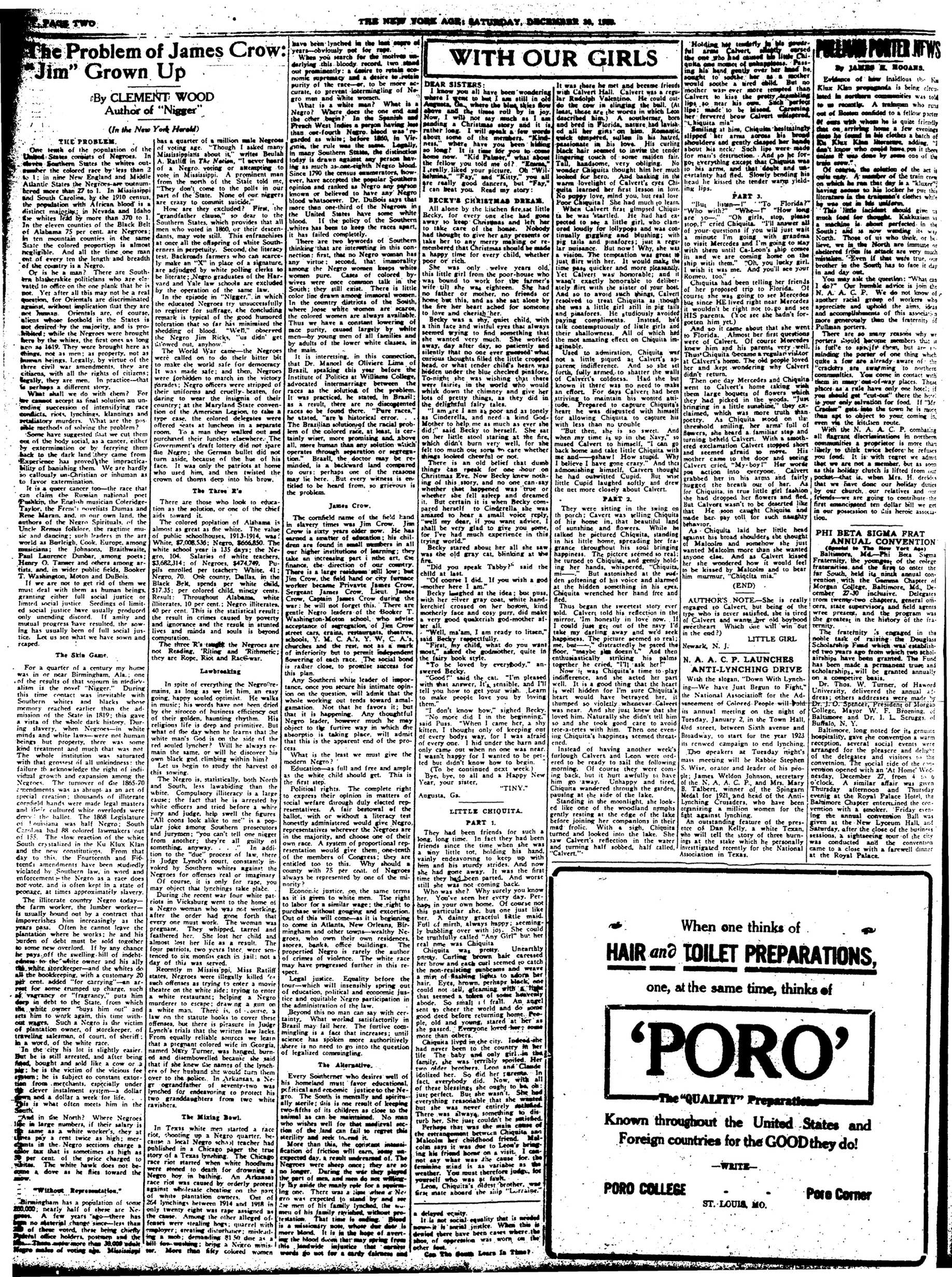
The Problem of James Crow: "Jim" Grown Up
By CLEMENT WOOD Author of "Nigger" (In the New York Herald)
THE PROBLEM
One tenth of the population of the United States consists of Negroes. In southern Southern States the whites outnumber the colored race by less than 2 to 1; in nine New England and Middle Atlantic States the Negroes are outnumbered more than 27 to 1. In Mississippi and South Carolina, by the 1910 census, the population with African blood is a distinct majesty; in Nevada and Idaho the whites led by more than 370 to 1. In the eleven counties of the Black Belt of Alabama 75 per cent, are Negroes; in ten mountain counties in the same State the colored proportion is almost negligible. And all the time one man out of every ten the length and breadth of the country is a Negro.
Or is he a man? There are Southern blazerhead politicians who are elevated to office on the one plank that he is not. Yet after all this may not be a real question, for Orientalists are discriminated against, without implication that they are not human. Orientalists are, of course, citizens whose foothold in the States is held by the Negroes, who are hobbled; while the Negroes were brought here by the whites, the first ones as long as 1619. They were brought here as things, not as men; as property, not as human beings. Legally, by virtue of the three civil war amendments, they are citizens, with all the rights of citizens; legally, they are men. In practice—that is perhaps a different story. What shall we do with them? For citizens accept as an unconditional an unconditional use of intensifying race conflicts, riots, lynchings, killings and retaliatory murders. What are the possible methods of solving the problem?
Some have suggested that we cut them out of the body social, as a cancer, either by extermination or by ferrying them back to the dark land they came from. Experience has proved the impracticability of banishing them. We are hardly so callously un-Germanian or inhuman as they are. It is a queer cancer too—the race that can claim the Russian national poet Pushkin, the English musician Coleridge-Taylor, the French novelist Dumas and Rene Maran, and, in our own land, the authors of the Negro Spirituals, of the Uncle Remus folklore, the ragtime music and dancing; such leaders in the art world as Berleigh, Cook, Europe, among musicians; the Johnson, Braithwaite, Henry O. Tanner and others among artists, and, in wider public fields, Booker T. Washington, Moton and DuBois.
If we are not to get rid of them we must deal with them as human beings granting either full social justice or limited social justice. Seedings of limited social justice have usually produced only unending discord. If amity and mutual progress have resulted, the sowing has usually been of full social justice. Let us see what we have sown and reaped.
For a quarter of a century my home was in or near Birmingham, Ala., one of the results of that sojourn in medievalism is the novel "Nigger." During this time contact was inevitable with Southern whites and blacks whose memory reached earlier than the admission of the State in 1819; this gave a vista of the whole dark history. During slavery, when Negroes in white minds and white laws, were not human kind treatment and much that was not. The whole institution was saturated with that greatest of all unkindness: the failure to acknowledge the right of individual growth and expansion among the Negroes. The turnover of the 1865-70 amendments was as abrupt as an act of special creation; thousands of illiterate carefellow hands were made legal masters and their cultured white overlords were demoted the ballot. The 1868 Legislature of Louisiana was half Negro; South Carolina had 88 colored lawmakers out of 153; the civil law of the KKK was South Carolina and the new constitutions. From that day to this, the Fourteenth and Fifteenth amendments have been studied violated by Southern law, in word and enforcement, the Negro as a race does not vote, and is often kept in a state of peonage, at times approximately slavery.
The illiterate country Negro today—the farm worker, the lumber worker—is usually bound out by a contract that impoverishes him increasingly as the years pass. Often he cannot leave the plantation where he works; he and his burden of debt must be sold together to pay for it. He pays off the swelling hill of indebtedness to the white owner and his ally the white, storekeeper—and the whites do all the bookkeeping, with a customary 20 per cent. added "for carrying"—an arrest for some trumped up charge, such as vagrancy or "fragrancy," puts him deep in debt to the State, from which the white owner "bys him out" and sets him to work again, this time with the plantation owner, of storekeeper, traveling salesman, of court, of sheriff: in a word, of the white race.
In the city his lot is slightly easier. But he is still arrested, and after being freed, bought and sold like a cow or a pig; he is the victim of the vicious fee system; he is subject to constant extortion from merchants, especially under the clever instalment dollar given and a dollar a week for life. This is what often meets him in the South.
And in the North? Where Negroes live in large numbers, if their salary is the same as a white worker's, they at times pay a rent twice as charge; merchants in the Negro sections charge a low tax that is sometimes as high as the cost of the city charged to whites. The white hawk does not become a dove as he flies toward the snow.
"Without Representation."
Birmingham has a population of some 220,000; nearly half of these are Negroes. A few years ago there has been no material change since less than 20 of these voted, these being chiefly Digital office holders, postmen and the maids. These more than 30,000 adult Negroes make of voting sign. Mississippi
The Skin Game.
has a quarter of a million male Negroes of voting age. "Though I asked many Mississippiians about it," writes Beulah A. Ratliff in *The Nation*, "I never heard of a Negro voting or attempting to vote in Mississippi. A prominent man from the north of the State told me, 'They don't come to the polls in our part of the State. None of our niggers are crazy to commit suicide.' How are they excluded? First, the "grandfather clause," so dear to the Southern States, which provides that all men who voted in 1860, or their descendants, may vote still. This enfranchisates at once all the offspring of white men who voted in 1860, or their descendants. Backrooms farmers who can scarcely make an "X" in place of a signature, are adjudged by white polling clerks to be literate; Negro graduates of the Harvard and Yale law schools are excluded by the operation of the same law.
In the episode in "Nigger," in which the educated Negroes try unsuccessfully to register for suffrage, the concluding remark is typical of the good humored toleration that so far has minimized the shedding of blood. "Well," observed the Negro Jim Ricks, "us didn't get allowed out, anyhow." The World War came—the Negroes were called to do their bitter bit to make the world safe for democracy. It was made safe; and then, Negroes were forbidden to march in the victory parades; Negro officers were stripped of their uniforms and cruelly-beaten, for daring to wear the insignia of their country; at the Maryland State convention of the American Legion, to take a type case, the colored delegates were offered seats at luncheon in a separate room. To a man they walked out and purchased their lunches elsewhere. The Negroes were called to the Negro; the German bullet did not turn aside, because of the hue of his face. It was only the patrons at home who used him, and then twisted the crown of thorns deep into his brow.
The Three R's
There are those who look to education as the solution, or one of the chief aids toward it.
The colored population of Alabama is almost as great as the white. The value of public schoolhouses, 1913-1914, was: white. $7,008,536. Negro. $666,850. The white grove, 104. Negro. $6,900. The white grove, 104. Salaries of white teachers, $3,682,314. of Negroes, $474,749. Pupils enrolled per teacher, White, 41. Negro, 70. One county, Dallas, in the Black Belt, spends per white child, $17.35. per colored child, ninety cents. Result: Throughout Alabama, white illiterates, 10 per cent. Negro illiterates, 40 per cent. This is the statistical result; the result in crimes caused by poverty and ignorance and the result in stunted minds and souls is beyond computation.
The three R's in the negroes are not Reading, 'Rilting and 'Rithmetic; they are Rope, Riot and Racew.
In spite of everything the Negrome-
tries, as long as we let him, an easy
going, happy souled optimist. He walks
in music; his words have not been dried
by the sireco of business efficiency out
of their golden, haunting rhythm. His
religious life is deep and primitive. But
what of the day when he learns that the
white man's God is on the side of the
red seated lynchman, will he always re-
serve him, or will he own his own black god climbing within him?
Let us begin to study the harvest of
this sowing.
The Negro is, statistically, both North
and South, less lawabiding than the
white. Compulsory illiteracy is a large
cause; the fact that he is arrested by
white officers and tried before a white
jury and judge, help swell the figures
"All coons look alike to me" is a popular
joke among Southern prosecutors
and jurymen; "you can't tell one nigger
from another; they're all guilty of
torture of the poor." "Addition to the
due" process of law there is Judge Lynch's court, constantly invoked by Southern whites against the Negroes for offenses real or imaginary
Of course, it is only for rape, you
may object that lynchings take place. During the recent war four white patricians of a Negro woman who was not worked after the order had gone forth that every one must work. The woman was pregnant. They whipped, tarred and feathered her. She lost her child and almost lost her life as a result. The women sentenced to six months each in jail; not a day of this was served.
Recently in Mississippi, Miss Ratiffi states, Negroes were illegally killed so offences as trying to enter a movie theatre on the white side; trying to enter a white restaurant; helping a Negro murderer to escape; drawing a gun on a white man. There is, of course, a law on the statute hooks to cover these offences, but there is piracy in Judge Lynch's trials that the written law lacks. From equally reliable sources we learn that Negro pregnant colored wife in Georgia, named Margaret was hanged, burned and disembowlled, because said that if she knew the names of the lynchs of her husband she would turn them over to the police. In Arkansas, a Negro orgrandfather of seventy-two was lynched for endeavoring to protect his two granddaughters from two white ravishers.
The Mixing Bowl.
In Texas white men started a race riot, shooting up a Negro quarter, because a local Negro school teacher had published in a Chicago paper the true story of a Texas lynching. The Chicago race riot starred when white hoodwuns were stoned to death for drowning a Negro boy in bathing. An Arkansas race riot was caused by orderly protest against wholesale cheating on the part of white plantation owners. Out of 254 lynchings between 1914 and 1918 in the twenty-eight wight was rape assigned as the charge. Other alleged offenses were stealing huge quarrel with employer; creating disturbance, misleading a mob; demanding 81.50 dollar bill for washing; bring a Negro minister. More than fifty colored women
Lawbreaking
THE NEW YORK AGE; SATURDAY, DECEMBER 20, 1918.
have been lynched in the last絮萄 a
years—obviously not for rape.
When you search for the motives underlying this bloody record, two stand out prominently: a desire to retain economic supremacy and a desire to retain purity of the nation. You can prevent intermingling of Negro men and white women.
What is a white man? What is a Negro? Where does the one end and the other begin? In the Spanish and French West Indies a person having less than one-fourth Negro blood was regarded as white; before 1850, in Virginia, the rule remained Negro blood, the distinction today is drawn against any person having as much as one-eighth Negro blood. Since 1790 the census enumerators, however, have accepted the popular Southern opinion and ranked as Negro any person known or believed to have any Negro blood whatsoever. Dr. DuBois says that more than one-third of the Negroes in the United States are Negro blood. If the policy of the Southern whites has been to keep the races apart, it has failed completely.
There are two bywords of Southern thinking: that are interesting in this connection: first, that no Negro woman has any virtue; second, that immorality among the Negro woman keeps white women pure. Cases of colored bywives were once common talk in the South; they still exist. There is little color line drawn among immoral women. In the country districts of the South, where Joose white women are scarce, the colored women are always liable. Thus the color of purity, caused largely by white men—by young men of all families and by adults of the lower white classes, in the main.
It is interesting, in this connection, that Dr. Manuel de Olivierre Lima of Brazil, speaking this year before the Institute of Politics at Williams College, advocated intermarriage between the races as the solution of the problem. It was practiced, he stated, in Brazil; as a result, there are no discerned races so be found there. "Pure races," he stated, "are historical error." The Brazilian solution of the racial problem of the colored race, at least, is certainly wiser, more promising and, above all, more human than any solution by thorough separation or segregation." Brazil, the doctor may be reminded, is a backward land compared to ours; perhaps one of the reasons may lie here. But every witness is entitled to be heard from, so grievous is the problem.
James Crow.
The cornfield name of the field hand in saliva times was Jim Crow. Jim Crow is sixty years older now. He has earned a smaller of education; his children are found in small members in all our higher institutions of learning; they take an increasing part in the art, the finance, the direction of our country. There is a large residuum still low; but Jim Crow, the field hand in saliva times, is private. James Crow, Sergeant James Crow, Lieut. James Crow, Captain James Crow during the war; he will not forget this. There are gentle Negro leaders of the Booker T. Washington-Moton school, who advise acceptance of aggregation, of Jim Crow street cars, strains, restaurants, theaters, schools, Y. M. C. A. s, Y. W. C. A. s, churches and the rest, not the most independent flowering of each race. The social bond is rather close, to promise success for this plan.
Any Southern white leader of importance, once you secure his intimate opinion on the question, will admit that the whole working out tends toward amalgamation. Not that he favors it; but that it is happening. Any thoughtful Negro leader, however much he may object to the furtive way in which the absorptio is taking place, will admit that this is the apparent end of the process.
What is the least we must give the modern Negro?
Education—as full and free and ample as the white child should get. This is the first step.
Political rights. The complete right to express their opinion in matters of social welfare through duly elected representatives. A fair bestowal of the ballot, with or without a literacy test honestly administered would give Negro representatives wherever the Negroes are in the majority, and choose one of their own race. A system of proportional representation would give them, one-tenth of the members of Congress; they are the majority of the county with 75 per cent. of Negroes always be represented by one of the minority?
Economic justice, on the same terms as it is given to white men. The right to labor for a similar wage; the right to purchase without gouging and extortion. Out of this will come—as it is beginning to come in Atlanta, New Orleans, Birmingham and other towns—wealthy Negroes, who own their own residences, stores, banks, office buildings. The Negroes, who are afraid of crimes of violence. The white race may have progressed further in this respect.
Legal justice. Equality before the tour—which will insensibly spring out of education, political and economic justice and equitable Negro participation in the administration of the law.
Beyond this no man can say with certainty. What worked satisfactorily in Brazil may fail here. The furtive commingling is a fact that increases; until science has spoken more authoritatively there is no need to go into the question of legalized commingling.
The Alternative.
Every Southernner who desires well of his homeland must favor educational, political and economic justice to the Negro. The South is mentally and spiritually sterile; this is one result of keeping two-fifths of its children as close to the animal as can be maintained. No man who wishes well for that medieval section of the land can fail to regret this sterility and seek to end it.
More than this, the constant insignification of friction will earn, some unexpected day, a result undreamed of. The Negroes were sheep once; they are no longer. During the war they played the part of men, and men do not willingly lay aside the manly role for a squirring one. There was a time when a Negro was expected to stand by and see the men of his family lynched, the women of his family reviled, without prosecution that time is ending. Blood is a missionary, and blood is more blood. It is in the hope of averting the blood down that may spring from this landwide injustice that members would not for a mere delicacy and
WITH OUR GIRLS
DEAR SISTERS:
I know you all have been wondering where I went to but I am still in old Augusta, GA, where the blues tails flow above and the times roll by in joy. Now, I will not say much as I am sending a Christmas story and it is rather long. I will speak a few words about some of the members, "Kindness," where have you been hiding so long. It is time for you to come home. "Kid time," where are you the fellow you told me of (of) "Baby," I really, liked your picture. "Oh Will-himma," "Fay," and "Kitty," you all are really good dancers, but "Fay." I can treat you. Read my story:
BECKY'S CHRISTMAS DREAM
All alone by the kitchen fire, set little Becky, for every one else had gone away to keep Christmas and left her to take care of the house. Nobody had thought to give her any presents or takes her to any merry making or remembered that Christmas should be made a happy time for every child, whether poor or rich.
She was only twelve years old, this little girl from the poor-house who was bound to work for the farmers' wife, was not the father or mother no friends or home but this, and as she sat alone by the fire her heart ached for someone to love and cherish her.
Becky was a shy, quiet child, with a thin face and wistful eyes that always seemed trying to find something that she wanted very much. She worked away, day after day, so patiently and silently that no one ever groomed what curious thoughts filled the little cropped head. She learned hidden under the blue checked floor. To-night she was wishing that there were fairies, in the world who would whisk down the chimney and give her lots of pretty things, as they did in the delightful fairy tales. "I am a I am I am a poor and as lonely as Cinderella, and need a kind God-Mother to help me as much as ever she did!" said Becky to herself. She sat on a stool staring at the fire, which didn't burn, for the felt too much out sore we care whether looked looked or not.
There is an old belief that dumb things can rasp for one hour on Christmas Eve. Now Becky knew nothing of this story, and no one can say whether that happened was true or false. But she did not tell it. But certain it is when Becky compared herself to Cinderella she was amazed to hear a small voice reply, "well my dear, if you want advice, I shall be very glad to give you some, for Ive had much experience in this life." Becky stared about her all she saw was the old gray cat, blinking at the fire.
"Did you speak Tabby?" said the child at last. "If you wish a good mother here I am." Becky laughed at the idea; but puss, with her silver gray coat, white hand-kerchief crossed on her bosom, kind motherly face and coy purs, did make a good quakerish god-mother after all.
"Well, ma'am, I am ready to litten," said Becky respectfully.
"First, hy child, what do you want most," asked the godmother, quite in the fairy book style.
"To be loved by everybody," answered Becky.
Good luck with the cat. "I'm pleased with that answer, it's a delight, and I'll tell you how to get your wish. Learn to make people love you by loving them."
"I don't know how," sighed Becky. "No more did I in the beginning."
said Puss. "When I came her, a shy kitten, I thought only of keeping out of every body's way, for I was afraid of every one. I hid under the harm and only came out when no one was near. I wasn't happy for wanted pet, but for loved one to begin. (To be continued next week)
Bye, bye, to all and a Happy New Year, your sister.
TINY.
Augusta, Ga.
LITTLE CHIQUITA
PART 1.
They had been friends for such a long, long time. In fact they had been friends since the time when she was a tiny little tot, holding his hand, vainly endeavoring to keep up with him and his sturdy strides. And she they had been parted. And worse still she was not coming back. Who was she? Why surely you know her. You've seen her every day. Perhaps in your own home. Of course not this particular she, but one just like her. A dainty graceful girl; a happy; a seemingly bubbling over with joy. She could be truthfully called "Any Girl" but her real name was Chiquita
Chiquita was pretty. Unearthly pretty. Carling brown hair caressed her brow and each curl seemed to catch the non-resisting sunbeams and weave a mini flashing light on her face. Eye piercing, perhaps black, could not tell, glancing with a flick that seemed a token of some heavenly abode. So small it frall. An anger sent to cheer the world and do some good deed before returning home, ple, old and young, stared at her as everyone loved here; some more than others.
Chiquita lived in the city. Indeed she had never been to the country in her life. The baby and only girl, in that family, she was terribly spoiled. Her two older brothers, Leon and Claus, idolized her. So did her parents. In fact, everybody did in the city with all the joy she ought to be on just perfect. But she wasn't. She had everything reasonable that she wanted but she was never entirely satisfied. There was always, something to disturb her. She just couldn't be punished. Perhaps that was the main cause of the entanglement between Chiquita, Malcolm her childhood and Malcolm says it to Leon's bring her on a visit. I cannot say what was the cause for the feminine mind is as variable as the weather. You must therefore judge, for yourself who was at fault. Leon, Chiquita's oldest brother, was first mate aboard the ship "Lurraire."
a delayed equity.
It is not social equality that is needed now—it is social justice. When this is divided there have been cases where the abuse, of oppression was worn on the other foot.
Can The Seems Learn In Time?
When one thinks of
HAIR and TOILET PREPARATIONS,
one, at the same time, thinks of
'PORO'
The "QUALITY" Preparations
Known throughout the United States and
Foreign countries for the GOOD they do!
—WRITE—
PORO COLLEGE
ST. LOUIS, MO.
Poro Corner
It was there he met and became friends with Calvert Hall. Calvert was a regular Rudolph Valentino. He could outdo the cow in the slinging ball. (As he did in the movie, he described him.) A southernborn, born and bred in Florida, nature had lauded all her gins' on him. Romantic quick tempered, sullen in his hatred, passionate in his love. His curling black hair seemed to invite the tender love of his tall, handsome, very obliging. No wonder Chiquita thought him her much looked for hero. And basking in the warm lovelight of Calvert's eyes Chiquita learned her first lesson in love. Kate Calvert, Kate Calvert, Kate Calvert. She had much so lea
When Calvert first glimpsed Chiquita he was startled. He had had expected to see a little girl, who clamored loudly for lollipops and was continually giggling and blushing; with pig tails and pinafores; just a regular nuisance. But now! Why, she was a vision. The temptation was great for her, and she was a time pass quicker and more pleasantly. Yet Calvert was honorable; and it wasn't exactly honorable to deliberately flirt with the sister of your host. And so to avoid such things, Calvert resolved to treat Chiquita as though she was a little girl still in pig tails and pinafores. He studiously avoided paying compliments. Instead, he told contextually of little girl and chihuahua names. All of Chiquita imaginable.
Used to admiration, Chiquita was not a little pigated at Calvert's apparent indifference. And so she set forth, fully armed, to shatter the walls of Calvert's coldness. Had she but known it there was no need to make an effort. For days Calvert had been suffering from a severe cold. Prepared to capture Chiquita's heart he was disgusted with himself for allowing Chiquita to capture him with less than no trouble. "But then, she is so sweet. And when my time is up in the Navy," so mused Calvert to himself, "I can go back home and take little Chiquita with me and—pshaw! How stupid. Why I believe I have gone crazy." And that he had been wrong, though he had outwitted Cupid. But was little Cupid laughed softly and drew the net more closely about Calvert.
PART 2.
They were sitting in the swing on th porch; Cavert was selling Chiquita of his home in, that beautiful land of sunshine and flowers. While he talked he pictured Chiquita, standing grace throughout his soul, grance throughout his soul bring happiness. The picture seemed so real; he turned to Chiquita, and gently holding her hands, whispered, "Chiquita, mi—" But astonished at the sudden softening of his voice and alarmed at the hidden something in his eyes, Chiquita wrenched her hand free and fled. Thus began the sweetest story ever told. Calvert took his reflection in the mirror, 'Im honestly in love now. If I could just get out of the navy I take my darling away and wed seek happiness. The picture seemed so real; the floor, "maybe you doesn't." And then enthusiastically striking his palms together he cried, "I'll ask her!"
Now it was Chiquita's time to play indifference, and she acted her part well. It is a good thing that the heart is well hidden for I'm sure Chiquita's heart would have betrayed her, it should so follown what Calvert was near. And she just knew that she loved him. Naturally she didn't tell him so and she took good care to avoid tete-a-tetes with him. Then one evening Chiquita's happiness seemed threatened.
Instead of having another week's furlough Calvert and Leon were ordered to be ready to sail the following morning. Of course they were compelled, but he felt fully up to go away. Unhappy and tired, Chiquita wandered through the garden, pausing at the side of the lake.
Standing in the moonlight, she looked like one of the woodland nymphs gently resting at the edge of the lake before joining her companions in their mad frolic. With a sigh, Chiquita looked into the lake. She saw Calvert's reflection in the water and turning half sobbed, half called, "Calvert."
Holding her tenderly in his powerful arms Calvert, almost covered the one who had caused his little Chiquita one moment of unwhippease. Passing his hand gently over her hand he sought to soothe her as a mother would soothe a tired child. But so mother was ever more tempestuous that Calvert to kiss the pretty woman appealing to soothe her perfectly perplexed hands' to be blissed. Caring her fervered brow Calvert whispered, "tihiquita mia."
Smiling at him, Chiquita hastily slipped her arms across his broad shoulders and gently clapped her hands about his neck. Such lips were made for man's destruction. And so he forged everything except that Chiquita was in his arms, and that doubt and uncertainty had fled. Slowly bending his head he kissed the tender warm yielding lips.
PART 3.
"But them—I" "To Florida"
"Who with? "Whe—" "How long
are you—" "Oh girls, stop, please
stop, I cried Chiquita, you
will wait a minute I will wait a
minute I'm going with grandma
to visit Mercedes and I'm going to stay
with them until Ca-Leon's ship comes
in and we are coming home on the
ship with them." "Oh, you lucky
day me. And you'll see your
Romeon, too."
Chiquita had been telling her friends of her proposed trip to Florida. Of course she was going to see Mercedes but since HE lived right near Mercedes it wouldn't be right not to. go and see HIS parents. (Yoc see she hadn't forgotten him yet.) And so it came about that she went to Florida. Almost her first questions were of Calvert. Of course Morel knew him and his parents, a young publicvidar at Calvert's home. The old people loved her and kept wondering why Calvert didn't return.
Then one day Mercedes and Chiquita went to Calvert's home taking with them large bouquets of flowers which they had picked in the woods. "Just bringing in a little sunshine they claimed, made them smell so sweet. As Chiquita stood on that threshold smiling, her arms full of flowers, she heard a familiar step and turning behind Calvert. With a another exclamation Calvert stopped short and seemed afraid to move. Her mother came afraid to move, seeing her wilted. "My boy-her." Her word pos action into everyone. Calvert grabbed her in his arms and fairly hugged the breath out of her. As for Chiquita, in true little girl fashion she had dropped her flowers and fled. But Calver wasn't to be deserted like that. He soon caught Chiquita and made her pay toll for such naughty behavior.
As- Chiquita laid her little head against his broad shoulders she thought of Malcolm and somehow she just wanted Malcolm more than she wanted anyone else. And as Calvert kissed her she wondered how it would feel to be kissed by Malcolm and to bear him murmur, "Chiquita mia."
(END)
AUTHOR'S NOTE—She is really engaged to Calvert, but being of the type who is never satisfied, she is tired of Calvert and wants her old boyhood sweetheart. Which one will win out in the end?
N. A. A. C. P. LAUNCHES
ANTI-LYNCHING DRIVE
With the slogan, "Down With Lynching—We have Just Begun to Fight," the National Association for the Advancement of Colored People will hold its annual meeting on the night of Tuesday, January 2, in the Town Hall, 43rd street, between Sixth avenue and Broadway, to start for the year 1923 its renewed campaign to end Lynching. The speakers at Tuesday night's mass meeting will be Rabbie Stephen S. Wise, orator and leader of his people; James Weldon Johnson, secretary of the N. A. A. C. P., and Mrs. Mary B. Talbert, winner of the Spingarn Medal for 1921, and head of the Anti-Lynching Crusaders, who have been organizing a million women for the fight against Lynching.
An outstanding feature of the present G. Kelly, a White Texan, who will off the stakes of these attacks at the stake which he personally investigated recently for the National Association in Texas.
BY JAMES K. MOOANS.
Evidence of how insidious the kiku Klux Klan propaganda is being spread in northern communities was told to us recently. A trainee who runs out of Boston confided to a fellow protree of men with whom he is quite proficient that on arriving home a few evenings since he found in his clothes a batch of the Klux Klan literature, adding, "I don't know who could have put it there unless it was done by some one of the train crew." Of course, the solution of the act is quite easy. A number of the train crew on which he run that day is a "kluxer" having access to his locker he put this literature in the trainman's clothes which he was in incident should give us much food for thought. Kukutian is a machine is about perfected in the South; and is now wending its North. Those of us who think or believe, in the North are immune or sheltered from its attack are very much mistaken. "Even if that were true, our brother in the South has to face it day in and day out."
You may ask the question: "What can I do?"
Our humble advice is join the N. A. A. C. P. We do not know of another racial group of workers who appreciate and uphold the aims, ideas and accomplishments of this association more generously than the fraternity of P. A. C. P. There are so many reasons why our porters should become members that it is futile to sparticipate, but are resisting the porter of one thing which quite a few are already aware of: the "crackers" are swarming to northern communities. You come in contact with them in many out-of-way places. These places as a rule have only one hotel: if you should get "cut-out" there the hotel will be closed. The "MC Crander" gets into the town he is then apt to object to your coming in even via the kitchen route.
With the N. A. A. C. P. combating all fragrant discriminations in northern communities a proprietor is more than likely to think twice before he refuses you food. It is with regret we admit that we are not a member, but as soon as this holiday clutch is lifted from our pocket—that is, when Mrs. H. dreckel that we have done our holiday duties by our church, our relatives and our friends—we are going to contribute the first amencinated ten dollar bill we get in our possession to this heroic association.
PHI BETA SIGMA FRAT
(Sponsored to The New York Age)
Baltimore, Md.-Phi Beta Sigma
Fraternity, the youngest of the college
fraternities, and the first to enter the
far South, held its ninth annual con-
vention, with the Gamma Chapter of
Morgan College, Baltimore, Md.,
December 27-30 inclusive. Delegates
from twenty-two chapters, general officers,
state supervisors and held agents
present, and the program was
greatest, in the history of the fraternity.
The fraternity is engaged in the
noble task of raising the Douglass
Scholarship Fund which was established
two years ago from which two scholi-
saries have been granted. The Fund
has been made a permanent true and
scholarships, will be granted annually
on a competitive basis.
Dr. Thos. W. Turner, of Haword
University, delivered the annual al-
bums of addresses were made by
Dr. J.-O. Sprague, president of Morgan
College, Mayor W. F. Briening,
of Baltimore and Dr. L. L. Seruggs,
of Buffalo, N. Y.
Baltimore, long noted for its genuinely hospitality, gave the convention a warm reception, several social events were arranged for the pleasurable and delight of the delegates and visitors to the convention. The social side of the convention was held at 14 A.M. Wednesday, December 27 from 4 to 6 o'clock. A similar affair was given Thursday afternoon and Thursday evening at the Royal Palace Hotel, the Baltimore Chapter entertained the convention with a smoker. Friday evening the annual convention Ball was given at the New Lyceum Hall, and after the close of the business sessions, a nightly reception was conducted and the convention came to a close with a farewell dinner at the Royal Palace.
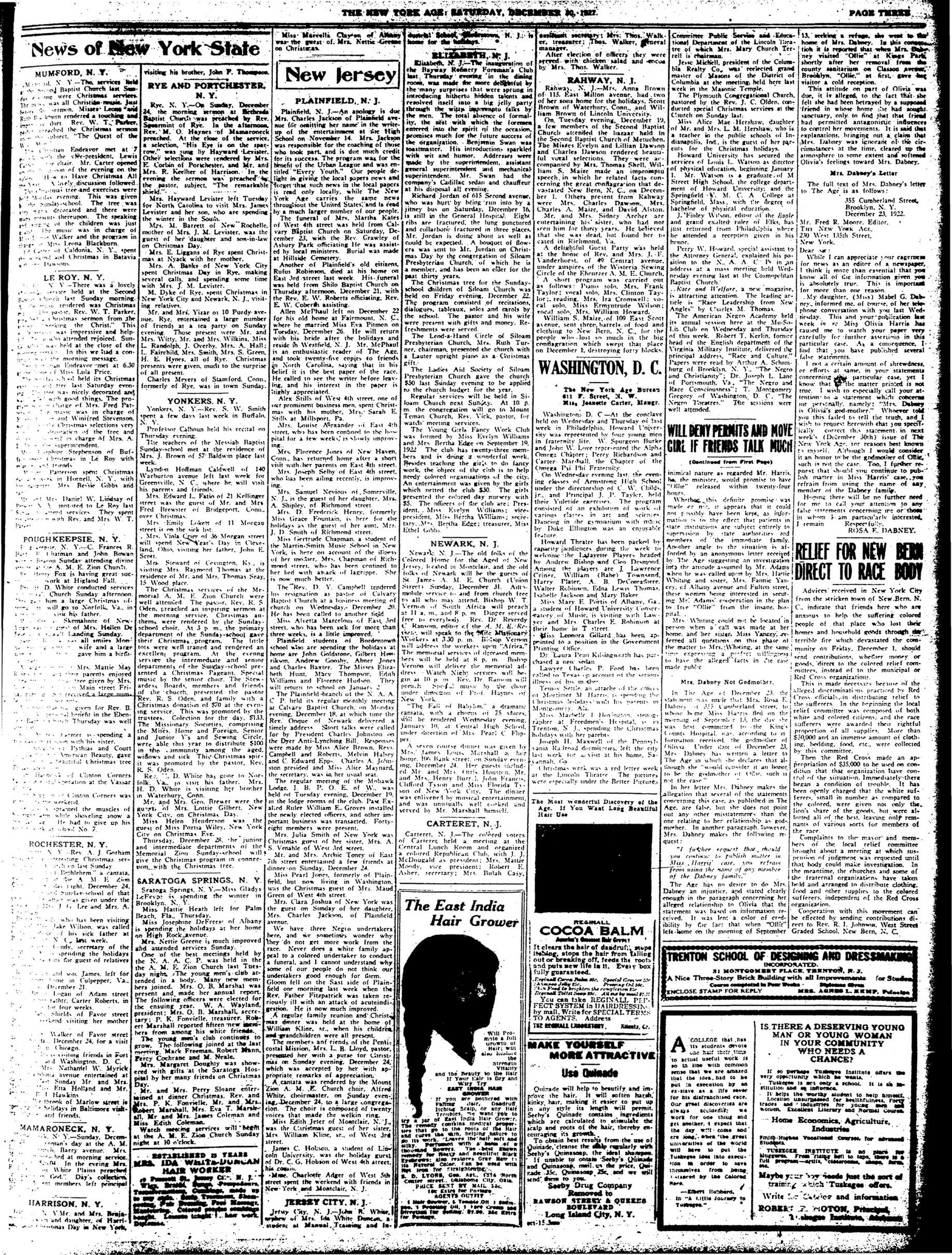
News of New York State
Maryland, N. Y. — The services held
at the Baptist Church last Sunday
were Christmas services.
There was all Christian music. Just
the sermon. Misses Leona and
Ruth been rendered a touching and
imparticular duet. Rev. W. T. Parker,
the Christmas sermon,
had a brief "The Quest of the
Woman." The Christian Endeavor met at 7
the Wesleyan, Lewis
Gardiner, the Mr. Carter opened
the session of the evening on the
How to Have Christmas All
Nearly discussion followed.
The Christmas tree and exercises were
held on the evening. This was given
by the Samla school. The tree was
very decorated and there were
many presents thereupon. The speaking
address of the children was just
the music was in charge of
Lewis Walters, who program in
Leona Blackburn, N. Y. spent
the evening and Christmas in Batavia
Dawson.
LE ROY, N Y
N.Y. - There was a lovely
hospital held at the Second
room which last Sunday morning,
when a resident was Christmas
poster. Rev. W. T. Parker,
a Christmas sermon from the
week, "The Christ." This
was impressive and help-
ed to attend rejoiced. Sun-
day was held at the close of the
week. In this we had a con-
tinued morning message.
An Endeavor met at 6.30
Miss Lilia Price.
A child held its Christmas
tree last Saturday even-
ning was nicely decorated and
great things. The presence of W. Fred Pat-
ter was in charge of
W. and Winnifred Stevenson,
Christmas selections very
decorated of the tree and
in charge of Mrs. A.
superintendent.
W. Joseph Stephen of Buffalo
Christmas in Le Roy with
friends
W. Patterson spent Christmas
in Hornell, N. Y. with
Mrs. Reske Gibbs and
Mrs. Daniel W. Lindsay of
Le Roy last
involved to Le Roy last
served services. They spent
with Rey, and Mrs W. T.
Hawkins.
POUGHKEEPSIE, N. Y.
G. Stephens, N. Y.-C. Frances R.
C. Graham and John Bowan
Boston Sunday attending divine
A. M. E. Zion Church.
Oak is having great suc-
cess. High school.
D. White conducted services.
Church Sunday afternoon.
him a large Christmas of-
will go to Norfolk, Va. in
your father.
all smiles Mom wife and a large gave him a birdf
Mrs. Mattie May
parents enjoyed tree given by Mrs.
Main street Fri
received a large num
given for Rev. B.
brief in the Eben-
Thursday was well
Lerner is spending a
with his sister.
Pythas and Court
American Beauty, gave
murful Christmas tree
Historian of Clinton Corners
operation at the Vassar
Clinton Corners was
weekend
treasured the muscles of
while shoveling snow a
He had to give up his
No. 7
ROCHESTER N Y
N. Y. Rey A. J. Gorham
interesting Christmas ser-
vices on last Sunday
was given under the
J. G. Lee and Mrs. A.
who has been visiting
Lake Wilson, was called
of his sick father at
N. C. last week.
Cindy secretary of the
spending the holidays
in the guest of relatives
and won James, left for
home in Culpepper, Va.
December 21.
Logan of Adam street
tahr, Carter Roberts, in
four weeks.
Shields of Favor street
and visiting her mother
Walker of Favor street
in December 24, for a visit
Chicago.
Volunteering in Fort
Washington, D. C.
Mrs. Nathaniel W. Myrick
on a avenue entertained at
Sunday Mr. and Mrs.
Etta Holland and Mr.
J. Hawkins
book of Marlow market is
located in Baltimore visit
and friends.
MAMARONECK N
N. Y.-Sunday, Decem-
man's day at the A. M.
Barry avenue. Mrs.
and at morning service.
In the evening Mrs.
White Plains preached
God. Day's collection
members left principal
HARRISON, N. Y.
N. Y. Mr. and Mrs. Beija-
and daughter of Harri-
cissons Day in New York.
Rye. N. Y.-On Sunday, December 24, the morning sermon at Bethesda Baptist Church was preached by Rye, Spearmint of Rye. In the afternoon, Rev. M. O. Haynes of Mamaroneck preached. At the close of the service, a selection, His Lily, is by Haynes on the space, followed by Levi the Leviar. Other selections were tendered by Mrs. E. Corbin of Porktown, and Mr. and Mrs. R. Keelher of Harrison. In the evening the sermon was preached to the pastor, subject, "The remarkable shield."
Mrs. Hayward Levister left Tuesday for North Carolina to visit Mrs. James Levister and her son, who are spending the time in the South.
Mrs. M. Baird, New Rochelle, mother of Mrs. J. M. Levister, was the guest of her daughter and son-in-law on Christmas Day.
Mrs. E. Liggans of Rye spent Christmas at Nyack with her mother.
Mrs. A. Banks of New York City spent Christmas Day in Rye, making several calls and spending some time with Mrs. J. Levister.
M. D. Day of Rye spent Christmas in New York City and Newark. N. J., visiting relatives.
Mr. and Mr. Yizar at 10 Purdy avenue, Rye, entertained a large number of friends at a tea party on Sunday evening. Those present were Mr. and Mrs. Witty, Mr. and Mrs. Wilkins, Miss L. Randolph, J. Overby, A. Hall; L. Fairchild, Mrs. Smith, Mrs. S. Green, L. E. Hynes, all of Rye. Christmas presents were given, mugs to the surprise of all present.
Charles Meyers of Stamford, Conn., formerly of Rye, was in town Sunday.
YONKERS N. Y.
Yonkers, N. Y.-Rev. S. W. Smith spent a few days last week in Buffalo, N. Y.
Professor Calhoun held his recital on Thursday evening.
The teachers of the Messiah Baptist Sunday School meet at the residence of Mrs. J. Brown of 57 Baldwin place last week.
Lyndon Hoffman Caldwell of 140 Warburton avenue left last week for Greensville, N. C., where he will visit his parents and friends.
Mrs. Edward L. Fatio of 21 Kellinger street was the guest of Mr. and Mrs. Fred Briar of Bridgeport, Conn. over Christmas.
Mrs. Emily Loket of 11 Morgan street is on the sick list.
Mrs. Vina Crier of 30 Morgan street will spend New Year's Day in Cleveland, Ohio, visiting her father, John E. Seet.
Mrs. Steward of Countington, Ky., is visiting Mrs. Raymond Thomas at the residence of Mr. and Mrs. Thomas Seay, 15 Wood place.
The Christmas services of the Memorial A. M. F. E. Zion Church were well attended. The pastor, Rev. R. S. Oden, preached an inspired sermon at the morning service. Christmas anthems were rendered by the Sunday-school, the Midday school, and the department of the Sunday-school gave their Christmas program. The little totts were well trained and rendered an excellent program. At the evening service the intermediate and senior departments of the Sunday-school presented a Christmas Pageant. Special music by the senior chair. The Stewart, the junior chair, and the third of the church, presented the pastor Rev. R. S. Oden, and family with a Christmas donation of $70 at the evening service. This was promoted by the trustees. Collection for the day, $133. The Missionary Societies, comprising the Mites, Home and Foreign, Senior and Junior Ys and forage Circle, were able this year to distribute $100 from the Christmas gift to the widows and sick. This Christmas spirit was promoted by the pastor, Rev. R. S. Oden.
Rez. "D. D. White has gone to Norfolk. Va., to visit his father. Mrs. H. D. White is visiting her brother in Waterbury, Conn.
Mr. and Mrs. Geo. Brewer were the guest of Mrs. Lottie Gilbert, New York City, on Christmas Day.
Miss Helen Henderson was the guest of Mrs. Wiley, New York City on Christmas Fue.
Thursday, December 28, the junior and intermediate departments of the Memorial Zion Sunday-school will give the Christmas program in connection with the Christmas tree.
SARATOGA SPRINGS. N. Y.
Sratoga Springs, N. Y.-Miss Gladys LeFevat is spending the winter in Brooklyn, N. Y.
Miss Hattie Heath left for Palm Beach, Fla. Thursday.
Miss Josephine DeFreesse of Albany is spending the holidays at her home on High Rock avenue.
She is much improved and attended services Sunday.
One of the best meetings held by the N. A. A. C. P. was held in the a. M. E. Zion Church last Tuesday night. The young men's club attended in a body. Many new members joined. Mrs. O. B. Marshal was present and made her annual election. The following officers are elected for president; Mrs. O. W. A. Wayland, president; Mrs. O. B. Marshall, secretary; P. K. Fonville, treasurer. Robert Marshall reported fifteen new members from among his white friends.
The young men's club continues to grow. The following joined at the last meeting. Mack Freeman, Robert Mann, Percy Cochrane and Angela Mrs. Craig Doughty was showed with gifts at the Saratoga Hospital by her many friends on Christmas Day.
Mr. and Mrs. Perry Sloane entertained at dinner Christmas, Rev. and Mrs. P. K. Fonville, Mr. and Mrs. Robert Marshall, Mrs. Eva T. Marshall, Mr. and Mrs. James Coleman and Mrs. Edith Coleman.
Watch meeting services will begin
at the A. M. E. Zion Church Sunday
night at 10 o'clock.
ESTABLISHED IN 1925
MRS. WRITE DURCAN
HAIR WORKER
at Pensacola St. Jersey City, N. J.
Wigs, Braids, Hues, Pimpawors,
Temporary Curtains, Curtains,
to any occasion, Transitions, Shoes,
Fats, Pins, Prowling, Food Message,
Meetingroom, Colored paper meetings
bought. Lenses taught 1. hair work.
Diplomas.
Miss Marcella Clayton of Alliance was the guest of Mrs. Nettie Greene on Christmas.
administral School, Wendertown, N. J., in home for the holidays.
BLIZABETH, N. J.
Elizabeth, N. J.—The inauguration of the Bayway Refinery Foreman's Club last. Thursday evening in the dining room, was made the more delightful by
assistant secretary, treasurer, the manager.
After election of served with chick by Mrs. Thos. W.
RAHW.
PLAINFIELD. N: I.
Plainfield, N. J.—An apology is due Mrs. Charles Jackson of Plainfield airbase for omitting her name in the write-up of the entertainment at the High School on November 14. Mrs. Jackson was responsible for the coaching of those who took part, and is due much credit for its success. The program was for the benefit of the Urban League and was entitled "Every Our Desire." Our attention to the local papers news and news that such news in the local papers is read only locally, while The New York Age carries the same news throughout the United States; and is read by a much larger number of our people. The funeral of Mrs. Martha Kates of West 4th street was held from Calvary Baptist Church on Saturday, December 23, with the Rev Crawley of Ashur Park officiating he was assisted by local ministers. Burial was made at Hillside Cemetery. Another of Plainfield's old citizens, Rufus Robinson, died at his home on Thursday afternoon. He was funeral held from Shilo Baptist Church on Thursday afternoon, December 21, with the Rev. E. W. Roberts officiating, Rev. E. W. Cobber assisting.
Allen McPaul left on December 22 for his old home at Fairmount, N. C. where he married Miss Eva Pitmon on Tuesday, December 26. He will return with his bride after the holidays and reside in Westfield, N. J. Mr. McPaul is an enthusiastic friend of The Age, and took twenty-five copies to friends in North Carolina, saying that in his belief it is the best paper of the race. He called to see the writer before leaving, and the best in the paper is slightly appreciated.
Alex Stills of West 4th street, one of our prominent business men, spent Christmas with his mother, Mrs. Sarah E. Stills at Millsport, Pa.
Mrs. Louise Alexander of East 4th street, who has been combined to the hospital for a few weeks, is slowly improving.
Mrs. Florence Jones of New Haven, Conn., has returned home after a short visit with her parents on East 4th street.
Mrs. Joseph Selby of East 4th street, who has been ailing recently, is improving.
Mrs. Samuel Nevous of Somerville, N. J. is the guest of her daughter, Mrs. A. Shinley of Richmond street.
Mrs. D. Frederick Henry, formerly Miss Grace Fountain, is here for the holidays as the guest of her aunt, Mrs. J. D. Smith of Richmond street.
Miss Gertrude Chapman, a student of the Martin-Smith Music School in New York, is here on account of the illness of her mother, Mrs. Chapman of Richmond street, who has been contined to her bed with attack of lagrange. She is now much better.
The "Rev. D. Y. Campbell tendered his resignation as pastor of Calvary Baptist Church at a business meeting of church on Wednesday, December 20. He has been called to another vigil.
Miss Alberta Marcelous of East Jaffa street, who has been sick for more than a month, is interested in the Planfield students of Bordentown school who are spending the holidays at home are John Goldstone, Gilbert Hewrison, Andrew Goosby, Abner Jones and Charles Baxter. The Misses Elizabeth Hunt, Mary Thompson, Edith Williams and Florence Hudson. They will return to school on January 2.
The Plainfield branch of the N. A. A. C. P. held its regular monthly meeting at Calvary Baptist Church, on Monday evening, December at which time the缓急 timely address. Short talks were called for by President Charles Johnson on the Dyer Anti-Lynching Bill. Responses were made by Miss Alice Brown, Rev. Campbell and Roberts, Melvin Haley and C. Edward Epps. Charles A. Johnson presided and Miss Alice Maynard, the secretary, was in her usual seat. The regular meeting of the Mohawk Lodge, B. P. O. E. of W. was held on Monday evening in the lodge rooms of the club. Past Exiled Ruler William E. Groves installed the newly elected officers, and other important business was transacted. Forty-eight members were present. Mrs. Julia Smith of New York was Christmas guest of her sister, Mrs. A. S. Venable of West 4th street. Mr. and Mrs. Archie Toney of East 7th street entertained a few friends at dinner on Sunday, December 24 at Parison former of a plainsfield, but now living in Washington, was the Christmas guest of Mrs. Maud Green of West 4th street.
Mrs. Clara Joshua of New York was the guest on Sunday of her daughter, Mrs. Charles Jackson, of Plainfield avenue.
We have three Negro undertakers here and we sometimes wonder why they do not get more work from race. Never does a white family appeal to a colored undertaker to conduct a funeral, and I cannot understand why some of our people do not think our undertakers good enough for them. Gloom fell on the Saskatchewan side one morning last week when the undertaker was taken seriously ill with an attack around a gestion. He is now much improved. A regular family reunion and Christmas dinner was held at the home of William Kline, st., when his children and grandchildren were all present. The members affriends of the Penticostal Mission, Mrs. L. B. Lloyd, pastor, was on Sunday evening, December 24, which was accepted by her with appropriate remarks of appreciation.
A cantata was rendered by the Mount Zion A. M. E. Church choir, Alfred Whit, choirmaster, on Sunday evening, December 24, to a large congregation. That choir is composed of twenty voices that make the choir a musical Miss Edith Jeter of Montclair, N. J., was the Christmas guest of her sister, Mrs William Kline, Sr. of West 3rd street.
James C. Hobson, a student of Lincoln University, was the holiday guest of Dr. C. G. Hobson of West 4th street, his cousin.
Charlotte Adger of West 5th street spent the weekend with friends in New York and Montclair, N. J.
JERSEY CITY, N. J.
Jersey City, N. J.-John R. White, widow of Mrs. Ida White Demon, a student at Manual, Training and In-
duettsch: School, Woodburn, N. J. : in
home for the teachers.
ELIZABETH N. I
Elizabeth, N. J.—The inauguration of the Bayway Refinery Forestman's Club last. Thursday evening in the dining room, was made the more delightful by the many surprises that were sprinkling in. The refinery resolved itself into a big jelly party through the wisty impromptu talks by the men. The total absence of formality, the zeit with which the foremen entered into the spirit of the occasion, promises much for the future success of the organization. Benjamin Swan was toastmaster. His introductions sparkled with wit and humor. Addresses were made by the superintendent, assistant superintendent, and main superintendent. Mr. Swan had company's Cadillac sedan and chauffeur at his disposal all evening.
Richard Jordan of 615 Second avenue, who was hurt by being run into by a jitney bus on Saturday, December 16, is still in the General Hospital. Eight ribs are fractured, the lung punctured and collaratic fractured in three places. Mr. Jordan is doing about as well as could be expected. A bouquet of flowers was sent to Mr. Jordan on Christmas Day by the congregation of Siloam church, of which he is a member, and has been an elder for the past thirty years. The Christmas tree for the Sunday-school children of Siloam Church was held on Friday evening, December 22. The program consisted of recitations, dialogues, tableaux, solos and carols by the school. The pastor and his wife were present with gifts and money. Refreshments were served. The Lend-a-Hand Circle of Siloam Presbyterian Church, Mrs. Ruth Turner, chairman, presented the church with a latter upright piano as a Christmas gift. The Ladies Aid Society of Siloam Presbyterian Church gave the church $50 last Sunday evening to be applied to the church budget for the year.
Regular services will be held in Siolaam Church next Sunday. At 10 p.m. the congregation will go to Mount Teman Church, Rev. Vick, pastor, for watchtie meeting services.
The Young Girls Fancy Work Club was formed by Miss Evelyn Williams and Mrs Bertha Edge on September 19, 1922. The club has twenty-three members and is doing a wonderful work. Besides teaching the girls to do fancy work, the object of the club is to help organized organizations by the city. An entertainer was given by the girls which netted the club $30. The girls presented the colored day nursery with $S. The officers of the club are: President, Miss Evelyn Williams; vice-president, Mrs Bertha Edge; secretary, Mrs Bertha Edge; treasurer, Miss Ethel Gobb.
NEWARK, N. J.
Newark, N.J.—The old folks of the Colored Home for the Aged of New Jersey, located in Montclair, and the old folks of Newark will be the guests of St James, A. M. E. Church (Union Street) Sunday, December 31. Attomile service to and from church free. Vernon will hold the Vernon of South Africa will preach at 11 a.m. and 8 p.m. Dinger served free to everybody. Rev. Dr. Reverdy C Ranom, editor of the A. M. E. Reverdy, will speak to the Mile Missionary Workers at 3:30 p.m. Bishop Veron will address the workers upon "Africa" memorial services of deceased members held in Philadelphia. Veron will deliver the memorial address "Watch Night" services will begin at 10 p.m. Rev. Dr. Ranom will preach. Special music by the choir under direction of Prof. Haynes of New York.
"The Fall of Babylon," a dramatic canata, with a choir of 75 shoes, will be rendered a evening. January at Central High School, under direction of Mrs. Pearl C. Clipper.
A seven course dinner was given by Mrs. James Louis, Marshall as his home, 100 Bank street, on Sunday evening, December 24. Her guests included Mr and Mrs Otis Houston, Mr and Mrs Henry Burrell, John Frames, Mr and Jason Burrell, Florida Tesson of New York City, and was enlivened by musical entertainment, and was unusually well cooked and served by Mr. Marshall himself.
CARTERET, N. J.
Carteret, N. J.—The coedited voters of Carteret held a meeting at the Central Lunch Room and organized a meeting of the voters of McDougall as president; Mrs. Mature Moody, vice president; Robert E. Asher, secretary; Mr. Bulah Casy,
The East India Hair Grower
Will Pro-
mote a full
growth of
hair; will
also increase
Strength
Vitality
and the beauty to the hair.
If Your Hair is Dry and
Wiry Try
EAST ICON HAIR
GROWER
If you are bothered with
Patting hair,
Brushing Scissor, or Dry Hair
Troubles, We want you to
try a jar of East India Hair Grower.
The remedy is the root of the hairs and the roots of the hairs and cures the skin, helping nature to do its work. Leaves the hair soft and moist. It is a wonderful thickened Bowers. The best known remedy for Heavy and Beautiful Black Hair is the Natural Color. Can be used with Hot Ties for Straightening.
D. L. YORN, Gm. Appl. 1937 636
Center street. Oklahoma City, OK
Philadelphia, PA 19104. Loc.
160 Exte for Postage
AGENTS OUTFIT
1 Male Groomer, 2 Tombstone On 1 Sqm.
1 Male Groomer, 2 Tombstone On 1 Sqm.
Directions for Bidding: 87.90. 346 Extra
for Postage.
assistant secretary; Mr. Thos. Walker, treasurer; Thos. Walker, general manager.
After election of officers they were served with chicken salad and encoub by Mrs. Thos. Walker.
BAHWAY, N. L.
Rahway, N. J.-Mrs. Anna Brown off-115. East Minton avenue, had two of her sons home for the holidays, Scott Brown of Waterbury, Conn., and William Brown of Lincoln University, Ohio. To Mrs. Brown, 1924 a few members of the Second Baptist Church attended the lazar衣 held in the Second Baptist Church of Metuchen. The Misses Evelyn and Lillian Dawson and Charles Dawson rendered beautiful vocal selections. They were accompanied by Mrs. Thomas Shell, William and made an impromptu spelling in which he made an improvise cermining the great conflagration that devastated New Bern, N. C., on December 1. Others present from Rahway were Mrs. Charles Dawson, Mrs. Charles A. Maize, and David Alston. Mr. and Mrs. Sidney Arecher are entertaining his sister, who had not seen him for three years. He believed she found her to care in Richmond, Va.
A delightful Guest Party was held at the home of Rev. and Mrs. J. E. Vanderhout, of 49 Centra) avenue, under auspices of the Wisteria Sewing Circle of the Ehnerstein A. M. E. Church. A short program was carried out as follows: Piano solo, Mrs. Frank Taylor; vocal solo, Mrs. Clinton Taylor; reading, Mrs. Ira Cromwell; vocal solo, Mrs. William Howard; vocal solo, Mrs. William Howard; William S. Maize, of 109 East Scott avenue, sent three barrels of food and clothing to New Born, N. C., for the people who lost so much in the big conflagration which swept that place on December 1, destroying forty blocks.
WASHINGTON, D. C.
WASHINGTON, D. C.
The New York Age Bureau
611 F. Street, N. W.
Miss Jeanette Carter, Mauro.
Washington D. C. At the conclave held on Wednesday and Thursday of last week in Philadelphia, Howard University was represented by four young men in fraternity life. W. Spurgeon Burke and John W. Love represented the Alpha Omega Chapter; Percy Richardson and Carter Marshall, the Chapter of the Gamma Fraternity. On Wednesday evening last, the evening classes of Armstrong High School under the directorship of C. W. Childs, jr., and Principal J. P. Taylor, held their Yuleide exercises. The program consisted of an exhibition of work of various classes in art and sciences training in the gymnasium with music by Diane Ellington was an enjoyable
Howard Theatre has been packed by capacity audiences during the week to welcome the LaJayette Players headed by Andrew Bishop and Cleo Desmond. Among the players are J. Lawrence Criner, William (Habe) Townsend, Harry Plater, A. B. DeComatier, Walter Robinson, Elena Lewis Thomas, Isabelle Jackson and Mary Baker. Miss Mary E. Portis of Albany, Gavin Hoadley and University Conservatist of Music, is visiting with Lawyer and Mrs Charles E. Robinson at their home in T. street. Miss Leonora Gillard has been appointed to a position in the Government Printing Office. Dr. Laura Pem Kibsingworth has purchased a new selen. Lawyer Charles P. Ford has been called to Texas account of the serious illness of his mother. Tennys Settle an attack of the illness of Mortimer M. Harrox is spending the Christmas holidays with his parents in Morgantown. Ms. Madeline L. Hobson, stenographer at Freedmen's Hospital, is in Trenton, N.J. spending the Christmas holidays with her parents.
Joseph H. Maxwell of the Pennsylvania Railroad dormitories, left the city last week for a visit at his home, Sayannah, Ga.
Christmas week was a red letter week at the Lincoln Theatre. The pictures were especially under the Better Pictures.
The Most wonderful Discovery of the Age. If You Waat Long Beautiful Hair Use
It clears the hair of dandruff, stops itching, stops the hair from falling out or breaking off, feeds the roots and puts new life in it. Every box fully guaranteed.
Forklift Cover Plus Inc. Special Grove Inc.
Amphiplex Jib Inc. Proving Oil Inc.
Forklift Tubes Inc. Proving Oil Inc.
You can take REGINAL, PRECT SYSTEM in HAIRDRESSING by mail. Write for SPECIAL TERMS address
Use Quinade
Quinade will help to beautify and improve the hair. It will soften hargh, kinky hair, making it easier to put up in any style its length will permit. Seeby's Quinade contains ingredients which are calculated to stimulate the scalp and roots of the hair, thereby encouraging its growth.
To obtain best results from the use of Quinade, cleanse the scalp regularly with Seeby's Quinade. It is ample to contain Seeby's Quinade and Quinapas, mail us the price, Quinade 35c, Quinapas 25c, and we will send them to you.
11:15.3mm
Committee Public Service and Educational Department of the Lincoln Theatre of which Mrs. Mary Church Terrell is chairman.
Jesse McKillip, president of the Columbia Realty Co., was reelected grandmaster of the Daughters of Columbia at the meeting, held here last week in the Masonic Temple.
The Plymouth Congregational Church, pastored by the Rev. J. C. Olden, conducted special Christmas services at the Church on Sunday last.
Miss Alice Mae Hershaw, daughter of the Rev. J. C. Olden, a teacher in the public schools of Indianapolis, Ind., is the guest of her parents for the Christmas holidays.
Howard University has secured the services of Louis L. Watson as director of physical education, beginning January 1. Mr. Watson is a graduate of M Street High School, the college department of the University of Springfield. Y. M. C. College at Springfield, Mass, with the degree of bachelor of physical education.
J. Finley Wilson, editor of the *Eagle* and grand exalted ruler of Elks, has just returned from Philadelphia where he attended a reception given in his honor.
Perry W. Howard, special assistant to the Attorney General, explained his position to the A. C. W. in an address a mass meeting held Wednesday evening last at the Cosmopolitan Baptist Church.
Rate and Welfare, a new magazine, is attracting attention. The leading article is "Race Leadership from New Angles" by Charles M. Thomas.
The American Negro Academy held its annual session here at the Mu-So-Lit Club on Wednesday and Thursday of this week. Robert T. Kerlin, former head of the English department of the Virginia Military Institute, delivered the principal address, "Race and Culture." Papers were read by Arthur A. Schomurge, Brooklyn, N.Y. The Negro University Christian School, Joseph L. Portsmouth, Va. "The Negro and Race Consciousness"; T. Montgomery Gregory of Washington, D. C. "The Negro Theatres." The sessions were well attended.
WILL DENY PERMITS AND MOVE
GIRL IF FRIENDS TALK MUCH
OF DESIGNING AND DRESSMAKING
INCORPORATED.
MERRY PLACE, TRENTON, N. J.
Building with all Improvements for Students
In Poor Works
Brighton gives
MRS. AGNES L. KEMP, Principa
IS THERE A DESERVING YOUNG
MAN OR YOUNG WOMAN
IN YOUR COMMUNITY
WHO NEEDS A
CHANCE?
If so perhaps Tuskegee Institute offers the
very opportunity which we want.
TRENTON SCHOOL OF DESIGNING AND DRESSMAKING
INDUSTRIAL HOSPITAL
31 MONTGOMERY PLACE, TRENTON, N.J.
A Nice Three-Story Brick Building with all Improvements for Students
Course completed in Poor Works
Digitized Gron
ENCLOSE STAMP FOR REPLY
MRS. AGNES L. KEMP, Publication
Tukeague is not only a school. It is an
friutian. It helps the worthy student to help himself.
It helps the worthy student to help himself.
Location unsurpassed for healthfulness. Forry
women. Excellent Literacy and Normal Course.
Smith Hughes Vocational Courses, for advanced Students.
TUSKEGEE INSTITUTE is no place for misgiven. From tiger hell to tape, there is a full program—drill, cloistered, shape, burn, etc.
Maybe your boy needs just the sort of training which Tuskages offers.
Write for Catering and information
ROBERT R. MOTON, Principal,
Tuskages Institute, Adelaide
(Continued from First Page)
minimal nature as regarded Mr. Harris, he the minister, would promise to have "Ollie" released within twenty-four hours. Whether this definite promise was made or not, it appears that it could not possibly have been kept, as information is to the effect that patients in state institutions are subject entirely to the care of the state's shortest members of the immediate family. Another angle to the situation is afforded by an anonymous letter received by The Age suggesting an investigation into the attitude assumed by Mr. Adams when he was called upon by Mrs. Hattie Whiting and sister, Mrs. Famie Yancey, of Albany avenue and Fulton street, these women being interested in securing Mr. Adams' cooperation in the plan to free "Ollie" from the insane hospital.
Mrs. Whiting could not be located in prison when call was made at her home and her lawyer, Mrs. Yancey, ferried all questions on this phase of the matter to Mrs. Whiting at the same time expressing a perfect willingness to have the alleged facts in the case made public.
Mrs. Dabney Not Godmoi:cr
In The Age of December 23, the statement was made that Mrs. Rosa Dahney or 355 Cumberland street, to whose home Miss Hassard has died on the morning of September 13, the day she was first committed to the King's County Hospital was, according to information received, the godmother of Bilbao Under state of December 23, Mrs. Dahney or 355 Cumberland street, the Age in which she declares that although she "would consider it an honor to be the godmother of Otto, such is not the case"
In her letter Mrs. Dahney makes the allegation that several of the statements concerning this case, as published in The Age, are false, but she does not point out any other misstatements than the one relating to her relationship as godmother. In another paragraph however, Mrs. Dahney makes the following request:
I further request that, should you continue to publish matter in Miss Hassard's case, you refrain from using the name of any member of the Dahney family.
The Age has no desire to do Mrs. Dabney an injustice, and stated clearly enough in the paragraph concerning her alleged relationship to Olivia that the statement was based on information received. It was lent a color of credibility by the fact that when "Olille" left home on the morning of September
COLLEGE that has its students devote one half their time to actual useful work is so in line with common sense that we are amazed to put in execution by an ex-slave as a life never for his disfranchised race. Our great discoveries are always accidental; we work for one thing and get another. I expect that the day will come and we long, often the great discoveries of the world will have to put the Tudorage ideas into execution in order to save themselves from being captured by the Colored Rare.
— Erbert Humbard,
In "A Little Journey to Tudorage."
13. seeking a refuge, she went to the home of Mrs. Dabney. In this contagious it is reported that when Mrs. Dabney visited "Olie" at Kings Park shortly after her removal from the county sanitarium on Clasdon avenue," she gave her visitor a cold reception. This attitude on part of Olivia was due, it is alleged, to the fact that she felt she had been betrayed by a supposed friend in whose home she had sought sanctuary, only to find that that friend had permitted antagonistic influences to control her movements. It is said that explanations, bringing out a claim that Mrs. Dabney was ignorant of the fact, helped to uprise the atmosphere to some extent and softened Olivia's feelings toward Mrs. Dabney.
Mrs. Dabney's Letter
The full text of Mrs. Dahney's letter to The Age is as follows:
355 Cumberland Street,
Brooklyn, N. Y.
December 23, 1922.
Mr. Fred R. Moore, Editor,
Turt New York Acct.
230 West 115th Street,
New York.
Dear sir:
While I can appreciate your eagerness for news as an editor of a newspaper, think it is more than essential that you know information given you is absolutely true. This is important for more than one reason.
My daughter, (Miss) Mabel G. Dahney, informed me of course, of her telephone conversation with you last Wednesday. This and your publication last week in me Miss Olivia Harris has caused me to watch your paper very carefully (for further assertion in the particular case. As a consequence, I find that you have published several false statements.
I not a certain amount of shrewdness, or efforts at same, in your statements concerning the particular case, yet I know that the matter printed is not true. I wish to especially call your attention to a statement which concerns me personally namely: "Mrs. Dabney is Olivia's god-mother. Who told you that you should wish to request herewith that you specifically correct this statement, in next week's (December 30th) issue of The New York Age, for reasons best known to myself. Although I would consider it an honor to be the godmother of Olivia, such is not the case. Too, I further request that you continue to publish matter in Miss Harris's case, you refrain from using the name of any member of the Dabney family. Honoring therewith no further need for you to be to any false statements concerning me or those in whom I am particularly interested, I remain. Respectfully." ROSA F. DABNEY.
RELIEF FOR NEW BERN DIRECT TO RACE BODY
Advices received in New York City from the stricken town of New.Bern, N. C. indicate that friends here who are anxious to help the suffering colored people of that place who lost their homes and household goods through the terrible fire which devastated the community on Friday, December 1, should send contributions, whether money or goods, direct to the colored relief committees, instead of to the municipal or Red Cross organization.
This is made necessary because of the alleged discrimination practiced by Red Cross officials, in distributing relief to the sufferers. In the beginning the local relief committee was composed of both white and colored citizens, and the race sufferers were awarded their rightful proportion of all supplies. More than $50,000 and an immense amount of clothing, bedding, food, etc., were collected by this committee.
Then the Red Cross made an appropriation of $35,000 to be used on condition that that organization have control of the situation. Immediately there began a condition of trouble. It has been charged the number of the smaller, small number, compared to the colored, were given not only the lion's share of the goods, but were allotted of all the best, leaving only remnants of various sorts for members of the race.
Complaints to the mayor and members of the local relief committee brought about a meeting at which suspicion of judgment was requested until that body could make investigation. In the meantime, the churches and some of the fraternal organizations have taken hold and arranged to distribute clothing, food and other supplies to the colored sufferers, independent of the Red Cross organization. Cooperation with this movement can be effected by sending contributions direct to Rev. R. I. Johnson, West Street Graded School, New Born, N. C.
---
Geralded as Second Class Matter September 18, 1813, as Post Office at New York, N. Y., under the Act of March 3, 1878.
MAKING GOOD ON THE FORCE. Despite the occasional enrollment of misfits among their number, the police force of New York City as a whole has lived up to the reputation of "the finest," as they have been termed by enthusiastic admirers. Alert, resourceful and courageous, they are equally active in saving lives from fire or water, or subduing the incipient outbreaks of a mob. In former days physical bulk and political pull were the chief requisites for enrollment on the force. Since the holding of civil service tests, brains as well as brawn figure in the examination. The result is apparent in the higher type of mentality represented.
For years it was an accepted fact that every brawny immigrant from Ireland was a probable candidate for the police force and many of the rank and file are still of this nationality. But later the Germans and Italians demanded the blue uniform and helped to guard the peace of the greatest city in America. During Mayor Mitchell's administration the Negro finally won recognition as an acceptable candidate for this sort of public service, although Brooklyn had appointed full ledged officers of this race years before consolidation, during Mayor Chappin's term. The number of these officers has grown under the present city administration, until now they number some forty-five men in uniform. All of these have made good in guarding the public peace and are rendering efficient service in the routine duties assigned to them. They pound the pavement with constant solidity on patrol and regulate traffic at dangerous crossings with the precision of bronze machines.
Nearly all of these colored members of the force are stationed in Harlem, in the section where the bulk of the colored population is located. Here under the immediate charge of Captain Gargan, an efficient and impartial commander, they have been doing a well service. Inspector Sweeney, who has supervision of the district, has frequently assigned some of these officers to special service on his staff with equally good results.
```markdown
```
In view of these facts, it would seem that the time has come when these officers might be distributed to advantage in other sections and given an opportunity to work their way upward in the service. More men of the race with the requisite mental and physical equipment should apply for appointment, so that the color of the man in uniform should arrive no special attention in any part of the city. Capacity, not color should be the criterion for enlistment among "the finest."
JUDICIAL VAGABIES
Recent proceedings in the courts ranging from a hearing before a police magistrate in Harlem to an opinion handed down by the Supreme Court at Washington, have illustrated the vagaries of the judicial mind, when the question of rage is injected into the situation. For instance, the Supreme Court at Washington recently held that white passengers who were forced to travel in a "jim crow car" had a proper case for damages against the railroad company. This may be perfectly good law, but the question arises whether any traveler, regardless of color, who pays first class fare and is forced to suffer the hardship and humiliation of the "jim crow car," is not entitled in equity to recover penititive damages.
The case before the Harlem magistrate involved a police raid on a colored slurret, in which some eighty or more white men and women were arrested. The police inspector who conducted the raid, charged that some of the prisoners were indulging in improper dances and otherwise misconducting by speech and action. The magistrate, not content to whittle their alleged misconduct, sought to impact the race question into the issue. He was reported as selling the prisoners that there were sufficient white cabarets to allow without going to places maintained by Negroes, thus creating an offence not defined by any law.
A judge in Florida was reported as releasing the release of a white man convicted of criminal assault upon a colored woman, because the evidence against the prisoner was rendered solely by witness of the same race as his accuser. Evidently this exponent of the law expected that the criminal should have taken a witness of his own color to testify against him. Such judicial vagaries on the part of a few of White elevated to the dealing
out of justice is calculated to recall the comment of one of Shakespeare's characters to the effect that the law is in ass. But on the other hand, there are too many splendid examples of evenhanded justice furnished in the courts to warrant the adoption of such a sweeping assertion: The few animeine exceptions that are to be noted now and then do but emphasize the fact that even judges are human and liable to error when awayed by prejudice.
WHAT A RACE RIOT COST.
According to a special dispatch from Chicago last week, the race riots of 1910, which prevailed for eight days in parts of that city, will cost the taxpayers over half a million dollars. This estimate was based on the approval by the City Council Finance Committee of eighteen death claims amounting to $18,000. The city had paid previously $20,800 for five other deaths and probably will be compelled to pay, for fifteen more attributed to the riots. The State law of Illinois holds a municipality liable for damages for all persons killed or injured during a riot, in which they were not participants.
The total number hurt as a result of the roots, according to the investigation reported by the Lowden commission, was 543. Of this number 348 were colored, 178 white and the remainder undetermined as to race. On the basis of the City Council's settlement at $4,500 for each death, the fifteen other deaths will cost $67,500. Relatives of the thirty-eight victims of the mob will receive a minimum of $169,300. Of the 543 injured, thirty-three have filed suits for $170,000 and three have obtained judgments amounting to $11,375. Maintenance of the regular police on riot duty, the sheriff's expenses for special deputies and the bills of the State's attorney on riot cases go to make up the total of $502,551. No allowance has yet been made for damages to property, which may carry the total even higher.
Of course no amount of blood money can atone for the loss of human life due to mob violence, permitted to run unchecked by the lawful authorities. Nevertheless, it is well that the taxpayers of Chicago should realize that they must pay for the disregard of law and order. The pocket has long been held by some cynical critics to be the most vulnerable portion of the American anatomy. Perhaps when the cost of mob violence is felt in the pocket, America may cultivate a higher respect for law and order.
NEVER TOO OLD TO LEARN
NEVER TOO OLD TO LEARN.
In the leading place on the editorial page of the Dallas Express, there was recently printed a simple little story, under the caption, "It Happened in Dallas." It read as follows:
She was little and wrinkled, yet soft of speech. And in her eyes was the look of those who had seen much and suffered in silence the lack of the things denied them in the days when white masters grew angry at the thought of education for their Negro slaves.
Many times she had gone to the postoffice window to cash the monthly order which her youngest child, a man of thirty-five, sent to her from his home in a far off state. Each month for more than two years she had made her "Mark" for she had not learned to write in her youth and in later years the care of the children had given her no time for it.
But there came a day when she no longer waited for the crowd before the window to thin out. She boldly took her turn and in a slow but legible way endorsed her order and gave it to the clerk with a smile of triumph. He took it without looking at her. But being familiar with her name and remembering that she had always "made her mark" he looked at her and in surprise asked: "Did you write that?" She said "Sure I did. I'm not too old to learn. The free night schools gave me the chance that I had never had before. I can read no tree." He was pleased. But not so much as she. It happened in Dallas. That woman though aged realized that she needed to learn.
We have reproduced this story of the little old woman, for the sake of the valuable lesson it carries. It is never too late to learn for those who have the desire and the disposition to grasp new ideas. Keep your mental faculties active by acquiring something new in the way of the knowledge of men or things. Then you can truly say, as Dr. Couse suggests, "Day by day, in every way, I am growing better and better."
The Southern Indicator recently noted the taking of necessary measures to better the health conditions among the colored school population of Greenville, S.C. It said:
That dental afflictions exist to a surprising extent among colored school children in Greenville has just been demonstrated through investigations, by the city health department. A total of 134 students have been examined at the Maternity school on Hampton avenue, and of this number but 12 had teeth in perfect condition. The remainder had decayed teeth, crooked teeth, and scores of cases of "toothache" were among those examined.
"The examination was carried out by Dr. C. L. Eccleston, local Negro dentist, and I. T. Heater, a nurse, working under the department of Health. After the examinations were made a total of 112 students had their teeth cleaned. Forty-six fillings were put in, three cases of crooked teeth were attended to. 8 teeth extracted, two bridges put in and three cases of pyorrhea were treated.
The value of this sort of work is reflected not only in the general improvement of health among the children, but in the greater progress they are able to make in their studies. All city health authorities would do well to encourage movements of this nature.
THE NEW YORK ARE: SATURDAY, DECEMBER 24, 1822
WHAT DO THEY REQUIRE?
One of our correspondents whose letters we ment us a clipping from the Greensboro, N. C. which it is related how forty masked men in a aroused a colored man from sleep and took after midnight, carried him into the woods and the colored man who was thus treated was state of Hampton, who has been a co-worker with Hampton, with Dr. R. R. Moton and Booker at present in the cooperative extension work some economics among Negroes, being partly state of North Carolina and of the government. Mr. Hall was taken out of his home by this the woods, and according to the report in News," submitted to an inquisition as follo
QUTSTION:—Did you say the Dyer Anti-Lynchists, and that for every Negro lynched the white peop pay $15,000?
One of our correspondents whose letters we most highly value has sent us a clipping from the Greensboro, N. C. "Daily News," in which it is related how forty masked men in Ku Klux Klan regalia aroused a colored man from sleep and took him out, of his home after midnight, carried him into the woods and whipped him.
The colored man who was thus treated was L. E. Hall, a graduate of Hampton, who has been a co-worker with Dr. Frissell of Hampton, with Dr. R. R. Moton and Booker T. Washington. He is at present in the cooperative extension work in agriculture and home economics among Negroes, being partly in the pay of the State of North Carolina and of the government.
Mr. Hall was taken out of his home by this crowd, carried into the woods and, according to the report in the Greensboro "Daily News," submitted to an inquisition as follows:
QUTSTION:—Did you say the Dyer Anti-Lynching Bill would pass, and that for every Negro lynched the white people would have to pay $15,000?
ANSWER:—No. I did not say that.
Q.—Well, did you not say that if the Dyer Anti-Lynching Bill did not pass that the Negroes would stop lynching by lynching a few white folks?
A.—No. I never gave utterance to any such statement.
Q.—What do you do around Chadbourn?
A.—I don't do much of anything around Chadbourn.
Q.—What kind of work do you do?
A.—Extension work.
Q.—Who employs you?
A.—I am employed by the extension service, department of agriculture.
Q-What do you do?
A-Organize and work with Negro farmers through
Q-That is just what we understand. You are o
ces against whites throughout the state.
A-That is not so. My business i sto assist farm
ming and help them solve their farm problems.
A.—Organize and work with Negro farmers throughout the state.
Q.—That is just what we understand. You are organizing Negroes, against whites throughout the state.
A.—That is not so. My business I oust assist farmers to do better farming and help them solve their farm problems.
Q. We did not come here to hear an agricultural lecture. Take him, boys, and whip him some anyhow.
The mob then proceeded to whip Mr. Hall by making him lie down on his face and beating him across the back with wet ropes.
From the account given in the "News" it can be judged that Mr. Hall is a man of great courage, of far greater courage than any one of the mob of dirty cowards who attacked him. When they had whipped him for a while they stopped and asked him what he had to say. He calmly answered, "I have nothing to say." He made no plea for mercy and did not even give his persecutors the satisfaction of making an explanation of his conduct. During the whole incident he asked only one question, and that was "Does it take all these men to whip one man?"
We could fill a couple of columns about the brutality and the cowardice of these Ku Kluxans, but if we expressed our feelings it would merely tax our vocabulary of profanity, which is not very extensive. The most significant commentary on the whole affair is the one made by Mr. Hall himself. It goes to the heart of the whole situation, not only the individual situation of Mr. Hall but the situation of every self-respecting Negro in the South. We quote Mr. Hall's comment as given in the "Daily News," as follows:
"For fifteen years since graduating from Hampton, there has not been a work day that I did not get pay for. Many nights and sometimes Sundays I have worked. I own the house in which I live, and eight lots adjoining it. My house is painted and has six rooms. I have a small farm. I have endeavored to mind my own business and meddle with no man's private life. If this is not this type of citizenship required of us, then what is required? If a man who 'tends to his own business is not safe with his family in a home that he has bought and paid for, then where can he be safe? These reflections are far sadder than the beating itself, because they seem to present a hopeless situation."
This experience naturally raises this serious question in Mr. Hall's mind. He wants to know what is it that the South demands of the Negro. He has taken the South at its own word. He has "kept the law" according to the South, and yet, literally, he is beaten with many stripes.
This question which is puzzling Mr. Hall is one which is uppermost in the minds of a great many colored men throughout the whole South. The question is a simple one if they will look a hard fact squarely in the face, and that fact is this: Unless a man has equal citizenship rights and privileges with all other citizens, mere property is no protection. Indeed, in some cases it becomes a liability.
The rights of citizenship are sometimes thought of and spoken of as abstract rights, but they are the rights upon which all other rights are based, even the fundamental right of the security of life and property. The possession of material wealth is no guarantee of the fundamental rights where a man is not covered by the so-called abstract rights. Indeed, the possession of wealth under such conditions is often a temptation to others to violate the fundamental rights.
MR. LATHROP STODDARD. K. K. K.
In his famous Birmingham speech President Harding had the following to say regarding the race problem:
"Indeed, we will be wise to recognize it [the race problem] as wider yet. Whoever will take the time to rad and ponder Mr. Lothrop Stoddard's book on 'The Rising Tide of Color,' or, say, the thoughtful review of some recent literature of this question which Mr. F. D. Lugard presented in a recent Edinburgh Review, must realize that our race problem here in the United States is only a phase of a race issue that the whole world confronts."
Perhaps no book recently issued has done more to alarm the white races o if the world and to make them feel that their overthrow by colored races was imminent than Mr. Stoddard's book. In spite of the fact that serious students of anthropology and history have pointed out that Mr. Stoddard's conclusions are not based upon any sound scholarship or careful research, "The Rising Tide of Color" has been widely read and has wielded a great influence upon average minds.
During the visits which I have made to Washington in the last two years, I have seen copies of the book on the desks or in the shelves of so many members of Congress that I venture to guess that the book has been read by almost every senator and representative. One day while I was sitting in the office of one of the western Congressmen, a naval officer of high rank came in and placed a copy of "The Rising Tide of Color" in the Congressman's hand telling him that it was a book he must read and that he would find revelations in it most amazing.
So we can see that this book of Mr. Stoddard's has exercised
a most insidious influence at Washington, an influence which has not only colored the thoughts of the men at the capital, from the President down, but which has perhaps also governed many of their actions.
And now there comes a revelation about Mr. Stoddard himself which is in a sense as amazing as anything in his book. In another sense it is not amazing at all because it is directly in accord with many of his sentiments and in reality explains and accounts for them.
In the January number of Hearst's "International" there is published an expose of the Ku Klux Klan. In the issue referred to there is a letter written by a member of the New York Branch of the Klan to the editor of the "Searchlight," the Klan's official paper, published in Atlanta, Ga. The letter is on the official letter-head of the Klan, stamped with the stamp of the Imperial Palace and with various cabalistic signs, and reads as follows:
"My faithful Klansman:
"King Kleagle Whitney, of Mass, says to you 'hot dog' and greetings and best wishes. If you are not mad at me for my former letter regarding the hootch still and the dropsy cure, I would like to ask that you take your pen in hand and write an editorial or news item about the book written by Lothrop Stoddard. THE RISING TIDE OF COLOR.
"King Kleagle Whitney, of King and best wishes. If you are regarding the hootcott still and the you take your pen in hand and write book written by Lothrop Stoddard. "Any white man that reads put into him over the race quot it and be able to quote the high Dr. Mahoney to dash o ffan arist that Stoddard is a Klausman, his Harding speaks highly of the b making, which will also be a go thyself busy, and let's see a good s good to me, and follow my sugg sit down some day and write you you can print in the SEARCHL your paper, overnight your circul this in mind.
The sentence in the second fact that Stoddard is a Klausman explains a good deal regarding Tide of Color" was written.
THE ECONOMIC S
The following dispatch from is a plain demonstration of the dice cost not only suffering and
"Any white man that reads this book will have the fear of God put into him over the race question. Every Klansman should read it and be able to quote the high spots. If you have not read it, get Dr. Mahoney to dash a fann article for you. Do not mention the fact that Stoddard is a Klansman, but give him a good boost. President Harding speaks highly of the book, and a new one is in process of making, which will also be a good Klan argument. Now Joseph, get myself busy, and let's see a good snappy article on this book. If you are good to me, and follow my suggestions, when they are worthy, I will sit down some day and write you a nice long story of my life, which you can print in the SEARCHLIGHT. IT would be the making of your paper, overnight your circulation would jump to millions, so bear this in mind.
The sentence in the second paragraph, "Do not mention the fact that Steqldard is a Klansman but give him a good boost," explains a good deal regarding the spirit in which "The Rising Tide of Color" was written.
THE ECONOMIC SIDE OF RACE RIOTS.
The following dispatch from Chicago is ver ysignificant. Here is a plain demonstration of the fact that race riots and race prejudice cost not only suffering and death but money as well.
Race Riot Bill Over $500,000.
Chicago, Dec. 21:—The 1919 r
$500,000 in addition to its s
0,000 Sta. troops nine days, it
claims aggregating $81,000 were a
city Finance Committee. The city
other death claims and fifteen claim
was not included in the $500,000.
There are people who are
ethics or morals or even of law
kind of people who are always o
and cents.
Well, here they are, plain
the cost of race riots. Those citi
er the Negro receives right treat
least take note of the fact that
costs somebody money.
Chicago, Dec. 21—The 1919 race riots will cost Chicago more than $500,000 in addition to its share of the expense of maintaining 6,000 Sta. citroops nine days, it was estimated today. Eighteen death claims aggregating $81,000 were approved yesterday by the City Council's Finance Committee. The city, previously had paid $20,800 for five other death claims and fifteen claims remain unsettled. Property damage was not included in the $500,000 estimate.
There are people who are not swayed by considerations of ethics or morals or even of law and order, but they are the very kind of people who are always convinced by arguments in dollars and cents.
Well, here they are, plain, hard, economic facts regarding the cost of race riots. Those cities which do not care about whether the Negro receives right treatment and justice or not should at least take note of the fact that committing wrongs against him costs somebody money.
A TAINTED CONGRESS.
Representative George H. Tinkham of Massachusetts has raised the serious charge that the representation of the lower house of Congress is tainted with unconstitutionality. Why he should make an exception of the upper house, we do not know, although he charged that the taint also extended to the office held by the President of the United States. These charges were made in a letter addressed to the President, calling attention to the widespread disfairishment in the Southern States. The letter read in part:
"You will agree that all parts of the constitution should be enforced equally and impartially, and in no past nullified
"With the greatest respect, may I draw your attention to the fact that whereas the eighteenth amendment to the constitution is permissive in its authorization to Congress to pass legislation to enforce it, the second section of the fourteenth amendment to the constitution which commands Congress to pass legislation to enforce it is now scandalously and completely unenforced and nullified.
"With the greatest respect, may I also draw your attention to the fact that with flagrant and widespread disfranchisement established by a mass of indisputable evidence now before Congress and by a common knowledge and the second section of the fourteenth amendment to the constitution unforced, the very tenure of the office you hold and the representation of the lower house of Congress is tainted with unconstitutionality.
"Unconstitutional tenure of office and illegal elections strike at the very heart of the moral sanctions behind laws and executive acts."
Representative Tinkham is the proponent of the scheme to reduce the representation of the South in Congress and in the electoral college and thus give the sanction of law to the disfranchisement of the Negro in the South. The Ace has always protested against this proposition as it involved the acceptance of the result of fraud and oppression in robbing the Negroes of the South of the ballot.
A better and more effective way to correct the wrongs complained of and to wipe out the taint in representation was pointed out in the National Republican of Washington. D. C. In discussing the popular election of Presidents, this exponent of stalwart Republicanism said:
Popular election of Presidents would require the voting of every citizen on a basis of absolute equality. This would involve the necessity of the revision of registration and election laws in states which have disfranchised large proportions of their voters. The Constitution tinkers dodge this proposition, because it would involve merely the doing of justice to suppressed portions of the American electorate, without any visible advantage in increased popularity for those compelling democracy to function in certain states where it is no longer operative.
"Yours in the sacred unfailing bond,
(Signed) "F. S. WEBSTER."
and paragraph. "Do not mention the
man but give him a good boost,
g the spirit in which "The Rising
SIDE OF RACE RIOTS.
In Chicago is ver ysignificant. Here
fact that race riots and race preju
death but money as well.
race riots will cost Chicago more than share of the expense of maintaining was estimated today. Eighteen death approved yesterday by the City Coun-ly, previously had paid $20,800 for fivems remain unsettled. Property damage estimate. not swayed by considerations of and order, but they are the very convinced by arguments in dollars in hard, economic facts regarding lies which do not care about wheth-ment and justice or not should at- t committing wrongs against him
If we are to have popular election of Presidents there must be a standardizing of registration and election laws and federal enforcement of honest elections. That idea does not appeal to some of those conspicuous in the cutery against "corrupt practices" and who utter no word of protest against the disfranchisement of more than two-thirds of the voters, including more white men and women than black in the eleven states of the Solid South—indeed are willing to violate their oaths of office in a refusal to apply the constitutional penalty for wholesale disfranchisement.
It is not likely that the Republican party, as at present constituted, has either the courage or the wisdom to move in this matter. The recurrence of the discussion of it, however, proves that no question can be considered settled until it is settled right. And right has not yet been done in the matter of disfranchisement in the South.
LESSONS IN FAILURES.
It causes that he at the root of the failure of some of the business enterprises promoted by the race should be carefully investigated and analyzed, in order that they may be avoided or corrected in the future. Several promising ventures in the retail field, which were started in Harlem, closed their doors after a brief experience, without being able to build up a paying trade. Enterprises of a similar kind, conducted by white tradesmen, occupied the same premises and seemingly are doing a successful business.
The reasons for this difference in results are not apparent at first glance, but obviously there must have been a lack of the qualities that mack for success somewhere in the situation. The original promoters of these ventures, it is claimed, brought to their undertaking experience, capital to a certain extent, the desire and the capacity to render good service, and yet, they failed to attract sufficient patronage. One of these concerns was a shorecmfwypc mfwypc a diversified stock of footwear equal in quality to neighboring establishments, with courteus and efficient service that met the requirements of its too infrequent customers. And yet it had give up the struggle to acquire a profitable patronage. Indifference on the part of the thousands of the race who passed its doors was assigned as the cause for this failure.
The example of the Jewish people is frequently pointed to as an incentive for the building up of business by Negroes. It is a good example to emulate, but it must not be forgotten that the exceptional qualities of the Jew in business have been acquired through centuries of harass and exchange. The trade of the world has been largely in the hands of the Jews, while the so-called Christian nations were engaged in war and killing.
errantry. Hence the special aptitude the English traders in all branches commerce and finance. The Negra race has much to learn in the and they can learn largely by mastering the causes of past failures. Let the young men and young who would build up a business the bottom and master the idea that special branch of industry them learn the practice of sales the secret of buying to advantage selling at a profit, the varieties suitable for the special business have in mind. Above all they quire the rudiments of account that they may know at any time they are doing business at a low profit. Courtesy to customers and neatness in the arrangement and stock are essentials that should be lost sight of.
Above all interest in the enterprise the part of the buying public created and maintained by advertising and the enlisting of all the resources of the community. The social organizations can do this respect. Let the leaders of bodies exert their influence in all business ventures deserving port and instead of failures there more successes to record. Let the Year start a movement to build gro business.
A recent news dispatch stated the colored woman of Jackson. Mr. responsible for the revival of the rog of the rag rug and "crazy" quilt will stir up a demand for more neckwear that has ceased to be mental or useful.
The "inferiority complex" has widened the courts in a plea for clemency and an embezzler of bank funds, which cost $51,000 in order that he might in his wife's affection. The plea went to the extent that his sentenie was at the maximum three years, the minimum of six months in the preliminary. An "inferiority complex" has little uses, after all.
---
The Prairie View Standard is listed semi-monthly during the fall year by Prairie View College, Tex. In the number December 9 a glance is given of the activities of this institution, which shows up-to-date information. The successful installation and power of a wireless receiving set is noted in the result that every night with the barrier of time, place, and device broken, they listen to music, lectures, sermons and what not. Communities from other stations have been received in the language department there is an enrollment of 128 and the seniors are preparing to produce a play in Spain. The advanced class in French is repeated as reading one of Dande's talks. All of which indicates that Texas is not lagging in the march of progress.
The following news note taken from the Kansas City Coll reflects a phase in race enterprise solden brought to notice.
The top price, $10.25 paid for steers at the stockyards today, was received by Emil Stokes, a Negro man win. Mo. for three cars of good horses that averaged 1.288 pounds. The cattle were bequeathed to Stokey C. Wolcott and were fed on the Waco farm. The Alexander, Conn. Martin Commission made the sale to Armour and Company.
Whether the fortunate seller is to continue to raise beef cattle in the market or was only realizing its legacy does not appear. Any buyer entitled to congratulations on retiring top price.
The news that the Bankers Insurance Company of Durham N. owned and operated by members of race, was the first concern to pay growing out of the recent fire at New Bern, moved the Journal and Guide to say that the pany put service to suffering huma ahead of business formalities. Insurance adjusters usually take time. It is cold business provided has doubled saved the fire and companies some money. But the business has a soul, which sets responds to the unselfish use. This is the invisible element that some business enterprises outgrow that appear to have the same cities.
The prompt payment of claims is the best kind of advice for any banking or insurance. The Durham concern will reap all of goodwill and new business by gacicus, policy.
The following, interesting from M. Georges Clemenecan, premier of France, who recently pled the cause of that country, United States, was printed in diadempsis Freeman of December I read:
May I avail myself of the part of your columns to thank very well the members of the committee with the name of the black American Indiana, were so kind as to offer loving cup in token of their appreciation for having performed what I so sider as my duty.
I regret I was resting when the gation called on me at Indiana thus depriving me of the privilege of extending my greetings to each man my deepest gratitude for their trust France and their kindness to me.
The Freeman added that the Lilly cup, referred to was presented to the veteran French statesman when the man on which he traveled stopped in Indianapolis on December 3. His graceful acknowledgement of the tribute was characteristic of the attitude of the French toward the darker races.
SECCIÓN EN ESPAÑOL
EL PRESIDENTE DE CUBA ALFREDO ZAYAS.
gra de metales que se levantan en las playas de moda. No tiene trama arquitectónica ni riqueza escultorica de símbolos clásicos. Es uno de los edificios vulgare que se encumbran en todos los puntos del mundo, y que la madera puede ser un hospital, que un tazón, que un cesto. Entalzado. Circundándolo, una parrilla cerrada con cadena. En la puertas principales, en ven de guardias volmimes, hay dos o tres policías.
La parte interior del vidillo no es superior a la exterior. Las dependencias que ven de material al desgaste del presidente, tienen mueblaje moderno y la ma. No hay un lienzo ni un tezado ni un marmol en los que puedo depurar o los. Todo parece adquirido en la subasta de un basar. Por estas depuraciones, vistidos de uniforme, los militares que constituyen el mismo del presidente. Uno de ellos se acerca a nosotros para hacernos un paso de la Marina de puerra canhole. Otro nos pide informes del Ejército que nosotros rendimos en terminos que le asombran. Le condeso raciones de ninguna clase. Para distinguir su graduación preciosa conmemoramos hematenducticos que, a pesar de nuestro esfuerzo, nos ha sido imposible adquirir.
El presidente nos recibe en una habilitación intima, de trabajo. Es una sala privada con metas llenas de libros y papeles. El presidente sale a nuestro paso e conviene nuestro nos invita a temar asiento. Hablamos con extension de España y de Cuba. ¿España? Al nombrar España el presidente recuerda los días del otoño preso en Santander, en Málaga y Ceuta; los últimos tiempos de dominación en Cuba.
La conversación recae sobre Marruecos, y exponemos, entonces, las características significativas de este problema. El presidente se interesa por copiar determinadas cuestiones políticas, económicas y sociales de España; nosotros le respecto a ellas, (nuestro juicio, al mismo tiempo que suplicamos el presidente respecto a determinadas cuestiones cubanas). El alcalgo se prolonga, sobre todo por parte del presidente, que habla con extraordinaria.
Nuestrosimos en pie. El presidente nos detiene unos momentos más, y luego
haremos de salir a despedirnos hasta la puerta de su sala de trabajo.
Nuestro produido pena ese hombre. El afán de su vida fue llegar al puesto
Batallón y sufrió por ello. Y ahora que está en lo alto, advierte, por
encuadrar en Cuba le ceila y lo despedazá la calumnia y, por otra parte,
efectivo de la soberanía cubana no está en el que es el presidente
En efecto. Pocos países habrá donde el juicio público se más
políticos. Entre bromas y veras se dice en la calle lo que no se
gana parte del mundo. Contra el hombre que ejerce un cargo de
popular, en Cuba es licito todo dieterio y acceptable toda impu-
rente el descubrimiento de los más intimos secretos del hogar.
Pocas habrá tampoco donde la soberanía está tan mediatizada; en Cu-
lquimia la afirmación y la creencia de que el presidente no es el doctor
el delegado especial de los Estados Unidos, general Crodwer. Có-
demás de produir pena ese hombre que nos ha recibido, y que se sienta so-
pedalde de lado y con un ciento de caña en las manos; que se ve des-
pedalde de pueblo y sojugirado por un pueblo extraño?
presidente Zayas, es bajito, cencino; su cara, pulcramente resurada, pa-
de de un sajon que de un latino. Excribe y habla con corrección y pro-
Coma Teofilo Braga, es Zayas el historiador de su país. Concoce los
doma y los secretos de la raza que va descubriendo en libros que
darse en tarde y que son un testimonio de talento y erudición.
nacabad son ahora la nostalgia del presidente, como erar la lucha
estagia del escritor, cuando escribendo, sofaba en la comquista de
presidente Zayas, es bajito, cencino su cara, pulcramente resurada, pa-
presidentes que desde su independencia Cuba ha tenido, vase inti-
tragedia moral del hombre que cuando se habla de austeridad, en
se habla de el; sino de Estrada Palma; que cuando se habla de
nse habla de el; sino de Jose Miguel Giménez; que cuando se habla
estencia no se habla de el, sino de Menocal, y que, siendo en el fondo,
superir a los tres, se le considera un herederio interior. ¿Qué
habla de realizar el doctor Zayas para sobrepasar en prestigio, ante
mirabila, a su entergas? Esa es tal vez la pregunta que, a
tumilo y que al acertarla a contestar, en unos cuantos meses,
en las huellas de la tumila durmiente de una infundida de años.
amente. Zayas es inferior a las exigencias de su epica? Se
epta epoca, de exigencias infinitas, se caracteriza en todas
adora crisis de hombres. No es en Cuba; es en toda Amé-
nipa. En que efectivamente, Zayas es inferior a las exi-
Aqui si que no es posible generalizar en la respuesta. Por
en el que sea difícil advertir por mucho que se acerque el
es lo que pide, este país es Cuba.
comiesas o martiricidas; falten impulses juveniles; carece
publica. Cierto que hay una inquietud, que es la inquietud
mente, que aún busca su camino para imponerse; pero es una
consistente. No se puede afirmar si Zayas es superior a Cuba
a Zayas. Lo que si puede afirmarse es que Zayas se en-
que le siga y que el pueblo cubano se siente sin pastor que
Marcelino DOMINGO,
Presidente de la República de Cuba, honorable Dr. Alfredo Zayas, es
pueblo sencillamente su genio representante constitucional; tras su
preden haber delegado o representantes del gobierno de Wash-
teria oficiales mas o menos aceptables; pero la suprema autoridad
del gobierno, la encarna el Presidente de la República Si el "Status"
la política de Cuba en relación con los Estados, Unidos, en
comienda Plate, admite y consiente la ingerencia en casos especiales
extraño el pueblo de Cuba, eminentemente patriota, amecramente
reconoce otra autoridad legitima que la que dimana de su consti-
ción de Cuba, no radica ni debe radicar en el Presidente de la
se asienta en el pueblo, haciendose efectiva en la persona de su
Admímos por ser una realidad dolorosa, que en el orden de los
se desenvuelve con absoluta independencia que su condición de
permiir le, pero, tomando en consideración la Enmienda
integrante de la constitución cubana, de la influencia prepon-
servición de los Estados Unidos de América en la Guerra
conquistaron, tenemos también, que la "Doctrina Monroe,"
republicas hispano-americanas, a manera de tutelage paternal, y
poder financiero yanki, son la balanza en que se pesan los
Cuba Europa. Cuba es un país perfectamente democrático, y el Pres-
República actual, que durante una serie de años ha estado en con-
masas populares, conoce la idiosincrasia de las mismas, y el com-
meno acerco que acerca de sus actos administrativos haga el
anla numa en su dignidad personal.
Regimen de libertad política que se respira en Cuba, no es el régimen de
mortuario que se respira en Espana; para los Cubanos, el Presidente
una persona honorable, sujeto a la crítica colectiva, individual y
una gobernados; pero el grado de civilización de dicho pueblo, hace que
hombre, que desde luego es conadería humano. En Espana
mengundo escritor del artículo aquí comentado, posiblemente en suelo
húbiera jurgado la personalidad de su Rey y Sífero como se ha
jugar la personalidad del Presidente de la República de Cuba.
há atravesado y esta atravesando la mas grave de sus crisi financieras
da republicana, y puede afirmarse, que si el pueblo cubano no tuviera
en sus sentimientos el amor a su independencia, a esta fecha la Re-
tribución percedo.
Dr. Zayas, sin ser superior a su pueblo, es lo bastante superior para
sobre las tormentas descencadadas en su administración, el bum
la libertad e independencia de Cuba.
el Dr. Zayas escaló la presidencia de la República de Cuba, bien
adversarios y amigos que solo voluntad persiste y una inteligencia
comun podian sacar a flote del intervenciónismo extranjero la República
gro.
administración que precedió a la actual fué desaírea en todas los
tos de la vida pública, y el actual presidente se encantró en el poder, ya
con la caja del tesor macional aumenta, sino con la crisi de la primera
nacional, y la quiebra de un gran quiero de instantiación tamariscui
tranán no encontraban una mano pervivora, y un quisitismo groundido
Presidente de la Nación, la Nación principal una duro trayectorio de la nama.
La evolución de la República columna, aunque manejada más dificil, es
laborado que ha realizado y está realignado con Presidencia, que no es
personalizado las cualidades de sus instituciones (estabilizadas o elegantes
por que el rejuvene las condiciones inherentes al cargo que desempone;
el patríto y la salida).
NEW YORK AGE:
De "España Nueva."
CRONICAS
HORRIBLE ASESINATO DESCUBIERTO EN
CONEY ISLAND.
Una Madre Con Su Hijo Fueron Apunalados Prendiendo
Los Asesinos o Asesinos Fuego Al Edificio.
Mrs. Amelia Cataldo, de 26 años de golpes. La garganta y el rostro
ledad y su hijo, Fred, de 9 años fueron
asesinados. El asesino, una vez consum-
el crimen, prendió fuego a los
vestidos de las victimas y deposito sus
cadáveres sobre el piso, a fin de que las
lamas se propagaran por las alfombras
y costimas y la conflagración ocultara su
delito. Las victimas residían en la casa
No. 2814 de Stillwell avenue, en Coney
Island. Como sus prendas de vestir estan
tabinas en sangre, en vez de consumir
los cadáveres y extendisse por el
aparamento, el fuego limitóse a un a
superficie sumamente reducida.
reclibido doce puñaladas por lo me
en el cuerpo encontrarse también
ribes de arma blanca
muchacho estaba degollado casi su
mutilado y su brazo arquierto den
por el fuego.
La policía de Coney Island de
que es este uno de los asesinatos
horripilantes que jamas se haya
trado en los rojos anales de la a
de Nueva York.
Solamente un odio loco pudo
impulsado al asesino a cebarse en
cuerpos de sus victimas como lo
Los bomberos y policías que responderon a la señal de alarma dada por los iniquilinos del apartamiento, sito en el piso inferior, encontraron los cuerpos de los desgracios, un junto al otro. La policía escapase activamente en buscar a Adama Cataldo, de 30 años de edad, espeso de la mujer asesinada. Entiende que el movil del horrendo crimen es el amor que sustentaba Mrs. Cataldo por un barbero, en cuya compañía había huido, regreasen después al hogar abandonado, hará cosa de dos meses. La cabeza de Mrs. Cataldo presentaba un espectáculo espantoso, mercerada a
LA EMIGRACION MEJICANA, SEGUN UN INFORME
RENDIDO AL DEPARTAMENTO DE TRABAJO.
AMENZA A LOS OBREROS DE
ESTADOS UNIDOS.
En Dicho Informe, Se Pide El Establecimiento de Una Guardia Fronteriza.
He aqui un extracto de dicho informe: Un ejercito de obreros mejicanos esta invadido a los Estados Unidos extendido por el norte, este y oeste copo una amenanza para los obreros de muchas localidades, según informe presentado al departamento de trabajo por Charles T. Connell y R. W. Burton, agente especiales, y los canales recomiendan el establecimiento de una "guardia frontera" que se encargue de hacer cumplir las leyes federales en la frontera en vez de que se encomiendan a diversas ramas del gobierno.
En el informe se calcula el número de mejicanes residentes en Texas, New Mexico, Arizona y California en 410,931, más 48,392 en doce estados adacientes.
A los lectoros de la sección espafola
Con el propósito de dar a conocer todo lo que se relacione e aspecto social con la vida que hace la colonia de habla españa de la raza de color, suplicamos nos enviar informaciones a respecto.
Serán bien acogidas, y de manera no pasarán desaperublios los festivos de nuestra raza.
De igual modo que en el mes de la multitud de la Habana lo a
"Méjico es un vasto receptaculo—dice el informe—le salio de un gran ejecicio de oberos empobrecidos y sin preparación, con tres salidas principales en la frontera mejicana." Entre los principales puntos de entrada se citan El Paso, Eagle Paras, Laredo y Brownville, Texas, Douglas y Nogales, Arizona y Calexico, Calif.
Se declara también que los mejicanos envian a sus parientes y amigos en Mejico, desde los Estados Unidos, cantidades "asombresas" de dimero, a pesar de que la opinión general es que el obero mejicano sin experiencia desplilar su dinero y lo gasta tan pronto como lo recibe.
"Casi todas las familias del norte y centro de México—ahade el informe—tienen uno o dos miembros de la familia en los Estados Unidos que de vez en cuando les remiten sumas de dinero para ayudarles y en muchos casos cantidad suficiente como para emigrar a este país. La población del norte y el centro de México viene graduadamente a dependen en grado considerable de las diversas oportunidades que se ofrecen a los obreros no preparados en los Estados Unidos.
"El flujo de la immigration mejicana—continua el informe—se dirige al norte, y es oeste. Hace años que había muy pocas colonias mejicanas en Colorado, Kansas, Missouri e Illinois, pero hoy hay una colonia en cada aldea, pueblo y ciudad a lo largo de las compañías ferrovianias y en las secciones arcaraceras. En años pasados los obreros mejicanos no preparados se enviaron a Saginaw. Michigan y sus vecindarios, para emplearlos en las planaciones de emolacha."
Observase que los immigrantes mejicanes no adquiren la daniente nortamericana, ni con mucho, con la misma facilidad de los otros emigrantes. En el informe se calcula que sólo el uno por ciento se naturalizan.
Se agrega que los obreros mejicanos, como los chinos y japoneses, si no se restringe la entrada, suplantarian al obrero norteamericano.
Charles F. Connell y R. W. Burton, agentes especiales del departamento de trabajo que acaban de regresar de una extensa jira a la largo de la frontera mejicana, recomendaron hoy al secretario de trabajo. Mr. Davia, la creación de una "guardia fronteriza" a lo largo del Rio Grande, que impidiera la entrada illicita de extranjeros y drogas heróicas y velara por la observancia de la prohibición.
Al recomendar la creación de dicha guardia, Connelly y Burton declararon que, los muchos mejicanos que se encuentran legalmente en los Estados Unidos, constituyen una amenaza para dos obreros americanos, las comunidades de la nación y las autoridades civiles, en razón de que entre ellos se cuentan muchos elementos nocivos.
Asegura ademada el informe, que la "guardia frontieria" no solo evitaria la entrada ilegal de extranjeros, sino superiría los contrabandos de licores y drogas.
Toquifd del semenario "La Politica Comica," que se publica en la Habana, reproducción el siguiente articulo que denuncia el emado de la conciencia cubana en los asuntos públicos.
EL HERSE DEL DIA
La paticula de arroyito
La fuga de Arroyo ha sido la nota sentimental de la sombra.
Publie una fuga de policía, con su habla de disminución, garrapes que se desplieguen, el hundiéndorro que se escoge por more los escoceros, el caballero preparado para intermarse en la manigua y un buzón de clydes en porrocañada del luna novorriquea.
Un chico comaraz con cinta profunda a comarza. En la vida real de Cuba la producida armadura. Iy por qué no darriera, al elegir y recompete.
NATO DESCUBIERTO EN
KEY ISLAND.
Fueron Apunalodos Prendiendo
Joséine Fuego Al Edificio.
de golpes. La garganta y el rostro hablan
recibido doce puiladas por lo menos y
en el cuerpo encontrarse también horri-
ribles heridas de arma blanca. El
muchacho estaba degollado casi, su rostro
mutilado y su brazo arquido destriuido
por el fuego.
La policía de Coney Island declara
que es este uno de los aceratinatos más
horriplantes que james se haya regit-
trado en los rojos anales de la ciudad
de Nueva York.
Solamente en odio loco pudo haber impulsa al aesino a cebarce en los cuerpos de sus victimas como lo hizo y tratar de quemar despues sus despojos mortales.
Poco después de las tres de la madana, John Molimi, cuyo apartamento erá piso directamente bajo el de la familia Cataldo, fut despertado por un olor acer. Abriendo los ojos vio que el chelo razo estaba envuelto en llamas. Asustado, llamo por telefono a los homberos.
Al llegar estos abrieron la puerta del apartamento de la, familia Cataldo, y sobre el piso, vivieron a los cadverdes. Las llamas se habían extinguido ya.
Crece que el crimen se perpetuó alrededor de las doce de la noche o la una de la madruga.
CANA, SEGUN UN INFORME
TAMENTO DE TRABAJO.
LOS OBREROS DE
OS UNIDOS.
ide El Etablecimiento de Una
a Fronteriza.
A los lectores de la sección
Con el propósito de dar a conocer poder lo que se relaciona en el aspecto social con la vida que aqui hace la colonia de habla española de la raza de color, suplicamos se envien informaciones a este respecto.
Serán bien acogidas, y de esta manera no pasarán desapercubidos los festivales de nuestra raza.
De igual modo que en el mes de Marzo las multitudes de la Habana lo acogeran con viteres y aplausos cuando era conducido por la Guardia Rural, ahora tan víto, con satisfacción su fuga pintoresca de la carcel. Por qué? Porque el pueblo es siempre así, romantico por espirito de raza y justiciero por tendencia de un alto sentimentalismo. Aplaide siempre al hombre valeros, cualquiera que sea su condicion social y cuando alrededor de su nombre la fantasía popular teja una historia de epoyela caballerafe, entonces su figura se engrandece y llega a convertir hasta en idolo de las muchudumbres.
Pero hay otra razon más poderosa para que el pueblo expresse sus simpatias por Arroyito. Si no tuvijeramos tantos Arroyos políticos y financieros que no han robado con la mayor desvergüenza, la personalidad de "Delirio" hubiera pasado inadvertida. Pero el pueblo, con ese instinto que lo carácteriza, sabe distinguir entre el bandolero de la manigua valiente y generoso y esos otros bandoleros de levita que se cogen los ahorros de los pobres sin peligro de ir a la carcel; entre el hombre que expioniendo su vida roba a un rico para dárselo, tal vez, a un infeliz, al miserable que mata a traición y consigue luego por su dinero y sus relaciones, huir de Cuba para pasearse en Madrid como un caballero sin tacha.
Arrojito no ha matado a nadie ni ha teñido su manos con sangre de ninguna victima; las circunstancias lo llevaron por un sendero al margen de la ley, la fatalidad de su sino lo impulso por caninos equivocados. La justicia lo condensa; pero el hombre ha preferido la libertad con riesgo de su vida, al cautiverio en un lobrego presidio cuyas puertas solo se abren para el que no puede "comprar" su fuga con el soborno o la influencia. En ese estriba la popularidad y la simpatia de Arrojito. Es todo un simbolo.
Y el pueblo, al aplaudirlo, al ocultarlo y al protegerlo cometrar, tal vez, un atentado a la ley; pero satisfy un intento placer de su espíritu dándose el gusto de ponerlo bajo el manto de su generosa misericordia, ya que tantos basidos, asesinos y mietables saborean en el extranjero, con la mayor impunidad, la vida plácida y regalada de tantos millones robados y de tantas límparas vertidas.
"THE COLOR QUESTION IN THE TWO AMERICAS"
(Por Dr. Bernardo Ruiz Suares)
Es la última contribución al estudio de los problemas que afectan a nuestra raza. En este libro se hace un estudio de las condiciones que en vive la raza de color en Centro y Sud América comparado con la de Norte América.
Por la puma de $2.30 para los Estados Unidos, y $3.40 para el exterior, el nuevo manuscript puede obtener un ejemplar de este libro, y un año de suscripción At New York Acz. Dirijase At New York Acz. Calk 135 Oeste No, 230, New York.
WANT SOLICITOR
FOR ADVERTISING
Young man or woman to
policit advertisem from
Spanish clients for The New
York Age. Should be able
to speak and write Spanish.
666
is a prescription for Colds, Power
and Lackigness. It's the most
speedy remedy we know, pre-
venting Pneumonia.
Malan C.J. Walker
Preparations
If you want Beauty of
Completion and loveliness of
Music, try Mane C.J. Walker's World
Renowned Toilet Preparations.
BE SURE THIS
BEAL IS UNKNOWN
LFULL DIRECTIONS ON EVERY BOTTLE.
ETHELYNDE SMITH IN RECITAL AT TUSKEGEE
(Sponsored to The New York Age)
Tuskegee Institute, Ala.—Miss Ethellynde Smith of Portland, Maine, opened the annual series of cancer as the institute with a song recital in the institute with a song recital in the institute with a song recital in the December 9. Miss Smith has a soprano voice of finished artistry and of clear, bell-like ruthiness. Her articulation, appearance and general stage presence are of a high degree. The audience of 2,000 students, teachers and friends was appreciative and enthusiastic.
Miss Smith used in her first group of the 18th Century classics the "Invocation" from the opera, "Kadamitou." This won her audience immediately "One Fine Day," from the Opéra, Madame Butterfly, pulsating with feeling and preceded by the story of the opera for the benefit of the students, was cordially and generously received. The group of songs by living composers of America and England included Burleigh's "Grey Wolf." This was exceptionally well interpreted by this artist and her accompanist, Miss Harriet Johnson, a cousin of Nathaniel Deict and an instructor in the music department of the Institute.
The group of Children's Songs came next. These, with the realism of their themes, brought out in such numbers as "The Bag Pipe Man," and "The lecicles," were especially enjoyed. Miss Smith gave as encore one or two popular numbers.
Miss Johnson's accompanying was sparkling, somber or whimsical as the number demanded. The program in full follows:
Eighteenth Century Classics:
(a) Invocation ... Handel
(From the opera "Radamisto" 1720)
—Arr. by Bibb
(b) Mermaid's Song ..... Haydn
French Songs:
(a) Le Celebré Menuet (1745)...
D'Exaudet
(b) Embarquer-Vou... Benj. Godard
Modern Italian Aria
One Fine Day.....Puccini
(From the Opera "Madame Butterfly")
(b) The Lark Rubenstein Songs by Living Composers of America and England
(a) Twilight "Katherine Glen
(b) Mornin' on de Bayou
Lillie Strickland
(c) Snow Fairies Cecil Forsythe
(d) The Little Damozel, Ivor Novello
(e) The Grey Wolf "H. T. Burleigh
Children's Songs:
(a) There Are Fairies at the Bottom of Our Garden, Liza Lehmann
(b) The Bagpipe Man
Howard D. McKinney
(Dedicated to Miss Smith)
(c) The Gobblins . . . *Gertrede Ross
(Dedicated to Miss Smith)
(d) The Icicle
(e) *Kzrolyn Well Bassett
(e) Good-Morning. Brother Sunshine
(*American Cowboy*)
N. J. State Federation Notes.
Newark, N. J.-The Clubs of the New Jersey State Federation of Colored Women have been busy with their fall activities: here, and there interesting echoes come to the various officials.
On Sunday, November 19, at Morristown, Mrs. F. J. Brown arranged a meeting to stimulate and awaken interest in community work in that section of the state, the workers there feel encouraged over that they are doing, and have bright hopes for larger activities.
Miss V. A. Johnson, the vice president of the State Federation a true and tried worker, brought greetings from Summit, and also gave a statistical review of race progress. Miss Isabella Polk, the well known Morristown musician brought echoes of the recent annual state session; while Morristown's own, Mrs. F. J. Brown gave the inter-
NATURAL HAIR WIGS
SWITCHES, TRANSFORMATIONS,
CURLS, CLUSTER PUFFS, HAIR NETS,
STRAIGHTENING COMBS,
AND EVERYTHING IN HAIR GOODS.
WIGS MADE TO YOUR MEASURE
Free Catalog Smit to Out-of-Town Patrons on Request
662½ EIGHTH AVE.
Open Daily 8. A. M. to 5:30 P. M. (Corridor Saturdays)
COR. 42nd STREET
eating reports of the Patterson newspapers, which were brim full, of the designs of the sessions.
The meeting was continued in the evening, the chief speaker was the Fedération's very efficient corresponding secretary, Mrs. Berthia E. Oliver, who brought club and National Federation echoes to the delight of the heaters.
The audiences at both services were splendid showing keen interest: in all the address made and pledging their co-operation. Representatives were present from all the various clubs of Morrissaint, Summit, and several from Navark.
NEWARK PEOPLE HONOR
ASSEMBLYM'N RANDOLPH
(Special To The New York Age)
Newark, N. J.--More than four hundred citizens attended the testimonial given in honor of Assemblyman-elect Oliver Randolph at the Central High School Menday evening, December 18.
The program consisted of speaking and musical selections. Dr. W. H. Washington, chairman of the Citizens' Committee, acting as master of ceremonies.
Dr. George E. Cannon of Jersey City, president of the State Federation of Colored Organizations, and a member of the advisory committee of the State Republican Committee, is a leader in a movement for the state legislation to curb the hooded Ku Klux Klan, and in the course of his address he flayed the Klan. He said that "Sixty years ago we were emancipated, but today we are confronted by two dangers, just as dangerous as slavery. They are lynching and the Ku Klux Klan, and if Mr. Randolph does anything to stop the Klan in the State, it will be for the benefit of both races."
Rev. W. W. Lucas of Chicago spoke briefly, and Mme. Marjorie Harris rendered a vocal solo, Mrs. Carl F. Flipper at the piano. James E. Sadler of Montclair, former editor of the New Jersey Observer, and Y. M. C. A. secretary in France during the World War, was the next speaker and was even more vigorous in his denunciation of the Ku Klux Klan than was Dr. Cannon.
Lawyer George A. Douglass, dean of the Negro lawyers in this State, made a short but snappy address, Mrs. Alice Foster, Y. W. C. A. secretary in Montclair, Cornelius M. Brown, Attorney William B. Brandon, who was chairman of the committee on resolutions, Mrs. M. E. Burrell, member of the Republican County Committee Dr. William Sinclair of Philadelphia, were other speakers. Dr. S. L. Corrothers, pastor of the Roosevelt Memorial Temple, who was chairman of the presentation committee, presented Assemblyman-elect with a handsome traveling bag. Rev. H. W Van Pelt, prison chaplain of Essex county prisons, presented Mr. Randolph with a brief case, from Pride of Newark Lodge of Elks of which Alexander Braithwaite is exalted ruler. The only white speaker was W. W Evans of Passaic county, speaker-elect for the House of Assembly for 1923 who paid a tribute to Mr. Randolph.
Many letters and telegrams of recess were read by W. P. Burrell, including communications from Mayor Bradenbach, City Commissioner Raymond, Edward E. Stokes, State Republican chairman, Mrs. E. F. Fierket, vice-president of the Republican State Committee, Republican county chairman Jesse R.
---
Solomon, Postmaster Frank J. Bock and Adrian G. Chamberlin, chairman of the Essex county delegation. Mrs. J. D. Berry, vice-chairman of the Republican county committee and other Republican leaders were present but were forced to leave because of the cold auditorium.
STEAMERS SAILING FOR THE WEST INDIES
Schedule of Sailing, and Ports of Call, for Vessels leaving New York on Friday and Saturday
Friday, December 29
9 a. m.-ss Munargo for Bahamas and City of Antilla Cuba, via Nassau and Antilla.
10 a. m.-ss Munargo for Grenada, St. Vincent, Trinidad; Ciudad, Bolivar and Grenada, Trinidad and Georgetown.
11 30 a. m.-ss Lake Wintrop for Monte Christi, Puerta Plata, Samana, Sancher, La Romana, via Monte Christi, Puerta Plata, Samana, Sancher, La Romana, San Pedro de Marcareo, San Domingo City, Azua and Bahamas.
21 m.-ss Bogota for Haiti and Colombia, via Port au Prince, Kingston.
Saturday, December 30
7.30 a. m—ss Fort George for Bermuda, via Hamilton.
8 a. m—ss Siboney for Cuba via Havana.
8.30 a. m—ss Philadelphia for Curacao and Venezuela, via San Juan, Curacao, La Guiana and Puerto Cabello.
8.30 a. m—ss San Lorenzo (Sopost) for Porto Rico, St. Thomas, St. Croix, St. Martins, St. Eustatius, San Pedro de Macoris and San Domingo City, via San Juan.
9 a. m—ss Calamaries for Costa Rica, via Havana Cristobal and Port Limon.
9 a. m—ss Araguaya for Bermuda via Hamilton.
9 a. m—ss Zacapa for Jamaica, Guatemala, British Honduras, via Santiago, Kingston, Belize, Puerto Barrios, Puerto Castilla and Tela.
9.30 a. m—ss Essequibo for Pura Bolivia and Chile, via Havana, Cristobal, Callao, Mollendo, Arica, Iquique, Antotagasta and Valgaima.
10:30 a.m. mss. Colombia for Cuala Zone, Panama Zone, Panamar, El Salvador, Nicaragua, Ampala City, Choluteca in Honduras, Ecuador, Bolivia and Chile, via Cristobal, Balboa, Carinto, La Libertad and San Jose de Guatemala.
Give Your Stomach a Chance
Don't doze yourself with coffee, tea and drugs. When you find down and out and all your "guy" is green, 177
Dr. Sieger's Angostura Bitterers
Hands since 1840 from the same fortress. It will pull you together and run out as bad effects.
THE STAGE AND ATHLETICS
Dancing Honey Girls" Are Big Feature of "Liza" Show
Those Little Girls Seem to Thrive on Hard Work and Complain That They Do Not Have Enough To Do-Always Wanting to Rehearse
THE FOLK STORY
Margaret Simms, Thadius Drayton and Gertrude Saunders / Featured in "Liza" at Daly's 63rd Street Theatre.
"The King's Carpenters" Presented at the Y. M. C. A.
The number of bright-faced young girls in the chorus of "Liza," the new all-colored musical show at Daly's Old Street Theatre, is always noted by the audience. Among the two dozen little girls who make up what the management defly calls the "Dancing Honey Girls," this youthfulness is particularly evident. "Such girls are hard to find," said Walter Brooks who drilled the dancing
Margaret Simms, Thaddius Dra
Featured in "Liza" at Daly
girls, "but it pays to search for them, but because you can get more work out them and they dance better and more gracefully than older girls.
"I have often heard people speak of the work of these girls in our company and wonder how they stand it. Why, in If people only knew, the "Dancing Honey Girls" in "Liza," with several the entire changes of costume to make and such as many different dancing specialities, of complain most of the time of not being kept busy.
"The King's Carp Presented at
The first steps toward establishing a dramatic center in Harlem was taken on Thursday night, December 21, when a group of young Negro artists presented a one-act romance, "The Kingy Carpenters," and two interpretative dances before a large audience at the Young Women's Christian Association, West 137th street. Miss Ottie B. Graham, author of the playlet, took one of the leading parts. The story of the play was about two artists who lived in adjoining attic rooms in Greenwich Village, a wealthy artist. Vital occupied the rooms, while a large sum of money somewhere in them. The landlady took little stock in these rumors and said that whoever found this money could have it.
For the first time, Paul, the young composer (played by Allan Stean) gets a good look at his next door neighbor, Gila Maria, an art student (played by Miss Graham) and they become lovers at first sight. That night the rats in the wall between the two rooms were unusually active. On previous occasions the occupants of the rooms had paid little attention to them. The young art student had shown her lack of fear by naming the rats "The Kings, Carpenters," and had dreamed of them knowing their way to the gold that was hid in the room. On this occasion however Gila Marie's friend, Andey, (played by Miss Marion Moore) had thrown both of them into a state of terror over the rats. The excitement was added to when it was found that the rats had broken through the wall into the room.
Hearing the screams in the room nox: door, Paul rushes in, quits the girls and for the first time realizes that Gila Marie is the girl he had seen on the street. To add to their happiness, the heroine begins, exploring the hoie in the wall caused by the rats and discovers the box of gold coins left by the former occupant. The playlet closes with the two planning a trip to South America. An addition to the excellent acting of Miss Graham and Allen Dean, Miss Moore showed dramatic power in her acting when she discovered that there were rats in the room and was natural and sharming as a friend and companion of Gila Marie.
George R. Washington, made the part of the Landlady stand out and added comedy to the performance, but Herbert L. Dudley, who played the part of Father Blce, a roommate of the young composer, seemed affected in his acting. On the whole the work of the members of the cast was exceptionally good. There is one criticism he made of the play, and that it is not in any way racial in theme. If there is it is dramatic power in Harlem, it should present plays pertaining to Negroes and Negro life.
The interpretation of Nathaniel Bute's "Juba Dance" by Mits. Graham, which followed the play, showed Mits. Graham to be an excellent danger as well as actress. Her interpretation was original and brought tremendous ap-
"The other morning I was drilling the company in parts of the performance in which they had been getting careless. I made them work hard, too, and finally quit, because I thought they had had enough rehearsing for one day.
"You can go home," I said to the girls, "and take a rest for the evening performance." Then I turned my attention to another group. After fifteen minutes work or so, I happened to
us Drayton and Gertrude Saunders at Daly's 63rd Street Theatre.
them, turn around and there were eight oi
out the little girls at the sale of the stage
more going through the steps, and all the
business of the groups that was reck
of hearing.
Company, "I called to them, 'Here you're not
Why, in this, I told you to go home.' 'Oh,
being so ill,' came the reply from one of
several them. 'We heard you, but we like to
and rehearse better than anything else, and
titles, if you have no objection, and we don't
bother you too much, we will stay here
and practice a little."
Carpenters"
at the Y. M. C. A.
plause from the audience. Miss Andracles Lunday, was at the piano. Another interpretative dance, "An Original Fantasy," as given by Miss Georgia K. Washington, with Mrs. Edna Barr at the piano. This dance so well received. After a short address by Mrs E. P. Roberts, he thanked the audience for their interest and appreciation, the program ended. Miss Margaret C. Smith was manager of the entire program, and the play was staged by Miss Graham, who won fame in Washington as a dramatic student while at Howard University. With the exception of Miss Moore, the other members of the cast were also former Howardites.
AT THE LAFAYETTE THEATRE
Coleman Brothers, Issues and managers of the Lafayette Theatre are playing host to poor children of the community during Christmas week. At the Tuesday afternoon matinee the orphans of the Riverside Orphan Asylum and other poor children were guests of the management. Other poor children and inmates of charitable institutions are invited to attend the matinee performances of Harvey's Minstrels on Thursday and Saturday afternoons. The children must be accompanied by a guardian or they will not be admitted. Mamie Smith with her jazz band will be the principal attraction at the Lafayette Theatre next week. She is bringing new songs and has made other changes in her act since her last appearance at this theaftee. These will be a strong supporting bill of other well known vaudaleve acts on the program.
EARL JOHNSON WILL
AGAIN MEET RITOLA
Earl Johnson, who recently lost the national' ten mile and cross country championships to Willie Ritola of the Finnish-American Club, has entered the three mile race of the Melrose A. A. games, which will be held at Madison Square Garden on January 31, and will attempt to average his recet defeats.
Ritola and I. Prim of the Finnish-American, with Max Bohland, and a number of other well known distance runners have also entered, and it will be a real contest for Johnson.
Many Harlemled will attend the meet and will be rooting for the colored runner.
MOONLIGHT DANCE ON
NEW YEAR'S NIGHT
Captain Henry Wilson and his popular "moonlight excursion" dance will be a holiday attraction at the New Star Casino on New Year's night, and from the advance sale of tickets, it will be the big attraction that night. In addition to the regular dancing, several novice numbers will be presented, and novelty souvenirs will be given the patrons. Music will be furnished by Allie Ross and his orchestra.
Commonwealth's String of Victories Broken at Last
The winning streak of the Commonwealth Casino on Sunday night, December 24, when the New Jersey State champions, the Perth Amoby Five, defeated them, 26-24, before the largest basketball crowd of the season.
The local team played a great game, but were outclassed in the last half by their more experienced opponents. Two members of the New Jersey team wer responsible for their victory. These two—Davis, the lank center, and Thomas, former star forward of the New York League—were the best players seen on the local court this season. Even "Hop" Hubbard was puzzled at the playing of Thomas, who scored fourteen points for this team.
During the first half, the local boys kept a slight advantage over their opponents, and led them in points, 13-16, when the half ended. But in the second half they were soon overtaken, and the score alternated back and forth until ten minutes before the end of the game. At this time the visiting team substituted Allen for Shear at guard, and Commonwealth forwards were so closely guarded for the remainder of the game that they were compelled to make all of their shots from the center of the floor. This put the local team on the defensive, and as the New Jersey team already had a safe margin of points, they were able to delay the game by passing the ball among themselves until the final whistle.
The summary of the game was as follows: Perth Amoby (26)—Regan, R. F.; Thomas, L. F.; Davis, C.; Hansom, R. G.; Shear, L. G. Commonwealth (24)—Fial, R. F.; Jenkins, L. F.; Slocum, C.; Hubbard, R. G.; Forbes, L. G.
Field goals—Perth Amboy: Thomas 7, Regan 2, and Davis 1. Commonwealth: Fial 4, Slocum 2, Jenkins 3, and Forbes 1. foul goals—Perth Amboy: Regan 1 and Hausom 1; Commonwealth: Slocum 1 and Hubbard 1; referee—Hurlee of the Bronx Catholic League.
In the preliminary game the Harlem Comets defeated the Silent Wolves, for the second time this season, by a score of 22:18.
Commonwealth Five Wins From Perth Amboy In Return Game
John Lester Johnson Defeats Ray Bennett
In a return game with the Perth Amboy five on Christmas night, the Commonwealth Big Five avenged their defeat of the night before by defeating the Perth Amboy team 31-21. The game was played before a crowd of 2,500 basketball fans, and is said to have been the fastest game seen in
John Lester Jo
Defeat
John Lester Johnson scored an easy victory over Hay Bennett in the main bout of twelve rounds at the 15th Army on Tuesday night, December 26. Bennett was nearly thirty pounds heavier than his opponent, and used his weight hanging on to Johnson throughout most of the bout. In this way he managed to save himself from being knocked out, but was out boxed in every round. Johnson weighed 178.3 4 pounds, and Bennett's weight was announced as 708 pounds.
In the final bout of six rounds, Steve Marone of the found Repentent won the judge's deputy over Kid Bates. Although Bates is showing improvement each of his fights, his opponent was too fat to win. Both fighters weighed 134 pounds.
Kid Alfred defeated kid Leonard in the opening preliminary bout of four rounds, although Leonard put up a game fight, and with the proper training should be come a good boxer. He weighed 124 rounds and his opponent 127. In other preliminary bout, Withie Powell defeated Lari Pedelton. Their weights were: Powell 133.12 and Pedelton 128.
The bouts were witnessed by a Dishy number of fans, including Harry Witz, Jack Johnson, Panama Joe Gans and a number of theatrical folk who were staunch voters for John Lester Johnson.
ALPHA "BIG 5" DEFEATS
BORO. ATHLETIC CLUB
The Alpha Big Five is the champion and the team of the East, despite the fact that that team defied for them on Christmas night at Manhattan casino. In a game marred by the fact that that team numbered of personal fouls, the brought up team feared to be by the Alpha Big Five in their first public appearance this season, all former members of Alpha highways, all former members of Alpha highways, all former members of Alpha highways, and it was the play of these team, and it was the play of these men rather than that of Sanders ever members of the team, that of Wanderer, and the players of the team, that won the game for them. Waddall was the outstanding player in the team, having scored 18 points for Alpha.
The showing of the Brooklyn team did not measure up to the standard set by the team in the season, and they committed a number of funnecessary fouls, and W, Scott were their best players.
Poor refereeing was partly the cause of the game being so rough, for although they were taken out because of personal fouls, they showed many fouls to pass uncalled.
The game was witnessed by a large crowd, who enjoyed dancing with music by the orchestra after the game ended upon an early in the preliminary contest, the Alpha Guba defeated the Oak Leaf five, 17-21, in a fast and well played game.
Substitutes—Alpha: Moody for Van Doren; for Carroll; B. A. G. Nok; for J. Bromwell; for A. W. Wilson; ad B. Britt for B. Evans; Beld goals—Alpha: Tucker; Waddell S. V.; Vandevereer I; A. Harrell; for A. W. Wilson; Borough A. C. W.; Scott I. Brown; S. A. Wilson I; and J. Brown I; four goals—Waddell for Alpha 6; ... Brown 4 for Borough.
Wedding And Anniversary.
Friends and relatives of Mr. and Mrs. George Johnson, 143 Broadway, West Staten Island, were present in large numbers at their home on Saturday, December 23, on the occasion of their twenty-fifth anniversary. The happy couple were sated upon a throne of gold and silver; flanked with flowers. Musicians from the New Amsterdam Association furnished music.
A lunch of bottillon, chicken salad and ice cream was served. Many presents of cut glass, silver and China were
Perth Amboy this season. George Fial played better than ever before and was the leading scorer for the New York team. The entire Commonwealth team played an excellent game. The Perth Amboy team will probably play a return game with the local team at Commonwealth Casino on Sunday night. January 7 or 14.
Johnson
its Ray Bennett
received. A number of friends from New York City were present, as were a large group of Seat Islanders.
Dr. Alexander Takes Issue With Wilberforce Council
Emphasizes Alleged Discourteous Attitude of Ohioans Who Made Public Protest of Nov. 18 Game Before Giving Notice to Lincoln
2 COL HEAD
Dr. Walter G. Alexander, graduate manager of athletics at Lincoln University, has given out for publication a letter written to C. F. Points, Jr. of Wilberforce University, in which he takes the Athletic Council of that school back for their alleged discourtesy in sending compres of the protest against the results of the Lincoln-Wilberforce basketball game to the colored press before mailing a copy to Lincoln. Dr. Alexander declares that no opportunity was given Lincoln to consider the protest before it was given wide publicity. In a letter to The Age, enclosing a copy of his letter to Mr. Points, Dr. Alexander writes as follows: December 18, 1922. Editor of THE NEW YORK ACE: I have noted in several papers an article regarding the protest made by Wilberforce University with reference to the game played between that institution and Lincoln University. I am enclosing yo'na copy of the letter which I have sent to Mr. C. F. Points. In addition to what I had said in this letter, I would further emphasize the discourteous attitude of Wilberforce University in first sending copies of the protest to the newspapers, to Mr. Walter Camp and others before filing the protest notice.
Marriage at Katy Perguson.
On Tuesday evening, December 26,
the Rev. Dr. Jam, W. Brown, par-
son of Mother A. M. K. Zien Church,
oated at the marriage of Sarah 182
Chrissie Williams, both parties be-
ing from Atlantic City, N. J.
The ceremony was performed in the parlor
of the Katy Perguson Home, 102 West
130th street, and the bride was given
away by Fred R. Moore, a member of
the board of directors of the Home.
Dr. Suarez to Lecture.
On Sunday, December 31, Dr. Bernardo Ruiz Sánchez will deliver two lectures, one at Mother A. M. E. Zion Church, 151 West 10th street at 4 p.m.; the other at the First Emmanuel Church, 165 West 10th street, at 7:30 p.m.
The subjects will be, respectively:
"The Future of the Colored Race in Spanish America" and "Latin American Conception of the Colored American."
December 18, 1922
Editor of THE NEW YORK ACE.
I have noted in several papers an article regarding the protest made by Wilberforce University with reference to the game played between that institution and Lincoln University. I am enclosing you a copy of the letter which I have sent to Mr. C. F. Points.
In addition to what I had said in this letter, I would further emphasize the discouragous attitude of Wilberforce University in first sending copies of the protest to the newspapers, to Mr. Walter Cainp and others before filing the protest with Lincoln University. No opportunity was offered to Lincoln to consider the protest was given wide publicity.
The letter to Mr. Points is as follows:
Dear Mr. Points:
"I have your letter of December 4, enclosing the protest of Wilberforce University Athletic Council against the referee's decision regarding the totsball game played Saturday, November 18, 1922, between Lincoln University and Wilberforce University.
"This letter is merely the acknowledgement, and an expression of my own personal opinion, and is not to be regarded as representing the Athletic Association of Lincoln University.
"I am forwarding your letter and protest to the Lincoln University Athletic Council.
"Personally I do not feel that the protest has very much merit. It does seem to me that there should have been some indication before now that it was your purpose to file such a protest."
I cannot understand why submitting the protest to Mr. Walter Candi and the others mentioned in your letter will be of any value, for none of these, despite the acknowledgment; of their position in the foot hall world, has any authority to revoke the decision of the officials of the game. Unless I am mistaken, Wilberforce is not a member of the Colored Inter-Collegiate Athletic Association, and this body, I am sure, is the only one that could take any action in such matters. "A careful reading of the protest in
A careful reading of the prot indicates to me that the foundation of
the protest is in the fact that Lincoln was the host on the day of the game, and is therefore, responsible for the crowding of the field. This appealed imagination to prove a point upon to me to be an unusual stretch of limay technicality. If you could see that it was humanly possible the authorities of Lincoln University or the officials of the Aubletic Association to keep the crowd from the door, I would be willing to allow your party but time after time I personally scaled to the police to keep the lines clear, and they did make every possible effort, without resorting to force, to do so.
"Again we might acknowledge our culpability if the crowding on the field had been by Lincoln men and Lincoln supporters only, but I note that practically all of the spectators who had been surrounding the Wilberforce players' bench were as anxious to see the last minute plays as any other persons on the field.
Note also that you claim that there was interference on the part of the Lincoln men with the player carry the ball who was trying for point.
"I am wondering if you or any who has signed the protest was a winner to this final play. I was within 5 yards of the play, and saw it executed. The Wilberforce man was carrying the ball as tackled by Coston and Wilson and as thrown at least 5 yards from the goal line; and any claim that there was interference on the part of any spectator with this play is unfounded and untruthful.
"Let us admit that full time was not up, but who could play football under the conditions existing at that time? Any fair minded person would justify the officials for calling the game. The darkness is absolute, and it was impossible to see half the distance of the field."
"And may I call your attention to the fact that the prolongation of the game was due almost entirely to the dilatory tactics of the Wilberforce players. Frequent calls for time, and repeated substitutions took up more time than the actual playing did."
"I am wondering if you are unmindful of the fact that we are in a position to protest at least one of your touch downs because of the appearance in the game of one of your players on three separate occasions.
"I regret very much that this unfortunate incident has occurred, for I had hoped that all of us were now reaching the plane where our athletics would be entirely dominated by a spirit of sportsmanship rather than a mere desire to win.
"I am sure you will receive an official communication from the Athletic Council of Lincoln University within
Lincoln Basketball "Five" Loses to N.Y. Defender Team
Picking All-American Team Of Colored Players a Farce
Dr. Alexander Criticizes Selections Made by Certain Writers, Especially With Regard to the Placing of Players From Lincoln Team
"All-Southeastern" Eleven Named by Morehouse Coach
Review of 1922 Season Causes Harvey to Award Championship to Fisk Although Atlanta University Defeated Fisk and Was Undefeated
EASTERN GIRL'S BASKET BALL TOURNAMENT
AND DANCING
COMMONWEALTH CINEMAS 100th St. & Madison
FRIDAY, EVE., DECEMBER 29th, 1922
BLUE BELT A. C.
OF NEW YORK CITY
QUINTELLAIS
GARDENS
THE DEERS
of New York City
THE MYSTERIOUS FIVE
Jersey City
N. Y. ACADEMY GIRLS
Seniors
Y. M. C. A
New York
NEW YORK ACADEMY LASSIES
ANTHRONIANS
Brown
Music by Jesse Young
Administration
(including way out)
General information and details at the
New York Academy of Music
The Lincoln University basketball team lost its first game of the season to the Chicago Defender's New York For at Manhattan Casino on Friday night December 22, before a comparison's small crowd. Although the game was tough it was hard fought and close from the beginning to the end, the final score being 25-20. Melanion started the scoring for Lincoln but quickly followed with a penalty Lowery for the Defenders. Although the Lincoln boys outplayed their opponents during the first half, both sides seemed deficient in goal shooting and misplaced easy shots. The score at the end of this half was 11-31.
In the next half, "Stretch" Grant, who was the arriving, was pot in at center, Barker going to forward, in place of Sanders' Grant's playing gave the local team an advantage over the Pennsylvania team. He outpaced Shirley and lowered in making several goals, as well as shooting two himself. The team traced back and forth during this half until about five minutes before the game ended, when a foul and two field goals gave the Defenders the kind that won the game for them.
Picking All-Amer Of Colored
Dr. Alexander Criticizes So Writers, Especially With Of Players From
Some excellent suggestions are made by Walter G. Alexander of Orange, in a letter to the sports editor of the League with regards to the covering of football games. He admits that the school reporters exaggerate the part the game and minisitutes the part the game. He makes the following suggestion: In the future the newspapers should pay their interests in reporting sports, and a representative of the group who is competent to report the game and pass on the merits of players should treat each game, and the papers should not be dependent on the biased reports connected with the teams. In communication the shooting of enthall all star teams, he makes the following observation:
The sporting editor of the New York Times in a recet article covering the foot ball season, said that the picking of an All-American Team had degenerated into a fance. I am just a little afraid that the same is true in the case of an All-American Colored Team. In two very important papers, for instance, McLean of Lincoln is given second place on this mythical Basketball game of fact, there was no quarter back in the present year who even approached McLean. It was said by the players on every opening team this generalship in running the team, and in taking advantage of the weaknesses of other teams was unexcelled, and had no superiors in kicking, and running back pints. As a defensive player few could equal him, and there was no
"All-Southeastern Named by Mo
Review of 1922 Season Ca
Championship to Fisk A
sity Defeated Fisk an
(Special To The New York Age)
Atlanta, Ga.-In an extended re-
view of the 1922 football season, B. T.
Havay, director of athletics at More-
house College dissects the playing of
players in the southeastern territory, im-
pacted from Morehouse, Fisk,
College Atlanta, Morris Brun, Knox-
ville, University of Texas, Tallahassee,
State Normal, Livingstone,
Virginia Union, Knox Institute, Haines
BASKETBALL
At Commonwealth Casino Madison Ave.
and 139th St.
Sunday Night, DEC. 31
CHICAGO DEFENDERS
colored champions of the West
COMMONWEALTH BIG 5
colored champions of the East
Music by Happy Rhone's
Vernatile Orchestra
ADMISSION . . . 60 CEP
Game starts promptly at 9 p.m.
EASTERN GIRL'S BASKET
AND DAIL
COMMONWEALTH GAS
FRIDAY, EVE, DECEM
BLUE BELT A. C.
OF NEW YORK CITY
THE DEERS
of New York City
N. Y. ACADEMY GIRLS
Seniors
NEW YORK ACADEMY LASSI
The Lincoln Five had good team work and was in good physical condition, but lacked skill in shooting. Polit scored the most field goals for his team, although Skinner led in the number of points scored, with two field goals and six fouls to his credit. Lowery and Grant were stars for the whining team, with Lowery scoring fifteen of the twenty-five points. One of the causes the roughness of the game was Sims the defensive guard, who had to be taken out because of personal footing.
The summary of the game was as follows:
Lincoln (20) Defenders (25)
Hamer R. F. Saumers
Polit L. F. Lowery
Skinner C. Butler
McLean R. G. Simms
Thompkins L. G. Anderson
Substitute—for Lincoln: Hoggan for Hammer; for Defenders: Turner for Simms and Grant for Saunders.
Peild goals—Lincoln: Polly 3, Skinner 2, McLean 1, and Thompkins 1. Defenders: Lowery 5, Grant 2, Butler 2, and Benton 2.
Referee—"Hop" Hubbard of the Commonwealth Big Five.
American Team Players a Farce.
Selections Made by Certain With Regard to the Placing in Lincoln Team
e quarter back on any team who could carry the ball, either for short or long gains, as well as he did. While he was brilliant to lead back, yet was of the games except the Howard game, it was McLean who did the kicking.
Another writer gives a place to Walls of Lincoln as a guard, when as a matter of fact, Walls was not a regular guard on the team, and seldom played a complete game. While he was not a regular guard, he too inexperienced to compete with either Carter or Diggs, and we would not claim a place for either of these on this stellar aggregation.
"One writer leaves out Coston, when as a matter of fact he was the outstanding tackle of the year. On offensive he was impregnable and on offensive he was always aiding the runner.
"One player whom every one seems to have overlooked is "Sty" Wood, right tackle on the Lincoln team. While two years there you have played in 15 yards through his tackle. This is possibly due to the fact that when a runner was once tackled by him he had no inclination to go in that direction and was then been charitable enough to give Lancaster a chance. I want to call every sporting editor's attention to this young fellow in future years. Not quite so flashy as Skinner who was out of form this year, yet he was still dependable both on defensive and outward getting down the field he was a terror to the man receiving kicks."
"Eleven
Morehouse Coach
Causes Harvey to Award
Although Atlanta Univer-
sad Was Undefeated
Institute, Payne College and Clark Uni-
versity.
This season's playing, according to
Mr. Harvey, was not up to the standard
of former years. He gives four reasons
for this: 1. Loss of yardity players;
2. Lack of coaching; 3. New coach;
4. Too much emphasis placed on hap-
bred forward passing.
Morehouse and Knowville lost many
of their old men; Morris Brown and
Talladega had plenty of material but
did not get results; Twisegree had too
many errors of coaching.
Atlanta University and Tennessee State Normal went through the season undefeated, but Mr. Harvey awards the championship title to Fisk, even though Fisk lost to A. U. early in the season. This defeat is attributed to the fact that Fisk had not secured a coach at that season. Sincerely, secured later is paid a high tribute to Fisk during the latter part of the season. Loosing to A. U. and Tennessee State by a similar score, 6 to 7, Fisk won all its later games from heavier teams, Tallahassee, 12-0; Knoxville, 12-7; Morehouse, 20-19, and Tuskegee, 44-0.
Atlanta University played seven games, won by A. U. as follows: Knox Institute, 20-0; Haines Institute, 7-6; Payne College, 20-0; Fisk, 7-6; Tallahassee, 16-0; Clark, 20-0; Morris Brown, 18-0.
Mousseeville went to Virginia Uni 0-18, and to Fisk, 19-20, but won its other games, Livingston, 13-10; Tuskegee, 40-
BETT BALL TOUCHMENT
DANCING
150th St. & Madison
MIDDEN 2016, 1922
QUINTELLAS
(606) 222-1191
THE MYSTERIOUS FIVE
Jersey City
Y. M. C. A.
New York
SIES
ANTONIANS
THE NEW YORK AGE: SATURDAY, DECEMBER 20, 1922.
St. James Presbyterian Church.
The services at St. James Presbyterian Church, 59-61 West 17th street, near Lenox avenue, last Sunday, were highly spiritual. The time discussed by the speaker prophecy and the coming of good will to earth. The text used was Isaiah 35:1. "The desert and solitary place shall rejoice."
The speaker passed in review some of the great human movements of the world which show the program of Jesus Christ as being adopted as the working basis of civilized government. The speaker said, "In the condition of the world today, is the speaker said, a healthy prophecy of better things and a historical argument in favor of human justice." The force which we call evolution has proved that social order is being vitalized with the Christian principles laid down by the founder of Christianity two thousand years ago. We will begin at 10:30 next Sunday night after the regular evening services. The annual revival will begin with Watch Night.
Three new members joined the church during the day. The Brotherhood held an emuation at 11 a.m. and a Sunday with Frank Simons, chief usher. A number of useful articles have been sent South to some of the sufferers from race prejudice. The church door of St James were open for Christmas and people were invited to spend a few moments in silent prayer and meditation.
Union Baptist Church
One of the festivities that featured services leading up to Christmas was a voting contest wherein fifteen members and friends took part. Mrs. A. E. Jackson picked 420 vot., winning the first prize. Mrs. Fannie Green the second and David Pohlman the third and awarded to Mrs. Claudia Scott, who pulled 258 votes. The largest number of tickets issued for admission to the polls and the entertainment, was sold by Miss Mary Anderson. Miss Mildred Stokes ran second. The proceeds amounted to $209.27.
On Thursday evening Mrs. Bessie Brooks was in charge of a Martha Washington program. The program was taught although the attendance was quite small. The proceeds of this was for the benefit of Deacon Peter Jones section.
The Sunday morning service was well attended. Prof. Calhoun had suitable selections, for the choir, which added special features to the occasion. After a number of selections by the congregation, our pastor delivered the Christmas message, "The mother of Christ." The sermon was well prepared and full of thought and contained food for the occasion. The Sunday-school children were enthused and seemed to have been ready for the coming of the Great Holiday. Three of the scholars who have been away to school were home for the holidays. They were Mass William Murray and James Harrison. Supt. Johnson was busily engaged in instructing the committee concerning the distribution of the gifts for the Sunday-school.
At the B. Y. P. U. President Lloyd had an interesting program divided into two parts. The first part under the direction of Bristol Rose and Allie Roberts who had the child trained for Christmas. The second part was arranged by Lottie Hammond and Horace Tibbs.
The evening service consisted of a musical program and the following persons played their parts well. Carl Cotter, the conductor, and Nora Wallace, Walker, Kate Terry and Nora Wallace Thompson as soloists (vocal), and Master Clarence Archer as piano soloist. The program ended with a sacred pantomime under direction of Mrs Anather Reed and Prof. Calhoun, with the aid of young people and children assisting.
The collection amounted to $485.02.
First Emmanuel Church
At the 11 o'clock services on Sunday, Pastor Bolden preached a wonderful sermon. He took for his text, *Sat Matthew 6:12. "And forgive us our debts, as we forgive our debtors." It is rather a hard thing to forgive anyone who has done you a wrong. But God said we must forgive them, as we might expect to forgive us. 2 to 12 hours St. Joseph school had its Christmas exercises, Miss Maggie Johnson having charge of the program. Recitations were given by Master Kenneth Bough, George Hogans, Dennis Hogans, Dorothy Frazier, Louise Wilkerson, Lilly Seay, Cornelia Hogans, Dorothy Joseph and Joseph Cantwell. The Literary Society took place at the annual hour, Mrs. Mattle Edwards had charge of the program. Recitation, little Ruth Edwards; recitation, Baby Louise Edwards; piano solo, Miss Ruby Silete; reading Miss Maggie Johnson; solo, Miss Dorothy small; reading, Mrs. E. Whitaker; reading, Mrs. Emily Townsend; solo, James Edwards.
The evening services were impressive. Many inspiring selections were read-
10: Morris Brown, 53-13; Talladega
18: Knoxville, 25-0.
Two teams are selected by Mr. Har-
vey for the "All Southeastern." They are as follows:
FIRST TEAM—Haywood, Tuske-
gue; left end; Irwin, Morehouse, left
tackle; Cromwell, Knoxville, left guard;
Lance, Atlanta University, center;
Cooke, Morehouse, right guard; Meeka
Livingstone, right tackle; Lancefo-
dik, right end; Johnson, Fisk, quarter-
back; Nancee, Tennessee State, left half-
back; Williams, Knoxville, fullback;
Williams, Tuskegee, fullback
SECOND TEAM—Knox, Talladega,
left end; Robinson, Knoxville, left
tackle; Spencer, Talladega, left guard;
Williams, Morehouse, center; Gibo,
Tuskegee, right guard; Long, Fisk,
right tack; Gayles, Morehouse, left
tack; Harper, Morehouse, quarterback;
Mcalmilum, Atlanta; University, left
tackback; Jones, Morris Brown, right
tackback; Edwards, Talladega, fullback.
MICRO STUDENT MADE
FOOTBALL CAPTAIN
Captain to the New York mayor
"Matthew Cal-Halffack Ed." Pass
from a Negro member of the
Catholic Church. He will be
the captain for the 1923 season.
Sophia, person will be. Thoughtfully
hands prison of the varsity gym at
this school.
widely by the choir. Pastor Baldwin's guest was St. Luke 2:11. "For your joy you to lay this day in the city of need a Saviour, which is Christ the Lord." At the close of the service Christmas halloween were sung, by the choir of the choir, Pastor Pammy Brown, acting as Mary William K. Townehead as Joseph, and Master James James as the Baby, Wm. Hempner, Ernest Ballot and Rev. Bolden acted as Wise Men. This scene was impressive, and at the close the choir passed out singing "Silent Night, Holy Dinner" was served during the day by the Bible. Class. $3.50 was turned into the church proceeds from the same. Monday, Christmas Day, at 1:10 a.m. Pastor Bolden preached the Christmas sermon to the many gathered. His subject was "The Mystery surrounding the mother of Jesus, the mother of the Joseph, or pay much attention to Mary, and yet she was the blessed woman that was ever on the earth.
Abnerian Baptist Church
The church had three Christmas services last Sunday. The pastor spoke on "The significance of the Birth of Christ" in the morning and the assistant pastor delivered another Christmas message in the evening. The choir, under the leadership of J. H. Page, was at its beat. The third service was held in the afternoon at the Metropolitan Baptist Church. Dr. J. W. M. Schaffer, Zion preach on "The Birth of Christ," and choir rendered Christmas music. The Abyssinian Usheres in charge of this service and about $90 was given toward the window they are placing in the new church.
The offering for the day amounted to $1,222,33.
The following friends gave contributions: Dr. James A, Banks, dentist; $50; G. T. Dillard, a classmate of the pastor's; the Oriental Grand Order of the Eastern Star, Mrs. Julia B. Wilson, state grand matron
Abyssinian will hold a service next Sunday afternoon at 3:30 o'clock in the National Baptist Church, East 125th street. Bishop W. L. Lee of the A. M. E. Zion Church will deliver the sermon. The regular Sunday evening services the regular Sunday will begin at 10 a.m. this Sunday, instead of 7:45, and will last until the New Year is ushered in.
Grace Congregational Church
The Rev. A. C. Garner is continuing his good work of practical preaching at Grace Church in the "Y." Speaking last Sunday on the subject, "The Shining of the Star into a World of Gloom," he took a shot at the stupidity of Harlem colored people who were making Jews and Gentiles rich without even asking that the white merchant should at least employ a single black person. It is clustively by Negroes. It is true that colored people should make more demands upon the people with whom we spend our money. Those who heard the sermon say it was unique and able, indeed an unusual Christmas sermon. Men made up the majority of the audience.
The church gave tokens of appreciation to Mrs. Jenkins and Mr. Tam; the Young People Meeting gave Christmas donation to Cleveland G. Allen and Peter Brown.
An event of unusual interest was the celebration Thursday, December 21. of Forefathers day, Geo. Couens, A. T. Strickland and Miss Mariam L. Woodward. This was the first exercise of this kind held by the church. The choir of Grace Church sang beautifully. The Young People's Forum was treated to a program in charge of Percy W. Bean. A young people's quartet rendered the music and Rev. Yuan Meeting at the "Y. W. C. A." The pastor made a few remarks and announced a very unusual program for Watch Meeting at the "Y. W. C. A." More than twenty speakers, will answer the question "What New Year should mean to me?" and the pastor will preach on Friday. The Church school Christmas tree for the community will take place on Friday night December 29. The young will entertain the grown ups, and the grown ups will entertain the young and old by the pantomime "Mistletoe Bigh." Grace Church is cooperating in the union revival at the Old Palace Casino all of January.
St. Luke's Episcopal Mission
The services at St. Luke's Mission were largely attended on Sunday December 24. The Rev. Scott Wood, vicar in charge, preached an advent sermon in charge, preached an advent sermon at 11 a.m. specializing upon the necessity of a thorough advent preparation for the coming Christmas tide. The Mission chapel was packed, standing room at a premium. The evening services were given over to the usual service, and the congregation of the vicar being "the incarnation." Christmas carols were sung by the choir, Christmas morning at 5 a.m. The chapel was again packed, many persons were turned away, unable to gain admission, so great was the crowd. High choral communion was celebrated after a sermon by the vicar, taking as his text, "The Word became flesh and dwelt among us." (St. John 1:14). It was a great day for the mission. The chapel was decorated beautifully for the season under the direction of Ernest Foote, who takes much interest in the care of the Altar: 127 persons received the Blessed sacrament and the Christmas offering was $115.
The work at the mission continues to grow. The vicar has a class of 25 persons for confirmation, and the bishop is expected at an early date. Plans are being laid to enlarge the seating capacity and a cordial invitation. The barrars, under direction of Mira Emeline Robinson, was very successful. More than $300 was realized for the benefit of the mission. Dr. Scott Wood has plans for the advancement of the mission, which will put it in the front ranks of missionary works in the diocese. He has the good and hard support of bishop and St. Luke's Parish, the roctor of St. Luke's Parish, and the friend of the work as carried on at the Bishop Arthur Lloyd, suffragan bishop of New York, will preach at St. Luke's Mission in the near future. He is an old friend of the Rev. Scott Wood, both of them. Virginians.
Mother Susan Church.
The true spirit of the Christmas season
is the spirit of the Christmas season.
Mother Susan Church
marrying as if of choice. The child
marrying as if of choice. The child
marrying as if of choice. The child
and the entire devotional exercise was highly appropriate to the season. Prior to the delivery of the sermon, the congregation, especially the parents of the children of the Sunday-school, was invited to the Christmas exercises of the school.
Bishop W. L. Lee preached. He spoke at length on the significance of the "Yuledale," and of its origin and the manner in which it was celebrated by various nationalities. He spoke of Christmas celebrated by us as significant of the gift, by the Father, of his love for us, by the Father, of the World of mankind. The spirit of giving, when there was need, was touched upon in all of its phases. The gift of peace to the soul was emphasized as the most precious of all gifts that can be bestowed. The Bishop was jovial, as well as eloquent and sincere and the congregation appeared to be inspired by the service was inspiring and spiritually uplifting. At its close three persons were received into the church.
At 2 o'clock, the Sunday-school, in all of its departments, assembled in the main auditorium and a unique program appropriate to the season, was presented by the young people, under the direction of the assistant pastor, Ken Herbert, choreographer, and Miss A. Jackson as pianist.
At 4 p. m., the Lyceum, under the direction of R. W. Willis, furnished an excellent program in the spirit of the season.
At 6 p. m., the Christian Endeavor Society held interesting and impressive exercises.
At 8 p. m., the senior choir furnished a musical Christmas program. This service was highly enjoyable, and inspiring as well. Mme. Lula Robinson Jones, the leading soprano, has returned from her professional tour of portions of the West and South, and has again taken up her duties in connection with the choir.
The Sunday-school Christmas tree and party will take place on Wednesday evening, December 27.
On Friday evening, December 29th, there will be a special prayer meeting service at which the Christian Endeavor Choir will furnish the music. The meeting of the officers and teachers of the Sunday-school at the Brotherhood at the Brotherhood House, to plan the work of the coming year. February 1, will mark the beginning of the spring campaign on the building of the Brotherhood. The conceived fact that a new church must be built in order that our large congregation of worshippers can be comfortably accommodated. The sick Evelyn Richards, Lincoln Hospital; Edith Tate, Booker T. Washington; Eleanor 217 West; 129th street; Sabel Milton, Bellevue Hospital; Mabel P. Wentworth, St. Lukes Hospital. On Monday, December 25, services were largely attended. Sermon was preached by Rev. L. G. Mason, former presiding elder at 11 o'clock. At 12 o'clock, the minister was to about two hundred old members and their friends, by a committee of which Julius W. Watson was chairman.
Christmas gifts were made to the older members by the Junior Stewardess Board, also to the old people of Lincoln Home by the Draconess Board.
The committee within to thank the friends that donated the use of their cars to bring the church to the hatch home. It was our largest and best celebration.
Rush Memorial A. M. K. Z. Church
The Sunday-school made first preparations for their Christmas tree which was held on Wednesday night. A very interesting program was given by the children at that time. The choir gave a lovely musical program, H. Gladstone Marshall, director, with a harp and violin accompanying. The program consisted of solos, duets and chorus. On Christmas morning the congregation of Salem Church worshipped at this church at the usual 5 o'clock service. Rev. F. A. Cullen was the speaker. On Thursday evening the choir will have their Christmas tree at the church. There will be a carnival, favors, confetti rattles, etc.
On next Sunday, New Years Eve, or Watch Meeting Night, there will be two services at this church, the regular evening service and one for which time Dr. A. R. Cooper, former pastor of Bethel Church, New York, now of New Jersey, will preach.
Harlem Congregational Church
Rev. T. B. Glasgow of Demerara,
British Guiana, who has been pastor
protem of the Harlem Congregational
Church, in the absence of Dr. W. S.
Holder, at present in South America,
returns to South America on the 9th
of January, 1923, with his wife,
Dr. Glasgow has done a splendid
work during his short pastorate.
The son he be taken up by Rev. D.
P. Miller, Jersey City, N. J.
,pastor emissus of the Congregational
Congregational Church, Brooklyn.
Next Sunday at 11 a. m., the topic
of the sermon will be "The philosophy
of present day world conditions, or
the cause of present world troubles."
At Watch Meeting at night Dr.
Glasgow will speak, also Dr. Miller.
Salem Church and Lyceum
Last Sunday was a Red Letter Day in old Salem. Rev. F. A. Cullen, pastor, preached a most excellent sermon in the morning on the "Birth of Christ" to a crowded house. The day was the rendition of "The Holy City," by the quartet and choir, with orchestral accompaniment. It was the greatest production of its kind ever given in the church. The hope of the church is that this week the last Christmas that this exercise will have to hold in this building, for more people were turned away than not into the church. Rudolph
STORE TO LET
Small new store in corner building.
Food location on right, bordered, drive
up from street.
Motor vehicle parking.
Responsible, Call or address Landlord.
600 West den Street, Plainfield, N. A.
SUNDAY, JULY 10, 8: A.
5 rows high, 4 rows deep, on
square floor. 100 square feet.
20 x 20 feet. 20 x 20 feet.
MARKET & SHOW
PLAINFIELD, N. A.
600 WEST DEN STREET, PLAINFIELD, N. A.
THE GREAT REVIVAL
Jan. 1st to Jan. 31st, 1923
At Comptonworth Casino
5th Ave. and W. 136th Street
Evangeline S. L. Johnson, Speaker
Station Chambers in Union Medical Services
Great Churches of 1000 Volunteers 1000 Persons in A Praying Band
Services with
Song, Sermon and Salvation
Every week night, except Saturday; and Sunday Afternoons
ALL AT CASINO
W. W. Brown, Pres.
W. Y. Bell, Secretary
J. W. Brown, Trees.
PHILIP A. PAYTON, Jr. COMPANY
12 WEST 14TH STREET, NEW YORK CITY
MOST WANTED
MORT WANTED
STATE
COMPANY LABOR FORCE
Grant, choirmaster-organist, proved his ability to train one of the finest choirs in the city. The program was for 7:30 and before 6 every seat in the church was taken. The choir and Men's Bible Class met at 2:30 and gave a fine demonstration of the Christmas lesson. At 4:00 clock the Lyceum and Choral Society rendered a beautiful Christmas cantata. Lawyer C. T. A. French delivered the address, which was timely and appropriate. The audience was delighted with the program. Mme. D. W. Harvey is director of the choral Society. At 6:30, the Enpworth League, under direction of Mme. S. McGill Chisholm, gave a well prepared program to a large and appreciative audience.
Fleet St. Church, Brooklyn
The services Sunday at Fleet Street Church were unusually interesting and significant, in that the Christmas spirit preceded the day. The church was beautifully decorated with the solemnity of Dr. Brown's theme, "In His Mark," was one of the declarations of Paul, the apostles of Jesus, emphasizing his relation to the Master, and a strong appeal to the Christian element of the church, the end and the riemen, of Brown introduced Mrs. Riemen, Dennis, of Manhattan who made a strong plea for Harlem and its moral and social reform.
The Sundays-school made a special donation to the committee for the Near East. At 3 o'clock the funeral service over the remains of the late Miss Anna Jackson of 1800 Dean street, the sister of Mrs. Emily Collins, was held. Dr. Brown and Dr. F. M. Jacobs assisted in the service. Miss Jackson was an old and respected member of the family. She leaves a sister, nephew and niece.
"Almost but not quite" was the theme at 7:45. The new rally was held in connection with the regular service. The choir rendered special music during the day. At the morning service "affirmatus" was sung by a full chorus.
The union revival between Bridge Street: A. M. E. Church and Fleet Street is the occasion for a survey of the community and each of these churches, are sending out workers to the end that the unchurched families must be involved in the spirit of worship seemed to have been upon the people on Christmas morning and as early as five o'clock, a.m., the members and friends were seen wending their way to church for the early Christmas service. Promptly at 5:30 the vested choir led in the opening service, and the congregation one hour. In this old story, though new, was retold with all the fervor and significance as in the days of yore. "And His name shall be called Jesus." The prophecy of the Prophet of the shepherd's watching their flock, the Star of Bethlehem and the Babe in the retold and re-encoded in a large audience before the rising of the Christmas sun.
Watch Night will be observed as usual. Dr. B. G. Shaw, will begin the union revival on this night.
January 1, at 3 p.m., the Brown's Knights will celebrate the Emancipation Proclamation, Hubert Harrison, author and lecturer, will deliver the principal address.
Stewart B. G. Board, No. 2, will render a musical program Sunday afternoon, December 31.
Bridge Street Church, Brooklyn.
Rev. E. E. Tyler filled his pulpit at the morning service. His text was selected from Luke 2:10. "And the angel said unto them, Fear not; for, behold I bring you good tidings of great joy, which shall be to all people." The congregation was large and listened to a well delivered sermon. Rt. Rev. V. W. Beckett was present. Rt. Rev. V. W. Beckett was Bishop. Beckett again was present and commented on his experiences while traveling through the South. The more serious side of his topic was devoted to on account of the problems.
THE DORSEY HOUSE
An all year round resort. Wonder guest
guests. R. R. from New York and
Towanda, Pa. On the main line of the
Lehigh Valley, R. R. from New York and
Towanda, Pa. On the main line of the
R. R. Stop over pristine available.
Transient parties. Specially provided fur,
snow, ice, snowboard, skiing, cold water,
Nose well heated, soapy air rooms.
Picturequeque Borrowings. Bauxu-
sous. For private rent. For private
retain. For participles address.
Gardner Y. Care Health
Assistance Unit
Cotarh of the
Bladder
Assistance Unit
REVIVAL
Jan. 31st, 1923
Wealth Casino
W. 130th Street
Johnson, Speaker
In Union Dental Service
1000 Persons In A Praying Band
cess with
and Salvation
Saturday, and Sunday Afternoons
T CASINO
W. Y. Bell, Secretary
own, Trees.
confronting our people in many sections of the South, and the immediate causes for the large exodus so the month He expelled his desire of the eminent priests and alleviate prevalent conditions. The Rev. Geo. Hall of Rockville Centre worshipped with us. The Sunday-school convened at 2 p.m. There was a large attendance. The school endured until Christmas. Fleet Street A, M. E. Zion and Bridge Street Churches will hold union revival services beginning New Year's Eve. Visitors at church Sunday were Mrs. Carpher, Norris Morrison and Miss Phillip. Visitors who oare spending the Christmas holidays with Mrs. Adah Dale Tricker.
Nazarene Church, Brooklyn.
Coming once in seven years Sunday is to be a great day at the Nazarene Church. At 11 a.m. Dr. Henry-Hugh Proctor will give the annual memorial sermon of the church, remembering those died during the year; Mrs. Ruth Mason, Rufus M. Meroney, Ernest Morgan, Irvine Richardson, Samuel N. Robins, for each of whom there will be a floral offering on the altar provided by friends.
At the evening flour three will be given to the students, being served at 8 and going until 12. The guest will be assisted by Rar. E. Haden Hart, Dr. J. E. Moorland and Mrs. Wynne in the addresses, and the choir will provide special music. Refreshments will be served at the close of the watch night service. As the Qld Year贺 the pastor will make address on Stay in the House Until the Morning."
Mrs. Ida Peyton has been called to Athens, Ga. on account of the death of her mother and the illness of her father.
A number of new members will be received into the fellowship of the church Sunday, both at the morning and the evening service.
Miss Muriel M. P. Proctor, critic teacher at Virginia Normal and Industrial Institute, is visiting her parents for the Christmas.
The Christmas tree of the Sunday-school was held Tuesday evening, when presents were given to all the members of the school, speeches heard, and gifts made for the sufferers of New Bern, N. C.
The pastor and his family were liberally remembered by the members of the church during the holidays.
FOR THE
BEST SICK, ACCIDENT AND
DEATH PROTECTION
JOIN
FOR THE
Paye Men up to $15.00 Weekly
Paye Women up to $8.00 Weekly
Full Immediate Benefits
Pays for all sickness contracted as well as accidents
HOME OFFICE
842-845 BROAD STREET
Newark, N. J.
Phone Mitchell 1161
Oct.14-3m
The Arsenal House
449 SEVENTH AVENUE
One Minute From Penn. Station
Between 34th and 35th Streets
Near Finished Rooms
For Permanent or Transient Guests
E. HUNTER
1116 West 135th Street.
Nearly furnished Rooms from
$2.50 to $6.00 per room, with use
of Kitchen. All Rooms private.
Best Rooms in the city $1.00 per
day and up. F. B. WHITE. Prop.
No complex admitted without
baggage.
The Laws House.
PHONE CHELSEA 200
Hortonway Purchased 1907
First Guest Association for Permanent
Residence
Mrs. L. D. LAWYR.
65 West 303rd Street, Suite 10, Pat 610 Ave.
Philadelphia Harbor 2000
HOTEL PRESS
128 West 135th STREET
New York City
128 West 135th STREET
Philadelphia
Rooms and Pursuits for Residence
on Popular Street
A. M. PARKING Proprietor.
Bake Time for guests is short in
THE DEADFORD
Hoold Ashar and was a caller at the Age office.
Mrs. A. E. Roan and daughter of Newbern, N. C. are the house guests of Miss Alice Sutton, 132 West 131st street. The Roan home was among those damaged in the late fire in Newbern, N. C.
New Year's Eve at St. Luke's Episcopal Mission, 28 Edgecombe avenue, the aWitch Night services will begin at 14 o'clock on Sunday night. The炎ar, New Scotch School, gives guests the Newbern the Holy Eucharist will be celebrated. The choir will render special music.
Mrs. -Lulu Robinson Jones, of 124 West 136th street, soprano soloist at Mother A. M. E. Zion Church, has returned from a concert tour through the South Atlantic and Gulf states. She gave recitals at Jackson, Tenn.; Little Rock, Ark.; Fort Worth, Temple, Housson and Beaumont, Texas; Tuscaloosa and Birmingham, Ala.; Sparra and Augusta; Aiken and Columbia, S. C.; Coryord, Winston-Salem, Green-sboro and Henderson, N. C.
Christmas Cheer for New Dispensed by H.
(Mary Mason, a group of former inmates of Fortune, Mr. and Mrs. Craig, Mrs. Treadwatt Terry, Dr. W. M. Alexander, James One of the established Harlem charities, York Charity Bureau, Inc., Mrs. Mariett Organized in 1913, it has brought cheer to homes each Christmas since that time. The this year from the home formerly occupied Thomas, who was one of the founders of the 194th street. A committee met on December, which were distributed on Saturday, 12.30 o'clock until late in the evening. Bureau are James A. Banks, vice-president Jr., financial secretary; Mrs. Minnie Waller, secretary; John D. Hadwin, treasurer.
Of perhaps greater interest to Harlem of Christmas observance was the open doors of Monarch Lodge of Elks, No. 45, at 137th street, on Christmas Day, the committee headed by D. McDaniel as chairman. A man was filled with presents provided by the librarian Monarch Lodge, and from December 20 the committee were present at the Home from late tickets to all children who applied. It was Christmas Day when hundreds of children past the portals of Elkdom and were greeted Claus, a venerable and patrjarchal figure, were alike of titanic proportions.
Mary Mason, a group of former inmates of the Home, Mrs. Carrie Fortune, Mr. and Mrs. Craig, Mrs. Treadwell, Miss Betty Snyder, Watt Terry, Dr. W. M. Alexander, James S. Joseph.
One of the established Harlem charities is that of the New York Charity Bureau, Inc., Mrs. Marietta Crichlow, president. Organized in 1913, it has brought cheer to hundreds of desolate homes each Christmas since that time. The distribution was made this year from the home formerly occupied by the late Mrs. Ella Thomas, who was one of the founders of the Bureau, at 89 West 134th street. A committee met on December 22 to prepare the baskets, which were distributed on Saturday, December 23, from 12.30 o'clock until late in the evening. Other officers of the Bureau are James A. Banks, vice-president; Charles C. Allison, Jr., financial secretary; Mrs. Minnie Waller French, recording secretary; John D. Hadwin, treasurer.
Of perhaps greater interest to Harlem children than any other Christmas observance was the open doors celebration of the members of Monarch Lodge of Elks, No. 45, at their home, 245 West 137th street, on Christmas Day, the committee in charge being headed by D. McDaniel as chairman. A mammoth Christmas tree was filled with presents provided by the liberal boys of "Mi-Tee" Monarch Lodge, and from December 20 to 24, members of the committee were present at the Home from 1 to 6 p. m., to distribute tickets to all children who applied. It was a wonderful scene on Christmas Day when hundreds of children trooped their way past the portals of Elkdom and were greeted by the Elks' Santa Claus, a venerable and patrjarchal figure, whose heart and beard were alike of titanic proportions.
The Debutante Club
An unusual exhibition of Christmas o by the Debutante Club, a group of charming on Harlem, which on Sunday morning. Chris the Lincoln Home for Old Folks and gave an of music, with a short address by the chaperolph, after which gifts were distributed to and refreshments were served. The following was the program readers
An unusual exhibition of Christmas cheer was exemplified by the Debutante Club, a group of charming young girls who live in Harlem, which on Sunday morning, Christmas Eve, went up to the Lincoln Home for Old Folks and gave an entertaining program of music, with a short address by the chaperone, Mrs. Lucile Randolph, after which gifts were distributed to inmates of the Home and refreshments were served.
The following was the program rendered: Song, "Holy, Holy, Holy," by the club; Twenty-third Psalm; piano solo; "Valse Cas price." Miss Mabel Jones; vocal solo, "The Rosary," Miss Bessie Allison; piano solo, "The Butterfly," Miss Zenaide Anderson; violin solo, "Simple Confession," Miss Gladys Goode; song, "Silent Night," the club; piano solo, "Scarf Dance," Miss Mabel Jones; remarks, Mrs. Lucile Randolph, chaperone; distribution of gifts; recessional; Miss Marion Moore, announcer.
DOWN WITH LYNCHING
TOWN HALL
43rd Street
Bat. 6th Ave.
and B'way
WE'VE JUST BEGUN TO FIGHT
Rabbi Stephen S. Wise
Mrs. Mary B. Talbert
James Weldon Johnson
WILL SPEAK
At the Annual Mass Meeting of the
NATIONAL ASSOCIATION FOR THE ADVANCEMENT
OF COLORED PEOPLE
The Annual Bus. Session will be held at 2 P.M. in the South
Hall of the Russell Sage Foundation, 130 East 22nd Street.
REAL NEGRO DOLLS
NEW ALLONE DOLL MANUFACTURING Co.
2376 Seventh Avenue, New York City
Mme. Allone is the originator of
the Famous Walking and
Talking Colored Dolls
Agents Wanted Everywhere Write To-day
L. B. MOORE & Co.
Licensed Investment Brokers
SOUND INVESTMENT PATTERNS AND BONDS
NEW YORK MONEY EXCHANGE
LOANS NEGOTIATED ON APPROVED COLLATERAL
Government, Railroad, Public Utility and Industrial Stores
and Bonds bought on our stockholders' Monthly Payment Plan.
Mrs. W. R. Jones of Jacksonville
Miss. St. Luke's Hospital for
adults.
Dr. Alfred Robinson gave an enjoy-
able Christmas breakfast to Rev. Dr.
Scott Wood on Christmas morning:
Bougain M. Wood of Pittsburgh,
Pa. will visit his father, the vicar of
St. Luke's Mission, early in the New
Year.
Johnf Randolph, medical student of
Pittsburgh, Pa., was the guest of Rev.
Scott Wood and J. C. Reed during
the Christmas holidays.
Mr. and Mrs. Wallace McCrary of
Washington, D. C., are spending the
holidays with their son-in-law and
daughter, Mr. and Mrs. Dingle, at
the latter's home, West 135th street.
Charles H. Williams, head of the
physical training department at Hampton
Institute, is attending the Inter-
collegiate Athletic Convention at the
THE NEW YORK AGE: SATURDAY, DECEMBER 20, 1922.
VOORHIEH'S SCHOOL HEAD
TRYING TO RAISE FUNDS
The Voorhees Industrial School at
Denmark, S. C. is attempting to put
on a campaign of six weeks in an
effort to raise funds for the present
year's work. The principal, J. E. Blankton,
will be in New York January 4
to 12, in interest of the school. His
headquarters will be at the Y. M. C.
A., 135th street.
The Voorhees School has 523 young
people who are being instructed along
the lines of industrial education, and
it carries the academic work through
the fourth year high school. The
school has an annual budget of $30,000,
raised from private sources.
The Voorhees School is in its twentysixth year, with students from eight
states, South, Carolina, Tennessee,
Georgia, Florida, Alabama, North
Carolina, Mississippi and New York.
132nd Street Library Notes.
Nathaniel Dett has given the library a collection of his original compositions.
Miss Mary G. Davis, who has been children's librarian at this branch, has been appointed as supervisor of story telling for the New York Public Library system. Miss Hope Greene has come to take Miss Davis' place. Miss Rose, the librarian, has been made President of the Staff Association for the New York Public Library works for the benefit of the entire New York Public Library system. Mrs. Latimer is the staff representative from this library.
Beginning January first, the library will add to its list, Musical America, Arts and Decoration, American Cooking, London Graphic, Living Age, School and Society, Science and Invention.
Manhattan X. W. C. A.
The pungent odor of Christmas greens, the laughter of young voices and the stir and bustle of holiday activities make the Y. W. C. A. a good place to be these days. Up in the gym they are skating, playing basketball and especially are they swimming, in preparation for the contest. The auditorium is the scene of Christmas play. The toy shop, and parties of all kinds. In the large club room upstairs there are small parties, glee club meetings and little intimate gatherings of various kinds. The beauty parlor knows that it is Christmas for, of course, the club must be furnished a bib for the parties. The crowds seem gayer than ever down in the cafeteria, bright and cheerful with its white curtained and holly-wreathed windows. This is the place to and light, warmth, good food, and, best of all, friends.
On Sunday akermonds during the holidays we gather in the hospitable lobby for a quiet hour when our hearts turn to deep and serious thoughts which are always close under the surface gaiety of Christmas time. We listen to the fresh young voices of the Girl Reserve Glee Club singing beautiful carols and realizing anew the real meaning of Christmas.
We are not much disposed to talk of work during this gala week, but the New Year is coming and all of our calendar clubs want to make a new record during the coming year. We must, therefore, remind the members of the annual meeting on January 12 at 8:30 p.m. Before this date, however, come the first club meetings of the year as follows: March Club, Tuesday, January 2; January Club, January 3, and August Club, January 4. All members are urged to attend these meetings.
Miss Blanche Butler contributed greatly to the Christmas cheer of the building by her gift of greens for decoration.
Hostesses for the Service of Song in the lobby Sunday were Miss Lillian Hawkins, Miss Sadie Hippard and Mrs. Katherine Lassiter. Visitors to the Branch last week were John P. Bowles, Columbus, O.; Mrs. M. A. Dutrievie, Mrs. Mary J. Wille Earle, West Branch W. Y. C. Philadelphia; Mrs. M. J. Hopper of the City Board, Philadelphia; James H. Taylor, Belmar, N. J.; Mrs. Edith Bunker, Wilton, Conn., and Kamba Simango, Africa.
WORK OF REV. J. W. BROWN AS PASTOR OF MOTHER ZION
hood was recently organized and the top floor has been turned over to the boys, and facilities provided for their amusement and recreation.
The Sisterhood of the church will begin, on January 2, a new activity, one that is hoped will be of great benefit to the mothers of the neighborhood. They decided at the December meeting to open at the church an afternoon home for school girls between the ages of six and fourteen, whose mothers are at work during the day. The Sisterhood will have a woman in charge of this activity, and school girls whose mothers are at work will be allowed to come to the church direct from school, where a substantial lunch will be provided, at a cost of only 10 cents per day. Mrs. Elizabeth Gail will be in charge at the opening and a board of managers will look after the afternoon home, with Mrs. A. Campbell as chairman, Miss Julia Hopkins, secretary, and Mrs. Margaret Thipen, trasurer.
In connection with this work it is planned that the pastor and officers and Sisterhood will get in touch with principals of public schools in the neighborhood and with officials of the 137th street branch of the Y. W. C. A., in an effort to cooperate for neighborhood improvement on community conditions. Facilities will be offered for the girls to do their school home work, and recreational opportunities will not be overlooked.
WHERE TO GO TO CHURCH
WHERE TO GO TO CHURCH
trustees of Mother Zion Church, covering the period from 1914 to June 30, 1922, shows that a grand total of money raised is $229,111.74.
6 NEW NEGRO COPS IN CLASS OF 75 ROOKIES
Seventy-five new policemen, with shining badges and spick and span uniforms, went on duty at Saturday morning at 8 o'clock on posts in various parts of the city. They were the men who were graduated Fjiday night from the training school at Police Headquarters.
Six colored men in the group have been assigned to duty in the 38th Precinct, and attached to the West, 135th street station house.
Commissioner Enright pinned the badges on the recruits and asked the men to "uphold the prodests, traditions of the Police Department," saying that only one man of the department ever finched from danger and that the militia had been called only twice to help the New York police. He reminded the recruits that they had excellent chances for promotion and that they might even become Commissioner. Wives, mothers, sisters and friends of the recruits aplaued as the badges were pinned on their breasts by Commissioner Enright. The Police Glee Club sang "Enright You're All Right
ALMS GERMAN MAP�IT ORCHON, 262-46 West 40th St., Between 7th and 5th Aves. Sunday services—11 a. m. and 7:30 p. m. in Holy Commission, every Friday 11 a. m. to 24 p. m. on Sunday News Agency, morning psalm player morning play a m. in Measory Society, prayer and praise service. Thursday, a p. m. in, h. y. f. u. m. in the New Jersey Program, Friday 4 p. m. in, h. m. and 2 p. m. in several prayer meeting. New. A play in rowed, v. D., Pastor, Residence, 227 West 136th St., Probe Aubon 1194.
WEODN MARTIN OSHWEN, 204-206 W. 623rd Street, New York City, New York, 262-264, 12. St., good singul. by the Esqv. All epistolic sermons by the Pastor Sunday, p. 9. on Sunday School news. Perviation of our superintendent, Mr. W. W. J. Johnson. Summary 2:30 u. m. com. when service the 30th Sunday in each month. Business, p. 9. in, Measory circle the 24th Sunday in the second month of the year. In the day of the 24th Sunday, the direction of W. W. Li, Liou, Sunny, 7150 p. m. in Pralas devices, followed with good singing by the cool led by Prof. W. A. Lamour. Organism and Other. Notes: A. A. Lamour's period of the major Theology, p. 5. in, L. L. L. L. L. and including Friday 6 p. m. in, Pralas service.
YEAR MONTHLY HOLIDAYS OF THE STATE COLLEGE
1888 s., and 78 s., dr. W. W. Brown,
pastor, Sunday evening, 8:30 p. preaching
11 a.m. to 11 a.m. prayer meetings, Friday evening
8 a. o'clock, community service, third
sunday in each month at 3 o'clock p. in
church meetings, first Monday evening in
occur month.
BY MONDAY'S ASSIGNMENT OF PROTECTIVE
COLLEGE, 8 a. s., hear Sunday eve., new
york city, Passer, William at preaching
11 a. m. and 7:45 p. p. prayer
meetings Friday evening at 8:30 p. and
sunday morning at a o'clock murray
school at 11 a. m. and 7:45 p. p. prayer
meetings Friday evening at a o'clock
sunior league, Friday at 4 p. p. Carson
sporthole League Sunday at 6:30 p. m.
sunday and Wednesday evening at 8:30
p. m.
and We'll Go Through Hell for You" as the Commissioner entered the gymnasium where the exercises were held. The recruits were schooled for sixty days by Capt. Charles E. Schofield. They went through their drills last night before they received the badges.
BROOKLYN
Mrs. Gertrude Brawner of 493 Hancock street is spending the holidays with her sister and brother-in-law, Mr. and Mrs. Frederick Watts in Washington, D. C.
Mrs. Hattie Newman of Philadelphia spent Christmas Day in Brooklyn, the guest of Miss Lulu Hairston and Mr. and Mrs. Frank La Tour, corner Herkimer street and Schemectet avenue.
The Rev. N. P. Boyd, of St. Philip's P. K. Church, Brooklyn, was tendered a dinner by his members on Thursday, December 21, as a testimonial for his twenty years of faithful service as rector.
Brooklyn Meadows Electr
Wednesday evening, December 20, at a meeting in Ionic Temple, Widow's Son Lodge, No. 11, F. & A. M., Prince Hall, elected officers for the ensuing year. Prior to the election, the recommendation of a number of young Betoklynites for membership in the lodge were approved, and a past master's apron was presented by Worthiful
WALKING MEMORIAL BAPTIST CURSE
29 bd. Bemidji m. St. Dr. J. D. Bursum,
1928 bd. Bemidji m. 1928 bd. Bursum,
sunday Services Morning. Bemidji m.
m. Evening Worship p. m. Bible School
8:30 a. m. Sunday school s.77 a. m.
8:30 a. m. Sunday school s.77 a. m.
8:30 a. m. Sunday school s.77 a. m.
8:30 a. m. Class in English day.
8:30 a. m. Class in English day.
8:30 a. m. Preaching both services
every Sunday. All are welcome. Residence phone harlem 1914.
GROVEN A. M. K. ZION CURSE, 131-
103 a. m. 1926 bd. St. Rev. J. W. brown,
1926 bd. Bemidji m. 1926 bd. Bursum,
sunday services—Preschooling 11
and 7:43 bd. Bursum and Communion
every second Sunday, 3 p. m. s. & m.
s. & m. superintendent
j. & k. Price Lyceum p. m.
6. K. 620 p. m. Classes every Sunday
evening. Prayer meeting Friday evening,
5 p. m. Prayer meeting Friday evening,
3 p. m. Prayer meeting Friday evening,
3 p. m. Evening Bemidji house.
1928 w. 1361 bd. Junior and
advisor every Friday afternoon 4 p.
m. Phone hours at church 10 b.
i. Phone Audubon 6035. Bees Free
all welcome.
BUSH MEMORIAL A. M. E. ZION CHURCH
60-80 West 13th St. Mey, O. M. O. Oliver,
M. O. Oliver, M. O. Oliver, W. S. KL
Apartment 10, 10th St. August 8th
Sunday Services—Holy Communion every
first Sunday, 3 p. m. Preaching at 51
p. m. Prayer Meeting every Sunday,
8 p. m. Prayer Library and History
Association, Sunday 4:80 p. m. Thursday
evening at 8 p. m. Varick E. C. Kowal
Sunday, 8 p. m. Prayer Meeting every
Sunday, 8 p. m. Prayer Meeting, Friday
8 p. m. All are cordially welcome.
FLEET STREET MEMORIAL PRAYER A.
M. E. ZION CHURCH 241-845 Bridge
street, Brooklyn, Mey, W. C. Brown, D. L.
Sunday, 8 p. m. Prayer Meeting every
Sunday, 10:45 a.m. Prayer Meeting, 7:45
p. m. Holy Communion every third
Sunday, 3 p. m. Sunday School 1 p. m.
Sunday, 8 p. m. Class meeting every
Wednesday evening; Prayer Meeting every
Wednesday evening; Vassor's phone: Navin
314-6656 costs Free. All are cordially
welcome.
W. Bernsay Scott daughter of the late Wm. and Arash Scott will write the Age, as will he to her interest. L. Bernsay Scott will write the Age. The father and mother worked for W. L. Lewis.
Master C. J. D. Kemp to Past Master John. D. Nixon in the name of Widow Sion.
J. District Deputy Master Walter A. Marshals, of the second district, presided during the election and installed those elected. Following the installation, ladies of the Eastern Star, under the direction of Mrs. L. B. Gould, served a splendid dinner in the banquet room; and speeches were made by visitors. Those installed were: worshipful master, C. Allen Oliver; senior warden, Samuel A. Gibbs; junior warden, Lawrence B. Gould; secretary, W. J. Rawlins; treasurer, Pierre Henry; superior deacon, S. B. May; junior deacon, Harry N. Howard; master of ceremonies, L. H. Hodges and Walter Shephard; stewards, W. H. Starky and Henry Hooie; trustees, Chas. J. D. Kemp, John F. Cooper and S. B. D. Kemp, B. T. Outlaw, tyler, John F. Cooper, and S. B. May, Charles H. Waters, organist;
Anhland Place Branch. Brooklyn.
About 250 persons attended the Y. W. C. A. Christmas party held in the gym Thursday evening. December 21, when a group of Y. W. C. A. girls presented the musical play, "A Christmas Garden," under direction of Mrs. John C. Mitchell. At the close of the program, stockings of candy were presented by Santa to all children present. The girls appearing in the play were Anna Crabbie, Henrietta Byrd, Edna Mitchell, Blanche Lee, Alnaite Rose, Virginia Groves, Vera Sparrock, Winfred Taylor, Alberta Grey, Edith Dotson, Margie Franklin, Dorothy Duncan, Mabel Duncan, Edna Spurrell, Rose, Robinson, Clarice Walters, Gladys Pracen, Carmen Pacola, Laurette Crabb.
Deary weather did not prevent a considerable number from attending the vesper service December 17, when
ALL ARE WELCOME TO VISIT
GRAND OPENING, Dec. 30, 1922
BEAUTY PARLOR
WITH ALL LATEST DEPARTMENTS IN HENANDSAGE CASING
CORNER 120TH STREET AND 7TH AVENUE
Mans. MARY K. HANNISON, Perpistoler.
Dec18-21
GROSS HOUSE
219 West 124th Street
Mrs. MATTHEE K. GROSS Proprietor.
Beginning Sunday, November 19, home cooked dinner served daily from 8 to 8:30, 65 cts. Sunday dinner, 1 to 8:30—chicken dinner, 75 cts.
11-11-3m
Marlton 7443
TABB'S
-HOME COOKING-
LUNCH ROOM RESTAURANT
506 Lenox Ave. 506 Lenox Ave.
NEW YORK CITY
Aug19-4m
GEORGE S. DOWELL
CARPENTER & BUILDER
Aftermarket. New and Old John M. Gros.
Phone 000-222-777
77 West 131st Street
July18-3m
Community Shop, 59 W 135th St.
We guarantee to cut your Coal and Gas bill in half. If you want your place Built with Blaxon, Water or Gas, Timmitsa with Zootera, Tar and gravel. Gold Water Furniture and Coffee Urns constructed and repaired. No Job Too Small. No Job Too Large.
NIGHT AND DAY SERVICE.
Plumbing in all its parts a specialty.
PHONE 3007 HARLEY.
C. DAVIS Master Mechanic.
UNDERTAKERS
Limestone For Hire Notary Press
W. DAVID BROWN
HIGH SHAPE
UNDERTAKER AND EMBALMER
Prompt Service Night and Day
Mercury, Charge and Ware Items
HIS SEVENTH AVENUE
Near 100th Street
Telephone: 349-6800
K. ADOLPH HOWELL
age 16, 11th Street
New York
Boston England To All Parts of the World
Lady Attendee
L. WILLIAM LANE
Undertaker & Embalmer
PARKER
Add in American Prison Service
Near Long Ave
WHY NOT GET THE BEST?
Have R. Cain No More.
Mercury Auto School
W. Stemm, Prop.
N. Y.
Rector George Fraser Miller gave a thought stimulating address on the subject, "The Prizes of Life and Their Cost." The music of the afternoon consisted of a piano solo by Miss Amy McIntuch; vocal solo, Miss Helene Gaanway; and a selection by the Peerless Quartet, composed of Messrs. Curry, Adams, Chase and Minkhinson of Jersey City, Mrs. M. B. Sutton coached with her usual distinction. The Choreographer E. Herbert of the Glee Club directed by Mrs. Aisy Takesley, December 24, was a rare treat enjoyed by many.
For the New Years Eve vesper service next Sunday an exceptionally fine program has been arranged by Miss Mae Truly and James Lynch.
As a result of the Book Lovers' Hours recently held at Ashland place, when interesting addresses on Negro literature were made by Miss Jessie Faucer, Miss Mary White Ovington and Walter P. White, a shelf of books by colored authors or about colored people has been started. Clubs and individuals are taking much interest in dozing books for this special part of our library. The most recent addition is a copy of Unsung Heroes," by Elizabeth Ross Haynes. The book is the gift of the Agenda Club of the Y. W. C. A. The book Lovers' Hours will be issued in February. Our Ashland Place basketball teams will play the girl of the Montclair Y. W. C. A. this Saturday, December 30 at 4:30 p. m. Tickets may be secured which adhere to three athletic events of this season. The Brooklyn "Y" belongs to the Inter-Association Athletic Council, consisting of members of the Y. W. C. A. in New York, Jersey City, Orange Newark, and Montclair.
The artistic work in flowermaking of Mrs. May V. Druliner's class attracted much attention at the recent exhibition of the educational classes, held Thursday, December 21. Creations of silk and velvet in natural flower colors, with decorations of silver and gold, covered a large table and were the work of Mrs. L. Murray, Mrs. D. McClellan.
From Miss Beekman's millinery class, hats were on exhibition by Miss Daily, Rigby, Shaw, Kennedy, Mrs Doughty, Mrs. Hicks, Mrs. Isbell] and from her dressmaking class, Clayton, Robinson, Lockett, Daily, Gordon and Timbers, Mrs. Isabelle, Heeks, Stewart, exhibited costumes.
New classes in dressmaking, millinery and flowermaking begin in January.
District By
Specialists!
To the Public: A New Service for the Disabled and Handicapped.
For Sale: A New Service for the Disabled and Handicapped.
Early Saturdays at 10am Church Sunday
appropriate for the Disabled and Handicapped.
Indian Post Office, Birmingham City
and the District.
F U S SUNT C
DR. KIPLIN
THE EVENING SPECIALIST
DELIVERY AND REASONABLE
RATES HEALTHFREE
823 LONOX AVE.
OFFORTS HARLEM HOSPITA