The Monitor
Saturday, July 10, 1915
Omaha, Nebraska
Page text (machine-generated)
THE MONITOR
A Weekly Newspaper Devoted to the Interests of the Eight Thousand Colored People in Omaha and Vicinity, and to the Good of the Community The Rev. JOHN ALBERT WILLIAMS, Editor
$1.00 a Year. 5c a Copy.
COLORED BOY BREAKS
GRADUATION RECORD
ONLY TEN YEARS OLD.
New Haven, Conn., June 28.—A colored boy broke the graduation record in the public schools of New Haven, Conn., last week, when Pritchett A. Klugh, the 10-year-old son of Rev. Dr. D. S. Klugh, pastor of the Emmanuel Baptist church, graduated from the Scranton public school as the youngest member to ever leave the public school of this city. In the class with young Klugh were 150 members, all of them being 14 years of age and more, and the appearance of this young boy of color receiving his diploma at the age of 10 was easily the feature of the commencement exercises. The record that this boy has made has created a wide stir in educational circles of New Haven, and is furnishing a topic for conversation among the intellectuals that has sent the stock of the Negro race up in New Haven 100 per cent. Investigation has found that the record of young Klugh in school was very brilliant, and his work was warmly praised by his teachers and the principal of the school. Young Klugh has been prominently mentioned for a candidate for the New Haven high school which prepares for Yale university, and when he enters high school this fall he will be the youngest candidate to ever enter the New Haven high school, which makes the feat of this boy a record that the whole race might well be proud of. If he keeps up his present record, he will be ready for Yale university at the age of 14, an age when most boys are leaving the grammar school. In an interview with Rev. Dr. Klugh, the father of young Klugh, he stated that his boy was perfectly normal in his play and study. "He is very fond of study," stated Dr. Klugh, "and that accounts for his success in his studies." Dr. Klugh said that his boy was extremely fond of reading and was also of a mechanical turn of mind. The record of young Klugh will be welcomed throughout the country with much delight, and his career will be watched with keen interest. Rev. Dr. Klugh is one of the most successful pastors in New Haven, and his church is one of the largest of the city.
GOVERNOR WILLIS AGAINST THE PICTURES—INDORSES SUPREME COURT STAND.
Columbus, O., June 28.—Governor Frank B. Willis, of this state, who proved his strong friendship for the race by having revoked the state censors' permit given for the photoplay, "The Nigger," to show in Ohio, and who declared that "The Birth of the Nation" should not be granted a permit to show in Ohio, has again won the plaudits of the colored people by his splendid endorsement of the federal supreme court's decision in the Oklahoma case. Thus far he is the
Omaha, Nebraska, July 10, 1915
---
Think on These Things
FOUR THINGS COME NO
THE SPED ARROW; THE SP
AND THE NEGLECTED OP
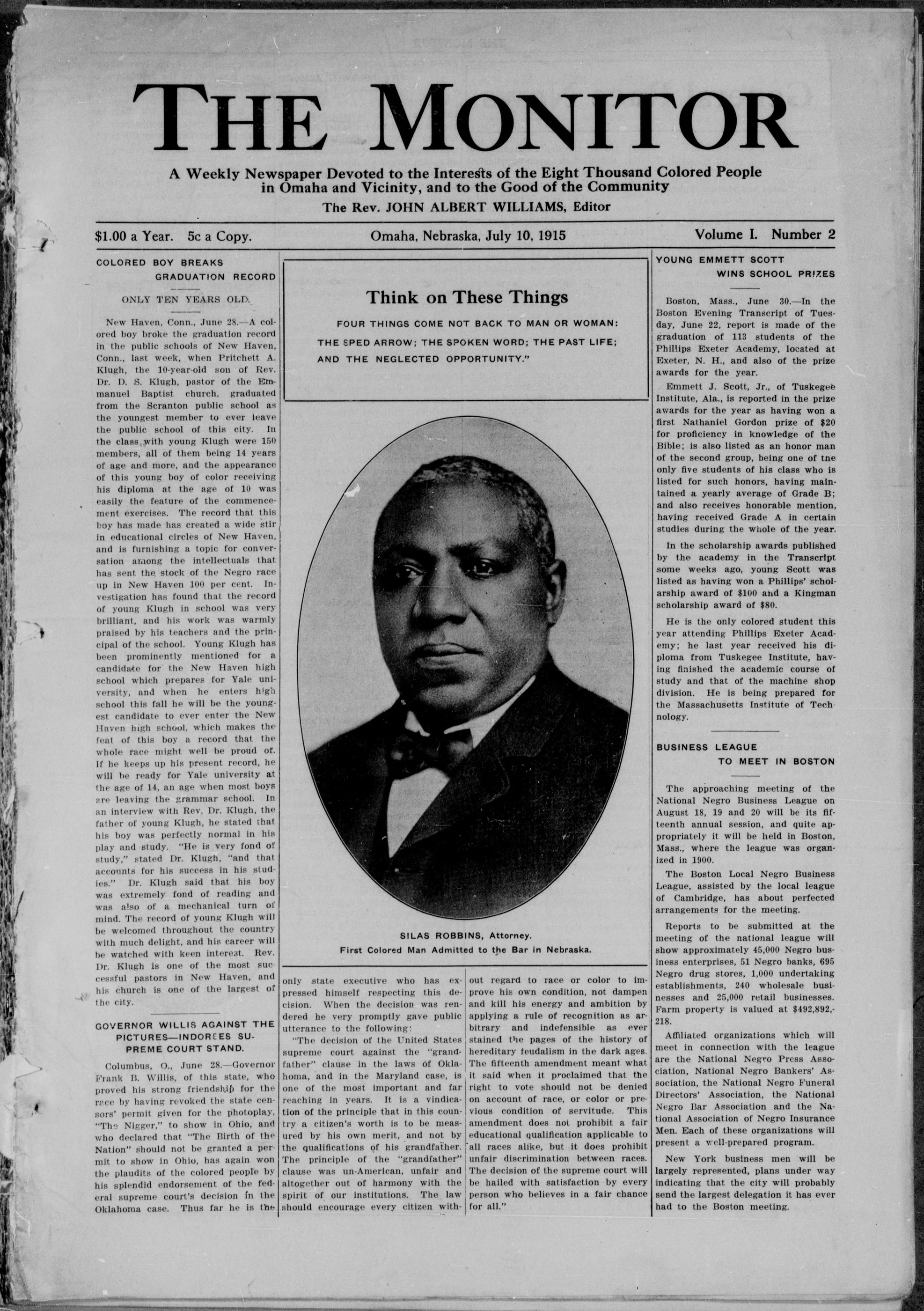
SILAS ROBB
First Colored Man Admitt
THE THINGS COME NOT BACK TO MAN ORDER; THE SPOKEN WORD; THE PASSAGE NEGLECTED OPPORTUNITY."
SILAS ROBBINS, Attorney.
Colored Man Admitted to the Bar in Nebraska
FOUR THINGS COME NOT BACK TO MAN OR WOMAN: THE SPED ARROW; THE SPOKEN WORD; THE PAST LIFE; AND THE NEGLECTED OPPORTUNITY."
[Name]
SILAS ROBBINS, Attorney. First Colored Man Admitted to the Bar in Nebraska.
only state executive who has expressed himself respecting this decision. When the decision was rendered he very promptly gave public utterance to the following:
"The decision of the United States supreme court against the "grandfather" clause in the laws of Oklahoma, and in the Maryland case, is one of the most important and far reaching in years. It is a vindication of the principle that in this country a citizen's worth is to be measured by his own merit, and not by the qualifications of his grandfather. The principle of the "grandfather" clause was un-American, unfair and altogether out of harmony with the spirit of our institutions. The law should encourage every citizen with-
---
---
---
BACK TO MAN OR WOMAN:
KEN WORD; THE PAST LIFE;
ORTUNITY."
NS, Attorney.
ed to the Bar in Nebraska.
out regard to race or color to improve his own condition, not dampen and kill his energy and ambition by applying a rule of recognition as arbitrary and indefensible as ever stained the pages of the history of hereditary feudalism in the dark ages. The fifteenth amendment meant what it said when it proclaimed that the right to vote should not be denied on account of race, or color or previous condition of servitude. This amendment does not prohibit a fair educational qualification applicable to all races alike, but it does prohibit unfair discrimination between races. The decision of the supreme court will be hailed with satisfaction by every person who believes in a fair chance for all."
---
Volume I. Number 2
YOUNG EMMETT SCOTT
WINS SCHOOL PRIZES
Boston, Mass., June 30.—In the Boston Evening Transcript of Tuesday, June 22, report is made of the graduation of 113 students of the Phillips Exeter Academy, located at Exeter, N. H., and also of the prize awards for the year.
Emmett J. Scott, Jr., of Tuskegee Institute, Ala., is reported in the prize awards for the year as having won a first Nathaniel Gordon prize of $20 for proficiency in knowledge of the Bible; is also listed as an honor man of the second group, being one of the only five students of his class who is listed for such honors, having maintained a yearly average of Grade B; and also receives honorable mention, having received Grade A in certain studies during the whole of the year.
In the scholarship awards published by the academy in the Transcript some weeks ago, young Scott was listed as having won a Phillips' scholarship award of $100 and a Kingman scholarship award of $80.
He is the only colored student this year attending Phillips Exeter Academy; he last year received his diploma from Tuskegee Institute, having finished the academic course of study and that of the machine shop division. He is being prepared for the Massachusetts Institute of Technology.
TO MEET IN BOSTON
The approaching meeting of the National Negro Business League on August 18, 19 and 20 will be its fifteenth annual session, and quite appropriately it will be held in Boston, Mass., where the league was organized in 1900.
The Boston Local Negro Business League, assisted by the local league of Cambridge, has about perfected arrangements for the meeting.
Reports to be submitted at the meeting of the national league will show approximately 45,000 Negro business enterprises, 51 Negro banks, 695 Negro drug stores, 1,000 undertaking establishments, 240 wholesale businesses and 25,000 retail businesses. Farm property is valued at $492,892,-218.
Affiliated organizations which will meet in connection with the league are the National Negro Press Association, National Negro Bankers' Association, the National Negro Funeral Directors' Association, the National Negro Bar Association and the National Association of Negro Insurance Men. Each of these organizations will present a well-prepared program. New York business men will be largely represented, plans under way indicating that the city will probably send the largest delegation it has ever had to the Boston meeting.
General Race News
2
PRESS COMMENTS. The Supreme Court Decision.
Complexion and Human Rights. (The New York Globe.) "But the Caucasian will continue to rule."—New York Sun. "The determination of the white man to rule the land wherein he lives is not affected by the decision."—New York Times.
Poor Caucasian! Poor white man! He will be submerged if not protected by a code of special laws. He is the fittest and the best, but so tender he cannot flourish under a rule of manhood equality. Yet men who so speak seldom realize that they are really insulting the Caucasian race.
The work of Jefferson, of Lincoln, of Sumner, and of all the glorious brotherhood of great statesmen who did not consider complexions when judging men, is unfinished. The old argument that some classes must be kept under still survives. In some circumstances it is the manual worker who must be kept to knowledge of his place and in others it is a race. Many of those who pretend to be leaders of public opinion and who think they are enlightened continue to be afraid of democracy. The fear is born, now as always of class selfishness and class prejudice.
The proposition that political rights should be dependent on race color is merely a milder expression of the doctrine by which thousands of otherwise good men quieted their consciences for a couple of centuries and justified the existence of slavery on the new continent. Assuming that one race was inherently and necessarily inferior, it was said that the most humane arrangement was to allow members of the superior race to "own" members of the inferior race—that thus it would become to the interest of the master to look after the welfare of his property—that the only way to insure the rightful supremacy of the white man was to keep the black man down.
The Negroes, who feel the bitter injustice of a system which denies to them an equal chance to grow and who await with exemplary patience the coming of the day when, under the providence of God, emancipation will be complete, are in many respects better Caucasians than those who labor to restrict liberty. The black man through hard experience has been educated into real belief in the Caucasian principle of equal chances for all the sons of men.
THE NATIONAL BAR ASSOCIATION MEETS.
To All Colored Attorneys:
The National Negro Bar Association will hold its fifth annual session in the city of Boston, July 18, 19 and 20, inclusive. The sessions heretofore have been well attended and it is the sense of those who have participated in these meetings that much good has been accomplished. This meeting is called in connection with the session of the National Negro Business League, of which it is an auxiliary and from the inspiration of which it sprung.
All attorneys of color who are in the active practice of the law and are in good standing with the Bar of their respective states and counties can be
THE MONITOR
and will be enrolled as members of this organization upon application properly made. Perhaps there was never a time when there was more necessity for a strong organization among, and a thorough understanding of, the colored attorneys in this country. And there is no nucleus around which they might gather and get more inspiration than from the National Negro Business League.
We had as well face the issue that the American Bar Association does not want us and will not have us and we ought to have self-respect enough to disavow any intention of enforcing our presence.
We trust that those good brethren of ours who have told us that they were members of the American Bar Association will be thoughtful enough to confess the error of their way and come and go along with us as independent men who are winning our way as successful attorneys.
It is no more discreditable for this organization to be distinctly racial than the National Negro Medical Association, which is a live organization and unquestionably making good. We trust that this meeting will be a record breaker in attendance and enthusiasm. Signed: Perry W. Howard, President, Jackson, Miss.; William H. Harrison, Secretary, Oklahoma City, Okla.
Jitneys in Washington, D. C.
In Washington, D. C., a delegation of colored citizens waited upon the public utilities commission a few days ago and entered a vigorous protest against the policy adopted by the "jitney" bus managers to refuse to accommodate Negroes who wish to ride. The matter is being looked into. The status of the "jitney" bus is still in the air, no decision having yet been reached as to whether it is or is not a common carrier, within the meaning of the statute. It has been determined that the taxicab is a common carrier and the colored lawyers hold that the "jitney" bus ought to come under the same head. If the "jitney" is held to be a common carrier, it can not draw the color-line, any more than the street cars can. If the "jitney" is not a common carrier, it is nothing and should not be granted a license to obstruct the public highways. It must conform to the laws of the District—or get out of business.
Dr. Charles Roberts Will Work in Paris.
Dr. Charles H. Roberts, 242 West Fifty-third street, New York, sailed on the steamer Chicago, leaving New York Saturday, July 3, for Paris, France, where he will engage for several months in coluntary work in the dental clinics of Paris, connected with the hospital service for French soldiers. Dr. Roberts is especially well qualified for this work, as he has sufficient command of the French language to talk intelligently, and has had extensive experience in the various dental clinics of New York City.
The National Negro Bar Association will meet in Boston July 18, 19, 20. The call says that "there was never a time when there was more necessity for a strong organization and a thorough understanding of the colored attorneys in this country."
FEAR DEPORTATION.
Philadelphia, Pa., June 30.—Daniel Riffan, a West Indian, who had stowed away on the steamer Rochelle, arriving here from the West Indies, was afraid of deportation and attempted to slip into the country by slipping overboard from the vessel and swimming ashore at a point off the lower part of the city. He was accompanied by Luther Read, another West Indian.
Riffan and Read were unable to reach the shore and Riffan was drowned before he could be rescued. Read was taken from the water by the crew on the government tug Vidette, and will be deported, just as he feared.
Mme. E. Azalia Hackley, after a successful series of concerts in and about. Springfield, Ill., appeared in Cleveland, O., in a grand song recital for the benefit of the Home for Aged Colored People. Mme. Hackley is making her headquarters in Chicago, where she will soon launch her longcherished Conservatory of Music. She is also preparing for the press a volume on "Art and Artists," which will be of inestimable value to young people who are ambitious to shine in the world of music and histrionic entertainment.
A savings bank has been organized at the Armstrong Manual Training School, Washington, D. C., through the active agency of Mr. George Henry Murray, one of the principal teachers in the department of business practice. The institution is designed not only to serve as an object lesson in the work of practical banking, but to encourage thrift on the part of the pupils of the school. Deposits aggregating more than $1,700 have already been made. This is the first bank formed in the colored schools of the District.
Mr. Andrew F. Hilyer, of the Treasury department, a trustee of Howard university, Washington, D. C., and a citizen of amply-demonstrated public spirit, has formed a correspondence committee, to work in conjunction with the National Association for the Advancement of Colored People. The committee will write protests against injustices and letters of appreciation to persons of influence in all parts of the country touching matters affecting the well being of the race.
Father Tolton, the first Negro Roman Catholic priest in the United States, is to have his grave in St. Peter's cemetery, Chicago, marked by a monument which will be paid for entirely by colored Roman Catholics.
J. H. Kelly, a colored man, who has been employed by the Illinois Central railroad for forty-two years, is chief train dispatcher at Carbondale, Ill.
Abram Smith, a colored merchant of
The Clothing Center of Omaha Brandeis Stores
TRY TO SWIM ASHORE
St. Thomas, D. W. I., has been elected crown member of the legislature in Denmark.
R. S. L. Jepson of Wheeling has been made state commissioner of health in West Virginia by the governor.
WANTED—Correspondents and subscription solicitors for The Monitor in Nebraska cities and towns.
WANTED-An absolutely reliable colored tenant for a good ten-room house; modern except heat. W. H. Russell, 631 Brandeis Theater.
Some New Toilet Goods Prices
50c Pompeian Massage Cream **29c**
25c Houbigant's Rice Powder **17c**
$1.00 Listerine, Lambert's.....59c
50c Malvina Cream for .....29c
25c Mennen's Taicum (4 kinds)
each .....12c
25c Rogers and Gallet Perfumed
Rice Powder for .....17c
25c 4711 White Rose Soap.....12c
25c Woodbury's Facial Soap.....17c
You "save time and money" by
coming to the Rexall Stores for
toilet goods.
Sherman & McConnell Drug Co.
4 GOOD DRUG STORES
Culinary Hints and Recipes
BY E. W. PRYOR,
Steward Omaha Commercial Club
EMERSON LAUNDRY
F. S. MOREY, Proprietor
1303-05 North 24th Street
Phone Webster 820
CHAS. EDERER
FLORIST
Plants, Cut Flowers, Designs,
Decorations
Greenhouses, 30th and Bristol Sts.
Phone Webster 1795
ASK FOR
Metz
OMAHA'S FAVORITE
BEER
THE BEER OF QUALITY
ing Center maha
News of the Churches and Religious Topics
Directory.
Baptist—
Mt. Moriah—Twenty-sixth and Seward streets. The Rev. W. B. M. Scott, pastor. Services: Sunday School, 9:30 a. m.; preaching, 11 a. m. and 8 p. m.; B. Y. P. U. at 6 p. m.
Zion—Twenty-sixth and Franklin (temporary location). The Rev. W. F. Botts, pastor; residence, 2522 Grant street. Telephone Webster 5838. Services: Devotional hour, 10:30 a. m.; preaching, 11 a. m.; Sunday School, 1 to 2 p. m.; pastor's Bible class, 2 to 3 p. m.; B. Y. P. U., 6:30 p. m.; choir devotion, 7:30 p. m.; preaching 8 p. m.
Episcopal
Church of St. Philip the Deacon—Twenty-first near Paul street. The Rev. John Albert Williams, rector. Residence, 1119 North Twenty-first
Science Notes
BY WILLIAM G. HAYNES.
SITUATION WANTED-FEMALE. Domestics and Day Work. Anti-colored woman wants housework by day. Webster 1219.
In this day of invention and discovery, it may be said that our dictionaries are practically obsolete before they leave the press. Autoing, aeroplaning, tangoing, soul-mate, eugenists, and a host of like technical terms are now commonplace. Saloon and anti-saloon, suffragists and anti-suffragists, socialists and anti-socialists, have likewise established their positions.
Not to be left behind in the matter of supplying the dictionaries with additional material, one of the progressive Omaha daily papers springs a decidedly new technical term on us, as is shown by the above want advertisement. Will some of our equally progressive readers come to our assistance and define the anti-term? Information as to the nature, species and habitat of this branch of the human family will be published most willingly for the enlightenment of our readers.
The Modern Incandescent Bulb.
The arc lamp is finding a serious rival for supremacy in the new gas-filled tungsten incandescent lights. As is generally known, the old style incandescent bulb consisted of a small carbon filament inside of a glass bulb that had been almost completely vacuated. In the new bulbs the carbon filament is replaced by one of tungsten, a rare metal, and instead of a vacuum, the space within the glass bulb is filled with an inert gas, usually nitrogen.
Most of the large, brilliant electric lights in the down-town districts are of this type. According to the "Electrical World," nearly ten thousand arc lamps in New York have been replaced by the tungsten gas-filled lamps. Yet even in this day of "bottled sunlight," there is much to be done, for about 85 per cent of the energy used for lighting purposes is wasted in other forms than light.
Among the many recent attempts
---
THE MONITOR
street. Telephone Webster 4243. Services daily at 7 a. m. and 9 a. m. Fridays at 8 p. m. Sundays at 7:30 a. m., 11 a. m. and 7:30 p. m. Sunday School at 12:45 p. m.
Grove M. E.—Twenty-second and Seward streets. The Rev. G. G. Logan, pastor. Residence, 1628 North Twenty-second street.
St. John's A. M. E.—Eighteenth and Webster streets. The Rev. W. T. Osborne, pastor. Residence, 613 North Eighteenth street. Telephone Douglas 5914. Services: Sunday, 11 a. m. and 8 p. m., preaching; 12 noon, class; 1:15 p. m., Sunday School; 7 p. m., Endeavor; Wednesday, 8 p. m., prayer and class meetings. Everybody made welcome at all of these meetings.
to produce substitutes for staple food products that have reached extremely high prices on account of the present war, there is an important one reported from the West Indies. Scientific work there has resulted in the production of a fruit flour from bananas at a comparatively low cost. From 537 pounds of bananas 138 pounds of the finished product are obtained, now selling for 4 cents a pound, wholesale.
The flour may be used alone or it may be mixed with other flour. On account of the high sugar content, bread and cakes made from the banana flour are not only more palatable, but also more nutritious than those composed of plain starch flour from potatoes, or from cereal flours in general.—Scientific American.
Everybody knows that the body loses considerable weight when perspiration exudes in noticeable drops, but it is somewhat of a surprise to learn that the rate of moisture evaporation from the body that goes on so slowly that it is not noticed results in the passage of no less than twenty to thirty-three ounces of water in twenty-four hours from the seven millions of pores on the human body.
Railroad service is being carried to a high point of efficiency, as is indicated by a recent invention which makes it possible to have wireless telephonic communication from car to car, from one train to another ahead, or one behind, or to the nearest station. The work is being done by Dr. Millener, experimental engineer of the Union Pacific railroad.
AUTO SPEEDWAY JULY 5TH
The auto races at the speedway last Monday afternoon were a disappointment in some respects, mostly due to the fact that there were so few entrants. This was caused by the Sioux City speedway races having been held on July 3rd, making it impossible for the drivers to get their cars in shape for the Omaha track in so short a time. Originally the Sioux City meet was set for June 19th, but for some reason yet unknown the A. A. A. allowed them to change to July 3rd, which deprived Omaha of ten or more drivers which they would have otherwise gotten.
Methodist
FAST TIME MADE AT NEW
OMAHA IN HOLIDAY ATTIRE FOR SAENGERFEST CONCERTS Omaha will be in its most gay attire for the Saengerfest of the Northwest Saengerbund, July 21 to 24, when six of the world's greatest singers will appear in conjunction with the Saengerfest concerts. The city will be decorated in the colors of the society, red, black and white, and from one end to the other the welcome greeting will be flouted to the visitors.
Nebraska will be strongly represented at the series, though members of the organization will come from all the surrounding states. Especially will Iowa be in evidence, for advices from Iowa cities state that large delegations will be on hand.
Never before has such an array of talent been secured for a series of concerts. Mme. Marie Rappold, Miss Julia Claussen, Miss Christine Miller, Jaul Althouse, Henri Scott and Enrico Palmetto, all names to conjure with in the musical world, will participate and appear in the five concerts.
Theodore Kelbe of Milwaukee has been secured to direct the male chorus of 2,000 voices. Music will be furnished by the Festival orchestra of sixty artists, with Th. Rud. Reese as conductor.
FIGURES SHOW NEBRASKA-IOWA AT HEIGHT OF PROSPERITY
That Omaha, Nebraska and Iowa are the most prosperous sections of the United States is proven by the bank clearings for the year. An analysis of the clearings, which reflect business accurately, show that for the entire year the business activity has been ten per cent greater than last year and for the last three months it has been 18.2 per cent greater.
These figures show without a doubt the stability of Nebraska and Iowa, which Omaha serves as a metropolis. With such a record, our citizens have just cause to be proud of their states, for in other sections, the business depression has been seriously felt. True, Omaha is in the heart of God's country, where all the world is now looking for food. The record made so far this season is one that is carrying the story of prosperity to all parts of the world.
BERG SUITS ME
Thousands of Satisfied Customers
who have attended our Semi-Annual
Half Price Clothing Sales
are coming back, because we satisfied them, and we advise those who have not taken advantage of this superior money saving opportunity to come here tomorrow and pass judgment on the greatest clothing values shown in Omaha.
$10.00 to $40.00 Suits are now
$5.00 to $20.00
BergClothing Co.
15TH & DOUGLAS.
3
BIG CIRCUS COMING
THIS WAY SOON
The Barnum and Bailey Greatest Show on Earth will exhibit at Omaha on Monday, July 26, and this good news is being heralded everywhere by the many agents of this, the biggest and foremost amusement institution in the world. The Barnum and Bailey circus has always been the largest that travels, and this season the management has found it necessary to add many more cars to their trains in order to provide for the great equipment. It requires 85 double-length railroad cars to transport the big show; 1,280 people are employed; there are 700, horses, 40 this world has ever known.
A fitting introduction to the wonderful performance this year is the presentation of the new, magnificent spectacular pageant, "Lalla Rookh," in which nearly 1,000 characters take part.
In the circus proper, which is presented in three rings, four stages, the hoppodrome, and in the dome of the largest tent ever erected, 480 performers from every nation in the world take part and present a vast array of foreign features entirely new to America. A wonderful trained animal exhibition is given by the marvelous war elephants, Pallenberg's wonder bears, Madam Bradna's angel horses, Thalero's dogs, ponies and monkeys, and the Barnum and Bailey statue horses.
Great interest is already being shown in this neighborhood and great crowds will no doubt go to Omaha for the biggest and most enjoyable holiday of the year. Everyone is advised to get an early start in order to be there in time for the parade, which starts promptly at 10 a. m., and which is said to eclipse anything of its kind ever before attempted in the history of circus business.
A man can lie out of a lot of things. But he can't deny it when he eats onions.
A man will pay a dollar for a 50-cent article that he wants. A woman will pay 49 cents for a 39-cent article that she doesn't want.
THE MONITOR
A Weekly Newspaper devoted to the civic, social and religious interests of the Colored People of Omaha and vicinity, with the desire to contribute something to the general good and upbuilding of the community. Published Every Saturday.
Application made for entry in second-class mail matter, under A
THE REV. JOHN ALBERT W.
Lucille Skaggs Edwards, William
Pryor, Assoc
Joseph Lacour, Jr., Advertisers
SUBSCRIPTION R.
Advertising rates, 25
Address, The Monitor, 1119 N
Application made for entry at the Postoffice, Omaha, Neb., as second-class mail matter, under Act of Congress, March 3, 1879.
THE REV. JOHN ALBERT WILLIAMS, Editor and Publisher.
Lucille Skaggs Edwards, William Garnett Haynes and Ellsworth W.
Pryor, Associate Editors.
Joseph Lacour, Jr., Advertising and Circulation Manager.
SUBSCRIPTION RATES, $1.00 per year.
Advertising rates, 25 cents an inch per issue.
Address, The Monitor, 1119 North Twenty-first street, Omaha.
We are grateful for the many kind expressions which have come to us concerning our first issue. It is gratifying to know that we have pleased our readers and patrons. We shall strive not only to maintain the high standard we have set, but to improve it. To do this will require not only diligent work upon the part of the staff, but also the hearty co-operation of our subscribers and advertisers. We want all our readers and patrons to feel that The Monitor is "OUR paper." We want them to take a personal pride and interest in it, and to feel perfectly free to make suggestions and criticisms which they believe will be for the betterment of the publication. We may not always see our way clear to act upon every suggestion given, but we shall be nevertheless grateful for them and are sure we will profit by them.
We desire to thank at this time all those who so heartily and cheerfully worked with us in getting out such a creditable edition as our first issue proved to be. To our associate editors, praise and thanks are due for their painstaking work. Our publishers, the Waters-Barnhart Printing Company, placed their knowledge and skill unreservedly at our service. Joseph LaCour, Jr., who is in charge of our advertising and circulating departments, gave most valuable assistance; and although midsummer is a dull advertising season, the merchants received us most kindly and were generous in their patronage as well as in their expressions of good wishes for success. All these agencies contributed to the success of our first issue, which has been so favorably received by our readers and warmly commended by the local press. For the assistance given and the words of commendation spoken, we take this opportunity to express our grateful appreciation.
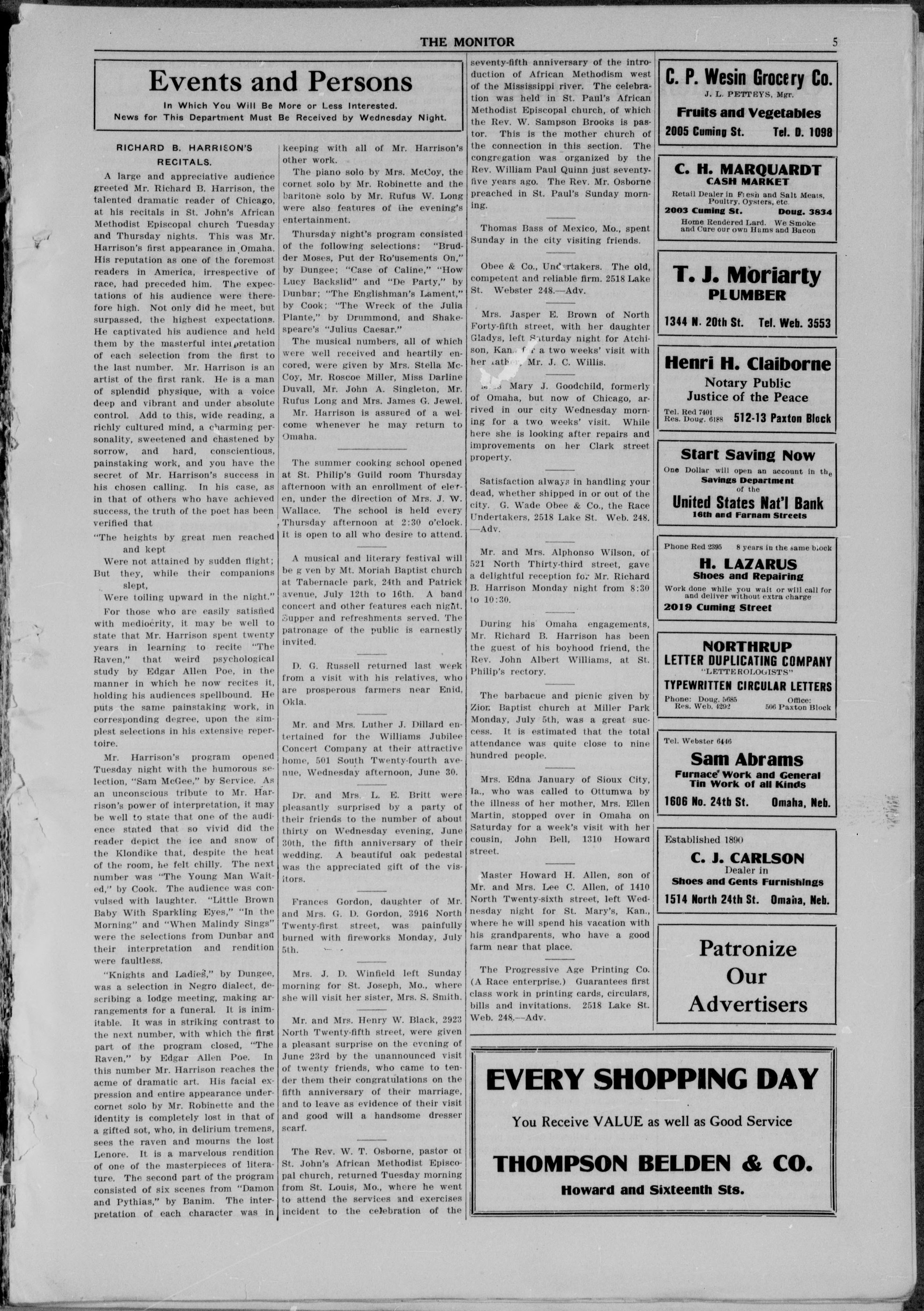
We publish today a cut of Silas Robbins, the first colored lawyer to be admitted to the bar in Nebraska. Mr. Robbins was born in Winchester, Ind., in 1858. His academic training was received at Union Literary Institute, a school founded by the Quakers, near Spartansburg, Ind. He read law in the office of Canada & Canada, a leading law firm of Winchester. William A. Canada, of that firm, is now United States consul at Vera Cruz. Subsequently Mr. Robbins taught school in Ohio, Kansas, Missouri and Mississippi. While teaching in Missouri he continued his legal studies in the office of Albert Burgess, a graduate of the University of Michigan, and a highly respected colored attorney of St. Louis. In 1884 Mr. Robbins became principal of the school for colored children at Wood-
---
4
APPRECIATION.
but the Postoffice, Omaha, Neb., as
act of Congress, March 3, 1879.
WILLIAMS, Editor and Publisher.
B. Garnett Haynes and Ellsworth W.
Associate Editors.
Bringing and Circulation Manager.
STATES, $1.00 per year.
Events an inch per issue.
North Twenty-first street, Omaha.
ville, Miss., where he remained four years. He was admitted to the bar in Woodville in 1888. In 1889 he came to Omaha, where he has since resided. Here he was admitted to practice in the state and federal courts in 1889 and in the supreme court in 1890. Some years ago, in speaking to us of Mr. Robbins, no less a distinguished member of the American Bar Association than the late James M. Woolworth said. "Mr. Robbins is a man for whom I have a high regard. He is a man who knows law."
Despite this fact, Mr. Robbins' practice has never been sufficiently lucrative nor exacting to demand all his time and attention. He has found it necessary, or expedient at least, to augment his income by devoting considerable attention to real estate. Mr. Robbins is a man of a fine mind and high character. Guy, his eldest son, is secretary to the American legation, Monrovia, Liberia. Mr. and Mrs. Robbins have an attractive home at 2883 Miami street.
The thrifty members of our race are rapidly acquiring homes of their own in this growing city. It is gratifying to point to the many attractive homes in good repair and with well-kept lawns which so many of our people own or are buying. It is the duty of every one who has an interest in the growth and betterment of the city to encourage this spirit, rather than to discourage it by putting barriers in the way. What do you think about it?
The jitneys in other cities are also having troubles of their own, and for their narrowness and littleness they deserve it.
OPINIONS ABOUT THE MONITOR.
An admirable little sheet is The Monitor," the race organ for the colored people of Omaha, edited by the Rev. John Albert Williams, which starts publication today. It will be issued each Saturday.
The associate editors are E. W. Pryor, steward of the Commercial club, who has a department on "Culinary Hints and Recipes;" William G. Haynes, who has a column on "Science Notes," and Mrs. Lucille Skaggs Edwards, who edits the section, "For Our Women and Children."
The first issue shows The Monitor to be a well-gotten-up, live journal. It is to be devoted to the civil, social and religious interests of the colored people with the desire of contributing to the general good of the community. General race news is chronicled. News of the local five colored churches is given. Lodges and fraternities have their notices and individuals have a
---
THE MONITOR section in which to express themselves through letters.—The World-Herald, July 3rd.
The first issue of the Monitor, a news paper edited by the Rev. John Albert Williams and devoted to the interests of the colored people of Omaha, came out yesterday. It is an unusually neatly prepared publication and is filled with excellent reading matter. Mr. Williams is assisted in his work as editor by Lucille Skaggs Edwards, William Garnett Haynes and Ellsworth W. Pryor, each of whom conducts a department in the paper. The Omaha Sunday Bee, July 5.
INDIVIDUAL INFLUENCE
Let us suppose the existence of an island where, fire being extinguished the people had to pass their days in cold and nights in darkness. A benevolent person comes with a torch and offers light to any one who wishes it, enjoining only that those persons so blessed should take their torches into at least two darkened dwellings. It would not be long before all the island would have light, the progression being 1, 2, 4, 8, 16, 32, etc.
Now this is precisely the position the Christian holds in reference to this darkened world. He is to let his light so shine that others may not only see, but kindle at his flame. He is never to cease his labors until (not merely two but) all around him experience heaven's blessings. And so each one thus blessed would become the center of innumerable rays. Were such a system carried out, the world would soon have no dark spots, but as it is, there are only a few bright ones. And why so?
There is an evil spirit, whose hatred against God's light is such, that he instigates his followers not merely to extinguish the light of God's truth in themselves, but to do the same to those around them; so that unless these centers of widening evil be resisted, the church shall become like Pergamos or Thyatira, where the stork builds on the ruins of God's house, and the Turkish mosque takes the place of "Christ's holy Temple." We see then around us two principles advancing with arithmetical precision, the one calculated to change earth to Heaven, the other to change earth to Hell.
What then shall we do? Stand by unconcerned? Hide our light under a bushel and so be responsible for the darkness such conduct occasions? Say we have no influence? No; let us be up and doing. The drop of rain will teach us a lesson. The spark of fire will rebuke our lethargy. The grain of wheat will shame us to exertion. Let us, if we would keep the light that now shines on us, remember that the condition of possession is its distribution to others.
God gives us our daily light as we give to those who need our assistance. Says Dr. Arnold: "Two or three decided persons steadily and quietly acting as they think right, will be a leaven to the whole mass, and the bad shall be left in that state, they shall meet hereafter—a minority of unmixed evil."—Church and Home.
There is only one safe way to save and that is to obligate yourself to do so.
If you haven't a wife, get one.
If you haven't a home, get one.
Buy something on a contract which compels you to make regular installments in payment—something tangible, like land which will not run away,
HOW TO SAVE.
or insurance which, if you should die, can be cashed in by your widow.
Most men cannot save unless they have to—they yield to temptation to spend when they needn't.
The dollar saved should be an invested dollar. A nimble dollar. Not a hoarded dollar. The miser is more contemptible than the spendthrift.
Saving means that when you are old you have something. You do not have to drudge pitifully to keep out of the poorhouse. It means that you can give your children advantages of education and the hope of a career. It means that you and your wife can round out your alloted span of years with your heads in the air, beholden to none.
It means that when you die your trustful wife, the woman who has found in you the shield and shelter against the menaces and chill of the world, will find that her confidence was not misplaced, that you built a shelter—a home which would endure even after death had claimed you.
Your worldly responsibilities do not end with the grave.
How desperate is the heart of the man who awakes in the morning from distressful slumber to the bitter knowledge that there is no food to be had that day for his children!
But how remorseful should be the heart of the man who lays himself down at night with the thought that "if I should die before I wake" there would be no food for wife or children but the bread of charity or the meat of toil!—Woodmen News.
As is generally thought, liquor can be obtained in Maine only and ostensibly as medicine. As a New York man was purchasing a toothbrush in a drug store in that state a big, rawboned fellow entered with a four gallon demijohn. He slammed it down on the counter in front of the druggist, and, handing him a bit of paper, said: "Fill her up, Henry; baby's took bad."
---
If The Monitor Pleases You Subscribe Now
One Dollar a Year
---
Events and Persons
In Which You Will Be More or Less Interested. News for This Department Must Be Received by Wednesday Night.
RICHARD B. HARRISON'S RECITALS.
A large and appreciative audience greeted Mr. Richard B. Harrison, the talented dramatic reader of Chicago, at his recitals in St. John's African Methodist Episcopal church Tuesday and Thursday nights. This was Mr. Harrison's first appearance in Omaha. His reputation as one of the foremost readers in America, irrespective of race, had preceded him. The expectations of his audience were therefore high. Not only did he meet, but surpassed, the highest expectations. He captivated his audience and held them by the masterful interpretation of each selection from the first to the last number. Mr. Harrison is an artist of the first rank. He is a man of splendid physique, with a voice deep and vibrant and under absolute control. Add to this, wide reading, a richly cultured mind, a charming personality, sweetened and chastened by sorrow, and hard, conscientious, painstaking work, and you have the secret of Mr. Harrison's success in his chosen calling. In his case, as in that of others who have achieved success, the truth of the poet has been verified that
"The heights by great men reached and kept Were not attained by sudden flight; But they, while their companions slept
Were toiling upward in the night." For those who are easily satisfied with mediocrity, it may be well to state that Mr. Harrison spent twenty years in learning to recite "The Raven," that weird psychological study by Edgar Allen Poe, in the manner in which he now recites it, holding his audiences spellbound. He puts the same painstaking work, in corresponding degree, upon the simplest selections in his extensive repertoire.
Mr. Harrison's program opened Tuesday night with the humorous selection, "Sam McGee," by Service. As an unconscious tribute to Mr. Harrison's power of interpretation, it may be well to state that one of the audience stated that so vivid did the reader depict the ice and snow of the Klondike that, despite the heat of the room, he felt chilly. The next number was "The Young Man Waited," by Cook. The audience was convulsed with laughter. "Little Brown Baby With Sparkling Eyes," "In the Morning" and "When Malindy Sings" were the selections from Dunbar and their interpretation and rendition were faultless.
"Knights and Ladies," by Dungee, was a selection in Negro dialect, describing a lodge meeting, making arrangements for a funeral. It is inimitable. It was in striking contrast to the next number, with which the first part of the program closed, "The Raven," by Edgar Allen Poe. In this number Mr. Harrison reaches the acme of dramatic art. His facial expression and entire appearance undercornet solo by Mr. Robinette and the identity is completely lost in that of a gifted sot, who, in delirium tremens, sees the raven and mourns the lost Lenore. It is a marvelous rendition of one of the masterpieces of literature. The second part of the program consisted of six scenes from "Damon and Pythias," by Banim. The interpretation of each character was in
THE MONITOR
keeping with all of Mr. Harrison's other work. The piano solo by Mrs. McCoy, the cornet solo by Mr. Robinette and the baritone solo by Mr. Rufus W. Long were also features of the evening's entertainment.
Thursday night's program consisted of the following selections: "Brudder Moses, Put der Ro'usements On," by Dungee; "Case of Caline," "How Lucy Backslid" and "De Party," by Dunbar; "The Englishman's Lament," by Cook; "The Wreck of the Julia Plante," by Drummond, and Shakespeare's "Julius Caesar."
The musical numbers, all of which were well received and heartily encored, were given by Mrs. Stella McCoy, Mr. Roscoe Miller, Miss Darline Duvall, Mr. John A. Singleton, Mr. Rufus Long and Mrs. James G. Jewel. Mr. Harrison is assured of a welcome whenever he may return to Omaha.
The summer cooking school opened at St. Philip's Guild room Thursday afternoon with an enrollment of eleven, under the direction of Mrs. J. W. Wallace. The school is held every Thursday afternoon at 2:30 o'clock. It is open to all who desire to attend.
A musical and literary festival will be g ven by Mt. Moriah Baptist church at Tabernacle park, 24th and Patrick avenue, July 12th to 16th. A band concert and other features each night. Supper and refreshments served. The patronage of the public is earnestly invited.
D. G. Russell returned last week from a visit with his relatives, who are prosperous farmers near Enid, Okla.
Mr. and Mrs. Luther J. Dillard entertained for the Williams Jubilee Concert Company at their attractive home, 501 South Twenty-fourth avenue, Wednesday afternoon, June 30.
Dr. and Mrs. L. E. Britt were pleasantly surprised by a party of their friends to the number of about thirty on Wednesday evening, June 30th, the fifth anniversary of their wedding. A beautiful oak pedestal was the appreciated gift of the visitors.
Frances Gordon, daughter of Mr. and Mrs. G. D. Gordon, 3916 North Twenty-first street, was painfully burned with fireworks Monday, July 5th.
Mrs. J. D. Winfield left Sunday morning for St. Joseph, Mo., where she will visit her sister, Mrs. S. Smith.
Mr. and Mrs. Henry W. Black, 2923 North Twenty-fifth street, were given a pleasant surprise on the evening of June 23rd by the unannounced visit of twenty friends, who came to tender them their congratulations on the fifth anniversary of their marriage, and to leave as evidence of their visit and good will a handsome dresser scarf.
The Rev. W. T. Osborne, pastor or St. John's African Methodist Episcopal church, returned Tuesday morning from St. Louis, Mo., where he went to attend the services and exercises incident to the celebration of the
seventy-fifth anniversary of the introduction of African Methodism west of the Mississippi river. The celebration was held in St. Paul's African Methodist Episcopal church, of which the Rev. W. Sampson Brooks is pastor. This is the mother church of the connection in this section. The congregation was organized by the Rev. William Paul Quinn just seventy-five years ago. The Rev. Mr. Osborne preached in St. Paul's Sunday morning.
Thomas Bass of Mexico, Mo., spent Sunday in the city visiting friends.
Obee & Co., Undertakers. The old, competent and reliable firm. 2518 Lake St. Webster 248.—Adv.
Mrs. Jasper E. Brown of North Forty-fifth street, with her daughter Gladys, left Saturday night for Atchison, Kan. for a two weeks' visit with her father, Mr. J. C. Willis.
Mary J. Goodchild, formerly of Omaha, but now of Chicago, arrived in our city Wednesday morning for a two weeks' visit. While here she is looking after repairs and improvements on her Clark street property.
Satisfaction always in handling your dead, whether shipped in or out of the city. G. Wade Obee & Co., the Race Undertakers, 2518 Lake St. Web. 248. Adv.
Mr. and Mrs. Alphonso Wilson, of 521 North Thirty-third street, gave a delightful reception for Mr. Richard B. Harrison Monday night from 8:30 to 10:30.
During his Omaha engagements, Mr. Richard B. Harrison has been the guest of his boyhood friend, the Rev. John Albert Williams, at St. Philip's rectory.
The barbacue and picnic given by Zion Baptist church at Miller Park Monday, July 5th, was a great success. It is estimated that the total attendance was quite close to nine hundred people.
Mrs. Edna January of Sioux City, Ia., who was called to Ottumwa by the illness of her mother, Mrs. Ellen Martin, stopped over in Omaha on Saturday for a week's visit with her cousin, John Bell, 1310 Howard street.
Master Howard H. Allen, son of Mr. and Mrs. Lee C. Allen, of 1410 North Twenty-sixth street, left Wednesday night for St. Mary's, Kan., where he will spend his vacation with his grandparents, who have a good farm near that place.
The Progressive Age Printing Co. (A Race enterprise.) Guarantees first class work in printing cards, circulars, bills and invitations. 2518 Lake St. Web. 248.—Adv.
THOMPSON BELDEN & CO. Howard and Sixteenth Sts.
You Receive VALUE as well as Good Service
5
C. P. Wesin Grocery Co.
J. L. PETTEYS, Mgr.
Fruits and Vegetables
2005 Cuming St. Tel. D. 1098
C. H. MARQUARDT CASH MARKET
Retail Dealer in Fresh and Salt Meats, Poultry, Oysters, etc.
2003 Cuming St. Doug. 3834
Home Rendered Lard. We Smoke and Cure our own Hams and Bacon
T. J. Moriarty PLUMBER
1344 N. 20th St. Tel. Web. 3553
Henri H. Claiborne
Notary Public
Justice of the Peace
Tel. Red 7401
Res. Doug. 6188 512-13 Paxton Block
Start Saving Now
One Dollar will open an account in the
Savings Department
of the
United States Nat'l Bank
16th and Farnam Streets
Phone Red 2395 8 years in the same block
H. LAZARUS
Shoes and Repairing
Work done while you wait or will call for
and deliver without extra charge
2019 Cuming Street
NORTHRUP
LETTER DUPLICATING COMPANY
"LETTEROLOGISTS"
TYPEWRITTEN CIRCULAR LETTERS
Phone: Doug, 5685
Res. Web, 4292
Office:
506 Paxton Block
Sam Abrams
Furnace' Work and General
Tin Work of all Kinds
1606 No. 24tb St. Omaha, Neb.
Established 1890
C. J. CARLSON
Dealer in
Shoes and Gents Furnishings
1514 North 24th St. Omaha, Neb.
Patronize Our Advertisers
PPING DAY well as Good Service
Our Women and Children
Conducted by Lucille Skaggs Edwards.
PROFITING BY MISTAKES. Now that national interest is being taken in the exposition to commemorate the fifty years' achievements of the Negro race; and since we know that these achievements have been attained just in proportion to the rise of the Negro woman; we should, while celebrating our successes, soberly reflect upon the failures, the mistakes we have made, and, profiting by them, start upon our second half-century wiser and more efficient women.
The possibility for development came slowly to the Negro woman. She has behind her a heritage of sin and shame, for which those upon whom she was taught to look as her superiors are responsible. She has suffered such degradation as was impossible to the men of her race. Today she labors against odds never dreamed of by women of other races. Yet she is slowly coming into the light of Christian, cultured womanhood. During the fifty years of her struggle many worthy achievements, also many mistakes, have marked her course. It is of the value of these mistakes that we would now speak.
We need not hold up our failures to the world, but there is need of more genuine frankness between us. Certainly there is no surrender of dignity implied in admitting our mistakes and making proper use of them. The calm, dispassionate recounting of an error, how it came to be made, how it was discovered and remedied, is often of infinitely more practical value than the recital of a series of apparently faultless achievements.
Every individual, every home, club, or church worker realizes how much is learned from one's own mistakes, even from a most common place standpoint. Every one with a grain of philosophy in them realizes further that mistakes are an inherent part of progress. Then, as we women look backward upon our half-century of "lifting and climbing," let us seek out the mistakes we have made, and those which we are still making, and benefit by them, for they are potent factors in our building for the future.
The finest courage is shown by those who fight again after each defeat, till victory is achieved, and build up their fortunes from the wrecks of their hopes. None are infallible. Mistakes are the "common fate of all," yet they may be made the "stepping stones to higher things."
WARNINGS ISSUED BY Y. W. C. A.
Do not start to a strange town without knowing of some safe place to spend the night.
Do not accept help or information from strangers either on the train or in the depot.
Do not go to strange parts of a city at night in a cab.
Aim to arrive in the day time.
If your friends fail to meet you, or you are in doubt what to do, ask any uniformed official to direct you to the Travelers' Aid Agent.
Panama-Pacific Exposition.
The Travelers' Aid Societies of the Pacific coast are sounding a note of warning to those who are going to the Exposition with a view of ob-
6
taining employment to defray their expenses. There are dozens of applications for one position. No young person should go who has not money sufficient for her maintenance and return fare, and parents are warned against allowing their children to run such a risk.
Believe, and make the world believe, your jaw is set to win;
Believe (belief's contagious) that your ship is coming in;
Believe that every failure is brought about by lack of grit;
Believe that work's a pleasure if you buckle into it;
Believe there's help in hoping, if your hope is backed with will;
Believe the prospect's fairer from the summit of the hill;
Believe, with all your power, that you're sure of winning out;
Believe, keep on believing, they are brothers—Death and Doubt.
—Strickland W. Gillilan.
If one-tenth of the time was spent in looking after the small children and bringing them up in the paths of rectitude that is used in punishing the older ones for violating the laws, our reformitories would be useless and our jails and penitentiaries would go out of business.—Richmond Planet.
The Council of Colored Women of Richmond, Va., is the direct agency for the collection of funds to help raise the $15,000.00 wanted by Miss Agnes D. Randolph, secretary of the Anti-Tuberculosis Association, for the erection of a Sanitarium for Colored Tubercular Patients.
THE VERY HOUSE IN
WHICH CHRIST LIVED
Dear Children: When in our reading we found a beautiful truth in an article under the above heading, we wondered how many of you had thought of what sacred things your bodies are. We know that it will be a great help to you, throughout your lives, to learn to think that you are living in the very house in which Christ lived, so we publish the article in part that each boy and girl may read it:
Suppose you could live in the very house Christ lived in!
Would it not seem to the most careless of us a sacred place, a holy place?
When you awoke in the morning, would you not say, "The same sun streaming into this very room bade Him arise to His daily toil as it bids me"?
At meal times would you not say, "Here, too, He ate and drank after giving thanks to His Father"?
At real hard work, when you were tired out, would you not say, "He labored long and diligently here. He was wearied"?
When you prayed, would you not say, "Kneeling here, He too spoke to His Father and to mine"?
Suppose you could live in the very house Christ lived in, would not your life be a happy one, a holy one, spent in that hallowed dwelling place?
But you do live in the very house Christ lived in.
The real house Christ lived in was the human body.
"The Word became flesh."
The eternal Son of God was "born
---
THE MONITOR
of a woman"—"conceived by the Holy Ghost, born of the Virgin Mary"—and grew in human form, as you are doing, from infancy to childhood, from childhood to youth, from youth to manhood.
You live now in the house He lived in then. Therefore is not your dwelling place a very sacred one? Is not your body sacred? Is not every part of it, every limb, every muscle, every nerve, a holy thing?
Look at your hand a moment.
That hand of yours, with its thumb and fingers, its knuckles and nails, its blood-vessels and nerves, is in every particular almost exactly as Christ's was. With a hand no different from that He touched the blind, the sick, the dead. His hand was ever an instrument of good. It was never lifted in passion. It never struck a hasty blow. It never wrote a word to be regretted. It never tampered with sin in any form.
That hand was nailed to the cross at last "for us men and for our salvation." Your human hand is therefore a sacred thing.
For what do you use it?
It is possible to use the hand to defile the whole body, to pollute and abuse and destroy the house Christ lived in.
I want you to honor and respect your body and all its parts, because it is the very house the eternal Son of God lived in on earth.
Guard the house Christ lived in very jealously from evil. Take care that nothing He used aright is used by you wrongly. Let no defiling thought stay with you. Look at nothing, listen to nothing that would cause you to think of sinning against your body.—White Cross League.
Open the door of your heart, my lad,
To the angels of love and truth;
When the world is full of unnumbered joys,
In the beautiful dawn of youth.
Casting aside all things that mar,
Saying to wrong, "Depart!"
To the voices of hope that are calling in you
Open the door of your heart.
Open the door of your heart, my lass,
To the things that shall abide;
To the holy thoughts that lift your soul.
Like the stars at eventide;
All of the fadeless flowers that bloom
In the realms of song and art
Are yours if you'll only give them
room;
Open the door of your heart.
—Edward Everett Hale.
"I'LL SHOW 'EM, DURN 'EM."
I've stopped the paper, yes I have,
I didn't like to do it,
But the editor he got too smart,
And I allow he'll rue it.
I am a man who pays his debts,
And will not be insulted,
So when the editor gets smart
I want to be consulted.
I took the paper 'leven years
And helped him all I could, sir,
But when it comes to dunnin' me
I didn't think he would ,sir.
But that he did, and you can bet
It made me hot as thunder;
I says, "I'll stop that sheet, I will,
If the doggone thing goes under."
I hunted up the editor
And for his cunnin' caper
I paid him 'LEVEN years and quit!
Yes, sir, I stopped the paper.
A Massachusetts girl cut off her hair in her sleep. Most girls yank it off before they go to sleep.
OPEN THE DOOR.
Issued by the United States Weather Bureau, Washington, D. C., for Week Beginning July 7.
For plains states and upper Mississippi valley: Moderately warm weather will prevail during the next three to four days, with widely scattered thunder showers. The latter half of the week will be fair and cooler.
Thomas
Kilpatrick & Co.
sell
Good Dry Goods
and
Ready-to-wear Clothes
priced according
to quality
Courteous Service Always
Harry E. Swanson
Carl H. Johnson Harry E. Swanson
Johnson & Swanson
Funeral Directors
and Embalmers
Phone Douglas 2342
2204 Cuming Street
COMBS'
JEWELRY STORE
is just the
Right Kind
of a Jewelry Store for
Merchandise or Repairs of
any kind
1520 Douglas Street
BRAMBLETT ENGRAVING CO.
Acid blast
ETCHING
1311 Howard St. Omaha, Neb.
H. GROSS
Lumber and Wrecking
21st and Paul Streets
Letters from Our Readers
Communications for this column must be brief and always signed.
LETTERS OF APPRECIATION.
2019 Cuming St., Omaha, Neb.
July 7th, 1915.
Rev. Jno. Albert Williams,
Editor of The Monitor.
Dear Sir:
I have received the first issue of
The Monitor and I am well pleased
with it. I am inclosing with pleasure
one dollar for a year's subscription.
I think the colored people of the
community should be proud to have
such a good organ to appear every
week for them.
Wishing you every success, I remain.
Yours truly.
H. LAZARUS,
Shoe Repairer
3334 Vernon Ave., Chicago, Ill. July 6th, 1915. Rev. Jno. Albert Williams,
With pleasure I have received and read The Monitor. It is a newsy, instructive paper, of which our people will feel proud. Your experience and ability fit you for the work. With your corps of able assistants, the paper will do much for our race. I am pleased to inclose money for a year's subscription.
With best wishes for success, I beg to remain,
Affectionately yours,
G. N. JOHNSON.
Omaha, Neb., July 7,th 1915. Rev. John Albert Williams,
1119 North Twenty-first St.,
Omaha, Neb.
Dear Sir:
I am very glad indeed to send you herewith check for $1.00, which will pay for a year's subscription to The Monitor. Your paper, I am sure, will have a strong tendency for good, both in the community at large and among the people of your race, for whom it is primarily intended. I am always interested in the welfare of the colored people, and am glad of an opportunity to be of slight help.
Very truly,
ROBERT T. BURNS.
Omaha, Neb., July 7,th 1915. Rev. John Albert Williams,
I have at hand the copy of The Monitor. I appreciate your sending it to me. If you will continue to do so, I will have it placed on our reading files.
I am glad to see the advent of this paper. I believe there is a place for it.
I feel sure that you know of my interest in the colored people of Omaha, although you and I do not always agree on means, we always agree, I am sure, on the end. I want to be of any service that I can to the colored people and feel sure that they will work out their salvation just as the white race must work out its salvation, through its own effort, in fear and trembling.
Very truly yours,
E. F. DENISON,
Genl. Secy. Y. M. C. A.
My congratulations and best wishes for the success of The Monitor. I will
Our Readers
must be brief and always signed.
watch its growth with much interest.
Very sincerely,
(Mrs. H. C.) KATHERINE SUMNEY.
4352 Forrestville Avenue,
Chicago, Ill., July 7, 1915.
Dear Father Williams:
I have received a copy of The Monitor, upon which I tender you my sincere congratulations. It is a most creditable production and more than merits the success which I am sure it will achieve. Enter my name as an annual subscriber.
Cordially, your friend,
JOHN C. LYNCH.
Columbus, Neb., July 7, 1915.
Dear Father Williams:
I thank you for the copy of your new newspaper, which I trust may be of real value to your people, to your community, and both a pleasure and a profit to you. Sincerely yours, EDGAR HOWARD.
CULINARY NOTES.
DRIPPED COFFEE.
How to Prepare and Serve.
Buy the best coffee from the best concerns you know that make coffee their specialty. Grind it medium. Use three-fourths of a pound of coffee to each gallon of water. This makes a very strong coffee. Make a bag of ordinary cheese cloth to extend half way down in urn; sides double and bottom single thickness.
The water then finds its way through the grounds and bottom of bag, for if made single on sides it is easier for the water to run through without touching the coffee at all than it is to run through the coffee and bottom of bag besides, and much strength is lost thereby.
Dampen the coffee grounds in an agateware can with just enough boiling water to thoroughly swell them, then place them in the bag in urn and use only fresh boiling, bubbling water on them; re-pour the coffee through the grounds five times, remove the bag and it is ready to serve. Serve with cream, with a little whipped cream on top of same.
FILLING FOR SANDWICHES
Worth Remembering for Picnics and Tea Parties.
One-half pound of Roquefort cheese, one-fourth as much butter and half a teaspoonful of paprika; mix to a paste with sherry wine. Spread on wafers or toasted rye bread.
Prunes, chopped with half the quantity of English walnut meats, seasoned with lemon juice and powdered sugar.
Equal parts of chicken and ham, finely minced and seasoned with curry powder.
Minced hard-boiled egg, one sardine to every three, seasoned with lemon juice. Equal parts of cold roast beef, cold roast turkey, boiled ham and tongue, seasoned with chopped pickles; mix with mayonnaise dressing. Cold cooked veal, chopped fine; hard-boiled eggs; season with tomato catsup.
Leftover Meats in Bread Cases. Philip's Keep the leftover meats from each lace.
BURGESS-NASH COMPANY
"EVERYBODY'S STORE"
announce their Second Annual
July Clearing Sale
Starting Friday, July 9th
JOS. S. BERKOWITZ
Manufacturer, Wholesale and Retail Dealer in Window and Store Shades of Every Description. Pictures and picture framing neatly done. Old mirrors resilvered equal to new at little cost. Window glass put n with the best workmanship. Give us a trial and an opportunity to fill your orders and you will be convinced. Our work and material are guaranteed to be the best and our prices defy competition.
We Print the Monitor
WATERS
BARNHART
PRINTING CO.
O M A H A
522-24 South Thirteenth St. Telephone Douglas 2190
meal, such as bacon, ham, roasts or stews. Mince the bacon or ham, cut the other meats into small cubes. Season well. Cook with a little gravy or water until tender. Make a cream dressing for this of one tablespoonful of butter, one tablespoonful flour, rubbed well together, and one cup of boiling milk.
Take slices of bread about two inches thicks, cut perfectly square. Shell out the crumbs, leaving about one-half inch, or enough to form a bottom thick enough to hold the mixture. Place under a quick fire until a light brown. Fill with the meat. Decorate with hard-boiled egg and parsley. Serve immediately.
Take the bread which you have taken from the cases and to one cup crumbs allow three of milk, three eggs, well beaten, retaining two of the whites for meringue, three spoonfuls sugar and one of butter. Bake in a moderate oven. When pudding is set, put the whites, well beaten with a spoonful of powdered sugar, on it. Return to oven until a rich brown.
To be demonstrated July 15 at St. Philip's Guild Room.—Mrs. J. W. Wallace.
Bread Cases.
Bread Pudding.
Telephone Web. 6654
int the
nitor
ERS
HART
TING CO.
Thirteenth St.
Douglas 2190
Mr. Richard B. Harrison gave a recital in the A. M. E. church here on Wednesday night. He is a wonderful reader. His audience was delighted. He gave several humorous selections and the court scene from "The Merchant of Venice." Mr. B. McKinley Ward contributed two pleasing musical numbers to the program.
The following testimonial was given to a servant girl: "This is to certify that the bearer has been in my service one year less eleven months. During this time I found her to be diligent at the back door, temperate at her work, prompt at excuses, amiable toward young gentlemen, faithful to her sweethearts, and honest when everything was safe under lock and key.—Sphere.
Passing a swimming pool in a small city one day two country women read this sign at the entrance: "Twenty-five thousand Gals. In and Out Every Hour." "That's all nonsense," said one of the women. "There ain't that many women in this whole country."
In the Garden of Hope grow the laurels for future victories, the roses of coming joy, and the lilies of approaching peace.
```markdown
```
7
COUNCIL BLUFFS.