The Monitor
Saturday, July 31, 1915
Omaha, Nebraska
Page text (machine-generated)
THE MONITOR
A Weekly Newspaper Devoted to the Interests of the Eight Thousand Colored People in Omaha and Vicinity, and to the Good of the Community The Rev. JOHN ALBERT WILLIAMS, Editor
---
$1.00 a Year. 5c a Copy.
THE LOGIC OF WOMAN SUFFRAGE
By Rev. Francis J. Grimke.
I am heartily in favor of woman suffrage. I did not use to be, but it was simply because I had not given the subject due consideration. The moment I began to think seriously about it, I became convinced that I was wrong, and swung over on the other side, and have been on that side ever since. I do not see how any one who stops to think, who takes a common sense view of things, can be opposed to the franchise for women. What is this right to vote, after all? Is it not simply the right to form an opinion or judgment as to the character and fitness of those who are to be entrusted with the high and responsible duty of making laws and administering them after they are made, and of having that judgment count in the selection of public officials? The ballot is simply the expression of the individual judgment in regard to such matters. Such being the case three things are perfectly clear in my mind: (1). The interests of women are just as much involved in the enactment of laws, and in the administration of laws, as are the interests of men. In some respects they are even more so. In many things, such as the liquor traffic, the social evil, and other demoralizing influences, which directly affect the peace and happiness of the home, the kind of laws that are enacted, and the character of the men who are to enforce them, have for women a peculiar, a special interest.
(2). The average woman is just as well qualified to form an opinion as to the character and qualifications of those who are to be entrusted with power as the average man. The average man is in no sense superior to the average woman, either in point of intelligence, or of character. The average woman, in point of character, is superior to the average man; and, in so far as she is, she is better fitted to share in the selection of public officials.
(3). To deprive her of the right to vote is to govern her without her consent, which is contrary to the fundamental principle of democracy. That principle is clearly expressed in the Declaration of Independence, where we read: "Governments are instituted among men, deriving their just powers from the consent of the governed." Under this principle, which is a just principle, women have the same right to vote as men have. Are they not governed? And being governed, can the government imposed upon them be justly imposed upon them without their consent? It is simply to treat them as minors and inferiors, which every self-respecting woman should resent, and continue to resent until this stigma is removed from her sex. The time is certainly coming, and coming soon, I believe, when this just claim on the part of women will be fully recognized in all truly civilized countries.—In August Crisis.)
Omaha; Nebraska, July 31, 1915
---
Think on These Things
"FOR anything worth having price is always work, patience, love promises to pay, but the gold of
anything worth having, one must pay the p
ys work, patience, love, sacrifice—no paper
pay, but the gold of real service."
"FOR anything worth having, one must pay the price, and the price is always work, patience, love, sacrifice—no paper currency,no promises to pay, but the gold of real service."
[Name]
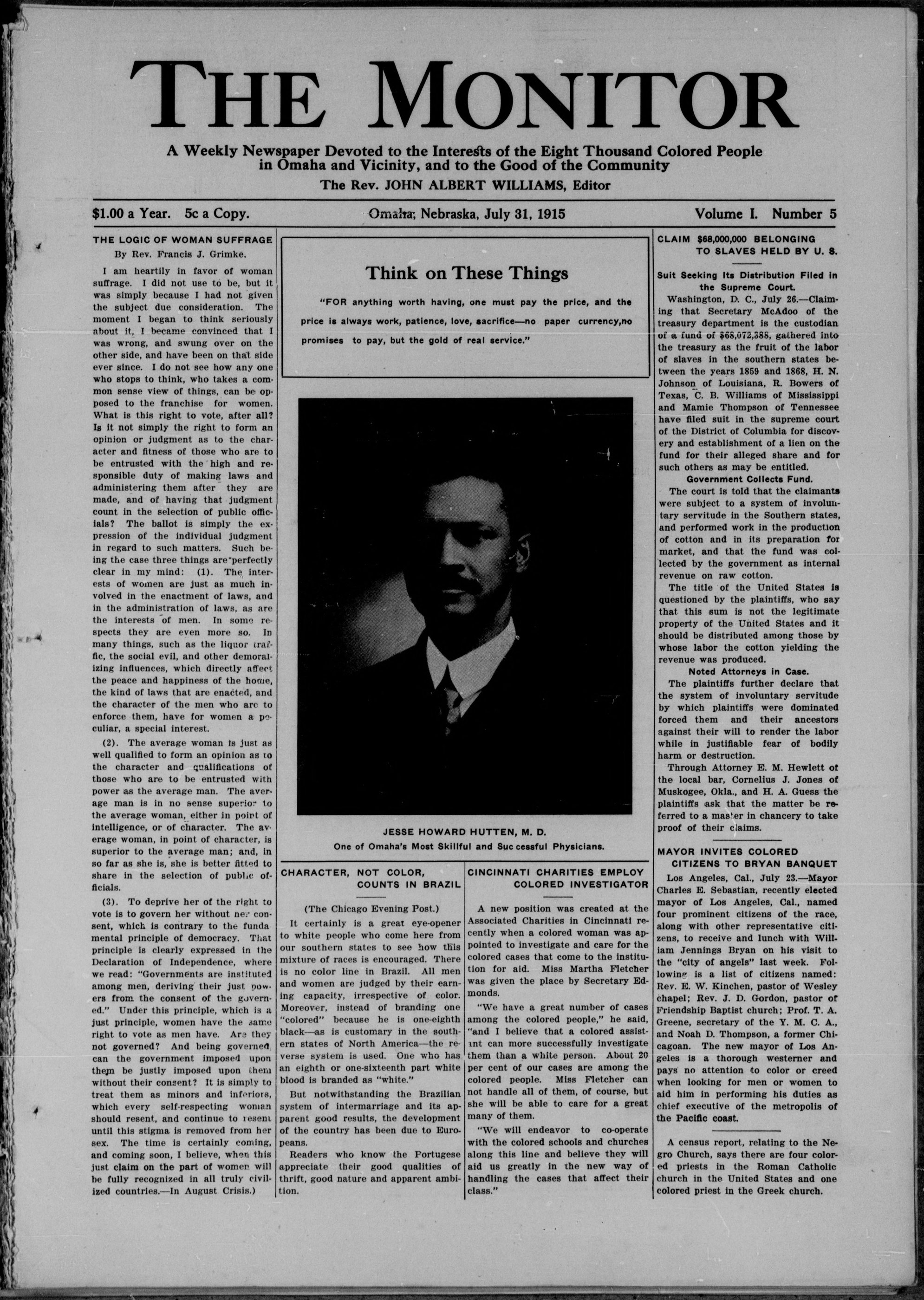
JESSE HOWARD HUTTEN, M. D. One of Omaha's Most Skillful and Successful Physicians.
CHARACTER, NOT COLOR,
COUNTS IN BRAZIL
(The Chicago Evening Post.)
It certainly is a great eye-opener to white people who come here from our southern states to see how this mixture of races is encouraged. There is no color line in Brazil. All men and women are judged by their earning capacity, irrespective of color. Moreover, instead of branding one "colored" because he is one-eighth black—as is customary in the southern states of North America—the reverse system is used. One who has an eighth or one-sixteenth part white blood is branded as "white."
But notwithstanding the Brazilian system of intermarriage and its apparent good results, the development of the country has been due to Europeans.
Readers who know the Portugese appreciate their good qualities of thrift, good nature and apparent ambition.
---
---
---
one must pay the price, and the
e, sacrifice—no paper currency, no
real service."
CINCINNATI CHARITIES EMPLOY COLORED INVESTIGATOR
A new position was created at the Associated Charities in Cincinnati recently when a colored woman was appointed to investigate and care for the colored cases that come to the institution for aid. Miss Martha Fletcher was given the place by Secretary Edmonds.
"We have a great number of cases among the colored people," he said, "and I believe that a colored assistant can more successfully investigate them than a white person. About 20 per cent of our cases are among the colored people. Miss Fletcher can not handle all of them, of course, but she will be able to care for a great many of them.
"We will endeavor to co-operate with the colored schools and churches along this line and believe they will aid us greatly in the new way of handling the cases that affect their class."
CLAIM $68,000,000 BELONGING TO SLAVES HELD BY U. S.
Suit Seeking Its Distribution Filed in the Supreme Court.
Washington, D. C., July 26.—Claiming that Secretary McAdoo of the treasury department is the custodian of a fund of $68,072,388, gathered into the treasury as the fruit of the labor of slaves in the southern states between the years 1859 and 1868, H. N. Johnson of Louisiana, R. Bowers of Texas, C. B. Williams of Mississippi and Mamie Thompson of Tennessee have filed suit in the supreme court of the District of Columbia for discovery and establishment of a lien on the fund for their alleged share and for such others as may be entitled.
Government Collects Fund.
The court is told that the claimants were subject to a system of involuntary servitude in the Southern states, and performed work in the production of cotton and in its preparation for market, and that the fund was collected by the government as internal revenue on raw cotton.
The title of the United States is questioned by the plaintiffs, who say that this sum is not the legitimate property of the United States and it should be distributed among those by whose labor the cotton yielding the revenue was produced.
Noted Attorneys in Case.
The plaintiffs further declare that the system of involuntary servitude by which plaintiffs were dominated forced them and their ancestors against their will to render the labor while in justifiable fear of bodily harm or destruction.
Through Attorney E. M. Hewlett of the local bar, Cornelius J. Jones of Muskogee, Okla., and H. A. Guess the plaintiffs ask that the matter be referred to a master in chancery to take proof of their claims.
MAYOR INVITES COLORED
CITIZENS TO BRYAN BANQUET Los Angeles, Cal., July 23.—Mayor Charles E. Sebastian, recently elected mayor of Los Angeles, Cal., named four prominent citizens of the race, along with other representative citizens, to receive and lunch with William Jennings Bryan on his visit to the "city of angels" last week. Following is a list of citizens named: Rev. E. W. Kinchen, pastor of Wesley chapel; Rev. J. D. Gordon, pastor of Friendship Baptist church; Prof. T. A. Greene, secretary of the Y. M. C. A., and Noah D. Thompson, a former Chicagoan. The new mayor of Los Angeles is a thorough westerner and pays no attention to color or creed when looking for men or women to aid him in performing his duties as chief executive of the metropolis of the Pacific coast.
A census report, relating to the Negro Church, says there are four colored priests in the Roman Catholic church in the United States and one colored priest in the Greek church.
General Race News
2
Dismond Wins Four-Forty Dash With Ease.
Pittsburgh, Pa., July 16.—H. Binga Dismond, star quarter-miler of the University of Chicago, came to Pittsburgh Saturday and so marvelous was his work that the entire athletic world is still talking about him. He entered the Pittsburgh Press games and won. So wonderful was his work that the Pittsburgh Press (white) has the following to say about him:
"H. B. Dismond, the * * * flier from the University of Chicago, had things all his own way in the 440-yard dash, in the Press meet at Forbes Field yesterday. Dismond is undoubtedly one of the fastest quarter-milers that has performed in the Steel City for many moons, and it was a pity that the local boys who were entered weren't able to give him a stiffer battle. His winning time was 50 1-5 seconds, which was very fast considering the fact that no one forced him to exert himself. Dismond is a remarkably built athlete, one who has just the right proportions to chock off the 440 dash in record time.
"Lawrence Holland, of the Indiana Normal school, who hails from Wellsville, O., and who is slated to enter the University of Pittsburgh next fall, was second place man. He beat out Dunseith, the Carnegie Tech quartermiler, who was running under the P. A. A. Holland is employed this summer with Westinghouse Airbrake Company and competed under their colors yesterday. He won the 440-yard dash on the Schenley Oval on the Fourth and is a good man, although not in the class with Dismond.
"It was a real treat to see the speed wonder eat up the distance around the Forbes Field track and when he broke the tape many yards ahead of his rivals he was accorded an ovation.
"H. B. Dismond, a superb specimen of young manhood, won the 440-yard dash for the University of Chicago amid the wildest applause. The athlete made a remarkable run that stamped him as a real champion.
"More than one sport sharp made the assertion that if Dismond had had stronger competition, he might have bettered the remarkable record he made when he established the Western Conference Collegiate record of 49 flat for the same distance. Dismond then made faster time than did Ted Meredith of the University of Pennsylvania in the East this year. He is a University of Chicago man. The reference made to the strength of his competition is no reflection on those who ran with him, who made the gamest kind of a fight for first place, and made very good time."
HON. CHARLES A. COTTRILL
Toledo, O., July 30.—Hon. Charles A. Cottrill, ex-collector of internal revenue at Honolulu, whom President Wilson removed, has returned, with his family, to Toledo, and was given a banquet here by his friends. Mr. Cottrill's Ohio friends in the Knights of Pythias are quietly discussing his fitness and availability for Supreme Chancellor of the K. P.'s to succeed
THE MONITOR
the present Supreme Chancellor Green of New Orleans, when the supreme lodge meets at Columbus in August. At the time he left for Honolulu Mr. Cottrill was grand chancellor of the state, and resigned on leaving for the Hawaiian islands.
J. D. Coleman, a freshman of Bates college, has been awarded a scholarship in Harvard college and a prize for excellence in Greek.
The track team of the Pittsburgh Central high school consists of eight members; four white and four colored. One of the colored boys is captain.
Fisk university graduated thirty-eight students; twenty-one bachelors of art; twelve normal graduates and five with certificates in teaching. There are 1,041 living alumni.
At the head of the regiment of Egyptian artillery, now fighting on the Yser, is a young West African, Col. Pasquale Denoix, who made a brillian record at the military academy at Bordeaux.
The Danville (Va.) Loan and Investment company is capitalized at $35,000. The corporation owns property valued at $40,000 and have made loans to the amount of $13,000. E. H. Adams is president and R. J. Wilson, secretary and treasurer.
W. Howlett Jones, 207 Main street, Danville, Va., has had twenty-five years' experience as a baker and manufacturing confectioner, and has successfully held his own against all competition in the city. He easily does a business of $25,000 annually.
Since the establishment of the Roman Catholic board for colored missions, forty new missions have been started and over 5,000 children received in school. The work which has been done in the South suffers from a lack of priests and sisters.
The newspaper and job printing establishment of the Journal and Guide, the Newport News Star and the Planet of Richmond, Va., are about the most complete businesses of its kind owned by the race in the United States. The payroll of the Journal and Guide is about $700 per week.
An official report from Paris tells of the successful capture of a trench near the Dardanelles, under cover of the dark. Following orders, a mixed company of colored and white volunteers crept on hands and knees, up the embankment, and so surprised the Turks that they fired in the air and fled.
Russell Lee of Des Moines, Iowa, is eleven years of age and in three years has done the school work which a normal child takes five and one-half years to do. The principal of his school says: "In all my experience as a teacher I have never seen a pupil make such remarkable progress." In a recent test in mathematics Lee ranked the whole school in accuracy and efficiency.
Mr. R. F. C. Cooper, a colored Jamaican and second year student in
medicine at Dalhousie university, at Halifax, has rendered a signal service to his college, as well as shown evidence of exceptional ability in his chosen profession, by drawing a set of twenty-five charts, or diagrams in colors, for use in the Historical department of the medical college. The diagrams are scientifically correct as well as artistically beyond criticism, but further than that they constitute a very valuable asset in the teaching equipment.
Mr. Julius Rosenwald has since October 1st, 1914, donated $6,191 toward the building of twenty-one school houses for colored children in Alabama. The state of Alabama gave $3,150; white people gave $1,570, and colored people themselves raised $9,279, a total of $21,190. Mr. Rosenwald is offering to help build two hundred school houses in Alabama and the South during a period of five years and will donate in all about $70,000. The money is given on condition that the state, and the colored people help. The fund is administered by the extension department of Tuskogee Institute.
A colored commissioner of St. Thomas, D. Hamilton Jackson, made a special trip to Denmark and obtained from the parliament freedom of speech for the islanders, full suffrage for natives, university education in Denmark for graduates of the island schools, replacement of white gendarmes by native police. The governor, who was the friend of the planters, has been recalled and the land which has been held by the planters has been thrown open to the natives, who can get loans from the government with which to buy it.
Mr. Jackson spoke before the king of Denmark and was invited by the king of Sweden to visit him. He will pass through New York shortly.
The Clothing Center of Omaha Brandeis Stores
Omaha & Council Bluffs Street Railway Company
When you stop to think about it, you, of course, realize the grave danger that menaces your children when they play on the streets on which cars are operated, but do you think about it often enough? And do you caution your children about it often enough?
When children are playing, their minds are engrossed with their play, and they are utterly unheedful of approaching cars, and frequently dart directly in front of them.
HELP US IN PREVENTING ACCIDENTS
Some New Toilet Goods Prices
50c Pompeian Massage Cream **29c**
25c Houbigant's Rice Powder **17c**
$1.00 Listerine, Lambert's.....**59c**
50c Malvina Cream for .....**29c**
25c Mennen's Taicum (4 kinds)
each .....**12c**
25c Rogers and Gallet Perfumed
Rice Powder for .....**17c**
25c 4711 White Rose Soap.....**12c**
25c Woodbury's Facial Soap.....**17c**
You "save time and money" by
coming to the Rexall Stores for
toilet goods.
Sherman & McConnell Drug Co. 4 GOOD DRUG STORES
ASK YOUR GROCER FOR Tip Top Bread Best Bread Made
Phone Douglas 1652
W. J. CATTIN CO.
PLUMBING AND
STEAM FITTING
910 No. 24th St. Omaha, Neb.
EMERSON LAUNDRY
F. S. MOREY, Proprietor
1303-05 North 24th Street
Phone Webster 820
CHAS. EDERER
FLORIST
Plants, Cut Flowers, Designs,
Decorations
Greenhouses, 30th and Bristol Sts.
Phone Webster 1795
ng Center
News of the Churches and Religious Topics
---
Directory
Baptist—
Mt. Moriah—Twenty-sixth and Seward streets. The Rev. W. B. M. Scott, pastor. Services: Sunday School, 9:30 a.m.; preaching, 11 a.m. and 8 p.m.; B. Y. P. U. at 6 p.m.
Zion — Twenty-sixth and Franklin (temporary location). The Rev. W. F. Botts, pastor; residence, 2522 Grant street. Telephone Webster 5838. Services: Devotional hour, 10:30 a.m.; preaching, 11 a.m.; Sunday School, 1 to 2 p.m.; pastor's Bible class, 2 to 3 p.m.; B. Y. P. U., 6:30 p.m.; choir devotion, 7:30 p.m.; preaching 8 p.m.
Episcopal—
Church of St. Philip the Deacon Twenty-first near Paul street. The Rev. John Albert Williams, rector. Residence, 1119 North Twenty-first street. Telephone Webster 4243. Services daily at 7 a. m. and 9 a. m. Fridays at 8 p. m. Sundays at 7:30 a. m., 11 a. m. and 7:30 p. m. Sunday School at 12:45 p. m.
Methodist—
St. John's A. M. E.—Eighteenth and Science Notes BY WILLIAM G. HAYNES.
Blood Bread.
Not long ago attention was called to the fact that a flour from bananas was being used as a substitute for wheat flour. How the little children's mouths watered for a taste of that flour! Right on the heels of that comes the announcement that a bread made from blood has been in use for many years. The Scientific American gives the following note:
"Prof. Kober of Munich has published a little treatise on the utilization of blood as food, from which Die Umschau quotes the following statements concerning the use of blood in breadmaking. For centuries blood bread has been the staff of life of the Esthonians of the Baltic provinces and their colonies in all parts of Russia. It is made of rye flour, with an admixture of at least 10 per cent of whipped hogs' blood. In the vicinity of Petrograd ox blood is also used. Blood bread is very nutritious and is highly praised by Esthonian physicians because of its richness in organic compounds of phosphorus and nerve-restoring salts. Bread made with ox blood dries very quickly, but this defect can be remedied by the addition of potato flour, which is now a common practice in Germany. Blood bread is the most natural substitute for meat, and, with government control of the slaughter houses, it need cost little or no more than ordinary bread. According to the Frankfurter Zeitung, rye bread containing hogs' blood has long been used in Oldenburg.
Hard Water.
This sounds like a "tough proposition," but it isn't. It isn't nearly so hard as ice, the real hard water—hard to get and hard to keep.
Hard water, generally speaking, is water containing certain mineral substances dissolved in it. The hardness
THE MONITOR
Webster streets. The Rev. W. T. Osborne, pastor. Residence, 613 North Eighteenth street. Telephone Douglas 5914. Services: Sunday, 11 a. m. and 8 p. m., preaching; 12 noon, class; 1:15 p. m., Sunday School; 7 p. m., Endeavor; Wednesday, 8 p. m., prayer and class meetings. Everybody made welcome at all of these meetings.
Grove M. E.—Twenty-second and Seward streets. The Rev. G. G. Logan pastor. Residence, 1628 North Twenty-second street.
Allen Chapel, A. M. E., 181 South Twenty-fifth street, South Omaha. The Rev. Harry Shepherd, pastor. Residence, 181 South Twenty-fifth street. Services: Preaching, 11 a.m.; Sunday School, 1:30 p. m.
The Rev. Harry Shepherd is closing is fourth conference year and is urging members and friends to pay in their Dollar Money now. The fourth and last quarterly meeting will take place the third Sunday in August.
of water is brought to the attention of the housewife by the fact that a larger amount of soap is necessary to make a good lather than is required when a "soft" water is used.
There are two kinds of hardness, namely: temporary and permanent. Water becomes temporarily hard by reason of the fact that it has dissolved in it a gas called carbon dioxide. Now, when the water comes in contact with calcium carbonate (or chalk as it is known), the dissolved carbon dioxide converts the insoluble chalk into a soluble form known as calcium bicarbonate. It is this substance that prevents the easy lathering of soap.
To remove temporary hardness it is merely necessary to boil the water, when the soluble calcium bicarbonate is decomposed, giving up the carbon dioxide, and reverting to the insoluble calcium dioxide, which may be found as a sediment in the bottom of the container.
Permanent hardness, on the other hand, is due chiefly to compounds of magnesium (a constituent of everyday Epsom salts). These compounds are not affected by boiling, so that the hardness is removed by a chemical method of treating the water and converting the magnesium salts into insoluble compounds.
A third form of "hardness" not designated in scientific treatises upon the subject is the topic of the following interesting paragraph:
"Do you realize how hard water is when a boat sails through it at full speed? Water passing at fifty miles an hour is not the limpid liquid we are accustomed to bathe in. If you put your arm overboard from a hydroplane running fifty miles an hour, and strike a wave crest, the probability is that you will break your arm or your wrist, because at that speed the water has not time to give or even to change shape, and striking it is like striking so much metal. If a swordsman should enter one of the great hydraulic quarries, where a stream of water, under enormous head, is used to wash down hillsides, and attempt to cut into one of those streams, his sword would fly to pieces without be-
ing able to penetrate the water. The stream is like a bar of iron.—The Youth's Companion.
Device Which Prevents Listening on Party Lines.
One of the most prevalent annoyances with which telephone subscribers have to deal is the "cutting in" by another person on a party line. Any attempt toward the elimination of the evil will receive hearty indorsement from all sides. The following description will no doubt be of interest to the long-suffering victims of the telephone eavesdropper:
An automatic licking device which prevents eavesdropping and interruptions on party lines will be of interest to many telephone subscribers. The lock weighs less than a pound and can be carried in the vest pocket. It may be connected to the telephone it serves or to the terminal box from which the several lines are distributed. The action is automatic, the mechanism being composed of a series of magnets and contacts which are brought into operation when a receiver any place on the party line is removed from the hook. A clear line from the subscriber to the central office is made automatically by the magnets and contacts. Telephone engineers have tested the invention and it is said to have worked properly and promptly.—World's Advance.
How often have we heard a friend say, "Don't mention that while I am eating because it will 'turn my stomach'." Everyone has undergone the experience of having his or her stom- "turned" at some time or other. Now, what is meant by "turning the stomach?" Some light is thrown on the subject by a recent article by Dr. Lusk of Cor-
BURGESS-NASH COMPANY
“EVERYBODY’S STORE”
announce their Second Annual
July Clearing Sale
Starting Friday, July 9th
We Print the Monitor
WATERS
BARNHART
PRINTING CO.
522-24 South Thirteenth St.
Telephone Douglas 2190
"Turning the Stomach."
nell medical school. The article is brief and is taken from the Journal of the American Medical Association," and follows:
"When food is taken without appetite, this important preliminary flow of gastric juice does not take place and proper digestion is rendered more difficult.
"The appetite is like a magic wand influencing the whole of the digestive process. Fear and anger lead to a parched throat, and in an entirely similar manner to a parched stomach, so that food can not be well digested under these circumstances. It is familiar to all that the sight, smell or sound of anything repellant will cause loss of appetite. The writer has seen an artist faint when an operation of Dr. Carrel became the subject of a dinner conversation where men and women were present. The appetite is favored by the extraneous refinements of civilized life, such as a spotless tablecloth. It would also be affected by the cleanliness of the preparation of the food could one always look behind the scenes. It is affected by the atmosphere of cheer at the table. Neither scolding parents nor snarling children facilitate the digestion of a Christmas dinner. The question of flavor in all its ramifications is therefore a very important one. It is one of the pitfalls of the prescribing physician, because he is very likely to believe that what he likes is excellent and what he detests is bad. The great multitude of people like pickles, but some do not; the latter class must not argue that pickles are therefore injurious. The common foods of life, such as potatoes, tomatoes, and bananas, all have their personal enemies based on dietetic prejudices which are largely imaginary, although as a phychosis the manifestations of repulsion are very real."
THE MONITOR
A Weekly Newspaper devoted to the civic, social and religious interests of the Colored People of Omaha and vicinity, with the desire to contribute something to the general good and upbuilding of the community. Published Every Saturday.
Entered as Second-Class Mail
office at Omaha, Neb., under the
THE REV. JOHN ALBERT W.
Lucille Skaggs Edwards, William
Pryor, Assoc
Joseph LaCour, Jr., Adverti
SUBSCRIPTION R
Advertising rates, 25
Address, The Monitor, 1119 N
Entered as Second-Class Mail Matter July 2, 1915, at the Post office at Omaha, Neb., under the act of March 3, 1879.
THE REV. JOHN ALBERT WILLIAMS, Editor and Publisher.
Lucille Skaggs Edwards, William Garnett Haynes and Ellsworth W. Pryor, Associate Editors.
Joseph LaCour, Jr., Advertising and Circulation Manager.
SUBSCRIPTION RATES, $1.00 per year.
Advertising rates, 25 cents an inch per issue.
Address, The Monitor, 1119 North Twenty-first street, Omaha.
"OCCUPIED BY COLORED TENANTS."
The following letter was received by a real estate firm a few days ago: "Omaha, July 22, 1915.
"We issued on July 20th, 1914, American policy No. 105710 to et al., covering on frame building at street. The company inspected the premises and found it occupied by colored tenants and inasmuch as they prefer not to continue the risk, they have asked us to cancel. Would you kindly return the policy to us and we will be pleased to send you the return premium thereon.
For obvious reasons we withhold the name of the local insurance firm making this unusual request and also the name of the real estate firm to whom the letter is addressed, as well as the name of the owner and location of the property. We have no desire to injure the insurance company, or to bring the owners of the property into any undue notoriety from which being modest people, they would naturally shrink. Our sole purpose is to protest against the unjust spirit manifested in this letter and to indignantly resent the implication that property "occupied by colored tenants" furnishes more hazardous risks than like property occupied by white tenants of the corresponding class or classes.
This property is in a good neighborhood and is occupied by respectable people. The absurdity of this request becomes the more striking when it is recalled that this company has carried the insurance on this same property for about twenty years and all this time it has been OCCUPIED BY COLORED TENANTS, and there has been no destruction by fire there yet. Surely this shows that tenancy by colored people does not necessarily constitute an unusual risk, although this company seems to think so. The fact that this firm has just discovered, after these many years, that this property has been "occupied by colored tenants" does not, in our humble judgment, speak any too well for the business acumen of this firm who for all these years have been running the hazardous risk incurred, evidently from their point of view, in carrying insurance on property "occupied by colored tenants."
It is to be noticed that the reason assigned is not that the property is in poor repair or defectively built, and might therefore be a bad risk, but that it is "occupied by colored tenants." Colored people have been accused of many things, some true, some
Matter July 2, 1915, at the Post-act of March 3, 1879.
WILLIAMS, Editor and Publisher.
Garnett Haynes and Ellsworth W.
Associate Editors.
Rising and Circulation Manager.
ATES, $1.00 per year.
Cents an inch per issue.
North Twenty-first street, Omaha.
false, but this is the first time that we have ever known them to be accused, by implication at least, of being by nature so inflammable that their mere occupancy of a house was liable to set it on fire. Heat means energy. By this sign, therefore, we must be becoming mighty energetic.
We have advised returning the policy as requested, and placing the insurance with another firm. Among our advertisers there are firms who will be pleased to write insurance for houses "occupied by colored tenants." Colored people are under no obligations to spend their money with people or firms who say they don't want it.
A SUCCESSFUL PHYSICIAN.
Omaha has many citizens of color who are making good in their chosen or enforced fields of occupation. Some are doing the work that pleases them and for which they have prepared themselves. Others are doing whatever work they can get to do awaiting an opportunity to do that which is more to their liking. For example, we know of a fine young man, who is a registered and experienced pharmacist, who came to Omaha haping that he might find employment along his own professional lines. He has not been able to do so as yet; so he wisely took the first thing he could get to do, namely, the position of a waiter, which is an honorable and honest occupation—just as honorable as that of a pharmacist, but it is not that for which he studied and prepared himself and naturally prefers.
Among our physicians, of whom we have six, namely, Drs. Hutten, Edwards, Gordon, Britt, Gooden and Hill, a prominent place is occupied and deservedly by Dr. Jesse Howard Hutten, whose cut it gives us pleasure to publish in this issue. Although a comparatively young man he is our ranking physician in time of residence and practice.
Dr. Hutten was born in Newberry, S. C., June 20th, 1870. He is the son of Ransom and Martha (Johnson) Hutten. His primary education was received in the public schools of his native town. He was graduated from Biddle university, the famous Presbyterian institution of Charlotte, N. C., with the degree of B.A. in June, 1893, receiving his master's degree from the same university later. He taught school for one year at Augusta, Ga., and entered the medical department of Howard university, Washington, D. C., in the autumn of 1894, from which he was graduated in 1897. He was employed as interne at the Freedmen's hospital for one year, after which he decided to come west. He came to Omaha in 1899, where he has since resided, and has built up a large practice. He has been very suc-
---
THE MONITOR
cessful as a physician and he owes his success to his studious, conscientious and strict attention to his profession. He has been frugal in his habits and industrious, and has invested his earnings in Omaha real estate, which have turned out well. As a result the day is not far distant when he will be in reasonably comfortable circumstances. He is one of the partners in the Peoples Drug Store and has a pleasant home at 1105 North Nineteenth street graciously presided over by Mrs. Hutten, who is a woman of marked culture and refinement.
Dr. Hutten like al. men whose place is assured in a community, is entirely void of professional jealousy. He has given cordial welcome to younger physicians who have come to Omaha and has been only too happy to aid them in any way possible.
His brother practitioners of the other race have high regard for his professional skill, and his gentlemanly bearing.
Dr. Hutten has been successful in his chosen calling because he has been willing to pay the price—painstaking, persevering work.
Did you attend the Saengerfest? Then you don't know what you missed. The local committee it to be congratulated upon bringing that inspiring organization of trained singers and artists to our city and upon the great success which attended the concerts. As one listened to the glorious music of those well-trained voices of the music-loving Germans, he could not but think of the thousands of similar voices which are being stilled in the trenches of Europe and earnestly pray that the day of peace, honorable peace, to all might speedily come. When you listen to the Germans sing, you can understand why the Germans can fight; but we would rather hear them sing that hear of their fighting, and we believe that they would rather sing than fight. May peace speedily cofine to war distracted Europe.
Have you seen the August number of "The Crisis," that splendid magazine published by the National Association for the Advancement of Colored People? If you are not a subscriber, you ought to be. This magazine is kept on file at the Omana public library. The August number contains a symposium on "Votes for Women" by some of the brainiest men and women of our race. The able articles from their pens show the ability of our people as thinkers on this important subject which is ultimately going to win.
We desire to extend our most sincere congratulations to our good friend, Thomas J. Flynn, upon his appointment to the important position of United States marshal for Nebraska. Mr. Flynn has discharged the duties of the various offices which he has held with faithfulness and efficiency and we are confident that the same intelligence, ability, fidelity and efficiency will characterize his work in the position to which he has just been appointed. We wish him every success.
The Monitor is being read in many of the best homes of both races in Omaha and elsewhere. It is on file in the reading rooms of the public library, the Y. M. C. A., the Y. W. C. A. and the Commercial Club. It is on sale at many of the news stands of the city. Its list of subscribers is steadily growing. Advertisers tell us that it is bringing them results. That
is what they want and that's what we want. We are helping advertise Omaha.
And that rubbish never quitting, still is lying, still is sitting, in the street so mud bespattered, and with brick bats sadly scattered, running by our chamber door. MUST IT LIE THERE EVERMORE? Street Commissioner, I implore: Remove or fence that unsightly rubbish, and stop complaint for evermore.
Next month Omaha is to welcome a large convention of well-behaved, self-respecting colored people. Citizens should and doubtless will extend them every courtesy to which they will be justly entitled.
Better get in your next winter's coal.
BIDS US WELCOME.
The Nebraskan has received the initial copy of The Monitor, "a weekly newspaper devoted to the interests of the eight thousand colored people in Omaha, and to the good of the community." This enw publication is printed on eight pages of fine paper and is well edited by the Rev. John Albert Williams. The Nebraskan bids welcome to the Monitor.—The Omaha Nebraskan.
A GOOD ADVERTISING MEDIUM.
1119 North Twenty-first Street,
We like the appearance of the Monitor and believe your paper affords an especially good, new medium through which to advertise our lines of real estate, insurance and rentals. As an evidence of this we enclose herewith some advertising copy for your next issue. With our best wishes for the Monitors's success.
CHARLES E. WILLIAMSON.
SEQUENCE.
If at my door I plant a tree,
And nurture it with care,
No wonder will it be to me
If birds come singing there.
If I cast anchor by a bog,
It should be no surprise
That noisome vapors, in the fog
Enshrouding me, arise.
If I encamp beside a lake,
Whose depths reflect the sky,
What marvel if, when morn shall
break,
White swans come sailing by!
—Harriet Appleton Sprague.
If The Monitor Pleases You Subscribe Now
One Dollar a Year
Events and Persons
In Which You Will Be More or Less Interested. News for This Department Must Be Received by Wednesday Night.
```markdown
```
Mrs. T. S. Riggs returned Tuesday morning from a week's visit to St. Louis, Mo.
Mrs. Phyllis Littold of Dallas, Tex., is visiting her sister, Mrs. George H. Thomas, 2430 Lake street.
Mrs. Julia Jones of Savannah, Ga., is visiting her sister, Mrs. James Clark, 3015 Franklin street.
The First Regimental band went to Clarinda, Ia., Tuesday to give concerts for the Chautauqua assembly.
Miss Hazel E. Wilson of Chicago is the guest of her grandmother, Mrs. S. G. Wilson, 3905 North Twenty-first street.
Miss Lena E. Thurston of Parsons, Kan., is visiting her sister, Mrs. W. E. Green, 2305 North Twenty-seventh street.
Mrs. Jasper E. Brown and daughter Gladys, who have been visiting relatives at Atchison, Kan., returned home the early part of last week.
Mrs. Chester Williams left Saturday morning for Denver to rejoin her husband, who is in the dining car service and is making that city his headquarters.
Mr. Nate Hunter leaves tonight for New York City to attend the imperial council of the Shriners. He expects to visit in Detroit, Mich., and Buffalo, N. Y., before returning home.
Miss Jennie Robinson of 3643 Parker street, accompanied by her nephew, Joseph Dorsey, left Friday night for Woodstock, Ontario, for a six weeks' visit with her parents.
Mr. Charles Johnson of Watson, Mo., was the guest of his sister, Mrs. Charles H. Hicks, 2020 Clark street, Sunday and Monday, and incidentally attended the Barnum & Bailey shows.
The lawn social given for the benefit of the Negro Women's Christian Association at the residence of Mrs. H. R. Roberts, Thursday night of last week, was a social and financial success.
Mrs. C. P. Lynch entertained a few friends at whist at her residence, on Twenty-sixth and Seward street, Wednesday evening of last week. The first prize was won by Mrs. Falling and Mr. Douglas.
Next Thursday, August 5th, Zion and Mount Moriah Baptist Sunday schools will hold a union picnic at Elmwood park. Cars leave Twenty-fourth and Franklin streets at 12 noon and dinner will be served at 3 o'clock.
Sergeant William Sadler, quartermaster at Fort Omaha, who is at present in sole charge of the post, was a dinner guest Sunday of Sergeant and Mrs. Philip Letcher at their residence, 3415 North Twenty-eighth street.
Mrs. Lizzie Porter of Oswego, Kas., grand matron O. E. S. of Kansas and Colorado jurisdiction, on her annual visitation, spent a few days in Omaha
THE MONITOR
this week and visited O. E. S. No. 42. While here she was the guest of Mrs. J. R. Harris.
Mrs. H. R. Roberts and her daughter Madaline of 2610 North Twenty-eighth avenue left Sunday afternoon for Seattle, Wash., to visit her husband, who for some months has been employed in the dining car service out of that city.
William Burrell returned last week from attendance at the grand lodge of Masons, which met at Cedar Rapids. His children, Selma and William, Jr., who accompanied him to Iowa, remained there visiting relatives until Tuesday of this week.
The "C" supper which was to have been given by the "Cautious Catering Company" under the auspices of the New Woman's Reform Circle at Zion Baptist church, Twenty-sixth and Franklin streets Tuesday evening, July 27th, has been postponed until Tuesday night, August 3rd. Public will please notice change of date.
The following were cooked and demonstrated at St. Philip's cooking school last Thursday, July 22:
Veal birds, stuffed with giblet dressing.
Chuck steak, stuffed with mushrooms and shriveled crackers.
Leftover meats with spaghetti shells.
Spaghetti escalloped with tomatoes.
Spaghetti with cream sauce.
Spaghetti with white dressing and cheese.
Green bean nuggets with cheese dressing.
Asparagus salad molded with tomatoes and nuts.
Macaroni with pimento cheese.
Shredded wheat cases filled with peaches.
Shredded wheat with blackberries.
Shredded wheat baskets with red currants and whipped cream.
Shredded wheat basket and red raspberries.
REFUSING GREAT MUSICIANS.
It is said that once Mendelssohn came to see the great Frieburg organ. The old custodian refused him permission, not knowing who he was. At length, however, he reluctantly granted him leave to play a few notes. Mendelssohn took his seat, and soon the most wonderful music was breaking forth from the organ. The custodian was spellbound. He came up beside the great musician and asked his name. Learning it, he stood humiliated, self-condemned, saying, "And I refused you permission to play upon my organ!"
There comes One to us and desires to take our lives and play upon them. But we withhold ourselves from Him, and refuse Him permission when if we would yield ourselves to Him, He would bring from our souls heavenly music.—Christian Index.
Judge—Have you anything to say before sentence is passed?
Burglar—The only thing I'm kicking about is bein' identified by a man that kep' his head under the bedclothes the whole time. That's wrong.
—Philadelphia Evening Ledger.
INJUSTICE.
COLORED GIRL TYPIST IS GOLD MEDAL WINNER Newport, R. L., July 21.—At the graduating exercises of the Child's Business College of this city, Friday afternoon, July 16th, Miss Olive L. Jeter, its only colored graduate, and the youngest daughter of the Rev. H. N. Jeter, was awarded a Remington gold medal for writing seventy-five words per minute for ten consecutive minutes on the Remington typewriter.
During the exercises a typewriting test was held, at which time Miss Jeter won the first prize, a $5 gold piece, as the result of having the average of sixty-six perfect words per minute for ten consecutive minutes. Miss Jeter recently was awarded the Underwood special credential certificate for writing sixty-three words per minute on the Underwood typewriter.
E. H. WRIGHT GETS A
Chicago, Ill., July 23.—Edward H. Wright, former county commissioner, was today appointed assistant corporation counsel at a salary of $5,000 a year. Wright is the third member of the race to receive a position in the corporation counsel's office in the last two weeks. The others were L. H. Anderson, also named an assistant corporation counsel, and the Rev. Archibald James Carey, who was made chief investigator at a salary of $2,400 a year.
Mr. Wright fills the vacancy that occurred when Charles M. Haft was made first assistant corporation counsel.
There is a Peace that cometh after sorrow,
Of Hope surrendered, not of Hope fulfilled;
A Peace that looketh not upon tomorrow,
But calmly on a tempest that is stilled.
A Peace that lives not now in Joy's excesses,
Or in the Happy Life of Love secure,
But in the unerring strength the heart possesses,
Of conflicts won, while learning to endure.
A Peace there is in sacrifice secluded,
A life subdued from will and passion
free;
'Tis not the Peace that over Eden
brooded,
But that which triumphed at Geth-
semane. —Gates.
A small, henpecked, worried-looking man was about to take an examination for life insurance.
"You don't dissipate, do you?" asked the physician, as he made ready for tests. "Not a fast liver, or anything of that sort?"
The little man hesitated a moment, looked a bit frightened, then replied, in a small, piping voice: "I sometimes chew a little gum."—Collier's Weekly.
EVERY SHO
You Receive VALUE
THOMPSON B
---
EVERY SHOPPING DAY
You Receive VALUE as well as Good Service
Howard and Sixteenth Sts.
PEACE.
THE RAKE.
5
C. P. Wesin Grocery Co.
J. L. PETTEYS, Mgr.
Fruits and Vegetables
2005 Cuming St. Tel. D. 1098
C. H. MARQUARDT CASH MARKET
T. J. Moriarty PLUMBER
1844 N. 20th St. Tel. Web. 3553
Henri H. Claiborne
Notary Public Justice of the Peace
Tel. Red 7401
Res. Doug. 6188 512-13 Paxton Block
Start Saving Now
One Dollar will open an account in the
Savings Department
of the
United States Nat'l Bank
16th and Farnam Streets
Phone Red 2395 8 years in the same block
H. LAZARUS
Shoes and Repairing
Work done while you wait or will call for
and deliver without extra charge
2019 Cuming Street
NORTHRUP
LETTER DUPLICATING COMPANY
"LETTEROLOGISTS"
TYPEWRITTEN CIRCULAR LETTERS
Phone: Doug. 5685 Office:
Res. Web. 4292 506 Paxton Block
Tel. Webster 6446
Sam Abrams
Furnace Work and General
Tin Work of all Kinds
1606 No. 24tb St. Omaha, Neb.
Established 1890
C. J. CARLSON
Dealer in
Shoes and Gents Furnishings
1514 North 24th St. Omaha, Neb.
Patronize Our Advertisers
Our Women and Children
Conducted by Lucille Skaggs Edwards.
HOME AND CHILDREN.
Many mothers give to their homes the frazzled ends of their time, talent, and strength. Our women, attempting to be "up to date," often allow the club, the lodge, and society to consume their energies to the neglect of the real, the greatest shrine in all the world—her home and children. The Omaha World-Herald in a recent editorial gives us much food for thought. It is as follows:
"Where there are childish feet heard pattering about a home there can be found a problem. It is the greatest problem of the world. Sages have differed as to its solution, but none of them has added to the world's information save when they underwent experiences quite the same as other parents. The most profound wisdom upon it has come from simple, patient, painstaking mothers and fathers. The principles have not been written into books, or made the themes of disseminative essays. They have been carried to other homes in quite as simple a manner as they were evolved. And they have become effective only where they have been revised and modified to meet the individual needs of childhood.
"No high-line of authorities need be quoted to emphasize the greatest fandure of the modern home. Mothers a-plenty know what it is. They know that not enough time is taken nowadays in the training of children. Too many mothers think more nowadays—pity 'tis—about the condition of their parlors and dining rooms than about the little temples whose construction and development are given unto them as a divine heritage. They see more in the censure of a neighborhood of their housekeeping faults than the frailties of their children. Too many homes are given up for clubs and outside activities, and too many boys and girls are forsaken at a period of life when their character is formed, to warrant ardent praise of our home-making system as a whole.
"Attempts have been made to substitute the school for the parent, in some measure, and to meet a need that school teachers saw even before the parents. This can never succeed. It has bettered the school, and increased the respect and love of children for their schools, but it has not reached into their hearts as it should.
"Some women are eager to assume new activities, to reach out into newer worlds—and they think that defects of the home government can be remedied by legislation. They never have been and never can be. The parents themselves are responsible for home government and only in being true to their trust can they rule successfully. The trust is of their own creation, and must be of their own molding to the last. The little temples of mind and body that are theirs to safeguard are to be made good or bad by them in their own homes."
ONLY ONE MOTHER.
Most of all the other beautiful things in life come by twos and threes, by dozens and hundreds! Plenty of roses, stars, sunsets, rainbows, brothers and sisters, aunts and cousins, but only one mother in all the wide world.
6
A. E.
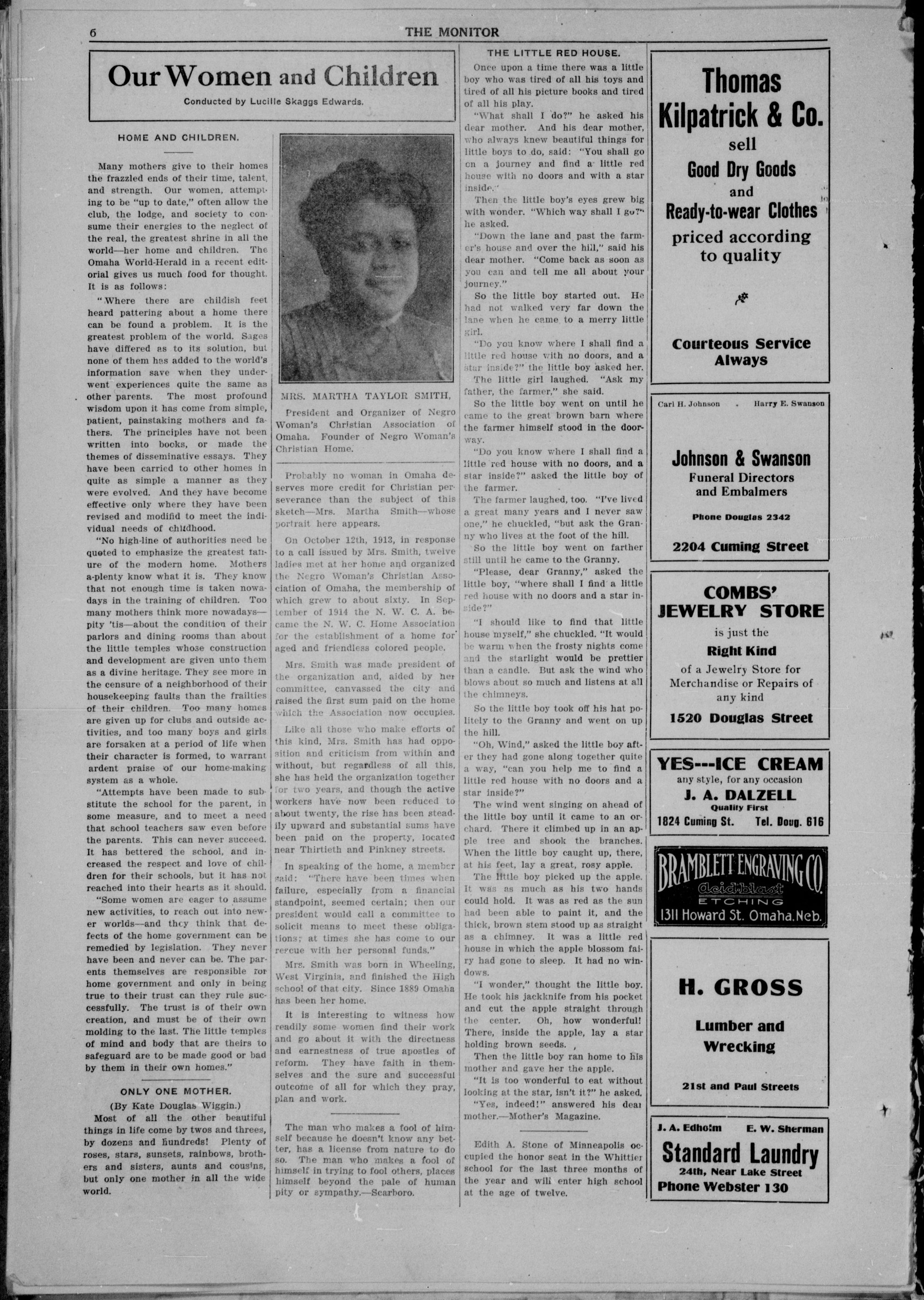
MRS. MARTHA TAYLOR SMITH, President and Organizer of Negro Woman's Christian Association of Omaha. Founder of Negro Woman's Christian Home.
Probably no woman in Omaha deserves more credit for Christian perseverance than the subject of this sketch—Mrs. Martha Smith—whose portrait here appears.
On October 12th, 1913, in response to a call issued by Mrs. Smith, twelve ladies met at her home and organized the Negro Woman's Christian Association of Omaha, the membership of which grew to about sixty. In September of 1914 the N. W. C. A. became the N. W. C. Home Association for the establishment of a home for aged and friendless colored people.
Mrs. Smith was made president of the organization and, aided by her committee, canvassed the city and raised the first sum paid on the home which the Association now occupies.
Like all those who make efforts of this kind, Mrs. Smith has had opposition and criticism from within and without, but regardless of all this, she has held the organization together for two years, and though the active workers have now been reduced to about twenty, the rise has been steadily upward and substantial sums have been paid on the property, located near Thirtieth and Pinkney streets.
In speaking of the home, a member said: "There have been times when failure, especially from a financial standpoint, seemed certain; then our president would call a committee to solicit means to meet these obligations; at times she has come to our rescue with her personal funds." Mrs. Smith was born in Wheeling, West Virginia, and finished the High school of that city. Since 1889 Omaha has been her home.
It is interesting to witness how readily some women find their work and go about it with the directness and earnestness of true apostles of reform. They have faith in themselves and the sure and successful outcome of all for which they pray, plan and work.
The man who makes a fool of himself because he doesn't know any better, has a license from nature to do so. The man who makes a fool of himself in trying to fool others, places himself beyond the pale of human pity or sympathy.—Scarboro.
THE MONITOR
Once upon a time there was a little boy who was tired of all his toys and tired of all his picture books and tired of all his play.
"What shall I do?" he asked his dear mother. And his dear mother, who always knew beautiful things for little boys to do, said: "You shall go on a journey and find a little red house with no doors and with a star inside."
Then the little boy's eyes grew big with wonder. "Which way shall I go?" he asked.
"Down the lane and past the farmer's house and over the hill," said his dear mother. "Come back as soon as you can and tell me all about your journey."
So the little boy started out. He had not walked very far down the lane when he came to a merry little girl.
"Do you know where I shall find a little red house with no doors, and a star inside?" the little boy asked her.
The little girl laughed. "Ask my father, the farmer," she said.
So the little boy went on until he came to the great brown barn where the farmer himself stood in the doorway.
"Do you know where I shall find a little red house with no doors, and a star inside?" asked the little boy of the farmer.
The farmer laughed, too. "I've lived a great many years and I never saw one," he chuckled, "but ask the Granny who lives at the foot of the hill.
So the little boy went on farther still until he came to the Granny.
"Please, dear Granny," asked the little boy, "where shall I find a little red house with no doors and a star inside?"
"I should like to find that little house myself," she chuckled. "It would be warm when the frosty nights come and the starlight would be prettier than a candle. But ask the wind who blows about so much and listens at all the chimneys.
So the little boy took off his hat politely to the Granny and went on up the hill.
"Oh, Wind," asked the little boy after they had gone along together quite a way, "can you help me to find a little red house with no doors and a star inside?"
The wind went singing on ahead of the little boy until it came to an orchard. There it climbed up in an apple tree and shook the branches. When the little boy caught up, there, at his feet, lay a great, rosy apple.
The little boy picked up the apple. It was as much as his two hands could hold. It was as red as the sun had been able to paint it, and the thick, brown stem stood up as straight as a chimney. It was a little red house in which the apple blossom fairy had gone to sleep. It had no windows.
"I wonder," thought the little boy. He took his jackknife from his pocket and cut the apple straight through the center. Oh, how wonderful! There, inside the apple, lay a star holding brown seeds.
Then the little boy ran home to his mother and gave her the apple.
"It is too wonderful to eat without looking at the star, isn't it?" he asked.
"Yes, indeed!" answered his dear mother.—Mother's Magazine.
Edith A. Stone of Minneapolis occupied the honor seat in the Whittier school for the last three months of the year and will enter high school at the age of twelve.
爱
Courteous Service Always
Carl H. Johnson Harry E. Swanson
Johnson & Swanson
Funeral Directors
and Embalmers
Phone Douglas 2342
2204 Cuming Street
COMBS'
JEWELRY STORE
is just the
Right Kind
of a Jewelry Store for
Merchandise or Repairs of
any kind
1520 Douglas Street
YES---ICE CREAM
any style, for any occasion
J. A. DALZELL
Quality First
1824 Cuming St. Tel. Doug. 616
BRAMBLETT ENGRAVING CO.
Acid blast
ETCHING
1311 Howard St. Omaha.Neb.
H. GROSS
Lumber and Wrecking
21st and Paul Streets
J. A. Edholm E. W. Sherman
Standard Laundry
24th, Near Lake Street
Phone Webster 130
---
Mushrooms.
Mushrooms constitute one of the greatest flavoring vegetables known to the scientific cusinier.
It is the fruit of one of the lowest of the great series of flowerless plants of the classified order Fungi, and not the plant itself as is so commonly supposed.
The plant in its beginning is a network of white threads, which are called Mycelium of fungi or spawn, and it is from the joints of these threads the mushroom develops.
They possess a delicate flavor and one eagerly sought for, yet their nutrient value is slight.
Mushrooms are quick in growth and rapid in decay, therefore they are only suitable for food when fresh and crisp.
They are best from October to May, yet in some sections they can be had any time during the year.
An edible mushroom can be easily distinguished from a poisonous fungi by certain characteristics. With the exercise of a little common sense there is no danger of mistaking the edible variety for those that are poisonous.
A true mushroom grows only in pastures, never in wet, boggy places and never about stumps or trees.
All toadstools, technically speaking, are mushrooms, but all mushrooms are not toadstools.
The difference between a toadstool and a true mushroom is soon apparent when you attempt to remove the skin. You can't skin a toadstool—it will break off in small fragments. The covering of a true mushroom on the contrary, can be removed without the slightest difficulty.
Make it a rule not to touch or use a mushroom whose lower gills are white. If still in doubt use the onion test. Take half an onion stripped of its outer skin and boil it with the mushrooms, if the color of the onion is changed and it becomes bluish or tinged with black it is an evident sign that the poisonous fungi are present. If the onion preserves its color there is no danger.
How to Prepare for Cooking.
Obtain freshly gathered mushrooms, sort out the buttons, saving them for garnitures and sauces. The large, open ones are most suitable for broiling, stuffing, baking, etc. Trim off the stems, peel the caps, thoroughly wash them in cold water, to which has been added the juice of a lemon. Drain them on a clean towel and they are ready for use as needed. The stems after being washed can be chopped and used in stuffing and sauces.
A PROSPEROUS SAVINGS BANK. Norfolk, Va., July 28.—The Brown Savings bank of Norfolk is in a very healthy condition. E. C. Brown is the president and William M. Rich, cashier. Starting six years ago, its total assets in 1909 of $10,434, has increased to $67,827.09 in 1914, which is being added to from twenty to thirty thousand each year. The Christmas Saving club feature is very popular. In 1914 the bank paid to the depositors in this club the sum of $23,000. At the rate the members of the club are now making weekly deposits the outlook is favorable for the return of $100,000 the forthcoming Christmas week to the fortunate depositors.
THE MONITOR
```markdown
```
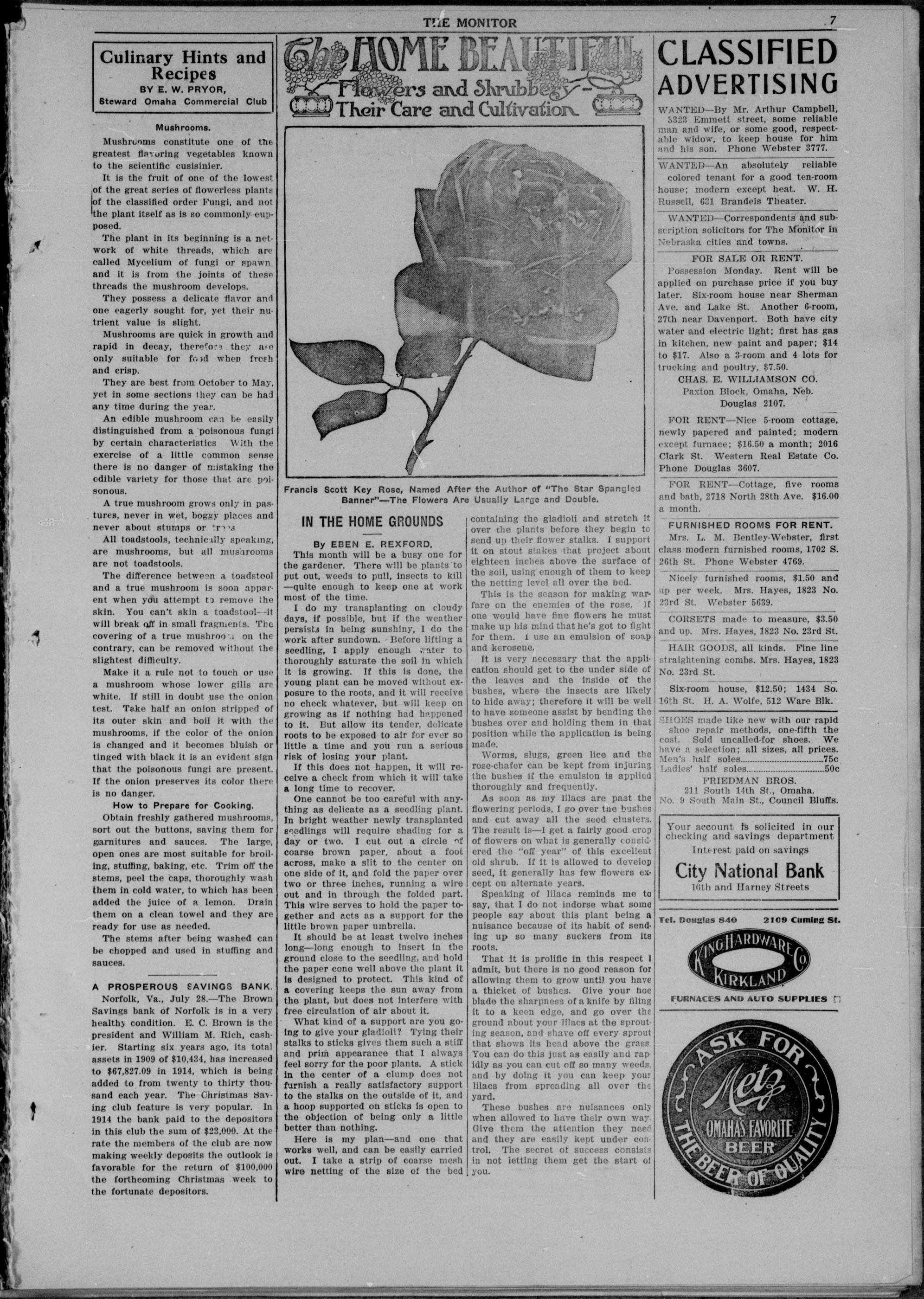
Francis Scott Key Rose, Named After the Author of "The Star Spangled Banner"—The Flowers Are Usually Large and Double.
IN THE HOME GROUNDS
This month will be a busy one for the gardener. There will be plants to put out, weeds to pull, insects to kill—quite enough to keep one at work most of the time.
I do my transplanting on cloudy days, if possible, but if the weather persists in being sunshiny, I do the work after sundown. Before lifting a seedling, I apply enough water to thoroughly saturate the soil in which it is growing. If this is done, the young plant can be moved without exposure to the roots, and it will receive no check whatever, but will keep on growing as if nothing had happened to it. But allow its tender, delicate roots to be exposed to air for ever so little a time and you run a serious risk of losing your plant.
If this does not happen, it will receive a check from which it will take a long time to recover.
One cannot be too careful with anything as delicate as a seedling plant. In bright weather newly transplanted seedlings will require shading for a day or two. I cut out a circle of coarse brown paper, about a foot across, make a slit to the center on one side of it, and fold the paper over two or three inches, running a wire out and in through the folded part. This wire serves to hold the paper together and acts as a support for the little brown paper umbrella. It should be at least twelve inches long—long enough to insert in the ground close to the seedling, and hold the paper cone well above the plant it is designed to protect. This kind of a covering keeps the sun away from the plant, but does not interfere with free circulation of air about it.
What kind of a support are you going to give your gladioli? Tying their stalks to sticks gives them such a stiff and prim appearance that I always feel sorry for the poor plants. A stick in the center of a clump does not furnish a really satisfactory support to the stalks on the outside of it, and a hoop supported on sticks is open to the objection of being only a little better than nothing.
Here is my plan—and one that works well, and can be easily carried out. I take a strip of coarse mesh wire netting of the size of the bed
By EBEN E. REXFORD.
containing the gladioli and stretch it over the plants before they begin to send up their flower stalks. I support it on stout stakes that project about eighteen inches above the surface of the soil, using enough of them to keep the netting level all over the bed.
This is the season for making warfare on the enemies of the rose. If one would have fine flowers he must make up his mind that he's got to fight for them. I use an emulsion of soap and kerosene.
It is very necessary that the application should get to the under side of the leaves and the inside of the bushes, where the insects are likely to hide away; therefore it will be well to have someone assist by bending the bushes over and holding them in that position while the application is being made.
Worms, slugs, green lice and the rose-chafer can be kept from injuring the bushes if the emulsion is applied thoroughly and frequently.
As soon as my lilacs are past the flowering periods, I go over the bushes and cut away all the seed clusters. The result is—I get a fairly good crop of flowers on what is generally considered the "off year" of this excellent old shrub. If it is allowed to develop seed, it generally has few flowers except on alternate years.
Speaking of lilacs reminds me to say, that I do not indorse what some people say about this plant being a nuisance because of its habit of sending up so many suckers from its roots.
That it is prolific in this respect I admit, but there is no good reason for allowing them to grow until you have a thicket of bushes. Give your hoe blade the sharpness of a knife by filing it to a keen edge, and go over the ground about your lilacs at the sprouting season, and shave off every sprout that shows its head above the grass. You can do this just as easily and rapidly as you can cut off so many weeds, and by doing it you can keep your lilacs from spreading all over the yard. These bushes are nuisances only when allowed to have their own way. Give them the attention they need and they are easily kept under control. The secret of success consists in not letting them get the start of you.
CLASSIFIED ADVERTISING
WANTED-By Mr. Arthur Campbell, 5323 Emmett street, some reliable man and wife, or some good, respectable widow, to keep house for him and his son. Phone Webster 3777.
WANTED-An absolutely reliable colored tenant for a good ten-room house; modern except heat. W. H. Russell, 631 Brandeis Theater.
WANTED-Correspondents and subscription solicitors for The Monitor in Nebraska cities and towns.
FOR SALE OR RENT.
Possession Monday. Rent will be applied on purchase price if you buy later. Six-room house near Sherman Ave. and Lake St. Another 6-room, 27th near Davenport. Both have city water and electric light; first has gas in kitchen, new paint and paper; $14 to $17. Also a 3-room and 4 lots for trucking and poultry, $7.50.
CHAS. E. WILLIAMSON CO.
Paxton Block, Omaha, Neb.
Douglas 2107.
FOR RENT—Nice 5-room cottage, newly papered and painted; modern except furnace; $16.50 a month; 2016 Clark St. Western Real Estate Co. Phone Douglas 3607.
FOR RENT—Cottage, five rooms and bath, 2718 North 28th Ave. $16.00 a month.
FURNISHED ROOMS FOR RENT.
Mrs. L. M. Bentley-Webster, first class modern furnished rooms, 1702 S. 26th St. Phone Webster 4769.
Nicely furnished rooms, $1.50 and up per week. Mrs. Hayes, 1823 No. 23rd St. Webster 5639.
CORSETS made to measure, $3.50 and up. Mrs. Hayes, 1823 No. 23rd St.
HAIR GOODS, all kinds. Fine line straightening combs. Mrs. Hayes, 1823 No. 23rd St.
Six-room house, $12.50; 1434 So. 16th St. H. A. Wolfe, 512 Ware Blk.
SHOES made like new with our rapid shoe repair methods, one-fifth the cost. Sold uncalled-for shoes. We have a selection; all sizes, all prices. Men's half soles.....75c Ladies' half soles.....50c
FRIEDMAN BROS.
211 South 14th St., Omaha.
No. 9 South Main St., Council Bluffs.
Your account is solicited in our checking and savings department Interest paid on savings City National Bank 16th and Harney Streets
KING HARDWARE CO.
KIRKLAND
ASK FOR
Metz
OMAHA'S FAVORITE
BEER
THE BEER OF QUALITY
8
News of the Lodges and Fraternities
Masonic.
Rough Ashler Lodge No. 74, A. F. & A. M., Omaha Neb. Meetings, first and third Tuesdays in each month. J. H. Wakefield, W. M.; E. C. Underwood, Secretary. Excelsior Lodge, A. F. & A. M., Omaha, Neb. Meetings first and third Thursdays in each month. Zaha Temple No. 52, A. E. A. O. U. M. S., Omaha, Neb. Meetings the fourth Wednesday in each month. N. Hunter, Ill. Potentate; Charles W. Dickerson, Ill. Recorder.
Shaffer Chapter No. 42, O. E. S., Omaha, Neb. Meetings first and third Friday in each month. Maggie Ransom, R. M. Elnora Obee, Secretary.
Rescue Lodge No. 25, A. F. & A. M., Omaha, Neb. Meetings first and third Monday in each month. Lodge rooms. Twenty-fourth and Charles streets. William Burrell, W. M.; H. Warner, Secretary.
Keystone Lodge No. 4, K. of P., Omaha, Neb. Meetings first and third Thursday in each month. N. Hunter, C. C.; Edward Turner, K. of R. S.
Omaha Lodge No. 2226, Grand United Order of Odd Fellows. Meeting nights, the first and third Thursdays of each month. Lodge rooms, $ 2 5 2 2 \frac {1}{2} $ Lake street. C. M. Johnson, N. G.; J. C. Belcher, Cor. Secretary.
MICHAEL ANGELO'S CIRCLE.
It is said that one day Michel Angelo, the great Indian artist, went to call upon a friend, and finding him away from home, took a bit of chalk and drew a circle on the door. When the owner of the house returned and saw what had been done, he said: Michael Angelo has been here; no other man in Florence could have drawn so perfect a circle as that.
Genius and life-long training were proclaimed by that simple chalkmark on the door. It required but a moment to draw the circle, yet there was such character, such perfection, such reflected personality in the sign, that the artist's friend could not for a moment question whose hand had drawn it.
It often happens that personal character attains such consistency, such distinctiveness, such moral quality, that it is recognizable even in the least act a person performs. The mere giving of a cup of water to one who is thirsty partakes of the spirit and quality that made Michael Angelo's chalk circle on the door imitable and unmistakable. There is something subtle and indescribable, but wonderfully beautiful and touching, about the way character imparts itself to the most commonplace words and actions. The way one shakes hands with you; the way he says "Good morning"; the way he smiles—even these slightest, commonest acts are often full of unnamable spirit, a loveliness, a graciousness, a tenderness and sympathy and a cheer for which the heart of the recipient is warmer and happier and better all day.—Forward.
Can Be Overdone.
"Practice doesn't allus make perfect," said Uncle Eben. "A man dat's continually kickin' gits so he can't make it nowise interestin'."
THE MONITOR
Obee & Co., Undertakers. The old competent and reliable firm. 2518 Lake St. Webster 248.—Adv.
Satisfaction always in handling your dead, whether shipped in or out of the city. G. Wade Obee & Co., the Race Undertakers, 2518 Lake St. Web. 248. Adv.
The Progressive Age Printing Co. (A Race enterprise.) Guarantees first class work in printing cards, circulars, bills and invitations. 2518 Lake St. Web. 248.—Adv.
PLANET INSTALLS LINOTYPE
Richmond, Va., July 30. — John Mitchell, editor of the Planet, has recently installed in his plant a new No. 14 linotype, the latest creation of the Mergenthaler Linotype company of New York, and the first machine of the type to be introduced in this district, comprising Delaware, Maryland, Virginia, West Virginia and North Carolina. It has a range of adjustibility hitherto unattained in a machine with such new complicated parts. It makes and sets the type for both straight matter and job work.
"I want to be procrastinated at de nex' corner," said the Negro passenger.
"You want to be what?" demanded the conductor.
"Don't lose yo' temper. I had to look in the dictionary mys'lf befo' I found out dat 'procrastinate' means 'put off.'"
HOME BAKERY and DELICATESSEN
Strictly home made bread, pies, cakes, etc.
Discount to churches, lodges or
special parties
OUR SPECIALTY: Pure home made ice cream
and all kinds of salads and sandwiches.
Phone Web. 6507
2530 Lake Street Omaha, Neb.
AMERICAN HAND LAUNDRY
LEWIS AND POLK, Props.
Ladies' and children's fine dresses and clothes given special attention. Bundle washing. Work called for and delivered. Get our prices.
Phone Web. 6118, 1809 N. 24th St.
Res. Phone Web. 4831 Office Doug. 4287
AMOS P. SCRUGGS
Attorney-at-Law
220 South 13th Street
(Over Pope's Drug Store)
Omaha, Neb.
Patton Hotel and Cafe
N. P. PATTON, Prop.
48 modern and neatly furnished
rooms
Meals served at all hours
1014-1016-1018 South 11th Street
Phone Douglas 4445
Repairing and Storing Orders Promptly Filled
North Side
Second-Hand Store
R. B. RHODES
Dealer in
New and Second Hand Furniture and Stoves
Household Goods Bought and Sold
Rentals and Real Estate
2522 Lake St. Omaha, Neb.
JOHN H.
G. WADE OBEE.
J. W. MOSS
Business Enterprises Conducted by Colored People-Help Them to Grow by Your Patronage.
1914 Cuming St.
It pays to investigate before employing prices—then get ours. Shipping to
It pays to investigate before employing an undertaker; just get his prices—then get ours. Shipping to any point our specialty.
Open Day and Night.
Dr. A. G. Edwards
Physician and Surgeon
Residence and Office, 2411 Erskine St.
Phone Web. 71
Levirt's Hand Laundry
1323 Howard Street
George Hansett
Dealer in ICE and COAL
Will appreciate your patronage
1119 N. 20th St. Phone Web. 2854
MUSIC
(THE RIGHT KIND)
By
Dan Desdunes Orchestra
2516 Burdette St. Web. 710
Williamson & Terrell Druggists
GIVE US a TRIAL Phone Web. 4443 24th and Grant Streets
MRS. J. M. ROBINSON
Milliner and Dressmaker
All Work Strictly First Class
2524 Lake St. Omaha, Neb.
MADAM LEVER
Manufactures
The World's Wonderful Hair
Grower and Shampoo
Hair Dressing and Manicuring
913 N. 27th Ave. Phone Harney 1497
BOOT BLACK PARLOR
We also save you 30 per cent on laundry. After August 1st, manufacturers and jobbers of boot black supplies and everything pertaining to the trade. Wholesale and retail. Free employment agency for barber shop porters. Special attention to all kinds of ladies' shoes. Give us a tri.al
103 South Fourteenth St.
The Business World
The Business World
Lewis & Wilks Undertaking Co.
SAFETY FIRST
Phone Douglas 4582
Excellent Service Free Delivery
F. J. THOMPSON'S
The Peoples Drug Store
Drugs, Cigars and Sodas Toilet and Rubber Goods Special attention to prescriptions We appreciate your patronage Phone Douglas 1446
Phone Doug. 3304 OPEN DAY AND NIGHT
LITTLE MISSOURI
CYRUS TERRELL, Prop. 1120-22-24 Dodge Street OMAHA, NEB.
Dress Well and Save Money
It is economy to have your clothes Custom Tailored individually, where you not alone get a perfect fit, but get superior quality in both the material and in the tailoring Your garment lasts longer and looks better. Let us make your summer suit.
H. LIVINGSTON
103 South Fourteenth Street
THE CASTLE
Broomfield Hotel
Strictly modern and up-to-date
Prices moderate
Phone Douglas 2378