The Monitor
Saturday, September 18, 1915
Omaha, Nebraska
Page text (machine-generated)
THE MONITOR
A Weekly Newspaper Devoted to the Interests of the Eight Thousand Colored People in Omaha and Vicinity, and to the Good of the Community The Rev. JOHN ALBERT WILLIAMS, Editor
$1.00 a Year. 5c a Copy.
Democracy Taught to World by Negro Race
Jethro, the Ethiopian Father-in-Law of Moses, Originator of Popular Representative Government.
MOSES MARRIED COLORED WIFE
Sociologist Milholland Boldly States That American Republic Founded on Statecraft of Negro.
John E. Milholland of New York is visiting in San Francisco, Cal., and Pauline Jacobson, a special writer on the San Francisco Bulletin, secured a page interview with the noted sociologist, in which he sets forth his idea of the debt the white man owes to the Negro. He declared that disfranchisement of the Negro is ingratitude to a race which has done much for humanity, and that lynchings of blacks is indefensible in regions where whites control all the courts.
Mr. Milholland said that while looking up the evolution of representative government he had come upon the debt which the white man owes the Negro race for all that is worth while in a democracy. "It is not kings which threaten a democracy," said he, "but lackeys. I had seen two republics crushed out in the Boer war. I saw the spread of lackeyism both in this country and abroad. Were we fast losing that most priceless heritage—liberty? I found myself wondering who first said: 'Proclaim liberty throughout the land and unto all the inhabitants thereof.' I thought it was an utterance of Jefferson. I began to trace it to its beginnings. I found that I had to go back and back—back of Jefferson and Thomas Paine, though both of these men had elaborated the idea magnificently; back of Bunker Hill and Runnymede; of the Magna Charta of King John; of Hampton and Cromwell; of Mirabeau and Danton and Rousseau; of Aristotle and Plato and Pericles. Jefferson had written it, but he had cribbed it from here—Leviticus 25, v. 10:
"And ye shall hallow the fiftieth year, and proclaim liberty throughout all the land unto all the inhabitants thereof."
But it was not Moses who first promulgated the idea of democracy. It was not Moses, the great lawgiver, the man of transcendent genius and accomplishment, who first imparted the secret of self-government, the antidote of tyranny. Moses knew little about it. He knew only the king business. He had been brought up at the court of the Pharaohs. What he had seen of human government was a remorseless despotism, the will of one man backed by the black magic of priestcraft and the brutality of military strength. He had probably never heard of any other form of government.
Omaha, Nebraska, September 18, 1915
11
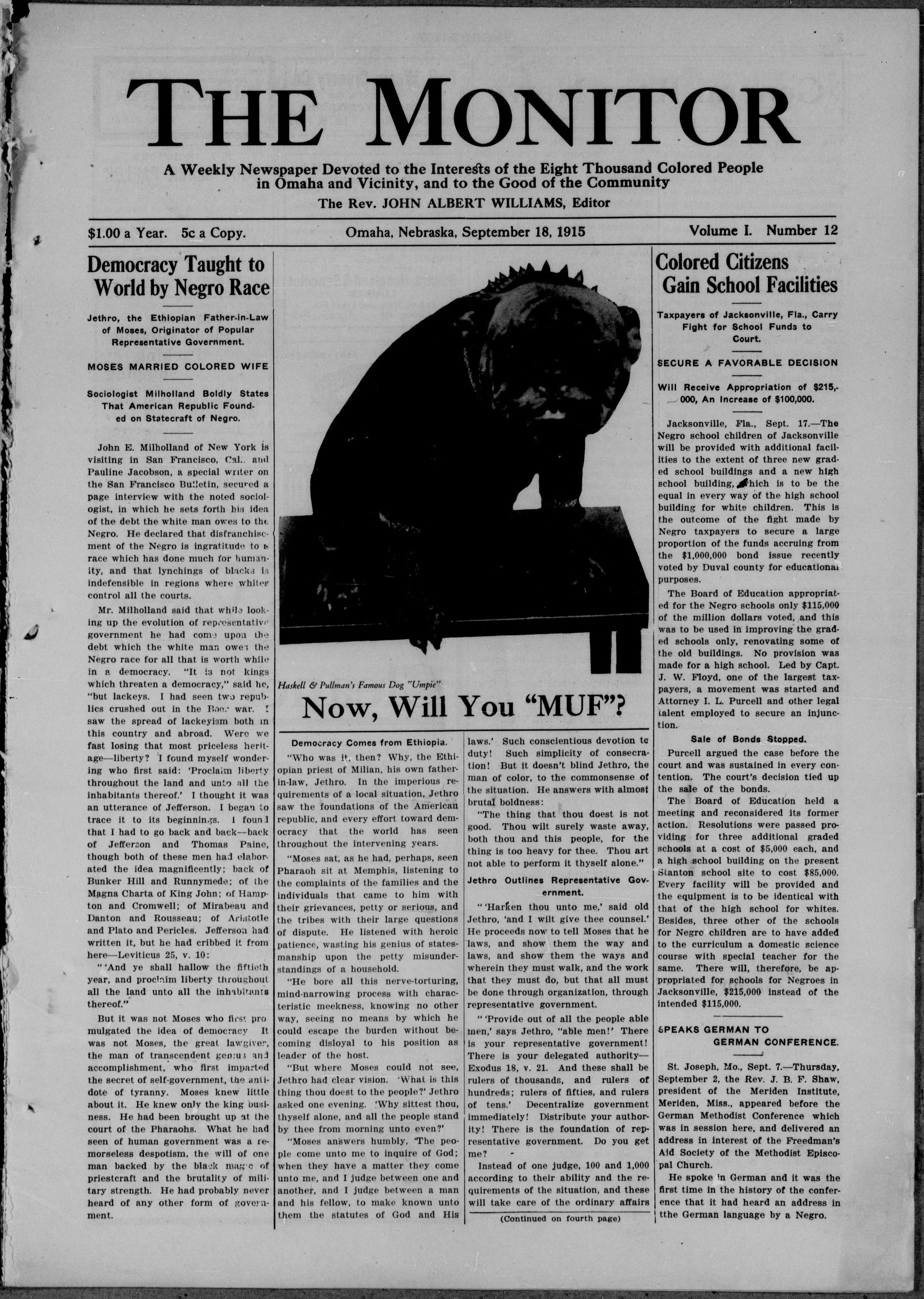
Now, Will You "MUF"?
"Who was it, then? Why, the Ethiopian priest of Milian, his own father-in-law, Jethro. In the imperious requirements of a local situation, Jethro saw the foundations of the American republic, and every effort toward democracy that the world has seen throughout the intervening years.
"Moses sat, as he had, perhaps, seen Pharaoh sit at Memphis, listening to the complaints of the families and the individuals that came to him with their grievances, petty or serious, and the tribes with their large questions of dispute. He listened with heroic patience, wasting his genius of statesmanship upon the petty misunderstandings of a household.
"He bore all this nerve-torturing, mind-narrowing process with characteristic meekness, knowing no other way, seeing no means by which he could escape the burden without becoming disloyal to his position as leader of the host.
"But where Moses could not see, Jethro had clear vision. 'What is this thing thou doest to the people?' Jethro asked one evening. 'Why sittest thou, thyself alone, and all the people stand by thee from morning unto even?'
"Moses answers humbly, 'The people come unto me to inquire of God; when they have a matter they come unto me, and I judge between one and another, and I judge between a man and his fellow, to make known unto them the statutes of God and His
laws.' Such conscientious devotion to duty! Such simplicity of consecration! But it doesn't blind Jethro, the man of color, to the commonsense of the situation. He answers with almost brutal boldness:
"The thing that thou doest is not good. Thou wilt surely waste away, both thou and this people, for the thing is too heavy for thee. Thou art not able to perform it thyself alone."
Jethro Outlines Representative Government.
"Harken thou unto me,' said old Jethro, 'and I wilt give thee counsel.' He proceeds now to tell Moses that he laws, and show them the way and laws, and show them the ways and wherein they must walk, and the work that they must do, but that all must be done through organization, through representative government.
"Provide out of all the people able men,' says Jethro, "able men!' There is your representative government! There is your delegated authority—Exodus 18, v. 21. And these shall be rulers of thousands, and rulers of hundreds; rulers of fifties, and rulers of tens.' Decentralize government immediately! Distribute your authority! There is the foundation of representative government. Do you get me?
Instead of one judge, 100 and 1,000 according to their ability and the requirements of the situation, and these will take care of the ordinary affairs (Continued on fourth page)
Volume I. Number 12
Colored Citizens Gain School Facilities
Taxpayers of Jacksonville, Fla., Carry Fight for School Funds to Court.
SECURE A FAVORABLE DECISION
Will Receive Appropriation of $215,-000, An Increase of $100,000.
Jacksonville, Fla., Sept. 17.—The Negro school children of Jacksonville will be provided with additional facilities to the extent of three new graded school buildings and a new high school building, which is to be the equal in every way of the high school building for white children. This is the outcome of the fight made by Negro taxpayers to secure a large proportion of the funds accruing from the $1,000,000 bond issue recently voted by Duval county for educational purposes.
The Board of Education appropriated for the Negro schools only $115,000 of the million dollars voted, and this was to be used in improving the graded schools only, renovating some of the old buildings. No provision was made for a high school. Led by Capt. J. W. Floyd, one of the largest taxpayers, a movement was started and Attorney I. L. Purcell and other legal talent employed to secure an injunction.
Sale of Bonds Stopped.
Purcell argued the case before the court and was sustained in every contention. The court's decision tied up the sale of the bonds. The Board of Education held a meeting and reconsidered its former action. Resolutions were passed providing for three additional graded schools at a cost of $5,000 each, and a high school building on the present Stanton school site to cost $85,000. Every facility will be provided and the equipment is to be identical with that of the high school for whites. Besides, three other of the schools for Negro children are to have added to the curriculum a domestic science course with special teacher for the same. There will, therefore, be appropriated for schools for Negroes in Jacksonville, $215,000 instead of the intended $115,000.
SPEAKS GERMAN TO GERMAN CONFERENCE.
St. Joseph, Mo., Sept. 7.—Thursday, September 2, the Rev. J. B. F. Shaw, president of the Meriden Institute, Meriden, Miss., appeared before the German Methodist Conference which was in session here, and delivered an address in interest of the Freedman's Aid Society of the Methodist Episcopal Church.
He spoke in German and it was the first time in the history of the conference that it had heard an address in the German language by a Negro.
News of the Churches and Religious Topics
vices daily at 7 a. m. and 9 a. m. Fridays at 8 p. m. Sundays at 7:30 a. m., 11 a. m. and 7:30 p. m. Sunday School at 12:45 p. m.
Methodist
Grove M. E.—Twenty-second and Seward streets. The Rev. G. G. Logan, pastor. Residence, 1628 North Twenty-second street. Services: Sunday School at 10 a. m.; preaching at 11 a. m. and 7:30 p. m.; Epworth League, 6:30 p. m.
Allen Chapel, A. M. E., 181 South Twenty-fifth street, South Omaha.—The Rev. Harry Shepherd, pastor. Residence, 181 South Twenty-fifth street. Services: Preaching, 11 a. m.; Sunday School, 1:30 p. m.
St. John's A. M. E.—Eighteenth and Webster streets. The Rev. W. T. Osborne, pastor. Residence, 613 North Eighteenth street. Telephone Douglas 5914. Services: Sunday, 11 a. m. and 8 p. m., preaching; 12 noon, class; 1:15 p. m., Sunday School; 7 p. m., Endeavor; Wednesday, 8 p. m., prayer and class meetings. Everybody made welcome at all of these meetings.
when taken into the alimentary canal and absorbed into the blood, is used for building up the body tissues, that is, the organism, or for the production of heat and energy, or for bringing about conditions favorable for the production of heat and energy. Coffee does not perform the first function to any marked degree, that is of building up the body organism. Coffee produces—on account of its percentage of fat or oil which constitutes about one-eighth of the total weight of the coffee—to that extent it furnishes a substance capable of being burned in the body and produces heat and energy. In addition to that, however, coffee renders the body capable of consuming and assimilating more nitrogenous food such as meat than it otherwise would consume or make available, and of using this meat or proteid or nitrogenous food in the production of heat and energy, and in this way it increases the amount of available energy that can be obtained from a given quantity of food.—The Spatula.
The above clipping was taken from a current pharmaceutical journal, and is interesting because it presents coffee in a light that is little thought of. For once it is not depicted as the enemy of man and sleep and nerves.
The editor of this column would like to receive the opinions of some of its readers upon the preceding abstract. It is taken for granted that coffee as mentioned here applies to the aqueous extract that appears at so many breakfast tables every morning. One or two points that might be deserving of comment are, first, whether a sufficient quantity of the oil or fat of coffee is extracted by the hot water to be of benefit to the consumer of the liquid extract; and, secondly, whether the food value of coffee is, or is not far overbalanced by the injurious effects of the caffeine.
"When first he was married, he used to boast that his wife had a way of her own."
"Well?"
"Now he complains that she has her own way."—Judge.
Directory.
Bethel—Twenty-ninth and T streets South Omaha. The Rev. J. C. Brown, pastor, residence 467 South Thirty-first street. Services, Morning, 11; evening, 7:30; Sunday School 1 p. m.; B. Y. P. B., 6:30 p. m.; praise service, 7:30 p. m.
Mt. Moriah—Twenty-sixth and Seward streets. The Rev. W. B. M. Scott, pastor. Services: Sunday School, 9:30 a. m.; preaching, 11 a. m. and 8 p. m.; B. Y. P. U. at 6 p. m.
Zion — Twenty-sixth and Franklin (temporary location). The Rev. W. F. Botts, pastor; residence, 2522 Grant street. Telephone Webster 5838. Services: Devotional hour, 10:30 a. m.; preaching, 11 a. m.; Sunday School, 1 to 2 p. m.; pastor's Bible class, 2 to 3 p. m.; B. Y. P. U., 6:30 p. m.; choir devotion, 7:30 p. m.; preaching 8 p. m.
Episcopal—
Church of St. Philip the Deacon Twenty-first near Paul street. The Rev. John Albert Williams, rector. Residence, 1119 North Twenty-first street. Telephone Webster 4243. Ser-
Science Notes BY WILLIAM G. HAYNES.
THE SCIENCE OF MEMORIZING.
Now, is there not a scientific way of remembering such a difficult thing as a name? Salesmen need to know how to do this more than any other group of people, unless it be politicians. This is the way is may be done. When you meet Mr. Brewer, get the name clearly, speak it clearly, fasten your mind upon it. That will make the impression deep. Next say it to yourself while you look at the man's eyes, face, form, and when you hear him speak and see him walk. This will give you many pathways leading into the impression. After he has left you, recall his name a few times during the next twenty minutes. This will fix his name so that you will know him anywhere you may see him, and so that you can call him by name almost the very minute after you catch a glimpse of him.
The same method may be applied in the learntng of other things that must be memorized, and with equal success. Attend with all your will power to the thing you wish to remember, repeat it several times and after intervals of rest, and, lastly, associate it with as many of your other ideas as you can. This is the science of memorizing.
The adult brain is criss-crossed in thousands of directions by pathways such as we have described. During all our waking hours, the mind travels through these, from one to another, choosing for itself which course to take at every point of crossing. Its movements are irregular, consisting of stops and flights, the stops occurring in the idea impressions, and the flights, along the pathway between impressions. The amount of time spent at each stop varies, but probably averages about three or four seconds. The Spatula.
COFFEE A FOOD.
Coffee performs two functions as a food. A food is any substance which,
THE MONITOR
I KNEW HIM WHEN HE WAS ALL RIGHT.
A bunch of young fellows were out on a lark, and while standing on the corner making hilarious remarks about themselves and everybody else that passed by, a little scene took place that put a damper on their frivolity. In the midst of their revelry a man came staggering along. He was ragged, red faced and despondent. Instantly the gang began to jeer at him and make light remarks. One of the boys in the crowd suddenly discovered that the subject of ridicule was an old friend of his father. He had known him when a boy in a country town as a prosperous merchant. Reverses had made a wreck of the fellow and he was sliding down hill about a fast as he could go. Suddenly the young fellow who had known him in his boyhood raised his hand and stopped his companions from making any further remarks. Then he said:
His rags and his reeling about. The clothes he is wearing are tattered And his face is a terrible sight.
And his face is a terrible sight,
But, boys, spread the mantle of kind-
ness,
I knew him when he was all right.
Years ago in a town called Ulysses
Pat Casey was one of the men
Who made business hum with a spirit,
He was happy and prosperous then.
But fate took his money and savings,
Death claimed his wife Maggie one
night,
So, boys, have a heart for old Casey,
I knew him when he was all right.
The bunch of young fellows stood
silent,
With heads bowed to indicate
shame;
They were sorry they jeered at old
Casey,
Or said ought that would injure his
name.
"Come, Casey, we're for you, old
timer,
You're good for some twenty years
more."
Said a lad, as he gave him a five-spot,
And the others showered silver galore.
The face of Pat now was a study,
As he glared at the silver and bills;
He thought sure at first he was dreaming,
And he knew he had fever and chills.
A lump in his throat almost choked him,
As he heartily thanked the young men
And swore in their presence that evening
He'd never touch liquor again.
It's a lesson we all should remember,
For fate is a wily old fox;
Today you may be worth thousands,
And tomorrow knocked out of the
box.
Be careful in chiding a person,
For we are all equal in might,
And some one can say of each brother,
I knew him when he was all right.
—Tanner's Magazine.
"Here, my dear," said the husband, producing his purse; "here's fifty dollars I won playing cards in the smoking room last night. You may have it to buy that dress you wanted."
Reluctantly the conscientious wife took the money, then, said, with an expression of rigid rectitude:
"I simply shudder at the thought of using money gained in such a way. Henry, promise me that after you have won enough for me to buy the hat to go with the dress you will never touch those awful cards. I don't want my husband to become a gambler."—Topeka Journal.
ENCOURAGING
3
Good Cookies.
Two cups of sugar, one cup of butter, cream well. Add three well beaten eggs, one cup of thick sour cream, one teaspoonful of soda dissolved in cream, one nutmeg, one pinch of salt; add enough flour so they will roll easily; set in refrigerator or cool place over night. In morning roll very thin and bake in quick oven. MRS. J. W. WALLACE.
Humbled.
Mrs. Mellen did not wish to offend her new cook.
"John," she said to the man servant, "can you find out, without asking the cook, whether the tinned salmon was all eaten last night? You see, I don't wish to ask her, because she may have eaten it, and then she would feel uncomfortable," added the good soul.
"If you please, ma'am," replied the man, "the new cook has eaten the tinned salmon, and if you was to say anything to her you couldn't make her feel any more uncomfortable than she is."—Christian Register.
Man's Part.
"Woman," says Dr. Anna Shaw, "ever has been man's companion, sharing his exile, espousing his cause, and buckling on his armour." And man ever has been woman's companion, sharing her happiness, espousing her when she would have him, and buttoning her up the back."—Boston Globe.
SWEET TONED Schmoller & Mueller Pianos and Player Pianos
SWEET TONED Schmoller & Mueller Pianos and Player Pianos
Sold direct from factory to home, eliminating the middleman's profit, which means a saving of $75 to $150.
Many different styles to select from.
Sold on terms of $5.00 per month.
Free Stool and Scarf.
Schmoller & Mueller Piano Co.
1311-13 Farnam Street
ASK FOR
Metz
OMAHA'S FAVORITE
BEER
THE BEER OF QUALITY
Phone South 701 Phone Webster 4829
Floral Designs for All Occasions
F. H. SWANSON
FLORIST
Cut Flowers and Potted Plants
Office, 532 N. 24th St. Greenhouse, 1418 N. 18th St.
South Omaha Omaha
Lumiere Studio
Modern Photography
1515-17 Farnam St. Omaha
Phone Doug. 3004
THE MONITOR
A Weekly Newspaper devoted to the civic, social and religious interests of the Colored People of Omaha and vicinity, with the desire to contribute something to the general good and upbuilding of the community. Published Every Saturday.
Entered as Second-Class Mail office at Omaha, Neb., under the
THE REV. JOHN ALBERT W.
Lucille Skaggs Edwards, William
Pryor, Assoc
Joseph LaCour, Jr., Advertising
SUBSCRIPTION R
Advertising rates, 25
Address, The Monitor, 1119 N
Entered as Second-Class Mail Matter July 2, 1915, at the Post-office at Omaha, Neb., under the act of March 3, 1879.
THE REV. JOHN ALBERT WILLIAMS, Editor and Publisher. Lucille Skaggs Edwards, William Garnett Haynes and Ellsworth W. Pryor, Associate Editors.
SUBSCRIPTION RATES, $1.00 per year.
Advertising rates, 25 cents an inch per issue.
Address, The Monitor, 1119 North Twenty-first street, Omaha.
IS MR. MILHOLLAND RIGHT?
When we began the publication of The Monitor, we stated in our first editorial that we would publish, from time to time, articles, original, contributed and selected, that would make our readers think. We believe that up to the present we have made that promise good. We have received written and verbal assurances that this is true. This policy we shall continue to pursue. In keeping with this policy, following the contribution of Joseph Carr in last week's issue, in which he advanced the view that the cause of personal freedom in the western hemisphere was largely influenced by the presence of Africa's native sons on this continent, we publish in this issue an interesting article which appeared first as an interview with that distinguished sociologist and philanthropist, John E. Milholland, of New York, in the San Francisco Bulletin, and was subsequently copied by The New York Age, in which he traces the origin of democracy to Jethro, the Ethiopian father-in-law of Moses. He then shows how poorly America has requited the descendants of the African for his gift. That part of the article must go over until next week. Our readers may or may not agree with Mr. Milholland, but they will all find this article intensely interesting. Is Mr. Milholland, who is a white gentleman of culture, wealth and wide reading, right in his conclusions?
We hope that such articles may quicken in our readers the determination to investigate along this and kindred lines, in order that they may realize that as a race the Negro has not been in the distant past a mere cumberer of the ground, nor is he now. The Negro has a history of which he may well be proud. He ought to know more accurately than he does what the great ethnic group to which he belongs has contributed to civilization.
Is Mr. Milholland right? Personally, we believe he is. At all events, he has advanced an opinion that will arouse discussion and quicken thought.
It will be a good thing for all parents who have children in school to get into the habit of visiting the schools from time to time and so become acquainted with the teachers of their children. To obtain the best results, there must be cordial and sympathetic co-operation between the home and the school. Acquaintance- ship with the teachers will establish a helpful bond between the home and the school. It will also show that you are keenly alive to seeing to it that your children shall make the best
---
4
VISIT THE SCHOOL.
Matter July 2, 1915, at the Post-act of March 3, 1879.
WILLIAMS, Editor and Publisher.
Garnett Haynes and Ellsworth W.
Associate Editors.
Using and Circulation Manager.
ATES, $1.00 per year.
Cents an inch per issue.
North Twenty-first street, Omaha.
possible use of their educational opportunities. If your child complains that the teacher is partial, it will be wise to reserve judgment until you get her side of the story. One of the best ways to prevent partiality is to make it known that you are carefully noting your child's progress in school, and are anxious to know the teacher and work with her for the best interests of the child. Visit the school.
Our venerable and able contemporary, The New York Age, says:
"If we are not forgetting what we learned at Sunday School, the Bible does not plainly state that Moses married an Ethiopian woman."
Well, if Bibles are as plentiful in New York as they are in Omaha, and the editor of The Age can by chance lay his hands on one, if he will turn to Numbers XII-1 he will read: "And Miriam and Aaron spake against Moses because of the ETHIOPIAN WOMAN WHOM HE HAD MARRIED: FOR HE HAD MARRIED AN ETHIOPIAN WOMAN."
The word Aithiops, from which Ethiopian is derived, means face blackened or darkened by fire, heat or the sun. Now, Moses' wife may have been, as many would have us believe, a beautiful golden-haired, blue eyed, Caucasian blonde, tastefully tanned to a teasing brown, whose beauty it is hard to withstand. She may have been a tanned blonde, but—.
A prominent business man and an appreciative and appreciated advertiser, said:
"You are certainly getting out a good paper. The Monitor is a fine publication, full of instructive reading matter. You have a splendid field and the paper ought to be a winner. Hope you'll make some money out of it."
Thanks for the compliment, good wishes and advertising patronage, which supports the good wishes.
The Examiner (Al Sorensen's paper) is booming early Christmas shopping and the swatting of the fly;
The Mediator's bombarding Sunday with "no quarter(s)" as his cry;
The Monitor is booming its subscription list and ads—
And incidentally taking a rap at one of the city dads;
But in addition to this strenuous hustling for the stuff
It's sounding forth its slogan for street car comfort—"MUF."
What do you mean by "MUF?" is a question frequently asked. For your enlightenment we would say, you will find the answer to al lsuch important public questions by reading The Mon-
THE MONITOR
YES. IT DOES
THANK YOU.
itor. To prove that we know what we are talking about we will inform you that it means Move Up Front. When you board a street car, Move Up Front.
BE OF SOME ACCOUNT IN THE WORLD.
If any young man will make up his mind to be of some account in the world, he can do it. Let him cease dawdling with no clear-cut aim! Let him forsake the habit of trying to get through each day as easily as possible, working with one eye on his job and the other on the clock! Let him cease spending five evenings a week at vaudeville or moving picture shows. Let him cut off all useless waste of time and energy, putting into his work the best of himself, not the second best! Before the gray hairs begin to show above his ears he is likely to find himself among the picked men in his line, enrolled with Gideon's three hundred.
Hear Emerson, poet, philosopher, transcendentalist though he was, holding fast that cast of mind characteristic of New England. "Let any man learn to do some one thing better than the average man is doing it and though he build his hut in the heart of a forest the people of the world will make a pathway to his door."
We hear the wail about competition being so keen and all the conditions of success so disheartening to the man who stands at the foot of the ladder. But what are youth and health for if not to go out and measure their strength against heavy odds?
You can not possibly bridge all the rivers of difficulty which flow between you and the object of your desire. You can not wait until some kind friend shall come to ferry you across—he may never come. Wade them! Put your own unwearied, undaunted strength into a heroic fight against those surging currents which would sweep you away, and boldly push ahead. The men who are doing just that are the men who share in the joy and honor of Gideon's three hundred.—C. R. Brown in The Congregationalist.
TAKING IT ALL.
"Before I agree to undertake your defense," said the eminent criminal lawyer, "you will have to tell me the whole truth. Did you embezzle the $100,000 you are accused of having taken?" "Yes, sir," replied the accused man, "I'll not attempt to conceal the fact from you. I stole every cent of it." "How much of it have you still?" "It's all gone but about a couple of dollars."
"Young man," said the eminent lawyer, buttoning his coat about him and putting on his gloves, "you'd better plead guilty and throw yourself on the mercy of the court."
"I'll do it if you say so, sir. What are you going to charge me for the advice?"
"Two dollars."
COULDN'T PROVE IT BY CASEY.
The case concerned a will, and Casey was called as a witness.
"Was the deceased in the habit of talking to himself when he was alone?" asked the lawyer.
"I don't know," said Casey.
"Come, come; you don't know, and yet you pretend that you were intimately acquainted with him?" said the lawyer.
"Well, sir," said Casey, "I never happened to be with him when he was alone."
(Continued from first page.)
of the hour, of the family, of the neighborhood, of the district, and of the tribes.
"'Every family matter they shall judge," says Jethro, 'and only great matters shall come to you on appeal, so shall it be easier for thyself, and they shall bear the burden with thee.'
"There you have it," said Mr. Milholland as he closed his Bible and returned it to his traveling bag. "There you have the genesis of every democracy that the world has seen. There you have the germ of one of the great ideas that have influenced the human race. And you've got to trace it right back to that old Ethiopian priest whose daughter Moses took unto himself as wife.
Moses Took Jethro's Advice.
Moses, as the narrator, could easily have suppressed his colored father-in-law's relation to the event. He could easily have taken the credit of this idea to himself. He was statesman enough to see the importance of it. But he didn't. He couldn't. He was too sublimely great. And in this connection must be mentioned that other, his recognition of that sublime truth, ages before it was claimed by Paul the Apostle that 'God has made of one flesh all the nations of the earth.' There was not a trace of prejudice in that great soul. He refused to divorce his Ethiopian wife, although his brother stormed and his sister, Miriam, raved until, we are told, the Hand of God smote her with leprosy. "So Moses harkened to the voice of his father-in-law, and did all that Jethro said.
"And Moses chose able men out of all Israel, and made them heads over the people, rulers of thousands, rulers of hundreds, rulers of fifties and rulers of tens. And they judged the people at all seasons; the hard cases they brought to Moses; but every small matter they judged themselves.
"And Moses let his father-in-law depart; and he went his way unto his own land.
"He went into his own land.' Jethro disappears from history. Of his subsequent career we know little. He had done his part for humanity's benefit. His name is imperishably linked with all forms of representative government which have become an imperial necessity to modern civilization. He ranks among the immortals. His spirit walks the stars."
REMEMBER—That the firms who advertise in this paper expect and appreciate YOUR PATRONAGE. Advertising is a BUSINESS, not a charitable proposition. If you wish to boost The Monitor-if you wish to help make it the best Race Paper in the country-patronize these firms and tell them that you saw their advertisement in The Monitor.
Events and Persons
In Which You Will Be More or Less Interested. News for This Department Must Be Received by Wednesday Night.
The Rev. J. C. Caldwell, D. D., of Nashville, Tenn., secretary of the Christian Endeavor Society, was an Omaha visitor last week. He preached at St. John's A. M. E. church Sunday night and also addressed the Epworth League. Dr. Caldwell left Monday night for Denver, Colo., to attend conference, stopping en route at Lincoln. While in Omaha, he was the guest of the Rev. W. T. Osborne.
Mrs. Edna V. Adams has return from her visit to Kansas City, Mo.
There was a pleasant surprise party given in honor of Miss C stance Wigington Monday evening, the occasion being her sixteenth birthday anniversary. There was a large number in attendance. Miss Wigton was the recipient of many beautiful presents. She leaves the last
Paul C. Wigington left Wednesday for Minneapolis, where he will enter the University of Minnesota for a course in architecture.
The Rev. J. A. Brown, rector of the Church of the Redeemer, Denver, en route to the Conference Workers of the Episcopalians, which meets in Boston, Mass., next week, spent Wednesday and Thursday as the guest of the Rev. John Albert Williams.
Mrs. Sarah Lewis, of 2818 Miami street, had as her dinner guest Sunday, Miss Mary A. Goodchild of Chicago.
Mr. William Newman left Wednesday for a visit to Paoli, Kas., where he will also look after some business interests.
Mr. and Mrs. L. C. Sayles of Ogden, Utah, are among the recent newcomers who expect to make Omaha their home. They are stopping with Mr. and Mrs. Charles H. Hicks, 2020 Clark street.
Mrs. Reeves and daughter, who have been the guests of Mr. and Mrs. Harry Buford, 3510 Blondo street, left Monday after a pleasant visit for their home in Emporia, Kas.
Mr. and Mrs. John Grant Pegg entertained at dinner Monday the Rev. Messrs. W. T. Osborne, H. Shepherd, J. C. Caldwell, of Nashville, Tenn.; and J. C. Owens of Kansas City, Mo.
Miss Amelia Singleton left Wednesday morning for Hastings, Neb., where she will be the guest of Miss Nona Foster.
Mr. and Mrs. Lee C. Allen of 1410 North Twenty-sixth street, entertained at a dancing party Saturday night in honor of Mrs. Butler and Mrs. Lacey, of Grand Rapids, Mich.; and Mrs. A. Kellar of Little Rock, Ark. About fifty guests were present.
Mrs. John Redick and daughter, Maxine, of Parsons, Kas., are visiting Mrs. W. E. Green, 2305 North Twenty-seventh street.
Mr. and Mrs. B. W. Harris of St. Paul, Minn., are in the city stopping at present with Mrs. M. D. Marshall, 2605 Grant street.
The surprise birthday party that was to have been given Tuesday evening at the Poro Parlors in honor of Mrs. Anna Jones, was postponed on account of the illness of Mrs. Jones. Her friends wish for her a speedy recovery.
The Rev. and Mrs. W. F. Botts have returned from the Netional Baptist convention, which was held in Chicago last week.
---
THE MONITOR
Mrs. Edna V. Adams has returned from her visit to Kansas City, Mo.
There was a pleasant surprise party party given in honor of Miss Constance Wigington Monday evening, the occasion being her sixteenth birthday anniversary. There was a large number in attendance. Miss Wigington was the recipient of many beautiful presents. She leaves the last of the week for St. Louis, Mo., where she will enter St. Rita's academy. Her friends wish her success in her school work.
Mrs. M. D. Marshall entertained at a porch party last Friday afternoon fourteen young ladies in honor of Miss Annie Elese Cottrell of Oklahoma City, Okla. Games were the feature of the afternoon. There were two prizes each given in the nut cracking and bean guessing games, the winners being Miss Anna Elese Cottrell, Miss Ella Otis Watson, Miss Pauline Black and Miss Anna Irvin Watson. Those in attendance were the Misses Anthone Edwards, Beatrice Black, Lillian Madison, Hazel Roulette, Pauline Black, Josephine Scott, Flora Cooper, Annie Elese Cottrell, Robbie Turner, Ella Otis Watson, Mary E. Pegg, Anna Irvin Watson, Ozelia Dunning and Pearl Ray. Mrs. Marshall was ably assisted by Miss Elizabeth Gibson and Mrs. Elder Scott.
A very pleasant surprise was tendered Mr. Harold Bentley by his mother, Mrs. Arthur Webster, and his sister, Aliene, at the family residence, 1702 North Twenty-sixth street, Wednesday evening on the eve of his departure for Western university, Quindaro, Kas., where he goes to take a three years' course in tailoring. Mr. Bentley has been one of the most active workers in Zion Baptist church and a large number of the congregation were present to wish him Godspeed.
Mrs. John A. Smith of 2512 Lake street gave a card party Wednesday afternoon in honor of Mrs. August Kellar of Little Rock, Ark., and Mrs. Thomas Slater of Atlanta, Ga. The first prize was won by Mrs. Luther Dillard, the second by Mrs. Thomas Riggs.
Miss Dorothy Flippin, who has been the guest of Mrs. Joseph LaCour, returned to her home in Lincoln Sunday night.
Mrs. T. P. Mohammitt, 2114 North Twenty-fifth street, has as her guests her sister, Mrs. Belle Butler, and her niece, Mrs. W. H. Lacey of Grand Rapids, Mich.
One modern desirable, furnished room, close in. 2824 Douglas street. Harney 4822.
Mr. and Mrs. J. H. Dora of Vicksburg, Miss., were the guests of Mr. and Mrs. S. K. Brownlow, 2810 Ohio street, during the letter carriers' national convention.
Mr. Frank Golden of 2302 North Twenty-fifth street, has returned from a visit to Chicago, where he attended the Lincoln Jubilee exposition, with which he was delighted. His only regret was that he saw no exhibits from Nebraska.
Mrs. Charles H. Hicks of 2020 Clark street had as her guests at a matinee party at the Orpheum Wednesday, Miss Mary L. Goodchild, Mrs. L. C. Sayles and Mrs. John Albert Williams.
The Knights and Daughters of Tabor will give their annual barbecue on Emancipation Day, September 22, at Golden Sheaf park, Twenty-fourth and Patrick avenue. Dinner will be served from 12 o'clock throughout the afternoon. The evening will be spent at Peterson hall. Everybody invited. The committee will spare no expense to make this the swellest affair of the season. Admission in evening, 10c. Mrs. Lenora Gray, Chairman.—Adv.
Charles D. Garrett, of Faithful lodge No. 25, U. B. F., has returned from visiting lodges in Missouri, where he distributed pictures of Omaha's illuminated welcome arch, which was so highly appreciated by the grand lodge during the sessions in this city. Wherever he went he heard nothing but words of praise for Omaha's entertainment of the grand lodge.
Mrs. M. F. Singleton, 1428 North Twenty-second street, entertained on Thursday, September 9th, in honor of Mrs. T. P. Mahammitt and Mrs. W. W. Peebles, who have recently returned to the city, and Mrs. A. Kellar of Little Rock, Ark. The other out-of-town guests who were present were Mrs. Belle Butler and Mrs. W. H. Lacey of Grand Rapids, Mich., and Mr. J. W. Madden of Chicago.
It pays to advertise in The Monitor.
Phone Douglas 1652
W. J. CATTIN CO.
PLUMBING AND
STEAM FITTING
910 No. 24th St. Omaha, Neb.
OMAHA
PRINTING COMPANY
THE
OFFICE
SUPPLY
HOUSE
ROUGH DRY 5 Cents Per Pound
OMAHA LAUNDRY
Tel. Web. 7788
The Omaha Stationery Co.
"Stationery That Satisfies"
Phone Doug. 805
309 So. 17th St. Omaha, Neb.
Over 60 New Models in Pleated Skirts
Buttons, 40 different styles Hemstitching, Picot Edging, Embroidery, Scollopping, Braiding and Beading
Ideal Button and Pleating Co. 107-109-111 South 16th Street
5
Some New Toilet Goods Prices
50c Pompeian Massage Cream **29c**
25c Houbigant's Rice Powder **17c**
$1.00 Listerine, Lambert's.....59c
50c Malvina Cream for .....29c
25c Mennen's Taicum (4 kinds)
each .....12c
25c Rogers and Gallet Perfumed
Rice Powder for .....17c
25c 4711 White Rose Soap.....12c
25c Woodbury's Facial Soap.....17c
You "save time and money" by
coming to the Rexall Stores for
toilet goods.
Sherman & McConnell Drug Co.
4 GOOD DRUG STORES
DO NOT buy your Fall suit until you see us. Most reasonable and reliable ladies cloak and suit store in Omaha.
Always high price samples on hand at reasonable prices
BONOFF
New York Sample Store
206 No. 16th St.
Krug Luxus
MEC.US.PAT.OF
The beer you like
A beer of quality with a coupon on each bottle.
Save coupons and
get free
premiums
Phone Douglas 1899 Luxus Mercantile Co. Distributors and have a case sent home
ASK YOUR GROCER FOR Tip Top Bread Best Bread Made
Patronize Our Advertisers
ls in Pleated Skirts
different styles
dging, Embroidery,
ing and Beading
Our Women and Children
Conducted by Lucille Skaggs Edwards.
THE PROSPECT.
In looking about us at the prejudice and discrimination, we sometimes wonder what the future will bring to us and our children. We have not time for conjecture. We must keep busy making for the years to come.
Nothing can defeat our effort if we have made up our minds to win. Our enemies can give us but temporary hurt. We sow the seeds of progress and racial development now. Who can destroy the seed or the rain that falls upon it? If a man stamp upon it, he only more firmly plants the seed and sends the drops of rain more quickly to the roots. Some of the most unreasonable discriminations have their chief value as fertilizers.
Perhaps we are inclined to expect too much in our day. In life, as a people, we are mere children. All our hopes cannot be realized now; we must live and build for the future. The day will surely come when men shall "brothers be for a' that."
No need for discouragement. What if we find those against us whom we had hoped to find for us? What if those are silent whom we expected to champion our cause? They too are passing through a period of evolution, for, as the poet says:
"But if twenty millions or summers are stored in the sunlight, still We are far from the noon of man; there is time for the race to grow.
Man as yet is being made, and, ere the crowning age of ages,
All about him shadow still, but while the races flower and fade,
Prophet eyes may catch a glory slowly gaining on the shade,
'Till the peoples all are one, and all their voices blend in choric
Hallelujah to the Maker—'It is finished—man is made.'"
Here and there we find those who see the true vision of humanity—no high, no low, no black, no white—just man. —L. E. S.
GENTLE INFLUENCES
BEST FOR CHILDREN
In no phase of life can any doctrines or rules be universally applied; for although there are always certain fundamental principles, still, with every different condition they must be tempered.
What to some might be but encouraging, to others would prove demoralizing; and while to some certain punishments would be but just, by the same methods would others be bitterly wounded and perhaps cowed into deception.
If a happy medium of gentle justice cannot be universally employed, perhaps the lesser of two evils is indulgence rather than continued severity; for love is stronger than reason, and what it fails to teach nothing else can as consistently emphasize or accomplish. Holland in his Kathrina portrays beautifully and states unreservedly that "The heart is wiser than the intellect and moves with stronger hands and surer feet toward wise conclusions."
If theories and bare justice prompted by mere intelligence were a more beneficial influence for children than simple mother love, then, indeed,
6
would chaperons, companions and governesses be more satisfactory guardians; but, then, what would become of "The hand that rocks the cradle"? and what tender memories would there be in after life, to guide, influence and govern us?
With experience one must necessarily learn that civilization would be helplessly imperiled without the higher power of sentiment, and it is this invisible force that we need, and as a community, should strive to encourage.
George Eliot says that "the eminence and nobleness of a people depend on its capacity of being stirred by memories—of striving for what we call spiritual ends—ends which consist not in immediate material possession, but in the satisfaction of a great feeling that animates the collective body as with one soul."
And if this living force of sentiment in common makes a national consciousness, certainly the remembrance of a childhood regulated only by justice rather than mercy, could hardly inspire pleasant thoughts, much less gratitude, which binds with honor the present and future to the past.
Whether happiness should come or not we should undoubtedly prepare children to do without it; but when tenderness can accomplish the desired result more satisfactorily than severity, it seems so unnecessary to embitter childhood with stern measures. All due reverence to justice, but can one expect a child to take pleasantly a nauseous dose of medicine because of reason, or to cease the yearning, homesick sobs, no matter what principle may be involved?
Logical arguments and reasons may be absolutely necessary in a court of appeal, but in simpler life are simpler measures equally appropriate. London Carter in Chicago Examiner.
ALWAYS A LITTLE MORE.
We can always stand a little more,
Always do a little more,
Always try a little more,
Than we really think.
Effort out of weariness;
Striving out of care,
We can always do a little more
Than we really think our share.
We can always shift a little more,
Always shift a little more,
Always toil a little more
Than we thought we could. Struggle, when the tide seems strong; Honest, when the world goes wrong, We can always do a little more
We can always wait a little more,
Always ache a little more,
Always trust a little more,
Than we thought was right.
Purpose of the golden will
Steering as to manhood still,
We can always do a little more
To lift the world to light.
LAGGARD IN SCHOOL IS LAGGARD IN LIFE.
"Almost 90 per cent of the pupils who come out of the third or fourth grade at the foot of their classes came out of the high school at the foot of their classes," says a veteran teacher. "If they enter college they continue to tail-enders, and after they pass in-
THE MONITOR
to business life, it is assumed, must go on as tail-enders."
Being among the last in one's classes tends to become a habit. The laggard at school and in college is the laggard in life. He is among the alsorans in whatever realm of life he enters; at least, that is what this teacher believes. And no doubt she has ample experience and observation to back her opinion.
But almost any rule falls down if applied too strictly. There are certainly plenty of examples of successful business and professional men who never shone in scholarship at school.
Nevertheless, it is good doctrine to urge that mental habits acquired or practiced in school are almost certain to stick to one through life; that the boy who hasn't pride and energy enough to get his lessons is not likely to be more than a mediocre success in after life. And, in general, it is true.—T. H. Roth.
WEEKLY WEATHER FORECAST
Issued by the U. S. Weather Bureau, Washington, D. C., for Week Beginning September 15th.
For Upper Mississippi Valley and Plains States: The week will be one of generally fair and cool weather with some probability of frosts the first half of the week in the middle and northern plains states and the extreme upper Mississippi valley.
SUBSCRIBE FOR THE MONITOR.
T. J. Moriarty
PLUMBER
1844 N. 20th St. Tel. Web. 3553
Fall Fashions
Thompson, B
Howard and Si
Thompson, Belden & Co. Howard and Sixteenth Sts.
---
For Women and Misses who like out of the ordinary styles at moderate prices--
pson, Belden &
Howard and Sixteenth Sts.
We Print the Monitor
WATERS
BARNHART
PRINTING CO.
ОМАНА
24 South Thirteenth
Telephone Douglas 2190
522-24 South Thirteenth St. Telephone Douglas 2190
Pleatings Buttons Buttonholes
Braiding Stamping Hemstitching
Picoting Pinring Shirring Tucking
Patterns Drafted and Fitted
"THE VOGUE"
FOR
Dressmaking Accessories
Telephone Douglas 3324
Room 403, Karbach Block
Henri H. Claiborne
Notary Public
Justice of the Peace
Tel. Red 7401
Res. Doug. 6188 512-13 Paxton Block
Start Saving Now
One Dollar will open an account in the Savings Department of the United States Nat'l Bank
16th and Farnam Streets
NORTHRUP
LETTER DUPLICATING COMPANY
"LETTEROLOGISTS"
TYPEWRITTEN CIRCULAR LETTERS
Phone: Doug. 5685 Office:
Res. Web. 4292 506 Paxton Block
Tel. Webster 6446
Sam Abrams
Furnace Work and General Tin Work of all Kinds
1606 No. 24th St. Omaha, Neb.
Established 1890
C. J. CARLSON
Dealer in
Shoes and Gents Furnishings
1514 North 24th St. Omaha, Neb.
elden & Co. sixteenth Sts.
100
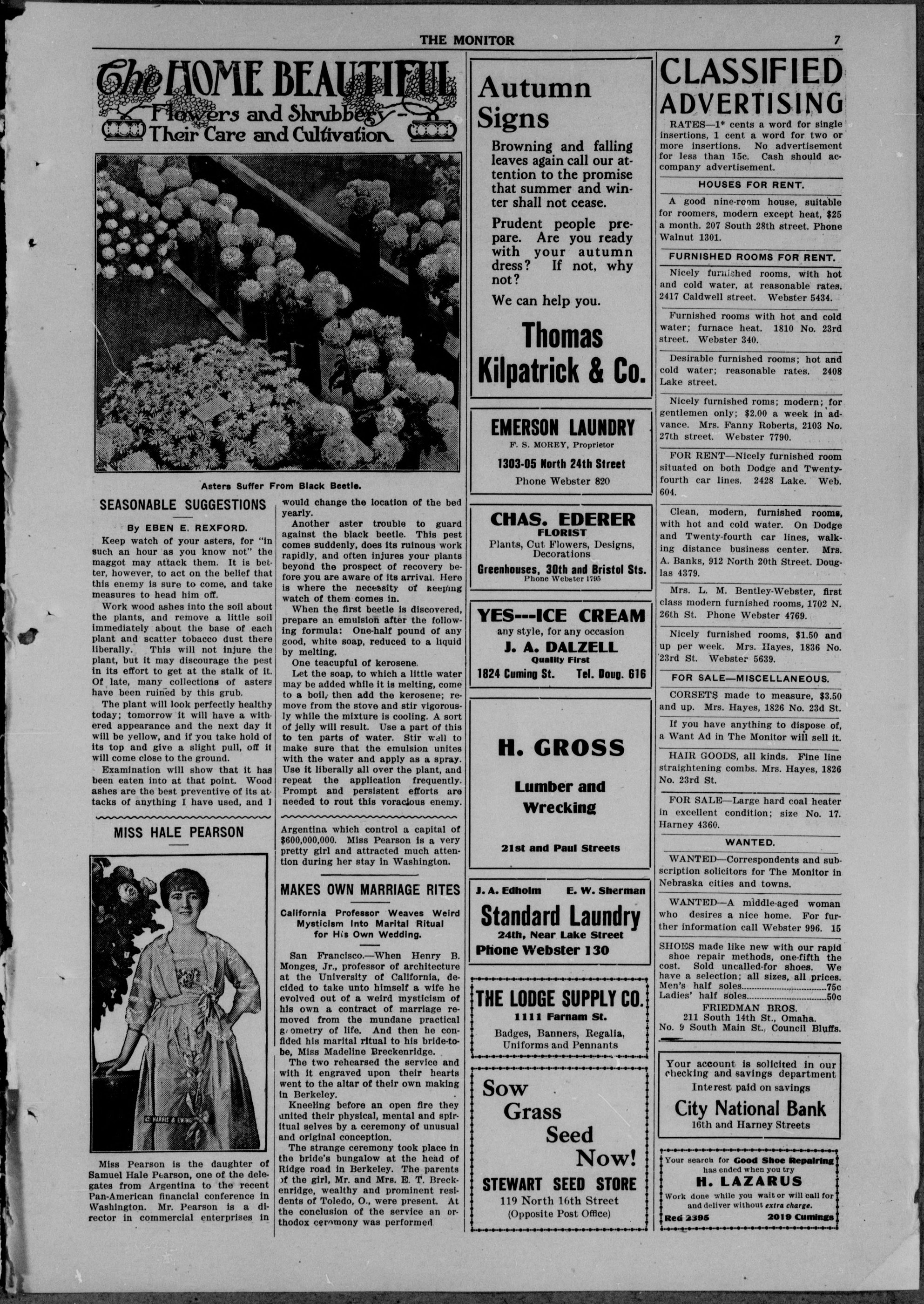
Asters Suffer From Black Beetle.
SEASONABLE SUGGESTIONS
Keep watch of your asters, for "in such an hour as you know not" the maggot may attack them. It is better, however, to act on the belief that this enemy is sure to come, and take measures to head him off. Work wood ashes into the soil about the plants, and remove a little soil immediately about the base of each plant and scatter tobacco dust there liberally. This will not injure the plant, but it may discourage the pest in its effort to get at the stalk of it. Of late, many collections of asters have been ruined by this grub.
The plant will look perfectly healthy today; tomorrow it will have a withered appearance and the next day it will be yellow, and if you take hold of its top and give a slight pull, off it will come close to the ground.
Examination will show that it has been eaten into at that point. Wood ashes are the best preventive of its attacks of anything I have used, and I
MISS HALE PEARSON
C. HARRIS & EWING
Miss Pearson is the daughter of Samuel Hale Pearson, one of the delegates from Argentina to the recent Pan-American financial conference in Washington. Mr. Pearson is a director in commercial enterprises in
would change the location of the bed yearly.
Another aster trouble to guard against the black beetle. This pest comes suddenly, does its ruinous work rapidly, and often injures your plants beyond the prospect of recovery before you are aware of its arrival. Here is where the necessity of keeping watch of them comes in.
When the first beetle is discovered, prepare an emulsion after the following formula: One-half pound of any good, white soap, reduced to a liquid by melting.
One teacupful of kerosene.
Let the soap, to which a little water may be added while it is melting, come to a boil, then add the kerosene; remove from the stove and stir vigorously while the mixture is cooling. A sort of jelly will result. Use a part of this to ten parts of water. Stir well to make sure that the emulsion unites with the water and apply as a spray. Use it liberally all over the plant, and repeat the application frequently. Prompt and persistent efforts are needed to rout this voracious enemy.
Argentina which control a capital of $600,000,000. Miss Pearson is a very pretty girl and attracted much attention during her stay in Washington.
MAKES OWN MARRIAGE RITES
California Professor Weaves Weird Mysticism Into Marital Ritual for His Own Wedding.
San Francisco.—When Henry B. Monges, Jr., professor of architecture at the University of California, decided to take unto himself a wife he evolved out of a weird mysticism of his own a contract of marriage removed from the mundane practical geometry of life. And then he confided his marital ritual to his bride-to-be. Miss Madeline Breckenridge.
The two rehearsed the service and with it engraved upon their hearts went to the altar of their own making in Berkeley.
Kneeling before an open fire they united their physical, mental and spiritual selves by a ceremony of unusual and original conception.
The strange ceremony took place in the bride's bungalow at the head of Ridge road in Berkeley. The parents of the girl, Mr. and Mrs. E. T. Breckenridge, wealthy and prominent residents of Toledo, O., were present. At the conclusion of the service an orthodox ceremony was performed
THE MONITOR
Broc
leav
tent
that
ter
Pru
parc
with
dress
not
We
EMI
130
---
Autumn Signs
Browning and falling leaves again call our attention to the promise that summer and winter shall not cease.
Prudent people prepare. Are you ready with your autumn dress? If not, why not?
We can help you.
Thomas Kilpatrick & Co.
EMERSON LAUNDRY
F. S. MOREY, Proprietor
1303-05 North 24th Street
Phone Webster 820
CHAS. EDERER FLORIST Plants, Cut Flowers, Designs, Decorations Greenhouses, 30th and Bristol Sts. Phone Webster 1795
YES---ICE CREAM
any style, for any occasion
J. A. DALZELL
Quality First
1824 Cuming St. Tel. Doug. 616
J. A. Edholm E. W. Sherman
Standard Laundry
24th, Near Lake Street
Phone Webster 130
THE LODGE SUPPLY CO.
1111 Farnam St.
Badges, Banners, Regalia,
Uniforms and Pennants
Sow
Grass
Seed
Now!
STEWART SEED STORE
---
H. GROSS
Lumber and Wrecking
21st and Paul Streets
119 North 16th Street (Opposite Post Office)
7
CLASSIFIED ADVERTISING
RATES—1* cents a word for single insertions, 1 cent a word for two or more insertions. No advertisement for less than 15c. Cash should accompany advertisement.
HOUSES FOR RENT.
A good nine-room house, suitable for roomers, modern except heat, $25 a month. 207 South 28th street. Phone Walnut 1301.
Nicely furnished rooms, with hot and cold water, at reasonable rates. 2417 Caldwell street. Webster 5434.
Furnished rooms with hot and cold water; furnace heat. 1810 No. 23rd street. Webster 340.
Desirable furnished rooms; hot and cold water; reasonable rates. 2408 Lake street.
Nicely furnished roms; modern; for gentlemen only; $2.00 a week in advance. Mrs. Fanny Roberts, 2103 No. 27th street. Webster 7790.
FOR RENT—Nicely furnished room situated on both Dodge and Twenty-fourth car lines. 2428 Lake. Web. 604.
Clean, modern, furnished rooms, with hot and cold water. On Dodge and Twenty-fourth car lines, walking distance business center. Mrs. A. Banks, 912 North 20th Street. Douglas 4379.
Mrs. L. M. Bentley-Webster, first class modern furnished rooms, 1702 N. 26th St. Phone Webster 4769.
Nicely furnished rooms, $1.50 and up per week. Mrs. Hayes, 1836 No. 23rd St. Webster 5639.
CORSETS made to measure, $3.50
and up. Mrs. Hayes, 1826 No. 23d St.
If you have anything to dispose of,
a Want Ad in The Monitor will sell it.
HAIR GOODS, all kinds. Fine line
straightening combs. Mrs. Hayes, 1826
No. 23rd St.
FOR SALE—Large hard coal heater
in excellent condition; size No. 17.
Harney 4360.
WANTED.
WANTED—Correspondents and subscription solicitors for The Monitor in Nebraska cities and towns.
WANTED—A middle-aged woman who desires a nice home. For further information call Webster 996. 15
SHOES made like new with our rapid shoe repair methods, one-fifth the cost. Sold uncalled-for shoes. We have a selection; all sizes, all prices. Men's half soles.....75c Ladies' half soles.....50c
FRIEDMAN BROS.
211 South 14th St., Omaha.
No. 9 South Main St., Council Bluffs.
Your account is solicited in our checking and savings department
Interest paid on savings
City National Bank
16th and Harney Streets
Your search for Good Shoe Repairing
has ended when you try
H. LAZARUS
Work done while you wait or will call for
and deliver without extra charge.
Red 2395 2019 Cumings
---
8
News of the Lodges and Fraternities
Masonic.
Rough Ashler Lodge No. 74, A. F. & A. M., Omaha Neb. Meetings, first and third Tuesdays in each month. J. H. Wakefield, W. M.; E. C. Underwood, Secretary. Excelsior Lodge, A. F. & A. M., Omaha, Neb. Meetings first and third Thursdays in each month. Zaha Temple No. 52, A. E. A. O. U. M. S., Omaha, Neb. Meetings the fourth Wednesday in each month. N. Hunter, Ill. Potentate; Charles W. Dickerson, Ill. Recorder.
Shaffer Chapter No. 42, O. E. S., Omaha, Neb. Meetings first and third Friday in each month. Maggie Ransom, R. M. Elnora Obee, Secretary.
Rescue Lodge No. 25, A. F. & A. M., Omaha, Neb. Meetings first and third Monday in each month. Lodge rooms, Twenty-fourth and Charles streets. William Burrell, W. M.; H. Warner, Secretary.
Keystone Lodge No. 4, K. of P., Omaha, Neb. Meetings first and third Thursday of each month. C. Lewis, C. C.; A. Marshall, K. of R. S.
Omaha Lodge No. 2226, Grand United Order of Odd Fellows. Meeting nights, the first and third Thursdays of each month. Lodge rooms, 2522 $ \frac{1}{2} $ Lake street. C. M. Johnson, N. G.; J. C. Belcher, Cor. Secretary.
Western Star No. 1, K. of P.—Meetings second and fourth Thursdays in each month. J. N. Thomas, C. C.; E. R Ro.binson, K. of R. and S.
Clean, modern furnished room, close to both Dodge and 24th street carlines Mrs. Ellen Golden, 2302 North 25th street. Webster 448.
Mrs. S. K. Brownlow gave a delightful garden party Thursday afternoon, September 9th, in honor of Mrs. R. C. Cottrell of Oklahoma City. Twenty-seven guests were present.
Mrs. Sadie Hermann, 2405 Hamilton street, has been quite ill for the past two weeks.
Mrs. H. Hall and daughter, Hazel, accompanied by Mrs. Mann and son, Walter, visited the state fair and friends and Lincoln. During their trip they visited the state penitentiary, asylum and other important places in Lincoln. They reported a very pleasant trip, which was made so by the hospitality of their friends.
But He Understood.
The artist was painting—sunset, red, with blue streaks and green dots. The old rustic, at a respectful distance, was watching.
"Ah," said the artist, looking up suddenly, "perhaps to you, too. Nature has opened her sky-pictures page by page. Have you seen the lambent flame of dawn leaping across the livid east; the red-stained, sulfurous islets floating in the lake of fire in the west; the ragged clouds at midnight, black as a raven's wing, blotting out the shuddering moon?"
"No," replied the rustic, shortly; "not since I signed the pledge."—Tit Bits.
The simple practice of raising your thoughts up into grander views of life will bring a peace that passeth all understanding.
THE MONITOR
Whereas, it has been rumored that the Undertaking Establishment operated by Allan Jones at 2314 North 24th street, Omaha, is a branch of G. Wade Obee & Co., undertakers, and, whereas, the same is false and untrue, the public is hereby informed that Allan Jones is the only person having, or, of right, claiming any property or interest in the undertaking business at 2314 North 24th street.
This statement is not made with intent to injure anyone, but to keep the record straight and to let the people know that "a live one" is ready to perform the sacred trust of burying the dead. I am always ready, night and day. Call Webster 204.
Sole Owner and Proprietor.
Uncle (to nephew playing a wargame with a chum)—"If you take the fortress within a quarter of an hour, I'll give you a quarter."
Youngster (a minute later)—"Uncle, the fortress is taken; now let me have the quarter."
Uncle—"How did you manage it so quickly?"
Youngster—"I offered the besieged ten cents, and they capitulated."—Christian Register.
Very few of us will have the chance of heroic self-devotion, but every day brings the petty, wearing sacrifice, which weighs full weight in God's scales."—Osgood.
"Father, did you ever lie when you were a boy?"
"No, my son," said the father, who evidently did not recall the past with any distinctness.
"Nor Mother either?" persisted the young lawyer.
"Oh, because I don't see how two people who never told a lie could have a boy who told as many as I did. Where could I have got it from?"
Aunt Ethel—Well, Beatrice, were you very brave at the dentist's?
Beatrice—Yes, Auntie, I was.
Aunt Ethel—Then, there's the halfcrown I promised you. And now tell me what he did to you.
Beatrice—He pulled out two of Willie's teeth!—Punch.
"Why did that young man look so cross when Mrs. Smith told him she heard he had such killing ways?" "She told him that? Great Scott He's a doctor!"—Baltimore American.
"Does your boss ever tell funny stories "
"No, but we have to laugh just the same."—Boston Transcript.
Obee & Co., Undertakers. The old, competent and reliable firm. 2518 Lake St. Webster 248.—Adv. Satisfaction always in handling your dead, whether shipped in or out of the city. G. Wade Obee & Co., the Race Undertakers, 2518 Lake St. Web. 248. The Progressive Age Printing Co. (A Race enterprise.) Guarantees first class work in printing cards, circulars, bills and invitations. 2518 Lake St. Web. 248.—Adv.
TO THE PUBLIC.
ALLAN JONES.
Humane Warfare.
EUGENICS.
"No. Why?"
POUR LA MERITE
Beatrice—Yes, Auntie, I was.
JOHN H. BROWN
G. WADE OBEE.
Business Enterprises Conducted by Colored People-Help Them to Grow by Your Patronage.
Dr. A. G. Edwards
Physician and Surgeon
Residence and Office, 2411 Erskine St.
Phone Web. 71
WILLIAMSON & TERRELL
Druggists
Free Delivery Excellent Service
Web. 4443 24th and Grant
North Side
Second-Hand Store
R. B. RHODES
Dealer in
New and Second Hand Furniture
and Stoves
Household Goods Bought and Sold
Rentals and Real Estate
2522 Lake St. Omaha, Neb.
AMERICAN HAND LAUNDRY
LEWIS AND POLK, Props.
Ladies' and children's fine dresses and clothes given special attention. Bundle washing. Work called for and delivered. Get our prices.
Phone Web. 6118, 1809 N. 24th St.
Patton Hotel and Cafe
48 modern and neatly furnished
rooms
Meals served at all hours
1014-1016-1018 South 11th Street
Phone Douglas 4445
Stand Phone, Doug, 3724
Res. Phone, Doug, 2378
Call Doug, 1491
From 1 a.m. to 5 a.m.
and his 7-passenger Abbott car Stand 111 So. 14th St. Jack's Buffet
Auto for Hire
Special attention to private parties
Special prices
PHONES:
7 p.m. to 11:55, Williamson, Terrill Drug Co., Web. 4443
12:05 p.m. to 5 a.m., Midway Doug. 1491-3459
5 a.m. to 7 p.m. Residence Web. 7681
Res. Phone Web. 4831 Office Doug 4287
AMOS P. SCRUGGS
Attorney-at-Law
Have your shoes shined right at
The Daisy Boot Black Parlor
309 So.15th Street (Opposite Beaton Drug Co )
Open Wednesday, August 11th
Have your voice trained by a singer
Studio Phone
2606 Seward St. Webster 4490
Funeral Directors and Embalmers
Lady Assistant Satisfaction Guaranteed
Phones, Res, Doug. 4379, Office Doug. 3718
1914 Cuming Street
L. O. GREGORY ICE CO.
IS AT YOUR SERVICE
Phone Webster 6421
The Business World
BOB ROBINSON
J. D. LEWIS
BANKS-WILKES
THE PEOPLES DRUG STORE
109 South 14th Street
Drugs, Cigars and Soda
Toilet and Rubber Goods
Special Attention to Prescriptions
We appreciate your patronage
Phone Douglas 1446
Dress Well and Save Money
It is economy to have your clothes Custom Tailored individually, where you not alone get a perfect fit, but get superior quality in both the material and in the tailoring Your garment lasts longer and looks better. Let us make your fall suit.
H. LIVINGSTON
103 South Fourteenth Street
MRS. J. M. ROBINSON
Milliner and Dressmaker
All Work Strictly First Class
2524 Lake St. Omaha, Neb.
MADAM LEVER
Manufactures
The World's Wonderful Hair
Grower and Shampoo
Hair Dressing and Manicuring
913 N. 27th Ave. Phone Harney 1497
C M. Simmons, Prop.
Economy Tailoring Co.
Suits Made to Order, $15 up
Cleaning and Repairing
Goods Called for and Delivered
114 So. 13th St. Omaha, Neb.
MUSIC
(THE RIGHT KIND)
By
Dan Desdunes Orcbestra
2516 Burdette St. Web. 710
J. W. MOSS
J. W. MOSS
HOME BAKERY and DELICATESSEN
Strictly home made bread, pies, cakes, etc.
Discount to churches, lodges or
special parties
OUR SPECIALTY: Pure home made ice cream
and all kinds of salads and sandwiches.
Phone Web. 6507
2530 Lake Street Omaha, Neb.
V
The Broomfield Hotel 116-118 South Ninth St. Strictly modern and up-to-date Prices moderate
Phone Douglas 2378