The Monitor
Saturday, November 13, 1915
Omaha, Nebraska
Page text (machine-generated)
THE MONITOR
A Weekly Newspaper Devoted to the Interests of the Eight Thousand Colored People in Omaha and Vicinity, and to the Good of the Community The Rev. JOHN ALBERT WILLIAMS, Editor
$1.00 a Year. 5c a Copy.
Pullman Porters Meet in Convention
Sessions Held in Pullman Building and Delegates Guests of Company.
Organize for Fraternal Benefits.
J. W. Long Addresses
Body.
Chicago, Ill., Nov. 12.—The first annual convention of the Pullman Porters' Benefit Association was held in the committee room of the Pullman company at Adams street and Michigan avenue Wednesday, November 3, with twenty-one delegates present representing the seven zones in the United States. The delegates were A. A. Wells, A. L. McDowell, J. W. Duncan, A. S. Barnett, M. Meridith and A. O. Taylor of Chicago; T. M. Blanton, Philadelphia; J. M. Brown, New York; H. L. Curtis, Jersey City, N. J.; F. C. Fane, Waverly Williams, New York; G. R. Price, Boston; R. L. Williams, San Francisco; T. R. Webb, Denver, Colo.; J. W. Stanley, Portland, Ore.; P. Parker, Cincinnati; W. Richardson, New Orleans, La.; A. May, Atlanta, Ga.; John Hammond, St. Louis, Mo.; C. H. Thomas and William Jarrett, Kansas City, Mo. Other visitors were T. E. Graham, San Francisco; J. W. Long, Omaha, Neb., and Mr. Mebane of Buffalo. Temporary chairman and secretary were Mr. Arthur Wells and Mr. T. R. Webb, respectively; permanent chairman and secretary, Mr. A. S. Barnett and Mr. J. M. Brown. At the caucus meeting held in the Y. M. C. A. building Tuesday a most cordial welcome was extended the delegates by the executive secretary of the Y. M. C. A. The Pullman company made arrangements for the accommodation of fourteen delegates at the "Y," which act of kindness was thoroughly appreciated by the visitors. During the sessions addresses of welcome and encouragement were made by Mr. L. S. Hungerford, general manager of the Pullman company; Mr. W. T. Ransom, general superintendent; Mr. Roy Kramer, Mr. Dean, vice presidents; Mr. Louis Taylor, treasurer, and Mr. Runnells Jr., son of the president of the Pullman company. Each official of the company expressed his delight at the interest displayed in this movement being made toward the uplift of the Pullman employees and the exceeding amount of intelligence prevalent at the sessions. It is the first time for a body of Afro-American employees of the company to meet in the offices of the company and share the hospitality extended to them. Messrs. Taylor, Hungerford and Ranson were constant visitors during the sessions, Mr. Taylor offering his aid to inform the body on matters pertaining to benefits and insurance. Very able and instructive addresses were made by Delegates A. S. Barnett, J. W. Long,
(Continued on eighth page)
Omaha, Nebraska, November 13, 1915
Do You Believe
of Race or Rel
“One purpose of the play is to
white people, especially in white
“No matter how many artistic
have, its ultimate result will be to
great and lasting harm to both race
MISS ALL
Who will appear in a recital at
Fol
You Believe in a Propagate Race or Religious Hatred
The purpose of the play is to create a feeling of abhay people, especially in white women against Colored men.
THOMAS DE
matter how many artistic and historic features the ultimate result will be to intensify prejudice and the lasting harm to both races."
Do You Believe in a Propaganda of Race or Religious Hatred?
"One purpose of the play is to create a feeling of abhorrence in white people, especially in white women against Colored men."
THOMAS DIXON.
"No matter how many artistic and historic features the play may have, its ultimate result will be to intensify prejudice and thereby do great and lasting harm to both races."
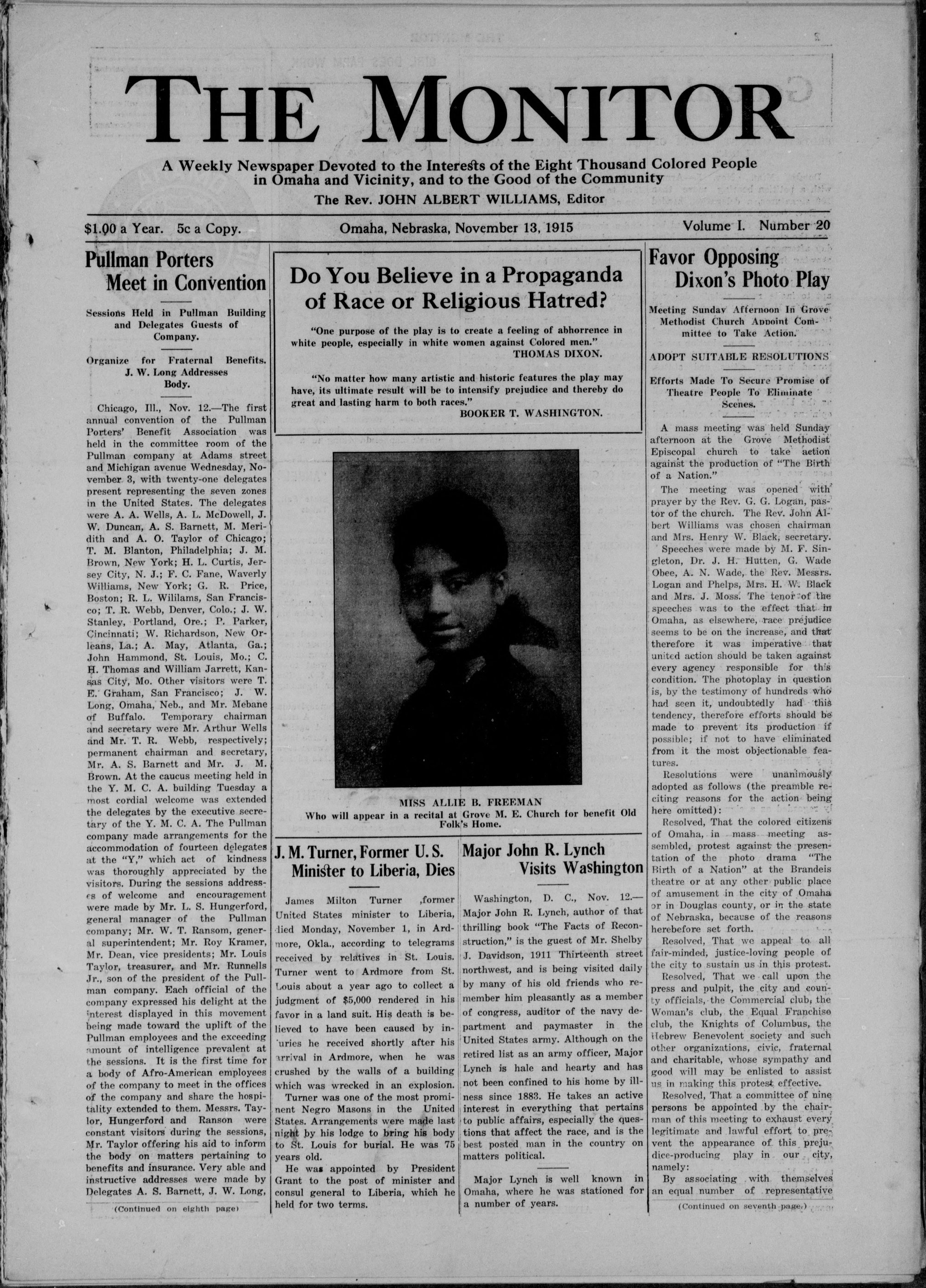
MISS ALLIE B. FREEMAN
will appear in a recital at Grove M. E. Church for
Folk's Home.
[Name]
MISS ALLIE B. FREEMAN Who will appear in a recital at Grove M. E. Church for benefit Old Folk's Home.
J.M. Turner, Former U.S. Minister to Liberia, Dies
James Milton Turner ,former United States minister to Liberia, died Monday, November 1, in Ardmore, Okla., according to telegrams received by relatives in St. Louis. Turner went to Ardmore from St. Louis about a year ago to collect a judgment of $5,000 rendered in his favor in a land suit. His death is believed to have been caused by injuries he received shortly after his arrival in Ardmore, when he was crushed by the walls of a building which was wrecked in an explosion. Turner was one of the most prominent Negro Masons in the United States. Arrangements were made last night by his lodge to bring his body to St. Louis for burial. He was 75 years old.
He was appointed by President Grant to the post of minister and consul general to Liberia, which he held for two terms.
---
in a Propaganda
ligious Hatred?
to create a feeling of abhorrence in
women against Colored men."
THOMAS DIXON.
and historic features the play may
intensify prejudice and thereby do
es."
BOOKER T. WASHINGTON.
E B. FREEMAN
Grove M. E. Church for benefit Older's Home.
Major John R. Lynch Visits Washington
Washington, D. C., Nov. 12. Major John R. Lynch, author of that thrilling book "The Facts of Reconstruction," is the guest of Mr. Shelby J. Davidson, 1911 Thirteenth street northwest, and is being visited daily by many of his old friends who remember him pleasantly as a member of congress, auditor of the navy department and paymaster in the United States army. Although on the retired list as an army officer, Major Lynch is hale and hearty and has not been confined to his home by illness since 1883. He takes an active interest in everything that pertains to public affairs, especially the questions that affect the race, and is the best posted man in the country on matters political.
Major Lynch is well known in Omaha, where he was stationed for a number of years.
Volume I. Number 20
Favor Opposing Dixon's Photo Play
Meeting Sunday Afternoon In Grove Methodist Church Appoint Committee to Take Action.
ADOPT SUITABLE RESOLUTIONS
Efforts Made To Secure Promise of Theatre People To Eliminate Scenes.
A mass meeting was held Sunday afternoon at the Grove Methodist Episcopal church to take action against the production of "The Birth of a Nation."
The meeting was opened with prayer by the Rev. G. G. Logan, pastor of the church. The Rev. John Albert Williams was chosen chairman and Mrs. Henry W. Black, secretary. Speeches were made by M. F. Singleton, Dr. J. H. Hutten, G. Wade Obee, A. N. Wade, the Rev. Messrs. Logan and Phelps, Mrs. H. W. Black and Mrs. J. Moss. The tenor of the speeches was to the effect that in Omaha, as elsewhere, race prejudice seems to be on the increase, and that therefore it was imperative that united action should be taken against every agency responsible for this condition. The photoplay in question is, by the testimony of hundreds who had seen it, undoubtedly had this tendency, therefore efforts should be made to prevent its production if possible; if not to have eliminated from it the most objectionable features.
Resolutions were unanimously adopted as follows (the preamble reciting reasons for the action being here omitted):
Resolved, That the colored citizens of Omaha, in mass meeting assembled, protest against the presentation of the photo drama "The Birth of a Nation" at the Brandeis theatre or at any other public place of amusement in the city of Omaha or in Douglas county, or in the state of Nebraska, because of the reasons herebefore set forth.
Resolved, That we appeal to all fair-minded, justice-loving people of the city to sustain us in this protest.
Resolved, That we call upon the press and pulpit, the city and county officials, the Commercial club, the Woman's club, the Equal Franchise club, the Knights of Columbus, the Hebrew Benevolent society and such other organizations, civic, fraternal and charitable, whose sympathy and good will may be enlisted to assist us in making this protest effective.
Resolved, That a committee of nine persons be appointed by the chairman of this meeting to exhaust every legitimate and lawful effort to prevent the appearance of this prejudice-producing play in our city, namely:
By associating with themselves an equal number of representative
(Continued on seventh page.)
General Race News
2
PROTEST AGAINST "BIRTH OF NATION."
Duluth, Minn., Nov. 5.—Armed with a petition bearing more than 100 signatures, a delegation, headed by Rev. George I. Holt, pastor of St. Mark's A. M. E. church, appeared before the city council again last Monday afternoon to protest against the showing in Duluth of the photoplay "The Birth of a Nation. "The picture is prejudicial to the black race and is apt to incite race riots," declared Rev. Mr. Holt. "It pictures conditions that never existed. The objectionable parts cannot be eliminated without making the production meaningless and unattractive. It has been barred in many cities and states. Noted authorities have declared that it is a disgrace to the white as well as the black race." Extracts from opinions of writers, who condemned the picture, were read to the council. "I will see the picture in Superior, Wis., before it is shown here and will then pass judgment on it," was the assurance of Commissioner Silberstein. Manager Morrissey of the Lyceum theater has already promised to eliminate any objectionable features.
CLEVELAND ELECTS COLORED ALDERMAN
Cleveland, O., Nov. 12.—Attorney Thomas W. Fleming was elected here on Tuesday, November 21, at the general election as a member of the city council. He will represent in that body the Eleventh ward. Mr. Fleming was the candidate on the non-partisan ticket, being opposed by five candidates, all white. The Eleventh ward is largely populated by white voters, there being only about one-fourth Afro-Americans of the voting strength of the ward. This is the first time in the history of the ward that it will be represented in the city council by an Afro-American. Attorney Fleming is prominent in fraternal circles and is regarded as one of the most brilliant lawyers at the Cleveland bar. His victory is generally regarded as a signal triumph for the Afro-Americans in this city.
YOUNG COLORED WOMAN LEFT VALUABLE ESTATE
St. Louis, Mo., Nov. 12.—Miss Wilhelmina Tait, the young colored woman who was accidentally killed by an automobile recently, left real and personal propetry worth several thousand dollars, besides $12,239.49 in cash on deposit in two banks.
No will was found, and the property will be divided among her mother and four sisters. Mrs. Callie M. Edwards is the executrix and she has filed an inventory of the estate with the probate court.
COLORED LAD WINS SCHOLARSHIP.
Yonkers, N. Y.—Master Willie H. Butler of this city, the clever boy violinist, has been given a scholarship in the Musical Settlement school in New York city and will train under the celebrated David Mannes, who thus acknowledges his gratitude to the Negro race, he having been taught the violin by the famous Negro violinist of New York, Douglass, many years ago.
THE MONITOR
THE COLORED MAN AS AN INVENTOR
The exposition at Chicago, August 22nd to September 16th, in celebration of the fiftieth anniversary of the emancipation of the colored race includes an exhibit of more than a thousand patents which have been granted to those of that race. Manifestly the list will be incomplete, as it is impossible to determine from the patent office records whether an applicant and patentee is white or colored, but much effort has been made by Henry E. Baker, who has been detailed by the commissioner of patents in charge of the patent exhibit to make it as complete as possible. Mr. Baker, himself a colored man, is an assistant examiner in the patent office, having entered such office in January, 1876, as a capyist. He was appointed to the examining corps in March, 1883, and has been promoted from time to time to his present position as second assistant examiner. Another colored man, Edward O. Clarke, was appointed to the examining corps in August, 1893, but resigned to accept a professorship in a college.—Scientific American.
BOOKER T. WASHINGTON IN SERIOUS CONDITION
New York, Nov. 9.—Dr. Booker T. Washington, principal of Tuskegee institute, is confined to a local hospital, suffering from a nervous breakdown, it became known tonight. While his condition is said to be serious, physicians said that it was not necessarily critical.
The Negroes of Alabama held a state fair at Tide Water Park October 25 to November 3. G. W. A. Johnston, president; A. R. Mosby, secretary.
CONCERNED ABOUT WHITE RACE.
"My interest is not at all in the effects of this play on the Negro race in our country. The Negro race is taking care of itself and it has proved that it is wonderfully capable of so doing. It is the mental condition of the white race that I am concerned about, because of the false teaching of history, the false teaching concerning American ideals of liberty and justice, and the preversion of those ideals which this play contains."
CHARLES W. ELIOT,
Ex-President of Harvard.
"One of the most unfortunate things about this film is that it appeals to race prejudice upon the basis of conditions of half a century ago, which have nothing to do with the facts we have to consider today. It is both unjust and untrue. The producer seems to have followed the principle of gathering the most vicious and grotesque individuals he could find among colored people, and showing them as representatives of the truth about the entire race. The same method could be followed to smirch the reputation of any race."
"It is a loathsome calumny of the Negro race and an insult to the south as well as to the north." ADELENE MOFFATT.
GIRL DOES FARM WORK
© DAILY MIRROR
LONDON
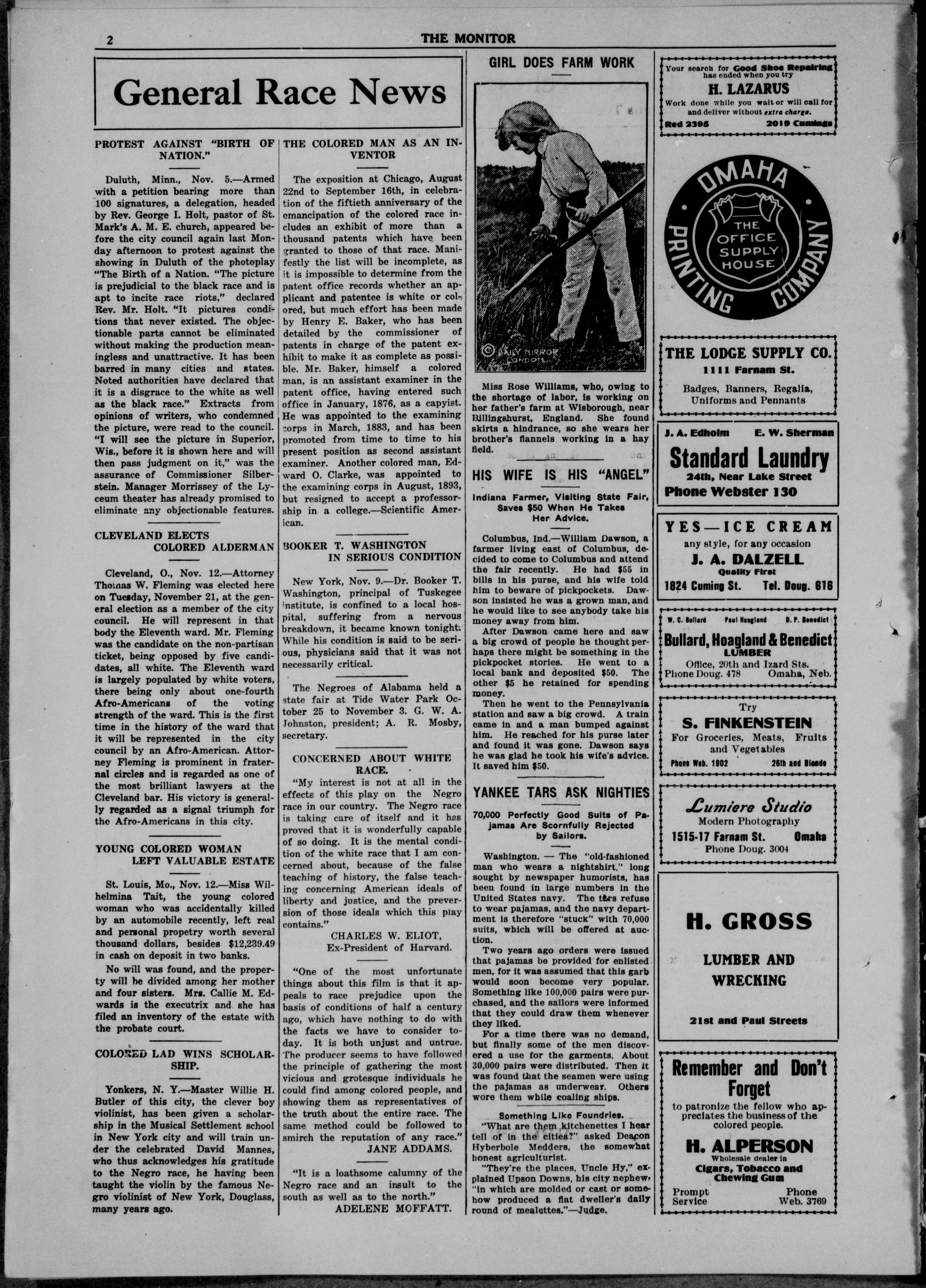
Miss Rose Williams, who, owing to the shortage of labor, is working on her father's farm at Wisborough, near Billingshurst, England. She found skirts a hindrance, so she wears her brother's flannels working in a hay field.
HIS WIFE IS HIS "ANGEL"
Indiana Farmer, Visiting State Fair, Saves $50 When He Takes Her Advice.
Columbus, Ind.—William Dawson, a farmer living east of Columbus, decided to come to Columbus and attend the fair recently. He had $55 in bills in his purse, and his wife told him to beware of pickpockets. Dawson insisted he was a grown man, and he would like to see anybody take his money away from him.
After Dawson came here and saw a big crowd of people he thought perhaps there might be something in the pickpocket stories. He went to a local bank and deposited $50. The other $5 he retained for spending money. Then he went to the Pennsylvania station and saw a big crowd. A train came in and a man bumped against him. He reached for his purse later and found it was gone. Dawson says he was glad he took his wife's advice. It saved him $50.
YANKEE TARS ASK NIGHTIES
70,000 Perfectly Good Suits of Pajamas Are Scornfully Rejected by Sailors.
Washington. — The "old-fashioned man who wears a nightshirt," long sought by newspaper humorists, has been found in large numbers in the United States navy. The tars refuse to wear pajamas, and the navy department is therefore "stuck" with 70,000 suits, which will be offered at auction.
Two years ago orders were issued that pajamas be provided for enlisted men, for it was assumed that this garb would soon become very popular. Something like 100,000 pairs were purchased, and the sailors were informed that they could draw them whenever they liked. For a time there was no demand, but finally some of the men discovered a use for the garments. About 30,000 pairs were distributed. Then it was found that the seamen were using the pajamas as underwear. Others wore them while coaling ships.
"What are them kitchenettes I hear tell of in the cities?" asked Deacon Hyberbole Medders, the somewhat honest agriculturist.
"They're the places. Uncle Hy," explained Upson Downs, his city nephew, "in which are molded or cast or somehow produced a flat dweller's daily round of mealettes."—Judge.
Something Like Foundries.
Work done while you wait or will call for and deliver without extra charge. Red 2395 2019 Cumings
OMAHA
PRINTING COMPANY
THE
OFFICE
SUPPLY
HOUSE
THE LODGE SUPPLY CO.
1111 Farnam St.
Badges, Banners, Regalia,
Uniforms and Pennants
J. A. Edholm E. W. Sherman Standard Laundry 24th, Near Lake Street Phone Webster 130
YES-ICE CREAM any style, for any occasion J. A. DALZELL Quality First 1824 Cuming St. Tel. Doug. 616
W. C. Bullard Paul Hoagland D. P. Benedict
Bullard, Hoagland & Benedict
LUMBER
Office, 20th and Izard Sts.
Phone Doug. 478 Omaha, Neb.
S. FINKENSTEIN
For Groceries, Meats, Fruits
and Vegetables
Phone Web. 1902 26th and Blonde
Lumiere Studio
Modern Photography
1515-17 Farnam St. Omaha
Phone Doug. 3004
H. GROSS
LUMBER AND WRECKING
Remember and Don't Forget
to patronize the fellow who appreciates the business of the colored people.
H. ALPERSON
Wholesale dealer in
Cigars, Tobacco and
Chewing Gum
Prompt
Service
Phone
Web. 3769
News of the Churches and Religious Topics
Bethel—Twenty-ninth and T streets South Omaha. The Rev. J. C. Brown, pastor, residence 467 South Thirty-first street. Services, Morning, 11; evening, 7:30; Sunday School 1 p. m.; B. Y. P. B., 6:30 p. m.; praise service, 7:30 p. m.
Mt. Moriah—Twenty-sixth and Seward streets. The Rev. W. B. M. Scott, pastor. Services: Sunday School, 9:30 a. m.; preaching, 11 a. m. and 8 p. m.; B. Y. P. U. at 6 p. m.
Zion — Twenty-sixth and Franklin (temporary location). The Rev. W. F. Botts, pastor; residence, 2522 Grant street. Telephone Webster 5838. Services: Devotional hour, 10:30 a. m.; preaching, 11 a. m.; Sunday School, 1 to 2 p. m.; pastor's Bible class, 2 to 3 p. m.; B. Y. P. U., 6:30 p. m.; choir devotion, 7:30 p. m.; preaching 8 p. m.
Church of St. Philip the Deacon—Twenty-first near Paul street. The Rev. John Albert Williams, rector. Residence, 1119 North Twenty-first street. Telephone Webster 4243. Ser-
PUBLIC FO
OUR PUBLIC FORUM
IV.—F. A. Vanderlip
On The Business of Banking
The farmers of this nation to owe must study business. We must, as the fundamental principles that under its functions to society and its relation there can be no intelligent co-operative standing. Mr. F. A. Vanderlip, presiding City Bank of New York, when asked, said in part:
"The first and most familiar fund that of gathering up the idle money small sums and large, and thus form a voir upon which responsible persons for money. It is evident that this makes for the employment of labor and the much more is accomplished than they on the banks, for by the use of drafts of money is multiplied several times, one one of the great beef packers, to one side of its bank account will be daily receiving from everywhere in the side will be entered the checks it draw use of money being for small paym
but one bank in a community and checks on that bank, and everyone receives in the bank, the amount of money in it and the entire business of the offices of the bank. And the situation is literal banks, for they daily exchange and receive on each other, which practically balances are paid in cash. This is on there is a 'Clearing House' where they settle their accounts with each other instantly receiving from its customers, patents to other localities, drafts and checks which it usually sends for deposit to all real cities with which it maintains permanent credits are consolidated and the supplying customers with the means of. As each local community sells and buys the course of a year, these payments at that the banks are very intimately a country. The banker is a dealer in credit and of course his own credit must be built for the credits acquired by the accommodation, but he must conduct them on always meet his own obligations with real thing about bank credit, that it
The farmers of this nation to come into their own must study business. We must, as a class, understand the fundamental principles that underlie every industry, its functions to society and its relation to agriculture, for there can be no intelligent co-operation without understanding. Mr. F. A. Vanderlip, president of the National City Bank of New York, when asked, "What is a bank?" said in part:
"The first and most familiar function of a bank is that of gathering up the idle money of a community, small sums and large, and thus forming a pool cr reservoir upon which responsible persons may draw as they
have temporary use for money. It is a aggregate available for the employment community. But much more is actually deposited in the banks, for notes the efficiency of money is multibusiness, for example one of the great actual money; on one side of its bank and drafts it is daily receiving from while on the other side will be entered cattle, etc., its only use of money by otherwise.
If there were but one bank in bills by drawing checks on that bank diately deposited it in the bank, the would not change at all and the entitled on the books of the bank. As when there are several banks, for the checks they receive on each other although the small balances are paid in every large city there is a 'Clearl banks meet daily to settle their account.
A bank is constantly receiving fro are shipping products to other localities in other cities, which it usually sends banks in the central cities with which this way these scattered credits are these accounts in supplying customers away from home. As each local company abroad in the course of a year other. It is evident that the banks are and industry of a country. The bank a dealer in money, and of course his exchanges his credit for the credits credit for their accommodation, but he judgment that he can always meet his This is the essential thing about business as cash."
have temporary use for money. It is evident that this makes large sums in the aggregate available for the employment of labor and the development of the community. But much more is accomplished than the use of the money actually deposited in the banks, for by the use of drafts, checks and bank notes the efficiency of money is multiplied several times over. A very large business, for example one of the great beef packers, may use very little actual money; on one side of its bank account will be entered the checks and drafts it is daily receiving from everywhere in payment for meats, while on the other side will be entered the checks it draws in payment for cattle, etc., its only use of money being for small payments, to labor and otherwise.
If there were but one bank in a community and everybody paid all bills by drawing checks on that bank, and everyone receiving a check immediately deposited it in the bank, the amount of money in the bank evidently would not change at all and the entire business of the community would be settled on the books of the bank. And the situation is but slightly changed when there are several banks, for they daily exchange among themselves all the checks they receive on each other, which practically offset themselves, although the small balances are paid in cash. This is called 'clearing' and in every large city there is a 'Clearing House' where representatives of the banks meet daily to settle their accounts with each other.
A bank is constantly receiving from its customers, particularly those that are shipping products to other localities, drafts and checks drawn on banks in other cities, which it usually sends for deposit to a few correspondent banks in the central cities with which it maintains permanent accounts. In this way these scattered credits are consolidated and the bank draws upon these accounts in supplying customers with the means of making payments away from home. As each local community sells and buys about the same amount abroad in the course of a year, these payments largely offset each other. It is evident that the banks are very intimately related to the trade and industry of a country. The banker is a dealer in credit much more than a dealer in money, and of course his own credit must be above question. He exchanges his credit for the credits acquired by the customers, and lends credit for their accommodation, but he must conduct the business with such judgment that he can always meet his own obligations with cash on demand. This is the essential thing about bank credit, that it shall always be the same as cash."
A writer in the New Republic of March 20, says: "Whatever happened during reconstruction, this film is aggressively vicious and defamatory. It is spiritual assassination. It degrades the censors that passed it and the white race that endures it."
---
Directory.
Baptist
Episcopal
PETER H.
vices daily at 7 a. m. and 9 a. m. Fridays at 8 p. m. Sundays at 7:30 a. m., 11 a. m. and 7:30 p. m. Sunday School at 12:45 p. m.
Methodist
Allen Chapel, A. M. E., 181 South Twenty-fifth street, South Omaha.—The Rev. John H. Nichols, pastor. Residence, 181 South Twenty-fifth street. Services: Preaching, 11 a. m.; Sunday School, 1:30 p. m.
Grove M. E.—Twenty-second and Seward streets. The Rev. G. G. Logan, pastor. Residence, 1628 North Twenty-second street. Services: Sunday School at 10 a. m.; preaching at 11 a. m. and 7:30 p. m.; Epworth League, 6:30 p. m.
St. John's A. M. E.—Eighteenth and Webster streets. The Rev. W. T. Osborne, pastor. Residence, 613 North Eighteenth street. Telephone Douglas 5914. Services: Sunday, 11 a. m. and 8 p. m., preaching; 12 noon, class; 1:15 p. m., Sunday School; 7 p. m. Endeavor; Wednesday, 8 p. m., prayer and class meetings. Everybody made welcome at all of these meetings.
IC FORUM
of this nation to come into their own business. We must, as a class, understand principles that underlie every industry, society and its relation to agriculture, for intelligent co-operation without under-
A. Vanderlip, president of the National New York, when asked, "What is a bank?"
And most familiar function of a bank is to give up the idle money of a community, large, and thus forming a pool or reserve responsible persons may draw as they evident that this makes large sums in the rent of labor and the development of the complished than the use of the money by the use of drafts, checks and bank applied several times over. A very large meat beef packers, may use very little bank account will be entered the checks in everywhere in payment for meats, need the checks it draws in payment for being for small payments, to labor and a community and everybody paid all and everyone receiving a check imme-
amount of money in the bank evidently the business of the community would be and the situation is but slightly changed by daily exchange among themselves all over, which practically offset themselves, in cash. This is called 'clearing' and 'big House' where representatives of the firms with each other.
From its customers, particularly those that trades, drafts and checks drawn on banks, for deposit to a few correspondent in it maintains permanent accounts. In consolidated and the bank draws upon bills with the means of making payments, community sells and buys about the same car, these payments largely offset each are very intimately related to the trade or is a dealer in credit much more than own credit must be above question. He acquired by the customers, and lends he must conduct the business with such own obligations with cash on demand. Bank credit, that it shall always be the
C. H. MARQUARDT
CASH MARKET
Retail Dealer in Fresh and Salt Meats, Poultry, Oysters, etc.
2003 Cuming St. Doug. 3834
Home Rendered Lard. We Smoke and Cure our own Hams and Bacon.
THE MONITOR
their own understand
ly industry,
culture, for
out under-
the National
as a bank?"
a bank is
community,
col cr reser-
aw as they
ums in the
ment of the
the money
and bank
very large
very little
the checks
for meats,
payment for
labor and
y paid all
check imme-
evidently
would be
ly changed
themselves all
themselves,
maring' and
selves of the
those that
on banks
respondent
counts. In
draws upon
payments
the same
offset each
to the trade
more than
question. He
and lends
with such
on demand.
always be the
ARDT
---
MAYOR DAHLMAN INTRODUCES ORDINANCE.
An ordinance prohibiting public exhibitions in the city of Omaha, and providing a penalty for the violation thereof.
Be it ordained by the city council of the city of Omaha:
Section 1.—It shall be unlawful for any person, firm or corporation to publicly show or exhibit in any place in the city of Omaha any picture or series of pictures by any device known as mutescope, kinetoscope, cinematograph, kinemacolor, penny arcade, moving picture or any vaudeville act, drama, play, theatrical song or stage or platform performance, or any advertisement or billboard display which tends to incite race riot or race hatred or which shall represent or purport to represent any hanging, lynching, burning or placing in a place of ignominy, any human being, the same being incited by race hatred.
Section 2. Any person, persons, firm or corporation violating any of the provisions of this ordinance shall be deemed guilty of a misdemeanor, and on conviction thereof shall be fined in any sum not less than one dollar nor more than one hundred dollars.
Section 3. This ordinance shall take effect and be in force from and after fifteen days from its passage. The above ordinance was introduced to the commissioners Thursday by Mayor Dahlman, read the first and second time and referred to the committee of the whole.
PATRONIZE OUR ADVERTISERS.
Great Overcoat Values
Beautifully tailored, clever variety of weaves and models.
Single breasted, narrow sl loose fitting models, double br self and adjustable collar style
Storm Coats Great Coats
Big buying and big selling price, and you're the gainer by of $5.00 to $7.50 on every garment
The Berg Cl
Attend First
Colored Firen
Alamo Hall
Great Overcoat $15 Values
Beautifully tailored, cleverly styled overcoats in a great variety of weaves and models.
Single breasted, narrow shoulder models, form fit models, loose fitting models, double breasted models, shawl, velvet, self and adjustable collar styles.
Big buying and big selling is the secret of this small price, and you're the gainer by a clear saving of $5.00 to $7.50 on every garment $15.00
Attend First Annual Ball
Admission, 25 Cents
REMEMBER-That the firms who advertise in this paper expect and appreciate YOUR PATRONAGE. Advertising is a BUSINESS, not a charitable proposition. If you wish to boost The Monitor-if you wish to help make it the best Race Paper in the country-patronize these firms and tell them that you saw their advertisement in The Monitor.
PAXTON'S
GAS
ROASTED
COFFEE.
PAXTON'S
GAS
ROASTED
COFFEE
PAXTON'S
GAS
ROASTED
COFFEE
THE FLAME QUICKLY -
NOT IN OVENS SLOWLY -
SAVES YOU THE
STRENGTH AND
DELICATE-
AROMA -
THAT IS
ECONOMY
TRY A CAN
AND BE
CONVINCED!
THEN-
BUYING IN
A24LB, CANAT-
50TH QUANTITY
PRICE IS ECONOMY
ORRIE S. HULSE
Harney 6257
C. H. T. RIEPEN
Harney 5564
HULSE & RIEPEN
Funeral Directors
Doug. 1226
701 So. 16th St.
C. P. Wesin Grocery Co.
J. L. PETTEYS, Mgr.
Fruits and Vegetables
2005 Cuming St. Tel. D. 1098
Tel. Red 1424
Will L. Hetherington
Violinist
Instructor at Bellevue College
Asst. of Henry Cox
Studio Patterson Blk.
UITS ME $15
THE MONITOR
A Weekly Newspaper devoted to the civic, social and religious interests of the Colored People of Omaha and vicinity, with the desire to contribute something to the general good and upbuilding of the community.
Published Every Saturday.
Entered as Second-Class Mail
office at Omaha, Neb., under the
THE REV. JOHN ALBERT W.
Lucille Skaggs Edwards, William
Pryor, Assoc.
Joseph LaCour, Jr., Advertising
SUBSCRIPTION RATE
Advertising rates, 50 c
Address, The Monitor, 1119 N
Entered as Second-Class Mail Matter July 2, 1915, at the Post-office at Omaha, Neb., under the act of March 3, 1879.
THE REV. JOHN ALBERT WILLIAMS, Editor and Publisher.
Lucille Skaggs Edwards, William Garnett Haynes and Ellsworth W.
Pryor, Associate Editors.
Joseph LaCour, Jr., Advertising and Circulation Manager.
SUBSCRIPTION RATES, $1.00 per year.
Advertising rates, 59 cents an inch per issue.
Address, The Monitor, 1119 North Twenty-first street, Omaha.
The Reason for Our Opposition.
Many cannot understand the opposition of colored Americans to "The Birth of a Nation." That they are tremendously aroused over it must be apparent to the most superficial observer. Why is this? There must be some reason for it. What is it?
Here is the answer. The south, speaking broadly, has two distinct parties, differing radically in their attitude toward and treatment of the Negro race. One is the party of progress, desirous of helping the Negro make the most of himself; the other is the reactionary party, composed chiefly, not of descendants of the kindly old gentle folks, but of the poor whites, or "white trash" as they are contemptously called, who are unequivocally and uncompromisingly enemies of Negro progress, and advocate repressive measures, curtailment of educational privileges, disfranchisement and the repeal of the fourteenth and fifteenth amendments. They seem to be obsessed with hatred toward the Negro.
To this party Dixon belongs. He is the incarnation of this spirit of hatred. He is its mouthpiece. He, with others of his ilk, have undertaken a propaganda which has as its object the engendering of a hatred toward the Negro in the United States which, if he could have his way, would result in the colored Americans' forced expatriation or his annihilation.
Not only does he hate the Negro, but he hates the north and the Union. He has used his literary gifts not only to vilify the Negro, but to besmirch, by subtle inuendo, the men who wore the blue and saved the Union, and to glorify those who sought to destroy it. "The Leopard's Spots" and "The Clansman" were the first vehicles of his propaganda of dual hatred. Then came the development of the moving picture. He took unto himself a creature, like unto himself, in the person of D. W. Griffith, and the scenic marvel, "The Birth of a Nation," which, if it had not been prostituted to the fostering of race prejudice, would be a tremendous agency for good, came into being as a powerful instrumentality for this propaganda of race hatred, which has as its object the engendering of the same spirit in the north as is found in the south among that class of which Dixon is the type and literary exponent. The motive back of the production, as expressed by Dixon himself, and the danger to the welfare of our common country, which involves not only black Americans—against whom it is chiefly aimed—but white Americans as well; because the insidious and subtle poison of the drama is hidden in scenic beauty; the adroitness and skill with which dramatic
---
Matter July 2, 1915, at the Post-act of March 3, 1879.
WILLIAMS, Editor and Publisher.
Garnett Haynes and Ellsworth W.
Associate Editors.
Using and Circulation Manager.
TATES, $1.00 per year.
Events an inch per issue.
Twenty-first street, Omaha.
scenes are arranged to stir the angry passions of men; and the types selected to represent the people to be vilified and discredited explains the reason for our opposition and indignation.
As to the motive and purpose of this "photoplay" we have only to quote the admissions of Mr. Dixon himself. In the sworn statement of Rolfe Cobleigh, associate editor of The Congregationalist and Christian World, published at 14 Beacon street, Boston, made before George R. Brackett, notary public, May, 26, 1915, he says:
"I asked Mr. Dixon what his real purpose was in having 'The Birth of a Nation' produced; what he hoped to accomplish by it. He said that one purpose in his play was TO CREATE A FEELING OF ABHORRENCE IN WHITE PEOPLE, ESPECIALLY IN WHITE WOMEN AGAINST COLORED MEN. * * * * HE WISHED TO HAVE ALL NEGROES REMOVED FROM THE UNITED STATES AND THAT HE HOPED TO HELP IN THE ACCOMPLISHMENT OF THAT PURPOSE BY 'The Birth of a Nation.'"
We cannot refrain from observing that Dixon does not pay a very high compliment to the noble women of his race when he implies, as his words would indicate, that colored men are so attractive to them that they must be taught abhorrence of them. But doubtless he is too stupid to see the reflection in his words, as he is to perceive that his desire to "have all Negroes removed from the United States" is impracticable. But he leaves no doubt as to what his purpose is in "The Birth of a Nation," and that is to arouse and propagate race hatred; "TO CREATE A FEELING OF ABHORRENCE IN WHITE PEOPLE, AND ESPECIALLY WHITE WOMEN, AGAINST COLORED MEN;" to make that hatred and abhorrence so deep, if you please, that its prenatal influence is to engender hatred of white against black. Suppose this diabolical purpose succeeds, and the influence of this propaganda is being felt, what of America's future?
Sodus, Mich., Nov. 9, 1915. Dear Father Williams:
I have been receiving The Monitor and have read it carefully and found it very interesting indeed. Enclosed find $1 for one year's subscription or the paper.
Respectfully yours,
MISS BEULAH WASHINGTON.
Fremont, Neb., Nov. 9, 1915.
Dear Father Williams:
I enclose $1 in payment of subscription for the paper.
With best wishes,
---
THE MONITOR
Very faithfully, VIOLA BRANNAN.
A CLASS INHUMANLY CRIMINAL
"The artificial character of the whole show does not always occur to young people or older people who see such exhibitions. The result, or at least the effect of the show, is substantially to make out that the Negroes were then, and are now, a class so inhumanly criminal that something violent ought to be done to them; they ought to be dealt with in some new fashion. I protest against that as I would protest against any similar attempt to vilify the Irish or the Germans, or the Slavs, or the Scandinavians, or any other race that rests within the United States."
From stenographic report of address by A. Bushnell Hart, professor of history, Harvard university, before the New England Asociation of Teachers of English at Huntington hall, Boston, Mass., May 7, 1915, and published in Vol. XI, No. 128 of the English Leaflet.
"I have expressed my disapproval of "The Birth of a Nation," following each view of it on the grounds of falsifying history in a riot of emotions glorifying crime, especially lynching, immorality, inviting prejudice against the Negro race, falsely representing the character of colored Americans and teaching the undemocratic and unchristian doctrine that all colored people should be removed from the United States. I especially disapprove the play because Mr. Dixon frankly explained that his purpose in the play was to promote a propoganda with the desire to accomplish the results that I have stated."
Associate Editor The Congregationalist and Christian World.
"It is a grave and intolerable insult to the Negro race."
RABBI STEPHEN S. WISE,
New York City.
Considerable has been said about government ownership of telephones about its efficiency and low cost of service.
Every government owned telephone system considers the Bell System as a standard, uses the Bell operating methods and either uses Bell apparatus or copies it.
Yet there is not another system in the world that gives an approximation to the facilities that
NEBRASKA TEL
ROLFE COBLEIGH,
Something About Government Ownership
Bell Telephone Service Has Set the Standard for the Rest of the World.
There's One Coffee Sold in Omaha
that never fails to satisfy. It possesses full strength, and is therefore economical. It has a most delicious flavor, therefore pleasing the most particular taste.
Ask your grocer today for Bird Brand Coffee
I cost is 35c per pound, or $1.00 per three pound can. It will not disappoint you.
German-American Coffee Company
ONE POUND NET WEIGHT
BIRD
BRAND
COFFEE
ROASTED AND PACKED BY
GERMAN AMERICAN COFFEE CO.
Normal Health Institute
Scientific and Electric Massage
Hydrotherapy. Tonic Bath
Beauty Culture Health Cur
Hydrotherapy. Tonic Baths
Beauty Culture Health Culture
Nervous, Acute and Chronic Diseases
Successfully Treated Without Drugs.
DR. GEO. WELLS PARKER, Director.
S. W. Cor. 14th and Douglas (Upstairs)
No. 6
the Bell System gives, or gives as good or as cheap service on the same basis of accounting, franchise conditions and wages paid.
The reason is that there is no such a thing as economical government administration; that low cost of government operated utilities is, as a
NEBRASKA TELEPHONE COMPANY
LOCAL
LONG
DISTANCE
TELEPHONE
AMERICAN TELEPHONE & TELEGRAPH CO.
rule, due to lack of quality, or to the fact that deficits of operation are being supplied out of the public treasury.
Events and Persons
In Which You Will Be More or Less Interested. News for This Department Must Be Received by Wednesday Night.
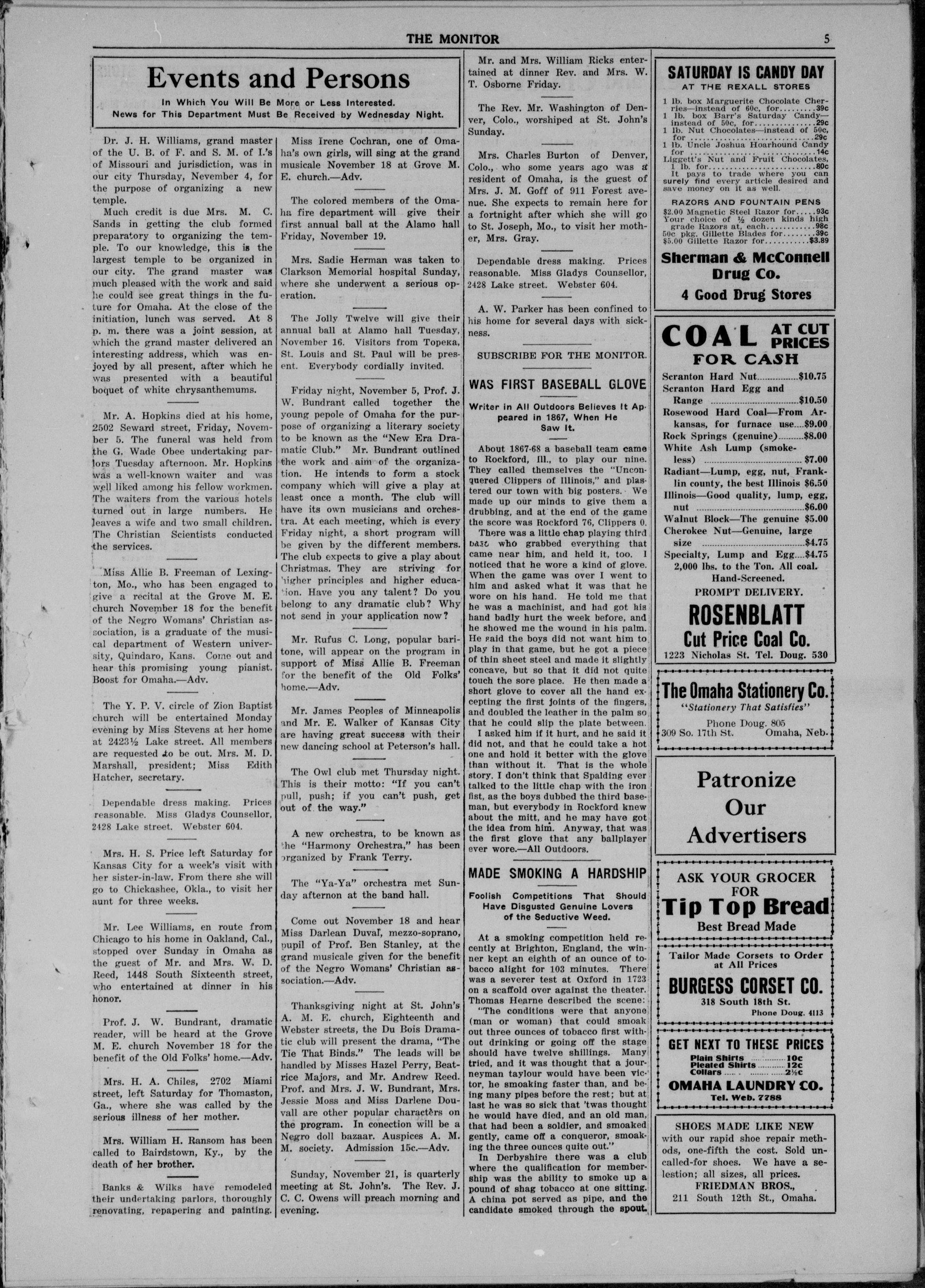
Dr. J. H. Williams, grand master of the U. B. of F. and S. M. of I.'s of Missouri and jurisdiction, was in our city Thursday, November 4, for the purpose of organizing a new temple.
Much credit is due Mrs. M. C. Sands in getting the club formed preparatory to organizing the temple. To our knowledge, this is the largest temple to be organized in our city. The grand master was much pleased with the work and said he could see great things in the future for Omaha. At the close of the initiation, lunch was served. At 8 p. m. there was a joint session, at which the grand master delivered an interesting address, which was enjoyed by all present, after which he was presented with a beautiful boquet of white chrysanthemums.
Mr. A. Hopkins died at his home, 2502 Seward street, Friday, November 5. The funeral was held from the G. Wade Obee undertaking parlors Tuesday afternoon. Mr. Hopkins was a well-known waiter and was well liked among his fellow workmen. The waiters from the various hotels turned out in large numbers. He leaves a wife and two small children. The Christian Scientists conducted the services.
Miss Allie B. Freeman of Lexington, Mo., who has been engaged to give a recital at the Grove M. E. church November 18 for the benefit of the Negro Womans' Christian association, is a graduate of the musical department of Western university, Quindaro, Kans. Come out and hear this promising young pianist. Boost for Omaha.—Adv.
The Y. P. V. circle of Zion Baptist church will be entertained Monday evening by Miss Stevens at her home at 2423 $ \frac{1}{2} $ Lake street. All members are requested to be out. Mrs. M. D. Marshall, president; Miss Edith Hatcher, secretary.
Dependable dress making. Prices reasonable. Miss Gladys Counsellor, 2428 Lake street. Webster 604.
Mrs. H. S. Price left Saturday for Kansas City for a week's visit with her sister-in-law. From there she will go to Chickashee, Okla., to visit her aunt for three weeks.
Mr. Lee Williams, en route from Chicago to his home in Oakland, Cal., stopped over Sunday in Omaha as the guest of Mr. and Mrs. W. D. Reed, 1448 South Sixteenth street, who entertained at dinner in his honor.
Prof. J. W. Bundrant, dramatic reader, will be heard at the Grove M. E. church November 18 for the benefit of the Old Folks' home.—Adv.
Mrs. H. A. Chiles, 2702 Miami street, left Saturday for Thomaston, Ga., where she was called by the serious illness of her mother.
Mrs. William H. Ransom has been called to Bairdstown, Ky., by the death of her brother.
Banks & Wilks have remodeled their undertaking parlors, thoroughly renovating, repapering and painting.
d Persons
More or Less Interested.
Be Received by Wednesday Night.
Miss Irene Cochran, one of Omaha's own girls, will sing at the grand musicale November 18 at Grove M. E. church.—Adv.
The colored members of the Omaha fire department will give their first annual ball at the Alamo hall Friday, November 19.
Mrs. Sadie Herman was taken to Clarkson Memorial hospital Sunday, where she underwent a serious operation.
The Jolly Twelve will give their annual ball at Alamo hall Tuesday, November 16. Visitors from Topeka, St. Louis and St. Paul will be present. Everybody cordially invited.
Friday night, November 5, Prof. J. W. Bundrant called together the young pepole of Omaha for the purpose of organizing a literary society to be known as the "New Era Dramatic Club." Mr. Bundrant outlined the work and aim of the organization. He intends to form a stock company which will give a play at least once a month. The club will have its own musicians and orchestra. At each meeting, which is every Friday night, a short program will be given by the different members. The club expects to give a play about Christmas. They are striving for higher principles and higher education. Have you any talent? Do you belong to any dramatic club? Why not send in your application now?
Mr. Rufus C. Long, popular baritone, will appear on the program in support of Miss Allie B. Freeman for the benefit of the Old Folks' home.—Adv.
Mr. James Peoples of Minneapolis and Mr. E. Walker of Kansas City are having great success with their new dancing school at Peterson's hall.
The Owl club met Thursday night. This is their motto: "If you can't pull, push; if you can't push, get out of the way."
A new orchestra, to be known as the "Harmony Orchestra," has been organized by Frank Terry.
The "Ya-Ya" orchestra met Sunday afternoon at the band hall.
Come out November 18 and hear Miss Darlean Duval, mezzo-soprano, pupil of Prof. Ben Stanley, at the grand musicale given for the benefit of the Negro Womans' Christian association.—Adv.
Thanksgiving night at St. John's A. M. E. church, Eighteenth and Webster streets, the Du Bois Dramatic club will present the drama, "The Tie That Binds." The leads will be handled by Misses Hazel Perry, Beatrice Majors, and Mr. Andrew Reed. Prof. and Mrs. J. W. Bundrant, Mrs. Jessie Moss and Miss Darlene Douvall are other popular characters on the program. In conection will be a Negro doll bazaar. Auspices A. M. M. society. Admission 15c.—Adv.
Sunday, November 21, is quarterly meeting at St. John's. The Rev. J. C. C. Owens will preach morning and evening.
Mr. and Mrs. William Ricks entertained at dinner Rev. and Mrs. W. T. Osborne Friday.
The Rev. Mr. Washington of Denver, Colo., worshiped at St. John's Sunday.
Mrs. Charles Burton of Denver, Colo., who some years ago was a resident of Omaha, is the guest of Mrs. J. M. Goff of 911 Forest avenue. She expects to remain here for a fortnight after which she will go to St. Joseph, Mo., to visit her mother, Mrs. Gray.
Dependable dress making. Prices reasonable. Miss Gladys Counsellor, 2428 Lake street. Webster 604.
A. W. Parker has been confined to his home for several days with sickness.
SUBSCRIBE FOR THE MONITOR.
WAS FIRST BASEBALL GLOVE
Writer in All Outdoors Believes It Appeared in 1867, When He Saw It.
About 1867-68 a baseball team came to Rockford, Ill., to play our nine. They called themselves the "Unconquered Clippers of Illinois," and plastered our town with big posters. We made up our minds to give them a drubbing, and at the end of the game the score was Rockford 76. Clippers 0.
There was a little chap playing third bass who grabbed everything that came near him, and held it, too. I noticed that he wore a kind of glove. When the game was over I went to him and asked what it was that he wore on his hand. He told me that he was a machinist, and had got his hand badly hurt the week before, and he showed me the wound in his palm. He said the boys did not want him to play in that game, but he got a piece of thin sheet steel and made it slightly concave, but so that it did not quite touch the sore place. He then made a short glove to cover all the hand excepting the first joints of the fingers, and doubled the leather in the palm so that he could slip the plate between.
I asked him if it hurt, and he said it did not, and that he could take a hot one and hold it better with the glove than without it. That is the whole story. I don't think that Spalding ever talked to the little chap with the iron fist, as the boys dubbed the third baseman, but everybody in Rockford knew about the mitt, and he may have got the idea from him. Anyway, that was the first glove that any ballplayer ever wore.—All Outdoors.
MADE SMOKING A HARDSHIP
Foolish Competitions That Should Have Disgusted Genuine Lovers of the Seductive Weed. At a smoking competition held recently at Brighton, England, the winner kept an eighth of an ounce of tobacco alight for 103 minutes. There was a severer test at Oxford in 1723 on a scaffold over against the theater. Thomas Hearne described the scene:
"The conditions were that anyone (man or woman) that could smoak out three ounces of tobacco first without drinking or going off the stage should have twelve shillings. Many tried, and it was thought that a journeyman taylour would have been victor, he smoaking faster than, and being many pipes before the rest; but at last he was so sick that 'twas thought he would have died, and an old man, that had been a soldier, and smoaked gently, came off a conqueror, smoaking the three ounces quite out."
In Derbyshire there was a club where the qualification for membership was the ability to smoke up a pound of shag tobacco at one sitting. A china pot served as pipe, and the candidate smoked through the spout.
5
SATURDAY IS CANDY DAY
1 lb. box Marguerite Chocolate Cherries—instead of 60c, for.....39c
1 lb. box Barr's Saturday Candy—instead of 50c, for.....29c
1 lb. Nut Chocolates—instead of 50c, for.....29c
1 lb. Uncle Joshua Hoarhound Candy for.....14c
Liggett's Nut and Fruit Chocolates, 1 lb. for.....80c
It pays to trade where you can surely find every article desired and save money on it as well.
RAZORS AND FOUNTAIN PENS
$2.00 Magnetic Steel Razor for.....93c
Your choice of ½ dozen kinds high grade Razors at, each.....98c
50c pkg. Gillette Blades for.....39c
$5.00 Gillette Razor for.....$3.89
Sherman & McConnell Drug Co. 4 Good Drug Stores
COAL AT CUT PRICES FOR CASH
Scranton Hard Nut.....$10.75
Scranton Hard Egg and
Range .....$10.50
Rosewood Hard Coal—From Arkansas, for furnace use.....$9.00
Rock Springs (genuine).....$8.00
White Ash Lump (smokeless) .....$7.00
Radiant—Lump, egg, nut, Franklin county, the best Illinois $6.50
Illinois—Good quality, lump, egg, nut .....$6.00
Walnut Block—The genuine $5.00
Cherokee Nut—Genuine, large size .....$4.75
Specialty, Lump and Egg.....$4.75
2,000 lbs. to the Ton. All coal.
Hand-Screened.
PROMPT DELIVERY.
ROSENBLATT
Cut Price Coal Co.
1223 Nicholas St. Tel. Doug. 530
The Omaha Stationery Co.
Phone Doug. 805
309 So. 17th St. Omaha, Neb.
Patronize Our Advertisers
ASK YOUR GROCER FOR Tip Top Bread Best Bread Made
Tailor Made Corsets to Order at All Prices
BURGESS CORSET CO.
318 South 18th St.
Phone Doug. 4113
GET NEXT TO THESE PRICES
Plain Shirts ..... 10c
Pleated Shirts ..... 12c
Collars ..... 2½c
OMAHA LAUNDRY CO.
Tel. Web. 7788
SHOES MADE LIKE NEW
with our rapid shoe repair methods, one-fifth the cost. Sold uncalled-for shoes. We have a selection; all sizes, all prices.
FRIEDMAN BROS.,
211 South 12th St., Omaha.
Our Women and Children
Conducted by Lucille Skaggs Edwards.
MOTHER, THE DAUGHTER'S BEST FRIEND
I believe that a girl's first and best friends are her parents; her wisest confidante, her mother. To these she may speak undeservedly of herself. With these she may freely talk over family matters. In a friendship with some outside the family it would be unwise to discuss family matters. It might be an unkindness to other members of the family, and in case of a break in the friendship the family secrets might be betrayed, and to the detriment of the trusting friend.
True honor would forbid the betrayal of a confidence even after the rupture of a friendship; but all persons have not the highest ideal of honor. If the girl is not discreet in her revelation of herself, and her mother is her only confidant, it will not be so serious a matter, for the mother will never be tempted to reveal to others anything that would bring scorn or criticism upon her child. Nowhere, in her girlish ignorance, can the girl find as sincere sympathy as in the loving mother.
"But all mothers are not sympathetic," you say. "They are often nagging, and use the confidences of the daughter to make her uncomfortable." Well, if this be so, you, at least, can learn the lesson, and by your habits of thought fit yourself to be the wise, loving, companionable, sympathetic confidante of your daughter, for you will be anxious that she should have no friend so close as yourself.
However, I believe that mothers should recognize the individuality of their daughters, and win, rather than command, confidence. It is difficult for us, as mothers, to realize that our daughter is just as much a separate individual as is our neighbor's daughter, and that we have no right to thrust ourselves upon her, no right to demand that she shall love us. We have the right to sympathize, to counsel, to direct her conduct so long as she remains in our personal care, but we should remember that she must be responsible, that she is a soul and must live her own life, learn her own lessons, suffer her own experiences. Our deepest love can only enable us to help her choose wisely, to think truly, to act judiciously. So I would have the friendship of mother and daughter something very deep and true—something more than a petting and caressing, an indulging or humoring.—Purity Magazine.
HOW HE LIVED.
So he died for his faith. That is fine—
More than most of us do.
But stay! Can you add to that line
That he lived for it, too?
It is easy to die. Men have died
For a wish or a whim—
From bravado, passion or pride?
Was it hard for him?
But to live; every day to live out
All the truth that he dreamt,
While his friends met his conduct
with doubt,
And the world with contempt—
Was it thus that he plodded ahead,
Never turning aside?
Then we'll talk of the life that he
led—
Never mind how he died.
—Ernest Crosby.
6
DIRTY PEOPLE MAKE DIRTY TOWNS.
"I'm as good as you are," said the dirty man to the well-dressed gentleman in the street car, who had drawn away from him a bit.
"You may be right," answered the Clean One, "but you certainly don't smell as good."
"Lord!" exclaimed a visitor to one of the most populous sections of Boston. "What smells there are here."
"Yes," agreed the social worker of the party, "we've got to clean out a lot of minds before we'll get rid of this dirt."
"You have to clean minds!"
"Surely. Dirty minds make dirty people and dirty people make a dirty town. The idea of cleanliness must be put in the minds of those whose present standards of cleanliness are elemental.
"The woman who will tolerate cobwebs in the corner of her ceiling has cobwebs in the corners of her mind. Disorder in a home is evidence of the presence of minds that are disorderly. Our surroundings always reflect what we are within. To make these streets clean we must create in the people who live here a desire for clean streets."
THE HOUSE BY THE SIDE OF THE ROAD.
There are hermit souls that live withdrawn
In the peace of their self-content,
There are souls, like stars, that dwell apart,
In the fellowless firmament;
There are pioneer souls that blaze their paths
Where highways never ran—
But let me live in a house by the side of the road
And be a friend of man.
Let me live in a house by the side of the road,
Where the races of men go by,
The men who are good, the men who
are bad,
As good and as bad as I;
I would not sit in the scorner's seat,
Or hurl the cynic's ban,
Let me live in a house by the side
of the road
And be a friend to man.
I see from my house by the side of the
road.
By the side of the highway of life,
The men who press with ardor of
hope,
The men who are faint with the
strife;
But I turn not away from their
smiles nor their tears,
Both part of an infinite plan,
Let me live in a house by the side
of the road
And be a friend to man.
I know there are brook-gladdened
meadows ahead
And a mountain of wearisome height,
That the road passes on through the long afternoon,
And stretches away to the night;
But still I rejoice when the travelers rejoice,
And weep with the strangers that moan,
Nor live in my house by the side of the road
Like a man who dwells alone.
THE MONITOR
ent;
that blaze
ran—
by the side
y the side
way of life,
ardor of
with the
plan,
by the side
through the
the night;
the travelers
ingers that
the side of
alone.
Let me live in a house by the side of the road,
Where the races of men go by,
They are good, they are bad, they are weak, they are strong,
Wise, foolish—so am I;
Then why should I sit in the scorner's seat,
Or hurl the cynic's ban?
Let me live in a house by the side of the road
And be a friend to man.
—Samuel W. Foss.
PATRONIZE OUR ADVERTISERS.
DO NOT buy your Fall suit until you see us. Most reasonable and reliable ladies cloak and suit store in Omaha.
Always high price samples on hand at reasonable prices
BONOFF'S New York Sample Store
---
Autumn Signs
Browning and falling leaves again call our attention to the promise that summer and winter shall not cease.
Prudent people prepare. Are you ready with your autumn dress? If not, why not?
We can help you.
Thomas Kilpatrick & Co.
We Pr
We Print the Monitor
WATERS
BARNHART
PRINTING CO
ОМАНА
522-24 South Thirteenth St.
Telephone Douglas 2190
206 No. 16th St.
MATTHEWS BOOK STORE
Stationers and Engravers
Have moved to their new location
1620 Harney St., State Bank Bldg.
Where larger facilities enable them
to give you better service
We recommend the
STATE FURNITURE CO.
Corner 14th and Dodge Sts.
as the most reliable, accommodating and economical furniture store to buy from.
NORTHRUP
LETTER DUPLICATING COMPANY
"LETTEROLOGISTS"
TYPEWRITTEN CIRCULAR LETTERS
Phone: Doug. 5685 Office:
Res. Web. 4292 506 Paxton Block
HENRI H. CLAIBORNE
Notary Public
Justice of the Peace
Tel. Red 7401
Res. Doug. 6188 512-13 Paxton Block
Established 1890
C. J. CARLSON
Dealer in
Shoes and Gents Furnishings
1514 North 24th St. Omaha, Neb.
Start Saving Now
One Dollar will open an account in the
Savings Department
of the
United States Nat'l Bank
16th and Farnam Streets
EMERSON LAUNDRY
F. S. MOREY, Proprietor
1303-05 North 24th Street
Phone Webster 820
Moving Vans and Piano
Moving, Packing, Shipping
Gordon Van Co.
11th and Davenport Douglas 394
I TAKE PLEASURE
in thanking you for your patronage.
I want your trade solely upon the merits
of my goods.
You will profit by trading here.
H. E. YOUNG
Phone Webster 515 2114-16 N. 24th St.
BY WILLIAM G. HAYNES.
HOW TO REGAIN MENTAL BALANCE
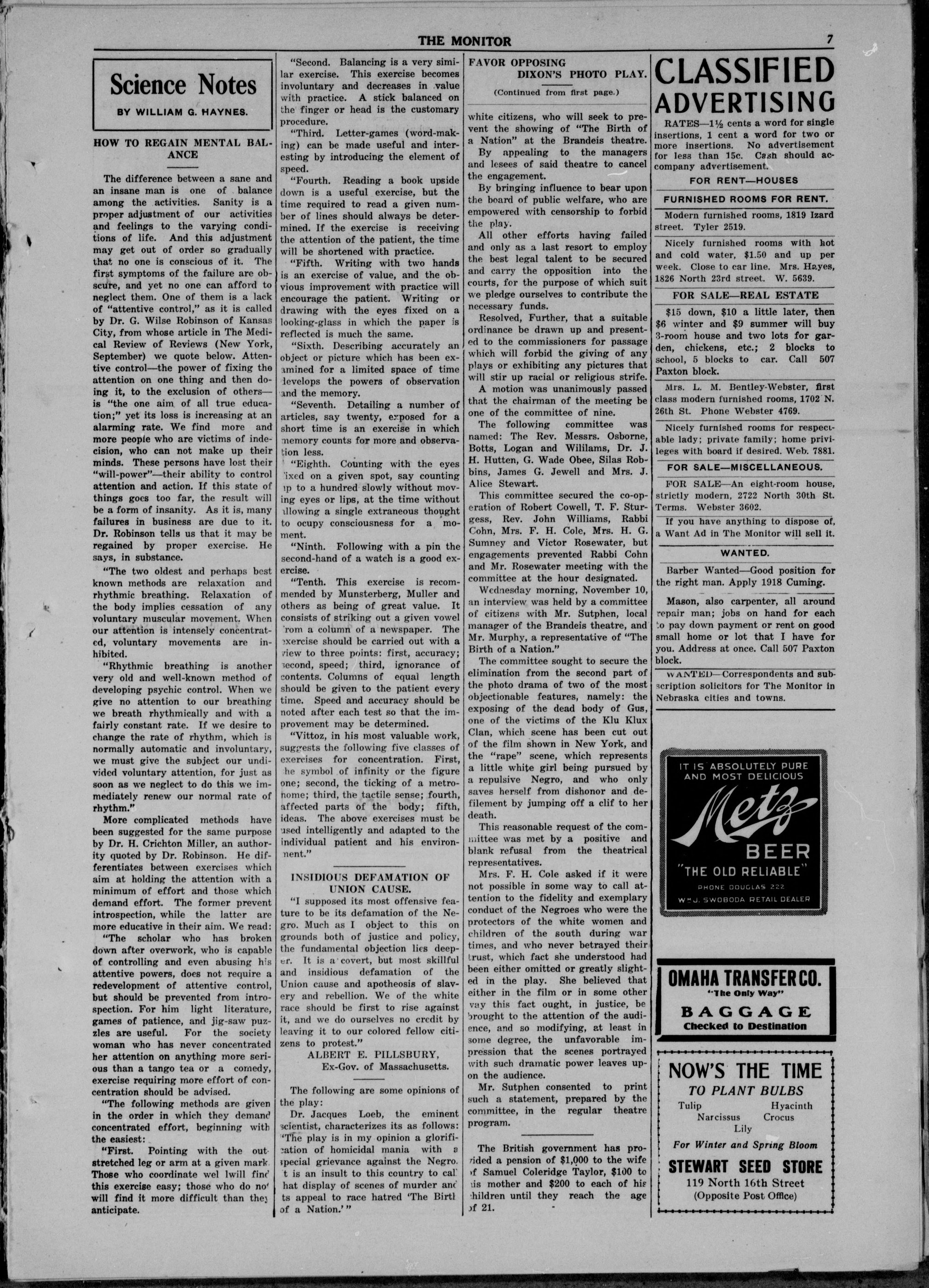
The difference between a sane and an insane man is one of balance among the activities. Sanity is a proper adjustment of our activities and feelings to the varying conditions of life. And this adjustment may get out of order so gradually that no one is conscious of it. The first symptoms of the failure are obscure, and yet no one can afford to neglect them. One of them is a lack of "attentive control," as it is called by Dr. G. Wilse Robinson of Kansas City, from whose article in The Medical Review of Reviews (New York, September) we quote below. Attentive control—the power of fixing the attention on one thing and then doing it, to the exclusion of others—is "the one aim of all true education;" yet its loss is increasing at an alarming rate. We find more and more people who are victims of indecision, who can not make up their minds. These persons have lost their "will-power"—their ability to control attention and action. If this state of things goes too far, the result will be a form of insanity. As it is, many failures in business are due to it. Dr. Robinson tells us that it may be regained by proper exercise. He says, in substance.
"The two oldest and perhaps best known methods are relaxation and rhythmic breathing. Relaxation of the body implies cessation of any voluntary muscular movement. When our attention is intensely concentrated, voluntary movements are inhibited.
"Rhythmic breathing is another very old and well-known method of developing psychic control. When we give no attention to our breathing we breath rhythmically and with a fairly constant rate. If we desire to change the rate of rhythm, which is normally automatic and involuntary, we must give the subject our undivided voluntary attention, for just as soon as we neglect to do this we immediately renew our normal rate of rhythm."
More complicated methods have been suggested for the same purpose by Dr. H. Crichton Miller, an authority quoted by Dr. Robinson. He differentiates between exercises which aim at holding the attention with a minimum of effort and those which demand effort. The former prevent introspection, while the latter are more educative in their aim. We read:
"The scholar who has broken down after overwork, who is capable of controlling and even abusing his attentive powers, does not require a redevelopment of attentive control, but should be prevented from introspection. For him light literature, games of patience, and jig-saw puzzles are useful. For the society woman who has never concentrated her attention on anything more serious than a tango tea or a comedy, exercise requiring more effort of concentration should be advised.
"The following methods are given in the order in which they demand concentrated effort, beginning with the easiest:
"First. Pointing with the outstretched leg or arm at a given mark. Those who coordinate wel lwill find this exercise easy; those who do not will find it more difficult than they anticipate.
THE MONITOR
"Second. Balancing is a very similar exercise. This exercise becomes involuntary and decreases in value with practice. A stick balanced on the finger or head is the customary procedure.
"Third. Letter-games (word-making) can be made useful and interesting by introducing the element of speed.
"Fourth. Reading a book upside down is a useful exercise, but the time required to read a given number of lines should always be determined. If the exercise is receiving the attention of the patient, the time will be shortened with practice.
"Fifth. Writing with two hands is an exercise of value, and the obvious improvement with practice will encourage the patient. Writing or drawing with the eyes fixed on a looking-glass in which the paper is reflected is much the same.
"Sixth. Describing accurately an object or picture which has been examined for a limited space of time develops the powers of observation and the memory.
"Seventh. Detailing a number of articles, say twenty, exposed for a short time is an exercise in which memory counts for more and observation less.
"Eighth. Counting with the eyes fixed on a given spot, say counting up to a hundred slowly without moving eyes or lips, at the time without allowing a single extraneous thought to occupy consciousness for a moment.
"Ninth. Following with a pin the second-hand of a watch is a good exercise.
"Tenth. This exercise is recommended by Munsterberg, Muller and others as being of great value. It consists of striking out a given vowel from a column of a newspaper. The exercise should be carried out with a view to three points: first, accuracy; second, speed; third, ignorance of contents. Columns of equal length should be given to the patient every time. Speed and accuracy should be noted after each test so that the improvement may be determined.
"Vittoz, in his most valuable work, suggests the following five classes of exercises for concentration. First, the symbol of infinity or the figure one; second, the ticking of a metronome; third, the tactile sense; fourth, affected parts of the body; fifth, ideas. The above exercises must be used intelligently and adapted to the individual patient and his environment."
INSIDIOUS DEFAMATION OF UNION CAUSE.
"I supposed its most offensive feature to be its defamation of the Negro. Much as I object to this on grounds both of justice and policy, the fundamental objection lies deeper. It is a covert, but most skillful and insidious defamation of the Union cause and apotheosis of slavery and rebellion. We of the white race should be first to rise against it, and we do ourselves no credit by leaving it to our colored fellow citizens to protest."
The following are some opinions of the play:
Dr. Jacques Loeb, the eminent scientist, characterizes its as follows:
"The play is in my opinion a glorification of homicidal mania with a special grievance against the Negro. It is an insult to this country to call that display of scenes of murder and its appeal to race hatred 'The Birth of a Nation.'"
white citizens, who will seek to prevent the showing of "The Birth of a Nation" at the Brandeis theatre. By appealing to the managers and lesees of said theatre to cancel the engagement. By bringing influence to bear upon the board of public welfare, who are empowered with censorship to forbid the play.
All other efforts having failed and only as a last resort to employ the best legal talent to be secured and carry the opposition into the courts, for the purpose of which suit we pledge ourselves to contribute the necessary funds.
Resolved, Further, that a suitable ordinance be drawn up and presented to the commissioners for passage which will forbid the giving of any plays or exhibiting any pictures that will stir up racial or religious strife.
A motion was unanimously passed that the chairman of the meeting be one of the committee of nine. The following committee was named: The Rev. Messrs. Osborne, Botts, Logan and Wililams, Dr. J. H. Hutten, G. Wade Obee, Silas Robbins, James G. Jewell and Mrs. J. Alice Stewart.
This committee secured the co-operation of Robert Cowell, T. F. Sturgess, Rev. John Williams, Rabbi Cohn, Mrs. F. H. Cole, Mrs. H. G. Sumney and Victor Rosewater, but engagements prevented Rabbi Cohn and Mr. Rosewater meeting with the committee at the hour designated. Wednesday morning, November 10, an interview was held by a committee of citizens with Mr. Sutphen, local manager of the Brandeis theatre, and Mr. Murphy, a representative of "The Birth of a Nation."
The committee sought to secure the elimination from the second part of the photo drama of two of the most objectionable features, namely: the exposing of the dead body of Gus, one of the victims of the Klu Klux Clan, which scene has been cut out of the film shown in New York, and the "rape" scene, which represents a little white girl being pursued by a repulsive Negro, and who only saves herself from dishonor and defilement by jumping off a clif to her death.
This reasonable request of the committee was met by a positive and blank refusal from the theatrical representatives.
Mrs. F. H. Cole asked if it were not possible in some way to call attention to the fidelity and exemplary conduct of the Negroes who were the protectors of the white women and children of the south during war times, and who never betrayed their trust, which fact she understood had been either omitted or greatly slighted in the play. She believed that either in the film or in some other vay this fact ought, in justice, be brought to the attention of the audience, and so modifying, at least in some degree, the unfavorable impression that the scenes portrayed with such dramatic power leaves upon the audience.
Mr. Sutphen consented to print such a statement, prepared by the committee, in the regular theatre program.
The British government has provided a pension of $1,000 to the wife of Samuel Coleridge Taylor, $100 to his mother and $200 to each of his children until they reach the age of 21.
7
CLASSIFIED ADVERTISING
RATES—1½ cents a word for single insertions, 1 cent a word for two or more insertions. No advertisement for less than 15c. Cash should accompany advertisement.
FOR RENT—HOUSES
FURNISHED ROOMS FOR RENT.
Modern furnished rooms, 1819 Izard street. Tyler 2519.
Nicely furnished rooms with hot and cold water, $1.50 and up per week. Close to car line. Mrs. Hayes, 1826 North 23rd street. W. 5639.
FOR SALE—REAL ESTATE
$15 down, $10 a little later, then $6 winter and $9 summer will buy 3-room house and two lots for garden, chickens, etc.; 2 blocks to school, 5 blocks to car. Call 507 Paxton block.
Mrs. L. M. Bentley-Webster, first class modern furnished rooms, 1702 N. 26th St. Phone Webster 4769.
Nicely furnished rooms for respectable lady; private family; home privileges with board if desired. Web. 7881.
FOR SALE—MISCELLANEOUS.
FOR SALE—An eight-room house, strictly modern, 2722 North 30th St. Terms. Webster 3602.
If you have anything to dispose of, a Want Ad in The Monitor will sell it.
WANTED.
Barber Wanted—Good position for the right man. Apply 1918 Cuming.
Mason, also carpenter, all around repair man; jobs on hand for each to pay down payment or rent on good small home or lot that I have for you. Address at once. Call 507 Paxton block.
WANTED—Correspondents and subscription solicitors for The Monitor in Nebraska cities and towns.
IT IS ABSOLUTELY PURE
AND MOST DELICIOUS
Metz
BEER
"THE OLD RELIABLE"
PHONE DOUGLAS 222
WMJ. SWOBODA RETAIL DEALER
OMAHA TRANSFER CO.
"The Only Way"
BAGGAGE
Checked to Destination
NOW'S THE TIME
TO PLANT BULBS
Tulip Hyacinth
Narcissus Crocus
Lily
For Winter and Spring Bloom
STEWART SEED STORE
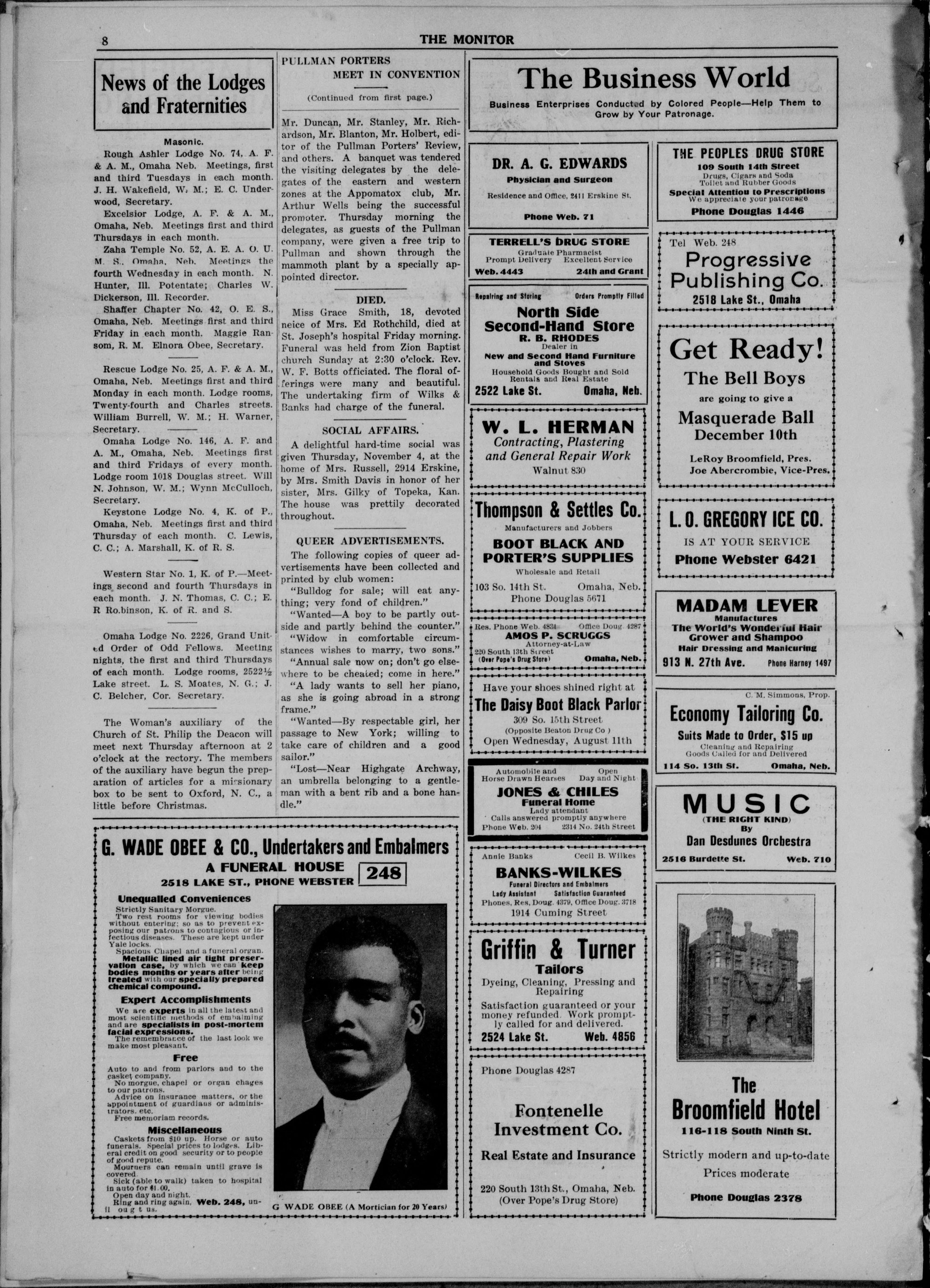
G. WADE OBEE & CO., Undertakers and Embalmers A FUNERAL HOUSE 248 2518 LAKE ST., PHONE WEBSTER
8
News of the Lodges and Fraternities
Masonic.
Rough Ashler Lodge No. 74, A. F. & A. M., Omaha Neb. Meetings, first and third Tuesdays in each month. J. H. Wakefield, W. M.; E. C. Underwood, Secretary. Excelsior Lodge, A. F. & A. M., Omaha, Neb. Meetings first and third Thursdays in each month. Zaha Temple No. 52, A. E. A. O. U. M. S., Omaha, Neb. Meetings the fourth Wednesday in each month. N. Hunter, Ill. Potentate; Charles W. Dickerson, Ill. Recorder.
Shaffer Chapter No. 42, O. E. S., Omaha, Neb. Meetings first and third Friday in each month. Maggie Ransom, R. M. Elnora Obee, Secretary.
Rescue Lodge No. 25, A. F. & A. M., Omaha, Neb. Meetings first and third Monday in each month. Lodge rooms, Twenty-fourth and Charles streets. William Burrell, W. M.; H. Warner, Secretary.
Omaha Lodge No. 146, A. F. and A. M., Omaha, Neb. Meetings first and third Fridays of every month. Lodge room 1018 Douglas street. Will N. Johnson, W. M.; Wynn McCulloch, Secretary. Keystone Lodge No. 4, K. of P., Omaha, Neb. Meetings first and third Thursday of each month. C. Lewis, C. C.; A. Marshall, K. of R. S.
Western Star No. 1, K. of P.—Meetings second and fourth Thursdays in each month. J. N. Thomas, C. C.; E. R Ro.binson, K. of R. and S.
Omaha Lodge No. 2226, Grand United Order of Odd Fellows. Meeting nights, the first and third Thursdays of each month. Lodge rooms, 2522 $ \frac{1}{2} $ Lake street. L. S. Moates, N. G.; J. C. Belcher, Cor. Secretary.
The Woman's auxiliary of the Church of St. Philip the Deacon will meet next Thursday afternoon at 2 o'clock at the rectory. The members of the auxiliary have begun the preparation of articles for a missionary box to be sent to Oxford, N. C., a little before Christmas.
G. WADE OBEE & CO., U.
A FUNERA
2518 LAKE ST., PHC
Unequalled Conveniences
Strictly Sanitary Morgue
Two rest rooms for viewing bodies without entering; so as to prevent exposing our patrons to contagious or infectious diseases. These are kept under Yale locks. Spacious Chapel and a funeral organ. Metallic lined air tight preservation case, by which we can keep bodies months or years after being treated with our specially prepared chemical compound.
Expert Accomplishments
We are experts in all the latest and most scientific methods of embalming and are specialists in post-mortem facial expressions.
The remembrance of the last look we make most pleasant.
Free
Auto to and from parlors and to the casket company.
No morgue, chapel or organ chages to our patrons.
Advice on insurance matters, or the appointment of guardians or administrators, etc.
Free memoriam records.
Miscellaneous
Caskets from $10 up. Horse or auto funerals. Special prices to lodges. Liberal credit on good security or to people of good repute.
Mourners can remain until grave is covered.
Sick (able to walk) taken to hospital in auto for $1.00.
Open day and night.
Ring and ring again, Web. 248, until ou g t us.
THE MONITOR
Mr. Duncan, Mr. Stanley, Mr. Richardson, Mr. Blanton, Mr. Holbert, editor of the Pullman Porters' Review, and others. A banquet was tendered the visiting delegates by the delegates of the eastern and western zones at the Appomatox club, Mr. Arthur Wells being the successful promoter. Thursday morning the delegates, as guests of the Pullman company, were given a free trip to Pullman and shown through the mammoth plant by a specially appointed director.
Miss Grace Smith, 18, devoted neice of Mrs. Ed Rothchild, died at St. Joseph's hospital Friday morning. Funeral was held from Zion Baptist church Sunday at 2:30 o'clock. Rev. W. F. Botts officiated. The floral offerings were many and beautiful. The undertaking firm of Wilks & Banks had charge of the funeral.
A delightful hard-time social was given Thursday, November 4, at the home of Mrs. Russell, 2914 Erskine, by Mrs. Smith Davis in honor of her sister, Mrs. Gilky of Topeka, Kan. The house was prettily decorated throughout.
QUEER ADVERTISEMENTS.
The following copies of queer advertisements have been collected and printed by club women:
"Bulldog for sale; will eat anything; very fond of children."
"Wanted—A boy to be partly outside and partly behind the counter."
"Widow in comfortable circumstances wishes to marry, two sons."
"A lady wants to sell her piano, as she is going abroad in a strong frame."
"Wanted—By respectable girl, her passage to New York; willing to take care of children and a good sailor."
"Lost—Near Highgate Archway, an umbrella belonging to a gentleman with a bent rib and a bone handle."
Undertakers and Embalmers
AL HOUSE 248
ONE WEBSTER
[Picture of a man in a suit and tie].
G WADE OBEE (A Mortician for 20 Years)
(Continued from first page.)
DIED.
SOCIAL AFFAIRS.
Business Enterprises Conducted by Colored People-Help Them to Grow by Your Patronage.
DR. A. G. EDWARDS
Physician and Surgeon
Residence and Office, 2411 Erskine St.
Phone Web. 71
TERRELL'S DRUG STORE
Graduate Pharmacist
Prompt Delivery Excellent Service
Web. 4443 24th and Grant
North Side
Second-Hand Store
R. B. RHODES
Dealer in
New and Second Hand Furniture
and Stoves
Household Goods Bought and Sold
Rentals and Real Estate
2522 Lake St. Omaha, Neb.
W. L. HERMAN
Contracting, Plastering and General Repair Work
Walnut 830
Thompson & Settles Co.
BOOT BLACK AND PORTER'S SUPPLIES
Wholesale and Retail
103 So. 14th St. Omaha, Neb.
Phone Douglas 5671
Res. Phone Web. 4831 Office Doug 4287
AMOS P. SCRUGGS
Attorney-at-Law
220 South 13th Street
(Over Pope's Drug Store) Omaha, Neb.
Have your shoes shined right at
The Daisy Boot Black Parlor
309 So.15th Street (Opposite Beaton Drug Co )
Open Wednesday, August 11th
Automobile and Open
Horse Drawn Hearses Day and Night
JONES & CHILES
Funeral Home
Lady attendant
Calls answered promptly anywhere
Phone Web. 204 2314 No. 24th Street
Annie Banks Cecil B. Wilkes
BANKS-WILKES
Funeral Directors and Embalmers
Lady Assistant Satisfaction Guaranteed
Phones, Res, Doug. 4379, Office Doug. 3718
1914 Cuming Street
Griffin & Turner
Dyeing, Cleaning, Pressing and Repairing Satisfaction guaranteed or your money refunded. Work promptly called for and delivered.
Phone Douglas 4287
Fontenelle Investment Co.
Real Estate and Insurance
220 South 13th St., Omaha, Neb.
(Over Pope's Drug Store)
The Business World
Tailors
THE PEOPLES DRUG STORE
109 South 14th Street
Drugs, Cigars and Soda
Toilet and Rubber Goods
Special Attention to Prescriptions
We appreciate your patronage
Phone Douglas 1446
Tel Web. 248
Progressive
Publishing Co.
2518 Lake St., Omaha
Get Ready!
The Bell Boys are going to give a Masquerade Ball December 10th LeRoy Broomfield, Pres. Joe Abercrombie, Vice-Pres.
L. O. GREGORY ICE CO.
IS AT YOUR SERVICE Phone Webster 6421
MADAM LEVER
MADAM LEVER
Manufactures
The World's Wonderful Hair
Grower and Shampoo
Hair Dressing and Manicuring
913 N. 27th Ave. Phone Harney 1497
C. M. Simmons, Prop.
Economy Tailoring Co.
Suits Made to Order, $15 up
Cleaning and Repairing
Goods Called for and Delivered
114 So. 13th St. Omaha, Neb.
MUSIC
(THE RIGHT KIND)
By
Dan Desdunes Orchestra
2516 Burdette St. Web. 710
THE MUSEUM OF THE WEST
Broomfield Hotel
116-118 South Ninth St.
Strictly modern and up-to-date
Prices moderate
Phone Douglas 2378