The Monitor
Saturday, April 15, 1916
Omaha, Nebraska
Page text (machine-generated)
THE MONITOR
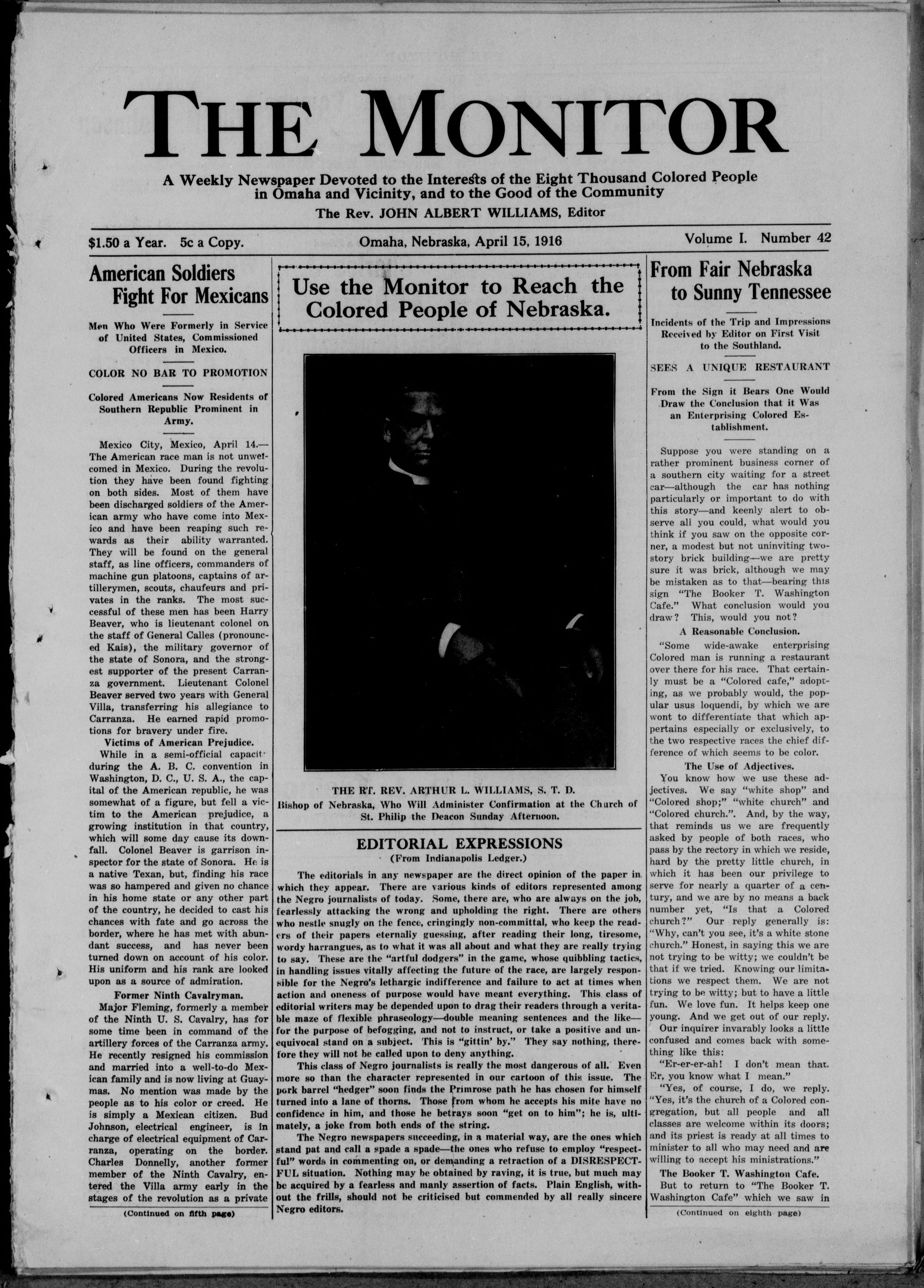
A Weekly Newspaper Devoted to the Interests of the Eight Thousand Colored People in Omaha and Vicinity, and to the Good of the Community The Rev. JOHN ALBERT WILLIAMS, Editor
$1.50 a Year. 5c a Copy.
American Soldiers Fight For Mexicans
Men Who Were Formerly in Service of United States, Commissioned Officers in Mexico.
COLOR NO BAR TO PROMOTION
Colored Americans Now Residents of Southern Republic Prominent in Army.
Mexico City, Mexico, April 14. The American race man is not unwelcomed in Mexico. During the revolution they have been found fighting on both sides. Most of them have been discharged soldiers of the American army who have come into Mexico and have been reaping such rewards as their ability warranted. They will be found on the general staff, as line officers, commanders of machine gun platoons, captains of artillerymen, scouts, chaufeurs and privates in the ranks. The most successful of these men has been Harry Beaver, who is lieutenant colonel on the staff of General Calles (pronounced Kais), the military governor of the state of Sonora, and the strongest supporter of the present Carranza government. Lieutenant Colonel Beaver served two years with General Villa, transferring his allegiance to Carranza. He earned rapid promotions for bravery under fire.
Victims of American Prejudice.
Victims of American Prejudice. While in a semi-official capacit during the A. B. C. convention in Washington, D. C., U. S. A., the capital of the American republic, he was somewhat of a figure, but fell a victim to the American prejudice, a growing institution in that country, which will some day cause its downfall. Colonel Beaver is garrison inspector for the state of Sonora. He is a native Texan, but, finding his race was so hampered and given no chance in his home state or any other part of the country, he decided to cast his chances with fate and go across the border, where he has met with abundant success, and has never been turned down on account of his color. His uniform and his rank are looked upon as a source of admiration.
Major Fleming, formerly a member of the Ninth U. S. Cavalry, has for some time been in command of the artillery forces of the Carranza army. He recently resigned his commission and married into a well-to-do Mexican family and is now living at Guaymas. No mention was made by the people as to his color or creed. He is simply a Mexican citizen. Bud Johnson, electrical engineer, is in charge of electrical equipment of Carranza, operating on the border. Charles Donnelly, another former member of the Ninth Cavalry, entered the Villa army early in the stages of the revolution as a private (Continued on fifth page)
Omaha, Nebraska, April 15, 1916
The Monitor to Reach
Saved People of Nebraska
RT. REV. ARTHUR L. WILLIAMS, S. T.
Naska, Who Will Administer Confirmation at
St. Philip the Deacon Sunday Afternoon.
Use the Monitor to Reach the Colored People of Nebraska.
THE RT. REV. ARTHUR L. WILLIAMS, S. T. D. Bishop of Nebraska, Who Will Administer Confirmation at the Church of St. Philip the Deacon Sunday Afternoon.
EDITORIAL EXPRESSIONS
ials in any newspaper are the direct opinion of ear. There are various kinds of editors representatives of today. Some, there are, who are all acting the wrong and upholding the right. They on the fence, cringingly non-committal, who pers eternally guessing, after reading their
The editorials in any newspaper are the direct opinion of the paper in which they appear. There are various kinds of editors represented among the Negro journalists of today. Some, there are, who are always on the job, fearlessly attacking the wrong and upholding the right. There are others who nestle snugly on the fence, cringingly non-committal, who keep the readers of their papers eternally guessing, after reading their long, tiresome, wordy harrangues, as to what it was all about and what they are really trying to say. These are the "artful dodgers" in the game, whose quibbling tactics, in handling issues vitally affecting the future of the race, are largely responsible for the Negro's lethargic indifference and failure to act at times when action and oneness of purpose would have meant everything. This class of editorial writers may be depended upon to drag their readers through a veritable maze of flexible phraseology—double meaning sentences and the like—for the purpose of befogging, and not to instruct, or take a positive and unequivocal stand on a subject. This is "gittin' by." They say nothing, therefore they will not be called upon to deny anything.
This class of Negro journalists is really the most dangerous of all. Even more so than the character represented in our cartoon of this issue. The pork barrel "hedger" soon finds the Primrose path he has chosen for himself turned into a lane of thorns. Those from whom he accepts his mite have no confidence in him, and those he betrays soon "get on to him"; he is, ultimately, a joke from both ends of the string.
The Negro newspapers succeeding, in a material way, are the ones which stand pat and call a spade a spade—the ones who refuse to employ "respectful" words in commenting on, or demanding a retraction of a DISRESPECTFUL situation. Nothing may be obtained by raving, it is true, but much may be acquired by a fearless and manly assertion of facts. Plain English, without the frills, should not be criticised but commended by all really sincere Negro editors.
Volume I. Number 42
From Fair Nebraska to Sunny Tennessee
Incidents of the Trip and Impressions Received by Editor on First Visit to the Southland.
SEES A UNIQUE RESTAURANT
From the Sign it Bears One Would Draw the Conclusion that it Was an Enterprising Colored Establishment.
Suppose you were standing on a rather prominent business corner of a southern city waiting for a street car—although the car has nothing particularly or important to do with this story—and keenly alert to observe all you could, what would you think if you saw on the opposite corner, a modest but not uninviting two-story brick building—we are pretty sure it was brick, although we may be mistaken as to that—bearing this sign "The Booker T. Washington Cafe." What conclusion would you draw? This, would you not?
A Reasonable Conclusion.
"Some wide-awake enterprising Colored man is running a restaurant over there for his race. That certainly must be a "Colored cafe," adopting, as we probably would, the popular usus loquendi, by which we are wont to differentiate that which appertains especially or exclusively, to the two respective races the chief difference of which seems to be color.
The Use of Adjectives.
You know how we use these adjectives. We say "white shop" and "Colored shop;" "white church" and "Colored church." And, by the way, that reminds us we are frequently asked by people of both races, who pass by the rectory in which we reside, hard by the pretty little church, in which it has been our privilege to serve for nearly a quarter of a century, and we are by no means a back number yet, "Is that a Colored church?" Our reply generally is: "Why, can't you see, it's a white stone church." Honest, in saying this we are not trying to be witty; we couldn't be that if we tried. Knowing our limitations we respect them. We are not trying to be witty; but to have a little fun. We love fun. It helps keep one young. And we get out of our reply. Our inquirer invarably looks a little confused and comes back with something like this:
"Er-er-er-ah! I don't mean that. Er, you know what I mean."
"Yes, of course, I do, we reply.
"Yes, it's the church of a Colored congregation, but all people and all classes are welcome within its doors; and its priest is ready at all times to minister to all who may need and are willing to accept his ministrations."
The Booker T. Washington Cafe.
But to return to "The Booker T. Washington Cafe" which we saw in
(Continued on eighth page)
THE MONITOR
10
ANIMAL TO BE LEFT ALONE
Porcupine Strictly Defensive, but a Dreaded Foe When It Comes to Close Quarters.
Perhaps you will come to the conclusion that this animal is more interesting to read about than to meet in the woods, the Philadelphia North American says. But don't worry—there are not many of him left. If he were common he might become, along with the rattlesnake, the emblem of the apostles of preparedness, for he carries a veritable arsenal around with him on his back. He is called the porcupine.
The only American member of the family is the Canadian porcupine, which occasionally wanders southward into the mountains of Pennsylvania. Covering his body from head to foot are sharp spines, or quills, varying from one to four inches in length. When the porcupine is undisturbed the quills lie flat against the body like hair. Approach him, and the spines become erect, pointing outward like a thousand bayonets.
Ancient writers handed down fanciful stories about how the porcupine could throw one of these quills from the body. He doesn't possess this power, however. He's wholly a defensive animal.
Sometimes a dog, unacquainted with this terror of the forest, will pounce upon him like he would on a rabbit. Immediately there's a howl of pain—from the dog, not the porcupine. The quills are covered with barbs, and once they are imbedded in another animal they work their way farther in, sometimes causing death.
The quills of the Canadian porcupine are hidden by a covering of hair. He makes his home in hollow trees or in caverns, and eats vegetables and bark from trees.
AERO-MOTORS USED IN WAR
French Are Said to Be Fitting the Fast Machines to Use as Transports.
An ingenious combination of aeroplane and motor car is now being used by the French army for the purpose of transporting troops and food and ammunition supplies across swamp country, deserts and sandy ground. These aero-motors are driven by an eight-foot propeller which revolves in the rear of a four-wheeled car at a speed of 1,000 revolutions a minute. The propeller is driven by an engine which operates the rear wheels of the vehicle as well as the air-screw.
The advantages of the invention are that it causes the motor car to lightly skim over soft ground at a speed of 50 miles an hour; the tired wheels of the vehicle do not dig into soft soil, for they brush lightly over it, as they do not have to grip the earth to force the car on its path; when the aero-motor hits a small hillock or bump it literally flies through the air, a few inches above the ground, and at top speed it travels in a series of leaps like a kangaroo. For many years motors driven by air-propellers have been popular in France, and they have been used to a large extent by sportsmen.
New Styles in Hosiery.
Here is something new for art lovers to keep their eyes glued to the ground. They are two dashy new styles in feminine hosiery. One is called the lampshade stocking. This is a silk ruffle attached to the hose just above the shoe tops to give the wearer the effect of a puss in boots. When you see the lampshade stocking on the street you cannot tell whether it is coming or going. The other new nether covering is called the purse pocket creation. This is very practical for shoppers. It's a stocking bearing a pocket, with a flap and a clasp just above the ankle. The new stocking makes it unnecessary when the wearer wants to get into the first national to hide behind something and hitch up her dress to reach the roll.
SHOULD HE DEFEND GUILTY?
Attorney's Duty Has Been Made Plain by Some of the Highest British Authorities.
Ought a barrister to defend on a plea of not guilty a prisoner who has confessed to him privately that he has committed murder or some other offense with which he is charged?
The question was raised by the bar committee at Shanghai, and Sir Edward Carson, when attorney general, and Sir Robert Finlay, K. C., M. P., approved the reply which the general council of the bar sent, says the London Globe.
This reply lays down that if the confession has been made before the proceedings have been commenced it is most undesirable that an advocate to whom it was made should undertake the defense, but if afterward, or in circumstances that the advocate cannot withdraw without seriously compromising the position of the accused, counsel's duty is to protect the client as far as possible.
The mere fact that the prisoner confessed to his counsel is no bar to that advocate continuing to appear in his defense, nor does the confession release the advocate from his imperative duty to do all that he honorably can for his client.
Jealousy in Woman.
In ordinary times, when no world-movements stimulate, the chief exasperation of woman resides in jealousy. It differs from male jealousy, for the male is generally possessive, the female competitive. I suspect that Euripides was generalizing rashly when he said that woman is woman's natural ally. She is too sex-conscious for that, and many of us have observed the annoyance of a mother when her son weds. Competition is always violent, so much so that woman is generally mocking or angry if a man praises ever so slightly another woman. If she is young and able to make a claim on all men, she tends to be still more virulent because her claim is on all men. This is partly due to the marriage market and its restrictions, but it is also partly natural. No doubt because it is natural, woman attempts to conceal that jealousy, nature being generally considered ignoble by the civilized world. In this respect we must accept that an assumption of coldness is considered a means of enticing man. It may well be that, where woman does not exhibit jealousy, she is with masterly skill suggesting to the man a problem—why is she not jealous? On which follows the desire to make her jealous, and entanglement.—W. L. George in Atlantic.
M.
Skunk All Right at a Distance.
The polecat, or skunk, is a playful, affectionate little creature, with beautiful black and white fur, an inquisitive disposition and a superabundance of animal spirits. Its hide is valued for its fine fur; its fat for a kind of grease well known in rural districts, and its two glands secrete what is known as civet oil. Civet oil, in its cultivated state, is used as a "fixer" for delicate perfumes. In its natural state civet oil is a perfume that would scarcely be called delicate. In fact, it is about the most undelicate perfume imaginable, as anybody can testify who has encountered it unexpectedly at first hand.
Why Jupiter Is Wearing Belts.
It has been suggested by Lau that the reason Jupiter has belts instead of zones of spots is to be found in its rapid rotation, the material forced upward from the lower strata of the planet, bringing with it a smaller lineal velocity than that of the surface, streams eastward, assuming the look of elongated streaks. If the centers of eruption are sufficiently numerous, belts are formed; and it is suggested that, were the sun's rotation much more rapid than it is, the solar surface at spot maximum would also present dark streaks.
These Candidates Solicit Your Support
at the Primaries April 18
J. P. PALMER
FOR COUNTY ATTORNEY
On the Republican Ticket
As a member of the 1915 Legislature he was the
author of the "Loan Shark Law" and the laws
creating a municipal court to take the
place of the Justice of the Peace
Courts.
J. P. PALMER
FOR COUNTY ATTORNEY On the Republican Ticket As a member of the 1915 Legislature he was the author of the "Loan Shark Law" and the laws creating a municipal court to take the place of the Justice of the Peace Courts.
DEAN T. GREGG
DEAN T. GREGG
PETER H.
Republican Candidate for
Fifth District 5th, 6th, 9th and 12th Wards Primaries April 18, 1916.
U
VOTE FOR
N. H.
LOOMIS
Omaha, Neb.
Candidate for Delegate From the Second Congressional District to the REPUBLICAN NATIONAL CONVENTION
PETER H. BURGESS
For Supreme Judge Born in Ohio 52 years ago; lived in Omaha 30 years; practiced law 28 years. Served in the legislature in 1893 and was United States Attorney for Nebraska 1906 to 1910.
Arthur C. Thomsen
FOR JUDGE OF THE Municipal Court
PETER B.
VOTE FOR
Republican Nominee FOR STATE REPRESENTATIVE
Primaries April 18th, 1916 Resident of Omaha 19 Years
FOR SHERIFF
WHEN THE AMATEURS APPEAR
Another Good Story Added to the Many That Are Told About Those Enamored of Stage.
The anecdotes told at the expense of amateur players are innumerable, and of course of varying degrees, both of truthfulness and of drollery. Another is added to the list by some students, who ambitiously undertook to play "Hamlet" for the benefit of a charity. The man who was to act the part of Horatio was extremely timid, and when the night of the performance came he was so overcome by stage-fright that he could hardly remember the lines he had so carefully studied. During the scene where Horatio and Marcellus tell Hamlet of the appearance of the spirit of his father, and the prince asks: "Stayed it long?" "While one with moderate haste might tell a hundred," Horatio managed to stumble out, but so confusedly that Marcellus forgot his cue, and instead of rejoining "Longer, longer," stood staring at Horatio. Theprompter, with a view to helping out Marcellus, began to whisper from the wings, "Longer, longer." Unfortunately Horatio, having lost all control of himself, was inspired with the idea that the man playing Marcellus was looking at him because he had made an error, and that the words from the wing were addressed to him. With a great effort he straightened himself up, cleared his burning throat, and said, loudly: "While one with moderate haste might tell two hundred, then."
MADE BY HIS ENVIRONMENT
Contact With the Sea Has Imparted Sternness to the New England Character.
In winter the sea is no joke, remarks the Boston Globe. It quickly knocks sentimentalizations over it out of the sentimentalizer. He had better stop ashore. It is bleak, angry and cruel. Yet one wonders if the men of New England would have been the breed they have been without that stern discipline.
On a day when the wind roars out of the east through skies of clear blue; when spray spouts half the height of lighthouse towers; when fishing schooners scurry under jib and trysail—then to stand on the deck of a coasting steamer and watch the huge rolls of solid green water bulge and fling the vessel up over their shoulders; to feel the vessel plunge and bury bows in a smother of foam; rise again; aim at the clouds; tremble, wallow and lift to meet the next; to see the shores dimly, dashed into a golden haze of flying spray; to hear the hiss of foam and swash of bow wave—that is to get a glimpse into something which has gone into the making of New England what New England is.
That is to get an inkling of the coast wisdom of the coastwise.
Quite So.
Mr. Harry Tate, who is to appear in the new revue at the London Hippodrome, can be as witty off the stage as he is on; but there was one occasion at least when he met his match.
Seeing a number of small boys busily engaged in asking one another riddles, Mr. Tate thought he would give them a poser.
Going up to one of the lads he asked:
"What time is it when the clock strikes thirteen?"
"Time it was taken to the clockmaker's to be mended," answered the urchin promptly.—Exchange.
Contrary.
Mrs. Closefist—Let's stroll down the boardwalk and visit the shops.
Mr. Closefist—Why—er—don't you think the sun makes these boards too hot?
Mrs. Closefist—Not so hot but that you get cold feet when I want to shop.
THE MONITOR
MAN AND DOMESTIC ANIMALS
Anthropologists Have Discovered Many Interesting Facts That Have Bearing on Their Relations.
At a recent meeting of the German Anthropological society, Prof. Ed Hahn lectured on human races and properties of domestic animals, dwelling especially on such relations as are found to exist between the outward appearance of human races and the races of man's animal companions. The hues mainly occurring in the case of man as well as of domestic animals are black, brown, red, yellow and white. a remarkable feature being that these external characteristics seem to be connected with the whole of bodily constitution. A distinguished anthropologist. Prof. Eugen Fischer of Freiburg, Baden, on evidence afforded by the eye of mammals, considers the whiteness of domestic animals and white man to be kindred phenomena, nor does he hesitate to suggest many other analogies of a similar kind between man and animals. According to the lecturer, humanity as a whole, inclusive of what are called primitive peoples, has been subjected for some time to conditions similar to those at work in the case of our domestic animals. The classification mainly based on color may be replaced by a system of darker and lighter strains within a given race. Attention is drawn in this connection to the Simmenthal oxen, which, within memory of man, have become remarkably bright-colored, as well as to the fact that the subsequent darkening of adults points to the merging, in olden times, of brighter and darker varieties of man.—Scientific American.
CITY'S ISRAEL IN MOURNING
War Has Played Havoc With London's Second-Hand Business in Men's Clothing.
There is sorrow in Judea and mourning in the tents of Israel. At least, this applies to that large and hitherto flourishing section which is especially interested in the vending of secondhand clothing. Several marts wherein the impecunious were wont to be smartly endued with "West end missifs" have been closed down altogether, and others are feeling a severe draft created by the blast of the war trumpet.
"We cannot get the stuff," is the cry of the beady-eyed salesmen with the crisped hair, lurking mournfully behind a deserted counter. The war affects the second-hand clothing trade in two ways. First, the young knut whose cast-off raiment was the main-stay of the business is now in khaki. He has not troubled his tailor in the matter of civilian clothes for many moons. Formerly a brisk trade was done in the morning coats and lounge suits discarded by young and fastidious officers. These were eagerly bought up by the city clerks and others whose means were not equal to their taste in attire. Now that source of supply is cut off. The military Brummel is living, and has been for months, in a suit of torn and mud-stained khaki. Furthermore, many hundreds of young dudes have joined the army since the outbreak of the war. So that channel is stopped up, and the disconsolate Israelite repeats his mournful cry: "We cannot get the stuff."—London Globe.
A new scheme for artificially producing rain is to be tried out in Australia, where there are large sections of land that would be valuable for agricultural purposes if sufficient moisture could be insured, says the Scientific American. A captive balloon at a height of 6,000 to 7,000 feet and anchored in the path of prevailing winds will be used to discharge electricity into the atmosphere; and it is hoped thus to cause sufficient ionization to provide nuclei upon which the moisture of the clouds will condense.
Making Electric Rain.
1512 Farnam Street
Superintendent of Florence Schools for Past Ten Years; Now Engaged in the Hardware Business at 24th and Lake.
John F. McLane
Republican Candidate for COUNTY SUPERINTENDENT OF PUBLIC INSTRUCTION Which position has been held by present incumbent since 1905. Boys, let's have a change, and vote for J. F. McLane.
PETER H. BURKE
[Name]
Vincent C. Hascall
[Name]
A. Lundgren
CANDIDATE FOR RE-ELECTION
FOR
REPRESENTATIVE
VOTE FOR
H.W.Reed
Republican Candidate for
Re-Nomination
Police Judge
My Platform:— "A Square Deal to All" Primaries, Tuesday, April 18th.
W. R. WALL
REPUBLICAN CANDIDATE FOR
STATE REPRESENTATIVE
YOUR VOTE RESPECTFULLY SOLICITED
VOTE FOR
HARRY G. COUNSMAN
Present County Assessor
CANDIDATE FOR
Clerk of District Court
Republican Ticket
VOTE FOR
Primaries April 18, 1916.
I pledge that every dollar of fees above LEGAL SALARY will be turned into the County Treasury.
Robert C. Hascall
Non-Partisan Candidate for Municipal Judge
George Holmes
CANDIDATE FOR
Judge
of
Municipal Court
NON-PARTISAN JUDICIAL BALLOT
Born in Omaha.
---
A. H.
PETER B.
General Race News
12
TREE GUEST OF HONOR
OF COLORED PLAYRS
English Actor Attends a Shakespeare
Celebration and Makes a Speech.
New York, April 14.—Sir Herbert Tree was a guest of honor at a Shakespeare tercentenary celebration by Colored actors in the Lafayette Theatre at One Hundred and Thirty-second street and Seventh Avenue, which draws its patrons almost exclusively from colored people.
The distinguished actor sat in a box with his daughter, Miss Iris, Mrs. Patrick, Campbell, Cunliffe Owen and Sir Cecil Spring-Rice, the British Ambassador.
A feature of the entertainment was the acting of a scene from "Othello" by Wilbur Wright, who spoke the lines of Othello, Desdemona, Iago and other characters.
When the curtain was rung down Sir Herbert was introduced by A. C. Winn, the stage director. The actor said in part:
"But how wonderful was Shakespeare in his dealings with this globe of ours. What a large understanding what a wide tolerance of humanity he showed in his commerce with the world. Oh, that we could have his speech of fire today! Oh, that Shakespeare were in power to guide the destinies of nations! If the world were governed by poet and philosopher there would be no wars."
MIDDLE WEST WILL
SEND ITS BEST EAST
New York, April 14.—Entries have just closed for the Pennsylvania relay carnival to be held at Franklin field on April 28 and 29. The meet promises to be more representative than ever. Practically the whole of the United States will be engaged in athletic competition, the special events having attracted the best men of the middle west as well as the stars of the east.
Nearly every eastern and western intercollegiate champion will be on hand as well as a number of newcomers anxious to acquire the laurels now worn by the champions. The middle west is believed to be more formidable than at any previous time. Simpson, of Missouri, is favorite for the hurdle race; Smith, of Michigan, and Butler, of Dubuque, are expected to fight out the sprint, while Muchs, of Missouri, is slated for the shot put and discus throw.
With the Colored crack, Dismond, as the probable anchor, it looks as if Chicago will have a great chance in the one mile relay. Dismond gave easterners a taste of his quality when he ran away from Ted Meredith in the suburban quarter at the Knights of St. Anthony games this winter. He is well backed up by other middle distance men of quality, and if Pennsylvania wishes to retain the championship won by Meredith, Kaufman, Lockwood and Lippincott last year, it looks as though a new record for the distance will have to be established.
The merchants and firms who advertise with us show that they want your trade. When patronizing them tell them that you saw their advertisement in The Monitor.
THE MONITOR
PORTER-DOCTOR SAVES NINE LIVES
Wreck Gives Medical Graduate in Pullman Service a Chance to Show His Ability.
Amherst, Ohio, April 14.—J. T. Edwards, Pullman porter, proved a hero in the recent wreck of the New York Central trains which cost the lives of nearly thirty persons. Edwards was well known to the train crews along the line of the Lake Shore. They knew that he had graduated from medicine and his health failing him he was advised to travel for a couple of years. He sought employment in the Pullman company, going from one town to another. He was on his way to Cleveland on the night of the wreck and was asleep in his car. The force of the wreck threw him out of his berth. He quickly slipped on his trousers and overcoat, going out into the chilly air without a hat or shoes. His underwear was the only protection his chest had against the cold, as his overcoat was open most of the time. He heard the cries of the dying and the wounded. He went at once to their aid. His heroic work was overlooked by the daily press. He saved the lives of nine, according to the hospital head at Elyria, Ohio. Ten others lived till they reached the hospital.
Nobody hampered him in his work. The train crew looked to him for orders and quickly assisted him in every way they could. For once in a lifetime the Color line was forgotten. Those with their lives ebbing away forgot that a man with dark blood flowing through his veins was assisting them. They did not refuse his aid. He was good enough to associate with, the man who was a few moments ago a porter was now "Doctor."
The New York Central R. R. has taken his act of heroism under advisement and it will be brought up at the next directors' meeting. Dr. Edwards lives at 2292 East 19th street, Cleveland, Ohio. He is a graduate of Shaw University and has passed the state board of medical examiners in three different states. He will practice his profession in the fall.
Flushing, N. Y., April 14.—Mrs. C. J. Walker, said to be the wealthiest Colored woman in the country, is planning a house in the most exclusive residential section of Flushing. She has bought the plot at State and North Prince streets, once owned by Bishop Derrick, of the African Methodist church.
For Governor
A. L.
SUTTON
Vote For Him
---
RICH COLORED WOMAN
$25 Detroit Jewel Special Range STANDARD CONNECTIONS
STANLEY JEWELS
NEVER BEFORE HAS SUCH A VALUE BEEN OFFERED AT THE PRICE. QUANTITY PRODUCTION MAKES IT POSSIBLE
All exposed parts finished with baked Ebonite, a rich velvety, durable finish, baked on at high temperatures, an impervious coating against rust and corrosion.
BODY—
Double wall construction with intervening air space. Exterior walls finished with baked Ebonite.
TOP PLATE—
Large roomy top plate so that all burners can be used without crowding. Five top burners.
OVENS—
Detroit Jewel Patented con-
ORCHARD & W
414-416-418 South
BENNETT
George A
George A. Eckles
CANDIDATE FOR Judge of the Municipal Court Non-Partisan
1. Thirty years practice in all courts of Nebraska and County. Attorney many years in Nebraska; 46 years ago came to Nebraska 8 years Trustee and Secretary of an Acad ½ years in Government Service; 9 years service in Omaha. Earned his own way since 8 years old. Qualified to be Judge Court in Nebraska.
Thirty years practice in all courts of Nebraska; City and County. Attorney many years in Nebraska; 46 years ago came to Nebraska a boy; 18 years Trustee and Secretary of an Academy; $ 8 \frac{1}{2} $ years in Government Service; 9 years residence in Omaha. Earned his own way in life since 8 years old. Qualified to be Judge in any court in Nebraska.
SEE THIS STOVE BEFORE YOU BUY Monthly Payments.
Primaries April 18, 1916.
LAWYER REPUBLICAN FOR STATE REPRESENTATIVE
struction with all linings removable. Two burners, each burner controlled by a separate valve, insuring safety in burner operation. Pilot lighter.
Porcelain oven and broiler door panels, porcelain dirt tray and broiler pan with tinned rack and valve handles.
OTHER ADVANTAGES
Drip pan full width of burner box, sliding between guides removable star-shaped burners, heavy reinforced 2-inch base frame, full size, high shelf.
WILHELM CO.
3 South 16th St.
Sidney W. SMITH
Candidate for Republican Nomination
For
County
Attorney
"Prosecution, not Persecution
or Evasion."
A. Eckles
W. REEL
LAWYER
PUBLIC FOR
RESENTATIVE
PETER H.
°
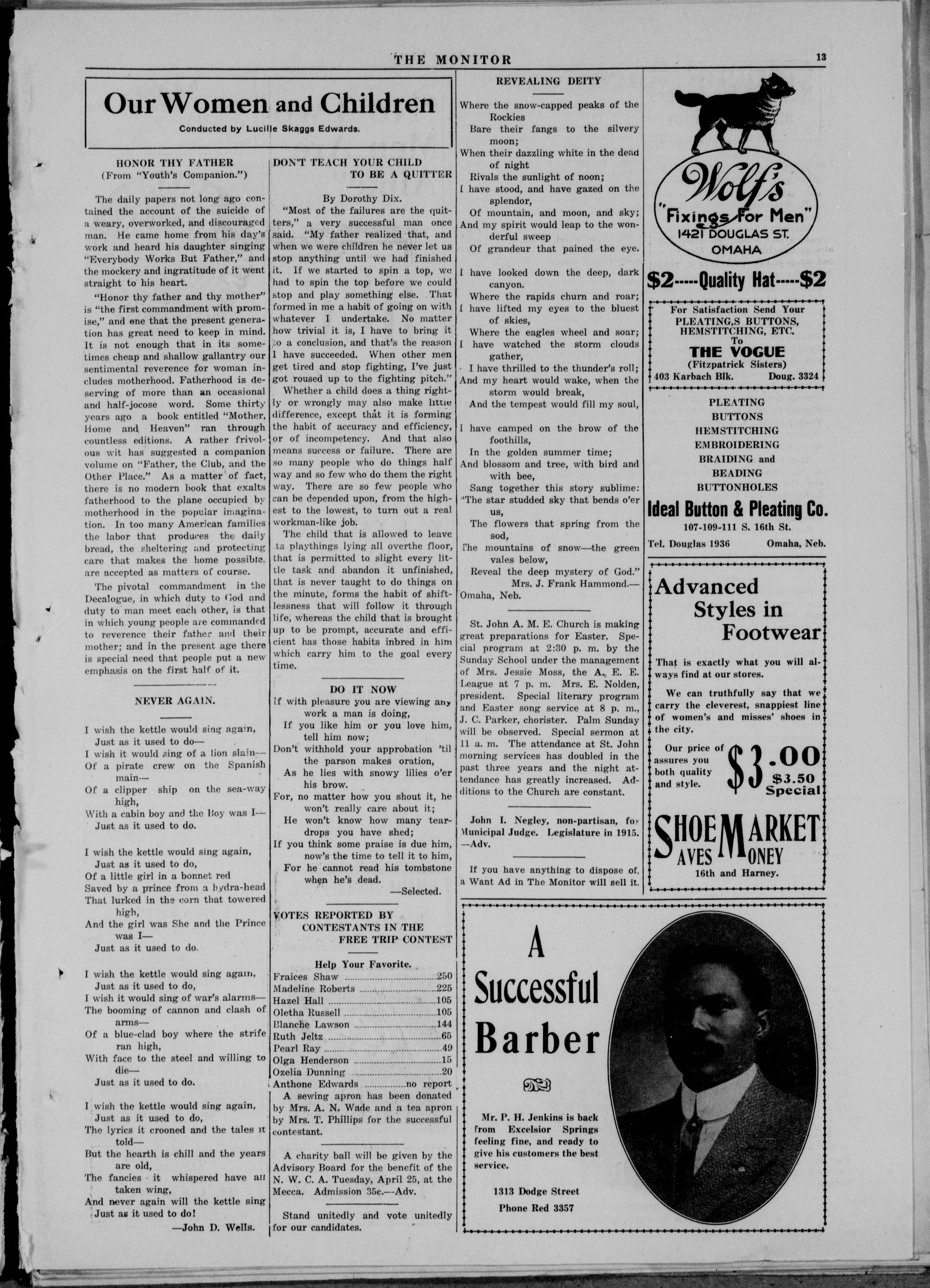
Our Women and Children
Conducted by Lucille Skaggs Edwards.
HONOR THY FATHER DON’T TEACH YOUR CHILD
(From “Youth’s Companion.”) | TO BE A QUITTE
The daily papers not long ago con-
tained the account of the suicide of
a Weary, overworked, and discouraged
man. He came home from his day’s
work and heard his daughter singing
“Everybody Works But Father,” and
the mockery and ingratitude of it went
straight to his heart.
“Honor thy father and thy mother”
is “the first commandment with prom-
ise,” and ene that the present genera-
tion has great need to keep in mind.
It is not enough that in its some-
times cheap and shallow gallantry our
sentimental reverence for woman in-
cludes motherhood. Fatherhood is de-
serving of more than an occasional
and half-jocose word. Some thirty
years ago a_ book entitled “Mother,
Home and Heaven” ran through
countless editions. A rather frivol-
ous wit has suggested a companion
volume on “Father, the Club, and the
Other Place.” As a matter of fact,
there is no modern book that exalts
fatherhood to the plane occupied by
motherhood in the popular imagina-
tion. In too many American families
the labor that produces the daily
bread, the sheltering and protecting
care that makes the home possibte,
are accepted as matters of course.
The pivotal commandment in the
Decalogue, in which duty to (rod and
duty to man meet each other, is that
in which young people are commanded
to reverence their father and their
mother; and in the present age there
is special need that people put a new
emphasis on the first half of it.
NEVER AGAIN.
I wish the kettle would sing again,
Just as it used to do—
I wish it would sing of a lion slain-—
Of a pirate crew on the Spanish
main-— 3
Of a clipper ship on the sea-way
high,
With a cabin boy and the Koy was I-—
Just as it used to do.
I wish the kettle would sing again,
Just as it used to do,
Of a little girl in a bonnet red
Saved by a prince from a hydra-head
That lurked in the corn that towered
high,
And the girl was She and the Prince
was I—
Just as it used to do.
I wish the kettle would sing again,
Just as it used to do,
I wish it would sing of war’s alarms—
The booming of cannon and clash of
arms—
Of a blue-clad boy where the strife
ran high,
With face to the steel and willing to
die—
Just as it used to do.
I wish the kettle would sing again,
Just as it used to do,
The lyries it crooned and the tales it
told—
But the hearth is chill and the years
are old,
The fancies - it whispered have all
taken wing,
And never again will the kettle sing
-Just as it used to do!
—John D, Wells.
‘THE MONITOR
DON’T TEACH YOUR CHILD
TO BE A QUITTER
OF. VEU Same
“Most of the failures are the quit-
ters,” a very successful man once
said. “My father realized that, and
when we were children he never let us
stop anything until we had finished
it. If we started to spin a top, we
had to spin the top before we could
stop and play something else. That
formed in me a habit of going on with
whatever I undertake. No matter
how trivial it is, I have to bring it
to a conclusion, and that’s the reason
1 have succeeded. When other men
get tired and stop fighting, I’ve just
got roused up to the fighting pitch.”
Whether a child does a thing right-
ly or wrongly may also make htue
difference, except that it is forming
the habit of accuracy and efficiency,
or of incompetency. And that also
means success or failure. There are
so many people who do things half
way and so few who do them the right
way. There are so few people who
can be depended upon, from the high-
est to the lowest, to turn out a real
workman-like job.
The child that is allowed to leave
ts playthings lying all overthe floor,
that is permitted to slight every lit-
tle task and abandon it unfinished,
that is never taught to do things on
the minute, forms the habit of shift-
lessness that will follow it through
life, whereas the child that is brought
up to be prompt, accurate and effi-
cient has those habits inbred in him
which carry him to the goal every
time.
[f with pleasure you are viewing any
work a man is doing,
If you like him or you love him,
tell him now;
Don’t withhold your approbation ’til
the parson makes oration,
As he lies with snowy lilies o’er
his brow. .
For, no matter how you shout it, he
won’t really care about it;
He won’t know how many tear-
drops you have shed;
If you think some praise is due him,
now’s the time to tell it to him,
For he cannot read his tombstone
} when he’s dead.
—Selected.
VOTES REPORTED BY
CONTESTANTS IN THE
FREE TRIP CONTEST
| Help Your Favorite.
Fraices Shaw .....2::.ssesssscsssssneeensees 250
Madeline Roberts ~....0...---------s+se0-225
Hazel Hall .-....-ssssssstencosessneseeetbavesne 1 05
Oletha Russell ...........------.-c----e-eee---- 105
Blanche Lawson ..:...-..-:s1scecseseeneeteree 4d
Ruth TOUS sai 0esciseseos-ndleeodtotheatsesesatnaan OD
Peae RAG aba ee a
Olga Henderson .........c.--ceccc-ssseceseee LD
Ozelia Dunning, ....-.-sccs-ccecceereteneeseeseee ZO
Anthone Edwards ...............n0 report
_ A sewing apron has been donated
by Mrs. A. N. Wade and a tea apron
by Mrs, T. Phillips for the successful
contestant.
A charity ball will be given by the
Advisory Board for the benefit of the
N. W. C. A. Tuesday, April 25, at the
Mecca, Admission 35¢.—-Adv.
Stand unitedly and vote unitedly
for our candidates. ,
DO IT NOW
Where the snow-capped peaks of the
Rockies
Bare their fangs to the silvery
moon;
When their dazzling white in the dead
of night
Rivals the sunlight of noon;
I have stood, and have gazed on the
splendor,
Of mountain, and moon, and sky;
And my spirit would leap to the won-
derful sweep
Of grandeur that pained the eye.
I have looked down the deep, dark
canyon,
Where the rapids churn and roar;
[ have lifted my eyes to the bluest
of skies,
Where the eagles wheel and soar;
I have watched the storm clouds
gather,
» Thave thrilled to the thunder’s roll;
And my heart would wake, when the
storm would break,
And the tempest would fill my soul,
I have camped on the brow of the
foothills,
In the golden summer time;
And blossom and tree, with bird and
with bee,
Sang together this story sublime:
‘The star studded sky that bends o’er
us,
The flowers that spring from the
sod,
The mountains of snow—the green
vales below,
Reveal the deep mystery of God.”
Mrs. J. Frank Hammond.—
Omaha, Neb.
St. John A. M. E. Church is making
great preparations for Easter. Spe-
cial program at 2:30 p. m. by the
Sunday School under the management
of Mrs. Jessie Moss, the A, E. E.
League at 7 p. m. Mrs. E. Nolden,
president. Special literary program
and Easter song service at 8 p. m.,
J. C. Parker, chorister. Palm Sunday
will be observed. Special sermon at
11 a.m. The attendance at St. John
morning services has doubled in the
past three years and the night at-
tendance has greatly increased. Ad-
ditions to the Church are constant.
John I. Negley, non-partisan, fo
Municipal Judge. Legislature in 1915.
Adv.
If you have anything to dispose of,
a Want Ad in The Monitor will sell it.
b a )
OS ~~ PA z
Mr. P. H. Jenkins is back J
from Excelsior Springs TA
feeling fine, and ready to ro
give his customers the best Bt
service. j os
1313 Dodge Street
Phone Red 3357
REVEALING DEITY
CST
/ Golf s
Fixin or Men”
1421 DOUGLAS ST.
OMAHA
$2-----Quality Hat-----$2
For Satisfaction Send Your
PLEATING,S BUTTONS,
HESTON ETC.
| THE VOGUE
(Fitzpatrick Sisters)
403 Karbach Blk. Doug. 3324
froreenonenenenOrn Or Oneres OnOnSrtnOnOnrOrOnOnOnOih
PLEATING
BUTTONS
HEMSTITCHING
EMBROIDERING
BRAIDING and
BEADING
BUTTONHOLES
Ideal Button & Pleating Co.
107-109-111 S. 16th St.
Tel. Douglas 1936 Omaha, Neb.
Pre ca oe TiO TA LET eee Vee
Advanced
Styles in
Footwear
That is exactly what you will al-
ways find at our stores.
We can truthfully say that we!
carry the cleverest, snappiest line
of women’s and misses’ shoes in
, the city.
Our price of
assures you $ 3 e O O
both quality
; $3.50
and style. Special
16th and Harney.
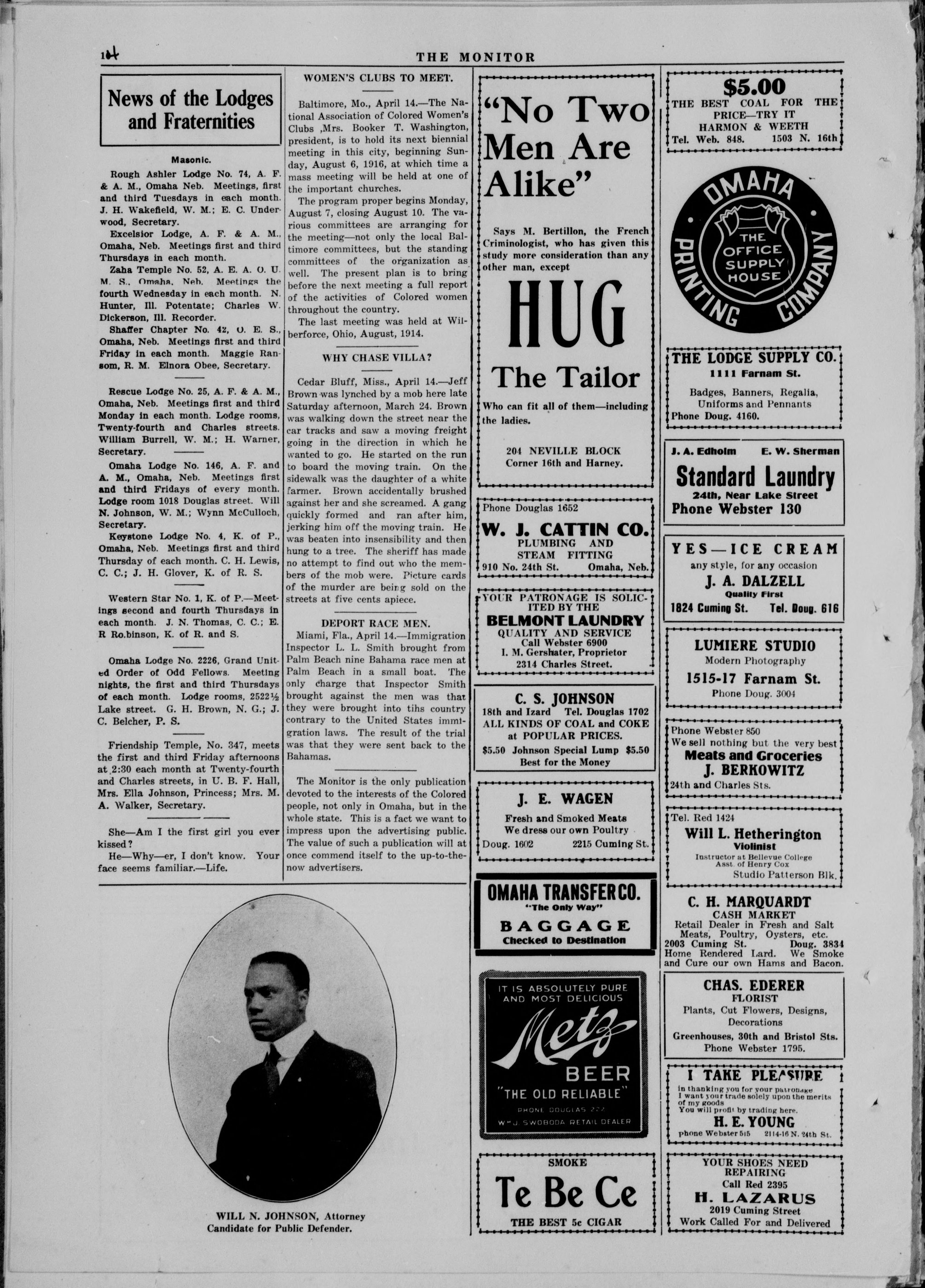
News of the Lodges and Fraternities
Rough Ashler Lodge No. 74, A. F. & A. M., Omaha Neb. Meetings, first and third Tuesdays in each month. J. H. Wakefield, W. M.; E. C. Underwood, Secretary. Excelsior Lodge, A. F. & A. M., Omaha, Neb. Meetings first and third Thursdays in each month. Zaha Temple No. 52, A. E. A. O. U. M. S., Omaha, Neb. Meetings the fourth Wednesday in each month. N. Hunter, Ill. Potentate; Charles W. Dickerson, Ill. Recorder.
Shaffer Chapter No. 42, O. E. S., Omaha, Neb. Meetings first and third Friday in each month. Maggie Ransom, R. M. Elnora Obee, Secretary.
Rescue Lodge No. 25, A. F. & A. M., Omaha, Neb. Meetings first and third Monday in each month. Lodge rooms, Twenty-fourth and Charles streets. William Burrell, W. M.; H. Warner, Secretary. Omaha Lodge No. 146, A. F. and A. M., Omaha, Neb. Meetings first and third Fridays of every month. Lodge room 1018 Douglas street. Will N. Johnson, W. M.; Wynn McCulloch, Secretary.
Keystone Lodge No. 4, K. of P., Omaha, Neb. Meetings first and third Thursday of each month. C. H. Lewis, C. C.; J. H. Glover, K. of R. S.
Western Star No. 1, K. of P.—Meetings second and fourth Thursdays in each month. J. N. Thomas, C. C.; E. R Ro.binson, K. of R. and S.
Omaha Lodge No. 2226, Grand United Order of Odd Fellows. Meeting nights, the first and third Thursdays of each month. Lodge rooms, 2522 $ \frac{1}{2} $ Lake street. G. H. Brown, N. G.; J. C. Belcher, P. S.
Friendship Temple, No. 347, meets the first and third Friday afternoons at 2:30 each month at Twenty-fourth and Charles streets, in U. B. F. Hall, Mrs. Ella Johnson, Princess; Mrs. M. A. Walker, Secretary.
She—Am I the first girl you ever kissed?
He—Why—er, I don't know. Your face seems familiar.—Life.
```markdown
```
[Portrait of a man in a suit and tie, facing left.]
WILL N. JOHNSON, Attorney Candidate for Public Defender.
---
184
Masonic.
WOMEN'S CLUBS TO MEET.
Baltimore, Mo., April 14.—The National Association of Colored Women's Clubs ,Mrs. Booker T. Washington, president, is to hold its next biennial meeting in this city, beginning Sunday, August 6, 1916, at which time a mass meeting will be held at one of the important churches.
The program proper begins Monday, August 7, closing August 10. The various committees are arranging for the meeting—not only the local Baltimore committees, but the standing committees of the organization as well. The present plan is to bring before the next meeting a full report of the activities of Colored women throughout the country. The last meeting was held at Wilberforce, Ohio, August, 1914.
WHY CHASE VILLA?
Cedar Bluff, Miss., April 14.—Jeff Brown was lynched by a mob here late Saturday afternoon, March 24. Brown was walking down the street near the car tracks and saw a moving freight going in the direction in which he wanted to go. He started on the run to board the moving train. On the sidewalk was the daughter of a white farmer. Brown accidentally brushed against her and she screamed. A gang quickly formed and ran after him, jerking him off the moving train. He was beaten into insensibility and then hung to a tree. The sheriff has made no attempt to find out who the members of the mob were. Picture cards of the murder are being sold on the streets at five cents apiece.
DEPORT RACE MEN.
Miami, Fla., April 14.—Immigration Inspector L. L. Smith brought from Palm Beach nine Bahama race men at Palm Beach in a small boat. The only charge that Inspector Smith brought against the men was that they were brought into tihs country contrary to the United States immigration laws. The result of the trial was that they were sent back to the Bahamas.
The Monitor is the only publication devoted to the interests of the Colored people, not only in Omaha, but in the whole state. This is a fact we want to impress upon the advertising public. The value of such a publication will at once commend itself to the up-to-the-now advertisers.
```markdown
```
---
THE MONITOR
"No Two Men Are Alike"
Says M. Bertillon, the French Criminologist, who has given this study more consideration than any other man, except HUG The Tailor
Who can fit all of them—including the ladies.
204 NEVILLE BLOCK
Corner 16th and Harney.
Phone Douglas 1652
W. J. CATTIN CO.
PLUMBING AND
STEAM FITTING
910 No. 24th St. Omaha, Neb.
YOUR PATRONAGE IS SOLICITED BY THE
BELMONT LAUNDRY
QUALITY AND SERVICE
Call Webster 6900
I. M. Gershater, Proprietor
2314 Charles Street.
C. S. JOHNSON
18th and Izard Tel. Douglas 1702
ALL KINDS OF COAL and COKE
at POPULAR PRICES.
$5.50 Johnson Special Lump $5.50
Best for the Money
Fresh and Smoked Meats
We dress our own Poultry
Doug. 1602 2215 Cuming St.
OMAHA TRANSFER CO.
"The Only Way"
BAGGAGE
Checked to Destination
IT IS ABSOLUTELY PURE
AND MOST DELICIOUS
Metz
BEER
"THE OLD RELIABLE"
PHONE DOUGLAS 222
W.M.J. SWOBODA RETAIL DEALER
Te Be Ce
THE BEST 5c CIGAR
J. E. WAGEN
$5.00
THE BEST COAL FOR THE
PRICE—TRY IT
HARMON & WEETH
Tel. Web. 848. 1503 N. 16th
OMAHA
PRINTING COMPANY
THE
OFFICE
SUPPLY
HOUSE
THE LODGE SUPPLY CO.
1111 Farnam St.
Badges, Banners, Regalia,
Uniforms and Pennants
Phone Doug. 4160.
J. A. Edholm E. W. Sherman Standard Laundry 24th, Near Lake Street Phone Webster 130
YES-ICE CREAM any style, for any occasion J. A. DALZELL Quality First 1824 Cuming St. Tel. Doug. 616
LUMIERE STUDIO
Modern Photography
1515-17 Farnam St.
Phone Doug. 3004
Phone Webster 850 We sell nothing but the very best Meats and Groceries J. BERKOWITZ 24th and Charles Sts.
Will L. Hetherington Violinist
Instructor at Bellevue College
Asst. of Henry Cox
Studio Patterson Blk
CASH MARKET
Retail Dealer in Fresh and Salt
Meats, Poultry, Oysters, etc.
2003 Cuming St. Doug. 3834
Home Rendered Lard. We Smoke
and Cure our own Hams and Bacon.
CHAS. EDERER
FLORIST
Plants, Cut Flowers, Designs,
Decorations
Greenhouses, 30th and Bristol Sts.
Phone Webster 1795.
I TAKE PLEASURE
in thankking you for your patronage
I want your trade solely upon the merits
of my goods
You will profit by trading here.
H. E. YOUNG
phone Webster 515 2114 16 N 9th Ct
YOUR SHOES NEED
REPAIRING
Call Red 2395
H. LAZARUS
2019 Cuming Street
Work Called For and Delivered
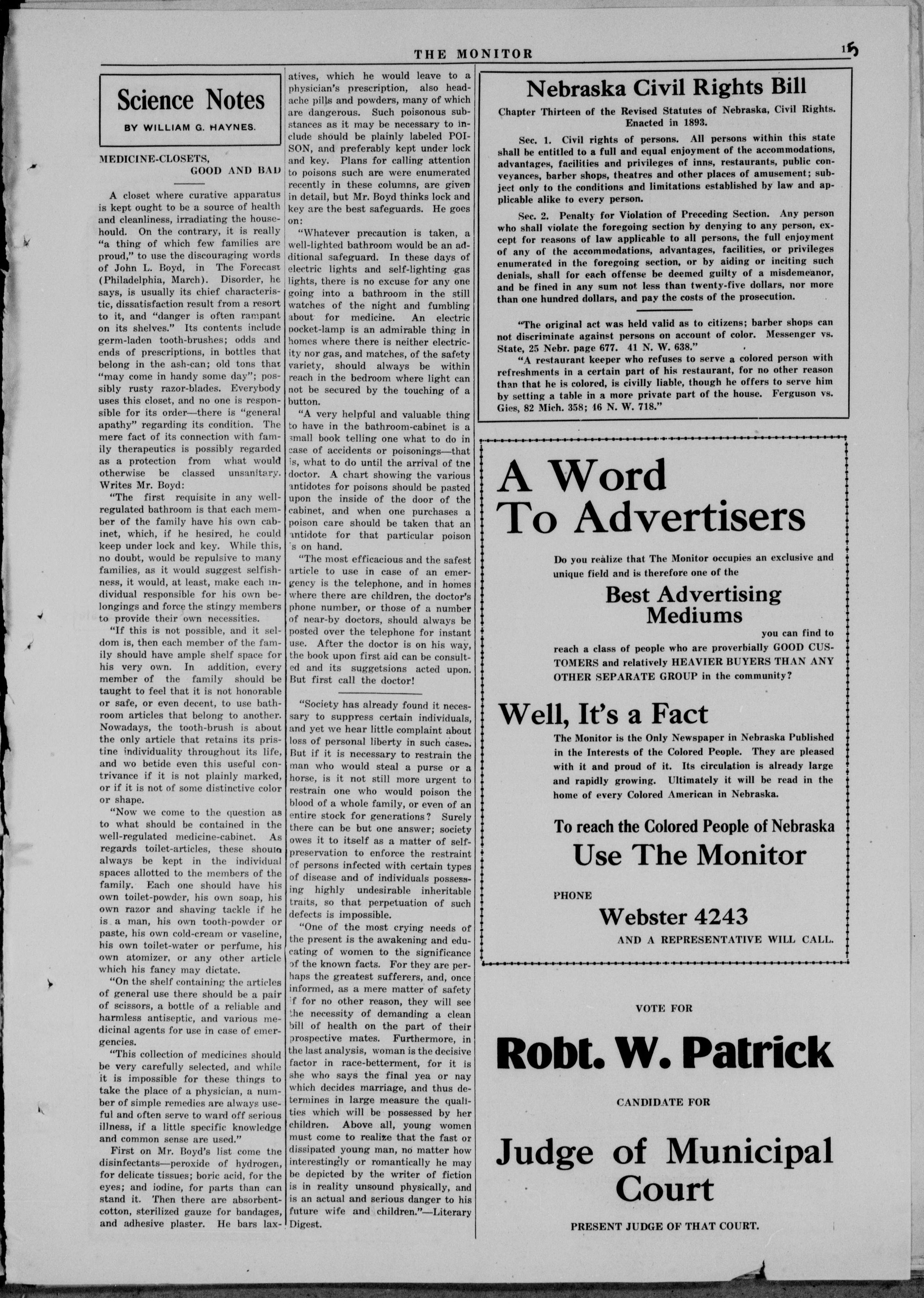
GOOD AND BAD
A closet where curative apparatus is kept ought to be a source of health and cleanliness, irradiating the house-hould. On the contrary, it is really "a thing of which few families are proud," to use the discouraging words of John L. Boyd, in The Forecast (Philadelphia, March). Disorder, he says, is usually its chief characteristic, dissatisfaction result from a resort to it, and "danger is often rampant on its shelves." Its contents include germ-laden tooth-brushes; odds and ends of prescriptions, in bottles that belong in the ash-can; old tons that "may come in handy some day"; possibly rusty razor-blades. Everybody uses this closet, and no one is responsible for its order—there is "general apathy" regarding its condition. The mere fact of its connection with family therapeutics is possibly regarded as a protection from what would otherwise be classed unsanitary. Writes Mr. Boyd:
"The first requisite in any wellregulated bathroom is that each member of the family have his own cabinet, which, if he hesired, he could keep under lock and key. While this, no doubt, would be repulsive to many families, as it would suggest selfishness, it would, at least, make each individual responsible for his own belongings and force the stingy members to provide their own necessities.
"If this is not possible, and it seldom is, then each member of the family should have ample shelf space for his very own. In addition, every member of the family should be taught to feel that it is not honorable or safe, or even decent, to use bathroom articles that belong to another. Nowadays, the tooth-brush is about the only article that retains its pristine individuality throughout its life, and wo betide even this useful contrivance if it is not plainly marked, or if it is not of some distinctive color or shape.
"Now we come to the question as to what should be contained in the well-regulated medicine-cabinet. As regards toilet-articles, these should always be kept in the individual spaces allotted to the members of the family. Each one should have his own toilet-powder, his own soap, his own razor and shaving tackle if he is a man, his own tooth-powder or paste, his own cold-cream or vaseline, his own toilet-water or perfume, his own atomizer, or any other article which his fancy may dictate.
"On the shelf containing the articles of general use there should be a pair of scissors, a bottle of a reliable and harmless antiseptic, and various medicinal agents for use in case of emergencies.
"This collection of medicines should be very carefully selected, and while it is impossible for these things to take the place of a physician, a number of simple remedies are always useful and often serve to ward off serious illness, if a little specific knowledge and common sense are used."
First on Mr. Boyd's list come the disinfectants-peroxide of hydrogen, for delicate tissues; boric acid, for the eyes; and iodine, for parts than can stand it. Then there are absorbent-cotton, sterilized gauze for bandages, and adhesive plaster. He bars lax-
THE MONITOR
atives, which he would leave to a physician's prescription, also headache pills and powders, many of which are dangerous. Such poisonous substances as it may be necessary to include should be plainly labeled POISON, and preferably kept under lock and key. Plans for calling attention to poisons such are were enumerated recently in these columns, are given in detail, but Mr. Boyd thinks lock and key are the best safeguards. He goes on:
"Whatever precaution is taken, a well-lighted bathroom would be an additional safeguard. In these days of electric lights and self-lighting gas lights, there is no excuse for any one going into a bathroom in the still watches of the night and fumbling about for medicine. An electric pocket-lamp is an admirable thing in homes where there is neither electricity nor gas, and matches, of the safety variety, should always be within reach in the bedroom where light can not be secured by the touching of a button.
"A very helpful and valuable thing to have in the bathroom-cabinet is a small book telling one what to do in case of accidents or poisonings—that is, what to do until the arrival of the doctor. A chart showing the various antidotes for poisons should be pasted upon the inside of the door of the cabinet, and when one purchases a poison care should be taken that an antidote for that particular poison is on hand.
"The most efficacious and the safest article to use in case of an emergency is the telephone, and in homes where there are children, the doctor's phone number, or those of a number of near-by doctors, should always be posted over the telephone for instant use. After the doctor is on his way, the book upon first aid can be consulted and its suggestions acted upon. But first call the doctor!
"Society has already found it necessary to suppress certain individuals, and yet we hear little complaint about loss of personal liberty in such cases. But if it is necessary to restrain the man who would steal a purse or a horse, is it not still more urgent to restrain one who would poison the blood of a whole family, or even of an entire stock for generations? Surely there can be but one answer; society owes it to itself as a matter of self-preservation to enforce the restraint of persons infected with certain types of disease and of individuals possessing highly undesirable inheritable traits, so that perpetuation of such defects is impossible.
"One of the most crying needs of the present is the awakening and educating of women to the significance of the known facts. For they are perhaps the greatest sufferers, and, once informed, as a mere matter of safety if for no other reason, they will see the necessity of demanding a clean bill of health on the part of their prospective mates. Furthermore, in the last analysis, woman is the decisive factor in race-betterment, for it is she who says the final yea or nay which decides marriage, and thus determines in large measure the qualities which will be possessed by her children. Above all, young women must come to realize that the fast or dissipated young man, no matter how interestingly or romantically he may be depicted by the writer of fiction is in reality unsound physically, and is an actual and serious danger to his future wife and children."—Literary Digest.
Chapter Thirteen of the Revised Statutes of Nebraska, Civil Rights. Enacted in 1893. Sec. 1. Civil rights of persons. All persons within this state shall be entitled to a full and equal enjoyment of the accommodations, advantages, facilities and privileges of inns, restaurants, public conveyances, barber shops, theatres and other places of amusement; subject only to the conditions and limitations established by law and applicable alike to every person.
Sec. 2. Penalty for Violation of Preceding Section. Any person who shall violate the foregoing section by denying to any person, except for reasons of law applicable to all persons, the full enjoyment of any of the accommodations, advantages, facilities, or privileges enumerated in the foregoing section, or by aiding or inciting such denials, shall for each offense be deemed guilty of a misdemeanor, and be fined in any sum not less than twenty-five dollars, nor more than one hundred dollars, and pay the costs of the prosecution.
"The original act was held valid as to citizens; barber shops can not discriminate against persons on account of color. Messenger vs. State. 25 Nebr. page 677. 41 N. W. 638."
"A restaurant keeper who refuses to serve a colored person with refreshments in a certain part of his restaurant, for no other reason than that he is colored, is civilly liable, though he offers to serve him by setting a table in a more private part of the house. Ferguson vs. Gies. 82 Mich. 358; 46 N. W. 718."
A Word To Advertisers
Well, It's a Fact
The Monitor is the Only Newspaper in the Interests of the Colored People with it and proud of it. Its size and rapidly growing. Ultimately home of every Colored American
To reach the Colored People
Use The M
PHONE
VOTE FOR Robt. W. P
Judge of Mu Court
Judge of Municipal Court
---
Nebraska Civil Rights Bill
Nebraska Civil Rights Bill
Do you realize that The Monitor occupies an exclusive and unique field and is therefore one of the
reach a class of people who are proverbially GOOD CUSTOMERS and relatively HEAVIER BUYERS THAN ANY OTHER SEPARATE GROUP in the community?
The Monitor is the Only Newspaper in Nebraska Published in the Interests of the Colored People. They are pleased with it and proud of it. Its circulation is already large and rapidly growing. Ultimately it will be read in the one of every Colored American in Nebraska.
To reach the Colored People of Nebraska Use The Monitor
ONE
The Monitor is the Only Newspaper in Nebraska Published in the Interests of the Colored People. They are pleased with it and proud of it. Its circulation is already large and rapidly growing. Ultimately it will be read in the home of every Colored American in Nebraska.
Webster 4243 AND A REPRESENTATIVE WILL CALL.
VOTE FOR
t. W. Patrick
VOTE FOR
CANDIDATE FOR
ge of Municipal
Court
PRESENT JUDGE OF THAT COURT.
---
PHONE
you can find to
Fully GOOD CUS-
ERS THAN ANY
community?
Nebraska Published
they are pleased
as already large
be read in the
Nebraska.
of Nebraska
itor
---
115
Is now serving his twenty-first consecutive year as judge of the district court of Lancaster County.
Brother of Ed Cornish, formerly of Omaha. We know our friends. Let's boost for him.
16
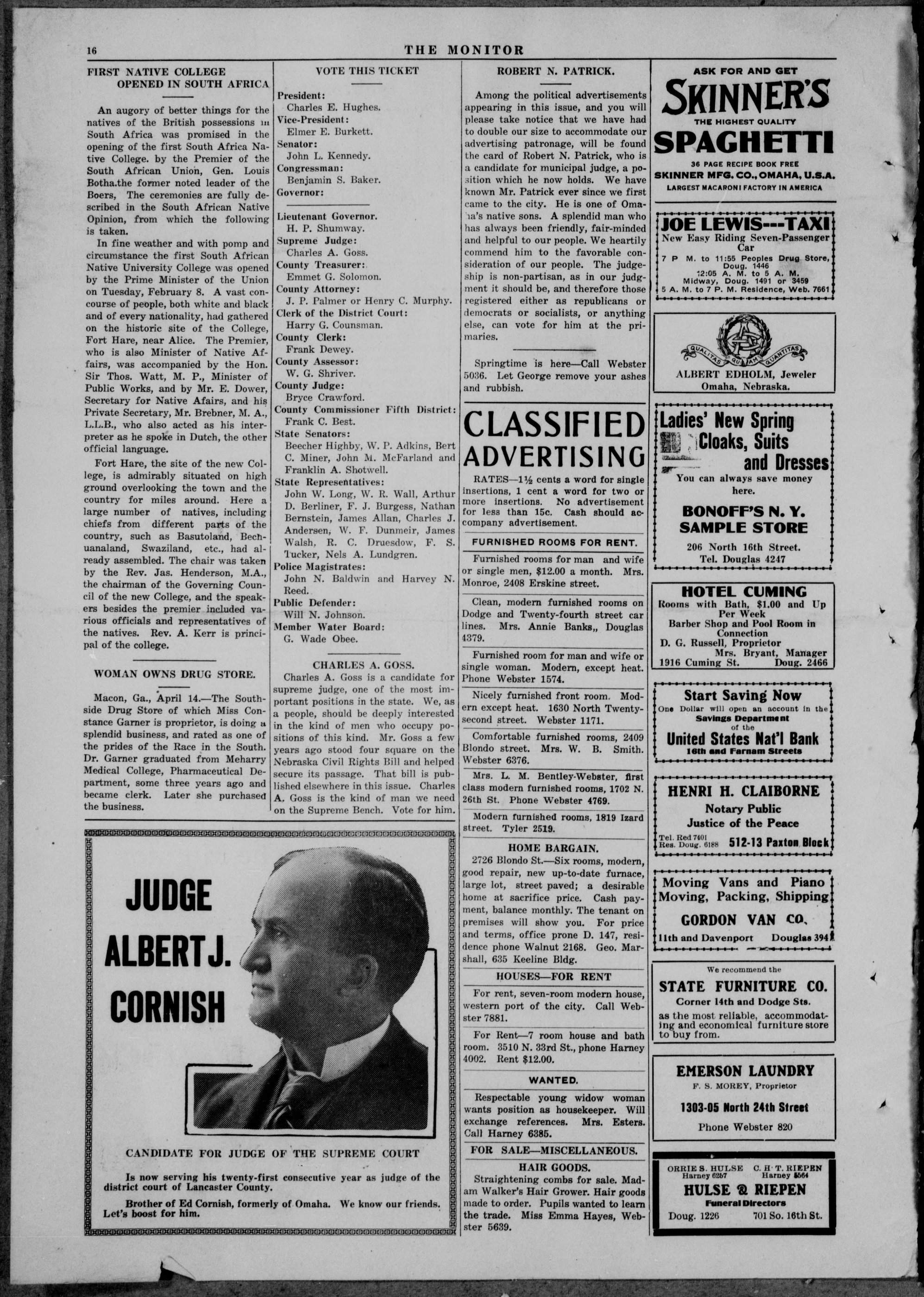
FIRST NATIVE COLLEGE OPENED IN SOUTH AFRICA
An augory of better things for the natives of the British possessions in South Africa was promised in the opening of the first South Africa Native College. by the Premier of the South African Union, Gen. Louis Botha.the former noted leader of the Boers, The ceremonies are fully described in the South African Native Opinion, from which the following is taken.
In fine weather and with pomp and circumstance the first South African Native University College was opened by the Prime Minister of the Union on Tuesday, February 8. A vast concourse of people, both white and black and of every nationality, had gathered on the historic site of the College, Fort Hare, near Alice. The Premier, who is also Minister of Native Affairs, was accompanied by the Hon. Sir Thos. Watt, M. P., Minister of Public Works, and by Mr. E. Dower, Secretary for Native Afairs, and his Private Secretary, Mr. Brebner, M. A., L.L.B., who also acted as his interpreter as he spoke in Dutch, the other official language.
Fort Hare, the site of the new College, is admirably situated on high ground overlooking the town and the country for miles around. Here a large number of natives, including chiefs from different parts of the country, such as Basutoland, Bechuanaland, Swaziland, etc., had already assembled. The chair was taken by the Rev. Jas. Henderson, M.A., the chairman of the Governing Council of the new College, and the speakers besides the premier included various officials and representatives of the natives. Rev. A. Kerr is principal of the college.
WOMAN OWNS DRUG STORE.
Macon, Ga., April 14.—The Southside Drug Store of which Miss Constance Garner is proprietor, is doing a splendid business, and rated as one of the prides of the Race in the South. Dr. Garner graduated from Meharry Medical College, Pharmaceutical Department, some three years ago and became clerk. Later she purchased the business.
JUDGE ALBERT J. CORNISH
THE MONITOR
H. P. Shumway.
Supreme Judge:
Charles A. Goss.
County Treasurer:
Emmet G. Solomon.
County Attorney:
J. P. Palmer or Henry C. Murphy.
Clerk of the District Court:
Harry G. Counsman.
County Clerk:
Frank Dewey.
County Assessor:
W. G. Shriver.
County Judge:
Bryce Crawford.
County Commissioner Fifth District: Frank C. Best.
State Senators:
Beecher Highby, W. P. Adkins, Bert C. Miner, John M. McFarland and Franklin A. Shotwell.
State Representatives:
John W. Long, W. R. Wall, Arthur D. Berliner, F. J. Burgess, Nathan Bernstein, James Allan, Charles J. Andersen, W. F. Dunmeir, James Walsh, R. C. Druesdow, F. S. Tucker, Nels A. Lundgren.
John N. Baldwin and Harvey N.
Reed.
Public Defender:
Will N. Johnson.
Member Water Board:
G. Wade Obee.
Charles A. Goss is a candidate for supreme judge, one of the most important positions in the state. We, as a people, should be deeply interested in the kind of men who occupy positions of this kind. Mr. Goss a few years ago stood four square on the Nebraska Civil Rights Bill and helped secure its passage. That bill is published elsewhere in this issue. Charles A. Goss is the kind of man we need on the Supreme Bench. Vote for him.
```markdown
```
VOTE THIS TICKET
President:
Charles E. Hughes.
Vice-President:
Elmer E. Burkett.
Senator:
John L. Kennedy.
Congressman:
Benjamin S. Baker.
Governor:
Lieutenant Governor.
Public Defender:
CHARLES A. GOSS.
ROBERT N. PATRICK.
Among the political advertisements appearing in this issue, and you will please take notice that we have had to double our size to accommodate our advertising patronage, will be found the card of Robert N. Patrick, who is a candidate for municipal judge, a position which he now holds. We have known Mr. Patrick ever since we first came to the city. He is one of Omaha's native sons. A splendid man who has always been friendly, fair-minded and helpful to our people. We heartily commend him to the favorable consideration of our people. The judgement is non-partisan, as in our judgment it should be, and therefore those registered either as republicans or democrats or socialists, or anything else, can vote for him at the primaries.
Springtime is here—Call Webster 5036. Let George remove your ashes and rubbish.
CLASSIFIED ADVERTISING
CLASSIFIED ADVERTISING
RATES—1 $ \frac{1}{2} $ cents a word for single insertions, 1 cent a word for two or more insertions. No advertisement for less than 15c. Cash should accompany advertisement.
FURNISHED ROOMS FOR RENT.
Furnished rooms for man and wife or single men, $12.00 a month. Mrs. Monroe, 2408 Erskine street.
Clean, modern furnished rooms on Dodge and Twenty-fourth street car lines. Mrs. Annie Banks,, Douglas 4379.
Furnished room for man and wife or single woman. Modern, except heat. Phone Webster 1574.
Nicely furnished front room. Modern except heat. 1630 North Twenty-second street. Webster 1171.
Comfortable furnished rooms, 2409
Blondo street. Mrs. W. B. Smith.
Webster 6376.
Mrs. L. M. Bentley-Webster, first
class modern furnished rooms, 1702 N.
26th St. Phone Webster 4769.
Modern furnished rooms, 1819 Izard
street. Tyler 2519.
2726 Blondo St.—Six rooms, modern, good repair, new up-to-date furnace, large lot, street paved; a desirable home at sacrifice price. Cash payment, balance monthly. The tenant on premises will show you. For price and terms, office prone D. 147, residence phone Walnut 2168. Geo. Marshall, 635 Keeline Bldg.
HOUSES—FOR RENT
For rent, seven-room modern house, western port of the city. Call Webster 7881.
For Rent—7 room house and bath room. 3510 N. 33rd St., phone Harney 4002. Rent $12.00.
Respectable young widow woman wants position as housekeeper. Will exchange references. Mrs. Esters. Call Harney 6385.
Straightening combs for sale. Madam Walker's Hair Grower. Hair goods made to order. Pupils wanted to learn the trade. Miss Emma Hayes, Webster 5639.
HOME BARGAIN.
WANTED.
HAIR GOODS.
36 PAGE RECIPE BOOK FREE SKINNER MFG. CO., OMAHA, U.S.A. LARGEST MACARONI FACTORY IN AMERICA
JOE LEWIS---TAXI
New Easy Riding Seven-Passenger Car
7 P. M. to 11:55 Peoples Drug Store,
Doug. 1446
12:05 A. M. to 5 A. M.
Midway, Doug. 1491 or 3459
5 A. M. to 7 P. M. Residence, Web. 7661
QUALITAS QUALAM QUANTITAS
ALBERT EDHOLM, Jeweler
Omaha, Nebraska.
Ladies' New Spring
Cloaks, Suits
and Dresses
You can always save money
here.
BONOFF'S N. Y.
SAMPLE STORE
206 North 16th Street.
Tel. Douglas 4247
HOTEL CUMING
Rooms with Bath, $1.00 and Up
Per Week
Barber Shop and Pool Room in
Connection
D. G. Russell, Proprietor
Mrs. Bryant, Manager
1916 Cuming St. Doug. 2466
Start Saving Now
One Dollar will open an account in the
Savings Department
of the
United States Nat'l Bank
16th and Farnam Streets
HENRI H. CLAIBORNE
Notary Public
Justice of the Peace
Tel. Red 7401
Res. Doug. 6188 512-13 Paxton Block
Moving Vans and Piano Moving, Packing, Shipping
GORDON VAN CO.
11th and Davenport Douglas 394
We recommend the
STATE FURNITURE CO.
Corner 14th and Dodge Sts.
as the most reliable, accommodating and economical furniture store to buy from.
EMERSON LAUNDRY
F. S. MOREY, Proprietor
1303-05 North 24th Street
Phone Webster 820
ORRIE S. HULSE
Harney 6257
C. H. T. RIEPEN
Harney 5564
HULSE & RIEPEN
Funeral Directors
Doug. 1226
701 So. 16th St.
News of the Churches and Religious Topics
days at 8 p. m. Sundays at 7:30 a. m., 11 a. m. and 7:30 p. m. Sunday School at 12:45 p. m.
Methodist—
Allen Chapel, A. M. E., 5233 South Twenty-fifth street, South Omaha. The Rev. John H. Nichols, pastor. Residence, 5233 South Twenty-fifth street. Services: Sunday at 11 a. m. and 8:00 p. m.; Sunday school, 1:30; class meeting, 12:00; A. C. E. L., 6:30; prayer meeting, Tuesday evening at 8:00.
Grove M. E.—Twenty-second and Seward streets. The Rev. G. G. Logan, pastor. Residence, 1628 North Twenty-second street. Services: Sunday School at 10 a. m.; preaching at 11 a. m. and 7:30 p. m.; Epworth League, 6:30 p. m.
St. John's A. M. E.—Eighteenth and Webster streets. The Rev. W. T. Osborne, pastor. Residence, 613 North Eighteenth street. Telephone Douglas 5914. Services: Sunday, 11 a. m. and 8 p. m., preaching; 12 noon, class; 1:15 p. m., Sunday School; 7 p. m., Endeavor; Wednesday, 8 p. m., prayer and class meetings. Everybody made welcome at all of these meetings.
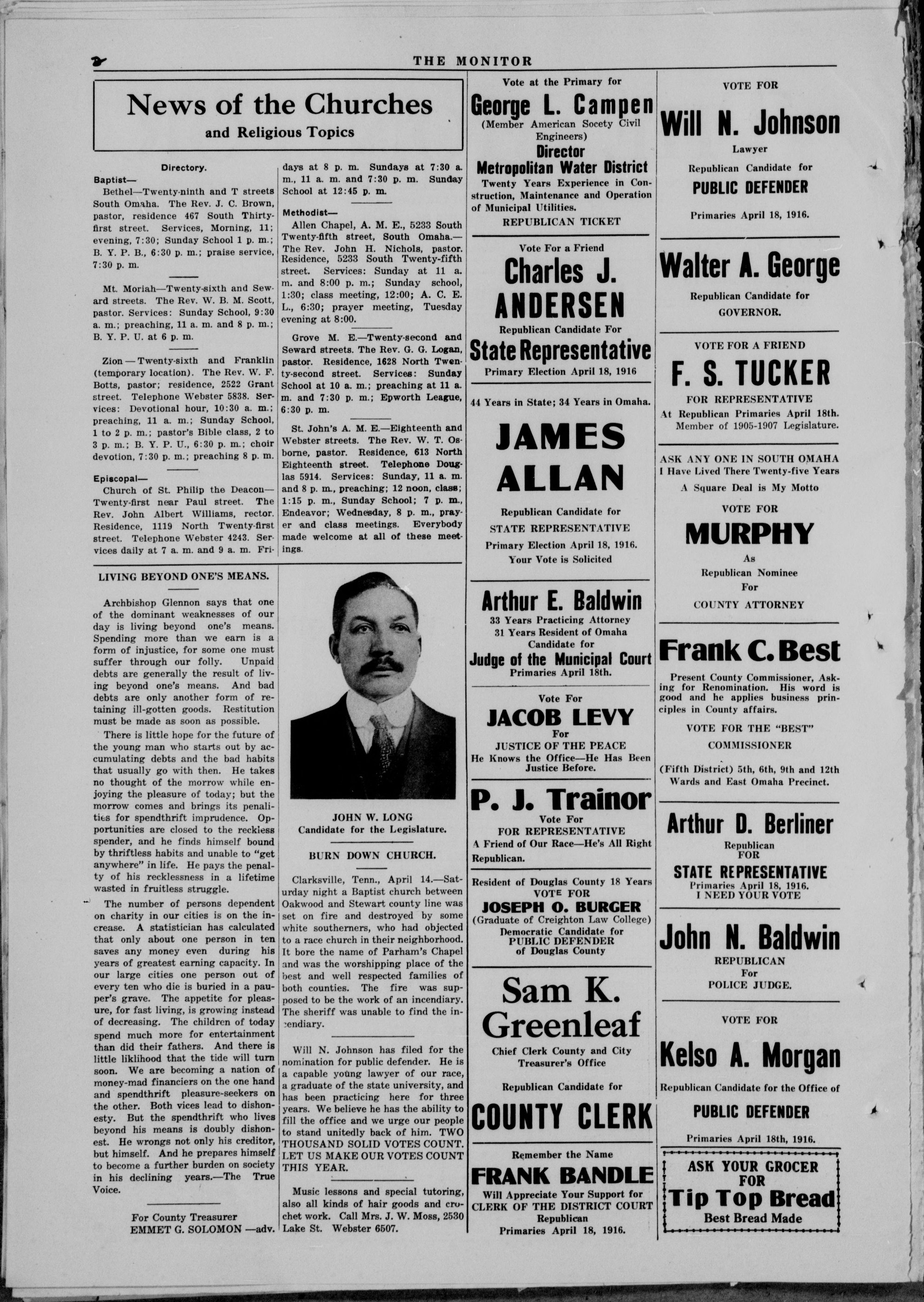
Clarksville, Tenn., April 14.—Saturday night a Baptist church between Oakwood and Stewart county line was set on fire and destroyed by some white southerners, who had objected to a race church in their neighborhood. It bore the name of Parham's Chapel and was the worshipping place of the best and well respected families of both counties. The fire was supposed to be the work of an incendiary. The sheriff was unable to find the incendiary.
Will N. Johnson has filed for the nomination for public defender. He is a capable young lawyer of our race, a graduate of the state university, and has been practicing here for three years. We believe he has the ability to fill the office and we urge our people to stand unitedly back of him. TWO THOUSAND SOLID VOTES COUNT. LET US MAKE OUR VOTES COUNT THIS YEAR.
Music lessons and special tutoring, also all kinds of hair goods and crochet work. Call Mrs. J. W. Moss, 2530 Lake St. Webster 6507.
Directory.
Baptist—
Bethel—Twenty-ninth and T streets South Omaha. The Rev. J. C. Brown, pastor, residence 467 South Thirty-first street. Services, Morning, 11; evening, 7:30; Sunday School 1 p. m.; B. Y. P. B., 6:30 p. m.; praise service, 7:30 p. m.
Mt. Moriah—Twenty-sixth and Seward streets. The Rev. W. B. M. Scott, pastor. Services: Sunday School, 9:30 a. m.; preaching, 11 a. m. and 8 p. m.; B. Y. P. U. at 6 p. m.
Zion — Twenty-sixth and Franklin (temporary location). The Rev. W. F. Botts, pastor; residence, 2522 Grant street. Telephone Webster 5838. Services: Devotional hour, 10:30 a. m.; preaching, 11 a. m.; Sunday School, 1 to 2 p. m.; pastor's Bible class, 2 to 3 p. m.; B. Y. P. U., 6:30 p. m.; choir devotion, 7:30 p. m.; preaching 8 p. m.
Episcopal—
Church of St. Philip the Deacon Twenty-first near Paul street. The Rev. John Albert Williams, rector. Residence, 1119 North Twenty-first street. Telephone Webster 4243. Services daily at 7 a. m. and 9 a. m. Fri-
LIVING BEYOND ONE'S MEANS.
Archbishop Glennon says that one of the dominant weaknesses of our day is living beyond one's means. Spending more than we earn is a form of injustice, for some one must suffer through our folly. Unpaid debts are generally the result of living beyond one's means. And bad debts are only another form of retaining ill-gotten goods. Restitution must be made as soon as possible.
There is little hope for the future of the young man who starts out by accumulating debts and the bad habits that usually go with then. He takes no thought of the morrow while enjoying the pleasure of today; but the morrow comes and brings its penalties for spendthrift imprudence. Opportunities are closed to the reckless spender, and he finds himself bound by thriftless habits and unable to "get anywhere" in life. He pays the penalty of his recklessness in a lifetime wasted in fruitless struggle.
The number of persons dependent on charity in our cities is on the increase. A statistician has calculated that only about one person in ten saves any money even during his years of greatest earning capacity. In our large cities one person out of every ten who die is buried in a pauper's grave. The appetite for pleasure, for fast living, is growing instead of decreasing. The children of today spend much more for entertainment than did their fathers. And there is little liklihood that the tide will turn soon. We are becoming a nation of money-mad financiers on the one hand and spendthrift pleasure-seekers on the other. Both vices lead to dishonesty. But the spendthrift who lives beyond his means is doubly dishonest. He wrongs not only his creditor, but himself. And he prepares himself to become a further burden on society in his declining years.—The True Voice.
For County Treasurer EMMET G. SOLOMON —adv.
THE MONITOR
[Name]
JOHN W. LONG Candidate for the Legislature.
BURN DOWN CHURCH.
Vote at the Primary for
(Member American Society Civil Engineers)
Director
Metropolitan Water District
Twenty Years Experience in Construction, Maintenance and Operation of Municipal Utilities.
REPUBLICAN TICKET
Vote For a Friend
Charles J.
ANDERSEN
Republican Candidate For
State Representative
Primary Election April 18, 1916
44 Years in State; 34 Years in Omaha.
JAMES
ALLAN
Republican Candidate for
STATE REPRESENTATIVE
Primary Election April 18, 1916.
Your Vote is Solicited
Arthur E. Baldwin
33 Years Practicing Attorney
31 Years Resident of Omaha
Candidate for
Judge of the Municipal Court
Primaries April 18th.
Vote For
JACOB LEVY
For
JUSTICE OF THE PEACE
He Knows the Office—He Has Been
Justice Before.
P. J. Trainor
FOR REPRESENTATIVE
A Friend of Our Race—He's All Right
Republican.
Resident of Douglas County 18 Years
VOTE FOR
JOSEPH O. BURGER
(Graduate of Creighton Law College)
Democratic Candidate for
PUBLIC DEFENDER
of Douglas County
Sam K.
Greenleaf
Chief Clerk County and City
Treasurer's Office
Republican Candidate for
COUNTY CLERK
FRANK BANDLE
Will Appreciate Your Support for CLERK OF THE DISTRICT COURT Republican Primaries April 18, 1916.
Remember the Name
VOTE FOR
Will N. Johnson
Lawyer
Republican Candidate for
PUBLIC DEFENDER
Primaries April 18, 1916.
Walter A. George
Republican Candidate for GOVERNOR.
VOTE FOR A FRIEND
F. S. TUCKER
FOR REPRESENTATIVE At Republican Primaries April 18th. Member of 1905-1907 Legislature.
ASK ANY ONE IN SOUTH OMAHA I Have Lived There Twenty-five Years A Square Deal is My Motto VOTE FOR
MURPHY
As Republican Nominee For COUNTY ATTORNEY
Frank C.Best
Present County Commissioner, Asking for Renomination. His word is good and he applies business principles in County affairs.
VOTE FOR THE "BEST"
COMMISSIONER
(Fifth District) 5th, 6th, 9th and 12th Wards and East Omaha Precinct.
Arthur D. Berliner
STATE REPRESENTATIVE
Primaries April 18, 1916.
I NEED YOUR VOTE
John N. Baldwin
REPUBLICAN For POLICE JUDGE.
VOTE FOR
Kelso A. Morgan
PUBLIC DEFENDER
Primaries April 18th, 1916.
ASK YOUR GROCER
FOR
Tip Top Bread
Best Bread Made
"OUR FATHER!"
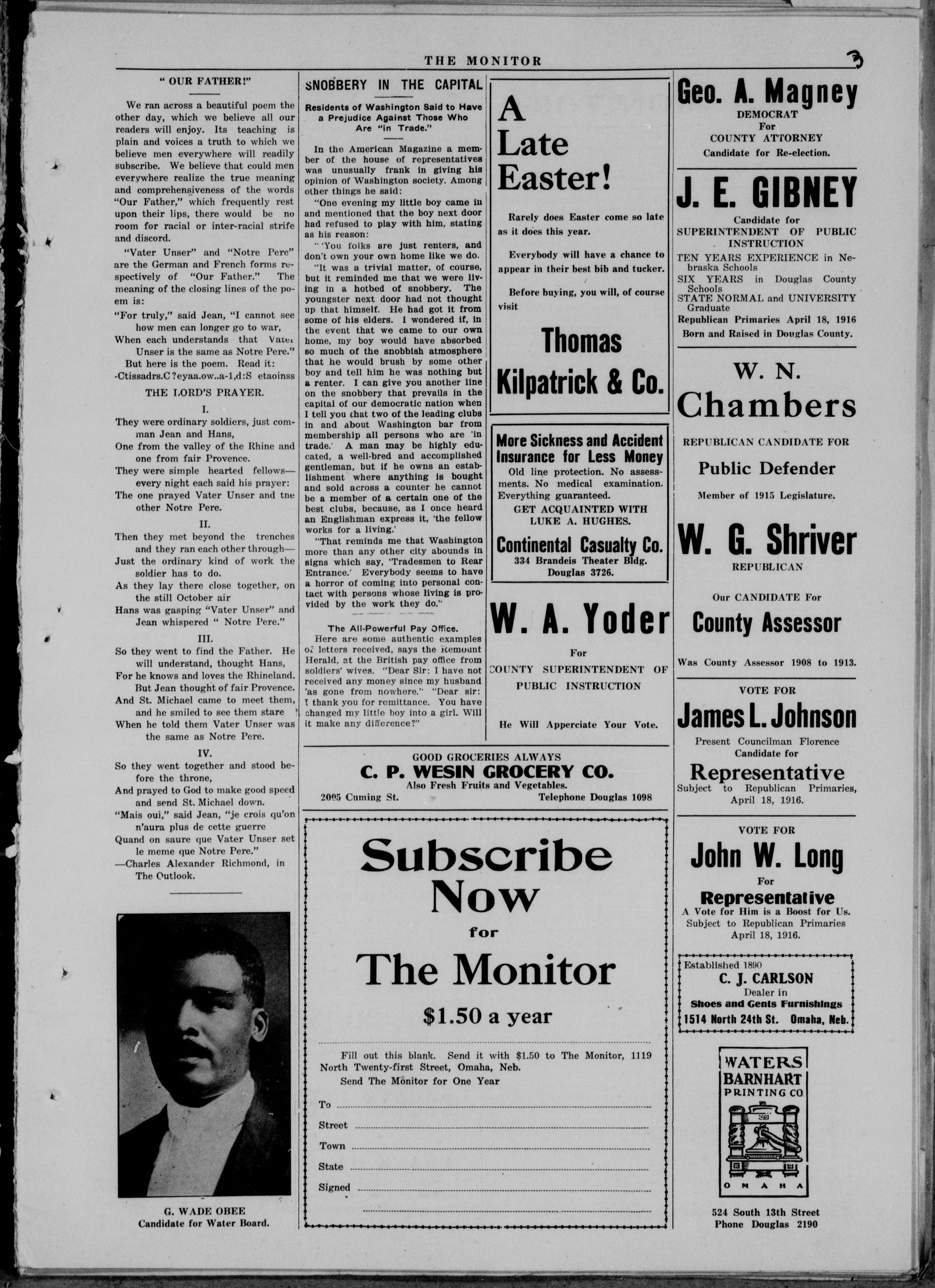
We ran across a beautiful poem the other day, which we believe all our readers will enjoy. Its teaching is plain and voices a truth to which we believe men everywhere will readily subscribe. We believe that could men everywhere realize the true meaning and comprehensiveness of the words "Our Father," which frequently rest upon their lips, there would be no room for racial or inter-racial strife and discord.
"Vater Unser" and "Notre Pere" are the German and French forms respectively of "Our Father." The meaning of the closing lines of the poem is:
"For truly," said Jean, "I cannot see how men can longer go to war, When each understands that Vater Unser is the same as Notre Pere." But here is the poem. Read it:
-Ctissadrs.C?eyaa.ow..a-1,d:S etaoinss
THE LORD'S PRAYER.
They were ordinary soldiers, just com man Jean and Hans,
One from the valley of the Rhine and one from fair Provence.
They were simple hearted fellows— every night each said his prayer:
The one prayed Vater Unser and the other Notre Pere.
II.
Then they met beyond the trenches and they ran each other through—
Just the ordinary kind of work the soldier has to do.
As they lay there close together, on the still October air
II.
Hans was gasping "Vater Unser" and Jean whispered " Notre Pere."
III.
So they went to find the Father. He will understand, thought Hans, For he knows and loves the Rhineland. But Jean thought of fair Provence. And St. Michael came to meet them, and he smiled to see them stare When he told them Vater Unser was the same as Notre Pere.
So they went together and stood before the throne,
And prayed to God to make good speed and send St. Michael down.
"Mais oui," said Jean, "je crois qu'on n'aura plus de cette guerre
Quand on saure que Vater Unser set le meme que Notre Pere."
—Charles Alexander Richmond, in The Outlook.
[Name]
G. WADE OBEE Candidate for Water Board.
THE MONITOR
SNOBBERY IN THE CAPITAL
Residents of Washington Said to Have a Prejudice Against Those Who Are "in Trade."
In the American Magazine a member of the house of representatives was unusually frank in giving his opinion of Washington society. Among other things he said:
"One evening my little boy came in and mentioned that the boy next door had refused to play with him, stating as his reason:
"You folks are just renters, and don't own your own home like we do. 'It was a trivial matter, of course, but it reminded me that we were living in a hotbed of snobbery. The youngster next door had not thought up that himself. He had got it from some of his elders. I wondered if, in the event that we came to our own home, my boy would have absorbed so much of the snobbish atmosphere that he would brush by some other boy and tell him he was nothing but a renter. I can give you another line on the snobbery that prevails in the capital of our democratic nation when I tell you that two of the leading clubs in and about Washington bar from membership all persons who are 'in trade.' A man may be highly educated, a well-bred and accomplished gentleman, but if he owns an establishment where anything is bought and sold across a counter he cannot be a member of a certain one of the best clubs, because, as I once heard an Englishman express it, 'the fellow works for a living.'
"That reminds me that Washington more than any other city abounds in signs which say, 'Tradesmen to Rear Entrance.' Everybody seems to have a horror of coming into personal contact with persons whose living is provided by the work they do."
The All-Powerful Pay Office.
Here are some authentic examples of letters received, says the Remount Herald, at the British pay office from soldiers' wives. "Dear Sir: I have not received any money since my husband 'as gone from nowhere.' "Dear sir: I thank you for remittance. You have changed my little boy into a girl. Will it make any difference?"
GOOD GROCER
C. P. WESIN C
Also Fresh Fruit
2005 Cuming St.
Subs
No
fo
The M
GOOD GROCERIES ALWAYS C. P. WESIN GROCERY CO. Also Fresh Fruits and Vegetables. 2005 Cuming St. Telephone Douglas 1098
Subscribe Now for The Monitor
$1.50 a year
Fill out this blank. Send it
North Twenty-first Street, Omah
Send The Monitor for One Y
To ...
Street ...
Town ...
State ..
Fill out this blank. Send it with $1.50 to The Monitor, 1119 North Twenty-first Street, Omaha, Neb. Send The Monitor for One Year
A Late Easter!
Rarely does Easter come so late as it does this year.
Everybody will have a chance to appear in their best bib and tucker.
Before buying, you will, of course visit
Thomas Kilpatrick & Co.
More Sickness and Accident Insurance for Less Money
Old line protection. No assessments. No medical examination. Everything guaranteed.
GET ACQUAINTED WITH
LUKE A. HUGHES.
Continental Casualty Co.
334 Brandeis Theater Bldg.
Douglas 3726.
W. A. Yoder
COUNTY SUPERINTENDENT OF PUBLIC INSTRUCTION
He Will Appreciate Your Vote.
RIES ALWAYS
GROCERY CO.
Fruits and Vegetables.
Telephone Douglas 1098
cribe
ow
or
Monitor
with $1.50 to The Monitor, 1119
a, Neb.
ear
3
DEMOCRAT For COUNTY ATTORNEY Candidate for Re-election.
J. E. GIBNEY
Candidate for
SUPERINTENDENT OF PUBLIC
INSTRUCTION
TEN YEARS EXPERIENCE in Nebraska Schools
SIX YEARS in Douglas County Schools
STATE NORMAL and UNIVERSITY Graduate
Republican Primaries April 18, 1916
Born and Raised in Douglas County.
W. N. Chambers
REPUBLICAN CANDIDATE FOR
Public Defender
Member of 1915 Legislature.
W. G. Shriver
REPUBLICAN
Our CANDIDATE For
County Assessor
Was County Assessor 1908 to 1913.
James L. Johnson
Present Councilman Florence
Candidate for
Representative
Subject to Republican Primaries,
April 18, 1916.
VOTE FOR
John W. Long
For
Representative A Vote for Him is a Boost for Us. Subject to Republican Primaries April 18, 1916.
C. J. CARLSON
Dealer in
Shoes and Gents Furnishings
1514 North 24th St. Omaha, Neb.
WATERS
BARNHART
PRINTING CO
O M A H A
524 South 13th Street
Phone Douglas 2190
THE MONITOR
A Weekly Newspaper devoted to the civic, social and religious interests of the Colored People of Omaha and vicinity, with the desire to contribute something to the general good and upbuilding of the community. Published Every Saturday.
Entered as Second-Class Mail
office at Omaha, Neb., under the
THE REV. JOHN ALBERT W.
Lucille Skaggs Edwards, William
Pryor, Asson
Joseph LaCour, Jr., Advertising
SUBSCRIPTION RATE
Advertising rates, 59 c
Address, The Monitor, 1119 N
Telephone V
Entered as Second-Class Mail Matter July 2, 1915, at the Post-office at Omaha, Neb., under the act of March 3, 1879.
THE REV. JOHN ALBERT WILLIAMS, Editor and Publisher.
Lucille Skaggs Edwards, William Garnett Haynes and Ellsworth W.
Pryor, Associate Editors.
Joseph LaCour, Jr., Advertising and Circulation Manager.
SUBSCRIPTION RATES, $1.50 PER YEAR
Advertising rates, 59 cents an inch per issue.
Address, The Monitor, 1119 North Twenty-first street, Omaha.
Telephone Webster 4243.
You will notice a ticket published in this issue. Cut it out; take it to the polls with you, and unless you have good conscientious and valid reasons against doing so, VOTE IT STRAIGHT. If you feel that you do not want to vote it straight, and we have no desire to curtail your liberty, we hope that you can see that it is your duty to vote it as nearly straight as you can and especially for the more important offices.
The reason that this ticket is suggested is this: The men whose names have been placed upon it have either been interviewed and have given assurance that they will deal fairly and squarely with Colored voters, after election as well as before, or their past records justify the belief that they will. In almost every case, however, they have been personally interviewed as to their attitude and if believed to be favorable to our people they have been endorsed by the Douglas Republican League and in some cases by the North End Colored Republican Club also. As far as possible, we are trying to centralize and unify the Colored vote. We can, of course, speak officially only for the League. They have pledged themselves to vote this ticket. That of itself means much. But if we can get all to unite on this ticket we know what that means.
This ticket is submitted because we believe that it is to the best interests of our people to vote it.
If you do not vote it all, then be sure to vote at least for the following: John L. Kennedy for senator; Ben S. Baker for congressman; Emmet G. Solomon for county treasurer; J. P. Palmer for county attorney; Harry G. Counsman for clerk of the District Court; Frank Dewey for county clerk; W. G. Shriver for county assessor; Frank Best for county commissioner; Will N. Johnson for public defender; John W. Long, state representative, and John N. Baldwin and H. W. Reed for police magistrate or judge.
RACE NEWSPAPERS
Several of our white friends who have been regularly reading the Monitor since its first publication and others who have received it as advertisers during this campaign, have said to us: "I have found The Monitor most interesting and instructive. I have gained information about the Colored people and what they are doing all over the country that has been a revelation to me. I never dreamed that your people were doing so much in so many lines."
---
4
OUR TICKET.
SOMETHING ABOUT
ONITOR to the civic, social and religious Omaha and vicinity, with the desire general good and upbuilding of the
Matter July 2, 1915, at the Post-act of March 3, 1879.
WILLIAMS, Editor and Publisher.
Garnett Haynes and Ellsworth W.
Associate Editors.
Bing and Circulation Manager.
RES, $1.50 PER YEAR
Events an inch per issue.
North Twenty-first street, Omaha.
Webster 4243.
The trouble with so many of our white friends is that they try to "dream about" what our people are doing. They do not know. How can they know?
The up-to-the-now white American who wants to keep in touch with the progress the Colored American is making can only do so by reading newspapers devoted to the interests of this special race group. The general newspaper could not, if it would, supply the information that the organ of a special group does.
We venture the assertion that all who read The Monitor will confess that they have learned much about the race that they did not know before. This is, of necessity, largely a political number, and does not fairly represent our normal condition and yet this will prove of interest. If you think it worth while, fill out the subscription blank published elsewhere in this issue and become a regular subscriber. It will enlarge your knowledge and widen your vision.
You will not agree with all we say editorally, of course not, but you will find many things to make you think.
POLICE MAGISTRATES
Two police magistrates are to be elected and assigned to the north and south sides respectfully. Our choice for these positions are John N. Baldwin and Harvey W. Reed.
Mr. Baldwin is a young man, a little under thirty, of marked legal ability, so lawyers who know advise us. He is of a good family, is well connected and has a bright future before him. We believe that he will be fair to all classes who come before him and will not allow the color of a man's skin to determine the punishment to be given or the amount of the fine to be assessed against the offender as has been the rule for a long time on the part of Judge Foster. All we ask as a people is justice. Nothing more; nothing less. We believe that Mr. Baldwin will endeavor to see that this is given.
Mr. Reed has been police judge of South Omaha for some time and bears the reputation of being a just and fair-minded judge. For this reason and because we believe a South Side man shroud be elected we are for Judge Reed.
Fred Beckman, whose advertisement appears elsewhere in this issue, is the present Commissioner of Public Lands and Buildings. He is seeking re-nomination. He is one of the mighty few officials who have any Colored men in their employ. Mr. Moore and Mr. Woods, janitors in the State Capitol at Lincoln are in his department. We can therefore well afford to vote for him.
THE MONITOR
DELEGATES TO NATIONAL REPUBLICAN CONVENTION
Nebraska is to be congratulated upon the character, standing and ability of the men who are seeking the honor of representing her as delegates to the national republican convention. This is especially true of the men who are aspirants from this the Second Congressional district. They are such men as Gurdon W. Wattles, Myron L. Learned, William F. Gurley, N. H. Loomis and Gould Dietz, concededly all men of high standing and ability.
Our first choice for this position two delegates to be elected—is Gurdon W. Wattles; our second, Myron L. Learned, and our third, N. H. Loomis. We urge our readers to vote for Wattles and Learned as the two delegates.
Mr. Wattles has been a resident of Omaha for the past twenty-five years and has contributed generously of his time, talent and money for the upbuilding of the city. Whatever contributes to the welfare of the city, contributes directly or indirectly to our interests as a component and important part of the community. In electing him to the position which he seeks the people of Omaha will be recognizing his valuable services to this growing community. We have known Mr. Wattles for years, and while he has the reserve of many a business man, he is warm-hearted and sympathetic and deeply interested in the upbuilding of the community, in the prosperity of which we share. We heartily commend Mr. Wattles to our voters.
Mr. Learned is an old resident of Omaha and has been prominent in political affairs. He has rendered the republican party good service and is justly entitled to the honor which he seeks. We can and do conscientiously commend him to the favorable attention of our voters.
HOW ABOUT THE GOVERNOR?
We really do not know. The Douglas League left that an open question. We, personally, have not yet made up our mind as to whom we wish to support. We know Judge Sutton, personally, and like him. He was fair to our people while on the district bench. We do not know McKelvie, but we like his face, and he has a good record. We believe he is a young man with a future. We know we are not for Madgett. We are always suspicious of the fellow who advertises his personal goodness. All three are avowed prohibitionists. We are not a prohibitionist, but that fact will not prevent our voting for or supporting either of these men should we be convinced that it would be to the best interests of the state and of our people to do so. We do not know either George or Miles, or anything about their record or their attitude to our people which at this time is a primary consideration with us. As to the Governorship we are undecided. Look up the men's records and vote as you think best. That is what we intend to do.
W. G. Shriver when he was assessor before, employed a Colored deputy, who gave good satisfaction, and that was A. N. Willis, now deceased. Don't you think we ought to elect men who have proven themselves friends in the past?
Vote for H. H. Claiborne for Justice of the Peace, Henri, despite the French way he spells his name, is all right.
FRANK DEWEY
Frank Dewey, of course, is going to receive our solid vote at the primaries. He is one of the few men who have always had one of our young men as clerk in his office. John Smith has been there all during Mr. Dewey's incumbency and has given good satisfaction. We all intend to vote for the men, who when they are in a position to do so, give us recognition, not by paltry pre-election donations but by permanent positions. Dewey is one of those men.
Vote for Michael L. Clark for sheriff.
"The Light Turned on the Colored Waiters of Omaha Again."
Omaha, Neb., April 5, 1916. Dear Sir: We wish to bring to your notice the fact that the Colored waiters do not seem to be active in registering and voting against the policy of prohibition. Not only is their own interest at stake, but that of their employers, yourselves, and this year we need every vote that is possible to wield against the campaign which the drys are planning.
We believe that if you take this matter up with the head waiter and have him impress the necessity of action upon the part of his men, they will see the value of concerted action and assist us in this fight.
Thanking you in advance for your co-operation in this matter, we remain,
Respectfully yours,
NORTH END REPUBLICAN CLUB.
The above letter was sent to the proprietors of the Omaha hotels which employ Colored waiters. The waiters quite justly resent this unwarranted interference. Communications of protest have been received. One of these communications follows:
This time it is turned on by the North End Colored Republican Club. A Club that consists of some of our leading Colored citizens, who have taken the liberty to show the proprietors of the several hotels in our city, the colored waiters' shortcomings, and the interest he has taken in their, (the proprietors') welfare, by not registering.
If our good brothers had known their duty as well as the waiters have known theirs and performed them, they would have addressed their letters, complaining of our negligence, to the head waiters and not to the proprietors. I want to register in the most vigorous manner, my disapproval of their actions in this matter. I am positive that every waiter knows that his interest is at stake and quite well does he know his duty to himself and to his employer.
The time is far in the past when the Colored waiter has to be driven that he may do his duty. Notice their modern homes and their many signs of progress. This, you will see, if you will only look in every direction of Omaha.
We want our men who are leading this work to try to show our good qualities and not our bad ones. For, if we have bad ones, they (our proprietors), will find them, without having our good Colored brothers to assist them.
IRVING W. GRAY.
2610 Seward St.
Ss ~ =: s A
ON OS Nas ee
. THE MONITOR : ata Be
|
iain, ce ceammmmnnetont MIN tO oi ee
ae eae
ie bee Fe Nia SSA a i
he ede SoS en
2 Wma pet, ne Rens i
pees hr ee S ase are ore are
DS einen, $e EE I:
ea ¥ Ps F A Bs a ne z N O cor _ T!
ae rE ae an A AS |
oa oR Serer ny a?
if ie RE a FERRE
ames | teil : pias EPR
Rime mm LN ot rege eee
ge Rad Lem a ra are
se ie we ee am
Pe LL
ry be 6 em IR Ne
ss | ‘ FE (uu
= fe om
re a + ar
, eh th [a
ma H.P. SHUMWAY Wi A ee
i) REPUBLICAN CANDIDATE FOR AX Res
_ LIEUTENANT GOVERNOR . \ x
wees weesam Tl
AMERICAN SOLDIERS
FIGHT FOR MEXICANS
(Continued)
and has become a major in the artil-
lery section. He has been promoted
rapidly for his courage and his valor
under fire. On both sides the machine
gun squads and heavy artillery are
under the command of members of
the race who were formerly members
of the U. S. regiments. Their lot has
been cast with a country that knows
no color. Their promotions came as a
reward for their deeds. Many of
these men saw service in the Spanish-
American war and in the Philippines.
Not an American soldier of color can
be found that holds a rank of major
or commanding officer that has come
from the ranks. They boast of one
major in the person of Charles Young,
but he was a graduate of West Point,
otherwise he would never be where
he is today. Even now the same race
men who are fighting us Mexicans
down here do not know that they they
are fighting their best friends; that
our government when the revolution
is over will not refuse them the right
to attend a military school where he
might seek the knowledge te com-
mand and to help and protect a gov-
ernment that is for the people and
by the people, not any color nor any
kind, but a government for all.
Chicago Boy a Captain.
John D. Johnson, a former Chicago
boy, nephew of John (Mushmouth)
Johnson, served a year in the Car-
ranza army, making the rank of cap-
tain in the machine gun squad. At
intervals during the last fifteen year
several columns have entered this
country, headed by conscientious as
well as unscrupulous individuals. All
of these have failed, for some one
reason or other, the larger portion of
the colonists being absorbed by the
Mexican population—in fact, they
have really become Mexicans them-
selves. Others, especially profession
al men, have found Mexico to their
liking, and even in these days they
are enjoying a living. The practice
of medicine and dentistry, electrical
engineering, railway men, including
electrical, and other skilled trades of-
fer opportunities not to be had in
the “land of the brave and the home
of the free(?)” The knowledge of
the Spanish language is necessary as
well as some capital.
RATHER QUEER
Statistics of the graduating class at
Princeton University for this year dis-
close some queer facts. Perhaps the
queerest is that out of the 230 seniors,
45 of them own up to never having
kissed a girl. It is difficult to decide
which is queerer, for a young man
never to have kissed a girl or owning
up to the fact. Forty of the men are
sticklers for the principle that it is
morally wrong to kiss a girl. We are
afraid there is something wrong with
Princeton.—New York Age.
With his hip shattered, one leg
amputated, and his horse shot from
under him, Villa is still 500 miles
ahead. This is not a bad record, we
take it.
A little boy only 6 years old was
boasting that he worked in a black-
smith shop. “What do you do
there?” he was asked. “Do you shoe
horses?” “No, sir;” he answered
promptly. “I shoo flies.’—-Our Dumb
Animals.
C. A. RANDALL
CANDIDATE FOR REPUBLICAN NOMINATION
State Railway Commissioner
Railroads are compelled to furnish adequate watering facilities, and sheds
for live stock, at shipping points by the passage of bills introduced by him.
The law to prohibit the drinking of liquor on trains and giving the railroads
authority to refuse to permit intoxicated persons to board trains was intro-
duced by him. These are only a few of the practical laws enacted by his
erforts. As Fire Commissioner in 1911-12 he enforced the law without fear
or favor. If he is nominated and elected Railway Commissioner he wil] faith-
fully serve the people and give everybody a square deal.
3
Cee 7 4
Fas Rie » Fi es :
As State Senator in 1907-9 he stood by
the people. He introduced several bills that
were enacted into laws. He worked and
voted for every constructive measure and
as Chairman of the committee on Public
Lands and Buildings, University and Nor-
mal Schools, Asylums, Schools for the Deaf
and Blind, he recommended and helped in
obtaining appropriations for buildings at
Omaha, Lincoln, Beatrice, Hastings, Kear-
new, Norfolk and Wayne. During his in-
vestigation into the affairs of the State
University, he discovered that the students
were compelled to purchase their books at
certain book stores at ex ,rbitant prices.
He reported this fact to the Senate and
House and introduced an amendment to the
University appropriation bill providing for
a fund for the purchase of books by the
state to be furnished to the students at
wholesale prices, making a saving of over
$50,000 a year to the students of the Uni-
versity.
a
a
ee
ee .
See | ohipblion ss”
Oe
oA
se
i Ee
s % iC
VOTE FOR
Gurdon W. Wattles
Candidate From Second Congressional
District For
DELEGATE TO THE REPUBLICAN
NATIONAL CONVENTION :
Was President of Trans-Mississippi
Exposition
Omaha Grain Exchange, Knights of
Ak-Sar-Ben and Fontenelle Hotel
His Preference is
JUDGE CHARLES E, HUGHES
Primaries April 18, 1916.
General Race News
b
COLORED. BOY WINS
CLASS PRESIDENCY
New Havein, Conn., April 14.—The
closest race in several years for the
honor of being chosen as the best ath-
lete in the senior class of the high
school was that between Major Allen,
a race youth, and Joseph Oed, ex-
captain of the school football eleven
in this year’s class. When the results
of the voting in the class was made
known it was seen that Allen had won
out by the scant margin of eight
votes, he received 108 to Oed’s 100.
The vote was the closest since the
class of 1912 cast their ballots at
which time “Happy” Granfield won
over “Hank” Hanlon by one vote. Ow-
ing to the splendid record in athletics
of Allen and Oed since they entered
the high school the interest in the
class vote was very high, and an-
nouncement had been awaited on all
sides. Both Allen and Oed have
played in baseball, football and hockey
since they entered the local institl-
tion. Their work in all three sports
has been of high caliber and has been
very hard to make any distinction be-
tween the merits of the two.
GIRLS INJURED
DORMITORY BURNS
Orangeburgh, S. C., April 14.—The
Administration Building, the greater
part of which was used as a girls’
dormitory, of the State Colored Col-
lege, R. S. Wilkinson, president, was
destroyed by fire early Mondary morn-
ing, March 20, There were 350 girls
and teachers in the building and forty-
six were seriously injured in attempt-
ing to escape.
The building, a two-story brick
structure, with contents was valued
at $60,000. Insurance will amount to
about fifty per cent. Claflin Univer-
sity, which adjoins the State College,
threw open its dormitories to the stu-
dents, and President Wilkinson’s house
was turned into an improvised hos-
pital. It is feared that two of the
girls may succumb to injuries re-
ceived. Eight physicians were kept
busy for several hours administering
to the wounded.
Most of the students in the build-
ing lost all their possessions.
COLORED SOLDIER IS THE
FIRST TO DIE IN MEXICO
Columbus, N. M., April 7.—A rail-
road wreck in the district south of
Casas Grandes caused the death of
the first soldier in the American pun-
itive expeditionary command, accord-
ing to official dispatches received by
military headquarters Tuesday. A
message from General J. J. Pershing’s
headquarters said that the soldier,
George A. Hudnell, a Colored soldier
in Troop B, Tenth Cavalry, had been
killed in a wreck, but gave no details.
NEW ENTERPRISE OPENS.
Pensacola, Fla., April 14.—A dry
goods store is to be opened here by a
members of the Race on West Bel-
mont street. This is to be the first
business house of its kind ever to be
operated by our people, and if it is a
success and is patronized, other en-
terprizes will be opened. This section
of the country is waking up to the
necessity of such institutions.
THE MONITOR
BORDENTOWN SCHOOL
GETS APPROPRIATION
Trenton, N. J., April 14.—As a re-
sult of the energetic campaign inaug-
urated and conducted by the Negroes
of New Jersey, aided by many of the
prominent and influential white citi-
zens, the New Jersey legislature has
made an appropriation for the Manual
Training and Industrial School at Bor-
dentown of $96,500, to be available
November 1, for the school year of
1916-17.
Col. D. Stewart Craven, chairman of
the committee of the State Board in
charge of the school, and J. S. Freling-
huysen, president of the State Board
of Education, were active agencies in
securing favorable action on the ap-
propriation. The school has never
been favored with so large an appro-
priation, last year’s amount only to-
talling $24,000. Negro organizations
of the State, notably the Committee of
100 of Hudson County, were important
factors in the campaign, sending com-
mittees to visit members of the ap-
propriations committee, and writing
thousands of letters to members of
the legislature.
MOTON PRESENTED WITH
BUST OF WASHINGTON
Pittsburgh, Pa., April 14.—One of
the features of the big meeting held
at Carnegia Music Hall Monday eve-
ning, March 27, was the presentation
of a bust of Booker T. Washington to
Major R. R. Moton by Miss Ruth Har-
ris, a Colored girl who had modeled
the bust in clay at the Carnegie In-
stitute of Technology, where she is a
student. Miss Harris made a pretty
presentation speech and Major Moton
fittingly replied in behalf of Tuske-
gee Institute.
Monday evening’s meeting was in
the interest of Hampton. The princi-
pal speakers were Major Moton and
the Hon. George McAneny of New
York. Dr. John A. Brashear presided.
The Hampton singers rendered yo-
cal selections which were encored.
COLORED PUPILS WIN
IN RAILROAD CONTEST
New Rochelle, N. Y., April 14.—
Four Colored children in New Ro-
ehelle schools won prizes offered to
public school children by the West-
chester Railroad for best essays on
“What the Rapid Transit Lines or
New York City Mean to New Ro-
chelle.”
In the high school there was only
one essay awarded a prize, and this
was written by Ernest Brown, who
received $5 in gold. No other high
school essay received even honorable
mention. Esther Eccles won for the
8th grade, Winyah avenue school;
Anna Brown, 7th grade, same school;
and Edna Slaughter, 6th grade, Col-
umbus school. These were awarded
$2.50 in gold.
ASK CONGRESS FOR
ARTILLERY REGIMENTS
Washington, D. C., April 14.—The
House and Senate committees on mil-
itary affairs have recently received
letters urging that at least two regi-
ments of artillery and two infantry
in the proposed increase of our army
be composed of Negro troons.
You NEVER Pay
More
at
Thompson-Belden’s
The Crowning Event
of the Season
The Autumn Leaf Athletic Club
AT THE ALAMO HALL
Easter Monday Night, April 24th.
Deverreaux Full Oreness Erne. Dancing Until 3 A. M.
To the Republicans of the Second Congressional District:
Having filed as a candidate for delegate from this Congressional
District to the Republican National Convention (by this action sub-
mitting my name to be voted for at the Republican Primaries, to
4 ee
LS
less to ‘attempt to account for it—the feeling deep and sin-
cere, that his nomination will best meet the exigencies of
the situation. Hughes, the most progressive of the conserva-
tives; Borah, the most conservative of the progressives, in my judg-
ment more nearly represent “the-rank-and-file” sentiment of the
reunited Republican Party than any cther two men.
A vete for Gurley is a vote for Hughes and Borah.
WILLIAM F. GURLEY,
Primaries April 18, 1916.
Fred Beckman
Commissioner Public
Lands and Buildings
Asks Your Support For
RE-NOMINATION
Republican Ticket.
GURLEY FOR DELEGATE
WILLIAM F. GURLEY.
be held Aprit 15th), 4 tan
this opportynity to announce
my candidacy in conjunction
with my position as to the
nominees of that convention.
if elected a delegate, I shall
give my support to Charles EB.
Hughes and William E. Borah.
If elected, I shall accept such
election as an expression of
preferenre from my constitu-
ency to tuat effect,
The Republican Party can
only win in the coming cam-
paign by nominations which
wili draw together all war-
ring factions. Even the ecas-
ual observer of the political
trend must recognize the ever-
increasing sentiment among
Republicans everywhere for
Charles E. Hughes. It is use-
ALL THE STARS ON ONE MAP
Astronomical Talent of the World Is to Combine for Undertaking That Is Colossal.
Every star that can be found by the most powerful telescope or camera lens will be engraved on a colossal map of the universe about to be completed, after many years' work, by the combined astronomical talent of the world. Some of the stars represented have never been seen by the eye of man and probably never will be. They were caught by the photographic plate.
Many other millions of specks, dimly made out on camera films, will not be traced on the map because they are too nebulous to be authentically recorded. About 100,000,000 stars will be shown on the map being painstakingly forged by the astronomers of the world. The completion of the map was delayed by the world war, the German and Austrian scientists having previously taken a large part in the formation of the huge tracing. Naturally, their services and their data have not been available since hostilities boomed.
Astronomers for ages have toiled over maps of the heavens, from the days of Ptolemy and the Grecian ages to those of Copernicus, but with unsatisfactory results, for the human eye, even aided by the primitive telescopes of a century ago, could not catch near all the myriads of stars.
But with the introduction and perfection of the long-distance camera, the hopes of the astronomers were realized, for the photographic plate, far more sensitive to light than the retina of the human eye, engraves on lasting documents thousands and millions of stars hitherto unknown to science.
WAR CENSUS IN AUSTRALIA
Sweeping Questions Which Citizens of That Country Have Been Called Upon to Answer.
Australia has just completed a national register which is very much more searching than the one we had recently.
Here are a few particulars asked for by the yellow "war census" card sent to every man.
Name, address, age? Married, widower or single? Health, good, bad, indifferent? Number and description of firearms you possess? Country of birth of father and mother and yourself?
"What were assets on June 30, 1915?" is a question asked. Everyone must state what cash he had in hand, money in banks, building societies and similar savings institutions; any shares in any companies, and the value of the stock in trade, live stock, machinery and tools, if in business. Value of household furniture had to be stated and the difference between one's estimated assets and liabilities. Anyone who possessed them had to state the number of horses, cattle, sheep and pigs. In short, every man or woman had to give full particulars.
Aboriginal Life.
The dog was the only domestic animal known to the Indians, except in Peru, where the llama and alpaca had been tamed before the coming of the whites. Hand in hand with this lack of the ox went a method of agriculture that depended on the use of the hoe instead of the Asiatic and European plow. The absence of the horse, coupled with that of wheeled conveyances, presented serious obstacles to the extensive transportation of people and property. Thirdly, the cultivated plants of economic importance differed, maize taking the place of millet, wheat and other old-world cereals. Finally, a fully developed phonetic system of writing was wanting throughout, the nearest approaches being confined to Mexico and Yucatan.
THE MONITOR
FAMOUS IN BIBLICAL TIMES
Persian City of Hamadan Has Had a Prominent Place Throughout the Centuries.
Hamadan, in Persia, figures in Biblical as well as early Grecian history. It was the ancient Ecbatana, the treasure city captured and plundered by Alexander the Great, and it appears in the Book of Esther as Shushan, where Ahasuerus, who "reigned from India even unto Ethiopia," gave way to the caprices of Vashti and was induced to relent by the attraction of Esther.
At Hamadan pious Jews still point out the tombs of Mordecai and Esther, which stand in a wooden-domed building in the center of the town. There is no doubt that the two wooden sarcophagi shown there are ancient, but there is considerable question of their being what tradition ascribes. They bear Hebrew inscriptions, one said to be of A. D. 557 and the other 841 A. D. Near the city a large mound is pointed out as the site of the palace of Ahasuerus. A crudely carved lion, on the site, is the subject of much legend also.
Five miles from Hamadan, in a mountain gorge, is a famous stone with inscriptions in the Persian, Median and Babylonian languages, which seems to have been placed there by Xerxes. These inscriptions supplied the key that enabled the cuneiform inscriptions at Nineveh to be deciphered. The natives believe treasure lies buried under the stone.
Hamadan was once famous for its white wines, but now its chief business is leather, which is much in demand in Persia for harness and saddles. Residents say the stench from the tanning pools prevents the clocks from keeping the correct time. Its population numbers 40,000, including 4,000 Jews, and its position 6,000 feet above the sea makes it a healthy place to live in.
Seals Again Plentiful.
Under the precautions taken to prevent the extinction of the fur seals in Alaska and the Pribilof islands the species has multiplied so rapidly that the bureau of fisheries now recommends that the killing of male seals be resumed. Ever since the signing of the pelagic treaty between Russia, England, Japan and our own nation, prohibiting the destruction of cow seals upon the high seas, the government has taken an occasional census of the seals. The last of these fixed the number of seals owned by the United States at 301,844, as against less than twenty thousand in 1906.
Besides fur, other possible use of the seal is being considered by the bureau of fisheries. The scarcity of the world's meat supply and the tremendous increase in seals as revealed by the last census suggest the shipping of seal meat to the United States for food. Those who have tasted it say that meat from a young seal is delicious in flavor and that seal steak would be a popular addition to a fashionable hotel menu.
English Writer's Ignorance.
Duke Chalmers, the essayist, was talking about war writers.
"A great grist of English literary hacks," he said, "were thrown out of regular work when the war began, and so they all turned themselves into 'our military correspondent,' and laded out optimistic soothing sirup to the public in the daily press at a guinea a column.
"One writer reminds me of the young lady who once carried on a glib naval argument with Admiral Mahan at a dinner. A third person said to her in some astonishment:
"‘Why, how well you talk up to the admiral on these abstruse naval topics!’
"‘Oh,’ said the young lady, 'I've only been concealing my ignorance.'
"‘Not at all,’ said Admiral Mahan gallantly. 'Quite the contrary.'"
Are you going to make your going to vote a slate made by some not understand, but which may be a Think for yourself—reach you according to your own convictions. Once during the past two ye Douglas County have employed spec to try an ordinary case for the court in connection with the County Attorney his office to try the county's lawsuit The writer is a candidate for County Attorney. If you believe that the writer torney he would be very glad to have JAMES C. CANDIDATE FOR REPUBLI COUNTY A
Are you going to make your own slate and vote it, or are you going to vote a slate made by someone else for a purpose that you do not understand, but which may be bad?
Think for yourself—reach your own conclusion, and then vote according to your own convictions.
Once during the past two years the County Commissioners of Douglas County have employed special counsel at an expense of $6,000 to try an ordinary case for the county. This is one thing to think of in connection with the County Attorney's office. It is the business of his office to try the county's lawsuits.
The writer is a candidate for the Republican nomination for County Attorney.
If you believe that the writer would be an efficient County Attorney he would be very glad to have your vote and your support.
PETER H. HARRIS
Republican
Wanted---
Reliable Every
1119 No. 21st St.
POLITICIAL SLATES
POLITICIAL SLATES
you going to make your own slate and vote it, or vote a slate made by someone else for a purpose to stand, but which may be bad?
If for yourself—reach your own conclusion, and do your own convictions.
during the past two years the County Commission county have employed special counsel at an expense ordinary case for the county. This is one thing to ion with the County Attorney's office. It is the best to try the county's lawsuits.
writer is a candidate for the Republican nominee attorney.
You believe that the writer would be an efficient C would be very glad to have your vote and your sup
JAMES C. KINSLE
CANDIDATE FOR REPUBLICAN NOMINATION
COUNTY ATTORNEY
make your own slate and vote it, or are you
be by someone else for a purpose that you do
may be bad?
reach your own conclusion, and then vote
inventions.
At two years the County Commissioners of
employed special counsel at an expense of $6,000
for the county. This is one thing to think of
County Attorney's office. It is the business of
Cly's lawsuits.
Candidate for the Republican nomination for
the writer would be an efficient County At-
lad to have your vote and your support.
C. KINSLER
REPUBLICAN NOMINATION FOR
COUNTY ATTORNEY
Vote For
MYRON L.
Learned
Benj. S.
BAKER
C. M.
C. M.
Rylander
The State S
The State Senate
able Agents everywhere
Reliable Agents Everywhere To solicit for The Monitor. Liberal commissions.
o. 21st St. Omah
---
For Delegate to REPUBLICAN NATIONAL CONVENTION Chicago
Primaries April 18, 1916.
REPUBLICAN CANDIDATE FOR
Congress
Vote for the Colored Man's Friend.
Republican Primaries April 18, 1916.
Good. Laws for Omaha and Nebraska
Will Help You to Make Them If You Send Him to
Primaries April 18, 1916.
7
Omaha, Neb.
8
Anti-Mob Move In the South
Colleges Start Educational Campaign Against Lynching.
Statistics Read at Meeting Showed That of 4,000 Lynchings the Last Thirty Years 90 Per Cent Were in the South.
Birmingham, Ala., April 14.—An aggressive educational campaign against lynch law in the South is to be undertaken immediately by the new association of Southern church colleges. This organization, composed of representatives of eighteen Southern institutions of learning, was formed here last night with the election of officers, headed by Dr. C. M. Bishop of the Texas Presbyterian College. It will have the moral support of forty Southern educational institutions.
The avowed object of the association will be to conduct a campaign against the spirit which prompts lynchings. A publicity bureau is to be established, speakers are to be sent out and the alumni of the various institutions are to be asked to do personal work.
Statistics were read at the meeting, which, it is said, showed that in the last thirty years there had been four thousand lynchings, about 90 per cent of which occurred in the South.
COLLIER'S WEEKLY DOES NOT WANT COLORED PATRONAGE
Mr. Editor-I wish to bring to the attention of the Colored people of the United States the fact that Collier's Weekly does not want Colored subscribers. The following statement contains the essential facts:
On the 6th of March I was employed by the Collier manager at Omaha to solicit for the magazine club offer of Collier's Weekly. A few days later an auditor from New York arrived to check accounts and stock and, happening to see me turning in subscriptions, ordered the local manager to discharge me for the reason that Collier's wanted neither Colored solicitors nor Colored subscribers. All my orders were held up at once and I was notified that my services were no longer wanted.
I did not care anything about the discharge, but felt that it was up to me to ascertain the truth of the statement and, if true, to publish the same. I thereupon wrote to Collier's and received a reply which substantiated the remarks of the auditor. The letter read: The attached card will give you a list of occupations; the people engaged in said occupations we do not care to do business with."
The card referred to enumerates waiters, barbers, bell boys, porters, railroad men, laborers, etc., as undesirables, and under Division 11 states specificlly that "soldiers, sailors, NEGROES, etc.," are not wanted. This card, of course, is supposed to reach only the hands of Collier's solicitors, but F. H. Rice, chief of branch administration, took pains to place a cross beside the word "Negroes" to be sure that it would not be overlooked. No further comment is necessary.
GEORGE WELLS PARKER, 925 North Twenty-seventh Street. Omaha, Neb., March 31, 1916.
THE MONITOR
(Continued from first page.)
Memphis. If your conclusion is the same as ours was when we read that sign, you would show yourself as unsophisticated a westerner as we were.
The proprietor is not "an enterprising Colored man," but a white man—native Southerner or imported Greek, we are not quite sure which, but as we now recall it our informant told us he was "a poor white man, who when it comes to making money off the darky or 'nigger' (how we hate both words, but you will note, please, that we are quoting) forgets all his scruples about and fears of 'social equality' and goes after the dollars."
The restaurant has two entrances, both front entrances if you please, one marked: "This door for Colored people", and the other "This door for white people." We are not quite sure, but we think the entrance for whites is on the right hand and that for Colored on the left, because it would never in the world do, not to have some distinction, implying "superiority." The tables and lunch counters are the same on both sides of the large common room, the same food is cooked and served by the same waiters to the two separate groups of people. Same room, same food, same air, but—. We did not learn how large a patronage the cafe has. It is on the border zone of the shabby genteel district, we would take it, and a class of our race who are not as self-respecting, or as creditable to us as they might be.
As we were well pleased with the care taken of us at the rectory and among other friends, and being somewhat pressed for time as it was, there was no need of our becoming a patron of "The Booker T. Washington Cafe," so we can say nothing as to the quality of the service given.
It did however impress us, from a superficial observation, as a rather unique institution. Named after the great Negro founder of Tuskegee, and run by a white Southerner catering to the two races for that wonderful leveler of all ranks, the almighty dollar. And let us be perfectly fair. Do you want to know what other thought came to us? It was this:
"Well, here is some provision made for supplying food to a hungry fellow, even if he belong to the Colored race; while in many northern and western cities, a hungry man, not seeking social equality—the hypercritical subterfuge under which our rights are denied us, for that will never fill an empty stomach—but a decent meal for which he is willing to pay, can not secure it even under the conditions which surround this Memphis cafe which, run by a white proprietor, bears the honored name of the great Tuskegeean.
When the Hon. John L. Kennedy announced his candidacy for the nomination for the United States Senatorship last autumn, we were among the first to express our gratification that he had done so. We ran a special article setting forth our reasons why we felt confident that he would be the unanimous choice of our people. He is broad-visioned, justice-loving and fair-minded, and just the kind of men the country needs in the Senate at this crucial period in the Nation's history. He is the kind of a man the Colored American needs in that influential body. Of course, the Colored vote is unanimous for the Hon. John L. Kennedy.
FROM NEBRASKA
JOHN L. KENNEDY.
The Business Business Enterprises Conducted Grow by Yo
Business Enterprises Conducted by Colored People-Help Them to Grow by Your Patronage.
TERRELL'S DRUG STORE
Graduate Pharmacist
Prompt Delivery Excellent Service
Web. 4443 24th and Grant
Repairing and Storing Orders Promptly Filled
Auction Every Saturday
North Side
Second-Hand Store
R. B. RHODES
Dealer in
New and Second Hand Furniture
and Stoves
Household Goods Bought and Sold
Rentals and Real Estate
2522 Lake St. Omaha, Neb.
BANKS-WILKES
Funeral Directors and Embalmers
Lady Assistant Satisfaction Guaranteed
Phones, Res, Doug. 4379, Office Doug. 3718
1914 Cuming Street
Thompson & Settles Co.
Manufacturers and Jobbers
Boot Black and Porter's
Supplies
Wholesale and Retail
103 So. 14th St. Omaha, Neb.
Phone Douglas 5671
Res. Phone Colfax 3831 Office Doug. 4287
AMOS P. SCRUGGS
Attorney-at-Law
220 South 13th Street
(Over Pope's Drug Store) Omaha, Neb.
Have your shoes shined right at
The Daisy Boot Black Parlor
309 So. 15th Street
(Opposite Beaton Drug Co )
Open Wednesday, August 11th
Automobile and Open
Horse Drawn Hearses Day and Night
JONES & CHILES
Funeral Home
Lady attendant
Calls answered promptly anywhere
Phone Web.204 2314 No.24th Street
Glad to see you
Your careful inspection of our Spring and Summer Woolens is cordially invited. If you have not favored us with an order ask one of our many customers how he likes us.
H. Livingston
Merchant Tailor
103 So. 14th St. Doug. 7501
NOTICE.
There will be a chicken dinner and a fair given by "Star of Bethlehem, No. 56, Eastern Star, at Rescue Hall, April 10 (Monday evening), from 6 to 9 p. m. An extensive store of ladies' wearing goods will be on sale and also works of fine needle art. Come. We anxiously invite you to our entertainment.
S. L. PATTON,
Committe on Publication.
Mar. 28, 1916.—Adv.
Grow with Growing Omaha.
The Business World
A. E.
NOTICE.
DR. A. G. EDWARDS
Physician and Surgeon
Residence and Office, 2411 Erskine St.
Phone Web. 71
The People's Drug Store
109 South 14th Street
Drugs, Cigars and Soda
Tollet and Rubber Goods
Special Attention to Prescriptions
We appreciate your patronage
Phone Douglas 1446
L. O. GREGORY ICE CO.
IS AT YOUR SERVICE
Phone Webster 6421
L. L. MORROW
General Repairing, Paper Hanging and Painting.
Office Hours—9 a. m. to 12; 1 p. m. to 5; 6 p. m. to 8.
CRAIG MORRIS, D. D. S.
DENTIST
2407 Lake St. Phone Web. 4024
Simmons, Prop.
Economy Tailoring Co.
Suits Made to Order, $15 up
Cleaning and Repairing
Goods Called for and Delivered
114 So. 13th St. Omaha, Neb.
MUSIC
(THE RIGHT KIND)
By
Dan Desdunes Orchestra
2516 Burdette St. Web. 710
W. L. HERMAN Contracting, Plastering and General Repair Work Walnut 830
THE CASTLE
The
Broomfield Hotel
116-118 South Ninth St.
Strictly modern and up-to-date
Prices moderate
Phone Douglas 2378
Events and Persons
In Which You Will Be More or Less Interested.
News for This Department Must Be Received by Wednesday Night.
Ln
J. L. Peoples, who has been em- The North End _ Republican c
ployed as the assistant of G. L. Wil-|held their regular weekly meeti
liams, operator of the escalator or|Tuesday night at the Mecca. Th
moving stairway used in the Boston |was a large attendance and addres'
Store, Chicago, has been transferred| were made by several of the lo
to Omaha and placed in charge of |candidates. The president, James
the escalator which has recently been | Jewell, presided.
installed in the Brandeis stores here, ——
the only one in the city. Mr. Peoples For County Treasurer
has the distinction of bemg one of EMMET G. SOLOMON —a
the two colored men in this country wees
who operate escalators. Mrs. Hattie Brown of Nelich. Ne
The Phi Delta met at the home of
Miss Wilmina Watson, 2925 Grant
Street, Wednesday and pledged three
Thetae, the Misses Cuma Watson,
Venus Cropp and Mary Gordon. More
are to be pledged later.
John N. Baldwin announces his can-
didacy for the republican nomination
‘or police magistrate of Omaha, and
respectfully solicits the support of
all colored voters.—Adv.
Miss Freeda Robbins, who has been
teaching domestic science in the high
school at Carthage, Mo., is home on
a leave of absence. As her father’s
health is quite poor she will probably
not return to her school duties until
the September term,
Will N. Johnson, Lawyer, Southwest
Corner of Fourteenth and Douglas
Sts. Douglas 4956.
Bishop A. L. Williams will admin-
ister the Sacrament of Confirmation
at the Church of St. Philip the Deacon
Sunday afternoon at 5 o’clock. In
the morning at 7:30 there will be the
benediction and distribution of palms
and the service of the Holy Commun-
ion. At 11 o’clock there will be
morning prayer, sermon and_ holy
baptism. Holy week, the usual daily
services, and Good Friday there will
be the usual Three Hours service
from 12 o’clock noon until 3 and ser-
vice again at 8 p. m.
For County Treasurer
EMMET G. SOLOMON —adv.
' The Rev, John Albert Williams
preached at Trinity cathedral Wed-
nesday night and in St. James’ church,
Fremont, Thursday night.
Mr. Fred Early, who has been quite
ill, is rapidly recovering and is able
to be out again. 3
D. G. Russell has returned from
Nash, Okla., where he was called by
the death of his father. Mr. Russell
was among the first to go to Okla-
homa when the territory was opened.
He acquired a homestead of 160 acres
to which he subsequently added 80
acres more. This farm has now be-
come quite valuable and falls to his
children. Two of his sons, Douglas
G. and John H., reside in Omaha.
Wait for the twenty-seventh at the
Mecca. St. Douglas Co.—adv.
Mrs. Rebecca Montgomery Cuff,
who leaves Saturday for St. Paul,
Minn., from which place she will go
to New York for an indefinite stay,
was tendered a party Monday night
by her daughter, Mrs. Irene Gardner,
at the residence of the latter, 2622
Maple street. Twenty guests were
present.
THE MONITOR
The North End _ Republican club
held their regular weekly meeting
Tuesday night at the Mecca. There
was a large attendance and addresses
were made by several of the local
candidates. The president, James G.
Jewell, presided.
For County Treasurer
EMMET G. SOLOMON —adv.
rege as ae ee ee OT ee, eT ck ee Oe
is the guest of Mrs. F. J. McCullough
on 24th and Patrick,
Professor and Mrs. J. W. Bundrant
gave a very successful recital to a
large and appreciative audience at
the Bethel A. M. E. Church of Council
Bluffs, Iowa, Thursday eve., April 6.
Miss Flora Evans, 2132 North 34th
Street, gave a party in honor of the
birthday of Mr. R. B. Rhoades Wed-
nesday evening. The table was beau-
tifully decorated in pink and white.
There were nine guests, among them
being Mrs. Rhoades, of Kansas City .
John I. Negley, non-partisan, for
Municipal Judge. Legislature in 1915.
—Adv.
The Queen Esther chorus that ap-
peared in oratorio at the Boyd March
5, and under the careful training and
leadership of Prof. Ben Stanley, made
themselves a distinct asset in the mu-
sical affairs of Omaha, is now re-
hearsing the dramatic work of “Es-
ther,” and will appear in drama early
in May. “Esther” dramatized will
prove the greatest rendition of its
kind yet staged by our people
in Omaha,
Persons mailing us local items must
sign their names and address.
The adult class No. 3 of St. John’s
A. M. E. Sunday School will entertain
at Mrs. Alice Avery’s, 2621 Erskine,
Friday, April 28, from 2:30 p. m. on.
The fifty members of that class are
urged to come during the afternoon
and evening. Bring some one and
help raise the class Easter offering.
Committee: Mrs. Avery, Mrs. A. Bur-
ton, Mrs. Metcalf, Mrs. L. Wheeler,
Mrs. B. Napper. Teacher Mrs. W. T.
Osborne.
Mr. Kelso A. Morgan, who has filed
for the office of Public Defender, has
earned quite a reputation as a straight
forward young man. Mr. Morgan at-
tended the University of Nebraska,
and is a graduate of the Michigan Col-
lege of Law, of the class of 1909.
Since then he has practiced in Omaha,
and for two years has been city at-
torney of Florence.
Mr. P. H. Jenkins returned last
Sunday from an extended visit of two
weeks to Excelsior Springs and Kan-
sas City. Mr. Jenkins found many
first-class shops in Kansas City and
their proprietors doing fine.
Queen Esther chorus will rehearse
Monday eve., at 8 p. m.
Mr. Milton Howard of 2102 Chicago
street, died of heart trouble Wednes-
day of last week. The funeral was
held from the undertaking parlors of
Jones and Chiles. The Rev. Thomas
Taggart officiated.
| The captains and members of the
$500 W. M. M. campaign will report
first of May. $250 of the amount was
cleared March 5.
SOME OF THE ACHIEVEMENTS
OF
Gurdon W. Wattles
Vote For a Business Man—One Who
Understands.
The principal offices I have held
are recited in my proposed public let-
ter. The efficiency of my services is
shown by the results. The Exposition
was promoted during the period of
greatest depression the country has
ever seen. It paid back 92% per cent
of the money put up by the people of
Nebraska. The Grain Exchange has
added millions annually to the market
value of all grain produced in Ne-
braska. It has increased the business
of Omaha more than any other insti-
tution except the Stock Yards. The
memberships taken by business men
to promote the enterprise are now
worth double their cash cost.
The Nebraska Exhibit at St. Louis
was the best the state ever made and
$15,000 of the $35,000 appropriated
‘by the state was returned to the
State Treasurer unused.
The Fontenelle Hotel cost over
$1,000,000. Every dollar was care-
fully expended, and the company is
already receiving 6 per cent on the
money invested.
VOTE FOR AN OLD FRIEND
Beecher Higby
Republican Candidate for
State Senator
Primaries April 18th,
Claude P.
Republican Candidate for
Secretary of State
Primaries April 18th, 1916,
Mather
Sheriff
Col. C. L, Mather, candidate for the
republican nomination for sheriff, has
lived in Douglas County for twenty-
six years and is widely and favorably
known as a good business man and a
model citizen. The people of Benson
have shown their confidence in him
by electing him Mayor of the thriv-
ing town. Colonel Mather, if elected,
promises to conduct the Sheriff's of-
fice on a strictly business basis with
a view of saving every dollar possible
for the benefit of the taxpayers.
9
ee ey
Pe ME
+. »’
ESS ee
ee
° Pe :
j
*
REPUBLICANS!
Your Vote Next Tuesday for
JOHN IL. KENNEDY
—FoR—
UNITED STATES SENATOR
Will Help Elect the Republican Ticket
This Fall,
‘ed A
VOTE FOR
James H. Macomber
CANDIDATE FOR
District Judge
Fourth Judicial District
NON-PARTISAN BALLOT
Six Year’s Experience as District
Judge.
FOR GOVERNOR
Vote
we
S. R. McKelvie
+ HE’S A FAIR, SQUARE MAN
CONTROLLED BY NO CLIQUE OR
COTERIE!
The Logical Candidate of all Repub-
licans
McKelvie Stands for a Square Deal to
Everybody and an Unprejudiced
Enforcement of the Law.
McKelvie’s All Right
VOTE FOR HIM!