The Monitor
Saturday, January 18, 1919
Omaha, Nebraska
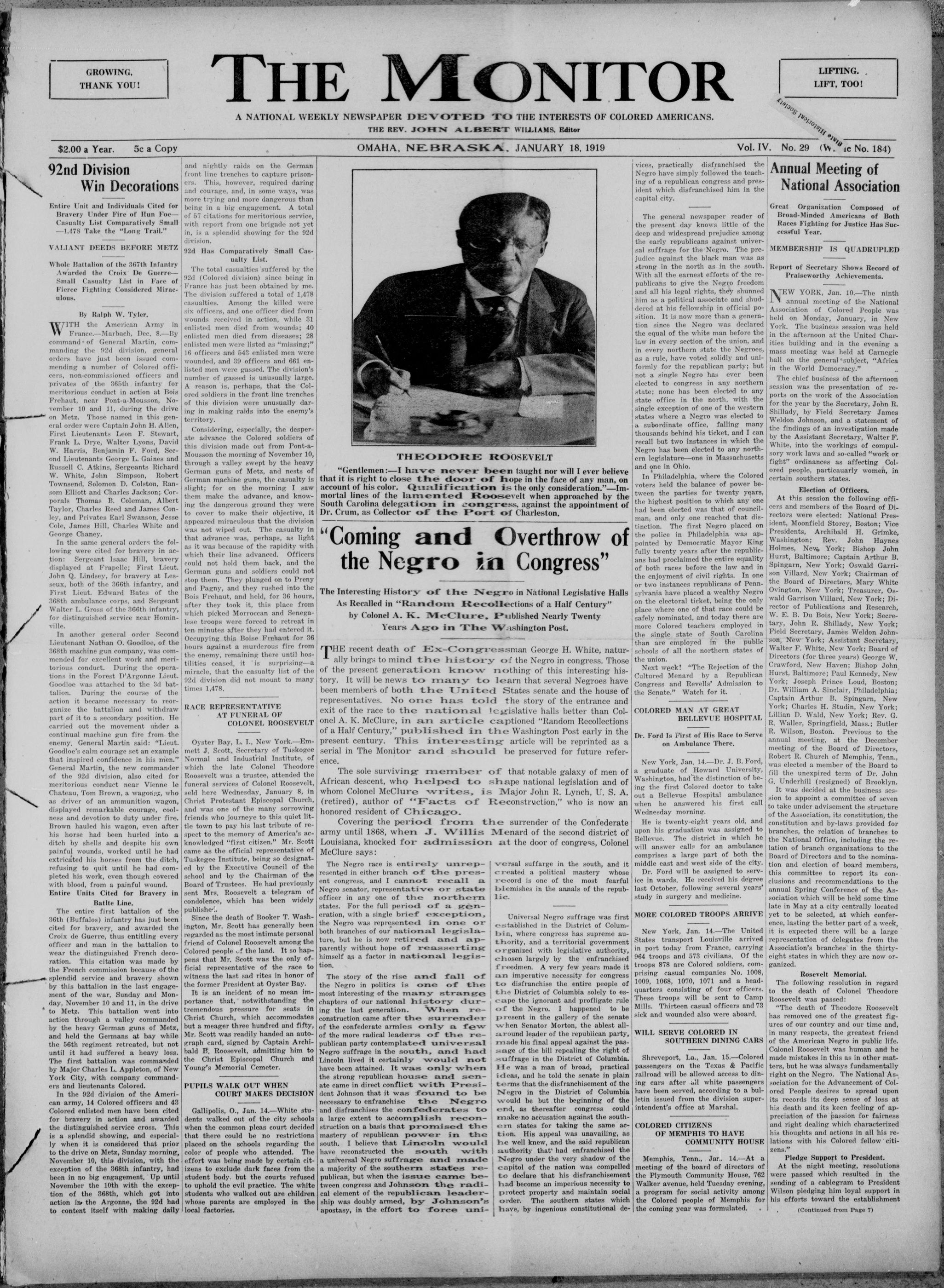
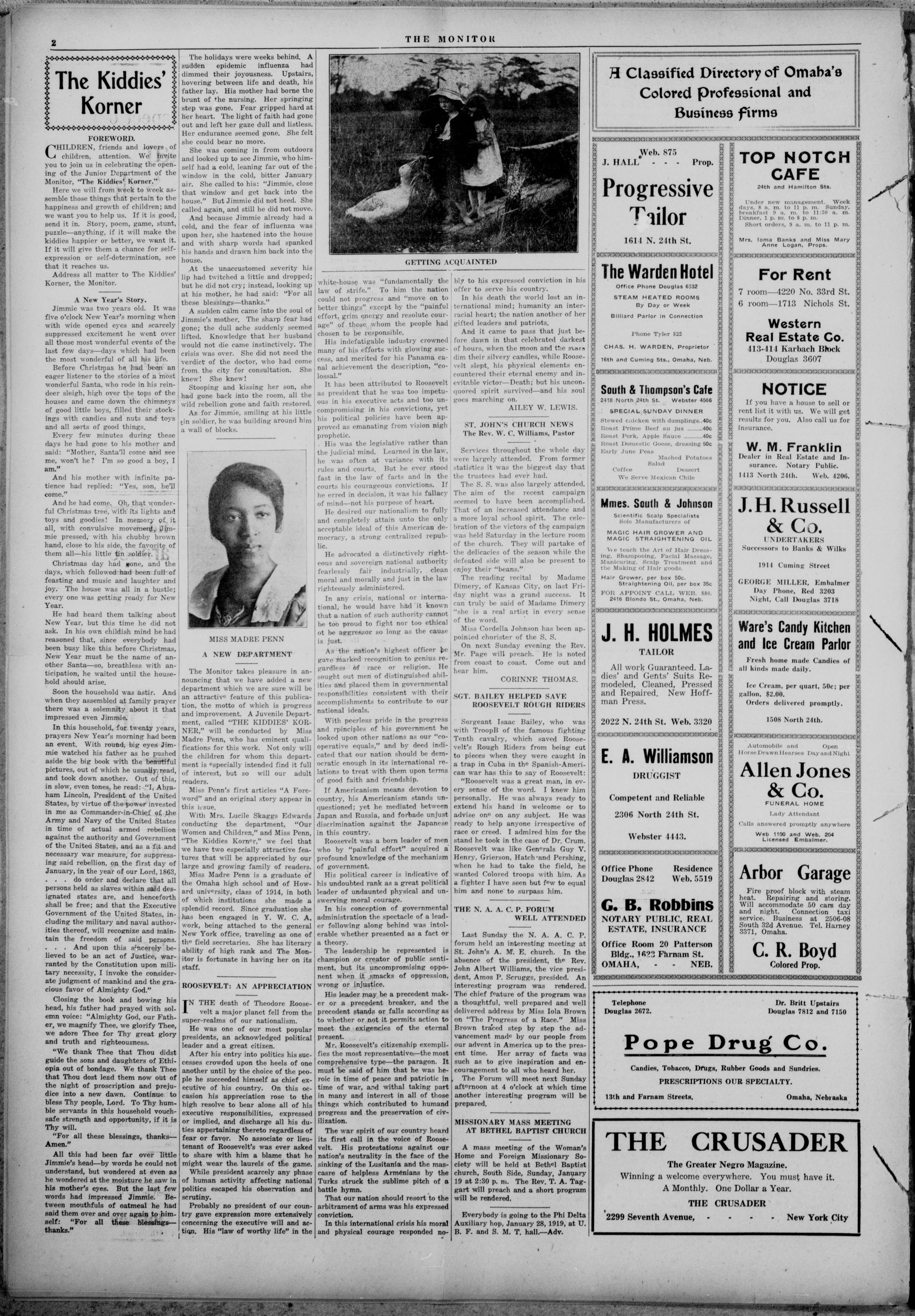
Page text (machine-generated)
GROWING,
THANK YOU!
$2.00 a Year. 5c a Copy
92nd Division Win Decorations
Entire Unit and Individuals Cited for Bravery Under Fire of Hun Foe— Casualty List Comparatively Small 1,478 Take the "Long Trail."
VALIANT DEEDS BEFORE METZ
Whole Battalion of the 367th Infantry Awarded the Croix De Guerre—Small Casualty List in Face of Fierce Fighting Considered Miraculous.
By Ralph W. Tyler.
WITH the American Army in France.—Marbach, Dec. 8.—By command of General Martin, commanding the 92d division, general orders have just been issued commending a number of Colored officers, non-commissioned officers and privates of the 365th infantry for meritorious conduct in action at Bois Fre Haut, near Pont-a-Mousson, November 10 and 11, during the drive on Metz. Those named in this general order were Captain John H. Allen, First Lieutenants Leon F. Stewart, Frank L. Drye, Walter Lyons, David W. Harris, Benjamin F. Ford, Second Lieutenants George L. Gaines and Russell C. Atkins, Sergeants Richard W. White, John Simpson, Robert Townsend, Solomon D. Colston, Ransom Elliott and Charles Jackson; Corporals Thomas B. Coleman, Albert Taylor, Charles Reed and James Conley, and Privates Earl Swanson, Jesse Cole, James Hill, Charles White and George Chaney.
In the same general orders the following were cited for bravery in action: Sergeant Isaac Hill, bravery displayed at Frapelle; First Lieut. John Q. Lindsey, for bravery at Lesseux, both of the 366th infantry, and First Lieut. Edward Bates of the 368th ambulance corps, and Sergeant Walter L. Gross of the 366th infantry, for distinguished service near Hominville.
In another general order Second Lieutenant Nathan O. Goodloe, of the 368th machine gun company, was commended for excellent work and meritorious conduct. During the operations in the Forest D'Argonne Lieut. Goodloe was attached to the 3d battalion. During the course of the action it became necessary to reorganize the battalion and withdraw part of it to a secondary position. He carried out the movement under a continual machine gun fire from the enemy. General Martin said: "Lieut. Goodloe's calm courage set an example that inspired confidence in his men." General Martin, the new commander of the 92d division, also cited for meritorious conduct near Vienne le Chateau, Tom Brown, a wagoner, who as driver of an ammunition wagon, displayed remarkable courage, coolness and devotion to duty under fire. Brown hauled his wagon, even after his horse had been hurled into a ditch by shells and despite his own painful wounds, worked until he had extricated his horses from the ditch, refusing to quit until he had completed his work, even though covered with blood, from a painful wound. Entire Units Cited for Bravery in
Batlte Line.
The entire first battalion of the 36th (Buffalos) infantry has just been cited for bravery, and awarded the Croix de Guerre, thus entitling every officer and man in the battalion to wear the distinguished French decoration. This citation was made by the French commission because of the splendid service and bravery shown by this battalion in the last engagement of the war, Sunday and Monday, November 10 and 11, in the drive to Metz. This battalion went into action through a valley commanded by the heavy German guns of Metz, and held the Germans at bay while the 56th regiment retreated, but not until it had suffered a heavy loss. The first battalion was commanded by Major Charles L. Appleton, of New York City, with company commanders and lieutenants Colored.
In the 92d division of the American army, 14 Colored officers and 43 Colored enlisted men have been cited for bravery in action and awarded the distinguished service cross. This is a splendid showing, and especially when it is considered that prior to the drive on Metz, Sunday morning, November 10, this division, with the exception of the 368th infantry, had been in no big engagement. Up until November the 10th with the exception of the 368th, which got into action in the Argonne, the 92d had to content itself with making daily
THE MONITOR
and nightly raids on the German front line trenches to capture prisoners. This, however, required daring and courage, and, in some ways, was more trying and more dangerous than being in a big engagement. A total of 57 citations for meritorious service, with report from one brigade not yet in, is a splendid showing for the 92d division.
92d Has Comparatively Small Casualty List.
The total casualties suffered by the 92d (Colored division) since being in France has just been obtained by me. The division suffered a total of 1,478 casualties. Among the killed were six officers, and one officer died from wounds received in action, while 31 enlisted men died from wounds; 40 enlisted men died from diseases; 28 enlisted men were listed as "missing;" 16 officers and 543 enlisted men were wounded, and 39 officers and 661 enlisted men were gassed. The division's number of gassed is unusually large. A reason is, perhaps, that the Colored soldiers in the front line trenches of this division were unusually daring in making raids into the enemy's territory.
Considering, especially, the desperate advance the Colored soldiers of this division made out from Pont-a-Mousson the morning of November 10, through a valley swept by the heavy German guns of Metz, and nests of German machine guns, the casualty is slight; for on the morning I saw them make the advance, and knowing the dangerous ground they were to cover to make their objective, it appeared miraculous that the division was not wiped out. The casualty in that advance was, perhaps, as light as it was because of the rapidity with which their line advanced. Officers could not hold them back, and the German guns and soldiers could not stop them. They plunged on to Prey and Pagny, and they rushed into the Bois Frehaut, and held, for 36 hours, after they took it, this place from which picked Morroccan and Senegalese troops were forced to retreat in ten minutes after they had entered it. Occupying this Boise Frehaut for 36 hours against a murderous fire from the enemy, remaining there until hostilities ceased, it is surprising—a miracle, that the casualty list of the 92d division did not mount to many times 1,478.
RACE REPRESENTATIVE
AT FUNERAL OF
COLONEL ROOSEVELT
Oyster Bay, L. I., New York.—Emmett J. Scott, Secretary of Tuskogee, Normal and Industrial Institute, of which the late Colonel Theodore Roosevelt was a trustee, attended the funeral services of Colonel Roosevelt, seld here Wednesday, January 8, in Christ Protestant Episcopal Church, and was one of the many sorrowing friends who journeye to this quiet little town to pay his last tribute of respect to the memory of America's acknowledged "first citizen." Mr. Scott came as the official representative of Tuskegee Institute, being so designated by the Executive Council of the school and by the Chairman of the Board of Trustees. He had previously sent Mrs. Roosevelt a telegram of condolence, which has been widely publishse'.
Since the death of Booker T. Washington, Mr. Scott has generally been regarded as the most intimate personal friend of Colonel Roosevelt among the Colored people of the land. It so happens that Mr. Scott was the only official representative of the race to witness the last sad rites in honor of the former President at Oyster Bay.
It is an incident of no mean importance that, notwithstanding the tremendous pressure for seats in Christ Church, which accommodates but a meager three hundred and fifty, Mr. Scott was readily handed an autograph card, signed by Captain Archibald B. Roosevelt, admitting him to the Christ Episcopal Church and Young's Memorial Cemeter.
PUPILS WALK OUT WHEN
COURT MAKES DECISION
Gallipolis, O., Jan. 14.—White students walked out of the city schools when the common pleas court decided that there could be no restrictions placed on the schools regarding the color of people who attended. The effort was being made by certain citizens to exclude dark faces from the student body, but the courts refused to uphold the evil practice. The white students who walked out are children whose parents are employed in the local factories.
THE REV. JOHN ALBERT WILLIAMS, Editor
OMAHA, NEBRASKA, JANUARY 18, 1919
ALFONSO BENZEMA
THEODORE ROOSEVELT
"Gentlemen:—I have never been that it is right to close the door of account of his color. Qualification mortal lines of the lamented Ro. South Carolina delegation in congr. Dr. Crum, as Collector of the Port.
"Coming and the Negro in
The Interesting History of the Negro As Recalled in "Random Recruit by Colonel A. K. McClure, Years Ago in The
THE recent death of Ex-Congressly brings to mind the history of the present generation known to the nation. It will be news to many to been members of both the United representatives. No one has to exit of the race to the national Colonel A. K. McClure, in an article of a Half Century," published in present century. This interesting serial in The Monitor and should ence.
The sole surviving member of African descent, who helped to whom Colonel McClure writes, is (retired), author of "Facts of honored resident of Chicago.
Covering the period from the army until 1868, when J. Willis Louisiana, knocked for admission McClure says:
"Gentlemen:—I have never been taught nor will I ever believe that it is right to close the door of hope in the face of any man, on account of his color. Qualification is the only consideration."—Immortal lines of the lamented Roosevelt when approached by the South Carolina delegation in congress, against the appointment of Dr. Crum, as Collector of the Port of Charleston.
"Coming and Overthrow of the Negro in Congress"
The Interesting History of the Negro in National Legislative Halls As Recalled in "Random Recollections of a Half Century" by Colonel A. K. McClure, Published Nearly Twenty Years Ago in The Washington Post.
THE recent death of Ex-Congressman George H. White, naturally brings to mind the history of the Negro in congress. Those of the present generation know nothing of this interesting history. It will be news to many to learn that several Negroes have been members of both the United States senate and the house of representatives. No one has told the story of the entrance and exit of the race to the national legislative halls better than Colonel A. K. McClure, in an article captioned "Random Recollections of a Half Century," published in the Washington Post early in the present century. This interesting article will be reprinted as a serial in The Monitor and should be preserved for future reference.
The sole surviving member of that notable galaxy of men of African descent, who helped to shape national legislation and of whom Colonel McClure writes, is Major John R. Lynch, U. S. A. (retired), author of "Facts of Reconstruction," who is now an honored resident of Chicago.
Covering the period from the surrender of the Confederate army until 1868, when J. Willis Menard of the second district of Louisiana, knocked for admission at the door of congress, Colonel McClure says:
The Negro race is entirely unrepresented in either branch of the present congress, and I cannot recall a Negro senator, representative or state officer in any one of the northern states. For the full period of a generation, with a single brief exception, the Negro was represented in one or both branches of our national legislature, but he is now retired and apparently without hope of reasserting himself as a factor in national legislation.
The story of the rise and fall of the Negro in politics is one of the most interesting of the many strange chapters of our national history during the last generation. When reconstruction came after the surrender of the confederate armies only a few of the more radical leaders of the republican party contemplated universal Negro suffrage in the south, and had Lincoln lived it certainly would not have been attained. It was only when the strong republican house and senate came in direct conflict with President Johnson that it was found to be necessary to enfranchise the Negro and disfranchises the confederates to a large extent to accomplish reconstruction on a basis that promised the mastery of republican power in the south. I believe that Lincoln would have reconstructed the south with a universal Negro suffrage and made a majority of the southern states republican, but when the issue came between congress and Johnson the radical element of the republican leadership was doubly armed, by Johnson's apostasy, in the effort to force uni-
---
been taught nor will I ever believe of hope in the face of any man, on man is the only consideration."—Imosevelt when approached by the怒ress, against the appointment of at of Charleston.
"Overthrow of in Congress"
Negro in National Legislative Halls collections of a Half Century"
Published Nearly Twenty Washington Post.
Pressman George H. White, natur- of the Negro in congress. Those nothing of this interesting his- learn that several Negroes have States senate and the house of the story of the entrance and legislative halls better than Colcaptioned "Random Recollections the Washington Post early in the article will be reprinted as a be preserved for future refer- of that notable galaxy of men of shape national legislation and of Major John R. Lynch, U. S. A. Reconstruction," who is now an surrender of the Confederate Menard of the second district of at the door of congress, Colonel
versal suffrage in the south, and it created a political mastery whose record is one of the most fearful blemishes in the annals of the republic.
Universal Negro suffrage was first established in the District of Columbia, where congress has supreme authority, and a territorial government organized with legislative authority, chosen largely by the enfranchised freedmen. A very few years made it an imperative necessity for congress to disfranchise the entire people of the District of Columbia solely to escape the ignorant and profligate rule of the Negro. I happened to be present in the gallery of the senate when Senator Morton, the ablest all-around leader of the republican party, made his final appeal against the passage of the bill repealing the right of suffrage in the District of Columbia. He was a man of broad, practical ideas, and he told the senate in plain terms that the disfranchisement of the Negro in the District of Columbia would be but the beginning of the end, as thereafter congress could make no accusation against the southern states for taking the same action. His appeal was unavailing, as he well knew, and the said republican authority that had enfranchised the Negro under the very shadow of the capitol of the nation was compelled to declare that his disfranchisement had become an imperious necessity to protect property and maintain social order. The southern states which have, by ingenious constitutional de
---
Vol. IV. No. 29 (W. ie No. 184)
vices, practically disfranchised the Negro have simply followed the teaching of a republican congress and president which disfranchised him in the capital city.
The general newspaper reader of the present day knows little of the deep and widespread prejudice among the early republicans against universal suffrage for the Negro. The prejudice against the black man was as strong in the north as in the south. With all the earnest efforts of the republicans to give the Negro freedom and all his legal rights, they shunned him as a political associate and shuddered at his fellowship in official position. It is now more than a generation since the Negro was declared the equal of the white man before the law in every section of the union, and in every northern state the Negroes, as a rule, have voted solidly and uniformly for the republican party; but not a single Negro has ever been elected to congress in any northern state; none has been elected to any state office in the north, with the single exception of one of the western states where a Negro was elected to a subordinate office, falling many thousands behind his ticket, and I can recall but two instances in which the Negro has been elected to any northern legislature—one in Massachusetts and one in Ohio.
In Philadelphia, where the Colored voters held the balance of power between the parties for twenty years, the highest position to which any one had been elected was that of councilman, and only one reached that distinction. The first Negro placed on the police in Philadelphia was appointed by Democratic Mayor King fully twenty years after the republicans had proclaimed the entire equality of both races before the law and in the enjoyment of civil rights. In one or two instances republicans of Pennsylvania have placed a wealthy Negro on the electoral ticket, being the only place where one of that race could be safely nominated, and today there are more Colored teachers employed in the single state of South Carolina than are employed in the public schools of all the northern states of the union.
Next week! "The Rejection of the Cultured Menard by a Republican Congress and Revells' Admission to the Senate." Watch for it.
COLORED MAN AT GREAT
BELLEVUE HOSPITAL
Dr. Ford Is First of His Race to Serve on Ambulance There.
New York, Jan. 14.—Dr. J. B. Ford, a graduate of Howard University, Washington, had the distinction of being the first Colored doctor to take out a Bellevue Hospital ambulance when he answered his first call Wednesday morning.
He is twenty-eight years old, and upon his graduation was assigned to Bellevue. The district in which he will answer calls for an ambulance comprises a large part of both the middle east and west side of the city. Dr. Ford will be assigned to service in wards. He received his degree last October, following several years' study in surgery and medicine.
MORE COLORED TROOPS ARRIVE
New York, Jan. 14.—The United States transport Louisville arrived in port today from France, carrying 964 troops and 573 civilians. Of the troops 878 are Colored soldiers, comprising casual companies No. 1008, 1009, 1068, 1070, 1071 and a headquarters consisting of four officers. These troops will be sent to Camp Mills. Thirteen casual officers and 73 sick and wounded also were aboard.
WILL SERVE COLORED IN
SOUTHERN DINING CARS
Shreveport, La., Jan. 15.—Colored passengers on the Texas & Pacific railroad will be allowed access to dining cars after all white passengers have been served, according to a bulletin issued from the division superintendent's office at Marshal.
COLORED CITIZENS
OF MEMPHIS TO HAVE
COMMUNITY HOUSE
Memphis, Tenn., Jar. 14.—At a meeting of the board of directors of the Plymouth Community House, 762 Walker avenue, held Tuesday evening, a program for social activity among the Colored people of Memphis for the coming year was formulated.
LIFTING.
LIFT. TOO!
Annual Meeting of National Association
Great Organization Composed of Broad-Minded Americans of Both Races Fighting for Justice Has Successful Year.
MEMBERSHIP IS QUADRUPLED
Report of Secretary Shows Record of Praiseworthy Achievements.
NEW YORK, Jan. 10.—The ninth annual meeting of the National Association of Colored People was held on Monday, January, in New York. The business session was held in the afternoon at the United Charities building and in the evening a mass meeting was held at Carnegie hall on the general subject, "Africa in the World Democracy."
The chief business of the afternoon session was the presentation of reports on the work of the Association for the year by the Secretary, John R. Shillady, by Field Secretary James Weldon Johnson, and a statement of the findings of an investigation made by the Assistant Secretary, Walter F. White, into the workings of compulsory work laws and so-called "work or fight" ordinances as affecting Colored people, particauarly women, in certain southern states.
Election of Officers.
At this session the following officers and members of the Board of Directors were elected: National President, Moonfield Storey, Boston; Vice Presidents, Archibald H. Grimke, Washington; Rev. John Haynes Holmes, New York; Bishop John Hurst, Baltimore; Captain Arthur B. Spingarn, New York; Oswald Garrison Villard, New York; Chairman of the Board of Directors, Mary White Ovington, New York; Treasurer, Oswald Garrison Villard, New York; Director of Publications and Research, W. E. B. Du Bois, New York; Secretary, John R. Shillady, New York; Field Secretary, James Weldon Johnson, New York; Assistant Secretary, Walter F. White, New York; Board of Directors (for three years) George W. Crawford, New Haven; Bishop John Hurst, Baltimore; Paul Kennedy, New York; Joseph Prince Loud, Boston; Dr. William A. Sinclair, Philadelphia; Captain Arthur B. Spingarn, New York; Charles H. Studin, New York; Lillian D. Wald, New York; Rev. G. R. Waller, Springfield, Mass.; Butler R. Wilson, Boston. Previous to the annual meeting, at the December meeting of the Board of Directors, Robert R. Church of Memphis, Tenn., was elected a member of the Board to fill the unexpired term of Dr. John G. Underhill (resigned) of Brooklyn.
It was decided at the business session to appoint a committee of seven to take under advisement the structure of the Association, its constitution, the constitution and by-laws provided for branches, the relation of branches to the National Office, including the relation of branch organizations to the Board of Directors and to the nomination and election of board members, this committee to report its conclusions and recommendations to the annual Spring Conference of the Association which will be held some time late in May at a city centrally located yet to be selected, at which conference, lasting the better part of a week, it is expected there will be a large representation of delegates from the Association's branches in the thirty-eight states in which they are now organized.
Rosevelt Memorial.
The following resolution in regard to the death of Colonel Theodore Roosevelt was passed:
"The death of Theodore Roosevelt has removed one of the greatest figures of our country and our time and, in many respects, the greatest friend of the American Negro in public life. Colonel Roosevelt was human and he made mistakes in this as in other matters, but he was always fundamentally right on the Negro. The National Association for the Advancement of Colored People desires to spread upon its records its deep sense of loss at his death and its keen feeling of appreciation of the passion for fairness and right dealing which characterized his thoughts and actions in all his relations with his Colored fellow citizens."
Pledge Support to President
At the night meeting, resolutions were passed which resulted in the sending of a cablegram to President Wilson pledging him loyal support in his efforts toward the establishment (Continued from Page 7)
2
The Kiddies' Korner
FOREWORD.
CHILDREN, friends and lovers of children, attention. We invite you to join us in celebrating the opening of the Junior Department of the Monitor, "The Kiddies' Korner."
Here we will from week to week assemble those things that pertain to the happiness and growth of children; and we want you to help us. If it is good, send it in. Story, poem, game, stunt, puzzle—anything, if it will make the kiddies happier or better, we want it. If it will give them a chance for self-expression or self-determination, see that it reaches us.
Address all matter to The Kiddies' Korner, the Monitor.
A New Year's Story.
Jimmie was two years old. It was five o'clock New Year's morning when with wide opened eyes and scarcely suppressed excitement he went over all those most wonderful events of the last few days—days which had been the most wonderful of all his life.
Before Christmas he had been an eager listener to the stories of a most wonderful Santa, who rode in his reindeer sleigh, high over the tops of the houses and came down the chimneys of good little boys, filled their stockings with candies and nuts and toys and all sorts of good things.
Every few minutes during these days he had gone to his mother and said: "Mother, Santa'll come and see me, won't he? I'm so good a boy, I am."
And his mother with infinite patience had replied: "Yes, son, he'll come."
And he had come. Oh, that wonderful Christmas tree, with its lights and toys and goodies! In memory of it all, with convulsive movement, Jimie pressed, with his chubby brown hand, close to his side, the favorite of them all—his little tin soldier.
Christmas day had gone, and the days, which followed had been full of feasting and music and laughter and joy. The house was all in a bustle; every one was getting ready for New Year.
He had heard them talking about New Year, but this time he did not ask. In his own childish mind he had reasoned that, since everybody had been busy like this before Christmas, New Year must be the name of another Santa—so, breathless with anticipation, he waited until the household should arise.
Soon the household was astir. And when they assembled at family prayer there was a solemnity about it that impressed even Jimmie.
In this household, for twenty years, prayers New Year's morning had been an event. With round, big eyes Jimmie watched his father as he pushed aside the big book with the beautiful pictures, out of which he usually read, and took down another. Out of this, in slow, even tones, he read: "I, Abraham Lincoln, President of the United States, by virtue of the power invested in me as Commander-in-Chief of the Army and Navy of the United States in time of actual armed rebellion against the authority and Government of the United States, and as a fit and necessary war measure, for suppressing said rebellion, on the first day of January, in the year of our Lord, 1863, . . . do order and declare that all persons held as slaves within said designated states are, and henceforth shall be free; and that the Executive Government of the United States, including the military and naval authorities thereof, will recognize and maintain the freedom of said persons. . . . And upon this sincerely believed to be an act of Justice, warranted by the Constitution upon military necessity, I invoke the considerate judgment of mankind and the gracious favor of Almighty God."
Closing the book and bowing his head, his father had prayed with solemn voice: "Almighty God, our Father, we magnify Thee, we glorify Thee, we adore Thee for Thy great glory and truth and righteousness.
"We thank Thee that Thou didst guide the sons and daughters of Ethiopia out of bondage. We thank Thee that Thou dost lead them now out of the night of proscription and prejudice into a new dawn. Continue to bless Thy people, Lord. To Thy humble servants in this household vouchsafe strength and opportunity, if it is Thy will.
"For all these blessings, thanks—Amen."
All this had been far over little Jimmie's head—by words he could not understand, but wondered at even as he wondered at the moisture he saw in his mother's eyes. But the last few words had impressed Jimmie. Between mouthfuls of oatmeal he had said them over and over again to himself: "For all these blessings—thanks."
The holidays were weeks behind. A sudden epidemic influenza had dimmed their joyousness. Upstairs, hovering between life and death, his father lay. His mother had borne the brunt of the nursing. Her springing step was gone. Fear gripped hard at her heart. The light of faith had gone out and left her gaze dull and listless. Her endurance seemed gone. She felt she could bear no more.
She was coming in from outdoors and looked up to see Jimmie, who himself had a cold, leaning far out of the window in the cold, bitter January air. She called to his: "Jimmie, close that window and get back into the house." But Jimmie did not heed. She called again, and still he did not move.
And because Jimmie already had a cold, and the fear of influenza was upon her, she hastened into the house and with sharp words had spanked his hands and drawn him back into the house.
At the unaccustomed severity his lip had twitched a little and dropped; but he did not cry; instead, looking up at his mother, he had said: "For all these blessings—thanks."
A sudden calm came into the soul of Jimmie's mother. The sharp fear had gone; the dull ache suddenly seemed lifted. Knowledge that her husband would not die came instinctively. The crisis was over. She did not need the verdict of the doctor, who had come from the city for consultation. She knew! She knew!
Stooping and kissing her son, she had gone back into the room, all the wild rebellion gone and faith restored. As for Jimmie, smiling at his little tin soldier, he was building around him a wall of blocks.
A. E. H.
MISS MADRE PENN
A NEW DEPARTMENT
The Monitor takes pleasure in announcing that we have added a new department which we are sure will be an attractive feature of this publication, the motto of which is progress and improvement. A Juvenile Department, called "THE KIDDIES' KORNER," will be conducted by Miss Madre Penn, who has eminent qualifications for this work. Not only will the children for whom this department is especially intended find it full of interest, but so will our adult readers.
Miss Penn's first articles "A Foreword" and an original story appear in this issue.
With Mrs. Lucile Skaggs Edwards conducting the department, "Our Women and Children," and Miss Penn, "The Kiddies Korner," we feel that we have two especially attractive features that will be appreciated by our large and growing family of readers. Miss Madre Penn is a graduate of the Omaha high school and of Howard university, class of 1914, in both of which institutions she made a splendid record. Since graduation she has been engaged in Y. W. C. A. work, being attached to the general New York office, traveling as one of the field secretaries. She has literary ability of high rank and The Monitor is fortunate in having her on its staff.
ROOSEVELT: AN APPRECIATION
IN THE death of Theodore Roosevelt a major planet fell from the super-realms of our nationalism. He was one of our most popular presidents, an acknowledged political leader and a great citizen. After his entry into politics his successes crowded upon the heels of one another until by the choice of the people he succeeded himself as chief executive of his country. On this occasion his appreciation rose to the high resolve to bear alone all of his executive responsibilities, expressed or implied, and discharge all his duties appertaining thereto regardless of fear or favor. No associate or lieutenant of Roosevelt's was ever asked to share with him a blame that he might wear the laurels of the game.
While president scarcely any phase of human activity affecting national politics escaped his observation and scrutiny. Probably no president of our country gave expression more extensively concerning the executive will and action. His "law of worthy life" in the
THE MONITOR
THE DUCK
THE GREY GOOSE
GETTING ACQUAINTED
white-house was "fundamentally the law of strife." To him the nation could not progress and "move on to better things" except by the "painful effort, grim energy and resolute courage" of those whom the people had chosen to be responsible.
His indefatigable industry crowned many of his efforts with glowing success, and merited for his Panama canal achievement the description, "colossal."
It has been attributed to Roosevelt as president that he was too impetuous in his executive acts and too uncompromising in his convictions, yet his political policies have been approved as emanating from vision nigh prohhetic.
His was the legislative rather than the judicial mind. Learned in the law, he was often at variance with its rules and courts. But he ever stood fast in the law of facts and in the courts his courageous convictions. If he erred in decision, it was his fallacy of mind—not his purpose of heart.
He desired our nationalism to fully and completely attain unto the only acceptable ideal of this American democracy, a strong centralized republic.
He advocated a distinctively righteous and sovereign national authority fearlessly fair industrially, clean moral and morally and just in the law righteously administered.
In any crisis, national or international, he would have had it known that a nation of such authority cannot be too proud to fight nor too ethical or be aggressor so long as the cause is just.
As the nation's highest officer he gave marked recognition to genius regardless of race or religion. He sought out men of distinguished abilities and placed them in governmental responsibilities consistent with their accomplishments to contribute to our national ideals.
With peerless pride in the progress and principles of his government he looked upon other nations as our "cooperative equals," and by deed indicated that our nation should be democratic enough in its international relations to treat with them upon terms of good faith and friendship.
If Americanism means devotion to country, his Americanism stands unquestioned; yet he mediated between Japan and Russia, and forbade unjust discrimination against the Japanese in this country.
Roosevelt was a born leader of men who by "painful effort" acquired a profound knowledge of the mechanism of government.
His political career is indicative of his undoubted rank as a great political leader of undaunted physical and unswerving moral courage.
In his conception of governmental administration the spectacle of a leader following along behind was intolerable whether presented as a fact or a theory. The leadership he represented is champion or creator of public sentiment, but its uncompromising opponent when it smacks of oppression, wrong or injustice. His leader may be a precedent maker or a precedent breaker, and the precedent stands or falls according as to whether or not it permits action to meet the exigencies of the eternal present.
Mr. Roosevelt's citizenship exemplifies the most representative—the most comprehensive type—the paragon. It must be said of him that he was heroic in time of peace and patriotic in time of war, and withal taking part in many and interest in all of those things which contributed to humand progress and the preservation of civilization.
The war spirit of our country heard its first call in the voice of Roosevelt. His protestations against our nation's neutrality in the face of the sinking of the Lusitania and the mascasre of helpless Armenians by the Turks struck the sublime pitch of a battle hymn.
That our nation should resort to the arbitrament of arms was his expressed conviction.
In this international crisis his moral and physical courage responded no-
THE LAND OF THE LION
bly to his expressed conviction in his offer to serve his country. In his death the world lost an international mind; humanity an interracial heart; the nation another of her gifted leaders and patriots. And it came to pass that just before dawn in that celebrated darkest of hours, when the moon and the stars dim their silvery candles, while Roosevelt slept, his physical elements encountered their eternal enemy and inevitable victor—Death; but his unconquored spirit survived—and his soul goes marching on.
ST. JOHN'S CHURCH NEWS
The REV. W. C. Williams, Pastor
Services throughout the whole day were largely attended. From former statistics it was the biggest day that the trustees had ever had.
The S. S. was also largely attended. The aim of the recent campaign seemed to have been accomplished. That of an increased attendance and a more loyal school spirit. The celebration of the victors of the campaign was held Saturday in the lecture room of the church. They will partake of the delicacies of the season while the defeated side will also be present to enjoy their "beans."
The reading recital by Madame Dimery, of Kansas City, on last Friday night was a grand success. It can truly be said of Madame Dimery "she is a real artist in every sense of the word.
Miss Cordella Johnson has been appointed chorister of the S. S.
On next Sunday evening the Rev. Mr. Page will preach. He is noted from coast to coast. Come out and hear him.
SGT. BAILEY HELPED SAVE
ROOSEVELT ROUGH RIDERS
Sergeant Isaac Bailey, who was with TroopB of the famous fighting Tenth cavalry, which saved Roosevelt's Rough Riders from being cut to pieces when they were caught in a trap in Cuba in the Spanish-American war has this to say of Roosevelt: "Roosevelt was a great man, in every sense of the word. I knew him personally. He was always ready to extend his hand in welcome or to advise one on any subject. He was ready to help anyone irrespective of race or creed. I admired him for the stand he took in the case of Dr. Crum. Roosevelt was like Generals Guy V. Henry, Grierson, Hatch and Pershing, when he had to take the field, he wanted Colored troops with him. As a fighter I have seen but few to equal him and none to surpass him.
Last Sunday the N. A. A. C. P. forum held an interesting meeting at St. John's A. M. E. church. In the absence of the president, the Rev. John Albert Williams, the vice president, Amos P. Scruggs, presided. An interesting program was rendered. The chief feature of the program was a thoughtful, well prepared and well delivered address by Miss Iola Brown on "The Progress of a Race." Miss Brown traced step by step the advancement made by our people from our advent in America up to the present time. Her array of facts was such as to give inspiration and encouragement to all who heard her. The Forum will meet next Sunday afternoon at 4 o'clock at which time another interesting program will be prepared.
MISSIONARY MASS MEETING
AT BETHEL BAPTIST CHURCH
A mass meeting of the Woman's
Home and Foreign Missionary
Society will be held at Bethel Baptist
church, South Side, Sunday, January
19 at 2:30 p. m. The Rev. T. A. Taggart will preach and a short program
will be rendered.
Everybody is going to the Phi Delta
Auxiliary hop, January 28, 1919, at U.
B. F. and S. M. T. hall.—Adv.
---
AILEY W. LEWIS.
CORINNE THOMAS.
A Classified Directory of Omaha's Colored Professional and Business firms
Candies, Tobacco, Drugs, Rubber Goods and Sundries.
PRESCRIPTIONS OUR SPECIALTY.
THE CRUSADER
THE CRUSADER
The Greater Negro Magazine. Winning a welcome everywhere. You must have it. A Monthly. One Dollar a Year.
2299 Seventh Avenue, - - - New York City
Web. 875
J. HALL - - - Prop.
Progressive Tailor 1614 N.24th St.
The Warden Hotel
Office Phone Douglas 6332
STEAM HEATED ROOMS
By Day or Week
Billiard Parlor in Connection
Phone Tyler 822
CHAS. H. WARDEN, Proprietor
16th and Cuming Sts., Omaha, Neb.
South & Thompson's Cafe
SPECIAL SUNDAY DINNER
Stewed caichen with dumplings. 40c
Roast Prime Beef au jus ...... 40c
Roast Pork, Apple Sauce ...... 40c
Roast Domestic Goose, dressing 50c
Early Peas
Mashed Potatoes
Salad
Dessert
Coffee
We Serve Mexican Chile
Mmes. South & Johnson
Scientific Scalp Specialists
Sole Manufacturers of
MAGIC HAIR GROWER AND
MAGIC STRAIGHTENING OIL
We teach the Art of Hair Dressing, Shampooing, Facial Massage, Manicuring, Scalp Treatment and the Making of Hair goods.
Hair Grower, per box 50c.
Stralightening Oil, per box 35c
FOR APPOINT CALL WEB, 880,
2416 Blondo St. Omaha, Neb.
J. H. HOLMES
TAILOR
All work Guaranteed. Ladies' and Gents' Suits Remodeled, Cleaned, Pressed and Repaired. New Hoffman Press.
2022 N. 24th St. Web. 3320
E. A. Williamson
DRUGGIST
Competent and Reliable
2306 North 24th St.
Webster 4443.
Office Phone Residence
Douglas 2842 Web. 5519
G. B. Robbins
NOTARY PUBLIC, REAL ESTATE, INSURANCE
Office Room 20 Patterson Bldg., 1623 Farnam St.
OMAHA, - - - NEB.
Telephone
Douglas 2672.
Pope I
Candies, Tobacco, Drugs
PRESCRIPTION
13th and Farnam Streets.
THE C
The Greater
Winning a welcome even
A Monthly.
THE
2299 Seventh Avenue,
TOP NOTCH CAFE
24th and Hamilton Sts.
Under new management. Week days, 8 a. m. to 11 p. m. Sunday, breakfast 9 a. m. to 11:30 a. m. Dinner, 1 p. m. to 8 p. m. Short orders, 9 a. m. to 11 p. m.
Mrs. loma Banks and Miss Mary Anne Logan, Props.
For Rent
7 room—4220 No. 33rd St.
6 room—1713 Nichols St.
Western
Real Estate Co.
413-414 Karbach Block
Douglas 3607
NOTICE
If you have a house to sell or rent list it with us. We will get results for you. Also call us for insurance.
W. M. Franklin
Dealer in Real Estate and Insurance. Notary Public.
1413 North 24th. Web. 4206.
J.H.Russell
UNDERTAKERS
Successors to Banks & Wilks
1914 Cuming Street
GEORGE MILLER, Embalmer
Day Phone, Red 3203
Night, Call Douglas 3718
Ware's Candy Kitchen and Ice Cream Parlor
Fresh home made Candies of all kinds made daily.
Ice Cream, per quart, 50c; per gallon, $2.00.
Orders delivered promptly.
Automobile and Open
Horse Drawn Hearses Day and Night
Allen Jones
& Co.
FUNERAL HOME
Lady Attendant
Calls answered promptly anywhere
Web 1100 and Web. 204
Licensed Embalmer.
Arbor Garage
Fire proof block with steam heat. Repairing and storing. Will accommodate 50 cars day and night. Connection taxi service. Business at 2506-08 South 32d Avenue. Tel. Harney 3371, Omaha.
C. R. Boyd
Colored Prop.
Dr. Britt Upstairs
Douglas 7812 and 7150
rug' Co.
Ober Goods and Sundries.
OUR SPECIALTY.
Omaha, Nebraska
USADER
gro Magazine.
here. You must have it.
Dollar a Year.
USADER
New York City
FORMULATED 1900
"PORO"
HAIR GROWER
MADE ONLY BY
Mrs Amelia Thurbo
Malone
ST LOUIS, MISSOURI
FOR DRAUFF, FALLING HAIR, ITCHING
SCALP, GIVING LIFE, BEAUTY, COLOR
AND ABUNDANT GROWTH
THIS STYLE OF RDY ADDED SINCE 1910
NET WT. 12 OZ.
PRICE 50 CENTS
Try our scientific method of treating
the scalp. We positively grow
hair or money. We electricly
massage for money and face. System
taught. Sterilized equipment. Steam
heated boots. All work private.
MRS. ANNA EVANS JONES
1516 North 24th St.
Webster 5450 Harney 5100
Hill-Williams Drug Co.
PURE DRUGS AND TOILET
ARTICLES
Free Delivery
Tyler 160 2402 Cuming St.
BOOKER 1. WASHINGTON HOTEL
Nicely Furnished Steam Heated Rooms, With or Without Board.
523 North 15th St. Omaha, Neb.
Phone Tyler 897.
2407 Lake St. Phone Web. 4024
SILAS JOHNSON
Licensed Embalmer in Attendance Service and Quality.
Phone Web. 248. 2518 Lake St.
C. S. JOHNSON
18th and Izard Tel. Douglas 1702
ALL KINDS OF COAL and COKE
at POPULAR PRICES.
Best for the Money
Res. Colfax 3831. Douglas 7150
AMOS P. SCRUGGS
Attorney-at-Law
13th and Farnam
AL HAMBRA
24th and Parker.
THE
HOUSE OF COURTESY
24th and Parker Sts.
24th and Franklin Streets
SATURDAY—
Jack Gardiner in
“THE RANGE BOSS”
Good Western and a Good Comedy
SUNDAY—
Neal Hart in
“ROPED AND TIED”
Constance Talmadge in
“GOOD NIGHT PAUL”
MELCHOR--Druggist
The Old Reliable
Tel. South 807 4826 So. 24th St.
K. & M.
GROCERY CO.
We solicit your patronage.
2114-16 North 24th St.
Petersen & Michelsen
Hardware Co.
GOOD HARDWARE
2408 N St. Tel. South 162
Liberty Drug Co.
EVERYBODY'S DRUG STORE
We Deliver Anywhere.
Webster 386. Omaha, Neb.
Wolf's
Semi-Annual Sale
Men's Fine
Furnishings
1421 DOUGLAS ST.
Events and Persons
The O. K. girls met at the residence of Mrs. Edith Cory Scott, 2204 North Nineteenth street, and completed the organization of the club. Look out for us.
Come to the O. K. girls' entertainment at Mrs. Lulu Rountree's residence, 1125 North Nineteenth street, Wednesday, January 29, 1919, to help find Billy Whiskers' tail. Come one, come all.
Mrs. Anna Lee left last Wednesday night for St. Paul, Minn., where she will remain with her sister, who is ill. Sgt. Jasper Ervin arrived home from Camp Funston on January 6. His sister, Mrs. W. H. Scruggs, entertained for him Saturday evening.
Furnished Rooms—Strictly modern. With or without board. 1516 North 16th. Tel. Webster 4983.
Mrs. Robert Wheeler of 2702 Erskine returned home Monday morning from Kansas City, where she spent the holidays visiting relatives.
The Phi Delta Sorority met at the home of Mrs. Francis Peoples Wednesday evening, at which time the election of officers was held.
Anyone wishing to buy an equity in a beautiful home, now is your chance; 8 rooms, strictly modern, terms reasonable. Call W. 2941.
Miss Emma Parker, who underwent an operation for appendicitis last week, is doing nicely.
Wanted, by man and wife, furnished room in private family. Call Douglas 6688 and inquire for Mrs. Lewis.
Des Dunes orchestra will be at the Phi Delta hop January 28. Will you?
Phi Delta hop January 28. Will you?
Mr. and Mrs. E. A. Williamson entertained Lt. Parks of Denver, Colo.
Thursday morning at a three course breakfast.
Corp. Leroy Kelly, Corp. Harrold Bentley, Bugler Aaron J. Glass and Private Leslie Graves were among those boys who returned last week from camp.
Sweet William Juveniles were entertained Friday afternoon, December 27, at the residence of Mrs. M. C. Sands, 2517 Burdette, by Mother Matron Payne and Sands.
Lunch room for rent. Light, heat and phone free. Hamilton Soft Drink Parlor, 24th and Hamilton.
The Phi Delta Sorority gave a Xmas Eve party at the home of Mrs. Simon Harrold and was joined by the auxiliary in a New Year's Eve party at 926 North Twenty-seventh avenue. Bob and Earl Terrell, sons of Mrs. Isaac Bailey, who spent the holidays here with Sergeant and Mrs. Bailey, have returned to their home in Dover, Ohio. Mr. and Mrs. P. H. Hall of Chicago, en route home from Wahoo, Neb., where they spent the holidays with Mrs. Hall's mother, were Omaha visitors between trains last Thursday, being guests at St. Philip's rectory. Mr. C. C. Galloway recently returned from Dallas, Tex., where he was called by the death of his mother and brother who died within a few days of each other.
Mr. and Mrs. B. Napier of 1624 North Twentieth street, entertained at dinner Sunday afternoon, their guests being the Rev. and Mrs. W. C. Williams of this city and Madame Sadie Dimery of Kansas City, Mo.
Does your neighbor take The Monitor? Ask him. You like it. So will he. Help put The Monitor in EVERY COLORED home in your community.
Married.
Mrs. R. B. Thompson, 813 Anita avenue, to Mr. Lewis. Ceremony performed by Rev. L. Bates.
Deaths.
Baby Robinson, at the Rescue Home, Albert Bailey, at Methodist Hospital. George Taylor, 706 S. E. Seventh street. The congregation of the Maple Street Baptist Church will move into their new auditorium February 15. Great preparations are being made for this occasion. A rally will begin next Sunday to furnish chairs for the pulpit. The congregation of the Corinthian Baptist Church has begun the New Year with great prospects. The new officers have been installed and set at work. The installation was followed by a reception for the officers. Rev. S. Childs, who died at his home at 1623 Filmore street, left a widow and four children to mourn his loss.
The Young Married People's Society met at Mrs. H. Ward's, 1438 Filmore street, Thursday, January 9.
MT. MORIAH BAPTIST
Services were good all day at the Mt. Moriah Baptist Church. Everything looks promising. Sunday morning a visitor that comes very highly recommended shall speak for us on the subject, God's Ideal Home." Don't fail to hear this great theme.
THE MONITOR
NEBRASKA CITY NEWS
Mrs. Charles Rollins
Mrs. Virgie Ellis, who spent Xmas with her mother, returned home last week.
Mr. and Mrs. Ira Stewart spent a few days with Mrs. Stewart's grandmother at Clarinda, Ia.
Mrs. Laura Letcher spent Xmas with her mother, Mrs. Jane Moss, of Clarinda.
Miss Edith Robinson returned to her school after a few days in this city.
Mr. and Mrs. Shaw and Mr. and Mrs. Gonzales spent Xmas in St. Joe.
W. R. Shafroth, our energetic young brother, has organized a get-to-gether club.
Mrs. Charles Mack, vice president of the Harmony club, distributed many dainty boxes candy to Xmas club members. If you are not a member join us and also join The Monitor's big family.
Let us have something stirring when the boys come home.
MT. MORIAH BAPTIST CHURCH
Rev. M. H. Wilkinson
Our quarterly and annual meeting came off Friday, January 3, and was pleasant, enjoyable and interesting. Nearly all the various boards and organizations reported and the results in all cases were inspiring.
Mr. L. Lewis, assistant church clerk, and Mrs. H. L. Anderson, church clerk, are to be complimented for their work.
Present membership, 270; money taken in for the year, $4,755.49; money spent for the year, $2,960.50; money on hand, $1,794.99.
Preaching next Sunday by pastor at both services.
OMAHA COLORED BUSINESS FIRMS
Our classified directory of Omaha Colored Business Firms, which is begun in this issue, will not only be a splendid advertising feature for the firms themselves, but will be a revelation to people at home and abroad of the number and variety of business ventures in which our people are engaged. We hope to have in time every business and professional firm in Omaha in this directory. It will make you open your eyes. The only way these firms can grow will be through your patronage. These firms must also, on their part, do all that in them lies to give its patrons efficient service.
PHI DELTA RED CROSS WORK
The Phi Delta Sorority Red Cross auxiliary, of which M. L. N. People is chairman, finished 100 infant shirts and eleven pairs of socks during its three months' work in 1918.
MONARCH POOL AND BIL-
LIARD HALL REOPENS
Sgt. Leroy C. Broomfield wishes to announce to the public that he has reopened the Monarch Pool and Billiard hall at 109 South 14th street. The same elegant tables, cues and furnishings, which made the former business the mecca for all gentlemen wishing to spend a social hour or two, are to be found in the new establishment. A full line of choice cigars from the famous Harley-Hass firm of Council Bluffs has been placed by Ben Milder. The proprietor extends a hearty welcome to his old patrons and to all others who may come and inspect the new place of business.
FRANKLIN THRIFTOGRAMS
Wisdom From Man Whose Birthday, January 17, Has Been Made National War Savings Day.
"A rolling stone gathers no moss."
"God helps those that help themselves."
"He that waits on fortune is never sure of a dinner."
"For age and want save while you may;
No morning sun last a whole day."
"A penny saved is two pence clear;
A pin a day is a great a year."
"The thrifty maxim of the wary Dutch Is to save all the money they can touch."
"All things are cheap to the saving, dear to the wasteful."
"Beware of small expenses; a small leak will sink a great ship."
"The way to wealth, if you desire it, is as plain as the way to market."
"It is easier to suppress the first desire than to satisfy all that follow it."
"If you would know the value of money, go and try to borrow some; for he that goes a borrowing goes a sorrowing."
"A man may, if he knows not how to save as he gets, keep his nose all his life to the grindstone, and die not worth a groat at last."
"Save and have."
LOCAL OPINIONS OF ROOSEVELT
What Some of Omaha's Colored Citizens Have to Say of the Passing of Theodore Roosevelt.
The Monitor has asked several of its readers for brief expressions of their opinion of the late Theodore Roosevelt. The following symposium will prove interesting:
"He was the greatest citizen of the greatest country of the world."—Fred C. Williams.
"It is difficult for me to say what I think of Roosevelt. He was in a class by himself. He had one of the brightest minds of the day. In his passing the world has lost one of its greatest men and the staunchest friends of the Negro."—E. W. Pryor.
"Roosevelt was one of the best friends of the Colored man ever had and had traits which made him admired by all. The race has lost its ablest defender."—Dr. P. W. Sawyer. "I think he was one of the greatest Americans who has ever lived and exceptionally fair to all."—W. T. Adams. "Col. Roosevelt was one of the most fearless exponents in America since the days of Lincoln. In his death the Negro loses its greatest living champion."—Amos P. Scruggs.
"In the passing of Mr. Roosevelt the Negro race has lost its greatest champion. He was strong and big enough to influence enough people in the right direction, that ultimately end in justice for all who deserved it. I admired him all the time and shall always revere his memory."—Dan. Desdunes.
"I think that Roosevelt has made less mistakes than any man who ever lived. Personally I know of no mistake he ever made. He did not doublecross the republican party. It double-crossed him, and he showed it. We have lost a true friend."—J. H. Broomfield.
"My opinion of Roosevelt is that he was a mighty good man. I think he did more for the Colored man than any president who ever lived."—W. C. Crigler.
"I do not think that Mr. Roosevelt had any superior in any walk of life in this country. He was sincere in everything he undertook and was fearless in any move that presented itself for his approval or disapproval. The race dost a champion whose place will be hard to fill."—S. T. Phannix.
"I think Roosevelt would have saved this country from the war, had he been president. He told the Kaiser what was what in the Argentine affair and that settled it. He was right in withdrawing from the republican party at the time he did. He was a big man in every sense of the word."—Arthur W. Campbell.
"Always fair and just and his thoughts were elegantly concise."—T. C. Ross.
"One of the world's really great men. The bravest and truest friend the American Negro has had among white men for the last half century."—Griffin G. Logan.
"I feel that in the death of Theodore Roosevelt the world lost a great man and the Colored race its loyalest friend."—Jas. G. Jewel.
"The Negro race has lost its most sincere and consistent friend. He not only fearlessly expressed his sentiments, but showed them by his actions as Governor of New York and as President of the United States."—Nate Hunter.
"Theodore Roosevelt was a man to be admired because of his fairness and his will to do and fight for principles in the face of the strongest criticisms."—Guy B. Robbins.
"Roosevelt stood for the rights of mankind everywhere. He was foresighted broad-minded and sagacious. He was America's foremost citizen, standing unqualifiedly for the uplift of mankind."—A. Chisley.
"The death of Roosevelt is a great calamity, especially at the critical period of reconstruction. He was a great man. He believed in the brotherhood of men. He was strongly opposed to race discrimination. The Colored people will greatly miss him as he was their loyal and staunch friend until the last. He was the greatest defender of human rights since Lincoln."—M. F. Singleton.
"In the death of Theodore Roosevelt the American nation has lost one of her greatest characters."—Dr. L. E. Britt.
SMOKE
Harley-Haas, Distributors Ben Milder, Omaha Agent
Thompson, Belden & Co. The Fashion Center for Women
Our Great Mid-Winter Basement Clearance Sales
The values and assemblage of merchandise gathered for this sale are without a doubt the best and largest we have offered in several years.
In each and every section of our Big Bargain Basement will be found money savings of the most unusual sort, bargains without end.
Brandeis Stores
Brandeis Stores
For Thursday we offer you your unrestricted choice of any silk dress in our house at the low price of—
Clothing and Shoes
Shoes and Slippers, best assortment in the city, now on sale.....$1.98
109 South 14th St.
3
Call and inspect our January White Sale
Thomas Kilpatrick & Co.
Established 1886
Our Great Mid-Winter
ment Clearance Sales
and assemblage of merchandise gathered for
without a doubt the best and largest we have
several years.
every section of our Big Bargain Basement will
mey savings of the most unusual sort, bargains
WATCH THE DAILY PAPERS.
andeis Stores
STORE FOR THE THRIFTY WOMEN
BONOFF'S
1409 Douglas Street—Under Mandarin Cafe
Choice of the House
Dress Sale
day we offer you your unrestricted choice of
in our house at the low price of—
$12.50
resses Are Worth From $19.00 to $39.50.
See Window Display.
```markdown
```
These Dresses Are Worth From $19.00 to $39.50. See Window Display.
Special Sale on
ning and Shoes
$15.00 values, on sale $6.90
$25.00 values, on sale $12.98
$12.50 values, on sale $7.50
$6.50 values, on sale $3.95
$5.00 values, on sale $2.95
$6.00 values on sale $2.95
Men's $27.50 Suits, on sale.....$19.95
Boys' Suits and Overcoats, on sale.....$ 7.50
THE MONITOR
A Weekly Newspaper devoted to the civic, social and religious interests of the Colored People of Nebraska and the Nation, with the desire to contribute something to the general good and upbuilding of the community and of the race.
PUBLISHED EVERY SATURDAY.
Entered as Second-Class Mail Matter July 2, 1915, at the Postoffice at Omaha, Neb., under the Act of March 3, 1879.
THE REV. JOHN ALBERT WILLIAMS, Editor and Publisher.
Lucille Skaggs Edwards and William Garnett Haynes, Associate Editors.
George Wells Parker, Contributing Editor. Bert Patrick, Business Managers. Fred C. Williams, Traveling Representative.
SUBSCRIPTION RATES, $2.00 A YEAR; $1.00 6 MONTHS; 60c 3 MONTHS
Advertising Rates, 60 cents an inch per issue.
Address, The Monitor, 1119 North Twenty-first Street, Omaha, Neb.
Telephone Webster 4243.
#
IT is a bit out of the true philosophy of the eternal that there is no condition in life but has its compensations. Recently our race press has bemoaned the weakness of the race throughout the world and, with a united voice, cried out to the powers to remember it at the peace table. No doubt but that they will be remembered, but even for the dark races there is a humor in the situation in Europe today and they should thank themselves that their very weakness means their safety.
The slogan of permanent peace has gone forth all over the world, but do not even the gods laugh at the sound? Russia and Germany are both in the throes of eternal troubles which bode ill for peace; Poland is fighting a Red army on one hand and a German army on the other and claiming more territory that it is intended she shall have; Serbia asserts that she is ready to slap Italy's face if she does not get part of Italy Irredentia and certain Adriatic ports; Spain is on the verge of revolution because of the pro-German and pro-Ally factions; the Irish have downed the national party and are making ready to declare Ireland an independent republic, and England is hesitating in demobilizing her army until she knows just what the Emerald Isle proposes to do; Austria is split into a dozen rival and fighting units and France wants new boundaries which excite interest and opposition. Even the United States has upset England by her secretary of the navy proposing a naval program that will make England take second place.
Europe is at this moment a hotbed of all that is antithetic of peace and even the most farseeing cannot glimpse the coming of any condition that will quiet the troubled waters and bring harmony to the many nations and races. And through it all Asia and Africa are tolerably quiescent. It may be that age and wisdom and experience bid them wait and hint that at some future day European strife will destroy European power and those who are strong will become weak through the excess of greed and those who are weak will become strong through the very weakness which they now deplore.
THE NEW GOVERNOR'S MESSAGE
CONSTRUCTIVE! That is the one word that comes into the wind of every Nebraska citizen who reads Governor McKelvie's message to the state legislature. We recall no recent message that has in it such virility and practicability as this. What is more, the governor does not propose new expenditures without showing how sensible consolidation in other lines will help meet, and in many instances, balance them. We realize, too, that our governor is thoroughly a business man and in no sense a dreamer of impossible and improbable dreams. We congratulate him upon his message and assure him that he has every Nebraskan behind him in his effort to realize the consummation of his proposals. Let the legislature get busy.
LAUGHTER AND SONG
HAVE you noticed that whenever men tell tales of the world war and mention the black troops, they always speak of how our boys were laughing and singing. In the camps and on their hikes, when reviewed by the great generals and in the thunders of guns and rain of shells, they never forgot how to laugh and always remembered how to sing. It is spoken of as a characteristic of our race and surely Nature never endowed us with a greater gift or more blessed privilege. It was Bolingbroke who said, "I have noticed that in comedies the best actor plays the droll. Thus it is in life—wise men spend their time in mirth, 'tis only fools who are serious." And who shall deny that the greatest fighters in the war were those black boys who laughed and sang? Who will wonder why it was that commanders and colonels who knew, were eager to lead black men to battle? No psychologist has told us of the relation between mirth and bravery, but the more one thinks of it the more he is convinced that laughter and cowardice never go together. It is a characteristic of our race, we should be proud of and glory in. It
spells of an inheritance that is as old as time and one that could only come from a long, long experience with life and its futile vanities.
At Sparta there were a thousand temples and shrines to a thousand different divinities and the altar to laughter has survived them all. In this, perhaps, may come a glimmer of a truth that the race which has learned best how to laugh and sing is destined to survive all others and to continue to laugh and sing when sorrow and hate and greed have rung down the curtain for those who despised them.
OUR NEW CONTRIBUTING EDITORS
THE MONITOR has been especially fortunate in securing for its readers two men of national, indeed of world-wide prominence, who will become contributing editors. The first is Hon. John E. Bruce, the famous "Bruce Grit" of Negro journalism, author of The Negro Soldier and president of the Negro Society for Historical Research; the second, Prof. John W. Cromwell, author of The History of the American Negro and secretary of the Negro academy. Both of these men are scholars of repute, lovers of the race and more familiar with the history and achievements of the Negro than perhaps any other two men of our times.
The Monitor feels that its readers want and deserve the best to be had in the way of news, articles and racial literature, and it is with the greatest of pleasure that we make this announcement. All may now look forward to these editorials and articles as distinct contributions to racial information and racial uplift.
Obvious Observations
Flags were at half mast, the world has paused for a moment in its mad whirl and the children of earth bow their heads in sorrow. Teddy is dead. Pleasant weather has come back again, but we have no welcome for the flu.
The bolsheviki are making things warm in Germany. It looks as though the people are determined to rule sure enough in some places.
When some one asked Von Bernsdorf why der kaiser hauled himself to Holland, Vony saght. "Where in hell else could he go?" And it was some answer and some question both together.
One million boys home in the next six weeks! Clear the decks and get ready for some STUNTS!
Have you contributed your bit to the Armenian fund? If you haven't, spare a penny or two because they need it.
What have you done about those New Year resolutions? Flung 'em in the fire, I 'pose?"
You just ought to see the Hamitic League of the World's certificate of membership! Some class; Cecil, some class!
How long before the governor will do something about the high cost of eating?
If you aren't a skater these days, it's hard to stand up on Omaha's sidewalks, so our friends say. Ditto.
Gov. Bilbo of Mississippi talked right out in church when he told the N. A. A. C. P. to take a 'trip to the hot place, didn't he?
Thanking you kindly for your munificent silence, we will now light up this cigarette butt and be happy.
SKITS OF SOLOMON The Message
GOVERNOR M'KELVIE, better known as Slippery Sam, the new state boss, has startled us sovereign citizens from the bogs of dull dark disinterest. The other day he appeared before the new and nifty legislature and with a mouthful of solid and substantial chatter, bridled its attention, harnessed its interest and lassoed its assistance. The governor told the boys in unmistakable terms that he means business and that they better get busy. He didn't bankrupt the rhetoric and friend Addison for language fodder, but told 'em in plain American that there was plenty of worth while stuff for 'em to do and if they were there for business, to show him. He suggested readjustment, gave radicalism a purple patch under the oculars, boosted centralization on the top shelf, handed nepisman an
THE MONITOR
uppercut, shook hands with prohibition, put his arm around equal suffrage and kissed her full on her cherry red lips, slipped a dose of disloyalty to the educational institutions, urged a bit of national training, threw out a collection of agricultural programs that will tickle the palates of the farmers and make old H. C. L. shiver in his boots, proposed an urgent invitation to new manufacturers, hauled out the urgency of good roads for farmers and auto speed fiends, said there should be a tax on buzz wagons, showed the penitentiary where prisoners could quit being gentlemen of leisure and earn their beans and buns, bespoke a new capitol to replace the ancient edifice of prehistoric times, said state parks should go into the advertising business, and laid a laurel wreath on the graves of our boys. It sure was some message Sam handed out and if the legislative bunch brings down some real realities, governor needn't worry about somebody else warming his seat two years from now. All we can say now is, "Go to it, Sam; we're widcha with both big feet clinging' to terry firmy.
Is it not possible that the certain condescension in foreigners toward America which irritated Lowell into writing one of his cleverest essays is now being repaid in kind by America rather more fully than the circumstances demand? It is true that high ideals inspired our entrance into the war; it is also true that we expected to gain nothing for ourselves. But is this quite the singular virtue some would have us believe?
After all, we had grievances to redress, though none so serious as Europe had suffered. It was perhaps a very human desire to avenge our dead, rather than an enthusiasm for the fourteen points, that nerved our men at Chateau Thierry and St. Michel. And if now the pose of the bloodless altruist becomes too irritating may our critics not be moved to say, first, that we took nothing for ourselves because there was nothing we want, and, second, that we ourselves have done in the New World what we ask not to do in the Old? America has been a fairly aggressive nation as such things go. Even the present administration has been arranging matters to suit itself in Hayti and San Domingo, without taking the slightest trouble to consult the fortunate wards of its beneficence. A just peace is to be desired above all things. But is there not an unpleasant moral egotism in the assumption that we are the principal arbiter of what is just?—New York Tribune.
The January Crisis says: "The New Year," sang the Persian poet, "awakens Old Desires." Certainly at no time during the year does the realization of unfilled hopes weigh so heavily. Today when the whole world waits while the delegates at the Peace Table formulate the new rights of man, we are conscious that for us discrimination still lowers. All Europe rejoices in its new gifts—the British proletariat is promised a liberal labor program; the Czecho-Slovaks are tasting the joys of nationalism; France is rid of the Prussian menace; Belgium is bidden to bind up her wounds. But our men, who have helped mightily to awaken and preserve the spirit which makes these things possible, are returning to what?
To a country whose plea for a democracy includes white men only; to a South which says openly that the Negro need not because of services in this war expect greater privileges, that he must be quept "in his place," and that the South intends to define that place. Political equality, economic opportunity, civil rights, justice before the law, all these, our "old desires," are as far away as ever, unless we take a desperate, unfilinching stand.
One thing is in our favorand that is the awakening of the social conscience. Hartley Withers says, "Hitherto it has always been assumed, except by a few voices crying in the wilderness, that by the force of inexorable economic laws, every nation must have its human dregs, living in a state of half-clad, half-fed misery and making a mockery of the civilization which allows their existence." The world knows better now. However desirable, however expedient, men may doom such a state, society is conscious that no scheme of life can be right or complete which dooms those who toil hardest, to get the meanest share of the good things of life and to have no chance of living in the fullest sense.
But this social conscience can avail nothing without our own deliberate and concerted effort. In this year of general reconstruction we black Americans must fight, must push forward, with steadier heart and nerve than ever before, until we are well over the top. We mstu do combat on our own Western Front. And in order to win, we have got to put aside bickering and factionalism, trivial jealousies and disputes. See what the Southern States, by pooling their race prejudice,
SELF-SEEING
OLD DESIRES
have been able to accomplish since that other Reconstruction. On, then, Black Americans, and remember the pass-word—Organization and Co-operation.
RETROSPECTION
OF late I have been reading much of the league of nations, the freedom of the seas and the proposals of self-determination. On one particular day I read an excerpt from an English paper that said, "self-determination was not intended to apply south of the Suez." I glanced at the calendar and when I saw it marked as the sixth one of the New Year, I remembered that just a year ago that day I had spent a pleasant afternoon in the company of a little old lady "way down south." She was old from the weight of years and from the weight of cares which she and her people had suffered. She had taught school in the south.
She told me a how a few years ago a strange man came to the south, speaking to her people. He was a short thick-set, highly intelligent looking black man and he talked in the most excellent English, with a foreign accent. He talked to them of a faraway country that belonged to them, a country that was beautiful and bountiful, and where jim-crowism, disfranchisement and segregation were never known. He asked his poor persecuted hearers to go with him and many of them, together with this little woman, sold all their worldly goods and followed him.
They journeyed to New-York, procured a ship, provisioned it and made ready to sail. But the government interefered, halted the expedition and held them for many months. Finally they were released. The ship set sail, arrived at a southern port and took aboard many strong followers, who had not become disheartened through the months of waiting. Again they set sail and this time for the port of their dreams.
Some weeks later they touched a port at the far side of the Atlantic and again the strong arm of a strong nation reached out and held them. More months passed and eventually, without a word of explanation, they were released with only two weeks of provisions in the hold of their ship and their destination yet a long way off.
But the winds were kind and the sea smooth and at last they landed on the rough and rugged coast of Africa, the native home of Chief Sam Sam, their leader and dreamer, who hoped that his followers would become the nucleus of a new empire in the great black continent. But the dream was doomed. Inexperience, hunger and hardships destroyed the morale of his people, and they lost hope. At the very end of their journey, when strong hearts and valiant spirit might have helped their vision come true, they quailed and sent a call across the sea to their own government to take them back. The United States sent a ship and took them all on board, all but the little black leader who had dreamed the big dream and was now called a fool and a knave.
As I think of it now, I wonder whether Chief Sam Sam was a fool or a martyr? I wonder if he might
The Monitor Office
```markdown
```
We have moved our office Down Town Right Into Heart of Business District
THE CHILDREN OF THE SUN
H·L·W·
What is the meaning of this beautiful insignia and why has it been adopted by the Hamitic League of the World? June 1, 1919, we will pay $100.00 to man, woman or child, who sends in the correct story. You will find a hint in the League's GREAT WORK:
The Children of the Sun ....
The book that is waking up America and establishing the Negro as the greatest race of all human history. Send 25 cents (no stamps) for a copy of this wonderful study in historical research and become a member of the greatest educational organization ever founded for the uplift of the African races throughout the world. Then study the insignia and send in your story.
THE HAMITIC LEAGUE OF THE WORLD
933 North 27th Street.
Omaha, Neb.
not have been really sincere and that his call to his race was the voice of a loving heart that longed to make them free. I wonder if, long before this world war, the idea of "self-determination" had come to him and that it meant to him a chance for his suffering race. I believe it did.
FRED C. WILLIAMS.
MUSICAL EVENT AT
LINCOLN HIGH SCHOOL
Kansas City, Mo.—Kansas Cityans were given a rare musical treat when seven white musical artists of the Studio building gave a most pretentious program in a monthly free concert at the Lincoln high school. A number of high class songs and mu
sical selections were given. The artists found a large and appreciative audience. A feature of the program was the playing of Miss Eaton, violinist, who played three Negro characteristics, composed by W. Clark Smith, local composer. This splendid program was due to the untiring efforts of Prof. J. R. E. Lee, who has done much to make the free and monthly musicals successful.
For moving, expressing and hauling call Douglas 7952. Penn and Sibley.—Adv.
For Rent—Unfurnished room for light housekeeping. Hutten Flats, 1107 North 19th street. Webster 2177, Mrs. T. L. Hawthorne.
```markdown
```
PETER H.
Killingsworth R. C. Price
mo Barber Shop and Pocket Billiard
best equipped shop in the state. Leadi
Baths, plain and shower. Cultured bar
E. W. Killingsworth
The Alamo Barber Shop
The best equipped shop the city. Baths, plain and sh
The Alamo Barber Shop and Pocket Billiard Parlor
The best equipped shop in the state. Leading shop of the city. Baths, plain and shower. Cultured barbers.
KILLINGSWORTH & PRICE, Props.
Phone Webster 5784. 2416 North 24th Street.
CLE SAM NEEDS OUR MEN. LET
FORO SYSTEM
TAKE CARE OF YOU
FIGHTING
IN
A
COCHACY
FORO SYSTEM COMP
SAINT LOUIS, MO.
Dept. U
UNCLE SAM NEEDS
PORO S
TAKE CARE
FIGHTING
FOR
DEMOCRACY
PORO SYSTEM
SAINT L
Dep
FIGHTING
FOR
DEMOCRACY
FORD SYSTEM
ST. LOUIS, MO.
ISUP WE DON'T WANT MUCH
THE LIONS SHARE
GEORGE WES
933 North 27th St. 304 Crouns
GOOD GROCK
C. P. WESIN
Also Fresh Fruits
2005 Cuming St.
BUY BOOK
Within the past ten years Y
toward literary achievement than i
Become familiar with the wor
GEORGE WELLS PARKER
7th St. 304 Crounse Block. Phone
GOOD GROCERIES ALWAYS
P. WESIN GROCERY C
Also Fresh Fruits and Vegetables.
St. Telephone
Y BOOKS BY AUT
the past ten years YOUR race has made p
ery achievement than in the CENTURIES tha
familiar with the work of RACE AUTHOR
BUY BOOKS BY RACE AUTHORS
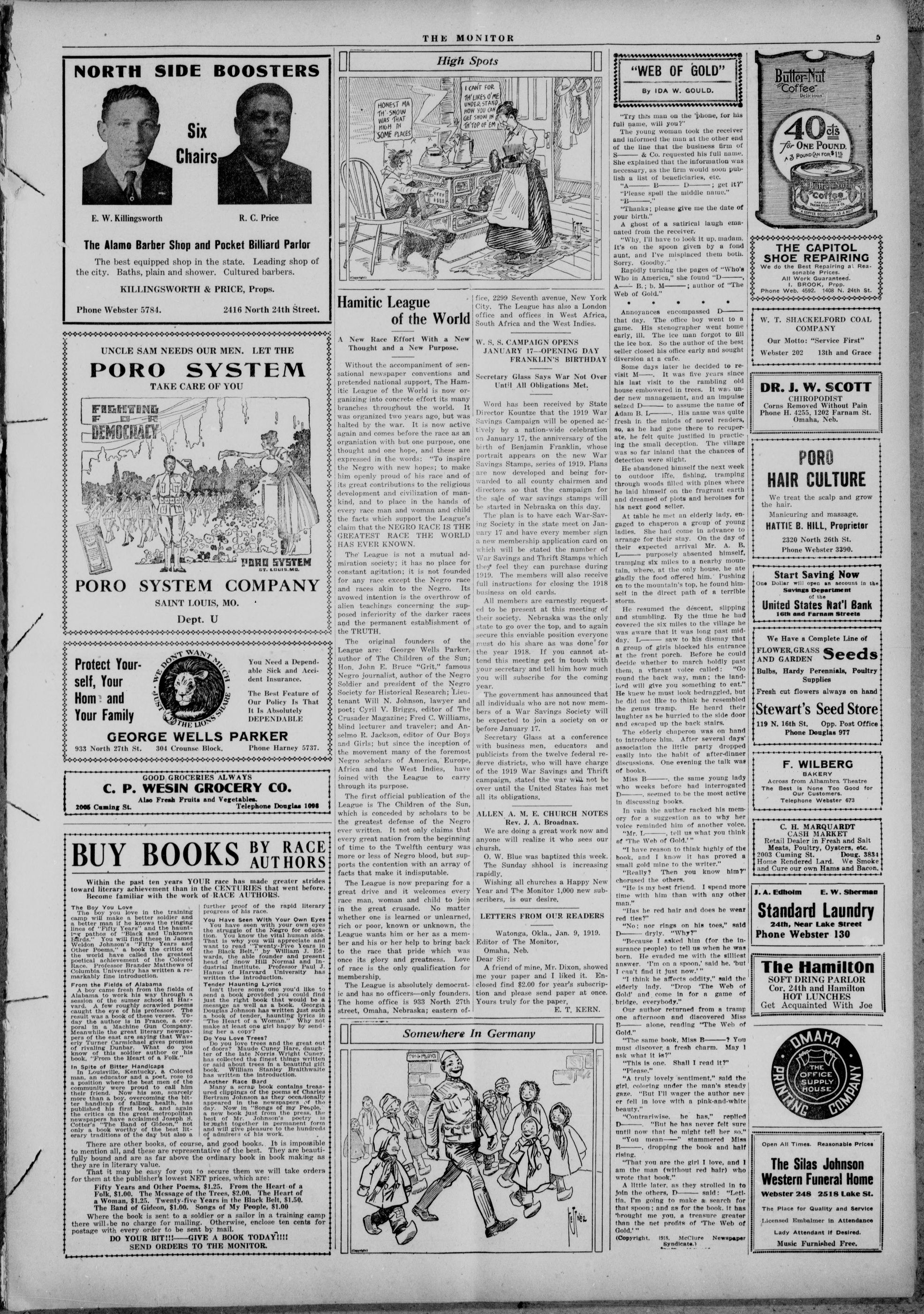
Within the past ten years YOUR race has made greater strides toward literary achievement than in the CENTURIES that went before.
Recome familiar with the work of RACE AUTHORS.
The Boy You Love
The boy you love in the training camp will make a better soldier and a better man. You know the ongoing lines of "Fifty Years" and the hauntings of "Black and Unknown Birds." You will find these in James Weldon Johnson's "Fifty Years and the World" book the critics of the world have called the greatest poetical achievement of the Colored Race. Professor Brander Matthews of Columbia University has written a remarkably fine introduction.
From the Fields of Alabama
A boy came fresh from the fields of Alabama. He took his way through a session of the summer school at Harvard. A few roughly scrawled poems caught the eye of his professor. The result was a book that he was never seen today the author is in France a corporal in a Machine Gun Company. Meanwhile the great literary newspapers are the most so-called "The New Cameran" which was promended by the Dumbos. What do you know of this soldier author or his book, "From the Heart of a Folk,"?
In Louisville, Kentucky, a Colored man, an educator and a poet, rose to a position where the best men of the city were the leaders of their friend. Now his son, scarcely more than a boy, overcoming the bitter handicap of falling health, has become a leader of the critics on the great metropolitan newspapers have acclaimed Joseph S. Cotter's The Band of Gideon, not the poor, but the poorer, artery traditions of the day but also a
There are other books, of course to mention all, and these are repress fully bound and are as far above as they are in literary value.
That it may be easy for you for them at the publisher's lowest N
Fifty Years and Other Poem
Folk, $1.00. The Message of a Woman, $1.25. Twenty-five The Band of Gideon, $1.00.
Where the book is sent to a s there will be no charge for mailin postage with every order to be se
DO YOUR BIT!!!—G
SEND ORDERS T
are other books, of course, and good books. It
is, and these are representative of the best. The
and are as far above the ordinary book in be-
literary value.
may be easy for you to secure them we wi-
the publisher's lowest NET prices, which are:
Years and Other Poems, $1.25. From the He-
man, $1.00. The Message of the Trees, $2.00. The
man, $1.25. Twenty-five Years in the Black Be-
and of Gideon, $1.00. Songs of My People, $1
the book is sent to a soldier or a sailor in a
no charge for mailing. Otherwise, enclose
every order to be sent by mail.
DO YOUR BIT!!!—GIVE A BOOK TODAY
SEND ORDERS TO THE MONITOR.
There are other books, of course, and good books. It is impossible to mention all, and these are representative of the best. They are beautifully bound and are as far above the ordinary book in book making as they are in literary value.
That it may be easy for you to secure them we will take orders for them at the publisher's lowest NET prices, which are:
Fifty Years and Other Poems, $1.25. From the Heart of a Folk, $1.00. The Message of the Trees, $2.00. The Heart of a Woman, $1.25. Twenty-five Years in the Black Belt, $1.50. The Band of Gideon, $1.00. Songs of My People, $1.00
Where the book is sent to a soldier or a sailor in a training camp there will be no charge for mailing. Otherwise, enclose ten cents for postage with every order to be sent by mail.
DO YOUR BIT!!!—GIVE A BOOK TODAY!!!!
SEND ORDERS TO THE MONITOR.
Protect Yourself, Your Hom and Your Family
R. C. Price
and Pocket Billiard Parlor
in the state. Leading shop of
power. Cultured barbers.
2416 North 24th Street.
OUR MEN. LET THE
SYSTEM
E OF YOU
PORO SYSTEM
ST. LOUIS, MO.
M COMPANY
LUIS, MO.
t. U
LLS PARKER
Block. Phone Harney 5737.
IES ALWAYS
GROCERY CO.
and Vegetables.
Telephone Douglas 1008
OKS BY RACE
AUTHORS
UR race has made greater strides
the CENTURIES that went before.
of RACE AUTHORS.
further proof of the rapid literary progress of his race.
You Have Seen With Your Own Eyes
You have seen with your own eyes the struggle of the Negro for education. You know the vital human side. That is why you will appreciate and love the Black Belt," by William J. Edwards, the able founder and present head of Snow Hill Normal and Industrial Institute. Professor Paul J. Bentley and University has written the introduction.
Tender Haunting Lyrics
Isn't there some one you'd like to send a book provided you could find just the right book that would be a message as well as a book. Georgia has just written a book of tender, haunting lyrics in "The Heart of a Woman." Why not make at least one girl happy by sending her a copy?
Do You Love Trees?
Have you ever loved trees and the great out of doors? Made Cuney Hare, daughter of the late Norris Wright Cuney, has collected the finest things written or said about trees in a beautiful gift book. William Stinley Braithwaite has written the introduction.
Best Seller
Many a scrap book contains treasured clippings of the poems of Charles Bertram Johnson as they occasionally appear in his day. Now in "Songs of my People," a new book just from the press, the best of Mr. Johnson's poetry is presented in a monumental form and will give pleasure to the hundreds of admirers of his work.
e, and good books. Ib is impossible
titative of the best. They are beauti-
e ordinary book in book making as
so secure them we will take orders
at T prices, which are:
$1.25. From the Heart of a
The Trees, $2.00. The Heart of
Years in the Black Belt, $1.50.
Songs of My People, $1.00
adier or a sailor in a training camp.
Otherwise, enclose ten cents for
by mail.
WE A BOOK TODAY!!!
TO THE MONITOR.
You Need a Dependable Sick and Accident Insurance.
The Best Feature of Our Policy Is That It Is Absolutely DEPENDABLE
THE MONITOR
HONEST MA
TH' SNOW
WAS THAT
HIGH IN
SOME PLACES
High Spots
HONEST MA
TH'S SNOW
WAS THAT
HIGH IN
SOME PLACES
I CAN'T FOR
TH' LIKES O'ME
UNDER STAND
HOW YOU CAN
GET SNOW IN
TH' TOP OF EM
(Copyright)
Hamitic League of the World
A New Race Effort With a New Thought and a New Purpose.
Without the accompaniment of sensational newspaper conventions and pretended national support, The Hamitic League of the World is now organizing into concrete effort its many branches throughout the world. It was organized two years ago, but was halted by the war. It is now active again and comes before the race as an organisation with but one purpose, one thought and one hope, and these are expressed in the words: "To inspire the Negro with new hopes; to make him openly proud of his race and of its great contributions to the religious development and civilization of mankind, and to place in the hands of every race man and woman and child the facts which support the League's claim that the NEGRO RACE IS THE GREATEST RACE THE WORLD HAS EVER KNOWN.
The League is not a mutual admiration society; it has no place for constant agitation; it is not founded for any race except the Negro race and races akin to the Negro. Its avowed intention is the overthrow of alien teachings concerning the supposed inferiority of the darker races and the permanent establishment of the TRUTH.
The original founders of the League are: George Wells Parker, author of The Children of the Sun; Hon. John E. Bruce "Grit," famous Negro journalist, author of the Negro Soldier and president of the Negro Society for Historical Research; Lieutenant Will N. Johnson, lawyer and poet; Cyril V. Briggs, editor of The Crusader Magazine; Fred C. Williams, blind lecturer and traveler; and Anselmo R. Jackson, editor of Our Boys and Girls; but since the inception of the movement many of the foremost Negro scholars of America, Europe, Africa and the West Indies, have joined with the League to carry through its purpose.
The first official publication of the League is The Children of the Sun, which is conceded by scholars to be the greatest defense of the Negro ever written. It not only claims that every great nation from the beginning of time to the Twelfth century was more or less of Negro blood, but supports the contention with an array of facts that make it indisputable.
The League is now preparing for a great drive and it welcomes every race man, woman and child to join in the great crusade. No matter whether one is learned or unlearned, rich or poor, known or unknown, the League wants him or her as a member and his or her help to bring back to the race that pride which was once its glory and greatness. Love of race is the only qualification for membership.
The League is absolutely democratic and has no officers—only founders. The home office is 933 North 27th street, Omaha, Nebraska; eastern of-
Somewhere In Germany
משפט מולאר
JE TINER
Spots
ANT FOR
LIKES O'ME
DER STAND
N YOU CAN
SHOW IN
TOP OF EM
office, 2299 Seventh avenue, New York City. The League has also a London office and offices in West Africa, South Africa and the West Indies.
W. S. S. CAMPAIGN OPENS
JANUARY 17-OPENING DAY
FRANKLIN'S BIRTHDAY
Secretary Glass Says War Not Over Until All Obligations Met.
Word has been received by State Director Kountze that the 1919 War Savings Campaign will be opened actively by a nation-wide celebration on January 17, the anniversary of the birth of Benjamin Franklin, whose portrait appears on the new War Savings Stamps, series of 1919. Plans are now developed and being forwarded to all county chairmen and directors so that the campaign for the sale of war savings stamps will be started in Nebraska on this day.
The plan is to have each War-Saving Society in the state meet on January 17 and have every member sign a new membership application card on which will be stated the number of War Savings and Thrift Stamps which they feel they can purchase during 1919. The members will also receive full instructions for closing the 1918 business on old cards.
All members are earnestly requested to be present at this meeting of their society. Nebraska was the only state to go over the top, and to again secure this enviable position everyone must do his share as was done* for the year 1918. If you cannot attend this meeting get in touch with your secretary and tell him how much you will subscribe for the coming year.
The government has announced that all individuals who are not now members of a War Savings Society will be expected to join a society on or before January 17.
Secretary Glass at a conference with business men, educators and publicists from the twelve federal reserve districts, who will have charge of the 1919 War Savings and Thrift campaign, stated the war will not be over until the United States has met all its obligations.
ALLEN A. M. E. CHURCH NOTES
Rev. J. A. Broadnax.
We are doing a great work now and anyone will realize it who sees our church.
O. W. Blue was baptized this week.
The Sunday shool is increasing rapidly.
Wishing all churches a Happy New Year and The Monitor 1,000 new subscribers, is our desire.
LETTERS FROM OUR READERS
Watonga, Okla., Jan. 9, 1919.
Editor of The Monitor,
Omaha, Neb.
Dear Sir:
A friend of mine, Mr. Dixon, showed me your paper and I liked it. Enclosed find $2.00 for year's subscription and please send paper at once. Yours truly for the paper.
```markdown
```
E. T. KERN.
"Try this man on the 'phone, for his full name, will you?"
The young woman took the receiver and informed the man at the other end of the line that the business firm of S——& Co. requested his full name. She explained that the information was necessary, as the firm would soon publish a list of beneficiaries, etc.
"A——B——D——; get it?"
"Please spell the middle name."
"B——."
"Thanks; please give me the date of your birth."
A ghost of a satirical laugh emanated from the receiver.
"Why, I'll have to look it up, madam. It's on the spoon given by a fond aunt, and I've misplaced them both. Sorry. Goodby."
Rapidly turning the pages of "Who's Who in America," she found "D——A——B.; b. M——; author of "The Web of Gold."
Annoyances encompassed D——that day. The office boy went to a game. His stenographer went home early, ill. The ice man forgot to fill the ice box. So the author of the best seller closed his office early and sought diversion at a cafe.
Some days later he decided to revisit M——. It was five years since his last visit to the rambling old house embowered in trees. It was under new management, and an impulse selzed D——to assume the name of Adam B. L——. His name was quite fresh in the minds of novel readers, so, as he had gone there to recuperate, he felt quite justified in practicing the small deception. The village was so far inland that the chances of detection were slight.
He abandoned himself the next week to outdoor life, fishing, tramping through woods filled with pines where he laid himself on the fragrant earth and dreamed of plots and heroines for his next good seller. At table he met an elderly lady, engaged to chaperon a group of young ladies. She had come in advance to arrange for their stay. On the day of their expected arrival Mr. A. B. L. — purposely absented himself, tramping six miles to a nearby mountain, where, at the only house, he ate gladly the food offered him. Pushing on to the mountain's top, he found himself in the direct path of a terrible storm.
He resumed the descent, slipping and stumbling. By the time he had covered the six miles to the village he was aware that it was long past midday. L——saw to his dismay that a group of girls blocked his entrance at the front porch. Before he could decide whether to march boldly past them, a vbright voice called: "Go round the back way, man; the landlord will give you something to eat." He knew he must look bedraggled, but he did not like to think he resembled the genus tramp. He heard their laughter as he hurried to the side door and escaped up the back stairs.
The elderly chaperon was on hand to introduce him. After several days' association the little party dropped easily into the habit of after-dinner discussions. One evening the talk was of books.
Miss B——, the same young lady who weeks before had interrogated D——, seemed to be the most active in discussing books.
In vain the author racked his memory for a suggestion as to why her voice reminded him of another voice.
"Mr L—— tell us what you think
"Mr. L.——, tell us what you think of 'The Web of Gold.'"
"I have reason to think highly of the book, and I know it has proved a small gold mine to the writer."
"Really? Then you know him?" chorused the others.
"Has he red hair and does he wear red ties?"
"No; nor rings on his toes," said D——dryly. "Why?"
"Because I asked him (for the insurance people) to tell us when he was born. He evaded me with the silliest answer. 'I'm on a spoon,' said he, 'but I can't find it just now.'"
"I think he affects oddity," said the elderly lady. "Drop 'The Web of Gold' and come in for a game of bridge, everybody."
Our author returned from a tramp one afternoon and discovered Miss B——alone, reading "The Web of Gold."
"The same book, Miss B——? You must discover a fresh charm. May I ask what it is?"
"This is one. Shall I read it?"
"Please."
"A truly lovely sentiment," said the girl, coloring under the man's steady gaze. "But I'll wager the author never fell in love with a pink-and-white beauty."
"Contrariwise, he has," replied D——. "But he has never felt sure until now that he might tell her so." "You mean——" stammered B——, dropping the book and half rising.
"That you are the girl I love, and I am the man (without red hair) who wrote that book."
A little later, as they strolled in to join the others, D—— said: "Letta. I'm going to make a search for that spoon; and as for the book. It has brought me you, a treasure greater than the net profits of 'The Web of Gold.'"
(Copyright, 1918. McClure Newspaper Syndicate.)
5
Butter-Nut
for Coffee
Delicious
40 cts
for ONE POUND.
A 3 POUND CAN FOR $1.15
Butter-Nut
coffee
and Coffee Delicious
Prairie Galleria Co.
A COFFEE DELICIOUS AS A NUT
THE CAPITOL SHOE REPAIRING
We do the Best Repairing at Reasonable Prices.
All Work Guaranteed.
I. BROOK, Prop.
Phone Web, 4592, 1408 N. 24th St.
W. T. SHACKELFORD COAL COMPANY
Our Motto: "Service First"
Webster 202 13th and Grace
DR. J. W. SCOTT
CHIROPODIST
Corns Removed Without Pain
Phone H. 4255, 1202 Farnam St.
Omaha, Neb.
PORO
HAIR CULTURE
We treat the scalp and grow the hair.
Manicuring and massage.
HATTIE B. HILL, Proprietor
2320 North 26th St.
Phone Webster 3390.
Start Saving Now
One Dollar will open an account in the
Savings Department
of the
United States Nat'l Bank
16th and Farnam Streets
FLOWER,GRASS Seeds AND GARDEN Bulbs, Hardy Perennials, Poultry Supplies Fresh cut flowers always on hand
119 N. 16th St. Opp. Post Office Phone Douglas 977
F. WILBERG
BAKERY
Across from Alhambra Theatre
The Best is None Too Good for
Our Customers.
Telephone Webster 673
C. H. MARQUARDT
CASH MARKET
C. H. MARQUARDI
CASH MARKET
Retail Dealer in Fresh and Salt
Meats, Poultry, Oysters, etc.
2003 Cuming St.
Doug. 3834
Home Rendered Lard. We Smoke
and Cure our own Hams and Bacon.
J. A. Edholm E. W. Sherman
Standard Laundry
24th, Near Lake Street
Phone Webster 130
The HamiltOn
SOFT DRING PARLOR
Cor. 24th and Hamilton
HOT LUNCHES
Get Acquainted With Joe
OMAHA
PRINTING COMPANY
THE OFFICE
SUPPLY
HOUSE
Open All Times. Reasonable Prices
The Silas Johnson
Western Funeral Home
Webster 248 2518 Lake St.
The Place for Quality and Service
Licensed Embalmer in Attendance
Lady Attendant if Desired.
Music Furnished Free.
H. DOLGOFF
FURNITURE AND HARDWARE
STOVES, RUGS, LINOLEUM
Better Goods for Less Money. Credit if You Wish.
OPEN EVENINGS
1839-47 N. 24th St. Phones—Webster 1607; Webster 4825
Hotel Cuming
1916 CUMING STREET
Comfortable Rooms—Reasonable Rates
Douglas 2466
D. G. Russell, Proprietor
A. F. PEOPLES
Painting, Paperhanging and Decorating.
Estimates Furnished Free. All Work Guaranteed.
4827 Erskine Street. Phone Walnut 2111.
CLEARING SALE
Boys' Box Calf Shoes, Sizes 1 to 6 for.....$2.75
Youths' Box Calf Shoes, Sizes 8 to 1 for.....$2.25
Boys' School Shoes, Broken Sizes.....$2.15
MILLINERY CLEARING SALE
$6.00 Hats, for...$3.00 $5.00 Hats for...$2.00 $3.00 Hats for...$1.00
Hosiery—Children's Winter/Hose, black, per pair.....25c
Men's Hosiery—Black, linen, double heel and toe, pair.....20c
OSBORNE
2506 NORTH 24TH ST.
WEBSTER 1412
PATTON HOTEL AND CAFE
N. A. Patton, Proprietor
1014-1016-1018 South 11th St.
Telephone Douglas 4445
62 MODERN AND NEATLY
FURNISHED ROOMS
Cabinet Making, Furniture Repairing, Mattress Renovating Douglas 864. H1917 Cuming St.
Established 1890
Shoes and Gents' Furnishings
1514 No. 24th St. Omaha, Neb.
Dr. Earnest E. Graves
DENTISTRY
242]North 10th Street
Telephone L 5263 LINCOLN, NEB
Modern Furnished Rooms
811 W. 14th Street
CENTER CAFE
Phone Red 1457
922 Center Street
Mrs. Louise Cooper, Prop.
Des Moines, Iowa
Classified Advertising
RATES—1½ cents a word for single insertions; 1 cent a word for two or more insertions. No advertisement taken for less than 15 cents. Cash should accompany advertisement.
Colored woman wanted who knows how to clean hog chitterings. Joseph Vomacka, 27th and M streets. Phone S 2469.
DRUG STORES
THE PEOPLE'S DRUG STORE Douglas 1446. 109 South 14th St.
ADAMS HAIGHT DRUG CO., 24th and Lake; 24th and Fort, Omaha, Neb.
COLORED NEWSPAPERS AND MAGAZINES
FRANK DOUGLASS Shining Parlor. Webster 1388. 2414 North 24th St.
'FURNISHED ROOMS FOR RENT.
First class rooming house, steam heat, bath, electric light. On Dodge and 24th st. car line. Mrs. Ann' Banks, 924 North 20th st. Doug. 437u.
First-class modern furnished rooms Mrs. L. M. Bentley Webster, 1702 North Twenty-sixth street. Phone Webster 4769.
PROBATE NOTICE
In the Matter of the Estate of Bell R.
Buford, Deceased.
Notice is hereby given: That the creditors of said deceased will meet the administrator of said estate, before me, County Judge of Douglas County, Nebraska, at the Rocky River, said county, on the 19th day of February, 1919, and on the 19th day of April, 1919, at 9 o'clock A. M., each day, for the purpose of presenting their claims for examination, adjustment and allowance. Three months are allowed for creditors to present their claims, from the 18th day of January, 1919.
BRYCE CRAWFORD,
County Judge.
26-12-46-19-16
H. DOR
FURNITURE AND HARDW
Better Goods for Less Mo
OPEN E
1839-47 N. 24th St. Phones-
IRVIN COBB CHANGES FRONT
Speech Before Colored People Far Different From Article in Saturday Evening Post. Against Caricaturing of Race.
Paducah, Ky., Jan. 15.—Does Irvin Cobb read the Louisville News? It would seem so to one who read the famous humorists' article in the Saturday Evening Post, some months ago. That article was entitled "Young Black Joe," and Mr. Bob spared no pains to belittle the Colored soldier in France. His speech here Sunday was far different. Instead of caricaturing the race he denounced "such doings" and his speech sounded like a real American's instead of a narrow Kentuckian, as he boasted he was recently, when asked how he stood on the race question.
Mr. Cobb was introduced by Prof. D. H. Anderson of the West Kentucky College. Prof. Anderson is Colored and so was most of the audience, which may account for the reversal of form shown by Mr. Cobb in his speech, as compared with his written article.
Mr. Cobb said in part: "My friends and fellow townsmen, I am facing an audience of men and women that I have known from childhood. You came here today to hear what the men of your color are doing 'over there.' I am glad to repeat to you some of the things I said to the greatest number of people assembled in New York, and, by the way, former President Roosevelt was present. After having the privilege of going to France and seeing what was going on at the Western front—the things done by the Colored soldiers were what impressed me most.
"If I were a Negro I would rather have the hand of a Colored Red Cross nurse give me succor and smooth my fevered brow in my sick or last moments than anyone else. I would want my parting words left as a legacy with a member of my race. I would strongly advocate—after my eyes had seen the actual conditions overseas—the establishing of a Colored Red Cross division. I deem it not fair to Colored soldiers to always portray them shooting 'craps' and with buck and wing dances. I advocate a real portrayal of the Colored soldier, for there are few enough things to make the intelligent Colored man laugh about anyway. I advocate the proposition of improving upon the absolute and ridiculous way of depicting the Negro, and to give him those things that are elevating and that tell his true worth. As he was bearing the same burden as his white brother, give him the same chance and mete out to his justice. The Negro cares nothing for social equality, mere justice is all he asks.
"I know you, who came here this afternoon, want to learn what your race has been doing 'over there.' On approaching the shore of France the first face one sees is that of a stalwart Negro of the Labor Battalion. These soldiers call for a share of the credit. They labor without the hope of advancement, and have proven—by work assigned them and accomplished—that they are Americans and patriotic ones, too, and belong in the first class. The Negroes fought and labored in France and bought Liberty bonds and stamps at home, and gave to the Red Cross to the extent of their means. The Negro is great in every way except complaining."—Louisville News.
Smoke John Ruskin 5c Cigar. Biggest and Best.—Adv.
THE MONITOR Lincoln N
Lincoln News
MRS. SARAH WALKER.
Mrs. May, who was a visitor, favored the unit with some very interesting remarks concerning the Red Cross, which met with the approval of all present.
The first meeting to be held at the home of Mrs. Maude Gates January 16, 1919.
A very large attendance was present at the presentation of "Oneida's Dream," at Masonic hall, Friday evening, by the members of the "Optimistic Set." The program was short, good and well worth while.
Those taking part onthe program were the following:
These taking part in these programs were the following:
Reading ..... Alma Williams
Instrumental solo ..... Valerie Crews
Vocal solo ..... Opal Ashford
Instrumental solo ..... Frances Hill
Duet ......
Mrs. Hazel Dean and Mr. Ray
Holcomb.
Solo ..... Miss Edna Carter
“Onedia's Dream”—Those who took
part were:
Mesdames Ada Holmes, Mabel Williams,
Mary Holmes, Eunice Shipman,
Virgil Miller, Margaret Williams,
Anita Taylor, Bess Washington, Sarah
Walker, Odessa Patrick; Misses Edna
Davis, Gertrude Jones, Manilla Jewitt
and Viola Walker.
At the conclusion of the program light refreshments, candies and ice cream were served, which met with the approval of all present. Dancing was participated in during the rest of the evening. Mrs. Sarah Walker, Lincoln agent of the Monitor, has been sent all bills owed by Lincoln subscribers. Please pay Mrs. Walker promptly when she calls.
519TH ENGINEERS ON DEATH
OF THEIR GODMOTHER
Nov. 25, 1918, 13th Service Ct. Md. Dict, A. E. F., A. and O., 717—Mr. Wm. M. Trotter—Dear Friend: After receiving the sad news of the death of your beloved wife, I could not help from spending these few moments in an attempt to express our regrets. As an organization of this great Army each and every one of us realized what a friend she was.
With an imaginary eye I can see her alighting from the train at Ayer, arms filled with presents to the differ- etn boys, taking an auto to the camp, going from barracks to barracks with a smile that never failed and saying, "How are you boys getting along?" There was not a boy in the whole battalion that did not know her, for our welfare was her joy in life.
You have our deepest sympathy in your loss, but you must try to cheer up for you are not the only one that will miss her, neither are we, but he whole Afro-Americans have lost one of the dearest friends this world has ever known.
She did not know anything thou the different boys' parentage, all she knew was that they were members of her race, and since it was her mission to do what she could for her race, there was not anything left undone that she rold do for our welfare.
Although she has departed to another world, her name and deeds will always live among the boys of 519th Engineers and Medical Department.
May the Almighty give her soul a resting place in His kingdom, for there was no rest for her on this side of the Jordan. May God help you to bear your burdens of grief and carry out her cause in which she gave her life. We all mourn her loss. May God be with you always. I remain
Year's Bigger
GOLD'S GREATEST
REARAN
Now In Progress! YOU
everything Redu
Come to Lincoln to this greater
at which EVERYTHING is su-
n in the whole establishment bein
every stock in the store range fr
discount is 10%.
Do not miss this greatest of N
he had will make the trip here one
continue until Saturday—Profit by i
The Year's
GOLD'S
CLEA
Is Now In Pre
Everyth
Come to Lil
sale at which E
item in the whol
on every stock in
the discount is 10
Do not miss
to be had will ma
continue until Sa
The Year's Biggest Saving Event GOLD'S GREATER SEMI-ANNUAL CLEARANCE SALE
Come to Lincoln to this greater January Sale—Nebraska's one big sale at which EVERYTHING is substantially reduced, only ONE single item in the whole establishment being reserved. The stirring reductions on every stock in the store range from 20% to 50%—in a few cases only the discount is 10%.
Do not miss this greatest of Nebraska sales—the immense savings to be had will make the trip here one of decided profit to YOU! Sale will continue until Saturday—Profit by it!
112 to 22 North 10th St., Lincoln, Neb.
(Opposite Government Square.)
---
Mrs. Ed Shipman entertained Saturday afternoon from 3 until 6 o'clock in honor of Mrs. Martha Smith of Omaha. Sixteen ladies were present and a very delightful time was enjoyed by all. Mrs. Smith gave a very interesting talk on the work of "Women's Clubs and Conventions."
The Tricentennial anniversary of the arrival of the Negro in America was observed New Year's night at the A. M. E. church. Those participating were the following:
"Emancipation Proclamation," Mr. Ray Poole.
"Negro Self Help During 300 Years," Mr. Paul Moore.
"300 Years in America," Mr. T. T. McWilliams.
"The Church of the Negro During 300 Years," Rev. I. B. Smith.
"Loyalty of the Negro During 300 Years," Mrs. Sarah Walker.
"Duty of the Hour," Mrs. Gertrude Haynes.
Two beautiful solos were rendered in a very pleasing manner by Mrs. Isetta Malone, one of which was the "Indian Love Song."
Mrs. Besheares, before departing for her home at St. Joseph, Mo., was the recipient of several social affairs during the holidays. An Xmas dinner and reception was given in her honor by Mrs. J. W. Cooley. A luncheon was given by Mrs. Wylie. A dinner party by Mrs. Wm. Woods. A breakfast by Mrs. Maude Johnson and also a dinner by Miss Flossie Patrick on Saturday evening.
Mr. and Mrs. Marshall Thomas entained at luncheon Saturday evening complimentary to Mr. and Mrs. James Starks, who are visiting at the home of Mrs. Starks' mother, Mrs. Falling. Mrs. Prewitt gave a dinner Saturday in honor of Mrs. Starks. Mrs. Hammond gave a dinner also Sunday in her honor. Francis Fallings is visiting at the home of his brother in St. Paul, Minn. Mr. and Mrs. James Starks left for their home in Peoria, Ill., Tuesday, where Mr. Starks is engaged in an enterprising business. His many friends wish him a prosperous New Year, as manager of a jewelry store there.
Mrs. Streeter Williams was quite ill last week, but is much better now. The 'Woman's Davis club met at the home of the president, Mrs. Jennie Sellers, 1942 U street, January 7. The meeting was largely attended. Mrs. May of Cheyenne, Wyo., addressed the club, giving them many words of encouragement. The proceeds of the afternoon amounted to $27.00. After being served with delightful refreshments, the club adjourned to meet with Mrs. Fannie Young, 1315 Washington street, January 21.
"Please remember that February 13, 1919, is Davis club night at Masonic hall!"
Mr. Thomas Coleman, who is in the employ of the Nebraska Material company, was shaken up quite badly when the truck he was driving collided with another, but nevertheless his injuries were slight and he is now able to resume his work.
A business meeting was held last Thursday afternoon by the local Red Cross unit at Masonic hall. It was decided, however, to continue the work and the former chairman, Mrs. Maude Gates, was re-elected. It was also decided that the other officers would stand as they were. The only new election was that of Mrs. Lottie Corneal as second vice chairman. It was also decided to discontinue holding meetings at the hall until further notice. The meetings to be held at the homes of the members.
PVT. R. H. ADAMS.
TOWN HALL
Are Thinking Serious for New Selling Policy
who have been forced to pay an exorbitant for clothes eleven months of the year that the sale buyer might buy his for library have approved our "NO SALE" POINTABLES you to buy clothing for considerable year around when we know we will not and the losses which are sure to come if rise is legitimately discounted.
King men have waited for some store to see that it would sell a $25 suit for $35, and so on.
I have long taken exception and offering to pay $25 for a suit and then had to buy the same suit for $18.
Plan both pay $20.00—sell more clothes satisfied customers.
Now when sales are prevalent—try this plan. You'll find greater values here here.
Making Seriously Selling Policy
forced to pay an exorbitant months of the year in order might buy his for less in our "NO SALE" POLICY.
nothing for considerably less we know we will not have are sure to come if mer-discounted.
limited for some store to an-sell a $25 suit for $25—a no on.
exception and offense at a suit and then had their suit for $18.
0.00—sell more clothing—rers.
are prevalent—try this "No greater values here than
Men who have been forced to pay an exorbitant price for clothes eleven months of the year in order that the sale buyer might buy his for less in January have approved our "NO SALE" POLICY.
It enables you to buy clothing for considerably less the year around when we know we will not have to stand the losses which are sure to come if merchandise is legitimately discounted.
Thinking men have waited for some store to announce that it would sell a $25 suit for $25—a $35 suit for $35, and so on.
They have long taken exception and offense at having to pay $25 for a suit and then had their neighbor buy the same suit for $18.
Our plan both pay $20.00—sell more clothing more satisfied customers.
Even now when sales are prevalent—try this "No Sale" plan. You'll find greater values here than elsewhere.
LINCOLN, NEBRASKA
saving Eve
I-ANNUAL
E SALE
Afford to Miss It!
0% to 50%
e—Nebraska's one big
uced, only ONE single
The stirring reductions
—in a few cases only
—the immense savings
ofit to YOU! Sale will
g Event
SAL
ALE
Miss It!
50%
the big
single
lections
only
savings
we will
Co. "The Store That Sells the Best for Just a Little-Less."
---
The Monitor Publishing Company
A Good Investment. Buy Shares Now. Become a Stockholder in a Growing Business. If Interested Address
304 Crounse Block
ANNUAL MEETING
NATIONAL ASSOCIATION
(Continued from Page 1)
of a universal League of Free Nations
which shall have among its central duties the protection and development
of the peoples of Middle Africa, and
of a similar communication to the
President of the Senate.
Word From Du Bois.
The following cablegram was received from Dr. Du Bois, who is in Paris:
"Greeting annual meeting. Race and friends uniting here to secure recognition throughout world on terms of full equality. Soldiers returning determined to join in struggle for justice to all in America. In the world crisis let us strive together without compromise or hesitation."
Mr. Shillady's Report.
Mr. Shillady's report, in part, was as follows (the full report will be printed later) : "On January 1, 1919, the Association had 80 branches and 9,282 members. On January 1, 1919, the Association had 165 branches and 44,096 members, in 38 states, the Philippine Islands, the Isthmus of Panama and Canada, an increase for the year of 85 new branches and 134,418 new mem-
"Distributed by geographical divisions the Association has six branches with 4,978 members in the New England states; 20 branches with 4,701 members in the Middle Atlantic states; 36 branches with 8,021 members in the East North Central states; 14 branches with 3,257 members in the West North Central states; 44 branches with 5,661 members in the South Atlantic states; 1 branch with 6,843 members in the District of Columbia; 6 branches with 2,591 members in the East South Central states; 19 branches with 3,606 members in the West South Central states; 5 branches with 717 members in the Mountain states; 11 branches with 2,142 members in the Pacific states; and 3 branches with 206 members outside the United States.
* "Adding together the membership of the three divisions containing the Southern states and the District of Columbia, the Association has a membership in the South and near South of 70 branches and 18,701 members, or more than twice the total membership of the Association in the whole country at the beginning of the year.
"Six states have more than ten branches each: Georgia, Ohio, Pennsylvania, Illinois, Virginia and Texas. Most remarkable of all, perhaps, is the rapid growth of membership in Texas, in which state there are at present 11 branches and 2,652 members. One of these branches, San Antonio, sent its application for membership in March last and has since reached a total of 1,228. California, with relatively smaller Colored populations in her cities, gives us nine branches and 1,756 members. Among the states, Ohio holds the palm for the largest number of members (4,117), followed in order by Massachusetts with 3,416 and Texas as the third on the list with her 2,652 members. All of these states are exceeded, however, by the single branch of the District of Columbia with its imposing total of 6,843."
Mr. Shillady said that he dwelt upon the year's increase in branches and membership not in any boasting spirit but with a deepening and sobering sense of opportunity and responsibility. He said that the Col-
The Monitor Publishing Co.
ored people of the nation had been stirred as never before by the appeals of a struggle to make the world safe for democracy; that the appeals of the nation in such high spirit of devotion as to have earned them the spontaneous tributes of the press and the people of America; that had Colored men never fought before, their fame as soldiers would have been securely established by the exploits of individuals like Needham Roberts and Henry Johnson and regiments like the 365th (the old New York 15th) and the 367th whose members had one and all received the French croix de guerre as a testimony to the bravery of both of these regiments.
The report continued: "Fighting thus, as President Wilson puts it, 'for the things which we have always carried nearest our hearts—for democracy, for the right of those who submit to authority to have a voice in their own government, it was but natural that in so tremendous a year the fathers, mothers, sisters and brothers of such soldiers, the men and women who responded to the nation's call for home service in field, factory, workroom and home, should respond to the challenge of the time and take their place in the ranks of an Association which is dedicated to the material and spiritual achievement of America's purpose—that democracy, at home and abroad, should be the rule of American life and the aim of American statesmanship."
Mr. Shillady appealed for an organization so strong that no President, no Governor, North or South, no member of Congress of any party and no Mayor of a city will dare to commit any indignity against Colored people with immunity.
Report on Lynching.
The report of the Association shows that 63 Negroes were lynched during 1918, an increase of 45 per cent over 1917. The Association believes that the actual number of persons lynched exceeds this total because of it having in its possession authenticated accounts of cases which have not appeared in the public press. Five of the year's victims have been women. Two men were burned at the stake before death. Three men, in addition to the two burned at the stake, were tortured before death. In one case the dead body of the victim was carried into town on the running board of an automobile and thrown into the public park where, according to press accounts, it was viewed by thousands. The burning of one of the bodies after death was explained by the Atlantic Constitution as having occurred because no one would claim the body and the burning of it was the only way to dispose of it. One victim was captured and handed over to the officers of the law by Negroes themselves. The selling of postcard pictures of a lynching at twenty-five cents each on the streets of Monroe, La., was referred to by Mr. Shillady. In fourteen cases, the report said, victims were taken from police officers and jails as follows: Arkansas, 1; Alabama, 2; Georgia, 4; Louisiana, 2; Mississippi, 1; North Carolina, 1; Oklahoma, 1; South Carolina, 1; Tennessee, 1.
The actions of Governor Bickett of North Carolina, Governor Manning of South Carolina and Governor Henderson of Alabama were commended in that these governors took cognizance of lynchings and endeavored to have legal action taken to bring the guilty parties to trial. The attitude of Governor Theodore G. Bilbo of Mississippi was contrasted with these three
public spirited governors, Governor Bilbo having been quoted in a Jackson (Miss.) paper as saying that he would the Association "to go to —," when he was asked what answer he would make to a telegram sent him by the National Association. During the year the N. A. A. C. P. sent 32 telegrams of protest and inquiry to governors in cases of lynching, 35 to Chambers of Commerce and 9 to other officials—74 in all; that there had been 9 acknowledgments from governors, 8 from Chambers of Commerce and 4 from other officials NEBR Mr. Alfred and highly man, died in morning and noon. Rev. Jesse Omaha was attending the daughter, Mr. Ye for a number of large cities
—21 in all; and that 40 press stories on lynching matters had been sent to the general press of the country. Special investigations of lynchings had been made by members of the N. A. A. C. P. staff at Fayetville, Ga.; Brooks and Lowndes counties, Ga.; Estill Springs, Tenn.; Blackshear, Ga., and of race riots and disturbances at Camp Merritt, N. J.; Brooklyn, N. Y., and Philadelphia, Pa.
The report continues by saying that the Association intends to raise and expend approximately $10,000 on its anti-lynching work during the coming year.
Welfare of Colored Soldiers
The Secretary mentioned also the Association's work in regard to the welfare and defense of the Colored soldier; its efforts to insure that the votes of Colored soldiers at the camps would be counted in the recent election; its efforts in fighting discrimination against Colored people in employment on government work; its successful effort to have the Tuberculosis Sanitorium of Wisconsin opened to Colored people; its having secured the consent of the National Tuberculosis Association to make a survey of the provisions for the care of Colored tuberculosis patients throughout the United States and of its co-operation with other organizations.
Mention is made of the work of the branches of the Association and of the general publicity and educational work of the National office.
Secretary Shillady concluded his report by saying the minimum budget of the Association proposed for 1919 is $50,000, $10,000 of which is to be used for the anti-lynching work. The Association will make strenuous efforts during the coming year to stamp out lynching, in which it asks the help of all patriotic Americans and of the press of the country.
During the year the Association spent for its general work $23,422.68 and for anti-lynching work $3,283.23.
The Crisis reported the most flourishing year of its existence. Its average monthly circulation for the year was 75,187 and its circulation for the month of December 82,000. The Crisis is entirely out of debt.
CHURCH OF ST. PHILIP
THE DEACON
Rev. John Albert Williams, Pastor
Instruction for confirmation will begin next Friday evening, January 24, at 8 o'clock. Persons desirious of knowing about the teaching of the Episcopal church are invited to attend.
The Woman's Auxiliary met Thursday at the residence of Mrs. Robt. T. Walker. This organization has met its pledge for missions and has funds in hand for some improvements in the church.
The usual services on next Sunday: Holy communion at 7:30 a. m., Sunday school at 10; holy communion and sermon at 11, and evening prayer and sermon at 8 o'clock.
NEBRASKA CITY NEWS
Mrs. Charles Rollins
Mr. Alfred Richard, a well known and highly esteemed young Colored man, died in this city early Thursday morning and was buried Sunday afternoon.
Rev. Jesse Young and wife of South Omaha were in the city last week, attending the bedside of Mrs. Young's daughter, Miss Rosalie, who was quite ill. Mr. Young resided in this city for a number of years and has quite a large circle of friends who are always glad to see him.
Mr. Rollie Shaforth has organized a sort of get together club and on Xmas day, Mrs. Charles Mack, vice president of the club, distributed dainty little boxes of candy with compliments of the club. If there is anything badly needed in the city, it is a get together club, so lead off brother, we are with you.
Our club news is late as we made a mistake and put a two-cent stamp on the letter instead of a three, but the lady at the postoffice said it had gone when we went to pay the other cent, anyway here goes again. We hope every Colored person in the city will be a club member and every member a Monitor reader.
Sunday was a good day in its entirety. In the morning the pastor spoke to his congregation and at night Rev. Isaac Marshall Page delivered an excellent sermon, "God's Ideal Home." Several new names were added to the roll.
The sick of the Church are on the road to recovery.
The various auxiliaries are working with new zeal. Let each member and friend do your part.
ZION BAPTIST
Des Moines News
By W. H. Lowry
Dr. E. A. See, dentist, has joined the St. Paul A. M. E. Church orchestra. The orchestra is composed of the following members:
Cornet, Vergil Williams, leader.
Trombone, W. R. Banta.
First violins, Mrs. Harry Shaw and Walter Jackson.
'Cello, Harry Shaw.
Bass violin, Dr. W. H. Lowry, manager.
Clarinets, John Rhodes and Ralph Crowley.
Saxaphone, Mrs. Walter Jackson and Dr. E. A. See.
The orchestra gives a sacred concert every Sunday evening, beginning at 7:30. At the close of the concert the orchestra combines with the church choir which is composed of twenty voices. The combined orchestra and choir, under the direction of Mr. Charles Wilson, chorister, furnish music for the evening services. Rev. S. L. Brit, pastor of St. Paul A. M. E. Church, deserves great praise for building up this musical organization and for the high Hon. J. B. Weaver, a member of the Iowa Legislature, delivered a eulogy upon the life of Theodore Roosevelt Sunday evening at St. Paul A. M. E. Church. The St. Paul orchestra rendered special music for the occasion.
Mrs. Elnora Gresham of Cedar Rapids is spending a few days in Des Moines.
We are pleased to note the rapid improvement of Miss Ruth Shaw, who underwent a recent operation for appendicitis.
The Ministerial Association held its regular meeting Tuesday morning at the Army Y. M. C. A.
Attorney S. Joe Brown paid a visit to the cadets of Class No. 2, St. Paul A. M. E. Sunday school. Attorney Brown was a student at the officers' training school at Fort Des Moines and because of this training he is in sympathy with military training.
We have been assisted greatly in providing telephone service in these busy times by the cordial cooperation of the public, who have been quick to appreciate the extraordinary job we were doing under war conditions, and we are very grateful for this co-operation.
OMAHA, NEBRASKA
'Cello, Harry Shaw.
Piano, Miss Mildred Griffin.
Rev. M. Toomey of Union Baptist Church conducted services at Corinthian Baptist Church Sunday afternoon. Music was rendered by the Union Baptich Church choir.
Rev. G. W. Robinson, pastor of Corinthian Baptist Church, conducted special services at Army Y. M. C. A. No. 89 at Camp Dodge. The soul stirring appeal for Christ, made by Dr. Robinson, resulted in more than twenty conversions.
Mr. Spurgeon Colstore and Miss Mamie Richardson were quietly married at the residence of Mrs. A. J. Courtney Monday at 5 p. m. Rev. G. W. Robinson officiated.
The Pastor's Aid Club of Corinthian Baptist Church furnished the pastor's study with a $30 writing desk.
Miss Eva D. Bowles, National Secretary for the Colored Y. W. C. A., with headquarters in New York city, arrived in Des Moines Monday morning. Monday evening she delivered an address to the girls of the Patriotic League at the Army Club. Miss Bowles also paid a visit to Camp Dodge and was the guest of the management of the Colored Hostess House. Miss Bowles has won for herself a national reputation by her activities in the Y. W. C. A. work. When making provisions for the distribution of his $40,000 Noble Prize Fund, Colonel Roosevelt directed that $4,000 of it should go to the Y. W. C. A. work among Colored women. Col. Roosevelt said: "I have asked that Miss Bowles be consulted in the disbursement of this item. My wife and I were much struck by her work in connection with the Colored Hostess Houses at Camp Upton, and I have asked that the money be used for the Hostess Houses for Colored Troops and in the work among Colored women and girls in and about the camps and cantonments." During the stay of Miss Bowles she was the guest of Miss Ursula Guy, Secretary for the Colored Department of the Recreation branch of the War Camp Community Service.
7
When Our Soldier Boys 'Come Marching Home'
Kashmir Skin Preparation marvelous—it does the work. Kashmir Hair Beautifier. The best pomade and hair grower on the market. Try it just once. None of that harsh, stringy after-effect. 50C EACH 8C POSTAGE
From Your Boy "Over There"
A Texas soldier boy, now in France, wrote a letter in rhyme to an attractive little lady who is waiting for him in that Texas town. Here it is:
FROM YOUR BOY OVER THERE.
I.
Darling, when I am far away,
From you somewhere in France,
I ask you to always think of me
And pray that I may have a chance.
II.
To leave you, dear, was hard,
The hardest thing of all,
But I am no slacker,
When I hear my country call.
III.
To be at home with you, little girl,
Is happiness that is true,
But I cannot see the enemy
Down the old red, white and blue.
IV.
I used to be with you often
In beautiful, happy days;
But it makes me feel blue to think
That we are so far away.
V.
Some day in the near future
This great conflict will end;
And this soldier boy who loves you
Will come back to you again.
VI.
It is the duty of every girl
Who is left behind
To always remember the one she loves
Who is on the firing line.
VII.
He did not want to leave you,
For he is going to risk his life;
He is a true American
And upholds the stars and stripes.
VIII.
The girls here are beautiful,
Most everywhere you roam;
But are nothing to compare
With the ones at home.
IX.
When the boys go marching by
In step with some rational hymn
It thrills my heart to know
That I am one of them.
I told you when I kissed
Those lips of yours so sweet
That I was going to leave you,
And again, we may never meet.
XI.
Don't give me up, my darling,
If you love me you will wait;
If we don't meet on earth again,
We will meet at the Golden Gate.
XII.
Some girls are not so patient,
Who will not wait so long,
Who will go and love a slacker
When her soldier boy has gone.
When O
How Must the Girls Greet Them?
"The Kashmir Way." With smooth, clear skin and soft, pretty hair.
Our guarantee: Your money back if you're not pleased.
Kashmir Skin Preparation man work.
Kashmir Hair Beautifier. The grower on the market. Try it that harsh, stringy after-effect.
When he goes to fight the battle
For his country and for you,
His thoughts are always resting
On the one he thinks is true.
XIV.
When he returns in years to come
And he finds you false,
And his whole life will be resting
And his happiness will be lost.
XV.
Don't bear the strain, little girl;
Make your love be true;
Greet the boy in khaki
When he comes marching back to
you.
XVI.
Throw your arms about him.
Let.him kiss your sweet little lips;
Then he will joyfully tell you
All about his wonderful trips.
XVII.
Do not respect the slacker;
They deserve not even a chance.
The boys that you should honor
Are the ones who have gone to
France.
XVIII.
I will close this letter, hoping
You will be mine some day;
As I bid you good-by for an hour,
Good-by for the day.
XIX.
If it is good-by for a month,
He loves you as true as ever;
Good-by for a year,
And perhaps good-by forever.
E. L. TRACY.
A Race's Greatest Asset.
A race's greatest asset is not alone in wealth; wealth can take wings and fly away. Not alone in dressing fine; the gaudy class only strikes the vulgar eye. Education is the key by which the aroused intellect may enter all the repository of treasure and take for itself available knowledge.—The (Chicago) Broadax.
Demobilization of the army will go on like clock work. The real problem is the demobilization of the Washing-ton job-holders. If all the safety first clerks are thrown out at once, the free soup lines that will have to be formed will reach to Spokane and last till spring.—The Cleveland Gazette.
THE SINCLAIR
LUNCH ROOM
The Criterion for Quick Service,
First Quality, Fair Quantity and
Sanitation.
4660 So. State St. Chicago.
Our future hinges on our making good—not good for Colored people—
Jeckey Hair Grower
Learn Mme. Newell's system. She is an original Hair
power and guarantees results after first treatment. A
will convince you that Jeckey is the best. Six
Jeckey treatment by mail $2.00, parcel post 25c. One box
Jeckey by mail 60 cents. Bleach-a-lene 25 cents,
parcel post 10 cents.
Mme. Newell's Time Saving Comb will do a suit of
war in 25 minutes. For particulars send stamped en-
ope.
ECKEY COLLEGE 4743 State Street.
Chicago, Ill.
Soldier Boys
Learn Mme. Newell's system. She is an original Hair Grower and guarantees results after first treatment. A treatment costs $100. She treats 25 cents. She weeks treatment by mail $2.00, parcel post $25. One box treatment costs $60 cents. Bleach-n-lene 25 cents, parcel post 10 cents.
Mme. Newell's Time Saving Comb will do a suit of
half in 25 minutes. For particulars stamped en-
glish.
ROCH
---
XV.
PRESS COMMENTS
Washington Job-Holders.
Our Future.
PETER
THE MONITOR
there must not be two standards, one for white, one for Black; there must be but one standard for all, and every man who courts success must measure up to that standard. Our whining, baby, dependent days are over; no longer will our shortcomings be overlooked, the test of manly worth will be applied equally to all—if anything we must be a shade the better to get equal credit. We need have no fear of what the future has in store for us if each day we give the very best that is in us to whatever task is set before us. We have asked for an even break; it is up to us to make good.—The Chicago Defender.
LA GRANGE, TEXAS.
H. L. Vincent, Agent
Mrs. Susie Anna Ganway, Beaumont, was buried here last December 26, 1918, from Ebenezer Baptist church, Rev. S. A. Tillman officiating. Deceased is a former citizen of Fayette county. The following relatives were present at the funeral: Mrs. Tommie Lewis, Imperial, Cal.; Mrs. Anna Hughes and Mr. Fritz Smizer, Beaumont; Mr. John Lewis and Mrs. Susie Anna Johnson, Galveston, and Mrs. Speedy Yarborough, Nacogdoches.
Some arrivals from the holiday trips: Mr. Dewey Moore, Mmes. Ethel Wormley and Denala Lowe and Misses Irene Brown and I. V. Sutton.
Mr. I. D. Coffey, wife and baby, left here for the sick bed of Mrs. Coffey's mother.
The following are some of the departures after spending holidays with relatives: Mr. and Mrs. J. G. Schermack, Misses Hattie Tillman, Nora Nunn, Messrs. Clifton Cot, Jonathan Machary, Revs. William White and D. A. Scott.
The very inclement weather prevented the celebration of the signing of the emancipation proclamation by Abraham Lincoln, January 1, 1863.
Rev. Napier, P. C. M. E. church, preached at St. James M. E. church here last Sunday and Sunday night to good audiences.
Preaching services at Ebenezer Baptist church Sunday.
Rev. S. A. Tillman was with Rev. D. A. Scott last week holding a bible
INCLAIR
ROOM
Quick Service,
Quantity and
Chicago.
power
original Hair
treatment. A
the best. Six
25c. One box
ene 25 cents.
do a suit of
stamped en-
1 White's
B
MADAME
1 Hair G
1 Glossine
1 Teller S
LEH
3 Fairplex
2 Lehman
BY
BLACK A
2 Ointment
2 Soap.
1 Powder.
BY
Boys 'Co
Kashmir Preparations For Hair and Skin
institute at Eagle Lake. The institute will begin here January 8 and close January 12, 1919. Sick—Mmes. Julia King and Edith Johnson.
GRANTED PATENT INVENTION
New Orleans, La., Jan. 13.—Miss Mary Lindsey, 2405 Third street, has the honor of being the first woman to be granted a patent for the invention of an unsinkable ship.
J. W. JOHNSON'S MOTHER DIES IN NEW YORK CITY
New York, Jan. 14.—Mrs. Helen Louise Dillet Johnson, mother of James Weldon Johnson, field secretary to the National Association for the Advancement of Colored people, and J. Rosamond Johnson, noted song writer, died here Tuesday, January 7. She was born in the British West Indies in 1842, and brought to New York at the age of six years. In this city she was educated at the Old Free school. At the outbreak of the civil war she returned to her birthplace and
PHONES
OAKLAND
2051.
HARVEY B
CUT RATE
PH. G.
THIS STORE HAS BROKEN EVERY LINK IN
EFFICIENCY
ACCURACY
SERVICE
4750 50.5
To save money is to take advantage
These preparations are offered to you
BLEACHES
By Mail
25c Rozol.....$0.19 $0.23
25c Fairplex Ointment.....19 .23
25c Fred Palmer Skin Whit-
ine.....19 .23
25c Palmer's Skin Success
Ointment.....19 .23
25c White's Specific.....19 .23
50c Kashmir Bleach.....42 .50
50c Palmer's Skin Success.....42 .50
WHITE'S SPECIFIC OUTFIT
2 White's Specific Ointment.
2 White's Specific Soap.
1 White's Specific Powder.
BY MAIL $1.00
MADAME WALKER'S OUTFIT
1 Hair Grower.
1 Glossine.
1 Teller Salve.
BY MAIL $1.35
LEHMAN'S OUTFIT
2 Fairplex Ointment.
2 Lehmir's Soap.
BY MAIL $1.00
BLACK AND WHITE OUTFIT
2 Ointment.
2 Soap.
1 Powder.
BY MAIL $1.00
FRED
2 Skin W
1 Skin W
E
OVI
1 High
1 High
E
VANISH
Melba Vanish
Kashmir Vanish
Pond's Ext.
Black and
25c Overton
25c Lehman
25c Ford's
25c Fred
Dressing
25c Plough
25c Palmer
Hair Dress
50c High
Grower ...
50c Ford's
50c Black a
ine Pom
PHONES
OAKLAND
2051.
PHONES
OAKLAND
3126.
HARVEY B.
SAVNDERS
CUT RATE
DRUGGIST
PH. G.
R. PH.
THIS STORE HAS BROKEN EVERY LINK IN THE CHAIN THAT BINDS THE PEOPLE TO HIGH PRICES
EFFICIENCY
ACCURACY
SERVICE
EFFICIENCY
ACCURACY
SERVICE
4750 So. State St. CHICAGO
Harvey B. Saunders
4750 South State Street
'Come Mar
Dept. m. 312
married. After the civil war she returned to this country and settled at Jacksonville, where she oecame an instructor in the public school.
EX-MINISTER TO HAYTI
Philadelphia, Pa., Jan. 12.—The Hon. William F. Powell, ex-minister to Hayti, had another stroke of paralysis and is very ill at his home. This is the second stroke he has had and his condition is very serious.
Government Considers Restricting Exports in Order to Ameliorate Conditions Among the Poor.
Washington, D. C.—Living costs in Brazil have reached a point where the Government has been obliged to consider restricting exports, according to information received by the Bureau of Labor Statistics, Department of Labor.
The President of Brazil has authorized a food administration, consisting
EVERY LINK IN THE CHAIN THAT BINDS THE
So So. State St. CHICAGO
a advantage of the smallest sale a
need to you at the manufacturers
FRED PALMER'S OUTFIT
2 Skin Whitener Ointment.
1 Skin Whitener Powder.
BY MAIL $1.00
OVERTON'S OUTFIT
2 Rozol.
1 High Brown Soap.
BY MAIL $1.00
VANISHING CREAMS By Mail
Melba Vanishing Cream $0.50
Kashmir Vanishing Cream .50
Pond's Extrac Cream .30
Black and White .25
By Mail
25c Overton Ada Pomade $0.19 $0.25
25c Lehman's Hair Dressing .19 .25
25c Ford's Hair Pomade .19 .25
25c Fred Palmer's Hair
Dressing .19 .25
25c Plough Hair Dressing .19 .25
25c Palmer's Skin Success .19 .25
Hair Dressing .19 .25
50c High Brown Hair
Grower .42 .50
50c Ford's Hair Dressing .42 .50
50c Black and White Quin-
ine Pomade .42 .50
arching'
The Kashmir Beauty Book tells you how to be beautiful Kashmir Chemical Co. Dept'm. 312 South Clark St. CHICAGO, ILL.
BRAZIL CONTROLS FOOD
of one commissioner and the necessary assistants, to investigate food supplies, costs of production and handling, selling prices, and means for improving conditions through Government control. Actual Government handling of the crops is possible if it becomes necessary. One of the plans of the administration is to assist workmen's co-operative organizations in every way. Food prices have advanced greatly in Rio de Janeiro and the working classes have found great difficulty in getting enough to eat. Prices of domestic products have advanced just as have imported articles and in some instances the percentage of increase is almost as great.
When in Chicago, buy The Monitor at Geo. W. Boyd's, 3620 South State street; Hayes' Book Store, 3640 South State street; Mrs. G. H. Dickerson, 16 West 47th street.
LODGE DIRECTORY
Keystone Lodge, No. 4, K. of O, Pmaha, Neb. Meetings first and third Thursdays of each month. M. H. Hazzard, C. C.; J. H. Glover, K. of R. and S.
PHONES
OAKLAND
3126.
LAUNDERS
DRUGGIST
R. PH.
SHOWS THE PEOPLE TO HIGH PRICES
EFFICIENCY
ACCURACY
SERVICE
sale and watch your pennies grow.
turers price.
STRAIGHTENING COMBS
$3.00 Combs by mail.....$2.50
$2.00 Combs by mail.....1.50
$1.50 Combs by mail.....1.25
$1.25 Combs by mail.....1.00
We carry to largest assortment of
combs of any drug store in Chicago.
MORGAN'S OUTFIT
Hair Refiner Cream.
Hair Refiner Soap.
Italian Oil.
Hair Stain.
BY MAIL $2.25
KASHMIR OUTFIT
1 Kashmir Vanishing Cream.
1 Kashmir Cleanser.
1 Kashmir Powder.
BY MAIL $1.60 OR 58c EACH
FACE POWDERS
By Mail
.25 50c High Brown DeLuxe $0.42 $0.50
.25 50c Bonew's Prim Rose .42 .60
.25 60c Mayvis .50 .60
.25 75c Djorkiss Powder .65 .75
.25 50c Kaamir Face Powder .42 .50
.25 50c High Brown .19 .25
.50 25c Fred Palmer's Skip
Whitener Powder .19 .25
.25 50c White's Specific .19 .25
.25 50c Black and White Powder .19 .25
aunders
CHICAGO, ILL. g' Home'
These civilian chaps must take a back seat—likewise the woman who neglects her appearance.
The modern, up-to-the-minute woman can't get along without Kashmir. It's "better than the best."
AGENTS WANTED
FREE!
s you how to be beautiful
emical Co.