The Monitor
Saturday, February 22, 1919
Omaha, Nebraska

Page text (machine-generated)
GROWING,
THANK YOU!
$2.00 a Year. 5c a Copy
The Rockefeller Labor Creed
A Program of Ten Principles for the New Partnership—Putting Fair Play to Work.
By John D. Rockefeller, Jr.
ORGANIZATION has its danger. Organized capital sometimes conducts itself in an unworthy manner, contrary to law and in disregard of the interest both of labor and the public. Such organizations cannot be too strongly condemned or too vigorously dealt with. Although they are the exception, such publicity is generally given to their unsocial acts that all organizations of capital, however rightly managed or broadly beneficent, are thereby brought under suspicion.
Likewise it sometimes happens that organizations of labor are conducted without just regard for the rights of the employer or the public and methods and practices adopted which, because unworthy or unlawful, are deserving of public censure. Such organizations of labor bring discredit and suspicion upon other organizations which are legitimate and useful, just as is the case with improper organizations of capital, and they should be similarly dealt with.
We should not, however, allow the occasional failure in the working of the principle of the organization of labor to prejudice us against the principle itself, for the principle is fundamentally sound. In the further development of the organization of labor and of large business, the public interest as well as the interest of labor and capital allike will be best advanced by whatever stimulates every man to do the best work of which he is capable.
While labor unions have secured for labor in general many advantages in hours, wages and standards of working conditions, a large proportion of the workers of the country are outside of these organizations and are to that extent not in a position to bargain collectively. Therefore an adequate plan of representation for labor must be more comprehensive and all inclusive than the labor union as now organized.
On the employers' side representation has been developed through the establishment of trade organizations, the purpose of which is to discuss matters of common interest and to act in so far as is legally permissable and to the common advantage, along lines that are generally similar. It will be a nice problem to determine just how labor organizations and employers' associations can work together, but certain it is that some method should be worked out which will profit to the fullest extent, by the experience, the strength and the leadership of these groups.
Wouldn't It Help Industry?
Might not the parties to industry subscribe to an industrial creed somewhat as follows:
1. I believe that labor and capital are partners, not enemies; that their interests are common interests, not opposed, and that neither can attain the fullest measure of prosperity at the expense of the other, but only in association with the other.
2. I believe that the community is an essential part to industry, and that it should have adequate representation with the other parties.
3. I believe that the purpose of industry is quite as much to advance social well-being as material well-being and that in the pursuit of that purpose the interests of the community should be carefully considered, the well-being of the employees as respects living and working conditions should be fully guarded, management should be adequately recognized and capital should be justly compensated and that failure in any of these particulars means loss to all four.
4. I believe that every man is entitled to an opportunity to earn a living, to fair wages, to reasonable hours of work and proper working conditions, to a decent home, to the opportunity to play, to learn, to worship and to love, as well as to toil, and that the responsibility rests as heavily upon industry as upon government or society, to see that these conditions and opportunities prevail.
5. I believe that industry, efficiency and initiative, wherever found, should be encouraged and adequately rewarded and that indolence, indifference and restriction of production should be discountenanced.
6. I believe that the provision of adequate means for uncovering griev- (Continued on Page 6)
THE MONITOR
Sergeant Edgar Caldwell, Who Shot Street Car Conductor Who Ejected Him, Given Death Sentence by Jury.
Anniston, Ala.—Sergt. Edgar Caldwell, Negro soldier who shot and killed Conductor Cecil Linten and seriously wounded Motorman Kelsie Morrison on an Oxford Lake car, December 15, was found guilty of murder in the first degree by the jury, which fixed his punishment at death.
The shooting of the two street car men occrued on Constantine street, opposite the plant of the Ornamental Foundry Company, and within a block or two of the home of the dead conductor. Caldwell is said to have insisted on riding well up toward the front of the car in the section set aside for the use of white passengers. The conductor forced him to the rear and in the fight which ensued Caldwell was ejected from the car by Linten.
The motorman took a hand in the fight and when landed on the ground he is said to have drawn his pistol and opened fire.
The defendant was brought before Judge Merrill Monday fc1 sentence. He was represented during the trial by ex-State Senator Charles D. Kline and Judge Basil M. Allen of Birmingham.
CHICAGO LAD WINS
HONORS AT CRANE
Chicago, Ill., Feb. 18.—The only representative of his race to graduate with scholastic honors in a class of seventy-two whites who completed four year terms at the Crane Technical school here last Wednesday evening is Lloyd F. Smith, son of Mrs. C. A. Williams, 6540 St. Lawrence avenue. In the commencement records considerable space was given in the praise of young Smith for his work in architectural mathematics. Aside from winning honors in the class room, he has won them in athletics, having been a member of the heavyweight soccer team of '17, '18 and track team of '16, '17, and 18. Followers of the cinder path will remember this stellar performance in the quarter mile event of the Tribune meet held last summer at Grant park, which landed the City Playground Championship for Doolittle Playground, 35th and Cottage Grove avenue. Smith was a member of the S. A. T. C. unit of the Crane Junior College.
FORM SOCIETY FOR BETTER HOUSING
Chicago, Ill.—Better living conditions and ownership of property by Negroes of Chicago are sought through the organization of the Pyramid Building and Loan Association, 3529 South State street, according to an announcement recently made public.
The officers of the new society said they have worked out a comprehensive scheme of rebuilding the Negro district and improving sanitary and housing conditions. The plan has been approved by members of the Chicago plan commission, they declared.
The association is incorporated under the state laws, with $60,000 subscribed. The following officers have been elected: George H. Jackson, president; William H. Terrell, secretary, and Charles S. Duke, treasurer.
ENGLISH HOODLUMS
Nigeria, West Africa.—The natives here are incensed over the recent whipping of a native merchant's employees by some Englishmen. It appears that the merchant purchased a property from the government and moved to it with his employees. They were met, however, by a gang of English hoodlums who beat the merchant's employees unmercifully because "the merchant had dared to buy property near houses where Europeans live."
A SPECIES OF GERMAN CRUELTY
London, England.—A photograph just reached this country showing how the late Chief Magato, of the Herreros, was buried alive by the German Captain Schiel. It shows the chief's head above the ground and his neck cemented round in order to form a slab. It is reported that he remained in this position for several days at the mercy of white ants, before death put an end to his sufferings.
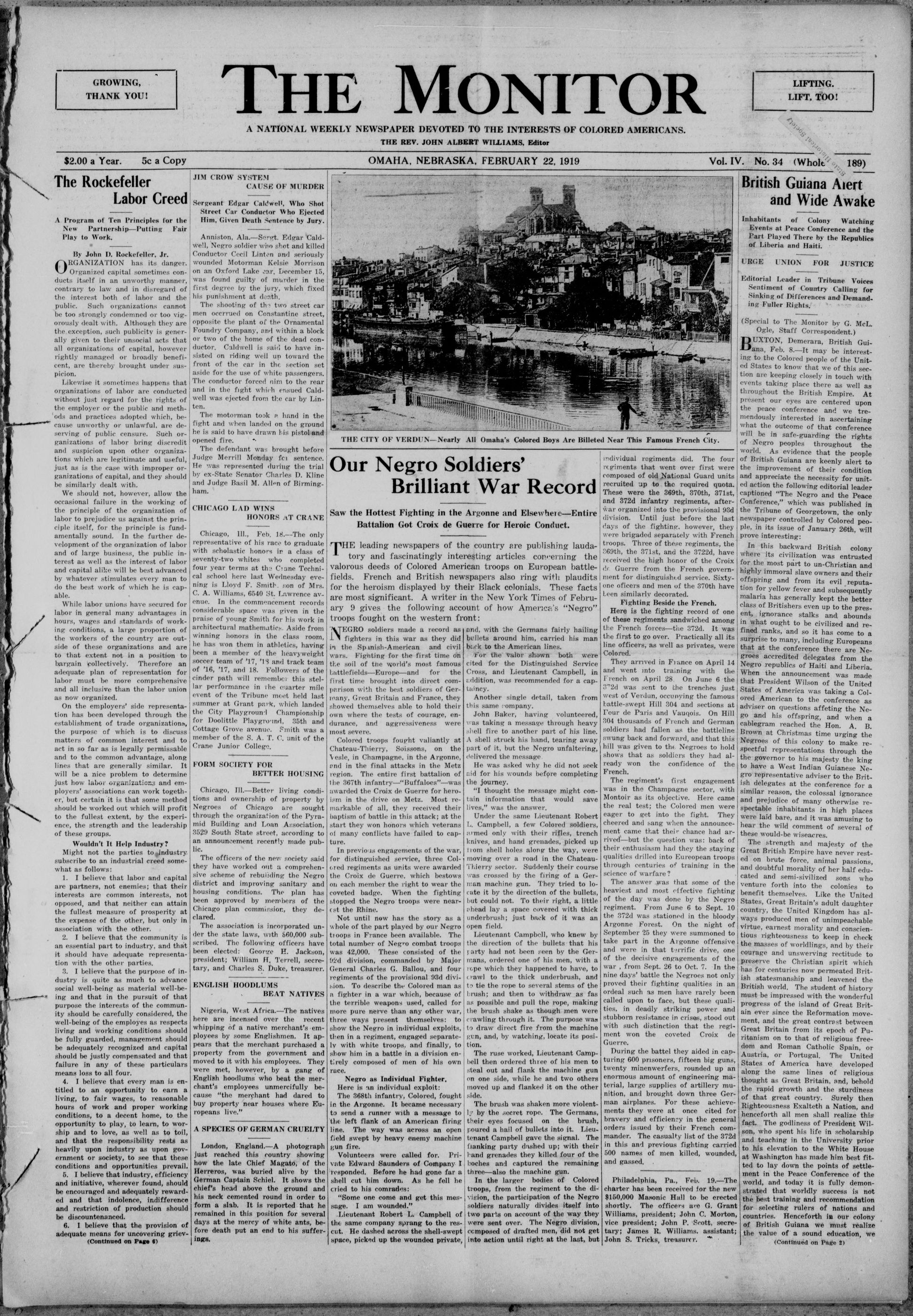
THE CITY OF VERDUN—Nearly All Omaha's Colored Boys Are Billeted Near This Famous French City.
Our Negro Soldiers' Brilliant War Record
Saw the Hottest Fighting in the Argonne and Elsewhere—Entire Battalion Got Croix de Guerre for Heroic Conduct.
THE leading newspapers of the country are publishing laudatory and fascinatingly interesting articles concerning the valorous deeds of Colored American troops on European battlefields. French and British newspapers also ring with plaudits for the heroism displayed by their Black colonials. These facts are most significant. A writer in the New York Times of February 9 gives the following account of how America's "Negro" troops fought on the western front:
NEGRO soldiers made a record as fighters in this war as they did in the Spanish-American and civil wars. Fighting for the first time on the soil of the world's most famous battlefields—Europe—and for the first time brought into direct comparison with the best soldiers of Germany, Great Britain and France, they showed themselves able to hold their own where the tests of courage, endurance, and aggressiveness were most severe.
and, with the Germans fairly hailing bullets around him, carried his man back to the American lines.
For the valor shown both were cited for the Distinguished Service Cross, and Lieutenant Campbell, in addition, was recommended for a captaincy.
Another single detail, taken from this same company.
John Baker, having volunteered, was taking a message through heavy shell fire to another part of his line.
Colored troops fought valiantly at Chateau-Thierry, Soissons, on the Vesle, in Champagne, in the Argonne, and in the final attacks in the Metz region. The entire first battalion of the 367th infantry—"Buffaloes"—was awarded the Croix de Guerre for heroism in the drive on Metz. Most remarkable of all, they received their baptism of battle in this attack; at the start they won honors which veterans of many conflicts have failed to capture.
In previous engagements of the war, for distinguished service, three Colored regiments as units were awarded the Croix de Guerre, which bestows on each member the right to wear the coveted badge. When the fighting stopped the Negro troops were nearest the Rhine.
Not until now has the story as a whole of the part played by our Negro troops in France been available. The total number of Negro combat troops was 42,000. These consisted of the 92d division, commanded by Major General Charles G. Ballou, and four regiments of the provisional 93d division. To describe the Colored man as a fighter in a war which, because of the terrible weapons used, called for more pure nerve than any other war, three ways present themselves: to show the Negro in individual exploits, then in a regiment, engaged separately with white troops, and finally, to show him in a battle in a division entirely composed of men of his own race.
Negro as Individual Fighter.
Here is an individual exploit:
The 368th infantry, Colored, fought in the Argonne. It became necessary to send a runner with a message to the left flank of an American firing line. The way was across an open field swept by heavy enemy machine gun fire.
Volunteers were called for. Private Edward Saunders of Company I responded. Before he had gone far a shell cut him down. As he fell he cried to his comrades:
"Some one come and get this message. I am wounded." Lieutenant Robert L. Campbell of the same company sprang to the rescut. He dashed across the shell-swept space, picked up the wounded private.
and, with the Germans fairly hailing bullets around him, carried his man back to the American lines.
For the valor shown both were cited for the Distinguished Service Cross, and Lieutenant Campbell, in addition, was recommended for a captaincy.
Another single detail, taken from this same company.
John Baker, having volunteered, was taking a message through heavy shell fire to another part of his line. A shell struck his hand, tearing away part of it, but the Negro unfaltering, delivered the message.
He was asked why he did not seek aid for his wounds before completing the journey.
"I thought the message might contain information that would save lives." was the answer.
Under the same Lieutenant Robert L. Campbell, a few Colored soldiers, armed only with their rifles, trench knives, and hand grenades, picked up from shell holes along the way, were moving over a road in the Chateau-Thiery sector. Suddenly their course was crossed by the firing of a German machine gun. They tried to locate it by the direction of the bullets, but could not. To their right, a little ahead lay a space covered with thick underbrush; just back of it was an open field.
Lieutenant Campbell, who knew by the direction of the bullets that his party had not been seen by the Germans, ordered one of his men, with a rope which they happened to have, to crawl to the thick underbrush, and to tie the rope to several stems of the brush; and then to withdraw as fast as possible and pull the rope, making the brush shake as though men were crawling through it. The purpose was to draw direct fire from the machine gun, and, by watching, locate its position.
The ruse worked, Lieutenant Campbell then ordered three of his men to steal out and flank the machine gun on one side, while he and two others moved up and flanked it on the other side.
The brush was shaken more violently by the secret rope. The Germans, their eyes focused on the brush, poured a hull of bullets into it. Lieutenant Campbell gave the signal. The flanking party dashed up; with their band grenades they killed four of the boches and captured the remaining three—also the machine gun.
In the larger bodies of Colored troops, from the regiment to the division, the participation of the Negro soldiers naturally divides itself into two parts on account of the way they were sent over. The Negro division, composed of drafted men, did not get into action until right at the last, but
individual regiments did. The four regiments that went over first were composed of old National Guard units recruited up to the required quota. These were the 369th, 370th, 371st, and 372d infantry regiments, afterwar organized into the provisional 92d division. Until just before the last days of the fighting, however, they were brigaded separately with French troops. Three of these regiments, the 369th, the 371st, and the 3722d, have received the high honor of the Croix de Guerre from the French government for distinguished service. Sixty-one officers and men of the 370th have been similarly decorated.
Fighting Beside the French.
Here is the fighting record of one of these regiments sandwiched among the French forces—the 372d. It was the first to go over. Practically all its line officers, as well as privates, were Colored.
They arrived in France on April 14 and went into training with the French on April 28. On June 6 the 372d was sent to the trenches just west of Verdun, occupying the famous battle-swept Hill 304 and sections at Four de Paris and Vauquois. On Hill 304 thousands of French and German soldiers had fallen as the battleline swung back and forward, and that this hill was given to the Negroes to hold shows that as soldiers they had already won the confidence of the French.
The regiment's first engagement was in the Champagne sector, with Montoir as its objective. Here came the real test; the Colored men were eager to get into the fight. They cheered and sang when the announcement came that their chance had arrived—but the question was: back of their enthusiasm had they the staying qualities drilled into Eureanean troops through centuries of training in the science of warfare?
The answer was that some of the heaviest and most effective fighting of the day was done by the Negro regiment. From June 6 to Sept. 10 the 372d was stationed in the bloody Argonne Forest. On the night of September 25 they were summoned to take part in the Argonne offensive and were in that terrific drive, one of the decisive engagements of the war , from Sept. 26 to Oct. 7. In the nine days' battle the Negroes not only proved their fighting qualities in an ordeal such as men have rarely been called upon to face, but these qualities, in deadly striking power and stubborn resistance in crises, stood out with such distinction that the regiment won the coveted Croix de Guerre.
During the battel they aided in capturing 600 prisoners, fifteen big guns, twenty minenwerfers, rounded up an enormous amount of engineering material, large supplies of artillery munition, and brought down three German airplanes. For these achievements they were at once cited for bravery and efficiency in the general orders issued by their French commander. The casualty list of the 372d in this and previous fighting carried 500 names of men killed, wounded, and gassed.
Philadelphia, Pa., Feb. 19.—The charter has been received for the new $150,000 Masonic Hall to be erected shortly. The officers are G. Grant Williams, president; John C. Morton, vice president; John P. Scott, secretary; James R. Williams, assistant; John S. Tricks, treasurer.
British Guiana Alert and Wide Awake
Inhabitants of Colony Watching Events at Peace Conference and the Part Played There by the Republics of Liberia and Haiti.
URGE UNION FOR JUSTICE
Editorial Leader in Tribune Voices Sentiment of Country Calling for Sinking of Differences and Demanding Fuller Rights.
(Special to The Monitor by G. McL. Ogle, Staff Correspondent.)
BUXTON, Demerara, British Guiana, Feb. 8.—It may be interesting to the Colored people of the United States to know that we of this section are keeping closely in touch with events taking place there as well as throughout the British Empire. At present our eyes are centered upon the peace conference and we tremendously interested in ascertaining what the outcome of that conference will be in safe-guarding the rights of Negro peoples throughout the world. As evidence that the people of British Guiana are keenly alert to the improvement of their condition and appreciate the necessity for united action the following editorial leader captioned "The Negro and the Peace Conference," which was published in the Tribune of Georgetown, the only newspaper controlled by Colored people, in its issue of January 26th, will prove interesting:
In this backward British colony where its civilization was entrusted for the most part to un-Christian and highly immoral slave owners and their offspring and from its evil reputation for yellow fever and subsequently malaria has generally kept the better class of Britishers even up to the present, ignorance stalks and abounds in what ought to be civilized and refined ranks, and so it has come to a surprise to many, including Europeans that at the conference there are Negroes accredited delegates from the Negro republics of Haiti and Liberia. When the announcement was made that President Wilson of the United States of America was taking a Colored American to the conference as adviser on questions affeting the Nego and his offspring, and when a cablegram reached the Hon. A. B. Brown at Christmas time urging the Negroes of this colony to make respectful representations through the governor to his majesty the king to have a West Indian Guianese Negro representative adviser to the British delegates at the conference for a similar reason, the colossal ignorance and prejudice of many otherwise respectable inhabitants in high places were laid bare, and it was amusing to hear the wild comment of several of these would-be wiseacres.
The strength and majesty of the Great British Empire have never rested on brute force, animal passions, and doubtful morality of her half educated and semi-sivilized sons who venture forth into the colonies to benefit themselves. Like the United States, Great Britain's adult daughter country, the United Kingdom has always produced men of unimpeachable virtue, earnest morality and conscientious righteousness to keep in check the masses of worldlings, and by their courage and unswerving rectitude to preserve the Christian spirit which has for centuries now permeated British statesmanship and leavened the British world. The student of history must be impressed with the wonderful progress of the island of Great Britain ever since the Reformation movement, and the great contrast between Great Britain from its epoch of Puritanism on to that of religious freedom and Roman Catholic Spain, or Austria, or Portugal. The United States of America have developed along the same lines of religious thought as Great Britain, and, behold the rapid growth and the sturdiness of that great country. Surely then Righteousness Exalteth a Nation, and henceforth all men shall realize this fact. The goddiness of President Wilson, who spent his life in scholarship and teaching in the University prior to his elevation to the White House at Washington has made him best fitted to lay down the points of settlement in the Peace Conference of the world, and today it is fully demonstrated that worldly success is not the best training and recommendation for selecting rulers of nations and countries. Henceforth in our colony of British Guiana we must realize the value of a sound education, we (Continued on Page 2)
Bruce Grit's Column
2
THE CAMEROONS CAMPAIGN
(Copyright by J. E. Bruce)
Special to The Monitor
IMMEDIATELY to the south of the British proctorate of Nigeria lies the great German colony of Cameroon (Kamerun), the largest of all Germany's overseas possessions. Its area of about 300,000 square miles equals that of the German Empire and Great Britain combined. Its coast line, which runs almost due north and south, has several good harbors, the best being, Duala on the Bay of Cameroons, opposite the island of Fernando Po. In the immediate neighborhood rises the Cameroons mountain, 13,700 feet high, which forms a magnificent and unique landmark on the west coast, with smoke and vapor constantly belching from its summit. The northern extremity of the colony is a tongue of land touching the southern shoe of Lake Chad, the meeting point of the territories of Britain, France and Germany. Thence the boundary runs first south and then southwest, marching with Nigeria till it reaches the sea at the Cross river. The eastern boundary runs in a generally southern direction with French equatorial Africa as its eastern neighbor. On the south it is bounded by the French colony of Gaboon (Gabun) along an almost straight westerly line which reaches the sea a few miles north of Libreville. At the southeastern end are two long antennae or fingers, of territory which intrude into Gabbon, the western touching the river Congo at Bonga, and the other the river Ubangi (an important affluent of the Congo) at Zinga. These two strips of territory, together with an extension of the eastern boundary of Cameroons, had been extorted from France in 1911, at the time of the political incident known as the Agadir crisis, in return for Germany's recognition of the French protectorate in Morocco. The territory ceded was only a small portion of Germany's original demands, but its cession was a humiliation to France, as well as an impediment to the development of French Congo, by cutting the communication between the different parts of French Equatorial Africa except by river. To Germany their only value was to bring her in touch with the Congo, and to serve as a starting point for further extension of her territory across Central Africa towards German East Africa, for the formation of a great Central African Empire touching the Atlantic ocean on the west, the Indian ocean on the east. Placed thus astride Africa she would have dominated the continent, cutting off South Africa, and threatening the rear of the French and British possessions in West and Northwest Africa, as well as Egypt, while from the ports on the seaboard she would have been able to cut the sea routes between Europe and South America, the Capes and India.
On the Cameroons mountain the Germans had established a hill station, named Buea, on a healthy site of remarkable beauty, which was the administrative capital of the colony. From Duala a railway ran eastward to Edea, a distance of about 100 miles, with several large bridges. From Bonaberi, on the northern shore of Cameroons bay, another railway ran northward about 75 miles to Nkongsamba. At various places in the interior, notably Yaunde about 30 miles northeast of Eade, at Agaundere at the northern edge of the central plateau; at Garua, near the Nigerian frontier, and at Mora, near Lake Chad, the Germans had made thirty strong fortified positions, well placed and garrisoned. They had also wireless tations with which they were able to maintain communication with the outer world after they had been driven from the coast.
One of the greatest obstacles the allies had to face was the nature of the country in which they had to operate. The British commander, General Dobell, thus describes it: "The country in the immediate vicinity of Duala is perhaps typical of the greater portion of the Cameroons in which my troops have operated, excepting beyond northern railhead where the country becomes open and, on account of its greater attitude, healthier, but all the coast line, and for some 150 miles inland, one meets the same monotonous impenetrable African forest, fringed on the coast line, by an area of mangrove swamp in varying depth."
An officer serving with the British forces thus describes the country in a letter, "This everlasting forest! You go marching along in single file, never knowing when you are going to be shot at. The enemy may be only a few yards away, but you cannot see them. There is an eternal twilight in these forests, the trees meeting overhead and interlaced by creepers. It is a fine sight to see the column on the march; it covers two or three miles of road, taking nearly an hour to pass a given spot, and it is a serious matter to defend
this long line. And the heat!" (Times "History of the War.") The forest also contained denizens as formidable as the human enemies, "We were having a hot scrap with the Germans (writes another officer) when suddenly an angry elephant appeared between us, and darted first one way and then the other. Before you could cough, both sides had done a bunk. (Times "History.") Wild bees were equally successful in scattering the combatants on more than one occasion.
According to the German official statistics the garrison consisted of about 200 Germans and 2,000 natives. But by calling up all the Germans of military age in the colony, including the crews of all the merchantmen which sought refuge in the harbors on the declaration of war, the number of Germans under arms was increased to fully 3,000, while the native troops were increased to about 20,000 by recalling to the colors all the old soldiers who had completed their service, but were still of military age. These troops were under the command of Colonel Zimmermann, who proved himself an able and resolute soldier. The native troops were divided into two classes, the Polizeitruppen (police force), armed with a carbine firing a soft nosed bullet, and the Schutzruppen (regular troops), who carried the regulation German army rifle with saw-backed sword bayonet. These troops were well trained, plentifully supplied with machine guns and well led.
(To Be Continued Next Week.)
JAMES HARVEY ANDERSON, D. D
ONE of the best editors that the Star of Zion has had since the death of the late Dr. J. W. Smith, bishop of the Zion conference, is its present editor, Dr. James Harvey Anderson, a man of the people who came up from the ranks, to the managing editorship, and who writes and speaks the language of those who largely support the official organ of this great Methodist body. Dr. Anderson was born in the month of June, 1848, and is a well made self-made man. Originally a common laborer, he became a clergyman in the A. M. E. Zion church, was a soldier in the civil war, serving one year and one month and participated with his regiment in the battles of Petersburg, Va. Deep Bottom, Va., and Fort Fisher N. C. He held acceptably the following charges as pastor: Harlem, Hudson, Troy, Binghamton, and Rochester, N. Y.; Wilkesbarre, Carlisle, Harrisburg, Pittsburg, Pa.; Baltimore, Md; New Bern, Edenton, N. C.; Petersburg, Va., and was presiding elder for five years of the Harrisburg district. Later he was elected statistician of A. M. E. Zion church and editor of A. M. E. Zion Year Book, serving in this capacity for twenty-four years. As a clergyman he ranks with the best in Zion connection who have successfully brought things to pass. He is a worker—a doer—and wherever he has been placed whether in a humble or exalted position he gave to the office the best that was in him and whenever he left that office it was always in a little better condition than it was when he took it over. As church statistician—the fact that he held this office for twenty-four years testifies to his efficiency and capacity as a careful painstaking officer. The compilation of the Year Book of a Negro Methodist church is a tax on the piety of any clergyman or layman who attempts it and it is more of a discipline than a pleasure because of its exacting requirements, entailing much research and labor—patience and time. It is the official record of a branch of Negro Methodism—and is practically the last word—as to numerical strength, financial standing, religious and spiritual development and general prosperity of the church. It is the history of the church reduced to figures for the use of the student of Negro church history, and the benefit of those who have made and are making church history. Dr. Anderson was elected editor of the Star of Zion at Louisville, Kentucky, general conference, May, 1916, and his election gave general satisfaction for the brethren knew that he was well qualified for the office, and that he would not disappoint them as its editor, that he would be impartial in the discharge of his duties, play no favorites, publish all the news that is fit to publish and make the Star a welcome visitor in the homes of thousands of readers throughout the country. There are of course more scholastic writers than Dr. Anderson, but these kind of writers are not as popular with the plain people as those writers who think their thoughts and express them in understandable language. Dr. Anderson being one of the people is now in his proper element as editor of the Star, and in seeking re-election to this post, he aspires to out a useful life in a position which he has honored and dignified by good work, conscientious and intel-
THE MONITOR
ligent service, which he has rendered faithfully to church and people, with an eye single to the best interests of Zion and the Negro race. He deserves re-election because of his long training as an editorial writer and news gatherer, having before becoming editor of the Star edited "the Voice of the People," at Pittsburg, Pa., and for two years the "Missionary Seer," during the absence of Bishop Small in Africa. I can personally testify to Dr. Anderson's special fitness for the editor of the Star. I have known him many years as clergyman, editor and friend and I know that he is well equipped for this work for his heart and his whole being is in it, and that men do best the things they like best to do. Editing a newspaper secular or religious is the thing James Harvey Anderson likes best, next to preaching. I therefore move that he be sentenced to edit the Star until he gets tired of the job.
BRUCE GRIT.
Echoes from the National Capital
As a concrete illustration of democracy for the world, the plan tentatively agreed on ground the council table in Paris affords the opportunity to test the sincerity of the slogan which has sounded ever since April, 1917, echoed and re-echoed until now the world sees quite the same old policy which for a generation has been considered all sufficient compensation for Africa. No settlement which repeats the policy that has prevailed for more than a generation will be more than a scrap of paper when armies have been demobilized and the men who composed them are occupied with the pursuits of peace. It may not be for a generation before the equilibrium of peace is found, but it is a mockery which ignored the natural inclinations and strivings of mankind. India, Japan, China, as well as Africa, must be remembered. Belgium and the Congo must not be forgotten. Germany's infamies do not weigh down the brutalities of the Congo. Neither should the service of the Sengalese be regarded as compensated in full by the award of the war cross. Great Britain must not forget the contributions which head men and chieftains in Africa made for the imperial cause. Internationalization of the German colonies does not say the final word towards democracy for the world in respect of the teeming millions who under the fostering influence of education are certain to demand a right to share in their own government or there will be troubles similar to those which have made Ireland and India sore spots in Great Britain's provincial administration the past fifty years. Internationalization of pre-war German colonies, however administered, should recognize the right of self-determination on the part of the thirteen millions of Southwest and Southeast Africa.
The "Church Advocate" of which Rev. George F. Bragg Jr. is editor, is doing invaluable service in behalf of the Colored Episcopalians of the country in gathering historical material and in persisting in the advocacy of the principal or policy of creating race bishops for the growth of that denomination among Colored people. Rev. H. Bragg has witnessed many advanced movements since he began his work in the ministry and the present writer who has watched his course for the past forty years believes that he may yet become a suffragan if not a full-fledged bishop
It is not to be understood that Father Bragg has all these years been in the ministry. Prior to his ordination he was editor of a secular newspaper, the Lancet, at Petersburg, Va., which took a lively interest in the politics of the Old Dominion and the activities of Colored men in education as well. It was this training which has enabled him to render such service in the agitation needful to improve the religious conditions of his special constituency.
February affords unusual opportunities for the inculcation of lessons of patriotism on our youth. This week the name and the fame of Abraham Lincoln are familiar throughout the republic. Every citizen sees him in the proportions which history is giving him as the foresome American of the nineteenth century and the world. Frederick Douglass, whose career was scarcely less imposing than that of Lincoln, came on the scene and passed away also in February. Only in the briefest outline has his career been written. We are yet to see it portraved as Samuel Johnson, Napoleon Bonaparte, Sir Walter Scott and George Washington's careers are given to the world by masters of literature, who have ransacked every nook and corner, left unexplored no source of information and neglected no influence by which they may have been impressed or that may have impressed the world.
---
Renewed interest in the study of the individual and the times in which Douglass lived may set on fire some genius or encourage some plodder that will give to mankind biographical studies comparable with the masterpieces of Boswell, Lockhardt and Sparks.
There was Richard Allen, who one hundred and sixty years ago nearly, an insignificant and humble slave lad was born to become the leader of protest against the religious discrimination and persecution of his times. Ultimately he was the founder of the African Methodist Episcopal church, the strongest religious body of the Negro race in the world, and with Absalom Jones, one of the two leaders of the first Colored church north of Mason and Dixon's line. Fifty year's after his birth, also in February, there was born Daniel Alexander Payne, at Charleston, S. C., a youth destined to hold high the standard of Christian character and higher education. Lest we forget he was one of the three founders with James A. Shorter and John G. Mitchell of Wilberforce university, the first Negro college in America. Shorter was also born in February.
February has been most liberal in her gifts to the Negro.
* * *
Among the men of force and prestige in the ministry of the M. E. church was the late Rev. I. L. Thomas, D. D., for many years field secretary of that denomination. As such he was in close touch with all uplift movements. He passed to the beyond from his home in the capital city the last week in January. Services in memorium were held at the Asbury M. E. church, Washington, D. C., of which he was for many years the successful pastor and at the Sharp St. Memorial in Baltimore. Interment was in the Auburn cemetery of that city.
CONGRESSMAN CALLS FOR INVESTIGATION
Representative Charles H. Dillon of South Dakota Makes Serious Charges in House of Representatives.
DRAFTEES VICTIMS OF GRAFT
South Dakotaan Excoriates Reprehensible Practices Which He Alleges to Have Found in Vogue in Virginia.
Washington, D. C.—On Wednesday, February 13, Congressman Chas. H. Dillon of South Dakota, who has represented his district in the house for the past six years, presented facts and figures in a most fearless manner as a result of a recent investigation and visit made by him to the military camps in the vicinity of Newport News, Va.
Mr. Dillon stated that unjust and unlawful practice was discovered in the treatment of Colored draftees in connection with the so-called "desertions" not only in the camps around Newport News, but in other camps. Several alleged desertions were not charged against men who had actually entered the service, but because of delinquency in reporting. He gave definite cases showing the methods used against Colored drafted men and added:
"Why was there no investigation of this practice of bringing in these men as deserters when they had received no notice calling them into the military service? It was because certain influential men and their friends were making considerable money by bringing these men in and collecting $50 for each.
"How was this done? It was done in this way. These Colored men get nothing through the mail in the form of a notice calling them into the military service. That was the method used by the local boards in giving notice, and since these cards giving notice were not returned to the local boards as undeliverable the draftees would be listed as deserters if they did not appear on the date set at the place specified in the notice.
"The notices were sent out by the local boards, but the postmaster did not deliver them as addressed, but held out certain ones and kept them until the draftee was one day delinquent. Then he would hand them to a marshal or policeman, who would go out and make arrests and collect $50 for each one apprehended."
Mr. Dillons address was replete with caustic criticism and eloquent appeal. He called attention to "jim-crow" practices in the separation of Colored and white people on the government-owned cars of the street railway lines operated to military fields and camps in Virginia; to thousands of Colored soldiers being used as laborers on private, municipal and county work, repairing streets, ditches, etc., under the most distressing conditions—these soldiers often working in the mud almost to their knees, despite their complaints. He charged also that their complaints included the withholding of allotments and that they could not secure discharges. Congressman Charles H. Dillon hails from South Dakota. He has very few Colored Americans among his
* * *
constitutents and therefore cannot well be accused of trying to make political capital out of the demand he has made for an investigation of alleged reprehensible methods employed in the exploitation of Colored men in certain communities and camps in Virginia. He presents facts and figures before congress to support his charges.
Undoubtedly there have been gross abuses as Congressman Dillon alleges. The practice of haling Negroes to court on trumped up or trivial charges and assessing fines against them, which under the fee system, goes into the pockets of the petty magistrates and higher ups is common throughout the south. It is not to be supposed that people trained under this system of robbery would relinquish it even in war time.
This system is one of the crying evils to which Fred C. Williams of the Monitor staff called attention a few months ago in a thoughtful article published in our columns entitled "The Menace."
Congressman Dillon will have done the whole country a splendid service if his demand for an investigation shall result in the punishment of these harpies and correct this evil. We are glad to know that he has had the moral courage—a rare quality in public men—to present unpalatable facts to congress and it is to be hoped that congress always so considerate of the south will have the courage to bring the offenders to book.
GOVERNMENT PROVIDES
VOCATIONAL TRAINING
Washington, D. C., Feb 22.—Anouncement is made by Dr. Emmett J. Scott, Special Assistant to the Secretary of War, that this generous government of ours, in keeping with its time-honored policies and traditions of justice, proposes to make liberal provision for its soldiers, of whatever race, color or creed, who return from the battle front disabled or handicapped in any way to resume their places as workers in the civilian life of the world.
The Government, in making this announcement, points out to the wives, mothers and sisters of the disabled American soldier, regardless of race, their solemn duty in helping the men of their families to make up their minds on this important question. It is realized that the discouragement or encouragement of the women relatives may be the deciding thing in the man's life. The country appeals to each woman interested in ay man to stand squarely back of him in his fight to make good and to become the useful citizen that his talents and opportunities permit him to be. They should help the men get into touch with the Federal Board for Vocational Education and insist, if necessary, that they accept the generous offer of the Government to fit him for a life of independence and self-helpfulness
The work that has thus been undertaken by the Federal Board for Vocational Education is of the most farreaching and fundamental benefit to the disabled soldiers of every type and class, and its necessity for general approval cannot be emphasized too forcibly nor too insistently by the Colored press, the clergy, secret societies and Colored women of the country, whose earnest co-operation the Government is now seeking in its effort to make its program of soldiers' rehabilitation a nation-wide success.
Mrs. Lena Roulette is taking the Meliorated system under Mrs. Ada Woodson and expects to finish in a few weeks.
Mrs. Anna Banks who has been very ill at home for the past ten days is improving.
Mr. Ernest J. Banks, who underwent a minor operation, is rapidly improving at his home, 920 North 20th street.
Miss Emogene Majors is very ill at her home. Her aunt, Mrs. Anna Banks, has the care of her.
Mrs. Georgie Graves, accompanied Mrs. C. Cornell to Des Moines, Ia., where Mrs. Cornell was called by the death of her father, Mr. Richard Winsor.
Houses for sale in all parts of the city. Tel. Douglas 2842 and Web. 5519.
Mrs. S. A. Bragg has moved to 2013 Grace street. Phone W. 4983.
Subscribe for The Monitor
GROVE METHODIST CHURCH
22nd and Seward Sts., Omaha, Neb.
BRITISH GUIANA ALERT
AND WIDE AWAKE
(Continued From Page One.)
must insist on being given that classical training which will instil into our students a fear of retribution for wrongdoing, a love of virtue for its own sake, and a purity of conscience and steady practice of consciousness which give strength and lasting happiness that no possession of wealth can purchase or destroy. The Negro States of Liberia and Haiti during the World War did not hesitate to make their alliance with the allies who stood for Right against Might, and they certainly put to shame the Spanish-American Republics of Mexico and Venezuela with their races of half castes. It has always been a characteristic of the Negro to love justice and fair play; his gratefulness to benefactors has ever been able to stand the severest test, and his courage has never left him to falter and hesitate on which side to go when the ultimate issue still appeared doubtful. We have no doubt therefore that in the Peace Conference the delegates of the Negroes will be patiently heard and their utterances respected; we anticipate cordial support for them from the delegates of the United States of America and of France, and we believe that the British delegates, whatever the sentiments and the inclination of the delegates from the Dominions, will rise to the occasion and not emerge from this ordeal inferior of the French or the Americans. To strengthen the hands of Great Britain in dealing with her Dominions in matters affecting the Negro and his offspring in the World, we have, though very late, begun to take some action in this colony. Let all Negroes and their Colored offspring rise above petty jealousy and natural cowardice, and unite in laying before His Majesty the King their just claims to equal rights wherever they live; and let us in concert with our brethren from Liberia and Haiti, from the French world and the United States of America, seek to make the Peace Conference lay down for posterity in all the ages to come laws of equity and justice, of charity and true godliness for all men as creatures of God, irrespective of color, or race, or creed.
RACE BOOKS AND PERIODICALS
A weekly newspaper for our youth,
$1.00 per year; 50c for 6 months. 54
West 140th St., New York City.
The Negro in American History
By Prof. John W. Cromwell, $1.40 and
worth more. 1439 Swann St., N. W.,
Washington, D. C.
The Negro Soldier
By John E. Bruce "Grit". The glorious record of America's black heroes, 25 cents (no stamps.) 2709 Madison Ave., New York City.
The Children of the Sun
By George Wells Parker. Proves the African the Greatest Race in History. 25 cents (no stamps.) Hamitic League of the World, 933 North 27th St., Omaha, Neb.
The Crusader Magazine
The Greatest Negro Magazine of America. $1.00 per year and cheap at that. 2299 Seventh Ave., New York City.
"The Fashion" will be that Cafe and Cabaret at 1314 North 24th street.—Adv.
MRS. H. STEELE
Scalp Specialist
MAGIC SYSTEM
Hair Dressing, Scalp Treatment
Shampooing and the Dyeing of
Hair Goods
For Appointment Call Web-
ster 7034
2202 Clark Street.
C. S. JOHNSON
18th and Izard Tel. Douglas 1702
ALL KINDS OF COAL and COKE
at POPULAR PRICES.
Best for the Money
Res. Colfax 3831. Douglas 7150 AMOS P. SCRUGGS Attorney-at-Law 13th and Farnam
A Church Where All Are Welcome
Services
Sunday School, 10 a. m.
Preaching, 11 a. m., 8 p. m.
League, 6:30 p. m.
Florence P. Leavitt Club, Monday afternoon.
Prayer Meeting, Wednesday Evening.
W. H. M. S. Thursday Afternoon
Ladies' Aid, Friday Afternoon.
GRIFFIN G. LOGAN,
Res. 1628 N. 22nd. Web. 5003
WARDEN HOTEL
STEAM HEATED ROOMS-HOT AND COLD RUNNING WATER-BATHS
By Day for One.....50c, 75c, $1.00
By Day for Two.....$1.00, $1.25, $1.50
By Week.....$2.00 to $4.50
Dan. Desdunes AND HIS
ON SUNDAY, FEBRUARY 23 DAT 2:30 P. M. FOR THEIR MAINTENANCE FUND.
OUR SOLOISTS FOR THAT DAY ARE JEFF SMITH, America's Greatest Cornetist. J. FRANK TERRY, the Wonderful Trombonist. HARRY MORTON, the Clever Baritone Soloist.
The House of Courtesy. 24th and Parker Sts.
THURSDAY—
Pearl White in No. 6
"THE LIGHTNING RAIDER"
Edna Mayo in
"THE CHAPERON"
Comedy
FRIDAY—
Winifred Allen and Jack
Deveraux in
"SUCCESSFUL FAILURE"
Harold Loyd Comedy
SATURDAY—
Mary McAllister in
"THE KILL JOY"
Pathe News. Comedy.
SUNDAY—
Madaline Traverse in
"THE DANGER ZONE"
Pathe News
Sunshine Comedy
"Son of a Hun"
Diamond
24th and Lake Sts.
FRANKLIN
24th and Franklin Streets
Automobile and Open
Horse Drawn Hearses Day and Night
Allen Jones and Company
FUNERAL HOME
Lady Attendant
Calls answered promptly anywhere
Web. 1100 and Web. 204
Licensed Embalmer.
FOR FIRST CLASS JAZZ
MUSIC CALL WEBSTER 4296
Will furnish any combination of instruments from 4 to 15 pieces, featuring Chas. Harrold, the senational trap drummer.
Prices Reasonable.
3521 Blondo St. Omaha, Neb.
MELCHOR -- Druggist
The Old Reliable
Tel. South 807 4826 So. 24th St.
K. & M.
GROCERY CO.
We solicit your patronage.
2114-16 North 24th St.
Hill-Williams Drug Co.
PURE DRUGS AND TOILET
ARTICLES
Free Delivery
Tyler 160 2402 Cuming St.
WARDE
On Sixteenth
STEAM HEATED ROOMS—HOT A
By Day for One.....
By Day for Two.....
By Week.....
Take Any Car From Station a
EASY WALKING DIST.
Events and Persons
Miss Washington of Detroit, Mich., is visiting her sister, Mrs. Clarence H. Singleton.
Mrs. Henry Buford has gone to Los Angeles, Cal., where she is the guest of Mrs. Harry Williams, formerly of Omaha.
Young ladies wanted as waitresses at the Fashion Cafe Cabaret, 1314 North Twenty-fourth street; and would also consider a housekeeper in charge of a hotel. Apply to Mrs. Charles Warden, Warden hotel, Sixteenth street, near Cuming.—Adv.
Clarence Johnson, formerly of Omaha, died at Los Angeles, Saturday, February 8, and was buried at Rosedale cemetery. The news of his death was a severe shock to his many Omaha friends and especially to his foster mother, Mrs. G. Jackson, and family.
Mr. and Mrs. H. W. Smith of 1518 North Twenty-fifth street, left Wednesday for Hot Springs, Ark., where they expect to remain for six or eight weeks.
Furnished Rooms—Strictly modern. With or without board. 1516 North 16th. Tel. Webster 4983.
R. E. Johnson entertained his mother-in-law, Mrs. Reynolds, of Denver, Colo., at dinner Sunday.
Smoke John Ruskin cigar.
For moving, expressing and hauling call Douglas 7952. Penn and Sibley.
—Adv.
The Sewing Bee Auxiliary of the N. W. C. A. home met with Mrs. R. W. Freeman last week. The regular meeting of the association will be held at the home February 26. All members are requested to be present for the election of officers.
The O. N. E. club will meet Monday night at the residence of Miss Anthone Edwards, 2411 Erskine street. Dance U. B. F. hall, 24th and Parker streets. Peikins' orchestra. Admission 25 cents. Given by St. Benedict's Catholic League. Don't forget the date—February 28.
The usual services at St. Philip's Episcopal church, Twenty-first street, near Paul, Sunday. Holy communion at 7:30 and 11 a. m.; Sunday school at 10; evening service at 8 o'clock. Watch for the announcement of the opening of the Fashion Cafe and Cabaret at 1314 North 24th street.—Adv. Lord Kurfond of Atchison, Kas., is visiting Mr. and Mrs. John Hall of Omaha and Mris. H. Fox of Benson.
Mrs. T. S. Phillips of 2504 Burdette street was called to South Bend, Ind., Wednesday by the illness of her mother. Her three younger boys, John, Gerald and Paul went with her. St. Benedict's Catholic League dance at U. B. F. hall, 24th and Parker streets, Friday, February 28. Perkins orchestra. Admission 25c.
Mr. and Mrs. Alfred Jones entertained at a Valentine masquerade Monday evening at their home for their daughters, the Misses Theresa and Ruth. About forty young people spent a delightful and happy evening. Desdunes orchestra furnished the music. Many unique costumes were worn.
The famous O. N. E. club will give their first spring entertainment, the grandest affair of the season. March 20, at the U. B. F. hall, 24th and Parker streets. Music by Perkins' Jazz band. Admission 50 cents.—Adv. 4t
THE MONITOR
The Rev. G. G. Logan was unable to hold services Sunday because of illness. Strictly modern furnished room for rent. Call or phone, evenings, Mrs. Gertrude Hickman, 1514 North 19th street. Webster 5162. J. T. Redmond was called to Great Falls, Mont., because of the serious illness of his father.
The N. A. A. C. P. forum met at Grove Methodist Episcopal church last Sunday afternoon at 4 o'clock. While the attendance was not as large as usual those present were favored with a scholarly and well delivered address on Abraham Lincoln by Miss Madre Penn. The address was analytical and emphasized the elements of Lincoln's character which entitled him to greatness with a clearness and precision which delighted the audience. Miss Penn is a talented and pleasing speaker of whom Omaha may well be proud.
The forum will meet as usual next Sunday afternoon at 4 o'clock at St. John's A. M. E. church at which time reports will be received from the two special committees recently appointed to investigate certain local grievances.
The Phi Delta Sorority held its last meeting in January at the home of the Misses Watson, and the first meeting in February at the home of Mrs. Simon Harrold.
The Phi Delta's annual Valentine party was given at the home of Miss Merriam Gordon Friday evening, February 14. Dancing, cards and fortune telling formed the amusements of the evening, fortunes being told by a medium in khaki.
A get-to-gether party was given Tuesday afternoon in honor of Mrs Wm. Costen, who has been a shut-in for several months, by the following ladies: Mesdames W. H. Mortimer, Dan Elligan, Wm. P. Wade, W. C. Williams, G. A. Johnson, W. B. Watson. After spending an enjoyable afternoon and partaking of light refreshments the ladies departed for their homes leaving Mrs. Costen much improved in spirits.
VALENTINE KENSINGTON
The Valentine Kensington social given last Thursday afternoon at the residence of Mrs. R. T. Walker by the Woman's Auxiliary of St. Philip's Episcopal church, was a most delightful affair. The prize for the novelty cake game was won by Mrs. L. N. Peoples; those for crocheting were awarded Mrs. Webster and Mrs. L. E. Britt.
Among the Churches
ALLEN CHAPEL A. M. E. CHURCH
J. A. Broadnax, Pastor
Allen Chapel A. M. E. church $1,000
rally workers for May 4th, 1919, are
really down to business. The quarterly
meeting was a real success, collections
for the day was $56.65—with
the envelopes and stewardess reports,
total $102.50, and for the quarter by
the stewards, $286.63. Total for the
stewards and trustees, $575.65. One
converted and baptized, 14 joiners, 7
in full membership.
This being the second quarterly
conference the Rev. Dr. W. C. Williams
of St. John's, and the Rev.
Ronenee and many of their members
were present.
Sunday the 16th one joined our
Zion. Total collection $53.20.
We come to the public once a year to help us in a financial rally. Don't fail to help those who ask you for financial assistance. Dear editor are we subscribing and paying up for the greatest Colored paper in the west.
MT. MORIAH BAPTIST CHURCH Rev, M. H. Wilkinson, Pastor
Sunday services were good all day,
and good crowds attended.
The Mission Circle will meet with
Mrs. E. Hill, 2754½ Lake street Frida-
day afternoon. The Silver Leaf club
met with Miss Ollie Parker Tuesday
night.
The B. Y. P. U. will meet every
Sunday evening at 5:30. Come out
and help make it a success.
Regular bible study every Monday
night at the church.
The sick of the church are doing
nicely.
Regular service next Lord's day.
Strangers welcome.
PLEASTANT GREEN
BAPTIST CHURCH
Rev. J. Costello, Pastor
The services are as follows: Sunday school at 9 a. m.; morning service at 11; B. Y. P. U. 5:30 p. m.; evening service at 8.
PHI DELTA NEWS
DESDUNES BAND CONCERT
Desdunes band of which all Omaha is proud is to give its annual band concert Sunday afternoon at 3:30 at the Auditorium for its maintenance fund. It is the one yearly entertainment given by this popular band when it appeals to the public for its patronage, which it fully deserves. The auditorium should be crowded for this concert. The band numbers forty-five pieces and has been diligently practising for three months on the program to be given.
The Emporium is the name of a new exclusive ladies' wear and millinery establishment recently opened on South Sixteenth street, in the building formerly occupied by the Public market. It is one of the handsomest establishments in the city, beautifully finished in mahogany and taube. B. Pred is the president, and Joseph Bonoff, son of A. Bonoff, is manager. Whether one buys or not the store is well worth a visit. All visitors and patrons are assured of courteous attention and treatment. Miss Adelle Davis is employed as stock clerk.
PREPARATION WEEK AT
GROVE M. E. CHURCH
Preparation week as part of the quarter centennial celebration of the ordination of the Rev. G. G. Logan will begin Wednesday night, February 26 with a sermon by the Rev. J. Costello. Friday night the Rev. Dr. J. C. Sherrill of Chattanooga, Tenn., will open the Centenary Training Council for Omaha, Lincoln, Grand Island and Hastings. Sunday, March 2, the Rev. F. A. Stribbling of Topeka will preach and in the afternoon at 8:30 Mayor Smith will deliver an address.
MEETING OF PORO AGENTS
Wednesday night, February 12,
eleven Poro agents met at the residence of Mrs. J. H. Hill, 2920 North
26th and organized an Omaha Poro club. The following officers were elected:
Mrs. J. H. Hill, president.
Mrs. Susie Smith Trent, vice president.
Mrs. Susie Perry, secretary.
Mrs. Rachel Harrold, treasurer.
Mrs. Clara Rodgers, assistant secretary.
Mrs. Clara Chiles, Inv. Comm.
Mrs. Isabel Stewart, asst.
Mrs. Anna E. Jones, reception com.
Mrs. Rachel Woods, asst.
Mrs. Bolden Shield, sick com.
Mrs. Walter Bell, club reporter
All Poro agents are requested to join. The next meeting will be held Thursday evening, March 6, at Mrs. Walter Bell's residence, 2218 North 27th street.
The pastor preached an excellent sermon and had a good attendance morning and night, with three additions. The pastor was able to be on duty Sunday. All of the sick of Pleasant Green are mending.
ST JOHN'S CHURCH NEWS
The REV, W. C. Williams, Pastor
Sunday was quarterly conference and very large crowds worshipped at the three services during the day.
There were five persons added to the church. The collection for the week was $200.
The sick of the church are Mesdames Mattie Lewis, Clara Jones, 1142 North 20 street; Alma Osborne, and Messrs. Charles Garrett and Thisler, 2404 North 25th street.
One of the most beautiful and artistic affairs of the season was a Valentine luncheon given on last Friday evening by the W. W. club, which is composed of young married ladies of the church. About 200 beautifully gowned ladies and handsomely dressed gentlemen entered the lecture room of the church, which had been very befittingly transformed into a banquet room. Upon entering each guest was presented with flowers by Mesdames Chas. Morriss and Arthur Rafferty, whose gracious smiles were the initial incidents to the evening's enjoyment. They were then served to punch after which they were seated to the various tables amid the loops and bands of hearts and cupids which streamed from every nook and corner interspersed here and there by cloisters of flowers and ferns. The luncheon, which consisted of a most delicious menu, creamed chicken in potato baskets, spring peas, vegetable salad, hot rolls, pickles, ripe and green olives, ice cream dotted with candy red hearts, cake and black coffee, was interspersed by beautiful strains of music rendered by Mrs. Estella Douglas Mc Coy, Miss Pearl Ray, accompanied by Miss Ozelia Dunning, through the management of Mrs. Jessie Moss.
THE EMPORIUM
CORRINE THOMAS.
February, Birth Month of Many Famous Americans:
Washington, Lincoln, Douglas Readily Come to Mind.
"Distinctive" Service
omas Kilpatrick &
npson, Belden &
Thomas Kilpatrick & Co.
The Fashion Center for Women
GOOD
C. P. WEE
Also Free
2006 Cuming St.
Hotel Cuming
Douglas 2466
GOOD GROCERIES ALWAYS
P. WESIN GROCERY CO.
Also Fresh Fruits and Vegetables.
St. Telephone
Cuming
1916 CUMING STREET
Comfortable Rooms—Reason
D. G. Russel
GOOD GROCERIES ALWAYS
C. P. WESIN GROCERY CO.
Also Fresh Fruits and Vegetables.
2005 Cuming St. Telephone Douglas 1098
GEORGE
933 North 27th St. 304
H. D.
FURNITURE AND H
Better Goods for L
OF
1839-47 N. 24th St. P
GEORGE WELLS PARKE
North St. 304 Crounse Block. Phone H
H. DOLGOEI
H. DOLGOFF
FURNITURE AND HARDWARE
STOVES, RUGS, LINOLEUM
Better Goods for Less Money. Credit if You Wish.
OPEN EVENINGS
1839-47 N. 24th St. Phones—Webster 1607; Webster 4825
Pope
Candies, Tobacco,
PRESCRI
Pope Drug Co.
Candies, Tobacco, Drugs, Rubber Goods and Sundries.
PRESCRIPTIONS OUR SPECIALTY.
13th and Farnam Streets. Omaha, Neb
A Good Chance to Bu
Desirable Real Estate
The property belonging to the late William H. Crutchfield and
The property belonging to the late William H. Crutchfield and consisting of—
1. Three modern brick flats at 2520, 2522 and 2524 Patrick Ave.
2. Two frame flats, 2516 and 2518 Patrick Ave.
3. Two-story frame dwelling, 2204 North 19th St.
4. Two-story modern brick dwelling, 1010 Capitol Ave.
5. One-story brick store building, 2218 North 24th St.
Will Be Sold at
PUBLIC AUCTION
For Cash to the Highest Bidder at 10 O'Clock, February 25th At East Front Door of the Court House.
Protect Yourself, Your Home and Your Family
Telephone Douglas 2672.
AYS
ERY CO.
Tables.
Telephone Douglas 1698
STREET
Imms—Reasonable Rates
G. Russell, Proprietor
MARKER
Phone Harney 5737.
OFF
DRUGS, LINOLEUM
edit if You Wish.
1607; Webster 4825
Dr. Britt Upstairs Douglas 7812 and 7150
g Co.
s and Sundries.
MALTY.
Established 1886
WE DONT WANT MUCH
JUST THE LIONS SHARE
3
You Need a Dependable Sick and Accident Insurance.
The Best Feature of Our Policy Is That It Is Absolutely DEPENDABLE
THE MONITOR
SUBSCRIPTION RATES, $2.00 A YEAR; $1.00 6 MONTHS; 60c 3 MONTHS
Advertising Rates, 60 cents an Inch per issue.
Address, The Monitor, 204 Crouse Block, Omaha, Neb.
Telephone Webster 4243.
A WORLD-WIDE RACE
THE MONITOR announces with pleasure that we are to have a correspondent in Demerara, British Guiana, in the person of Mr. G. McL. Ogle, who will from time to time send us interesting articles from that distant section of the British Empire. Thus gradually this publication is securing a staff of competent correspondents in all parts of the civilized world inhabited by the Negro race, which is practically ubiquitous. It is not generally known how widely distributed are the people of African blood and descent, nor what a tremendous influence they have exercised upon civilization, are still exerting and will more extensively apply in the future. Our vision is largely limited to the members of our race in the United States and we know nothing of the thoughts, aspirations and activities of the hundreds of millions who are outside our borders and in other sections of the world. We need to be brought into mental, if not physical, contact with these.
This The Monitor with its growing staff of correspondents plans to do. The advantages of this are readily apparent. It will broaden our outlook, and we all need broadening; increase our knowledge and catholicize or internationalize our sympathies. It will enable us to appreciate the fact that throughout the world there are thousands of men and women of keen minds and well trained intellects and high moral ideals facing, fighting and working out the same perplexing human problems that we are facing here; all working together, though sundered far by physical bounds and unknown to each other, for the ultimate triumph of righteousness, justice and truth.
The Negro race in America numbers, so far as known, approximately 12,000,000; throughout the world it numbers nearly 400,000,000, or one-fourth of the entire population of the world. We in this country are therefore a mere handful as compared with the world population of our race. Throughout the world this virile race is thinking, stirring, moving playing the part that God has planned for it to fulfill in the great world movements which are making for the ultimate goal of civilization through which He is working out His purposes for the weel of all mankind. For He plays no favorites with either individuals, races or nations.
We should recognize the fact that ethically we belong to a world-wide race.
A WORLD PROBLEM
To our office last week came a new journal, The African Telegraph, one of the finest examples of race journalism we have seen either in this country or any other. We scanned its 44 pages carefully and more than once we saw blue and felt like going out into the open air and cooling off. It is the first paper to come to our hands that gives us some of the real inside information as to how the African soldier was treated in England and how the native Africans are treated at home. From what we read and from the pictures we saw, Germany didn't have the exclusive corner on cruelty to colonials. England, too, is permitting some things to pass that makes one's blood boil and to wish that some power would come to chasten her for her short comings.
The more we read the more we become convinced that the race problem is a world problem and that any attempt to narrow it to national limits is unwise and foolish. The white man is the same the world over and the black man is the same the world over and the wrongs we suffer in this country do not differ in degree, but only in kind. There must come forth a welding together of the dark races for their own protection and for their own future. The time is coming when these races must arise in self defense and the question now is whether they shall rise singly and be annihilated, or rise en masse and bring their oppressors to time.
It is a problem worth thinking about. It is a problem which cannot be ignored.
ROOSEVELT ON THE SCREEN
HARDLY had the breath passed out of the body of the late lamented Roosevelt, than the movies brought out of the life of Roosevelt upon the screen. It is a stirring
picture and worthy the memory of the man, but even here the authors of the production have seen fit to abuse the truth in order that their own prejudices may support the false. In the scene where the Rough Riders assault and finally capture San Juan hill, the Negro soldier is conspicuous by his absence. We say "conspicuous" because it is now a national memory of how the Negro soldiers came to the rescue of Roosevelt and his Rough Riders and saved them, but not even a hint of this on the screen.
ROCKEFELLER'S 10 PRINCIPLES
WE want to call the attention of our readers to the article appearing elsewhere on Rockefeller's Labor Creed. It is a most enlightening bit of literature and very impressive from the fact that it comes from the son of one of the world's richest men. It is especially of interest to the race, since so many million race people go to make up the sum total of labor. We sincerely hope that Mr. Rockefeller's ten principles will be soberly considered, because it is the wisest solution that has ever been offered for the settlement of the portentous shadow that looms above America and would throttle her.
ALAS! ALACK! IT IS NOT TRUE
THE TRIBUNE of Georgetown, British Guiana, is laboring under the impression that President Wilson took "a Colored American to the peace conference as adviser on questions affecting the Negro and his offspring." Alas! Alack! It is not true. It shows how distance lends enchantment to the view. Wilson has about as much respect for the opinion and advice of a Colored American on any question as a high caste Brahman has for that of a slave. Major Moton was sent to France to advise the Colored soldiers how to deport themselves upon their return to the United States, so we in this country have been advised. The reports that have reached us from Europe are to the effect that Major Moton carried out this program. But "as adviser on questions affecting the Negro and his offspring," President Wilson needs no advice—in his own over-weening, omniscient self opinion—for does he not hail from that section of the country, Virginia, sah! and the oligarchic south, where they know all about "the niggah, sah"?
THE LEAGUE OF NATIONS
ACROSS the length and breadth of the world has been heralded news that the peace conference has accomplished its first great task and that the league of nations has emerged from tepid idealism and become material fact. President Wilson has requested congress not to discuss the plan until he returns to America and it would likewise be unbecoming the press of the country to take issue with any of its provisions until the chief executive explains them and makes the reasons for their adoption clear.
At this time The Monitor has little to say, but will treat the subject thoroughly at the appointed time. We are glad that the league has been formed and we sincerely hope that it becomes effective to the end for which it is formed. But being somewhat familiar with diplomatic history, we feel that only the future will decide how far the league will be able to maintain world peace.
RICHMOND PLANET CARTOONS
FOR several months the Richmond Planet has been running a series of very commendable cartoons from the pen of George H. Johnson. They are generally historical and the tendency is to awaken the Negro to the part his race has played in the world. Last week the cartoon was entitled, "The Black Builder," and referred to Cecrops, the lenegndary builder of the citadel of Athens.
We congratulate the Planet upon this new feature and regret that these excellent drawings are not more widely used. The Negro race has played a most wonderful part in the building of civilization and built not only Athens, but the civilization of Africa, Asia and Southern Europe. The use of pictures is a most interesting medium for the presentation of these facts and the artist has shown himself an adept in drawing. It would not be out of place here to remark
THE MONITOR
that if Mr. Johnson would try oil or crayon work along with these conceptions, he would undoubtedly produce canvasses that would eventually find a place in the realm of American art.
OMAHA needs sadly such social service institutions for the uplifting of our special social group as the Y. M. C. A. and the Y. W. C. A. We have no institutions of this kind and they are needed. It is all well enough for our over pious people to condemn public pool halls and similar places of recreation and amusement, which, of course, have attendant evils, but meet a need in the recreational life for which no other provision has been made. Let us get busy and make some provision for the recreational life of our boys and girls by establishing such institutions as will meet this need.
A WORD TO THE COMMISSIONERS
GENTLEMEN, how long are you going to permit Omaha to be disgraced by tolerating such a rubbish heap as that to be found on Twenty-first street between Nicholas and Paul? A fire last May demonstrated that this place is not only unsightly but a menace to the safety of the city. Clean it up and put a public playground there; but at all events clean it up.
Obvious Observations
It used to be that the weather man could tell you 48 hours ahead of time when a blizzard was going to hit you broadside. Now he has it down to two hours. Is this improvement or not?
Japan brought up the question of racial discrimination to the proposed league, but they squelched her. Never mind, she will bring it up again. Just you watch Japan.
Race journalism in America thinks it is some pumpkins, but there are some African journals that make us look like a pair of deuces against a royal flush.
How long will European peace last? Sh!
A local daily said last week that two months ago. President Wilson could have been elected president of France, but now that he couldn't be elected a French justice of the peace. Wow! That's no way to talk about Woody. Where's the censor?
Where the dickens does the wind stay when it doesn't blow? Your turn to answer first, Claudette.
The subscription editor has got his ax up and I think it's going to drop. The folks way over in British Guiana want to read The Monitor. Maybe that isn't going some.
Yes, Bertie. The Monitor has now the largest and finest staff of any Negro newspaper in the old U. S. A. Ain't that going some?
So far we haven't heard of a single black I. W. W. Have you?
Have you seen that picture yet, A Colored Gentleman?
We would sooner miss dinner than miss Desdunes' band concert and we claim that's going some.
Thanking you kindly for your apt attention, we will now address some harsh and cruel words to this here radiator.
THE furnace is a sheet iron bucket on a huge scale that has an endless capacity for coal and a limited energy for the distribution of heat. A furnace is the most temperamental thing known to humanity. It has more notions in its noodle than the contrariest female who ever danced in a pair of number tens. When it is real cold the furnace ignores the fact, no matter how much you coax it and tamper with its furniture, and when the sun is shining and showing off how much heat it can give on a January day, the furnace somehow feels that it is under an obligation to do the same thing, no matter how much you let it alone or how little fuel you feed it. Philosophers have spent their lives throughout the ages studying with the innumerable shacks in man that don't amount to three continental whoops, when they could have spent said time studying the furnace and reached some conclusions that would have helped the race throughout that space which has a habit of getting really cold during the period called winter. There are a million furnaces advertised upon the market, and a billion books telling how they act and so forth, but after they get into the cellar they all act the same way. With everyone of them you get a nifty set of directions what to do, when to do it and how to do it, but it appears that a furnace doesn't care anything about directions. It does to suit itself and generally it never suits you and itself at the same time. We hope that there is some wild eyed genius in the world who is trying to invent a furnace that will heat up when its
SOME LOCAL NEEDS
SKITS OF SOLOMON The Furnace
cold and cool off when its warm, and if he succeeds, John D. won't be in it with him when it comes to loading the sectional bookcases up with bank books.
SEES DANGER IN AFRICAN MILITARY TRAINING
REFERRING to an article published last April in the "Munchener Neueste Nachrichten," by Friedrich Hupfeld, a director of the German Togoland company, in which the following appeared:
"German possessions should stretch right through from the Indian ocean to the Atlantic, in which there must be a general recruitment of black people in order to establish a military equilibrium."
Leopold Grahame, a South African journalist, makes the following comment in the New York Tribune:
"The implication contained in this suggestion of a 'military equilibrium' was evidently designed to convey the impression that the recruiting of black people is practiced in the African colonies of the other powers, which, of course, is the very reverse of the truth. In British South Africa there is not a single trained or professional native soldier, nor is there ever likely to be when it is remembered that the black population is in the ratio of about 7 to 1 white. Thus, the creation of native soldiery would be a standing menace to the white inhabitants of the country, and during the Boer war both the British and the Boers studiously avoided bringing natives into the conflict."
ALL CHICAGO SHOULO DO
HONOR TO GALLANT EIGHTH
WHEN IT COMES HOME
These Colored Soldiers Have Made a Proud Record—Let Us Make Their Homecoming Fitting Tribute.
The "Black Devils" are coming home.
The latter part of this week or the first part of the next these Colored men from Chicago—members of the famous old Eighth Regiment—will carry their colors down Michigan boulevard, covered with the glory of the deeds of heroes. They said when they left that they would bring the old flag back to stay with it in France forever. And they made good.
They are also bringing on their proud breasts twenty-two American distinguished service crosses and sixty-eight croid de guerre.
No American Regiment has done better.
They are the First Illinois Regiment that was actually in the fighting to come back to the city as a body. And, true to the characteristic good nature of the race, they are coming back as they went away—without a whimper or without a complaint.
Out in that section of the South Side where most of them live they are preparing for them a reception that will outdo the welcome that our fighting men received in France. Some of their relatives have been saving ever since they went away to make the homecoming all that money can provide.
But these men went out to fight for the white race. They went over to help France and Belgium.
And when they come back not only their own people, but all of Chicago should go out to them honor. They have added a bright chapter to the history of Illinois at arms, and they deserve all the honors that a grateful city and state can give them.
Furthermore, their people have a proud record while they were away. Not a man of their color went to an internment camp for disloyalty. Not a man or woman of their race gave the government any trouble during the period of the war.
They are hard working people, who earn their bread in the sweat of their brow, and out of their small earnings did their share in Liberty Loan, Red Cross, Y. M. C. A. and other drives.
Their war record as a race is enviable.
Their soldiers went out to fight the fight of men; they died the death of heroes; they were Americans to the core.
They proved themselves, and Chicago should show its pride and appreciation as they pass by.—The Chicago American.
ENGLISH JURY ASKS
London, England.—(Special to The Monitor.)—"Manslaughter, but the majority of us think the blow was given under provocation," was the verdict rendered in the trial of Private John Monroe for the murder of Allen MacDonald, a white private in the Canadian forestry corps.
The trial brought out the fact that a black private named John Albert had been called "nigger" by MacDonald, and when the former resented the epithet, was knocked down. At this point Private Monroe walked up and asked MacDonald why he had hit Albert, and when MacDonald replied with an abusive term, Monroe knocked him down. When MacDonald was picked up he was dead.
A Classified Directory of Omaha's Colored Professional and Business firms
J. H. HOLMES
All work Guaranteed. Ladies' and Gents' Suits Remodeled, Cleaned, Pressed and Repaired. New Hoffman Press.
2022 N. 24th St. Web. 3320
E. A. Williamson DRUGGIST
2306 North 24th St.
Mrs. A. HICKS
Scalp Specialist
SLAUGHTER SYSTEM
Guaranteed to Grow Hair in
Six Treatments or Money Refunded.
Diplomas Granted.
2716 Miami Street.
Webster 6426.
Telephone Webster 248
Silas Johnson
Western Funeral Home
2518 Lake St.
The Place for Quality and Service
PRICES REASONABLE.
Licensed Embalmer In Attendance
Lady Attendant If Desired.
MUSIC FURNISHED FREE.
R. H. Robbins
& Co.
GROCERIES AND MEATS
An Up-to-Date Store.
1411 North 24th Street.
Prompt Delivery. W. 241.
Why Not L
Why Not Learn Here?
FORMULATED 1900
"PORO"
HAIR GROWER
MADE ONLY BY
Mrs Amber Turrillo
Malone
ST. LOUIS, MISSOURI
FOR DANDRUFF FALLING HAIR, ITCHING
SCALP; GIVING LIFE, BEAUTY, COLOR
AND ABUNDANT GROWTH
THIS STYLE OF BON ADOPTED JAN. 1900
MET WT. 2 OZ.
PRICE 50 CENTS
This branch of our business has been given so much care and attention, and our opportunity for studying special cases and the results following our treatments of them have been so numerous, that I feel I may be justly considered an authority on the subject.
Every woman will concede that to be attractive in manner and as beautiful in face as possible, is a duty she owes to her sex, and to possess this attractiveness and beauty, even to old age, is her greatest desire. This is not vanity. It is simply a love for the beautiful.
Every woman knows if she allows her complexion to become salow and wrinkled, her hair to become lusterless and hard her nails to become long and shapeless, she is placed at a disadvantage beside the woman who is outwardly attractive.
Phone:—Web. 5450, College.
Web. 3290, Res.
Webster 4443.
Woman's Duty to be Beautiful
Under new management. Week
days, 8 a. m. to 11 p. m. Sunday,
8 a. m. to 13:00 a. m. to 13:00
Dinner, 1 p. m. to 8 p. m.
Short orders, 9 a. m. to 11 p. m.
A. F. PEOPLES
Painting
Paperhanging and
Decorating
Estimates Furnished Free.
All Work Guaranteed.
4827 Erskine Street.
Phone Walnut 2111.
J.H.Russell
& Co.
UNDERTAKERS
Successors to Banks & Wilks
1914 Cuming Street
GEORGE MILLER, Embalmer
Day Phone, Red 3203
Night, Call Douglas 3718
Ware's Candy Kitchen and Ice Cream Parlor
Fresh home made Candies of all kinds made daily.
Ice Cream, per quart, 50c; per gallon, $2.00.
Orders delivered promptly.
1508 North 24th.
Funeral and Wedding Taxi by Hour or Trip
Service Day and Night
North Side Taxi
J. D. LEWIS, Prop.
Stand Phone Web. 1490.
When not at stand please call
Res. Web. 949.
NEW CLOSED CAR.
Stand 2414 N, 24th St., Omaha.
South & Thompson's Cafe
2418 North 24th St. Webster 4566
SPECIAL SUNDAY DINNER
Stewed calcken with dumplings...40c
Roast Prime Beef au jus .....40c
Roast Pork, Apple Sauce .....40c
Roast Domestic Goose, dressing 50c
Early June Peas
Mashed Potatoes
Salad
Coffee Dessert
We Serve Mexican Chile
earn Here?
A visit once a week to the Poro Culture College is now a necessity which even the woman with small means cannot omit. The feeling of comfort and happiness as she places herself under the skilled hands of an experienced specialist; as the delightful, soothing, cleansing creams are applied by gentle manipulation and the exhilarating electric currents, followed by correct vibrations, causing the blood to circulate freely, bringing a glow to the cheeks, is well worth the time and money spent. Therefore consider your conditions and go to
JONES PORO CULTURE
COLLEGE
Where Quality is supreme, Workmanship the best. Service excellent. System taught. Terms reasonable.
culture College
1516 N. 24th St.,
OMAHA, NEB.
Improve Yourself in Poro Way
ea
oN
I ieee AX
S TH ~
ff ge ‘B i i
eZ, ceeee a (Pei ee “i ime
Za lee HEE ey gy Lai
eA CTL
eerste Eg a ne cay
ICSI =) a} MSU a A Rf
Fie tapel Mbp ml
[a ____ _ <> regpINANno-Ave.
i 2 Geers
25,000 MORE PORO AGENTS WANTED
Equipped with the Very Latest Apparatus for Teaching the
Poro System of Scalp and Hair Culture
and ali Branches of Beauty Culture
Terms Moderate Diplomas Given
Has a Write Today for Further Information
are “*PORO COLLEGE
‘oro Corner ¥ St. Louis, Mo.
The Kiddies’
INDIAN LORE
The Twin Stars
Two Bright Eyes went wandering out
To chase the whippoorwill;
Two Bright Eyes got lost and left
Our tepee—oh, so stili!
Two Bright Eyes was lifted up
To sparkle in the skies
And look like stars—but we know
well
‘That that’s our lost Bright Eyes.
She is looking for the camp;
She would come back if she could;
She is peeping thro’ the tree tops
For the tepee in the wood.
THE GITCH-E O-KOK-O-HOO
After the Great Spirit had made
the world and the creatures in it, he
made Gitch-e O-kok-o-hoo. This was
like an owl, but bigger than anything
else alive, and his voice was like a
river plunging over a rocky ledge.
He was so big that he thought he did
it all himself and was puffed up.
‘The blue jay is the mischief maker
of the woods. He is very smart and
impudent; so one day when Gitch-e
0-kok-o-hoo was making thunder in
his throat, the blue jay said: “Pooh,
Gitch-e O-kok-o-hoo, you don’t call
_that a big noise! You should hear
Niagara; then you would never twit-
ter again.”
Now Niagara was the last thing the
Manitou had made; it never ceased to
utter the last words of the great
spirit in creating it: “Forever! For-
ever! Forever!” 7%
But Gitch-e O-kok-o-hoo was net-
tled at hearing his song called a
“twitter,” and he said: “Niagara,
Niagara! I’m sick of hearing about
Niagara, I will go and silence Niagara
for always.” So he flew to Niagara
and the blue jay snickered and fol-
lowed to see the fun.
When they came to Niagara where
it thundered down the Gitch-e O-kok-
o-hoo began bawling to drown the
noise of it, but could not make him-
self heard.
“Wa-wa-wa,” said the, Gitch-e O-
kok-o-hoo, with great effort.
“Wa-wa-wa-wa,” said the river
steadily, easily and forever.
“Wa-wa-wa,” shrieked Gitch-e O-
kok-o-hoo, but it was so utterly lost
that he could not hear it himself, and
he began to feel small; and he felt
smaller and smaller until he was no
bigger than a sparrow, and his voice
instead of being like a cataract, be-
came like the dropping of water, just
a little
‘Tink-tank-tink,
‘Tink-tank-tink.
And this is why the Indians give
to this smallest of the owls the name
of “the water dropping bird.”
When the top is wider than the
root the tree falls down.
From “Woodmyth and Fable,” Er-
nest Thompson Seton, Acknowledge-
ment to Century Co.
i aa re:
| A
" a B
| a y
ine a = oe =
eta
. Px se oy ee es
, nse" ae aS
SEWING FOR DOLLY
Our Women
and Children
vice Wise nawieee
I have always enjoyed telling and
reading stories to children and I have
always found children the finest lis-
teners, I was reared in a children’s
boarding school; we used to sit on
the floor in a circle and tell all the
stories we knew and then there were
those of us who were good at “mak
ing them up.” So it was natural
that when I had children of my own
that I should find myseif brimming
over with all sorts of stories that I
had read, heard and could “make up.”
Story telling is as primitive as the
family itself, Mothers have always
told stories to their children. Christ,
the great teacher taught by means
of story telling. ‘There is no lesson
that cannot be taught, no truth that
cannot be brought home throught the
telling of stories. Stories entertain,
stories discipline and stories teach.
No stories entertain more than
fairy tales and the myths. The good
fairies, the wicked gnomes, the great
giants and the generous Santa Claus
only the faith and heart of the child
can understand, The same story,
often told, may be varied and given
added interest by turning it into a
lesson for the heild. ‘Take the story
of Red Riding Hood for example, it
may teach color: “She wore a red
hood like your little red chair, like
the shade on the lamp, ete. Soon
OUR NEW HOME
STORY TELLING
the child will begin to make smiles
which will show it knows one of the
cardinal colors, ‘This story may be
turned into a wee lesson in physiology
and numbers—two hands for feeling,
two feet for walking, two ears for
hearing, and one “great mouth to
eat you up.” The mother may also
tell how the teeth, the tongue and
ips aid in eating and speaking.
A bed time story will put the lit-
tle one to sleep without excitement
or fretfulness. ‘The Bedtime stories
by Thornton W. Burgess, published
each evening in the World-Herald will
interest the mother as well as the
child. Remember, mothers, you must
love the fairies, the animals and the
stories if you would possess the
charm and the inspiration that makes
story telling worth while.
Perhaps baby is stubborn, grouchy
or crying for her way about some-
thing. “Come, let’s read a story” or
“Once upon a time” are charms that
never fail to hold the attention, draw
a smile through the tears and drive
all the ugly feeling away.
As the child grows it comes to the
mother with perplexing questions con:
cerning the mystery of birth. I be-
lieve it is the sacred duty of the moth-
er to answer these questions. Answer
vlainly? No, for this great truth told
n its bareness would be crude and re-
pvlsive to the child, It must — be
clothed with the beauties and wonders
of nature. Told by means of stories
of the unfolding of leaves and flow-
ers; of the growth of bull and seed;
of the hatching of the birds and of
how the baby animals tie close to
their mother’s heart and are nour-
ished by her heart’s blood. It must
he a story of nature, ever beautiful,
ever wonderful or the lesson may be
lost.
THE MONITOR
The helpfulness, the beauty, the
sympathy, the understanding in story
telling is unlimited. A charm, a bond
is created between mother and child
that cannot be broken. The charm
is hereditary. I listen with interest
to the stories my older children weave
to entertain the little one. When
I think of how they will tell stories
to their children and these to chil-
dren's children; of the lessons and
truths that will thus be taught; there
comes to my mind the last lines of
Longfellow’s beautiful poem which
tells of the immortality of influence:
“Long years after in an oak
I found the arrow still unbroke
And the song from beginning to end
I found again in the heart of a friend.”
FROM THE BOYS OVER THERE
Chateau Thierry, Dee. 19, 1919.
Mr. George Wells Parker,
Omaha, Nebracka,
Dear Sir:
We wish you and our many friends
in Omaha to know that, although in a
far away country, our hearts are still
with you and the true and loyal
friends we left in Omaha. Before this
year goes to join the many buried
years, we take this occasion to say
that our baptism of fire has brought
home to us the fact that we are for-
tunate in having such true friends as
those we have left behind us.
We are sending you a helmet cap-
tured on the Battle Fields of France,
and with it we send our best wishes
and kindest regards,
Hoping to join you soon, we are
Respectfully yours,
Corporals William McKinley Pierson,
2604 Patrick avenue; Harry Watson,
2638 Seward; William Henry John-
son, 2429 Lake; Frank B. James,
1105 South Thirteenth; Tolton Price,
4416 South Sixteenth; H. Louis Rob-
inson, 1015 South Eleventh,
THE BEAR CAT'S BITE
You stayed at home, I know, 'tis true,
And you know you did your bit;
And Omaha's Black Yankee boys
Sure gave the Huns a fit
The cannon balls were falling
And the machine guns thy did pop;
But ‘spite of all we know that you
know
‘That the Yankees didn’t stop,
We went through Argonne forest
In a way that broke the spell;
But a bunch of boys like ours
Would as lief had gone through
hell.
The curtain of fire you read about
Was sure an awful thing,
And while we sped through Argonne
‘The foe cut our right wing.
We had orders for a skirmish
And did with free good will,
‘nd finished by taking a cun nest
High up on a hill.
The last drive was some fatal
And the world will ne'er forget,
“ow Kaiser Bill jumped off his throne
And ain't through running yet,
We are sending you a helmet
And you'll know us by our names;
We'd have sent you a whole dog-
gone German,
But he wouldn't look the same.
Corporal William McKinley Pierson,
Bear Cat Regiment, 805 Infantry.
MOTON MADE MEMBER
OF ROOSEVELT COMMITTEE
Tuskegee, Ala., Feb, 14.—Upon in-
vitation of Will H. Hays (white)
chairman of the republican national
committee; Dr. Robert R Moton, prin-
cipal of Tuskegee Institute, has ac-
cepted membership on the Roosevelt
ermanent memorial national commit-
tee, Dr. Moton also became chairman
of the Negro sub-committee of the me-
maeial national committee.
mE
agers
« oe
Tee
Be
seh ea re :
INTRODUCING THE NEW PET
Other members of the national com-
mittee include members of Col. Roose-
velt’s cabinet; ex-President Taft, Hon.
Chas, E. Hughes, Senator Lodge, Car-
dinal Gibbons, President Lowell of
Harvaid university und other repre-
sentative Americans. The press dis-
patches state that this committee is
not a partisan effort, but rather a
means through which the friends of
Col. Roosevelt may in a large way
evidence their apprec:ation of him and
his service to the country.
| BARN OWL |
(Aluco pratincola)
Length, about seventeen inches.
Facial disk not circular as in our oth-
er owls; plumage above, pale yellow;
beneath, varying from silky white to
pale bright tawny.
Range: Resident in Mexico, in the
jsouthern United States, and north to
New York, Ohio, Nebraska, and Cali-
fornia,
Habits and economic status: The
barn owl, often called monkey-faced
owl, is one of the most beneficial of
the birds of prey, since it feeds almost
exclusively on small mammals that
injure farm produce, nursery, and or
cherd stock. It hunts principally in
the open and consequently secures
such mammals as pocket gophers,
field mice, common rats, house mice,
harvest mice, kangaroo rats, and cot-
ton rats. It occasionally captures a
few birds and insects. At least a half
bushel of the remains of pocket go-
phers have been found in the nesting
cavity of a pair of these birds. Re
membering that a gopher has been
known in a short time to girdle seven
apricot trees worth $100 it is hard to
overestimate the value of the service
of a pair of barn owls. One thousand
two hundred and forty-seven pellets
of the barn owl collected from the
| Smithsonian towers contained 3,100
skulls, of which 3,004, or 97 per cent,
were mammals; 92, or 3 per cent, of
birds; and 4 were of frogs. The bulk
consisted of 1,987 field mice, 656 house
‘mice, and 210 common rats. The birds
| eaten were mainly sparrows and black-
|0irds. This valuable owl should be
| Heidiy protected throughout the en-
ie gesige.
THE CHEERFUL CHE
dust ke our heart
choelvull of love,
It mekes the gloormest)
dey seem bright,
Tt keeps vee oe
ARE nbs tue iRit
does sound trite
| Reece
ie )
% 02 >
*
(arin \
Ne Pere ger L
Wy Py ry i
VY milhon}y
NN Pets ),
WN a Yi
CSD 7
Gita don Mee dae
5
: PLEATING
; BUTTONS
; | HEMSTITCHING
; EMBROIDERING
BRAIDING and
; BEADING
; BUTTONHOLES
; :
; Ideal Button & Pleating Co.
» 300-310 Brown Bldg., 16th and
Douglas Streets.
Opposite Brandeis Stores.
: OMAHA, NEB.
eee renin rneninrins rit:
ST Open for Business. the
| BOOKER T. WASHINGTON
HOTEL
nooner with or without. ‘Board:
Ee Nocat tein ee Omaha, Neb:
Phone Tyier 897.
.dinesnaanenensmiamnenntiestiosi
pitalieanemhomennommanennrs
Petersen & Michelsen
Hardware Co.
GOOD HARDWARE
+2408 N St. Tel. South 162
t Liberty Drug Co.
: EVERYBODY’S DRUG STORE
, We Deliver Anywhere.
; Webster 386. Omaha, Neb.
PPPOE POSE OPO POPS On
Leis snc coaeaie ae ea
E. A. NIELSEN |
UPHOLSTERING ;
Cabinet Making, Furniture Re- |
pairing, Mattress Renovating |
Douglas 864, H1917 Cuming St. |
bnonene=b:o-tntut se Onde Qntutnt> Ortrtrtmtrontntnte
aaIGSDEOMANERAS TIS
Established 1890 |
Cc. J. CARLSON |
Dealer in
Shoes and Gents’ Furnishings ;
1514 No. 24th St. Omaha, Neb.|
erg Ne 2th Be Oe
SEE socio toeaeiene
PATTON HOTEL AND CAFE
N. A. Patton, Proprietor |
1014-1016-1018 South 11th St. |
Telephone Douglas 4445
62 MODERN AND NEATLY
+ FURNISHED ROOMS
pala rigp epeipittad Rita dS pete IFES i Sita
Modern Furnished Rooms
811_W. 14th Street
CENTER CAFE
Phone Red 1457
922 Center Street
Mrs. Louise Cooper, Prop.
Des Moines, lowa
buisins tienes ese nas secs
Dredochoedordortonnioetoetnctoetoeioeteatenzonioniontontontedteeeeineioe
THE CAPITOL ;
SHOE REPAIRING :
We do the Best Repairing at Rea- |
sonable, Prices:
alt Work Guaranteed. ;
: |. BROOK, Prop. 3
brane wb, 2, 08 N. ath ot
bencrncntnnentrnaninnenrrnno nero
W. T. SHACKELFORD COAL
COMPANY
Our Motto: “Service First”
Webster 202 13th and Grace
t
Lalas ese eee!
pirates ates mean
| Start Saving Now
One Dollar will open an account in the
‘Savings Department |
ot te |
i
United States Nat'l Bank
16th ond Farnam Streets
We Have a Complete Line of
FLOWER,GRASS
AND GARDEN Seeds
Bulbs, Hardy Perennials, Poultry
Supplies:
Fresh cut flowers always on hand
;
Stewart’s Seed Store
119 N. 16th St, Opp. Post Office
Phone Douglas 977
egies retest
Ge
F. WILBERG
ge ee
Cc. H. MARQUARDT
CASH MARKET
Retail Dealer in Fresh and Salt
Meats, Poultry, Oysters, etc.
2003 Cuming St. Doug, 3834
Home Rendered Lard. We Smoke
and Cure our own Hams and Bacon,
{and Cure our own Hams and Bacon. |
Standard Laundry
Phone Webster 130.
gMAta
o ant i a
A at Fs
Oy
The National Capital Making Great Preparations to Welcome President Wilson Upon His Return From France.
COLORED TROOPS TO BE IN LINE
Transports Bring Home Large Detachments of Overseas Troops Which Have Covered Themselves With Honor.
Special to The Monitor by Walter J. Singleton, Staff Correspondent.
WASHINGTON, D. C., Feb. 20 Great preparations are being made in this city to receive the returning heroes and the president of the United States. The troopers will march up historic Pennsylvania avenue, pass the reviewing stand at the White House, where they will be reviewed and greeted by the president, cabinet officers, high war and navy department officials, and prominent citizens who will occupy beautifully decorated stands now in course of erection.
In the lengthy parade, the citizens are arranging to escort the troops, the Colored brother has not been overlooked. Judge Robert H. Terrell, has been urged to have as many uniformed fraternal organizations in the line of march as he and his assistants can muster. The latest information concerning the return of the president to this country, is that he and party will reach here on Washington's birthday. In the event that he does not arrive on this date, the great day will be declared a holiday in all departments of the government, so that all the people of the city can join in the general welcome. The following troops arrived in time for the celebration:
New York, Negro Guardsmen of the old 15th Regiment of Infantry, now designated as the 369th infantry, and the old First Separate Battalion of the District of Columbia, now known as the 370th infantry.
Aboard the transport La France, which sailed from Brest February 2, and was due in New York February 10, is the 369th Infantry Machine Gun Company, of which 13 officers and 491 New York men are listed for demobilization at Camp Upton. On the transport Stockholm, which left Brest the same day and was scheduled to dock at New York February 12, is the 369th Infantry Field and Staff Headquarters Company, medical detachment, and Companies A, B, C and D of which many New York men will go to Camp Upton for discharge.
The transport La France also has on board the 370th Infantry Regiment, another Negro infantry unit of the 93d division. One officer and 497 men of this regiment will be demobilized at Camp Dix, N. J. Both regiments operated with the French.
The complete list of troops arriving on La France follows:
370th infantry, complete, 114 officers, 2,843 men, Negroes.
369th Infantry, Machine gun company, medical detachment, 3d battalion, 30 officers, 952 men, Negroes; machine gun company, 368th Infantry, 6 officers, 143 men, Negroes; medical detachment, 5 officers, 36 men; transport medical personnel, 1 officer, 12 men; 282 casual officers.
The transport Stockholm brings the following troops:
369th Infantry, field and staff headquarters company, medical detachment, Companies A, B, C, D, 29 officers and 1,019 men.
854th company, transportation corps, 2 officers, 245 men, Negroes; casual company, Nos. 219, 222 and 234, 6 officers and 327 men.
THE ROCKEFELLER
LABOR CREED
(Continued From Page One.) ances and promptly adjusting them, is of fundamental importance to the successful conduct of industry. 7. I believe that the most potent measure in bringing about industrial harmony and prosperity is adequate representation of the parties in interest; that existing forms of representation should be carefully studied and availed of in so far as they may be found to have merit and are adaptable to the peculiar conditions in the various industries.
8. I believe that the most effective structure of representation is that which is built from the bottom up, which includes all employees, and, starting with the election of representatives in each industrial plant, the formation of joint works committees, of joint district councils and annual joint conferences of all parties in interest in a single industrial corporation, can be extended to include all plants in the same industry, all industries in a community, in a nation and in the various nations.
9. I believe that the application of right principles never fails to effect right relations; that the letter killeth and the spirit maketh alive; that forms are wholly secondary while at-
titude and spirit are all important, and that only as the parties in industry are animated by the spirit of fair play, justice to all and brotherhood, will any plans which they may mutually work out succeed. 10. I believe that that man renders the greatest social service who so cooperates in the organization of industry as to afford to the largest number of men the greatest opportunity for self-development and the enjoyment, by every man of those benefits which his own work adds to the wealth of civilization.
In the days when kings and queens reigned over their subjects, the gratification of the desires of those in high places was regarded as of supreme moment, but in these days the selfish pursuit of personal ends at the expense of the group can and will no longer be tolerated.
Men are rapidly coming to see that human life is of infinitely greater value than material wealth, that the health, happiness and well-being of the individual, however humble, is not to be sacrificed to the selfish aggrandizement of the more fortunate or more powerful.
The Man Behind the Wage
Modern thought is placing less emphasis on material considerations. It is recognizing that the basis of national progress, whether industrial or social, is the health, efficiency and spiritual development of the people. Never has there been a more profound belief in human life than today. Whether men work with brain or brawn, they are human beings, with the same cravings, the same aspirations, the same hatreds, the same capacity for suffering and for enjoyment.
As the leaders of industry face this period of reconstruction, what will their attitude be? Will it be that of the standpatters, who take no account of the extraordinary changes which have come over the face of the civilized world and have taken place in the minds of men, who say: "What has been and is must continue to be with our flag nailed to the mast, we will fight it out along the old lines or go down with the ship," who attempt stubbornly to resist the inevitable and, arming themselves to the teeth, invite open warfare with other parties in industry, the certain outcome of which will be financial loss, inconvenience and suffering to all, the development of bitterness and hatred, and in the end the bringing about through legislation if not by force of conditions far more drastic and radical than could now be amicably arrived at through mutual concession in friendly conferences?
Or will it be an attitude, in which I myself profoundly believe, which takes cognizance of the inherent right and justice of the principles underlying the new order, which recognizes that mighty changes are inevitable, many of them desirable, which, not waiting until forced to adopt new methods, takes the lead in calling together the parties in interest for a round-table conference to be held in a spirit of justice, fair play and brotherhood? Thus they can work out some plan for co-operation which will insure to all those concerned adequate representation, an opportunity to earn a fair wage under proper working and living conditions, with such restrictions as to hours as shall leave time not alone for food and sleep, but also for recreation and the development of the higher things in life.
Never was there such an opportunity as exists today for the industrial leader with clear vision and broad sympathy permanently to bridge the chasm that is daily gaping wider between the parties in interest and to establish a solid foundation for industrial prosperity, social improvement and national solidarity. Who, I say, dares to block the wheels of progress, and to fail to recognize and seize the present opportunity of helping to usher in a new era of industrial peace and prosperity?—The Nation's Business.
Cloves In Commerce.
The clove tree has been introduced into the western world and now is, and for more than a century has been, grown in Brazil, Guiana and the West Indian islands. Clove trees now grow in groves in the island of Mauritius, where plantations were set out under the auspices of the French in the eighteenth century, and in Zanzibar and Pemba. These last named islands, off the east coast of Africa, have become important producers of cloves. Java and Sumatra, in the east, also make their contribution to the world's supply of cloves.
"Western Reserve."
When Connecticut, in 1788, ceded her western lands to the United States, she reserved a large tract adjoining Pennsylvania, now forming several counties in the northeastern part of Ohio. From this the region came to be called "the Western Reserve." The reservation by Connecticut only lasted a few years, as in 1800 she completed the transfer of all the lands to the United States. The Western Reserve soon became famous for its good citizenship, fine farms and determined opposition to slavery.
THE MONITOR
Des Moine
By W.
Des Moines News
By W. H. Lowry
Miss Robert Mash and Miss Hazel Shaw entertained 50 of their friends with a Valentine party Friday evening at the Masonic temple, corner of Eleventh and Center streets. The hall bore a color scheme of red and white. The decorations consisted of festoons bearing hearts pierced with arrows. While some of the guests engaged in chats and games of the season others tripped to the sweet strains of music furnished by the orchestra which was concealed by an unique arrangement of the decoration. At the close of the recreation period the guests repaired to neatly arranged tables where they were served to a light luncheon of oyster patties, waterice cupids, sweetheart cakes and midnight coffee.
The Step Lively Girls Circle of the Patriotic League gave their third annual dancing party at Army Club Nov 2 Monday evening. The hall was decorated with the circle colors. Music was furnished by Dysart's orchestra. Misses Burnice and Lillian Weeden the guests of Miss Lucile Morrison, returned to their home at Townsend, Mont., Thursday evening. Mrs. Charlotte Hawkins Brown, secretary of the National Association of Colored Women, addressed a capacity house at St. Paul A. M. E. church Friday evening. The occasion was in memroy of the late Frederick Douglass. At the conclusion of Mrs. Brown's address Major General C. C. Ballou was introduced by Mr. Harvey Ingraham, editor of Des Moines Register. Mrs. Brown and General Ballou were well received by the audience.
The revival meeting at Corinthian Baptist was the means of adding 65 members to the church. Twenty candidates were baptized Sunday. Rev. G. W. Robinson, pastor, occupied the pulpit Sunday and preached to a large congregation both morning and evening. Mrs. Ellen Robinson and son, Er-
South Side Notes
Master Philip Alston Jr., who died Saturday morning, February 15, at the home of his parents, Mr. and Mrs. Phil Alston, was buried Sunday at 2:30 p. m. from the family residence. Rev. J. A. Broadnax officiated.
Mrs. Bell Henderson was called to Bonner Springs, Kas., by the very severe illness of her mother, Mrs. H. Turner.
Mrs. Maude Coleman of Duluth, Minn., is here visiting her four sisters and father. She is stopping with Mrs. Frankie Redd of 5704 South 28th. Little Alma Upchurch is improving nicely. She is still at St. Joseph's hospital.
Mrs. Bessie Johnson of 2720 Drexel street, is on the sick list.
Mrs. Roxy Williams of 2514 M street is again confined to her bed. She suffered a relapse of influenza.
Miss Beatrice Stewart and Mr. Robert Gray were quietly married Monday evening at 8 o'clock by the Rev. J. A. Broadnax at the parsonage.
Mr. E. J. Garrison of 32d and W, who has been sick for some time, is still on the sick list.
New Hats for Spring
That Will Win Your Admiration
The Largest and Finest Display in Lincoln
The charming simplicity of these new spring hats is one of their best assets. They are simple but not plain and some of course, are more elaborate than others, but all are very lovely and becoming. Exclusive styles from which any woman can find a satisfactory hat at a suitable price:
$4.95, $7.50, $10, $15 and up to $35
Mayer Bros. Co.
ELI SHIRE, President
nest, mother and brother respectively of Rev. G. W. Robinson, are visiting in the city, the guests of Rev. Robinson.
The infant baby of Mrs. Rosa Wood died Monday morning at z o'clock.
Sunday was quarterly meeting day at St. Paul A. M. E. church. Rev. J. H. Farribee, presiding elder, was in charge of the service. Rev. Hodges of A. M. E. Zion church preached at 3 p. m.
The Des Moines branch of N. A. A. C. P. celebrated Lincoln and Douglass night February 12 at St. Paul's A. M. E. church. An audience of 1,200 people assembled to witness the program and hundreds were turned away because of the lack of seating capacity.
Lieut. M. L. Gregory eulogized Frederick Douglass; Major General C. C. Ballou, commander of the 92d division overseas gave a comprehensive review of the making of that division, and the great service it has rendered. Rev. C. S. Medbury portrayed the life of Abraham Lincoln. Company 22, Camp Dodge, gave a Lincoln-Douglass Wednesday evening, February 12. This company is commanded by Captain C. C. Cooper, the only Negro captain stationed at Camp Dodge. Rev. Frank: Gregory, army secretary from Washington, D. C., delivered an eulogy upon the life of Douglass.
The congregation of Maple Street Baptist church moved into their new auditorium Sunday morning. Rev. Bates, the pastor, preached at 11 a. m. and 8 p. m. Rev. King, pastor of the Congregational church, preached at 3 p. m. More than a thousand people were in attendance at the services. During the evenings of the week services were conducted by the pastors of the various churches of the city. A collection of $400 was placed upon the altar for the church during the Sunday services.
Mrs. Alice Nelson of 2410 P street, underwent an operation at Swedish Mission hospital Tuesday morning, February 18.
Mr. G, C. Tucker has been confined to his home, 3315 Madison street for about a week with a severe attack of la gripe. He is reported some better.
Mr. Robert George, who has been down with rheumatism for seven or eight years is now unable to use one arm and one of his legs.
HASTINGS, NEB., NEWS
Mrs. Clarence Daugherty was on our sick list last week.
Lincoln's birthday was celebrated last Wednesday evening at the Second Baptist church. A very splendid program was rendered, a piece spoken by Master Delmar Daugherty, "When Will Democracy Die," was well spoken and enjoyed by every one. The trio furnished some well rendered songs for the occasion. Mr. R. P. Booth and Lawyer Addie spoke on Lincoln's life. After the program a supper was served. A very enjoyable evening was spent by all present.
Mrs. E. C. Briscoe was taken very ill last Tuesday evening. She is im-
proved at this writing and able to be up and around.
FREMONT. NEB.. NEWS
The infant child of Mr. and Mrs. John Berry has recovered. The last indebtedness of $192 was paid on the two lots purchased by St. Paul's A. M. E. church and preparations will now be began for the foundation and building of the church. A grand rally is to be held the last Sunday in May. Mrs. A. V. Thomas, who has been ill with pneumonia is slowly recovering. Mr. Wardell Cash, who underwent an operation at Fremont hospital is resting easily. Corporal James Thomas spent part of last week in Lincoln. Mr. Platt, formerly of our city, is here for several days.
June Winters was called to Sioux City, Ia., last week, where severan members of her family are sick. The Monitor is a splendid race paper and should be in every family of the race in the city.
PALESTINE. TEXAS
It is very cold here. All the local churches reported good services and good sermons under their respective pastors.
Rev. I. W. Water went to Jacksonville last week to fill his appointment.
Lincoln News
MRS. SARAH WALKER.
Mr. and Mrs. Nelson, who have been ill for some time are both feeling somewhat better this week. Mrs. Clara Shipman, who has been very ill from an attack of asthma is feeling somewhat better this week. Mrs. Lindsay, who recently lost her husband, is also on the sick list. Mrs. Hillis is also feeling very badly this week. Remember the Woman's Day Rally, which will be held at the A. M. E. church the first Sunday in March. Quite a number were present at the entertainment given at Masonic hall last Wednesday by the members of the Mary E. Dixon Tent No. 3.
The members of the Davis Woman's club postponed their "Living Picture Show," last Friday evening on account of the severe cold weather. It will be given, however, February 19 at Masonic hall. Everyone is cordially invited to be present as a very interesting feature will be presented. The proceeds will be given to the Old Folks' Home.
Mrs. Earl Gross received word last week concerning the illness of her niece, Miss Grazia Bell Carroll, who was stricken with the flu in Omaha, where she had been staying with old friends of the family and also attending school there. Miss Carroll's illness was of short duration, however, and she is now visiting at the home of her aunt and uncle, Mr. and Mrs. S. E. Gross.
Mrs. Alexander, who has been very ill from an attack of pneumonia, is feeling much better this week.
Mrs. Lillian Richards of Toronto, Canada, is home visiting her mother,
Rev. William Thornton was here last week after his attack of the flu. Mrs. M. L. Garland is very happy expecting her husband home this week. Two baby girls were born to Mr. and Mrs. Steve Jones last week. Mr. Jones, the father of the twins, is about 70 years old, but as spry as a young chicken. Mrs. Fannie Howard is somewhat indisposed this week.
BELMONT HOSPITAL
Liverpool, England.—Special to The Monitor.)—Recently at the famous Belmont hospital here, where many black, Canadian and English wounded were being treated, a serious fight occurred between the soldiers. It appears that the white soldiers, and especially the Canadians, resented the treatment which the white nurses were showing the black soldiers, and started a fight. Most of the black soldiers were legless, and many were armless, and if it had not been that some of the British Tommies jumped in and helped the black soldiers, there would probably have been several tragedies.
The provost marshal of Liverpool investigated the affair and the ring-leaders were meted out severe punishment.
Oh, so different will be that Fashion Cafe, where everybody acts a lady or a gentleman.—Adv.
Mrs. Sarah McWilliams, who has been seriously ill.
There will be a monster demonstration by the N. A. A. C. P on Friday evening, February 21, at the Third Christian church, at 23d and P streets. Chairman William Woods of the meetings committee has arraigned a very good program and the admission is free.
The right evinent Grand Commander Mr. Thomas G. McCampbell of the Missouri jurisdiction will visit Lebanon lodge on Wednesday, February the 19th. Worshipful Master T. T. McWilliams and Grand District Deputy Comander Abe Corneal are requesting all the craft to be present to meet the distinguished visitor.
Mrs. West is also on the sick list. Mrs. Mary Payne was taken ill very suddenly last week, but she is feeling somewhat better now. President Rev. I. B. Smith and Secretary Trago McWilliams of the local branch of the N. A. A. C. P. were in Beatrice on Friday, February 14, in the interest of the association and assisted in organizing a branch in that city. In a very enthusiastic meeting in which nineteen members were secured the following officers were elected: President, Mr. William Mason. Vice President, Miss N. Scott. Secretary, Mr. G. S. Price. Treasurer, Mrs. Grace Sisco.
Everyone present enjoyed the Valentine program and supper arraigned by Miss Scott, the outstanding features of which were the singing of Miss Gordon and the instrumental by Miss Burer of Fairbury.
The Monitor Publishing Company
A Good Investment. Buy Shares Now. Become a Stockholder in a Growing Business. If Interested Address
304 Crounse Block
THE MONITOR
For Names of Stockholders in The Monitor Publishing Co.
a
Butter-Nut
Coffee
Delicious
QUALITY 1st
PRICE LAST.
Butter-Nut
Coffee
Delicious
GARLAND COFFEE CO.
PATTERSON & COFFEE CO.
A COFFEE DELICIOUS AS A NUT
NOTICE OF ADMINISTRATION In the County Court of Douglas County, Nebraska, In the Matter of the Estate of Fred Gitter, Deceased.
All persons interested in said estate are hereby notified that a petition has been filed in said Court alleging that said deceased died leaving no last will and praying for administration upon his estate, and that a hearing will be had on said petition before said court on the 15th day of February, 1919, and that if they fail to appear at said Court on the said 15th day of February, 1919, at 9 o'clock A. M. to contest said petition, the Court may grant the same and grant administration of said estate to Mary Gitter, or some other suitable person and proceed to a settlement thereof.
BRYCE CRAWFORD,
2-1-8-15
County Judge.
Classified Advertising
RATES—1½ cents a word for single insertions; 1 cent a word for two or more insertions. No advertisement taken for less than 15 cents. Cash should accompany advertisement.
Colored woman wanted who knows how to clean hog chiterings. Joseph Vomacka, 27th and M streets. Phone S 2469.
Wanted—A Colored dressmaker. Call Webster 2177. 1107 North Nineteenth street.
Wanted—A middle aged woman as a housekeeper. R. S. Dixon, 2812 Harney street.
DRUG STORES
THE PEOPLE'S DRUG STORE
Douglas 1446. 109 South 14th St
ADAMS HAIGHT DRUG CO.,
24th and Lake; 24th and Fort,
Omaha, Neh.
COLORED NEWSPAPERS AND
MAGAZINES
FRANK DOUGLASS
Shining Parlor.
FURNISHED ROOMS FOR RENT.
First class rooming house, steam heat, bath, electric light. On Dodge and 24th st. car line. Mrs. Ann Banks, 924 North 20th st. Doug. 4370.
First-class modern furnished room Mrs. L. M. Bentley Webster, 1706 North Twenty-sixth street. Phone Webster 4769.
For Rent—Unfurnished room for light housekeeping. Hutten Flats, 1107 North 19th street. Webster 2177. Mrs. T. L. Hawthorne.
Furnished rooms in packing house district. 2715 Q street (rear). Mrs. M. Irving.
For Rent—Two furnished rooms. Mrs. W. H. Middleton, 2866 Maple street. Webster 1489.
Smoke John Ruskin 5c Cigar. Biggest and Best.—Adv.
LODGE DIRECTORY
Keystone Lodge, No. 4, K. of P., Omaha, Neb. Meetings first and third Thursdays of each month. M. H. Hazzard, C. C.; J. H. Glover, K. of R. and S.
THE WASHINGTON - DOUGLAS INVESTMENT CO.
BONDS, INVESTMENTS, RENTALS AND FARM LANDS
Phone Webster 4206.
1413 North 24th St.
DR. CRAIG MORRIS
DENTIST
2407 Lake St. Phone Web. 4024
PAY FOR YOUR PAPER
The really cheap man or woman is
the one who takes a paper, reads it
and then runs when the collector calls
to ask them to pay for it.
Do you patronize The Monitor
advertisers?
When you fail to get your paper,
don't holler. It must be that you
owe something and haven't paid.
It takes some folks a long time to learn that a newspaper isn't existing upon air.
© Western Newspaper Union
BRITISH OFFICIAL PHOTO
British Official Photograph of an Elaborate Mass of Machinery in a Lille Linen Mill That Was Completely Wrecked by the Germans.
GERMANY MUST PAY
Boche Entitled to No More Sympathy Than Any Criminal.
WRECKED CITIES AND LIVES
Many Girls in Lille Are Mothers of Babes Whose Fathers Are Germans—Punishment Cannot Be Too Severe.
By WRIGHT A. PATTERSON.
When a robber breaks into your house and steals that which he can carry away and then destroys that which he cannot steal, you expect that when caught he will be punished both for what he stole and for what he destroyed.
So it is with Germany.
The German army, acting under the orders of the German government, stole everything it could carry away in the invaded sections of Belgium and France, and what it could not carry away it destroyed.
I was in the city of Lille very shortly after the retreating Germans had evacuated it. Before the war Lille had been one of the busiest and most prosperous manufacturing towns in all of Europe. Its great factories, producing linens, cottonts, velvets, ribbons and woolen goods, had patrons all over the world, and its sugar and chemical plants supplied much of France with these products.
For four years, during the German occupation, the factories of Lille had been idle. They are idle today, and they will be idle for many months to come. The reason is that Germany stole the machinery from all of these factories, or in the very few cases where actual theft was not possible or profitable, they destroyed the machinery. The people of Lille told me that this theft of machinery had been carried to such lengths that the Huns even invaded the homes of the people and took from them their sewing machines.
Germans Fathers of Their Babes.
The German army looted this beautiful French city of more than 200,000 population. It stole not alone the machinery from its factories and its homes, but even its people. French mothers told me of how 8,000 young girls of twenty-two years of age and under had been carried away at one
British Official Photograph of an Elab
Linen Mill That Was Completely W
time. They told me of another time when more than 10,000 boys of from fourteen to twenty years of age had been carried away to Germany. When I was in Lille on October 22 it had very few inhabitants except old people or very young children. Among the few exceptions were girls of from seventeen to twenty years of age nursing babies, which they told me were the offspring of German fathers, and the pathos of the situation of those young girls is something I shall never forget.
And this condition at Lille is the result of German ambition for world domination, an ambition fostered among the German people through years of training, the ambition of a people whose boast has been that "might makes right."
I am sorry to say I have heard people attempt to excuse this looting of Lille on the ground that it could be shown to be a war measure—the need of Germzzy for this machinery and for theabor of the people deported to Germany. But these people cannot find any reasonable excuse for the war itself, a war that was started only for the selfish purpose of a selfish people.
Shall Germany not pay for this condition at Lille? Shall she not pay for the machinery that was carted away or destroyed, for the people that were deported? Shall she not pay for the years of idleness of these factories, for the years of idleness of the employees denied the opportunity of profitable employment? Shall she not pay for the markets that have been destroyed and which it will take years to re-establish if it can ever be done?
No, Germany will never be able to pay for all of it. She will never be able to pay, and no sum of money could pay for the anguish of those mothers who were forced to stand aside and watch their sons and daughters carried away into virtual slavery. She will never be able to pay for the Irish, the wrecked lives, of those
THE MONITOR
girls with German babies. Money will not pay for these things, but money and work can in some small degree pay for the wrecked factories and ruined business of the city of Lille, and through the payment of this money and labor the people of Germany will learn that might is not right, and that war for the purpose of gratifying a selfish ambition is not profitable.
Why Lille Was Not Destroyed.
The German retreat from Lille came near the close of the war when the Germans knew they were beaten and they would have to pay, and for that reason the city itself was not destroyed. But the fact that it was not destroyed is but another evidence of German selfishness rather than of virtue.
There are hundreds of cities and towns that have been destroyed after being looted as Lille was looted; hundreds of towns where even the material of which they were built has been carried away that it might be used in the construction of fortifications behind which the German army might defend itself and its ill-gotten gains. For all of these Germany should pay now, and for generations to come.
No sympathetic pardon board should sit on Germany's case. No sentiments allist should have a voice in deciding her punishment. There is no more if as much, reason for leniency in fixing the punishment of Germany than there would be for leniency in fixing the punishment of the ruthless slayer of your son or your daughter. Germany must pay all that the present and future generations can pay, and she will even then have explated her crime only in a small degree.
Any Demand Not Too Great.
I am sure I know the desire of the American people for fair play in all things, including the settlement with Germany. They would not wish to do the German people an injustice in the demand for reparation. As I rode mile after mile over the devastated fields of Belgium and northern France, as I passed through town after town that had been destroyed because of a mad craze for loot and world domination. I felt that could the American people but see the things I was seeing, they would feel, as I felt, that any demand that might be made could not be unfair. Could they have seen the ruins of the beautiful cities of Ypres, Armentieres, La Basssee, Peronne, St Quentin, Noyon, Lens and many hundreds of others, they, too, would say with one voice: "Germany must pay."
The boche will appeal, and in fact is appealing, for the sympathy of the
corporate Mass of Machinery in a Lille
Wrecked by the Germans.
in a Lille
world, but the boche is entitled to just the same degree of sympathy that the world accords to any other criminal. We feed and clothe the criminal that he may live to explain his crime, and we will feed and clothe the German people that they may live to explain their crime, and that after they have done that they may again be entitled to the place in the world's civilization that only those who are cleansed may occupy. Germany is entitled to nothing more than this, and this is fair play.
BRITISH HONDURAS HOT SPOT
Steam-Heating Plants and Heavy Overcoats Never in Demand in That Part of the Earth.
British Honduras keeps its Christmas in the shade. From its position, pretty near to the equator, and wedged in between Yucatan and Guatemala, it is always hot in that country, and especially so when it is midwinter with us. It is a land of costly woods innumerable semivarieties of them, and of lovely flowers. It is one of the native homes of hummingbirds and gorgeous butterflies. In fact, nature is rather more gaudy than neat in that part of the world. English people settled there from Jamaica as long ago as in 1657, but it was not until over a century later that treaty arrangements with Spain made their position secure as still inhabitants of the British empire. A good deal of the country is marshland but the Cocks comb mountains which run into Honduras from Guatemala are in places 2,000 feet high, and wherever really dry land is found the ground is won derfully fertile. Mahogany grows there to perfection; so does the log wood used for dyeing, also bananas plantains and coconuts. The capital Bellize, is the chief port of entry, and the center of the rubber industry which depends upon regularly tended plantations.
---
---
A Million Eyes Turned Upon it Daily
AGENTS EVERYWHERE
MADAM
C.J.WALKERS
WONDERFUL
HAIR
GROWER
SUPREME IN REPUTATION
SOLD EVERYWHERE IN U.S.A.
WE BELT THE GLOBE
A Preparation that will do exactly as recommended
ONCE A USER ALWAYS A USER
Mme C.J.Walker
640 North West st.
Indianapolis.
Indiana.
Great opportunity for Agents
Write for terms
---
PHONES
OAKLAND
2051.
MARVEY B.
SAVNDERS
CUT RATE
DRUGGIST
PH. G.
R. PH.
THIS STORE HAS BROKEN EVERY LINK IN THE CHAIN THAT BINDS THE PEOPLE TO HIGH PRICES
EFFICIENCY
ACCURACY
SERVICE
EFFICIENCY
ACCURACY
SERVICE
4750 So. State St. CHICAGO
To save money is to take advantage of the smallest sale and watch your pennies grow. These preparations are offered to you at the manufacturers price.
4750 South State Street
The Monitor Office
OPPOSITE POSTOFFICE
```markdown
```
We have moved our office Down Town Right Into Heart of Business District
FRED PALMER OUTFIT
2 Skin Whitener Ointment.
2 Skin Whitener Soap.
2 Skin Whitener Career.
BY MAIL $1.00
MORGAN'S OUTFIT
Hair Refiner Cream.
Hair Refiner Soap.
Italian Soap.
Hair Stain.
BY MAIL $2.25
KASHMIR OUTFIT
1 Kashmir Washing Cream.
1 Kashmir Cleaner.
1 Kashmir Powder.
BY MAIL $1.60 OR 58c EACH