The Monitor
Saturday, March 15, 1919
Omaha, Nebraska
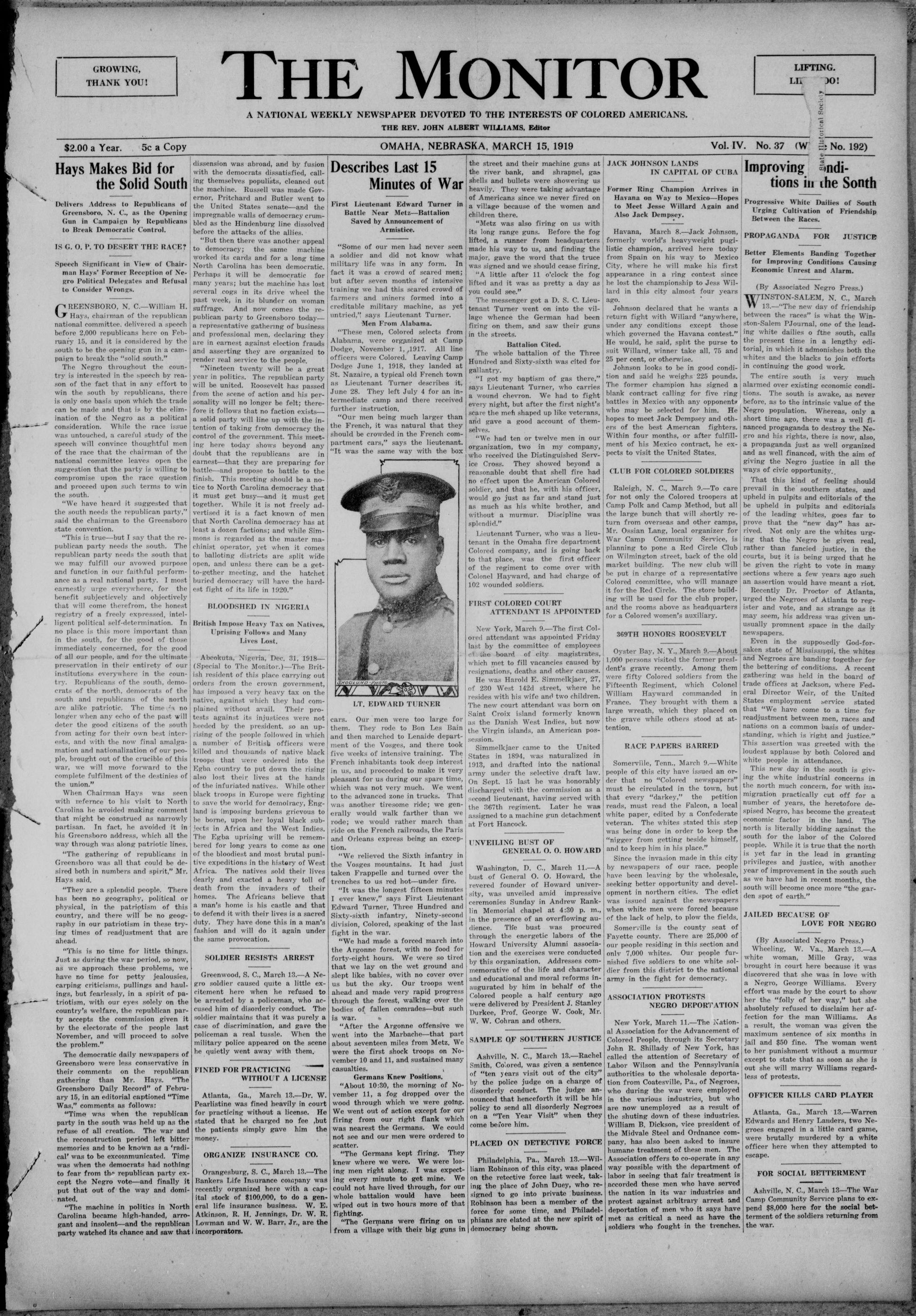
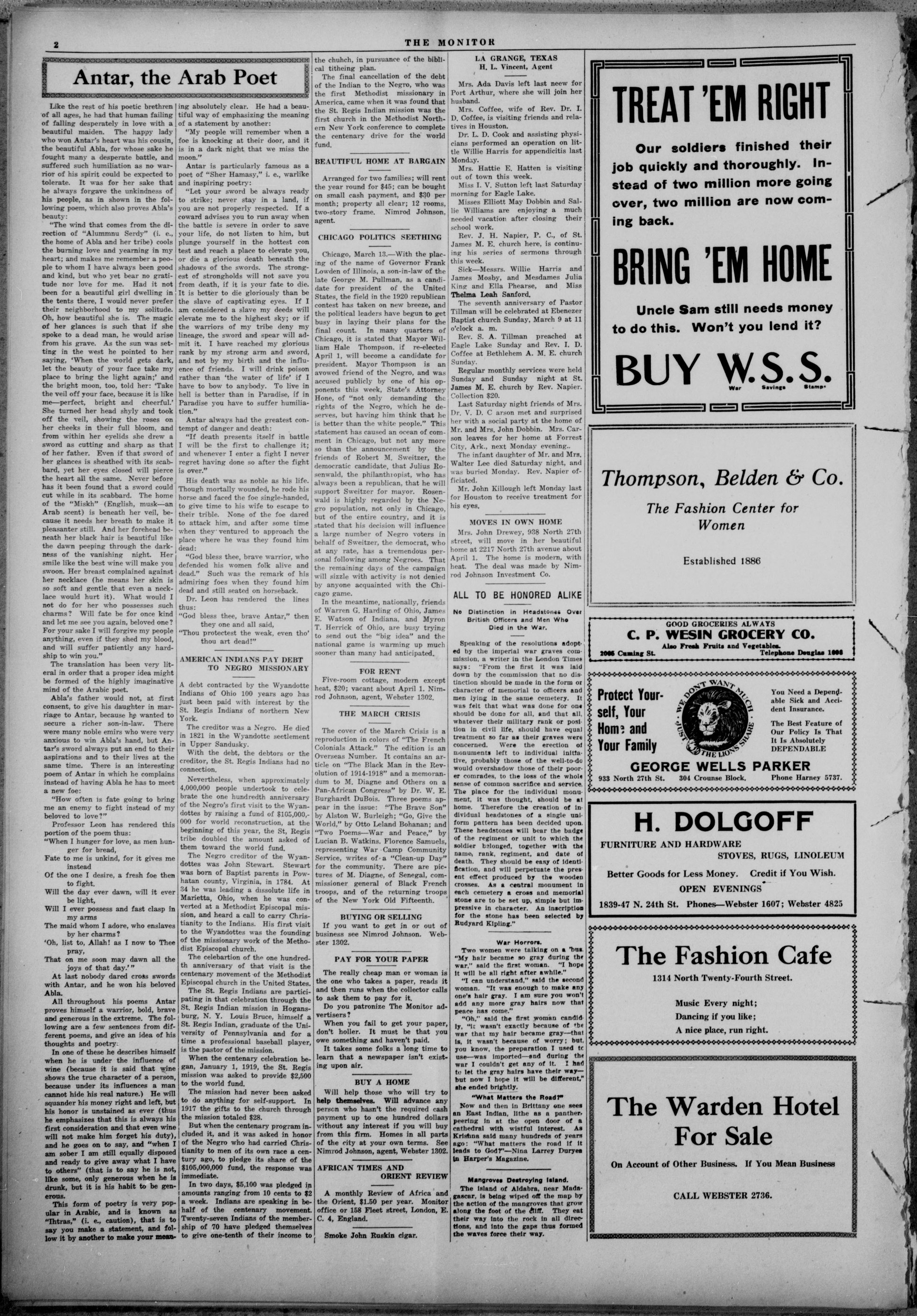
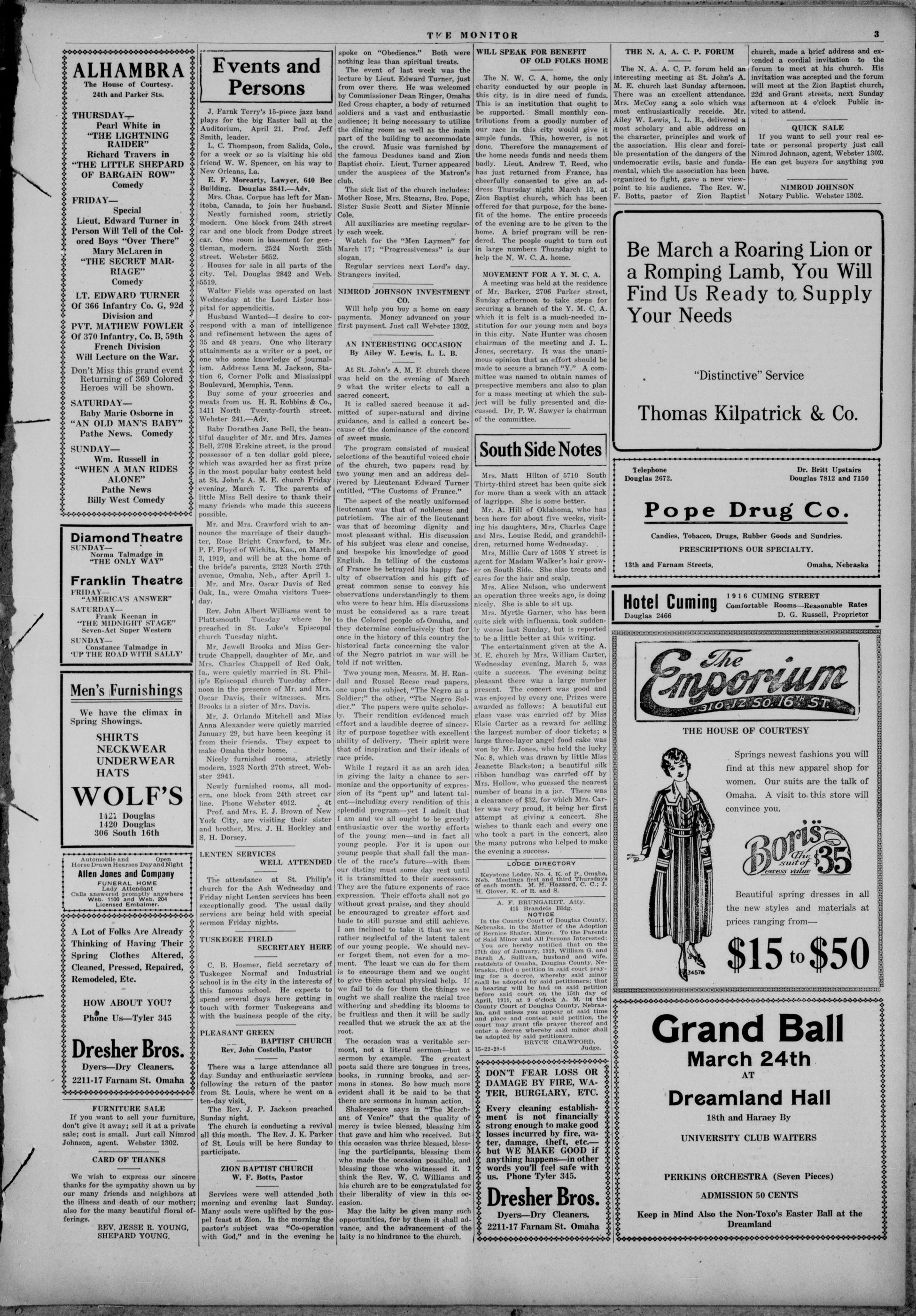
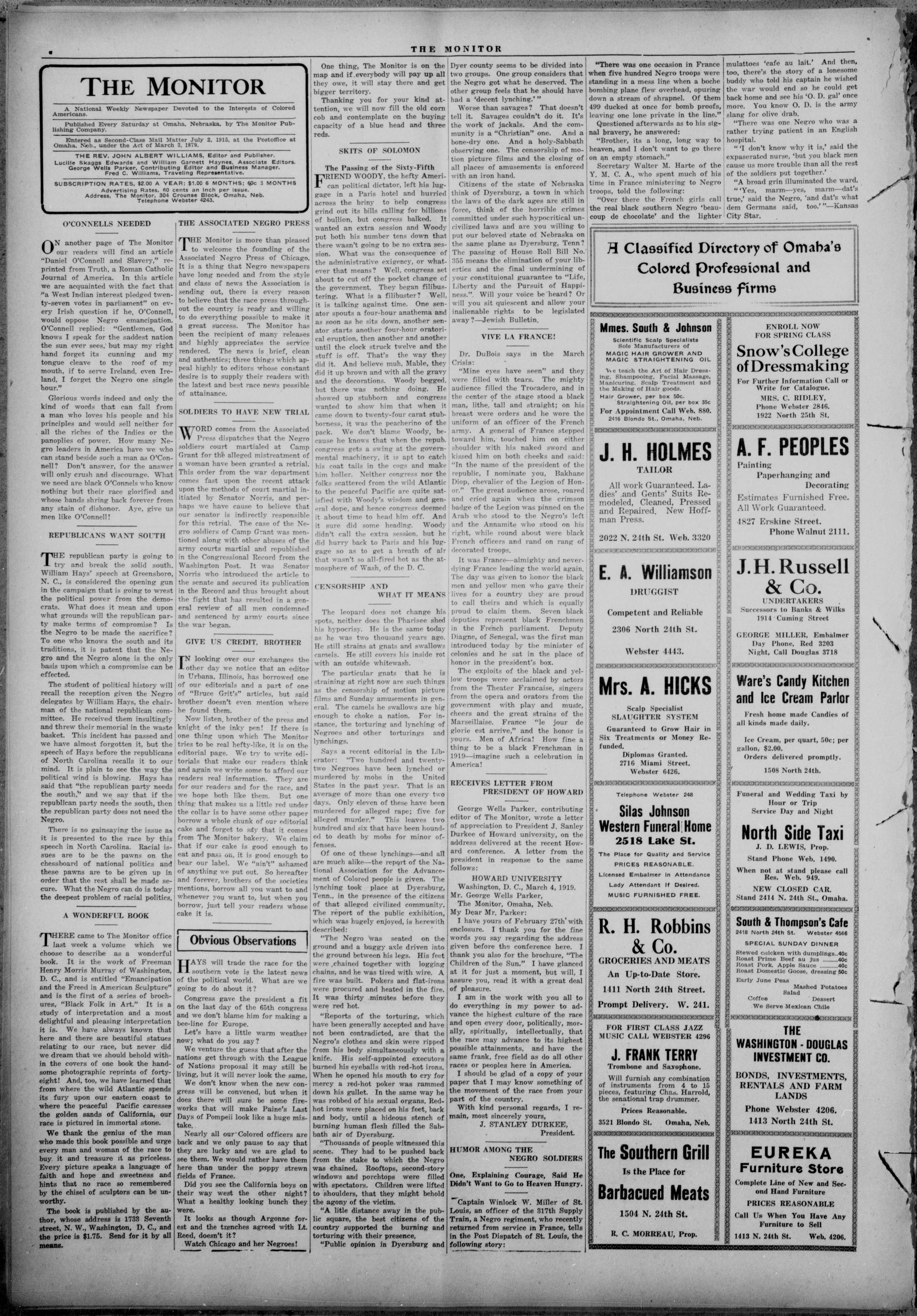
Page text (machine-generated)
GROWING,
THANK YOU!
$2.00 a Year. 5c a Copy
Hays Makes Bid for the Solid South
Delivers Address to Republicans of Greensboro, N. C., as the Opening Gun in Campaign by Republicans to Break Democratic Control.
IS G. O. P. TO DESERT THE RACE?
Speech Significant in View of Chairman Hays' Former Reception of Negro Political Delegates and Refusal to Consider Wrongs.
GREENSBORO, N. C.—William H. Hays, chairman of the republican national committee, delivered a speech before 2,000 republicans here on February 15, and it is considered by the south to be the opening gun in a campaign to break the "solid south."
The Negro throughout the country is interested in the speech by reason of the fact that in any effort to win the south by republicans, there is only one basis upon which the trade can be made and that is by the elimination of the Negro as a political consideration. While the race issue was untouched, a careful study of the speech will convince thoughtful men of the race that the chairman of the national committee leaves open the suggestion that the party is willing to compromise upon the race question and proceed upon such terms to win the south.
"We have heard it suggested that the south needs the republican party," said the chairman to the Greensboro state convention.
"This is true—but I say that the republican party needs the south. The republican party needs the south that we may fulfill our avowed purpose and function in our faithful performance as a real national party. I most earnestly urge everywhere, for the benefit subjectively and objectively that will come therefrom, the honest registry of a freely expressed, intelligent political self-determination. In no place is this more important than in the south, for the good of those immediately concerned, for the good of all our people, and for the ultimate preservation in their entirety of our institutions everywhere in the country. Republicans of the south, democrats of the north, democrats of the south and republicans of the north are alike patriotic. The time is no longer when any echo of the past will deter the good citizens of the south from acting for their own best interests, and with the now final amalgamation and nationalization of our people, brought out of the crucible of this war, we will move forward to the complete fulfilment of the destinies of the union."
When Chairman Hays was seen with reference to his visit to North Carolina he avoided making comment that might be construed as narrowly partisan. In fact, he avoided it in his Greensboro address, which all the way through was along patriotic lines.
"The gathering of republicans in Greensboro was all that could be desired both in numbers and spirit," Mr. Hays said.
"They are a splendid people. There has been no geography, political or physical, in the patriotism of this country, and there will be no geography in our patriotism in these trying times of readjustment that are ahead.
"This is no time for little things. Just as during the war period, so now, as we approach these problems, we have no time for petty jealousies, carping criticisms, pullings and haulings, but fearlessly, in a spirit of patriotism, with our eyes solely on the country's welfare, the republican party accepts the commission given it by the electorate of the people last November, and will proceed to solve the problem."
The democratic daily newspapers of Greensboro were less conservative in their comments on the republican gathering than Mr. Hays. "The Greensboro Daily Record" of February 15, in an editorial captioned "Time Was," comments as follows:
"Time was when the republican party in the south was held up as the refuse of all creation. The war and the reconstruction period left bitter memories and to be known as a 'radical' was to be excommunicated. Time was when the democrats had nothing to fear from the republican party except the Negro vote—and finally it put that out of the way and dominated.
"The machine in politics in North Carolina became high-handed, arrogant and insolent—and the republican party watched its chance and saw that
THE MONITOR
dissension was abroad, and by fusion with the democrats dissatisfied, calling themselves populists, cleaned out the machine. Russell was made Governor, Pritchard and Butler went to the United States senate—and the impregnable walls of democracy crumbled as the Hindenburg line dissolved before the attacks of the allies.
"But then there was another appeal to democracy; the same machine worked its cards and for a long time North Carolina has been democratic. Perhaps it will be democratic for many years; but the machine has lost several cogs in its drive wheel the past week, in its blunder on woman suffrage. And now comes the republican party to Greensboro today—a representative gathering of business and professional men, declaring they are in earnest against election frauds and asserting they are organized to render real service to the people.
"Nineteen twenty will be a great year in politics. The republican party will be united. Roosevelt has passed from the scene of action and his personality will no longer be felt; therefore it follows that no faction exists—a solid party will line up with the intention of taking from democracy the control of the government. This meeting here today shows beyond any doubt that the republicans are in earnest—that they are preparing for battle—and propose to battle to the finish. This meeting should be a notice to North Carolina democracy that it must get busy—and it must get together. While it is not freely advertised it is a fact known of men that North Carolina democracy has at least a dozen factions; and while Simmons is regarded as the master machinist operator, when it comes to balloting districts are split wide open, and unless there can be a get-to-gether meeting, and the hatchet buried democracy will have the hardest fight of its life in 1920."
BLOODSHED IN NIGERIA
British Impose Heavy Tax on Natives, Uprising Follows and Many Lives Lost.
Abeokuta, Nigeria, Dec. 31, 1918—(Special to The Monitor.)—The British resident of this place carrying out orders from the crown government, has imposed a very heavy tax on the native, against which they had complained without avail. Their protests against its injustices were not heeded by the president, so an uprising of the people followed in which a number of British officers were killed and thousands of native black troops that were ordered into the Egba country to put down the rising also lost their lives at the hands of the infuriated natives. While other black troops in Europe were fighting to save the world for democracy, England is imposing burdens grievous to be borne, upon her loyal black subjects in Africa and the West Indies. The Egba uprising will be remembered for long years to come as one of the bloodiest and most brutal punitive expeditions in the history of West Africa. The natives sold their lives dearly and exacted a heavy toll of death from the invaders of their homes. The Africans believe that a man's home is his castle and that to defend it with their lives is a sacred duty. They have done this in a man's fashion and will do it again under the same provocation.
SOLDIER RESISTS ARREST
Greenwood, S. C., March 13.—A Negro soldier caused quite a little excitement here when he refused to be arrested by a policeman, who accused him of disorderly conduct. The soldier maintains that it was purely a case of discrimination, and gave the policeman a real tussle. When the military police appeared on the scene he quietly went away with them.
FINED FOR PRACTICING
WITHOUT A LICENSE
Atlanta, Ga., March 13.—Dr. W. Pearlistine was fined heavily in court for practicing without a license. He stated that he charged no fee, but the patients simply gave him the money.
ORGANIZE INSURANCE CO.
Orangesburg, S. C., March 13.—The Bankers Life Insurance company was recently organized here with a capital stock of $100,000, to do a general life insurance business. W. E. Atkinson, R. H. Jennings, Dr. W. R. Lowman and W. W. Barr, Jr., are the incorporators.
OMAHA, NEBRASKA, MARCH 15, 1919
Describes Last 15 Minutes of War
First Lieutenant Edward Turner in Battle Near Metz-Battalion Saved by Announcement of Armistice.
"Some of our men had never seen a soldier and did not know what military life was in any form. In fact it was a crowd of scared men; but after seven months of intensive training we had this scared crowd of farmers and miners formed into a creditable military machine, as yet untried," says Lieutenant Turner.
Men From Alabama.
"These men, Colored selects from Alabama, were organized at Camp Dodge, November 1, 1917. All line officers were Colored. Leaving Camp Dodge June 1, 1918, they landed at St. Nazaire, a typical old French town as Lieutenant Turner describes it, June 28. They left July 4 for an intermediate camp and there received further instruction.
"Our men being much larger than the French, it was natural that they should be crowded in the French compartment cars," says the lieutenant. "It was the same way with the box
SKOOLUND- PHOTO
LT. EDWARD TURNER
cars. Our men were too large for them. They rode to Bon Les Bain and then marched to Lenaide department of the Vosges, and there took five weeks of intensive training. The French inhabitants took deep interest in us, and proceeded to make it very pleasant for us during our spare time, which was not very much. We went to the advanced zone in trucks. That was another tiresome ride; we generally would walk farther than we rode; we would rather march than ride on the French railroads, the Paris and Orleans express being an exception.
"We relieved the Sixth infantry in the Vosges mountains. It had just taken Frappelle and turned over the trenches to us red hot—under fire.
"It was the longest fifteen minutes I ever knew," says First Lieutenant Edward Turner, Three Hundred and Sixty-sixth infantry, Ninety-second division, Colored, speaking of the last fight in the war.
"We had made a forced march into the Argonne forest, with no food for forty-eight hours. We were so tired that we lay on the wet ground and slept like babies, with no cover over us but the sky. Our troops went ahead and made very rapid progress through the forest, walking over the bodies of fallen comrades—but such is war.
"After the Argonne offensive we went into the Marbache—that part about seventeen miles from Metz. We were the first shock troops on November 10 and 11, and sustained many casualties.
Germans Knew Positions.
"About 10:30, the morning of November 11, a fog dropped over the wood through which we were going. We went out of action except for our firing from our right flank which was nearest the Germans. We could not see and our men were ordered to scatter.
"The Germans kept firing. They knew where we were. We were losing men right along. I was expecting every minute to get mine. We could not have lived through, for our whole battalion would have been wiped out in two hours more of that fighting.
"The Germans were firing on us from a village with their big guns in
the street and their machine guns at the river bank, and shrapnel, gas shells and bullets were showering us heavily. They were taking advantage of Americans since we never fired on a village because of the women and children there.
"Metz was also firing on us with its long range guns. Before the fog lifted, a runner from headquarters made his way to us, and finding the major, gave the word that the truce was signed and we should cease firing.
"A little after 11 o'clock the fog lifted and it was as pretty a day as you could see."
The messenger got a D. S. C. Lieutenant Turner went on into the village whence the German had been firing on them, and saw their guns in the streets.
Battalion Cited.
The whole battalion of the Three Hundred and Sixty-sixth was cited for gallantry.
"I got my baptism of gas there," says Lieutenant Turner, who carries a wound chevron. We had to fight every night, but after the first night's scare the meh shaped up like veterans, and gave a good account of themselves.
"We had ten or twelve men in our organization, two in my company, who received the Distinguished Service Cross. They showed beyond a reasonable doubt that shell fire had no effect upon the American Colored soldier, and that he, with his officer, would go just as far and stand just as much as his white brother, and without a murmur. Discipline was splendid."
Lieutenant Turner, who was a lieutenant in the Omaha fire department Colored company, and is going back to that place, was the first officer of the regiment to come over with Colonel Hayward, and had charge of 102 wounded soldiers.
FIRST COLORED COURT
New York, March 9.—The first Colored attendant was appointed Friday last by the committee of employees of the board of city magistrates, which met to fill vacancies caused by resignations, deaths and other causes. He was Harold E. Simmelkjaer, 27, of 230 West 142d street, where he resides with his wife and two children. The new court attendant was born on Saint Croix island formerly known as the Danish West Indies, but now the Virgin islands, an American possession. Simmelkjaer came to the United States in 1894, was naturalized in 1913, and drafted into the national army under the selective draft law. On Sept. 15 last he was honorably discharged with the commission as a second lieutenant, having served with the 367th regiment. Later he was assigned to a machine gun detachment at Fort Hancock.
UNVEILING BUST OF
GENERAL O. O. HOWARD
Washington, D. C., March 11.—A bust of General O. O. Howard, the revered founder of Howard university, was unveiled amid impressive ceremonies Sunday in Andrew Ranklin Memorial chapel at 4:30 p. m., in the presence of an overflowing audience. The bust was procured through the energetic labors of the Howard University Alumni association and the exercises were conducted by this organization. Addresses commemorative of the life and character and educational and moral reforms inaugurated by him in behalf of the Colored people a half century ago were delivered by President J. Stanley Durkee, Prof. George W. Cook, Mr. W. W. Cohran and others.
SAMPLE OF SOUTHERN JUSTICE
Ashville, N. C., March 13.—Rachel Smith, Colored, was given a sentence of "ten years visit out of the city" by the police judge on a charge of disorderly conduct. The judge announced that henceforth it will be his policy to send all disorderly Negroes on a "Ten Year Visit" when they come before him.
PLACED ON DETECTIVE FORCE
Philadelphia, Pa., March 13.—William Robinson of this city, was placed on the retractive force last week, taking the place of John Duey, who resigned to go into private business. Robinson has been a member of the force for some time, and Philadelphiaans are elated at the new spirit of democracy being shown.
Vol. IV. No. 37 (W
JACK JOHNSON LANDS
IN CAPITAL OF CUBA
Former Ring Champion Arrives in Havana on Way to Mexico—Hopes to Meet Jesse Willard Again and Also Jack Dempsey.
Havana, March 8.—Jack Johnson, formerly world's heavyweight pugilistic champion, arrived here today from Spain on his way to Mexico City, where he will make his first appearance in a ring contest since he lost the championship to Jess Willard in this city almost four years ago.
Johnson declared that he wants a return fight with Willard "anywhere, under any conditions except those which governed the Havana contest." He would, he said, split the purse to suit Willard, winner take all, 75 and 25 per cent, or otherwise.
Johnson looks to be in good condition and said he weighs 225 pounds. The former champion has signed a blank contract calling for five ring battles in Mexico with any opponents who may be selected for him. He hopes to meet Jack Dempsey and others of the best American fighters. Within four months, or after fulfillment of his Mexico contract, he expects to visit the United States.
CLUB FOR COLORED SOLDIERS
Raleigh, N. C., March 9.—To care for not only the Colored troopers at Camp Park and Camp Method, but all the large bunch that will shortly return from overseas and other camps, Mr. Ossian Lang, local organizer for War Camp Community Service, is planning to pone a Red Circle Club on Wilmington street, back of the old market building. The new club will be put in charge of a representative Colored committee, who will manage it for the Red Circle. The store building will be used for the club proper, and the rooms above as headquarters for a Colored women's auxiliary.
Oyster Bay, N. Y., March 9. About 1,000 persons visited the former president's grave recently. Among them were fifty Colored soldiers from the Fifteenth Regiment, which Colonel William Hayward commanded in France. They brought with them a large wreath, which they placed on the grave while others stood at attention.
Somerville, Tenn., March 9.—White people of this city have issued an order that no "Colored newspapers" must be circulated in the town, but that every "darkey," the petition reads, must read the Falcon, a local white paper, edited by a Confederate veteran. The whites stated this step was being done in order to keep the "nigger from getting beside himself, and to keep him in his place."
Since the invasion made in this city by newspapers of our race, people have been leaving by the wholesale, seeking better opportunity and development in northern cities. The edict was issued against the newspapers when white men were forced because of the lack of help, to plow the fields.
Somerville is the county seat of Fayette county. There are 25,000 of our people residing in this section and only 7,000 whites. Our people furnished five soldiers to one white soldier from this district to the national army in the fight for democracy.
ASSOCIATION PROTESTS
NEGRO DEPORTATION
New York, March 11.—The National Association for the Advancement of Colored People, through its Secretary John R. Shillady of New York, has called the attention of Secretary of Labor Wilson and the Pennsylvania authorities to the wholesale deportation from Coatesville, Pa., of Negroes, who during the war were employed in the various industries, but who are now unemployed as a result of the shutting down of these industries. William B. Dickson, vice president of the Midvale Steel and Ordnance company, has also been asked to insure humane treatment of these men. The Association offers to co-operate in any way possible with the department of labor in seeing that fair treatment is accorded these men who have served the nation in its war industries and protest against arbitrary arrest and deportation of men who it says have met as critical a need as have the soldiers who fought in the trenches.
369TH HONORS ROOSEVELT
RACE PAPERS BARRED
Improving indi tions in the South
Progressive White Dailies of South
Urging Cultivation of Friendship
Between the Races.
PROPAGANDA FOR JUSTICE
Better Elements Banding Together
for Improving Conditions Causing
Economic Unrest and Alarm.
WINSTON-SALEM, N. C., March 13.—"The new day of friendship between the races" is what the Winston-Salem PJournal, one of the leading white dailies o f the south, calls the present time in a lengthy editorial, in which it admonishes both the whites and the blacks to join efforts in continuing the good work.
The entire south is very much alarmed over existing economic conditions. The south is awake, as never before, as to the intrinsic value of the Negro population. Whereas, only a short time ago, there was a well financed progaganda to destroy the Negro and his rights, there is now, also, a propaganda just as well organized and as well financed, with the aim of giving the Negro justice in all the ways of civic opportunity.
That this kind of feeling should prevail in the southern states, and upheld in pulpits and editorials of the be upheld in pulpits and editorials of the leading whites, goes far to prove that the "new day" has arrived. Not only are the whites urging that the Negro be given real, rather than fancied justice, in the courts, but it is being urged that he be given the right to vote in many sections where a few years ago such an assertion would have meant a riot. Recently Dr. Proctor of Atlanta, urged the Negroes of Atlanta to register and vote, and as strange as it may seem, his address was given unusually prominent space in the daily newspapers.
Even in the supposedly God-forsaken state of Mississippi, the whites and Negroes are banding together for the bettering of conditions. A recent gathering was held in the board of trade offices at Jackson, where Federal Director Weir, of the United States employment service stated that "We have come to a time for readjustment between men, races and nations on a common basis of understanding, which is right and justice." This assertion was greeted with the loudest applause by both Colored and white people in attendance.
This new day in the south is giving the white industrial concerns in the north much concern, for with immigration practically cut off for a number of years, the heretofore despised Negro, has become the greatest economic factor in the land. The north is literally bidding against the south for the labor of the Colored people. While it is true that the north is yet far in the lead in granting privileges and justice, with another year of improvement in the south such as we have had in recent months, the south will become once more "the garden spot of earth."
JAILED BECAUSE OF
LOVE FOR NEGRO
(By Associated Negro Press.)
Wheeling, W. Va., March 13.—A white woman, Mille Gray, was brought in court here because it was discovered that she was in love with a Negro, George Williams. Every effort was made by the court to show her the "folly of her way," but she absolutely refused to disclaim her affection for the man Williams. As a result, the woman was given the maximum sentence of six months in jail and $50 fine. The woman went to her punishment without a murmur except to state that as soon as she is out she will marry Williams regardless of protests.
OFFICER KILLS CARD PLAYER
Atlanta, Ga., March 13.—Warren Edwards and Henry Landers, two Negroes engaged in a little card game, were brutally murdered by a white officer here when they attempted to escape.
FOR SOCIAL BETTERMENT
Ashville, N. C., March 13—The War Camp Community Service plans to expend $8,000 here for the social betterment of the soldiers returning from the war.
Antar, the Arab Poet
2
Like the rest of his poetic brethren of all ages, he had that human failing of falling desperately in love with a beautiful maiden. The happy lady who won Antar's heart was his cousin, the beautiful Abla, for whose sake he fought many a desperate battle, and suffered such humiliation as no warrior of his spirit could be expected to tolerate. It was for her sake that he always forgave the unkindness of his people, as in shown in the following poem, which also proves Abla's beauty:
"The wind that comes from the direction of "Alummu Serdy" (i. e., the home of Abla and her tribe) cools the burning love and yearning in my heart; and makes me remember a people to whom I have always been good and kind, but who yet bear no gratitude nor love for me. Had it not been for a beautiful girl dwelling in the tents there, I would never prefer their neighborhood to my solitude. Oh, how beautiful she is. The magic of her glances is such that if she spoke to a dead man, he would arise from his grave. As the sun was setting in the west he pointed to her saying, 'When the world gets dark, let the beauty of your face take my place to bring the light again,' and the bright moon, too, told her: 'Take the veil off your face, because it is like me-perfect, bright and cheerful.' She turned her head shyly and took off the veil, showing the roses on her cheeks in their full bloom, and from within her eyelids she drew a sword as cutting and sharp as that of her father. Even if that sword of her glances is sheathed with its scabbard, yet her eyes closed will pierce the heart all the same. Never before has it been found that a sword could cut while in its scabbard. The home of the "Miskh" (English, musk—an Arab scent) is beneath her veil, because it needs her breath to make it pleasanter still. And her forehead beneath her black hair is beautiful like the dawn peeping through the darkness of the vanishing night. Her smile like the best wine will make you swoon. Her breast complained against her necklace (he means her skin is so soft and gentle that even a necklace would hurt it). What would I not do for her who possesses such charms? Will fate be for once kind and let me see you again, beloved one? For your sake I will forgive my people anything, even if they shed my blood, and will suffer patiently any hardship to win you."
The translation has been very literal in order that a proper idea might be formed of the highly imaginative mind of the Arabic poet.
Abla's father would not, at first consent, to give his daughter in marriage to Antar, because he wanted to secure a richer son-in-law. There were many noble emirs who were very anxious to win Abla's hand, but Antar's sword always put an end to their aspirations and to their lives at the same time. There is an interesting poem of Antar in which he complains instead of having Abla he has to meet a new foe:
"How often is fate going to bring me an enemy to fight instead of my beloved to love?"
Professor Leon has rendered this portion of the poem thus:
"When I hunger for love, as men hun ger for bread,
Fate to me is unkind, for it gives me instead
Of the one I desire, a fresh foe then to fight.
Will the day ever dawn, will it ever be light,
Will I ever possess and fast clasp in my arms
The maid whom I adore, who enslaves by her charms?
'Oh, list to, Allah! as I now to Thee pray,
That on me soon may dawn all the joys of that day.'"
At last nobody dared cross swords with Antar, and he won his beloved Abla.
All throughout his poems Antar proves himself a warrior, bold, brave and generous in the extreme. The following are a few sentences from different poems, and give an idea of his thoughts and poetry.
In one of these he describes himself when he is under the influence of wine (because it is said that wine shows the true character of a person, because under its influences a man cannot hide his real nature.) He will squander his money right and left, but his honor is unstained as ever (thus he emphasizes that this is always his first consideration and that even wine will not make him forget his duty), and he goes on to say, and "when I am sober I am still equally disposed and ready to give away what I have to others" (that is to say he is not, like some, only generous when he is drunk, but it is his habit to be generous.
This form of poetry is very popular in Arabic, and is known as "Intras," (i. e., caution), that is to say you make a statement, and follow it by another to make your mean-
ing absolutely clear. He had a beautiful way of emphasizing the meaning of a statement by another: "My people will remember when a foe is knocking at their door, and it is in a dark night that we miss the moon." Antar is particularly famous as a poet of "Sher Hamasy," i. e., warlike and inspiring poetry:
"Let your sword be always ready to strike; never stay in a land, if you are not properly respected. If a coward advises you to run away when the battle is severe in order to save your life, do not listen to him, but plunge yourself in the hottest contest and reach a place to elevate you, or die a glorious death beneath the shadows of the swords. The strongest of strongholds will not save you from death, if it is your fate to die. It is better to die gloriously than be the slave of captivating eyes. If I am considered a slave my deeds will elevate me to the highest sky; or if the warriors of my tribe deny my lineage, the sword and spear will admit it. I have reached my glorious rank by my strong arm and sword, and not by my birth and the influence of friends. I will drink poison rather than 'the water of life' if I have to bow to anybody. To live in hell is better than in Paradise, if in Paradise you have to suffer humiliation."
Antar always had the greatest contempt of danger and death:
"If death presents itself in battle I will be the first to challenge it; and whenever I enter a fight I never regret having done so after the fight is over."
His death was as noble as his life. Though mortally wounded, he rode his horse and faced the foe single-handed, to give time to his wife to escape to their trible. None of the foe dared to attack him, and after some time when they ventured to approach the place where he was they found him dead:
"God bless thee, brave warrior, who defended his women folk alive and dead." Such was the remark of his admiring foes when they found him dead and still seated on horseback.
Dr. Leon has rendered the lines thus:
"God bless thee, brave Antar," then they one and all said,
"Thou protectest the weak, even tho' thou art dead!"
AMERICAN INDIANS PAY DEBT TO NEGRO MISSIONARY
A debt contracted by the Wyandotte Indians of Ohio 100 years ago has just been paid with interest by the St. Regis Indians of northern New York.
The creditor was a Negro. He died in 1821 in the Wyandotte seetlement in Upper Sandusky.
With the debt, the debtors or the creditor, the St. Regis Indians had no connection.
Nevertheless, when approximately 4,000,000 people undertook to celebrate the one hundredth anniversary of the Negro's first visit to the Wyandottes by raising a fund of $105,000,-000 for world reconstruction, at the beginning of this year, the St, Regis tribe doubled the amount asked of them toward the world fund.
The Negro creditor of the Wyandottes was John Stewart. Stewart was born of Baptist parents in Powhatan county, Virginia, in 1784. At 34 he was leading a dissolute life in Marietta, Ohio, when he was converted at a Methodist Episcopal mission, and heard a call to carry Christianity to the Indians. His first visit to the Wyandottes was the founding of the missionary work of the Methodist Episcopal church.
The celebrantion of the one hundredth anniversary of that visit is the centenary movement of the Methodist Episcopal church in the United States
The St. Regis Indians are participating in that celebration through the St. Regis Indian mission in Hogansburg, N. Y. Louis Bruce, himself a St. Regis Indian, graduate of the University of Pennsylvania and for a time a professional baseball player, is the pastor of the mission.
When the centenary celebration began, January 1, 1919, the St. Regis mission was asked to provide $2,500 to the world fund.
The mission had never been asked to do anything for self-support. In 1917 the gifts to the church through the mission totaled $28.
But when the centenary program included it, and it was asked in honor of the Negro who had carried Christianity to men of its own race a century age, to pledge its share of the $105,000,000 fund, the response was immediate. In two days, $5,100 was pledged in amounts ranging from 10 cents to $2 a week. Indians are speaking in behalf of the centenary movement. Twenty-seven Indians of the membership of 70 have pledged themselves to give one-tenth of their income to
THE MONITOR
the chuhch, in pursuance of the biblical titheing plan. The final cancellation of the debt of the Indian to the Negro, who was the first Methodist missionary in America, came when it was found that the St. Regis Indian mission was the first church in the Methodist Northern New York conference to complete the centenary drive for the world fund.
BEAUTIFUL HOME AT BARGAIN
Arranged for two families; will rent the year round for $45; can be bought on small cash payment, and $30 per month; property all clear; 12 rooms, two-story frame. Nimrod Johnson, agent.
CHICAGO POLITICS SEETHING
Chicago, March 13.—With the placing of the name of Governor Frank Lowden of Illinois, a son-in-law of the late George M. Pullman, as a candidate for president of the United States, the field in the 1920 republican contest has taken on new breeze, and the political leaders have begun to get busy in laying their plans for the final count. In many quarters of Chicago, it is stated that Mayor William Hale Thompson, if re-elected April 1, will become a candidate for president. Mayor Thompson is an avowed friend of the Negro, and was accused publicly by one of his opponents this week, State's Attorney Hone, of "not only demanding the rights of the Negro, which he deserves, but having him think that he is better than the white people." This statement has caused an ocean of comment in Chicago, but not any more so than the announcement by the friends of Robert M. Sweitzer, the democratic candidate, that Julius Rosenwald, the philanthropist, who has always been a republican, that he will support Sweitzer for mayor. Rosenwald is highly regarded by the Negro population, not only in Chicago, but of the entire country, and it is stated that his decision will influence a large number of Negro voters in behalf of Sweitzer, the democrat, who at any rate, has a tremendous personal following among Negroes. That the remaining days of the campaign will sizzle with activity is not denied by anyone acquainted with the Chicago game.
In the meantime, nationally, friends of Warren G. Harding of Ohio, James E. Watson of Indiana, and Myron T. Herrick of Ohio, are busy trying to send out the "big idea" and the national game is warming up much sooner than many had anticipated.
Five-room cottage, modern except heat, $20; vacant about April 1. Nimrod Johnson, agent. Webster 1302.
The cover of the March Crisis is a reproduction in colors of "The French Colonials Attack." The edition is an Overseas Number. It contains an article on "The Black Man in the Revolution of 1914-1918" and a memorandum to M. Diagne and Others on a Pan-African Congress" by Dr. W. E. Burghardt DuBois. Three poems appear in the issue: "The Brave Son" by Alston W. Burleigh; "Go, Give the World," by Otto Leland Bohanan; and "Two Poems—War and Peace," by Lucian B. Watkins. Florence Samuels, representing War-Camp Community Service, writes of a "Clean-up Day" for the community. There are pictures of M. Diagne, of Senegal, commissioner general of Black French troops, and of the returning troops of the New York Old Fifteenth.
BUYING OR SELLING
If you want to get in or out of business see Nimrod Johnson. Webster 1302.
PAY FOR YOUR PAPER
The really cheap man or woman is the one who takes a paper, reads it and then runs when the collector calls to ask them to pay for it.
Do you patronize the Monitor advertisers?
When you fail to get your paper, don't holler. It must be that you owe something and haven't paid.
It takes some folks a long time to learn that a newspaper isn't existing upon air.
Will help those who will try to help themselves. Will advance any person who hasn't the required cash payment up to one hundred dollars without any interest if you will buy from this firm. Homes in all parts of the city at your own terms. See Nimrod Johnson, agent, Webster 1302.
AFRICAN TIMES AND ORIENT REVIEW
A monthly Review of Africa and the Orient, $1.50 per year. Monitor office or 158 Fleet street, London, E. C. 4, England.
FOR RENT
THE MARCH CRISIS
BUY A HOME
Smoke John Ruskin cigar.
LA GRANGE, TEXAS
H. L. Vincent, Agent
Mrs. Ada Davis left last newe for Port Arthur, where she will join her husband.
Mrs. Coffee, wife of Rev. Dr. I. D. Coffee, is visiting friends and relatives in Houston.
Dr. L. D. Cook and assisting physicians performed an operation on little Willie Harris for appendicitis last Monday.
Mrs. Hattie E. Hatten is visiting out of town this week.
Miss I. V. Sutton left last Saturday morning for Eagle Lake.
Misses Elliott May Dobbin and Sallie Williams are enjoying a much needed vacation after closing their school work.
Rev. J. H. Napier, P. C., of St. James M. E. church here, is continuing his series of sermons through this week.
Sick—Messrs. Willie Harris and James Mosby, and Mesdames Julia King and Ella Phearse, and Miss Thelma Leah Sanford.
The seventh anniversary of Pastor Tillman will be celebrated at Ebenezer Baptist church Sunday, March 9 at 11 o'clock a. m.
Rev. S. A. Tillman preached at Eagle Lake Sunday and Rev. I. C. Coffee at Bethheem A. M. E. church Sunday.
Regular monthly services were held Sunday and Sunday night at St. James M. E. church by Rev. Napier. Collection $20.
Last Saturday night friends of Mrs. Dr. V. D. C arson met and surprised her with a social party at the home of Mr. and Mrs. John Dobbin. Mrs. Carson leaves for her home at Forrest City, Ark., next Monday evening..
The infant daughter of Mr. and Mrs. Walter Lee died Saturday night, and was buried Monday. Rev. Napier officiated.
Mr. John Killough left Monday last for Houston to receive treatment for his eyes.
MOVES IN OWN HOME
Mrs. John Drewey, 938 North 27th street, will move in her beautiful home at 2217 North 27th avenue about April 1. The home is modern, with heat. The deal was made by Nimrod Johnson Investment Co.
ALL TO BE HONORED ALIKE
No Distinction in Headstones Over British Officers and Men Who Died in the War.
Speaking of the resolutions adopted by the imperial war graves commission, a writer in the London Times says: "From the first it was laid down by the commission that no distinction should be made in the form or character of memorial to officers and men lying in the same cemetery. It was felt that what was done for one should be done for all, and that all, whatever their military rank or position in civil life, should have equal treatment so far as their graves were concerned. Were the erection of monuments left to individual initiative, probably those of the well-to-do would overshadow those of their poorer comrades, to the loss of the whole sense of common sacrifice and service. The place for the individual monument, it was thought, should be at home. Therefore the creation of individual headstones of a single uniform pattern has been decided upon. These headstones will bear the badge of the regiment or unit to which the soldier balonged, together with the name, rank, regiment, and date of death. They should be easy of identification, and will perpetuate the present effect produced by the wooden crosses. As a central monument in each cemetery a cross and memorial stone are to be set up, simple but impressive in character. An inscription for the stone has been selected by Rudyard Kipling."
Two women were talking on a "bus." "My hair became so gray during the war," said the first woman. "I hope it will be all right after awhile." "I can understand," said the second woman. "It was enough to make any one's hair gray. I am sure you won't add any more gray hairs now that peace has come." "Oh," said the first woman candidly, "it wasn't exactly because of the war that my hair became gray—that is, it wasn't because of worry; but, you know, the preparation I used to use—was imported—and during the war I couldn't get any of it. I had to let the gray hairs have their way—but now I hope it will be different," she ended brightly.
"What Matters the Road?"
Now and then in Brittany one sees an East Indian, lilie as a panther-peering in at the open door of a cathedral with wistful interest. As Krishna said many hundreds of years ago: "What matters the road if it leads to God?"—Nina Larrey Duryea in Harper's Magazine.
Mangroves Destroying Island.
The island of Aldabra, near Madagascar, is being wiped off the map by the action of the mangroves that grow along the foot of the cliff. They eat their way into the rock in all directions, and into the gaps thus formed the waves force their way.
War Horrors.
TREAT'EM RIGHT
Our soldiers finished their job quickly and thoroughly. Instead of two million more going over, two million are now coming back.
BRING 'EM HOME
Uncle Sam still needs money to do this. Won't you lend it?
BUY W.S.S. War Savings Stamps
The Fashion Center for Women
GOOD GROCERIES ALWAYS
P. WESIN GROCERY CO.
Also Fresh Fruits and Vegetables
St. Telephone B
GOOD GROCERIES ALWAYS C. P. WESIN GROCERY CO. Also Fresh Fruits and Vegetables. 2005 Cuming St. Telephone Douglas 1008
GEORGE WELLS PARKER
40th St. 304 Crounse Block. Phone H.
H. DOLGOFF
WARE AND HARDWARE
STOVES, RUGS, L
foods for Less Money. Credit if You
OPEN EVENINGS
24th St. Phones—Webster 1607; We
ne Fashion Ca
GEORGE WELLS PARKER
933 North 27th St. 304 Crounse Block. Phone Harney 5737.
H. DOLGOFF
FURNITURE AND HARDWARE
STOVES, RUGS, LINOLEUM
Better Goods for Less Money. Credit if You Wish.
OPEN EVENINGS
1839-47 N. 24th St. Phones—Webster 1607; Webster 4825
The Fashion Cafe
e Warden Hoe For Sale
unt of Other Business. If You Mean
The Warden Hotel For Sale
On Account of Other Business. If You Mean Business
```markdown
```
Protect Yourself, Your Home and Your Family
1314 North Twenty-Fourth Street.
Established 1886
WE DON'T WANT MUCH
JUST SURE
THE LIONS SHARE
Music Every night;
Dancing if you like;
A nice place, run right.
CALL WEBSTER 2736.
RY CO.
Poles.
Telephone Douglas 1008
You Need a Dependable Sick and Accident Insurance.
The Best Feature of Our Policy Is That It Is Absolutely DEPENDABLE
ARKER
Phone Harney 5737.
OFF
DRUGS, LINOLEUM
mit if You Wish.
507; Webster 4825
Cafe
---
The House of Courtesy.
24th and Parker Sts.
THURSDAY
Pearl White in
"THE LIGHTNING
RAIDER"
Richard Travers in
"THE LITTLE SHEPARD
OF BARGAIN ROW"
Comedy
Special
Lieut. Edward Turner in
Person Will Tell of the Colored Boys "Over There"
Mary McLaren in
"THE SECRET MARRIAGE"
Comedy
LT. EDWARD TURNER
Of 366 Infantry Co. G, 92d Division and
PVT. MATHEW FOWLER
Of 370 Infantry, Co. B, 59th French Division
Will Lecture on the War.
Don't Miss this grand event
Returning of 369 Colored Heroes will be shown.
SATURDAY—
Baby Marie Osborne in
"AN OLD MAN'S BABY"
Pathe News. Comedy
SUNDAY—
Wm. Russell in
"WHEN A MAN RIDES
ALONE"
Pathe News
Billy West Comedy
Diamond Theatre
SUNDAY—
Norma Talmadge in
"THE ONLY WAY"
Franklin Theatre
FRIDAY—
"AMERICA'S ANSWER"
SATURDAY—
Frank Keenan in
"THE MIDNIGHT STAGE"
Seven-Act Super Western
SUNDAY—
Constance Talmadge in
"UP THE ROAD WITH SALLY"
Men's Furnishings
We have the climax in Spring Showings.
SHIRTS
NECKWEAR
UNDERWEAR
HATS
WOLF'S
1421 Douglas
1420 Douglas
306 South 16th
Automobile and Open
Horse Drawn Hearses Day and Night
Allen Jones and Company
FUNERAL HOME
Lady Attendant
Calls answer anywhere
Web. 110 and Web. 204
Licensed Embalmer.
A Lot of Folks Are Already Thinking of Having Their Spring Clothes Altered, Cleaned, Pressed, Repaired, Remodeled, Etc.
HOW ABOUT YOU?
Phone Us—Tyler 345
Dresher Bros.
Dyers—Dry Cleaners.
2211-17 Farnam St. Omaha
FURNITURE SALE
If you want to sell your furniture, don't give it away; sell it at a private sale; cost is small. Just call Nimrod Johnson, agent. Webster 1302.
CARD OF THANKS
We wish to express our sincere thanks for the sympathy shown us by our many friends and neighbors at the illness and death of our mother; also for the many beautiful floral offerings.
REV. JESSE R. YOUNG,
SHEPARD YOUNG.
Events and Persons
J. Farnk Terry's 15-piece jazz band plays for the big Easter ball at the Auditorium, April 21. Prof. Jeff Smith, leader.
L. C. Thompson, from Salida, Colo., for a week or so is visiting his old friend W. W. Spencer, on his way to New Orleans, La.
E. F. Morearty, Lawyer, 640 Bee Building. Douglas 3841.—Adv.
Mrs. Chas. Corpue has left for Manitoba, Canada, to join her husband.
Neatly furnished room, strictly modern. One block from 24th street car and one block from Dodge street car. One room in basement for gentleman, modern. 2524 North 25th street. Webster 5652.
Houses for sale in all parts of the city. Tel. Douglas 2842 and Web. 5519.
Walter Fields was operated on last Wednesday at the Lord Lister hospital for appendicitis.
Husband Wanted—I desire to correspond with a man of intelligence and refinement between the ages of 35 and 48 years. One who literary attainments as a writer or a poet, or one who some knowledge of journalism. Address Lena M. Jackson, Station 6, Corner Polk and Mississippi Boulevard, Memphis, Tenn.
Buy some of your groceries and meats from us. H. R. Robbins & Co., 1411 North Twenty-fourth street. Webster 241—Adv.
Baby Dorathea Jane Bell, the beautiful daughter of Mr. and Mrs. James Bell, 2708 Erskine street, is the proud possessor of a ten dollar gold piece, which was awarded her as first prize in the most popular baby contest held at St. John's A. M. E. church Friday evening, March 7. The parents of little Miss Bell desire to thank their many friends who made this success possible.
Mr. and Mrs. Crawford wish to announce the marriage of their daughter, Rose Bright Crawford, to Mr. P. F. Floyd of Wichita, Kas., on March 3, 1919, and will be at the home of the bride's parents, 2323 North 27th avenue, Omaha, Neh., after April 1.
Mr. and Mrs. Oscar Davis of Red Oak, Ia., were Omaha visitors Tuesday.
Rev. John Albert Williams went to Plattsmouth Tuesday where he preached in St. Luke's Episcopal church Tuesday night.
Mr. Jewell Brooks and Miss Gertrude Chappell, daughter of Mr. and Mrs. Charles Chappell of Red Oak, Ia., were quietly married in St. Philip's Episcopal church Tuesday afternoon in the presence of Mr. and Mrs. Oscar Davis, their witnesses. Mrs. Brooks is a sister of Mrs. Davis.
Mr. J. Orlando Mitchell and Miss Anna Alexander were quietly married January 29, but have been keeping it from their friends. They expect to make Omaha their home.
Nicely furnished rooms, strictly modern, 1923 North 27th street. Webster 2941.
Newly furnished rooms, all modern, one block from 24th street car line. Phone Webster 4012. 4t Prof. and Mrs. E. J. Brown of New York City, are visiting their sister and brother, Mrs. J. H. Hockley and S. H. Dorsey.
The attendance at St. Philip's church for the Ash Wednesday and Friday night Lenten services has been exceptionally good. The usual daily services are being held with special sermon Friday nights.
C. B. Hosmer, field secretary of Tuskegee Normal and Industrial school is in the city in the interests of this famous school. He expects to spend several days here getting in touch with former Tuskegeeans and with the business people of the city.
There was a large attendance all day Sunday and enthusiastic services following the return of the pastor from St. Louis, where he went on a ten-day visit. The Rev. J. P. Jackson preached Sunday night. The church is conducting a revival all this month. The Rev. J. K. Parker of St. Louis will be here Sunday to participate.
ZION BAPTIST CHURCH
W. F. Botts, Pastor
Services were well attended both morning and evening last Sunday. Many souls were uplifted by the gospel feast at Zion. In the morning the pastor's subject was "Co-operation with God," and in the evening he
THE MONITOR
spoke on "Obedience." Both were nothing less than spiritual treats.
The event of last week was the lecture by Lieut. Edward Turner, just from over there. He was welcomed by Commissioner Dean Ringer, Omaha Red Cross chapter, a body of returned soldiers and a vast and enthusiastic audience; it being necessary to utilize the dining room as well as the main part of the building to accommodate the crowd. Music was furnished by the famous Desdunes band and Zion Baptist choir. Lieut. Turner appeared under the auspices of the Matron's club.
The sick list of the church includes: Mother Rose, Mrs. Stearns, Bro. Pope, Sister Susie Scott and Sister Minnie Cole.
All auxiliaries are meeting regularly each week.
Watch for the "Men Laymen" for March 17; "Progressiveness" is our slogan. Regular services next Lord's day. Strangers invited.
NIMROD JOHNSON INVESTMENT CO.
Will help you buy a home on easy payments. Money advanced on your first payment. Just call Webster 1302.
AN INTERESTING OCCASION
By Ailey W. Lewis, L. L. B.
At St. John's A. M. E. church there was held on the evening of March 9 what the writer elects to call a sacred concert.
It is called sacred because it admitted of super-natural and divine guidance, and is called a concert because of the dominance of the concord of sweet music.
The program consisted of musical selections of the beautiful voiced choir of the church, two papers read by two young men and an address delivered by Lieutenant Edward Turner entitled, "The Customs of France."
The aspect of the neatly uniformed lieutenant was that of nobleness and patriotism. The air of the lieutenant was that of becoming dignity and most pleasant withal. His discussion of his subject was clear and concise, and bespoke his knowledge of good English. In telling of the customs of France he betrayed his happy faculty of observation and his gift of great common sense to convey his observations understandingly to them who were to hear him. His discussions must be considered as a rare treat to the Colored people of Omaha, and they determine conclusively that for once in the history of this country the historical facts concerning the valor of the Negro patriot in war will be told if not written.
Two young men, Messrs. M. H. Randall and Russel Reese read papers, one upon the subject, "The Negro as a Soldier;" the other, "The Negro Soldier." The papers were quite scholarly. Their rendition evidenced much effort and a laudible degree of sincerity of purpose together with excellent ability of delivery. Their spirit were that of inspiration and their ideals of race pride.
While I regard it as an arch idea in giving the laity a chance to sermonize and the opportunity of expression of its "pent up" and latent talent—including every rendition of this splendid program—yet I admit that I am and we all ought to be greatly enthusiastic over the worthy efforts of the young men—and in fact all young people. For it is upon our young people that shall fall the mantle of the race's future—with them our dstiny must some day rest until it is transmitted to their successors. They are the future exponents of race expression. Their efforts shall not go without great praise, and they should be encouraged to greater effort and bade to still pursue and still achieve. I am inclined to take it that we are rather neglectful of the latent talent of our young people. We should never forget them, not even for a moment. The least we can do for them is to encourage them and we ought to give them actual physical help. If we fail to do for them the things we ought we shall realize the racial tree withering and shedding its blooms to be fruitless and then it will be sadly recalled that we struck the ax at the root.
The occasion was a veritable sermont, not a literal sermon—but a sermon by example. The greatest poets said there are tongues in trees, books, in running brooks, and sermons in stones. So how much more evident shall it be said to be that there are sermons in human action.
Shakespeare says in "The Merchant of Venice" that the quality of mercy is twice blessed, blessing him that gave and him who received. But this occasion was thrice blessed, blessing the participants, blessing them who made the occasion possible, and blessing those who witnessed it. I think the Rev. W. C. Williams and his church are to be congratulated for their liberality of view in this occasion.
May the laity be given many such opportunities, for by them it shall advance, and the advancement of the laity is no hindrance to the church.
WILL SPEAK FOR BENEFIT
OF OLD FOLKS HOME
The N. W. C. A. home, the only charity conducted by our people in this city, is in dire need of funds. This is an institution that ought to be supported. Small monthly contributions from a goodly number of our race in this city would give it ample funds. This, however, is not done. Therefore the management of the home needs funds and needs them badly. Lieut. Andrew T. Reed, who has just returned from France, has cheerfully consented to give an address Thursday night March 13, at Zion Baptist church, which has been offered for that purpose, for the benefit of the home. The entire proceeds of the evening are to be given to the home. A brief program will be rendered. The people ought to turn out in large numbers Thursday night to help the N. W. C. A. home.
A meeting was held at the residence of Mr. Barker, 2706 Parker street, Sunday afternoon to take steps for securing a branch of the Y. M. C. A. which it is felt is a much-needed institution for our young men and boys in this city. Nate Hunter was chosen chairman of the meeting and J. L. Jones, secretary. It was the unanimous opinion that an effort should be made to secure a branch "Y." A committee was named to obtain names of prospective members and also to plan for a mass meeting at which the subject will be fully presented and discussed. Dr. P. W. Sawyer is chairman of the committee.
South Side Notes
Mrs. Matt Hilton of 5710 South Thirty-third street has been quite sick for more than a week with an attack of lagripe. She is some better.
Mr. A. Hill of Oklahoma, who has been here for about five weeks, visiting his daughters, Mrs. Charles Cage and Mrs. Louise Redd, and grandchildren, returned home Wednesday.
Mrs. Millie Carr of 1508 Y street is agent for Madam Walker's hair grower on South Side. She also treats and cares for the hair and scalp.
Mrs. Alice Nelson, who underwent an operation three weeks ago, is doing nicely. She is able to sit up.
Mrs. Myrtle Garner, who has been quite sick with influenza, took suddenly worse last Sunday, but is reported to be a little better at this writing.
The entertainment given at the A. M. E. church by Mrs. William Carter, Wednesday evening, March 5, was quite a success. The evening being pleasant there was a large number present. The concert was good and was enjoyed by every one. Prizes were awarded as follows: A beautiful cut glass vase was carried off by Miss Elsie Carter as a reward for selling the largest number of door tickets; a large three-layer angel food cake was won by Mr. Jones, who held the lucky No. 8, which was drawn by little Miss Jeanette Blackston; a beautiful silk ribbon handbag was carried off by Mrs. Hollow, who guessed the nearest number of beans in a jar. There was a clearance of $32, for which Mrs. Carter was very proud, it being her first attempt at giving a concert. She wishes to thank each and every one who took a part in the concert, also the many patrons who helped to make the evening a success.
Keystone Lodge, No. 4, K. of P., Omaha.
Neb. Meetings first and third Thursdays of each month. M. H. Hazzard, C. C.; J.
H. Glover, K. of R. and S.
In the County Court of Douglas County, Nebraska, in the Matter of the Adoption of Bernice Shafer, Minor. To the Parents of Said Minor and All Persons Interested: You are hereby notified that on the 17th day of January, 1919, William G. and Sarah A. Sullivan, husband and wife, residents of Omaha, Douglas County, Nebraska, filed a petition in said court praying for a decree, whereby said minor saill be adopted by said petitioners; that a hearing will be had on said petition before said court on the 15th day of April, 1919, at 9 o'clock A. M. in the County Court of Douglas County, Nebraska, and unless you appear at said petition and place and contest said petition, the court may grant you order thereof and enter a decree whereafter thereof and be adopted by said petitioners. BRYCE CRAWFORD.
DON'T FEAR LOSS OR DAMAGE BY FIRE, WATER, BURGLARY, ETC. Every cleaning establishment is not financially strong enough to make good losses incurred by fire, water, damage, theft, etc. but WE MAKE GOOD if anything happens—in other words you'll feel safe with us. Phone Tyler 345.
Dresher Bros.
Dyers—Dry Cleaners. 2211-17 Farnam St. Omaha
LODGE DIRECTORY
THE N. A. A. C. P. FORUM
The N. A. A. C. P. forum held an interesting meeting at St. John's A. M. E. church last Sunday afternoon. There was an excellent attendance. Mrs. McCoy sang a solo which was most enthusiastically receide. Mr. Ailey W. Lewis, L. L. B., delivered a most scholarly and able address on the character, principles and work of the association. His clear and forcible presentation of the dangers of the undemocratic evils, basic and fundamental, which the association has been organized to fight, gave a new viewpoint to his audience. The Rev. W. F. Botts, pastor of Zion Baptist
Be March a R a Romping La Find Us Read Your Needs
arch a Roaring
humping Lamb, You
Us Ready to, S
Needs
Be March a Roaring Lion or a Romping Lamb, You Will Find Us Ready to. Supply Your Needs
"Distinctive" Service
Thomas Kilp
nas Kilpatrick
Dr.
Dougl
pe Drug C
Tobacco, Drugs, Rubber Goods and
PRESCRIPTIONS OUR SPECIALTY
n Streets.
Thomas Kilpatrick & Co.
Pope D
Candies, Tobacco, Drugs, R
PRESCRIPTIONS
Candies, Tobacco, Drugs, Rubber Goods and Sundries.
PRESCRIPTIONS OUR SPECIALTY.
13th and Farnam Streets. Omaha, N
Hotel Cuming 1916 Comfo
Douglas 2466
The
Empo
310-12
The
emporium
310-12-50.16TH
The Emporium
310 J2 SO. 16TH ST.
THE HOUSE OF COURTESY
34576
Grand B
March 24th
AT
Dreamland H
Grand
March
Dreamla
18th and
Grand Ball March 24th AT
Telephone Douglas 2672.
church, made a brief address and extended a cordial invitation to the forum to meet at his church. His invitation was accepted and the forum will meet at the Zion Baptist church, 22d and Grant streets, next Sunday afternoon at 4 o'clock. Public invited to attend.
If you want to sell your real estate or personal property just call Nimrod Johnson, agent, Webster 1302. He can get buyers for anything you have.
NIMROD JOHNSON
Notary Public, Webster 1302.
a Roaring Lion or Lamb, You Will ready to, Supply
Kilpatrick & Co.
Drug Co. drugs, Rubber Goods and Sundries. IONS OUR SPECIALTY.
1916 CUMING STREET
Comfortable Rooms—Reasonable Rates
D. G. Russell, Proprietor
orium
12 S0.16TH ST.
Springs newest fashions you will find at this new apparel shop for women. Our suits are the talk of Omaha. A visit to this store will convince you.
Boris
The suit of
excess value
$35
Beautiful spring dresses in all the new styles and materials at prices ranging from—
$15 to $50
nd Ball
March 24th
AT
mland Hall
3
QUICK SALE
Dr. Britt Upstairs Douglas 7812 and 7150
Omaha, Nebraska
THE MONITOR
A National Weekly Newspaper Devoted to the Interests of Colored Americans.
Published Every Saturday at Omaha, Nebraska, by The Monitor Publishing Company.
Entered as Second-Class Mall Matter July 2, 1915, at the Postoffice at Omaha, Neb., under the Act of March 3, 1879.
THE REV. JOHN ALBERT WILLIAMS, Editor and Publisher.
Lucille Skaggs Edwards and William Garnett Haynes, Associate Editors.
George Wells Parker, Contributing Editor and Business Manager.
Fred C. Williams, Traveling Representative.
SUBSCRIPTION RATES, $2.00 A YEAR; $1.00 6 MONTHS; 60c 3 MONTHS
Advertising Rates, 60 cents an Inch per issue.
Address, The Monitor, 304 Crouse Block, Omaha, Neb.
Telephone Webster 4243.
O'CONNELLS NEEDED
ON another page of The Monitor our readers will find an article "Daniel O'Connell and Slavery," reprinted from Truth, a Roman Catholic Journal of America. In this article we are acquainted with the fact that "a West Indian interest pledged twenty-seven votes in parliament" on every Irish question if he, O'Connell, would oppose Negro emancipation. O'Connell replied: "Gentlemen, God knows I speak for the saddest nation the sun ever sees, but may my right hand forget its cunning and my tongue cleave to the roof of my mouth, if to serve Ireland, even Ireland, I forget the Negro one single hour."
Glorious words indeed and only the kind of words that can fall from a man who loves his people and his principles and would sell neither for all the riches of the Indies or the panoplies of power. How many Negro leaders in America have we who can stand beside such a man as O'Connell? Don't answer, for the answer will only crush and discourage. What we need are black O'Connels who know nothing but their race glorified and whose hands shring back forever from any stain of dishonor. Aye, give us men like O'Connell!
REPUBLICANS WANT SOUTH
THE republican party is going to try and break the solid south, William Hays' speech at Greensboro, N. C., is considered the opening gun in the campaign that is going to wrest the political power from the democrats. What does it mean and upon what grounds will the republican party make terms of compromise? Is the Negro to be made the sacrifice? To one who knows the south and its traditions, it is patent that the Negro and the Negro alone is the only basis upon which a compromise can be effected.
The student of political history will recall the reception given the Negro delegates by William Hays, the chairman of the national republican committee. He received them insultingly and threw their memorial in the waste basket. This incident has passed and we have almost forgotten it, but the speech of Hays before the republicans of North Carolina recalls it to our mind. It is plain to see the way the political wind is blowing. Hays has said that "the republican party needs the south," and we say that if the republican party needs the south, then the republican party does not need the Negro.
There is no gainsaying the issue as it is presented to the race by this speech in North Carolina. Racial issues are to be the pawns on the chessboard of national politics and these pawns are to be given up in order that the rest shall be made secure. What the Negro can do is today the deepest problem of racial politics.
A WONDERFUL BOOK
THERE came to The Monitor office last week a volume which we choose to describe as a wonderful book. It is the work of Freeman Henry Morris Murray of Washington, D. C., and is entitled "Emancipation and the Freed in American Sculpture" and is the first of a series of brochures, "Black Folk in Art." It is a study of interpretation and a most delightful and pleasing interpretation it is. We have always known that here and there are beautiful statues relating to our race, but never did we dream that we should behold within the covers of one book the handsome photographic reprints of forty-eight! And, too, we have learned that from where the wild Atlantic spends its fury upon our eastern coast to where the peaceful Pacific caresses the golden sands of California, our race is pictured in immortal stone.
We thank the genius of the man who made this book possible and urge every man and woman of the race to buy it and treasure it as priceless. Every picture speaks a language of faith and hope and sweetness and hints that no race so remembered by the chisel of sculptors can be unworthy. The book is published by the author, whose address is 1733 Seventh street, N. W., Washington, D. C., and the price is $1.75. Send for it by all means.
THE Monitor is more than pleased to welcome the founding of the Associated Negro Press of Chicago. It is a thing that Negro newspapers have long needed and from the style and class of news the Association is sending out, there is every reason to believe that the race press throughout the country is ready and willing to do everything possible to make it a great success. The Monitor has been the recipient of many releases and highly appreciates the service rendered. The news is brief, clean and authentic; three things which appeal highly to editors whose constant desire is to supply their readers with the latest and best race news possible of attainance.
SOLDIERS TO HAVE NEW TRIAL
WORD comes from the Associated Press dispatches that the Negro soldiers court martialed at Camp Grant for the alleged mistreatment of a woman have been granted a retrial. This order from the war department comes fast upon the recent attack upon the methods of court martial initiated by Senator Norris, and perhaps we have cause to believe that our senator is indirectly responsible for this retrial. The case of the Negro soldiers of Camp Grant was mentioned along with other abuses of the army courts martial and republished in the Congressional Record from the Washington Post. It was Senator Norris who introduced the article to the senate and secured its publication in the Record and thus brought about the fight that has resulted in a general review of all men condemned and sentenced by army courts since the war began.
GIVE US CREDIT. BROTHER
IN looking over our exchanges the other day we notice that an editor in Urbana, Illinois, has borrowed one of our editorsials and a part of one of "Bruce Grits" articles, but said brother doesn't even mention where he found them.
Now listen, brother of the press and knight of the inky pen! If there is one thing upon which The Monitor tries to be real hefty-like, it is on the editorial page. We try to write editorials that make our readers think and again we write some to afford our readers real information. They are for our readers and for the race, and we hope both like them. But one thing that makes us a little red under the collar is to have some other paper borrow a whole chunk of our editorial cake and forget to say that it comes from The Monitor bakery. We claim that if our cake is good enough to eat and pass on, it is good enough to bear our label. We "ain't" ashamed of anything we put out. So hereafter and forever, brothers of the societies mentions, borrow all you want to and whenever you want to, but when you borrow, just tell your readers whose cake it is.
Obvious Observations
HAYS will trade the race for the southern vote is the latest news of the political world. What are we going to do about it?
Congress gave the president a fit on the last day of the 65th congress and we don't blame him for making a bee-line for Europe.
Let's have a little warm weather now; what do you say?
We venture the guess that after the nations get through with the League of Nations proposal it may still be living, but it will never look the same.
We don't know when the new congress will be convened, but when it does there will sure be some fireworks that will make Paine's Last Days of Pompeii look like a huge mistake.
Nearly all our Colored officers are back and we only pause to say that they are lucky and we are glad to see them. We would rather have them here than under the poppy strewn fields of France.
Did you see the California boys on their way west the other night? What a healthy looking bunch they were.
It looks as though Argonne forest and the trenches agreed with Lt. Reed, doesn't it?
Watch Chicago and her Negroes!
THE MONITOR
One thing, The Monitor is on the map and if everybody will pay up all they owe, it will stay there and get bigger territory. Thanking you for your kind attention, we will now fill the old corn cob and contemplate on the buying capacity of a blue head and three reds.
The Passing of the Sixty-Fifth FRIEND WOODY, the hefty American political dictator, left his luggage in a Paris hotel and hurried across the briny to help congress grind out its bills calling for billions of bullion, but congress balked. It wanted an extra session and Woody put both his number tens down that there wasn't going to be no extra session. What was the consequence of the administrative exigency, or whatever that means? Well, congress set about to cut off the pocket change of the government. They began filibustering. What is a filibuster? Well, it is talking against time. One senator spouts a four-hour anathema and as soon as he sits down, another senator starts another four-hour oratorical eruption, then another and another until the clock struck twelve and the stuff is off. That's the way they did it. And believe muh, Mable, they did it up brown and with all the gravy and the decorations. Woody begged, but there was nothing doing. He showed up stubborn and congress wanted to show him that when it came down to twenty-four carat stubbornness, it was the peacherino of the pack. We don't blame Woody, because he knows that when the repub. congress gets a swing at the governmental machinery, it is apt to catch his coat tails in the cogs and make him holler. Neither congress nor the folks scattered from the wild Atlantic to the peaceful Pacific are quite satisfied with Woody's wisdom and general dope, and hence congress deemed it about time to head him off. And it sure did some heading. Woody didn't call the extra session, but he did hurry back to Paris and his luggage so as to get a breath of air that wasn't so all-fired hot as the atmosphere of Wash, of the D. C.
The leopard does not change his spots, neither does the Pharisee shed his hypocrisy. He is the same today as he was two thousand years ago. He still strains at gnats and swallows camels. He still covers his inside rot with an outside whitewash.
The particular gnats that he is straining at right now are such things as the censorship of motion picture films and Sunday amusements in general. The camels he swallows are big enough to choke a nation. For instance, the torturing and lynching of Negroes and other torturings and lynchings.
Says a recent editorial in the Liberator: "Two hundred and twenty-two Negroes have been lynched or murdered by mobs in the United States in the past year. That is an average of more than one every two days. Only eleven of these have been murdered for alleged rape; five for alleged murder." This leaves two hundred and six that have been hounded to death by mobs for minor offenses.
Of one of these lynchings—and all are much alike—the report of the National Association for the Advancement of Colored people is given. The lynching took place at Dyersburg, Tenn., in the presence of the citizens of that alleged civilized community. The report of the public exhibition, which was hugely enjoyed, is herewith described:
"The Negro was seated on the ground and a buggy axle driven into the ground between his legs. His feet were chained together with logging chains, and he was tired with wire. A fire was built. Pokers and flat-irons were procured and heated in the fire. It was thirty minutes before they were red hot.
"Reports of the torturing, which have been generally accepted and have not been contradicted, are that the Negro's clothes and skin were ripped from his body simultaneously with a knife. His self-appointed executors burned his eyeballs with red-hot irons. When he opened his mouth to cry for mercy a red-hot poker was rammed down his gullet. In the same way he was robbed of his sexual organs. Red-hot irons were placed on his feet, back and body, until a hideous stench of burning human flesh filled the Sabbath air of Dyersburg.
"Thousands of people witnessed this scene. They had to be pushed back from the stake to which the Negro was chained. Rooftops, second-story windows and porchtops were filled with spectators. Children were lifted to shoulders, that they might behold the agony of the victim.
"A little distance away in the public square, the best citizens of the country supported the burning and torturing with their presence.
"Public opinion in Dyersburg and
SKITS OF SOLOMON
Dyer county seems to be divided into two groups. One group considers that the Negro got what he deserved. The other group feels that he should have had a 'decent lynching.'" Worse than savages? That doesn't tell it. Savages couldn't do it. It's the work of jackals. And the community is a "Christian" one. And a bone-dry one. And a holy-Sabbath observing one. The censorship of motion picture films and the closing of all places of amusements is enforced with an iron hand.
Citizens of the state of Nebraska think of Dyersburg, a town in which the laws of the dark ages are still in force, think of the horrible crimes committed under such hypocritical uncivilized laws and are you willing to put our beloved state of Nebraska on the same plane as Dyersburg, Tenn? The passing of House Roll Bill No. 355 means the elimination of your liberties and the final undermining of your constitutional guarantee to "Life, Liberty and the Pursuit of Happiness." Will your voice be 'heard' Or will you sit quiescent and allow your inalienable rights to be legislated away?—Jewish Bulletin.
VIVE LA FRANCE!
Dr. DuBois says in the March Crisis:
"Mine eyes have seen" and they were filled with tears. The mighty audience filled the Trocadero, and in the center of the stage stood a black man, lithe, tall and straight; on his breast were orders and he wore the uniform of an officer of the French army. A general of France stepped toward him, touched him on either shoulder with his naked sword and kissed him on both cheeks and said: "In the name of the president of the republic, I nominate you, Bakhane Diop, chevalier of the Legion of Honor." The great audience arose, roared and cried again when the crimson badge of the Legion was pinned on the Arab who stood to the Negro's left and the Annamite who stood on his right, while round about were black French officers and rand on rang of decorated troops.
It was France—almighty and neverdying France leading the world again. The day was given to honor the black men and yellow men who gave their lives for a country they are proud to call theirs and which is equally proud to claim them. Seven black deputies represent black Frenchmen in the French parliament. Deputy Diagne, of Senegal, was the first man introduced today by the minister of colonies and he sat in the place of honor in the president's box.
The exploits of the black and yellow troops were acclaimed by actors from the Theater Francaise, singers from the opera and orators from the government with play and music, cheers and the great strains of the Marseillaise. France "le jour de glorie est arrive," and the honor is yours. Men of Africa! How fine a thing to be a black Frenchman in 1919—imagine such a celebration in America!
RECEIVES LETTER FROM
PRESIDENT OF HOWARD
George Wells Parker, contributing editor of The Monitor, wrote a letter of appreciation to President J. Sanley Durkee of Howard university, on the address delivered at the recent Howard conference. A letter from the president in response to the same follows:
HOWARD UNIVERSITY
Washington, D. C., March 4, 1919.
Mr. George Wells Parker,
I have yours of February 27th with enclosure. I thank you for the fine words you say regarding the address given before the conference here. I thank you also for the brochure, "The Children of the Sun." I have glanced at it for just a moment, but will, I assure you, read it with a great deal of pleasure.
I am in the work with you all to do everything in my power to advance the highest culture of the race and open every door, politically, morally, spiritually, intellectually, that the race may advance to its highest possible attainments, and have the same frank, free field as do all other races or peoples here in America.
I should be glad of a copy of your paper that I may know something of the movement of the race from your part of the country.
With kind personal regards, I remain, most sincerely yours,
J. STANLEY DURKEE,
President.
Captain Winlock W. Miller of St. Louis, an officer of the 317th Supply Train, a Negro regiment, who recently returned from service in France, tells in the Post Dispatch of St. Louis, the following story:
A Classified Directory of Omaha's Colored Professional and Business firms
"There was one occasion in France when five hundred Negro troops were standing in a mess line when a boche bombing plane flew overhead, opuring down a stream of shrapnel. Of them 499 ducked at once for bomb proofs, leaving one lone private in the line."
Questioned afterwards as to his signal bravery, he answered:
"Brother, its a long, long way to heaven, and I don't want to go there on an empty stomach."
Secretary Walter M. Harte of the Y. M. C. A., who spent much of his time in France ministering to Negro troops, told the following:
"Over there the French girls call the real black southern Negro 'beau-coup de chocolate' and the lighter
A Classified Dir
Colored Pro
Business
Mmes. South & Johnson
We teach the Art of Hair Dressing, Shampooing, Facial Massage, Manicuring, Scalp Treatment and the Making of Hair goods.
Hair Grower, per box 50c.
Straightening Oil, per box 35c
For Appointment Call Web. 880.
2416 Blond, Stoma, Neb.
J. H. HOLMES
All work Guaranteed. Ladies' and Gents' Suits Remodeled, Cleaned, Pressed and Repaired. New Hoffman Press.
2022 N. 24th St. Web. 3320
E. A. Williamson
Competent and Reliable
2306 North 24th St.
Webster 4443.
Mrs. A. HICKS
Scalp Specialist
SLAUGHTER SYSTEM
Guaranteed to Grow Hair in
Six Treatments or Money Refunded.
Diplomas Granted.
2716 Miami Street.
Webster 6426.
Telephone Webster 248
Silas Johnson
Western Funeral Home
2518 Lake St.
The Place for Quality and Service
PRICES REASONABLE.
Licensed Embalmer in Attendance
Lady Attendant If Desired.
MUSIC FURNISHED FREE.
R. H. Robbins & Co.
GROCERIES AND MEATS
An Up-to-Date Store.
1411 North 24th Street.
Prompt Delivery. W. 241.
FOR FIRST CLASS JAZZ
MUSIC CALL WEBSTER 4296
J. FRANK TERRY
Trombone and Saxophone
Trombone and Saxophone.
Will furnish any combination of instruments from 4 to 15 pieces, featuring Chas. Harrold, the senational trap drummer.
Prices Reasonable.
3521 Blondo St. Omaha, Neb.
The Southern Grill
Is the Place for
Barbacued Meats
1504 N. 24th St.
R. C. MORREAU, Prop.
mulattoes 'cafe au lait.' And then, too, there's the story of a lonesome buddy who told his captain he wished the war would end so he could get back home and see his 'O. D. gal' once more. You know O. D. is the army slang for olive drab.
"There was one Negro who was a rather trying patient in an English hospital.
"I don't know why it is," said the expasered nurse, 'but you black men cause us more trouble than all the rest of the soldiers put together.'
"A broad grin illuminated the ward.
"Yes, marm—yes, marm—dat's true,' said the Negro, 'and dat's what dem Germans said, too.'"—Kansas City Star.
directory of Omaha's professional and firms
ENROLL NOW
FOR SPRING CLASS
Snow's College
of Dressmaking
For Further Information Call or
Write for Catalogue.
MRS. C. RIDLEY,
Phone Webster 2846.
1922 North 25th St.
A. F. PEOPLES
Painting
Paperhanging and
Decorating
Estimates Furnished Free.
All Work Guaranteed.
4827 Erskine Street.
Phone Walnut 2111.
J.H.Russell
& Co.
UNDERTAKERS
Successors to Banks & Wilks
1914 Cuming Street
GEORGE MILLER, Embalmer
Day Phone, Red 3203
Night, Call Douglas 3718
Ware's Candy Kitchen and Ice Cream Parlor
Fresh home made Candies of all kinds made daily.
Ice Cream, per quart, 50c; per gallon, $2.00.
Orders delivered promptly.
1508 North 24th.
Funeral and Wedding Taxi by Hour or Trip
Service Day and Night
North Side Taxi
J. D. LEWIS, Prop.
Stand Phone Web. 1490.
When not at stand please call
Res. Web. 949.
NEW CLOSED CAR.
Stand 2414 N. 24th St., Omaha.
South & Thompson's Cafe
2418 North 24th St. Webster 4566
SPECIAL SUNDAY DINNER
Stewed chicken with dumplings..40c
Roast Prime Beef au jus .....40c
Roast Pork. Apple Sauce .....40c
Roast Domestic Goose, dressing 50c
Early June Peas
Mashed Potatoes
Salad
Coffee Dessert
We Serve Mexican Chile
THE
OUR NEW HOME
PORO COLLEGE
PENDLETON AVE.
ST. FERDINAND AVE.
The Kiddies' Korner
THE LAUGHING DUMPLING
Part II
LEAVING the second Jizo, she laughed and ran on, still crying out, "My dumpling! My dumpling! Where is that dumpling of mine?" And she came to a third Jizo, and asked it: "O dear Jizo, did you see my dumpling?"
But Jizo said:
"Don't talk about dumpling now. Here is the Oni coming. Squat down here behind my sleeve and don't make any noise."
Presently the Oni came very close and stopped and bowed to Jizo, and said:
"Good day, Jizo San!"
Jizo said good day, too, very politely.
Then the Oni suddenly sniffed the air two or three times in a suspicious way and cried out: "Jizo San, Jizo San! I smell a smell of mankind somewhere, don't you?"
"Oh!", said Jizo, "perhaps you are mistaken."
"No, no!" said the Oni, after sniffing the air again; "I smell a smell of mankind."
Then the old woman could not help laughing—"Te-he-he!"—and the Oni immediately reached down his big, hairy hand behind Jizo's sleeve and pulled her out, still laughing, "Te-he-he!"
"Ah! ha!" cried the Oni.
Then Jizo said:
"What are you going to do with that good old woman? You must not hurt her."
"I won't," said the Oni; "but I will take her home with me to cook for us."
"Te-he-he!" laughed the old woman.
"Very well," said Jizo, "but you must really be kind to her. If you are not I shall be very angry."
"I won't hurt her at all," promised the Oni, "and she will only have to do a little work for us every day. Goodby, Jizo San."
Then the Oni took the old woman far down the road till they came to a wide, deep river, where there was a boat. He put her into the boat and took her across the river to his house. It was a very large house. He led her at once into the kitchen and told her to cook some dinner for himself and the other Oni who lived with him, and he gave her a small wooden rice paddle and said:
"You must always put only one grain of rice into the pot, and when you stir that one grain of rice in the water with this paddle the grain will multiply until the pot is full."
So the old woman put just one grain of rice into the pot, as the Oni told her, and began to stir it with the paddle, and as she stirred the one grain became two, then four, then eight, then sixteen, thirty-two, sixty-four
and so on. Every time she moved the paddle the rice increased in quantity, and in a few minutes the great pot was full.
After that the funny old woman stayed a long time in the house of the Oni, and every day cooked for him and all of his friends. The Oni never hurt or frightened her, and her work was made quite easy by the magic paddle, although she had to cook much more than any human being, for an Oni eats much more than any human being.
But she felt lonely and always wished to go back to her own little house and make dumplings; and one day, when the Oni was out somewhere, she thought she would run away.
(Concluded in next week's issue.)
COLORED OMAHA LAWYER
ENTERS SUPREME COURT
Washington, D. C., March 11. Lieutenant H. P. Pinkett, lawyer of Omaha, was admitted today to practice before the United States supreme court. He says he is the first Colored man from the state of Nebraska to scale this legal height. Lieutenant Pinkett is back from an eight months' stay in France. Before his return to Omaha he will visit his aged parents in Virginia. Pinkett says he will be glad to return to Nebraska and says he doesn't want to stray very far away from it again. After his return he will make several speeches for the next liberty loan.
OREGONIANS DEMANDING
EQUAL CIVIL RIGHTS
By Associated Negro Press.)
Portland, Ore., March 13.—The Colored people of Oregon, the population of which has increased in large numbers in the last two years, are much incensed over the failure of the legislature to pass the "Equal Rights" bill, which was finally voted down by a vote of 31 to 24. The bill was to extend equal privileges, which even without a law should be denied, in hotels, theaters, and other public places regardless of race. The declaration is being loudly made that there will be a day of reckoning.
DANCING GIRL
Subscribe for The Monitor
THE MONITOR
```markdown
```
Length, about five and one-fourth inches.
Range: Resident in the United States (except the southern half east of the plains). Canada and Alaska.
Habits and economic status: Because of its delightful notes, its confiding ways, and its fearlessness, the chickadee is one of our best known birds. It responds to encouragement, and by hanging within its reach a constant supply of suet the chickadee can be made a regular visitor to the garden and orchard. Though insignificant in size, titmice are far from being so from the economic standpoint, owing to their numbers and activity. While one locality is being scrutinized for food by a larger bird, ten are being searched by the smaller species. The chickadee's food is made up of insects and vegetable matter in the proportion of seven of the former to three of the latter. Moths and caterpillars are favorites and form about one-third of the whole. Beetles, ants, wasps, bugs, flies, grasshoppers, and spiders make up the rest. The vegetable food is composed of seeds, largely those of pines, with a few of the poison ivy and some weeds. There are few more useful birds than the chickadees.
The New Way.
"Don't be in such a hurry to succeed, son. Look at me. I began life at the bottom."
"Well, I've been in France, and I be gan by going over the top."
I've made a slide on our front walk;
It's long and smooth as glass.
I love to sit on our front porch
And watch the people pass.
JUST
able!
25
INTERN
IS AT SO GRAMMY
YUM HONEST TO COOL
DON'T KNOW WHO CLOUD
CIMPLAIN IS POSSIBLE.
INTERNATIONAL CARTOON CO.
CAMPAIGN FOR W.S.S.NOW ON
County Officials for War Savings Stamps Have Instructions From State Headquarters.
QUOTA FOR STATE $28,000,000.
Definite instructions are now in the hands of the War Savings officials for the various counties of the state. The War Savings society in each district will be charged with the task of raising the quota assigned to that territory by taking pledges through the medium of society meetings or by personal solicitation where necessary. School boards will play an important part in the campaign. Communication will go to the Secretary or Moderator of the School Board in each district advising that the school officers are charged with equal responsibility in the work of taking subscriptions in their territory, either assisting the society officers in the first place or checking over pledge cards later and securing additional subscriptions where necessary.
During the two weeks allowed for School and Society officers to finish their work, the County Chairman and Director will determine upon a canvassing committee for each district or territory. These committees will work under the direction of the County Chairman and will carefully check over all pledges taken through societies or otherwise and determine from
SCHOOL MUSIC
JUST KIDS—Hookey!
BY AD CARTER
HOW IS WILLIAM?
I THOUGHT HE MIGHT
BE SICK AS HE WAS
NOT IN SUNDAY SCHOOL
LAST SUNDAY
HE STARTED
WITH HIS NUGLE
53
INTERNATIONAL CARTOON CO.
financial rating, property valuation, etc., whether or not each one has done his or her full share. The committee will call in or visit such parties as the investigation disclosures should do more, or have not pledged at all.
Remember, that while the fighting has stopped our work has not been completed. Our slogan is, "Finish The Job"—or even better, "Don't Quit—Finish It." We have two million men abroad. They finished their job quickly and thoroughly. In doing so they have saved us lives and money! If they had not, instead of bringing two million men home, we would be sending two million additional men over. These men must be brought home with the same comfort and care they had in going over. Your Government needs money to accomplish this.
Remember that it cost a lot to get them over, but it's worth a lot more to get them back. We are not giving money. We are lending it when we buy War Savings Stamps. We have the best security behind them the world has ever known. They draw 4% interest compounded quarterly, can be cashed at the postoffice after ten days' notice, and are tax exempt. Those desiring large amounts can buy $100 or $1,000 certificates and not bother with the gummed stamps.
Our Slogan—"Don't Quit—Finish It." means buy War Savings Stamps. Help your society officers by going to them and not waiting for them to come to you to give your pledge.
j
PLEATING
BUTTONS
HEMSTITCHING
EMBROIDERING
BRAIDING and
BEADING
BUTTONHOLES
Ideal Button & Pleating Co.
300-310 Brown Bldg., 16th and
Douglas Streets.
Opposite Brandeis Stores.
OMAHA, NEB.
BOOKER T. WASHINGTON
HOTEL
Nicely Furnished Steam Heated
Rooms, With or Without Board.
523 North 15th St. Omaha, Neb.
Phone Tyler 897.
Petersen & Michelsen
Hardware Co.
GOOD HARDWARE
2408 N St. Tel. South 162
Liberty Drug Co.
EVERYBODY'S DRUG STORE
We Deliver Anywhere.
Webster 386. Omaha, Neb.
E. A. NIELSEN
UPHOLSTERING
Cabinet Making, Furniture Repairing, Mattress Renovating
Douglas 864. H1917 Cuming St.
Established 1890
C. J. CARLSON
Dealer in
Shoes and Gents' Furnishings
1514 No. 24th St. Omaha, Neb.
PATTON HOTEL AND CAFE
N. A. Patton, Proprietor
1014-1016-1018 South 11th St.
Telephone Douglas 4445
62 MODERN AND NEATLY
FURNISHED ROOMS
MELCHOR--Druggist
The Old Reliable
Tel. South 807 4826 So. 24th St.
Hill-Williams Drug Co.
PURE DRUGS AND TOILET
ARTICLES
Free Delivery
Tyler 160 2402 Cuming St.
W. T. SHACKELFORD COAL
COMPANY
Our Motto: "Service First"
Webster 202 13th and Grace
Start Saving Now
One Dollar will open an account in the
Savings Department
We Have a Complete Line of
FLOWER, GRASS
AND GARDEN Seeds
Bulbs, Hardy Perennials, Poultry
Supplies
Fresh cut flowers always on hand
Stewart's Seed Store
119 N. 16th St. Opp. Post Office
Phone Douglas 977
F. WILBERG
BAKERY
Across from Alhambra Theatre
The Best is None Too Good for
Our Customers.
Telephone Webster 673
C. H. MARQUARDT
CASH MARKET
Retail Dealer in Fresh and Salt
Meats, Poultry, Oysters, etc.
2003 Cuming St. Doug. 3834
Home Rendered Lard. We Smoke
and Cure our own Hams and Bacon.
J. A. Edholm E. W. Sherman
Standard Laundry
24th, Near Lake Street
Phone Webster 130
OMAHA
THE
OFFICE
SUPPLY
HOUSE
PRINTING COMPANY
es
Bea ee os
aise Gy eee aes
Cea
Se
Se a
Re peer oe
i
en Es Ce
PUMA RON a bh as SEE I
PERMA ee ene ce
re
Tie Soa
ee
eee
SNe aha Rieger
ee a
Rip RE BU Cte eS
oe
A eee ee
ee ee are
ISP SR Se
eee
Ce eee
a Eanes" Rie ie
De Maee ea cet eee
Re NEO ar ant ei
Ree are a vioahai
iy ONG hs eee, eek: Bel Oa
aie os
onan Meer i pects
Benet: i pa
LS iam Sy ee,
ea Nee es
ee oe Pi
oe AO ETRE S ey
ore Seas Lee
a Oe a a ae
a
eee
Ges, eee
BS ae Cee ie
ee es
a ee
ee ae
as! ha niae re ene
eign asi Re Lise ea
es Ge ae oe a a 1
Meee: reese Ci: AEN as
De oe Se
cuncne epee aS tak
SS Sueneee a cis
i Subscribe for
The Monitor
Seria at %
oe eee
ie oe i
Peete Se eee aes Rieke she
ASE ae Sad Cn :
ee a Cae eee
ee i. fe :
; ne ee e
oo. ee oS
oe
ee es ee
Sate seek cone ee
poses cee
re aS
ees ee ee
ee a
ao
ee
ee ae
a, a
oe a ae ga Be
ae :
ee
Re ene Hea ees
co
oe eee ee
ee se
ee pes ee
‘ae ice bt net ia fees
ae See Ce, oes
pr ometeer ta et Calpers eet
i ghee ae Cae eet Ay
be a eer =
eee oor
Og Mee
Bi cog ge ce Ace
Bi eee te
ei Rae tag ate
pa iar Gr mena near,
Se ae gah Bile eee,
Be aot
re, Sipe ete
eM me) Ss
ro ee, fe Ro
RS ran ec as
oa iigeabs ee
: PS ne
Ce
ene ne
ee ue
eee e a tas
ee ey
en ee
aay one to
ies a or
Y : Aud 7
THE MONITOR
UMTAUOUNEUUO0RAEAUAEOUASAUUAEAE AAT
Pe he i eee
i
ate Un) 8 aa
Bg Or ue cer eae
eee
ee aie th ae
Siesta eo ee
ey Pee i a
eee oe oe ee
FS sar aes ear oe eee
i ae ee
Pore Sites tora aN ae aaa
eee
Se es eee
ee anny la Neelam
Ce Vip ee ee
a ee oe
ee
ee ea
ee ee
ON a eee
PASSA een ha ea
ne eee
icra vee GEN cae
SL in eee ans oe aR
ee
es ee
CG eee oa :
IP HE A Ode A gi Be eae
te
- Ree Mie emg:
The Nation’s Best
Negro Weekly
‘ Hee oe le fe rn
. E : ¥ Ki ‘
ae ei ie ek
oe
pe aS a
oe
eee Mier ee i
cee: ae
ee ae
oe Rot.
yg PoE eon
ees eee
Bs
en ea.
ca ea ae
Kear ee es
Pe ak
ee
eee ae )
: er Ewe ena
ee ANE Ca
Ee eee a
ee eee.
Oe ae fe
oo
Per Ga pk
Snes eee oa Sia
Aeon ae
Petes aN ak
Si ale te a eae ca ee
TASS Seana eet NE
CS Seattle 25
| Sep epem Crea Magee Gry ko
ee ee
ey Naeeet a ee ee
‘aS aa et oh
ine ae (Soa Gs
SEE eo eam ea ree ors Hine
See ee ou
Regs
2 nt ee ep atleetner de na
Be eae
aa
oe eee ee
Cee ee
Beene:
pe as
es ice Ee
Te ee
Eps eerie eee é
Ce
SN er ae ae
a
oe e
Wien Sher cee
ie es
gee eke ones
Lage ee oan geletaad Pe ne
Se eee
Pp ae ue
SO EG Ae ee ee
ies eee a Ges
aU RIC ET
Ura Nast apres toe
Se Re eens cuits
2 ee
ARE SES ia Age Peay
ae! See
as o
3 eee
eee om SR Ph
eos mes
ee ae
ee ae aes
ye j i TES ee
ee Sou Bos
ee Seay :
ae Ren ae
ae Se -
Bee ae Dein te eee
Be eS tak oe eae
ie ena: ey
| eee oe
ea ae oe
ee fei ie Zoe
: oe.
ties ea en
a a re
vee oe L.
Be oe ae
eee an De ana) “e a
= 2S ee
: Fee ae oe eon an Re
Bik aes Pee
jean bet i ae Se
eee oe
ee ae ery aS
eet: aoe
iss ee ee ee
= a
eo ae Sas se aea, eee
a a
oo See He aa te
ee Ve ae
% eo cree eS ee See
See a
oe oe
i ae oF
Se
fe Degree Sw, aise
oo
iss ee Dy ieee
so ae pe
Soe ee
Sales Paes ee
Es a
ae a ee
aoe ces ee
Bee ana ees
Ore Sane eee
coves eet ees
Be eteat Varney ea Ren ra
PGE toe teen ern
oe
Pea vets eae
Ee eae Nae
BMG as SAAR a
eee rla WeN aoe reser
es ee ee
BERNA Ie SEs geen oped Ps tet
OG es ee
eo
Pert eau ice
ea
Be a ua
Repel eee one eh Pec aah
Re en ak 2.
as Se rs
Ce
peer eS ae yk
ign ae sc eon ea :
Be COIR eee Sint ihr
SAV Ua aE 948
Dit ye Ce iaae
Bee ae ang
Ree cine.
eis a igen ia
Ve
eee re
one Se
Sec pS ge DCL es
Neat ee Nee ee os
cn aT ae ooh a HU Cit
eee ae
Oe ie a
¥
C
RACE BOOKS AND PERIODICALS
A weekly newspaper for our youth,
$1.00 per year; 50c for 6 months. 54
West 140th St., New York City.
The Negro in American History
By Prof. John W. Cromwell, $1.40 and
worth more. 1439 Swann St., N. W.,
Washington, D. C.
The Negro Soldier
By John E. Bruce "Grit". The glorious record of America's black heroes, 25 cents (no stamps.) 2709 Madison Ave., New York City.
The Children of the Sun
By George Wells Parker. Proves the African the Greatest Race in History. 25 cents (no stamps.) Hamitic League of the World, 933 North 27th St., Omaha, Neb.
The Crusader Magazine
The Greatest Negro Magazine of America. $1.00 per year and cheap at that. 2299 Seventh Ave., New York City.
Butter-Nut
the Coffee
Delicious
QUALITY 1st
PRICE LAST.
Butter-Nut
coffee
DELICIOUS
TUSON & GULAGAN CO.
GULAGAN, NY
A COFFEE DELICIOUS AS A NUT
K. & M.
GROCERY CO.
We solicit your patronage.
2114-16 North 24th St.
DR. CRAIG MORRIS
DENTIST
2407 Lake St. Phone Web. 4024
C. S. JOHNSON
18th and Izard Tel. Douglas 1702
ALL KINDS OF COAL and COKE
at POPULAR PRICES.
Best for the Money
Res. Colfax 3831. Douglas 7150
AMOS P. SCRUGGS
Attorney-at-Law
13th and Farnam
Classified Advertising
RATES—1½ cents a word for single insertions; 1 cent a word for two or more insertions. No advertisement taken for less than 15 cents. Cash should accompany advertisement.
NIMROD JOHNSON
General contractors and jobbers in all lines of work. Webster 1302.
DRUG STORES
THE PEOPLE'S DRUG STORE
Douglas 1446. 109 South 14th St.
ADAMS HAIGHT DRUG CO.,
24th and Lake; 24th and Fort,
Omaha, Neb.
COLORED NEWSPAPERS AND
MAGAZINES
FRANK DOUGLASS
Shining Parlor.
Webster 1388. 2414 North 24th St.
FURNISHED ROOMS FOR RENT.
Furnished rooms for rent, 980 North
25th Ave. Douglas 6077.
Modern furnished rooms. Gentle-
men preferred. Webster 1975. 2320
North 28th Ave. Meh 15.
First class rooming house, steam heat, bath, electric light. On Dodge and 24th st. car line. Mrs. Ann Banks, 924 North 20th st. Doug. 4375.
First-class modern furnished rooms. Mrs. L. M. Bentley Webster, 1702 North Twenty-sixth street. Phone Webster 4769.
For Rent—Unfurnished room for light housekeeping. Hutten Flats, 1107 North 19th street. Webster 2177. Mrs. T. L. Hawthorne.
Furnished rooms in packing house district. 2715 Q street (rear). Mrs. M. Irving.
For Rent—Two furnished rooms. Mrs. W. H. Middleton, 2866 Maple street. Webster 1489.
Smoke John Ruskin 5c Cigar. Biggest and Best.—Adv.
BOY BLUE
When Jerry Stanton was a very little fellow he had been called "Little Boy Blue" by his fond parents. Now the term as applied to him had a bigger and broader meaning, for the only son of the proud Mr. Stanton was a sailor boy in blue.
Indeed, Jerry was a lad to be proud of, one who would be able to do his bit for Uncle Sam. But he had one grievous fault which threatened to be his downfall, Jerry was conceived, very, very conceived. Why, it did not seem to surprise him in the least when he learned that the sweetest little girl in the whole wide world had fallen in love with him. However, the entire blame should not be placed on Jerry's shoulders. He was doubtless the spoiled pet of an over-indulgent mother.
Now, to be sure, Louise Gray was deeply in love with the handsome Stanton boy, but she knew he thought too much of himself, and it troubled her. Time and again she would pucker up her pretty lips, frown and try to think of some plan to make her lover see himself as others saw him.
One warm and lovely summer evening the sailor had come bounding up the steps of the Gray homestead. He rang the bell, knocked at the door and called "her" name. Useless! No sound reached his ear, and all was darkness within. Slowly he retraced his steps and began to walk around the house. As he reached the side porch he heard voices, and yes, he recognized his sweetheart's ringing laughter. With angry steps and beating heart he drew nearer. His attempt to play eavesdropper was rewarded when these words reached his ears, "Tom, you're just a dear and I love you." These few words, without any doubt, gave Boy Blue the "blues."
Jerry gave one last hopeless glance at the porch above him and then made his way toward the pond. He thought he would jump in, but plans for revenge caused him to turn around sharply and stumbled for home. Just then his foot stumbled over something. Jerry fell to the earth with a bang, a pitiful little "mew" was heard, and somewhere out of the darkness came the cry, "Tom, where are you?" Then the lovers came face to face and both seemed bewildered. Jerry rubbed his head and Louise picked up the abused cat. At last Jerry was humbled. He blurted out something about being a fool, and asked Louise to please forgive him. By the mischievous twinkle in her eyes and the regurgit smile on her lips, she told him all was well again.
And now the deserted kitten demanded attention. This time Jerry took him, and as he did so he tauntingly quoted, "Tom, you're a dear and I love you." (Copyright, 1919, by the McClure News-paper Syndicate.)
MAKES POINT ON EDUCATION
Writer Seems to Think That All Is Not Right With Present System Employed.
Here is a healthy boy of twelve. What we most want of him is that he shall develop himself in character and ability to the utmost extent of which he is capable. If there is a precious little spark of originality or germ of leadership anywhere about him, we most want him to discover that and develop it, for there is never enough leadership and originality in the world. We are always wanting inventors and leaders in industry, in politics, in science, in art. So we take this boy at half past eight in the morning and stick him in a hard seat, right behind a hard desk, and tell him he must not budge if he values his hide. He must not even shuffle his feet or look about; he must not whisper to the boy next him.
We give him certain carefully prescribed books, none of which interests him very much, and tell him it makes no difference if one of them happens to interest him more than another; he must give exactly the same attention to all of them for rigidly prescribed periods.
He is "good" in proportion as he takes the books, just as some well-regulated machine takes whatever is fed into it. He is "good" in proportion as he submits to a cast-iron, mechanical regimen, and represses all impulses that are not in strict conformity with unvarying rules—which, for a healthy boy, means repressing practically all natural impulses. The school is a ponderous, close-webbed machine for compelling absolute uniformity. In the matter of rigidity the Prussian military regimen is by comparison quite lax and roomy.
Is that the best way to treat that boy, when what we want of him most of all is that he shall develop initiative and leadership?—Saturday Evening Post.
Queer Fashions of Other Days.
Writing of the period preceding and following the American Revolutionary war, Watson, in his quaint Annals, has much to say concerning the fashions and apparel of that time. He particularly deplores the fact that the fashions change so rapidly, and, as an instance of this, he writes: "In the year 1817, I bought in the East Indies a second-hand vest sold by its owner because it was out of fashion; I have it yet, and it is nearly as good as new, although it has been in and out of fashion five times respectively since I bought it."
THE MONITOR
Information Supplied Monitor for Benefit of All Men Who Have Been Engaged in Military Service and Entitled to Money.
Washington, D. C., Feb. 26.—Army Zone Supply Officer, Army Building, Omaha, Neb.—Following telegram sent Feb. 25 by A. G. O. to all camps and independent stations: Section 1506 revenue act approved February 24, 1919, provides
"That all persons serving in military or naval forces United States during present war who have since April 6, 1917, resigned or been discharged under honorable conditions (or in case reservists been placed on inactive duty) or who at any time hereafter (but not later than termination current enlistment or term service.) In iase enlisted personnel and female nurses, or within one year after termination present war in case officers, may resign or be discharged under honorable conditions (or in case reservists be placed on inactive duty) shall be paid in addition all other amounts due them in pursuance law sixty dollars each.
1. To any person who though appointed or inducted into military or naval forces on or prior to November 11, 1918, had not reported for duty to his station on or prior to such date; or
2. To any person who has already received one month's pay under provisions of section 9, Act Maf 18, 1917; or
3. To any person who is entitled to retired pay; or
4. To heirs or legal representatives any persons entitled any payment under this section who has died or may die before receiving such payment.
In case of any person who subsequent to separation from service as above specified has been appointed or inducted into military or naval forces and has been or is again separated from service as aboce specified, only one payment of sixty dollars shall be made.
The above amount, in case separation from service on or prior to passage of this act, shall be paid soon as practicable after passage of this act, and in case separation from service after passage of this act shall be paid at time of such separation. The amounts herein provided for shall be paid out of appropriations for pay for army and navy respectively by such disbursing officers as may be designated by secretary of war and secretary of navy. The secretary of war and secretary of navy respectively shall make all regulations necessary for enforcement of the provisions of this section."
Paragraph 2. All persons separated from active military service after receipt of these instructions who are entitled to the bonus of sixty dollars provided for in act above quoted will be credited with and paid such bonus upon their final pay vouchers period. In event that they have been separated from active service prior to receipt of these instructions, but have not yet received final pay the disbursing officer making final settlement will include any pay bonus of sixty dollars in making such settlement.
Disbursing officers asking payment of sixty dollars bonus in connection with final settlement will make indorsement in each case on discharge certificate or discharge order, if no certificate is issued, of each personal showing specifically that such bonus was paid.
Paragraph 3. All persons separated from active military service from April 6, 1917, to date, receipt these instructions who are entitled to sixty dollars bonus in reference and who have received their final pay will forward claim for such bonus direct to zone finance officer, Lemon building, Washington, D. C., who is hereby designated to settle such claims. Such applications must contain.
(a) The discharge certificate, or order for discharge or relief if no certificate was issued, but both certificate and order if both were issued, the paper bearing indorsement of final payment being required.
(b) Statement all military service since April 6, 1917, showing place and date reporting gfirst military station and
(c) Address to which check is to be sent.
When settlement is made all personal papers will be returned to applicant with check.
No further correspondence is necessary except to advise of change in address of applicant period.
No other disbursing officers are authorized to pay claims covered by this paragraph.
FOR EQUAL RIGHTS LAW Hartford, Conn., March 13.—A large delegation of Colored people visited the legislature this week in an effort to have "Equal Right" legislation passed. George W. Crawford and J. P. Peaker, of New Haven, were spokesmen.
This amount shall not eb paid
IN the decade 1830, when Negro slavery existed in the British West Indies, a little party of three men in the British parliament began to agitate, in season and out of season, for Negro emancipation. Daniel O'Connell, with the few Irish members who supported him, threw his strength to this little party on every division. There was a West Indian interest pledged to maintain Negro slavery, and this interest counted twenty-seven votes in parliament. They came to O'Connell and offered to throw their twenty-seven votes to him on every Irish question if he would oppose Negro emancipation.
"It was," said Wendell Phillips, "a terrible temptation. How many so-called statesmen would have yielded!" O'Connell said: "Gentlemen, God knows I speak for the saddest nation the sun ever sees, but may my right hand forget its cunning and my tongue cleave to the roof of my mouth, if to serve Ireland, even Ireland, I forget the Negro one single hour." There spoke the consistent lover of liberty, the statesman who carried morals into politics, believing with Edmund Burke, that politics are morals in their wider development.
It belongs to the higher standard of politics to refuse the bribes of circumstances or compromise in pushing a great principle. It is too costly a price to pay if one conviction must be debauched in order that another conviction may prosper. That profoundest of English poets, Coleridge, was moved to say in this connection: "O for a great man—for one really great man who could feel the power and weight of a principle and unflinchingly put it into action! See how triumphant in debate O'Connell is. Why! Because he asserts a broad
A Million Eyes Turned Upon it Daily
AGENTS EVERYWHERE
MADAM
C.J.WALKERS
WONDERFUL
HAIR
GROWER
SUPREME IN REPUTATION
SOLD EVERYWHERE IN U.S.A.
WE BELT THE GLOBE
A Preparation list will do exactly as recommended
ONCE A USER ALWAYS A USER
Mme C.J. Walker
640 North West st.
Indianapolis, Indiana.
Great opportunity for Agents
Write for terms
The Monitor Office
```markdown
```
We have moved our office Down Town Right Into Heart of Business District
principle and acts up to it—rests all his weight on it and has faith in it." —Truth, February, 1919.
RASTUS' PHILOSOPHY
De sunflower ain't de daisy, and de melon ain't de rose;
Why is dey all so crazy to be sumfin else dat grows?
Jess sticy to de place you're planted; and do de bes you knows;
Be de sunflower or de daisy, de melon or de rose,
Don't be what yo ain't. jess yo be what yo is.
If you're jess a little tadpole, don't try to be de frog;
If you are de tail, don't try to wag de dawg.
Pass de plate if yo can't exhawt and preach;
If you're jess a little pebble, don't try to be de beach;
When a man is what be isn't, den he isn't what he is.
An' as sure as I'm a talking, he's gwine to get his.
WANT CIVIL RIGHTS BILL
Philadelphia, March 13.—A statewide organization has been formed, with headquarters in Philadelphia, to demand of the present legislature a civil rights bill. It will be patterned after the New York bill. The effort is being backed with large sums of money for expenses. "The day of reckoning and justice is at hand," said Dr. Barber, the president.
JACK JOHNSON BARRED
FROM BOXING IN MEXICO
Mexico City, March 11.—The announcement that Jack Johnson was scheduled for five bouts in Mexico City was met today by an announcement that the government had re-
quested the municipal authorities to refuse licenses for boxing matches because previous contests have been of such unsatisfactory nature as to cause disorder. It is expected that the municipality will accede to the request of the federal authorities.
NEW TRIALS FOR NEGRO
SOLDIERS IN ATTACK CASE
Washington, D. C., March 11.—In announcing today that President Wilson had set aside court martial sentences and ordered new trials in the cases of nineteen Negro soldiers tried at Camp Grant, Ill., in connection with an attack upon a woman, Secretary Baker said the judge advocate general had found undue haste in trying the men on the eve of their division's departure for France and deprived the accused of the fundamental rights.
Eight of the men were sentenced to death, five sentenced to life imprisonment, one found insane and five acquitted.
The facts in these cases were not touched upon by the reviewers.
IS SOUTH AWAKENING?
Atlanta, Ga., March 13.—That the white south is awakening to the needs and demands of the hour is attested by the momentous conference of white churches which has been in session in this city. Dr. C. B. Wilmer, in an address demanding justice for the Negro declared that it should be given without "camouflaging behind a lot of glittering generalities." Among the things that these white people will throw their influence behind to encourage are: Justice in courts, better living conditions, educational opportunities extended and courteous, clean traveling accommodations.