The Monitor
Thursday, October 16, 1919
Omaha, Nebraska
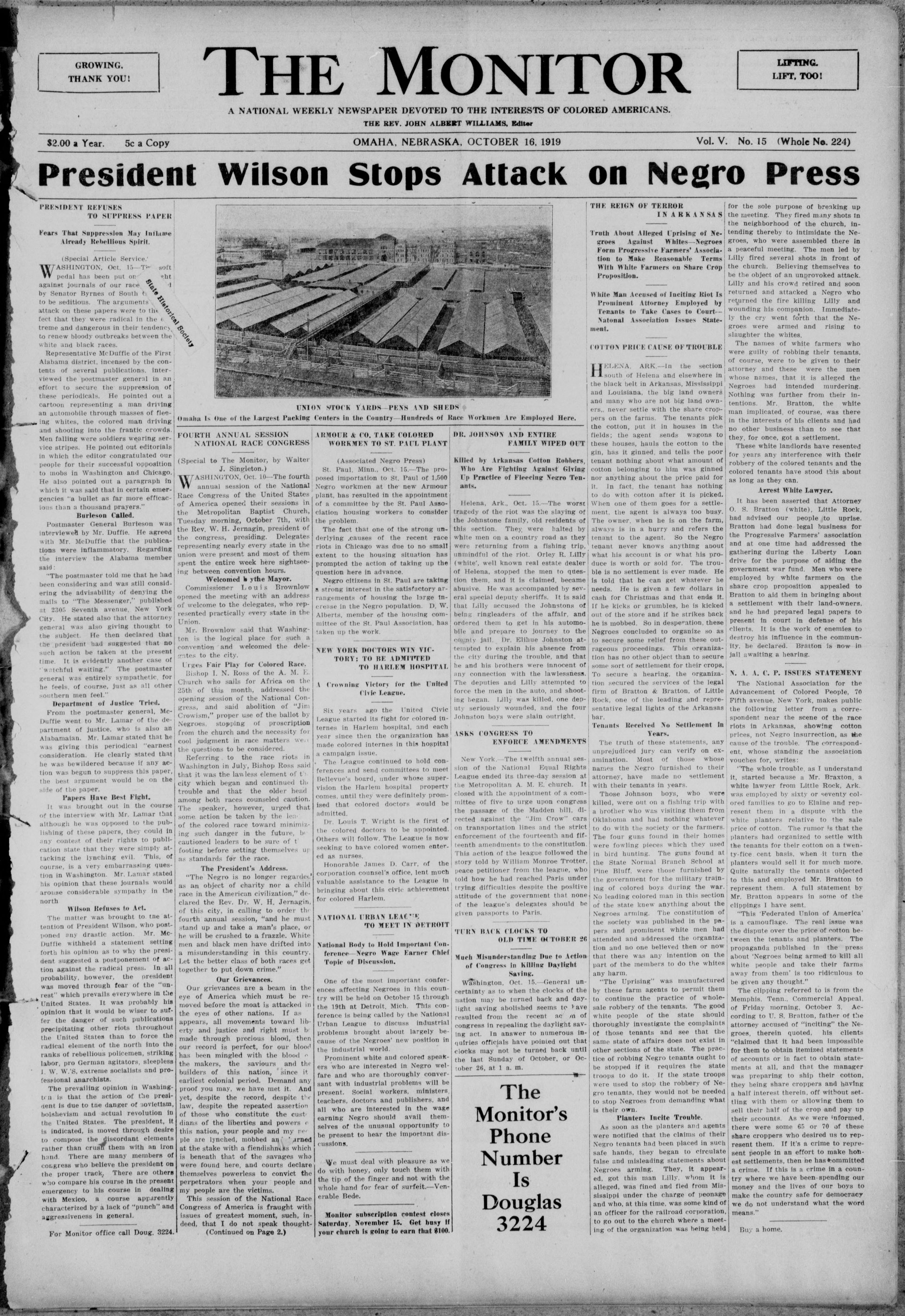
Page text (machine-generated)
President Wilson Stops Attack on Negro Press
GROWING.
THANK YOU!
$2.00 a Year. 5c a Copy
PRESIDENT REFUSES
TO SUPPRESS PAPER
Fears That Suppression May Inflame
Already Rebellious Spirit.
WASHINGTON, Oct. 15—The soft pedal has been put on against journals of our race by Senator Byrnes of South Carolina to be seditious. The arguments attack on these papers were to the fact that they were radical in the extreme and dangerous in their tendency to renew bloody outbreaks between the white and black races. Representative Mc Duffie of the First Alabama district, incensed by the contents of several publications, interviewed the postmaster general in an effort to secure the suppression of these periodicals. He pointed out a cartoon representing a man driving an automobile through masses of fleeing whites, the colored man driving and shooting into the frantic crowds. Men falling were soldiers wearing service stripes. He pointed out editorials in which the editor congratulated our people for their successful opposition to mobs in Washington and Chicago. He also pointed out a paragraph in which it was said that in certain emergencies "a bullet as far more efficacious than a thousand prayers."
Burleson Called.
Postmaster General Burleson was interviewed by Mr. Duffie. He agreed with Mr. McDuffie that the publications were inflammatory. Regarding the interview the Alabama member said:
"The postmaster told me that he had been considering and was still considering the advisability of denying the mails to "The Messenger," published at 2305 Seventh avenue, New York City. He stated also that the attorney general was also giving thought to the subject. He then declared that the president had suggested that no such action be taken at the present time. It is evidently another case of "watchful waiting." The postmaster general was entirely sympathetic, for he feels, of course, just as all other southern men feel."
Department of Justice Tried.
From the postmaster general, McDuffie went to Mr. Lamar of the department of justice, who is also an Alabamian. Mr. Lamar stated that he was giving this periodical "earnest consideration. He clearly stated that he was bewildered because if any action was begun to suppress this paper, the best argument would be on the side of the paper.
Papers Have Best Fight.
It was brought out in the course of the interview with Mr. Lamar that although he was opposed to the publishing of these papers, they could in any contest of their rights to publication state that they were simply attacking the lynching evil. This, of course, is a very embarrassing question in Washington. Mr. Lamar stated his opinion that these journals would arouse considerable sympathy in the north
Wilson Refuses to Act.
The matter was brought to the attention of President Wilson, who postponed any drastic action. Mr. McDuffie withheld a statement setting forth his opinion as to why the president suggested a postponement of action against the radical press. In all probability, however, the president was moved through fear of the "unrest" which prevails everywhere in the United States. It was probably his opinion that it would be wiser to suffer the danger of such publications precipitating other riots throughout the United States than to force the radical element of the north into the ranks of rebellious policemen, striking labor, pro German agitators, sleepless L. W. W.'S, extreme socialists and professional anarchists.
The prevailing opinion in Washington is that the action of the president is due to the danger of sovietism, bolshevism and actual revolution in the United States. The president, it is indicated, is moved through desire to compose the discordant elements rather than crush them with an iron hound. There are many members of congress who believe the president on the proper track. There are others who compare his course in the present emergency to his course in dealing with Mexico, a course apparently characterized by a lack of "punch" and aggressiveness in general.
For Monitor office call Doug. 3224.
THE MONITOR
UNION STOCK YARDS—PENS AND SHEDS
Omaha Is One of the Largest Packing Centers in the Country—Hundreds of Race Workmen Are Employed Here.
FOURTH ANNUAL SESSION
NATIONAL RACE CONGRESS
ARMOUR & CO. TAKE COLORED
WORKMEN TO ST. PAUL PLANT
DR. JOHNSON AND ENTIRE
FAMILY WIPED ON
(Special to The Monitor, by Walter J. Singleton.)
WASHINGTON, Oct. 10—The fourth annual session of the National Race Congress of the United States of America opened their sessions in the Metropolitan Baptist Church, Tuesday morning, October 7th, with the Rev. W. H. Jernagin, president of the congress, presiding. Delegates representing nearly every state in the union were present and most of them spent the entire week here sightseeing between convention hours.
Welcome d hythe Mayor.
Commissioner Louis Brownlow opened the meeting with an address of welcome to the delegates, who represented practically every state in the Union.
Mr. Brownlow said that Washington is the logical place for such a convention and welcomed the delegates to the city.
Urges Fair Play for Colored Race.
Bishop I. N. Ross of the A. M. E. Church who sails for Africa on the 25th of this month, addressed the opening session of the National Congress, and said abolition of "Jim Crowism," proper use of the ballot by Negroes, stopping of proscription from the church and the necessity for cool judgment in race matters were the questions to be considered.
Referring to the race riots in Washington in July, Bishop Ross said that it was the lawless element of the city which began and continued the trouble and that the older head among both races counseled caution. The speaker, however, urged that some action be taken by the leader of the colored race toward minimizing such danger in the future, be cautioned leaders to be sure of the footing before setting themselves up as standards for the race.
The President's Address.
"The Negro is no longer regarded as an object of charity nor a child race in the American civilization," declared the Rev. Dr. W. H. Jernagin, of this city, in calling to order the fourth annual session, "and he must stand up and take a man's place, or he will be crushed to a frazzle. White men and black men have drifted into a misunderstanding in this country. Let the better class of both races get together to put down crime."
Our Grievances.
Our grievances are a beam in the eye of America which must be removed before the moat is attacked in the eyes of other nations. If as appears, all movements toward liberty and justice and right must be made through precious blood, then our record is perfect, for our blood has been mingled with the blood of the makers, the saviours and the builders of this nation, since it earliest colonial period. Demand any proof you may, we have met it. And yet, despite the record, despite the law, despite the repeated assertion of those who constitute the custodians of the liberties and powers of this nation, your people and my people are lynched, mobbed and earned at the stake with a fiendishness which is beneath that of the savages who were found here, and courts declare themselves powerless to convict the perpetrators when your people and my people are the victims.
This session of the National Race Congress of America is fraught with issues of greatest moment, such, indeed, that I do not speak thought- (Continued on Page 2.)
OMAHA, NEBRASKA, OCTOBER 16, 1919
UNION STOCK YARDS—PENS AND SHEDS
ARMOUR & CO. TAKE COLORED
WORKMEN ST. ST. PAUL PLANT
(Associated Negro Press)
St. Paul, Minn., Oct. 15.—The proposed importation to St. Paul of 1,500 Negro workmen at the new Armour plant, has resulted in the appointment of a committee by the St. Paul Association housing workers to consider the problem.
The fact that one of the strong underlying causes of the recent race riots in Chicago was due to no small extent to the housing situation has prompted the action of taking up the question here in advance.
Negro citizens in St. Paul are taking a strong interest in the satisfactory arrangements of housing the large increase in the Negro population. D. W. Alberts, member of the housing committee of the St. Paul Association, has taken up the work.
NEW YORK DOCTORS WIN VICTORY; TO BE ADMITTED TO HARLEM HOSPITAL
A Crowning Victory for the United Clyde League.
Six years ago the United Civic League started its fight for colored internes in Harlem hospital, and each year since then the organization has made colored internes in this hospital a campaign issue.
The League continued to hold conferences and send committees to meet Bellevue's board, under whose supervision the Harlem hospital property comes, until they were definitely promised that colored doctors would be admitted.
Dr. Louis T. Wright is the first of the colored doctors to be appointed. Others will follow. The League is now seeking to have colored women entered as nurses.
Honorable James D. Carr, of the corporation counsel's office, lent much valuable assistance to the League in bringing about this civic achievement for colored Harlem.
NATIONAL URBAN LEAGUE
TO MEET IN DETROIT
National Body to Hold Important Conference—Negro Wage Earner Chief Topic of Discussion.
One of the most important conferences affecting Negroes in this country will be held on October 15 through the 19th at Detroit, Mich. This conference is being called by the National Urban League to discuss industrial problems brought about largely because of the Negroes' new position in the industrial world.
Prominent white and colored speakers who are interested in Negro welfare and who are thoroughly conversant with industrial problems will be present. Social workers, ministers, teachers, doctors and publishers, and all who are interested in the wage earning Negro should avail themselves of the unusual opportunity to be present to hear the important discussions.
We must deal with pleasure as we do with honey, only touch them with the tip of the finger and not with the whole hand for fear of surfeit.—Venerable Bede.
Monitor subscription contest closes Saturday, November 15. Get busy if your church is going to earn that $100.
DR. JOHNSON AND ENTIRE FAMILY WIPED OUT
Killed by Arkansas Cotton Robbers Who Are Fighting Against Giving Up Practice of Fleecing Negro Tenants.
Helena, Ark., Oct. 15.—The worst tragedy of the riot was the slaying of the Johnstone family, old residents of this section. They were halted by white men on a country road as they were returning from a fishing trip, unmindful of the riot. Orley R. Lilly (white', well known real estate dealer of Helena, stopped the men to question them, and it is claimed, became abusive. He was accompanied by several special deputy sheriffs. It is said that Lilly accused the Johnstons of being ringleaders of the affair, and ordered them to get in his automobile and prepare to journey to the county jail. Dr. Elihue Johnston attempted to explain his absence from the city during the trouble, and that he and his brothers were innocent of any connection with the lawlessness. The deputies and Lilly attempted to force the men in the auto, and shooting began. Lilly was killed, one deputy seriously wounded, and the four Johnston boys were slain outright.
ASKS CONGRESS TO
ENFORCE AMENDMENTS
New York.—The twelfth annual session of the National Equal Rights League ended its three-day session at the Metropolitan A. M. E. church. It closed with the appointment of a committee of five to urge upon congress the passage of the Madden bill, directed against the "Jim Crow" cars on transportation lines and the strict enforcement of the fourteenth and fifteenth amendments to the constitution. This action of the league followed the story told by William Monroe Trotter, peace petitioner from the league, who told how he had reached Paris under trying difficulties despite the positive attitude of the government that none of the league's delegates should be given passports to Paris.
TURN BACK CLOCKS TO
OLD TIME OCTOBER 26
Much Misunderstanding Due to Action of Congress in Killing Daylight Saying.
Washington, Oct. 15. General uncertainty as to when the clocks of the nation may be turned back and daylight saving abolished seems to have resulted from the recent action of congress in repealing the daylight saving act. In answer to numerous inquiries officials have pointed out that clocks may not be turned back until the last Sunday of October, or October 26, at 1 a.m.
The Monitor's Phone Number Is Douglas 3224
Vol. V. No. 15 (Whole No. 224)
THE REIGN OF TERROR
IN ARKANSAS
Truth About Alleged Uprising of Negroes Against Whites—Negroes Form Progressive Farmers' Association to Make Reasonable Terms With White Farmers on Share Crop Proposition.
White Man Accused of Inciting Riot Is Prominent Attorney Employed by Tenants to Take Cases to Court—National Association Issues Statement.
COTTON PRICE CAUSE OF TROUBLE
HELENA. ARK—In the section south of Helena and elsewhere in the black belt in Arkansas, Mississippi and Louisiana, the big land owners and many who are not big land owners, never settle with the share croppers on the farms. The tenants pick the cotton, put it in houses in the fields; the agent sends wagons to these houses, hauls the cotton to the gin, has it ginned, and tells the poor tenant nothing about what amount of cotton belonging to him was ginned nor anything about the price paid for it. In fact, the tenant has nothing to do with cotton after it is picked. When one of them goes for a settlement, the agent is always too busy. The owner, when he is on the farm, always is in a hurry and refers the tenant to the agent. So the Negro tenant never knows anything about what his account is or what his produce is worth or sold for. The trouble is no settlement is ever made. He is told that he can get whatever he needs. He is given a few dollars in cash for Christmas and that ends it. If he kicks or grumbles, he is kicked out of the store and if he strikes back he is mobbed. So in desperation, these Negroes concluded to organize so as to secure some relief from these outrageous proceedings. This organization has no other object than to secure some sort of settlement for their crops. To secure a hearing, the organization secured the services of the legal firm of Bratton & Bratton, of Little Rock, one of the leading and representative legal lights of the Arkansas bar.
Tenants Received No Settlement In Years
The truth of these statements, any unprejudiced jury can verify on examination. Most of those whose names the Negro furnished to their attorney, have made no settlement with their tenants in years.
Those Johnson boys, who were killed, were out on a fishing trip with a brother who was visiting them from Oklahoma and had nothing whatever to do with the society or the farmers.
The four guns found in their homes were fowling pieces which they used in bird hunting. The guns found at the State Normal Branch School at Pine Bluff, were those furnished by the government for the military training of colored boys during the war. No leading colored man in this section of the state knew anything about the Negroes arming. The constitution of the society was published in the papers and prominent white men had attended and addressed the organization and no one believed then or now that there was any intention on the part of the members to do the whites any harm.
"The Uprising" was manufactured by these farm agents to permit them to continue the practice of wholesale robbery of the tenants. The good white people of the state should thoroughly investigate the complaints of those tenants and see that the same state of affairs does not exist in other sections of the state. The practice of robbing Negro tenants ought to be stopped if it requires the state troops to do it. If the state troops were used to stop the robbery of Negro tenants, they would not be needed to stop Negroes from demanding what is their own.
Planters Incite Trouble.
As soon as the planters and agents were notified that the claims of their Negro tenants had been placed in such safe hands, they began to circulate false and misleading statements about Negroes arming. They, it appeared, got this man Lilly, whom it is alleged, was fined and fled from Mississippi under the charge of peonage and who, at this time, was some kind of an officer for the railroad corporation, to go out to the church where a meeting of the organization was being held
LIFTING.
LIFT, TOO!
for the sole purpose of breaking up the meeting. They fired many shots in the neighborhood of the church, intending thereby to intimidate the Negroes, who were assembled there in a peaceful meeting. The men led by Lilly fired several shots in front of the church. Believing themselves to be the object of an unprovoked attack. Lilly and his crowd retired and soon returned and attacked a Negro who returned the fire killing Lilly and wounding his companion. Immediately the cry went forth that the Negroes were armed and rising to slaughter the whites.
The names of white farmers who were guilty of robbing their tenants, of course, were to be given to their attorney and these were the men whose names, that it is alleged the Negroes had intended murdering. Nothing was further from their intentions. Mr. Bratton, the white man implicated, of course, was there in the interests of his clients and had no other business than to see that they, for once, got a settlement.
These white landlords have resented for years any interference with their robbery of the colored tenants and the colored tenants have stood this about as long as they can.
Arrest White Lawyer.
It has been asserted that Attorney O. S. Bratton (white), Little Rock, had advised our people to uprise. Bratton had done legal business for the Progressive Farmers' association and at one time had addressed the gathering during the Liberty Loan drive for the purpose of aiding the government war fund. Men who were employed by white farmers on the share crop proposition appealed to Bratton to aid them in bringing about a settlement with their land-owners, and he had prepared legal papers to present in court in defense of his clients. It is the work of enemies to destroy his influence in the community, he declared. Bratton is now in jail awaiting a hearing.
N. A. A. C. P. ISSUES STATEMENT
The National Association for the Advancement of Colored People, 70 Fifth avenue, New York, makes public the following letter from a correspondent near the scene of the race riots in Arkansas, showing cotton prices, not Negro insurrection, as the cause of the trouble. The correspondent, whose standing the association vouches for, writes: "The whole trouble, as I understand it, started because a Mr. Braxton, a white lawyer from Little Rock, Ark. was employed by sixty or seventy colored families to go to Elaine and represent them in a dispute with the white planters relative to the sale price of cotton. The rumor is that the planters had organized to settle with the tenants for their cotton on a twenty-fice cent basis, when it turn the planters would sell it for much more. Quite naturally the tenants objected to this and employed Mr. Bratton to represent them. A full statement by Mr. Bratton appears in some of the clippings I have sent.
"This 'Federated Union of America' is a camouflage. The real issue was the dispute over the price of cotton between the tenants and planters. The propaganda published in the press about 'Negroes being armed to kill all white people and take their farms away from them' is too ridiculous to be given any thought."
The clipping referred to is from the Memphis, Tenn., Commercial Appeal, of Friday morning, October 3. According to U. S. Bratton, father of the attorney accused of "inciting" the Negroes, therein quoted, his clients "claimed that it had been impossible for them to obtain itemized statements of accounts or in fact to obtain statements at all, and that the manager was preparing to ship their cotton, they being share croppers and having a half interest therein, off without settling with them or allowing them to sell their half of the crop and pay up their accounts. As we were informed, there were some 65 or 70 of these share croppers who desired us to represent them. If it's a crime to represent people in an effort to make honest settlements, then he has committed a crime. If this is a crime in a country where we have been spending our money and the lives of our boys to make the country safe for democracy we do not understand what the word means."
Buy a home.
X
LEADING EDITORIALS OF THE DAY
Perhaps Italy could be persuaded to be mandatory for Omaha, suggested a United States senator after reading of the riots in the Nebraska city, in the course of which citizens set fire to the jail and court house, attempted to hang the mayor when he protested in the name of law and order, and finally lynched a Negro prisoner, afterward dragging his body through the streets at the end of a rope, and an eastern cartoonist depicts Lenine reading the same news item with a grin of approval and the comment, "They're learning." Omaha's orgy of mob-madness, as papers of all sections join with the Milwaukee Journal in reminding us, is only "a horrible symptom of a general spirit of lawlessness." What makes the action of the Omaha mob all the more sinister, remarks the Indianapolis News, is that "it might have happened anywhere else in this country;" and many editors recall the recent outbreaks of race-rioting in East St. Louis, Knoxville, Washington and Chicago. Such crimes against civilization, says the Boston Transcript, "puts every American on the defensive before the world—the world which Americans went forth, only a few months ago, to make safe for democracy." "Where will Hades break loose next?" asks the Washington Star, which sees the mob spirit spreading and lawlessness putting on an ever bolder front. "Omaha, Boston, Washington, Chicago with bloody fingers a warning to the American people," exclaims the Chicago Tribune.
In Omaha, on the day after the lynch-
ing, the World-Herald said editorially;
"We have felt, however briefly, the fetid breath of anarchy on our cheeks. We have experienced the cold chill of fear which it arouses. We have seen as in a nightmare its awful possibility. We have learned how frail is the barrier which divides civilization from the primal jungle, and we have been given to see clearly what the barrier is. It is the law. It is the might of the law wisely and fearlessly administered. It is the respect for and obedience to the law on the part of the members of society. When these fail us, all things fail. When these are lost, all will be lost. Should the day ever come when the rule that was in Omaha Sunday night became the dominant rule, the grasses of the jungle would overspread our civilization, its wild denizens human and brute, would make their foul feast on the ruins, and the God who rules over us would turn his face in horror from a world given over to bestiality. May the lesson of Sunday night sink deep!"
The feature of the Omaha riot that somewhat differentiates it from previous crimes of the same nature, while emphasizing the sinister spirit of anarchy that inspires them all, is the murderous assault upon Mayor E. P. Smith when he attempted to address the mob. Omaha dispatches report a recent epidemic of crimes committed by Negroes in that city, culminating in an assault upon a nineteen-year-old white girl. On Sunday night, September 28, the correspondents tell us, a mob of five thousand stormed the court house where the Negro charged with this crime was imprisoned and demanded that the authorities hand him over to them. When this demand was refused they set fire to the court house with incendiary bombs, imperiling the lives of more than a hundred prisoners and officials, and turned upon the building a fusillade of shots. When the mayor appeared upon the court house steps and began to address the mob as "fellow citizens" the leaders interrupted him with shouts of "give us that nigger." When he replied, "I can't do that, boys." he was seized by the men nearest him and dragged to a point several blocks away. "Lynch him," shouted some one in the crowd, and in a moment a rope was round his neck and he was strung up to a trolley wire. Somebody cut him down, but the mob readjusted the rope and pulled him up again. When a group of policemen rescued him he was bleeding at the nose and mouth, but still conscious. At the hospital where he was taken his condition was found to be critical, but he ultimately rallied. In the meanwhile, the mob wreaked its fury on the Negro, Brown, who had been handed over to it by his fellow prisoners when they faced the alternative of being burned alive. His body was riddled with bullets, partially burned and dragged through the streets behind an automobile. Afterward rioting continued, with threats against the Negro population, until federal troops under Gen. Leonard Wood took charge of the situation.
Behind all these outbreaks, avers the Rev. John Albert Williams in the Omaha Monitor, a Negro paper, is 'the unexplainable and regrettable race prejudice which unfortunately looms large in American life and is latent or dormant in the most liberal and broad-minded communities." The lynching in Omaha, he argues, "is directly traceable to the fanning of race prejudice by sensational reports in two of the daily newspapers of this city of alleged crimes by Negroes against white women."
Whatever the provocation may have been, declares the Omaha News, "it does not warrant any band of men taking the law into their own hands unless they are prepared to face the judgment of their fellow citizens for such an act. It is absolutely necessary that the men who participated in the riot should be brought to account to find justification for what they did." "The time has come to the public authorities to deal with mob crimes, mercilessly and relentlessly," exclaims the Pittsburg Post, and dispatches indicate that this opinion is held also in Omaha, where the authorities have taken immediate steps to identify those who took part in the lynching of Brown and the attack on Mayor Smith, and to prosecute them. This vigorous action of the local authorities, says the New York Globe, is to no small degree due to pressure from the war department, which, having been called upon to restore order, "is insisting that the job be done thoroughly and permanently." Further evidence of federal interest in this problem is supplied by a resolution introduced by Senator Curtis of Kansas, calling for a senatorial investigation into recent race riots and lynchings.—The Literary Digest.
As to Social Equality—From the Negro Man's Viewpoint.
To the Kansas City Star: If I so desired I could start a race riot. It would be necessary only to select the psychological moment to make skillful use of the term "social equality." If the wisest and best loved white man in the United States were to announce himself as in favor of social equality he would at once lose caste and there are places in this country where his life would be in danger. If a Negro were to make verbal insistence on social equality anywhere south of the Mason and Dixon line he would be lynched.
The influence of this term has sent representatives and senators to Washington, has elected governors and has inspired and promulgated class legislation of the most discriminatory type. It is the gaunt specter which haunts the consciousness of the white people of America—warping their judgment, blinding their vision, nullifying their religion, polluting their ethics, dwarfing their sense of justice, stultifying their ideals and shutting out from their tragic gaze the ligt of love, harmony and truth.
What is social equality?
One would think that a term having so much power in our social life easily would be defined. But not so! When you try to define social equality you find that it escapes the utmost mental concentration—it is as elusive as the evanescent cloud shapes that play over the landscape on a summer day. It is not the same thing in any two places or in any two minds. It is the vaguest sort of an idea; it has no clear force; it is wholly lacking definiteness, precision and homogeneity.
Strange to say, such definition as you are able to extract from any person is wholly inconsistent with the circumstances to which the term is applied. I have asked a great many white persons to define social equality. A summing up of those definitions would be about as follows:
"Social equality is that status in which Negroes would be received on terms of intimacy and friendship in white homes, and permitted to eat at the table in those homes with white persons."
Now, as has been said, while that is the definition usually given, it is the definition which never is applied. It is plain to be seen that under that definition the white people of the United States surely have no need to fear. Negro "domination" through social equality. There is no way possible for Negroes to force their way into white homes on terms of intimacy and friendship, and take seats at the tables of white persons. There is no case on record where any Negro ever attempted to do such a thing. No Negro has ever contemplated that. Negroes are well satisfied to eat in their own homes; and I do not believe there is a Negro on earth who would desire in the least to eat with white persons in their homes. Does any white person seriously believe that the message of Negroes forcing themselves into his home and eating at this table is so great that "Jim Crow" laws, economic restrictions, violent race hatreds, class legislation and frequent bitter denunciation of Negroes as desiring social equality are necessary? No one in his right mind and capable of the slightest analysis by any possibility could believe such a thing!
The practical application of the term social equality never has anything to do with the above definition. If I were to apply for a job as conductor on a local street car I would be refused and the ultimate grounds of the refusal would be social equality. In fact there are some fifty-siv occupations in the United States a white man may pursue, which I may not pursue, however competent I may be, and in no way involving entrance to a white man's home and eating at his table. Yet the ground of denial always is the same, social equality. If I desire to move out of the slum districts—out
THE MONITOR
where the streets are well kept and the surroundings clean ad wholesome—if I do that, my home is dynamited! Why? Social equality! The fact that I do not desire to affiliate with my white neighbors in any way, or even speak to them, does not modify the verdict. The assumption is that I am trying to force social equality.
In some places it is social equality to sit beside a white person on the street or railway car—and in Kansas City is social equality to sit in certain parts of the theater. In some places it is social equality for a Negro to enter the public library, while in Kansas City it would be social equality to enter certain churches. Yet not any of those things pertain in any way to entering a white man's home and eating at his table.
Are the white people dishonest in the definition they usually give of social equality? Or have they merely fallen into the habit of using a term whose meaning and application they have not taken trouble to analyze and define? Certain it is that the term as applied has no clear and stable definition. It is made to do duty on any occasion where a Negro seeks to rise above that condition or status of economic and political serfdom, which the nonethical and undisciplined consciousness of the American people have sensed acutely as being "his place." The term is indissolubly interwoven with the instinctive emotions, and by having no foundation in either reason or ethics, does not yield itself to logical definition.
WILLIAM E. GRIFFIN.
4325 Pennsylvania Avenue.
"Race Is Greater Than Law"
The Senators from Nebraska not having risen to defend lynch law, Senator John Sharp Williams, of Mississippi, whose knowledge of his own state should make him an expert on the subject, appeared as advocate for the Omaha mob. We quote a striking bit from his remarks:
"Race is greater than law now and then, and protection of women transcends all law, human and divine."
This is a variation of the excuse given by the lawless everywhere. The bolshevist pleads that his might is greater than the law; and he appears in a better light than Mr. Williams because bolshevism first goes through the process of savagely demolishing the law.
The exponent of sabotage cries out that his passion to subvert industry is greater than the law and he proceeds along the lines laid down in William Z. Foster's red book. He paraphrases the senior Senator from Mississippi by remarking that syndicalism transcends all law, whether human or divine. Perhaps half the criminals who kill or steal believe that their particular causes are greater than the law; but the law itself, representing the majority of the people, sends the criminal to prison. There he has an opportunity to explain his social views to his fellow prisoners. But no reporter for the Congressional Record is at hand to note down his statement.
A foreigner unfamiliar with his country might take it, from Senator Williams' remark about the protection of women, that our laws were designed to prevent them from being protected. The fact is, of course, that the state of Nebraska has been free to impose the death penalty for the unpardonable crime. Its people, however, set the maximum punishment at twenty years. In Mr. Williams' own state death may be the penalty, yet there have been cases where the Mississippi criminal, after having been legally condemned to death, has been taken by the mob and lynched.
It is not the initial crime that is at issue, particularly when the people may inflict death lawfully if they vote to do so. It is the crime of the mob; and the mob kills, not to avenge a wrong but to vent its blood lust. The worst individual in Omaha on Sunday was the Negro assailant, Brown. The best individual was Smith, the mayor,
HOT CHILI!
Yum, Yum
HOT COFFEE
Delicious
Gregory's
Kandy Kitchen
and
Luncheonette
1508 North 24th Street
Webster 267
Home Made Candies.
Ice Cream Sodas
who tried to fulfill the letter and spirit of his oath. But the mob applied its blind and cowardly rage alike to both of these men!
"Race is greater than law now and then." It is curious that these words should come from a supporter of the Wilson covenant. Suppose that the league should become a fact, and that some day one of its members, say a great Oriental nation, should rise in new found strength, blazing with a racial pride that had smouldered for centuries, and say to the council: 'International law is all very well at times, but in the words of John Sharp Williams, 'race is greater than law now and then!'" On that day, if Mr. Williams were alive, what could he say? - New York Sun.
PROMINENT EDUCATOR DIES
Oberlin.—With the passing of William Mitchell, age 82, who died recently, Oberlin has lost one of its first citizens. For fifty years he had been actively engaged in business here. His home, only a few blocks from the college campus, was the temporary residence of many students who came here from distant cities. The funeral, held from the First Presbyterian church, was one of the largest ever seen in this city. Mrs. Mitchell had ben ill for over a year suffering from injuries sustained when he fell from his bicycle. He had been unable to walk since the accident. He is survived by a wife, Mrs. Edith Mitchell, two sons and two daughters.
FOURTH ANNUAL SESSION
NATIONAL RACE CONGRESS
lessly when I say they are of moment as to well nigh disturb the confidence with which this great nation of ours has marched forward in the progress of civilization and the triumph of democracy. Even as I utter these words, my mind runs back to a few days since, when mob violence in the proud city of Omaha, so far despised the law and its chief executive and its temple of administration that it despoiled and burned and attempted to destroy them.
It is to the correction and prevention of such conditions as those that this congress directs its deliberations and its resources.
President Jernagin then gave the origin and aims of the National Rac Congress: How the congress is governed; the policies; stating barbarities must cease; we must "carry" on the work of our heroes; a statement of his trip abroad under the headings: My Voyage; Landing on the Continent; My Activities in France; Impressions; My Return and Recommendations.
The Value of Our Press.
I especially want to commend to you the splendid services of the Negro press of this country, which so clearly, fearlessly and persistently gives to us the truth which but for it would slumber in keeping or be hidden out of sight in the hate of our enemies. In the development of this organ and the arm of defense, God has surely raised up a set of men who are worthy followers of the first champion of our liberties, men who spoke for us when we had no voice of our own. The Negro press deserves your greater continued support. As you regard your liberty, preserve the spirit and freedom of the press. A strong memorial was prepared and presented to the congress of the United States which will appear later.
Executive Secretary's Report.
The report of Executive Secretary John R. Hawkins was complete in every detail, showing the amount of funds collected from every fraternal association in this city and the amount, also money received from other sources. Secretary Hawkins deserves high praise for his splendid report to the congress which included a number of recommendations all of which were adopted by the congress. Among those who delivered ad-
The greatest gathering of men and women from the states in the history of Washington came to a close after a most harmonious session of four days. Every man and woman representing their constituents had his day in court, and all left the city believing they had accomplished a great good for humanity.
The following officers were elected: Rev. W. H. Jernagin, president; Washington, D. C.; Bishop I. N. Ross, vice-president, Washington, D. C.; Rev. C. H. Stepteau, recording secretary, Baltimore, Md.; Rev. W. A. Taylor, corresponding secretary, Washington, D. C.; J. R. Hawkins, executive secretary, Bureau of Information and Defense Fund. Rev. W. H. Dean, treasurer, Washington, D. C.; Rev. E. A. P. Chek, chaplain, Newark, N. J.; Rev. J. G. Austin, national organizer, Pittsburgh, Pa.; Mr. J. J. Nickerson, sergeant-at-arms, Hinton, W. Va.; Mr. William Harrison, national lecturer, Chicago, Ill.; Rev. J. Milton Waldron, secretary Haitian committee; musical director, J. D. Bushnell of Pittsburgh, Pa.
arch Cafe
The Monarch Ca
The Monarch Cafe
IS NOW OPEN TO THE PUBLIC
YOUR PATRONAGE IS SOLICITED
See us and arrange your special parties of an
Well cooked, wholesome food. We make a specialt
made pies.
SPECIAL SUNDAY DINNERS
Chicken Dinner, 50c. Roast Pork and Sweet Potato
Roast Beef Dinner, 40c. Baby Catfish,
With the above dinners you get—
Chicken Soup. Creamed Potatoes,
June Peas Combination. Salad and Co
Can you beat it? I should say not!
CARNER & TRIMBLE, Pro
107 South 14th Street. Phone T
MAGIC HAIR GROW
AND STRAIGHTENING
special parties of any number.
We make a specialty of home
DAY DINNERS
Pork and Sweet Potatoes, 50c.
Baby Catfish, 40c.
et—
Creamed Potatoes.
Salad and Coffee.
I should say not!
RIMBLE, Props.
Phone Tyler 4591-J
R GROWER
HTENING OIL
See us and arrange your special parties of any number. Well cooked, wholesome food. We make a specialty of homemade pies.
MAGIC HAIR GROWER AND STRAIGHTENING OIL
S
AND
J
The most wonderful hair preparation on the market. When we say Magic we do not exaggerate, as you can see great reultat the first few treatments. We guarantee Magic Hair Grower to stop the hair at once from falling out and breaking off; making hair, stubborn hair soft and silky. Magic Hair Grower grows hair on bald places of the head. If you use these preparations once you will never be without them. Magic Hair Grower and Straightening Oil are manufactured by Meidames South and Johnson. We also do scalp treating. Magic Hair Grower, 50c. Straightening Oil, 35c. Allorders promptly filled; send 10c for postage. Money must accom
The most wonderful hair preparation on the market. When we say Magic we do not exaggerate, as you can see great results in the first few treatments. We guarantee Magic Hair Grower to stop the hair at once from falling out and breaking off making harsh, stubborn hair soft and silky. Magic Hair Grower grows hair on bald places of the head. If you use these preparations once you will never be without them. Magic Hair Grower and Straightening Oil are manufactured by Mesdames South and Johnson. We also do scalp treating.
Agents wanted—Write for particulars.
We carry everything in the latest fashion-
able hair goods at the lowest prices.
We make switches, puffs, transformation
curls, coronet braids, and combions
made to order, matching all shades a
specialty. Send samples of hair with
all orders.
2416 Blondo St., Omaha, Neb.
Telephone Webster 880
Investment Co.
Washington Investment Co.
CALIFORNIA STREETS.
Webster, 5966; Red, 3203.
The W. H. & R. Investment
Successor to the Douglas Washington Investment
OFFICE, 15TH AND CALIFORNIA STREETS
Phones: Tyler 897; Webster, 5966; Red, 3203
```markdown
```
The W. H. & R. Investment Co.
Successor to the Douglas Washington Investment Co.
OFFICE, 15TH AND CALIFORNIA STREETS.
Phones: Tyler 897; Webster, 5966; Red, 3203.
BOARD OF DIRECTORS
H. Hamler, Chairman.
D. G. Russell.
N. W. Ware.
---
Mr. Advertiser:
The Monitor is read in tically every Colored fa in Omaha, Council Bluffs Lincoln.
It has also a wide circu in Nebraska and other s
Do You Want This Trade?
or is read in prac- Colored family Council Bluffs and a wide circulation and other states. is Trade?
The Monitor is read in practically every Colored family in Omaha, Council Bluffs and Lincoln. It has also a wide circulation in Nebraska and other states. Do You Want This Trade?
dresses were Mrs. Mary Church Terrell, who gave a very interesting story of her trip with a party of twelve to the International Congress of Women held in Switzerland. The Rev. H. N. Jetter, R. I., on "Migration of the Colored People and Our Duty to It." The Rev. W. F. Grahem, Philadelphia, Pa., on "Political Training," and the "Present Need of the American Negro and How We Can Secure It." Illustrated lecture by Mr. Edward L. Snyder, Philadelphia, Pa., "Our Soldiers in France." Lawyer William Harrison, Chicago; Mr. John Mitchell, Jr., of Richmond, Va., Mr. John W. Lewis of Washington, D. C.
The Pittsburgh delegation was the largest in attendance from any city or state among them being: The Rev. P. A. Scott, Rev. O. S. Sims, Rev. J. C. Austin, Rev. J. H. Burks, Rev. J. D. Bushell, the great chorister who led the singing; Mr S. A. Davenport, P. J. Clyde Randall, Esq., attorney at law, and Mr. Robert L. Vann, editor The Pittsburgh Courier.
MME. JOHNSON AND SOUTH
```markdown
```
D. G. Russell, President.
Anderson Hamler, Treasurer.
N. W. Ware, Sec. and Gen. Mgr.
```markdown
```
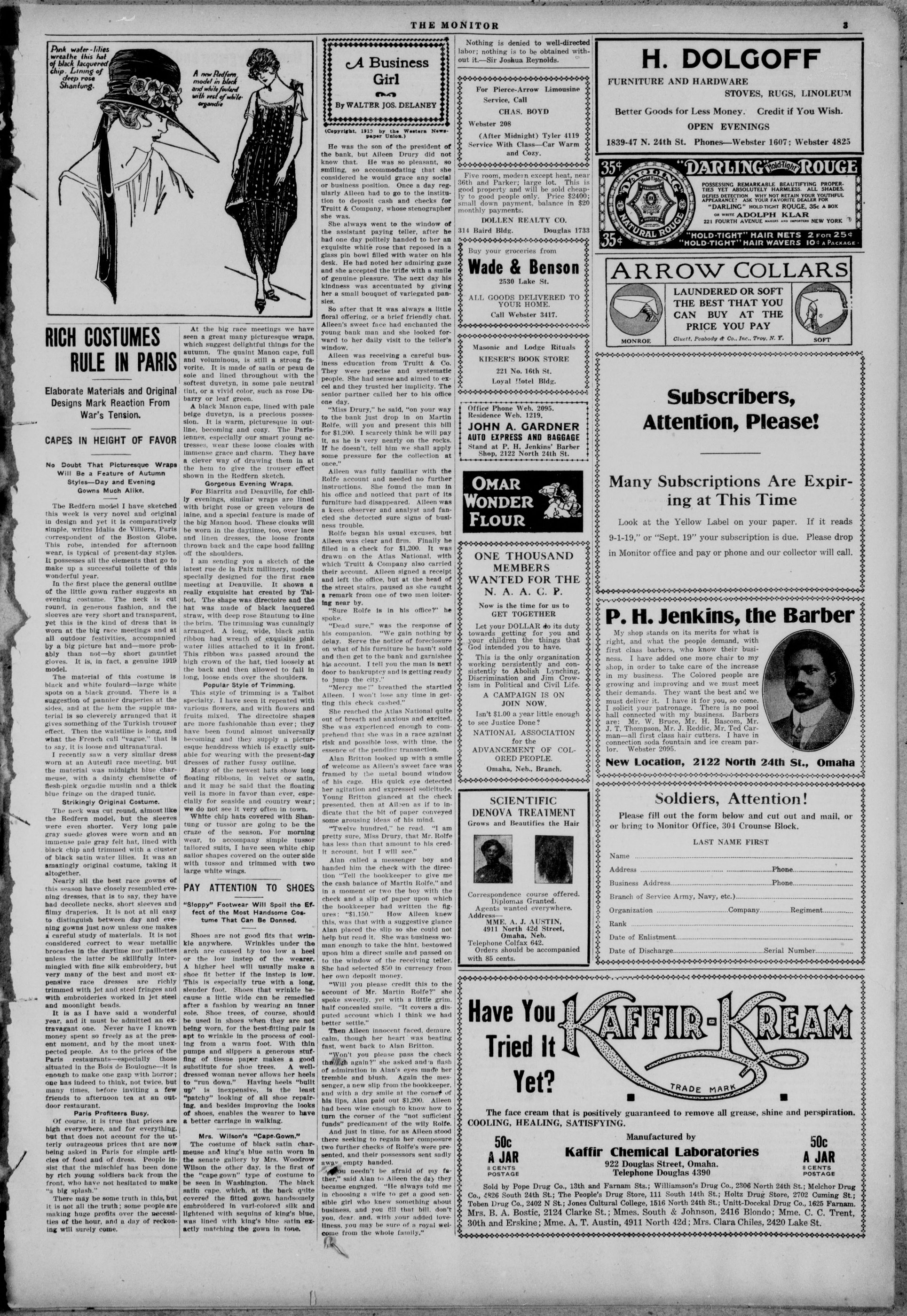
Pink water-lilies wreathe this hat of black lacquered chip. Lining of deep rose Shantung.
A new Redfern model in black and white foward with vest of white organdie
RICH COSTUMES RULE IN PARIS
Elaborate Materials and Original Designs Mark Reaction From War's Tension.
CAPES IN HEIGHT OF FAVOR
No Doubt That Picturesque Wraps
Will Be a Feature of Autumn
Styles—Day and Evening
Gowns Much Alike.
The Redfern model I have sketched this week is very novel and original in design and yet it is comparatively simple, writes Idalia de Villiers, Paris correspondent of the Boston Globe. This robe, intended for afternoon wear, is typical of present-day styles. It possesses all the elements that go to make up a successful toilette of this wonderful year.
In the first place the general outline of the little gown rather suggests an evening costume. The neck is cut round, in generous fashion, and the sleeves are very short and transparent, yet this is the kind of dress that is worn at the big race meetings and at all outdoor festivities, accompanied by a big picture hat and—more probably than not—by short gauntlet gloves. It is, in fact, a genuine 1919 model.
The material of this costume is black and white foulard—large white spots on a black ground. There is a suggestion of pannier draperies at the sides, and at the hem the supple material is so cleverly arranged that it gives something of the Turkish trouser effect. Then the waistline is long, and what the French call "vague," that is to say, it is loose and ultramatural.
I recently saw a very similar dress worn at an Auteuil race meeting, but the material was midnight blue charmeuse, with a dainty chemisette of flesh-pink orgadie muslin and a thick blue fringe on the draped tunic.
Strikingly Original Costume.
The neck was cut round, almost like the Redfern model, but the sleeves were even shorter. Very long pale gray suede gloves were worn and an immense pale gray felt hat, lined with black chip and trimmed with a cluster of black satin water illies. It was an amazingly original costume, taking it altogether.
Nearly all the best race gowns of this season have closely resembled evening dresses, that is to say, they have had decollete necks, short sleeves and filmy draperies. It is not at all easy to distinguish between day and evening gowns just now unless one makes a careful study of materials. It is not considered correct to wear metallic brocades in the daytime nor paillettes unless the latter be skillfully intermingled with fine silk embroidery, but very many of the best and most expensive race dresses are richly trimmed with jet and steel fringes and with embroideries worked in jet steel and moonlight beads.
It is as I have said a wonderful year, and it must be admitted an extravagant one. Never have I known money spent so freely as at the present moment, and by the most unexpected people. As to the prices of the Paris restaurants—especially those situated in the Bols de Boulogne—it is enough to make one gasp with horror; one has indeed to think, not twice, but many times, before inviting a few friends to afternoon tea at an outdoor restaurant.
Paris Profiteers Busy.
Of course, it is true that prices are high everywhere, and for everything, but that does not account for the utterly outrageous prices that are now being asked in Paris for simple articles of food and of dress. People insist that the mischief has been done by rich young soldiers back from the front, who have not hesitated to make "a big splash."
There may be some truth in this, but it is not all the truth; some people are making huge profits over the necessities of the hour, and a day of reckoning will surely come.
At the big race meetings we have seen a great many picturesque wraps, which suggest delightful things for the autumn. The quaint Manon cape, full and voluminous, is still a strong favorite. It is made of satin or peau de soie and lined throughout with the softest duvetyn, in some pale neutral tint, or a vivid color, such as rose Dubarry or leaf green.
A black Manon cape, lined with pale beige duvetyn, is a precious possession. It is warm, picturesque in outline, becoming and cozy. The Parisiennes, especially our smart young actresses, wear these loose cloaks with immense grace and charm. They have a clever way of drawing them in at the hem to give the trouser effect shown in the Redfern sketch.
Gorgeous Evening Wraps.
For Blairritz and Deauville, for chilly evenings, similar wraps are lined with bright rose or green velours de laine, and a special feature is made of the big Manon hood. These cloaks will be worn in the daytime, too, over lace and linen dresses, the loose fronts thrown back and the cape hood falling off the shoulders.
I am sending you a sketch of the latest rue de la Palix millinery, models specially designed for the first race meeting at Deauville. It shows a really exquisite hat created by Talbot. The shape was directoire and the hat was made of black lacquered straw, with deep rose Stuntung to line the brim. The trimming was cunningly arranged. A long, wide, black satin ribbon had wreath of exquisite pink water lilies attached to it in front. This ribbon was passed around the high crown of the hat, tied loosely at the back and then allowed to fall in long, loose ends over the shoulders.
Popular style of trimming. This style of trimming is a Talbot specialty. I have seen it repeated with various flowers, and with flowers and fruits mixed. The directoire shapes are more fashionable than ever; they have been found almost universally becoming and they supply a picturesque headdress which is exactly suitable for wearing with the present-day dresses of rather fussy outline. Many of the newest hats show long floating ribbons, in velvet or satin, and it may be said that the floating veil is more in favor than ever, especially for seaside and country wear; we do not see it very often in town.
White chip hats covered with Shantung or tussor are going to be the craze of the season. For morning wear, to accompany simple tussor tailored suits, I have seen white chip sailor shapes covered on the outer side with tussor and trimmed with two large white wings.
PAY ATTENTION TO SHOES
"Sloppy" Footwear Will Spoil the Effect of the Most Handsome Costume That Can Be Donned.
Shoes are not good fits that wrinkle anywhere. Wrinkles under the arch are caused by too low a heel or the low instep of the wearer. A higher heel will usually make a shoe fit better if the instep is low. This is especially true with a long, slender foot. Shoes that wrinkle because a little wide can be remedied after a fashion by wearing an inner sole. Shoe trees, of course, should be used in shoes when they are not being worn, for the best-fitting pair is apt to wrinkle in the process of cooling from a warm foot. With thin pumps and slippers a generous stuffing of tissue paper makes a good substitute for shoe trees. A well-dressed woman never allows her heels to "run down." Having heels "built up" is inexpensive, is the least "patchy" looking of all shoe repairing, and besides improving the looks of shoes, enables the wearer to have a better carriage in walking.
Mrs. Wilson's "Cape-Gown."
The costume of black satin charmeuse and king's blue satin worn in the senate gallery by Mrs. Woodrow Wilson the other day, is the first of the "cape gown" type of costume to be seen in Washington. The black satin cape, which, at the back quite covered the fitted gown handsomely embroidered in vari-colored silk and lightened with sequins of king's blue, was lined with king's blue satin exactly matching the gown in tone.
THE MONITOR
For Pierce-Arrow Limousine
Service, Call
CHAS. BOYD
Webster 208
(Copyright, 1910 by the Western News-
paper Union.)
He was the son of the president of
the bank, but Alleen Drury did not
know that. He was so pleasant, so
smiling, so accommodating that she
considered he would grace any social
or business position. Once a day
regularly Alleen had to go to the insti-
tution to deposit cash and checks for
Truitt & Company, whose stenographer
she was.
DOLLEN REALTY CO.
314 Baird Bldg. Douglas 1733
reposed in a
water on his
Buy your groceries from
She always went to the window of the assistant paying teller, after he had one day politely handed to her an exquisite white rose that reposed in a glass pin bowl filled with water on his desk. He had noted her admiring gaze and she accepted the trifle with a smile of genuine pleasure. The next day his kindness was accentuated by giving her a small bouquet of variegated pansies.
So after that it was always a little floral offering, or a brief friendly chat. Alleen's sweet face had enchanted the young bank man and she looked forward to her daily visit to the teller's window.
chanted the
looked for
to the teller's
careful bus-
s-ruitt & Co.
systematic
aimed to ex-
plimplicity. The
to his office
Masonic and Lodge Rituals
KIESER'S BOOK STORE
221 No. 16th St.
Loyal Hotel Bldg.
Aileen was receiving a careful business education from Truitt & Co. They were precise and systematic people. She had sense and aimed to excel and they trusted her implicitity. The senior partner called her to his office one day.
"Miss Drury," he said, "on your way to the bank just drop in on Martin Rolfe, will you and present this bill for $1,200. I scarcely think he will pay it, as he is very nearly on the rocks. If he doesn't, tell him we shall apply some pressure for the collection at once."
JOHN A. GARDNER
AUTO EXPRESS AND BAGGAGE
Stand at P. H. Jenkins' Barber
Shop, 2122 North 24th St.
Aileen was fully familiar with the Rolfe account and needed no further instructions. She found the man in his office and noticed that part of its furniture had disappeared. Aileen was a keen observer and analyst and fancied she detected sure signs of business trouble. Rolfe began his usual excuses, but Aileen was clear and firm. Finally he filled in a check for $1,200. It was drawn on the Atlas National, with which Truitt & Company also carried their account. Aileen signed a receipt and left the office, but at the head of the street stairs, paused as she caught a remark from one of two men loitering near by.
"Sure Rolfe is in his office?" he snoke.
"Dead sure," was the response of his companion. "We gain nothing by delay. Serve the notice of foreclosure on what of his furniture he hasn't sold and then get to the bank and garnishee his account. I tell you the man is next door to bankruptcy and is getting ready to jump the city." "Mercy me!" breathed the startled Alleen. I won't lose any time in getting this check cashed."
time in get-
national quite
and excited.
ough to com-
race against
with time, the
transaction.
with a smile
sreet face was
bound window
eye detected
ed solicitude.
A CAMPAIGN IS ON
JOIN NOW.
Isn't $1.00 a year little enough
to see Justice Done?
NATIONAL ASSOCIATION
for the
ADVANCEMENT OF COL-
ORED PEOPLE.
Omaha, Neb., Branch.
She reached the Atlas National quite out of breath and anxious and excited. She was experienced enough to comprehend that she was in a race against risk and possible loss, with time, the essence of the pending transaction.
Alan Britton looked up with a smile of welcome as Alleen's sweet face was framed by the metal bound window of his cage. His quick eye detected her agitation and expressed solitude. Young Britton glanced at the check presented, then at Alleen as if to indicate that the bit of paper conveyed some arousing ideas of his mind.
"Twelve hundred," he read. "I am pretty sure, Miss Drury, that Mr. Rolfe has less than that amount to his credit account, but I will see."
read. "I am
that Mr. Rolfe
to his cred-
e."
over boy and
with the direc-
r to give me
in Rolfe," and
Alan called a messenger boy and handed him the check with the direction "Tell the bookkeeper to give me the cash balance of Martin Rolfe," and in a moment or two the boy with the check and a slip of paper upon which the bookkeeper had written the figures: "$1.150." How Alleen knew this, was that with a suggestive glance Alan placed the slip so she could not help but read it. She was business woman enough to take the hint, bestowed upon him a direct smile and passed on to the window of the receiving teller. She had selected $50 in currency from her own deposit money.
Have You Tried It Yet?
"Will you please credit this to the account of Mr. Martin Rolfe?" she spoke sweetly, yet with a little grim, half concealed smile. "It covers a disputed account which I think we had better settle."
Then Alleen innocent faced, demure, calm, though her heart was beating fast, went back to Alan Britton.
"Won't you please pass the check thou again?" she asked and a flash of admiration in Alan's eyes made her tremble and blush. Again the messenger, a new slip from the bookkeeper, and with a dry smile at the corner of his lips, Alan paid out $1,200. Alleen had been wise enough to know how to turn the corner of the "not sufficient funds" predicament of the wily Rolfe.
And just in time, for as Alleen stood there seeking to regain her composure two further checks of Rolfe's were presented, and their possessors sent sadly away, away handed.
You needn't be afraid of my father," said Alan to Aileen the day they became engaged. "He always told me in choosing a wife to get a good sensible girl who knew something about business, and you fill that bill, don't you, dear, and, with your added lovefulness, you may be sure of a royal welcome from the whole family."
By WALTER JOS. DELANEY
Have You Tried It Yet?
KAFFIR-KREAM
TRADE MARK
The face cream that is positively guaranteed to remove all grease, shine and perspiration. COOLING, HEALING, SATISFYING.
Sold by Pope Drug Co., 13th and Farnam Sts.; Williamson's Drug Co., 2306 North 24th St.; Melchor Drug Co., 4826 South 24th St.; The People's Drug Store, 111 South 14th St.; Holtz Drug Store, 2702 Cuming St.; Toben Drug Co., 2402 N St.; Jones Cultural College, 1516 North 24th St.; Unitt-Docekal Drug Co., 1625 Farnam. Mrs. B. A. Bostic, 2124 Clarke St.; Mmes. South & Johnson, 2416 Blondo; Mme. C. C. Trent, 30th and Erskine; Mme. A. T. Austin, 4911 North 42d; Mrs. Clara Chiles, 2420 Lake St.
Nothing is denied to well-directed labor; nothing is to be obtained without it.—Sir Joshua Reynolds.
(After Midnight) Tyler 4119
Service With Class—Car Warm
and Cozy.
Five room, modern except heat, near
36th and Parker; large lot. This is
good property and will be sold cheaply
to good people only. Price $2400;
small down payment, balance in $20
monthly payments.
Wade & Benson
2530 Lake St.
ALL GOODS DELIVERED TO
YOUR HOME.
Call Webster 3417.
Office Phone Web. 2095.
Residence. Web. 1219.
OMAR WONDER FLOUR
ONE THOUSAND MEMBERS WANTED FOR THE N. A. A. C. P.
Now is the time for us to GET TOGETHER
Let your DOLLAR do its duty towards getting for you and your children the things that God intended you to have.
This is the only organization working persistently and consistently to Abolish Lynching, Discrimination and Jim Crowism in Political and Civil Life.
SCIENTIFIC
DENOVA TREATMENT
Grows and Beautifies the Hair
Correspondence course offered.
Diplomas Granted.
Agents wanted everywhere.
Address—
MME. A. J. AUSTIN,
4911 North 42d Street,
Omaha, Neb.
Telephone Colfax 642.
Orders should be accompanied
with 85 cents.
50c
A JAR
8 CENTS
POSTAGE
H. DOLGOFF
Better Goods for Less Money. Credit if You Wish OPEN EVENINGS 1839-47 N.24th St. Phones—Webster 1607; Webster 4825
35¢ "HOLD-TIGHT" HA "HOLD-TIGHT" HAIR ARROW CO
"HOLD-TIGHT" HAIR NETS
"HOLD-TIGHT" HAIR WAVERS
ROW COLLA
MONROE
Subscribers,
Attention, Please
Subscriptions Are B
ing at This Time
the Yellow Label on your paper.
"Sept. 19" your subscription is due.
office and pay or phone and our collect
Jenkins, the Ba
Many S
Look at the
9-1-19," or "Se
in Monitor off
P. H. J
Subscrib
Attention, P
Many Subscriptions
ing at This T
Look at the Yellow Label on you
9-1-19," or "Sept. 19" your subscriptions
in Monitor office and pay or phone an
P. H. Jenkins, th
Many Subscriptions Are Expiring at This Time Look at the Yellow Label on your paper. If it reads 9-1-19," or "Sept. 19" your subscription is due. Please drop in Monitor office and pay or phone and our collector will call.
P. H. Jenkins, the Barber
My shop stands on its merits for what is right, and what the people demand, with first class barbers, who know their business. I have added one more chair to my shop, in order to take care of the increase in my business. The Colored people are growing and improving and we must meet their demands. They want the best and we must deliver it. I have it for you, so come. I solicit your patronage. There is no pool hall connected with my business. Barbers are: Mr. W. Bruce, Mr. H. Bascom, Mr. J. T. Thompson, Mr. J. Reddic, Mr. Ted Carman—all first class hair cutters. I have in connection soda fountain and ice cream parlor. Webster 2095.
New Location
Please fill o
New Location, 2122 North
ation, 2122 North 24th St.,
New Location, 2122 North 24th St., Omaha
Soldiers, Attention!
Please fill out the form below and cut out and mail, or or bring to Monitor Office, 304 Crouse Block.
Name .....
Address .....
Business Address.....
Branch of Service Army, Navy, etc.).....
Organization ..... Company
Rank .....
Date of Enlistment.....
Phone
Address.....Phone
Service Army, Navy, etc.)
Company.....Regina
Investment.....
POSSESSING REMARKABLE BEAUTIFYING PROPER-
TIES YET ABSOLUTELY HARMLESS. ALL SHADES.
DEFIES DETECTION. WHY NOT RETAIN YOUR YOUTHFUL
APPEARANCE? ASK YOUR FAVORITE DEALER FOR
"DARLING." HOLD-TIGHT ROUGE, 35c A BOX
OR WRITE ADOLPH KLAR
221 FOURTH AVENUE MAKERS AND IMPORTERS NEW YORK
"HOLD-TIGHT" HAIR NETS 2 FOR 25¢
"HOLD-TIGHT" HAIR WAVERS 10¢ A PACKAGE
LOW COLLARS
LAUNDERED OR SOFT
THE BEST THAT YOU
CAN BUY AT THE
PRICE. YOU PAY
Cluett, Peabody & Co., Inc., Troy, N. Y.
Subscribers,
ention, Please!
Scriptions Are Expir-
at This Time
By Label on your paper. If it reads
your subscription is due. Please drop
pay or phone and our collector will call.
kins, the Barber
122 North 24th St., Omaha
LAST NAME FIRST
Phone
Phone
(, Navy, etc.)
Company Regiment
A. E. H.
SOFT
50c
A JAR
8 CENTS
POSTAGE
THE MONITOR
Published Every Thursday at Omaha, Nebraska, by The Monitor Publishing Company.
Entered as Second-Class Mail Matter July 2, 1915, at the Postoffice at Omaha, Neb., under the Act of March 3, 1879.
THE REV. JOHN ALBERT WILLIAMS, Editor and Publisher.
Lucille Skaggs Edwards and Madre Penn, Associate Editors.
Fred C. Williams, Business Manager.
SUBSCRIPTION RATES, $2.00 A YEAR; $1.00 6 MONTHS; 60c 3 MONTHS
Advertising Rates, 60 cents an inch per issue.
Address, The Monitor, 304 Crouse Block, Omaha, Neb.
Telephone Douglas 2224.
For mankind are one in spirit, and an instinct bears along, Round the earth's electric circle the swift flush of right or wrong:
In the gain or loss of one race all the rest have equal claim. James Russell Lowell.
ECCLESIA LOCUTUS EST.
"The Church hath spoken." That is to say a large and influential portion of it has. That portion of American Christianity represented by the Federal Council of the Churches of Christ in America has found a voice. It has spoken in no uncertain tones against "our large professions and our little deeds" in our application of the principles of the Christian religion in our dealings with the Negro. In the statement recently issued by the council and published in our columns a few weeks ago, it is frankly confessed that the Christian forces of America have been wantonly indifferent to the injustices to which the Negro has been subjected and has so patiently borne. In language which has the ring of sincerity—and where there is contrition there is always sincerity—the council issues "a call to the citizens of the United States to act in conformity with the high ideals of democracy and Christianity in the present strained relations between the races." The demand is made upon the government, local, state and national that it "impartially guarantee to all classes, security of life and property," and attention is directed to the undeniable fact that "mob violence is becoming a crowd habit." "Adequate educational facilities for Negro children and youth should be provided not only as a national obligation, but as a necessity of national welfare."
Equal accommodations on railroads for equal fares should be granted on the grounds of common justice and honesty. Closer sympathetic relationship and co-operation between the races, calling for conference and interchange of views, is wisely advocated. It is also aptly asserted the qualifications for the franchise should be administered irrespective of race, creed or color." Perhaps the most significant utterances of this influential body is the frank admission that "the root of the whole matter is the failure to recognize the Negro as a man."
This puts the emphasis precisely in the right place. Racial friction is due to the unwillingness of the white man to recognize the Negro as a man. Until this viewpoint is changed racial friction will continue. Moreover, as the Negro grows in intelligence, character, moral worth, self-respect and wealth, and he is making progress along these lines every day of his life, this friction will become more acute. There is no need of blinking this fact and The Monitor is grateful that the Federal Council of the Churches of Christ in America, which represents millions of the most thoughtful, influential and upstanding citizens of the republic should so clearly perceive and frankly state the crux of the whole matter.
We are equally gratified with the closing words of this paragraph, which are these: "If we propose a democratic program for the protection and self-determination of the weak and oppressed people of Europe as a means of permanent peace and good will abroad let us apply the same program at home." And then surely all must agree that in the increasing disorders, racial and industrial, throughout the land, there is "a challenge to the churches charged with the promotion of the brotherhood of man, which calls for preaching the duty of economic and community justice for the Negro (and all other men), thus securing peace and good will among the races."
We hope that the Roman Catholic communion and the Anglican communion in the United States speaking through their corporate representatives will also find a voice as united and clear as that of the Federated Churches of Christ in America which has spoken a much-needed message at a crucial period.
While among all the great religious bodies of the land there have been individuals like Frank Crane, Wilbur
F. Thirkield, John Holmes Haynes, Rabbi Stephen Wise, the late Archbishop Ireland, Cardinal Gibbons, the late Bishop Greer, Bishop Gailor and others who have spoken in no uncertain tones against mobocracy and other injustices of which the Negro has been so largely the victim, it remained for the Federal Council of the Churches of Christ in America to be the first religious body, so far we have been able to learn, to speak with a corporate voice against these evils.
That so influential a portion of the American church has spoken is most enheartening to our group who have longed for such a message and marvelled at the silence, sympathetic silence some thought, of the religious forces of America who were so profoundly moved by atrocities across the seasand so blind to atrocities against fellow Christians in their own land.
Laus Deo! Ecclesia Locustus est.
AN ISSUE TO BE FACED.
THE Monitor desires to call attention to the fact that from the trend of events in our city for the last few months we are face to face with a serious matter which involves an important principle. Certain selfish and short-sighted individuals have been advocating and seeking to bring to pass segregation in civic privileges for which we in common with other citizens are being taxed. The vicious propaganda of alleged increase of crime upon the part of members of our race, which The Monitor does not hesitate to brand as largely fictitious, is undoubtedly a part of a deeply-laid scheme to justify the adoption of such a policy when those in favor of it find it feasible to put it into effect. The time is here and now to face this issue squarely. Short-sighted people among our group are lending their efforts to this scheme, by advocating segregation in other matters. The Monitor is absolutely opposed to any scheme, by whomsoever proposed for segregation in the enjoyment of any of the civic or public privileges for which we are taxed. We stand for the unrestricted and unlimited enjoyment, as they have always existed in this city, of educational facilities, use of the public parks, play grounds, community centres and like civic and municipal advantages. These have always been enjoyed without friction or embarrassment by all citizens and there is no reason why any change should be suggested or advocated now. And we respectfully, courteously, but emphatically, call the attention of any and all persons who are adroitly planning such a coup de sat that they are not so wise as they think themselves to be in this day and generation.
EXCELSIOR CLEARS ITSELF
LAST week The Monitor called attention to the fact that there was only one newspaper in the city that attempted to defend the recent lynching. That newspaper was The Excelsior, a society publication of venerable antecedents and high standing. We expressed surprise that Clement Chase should endorse the sentiments of John Sharp Williams. Mr. Chase, who had been absent from the city for some weeks, upon his return promptly repudiated the statement of his acting editor. The Excelsior of October 11 contained the following editorial from the pen of Mr. Chase under the caption, "A Much Criticized Editorial," which restores the sane standing of the publication:
"Considerable criticism of the Excelsior's editorial last week on the riot that resulted in damages to the county court house, and the lynching of a Negro prisoner, has come to this desk.
"The Excelsior has always stood for law and order, and never intended to deviate from this policy, and regrets that the article, which does not represent the opinion of the owners of
THE MONITOR
this paper, was permitted to appear without verification of the truth of the statements which have been appearing from day to day in the press. "The Excelsior has a long record for the most careful judgment regarding civic affairs, and trusts that its previous reputation will not be unsettled by this contribution, which it regrets should have appeared." The same issue also contained the following:
"A Word From Mr. Caldwell.
"A valued friend of the Excelsior, Mr. John H. Caldwell, has addressed a communication to us in which he expresses his regrets concerning the article. We beg to assure him, and others who have spoken to us, that we regret the impression that has been created, inadvertently, by the language used. Among other things, Mr. Caldwell says:
"In your editorial columns of October 4th you have made certain statements which are so misleading and incorrect that they must not be allowed to go unchallenged.
"Referring to alleged inadequate sentences given to criminals here, you ask what the police and city have done to see that the proper penalty is paid. As it happens, cases of the serious nature you refer to are prosecved not by the city, but by the state through the county attorney and the district court.
"I challenge you to prove where any man, white or black, convicted of rape or of assault to commit rape, has been sentenced to less than two years (generally the sentence is much higher, the maximum being life imprisonment), yet you have endeavored to convey the impression that the guilty ones generally receive from sixty to ninety days. The records of the county attorney's office will refute your statements. If you had ascertained the facts first, you would have found that such sentences, when given, were against those found not guilty of the crime charged and were given as sentences for minor offenses. Such distortions of the real facts are unworthy of any paper, whose columns are generally held to be reliable and authentic."
GOOD BEHAVIOUR. ALWAYS.
WE cannot too frequently emphasize the necessity of our people always and everywhere conducting themselves as ladies and gentlemen. We have among us many who mean well but who are unfortunately rather loud-mouthed and boisterous. It is to be hoped that such of these as read The Monitor will realize how much depends upon them to help maintain good relations. All of us are on trial everywhere and it is up to us all to do our full share in helping to win respect for ourselves as a people.
HELPING PEOPLE DO RIGHT
ROOSEVELT said many wise things. Among the many was this, "Never be ashamed to lift a man up out of the mire and help him stand upon his feet; but if he insists upon lying down in the mud and tries to drag you down with him, let him alone." This is a good motto for everyone to adopt. Do your best to help someone do right, but if he will not let you help him, you have done your duty, let him alone.
RECENTLY there have been several crimes alleged to have been committed by Negroes which when run to cover were found to have been committed by white men. Despite apparent evidence to the contrary truth will ultimately triumph. In the meantime see to it that you do nothing to bring discredit upon yourself or race.
SCRUPULOUS HONESTY
THERE is need for it. Too many people contract debts with no intention of paying them. This is downright dishonesty. Our observation has been that this is more common among men than among women.
WHAT doth the busy little "Bee?"
While buzzing on the wing?
"Ouch! Ouch! Jimminy! Gee!
Darn it, don't sting?
STUBBORN FACTS FOR OMAHA
(Rev. M. H. Wilkilinson, Pastor M. Moriah Baptist Church.) It will be long remembered with regret, what took place in Omaha Sunday night, Sept. 28. Everything shameful and not glorious. A member of the Negro race is considered the bottom cause. It might be that the right man has met his fate and it might be that the guilty party is yet at large. The mayor and other officers are to be commended for the brave stand they took to prevent the worst outrage in America's history. No man is to be shielded for the wrong he has done, regardless of color. We are only sorry that patience could not rule, so that the wrong doer could be handled by law, instead of a mob.
We want the public to understand that any man, black, white or any other color, that will attack a woman, black, white or any other color, is
TRUTH WILL TRIUMPH
nothing short of a "nigger." The quicker such persons are put out of the community, the happier all races will live together. The colored race is not in sympathy with any cutthroat and disgracer of the race. The men who do such things are those who do not belong to any Christian church, nor religious organization of the community. Any member of the race or any other race that disregards the Christian church or assembly is dangerous to the race. The home in which the man was caught and company, is a demonstration of the fact, that he was not belonging to the class of respectable Negroes, and we have no more use for them than the respectable white have for theirs. This is a well established fact. We want the public to understand that the respectable Negroes think too much of themselves to raise a race riot for a man whom nobod knows anything about and who sto for nothing.
There is a fighting spirit in Negro, when there is something to fight for, in this land or No Man's Land. But, as touching the one that was put to death on Sunday night there is no fighting spirit about him. It is absolutely unnecessary to watch the Negroes in the northern section of the city, and the military office has undertaken an unnecessary task in sending soldiers in the section which they are now stationed. Action on the part of the colored citizens would be a demonstration of the fact that we are in accord with the action of that dirty rascal who did that deed. I therefore advise that the military official withdraw as soon as possible the soldiers in the northern section of the city. This will readily create a better feeling between all races. This military action is a humiliation to the colored people. The presence of these soldiers in the community keeps the people thinking that trouble is ahead, and are ready to defend themselves and not Brown. Let it not be thought for a moment that they are going to lynch the mayor, nor finish what is left of the once beautiful $2,000,000 county building. No, sir, nor anyone else. Those who did that are the ones need watching. What is in the mind of the colored people now is whether Omaha thinks that Brown has not paid the price, and there is anything in the air by way of coming to get some other law-abiding Negroes. Send back the soldiers to their old beats, and all is over.
Flashes of Most Anything
F-One of those "little big" words upon which rests destinies of individuals and nations. The poet says:
Dental Hygiene and Care of the Teeth By Dr. W. W. Peebles
Wooderful Saving Possibilities Are Offered
About the FORD CAR is its 100% simplicity of operation, 100% per cent economy, and 100% service. That's why we've adopted the slogan 100% Ford Service. We strive to maintain the Ford standard all the time, in all ways, in all departments.
FLOR DE
MELBA
The Cigar Supreme
At the price FLOR DE MELBA, is better, bigger
and more pleasing than any mild Havana cigar
If your dealer can't supply you, write us
I. LEWIS CIGAR MFG. CO. Newark, N. J.
Largest Independent Cigar Factory in the World
Flor de
THE CIGAR
CORONA OR
SELECTOS SIZE 10¢ Straight
OTHER SIZES DISPERENT PRICES
Ask your dealer
for your favorite size
By Dr. Peebles.
REMINISCENCES
In the article of last week we spoke of the necessity of teaching the young ones the use of the toothbrush. Habits early required grow upon one, and soon become a part of our nature; hence if we acquire this habit early in life, it will follow that one will need no further warning as we grow into maturity.
As the writer has promised to intersperse these articles with experiences in the army, no better time can he do so than at the present.
One of the startling facts early brought to the attention of the writer, was the very neglected condition of the people in France. Dental hygiene seems to be in its embryonic stage among these people.
Fine appearing men and women present in innumerable cases, a distorted facial appearance wholly due to this neglect of the teeth. After many inquiries I have concluded that the fear of the dentist and the lack of proper instructions added to the scarcity of dental surgeons, accounts for this neglect.
Oftentimes as a train loaded with soldiers would stop at some small town, the soldiers would soon hop off and invariably rush for water, and were soon busily engaged in cleansing their teeth. This was always highly amusing as well as interesting to the
natives. Many times I have been asked why the Americans wash their teeth so often. Only among the more intelligent has dental sanitation received any consideration.
In large cities with a hundred thousand inhabitants one finds seldom more than ten dentists. While in the villages there are none. Here the dentist comes once a month, and his visits are heralded by the town crier. Let us look for a moment at this important personage. Twice daily in the villages and small towns, there appears on the streets, a man designated as the official town crier. With his ever present horn, which seems to give him as much pleasure as that received by a youngster on Christmas morn, he announces his presence to the ever busy people. As soon as a crowd has assembled the crier begins to read from a long sheet, in stentorian voice, the news of the state and county or department.
During the war when the interest of the people was ever at high tide there was always a large crowd to listen. We who are blessed, or cursed, take it as you will, with innumerable newspapers and periodicals of all kinds, can hardly appreciate the fact that in France, with its thirty-eight million people, I am sure there are not more than seven different dailies, and they are never over four or six pages. So you can readily see the need of a town crier.
How the old world brings one out of the studied cold atmosphere of this new highly nervous age, and with its quaint picturesque characters, guides one into the laughter and sunshine of the past. Think as one will the thought readily comes if in the old state, there is not a more natural and tranquil life, with a charm that one fails to feel in this modern life. For me it retains a memory which will always cheer and brighten the dark and worried moments that comes so often and unheralded.
Monitor subscription contest closes Saturday, November 15. Get busy if your church is going to earn that $100.
Men are never so ridiculous from the qualities which really belong to them as from those they pretend to possess.
Kiddies' Korner
By
MADREE PENN
DADDY'S EVENING FAIRY TALE BY MARY GRAHAM BONNER
"I've heard children talking," said the camel with two humps, known as the Bactrian Camel.
"So have I," said the camel with one hump, known as the Dromedary.
"Well, that doesn't take anything away from the fact that I've heard them," said the Bactrian Camel. His name was Carlton, while the camel with the single hump was named Davey Dromedary.
"No, I never said it did," said Davey.
"Of course it doesn't take anything away from that fact, nothing at all. What makes you think it does?"
"Because," said Carlton, "when I start to say something about myself you start in to say the same thing."
"I'm only agreeing with you," said Davey.
"You can agree with me without saying you did the same thing or heard the same thing. You are like some creatures," continued Carlton, "who never hear anyone who knows anything, or has had any fun or any interesting experience that they don't want to step in and say they'd had something just as interesting happen."
"I didn't step anywhere but straight ahead," said Davey.
"You know what I mean," said Carlton.
"Oh, all right," said Davey; "what did you hear children say?
"I heard them talking about the joys of riding the camels in the zoo and I wanted to tell them that once I was in a circus and I had handsomely dressed ladies riding on me."
Davey was just about to say that he, too, had been in a circus, but then he remembered his story wouldn't be a very good one because he hadn't given children or handsome ladies or anyone a ride. He was rather small in comparison with Carlton.
"Yes," continued Carlton, "life in the circus was very interesting, and if the children come to the show I will tell them about it, if I can take the time away from my chewing."
"Do you suppose you will be able to take the time away from that?" asked Davey.
"That's the whole trouble," said Carlton. "I very much doubt it. Yes, I very much doubt it, indeed."
"So do I." said Davey. "I may say that much, may I not? I see you're not feeling so pleasant today and we'd better be friendly or we'll do the show great harm, great harm."
"I'm feeling pleasant," said Carlton, "and I don't mind having you or any other creature relate interesting adventures and experiences.
"Only, it does make me a little mad when I think that there are some creatures who will never, never, never let anyone else tell a story that they don't say: 'Oh, yes, I know all about that. I had the same thing happen to me, only more so!'
"You were about to get into that bad habit, Daven," said the camel, with
Earn $100
Or More for Your Church
To any church sending us 100 New Yearly
Subscribers The Monitor will give
$100.00
and $1 for each additional new yearly subscriber over 100
This Offer Holds Good Only for a Short Time So Get Busy!
The Monitor is $2.00 a year. Everybody who sees it wants it!
It is not hard to secure subscribers, so here's a good chance to
Earn $100.00 or More for Your Church
For Particulars
Address
The Monitor
304 Crounse Block
Omaha, Neb.
0
THE CAMELS' WALK
the two humps. "I stopped you in time, for you're a nice dromedary."
"Thank you," said Davey.
"Yes, you say something that is true when you say that you don't know whether I'll be able to stop chewing long enough to tell the children my story.
"I'm not sure that I will have time. Anyway, I am doing my duty now, and you are, too, Davey."
"Thank you," said Davey, "for mentioning me, too. Yes, we couldn't quarrel now, for here we are, walking in this city street, and we're to walk around some others, and we're all dressed up with capes or shawls or something of the sort, which say that there is going to be a show tonight and where it is going to be. In other words, we're advertising these shows. We're doing good work."
"I know we are," said Carlton. "We're attracting attention, notice, the looks of people and children. That is, we're not getting their looks so we'll look like them instead of us, but we're making them look at us and they're reading our signs.
"I guess, come to think of it," said Carlton. "that after this long city walk advertising the show I'll have to take a good rest when the children come to see me and will have to do nothing else but chew."
"I feel the same way about it," said Davey.
More Blessed to Give.
Father—Jimmy, why did you beat Neighbor Smith's little boy so shamefully?
Jimmy—You told me to.
Jimmy—You told me to.
Father—I told you to! Why, my son, what do you mean?
Jimmy—Didn't you tell me the other day that it was more blessed to give than to receive?
Father—Yes, but—
Jimmy—Well, I had to give him a lickin' or receive one.
Why Love Our Neighbors?
Sunday School Teacher—Why did the Lord command us to love our neighbors?
Little Hazel—I guess it was because we can get along with most everybody else.
Bobby, aged six, answered the door when his big sister's new beau called. "Where's your sister?" he was asked. "Upstairs putting herself on," was Bobby's rather startling answer.
NEGRO HIGH SCHOOL PROPOSED
FOR KANSAS CITY, KANSAS
A junior high school for Negro students is part of a plan of school improvements proposed by the board of education of Kansas City, Kas., in asking an issue of bonds of $1,500,000. At a meeting recently, M. F. Pearson, superintendent, submitted to the board plans for various improvements. One of these was the building of a 14-room junior high school for Negroes. A new junior high school is proposed in the northwest section of the city to relieve the congestion of Quindaro, Bryant, Hawthorne, Abbott and Chelsea schools.
1920
More Blessed to Give.
A Giveaway.
THE MONITOR
PARENTS' LEAGUE PLAN
TO CONTINUE FIGHT
Colored Parents' League Adopts Resolutions Decrying Secret Nature of Recent Inquiry.
(Special to The Monitor, by Walter J. Singleton.)
Washington, D. C.—Plans for carrying on its fight for the removal of Roscoe C. Bruce from the head of the colored schools, despite the action on the board of education in finding Mr. Bruce competent, were discussed by the Colored Parents' League at a meeting in the Vermont Avenue Baptist church ast nlght.
Resolutions were adopted decrying what the league regarded as the secret nature of the board's investigation and asking the board to give the league a copy of the testimony taken
The meeting was enlivened by the assertion of Mrs. C. M. Tanner, president of the league, that Rev. Dr. John Van Schaick was elected president of the school board on the vote of a colored members who, according to Mr. Tanner, believed there would be a open inquiry into the Bruce case. Dr. Van Shaick was elected. Discussing the matter today, Mrs. Tanner said the colored member in question was Fountain Peyton, and that she asked him to vote for Dr. Van Schaick because she believed it would be in the interest of what the league was working for.
Dr. Henry B. Learned, chairman of the committee of the school board which investigated the Bruce case stated today that he expects to complete by tomorrow the majority report of the committee, representing himself and Mrs. Coralie F. Cook, said he would submit copies to all the members of the board as soon as it finished, but that it remained with the board to say whether it should be made public.
Mr. Peyton, the third and dising member of the committee, said he expected to have his minority report ready for the next meeting of the board and would make every effort to have the board make it public.
PROF. G. DAVID HOUSTON
HEADS BUSINESS COURSE
Washington, D. C.—Appointment of Prof. G. David Houston, head of the English department of Howard university, to direct business training in the colored high schools of the district has been announced.
Prof. Houston holds the degree of A. B. and M. A. from Harvard university and is regarded as one of the foremost colored teachers of the country. He formally taught at Tuskegee Institute and at Baltimore high schools. The position as head of business practice in local high schools was created in the last appropriation bill. The colored high schools have had a business course for some time, but it has not been under an organized head thus far. It is expected that the business training will be broadened under the direction of Prof. Houston.
JUST OFF THE PRESS
"Brown Boys in Khaki Brown," a snappy, stirring, catchy race song. Suitable for stage, church or school. Sung about our own boys in our own songs. Words and music by Eva A. Jessie. Copies at 25c at Monitor office, or send 25c to Eva A. Jessie, 309 West Street Boulevard, Muskogee, Okla.—Adv.
PROHIBITION INCREASES
THRIFT AND CONTRIB-
UTES TO PROGRESS
Westerville, O., Oct. 15.—From this important departments of the Anti-Saloon League of America, its officials say, will be the home missionary work.
This work will be done among not only the foreign-speaking element of the United States, but also among other large classes, including Negroes.
The Negroes of America own 20,000,000 acres of land, 500,000 homes, 64 banks, 398 newspapers and periodicals, and 31,393 churches worth $26,000,000.
There are 4,000 Negro physicians in the United States, 2,000 Negro lawyers and 1,000 trained Negro nurses;
[Name]
Thos. A. Douglas
EXPERT WATCHMAKER
AND JEWELER
Repairing
REPAIRING
1436 So. 13th St.
The Reliable Dry Goods Co.
CASH IF YOU HAVE IT.
CREDIT IF YOU WANT IT.
Please phone Webster 6909
and representative will call.
18th and Izard Tel. Douglas 1702
ALL KINDS OF COAL and COKE
at POPULAR PRICES.
Best for the Money
E. A. NIELSEN
UPHOLSTERING
Cabinet Making, Furniture Repairing, Mattress Renovating
Douglas 864. 1917 Cuming St.
SUITS AT
$45 and up
CAN YOU BEAT IT?
Victory Tailors
1618 Capital Ave.
NEW YORK
SIOUX CITY
OMAHA
LINCOLN
GO TO
OrkinBros.
OMAHA'S LARGEST STORE
FOR
WOMEN'S WEAR
CONANT HOTEL BLDG., SIXTEENTH ST.
The Emporium
310-12 SO.16TH ST.
THE QUEEN
750,000 Negroes have migrated into the northern states from the south since 1916.
It is quite likely, in the opinion of league men, that a special department will handle the work of the Negroes.
Prohibition in the southern states, it is agreed by both white and colored men, has been of inestimable benefit to the Negroes.
Monitor subscription contest closes Saturday, November 15. Get busy if your church is going to earn that $100.
NEW YORK
SIOUX CITY
Ork
OMAHA'S LA
F
WOMEN
CONANT HOTEL BI
DUNBUR
We Highly
OUR COLORED
REAL ESTATE FOR SALE
Eight rooms, thoroughly modern; three large lots, barn, chicken house, etc.; some fruit trees; excellent place for chicken raising; convenient to school and car. Will sell on easy terms to responsible party. Call Douglas 6688.
Get a new Subscriber for The Monitor. It is only $2.00 a year. It is up to you to help push your own paper. The Monitor must go into every Colored home in Omaha. Help us put it there. Thank you.
OMAHA
LINCOLN
GO TO
winBros.
LARGEST STORE
FOR
EN'S WEAR
L BLDG., SIXTEENTH ST.
Phone Douglas 1872
FRANK SVOBODA
Monuments. Headstones, etc
1215 South 13th St., Omaha.
Among the Churches
John's I saw some one pay for The Monitor. This paper should go in every colored home. I am with the editor in the strong stand he takes for his people.
MT. MORIAH BAPTIST CHURCH
Rev. M. H. Wilkinson, Pastor
Services were good all day Sunday. The pastor delivered two soul-stirring sermons. Two were added to the church. Several visitors worshipped with us.
Beginning with Sunday, October 19 Sunday school will be held at 1:30 p. m.
The Cow rally will be held Sunday afternoon. Come out and see who is at the head.
Mr. J. C. Banks and Miss Mary Puckett were married October 7 at the home of Mrs. Turner, 2610 Charles street, Rev. M. H. Wilkinson officiating.
Mr. and Mrs. Mathews entertained at dinner Thursday. Those present were:
THERE'S A MESSAGE
FOR YOU AT
Bethel Baptist
Church
29th and T Sts., South Side
SERVICES
Sunday school, 9:30 a. m.
Song service, 10:45 a. m.
Preaching services, 11 a.
m.; 8 p. m.
Rev. Thomas A. Taggart,
Pastor.
2120 North 27th St.
A. M. E. CHURCH
ALLEN CHAPEL A. M. E. CHU
ALLEN CHAPEL A.M.E. CHURCH
5233 South 25th Street
SERVICES
Preaching, 11 a. m.; Sunday school, 1 p.
Allen Endeavor, 7 p. m.; preaching, 8 p. m.
Class meetings Friday nights.
ICES
Sunday school, 1 p. m.;
preaching, 8 p. m.
nights.
SERVICES
Preaching, 11 a. m.; Sunday school, 1 p. m.; Allen Endeavor, 7 p. m.; preaching, 8 p. m.
Class meetings Friday nights.
J. A. BROADNAX, P. C.
Phone South 3475.
Pleasant Green Baptist Church
Twenty-second and Paul Streets
Baptist Church and Paul Streets
Pleasant Green Baptist Church Twenty-second and Paul Streets
REV. JOHN COSTELLO, PASTOR.
SERVICES
Sunday school, 9:30 a. m.; morning service and preaching
B. Y. P. U., 5:30 p. m.; evening service and preaching;
Prayer meeting, Wednesday night; class meeting Friday
Women's Missionary Society, Tuesday afternoon at 3:30.
Pilgrim Rest Baptist Ch
ing service and preaching, 11 a. m.; service and preaching, 8 o'clock. ht; class meeting Friday, night. day afternoon at 3:30.
Sunday school, 9:30 a. m.; morning service and preaching, 11 a. m.; B. Y. P. U., 5:30 p. m.; evening service and preaching, 8 o'clock. Prayer meeting, Wednesday night; class meeting Friday, night. Women's Missionary Society. Tuesday afternoon at 3:30.
Pilgrim Rest Baptist Church
26th and Franklin Streets REV. WILLIAM FRANKLIN, Pastor
VICES
g service and preaching, 11 a. m.
vice and preaching, 8 p. m.
right; Women's Missionary Society,
SERVICES
Sunday School, 10 a. m.; morning service and preaching,
B. Y. P. U., 6 p. m.; evening service and preaching, 8 p.
Prayer meeting Wednesday night; Women's Missionary
1st and 3d Sunday, 4 p. m.
Sunday School, 10 a. m.; morning service and preaching, 11 a. m.
B. Y. P. U., 6 p. m.; evening service and preaching, 8 p. m.
Prayer meeting Wednesday night; Women's Missionary Society, 1st and 3d Sunday, 4 p. m.
A Church Where
All Are Welcome
Sunday School, 10 a. m.
Preaching, 11 a. m., 8 p. m.
League, 6:30 p. m.
Florence P. Leavitt Club, Mon-
day afternoon.
Prayer Meeting, Wednesday
Evening.
W. H. M. S. Thursday Afternoon
Ladies' Aid, Friday afternoon.
REV. F. L. DEAS, Pastor
Residence 2202 Clark St.
eb.
Church of St. Philip the De
(EPISCOPAL)
Church of St. Philip the Deacon (EPISCOPAL)
Twenty-first Between Nicholas and Paul Sts.
REV. JOHN ALBERT WILLIAMS, PRIEST
Sunday services, 7:30, 10 and 11 a. m. and 8 p. m.
COME. YOU ARE WELCOME.
CHURCH OF ST. BENEDICT THE M.
(Catholic)
MASS—8 a. m., First Sunday in every month. BENEDICTI
Third Sunday in every month. Services to be held temporaril
Heart Chapel, Twenty-second and Binney Streets. Everybody
REV. FRANCIS CASSILLY, S. J., Pastor.
CHURCH OF DIVINITY
Inter-Denominational People's M.
26th and Franklin Streets
Preaching, 11 a. m., 7:30 p. m.; Sunday school, 1:15
Prayer and conference meeting every Thursday 8 p.
REV. A. WAGNER, Pastor and G. O. P.
BENEDICT THE MOOR
(Cholic)
every month. BENEDICTION—8 p. m.,
licenses to be held temporarily in Sacred
Inney Streets. Everybody welcome.
BISILLY, S. J., Pastor.
OF DIVINITY
National People's Mission
Franklin Streets
m.; Sunday school, 1:15 p. m.
stating every Thursday 8 p. m.
P. Pastor and G. O. P.
MASS—8 a. m., First Sunday in every month. BENEDICTION—8 p. m.
Third Sunday in every month. Services to be held temporarily in Sacred Heart Chapel, Twenty-second and Binney Streets. Everybody welcome.
REV. FRANCIS CASSILLY, S. J. Pastor.
CHURCH OF DIVINITY
Inter-Denominational People's Mission
26th and Franklin Streets
Preaching, 11 a. m., 7:30 p. m.; Sunday school, 1:15 p. m.
Prayer and conference meeting every Thursday 8 p. m.
REV. A. WAGNER. Pastor and G. O. P.
ALLEN CHAPEL A. M. E. NOTES
Rev. J. A. Broadnax, Pastor
Rev. Broadnax, who has been attending conference has returned. While away he visited Junction City, Manhattan, Topeka, Lawrence, Atchison and Kansas City, Kas.
While in Kansas City he was the guest of his brother-in-law, Mr. Underwood Gains. Mr. Gains has recently bought a five-room cottage. He and his wife are doing nicely.
Mr. D. N. Aldridge owns a beautiful home and is one of the progressive business men of the city. He and his son-in-law, Sebren, Mr. Bonner, Samuel Bowman and Mr. Coonze are all great men of the craft. Mr. Underwood Gains is grand master of the York Rite in District D.
In Topeka I attended services at St. Johns A. M. E. church. Dr. W. H. King, pastor. He is doing a fine work. The services were well attended, and the collection for the day was $38. While attending services at St.
THE CHURCH
2629 Caldwell Street.
SERVICES
GROVE METHODIST CHURCH
22nd and Seward Sts., Omaha, Neb.
Webster 6035
THE MONITOR
Rev. and Mrs. Wilkinson and nephew, also Mr. and Mrs. Jones from Mississippi. Mrs. Jones is a daughter of Mr. Mathew.
Next Sunday morning the pastor will preach an illustrative sermon. In the evening he will preach from the text, "What Has Jesus Got in Your Home."
ST. JOHN'S A. M. E. CHURCH NOTES
Rev. W. C. Williams, Pastor
During the absence of the pastor, Rev. Metcalf preached two very inspiring sermons Sunday, to an appreciative audience.
The collections as usual were good.
There were several persons added to the church.
Mrs. Mattie Thorn is very ill at the county hospital.
Very sad news has come to the members and friends of St. John's in the death of Mrs. Caston, a very devout member, and Mr. W. H. Porter, a S. S. teacher, usher and useful member. We the members desire with sincere regret to express our sympathy at the loss of these two very useful members.
ZION BAPTIST CHURCH NOES
Rev, W. F. Bottis, Pastor
As order is being restored after the chaos of the past few weeks, normal crowds are once more attending services. New members are being added to the roll of the church and Sunday school, and last, but not least the B. Y. P. U. is taking on new life. Come over into Macedonia and help us continue the good work.
Last Sunday Dr. Botts spoke on, "Which Reward," all present enjoyed the splendid discourse. In the evening he gave a talk on "Our Trip to the National Convention and Lessons Learned Thereby."
Dr. E. P. Taft was entertained at a farewell banquet at Zion cafeteria Monday, October 13, given by the Ministerial Association of this city, prior to Dr. Taft's departure for New York. Thirteen ministers were present and enjoyed a bounteous repast, and the interesting speeches made by the various ministers, showing the high esteem in which Dr. Taft was held by his co-workers.
Rev. E. K. Bruce is still on the sick list.
Rev. M. D. Johnson has accepted the pastorate of the new mission in Council Bluffs. We wish him success.
Dr. Botts left Monday for a few days in Kansas City and Excelsior Springs. He will be back at his post of duty Sunday.
Strangers are given a hearty welcome at all our services.
Mrs. G. L. Flippin of 2750 Arlington avenue, had as guest last week her cousin, Mrs. C. G. Street, of Ralston, Mass. Mrs. Street departed for Cedar Rapids, Ia., where she will spend some time visiting friends at her old home before returning east.
Mrs. Henry Nelson of this city reports that she is doing nicely as principal of one of the high schools in the northwestern part of the state. She is teaching French, English and music.
Mr. Roy White of Omaha spent a couple of days this week at the home of his siter, Mrs. G. C. Walker.
ATCHISON, KANSAS, NOTES
Miss Julia Guthrie entertained Sunday evening in honor of Miss Lucille and Luella Carter of Tonginoxie, Kas. Miss Chloe E. Pyles and Mr. Wm. Johnson motored to St. Joseph Sunday to visit friends.
Mr. William Mathews, who while away on his vacation had a serious accident, being hit by an automobile, is home again doing nicely.
Cards have been received in Atchison announcing the engagement of Miss Leona Jane Hamilton to Mr. Floyd Kelly. Both are fine young people. They live in Weston, Mo., but have visited at the, Guthrie and Baylls homes.
Mr. Calvin Mays was a week-end guest in Atchison.
Miss Chloe Pyles invited a number of young people to her home last Friday evening to meet Miss Lucile Dorsey, who is the new school teacher,
Mrs. Clyde Briggs is spending this week in Kansas City, the guest of Dr. and Mrs. Caldwell.
Messrs. Roy Cocanougher and Ralph V. Baylis spent Sunday in Weston, Mo., guests of the Hamilton sisters. They will return to Weston October 29 where Mr. Baylis will act as best man at the Hamilton-Kelly wedding. They will be accompanied by Mrs. Pauline Wilson, Miss Chloe Pyles, Mr. Tom Floyd and Mr. Archie Green.
Mrs. Lena Nelson left for a visit with re daughter in Omaha, Mrs. Lena Moore
Miss Myrtle Griffin of Kansas City, who has been visiting her parents, Mr. and Mrs. E. P. Pennel, has returned home. Mr. Henry Ousley is on the sick list. Mr. Isaac Jackson of Shreveport, La. will arrive the last of the month
LINCOLN NEWS
to visit with Mr. Ralph V. Baylis, his army pal. They will have a reunion, as they expect Sergt. Shirley Mack of Kansas City and Sergt. Earl Phoenix of St. Joseph to join them.
Mr. James Brown and Mrs. U. M. Smothers have returned from the convention at Emporia.
SIOUX CITY, IOWA, NOTES
Mr. Mansfield Askew, D. G. M. of the Iowa G. U. O. of O. F. is in Des Moines attending the Odd Fellows jubilee. Two large and appreciative audiences greeted the pastor, Rev. P. M. Lewis, on his opening Sunday or the conference year, October 12. Sunday, October 5, he spent in Rock*ford, Ill., his former charge. He was welcomed by a large and appreciative audience at Allen Chapel] A. M. E. Dr. J. Wilbur Norris expects to open a chiropractic office as soon as he can find a suitable location. There will be a church conference held at Malone A. M. E. church Wednesday evening, October 15, to formulate plans for the welfare of the church and community.
Rev. T. B. Stovall, formerly of St. Peter's at Minneapolis, has been appointed district superintendent of the Des Moines district. Rev. Stovall is a strong and able man and we look for great things in the district this year. The Willing Workers gave an entertainment at Malone A. M. E. Monday night. The A. M. E. Sunday school under the leadership of Mrs. Jessie Boyd is the best ever. Mrs. Mattie Norris, wife of Dr. Norris, is convalescing from her recent illness. Mr. Guy Wurkle of Lexington, Mo., has moved to our city and united with Malone A. M. E. Mr. Charles Murray received word Sunday morning from Omaha of the death of his mother.
Mr. Kinney, Mitchell of North Riverside is a candidate for the mysteries of Odd Fellowship. Mrs. Geo, Hicks, residing at 1310 Hill street, is suffering from a paralytic stroke. Rev. N. H. Jeltz of Huron, S. D., was a visitor in our city last week.
LA GRANGE, TEXAS, NOTES
Pref. Andrew Johnson and Miss Laona Palmer took examination for teachers' certificates last Friday and Saturday, October 3 and 4. The Fayette county institute for colored teachers meets at the colored high school building here beginning Monday, October 6. Mr. Ewing Schermack is spending a few days visiting his sister in Houston. Rev. S. A. Tillman and Prof. G. A. Randolph left Thursday night for the executive board meeting of La Grange association at Taylor, October 3 and 4. Rev. William Anderson of San Antonio, and Prof. W. J. Mann, Weimar, passed through the city en route to Taylor to attend a board meeting. Mrs. Mollie Dobbin and family and Mrs. Cassie Edwards are spending sometime out of the city.
Born to Mr. and Mrs. Jonathan Zachary last Saturday, a fine baby boy. Our sick: Mesdames Julia King, Polly Smith, Maggie Johnson and Pauline Zachary. Last Monday Mrs. Nanny Johnson, wife of Mr. Clay Johnson, died here. She was buried from A. M. E. church Tuesday evening, Rev. I. D. Coffee officiating. Mrs. Florence Alexander is back home from an extended trip to San Antonio and other cities. Beginning last Monday night Rev. J. H. Napier held a series of meetings ending Sunday night following. They had for their object the raising of money for conference. Rev. I. D. Coffee held regular services at St. Paul A. M. E. church last Sunday.
The weather is quite warm and rainy here.
Cotton is selling at a good price and is rolling in rapidly.
Services at all the churches Sunday.
Rev. F. F. Washington was in the city this week; also Rev. T. S. Pryar of Llivingston. He was the guest of Rev. S. M. Bolden.
Rev. B. E. Simpson of Jacksonville, and Rev. Walker were out of town visitors this week.
Rev. J. E. Ellis, Rev. P. A. Norenton and Rev. A. W. Keith were all in their respective pulpits Sunday.
Rev. H. K. Johnson of the C. M. E. church returned to the city last week after spending a short time visiting at his home. He will be at his old post next Sunday.
Mrs. Ann Hall, Mrs. Zenobia Williams and Miss Mary Forney are on the slick list this week.
Mr. Archie Oliver of Oakwood was visiting in the city this week.
Mrs. Ada Daniel left last week for a visit in the west.
Monitor subscription contest closes Saturday, November 15. Get busy if your church is going to earn that $100.
PALESTINE NOTES
JUST KIDS—A Bad Excuse. By Ad Carter
IS POP CUTTING A SWITCH TO LICK YOU FER WRITIN' A EXCUSE TO THE TEACHER, TOMMY? WHY DONTCHA PUT A PILLER IN OR SOMETHIN?
I WISHT I HADN'T NEVER BEEN BORN!
INTERNATIONAL CARTOON CO.
JOHN HALL--PROGRESSIVE TAILOR
THE SHOP
LADIES' AND GENTS' TAILORING. SUITS MADE TO ORDER
Cleaning and Pressing Neatly Done. Work Called for and Delivered.
Phone Webster 875. 1614 North 24th St.
LADIES' AND GENTS' TAILORING. SUITS MADE TO ORDER
Cleaning and Pressing Neatly Done. Work Called for and Delivered.
Phone Webster 875. 1614 North 24th St.
There are two noted statues of the Venus Genetrix in which the Grecian marriage-gesture is illustrated—one a Roman copy of a Greek original held to represent a celebrated type by Alcamenes, in the Louvre, Paris. The goddess is clad in a very light Ionian tunic, and with raised right arm lifts her himation from behind toward her head, forming the Greek gesture symbolic of marriage. The left hand extends the apple. The other, an antique marble statue, in the Vatican museum, is held to be an excellent copy of the bronze cut statue by Arcesilaus which stood in the temple of Venus of the Forum Julium. The figure is fully draped in very thin, clinging drapery; she extends the apple with her left hand, and with the right raises her mantle over the shoulder toward the head—the symbolical marriage-gesture.
Japanese "Maru."
The word "maru" attached to the name of every merchant ship and commonly accepted as meaning "ship" in reality has no known meaning. According to a Japanese authority the word is the survival of a custom centuries old. There are two opinions as to how the custom started. The story, the more likely to be the true one, is that in ancient times the Japanese attached "maru" to the name of anything precious or highly prized, as a sword or a baby. It was first applied to a ship's name about 2,000 years ago, when the Empress Jingo sent an expedition to Korea. She added the word to the name of the ship that transported the troops to Korea. Ever since then "maru" has been associated with the name of a steamship or sailing vessel. It is never used with the name of a warship.
Monitor office, Douglas 3224.
JOHN HALL--PRO
LADIES' AND GENTS' TAILOR
Cleaning and Pressing Neatly Done
Phone Webster 875.
THE BROOKLYN PRESS
---
Wedding Rituals
The weeding ring was not always plain, as we see it today. It was frequently highly ornamented and wrought with various designs. But as other rings began to be worn the wedding ring was made conspicuously plain. The practice, however, was long in vogue of inscribing appropriate mottoes on rings. The ring may be said to be symbolic. It is of gold and typifies purity and refinement, whereas its rotundity signifies "the round flowing of mutual love and hearty affection."
Walking.
Walking! Walking! What pleasure there is in the mere act of walking upon some pleasant level! If relieved by alternating hill and dale, so much the better.—Edward P. Hood.
S. W. MILLS
REAL ESTATE CO.
List your property with us. We will sell or rent for you.
Notary Public.
Office Phone Web. 148.
1421 N. 24th St., 24th & Charles
S. W. MILLS
FURNITURE CO.
We sell new and second hand furniture, 1421 North 24th St Webster, 148. 24th and Charles.
Mrs. J. H. Russell
PORO SYSTEM
Hairdressing and Manicuring
Distinctive Service
Appointments Made by Phone
2914 Erskine St. Web. 2311
GRESSIVE TAILOR
RING. SUITS MADE TO ORDER
. Work Called for and Delivered.
1614 North 24th St.
The Little Ruby Tonsorial Parlor
Now open under new management with three first class artists. Strictly modern. We are the South Side Boosters. You don't have to go to the North Side to get your hair service. Stop and give us a trial.
Phone South 3547.
C. R. LEWIS, Prop.
2519 Q St. South Omaha
8
Classified Advertising
RATES—2 cents a word for single insertions; 1½ cent a word for two or more insertions. No advertisement taken for less than 25 cents. Cash should accompany advertisement.
WANTED—A competent operator for hairdressing, facial massage and manicuring; good salary and permanent position; railroad fare refunded after six months' service. Address Mrs. Thompson's Beauty Shop, Laurel Bldg., Muscatine, Iowa.
DESIRABLE ROOMS FOR RENT
Furnished rooms, strictly modern, one block from 24th street car line.
Men only. Call Webster 4012. 4t
First class rooming house, steam heat, bath, electric lights on Dodge and 24th street car line. Mrs. Anna Banks, 924 North 20th. Douglas 4379.
Neatly furnished rooms for light housekeeping. 2901 Seward. Call evenings after six.
First-class modern furnished room Mrs. L. M. Bentley Webster, 170 North Twenty-sixth street. Phone Webster 4769.
Nicely furnished room in modern home; 2604 Decatur street. Webster 4490.
For Sale—5-room cottage, modern except heat, 1218 South 17th street, $2,000; $500 down, balance in payments. Phone Webster 1911.
For Rent—Room for gentleman in private family. Call Web. 3200.
Neatly furnished room for man in
strictly modern home. Mrs. Barker,
2706 Parker street. Webster 1250. 4t
Property for sale. Telephone Web-
ster 1352.
FOR SALE—A nice home for Colored
family; easy terms. Call at 1809
North 24th st.
FOR SALE
3616 Patrick, 7 rooms, all modern,
$3,000; $500 down, terms
18th and Paul, 9 rooms, all modern.
$3,000; $500 cash, terms.
2913 Grant, 5 rooms, modern, except
heat, $1,800; $20 down; terms.
See Reed, Webster 5660.
LODGE DIRECTORY
Keystone Lodge, No. 4, K. of P., Omaha.
Neb. Meetings first and third Thursdays
of each month. M. H. Hazzard, C. C.; J.
H. Glover, K. of R. and S.
Ask the grocer, merchant, etc., with
whom you trade: "Do you advertise
in our paper, The Monitor?"
Snow's College of Dressmaking
Fall term will open September 2. Enroll now. Mrs. C. Ridley, 1922 North
25th St.
DRUG STORES
ADAMS HAIGHT DRUG CO.,
24th and Lake; 24th and Fort,
Omaha, Neb.
Res. Colfax 3831. Douglas 7150
AMOS P. SCRUGGS
Attorney-at-Law
13th and Farnam
K. & M.
GROCERY CO.
We solicit your patronage.
2114-16 North 24th St.
We Sell Kashmir Goods
STARK'S PHARMACY
30th and Pinkney Streets Phone Webster 4225.
Fine Watch Repairing. Red 7914
We Buy and Sell
Jewelry, Clothing, Shoes, Trunks
Suit Cases, Etc.
MUSICAL INSTRUMENTS
WATERS
BARNHART
PRINTING CO.
OMAHA
```markdown
```
PHOTO BY
Western Newspaper Union
As in the days before the war, Paris is taking on its old-time gayety. All ways a leader in fads and fancies, Paris again strives to regain her pre-eminence. Our photo shows the latest sensation on the Bois de Boulogne, a French miss out for a stroll, her pretty limbs utterly devoid of any suggestion of hosiery.
POLKA-DOT DESIGN POPULAR
Has Risen to the Distinction of a Fad Among Society Women at the Nation's Capital.
The polka dot in its various expressions, from the tiniest dot to the coin dot, seems suddenly to have "broken out" in Washington. Never a gathering these days of any particular moment that the silken fock with its polka-dot design does not appear.
Miss Bertha Bolling, sister of Mrs. Woodrow Wilson, wears a simple frock of dark navy blue cotton voile marked in the tiniest of dots set very thickly together. A one-piece effect, the frock has a surpice bodice with a tiny inset vest of organdie and cuffs and collar also of organdie. The skirt has rather long swinging hip draperies.
A very smart frock of plain white georgette combined with small polka-dot pattern in coral pink formed an attractive frock the other evening at an informal dinner at one of the suburban "inns" which have sprung up like mushrooms during the past two seasons.
Mrs. Arthur Capper, wife of the senator from Kansas, wears a costume of navy blue georgette with large coin dots of white, the georgette draped over navy blue silk.
An attractive frock worn the other evening at a downtown cafe was of white georgette, the tunic, the bell sleeves and the long draped sash all of sapphire blue georgette coin dotted in white, the dots widely separated.
The hat was a small toque of white satin, the brim a solid mass of black metallic grapes with black satin foliage.—From a Washington Letter in Women's Wear.
MUST HARMONIZE WITH HAT
Pins Are by No Means to Be Regarded as Nonessential Part of the Costume.
Hatpins are little things and almost nonessential except on windy days, but put the wrong hatpin—even the littlest, plainest one—into a hat and the whole effect is spilled, and the hatpin is proved, after all, to be of great importance. So if one must wear hatpins they should be chosen with the greatest care.
Small, inconspicuous gold hatpins are attractive in a plain sailor hat of light color, and gunmetal ones are suitable for hats of darker hue. But for summer hats in all their glory of many colors new and original hatpins have been devised. These are of enamel and represent flowers or butterflies or fruits; some of them are small and some are quite large, but their chief charm lies in the fact that one can find hatpins to harmonize with almost any hat trimming and thus avoid a jarring note. What could be more charming than a little coral rose nestling in the midst of the flowers on a hat? Or a cloisonne leaf among leaves? Or a New York Evening Sun.
TO WEAR WHEN TRAVELING
Frock of Dark Blue Taffeta Has Many Advantages That Are Worth Remembering.
Do you expect to take a trip soon?
Then you will need for wear in the car or on the train a frock of dark blue silk, preferably taffeta. Charmeuse is very lovely, but under hard wear it is apt to grow dull looking. Crepe meteor is cool and graceful, but it rumps easily.
Crepe de chine has much to recommend it, but to be a really good quality it must be rather heavy, and this makes it warm. Taffeta crumples a trifle, it is true, but the soft weaves are not bad in this respect. You could do no better than choose dark blue taffeta.
Different vest may accompany this gown, such as batiste, marquisette or organdle. A very pretty vest is made of Madeira embroidery. This is a new idea. A little batiste guipme may also be worn with this gown.
THE MONITOR
"UNDIES" OF SOLID COLORS
Though at First Thought They May Seem Bizarre. They Are Really Quite Practical.
Undergarments developed in black and a great range of vivid colors seem bizarre and rather absurd at first glance, but when one considers that regardless of the season or occasion for which they are intended, outer garments are now made of the most transparent fabrics, the need of under things that match or blend with them will be easily realized. Petticoat combinations and separate camisoles are shown for next season made of black chiffon and georgette combined with black lace, of all-over lace in black or of either of the first named fabrics trimmed with fine tucking, drawn work, etc.
Emphasizing the tendency to match undergarments with outer apparel chemises and combinations are now being shown made of brown geogette and other sheer silks. Brown has already been bulleted as a leading color for outer apparel for next season and manufacturers of items of lingerie have not been slow to follow this lead. Bloomers will continue to be in great demand next season, it seems certain, as narrow skirts and voluminous petticoats are an impossible combination. Crepe de chine and washable satin are the two fabrics most used in the development of undergarments for fall and winter, and various laces, dainty hand embroidery or insets of geogette are favorite trimming touches.
Two-piece palazmas are very popular, because they may serve either as sleeping or lounging garments.
SOMETHING NEW IN APRONS
Young Woman With Ideas Tells How She Adapted Glazed Chintz With Remarkably Good Effect.
A young woman who very much admired the bright glazed chintz which formed the window shades, slipovers and overcurtains in a friend's home was presented with a yard-long remnant to be used "for a pillow cover."
But as the young woman in question felt that glazed chintz would not make especially pleasing or comfortable covers for down pillows she planned another use for the gay patterned fabric.
A circular apron pattern that crossed over in the back and buttoned on the shoulders was chosen. The chintz was cut very carefully with straight, even edges and bound all the way around with rose-colored linen braid just the shade of the most prominent flowers in the pattern. Rose-colored pearl buttons finished the shoulders. Because of its smooth finish this apron did not become spoiled nearly so quickly as one of ordinary gingham, but when it did require laundering was treated to an extra amount of starch and ironed on the right side while damp.
SIMPLE GARMENT FOR CHILD
"Gertrude" Petticoat Will Please the Little Maid as Well as Her Proud Mother.
The prettiest of undergarments for children are the little "Gertrude" petticoats, which slip over the head and fasten with one small button on one shoulder. Many of these have the simplest of narrow frills at the bottom and this is edged with a fine crochet lace or bit of Valenciennes. No other trimming is used on the little skirt.
Children, of course, will not remain the same size and length, therefore many mothers run a wide tuck just through the middle of the little one-piece petticoat, which can thus be lengthened as required.
The wash fabrics which do not require ironing, such as cotton crepe and kindred crinkled materials, are much in demand for the small garments. These are often made up in the flesh pink, which always pleases little girls, who are charmed by colors.
Red roses with blue straw—what more charming a combination could be found for so smart a hat?
Knitted gaiters made their appearance in Paris this past spring. White wool, snugly knitted, answers the purpose of a spat on a low shoe, and appears to good advantage. Mayhap this is a style that will find favor here as the weeks pass. We are told that shoes are going to be higher in price next autumn and leather so scarce that we may find it best to wear low shoes and gaiters. In that case these well-knitted gaiters might be a really useful fad.
IN RED AND BLUE
Knitted Gaiters
PRAISES N. A. A. C. P. MEETING
To the Editor of The Monitor:
I do not remember of ever having attended a meeting that proved more satisfactory to me as a whole than that of the N. A. A. C. P. at Grove Methodist church on Sunday last. According to my humble judgment the topics introduced for discussion comprised a faultless list as respects their appropriateness to the occasion; and the eloquent and energetic deliveries of those who participated in the debates were well calculated to evoke such enthusiastic demonstrations in response as the audience gave.
I frankly confess the fact of my conviction as to the absolute necessity of the maintenance of just such an organization as this National Association for the Advancement of Colored People. And I have equal confidence as to the primary importance of the association as an agency for the general uplift of the colored people here as in other parts of the country. Although the local branch is of quite recent establishment here, starting out with a charter membership of a mere handful, comparatively speaking, its wonderful invigorating influence in arousing interest and accelerating activity among that element of the population for whose benefit, in particular, it was founded, finds positive demonstration in the fact that today its roll of membership is far advanced toward the one thousand mark. One notes with genuine satisfaction the evident earnestness and readiness of the members, both masculine and feminine to contribute their fair proportion of work and material to insure the constant progress of the institution toward its highest possible development for the dissemination of intellectual, moral and social excellence in the community.
I am prohibited, for lack of time, from taking proper notice of the several subjects which were ably discussed at the above mentioned meeting. As has already been said, the program of topics was without a fault and it is hardly an exaggeration to say that few, if any sentences were uttered during the debates that did not convey ideas well worth noting. Were I called upon to cast a vote expressive of my opinion as to the relative qualities of the several addresses delivered, I should, without hesitation, favor Mrs. J. E. Smith's as the best. Of course, I do not wish to be under-
"THE TALK OF THE TOWN"
SUIT
With Extra Trousers FREE
MADE TO YOUR MEASURE
SATISFACTION GUARANTEED
UNION
$35
MADE
Dundee
WOOLEN MILLS
15TH & HARNEY
NORTHWEST CORNER
A Million Eyes Turned Upon it Daily
AGENTS EVERYWHERE
MADAM C.J.WALKERS
WONDERFUL
HAIR
GROWER
SUPREME IN REPUTATION
MADAM C.J.WALKERS
WONDERFUL
HAIR
GROWER
SOLD EVERYWHERE IN U.S.A.
WE BELT THE GLOBE
A Preperation that will do exactly as recommended
ONCE A USER ALWAYS A USER.
Mime C.J. Walker
640 North West st.
Indianapolis, Indiana.
Great opportunity for Agents
Write for terms
1509 CAPITOL AVENUE
Phone Douglas 2972 and Wagon Will Call.
J. G. LOHLEIN.
stood as saying that I would cast my vote as an endorsement of this young matron's proposal to subsidize white newspapers in behalf of our association so that we may use their columns as a better avenue for the wide distribution of matter of peculiar interest to the cause we seek to advance. It is well, however, that the matter has been broached, and Mrs. Smith, in her brief discussion of it, advanced some, if not all of the strongest points that could be offered on the wrong side of the question. Our long time friend, Judge M. F. Singleton, came almighty close to getting himself in bad with the whole crowd when he said, in substance, that the Negro race must fall completely when it ceases to depend upon whites for aid and protection. It was extremely gratifying to note the apparent unanimity of protest against such sentiments. The address of Mr. Young in response to the judge was "a scorcher for true," and was delivered with such fervor and vehemence as elicited generous ampleause.
It may be said in concluding this confessedly imperfect article that the fact was easily discernible that the overwhelming preponderance of sentiment and opinion in this meeting favored the establishment and maintenance of a daily newspaper here, owned, edited and published—primarily at least—for and by colored people. CYRUS D. BELL.
Monitor subscription contest closes Saturday, November 15. Get busy if your church is going to earn that $100.
RACE BOOKS AND PERIODICALS
Our Boys and Girls
A weekly newspaper for our youth,
$1.00 per year; 50c for 6 months. 54
West 140th St., New York City.
The Negro in American History
By Prof. John W. Cromwell, $1.40 and
worth more. 1439 Swann St., N. W.,
Washington, D. C.
The Negro Soldier
By John E. Bruce "Grit". The glorious record of America's black heroes,
25 cents (no stamps). 2709 Madison
Ave., New York City.
The Crusader Magazine
The Greatest Negro Magazine of
America. $1.00 per year and cheap
at that. 2299 Seventh Ave., New
York City.
A monthly Review of Africa and
the Orient, $1.50 per year. Monitor
office or 158 Fleet street, London, E.
C. 4. England.
The House of Courtesy. 24th and Parker Sts.
THURSDAY and FRIDAY—
Metro Night
Emma Whalen in
"FOOLS AND THEIR MONEY"
SATURDAY—
Margarita Fisher in
"THE TIGER LILY"
Strand Comedy
Pathe News
SUNDAY—
Frank Keenan in
"THE GATES OF BRASS"
Pathe News and Comedy
MONDAY and TUESDAY—
George Walsh in
“THE WINNING STROKE”
Mutt and Jeff Comedy
Diamond Theatre
New Prices Effective Sept. 14
CHILDREN 10c, Including War
Tax.
ADULTS 15c, Including War
Tax
THURSDAY—
SPECIAL ATTRACTION
MARY PICKFORD
in her latest attraction
"DADDY LONG LEGS"
And Comedy
FRIDAY—
Gail Cain in
"THE RED WOMAN"
Also
"ELMO THE MIGHTY"
And Good Comedy
SATURDAY—
All Star Cast in
"THE UNBROKEN PROMISE"
A Western Feature
"MASKED RIDERS"
SUNDAY—
ALICE BRADY
in
"SILENT SACRIFICE"
Also
TEXAS GUINAN
In a Western Feature
H. LAZARUS
SHOE REPAIRING
24201/2 Cuming Street
REPAIRS
FOR
STOVES FURNACES AND BOILERS
OMAHA STOVE REPAIR WORKS.
1206-8 DOUGLAS STR. PHONE TYLER 20.
Smoke John Ruskin 5c Cigar. Biggest and Best.—Adv.
UNION
$25