The Monitor
Thursday, January 8, 1920
Omaha, Nebraska
Page text (machine-generated)
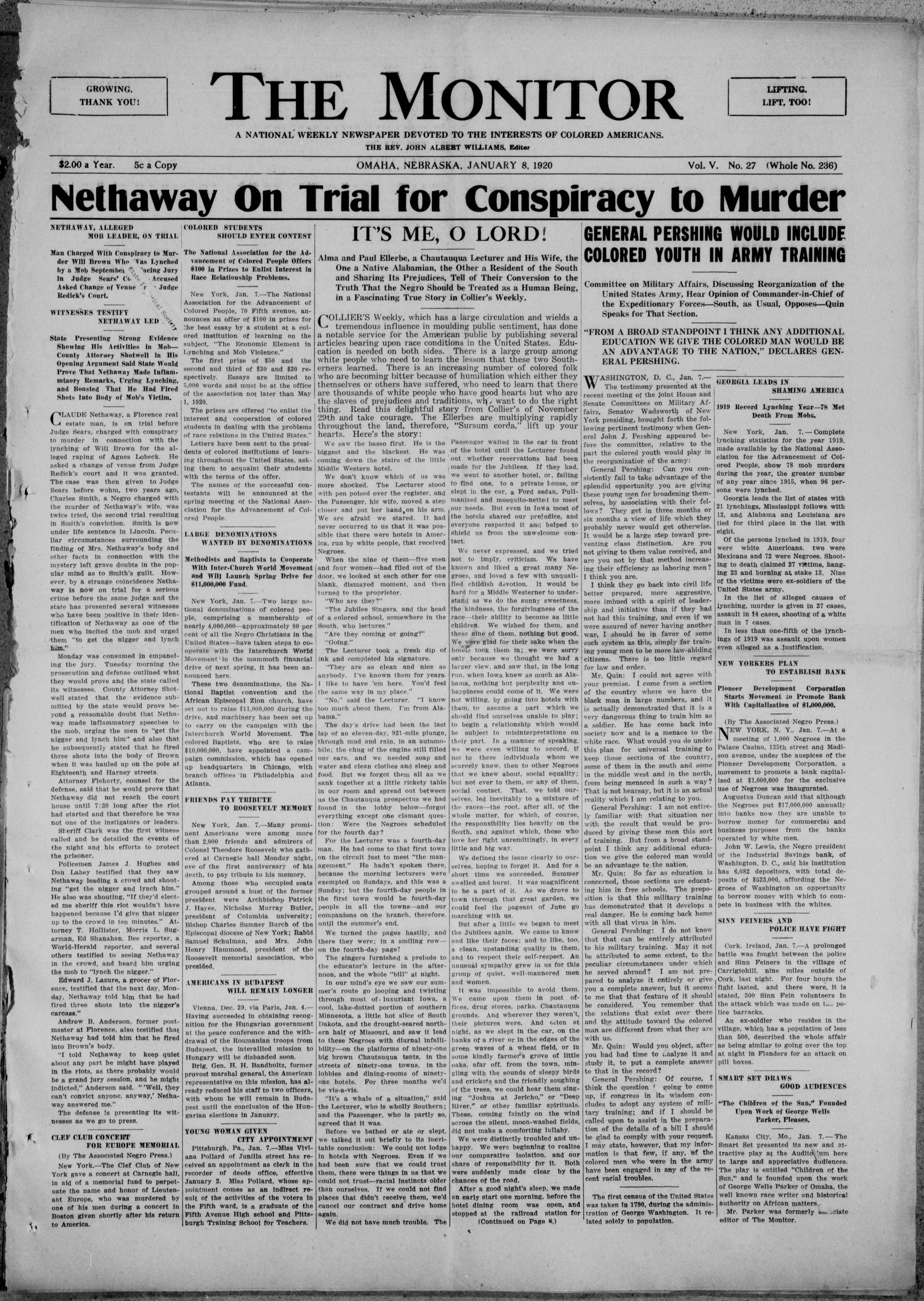
Nethaway On Trial for Conspiracy to Murder
GROWING.
THANK YOU!
$2.00 a Year. 5c a Copy
NETHAWAY, ALLEGED
MOB LEADER, ON TRIAL
Man Charged With Conspiracy to Murder Will Brown Who Vas Lynched by a Mob September 22 racing Jury in Judge Sears' Court Accused Asked Change of Venue Judge Redick's Court.
WITNESSES TESTIFY
NETHAWAY LED
State Presenting Strong Evidence Showing His Activities in Mob—County Attoracy Shotwell in His Opening Argument Said State Would Prove That Nethaway Made Inflammtaory Remarks, Urging Lynching, and Boasted That He Had Fired Shots Into Body of Mob's Victim.
CLAUDE Nethaway, a Florence real estate man, is on trial before Judge Sears, charged with conspiracy to murder in connection with the lynching of Will Brown for the alleged raping of Agnes Lobek. He asked a change of venue from Judge Redick's court and it was granted. The case was then given to Judge Sears before wohm, two years ago, Charles Smith, a Negro charged with the murder of Nethaway's wife, was twice tried, the second trial resulting in Smith's conviction. Smith is now under life sentence in Lincoln. Peculiar circumstances surrounding the finding of Mrs. Nethaway's body and other facts in connection with the mystery left grave doubts in the popular mind as to Smith's guilt. However, by a strange coincidence Nethaway is now on trial for a serious crime before the same judge and the state has presented several witnesses who have been positive in their identification of Nethaway as one of the men who incited the mob and urged them "to get the nigger and lynch him."
Monday was consumed in empaneling the jury. Tuesday morning the prosecution and defense outlined what they would prove and the state called its witnesses. County Attorney Shotwell stated that the evidence submitted by the state would prove beyond a reasonable doubt that Nethaway made inflammatory speeches to the mob, urging the men to "get the nigger and lynch him" and also that he subsequently stated that he fired three shots into the body of Brown when it was hauled up on the pole at Eighteenth and Harney streets.
Attorney Fleharty, counsel for the defense, said that he would prove that Nethaway did not reach the court house until 7:30 long after the riot had started and that therefore he was not one of the instigators or leaders.
Sheriff Clark was the first witness called and he detailed the events of the night and his efforts to protect the prisoner.
Policemen James J. Hughes and Dan Lahey testified that they saw Nethaway leading a crowd and shouting "get the nigger and lynch him." He also was shouting, "If they'd elected me sheriff this riot wouldn't have happened because I'd give that nigger up to the crowd in ten minutes." Attorney T. Hollister, Morris L. Sugarman, Ed Shanahan. Bee reporter, a World-Herald reporter, and several others testified to seeing Nethaway in the crowd, and heard him urging the mob to "lynch the nigger."
Edward J. Lazure, a grocer of Florence, testified that the next day, Monday, Nethaway told him that he had fired three shots into the nigger's carcass."
Andrew B. Anderson, former postmaster at Florence, also testified that Nethaway had told him that he fired into Brown's body.
"I told Nethaway to keep quiet about any part he might have played in the riots, as there probably would be a grand jury session, and he might indicted," Anderson said. "Well, they can't convict anyone, anyway," Nethaway answered me."
The defense is presenting its witnesses as we go to press.
CLEF CLUB CONCERT
FOR EUROPE MEMORIAI
(By The Associated Negro Press.)
New York.—The Clef Club of New York gave a concert at Carnegie hall, in aid of a memorial fund to perpetuate the name and honor of Lieutenant Europe, who was murdered by one of his men during a concert in Boston given shortly after his return to America.
THE MONITOR
COLORED STUDENTS
SHOULD ENTER CONTEST
The National Association for the Advancement of Colored People Offers $100 in Prizes to Enlist Interest in Race Relationship Problems.
New York, Jan. 7.—The National Association for the Advancement of Colored People, 70 Fifth avenue, announces an offer of $100 in prizes for the best essay by a student at a colored institution of learning on the subject, "The Economic Element in Lynching and Mob Violence."
The first prize of $50 and the second and third of $30 and $20 respectively. Essays are limited to 5,000 words and must be at the office of the association not later than May 1, 1920.
The prizes are offered "to enlist the interest and cooperation of colored students in dealing with the problems of race relations in the United States."
Letters have been sent to the presidents of colored institutions of learning throughout the United States, asking them to acquaint their students with the terms of the offer.
The names of the successful contestants will be announced at the spring meeting of the National Association for the Advancement of Colored People.
LARGE DENOMINATIONS
WANTED BY DENOMINATIONS
Methodists and Baptists to Cooperate With Inter-Church World Movement and Will Launch Spring Drive for $11,000,000 Fund.
New York, Jan. 7.—Two large national denominations of colored people, comprising a membership of nearly 4,000,000—approximately 80 percent of all the Negro Christians in the United States—have taken steps to cooperate with the Interchurch World Movement in the mammoth financial drive of next spring, it has been announced here.
These two denominations, the National Baptist convention and the African Episcopal Zion church, have set out to raise $11,000,000 during the drive, and machinery has been set up to carry on the campaign with the Interchurch World Movement. The colored Baptists, who are to raise $10,000,000, have appointed a campaign commission, which has opened up headquarters in Chicago, with branch offices in Philadelphia and Atlanta.
FRIENDS PAY TRIBUTE
TO ROOSEYELT MEMORY
New York, Jan. 7.—Many prominent Americans were among more than 2,000 friends and admirers of Colonel Theodore Roosevelt who gathered at Carnegie hall Monday night, eve of the first anniversary of his death, to pay tribute to his memory. Among those who occupied seats grouped around a bust of the former president were Archbishop Patrick J. Hayes, Nicholas Murray Butler, president of Columbia university; Bishop Charles Sumner Burch of the Episcopal diocese of New York; Rabbi Samuel Schulman, and Mrs. John Henry Hammond, president of the Roosevelt memorial association, who presided.
AMERICANS IN BUDAFEST
WILL REMAIN LONGER
Vienna, Dec. 29, via Paris, Jan. 4. Having succeeded in obtaining recognition for the Hungarian government at the peace conference and the withdrawal of the Roumanian troops from Budapest, the interallied mission to Hungary will be disbanded soon. Brig. Gen. H. H. Bandholtz, former provost marshal general, the American representative on this mission, has already reduced his staff to two officers, with whom he will remain in Budapest until the conclusion of the Hungarian elections in January.
YOUNG WOMAN GIVEN
CITY APPOINTMENT
Pittsburgh, Pa., Jan. 7.—Miss Viviana Pollard of Junilla street has received an appointment as clerk in the recorder of deeds office, effective January 2. Miss Pollard, whose appointment comes as an indirect result of the activities of the voters in the Fifth ward, is a graduate of the Fifth Avenue High school and Pittsburgh Training School for Teachers.
OMAHA. NEBRASKA. JANUARY 8, 1920
Alma and Paul Ellerbe, a Chautauqua Lecturer and His Wife, the One a Native Alabamian, the Other a Resident of the South and Sharing Its Prejudices, Tell of Their Conversion to the Truth That the Negro Should be Treated as a Human Being, in a Fascinating True Story in Collier's Weekly.
COLLIER'S Weekly, which has a large circulation and wields a tremendous influence in moulding public sentiment, has done a notable service for the American public by publishing several articles bearing upon race conditions in the United States. Education is needed on both sides. There is a large group among white people who need to learn the lesson that these two Southerners learned. There is an increasing number of colored folk who are becoming bitter because of humiliation which either they themselves or others have suffered, who need to learn that there are thousands of white people who have good hearts but who are the slaves of prejudices and traditions, who want to do the right thing. Read this delightful story from Collier's of November 29th and take courage. The Ellerbes are multiplying rapidly throughout the land, therefore, "Sursum corda," lift up your hearts. Here's the story:
We saw the basso first. He is the Passenger waited in the car in front biggest and the blackest. He was coming down the stairs of the little out whether reservations had been Middle Western hotel. If they had,
We don't know which of us was more shocked. The Lecturer stood with pen poised over the register, and the Passenger, his wife, moved a step closer and put her hand, on his arm. We are afraid we stared. It had never occurred to us that it was possible that there were hotels in America, run by white people, that received Negroes.
When the nine of them—five men and four women—had filed out of the door, we looked at each other for one blank, dismayed moment, and then turned to the proprietor.
"Who are they?"
"The Jubilee Singers, and the head of a colored school, somewhere in the South, who lectures."
"Are they coming or going?"
"Going."
The Lecturer took a fresh dip of ink and completed his signature.
"They are as clean and nice as anybody. I've known them for years. I like to have 'em here. You'd feel the same way in my place."
"No," said the Lecturer. "I know too much about them. I'm from Alabama."
The day's drive had been the last lap of an eleven-day, 921-mile plunge, through mud and rain, in an automobile; the chug of the engine still filled our ears, and we needed soap and water and clean clothes and sleep and food. But we forgot them all as we sank together at a little rickety table in our room and spread out between us the Chautauqua prospectus we had found in the lobby below—forgot everything except one clamant question: Were the Negroes scheduled for the fourth day?
For the Lecturer was a fourth-day man. He had come to that first town on the circuit just to meet "the management." He didn't spoken there, because the morning lecturers were exempted on Sundays, and this was a Sunday; but the fourth-day people in the first town would be fourth-day people in all the towns—and our companions on the branch, therefore, until the summer's end.
We turned the pages hastily, and there they were; in a smiling row—on the fourth-day page!
The singers furnished a prelude to the educator's lecture in the afternoon, and the whole "bill" at night.
In our mind's eye we saw our summer's route go looping and twisting through most of luxuriant Iowa, a cool, lake-dotted portion of southern Minnesota, a little hot slice of South Dakota, and the drought-seared northern half of Missouri, and saw it lead to these Negroes with diurnal infallibility—on the platforms of ninety-one big brown Chautauqua tents, in the streets of ninety-one towns, in the lobbies and dining-rooms of ninety-one hotels. For three months we'd be vis-a-vis.
"It's a whale of a situation," said the Lecturer, who is wholly Southern; and the Passenger, who is partly so, agreed that it was.
Before we bathed or ate or slept, we talked it out briefly to its inevitable conclusion: We could not lodge in hotels with Negroes. Even if we had been sure that we could trust them, there were things in us that we could not trust—racial instincts older than ourselves. If we could not find places that didn't receive them, we'd cancel our contract and drive home again.
We did not have much trouble. The
Passenger waited in the car in front of the hotel until the Lecturer found out whether reservations had been made for the Jubilees. If they had, we went to another hotel, or, failing to find one, to a private house, or slept in the car, a Ford sedan, Pullmanized and mosquito-netted to meet our needs. But even in Iowa most of the hotels shared our prejudice, and everyone respected it and helped to shield us from the unwelcome contact.
We never expressed, and we tried not to imply, criticism. We have known and liked a great many Negroes, and loved a few with unqualified childish devotion. It would be hard for a Middle Westerner to understand as we do the sunny sweetness, the kindness, the forgivingness of the race—their ability to become as little children. We wished for them, and these nine of them, nothing but good. We were glad for their sake when the hotels took them in; we were sorry only because we thought we had a larger view, and saw that, in the long run, when Iowa knew as much as Alabama, nothing but perplexity and unhappiness could come of it. We were not willing, by going into hotels with them, to assume a part which we should find ourselves unable to play; to begin a relationship which would be subject to misinterpretations on their part. In a manner of speaking, we were even willing to accord, if not to these individuals whom we scarcely knew, then to other Negroes that we knew about, social equality; but not ever to them, or of any them, social contact. That, we told ourselves, led inevitably to a mixture of the races—the root, after all, of the whole matter, for which, of course, the responsibility lies heavily on the South, and against which, those who love her fight unremittingly, in every little and big way.
We defined the issue clearly to ourselves, hoping to forget it. And for a short time we succeeded. Summer swelled and burst. It was magnificent to be a part of it. As we drove to town through that great garden, we could feel the pageant of June go marching with us.
But after a little we began to meet the Jubilees again. We came to know and like their faces; and to like, too, a clean, upstanding quality in them, and to respect their self-respect. An unusual sympathy grew in us for this group of quiet, well-mannered men and women.
It was impossible to avoid them. We came upon them in post offices, drug stores, parks, Chautauqua grounds. And wherever they weren't, their pictures were. And often at night, as we slept in the car, on the banks of a river or in the edges of the green waves of a wheat field, or in some kindly farmer's grove of little oaks, afar off, from the town, mingling with the sounds of sleepy birds and crickets and the friendly soughing of the trees, we could hear them singing "Joshua at Jericho," or "Deep River," or other familiar spirituals. These, coming faintly on the wind across the silent, moon-washed fields, did not make a comforting lullaby.
We were distinctly troubled and unhappy. We were beginning to realize our comparative isolation, and our share of responsibility for it. Both were suddenly made clear by the chances of the road.
After a good night's sleep, we made an early start one morning, before the hotel dining room was open, and stopped at the railroad station for (Continued on Page 8.)
No Murder
WISHING WOULD INCLUDE
TH IN ARMY TRAINING
Affairs, Discussing Reorganization of the
Hear Opinion of Commander-in-Chief of
forces—South, as Usual, Opposes—Quin
ion.
DPOINT I THINK ANY ADDITIONAL
LIVE THE COLORED MAN WOULD BE
TO THE NATION," DECLARES GEN-
GENERAL PERSHING WOULD INCLUDE COLORED YOUTH IN ARMY TRAINING
Committee on Military Affairs, Discussing Reorganization of the United States Army, Hear Opinion of Commander-in-Chief of the Expeditionary Forces—South, as Usual, Opposes—Quin Speaks for That Section.
"FROM A BROAD STANDPOINT I THINK ANY ADDITIONAL EDUCATION WE GIVE THE COLORED MAN WOULD BE AN ADVANTAGE TO THE NATION," DECLARES GENERAL PERSHING.
---
WASHINGTON, D. C., Jan. 7. The testimony presented at the recent meeting of the joint House and Senate Committees on Military Affairs, Senator Wadsworth of New York presiding, brought forth the following pertinent testimony when General John J. Pershing appeared before the committee, relative to the part the colored youth would play in the reorganization of the army:
General Pershing: Can you consistently fail to take advantage of the splendid opportunity you are giving these young men for broadening themselves, by association with their fellows? They get in three months or six months a view of life which they probably never would get otherwise. It would be a large step toward preventing class distinction. Are you not giving to them value received, and are you not by that method increasing their efficiency as laboring men? I think you are.
I think they go back into civil life better prepared, more aggressive, more imbued with a spirit of leadership and initiative than if they had not had this training, and even if we were assured of never having another war, I should be in favor of some such system as this, simply for training young men to be more law-abiding citizens. There is too little regard for law and order.
Mr. Quin: I could not agree with your premise. I come from a section of the country where we have the black man in large numbers, and it is actually demonstrated that it is a very dangerous thing to train him as a soldier. He has come back into society now and is a menace to the white race. What would you do under this plan for universal training to keep those sections of the country, some of them in the south and some in the middle west and in the north, from being menaced in such a way? That is not hearsay, but it is an actual reality which I am relating to you.
General Pershing: I am not entirely familiar with that situation nor with the result that would be produced by giving these men this sort of training. But from a broad standpoint I think any additional education we give the colored man would be an advantage to the nation.
Mr. Quin: So far as education is concerned, those sections are educating him in free schools. The proposition is that this military training has demonstrated that it develops a real danger. He is coming back home with all that virus in him.
General Pershing: I do not know that that can be entirely attributed to his military training. May it not be attributed to some extent, to the peculiar circumstances under which he served abroad? I am not prepared to analyze it entirely or give you a complete answer, but it seems to me that that feature of it should be considered. You remember that the relations that exist over there and the attitude toward the colored man are different from what they are with us.
Mr. Quin: Would you object, after you had had time to analyze it and study it, to put a complete answer to that in the record?
General Pershing: Of course, I think the question 'going to come up, if congress in its wisdom concludes to adopt any system of military training; and if I should be called upon to assist in the preparation of the details of a bill I should be glad to comply with your request. I may state, however, that my information is that few, if any, of the colored men who were in the army have been engaged in any of the recent racial troubles.
The first census of the United States was taken in 1790, during the administration of George Washington. It related solely to population.
LIFTING.
LIFT, TOO!
GEORGIA LEADS IN SHAMING AMERICA
1919 Record Lynching Year--78 Met Death From Mobs.
New York, Jan. 7. — Complete lynching statistics for the year 1919, made available by the National Association for the Advancement of Colored People, show 78 mob murders during the year, the greater number of any year since 1915, when 96 persons were lynched.
Georgia leads the list of states with 21 lynchings, Mississippi follows with 12, and Alabama and Louisiana are tied for third place in the list with eight.
Of the persons lynched in 1919, four were white Americans, two were Mexicans and 72 were Negroes. Shooting to death claimed 27 victims, hanging 23 and burning at stake 13. Nine of the victims were ex-soldiers of the United States army.
In the list of alleged causes of lynching, murder is given in 27 cases, assault in 14 cases, shooting of a white man in 7 cases.
In less than one-fifth of the lynchings of 1919 was assault upon women even alleged as a justification.
NEW YORKERS PLAN
TO ESTABLISH BANK
Pioneer Development Corporation Starts Movement to Promote Bank With Capitalization of $1,000,000.
(By The Associated Negro Press.)
NEW YORK, N. Y., Jan. 7.—At a meeting of 1,000 Negroes in the Palace Casino, 135th street and Madison avenue, under the auspices of the Pioneer Development Corporation, a movement to promote a bank capitalized at $1,000,000 for the exclusive use of Negroes was inaugurated.
Augustus Duncan said that although the Negroes put $17,000,000 annually into banks now they are unable to borrow money for commercial and business purposes from the banks operated by white men.
John W. Lewis, the Negro president of the Industrial Savings bank, of Washington, D. C., said his institution has 6,082 depositors, with total deposits of $523,000, affording the Negroes of Washington an opportunity to borrow money with which to compete in business with the whites.
SINN FEINERS AND
POLICE HAVE FIGHT
Cork, Ireland, Jan. 7.—A prolonged battle was fought between the police and Sinn Feiners in the village of Carrigtohill, nine miles outside of Cork, last night. For four hours the fight lasted, and there were, it is stated, 300 Sinn Fein volunteers in the attack which was made on the police barracks.
An ex-soldier who resides in the village, which has a population of less than 500, described the whole affair as being similar to going over the top at night in Flanders for an attack on pill boxes.
SMART SET DRAWS
GOOD AUDIENCES
"The Children of the Sun," Founded Upon Work of George Wells Parker, Plenses.
Kansas City, Mo., Jan. 7. — The Smart Set presented its new and attractive play at the Auditorium here to large and appreciative audiences. The play is entitled "Children of the Sun," and is founded upon the work of George Wells Parker of Omaha, the well known race writer and historical authority on African matters. Mr. Parker was formerly associate
Mr. Parker was formerly associate editor of The Monitor.
© Western Newspaper Union
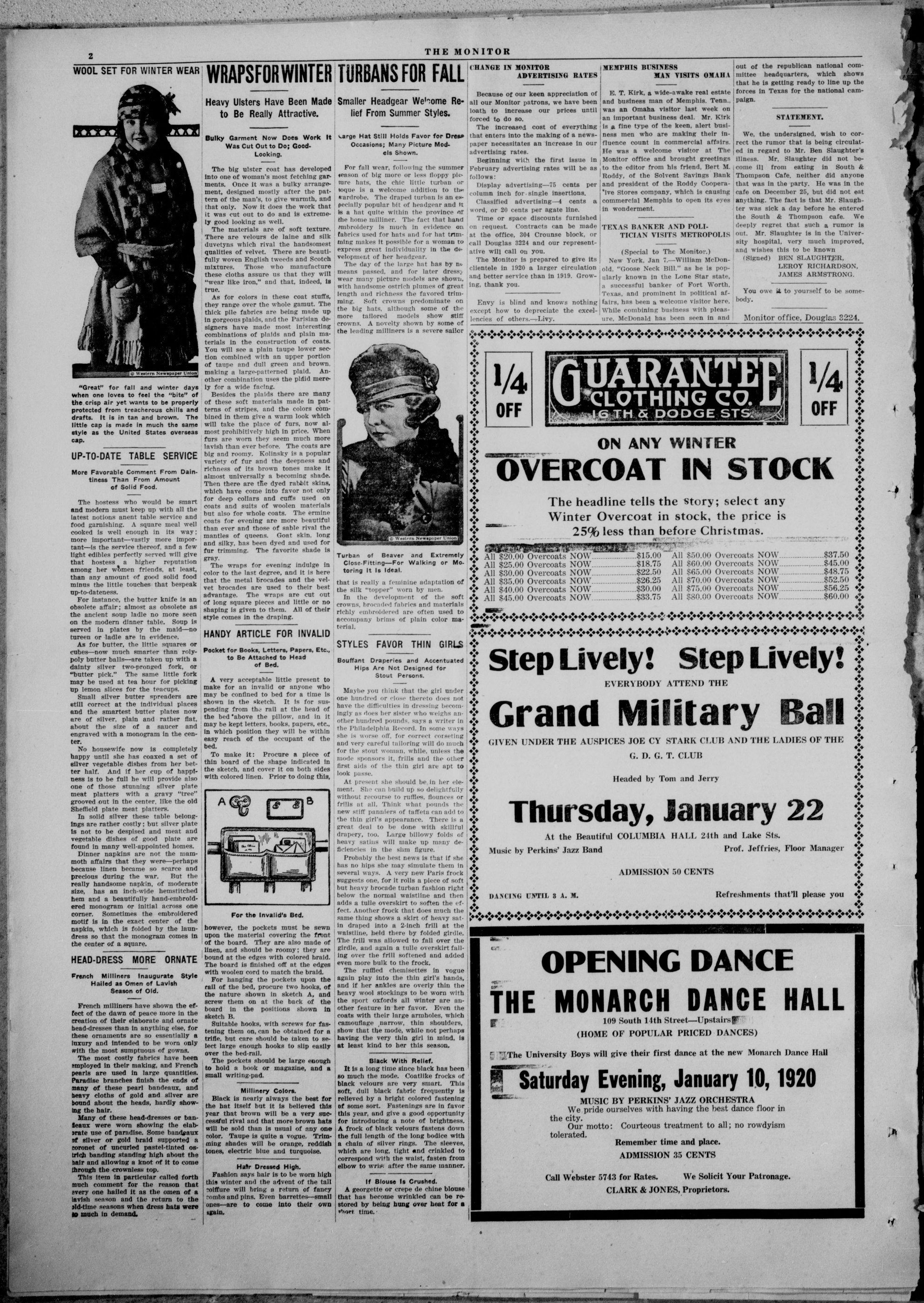
"Great" for fall and winter days when one loves to feel the "bite" of the crisp air yet wants to be properly protected from treacherous chills and drafts. It is in tan and brown. The little cap is made in much the same style as the United States overseas cap.
UP-TO-DATE TABLE SERVICE
More Favorable Comment From Dain-
tiness Than From Amount
of Solid Food.
The hostess who would be smart
and modern must keep up with all the
latest notions anent table service and
food garnishing. A square meal well
cooked is well enough in its way;
more important—vastly more important—is the service thereof, and a few
light edibles perfectly served will give
that hostess a higher reputation
among her women friends, at least,
than any amount of good solid food
minus the little touches that bespeak
up-to-dateness.
For instance, the butter knife is an
obsolete affair; almost as obsolete as
the ancient soup ladle no more seen
on the modern dinner table. Soup is
served in plates by the maid—no
tureen or ladle are in evidence.
As for butter, the little squares or cubes—now much smarter than roly-poly butter balls—are taken up with a dainty silver two-pronged fork, or "butter plick." The same little fork may be used at tea hour for picking up lemon slices for the teacups.
Small silver butter spreaders are still correct at the individual places and the smartest butter plates now are of silver, plain and rather flat, about the size of a saucer and engraved with a monogram in the center.
No housewife now is completely happy until she has coaxed a set of silver vegetable dishes from her better half. And if her cup of happiness is to be full he will provide also one of those stunning silver plate meat platters with a gravy "tree" grooved out in the center, like the old Sheffield plate meat platters.
In solid silver these table belongings are rather costly; but silver plate is not to be despised and meat and vegetable dishes of good plate are found in many well-appointed homes. Dinner napkins are not the mammoth affairs that they were—perhaps because linen became so scarce and precious during the war. But the really handsome napkin, of moderate size, has an inch-wide hemstitched hem and a beautifully hand-embroidered monogram or initial across one corner. Sometimes the embroidered motif is in the exact center of the napkin, which is folded by the laundress so that the monogram comes in the center of a square.
HEAD-DRESS MORE ORNATE
French Milliners Inaugurate Style
Hailed as Omen of Lavish
Season of Old.
French milliners have shown the effect of the dawn of peace more in the creation of their elaborate and ornate head-dresses than in anything else, for these ornaments are so essentially a luxury and intended to be worn only with the most sumptuous of gowns.
The most costly fabrics have been employed in their making, and French pearls are used in large quantities. Paradise branches finish the ends of many of these pearl bandeaux, and heavy cloths of gold and silver are bound about the heads, hardly showing the hair.
Many of these head-dresses or banleaux were worn showing the elaborate use of paradise. Some bandgaux of silver or gold braid supported a coronet of uncurled pastel-tinted ostrich banding standing high about the hair and allowing a knot of it to come through the crownless top.
This item in particular called forth much comment for the reason that every one hailed it as the omen of a lavish season and the return to the old-time seasons when dress hats were so much in demand.
WRAPSFORWINTER TURBANSFOR FALL
Heavy Ulsters Have Been Made to Be Really Attractive.
Bulky Garment Now Does Work It Was Cut Out to Do; Good It
The big ulster coat has developed into one of woman's most fetching garments. Once it was a bulky arrangement, designed mostly after the pattern of the man's, to give warmth, and that only. Now it does the work that it was cut out to do and is extremely good looking as well.
The materials are of soft texture. There are velours de laine and silk duvetyns which rival the handsomest qualities of velvet. There are beautifully woven English tweeds and Scotch mixtures. Those who manufacture these cloths assure us that they will "wear like iron," and that, indeed, is true.
As for colors in these coat stuffs, they range over the whole gamut. The thick pile fabrics are being made up in gorgeous plaids, and the Parisian designers have made most interesting combinations of plaids and plain materials in the construction of coats. You will see a plain taupe lower section combined with an upper portion of taupe and dull green and brown, making a large-patterned plaid. Another combination uses the plaid merely for a wide facing.
Besides the plaids there are many of these soft materials made in patterns of stripes, and the colors combined in them give a warm look which will take the place of furs, now almost prohibitively high in price. When furs are worn they seem much more lavish than ever before. The coats are big and roomy. Kolinsky is a popular variety of fur and the deepness and richness of its brown tones make it almost universally a becoming shade. Then there are the dyed rabbit skins, which have come into favor not only for deep collars and cuffs used on coats and suits of woolen materials but also for whole coats. The ermine coats for evening are more beautiful than ever and those of sable rival the mantles of queens. Goat skin, long and silky, has been dyed and used for fur trimming. The favorite shade is gray.
The wraps for evening indulge in color to the last degree, and it is here that the metal broaches and the velvet broaches are used to their best advantage. The wraps are cut out of long square pieces and little or no shaping is given to them. All of their style comes in the draping.
HANDY ARTICLE FOR INVALID
Pocket for Books, Letters, Papers, Etc., to Be Attached to Head of Bed.
A very acceptable little present to make for an invalid or anyone who may be confined to bed for a time is shown in the sketch. It is for suspending from the rail at the head of the bed 'above the pillow, and in it may be kept letters, books, papers, etc., in which position they will be within easy reach of the occupant of the bed.
To make it: Procure a piece of thin board of the shape indicated in the sketch, and cover it on both sides with colored linen. Prior to doing this.
A B
For the Invalid's Bed.
however, the pockets must be sewn upon the material covering the front of the board. They are also made of linen, and should be roomy; they are bound at the edges with colored braid. The board is finished off at the edges with woolen cord to match the braid. For hanging the pockets upon the rail of the bed, procure two hooks, of the nature shown in sketch A, and screw them on at the back of the board in the positions shown in sketch B. Suitable hooks, with screws for fastening them on, can be obtained for a trifle, but care should be taken to select large enough hooks to slip easily over the bed-rail. The pockets should be large enough to hold a book or magazine, and a small writing-pad.
Millinery Colors.
Black is nearly always the best for the hat itself but it is believed this year that brown will be a very successful rival and that more brown hats will be sold than is usual of any one color. Taupe is quite a vogue. Trimming shades will be orange, reddish tones, electric blue and turquoise.
Hair Dressed High.
Fashion says hair is to be worn high this winter and the advent of the tall coifure will bring a return of fancy combs and pins. Even barrettes—small ones—are to come into their own again.
THE MONITOR
Smaller Headgear Welcome Relief From Summer Styles.
Large Hat Still Holds Favor for Dress Occasions; Many Picture Mod-
For fall wear, following the summer season of big more or less floppy picture hats, the chic little turban or toque is a welcome addition to the wardrobe. The draped turban is an especially popular bit of headgear and it is a hat quite within the province of the home milliner. The fact that hand embroidery is much in evidence on fabrics used for hats and for hat trimming makes it possible for a woman to express great individuality in the development of her headgear.
The day of the large hat has by means passed, and for later dress, wear many picture models are shown, with handsome ostrich plumes of great length and richness the favored trimming. Soft crowns predominate on the big hats, although some of the more tailored models show stiff crowns. A novelty shown by some of the leading milliners is a severe sailor
© Western Newspaper Union
Turban of Beaver and Extremely Close-Fitting-For Walking or Motoring It Is Ideal.
that is really a feminine adaptation of the silk "topper" worn by men.
In the development of the soft crowns, brocaded fabrics and materials richly embroidered are often used to accompany brims of plain color material.
STYLES FAVOR THIN GIRLS
Bouffant Draperies and Accentuated Hips Are Not Designed for Stout Persons.
Maybe you think that the girl under one hundred or close thereto does not have the difficulties in dressing becoming as does her sister who weighs another hundred pounds, says a writer in the Philadelphia Record. In some ways she is worse off, for correct corseting and very careful tailoring will do much for the stout woman, while, unless the mode sponsors it, frills and the other first aids of the thin girl are apt to look passe.
At present she should be in her element. She can build up so delightfully without recourse to ruffles, flounces or frills at all. Think what pounds the new stiff panniers of taffeta can add to the thin girl's appearance. There is a great deal to be done with skillful drapery, too. Large billowy folds of heavy satius will make up many deficiencies in the shim figure.
Probably the best news is that if she has no hips she may simulate them in several ways. A very new Paris frock suggests one, for it rolls a piece of soft but heavy brocade turban fashion right below the normal waistline and then adds a tulle overskirt to soften the effect. Another frock that does much the same thing shows a skirt of heavy satin draped into a 2-inch frill at the waistline, held there by folded girdle. The frill was allowed to fall over the girdle, and again a tulle overskirt falling over the frill softened and added even more bulk to the frock.
The ruffled chemisettes in vogue again play into the thin girl's hands, and if her ankles are overly thin the heavy wool stockings to be worn with the sport oxfordings all winter are another feature in her favor. Even the coats with their large armholes, which camouflage, narrow, thin shoulders, show that the mode, while not perhaps having the very thin girl in mind, is at least kind to her this season.
It is a long time since black has been so much the mode. Coatlike frocks of black velours are very smart. This soft, dull black fabric frequently is relieved by a bright colored fastening of some sort. Fastenings are in favor this year, and give a good opportunity for introducing a note of brightness. A frock of black velours fastens down the full length of the long bodice with a chain of silver rings. The sleeves, which are long, tight and crinkled to correspond with the waist, fasten from elbow to wrist after the same manner.
If Blouse Is Crushed.
A georgette or crepe de chine blouse that has become wrinkled can be restored by being hung over heat for a short time.
Black With Relief.
If Blouse Is Crushed.
CHANGE IN MONITOR
ADVERTISING RATES
Because of our keen appreciation of all our Monitor patrons, we have been loath to increase our prices until forced to do so.
The increased cost of everything that enters into the making of a newspaper necessitates an increase in our advertising rates.
Beginning with the first issue in February advertising rates will be as follows:
Display advertising—75 cents per column inch for single insertions.
Classified advertising—4 cents a word, or 20 cents per agate line.
Time or space discounts furnished on request. Contracts can be made at the office, 304 Crounse block, or call Douglas 3224 and our representative will call on you.
The Monitor is prepared to give its clientele in 1920 a larger circulation and better service than in 1919. Growing, thank you.
Envy is blind and knows nothing except how to depreciate the excellencies of others.—Livy.
---
ON ANY WINTER OVERCOAT IN STOCK
GIVEN UNDER THE AUSPICES JOE CY STARK CLUB AND THE LADIES OF THE G. D. G. T. CLUB
At the Beautiful COLUMBIA HALL 24th and Lake Sts.
Music by Perkins' Jazz Band Prof. Jeffries, Floor Manager
DANCING UNTIL 3 A. M.
OPEN
THE MON
OPENING DANCE
THE MONARCH DANCE HALL
109 South 14th Street—Upstairs
(HOME OF POPULAR PRICED DANCES)
The University Boys will give their first dance at the new Monarch Dance Hall
Saturday Evening, January 10, 1920
MUSIC BY PERKINS' JAZZ ORCHESTRA
We pride ourselves with having the best dance floor in the city.
Our motto: Courteous treatment to all; no rowdyism tolerated.
Remember time and place.
ADMISSION 35 CENTS
Call Webster 5743 for Rates. We Solicit Your Patronage.
CLARK & JONES, Proprietors.
The headline tells the story; select any Winter Overcoat in stock, the price is 25% less than before Christmas.
MEMPHIS BUSINESS
MAN VISITS OMAHA
E. T. Kirk, a wide-awake real estate and business man of Memphis. Tenn. was an Omaha visitor last week on an important business deal. Mr. Kirk is a fine type of the keen, alert business men who are making their influence count in commercial affairs. He was a welcome visitor at The Monitor office and brought greetings to the editor from his friend, Bert M. Roddy, of the Solvent Savings Bank and president of the Roddy Cooperative Stores company, which is causing commercial Memphis to open its eyes in wonderment.
TEXAS BANKER AND POLITICIAN VISITS METROPOLIS
(Special to The Monitor.)
New York, Jan 7.—William McDonald. "Goose Neck Bill." as he is popularly known in the Lone Star state, a successful banker of Fort Worth, Texas, and prominent in political affairs, has been a welcome visitor here. While combining business with pleasure, McDonald has been seen in and
GUARANTY
CLOTHING CO
LENGTH & DODGE S
ON ANY WINTER
COAT IN S
dline tells the story; s
Overcoat in stock, the
less than before Chris
$15.00 All $50.00 Over
$18.75 All $60.00 Over
$22.50 All $65.00 Over
$26.25 All $70.00 Over
$30.00 All $75.00 Over
$33.75 All $80.00 Over
vely! Step
EVERYBODY ATTEND THE Military PICES JOE CY STARK CLUB A G. D. G. T. CLUB Headed by Tom and Jerry
day, Janu
iful COLUMBIA HALL 24th an
P
ADMISSION 50 CENTS
out of the republican national committee headquarters, which shows that he is getting ready to line up the forces in Texas for the national campaign.
STATEMENT.
We, the undersigned, wish to correct the rumor that is being circulated in regard to Mr. Ben Slaughter's illness. Mr. Slaughter did not become ill from eating in South & Thompson Cafe, neither did anyone that was in the party. He was in the cafe on December 25, but did not eat anything. The fact is that Mr. Slaughter was sick a day before he entered the South & Thompson cafe. We deeply regret that such a rumor is out. Mr. Slaughter is in the University hospital, very much improved, and wishes this to be known (Signed) BEN SLAUGHTER, LEROY RICHARDSON, JAMES ARMSTRONG.
You owe it to yourself to be somebody.
Monitor office. Douglas 3224.
1/4 OFF
ER
STOCK
; select any
the price is
christmas.
Overcoats NOW.....$37.50
Overcoats NOW.....$45.00
Overcoats NOW.....$48.75
Overcoats NOW.....$52.50
Overcoats NOW.....$56.25
Overcoats NOW.....$60.00
Keep Lively!
THE
Ball
CLUB AND THE LADIES OF THE
January 22
North and Lake Sts.
Prof. Jeffries, Floor Manager
Refreshments that'll please you
ANCE
ANCE HALL
tairs
THE YELLOW PERIL
THREATENS EUROPE
The Spectre of Mongolians Gaining Ascendency in European Affairs
Gives Grave Concern in Many Quarters Says Special Writer or Chicago Tribune.
WHITE MAN'S WORLD CRACKING
Danger Not in Europe, But in Asia Led by a Master Nation Like Japan and Equipped With Modern Resources — Nationalism Stirring the Islam Millions.
(By Thomas Stewart Ryan)
(Chicago Tribune Foreign News Service — By Special Cable.)
WARSAW, Dec. 31.—If I had not heard it from so many quarters, from so many different kinds of people in eastern Europe, it would not be worth reporting as an influence which may figure in future events in Europe.
"The end of the white man's time is at hand. Now comes the yellow race."
It has long been a theme or editorial writers at home. But in this east it is a whisper throughout the land, like a rustle of prairie grass before the old Mongolian horsemen of Attila, Genghis Khan, and Tamurlane. Along Russia's borders you can scent the nearness of the east. There are the wild costumes, the touch of barbaric splendor, the weird paeans of waste places, the quick passions, the quiet suffering since the beginning of time—and then an echo from regions beyond where dervishes are howling and outlandish rites are performed, and millions bide their time as before the great migrations.
In Bucharest I sat in a cafe chantant. It was exotic enough. Conspicuous were the number of men who dragged sabres across the floor and a Turkish girl in her own Levantine dress. Russian dancers were leaping under the loges.
**Sees Yellow Race Coming.**
"This can't last much longer," remarked a distinguished editor. "It is the mounting fever before the crisis. We are like that prince in Poe's tale who locks himself up in a tower to dance and make merry while death is waiting outside. A little more war, a little more crumbling of moral ties, and the yellow race will have a clear sweep."
Later I sat with a young Roumanian officer in a mud hut, near the brown Dneister. The spot is just at the threshold of the oldest civilization in Europe. The river flows into the sea of the Golden Fleece. Yet there is not a corner of the Yukon more savage, more desolate, than that region of Bessarabia. In the Kherson government, southward down to Odessa, the highroads are lined with human bodies, horribly mutilated, beaten sometimes to pulp. Report your discoveries to the nearest volunteer post and the officer will shrug and remark:
"What would you have? That happens daily."
"The Mongols will come in our day," the young Roumanian said, "just as they always came before when Europe wore herself out. They came when the Roman world broke up, when Charlemagne's empire crumbled. They will come now in this age of war, hunger, oppression, and rotting discipline."
Thoughtful Pole's Opinion.
Of all such talks the most thoughtful I heard from a Polish official. With him the peril from Asia is a fixed belief. "We hear much of Germany trying again, of this nation or that in Europe becoming too strong," he said. "I tell you the danger is not in Europe, but in Asia—Asia led by a master nation, like Japan, and equipped with modern resources. Moreover, there are the 300,000,000 of Islam, already stirred by nationalism in Egypt, India, and Turkey.
"In Europe only Great Britain and France among the great powers. and possibly Italy, are interested in keeping the peace. Germany and Russia are old offenders. Such is the Europe that meets a possible Mongolian inroad in the future. Likely some nation will call the yellow race in. That might well be Germany.
"White Man's World Cracking."
"Even now Japanese troops are in Siberia with Kolchak, and there are Chinese in Russia.
"You don't need to believe in direct attack, only indirect at first, such as insurrections in India fomented by Japanese agents. The yellow man sees that the white man's world is cracking. The yellow man is no fool."
"It is the task of the Anglo-Saxon to meet the danger. You must create in eastern Europe such outposts as will secure the country such alliances as you can trust. Poland, if given the chance, will assume the charge." I have heard such ideas, more or less, for weeks.
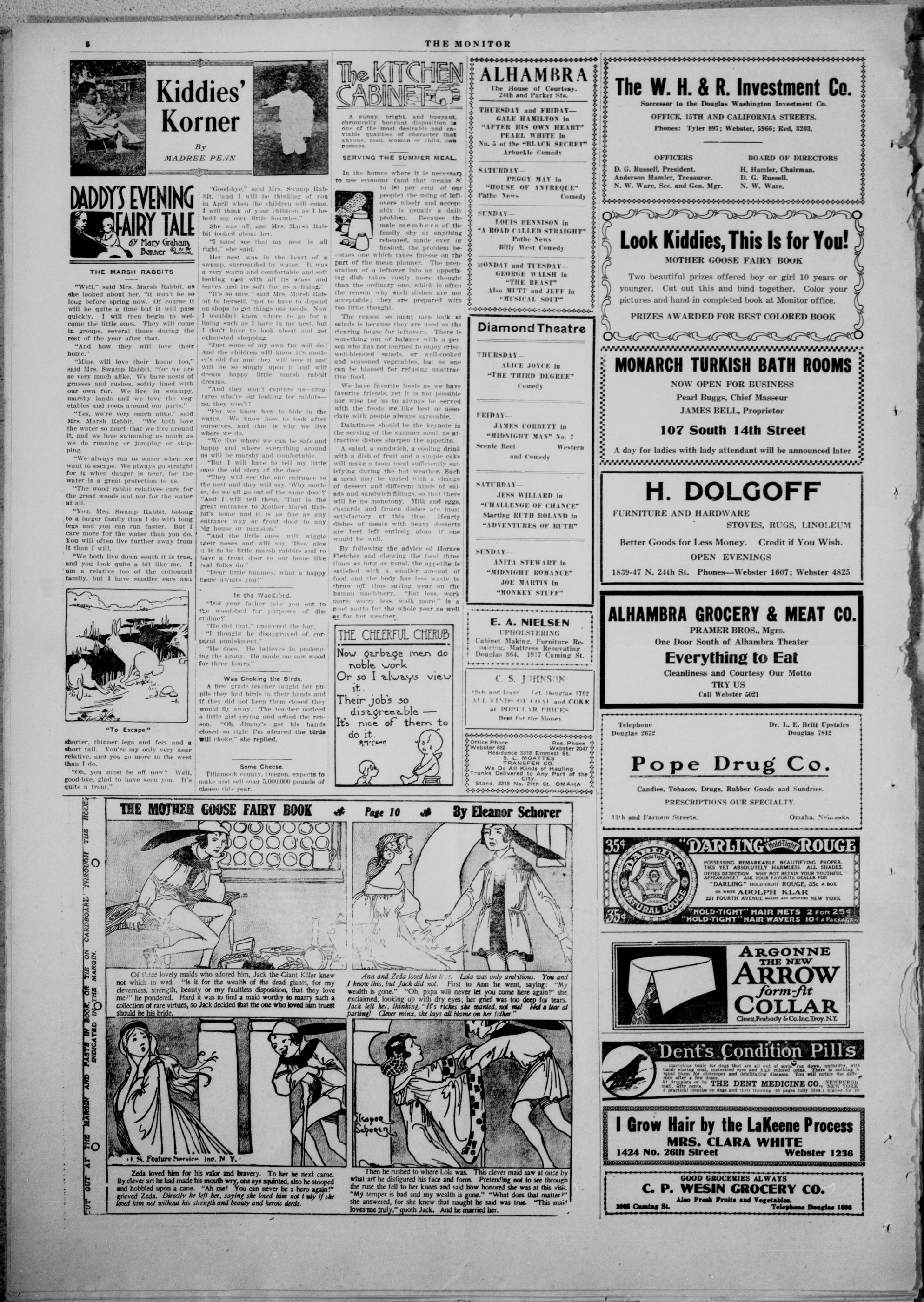
A chance for the kiddies to earn a prize. Read Monitor Mother Goose offer on page six.
(Copyright, 1919, by the Western Newspaper Union.)
When the mothers of Ellington wished to warn or frighten their children who were troublesome or rebellious, they had a "bogey man" directly at hand without appealing to a vague and distant object of juvenile dread.
Just at the outskirts of the town was a spot marshy and broken. It had been at one time a great resort for wild ducks and geese in the season and some ardent hunter had built a shed house fairly habitable. With the growing scarcity of game it had been abandoned until "Old Moon," tramp, cynic, miser, hermit, it was reported, came along, appropriated the ramshackle hut, patched it up and settled down. All kinds of wild stories were current concerning him. He was old, gray whiskered, had glittering, forbidding eyes and never addressed those who met him. Once or twice a week he would visit the local general store, purchase what provisions he required and then again retire to his grewsome retreat.
Robert Blake, his wife and their little four-year-old child lived in a neat but isolated cottage directly at the edge of the swamp. They had bought it cheap on account of its unfavorable situation, but had made a perfect paradise of its garden space. Economical as they were, however, they had not been able to keep up their payments on the property, illness and lack of steady employment cutting down the income of Mr. Blake. At times they dejectedly feared that they would have to give up their little home.
Doris was a bright, lively little sprite and rarely wandered away from home. Upon her youthful mind Old Moon had been impressed in a way that made her serious, but one moonlight evening she came rushing into the house in a fervent frame of excitement.
"Oh, papa! mamma!" she cried breathlessly. "I've talked to him!"
"Who is 'him,' Doris?" questioned her mother.
"Old Moon. Oh, surely he was the man you once pointed out to me! He was coming from the town, his arms full of groceries, and a bundle fell over and I ran out and picked it up and gave it to him. He set his things on the ground and put his hand on my head and said, 'Thank you, my little cherub,' and then gave me this box of candy. He spoke so kindly, and he can't be a bugaboo, to treat a little girl so nice, can he, now?"
Old Moon was no longer quoted to Doris as a bogey man. In fact, she asked questions constantly about his lonely living place and wanted to see him again. One day her father brought home her first pair of rubbers and Doris gloated over an accession she had long coveted.
"I can go out in the wet grass now whenever I want to, can't I, mamma?" she submitted. "Why, I can even walk along the edge of swamp water, picking pretty pebbles and shells. Oh, what dear, cute little rubbers!" It was just about dusk one afternoon when Doris started from the house. It had been raining and the fact delighted her, for she could find some puddles to wade through. She ventured in the direction of the swamp. Some distant flowers tempted her and she wandered on and on until a haze coming down over the landscape confused her. She began to cry as she found that she had lost both rubbers in the mud.
Then she saw a spark of light in the distance. She hurried toward it, to arrive in front of a wretched hut. Vaguely she fancied that it must be the oft-mooted habitat of Old Moon. She tiptoed to the sill of a window, glanced within a lighted room and, young as she was, what she saw there chilled and thrilled her—Old Moon lying bound hand and foot upon the floor and two men bending over him. One held a hammer menacingly, the other was prodding the helpless captive with a poker.
Doris ran from the spot with a wild cry of fright. It was shrill and echoing. Missing their little one, her father and mother had started to find her.
"Oh, papa! mamma!" gasped Doris wildly as they reached her—"Old Moon in his house and two men are trying to kill him!"
Robert Blake seized a heavy piece of wood and drove in the window sash as he in turn discerned what was going on behind it. The two strangers fled at his appearance. Mr. Blake relieved the old hermit of his bonds.
"They were talking of torturing me with a red-hot poker if I did not disclose the hiding place of my money," he explained. "You have saved it, and me. Ah! is that your child?" as the door opened and little Doris and her mother stood revealed.
It appeared that Old Moon had no inconsiderable treasure hidden in the old shack. The visitation of the burglar had the effect of driving him nearer to his neighbors. His gratitude toward little Doris, who had been the medium of his rescue, led to his building a new and better home next to that of the Blages. He insisted on helping them out of their money troubles, proving a good friend and neighbor and seeming to tire of the company of the little child whose adventurous spirit had been the means of transforming "the bogey man" into a happy and rational human being.
THE MONITOR
(Copyright, 1915, by the Western Newspaper Union.)
Captain Joel Holcomb had been gone a year on his last whaling voyage before either his niece, Rhoda, or her lover, Vance Deveril, heard from him. During the twelve months Rhoda had lived with a distant relative and Vance had held a modest clerkship in a shipping office.
The sea had been the roving ground of Vance's father for many a year. He had been the owner of a whaler. When he died about all he left was the good ship Defiance. She was not as good as new by any means, however, and the executors were about to sell the vessel for what she would bring as old junk when Captain Holcomb had come along. It was through this circumstance that young Deveril became acquainted with Rhoda, his niece. Thenceforward she filled all his thoughts and this fact induced Vance to favor the uncle in a plan he had formed.
"Tell you what, lad," Captain Holcomb had said, "the Defiance can be made entirely seaworthy and I have enough laid by to make her so. Here's my proposition: you furnish the ship, I'll refit her, then fifty-fifty on what comes of a venture to the South seas, say around Polynesia. I know the district, it abounds in spouters, and as to ambergries, it's there that precious spill abounds. One lucky voyage and we've both made men in a money way." So the battered old Defiance started for the Southern seas and Vance and Rhoda dreamed, and loved, and hoped. Vance had only his limited salary to depend on if they married, so they awaited some word from their venturesome argonian.
It had come at last—a letter. From what Vance could surnise it had been picked up by a mail steamer from a boat coming off shore from somewhere in the vicinity of the Papuan group of islands. It started out with the words, "I'm about to tell you about our cruise, and I'll start in by saying in an encouraging way we had greasy luck."
"What does that mean?" inquired Rhoda, to whom Vance showed the letter.
"It's a whalers' term and means that they were successful in finding plenty of whales and secured a rich cargo of sperm oil," explained Vance. "For two pages, though, the rest of the letter is undecipherable. It must have been wet through, immersed in sea water somewhere, for the pencillings are all blurred and blotted out. Only the last page is clear again. Listen, dear," and he read aloud:
"You must come therefore to Mimosa island, where, as I tell you, I am, and I need your help in getting away. Come alone by yawl from Ampti, and be sure to paint your nose red. As I have explained to you I am a king, but I need a prime minister to help me out of my fix."
"Jargon! 'King,' 'prime minister,' 'red nose!'" quoted Vance. "It sounds like the ravings of a madman."
"Perhaps the blotted out pages explained?" suggested Rhoda, and after a lengthy consultation it was decided that Vance must certainly try and find this mysterious and uncharted Mimosa island.
NEW YORK
SIOUX CITY
Orkii
OMAHA'S LAKE
FOR
WOMEN
CONANT HOTEL BLUE
It was just
survivor, the
navigate the
love at an un-
a island.
the captain,
the supersti-
ters to assist
It was not an easy task and it strained his resources to reach the presumed vicinity of the old captain's whereabouts and hire others to assist him to his quest.
Vance was greeted by a half-nude, ferocious appearing crowd, bearing spears, clubs and darts. They were about to attack him when their attention was focused on his carmine-bedaued nose. He was led to a rude habitation and there, seated on a broad dals, more rublcumb than ever, his nasal appendage more than usual aglow, was Captain Holcomb.
It took the latter some time to impart to Vance the story of his adventures. Laden with "greasy spoil" representing a fortune the Defiance had encountered a storm. Then pestilence had swept away the crew. It was just by chance that the sole survivor, the captain, had been able to navigate the dismantled vessel into a cove at an unfrequented part of Mimosa island.
"She's there now," said the captain, "but I have so played on the superstitious fears of my subjects that they believe she is haunted, for when they first discovered me I played some tricks on them with fireworks, a victrola and an electric battery which impressed them that I was a sort of wizard. They made me their king. I told them of the coming of my red-nosed relative and they believe red noses to be a distinctive mark of great dignity and power. They will never let me go willingly and my escape and the conveyance of the Defiance to some friendly port is now to be your task."
The face cream that is po-
COOLING, HEALING, SATIS-
tion, claiming
the haunt-
us allowed to
midnight the
island and
ex-kling and
home by pretty
ness from their
keep them all
50c
A JAR
8 CENTS
POSTAGE
Sold by Pope Drug Co., 13th
Co., 4826 South 24th St.; The Peop-
Toben Drug Co., 2402 N St.; Jones
Mrs. B. A. Bostic, 2124 Clarke
30th and Erskine; Mme. A. T.
Vance received explicit orders from the captain and rowed away that night. At the settlement he engaged a steam launch to proceed back to the island after dark. All due preparations were made for towing the whaler to a safe port the following evening.
And upon that occasion, claiming that he wished to exorcise the haunting spirits, the captain was allowed to visit the cave alone. By midnight the old ship was free of the island and two months later the ex-kling and Vance were welcomed home by pretty Rhoda, with the proceeds from their greasy luck sufficient to keep them all in comfort for life.
OrkinBros.
WOMEN'S WEAR CONANT HOTEL BLDG., SIXTEENTH ST.
The face cream that is positively guaranteed to remove all grease, shine and perspiration. COOLING, HEALING, SATISFYING.
Sold by Pope Drug Co., 13th and Farnam Sts.; Williamson's Drug Co., 2306 North 24th St.; Melchor Drug Co., 4826 South 24th St.; The People's Drug Store, 111 South 14th St.; Holtz Drug Store, 2702 Cuming St.; Toben Drug Co., 2402 St.; Jones Cultural College, 1516 North 24th St.; Unitt-Doceckal Drug Co., 1625 Farnam. Mrs. B. A. Bostic, 2124 Clarke St.; Mmes. South & Johnson, 2416 Blondo; Mme. C. C. Trent, 30th and Erskine; Mme. A. T. Austin, 4911 North 42d; Mrs. Clara Chiles, 2420 Lake St.
BANKER BINGA'S HOME
BOMBED THREE TIMES
But Binga's Neither Bluffed Nor Bothered — Colored Chicagoans Determined to Enjoy Their Constitutional Rights.
Chicago, Jan. 7. For the third time within six months the property of Jesse Binga, banker and real estate dealer, has been bombed by unknown parties. So critical has become the situation, and so determined are the colored people of Chicago to enjoy their constitutional rights that a new organization, the Chicago Protective Circle, has been inaugurated for the avowed purposes of using every means within the law to put a stop to lawlessness and insidious propaganda. It is made up of the most substantial people of the community, and very heavily financed.
HAYS HEARS REPUBLICANS
WILL CARRY TEXAS
New York, Jan. 7.—Will H. Hays, chairman of the republican national committee, daily receives surprising reports about rosy republican prospects, but none of them are so surprising as the predictions coming from Texas to the effect that the republicans there will carry that state for the republican national ticket next fall.
The democrats of Texas concede nearly complete demoralization in their state organization, with no likelihood of harmonizing the ambitions of the rival leaders until there has been a political cataclysm that will blow the old democratic machine to bits, after which the democrats hope they can get together again with chastened spirits and rebuild their party in the Lone Star state.
UNIFORM STANDARD AND WAGE FOR TEACHERS
(By The Associated Negro Press.)
Baltimore, Md., Jan. 7. That there should be a uniform standard of efficiency for white and colored teachers, with a single salary scale; that a commission should be appointed by the governor to consider Negro education in Maryland, and that there should be closer co-operation between the state board of education and colored leaders were some of the suggestions made at a conference between leading colored men and the state board of education. The meeting was held at the Colored Young Men's Christian Association.
SCORES KILLED IN MEXICO
BY EARTHQUAKES
Mexico City, Jan. 7.—Scores of persons have been killed in a violent earthquake which occurred in many parts of Mexico. The center of the disturbance is believed to have been near the volcano of Orizaba. Incomplete press reports indicate that the state of Vera Cruz suffered more than any other section, although seismic disturbances were felt throughout the entire republic.
NEW YORK
SIOUX CITY
Have You Tried It Yet?
KAFFIR-KREAM
TRADE MARK
COLORADO ORGANIZES CLUBS TO SWELL REPUBLICAN RETURNS
Denver, Colo., Jan. 7.—With the organization of the Lincoln Republican League of Colorado, with a membership said to number 1,000 Negroes, it develops that similar political clubs have been formed in many states to work for the success of the national republican party in the forthcoming presidential campaign.
Sponsor for the clubs is Robert R. Church, reputed Negro millionaire, of Memphis, Tenn. A convention will be held in Chicago February 11-13. Robert S. Abbott, editor of a Negro weekly at Chicago, is said to be at the head of the Lincoln league in Illinois. It is hinted in local political circles that National Chairman Will Hays has sanctioned the organization.
WILL SEND HOME BODIES
OF AMERICAN SOLDIERS
London, Jan. 7.—Extensive plans for the wholesale removal of the bodies of America's war dead to the United States will be put in operation in England and France this week.
HOWARD REPRESENTED AT
TEACHERS' FEDERATION
Washington, D. C., Jan. 7.—Dr. Emmett J. Scott and J. D. Logan represented the Howard University Teachers' Union as delegates at the convention of American Federation of Teachers in Chicago last week.
Griffin, Ga., Jan. 7.—A large meeting of Negro farmers from Henry, Pike, Butts and Spalding counties was held under the auspices of the Griffin and Spalding county board of trade for the purpose of raising the Negro farm demonstration agent operation in the counties.
WATERS
BARNHART
PRINTING CO.
OMAHA
Masonic and Lodge Rituals
KIESER'S BOOK STORE
221 No. 16th St.
Loyal Hotel Bldg.
OMAHA
LINCOLN
A chance for the kiddies to earn a prize. Read Monitor Mother Goose offer on page six.
SCIENTIFIC
DENOVA TREATMENT
Grows and Beautifies the Hair
Correspondence course offered. Diplomas Granted. Agents wanted everywhere. Address— MME. A. J. AUSTIN, 4911 North 42d Street, Omaha, Neb. Telephone Colfax 642. Orders should be accompanied with 85 cents.
We Sell Kashmir Goods
STARK'S PHARMACY
30th and Pinkney Streets
Phone Webster 4225.
NORTH END COAL & EXPRESS CO.
Hauls Everything.
2010 No. 24th St.
A. C. ALLEN, Prop.
Phone Webster 5036
FRESH EGGS
Quality First
Our Motto
We are just as particular
regarding the quality of
foods we buy as we are
about the way we serve
them.
Only the best products on the market are good enough for cur patrons And the most rigid rules of cleanliness are followed in preparing these products for the table.
The Monarch Cafe
CARNER & TRIMBLE, Props.
107 South 14th St.
Phone Tyler 4119
OMAR
WONDER
FLOUR
REAM
THE MONITOR
A National Weekly Newspaper Devoted to the Interests of Colored Americans.
Published Every Thursday at Omaha, Nebraska, by The Monitor Publishing Company.
Entered as Second-Class Mail Matter July 2, 1915, at the Postoffice at Omaha, Neb., under the Act of March 3, 1879.
THE REV. JOHN ALBERT WILLIAMS, Editor and Publisher.
Lucille Skaggs Edwards and Madree Penn, Associate Editors.
Fred C. Williams, Business Manager.
SUBSCRIPTION RATES: $2.00 A YEAR; $1.00 6 MONTHS; 60c 3 MONTHS
Advertising Rates, 60 cents an inch per issue.
Address, The Monitor, 304 Crouse Block, Omaha, Neb.
Telephone Douglas 2224.
Citizenship Rights Not to Be Abridged.
1. All persons born or naturalized in the United States, and subject to the jurisdiction thereof, are citizens of the United States and of the State wherein they reside. No state shall make or enforce any law which shall abridge the privileges or immunities of citizens of the United States; nor shall any state deprive any person of life, liberty, or property without due process of law, nor deny to any person within its jurisdiction the equal protection of the laws.
LAST week's issue contained a news item stating that a French newspaper had suggested editorial that France invite 2,000,000 colored Americans to help rebuild the war-stricken land. The Monitor has received several inquiries for further information from men who are anxious to go. We can give no further information.
The item and the inquiries have caused us serious thought. The painful reflection is forced upon us that while the United States seems so indifferent to one of her most valuable assets, other countries recognize it. That while she treats the colored American largely as an alien and an unwelcome guest other countries—for France is not alone in this, the South American republics being equally outspoken—are bidding him welcome and inviting him to come. The desire of many of our most thoughtful, upstanding and ambitious young men to accept such invitations and forsake America is equally significant.
The Monitor's opinion is that despite the tempting lure of other lands the United States is where we are most needed and where we will best work out our destiny. The advancement we have made, despite prescription and limitations, foretell the greater achievements that will be ours right here in this land upon which none has greater claims than we, if we remain true to God, true to our country and true to ourselves.
AMERICANIZATION.
AMERICANIZATION is the term used for the process of making loyal American citizens out of the various race groups and varieties which go to make up the population of the United States. A large percentage of the population is of foreign birth. Millions owe allegiance to other flags than the starry emblem which waves over our own land. Millions speak a foreign language. This does not make for national unity. It perpetuates racial groups whose interests are first racial and after that national. Race consciousness and class consciousness, instead of a national consciousness predominates. The danger of this must be apparent to all. A few national leaders have seen this danger, called attention to it and have urged that a campaign of Americanization be vigorously prosecuted. To this end a program providing for education in the English language and instruction in American principles and ideals has been put into operation in several of our larger cities among these foreign groups. By this process it is planned to make them loyal, patriotic and enthusiastic American citizens, submerging their racial or class consciousness in that of the nation, so that they will pride themselves upon being Americans first. Not, however, that they should forget the land of their nativity to which they must be bound with ties of tenderest affection because of birth and kinsmanship; but that their allegiance shall be sincere and whole-hearted to America, the land of their adoption. In self-defense and for the perpetuity of her institutions the United States can ask no less than this. Polygeneous, that is to say composed of many races and nations, she must become unigenous, one nation. She cannot endure without national unity. She must have a national consciousness and a national life and a national policy embracing all elements of her population and her population must be made and must become thoroughly, truly and ideally American. Americanization is therefore an imperative duty imposed upon this nation and people.
It may be well, however, to remind the statement of the nation and the moulders of public sentiment, such as the press and the pulpit, throughout
the nation, that while properly stressing the Americanization of foreign groups and races, there is grave danger of de-Americanizing that loyal and dependable people, one hundred per cent American, who constitute at least one-ninth, possibly one-eighth of the total population of the United States. The constant pushing aside and practical counting out of the colored American will, we fear, if persisted in, result in his estrangement from and the weakening of his affection for the United States. We do not speak as an alarmist, but as an interpreter of the sentiment which we know to exist among our group. Segregation movements and the like, proclaiming our people 'undesirable;' various forms of prescription, and the popular emphasizing of the fact in the public mind that we are Negroes and not men, is creating that very class and racial consciousness among us which Americanization seeks to minimize and lessen among the foreign racial groups composing the population of the United States. Is this a wise policy to pursue? Ought not every group be encouraged to feel itself American first, willing to contribute its all for the upbuilding and defense of the republic? Can any process of Americanization be complete which fails to accord to the colored American his full constitutional rights and privileges? While Americanizing those of alien blood, is it part of wisdom or far-sseeing statesmanship to foster, favor or encourage any policy that inevitably has a tendency to de-Americanize the colored American?
AN INDEFENSIBLE PRACTICE?
THE Omaha police have an indefensible practice which ought to be stopped. It is the habit of arresting forty or fifty colored men indiscriminately in an effort to apprehend one or two men who have been accused of crime. Almost every time it is reported that a Negro has committed a crime, the police throw out what they call a dragnet, visit pool halls and similar places run by colored men, and make arrests by the wholesale. Many of these men are respectable and industrious men, employed at hotels and packing houses, who have dropped in to play a game of pool or billiards, which they have a perfect right to do, who are taken in these general round-ups. They are held over night or for a day or two and are then discharged. Some of these men have lost their jobs by being unjustly detained. There are more white men loafers and habitues of pool halls than there are colored men, and at that we have too many colored loafers who ought to be made to go to work or be sent to jail, but if it is reported that some white man has committed a crime, the police do not round up the white pool halls and make indiscriminate arrests by the wholesale, running in hard-working men who may have dropped into such places for a little recreation.
Why, then, is this difference made? There is nothing fair about it, and the practice should be stopped.
Recently a man was held up and robbed of $20.00 by a Negro. Forty-eight Negroes were arrested and held in custody in an effort to apprehend the criminal. Among these were several waiters and men who were able to give good account of themselves. About the same time Hayden's store was robbed of $65,000; holdups and burglaries by white men were reported to the police, and yet there was no wholesale rounding up of white men, although the police know there are several here of shady reputation, in an effort to apprehend the guilty ones. If the police are going to make wholesale arrests of colored men, every time some colored man commits a crime, is it not fair to request that they follow the same policy whenever a white man is accused of crime?
THE MONITOR
VIA DOLOROSA
(By Ethel Merrill Beale in "The Congregationalist and Advance.")
Times were, and they scorned the toiler
Because he worked with his hands;
And then the Christ as a Toller came,
Bearing the burden, bearing the shame,
And died in their scorning lands.
Since then they have blest the toiler,
Have woven a glamour around
Till each at his chosen task is king;
The scythes are whetted, the anvils ring,
And they call it goodly sound.
Times are, and they score
Because of his dusky
Though his soul were pure
Twould anger them more
For a trifle they'd st
If Christ should come as
With his burning love
Would they cry out: "Ip
Would they stand and mo
Would Calvary live an
And then, too late, would
Would they learn that the
If Christ should come as a Negro
With his burning love for men.
Would they cry out: "Lunch!" as he tried to save?
Would they stand and mock as his life he gave?
Would Calvary live anew?
"WHATA HELLA DA MATTAH?" THE Monitor has a somewhat irascible Italian friend. We met him the other day. He was somewhat excited, indeed, very excited. No, he hadn't been drinking. He met us with the inquiry, "Whata de hella de mattah wida Nebraska, wida Omaha, wida de whola de states? Everybod de crazy. No lika de Italian, no lika de Jew, no lika de collata man, lyncha him, killa him; no lika de Pola, no lika de Jap; whata de halla de mattah? Canta you tella me? Whata de hella de mattah?" Tony's not the only one asking this question. We wonder who can answer him.
THE PEOPLE MUST BE HEARD.
DON'T you know the time has passed when any group of men or women can get together and do all the thinking and planning for others and expect them to accept their conclusions unquestioningly? It is becoming more apparent daily that this is the age of the masses not of the classes. The people have rights, know their rights and will be heard. Autocracy, individual or bureaucratic, is detroned; democracy has begun to reign.
CONGRATULATIONS, JUDGE AND MARSHAI
THE Monitor extends sinne congratulations to Judge George A. Day upon his elevation to the supreme bench of Nebraska, a well-merited promotion to an eminent jurist and a splendid gentleman. Our felicitations in equal measure and sincerity, we extend to another appreciated friend of many years' standing —Thomas J. Flynn, upon his reappointment as United States marshal, in merited recognition of duties well performed.
Judge Day is an ardent republican, politically, and Mr. Flynn an equally enthusiastic democrat. Religiously, they belong to different communions, perhaps as widely separated as in their political affiliations; but what counts most is that they are men from the ground up. Therefore, congratulations, judge and marshal, with the heartfelt hope that higher honors still lie before you.
Men are never so ridiculous from the qualities which really belong to them as from those they pretend to possess.
Fe
THE UNIV
Ford
THE UNIVERSAL CAR
Ford service for owners of Ford cars,
is one of the important elements of the
great Ford organization. Ford owners
can get real Ford service only by coming
to the authorized Ford
dealers, where there are
at all times Ford work-
men, genuine Ford ma-
terials and the standard
low Ford prices. If you
want to get all there is, and the best
there is, in your Ford car come to us
with it for the genuine Ford service.
Prompt attention every time.
SAMPLE-HART MOTOR CO.
100% Ford Service
18th and Burt Streets
OMAHA
at the Negro
hue.
as as the drifted snow
to have it so;
b him through.
at Negro
for men,
uch!" as he tried to save?
ok as his life he gave?
ew?
they see the right?
black man's soul is white?
"Anywhere—Providing it be Forward"
Just now, at the beginning of 1920, it is interesting to recall the famous remark of James Gordon Bennett, when he sent Henry M. Stanley into the jungles of darkest Africa to "Find Livingston." "Where shall we go?" someone inquired. Quick as a flash came the eternal words: "Anywhere—providing it be forward."
That is a fitting and timely slogan for us, this 1920 wonderful year. No backward step this year; it must be a year of Forward March! We must go forward in every field of activity, and at every stage of the game. We must concentrate our forces, and conserve our resources. We must rub elbows of friends, and loyalty to each other, and "be on the job."
We must generate and regenerate avalanches of "pep" and enthusiasm. Life's battles of peace need those ingredients, as well as the battles of war. Almost a year ago Lieut. "Jim" Europe, "the noblest Roman of them all," lost his life, because of his desire to go "over the top" in musical inspiration, he urged his drummer to "Put a little more pep in your sticks." But in those very words Jim Europe, aside from his musical achievements, left us an undying legacy in a real slogan for success in life. We must all put a little more pep in our sticks. It matters not the kind of drum we are beating in the parade or concert of life, if we fail to have the kick in our sticks, we will not get very far. And we must go forward!
There's a big job on hand. The chief strategists of injustice and destruction are working out campaigns of disaster. They are using their best brains—as little as that may be—and they are putting up their filthy dollars to pay the fiddler. We must use our best brains and our best dollars in the very best and most righteous way to turn back the ungodly attempts to advance further into the land of "Thy Kingdom Come." We have the brains, and we have the dollars, and by the eternal gods, we must be stingy with neither!
We must find the Livingstone of justice.
"Where shall we go?"
"Anywhere—providing it is forward."
It is not doing the thing we like to do, but liking the thing we have to do, that makes life blessed.—Goethe.
PERISCOPE.
We Have a Complete Line of
FLOWER, GRASS
AND GARDEN Seeds
Bulbs, Hardy Perennials, Poultry
Supplies
Fresh cut flowers always on hand
Stewart's Seed Store
119 N. 16th St. Opp. Post Office
Phone Douglas 977
Call Webster 1358 After 6 P. M.
C. W. ANDERSON
Upholstering of Chairs
3325 Emmet Street. Omaha
Petersen & Michelsen
Hardware Co.
GOOD HARDWARE
2408 N St. Tel. South 162
Liberty Drug Co.
EVERYBODY'S DRUG STORE
We Deliver Anywhere.
Webster 386. Omaha, Neb.
Established 1890
C. J. CARLSON
Dealer in
Shoes and Gents' Furnishings
1514 No. 24th St. Omaha, Neb.
PATTON HOTEL AND CAFE
N. A. Patton, Proprietor
1014-1016-1018 South 11th St.
Telephone Douglas 4445
62 MODERN AND NEATLY
FURNISHED ROOMS
MELCHOR--Druggist
The Old Reliable
Tel. South 807 4826 So. 24th St.
Hill-Williams Drug Co.
PURE DRUGS AND TOILET
ARTICLES
Free Delivery
Tyler 160 2402 Cuming St.
Start Saving Now
One Dollar will open an account in the
Savings Department
of the
United States Nat'l Bank
16th and Farnam Streets
F. WILBERG
BAKERY
Across from Alhambra Theatre
The Best is None Too Good for
Our Customers.
Telephone Webster 673
C. H. MARQUARDT
CASH MARKET
Retail Dealer in Fresh and Salt
Meats, Poultry, Oysters, etc.
2003 Cuming St. Doug. 3833
Home Rendered Lard. We Smoke
and Cure our own Hams and Bacon.
J. A. Edholm E. W. Sherman
Standard Laundry
24th, Near Lake Street
Phone Webster 130
OMAHA
PRINTING COMPANY
THE
OFFICE
SUPPLY
HOUSE
Just Call
Douglas 3889
Autos Everywhere
Empire Cleaners and Dyers
707 South 16th St.
OMAR
WONDER
FLOUR
For Accurate and Dependable
Service See
WILLIAMSON
DRUGS, TOILET ARTICLES,
PRESCRIPTIONS
2306 North 24th St.
Phone Webster 4443 and we will
send it out.
A CLASSIFIED DIRECTORY OF
OMAHA'S COLORED BUSINESS
AND PROFESSIONAL FIRMS
A. F. PEOPLES
PAINTING
PAPERHANGING AND
DECORATING
Estimates Furnished Free.
All Work Guaranteed.
4827 ERSKINE STREET.
PHONE WALNUT 2111.
SILAS JOHNSON
Licensed Embalmer and Funeral Director
2518 Lake Street
The place known for its quality service, and reasonable prices
We spare no pains for our complete chapel service. Open day and night.
Phone Webster 248.
For Pierce-Arrow Limousine
Service, Call
CHAS. BOYD
Webster 208
(After Midnight) Tyler 4119
Service With Class—Car Warm
and Cozy.
Repairing and Storing
Orders Promptly Filled
NORTH SIDE
SECOND-HAND STORE
R. B. RHODES
Dealer in
New and Second-Hand Furniture
and Stoves.
Household Goods Bought and
Sold. Rental and Real Estate.
2522 Lake St. Webster 608
ATTENTION! LISTEN!
MEN OF OMAHA
Are you interested in giving your wife one day's rest during the week with no dinner to get and no worrisome dishes to wash?
If so, take advantage of
SOUTH & THOMPSON'S
delicious 50-cent Sunday Dinner.
Regular Weekly Dinner, 35c.
Phone Web. 4566 2418 No. 24th St.
Allen Jones, Res. Phone W. 204
Andrew T. Reed, Res. Phone
Red 5210
FUNERAL PARLOR
2314 North 24th St. Web. 1100
Lady Attendant
Phone Douglas 6335
Goods Called for and Delivered.
ECONOMY TAILOR CHAS, M. SIMMONS, Prop.
25 Years in Tailoring Business 1313 Dodge St.
Quality Service
DR. P. W. SAWYER
DENTIST
1614½ No. 24th St.
Webster 3694
MISS ALICE MARSHALL
Artistic Hairdresser
Student of Madame J. C. Walker
Parlor 1855 North 23d Street
Phone Webster 2687.
Satisfaction Guaranteed
Open for Business the
BOOKER T. WASHINGTON
HOTEL
Nicely Furnished Steam Heated
Rooms, With or Without Board.
523 North 15th St. Omaha, Neb.
Phone Tyler 897.
Eureka Furniture Store
Complete Line of New and Second Hand Furniture
PRICES REASONABLE
Call Us When You Have Any Furniture to Sell
1417 N. 24th St. Web. 4206
DR. W. W. PEEBLES
DENTIST
220 So. 13th St.
(Over Pope's Drug Store)
Telephone: Douglas 7812
```markdown
```
F vents and
Persons
musical selections were rendered by
members of the club. After a de-
Jightful menu was served members re-
tired, thanking the hostess, who is
president for a very pleasant evening.
A chance for the kiddies to earn a
prize. Read Monitor Mother Goose
offer on page six.
‘The musical program rendered un-
der the management of Mrs. N. A.
Walker at Pilgrim's Rest Baptist
church, New Year's evening was both
an artistic and a financial success
with Mrs. Clara Guy at the piano.
Have you joined the N, A. A. C. P.
yet? Why not?
Sayman's Soap, 2 bars for 25c, at
Finkenstein, 26th and Blondo,
Mr. A, Essix and wife arrived in
Omaha January 2, and are stopping
with T. J. Elliott. 1854 North Twenty-
third avenue. Mrs. Elliott and also
Mrs. Paris of 1631 North Twenty-first
street, are his sisters,
For special bargains in stocks,
bonds and real estate see Fred Wil-
liams, Monitor office. Douglas $224.
BE. F, Morearty, Lawyer, 640 Bee
Building. Douglas 3841—Adv,
Mr. E. G, Scott, 2513 North Twenty-
eighth avenue, was called to Topeka
‘Tuesday morning on business.
For big bargains and safe invest-
ments see Fred C. Williams, Douglas
3224,
The Pleasant Hour club gave a de-
lightful whist party at the residence
of Dr. and Mrs. J. H, Hutten, Wednes-
day evening, December 30. First prize,
Mr, Harry Buford; second prize, Dr.
Peebles; third prize, Mr. Augustus
Hicks.
Photos painted in oil colors by our
method, beautiful and look alive.
Send $1 with photo for sample. De-
seribes color fully. We copy and en-
large all kinds of pictures. Satisfae-
tion guaranteed. _ Representatives
wanted. ‘The Photo Color Studio, 2866
Saratoga street, Omaha, Neb.
N. A. A.C. P. meets at Pilgrims
Rest Baptist church. Twenty-sixth and
Franklin, next Sunday afternoon, Dr.
J. R, Lemma and Mr. H. L. Anderson
will deliver short addresses. Mrs. J.
H, Smith will sing.
Mrs. Samuel Bush and granddaugh-
ter, Alice Green of Lincoln, spent the
holidays with Mrs. Francis Smith,
1334 Dodge street.
Sugar, 15¢ per pound; coal oil, 18¢
gallon; Yellow Yam sweet potatoes,
10¢ pound, at Finkenstein, Webster
1902.
North Side taxi, J. D. Lewis, pro-
prietor, ‘Two limousines with heat.
Stand phone, Web. 1490; residence
phone, Web. 949,
A birthday party in honor of Spen-
cer McGovern and Luther Alexander
was given December 25 at 2222 Sew-
ard street. The out-of-town guests
were: Mr. and Mrs. Daniel Smith
and Miss Cora Mitchell of Nebraska
City. The following Omahans were
present: Mr. Daniel Smith, jr. Mr.
and Mrs. Givens and daughter, Mr.
and Mrs, Shackelford, Mr, and Mrs,
Williams, Mr. and Mrs. Jennings, Mr.
and Mrs. Washington, Mrs. Lena
Smith, Miss Willie Neal. Mr, Joe
Hunter, Mr. Thompson, Mr. Johnson,
Mr. Alexander, Master Lloyd and
Floyd Shackelford, jr.
Drs, Singleton & Singleton, dentists,
111 South 1th street. Quality and
efficiency our motto,
One of the most popular of the holi-
day affairs wa sthe dinner given on
Christmas day by Mr. Harold Bentley
and Mr, Tom Roulette. The honorees |
were Misses Aline Bentley and Thel-|
ma Jones and Messrs. Hubert Glover
and Arthur Hadley, students of West-
ern university. The guests numbered
fifteen.
Mr. W. B. Brown of 3870 Harney
street is much improved and will be
out soon with his friends.
On Christmas evening Mr. and Mrs,
L. L. Floyd entertained Misses Thel-
ma Jones and Aline Bentley at a five-_
course luncheon, Among the guests
were some former Western univer~
sity students, and many interesting |
events were recalled and pleasure.
After having enjoyed some of the de-
Ughtful repasts of the culfmary art of
this young matron, everyone departed
after having expressed their appre-
ciation of the hospitality of the host
and hostess.
Fresh Dressed Chicken, Fresh Chit-_
terlings and Juicy tender meats of all |
Kinds at the meat department—Fink-
enatein, 26th and Blondo.
NEW FURNITURE STORE
OPENED AT 24TH AND LAKE
€. J. Dolan, who has been connect-
ed for several years with the H. R.
Bowen Co, as sales manager, and John
P. Shields, who has been connected
with the Omaha Gas company for sev-
eral years, have opened a furniture
store on the northeast corner of
Twenty-fourth and Lake.
With their years of experience in
the furniture business and their inex-
pensive location they feel they can
serve their customers better and sell
more furnishings much cheaper than
other stores with greater expense.
Members of The Monitor staff who
Visited the store found courtesy and
efficiency the evident watchword.
JAPANESE TEA AND
PRE-LENTEN SALE
| The Woman's Auxiliary of St.
Philip's Episcopal church ts giving a
‘unique affair next Wednesday after-
Bbon and evening, January 14, in the
guild rooms, from 2 to 11 p. m., under
‘the chairmanship of Mrs. S. B. Canty.
It is to be a Japanese Tea and Pre-
Lenten sale of fancy and useful ar-
ticles, Those who like tea and coffee
‘will be graciously served from booth
No, 1 in charge of Mesdames W. W.
Peebles, Joseph LaCour and Joseph
Brown; those whose appetites call for
spaghettl and baked beans, simply
have to make their wants and capacity
known to Booth No. 2, where Mes-
dames J. H. Crawford, L. B. Britt and
H.R. Roberts preside. Others who
delight in useful and fancy articles
will find Mesdames T. S, Phillips,
Sarah Lewis, George P. Johnson and
J. A. Williams ready to supply their
needs at Booth No. 3. Mesdames R.
T. Walker and Thomas Reese will
serve large slices of “Scripture Cake.”
Japanese gowns will be worn,
PHI DELTA NOTES.
The Phi Delta girls, with the assist-
ance of a number of the younger set
of the city and Mrs. Estella McCoy,
gave a watch night party at the home
of the Misses Jones in honor of the
city’s holiday guests—Miss Mozella
Joseph, Mrs. H. Gleen, Mrs. James
|Madden, Mrs. Cliff Robinson and Miss
Irene Newman. Games and dancing
were indulged in till January 1, 1920,
ise which time the tooting of horns and
‘singing announced the new year. A
bounteous lunch was served about 1
‘a. m., after which dancing was con-
|tinued till 2:30 with some real jazz.
GIVE INFORMATION
TO CENSUS TAKER
‘The Fourteenth United States Census
is Important to the Whole Country,
and of Unusual Importance at This
| Time to the Colored People.
| Because of the many economic
changes since 1910, the importance of
the decennial census to the colored
people should not be underestimated.
‘These changes will be a matter of
‘record in the history of the growth of
‘the race, and of the nation, and the
‘statistical information which will be
compiled from the data collected by
the census enumerators, who will can-
vass the United States this month,
should constitute a source of reliable
information for this and for future
generations.
‘Through migration, the colored
population of some states has con-
siderably increased, while in others it
has decreased since the United States
‘census of 1910. Agricultural activi-
ties appear to be extending in new di-
rections, Thousands of colored men
and women have entered into the in-
dustrial life of the nation as produe-
ers. Indications, in certain states,
point to a large increase in home
ownership. A substantial growth in
the number of business enterprises
‘owned and oeprated by colored men
is reflected in their newspapers and
magazines, which are growing in
‘number and influence, ‘The number
‘of professional men and women are
‘steadily increasing, and the percent-
age of illiteracy is rapidly decreasing.
~The accuracy of the census reports
‘depends largely upon the willingness
‘of each individual to answer fully each
‘question asked by the enumerator,
‘and it is only in this way that reliable
data can be obtained from which can
be determined the social and economic
progress made by each element of the
population in the United States,
‘The census bureau emphasizes the
point that all information collected by
the census enumerators is strictly
confidential, It cannot be used as a
basis for taxation, for the enforcement
of any federal. state or local law, or
in any way whatsoever that will
cause harm to the person giving it or
to his affairs. No one, therefore,
should hesitate to give to the census
enumerators complete and truthful
replies which the enumerators can
use in filling out the printed census
schedule carried by them, nor should
any attempt be made by anyone to
cover up the true facts that pertain
to each man and woman,
Are you a member of the N. A. A.
©. P.? If not, why not?
THE MONITOR
y LI >
dM ;
J eas .
eee 4
| ao : ee Ce
Oe eee cae a eS.
Po wee
Ee caer
Se er pe: fen
eo ] ey
\ b, sem
sie
} je 5 ais:
i : ty
‘XN y
“ABS
REY. RB. P. TYLER
Presiding Elder of the (. M. E, Church, who, since coming to Omaha,
has established a (. M. B. Church here, of which Rey, Sims is pastor
‘The last meeting of the year was
held at the home of Frances Gordon,
at which time Christmas packages
were wrapped for some children and
Christmas songs practiced.
‘The first meeting of 1920 was held
at the Community house. A pleasant
social hour was spent.
Meeting of Roosevelt Post No. 30,
American Legion, Friday evening at
8:30 at headquarters, Community Cen-
tor. 2420 Lake street
rbeiscolcP ait Centerecosuestoh
unites of viral
By order of Peal Ocmnatantar,
DR. AMOS B. MADISON.
CARD OF THANKS,
We. daughter and son, wish to ex-
us during the bereavement of our be-
loved mother, Mrs. Emma Ray We
also wish to especially thank Daugh-
Y a E
(7 ex a, N
= 4 aa <R
d ae hy
f §
7S. Sash ‘S
pe ) sei
) } Q
febrin, Loren C pyre Me
3 henge: Sth :
af Hike Qtr axipasatort, hare done
wendus for ray Lar andl then’ S tied nearkysrtvy
Hinge clean ny complidieon of Aint, Lrcoige
and. Hackftads ther ¥ cncebet, ia, Lforvigl
asd ¢ tim, fle on ch Aw he weer the
rsa Aesedaah, tha Lite adie at arak.
ME our Wwoarir® wth ly Weke Gece
Meds bee
1 ‘
. = aa
i [ogye] . NILE QUEEN — fi@>yyee
4 Preparations for Hair and Skin
For sale at all Dru Stores and first class Beauty Parlors
FREE! DeLuxe Beauty Book write today for a copy FREE!
i KASHMIR CHEMICAL COMPANY
7 312 South Clark Street, Chicago Dept. 00000
'P. H. Jenkins, the Barber
| My shop stands on its merits for what is a ;
right, and what the people demand, with ‘a ee
first class barbers, who know their busi- 4 F a
ness. I have added one more chair to my Aig ee. \
shop, in order to take care of the increase Aga on \
in my business. The Colored people are [Mam Peay \
growing and improving and we must meet [1 | pa
their demands. ‘They want the best and we \P 7
must deliver it. I have it for you, so come, \W) r
I solicit your patronage. There is no pool 4 a)
hall connected with my. business. Barbers \Waeas Tg y
are: Mr. H. Bascom, Mr. J. T. Thompson, \ re y
Mr, J. Reddic, Mr, Ted Carman—all first oe” 3
class hafreutters; Ethel Dow, manicurist. I an Y '
have in connection soda fountain and ice £ 7 ‘
eream parlor.’ Webster 2095. — ‘
New Location, 2122 North 24th St.,Omaha ;
CAMP FIRE.
ATTENTION.
ters of Bethel No, 9, Aksarben Temple
254, Leona Burton Royal House, Mary
E, Dixon Tabernacle No. 20, and our
host of friends for their beautiful
floral offerings.
MRS. A. A. AUSTIN,
. MR. W. C. RAY.
.
RACE BOOKS AND PERIODICALS
. Our Boys and Girls
A weekly newspaper for our youth,
‘$1.00 per year; 50¢ for 6 months. 54
‘West 140th St., New York City.
The Negro in American History
By Prof. John W. Cromwell, $1.40 and
worth more. 1439 Swann St., N. W.,
Washington, D. C.
The Negro Soldier
By John E. Bruce “Grit”. The glor-
ious record of America’s black heroes,
25 cents (no stamps.) 2709 Madison
Ave., New York City.
‘The Crusader Magazine
The Greatest Negro Magazine of
Ameries. $1.00 per year and cheap
it that. 2299 Seventh Ave, New
Vork City.
Richardson Bros.
Garment Renovators
Tailors Dyers Hatters
MAIN OFFICE—27th and CUMING ST.
| We are as Close to You as Your Telephone
| Quick Delivery Service FREE Telephone Harney 3374
|
“Good Workmanship and Service Count, Not Words”
HOT CHILI! HOT COFFEE |
Yum, Yum Delicious |
Gregory’s _
Kandy Kitchen
and
Luncheonette |
1508 North 24th Street |
Webster 267 |
Home Made Candies. Tee Cream Sodas |
QS
SCAR ERS)
\ Le
is a healthy, active, industrious liver. Small doses of these pills
taken regularly insure that. You may also need a purgative
sometimes. Then take one larger dose. Keep that in mind;
it will pay you rich dividends in Health and Happiness.
ROSY CHEEKS 2%,#24L THY COLOR iodicates Iron ia the Blood. Pale or
‘sameoenalt, how js absence, 4 290° CARTER’S IRON PILLS
FLOR DE
The Cigar Supreme
At the price FLOR DE MELBA. is better. bigger
and more pleasing than any mild Havana cigar
IG ARLHS Fe tale joss sete es ls :
1 LEWIS, clean Mee, cO- Newent, 3 [DP rieareay,
a we ®
<r) Be. Flor de eo
SE Ges ta TH cican (aie Ly | iN
oH ace TF oe
CORONA OR i Cy a,
S008 210¢ 10° se eee
Ash your de LL
omnes sizes pevenewT paices, ASL Ss ace CI
en ee ee eT eee ee te
'
MAGIC HAIR GROWER |
AND STRAIGHTENING OIL
" nee - mappa me mar
me a a :
ae ae eed oy 4 !
££ ye ai | ge ee }
By ye Bis 3 ‘
>. ie
se 4 B ‘ i '
A \. : Pi E '
Y | |
way is am '
L Paso er cet f
eral mh bina ,
MME. JOHNSON AND SOUTH Fe |
‘The most wonderful hair preparation on the market, When |) /j ag
we say Magic we do not exaggerate, as you can sce great re- |
sults in the first few treatments. We guarantee Magic Hair ve |
Grower to stop the hair atonce from falling outand breaking | :
off; making harsh, stubborn hair soft and silky. Magic Hair | Zi '
Grower grows hair on bald places of the head. Ifyou use | 4 a
these preparations once you will never be without them. | 4M |
MarleHalr Grower and Straightening Ollare tanatacrered [ih ae :
by MesdamesSouth and John. Wealsodo scalp treating. [U0 7 '
Magic Hair Grower, 50c. Straightening Oil, 35c. > ‘
Allorders promptly filled; send 10c for postage. Money must accompanyallorders, |
icc Agents wanted—Write for particulars. |
Dees Bie | Wecaryeverythinginthe latest fashion-
eg b)| able hair goods at the lowest prices. }
Ay | We make switches, puffs, transforma-
f || tion curls, coronet braids, and combings §
M p| made to order, matching all shades 4
f| specialty. Send:samples of hair with §
} , P| sivorders. . '
ee W | 2416 BlondoSt., Omaha, Neb. }
LB WS RA Terr onth Mee WAP FN ‘Telephone Webster 880 :
Kiddies' Korner
By
MADREE PENN
DADDY'S EVENING FAIRY TALE
O Mary Graham
Bonner AUTOR
THE MARSH RABBITS
"Well," said Mrs. Marsh Rabbit, as she looked about her, "it won't be so long before spring now. Of course it will be quite a time but it will pass quickly. I will then begin to welcome the little ones. They will come in groups, several times during the rest of the year after that.
"And how they will love their home."
"Mine will love their home too," said Mrs. Swamp Rabbit, "for we are so very much alike. We have nests of grasses and rushes, softly lined with our own fur. We live in swampy, marshy lands and we love the vegetables and roots around our parts."
"Yes, we're very much alike," said Mrs. Marsh Rabbit. "We both love the water so much that we live around it, and we love swimming as much as we do running or jumping or skipping.
"We always run to water when we want to escape. We always go straight for it when danger is near, for the water is a great protection to us.
"The wood rabbit relatives care for the great woods and not for the water at all.
"You, Mrs. Swamp Rabbit, belong to a larger family than I do with long legs and you can run faster. But I care more for the water than you do. You will often live further away from it than I will.
"We both live down south it is true, and you look quite a bit like me. I am a relative too of the cottontail family, but I have smaller ears and
Hare
shorter, thinner legs and feet and a short tail. You're my only very near relative, and you go more to the west than I do.
"Oh, you must be off now? Well, good-bye, glad to have seen you. It's quite a treat."
THE MOTHER GOOSE FAIRY BOOK
A
Of three lovely maids who adored him, Jack the Giant Killer knew not which to wed. "Is it for the wealth of the dead giants, for my cleverness, strength, beauty or my faultless disposition, that they love me?" he pondered. Hard it was to find a maid worthy to marry such a collection of rare virtues, so Jack decided that the one who loved him truest should be his bride.
D. N. Feature Service, Inc. N. Y.
Zeda loved him for his valor and bravery. To her he next came. By clever art he had made his mouth wry, one eye squinted, also he stooped and hobbled upon a cane. "Ah me! You can never be a hero again!" grieved Zeda. Directly he left her, saying she loved him not *t* only if she loved him not without his strength and beauty and heroic deeds.
1930
"To Escape."
"Good-bye," said Mrs. Swamp Rabbit, "and I will be thinking of you in April when the children will come. I will think of your children as I behold my own little beauties."
She was off, and Mrs. Marsh Rabbit looked about her.
"I must see that my nest is all right," she said.
Her nest was in the heart of a swamp, surrounded by water. It was a very warm and comfortable and soft looking nest with all its grass and leaves and its soft fur as a lining.
"It's so nice," said Mrs. Marsh Rabbit to herself, "not to have to depend on shops to get things one needs. Now I wouldn't know where to go for a lining such as I have in my nest, but I don't have to look about and get exhausted shopping.
"Just some of my own fur will do! And the children will know it's mother's old fur and they will love it and will lie so snugly upon it and will dream happy little marsh rabbit dreams.
"And they won't capture us—creatures who're out looking for rabbits—no, they won't!
"For we know how to hide in the water. We know how to look after ourselves, and that is why we live where we do.
"We live where we can be safe and happy and where everything around us will be marshy and comfortable.
"But I will have to tell my little ones the old story of the door."
"They will see the one entrance to the nest and they will say, 'Why mother, do we all go out of the same door?' "And I will tell them, "That is the great entrance to Mother Marsh Rabbit's home and it is as asine as any entrance way or front door to 'big house or mansion.' "And the little ones will wiggle their noses and will say, 'How nice it is to be little marsh rabbits and to have a front door to our home like real folks do.' "Dear little bunnies, what a happy theme awaits you!"
"Did your father take you out to the woodshed for purposes of discipline?"
"He did that," answered the boy.
"I thought he disapproved of corporal punishment."
"He does. He believes in prolonging the agony. He made me saw wood for three hours."
Was Choking the Birds
A first grade teacher taught her pupils they had birds in their hands and if they did not keep them closed they would fly away. The teacher noticed a little girl crying and asked the reason. "Oh. Jimmy's got his hands closed so tight I'm afeared the birds will choke," she replied.
Tillamook county, Oregon, expects to make and sell over 5,000,000 pounds of cheese this year.
The KITCHEN CABINET
In the homes where it is necessary to use economy (and that means 80 to 90 per cent of our people) the using of left overs wisely and acceptably is usually a daily problem. Because the male members of the family shy at anything reheated, made over or hashed, the problem becomes one which takes finesse on the part of the menu planner. The preparation of a leftover into an appetizing dish takes vastly more thought than the ordinary one, which is often the reason why such dishes are not acceptable; they are prepared with too little thought.
The reason so many men balk at salads is because they are used as the clearing house for leftovers. There is something out of balance with a person who has not learned to enjoy crisp, well-blended salads, or well-cooked and seasoned vegetables, but no one can be blamed for refusing unattractive food.
We have favorite foods as we have favorite friends, yet it is not possible nor wise for us to always be served with the foods we like best or associate with people always agreeable.
Daintiness should be the keynote in the serving of the summer meal, as attractive dishes sharpen the appetite.
A salad, a sandwich, a cooling drink with a dish of fruit and a simple cake will make a noon meal sufficiently satisfying during the hot weather. Such a meal may be varied with a change of dessert and different kinds of salads and sandwich fillings, so that there will be no monotony. Milk and eggs, custards and frozen dishes are most satisfactory at this time. Henry dishes of meats with heavy desserts are best left entirely alone if one would be well.
By following the advice of Horace Fletcher and chewing the food three times as long as usual, the appetite is satisfied with a smaller amount of food and the body has less waste to throw off, thus saving wear on the human machinery. "Eat less, work more, worry less, walk more" is a good motto for the whole year as well as for hot weather.
THE CHEERFUL CHERUB
Now garbage men do noble work
Or so I always view it.
Their job's so disagreeable —
It's nice of them to do it.
AMCAM
1930
In the Woodshed.
Some Cheese.
THE MONITOR
A sunny, bright, and buoyant, chronically buoyant disposition is one of the most desirable and enviable qualities of character that anyone, man, woman or child, can possess.
SERVING THE SUMMER MEAL
to 90 per cent of our people) the using of left overs wisely and acceptably is usually a daily problem. Because the male members of the family stay at anything reheated, made over or hashed, the problem be-
UPHOLSTERING
Cabinet Making, Furniture Repairing, Mattress Renovating
Douglas 864. 1917 Cuming St.
By Eleanor Schorer
Page 10 By Eleanor Schorer
A
Ann and Zeda loved him too. Lola was only ambitious. You and I know this, but Jack did not. First to Ann he went, saying: "My wealth is gone." "Oh, papa will never let you come here again!" she exclaimed, looking up with dry eyes; her grief was too deep for tears. Jack left her, thinking, "It's riches she wanted, not me! Not a tear at parting! Clever minx, she lays all blame on her father."
ELADOR
SEBOER
Then he rushed to where Lola was. This clever maid saw at once by what art he disfigured his face and form. Pretending not to see through the ruse she fell to her knees and said how honored she was at this visit. "My temper is bad and my wealth is gone." "What does that matter?" she answered, for she knew that naught he said was true. "This maid loves me truly," quoth Jack. And he married her.
ALHAMBRA
The House of Courtesy.
24th and Parker Sts.
THURSDAY and FRIDAY—
GALE HAMILTON in
"AFTER HIS OWN HEART"
PEARL WHITE in
No. 5 of the "BLACK SECRET"
Arbuckle Comedy
SATURDAY-
PEGGY MAY in
"HOUSE OF ANTREQUE"
Pathe News Comedy
SUNDAY—
LOUS BENNISON in
"A ROAD CALLED STRAIGHT"
Pathe News
Billy West Comedy
MONDAY and TUESDAY—
GEORGE WALSH in
"The BEAST"
Also MUTT and JEFF in
"MUSICAL SOUP"
Diamond Theatre
THURSDAY—
ALICE JOYCE in
"THE THIRD DEGREE"
Comedy
FRIDAY—
JAMES CORBETT in
“MIDNIGHT MAN” No. 7
Scenic Reel Western
and Comedy
SATURDAY—
JESS WILLARD in
“CHALLENGE OF CHANCE”
Starting RUTH ROLAND in
“ADVENTURES OF RUTH”
SUNDAY—
ANITA STEWART in
"MIDNIGHT ROMANCE"
JOE MARTIN in
"MONKEY STUFF"
E. A. NIELSEN
C. S. JOHNSON
Bith and Board Tel. Douglas 1702
ALL KINDS OF COAL and COKE
at POPULAR PRICES
Best for the Money
Office Phone Res. Phone
Webster 682 Webster 2047
Residence 3318 Emerytst St.
S. L. MOATTES
TRANSFER CO.
We Do All Kinds of Hauling
Trunks Delivered to Any Part of the
City.
Stand, 2218 No. 24th St. OMAHA
The W. H. & R. Investment Co.
Successor to the Douglas Washington Investment Co.
OFFICE, 15TH AND CALIFORNIA STREETS.
Phones: Tyler 897; Webster, 5966; Red, 3203.
D. G. Russell, President.
Anderson Hamler, Treasurer.
N. W. Ware, Sec. and Gen. Mgr.
Look Kiddies,
MOTHER GOOD
Two beautiful prizes of
younger. Cut out this a
pictures and hand in comp
PRIZES AWARDED FO
MONARCH TURK
Kiddies, This Is for You!
MOTHER GOOSE FAIRY BOOK
beautiful prizes offered boy or girl 10 years or
Cut out this and bind together. Color your
hand in completed book at Monitor office.
IS AWARDED FOR BEST COLORED BOOK
ARCH TURKISH BATH ROOMS
Look Kiddies, This Is for You!
Two beautiful prizes offered boy or girl 10 years or younger. Cut out this and bind together. Color your pictures and hand in completed book at Monitor office. PRIZES AWARDED FOR BEST COLORED BOOK
MONARCH TURKISH BATH ROOMS
NOW OPEN FOR BUSINESS Pearl Buggs, Chief Masseur JAMES BELL, Proprietor
107 South 14th Street
A day for ladies with lady a
H. DO
FURNITURE AND HARDY
Better Goods for Less M
OPEN
1839-47 N. 24th St. Phones
ALHAMBRA GRO
PRAMED
One Door South
Everyth
adies with lady attendant will be announced later
H. DOLGOFF
RE AND HARDWARE
STOVES, RUGS, LINOLEUM
foods for Less Money. Credit if You Wish.
OPEN EVENINGS
24th St. Phones—Webster 1607; Webster 4825
BRA GROCERY & MEAT CO.
PRAMER BROS., Mgrs.
One Door South of Alhambra Theater
Everything to Eat
A day for ladies with lady attendant will be announced later
H. DOLGOFF
FURNITURE AND HARDWARE
STOVES, RUGS, LINOLEUM
Better Goods for Less Money. Credit if You Wish.
OPEN EVENINGS
1839-47 N. 24th St. Phones—Webster 1607; Webster 4825
ALHAMBRA GROCERY & MEAT CO.
Cleanliness and Courtesy Our Motto
TRY US
Call Webster 5021
Pope D
Candies, Tobacco, Drugs
PRESCRIPTION
ope Drug Co.
es, Tobacco, Drugs, Rubber Goods and Sundries.
PRESCRIPTIONS OUR SPECIALTY.
Pope Drug Co.
Candies, Tobacco, Drugs, Rubber Goods and Sundries.
PRESCRIPTIONS OUR SPECIALTY.
13th and Farnam Streets. Omaha, N
35¢ "DARLING"
GOLD TIGHT
NATURAL ROUGE
35¢
POSSESS
TIES YET
DEFES
APPLIAR
"DARL
OR
221 FO
"HOLD-TI
"HOLD-TIG
"DARLING" Hold Tight ROUG
"HOLD-TIGHT" HAIR NETS 2 FOR 25£
"HOLD-TIGHT" HAIR WAVERS 10£ A PACKA
ARGONNE
THE NEW
ARROW
form-fit
COLLAR
ARGONNE
THE NEW
ARROW
form-fit
COLLAR
Cluett,Peabody & Co.Inc.Troy,N.Y.
Dent's Condition Pills
marvelous tonic for dogs that are all out of sort, run down, authority, with harsh starting coat, illustrated eyes and hair, colored uplift. There is nothing it equal them for distemper and debilitating diseases. You will notice the difference after a few doses.
A赠品 or by by THE DENT MEDICINE CO., NEWBURGH
mail, fifty cents.
A practical treaties on dogs and their training (66 pages fully illustrated), mailed for use.
I Grow Hair by the LaKeene Process
MRS. CLARA WHITE
1424 No. 26th Street
Webster 1236
GOOD GROCERIES ALWAYS
C. P. WESIN GROCERY CO.
Also Fresh Fruits and Vegetables.
2005 Cuming St.
Telephone Douglas 1006
I Grow Hair by the LaKeene Process
MRS. CLARA WHITE
1424 No. 26th Street Webster 1236
GOOD GROCERIES ALWAYS
C. P. WESIN GROCERY CO.
Also Fresh Fruits and Vegetables.
2006 Cuming St. Telephone Douglas 1896
Telephone Douglas 2672
CORVETTE
BOARD OF DIRECTORS
H. Hamler, Chairman.
D. G. Russell.
N. W. Ware.
Dr. L. E. Britt Upstairs Douglas 7812
Omaha, Nebraska
POSSESSING REMARKABLE BEAUTIFYING PROPERTIES YET ABSOLUTELY HARMLILLED. ALL SHADES. DEFIES DETECTION. WHY NOT RETAIN YOUR YOUTHFUL CAPACITY FOR A NEW FASHION? "DARLING" HOLD TIGHT ROUSE, 35C A BOX OR WRITE ADOLPH KLAR 221 FOURTH AVENUE MARAS AND INSTITUTION NEW YORK
Among the Churches
Bro John Gipson is on the sick list. Rev. H. W. Botts of Booneville, Mo., has arrived on the scene to begin his active mission work in the state of Nebraska. All auxiliaries are getting their work outlined for the new year. Every member is asked to attend regularly. Regular services next Lord's Day. Strangers welcome.
BETHEL BAPTIST CHURCH
Service were held at the usual hour Sunday evening. The pastor preached a very excellent sermon from the subject, "A Dead Dog After a Flea." Rev Botts, the newly elected missionary, was present and gave some very timely remarks. There was baptizing in the afternoon.
The Mission Circle elected their officers for the year: Mrs. Charles Cage, president; Mrs. Estella Andrews, secretary; Mrs. Marie Dinman, treasurer. The Circle will meet at the home of Mrs. Bessie Johnson. Drexel street. All co-workers are requested to be present.
MT MORIAH BAPTIST CHURCH Rev. M. H. Wilkinson. Pastor.
Services were good all day last Sunday. There were several additions
On Nw Year's day at 3:30 o'clock a very elaborate dinner was served by Mr. and Mrs. James A. Clarke at their residence, 2869 Ohio street. A four course dinner was served to the following: Rev. and Mrs. M. H. Wilkinson, Mr. and Mrs. G. W. Hibbler, Mr. and Mrs. Charles Garrett, Mr. and Mrs. S. H. Phillips, Mr. and Mrs. Samuel Ray, Mr. and Mrs. Ed Fletcher Mr. and Mrs. H. L. Anderson, Mesdames Mary Duncan, S. C. Kennedy E. Howard, Messrs. Harvey, Bartlett
Church they Worship? 24th St (Upstairs)
---
C. M. E. Church
QUESTION—Where do they Worship?
ANSWER—1423 North 24th St (Upstairs)
LOOK FOR THE SIGN
r of this church? If so, why us now? We ask all members Church to meet with us each age from God for you.
Were you ever a member of this church? If so, why not come and worship with us now? We ask all members and friends of the C. M. E. Church to meet with us each Sabbath as we have a message from God for you.
A. SIMS, Pastor.
R. P. Tyler Presiding Elder, 24th and Charles Sts.
R. P. Tyler Presiding Elder, 24th and Charles Sts.
THERE'S A MESSAGE
FOR YOU AT
Bethel Baptist
Church
29th and T Sts., South Side
SERVICES
Sunday school, 9:30 a. m.
Song service, 10:45 a. m.
Preaching services, 11 a.
m.; 8 p. m.
Rev. Thomas A. Taggart,
Pastor.
2120 North 27th St.
A. M.E. CHURCH
ALLEN CHAPEL A.M.E. CHURCH
5233 South 25th Street
ICES
Sunday school, 1 p. m.;
preaching, 8 p. m.
nights.
SERVICES
Preaching, 11 a. m.; Sunday school, 1 p. m.;
Allen Endeavor, 7 p. m.; preaching, 8 p. m.
Class meetings Friday nights.
J. A. BROADNAX, P. C.
Phone South 3475.
Church of St. Philip the Deacon
(EPISCOPAL)
Church of St. Philip the Deacon
(EPISCOPAL)
Twenty-first Between Nicholas and Paul Sts.
REV. JOHN ALBERT WILLIAMS, PRIEST
Sunday services, 7:30, 10 and 11 a. m. and 8 p. m.
COME. YOU ARE WELCOME.
OF DIVINITY
Real People's Mission
Franklin Streets
m.; Sunday school, 1:15 p. m.
taking every Thursday 8 n. m.
Pastor and G. O. P.
BENEDICT THE MOOR
(molic)
every month. BENEDICTION—8 p. m.
access to be held temporarily in Sacred
Money Streets. Everybody welcome.
SILLY, S. J. Pastor.
CHURCH OF DIVINITY
Inter-Denominational People's Mission
26th and Franklin Streets
Preaching, 11 a. m., 7:30 p. m.; Sunday school, 1:15 p. m.
Prayer and conference meeting every Thursday 8 p. m.
REV. A. WAGNER. Pastor and G. O. P.
MASS--8 a. m. First Sunday in every month. BENEDICTION--8 p. m.
Third Sunday in every month. Services to be held temporarily in Sacred
Heart Chapel. Twenty-second and Binney Streets. Everybody welcome.
REV. FRANCIS CASSILLY, S. J. Pastor.
The fiscal year closed December 31. Last Sunday at the close of the morning service reports for the year were given by the treasurer, Dr. Craig Morris; by Miss Anna Logan for the Altar Guild and by Mrs. John Albert Williams for the Woman's Auxiliary. The reports disclosed that the church has had the most prosperous year in its entire history. All the officers were elected except E. W. Pryor, senior warden, who declined on the ground that business affairs would not permit him to serve. Mr. W. G. Haynes was elected to this office. A vacancy on the vestry will be filled later. Thomas Reese will serve as lay reader.
Confirmation instructions will begin Sunday afternoon, January 18, a week from next Sunday at 5:30 p.m. services and instruction lasting just one hour.
ZION BAPTIST CHURCH.
Rev. W. F. Botts. Pastor.
A spiritual feast, in the form of an old time covenant meeting, was given to those who worshipped with us last Sunday. This was followed by the Lord's Supper, and the entire service made one exclaim: "It is good to be here."
At night the pastor spoke on "Marching Orders," and it could not fail to awaken new zeal in the heart of every hearer.
Among the visitors were: Mrs. Alpha Grant, Bevier. Mo.; Mr. D. Cunningham, Mr. Ed McKinney and Mrs. Carter of the city.
Miss Aline Bentley and Miss Neola Jenkins, who spent the holidays with parents and friends, left Sunday night to resume their studies at the Western university.
M. H. H.
THE MONITOR
A. Miles, P. Phillips of Pueblo, Colo., and R. Oliver
Genevieve Paris, who left for Western university, Quindaro, Kas., last week, was guest of honor at a party given by her Sunday School teacher, Mrs. M. H. Wilkinson, assisted by Mrs. L. Louis. A very pleasant afternoon was spent by the girls and boys of Miss Paris' class. The Sunday school extended its best wishes for her success.
Our revival meeting will begin May 3. We will be assisted by a minister from Texas.
LEASANT GREEN
BAPTIST CHURCH
Rev. J. Costello, Pastor.
The pastor preached two very good sermons to a large audience Sunday. Five new members were added to the church membership. Sunday School held their annual election. Mrs. Irene Faulkner was re-elected superintendent. The interest in building up the Sunday School was manifested Sunday by a large attendance. Rev. W. H. Botts of Booneville, Mo., will conduct the revival and preaching will begin Wednesday night. All are invited to attend the revival meeting. The sick are convalescing. The Mission Circle will meet next Monday at 2 p.m. with Mrs. Rounds, 2019 Paul street.
ALLEN CHAPEL A. M. E. CHURCH
Services were good Sunday, and the members were very thankful for the many blessings received in the past year, and all resolved to do more in the future for the Master and for humanity. Many strangers worshipped with us. Collection $35.00.
Mrs. Cora Broadnax received a donation for New Year's present of $9 from the choir, which she thoroughly appreciated.
Allen Endeavor is doing nicely. Mrs. C. J. Good is president and Rev. Harris, vice president.
S. S. by Mrs. Frankie Reed has made a great record in the last year.
Mr. Alton Good is now superintendent of the S. S., and we hope for him success.
Ladies' Aid meets with Mrs. C. J. Good Friday at 2:30 All members are asked to be present. Mrs. Emma Blue, president.
Rev. J. P. Jackson, pastor of the Tabernacle Baptist church, reports good services all day Sunday.
Rev. M. D. Johnson, pastor of the Beulah Baptist church, had meeting all day Sunday. Rev. Griffith of Omaha preached at 11 o'clock Sunday morning. The Mission Circle had prayer meeting Thursday night at the home of Mr. and Mrs. Bush. It was well attended
Sunday was a great day at Bethel, Pastor preached morning and evening. Mrs. E. H. Madison, superintendent of the Sunday school, is doing a great work with her young people. Mrs. W. C. Carter, president of the Christian Endeavor, is doing a work as never before with the young people. They all love her. The choir, Mrs. Davis, president will meet every Friday night. Mrs. Davis is bringing the choir out as never before. They are getting all new songs, and are making wonderful progress in their singing. Mrs. H. V. Besse is the pianist and is loved by all.
A New Year dinner at Bethel A. M. E., given by members of the Church Aid, proved to be a grand success, $23.25 being realized. Mrs. Lizzie Payne is president; committee on dinner: Mrs. W. H. Herndon, Mrs. P. J. Richardson, Mrs. Lida Mallott, Mrs. Minnie Althouse, and some young girls of the church. Mrs. Payne did a wonderful work the past year, and hopes to do better work this year.
Mr. and Mrs. F. M. Harris of Kansas City, Mo., spent the holidays with Mr. and Mrs. W. A. Harris, 1213 10th avenue. They will later reside in Omaha.
Mr. and Mrs. J. F. Fermar of Brookfield, Mo., spent the holidays with their father and mother, Mr. and Mrs. P. P. Fermar, 2201 Fourth avenue.
Miss Ethel Richardson was joined in marriage to Mr Percy R. Starks of Boone, Ia. Their many friends wish them much happiness and joy. Mr. and Mrs. Jack Payne were blessed to have his son and daughter-in-law from Grand Island, Neb. Mrs. P. J. Richardson is suffering from an attack of cold. The official board met at the parsonage on Monday the 5th. Everything was very encouraging. Mrs. Manuel, one of the active of Tabernacle Baptist, who is in the hospital is much improved at this time. Mrs. Ella Rodriguez entertained at her home, 1230 Seventh avenue, in honor of her nephew, Charles Davis, and the young people of Council Bluffs. Refreshments were served and a delightful evening spent.
The sick are convalescing.
COUNCIL BLUFFS, IA.
Mr. Palmer Nealy of Chicago spent Christmas with his sister, Mrs. Ella Rodriguez.
The board of stewardesses of Malone A. M. E. church met at the parsonage Tuesday, January 6.
The members and friends of Mt. Zion Baptist church tendered a reception to their pastor and wife, Rev. and Mrs. Curzon, Tuesday, January 6, in the church parlors. Mrs. John Shores is chairman of the committee. Mr. and Mrs. J. D. Anthony entertained Mr. and Mrs. Rasburn Curtis at New Year's dinner at their beautiful rome, 3114 Grand avenue.
Mrs. A. E. Bishop gave a birthday party Thursday, January 1, in honor of her daughter, Fannie May, at her home, 716 North Sixth street.
Mr. and Mrs. John Wilkinson entertained Rev. and Mrs. Lewis, Mr. and Mrs. George Hicks, Mr. and Mrs. Rasburn Curtis and Mrs. Ella Flinn at dinner Sunday, January 4, at their home, 910 Dale avenue. An enjoyable time was had by all present.
Mr. and Mrs. George Hicks gave a birthday party at their home, 1301 Hill avenue, in honor of their laughter, Loraine, Wednesday evening, December 1.
The morning choir of Malone A. M. E. church, Mrs. Mahala Wright leader, has been augmented by the addition of Mr. Mack Williams, cornet soloist of Marshalltown, Texas.
The services of Malone A. M. E. church were very interesting Sunday. The pastor, Rev. Tims, preached a most excellent sermon in the morning, prolonged by general class. Bro. Joseph Town spoke at night.
The Christmas holidays passed with very quiet and orderly behavior on the part of our people. The home-coming of so many friends and relatives was a thing to be noticed. The agent tried to get all of the news but did not succeed.
The following are some that arrived: Mr. Clifton Jarmon, Dallas; Mrs. Ellen Deckert, Fort Worth; Mr. J. Wesley Jarmon, Garland, were guests of Mrs. Charlotte Jarmon and Lizzie Williams. Mr. Gus Blocker and children, Dallas, visited Mrs. Louisa Blocker and other relatives. Miss Emma Rodgers, Oklahoma, visited Mrs. Dora Johnson and other relatives. Mr. Tom Dary and daughters visited their mother and other relatives. Prof. F. M. McCoy, Giddings, guest of Mrs. Mabel Schemack. Mr. Shelley Miller and wife, from Waco; Rev. F. F. Washington and wife from Palstine, Mrs. Ada B. Price, Houston; Messrs. F. D. Breeding, Antonis, Sam Ford and Dempsey Blacker from Quanah; Mrs Willie (Hunter) Ryan, Austin; Mr. Sam Anderson and wife, Kansas City; Mr. John Robinson and wife, Houston; Mr. John Williams and wife, Eagle Lake.
Those who are ill: Mrs. Polly Smith, Mabel Shermack, Sallie Scott, Jennie Breeding and Horace Randolph.
Mrs. Easter Phearse and Mrs. Laura Wilson are visiting at the home of Mr. and Mrs. James Matthews in San Antonio.
Prof. J. W. Hubbard is visiting in Smithville
Rev. S. A. Tillman held regular services at Ebenezer Baptist church Sunday morning. Sunday night Rev. Ernest Poale preached a very interesting sermon to a large audience.
Sunday night, December 28, 1919,
Miss Minnie Ellis was married to Mr.
Teddy Williams at Ebenezer Baptist
church. The out-of-town guests were
Mrs. Charles Bands and daughter,
Miss Edna Celeste, and Mr. Guy Ellis,
Houston, sister and niece of the bride
and Mrs. Bessie Allen, Taylor, sister
of the bridegroom.
The body of Mr. Charles Chapel was
shipped here from Alta Loma, Pa.,
and interred in the city cemetery Sunday.
There were services in all of the churches during the holidays.
The Christmas tree was postponed at the A. M. E. church on account of the funeral of one of our oldest citizens, Brother H. Stroud, who was 80 years old.
Mr. Wiley Robinson was quietly married to Miss Lettie Butler.
Mr. and Mrs. Bush of Fort Worth, Texas, were the guests of Mrs. Goins recently.
Mr. Powell Kennedy and wife were the guests of their father this week.
Mrs. Sullar of Houston was the guest of her mother, Mrs. S. A. Brown.
Rev. M. G. Green preached at New Hope Sunday night. His text was "Let Not Your Heart Be Troubled."
SIOUX CITY, IOWA.
LA GRANGE, TEXAS.
ROCKDALE. TEXAS.
PERMANENT APPOINTMENTS
AT FIREBARN NO. 11
James Grier and Edward Turner, after serving their six months probation, were confirmed respectively as senior and junior captains by the city council. Jewell Rose and Winifred M. Freeman were confirmed as firemen after a satisfactory six months probation.
June Grant, eldest daughter of W. D. Grant, deceased, is taking a business course in the Commercial High school. The Wood club met at the Community center Tuesday evening. There were fifty present and fifty-six new members taken in. The next meeting will be at The Monitor office, 304 Crounse block.
EASY TO RAISE BANDIT ARMY
Manuel Lozado Made Hunger His Chief Recruiting Sergeant and Thereby Rose to Power.
Manuel Lozado, the Mexican bandit, whose remains now lie in the cemetery near Tepic, in the newly made state of Nayarit, gave the key to the whole Mexican problem by his strategy in organizing armies, declares Charles Johnston, in The Atlantic. Lozado was notable because he waged war against three presidents, Benito Juarez, Lerdo de Tejada and Porfirio Diaz, and because he raised and equipped armies of peons strong enough to attack great cities like Tepic and Guadalajara, in a struggle lasting from 1870 to 1877.
It was Lozado's custom, when new campaign against the central morbities was in contemplation, to send his bodyguard down from their lairs in the high Sierraas to the fertile plains, with orders to cut down all banana plants, thus destroying the chief food supply of the native villages.
The peons starved for a while, and watched their women and children starve, then they came up the mountains in a body and begged Lozado to enroll them in his army of bandits to lead them forth to plunder, which for them meant simply food.
This gives a clew to the situation, declares Mr. Johnston, because it shows that banditry and plunder are the last resources of hungry peons, pressed beyond the verge when their manger sustenance is cut off.
Be swift to hear and let thy life be sincere and with patience give answer.
Announ
Columbia Hall Reopens
Under new management
Here is the place to have and general assemblies. Ra information call Webster 765
Best of order maintained
W. G. MAC
2420 La
Here is the place to have your dancing, private parties and general assemblies. Rates reasonable. For further information call Webster 765 or Webster 2442. Best of order maintained—strictly first class service.
2420 Lake Street
```markdown
```
We have been very fortunate in the face of the present high prices in purchasing a big quantity of mattresses; from the all layer felts in fancy tickings to the cotton tops in plainer ticks, in fact everything in mattresses. This fortunate purchase will be put on sale ONE DAY ONLY—JANUARY 17—at 50 per cent below the present mattress prices. You cannot afford to miss this sale if you are in need of a mattress.
Note the exceptional low prices on the mattresses now on display in our window.
The Monitor recommends its advertisers. Reliable and accommodating service can be found here.
LOCALS.
Football Language in Britain.
However the ordinary journalist may have to curb his pen, the descriptive reporter of football can still give rein to his fancy and his rhetoric with little fear of the sub-editorial blue pencil.
To him a match is usually a "tourney," and the ball lends itself to such varied description as "the leather," "the oval," "the globe," or even the "bounding sphere." If the players hall from Sheffield they are "knifegrinders;" from Northampton, "cobblers;" from Luton, "strawhatters;" from Reading, "biscuiters;" from Devonshire, "cider drinkers." and from West Ham, "hammers."
The swift runer is "twinklefooted," or has "brilliant hoofs." If a player is skillful in head play, he "uses the cranium with brilliant effect," or does "good brain-box work." If the ball hits a man on the nose, he "receives a smacker from the spheroid on his proboscis."
Brother Dutton's Noble Work.
The American secretary for the Mission to Leperes estimates that there are not fewer than 2,000,000 lepers in the world, 6,000 of whom have been converted to Christianity. Apropos of this, the Hawaiian legislature has offered to pension Brother Joseph Dutton, who succeeded Father Damien at the leper settlement on Molokal. Brother Dutton has not been off the leper island for 33 years, and has spent $10,000 of his own money to relieve the poor creatures among whom he lives. But he refused the pension, wishing no reward and expecting to work on to the end in the cause to which he long ago devoted his life. The world has heroes of whom it rarely hears; and it cannot be otherwise than that such self-sacrifice must win a higher reward than governments or the plaudits of peoples can confer.
Jewelry Awaiting Purchasers.
A note of interest from London concerns a pearl necklace, valued at $1,500,000, which is in London awaiting sale. It is probable that the necklace will be offered by public auction. The pearls are remarkable not only for their size, but for their delicate tinting. There is at the present time much very valuable jewelry in process of realization on behalf of Russian and other owners, who have no option but
SUITS AT $45 and up CAN YOU BEAT IT? Victory Tailors 1612 Capitol Ave.
your dancing, private parties
tates reasonable. For further
or Webster 2442.
—strictly first class service.
ON, Manager
ke Street
"
8
Classified
- Advertising
RATES—2 cents a word for single in-
AEE Sh nica
cones S's Wd og ae
feat» Sovadegna ae
isa pe 2a c
DRUG STORES
AVAMS HAIGHT DRUG CO.,
24th and Lake; 24th and Fort,
Omaha, Neh.
FOR SALE—Four-room cottage,
partly modern, located at 2212 North
‘Twenty-seventh street, for $750 cash.
Call Tyler 897. N. W. Ware.
For Sale—Part interest in restau-
2709 Q street, South Side. S. D. Marsh
a
FOR RENT—Strictly modern room
im private family. Young lady pre.
ferred. Webster 5434.
Furnished room for rent, modern
Gentleman only. Call at 2640 Cald
well. Webster 6303.
FOR SALE—Five room cottage.
modern except furnace. Near school
church and car line. 1818 No. 27th
Sts. $300.00 cash. Inquire Dougtas
2842 or Webster 5519.
Modern furnished rooms for gentle-
men. 2013 Grace street. Webster
4983.
FOR RENT—Two furnished rooms;
steam heat and modern conveniences.
Call Webster 2885. W. B, Newby, 2529
North 18th St.
Furnished rooms for rent in private
family. Call Webster 3200.
FOR RENT — Comfortable, nicely
furnished rooms. Call Webster 1256.
Large, comfortable rooms for gen-
tlemen, 933 No. 27th St. Call Harney
5737.
First class rooming house, steam
heat, bath, electric lights on Dodge
and 24th street car line. Mrs. Anna
Banks, 924 North 20th. Douglas 4379,
First-class modern furnished rooms
Mrs. L. M. Bentley Webster, .70x
North Twenty-mxth street. rhome
Webster 4769.
Furnished and unfurnished rooms
for rent. Call Webster 4532.
Nicely furnished room, strictly mod-
ern, in private family, one block from
Dodge and Twenty-fourth car lines.
2524 North 25th street. Webster 5652.
Bt-1-8-20.
Agents Wanted—Our agents are
making good money and are building
@ permanent income selling our liberal
policies. See us at once. Nebraska
State Health and Accident Insurance
Co,, 527-622 Paxton Block. Phone
Douglas 5575.
First class furnished rooms, 2204
North 19th street. Gentlemen pre-
ferred. Webster 3308. Mrs. W. A.
Seott. 4t-1-22-20
Good barber wanted. 1710 North
24th street. J. W. Holmes.
Furnished rooms in private home,
one block from 24th stret car line.
Webster 1888. 2t-1-8-20.
LODGE DIRECTORY
SSR
SSO
G. U. 0. of 0. F., South Omaha Lodge
NWS" 03742" Mestings first and thied Fae
Saver College, Deke, second and” fourth
Prdays 20% and ‘shes south side.
Bek" Grand’ Marans 'Connch ‘Ne. 442,
tirat and third Tuesdays, Sith and Charies
Streets.
WM. A. SHAFROTH, N. G.
E.€. BAYANTI OM and PS.
Office Phone, Webster 5784
Residence, Webster 1219
JOHN A. GARBNER
3 Auto Express and Baggage
Stand at Killingsworth & Price
2416 No. 24th St.
S scciiiet cca etilemeeet
Friedman’s Place
Fine Watch Repairing. Red 7014
ive Buy" and” sent
Jewelry, Clothing, Shoes, Trunks
Sait eaten bees
MUSICAL INSTRUMENTS
mone Me Pe os ES ee
MINKIN’S j
GROCERY CO.
Woltie North Bath Stee i
POLL LALLA AAA LA LAA
geostoontonemvowniienetits
H. LAZARUS
SHOE REPAIRING
2420% Cuming Street
POEL ALAA
'A chance for the kiddies to earn a
prize. Read Monitor Mother Goose
offer on page six.
IT’S ME, 0 LORD!
(Continued From Page 1.)
ss eae Ne a
for several days. They seemed ex-
hausted. The ticket agent said thes
had been there since arrival of their
train at midnight; that the hotel pro-
prietor had agreed to receive them,
but had changed his mind before they
came.
‘As we looked at them we wondered
if we had had something to do with it
‘The masks that all men wear by
day were gone: there was a gentle
goodness and sweetness in their un-
conscious faces. Suddenly they ceased
to represent the Negro race, or any-
thing else; they were just people, like
us. And we wanted them to be com-
fortable and happy.
We ate little and got away as
quickly and quietly as possible, and
drove to our next town. Through the
wild-rose odors of the cool and silent
summer day that unfolded around us
the spacious freshness and peace of
outdoors, the sense of our own well-
being, the question of a great Amer-
ican poet teased at our hearts:
“Who has given to me this sweet,
‘And given my brother dust to eat,
And when will his wage come in?”
As it happened, we went into the
hotel together.
“Are the Jubilee Singers coming
here?”
“Not if anyone objects.” said the
proprietor promptly.
“We don't.” said the Passenger un-
expectedly.
The Lecturer looked at her specu-
latively. “No,” he said deliberately.
“I asked because the hotel man down
the road promised to take them and
broke his word, and they need 2 good
night’s rest.”
In our room he said: “Now you've
gone and done it!”
“And you are glad,” said she.
We found that, instead of a theory,
we were facing a condition. Negroes
should not be received in hotels fre-
quented by white people, but neither
should the Jubilee Singers be made to
sleep in railroad stations. It was at
least clear which was the lesser of
the two evils in the case at hand. For
the present we were content to let it
go at that. We had lost our taste for
generalizations. We saw that it was
not the individua! matter we had cno-
sidered it. Our little stone, cast into
the lake, stirred we knew not what
far margins with its ripples. And we
saw, too, that the thing we did not
4o could have all the force of an inim-
jeal deed.
We registered thereafter without
comment. The Passenger and the
the Jubilee women smiled at each
other the next time they met, and we
went as soon as we had the chance to
hear the lecture of the young Negro
teacher.
It was a simple account of the
school he has built up in the Black
Belt, where there were none before he
came. The schoo] began under the
trees on a log, the teacher on one end
and his only pupil on the other. Some
one gave him the cabin that sheltered
his first class, and he and his assist-
ants and pupils made it weather-proof
and put up the other buildings with
their own hands,
It is a boarding school. The bays
and girls who can afford it are
charged eight dollars a month; the
others pay their way with hard man-
ual work. They have no meat, no
sweets, only the plainest clothes.
They study no Latin or Greek or
higher mathematics, only farming,
cooking, housework, horseshoeing,
end things like that. They have noth-
ing, and they learn nothing that they
can do without,
Born in the Middle West, educated
in a Middle Western university, he de-
clined the principalship of a large
high school in a great city—a very
unusual honor for a Negro—for the
chance to help the poorest and most
hopeless of his race.
He spoke with sincerity, modesty,
abundant humor, and touches of bit-
terness which we acknowledged as
mild when we compared them with
the mordant fury the experiences he
recounted would have bred in us. We
acknowledged the truth of most of his
indictment of conditions in the South,
and approved the spirit of his plea for
that education of his people which he
declared to be the only way out.
‘Then the Chautauqua superintend-
ent brought him up and introduced
him, giving him that “Mr.,” which, in
the South, is exclusively the property
of the white man, and behind him
THE MONITOK
“other side” policy in comfort, con-
fining the relationship to a polite
speaking acquaintance. It probably
wouldn't be necessary for the Lec-
turer to raise his hat to the Jubilee
women, or to appear to decline to do
s0; to say “Mr.” or “Mrs.” or to make
a point of withholding them. It
would have been easy to beg the whole
vexed question for at least another
summer, if it hadn’t been for the Pas-
senger’s smile ard the fact that the
Lecturer felt suddenly ashamed of
himself.
There seemed nothing else for it:
he took a long breath, swallowed, and
said the “Mr.” when he came to it
without hesitation Then off came his
hat, and a line was crossed. In the
South it used to be a dead line. but
if we ever meet the Jubilees there, or
anywhere else, look for us on their
side of it, please—and this with full
knowledge of the profound influences
which have drawn the line.
That same afternoon in the perlor
of the little hotel we had a long talk
with one of them, a woman. We shall
be grateful to he: always.
Until we talked with her, we were
uneasy at what we had done, but we
had scarcely shaken hands before we
knew that it was all right. She had
long ago thought her way through onr
phase of the problem, and had been
watching our progress with a toler-
ant and sympathetic interest. li we
had arrived at « conclusion opposite
from hers, she was sufficiently ac-
quainted with the deep bitterness and
misunderstanding with which the
question was permeated, to know why,
to make allowance and forgive. We
could never know or deplore the
shortcomings of her race as she did.
It was with these that she was mainly
concerned; that was where her work
could count; that was something that
she knew would help. Education,
moral and mental, was the only way,
Why concern herself with the Injus-
tice, the cruelty, the intoleranec of the
whites? That was a job for white
people. Her own lay near at hand
and needed all her strength. She, and
the others with ber, saw all the time
the adjustment of a race, for which
they were, in % certain sense, am-
bassadors. No hardships which they
had to undergo on account of their
color could ever be wholly personal.
It was their big task. They would not
for the world jeopardize the outcome
by pettiness or evidence of their own
distress. It was, if you will believe
us, a very genuine case of noblesse
oblige,
The summer proved it. The inci-”
dent of that night in the waiting room
was one of a jong chain. We came to
know them very wel’, and we never
heard them speak a word in malice,
hatred, or unkindness. We drove into
towns and fuond them sitting on the
station platform drawing the sting
from the curiosity of an idle throng
by the quiet dignity and urban self-
possession of their demeanor, while
the superintendent vainly sought for
a dwelling sufficiently humble to re-
ceive them.
As our tribute to them, let us re-
cord that on each of these occasions
we turned the car's nose toward the
hotel that had declined to take them
in, made our confession to the pro-
prietor, and called upon him to change
as we had changed. And it is a pleas-
ure to remember that every now and
then he did. The conversion of an
Alabamian — hall-marked genuine by
the pronunciation of every word he
uttered—backed by the testimony of
his wife, was a cogent argument,
We know no more, perhaps, about
the “Negro problem” than we did be-
fore, but this we do know: the lodg-
ment of a human soul in a black body
or a white one is an accident—an ac-
cident sometimes of terrible signifi-
cance, but an accident! The accidental
part of life must be adjusted with
‘meticulous care. There is a Negro
roblem certainly The South groans
under it and bears and forbears, and
ee and longs to work out an
honest answer. Distrust that South-
erner who, freed from {ts octopus ten-
tacles, denies it. But above and be-
yond al] other things whatsoever,
there are men ang women, striving al-
ways upward and onward, and always
they break through the generaliza-
tions with which we encompass them
and must be dealt with as human
ee
We do not know the Jubilees as Ne-
see off over a park or a valley or a
hillside.
They sang the quaint, deep old
spirituals simply, earnestly and well.
‘Strange music, that, from the hearts
of a race bowed down; shot through.
too, in some of its minors, with eerie.
barbaric glints of who knows what
echoes of jungles and voodooism.
There is a strain in it that is surely
far older than America. Its weary
patience, its child-like freedom from
malicé in the face of crushing injus-
tice, its sweet, unaffected humility-
these are home-grown and jab into
your heart, if you are Southern and
feel your share of the blame lying
heavy upon you.
We sat there sometimes and wanted
to hear the white race line up with
them and sing with the same plan-
gent, haunting, inescapable sincerity
“It's me, it's me, it’s me, O Lord,
Standing in the need of prayer!
Not my sister, not my brother.
But it’s me, O Lord,
Standing in the need of prayer!
Not my father, not my mother.
But it’s me, O Lord;
It's me, it’s me, it’s me, O Lord,
Standing in the need of prayer!”
How the spirit of the old humble,
heavy-laden daye lives in these ca-
dences and hurts you as you listen’
Heaven is a place where the black
man may
“sing and shout.
Nobody there to turn me out!"
Mr. Advertiser:
The Monitor is read in prac-
tically every Colored family
in Omaha, Council Bluffs and
Lincoln.
It has also a wide circulation
in Nebraska and other states.
Do You Want This Trade?
UNDER NEW MANAGEMENT
1509 CAPITOL AVENUE
Phone Douglas 2972 and Wagon Will Call.
J. G, LOHLEIN,
NOTICE "TO AON-RUSIGENT ” Gurponsd af Ws organisation or ial
e oe ee change the par value thereof by a n
inimen, judge ofthe lea court ot JRA” vote th any rorulr meeting
ae % = ee Cons ae hall be non-nsgeasable Each mem
. oe eee anes id of A poration shall be entitled
nies C> Sane plain-| one (1) share of stock and no more, s
19.60, a weit of at-itoors of ‘this corporation at the opt
mer ed “und levied pen! ofthe ‘holder when properly, assigned
a eee pees. preper’ One | one ‘ceptable to the executive cc
a Gd ma cae as | mien Bald corporation “tall pr
in‘coninded ftp to the 2-day of| ‘9am, rine when PA
seatetatap LOUIS © PARSEN, | MChertor of thie corporation a
ARTICLES OF INCORPORATION
OF COLORED COMMERCIAL
CLUB OF OMAHA
‘The name of this Corporation 1g and
shall be “Colored Commercial Club of
Omaha.
‘The principal place for the transaction
of its business 1s and shall be in the City
of Omaha, Douglas County, Nebraska.
‘The objects and purposes for which
‘this corporation ts organized and the
‘business in which it shall be engaged
shall be the promotion of the commer-
‘cial, industrial and public interests and
welfare of the City of Omaha, Nebraska
Further to bring about « better under-
standing with the business and commer-
cial interests of Omaha. It shall have
power through its president and secretary
with the approval of its executive com-
mittee hereinafter created to sign notes,
bonds, evidences of indebtedness, and to
secure the same upon any of its prop-
erty, und sald corporation shall have the
power to own, lease, buy and sell real
‘and personal property and transact any
business within the general object and
“THE TALK OF THE TOWN”
SUIT
With Bale aaa
MADE
very different from the Big House on
the plantation in the old days, where
the white folks lived. Only parts o!
that were open to him and his bare-
footed fellows. So he sings of the
time when he can say:
“I got shoes, you got shoes,
All God's chillun got shoes.
When I git to Heaven; go'n put on
my shoes
And walk all over God's Heaven!”
And in the meantime he says ex-
plicitly in one song and implicitly in
many, “live a-humble,” and means it,
and accepts it with a marvelous sweet-
ness that must have come, we Chris-
tians say, from Christ.
The places to which they might not
go! The things they should not do!
‘The pleasantnesses of the world that
were not for them! They suffered
Jong and silently, and left this little
barb forever in their music, to prick
us on moonlit nights as we sit out-
side Chautauqua tents and listen to
their humble millions speaking
through their representatives of to-
day, who, like the rest of us, are try-
ing somehow to scramble up and on
to something better. if that may be.
Res, Colfax 3831. Office Doug. 7812 |
AMOS P. SCRUGGS ;
LAWYER .
Real Estate, Insurance, Loans, |
Notary. Public
220 South 13th Street
(Over Pope's Drug Store)
Sodintle dtetietie tie ett aleltets,
purposes of its organization or incident
‘thereto, and not for. profit
‘The authorized capital stock of this
corporation shall consist of Five. ‘Thou-
sand Dollars ($5,000" divided Into. Five
Hundred (300° shares of the par value of
‘Ten Dollars ($10) per share, with the
power reserved to and lodged in the
hoard of directors of said corporation to
change the par value thereof by a ma-
Jority vote at any regular meeting of
said board of directors, which shares
shall be non-asseasable. Bach member
of sald corporation shall be entitled to
‘one (1) share of stock and no more, said
share of stock to be transferable on the
vooks of this corporation at the option
of the holder when properly assigned to
‘one acceptable to the executive com-
“mittee. Said corporation shall proceed
to transact business when Fifty (50)
‘shares of its capital stock shall have
[been issued.
The charter of this corporation shall
expire on the 28th day of November, 1044
“and the term of thls corporation’ shall
[extend to that time.
The highest amount of indebtedness oF
Mability’ to which this corporation may
at any time subject Itself shall not_ex-
‘ceed two-thirds of its paid up eapltal
| ntock.
|" No officer or member of this corpora:
\tion shall be authorized to incur or cre-
| ate any indebtedness for which this cor-
poration or {ts members may be lable
| without the consent and authority of the
executive committee.
‘The annual meeting of this associa-
oma Be! ne ome ura ea
in November of each year, and monthi}
| nnd special meetings shall be held as pro-
| vided for in the By-Laws,
|The government of this corporation
shall be vested In a board of directors 0
| not less than twenty (20) members, wh¢
shall be selected from among {ts mem:
bers, and shall be elected by the mem:
hers present at the annual meeting of th
Association, at which thirty (30) mem:
bers shall constitute a quorum.
‘The board of directors of this corpora.
‘thon at ite firet meeting, which shall be
|held on the Monday following their elec-
Ce ei
vice president, a secretary, and a treas-
“urer und an Executive Committee of not
Jess than twelve (12) members, ‘The suid
[officers shall be ex-officio members of the
| Executive Committee, with right to vote
‘The Executive Committee may, at its dis-
“cretion, appoint not exceeding five (5)
additional members of the Executive
Commitee from the membership of the
‘club. The Executive Committee shall
have power to adopt, modify and amend
‘the By-Laws for the organization at any
regular meeting thereof after the pro-
posed By-laws or amendments shall have
beghedg late reyes
at the regular meeting thereof next prior
[to thetr adoption. The Executive Come
‘mittee shall have the management of
the “affairs of the corporation, except
‘as the same may be referred to the Board
‘of Directors by the Executive Committee.
‘The Executive Committee of this cor-
poration shal be empowered to fix dues
‘or assessments, for which each member
shall be liable and shall also have power
to forfeit the stock of each member for
non-payment of dues and assessments,
The Board of Directors and officers and
the Executive Committee who are. to
serve until the first annual meeting on
the fourth Friday in November, 1920,
shall be Ellsworth W. Pryor, President:
Jesse TH, Hutten, Vice President; Dantel
Desdunes, Treasurer; Amos P. Scruggs,
Secretary; Thomas P. Mahammitt, Wile
Ham C. Williams, John Albert Wiillams,
‘William F, Rotts, Leonard E. Britt, Ale
fred Jones, Amos B. Madison, Sagnolius
H. Dorsey, James A. Clark, Joseoh Carr
and Harrison J. Pinkett.
These articles may be added to, re-
pealed or modified at any regular meet-
ing of the Board of Directors, by a three-
Afths affirmative vote of all those direc-
tors present at said meeting or ato
called meeting for that. purpose.
In testimony whereof ‘we have here-
unto set our hands ax incorporators this
22d day of December, A.D. 1018,
(Signed) ELLSWORTH W. PRYOR,
JESSE H. HUTTEN.
DANIEL DESDUNES.
AMOS. P. SCRUGGS.
ALFRED JONES.
In presence of H. J. Pinkett
1-1-20-bt-1-29-20
CORPORATION OF KeARHIN CHAM
CORPORATION OF KAFFIR CHEM.
ICAL LABORATORIES
| KNOW ALL MEN BY THESE PRES-
ENTS; that at a special called meeting
of all ‘of the stockholders of the Kaffir
Chemteal Laboratories held on. the 1st
day of December, 1919, at the office of
the principal place of business In Oma-
‘ha, Nebraska, all of the atock being pres-
‘eni, and notice ax required by the Ar-
‘ticles of Incorporation by By-Laws hav-
‘ing been given, Article 3, Article 4 and
‘Article 10" of the Articles of Incorpora-
tion of sald Kafflr Chemical Labora-
tories were amended so that hereafter
the same shall read aa follows, to-wit!
ARTICLE ir
‘The general nature of the business to
‘be transacted by this corporation, shall
be the manufacturing and dealing in
pharmaceuticals, chemicals, drug prepa-
rations, medicines and all other things
Incidental to or connected therewith, ‘The
corporation may also purchase, own and
sel trade marks, trade names, copyrights,
patents and formulas and protect. the
‘hame under the laws of the several states
and of the United States and all for-
lg countries,
The corporation may also purchase,
own and encumber and sell all’ kinds of
real und personal property necessary or
convenient in the execution of the main
‘Dusiness of the corporation, and may do
all other things Incidental to or connected
with the business of & wholesale or re-
tall manufacturing druggist as weil as the
other rights herein enumerated
ARTICLE 1V
‘The authorized capital stock of this
corporation shall be the sum of Five Hun-
Gred ‘Thousand Dollars. $500,000.00) and
shall be divided into shares of Ten Dol-
ars ($10.00) each and, when Sasued, shall
be fully paid and non-assensable.
‘Two Hundred Thousand Doliars ($200,-
000,00) of sald capital stock shall be com-
mon stock with full voting rights. The
common stock may be pald for in cash,
bankable ‘notes ‘or such property as the
compuny may need or be able to use in
the ‘conduct. of Its business or in. such
service as the company may require in
the conduct of its business
‘Three Hundred ‘Thousand Dollars
($300,000.00) ‘of sald capital stock shall
be of seven per cent (7%) cumulative,
preferred and voting, which shall take
priority over all other stock an to assets
and dividends, and on increased mortgage
‘hall hereafter be placed on any of the
property of the company without the
written consent of the owners of not less
than two-thirds of the outstanding capt-
tal stock of this clase and issue. ‘This
stock shall recelve seven per cent (7%)
annual dividends payable annually, to-
wit: June let of each year, and in the
event of the liquidation of the company,
his stock shall be pald at par plus any
[accumulated dividends, before any other
payment is made upon any other class
(of stock. ‘This stock may be pald for in
|cash, bankable notes, or such property
‘ax the company may need oF be able to
use tn the conduct of its business, or in
such services as the company may re-
quire in the conduct of its business, And
said stock shall be redeemable at ten per
cent (10%) above par per share, plus any
unpaid guaranteed dividends to which it
may be entitled, on thirty days written
notice given by the company on or after
five years from date raid stock 1s issued,
ARTICLE X
‘The shares of stock of sald corporation
shall baci ade 8 ‘on the poet said
corporation, In accordance such
rules and regulations as may be adopted
by the board of directors, but any stock
holder who is about to sell, dispose of or
transfer his share or shares of stock, or
any of them, in said corporation, must
offer the same to the board of directors
lat the same price for which he is about
‘to dispose of or sel} said share or shares,
‘and said board of directors may purchase
such share or shares at such figures or
price: sald purchase to be for the benefit
of the remaining stockholders.
MADREE PENN, President.
Attented by
ELEANOR ©, HAYNES, Secretary.
aes a ee