The Monitor
Friday, August 11, 1922
Omaha, Nebraska
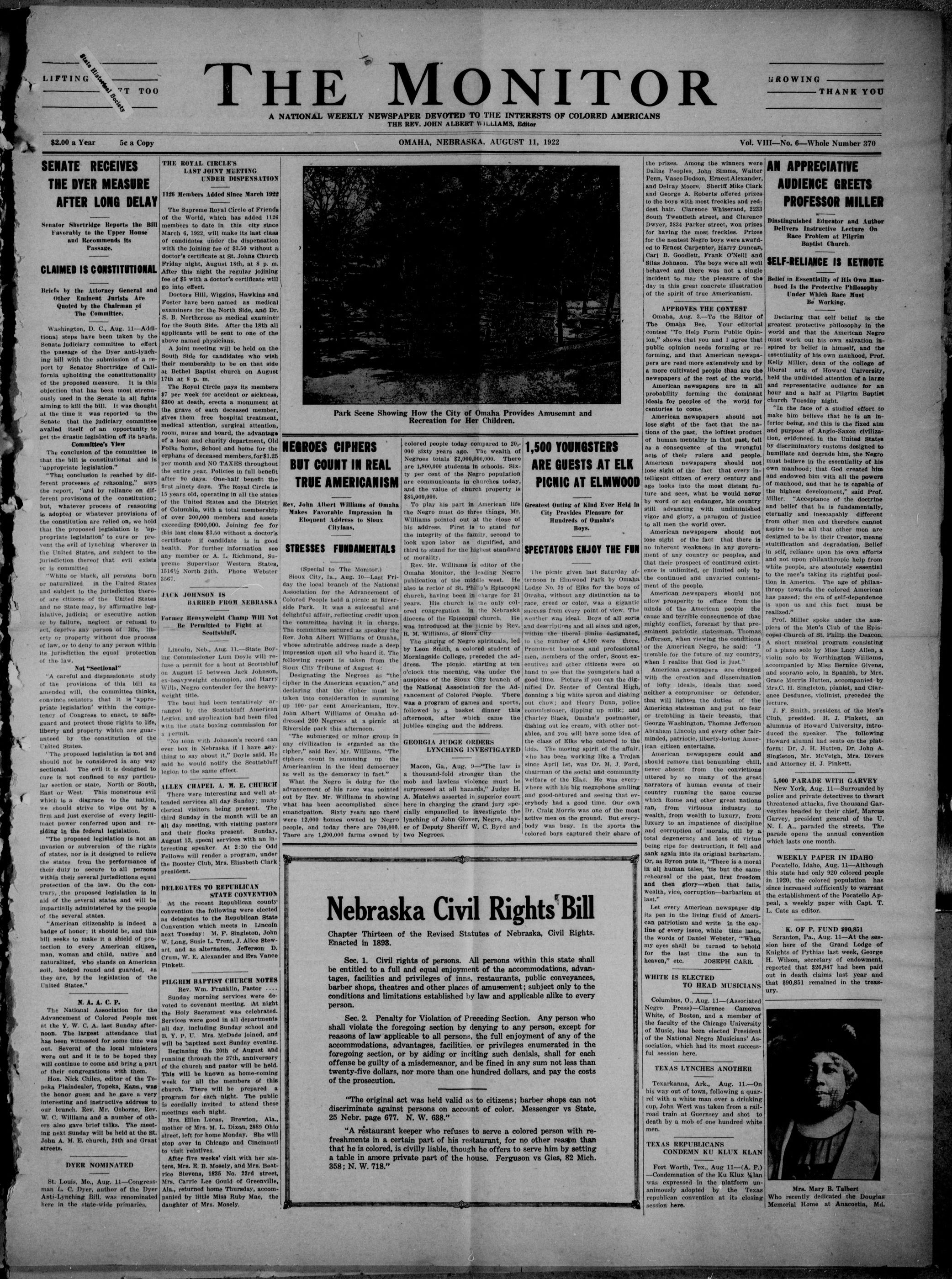
Page text (machine-generated)
LIFTING
T TOO
$2.00 a Year 5c a Copy
SENATE RECEIVES
THE DYER MEASURE
AFTER LONG DELAY
Senator Shortridge Reports the Bill
Favorably to the Upper House
and Recommends its
Passage.
CLAIMED IS CONSTITUTIONAL
Briefs by the Attorney General and Other Eminent Jurists Are Quoted by the Chairman of The Committee.
Washington, D. C., Aug. 11—Additional steps have been taken by the Senate judiciary committee to effect the passage of the Dyer anti-lynching bill with the submission of a report by Senator Shortridge of California upholding the constitutionality of the proposed measure. It is this objection that has been most strenuously used in the Senate in all fights aiming to kill the bill. It was thought at the time it was reported to the Senate that the judiciary committee availed itself of an opportunity to get the drastic legislation off its hands.
Committee's View
The conclusion of the committee is that the bill is constitutional and is "appropriate legislation."
"That conclusion is reached by different processes of reasoning," says the report, "and by reliance on different provisions of the constitution; but, whatever process of reasoning is adopted or whatever provisions of the constitution are relied on, we hold that the proposed legislation is 'appropriate legislation' to cure or prevent the evil of lynching wherever in the United States, and subject to the jurisdiction thereof that evil exists or is committed
"White or black, all persons born or naturalized in the United States and subject to the jurisdiction thereof are citizens of the United States and no State may, by affirmative legislative, judicial or executive action or by failure, neglect or refusal to act, deprive any person of life, liberty or property without due process of law, or to deny to any person within its jurisdiction the equal protection of the law.
Not "Sectional"
"A careful and dispassionate study of the provisions of this bill as amended will, the committee thinks, convince senators that it is "appropriate legislation" within the competency of Congress to enact, to safeguard and protect those rights to life, liberty and property which are guaranteed by the constitution of the United States.
"The proposed legislation is not and should not be considered in any way sectional. The evil it is designed to cure is not confined to any particular section or state, North or South, East or West. This monstrous evil which is a disgrace to the nation, we should strive to wipe out by a firm and just exercise of every legitimacy power conferred upon and residing in the federal legislation.
"The proposed legislation is not an invasion or subversion of the rights of states, nor is it designed to relieve the states from the performance of their duty to secure to all persons within their several jurisdictions equal protection of the law. On the contrary, the proposed legislation is in aid of the several states and will be impartially administered by the people of the several states."
"American citizenship is indeed a badge of honor; it should be, and this bill seeks to make it a shield of protection to every American citizen, man, woman and child, native and naturalized, who stands on American soil, hedged round and guarded, as they are, by the legislation of the United States."
N. A. A. C. P.
The National Association for the Advancement of Colored People meu at the Y. W. C. A. last Sunday afternoon. The largest attendance that has been witnessed for some time was out. Several of the local ministers were out and it is to be hoped they will continue to come and bring a part of their congregations with them.
Hon. Nick Chiles, editor of the Topeka Plaindealer, Topeka, Kansas, was the honor guest and he gave a very interesting and instructive address to our branch. Rev. Mr. Osborne, Rev W. C. Williams and a number of others also gave brief talks. The meeting next Sunday will be held at the St. John A. M. E. church, 24th and Grant streets.
DYER NOMINATED
St. Louis, Mo., Aug. 11—Congressman L. C. Dyer, author of the Dyer Anti-Lynching Bill, was renominated here in the state-wide primaries.
THE MONITOR
THE ROYAL CIRCLE'S
LAST JOINT MEETING
UNDER DISPENSATION
1126 Members Added Since March 1922
The Supreme Royal Circle of Friends of the World, which has added 1126 members to date in this city since March 6, 1922, will make its last class of candidates under the dispensation with the joining fee of $3.50 without a doctor's certificate at St. Johns Church Friday night, August 18th, at 8 p. m. After this night the regular joining fee of $5 with a doctor's certificate will go into effect. Doctors Hill, Wiggins, Hawkins and Foster have been named as medical examiners for the North Side, and Dr. S. B. Northcross as medical examiner for the South Side. After the 18th all applicants will be sent to one of the above named physicians. A joint meeting will be held on the South Side for candidates who wish their membership to be on that side at Bethel Baptist church on August 17th at 8 p. m.
The Royal Circle pays its members $7 per week for accident or sickness, $300 at death, erects a monument at the grave of each deceased member, gives them free hospital treatment, medical attention, surgical attention, room, nurse and board, the advantage of a loan and charity department, Old Folks' home, School and home for the orphans of deceased members, for $1.25 per month and NO TAXES throughout the entire year. Policies in full benefit after 90 days. One-half benefit the first ninety days. The Royal Circle is 15 years old, operating in all the states of the United States and the District of Columbia, with a total membership of over 200,000 members and assets exceeding $900,000. Joining fee for this last class $3.50 without a doctor's certificate if candidate is in good health. For further information see any member or A. L. Richmond, Supreme Supervisor Western States, 1516½ North 24th. Phone Webster 3567.
JACK JOHNSON IS
BARRED FROM NEBRASK
Former Heavyweight Champ WILL Not Be Permitted to Fight at Scottsbluff.
Lincoln, Neb., Aug. 11.—State Boying Commissioner Lum Doyle will refuse a permit for a bout at Scottsbluf on August 15 between Jack Johnson, ex-heavyweight champion, and Harry Wills, Negro contender for the heavyweight title.
The bout had been tentatively arranged by the Scottsbluff American Legion, and application had been filled with the state boxing commission for a permit.
"No man with Johnson's record can ever box in Nebraska if I have anything to say about it," Doyle said. He said he would notify the Scottsbluff legion to the same effect.
ALLEN CHAPEL A. M. E. CHURCH
There were interesting and well attended services all day Sunday; many clerical visitors being present. The third Sunday in the month will be an all day meeting, with visiting pastors and their flocks present. Sunday, August 13, special services with an interesting speaker. At 2:30 the Odd Fellows will render a program, under the Booster Club, Mrs. Elisabeth Clark president.
At the recent Republican county convention the following were elected as delegates to the Republican State Convention which meets in Lincoln next Tuesday: M. F. Singleton, John W. Long, Susie L. Trent, J. Alice Stewart, and as alternates, Jefferson D. Crum, W. E. Alexander and Eva Vance Pinkett.
Rev. Wm. Franklin, Pastor .... Sunday morning services were devoted to covenant meeting. At night the Holy Sacrament was celebrated. Services were good in all departments all day, including Sunday school and B. Y. P. U. Mrs. McDade joined, and will be baptized next Sunday evening. Beginning the 20th of August and running through the 27th, anniversary of the church and pastor will be held. This will be known as home-coming week for all the members of this church. There will be prepared a program for each night. The public is cordially invited to attend these meetings each night. Mrs. Ellen Lucas, Brewton, Ala., mother of Mrs. M. L. Dixon, 2889 Ohio street, left for home Monday. She will stop over in Chicago and Cincinnati to visit relatives. After five weeks' visit with her sisters, Mrs. E. B. Mosely, and Mrs. Beatrice Stevens, 1835 No. 23rd street, Mrs. Carrie Lee Gould of Greenville, Ala., returned home Thursday, accompanied by little Miss Ruby Mae, the daughter of Mrs. Mosely.
A NATIONAL WEEKLY NEWSPAPER DEVOTED TO THE INTERESTS OF COLORED AMERICANS THE REV. JOHN ALBERT WILLIAMS, Editor
Park Scene Showing How the City of Omaha Provides Amusemnt and Recreation for Her Children.
Nebraska Civil Rights Bill
Chapter Thirteen of the Revised Statutes of Nebraska, Civil Rights. Enacted in 1893.
Sec. 1. Civil rights of persons. All persons within this state shall be entitled to a full and equal enjoyment of the accommodations, advantages, facilities and privileges of inns, restaurants, public conveyances, barber shops, theatres and other places of amusement; subject only to the conditions and limitations established by law and applicable alike to every person.
Sec. 2. Penalty for Violation of Preceding Section. Any person who shall violate the foregoing section by denying to any person, except for reasons of law applicable to all persons, the full enjoyment of any of the accommodations, advantages, facilities, or privileges enumerated in the foregoing section, or by aiding or inciting such denials, shall for each offense be guilty of a misdemeanor, and be fined in any sum not less than twenty-five dollars, nor more than one hundred dollars, and pay the costs of the prosecution.
"The original act was held valid as to citizens; barber shops can not discriminate against persons on account of color. Messenger vs State, 25 Nebr. page 677. N. W. 638."
"A restaurant keeper who refuses to serve a colored person with refreshments in a certain part of his restaurant, for no other reason than that he is colored, is civilly liable, though he offers to serve him by setting a table in amore private part of the house. Ferguson vs Gies, 82 Mich. 358: N. W. 718."
NEGROES CIPHERS BUT COUNT IN REAL TRUE AMERICANISM
Rev, John Albert Williams of Omaha Makes Favorable Impression in Eloquent Address to Sioux Cityians.
STRESSES FUNDAMENTALS
(Special to The Monitor.)
Sloux City, Ia., Aug. 10—Lagst Friday the local branch of the National Association for the Advancement of Colored People held a picnic at Riverside Park. It was a successful and delightful affair, reflecting credit upon the committee having it in charge. The committee secured as speaker the Rev. John Albert Williams of Omaha, whose admirable address made a deep impression upon all who heard it. The following report is taken from the Sloux City Tribune of August 4:
Designating the Negroes as "the cipher in the American equation," and declaring that the cipher must be taken into consideration in summing up 100·per cent Americanism, Rev. John Albert Williams of Omaha addressed 200 Negroes at a picnic at Riverside park this afternoon.
"The submerged or minor group in any civilization is ergarded as the cipher," said Rev. Mr. Williams. "The ciphers count in summing up the Americanism in the ideal democracy as well as the democracy in fact."
What the Negro is doing for the advancement of his race was pointed out by Rev. Mr. Williams in showing what has been accomplished since emancipation. Sixty years ago there were 12,000 homes owned by Negro people, and today there are 700,000. There are 1,200,000 farms owned by
OMAHA, NEBRASKA, AUGUST 11, 1922
colored people today compared to 20,000 sixty years ago. The wealth of Negroes totals $2,000,000,000. There are 1,800,000 students in schools. Sixty per cent of the Negro population are communicants in churches today, and the value of church property is $85,000,000.
To play his part in American life the Negro must do three things, Mr. Williams pointed out at the close of his address. First is to stand for the integrity of the family, second to look upon labor as dignified, and third to stand for the highest standard of morality.
Rev. Mr. Williams is editor of the Omaha Monitor, the leading Negro publication of the middle west. He also is rector of St. Philly's Episcopal church, having been in charge for 31 years. His church is the only colored congregation in the Nebraska diocese of the Episcopal church. He was introduced at the picnic by Rev. R. M. Williams, of Sioux City.
The singing of Negro spirituals, led by Leon Smith, a colored student of Morningside College, preceded the address. The picnic, starting at ten o'clock this morning, was under the auspices of the Sioux City branch of the National Association for the Advancement of Colored People. There was a program of games and sports, followed by a basket dinner this afternoon, after which came the jubilee singing and the address.
GEORGIA JUDGE ORDERS
LYNCHING INVESTIGATED
Macon, Ga., Aug. 9—"The law is a thousand-fold stronger than the mob and lawless violence must be suppressed at all hazards," Judge H. A. Matehws asserted in superior court here in charging the grand jury specially empanelled to investigate the lynching of John Glover, Negro, slayer of Deputy Sheriff W. C. Byrd and two Nergroes.
1,500 YOUNGSTERS ARE GUESTS AT ELK PICNIC AT ELMWOOD
Greatest Outing of Kind Ever Held in City Provides Pleasure for Hundreds of Omaha's Boys.
SPECTATORS ENJOY THE FUN
The picnic given last Saturday afternoon in Elmwood Park by Omaha Lodge No. 39 of Elks for the boys of Omaha, without any distinction as to race, creed or color, was a gigantic success from every point of view. The weather was ideal. Boys of all sorts and descriptions and all sizes and ages, within the liberal limits designated, to the number of 4,500 were there. Prominent business and professional men, members of the order, Scout executives and other citizens were on hand to see that the youngsters had a good time. Picture if you can the dignified Dr. Senter of Central High, doming a big white apron and dishing out chow; and Henry Dunn, police commissioner, dipping up milk; and Charley Black, Omaha's postmaster, dishing out ice cream, with other notables, and you will have some idea of the class of Elks who catered to the kids. The moving spirit of the affair, who has been working like a Trojan since April 1st, was Dr. M. J. Ford, chairman of the social and community welfare of the Elks. He was everywhere with his big megaphone smiling and good-natured and seeing that everybody had a good time. Our own Dr. Craig Morris was one of the most active men on the ground. But everybody was busy. In the sports the colored boys captured their share of
Vol. VIII—No. 6—Whole Number 370
the prizes. Among the winners were Dallas Peoples, John Simms, Walter Penn, VascoDodson, Ernest Alexander, and Delray Moore. Sheriff Mike Clark and George A. Roberts offered prizes to the boys with most freckles and reddest hair. Clarence Whiserand, 2233 South Twentieth street, and Clarence Dwyer, 2834 Parker street, won prizes for having the most freckles. Prizes for the nearest Negro boys were awarded to Ernest Carpenter, Harry Duncan, Carl B. Goodlett, Frank O'Neill and Silas Johnson. The boys were all well behaved and there was not a single incident to mar the pleasure of the day in this great concrete illustration of the spirit of true Americanism.
APPROVES THE CONTEST
Omaha, Aug. 3.—To the Editor of The Omaha Bee. Your editorial contest "To Help Form Public Opinion," shows that you and I agree that public opinion needs forming or reforming, and that American newspapers are read more extensively and by a more cultivated people than are the newspapers of the rest of the world. American newspapers are in all probability forming the dominant ideals for peoples of the world for centuries to come. American newspapers should not lose sight of the fact that the nations of the past, the loftiest product of human mentality in that past, fell as a consequence of the wrongful acts of their rulers and people. American newspapers should not lose sight of the fact that every intelligent citizen of every century and age looks into the most distant future and sees, what he would never by word or act endanger, his country still advancing with undiminished vigor and glory, a paragon of justice to all men the world over.
American newspapers should not lose sight of the fact that there is no inherent weakness in any government of any country or peoples, and that their prospect of continued existence is unlimited, or limited only by the continued and unvaried contentment of the people.
American newspapers should not allow prosperity to efface from the minds of the American people the cause and terrible consequence of that mighty conflict, forecast by that preeminent patriotic statesman, Thomas Jefferson, when viewing the conditions of the American Negro, he said: "I tremble for the future of my country, when I realize that God is just."
American newspapers are charged with the creation and dissemination of lofty ideals, ideals that need neither a compromiser or defender, that will lighten the duties of the American statesman and put no fear or trembling in their breasts, that George Washington, Thomas Jefferson Abraham Lincoln and every other fair-minded, patriotic, liberty-loving American citizen entertains.
American newspapers could and should remove that benumbing chill, never absent from the convictions uttered by so many of the great narrators of human events of their country running the same course which Rome and other great nations ran, from virtuous industry to wealth, from wealth to luxury, from luxury to an impatience of discipline and corruption of morals, till by a total degeneracy and loss of virtue being ripe for destruction, it fell and sank again into its original barbarism. Or, as Byron puts it, "There is a moral in all human tales, 'tis but the same rehearsal of the past, first freedom and then glory—when that falls, wealth, vice, corruption—barbarism at last."
Let every American newspaper dip its pen in the living fluid of American patriotism and write in the capline of every issue, while time lasts, the words of Daniel Webster, "When my eyes shall be turned to behold for the last time the sun in heaven," etc. JOSEPH CARR.
WHITE IS ELECTED TO HEAD MUSICIANS
Columbus, O., Aug. 11—(Associated Negro Press)—Clarence Cameron White, of Boston, and a member of the faculty of the Chicago University of Music, has been elected President of the National Negro Musicians' Association, which had its most successful session here.
TEXAS LYNCHES ANOTHER
Texarkana, Ark., Aug. 11.—On his way out of town, following a quarrel with a white man over a drinking cup, John West was taken from a railroad train at Guernsey and shot to death by a mob of one hundred white men.
Fort Worth, Tex., Aug 11—(A. P.)—Condemnation of the Ku Klux $ \frac{1}{2} $lan was expressed in the platform unanimously adopted by the Texas republican convention at its closing session here.
GROWING
THANK YOU
AN APPRECIATIVE AUDIENCE GREETS PROFESSOR MILLER
Dinstinguished Educator and Author Delivers Instructive Lecture On Race Problem at Pilgrim Baptist Church.
SELF-RELIANCE IS KEYNOTE
Belief in Essentiality of His Own Manhood Is the Protective Philosophy Under Which Race Must Be Working.
Declaring that self belief is the greatest protective philosophy in the world and that the American Negro must work out his own salvation inspired by belief in himself, and the essentiality of his own manhood, Prof. Kelly Miller, dean of the college of liberal arts of Howard University, held the undivided attention of a large and representative audience for an hour and a half at Pilgrim Baptist church Tuesday night.
"In the face of a studied effort to make him believe that he is an inferior being, and this is the fixed aim and purpose of Anglo-Saxon civilization, evidenced, in the United States by discriminatory customs designed to humiliate and degrade him, the Negro must believe in the essentiality of his own manhood; that God created him and endowed him with all the powers of manhood, and that he is capable of the highest development," said Prof. Miller. "Acceptance of the doctrine and belief that he is fundamentally, eternally and inescapably different from other men and therefore cannot aspire to be all that other men are designed to be by their Creator, means stultification and degradation. Belief in self, reliance upon his own efforts and not upon philanthropic help from white people, are absolutely essential to the race's taking its rightful position in America. The age of philanthropy towards the colored American has passed; the era of self-dependence is upon us and this fact must be realized."
Prof. Miller spoke under the auspices of the Men's Club of the Episcopal Church of St. Philip the Deacon. A short musical program consisting of a piano solo by Miss Lucy Allen, a violin solo by Worthington Williams, accompanied by Miss Bernice Givens, and soprano solo, in Spanish, by Mrs. Grace Morris Hutten, accompanied by Mrs.C. H. Singleton, pianist, and Clarence Desdunes, violinist, preceded the lecture.
J. F. Smith, president of the Men's Club, presided. H. J. Pinkett, an alumnus of Howard University, introduced the speaker. The following Howard alumni had seats on the platform: Dr. J. H. Hutten, Dr. John A. Singleton, Mr. McVeigh, Mrs. Divers and Attorney H. J. Pinkett.
5.000 PARADE WITH GARVEY
New York, Aug. 11—Surrounded by police and private detectives to thwart threatened attacks, five thousand Garveyites headed by their chief, Marcus Garvey, president general of the U. N. I. A., paraded the streets. The parade opens the annual convention which lasts one month.
WEEKLY PAPER IN IDAHO
Pocatello, Idaho, Aug. 11-Although this state had only 920 colored people in 1920, the colored population has since increased sufficiently to warrant the establishment of the Pocatello Appeal, a weekly paper with Capt. T. L. Cate as editor.
K. OF P. FUND $90.851
Seranton, Pa., Aug. 11—At the session here of the Grand Lodge of Knights of Pythias last week, George H. Wilson, secretary of endowment, reported that $26,847 had been paid out in death claims last year and that $90,851 remained in the treasury.
Mrs. Mary B. Talbert
Who recently dedicated the Douglas
Memorial Home at Anacostia, Md.
THE MONITOR
Published every Friday at Omaha, Nebraska,
by the Monitor Publishing Company.
Entered as Second-Class Mail Matter July 2, 1915, at the Postoffice at
Omaha, Neb., under the Act of March 8, 1879.
THE REV. JOHN ALBERT WILLIAMS, Editor.
W. W. MOSELY, Associate Editor, Lincoln, Neb.
SUBSCRIPTION RATES, $2.00 A YEAR; $1.25 a MONTHS; 75c 3 MONTHS
Advertising Rates Furnished Upon Application.
Address The Monitor, 204 Kaffir Block, Omaha, Neb.
Telephone Atlantic 1322; Webster 4243
ARTICLE XIV. CONSTITUTION OF THE
UNITED STATES.
SUBSCRIPTION RATE, $2.00 A YEAR; $1.25 A MONTHS; 75c 3 MONTHS
Advertising Rates Furnished Upon Application.
ARTICLE XIV. CONSTITUTION OF THE UNITED STATES.
Citizenship Rights Not to Be Abridged.
1. All persons born or naturalized in the United and subject to the jurisdiction thereof, are citizen United States and of the State wherein they re state shall make or enforce any law which shall ab privileges or immunities of citizens of the United States shall any state deprive any person of life, liberty,erty without due process of law, nor deny to any within its jurisdiction the equal protection of the l
1. All persons born or naturalized in the United States, and subject to the jurisdiction thereof, are citizens of the United States and of the State wherein they reside. No state shall make or enforce any law which shall abridge the privileges or immunities of citizens of the United States; nor shall any state deprive any person of life, liberty, or property without due process of law, nor deny to any person within its jurisdiction the equal protection of the laws.
MEMBER
OF
THE ASSOCIATED
MILLO PRIZE
FIRST IN
SERVICE
THE TWIN STRIKES
THE twin strikes, coal and railroad, do not seem very near settlement. Daily the public is led to believe that the end is near. Conferences are being held, but little progress is made. Operatives and employees seem to be stubbornly contending for certain concessions which it would seem might well be left to a board of arbitration. In the meantime tremendous economic waste is going on for which the public must pay. Strikes, like all forms of war, evoke greater evils than they allay.
FORMING PUBLIC OPINION
JOSEPH CARR has sent a communication to the Omaha Daily Dale commending its editorial contest "To Help Form Public Opinion," which so fully expresses the views of many of our own thoughtful readers that we give it space in our columns and commend its careful reading. The American newspaper has a great responsibility placed upon it. The race newspaper shares this responsibility in a limited degree with the great dailies and national weekles. The formation of sound public sentiment is greatly needed at all times and never more particularly so than in these hysterical days of the reconstruction period.
SENATE GETS DYER BILL
NOW that the committee has recommended the Dyer Bill to the Senate it does seem to us that that august body should get into quick action. It is not a sectional measure, nor a partisan one, but a patriotic one. If Americans believe in the reign of the law rather than the reign of the mob, federal steps should be taken to make this fact plain not only to our own citizens, but to the world. The Dyer measure has this as its objective. It should be speedily passed. We are told this is a white man's civilization, well then it is up to the Congress of the United States who are all white men to help save their civilization from barbarism and savagery. Establish and maintain the supremacy of law. The individual states admit their impotency; the federal government should therefore act.
P. M. Harris, popular barber of the South Side, returned last week after an extended visit through the South. He also looked over his oil interests while on this vacation thus mixing business and pleasure.
Worth Recording.
A Washington woman had scrimped for a long time to take a trip to rama. A man very much younger than herself, in the deck chair beside her, was making the voyage for the good of a frazzled nervous system. He was a whimsical youngster, who could joke at his own ups and downs, and she was used to boys, so they talked of this and that until at last the subject came around to the thing that makes the traditional mare go. The woman, still dazed at the Aladdin-like power that could transmit small economies into a fairy world of blue ocean bellowing into blue sky, took her turn at the conversation by voicing civilization's oldest platitude: "Money talks, doesn't it?" "It sure does, though my money only knows two words—'Good bye.'" And the woman has brought it home as one of her good little stories.
The Church Fair.
The suburban woman and her seventeen-year-old son, George, went to the church fair. The fair, like most church fairs, was costing the woman a great deal of money. It was a chance on this and a chance on that. A few articles she bought outright. Since she was well known and her husband's salary was also a matter of town gossip, all her friends who had charge of booths upon her buying and buying.
All this continual handing out money was too much for George's comprehension. He couldn't seem to understand the cause of it all. Finally, when his mother was free for a few moments, he looked at her seriously and asked, "Mamma, do we have to pay to get out?"—Chicago Journal.
INSTITUTION OF THE
STATES.
Not to Be Abridged.
Naturelized in the United States,
on thereof, are citizens of the
state wherein they reside. No
any law which shall abridge the
citizens of the United States; nor
person of life, liberty, or prop-
law, nor deny to any person
final protection of the laws.
400,000 ELIGIBLE—ONLY 2,500 VOTE IN SOUTH CAROLINA
Columbia, S. C., Aug. 11—Although there are 400,000 colored men and women of voting age in this state, only about 2,500 of them have been able to pass the rigid disfranchising laws, get themselves registered and vote.
There are the same number of white people of voting age in the state and 64,000 of them voted in the last election for Woodrow Wilson. Harding got a little over 2,250 votes.
Efforts of the republican party to increase the colored vote in South Carolina has aroused the Columbia State, a white daily paper here, which declares that unless the Negro is kept out of politics, he cannot be kept out of jobs in the cotton mills. This white newspaper also calls upon the governor to appoint the "right kind of judges of election and registrars" so that even qualified Negroes may not get their names on the books.
S. PAUL'S PRESBYTERIAN CHURCH
26th and Seward Streets
R. Taylor. Pastor
Is it necessary at this time to ask the question, "What is the Purpose of Divine Worship? Why Have Two Services or More One Day in Seven?" It certainly shouldn't be and yet there seems to be much confusion on the matter. Let us remember that God Almighty established the idea that to keep us human beings correct spiritually at least one-seventh of our time should be definitely devoted to spiritual development. Shall creature say to the Creator, "You are in error in this matter." And he gave some apostles; and some prophets; and some evangelists; and some pastors and teachers for the perfecting of the saints, for the work of the ministry, for the edifying of the body of Christ. Services Sunday: 11 a. m., "Meat." 8 p. m., "The Call of Levi." 7 15 p. m., Christian Endeavor, "Pride and Humility." Jas. 4: 6-10; Miss Minnie Givens, leader
Penny-urious. So to Speak
A man who had just opened a store in a strange town was interrogating one of his early customers on the purchasing power of the citizens. "Now, there's Deacon Brown," he said. "He has the reputation of being wealthy. Would he be likely to spend much money in here?" "Wa-al." drawled the native, reflectively, "I wouldn't exactly say that he'd go to hell for a nickel, but he'd fish around fer one till he fell in."—Salt Lake Telegram.
A Privilege of Youth.
Mrs. Chatterton—Oh. Henry; what do you think? Little Richard is beginning to talk.
Her Husband—Good luck to him! It's more than I've been able to do in this house. How did he ever get the chance?
Growth of the Telephone.
If the telephone calls that were put in last year in the United States alone had been scattered evenly about the earth, every person in every country would have been seven times to the phone—every one of India's troubled millions, of China's and of Africa's, and of the almost countless others in every other land. The wires used in the United States would span the distance of the moon 100 times—would circle the earth 1,000. The army and navy of the United States together number about the same as the employees of the Bell telephone system.
Trampa.
The age of the average tramp before the war was fifty years. Now it's thirty-two. And the 1922 model tramp rides on auto trucks instead of freight trains. This information is from the report of a New York welfare association with a name as long as Barnum's Cardiff giant. The association is seeking a way to reduce the number of trumps. Quickest way is to give them the jobs they seek. Second, and impossible, is to kill the wanderlust that exists in every human, a psychoanalytic complex, rejection from the dull grind of civilization.
Tramps.
LINCOLN NEWS AND
:: COMMENT ::
Mrs. W. Turner of Brookfield, Mo., is visiting her sister-in-law, Mrs. Anna Christman. here.
Miss Marie Jones of St. Joseph, Mo., is visiting her aunt, Mrs. Anna Christman.
Mrs. Alma Wiley and Mrs. A. L. Brown of Kansas City Mo., went to Omaha Friday to visit Mrs. J. A. Harris.
Miss Flossie Patrick entertained the Utopian Art Club at her home on Holdrege street last Thursday night. The meeting was a profitable one. Mrs. W. R. B. Alexander read a paper before the club which was filled with thought, and was commented on by several members in attendance.
The N. A. A. C. P. held a rousing meeting at Mt Zion Baptist church Monday night. Letters of importance from prominent workers were read. There were seven joiners.
The Lancaster Republican Club met on Monday night, and discussed questions of the day. A number of names were added to the roll.
The N. A. A. C. P. will hold their second annual picnic in Epworth Park Tuesday, August 15th.
Mr. Nimrod Ross will entertain the Utopian Art Club at his home, 2120 T street, Thursday night, August 17.
Misses Sylvania and Adalade Newton returned to their home in Beatrice last Friday after some stay with their cousin, Miss Florence Reid.
Mrs. Laura Johnson has just purchased a new Buick car.
Mr. and Mrs. R. H. Young spent a couple of days at Fairbury last week on business.
Mrs. Ben Corneal went to California last week.
Mr. Gaskin and family were here from Casper, Wyo. visiting their daughter, Mrs. Burris. They drove over in their Dodge.
Rev. I. J. Smith filled the pulpit for Rev. McAlister last Sunday morning and for a white congregation at Burham Sunday evening.
Services at Mt. Zion Baptist church last Sunday were as follows: Sunday school at 10 a. m. Covenant and praise services at 11 and 12:30; preaching by the pastor and communion at 8 p. m.
Mr. Sam Roy was named as representative to the State Convention from his district.
Mr. Jasper Brown has purchased an auto.
Mr. Chas. W. Dickerson and son of Omaha spent Sunday in the city, the guests of Mr. R. H. Young.
CARD OF THANKS.
We desire to express our heartfelt thanks to our many friends for their kindness to us and our beloved mother, Sophia Woodard Banks, during her illness and death. We appreciated, too, the many beautiful floral tributes sent—Fred Botts, William Bott, Vann Botts, Nathaniel Travis.
Omaha, August 10, 1922
BAUM & RUBEN
GROCERIES and MEATS
FREE DELIVERY
1302 North 24th St.
Tel. Webster 4378
We Sell SKINNER'S
the highest grade Macaroni,
Spaghetti and Egg Noodles
Alaska Fish Co.
1114 North 24th St.
Telephone Webster 6512
LIVE FISH DAILY
GROCERIES and FRUITS
Free Delivery
We Sell SKINNER'S
the highest grade Macaroni,
Spaghetti and Egg Noodles
Kotera & Sloup
FANCY AND STAPLE
GROCERIES
We Sell SKINNER'S
the highest grade Macaroni,
Spaghetti, Egg Noodles and
other Macaroni Products.
1261 South 16th St.
PHONE DOUGLAS 5573
THE MONITOR
PHONE MARKET 4980
Higgins Packing Company
Authorized Capital
$5,000,000
W. V. Hoagland, President
Florian Fuchs, Vice.-Pres.
E. E. Howell, Sec.-Treas.
J. W. Pepperdine, Gen. Mgr.
36th and L Streets
South Side Station
DOWN TOWN ADDRESS
1211 Howard Street
OMAHA
J. H. Kopietz
REALTOR
REAL ESTATE, LOANS
AND INSURANCE
4733 South 24th St.
South Side, Omaha, Nebr.
TOWNSEND
GUN CO.
At Their New Location
ATHLETIC SUPPLIES
OUTING GOODS
GUNS AMMUNITION
FISHING TACKLE
and KODAKS
Phone Jackson 0870
1309 Farnam St., Omaha
"Say It With
Flowers"
Hess &
Swoboda
Florists
1415 FARNAM STREET
Paxton Hotel
MEMBERS
FLORISTS TELEGRAPH
DELIVERY
ASSOCIATION
We Deliver Flowers on
Short Notice Anywhere in
the United States or
Canada.
Telephone
Jackson
1501
Lewis Henderson
Florist
GREENHOUSE:
4225 South 25th Street
South Side
Phone Market 0052
STORE:
1507 Farnam Street
Phone Jackson 1258
Omaha
Hinchey
Laundry
2307-9-11 N STREET
OMAHA
(South Side)
TELEPHONES:
Market 4750
Atlantic 4750
H. WEISS
THE UP-TO-DATE
Grocery and Meat Market
EVERYTHING FIRST CLASS
Solicits Your Patronage
2601 HAMILTON STREET
Phone Webster 7165
the highest grade Macaroni
Spaghetti and Egg Noodles
NEW METHOD
Shoe Repair Shop
J. O. LOZITO, Prop.
2818 CUMING STREET
COLORED TRADE SOLICITED
A. LAROB
Try the Shoemaker at
1530 NO. TWENTIETH ST.
and you will not be sorry.
New and Second Hand
FURNITURE
We Rent and Sell Real Estate
Notary Public
S. W. Mills Furniture Co.
421 No. 24 St. We Thank You. Web. 0148
GEORGE C. TUCKER
Barber Shop
NEW LOCATION:
5303 South 28th St.
EVERYTHING FIRST CLASS
Liberty Drug Company
B. Robinson, Mgr.
Webster 0386.
1904 N 24th St.
FREE DELIVERY
Allen Jonce, Res. Phone W. 204
JONES & CO.
FUNERAL PARLOR
2814 North 24th St. Web. 1100
Lady Attendant
C. J. Carlson
SHOES
1514 N. 24th St.
"Same Location 51 Years
(Cor. Alley)
Phones—Office Web. 5036—Res.
Web. 5406
From Early Morn Until Late at
Night
"Taxi at Your Service"
NORTH END EXPRESS CO.
A. F. ALLEN, Prop.
Trucks for Either Light or
Heavy Hauling
We Haul Anything, Anywhere
2010 N. 24th St. Omaha, Neb.
The Live Dependable Market of the U. S. A.
Wood-Oswald Co.
LIVE STOCK COMMISSION MERCHANTS
Long Distance Phone Market 0320 ROOMS 107-109 EXCHANGE BUILDING Stock Yards Station, Omaha
French Dry Cleaning Works
TELEPHONE MARKET 0356
PROMPT CALLS AND DELIVERIES EVERYWHERE
2313 N Street, Omaha (South Side)
RALPH K. TOWL CO.
GENTS' FURNISHINGS and HABERDASHERS
4837 So. 24th St. Omaha (South Side)—Phone Market 0797
ALL UP-TO-DATE DRESSERS TRADE HERE
KEEPING WELL MEANS
A CONSTANT FIGHT
AGAINST CATARRH
Many diseases may be described as a catarrhal condition. Coughs, colds, nasal
catarrh, stomach and bowel disorders are just a few of the very common ills due to
catarrh.
Fight it! Fight catarrh with a remedy of assured merit, a remedy which has a
reputation for usefulness extending over half a century—
DR. HARTMAN'S
PE-RU-NA
Tablets or Liquid Sold Everywhere
Peoples' Gro. Store
P. E. Anderson, Prop.
2530 Lake Street
STAPLE AND FANCY
GROCERIES
Fresh and Cured Meats
The Best of Everything at
Reasonable Prices.
We Sell SKINNERS
the highest grade Macaroni,
spaghetti, Egg Noodles and
other Macaroni Products.
Why Not Let Us Do Your
SHOE REPAIR WORK
Best material, reasonable prices.
ALL WORK GUARANTEED
BENJAMIN & THOMAS
Phone Web. 5084—1415 No. 24th
JENSEN'S
FAMILY WET WASH
FLAT WORK and
ROUGH DRY
LAUNDRY
2316 No. 24th St. Web. 1029
CENTRAL HOTEL
1916 Cuming Street
PHONE JACKSON 2466
Mrs. Mary Jackson, Prop.
— NEAT, CLEAN ROOMS —
On Car Line to Any Part of City
Mineral Springs
PHONE MARKET 0149
1812 N Street
Omaha (South Side)
Bottlers of All High Grade
Beverages,
Sole Distributors of the
Famous Orangade.
Phone ATlantic 6104
Notary Public in Office
and Counselor
N. W. WARE
Attorney at Law
Practicing in North State and Fed-
eral Courts
111 South 14th St. Omaha, Neb.
Lambert, Shotwell &
Shotwell
ATTORNEYS
Omaha National Bank Bldg.
W. K. Flemming
Artistic Printer
Phone Web. 5621
1425 N. 24th St.
Burdette Grocery
Full Line of
Staple and Fancy
GROCERIES
Fresh and Canned
Meats
We
Sel. SKINNER'S
the highest grade Macaroni
Spaghetti and Egg Noodles
Local and Personal Happenings WE PRINT THE NEWS WHILE IT IS NEWS
2078 North 24th Street—Phone Webster 1773
CIGARS, TOBACCO and SOFT DRINKS
CHAS. W. SOUTH, Prop.
TRAVELING BAGS AND CASES, LADIES' HANDBAGS AND LEATHER NOVELTIES
E. F. Mercenty, Lawyer, 700 Poters Trust Bldg, Jackson 8841 or Harney 2156.
Mrs. Beatrice Gray and children, Bernice and Norman, returned Friday morning from a two months' extended visit with relatives and friends in Illinois and Missouri.
For Rent—Two neatly furnished rooms. Gentlemen preferred. 812 North Twenty-third street. Atlantic 4534. —indef.
Mrs. James Harris, 3324 Parker St., gave a delightful luncheon July 29th to twelve guests in honor of Mrs. J. W. Gowan of Dallas, Texas; Mrs. A. Brown of Kansas City, Mo.; and Mrs. A. Wiley of Lincoln, Nebr.
REAL ESTATE, Rentals and Fire Insurance. Phone G. B. ROBBINS, Jackson 2842 or Webster 5108. Adv. 7-7-28.
Mr. and Mrs. Vanie S. Wheatley entertained Prof. Kelly Miller of Washington, D. C., and the Rev. John Albert Williams at breakfast Wednesday morning at their pretty home, 2515 Hamilton street
Holst Pharmacy for drugs 2702
Cuming street. Harney 681--Adv.
Mrs. Doc Stewart of 2862 Chicago street and Mrs. J. H. Turner of 2514 Corby street entertained at breakfast at Elmwood park Wednesday morning complimentary to Mrs. Steward's guest, Miss Alice Harper of Kansas City. After a delightful visit here Miss Harper left for her home Sunday afternoon.
FOR RENT—Furnished apartments of two and three rooms...2130 North Twenty-eighth Street....Webster 4983.
Nick Chiles, the versatile editor of the Topeka Plaindealer, was an Omaha visitor last week.
FOR RENT—Furnished rooms; also furnished rooms for light housekeeping. Call Web. 3222. Mrs. Wade. 2634 Hamilton St. (2 mo.)
The Helpers' Club will give a lawn social at the North End "Y" next Thursday evening to which the public is cordially invited.
Modern furnished rooms at 926 No. 27th Ave, one-half block from Cuming St. car line—Mrs. Clay Anderson. Phone Harney 7228. Call mornings.
The funeral of Joseph Newman, aged 89, who passed away at the residence of his daughter-in-law Mrs. William Newman, on Twenty-eighth avenue, was held last Saturday afternoon from the chapel of the Western Funeral Home. The Rev. W. F. Bottos officiated.
A. P. Scruggs, Lawyer, 2310 No.
22nd St. Webster 419—Adv.
Wanted—Wide awake boys to sell The Monitor every Saturday. Live boys can make money by selling Monitors. Phone Webster 4243.
Miss Ireta Walker entertained several of the younger set at breakfast at Elmwood Park last Sunday morning complimentary to Miss Boots of Manhattan, Kansas.
For news when it is news, you must read the Monitor.
The Smarter Set Society have sent out invitations for their annual dancing party next Monday night at Hanscom Park pavilion.
M. M. Beitel
GROCERIES
AND MEATS
SPECIAL
Special Week of Aug. 14th.
Strictly Fresh Eggs
21c dozen
Quality Goods Best Prices
20th and Grace Streets
PHONE WEBSTER 0134
Mrs. M. E. Overall has, recently improved her handsome and well-kept residence at 2010 Lake street by the addition of an attractive stucco porch.
First-Class Modern Furnished Rooms —1702 No. 26th St. Web. 4769. Mrs. L. M. Bentley Erwin.
Dr. John A. Singleton, who is an alumnus of Howard Universit, and one of Omaha's most successful dentists, took Prof. Kelly Miller for an automobile ride around the city Tuesday afternoon in his Liberty.
For Rent—Nestly furnished front room for man and wife or gentleman. 2429 Lake St. Webster 1521.
Mrs. A. L. Phillips of Tulsa, Okla,
and Mrs. Leroy Brown of Kansas City,
daughters of Mrs. C. B. Parks, 2710
Parker street, who were called here by
their mother's illness, will remain
mdefinitely.
Mr. and Mrs. Dorris Tornton and
son, Cornelius, will motor over to
Emerson, Iowa, Sunday to visit Mrs.
Thornton's parents, Mr. and Mrs.
Goodlow.
Have you paid your subscription for
The Monitor yet? This is important.
Please pay promptly.
FOR RENT—Nearly furnished room
for man and wife or single lady. 2630
Hamilton St. Mrs. Smith, Web. 2759.
Edward Turner, junior captain of Hose Company No. 11, sent in his resignation last week and it was promptly accepted.
Leroy Kelly having served his six months' probation as a member of the Omaha fire department, was confirmed by the council this week.
The firm of Beitel & Bettel at Twenteth and Grace streets has been dissolved, M. M. Bettel having purchased his partner's interest and will hereafter conduct the business alone. He carries nothing but the very best in groceries and meats, and has reduced prices to conform to the present market conditions. He solicits a share of your patronage.
FOR RENT—Furnished rooms with use of kitchen. On Dodge and North Twenty-fourth streeet car lines. Webster 5964. 5-4t
Mr. T. H. Montgomery, 2415 Hamilton street, is remodeling his home. John T. McDonald Sr. is doing the finishing work on this job.
Mrs. Lucinda McCarn, 2640 Charles street, was taken very seriously ill last Tuesday evening. She was sittig talking to her husband and fell while talking and lost consciousness. She is some improved at this writing.
Attorney Noah W. Ware is building a modern home at 28th and Binney and as soon as same is completed he will give up the hotel and move into the home.
Wm. Dixon who was injured several weeks ago while rrossing the street at 24th and Charles by an automobile, received a sack for $75 for the settlement of the claim.
FOR SALE
$60.00 Velour Cape.....$10.00
Grey Canton Crepe Dress—
Size 30.....5.00
2 Pair Black Satin Slippers.....3.00
Brown and Yellow Pussy Will-
low Taffeta Silk Dress; Size
18.....5.00
Call Web. 5161 or Web. 0386
OLD RESIDENT PASSES AWAY
Lewis Spady, who has been a resident of Omaha for the past forty years and had a wide acquaintance, died on Tuesday afternoon at his late residence on North Thirtieth street, after a brief illness. Mr. Spady after serving in the 10th cavalry for many years upon his discharge in 1877 came to Omaha where he has since resided following the trade of a plasterer and bricklayer. He is survived by his widow, a son William E., and a daughter Louise. The funeral will he held this afternoon from Zion Baptist church of which he was a member.
POOL HALL
Phone Webster 1773
and SOFT DRINKS
SOUTH, Prop.
unk Factory
facturers of
UNKS
CASES, LADIES' HANDBAGS
ER NOVELTIES
Phone Jackson 0480
I
CHAMPION LIAR
By MARY LOUISE CORMIER
© 1922, by McClure Newspaper Syndicate
Milt is the champion lion of Merri-
mac Mills. His superiority in this line
has never been challenged. There are
other prevaricators in the town, but
ranged beside the urban, accomplished
Milt, they appear as so many lisping
schoolboys. With Milt, lying is an art,
if not actually a profession.
As a boy Milt would not attend
school if he could possibly he his way
out of it. Later, when he came to be
employed in Hinckle's general store,
his ability to evade the truth proved
useful in a number of different ways.
For instance, a crate of cold storage
eggs would be purchased. Milt would
promptly advertise them as "strictly
fresh" and levy his price accordingly.
He would sell them all.
Milt had a sort of quick, crafty intelligence. He realized that women trusted him and it was through them that he must reach the men. When John Hinckle dismissed him because of a discrepancy in the cash register, Milt swore that he would get even if it took him the rest of his life and he straightway began to lay his plans. On a certain May morning he strolled into the general store. Mrs. Hinckle, a thin, dark woman with a jealous temper, was behind the counter.
"Morning," said Milt, in his soft drawl. "Where's John?" He knew well enough that Hinckle left that morning for the wholesale house in Boston where he purchased supplies. "He's gone to Boston," the woman replied, curtly. "Did you want to see him about a job? If you did, there's nothing doing."
A gentle laugh rippled out of Milt's supply throat.
"A job?" he repeated, with a deprerectory smile. "No thanks. Doing chores pays me well enough. Some weeks I make as high as $60." That was a fallacy, of course. Milt seldom averaged more than $20 when he worked—and he did not work very often.
"What did you want to see John about, then?" persisted-Mrs. Hinkle.
about, then?” persisted Mrs. Hincke. “Oh, it doesn’t matter,” Milt responded, evasively. “Come to think, I see him getting on the train this morning. That Blake woman was with him.” Mrs. Hincke stopped weighing a bag of brown sugar and her little black eyes sparkled dangerously. “How do you know she was—with him?” The question came as a challenge and Milt answered it with an enjoyment that was typical of him. “Well,” he explained, carefully, “I heard her say to him when he was helping her onto the train. “This is the first trip we’ve had together in ten years, John.” And she was laughing. sort of happy-like, when she said it. “I don’t believe you,” Mrs. Hincke informed him coldly. Milt smiled and shrugged his shoulders. “I didn’t expect you would,” he mocked, anbling off.
After that Merrimac Mills sneered at Milt's "stories" and openly branded them for what they were.
But Milt was one of those curious belongs who thrive on opposition.
There was a good deal of speculation concerning Tillie, Milt's young and still pretty wife. People wondered why she had not left him long ago.
"Tillie's gone to spend the week with my folks in Baltimore," he would elucidate, as he stood in the bunkroom of the firehouse on a Friday evening watching a poker game. "I kinder thought the change of air might do her good. She'll have all the comforts of home, too. My folks—the Baltimore Jones, you know—are pretty well off. Most likely, by now, Tillie is riding up from the station in their town car—"
Through the blue haze of cigar smoke, the men would grin at each other over their cards as if they were in secret understanding. They were. All of them understood tactily that Tillie was, at that very moment, sitting in her shoddy home across the river, mending Milt's socks.
One raw night in winter Milt was awakened by Tillie's low meaning. He found her condition to be dangerous and hurriedly set out for Merrimac Mills. Young Doctor Garret heard Milt's frantic knocking and flung open his bedroom window.
"What is it?" he called drowsily to the restless, dark figure on the snow-covered steps. Milt explained.
"Your wife is in Baltimore," the doctor answered coldly. "You told me so yourself this afternoon. And I don't propose to be dragged out of bed on a night like this for the sake of a practical joke!" The window slammed down.
Milt stood there in the snow, quivering with anger and despair.
Desperate and half-crazed Milt borrowed a sleigh and drove to Merrimac, some three miles away, where he secured a doctor. But when, after their mad race against time, they reached Milt's shack, Tilley was past the need of medical science.
It was many months before Merrimac Mills saw Milt again. Once fond of company, he now sought isolation. It was even whispered about that Milt was going to reform. But Milt was too human for that. Another year found him back in the firehouse and he was as glib and prevaricating of tongue as ever. Now and then he sits apart, this champion, and there comes into his faded eyes an expression of baffled wistfulness.
"I could tell the truth," he mutters, half defensively, "but nobody will believe me now. Nobody will believe."
The Monitor Is YOUR Paper.
4243
$200 cash
We have a couple of good houses on paved street, priced less than $3,000.—Balance required in monthly terms, not greater than at present renting.
AMOS GRANT COMPANY
Atlantic 8380—210 So. 18th
Come to
THE OMAHA
BEAUTY SHOP
for Beautifying Your Hair,
Skin and Hands
We can use a few HAIR DRESSERS, one MANICURIST.
2204 North 24th Street
HARMEL
GROCERY
1502 North 24th St.
WEBSTER 0850
SATURDAY SPECIAL:
Advo Coffee, 38c per pound
We
Sc.
SKINNERS
the highest grade Macaroni,
Spaghetti and Egg Noodles.
Central Cuming Mkt.
HIGHEST QUALITY
GROCERIES and MEATS
All Kinds of Fruit and
Vegetables in Season
Open Until 9 P. M. Every
Evening. All Day Sunday.
2820 Cuming Street
PHONE HARNEY 4515
We Sell SKINNER'S
the Highest grade Macaroni,
Spaghetti, Egg Noodles and
other Macaroni Productions
AN EVENT THAT COMES ONLY ONCE A YEAR
Be Sure to Benefit by Our Great
August
FUR
SALES
Here are a few of the wonderful bargains:
GENUINE BAY SEAL COAT,
40 inches long, Chin Chin or
Shawl Collar, Fancy Border
Lining, for
$87.50
GENUINE BAY SEAL CAPE,
44 Inches Long, Fancy Lined,
for
$97.50
KIT CONEY COAT OR CAPE,
40 Inches Long, for
$47.50
A Small Deposit Will Hold Any
Garment
ALASKA FUR CO.
203 50.15th Street
PHONES:
Office, Web. 3567; Res., Web. 0476
Dr. A. A. Foster
PHYSICIAN and SURGEON
OFFICE HOURS:
8 to 10 a. m.; 2 to 4, 7 to 8 p. m.
OFFICE—1516½ North 24th St.
Don't Fuss With Mustard Plasters
Musterole, made of pure oil of mustard and other helpful ingredients, will do all the work of the old-fashioned mustard plaster — without the blister.
Musterole usually gives prompt relief from bronchitis, sore throat, coughs, colds, croup, neuralgia, headache, congestion, rheumatism, sprains, sore muscles, bruises, and all aches and pains. It may prevent pneumonia. All drug-gists — 35c and 65c jars and tubes— hospital size $3.
Better than a mustard plaster
MUSTEROLE
WILL NOT BLISTER
Nemo
SELF-REDUCING
CORSETS
$500
622
626
622
THE BEST CORSETS
FOR STOUT
WOMEN
SIZES
24-36
If your dealer doesn't carry them, send
money and wear measure (over
clothing) and we will trial, send
you one for trial, send
Postage/Prepaid.
Nemo HIERENIC.
FASHION INSTITUTE
23 Jump Street
New York
"IF IT ISN'T AN
EASTMAN IT ISN'T
A KODAK"
The Robt. A.
Dempster Co.
Eastman Kodak Co.
308 South 15 Street
PHONE JACKSON 1279
Omaha, Nebr.
I
R. A. McFARLAND Resident Manager
PATRICK
PHARMACY
24th and Seward St.
16 Years Same Location
Particular Attention
to Prescriptions
FOR RENT—Two well furnished
rooms with use of kitchen. One room
for gentlemen preferred.—Web. 5372.
1823 North 23d Street.—Mrs. Drake.
SAVE YOUR COUPONS
Daily, August 12th, at 9 p. m. we are going
TO WARDROBE TRUNK away FREE...
You store on the North Side which carries
of LADIES' READY-TO-WEAR. Co-
struction and save $10.00 to $15.00 on your
suit, c at or dress.
Burnstein's New Big Department
North 24th Street—Next to Decatur S
MONIZE THE STATE FURNITURE
North and Dodge Streets
Tel. JACK
Parters
or
BRUNSWICK
Phonog
and R
Delicious! Appetite
CRAFT CHEESE
IN TINS IN LOA
ASK YOUR GROCER
ABLE SUPPLIES
MAHA'S PURE FOOD HEADQUARTERS
SEVENTEENTH AVE.
DOUGLAS STREET
AMAZING VALUES
Foodies and All Food Su
SKINNER'S
The Highest Grade
Egg Noodles, Spice
other Macaroni
or to Any Part of the City——Tel. Do
A. J. Glenn
9 p. m. we are going to p. NK away FREE.. This st. h Side which carries a c. Y-TO-WEAR. Come in at to $15.00 on your next
New Big Department Store
Next to Decatur Street
TE FURNITURE CO
Tel. JACKSON 1
WICK
Phonographs and Records
Appetizing CHEESI IN LOAVES GROCER
SUPPLY HEADQUARTERS
Douglas street
VALUES
All Food Supplies
The Highest Grade Macaroni Egg Noodles, Spaghetti and other Macaroni Products
City——Tel. Douglas 3
Glenn
Saturday, August 12th, at 9 p. m. we are going to give that $50.00 WARDROBE TRUNK away FREE.. This store is the only store on the North Side which carries a complete stock of LADIES' READY-TO-WEAR. Come in and give us a trial and save $10.00 to $15.00 on your next fall and winter suit, c at or dress.
Bernstein's New Big Department Store
PATRONIZE THE STATE FURNITURE CO.
Corner 14th and Dodge Streets
Tel. JACKSON 1317
Headquarters for BRUNSWICK
Phonographs and Records
Delicious! Appetizing
KRAFT CHEESE
IN TINS IN LOAVES
ASK YOUR GROCER
The TABLE SUPPLY
OMAHAS' PURE FOOD HEADQUARTERS
in Groceries and All Food Supplies
We Deliver to Any Part of the City Tel. Douglas 3940
A. J. Glenn
2426 Lake Street
SKINNER'S The Highest Grade
Egg Noodles, Spice
other Macaroni
LINE STAPLE AND FANCY GROC
FRESH AND CURED MEATS
ARN HAIR DRESS
and SKIN CULTURE
The Highest Grade Macaroni
Egg Noodles, Spaghetti
other Macaroni Produce
FANCY GROCERIES
FURRED MEATS
R DRESSING
ACULTURE
We SKINNER'S The Highest Grade Macaroni Egg Noodles, Spaghetti and other Macaroni Products FULL LINE STAPLE AND FANCY GROCERIES FRESH AND CURED MEATS
LEARN HAIR DRESSING and SKIN CULTURE
"The Kashmir Way"
one of the best paying professions open to
this scientific Beauty Culture. Become a
trade. Be independent.
THE KASHMIR INSTITUTE teaches by
face, in its comprehensive courses, the la-
plete methods in Care of the Skin, Care
Health, Manicuring, Massage, Foot an-
d, Figure and Bust Development, etc.
able. Easy terms.
Write today for illustrated Beauty Cultu-
Address—
professions open to women Culture. Become the man gent.
TUTE teaches by corrective courses, the latest are of the Skin, Care of the Massage, Foot and Hand Development, etc. Price
ated Beauty Culture cat
One of the best paying professions open to women today, is scientific Beauty Culture. Become the master of a trade. Be independent.
The KASHMIR INSTITUTE teaches by correspondence, in its comprehensive courses, the latest and most complete methods in Care of the Skin, Care of the Hair, Health, Manicuring, Massage, Foot and Hand Culture, Figure and Bust Development, etc. Prices reasonable. Easy terms.
Write today for illustrated Beauty Culture catalog. Address—
KASHMIR INSTITUTE
Dept. 52
3423 Indiana avenue,
Chicago, Ill.
IS WANTED to sell the famous NILE QUEEN formerly known as KASHMIR) Quick money! Write for terms.
MIR CHEMICAL COMPANY Dept. 52 8428 I. Chicago, Ill.
ARSH & MAR
(Incorporated)
Blue River Product
BUTTER MARGARINE PICKLE
Buy Blue River Brick Cheese
Distributors for BLUE RIVER BUT
PHONE DOUGH
18 South 11th Street
famous NILE QUEEN Prepa-
tion (MIR) Quick money! Big pro-
vice terms.
NY Dept. 52 8428 Indiana A-
tico, Ill.
& MARSH
(orated)
Products
MARINE PICKLES EC
Brick Cheese——
LUE RIVER BUTTER
PHONE DOUGLAS 223
Omaha, N
AGENTS WANTED to sell the famous NILE QUEEN Preparations (formerly known as KASHMIR) Quick money! Big profit!
Write for terms.
KASHMIR CHEMICAL COMPANY Dept. 52 8423 Indiana Ave
Chicago, Ill.
CHEESE BUTTER MARGARINE PICKLES EGGS
Buy Blue River Brick Cheese
Buy Your Lumber of
atner Lbr.
24th and Oak Streets, Omaha
AND BUILDING MATERIALS OR
DESCRIPTION
PHONE JACKSON 0725
Lbr. Co
Streets, Omaha
MATERIALS OF EVE
SCRIPTION
JACKSON 0725
LUMBER AND BUILDING MATERIALS OF EVERY DESCRIPTION
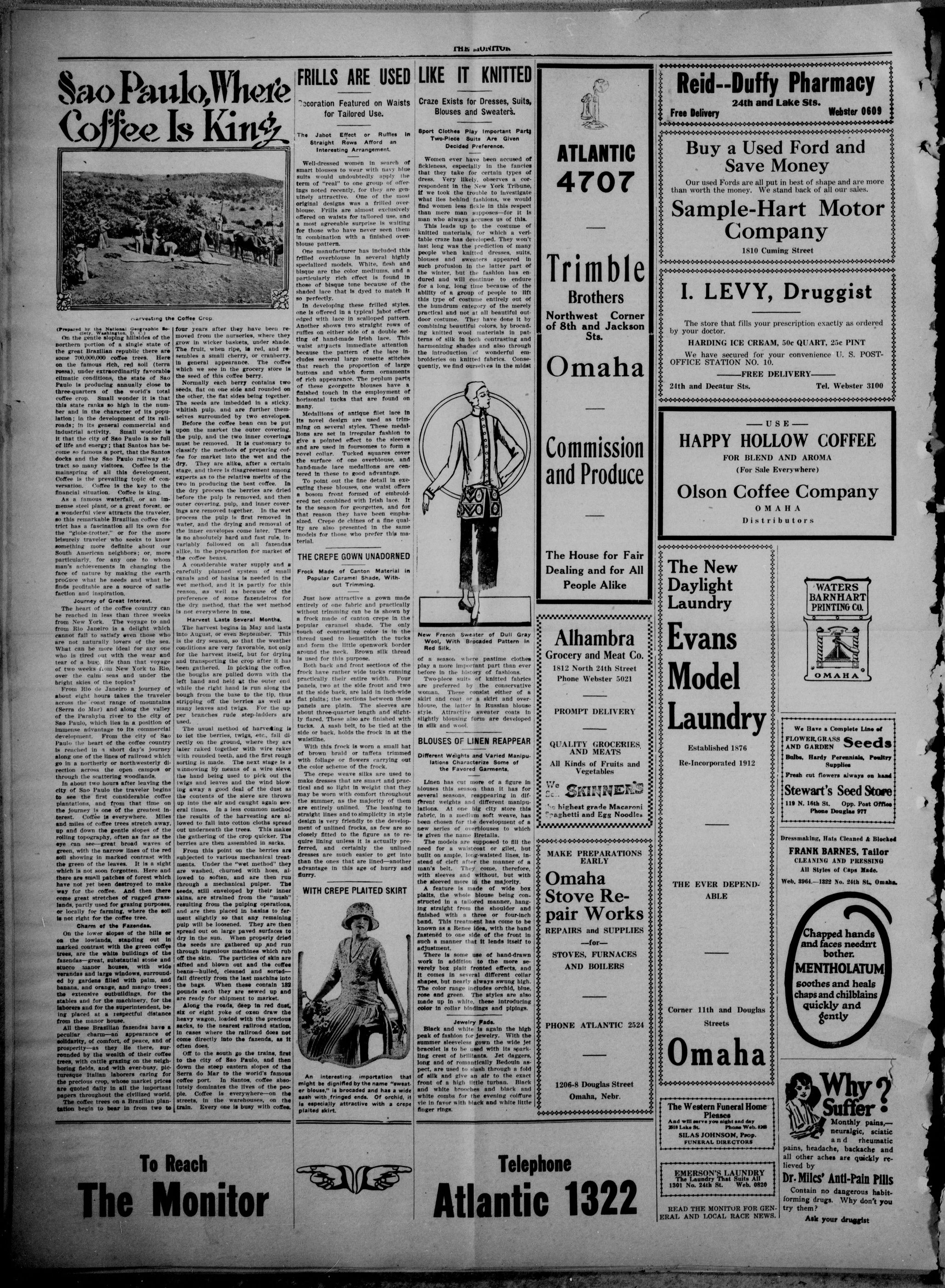
Sao Paulo,Where Coffee Is King
Harvesting the Coffee Crop.
(Prepared by the National Geographic Board. On the gentle sloping hillsides of the northern portion of a single state of the great Brazilian republic there are some 700,000,000 coffee trees. Here on the famous rich, red soil (terra rosa), under extraordinarily favorable climatic conditions, the state of Sao Paulo is producing annually close to three-quarters of the world's total coffee crop. Small wonder it is that this state ranks so high in the number and in the character of its population; in the development of its railroads; in its general commercial and industrial activity. Small wonder is it that the city of Sao Paulo is so full of life and energy; that Santos has become so famous a port, that the Santos docks and the Sao Paulo railway attract so many visitors. Coffee is the mainspring of all this development. Coffee is the prevailing topic of conversation. Coffee is the key to the financial situation. Coffee is king.
As a famous waterfall, or an immense steel plant, or a great forest, or a wonderful view attracts the traveler, so this remarkable Brazilian coffee district has a fascination all its own for the "globe-trotter," or for the more leisurely traveler who seeks to know something more definite about our South American neighbors; or, more particularly, for any one to whom man's achievements in changing the face of nature by making the earth produce what he needs and what he finds profitable a a source of satisfaction and inspiration.
Journey of Great Interest.
The heart of the coffee country can be reached in less than three weeks from New York. The voyage to and from Rio Janeliro is a delight which cannot fail to satisfy even those who are not naturally lovers of the sea. What can be more ideal for any one who is tired out with the wear and tear of a busy life than that voyage of two weeks from New York to Rio, over the calm seas and under the bright skies of the topics?
From Rio de Janeiro a journey of about eight hours takes the traveler across the coast range of mountains (Serra do Mar) and along the valley of the Parahyba river to the city of São Paulo, which lies in a position of immense advantage to its commercial development. From the city of São Paulo the heart of the coffee country is reached in a short day's journey along one of the lines of railroad which go in a northerly or northwesterly direction across the open campos or through the scattering woodlands.
In about two hours after leaving the city of Sao Paulo the traveler begins to see the first considerable coffee plantations, and from time on the journey is one of the greatest interest. Coffee is everywhere. Miles and miles of coffee trees stretch away, up and down the gentle slopes of the rolling topography, often as far as the eye can see—great broad waves of green, with the narrow lines of the red soil showing in marked contrast with the green of the leaves. It is a sight which is not soon forgotten. Here and there are small patches of forest which have not yet been destroyed to make way for the coffee. And then there come great stretches of rugged grasslands, partly used for grazing purposes, or locally for farming, where the soil is not right for the coffee tree.
Charm of the Fazendas.
On the lower slopes of the hills or on the lowlands, standing out in marked contrast with the green coffee trees, are the white buildings of the fazenda—great, substantial stone and stucco manor houses, with wide verandas and large windows, surrounded by gardens filled with palm, and banana, and orange, and mango trees; the extensive outbuildings, for the stables and for the machinery, for the laborers and for the superintendent, being placed at a respectful distance from the manor house.
All these Brazilian fazendas have a peculiar charm—an appearance of solidarity, of comfort, of peace, and of prosperity—as they lie there, surrounded by the wealth of their coffee trees, with cattle grazing on the neighboring fields, and with ever-buy, picturesque Italian laborers caring for the precious crop, whose market prices are quoted daily in all the important papers throughout the clivilized world. The coffee trees on a Brazilian plantation begin to bear in two to
four years after they have been removed from the nurseries, where they grow in wicker baskets, under shade. The fruit, when ripe, is red, and resembles a small cherry, or cranberry, in general appearance. The coffee which we see in the grocery store is the seed of this coffee berry. Normally each berry contains two seeds, flat on one side and rounded on the other, the flat sides being together. The seeds are imbedded in a sticky, whitish pulp, and are further themselves surrounded by two envelopes.
Before the coffee bean can be put upon the market the outer covering, the pulp, and the two inner coverings must be removed. It is customary to classify the methods of preparing coffee for market into the wet and the dry. They are alike, after a certain stage, and there is disagreement among experts as to the relative merits of the two in producing the best coffee. In the dry process the berries are dried before the pulp is removed, and then outer covering, pulp, and inner coverings are removed together. In the wet process the pulp is first removed in water, and the drying and removal of the inner envelopes come later. There is no absolutely hard and fast rule, invariably followed on all fazendas alike, in the preparation for market of the coffee beans.
A considerable water supply and a carefully planned system of small canals and of basins is needed in the wet method, and it is partly for this reason, as well as because of the preference of some fazendelios for the dry method, that the wet method is not everywhere in use.
Harvest Lasts Several Months.
The harvest begins in May and lasts into August, or even September. This is the dry season, so that the weather conditions are very favorable, not only for the harvest itself, but for drying and transporting the crop after it has been gathered. In picking the coffee the boughs are pulled down with the left hand and held at the outer end while the right hand is run along the bough from the base to the tip, thus stripping off the berries as well as many leaves and twigs. For the upper branches rude step-ladders are used.
The usual method of harvesting is to let the berries, twigs, etc., fall directly on the ground, where they are later raked together with wire rakes with rounded teeth, and the first rough sorting is made. The next stage is a winnowing by means of a wire sieve, the hand being used to pick out the twigs and leaves and the wind blowing away a good deal of the dust as the contents of the sieve are thrown up into the air and caught again several times. In a less common method the results of the harvesting are allowed to fall into cotton cloths spread out underneath the trees. This makes the gathering of the crop quicker. The berries are then assembled in sacks.
From this point on the berries are subjected to various mechanical treatments. Under the "wet method" they are washed, churned with hoses, allowed to soften, and are then run through a mechanical pulper. The seeds, still enveloped by the inner skins, are strained from the "mush" resulting from the pulping operations, and are then placed in basins to ferment slightly so that any remaining pulp will be loosened. They are then spread out on large paved surfaces to dry in the sun. When properly dried the seeds are gathered up and run through ingenious machines which rub off the skin. The particles of skin are sifted and blown out and the coffee beans—hulled, cleaned and sorted—fall directly from the last machine into the bags. When these contain 182 pounds each they are sewed up and are ready for shipment to market.
Along the roads, deep in red dust, six or eight yoke of oxen draw the heavy wagon, loaded with the precious sacks, to the nearest railroad station, in cases where the railroad does not come directly into the fazenda, as it often does.
Off to the south go the trains, first to the city of Sao Paulo, and then down the steep eastern slopes of the Serra do Mar to the world's famous coffee port. In Santos, coffee absolutely dominates the lives of the people. Coffee is everywhere—on the streets, in the warehouses, on the train. Every one is busy with coffee.
Decoration Featured on Waists for Tailored Use.
The Jabot Effect or Ruffles in Straight Rows Afford an Interesting Arrangement.
Well-dressed women in search of smart blouses to wear with navy blue suits would undoubtedly apply the term of "real" to one group of offerings noted recently, for they are genuinely attractive. One of the most original designs was a frilled overlouse. Frills are almost exclusively offered on waists for tailored use, and a most agreeable surprise is waiting for those who have never seen them in combination with a finished overlouse pattern.
One manufacturer has included this frilled overlouse in several highly specialized models. White, flesh and bisque are the color mediums, and a particularly rich effect is found in those of bisque tone because of the shaded lace that is dyed to match it so perfectly.
In developing these frilled styles, one is offered in a typical jabot effect edged with lace in scalloped pattern. Another shows two straight rows of ruffles on either side of a double setting of hand-made Irish lace. This waist attracts immediate attention because the pattern of the lace includes several large rosette stitches that reach the proportion of large buttons and which form ornaments of rich appearance. The peplum parts of these georgettes blouses have a finished touch in the employment of horizontal tucks that are found on many.
Medallions of antique fillet lace in its novel design are used as trimming on several styles. These medallions are set in irregular fashion to give a pointed effect to the sleeves and are used in foursomes to form a novel collar. Tucked squares cover the surface of one overlouse, and hand-made lace medallions are centered in these to good advantage.
To point out the fine detail in executing these blouses, one waist offers a bosom front formed of embroidered net combined with Irish lace. It is the season for georgettes, and for that reason they have been emphasized. Crepe de chines of a fine quality are also presented in the same models for those who prefer this material.
THE CREPE GOWN UNADORNED
Frock Made of Canton Material in Popular Caramel Shade, Without Trimming.
Just how attractive a gown made entirely of one fabric and practically without trimming can be is shown by a frock made of canton crepe in the popular caramel shade. The only touch of contrasting color is in the thread used to hemsithe tucks and form the little openwork border around the neck. Brown silk thread is used for this purpose.
Both back and front sections of the frock have rather wide tucks running practically their entire width. Four panels, two at the side front and two at the side back, are laid in inch-wide flat plains; the sections between these panels are plain. The sleeves are about three-quarter length and slightly fared. These also are finished with tucks. A sash belt, to be tied at the side or back, holds the frock in at the waltaline.
With this frock is worn a small hat of brown braid or taffeta trimmed with foliage or flowers carrying out the color scheme of the frock.
The crepe weave silks are used to make dresses that are smart and practical and so light in weight that they may be worn with comfort throughout the summer, as the majority of them are entirely unlined. The leaning to straight lines and to simplicity in style design is very friendly to the development of unlined frocks, as few are so closely fitted to the figure as to require lining unless it is actually preferred, and certainly the unlined dresses are much easier to get into than the ones that are lined—another advantage in this age of hurry and flurry.
WITH CREPE PLAITED SKIRT
THE FASHION WEEKLY
An interesting importation that might be dignified by the name "sweater blouse," is brocaded and has a wide sash with fringed ends. Of orchid, it is especially attractive with a crepe plaited skirt.
THE MONITOR
Craze Exists for Dresses, Suits, Blouses and Sweaters.
Sport Clothes Play Important Parts
Two-Piece Suits Are Given
Decided Preference.
Women ever have been accused of
fickleness, especially in the fancies
that they take for certain types of
dress. Very likely, observes a cor-
respondent in the New York Tribune,
if we took the trouble to investigate
what lies behind fashions, we would
find women less fickle in this respect
than mere man supposes—for it is
man who always accuses us of this.
This leads up to the costume of knitted materials, for which a veritable craze has developed. They won't last long was the prediction of many people when knitted dresses, suits, blouses and sweaters appeared in such profusion in the latter part of the winter, but the fashion has endured and will continue to endure for a long, long time because of the ability of a group of people to lift this type of costume entirely out of the humdum category of the merely practical and not at all beautiful outdoor costume. They have done it by combining beautiful colors, by broaching knitted wool materials in patterns of silk in both contrasting and harmonizing shades and also through the introduction of wonderful embroideries on knitted fabrics. Consequently, we find ourselves in the midst
New French Sweater of Dull Gray Wool, With Brocaded Pattern in Red Silk.
of a season where pastime clothes play a more important part than ever before in the history of fashions.
Two-piece suits of knitted fabrics are preferred by the conservative woman. These consist either of a skirt and coat or a skirt and overblouse, the latter in Russian blouse style. Attractive sweater coats in slightly blossoming form are developed in silk and wool.
BLOUSES OF LINEN REAPPEAR
Different Weights and Varied Manipulations Characterize Some of the Favored Garments.
Linen has cut more of a figure in blouses this season than it has for several seasons, reappearing in different weights and different manipulations. At one big city store this fabric, in a medium soft weave, has been chosen for the development of a new series of overblouses to which is given the name Bretalia.
The models are supposed to fill the need for a waistcoat or gilet, but built on ample, long-waisted lines, instead of cleft at the manner of a man's belt. They come, therefore, with sleeves and without, but with the sleeved more in the majority.
A feature is made of wide box plaits, the whole blouse being constructed in a tailored manner, hanging straight from the shoulder and finished with a three or four-inch band. This treatment has come to be known as a Renee idea, with the band fastened to one side of the front in such a manner that it lends itself to adjustment.
There is some use of hand-drawn work in addition to the more severely box plait fronted effects, and it comes in several different collar shapes, but nearly always swung high. The color range includes orchid, blue, rose and green. The styles are also made up in white, these introducing color in collar bindings and pipings.
Black and white is again the high peak of fashion for jewelry. With the summer sleeveless gown the wide jet bracelet is to be used with its sparkling crest of brilliants. Jet daggers, long and of romantically Bedouin aspect, are used to slash through a fold of silk and give an air to the exact front of a high little turban. Black and white brooches and black and white combs for the evening collure vie in favor with black and white little finger rings.
Brothers
Northwest Corner
of 8th and Jackson
Sts.
Omaha
Commission and Produce
The House for Fair Dealing and for All People Alike
Alhambra
Grocery and Meat Co.
1812 North 24th Street
Phone Webster 5021
PROMPT DELIVERY
QUALITY GROCERIES
AND MEATS
All Kinds of Fruits and
Vegetables
We
Sell.
SKINNER'S
the highest grade Macaroni
Spaghetti and Egg Noodles
MAKE PREPARATIONS
EARLY
Buy a Used Ford and Save Money
HAPPY HOLLOW COFFEE
FOR BLEND AND AROMA
(For Sale Everywhere)
Olson Coffee Company
OMAHA
Distributors
Established 1876
Re-Incorporated 1912
THE EVER DEPEND-ABLE
Corner 11th and Douglas Streets
Omaha
The Western Funeral Home
Pleases
And will serve you night and day
2518 Lake St. Phone Web. 9268
SILAS JOHNSON, Prop.
FUNERAL DIRECTORS
EMERSON'S LAUNDRY
The Laundry That Suits All
1301 No. 24th St. Web. 0820
READ THE MONITOR FOR GENERAL AND LOCAL RACE NEWS.
WATERS
BARNHART
PRINTING CO.
OMAHA
We Have a Complete Line of
FLOWER, GRASS Seeds
AND GARDEN
Bulbs, Hardy Perennial, Poultry
Supplies
Fresh cut flowers always on hand
Stewart's Seed Store
119 N. 16th St. Opp. Post Office
Phone Douglas 977
Dressmaking, Hats Cleaned & Blocked
FRANK BARNES, Tailor
CLEANING AND PRESSING
All Styles of Caps Made.
Web, 3964.-1322 No. 24th St., Omaha.
Chapped hands and faces needn't bother.
MENTHOLATUM
soothes and heals
chaps and chilblains
quickly and
gently