The Monitor
Friday, December 29, 1922
Omaha, Nebraska
Page text (machine-generated)
WE WISH YOU A HAPPY, PROSPEROUS NEW YEAR
LIFTING FT TOO
State Historical Society
HENRY FORD AVERS NEGRO HAS PROVED COMMUNITY ASSET
Automobile King Takes the Position That Colored American Should Be Given Opportunity for Development.
RAGE HATRED UNWARRANTED
"A Race That Calls Itself Superior Can Only Prove Its Superiority By Superior Ability to Help Others," Says Ford.
Detroit, Mich., Dec. 29.—(Associated Negro Press.)—The name of Henry Word is undoubtedly household in America. Besides being one of the greatest employers of labor, he is one of the most influential men in the country.
Mr. Ford has been mentioned for president much in the last year, and no one can tell what the future may bring. It is known generally that for a long time he had had before congress an offer for the purchase of the great Muscle Shoals properties. Opposition has sprung up on many sides, but it is hardly to be thought that Henry Ford is a quitter.
The attitude of such a powerful factor in the economic life of the nation with reference to Colored Americans is at once a most interesting subject. Recently Mr. Ford set forth his views in the Dearborn Independent, his personal publication, as follows:
"There is no need of race hatred in America, says Mr. Ford, even though there is a race question. A race question is primarily a question for the race that is being complained against. The complainant has no way of settling it else it would not have stopped to complain. The question between the white and colored races in our country is primarily a question for the white race. It is a question for the Negro, too, in so far as he ought to identify the enemy of both colored man and the white man, the common enemy that is trying to stir hatred between them. Destiny has placed these two races together. Our modern industrialism, changed, will provide means to remove to motives or public service every injustice that gives soil for prejudice.
"There is something to say to the white man, too. The race that calls itself superior can only prove its superiority by superior ability to help others, and can only retain its racial destiny as helper of the others. The Negro is a human being, capable of integrity, loyalty and domestic peace and prosperity and as a human being, he is entitled to opportunities to develop and exhibit those qualities and to enjoy his natural human rights. Where the Negro has been given opportunity, he has proved a community asset, his labor and his contribution to the development of the country are capable of being increased. Race correction by education is always the superior way, and not coercion. The Negro should be given a chance, and should be regarded with full humanity and treated with entire justice.
"To ooth may be repeated what was said above, that both are here by an apparently purposeful destiny, and the thing to do is to identify and nullify the common enemies of both and tackle the question upon the principle basis offered this generation, namely, the industrial basis.
"When there are enough jobs to go around in this country, when every man shall have opportunity to go forth in the morning to perform the work he is best fitted to do, and to receive a wage which means to secure family life there will be no race question. The Negro question is largely one of unemployment and of inexperiences in handling the rewards of labor. The Negro needs a job, he needs a sense of industrially 'belonging', and thus it ought to be the desire of our industrial engineers to supply."
THRILLING PLEA AGAINST
LYNCHING IS FEATURED
"Wine, Woman and Song" at Gayety Next Week to Present a Novel Offering.
A strong plea against lynching is featured in the "Wine, Woman and..." show which comes to the Gayetty Theatre starting with a matinee Saturday, Dec. 30th. This occurs during the scene, "Plantation Days." There is a false charge of murder against an old Negro. To hide the real white criminal, a lynching is brewing, when another white man steps up and delivers an ultimatum with humanity, equality and freedom as its theme, that carries weight. There is much singing, dancing and comedy. The piece was staged with
THE MONITOR
all its effects, and full details, bringing before your very eyes the plantations and the cotton fields of the South. The company consists of 40 performers and the Gayette Theatre management guarantees it to be the greatest show seen here this season. Daily matinees and night shows will be given. Do not miss this show. A Southern Jubilee is offered in the "Plantation Days" scene, in which the greatest story of a human race is totd.
ROLAND HAYES COMES HOME
New York, Dec. 29—Roland Hayes, accomplished soloist, has completed his European tour and is now returning to America, where he will attend the eleventh annual conclave of the Omega Psi Phi Fraternity in Philadelphia this month.
Hayes' rendition of Negro folk songs throughout the large European cities won him passionate admiration. He sang before royalty and other dignitaries.
ASK REMOVAL OF JUDGE
Roanoke, Va., Dec. 29—Leading colored citizens have asked the removal of City Judge Beverly Berkley, white, who kicked Miss Bertha Lawson, a school teacher, out of his office in the city hall. Miss Lawson entered the Judge's office by mistake and inquired the way to the office of the Tax Collector.
MORE STUDENTS COMING NORTH TO BIG COLLEGES
Atlanta University Head Declares That Colleges Are Good Places for the Amalgamation of the Races.
NUMBER STEADILY INCREASING
New Haven, Conn., Dec. 29—Edward Twitchell Ware, president of Atlanta University, Sunday declared in a statement to Yale men that unless adequate provision is made for education of Negroes in the South the universities and colleges of the North will be called upon to accommodate increasing numbers of them in the future. Already the number of applications of Negro students to Northern institutions is growing, he said:
"This situation seems to be causing some embarrassment in the North," Dr. Ware said. "To exclude trom college on account of racial inheritance any otherwise qualified person is directly opposed to the democratic principles upon which these colleges are founded. There have almost always been a few Negroes in the Northern institutions, but when they come in larger numbers it seems somehow to change the situation. The embarrassment arises out of the reluctance to take into the student body a group which is socially unwelcome.
"It itens to me the situation can be met with justice to all in the following way: First, by refusing to make discrimination against any candidate for admission on account of race; secondly, by strengthening and developing the institutions for the liberal education of the Negroes in the South, and where the demand justifies, by creating professional schools in connection with these institutions.
"One great problem before this nation is to find the way of interracial sympathy and cooperation. There must be some places of contact where our Negro and white youth can come together on equal footing and with mutual understanding. Where better than in our universities? It is one way of overcoming in our youth the provincialism to which their elders are so prone. It is a good thing for the Negro youth to compete in college with the youth of another race."
TEXAS MOB LYNCHES
AN INNOCENT MAN
Streetman, Texas, Dec. 29—Unable to find the person who is alleged to have attacked a white girl, George Gay was captured by a mob and before 2000 persons was shot to death. After the lynching the local colored hotel was destroyed by fire. The girl, who is unhurt, said she did not think Gay was the man who assaulted her.
HUNT FOR YOUR NAME
Each week the name of some paid-up subscriber is inserted in one of the "ads" appearing in The Monitor. If that subscriber finds his or her name and will bring his copy of the paper to The Monitor office before the following Friday he will be paid One Dollar.
A NATIONAL WEEKLY NEWSPAPER DEVOTED TO THE INTERESTS OF COLORED AMERICANS
THE REV. JOHN ALBERT WILLIAMS, Editor
OMAHA, NEBRASKA, FRIDAY, DECEMBER 29, 1922
REPUBLICANS TOLD INVESTIGATION OF LYNCHING NEEDLESS
Proposal by Senators is Regarded as Transparent Subterfuge to Delay Action and Lull With False Hopes.
FACTS BEFORE CONGRESS
Johnson Tells Senator Frelinghuysen Substitute for Dyer Bill Will Not Be Acceptable to the Colored People.
New York, Dec. 29.—Proposal by Republican Senators to institute a commission for the purpose of investigating lynching in the United States has elected a sharp letter to Senator Frelinghuysen, author of the resolution, from James Weldon Johnson, Secretary of the National Association for the Advancement of Colored People, in which notice is served that a substitute for the Dyer Anti-Lynching Bill will not be acceptable to colored people.
Mr. Johnson's letter asserts that the essential facts concerning lynching in America are known throughout the world, that a commission to "investigate" will be interpreted only as a plan to delay action and to "null the nation and the Negro with false hopes". The letter in full is as follows:
December 21, 1922.
Hon. Joseph S. Frelinghuysen,
United States Senate,
Washington, D. C.
My dear Senator Frelinghuysen: I wish to confirm my telegram of today as follows: "Your letter with enclosure received. Have given the matter careful study. Am writing you giving reasons why we do not consider proposed measure adequate. I request that you delay action until you receive my letter." I have carefully examined your proposed Joint Resolution establishing a commission for the purpose of conducting a general inquiry into the subject of lynching in the United States, including the number occurring and the cause thereof.
We would interpose no active opposition to any steps leading toward the abolishment of the crime of lynching, but the National Association for the Advancement of Colored People in this case as in a half a dozen similar proposals in the past is unable to see any necessity whatsoever for such a commission, nor can we endorse the proposed measure as a substitute for the Dyer Anti-Lynching Bill. Such a commission as you propose could gather only statistics and facts such as have already been presented by this Association and other agencies and which have been repeatedly and at great length read into the Congressional Record, where they are available to the United States Senate as well as to other citizens.
The essential facts in regard to lynching are well known and undisputed. The gathering of such facts for an additional year would have no appreciable effect upon the question. We would, therefore, view this commission plan, with its year of investigation, only as a further delay to the one thing we believe to be essential in the circumstances, and that is legislation giving the Federal Government jurisdiction where States fail, as they have failed in the past thirty-five years, to secure to persons accused of crime trial by due process of law, or to prosecute and punish members of mobs.
This commission plan, therefore, seems calculated only to delay action or lull the nation and the Negro with false hopes.
The National Association for the Advancement of Colored People will not be actively interested in a commission to investigate lynching. Rather, we insist upon a revision of the Senate rules of procedure and the passage of the Dyer Anti-Lynching Bill. Yours very truly,
(Signed) James Weldon Johnson, Secretary.
WELL KNOWN ATTORNEY DIES
Pittsburgh, Pa., Dec. 29—Attorney J. Wilfred Holmes, 52 years old, died at his home last Friday of pneumonia following an illness of three days. He is survived by his widow, who was Miss Emily Waring of Washington, and two sons.
JIM CROWED PASSEGERS
DIE IN RAILWAY WRECK
Houston, Tex., Dec. 29.—(Associated Negro Press.)—Seventeen persons
were cooked to death by live steam and twenty-five others burned, many probably fatally, when Houston East and West Teras passenger train No. 26 sideswiped a switch engine near the depot at Humble. The living, hissing steam transformed the smoker filled with colored men and women into a cauldron. Seven of the victims lingered until morning before death ended their suffring. Bodies of teh dead were removed to the morgue at Humble, while all of the injured were brought to the Southern Pacific hospital here in ambulances.
OVER 16,000,000 CARELESS AND
STUPID USERS OF THE MAILS
Washington, Dec. 29—If Uncle Sam were as careless with the mails as those who use them, there would be chaos in the world of affairs in this country. The report of the Dead Letter office for the last year shows that because of inaccurate or insufficient addresses 16,586,419 letters and 629,000 packages were not deliverable. Thousands of these letters contained money or money orders and thousands of the packages contained very valuable matter. To illustrate the utter carelessness of the public, of this number of letters over 140,000 were placed in mail boxes or postoffices without any address whatever.
FRANCE NEEDS MEN,
NO MATTER WHAT COLOR
Worried Over Shrinking Birth Rate
All She Asks is For Men Big
and Husky Enough to
Defend Country
IN FEAR OF GERMAN INCRESAE
(Associated Negro Press)
Paris, France Dec. 29.—France needs men. She does not care what the color of their skin is just so long as they speak French and are big and husky enough to bravely defend French soil from the invasion of enemies. The contention is that the French language possesses enough of potentiality to preserve the traditions and national spirit of the French people. The Senegalese fought like valiant_Frenchmen in the late World War and therefore are worthy to be included in the national scheme of French civilization. Frenchmen, white and black, if necessary, is the cry of the hour. Some 70,000 fewer children were born this year than last, according to statistics compiled and announced last Monday by the National Alliance e for the Increase of French population. The figures point to this conclusion. In less than fifty years there will be 93,000,000 Germans as against 43,000,000 French unless old Father Stork, who is the national bird of restored Alsace, makes more regular visits to the average French household. To the mind of the still-feared French, a German population more than double their own would mean nothing more nor less than almost certain annihilation in event of another war. Herein lies the ecrux of France's concern over her shrinking birth rate.
COLORED MAN GETS $50 FOR EXCLUSION FROM SWIMMING POOL
New York, Dec. 23.—A colored citizen of New York, James Pilcher, who was excluded from the Madison Square Garden swimming pool, took the case to law, upon the advice of the National Association for the Advancement of Colored People, with the result that the swimming pool settled the case out of court for $50. The case was undertaken under the Civil Rights law of New York state.
Mr. Pilcher consulted his attorney in August of this year. On November 22, a check for $50 was in his attorney's hands.
The exclusion at the Madison Square Garden pool was upon the pretext that Mr. Pilcher was not a member of "the club", and could therefore not use the swimming pool. However, Mr. Pilcher was accompanied by a white friend who gained access to the pool upon payment of the admission fee, without being a member of "the club".
TO CROSS SAHARA IN AUTOMOBILE
Tuggant, Algiers, Dec. 29.—(Associated Negro Press).—A party of French pioneers set out from here in a "caterpillar" automobile, manufactured by a Paris company, to carry out the long-heralded journey across the Sahara desert. It is hoped that the party will reach Timbuteco on the Niger River in the early days of January.
FAMOUS SINGER
SUCCUMBS AFTER
BRAVE STRUGGLE
Mme. E. Azalia Hackley, Well-Known for Her Concert Work in Europe and America, Dies at Home of Her Sister.
INVALID FOR SEVERAL YEARS
Assisted Many Prominent Musicians of Race in Winning Their Place in the Musical World.—Was Also an Author.
Detroit, Mich., Dec. 29—Mme. E. Azalia Hackley, "our Azalia" as all old Detroiters loved to proudly call her, died here at the residence of her sister, Mrs. Marietta Johnson, Dec. 13th, after an illness of several months. In fact, she had been an invalid for several years, but with the indomitable fortitude and will she kept at her loved work until through physical weakness she was compelled to give up. The funeral was held from St. Matthew's Episcopal church, Saturday, December 16th.
Mme. Hackley was the older daughter of the late George and Corilla Beard Smith of this city. She was reared and educated in the public schools here, graduating from the high school and taking a normal course, she was assigned at the age of eighteen to teach in the Clinton street school. She inherited a talent for music from her mother, and while attending school she not only studied music, but helped support herself by being the pianist for Finney's orchestra. After teaching for six years in the Detroit public schools, she was married to Edwin H. Hackley of Denver, Colo. She graduated from the Denver College of Music with distinction. Subsequently she and her husband moved to Philadelphia. Later she studied in paris. Her beautiful well-trained soprano voice soon brought her into prominence in Europe. Returning to America she had a successful concert tour here. Filled with a desire to help talented and aspiring musicists of the race she gave of her earnings to establish "the Azalia Hackley Scholarship Fund," which enabled some of our prominent musicians of today to study in Europe. The firs beneficiary of this fund was the well-known violinist, Clarence Cameron White. She strove, though unsuccessfully, to have this fund increased and continued to help deserving pupils who showed unusual talent.
Anxious to help her people she visited and trained choruses in the schools and colleges of the Southland and in other sections of the country with great success and gave most helpful courses of lectures. Added to her many duties she found time for writing magazine and newspaper articles and also published a "Guide to Voice Culture" and a fascinating book entitled the "Colored Girl Beautiful," which every young woman should read, and in which the author holds up the highst ideals.
One sentence taken from this volume expresses the philosophy of Azalia Hackley's life. It is this: "By helping others we help ourselves. We must learn to give, give, give, in order to receive." And how fittingly do the closing words of this book apply to her:
"The peace and contentment that comes from having done her whole duty gives her a spiritual beauty of countenance that comes from the other world; the habit of right living, through right thought, reflects in her face and gives her a physical beauty that comes in no other way. And at the last the Still Small Voice whispers, 'Well done, thou good and faithful servant of a persecuted race, You have done what you could. No one can do more. Receive your eternal reward,' and the face is illumined with the beauty that shall endure forever."
Mme. Hackley sang in Omaha twice, her last visit here being about fourteen years ago. Mrs. Florentine F Pinkston, the talented Omaha pianist and teacher, received her first lessons while a child in Denver from Mme. Hackley.
BANK DISTRIBUTES $100,000
Nortok, Va., Dec. 29.—The Metropolitan Bank and Trust Company mailed to the 6,000 members of its 1922 Christmas Savings Club checks for $100,000.
Pine Bluff, Ark., Dec. 29—Rev. BJ
Jeffries, a Baptist minister here, i
Whole Number 390
held in jail here on a charge of bigamy. According to reports, the Rev. Mr. Jeffries wrote his name once too often when he signed a marriage license application in the county clerk's office recently.
When word reached Mrs. Jeffries, No. 1, who resides at 213 Arch street, she called at the sheriff's office and swore out a warrant for husband's arrest. The minister was arrested and lodged in jail on a charge of bigamy.
PERPETUATE MEMORY OF
CIVIL WAR WOMEN
Washington, D. C., Dec. 29.—The memory of the "faithful colored mammies of the south" would be perpetuated in enduring bronze or granite under a resolution introduced by Senator Williams (demoat, Mississippi). The measure would direct the chief of engineers of the army to select a site and permit Jefferson Davis Chapter No. 1,650, of the United Daughters of the Confederacy, to erect such a monument in Washington as "a gift to the people of the United States".
OMEGA PSI PHI TO MEET
Philadelphia, Pa., Dec. 29.—Chapter of Lincoln University and Philadelphia are the hosts at the tenth national convention of the Omega Psi Phi Fraternity being held here December 26th and 30th.
WILL ORGANIZE NATIONAL SOCIETY FOR STUDENTS
Two Hundred Fifty Schools Have Been Asked to Work Toward Union of American Students
PLAN TO HOLD CONFERENCE
Lincoln University, Pa., Dec. 29 The attempt is being made to unite the colored students of High Schools, Colleges and Universities throughout the country.
The effort is an outgrowth of the Students Anti-Lynching League. Last June while appearing before President Harding at the White House in the interest of the Dyer Anti-Lynching Bill a delegation of students from the League informed the President that the colored students today were working to promote the highest type of American Citizenry. During the last Summer at Atlantic City, still warmed by the fire of the Washington Conference, students attending Howard, Yale, Lincoln, Cornell, Tuskegee, Downington, Mount Claire Normal, the Atlantic City High School and those who anticipated entrance to similar schools during the coming year created an executive committee to invite the Colored American Student to a National Consideration of racial progress and the means of furthering it. Plans are being made to have a national (and eventually an international) yearly conference of students for such purposes of promoting cooperation, stimulating race pride, encouraging education, promoting a higher racial culture, and giving intelligent consideration to the race problems.
The chairman of the Executive Committee, I. J. K. Wells of Lincoln University, states that two hundred and fifty High Schools, Colleges and Universities have been invited to work in achieving the union of American students.
RED ARMY CALLED
FINEST IN WORLD
German Traveler Claims That Russia Could Muster 6,000,000 to "Walk Through Europe".
Berlin, Dec. 29.—(Crusader Service.)—Interesting details of the strength, equipment and morals of the Russian Red Army at the present time are contained in a an article published here by Dr. Robert Fluhr, a mining engineer of this city, who left for America a few days ago after making an extensive tour of Russia. In Dr. Fluhr's opinion Russia is in a stronger condition today than she has ever been in all her history, not only in the army and navy, but in the civil administration as well.
"The Red Army, as the active force is called," the doctor said, "is composed of 1,500,000 troops well drilled and equipped with every kind of modern weapon, including light and heavy artillery, bombs and airplanes. These soldiers are all young men who did not fight in the World War and therefore are not tired of fighting, like the men in the other armies of Europe. It is not any exaggeration to state that the Red Army is the finest in the world at the present time.
"At least six million officers and men are included in this army, and it could walk through Europe in a short time."
GROWING _____
THANK YOU
Vol. VIII—No. 26
THE RISING TIDE OF COLOR STRIKES ISLE OF JAMAICA
Natives, Resentful of Dishonest and Supercellious Governor Urge Him to Remove His Presence Elsewhere.
ACTION IS QUITE SIGNIFICANT
West Indian No More Than American Negro Inclined to Surrender Hard Won Rights of Race in Native Land.
Kingston, Jamaica, Dec. 29.—(Crusader Service.)—That the "rising tide of color against white domination" is not confined to the east, but is revealing itself in the west as well, is proved by recent action of the fourteen elected members of the Legislative Council in unanimously voting the lack of confidence of the natives of Jamaica in the administration of the present governor, Sir Leslie Proyn. The electorate is overwhelmingly Negro and with two or three exceptions the elected councillors are members of the colored race.
The drastic vote was occasioned by the action of the governor in granting Major Thomas, the newly appointed director of railways an honorarium of 1,700 pounds (being about $8,000) without the consent of the council which act is a clear violation of the constitution granted the island by Lord Derby in 1884. The situation was aggravated when the Colonial Secretary, Col. H. H. Bryan, deliberately sought to deceive the people by omitting to read to the Council the communications bearing on the matter that passed between the local government, Major Thomas and the secretary of state for the colonies, Mr. Winston Churchill. This clumsy piece of trickery was discovered and its authors were denounced by the legislators led by Barrister J. A. G. Smith, H. A. L. Simpson, D. I. Wint and Rev. G. L. Young (all colored). With undaunted courage these men treated "His Excellency", the representative of the king, to severe dialectical castigation and invited him to cease polluting the community by betaking himself to some place where his talent for dishonest methods might have full play. Although at no time the race question was raised, still it is easy to realize that the denunciation of the Colonial Secretary and Major Thomas, particularly the latter, who is lately from South Africa, was due to their contemptuous attitude towards Negroes. Having had their first contact with Negroes in Africa, these men have sought to treat Jamaicans with the super-ciliousness and reprehensible methods that characterized white officialdom in that unfortunate continent.
The action of the elected members is unique and will have a bearing upon the future of the island inasmuch as these same men (natives) were the recipients of enconiloms from the under secretary of state for the colonies, Major Wood, who recently headed a commission to the West Indies and in his report advised the granting of a greater measure of political self-rule.
Not only was the administration denounced but no longer did the natives show the usual timidity and unnatural deference to Europeans. These latter were told to "shut up", "sit down", you are wasting time", with truculence that bodies good for the manhood of the race and gives the lie to ignorant and misguided mountebanks who tell Negroes that they must give up what rights they have in the western world in order to get greater rights in Africa.
CONGRESS ASKED TO IN
VESTIGATE KU KLUX KLAN
Washington, Dec. 29.—Investigation of the Ku Klux Klan activities by a house committee which would be directed to "recommend, if necessary, proper disciplinary action," was proposed in a resolution introduced here by Representative Ryan, republican, New York.
The resolution also called for an examination of the financial condition of the organization "in order that just and proper returns be filed with the collectors of internal revenue" and provided that all such organizations must file with the Postmaster General semi-annually the names and addresses of officers and members.
It was declared in the resolution that the Klan was "un-American" that it had expended "large sums for the building of palaces" and had issued "propaganda of religious bigotry and racial hatred."
THE M
A National Weekly Newspaper of Colored
THE MONITOR
A National Weekly Newpaper Devoted Primarily to the Interests of Colored Americans.
Published Every Friday at Omaha, Nebraska, by the Monitor Publishing Company.
Entered as Second-Class Mail Matter July 2, 1915, at the Postoffice at Omaha, Nebraska, under the Act of March 2, 1879.
THE REV. JOHN ALBERT WILLIAMS, Editor.
W. W. MOSELY, Associate Editor, Lincoln, Neb.
SUBSCRIPTION RATES, $2.00 A YEAR; $1.25 6 MONTHS; 75c 3 MONTHS
Advertising Rates Furnished Upon Application.
Address The Monitor, Postoffice Box 1204, Omaha, Neb.
Telephone Atlantic 1322, Webster 4243
ARTICLE XIV. CONSTITUTION OF THE UNITED STATES.
SUBSCRIPTION RATES, $2.00 A YEAR; $1.25 6 MONTHS; 75c 3 MONTHS
Advertising Rates Furnished Upon Applicaton.
Address The Monitor, Postoffice Box 1204, Omaha, Neb.
Telephone Atlantic 1322, Webster 4243
ARTICLE XIV. CONSTITUTION OF THE UNITED STATES.
Citizenship Rights Not to Be Abridged.
1. All persons born or naturalized in the Unite and subject to the jurisdiction thereof, are citizen United States and of the State wherein they re state shall make or enforce any law which shall al privileges or immunities of citizens of the United S shall any state deprive any person of life, liberty erty without due process of law, nor deny to a within its jurisdiction the equal protection of the l
1. All persons born or naturalized in the United States, and subject to the jurisdiction thereof, are citizens of the United States and of the State wherein they reside. No state shall make or enforce any law which shall abridge the privileges or immunities of citizens of the United States; nor shall any state deprive any person of life, liberty, or property without due process of law, nor deny to any person within its jurisdiction the equal protection of the laws.
THE ASSOCIATED
MILKO FREE
FIRST IN
SERVICE
ACTION WANTED- NOT INVESTIGATION.
IT seems incredulous that any man with the supposed intelligence of a United States Senator would have the temerity to suggest at this particular time the institution of "a commission to investigate lynching." Incredulous at it may seem this is the proposal of our sapient republican friends. Senator Frelinghuysen is the author of a joint resolution proposing the creation of such a commission. With volumes of facts before them, in the name of high heaven what further "investigation" do they need? Facts in great array have been collected, tabulated, classified, presented, discussed, printd in separate reports and in the Congressional Record, and are not only well known and accessible to every member of congress, but to the world, and so when the Republican senators propose a "commission to investigate lynching," they are simply making themselves absurd or closing traits to insincerity and very transparent hypocrisy. Every intelligent American citizen knows that for the past thirty-three years KNOWN lynchings about 110 a year or almost one for every third day in the year. That this evil does not seem to abate and that the states in which this crime is most damp either lack the ability or the disposition to adequately deal with it; and that while members of the black race have been, and are, most largely the victims, the evil is growing so apace that men and women of other race groups are becoming victims. We have had enough "investigation;" what we want is action. The people of the country are gettiing very tired of congressional investigations which simply cost hundreds of thousands of dollars and give no results or simply issue in the application of beautiful coats of whitewash. A lynching investigation commission would simply mean a needless expenditure of public money without adequate results. Give us action, and by action we mean a federal law, such as the Dyer Bill. Congress has the FACTS. Act upon them. Action, gentleman, not bluff.
A NOBLE WOMAN
IN the death of Emma Azalia Hackley at the home of her sister in Detroit, Michigan, the place of her birth and rearing, the race has lost, humanly speaking, a noble and most useful woman. We say lost, but we are not so sure of that, since death is only the removal of an immortal soul from earthly sight, and while the earthly career is ended, who can say what wonderful things for the loved ones who still remain on their earthly pilgrimage can still be wrought by those who have been called into the Nearer Presence of Him they loved and strove to serve? And then, too, do we not live on here in the good deeds we have done in the lives that we have influenced? Judged by either of these standards, those who lived their lives well here are not lost to us. The musical and literary world to many years knew this talented singer and composer as Madame E. Azalia Hackley. We knew her in our early childhood, for we were children together, as Azalia Smith. She was a beautiful girl in feature and character. We know how hard she worked and studied during school days, and how at the age of eighteen she became a teacher in the Clinton street school, where she was most popular with pupils of all classes as well as her colleagues; of her subsequent marriage to Edwin H. Hackley of Denver, and her brilliant career in music there and in teaching others; of their removal to Philadelphia, where she deeply influenced those with whom she came in contact; of her studying in Paris, all meaning struggle and sacrifice, and then her final triumph in her chosen career. The dominant note of Azalia Hackley's life was unselfishness and a desire to help her race. "Fair enough to pass," she scorned to do. She
Page Two
INSTITUTION OF THE
STATES.
Not to Be Abridged.
Naturalized in the United States,
on thereof, are citizens of the
state wherein they reside. No
any law which shall abridge the
citizens of the United States; nor
person of life, liberty, or prop-
law, nor deny to any person
final protection of the laws.
was offered the position of prima donna for one of America's leading orchestras at an almost fabulous salary,if she would pass for white, but this she declined. The hundreds of young people whom she has helped and trained and encouraged in useful careers rise up and call her blessed. A noble woman, who wrought nobly for God and her race of which she was proud, and whose possibilities for the highest advancement, usefulness and service she never doubted, entered into well-earned rest when Azalia Hackley "crossed the bar." May light perpetual shine upon her.
THE OLD YEAR AND THE NEW
THE OLD YEAR AND THE NEW ONE year with all its experiences, its joys and sorrows, its lights and shadows, is fast drawing to a close. There is always something pathetic in the passing of the Old Year. It brings to even the most thoughtless an opportunity for at least some serious thought and reflection. The year is regarded as a period of opportunity for doing something worthwhile, and looking back one sees that he has not made the most of his opportunities. He looks forward hopefully to the dawning of the New Year with the resolution, sometimes unvoiced, of trying to improve upon the past. If this be the fruit of one's reflection as the year closes he has made a substantial gain, for the wish, passing to the desire and issuing in the determination to improve oneself leaves a worthwhile impression, even though it may be faintly outlined, upon the soul. May the unrealized aspirations and ideals of the year which is closing move all of us to continue to struggle for their realization in that which is about to dawn. With gratitude for the past, let us move onward and upward during the New Year, resolved to do our best, acting well and faithfully our part in that station of life to which we may be called, proving ourselves to be men and women of noble mould, despite whatever the future may have in store for us.
"With grateful hearts the past we own;
The future, all to us unknown,
We to Thy guardian care commit,
And peaceful leave before Thy feet."
HENRY Ford recently published a notable article in The Dearborn Independent in which he takes high ground for the rights of the Colored American. In this we rejoice. But we would feel much better about Mr. Ford's sincerity of utterance if he took the same position for all persecuted races. The bitter anti-semitic position of The Dearborn Independent makes us a little suspicious of its attitude on our special race problem. Our own feeling is that a person who is deeply prejudiced against one race is prejudiced against another. We are of the opinion that race prejudice, against whomsoever directed, warps one's sense of justice and dims his moral vision.
THE Monitor notes with pleasure that Sheriff-Elect Endres, who takes office January 1st, has appointed a member of our race as deputy sheriff. Dudley-Wright's experience on the police force should qualify him for the position to which he has been appointed. Mr. Endres received a good vote from our people and we are glad he has given our group this recognition. The Monitor wishes him success in the enforcement of law in this county.
San Antonio, Texas, Dec. 29-The Tenth United States Cavalry and the Twenty-fifth Infantry are scouring the hills of Arizona in search of Col. Frances R. Marshall and Lieutenant Charles L. Webber, the two aviators who have now been missing almost two weeks.
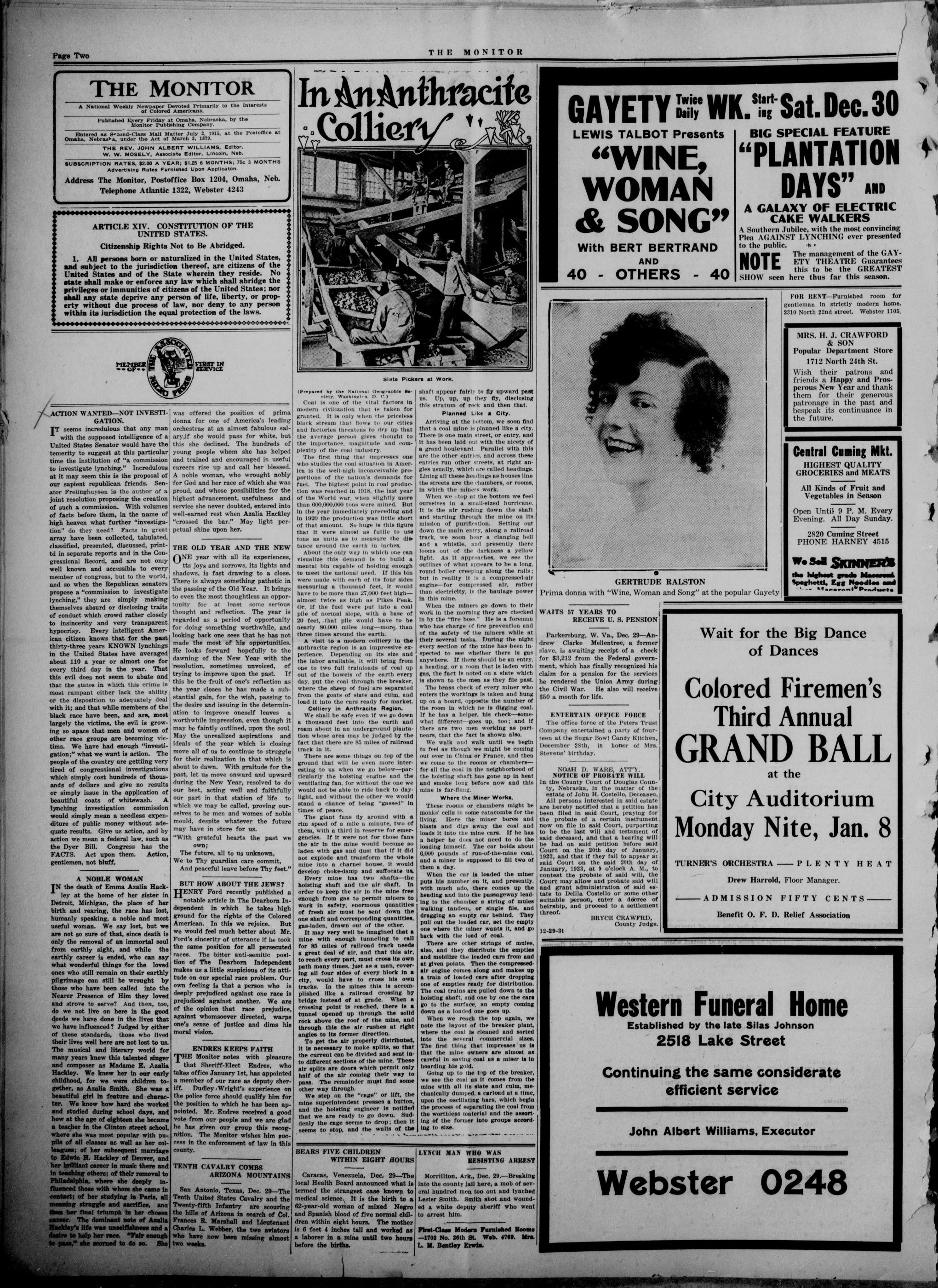
In AnAnthracite Colliery
Slate Pickers at Work
(Prepared by the National Geographic Society, Washington, D.C.)
Coal is one of the vital factors in modern civilization that is taken for granted. It is only when the priceless black stream that flows to our cities and factories threatens to dry up that the average person gives thought to the importance, magnitude and complexity of the coal industry.
The first thing that impresses one who studies the coal situation in America is the well-night inconceivable proportions of the nation's demands for fuel. The highest point in coal production was reached in 1918, the last year of the World war, when slightly more than 600,000,000 tons were mined. But in the year immediately preceding and in 1920 the production was little short of that amount. So huge is this figure that it were almost as futile to use tons as units to measure the distance around the earth in inches.
About the only way in which one can visualize this demand is to build a mental bin capable of holding enough to meet the national need. If this bin were made with each of its four sides measuring a thousand feet, it would have to be more than 27,000 feet high—almost twice as high as Pikes Peak. Or, if the fuel were put into a coal pile of normal slope, with a base of 20 feet, that pile would have to be nearly 80,000 miles long—more than three times around the earth.
A visit to a modern colliery in the anthracite region is an impressive experience. Depending on its size and the labor available, it will bring from one to two full trainloads of coal up out of the bowels of the earth every day, put the coal through the breaker, where the sheep of fuel are separated from the goats of slate and culm, and load it into the cars ready for market.
Colliery in Anthracite Region
We shall be safe even if we go down a thousand feet into the earth and roam about in an underground plantation whose area may be judged by the fact that there are 85 miles of railroad track in it.
There are some things on top of the ground that will be even more interesting to us when we go below—particularly the hoisting engine and the ventilating fan, for without the one we would not be able to ride back to daylight, and without the other we would stand a chance of being "gassed" in times of peace.
The giant fans fly around with a rim speed of a mile a minute, two of them, with a third in reserve for emergencies. If it were not for those fans the air in the mine would become so laden with gas and dust that if it did not explode and transform the whole mine into a channel house, it would develop choke-damp and suffocate us,
Every mine has two shafts—the hoisting shaft and the air shaft. In order to keep the air in the mine free enough from gas to permit miners to work in safety, enormous quantities of fresh air must be sent down the one shaft and corresponding quantities, gas-laden, drawn out of the other. It may very well be imagined that a mine with enough tunneling to call for 85 miles of railroad track needs a great deal of air, and that this air, to reach every part, must cross its own path many times, just as a man, covering all four sides of every block in a city, would have to cross his own tracks. In the mines this is accomplished like a railroad crossing by bridge instead of at grade. When a crossing point is reached, there is a tunnel opened up through the solid rock above the roof of the mine, and through this the air rushes at right angles to its former direction.
To get the air properly distributed, it is necessary to make splits, so that the current can be divided and sent into different sections of the mine. These air splits are doors which permit only half of the air coming their way to pass. The remainder must find some other way through. We step on the "cage" or lift, the mine superintendent presses a button, and the hoisting engineer is notified that we are ready to go down. Suddenly the cage seems to drop; then it seems to stop, and the walls of the
Caracas, Venezuela, Dec. 29-The local Health Board announced what is termed the strangest case known to medical science. It is the birth to a 62-year-old woman of mixed Negro and Spanish blood of five normal children within eight hours. The mother is 6 feet 4 inches tall and worked as a laborer in a mine until two hours before the births.
THE MONITOR
thracite
shift appear fairly to fly upward past us. Up, up, up they fly, disclosing this stratum of rock and then that.
Planned Like a City.
Arriving at the bottom, we soon find that a coal mine is planned like a city. There is one main street, or entry, and it has been laid out with the nicety of a grand boulevard. Parallel with this are the other entries, and across these entries run other streets, at right angles usually, which are called headings. Lining all these headings as houses line the streets are the chambers, or rooms, in which the miners work.
When we stop at the bottom we feel ourselves in a small-sized hurricane. It is the air rushing down the shaft and starting through the mine on its mission of purification. Setting out down the main entry, along a railroad track, we soon hear a clanging bell and a whistle, and presently there looms out of the darkness a yellow light. As it approaches, we see the outlines of what appears to be a long, round boiler creeping along the rails; but in reality it is a compressed-air engine—for compressed air, rather than electricity, is the haulage power in this mine.
When the miners go down to their work in the morning they are checked in by the "fire boss." He is a foreman who has charge of fire prevention and of the safety of the miners while at their several tasks. During the night every section of the mine has been inspected to see whether there is gas anywhere. If there should be an entry, a heading, or a room that is laden with gas, the fact is noted on a slate which is shown to the men as they file past.
The brass check of every miner who enters the workings is taken and hung up on a board, opposite the number of the room in which he is digging coal. If he has a helper, his check—somewhat different—goes up, too; and if there are two men working as partners, that the fact is shown also.
We walk and walk until we begin to feel as though we might be coming out over in China or France, and then we come to the rooms or chambers—for all the coal in the neighborhood of the hoisting shaft has gone up in heat and smoke long before now and this mine is far-flung.
Where the Miner Works.
These rooms or chambers might be monks' cells in some catacombs for the living. Here the miner bores and blasts and digs away the coal and loads it into the mine cars. If he has a helper he does not need to do the loading himself. The car holds about 6,000 pounds of run-of-the-mine coal, and a miner is supposed to fill two of them a day.
When the car is loaded the miner puts his number on it, and presently, with much ado, there comes up the heading and into the passageway leading to the chamber a string of mules walking tandem, or single file, and dragging an empty car behind. They pull out the loaded car, set the empty one where the miner wants it, and go back with the load of coal.
There are other strings of mules, also, and they distribute the empties and mobilize the loaded cars from and at given points. Then the compressed-air engine comes along and makes up a train of loaded cars after dropping one of empties ready for distribution.
The coal trains are pulled down to the hoisting shaft, and one by one the cars go to the surface, an empty coming down as a loaded one goes up.
When we reach the top again, we note the layout of the breaker plant, where the coal is cleaned and sorted into the several commercial sizes.
The first thing that impresses us is that the mine owners are almost as careful in saving coal as a miser is in boarding his gold.
Going up to the top of the breaker, we see the coal as it comes from the mine with all its slate and culm, mechanically dumped, a carlod at a time, upon the oscillating bars, which begin the process of separating the coal from the worthless material and the assorting of the former into groups according to size.
---
Morrillon, Ark., Dec. 29.—Breaking into the county jail here, a mob of several hundred men too out and lynched Lester Smith. Smith shot and wounded a white deputy sheriff who went to arrest him.
First-Class Modern Furnished Rooms
—1702 No. 26th St. Web. 4769. Mrs.
L. M. Bentley Erwin.
Planned Like a City.
Western Funeral Home
Established by the late Silas Johnson
2518 Lake Street
Continuing the same considerate
efficient service
John Albert Williams, Executor
Webster 0248
Mary
WAITS 57 YEARS TO
RECEIVE U. S. PENSION
Parkersburg, W. Va., Dec. 29—Andrew Clarke Mellentreet, a former slave, is awaiting receipt of a check for $3,212 from the Federal government, which has finally recognized his claim for a pension for the services he rendered the Union Army during the Civil War. He also will receive $50 a month for life.
ENTERTAIN OFFICE FORCE
ENTERTAIN OFFICE FORCE
The office force of the Peters Trust
Company entertained a party of fourteen at the Sugar Bowl Candy Kitchen, December 28th, in honor of Mrs. Stevens' birthday.
estate of John H. Costello, Deceased.
All persons interested in said estate are hereby notified that a petition has been filed in said Court, praying for the probate of a certain instrument now on file in said Court, purporting to be the last will and testament of said deceased, and that a hearing will be had on said petition before said Court on the 20th day of January, 1922, and that if they fail to appear at said Court on the 20th day of January, 1923, at 9 o'clock A. M., to contest the probate of said will, the Court may allow and probate said will and grant administration of said estate to Deila Costello or some other suitable person, enter a decree of heirship, and proceed to a settlement threef.
BRYCE CRAWFRD,
County Judge.
12-29-3t
A GALAXY OF ELECTRIC CAKE WALKERS
A Southern Jubilee, with the most convincing
Plea AGAINST LYNCHING ever presented
to the public.
NOTE
The management of the GAY-
ETY THEATRE Guarantees
this to be the GREATEST
SHOW seen here thus far this season.
FOR RENT—Furnished room for
gentleman in strictly modern home.
2310 North 22nd street. Webster 1105.
MRS. H. J. CRAWFORD
& SON
Popular Department Store
1712 North 24th St.
Wish their patrons and
friends a Happy and Prosperous New Year and thank them for their generous patronage in the past and bespeak its continuance in the future.
Central Cuming Mkt.
HIGHEST QUALITY
GROCERIES and MEATS
All Kinds of Fruit and
Vegetables in Season
Open Until 9 P. M. Every Evening. All Day Sunday.
2820 Cuming Street
PHONE HARNEY 4515
We Sell SKINNER'S
the highest grade Macaucasian
Sorghum, Egg Noodles and
Wait for the Big Dance of Dances
Local and Personal Happenings WE PRINT THE NEWS WHILE IT IS NEWS
ADDRESS BOX 1204
SUIT and EXTRA PANTS to order $40 Reduced from $55
Other Grades at $45, $50 and Up. A Similar Reduction on Overcoats.
This is less than the original price of suit alone. An extra pair of pants doubles the life of a suit. A few sample garments made in our own work shop for sale at attractive prices. They are better and cheaper than ready-mades.
Grand Special Offer: Fine Blue Serge Suit, $40; Worth $60
MacCARTHY-WILSON TAILORING CO.
Big Daylight Tailor Store.
S. E. Corner 15th and Harney Sts.
Mr. H. R. Roberts returned Wednesday afternoon from Lincoln where she went to spend Christmas.
Miss Ruth Jones left Wednesday morning for Des Moines, la., for a few days' visit with friends.
USE DENTLO—The premier pyorrhea preventive tooth paste. 25 cents for two ounce tube.
Mrs. J. F. Smith returned to her home last week from the University hospital very much improved.
The Birthday Club, composed of ladies who still have birthday anniversaries, but decline to tell their age, met with Mrs. R. Dewey Allen Wednesday.
Patronize Monitor advertisers and be sure to tell them that you saw their ad in the Monitor.
The Five Hundred Club met Wednesday afternoon as the guests of Mrs. George H. Bullock, 2516 Mapie street. The prize winner was Mrs. William Murphy.
FOR RENT — Neatly furnished rooms. Strictly modern. One block from Twenty-fourth and Dodge street car lines. Webster 5652.
Miss Linnie Hale was called to the city from Chicago recently by the serious illness of her aunt, Mrs. Luella McCullough, who is still at the Paxton Memorial hospital.
Nearly Furnished Rooms for light housekeeping. Call Webster 4432 after 5:30 P. M.
Mrs. Austin Serrant and daughter, Olethea, arrived in the city Sunday morning from Chicago to spend the holidays with their relatives, Mr. and Mrs. Jasper E. Brown, Mr. and Mrs. N. Kellar and Mrs. and Mrs Ouver Willis.
Mr. Clay Shipman of Norfolk, Neb., arrived here Sunday to spend the holidays with his sons. He is the guest of Mr. and Mrs. Otis Shipman, 2924 North Thirtieth street.
Mr. and Mrs. Luther Tucker of Ogden, Utah, are in the city visiting Mr. and Mrs. R. D. Tucker. Luther is R. D's. youngest brother whom he had not seen for several years.
Harrold Jones of Lincoln, Nebr., is the guest of Worthington Williams at St. Philip's rectory.
Miss Mattie Pearl Hendrix entertained at six o'clock dinner Sunday having as her guests the Misses Hazel Roulette and Aline Bentley, Messrs Herbert Glover and Harold Bentley and Lieut. Ray Williams of Western University. The evening was spent in music with Miss Roulette at the piano and the Misses Hendrix and Bentley soloists.
Edward Wood, aged 52, died at his residence, 2415 Caldwell Street, last Friday. The funeral was held Christmas day from the cnapel of the Western Funeral Home. The Rev. Thomas A. Taggart officiated. Interment was in Forest Lawn.
Miss Florence A. Jones, youngest daughter of Mr. and Mrs. Alfred Jones, was hostess Thursday even'g, Dec. 21, at Hillcrest, at one of the largest and most elaborate affairs of the season among the younger set, a Christmas dancing party. About sixty youngsters of the popular high school sets attended and a most delightful evening was spent.
Mrs. John A. Smith underwent an operation Thursday morning at the Lord Lister hospital. She is reported doing well as we go to press.
Louis LaCour, son of Mr. and Mrs. Joseph LaCour, 2419 Maple street, a student in engineering at the University of Southern Ohio, is home for the Christmas holidays.
Mrs. James G. Jewell who spent Christmas in Lincoln has returned home reporting a delightful time.
Miss Frances Gordon was hostess Christmas morning at a breakfast served at the family residence, 2416 Binney street, for several girls of the younger set. Bethel A. M. E. church held their Christmas tree and entertainment on Christmas night. There was a large attendance and all reported having a good time. Martha Ellen, the infant daughter of Mr. and Mrs. Wade Green, whose birth was reported in last week's issue, died December 20 and was buried from the Western Funeral Home Thursray.
Charles Solomon
2530 Lake St. Web. 2019
Residence Web. 4238
Joseph B. LaCour and Carl Beck with of the Kansas City City motored to Omaha Sunday to spend Christmas as the guests of Mr. LaCour's parents, Mr. and Mrs. Joseph LaCour. They left for Kansas City Christmas night.
Rev. John Costello, founder of Pleasant Green Baptist Church, died early Sunday morning after a prolonged illness. The funeral will be held Saturday afternoon at 2 o'clock from the Western Funeral Home.
START THE NEW YEAR RIGHT BY PAYING YOUR SUBSCRIPTION TO THE MONITOR.
Mrs. Clarence H. Singleton was called to Ypsilanti, Mich., last week because of the illness of her mother, Mrs. Washington.
Wanted-Wide awake boys to sell The Monitor every Saturday. Live boys can make money by selling Monitors. Phone Webster 4243.
Mrs. J. W. Alexander gave a re-ception this week in honor of her daughter, Mrs. Jos. P. Taylor. Quite a number were in attendance and a fine time is reported.
Mrs. Beulah Maye of Paducah, Ky., spent the holidays the guest of her brother, J. W. Alexander.
Mrs. C. V. Barker, formerly Miss Ruth Alexander, is in the city visiting her parents, Mr. and Mrs. J. W. Alexander. She expects to go East to take up a position in a few days.
FOR SALE at Massey & Coopers—All the leading colored artists' records at fifty-five cents each. Webster 6668.—Adv.
GURANTEED ATTRACTION
AT THE GAYETY THEATRE
Old Man Johnson Puts His "John Henry" Under the Indorsement of "Wine, Woman and Song".
In thorough accord with the policy of bigger and better burlesque instituted by the Columbia Circuit for this season, is Lewis Talbot's "Wine, Woman and Song" company at the popular Gayety for the week beginning Saturday matinee.
In two big, colorful acts—"Hello Mars" and "Plantation Days" it is said to be brimming with hearty laughs and tuneful songs. In all there is a kaleidoscopic array of seven big scenes unfolded during its action. One of these occurs on the planet Mars, to which Bert Bertrand the chief comedian has been speeded in an huge projectile.
More "earthly" is the dramatic spectacle, "Plantation Days", in which Uncle Tom, Little Eva and a certain hooded "klan" get all mixed up in clever burlesque with a comedy "kick". Another company ensemble will be special incidents in two numbers with individual members of the chorus "stopping out" for favor with entertaining specialties.
Gertrude Kalston will sing the prima donna roles and will lead numbers. Her singing of "Play in Your Own Back Yard" is declared to be a beautiful conversation of a "crooning" song into sweetest melody.
"Wine, Woman and Song" promises a bevy of chorus beauties and show girls that have created comment and admiration in other cities. The reports preceding this organization are all favorable. Patrons of musical burlesque may look with confidence to "Wine, Woman and Song" for pleasing entertainment.
Sunday night "Wine, Woman and Song" will present two separate and complete performances beginning at 8:30 and 11:30 respectfully. The occasion for the 11:30 show is to supply the annual New Year's Eve midnite performance for which the Gayetone alone has been famous for years, it having originated the midnite show idea many seasons ago.
To make the event one to be remembered until the next one rolls around, Old Man Johnson is preparing noval
and timely stunts that will be symbolical of the death of the old year and the birth of the new year. "Wine, Woman and Song" will be the attraction and there will be a jamboree of high jinks and good fun that will be unlimited and it wouldn't be surprising if the roof should be tilted a bit
1
by the enthusiasm and joy of the theatreful that will attend the Gayet's watch-meeting performance. The house will be open at 11:00; curtain at 11:30—all will be out and over at 1:45 Monday morning January 1, 1922. The demond for seats for the midnight show has always been in excess of the supply; it will be well to get tickets early rather than to take chances on being disappointed at the last minute. Ladies' matinee at 2:15 daily all week starting Tuesday. Sunday's maine starts at 3:00 as will the gala holiday matinee New Year's Day.
THE DEATH OF THE
REV. MR. COSTELLO
To Whom It Mav Conren:
This is to certify that the Rev. John H. Costello died in good and regular standing with the Spring Hill Baptist church. In a conversation between him and the pastor two days prior to his death he disclosed the following facts, "I am ready and willing to die and wish death would hurry on to relieve me, because no one knows how I suffer with pain. My body has made mistakes, but that's all right; my spiritual body has corrected them." His departing words wede: "Babe, babe," speaking to Mrs. Sills, "I am sick, I am sick, I am sick unto death." With these words he departed this life.
MRS. M. LACY, Secretary,
REV. BRUCE, Pastor.
ALLEN CHAPEL A. M. E. CHURCH
G. J. Burkhart, P.A.S.O.
Sunday being Christmas Eve was an interesting day with us. The morning service was not largely attended. The Sunday school program arranged by the Superintendent, W. M. Cortes, assisted by Mrs. Carter and Mrs. Redd, proved a great success. The Christmas tree that followed the program was a delightful affair. The pastor's Booster Club was in evidence as usual. Mrs. Elizabeth Clark, the president, with her workers, Mrs. Ruth Redd, Laura Jefferson and Sarah Jones and their friends, made the pastor very happy by presenting him a neat and much needed sum of money for one of his Christmas gifts, this sum being supplemented by personal donations from W. C. Mallord and Joe Redd. The pastor highly appreciates the sum given and all other presents he received through his church members and friends and the prayer of his heart is that he may prove himself worthy of their respect and Christian cooperation. Sunday at morning and evening the pastor will preach New Year sermons. Plan to attend church on the last Sunday of the old year. You will be made welcome. Mother Helm is much better at this writing.
BETHEL A. M. E. CHURCH TO HOLD REVIVAL
Beginning Sunday night, Dec. 31st, Bethel A. M. E. church on Franklin between 24th and 25th, will engage in a Great Revival. The pastor, Rev. Frederick Divers, and the congregation are getting everything in readiness. Rev. W. A. McClendon, D. D., of Lincoln, a great preacher who needs no introduction to those who have been to Lincoln in the last year and heard him in our church there, will be in town Monday, Jan. 1st, and assist in the meeting. It is not often that we are able to secure such a man, busy pastor as he is, to give his time in such a meeting, and we are glad to have the opportunity to present him to the people of Omaha. If you come early in the meeting we are assured of your presence throughout the meetings without further urging.
EPISCOPAL CHURCH OF
ST. PHILIP THE DEACON
The services Sunday and Christmas day were well attended. Sunday afternoon at the vesper service Bishop Shayler preached an eloquent sermon on "Preparation for Christ's Coming," to a large congregation. At the Midnight Mass which ushered in Christmas there was a large attendance. The other services of Christmas day were at 8 and 11 a. m., and evensong at 5 o'clock. The Christmas tree and entertainment was Thursday night, the feast of the Holy Innocents. The instruction of the Confirmation class will begin next Friday night. Services Sunday will be at 7:30, 8:30, 10 and 11 a. m. and 5 p. m.
N. Y. C. A. HOME TO
KEEP OPEN HOUSE
The N. W. C. A. will keep open doors New Year's day at the Home,
3029 Pinkney street, to which the public is cordially invited. Mrs. M. L.
Shelton, chairman of the House Committee, wishes every member to be present some time during the day to serve on the reception committee.
The management desires to announce and acknowledge the receipt of Mr./John H. Broomfield's annual donation of a generous Christmas dinner for the inmates of the Home.
The regular monthly meeting will be held Wednesday and a full attendance is requested.
THE MONITOR
Atlantic 1322
or
ebster 4243
KLANSMEN INITIATE
75 MORE IN NEWARK
Negroes Making Rush to Militant Race Organizations as Klan's Shadow Darkens Nation.
Newark, N. J., Dec. 29.—(Crusader Service.)—A Klan of the Knights of the Invisible Empire received its charter from the Imperial Wizard of the Ku Klux Klan at a meeting ecently at 17 West Park street, without hindrance from two Newark detectives who were in the building but did not interrupt the meeting. The meeting initiated seventy-five new members and heard a "message of world-wide importance" from the Imperial Cyclops of the Klan.
The new Klan was christened George Washington Klan, No. 3, of the Realm of New Jersey.
At the same time, not very far away from the meeting of the Klan there was held an organizational meeting of the African Blood Brotherhood, one of the most militant Negro organizations in the country and reputed to have organized Negroes in their own defence at Tulsa, Okla. The meeting was held as a result of many communications from residents of Newark to the Supreme Council of the organization at 2299 Seventh Avenue, asking that a Post of the Brotherhood be organized in Newark to meet the growing Klan menace. In response to these requests and communications two organizers of the A. B. B. had been sent to Newark. It is said that fully fifty persons attended the meeting which was marked with far more effective secrecy than was the meeting held by the Klan.
SOLDIER WHO INTERRUPTED
SENATOR HITCHCOCK
CREATING COMMENT
Washington, Dec. 29-The gallery incident in the Senate when Lucius J. Jones, the wounded colored soldier, arose and attempted to ask Senator Hitchcock a question, has provoked considerable comment and discussion throughout the country. Practically all of the daily papers that have given mention to the incident sympathize with the wounded soldier, and many are they that declare the propriety of Jones' action.
The Hearst papers argue that it would be a good thing if the U. S. Senate rules were so amended that the public might ask questions from the gallery at special sessions.
Lucius J. Jones, he convalescent wounded soldier, seemingly passes much of his time attending sessions in the Senate and since the incident just mentioned, he has received considerable recognition from many senators and persons in the executive and diplomatic families. Mrs. Sawyer, wife of General Sawyer and Mrs. Harding's private secretary, have, as well as Secretary of War Weeks, had personal chats with Mr. Jones and manifested a very kind and friendly interest in him.
JAPANESE STUDYING
AMERICAN RACE PROBLEM
Tokyo, Japan, Dec. 28.—Professor S. Konishi of the faculty of literature, Kioto university, Japan, who visited Hampton institute a few months ago, contributed to the October number of Taiyo (The Sun, one of the leading monthly magazines of Japan) a sixpage illustrated article on "Race Problems and Education in the United States of America" and introduced to his friends "the admirable work of Hampton and Tuskegee." Professor Konishi included photographs of General Armstrong, Dr. Washington, Dr. Moton, Tuskegee campus, and two Hampton classrooms (girls studying science and bodys studying agricultural chemistry).
SHERIFF-ELECT ENDRES
Sheriff-Elect Michael L. Endres has appointed Dudley Wright, a deputy sheriff. Robert Johnson was applicant for this position and was slated for it, but his appointment was considered ill-advised. Wright has been a member of the police force and ought to make a good man on Sheriff Endren's force.
CHISTMAS BALL SOCIAL FEATURE
The Christmas ball given by the North End Amusement club at the De Luxe hall was a brilliant social and financial success. At the matinee there was a large attendance and at night there were about 800 present. The members of the club are gratified with the patronage received.
FOUND HIS NAME
Warren Brooks, 108 South Twenty-eighth avenue, found his name in McCarthy-Wilson Tailoring Company's advertisement last week and got his dollar from The Monitor. As his subscription expires early in January he took this opportunity of renewing his subscription. Whose name is in an "ad" this week? Is it yours? Look closely, it may be.
FOG
BY FRANCES E. GOODRICH
(@ by McClure Newspaper Syndicate.)
Swiftly the fog rolled in over the cove. A chill, yielding blanket it pressed down on the little village. The men who had been out in their boats came to shore and prepared to spend the time repairing nets and doing the numerous odd jobs that were left for just such weather.
In one of the larger houses in the village a husky young fisherman stood for a moment at the window, looking into the grayness. After a while, with a shake of his head, he turned away and again put on his olskins.
"Now, surely, Tom, you're not going out again in this fog. I never did see such an uneasy boy in my life."
"Well, you know, Aunt Myra, I can see just as well in the fog. I've got fog eyes, you know," and with a laugh he was gone, leaving his aunt shaking her head.
Swiftly he reached the beach, and pushing off the light dory, skillfully threaded his way among the boats and put out to the open sea. It did seem as though he had a sixth sense of direction, for there was no hesitancy in the way he drove the boat through the dimness.
"I guess Ned Bentley won't tackle this kind of work today. He'll take the road to Mary's and I'll beat him by over an hour. He can't slip anything over me."
The stillness would have been uncanny to anyone else but a born seafaring man, for there was a peculiar quality about it, unlike any land stillness.
Suddenly Tom's trained ear noted a sound, a steady, slow pulsing on his left. "One of the liners coming in," he murmured to himself, and again he dreamed his dreams of being one of the gold-braided officers who trod so proudly the decks of the great ocean ships.
A sudden riffle of wind and a light lifting of the fog. Again the stillness, the throbbing of slowly moving engines, and the noise from the powerfully wielded oars. Then came a stronger breeze than before and this time the fog lifted clearly for a moment. In that instant a picture leaped clear on the sea. Slowly the great ship came on, and under her bows, like a pigmy crouched at the feet of a giant, was a tiny boat. Swiftly it slipped into the deep trough made by the ship, balanced crazily for a second, then overturned, and its one occupant was beneath the oncoming bows.
In an instant Tom knew who was in that boat, even though he was too far distant to see the face clearly. So Ned had taken the chance and lost out. Fate had taken a hand in the game and had played on Tom's side. There was nothing he could do, he argued. There was no reason why he should risk his own life on a fool's errand. It wasn't possible that anyone could be swept under those great bows and live.
So he rowed steadily on, but his strokes had somehow lost their power. The oars moved slower and slower, then stopped, and the boat drifted. Tom battled alone in the fog and silence.
Then suddenly shaking himself as though to drive off some unwished for power, he turned the boat back. Afterward it seemed for him that for hours he had rowed through the fog, calling Ned's name and searching the dim waters. Then he had found him, dragged him into the boat, whether dead or not, he did not know, and had rowed with all his might to Mary's home.
It was night when Tom opened his eyes in a quiet, unfamiliar room. He could hear a fire sputtering gaily nearby, and the gleam from a softly shaded lamp came from another room. There was a soft movement near him and a warm, gentle hand touched his.
He turned his head and gazed into blue eyes near his own. He was amazed to see the tears gather while he gazed; it must be that Mary considered him little better than a murderer because of the time he had lost getting to Ned's rescue, and she was crying because of it.
"I—Ned—" He stopped, unable to ask his question.
"Ned is alive and well, thanks to you, Tom. You saved his life and risked your own getting him over the rocks that night. You got him nearly to the plaza, then slipped and struck your head. Ned comes every day to ask for you, and I think he likes to see my cousin, who is here with me, too," and a tender little smile touched her mouth.
"Every day?" Tom repeated. "How long have I been here?"
"You've been here five weeks, Tom, and, oh, how thankful I was when the delirium left you. It was terrible to hear you rave about that night."
Tom groaned. If he had raved about that night she would know just how he had felt. It was impossible for a girl like Mary to care for a man who had had black, murderous thoughts in his mind.
Soft fingers drew his hand from his eyes. He turned his head and looked into the face beside his pillow.
"Mary," he gasped, answering look in her eyes.
There was a sudden move sent towards the bed. A soft mouth touched his.
A form darkened the open door for an instant, then Mary's father drew softly back and chuckled to himself, "Guess the boy'll get well fast now."
Don't sneer at the man who fails, but remember that he at least dared to try.
Hope is the mainspring of efficiency.
A nation is no better than its home life, and its home life is no better than that nation's womanhood.
We are so busy keeping the wolf from our door until we haven't time to let in the Angel.
Pharmacy
Lake Sts.
Websier 0609
New and Second Hand
FURNITURE
We Rent and Sell Real Estate
Notary Public
S. W. Mills Furniture Co.
421 No. 24 St. We Thank You. Web. 0148
Alhambra
Grocery and Meat Co.
1812 North 24th Street
Phone Webster 5021
PROMPT DELIVERY
Alaska Fish Co.
1114 North 24th St.
Telephone Webster 6512
We SKINNER'S
The highest grade Macaroni
Spaghetti and Egg Noodles.
Rev. M. H. Wilkinson,
2308 North 29th St.
J. Eskelson
We Have a Complete Line of FLOWER,GRASS Seeds AND GARDEN
We SKINNER'S
Fresh cut flowers always on hand
Stewart's Seed Store
119 N. 16th St. Opp. Post Office
Phone Douglas 977
the highest grade Macaroni,
Spaghetti and Egg Noodles
GEORGE C. TUCKER
Barber Shop
NEW LOCATION:
5303 South 28th St.
EVERYTHING FIRST CLASS
PATRICK PHARMACY
24th and Seward St.
16 Years Same Location
Particular Attention
to Prescriptions
REPAIRS
FOR STOVES
FURNACES
AND
BOILERS
OMAHA STOVE
REPAIR WORK
1206-8 Douglas St
Phone Atlantic 252
LION COAL CO.
LION LUMPS .....$10.50
LION NUT .....$10.00
COLORADO
SMOKELESS .....$10.50
SCREENINGS .....$6.00
FREE DELIVERY
PHONE WEBSTER 2605
If You Desire a BEAUTIFUL COMPLEXION with one treatment for the small sum of 65c call WEBSTER 4474 All Work Guaranteed- OMAHA FISH CO.
CROSSTOWN
FURNITURE CO.
1607-09 North 24th St.
LE BRON & GRAY
ELECTRICAL WORKS
Expert Electrical
Engineers
TRANSFER
the highest grade Macaroni
Spaghetti and Egg Noodles.
MELCHOR--Druggist
The Old Relicable
Tel. South 807 4026 Sq. 34th St.
E. F. Mercarty, Lawyer, 700 Peters
Trust Bldg, Jackson 8841 or Harney
2156.
Furnace and Stove Repairing
Plumbing, Heating and Tin Work
We carry full line of repairs
1419 No.
24th St.
E. J. STELL
Webster
3760
Lambert, Shotwell &
Shotwell
ATTORNEYS
Omaha National Bank Bldg.
Burdette Grocery
2116 North 24th St.
PHONE WEBSTER 0515
Full Line of
Staple and Fancy
GROCERIES
Fresh and Canned
Meats
We
Sel. SKINNER'S
the highest grade Macaroni
Spaghetti and Egg Noodles.
LIVE FISH DAILY
GROCERIES and FRUITS
Free Delivery
We SKINNER'S
Sell
the highest grade Macaroni,
Spaghetti and Egg Noodles.
Bulba, Hardy Perennials, Poultry Supplies
Peoples' Gro. Store
STAPLE AND FANCY
GROCERIES
Fresh and Cured Meats
The Best of Everything at
Reasonable Prices.
We Sell SKINNER'S
the highest grade Macaroni,
Spaghetti, Egg Noodles and
other Macaroni Products.
A NEW DISCOVERY for ZERO WEATHER Get that heating stove and save enough on the price to buy the feed for it for two months. Rush right down to
Motors, Generators, Electric
Elevators Repairs, Armature
Winding, Electric Wiring
For news when it is news, you must read the Monitor.
Page Three
WATERS
BARNHART
PRINTING CO.
OMAHA
QUALITY GROCERIES AND MEATS
All Kinds of Fruits and Vegetables
FANCY GROCERIES
1837 No. 24th St.
Phone Webster 0456
Successor to
F. HAGELIN & Co.
OMAHA STOVE
REPAIR WORKS
1206-8 Douglas St.
Phone Atlantic 2524
GIRLS!!
M. TURNER
1702 North 24th St.
PHONE WEBSTER 2092
FISH—GROCERIES
VEGETABLES—FRUITS
DELICATESEN
RIGHT NOW is a Good Time to Pay Your Subscription to THE MONITOR
Page Four
WITHOUT CAPITAL BOY OPENS BANK IN RHINELAND
Its Checks Now Are Held in Preference to Currency.
UPSETS HABIT OF CENTURIES
American Lad in Two Years Has Actually, Taught the Germans to Use Checks in Ordinary Business—Neidecker, Successful Bond Salesman at Nineteen, Wins War Honors in Air and at Twenty-Five Heads American Plan Bank in Germany.
The crowded life story of B. Coles Neidecker at the age of twenty-five is not reflected in the youthful, smiling personality of an American boy who capitalized opportunity and foresight, opened a bank in Coblenz, Germany, in June, 1920, without capital and ignorant of the German language. Its checks now are held in preference to currency throughout the Rhineland. He actually taught the Germans in two years to use checks in ordinary business, upsetting the strictly currency habit of centuries.
He is founder and chief of the Rhineland bank (Neidecker, Weihagen & Co.), Coblenz, has declined offers to merge it with great banking institutions of Germany and is in New York organizing the Traveler's Bank of Paris with fully developed plans for its operation there and, through branches, all over Europe. Not a fairy story at all. The Guaranty Trust company of New York, in its banking school taught him so well that he was the youngest bond salesman in New York in 1916 when he was barely nineteen years old and he showed a record with sales that included one to a very wealthy New York capitalist of $450,000 in Anglo-French bonds.
Went to the War.
Thus fairly well started in life as a financier, he decided that it was too slow a game when the war was on. He applied for admission to the Franco-American flying corps. Its name was superficially changed to the Lafayette Escadrille when the German ambassador at Washington early in 1917 protested against association of the word American with a military enterprise against Germany, not then an enemy of the United States.
Neldecker's application for a chance to fight in the air was under favorable consideration when he decided to get to France at once. He joined the American ambulance in Paris in January, 1917, drove ambulances and later camions when the ambulance service was diverted to transport of supplies for the American forces. He saw some very lively times around Solosss and on the Alsne in that work, but he wanted to get into the real thing, and as soon as American military aviation was organized Neldecker joined that service, August, 1917.
When the armistice was declared November 11, 1918, the American military aviation service had five graduate air pilots at the front. Neldecker was one of them. He wore the Croix de Guerre with palm, had three recommendations for the Distinguished Service decoration and a record of bringing down three Fokkers and their pilots in air combats.
As pilot he was a first lieutenant and with that rank he was immediately attached to the Hoover mission to Poland on the staff of General Grove, its chief. Lieutenant Neidecker was sent to Lithuania and there superintended distribution of American food supplies.
This young man was educated entirely by tutors and prepared for Exeter and Harvard but when he was seventeen decided on business life, banking, for his career. He entered the Guaranty Trust company's service in its school of instruction in 1915 and within 15 months was selling its bonds in Wall street.
That training made him realize the tremendous possibilities all about him in post-war Europe. The American Rhineland force whose headquarters were outside Coblenz numbered about 30,000 and the United States was distributing there about $1,000,000 good American dollars every month in paying them.
There was not in Coblenz any bank which accepted dollar accounts. All the banks handled marks exclusively as the basis of their transactions. There was a depositor's field for that million a month just crying for a dollar deposit bank.
Found Credit Readily.
Capital was not an asset of the youthful American financier but he leased a two-story building, remodeled it, fitted it up with a modern American office equipment and had crowds of Germans coming in to just look at it before it was finished. The German banking house type then was a small office with a counter, which only recently had supplanted merely the desk of the German banker in his office in his home, where he transacted all his business.
Credit for this enterprise young Neldecker found ready for his asking on all sides. He had learned not to be afraid of doing the unusual in Germany.
A partner who could speak German was a great need for the new bank-
ing house of one American boy, Nei-decker found Paul J. Weinhagen in the American camp, Weinhagen, a San Francisco boy, commissioned in the American artillery service, was out of the army after the armistice and also broke.
That sort of boy was the boy who appealed to the boy embryo banker and they joined forces, wonderful but not capitalists.
But capital, you know, really is a part of the routine in preparing for a banking business. The American youths advertised for partners with capital. They got two.
The bank was opened in June, 1920, when the senior partner was twenty-three years old and did not look his age. Its site had been well chosen, on the main route in Coblenz from everywhere. Everybody bound from the American camp for the other banks, the Salvation Army headquarters, the theaters and to pass the American bank.
Before it had a dollar of deposits it had all fittings and supplies which would be a credit to any bank in America, including bank check books which cost about 20 cents each. It paid for them and all its other construction liabilities in no time.
Godsend to the Army.
Immediately a tremendous business in small loans developed. The American doughbys were always sending money somewhere and most of them wanted to borrow between paydays. An officer's indorsement was all the enlisted man needed to borrow a reasonably large portion of his pay in advance. A minimum fixed charge was made for discount of these notes and time loans were made to officers at 8 per cent per annum. This business put the bank on its feet almost before it needed feet.
The big field of local banking business with the Germans came more slowly, but it rose and rose until it reached important volume. The enormous speculation in industrial stocks and municipal bonds which followed rapid depreciation of the mark in 1920 and 1921 brought the Rhineland bank of the young Americans another source of large income in commissions for executing sales and purchases. This grew to such size that the bank was not able to handle all of its brokerage business and had to divide it with correspondent banks.
Success of this phenomenal sort naturally attracted to the American bankers the keen interest of great German banking houses. Offers were made to buy or absorb the new institution, but they were not entertained.
When the Rhineland bank was opened the Germans of Coblenz never thought of using checks except in large transactions. If a business man received in payment of an account a check for 1,000 marks he tucked it carefully in his pocket and went around to his bank, which resembled an old-fashioned law office rather than a financial institution. The banker sent the check to the bank on which it was drawn, or to his own, and paid out the cash, which was carried off by its owner or deposited to his account.
The American bank paid its bills with checks, of course, and thus advertised its modern methods locally. Germans began to be depositors in satisfactory numbers and they learned to pay their bills in checks. Their example spread.
Then came one of the strangest things in financial history. As the gold value of the German paper mark shrank German industry was increasing as never before. This meant an increasing need for currency and an increase at the same time in the amount of currency needed. Two marks were needed one month to pay what was a bill for one mark the previous month.
Checke Better Than Money.
Scarcity of currency grew. A climax came last July and was repeated with growing threat of disaster thereafter week after week. The printers who printed the Reichsbank national paper currency of Germany went on strike in July following the murder of Dr. Walter Rathenau, minister of finance. No currency was printed for weeks, and issue never has caught up with increasing demand for currency.
Checks of the Rhineland bank of the young Americans became cherished things. They were preferred to currency. Those lucky enough to get them held on to them as if they were gold coin. The bank could not get its checks back.
Thus millions of marks were loaned to the bank by these holders of its checks because the cash held to protect them became available for loans by the bank with great profit from such use. The necessary securities to meet these checks were, of course, kept in the depositary banks of the Rhineland bank. Those securities bore interest and the money representing the withheld checks was bearing interest in loans, so the bank profited both ways.
Mr. Neeldecker Miss Sihyl Kosminskil, whose father was famous as American director of the French line of steamships during his administration throughout the war years.
Parachute Jumper Drowns in River.
Fallig into the Tennessee river near Chattanooga, Tenn., D. A. Chandler, a parachute jumper, was drowned, Chandler was giving exhibitions at an interstate far near the city.
Pays Fine for Flying Too Low.
Charged with driving his airplane too low over the business section of Birmingham, Ala. Sar Torell, airplane pilot, paid a fine of so. Birmingham regulates air traffic by ordinance
DRUG STORES AND THE DODECANESE
DRUG STORES AND THE DODECANESE
Harks Back to Hippocrates, Father of Modern Medicine.
'DRUG ISLAND' NOW HERBLESS
Pharmake, Called the "Drug Island," Perpetuates Its Claim to Being First Drug Store in World by Title "Phar.D." Held by Every Man Authorized to Fill Your Prescription—Another of the islands Was Home of Hippocrates.
Busy Rabbit is apt to skip the item, "Italy Announces Cession of Dodecanese Invalid, Pending Lausanne Conference," with the exclamation:
"What are these Greeks to me? I build bungalows, not Greek temples; and I haven't time for the theaters or the art galleries."
On the way home, however, Babbit calls at the doctor's office. "Been a little sluggish," and he takes the prescription to a drug store.
"That's when the Dodecanese come in," says a bulletin from the Washington headquarters of the National Geographic society.
"On Kos, second largest of the Dodecanese, lived Hippocrates, the father of modern medicine. For service to mankind this intellectual colossus of Kos deserves to overshadow the innate colossus of Rhodes, the largest island in the chain that straggles from Samos toward Crete.
"Pharmako, or the island of herbs, is now herbless. But this 'drug island', occupied some years ago by a single family, perpetutes its claim to being the first drug store in the world by the title 'Phar. D.' held by every man authorized to fill your prescription.
"Pharmako is not one of the major land units which give the group its name—Twelve Islands. Even some of the twelve are, or have been, uninhabited, and on none of their rocky surfaces are the residents self-sustaining.
Bore Gift of Sponges and Loaves.
"When, in 1521, Kalymnos, just north of Kos, gave up its losing fight and sent a mission to surrender to Suitan Suleiman, the delegates took along a highly suggestive geographical exhibit. The gifts they bore consisted of sponges and white loaves. The first symbolized their principal industry—and today the sponges piled on the drug store counter most likely were collected by a Dodecanese diver—while the white bread showed the islanders' need of wheat from the mainland of Asia Minor since they could not live upon corn of their own growing.
"When the sponge-grounds in the Aegean became depleted the Dodecanese divers discovered other beds off Tripoli and when Italy virtually made a monopoly of the fisheries there some of the divers fared as far away from home as Tarpon Springs, Fla., to ply their precarious trade.
"Patinos, northernmost of the group, known wherever the Bible is read because its cave sheltered St. John, was without a single inhabitant in the Twelfth century.
"It long has been a saying that the Greek islands are more Greek than Greece. The Dodecanese are among the most Greek of all the islands. Homer knew them and mentions the leaders under which their armies took part in the expedition against Troy.
"One sort of ruins of the time of Hippocrates may well be considered the precursor of another humane institution of modern life, the hospital. On Kos may be seen the base stones and columns of an Asclepion, one of those institutions, which blended the modern functions of a temple, a sanitarium and a clinic. By incantations, charms and witchcraft the asclepia sought to heal the sick, and it was against these practices that Hippocrates rebelled. He was not permitted to dissect human bodies, but his study of animals and a comparison of their habits, anatomy and functions with those of man gave him a remarkable basis for diagnosis of human life. His ideas about diet and regimen for the sick, for example, are remarkably sound when it is considered he was a plonker in this field.
Healing Arts Among Greeks.
"To many sufferers the 'faith cures' effected by the asclepia were potent; others were kept in physical condition by the gymnasia, but Hippocrates' fame as a surgeon, especially, soon spread far. Thus these remote Aegean islands had three therapeutic schools which corresponded to our modern practitioners of mental healing, medical practitioners and physical culturers.
"Geologically the islands are fragments of Asia Minor, torn away by some remote volcanic upheaval. The sporadic formation of the group is attested by their other name, Sporades, given them in contrast to the Cyclades, so called because of their circular arrangement.
"Should you visit a home in Rhodes you would get a first impression that some member of the household has a hobby for collecting curious, heterogeneous assortments of plates. When a child is born custom decrees that a plate be added to the family collection, and the pattern of this plate must be distinctive. Hence a genealogy recorded in platters which, if they are the famous Rhodian ware, have great beauty and a high price, since only extreme stress or a generous offer would impel a family to part with any of the family tree."
THE MONITOR
GLORIOUS FREEDOM
By DOROTHY DONAHUE
Pa Whittaker, being fifty-two and henpecked, wiggled his toes happily in his broad-toe shoes to express his great joy when Ma Whittaker decided to take a vacation—minus Pa.
Of course, Pa conceded, within the protective walls of the woodshed, Ma had a few merits. She did darn his stockings and keep his clothes mended and give him the best of meals, besides keeping the house as spotless and shining as a new aluminum pan under the direct rays of the sun; but Pa felt justified, nevertheless, in his happiness, because, oh, how Ma Whittaker's tongue could fly.
So it was that Pa closed the house the next day and made for the city.
Pa reached the city in a state of glorified individuality. His funds were low, very low—so the only restaurant that could possibly attract him was exceedingly undesirable with its smoke-clouded windows, greasy, wet counters and suspiciously revolving stools. But Pa was hungry, so he forced his way in and sat down a little mournfully, with the odor of corned beef and cabbage prevailing. He was thinking of Ma Whittaker when he ordered flaplacks—and was disappointed. Thin, soggy, burnt—horrible! Pa gulped down his coffee, and, forgetting that he was not in the broad-backed chair at home, leaned back! Two dark-faced roaring sailors picked him up, snapped a few pieces of invisible hayseed from his shiny coat and bowed low. Pa reached the street, greatly surprised and humbled, minus the bravado of early morning.
Pa felt a sudden desire for quiet and calm. Everyone seemed to be rushing past him. In the midst of the excited, jabbering through he felt strangely alone. The cool gray front of a movie theater, with its welcoming gandy sploch of posters, attracted. Pa went into the soft darkness and groped his way to a seat near the back, sitting down with a worried little sigh of relief. But his eyes were a little weak, and he couldn't read the sub-titles. Ma Whittaker had read them, gladly, the few times they had been.
A stout, laughing woman wedged her way into the row in front of him, followed by her husband. Her broad, expansive back obstructed Pa's view to the point of exasperation. He moved uneasily in his chair. The stout lady read the first title in a loud, husky voice. The man with her nodded and stared straight ahead.
An aching flood of genuine homeliness almost overpass Pa. He crept out of the dark little palace into the sunshine and decided at once to go home and sleep rather than brave the terrors of a public and cheap hotel. Pa found the house empty, hollow-sounding, lonely. The deadly absence of Ma's merry but insistent chirping was distracting. He fell asleep reading the Gazette and stroking the cat. He dreamed it was Ma's hand he was patting while she cried him, furiously, for some little thing—and he awoke smiling, only to frown at sight of the purring little ball of fur. Outside it was drizzling. It had been drizzling in Pa's heart all day. He pulled on a buttered hat and started for the garden. He could almost see her now puttering among those swaying poppies and that deluge of color that spread over half an acre. "Pa Whittaker!" Pa blinked pale eyes and swung around like a well-trained soldier. He must be getting old. His eyes—
"Pa Whittaker—out in this wet garden without your rubbers! I've told you and told you, and just because you think I'm not looking, you sneak out and plow through this wet. You're not a young man, I want you to remember, and if—"
Pa followed the voice blankly into the house and fell into a chair. The voice went on.
"And I decided I'd better not stay away more'n a day with you so forgetful, so I trudged right home, and here you are, as usual, doing something that will be the death of you. I've been looking everywhere for you—everywhere, and—"
Pa still stared, Understanding crept slowly, very slowly into his mind. Something inside him kept repeating: "She's here—to stay. She's here—to stay."
Fifteen minutes later Ma ran out of breath and stopped to regard the silent figure in the chair.
"Fer land sakes, Pa, are you dumb? Say something."
Pa looked up into the sharp eyes that held a glint of kindness.
"Ma, please—please keep right on talking. I was never so happy in my life! Never!
Strange Bear.
The Chemoost, or Nandi bear, a mysterious animal that is said to haunt the deep forests in the most inaccessible parts of the East African highlands, has again been seen, this time by a party of reliable European and native witnesses.
It has been seen by various people several times during recent years, but no specimen has been killed or captured. The latest description of the bear tallies accurately with previous reports. The animal is between five and six feet high, walks on its hind legs something after the manner of a chimpanzee, and has a long fringe of white hair completely encircling its face.
LINCOLN COMMENT
Christmas day was an ideal one in this vicinity, as the sun shone brightly and warm. Thousands of people strolled to and fro mingling with relatives and friends, offering tokens of cards, presents of various kinds, which gladdened the hearts of the recipients. Thousands of children were made glad by the Order of Elks who played Santa to them at the City Auditorium on Christmas morning. Seeinggty everybody was proud of the fact that they were able to celebrate the birth of our Lord and Savior, Jesus Christ. Milton Johnson is spending the holidays with his parents at St. Joseph, Missouri.
Mr. and Mrs. E. Bush and children are spending the holidays with relatives at St. Joseph, Mo.
Mrs. W. L. Todd is spending the holidays with her mother in Brunswick, Mo.
Rev. C. W. Wilson from Chetopa,
Kansas, is visiting his daughters, Mrs.
M. Griffin and Mrs. W. Piece, here,
M. W. M. Clark went to his home
Mr. W. M. Clark went to his home at Wichita, Kansas, last Saturday.
Miss Alma Wiley left Monday night to spend the holidays with her mother in Plattsburg, Mo.
Mr. Chris C. Stith is able to be out after some days' illness.
Mrs. Bertie Brooks is reported confined at home with illness.
Services at Mt. Zion Baptist church last Sunday were Sunday school at 10. The pastor preached an interesting sermon on the Birth of Christ at 11. The B. Y. P. U. met at 7 p. m. At 8:15 Rev. Botts told the church of the doings of the National Baptist Convention which was listened to with interest. Mrs. C. J. Griffin gave echoes of the women's work at the convention which was inspiring. The Children's Christmas tree was held on Monday night, all of which was nicely attended. The several suppers given in the interest of the church proved successful.
The choir of the A. M. E. church gave a cantata at the church at 6 a.m. Christmas morning, which was well attended. The annual union services of the churches were held at 11 a.m. at the A. M. E. church, and Rev. J. H. McAllister of Newman was preacher of the hour, which all present enjoyed. Union services will be held at the Mt. Zion Baptist church in December, 1923.
The supper and entertainment given by Amaranth Chapter, O. E. S., last Tuesday afternoon and evening proved to be a success.
Mrs. H. R. Roberts and Mrs. J. W. Jewel of Omaha were guests at the homes of Mrs. O. J. Burckhardt and Mrs W. M. Jenqueriz during the holidays.
Rev. O. J Burckhardt of So. Omaha is spending a fed days at home, shaking hands with friends.
Mrs. J. Sherman Jones and her brother, Wm. N. Johnson, attorney, of Chicago, are spending the holidays with their mother and friends here. Utopian Art Club will meet at the home of Mrs. E. Black on Thursday evening, January 4th. A. B. Mosley spent the holidays with his brother and friends at Atchison, Kansas. The A. M. E. Church Sunday school held their Christmas tree last Saturday night. The pastor conducted the services Sunday during the day. Watch-meetings will be held in the several churches next Sunday night. We wish all our readers a happy and prosperous New Year.
MEN TAKEN FROM JAIL
MAY HAVE BEEN SLAIN
Pilot Point, Texas, Dec. 29—Two colored men, who were spirited away from the county jail last Wednesday, may have been slain by white mobbists. A notice, written on plain paper and unsigned, was found on the door of a local newspaper office warning Negroes to leave the town.
PAYS $5,000 FOR SAYING
WOMAN HAS NEGRO BLOOD
Stigler, Okla., Dec. 29—Trial of the slander suit of Miss Beulah Ford, attractive school teacher of Tehamah, Haskell county, against Andrew Dalton, well-known farmer was abruptly discontinued when Dalton confessed judgment and handed Miss Ford a check for $5,000. The teacher had brought suit for $20,000, alleging Dalton had said that she had Negro blood in her veins.
SIOUX CITY ITEMS
Mrs. Alice Flowers, of Robinson, Ill., who is in the city to spend the holidays with her daughter, was entertained by a host of friends on Christmas day at the home of her daughter, Mrs. Russell Bryant, 1411 Cook street. Mr. Calum Stubbelfield, who is attending college at Ames, Iowa, is in the city spending the holidays with his parents in their home at 3214 Jones street. Miss Lenora Sing Watkins, an accomplished pianist of this city, who accepted a position with Mr. Walker's orchestra about two weeks ago, and who is now filling engagements in Wyoming, reports a very pleasant experience. Miss Watkins is the daughter of Mr. and Mrs. Charlie Watkins, 612 Otto street.
The Dames Club which has been meeting every two weeks, will not meet this Thursday but will announce the meeting after the holidays.
The Entre Nous Club, which was organized less than a year, is to be commended for the splendid work that was carried on during the Christmas
holidays, and one act I wish to bring to the attention of the readers of The Monitor is the gift of $10 which they gave to Mrs. M. Knight, who is quite elderly and who is fostering six of her nieces.
Miss Leona Cross, who is teaching school in Kansas City, Mo., is in the city this week to spend the holidays with her parents in their home at 819 West Eighth street.
The homes of two of our people were made sad the last week when death knocked on the door of Mr. and Mrs. Holder, 319 West 7th street, and robbed them of their four-months-old daughter. And also at the home of Mr. and Mrs. Clay at 7th and Soo streets, where their eight year old daughter was called to rest.
The Haddock Church and Mt. Olive Church held union services on Christmas day at Haddock church at 3 p.m. There was an appreciative attendance and the time was well spent, with a program for the occasion.
FOR MEN ONLY
HOOTCHY KOOTCHY WOW. WOW!!
HOT DOG! LET'S GO!
AGENTS WANTED
Greatest Novelty ever produced. More fun than burlesque show. Write now for sampl and instructions.
SAMPLE 20
EMERSON'S LAUNDRY
The Laundry That Suits All
1301 No. 24th St. Web. 0820
The Diamond Store
3421 N. 30th St. Web. 3458
THE STORE OF GOOD QUALITY AND LOW PRICES
Come In and Give Us a Trial
THE
store
3458
QUAL-
CES
We
S€
Why Not Let Us Do Your
SHOE REPAIR WORK
Best material, reasonable prices.
ALL WORK GUARANTEED
BENJAMIN & THOMAS
Phone Web. 5084-1415 No. 24th
Phone 881 Phone 881
CALL L
YELLOW CAR COMPANY
for
SAFETY AND SERVICE
to all alike
Council Bluffs, Iowa
I. LEVY, D
FREE DE
24th and Decatur Sts.
NY, DRUG
FREE DELIVERY
Sts.
ROL POOL
41th Street—Phone
CO. CANDIES and
AS. W. SOUTH, H
THE STATE FRI
edge Streets
BRUNSWICK
ROCERIES
tesin Gro
Fruits and
NER'S the Ma
EG
EET TELEPH
J. Gle
I. LEVY, DRUGGIST FREE DELIVERY 24th and Decatur Sts. Web. 3100
CAPITOL POOL HALL
2018 North 24th Street—Phone Webster 1773
CIGARS, TOBACCO, CANDIES and SOFT DRINKS
CHAS. W. SOUTH, Prop.
PATRONIZE THE STATE FURNITURE CO.
Corner 14th and Dodge Streets Tel. JACKSON 1317
Headquarters for BRUNSWICK Phonographs and Records
GOOD GROCERIES ALWAYS
C. P. Wesin Grocery Co.
Also Fresh Fruits and Vegetables
2001 CUMING STREET TELEPHONE JACKSON 1098
A. J. Glenn
2426 Lake Street
NER'S The
Eggs
eth
APLE AND FAN
H AND CURED M
E S
DUDE COOKING
SKINNERS The Highest Grade Macaroni Egg Needles, Spaghetti and other Macaroni Products FULL LINE STAPLE AND FANCY GROCERIES FRESH AND CURED MEATS
The TABLE SUPPLY
OMANA'S DUNCE DOUBLE MACHINERY
We SKINNERS The Highest Grade Macaroni Egg Needles, Spaghetti and other Macaroni Produces We Deliver to Any Part of the City——Tel. Douglas 3940 30 YEARS—ESTABLISHED IN OMAHA—30 YEARS
2624 North 30th St.
Phone Webster 0171
GROCERIES and MEATS
Vegetables in Season
FREE DELIVERY
If Our Goods Don't Please
You, Your Money Back
We Sell SKINNER'S
the highest grade Macaroni,
Spaghetti, Egg Noodles and
other Macaroni Products.
Star Grocery and Meat Market
No. 2
N. W. Corner 30th and Pratt Sts.
THE STORE OF COURTESY
AND SERVICE
the highest grade Macaroni,
Spaghetti and Egg Noodles
Alien Jones. Res. Phone W. 204
JONES & CO.
FUNERAL PARLOR
2314 North 24th St. Web. 1100
Lady Attendant
Phone AT lantis 6104
Notary Public in Office
and Counselor
N. W. WARE
Attorney at Law
Practicing in Both State and Fed-
court