The Monitor
Friday, July 29, 1927
Omaha, Nebraska
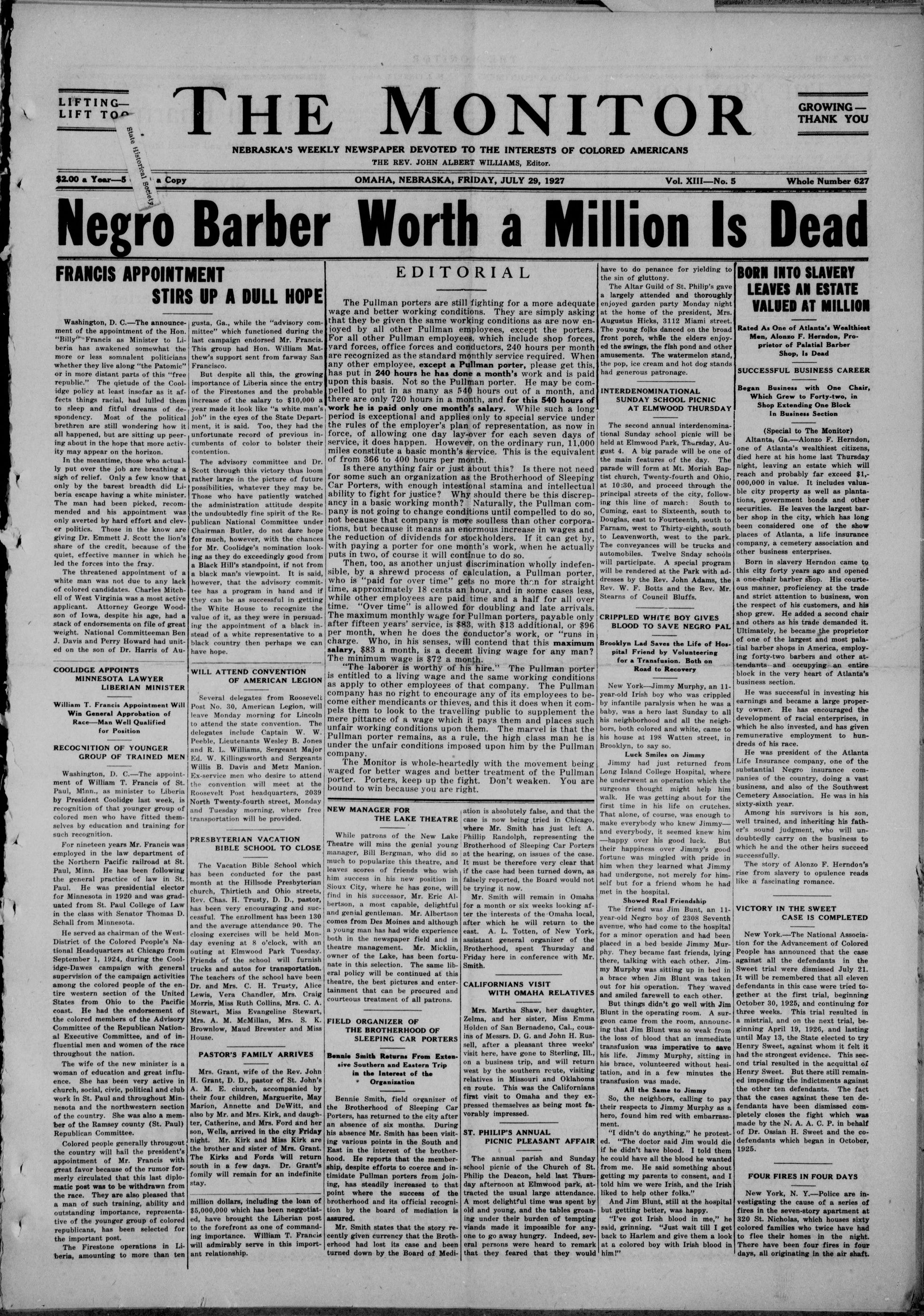
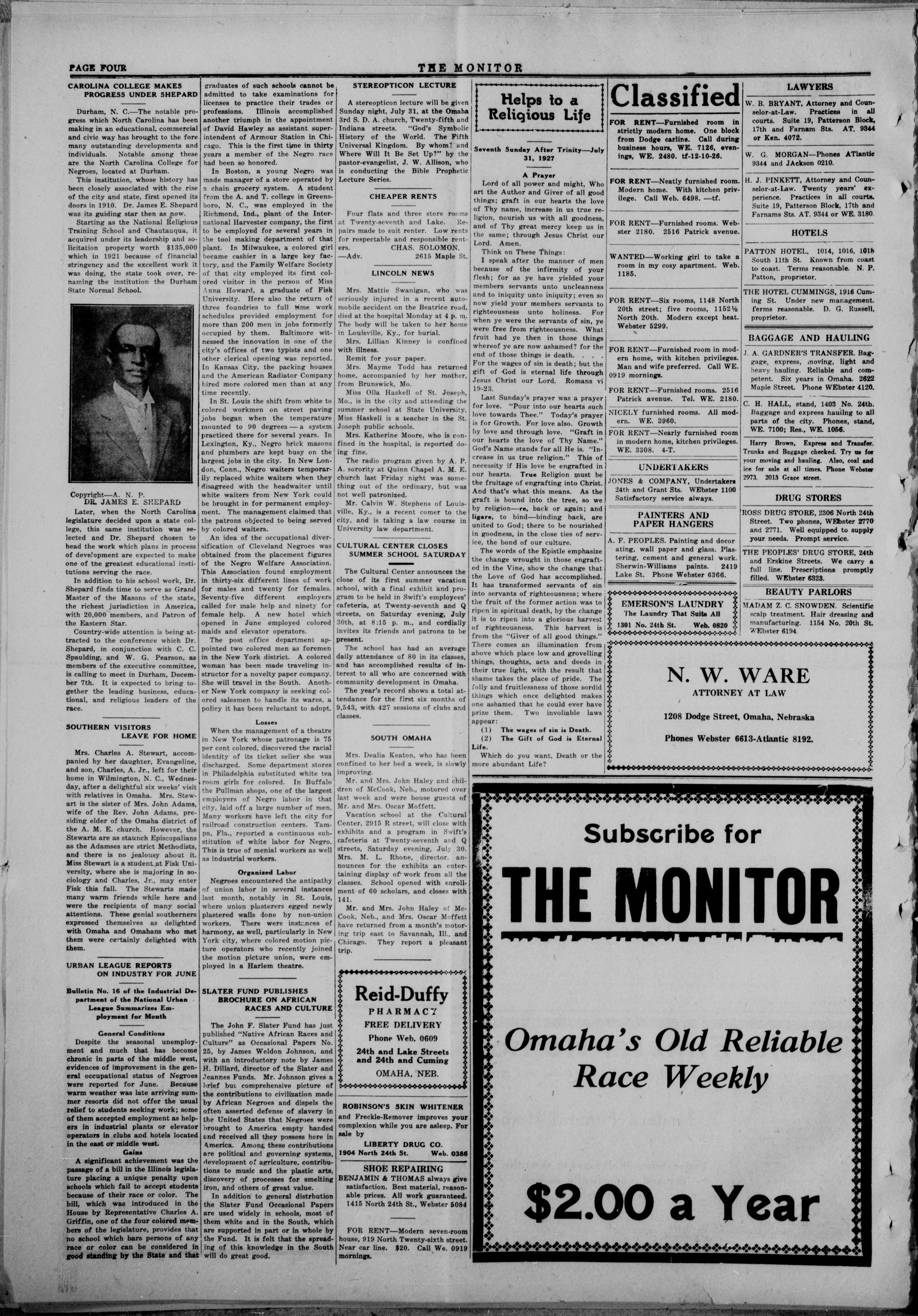
Page text (machine-generated)
Negro Barber Worth a Million Is Dead
FRANCIS APPOINTMENT STIRS UP A DULL HOPE
LIFTING
LIFT TOO
State Historical Society
$2.00 a Year—5 a Copy
Negro
FRANCIS APPOINTED
STIRS
Washington, D. C.—The announcement of the appointment of the Hon. "Billy" Francis as Minister to Liberia has awakened somewhat the more or less somalent politicians whether they live along "the Patomic" or in more distant parts of this "free republic." The qietude of the Coolidge policy at least insofar as it affects things racial, had lulled them to sleep and fitful dreams of despondency. Most of the political brethren are still wondering how it all happened, but are sitting up peering about in the hope that more activity may appear on the horizon.
In the meantime, those who actually put over the job are breathing a sigh of relief. Only a few know that only by the barest breadth did Liberia escape having a white minister. The man had been picked, recommended and his appointment was only averted by hard effort and clever politics. Those in the know are giving Dr. Emmett J. Scott the lion's share of the credit, because of the quiet, effective manner in which he led the forces into the fray.
The threatened appointment of a white man was not due to any lack of colored candidates. Charles Mitchell of West Virginia was a most active applicant. Attorney George Woodson of Iowa, despite his age, had a stack of endorsements on file of great weight. National Committeeman Ben J. Davis and Perry Howard had united on the son of Dr. Harris of Au-
COOLIDGE APPOINTS
MINNESOTA LAWYER
LIBERIAN MINISTER
William T. Francis Appointment Will Win General Approbation of Race—Man Well Qualified for Position
RECOGNITION OF YOUNGER
GROUP OF TRAINED MEN
Washington, D. C.—The appointment of William T. Francis of St. Paul, Minn., as minister to Liberia by President Coolidge last week, is recognition of that younger group of colored men who have fitted themselves by education and training for such recognition.
For nineteen years Mr. Francis was employed in the law department of the Northern Pacific railroad at St. Paul, Minn. He has been following the general practice of law in St. Paul. He was presidential elector for Minnesota in 1920 and was graduated from St. Paul College of Law in the class with Senator Thomas D. Schall from Minnesota.
He served as chairman of the West-District of the Colored People's National Headquarters at Chicago from September 1, 1924, during the Coolidge-Dawes campaign with general supervision of the campaign activities among the colored people of the entire western section of the United States from Ohio to the Pacific coast. He had the endorsement of the colored members of the Advisory Committee of the Republican National Executive Committee, and of influential men and women of the race throughout the nation.
The wife of the new minister is a woman of education and great influence. She has been very active in church, social, civic, political and club work in St. Paul and throughout Minnesota and the northwestern section of the country. She was also a member of the Ramsey county (St. Paul) Republican Committee.
Colored people generally throughout the country will hail the president's appointment of Mr. Francis with great favor because of the rumor formerly circulated that this last diplomatic post was to be withdrawn from the race. They are also pleased that a man of such training, ability and outstanding importance, representative of the younger group of colored republicans, has been selected for the important post.
The Firestone operations in Liberia, amounting to more than ten
THE MONITOR
gusta, Ga., while the "advisory committee" which functioned during the last campaign endorsed Mr. Francis. This group had Hon. William Matthew's support sent from farway San Francisco. But despite all this, the growing importance of Liberia since the entry of the Firestones and the probable increase of the salary to $10,000 a year made it look like "a white man's job" in the eyes of the State Department, it is said. Too, they had the unfortunate record of previous incumbents of color to bolster their contention.
The advisory committee and Dr. Scott through this victory thus loom rather large in the picture of future possibilities, whatever they may be. Those who have patiently watched the administration attitude despite the undoubtedly fine spirit of the Republican National Committee under Chairman Butler, do not dare hope for much, however, with the chances for Mr. Coolidge's nomination looking as they do exceedingly good from a Black Hill's standpoint, if not from a black man's viewpoint. It is said; however, that the advisory committee has a program in hand and if they can be as successful in getting the White House to recognize the value of it, as they were in persuading the appointment of a black instead of a white representative to a black country then perhaps we can have hope.
WILL ATTEND CONVENTION
OF AMERICAN LEGION
Several delegates from Roosevelt Post No. 30, American Legion, will leave Monday morning for Lincoln to attend the state convention. The delegates include Captain W. W. Peeble, Lieutenants Wesley B. Jones and R. L. Williams, Sergeant Major Ed. W. Killingsworth and Sergeants Willis B. Davis and Metz Manion. Ex-service men who desire to attend the convention will meet at the Roosevelt Post headquarters, 2039 North Twenty-fourth street, Monday and Tuesday morning, where free transportation will be provided.
PRESBYTERIAN VACATION
BIBLE SCHOOL TO CLOSE
The Vacation Bible School which has been conducted for the past month at the Hillsode Presbyterian church, Thirtieth and Ohio streets, Rev. Chas. H. Trusty, D. D., pastor, has been very encouraging and successful. The enrollment has been 130 and the average attendance 90. The closing exercises will be held Monday evening at 8 o'clock, with an outing at Elmwood Park Tuesday. Friends of the school will furnish trucks and autos for transportation. The teachers of the school have been Dr. and Mrs. C. H. Trusty, Alice Lewis, Vera Chandler, Mrs. Craig Morris, Miss Ruth Collins, Mrs. C. A. Stewart, Miss Evaeline Stewart, Mrs. A. M. McMillan, Mrs. S. K. Brownlow, Maud Brewster and Miss House.
PASTOR'S FAMILY ARRIVES
Mrs. Grant, wife of the Rev. John H. Grant, D. D., pastor of St. John's A. M. E. church, accompanied by their four children, Marguerite, May Marion, Annette and DeWitt, and also by Mr. and Mrs. Kirk, and daughter, Catherine, and Mrs. Ford and her son, Wells, arrived in the city Friday night. Mr. Kirk and Miss Kirk are the brother and sister of Mrs. Grant. The Kirks and Fords will return south in a few days. Dr. Grant's family will remain for an indefinite stay.
million dollars, including the loan of $5,000,000 which has been neggotiated, have brought the Liberian post to the forefront as one of commanding importance. William T. Francis will admirably serve in this important relationship.
OMAHA, NEBRASKA, FRIDAY, JULY 29, 1927
EDITORIAL
The Pullman porters are still wage and better working conditions that they be given the same wages enjoyed by all other Pullman porters. For all other Pullman employees, yard forces, office forces and co-are recognized as the standard of any other employee, except a has put in 240 hours he has done upon this basis. Not so the Pull-pelled to put in as many as 50 there are only 720 hours in a work he is paid only one month period is exceptional and applies the rules of the employer's play force, of allowing one day last service, it does happen. However, miles constitute a basic month's of from 366 to 400 hours per week.
Is there anything fair or just for some such an organization? Car Porters, with enough ability to fight for justice? Wancy in a basic working month, pany is not going to change condition because that company is motsions, but because it means an end the reduction of dividends for with paying a porter for one mots in two, of course it will come. Then, too, as another unjustifiable, by a shrewd process of who is "paid for over time" a time, approximately 18 cents a while other employees are paid time. "Over time" is allowed. The maximum monthly wage for after fifteen years' service, is $83 per month, when he does the charge. Who, in his senses, with salary, $83 a month, is a deco. The minimum wage is $72 a month.
"The laborer is worthy of it is entitled to a living wage and as apply to other employees of company has no right to encounter either mendicants or thieves pels them to look to the travails mere pittance of a wage which unfair working conditions upon Pullman porter remains, as a under the unfair conditions imp company.
The Monitor is whole-heart waged for better wages and better porter. Porters, keep up the bound to win because you are not
in porters are still fighting for a better working conditions. They are given the same working conditions, rather Pullman employees, except Pullman employees, which include price forces and conductors, 240 hours as the standard monthly service employee, except a Pullman porter, for hours he has done a month's work. Not so the Pullman porter. He has as many as 540 hours out of 720 hours in a month, and for the only one month's salary. What national and applies only to special employer's plan of representing one day lay-over for each happen. However, on the ordinary a basic month's service. This is 400 hours per month. Nothing fair or just about this? Is an organization as the Brotherhood with enough intestinal stamina for justice? Why should there be a working month? Naturally, the tag to change conditions until company is more soulless than use it means an enormous increase of dividends for stockholders. In porter for one month's work, when course it will continue to do so. Is another unjust discrimination a new process of calculation, a Hor over time" gets no more thanately 18 cents an hour, and in employees are paid time and a half time" is allowed for doubling and monthly wage for Pullman porter's service, is $83, with $13 added. he does the conductor's work in his senses, will contend that month, is a decent living wage a wage is $72 a month. It is worthy of his hire." The living wage and the same worker employees of that company. so right to encourage any of its employees or thieves, and this it does to the travelling public to sell of a wage which it pays them all conditions upon them. The man remains, as a rule, the high cost conditions imposed upon him. It is whole-heartedly with the more wages and better treatment of, keep up the fight. Don't wear because you are right.
The Pullman porters are still fighting for a more adequate wage and better working conditions. They are simply asking that they be given the same working conditions as are now enjoyed by all other Pullman employees, except the porters. For all other Pullman employees, which include shop forces, yard forces, office forces and conductors, 240 hours per month are recognized as the standard monthly service required. When any other employee, except a Pullman porter, please get this, has put in 240 hours he has done a month's work and is paid upon this basis. Not so the Pullman porter. He may be compelled to put in as many as 540 hours out of a month, and there are only 720 hours in a month, and for this 540 hours of work he is paid only one month's salary. While such a long period is exceptional and applies only to special service under the rules of the employer's plan of representation, as now in force, of allowing one day lay-over for each seven days of service, it does happen. However, on the ordinary run, 11,000 miles constitute a basic month's service. This is the equivalent of from 366 to 400 hours per month.
Is there anything fair or just about this? Is there not need for some such an organization as the Brotherhood of Sleeping Car Porters, with enough intestinal stamina and intellectual ability to fight for justice? Why should there be this discrepancy in a basic working month? Naturally, the Pullman company is not going to change conditions until compelled to do so, not because that company is more soulless than other corporations, but because it means an enormous increase in wages and the reduction of dividends for stockholders. If it can get by, with paying a porter for one month's work, when he actually puts in two, of course it will continue to do so.
Then, too, as another unjust discrimination wholly indefensible, by a shrewd process of calculation, a Pullman porter, who is "paid for over time" gets no more than for straight time, approximately 18 cents an hour, and in some cases less, while other employees are paid time and a half for all over time. "Over time" is allowed for doubling and late arrivals. The maximum monthly wage for Pullman porters, payable only after fifteen years' service, is $83, with $13 additional, or $96 per month, when he does the conductor's work, or "runs in charge. Who, in his senses, will contend that this maximum salary, $83 a month, is a decent living wage for any man? The minimum wage is $72 a month.
"The laborer is worthy of his hire." The Pullman porter is entitled to a living wage and the same working conditions as apply to other employees of that company. The Pullman company has no right to encourage any of its employees to become either mendicants or thieves, and this it does when it compels them to look to the travelling public to supplement the mere pittance of a wage which it pays them and places such unfair working conditions upon them. The marvel is that the Pullman porter remains, as a rule, the high class man he is under the unfair conditions imposed upon him by the Pullman company.
The Monitor is whole-heartedly with the movement being waged for better wages and better treatment of the Pullman porter. Porters, keep up the fight. Don't weaken. You are bound to win because you are right.
NEW MANAGER FOR
THE LAKE THEATRE
While patrons of the New Lake Theatre will miss the genial young manager, Bill Bergman, who did so much to popularize this theatre, and leaves scores of friends who wish him success in his new position in Sioux City, where he has gone, will find in his successor, Mr. Eric Albertson, a most capable, delightful and genial gentleman. Mr. Albertson comes from Des Moines and although a young man has had wide experience both in the newspaper field and in theatre management. Mr. Micklin, owner of the Lake, has been fortunate in this selection. The same liberal policy will be continued at this theatre, the best pictures and entertainment that can be procured and courteous treatment of all patrons.
FIELD ORGANIZER OF
THE BROTHERHOOD OF
SLEEPING CAR PORTERS
Bennie Smith Returns From Extensive Southern and Eastern Trip in the Interest of the Organization
Bennie Smith, field organizer of the Brotherhood of Sleeping Car Porters, has returned to the city after an absence of six months. During his absence Mr. Smith has been visiting various points in the South and East in the interest of the brotherhood. He reports that the membership, despite efforts to coerce and intimidate Pullman porters from joining, has steadily increased to that point where the success of the brotherhood and its official recognition by the board of mediation is assured.
Mr. Smith states that the story recently given currency that the Brotherhood had lost its case and been turned down by the Board of Medi-
---
full fighting for a more adequate positions. They are simply asking working conditions as are now employees, except the porters,ees, which include shop forces,conductors, 240 hours per month monthly service required. When Pullman porter, please get this,one a month's work and is paid Pullman porter. He may be com-540 hours out of a month, and month, and for this 540 hours ofth's salary. While such a longes only to special service undern of representation, as now inay-over for each seven days ofver, on the ordinary run, 11,000s service. This is the equivalentmonth.
It about this? Is there not need was the Brotherhood of Sleeping national stamina and intellectual why should there be this discrep? Naturally, the Pullman conditions until compelled to do so,more soulless than other corpora-normous increase in wages andstockholders. If it can get by,month's work, when he actuallycontinue to do so.
It discrimination wholly indefen-calculation, a Pullman porter,gets no more than for straight on hour, and in some cases less,old time and a half for all over for doubling and late arrivals. Or Pullman porters, payable only83, with $13 additional, or $96conductor's work, or "runs in will contend that this maximument living wage for any man?month.
This hire." The Pullman porter and the same working conditions of that company. The Pullman wage any of its employees to bees, and this it does when it com-lling public to supplement the man it pays them and places such them. The marvel is that the rule, the high class man he is oposed upon him by the Pullman
edly with the movement being better treatment of the Pullman right. Don't weaken. You are right.
ation is absolutely false, and that the case is now being tried in Chicago, where Mr. Smith has just left A. Phillip Randolph, representing the Brotherhood of Sleeping Car Porters at the hearing, on issues of the case. It must be therefore very clear that if the case had been turned down, as falsely reported, the Board would not be trying it now. Mr. Smith will remain in Omaha for a month or six weeks looking after the interests of the Omaha local, after which he will return to the east. A. L. Totten, of New York, assistant general organizer of the Brotherhood, spent Thursday and Friday here in conference with Mr. Smith.
CALIFORNIANS VISIT
WITH OMAHA RELATIVES
Mrs. Martha Shaw, her daughter, Zelma, and her sister, Miss Emma Holden of San Benadeno, Cal., cousins of Messrs. D. G. and John H. Russell, after a pleasant three weeks' visit here, have gone to Sterling, Ill., on a business trip, and will return west by the southern route, visiting relatives in Missouri and Oklahoma en route. This was the Californians first visit to Omaha and they expressed themselves as being most favorably impressed.
ST. PHILIP'S ANNUAL
PICNIC PLEASANT AFFAIR
The annual parish and Sunday school picnic of the Church of St. Philip the Deacon, held last Thursday afternoon at Elmwood park, attracted the usual large attendance. A most delightful time was spent by old and young, and the tables groaning under their burden of tempting viands made it impossible for anyone to go away hungry. Indeed, several persons were heard to remark that they feared that they would
Vol. XIII—No. 5
have to do penance for yielding to the sin of gluttony. The Altar Guild of St. Philip's gave a largely attended and thoroughly enjoyed garden party Monday night at the home of the president, Mrs. Augustus Hicks, 3112 Miami street. The young folks danced on the broad front porch, while the elders enjoyed the swings, the fish pond and other amusements. The watermelon stand, the pop, ice cream and hot dog stands had generous patronage.
INTERDENOMINATIONAL
SUNDAY SCHOOL PICNIC
AT ELMWOOD THURSDAY
The second interdenominational Sunday school picnic will be held at Elmwood Park, Thursday, August 4. A big parade will be one of the main features of the day. The parade will form at Mt. Moriah Baptist church, Twenty-fourth and Ohio, at 10:30, and proceed through the principal streets of the city, following this line of march: South to Cuming, east to Sixteenth, south to Douglas, east to Fourteenth, south to Farnam, west to Thirty-eighth, south to Leavenworth, west to the park. The conveyances will be trucks and automobiles. Twelve Snday schools will participate. A special program will be rendered at the Park with addresses by the Rev. John Adams, the Rev. W. F. Botts and the Rev. Mr. Stearns of Council Bluffs.
CRIPPLED WHITE BOY GIVES
BLOOD TO SAVE NEGRO PAL
Brooklyn Lad Saves the Life of Hospital Friend by Volunteering for a Transfusion. Both on Road to Recovery
New York—Jimmy Murphy, an 11-year-old Irish boy who was crippled by infantile paralysis when he was a baby, was a hero last Sunday to all his neighborhood and all the neighbors, both colored and white, came to his house at 198 Watten street, in Brooklyn, to say so.
Luck Smiles on Jimmy
Jimmy had just returned from Long Island College Hospital, where he underwent an operation which the surgeons thought might help him walk. He was getting about for the first time in his life on crutches. That alone, of course, was enough to make everybody who knew Jimmy—and everybody, it seemed knew him—happy over his good luck. But their happiness over Jimmy's good fortune was mingled with pride in him when they learned what Jimmy had undergone, not merely for himself but for a friend whom he had met in the hospital.
Showed Real Friendship
The friend was Jim Bunt, an 11-year-old Negro boy of 2308 Seventh avenue, who had come to the hospital for a minor operation and had been placed in a bed beside Jimmy Murphy. They became fast friends, lying there, talking with each other. Jimmy Murphy was sitting up in bed in a brace when Jim Blunt was taken out for his operation. They waved and smiled farewell to each other.
But things didn't go well with Jim Blunt in the operating room. A surgeon came from the room, announcing that Jim Blunt was so weak from the loss of blood that an immediate transfusion was imperative to save his life. Jimmy Murphy, sitting in his brace, volunteered without hesitation, and in a few minutes the transfusion was made.
All the Same to Jimmy
So, the neighbors, calling to pay their respects to Jimmy Murphy as a hero, found him red with embarrassment.
"I didn't do anything," he protested. "The doctor said Jim would die if he didn't have blood. I told them he could have all the blood he wanted from me. He said something about getting my parents to consent, and I told him we were Irish, and the Irish liked to help other folks."
And Jim Blunt, still at the hospital but getting better, was happy.
"I've got Irish blood in me," he said, grinning. "Just wait till I get back to Harlem and give them a look at a colored boy with Irish blood in him!"
GROWING
THANK YOU
Whole Number 627
s Dead
BORN INTO SLAVERY LEAVES AN ESTATE VALUED AT MILLION
Rated As One of Atlanta's Wealthiest Men, Alonzo F. Herndon, Proprietor of Palatial Barber Shop, Is Dead
SUCCESSFUL BUSINESS CAREER
Began Business with One Chair, Which Grew to Forty-two, in Shop Extending One Block In Business Section
Altanta, Ga.—Alonzo F. Herndon, one of Atlanta's wealthiest citizens, died here at his home last Thursday night, leaving an estate which will reach and probably far exceed $1,000,000 in value. It includes valuable city property as well as plantations, government bonds and other securities. He leaves the largest barber shop in the city, which has long been considered one of the show places of Atlanta, a life insurance company, a cemetery association and other business enterprises.
Born in slavery Herndon came to this city forty years ago and opened a one-chair barber shop. His courteous manner, proficiency at the trade and strict attention to business, won the respect of his customers, and his shop grew. He added a second chair and others as his trade demanded it. Ultimately, he became the proprietor of one of the largest and most palatial barber shops in America, employing forty-two barbers and other attendants and occupying an entire block in the very heart of Atlanta's business section.
He was successful in investing his earnings and became a large property owner. He has encouraged the development of racial enterprises, in which he also invested, and has given remunerative employment to hundreds of his race.
He was president of the Atlanta Life Insurance company, one of the substantial Negro insurance companies of the country, doing a vast business, and also of the Southwest Cemetery Association. He was in his sixty-sixth year.
Among his survivors is his son, well trained, and inheriting his father's sound judgment, who will undoubtedly carry on the business to which he and the other heirs succeed successfully.
The story of Alonzo F. Herndon's rise from slavery to opulence reads like a fascinating romance.
VICTORY IN THE SWEET
CASE IS COMPLETED
New York.—The National Association for the Advancement of Colored People has announced that the case against all the defendants in the Sweet trial were dismissed July 21. It will be remembered that all eleven defendants in this case were tried together at the first trial, beginning October 30, 1925, and continuing for three weeks. This trial resulted in a mistrial, and on the next trial, beginning April 19, 1926, and lasting until May 13, the State elected to try Henry Sweet, against whom it felt it had the strongest evidence. This second trial resulted in the acquittal of Henry Sweet. But there still remained impending the indictments against the other ten defendants. The fact that the cases against these ten defendants have been dismissed completely closes the fight which was made by the N. A. A. C. P. in behalf of Dr. Ossian H. Sweet and the code defendants which began in October, 1925.
FOUR FIRES IN FOUR DAYS
New York, N. Y.—Police are investigating the cause of a series of fires in the seven-story apartment at 320 St. Nicholas, which houses sixty colored families who twice have had to flee their homes in the night. There have been four fires in four days, all originating in the air shaft.
THE MONITOR
A WEEKLY NEWSPAPER DEVOTED PRIMARY TO THE INTERESTS OF COLORED AMERICANS
PUBLISHED EVERY FRIDAY AT OMAHA, NEBRASKA, BY THE MONITOR PUBLISHING COMPANY
Entered as Second-Class Mail Matter, July 2, 1915 at the Postoffice at Omaha, Nebraska, under the Act of March 8, 1879.
THE REV. JOHN ALBERT WILLIAMS
W. W. MOSLEY, Lincoln, Neb.
Associate Editor
LUCIDA W. WILLIAMS
Business Manager
SUBSCRIPTION RATES, $2.00 PER YEAR; $1.25 6 MONTHS; 75c 3 MONTHS
Advertising Rates Furnished Upon Application
Address, The Monitor, Postoffice Box 1204, Omaha, Neb.
Telephone WEbster 4243
AN IMPORTANT WORD TO SUBSCRIBERS.
The postal regulations require that for newspapers to be sent through the mails subscriptions must be paid in advance. A reasonable time, thirty days, is allowed for renewals. At the expiration of this period, where subscriptions are not renewed, the paper must be stopped. If this is not done, postal privileges are denied the publication. Those, therefore, who desire to continue receiving The Monitor must see to it that their subscriptions are paid, as the law requires, in advance. Statements are being sent to all those who owe, or our collector will call—and unless your subscription is paid we will be compelled to cut off your paper which, of course, we do not want to do.
We, as publishers, MUST comply with the law or pay the penalty.
EPISCOPAL
Church of St. Philip the Deacon
21st near Paul
Rev. John Albert Williams, Rector
SUNDAY SERVICES
7:30 a. m. Holy Communion
10 a. m. Sunday School
11 a. m. Sung Eucharist With Sermon
8 p. m. Service and Sermon
The Church With a Welcome and a Message, Come
PAGE TWO
THE MO
A WEEKLY NEWSPAPER DEVOTED TO COLORED EDITIONS
PUBLISHED EVERY FRIDAY AT MONITOR PUBLISHING
Entered as Second-Class Mail Matter, J. Nebraska, under the a
THE REV. JOHN ALBERT WILLIAMS, W. W. MOSLEY, Lincoln, Neb.
LUCINDA W. WILLIAMS
SUBSCRIPTION RATES, $2.00 PER YEAR. Advertising Rates Furnished
Address, The Monitor, Poston Telephone W
AN IMPORTANT WORK
The postal regulations require sent through the mails such advance. A reasonable time renewals. At the expiration, scriptions are not renewed, If this is not done, postal priation. Those, therefore, who The Monitor must see to it paid, as the law requires, in a ing sent to all those who own and unless your subscription to cut off your paper which to do.
We, as publishers, MUST pay the penalty.
"SMALL TOWN STUFF"
"Oh, gee! such small town stuff! Can you imagine it?" This was the disgusted exclamation of a very excellent, cultured and well-bred girl in her early twenties who upon reaching a recent outdoor entertainment about 11 o'clock at night found the crowd thinning out and going home. From the tone of her voice there was no question about her disgust at the primitive rustication displayed by these unsophisticated urbanites in going home at an hour when "big town" folks would just be coming for the evening's entertainment.
This girl had been born and reared in the "small town" of more than 200,000 souls; but she had visited "big towns" like New York and Chicago, where the custom is to go to social affairs such as balls and parties from say 11 p. m. to 3 a. m. This, you know, is big town stuff. And, sad to relate, such "big town stuff" is becoming quite the vogue, even in such a "small town" as OmahA. Midnight, once considered quite a respectable hour for the conclusion of social functions among well bred people, is now "too early to think about going home." In fact, you know, it is "small town stuff."
But somehow we are "old-fashioned" enough, and "fogey" enough, and so "far behind the times" as to believe that the nervous tension, frazzled nerves, and unbalanced poise, so largely prevalent in American life today, would be most beneficially modified were our people, old as well as young, to observe better hours than are now customary even in relatively "small towns." We are in favor of recreation for old and young. We believe that recreation, such as dancing for those who enjoy it, or other forms of recreation, amusement and entertainment, is
Church Rev
Orchard & Wilhelm Co.
necessary for every well-balanced normal human life. We are not of those who believe that our young people of the present generation are worse than those of other generations and are rushing headlong to perdition. We believe that they are genuinely sound at heart and have a high conception of honor and right despite much of current flippancy and apparent disregard of the conventional, much of which conventionality is thinly-masked hypocrisy. But at the same time we cannot help but believing that this "big town stuff" of late hours saps their vitality and correspondingly weakens their mentality, and that all would be much better physically and mentally if they could bring themselves to appreciate the fact that "small town stuff" so far as relatively early hours are concerned is, after all, a pretty good thing and not to be despised.
THE MONITOR
A GOOD APPOINTMENT
The Monitor is gratified at the appointment by President Coolidge of William T. Francis of St. Paul, Minn., as minister to Liberia. It is not only an excellent choice, Mr. Francis being well qualified for this important position, but it is also a well-merited recognition of the West. The majority of appointments of this character have hitherto gone to the South or East. President Coolidge's rather tardy recognition of the race by this, we believe, up to this time the only appointment of a Negro made by him, will do something toward relieving the disappointment of the race at what has been considered his apathetic, if not wholly indifferent, attitude towards us. We hope that the appointment of Mr. Francis is the earnest of others.
We are gratified that President Coolidge did not give ear to those who have advised sending a white American to Liberia. The advent there of the Firestones and the investment of American capital made it seem desirable upon the part of some that only a white man would be able to cope with the situation. This same attitude of mind has infleunced certain American ecclesiastical bodies in choosing administrative representatives for that field. We are therefore glad that among our group there were those close enough to President Coolidge to influence him in this wise decision. Mr. Francis is a high-class, well educated, cultured American citizen, for whom no one will have any occasion to apologize. As minister of Liberia he will reflect credit upon the administration, his country and his race. There should be no hesitation upon the part of the Senate when it convenes in confirming the appointment of William T. Francis. The Monitor extends sincere congratulations to Mr. Francis and also to President Coolidge.
Mrs. Marie Lecoq, matron at the North Side Branch Y. W. C. A., returned Monday morning from a month's vacation spent visiting relatives and friends at her former home in New Orleans, La.
PROBATE NOTICE
IN THE MATTER OF THE ESTATE OF WALTER BELL, DECEASED.
Notice is Hereby Given: That the creditors of said deceased will meet administratrix of said estate, before me, county judge of Douglas County, Nebraska, at the county court room, in said county, on the 16th day of September, 1927, and on the 16th day of November, 1927, at 9 o'clock, a.m., each day, for the purpose of presenting their claims for examination, adjustment and allowance. Three months are allowed for the creditors to present their claims, from the 13th day of August, 1927.
BRYCE CRAWFORD.
4t-7-15-27 County Judge
D. H. OLIVER, Attorney
LEGAL NOTICE
To Charles W. Brutton, Henry R. Scruggs, and Brutton and Scruggs, Minstrels, a Partnership:
You and each of you will take notice that on the 2nd day of June, 1927, an order of attachment for the sum of $787.60 was duly issued out of the Municipal Court of the City of Omaha, Douglas County, Nebraska, under the seal thereof, in an action wherein Jim Bell was plaintiff, and Charles W. Brutton, Henry R. Scruggs, and Brutton and Scruggs Minstrels, a partnership, were defendants, appearing in Civil Docket Number 21, at page 18 of the records of said court, and property of said defendants, consisting of three trunks and stage curtains, was duly attached and taken in the hands of John Schmidt, constable, and on the 9th day of June, 1927, said property was duly ordered held until further order of the court.
You are further notified that the object and prayer of said petition are to obtain judgment against you and each of you for the sum of $787.60 with interest and costs, and to take and appropriate by the provisional remedies of attachment and garnishment the said property attached, or so much thereof as may be necessary to satisfy said judgment and costs. You are required to answer said petition on or before the 27th day of July, 1927.
7-1-27-4t JIM BELL. Plaintiff.
JOHN ADAMS, Attorney
NOTICE TO NON-RESIDENT
DEFENDANT
To NATHANIEL FRIEND, whose place of residence is not known and upon whom personal service of summons cannot be had:
You are hereby notified that MATILDA FRIEND, your wife, the plaintiff, filed her petition in the district court of Douglas County, Nebraska, on the 27th day of August, 1926, to obtain an absolute divorce from you on the grounds of desertion and non-support. You are required to answer said petition on or before the 29th day of August, 1927.
LINCOLN MARKET
is still drawing crowds. There is a reason. Groceries and meats which please.
1406 No. 24th. Web. 1411
WATERS
BARNHART
PRINTING CO.
OMAHA
---
2116 North Twenty-fourth Street
Webster 6014 Webster 6014
Special Prices to Churches and Lodges
Open Early Open Evenings
Telephone Your Order. Prompt Attention
24th and Seward Streets
GIVES SERVICE!
Delivery Webster
Free Delivery
Petersen Bakeries
24th and Lake—24th
Why Not Be Cool
LET US DO IT
We bake cheaper than
PIES CAKES
MACAROONS LADY
A VARIETY
Specials
WHITE LAYER CAKES
ICED NUT AND
CHERRY CAKES
CREAM ICING
CAKES
CLOVER ROLLS FOR
"Dependable
Dry Cleaning of Laundry
Apparel and Home
SOFT WATER
Wet Wash
Thrifty Wash
Dry Wash—Rough
Linen—Curtain
EDHOLM
And Lake—24th and Ames—1806 H
Why Not Be Cool and Comfortable and
LET US DO YOUR BAKING!
bake cheaper than you could bake at h
PIES CAKES COOKIES
DOONS LADY FINGERS SWEET
A VARIETY OF BREAD
Specials for Saturday
E LAYER CAKES
O-
ED NUT AND
BERRY CAKES
O-
REAM ICING
CAKES
ORANGE
CAKES
O-
BETTY BRO
COOKIES
15c
PER DOZ
ER ROLLS FOR YOUR SUNDAY DIE
Endable Family Service
Dry Cleaning of Ladies' and Gents' Wear
Apparel and Household Furnishings
SOFT WATER LAUNDERING
Wet Wash - - - 4¢ per L
熵rifty Wash - - 6¢ per L
Dry Wash—Rough Dry—Family Finish
Linen—Curtains—Blankets, Etc.
HOLM & SHERM
24th and Lake—24th and Ames—1806 Farnam
We bake cheaper than you could bake at home.
PIES CAKES COOKIES
MACAROONS LADY FINGERS SWEET ROLLS
A VARIETY OF BREAD
Wet Wash - - - 4c per lb.
Thrifty Wash - - 6c per lb.
Dry Wash—Rough Dry—Family Finish
Linen—Curtains—Blankets, Etc.
EDHOLM & SHERMAN
LAUNDERERS AND CLEANERS
24th Near Lake Street
PHONE WE. 6055
ROSS DRUG
Phones WEbster 27
Full
DRUGS, TOILETTE
Best Sodas
2306 North
FREE P
PATRONIZE THE S
Corner 14th and Dodge St
Agents
for
BRU
STUART'S
Vocalion, O. K. and
Open evenings. Mail o
1803 North T
DOSS DRUG STORE
Jones WEbster 2770 and WEbster 2771
Full Line of
US, TOILETRIES and SUNDAYS
Best Sodas and Ice Cream
2306 North 24th Street
FREE DELIVERY
ONIZE THE STATE FURNITURE
47th and Dodge Streets
Tel. JACKS
BRUNSWICK
Phon
and
STUART'S ART SHOP
Lyon, O. K. and Paramount Race Races
evenings. Mail orders given special attention
1803 North Twenty-oorth Street
ROSS DRUG STORE
Phones WEbster 2770 and WEbster 2771
Full Line of
DRUGS, TOILETRIES and SUNDRIES
Best Sodas and Ice Cream
2306 North 24th Street
FREE DELIVERY
PATRONIZE THE STATE FURNITURE CO.
Corner 14th and Dodge Streets
Tel. JACKSON 1317
Agents for BRUNSWICK Phonographs and Records
STUART'S ART SHOP
Vocalion, O. K. and Paramount Race Records
Open evenings. Mail orders given special attention.
1803 North Twenty-ourth Street
ICE CREAM
Best on the Market
Taylor's
North Twenty-fourth
Prices to Churches an
Your Order. Promp
Taylor's Dairy
twenty-fourth Street
Webster
Churches and Lodges
Open Event
Order. Prompt Attention
Webster 2000
1806 Farnam
comfortable and
BAKING!
d bake at home.
COOKIES
SWEET ROLL
READ
day
ORANGE
CAKES
BETTY BROWN
COOKIES
15c
PER DOZ.
SUNDAY DINNER
My Service
Gents' Wearing
Curnishings
DERING
4c per lb.
6c per lb.
Family Finish
Sets, Etc.
HERMAN
STORE
WEBster 2771
and SUNDRIE
PAGE FOUR
CAROLINA COLLEGE MAKES
PROGRESS UNDER SHEPARD
Durham, N. C.—The notable progress which North Carolina has been making in an educational, commercial and civic way has brought to the fore many outstanding developments and individuals. Notable among these are the North Carolina College for Negroes, located at Durham.
This institution, whose history has been closely associated with the rise of the city and state, first opened its doors in 1910. Dr. James E. Shepard was its guiding star then as now.
Starting as the National Religious Training School and Chautauqua, it acquired under its leadership and solicitation property worth $135,000 which in 1921 because of financial stringency and the excellent work it was doing, the state took over, renaming the institution the Durham State Normal School.
P. R. S.
Later, when the North Carolina legislature decided upon a state college, this same institution was selected and Dr. Shepard chosen to head the work which plans in process of development are expected to make one of the greatest educational institutions serving the race.
In addition to his school work, Dr. Shepard finds time to serve as Grand Master of the Masons of the state, the richest jurisdiction in America, with 20,000 members, and Patron of the Eastern Star.
Country-wide attention is being attracted to the conference which Dr. Shepard, in conjunction with C. C. Spaulding, and W. G. Pearson, as members of the executive committee, is calling to meet in Durham, December 7th. It is expected to bring together the leading business, educational, and religious leaders of the race.
SOUTHERN VISITORS
LEAVE FOR HOME
Mrs. Charles A. Stewart, accompanied by her daughter, Evangeline, and son, Charles, A. Jr., left for their home in Wilmington, N. C., Wednesday, after a delightful six weeks' visit with relatives in Omaha. Mrs. Stewart is the sister of Mrs. John Adams, wife of the Rev. John Adams, presiding elder of the Omaha district of the A. M. E. church. However, the Stewarts are as staunch Episcopalians as the Adamses are strict Methodists, and there is no jealousy about it. Miss Stewart is a student at Fisk University, where she is majoring in sociology and Charles, Jr., may enter Fisk this fall. The Stewarts made many warm friends while here and were the recipients of many social attentions. These genial southerners expressed themselves as delighted with Omaha and Omahans who met them were certainly delighted with them.
URBAN LEAGUE REPORTS
ON INDUSTRY FOR JUNE
Bulletin No. 16 of the Industrial Department of the National Urban League Summarizes Employment for Month
Despite the seasonal unemployment and much that has become chronic in parts of the middle west, evidences of improvement in the general occupational status of Negroes were reported for June. Because warm weather was late arriving summer resorts did not offer the usual relief to students seeking work; some of them accepted employment as helpers in industrial plants or elevator operators in clubs and hotels located in the cast or middle west.
Gains
A significant achievement was the passage of a bill in the Illinois legislature placing a unique penalty upon schools which fail to accept students because of their race or color. The bill, which was introduced in the House by Representative Charles A. Griffin, one of the four colored members of the legislature, provides that no school which bars persons of any race or color can be considered in good standing by the State and that
graduates of such schools cannot be admitted to take examinations for licenses to practice their trades or professions. Illinois accomplished another triumph in the appointment of David Hawley as assistant superintendent of Armour Station in Chicago. This is the first time in thirty years a member of the Negro race had been so honored.
In Boston, a young Negro was made manager of a store operated by a chain grocery system. A student from the A. and T. college in Greensboro, N. C., was employed in the Richmond, Ind., plant of the International Harvester company, the first to be employed for several years in the tool making department of that plant. In Milwaukee, a colored girl became cashier in a large key factory, and the Family Welfare Society of that city employed its first colored visitor in the person of Miss Anna Howard, a graduate of Fisk University. Here also the return of three foundries to full time work schedules provided employment for more than 200 men formerly occupied by them. Baltimore witnessed the innovation in one of the city's offices of two typists and one other clerical opening was reported. In Kansas City, the packing houses and the American Radiator Company hired more colored men than at any time recently.
In St. Louis the shift from white to colored workmen on street paving jobs began when the temperature mounted to 90 degrees — a system practiced there for several years. In Lexington, Ky., Negro brick masons and plumbers are kept busy on the largest jobs in the city. In New London, Conn., Negro waiters temporarily replaced white waiters when they disagreed with the headwaiter until white waiters from New York could be brought in for permanent employment. The management claimed that the patrons objected to being served by colored waiters.
An idea of the occupational diversification of Cleveland Negroes was obtained from the placement figures of the Negro Welfare Association. This Association found employment in thirty-six different lines of work for males and twenty for females. Seventy-five different employers called for male help and ninety for female help. A new hotel which opened in June employed colored maids and elevator operators. The post office department appointed two colored men as foremen in the New York district. A colored woman has been made traveling instructor for a novelty paper company. She will travel in the South. Another New York company is seeking colored salesmen to handle its wares, a policy it has been reluctant to adopt.
Losses
When the management of a theatre in New York whose patronage is 75 per cent colored, discovered the racial identity of its ticket seller she was discharged. Some department stores in Philadelphia substituted white tea room girls for colored. In Buffalo the Pullman shops, one of the largest employers of Negro labor in that city, laid off a large number of men. Many workers have left the city for railroad construction centers. Tampa, Fla., reported a continuous substitution of white labor for Negro. This is true of menial workers as well as industrial workers.
Organized Labor
Negroes encountered the antipathy of union labor in several instances last month, notably in St. Louis, where union plasterers egged newly plastered walls done by non-union workers. There were instances of harmony, as well, particularly in New York city, where colored motion picture operators who recently joined the motion picture union, were employed in a Harlem theatre.
SLATER FUND PUBLISHES
BROCHURE ON AFRICAN
RACES AND CULTURE
The John F. Slater Fund has just published "Native African Races and Culture" as Occasional Papers No. 25, by James Weldon Johnson, and with an introductory note by James H. Dillard, director of the Slater and Jeannes Funds. Mr. Johnson gives a brief but comprehensive picture of the contributions to civilization made by African Negroes and dispels the often asserted defense of slavery in the United States that Negroes were brought to America empty handed and received all they possess here in America. Among these contributions are political and governing systems, development of agriculture, contributions to music and the plastic arts, discovery of processes for smelting iron, and others of great value.
In addition to general distribution the Slater Fund Occasional Papers are used widely in schools, most of them white and in the South, which are supported in part or in whole by the Fund. It is felt that the spreading of this knowledge in the South will do great good.
THE MONITOR
STEREOPTICON LECTURE
A stereopticon lecture will be given Sunday, July 31, at the Omaha 3rd S. D. A. church, Twenty-fifth and Indiana streets. "God's Symbolic History of the World. The Fifth Universal Kingdom. By whom? and Where Will It Be Set Up?" by the pastor-evangelist, J. W. Allison, who is conducting the Bible Prophetic Lecture Series.
Four flats and three store rooms at Twenty-seventh and Lake. Repairs made to suit renter. Low rents for respectable and responsible renters. CHAS. SOLOMON.
Mrs. Mattie Swanigan, who was seriously injured in a recent automobile accident on the Beatrice road, died at the hospital Monday at 4 p. m. The body will be taken to her home in Louisville, Ky., for burial.
Mrs. Lillian Kinney is confined with illness.
Remit for your paper.
Mrs. Mayme Todd has returned home, accompanied by her mother, from Brunswick, Mo.
Miss Olla Haskell of St. Joseph, Mo., is in the city and attending the summer school at State University. Miss Haskell is a teacher in the St. Joseph public schools.
Mrs. Katherine Moore, who is confined in the hospital, is reported doing fine.
The radio program given by A. P. A. sorority at Quinn Chapel A. M. E. church last Friday night was something out of the ordinary, but was not well patronized. Mr. Calvin W. Stephens of Louisville, Ky., is a recent comer to the city, and is taking a law course in University law department.
CULTURAL CENTER CLOSES
SUMMER SCHOOL SATURDAY
The Cultural Center announces the close of its first summer vacation school, with a final exhibit and program to be held in Swift's employees' cafeteria, at Twenty-seventh and Q streets, on Saturday evening, July 30th, at 8:15 p. m., and cordially invites its friends and patrons to be present. The school has had an average daily attendance of 80 in its classes, and has accomplished results of interest to all who are concerned with community development in Omaha. The year's record shows a total attendance for the first six months of 9,543, with 427 sessions of clubs and classes.
Mrs. Dealia Keaton, who has been confined to her bed a week, is slowly improving. Mr. and Mrs. John Haley and children of McCook, Neb., motored over last week and were house guests of Mr. and Mrs. Oscar Moffett. Vacation school at the Cultural Center, 2915 R street, will close with exhibits and a program in Swift's cafeteria at Twenty-seventh and Q streets, Saturday evening, July 30. Mrs. M. L. Rhone, director, announces for the exhibits an entertaining display of work from all the classes. School opened with enrollment of 60 scholars, and closes with 141.
Mr. and Mrs. John Haley of McCook, Neb., and Mrs. Oscar Moffett have returned from a month's motoring trip east to Savannah, Ill., and Chicago. They report a pleasant trip.
Reid-Duffy
PHARMACY
FREE DELIVERY
Phone Web. 0609
24th and Lake Streets
and 24th and Cuming
OMAHA, NEB.
ROBINSON'S SKIN WHITENER
and Freckle-Remover improves your complexion while you are asleep. For sale by
LIBERTY DRUG CO.
1904 North 24th St. Web. 0386
SHOE REPAIRING
BENJAMIN & THOMAS always give satisfaction. Best material, reasonable prices. All work guaranteed.
1415 North 24th St., Webster 5084
FOR RENT—Modern seven-room house, 919 North Twenty-sixth street. Near car line. $20. Call We. 0919 mornings.
CHEAPER RENTS
LINCOLN NEWS
Remit for your paper.
SOUTH OMAHA
Helps to a Religious Life
Seventh Sunday After Trinity—July
31, 1927
A Prayer
Lord of all power and might, Who art the Author and Giver of all good things; graft in our hearts the love of Thy name, increase in us true religion, nourish us with all goodness, and of Thy great mercy keep us in the same; through Jesus Christ our Lord. Amen.
Think on These Things:
I speak after the manner of men because of the infirmity of your flesh; for as ye have yielded your members servants unto uncleanness and to iniquity unto iniquity; even so now yield your members servants to righteousness unto holiness. For when ye were the servants of sin, ye were free from righteousness. What fruit had ye then in those things whereof ye are now ashamed? for the end of those things is death. . . . For the wages of sin is death; but the gift of God is eternal life through Jesus Christ our Lord. Romans vi 19-23.
Last Sunday's prayer was a prayer for love. "Pour into our hearts such love towards Thee." Today's prayer is for Growth. For love also. Growth by love and through love. "Graft in our hearts the love of Thy Name." God's Name stands for all He is. "Increase in us true religion." This of necessity if His love be engrafted in our hearts. True Religion must be the fruitage of engrafting into Christ. And that's what this means. As the graft is bound into the tree, so we by religion—re, back or again; and ligare, to bind—binding back, are united to God; there to be nourished in goodness, in the close ties of service, the bond of our culture.
The words of the Epistle emphasize the change wrought in those engrafted in the Vine, show the change that the Love of God has accomplished. It has transformed servants of sin into servants of righteousness; where the fruit of the former action was to ripen in spiritual death, by the change it is to ripen into a glorious harvest of righteousness. This harvest is from the "Giver of all good things." There comes an illumination from above which place low and grovelling things, thoughts, acts and deeds in their true light, with the result that shame takes the place of pride. The folly and fruitlessness of those sordid things which once delighted makes one ashamed that he could ever have prize them. Two inviolable laws appear:
(1) The wages of sin is Death.
(2) The Gift of God is Eternal Life.
Which do you want, Death or the more abundant Life?
Subscribe for
THE MONITOR
Omaha’s Old Reliable
Race Weekly
$2.00 a Year
A Prayer
1208 Dodge Street, Omaha, Nebraska
Phones Webster 6613-Atlantic 8192.