Phoenix Tribune
Saturday, November 2, 1918
Phoenix, Arizona
Page text (machine-generated)
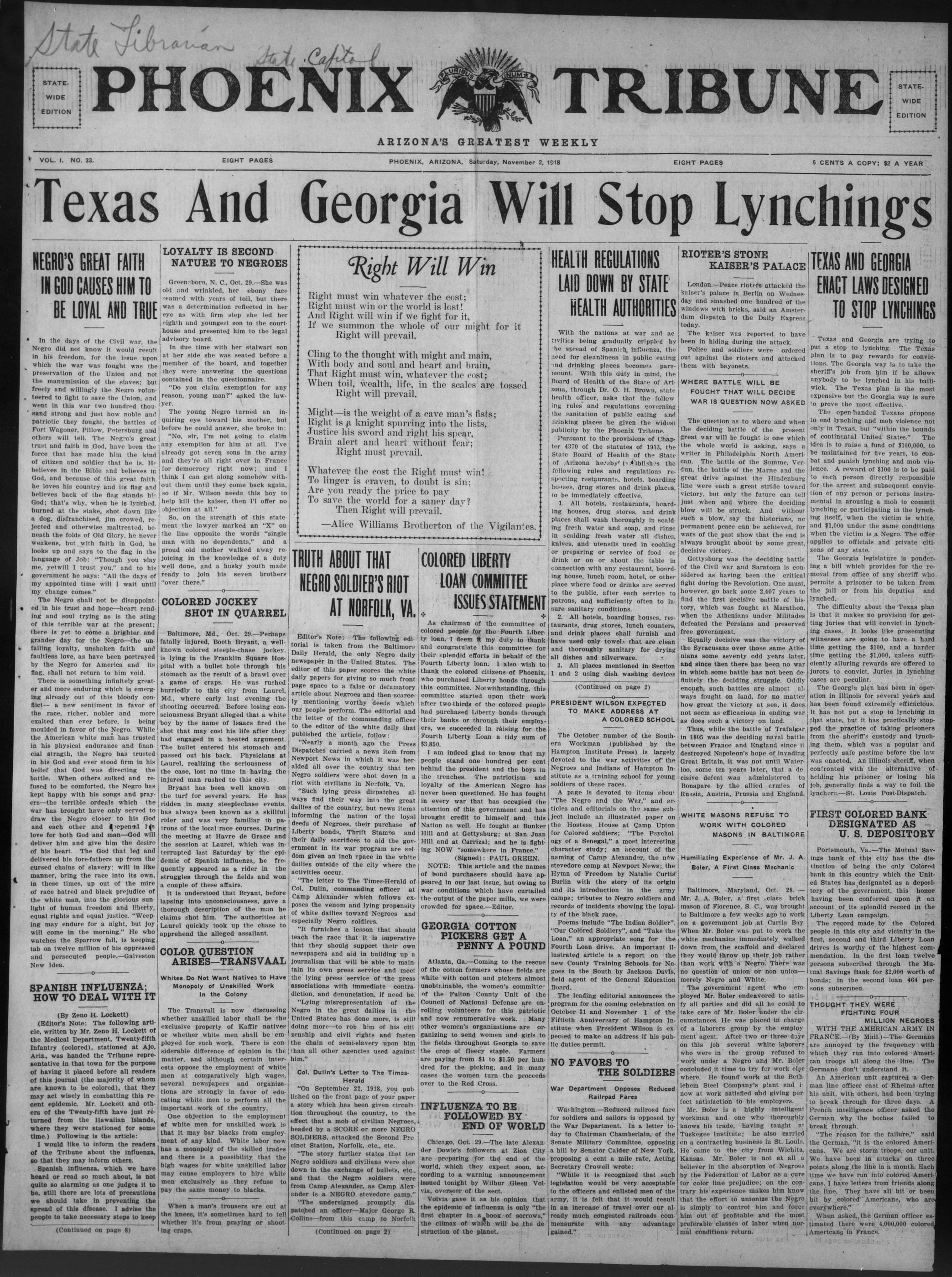
Texas And Georgia Will Stop Lynchings
State Librarian
STATE-
WIDE
EDITION
VOL. 1. NO. 33.
NEGRO'S GREAT FAITH IN GOD CAUSES HIM TO BE LOYAL AND TRUE
In the days of the Civil war, the Negro did not know it would result in his freedom, for the issue upon which the war was fought was the preservation of the Union and not the manumission of the slaves; but freely and willingly the Negro volunteered to fight to save the Union, and went in this war two hundred thousand strong and just how noble and patriotic they fought, the battles of Fort Wagoner, Pillow, Petersburg and others will tell. The Negro's great trust and faith in God, have been the force that has made him the kind of citizen and soldier that he is. He believes in the Bible and believes in God, and because of this great faith he loves his country and its flag and believes back of the flag stands his God; that's why, when he is lynched, burned at the stake, shot down like a dog, disfranchised, Jim crowed, rejected and otherwise maltreated, beneath the folds of Old Glory, he never weakens, but with faith in God, he looks up and says to the flag in the language of Job: "Though you slay me, yetwill I trust you," and to his government he says: "All the days of my appointed time will I wait until my change comes."
The Negro shall not be disappointed in his trust and hope—heart rending and soul trying as is the sting of this terrible war at the present; there is yet to come a brighter and grander day for the Negro—the unfalling loyalty, unshaken faith and faultless love, as have been portrayed by the Negro for America and its flag, shall not return to him void.
There is something infinitely greater and more enduring which is emerging already out of this bloody conflict—a new sentiment in favor of the race, richer, nobler and more exalted than ever before, is being moulded in favor of the Negro. While the American white man has trusted in his physical endurance and financial strength, the Negro has trusted in his God and ever stood firm in his belief that God was directing the battle. When others sulked and refused to be comforted, the Negro has kept happy with his songs and prayers—the terrible ordeals which the war has brought have only served to draw the Negro closer to his God and each other and to perpetual love for both God and man—God will deliver him and give him the desire of his heart. The God that led and delivered his fore-fathers up from the cursed chains of slavery; will in like manner, bring the race into its own, in these times, up out of the mire of race hatred and black prejudice of the white man, into the glorious sunlight of human freedom and liberty, equal rights and equal justice. "Weeping may endure for a night, but joy will come in the morning." He who watches the Sparrow fall, is keeping tab on twelve million of his oppressed and persecuted people.—Galveston New Idea.
SPANISH INFLUENZA; HOW TO DEAL WITH IT
(Editor's Note: The following article, written by Mr. Zeno H. Lockett of the Medical Department, Twenty-fifth Infantry (colored), stationed at Ajo, Ariz., was handed the Tribune representative in that town for the purpose of having it placed before all readers of this journal (the majority of whom are known to be colored), that they may act wisely in combatting this recent epidemic. Mr. Lockett and others of the Twenty-fifth have just returned from the Hawaiian Islands, where they were stationed for some time.) Following is the article:
I would like to inform the readers of the Tribune about the influenza, so that they may inform others.
Spanish influenza, which we have heard or read so much about, is not quite so alarming as one judges it to be, still there are lots of precautions we should take in preventing the spread of this disease. I advise the people to take necessary steps to keep
(Continued on page 8)
EIGHT PAGES
LOYALTY IS SECOND NATURE TO NEGROES
Greensboro, N. C., Oct. 29.—She was old and wrinkled, her ebony face seamed with years of toil, but there was a determination reflected in her eye as with firm step she led her eighth and youngest son to the courthouse and presented him to the legal advisory board.
In due time with her stalwart son at her side she was seated before a member of the board, and together they were answering the questions contained in the questionnaire.
"Do you claim exemption for any reason, young man?" asked the lawyer.
The young Negro turned an inquiring eye toward his mother, but before he could answer, she broke in: "No, sir, I'm not going to claim any exemption for him at all. I've already got seven sons in the army and they're all right over in France for democracy right now; and I think I can get along somehow without them until they come back again, so if Mr. Wilson needs this boy to help kill the kaiser, then I'll offer no objection at all."
So, on the strength of this statement the lawyer marked an "X" on the line opposite the words "single man with no dependents," and a proud old mother walked away rejoicing in the knowledge of a duty well done, and a husky youth made ready to join his seven brothers "over there."
COLORED JOCKEY
SHOT IN OUARREL
Baltimore, Md., Oct. 29.—Perhaps fatally injured, Booth Bryant, a well-known colored steeple-chase jockey, is lying in the Franklin Square Hospital with a bullet hole through his stomach as the result of a brawl over a game of craps. He was rushed hurriedly to this city from Laurel, Md., where early last evening the shooting occurred. Before losing consciousness Bryant alleged that a white boy by the name of Isaacs fired the shot that may cost his life after they had engaged in a heated argument. The bullet entered his stomach and passed out his back. Physicians at Laurel, realizing the seriousness of the case, lost no time in having the injured man rushed to this city. Bryant has been well known on the turf for several years. He has ridden in many steeplechase events, has always been known as a skillful rider and was very familiar to patrons of the local race courses. During the meeting at Havre de Grace and the session at Laurel, which was interrupted last Saturday by the epidemic of Spanish influenza, he frequently appeared as a rider in the struggles through the fields and won a couple of these affairs.
It is understood that Bryant, before lapsing into unconsciousness, gave a thorough description of the man he claims shot him. The authorities at Laurel quickly took up the chase to apprehend the alleged assailant.
COLOR QUESTION ARISES—TRANSVAAL
Whites. Do Not Want Natives to Have Monopoly of Unskilled Work In the Colony
The Transvall is now discussing whether unskilled labor shall be the exclusive property of Kaffir natives or whether white men shall be employed for such work. There is considerable difference of opinion in the matter, and although certain interests oppose the employment of white men at comparatively high wages, several newspapers and organizations are strongly in favor of educating white men to perform all the important work of the country.
One objection to the employment of white men for unskilled work is that it may bar blacks from employment of any kind. White labor now has a monopoly of the skilled trades and there is a possibility that the high wages for white unskilled labor may cause employers to hire white men exclusively as they refuse to pay the same money to blacks.
When a man's trousers are out at the knees, it's sometimes hard to tell whether it's from praying or shooting craps.
ARIZONA'S GREATEST WEEKLY
PHOENIX, ARIZONA, Saturday, November 2, 1918
Right Will Win
Right must win whatever
Right must win or the woe
And Right will win if we
If we summon the whoe
Right will prevail.
Cling to the thought with
With body and soul and
That Right must win, when
When toil, wealth, life,
Right will prevail.
Might—is the weight of
Right is a knight spurring
Justice his sword and right
Brain alert and heart w
Right must prevail.
Whatever the cost the R
To linger is craven, to do
Are you ready the price?
To save the world for a
Then Right will pr
—Alice Williams Bro
Right must win whatever the cost;
Right must win or the world is lost!
And Right will win if we fight for it,
If we summon the whole of our might for it
Right will prevail.
Cling to the thought with might and main,
With body and soul and heart and brain,
That Right must win, whatever the cost;
When toil, wealth, life, in the scales are tossed
Right will prevail.
Might—is the weight of a cave man's fists;
Right is a knight spurring into the lists,
Justice his sword and right his spear,
Brain alert and heart without fear;
Right must prevail.
Whatever the cost the Right must win!
To linger is craven, to doubt is sin;
Are you ready the price to pay
To save the world for a saner day?
Then Right will prevail.
—Alice Williams Brotherton of the Vigilantes.
TRUTH ABOUT THAT NEGRO SOLDIER'S RIOT AT NORFOLK, VA.
Editor's Note: The following editorial is taken from the Baltimore Daily Herald, the only Negro daily newspaper in the United States. The editor of this paper scores the white daily papers for giving so much front page space to a false or defamatory article about Negroes and then scarcely mentioning worthy deeds which our people perform. The editorial and the letter of the commanding officer to the editor of the white daily that published the article, follow:
"Nearly a month ago the Press Dispatches carried a news item from Newport News in which it was heralded all over the country that ten Negro soldiers were shot down in a riot with civilians in Norfolk, Va.
"Such lying press dispatches always find their way into the great dallies of the country, but news items informing the nation of the loyal deeds of Negroes, their purchase of Liberty bonds, Thrift Stamps and their daily sacrifices to aid the government in its war program are seldom given an inch space in the white dallies outside of the city where the activities occur.
"The letter to The Times-Herald of Col. Dulin, commanding officer at Camp Alexander which follows exposes the venom and lying propensity of white dallies toward Negroes and especially Negro soldiers.
"It furnishes a lesson that should teach the race that it is imperative that they should support their own newspapers and aid in building up a journalism that will be able to maintain its own press service and meet the lying press service of the press associations with immediate contradiction, and denunciation, if need be.
"Lying misrepresentation of the Negro in the great dallies in the United States has done more, is still doing more—to rob him of his citizenship and civil rights and fasten the chain of semi-slavery upon him than all other agencies used against him."
Col. Dulin's Letter to The Times-
Herald
"On September 22, 1918, you published on the front page of your paper a story which has been given circulation throughout the country, to the effect that a mob of civilian Negroes, headed by a SCORE or more NEGRO SOLDIERS, attacked the Second Precinct Station, Norfolk, etc., etc.
"The story further states that ten Negro soldiers and civilians were shot down in the exchange of bullets, etc., and that the Negro soldiers were from Camp Alexander, as Camp Alexander is a NEGRO stevedore camp."
"The undersigned promptly dispatched an officer—Major George R. Collins—from this camp to Norfolk
(Continued on page 2)
er the cost;
world is lost!
fight for it,
side of our might for it
might and main,
heart and brain,
whatever the cost;
in the scales are tossed
cave man's fists;
ing into the lists,
right his spear,
without fear;
all.
fight must win!
doubt is sin;
to pay
saner day?
revail.
motherton of the Vigilantes.
COLORED LIBERTY LOAN COMMITTEE ISSUES STATEMENT
As chairman of the committee of colored people for the Fourth Liberty loan, I deem it my duty to thank and congratulate this committee for their splendid efforts in behalf of the Fourth Liberty loan. I also wish to thank the colored citizens of Phoenix, who purchased Liberty bonds through this committee. Notwithstanding, this committee started upon their work after two-thirds of the colored people had purchased Liberty bonds through their banks or through their employers, we succeeded in raising for the Fourth Liberty Loan a tidy sum of $3,850.
I am indeed glad to know that my people stand one hundred per cent behind the president and the boys in the trenches. The patriotism and loyalty of the American Negro has never been questioned. He has fought in every war that has occupied the attention of this government and has brought credit to himself and this Nation as well. He fought at Bunker Hill and at Gettysburg; at San Juan Hill and at Carrizal; and he is fighting NOW "somewhere in France."
(Signed): PAUL GREEN.
NOTE: This article and the names of bond purchasers should have appeared in our last issue, but owing to war conditions which have curtailed the output of the paper mills, we were crowded for space—Editor.
GEORGIA COTTON
PICKERS GET A
PENNY A POUND
Atlanta, Ga.—Coming to the rescue of the cotton farmers whose fields are white with cotton and pickers almost unobtainable, the women's committee of the Fulton County Unit of the Council of National Defense are enrolling volunteers for this patriotic and now renumerative work. Many other women's organizations are organizing to send women and girls to the fields throughout Georgia to save the crop of fleecy staple. Farmers are paying from $1 to $1.50 per hundred for the picking, and in many cases the women turn the proceeds over to the Red Cross.
INFLUENZA TO BE
FOLLOWED BY
END OF WORLD
Chicago, Oct. 29.—The late Alexander Dowie's followers at Zion City are preparing for the end of the world, which they expect soon, according to a warning announcement issued tonight by Wilbur Gleen Volvia, overseer of the sect.
Volvia gave it as his opinion that the epidemic of influenza is only "the first chapter in a book of sorrows," the climax of which will be the destruction of the planet.
HEALTH REGULATIONS LAID DOWN BY STATE HEALTH AUTHORITIES
With the nations at war and activities being gradually crippled by the spread of Spanish influenza, the need for cleanliness in public eating and drinking places becomes paranoid. With this duty in mind, the Board of Health of the State of Arizona, through Dr. O. H. Brown, state health officer, asks that the following rules and regulations governing the sanitation of public eating and drinking places be given the widest publicity by the Phoenix Tribune.
Pursuant to the provisions of Chapter 4370 of the statutes of 1913, the State Board of Health of the State of Arizona heyday (1) publishes the following rules and regulations respecting restaurants, hotels, boarding houses, drug stores and drink places, to be immediately effective.
1. All hotels, restaurants, boarding houses, drug stores, and drink places shall wash thoroughly in scalding fresh water and soap, and rinse in scalding fresh water all dishes knives, and utensils used in cooking or preparing or service of food or drink or on or about the table in connection with any restaurant, boarding house, lunch room, hotel, or other place where food or drinks are served to the public, after each service to patrons, and sufficiently often to insure sanitary conditions.
2. All hotels, boarding houses, restaurants, drug stores, lunch counters, and drink places shall furnish and have used only towels, that are clean and thoroughly sanitary for drying all dishes and silverware.
3. All places mentioned in Section 1 and 2 using dish washing devices
PRESIDENT WILSON EXPECTED
TO MAKE ADDRESS AT
A COLORED SCHOOL
The October number of the Southern Workman (published by the Hampton Institute Press) is largely devoted to the war activities of the Negroes and Indians of Hampton Institute as a training school for young soldiers of these races. A page is devoted to items about "The Negro and the War," and articles and editorials on the same subject include an illustrated paper on the Hostess House at Camp Upton for Colored soldiers; "The Psychology of a Senegal," a most interesting character study; an account of the naming of Camp Alexander, the new stevedore camp at Newport News; the Hymn of Freedom by Natalie Curtis Burlin with the story of its origin and its introduction in the army camps; tributes to Negro soldiers and records of incidents showing the loyalty of the black race. Poems include "The Indian Soldier," "Our Colored Soldiery," and "Take the Loan," an appropriate song for the Fourth Loan drive. An important illustrated article is a report on the new County Training Schools for Negoes in the South by Jackson Davis, field agent of the General Education Board.
The leading editorial announces the program for the coming celebration on October 31 and November 1 of the Fiftieth Anniversary of Hampton Institute when President Wilson is expected to make an address if his public duties permit.
NO FAVORS TO THE SOLDIERS
War Department Opposes Reduced Railroad Fares
Washington.—Reduced railroad fare for soldiers and sailors is opposed by the War Department. In a letter today to Chairman Chamberlain, of the Senate Military Committee, opposing a bill by Senator Calder of New York, proposing a cent a mile rate, Acting Secretary Crowell wrote:
"While it is recognized that such legislation would be very acceptable to the officers and enlisted men of the army, it is felt that it would result in an increase of travel over our already much congested railroads commensurate with any advantage gained."
EIGHT PAGES
RIOTER'S STONE KAISER'S PALACE
London.—Peace rioters attacked the kaiser's palace in Berlin on Wednesday and smashed one hundred of the windows with bricks, said an Amsterdam dispatch to the Daily Express today.
The kaiser was reported to have been in hiding during the attack.
Police and soldiers were ordered out against the rioters and attacked them with bayonets.
WHERE BATTLE WILL BE
FOUGHT THAT WILL DECIDE
WAR IS QUESTION NOW ASKED
The question as to where and when the deciding battle of the present great war will be fought is one which the whole world is asking, says a writer in Philadelphia North American. The battle of the Somme, Verdun, the battle of the Marne and the great drive against the Hindenburg line were each a great stride toward victory, but only the future can tell just when and where the deciding blow will be struck. And without such a blow, say the historians, no permanent peace can be achieved, for wars of the past show that the end is always brought about by some great, decisive victory.
Gettysburg was the deciding battle of the Civil war and Saratoga is considered as having been the critical fight during the Revolution. One must, however, go back some 2,407 years to find the first decisive battle of history, which was fought at Marathon, when the Athenians under Militades defeated the Persians and preserved free government.
Equally decisive was the victory of the Syracusans over those same Athenians some seventy odd years later, and since then there has been no war in which some battle has not been definitely the deciding struggle. Oddly enough, such battles are almost always fought on land, for no matter how great the victory at sea, it does not seem as efficacious in ending war as does such a victory on land.
Thus, while the battle of Trafalgar in 1805 was the deciding naval battle between France and England since it destroyed Napoleon's hope of invading Great Britain, it was not until Waterloo, some ten years later, that a decisive defeat was administered to Bonapare by the allied armies of Russia, Austria, Prussia and England.
WHITE MASONS REFUSE TO WORK WITH COLORED MASONS IN BALTIMORE
Humilating Experience of Mr. J. A
Boler, A First Class Mechanic
Baltimore, Maryland, Oct. 28. Mr. J. A. Boler, a first class brick mason of Florence, S. C., was brought to Baltimore a few weeks ago to work on a government job at Curtis Bay When Mr. Boler was put to work the white mechanics immediately walked down from the scaffold and declared they would throw up their job rather than work with a Negro. There was no question of union or non union—merely Negro and White. The government agent who employed Mr. Boler endeavored to satisfy all parties and did all he could to take care of Mr. Boler under the circumstances. He was placed in charge of a laborers group by the employment agent. After two or three days on this job several white laborers who were in the group refused to work under a Negro and Mr. Boler concluded it time to try for work else where. He found work at the Bethlehem Steel Company's plant and is now at work satisfied and giving perfect satisfaction to his employers.
Mr. Boler is a highly intelligent workman and one who thoroughly knows his trade, having taught at Tuskegee Institute; he also carried on a contracting business in St. Louis. He came to the city from Wichita, Kansas. Mr. Boler is not at all a believer in the absorption of Negroes by the Federation of Labor as a cure for color line prejudice; on the contrary his experience makes him know that the effort to unionize the Negro is simply to control him and force him out of profitable and the most preferable classes of labor when normal conditions return.
STATE-
WIDE
EDITION
5 CENTS A COPY; $2 A YEAR
TEXAS AND GEORGIA ENACT LAWS DESIGNED TO STOP LYNCHINGS
Texas and Georgia are trying to put a stop to lynching. The Texas plan is to pay rewards for convictions. The Georgia way is to take the sheriff's job from him if he allows anybody to be lynched in his bailiwick. The Texas plan is the most expensive but the Georgia way is sure to prove the most effective.
The open handed Texans propose to end lynching and mob violence not only in Texas, but "within the bounds of continental United States." The idea is to raise a fund of $100,000, to be maintained for five years, to combat and punish lynching and mob violence. A reward of $100 is to be paid to each person directly responsible for the arrest and subsequent conviction of any person or persons instrumental in arousing a mob to commit lynching or participate in the lynching itself, when the victim is white, and $1,000 under the same conditions when the victim is a Negro. The offer applies to officials and private citizens of any state.
The Georgia legislature is pondering a bill which provides for the removal from office of any sheriff who permits a prisoner to be taken from the jail or from his deputies and lynched.
The difficulty about the Texas plan is that it makes no provision for getting juries that will convict in lynchings cases. It looks like prosecuting witnesses are going to have a hard time getting the $100, and a harder time getting the $1,000, unless sufficiently alluring rewards are offered to jurors to convict. Juries in lynching cases are peculiar.
The Georgia plan has been in operation in Illinois for several years and has been found extremely efficacious. It has not put a stop to lynching in that state, but it has practically stopped the practice of taking prisoners from the sheriff's custody and lynching them, which was a popular and perfectly safe pastime before the law was enacted. An Illinois sheriff, when confronted with the alternative of holding his prisoner or losing his job, generally finds a way to foil the lynchers.—St. Louis Post-Dispatch.
FIRST COLORED BANK
DESIGNATED AS
U. S. DEPOSITORY
Portsmouth, Va.—The Mutual Savings bank of this city has the distinction of being the only Colored bank in this country which the United States has designated as a depository of the government, this honor having been conferred upon it on account of its splendid record in the Liberty Loan campaign.
The record made by the Colored people in this city and vicinity in the first, second and third Liberty Loan drives is worthy of the highest commendation. In the first loan twelve persons subscribed through the Mutual Savings Bank for $2,000 worth of bonds; in the second loan 464 persons subscribed.
THOUGHT THEY WERE
FIGHTING FOUR
MILLION NEGROES WITH THE AMERICAN ARMY IN FRANCE.—(By Mall.)—The Germans are annoyed by the frequency with which they run into colored American troops all along the line. The Germans don't understand it.
An American unit captured a German line officer cast of Rheims after his unit, with others, had been trying to break through for three days. A French intelligence officer asked the German why the boches failed to break through.
"The reason for the failure," said the German, "it is the colored Americans. We are storm troops, our unit. We have been in attacks on three points along the line in a month. Each time we have run into colored Americans. I have letters from friends along the line. They have all hit or been hit by colored Americans, who are everywhere."
When asked, the German officer estimated there were 4,000,000 colored Americans in France.
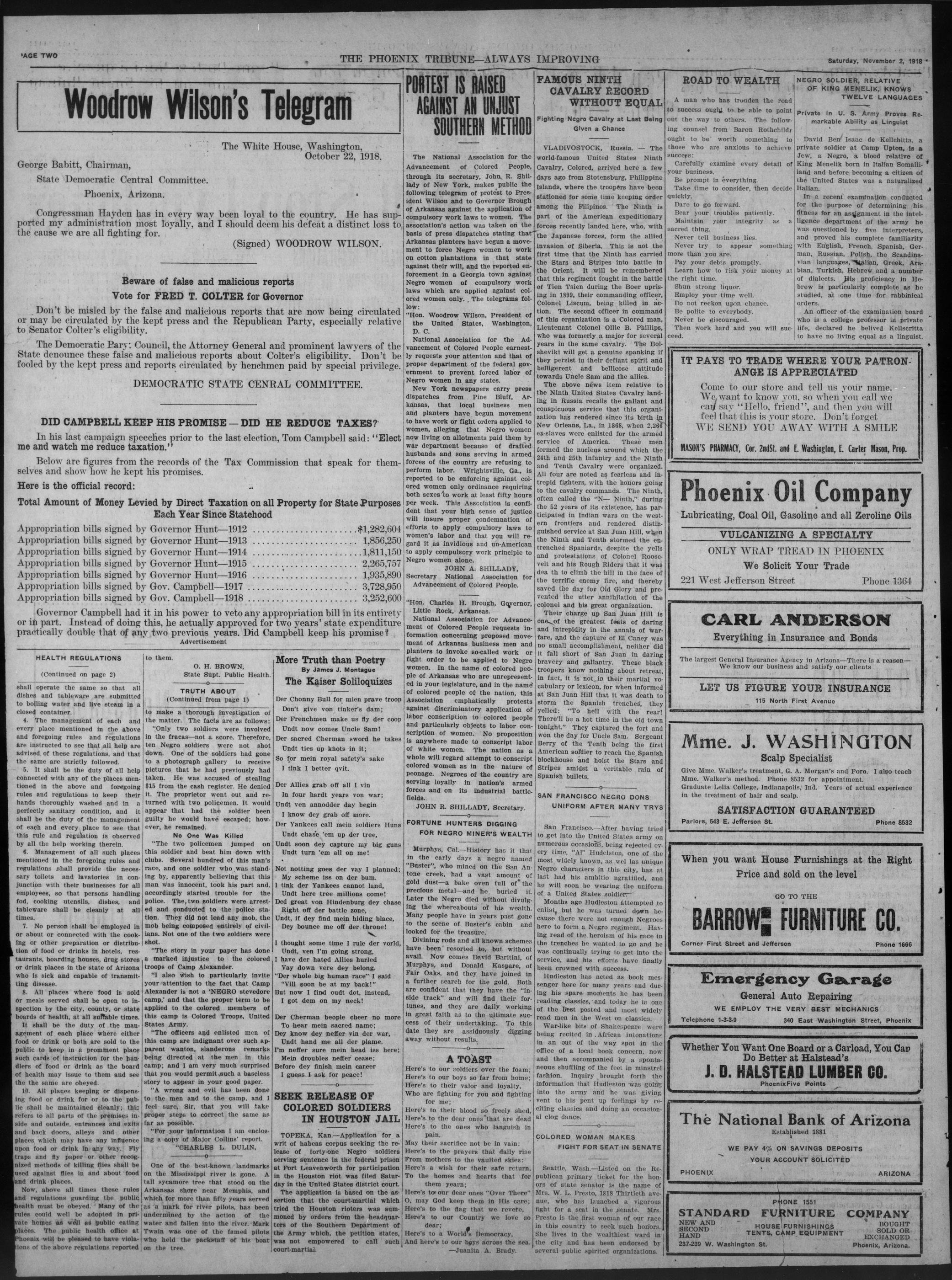
Woodrow Wilson’s Telegram
George Babitt, Chairman, Z
State Democratic Central Committee. e
Phoenix, Arizona. .
Congressman Hayden has in every way been loyal to the country. He has sur
ported my administration most loyally, and I should deem his defeat a distinct loss t
the cause we are all fighting for.
‘ (Signed) WOODROW WILSON.
Beware of false and malicious reports
Vote for FRED T. COLTER for Governor
Don’t be misled by the false and malicious reports that are now being circulated
or may be circulated by the kept press and the Republican Party, especially relative
to Senator Colter’s eligibility.
The Democratic Pary; Council, the Attorney General and prominent lawyers of the
State denounce these false and malicious reports about Colter’s eligibility.. Don’t be
fooled by the kept press and reports cireulated by henchmen paid by special privilege.
DEMOCRATIC STATE CENRAL COMMITTEE.
DID CAMPSELL KEEP HIS PROMISE— DID HE REDUCE TAXES?
In his last campaign speeches prior to the last election, Tom Campbell said: ‘Elect
me and watch me reduce taxation.’’
Below are Spires from the records of the Tax Commission that speak for them-
selves and show how he kept his promises.
Here is the official record: “
Total Amount of Money Levied by Direct Taxation on all Property for State Purposes
Each Year Since Statehood |
Appropriation bills signed by Governor Hunt—1912 ..................... 81,282,604
Appropriation bills signed by Governor Hunt—1913 ................-.2.05 1856250
Appropriation bills signed by Governor Hunt—1914 ........................1,811,150
Appropriation bills signed by Governor Hunt—1915 ...... geet eeteeeeeee + BpQO0;100
Appropriation bills signed by Governor Hunt—1916 ...................... 1,935,890
Appropriation bills signed by Gov. Campbell—1917 .............0.2.....2.. 8,728,950
Appropriation bills signed by Goy. Campbell—1918 ..................+++.+ 3,252,600)
Governor Campbell had it in his power to veto any appropriation bill in its entiret, y
or in part. Instead of doing this, he actually approved for two years’ state expenditure
practically double that of any two previous years. Did Campbell keep his promise?
‘AGE TWO
HEALTH REGULATIONS
(Continued on page 2)
shall operate the same so that all
dishes and tableware are submitted
‘to boiling water and live steam in a
closed container.
4. The management of each and
every place mentioned in the above
and foregoing rules and regulations
are instructed to see that all help are
advised of these regulations, and that
the same are strictly followed.
5. It shall be the duty of all help
connected with any of the places men-
tioned in the above and foregoing
Tules and regulations to keep their
hands thoroughly washed and in a
perfectly sanitary condition, and it
shall be the duty of the management
of each and every place to see that
this rule and regulation is observed
by all the help working therein.
6. Management of all such places
mentioned in the foregoing rules and
regulations shall provide the neces-
sary toilets and lavatories in con-
junction with their businesses for all
employees, so that persons handling
fod, cooking utensils, dishes, and
tableware shall be cleanly at all
times,
7. No person shall be employed in
or about or connected with the cook-
ing or other preparation or distribu-
|tion of food or drinks in hotels, res-
taurants, boarding houses, drug stores
or drink places in the state of Arizona
who is sick and capable of transmit-
ting disease.
8. All places where food is sold
6r meals served shall be open to in-
spection by the city, county, or state
boards of health, at all sulfable cimes.
Mi shall be the duty of the man-
Agement of each place where either
food or drink or both are sold to the
‘public to keep in a promment place
such cards of instruction for the haw
diers of food or drink as the board
of health may issue to them and see
the the same are obeyed.
10. AM places keeping or dispens-
ing food or drink for or to the’ pub-
lic shall be maintained ¢leanly;. this
refers to all parts of the premises in-
side and outside, entrances and exits
and back doors, alleys and. other
places which may have any influence
japon food or drink ih any way. Ply
and fly paper or other recog-
methods of killing flies shall be
ased against flies in and about ‘food
drink places.
Now, above all times these rules
regulations guarding the public
alth must be obeyed. ‘ Many of the
ules could well be adopted in prit
homes a well ad public eating
jes. ‘The public health office at
will be pleased to have viola-
of the above regulations reported
The White House, Washington,
October 22, 1918.
0. H. BROWN,
State Supt. Public Health
ste ie ae
TRUTH ABOUT :
(Continied from page 1)
to make a thorough imvestigation of
the matter. The facts are as follows:
“Only two soldiers were involved
in the fracas—not a score, Therefore,
ten Negro soldiers were not shot
down, One of the soldiers had gone
to a photograph gallery to receive
Pictures that he had previously had
taken. He was accused of stealing
$15 from the cash register. He denied
it. The proprietor went out and re-
turned with two policemen. It would
appear that had the soldier been
guilty he would havé escaped; how-
ever, he remained.
No One Was Killed
“The two policemen jumped on
this soldier and beat him down with
clubs. Several hundred of this man’s
race, and one soldier who was stand-
ing by, apparently believing that this
man was innocent, took his part and,
accordingly started trouble for the
police. The, two soldiers were arrest-
ed and gonducted to the police sta-
tion, ‘They did not lead any mob, the
mob being composed entirely of civil-
ians. Not one of the two soldiers were
shot.
“The story in your paper has done
a marked injustice to the colored
troops of Camp Alexander.
“I also Wish to particularly invite
your/attention to the fact that Camp
Alexander is not a ‘NEGRO stevedore
camp,’ and that the proper term to be
applied to the colored members of
this camp is Colored Troops, United
States Army.
“The officers and enlisted men of
this camp are indignant over such ap-
parent wanton, slanderous remarks
being directed at the men in this
camp; and 1 am very much surprised
that you would permit such a baseless
story to appear in your good paper.
“A wrong and evil has been done
to the men and to the camp, and I
feel sure, Sir, that you will take
proper steps (o correct the same as
far as possible.
“For your information I am enclos-
ing 8 eopy of Major Collins’ report.
“@HARLES L. DULIN,
One of the best-known landmarks
on the Mississippi river is gone. A
tall sycamore tree that stood on the
Arkansas shore near Memphis, and
which for more than fifty years served
as “a mark for river pilots, has been
undermined by the action of the
water and fallen into the river. Mark
Twain was one of the famed pilote
who held the packstaft of his bout
on the tree.
THE PHOENIX TRIBUNE—ALWAYS IMPROVING
More Truth than Poetry
By James J. Montague
The Kaiser Soliloquizes
Der Chonny Bull for mien prave troop
Don’t give von tinker’s dam;
Der Frenchmen make us fly der coop
Undt now comes Uncle Sam!
Der sacred Cherman sword he takes
Undt ties up khots in it;
So for mein royal safety’s sake
I tink I better qvit.
Der Allies grab off all I vin
In four hardt years von war;
Undt ven annodder day begin
I know dey grab off more.
Der Yankees call mein soldiers Huns
Undt chase ‘em up der tree,
Undt soon dey capture my big guns
‘Undt turn ‘em all on me!
Not notting goes der vay I planned;
My scheme iss on der bum.
1 tink der Yankees cannot land,
Undt here tree millions come!
Ded great von Hindenburg dey chase
Right off der battle zone,
Undt, if dey find mein hiding blace,
Dey bounce me off der. throne!
XN
I thought some time I rule der vorld,
_ Undt, ven I'm going strong,
T have der hated Allies hurled
Vay down vere dey belong.
“Der whole big human race” I said
“Vill goon be at my back!”
But now I find oudt dot, instead,
I got dem on my neck!
Der Cherman beople cheer no more
To hear mein sacred name;
Dey know dey neffer vin der war,
Undt hand me all der plame.
I'm neffer sure mein head iss here;
Mein droubles neffer' cease;
Before dey finish mein career
I guess. ask for peace!
SEEK RELEASE OF
COLORED SOLDIERS
IN HOUSTON JAIL
TOPEKA, Kan—Application for a
writ of habeas corpus seeking the re-
lease of forty-one Negro soldiers
serving sentence in the federal prison
at Fort Leavenworth for participation
in the Houston riot was filed Satur-
day in the United States district court.
‘The application is based on the as-
sertion that the court-martial which
tried the Houston rioters was sum-
moned by orders from the headquar-
ters of the Southern Department of
the Army which, the petition states,
was not empowered to call such
court-martial,
PORTEST 1S RAISED
AGAINST AN UNJUST
SOUTHERN METHOD
‘The National Association for the
Advancement of Colored People,
through its secretary, John, R. Shil-
lady of New York, makes public the
following telegram of protest to Pres-
ident Wilson and to Governor Brough
of Arkansas against the application of
compulsory work laws to women. The
association’s action was taken on the
basis of press dispatches stating that
Arkansas planters have begun a move-
ment to force Negro women to work
on cotton plantations in that state
against their will, and the reported en-
forcement in a Georgia town against
Negro women of compulsory work
laws which are applied against col-
ored women only. . The telegrams fol-
low:
“Hon. Woodrow Wilson, President of
the United States, Washington,
D.C.
National Association for the Ad-
vancement of Colored People earnest.
ly requests your attention and that of
proper department of the federal gov-
ernment to prevent forced labor of
Negro women in any states.
New York newspapers carry press
dispatches from. Pine Bluff, Ar-
kansas, that local business men
and planters have begun movement
to have work or fight orders applied to
women, alleging that Negro women
now living on allotments paid them by
war department because of drafted
husbands and sons serving in armed
forces of the country are refusing to
perform labor. Wrightsville, Ga., is
reported to be enforcing against col-
ored women only ordinance requiring
both sexes ‘to work at least fifty hours
Per week. This Asscciation is confi-
dent that your high sense of justice
will insure proper condemnation of
efforts to apply compulsory laws to
women’s labor and that you will re-
gard it as invidious and un-American
to apply compulsory work principle to
Negro women alone.
JOHN A. SHILLADY,
Secretary National Association for
Advancement of Colored People.
“Hon. Charles H. Brough, Gqyernor,
Little Rock, Arkansas.
National Association for Advance-
ment of Colored People requests in
formation concerning proposed move:
ment of Arkansas business men and
Planters to invoke so-called work or
fight order to be applied to Negro
women. In the name of colored peo
ple of Arkansas who are unrepresent.
ed in your legislature, and in the namé
of colored people of the nation, this
Association emphatically _ protests
against discriminatory application of
labor conscription to colored people
and particularly objects to labor con
scription of women, No proposition
is anywhere made to conscript labor
of white women. The nation as a
whole will regard attempt to conscript
colored women as in the nature of
Peonage. Negroes of the country arc
serving loyally in nation's armed
forces and on its industrial battle
tields.
JOHN R. SHILLADY, Secretary.
FORTUNE HUNTERS DIGGING
FOR NEGRO MINER'S WEALTH
Murphys, Cal.—History has it that
in the early days a negro named
“Buster”, who mined on the Sen An-
tone creek, had a vast amount ot
gold dust—a bake oven full of* the
Precious metal—and he buried it.
Later the Negro died without divalg.
ing the whereabouts of his wealth.
Many people have in years past gone
to the scene of Buster’s eabin and
looked for the treasure,
Divining rods and all known schemes
have been’ resorted to, but without
avail. Now comes David Baritini, of
Murphys, and Donald Kaspare, of
Fair Oaks, and they have joined in
a further search for the gold. Both
are confident that they have the “in-
side track” and will find their for.
tunes, and they are daily working
in great faith as to the ultimate suc-
cess of their undertaking. To this
date they are assiduously digging
away without results.
a ee
A TOAST
Here's to our soldiers over the foam;
Here's to our boys so far from home;
Here's to their valor and loyalty,
Who are fighting for you and fighting
for me; -
Here's to their blood so freely shed,
Here's. to the dear onos"that are dead
Here's to the ones who languish in
pain,
May their sacrifice not be in vain:
Here's to the prayers that daily rise
From mothers to the vaulted skies:
Here's a wish for their safe roturn,
To the homes and hearts that for
them yearn;
Here's tor our dear ones “Over There”
O, may God keep them in His care;
Here's to the flag that we reveto,
Here’s to our Country we love so
dear;
Here's to a World's Democracy,
And here's to our bgys across the sea.
Juanita “A. Brady.
FAMOUS NINTH
CAVALRY RECORD
WITHOUT EQUAL
Fighting Nagre Cavalry at Last Being
Given a Chance
VLADIVOSTOCK, Russia, — The
world-famous United States Ninth
Cavalry, Colored, arrived here a few
days ago from Stotensburg, Philippine
Islands, where the troopers have beon
stationed for some time keeping order
among the Filipinos. The Ninth is
part of the American expeditionary
forces recently landed here, who, with
the Japanese forces, form the allied
invasion of Siberia. This is not the
first time that the Ninth has carried
the Stars and Stripes into battle in
the Orient. It will be remembered
that this regiment fought in the battle
of Tien Tsien during the Boer upris-
ing in 1899, their commanding officer,
Colonel Liscum, being killed in ac-
tion, ‘The second officer in command
of this organization is a Colored man,
Lieutenant Colonel Ollie B. Phillips,
who was formerly a major for several
years in the same cavalry. The Bol-
sheviki will get a genuine spanking if
they persist in their defiant spirit and
belligerent and bellicose attitude
towards Uncle Sam and the allies.
The above néws item relative to
the Ninth United States Cavalry land-
ing in Russia recalls the gallant and
conspicuous service that this organi-
zation has rendered since its birth fe
New Orleans, La., in 1868, when 2,26
exslaves were enlisted for the armed
service of America. These men
formed the nucleus around which the
24th and 25th Infantry and the Ninth
and Tenth Cavalry were organized.
All four are noted ag fearless and in-
trepid fighters, with the honors going
to the cavalry commands. ‘The Ninth,
often called the “N— Ninth,” during
the 52 years of its existence, has par-
ticipated in Indian wars on the west-
em frontiers and rendered distin-
guished service at San Juan Hill, when
‘the Ninth and Tenth stormed the en-
trenched Spaniards, despite the yells
and protestations of Colonel Roose-
velt and his Rough Riders that it was
dea th to climb the hill in the face of
the terrific enemy fire, and thereby
saved (ae day fov Old Glory and pre-
‘vented the utter annihilation of the
colonel and his great organization.
‘Their charge up San Juan Hill is
one_of the greatest feats of daring
and intrepidity in the annals of Wwar-
fare, and tho capture of Hl Caney was
no small accomplishment, neither did
it fall short of San Juan in daring
bravery and gallantry. ‘These black
troopers know nothing about retreat,
in fact, it is not_in their martial yo-
cabulary or lexicon, for when informed
at San Juan Hill that it was death to
storm the Spanish trenches, they
yelled: “To hell with the rear!
There'll be a hot time in the old town
tonight.” ‘They captured the fort and
won the day for Uncle Sam. Sergeant
Berry of the Tenth being the first
American soltiier to reach the Spanish
dlockhouse and hoist the Stars and
Stripes amidst a veritable rain of
Spanish bullets,
SAN FRANCISCO NEGRO DONS
UNIFORM AFTER MANY TRYS
San Franciseo.—After having tried
to get into the United States army on
numerous occasions, being rejected cv-
ery time, “Al” Hudelston, one of the
most widely known, as wel las unique
Negro characiers in this city, has at
last had his ambitio ngratified, and
he will soon be wearing the uniform
of a United States soldier
Months ago Hudleston attempted to
enlist, but he was turned down. be-
cause there were not enough Negroes
here to form a Negro regiment. Hay-
‘ing read of the heroism of his race in
the trenches he wanted to go and he
‘was continually trying to get into the
service, and his efforts have finally
been crowned with success.
Hudieston has acted as book mes-
senger here for many years and dur-
ing his spare moments he has been
reading classics,"and today he is one
of the Dest posted and most widely
read men in the West on classics.
Wardike bits of Shakespeare were
being recited in. African intonation:
in an out of the way spot in the
office of a local book concern, now
and then accompanied by a sponta-
neous shuffling of the feet in minstrel
fashion. Inquiry brought forth the
information that Hudieston was gots
into the army and he was giving
vent to his pent up feelings by re-
citing classies and doing an occasion-
al clog dance.
COLORED WOMAN MAKES
FIGHT FOR SEAT IN SENATE
Seattle, Wash—Listed on the Re-
Publican primary ticket for the hon-
ors of state senator is the name of
Mrs. W. L.. Presto, 1818 Thirtieth ave-
nue, who has launched a vigorous
fight for a seat in the senate. Mrs,
Presto is the first woman of our race
in this country to seek ‘such honors,
She lives in the wealthiest ward in:
the city and has been endorsed by
several public spirited organizations.
IT PAYS TO TRADE WHERE YOUR PATRON-
ANGE IS APPRECIATED
Come to our store and tell us your name.
‘We want to know von, so when you call we
car say “Hello, friend”, and then yon will
feel that this is your store. Don’t forget
WE SEND YOU AWAY WITH A SMILE
MASON'S PHARMACY, Cor. 2ndSt. and E. Washington, £. Carter Mason, Prop.
Phoenix: Oil Company
Lubricating, Coal Oil, Gasoline and all Zeroline Oils
VULCANIZING A SPECIALTY
ONLY WRAP TREAD IN PHOENIX
We Solicit Your Trade
221 West Jefferson Street Phone 1364
CARL ANDERSON |
Everything in Insurance and Bonds
The largest General Insurance Agency in Arizona—There is a reason—
We know our business and satisfy our clients
LET US FIGURE YOUR INSURANCE
_ 115 North First Avenue
Mme. J. WASHINGTON
Scalp Specialist
Give Mme, Walker's treatment, G. A. Morgan's and Poro. 1 algo teach
Mme. Walker's method. Phorie 8532 for appointment.
Graduate Lelia College, Indianapolis; Ina. Years of actual experience
in the treatment of hair and scalp,
SATISFACTION GUARANTEED
Parlors, 543 E. Jefferson St. Phone 8532
When you want House Furnishings at the Right
Price and sold on the level
. GO TO THE
BARROWS FURNITURE CO,
Corner First Street and Jefferson ‘ Phone 1666
Emergency Garage
General Auto Repairing
WE EMPLOY THE VERY BEST MECHANICS
Telephone 1-3:3.9 340 East Washington Street, Phoenix
a
oR
Whether You Want One Board or a Carload, You Cap
Do Better at Halstead’s
J. D. HALSTEAD LUMBER CO.
E PhoenixFive Points ’
The National Bank of Arizona
Established 1881
WE PAY 4% ON SAVINGS DEPOSITS
is YOUR ACCOUNT SOLICITED
PHOENIX ‘ ARIZONA
SS
PHONE 1551
STANDARD FURNITURE COMPANY
NEW AND - | BOUGHT
SECOND TENTS, CAMP EGUIFMENT |. SOLD OB
287.239 W. Washington St. Phoenix, Arizona.
— oe eee ih
ROAD TO WEALTH {
A man who has troaden the toad
#6 success oughj to.be able to point
out the way to others. The follow.
ing counsel from Baron Rothchildy
ought to be’ worth something to
those who are anxious to achicve
suecegs:
Carefully examine every detail of
your business,
Be prompt in éverything.
‘Take time to consider, then decide
quickly,
Dare to go forward.
Bear your troubles patiently.
Maintain your integrity as
sacred thing.
Never tell business lies.
Never try to appear something
more than you are. :
Pay. your debts promptly.
Learn how to risk your money at
the right time,
Shun strong liquor,
Employ your time well.
Do not reckon upon chance.
Be polite to everybody.
Never be discouraged.
‘Then work hard and you will suc
ceed.
Saturday, November 2, 1918”
y ey $$
NEGRO SOLDIER, RELATIVE
OF KING MENELIK) KNOWS,
TWELVE LANGUAGES
Private in U. 8. Army Proves. Re.
markable Ability as Linguist
David Ben! Isaac de ‘Kellehitta, a
private soldier at Camp Upton, is a
Jew, a Negro, a blood relative of
King Menelik born in Italian Somaili-
land and before becoming a citizen of
the United States was a naturalized
Italian.
Ina recent examination. conducted
for the purpose of determining his
fitness for an asajgnment in the intel-
ligence department of the army he
was questioned by five interpreters,
and proved his complete familiarity
with English, French, Spanish, Ger-
man, Russian, Polish, the Scandina-
vian languages, “Malian, Greek, Ara-
bian, Turkish, Hebrew and a number
of dialects. 4is proficiency in He-
brew is particularly complete as he
‘studied, at one time for rabbinical
orders.
An officer of the examination board
who is a college professor in private
life, declared he belived Keliseritta
to have no living equal as a linguist.
Food Administration to Continue Assurance $15.50 for Fall Hogs
Saturday, November 2, 1913
Food Administrator
Assurance $150
Herbert Hoover, food administrator
was written the following letter to H.
C. Stuart, chairman of the Agricultural Advisory Board, in response to
the recommendations of the board
with regard to the maintenance of hog prices;
"Dear Gov. Stuart—I am extremely obliged for the helpful and intelligent recommendations of the committee. I wish to say for the Food Administration that so far as we are able we will continue the assurance of a minimum $15.50 per hundred for average of packers' drives at Chicago for hogs farrowed this fall. We can reconsider the outlook in a few months as to the extension of this again to spring farrowing. I have myself little doubt that we will be able to continue. I do want it made clear in all these matters of price influence by the government that this is not a guaranty—it is a policy, and this policy will only be defeated by some unlooked for interruption in distribution transportation or consumption—a risk of war we must all take.
"The criticism has been made that in changing the formula from 'cost of corn to be fed to the hogs' to the 'farm value' or farmers' 'selling value at country stations' has the effect of an advance to the farmer, as it realizes to him the profit on corn production as well as the profit between the normal amount of corn fed to hogs and the higher ratio here adopted, and that the calculation of hogs at Chicago only partly compensates this. I am not, however, disposed to quarrel with just profits to the farmer, and in any event the application of such formulas must be rough and ready, and designed to attain their real end—justice and the stimulation of production
"The Food Administration has systematic independent information on the actual prices paid for corn at country stations through its cereal division, and we must necessarily use this information in conjunction with information collected by the Department of Agriculture.
"We have carried out an inquiry as to which really are the eight leading hog and corn-producing states for a basis of these calculations. We examined the question from various standpoints—production of both items upon a square-mile basis, upon per capita basis of population, upon simple state production and for different years. Under these tests Iowa, Illinois, Indiana, Ohio, Nebraska and Missouri—six states—fall into every basis of cal-
VOTE FOR
THE MAN!
THOMAS E. CAMPBELL'S DECLARATION OF AMERICANISM
(Issued Last April)
I stand by the President.
There is no issue but the war.
There must be no catering to traitors.
I detest the I. W. W. and their doctrines.
The people of the United States are waging this war.
I am not in sympathy with the strike breeder and agitator.
I am not in sympathy with the profiteer.
The logical method of adjusting labor differences is arbitration.
We should punish purveyors of enemy propaganda and advocates of sabotage as felons.
Every able bodied man should be compelled by law to work at some useful calling.
We must run down and stamp out the enemy within our gates and crush his ally, the I. W. W.
Put Arizona Squarely Behind the Government—
Elect Tom Campbell
(Campbell Victory League)
ulation. Of the others it is difficult o decide. From different aspects, Minnesota, South Dakota, Texas and 'ennessee all enter for the other two in fact, the committee was referring o the 'corn belt,' of which Texas lies outside and only, has place here by heer size. From various aspects it appears to me that everyone would agree that South Dakota and Minnesota more nearly conform to the committee's definition than any other, specially if we 'weight' the relative factors. I have, therefore, adopted these states.
"In accordance with the committee's recommendation we will issue instructions to the packing firms, about 50 in number, who participate in controlled orders, effecting so far as these orders will go the stabilization of price on these lines.
"You will recognize that this should be effective as long as the controlled orders dominate the market. If they fall short of this it will be necessary to rely upon the packers carrying in stock any surplus pending absorption by the controlled orders or general consumption.
"This was accomplished last winter under difficulties, and a break below the minimum was prevented.
"Faithfully yours,
(Signed) "HERBERT HOOVER.
"The Hon. Henry C. Stuart, Department of Agriculture, Washington, D. C."
The Agricultural Advisory Board's recommendations were embodied in a report of a special subcommittee made public last Thursday. This committee's report was as follows:
The committee has been asked by the Agricultural Advisory Board to meet in conference with the Food Administration in consideration of the commercial methods to be pursued by the administration in the interpretation of the policy outlined on November 3 1917, with regard to the price of hogs, which was as follows:
"The prices, so far as we can effect them, will not go below a minimum of about $15.50 per hundred weight for the average of packers' droves on the Chicago market until further notice. * * * As to the hogs farrowed next spring (1918), we will try to stabilize the price so that the farmer can count on getting for each 100 pounds of hog ready for market, 13 times the average cost per bushel of corn fed into the hogs. Let there be no misunderstanding of this statement. It is not a guarantee backed by money. It is not a promise by the packers. It is a statement of the intention and policy of the Food Administration, which means to do justice to the farmer." The recommendations of the committee were.
(1) It is recognized that the Food Administration has no power to fix the price of hogs or corn, and can only influence the hog price so far as the volume of controlled orders for the army, navy, allies and export trade will absorb the surplus production. If prices should go so high as to curtail consumption at home and abroad, then in this event the stabilization of prices during the next winter would be likely to fall, with disaster to the producer. On the other hand, it must be recognized that the costs of production are necessarily greatly increased and that to maintain production fair returns must be assured to the farmer. It is, therefore, in the fundamental interest of the producer and consumer that both extreme high and low prices should be guarded against.
(2) In order to effectually carry out the above policy of the Food Administration, it is recommended that in dealing with the packer in respect to the coordinated purchase of pork products that directions should, if necessary, include a definite price basis in advance from month to month for the packers, purchase of hogs, upon which such orders will be based.
(3) It is recommended by the committee that the "average cost per bushel of corn" for the purpose of determining the price of hogs be considered as the average "farm value of corn," or the average selling price of corn at local railroad stations, as determined by the Department of Agriculture, and that the general corn figures may be arrived at by taking these averages and weighing them according to production over the eight leading hog and corn producing states for a period of five months preceding the month the hogs are marketed, or prior to the month for which the directions are given to the packers. The price of hogs should be calculated on the average packers' droves at Chicago.
(4) To illustrate: Based upon the prices of corn figured on the above basis during the last five months, and a general survey of market and consumption conditions, it was agreed that a fair price interpretation of the ratio for the month of October would be an average price, for the average of packers' droves, of about $18.50 per 100 pounds at Chicago. It can not be expected that the day to day market prices, with the fluctuating flow of demand and supply, can be maintained at any fixed and definite figures, but that it should be the aim to maintain about an average during
THE PHOENIX TRIBUNE-ALWAYS IMPROVING
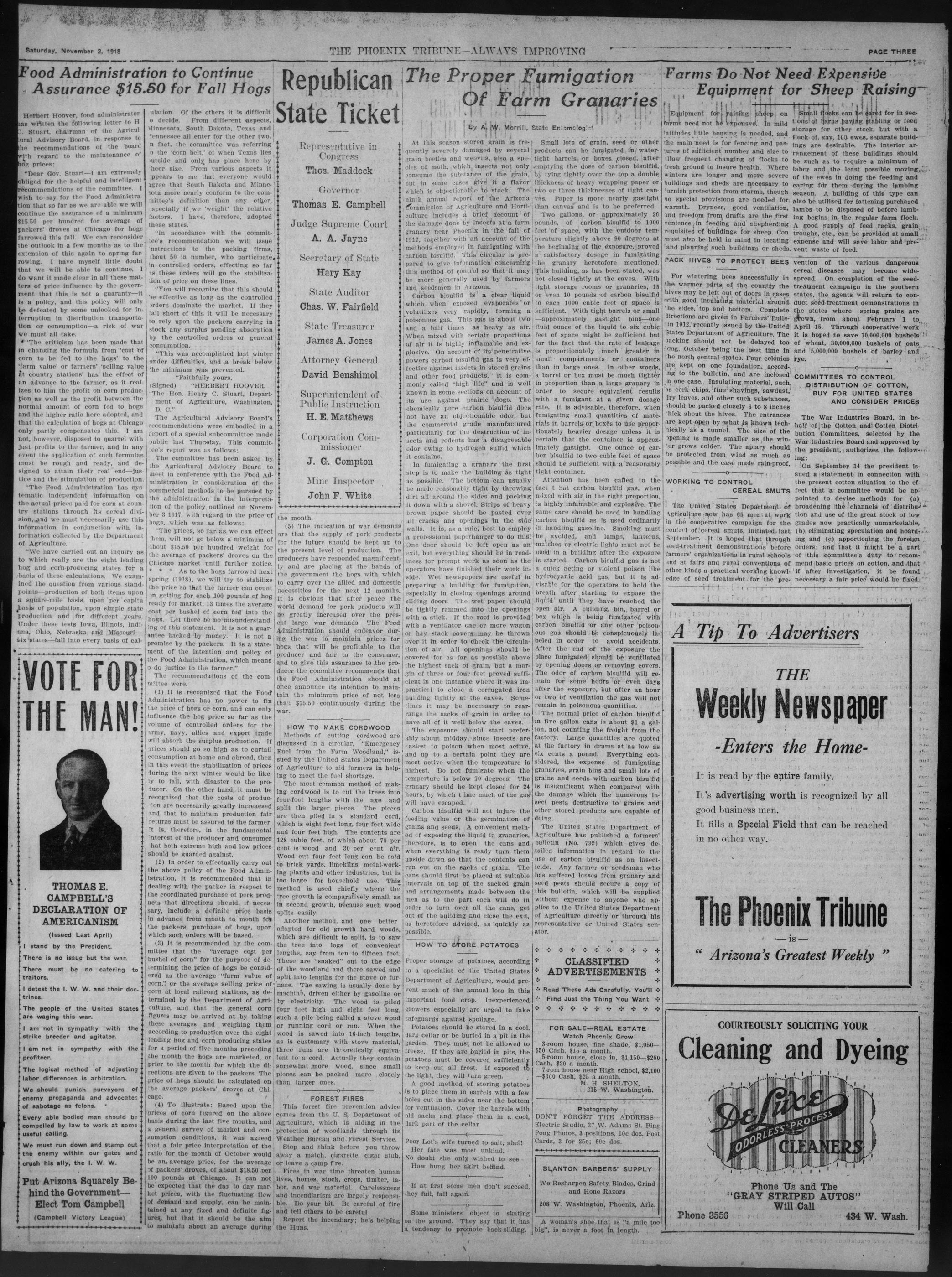
Republican State Ticket
Republican State Ticket
Representative in Congress
Thos. Maddock
Secretary of State
Hary Kay
State Auditor
Chas. W. Fairfield
State Treasurer
James A. Jones
Attorney General
David Benshimol
Superintendent of
Public Instruction
H. E. Matthews
Corporation Commissioner
J. G. Compton
Mine Inspector
John F. White
(5) The indication of war demands are that the supply of pork products for the future should be kept up to the present level of production. The producers have responded magnificently and are placing at the hands of the government the hogs with which to carry over the allied and domestic necessities for the next 12 months. It is obvious that after peace the world demand for pork products will be greatly increased over the present large war demands The Food Administration should endeavor during the war to maintain prices for hogs that will be profitable to the producer and fair to the consumer, and to give this assurance to the producer the committee recommends that the Food Administration should at once announce its intention to maintain the minimum price of not less than $15.50 continuously during the war.
HOW TO MAKE CORDWOOD Methods of cutting cordwood are discussed in a circular. "Emergency Fuel from the Farm Woodland," issued by the United States Department of Agriculture to aid farmers in helping to meet the fuel shortage.
The most common method of making cordwood is to cut the trees into four-foot lengths with the axe and split the larger pieces. The pieces are then piled in a standard cord, which is eight feet long, four feet wide and four feet high. The contents are 128 cubic feet, of which about 70 per cent is wood and 30 per cent air. Wood cut four feet long can be sold to brick yards, limestone, metal-working plants and other industries, but is too large for household use. This method is used chiefly where the tree growth is comparatively small, as in second growth, because such wood splits easily.
Another method, and one better adapted for old growth hard woods, which are difficult to split, is to saw the tree into logs of convenient lengths, say from ten to fifteen feet. These are "snaked" out to the edge of the woodland and there sawed and split into lengths for the stove or furnace. The sawing is usually done by machin$, driven either by gasoline or by electricity. The wood is piled four feet high and eight feet long, such a pile being called a stove wood or running cord or run. When the wood is sawed into 16-inch lengths, as is customary with stove material, three runs are theoretically equivalent to a cord. Actually they contain somewhat more wood, since small pieces can be packed more closely than larger ones.
This forest fire prevention advice comes from the U. S. Department of Agriculture, which is aiding in the protection of woodlands through its Weather Bureau and Forest Service.
Stop and think before you throw away a match, cigarette, cigar stub, or leave a camp fire.
Fires in war time threaten human lives, homes, stock, crops, timber, labor, and war material. Carelessness and incendiarism are largely responsible. Do your bit. Be careful of fire and tell others to be careful
Report the incendiar; he's helping the Huns.
The Proper Fumigation Of Farm Granaries
At this season stored grain is frequently severely damaged by several grain beetles and weevils, also a species of moth, which insects not only consume the substance of the grain, but in some cases give it a flavor which is objectionable to stock. The ninth annual report of the Arizona Commission of Agriculture and Horticulture includes a brief account of the damage done by insects at a farm granary near Phoenix in the fall of 1917, together with an account of the methods employed in fumigating with carbon bisulfid. This circular is prepared to give information concerning this method of control so that it may be more generally used by farmers and seedmen in Arizona.
Small lots of grain products can be f tight barrels, or b emptying the doses by tying tightly over thickness of heavy two or three thick vas. Paper is more canvas and i Two gallons, or pounds, of carbo feet of space, with perature slightly at the beginning of the a satisfactory dos the granary here This building, as h not closed tightly t tight storage room
Carbon bisulfid is a clear liquid which when exposed evaporates or volatilizes very rapidly, forming a poisonous gas. This gas is about two and a half times as heavy as air. When mixed with certain proportions of air it is highly inflammable and explosive. On account of its penetrative powers carbon bisulfid gas is very effective against insects in stored grains and other food products. It is commonly called "high life" and is well known in some sections on account of its use against prairie dogs. The chemically pure carbon bisulfid does not have an objectionable odor, but the commercial grade manufactured particularly for the destruction of insects and rodents has a disagreeable odor owing to hydrogen sulfid which it contains.
In fumigating a granary the first step is to make the building as tight as possible. The bottom can usually be made reasonably tight by throwing dirt all around the sides and packing it down with a shovel. Strips of heavy brown paper should be pasted over all cracks and openings in the side walls. It is, as a rule, best to employ a professional paperhanger to do this. One door should be left open as an exit, but everything should be in readiness for prompt work as soon as the operators have finished their work inside. Wet newspapers are useful in preparing a building for fumigation, especially in closing openings around sliding doors. The wet paper should be tightly rammed into the openings with a stick. If the roof is provided with a ventilator one or more wagon or hay stack covers may be thrown over it in order to check the circulation of air. All openings should be covered for as far as possible above the highest sack of grain, but a margin of three or four feet proved sufficient in one instance where it was impractical to close a corrugated iron building tightly at the eaves. Sometimes it may be necessary to rearrange the sacks of grain in order to have all of it well below the eaves.
The exposure should start preferably about midday, since insects are easiest to poison when most active, and up to a certain point they are most active when the temperature is highest. Do not fumigate when the temperature is below 70 degrees. The granary should be kept closed for 24 hours, by which t time much of the gas will have escaped.
Carbon hisulfid will not injure the feeding value or the germination of grains and seeds. A convenient method of exposing the liquid in granaries, therefore, is to open the cans and when everything is ready turn them upside down so that the contents can run out on the sacks of grain. The cans should first be placed at suitable intervals on top of the sacked grain and arrangements made between the men as to the part each will do in order to turn over all the cans, get out of the building and close the exit, as heretofore advised, as quickly as possible.
Proper storage of potatoes, according to a specialist of the United States Department of Agriculture, would prevent much of the annual loss in this important food crop. Inexperienced growers especially are urged to take safeguards against spoilage. Potatoes should be stored in a cool, dark cellar or be buried in a pit in the garden. They must not be allowed to freeze. If they are buried in pits, the potatoes must be covered sufficiently to keep out all frost. If exposed to the light, they will turn green. A good method of storing potatoes is to place them in barrels with a few holes cut in the sides near the bottom for ventilation. Cover the barrels with old sacks and place them in a cool, lark part of the cellar
Poor Lot's wife turned to salt, alas!
Her fate was most unkind.
No doubt she only wished to see
How hung her skirt bellind.
If at first some men don't succeed,
they fail, fall again.
Some ministers object to skating
on the ground. They say that it has
a tendency to promote back-sliding.
Small lots of grain, seed or other products can be fumigated in water-tight barrels or boxes closed, after emptying the dose of carbon bisulfid, by tying tightly over the top a double thickness of heavy wrapping paper or two or three thicknesses of tight canvas. Paper is more nearly gastight than canvas and is to be preferred.
Two gallons, or approximately 20 pounds, of carbon bisulfid to 1000 feet of space, with the outdoor temperature slightly above 90 degrees at the beginning of the exposure, proved a satisfactory dosage in fumigating the granary heretofore mentioned. This building, as has been stated, was not closed tightly at the eaves. With tight storage rooms or granaries, 15 or even 10 pounds of carbon bisulfid to each 1000 cubic feet of space is sufficient. With tight barrels or small—approximately gastight bins—one fluid ounce of the liquid to six cubic feet of space might be sufficient but for the fact that the rate of leakage is proportionately much greater in small compartments or containers than in large ones. In other words, a barrel or box must be much tighter in proportion than a large granary in order to secure equivalent results with a fumigant at a given dosage rate. It is advisable, therefore, when fumigating small quantities of materials in barrels or boxes to use proportionately heavier dosage unless it is certain that the container is approximately gastight. One ounce of carbon bisulfid to two cubic feet of space should be sufficient with a reasonably tight container.
Attention has been called to the fact that carbon bisulfid gas, when mixed with air in the right proportion, is highly infamable and explosive. The same care should be used in handling carbon bisulfid as is used ordinarily in handling gasoline. Smoking must be avoided, and lamps, lanterns, matches or electric lights must not be used in a building after the exposure is started. Carbon bisulfid gas is not a quick acting or violent poison like hydrocyanic acid gas, but it is advisable for the operators to hold the breath after starting to expose the liquid until they have reached the open air. A building, bin, barrel or box which is being fumigated with carbon bisulfid or any other poisonous gas should be conspicuously labeled in order to avoid accidents. After the end of the exposure the place fumigated should be ventilated by opening doors or removing covers. The odor of carbon bisulfid will remain for some hours or even days after the exposure, but after an hour or two of ventilation the gas will not remain in poisonous quantities.
The normal price of carbon bisulfid in five gallon cans is about $1 a gallon, not counting the freight from the factory. Large quantities are quoted at the factory in drums at as low as six cents a pound. Everything considered, the expense of fumigating granaries, grain bins and small lots of grains and seeds with carbon bisulfid is insignificant when compared with the damage which the numerous insect pests destructive to grains and other stored products are capable of doing.
The United States Department of Agriculture has published a farmers' bulletin (No. 799) which gives detailed information in regard to the use of carbon bisulfid as an insecticide. Any farmer or seedsman who has suffered losses from granary and seed pests should secure a copy of this bulletin, which will be supplied without expense to anyone who applies to the United States Department of Agriculture directly or through its representative or United States senator.
CLASSIFIED ADVERTISEMENTS
Read These Ads Carefully. You'll
Find Just the Thing You Want
FOR SALE—REAL ESTATE
Watch Phoenix Grow
3-room house, fine shade, $1,050—
$50 Cash, $15 a month.
5-room house, close in, $1,150—$200
Cash, $20 a month.
7-room house near High school, $2,100
—$300 Cash, $25 a month.
M. H. SHELTON,
215 W. Washington.
Photography
DON'T FORGET THE ADDRESS—
Electric Studio, 37, W. Adams St. Ping
Pong Photos, 3 positions, 10c doz. Post
Cards, 3 for 25c; 60c doz.
BLANTON BARBERS' SUPPLY
We Resharpen Safety Blades, Grind
and Hone Razors
208 W. Washington, Phoenix, Ariz.
A woman's shoe that is "a mile too
big", is never a foot in length.
Farms Do Not Need Expensive Equipment for Sheep Raising
A Tip To Advertisers
THE
Weekly Newspaper
-Enters the Home-
It is read by the entire family.
It’s advertising worth is recognized by all good business men.
It fills a Special Field that can be reached in no other way.
The Phoenix Tribune
— is —
“Arizona’s Greatest Weekly”
COURTEOUSLY SOLICITING YOUR
Cleaning and Dyeing
Delixe
ODORLESS PROCESS
CLEANERS
Phone Us and The
“GRAY STRIPED AUTOS”
Will Call
Phone 3556
434 W. Wash.
Equipment for raising sheep on farms need not be expensive. In mild latitudes little housing is needed, and the main need is for fencing and pastures of sufficient number and size to allow frequent changing of flocks to fresh ground to insure health. Where winters are longer and more severe buildings and sheds are necessary to furnish protection from storms, though no special provisions are needed for warmth. Dryness, good ventilation, and freedom from drafts are the first venience, in feeding and shepherding requisites of buildings for sheep. Con must also be held in mind in locating and planning such buildings or sheds
PACK HIVES TO PROTECT BEES
For wintering bees successfully in the warmer parts of the country the hives may be left out of doors in cases with good insulating material around the sides, top and bottom. Complete directions are given in Farmers' Bulletin 1012, recently issued by the United States Department of Agriculture. The packing should not be delayed too long. October being the best time in the north central states. Four colonies are kept on one foundation, according to the bulletin, and are inclosed in one case. Insulating material, such as cork chips, fine shavings, sawdust, dry leaves, and other such substances, should be packed closely 6 to 8 inches thick about the hives. The entrances are kept open by what is known technically as a tunnel. The size of the opening is made smaller as the winter grows colder. The apiary should be protected from wind as much as possible and the case made rain-proof.
WORKING TO CONTROL CEREAL SMUTS
The United States Department of Agriculture now has 65 men at work in the cooperative campaign for the control of cereal smuts, initiated last September. It is hoped that through seed-treatment demonstrations before farmers' organizations in rural schools and at fairs and rural conventions of other kinds a practical working knowledge of seed treatment for the pre-
PAGE THREE
Small flocks can be cared for in sections of barns paying stabiling or feed storage for other stock, but with a fleck of, say, 100 ewes, separate buildings are desirable. The interior arrangement of these buildings should be such as to require a minimum of labor and the least possible moving, of the ewes in doing the feeding and caring for them during the lambing season. A building of this type can also be utilized for fattening purchased lambs to be disposed of before lambing begins in the regular farm flock. A good supply of feed racks, grain troughs, etc., can be provided at small expense and will save labor and prevent waste of feed.
vention of the various dangerous cereal diseases may become widespread. On completion of the seed-treatment campaign in the southern states, the agents will return to conduct seed-treatment demonstrations in the states where spring prains are grown, from about February 1 to April 15. Through cooperative work it is hoped to save 10,000,000 bushels of wheat, 30,000,000 bushels of oats and 5,000,000 bushels of barley and rye.
COMMITTEES TO CONTROL
DISTRIBUTION OF COTTON,
BUY FOR UNITED STATES
AND CONSIDER PRICES
The War Industries Board, in behalf of the Cotton and Cotton Distribution Committees, selected by the War Industries Board and approved by the president, authorizes the following:
On September 14 the president issued a statement in connection with the present cotton situation to the effect that a committee would be appointed to devise methods for (a) broadening the channels of distribution and use of the great stock of low grades now practically unmarketable, (b) eliminating speculation andoarding and (c) apportioning the foreign orders; and that it might be a part of this committee's duty to recommend basic prices on cotton, and that if after investigation, it be found necessary a fair price would be fixed.
* Arizona’s Greatest Weekly ae
A Phoenix, Arizona
Published Every Saturday by the Tribune Publishing Company
Ee | | Address ait Communications | to! the
° \ PHOENIX TRIBUNE
‘ P. 0, Box 1052, Phoenix, Arizona
: pee es
‘fintered as Second-Class Matter June 22, 1918, at the Postoffice at Phoenix,
“ ‘Arizona, under Act of March 3, 1879
Business Office, 928 East Jefferson Street
Mintiaging Walter eR Smith
: Subscription Rates—In Advance
Meee ee
* I I ihc Sa baa anes otter a esi tern se
ieee ee er ee ee
: Member National Negro Press Association
” Advertising Rates on Application
All Matter for Publication MUST be in our Office by Wednesday evening,
2 ‘ as We go to press on Thursday
. | SBE z
: PHOENIX, ARIZONA, SATURDAY, NOVEMBER 2, 1918.
‘The progress of civilization is due to the precedent breakers, the
brave,men and women who dared to be original, dared to step out of
the crowd and think and act for themselves.—Marden,
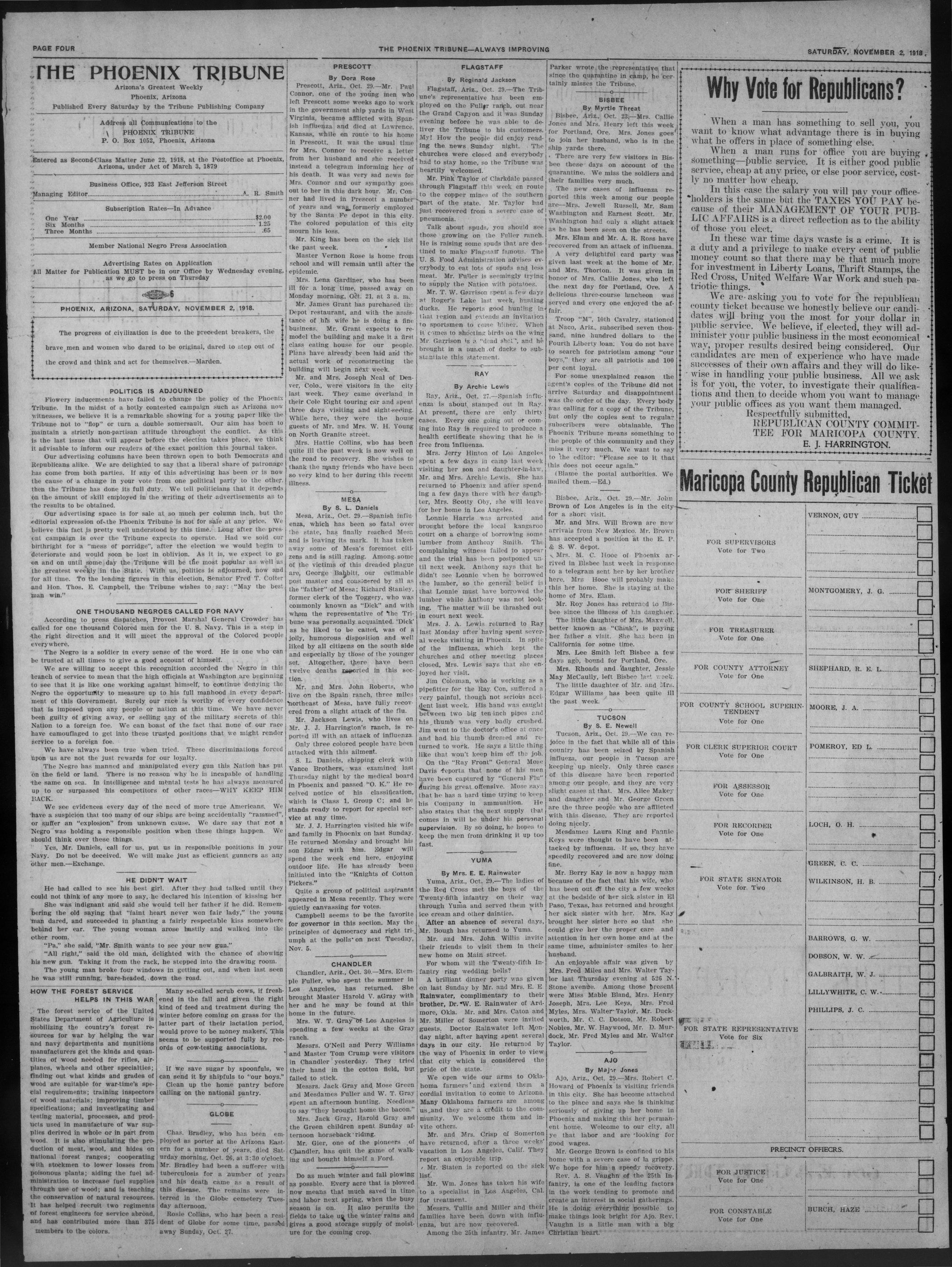
POLITICS IS ADJOURNED
Flowery inducements have failed to change the policy of the Phoenix
Tribune, In the midst of a hotly contested campaign such as Arizona now
witnesses, we believe it is a remarkable showing for a young paper like the
‘Tribune not to “flop” or turn a double somersault, Our aim has been to
Jwaintain a strictly non-partisan attitude throughout the conflict. As this
ds the last issue that will appear before the election takes place, we think
it advisable to inform our readers of ‘the exact position this journal takes.
Our advertising columns have been thrown open to both Democrats and
Republicans alike. We are delighted to say that a liberal share of patronage
has come from both parties. If any of this advertising has been or is now
the cause of 'a change in your vote from one political party to the other,
then the ‘Tribune has done its full duty. We tell politicians that it depends
on the amount of skill employed in the writing of their advertisements as to
the results to be obtained. i
Our advertising space is for sale at so much per column inch, but the
editorial expression of-the Phoenix Tribune is not for sale at any price. We
believe this fact is pretty well understood by this time». Long after the pres-
ent campaign is over the Tribune expects to operate. Had we soid our
birthright for a “mess of porridge”, after the election we would begin to
‘@eteriorate and would soon be lost in oblivion. As it is, we expect to go
‘on and on until some}day the Trijune will be the most popular as well as
the greatest weekly ‘in the State. With us, politics is adjourned, now and
for all time. To the leading figures in this election, Senator Fred T. Colter
and Hon. Thos. EB. Campbell, the Tribune wishes to, say: “May the best
man win.” ®
ONE THOUSAND NEGROES CALLED FOR NAVY 5
According to press dispatches, Provost Marsha! General Crowder has
called for one thousand Colored men for the U. S. Navy. This is a step in
the right direction and it will meet the approval of the Colored people
every where,
‘The Negro is a soldier in every sense of the word. He is one who can
be trusted at all times to give a good account of himself.
We are willing to accept this recognition accorded the Negro in this
Branch of service to mean that the high officials at Washington are beginning
to see that it is like one working against himself, to continue denying the
Negro the opporturity to measure up to his full manhood in every depart.
ment of this Government. Surely our race is worthy of every confidence
that is imposed upon any people or nation at this time. We have never
been guilty of giving away, or selling any of the military secrets of this
Nation to a foreign foe. We can boast of the fact that none of our race
have camouflaged to get into these trusted positions that we might render
Service to a foreign foe. e
We have always been true when tried. These discriminations forced
Uipon us are not the just rewards for our loyalty.
‘The Negro has manned and manipulated every gun this Nation has put
‘6n the field or land. ‘There is no reason why he is incapable of handling
‘the same on sea. In intelligence and mental tests he has always measured
up to or surpassed ‘his competitors of other races—WHY KEEP HIM
BACK,
We see evidences every day of the need of more true Americans, We
‘have a suspicion that too many of our ships are being accidentally “rammed”,
or suffer an “explosion” from unknown cause, We dare say that not a
‘Negro was holding a responsible position when these things happen, We
should think over these things.
Yes, Mr. Daniels, call for us, put us in responsible positions in your
Navy. Do not be deceived. We will make just as efficient gunners as any
‘other men.—Exchange. ‘
< HE DIDN’T WAIT
He had called to see his best girl. After they had talked until they
could not think of any more to say, he declared his intention of kissing her
She was indignant and said she would tell her father if he did. Remem-
‘Dering the old saying that “faint heart never won fair lady,” the young
‘man dared, and succeeded in planting a fairly respectable kiss somewhere
behind her ear. The young woman arose hastily and walked into the
other room,
“Pa,” she said, “Mr. Smith wants to see your new gun.”
“All right,” said the old man, delighted with the chance of showing
his new gun. ‘Taking it from the rack, he stepped into the drawing room.
‘The young man broke four windows in getting out, and when last seen
ho was stil! running, bare-headed, down the road.
HOW THE FOREST SERVICE Many so-called scrub cows, if fresh-
HELPS IN THIS WAR|ened in the fall and given the right
The forest service of the United
States Department of Agriculture is
mobilizing the country’s forest re-
‘Sources for war by helping the war
and navy departments and munitions
manufacturers get the kinds and quan-
tities of wood needed for rifles, air-
planes, wheels and other specialties;
finding out what kinds and grades of
‘wood are suitable for war-time’s spe-
cial requirements; training inspectors
of wood materials; improving timber
Specifications; and investigating and
testing material, processes, and prod-
‘ucts used in manufacture of war sup-
plies derived in whole or in part from
wood. It is also stimulating the pro-
duction of meat, wool, and hides on
National forest ranges; cooperating
‘with stockmen to lower losses from
‘Poisonous plants; aiding the fuel ad-
‘ministration to increase fuel supplies
‘through use of wood; and is teaching
the conservation of natural resources.
‘It has helped recruit. two regiments
of forest engineers for service abroad,
and has contributed more than 375
members to the colors.
PAGE FOUR
Many so-called scrub cows, if fresh-
ened in the fall and given the right
kind of feed and treatment during the
winter before coming on grass for the
latter part of their lactation period,
would prove to be money makers, This
seems to be supported fully by rec-
ords of cow-testing associations,
beanie ts)
It We save sugar by spoonfuls, we
can send it By shipfuls to “our boys.”
Clean up the home pantry before
calling on the national pantry.
Chas, Bradley, who has been em
Ployed as porter at the Arizona Hast.
ern for a number of years, died Sat
urday morning, Oct. 26, at 3:20 o'clock
Mr. Bradley had been a sufferer with
tuberculosis for a aumber of year:
and his death came as a result o
this disease. ‘The remains were in
terred in the Globe cemetery Tues
day afternoon,
Rosie Collins, who has been a resi
dent of Globe for some time, passtd
away Sunday, Oct, 27,
GLOBE
THE PHOENIX TRIBUNE—ALWAYS IMPROVING
PRESCOTT
twin Mana
| Prescott, Ariz., Oct. 29.—Mr. Paul
Connor, one of the young imen who
left Prescott some weeks ago to work
in the government ship yards in Wesi
‘Virginia, became afflicted with Span-
ish influenza and died at Lawrence,
eats while en route to his home
in Prescott, It was the usual time
for Mrs. Connor to receive a letter
from her husband and she received
instead a telegram informing her of
his death. It was very sad news for
Mrs. Connor and our sympathy goes
out to her in this dark hour. Mr. Con-
ner had lived in Prescott a number
of years and wag, formerly employed
by the Santa Fe depot in this city.
The colored population of this city
mourn his loss.
Mr. King has been on the sick list
the past week. e
Master Vernon Rose is home from
school and will remain until after the
epidemic,
Mrs. Lena Gardiner, who has been
ill for a long time, passed away on
Monday morning, O@t. 21, at 3 a. m.
Mr. James Grant has purchased the
Depot restaurant, and with: the assis-
tance of his wife he is doing a fine
business. Mr. Grant expects to re-
model the building and make it a first
class eating house for our people.
Plans have already been laid and the
aetual work of reconstructing — the
building will begin néxt week.
Mr. and Mrs. Joseph Neal of Den-
ver, Colo., were visitors in the city
last week. They came overland in
their Cole Eight touring car and spent
three days visiting and sightseding.
While here, they were the house
guests of Mr. and Mrs. W. H. Young
‘on North Granite street.
(Mrs. Hattie Collins, who has been
quite Ml the past week is now well on
the road to recovery. She wishes to
thank the many friends who have been
so very kind to her during this recent
illness.
MESA
By S. L. Daniels
Mesa, Ariz., Oct. 29.—Spanish influ-
enza, which has been so fatal over
the state, hag finally reached Mesa
and is leaving its mark. It has taken
away some of Mesa’s foremost citi
zens and is still raging. Among.some
of the victims of this dreaded plague
are, George Babbitt, our estimable
post master and considered by all as
the “father” of Mesa; Richard Staniey,
former clerk of the Toggery, who was
commonly known as “Dick” and with
whom the representative of the Tri-
Dune was personally acquainted. "Dick
as he liked to be catted, was of a
jolly, humorous disposition and well
liked by all citizens on the south side
and especially by tliose of the younger
set. Altogether, there have been
twelve deaths geported in this sec-
tion.
Mr, and Mrs. John Roberts, who
live on the Spain ranch, three miles
northeast of Mesz, have fully recov-
cred from a slight attack of the flu.
Mr. Jackson Lewis, who lives on
Mr. J. J. Harrington’s ranch, is re-
ported ill with an attack of influenza.
Only three colored people have been
attacked with this ailment.
S. L. Daniels, shipping clerk with
Vance Brothers, was examined inst
Thursday night by the medical board
in Phoenix and passed “0. K.” He re-
ceived notice of his classification,
which is Class 1, Group C; and he
stands ready to report for special ser-
vice at any time.
Mr. J. J, Harrington visited his wife
and family in Phoenix on last Sunday.
He returned Monday and brought his
son Edgar with him. Sdgar will
spend the week end here, enjoying
outdoor life. He has already been
initiated into the “Knights of Cotton
Pickers.”
Quite a group of political aspirants
appeared in Mesa recently. They were
quietly canyassing for votes.
Campbell seems to be the favorite
for governor in this section. May the
principles of democracy and right tri
umph at the polls*on next Tuesday,
Nov. 5.
CHANDLER
Chandler, Ariz., Oct. 30.—Mrs, Etem
ple Fuller, who spent the summer in
Los Angeles, has returned, She
brought Master Harold V. aGray with
her and he may be found at this
home in the future.
Mrs. W. T. Gray“of Los Angeles is
spending a few weeks at the Gray
ranch.
Messrs. O'Neil and Perry Williams
and Master Tom Crump were visitors
in Chandler yesterday. They tried
their hand in the cotton field, but
failed to stick.
Messrs. Jack Gray and Mose Green
and Mesdames Fuller and W. T. Gray
spent an afternoon hunting. Neediess
to say “they brought home the bacon.”
Mrs. Jack Gray, Harold Gray and
the Green children spent Sunday af-
ternoon horseback riding.
Mr, Gier, one of the pioneers of
Chandler, has quit the game of walk
ing and bought himself a Ford.
Do as much winter and fall plowing
as possble. Every acre that is plowed
now means that much saved in time
and labor next spring, when the busy
season is on. It also permils the
fields to take ug the winter/rains and
gives a good storage supply of moist:
‘ure for the coming crop.
FLAGSTAFF
By Reginald Jackson
Flagstaff, Ariz., Oct. 29.—The Trib:
une’s representative has been em
ployed on the Pullgr rarigh, out near
the Grand Capyon and it'was Sunday
evening before he was able to de
liver the Tribune to his customers.
My! How the people did enjoy read
ing the news Sunday night. . The
churches were closed and everybody
had to stay home, so the Tribune was
heartily welcomed.
Mr. Pink Taylor of Clarkdale passed
through Flagstaff this week en route
to the copper mines of the southern
part of the state. Mr. Taylor had
just recovered front 2 severe case of
pneumonia.
Talk about spuds, you should see
those growing on the Fuller ranch.
He is raising some spuds that are des
tined to make Flagstatr famous. The
U. S, Food Administration advises ev-
erybody to eat lots of spuds and loss
meat. Mr. Fuller is seemingly trying
to supply the Nation with potatoes.
Mr. T. W. Garrison spent a few days
at Roger’s Lake last week, bunting
ducks. He reports good hunting in
that region and extends an invitation
to sportsmen to come hither, Whet
it comes to shdoting birds oa the wing
Mr. Garrison fs a “dead shot”, and hé
brought in a punch.of ducks to sub:
stantiate this statement.
RAY
ie Banhie Lewes
Ray, Ariz., Oct, 27.—Spanish influ-
enza is about, stamped out in Ray.
At present, there are only thirty
cases. Every one going out or com-
ing into Ray is required to produce a
health certificate showing that he is
free from influenza. k
Mrs. Jerry Hinton of Los Angeles
spent a few days in camp last week
visiting her son and daughter-indaw,
Mr. and Mrs. Archic Lewis. She has
returned to Phoenix and after spend
ing a few days there with her daugh-
ter, Mrs. Seotty Oby, she will leave
for her home in Los Angeles.
Lonnie Harris was arrested and
brought before the local kangaroo
court on a charge of borrowing some
lumber from Anthony Smith, ‘The
complaining witness failed to appear
and the trial has been postponed un
til next week, Anthony says that he
didn’t see Lonnie when he borrowed
the lumber, so the general: belief is
that Lonnie must have borrowed the
uate while Anthony was not look-
ing. The matter will be thrashed out
im court next week.
Mrs. J. A. Lewis returned to Ray
last Monday after having spent sever-
al weeks visiting in Phoenix. In spite
of the influenza, which kept the
churches and other meeting places
closed, Mrs. Lewis says that she en-
joyed her visit.
Jim Coleman, who is working as a
pipefitter for the Ray. Con, suffered a
very painful, though not serious acci
o~ last week. His hand was caught
between two big teninch pipes and
his_thumb was very badly crushed.
Jim went to the doctor's office at ence
and had his thumb dressed and re-
turned to work, He says a little thing
like that won't keep him off the job.
On the “Ray Front" General Mose
‘Davis feports that none of his men
‘gave been captured by “General Flu"
during his great. offensive. Mose says
‘that he has a hard time trying to keep
his Company in ammunition. He
also states that oe supply that
ate in will be uhder his persona!
supervision. By so doing, he hopes to
keep the men from drinking it up too
fast.
YUMA
By Mrs. E. E. Rainwater
Yuma, Ariz., Oct, 29.—The ladies of
the Red Cross met the boys of the
Twenty-fifth infantry on their way
through Yuma and served them with
ico cream and other dainties.
_ ‘After an absence of several days,
Mr. Bough has returned to Yuma.
Mr. and Mrs. John Willis invite
their friends to visit them In their
new home on Main street.
For whom will the Twenty-fifth In-
fantry ring wedding bells?
A brilliant dinner party was given
on last Sunday by Mr, and Mrs. E. E
Rainwater, complimentary to their
brother, Dr.*W. E. Rainwater of Ard:
more, Okla, Mr. and Mrs. Caton and
‘Mr. Miller of Somerton were inyited
guests, Doctor Rainwater left Mon-
day night, after having spent several
days in our city. He returnod by
the way of Phoenix in order to view
that city which is considered the
pride of the state.
| We open wide our arms to Okla
‘Thoma farmers*and extend them 4
cordial invitation to come to Arizona.
Many Oklahoma farmers are among
fas and they are a erédit to the com
munity. We welcome them and in-
vite others.
Mr. and Mrs, Grisp af Somerton
have returned, after a three weeks’
vacation in Los Angeles, Calif. They
report an enjoyable trip.
') Mr, ‘Staten is reported on the sick
list.
_ Mr. Wm, Jones has taken his wife
to & specialist in Los Angeles, Cal
for treatment.
Messrs, Tullis and Miller and their
families have been down with influ-
enza, but are how recovered. 7
- Among the 25th infantry, Mr. James
Parker wrote, the \representatiye that
since the quarantine in camp, he ‘cer-
tainly misses the Tribune.
Sr
BISBEE
By Myrtle Threat
| Bisbee, Ariz. Oct. 23;—Mrs. Callie
Jones and Mrs. Henry left this week
for Portland, Ore. Mrs. Jones goes
to join her husband, who is in the
ship yards there,
+ There are very few visitors in Bis-
bee these days on account of the
quarantine. We miss the soldiers and
their families very much.
‘The new cases of influenza re-
ported this week among our people
are—Mrs. Jewell Russell, Mr, Sam
Washington and Earnest Scott. Mr.
Washington had only a slight attack
as he has been seen on the streets.
_ Mrs, Elam and Mr. A. R. Ross have
recovered from an attack of influenza.
| A very delightful card party~ was
given last week at the home of Mr,
and Mrs. Thorton. It was given in
honor of Mrs, Callie Jones, who left
the next day for Portland, Ore. A
@elicious three-course luncheon was
served and every one enjoyed the af-
fair.
| Troop “M”, 10th Cavalry, stationed
at Naco, Ariz., subscribed seven thou-
sang, nine hundred dollars to the
Fourth Liberty loan; You do not have
to search for patriotism among “our
boys,” they are all patriotis and 100
ber cent loyal.
For some unexplained reason the
agent's copies of the Tribune did not
arrive Saturday and disappointment
was the order of the day. Every body
was calling for a copy of the Tribune,
but only tite copies sent to regular
subseribers were obtainable, The
Phoenix Tribune means something to
the people of this community and they
miss it very much. We want to say
to the editor: “Please see to it that
this does not occur again.”
(Blame the postal authorities. We
mailed them.—Ed.)
Bisbee, Ariz., Oct. 29.—Mr. Jobn
Brown of Los Angeles is in the city
for a short visit.
Mr. and Mrs, Will Brown are new
arrivals from New Mexico. Mr. Brown
has accepted a position at the B. P.
& S. W. depot.
\ Mrs. M. C. Hooe of Phoenix ar
rived in Bisbee last week in response
to a telegram sent her by her brother
here, Mrs Hove will probably make
this her home. She is staying at the
home of Mrs, Elam.
Mr. Roy Jones has returned to Bis.
bee since the illness of his daughier.
‘The little daughter of Mrs. Maxwell,
better known as “Chink”, is paying
her father a visit. She has been in
California for some time.
Mrs, Lee Smith left Bisbee a few
days ago, bound for Portland, Ore.
‘Mrs. Rhoads and @aughter, Jessic
May MeCaully, left Bisbeo last woe’.
‘The little daughter of Mr. and Mrs.
Edgar Williams has been quite ill
the past week. “
eS pesca
Z TUCSON
By S. E. Newell
Tueson, Ariz., Oct. 29.—We can re-
joice in the fact that while all of this
country has been. seized by Spanish
influeza, our people in Tucson are
keeping’ up nicely. Only three cases
of this disease haye been reported
among our people, and they are very
slight cases at that. Mrs, Alice Makey
and daughter and Mr. George Green
are the three people who are afflicted
with this disease. They are reported
doing nicely.
Mesdames Laura King and Fannie
Keys were thought to have been at-
tacked by influenza. If so, they have
speedily recovered and are now doing
fine. 7
Mr. Berry Kay is now a happy man
because of the fact that his wife, who
has been out ¢f the city a few weeks
at the bedside of ‘her sick sister in El
Paso, Texas, has returned and brought
her sick sister with her. Mrs, Kay
brought her sister here so that she
could give her the proper care and
attention in her own home and at the
same time, administer smiles to her
husband.
| An enjoyable affair was given by
Mrs. Fred Miles and Mrs. Walter Tay-
lor last ‘Thursday evening at 526 N.
Stone avende. Among those present
were Miss Mable Bland, Mrs. Henry
ower Mrs. Lee Keys, Mrs. Fred
Myles, Mrs, Walter-Taylor, Mr. Duck-
worth, Mr. C. C. Dotson, Mr. Robert
Nobles, Mr. W. Haywood, Mr. D. Mur-
dock, Mr. Fred Myles and Mr. Walter
‘Taylor.
AsO
By Majin Jones
Ajo, Ariz., Oct. 29.—Mrs. Robert C.
Howard of Phoenix is visiting friends
in this city. She has become attached
to the place and says she is thinking
seriously of giving up her home in
Phoenix and making this her perman-
ent home. Welcome to our city, all
ye that labor and are ‘looking for
good wages.
Mr. George Brown is confined to his
home with a severe case of la grippe.
We hope for him)a speedy recovery.
Rey. A. S. Vaughn’ of the 25th In-
faniry, is one of the leading factors
in the work tending to promote and
create an interest in social gatherings.
He is doing evérythiig [possible to
make things look bright for Ajo. Rev.
Vaughn is a little man with a big
edi pi viagramaine nian cibaermtin-aaar
SATURDAY, NOVEMBER 2, 1918,
Why Vote for Republicans?
Pe ¥
When a man has something to sell you, you
want to know what advantage there is in buying
what he offers in place of something else. .
When a man runs for office you are buying ,
something—public service. It is either good public
service, cheap at any price, or else poor service, cost-
ly no matter how cheap.
In this: case the salary you will pay your office-
“holders is the same but the TAXES YOU PAY be-
cause of their MANAGEMENT OF YOUR, PUB-
LIC AFFAIRS is a direct reflection as to the ability
of those you elect. :
In these war time days waste is a crime. It is
a duty and a privilege to make every cent of public
money count so that there may be that much more
for investment in Liberty Loans, Thrift Stamps, the
Red Cross, United Welfare War Work and such pa-
triotic things. *
We are- asking you to vote for the republican
county ticket because we honestly believe our candi-
dates will bring you the most for your dollar in
public service. We believe, if elected, they will ad-
minister your public business in the most economical
way, proper results desired being considered. Our
candidates are men of experience who have made
successes of their own-affairs and they will do like-
wise in handling your public business, All we ask
is for you, the voter, to investigate their qualifica-
tions and then to decide whom you want to manage
your public offices as you want them managed.
3 Respectfully submitted,
REPUBLICAN COUNTY COMMIT-
TEE FOR MARICOPA COUNTY.
E, J. HARRINGTON.
oe. , gc Rd a eg oe! eee ee
| 3 Respectfully submitted,
REPUBLICAN COUNTY COMMIT-
TEE FOR MARICOPA COUNTY.
P E. J. HARRINGTON.
Maricopa Cou ty Republican Ticket
ee
VERNON, GUY. iecicnencne a
FOR SUPERVISORS
FOIt SHERIFF MONTGOMERY, J. G. .......... Pe
Vote for One [4
FOR TREASURER cla Sentence neat. BA
Vote for One a
FOR COUNTY ATTORNEY SHEPHARD, R. E. L.... oe
Vote for One fa
FOR COUNTY SCHOOL SUPERIN-| MOORE, J. A. 0.0... oa
TENDENT |
| FOR CLERK SUPERIOR COURT | POMEROY, EDL. pence fs
| Vote for One set ee Sa
1
| Ne so ae
! FOR ASSESSOR Bia a ee ]
| Vote for One a aaa Noe oh
Vote for One * [4
GREEN, ©. ©. on... les
FOR STATE SENATOR WILKINSON, H. B. gone J:
Vote for. Two
es BARROWS, G. W. Be |
’
: GALBRAITH, W. J. ig
LILLY WHITE, ©. We ecnrconeenee 5
PHILLIPS, J. C. ee
urns STATE REPRESENTATIVE |--—---——— C
Vote for Six
: | :
a PRECINCT OFFIEGRS.
FOR JUSTICE. ore ee
Vote for One
Sepa re ee aor fo ee er ee
THIS STORE DOES
"THz PRESCRIPTIO N
ee
Ghe EAGLE DRVG CO.
‘TELEPHONE 3035 Des ee 21 SOUTH CENTER
SATURDAY, NOVEMBER 2, 1918
renee
LABOR’S TASK
\ vigorous Wve i the thal edi
ons of "mate system as
varied as (he news of the hour—
means the simultaneous hurling with
titanic force of nations against each
ke Breat battles of the Civil War
tnd of about all past wars, in fact
|—were mere outpost skirmishes com-
d. with the stupendous offensive
that has been in progress for the last
three months in Europe.
“qNapoleon’s greatest army was
[searcely more than a division; his bat:
tle fronts the boundaries of a town;
machinery of war an impecunious
Jdisplay contrasted with the stagger
jing immensity of the forces engaged
Jand the armament required by the
fighting nations of our time.
We no longer fight with armies.
Whole nations now plunge into the
fray; millions of men manage the ma-
}chinery of destruction; battle fronts
Jate measured by the boundary lines
of states. All the people of all the
‘countries comprise the fighting forces,
‘because all the contentions of the past
‘fre crystallized in the issues of this
‘war. These have their center in the
‘Single issue: Autocracy against de-
yocracy. Both can not survive. One
must die,
To this land, whose century and a
half of political, religious and civie
freedom has been ihe inspiration of
the Old World to be born anew, the
children of an ancient order plead
for liberation with suppliant hearts.
‘This great, tremendous force, endowed
with the consciousness of power that
liberty alone can give, has responded
with giant blows. It has volunteered
its manhood, it has contributed its
skill, it has proffered its wealth—it
has done much.
‘The continuity of liberty rests upon
our people, more than upon any other,
for autocracy, sheltered by its mili-
tarism, desperate in its death throes,
will strike its hardest against its most
virile foe.
That foe is American liberty,
‘Thus every human unit in America
has its burden to bear. Each is a
Part of the fighting force. Every shell
that is fired by the man in arms must
be reinforced; every gun which
thrusts the enemy back must be ‘sup-
ported by reserves; every ship which
Sails the seas must be laden with car-
0, and manned by sailors. This is
labor's part in the war machine. La
or’ is confronted with a mighty
task,
* ‘The lives of our soldiers are in the
keeping of these workers,
‘These fighting sons ot our nation
have shouldered their guns and have
gone into battle with songs on their
lips; they have astounded the world
with the vigor of their blows; they
have made the supreme sacrifice glo-
riously.
These soldier boys, these chums of
Yesterday, must be assured that la-
bor, shall meet its stupendous task at
home with the same patriotic spirit
‘that moved them when they faced the
enemy on the battlefield,
‘That assurance will be best reflect-
ed in the abolishing of willful absen-
teeism and in the reduction of the un-
Justified labor turnover.
‘These are the great industrial evils
cf today.
Labor can—and must—contro} them,
NUTS REAL FOOD; SHELLS
MAKE GAS MASKS
in connection with the campaign
for gathering nut shells for gas masks,
it should be borne in mind that nuts
are among the richest and most whole-
some of our foods. Wherever possi-
Ble the Kernels of the native nuts
should be added to the home supply of
foods. Nuts are unique in being prac-
tically the only class of products
‘Which, without being cooked or other-
Wise especially prepared, offer a com-
Plete food 8 the human family, says
the United States Department of Ag-
riculture, In many parts of the coun-
try families considerable money
‘during the pb ‘winter evenings by
cracking black walnuts and_ butler-
juts and ‘selling the kernels. During
the winter of 1917-18 the price to the
farmers ranged from 25 to 30 cents
‘per pound
The hard shells not the husks, of
black ‘walnuts, butternuts, hickory
nuts, Persion (English) walnuts, Jap-
anese walnuts, and the seeds of such
fruits as peaches, plums, prunes, apri-
cots, and olives are exceedingly use-
ful in the making of carbon for gas
‘masks. The shells of pecans and al-
‘monds cannot be used,
Seven pounds of hard nut shells, or
200 peach pits, will make enough car-
bon for one gus mask. Thousands of
tons of cocoanut shells and shells of
‘cohune nuts from tropical America,
and carloads of fruit pits from the Pa-
cafle Coast are being used, Still the
supply is not sufficient.
‘With an army of 4,000,000 men in
prospect, it is evident that to provide
every man with even one gas mask
will require 28,000,000 pounds of nut
shells or the equivalent.
County agents and field men of the
United States Department of Agricul-
ture are urged to put in a word when-
‘ever possible to stimulate the saving
and assembling of such material. As
a result of the campaign already
launched barrels have -been placed in
conspicuous places in many cities and
towns as depositorie, and large quan-
tities of material are being brought to-
gether.
In practically all of the eastern
states many thonsand bushels of
black walnuts, butternuts, and hickory
nuts annually go to waste because of
not being harvested. ‘These should all
be gathered and wherever practicable
the best should be cracked and the
Kernels used as food. Nuts which
cannot readily be cracked, ‘those
which have become stale with age, or
those which have failed to develop
plump kernels, should be turned over
to the Red Cross. Black walnuts and
‘butternuts which are not to be cracked
may be sent in without removing the
outer husk. Arrangements for gath-
ering and shipping nuts, nut shells
and fruit pits can be made through the
jJocal Red Cross.
BEGIN TO RAISE HOGS
| Those who have not been raising
‘their pork and bacon should get a gilt
a8 soon as possible and begin. It is
hard to estimate the value of a good
brood sow. Take a purebred sow
that produces two litters of pigs a
year, and at the present prices for
breeding stock and pork you can read-
ily see the value of such an animal.
Since the gilt must be bought, it would
be more economical in the end to buy
a pure-bred gilt and raise good pigs.
Registered stock is in good demand
at the present time in this state. As
a rule pure-bred sows or gilts are bet-
ter feeders and will respond better to
good care than scrubs, At the com-
paratively low cost of pure-bred swine
as compared with purebred cattle all
swine should be purebred but not
necessarily registered, With a bred
gilt or one to be bred to farrow early
in the spring it need not take one long
to raise enough hogs for the farm
meat supply Why should we import
German frankfurters? The home cur-
ing of meats and making of pork spe-
eljalties invites careful consideration.
Every producer of pork should cure
his own hams and sides—that is,
enough to meet the demands of his
own household and his hired family
labor. Hogs will turn pasture and
grain into more meat than any other
@nimals and do it most economically
at all.” They should have a place on
every farm, large and small. Start
now and ‘start right—with pure-bred
animals,—Wm. KE. Schneider, Swine
Extension, U, 8. D. A., and University
of Arizona.
RN Mapes ec
The laborer is the best representa.
tive of the laboring people.
THE PHOENIX TRIBUNE~ALWAYS IMPROVING
DIAMOND CONTEST IS
GROWING MORE AND
MORE INTERESTING
The Phoenix Tribune subseription
contest is growing warnier ana warm:
er. This weeks’ mail brought in eo
many new subscribers that we are
compelled to print several hundred
extra copies. One strange feature
about the conte:t Is, the representa.
tive living in the smallest town has
a big Iead on the other representa:
tives. Rev. Major Jones at Ajo, Ariz,
has turned in more money for sub-
scriptions than we thought posisble to
sécure from that small town. He is
surely not confining his efforts to
‘members of the race—and rightly so—
‘Tor’ there are not that many colored
Deople in the camp. Yuma made a
surprising leap this week and should
‘cause Ajo a little concern. Prescott
ig right there with the goods and at
‘though she occupies third place this
week, she has a chance to take the
ead, Tucson is. considered a “dark
horse” and we would advise all rep.
resentatives to keep theit cyes on
Tueson. At this stage, Douglas and
Bisbee are tied for fitth place and we
fear to veniute a guess-as to what
next week will reveal between this
pair, Flagstaff and Ray aro entitled
to sixth place with Prairie“View Col:
lege right on their heels, Las Cruces,
N. M., El Paso, Texas, Globe and
Mesa: are entered, but we cannot con
sider that they are “in the money” as
yet.
The big $25 diamond is in the show
‘window at Sheldon’s Jewelry, 106 N.
‘First Avenue and it is dazzling night
and day, Somebody's heart Is going
to be made glad when he or she opens
‘that blue plush box and beholds the
scintillating rays from that brilliant,
blue white perfect diamond. We saw
a lady the other day look adiniringly
upon this beautiful gem and really,
honest-to-goodness, it made her nfoth
“water.” 2
At midnight on Dec. 7, this contest
closes, and the Tribune representa-
tive who has worked incessantly, in
season and out of season and has the
biggest total in dollars and cents op-
posite his or her name, will be de-
clared the winner. We shall keep you
informed each week as to “who's who
and why.” The steady worker is the
‘one that has the best chance, While
the others are waiting to get together
a big bunch of subseriptions, your
steady remittances will have reached
such proportions that you will be hard
to catch. Make it a point to get at
least five subseriptions EVERY DAY
and if possible, get 25. Who is going
to lead next week?”
GROW A WINTER COVER
CROP IN THE ORCHARD
‘An important feature of orchard
management that should engage the
attention of fruit growers at this sea-
gon is the planting of cover crops. It
has been demonstrated beyond ques-
tion that the most needed thing in the
soils of Arizona is humus, and par-
ticularly is this true with reference to
our orchard lands which in most cases
are light and sandy, ‘The presence of
humus makes a soil betteraerated and
enables it to retain a greater amount
of moisture—an item of no little con-
sequence to the fruit grower as well
as the general farmer.
While anything will produce humus
“from a broom straw to a fence rail”
if turned into the soil, the cheapest
and most satisfactory method of sup-
plying this material is through the
growing of cover crops. Furthermore,
if leguminous covers are used, an add-
ed yalue is secured in that nitrogen,
the element of plant food most lacking
in our soils and most needed in the
development of tree growth and size
‘of fruit, is supplied. Among the
legumnious cover crops that might be
planted during October are Crimson
clover, bur clover, sour clover (mel-
lotus Indica), vetch, and Canadian
field peas.. Non-legumes are rye, bar-
ley and oats. Do not deprive your
orchard of the benefits to be derived
fram the growing’ of one of these
crops. Plant it mow!—F. J. Crider,
Horticulturist, Agr. Exp. Station,
U. of A.
ee
COTTONSEED MEAL MORE
NUTRITIOUS THAN COTTON.
SEED FEED; WORTH MORE
Cottonseed meal contains more pro-
tein, the chiet food constituent of cot
ton seed, and less fiber than does
cottonseed feed Cottonseed meal is
generally recognized as a product of
the cotton seed only, composed prin-
cipally of the kernel, with sueh por-
tions of the hull as is necessary in
the manufacture of oil, and as con-
taining at least 36 per cent protein.
Cottonseed feed, which. may more
properly be labeled “cottonseed meat
and hulls,” is generally recognized as
& mixture of cottonseed meal and cot-
tonseed hulls, containing less than 36
per cent protein. If to cottonseed
meal, as defined above, cottonseed
hulls are added, the mixture cannot
be labeled as cottonseed meal under
the terms of the Federel Food and
Drugs Act and the food laws of many
states.
Buyers should distinguish earefully
between cottonseed meal and cotton-
seed feed, according to officials of
the Bureau of Chemistry, United
States Deparment of . Agriculture.’
While éottonsecd feed containing a,
reasonable quantily of cottonseed
meal is a good feed, the hulls have
very low feeding: value as compared
with the meal. The mixture having
less food value should sell fora less
price than cottonseed meal. Buyers
in many instances failing to distin-
guish between cottonseed meal and
cottonseed feed have paid as much,
or nearly as much, for the feed as for
the meal, ‘This has been the case
especially when the, manufacturer of
cottonseed feed has sold it under the
designation “cottonseed feed meal.”
SELECT YOUR SEED CORN
| Experience, especially that of farm-
ers. during the past year, should be
sufficient to make most of them save
fenough seed corm not only for them-
selves for planting the field ailotied
for corn next year, but also a sur-
plus for disposal jo.others who may
find their seed of poor quality next
sprmg. Several thousand farmefs
were inconvenienced last spring be-
cause of a shortage of good seed corn,
and those who had a surplus received
@ good price. Several states have
been holding seed corn selection cam-
paigns during September and thou-
sands of bushels of seed corn have
been Bolontet in this movement car-
ried on by {the State Agricultural
Colleges through their extension
forces, and especially by the county
agents. There is still time for those
who have not selected their seed’ corn
to make the. best of it, and lay aside
a_supply of the’ best seed corn now
available.
Farmers generally realize that the
best time to select seed corn is be-
fore severe fall frosts. However, if
it is too late to go through the field
before husking the crop and select
from standing stalks, an effort should
be made to save the best clirs while
husking,
In the corn belt a small box may
be carried on side or at rear end of
the wagon box for carrying the ears
selected for seed. It is especially de-
sirable that the geed ears be selected
from the standing stalk in order that
it may be possible to reproduce from
stalks of the best type which have
produced good ears,
In those regions where corn is cut
‘early for husking trom the shock, it
is impossible to judge whether the
00d looking ear was grown under
more favorable conditions, such as
‘upon a stalk standing alone, yen
when husked from the shock, selection
‘before putting the corn in crib is still
preferable, because it will then be
more likely to be stored carefully,
thereby insuring a higher percentage
of germination in the spring, and con.
sequently a better stand and a larger
yield,
CATTLEMEN HUNT FOR FEED:
“The size of the haystacks will rep-
resent the number of animals in many
of the cow outfits next spring,” says
R. H. Williams, animal husbandman of
the University of Arizona. “Condi-
tions are most serious for the febd has
tiried up and heavy losses will be sus-
tained, Even if cattle are shipped to
market or to pastures a certain loss
will be inevitable “in order to reduce
this loss. to a minimum it is best to
maintain the stock on their home
range and ship cotton seed cake to
them. This can be secured from the
various. cotton off mills. ‘The cake
alone given in quantities of one to
three pounds a @ay, would be suffi-
cient to tide cows over the drought’ if
they can secure browse, water and
salt along with ff. Some roughage
should be used where there fs no
browse.”
THIS $35.00 DIAMOND |
NZ
ara
(Smo) maa
eo »
a =
Will Be Given ‘
To the TRIBUNE REPRESENTATIVE that sends in the great-
est amount in subscriptions before midnight, December 7, 1918,
we will give a $35 diamond, absolutely free,
Your Unlimtted Field
Everybody enjoys reading The PHOENIX TRIBUNE. Over
iwo hundred Caucasians here in Phoenix read The TRIBUNE
every week, They are as loud in their praise of it’s clean editorials
and news colunms as the people of our race. It’s a paper for all
Americans, .
te
Start Now and Win
Enter this contest with a VIM and a determination to win. Don’t
limit your subscriptions to members of the race. SOLICIT
EVERYBODY. Your success depends on the amount of enthusi-
astie effort put forth. Persistency wins.
THE DIAMOND IS NOW ON DISPLAY IN THE WINDOW
—AT—
SHELDON’S JEWELRY
106 North First Avenue, Phoenix
’
ARIZONA’S GREATEST WEEKLY
Too Much Grazing Starts Soil
Washing; May Eventually Lead
to Total Ruin of Good Ranges
‘Excessive grazing, which injures the
vegetative cover, will frequently per-
mit erosion to get a start on the range,
and valuable pasturage will be changed
by the elements to barrén land, ac-
cordnig to Bulletin 675, “Range, Pres-
ervation and Its Relation to Erosion
Control on Western Grazing Lands,”
recently published by the United
States Department of Agriculture,
1 is a case of killing the goose
that laid the golden eggs. While to-
pography, climate and soil are factors
in determining erosion, the combina-
Hon of these factors with the vege-
tative growth is such that erosion is
slight where the natural conditions
have not been disturbed, and may be
made gerious by any influence which
upseis the balance established by na-
ture, Numerous instances are on ree-
ord where serious erosion was un-
known until the grougd cover was
largely destroyed, and in localities
where destroyed vegetation has been
reestablished serious erosion has been
stopped. The reestablishment of vege-
tation, the bulletin points ont, is ex-
tremély difficult,
The importance of preserving the
upper few inches on the high ranges
and with it the vegetative cover, in
order to regulate the stream flow, to
maintain indefinitely the forage cover
for grazing, and incidentally to pre-
vent destructive erosion, is not always
fully appreciated by the stockman and
farmer. The farmer stockman can
ot afford to do without feed from the
Mi. ‘The temporary larger profits
that might be derived from over-graz-
ing would soon be offset by the loss of
the souree of feed supply which would
result. ‘
Small Start Makes Large Loss
Three or four seasons of excessively
heavy grazing on a watershed will
usually give the elements a chance to
start their destructive work. Erosion,
with its rush of water and debris, fre-
quently ruins the land where the
debris is deposited and puts out of
commission roads, trails, power plants
and other improvements. In many lo-
calities loss of property from this
source has been appalling.
The preventative measures given in
the bulletin are deferred and rotation
grezing, artificial seeding (in choice
sites only), and proper control and
distribution of stock. Where the de-
pletion of the soil and the formation
of long-established gullies make thor-
ough revegetation impossible, destruc-
tive floods and erosion may be con-
trolled by the total exclusion of stock,
by terracing and planting, and by the
construction of dams.
Much more than half the battle of
preserving range is preventing erosion
from getting started. Where it has
full play for a number of years the at-
tempted reestablishment of the grotind
cover, even though grazing is discon-
tinued, does not always give adequate
results. In such instances, which for-
tunately are relatively rare in this
country, extreme measures, such as
the combination of terracing and
planting, or, in exceptional cases, the
construction of dams are justified.
EE a,
REDUCE LOSSES FROM RAV-
AGES OF SCREW-WORMS
R, W. Wells, special field agent of
the Bureau of: Entomology’ of the
United States Department of Agricul-
ture, while carrying on work in Ari-
zona, recently, with the Agricultural
Extension Service, gave consideration
to the important livestock pest known
as the serew-worm. In Arizona, as in
many parts of the southwest, it was
found that many stock owners gave
very little attention to the source of
screw-worm troubles; that is, the car-
casses of various animals. Much time
and money are spent in a large part
of the state in the treatment of screw-
worm cases, and losses due to the
actual death of livestock and the re-
duction in growth resulting from the
attack of this pest amount to many
thousands of dollars annually.
All screw-worm flies breed in decay.
ing animal matter and with concerted
action in the destruction of carcasses,
the screw-worm troubles can be prac-
tically eliminated. The Bureau of En-
lomology is recommending the burn-
ing of catcasses wherever possible.
This is not a difficult job, as many
stockmen belleve. The best proced-
ure to follow is to dig a trench along
the back of the careass about eighteen
inches wide and fourteen, inches deep
and slightly longer than the animal.
Fill this trench with wood and\roll the
carcass over on top of it. Start a fire
at the windward end, and usually no
further attention is necessary but to
fold the legs and head back into the
middle of the trench after the fire has
PAGE FIVE
been allowed to burn for a few hours.
one-quarter of a cord of wood and an
hour's time under ordinary conditions
will suffice to dispose of any carcass,
‘This not only prevents the breeding
of myriads of serew-worms flies but
also aids. in the control of dangerous
diseases, such as anthrax and black-
leg. .
Proper bural of large carcasses is
usually more expensive than burning.
It should be kept in mind that flies
emerge freely from carcasses if not
buried fully two fect deep.
The cee of trouble from
wool maggots will also result from
thorough and general carcass destruc-
tion. :
It is also advisable to castrate and
have calves come at such esasons as
to avoid the screw-worms. Mechani-
eal injuries should be avoided as far
‘as possible. 7
much used as it should be. Pound for
pound it possesses higher food value
than round steak, though it sells for
a lower price. Peanut butter added
to any dish raises its protein fat and
carbohydrate value,
Sore eee
PEANUT BUTTER MAKES
Peanut butter is a wholesome and
highly nutritious food not nearly ap
‘Tomato and Peanut Soup
¥% cup peanut butter.
1% cups seeded and strained to-
matoes.
1 level teaspoon of salt.
% level teaspoon of paprika.
2% cups boiling water.
Add tomatoes gradually to the pea-
nut butter and when smooth add the
Seasoning and water. Simmer for ten
minutes and serve with croutons Well
seasoned soup «tock may be substi-
tuted for the water; if used the quan-
tity of salt should be reduced. %
The fact that Dr. Wilkinson was
making a charge of about $5 for vac:
cinating our people for the influenza
caused somewhat of a rumpus this
week when Dr. Hughes arrived from
Phoenix. The latter is a member of
the State Board of Health and’ stated
that no charge should be made for
this service; that it is being done
free all over the state. He immedic
ately put a stop to it, and announces
that vaccination is free at the school
hospital at certain hours. It is said
that the names of those who have paid
for it are being sought with a view
of returning their money. We believe
that Dr. Wilkinson is getting $200
‘and expenses per month from the gov-
ernment, which amounts to about '$10
per day, and it would seem that a man
should be able to live on that sum
during these times of stregs.—Hol-
brook Tribune, Oct. 17, 1918.
PAGE SIX
COLORED AMERICANS IN THE WAR WORK
Issued From Office of Emmett J. Scott
Special Asst. to Secty. of War.
Washington, D. C.
October 29.
There are now fifty colored chap-
lains in the United States army.
The September call for selective
drafttees, issued by Provost Marshal
General Crowder, included 29,016 colo-
red men.
In the total of 1,900,000 American
troops sent overseas, a goodly propo-
tion may be accredited to the Negro
race. This total was given by the War
Department officials at a recent hear-
ing before the House Committee or
military affairs.
Many press reports, commenting on the American army in France, intimate that the Germans have a whole some fear of colored troops in action. General Pershing is lavish in his praise of the colored soldiers and has testified officially that they show marvelous coolness under shell fire, and an entire regiment, as well as individual colored soldiers, has been cited for decorations of honor.
Preliminary to the recent session of the National Baptist Convention at St. Louis, a patriotic meeting was held at the Coliseum, in the course of which 10,000 enthusiastic colored people proclaimed their loyalty to the United States. A long parade, a chorus of 200 voices and a program of stirring addresses and songs, featured the celebration. The general theme of the orators embodied a review of the part which the American Neiro is playing in the destiny of the nation from the time that slavery was first introduced, through the Civil and Spanish-American wars, into the present conflict.
A canteen has been established by the colored women of New York City at Numbers 4 and 6 West 131st Street for the exclusive patronage of colored soldiers and sailors. Spacious accommodations where the men may read and write and have their meals served at cost, are provided. The canteen is officially known as Canteen No. 5, of the Mayor's Committee, and is operated by a committee of public-spirited colored people of Harlem, under the leadership of Mrs. E. C. Goode. Such canteens are being established in many cities and they are doing a mint of good for our soldiers and sailors.
The War Department Commission on Training Camp Activities has made provisions for the entertainment of a Labor Battalion of about 1,000 colored troops which has been sent to Camp Kearney, Linda Vista, Cal., for sanitation work around the camp. The battalion is made up of colored men unfit for overseas duty by reason of minor physical disabilities.
Conservative estimates place the number of colored soldiers now in the United States army establishment or both sides of the ocean at little less than 400,000.
Detroit, Michigan, has opened a well-appointed club house for colored soldiers at 282 St. Antoine street. Mrs. E. D. Trowbridge is chairman of the committee in charge. Roscoe S. Douglas, of the Detroit Uban League, is general director.
At a recent meeting of the California Federation of Colored Women's clubs at Los Angeles, the Governor of the State delivered an address that stirred the audience to the highest pitch of enthusiasm. The Governor was escorted to the platform by William Edgar Easton, the well known journalist, orator and literate-author of "Dessalines", etc.—and member of the speakers' committee of 100 for California.
Mrs. Victoria Clay-Haley, of St Louis, is state organizer for the Colored Women's War Savings Commission of Missouri.
Mrs. Rippin, of the War Community Service, in charge of the protective work for girls, is planning to place colored protective workers in Chilicothe, Ohio, and Rockford, Ill. just as soon as the salaries are available for these positions. Camps Sher man and Grant, respectively, are located near these cities.
The colored man now holding the highest rank in the regular army in Licutenant-Colonel Benjamin Oliver Davis, a native of Washington, D. C. stationed with the 9th Cavalry in the Philippines. He has seen service in Mexico and a number of points in this country and won distinction as a military attache of the United States in Liberia. He was in the Spanish-American war and won his way up from the ranks through sheer merit.
The seasoned 10th United States Cavalry has been doing some effective work in repulsing Mexican aggressions on our border in the southwest.
Home Colored Female War Worker
It is highly encouraging to note that the colored women of Chester, Pennsylvania, acting under the auspices of the Pennsylvania State Federation of Negro Women's Clubs of which Mrs. Ruth L. Bennett is president, and Mrs. Rebecca Aldridge of Pittsburg, Pa., honorary president, have purchased a building to be used as a home for women of the Race who are doing war work in the many corporations in and near the city of Chester, Pann. This property will also be used as a center for governmental activities, viz: American Red Cross, Colored Women's unit of the National Council of Defense, etc. This is the first effort on the part of the women in said city to do something definite along this particular line, although they have been working faithfully ever since they were called upon to help. This splendid achievement should be an inspiring example to colored women in every city where any appreciable group of them reside. A formal opening of the building question will be held October 30th November 1st. Hon. Emmett J. Scott, special assistant to the Secretary of War, Miss Nannie H. Burroughs, principal of the National Training School for Women and Girls, Washington, D.C., and other prominent persons have been invited to deliver special addresses upon said occasion. The officers of the Pennsylvania State Federation of Negro Women's Clubs are as follows: Mrs. Ruth L. Bennett, president; Mrs. Laura A. Brown, vice-president; Mrs. R. Evelyn Payne, recording secretary; Mrs. Ida S. Wright, corresponding secretary; Mrs. Fannie E. Morton, treasurer; Mrs. Daisy E. Lampkin, organizer. Chester is one of the leading manufacturing centers of Pennsylvania and a splendid opportunity for usefulness is open to the patriotic and aggressive colored women of the vicinity.
A hostess house has been opened through the War Camp Community Service at Augusta, Ga., where Camp Hancock is located. Money has been raised to support a colored worker for girls in connection with this useful center.
Mrs. Frances Berry Coston, a teacher in the public schools of Indianapolis, Ind., and special correspondent of the Indianapolis News on the activities of the colored people, has been designated by the War Department as a reporter of the work of the colored women of the Hoosier capital in the war work of the nation.
The new Y. W. C. A. Hostess House for colored women at Camp Dodge, Iowa, is expected to be ready for occupancy this month. The building is located at the extreme south end of the camp. A complete staff of colored women will be in charge to act as hostesses and secretaries. The National Y. W. C. A. will send out these workers.
The colored men and women of Oklahoma have organized a Council of Defense, as an auxiliary to the organization operated by the white citizens and very satisfactory progress is being made. The women's branch is in charge of Mrs. Nellie B. Henderson, of Oklahoma City.
OUR BLACK BOYS WITH THEIR SHORT SHOT-GUNS—U. S. A.
Our boys are there, yes over there, And hooked up in war harness gear: They have handed to old Kaiser Bill Some knockout drops and a quinine pill.
And proved that sure as son of Ham
They are also sons of Uncle Sam.
They've done the act—it's a real fact,
And many a German's head they've
cract.
What did Johnson and Roberts do?
Something to Germans that was worse
than "Flu."
We're proud, yes proud, you bet we're
proud;
We'll say it out in any old crowd,
Because if it's a black boy's picture
frame,
Or the letter "B" in Black boys name,
You'll certainly hear a German squall,
Drop his gun and bat the ball;
For our Black boys, with their short
shot guns
Sure did slam hell up to those Huns.
And to the whole round world did
show
They really meant for Huns to go.
SALARIES PAID TO PRINCIPAL
OFFICERS OF UNITED STATES
The salaries of the principal officers of the United States government are as follows: The president, $75,000 a year; vice-president, $12,000; members of the cabinet, $12,000; representatives in congress, $7,500; speaker of the house, $12,000; United States senators, $7,500; chief justice of supreme court, $15,000; each associate justice, $14,500. In the diplomatic service twelve ambassadors are each paid $17,500 a year; five ministers are each paid $12,000, and 23 ministers are each paid $10,000. An authority says: "It is a matter of common knowledge that certain posts, especially in the diplomatic service, entail expenses so much in
JUDGE SAMES THINKS CAMPBELL WILL BE ELECTED ON NOV.
That Tom Campbell will be elected governor of Arizona by a majority of 5,000 is the prediction of Judge Albert M. Sames, Republican state chairman, who has just returned from a tour which took him into every county in Arizona. Judge Sames found that in every county the old Hunt and anti-Hunt lines have been closely drawn and that it is generally understood that Fred Colter is the Hunt candidate. Judge Sames believes that 7,500 Democrats in Arizona will vote for Tom Campbell this year, because they believe he was counted out when justly elected and because of their desire to smash the Hunt machine.
Judge Sames, who lives at Douglas, predicts that Tom Campbell will carry Cochise county and that he will get a larger majority in Maricopa county than he received two years ago when that county went over the top with 3494. He also believes that Colter will lose his home county of Apache. Here is the way Judge Sames has figured it out from personal observation in each county:
Campbell Colter
Apache 100
Navajo 150
Coconino 250
Mohave 250
Yavapal 4,000
Yuma 250
Pima 750
Gila 750
Graham 250
Greenlee 250
Santa Cruz 100
Pinal 150
Cochise 250
6,500 1,500
Campbell's majority 5,000
AMERICAN NEGROES REFUSE TO GO IN GERMAN TRAP
Had it occurred to you, the universal loyalty of our colored citizens? Have you ever met a colored man in this country who was a pro-German? Do you even know anyone who thinks he has actually seen one? I have personally made this inquiry in the South in New England, on the Pacific coast, and here at home in the central West, and have arrived at the firm conviction "There ain't no such animal" as a pro-German American colored man. When the big war started and Bernstorff let loose his long and carefully prepared plans of arson, homos, strikes, and general confusion in this country, on of the most dastardly schemes on which his boss depended, was an uprising of the nine million colored people in the South. The effort was well organized, bountifully supplied with money, was operated with great secrecy, and at first was carried, on outside the larger southern cities. All sorts of impossible rewards were promised; the blacks were to own and rule the South; every sort of poison lie was used to tempt the colored people into a revolt against the whites. It was expected and hoped this revolt would keep this country busy for the duration of the war. Of all this, people in the North heard very little.
To the everlasting credit of the colored people they refused to be led into the trap, and like the proposed revolution in India and Egypt and some other countries, the plot miserably failed.
At last we entered the war. What then of the colored man? When voluntary enlistment was offered, he responded promptly and in large numbers. During the Civil War, it was no infrequent part of a northern general's report of a battle that "the colored troops fought bravely." The reports which are reaching us of the colored troops in France include more than "fought bravely"—they fight magnificently.
A letter from an officer describing such a regiment going "over the top" is a picture worth painting. Bare-headed, shirts unbuttoned or no shirts at all, with the most unearthly yells, as demons let loose, they went at the enemy like a cage of wild lions released. These boys from the cotton and cane fields like best to fight with the bayonet, which Fritz enjoys least of all, but in hand-to-hand combat they fall back on their trusty razor or knife, in the use of which they are more than proficient. The staunchest Hun is said to quail and run before one of these dusky giants bent on carving a map of Florida on a fat German face, or a delta of the Mississippi on his throat. Yes, the colored troops are still "fighting bravely."—Popular Mechanics.
excess of the salary paid that they can be accepted only by men of wealth. A recent secretary of state who did not maintain an elaborate establishment, said that his four years in office cost him $40,000 in excess of the salary which he received."
THE PHOENIX TRIBUNE-ALWAYS IMPROVING THE NEGRO AFTER THE WAR Farm Congress Considers Returning Soldiers' Weal sired. You will b time of the By E. J. Moore
The war is going to work many changes in the Negro race. Before the war began the Negro for the most part lived in the South, and it seemed well nigh impossible to think of his living anywhere else in any considerable numbers. Heretofore the Negro has taken very little stock in emigration; he contented himself with living in one great group in the southern portion of the United States. But when the war is over the Negro is going to get the moving habit just as other peoples have done under similar circumstances. In short, the Negro is going wherever he believes he can better his condition. All sections of this country are going to receive a goodly portion of the Negro population from the South. And, besides, they are even going to foreign countries in considerable numbers. In other words the Negro is going where conditions are most congenial; whether north, east, west, or abroad. But you may rest assured that he is going to be on the move. Of course there will be a large number that will remain in the South; some from choice, others because they can't help themselves.
France will, in all probability, claim the greater number of those who emigrate from this country, with Great Britain a close second. It is probable that nearly every European country will be represented by the advent of the American Negro. This is not new; such changes always follow great international struggles. And the Negro is so interwoven in the present conflict that he cannot fail to be affected thereby. There are great moral issues at stake in this world war that are going to have a marvelous effect upon the Negro. He is fighting to make the world safe for democracy, but that is not the only fight he is making. He is also fighting to make the world a safe place for himself to live in.
It is also plainly evident that the Negro's educational advantages are going to be looked after more carefully after this war. There is going to be a general educational awakening, the effect of which will be far-reaching. Indeed, it is not improbable that the government may assume operation of the schools, especially where the facilities are far from being adequate. Leading Negroes throughout the country have long felt that the Federal Government should take a hand in the educational work of the country, and this now seems very probable. Ignorance is our greatest handicap. 12,000,000 Negroes can be a power if they were only educated.
Another thing the Negro is going to have is access to military training. It is very essential that the Negro, as well as other nationalities, should have the most thorough military training of the age, so that he can the more effectively do his part when he is called upon to defend is country. In fact the government has already established military training in conjunction with other college studies in leading institutions with a view to continuing them for an indefinite period.
Every race that has attained any boys are writing their names indelibly on the pages of history in their brilliant fighting at the front, while the world looks on in amazement. And here at home we are trying to bask them up by our assistance in the Liberty Loan drive and other movements, the Negroes of Philadelphia alone raising $5,000,660.
All of these things point unmistakably to the fact that the Negro is going to come out of this war the wiser and better for having participated in it. In short he will feel as never before that he is a ful-fledged American who rendered his country every possible service that could be expected of him; and therefor will be justly entitled to a seat at the "welcome table," around which all will sit as a fitting climax to world democracy.
GOD BLESS OUR BOYS
(Tune, "America")
God bless our soldier boys,
Watch o'er them over there;
God bless our boys.
Help them to win this war,
For truth and righteousness,
They love our country true,
God bless our boys.
Farm Congress Considers Returning Soldiers' Weal
Phoenix, Ariz., Oct. 21st, 1918. To the Honorable Geo. W. P. Hunt, Governor of Arizona.
Pursuant to my appointment by you as delegate to represent the state of Arizona at the congress of the International Farm Congress, I have the honor to report:
The joint session of the congress was convened in Kansas City, Mo., on the 17th day of October, 1918, at which time the permanent amalgamation of the International Irrigation Congress and the International Farm Congress was effected, and incorporated under the laws of the state of Colorado. Thus it will be seen that these two organizations, so fruitful in their pats efforts, now go forward with increased power and vigor to carry out the plans of the federal government entrusted to them.
Just what the requirements of our government will be from the greater congress remains, in detail, unknown at the present moment, but we may safely assume that its duties will be fundamentally that of a clearing house or intermediate information bureau, between the federal government and the several states. The chief object and purpose of the conference was to meet with the representatives of the secretary of the interior, and to hear from them the plans proposed by the federal authorities for the land settlement of such soldiers returning from war service as may elect to establish homes for themselves in the various states.
Dr. Elwood Meads, head of the California Farm Settlement Association, and Arthur P. Davis, director of United States Reclamation Service, represented the secretary of the interior. From their speeches and informal conversation I gather the following: 'The federal government asks the loyal support and cooperation of each state in this, the greatest of all undertakings, for the welfare of the men at the battle front, and I may add that the scope of the proposed soldier farm settlement movement is so great as to promise, for the time being, the enormous expenditure of money, to say nothing of administration expense in connection therewith
It is proposed that the states will furnish the land to such soldiers as indicate a desire to settle and make homes therein. The tracts to be from 40 to 160 acres in extent, and to be land of such a type and physical value as to give the settler an assurance of a proper and life sustaining livelihood. Such lands, if not already owned by the state, shall be purchased by the state for the purpose of soldier settlement. The project also proposes to finance the settler, to the end that he may make a start under the most favorable conditions—help him to the purchase of equipment, livestock or any other thing or things necessary to his well being—to keep him under a sort of parental guidance if necessary, in the art of husbandry and to give him the full opportunity to make good for himself, and become a valuable new member of the state as well.
It is proposed that the United States government will finance the undertaking, relying upon the several states to provide the legal machinery, through which they may become coordinate with the government in the vast undertaking. A federal appropriation of $1,000,000 is already asked of congress for the survey of the project; this fund to be immediately available.
By means of soil drainage, irrigation, clearing and other agencies of reclamation, the government proposes at once to proceed with scientific investigation and construction of all projects which will add to the desired land resources of the state and nation. It will be seen from the foregoing that this plan for soldier land settlement involves the working out of an administrative system, which will successfully determine and dispose of the many complex features which will naturally arise in a program of such vast magnitude. To accomplish this and to further supply the machinery for carrying out that program, a meeting of the executive committee of the International Farm Congress, a committee composed of one member from each state, will be soon called in Washington, D. C., at which time the federal government will have prepared the frame work for the soldier land settlement program, and at which time it is hoped the several states may be allotted their share of the great responsibility.
It is needless for me to say that I have promised the conference that our great state would loyally and cheerfully respond to the call of the federal government with its usual and characteristic spirit.
It is probable that the task of carrying out the government program will fall to the various state councils of defense, except in such states as may have regularly organized land departments or land commissions. This naturally follows the line of reason that state land departments are equipped with the necessary information and experience to at once meet with the federal requirements, along the line of the land information de-
INTERESTS EVERYBODY!
Subscription $2 per Year Six Months $1.25 SUBSCRIBE NOW
Tribune Publishing Company
P. O. BOX 1052 PHOENIX, ARIZ.
AVote 'Over Here' will be appreciated 'Over There'
[Name]
Phones: Office 3089. Residence 8797
DR. MORRISON-
SANITARY SYSTEM
MORE AND BETTER DENTISTRY FOR LESS MONEY
36 E. Washington St., Goldberg Bldg. Phoenix, Ariozna.
VOTE FOR
Edith M. Jacobs
FOR
County Recorder
sired.
You will be advised, from time to time, of the actions of the executive committee.
The writer was elected a member of the executive committee from Arizona, for the term of one year.
With respect, sir, I have the honor to subscribe myself,
(Signed) ALFRED C. SIEBOTH.
Saturday, November 2, 1918
Delegate from Arizona to International Farm Congress.
On about 5000 representative farms scattered throughout the United States, reporting to the Bureau of Crop Estimates, the decline in the number of cattle was 0.8 per cent from last July 1 to August 1, 2.9 per cent in hogs, and 3.3 per cent in sheep.
Saturday, November 2, 1918
STORY OF NEGRO NOT WRITTEN; IT LIES UPON SOIL
By P. A. Glanton in Half-Century Magazine
When William of Orange saw Louis the fourteenth cover Holland with pops he said "Break down the dykes,ave Holland back to the ocean," and Europe said "Sablime!" When the enemies of France descended upon Russia there was a cry of "Burn Moscow,carve the invaders." And Europe said, "Sablime!" This black man saw Europe against him, and his race are off its own fetters, forged them to swords and won the liberty thru sea of blood on the battlefields, but on. His last words uttered to his son in France were "My boy go back St. Domingo and forget that France murdered your father." He risked his empire rather than permit the slave trade on his dominion.
What of the American Negro as a soldier? No attempt has been made to reserve a record of the services and the sufferings of the Colored soldiers in the Revolution. Their history is not written; it lies upon the soil, watered with their blood. And what is true of the history of the Negro's bravery in the Revolution is true of him in every war in the history of this country. From the streets of Boston, where Chrispus Attucks gave his life' for Democracy, to the shell torn trenches of Europe, truly he has watered the soil with his blood. At Bunker Hill Peter Salem, an ex-slave, emptied the contents of his gun into the body of Major Pitcairn, an English officer, killing instantly. This brave act checked the British advance and saved the day.
A Negro soldier by the name of Prince was a member of Col. Barton's expedition at Newport, and was instrumental in the success of that mid- Prominent Powerful The Stat
Prominent Colored Man Writes Powerful Endorsement of 100 The State Insurance Amendment
By PROFESSOR CICERO SIMMONS
Laurence Dunbar School Tuson Arizona
Some colored people say that us because it refers to miners or reason that the Amendment embri and kinds of occupations, running ing, automobiling, mining, farm road building to ditch digging, others to come in who may desi men are operating mines in Arizona. As a union carpenter the nexsts me bacuse it replaces the pre and provides adequate insurance of fair compensation to the injuin. The present law does not fr proposed Amendment 100 provides at no cost to himself and at actual. A number of local and out-of to me to write something about must state that, however trite and the fact remains that any new constitutional amendment interest ored people proportionate to the a give us as well as the commun proposed new law stands, and I culiar to the Negro race alone, but of the human family. It is but the sal law: Self-preservation, the fir you please. And you don't blame ch! But I must pass on.
Some colored people say that Amendment 100 doesn't interest us because it refers to miners only. That is hardly true, for the reason that the Amendment embraces twenty-seven different classes and kinds of occupations, running from broom or brush manufacturing, automobiling, mining, farming, school teaching, laundrying, road building to ditch digging, and the way is left open for all others to come in who may desire to do so. Again, some colored men are operating mines in Arizona, and more will be.
As a union carpenter the new proposed Amendment 100 interests me bacuse it replaces the present inadequate compensation law, and provides adequate insurance to the employer and a guarantee of fair compensation to the injured workman.
The present law does not furnish a State Insurance, but the proposed Amendment 100 provides a state insurance for the employee at no cost to himself and at actual cost to the employer.1
A number of local and out-of-town requests have come recently to me to write something about Amendment 100. At the outset, I must state that, however trite and provincial it might seem to be, the fact remains that any new proposed legislative measure or constitutional amendment interests or gets the attention of the colored people proportionate to the amount of benefits it offers or will give us as well as the community along the lines for which the proposed new law stands, and I doubt if this characteristic is peculiar to the Negro race alone, but is true of all units or branches of the human family. It is but the practical operation of the universal law: Self-preservation, the first law of Nature—"safety first" if you please. And you don't blame us, for you do the same yourself, ch! But I must pass on.
An impartial study of Amendment 100 shows, it seems to me, that the measure is not a political one, but if enacted, would undoubtedly be both mutually and equitably beneficial, on a whole, to all the people of Arizona. Of course there would be some people helped who would not realize it. And even, perchance, they found they were benefitted they would not admit it. 1 mean the habitual knockers. Representatives of Labor and Capital mutually claim that the present Compensation law is unsatisfactory because the scale of payments for injuries is far too low.
A brief comparison of payments which are provided by the proposed Amendment 100 with those accorded by the present "Workmen's Compensation Law" will be illuminating. Something like 90 per cent of the accidents do not result in permanent disfigurement or disability, but do result in much lost time and disability over a period of from one to six weeks, sometimes, of course, much longer. The old or present law provides that while a man is incapacitated from work he receives half pay as compensation, but only if the period of disability is in excess of two weeks. The new law, or Amendment 100, on the other hand, provides for compensation if a man is out of work for one week or longer, and such compensation is paid at the rate of two-thirds of the wages which he
night raid which terminated in the capture of the British Maj. Gen. Prescott, thus effecting the release of General Lee who was then a prisoner of war. There are hundreds of others whose names are too numerous to mention who distinguished themselves for bravery, unequalled in the annals of history. They were with Washington at Valley Forge and like their white comrades, left their life's blood on the frozen earth from their uncovered feet. The race was well represented in the War of 1812 and many heroes could be mentioned here if space would permit. But let us turn to the Civil war.
Denied admission at first, they answered the call 200,000 strong when the chance was given them to fight. Gen. Butler said that no Colored soldiers were wounded in the back which proves conclusively that there were no cowards among them—they always faced the enemy.
Did the Negro gain his freedom by the shedding of his own blood? Colonels Shaw, Beecher, Birney, Captain Pinchback, Lieutenants Trotter, Dupree, Surgeon, Augusta, and many others could tell you that 68,178 black men and women laid down their lives that we might have the freedom we are enjoying today. Some day when truth and justice have a hearing, the names of those martyrs shall adorn history's pages—the brightest stars of modern civilization. Notwithstanding some have always raised the cry of "white man's wars." God has always permitted the sons of Ham to arrive on time and win the victory. Who can forget the charge of our gallant men up San Juan Hill in the face of a withering fire singing, "There'll be a hot time in the old town tonight." They saved the lives of Col. Roosevelt and his rough riders and brought the war of 1898 to an immediate and victorious close. Again these same cavalrymen traveled across the barren plains of Mexico, where in the face of overwhelming odds, they
Colored Man Endorseme te Insurance
At Amendment 100 doesn't interest only. That is hardly true, for the places twenty-seven different classes from broom or brush manufacturing, school teaching, laundrying, and the way is left open for all are to do so. Again, some coloredona, and more will be.
I proposed Amendment 100 intersent inadequate compensation law, to the employer and a guaranteed workman.
I furnish a State Insurance, but the is a state insurance for the employee cost to the employer. I town requests have come recently Amendment 100. At the outset, I had provincial it might seem to be, I proposed legislative measure or or gets the attention of the colum-ount of benefits it offers or will along the lines for which the doubt if this characteristic is peat is true of all units or branches the practical operation of the univers-ist law of Nature—"safety first" if us, for you do the same yourself.
was receiving at the time of his accident. For example, if a man should be injured or incapacitated for fifty days, under the scale of wages paid miners (now $5.90 a day), the present or old law would give him $147.50, while the new proposed Amendment 100, if adopted, would give him $196.50—a difference of $48, and if a man is killed, his beneficiaries get, under the present law, $4,000.00, while under the operation of the new they would get $8,000.00.
Reliable authorities tell us that it provides more liberal payment for injuries sustained than any other compensation law in the United States. It comprises all that is best in the Montana, Wisconsin, Washington and New York compensation laws, considered the best in the country.
This proposed new measure, Amendment 100, removes all uncertainty on the part of the employee as to what he is entitled to receive, and on the part of the employer as to what he should pay.
And too, it provides for payment of compensation to injured workmen without delay, whereas under our present law they get but from 40 to 70 per cent of compensation payments, the other 30 to 60 per cent going for legal service and other incidentals, such as witness expenses, etc. Moreover, the manager and staff of a self respecting concern of company are made the reluctant de-
gave up their lives for Old Glory. And today while we are recounting the noble deeds of the past, the black soldiers from Africa and America are forming the only stone wall in Europe which is preventing the Huns from conquering the world. But there is no cause for surprise. They are living up to the records and achievements of our forefathers, the mighty kings of Ethiopia.
GOD'S JUDGMENT ON PEOPLE FOR SINS
"The way of the transgressor is hard."
"Be ye sure your sins will find you out."
"Whatsoever a man soweth, that shall he also reap."
DRENNER CO
The follow yesterday by of Democrat "Report is
We cannot write of those brave boys who are now giving their lives for world's democracy on the battle fields of France. Who will record their deeds? The story of the two New York lads who whipped 25 of the enemy, of our own Col Denison, who led the 370th Infantry across the ocean, of the 15th New York—the first of our boys to enter the trenches—yes, the 700,000 of our young men who answered the first call of their country to fight for liberty, right and justice—this must be recorded in history.
JAZZ MUSIC IS NOW POPULAR IN FRANCE
High officials in France are said to be exceedingly fond of the "jazz" music furnished by the Colored bands. General Petain recently visited a sector in which there are American troops and had "the time of his life" listening to a Colored band playing the popular "jazz" music, with some Negro dance stunts in keeping with the spirit of the melodies. He warmly congratulated the Colored leader.
One day in a dining car, the boy across the aisle got to laughing so he couldn't stop. The conductor said to his mother, "That boy needs a spanking." She said, "Well, I don't believe in spanking a boy on a full stomach." The conductor said, Neither do I. Turn him over."
fendants in annoying, humiliating and disagreeable lawsuits against men who have been injured while in their employ. I understand that Capital is favoring this proposed new measure 100, for the non-court, proceeding features it contains as much as anything else. This proposed Amendment 100, therefore, does away with a great many unnecessary damage suits with which our Coprats are constantly clogged, costing the taxpayers of Arizona over $100,000.00 a year.
A few colored people operate small mines in this state. The passage of Amendment 100 would help these small mine operators because the State and not the individual mine operator (as is true under the present law), would be responsible for the compensation payments. One serious accident often puts a small operator out of business altogether and the compensation due the injured man or man is never paid because of no available funds, but under the proposed Amendment 100, the small operator or leaser needs only to pay his small share of compensation taxes and he will never be charged with heavy damages, while the injured, if there be any unfortunates, will receive from the State such compensation as may be due them, even though the company for which they were working when injured may have gone out of business, and in this way the workers of the smaller companies will be as well protected in case of injury as those for the largest concerns, which is untrue under the present law.
I am in favor of the proposed Amendment 100 because it is the first proposition on which the employee and employer have ever gotten together in Arizona to my knowledge. Billy Sunday's creed is: "That I am against anything that the Devil is for." And I have sometimes thought that Capital was always against anything that Labor was for.
But in the case of the proposed Amendment 100, the rich and the poor—the employee and the employer are as one upon this proposed mutually beneficial measure. And this is fine, for well has it been said in effect: Capital can no more get along without Labor than Labor can get along without Capital, but each must lean upon and help the other if industrial peace, progress and prosperity are to be maintained.
I, therefore, urge that all colored voters vote YES on Amendment 100.
CICERO C. SIMMONS,
Principal Paul Laurence Dunbar
School,
and
Member Carpenter's Local Union 857
Tucson, Arizona.
(ADVERTISEMENT)
GOD'S JUDGMENT ON PEOPLE FOR SINS
"The way of the transgressor is hard."
"Be ye sure your sins will find you out."
"Whatsoever a man soweth, that shall he also reap."
The above scriptures are as true today as when they were spoken; and they are as applicable to races and nations as to individuals. Every man or woman of any vision at all, can see that our God, who hates sin, is visiting the people with judgment.
He has permitted the people to go on in sin and folly in the face of his accessible word, which forbids it, in the face of past experiences, in the face of the preached word, and in the face of every other warning until now He is moving about among them Himself.
For over four years we have been in the awful grip of the most terrible and death-dealing war the world has ever known. We have seen our sons and husbands leave us for the battle fields of Europe, some of them never to return again, and some of them who may chance to return will be maimed for life. Thousands upon thousands of home ties have been and will still be broken never to be mended; plans thwarted, business upset, arrangements for future happiness frustrated, sorrow, disappointment and gloom are filling almost every heart, all because of sin—because the people have wantonly strayed from and ignored God and righteousness.
Finding that the awful blood-sheld and destruction of war have failed to bring the nations to their knees and to a confession of their sins, God has sent a disease, a deathly epidemic—shall I say a pestilence—in the land which is thinning out the people, irrespective of race, color, sex, or social standing. I refer to the Spanish influenza, the present plague that is sweeping the county. And with all of its alarming results the people have not even become serious. They seem not to see the chastening hand of God yet. But, friends, if we do not see God's hand yet, we will see it, and see it clearly, before He is through, for He has commenced now, and He will finish before he stops.
We may get control of this plague; we may win this war (and I certainly believe we will win it); but God will send some other and worse calamity upon us and will continue to send them until we humble ourselves before Him and confess our sins and implore His forgiveness.
Read Lev. 26th chapter; Deut. 28th chapter, and 2 Sam. 24th chapter, and be convinced.
The Christian Church and the Christian ministry are largely responsible for these calamities that are now upon us. Am I putting it too strong? The Gospel is the strongest power in all the world; it is the power of God unto salvation to every one that believes it, and believing it depends on hearing it, and hearing it depends on the preacher.
Let us ask ourselves in all seriousness: Are we preaching the whole gospel uncompromisingly and without fear of men? Are we preaching fearlessly against every known sin and evil? Are we using all of the power with which our Savior has invested us to stamp out and cradicate these evils that are sapping the spiritual life out of the people? And are we really living the Gospel we preach? Isaiah 52:11. Are we standing up in our churches and condemning and protesting against these modern evils that they have drifted into?
I do not mean to allege any charge or accuse any minister of derelict of duty, but simply want us to ponder over these questions. There is a "loose screw" somewhere. Let us see if it is about us.
As for the Christian churches, they have drifted away from the "old land, mark," and instead of leading the world, and setting examples for the world, as is their duty, they are being led by the world and foolishly following the sinful examples set by the world. They are holding feasts, fairs, bazaars, dances and are engaged in many kinds of speculating devices just like the world. In fact the churches run their business largely by the world's plans.
This may be a little plain and radical way of saying things, but, friends, this is a time to say things plainly. We need to see where we have drifted and call a halt before it is too late.
In the scriptures referred to above, the Lord promises to relieve us of the plagues and destructions if we will forsake the evils that caused them and return unto Him. Will we do it, and save ourselves, or will we blindly continue until we are utterly destroyed?
We see our churches are closed, we are denied the privilege of going to the mount of God, and instead of rearing an altar in our homes before which we may bow, and instead of accepting the next best chance offered, as an evidence of our love to God and his service, we are roaming the streets and visiting from house to house, thus being infected more with influenza. "There is a way that seemeth right unto man, but the end thereof are the ways of death."
The following statement was made yesterday by Tom Drennen, secretary of Democratic State Committee;
"Reports coming into the Democratic State headquarters from all parts of the state indicate that Fred T. Colter will be elected Governor by three to five thousand majority. Every county in the state will roll up a large majority for every democratic candidate on the ticket. The vicious attack that the republican newspapers are making upon President Wilson has caused the sentiment of the people to vote for men who will uphold the hands of the President. The propaganda promulgated by the kept press that "a vote for Colter is a vote for Hunt" has been punctured. Governor Hunt has come out in an open letter stating that he would not, under any circumstances, hold the office of governor after his present term of office expires. This should relieve the minds of Governor Hunt's enemies that he will hold the office two years longer. There is no question as to Senator Colter's eligibility as the best authorities in the United States have passed upon the question in other states and if Colter is elected governor he will be governor, in person as well as in fact. It looks like a landslide for the democratic ticket this year."
THE GREAT PHYSICIAN
CAN HEAL INFLUENZA
Jesus gave that power to Stephen, Paul and others.—Acts 6:7, 8, 10, Acts 28:8, 9; Acts 19:11, 12; Cor. 12:4-12, 28.
That power is given to some in the church.—St. John 15:7; St. John 14:12-14.
Sinners may be healed and forgiven. 2 Tim. 3:16, 17.
The power of healing is given to the elders.—James 5:14, 15.; Acts 20:28.
That power is given to us if we believe.—St. John 17:20-22.
The day of healing is not past with believers.—Mark 16:16-18; Heb. 13:18; Mark 11:24; 15; John 5:14, 15.
What to do in case of sickness.—St. John 15:7; James 5:14, 15; Matt. 18:14-18; James 2:21-24.
Now is the time that all races should obey the teaching at the word of the Lord—Eph. 3:16-21; Heb. 13:8; Mark 6:13; 3rd John 1:2; Jer. 8:15, 22; Prov. 4:22; Prov. 16:24; Psalms 42:11; Psalms 67:2.
Healing for the believers in Christ! And have faith in God! Fany have been healed in this way.
—A. D. DeVOE, in the Lokeland Telegram.
SOUTHERN NEWS
PAPER COMMENDS
NEGRO OFFICER
Lieut. T. J. Bullock, formerly principal of the Williston Industrial school of this city, was killed in action September 2, according to a telegram received by his wife, Cleopatria Bullock, from the War Department yesterday. He is the first colored soldier from this city to make the supreme sacrifice.
He was a volunteer, and was commissioned lieutenant after having qualified himself, and then later went overseas. A veteran of the Spanish-American war, he was not without military training and experience, and proved himself a valuable man.
A note from one who knew him best says that when the war broke out he immediately offered himself, ready to give his life for his country. He is spoken of as a devout Christian and, says the note: "I am sure that his soul is at rest with God, for he has full hope and confidence in God, and trusted Him utterly."
Surviving are his wife, father, a brother and sister, and a step-daughter. The city will write his name on her roll of honor, and remember him as its first Negro patriot to die for the great principles of liberty and justice.—Wilmington (N. C.) Star.
"The pen is mightier than the sword." This idea becomes fundamentally truer with each passing day.
Lack of space forbids me to speak of the system of graft, usury, oppression, the divorce, evil, adultery, drunkenness, gambling, hypocryty, and a hundred and one other evils, all with which God is displeased and is now vindicating Himself.
In the name of God, and for the sake of our own souls and the future of our lives, and our country's welfare, let us come to God in humble confession and repentance and stay his judgment.
CHICAGO DEFENDER
THE CRISIS
NEW YORK AGE
THE FREEMAN
DALLAS EXPRESS
THE TRIBUNE
In Fact
Any Paper You Want
—AT—
In Fact
Snell's
```markdown
```
Do Not Delay!
Those who are continually planning to begin saving some day "when it is convenient" seldom save anything.
On the other hand, those who make a practice of depositing small sums in this bank regularly every week or month soon build up substantial accounts.
Phoenix Savings Bank & Trust Company
Los Angeles Grocery
601 E. Washington St.
STAPLE AND FANCY GRO-
CERIES AT REASONABLE
PRICES
GEO. HURST, Prop., Phone 1740
"EVERYTHING MUSICAL"
PHOENIX, ARIZONA
REDEWILL MUSIC CO.
222-224-81WASH ST.
The Firm
That Made
Arizona
Musical
Established
in Phoenix
in
1881
HEATH STUDIO First Ave. & Adams
BARBER WANTED
For Shop at Fort Whipple
Barracks
Apply L. J. HARRIS,
Box 446, Prescott, Ariz.
Fish House
Fried Fish at all Hours
REGULAR DINNER EVERY DAY
Special Chicken Dinner on Sunday
Old Fashion Home Cooking
Give Us a Trial
J. W. SNELL, Prop. 27 S. 2nd St.
Keys Fitted and Duplicated
CAPITOL CITY
CYCLE CO.
LETIS R. TEMPLIN, Manager
Everything for the
Bicycle
25-27 E. Adams St., Tcl. 6-58
PHOENIX I. ::. ARIZONA
PAGE SEVEN
ALL OTHERS MUST FOLLOW, NOT ONLY WITH THE
Moore Hair Clipper
VIBRATOR
but with sanitary methods as well. Shop disinfected every day; cleanliness and service are our watchwords. Come here the next time.
33 S. Second St.
LEWIS 'BRADY, Prop.
Personal Invitation
is considered the most direct method of appealing to a person.
An advertisement in the Tribune is a direct appeal to YOU.
De Luxe Cafe
Short Orders Ice Cream
Special Chicken Dinner on
Sunday from 2 to 8 p. m.
Courtesy and Service
Always
Your Patronage is Desired
Wm. LEE, Prop.
37 So. Second St.
Put Your Starting Battery Problem Up to Us
We have the solution.
Ask us about our free testing service—it's insurance against many battery troubles.
J. S. REIF
Successor to
White Electrical Engineering Co.
305 N. Central Ave. Phone 4473.
PHOENIX, ARIZONA
IT SURE IS DELICIOUS Donofrio's Pure Ice Cream
Vanilla
Strawberry
Chocolate
Order Your Brick Ice
Cream early
Deliveries. 10:30 A.M., 11:30 A.M.,
2:30 P.M., 5:30 P.M.
PHONE 4301
SCOTT, COLORED WAR
SECTY., MAN OF
BIG ATTAINMENTS
Newarker Who Met Him Gives Impressions of Him at Work
By Robert A. Travis.
In Newark (N. J.) Daily Ledger, Oct. 6. Some months ago, or, to be exact, on Friday, May 17, George Creel, Director of the National Bureau of Information, at Washington, D. C., said to the writer, in speaking of Emmett J. Scott, special assistant to the secretary of war, "A wonderful man, a remarkably efficient man, brilliant, of inestimable value to the War Department."
These words were in our mind as we were being led by a marine Thursday morning through the lobby and down the aisle of the west side of the first floor of the War Department building to Room 131, in which Mr Scott has his office.
Entering the main entrance of the War Department building, one is immediately impressed with the air of business-like bustle. Here there is no loafing. Everyone is on his or her job with 100 per cent energy.
Entering the office of the special assistant secretary, one realizes that here is a workshop. Four expert male stenographers are seated at desk piled with correspondence and printed mater in orderly array, pounding typewriter keys at a high rate of speed. We are greeted by one of these. Our errand being stated, we are advised that Mr. Scott has stepped out of the office for a moment, and we are introduced to Private Secretary Davis. One glance at Secretary Davis, the shape of his head, the alertness of his eye, the air of high efficiency which seems to be all about him, and it is quickly realized that one of the things which has contributed to Mr. Scott's success is his ability to pick men. A five or ten minute wait, and Secretary Scott enters. Even in the formalities of greeting one could not re
Keep
HOW TO AVOID INFLUENCE
SICKN
Cut this out of the paper and hang it
Keep Well!
HOW TO AVOID INFLUENZA AND OTHER SICKNESS
Cut this out of the paper and hang it up in a convenient place.
Rules for those at work
Avoid the person who coughs or sneezes.
Wash your hands before eating.
Make full use of all available sunshine.
Do not use a common towel. It spreads disease.
Should you cough or sneeze, cover nose and mouth with a handkerchief.
Keep out of crowded places. Walk in the open air rather than go to crowded places of amusement.
Sleep is necessary for well-being—avoid over-exertion. Eat good, clean food.
Keep away from houses where there are cases of influenza.
If sick, no matter how slightly, see a physician.
If you have had influenza, stay in bed until your doctor says you can safely get up.
Suggestions to those who Keep clean. Isolate your patients.
Suggestions to those who are nursing the sick
When in attendance upon patients, wear a mask which will cover both the nose and the mouth. When the mask is once in place do not handle it. Change the mask every two hours. Owing the the scarcity of gauze, boil for one half hour and rinse, then use the gauze again.
Wash your hands each time you come in contact with the patient, or anyone else.
Rules for everyone to follow
If you feel a sudden chill, followed by muscular pain, headache, backache, unusual tiredness and fever, go to bed at once and send for a doctor.
See that there is enough bed clothing to keep you warm.
Open all windows in your bedroom and keep them open.
Take medicine to open the bowels freely.
Take some nourishing food—some cereal, toast, fruit, etc., are the best.
Stay in bed until a physician tells you that it is safe to get up.
Allow no one else to sleep in the same room.
BEAR DRUG STORE 1
MASON'S PHARMACY
BEAR DRUG STORE BOEHMER'S PHARMACY MASON'S PHARMACY OWL DRUG STORE
Who esteem it a privilege to contribu t
of influenza infection.
PAGE EIGHT
sist the temptation to seek to study the sub-conscious man while gazing into the face of the visible. Here is he upon whom the hopes of 12,000,000 black Americans rest. In appearance youthful. In demeanor, quiet; cultured rather than dignified, with a total absence of ostentation, quiet in speech. Precise in action and word. A master of details, as was demonstrated by his giving attention to and rendering decisions on four separate matters, without even a noticeable break in his words of greeting. Truly, the president has wrought wisely and well in the selection of Mr. Scott, and the race is justified in feeling proud of the fact that it possesses as one of its own a man of the high caliber and remarkable abilities of the special assistant to the secretary of war, Emmett J. Scott.
EDITOR'S MAIL
Chandler, Ariz., Oct. 29, 1918.
Editor Phoenix Tribune,
Phoenix, Arizona.
Dear Sir:—Enclosed find money or
order to pay for one year's renewal sub
scription to the Tribune. I like the
Chicago Defender and also the Cali-
fornia Eagle, but the Tribune, I must
have.
Respectfully yours,
JACK GRAY.
UP-TO-DATE
Humpty Kaiser sat on a wall.
And saw his German Empire fall
Now, all the Kultur in Borline.
Can't put that Empire back again.
Uncle Sam rode a white horse
And the Kaiser rode a cow.
The Allies are going to win this war
Because the Germans don't know how
HATTIE TERRY,
355 W. Sherman, Phoenix, Ariz.
A faint heart may never win a fair
lady, but five of them have won many
a lackpot.
Rules for those at home
Keep out of the sick room unless attendance is necessary.
Do not handle articles coming from the sick room until they are boiled.
Allow no visitors, and do not go visiting.
Call a doctor for all inmates who show signs of beginning sickness.
The usual symptoms are: Inflamed and watery eyes, discharging nose.
backache, headache muscular pain, and fever.
Keep away from crowded places such as "movies", theatres, street cds.
See to it that your children are kept warm and dry, both night and day.
Have sufficient fire in your home to disperse the dampness.
Open your windows at night. If cool weather prevails, add extra bed clothing.
Obtain at least seven hours' sleep in each twenty-four hours. Eat plenty of good, clean food.
Walk in the fresh air daily.
Sleep with your windows open.
Insist that the patient cough, sneeze or expectorate into cloths that may be disinfected or burned.
Keep patients warm
Protect others by sneezing and coughing into handkerchiefs or cloths, which should be boiled or burned.
Insist that whoever gives you water or food or enters the sick room for any other purpose shall wear a gauze mask, which may be made at the home of four to six folds of gauze and which should cover the nose and mouth and be tied behind the head.
Remember that these masks must be kept clean, must be put on outside the sick room, must not be handled after they are tied on and must be boiled 30 minutes and thoroughly dried every time they are taken off.
THE PHOENIX TRIBUNE—ALWAYS IMPROVING
SOCIETY AND LOCAL NEWS
Off to Ray-
On to Ray
Mr. and Mrs. J. A. Lewis, who have been visiting friends here during the past two weeks, returned to their home in Ray.
Influenza Sufferer—
A. A. M. Carter, 714 West Grant street has been confined to his home the past two weeks with an attack of Spanish influenza. He is reported much improved and well on the road to recovery.
Doing Red Cross Work—
The Phoenix branch of the Arizona Federation of Colored Women's club has given one day each week to sewing at the Red Cross headquarters All members who are willing to give Mondays to this work will kindly report to any of the following: Mes dames Carter, Howard, James, Shep person and Wiggins.
Palace Tailoring Co., Cleaning, pressing and repairing. 419 E. Washington St., Phone 1242.
Music Teacher Here-
Mr. and Mrs. Clarence Lee Lindsey of Sardis, Miss., are recent arrivals in Phoenix, Mrs. Lindsey is a music teacher of note, holding a certificate from Tuskegee Institute. She is prepared to teach either children or grown ups and guarantees advancement. Mr. and Mrs. Lindsey were married just five months ago in Sardis, Miss., where the bride has been teaching music for a number of years. They arrived in Phoenix on the 24th instant and are staying at the residence of Rev. and Mrs. J. A. Wimberley, 217 N. 11th street. They expect to make Phoenix their home. Any one musically inclined, is requested to get in touch with Mrs. Lindsey.
"Let the Palace Do It." Cleaning Pressing, Phone 1242.
Down from Prescott—
Mr. Harry Gish who has been employed at Prescott for the past month returned to Phoenix this week. Mr. Gish says he has one big kick to make about conditions in Prescott and that is the great difficulty he experienced in securing copies of the Tribune from our agent there. He says that nearly every time he came to buy one the "sold out" sign met his gaze. We can suggest a remedy for this; subscribe for the Tribune by the year and have it sent direct to you each week. We have ample copies to supply all paid up subscribers. Others have to take what is left. Play safe and send in your subscription NOW. Only $2 a year.
FOR RENT—Nice room for rent.
No sick. Gentleman preferred. Apply 1421 E. Van Buren street. Phone 2079.—Adv.
Surprise Party—
Mrs. Andersonia was given a delightful surprise on last Monday evening. It was in honor of her birthday, an event which occurs about the same time every year. Mandolin and guitar selections were rendered by Mrs. Howard and Mr. Andersonia. These selections were something above the ordinary and a delight to all. The host mystified the guests with a display of great magical skill and rapturously entertained them with his mind-reading "stunts." He was bound with ropes and chains and magically released himself with ease. A cafeteria lunch was served and every one enjoyed it immensely. Mrs. Andersonia was the recipient of many beautiful presents. Among them was a ring set with an exquisite birthstone. Those who enjoyed the evening with Mr. and Mrs. Andersonia were; Mr. and Mrs. John Washington, Mr. and Mrs. Chas. Fish, Mr. and Mrs. O. G. Howard. ROOMS FOR RENT—Well furnished rooms for ladies or gentlemen. Private entrance to all rooms. Apply 201 E Van Buren street.—Adv.
To Err Is Human—
"He who makes no mistakes, does nothing and he who makes too many loses his job." This sign or one similar, met our eyes the moment we entered an elevator in a certain building in Phoenix. We have had occasion recently to reflect on that sign. Two issues in succession we have been guilty of making a slight mistake in printing the advertisement for the Black Diamond Barber Shop located at 33 South Second street. First we said you would find the shop at 30 South Second street; we corrected this by supplying the 3, and made another mistake by writing MRS. BRADY as owner of the shop whereas, we should have written MR. BRADY. The proprietor of this popular tonsorial parlor said that he had one awful time trying to convince his wife that HE was still the boss of that shop. Mrs. Brady told her husband that she had become to regard the Tribune as a reliable newspaper and when she read an article in it she naturally took it for granted that the statements contained therein were true. She has finally consented to relinquish her claim of ownership.
Cleaning, pressing, altering. Prompt service, courteous treatment. The Palace. Phone 1242.
Mr. Arthur Graves of Morenci, Arizona, is visiting his sister, Mrs. Wm. H. Clay, Jr., on East Buchanan st. Mr. Graves is in Class A-1 and expects to be called into service soon.
Mr. Williams Convalescent—
Mr. E. J. Williams of West Lincoln street, who has been confined to his home the past week with an attack of influenza, is able to be out again. He is not fully recovered, but is able to perform light work and hopes to be himself again soon.
Mr. Van at Home—
Friends of Mr. and Mrs. Willie Van. 212 E. Lincoln street, will be pleased to learn that he is now at home and able to walk about the house on his crutches. Mr. Van has been a patient at the Sisters' hospital for the past ten or twelve weeks, recovering from the effects of a broken leg and other minor injuries which he sustained when he fell from an engine in the yards of the Arizona Eastern.
Mrs. H. H. Jackson returned last week after a three months' vacation spent in Chicago. She reports an enjoyable trip and was so favorably impressed with the people and condition in that city that she expects to return and take up a permanent residence there. Among some of the Phoenix people she met in Chicago were Mrs. Penn and daughter Jeanette, who are comfortably settled in a pretentious home.
Anderson-Melton Nuptials
On Saturday afternoon, October 19, Mr. F. Melton and Mrs. Clara Anderson son were united in the holy bonds of matrimony. The ceremony was performed by Rev. R. H. Herring at the parsonage on South Second street. Mr. and Mrs. Melton took no one into their confidence concerning the affair and it was just one week after the marriage before the news leaked out. They are both very prominent socially and are ardent church workers After November 20, Mr. and Mrs. Melton will be at home to their friend at 1200 East Madison street.
Roaming House Changes Hands—
Mr. Wm. Lee, proprietor of the De Luxe Cafe at 37 South Second street,
has purchased the lease and furnishings of the big rooming house at 521 South Second avenue. This place was formerly conducted by Mrs. Windsor,
who has given up the place to make a trip into the Northwest and take a much needed rest. Mr. Lee, the new owner of this modern establishment is merely keeping pace with the times. So many colored people are coming into Phoenix recently, that there are scarcely enough houses of this kind to accommodate them. All newcomers instinctively go to the De Luxe cafe for their meals and Mr. Lee had so many inquiries about rooms, till he decided to take care of this situation himself. He accordingly purchased this modern establishment, and can now direct all tourists or transients to 521 South Second avenue.
Mrs. Dawson Entertains—
In honor of Mrs. J. H. Holden of Los Angeles, Calif., a daintily prepared and well appointed luncheon was served by Mrs. E. S. P. Dawson, 1002 East Fillmore street, on Monday, Oct 21. The table was beautifully decorated for the occasion, American beauty roses being used for the center piece. Covers were laid for ten and each guest was presented with a rose. Those who enjoyed Mrs. Dawson's hospitality wre: Mrs. Georgia Hoyt Mrs. Simpson, Mrs. Ella Barker, Mrs Ed Moore, Mrs. J. A. Green and Mrs J. A. Coleman. The honor guest Mrs. J. H. Holden, who has been visiting Mrs. Dawson since August 21 left Thursday evening, Oct. 24, for her home in Los Angeles, Calif.
Over from Ray
Mrs. Jerry Hinton, who left Phoenix last week for a short visit with her son Archie Lewis at Ray, Ariz. returned to Phoenix Monday evening and brought Archie with her. Archie is a former resident of this city and is well known here. He is the Tribune representative at Ray and is responsible for the intensely interesting news that has made the RAY COLUMN so popular with our readers. Mrs. Hinton will visit here a few days and then return to her home in Los Angeles, Cal. Archie returned to Ray Thursday morning. He took a good look at that beautiful $35 diamond ring in the window at Sheldon's Jewelry, 106 N. 1st ave., and declared he was going to present that ring to his wife for a Christmas present. All right, Archie, whoever sends in the greatest amount in subscriptions before midnight, December 7, 1918, can have it. Somebody will have to hustle if they expect to beat Ajo, for our representative there is now leading Yuma is a close second, with Prescott third; Tucson is threatening, Douglas and Bisbee are neck and neck; Flag staff and Ray have let us know that they are in the race; Prairie View Mesa, Globe, El Paso and Las Cruces are running well with Prairie View leading by a nose. So now, Mr. Lewis, you can see what you are up against. Mrs. Lewis may wear that ring and then again, she MAY not.
Strangers Galore—
Never before in the history of Phoenix have so many colored people graced its confines. Men, women and children from every section of the globe are here and more arrily daily. One meets so many stranger these days until he begins to wonder, "What's it all about?" It's because Phoenix is the biggest little town in the Southwest and the best little city in the U. S. A.
Only a Few Left—
Mr. J. W. Shell, the popular news lealer, at 27 South Second street, said that he has only a few copies of the Crisis left and that all who wanted one of these magazines would have to hurry. Mr. Shell is doing a "land office" business with newspapers and magazines. He handles all the Negro journals in the country and if you "home paper" is not in the bunch he'll get it for you. He is on the job lay and night and you can purchase fried fish as well as newspapers at 27 South Second street.
Distinguished Visitor
Dr. W. E. Rainwater, a practicing physician of Ardmore, Okla., was a business visitor in Phoenix this week. Dr. Rainwater has been visiting his brother, Mr. E. E. Rainwater of Yuma and also his son, who is in that city 'or the benefit of his health. The doctor was surprised to learn that 1,500 colored people are living in Phoenix. He spent all day Tuesday and a part of Wednesday looking over the city and expressed his disappointment in finding so few business enterprises operated by our people. "With a colored population of 1,500 individuals," said Dr. Rainwater, "you should have at least one drug store, an up-to-date restaurant, an amusement park and several mercantile establishments owned and operated by members of the race." We assured him that on his next visit to Phoenix he would find all these things in operation among the enterprising colored citizens of this great city. Dr. Rainwater left Wednesday evening over the Santa Fe for his home in Ardmore. Incidentally, the TRIBUNE will follow.
Rev. Herring Doing Nicely—
Our California subscribers, who are mostly former residents of Phoenix or some other part of Arizona, have made a special request for news every week that will inform them of the condition of Rev. R. H. Herring, pastor of the A. M. E. church here. They suggest that we insert a small article each week so that his California friends may keep posted until he has fully revocered from the effects of the broken leg. We are pleased to say that the reverend and wife are both doing nicely. Rev. Herring performed a marriage ceremony about two weeks ago, so you may know he is feeling pretty good. Personally, we believe Rev. Herring and wife are in the same boat with the editor of the Tribune. The editor feels that he has received his share of verbal aid and what he would very much like to receive, right along through here is material assistance. We want more subscribers to the Tribune so we can grow into a regular eight page paper. Indications are that we shall have to give you eight pages this week; if we do, it will not be a regular thing, because we must have 7,000 subscribers before we can keep up an eight-page paper. Actions speak loudest. Place your own interpretation on this.
There is nothing so scarce in the world as truly great men; men who by their talents, their patriotism, and love for humanity make an epoch in history. Moses, Jesus, Mahomet, and Luther made epochs in the religious world. Washington, Napoleon and Lincoln made epochs in the political world. Homer, Herodotus, Shakespeare, Dante, Goethe, and Gibbon made epochs in the literary world. And there were other great lights that made their age glorious.
President Wilson is pitching gilt-edge ball. Bulgaria struck out; Austria fouled out to Lansing; and two strikes called on Kaiser Bill. No runs, no hits, no errors.
SPANISH "FLU"
(Continued from page 1)
as much of this disease as possible out of their cities and towns.
Hawaii and the Influenza A few months ago the influenza visited Hawaii, and I don't think there was a city that escaped this epidemic. Ft. Shafter and Schofield barracks were especially hard hit. Well, to tell the truth, the people of that island, just like the people of Arizona, thought the disease would never reach them. They claimed that they were too far out in the Pacific ocean for anything like that to reach them. But it did, and this is what happened: I was on duty at the quarantine camp, June 17, 1918, when everything began to go wrong. The Hawaiian National Army was assigned to Schofield barracks for duty, and two days later the physicians made a thorough inspection of the company, and reports reached department surgeon that everybody was well. At 5 o'clock we commenced to receive ambulance calls, one right after the other, until all ambulance was busy, day and night. At first the doctors were unable to give a correct diagnosis of thees cases, because they had never
REV. S. E. NEWELL'S POLITICAL VERSION
Pianos, Players, Victrolas, Records
Headquarters for "Everything Musical"
Two great political parties are now arrayed against each other in the great State of Arizona. The Negro asks: "With which party should I affiliate?" I answer by saying that he should affiliate with no "certain" party any more than the American white man does.
The Negro has always proved himself one hundred per cent American. He lived two hundred and fifty years in chattel slavery on American soil. He learned to follow the examples set by the proud Anglo Saxons. They are able to see the necessity for arranging themselves in two great parties. Now, whatever is good for the American white man, is also good for the American Negro.
The Negro should no longer allow any party to "put a ring in his nose", and lead him about at will. In the year of 1886, one of our great republican leaders in the person of the Hon. H. Clay Evans of Tennessee, caused the thinking Negro to realize that the republican party had decided to make the Negro go for himself. This honorable gentleman introduced the first bill of disfranchisement in the U. S. congress; namely "The Lily White Republican Bill."
Every rule of reason and every law of logic will teach us that the Negro can never hope to derive any political benefits so long as he continues to follow the party that is simply tolling him along with promises. Every Negro man and woman should make good use of the ballot now and for all times to come. We should spurn the offer of a job or a few dollars for our vote. Whenever a politician begins to tell you that he fought to free your fathers in the dark days of the 60's, just tell him to go to Heaven. The Negro fought for the white man long before the white man ever fought for the Negro. Yes, it was in 1776 on Boston Commons, that Christopher Attucks, a Negro, was the first human being to shed his blood in the defense of American independence. It was in a
Pianos, Play
Victro
Headquarters for "Ev
FIRM THAT MADE
VICTROLAS
PIANOS
ECT. MUSEUM
Rede
22.4
before been called on to treat such a peculiar disease. Later discoveries disclosed the fact that this was influenza. After that, the quarantine camps were full, the quarantine yards were full, and there were more on the outside waiting for admission. We had to put up about 75 or more tents, and even this was not enough, because they were still coming. Many were forced to lie in the hot sun until we could fix a place to receive them. In order to accommodate all we were compelled to use the old Vets' Hall as a hospital. We had fully 18,000 patients. It was at this time the Medical Department had to work day and night in order to administer to all. We were assigned to no particular section, consequently we had to skip from tent to tent in order to give each man the same amount of attention. When we made a second investigation of the cases, we found quite a few had developed into pneumonia. Then things began to grow worse. The death rate began to add up on us. You would look at your patient this minute, and the next time you came around he would be dead. We had to take other steps to prevent the death totals from piling up. On the third examination we found a few cases of meningitis, measles and mumps and to nurse them also. We segregated these patients from the others. So, you see, one can never tell what's coming to him, if we allow influenza to have its course in and around our cities.
Symptoms of the Disease
What I want to impress upon the reader is, that Spanish Influenza does not select its victims. It attacks the old as well as the young. So don't get the idea that you are going to miss catching it because you are too young or too old. It will get you if you are only twelve years old the same as it would a person seventy years old. That is one reason why I so strongly advise that every precaution be taken to prevent the spread of this disease.
Saturday, November 2, 1918
EWELL'S
LITICAL VERSION
PIMA COUNTY DEMOCRATIC
TICKET
State Senators
A. C. Bernard
B. J. Breck Richardson
State Representatives
D. A. Paul Curtis Toby
B. F. Wilcox
Judge of the Superior Court
Samuel L. Pattee
Clerk of Superior Court
Edwin F. Jones
Sheriff
J. T. Miles
Treasurer
A. J. Menard
County School Superintendent
Mabel C. Chambers
Recorder
R. B. Vinson
Assessor
Vic. S. Griffith
Supervisors
N. C. Bernard J. P. Mallory
Joe C. Haldeman. Secretary
P. O. Box 1551 Tucson, Ariz.
scrimimage with a bunch of English agitators that this noble American Negro shed his life blood upon the altar of American liberty. From that time, until the present day, the Negro has been sacrificing his life for the greatest government in all the world; a government that is now fighting for human rights and justice—a world democracy.
In conclusion, I desire to say that the present war is one in which we should all be interested. Not passively, but actively. We should make personal sacrifices in order to bring this bloody conflict to a speedy and a successful end. I believe it is the plan of God to have the Negro know that he is part and parcel of this great government and not just the handy pair of tongs with which a political party may pull clinkers out of the fire. In the words of the Immortal Lincoln: "You can fool all the people some of the time and some of the people all the time, but you CAN'T FOOL ALL THE PEOPLE ALL THE TIME". Politicians! The Negro is awake.—Advertisement.
Players,
Attrolas, Records
"Everything Musical"
Redewill Music Company
Established in 1881
224 WEST WASHINGTON STREET
PHOENIX, ARIZONA
You will know when you have got the influenza, as it always attacks the person, first, with a chilly feeling, then comes a high temperature, say 103 to 104, rapid pulse and respiration.
Necessary Precautions
Necessary Precautions
Spanish influenza is very contagious and the person afflicted should by all means be segregated from people who are not afflicted with the disease, or they will surely catch it. Never allow the room in which a patient is confined to become damp, as it will always make him worse. Dampness makes the disease more serious and fatal. Give the patient plenty of fresh air. Now, I do not mean to have your patient exposed to a dangerous draft, but simply raise the windows on one side of the room and lower them on the other. This will give you a well ventilated room. Oxygen won't hurt anyone and is very essential to every patient's health. If you think you have the influenza, do not become alarmed. Call your doctor at once, as he is the one who will tell you if you are really afflicted with the disease. I wish to say with emphasis: PLEASE, LET THE PATENT REMEDIES ALONE. They are absolutely no good whatever in combatting this disease. Take a big dose of salts to move the bowels, get in bed, cover yourself well, and for several days it is best to go on a liquid diet. When you get a little stronger, drink a light diet Drink some beef tea, cocoa, coffee or hot milk and follow this with a hot bath. Be careful, however, not to take these hot baths too often or you will injure your case. Stay in bed until your doctor tells you to get up. Do not use your own judgment about getting out of bed, or you will likely find yourself in another world. In conclusion, I want to say that we should observe all the laws of health, keeping our heads cool, feet warm, and bowels open, and use every necessary precaution against the spread of this disease. By doing so, we will find ourselves ahead with money, time and labor.