Phoenix Tribune
Saturday, May 3, 1919
Phoenix, Arizona
Page text (machine-generated)
An Advertisement in the Tribune is a Direct Personal Appeal to the Colored People
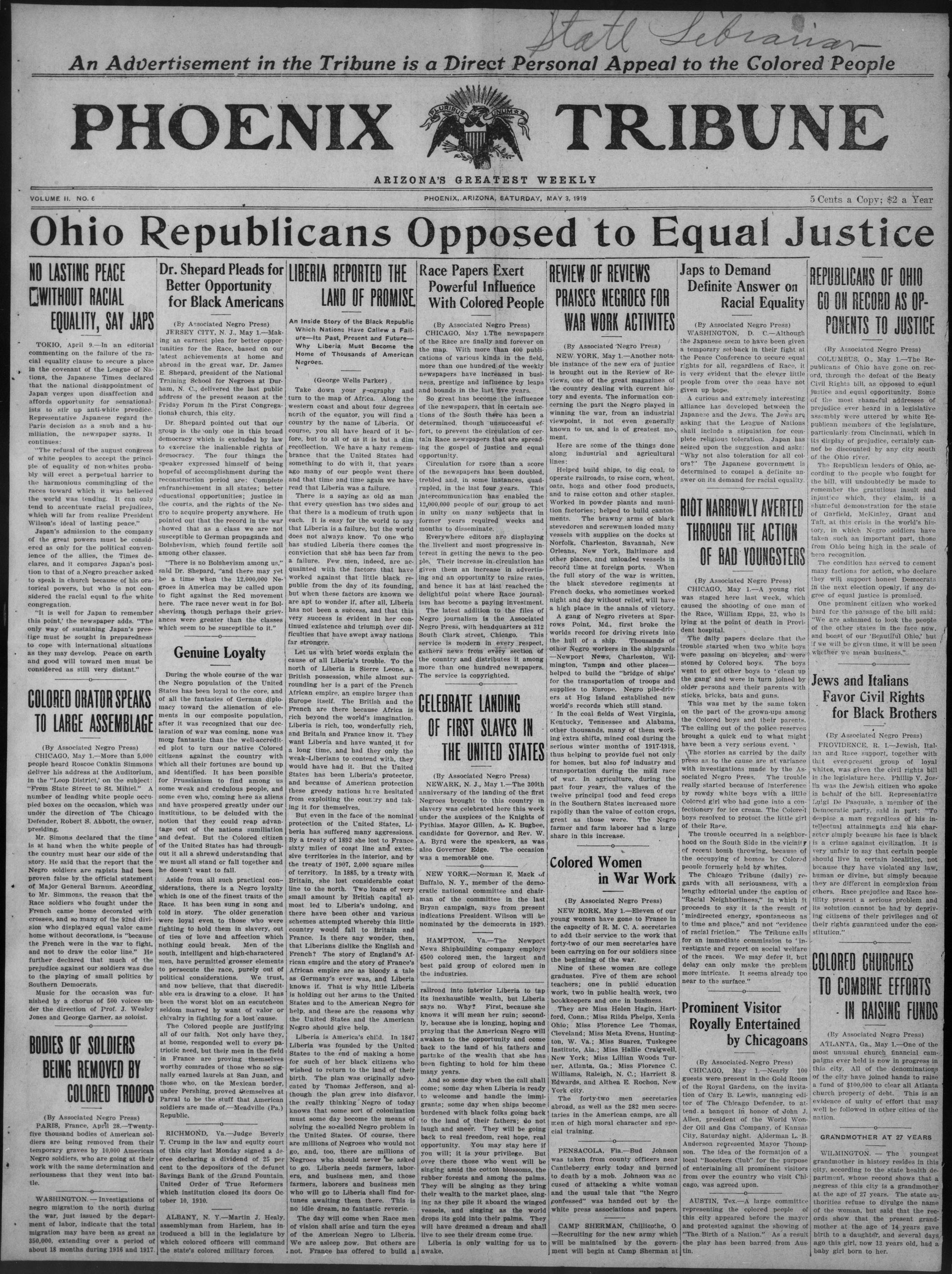
Ohio Republicans Opposed to Equal Justice
PHOENIX
VOLUME II. NO. 6
NO LASTING PEACE WITHOUT RACIAL EQUALITY, SAY JAPS
TOKIO, April 9.—In an editorial commenting on the failure of the racial equality clause to secure a place in the covenant of the League of Nations, the Japanese Times declared that the national disappointment of Japan verges upon disaffection and affords opportunity for sensationalists to stir up anti-white prejudice. Representative Japanese regard the Paris decision as a snub and a humiliation, the newspaper sayss. It continues:
"The refusal of the august congress of white peoples to accept the principle of equality of non-whites probably will erect a perpetual barrier to the harmonious commingling of the races toward which it was believed the world was tending. It can only tend to accentuate racial prejudices, which will far from realize President Wilson's ideal of lasting peace."
Japan's admission to the company of the great powers must be considered as only for the political convenience of the allies, the Times declares, and it compares Japan's position to that of a Negro preacher asked to speak in church because of his oratorical powers, but who is not considered the racial equal to the white congregation.
"It is well for Japan to remember this point," the newspaper adds. "The only way of sustaining Japan's prestige must be sought in preparedness to cope with international situations as they may develop. Peace on earth and good will toward men must be considered as still very distant."
COLORED ORATOR SPEAKS TO LARGE ASSEMBLAGE
COLORED ORATOR SPEAKS TO LARGE ASSEMBLAGE
(By Associated Negro Press)
CHICAGO. May 1.—More than 5,000 people heard Roscoe Conklin Simmons deliver his address at the Auditorium, in the "Loop District," on the subject: "From State Street to St. Mihiel." A number of leading white people occupied boxes on the occasion, which was under the direction of The Chicago Defender, Robert S. Abbott, the owner, presiding.
Mr. Simons declared that the time is at hand when the white people of the country must hear our side of the story. He said that the report that the Negro soldiers are rapists had been proven false by the official statement of Major General Barnum. According to Mr. Simmons, the reason that the Race soldiers who fought under the French came home decorated with crosses, and so many of the 92nd division who displayed equal valor came home without decorations, is "because the French were in the war to fight, and not to draw the color line." He further declared that much of the prejudice against our soldiers was due to the playing of small politics by Southern Democrats.
Music for the occasion was furnished by a chorus of 500 voices under the direction of Prof. J. Wesley Jones and George Garner, as soloist.
BODIES OF SOLDIERS BEING REMOVED BY COLORED TROOPS
(By Associated Negro Press)
PARIS, France, April 28.—Twenty-five thousand bodies of American soldiers are being removed from their temporary graves by 10,000 American Negro soldiers, who are going at their work with the same determination and seriousness that they went into battle.
WASHINGTON.—Investigations of negro migration to the north during the war, just issued by the department of labor, indicate that the total migration may have been as great as 350,000, extending over a period of about 18 months during 1916 and 1917.
Dr. Shepard Pleads for Better Opportunity for Black Americans
(By Associated Negro Press)
JERSEY CITY, N. J., May 1.—Making an earnest plea for better opportunities for the Race, based on our latest achievements at home and abroad in the great war, Dr. James E. Shepard, president of the National Training School for Negroes at Durham, N. C., delivered the last public address of the present season at the Friday Forum in the First Congregational church, this city.
Dr. Shepard pointed out that our group is the only one in this broad democracy which is excluded by law to exercise the inalienable rights of democracy. The four things the speaker expressed himself of being hopeful of accomplishment during the reconstruction period are: Complete enfranchisement in all states; better educational opportunities; justice in the courts, and the rights of the Negro to acquire property anywhere. He pointed out that the record in the war showed that as a class we are not susceptible to German propaganda and Bolshevism, which found fertile soil among other classes.
"There is no Bolshevism among us," said Dr. Shepard, "and there may yet be a time when the 12,000,000 Negroes in America may be called upon to fight against the Red movement here. The race never went in for Bolshevism, though perhaps their grievances were greater than the classes which seem to be susceptible to it."
Genuine Loyalty
During the whole course of the war the Negro population of the United States has been loyal to the core, and of all the fantasies of German diplomacy toward the alienation of elements in our composite population, after it was recognized that our declaration of war was coming, none was more fantastic than the well-accredited plot to turn our native Colored citizens against the country with which all their fortunes are bound up and identified. It has been possible for Prussianism to find among us some weak and credulous people, and some even who; coming here as aliens and have prospered greatly under our institutions, to be deluded with the notion that they could reap advantage out of the nations summilation and defeat. But the Colored citizen of the United States has had throughout it all a shrewd understanding that we must all stand or fall together and he doesn't want to fall.
Aside from all such practical considerations, there is a Negro loyalty which is one of the finest traits of the Race. It has been sung in song and told in story. The older generation were loyal even to those who were fighting to hold them in slavery, out of ties of love and affection which nothing could break. Men of the south, intelligent and high-charactered men, have permitted grosser elements to persecute the race, purely out of political considerations. We trust, and now believe, that that discreditable era is drawing to a close. It has been the worst blot on an escutcheon seldom marred by want of valor or chivalry in fighting for a lost cause. The Colored people are justifying all of our faith. Not only have they, at home, responded well to every patriotic need, but their men in the field in France are proving themselves worthy comrades of those who so signally earned laurels at San Juan, and those who, on the Mexican border, under Pershing, proved themselves at Parral to be the stuff that American soldiers are made of.—Meadville (Pa.) Republic.
RICHMOND, Va.—Judge Beverly T. Crump in the law and equity court of this city last Monday signed a decree declaring a dividend of 25 per cent to the depositors of the defunct Savings Bank of the Grand Fountain, United Order of True Reformers which institution closed its doors October 10, 1910.
ALBANY, N. Y.—Martin J. Healy, assemblyman from Harlem, has introduced a bill in the legislature by which colored officers will command the state's colored military forces.
ARIZONA'S GREATEST WEEKLY
LIBERIA REPORTED THE LAND OF PROMISE
An Inside Story of the Black Republic Which Nations Have Callew a Failure—Its Past, Present and Future—Why Liberia Must Become the Home of Thousands of American Negroes.
Take down your g-ography and turn to the map of Africa. Along the western coast and about four degrees north of the equator, you will find a country by the name of Liberia. Of course, you all have heard of it before, but to all of us it is but a dim recollection. We have a hazy remembrance that the United States had something to do with it, that years ago many of our people went there and that time and time again we have read that Liberia was a failure.
There is a saying as old as man that every question has two sides and that there is a modicum of truth upon each. It is easy for the world to say that Liberia is a failure, but the world does not always know. To one who has studied Liberia there comes the conviction that she has been far from a failure. Few men, indeed, are acquainted with the factors that have worked against that little black republic from the day of its founding, but when these factors are known we are apt to wonder if, after all, Liberia has not been a success, and that this very success is evident in her continued existence and triumph over difficulties that have swept away nations far stronger.
Let us with brief words explain the cause of all Liberia's trouble. To the north of Liberia is Sierra Leone, a British possession, while almost surrounding her is a part of the French African empire, an empire larger than Europe itself. The British and the French are there because Africa is rich beyond the world's imagination. Liberia is rich, too, wonderfully rich, and Britain and France know it. They want Liberia and have wanted it for a long time, and had they only the weak-Liberians to contend with, they would have had it. But the United States has been Liberia's protector, and because of American protection these greedy nations have hesitated from exploiting the country and taking it for themselves.
But even in the face of the nominal protection of the United States, Liberia has suffered many aggressions. By a treaty of 1892 she lost to France sixty miles of coast line and extensive territories in the interior, and by the treaty of 1907, 2,000 square miles of territory. In 1885, by a treaty with Britain, she lost considerable coast line to the north. Two loans of very small amount by British capital almost led to Liberia's undoing, and there have been other and various schemes attempted whereby this little country would fall to Britain and France. Is there any wonder, then, that Liberians dislike the English and French? The story of England's African empire and the story of France's African empire are as bloody a tale as Germany's ever was, and Liberia knows it. That is why little Liberia is holding out her arms to the United States and to the American Negro for help, and these are the reasons why the United States and the American Negro should give help.
Liberia is America's child. In 1847 Liberia was founded by the United States to the end of making a home for such of her black citizens who wished to return to the land of their birth. The plan was originally advocated by Thomas Jefferson, and although the plan grew into disfavor, the really thinking Negro of today knows that some sort of colonization must some day become the means of solving the so-called Negro problem in the United States. Of course, there are millions of Negroes who would not go, and, too, there are millions of Negroes who should never be asked to go. Liberia needs farmers, laborers, and business men, and those farmers, laborers and business men who will go to Liberia shall find fortunes awaiting them. This is no idle dream, no fantastic reverie. The day will come when Race men of vision shall arise and turn the eyes of the American Negro to Liberia. We are asleep now. But others are not. France has offered to build a
PHOENIX,.ARIZONA, SATURDAY, MAY 3, 1919
PLURIBUS UNUM
Race Papers Exert Powerful Influence With Colored People
(By Associated Negro Press)
CHICAGO, May 1. The newspapers of the Race are finally and forever on the map. With more than 400 publications of various kinds in the field, more than one hundred of the weekly newspapers have increased in business, prestige and influence by leaps and bounds in the last five years.
So great has become the influence of the newspapers, that in certain sections of the South there has been a determined, though unsuccessful effort, to prevent the circulation of certain Race newspapers that are spreading the gospel of justice and equal opportunity.
Circulation for more than a score of the newspapers has been doubled, trebled and, in some instances, quadrupled, in the last four years. This intercommunication has enabled the 12,000,000 people of our group to act in unity on many subjects that in former years required weeks and months to disseminate.
Everywhere editors are displaying the liveliest and most progressive interest in getting the news to the people. Their increase in circulation has given them an increase in advertising and an opportunity to raise rates, and hence it has at last reached the delightful point where Race journalism has become a paying investment. The latest addition to the files of Negro journalism is the Associated Negro Press, with headquarters at 312 South Clark street, Chicago. This service is modern in every respect, gathers news from every section of the country and distributes it among more than one hundred newspapers. The service is copyrighted.
CELEBRATE LANDING OF FIRST SLAVES IN THE UNITED STATES
(By Associated Negro Press)
NEWARK, N. J., May 1.—The 300th anniversary of the landing of the first Negroes brought to this country in slavery was celebrated here this week under the auspices of the Knights of Pythias. Mayor Gillen, A. K. Bugebee, candidate for Governor, and Rev. W. A. Byrd were the speakers, as was also Governor Edge. The occasion was a memorable one.
NEW YORK—Norman E. Mack of Buffalo, N. Y., member of the democratic national committee and chairman of the committee in the last Bryan campaign, says from present indications President. Wilson will be nominated by the democrats in 1920.
HAMPTON, Va.—The Newport News Shipbuilding company employs 4500 colored men, the largest and best paid group of colored men in the industries.
railroad into interior Liberia to tap its inexhaustible wealth, but Liberia says no. Why? First, because she knows it will mean her ruin; secondly, because she is longing, hoping and praying that the American Negro will awaken to the opportunity and come back to the land of his fathers and partake of the wealth that she has been fighting to hold for him these many years.
And so some day when the call shall come; some day when Liberia is ready to welcome and handle the immigrants; some day when ships become burdened with black folks going back to the land of their fathers; do not laugh and sneer. They will be going back to real freedom, real hope, real opportunity. You may stay here if you will; it is your privilege. But over there those who went will be singing amid the cotton blossoms, the rubber forests and among the palms. They will be singing as they bring their wealth to the market place, singing as they pile it aboard the winged vessels, and singing as the world drops its gold into their palms. They will have dreamed a dream and shall live to see their dream come true.
Liberia is only waiting for us to awake.
TRIBUNE
REVIEW OF REVIEWS PRAISES NEGROES FOR WAR WORK ACTIVITES
NEW YORK, May 1.—Another notable instance of the new era of justice is brought out in the Review of Reviews, one of the great magazines of the country dealing with current history and events. The information concerning the part the Negro played in winning the war, from an industrial viewpoint, is not even generally known to us, and is of greatest moment.
Here are some of the things done along industrial and agricultural lines:
Helped build ships, to dig coal, to operate railroads, to raise corn, wheat, oats, hogs and other food products, and to raise cotton and other staples. Worked in powder plants and munication factories; helped to build cantments. The brawny arms of black stevedores and screwmen loaded many vessels with supplies on the docks at Norfolk, Charleston, Savannah, New Orleans, New York, Baltimore and other places, and unloaded vessels in record time at foreign ports. When the full story of the war is written, the black stevedore regiments at French docks, who sometimes worked night and day without relief, will have a high place in the annals of victory.
A gang of Negro riveters at Sparrows Point, Md., first broke the worlds record for driving rivets into the hull of a ship. Thousands of other Negro workers in the shipyards—Newport News, Charleston, Wilmington, Tampa and other places—helped to build the "bridge of ships" for the transportation of troops and supplies to Europe. Negro pile-drivers at Hog Island established new world's records which still stand.
In the coal fields of West Virginia, Kentucky, Tennessee and Alabama, other thousands, many of them working extra shifts, mined coal during the serious winter months of 1917-1918, thus helping to provide fuel not only for homes, but also for industry and transportation during the mad race of war. In agriculture, during the past four years, the values of the twelve principal food and feed crops in the Southern States increased more rapidly than the value of cotton crops, great as those were. The Negro farmer and farm laborer had a large share in this increase.
Colored Women in War Work
NEW RORK, May 1.—Eleven of our young women have gone to France in the capacity of R. M. C. A. secretaries to add their service to the work that forty-two of our men secretaries have been carrying on for our soldiers since the beginning of the war.
Nine of these women are college graduates. Five of them are school teachers; one in public education work, two in public health work, two bookkeepers and one in business.
They are Miss Helen Hagin, Hartford, Conn.; Miss Rilda Phelps, Xenia Ohio; Miss Florence Lee Thomas, Cleveland; Miss Meta Evens, Huntington, W. Va.; Miss Suarez, Tuskegee Institute, Ala.; Miss Halle Craigwell, New York; Miss Lillian Woods Turner, Atlanta, Ga.; Miss Florence C. Williams, Raleigh, N. C.; Harriett S. Edwards, and Althea E. Rochon, New York city.
The forty-two men secretaries abroad, as well as the 282 men secretaries in the American camps, are all men of high moral character and special training.
PENSACOLA, Fla.—Bud Johnson was taken from county officers near Cantleberry early today and burned to death by a mob. Johnson was accused of attacking a white woman and the usual tale that "the Negro confessed" was handed out by the white press associations and papers.
CAMP SHERMAN, Chillicothe, O.
—Recruiting for the new army which will be maintained by the government will begin at Camp Sherman at
Japs to Demand Definite Answer on Racial Equality
WASHINGTON, D. C.-Although the Japanese seem to have been given a temporary set-back in their fight at the Peace Conference to secure equal rights for all, regardless of Race, it is very evident that the clever little people from over the seas have not given up hope.
A curious and extremely interesting alliance has developed between the Japanese and the Jews. The Jews are asking that the League of Nations shall include a stipulation for complete religious toleration. Japan has seized upon the suggestion and asks: "Why not also toleration for all colors?" The Japanese government is determined to compel a definite answer on its demand for racial equality.
RIOT NARROWLY AVERTED THROUGH THE ACTION OF BAD YOUNGSTERS
RIOT NARROWLY AVERTED THROUGH THE ACTION OF BAD YOUNGSTERS
(By Associated Negro Press)
CHICAGO, May 1.—A young riot was staged here last week, which caused the shooting of one man of the Race, William Epps, 23, who is lying at the point of death in Provident hospital.
The daily papers declare that the trouble started when two white boys were passing on bicycles, and were stoned by Colored boys. The boys went to get other boys to 'clean up the gang' and were in turn joined by older persons and their parents with sticks, bricks, bats and guns.
This was met by the same token on the part of the grown-ups among the Colored boys and their parents. The calling out of the police reserves brought a quick end to what might have been a very serious event.
The stories as carried by the daily press as to the cause are at variance with investigations made by the Associated Negro Press. The trouble really started because of interference by rowdy white boys with a little Colored girl who had gone into a confectionery for ice cream. The Colored boys resolved to protect the little girl of their Race.
The trouble occurred in a neighborhood on the South Side in the vicinity of recent bomb throwing, because of the occupying of homes by Colorad people formerly held by whites.
The Chicago Tribune (daily) regards with all seriousness, with a lengthy editorial under the caption of "Racial Neighborliness," in which it proceeds to say it is the result of "misdirected energy, spontaneous as to time and place," and not "evidence of racial friction." The Tribune calls for an immediate commission to "investigate and report on social welfare of the races. We may defer it, but delay can only make the problem more intricate. It seems already too near to the surface."
Prominent Visitor Royally Entertained by Chicagoans
(By Associated. Negro Press)
CHICAGO, May 1.—Nearly 100 guests were present in the Gold Room of the Royal Gardens, on the invitation of Cary B. Lewis, managing editor of The Chicago Defender, to attend a banquet in honor of John J. Allen, president of the World Wonder Oil and Gas Company, of Kansas City, Saturday night. Alderman L. B. Anderson represented Mayor Thompson. The idea of the formation of a local "Boosters Club" for the purpose of entertaining all prominent visitors from over the country who visit Chicago, was agreed upon.
AUSTIN, Tex.—A large committee representing the colored people of this city appeared before the mayor and protested against the showing of "The Birth of a Nation." As a result the play has been barred from Austin.
5 Cents a Copy; $2 a Year
REPUBLICANS OF OHIO GO ON RECORD AS OP- PONENTS TO JUSTICE
(By Associated Negro Press)
COLUMBUS, O., May 1.—The Republicans of Ohio have gone on record, through the defeat of the Beaty Civil Rights bill, as opposed to equal justice and equal opportunity. Some of the most shameful addresses of prejudice ever heard in a legislative assembly were uttered by white Republican members of the legislature, particularly from Cincinnati, which in its display of prejudice, certainly cannot be discounted by any city south of the Ohio river.
The Republican leaders of Ohio, according to the people who fought for the bill, will undoubtedly be made to remember the gratutious insult and injustice which, they claim, is a shameful demonstration for the state of Garfield, McKinley, Grant and Taft, at this crisis in the world's history, in which Negro soldiers have taken such an important part, those from Ohio being high in the scale of hero recognition.
The condition has served to cement many factions for action, who declare they will support honest Democrats in the next election openly, if any degree of equal justice is promised.
One prominent citizen who worked hard for the passage of the bill said: "We are ashamed to look the people of the other states in the face now, and boast of our 'Begutiful Ohio,' but if we will be given time, it will be seen whether we mean business."
Jews and Italians Favor Civil Rights for Black Brothers
(By Associated Negro Press)
PROVIDENCE, R. I—Jewish, Italian and Race support, together with that ever-present group of loyal whites, was given the civil rights bill in the legislature here. Phillip V. Joslin was the Jewish citizen who spoke in behalf of the bill. Representative Luigi De Pasquale, a member of the Democratic party, said in part: "To despise a man regardless of his intellectual attainments and his character simply because his face is black is a crime against civilization. It is very unfair to say that certain people should live in certain localities, not because they have violated any law, human or divine, but simply because they are different in complexion from others. Race prejudice and Race hostility present a serious problem and its solution cannot be had by depriving citizens of their privileges and of their rights guaranteed under the constitution."
COLORED CHURCHES TO COMBINE EFFORTS IN RAISING FUNDS
(By Associated Negro Press)
ATLANTA, Ga., May 1.—One of the most unusual church financial campaigns ever held is now in progress in this city. All of the denominations of the city have joined hands to raise a fund of $100,000 to clear all Atlanta church property of debt. This is an evidence of unity of effort that may well be followed in other cities of the nation.
GRANDMOTHER AT 27 YEARS
WILMINGTON. — The youngest grandmother in history resides in this city, according to the state health department, whose record shows that a negress of this city is a grandmother at the age of 27 years. The state authorities refuse to divulge the name of the woman, but said that the records show that the present grandmother at the age of 14 years gave birth to a daughter, and several days ago this girl, now 13 years old, had a baby girl born to her.
Irvine
Irvine Park
OPEN DAY AND NIGHT
Sunday: Musical concert from 4 p.m.
Monday: Open, for rent to anyone
Tuesday: High class entertainment
p. m. (Colored people
Wednesday: Open, for rent to anyone
Friday: High class entertainment
p. m. (Colored people
FRIED FISH and CHICKEN
ROY LUCAS
Take the big yellow auto at 27 So. S.
--RICH--
For tired, nervous and run-down
a general health-building tonic
Money cheerfully refunded if not
Sales
Mason's
Wall
Painting, Paper-hang
at Reasona
Taylor Paint
musical concert from 4 p. m. to 7 p. m.
Open, for rent to anyone.
High class entertainment and dancing from 6
p. m. (Colored people only).
Open, for rent to anyone.
High class entertainment and dancing from 6
p. m. (Colored people only).
FRIED FISH and CHICKEN SANDWICHES
ROY LUCAS, Manager
yellow auto at 27 So. Second Street. Fare 15
KICH-TON
nervous and run-down-condition people
health-building tonic.
powerfully refunded if not entirely satisfied.
Sales Agency
Mason's Pharmac
Vall Paper
cutting, Paper-hanging and Kalsom
at Reasonable Prices
Color Paint & Paper
Sunday: Musical concert from 4 p. m. to 7 p. m.
Monday: Open, for rent to anyone.
Tuesday: High class entertainment and dancing from 6 p. m. to 12 p. m. (Colored people only).
Wednesday: Open, for rent to anyone.
Friday: High class entertainment and dancing from 6 p. m. to 12 p. m. (Colored people only).
FRIED FISH and CHICKEN SANDWICHES
ROY LUCAS, Manager
Take the big yellow auto at 27 So. Second Street. Fare 15 cents.
--RICH-TONE--
For tired, nervous and run-down-condition people who need a general health-building tonic.
Money cheerfully refunded if not entirely satisfied.
Sales Agency
Wall Paper
Painting, Paper-hanging and Kalsomining at Reasonable Prices
TaylorPaint&PaperCo.
CHAS. ALTERMATT, Mgr.
PHONE 1463
Shop, 1310 East Jefferson Street
CARL AN
Everything in Ins
The largest General Insurance Agent
We know our business
LET US FIGURE Y
Adams Hot
Let You
Be Our
We have every facility to insure
guarantee that your goods will b
and caution.
MARL ANDERSON
Everything in Insurance and Bond
General Insurance Agency in Arizona—There is
We know our business and satisfy our clients
GET US FIGURE YOUR INSURANCE
Adams Hotel Building
Get Your Move
We Our Move
very facility to insure speedy transferring. A
that your goods will be handled and handled
CARL ANDERSON
Everything in Insurance and Bonds
The largest General Insurance Agency in Arizona—There is a reason
We know our business and satisfy our clients
LET US FIGURE YOUR INSURANCE
Adams Hotel Building
Let Your Move Be Our Move
We have every facility to insure speedy transferring. An absolute guarantee that your goods will be handled and handled with care and caution.
Old or New Time, we're on Time.
Chambers Transfer Co.
ambers Transfer
Chambers Transfer Co.
---
---
We Solicit Your Trade
and by offering you the h
dise at right prices, believ
patronage.
TALBOT & H
HARD
offering you the highest quality of light prices, believe we merit a share. ALBOT & HUBBARD,
and by offering you the highest quality of merchandise at right prices, believe we merit a share of your patronage.
TALBOT & HUBBARD, Inc.
HARDWARE "At the Sign of the Dog"
Advertise in The
tise in The Phoenix T
Advertise in The Phoenix Tribune
Saturday, May 3, 1919
Phone 3526
a. to 7 p. m.
and dancing from 6 p. m. to 1
e only).
e.
and dancing from 6 p. m. to 1
e only).
KEN SANDWICHES
Manager
Bond Street. Fare 15 cents.
STONE-
condition people who need
entirely satisfied.
currency
Pharmacy
Paper
g and Kalsomining
le Prices
& Paper Co.
ANDERSON
Insurance and Bonds
in Arizona—There is a reason-
and satisfy our clients
OUR INSURANCE
Building
or Move
Move
speedy transferring. An absolute
handled and handled with care
transfer Co.
18 South Central Ave.
hest quality of merchant we merit a share of you
BBBARD, Inc.
WARE
Phoenix Tribun
THE PHOENIX TRIBUNE—ALWAYS IMPROVING
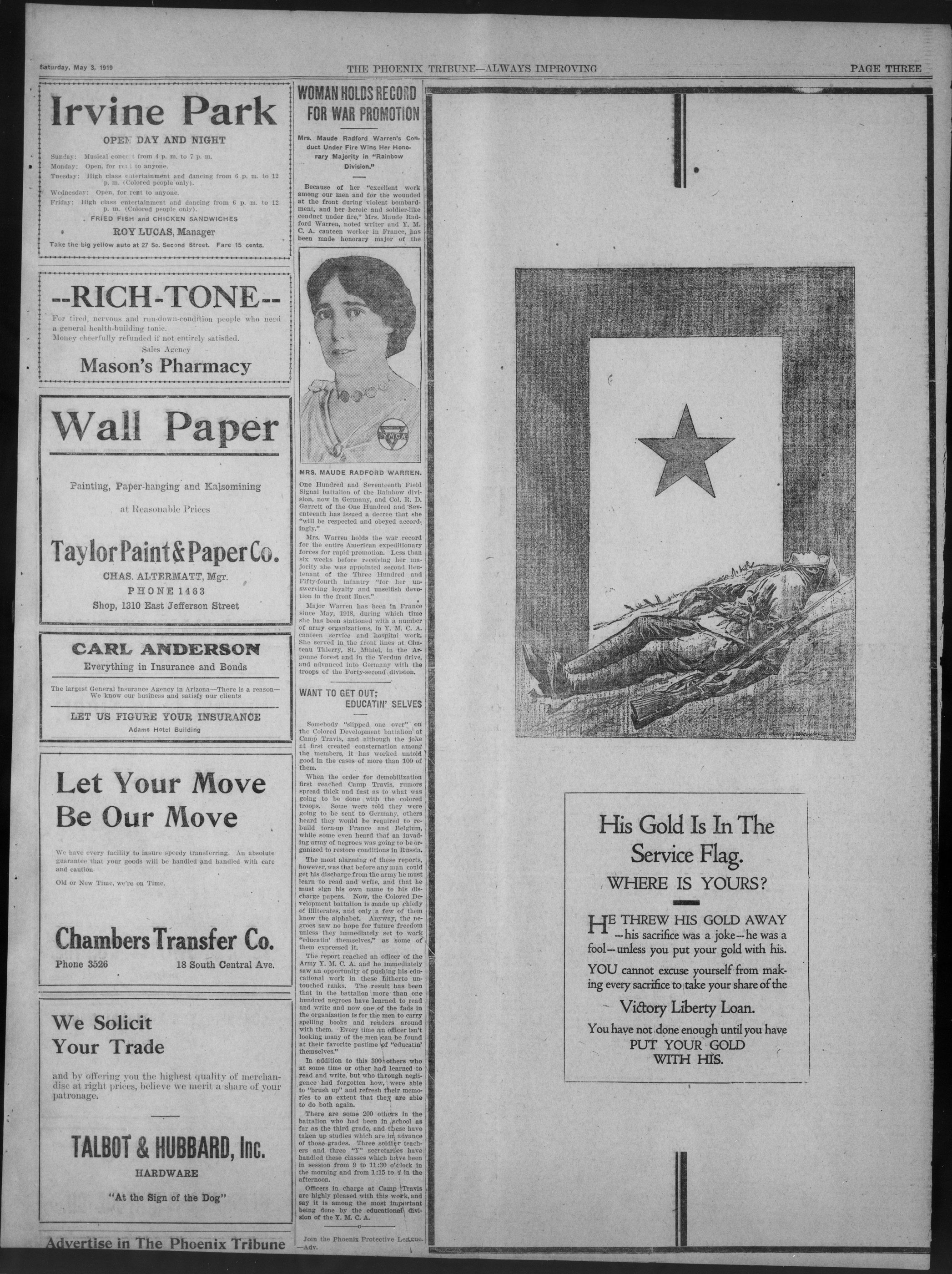
WOMAN HOLDS RECORD FOR WAR PROMOTION
Mrs. Maude Radford Warren's Conduct Under Fire Wins Her Honorary Majority in "Rainbow Division."
Because of her "excellent work among our men and for the wounded at the front during violent bombardment, and her heroic and soldier-like conduct under fire," Mrs. Maude Radford Warren, noted writer and Y. M. C. A. canteen worker in France, has been made honorary major of the
YMCA
MRS. MAUDE RADFORD WARREN.
One Hundred and Seventeenth Field Signal battalion of the Rainbow division, now in Germany, and Col. R. D. Garrett of the One Hundred and Seventeenth has issued a decree that she "will be respected and obeyed accordingly."
Mrs. Warren holds the war record for the entire American expeditionary forces for rapid promotion. Less than six weeks before receiving her majorly she was appointed second Lieutenant of the Three Hundred and Fifty-fourth infantry "for her unswerving loyalty and unselfish devotion in the front lines."
Major Warren has been in France since May, 1918, during which time she has been stationed with a number of army organizations, in Y. M. C. A. canteen service and hospital work. She served in the front lines at Chateau Thierry, St. Mihiel, in the Argonne forest and in the Verdun drive, and advanced into Germany with the troops of the Forty-second division.
WANT TO GET OUT;
EDUCATIN' SELVES
Somebody "slipped one over" on the Colored Development battalion at Camp Travis, and although the joke at first created consternation among the members, it has worked untold good in the cases of more than 100 of them.
When the order for demobilization first reached Camp Travis, rumors spread thick and fast as to what was going to be done with the colored troops. Some were told they were going to be sent to Germany, others heard they would be required to rebuild torn-up France and Belgium, while some even heard that an invading army of negroes was going to be organized to restore conditions in Russia.
The most alarming of these reports, however, was that before any man could get his discharge from the army he must learn to read and write, and that he must sign his own name to his discharge papers. Now, the Colored Development battalion is made up chiefly of illiterates, and only a few of them know the alphabet. Anyway, the negroes saw no hope for future freedom unless they immediately set to work "educatin' themselves," as some of them expressed it.
The report reached an officer of the Army Y. M. C. A. and he immediately saw an opportunity of pushing his educational work in these hitherto untouched ranks. The result has been that in the battalion more than one hundred negroes have learned to read and write and now one of the fads in the organization is for the men to carry spelling books and readers around with them. Every time an officer isn't looking many of the men can be found at their favorite pastime of "educatin' themselves."
In addition to this 300 others who at some time or other had learned to read and write, but who through negligence had forgotten how, were able to "brush up" and refresh their memories to an extent that they are able to do both again.
There are some 200 others in the battalion who had been in school as far as the third grade, and these have taken up studies which are in advance of those grades. Three soldier teachers and three "Y" secretaries have handled these classes which have been in session from 9 to 11:30 o'clock in the morning and from 1:15 to 4 in the afternoon.
Officers in charge at Camp Travis are highly pleased with this work, and say it is among the most important being done by the educational division of the Y. M. C. A.
PAGE THREE
★
His Gold Is In The Service Flag. WHERE IS YOURS?
HE THREW HIS GOLD AWAY --his sacrifice was a joke--he was a fool--unless you put your gold with his. YOU cannot excuse yourself from making every sacrifice to take your share of the Victory Liberty Loan. You have not done enough until you have PUT YOUR GOLD WITH HIS.
PAGE FOUR
By GEORGE BARR
McCUTCHEON
Author of "GRAUSTARK," "THE
HOLLOW OF HER HAND," "THE
PRINCE OF GRAUSTARK," ETC.
Copyright by Dodd, Lansdowne and Company, Inc.
(Continued from last week's issue)
when some one spoke suddenly at his
elbow. He whirled and found himself
facing the gaunt landlord.
"Good Lord! You startled me," he exclaimed. His gaze traveled past the tall figure of Putnam Jones and rested on that of a second man, who leaned, with legs crossed and arms folded, against the porch post directly in front of the entrance to the house, his features almost wholly concealed by the broad-brimmed slouch hat that came far down over his eyes. He, too, it seemed to Barnes, had sprung from nowhere.
"Fierce night," said Putnam Jones, removing the corncob pipe from his lips. Then, as an afterthought, "Where'd you walk from today?"
"I slept in a farmhouse last night, about fifteen miles south of this place, I should say."
"That'd be a little ways out of East Cobb," speculated Mr. Jones.
"Five or six miles."
"Goin' over into Canada?"
"No. I shall turn west, I think, and strike for the Lake Champlain country."
"I suppose you've traveled right smart in Europe?"
"Quite a bit. Mr. Jones."
"Any partier' part?"
"No," said Barnes, suddenly divining that he was being "pumped." "One end to the other, you might say."
"What about them countries down around Bulgaria and Roumania? I've been considerable interested in what's going to become of them if Germany gets licked. What do they get out of it, either way?"
Barnes spent the next ten minutes expatiating upon the future of the Bulkan states. Jones had little to say. He was interested, and drank in all the information that Barnes had to impart. He puffed at his pipe, nodded his head from time to time, and occasionally put a leading question. And quite as abruptly as he introduced the topic he changed it.
"Not many automobiles up here this time o' the year," he said. "I was a little surprised when you said a feller had given you a lift. Where from?"
"The crossroads a mile down. He came from the direction of Frogg's Corner and was on his way to meet someone at Spanish Falls. It apears that there was a misunderstanding. The driver didn't meet the train, so the person he was going after walked all the way to the forks. We happened upon each other there, Mr. Jones, and we studied the signpost together. She was bound for a place called Green Fancy."
"Did you say she?" "Yes. I was proposing to help her out of her predicament when the belated motor came racing down the slope." "What for sort of looking lady was she?" "She wore a veil," said Barnes succinctly.
"Young?"
"I had that impression. By the way,
Mr. Jones, what and where is Green
Fancy?"
"Well," began the landlord, lowering
his voice, "it's about two mile and
a half from here, up the mountain. It's
a house and people live in it, same as
any other house. That's about all
there is to say about it."
"Why is it called Green Fancy?"
"Why is it called Green Fancy?"
"Because it's a green house," replied Jones succinctly. "Green as a gourd. A man named Curtis built it a couple o' years ago and he had a fool idea about paintin' it green, Might ha' been a little crazy, for all I know. Anyhow, after he got it finished he settled down to live in it, and from that day to this he's never been off'n the place."
"Isn't it possible that he isn't there at all?"
"He's there, all right. Every now and then he has visitors—just like this woman today—and sometimes they come down here for supper. They don't hesitate to speak of him, so he must be there. Miss Tilly has got the dee that he is a recluse, if you know what that is."
Further conversation was interrupted by the irregular clatter of horses' hoofs on the macadam. 'Off to the left a dull red glow of light spread across the roadway and a man's voice called out, "Whoa, dang e!"
The door of the smithy had been thrown open and someone was leading forth freshly shod horses.
A moment later the horses—prancing, high-spirited animals— their ridle bits held by a strapping black-mith, came into view. Barnes looked in the direction of the steps. The two men had disappeared. Instead of stopping directly in front of the steps the smith led his charges quite a distance beyond and into the darkness.
Putnam Jones abruptly changed his position. He insinuated his long body between Barnes and the doorway, at the same time rather loudly proclaiming that the rain appeared to be over. "Yes, sir," he repeated, "she seems have let up altogether. Ought to
have a nice day tomorrow, Mr. Barnes — nice, cool day for walkin'."
Volces came up from the darkness. Jones had not been able to cover them with his own. Barnes caught two or three sharp commands, rising above the pawing of horses' hoofs, and then a great clatter as the mounted horsemen rode off in the direction of the crossroads.
Barnes waited, until they were muffled by distance and then turned to Jones with the laconic remark:
"They seem to be foreigners, Mr. Jones."
Jones' manner became natural once more. He leaned against one of the posts and, striking a match on his leg, relighted his pipe.
"Kind o' curious about 'em?" he drawled.
"It never entered my mind until this instant to be curious," said Barnes.
"Well, it entered their minds about an hour ago to be curious about you," said the other.
An Extraordinary Chambermaid, a Midnight Tragedy, and a Man Who Said "Thank You."
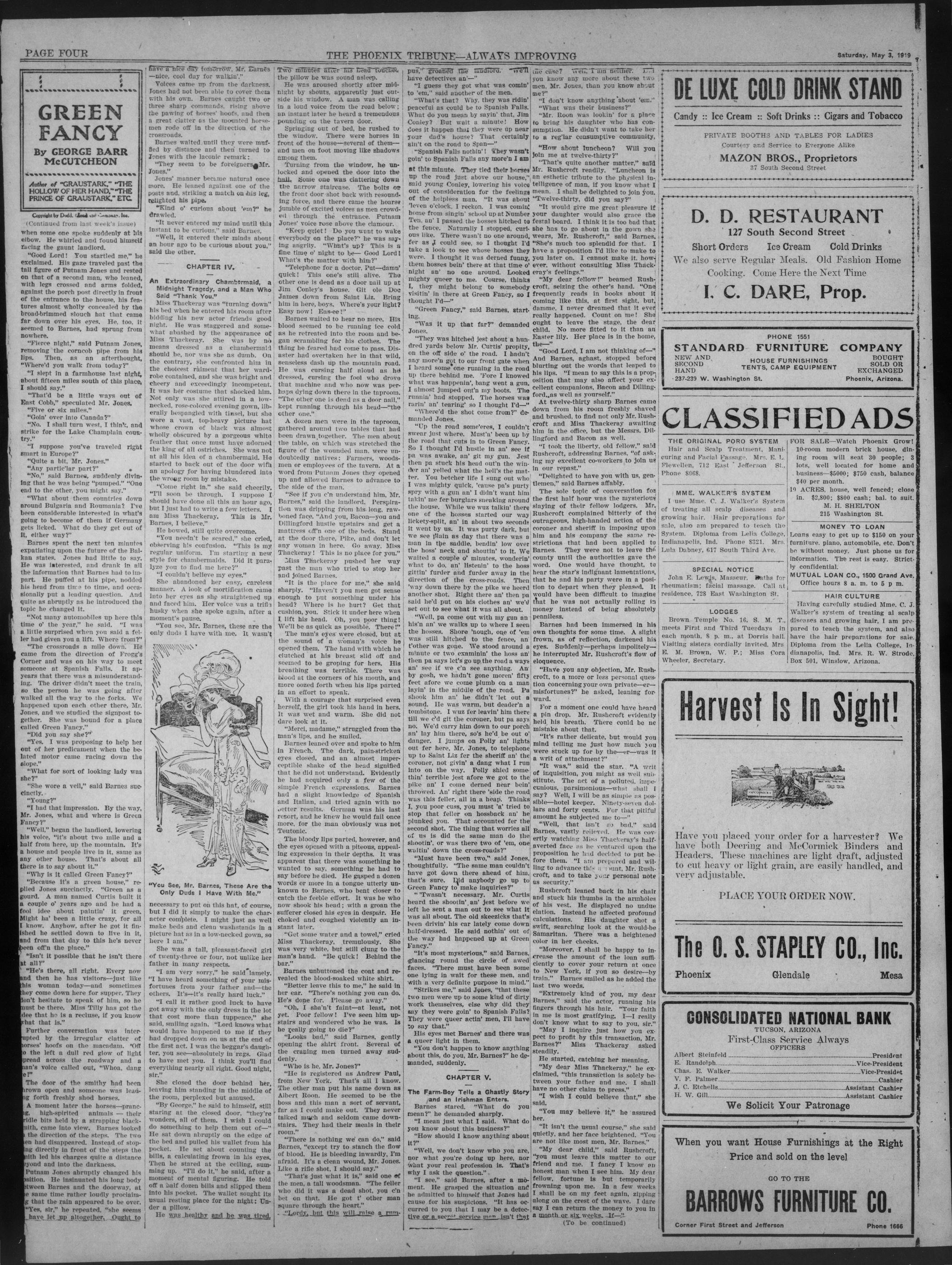
Miss Thackeray was "turning down" his bed when he entered his room after bidding his new actor friends good night. He was staggered and somewhat abashed by the appearance of Miss Thackeray. She was by no means dressed as a chambermaid should be, nor was she as dumb. On the contrary, she confronted him in the choostet raliment that her wardrobe contained, and she was bright and cheery and exceedingly incompetent. It was her costume that shocked him. Not only was she attired in a low-necked, rose-colored evening gown, liberally basked with tinsel, but she wore a vast, top-heavy picture hat whose crown of black was almost wholly obscured by a gorgeous white feather that once must have adorned the king of all ostriches. She was not at all his idea of a chambermaid. He started to back out of the door with an apology for having blundered into the wrong room by mistake.
"Come right in." she said cheerly. "T'll soon be through. I suppose I should have done all this an hour ago, but I just had to write a few letters. I am Miss Thackeray. This is Mr. Barnes, I believe."
He bowed, still quite overcome. "You needn't be scared," she cried, observing his confusion. "This is my regular uniform. I'm starting a new style for chambermaids. Did it paralyze you to find me here?" "I couldn't believe my eyes."
She abandoned her easy, careless manner. A look of mortification came into her eyes as she straightened up and faced him. Her voice was a trifle husky when she spoke again, after a moment's pause.
"You see, Mr. Barnes, these are the only dudes I have with me. It wasn't
K.
"You See, Mr. Barnes, These Are the Only Duds I Have With Me."
necessary to put on this hat, of course, but I did it simply to make the character complete. I might just as well make beds and clean washstands in a picture hat as in a low-necked gown, so here I am."
She was a tall, pleasant-faced girl of twenty-three or four, not unlike her father in many respects.
"I am very sorry," he said lamely. "I have heard something of your misfortunes from your father and—the others. It's—it's really hard luck."
"I call it rather good luck to have got away with the only dress in the lot that cost more than tuppence," she said, smiling again. "Lord knows what would have happened to me if they had dropped down on us at the end of the first act. I was the beggar's daughter, you see—absolutely in regs. Glud to have met you. I think you'll find everything nearly all right. Good night, sir."
She closed the door behind her, leaving him standing in the middle of the room, perplexed but amused.
"By George," he said to himself, still staring at the closed door, "they're wonders, all of them. I wish I could do something to help them out of-" He sat down abruptly on the edge of the bed and pulled his wallet from his pocket. He set about counting the bills, a calculating frown in his eyes. Then he stared at the ceiling, summing up. "I'll do it," he said, after a moment of mental figuring. He told off a half dozen bills and slipped them into his pocket. The wallet sought its usual resting place for the night: Under a pillow. He was healthy and he was tired.
Two minutes after his head touched, the pillow he was sound asleep.
He was aroused shortly after midnight by shouts, apparently just outside his window. A man was calling in a loud voice from the road below; an instant later he heard a tremendous pounding on the tavern door.
Springing out of bed, he rushed to the window. There were horses in front of the house—several of them—and men on foot moving like shadows among them.
Turning from the window, he unlocked and opened the door into the hall. Some one was clattering down the narrow staircase. The bolts on the front door shot back with resounding force, and there came the hourse jumble of excited voices as men crowded through the entrance. Putnam Jones' voice rose above the clamour.
pus," groaned the auditor. "We'll have detectives an'—"
"I guess they got what was comin' to 'em," said another of the men.
"What's that? Why, they was ridin' peaceful as could be to Spanish Falls. What do you mean by sayin' that, Jim Conley? But wait a minute! How does it happen that they were up near your dad's house? That certainly ain't on the road to Span—"
"Spanish Falls nothin'! They wasn't goin' to Spanish Falls' any more'n I am at this minute. They tied their horses up the road just above our house," said young Conley, lowering his voice out of consideration for the feelings of the heipless man. "It was about 'leven o'clock. I reckon. I was comin' home from singin' school up at Number Ten, au' I passed the hoses hitched to the case? We you know and Mr. Jones me?
"I don't know What was Mr. Roon to bring his sumption. He to a regular 'How about join me at two Mr. Rushcroft an esthetic trilogy of a mean. I shall Twelve-thirty 'It would give your daughter festal board.
"Keep quiet! Do you want to wake everybody on the place?" he was saying angrity. "What's up? This is a fine time o' night to be—Good Lord! What's the matter with him?" "Telephone for a doctor, Put—damn' quick! This one's still alive. The other one is dead as a door nail up at Jim Conley's house. Git ole Doc James down from Saint Liz. Bring him in here, boys. Where's your light? Easy now! Eas-ee!"
Barnes waited to hear no more. His blood seemed to be running ice cold as he retreated into the room and began scrambling for his clothes. The thing he feared had come to pass. Disaster had overtaken her in that wild, senseless dash up the mountain road. He was cursing half aloud as he dressed, cursing the fool who drove that machine and who now was perhaps dying down there in the taproom. "The other one is dend as a door nail," kept running through his head—"the other one."
A dozen men were in the taproom, gathered around two tables that had been drawn, together. The men about the table, on which was stretched the figure of the wounded man, were undoubtedly natives: Farmers, woodsmen or employees of the tavern. At a word from Putnam Jones they opened up and allowed Barnes to advance to the side of the man.
"See if you c'n understand him, Mr. Barnes," said the landlord. Perspiration was dripping from his long, raw-boned face. "And you, Bacon—you and Dillingford hustle upstairs and get a mattress off n one of the beds. Stand at the door there, Pike, and don't let any woman in here. Go away. Miss Thackeray! This is no place for you." Miss Thackeray pushed her way past the man who tried to stop her and joined Barnes.
"It is the place for me," she said sharply. "Haven't you men got sense enough to put something under his head? Where is he hurt? Get that cushion, you. Stick it under here when I lift his head. Oh, you poor thing! We'll be as quick as possible. There!"
The man's eyes were closed, but at the sound of a woman's voice he opened them. The hand with which he clutched at his breast slid off and seemed to be groping for hers. His breathing was terrible. There was blood at the corners of his mouth, and more oozed forth when his lips parted in an effort to speak.
With a courage that surprised even herself, the girl took his hand in hers. It was wet and warm. She did not dare look at it.
"Merci, madame," struggled from the man's lips, and he smiled.
Barnes leaned over and spoke to him in French. The dark, pain-striken eyes closed, and an almost imperceptible shake of the head signified that he did not understand. Evidently he had acquired only a few of the simple French expressions. Barnes had a slight knowledge of Spanish and Italian, and tried again with no better results. German was his last resort, and he knew he would fail once more, for the man obviously was not Teutonic.
The bloody lips parted, however, and the eyes opened with a piteous, appealing expression in their depths. It was apparent that there was something he wanted to say, something he had to say before he died. He gasped a dozen words or more in a tongue utterly unknown to Barnes, who bent closer to catch the feeble effort. It was he who now shook his head; with a groan the sufferer closed his eyes in despair. He choked and coughed violently an instant later.
"Get some water and a towel," cried Miss Thackeray, tremulously. She was very white, but still clung to the man's hand. "Be quick! Behind the bar."
Barnes unbuttoned the coat and revealed the blood-soaked white shirt. "Better leave this to me," he said in her ear. "There's nothing you can do. He's done for. Please go away."
"Oh, I shan't faint—at least, not yet. Poor fellow! I've seen him upstairs and wondered who he was. Is he really going to die?" "Looks bad," said Barnes, gently opening the shirt front. Several of the craning men turned away suddenly. "Who is he. Mr. Jones?"
"He is registered as Andrew Paul, from New York. That's all I know. The other man put his name down as Albert Roon. He seemed to be the boss and this man a sort of servant, far as I could make out. They never talked much and seldom came downstairs. They had their meals in their room."
"There is nothing we can do," said Barnes, "except try to stanch the flow of blood. He is bleeding inward, I'm afraid. It's a clean wound, Mr. Jones. Like a rifle shot, I should say."
"That's just what it is," said one of the men, a tall woodsman. "The feller who did it was a dead shot, you can bet on that. He got t' other man square through the heart."
"Lordy, but this will raise a rum-
pus," groaned the midlord. "we'll have detectives an—"
"I guess they got what was comin' to 'em," said another of the men.
"What's that? Why, they was ridin' peaceful as could be to Spanish Falls. What do you mean by sayin' that, Jim Conley? But wait a minute! How does it happen that they were up near your dad's house? That certainly ain't on the road to Span—"
"Spanish Falls nothin'! They wasn't goin' to Spanish Falls any more' I am at this minute. They tied their horses up the road just above our house," said young Conley, lowering his voice out of consideration for the feelings of the helpless man. "It was about 'leven o'clock. I reckon. I was coming home from singin' school up at Number Ten, an' I passed the hosses hitched to the fence. Naturally I stopped, curious like. There wasn't no one around, fer as I could see, so I thought I'd take a look to see whose hosses they were. I thought it was derned funny, them hosses bein' there at that time o'night an' no one around. Looked mighty queer to me. Course, thinks I, they might belong to somebody visitin' in there at Green Fancy, so I thought I'd—"
"Green Fancy," said Barnes, starting.
"Was it up that far?" demanded Jones.
"They was hitched jest about a hundred yards below Mr. Curtis' propity, on the off side o' the road. I hadn't any more'n got to our front gate when I heard some one running in the road up there behind me. 'Fore I knewed what was happenin', bang went a gun, I almost jumped out'n my boots. The runnin' had stopped. The horses was rarin' an' tearing' so I thought I'd—"
"Where'd the shot come from?" de
"Where'd the shot come from?" demanded Jones.
"Up the road some'eres, I couldn't swear just where. Must'a' been up by the road that cuts in to Green Fancy. So I thought I'd hustle in an' see if pa was awake, an' git my gun. Jest then pa stuck his head out'n the winder an' yelled what the hell's the matter. You betcher life I sung out who I was mighty quick, 'cause pa's purty spry with a gun an' I didn't want him takin' me fer burglarms sneaking around the house. While we wuz talkin' there one of the hosses started our way lickety-split, an' in about two seconds it went by us. It was purty dark, but we see plain as day that there was a man in the saddle, bendin' low over the boss' neck and shoutin' to it. We waited a couple o' minutes, wonderin' what to do, an' listenin' to the boss gitter' furrin and furder away in the direction of the cross-roads. Then 'way down there by the pike we heared another shot. Right there an' then pa said he'd put on his clothes an' we'd set out to see what it was all about.
"Well, pa come out with my gun an his'n an' we walks up to where I see the hosses. Shore 'nough, one of 'em was hitched to the fence, an' tother was gone. We stood around a minute or two examinin' the hoss an' then pa says let's go up the road a ways an' see if we c'en see anything. An' by gosh, we wehn't gone moren' fifty feet afore we come plumb on a man layin' in the middle of the road. Pa shook him an' he didn't let out a sound. He was warm, but deaner'n a tombstone. I wuz fer leavin' him there till we c'd git the coroner, but pa says no. We'd carry him down to our porch an' lay him there, so's he'd be out o'danger. I jumps on Polly an' lights out for her, Mr. Jones, to telephone up to Saint Liz fer the sheriff an' the coroner, not givin' a dang what I run into on the way. Polly shiled some thin' terrible jest afore we got to the pike an' I come derned near bein' thrown. An' right there 'side the road was this feller, in a heap. Thinks I, you poor cuss, you must 'a tried to stop that feller on hossoad an' he plunked you. That accounted for the second shot. The thing that worries all of us is did the same man do the shootin', or was there two of 'em, one waitin' down the cross-roads?"
"Must have been two," said Jones, thoughtfully. "The same man couldn't have got down there ahead of him, that's sure. Did anybody go up to Green Fancy to make inquiries?" "Twasn't necessary. Mr. Curtis heard the shootin' an' jest before we left he sent a man out to see what it was all about. The old skeezicks that's been drin' his car lately come down half-dressed. He said nothin' out of the way had happened up at Green Fancy." "It's most mysterious," said Barnes, glancing round the circle of awed faces. "There must have been some one lying in wait for these men, and with a very definite purpose in mind." "Strikes me," said Jones, "that these two men were up to some kind of dirty work themselves, else why did they say they were gone' to Spanish Falls? They were queer actin' men, I'll have to say that."
His eyes met Barnes' and there was a queer light in them.
"You don't happen to know anything about this, do you, Mr. Barnes?" he demanded, suddenly.
CHAPTER V.
The Farm-Boy Tells a Ghostly Story
and an Inshaw Entert
and an Irishman enters.
Barnes stared. "What do you mean?" he demanded sharply.
"I mean just what I said. What do you know about this business?" "How should I know anything about it?" "Well, we don't know who you are, nor what you're doing up here, nor what your real profession is. That's why I ask the question." "I see," said Barnes, after a moment. He grasped the situation and he admitted to himself that Jones had cause for his suspicions. "It has occurred to you that I may be a detective or a secret service man, isn't that
the case? well, I am neither. Let you know any more about these two men, Mr. Jones, than you know about me?
"I don't know anything about 'em."
"What was their business?"
"Mr. Roon was lookin' for a place to bring his daughter who has consumption. He didn't want to take her to a regular consumptive community,
"How about luncheon? Will you join me at twelve-thirty?"
"That's quite another matter," said Mr. Rushcroft readily. "Luncheon is an esthetic tribute to the physical intelligence of man, if you know what I mean. I shall be delighted to join you.
Twelve-thirty, did you say?"
"It would give me great pleasure if your daughter would also grace the festal board. I think it is too bad that she has to go about in the gown she wears, Mr. Rushcroft," said Barnes, "She's much too splendid for that. I have a proposition I'd like to make to you later on. I cannot make it, however, without consulting Miss Thack-cray's feelings."
"My dear fellow!" beamed Rushcroft, seizing the other's hand. "One frequently reads in books about it coming like this, at first sight, but, damme, I never dreamed that it ever really happened. Count on me! She ought to leave the stage, the dear child. No more fitted to it than an Easter illy. Her place is in the home, the—"
"Good Lord, I am not thinking of—" And Barnes, aghast, stopped before blurting out the words that leaped to his lips. "I mean to say this is a proposition that may also affect your excellent companions, Bacon and Dillingford, as well as yourself."
At twelve-thirty sharp Barnes came down from his room freshly shaved and brushed, to find not only Mr. Rushcroft and Miss Thackeray awaiting him in the office, but the Messrs. Dillingford and Bacon as well.
"I took the liberty, old fellow," said Rushcroft, addressing Barnes, "of asking my excellent co-workers to join us in our repast."
"Delighted to have you with us, gentlemen," said Barnes affably.
The sole topic of conversation for the first half hour was the mysterious slaying of their fellow lodgers. Mr. Rushcroft complained bitterly of the outrageous, high-handed action of the coroner and sheriff in imposing upon him and his company the same restrictions that had been applied to Barnes. They were not to leave the county until the authorities gave the word. One would have thought, to hear the star's indignant lamentations, that he and his party were in a position to depart when they pleased. It would have been difficult to imagine that he was not actually rolling in money instead of being absolutely penniless. Barnes had been immersed in his own thoughts for some time. A slight frown, as of reflection, darkened his eyes. Suddenly—perhaps impolitely—he interrupted Mr. Rushcroft's flow of eloquence.
"Have you any objection, Mr. Ruschrott, to a more or less personal question concerning your own private—er—misfortunes?" he asked, leaning forward.
For a moment one could have heard a pin drop. Mr. Ruschroft evidently held his breath. There could be no mistake about that.
"It's rather delicate, but would you mind telling me just how much you were stuck up for by the—er—was it a writ of attachment?"
"It was," said the star. "A welt of inquisition, you might as well substitute. The act of a polluted, impecunious, parsimonious—what shall I say? Well, I will be as simple as possible—hotel keeper. Ninety-seven dollars and forty cents. For that pitiful amount he subjected me to—"
"Well, that isn't so bad," said Barnes, vastly relieved. He was covertly watching Miss Thackeray's half-verted face as he ventured upon the proposition he had decided to put before them. "I am prepared and willing to advance this a count, Mr. Rushcroft, and to take your personal note as security."
Rushcroft leaned back in his chair and stuck his thumbs in the armholes of his vest. He displayed no undue elation. Instead he affected profound calculations. His daughter shot a swift, searching look at the would-be Samaritan. There was a heightened color in her cheeks.
"Moreover, I shall be happy to increase the amount of the loan sufficiently to cover your return at once to New York, if you so desire—by train." Barnes smiled as he added the last two words.
"Extremely kind of you, my dear Barnes," said the actor, running his fingers through his hair. "Your faith in me is most gratifying. I—I really don't know what to say to you, sir." "May I inquire just how you expect to profit by this transaction, Mr. Barnes?" Miss Thackayay asked steadily.
He started, catching her meaning. "My dear Miss Thackayay," he exclaimed, "this transaction is solely between your father and me. I shall have no other claim to press." "I wish I could believe that," she said.
"You may believe it," he assured her.
"It isn't the usual course," she said quietly, and her face brightened. "You are not like most men, Mr. Barnes."
"My dear child," said Rushcroft, "you must leave this matter to our friend and me. I fancy I know an honest man when I see him. My dear fellow, fortune is but temporarily frowning upon me. In a few weeks I shall be on my feet again, zipping along on the crest of the wave. I dare say I can return the money to you in a month or six weeks. If-" (To be continued)
DE LUXE COLD DRINK STAND
Candy :: Ice Cream :: Soft Drinks :: Cigars and Tobacco
PRIVATE BOOTHS AND TABLES FOR LADIES
Courtesy and Service to Everyone Alike
MAZON BROS., Proprietors
37 South Second Street
CLASSIFIEDADS
THE ORIGINAL PORO SYSTEM
Hair and Scalp Treatment, Manicuring and Facial Fassage. Mrs. E. L. Flewellen, 712 East Jefferson St. Phone 8068.
MME. WALKER'S SYSTEM
I use Mme. C. J. Walker's System of treating all scalp diseases and growing hair. Hair preparations for sale, also am prepared to teach the System. Diploma from Lelia College, Indianapolis, Ind. Phone 8321. Mrs. Lula Dabney, 617 South Third Ave.
SPECIAL NOTICE
John E. Lewis, Massseur. Paths for rheumatism; facial massage. Call at residence, 728 East Washington St.
Brown Temple No. 16, S. M. T. meets First and Third Tuesdays in each month. 8 p. m., at Dorris hall. Visiting sisters cordially invited. Mrs. E. M. Brown, W. P.; Miss Cora Wheeler, Secretary.
vest Is In Si
Harvest Is In Sight!
*NECOMICK*
Have you placed your or have both Deering and Headers. These machines to cut heavy or light gravy adjustable.
n placed your order for a harvest Deering and McCormick Bid. These machines are light draft heavy or light grain, are easily haustable.
Have you placed your order for a harvester? We have both Deering and McCormick Binders and Headers. These machines are light draft, adjusted to cut heavy or light grain, are easily handled, and very adjustable.
PLACE YOUR ORDER NOW.
The O. S. STAPLEY CO., Inc.
D. S. STAPLEY CO.
Glendale
SOLIDATED NATIONAL
TUCSON, ARIZONA
First-Class Service Always
OFFICERS
Feld
Walker
T
Ass
Ass
We Solicit Your Patronage
You want House Furnishings at
Price and sold on the level
GO TO THE
GROWS FURNITURE
The O. S. STAPLEY CO., Inc.
CONSOLIDATED
TUCSON,
First-Class S
OFF
Albert Steinfeld
E. Randolph
Chas. E. Walker
V. F. Palmer
J. C. Etchells
H. W. Gill
We Solicit Y
When you want House
Price and so
GO T
BARROWS F
When you want House Furnishings at the Right Price and sold on the level
Corner First Street and Jefferson
Phoenix
DRINK STAND
Drinks :: Cigars and Tobacco
O TABLES FOR LADIES
Please to Everyone Alike
DS., Proprietors
Second Street
TAURANT
Second Street
Cream Cold Drinks
Meals. Old Fashion Home
Here the Next Time
RE, Prop.
FIEDADS
FOR SALE—Watch Phoenix Grow!
10-room modern brick house, dlng room will seat 30 people; 3 lots, well located for home and business—$5000; $750 cash, balance $40 per month.
19 ACRES, house, well fenced; close in. $2,800; $800 cash; bal. to suit.
M. H. SHELTON
MONEY TO LOAN
Loans easy to get up to $150 on your furniture, piano, automobile, etc. Don't be without money. Just phone us for information. The rest is easy. Strictly confidential.
MUTUAL LOAN CO., 1500 Grand Ave.
Office hours 8 a. m. to 5 p.m.
HAIR CULTURE
Having carefully studied Mme. C. J. Walker's system of treating al scalp diseases and growing hair, I am prepared to teach the system, and also have the hair preparations for sale.
Diploma from the Lelia College, Indianapolis, Ind. Mrs. R. W. Strode, Box 501, Winslow, Arizona.
In Sight!
der for a harvester? We McCormick Binders and are light draft, adjusted in, are easily handled, and
PLEY CO., Inc. ndale Mesa NATIONAL BANK
Saturday, May 3, 1919
COMPANY
BOUGHT
SOLD OR
EXCHANGED
Phoenix, Arizona.