Phoenix Tribune
Saturday, November 11, 1922
Phoenix, Arizona
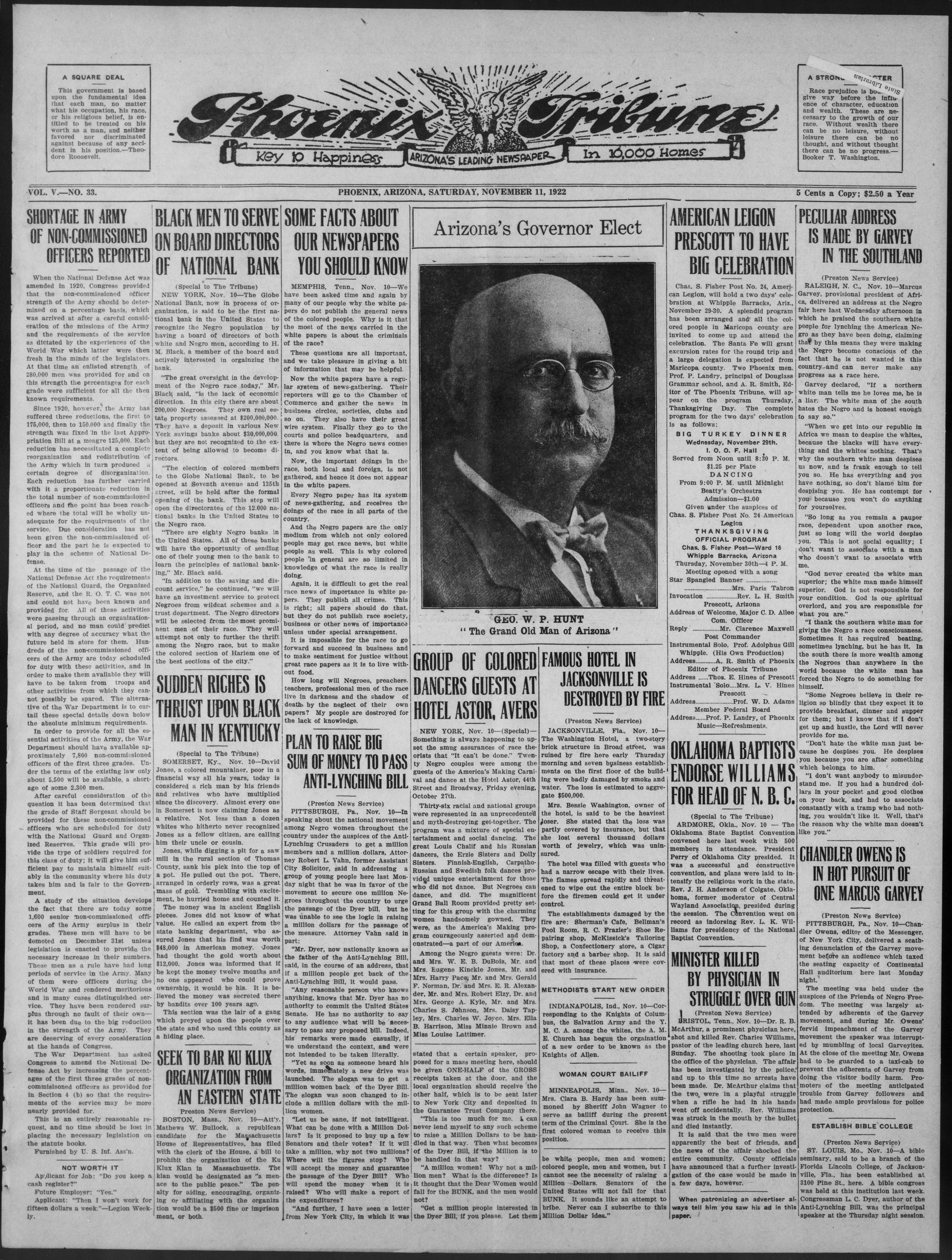
Page text (machine-generated)
This government is based upon the fundamental idea that each man, no matter what his occupation, his race, or his religious belief, is entitled to be treated on his worth as a man, and neither favored nor discriminated against because of any accident in his position.—Theodore Roosevelt.
VOL. V.—NO. 33.
SHORTAGE IN ARMY OF NON-COMMISSIONED OFFICERS REPORTED
When the National Defense Act was amended in 1920, Congress provided that the non-commissioned officer strength of the Army should be determined on a percentage basis, which was arrived at after a careful consideration of the missions of the Army and the requirements of the service as dictated by the experiences of the World War which latter were then fresh in the minds of the legislators. At that time an enlisted strength of 280,000 men was provided for and on this strength the percentages for each grade were sufficient for all the then known requirements.
Since 1920, however, the Army has suffered three reductions, the first to 175,000, then to 150,000 and finally the strength was fixed in the last Appropriation Bill at a meagre 125,000. Each reduction has necessitated a complete reorganization and redistribution of the Army which in turn produced a certain degree of disorganization. Each reduction has further carried with it a proportionate reduction in the total number of non-commissioned officers and the point has been reached where the total will be wholly inadequate for the requirements of the service. Due consideration has not been given the non-commissioned officer and the part he is expected to play in the scheme of National Defense.
At the time of the passage of the National Defense Act the requirements of the National Guard, the Organized Reserve, and the R. O. T. C. was not and could not have been known and provided for. All of these activities were passing through an organizational period, and no man could predict with any degree of accuracy what the future held in store for them. Hundreds of the non-commissioned officers of the Army are today scheduled for duty with these activities, and in order to make them available they will have to be taken from troops and other activities from which they cannot possibly be spared. The alternative of the War Department is to curtail these special details down below the absolute minimum requirements. In order to provide for all the essential activities of the Army, the War Department should have available approximately 7,800 non-commissioned officers of the first three grades. Under the terms of the existing law only about 5,500 will be available, a shortage of some 2,300 men.
After careful consideration of the question it has been determined that the grade of Staff Sergeant should be provided for these non-commissioned officers who are scheduled for duty with the National Guard and Organized Reserves. This grade will provide the type of soldiers required for this class of duty; it will give him sufficient pay to maintain himself suitably in the community where his duty takes him and is fair to the Government.
A study of the situation develops the fact that there are today some 1,600 senior non-commissioned officers of the Army surplus in their grades. These men will have to be demoted on December 31st unless legislation is enacted to provide the necessary increase in their numbers. These men as a rule have had long periods of service in the Army. Many of them were officers during the World War and rendered meritorious and in many cases distinguished service. They have been rendered surplus through no fault of their own—it has been due to the big reduction in the strength of the Army. They are deserving of every consideration at the hands of Congress.
The War Department has asked Congress to amend the National Defense Act by increasing the percentages of the first three grades of noncommissioned officers as provided for in Section 4 (b) so that the requirements of the service may be more nearly provided for. This is an entirely reasonable request, and no time should be lost in placing the necessary legislation on the statute books. Furnished by U. S. Inf. Ass'n.
NOT WORTH IT
Applicant for Job: "Do you keep a cash register?"
Future Employer: "Yes."
Applicant: "Then I won't work for fifteen dollars a week."—Legion Weekly.
Phoenix Tribune
key to Happiness ARIZONA'S LEADING NEWSPAPER In 10,000 Homes
BLACK MEN TO SERVE ON BOARD DIRECTORS OF NATIONAL BANK
(Special to The Tribune)
NEW YORK, Nov. 10—The Globe National Bank, now in process of organization, is said to be the first national bank in the United States to recognize the Negro population by having a board of directors of both white and Negro men, according to H. M. Black, a member of the board and actively interested in orgaining the bank.
"The great oversight in the development of the Negro race today," Mr. Black said, "is the lack of economic direction. In this city there are about 200,000 Negroes. They own real estate property assessed at $200,000,000. They have a deposit in various New York savings banks about $30,000,000, but they are not recognized to the extent of being allowed to become directors.
"The election of colored members to the Globe National Bank, to be opened at Seventh avenue and 135th street, will be held after the formal opening of the bank. This step will open the directorates of the 12,000 national banks in the United States to the Negro race.
"There are eighty Negro banks in the United States. All of these banks will have the opportunity of sending one of their young men to the bank to learn the principles of national banking," Mr. Black said.
"In addition to the saving and discount service," he continued, "we will have an investment service to protect Negroes from wildcat schemes and a trust department. The Negro directors will be selected from the most prominent men of their race. They will attempt not only to further the thrift among the Negro race, but to make the colored section of Harlem one of the best sections of the city."
SUDDEN RICHES IS THRUST UPON BLACK MAN IN KENTUCKY
(Special to The Tribune)
SOMERSET, Ky., Nov. 10—David Jones, a colored mountainer, poor in a financial way all his years, today is considered a rich man by his friends and relatives who have multiplied since the discovery. Almost every one in Somerset is now claiming Jones as a relative. Not less than a dozen whites who hitherto never recognized Jones as a fellow citizen, are calling him their uncle or cousin.
Jones, while digging a pit for a saw mill in the rural section of Thomas County, sank his pick into the top of a pot. He pulled out the pot. There, arranged in orderly rows, was a great mass of gold. Trembling with excitement, he hurried home and counted it. The money was in ancient English pieces. Jones did not know of what value. He called an expert from the state banking department, who assured Jones that his find was worth $48,000 in American money. Jones had thought the gold worth about $12,000. Jones was informed that if he kept the money twelve months and no one appeared who could prove ownership, it would be his. It is believed the money was secreted there by bandits over 100 years ago.
This section was the lair of a gang which preyed upon the people over the state and who used this county as a hiding place.
SEEK TO BAR KU KLUX ORGANIZATION FROM AN EASTERN STATE
Preston News Service)
BOSTON, Mass., Nov. 10—Att'y.
Mathews W. Bullock, a republican candidate for the Massachusetts House of Representatives, has filed with the clerk of the House, a bill to prohibit the organization of the Ku Klux Klan in Massachusetts. The klan would be designated as "a menace to the public peace." The penalty for aiding, encouraging, organizing or affiliating with the organization would be a $500 fine or imprisonment, or both.
PHOENIX, ARIZONA, SATURDAY, NOVEMBER 11, 1922
SOME FACTS ABOUT OUR NEWSPAPERS YOU SHOULD KNOW
MEMPHIS, Tenn., Nov. 10—We have been asked time and again by many of our people why the white papers do not publish the general news of the colored people. Why is it that the most of the news carried in the white papers is about the criminals of the race?
These questions are all important, and we take pleasure in giving a bit of information that may be helpful.
Now the white papers have a regular system of news-gathering. Their reporters will go to the Chamber of Commerce and gather the news in business circles, societies, clubs and so on. They also have their great wire system. Finally they go to the courts and police headquarters, and there is where the Negro news comes in, and you know what that is.
Now, the important doings in the race, both local and foreign, is not gathered, and hence it does not appear in the white papers.
Every Negro paper has its system of news-gathering, and receives the doings of the race in all parts of the country.
And the Negro papers are the only medium from which not only colored people may get race news, but white people as well. This is why colored people in general are so limited in knowledge of what the race is really doing.
Again, it is difficult to get the real race news of importance in white papers. They publish all crimes. This is right; all papers should do that, but they do not publish race society, business or other news of importance unless under special arrangement.
It is impossible for the race to go forward and succeed in business and to make sentiment for justice without great race papers as it is to live without food.
How long will Negroes, preachers, teachers, professional men of the race live in darkness and the shadow of death by the neglect of their own papers? My people are destroyed for the lack of knowledge.
PLAN TO RAISE BIG SUM OF MONEY TO PASS ANTI-LYNCHING BILL
(Preston News Service)
PITTSBURGH, Pa., Nov. 10—In speaking about the national movement among Negro women throughout the country under the auspices of the Anti-Lynching Crusaders to get a million members and a million dollars, Attorney Robert L. Vahn, former Assistant City Solicitor, said in addressing a group of young people here last Monday night that he was in favor of the movement to secure one million Negroes throughout the country to urge the passage of the Dyer bill, but he was unable to see the logic in raising a million dollars for the passage of the measure. Attorney Vahn said in part:
"Mr. Dyer, now nationally known as the father of the Anti-Lynching Bill, said, in the course of an address, that if a million people get back of the Anti-Lynching Bill, it would pass.
"Any reasonable person who knows anything, knows that Mr. Dyer has no authority to commit the United States Senate. He has no authority to say to any audience what will be necessary to pass any proposed bill. Indeed, his remarks were made casually, if we understand the context, and were not intended to be taken literally.
"Yet as soon as someone heard his words, immediately a new drive was launched. The slogan was to get a million women back of the Dyer Bill. The slogan was soon changed to include a million dollars with the million women.
"Let us be sane, if not intelligent. What can be done with a Million Dollars? Is it proposed to buy up a few Senators and their votes? If it will take a million, why not two millions? Where will the figures stop? Who will accept the money and guarantee the passage of the Dyer Bill? Who will spend the money when it is raised? Who will make a report of the expenditures?
"And further, I have seen a letter from New York City, in which it was
Arizona's Governor Elect
Arizona's Governor Elect
[Name]
GROUP OF COLORED DANCERS GUESTS AT HOTEL ASTOR, AVERS
NEW YORK, Nov. 10—(Special)—Something is always happening to upset the smug assurances of race theorists that "It can't be done." Twenty Negro couples were among the guests of the America's Making Carnival and dance at the Hotel Astor, 44th Street and Broadway, Friday evening, October 27th.
Thirty-six racial and national groups were represented in an unprecedented and myth-destroying get-together. The program was a mixture of special entertainment and social dancing. The great Louis Chalif and his Russian dancers, the Erzie Sisters and Dolly Sisters. Finnish-English, Carpatho-Russian and Swedish folk dances provided unique entertainment for those who did not dance. But Negroes can dance, and did. The magnificent Grand Ball Room provided pretty setting for this group with the charming women handsomely gowned. They were, as the America's Making program courageously asserted and demonstrated—a part of our America.
Among the Negro guests were: Dr. and Mrs. W. E. B. DuBois, Mr. and Mrs. Eugene Kinckle Jones, Mr. and Mrs. Harry Pace, Mr. and Mrs. Gerald F. Norman, Dr. and Mrs. E. R. Alexander, Mr. and Mrs. Robert Elzy, Dr. and Mrs. George A. Kyle, Mr. and Mrs. Charles S. Johnson, Mrs. Daisy Tapley, Mrs. Charles W. Joyce, Mrs. Ella B. Harrison, Miss Minnie Brown and Miss Louise Lattimer.
stated that a certain speaker, proposed for a mass meeting here, should be given ONE-HALF of the GROSS receipts taken at the door, and the local organization should receive the other half, which is to be sent later to New York City and deposited in the Guarantee Trust Company there.
"This is too much for me. I can never lend myself to any such scheme to raise a Million Dollars to be handled in that way. Then what becomes of the Dyer Bill, if the Million is to be handled in that way?
"A million women! Why not a million men? What is the difference? Is it thought that the Dear Women would not?
"Get a million people interested in the Dyer Bill, if you please. Let them
FAMOUS HOTEL IN JACKSONVILLE IS DESTROYED BY FIRE
(Preston News Service)
JACKSONVILLE, Fla., Nov. 10—The Washington Hotel, a two-story brick structure in Broad street, was ruined by fire here early Thursday morning and seven business establishments on the first floor of the building were badly damaged by smoke and water. The loss is estimated to aggregate $500,000.
Mrs. Bessie Washington, owner of the hotel, is said to be the heaviest loser. She stated that the loss was partly covered by insurance, but that she lost several thousand dollars worth of jewelry, which was uninsured.
The hotel was filled with guests who had a narrow escape with their lives. The flames spread rapidly and threatened to wipe out the entire block before the firemen could get it under control.
The establishments damaged by the fire are: Sherman's Cafe, Bellman's Pool Room, R. C. Frazier's Shoe Repairing shop, McKissick's Tailoring Shop, a Confectionery store, a Cigar factory and a barber shop. It is said that most of these places were covered with insurance.
METHODISTS START NEW ORDER
INDIANAPOLIS, Ind., Nov. 10—Corresponding to the Knights of Columbus, the Salvation Army and the Y. M. C. A. among the whites, the A. M. E. Church has begun the orgaination of a new order to be known as the Knights of Allen.
WOMAN COURT BAILIFF
MINNEAPOLIS, Minn., Nov. 10—Mrs. Clara B. Hardy has been summoned by Sheriff John Wagner to serve as bailiff during the present term of the Criminal Court. She is the first colored woman to receive this position.
be white people, men and women; colored people, men and women, but I cannot see the necessity of raising a Million Dollars. Senators of the United States will not fall for that BUNK. It sounds like an attempt to bribe. Never can I subscribe to this Million Dollar idea."
AMERICAN LEIGON PRESCOTT TO HAVE BIG CELEBRATION
Chas. S. Fisher Post No. 24, American Legion, will hold a two days' celebration at Whipple Barracks, Ariz. November 29-30. A splendid program has been arranged and all the colored people in Maricopa county are invited to come up and attend the celebration. The Santa Fe will grant excursion rates for the round trip and a large delegation is expected from Maricopa county. Two Phoenix men, Prof. P. Landry, principal of Douglass Grammar school, and A. R. Smith, Editor of The Phoenix Tribune, will appear on the program Thursday, Thanksgiving Day. The complete program for the two days' celebration is as follows:
BIG TURKEY DINNER
Wednesday, November 29th.
L O. O. E. Hall
From 9:00 P. M. until Midnight
Beatty's Orchestra
Admission—$1.00
Given under the auspices of
Chas. S. Fisher Post No. 24 American
Legion
Chas. S. Fisher Post—Ward 16 Whipple Barracks, Arizona Thursday, November 30th-4 P. M.
Mrs. Paris Tabron
Invocation Rev. L. H. Smith
Prescott, Arizona
Address of Welcome, Major C. D. Allee
Com. Officer
Reply Mr. Clarence Maxwell
Post Commander
Instrumental Solo, Prof. Adolphus Gill
Whipple. (His Own Production)
Address A. R. Smith of Phoenix
Editor of the Press Tribute
Editor of Phoenix Tribune
Address ..Thos. E. Hines of Prescott
Instrumental Solo.....Mrs. L. V. Hines
Prescott
Address.....Prof. W. D. Adams
Member Federal Board
Address.....Prof. P. Landry, of Phoenix
Music—Refreshments.
OKLAHOMA BAPTISTS ENDORSE WILLIAMS FOR HEAD OF N. B. C.
(Special to The Tribune)
ARDMORE, Okla., Nov. 10 — The Oklahoma State Baptist Convention convened here last week with 500 members in attendance. President Perry of Oklahoma City presided. It was a successful and constructive convention, and plans were laid to intensify the religious work in the state. Rev. J. H. Anderson of Colgate, Oklahoma, former moderator of Central Wayland Association, presided during the session. The Convention went on record as indorsing Rev. L. K. Williams for presidency of the National Baptist Convention.
MINISTER KILLED BY PHYSICIAN IN STRUGGLE OVER GUN
MINISTER KILLED BY PHYSICIAN IN STRUGGLE OVER GUN
(Preston News Service)
BRISTOL, Tenn., Nov. 10—Dr. R. B. McArthur, a prominent physician here, shot and killed Rev. Charles Williams, pastor of the leading church here, last Sunday. The shooting took place in the office of the physician. The affair has been investigated by the police; and up to this time no arrests have been made. Dr. McArthur claims that the two were in a playful struggle when a rifle he had in his hands went off accidentally. Rev. Williams was struck in the mouth by the bullet and died instantly.
It is said that the two men were apparently the best of friends, and the news of the affair shocked the entire community. County officials have announced that a further investigation of the case would be made in a few days, however.
When patronizing an advertiser always tell him you saw his ad in this paper.
Race prejudice is be given way before the influence of character, education and wealth. These are necessary to the growth of our race. Without wealth there can be no leisure, without leisure there can be no thought, and without thought there can be no progress.— Booker T. Washington.
5 Cents a Copy; $2.50 a Year
PECULIAR ADDRESS IS MADE BY GARVEY IN THE SOUTHLAND
(Preston News Service)
RALEIGH, N. C., Nov. 10—Marcus Garvey, provisional president of Africa, delivered an address at the Negro fair here last Wednesday afternoon in which he praised the southern white people for lynching the American Negro as they have been doing, claiming that by this means they were making the Negro become conscious of the fact that he is not wanted in this country and can never make any progress as a race here.
Garvey declared, "If a northern white man tells me he loves me, he is a liar. The white man of the south hates the Negro and is honest enough to say so."
"When we get into our republic in Africa we mean to despise the whites, because the blacks will have everything and the whites nothing. That's why the southern white man despises us now, and is frank enough to tell you so. He has everything and you have nothing, so don't blame him for despising you. He has contempt for you because you won't do anything for yourselves.
"So long as you remain a pauper race, dependent upon another race, just so long will the world despise you. This is not social equality; I don't want to associate with a man who doesn't want to associate with me.
"God never created the white man superior; the white man made himself superior. God is not responsible for your condition. God is our spiritual overlord, and you are responsible for what you are."
"I thank the southern white man for giving the Negro a race consciousness. Sometimes it has required beating, sometimes lynching, but he has it. In the south there is more wealth among the Negroes than anywhere in the world because the white man has forced the Negro to do something for himself.
"Some Negroes believe in their religion so blindly that they expect it to provide breakfast, dinner and supper for them; but I know that if I don't get up and hustle, the Lord will never provide for me.
"Don't hate the white man just because he despises you. He despises you because you are after something which belongs to him."
"I don't want anybody to misunderstand me. If you had a hundred dollars in your pocket and good clothes on your back, and had to associate constantly with a tramp who had nothing, you wouldn't like it. Well, that's the reason why the white man doesn't like you."
CHANDLER OWENS IS IN HOT PURSUIT OF ONE MARCUS GARVEY
(Preston News Service)
PITTSBURGH, Pa., Nov. 10—Chandler Owens, editor of the Messenger, of New York City, delivered a scathing denunciation of the Garvey movement before an audience which taxed the seating capacity of Continental Hall auditorium here last Monday night.
The meeting was held under the auspices of the Friends of Negro Freedom. The meeting was largely attended by adherents of the Garvey movement, and during Mr. Owens' fervid impachment of the Garvey movement the speaker was interrupted by mumbling of local Garveyites. At the close of the meeting Mr. Owens had to be guarded to a taxi-cab to prevent the adherents of Garvey from doing the visitor bodily harm. Promoters of the meeting anticipated trouble from Garvey followers and had made ample provisions for police protection.
ESTABLISH BIBLE COLLEGE
ST. LOUIS, M., Nov. 10—A bible seminary, said to be a branch of the Florida Lincoln College, of Jacksonville, Fla., has been established at 3100 Pine St., here. A bible congress was held at this institution last week. Congressman L. C. Dyer, author of the Anti-Lynching Bill, was the principal speaker at the Thursday night session.
PAGE TWO
Phoenix Tribune
KEY TO HAPPINESS AROZONA'S LEADING NEWSPAPER In 10,000 Homes
Entered as Second-Class Matter June 22, 1918, at the Postoffice at Phoenix
Arizona, under Act of March 3, 1879
An erroneous reflection upon the character, standing or reputation of any person, firm or corporation which may appear in the column of THE TRIBUNE will be gladly corrected upon its being brought to the attention of the publishers.
6
BROOKLYN
NATIONAL
HISTORICAL
MUSEUM
No one has any more right to go about unhappy than he has to go about ill-bred. He owes it to himself, to his friends, to society, and to the community in general, to live up to his best spiritual possibilities, not only now and then, once or twice a year, or once in a season, but every day and every hour.—Lillian Whiting.
DEMOCRATIC VICTORY
ction Tuesday, resulted in a veto only in Arizona, but in several ona, as elsewhere, the result wi group who supported the republicans are game losers and duty as citizens, simply because oune supported Governor Carr Governor Hunt because we bel office would have been for the We are not ashamed of have, ampbell, and two years hence, again will be pitted against e be found supporting the Repiples for which it stands. ratulate Governor-Elect Hunt trust he will fulfill his promise to the people of this great state is a quality inherent in the color remain—100 per cent America
The election Tuesday, resulted in a victory for the democrats not only in Arizona, but in several other states. Here in Arizona, as elsewhere, the result was disheartening to a large group who supported the republican ticket. But good republicans are game losers and will not cease to do their duty as citizens, simply because their ticket was defeated.
The Tribune supported Governor Campbell as opposed to Ex-Governor Hunt because we believed that his retention in office would have been for the best interest of the state. We are not ashamed of having supported Governor Campbell, and two years hence, when the two great parties again will be pitted against each other, The Tribune will be found supporting the Republican party and the principles for which it stands.
We congratulate Governor-Elect Hunt on the victory achieved, and trust he will fulfill his promises and redeem his pledges to the people of this great state. Loyalty to government is a quality inherent in the colored people and we shall ever remain—100 per cent American.
AGE OF OPPORTUNITIES
world growing-better? Yes. The reached middle life, but who
Is the world growing better? Yes. There are few men who have reached middle life, but who can look back over the past decade and note many changes for the better. The world is growing more humane; more mindful of the sufferings of the poor and unfortunate. There is a general air of philanthropy permeating our entire social system. We have a great many societies devoted to charitable work. Our churches are engaged in strenuous efforts to relieve the sufferings of unfortunate people, the sick and distressed in every land, and this, too, to a greater extent than ever before in the history of the world. We have free schools and high schools that are better than the colleges of 50 years ago, and all are free and in fact the common school attendance is compulsory. This was not always the case, and thousands of bright boys and girls of the past century got very little schooling. Today an education is recognized as an asset that the state and nation is duty bound to confer upon its citizenship. We have come to recognize the schoolhouse as the safeguard of the nation, and we have introduced into our schools certain features that are calculated to instill into the minds of every boy and girl the fundamental principles of manhood and womanhood. They are taught hygiene and how to take care of themselves physically, and how to improve themselves mentally, and are given a business course in the high schools that fit every pupil to do business understandingly. Is this not a great improvement over the educational system of a half century ago? You will say that it is, regardless of the fact that you may be one of those who dwell upon the past and close your eyes to the present and the future; but the knowledge of the great improvements of educational work works in through the skin and you have to admit it. Our schools are making better men and women today than ever before in history. Again, the standards of life are higher today than ever before. The youth sets his mark higher and strives to reach the goal of his ambition, and his training in the schoolhouse and the home has qualified him for the strenuous advance upward and onward to success. He knows how to take care of himself, and marches on over obstacles and pitfalls that would have been certain to end the career of the greater number of boys and girls of 50 years ago. There is more going on in the world today than ever before more to attract the attention of the youth; but he shuts his eyes to temptation and keeps in the middle of the road. There may be some unfortunates who wander from the path, but their number is far less than formerly. They realize that there is something worth while to strive for, and they also realize that he who fails to make the best use of the talents God gave him will fall by the wayside, an outcast, and so the slogan is "press on," press on to victory. Medical science has made rapid strides within the past half century and has added many years to the allotted span of human life. Active work in the churches has raised the standard of morality throughout the country, and while the automobile and other attractions may have reduced church attendance they have not taken from the people a deep-rooted belief in the Creator, and the Christian spirit is stronger, and they have
more sympathy for the unfortunate and less envy and hatred for the successful. They have come to develop the one, two or any other number of talents that God gave them:
BEGIN AT THE BOTTOM
Many boys and young men they can obtain "big pay." of big wages are past, and timeal There will be no more out of all proportion to serve man and boy must take such is worth. It may be small large; but in many events it neither will the job be the caring the war. This must be man before he will make a great captains of industry men in business began "at worked up through all the hand of a business the detail mastered. While learning to perhaps the wages they rehearse have been more than they will industries men must be trained being left vacant by those a firm or corporation that educareful and faithful workers, knowing that the time will belected the right kind of a bworth the salary he may rec. Young man be not partied you are engaged in an he will come later in life. Be p company you keep and the his important items in the can means more to him than an spotless character is worth me that the clean young man will to advance. He will be trustsportunities will be given him careless youth, the spendthrive right. Do not hesitate to win, and you will surely win entirely up to you. If you your fault. You cannot bla serve the confidence of your he will help you; but do not boss. He has been through young like you and he know not aware of. Therefore, be ful and dependable and your youthful dreams aspired to.
ays and young men refuse to win "big pay." The war is over are past, and times are settling will be no mor opportunities to portion to services rendered, but must take such wages as that may be small or it may be many events it will not be woe the job be the easy one that coul. This must be understood by he will make a success in life. As of industry began at the toess began "at the foot of the through all the various grades business the details of which the while learning they were of life wages they received, however more than they were actually woe must be trained to fill the peacant by those who are passingation that educates the such faithful workers is doing it at a time the time will come, provided that kind of a boy, when his sary he may receive. Can be not particular about you engaged in an honest business or in life. Be particular, however keep and the habits you acquiams in the career of any you do him than any wages he maacter is worth more than gold, young man will be given ever he will be trusted and he will will be given him that will never, the spendthrift or the sport, not hesitate to take an honest will surely win if you deserves to you. If you fail to win out You cannot blame it on other evidence of your employer you wou; but do not think that you is been through the mill, and you and he knows a thing or two. Therefore, be honest and indisable and your future will beems aspired to.
Many boys and young men refuse to work unless they can obtain "big pay." The war is over. The days of big wages are past, and times are settling back to normal. There will be no mor opportunities to earn wages out of all proportion to services rendered, and the young man and boy must take such wages as the job they get is worth. It may be small or it may be comparatively large; but in many events it will not be war-time wages, neither will the job be the easy one that could be had during the war. This must be understood by every young man before he will make a success in life. Not all of the great captains of industry began at the top. The great men in business began "at the foot of the ladder" and worked up through all the various grades to take command of a business the details of which they thoroughly mastered. While learning they were of little value, and perhaps the wages they received, however small, may have been more than they were actually worth; but in all industries men must be trained to fill the places that are being left vacant by those who are passing on, and the firm or corporation that educates the successors to the careful and faithful workers is doing it at a pecuniary loss, knowing that the time will come, provided they have selected the right kind of a boy, when his service may be worth the salary he may receive.
Young man be not particular about your job, provided you are engaged in an honest business, your reward will come later in life. Be particular, however, about the company you keep and the habits you acquire. These are important items in the career of any young man and means more to him than any wages he may receive. A spotless character is worth more than gold, and it means that the clean young man will be given every opportunity to advance. He will be trusted and he will be helped. Opportunities will be given him that will never come to the careless youth, the spendthrift or the sport. Young man, live right. Do not hesitate to take an honest job that you win, and you will surely win if you deserve success. It is entirely up to you. If you fail to win out it is entirely your fault. You cannot blame it on others. If you deserve the confidence of your employer you will get it, and he will help you; but do not think that you can fool the boss. He has been through the mill, and he was once young like you and he knows a thing or two that you are not aware of. Therefore, be honest and industrious, faithful and dependable and your future will be all that your youthful dreams aspired to.
An Arizona flour camaign is being carried on over the State by the home demonstration agents of the University of Arizona.
In Coconino County housewives are using Star and Flavo brands and are comparing our own products with the Kansas flours. The agent reports that the results are encouraging.
In Santa Cruz County tests are being made with Arizona entire wheat flour. The Home Demonstration Agent has given demonstrations of the use of this flour and housewives are making their own tests in their own kitchens under the direction of the agent.
In Cochise County home demonstrators in six communities are testing the flour and at Bowle a Bread Club, consisting of five girls, has been organized to do experimental baking. The majority of the experimenters in this county have agreed to exhibit sample loaves at the Cochise County Fair. This will be one of the most interesting features of the home economics exhibits at Douglas this week.
THE TWILIGHT OF INNISFREE
I am the wind that grieves here, and grieves through Innisfree.
I am a silver echo that whispers of the dawn
When songs glowed in my heart here,
when I was a lad and free.
Where has my soul with its passion gone!
Now I can breathe the rose musk, as night's cool shadowy hair
Enfolds me, and cry not in my throat when morning brings
Wet summer beauty over the glimmering hillside there.
Do I sleep while the linnet sings!
I am the wind that grieves here, recalling in dreams
at the rose musk, as
shadowy hair
not in my throat
brings
over the glimmer
here.
the linnet sings!
Corner Seventh st
M. Thompson, past
South Seventh st
Sunday school at 1
at 11 a.m. m. and s
League at 6:30
meeting every Wed
A young sweet sound that Aengus in blowing an oaten straw
in The Harvard Advocate
MIXED RELIGIONS
Dr. Grenfell, after amputating the limb of a Roman Catholic patient, wrote an appeal for a wooden leg to enable the man to move about. This was published in The Congregationalist and read by a Baptist woman whose husband, a Methodist, who had worn a wooden leg, had just died. So the Methodist leg given by a Baptist woman in answer to a Congregational appeal is now being used as a perfectly good interdenominational understanding. — The Christian Advocate (New York).
---
HOUSEWIVES TEST
men refuse to work unless
the war is over. The days
times are settling back to nor-
opportunities to earn wages
prices rendered, and the young
thigh wages as the job they get
or it may be comparatively
it will not be war-time wages,
usy one that could be had dur-
understood by every young
success in life. Not all of the
began at the top. The great
the foot of the ladder" and
various grades to take com-
mits of which they thoroughly
they were of little value, and
received, however small, may
were actually worth; but in all
need to fill the places that are
who are passing on, and the
educates the successors to the
is doing it at a pecuniary loss,
come, provided they have seey, when his service may be receive.
icular about your job, provid-
honest business, your reward
particular, however, about the
habits you acquire. These are
neer of any young man and
any wages he may receive. A
more than gold, and it means
will be given every opportunity
used and he will be helped. Open
that will never come to the
ift or the sport. Young man,
to take an honest job that you
if you deserve success. It is
fail to win out it is entirely
me it on others. If you de-
employer you will get it, and
at think that you can fool the
in the mill, and he was once
is a thing or two that you are
honest and industrious, faith-
future will be all that your
HEAVY WHEAT PRODUCTION
IN ARGENTINA
The final estimate of the Argentine Government for the 1921-22 wheat harvest is 180,640,700 bushels, according to a cablegram received by the U. S. Department of Agriculture from the U. S. agricultural commissioner in Buenos Aires. This is an increase over the preliminary estimate of more than 25,000,000 bushels. The wheat production in 1920-21 was officially estimated at 169,756,000 bushels, or approximately 10,000,000 bushels less than the last harvest. Flax production in Argentina for 1921-22 is officially estimated at 32,272,000 bushels, compared with 50,470,000 bushels last year.
CHURCH DIRECTORY
A. M. E. Church
Corner Second street and Jefferson.
Sunday school at 10 a. m. Preaching
at 11 a. m. and 8 p. m. Christian Endeavor at 6:15 p. m. Prayer meeting
Wednesday night. General class
every Sunday at 12:15 p. m.
Second Baptist Church
Second Baptist Church
Corner Fifth street and Jefferosn.
E. D. Green, pastor. Residence 1416
East Jefferson street. Sunday school
at 9:30 a. m. Preaching at 11 a. m.
and 8 p. m. B. Y. P. U. at 6 p. m.
Prayer meeting every Wednesday
evening.
C. M. E. Church
Corner Seventh street and Jefferson. M. Thompson, pastor. Residence, 112 South Seventh street. Phone 4869. Sunday school at 10 a.m. Preaching at 11 a.m. and 8 p.m. Epworth League at 6:30 p.m. Teachers' meeting every Wednesday evening.
Antioch Baptist Church
(11th St. and Washington)
C. A. Gilmore, pastor. Residence, 429
East Washington. Phone 2643. Sunday
school at 10 a. m. Preaching at
11 a. m. and 8 p. m. B. Y. P. U. at
6:30 p. m. Prayer meeting Wednesday
evening. Bible study every Sunday
at 3 p. m.
Church of God in Christ
Corner Fourteenth street and Madison.
Elder L. L. Britton, pastor.
Residence, 1443 East Jefferson. Sunday
school at 10 a. m. Preaching at
11 a. m. and 7:30 p. m. Services also
are held on Tuesday and Friday
nights of each week, beginning at
7:30 o'clock.
Grace Baptist Church
822 South Montezuma avenue. J. H. Jones, minister. Sunday school at 10 a. m. Preaching at 11 a. m. and 7:30 p. m. Everybody come-praying
Wedding Announcement
Mr. and Mrs. Perry Payne announce the engagement of their daughter, Miss Eleanor G. Payne, to Dr. Raymond Richard of San Francisco, Calif, which wedding will be in January 1923, at their home, 64 So. 3rd St., Phoenix.
Notes from Superior
Mrs. Julius Miller of Superior has been confined to her bed the past week, but is now able to be out. Mrs. Effie Jackson of Miami is the house guest this week of Mr. and Mrs. Miller at the club house. Mr. and Mrs. Watt kins and Mrs. M. Davis of Miami stopped over in Superior a few hours last Sunday while on route home from Phoenix, where they had been attending the State Fa ir. A day and night shift is busy on the new broad gauge railroad connecting Superior with the main line of the A. & E., and when completed, just—oh, just consult the map! J. H. Miller, reporter.
```markdown
```
Mrs. W. E. Noble and Mrs. I. F. Silvers very delightfully entertained the Sons and Daughters of the I Will Arise Across the River to The Burying Ground Society in honor of Messrs Gamble and Stearns of Oakland, Cal. Monday evening, November 6, at the home of Mrs. Silvers, 1427 East Jefferson St. Music was a feature of the evening, Mrs. M. A. White presiding at the plano. Mrs. P. F. McCutcheon favored the guests with a beautiful solo. The most amusing feature of the evening was the Chinese Sextette, composed of Mrs. M. A. White, Mrs. P. F. McCutcheon, Mr. and Mrs. Chas, Fish, Mr. Harold Carriger and Mrs. I. F. Silvers. The guests were also favored with a solo by Mrs. M. A. White, cornet solo, Mr. Chas, Fish, and remarks by Mr. Owens of Oklahoma who spoke on the subject: "Why Some Churches Are Without Ministers." Mrs. W. E. Noble made a short talk on club work, and Mr. Harold Carriger sang a beautiful solo. The ladies were exquisitely gowned for the occasion, and among those present were: Mesdames White Scott, Carter, McCutcheon, Owens, Lucas, Fish, Silvers and Noble. Gentlemen present were: Messrs Gamble, Stearns, Carter, Owens, Fish, McCutcheon, Carriger, Silvers and Noble.
Revival Meetings
Commencing Sunday, November 12, a series of revival meetings will be held at the C. M. E. church, 7th St. and Jefferson. The members of this church began their prayer meetings Wednesday night, and these will continue until Sunday, when the revival will begin. The Rev. T. C. Cunningham, noted divine of El Paso, Texas, will arrive Saturday and will have charge of the meetings. Dr. Cunningham is a wonderful pulpit orator and all who heard him speak at the meeting of the Annual Conference in this city a few weeks ago, will bear witness to the fact. He will deliver the sermon Sunday and for ten nights will be in charge of the revival at this church. The pastor. Rev. M. Thompson, invites the pastors and members of all churches in the city to come and assist in this great revival. The general public also invited.
An Appreciation
Mrs. Geo. W. Caldwell, of 233 East Jefferson street, who the past six months has been confined to her home on account of an afflicted foot, was the recipient of a handsome bathrobe on last Sunday, the gift of Mr. and Mrs. W. E. Noble. The Nobles have been friends of Mr. and Mrs. Caldwell for the past 35 years, and she is very appreciative of a gift coming from such old time friends. She also wishes to thank all the people of Phoenix, both colored and white, who have in any way shown kindness to her during her confinement. She also desires that special mention be made of the people of California, Yuma and Prescott, Arizona, who have remembered her during her illness. As organizer and first president of the Self Improvement Art Club of Phoenix, she is keenly interested in the welfare and success of this club, and wishes to say that she is gratified with the splendid reports that come to her of the success with which the club is meeting under its new president, Mrs. J. T. Lucas.
Splendid Meeting Held
The Phoenix Branch of the N. A. A. C. P. held a splendid meeting Sunday afternoon, 3 o'clock, at the A. M. E. Zion church. Many were present and several Republican candidates were invited to address the meeting. Judge Jenckes gave a splendid talk on the welfare of the child, he being in charge of the juvenile department of the courts in Maricopa county. His talk was educational, interesting and full of sound logic. Other candidates spoke of the issues in the campaign. Next meeting of the Association will be Tuesday evening, November 14, at the A. M. E. Zion church, 10th street and Washington. All invited to attend the meetings. W. C. Hawkins, Press. Mrs. Lynn Ross Carter, Secy.
Miss Smith is Hostess
Last Saturday, November 4, Miss Nokomas Smith, of 1342 East Washington street, was hostess at a delightful dinner party given in honor of a number of members of the 10th Cavalry band. The evening was spent at cards and dancing and other amusements. Among those present were: Miss Iva Mae Tomlin, Miss Helen Mae Brown, Miss Agnes Rose, Mrs. Mattie Hudson, Mrs. Robert Murphy, Miss Emily Smith, Mr. Reed, Mr. Perry, Mr. Ducan, Mr. Powell, Mr. Hawthorne, Mr. Lewis, Mr. Tomlin, Mr. Robert Murphy and the hostess. At a late hour the guests departed, and all were unanimous in proclaiming Miss Smith an ideal hostess.
Builds New Cottage
The Rev. Wm. Solly of 607 East Jefferson street, has erected a neat little three-room cottage on his property at 937 West Grant street. The house is now practically complete and ready for occupancy. Any one desirous of renting a neat little modern cottage, should see Rev. Solly.
Mrs. Morgan Will Sing
Sunday night a feature of the services at the Second Baptist church will be several vocal selections by Mrs. Cora Morgan, noted singer from Houston, Texas, who is spending the winter here. All who would enjoy a splendid song service, should attend this church Sunday.
S. I. A. Club Notes
Ladies of the S. I. A. Club met Monday afternoon, November 6, with Mrs. Noble White, 1738 East Jefferson St., and a pleasant social hour was spent. Delightful refreshments were served by the genial hostess, after which the meeting adjourned to meet November 13, with Mrs. P. F. McCutcheon at 1215 East Jefferson street. The club members are pleased to say that physicians attending Mrs. Geo. W. Caldwell announce her condition as much improved. Mrs. M. Noble, reporter.
Tent Meeting
Maids and Pages of Mt. Sinai Tent are hereby notified that meetings will be held the first and third Fridays in each month. Take due and timely notice, and govern yourselves accordingly. Mrs. Jessie James, Q. M.
Buys Ford Coupe
Mrs. O. G. Howard of 726 West Grant street, is the proud owner of a late model Ford coupe purchased last week. She has learned to drive and is now enjoying the fruits of her purchase. Mrs. Howard is a modiste, and her many customers and friends are pleased to note her success.
Home From Coast
Mrs. P. S. Johnson and her granddaughter, Lillian Barbee, returned this week from the coast, where they spent the summer. Mrs. Johnson also brought another one of her grandchildren, Ethel Hackley, whose mother resides in California. Mrs. Johnson reports a very delightful trip and states that she was kept informed of the happenings in Phoenix through the Tribune, which came regularly.
Lest You Forget
The Harvest Dinner will be given November 23 at the Zion Methodist Church by members of the S. I. a. club. A rare treat is in store for all who attend. Everyone welcome.
GIRLS. NOTE THIS
Her Girl Chum—"Did the minister make Ferdinand use the words 'With all my worldly goods I thee endow'?" Mrs. Justwed—"No. Why put him on his guard? I'll get 'em anyway."— Judge.
FOR SALE—Two dandy lots. Nos. 10 and 11, Block 4, Park addition, Oklahoma City, Okla. For information, address Mrs. R. M. Henderson, 112 So. 7th street, Phoenix, Arizona.
FOR SALE—Two lots. Nos. 23 and 24, Block 38, Taft, Oklahoma. For further information, address Mrs. R. M. Henderson, 112 So. 7th street, Phoenix, Arizona.
FOR SALE—Thoroughly modern pebble dashed house in east end. Extra large lot, shade trees, lawn, etc. Reasonable terms. See Smith about it. Apply 1302 East Jefferson St.
A REAL SNAP
FOR SALE—Corner lot, close in, on East Washington street. Owner needs the money and will sell for $500. Only $200 cash, balance to suit. Apply 345 East Monroe St.
THE GEO. F. MERRYMAN CO.
Undertakers and Embalmers
124 North Second Avenue
Phoenix Phoenix
SHELDON
THE JEWELER
106 North First Ave.
Best Equipped workshop in Arizona
WRIST WATCHES
DIAMONDS
LAVELLIRES, Etc.
'IF YOU BUY IT OF SHELDON
YOU KNOW IT'S RIGHT'
SATURDAY. NOVEMBER 11. 1922
Tribune CLASSIFIED ADVERTISING
Rate: 1½ cents per word per issue.
No ads accepted for less than 25c
Read for profit. Use for results.
KEYS
Fitted and Duplicated
LETIS R.' TEMPLIN
146 E. Adams St. Phone 5058
FOR SALE
WATCH PHOENIX GROW
5-Room modern house; lot 50x235
feet; $1750; $250 cash; $20 a month.
6-Room brick, furnished, $2850; $500
cash, $25 a month.
7-Room brick, business district,
$5000; $1000 cash.
12-Room apartment furnished,
$5500; $500 cash, $50 a month.
M. H.SHELTON
215 W. Wash. 522 E. Wash.
PORO SYSTEM HAIRDRESSING
FOR SALE
Graduate of the Poro College of Hair and Beauty Culture and specialize in the Poro System of hair and scalp treatment, shampooing, manicuring and facial massaging. I also teach the Poro System. Phone 4836 for appointments.
MRS. R. C. HOWARD.
38 N. 11th St.
MONEY TO LOAN
We Loan The Most
15 North
First
Avenue
We loan money on Diamonds,
Watches, Guns, Bags and Clothing.
PHOENIX LOAN & JEWELRY CO.
Hauling is our business, and if you need any hauling done, call us. Prompt delivery at reasonable prices. We also have a few furnished rooms, apartments and houses to rent. Just phone 5950 and tell us your troubles. GEO. M. FINLEY.
CHICAGO PAINT STORE
L. J. Lawlor, Prop.
Picture Framing
Wall Paper, Paints, Varnishes, Etc.
Phone 3496 336 E. Washington St.
Phoenix, Arizona
FOR SALE—AUTOMOBILES
Mr. John Goldsmith, popular barber in the West end, and whose place of business is 623 West Grant street, is now an authorized auto salesman for Ed Rudolph, Lincoln and Ford dealer. Mr. Goldsmith has some real bargains in used cars, and if you are thinking of buying a car, it will pay you to see him first. Office, 623 West Grant St.
FOR SALE—REAL ESTATE
For real bargains in houses, lots,
apartments, ranches and honest-to-
goodness business chances, see H. H.
Rice, 438 East Jefferson street. House
and lots for sale or rent in any se-
ction of the city. Tell me your trou-
bles.
FOR RENT—Neatly furnished rooms
for gentlemen. All modern conveniences;
right on car line. Apply 936 East
Washington street. Phone 3159.
SPECIAL NOTICE
PENSIONS, all wars. J. S. Detwiler,
505 E. Street, Washington, D. C.
HOME BAKERY
Fresh home-made bread for sale every Monday, Wednesday, Thursday and Saturday. Home-made plies and cakes baked to order. Phone 2120, or call on Mrs. J. J. Brown, 1722 East Jefferson St.
BOOKER T. WASHINGTON MEMORIAL HOSPITAL
WITH SANITARIUM ANNEX
Corner 14th Street and Jefferson
Dr. W. C. Hackett, Director
FURNISHED ROOMS
FOR RENT — Large, comfortable rooms, bath, closets and other modern conveniences. Reasonable rates.
Mrs. Chas. Franklin, 219 East Jefferson street.
GOOD INDUSTRIOUS men and women, can make good money in a pleasant way in handling EXCLUSIVE AGENCY contract for INTERNATIONAL DISTRIBUTORS, MEMPHIS, TENN. Write them for FREE INFORMATION about this GREAT OFFER today.
FOR RENT — Thoroughly modern house to rent in Cottage Court. Apply 930 East Washington.
FOR RENT—Large brick house at 313 So. 11th Ave. Apply Mrs. Lewis Varnes, 1225 East Madison St.
FOR RENT—Neat little six-room cottage in west end. Big lot, plenty of shade. See owner at 219 East Jefferson St. Phone 4669.
Personal, Local and
Personal, Local and Society News
OF THE STATE CAPITAL
By R. L. S., Society Editor
Wednesday evening, November 8 Mrs. J. J. Brown and mother, Mrs. A. M. Wooby, gave a delightful surprise birthday party in honor of Mr. J. J. Brown's 43rd anniversary. Promptly at 8 o'clock the guests began to arrive and by 9 o'clock the house was full of people who had come to help Mr. Brown celebrate. He was taken completely by surprise, and the guests found him arrayed in his working clothes, enjoying the quietude of home with no thought of a celebration. Mr. Brown is a very popular man, and this was evidenced by the guests who were many. A feature of the evening was a "peanut toting contest," in which Mrs. Hattie Terry won first prize, a box of stationery, and Miss Eliza Richardson second prize, a little box containing something unique and suited for a girl of tender years. Mr. Roy Parker and Mr. W. J. Jones alternated in furnishing music on the victoria, to the delight of all. Delightful refreshments were served, and then came the big birthday cake, be decked with 43 miniature candles. Mr. Brown succeeded in lighting all the candles before the first had burned out. He was the recipient of many beautiful and valuable presents and on departing, the guests wished him many more happy birthdays. Mr. G. S. Rodgers told him that he hoped he would live to see 43 more birthdays, and that each year would be harder than those through which he has come. All spent a very enjoyable evening, and it was the wish of Mr. W. J. Jones and a certain other gentleman that these birthday parties be given monthly instead of annually as is the custom.
Mr. Samuel Hardwick returned this week from Jerome, Ariz., where he has been the past several weeks. He reports extremely cold weather in that section and says that Phoenix certainly looks good to him.
Notice to the Public
Now is the time to drop into the B. B. Second Hand Store, 17 South 4th street, and buy your winter furnishings. Anything you need may be had at this store. New suits, made-to-measure, and if your suit doesn't fit, your money back with a smile. Shoes, hats, dresses, furs and lots of other things for men, women and children. Shot guns, rifles, revolvers, watches, clocks, rings and many other things too numerous to mention. Drop in any time. You are welcome whether you wish to buy or not.
B. BANKS, Mgr.
17 Sq. 4th St.
"JUST WE
Shoes for
Union Mac
NELSON SH
42 West Washington St.
$500 REWARD
The above reward will be paid to any person who that we ever failed to pay a legitimate claim ag company for disability caused by sickness or acc pay for every sickness and every accident. Po only $24 per year and pays $20 weekly benefits a death benefit. Policies issued to men and women occupation between the ages of 16 and 70 years
The above reward will be paid to any person who can prove that we ever failed to pay a legitimate claim against our company for disability caused by sickness or accident. We pay for every sickness and every accident. Policy costs only $24 per year and pays $20 weekly benefits and $5,000 death benefit. Policies issued to men and women in any occupation between the ages of 16 and 70 years. Policy in full force 30 days from date issued.
COMMONWEALTH CASUALTY COMPANY
OF PHILADELPHIA
A. R. SMITH, General Agent for Arizona
1302 East Jefferson St. Phoenix, Arizona
Surprise Birthday Party
```markdown
```
Returns from Jerome
Mrs. Maryland Is Hostess
Wednesday - evening, November 1,
Mrs. Chester Maryland of 1207 East
Jefferson street entertained in honor
of Mrs. Mose Davis and Mrs. F. C.
Watkins of Miami, and Mrs. Evelena
Miller of Texas. Cards and dancing
furnished amusement for the guests,
among whom were many members of
the 10th Cavalry band. Delightful
refreshments were served and all had a
delightful time. Guests present were:
Mrs. C. Morgan, Mrs. Willie Moses,
Mrs. and Mrs. P. F. Chaves, Mr. Roy
Bailey, Mrs. Estelle Wright, Mrs. A.
Stewart, Miss Pauline Howard, Mr.
Alphonso Clarke, Mr. George Perry,
Mr. Leamon Wilkerson, Mr. Thomas
White, Mr. Willie McGhee, Mr. and
Mrs. Ballu, Mr. and Mrs. R. E. Wilson,
Mr. and Mrs. F. H. Lewis, Miss
Thresa McCloud, Miss Erma Jones,
Mr. Harold Carriger, Miss Constance
Hall, Mr. Taylor Williamson, Mr. Immanuel Penna, Mr. Norman M. Hawthorne, Mr. Powell Clarksdale, Mr.
and Mrs. Timothy Gilmore, Mr. F. Knox, Mr. Charles Smith and Mr. A. Tuckey.
```markdown
```
Open Lunch Stand
Mr. and Mrs. Wm. Burnett, recent arrivals from Tucson, Ariz., have leased the establishment at 115 South 6th street and have opened a lunch stand. They plan to serve hot tamales, chili con carne, all kinds of sandwiches, light lunches and cold drinks. They will cater to the school children and all others who want light lunches, sandwiches, etc. After church services, after the show, or whenever you want a bowl of chili, some hot tamales or a sandwich, stop at 115 South 6th street.
***
Hospital Club Notes
The Booker T. Washington Hospital and Relief Club met Tuesday evening, Nov. 7, at the home of Dr. and Mrs. W. C. Hackett, 1334 East Jefferson, with the president in the chair. The attendance was good and much important business was transacted. Tickets were turned in from the entertainment which was given October 31, and a general report was made. To date the club has realized $46 from the entertainment, and there are still others to report. Election of officers was postponed until next meeting, on account of so much business which had to be transacted. All members urged to attend the next meeting. The following new members were enrolled at the meeting last Tuesday night: Mr. and Mrs. Ina Gilstrap, Mrs. Mary E. Scott and Mr. Charles Jackson. Remember the date of the next meeting is November 14. Miss Eliza Richardson. Reporter.
THE PHOENIX TRIBUNE—ALWAYS IMPROVING
The
Cross-Cut
By
Courtney Ryley
Cooper
Illustrations by R. B. Van Nice
Copyright by Little, Brown & Co.
SYNOPSIS
CHAPTER I.—At Thornton Fairchild's death his son Robert learns there has been a dark period in his father's life which for almost thirty years has caused him suffering. The secret is hinted at in the Fairchild child, which also informs Robert he is now owner of a mining claim in Colorado, and advising him to see Henry Beamish, a lawyer.
CHAPTER II.—Beamish tells Robert his claim, a silver mine, is at Oahadi, thirty-eight miles from Denver. He also warns him against a certain man, "Squint" Rodaline, his father's enemy. Robert decides to go to Oahadi.
CHAPTER III.—On the road to Oahadi from Denver Fairchild assists a girl, apparently in a frenzy of haste, to change his outfit. To do so, the sheriff and a pose appear, in pursuit of a bandit. Fairchild bewildered, misleads them as to the direction the girl had taken.
CHAPTER IV.—At Oahadi Fairchild is warmly greeted by "Mother" Howard, boarding-house keeper, for his father's sake.
CHAPTER V.—From Mother Howard. Fairchild learns something of the mystery connected with the disappearance of "Sisi," Larsen in the movie. He meets the girl he had assisted, but she denies her identity. She is Anita Richmond, Judge Richmond's daughter.
CHAPTER VI.—Visiting his claim. Fairchild is shadowed by a man he recognizes from descriptions as "Squint" Rodaine in the movie, in his friend, Harry Hartkins, a Cornishman, summoned from England by Beamish to help Fairchild, hails him with joy.
CHAPTER VII.—The pair find the mine flooded and have not sufficient funds to have it pumped dry. Later in the day "Squint" Rodaine announces that he practically saw Harkins fall into the flooded mine, and evidently is drowned.
CHAPTER VIII.—Harkins being a general favorite, the entire population turns against him. The work is practically done, Harry appears, apparently surprised at the turmil. It had been a shrewd trick on his part to get the mine pumped out without causing harm or for Harkins, the man take it as a good joke.
CHAPTER IX.—Fairchild learns that Judge Richmond is dying, and that he and Anita are in the power of the Rodaines. They begin, as partners, to work the mine their hearts hold. The Lord Fairchild his body buried by a cave-in which destroyed the mine. At the "Old Times Ball" Fairchild dances with Anita, to the discomfiture of Maurice Rodaine, son of the mine's owner, to be engaged to the girl. A bandit holds up the dam and shoots a merrymaker. Maurice Rodaine claims he recognized the bandit as Harkins. The latter is arrested. Fairchild interferes to save Anita from the bullying of the two Rodaines, and is mystified at Anita's apparent ingratitude.
CHAPTER X.—Fairchild puts up the claim as bond, and secures Harry's release from jail. They are offered $50,000 for the bullying of the mine. They agree to disregard it. Clearing the mine, they come to where they fear to find Larsen's remains.
CHAPTER XI.—A skeleton, in a miner's costume, which Harkins identifies as Larsen, is there, and there seems little doubt that Thornton Fairchild was a murderer.
CHAPTER XII.-Fairchild informs the coroner of the discovery of the skeleton. At the inquest, "Crazy Laura," castellon knows the skeleton, and an knowledgeable imbecile, gives damning testimony against Thornton Fairchild. The jury returns a verdict that Larsen came to his death at Thornton Fairchild's hands. Anita's engagement to Maurice Rodale is announced.
CHAPTER XIII.-Summoned to Denver to receive "important information" Fairchild gives, an unwelcome child refuses. Returning to Chadil he sees a marvelous strike made in the Silver Queen, Rodale's mine, which adjoins the Blue Poppy.
CHAPTER XIV.-The capital of the two partners is rapidly vanishing. Anita appears to avoid Fairchild. He and Harry leave the mine, and Silver Leaving Harry in the mine Fairchild hastens to have the fined assay.
CHAPTER XV.-The assayer tells Fairchild the vein is fine. Hastening back, he finds the mine destroyed by a cave-in, and Harry gone.
CHAPTER XVI.—A note from Anita puts Fairchild on Rodaine's track. He follows his enemy to the home of "Crazy Harry," the murderer of Harry, whom the woman had in the house, in an unconscious state.
CHAPTER XVII.—In the absence of the Rodaines, Fairchild gats Harry from the house and to a hospital. He has been drugged by the crazy woman, but makes a quick recovery. He tells of escaping the police and being suspected passage. Judge Richmond dies, Anita friendless. Anita visits the partners in the mine, seeking Fairchild's aid against the Rodaines. Startled by a mysterious noise, the three take refuge in the passage which Harry had found.
CHAPTER XVIII.—They find evidence of the existence of a cross-cut" from the house of the Rodaines. Harry has visited the Blue Poppy vein. Two of Rodaine's henchmen, Blindeze Boseman and Taylor Bill, are captured. Taylor Bill admits the robbery of the Blue Poppy and also the murder of Harry. He upstairs "Old Times Dance," for which Harry is under indictment.
CHAPTER XIX.-Realizing the game is up, Maurice Rodina endeavors to reach Denver and get away, but is caught in a fight with the police and is pursued. "Squint" Rodina, corrupted, jumps from a window and escapes for a time.
CHAPTER XX.-Rodina makes for the benefit of the police, destroy incriminating evidence which he knows she possesses. The woman resists him, and in the struggle the house is burned, with Rodina, the Crazy Laura, waking up. Rodina has led her to set down her crimes, committed at the instigation of her husband, is captured. Among others, the murderer, the lawyer and the crime officer, the mine are apprehended. Thornton Fairchild's name is cleared. The mystery of Anita's escapade on the Denver road turns out to have been in the hands of her child, rich in his silver vein and Anita's love, feels there is little more on earth.
(Continued from last issue)
"Ow so?"
"I don't know. I'll be ready in a moment."
An hour later they entered the mouth of the Blue Poppy tunnel, once more to start the engines and to resume the pumping, meanwhile struggling back and forth with timbers from the mountain side, as they began the task of rehabilitating the tunnel where it had caved in just beyond the shaft.
Hour after hour they toiled, until the gray mists hung low over the mountain tops, until the shadows lengthened and twilight fell. The engines ceased their chugging, the coughing swirl of the dirty water as it came from the drift, far below, stopped. Slowly weary men jogged down the rutty road to the narrow, winding highway which led through Kentucky gulch and into town.
That night Fairchild did not lie awake to stare about him in the darkness. His eyes closed wearily, yet with a wholesome fatigue. Nor did he wake until Harry was pounding on the door in the dawn of the morning.
Once more the pumps; once more the struggle against the heavy timbers; once more the "clunk" of the ax as it bit deep into wood, or the pounding of hammers as great spikes were driven into place. The timbering of the broken-down portion of the tunnel just behind the shaft had been repaired, and Harry flipped the sweat away from his broad forehead with an action of relief.
"Not that it does any particular good," he announced. "But it's room we'll need when we start working down below, and we might as well 'ave it fixed up—"
He ceased suddenly and ran to the pumps. A peculiar gurgling sound had come from the ends of the hose, and the flow deprecated greatly; instead of the steady gush of water, a silmy silt was coming out now, spraying and splattering about on the sides of the drainage ditch. Wildly Harry waved a monstrous paw. "Shut 'em off!" he yelled to Fairchild in the dimness of the tunnel.
VAN MIE
"Shut 'Em Off! It's Sucking the Muck Out of the Sump!"
"It's sucking the muck out of the sump! That means the 'ole drift is unwatered."
"Then the pumping job's over?"
"Yeh." Harry rose. "You stay ere and dismantle the pumps, so we can send 'em back. I'll go to town. We've got to buy some stuff."
Then he started off down the trail, while Fairchild went to his work. And he sang as he dragged at the heavy hose. Work was before him, work which was progressing toward a goal that he had determined to seek, in spite of all obstacles. The mysterious offer which he had received gave evidence that something awaited him, that some one knew the real value of the Blue Poppy mine, and that if he could simply stick to his task, if he could hold to the unwavering purpose to win in spite of all the blocking pitfalls that were put in his path, some day, some time, the reward would be worth its price.
More, the conversation with Mother Howard on the previous morning had been comforting; it had given a woman's viewpoint upon another woman's actions. And Fairchild intuitively believed she was correct.
A shout from the road, accompanied by the roaring of a motor truck, announced the fact that Harry was making his return.
Five men were with him, to help him carry in ropes, heavy pulleys, weights and a large metal shaft bucket, then to move out the smaller of the pumps and trundle away with them, leaving the larger one and the larger engine for a single load. At last Harry turned to his paraphernalia and rolled up his sleeves.
"Ere's where we work!" he announced. "It's us for a pulley and bucket arrangement until we can get the 'oist to working and the skip to running. 'Elp me 'eave a few timbers."
It was the beginning of a three-day's job, the building of a heavy staging over the top of the shaft, the affixing of the great pulley and then the attachment of the bucket at one end, and the skip, loaded with pig iron, on the other. Altegether, it formed a sort of crude, counterbalanced elevator, by which they might lower themselves into the shaft, with various bumpings and delays—but which worked successfully, nevertheless. Together they piled into the big, iron bucket, Harry lugging along spikes and timbers and sledges and ropes. Then.
pulling away at the cable which held the weights, they furnished the necessary gravity to travel downward. An earl journey, faced on one side by the crawling rope of the skip as it traveled along the rusty old track on its watersoaked ties, on the other by the still dripping timbers of the aged shaft and its broken, rotting ladder, while the carbide lanterns cast shadows about, while the pulley above creaked and the eroded wheels of the skip squeaked and protested! Downward—a hundred feet—and they collided with the upward-bound skip, to fend off from it and start on again. The air grew colder, more moist. The carbides spluttered and flared.
A slight bump, and they were at the bottom. Before them the drift tunnel, damp and dripping and dark, awaited, seeming to throw back the flare of the carbides as though to shield the treasures which might lie beyond. Harry started forward a step, then pausing, shifted his carbide and laid a hand on his companion's shoulder.
"Boy," he said slowly, "we're starting at something now—and I don't know where it's going to lead us. There's a cave-in up 'ere, and if we're ever going to get anywhere in this mine, we'll 'ave to go past it. And I'm afraid of what we're going to find when we cut our wye through!"
Clouds of the past seemed to rise and float past Fairchild—clouds which carried visions of a white, broken old man sitting by a window, wailing for death, visions of an old safe and a letter it contained. For a long, long moment, there was silence. Then came Harry's voice again.
"I'm afraid it ain't going to be good news, Boy. But there ain't no wye to get around it. It's got to come out sometime—things like that won't stay 'lidden forever. And your father's gone now—gone where it can't 'urt 'im."
"I know," answered Fairchild, in a queer, husky voice. "He must have known, Harry—he must have been willing that it come, now that he is gone. He wrote me as much."
"It's that or nothing. If we sell the mine, some one else will find it. And we can't 'it' the vein without following the drift to the stope. But you're the one to make the decision."
"He told me to go ahead, if neces sary. And we'll go, Harry."
CHAPTER XI
They started forward then, making their way through the slime and slit of the drift flooring, slippery and wet from years of flooding. On—on—they stopped.
Progress had become impossible. Before them, twisted and torn and piled about in muddy confusion, the timbers of the mine suddenly showed in a perfect barricade, supplanted from behind by piles of muck and rocky refuse which left no opening to the chamber of the stope beyond. Harry's carbide went high in the air, and he slid forward, to stand a moment in thought before the obstacle. At place after place he surveyed it, finally to turn with a shrug of his shoulders.
"It's going to mean more'n a month of the 'ardest kind of work, Boy," came his final announcement. "Ow it could 'ave caved in like that is more than I know. I'm sure we timbered it good."
There was only one thing to do—turn back. Fifteen minutes more and they were on the surface, making their plans; projects which entailed work from morning until night for many a day to come. Harry reached for a new ax and indicated another. "We'll cut ties first," he announced. And thus began the weeks of effort, weeks in which they worked with crude appliances; weeks in which they dragged the heavy stools and other timbers into the tunnel and then lowered them down the shaft to the drift, two hundred feet below, only to follow them in their counterbalanced bucket and laboriously pile them along the sides of the drift, there to await use later on. Weeks in which they worked in mud and slime, as they shoveled out the muck and with their gad hooks tore down loose portions of the hanging wall to form a roadbed for their new tram.
It was a slow, galling progress, but they kept at it. Gradually the tram line began to take shape, pleced together from old portions of the track which still lay in the drift and supplemented by others bought cheaply at that graveyard of miner's hopes—the junk yard in Ohadi. At last it was finished; the work of moving the heavy timbers became easier as they were shunted onto the small tram truck from which the body had been dismantled and trundled along the rails to the cave-in, there to be piled in readiness for their use. And finally—
A pick swung in the air, to give forth a chunky, smacking sound, as it struck water-softened, spongy wood. The attack against the cave-in had begun. A foot at a time they tore away the old, broken, splintered timbers and the rocky refuse which lay piled behind each shivered beam; only to stop, carry away the muck, and then rebuild. Cold and damp, in the moist air of the tunnel they labored, but there was a joy in it all. Down here they could forget Squint Rodaine and his chalky-faced son; down here they could feel that they were working toward a goal and lay aside the handicap which humans might put in their path.
Day after day of labor and the indentation upon the cave-in grew from a matter of feet to one of yards. A week. Two. Then, as Harry swung his pick, he lurched forward and went to his knees. "I've gone through!" he announced in happy surprise. "I've gone through. We're at the end of it!" Up went Fairchild's carbide. Where
Up went Fairchild's carbide. Where the pick still hung in the rocky mass.
a tiny hole showed, darker than the surrounding refuse. There was joy in Harry's voice as he made a momentary survey.
"It's fairly dry be'ind there," he announced. "Otherwise we'd have been scrambling around in water up to our necks. We're lucky there, any'ow."
Again the attack and again the hole widened. At last Harry straightened.
"We can go in now," came finally.
"Are you willing to go with me?"
"You mean—?"
But Harry stopped him.
"Let's don't talk about it till we 'ave to. Come on."
Silently they crawled through the opening, the silt and fine rock rattling about them as they did so, to come upon fairly dry earth on the other side, and to start forward. Suddenly, as they walked along, Harry took the lead, holding his lantern far ahead of him, with one big hand behind it, as though for a reflector. Then, just as suddenly, he turned.
"Let's go out," came shortly.
"Why?"
"It's there!" In the light of the lantern, Harry's face was white, his big lips livid. "Let's go—"
But Fairchild stopped him.
but Fannin stopped him.
"Harry," he said, and there was determination in his voice, "if it's there—we've got to face it. Don't you think that certain people would make an investigation if we should happen to quit the mine now?"
"The Rodaines!"
"Exactly. And how much worse would it be for them to tell the news—than for us!"
"Nobody 'as to tell it—" Harry was staring at his carbide flare—"there's a wye."
"But we can't take it, Harry. In my father's letter was the statement that he made only one mistake—that of fear. I'm going to believe him—and in spite of what I find here, I'm going to hold him innocent, and I'm going to be fair and square and aboveboard about it all. There's nothing on my conscience—and I know that if my father had not made the mistake of running away when he did, there would have been nothing on his."
"I couldn't do much else, Boy. Rodaine was stronger in some ways then than he is now. That was in different days. That was in times when Squint Rodaine could 'ave gotten a 'undred men together quicker'n a cat's wink and lynched a man without 'im 'availing a trial or anything. And if I'd been your father, I'd 'ave done the same as 'e did. I'd 'ave run, too—'e'd 'ave paid for it with 'is life if 'e didn't, guilty or not guilty. And—" he looked sharply toward the younger man—"you say to go on?"
"Go on," said Fairchild, and he spoke the words between tightly clenched teeth. Harry turned his light
VAN HEY
"Look—There—Over by the Foot-
wall!"
before him, and once more shielded
it with his big hand. A step—two,
then:
"Look—there—over by the foot-
wall!"
Fairchild forced his eyes in the direction designated and stared intently. At first it appeared only like a succession of disjointed, broken stones, lying in straggly fashion along the footwall of the drift where it widened into the stope, or upward slant on the vein. Then, it came forth clearer, the thin outlines of something which clutched at the heart of Robert Fairchild, which sickened him, which caused him to fight down a sudden, panicky desire to shield his eyes and to run—a heap of age-denuded bones, the scraps of a miner's costume still clinging to them, the heavy shoes protruding in comically tragic fashion over bony feet; a huddled, cramped skeleton of a human being!
They could only stand and stare at it—this reminder of a tragedy of a quarter of a century agone. Their lips refused to utter the words that strove to travel past them; they were two men dumb, dumb through a discovery which they had forced themselves to face, through a fact which they hoped against, each more or less silently, yet felt sure must, sooner or later, come before them. And now it was here.
And this was the reason that twenty years before, Thornton Fairchild, white, grim, had sought the aid of Harry and of Mother Howard. This was the reason that a woman had played the part of a man, to all appearances only one of three disappointed miners seeking a new field. And yet—
"I know what you're thinking." It
PAGE THREE
was Harry's voice, strangely hoarse and weak. "I'm thinking the same thing. But it mustn't be. Dead men don't always mean they've died—in a wye to cast reflections on the man that was with 'em. Do you get what I mean? You've said—" and he looked hard into the cramped, suffering face of Robert Fairchild—"that you were going to 'old your father innocent. So 'm I. We don't know, Boy, what went on 'ere. And we've got to 'ope for the best."
Then, while Fairchild stood motionless and silent, the big Cornishman forced himself forward, to stoop by the side of the heap of bones which once had represented a man, to touch gingerly the clothing, and then to bend nearer and hold his carbide close to some object which Fairchild could not see. At last he rose and with old, white features, approached his partner.
"The appearances are against us," came quietly. "There's a 'ole in 'is skull that a jury'll say was made by a single jack. It'll seem like some one 'ad killed 'im, and then caved in the mine with a box of powder. But e's gone, Boy—your father I—mean 'E can't defend myself. We've got to take 'is part."
"Maybe—" Fairchild was grasping at the final straw—"maybe it's not the person we believe it to be at all. It might be somebody else—who had come in here and set off a charge of powder by accident and—"
But the shaking of Harry's head stifled the momentary ray of hope.
"No. I looked. There was a watch—all covered with mold and mildew. I pried it open. It's got Larsen's name inside!"
CHAPTER XII.
Again there was a long moment of silence, while Harry stood pawing at his mustache and while Robert Fairchild sought to summon the strength to do the thing which was before him. All the soddenness of the old days had come back to him, ghosts which would not be driven away; memories of a time when he was the grubbing, though willing slave of a victim of fear—of a man whose life had been wrecked through terror of the day when intruders would break their way through the debris, and when the discovery would be made. And it had remained for Robert Fairchild, the son, to find the hidden secret, for him to come upon the thing which had caused the agony of nearly thirty years of suffering, for him to face the alternative of again placing that grusome find into hiding, or to square his shoulders before the world and take the consequences.
There was no time to lose in making his decision. Beside him stood Harry, silent, morose. Before him—Fairchild closed his eyes in an attempt to shut out the sight of it. But still it was there, the crumpled heap of tattered clothing and human remains, the awry, heavy shoes still shielding the fleshless bones of the feet. He turned blindly, his hands groping before him.
"Harry," he called, "Harry! Get me out of here—I can't stand it!"
Wordlessly the big man came to his side. Wordlessly they made the trip back to the hole in the cave-in and then followed the trail of new-laid track to the shaft. Up-up—the trip seemed endless as they jerked and pulled on the weighted rope, that their shaft bucket might travel to the surface. Then, at the mouth of the tunnel, Robert Fairchild stood for a long time staring out over the soft hills and the radiance of the snowy range, far away. It gave him a new strength, a new determination. His eyes brightened with resolution. Then he turned to the faithful Harry, waiting in the background.
"There's no use trying to evade anything, Harry. We've got to face the music. Will you go with me to notify the coroner—or would you rather stay here?"
Silently they trudged into town and to the little undertaking shop which also served as the office of the coroner. They made their report, then accompanied the officer, together with the sheriff, back to the mine and into the drift. There once more they clambered through the hole in the cave-in and on toward the beginning of the stope. And there they pointed out their discovery.
A wait for the remainder of that day—a day that seemed ages long, a day in which Robert Fairchild found himself facing the editor of the Bugle and telling his story. Harry beside him. But he told only what he had found, nothing of the past, nothing of the white-baired man who had waited by the window, cringing at the slight est sound on the old, vine-clad veranda, nothing of the letter which he had found in the dusty safe. Nothing was asked regarding that; nothing could be gained by telling it. In the heart of Robert Fairchild was the conviction that somehow, some way, his father was innocent, and in his brain was a determination to fight for that innocence as long as it was humanly possible. But gossip told what he did.
There were those who remember bered the departure of Thornton Fairchild from Ohadi. There were others who recollected perfectly that in the center of the rig was a man, apparently "Sissie" Larsen. And they asked questions. They cornered Harry, they shot their queries at him one after another. But Harry was adamant "I ain't got anything to sye! And there's an end to it!"
Late that night, as they were engaged at their usual occupation of relating the varied happenings of the day to Mother Howard, there came a knock at the door. Instinctively, Fairchild bent toward her:
(To be continued)
Amusements
SICKNESS AND ACCIDENT INSURANCE THAT PAYS
Commonwealth Casualty Company
No. 23550
PHILADELPHIA, PA., Oct. 2, 1922
Pay to the
register of
Hillary Moore $28.87
Seventy eight and 87/100 Dollars
In full of any and all Claims whatsoever against this Company for his disability
by accident beginning 9/4/1922.
TO THE PENNSYLVANIA COMPANY
FOR INSURANCES ON LIVES AND GRANTING ANNUITIES.
PHILADELPHIA, PA.
TREASURER
E. Sloon.
SECRETARY
Facsimile of check given Mr. H. H. Moore, of Phoenix, in payment of his claim for 10 days' confinement caused by injuries sustained in an accident near Joint Head when his automobile overturned, pinning him and several of his passengers underneath.
We Pay All Claims Promptly
Entire cost of policy is $24 per year. We pay $20 weekly sickness benefit; $20 weekly accident benefit and
No "ifs," we pay. Pay if you live and pay if you die—you can't lose
Policies issued to men and women of all nationalities between the ages of 16 and 70 years at the same low cost of $24 per year. We pay for every sickness and every accident—no exceptions.
NO DUES — NO ASSESSMENTS—NO MEDICAL EXAMINATION
Commonwealth Casualty Company
of Philadelphia
A.R. Smith Gen'l Agent for Ariz.
TWENTY EIGHT YEARS IN BUSINESS-OVER $2,500,00 PAID IN CLAIMS TO POLICY HOLDERS Insure Today---Tomorrow May Be Too Late
PAGE FOUR
Amu
FLAPPERS HITTING
THE "PIPE" IN OLD
NEW YORK, AVERS
(By The Associated Negro Press)
NEW YORK CITY, Nov. 3.—New York flappers are hitting the "pipe."
At least that is the whispered gossip in the damsants. Hitting the "pipe" is merely smoking the Oriental water pipe instead of cigarettes. A group can gather around and try out the taste of the long distance smoke from a glowing bit of charcoal and a pill of Persian tobacco kept burning together at the top of the nargile. The smoke comes through the bottle of water and is said to be pleasant and refreshing. There are more than 10,000 of these "pipes" imported to New York each year, but, of course, most of them are sold to the miscellaneous north Africans and Levantines.
MISTAKEN IDENTITY
An American soldier had wandered away from his outfit and had bunked for the night with a colored regiment. While he slept, somebody as a joke blackened his face.
In the morning an orderly was sent to wake him early in order that he get back to his own company without loss of time. He started off in a hurry, but stopped suddenly as he caught sight of his face in a mirror.
"I'm going back to bed," he announced. "They've woke up the wrong guy. 'Tain't me.'"—Legion Weekly.
SICKNESS INSURA
STORER COLLEGE TO PLAY DUNBAR TEAM OF FOOTBALL STARS
STORER COLLEGE TO PLAY DUNBAR TEAM OF FOOTBALL STARS
Harpers Ferry, W. Va., Nov. 10- Things are rounding into shape rapidly here for a successful year in athletics. The football squad is in fine shape and the schedule for this season is heavy. The college has taken an advanced step in the purchase of a large motor truck to transport the team to various points for games. This has created a new interest in athletics here.
The first game of the season with Armstrong Tech, of Washington, showed very clearly the quality of the local squad. Although the game ended in a 0-0 score, it was evident that Storer boys suffered the serious fault of over confidence. Coach Drew says that he is glad that the visitors gave the boys such a stiff game, for it will show them the necessity of having full confidence and serious practice. The next game will be with the Dunbar aggregation from Washington.
USE OR ABUSE?
"Henry, said a mother to her ten year-old, "haven't I always told you to use your napkin at the table?"
"Why, I am using it, mother," protested Henry, with an air of injured innocence. "I've got the dog tied to the table with it."
SS AND AC
ANCE THA
Here's Proof
conwealth Casualty Comp
PHILADELPHIA, PA.,
$5,000 Death Benefit
1302 East Jefferson St., Phoenix, Ariz
NEW YORK JURIST SCORES JURY FOR VERDICT RENDERED
(Preston News Service)
NEW YORK CITY, Nov. 10—A jury which last Friday acquitted Charles S. Warfield of the charge of killing James Goodwin, a janitor at an apartment house, was discharged without the thanks of the court.
"I rejoice that no part of the responsibility attaches to me," said Judge Talley in General Sessions.
"There were 8500 homicides in this country last year. No other country in the world has such a record for such shocking lawlessness, and the reason that we lead the world's record in crime and particularly in murder, is because juries render verdicts of this kind." he concluded.
A FAILURE
The Army of Occupation man had married a British welfare worker and was proudly bringing her back across the Atlantic. It was her first sea trip, however, and things weren't so good. The ocean appeared to be moving around too frequently.
"Julius," asked the bride, as the great liner rolled and pitched, "Julius, do you love me?"
"More than ever, darling," was Julius's fervent reply.
There was a moment's silence, after which the young woman said feebly:
"Julius, I thought that would make me feel better, but it doesn't."—Leglon Weekly.
THE PHOENIX TRIBUNE—ALWAYS IMPROVING
SIKI SHOULD NOT BE ALLOWED TO ENTER U. S. SAYS WRITER
SIKI SHOULD NOT BE ALLOWED TO ENTER U. S. SAYS WRITER
(Preston News Service)
NEW YORK CITY, Nov. 10—The intelligent people of this country should do everything possible to prevent Siki, the Senegalese champion prize fighter of France, coming to the United States.
The pernicious American white propagandists have already written and done enough injury to the race in this country with Siki's victory over Carpentier. They have fed the country up on the savage instincts of Siki His love for white women, wine and song. They have even painted him as worse than Jack Johnson in his wildest career.
Sensible American Negroes do not want to be set back another half century in their efforts to perfect a better racial understanding between the races in this country. All should join hands in an effort to keep Siki in France, where he will be treated as a man.
All this BUNK about true DEMOCRACY in this country and true principles of AMERICANISM is nothing. And what small lotas of better understanding between the races will be cast asunder if Siki comes over here and is advertised by money sharks in the prize fighting game. What do such men as Tex Rickard Bill Mulldoon and the like care about the welfare of the races in America? All they are after is the almighty dollar.
EASTERN STANDARD
"Johnny, don't you know it's Sunday? You mustn't play marbles out there on the sidewalk. Go into the back yard if you want to play." "All right, mother, but what day of the week is it in the back yard?"—Legion Weekly.
STRAIT-TEX HAIR TONIO
A Refining and Straightening Kinky or Coarse, Stubbock Will Positively Refine, to the Hair in from Two SEVEN REASONS WILL STRAIT-TEX
1. Straightens the hair
2. Will not injure the hair
3. Will not leave the hair or collar.
4. Refines and gives lus
5. It is mild and straight
6. Constant use does not
7. You can treat your hair
Stop using pastes, creme, proven scientific preparations
If your hairdresser or order direct from us. STRAIT-TEX. Sent post States.
AGENTS WANTED:
The Strait-Tex
620 Fifth Avenue
STRAIT-TEX
If your hairdresser or drugstreet cannot supply you,
order direct from us. Send $1.00 for a bottle of
STRATT-TEX. Sent postpaid anywhere in the United
States.
M.
Learn the Madam C. J. Wall
sell her 18 Superfine Preparations
Use her world-famed prepara
hair and a charming complexion.
Is your hair short, breaking o
MADAM C. J. WALK
HAIR G
Dept.
THE MADAME C. J.
640 North West Street
(Six Weeks' Trial Treatment
BECOME
Learn the Madam C. J. Walker System of Beauty Culture and sell her 18 Superfine Preparations and a prosperous future is your's. Use her world-famed preparations regularly and have beautiful hair and a charming complexion.
MADAM G. J. WALKER'S WONDERFUL HAIR GROWER
Musical Comedy
POLICE BREAK UP KU KLUX MEETING IN PENNSYLVANIA
(Preston News Service)
McKEES ROCKS, Pa., Nov. 10—Scores of persons massed in front of the city hall here last Thursday afternoon, told Chief of Police Edward Reider that if he did not prevent a Ku Klux Klan meeting within the "hall across the street" they would. Reider broke up the meeting and the crowd dispersed.
Klansmen from Pittsburgh, who organized and advertised the proposed klan meeting, were on hand, it is said, with full regalia when the official broke up the meeting.
MESA
By Mrs. R. N. Roan
Rev. Green of Phoenix preached Sunday evening at Mt. Olive Baptist church. Quite a few were out to the services.
No services were held at Bethel A. M. E. church Sunday, the pastor being away.
Miss Vera Lee McKelvery was a week end visitor in Phoenix, visiting Mrs. Henderson, of the East end.
Mr. and Mrs. Harvey, Mr. and Mrs. Graham and family spent Friday visiting at the Fair.
Mr. Adolphus Gill was taken ill Thursday, and was rushed back to Whipple Barracks Friday. We hope he will soon be able to be about again soon.
Mr. John Lee was very sick Friday and Saturday, but is better today.
Mrs. Frank Moore is on the sick list. Mr. and Mrs. Ashton Plummer, Mrs. Bates and Mrs. Ridwick motored down from Miami Friday and visited the Fair. They stopped with Mr. and Mrs. Roan, driving over daily to the
Lightening Tonic for Frizzy,
Burn Hair.
Straighten and Give Luster
to Three Applications.
WHY YOU SHOULD USE
HAIT-TEX
and keeps it straight.
hair or the scalp.
hair greasy to sell your hat
water to your hair.
lightens the hair gently.
not harm the hair or scalp.
hair yourself.
beams or greases and use a
tonion.
druggist cannot supply you.
Send $1.00 for a bottle of
unpaid anywhere in the United
WRITE FOR TERMS
Chemical Company
Pittsburgh, Penna.
T-TEX
YOUR FUTURE
HOLDS
Money, Prosperity Success
A Healthy Scalp—
Long, Wavy Hair—
and a Lovely Complexion.
Baker System of Beauty Culture and
and a prosperous future is your's.
ations regularly and have beautiful
off, thin or falling out?
USE
WAKER'S WONDERFUL
GROWER
t. AK
W. WALKER MFG. CO.
Indianapolis, Ind.
sent sent anywhere for $1.50)
MESA
PRISONERS ESCAPE BY MEANS OF ROPE CUT FROM GALLOWS
MADISON, Ga., Nov. 10—Seven prisoners made their escape from the Morgan county jail last Monday night. After breaking the cell door the men, it is said, went through the roof of the jail and made a long drop to the outside of the building by means of a rope which they had cut from the gallows. According to the warden the prisoners are: Dock Jackson, William Moore, Henry Allen, Jesse Matthews, Wilbert Riley, Lewis Sanford and Samuel Phillips. Two prisoners remained in jail, but gave no alarm until after the others had made their get-away.
Fair. They departed Sunday evening for their homes.
Master Claude Ferguson went over Thursday to the Fair and to visit with his grandmother, Mrs. Isabel Ferguson, and also the Misses Clara and Helen Ferguson were visitors.
Mr. Jarmon of Miami motored down Sunday and visited a while with the Roan's.
Everybody is busy today—Election Day. We all know it, because everyone is out.
THE CAR
There is a young fellow in Whipple,
Who goes by the name of Al Dipple,
He saved up his 'jack' to buy a 'road-
hack.'
And the rest, well it seems very
simple.
Each day after 3 he will go on a
spree,
Taking nurses and aides to there
quarters,
He piles them in and then says 'do
or die.'
As he cranks up the car for the start.
'Round the corners he goes, where,
the Lord only knows,
And he spins up all hills in high gear,
While the poor girls behind look up
at the climb.
And gaze at each other with fear.
But Dipple he knows, and up the car
goes,
Once at the top the aides chuckle with
glee,
While the nurses they smile and think
of that mile
Ride they have every day after 3.
Each day in his room Dipple's face
turns to gloom,
While he tries to be cheerful and free
But a genuine smile that stretches a
mile,
Appears as the whistle blows 3.
Fred Wagner.
Censored by Wm. Lur.deberg and
John Carr.
OTHERWISE-
Lawyer: "Is this your last will and testament?"
Client: "It is if I die."—Legion Weekly.
HAVE IT MADE
TO MEASURE
All Wool Suits and Overcoats
To every man who appreciates the superior points of a made to measure suit we suggest that they look into the equally superior points of made to measure overcoats.
$25 $30 $35 $40 $45
A. L. STITT
623 West Grant St.
Comedy
HATS CLEANED
and BLOCKED
California Hat Cleaners
224 East Adams St. Phoenix
Mrs. Della King, Prop.
COMPLETE
You can buy the complete furnishings of a home, be it large or small, within the four walls and five floors of this store.
Thirty-five years continuously in business in Phoenix is your assurance of our responsibility.
DORRIS-HEYMAN
FURNITURE CO.
First Street and Adams
---
WESTERN MUTUAL BENEFIT ASS'N, INC.
Life is one serious game of unexpected happenings, more so when you are not insured and when others are depending upon you. Insure in the Western Mutual and you will get the best contract on the market.
We pay our sick claims promptly and death benefits 24 hours after proof of death.
G. S. Rodgers, Pres. and Gen. Mgr.
Office 25 North 11th Street
PHONE 8381
Phoenix :: Arizona
start.
IF YOU WANT—
Good Merchandise—Fine Treatment
Honest Dealing—The Lowest Prices
Terms to Suit—Then you should
come to
The Standard Furniture Co., Inc
237 West Washington St.
Phone 1551
PHOENIX ARIZONA
s face
Get Married
Many refined colored men and women seeking early marriage through the CREOLE CORRESPONDENCE CLUB. Stamp for particulars. Address MRS. EUNICE R. FULGUM Box 8 Folsom Louisiana
A. R. Smith
REAL ESTATE
INSURANCE
Notary Public
Phone 6250
37 South 13th Street
MARICOPA
"THE BUTTER THAT'S BETTER"
MARICOPA
EVAPORATED
MILK
"FRESH CREAM'S" ONLY RIVAL
A Real Food—
DONOFRIO'S
ICE CREAM
Cooling, Refreshing, Invigorating
Phones 1681 and 4301
PHOENIX ARIZONA