The Pioneer Press
Saturday, June 8, 1912
Martinsburg, West Virginia
Page text (machine-generated)
"HERE SHALL THE PRESS, THE PEOPLE'S RIGHTS MAINTAIN, UNAWED BY INFLUENCE AND UNBRIBED BY GAIN."
The
"HERE SHALL THE
ESTABISHED 1882.
CUBA.
Several days before the outbreak of the blacks in Cuba, I received from General Evaristo Estenoz, who is now in command of the "rebel forces" there, a letter asking for some information, which was immediately forwarded to him. The outbreak following the dispatch of my letter has caused me to enquire into the cause of the trouble in that Island, and a batch of Havana news papers some of them in Spanish, and some of them in English partially explain the cause. It appears that a former cabinet officer a man of color, under the administration of President Gomez, one Senor Delgardo Morna, now deceased is responsible for the law which bears his name; that he readily fell in with the white Cubans soon after the Gomez administration came into power, and in return for his apostacy to his race, was given a cabinet portfolio. The Morna Law in effect is directed against the Colored Cubans, who when Spain was fighting the United States, took the side of this country and furnished some of the best and bravest black troops and officers that ever went up against the Spanish Army and they licked the Spaniards "to a frazzle," as everybody knows.
Very naturally these black veterans and their race being in the majority in Cuba, feel that their class should be recognized, especially in view of the fact that in every revolution that has taken place in Cuba, the blacks have furnished the commanders and the larger number of the followers and fighters. The Morna law prohibits these blacks from organizing a separate political party in Cuba, and it eliminates from office men of color—the men who more than any others on the Island helped to make the Independence of Cuba, a fact. The Gomez Administration has been at great pains to provide offices in the Island to Spaniards and it has filled most of the government departments with retainers male and female, whose chief duties are to support the constitution and sign the pay roll. But there are no commanding positions under the Gomez administration for the Black and Colored Cuban veterans, who fought its battles, and shed their blood for the cause, while thousands of others gave their lives—who believed that the sacrifices they made of life and property to secure Cuban independence, fraternity and brotherhood appear to have died in vain. It is because of this manifest injustice—the introduction of the color line in the social and political life of the Cuban people that the Black Cubans have risen in righteous protest against this contemptible attempt of the present administration in Cuba not only to segregate them, but to keep them from holding any positions of trust or emolument and prevent them from organizing to protect themselves from a further invasion of their rights as citizens and taxpayers. They are well organized and ably led and if the United States will keep hands off the black Generals in Cuba will get what they are after—the scalp of Gomez—and secure the election of a President in that Island who will recognize the claims of all Cubans to equal repre-
---
HALL THE PRESS, THE PEOPLE
MARTINSBURG,
sentation in the administration of government. Spain in ten years could not catch any of the Negro leaders and soldiers who were fighting her. What chance have the toy soldiers of capturing the men now in revolt in Cubs? If the United States sends Southern U. S. Army officers into Cuba to assist the present administration there in putting down the rebellion, there will undoubtedly be some bloodshed. Like the Japanese the Cuban Negroes do not fear death, and now that they are contending for a sacred principle they are resolved to make foreign interference with their internal affairs both bloody and expensive. The Southerners who settled in Cuba after the war, or who have gone there recently are largely responsible for the present crisis. They will welcome intervention for obvious reasons, but there will be many a funeral in Cuba, when America intervenes, and the deceased will not all of them be Negroes. The Cuban newspapers printed in English, give no important information about the uprising there. They are hysterical and sensational and given to exaggeration of the facts. Those printed in Spanish however—at least some of them—regard the situation as very grave and they do not minimize the strength of the following of the men who are leading the revolt. When Nat Turner started his insurrection in Virginia, in 1833, the press of the country did not at any time publish as much as a column of matter relating to it. It rather suppressed the facts. This is what the Cuban papers printed in English are doing and what American newspapers are doing in the United States. There's a reason.
Yookers, N. Y. Bruce Grit.
PASSING OF TUATARA LIZARD
Is One of Most Ancient Forms of Animal Life Now Found on Earth.
The tuatara lizard, found in New Zealand, is one of the most ancient forms of animal life now found on earth. Originally this lizard possessed four eyes, but in the course of the ages it has lost one pair and must now get along with two. The tuatara lay eggs which are remarkable in that they require 14 months to hatch, the embryo passing the winter in a state of hibernation.
These small survivors of past ages are found only in a few localities and are becoming very scarce, collectors from every part of the world being continually on their trail. They are about two feet in length, and, in common with other lizards, have the fortunate characteristic of being able to replace portions of their limbs or tails which have been destroyed. It is asserted that one of these lizards, owned by a naturalist, had the misfortune some time ago to lose an eye and that a complete new eye, perfect in every way, has grown in the place of the old one.
An ancestor of Tolstoy's, an army officer, was an excellent mimic. One day he was mimicking the Emperor Paul to a group of his friends when Paul himself entered and for some moments looked on unperceived at the antics of the young man. Tolstoy finally turned and beholding the em Thompson & Thompson have the largest stock, the best material and sell under the best guarantee of any clothing house in Martinsburg, test it by trying it.
---
An Officer's Ready Wit.
DOMESTIC SCIENCE VERY POPULAR
THIS DEPARTMENT OF WEST VIRGINIA UNIVERSITY IS RECEIVING CALLS FOR INSTRUCTORS.
Practice Class in Teaching.
One of the interesting phases of the work in the Domestic Science Department of the West Virginia University during the spring term has been that of a practice class conducted by the young ladies who are completing the work of their second year. The pupils of this class are eighteen girls from the freshmen and sophomore classes of the Morgantown High School, who meet in the University laboratory on Saturday mornings.
The purpose of this work is to give practice in teaching to graduates of the University who are going out in the state to teach Domestic Science. A series of six lessons is being given, each upon a type of food. Each of the girls of the department is required to teach one lesson, making out her own lesson, plan and market list. The girl teaching is responsible for all questions and criticisms. Conferences are then held by the head of the department both with the one who acted as teacher and with the class as a whole. The demand for Domestic Science instructors is very great, and it is essential that the graduates in this work have much practice before assuming responsible positions.
Engineering College Extending Ita Work
Plans are maturing for short courses and extension work in Mining under the direction of the dean of the Engineering College and the professor of the Department of Mining West Virginia University. A five-ton travelling crane has been installed in the power plant, which will be used in unloading and handling heavy machinery and for experimental purposes.
An Illustrated Lecture.
A set of lantern slides showing views of the West Virginia University buildings, the campus, the interior of the library, and a number of the scientific laboratories, have been prepared for illustrating the work done at the University. These will be used in illustrated lectures throughout the state.
The Summer School Faculty.
The detailed announcements of the University Summer School, Mergantown, W. Va., show that there is to be a faculty of thirty-seven members besides the faculty of School of Methods for Sunday-school Workers, making in all nearly fifty instructors. This is much the largest faculty that the Summer School has ever had, and the range of subjects taught will be much greater than ever before.
The Public School and Public Health
The program is now being prepared for the ninth annual two-days Educational Conference at Morgantown, W. Va., to be held under the auspices of the University Summer School, Friday and Saturday, July 19th and 20th. The general topic for discussion will be "The Public School and Public Health." A more important or more timely topic could hardly be found. It is the intention to go into this subject with a good deal of vigor. Some investigations, now being made, will be reported at that conference and discussed.
Summer School Observation Classes
For the first time since the organization of the University Summer School at Morgantown, fourteen years ago, there will be a "Model," or Observation School, composed of children of all of the eight grades. Hitherto only some of the grades have been represented. Those eight grades will be in charge of three well-known expert teachers. One of them is Miss Eleanor Wright, of Columbia University, and the other two are Miss Sarah B. Griswold and Miss Lucy Marian Doyle, of the Chicago Normal School. This Observation School will be made
up of children of the various grades of the Morgantown public schools, and the subjects taught will be such as are required in the West Virginia schools. This will give teachers an opportunity to see actual teaching in all of the grades done by the best trained experts. It will give teachers a standard by which to measure their own work.
Music In the Public Schools
Instruction in music in the public schools is for the purpose of teaching the pupils how to sing, and the teacher who can read a simple tune and sing intelligently enough to interest pupils in music is the successful teacher. Nearly all public school teachers need to understand music to some degree, and the West Virginia University Summer School of Music is aiming to plan its work that it may give to teachers just the work they need in the way of fundamental knowledge of music and insight into methods of teaching it. Arrangements will be made for both class and private instruction.
Teach Children Games
Games and dances, in which children play in groups, are coming more and more to be considered important elements in the development of child life. The play instinct is inherent in the child, and educators are now directing this spirit into channels that make for greater happiness and usefulness in the community life of the child.
The Summer School of the University of West Virginia is making a special effort to bring before the teachers of the state the importance of the group work in their schools, and with this in view is offering a graded course in playground games and dances. Mrs. Chez, the director of the Woman's Gymnasium, will demonstrate these games to teachers in practice classes, which will meet two hours a week. The children from the model school and the teachers will also engage in these charming activities twice a week under Mrs. Chez's direction.
Recent Changes at the University.
The Medical Department has been reorganized so that it will give the University membership in the Association of American Medical Colleges and full recognition for work done at Morgantown.
University Boys in Camp
The Y. M. C. A., of the West Virginia University, is turning its attention now to the Summer Student Conference, which will be held at Eagles Mere, Pennsylvania, from June 14th to the 23d. West Virginia University expects to have a large delegation in attendance. The Student Conference idea has grown since its beginning at Northfield until each summer now sees over five thousand college men gathered from schools in all parts of the country.
The conference will be held on the shores of a little lake, Eagles Mere, high in the mountains of Central Pennsylvania, near Williamsport. The mornings are devoted to work, Bible Study classes, Mission Study classes, conference and addresses. The afternoons are open for athletics and recreation. The various colleges in attendance meet each other in baseball, tennis, track, and water sports. The evenings are given over to life-work discussions, group conferences, and study. Altogether the conference forms an ideal vacation for a college man. Some of the biggest men speakers in the country will be there—such men as John R. Mott, Robert E. Speer, Harry E. Fosdick, Jeremiah Jenks and many more.
The cadets of West Virginia University go into camp for four days, on May 28th, at Camp Cadell. The Y. M. C. A. will have a tent there, and provide a place for the boys to meet, read, write or play games. The Y. M. C. A. has come to form an important part of army life all over the world.
A Great Story-Teller
The pedagogical value of story-telling is now fully recognized by all progressive teachers, and a special effort is being made to train primary and graded teachers to use story-telling ef (Continued on Fourth Page)
VOL. 31.
NO.14
Anecdotal Literature
Anecdotal Literature
BY W. G.
MARK TWAIN ON THE POTATO.
Among the many pranks of Twain was the concoction of a speech that was put upon a famous Senator.
The Senator had attended a Virginia City banquet, but had not spoken, having a sore throat. A brother from a rival paper reached the banquet late, and whispered to Mark,—"What did the Senator speak about?"
He made a very interesting speech on the potato," was the reply.
"The potato, eh? That's odd. Let's have the points."
"With pleasure," said Mark; and he dictated a half column that the reporter duly printed the next morning as the distinguished Senator's contribution to agricultural science. The speech began like this:
"Ladies and gentleman; had it been my lot to be born and reared in Ireland, where my food would have principally consisted of the potato—that most salubrious and nutritious root, I should now be, instead of the poor, infirm, stunted creature you see before you a tall, stout, athletic man able to carry an enormous weight.
CUTTING SHORT.
A minister, during a discourse one, Sabbath, said: "In each blade of grass there is a sermon." The following day one of his flock discovered the good minister pushing a lawn mower about his garden, and his parishioner said to him: "Well doctor, 'I certainly am glad you are engaged in cutting your sermons short'"
ACCORDING TO SCHEDUL.
Eugene Higgins condemned the two hurried tour that Americans make to Europe. Europe to give its must be taken slowly. Once in an Italian picture gallery, I heard one broad-shouldered woman ask another.
"Is this Florence or Venice?"
"What day's today? The other asked in turn.
"Wednesday."
"Then it's Florence."
SPOILING THE FIRST IMPRESSION.
A long sermon or speech is apt to nullify the first impression. Mark Twain relates the following as an example.
"Some years ago, in Hartford we all want to church one sweltering evening to hear a report of the city missionary—Mr. Hawley.
He told of the life in cellars where poverty resided; and gave instances of the heroism and devotion of the poor, and the pressing necessity for financial aid immediate relief.
Well, Mr Hawley worked me up to a great pitch. I could hardly wait for him to get through. I had four hundred dollars in my pocket. I wanted to give that. You could see greenbacks in every eye. But instead of passing the plate at that exciting moment, he kept on talking, and as he talked it grew hotter and hotter in the church, and we got sleeper and sleeper.
My enthusiasm went down, down, down, one hundred dollars at a clip, until finally when the plate did come around, I placed on it—a dime.
AN INDEPENDENT WEEKLY NEWSPAPER
DEVOTED TO THE MORAL, ENLIGIOUS AND
FINANCIAL DEVELOPMENT OF HUMAN-
ITY.
Rates of Subscription:
1 year $1.50.
Pay for all advertisements is due in advance unless advertising is run by yearly contract, in which case the advertiser pays every three months.
Advertising 1 inch one time 75c.
standing 59c.
J. K. Cafford, Editor & Proprietor
Drawer 869, and Self Phone, 60K Martinsburg, W. Va.
SATURDAY, JUNE 8, 1912
The Pioneer Press usually plays in high keys, but of hate it stuck to the key of G, but once and awhile it skipped over to H, and H, and finally got so enthused over its rues and trills that it was found down on W.
```markdown
```
Criticism seems to be a natural possession with the average person, and some people so delight in doing it, that in their great selfishness they can invariably see the faults of their fellows, but when it comes to their own derelictions, they are absolutely BLIND. Oh! if they would only be consistent! What a paradise this world would be! But alas! it can never be true.
```markdown
```
Although defeated in his aspirations to be a district delegate to the Democratic National Convention at Baltimore, Ceh John W. Dodd will attend that gathering anyway, he having been elected an alternate. We rejoice in the honor accorded this well known gentleman, and know that he will enjoy himself and make friends at the Convention, because he is as companionable and entertaining as a person can be.
Hon. Peyton R. Harrison was inducted into the office of Mayor of the City of Martinaburg on Thursday evening. Mr. Harrison is no stranger to the office of Mayor, he having filled that place before. In addition to his experience along the line mentioned above, Mr. Harrison was one of the best Magistrates this town ever had, and he is thoroughly equipped to perform the various and exacting duties which will devolve upon him as a result of the latest besowal of public confidence in his ability to accomplish results for a Greater Martinburg.
It's amusing how some people sit around in their peculiar way praying, and take people to task for doing things. When we returned from fishing last Tuesday a big fellow had the audacity to say: "You ought to been here all day," &c. We were working when he was sleeping. Never worked at the polls and never intend to, and we allow no men to dictate a course of duty in politics for us. The finest tone we can take or retish after working hard is to hear our real run—more charming than the Marine Band—land a four pounder.
```markdown
```
Hon. Howard Sutherland, Republican candidate for Congressman at Large, with residence in Elkins, Randolph County, is some runner, he ussing won the nomination by a majority of thirty thousand votes over his opponent, Hon. Charles F. Teter, of Philippi, Barbour County. He should feel very proud of such a display of confidence in him by his constituents throughout the whole of West Virginia. We don't know the gentleman personally, but responsible men tell us he is O. K., and we believe them, basing our belief upon the handsome run modes by him at the State wide primaries on Tuesday, June 4, 1912.
Hon. Stuart W. Walker, the well known lawyer and former United States District Attorney, has been elected a delegate at large to the National Democratic Convention at Baltimore. A better selection could not have been made, for the gentleman named above combines all the requisites necessary for a delegate. Martinsburgers generally are pleased at the honor accorded Mr. Walker, be being as popular among Republicans as he is among Democrats. In short, his is a case of a big man being designated to fill a big place.
If, when the sunshine, rain and warmth produced grass in abundance and "cattle on a thousand hills" fattened and were sold on foot for 4 and 5 cents a pound, and the same elements do the same today, why should it sell for twice as much per pound now? A scientist, who is highly educated in political economy, would write a book on it, and the public would be none the less wise or relieved of this present-day strenuous high priced products. The whole thing simmers down to this: instead of the bulk of the people living in the country and raising the necessaries of life as was once done, a few buy all the stock they can, and hold them back for high prices while on foot, and freeze them for years when dead—forcing up prices to three and four times the cost, and what holds good in meats, holds equally good in everything needed in this country, and all the books that could be written could not make it plainer.
```markdown
```
We are in receipt of the official program of the Sixth Annual Session of the West Virginia Medical Society, which met at Huntington Thursday and Friday, June 6 and 7. It is interesting alike to the laity and medical profession in the "little Mountain State," and shows that our doctors, like those of other races are keeping abreast of the age. The papers and discussions were of a high order, and all in all, this last session of the West Virginia Medical Society was one of the most successful in its history. The officers of the W. Va. M. S. are Dr. W. A. Holley, Bramwell, President; Dr. W. C. Lawrence, Montgomery, Vice President; Dr. R L Jones, Charleston, Secretary and Treasurer. They are all high class medicos, and having a love for their work, they never lag when the Society or its interests are concerned. More power to these gentlemen and the organization over whose destinies they preside.
The Court of Appeals of the State of New York has rendered a decision which prohibits the colored people from using the name "Elke," saying in effect, that Negroes using said term has a tendency to infringe upon the rights of the white Elks, thereby injuring them and their lodges to an unwarranted degree. Such an infamous decision might lead one to believe that all the good white people in the State of New York are dead, but nothing could be further from the truth. It simply illustrates to us the remarkable perversity of the minds of some eminent legal authorities, and shows conclusively how some great men can become small when it comes to deciding a question between white and black men, no matter how just are the claims of the latter. Notwithstanding all the meanness of the proud and baughty Anglo Saxon race, the Negroes are coming and they will continue to come, regardless of all unjust court decisions and anything else that is done to facilitate them, so the Elks (Negroes) of New York need not worry about the very unfair decision rendered against them by the New York Appellate Court. They should rather redouble their efforts and attain and attain; until attaining
becomes a habit with them, likewise their brothers who are not Eks.
BIG TIME AMONG RAILROAD MEN AT TOLEDO.
The annual meeting of the freight traffic officials of the Baltimore and Onio System will open in Toledo on June 11 with a business meeting at the Secor Hotel. Representatives of the railroad from all sections of the country will be present to discuss traffic conditions and to interchange views on railroad subjects of general interest.
This year's meetings will be the first held on the lines of the Cincinnati, Hamilton and Dayton railway since that road became part of the Baltimore and Ohio System, and an unusual attendance is looked for. Following the close of the business meetings, an inspection of the C. H. & D. will be made in order to familiarize the traffic officials with the terminals and other facilities of the road.
General George F. Randolph, first vice-president and head of the traffic departments of both lines, will attend the meetings and accompany the railroad men on their inspection of the property. General Randolph will arrive in Toledo with the eastern officials on June 10.
C. S. Wight, general traffic manager, from Baltimore, will preside at the business meetings. Mr. Wight has invited a number of his staff officials to prepare papers on various phases of traffic questions, the trade relations between railroads and the public, and the presentation of these papers will be followed by open discussions. At the adjournment of the business meetings, the railroad men will leave Toledo by special boat for Detroit, where an inspection of the terminals is on the program. Then the party will return to Toledo by rail. After an inspection of the Toledo terminals, special trains will take the railroad men to Cincinnati on a daylight train over the C. H. & D. The facilities in intermediate cities will also be inspected. Friday will be devoted to a trip to Indianapolis and return to Cincinnati for a banquet at the Sinton Hotel in the evening. Mr. Wight will be toastmaster at the banquet in Cincinnati, where a hearty welcome awaits him at the scene of his earliest railroad experience. A former Cincinnatiian, Mr. Wight's first employment was in the freight department of the Little Miami railroad.
GREAT DAY AT EBENEZER.
Last Sunday, June 2, was a big day at Ebenezer Memorial Baptist Church. In the morning at eleven o'clock, Rev. J. H. Reed, pastor of the Baptist Church at Luray, Va., and Editor of the Colored Churchman, of the same place, preached. His sermon was plain, practical and instructive, abounding in wise sayings and Biblical truisms from start to finish. At three o'clock in the afternoon Rev. John W. Carter, son of Rev George H. Carter, and pastor of the Baptist Church in Chillicothe, Ohio preached the dedicatorial sermon, which was one of the finest discourses Ebenezerites have had the pleasure of listening to since the church has been in existence. A eight o'clock p.m., Rev. I. A. Law, of Charles Town, preached one of his characteristically vigorous sermons. From a financial standpoint, the dedicatorial exercises were very successful, the sum of one hundred and thirty dollars and seventy cents being realized.
Rev. John W. Carter also preached a soul-swirring sermon on Monday night, after which the ladies of the Eunicez Church tendered him a reception.
Owing to a law enacted by the Maryland legislature, all West Virgina and other state fishermen will have to pay a $10 license fee to fish in the Potomac hereafter.
MILK FEVER CAN BE PREVENTED
Nervous Disease Which Yields to Simple Treatment
Nature May Be Assisted By Use of a Milk Tube and a Clean Bicycle Pump.
As spring is coming and time for the cows to freshen, the farmer can not afford to lose the best cow he has in his herd after he has wintered her and is looking forward to a big flow of milk the coming season. One of the worst diseases among dairy cattle, and a disease that always takes the best cow, is Milk Fever.
Milk Fever is a nervous disease which develops in cows from one to four days after calving. It attacks mainly heavy milkers and animals that have been well fed and in full flesh. The disease is most frequent in the hot season, although it may appear at any time in the best class of cows.
A Cow ill from Milk Fever.
The first symptoms show while the cow is on her feet, unsteady gait, staggering, partial loss of control of limbs, loss of appetite and constipation. In one to four hours, the cow lies down and loses complete control over both motion and sensation. Although she may move the head and limbs, she is not conscious of it. Sometimes the head will be dashed against the floor and even break the horns and not show any sense of feeling. Again, the head will be placed in the flank and held perfectly still, as seen in the cut. The old saying, "An ounce of prevention is worth a pound of cure," is true in this disease, and, as we know the disease appears from one to four days after calving, it is best to give the cow a spare diet, keep the bowels loose with succulent foods, as cabbage, beets, carrots, etc. A purgative of Epsom salts would be good. Keep the cow indoors during the flush of grass and feed a scant ration of dry food with plenty of water, and there need be no fear of Milk Fever.
Injectional Springe and Teat Tube.
After the animal has lost all control and is in a paralyzed condition, her chance of recovery looks very discouraging, and the farmer is at sea as to a successful treatment. Naturally, the first thing is to give the animal some medicine, whatever is at hand, but, as stated above, she is paralyzed; that is, the tongue, throat, stomach and intestines all are dormant, and if any liquid whatever is put down the patient, it is liable to go on the lungs and cause pneumonia. Therefore no attempt should ever be made to administer medicine by the mouth in Milk Fever. The present and only up-to-date treatment is simply to inflate the udder tight with pure, clean air, and surely any farmer should be competent to do this. A milk tube and clean bicycle pump will answer the purpose nicely, but a simple and much better device is shown in the above cut, with a clean cloth or cotton tied over the end where the air passes into the tube and a milk tube fastened in the outflow. The covering over the inflow is simply to strain out the dirt and impuritives from the air. After the udder has been pumped full of air, tight, you should squeeze the end of the teat tight between the fingers for a half-minute and the air will not escape. Do not tie a string around the teat, because this is liable to cause trouble.
All farmers should possess this simple device and a milk tube, which only costs from 25 to 30 cents, and he can cure the worst cases of Milk Fever.
DR. C. A. LUEDER,
Instructor in Veterinary Science,
West Virginia University.
Corrected to December 1, 1911.
Trains leave Martinsburg as follows:
WEST BOUND
No 55 Daily at 11.21 a.m for Pittsburg,
Cincinnati, Louisville and St. Louis.
Connects for Romney except Sunday and
at Grafton for Wheeling daily.
No. 55 Daily at 11.21 a.m for Grafton,
Pittsburg and Chicago.
No 5 Daily, at 3.17 p m for Grafton,
Pittsburgh, and Chicago.
No. 7 Daily 7.42 p m for Wheeling, Col-
luzabus and Chicago.
No.1 Daily at 6.20 p m for Cincinnati
Louisville and St. Louis.
No 3 Daily at 2.10 a m for Cincinnati
Louisville and St Louis.
For Cumberland and way Stations, No
39.5 37 p. m.
No.9 Daily at 11.28 p m; for Pittsburg
No 15 Daily except Sunday at 6.30 a m
or Cumberland and intermediate sta-
tions. Connects for Berkeley Springs.
EAST BOUND.
No 12 Daily "Duquesne Limited" at 12.23 a. m. for Washington, Baltimore, Philadelphia and New York.
No 10 Daily except Sunday at 12.15 p.m. for Frederick, Baltimore and all intermediate stations via old line.
No 18 Daily except Sunday at 6.30 p.m. for Washington and Baltimore and all intermediate stations, Connects for Frederick.
G. W. SQUIGGINS, Gen. Pass Agent.
Baltimore Md.
R. S. BOUIC Ticket Agent.
Martinsburg, W. V.
HOWARD UNIVERSITY, WASHINGTON, D.C.
WILBUR P, THIRKIELD, D, D.
PRESIDENT.
Located in Capitol of the Nation.
Campus of over twenty acres. Advantages unsurpassed. Modern scientific and general equipment. New Carnegie Library. New Science Hall. Faculty of over one hundred. 1382 students from 37 states and 10 other countries. Unusual opportunities for self-support.
No young man or woman of energy or capacity need be deprived of its advantages.
THE COLLEGE OF ARTS AND SCIENCES.
Devoted to liberal studies. Courses in English, Mathematics, Latin, Greek, French, German, Physics, Chemistry Biology, History, Philosophy, and the Social Sciences, such as are given in the best approved colleges. 10 professors.
Kelly Miller, A. M., Dean.
THE TEACHERS' COLLEGE.
Special opportunities for teachers.
Regular college courses in Psychology.
Pedagogy, Education, &c., with degree of A. B.; Pedagogical courses leading to Ph. B. degree. High-grade courses in Normal Training, Music, Manual Arts, and Domestic Sciences. Graduates helped to postpositions. Lewis B. Moore A. M., Ph. D., Dean.
THE ACADEMY.
Faculty of 13. Three courses of four years each. High grade preparatory school. George J. Cummings, A. M., Dean.
THE COMMERCIAL COLLEGE.
Courses in Bookkeeping, Stenography Commercial Law, History, Civics, &c. Business and English high school education combined. George W. Cook, A. M., Dean.
SCHOOL OF MANUAL ARTS AND APPLIED SCIENCES. Furnishes thorough courses. Six instructors. Offers four-year courses in Mechanical and Civil Engineering, and Architecture.
Professional Schools
THE SCHOOL OF THEOLOGY.
Interdenominational. Five professors. Broad and thorough co. es. Advantages of connection with a great University. Students' Aid. Low expenses, Isaac Clark, D. D., Dean.
THE SCHOOL OF MEDICINE.
Forty-nine professors. Modern laboratories and equipment. Connected with new Freedmen's Hospital, costing half million dollars. Clinical facilities not surpassed in America. Post-graduate School and Polychronic. Edward A. Bailoch, M. D., Dean, 5th and W. Streets N. W. W. C. McNeill, M. D., Secretary, 901 R St. N. W.
THE SCHOOL OF LAW.
Faculty of eight. Courses of three years, giving a thorough knowledge of theory and practice of law. Occupies own building opposite the court house. Benjamin F. Leighton, LL.B., Dean, 420 8th street N. W.
catalogue and special information address Dean or Department.
Batered in Post Office at Martinsburg
W. Va., as Becond Class Matter
Quite a number of Martinsburgers and Berkeley Countians attended the commencement exercises at Storer College, Harper's Ferry.
Mr. James Allen is mourning the loss of "Billy," his fine bull dog, who was a very intelligent animal and who was looked upon almost the same as one of the family.
Buy at the West End Grocery Store, where you get quality. quantity and the right price. 526 West Martin St. P.R. Fletcher, Proprietor. Phone 287K.
The local Lodge of the Knights of Columbus went to Washington this morning, and were accompanied by the famous Martinsburg City Band.
Miss Mary Washington, of Parkersburg, who attended Storer College, Harper's Ferry, stopped over here between trains Friday evening en route home.
The Confederates here decorated the graves of their dead on Monday, and those in Winchester performed a like service for theirs on Wednesday.
For cleaning, dying and pressing clothes, Mr. C. E. Cordner has one of the best outfits and does the finest guaranteed work of any one in the state. Place of business, Winchest Ava., P. O 609. Both Phones.
Mrs. A. V. Blackburn Truxon, of Philadelphia, a noted temperance worker and speaker, has been in our city during the week in the interest of the Woman's Christian Temperance Union movement.
Mrs. Christena Smith is improving her home by the addition of a story and a garret. It will enhance the value of her already valuable property, and add greatly to its appearance.
Hon. J. O. Henson, Assistant Attorney General of the State, was here a day or two this week. His friends were glad to see him, and they are also happy over his election as Second District Congressional Committeeman.
S. Anargyros, of New York, manufacturer of the famous Egyptian "Mogul" cigarette, has our thanks for a box of these famous trophies, which are a boon to the individual who cares for a cigarette with a reputation.
Mr. Dade Green, who makes his home here, but who works in Pinesburg, Md., came over Sunday last, and spent the day rejoicing at the dedication of Ebenezer Memorial Baptist Church, and pointing out to those less experienced than he, the way to a better life.
Mr. George M. Miller is around again after experiencing a very severe spell of illness, he having had the pneumonia. His friends are gratified at his convalescence, and he and they are agreed that the skillful and untiring attention given him by Dr. George W. Baylis, the popular Charles Street physician, had lots to do with the saving of his life.
Mrs. Maria Edmoneon, and Mrs. Emma Custis, both of Parkersburg, are in our city for a few days, after having attended the commencements at Howard University, Washington, D.C., and Storer College, Harper's Ferry. They are both fine ladies, being grandmother and granddaughter respectively, and it is a real treat to meet them, because they are good company, have high ideals, and are engaged in laboring for the general betterment of humanity. While here these estimable ladies are the guests of Mr. and Mrs. J. R. Clifford and family.
ATLANTIC CITY.
BALTIMORE MD.
CHICAGO, ILL.
CLEVELAND, O.
KANSAS CITY, MO.
LOUISVILLE, KY.
MINNEAPOLIS, MINN.
PHILADELPHIA, PA.
ST. LOUIS, MO.
ST. PAUL, MINN.
TOLEDO, O.
WASHINGTON, D. C.
FOR FURTHER DETAILS APPLY TO NEAREST BALTIMORE & OHIO TICKET AGENT.
SHREWD BUSINESS MAN.
Success of J. Jamison, the Los Angeles Iron Merchant.
One of the most gratifying signs of the progress which the race is making is seen in the thrift and industry of many ambitious individuals who in the far west are engaged in lines of business other than the ordinary. The manufacture of cotton fabrics, soap, statuary and the like has been undertaken. Quite out of the ordinary indeed we find Mr. J. Jamison of Los Angeles, Cal., engaged in the iron business with marked success.
He has a large yard on Santa Fe avenue, in Los Angeles, with improved facilities for handling the commodity and employs a large number of persons in his establishment. By buying several tons of iron at a time he is able to secure more reasonable terms. This has been one of the features of his success in the business which he has given careful study.
Mr. Jamison is well known among the large iron manufacturers of the state, who recognize in him those necessary elements which characterize the successful man of affairs. Mr. Jamison started his business in a small way. He proceeded cautiously, keeping a close watch on receipts and expenses. By this method he has kept on the safe side in a line of business not hitherto undertaken by our people.
Splendid Work of the Rev. D. J. Jenkins Rev. D. J. Jenkins, founder and president of the orphanage which bears his name in Charleston, S. C., is doing a splendid work of uplift among the people. He not only keeps the institution up to a high standard of efficiency in its work and care for the orphans, but takes a leading part in all good movements for the benefit of the race in the community. The Rev. Mr. Jenkins is also the successful pastor of the New Tabernacle Fourth Baptist church.
Banks Operated by Afro-Americans.
Savings banks operated by Afro-Americans by states are distributed as follows: Four in Tennessee, seven in Alabama, four in Georgia, eleven in Mississippi, ten in Virginia; Texas and North Carolina, six each; Florida, South Carolina and Maryland, one each; Oklahoma, two; Pennsylvania and Massachusetts, one each, and two in Illinois.
BIOGRAPHY OF
EMINENT NEGRO MEN AND WOMEN OF EUROPE AND THE UNITED STATES
Adapted to the use of Students of race history, and of Negro youth. A valuable and handy reference book with questions and answers. Is printed on heavy paper in good, large clear type. And compactly bound in boards. A copy of this book should be in every Negro home. Price one dollar per volume—$1.00 Cash must invariably accompany all orders postage paid. Good live agents wanted for West Virginia. No sample outfits. Stamps not accepted. For further information and terms to Agents, Address,
John E. Bruce Grit, Author and Pub Sunnyslope Cottage, Yonkers, N. Y. Refers to J. R. Clifford, Esq. Editor Pioneer Press.
J. R. CLIFFORD.
ATTORNEY AT LAW
MARTINSPURG, WEST VIRGINIA Practices in all the Courts of Va., the Supreme Court of Appeals and the United States Courts.
For Thirty Years
THE PIONEER FRESS
Has been the leader in this State and Nation for the grand and noble fight that is being waged for the amelioration of the condition of the Negro. The PIONEER PRESS was never known to lag or trifle in any matter where the interest of the race was involved. For this characteristic, THE PRESS should have the unswerving support and encouragement of Negroes everywhere. It contains reliable news, interesting editorials and clever special articles. It is safely recommended to you as a perfect newspaper for the house and family. IT LEADS in the quantity of original matter which it furnishes its patrons.
IT LEADS in its spicy editorials and fearless sayings.
IT LEADS in its general, local and miscellany pages.
TAKEN all in all, we don't feel that we are exaggerating when we state that The PIONEER PRESS is one of the best all around weekly papers in this country today.
WE ARE not alone in making this statement, for some of the best and most prominent men of the United States have done likewise. These persons above referred to were not confined to one particular race, either, but to both.
THE PIONEER PRESS
Has the LARGEST city circulation—
The LARGEST Foreign circulation—
The LARGEST domestic and general circulation—
The LARGEST county and rural circulation of any Negro newspaper in the United States—
Has the LARGEST Anglo Saxon circulation—
WHY
IS THE ABOVE SO?
BECAUSE it is the pioneer of this section in blazing the way for truth, honesty, piety and frugality and all other requisites that are necessary for the making of manly men and womanly women of all races.
BECAUSE it merits support and gets it is proof positive that people know a good thing when they see it.
BECAUSE of its unique and original qualities the PIONEER PRESS has a noticeable exclusiveness enjoyed by no other paper in the class wherein it circulates.
The Pioneer Press
With its generally large and
intelligent circulation will bring
ABUNDANT
AND
PROFITABLE
RETURNS.
TO ITS ADVERTISERS.
Viewed from the standpoint of news merit, circulation or advertising power, THE PIONEER PRESS is the peer of its competitors and stands forth as a brilliant example of successful modern newspaper methods.
DOMESTIC SCIENCE VERY POPULAR
Continued from first page. effectively. The greatest moral and ethical lessons are taught to children in this way. In connection with University Summer School at Morrantown and School of Methods for Sunday-school Workers, Mr. Richard Thomas Wyche, president of the American Story-Tellers' League, will give a series of lectures and illustrations. Mr. Wyche is much the most famous exponent of the art of story-telling in this country. His work is purely pedagogical, and it appeals to the judgment as well as to the interest of all who hear him. Mr.' Wyche's stories and pictures promise to be an interesting feature of the Summer School.
A Practice Law Court.
The Law School of the West Virginia University has recently issued a circular of that department which calls attention to the extension of courses, the methods of teaching, the law library facilities, and expenses per year for a law student. The University aims to give a thorough course in law, and in order to enable the student properly to conduct the trial of cases in court, practice is given through the agency of what is called the University Court, which extends throughout the third year, meeting three times a week. The work thus done by the students is not perfunctory, but instruct and complete, showing how to institute suits at law and in equity, their necessity for trial and hammers and their virtual trial, requiring the drift of declarative plebis of equity, their answers, the manounging of jurors, their impenetrating for the trial of accusing, the introduction of witnesses, their examination, cross-examination, and every other routine of trial as it actually takes place in the courts of original jurisdiction. This course also includes appellate practice and brief-making. In short, it prepares the student for actual practice.
Country Life Conference.
One of the leading features of the Summer School of the University will be the West Virginia. Country Life Conference, July 15th to 19th. During this week the county and district school superintendents will also be in session at the University. This is the first attempt to hold a state country life conference in West Virginia. Similar conferences have been held in several states during the last few years, and have proved of great value in focusing the sentiment of leaders in various lines of country life as to how country life may be made more attractive and satisfying and how the various agencies working to this end may best cooperate.
All interested in better country life are invited to this conference, including farmers, school workers, the elergy, representatives of boards of trade and chambers of commerce, representatives of granges, women's clubs, etc., etc.
Among the topics to be discussed will be such as agricultural conditions in West Virginia, extension work for West Virginia, business organizations for the farmers, the grange and its work, the country church, the country Sunday-school, boys' and girls' agricultural clubs, community work for the rural school', better literature for the country home, etc.
Pale-Faced Women
You ladies, who have pale faces, sallow complexions, dark circles under eyes, drawn features and tired, worn-out expressions, you need a tonic.
The tonic you need is Cardui, the woman's tonic
It is the best tonic for women, because its ingredients are specifically adapted for women's needs. They act on the womanly organs and help to give needed strength and vitality to the worn-out womanly frame. Cardui is a vegetable medicine. It contains no minerals, no iron, no potassium, no lime, no glycerin, no dangerous, or habit-forming drugs of any kind. It is perfectly harmless and safe, for young and old to use. Take CARDUI J43
"After my doctor had done all he said he could for me," writes Mrs. Wm. Hilliard, of Mountainburg, Ark., "I took Cardui, on the advice of a friend, and it helped me so much.
"Before taking Cardui, I had suffered from female troubles for five years, but since taking it, I am in good health.
"I think there is some of the best advice in your book that I ever saw." Your druggist sells Cardui. Try it.
Write to: Ladies' Advisory Dept., Chattanooga Medicine Co., Chattanooga, Tenn., for Special Instructions, and 64-page book, "Home Treatment for Women," for free.
Among the leading speakers will be Herbert Quick, editor of Farm and Fireside; Mr. Tahir, lecturer of the Ohio State University, Darnesville, O.; Rev. C. O. Powles, of McClellandtown, Pa., leader in country church work; Mr. O. H. Dewson, of the United States Department of Agriculture; Mr. J. D. Eggleston, Superintendent of Public instruction of Virginia.
The work of this conference will be largely informal in character, and it is desired that the representatives of the various organizations in attendance will take up the large part of the time in general discussion of the topics presented by the speakers.
West Virginia seems to be awake to the need of improving its agriculture and its country life. The University authorities feel that this is an auspicious time for a general conference of all those interested in these problems, with a view to cultivate a initiative program for future development of this work in West Virginia.
East Central Student Conference.
Announcements of the East Central Student Conference have been received by the Young Woman's Christian Association of the West Virginia University. For the past two years the annual Sunnifer Conference has met at Granville, O., but this year it will be held at Forest Inn, Eagles More, Pa., from June 25 to July 5. With the change to the eastern portion of the territory, it has been decided to draw to the conference a number of the larger eastern colleges which have before sent their delegations to Silver Bay, among them Cornell, Bryn Mawr, Swartzimore and Gegher Colleges. A program is being planned, which includes many leaders and speakers who are in touch with student life—the very best leaders and supporters that the East affords. The moralings will be given over to Ellie and Mission Study classes and special technical councils; the after-rooms, to recreation, and the evenings, to platform lectures by such men as Rev. Floyd W. Thompson, of the Church of the Holy Trinity, in Philadelphia; Rev. Robert E. Speer, and Prof. Davis S. Cairns, D. D., of the United Free Church College, of Aberdeen, Scotland.
The University girls always look forward to these conferences with a great deal of pleasure, and the association is planning to send a large and enthusiastic delegation.
THE KEYSER, MOOKEFIELD
AND PETERSBURG
STAGE LINE
Runs daily except Sunday. Persons wishing to travel in the direction mentioned will find it a great convenience and very cheap—the round trip only $3, and the distance being to either place and back, 87 miles. Persons traveling it once, will never forget the kindness of the proprietor Mr. George Shank.
Thompson and Thompson are in reality the bushlers of bushlers in the clothing line and their stock is up in date in style and shades.
.
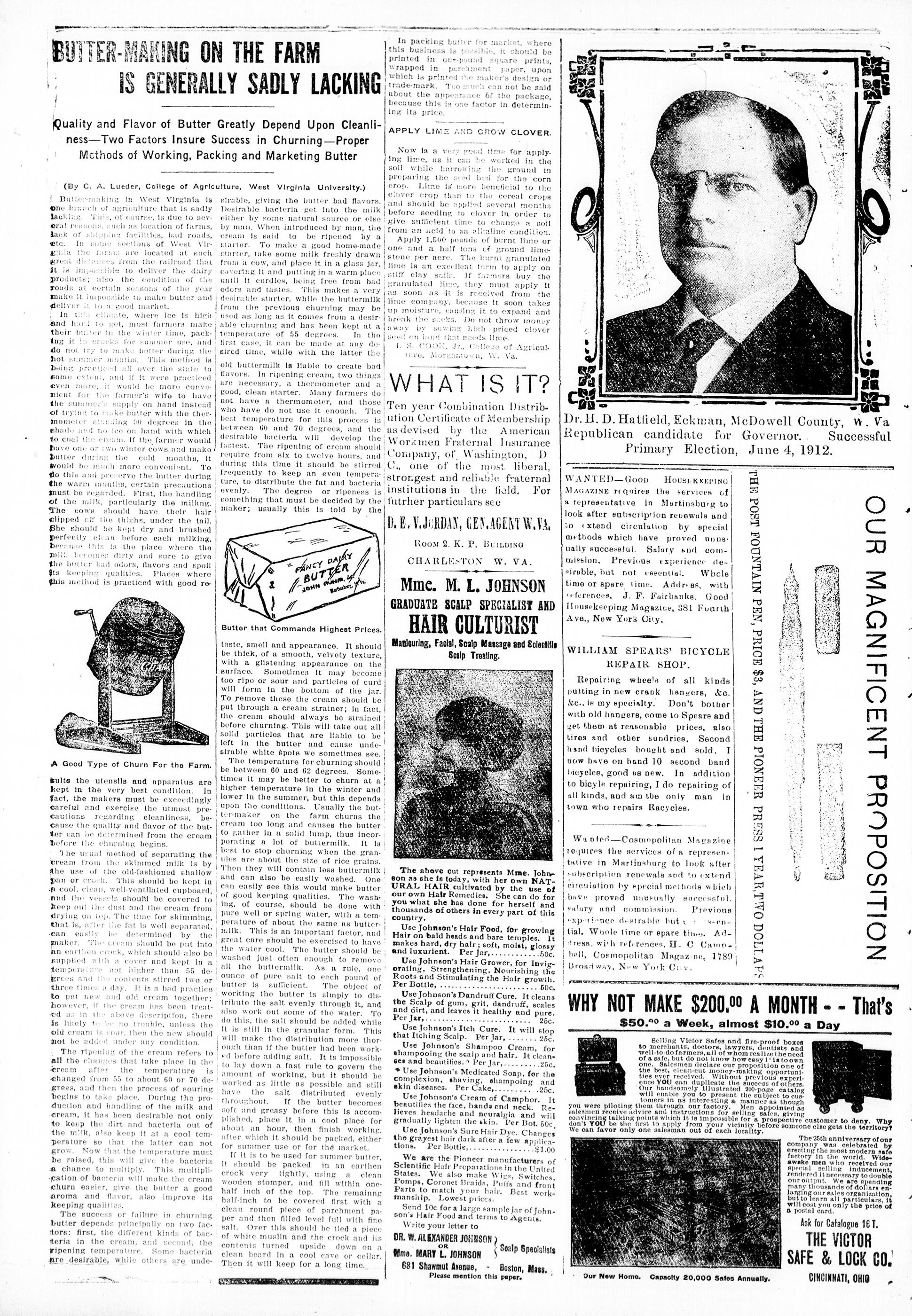
BUTTER-MAKING ON THE FARM IS GENERALLY SADLY LACKING
Quality and Flavor of Butter Greatly Depend Upon Cleanliness—Two Factors Insure Success in Churning-Proper Methods of Working, Packing and Marketing Butter
Butter-making in West Virginia is one branch of agriculture that is sadly lacking. This, of course, is due to several reasons, such as location of farms, lack of shipping facilities, bad roads, etc. In some sections of West Virginia the farms are located at such great distances from the railroad that it is impossible to deliver the dairy products; also the condition of the roads at certain seasons of the year make it impossible to make butter and deliver it to a good market. strable, giving the butter bad flavor. Desirable bacteria get into the milk either by some natural source or by man. When introduced by man, cream is said to be ripened by starter. To make a good home-made starter, take some milk freshly drawn from a cow, and place it in a glass covering it and putting in a warm place until it curdles, being free from odors and tastes. This makes a desirable starter, while the buttermilk from the previous churning may
In this climate, where ice is high and hard to get, most farmers make their butter in the winter time, packing it in cracks for summer use, and do not try to make butter during the hot summer months. This method is being practiced all over the state to some extent, and if it were practiced even more, it would be more convenient for the farmer's wife to have the summer's supply on hand instead of trying to make butter with the thermometer standing 90 degrees in the shade and no ice on hand with which to cool the cream. If the farmer would have one or two winter cows and make butter during the cold months, it would be much more convenient. To do this and preserve the butter during the warm months, certain precautions must be regarded. First, the handling of the milk, particularly the milkng. The cows should have their hair clipped off the thighs, under the tail. She should be kept dry and brushed perfectly clean before each milking, because this is the place where the milk becomes dirty and sure to give the butter bad odors, flavors and spoil its keeping qualities. Places where this method is practiced with good re-
A Good Type of Churn For the Farm.
ults the utensils and apparatus are kept in the very best condition. In fact, the makers must be exceedingly careful and exercise the utmost precautions regarding cleanliness, because the quality and flavor of the butter can be determined from the cream before the churning begins.
The usual method of separating the cream from the skimmed milk is by the use of the old-fashioned shallow pan or crock. This should be kept in a cool, clean, well-ventilated cupboard, and the vessels should be covered to keep out the dust and the cream from drying on top. The time for skimming, that is, after the fat is well separated, can easily be determined by the maker. The cream should be put into an earthen crock, which should also be supplied with a cover and kept in a temperature not higher than 55 degrees and the contents stirred two or three times a day. It is a bad practice to put new and old cream together; however, if the cream has been treated as in the above description, there is likely to be no trouble, unless the old cream is sour, then the new should not be added under any condition.
The ripening of the cream refers to all the changes that take place in the cream after the temperature is changed from 55 to about 60 or 70 degrees, and then the process of souring begins to take place. During the production and handling of the milk and cream, it has been desirable not only to keep the dirt and bacteria out of the milk, also keep it at a cool temperature so that the latter can not grow. Now that the temperature must be raised, this will give the bacteria a chance to multiply. This multiplication of bacteria will make the cream churn easier, give the butter a good aroma and flavor, also improve its keeping qualities.
The success or failure in churning butter depends principally on two factors: first, the different kinds of bacteria in the cream, and second, the ripening temperature. Some bacteria are desirable, while others are unde-
sirable, giving the butter bad flavors. Desirable bacteria get into the milk either by some natural source or else by man. When introduced by man, the cream is said to be ripened by a starter. To make a good home-made starter, take some milk freshly drawn from a cow, and place it in a glass jar, covering it and putting in a warm place until it curdles, being free from bad odors and tastes. This makes a very desirable starter, while the buttermilk from the previous churning may be used as long as it comes from a desirable churning and has been kept at a temperature of 55 degrees. In the first case, it can be made at any desired time, while with the latter the
old buttermilk is liable to create bad flavors. In ripening cream, two things are necessary, a thermometer and a good, clean starter. Many farmers do not have a thermometer, and those who have do not use it enough. The best temperature for this process is between 60 and 70 degrees, and the desirable bacteria will develop the fastest. The ripening of cream should require from six to twelve hours, and during this time it should be stirred frequently to keep an even temperature, to distribute the fat and bacteria evenly. The degree or ripeness is something that must be decided by the maker; usually this is told by the
FANCY DAIRY
BUTTER
JOHN MUMM, L.
Murray, T. W.
taste, smell and appearance. It should be thick, of a smooth, velvety texture, with a glistening appearance on the surface. Sometimes it may become too rlpo or sour and particles of curd will form in the bottom of the jar. To remove these the cream should be put through a cream strainer; in fact, the cream should always be strained before churning. This will take out all solid particles that are liable to be left in the butter and cause undesirable white spots we sometimes see
The temperature for churning should be between 60 and 62 degrees. Sometimes it may be better to churn at a higher temperature in the winter and lower in the summer, but this depends upon the conditions. Usually the butter-maker on the farm churns the cream too long and causes the butter to gather in a solid lump, thus incorporating a lot of buttermilk. It is best to stop churning when the granules are about the size of rice grains. Then they will contain less buttermilk and can also be easily washed. One can easily see this would make butter of good keeping qualities. The washing, of course, should be done with pure well or spring water, with a temperature of about the same as buttermilk. This is an important factor, and great care should be exercised to have the water cool. The butter should be washed just often enough to remove all the buttermilk. As a rule, one ounce of pure salt to each pound of butter is sufficient. The object of working the butter is simply to distribute the salt evenly through it, and also work out some of the water. To do this, the salt should be added while it is still in the granular form. This will make the distribution more thorough than if the butter had been worked before adding salt. It is impossible to lay down a fast rule to govern the amount of working, but it should be worked as little as possible and still have the salt distributed evenly throughout. If the butter becomes soft and greasy before this is accomplished, place it in a cool place for about an hour, then finish working, after which it should be packed, either for summer use or for the market.
If it is to be used for summer butter, it should be packed in an earthen crock very tightly, using a clean wooden stomper, and fill within one-half inch of the top. The remaining half-inch to be covered first with a clean round piece of parchment paper and then filled level full with fine salt. Over this should be tied a piece of white muslin and the crock and its contents turned upside down on a clean board in a cool cave or collar. Then it will keep for a long time.
In packing butter for market, where this business is possible, it should be printed in one-pound square prints, wrapped in parchment paper, upon which is printed the maker's design or trade-mark. Too much can not be said about the appearance of the package, because this is one factor in determining its price.
Now is a very good time for applying lime, as it can be worked in the soil while harrowing the ground in preparing the seed bed for the corn crop. Lime is more beneficial to the clover crop than to the cereal crops and should be applied several months before seeding to clover in order to give sufficient time to change a soil from an acid to an alkaline condition.
Apply 1,500 pounds of burnt lime or one and a half tons of ground limestone per acre. The burnt granulated lime is an excellent form to apply on stiff clay soils. If farmers buy the granulated lime, they must apply it as soon as it is received from the lime company, because it soon takes up moisture, causing it to expand and break the sacks. Do not throw money away by sowing high priced clover seed on land that needs lime. I. S. COOK, Jr., College of Agriculture, Morgantown, W. Va.
WHAT IS IT?
Ten year Combination Distribution Certificate of Membership as devised by the American Workmen Fraternal Insurance Company, of Washington, DC., one of the most liberal, strongest and reliable fraternal institutions in the field. For futrher particulars see
D. E. V. JORDAN. GEN. AGENT W. VA.
CHARLESTON W. VA.
Mme. M. L. JOHNSON GRADUATE SCALP SPECIALIST AND HAIR CULTURIST
Manlouring, Faalal, Scalp Message and Scientific Scalp Treating.
THE LIFE OF MARY C. BURTON
The above cut represents Mme. Johnson as she is today, with her own NATURAL HAIR cultivated by the use of our own Hair Remedies. She can do for you what she has done for herself and thousands of others in every part of this country.
Use Johnson's Hair Food, for growing Hair on bald heads and bare temples. It makes hard, dry hair; soft, moist, glossy and luxurient. Per Jar, 50c.
Use Johnson's Hair Grower, for Invigorating, Strengthening, Nourishing the Roots and Stimulating the Hair growth. Per Bottle, 50c.
Use Johnson's Dandruff Cure. It cleans the Scalp of gum, grit, dandruff, scales and dirt, and leaves it healthy and pure. Per Jar, 25c.
Use Johnson's Itch Cure. It will stop that Itching Scalp. Per Jar, 25c.
Use Johnson's Shampoo Cream, for shampooing the scalp and hair. It cleanses and beautifies. Per Jar, .25c.
Use Johnson's Medicated Soap, for the complexion, shaving, shampoing and skin diseases. Per Cake, .25c.
Use Johnson's Cream of Camphor. It beautifies the face, hands and neck. Relieves headache and neuralgia and will gradually lighten the skin. Per Bot. 50c.
Use Johnson's Sure Hair Dye. Changes the grayest hair dark after a few applications. Per Bottle, .1.00
We are the Pioneer manufacturers of Scientific Hair Preparations in the United States. We also make Wigs, Switches, Pomps, Coronet Braids, Puffs and front Parts to match your hair. Best workmanship. Lowest prices.
Send 10c for a large sample jar of Johnson's Hair Food and terms to Agents.
DR. W. ALEXANDER JOHNSON
OR
Mme. MARY L. JOHNSON
681 Shawmut Avenue, Boston, Mass.
Please mention this paper.
[Portrait of a man in a suit with a tie, framed by decorative borders].
Dr. H. D. Hatfield, Eckman, McDowell County, W. Va Republican candidate for Governor. Successful Primary Election, June 4, 1912.
Dr. H. D. Hatfield, Eckman, McDowell County, W. Va Republican candidate for Governor. Successful Primary Election, June 4, 1912.
WHY NOT MAKE $200.00 A MONTH $50.00 a Week, almost $10.00
WHY NOT MAKE $200.00 A MONTH - - That's $50.00 a Week, almost $10.00 a Day
Selling Victor Safes and fire-proof boxes to merchants, doctors, lawyers, dentists and well-to-do farmers, all of whom realize the need of a safe, but do not know how easy it is to own a fire-cut, clean-cut or new opportunities ever received. Without previous experience YOU can duplicate the success of others. Our handsomely illustrated 200-page catalog will enable you to present the subject to customers in as interesting a manner as though you were a fire-cut farmer.
you were piloting them through our factory. Men appointed as salesmen receive advice and instructions for selling sales, giving comments talking about it. It is impossible for a prospective customer to deny. Why isn't YOU better suited to apply before someone else gets the territory? We can favor only one salesman out of each locality.
WANTED—GOOD HOUSEKEEPING MAGAZINE requires the services of a representative in Martinsburg to look after subscription renewals and to extend circulation by special methods which have proved unusually successful. Salary and commission. Previous experience desirable, but not essential. Whole time or spare time. Address, with references. J. F. Fairbanks. Good Housekeeping Magazine, 381 Fourth Ave., New York City.
WILLIAM SPEARS' BICYCLE REPAIR SHOP.
Repairing wheels of all kinds putting in new crank hangers, &c. &c., is my specialty. Don't bother with old hangers, come to Spears and get them at reasonable prices, also tires and other sundries. Second hand bicycles bought and sold. I now have on hand 10 second hand bicycles, good as new. In addition to bicycle repairing, I do repairing of all kinds, and am the only man in town who repairs Racycles.
Wanted—Cosmopolitan Magazine requires the services of a representative in Martinsburg to look after subscription renewals and to extend circulation by special methods which have proved unusually successful, salary and commission. Previous experience desirable but not essential. Whole time or spare time. Address, with references, H. C Campbell, Cosmopolitan Magazine, 1789 Broadway, New York City.
TAXI
Our New Home. Capacity 20,000 Safes Annually.
OUR MAGNIFICENT PROPOSITION
```markdown
```
---
#
The 25th anniversary of our company was celebrated by erecting the most modern safe factory in the world. Wide-awake men who received our special selling inducement, rendered it necessary to double our output. We are producing many thousands of dollars enlarging our sales organization, but to learn all particulars, it will cost you only the price of a postal card.
Ask for Catalogue 16 T.
THE VICTOR SAFE & LOCK CO.
CINCINNATI, OHIO