The Pioneer Press
Saturday, June 15, 1912
Martinsburg, West Virginia
Page text (machine-generated)
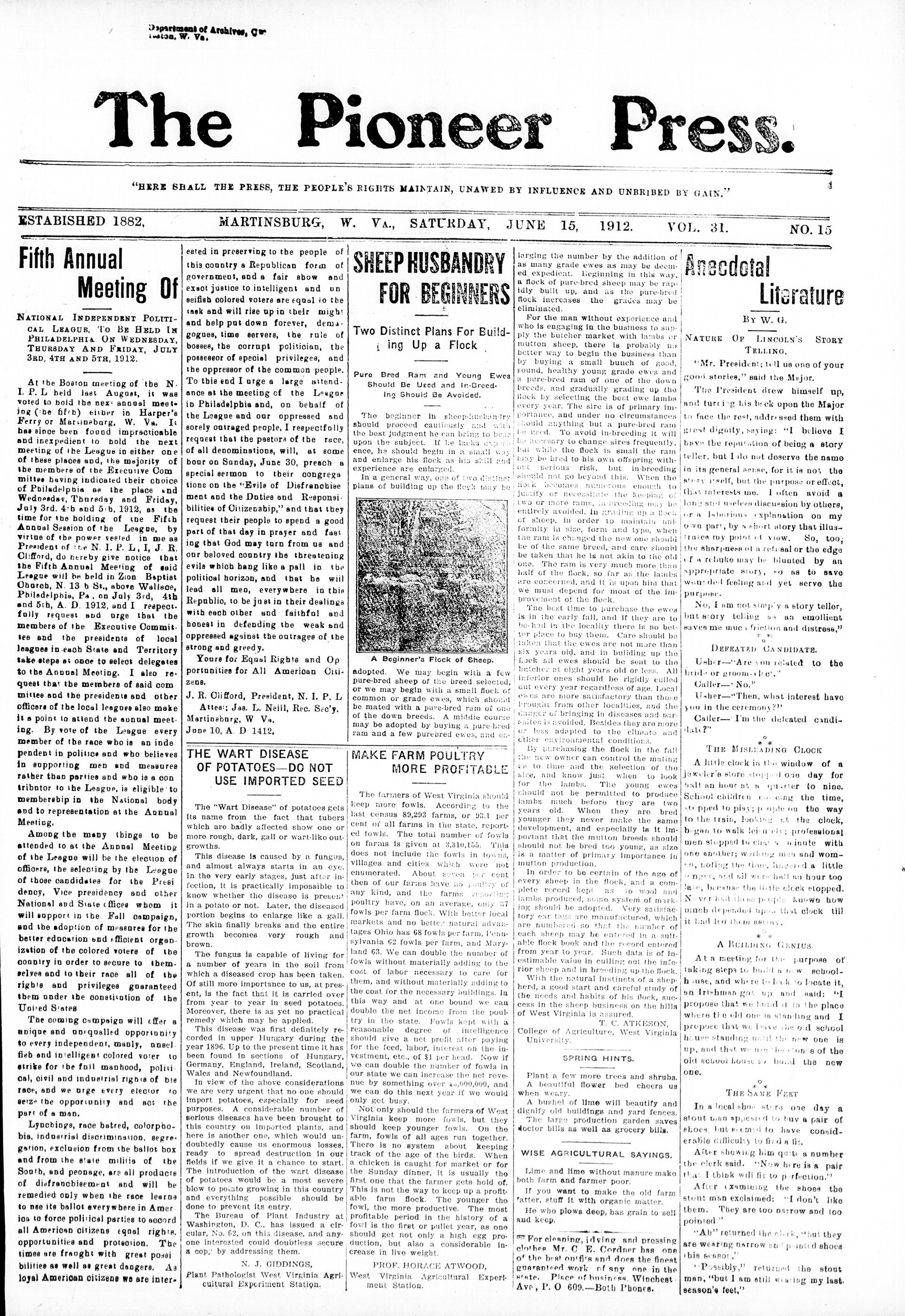
The Pioneer Press.
"HERE SHALL THE PRESS, THE PEOPLE'S RIGHTS MAINTAIN, UNAWED BY INFLUENCE AND UNBRIBED BY GAIN."
Fifth Annual Meeting Of
NATIONAL INDEPENDENT POLITICAL LEAGUE, TO BE HELD IN PHILADELPHIA ON WEDNESDAY, THURSDAY AND FRIDAY, JULY 3RD, 4TH AND 5TH, 1912.
At the Boston meeting of the N. I. P. L held last August, it was voted to hold the next annual meeting (the fifth) either in Harper's Ferry or Martineburg, W. Va. It has since been found impracticable and inexpedient to hold the next meeting of the League in either one of these places and, the majority of the members of the Executive Committee having indicated their choice of Philadelphia as the place and Wednesday, Thursday and Friday, July 3rd, 4th and 5th, 1912, as the time for the holding of the Fifth Annual Session of the League, by virtue of the power vested in me as President of the N. I. P. L, I, J. R. Clifford, do hereby give notice that the Fifth Annual Meeting of said League will be held in Zion Baptist Church, N. 13 b St., above Wallace, Philadelphia, Pa., on July 3rd, 4th and 5th, A. D. 1912, and I respectfully request and urge that the members of the Executive Committee and the presidents of local leagues in each State and Territory take steps at once to select delegates to the Annual Meeting. I also request that the members of said committee and the presidents and other officers of the local leagues also make it a point to attend the annual meeting. By vote of the League every member of the race who is an independent in politics and who believes in supporting men and measures rather than parties and who is a contributor to the League, is eligible to membership in the National body and to representation at the Annual Meeting.
Among the many things to be attended to at the Annual Meeting of the League will be the election of officers, the selecting by the League of those candidates for the Presidency, Vice presidency and other National and State offices whom it will support in the Fall campaign, and the adoption of measures for the better education and efficient organization of the colored voters of the country in order to secure to themselves and to their race all of the rights and privileges guaranteed them under the constitution of the United States.
The coming campaign will offer a unique and unequalled opportunity to every independent, manly, unselfieb and intelligent colored voter to strike for the full manhood, political, civil and industrial rights of his race, and we urge every elector to setze the opportunity and act the part of a man.
Lynchings, race batred, colorphobia, industrial discrimination, segregation, exclusion from the ballot box and from the state militia of the South, and peonage, are all products of disfranchisement and will be remedied only when the race learns to use its ballot everywhere in America to force political parties to accord all American citizens equal rights, opportunities and protection. The times are fraught with great possibilities as well as great dangers. As loyal American citizens we are inter-
ESTABISHED 1882
Department of Archives, Gov
London, W. Va.
he
ERE SHALL THE PRES
MARTI
HALL THE PRESS, THE PEOPLE
MARTINSBURG,
eated in preserving to the people of this country a Republican form of government, and a fair show and exact justice to intelligent and unseifish colored voters are equal to the task and will rise up in their might and help put down forever, demagogues, time servers, the rule of bosses, the corrupt politician, the possessor of special privileges, and the oppressor of the common people. To this end I urge a large attendance at the meeting of the League in Philadelphia and, on behalf of the League and our oppressed and sorely outraged people, I respectfully request that the pastors of the race, of all denominations, will, at some hour on Sunday, June 30, preach a special sermon to their congregations on the "Evile of Disfranchisement and the Duties and Responsibilities of Citizenship," and that they request their people to spend a good part of that day in prayer and fasting that God may turn from us and our beloved country the threatening evils which hang like a pall in the political horizon, and that he will lead all men, everywhere in this Republic, to be just in their dealings with each other and faithful and honest in defending the weak and oppressed against the outrages of the strong and greedy.
You're for Equal Rights and Opportunities for All American Citizens.
J. R. Clifford, President, N. I. P. L
Attest; Jas. L. Neill, Rec. Sec'y.
Martineburg, W Va.
June 10. A. D. 1412.
THE WART DISEASE OF POTATOES—DO NOT USE IMPORTED SEED
The "Wart Disease" of potatoes gets its name from the fact that tubers which are badly affected show one or more rough, dark, gall or wart-like outgrowths. This disease is caused by a fungus, and almost always starts in an eye. In the very early stages, just after infection, it is practically impossible to know whether the disease is present in a potato or not. Later, the diseased portion begins to enlarge like a gall. The skin finally breaks and the entire growth becomes very rough and brown.
The fungus is capable of living for a number of years in the soil from which a diseased crop has been taken. Of still more importance to us, at present, is the fact that it is carried over from year to year in seed potatoes. Moreover, there is as yet no practical remedy which may be applied. This disease was first definitely recorded in upper Hungary during the year 1896. Up to the present time it has been found in sections of Hungary, Germany, England, Ireland, Scotland, Wales and Newfoundland.
In view of the above considerations we are very urgent that no one should import potatoes, especially for seed purposes. A considerable number of serious diseases have been brought to this country on imported plants, and here is another one, which would undoubtedly cause us enormous losses, ready to spread destruction in our fields if we give it a chance to start. The introduction of the wart disease of potatoes would be a most severe blow to potato growing in this country and everything possible should be done to prevent its entry. The Bureau of Plant Industry at Washington, D. C., has issued a circular, No. 52, on this disease, and anyone interested could doubtless secure a copy by addressing them.
N. J. GIDDINGS, Plant Pathologist West, Virginia Agricultural Experiment Station.
SHEEP HUSBANDRY FOR BEGINNERS
SHEEP HUSBANDRY FOR BEGINNERS
Two Distinct Plans For Building Up a Flock
Puro Bred Ram and Young Ewes Should Be Used and In-Breeding Should Be Avoided.
The beginner in sheep-husbandry should proceed cautiously and with the best judgment he can bring to bear upon the subject. If he lacks experience, he should begin in a small way and enlarge his flock as his skill and experience are enlarged.
In a general way, one of two distinct plans of building up the flock may be
A Beginner's Fleck of Sheep.
adopted. We may begin with a few pure-bred sheep of the breed selected, or we may begin with a small flock of common or grade ewes, which should be mated with a pure-bred ram of one of the down breeds. A middle course may be adopted by buying a pure-bred ram and a few purebred ewes, and en-
MAKE FARM POULTRY MORE PROFITABLE
The farmers of West Virginia should keep more fowls. According to the last census 89,293 farms, or 93.1 per cent of all farms in the state, reported fowls. The total number of fowls on farms is given at 3,310,155. This does not include the fowls in towns, villages and cities which were not enumerated. About seven per cent then of our farms have no poultry of any kind, and the farms reporting poultry have, on an average, only 37 fowls per farm flock. With better local markets and no better natural advantages Ohio has 68 fowls per farm, Pennsylvania 62 fowls per farm, and Maryland 63. We can double the number of fowls without materially adding to the cost of labor necessary to care for them, and without materially adding to the cost for the necessary buildings. In this way and at one bound we can double the net income from the poultry in the state. Fowls kept with a reasonable degree of intelligence should give a net profit after paying for the feed, labor, interest on the investment, etc., of $1 per head. Now if we can double the number of fowls in our state we can increase the net revenue by something over $0,000,000, and we can do this next year if we would only get busy.
Not only should the farmers of West Virginia keep more fowls, but they should keep younger fowls. On the farm, fowls of all ages run together. There is no system about keeping track of the age of the birds. When a chicken is caught for market or for the Sunday dinner, it is usually the first one that the farmer gets hold of. This is not the way to keep up a profitable farm flock. The younger the fowl, the more productive. The most profitable period in the history of a fowl is the first or pullet year, as one should get not only a high egg production, but also a considerable increase in live weight.
PROF. HORACE ATWOOD
larging the number by the addition of as many grade ewes as may be decemed expedient. Beginning in this way, a flock of pure-bred sheep may be rapidly built up, and as the pure-bred flock increases the grades may be eliminated.
For the man without experience and who is engaging in the business to supply the butcher market with lambs or mutton sheep, there is probably no better way to begin the business than by buying a small bunch of good, sound, healthy young grade ewes and a pure-bred ram of one of the down breeds, and gradually grading up the flock by selecting the best ewe lambs every year. The sire is of primary importance, and under no circumstances should anything but a pure-bred ram be used. To avoid in-breeding it will be necessary to change sires frequently, but while the flock is small the ram may be bred to his own offspring without serious risk, but in-breeding should not go beyond this. When the nock becomes numerous enough to justify or necessitate the keeping of two or more rams, in-breeding may be entirely avoided. In grading up a flock of sheep, in order to maintain uniformity in size, form, and type, when the ram is changed the new one should be of the same breed, and care should be taken that he is not akin to the old one. The ram is very much more than half of the flock, so far as the lambs are concerned, and it is upon him that we must depend for most of the improvement of the flock.
The best time to purchase the ewes is in the early fall, and if they are to be had in the locality there is no better place to buy them. Care should be taken that the ewes are not more than six years old, and in building up the fock all ewes should be sent to the butcher at eight years old or less. All inferior ones should be rigidly culled out every year regardless of age. Local ewes are more satisfactory than those brought from other localities, and the danger of bringing in diseases and parasites is avoided. Besides they are more or less adapted to the climate and other environmental conditions.
By purchasing the flock in the fall the new owner can control the mating as to time and the selection of the site, and know just when to look for the lambs. The young ewes should not be permitted to produce lambs much before they are two years old. When they are bred younger they never make the samo development, and especially is it important that the mutton breeds should not be bred too young, as size is a matter of primary importance in mutton production.
In order to be certain of the age of every sheep in the flock, and a complete record kept as to wool and lambs produced, some system of marking should be adopted. Very satisfactory ear tags are manufactured, which are numbered so that the number of each sheep may be entered in a suitable flock book and the record entered from year to year. Such data is of inestimable value in culling out the inferior sheep and in breeding up the flock. With the natural instincts of a sheepherd, a good start and careful study of the needs and habits of his flock, success in the sheep business on the hills of West Virginia is assured. T. C. ATKESON.
T. C. ATKESON, College of Agriculture, West Virginia University.
SPRING HINTS.
Plant a few more trees and shrubs. A beautiful flower bed cheers us when weary. A bushel of lime will beautify and dignify old buildings and yard fences. The large production garden saves doctor bills as well as grocery bills.
WISE AGRICULTURAL SAYINGS
Lime and lime without manure make both farm and farmer poor.
If you want to make the old farm farter, stuff it with organic matter.
He who plows deep, has grain to sell and keep.
For cleaning, idying and pressing clothes. Mr. C. E. Cordner has one of the best outfits and does the finest guaranteed work of any one in the state. Place of business. Winchester Ave., P. O. 609.—Both Phones.
VOL. 31.
NO.15
Anecdotal Literature
BY W. G.
NATURE OF LINCOLN'S STORY
TELLING.
"Mr. President; tell us one of your
good stories," said the Major.
The President drew himself up, and turning his back upon the Major to face the rest, addressed them with great dignity, saying: "I believe I have the reputation of being a story teller, but I do not deserve the name in its general sense, for it is not the story itself, but the purpose or effect, that interests me. I often avoid a long and useless discussion by others, or a laborious explanation on my own part, by a short story that illustrates my point of view. So, too; the sharpness of a refusal or the edge of a rebuke may be blunted by an appropriate story, so as to save wounded feeling and yet serve the purpose.
No, I am not simply a story teller, but story telling as an emollient saves me much friction and distress."
DEFEATED CANDIDATE.
Usher—"Are you related to the bride or groom she?"
Caller—"No."
Usher—"Then, what interest have you in the ceremony?"
Caller—"I'm the defeated candidate?"
A little clock in the window of a jeweler's store stopped one day for half an hour at a quarter to nine. School children noticing the time, stepped to play; people on the way to the train, looking at the clock, began to walk leisurely; professional men stopped to chat a minute with one another; working men and women, noting the time, lingered a little longer, and all were half an hour too late, because the little clock stopped. Never had these people known how much depended upon that clock till it had lot them astray.
A BUILDING GENIUS
At a meeting for the purpose of taking steps to build a new school house, and where to look to locate it, an Irishman got up and said: "I propose that we build it in the place where the old one is standing and I propose that we leave the old school house standing until the new one is up, and that we use the stones of the old school house to build the new one.
THE SAME FERT
In a local shoe store one day a stout man appeared to buy a pair of shoes, but seemed to have considerable difficulty to find a fit.
After showing him quite a number the clerk said. "Now here is a pair that I think will fit to perfection."
After examining the shoes the stout man exclaimed: "I don't like them. They are too narrow and too pointed."
"Ab" returned the clerk, "but they are wearing narrow and pointed shoes this sensor."
"Possibly," returned the stout man, "but I am still wearing my last season's feet."
Entered in Post Office at Martinsburg W. Va., as Second Class Matter
Miss Lola West, of Hedgesville, visited friends and relatives in our city during the past week.
We guess oiling the streets will soon be in order, the Board of Affairs having already contracted for the oil.
Mr. and Mrs. Lewis Ford, of Nipotown, were in town the other day, and their friends were glad to see them.
Samuel, the young son of Mrs. Josephine Nash, is rapidly recovering from a burn which he received last week.
Mrs. Maria Edmonson, and Mrs. Emma Custis, both of Parkersburg, have returned home, after a visit of several days in this town.
Quite a number of Martinsburgers went to Hagerstown on Thursday to see the big Firomen's Parade there.
We received word the other day from our friend Mr. McCanada Dailey that he had left Baltimore for the summer season, and would spend it in Chelsea, New Jersey.
Buy at the West End Grocery Store, where you get quality. quantity and the right price. 526 West Martin St. P. R. Fletcher, Proprietor. Phone 287K.
Mrs. Mary Mackey spent Sunday last in Berkeley Surings as the guest of her husband, Mr. Walker Mackey, who is working up there during the summer season.
Miss Mary Brown, this city, is a notable exception among young colored women in this county, she being an owner of valuable real estate, and an individual who seeks to improve her holdings.
Thompson & Thompson have the largest stock, the best material and sell under the best guarantee of any clothing house in Martinsburg, test it by trying it.
William Ford, jr., jailed on information charging him with committing a rape on Harriet Hamilton, was discharged by 'Squire Felker, that gentleman deeming the evidence adduced at the preliminary hearing given Ford insufficient to hold him for the Grand Jury.
Frederick J. Becker, who last winter held up and robbed a Baltimore and Ohio train near Oakland single-handed, was found guilty there and sentenced to nine years in the Maryland penitentiary. The crime occurred on the border, Becker having boarded the train near Keyseer where he was employed in a section gang.
We sympathize deeply with Rev. W. W. Mayle, formerly of Piedmont, but now of Wellsburg, in the loss of his son Lawrence, who was drowned at the latter place. Mr. Mayle's wife has also been very ill with typhoid fever, which makes his ministerial and newspaper work somewhat hard to accomplish. In the latter connection, it might be added, that hereafter, Rev. Mr. Mayle's sprightly paper, the Messenger, will be issued at Wellsburg instead of Piedmont.
Mr. John H. Powell, chauffeur for a prominent Washington man, and a resident of the same city, came to our city to get a Norwalk motor car for his employer, and after attending to some necessary details connected with his errand, he returned to the Capitol City on Saturday last. Mr. Powell is apparently a very fine young man, and we wish thousands of young Negroes everywhere would do like he has done—learn something that would guarantee them a living at all times.
COLORED BANK MESSENGER TRUSTED WITH MILLIONS. Richard Allen,the oldest employee of the First National Bank, of Kansas City, Missouri, has carried hundreds of millions of dollars through the streets of that city in the 26 years he has been in its service, says the Kansas City Times.
Mr. Allen, who is a Negro, is the medium through which all the cash which the bank ships to county banks and the institution's correspondents East and West and North and South is sent to the express office. Daily $25,000 to $50,000 is sent to country banks. Sometimes hundreds of thousands of dollars in a day are sent to eastern and western points.
"The bank has the most implicit faith in Mr. Allen," A. C. Jobes, vice president, said the other day. "We trust him absolutely."
And as a token of the bank's appreciation, when the institution was 20 years old it made Mr. Alien a gift of a house and lot where he lives at 2324 Highland avenue. It was the bank's method of showing its appreciation of the high class service Mr. Allen had rendered in carrying hundreds of millions of dollars of the bank's cash through the streets of Kansas City and never losing a penny.
When Mr. Allen first went to work for the bank he was a man on the street looking for any kind of a job he could find. Lombard Brothers' Banking Company were opening for business in the Junction building 26 years ago when Mr. Allen walked in and asked for a job—any kind of a job he said. They gave him a job cleaning the tile floor, and when the bank wanted a porter Mr. Allen got the place. A few years later he became the bank's messenger, and for 18 years he has been a trusted employee. Mr. Allen is commissioned as a deputy policeman and is always armed when he is carrying the funds of the bank.
Baltimore & Ohio Rail-Road
GREATLY REDUCED
CONVENTION FARES
TO
ATLANTIC CITY.
BALTIMORE MD.
CHICAGO, ILL.
CLEVELAND, O.
KANSAS CITY, MO.
LOUISVILLE, KY.
MINNEAPOLIS, MINN.
PHILADELPHIA, PA.
ST. LOUIS, MO.
ST. PAUL, MINN.
TOLEDO, O.
AND MANY POINTS ON THE
PACIFIC COAST.
FOR FURTHER DETAILS APPLY TO NEAREST
BALTIMORE & OHIO TICKET AGENT.
BIOGRAPHY OF
THE UNITED STATES.
Adapted to the use of Students of race history, and of Negro youth. A valuable and handy reference book with questions and answers. Is printed on heavy paper in good, large clear type. And compactly bound in boards. A copy of this book should be in every Negro home. Price one dollar per volume—$1.00 Cash must invariably accompany all orders postage paid. Good live agents wanted for West Virginia. No sample outfits. Stamps not accepted. For further information and terms to Agents, Address,
John E. Bruce Grit, Author and Pub Sunnyslope Cottage, Yonkers, N. Y. Refers to J. R. Clifford, Eqq. Editor Pioneer Press. Thompson and Thompson are in reality the hustlers of bustlers in the clothing line and their stock is up to date in style and shades.
图
For Thirty Years
THE
PIONEER PRESS
Has been the leader in this State and Nation for the grand and noble fight that is being waged for the amelioration of the condition of the Negro. The PIONEER PRESS was never known to lag or trifle in any matter where the interest of the race was involved. For this characteristic, THE PRESS should have the unswerving support and encouragement of Negroes everywhere. It contains reliable news, interesting editorials and clever special articles. It is safely recommended to you as a perfect newspaper for the home and family. IT LEADS in the quantity of original matter which it furnishes its patronage.
IT LEADS in its spicy editorials and fearless sayings.
IT LEADS in its general, local and miscellany pages.
TAKEN all in all, we don't feel that we are exaggerating when we state that The PIONEER PRESS is one of the best all around weekly papers in this country today.
WE ARE not alone in making this statement, for some of the best and most prominent men of the United States have done likewise. These persons above referred to were not condined to one particular race, either, but to both.
THE PIONEER PRESS
Has the LARGEST city circulation—
The LARGEST Foreign circulation—
The LARGEST domestic and general circulation—
The LARGEST county and rural circulation of any Negro newspaper in the United States—
Has the LARGEST Anglo Saxon circulation—
WHY
IS THE ABOVE SO?
BECAUSE it is the pioneer of this section in blazing the way for truth, honesty, piety and frugality and all other requisites that are necessary for the making of manly men and womanly women of all races.
BECAUSE it merits support and gets it is proof positive that people know a good thing when they see it.
BECAUSE of its unique and original qualities the PIONEER PRESS has a noticeable exclusiveness enjoyed by no other paper in the class wherein it circulates.
The
Pioneer
Press
With its generally large and
intelligent circulation will bring
ABUNDANT
AND
PROFITABLE
RETURNS.
AND
TO ITS ADVERTISERS. Viewed from the standpoint of news merit, circulation or advertising power, THE PIONEER PRESS is the peer of its competitors and stands forth as a brilliant example of successful modern newspaper methods.
FEEDING THE CHICKS
EXERCISE AND LISERAL FEEDING ARE VERY NECESSARY.
Grains, Animal Food and Green Food Should Be Provided — A Mash Moistened With Sour Milk Give Rapid Growth
Quite irrespective as to whether chickens are raised by natural or artificial means there are certain principles in reference to their needs and requirements that must be kept in mind if satisfactory results are to be obtained.
With reference to its original weight a chicken grows faster than any other domesticated animal. A young colt doubles its original weight in about 60 days, and a calf in about 47 days.
Colony kept chickens at the Experi- ment Station.
while a chicken, if properly fed and cared for, will double its original weight in 6 days or less. This extreme rapidity of growth indicates an enormous power for digesting and assimilating food. Liberal feeding, then, is of prime necessity. Feed liberally, but yet keep the chickens active. When raised under natural conditions, a chick is on the move practically from morning till night, and in raising chickens artificially, it is important to feed so that the natural activity is maintained. This can be accomplished by scattering the cracked grain that they receive in litter, so that they are obliged to scratch for it.
Under natural conditions chickens consume a large amount of animal food. The mother hen busies herself in scratching for bugs and worms. There is a reason for this eagerness for animal food. The growing chick demands large amounts of both protein and mineral matter to build up its system. Grain alone furnishes neither enough ash nor protein for this purpose. Animal food is rich in both these materials. When chicks are raised in brooders or when their range is restricted, feeds of animal origin should usually be added to their ration for best results. Sour skimmed milk or buttermilk is excellent. For some reason sweet milk is less valuable for poultry than sour milk. In the absence of milk it will usually pay to purchase beef scrap.
Green food of some sort is essential. For brooder chicks early in spring when other green stuff is not available, sprouted oats answer the purpose. Prepare them by soaking them over night in tepid water. In the morning spread them out in a warm
Failed in
"My mother died six
Ward, of Jerseyville, Ill., " "children. I had never been
of her death, was too much.
"I failed in health. I w
not want to go anywhere, m
the headache all the time.
"A very dear friend ad
had done her so much good
and now I am in good health.
failed in Health
or died six years ago," writes Miss Ruth
ville, Ill., "and left me to care for six
never been strong; and this, with the shock
as too much for me.
health. I was tired all the time and did
anywhere, nor care for company. I had
all the time and such bearing-down pains.
our friend advised me to take Cardui, as it
so much good, so I commenced to use it
in good health."
Failed in Health
"My mother died six years ago," writes Miss Ruth Ward, of Jerseyville, Ill., "and left me to care for six children. I had never been strong; and this, with the shock of her death, was too much for me.
"I failed in health. I was tired all the time and did not want to go anywhere, nor care for company. I had the headache all the time and such bearing-down pains.
"A very dear friend advised me to take Cardui, as it had done her so much good, so I commenced to use it and now I am in good health."
Take CARDUI
The Woman's Tonic
ains are relieved or prevented and women's
kly restored, by Cardui, the woman's tonic.
If know best if you need it, or not.
need it, do not delay, but commence to use
ery day of delay, only lets you slide further
then, but begin to take Cardui today, for its
show prolonged, cannot harm you and will
good.
Advisory Dept., Chattanooga Medicine Co., Chattanooga, Tenn.
and 64-page book, "Home Treatment for Women," sent free.
The Wor
Women's pains are reli
strength is quickly restored,
You yourself know best
If you do need it, do no
it at once. Every day of de
down the hill.
Don't wait, then, but be
use, no matter how prolong
surely do you good.
Write to: Ladies' Advisory Dept., C
or Special Instructions, and 64-page book.
Women's pains are relieved or prevented and women's strength is quickly restored, by Cardui, the woman's tonic. You yourself know best if you need it, or not.
If you do need it, do not delay, but commence to use it at once. Every day of delay, only lets you slide further down the hill.
Don't wait, then, but begin to take Cardui today, for its use, no matter how prolonged, cannot harm you and will surely do you good.
Write to: Ladies' Advisory Dept., Chattanooga Medicine Co., Chattanooga, Tenn., for Special Instructions, and 64-page book, "Home Treatment for Worgen." sent free.
Take
J 44
place two or three inches thick. Sprinkle occasionally with warm water, and in about a week's time, depending upon the temperature at which they are kept, they will be sprouted sufficiently. They should be thoroughly moist when fed for if they are allowed to become dry and shriveled there is danger that the hulls may accumulate in the gizzards of the chicks and cause serious trouble. So much for the theory of feeding little chicks. The application of these principles can be illustrated most clearly by describing the method of feeding little chicks in use at the Experiment Station where two or three thousand are raised annually.
For the first feeding, the infertile eggs from the incubators are hard boiled and run, shell and all, through a food chopper. The ground egg is mixed with bread crumbs or rolled oats so as to form a crumbly mixture. This is fed four or five times per day, or until the infertile eggs are exhausted. This mixture is fed in such quantities that it is cleaned up quickly by the chicks. Also a good chick feed, consisting of cracked grains is scattered in the litter, covering the floor of the brooder, and the chicks soon learn to scratch for the grain. After they are about a week old, they are fed as follows: A dry mash is provided, which is fed in shallow trays later in hoppers, so as to be constantly available to the chicks. This mash usually has the following composition: Equal parts of wheat bran, corn meal, wheat middlings and beef scrap. To this is added 10 per cent of bone meal, or some similar material rich in phosphorus. This mixture is not always fed dry, but is sometimes moistened with sour milk and fed twice a day in troughs. As the chicks grow older the amount of moistened mash is gradually reduced, so that finally only one feed per day is fed. After they are put on the range in colony houses, they are fed entirely on dry mash, and a mixture of cracked corn and wheat fed in hoppers. More than 1,800 chicks are being fed at the Experiment Station on the above rations, and the mortality has been less than one per cont. HORACE ATWOOD
Nest Virginia Agricultural Experiment Station.
J. R. CLIFFORD.
ATTORNEY AT LAW
MARTINSEURG, WEST VIRGINIA Practices in all the Courts of W Va., the Supreme Court of Appeals and the United States Courts. THE KEYSER, MOOREFIELD.
```markdown
```
Runs daily except Sunday. Persons wishing to travel in the direction mentioned will find it a great convenience and very cheap—the round trip only $3, and the distance being o either place and back, 87 miles. Persons traveling it once, will never forget the kindness of the proprietor Mr. George Shank.
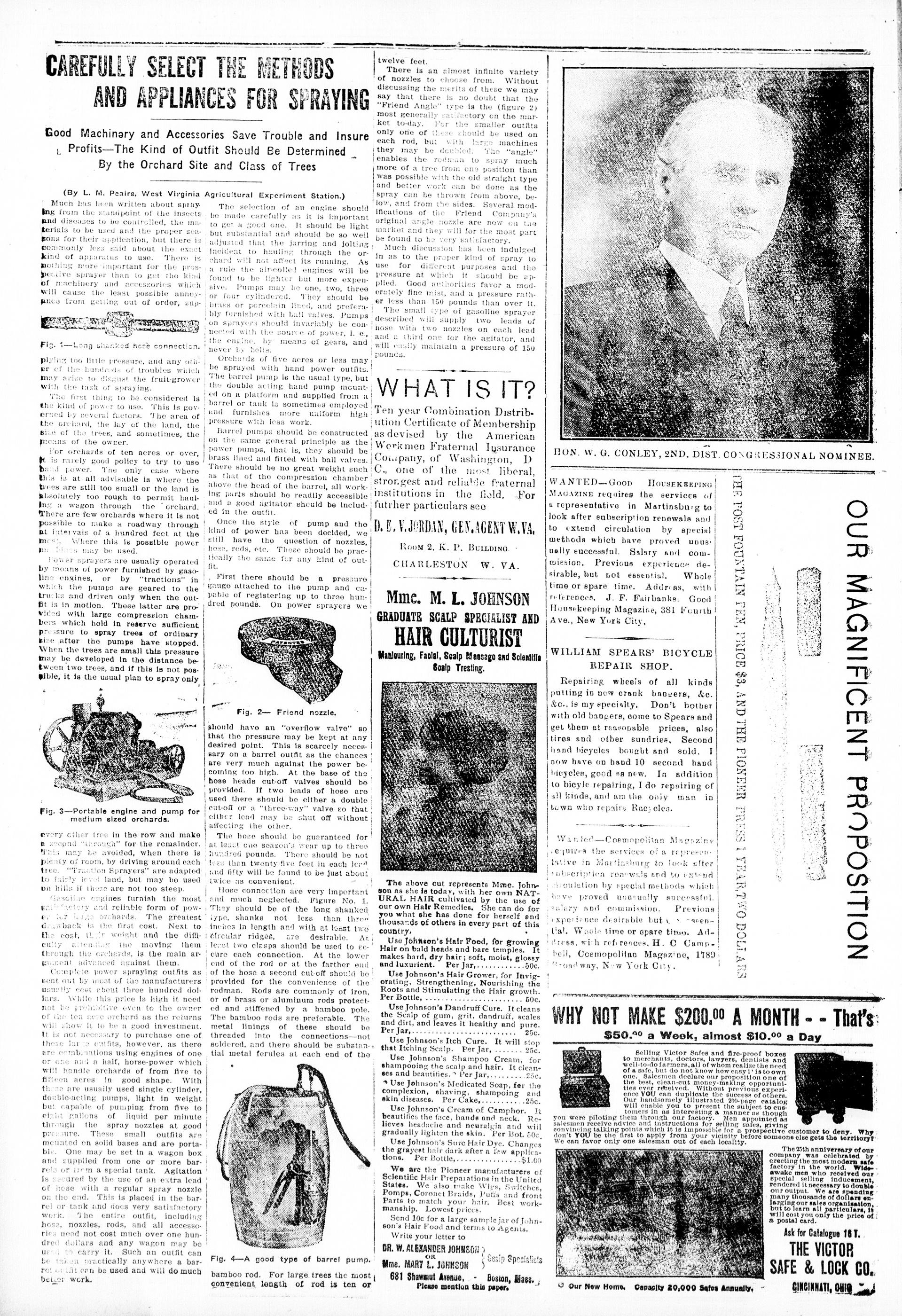
CAREFULLY SELECT THE METHODS AND APPLIANCES FOR SPRAYING
Good Machinery and Accessories Save Trouble and Insure Profits—The Kind of Outfit Should Be Determined By the Orchard Site and Class of Trees
(By L. M. Peairs, West Virginia Agricultural Experiment Station.)
Much has been written about spraying from the standpoint of the insects and diseases to be controlled, the materials to be used and the proper seasons for their application, but there is commonly less said about the exact kind of apparatus to use. There is nothing more important for the prospective sprayer than to get the kind of machinery and accessories which will cause the least possible annoyance from getting out of order, sup-
Fig. 1—Long shanked hose connection.
plying too little pressure, and any other of the hundreds of troubles which may arise to disgust the fruit-grower with the task of spraying.
The first thing to be considered is the kind of power to use. This is governed by several factors. The area of the orchard, the lay of the land, the size of the trees, and sometimes, the means of the owner.
For orchards of ten acres or over, it is rarely good policy to try to use hand power. The only case where this is at all advisable is where the trees are still too small or the land is absolutely too rough to permit hauling a wagon through the orchard. There are few orchards where it is not possible to make a roadway through at intervals of a hundred feet at the most. Where this is possible power machines may be used.
Power sprayers are usually operated by means of power furnished by gasoline engines, or by "tractions" in which the pumps are geared to the trucks and driven only when the outfit is in motion. These latter are provided with large compression chambers which hold in reserve sufficient pressure to spray trees of ordinary size after the pumps have stopped. When the trees are small this pressure may be developed in the distance between two trees, and if this is not possible, it is the usual plan to spray only
Fig. 3—Portable engine and pump for medium sized orchards.
every other tree in the row and make a second "through" for the remainder. This may be avoided, when there is plenty of room, by driving around each tree. "Traction Sprayers" are adapted to fairly level land, but may be used on hills if these are not too steep. Gasoline engines furnish the most easily fuely and reliable form of power for large orchards. The greatest drawback is the first cost. Next to the cost, their weight and the difficulty attaining the moving them through the orchards, is the main argument advanced against them.
Complete power spraying outfits as sent out by most of the manufacturers usually cost about three hundred dollars. While this price is high it need not be prohibitive even to the owner of the ten acre orchard as the returns will show it to be a good investment. It is not necessary to purchase one of these large outfits, however, as there are combinations using engines of one or one and a half, horse-power which will handle orchards of from five to fifteen acres in good shape. With these are usually used single cylinder, double-acting pumps, light in weight but capable of pumping from five to eight gallons of liquid per minute through the spray nozzles at good pressure. These small outfits are mounted on solid bases and are portable. One may be set in a wagon box and supplied from one or more barrels or from a special tank. Agitation is secured by the use of an extra lead of hose with a regular spray nozzle on the end. This is placed in the barrel or tank and does very satisfactory work. The entire outfit, including hose, nozzles, rods, and all accessories need not cost much over one hundred dollars and any wagon may be used to carry it. Such an outfit can be taken practically anywhere a barrel or fit can be used and will do much better work.
twelve feet. There is an almost infinite variety of nozzles to choose from. Without discussing the merits of these we may say that there is no doubt that the "Friend Angle" type is the (figure 2) most generally satisfactory on the market to-day. For the smaller outfits only one of these should be used on each rod, but with large machines they may be doubled. The "angle" enables the rodman to spray much more of a tree from one position than was possible with the old straight type and better work can be done as the spray can be thrown from above, below, and from the sides. Several modifications of the Friend Company's original angle nozzle are now on the market and they will for the most part be found to be very satisfactory.
Much discussion has been indulged in as to the proper kind of spray to use for different purposes and the pressure at which it should be applied. Good authorities favor a moderately fine mist, and a pressure rather less than 150 pounds than over it. The small type of gasoline sprayer described will supply two leads of nose with two nozzles on each lead and a third one for the agitator, and will easily maintain a pressure of 150 pounds.
WHAT IS IT?
WHAT IS IT?
Ten year Combination Distribution Certificate of Membership as devised by the American Werkmen Fraternal Insurance Company, of Washington, DC., one of the most liberal, strongest and reliable fraternal institutions in the field. For futrher particulars see
D. E. V. JORDAN. GEN. AGENT W. VA.
Mme. M. L. JOHNSON
GRADUATE SCALP SPECIALIST AND
HAIR CULTURIST
Manlouring, Facial, Scalp Massage and Scientific
Scalp Treating.
```markdown
```
The above cut represents Mme. Johnson as she is today, with her own NATURAL HAIR cultivated by the use of our own Hair Remedies. She can do for you what she has done for herself and thousands of others in every part of this country.
Use Johnson's Hair Food, for growing Hair on bald heads and bare temples. It makes hard, dry hair; soft, moist, glossy and luxurious. Per Jar.....50c.
Use Johnson's Hair Grower, for Invigorating, Strengthening, Nourishing the Roots and Stimulating the Hair growth. Per Bottle.....50c.
Use Johnson's Dandruff Cure. It cleans the Scalp of gum, grit, dandruff, scales and dirt, and leaves it healthy and pure. Per Jar.....25c.
Use Johnson's Itch Cure. It will stop that Itching Scalp. Per Jar, ..... 25c.
Use Johnson's Shampoo Cream, for shampooing the scalp and hair. It cleanses and beautifies. Per Jar, ..... 25c.
Use Johnson's Medicated Soap, for the complexion, shaving, shampooing and skin diseases. Per Cake, ..... 25c.
Use Johnson's Cream of Camphor. It beautifies the face, hands and neck. Relieves headache and neuralgia and will gradually lighten the skin. Per Bot. 50c.
Use Johnson's Sure Hair Dye. Changes the grayest hair dark after a few applications. Per Bottle, ..... $1.00
We are the Pioneer manufacturers of Scientific Hair Preparations in the United States. We also make Wigs, Switches, Pomps, Coronet Braids, Puffs and front Parts to match your hair. Best workmanship. Lowest prices.
Send 10c for a large sample jar of Johnson's Hair Food and terms to Agents.
The selection of an engine should be made carefully as it is important to get a good one. It should be light but substantial and should be so well adjusted that the jarring and jolting incident to hauling through the orchard will not affect its running. As a rule the air-colled engines will be found to be lighter but more expensive. Pumps may be one, two, three or four cylindered. They should be brass or porcelain lined, and preferably furnished with ball valves. Pumps on sprayers should invariably be connected with the source of power, i.e., the engine, by means of gears, and never by belts.
Orchards of five acres or less may be sprayed with hand power outfits. The barrel pump is the usual type, but the double acting hand pump mounted on a platform and supplied from a barrel or tank is sometimes employed and furnishes more uniform high pressure with less work. Barrel pumps should be constructed on the same general principle as the power pumps, that is, they should be brass lined and fitted with ball valves. There should be no great weight such as that of the compression chamber above the head of the barrel, all working parts should be readily accessible and a good agitator should be included in the outfit.
Once the style of pump and the kind of power has been decided, we still have the question of nozzles, hose, reds, etc. These should be practically the same for any kind of outfit.
First there should be a pressure gauge attached to the pump and capable of registering up to three hundred pounds. On power sprayers we
should have an "overflow valve" so that the pressure may be kept at any desired point. This is scarcely necessary on a barrel outfit as the chances are very much against the power becoming too high. At the base of the hose heads cut-off valves should be provided. If two leads of hose are used there should be either a double cut-off or a "three-way" valve so that either lead may be shut off without affecting the other. The hose should be guaranteed for at least one season's wear up to three hundred pounds. There should be not less than twenty-five feet in each jersey and fifty will be found to be just about twice as convenient.
Hose connection are very important and much neglected. Figure No. 1. They should be of the long shanked type, shanks not less than three inches in length and with at least two circular ridges, are desirable. At least two clasps should be used to secure each connection. At the lower end of the rod or at the farther end of the hose a second cut-off should be provided for the convenience of the rodman. Rods are commonly of iron, or of brass or aluminum rods protected and stiffened by a bamboo pole. The bamboo rods are preferable. The metal linings of these should be threaded into the connections—not soldered, and there should be substantial metal ferules at each end of the
木
Fig. 4-A good type of barrel pump. bamboo rod. For large trees the most convenient length of rod is ten or
ROOM 2, K. P. BUILDING
CHARLESTON W. VA.
TAXI
M. B.
HON. W. G. CONLEY, 2ND. DIST. CONGRESSIONAL NOMINEE.
THE POST FOUNTAIN PEN, PRICE $3, AND THE PIONEER PRESS 1 YEAR,TWO DOLLARS
WANTED—GOOD HOUSEKEEPING MAGAZINE requires the services of a representative in Martinsburg to look after subscription renewals and to extend circulation by special methods which have proved unusually successful. Salary and commission. Previous experience desirable, but not essential. Whole time or spare time. Address, with references. J. F. Fairbanks. Good Housekeeping Magazine, 381 Fourth Ave., New York City.
OUR MAGNIFICENT PROPOSITION
```markdown
```
WILLIAM SPEARS' BICYCLE REPAIR SHOP.
Repairing wheels of all kinds putting in new crank hangers, &c. &c., is my specialty. Don't bother with old hangers, come to Spears and get them at reasonable prices, also tires and other sundries. Second hand bicycles bought and sold. I now have on hand 10 second hand bicycles, good as new. In addition to bicycle repairing, I do repairing of all kinds, and am the only man in town who repairs Raccles.
```markdown
```
Wanted—Cosmopolitan Magazine requires the services of a representative in Martin'sburg to look after subscription renewals and to extend circulation by special methods which have proved unusually successful. salary and commission. Previous experience desirable but essential. Whole time or spare time. Address, with references, H. C Campbell, Cosmopolitan Magazine, 1789 Broadway, New York City.
WHY NOT MAKE $200.00 A MONTH -- That's:
$50.00 a Week, almost $10.00 a Day
Selling Victor Safes and fire-proof boxes to merchants, doctors, lawyers, dentists and well-to-do farmers, all of whom realize the need of a safe, but do not know how easy it is to own one. Salesmen declare our proposition one of the best, clean-cut money-making opportunities ever received. Without previous experience YOU can duplicate the success of others. Our handsomely illustrated 200-page catalog will enable you to present the subject to customers in as interesting a manner as though
#
you were piloting them through our factory. Men appointed as salesmen receive advice and instructions for selling sales, giving convincing talking points which it is impossible for a prospective customer to deny. Why don't YOU be the first to apply from your vicinity before someone else gets the territory? We can favor only one salesman out of each locality.
The 25th anniversary of our company was celebrated by erecting the most modern as factory in the world. Wide-awake men who received our special selling inducement, rendered it necessary to double our output. We are spending many thousands of dollars enlarging our sales organization, but to learn all particulars, it will cost you only the price of a postal card.
```markdown
```
Ask for Catalogue 18 T.
THE VICTOR
SAFE & LOCK CO.
CINCINNATI, OHIO
Our New Home, Capacity 20,000 Safes Annually.