The Pioneer Press
Saturday, October 11, 1913
Martinsburg, West Virginia
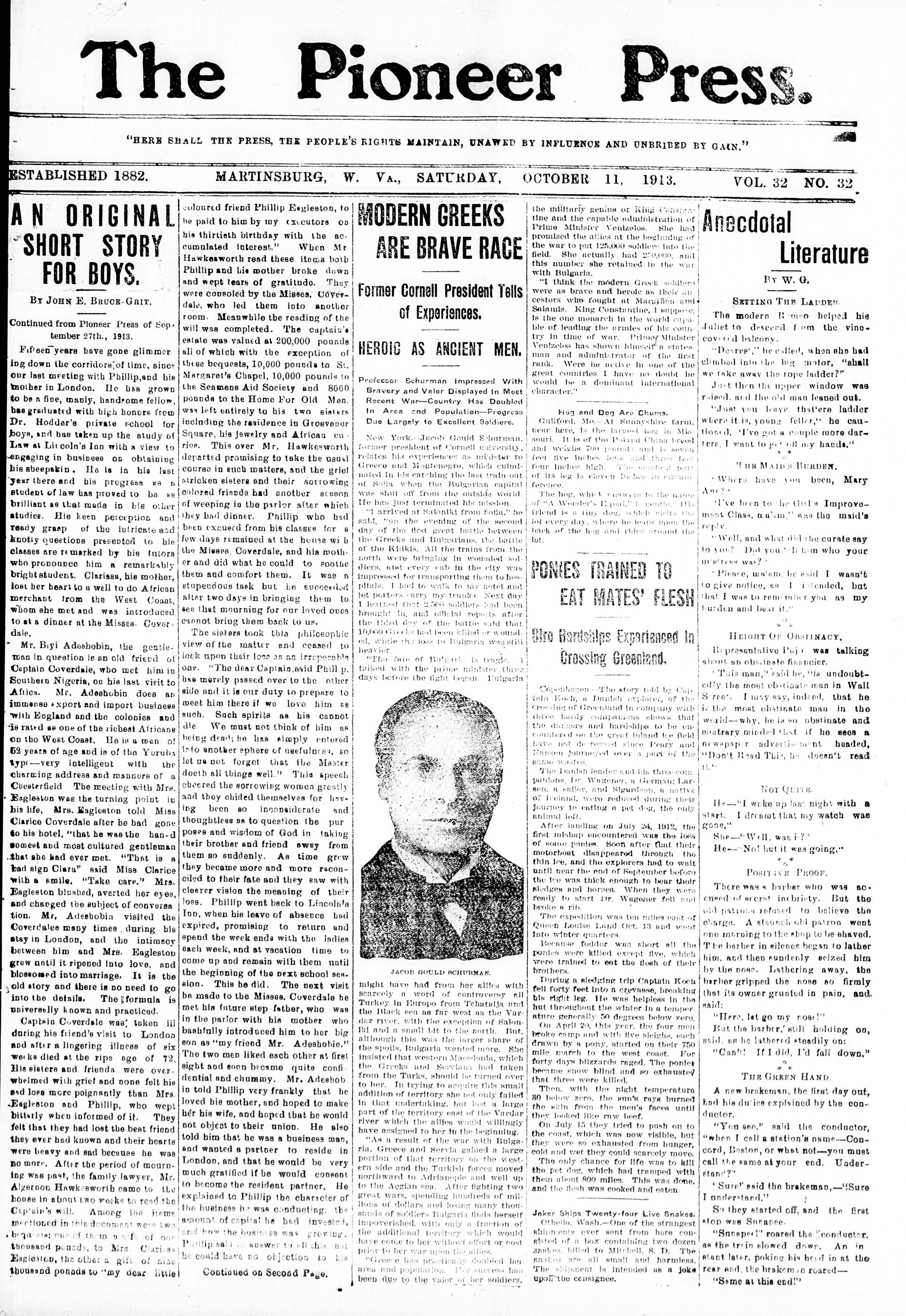
Page text (machine-generated)
The Pioneer
"HERE SHALL THE PRESS, THE PEOPLE'S RIGHTS MAINTAIN, UNAWED BY INFLUENCE AND UNBRIDED BY GAIN"
ESTABLISHED 1882.
AN ORIGINAL SHORT STORY FOR BOYS.
BY JOHN E. BRUCE-GRIT.
Continued from Pioneer Press of September 27th., 1913.
Fifteen years have gone glimmering down the corridors of time, since our last meeting with Phillip, and his mother in London. He has grown to be a fine, manly, handsome fellow, has graduated with high honors from Dr. Hodder's private school for boys, and has taken up the study of Law at Lincoln's Inn with a view to engaging in business on obtaining his sheepskin. He is in his last year there and his progress as a student of law has proved to be as brilliant as that made in his other studies. His keen perception and ready grapp of the intricate and knotty questions presented to his classes are remarked by his tutors who pronounce him a remarkably bright student. Clarissa, his mother, lost her heart to a well to do African merchant from the West Coast, whom she met and was introduced to at a dinner at the Misses. Coverdale.
Mr. Biyi Adeshobin, the gentleman in question is an old friend of Captain Coverdale, who met him in Southern Nigeria, on his last visit to Aftics. Mr. Adeshobin does an immense export and import business with England and the colonies and is rated as one of the richest Africans on the West Coast. He is a man of 52 years of age and is of the Yoruba type—very intelligent with the charming address and manners of a Chesterfield. The meeting with Mrs. Eagleston was the turning point in his life. Mrs. Eagleston told Miss Clarice Coverdale after he had gone to his hotel, "that he was the hand-somest and most cultured gentleman that she had ever met. "That is a bad sign Clara" said Miss Clarice with a smile. "Take care." Mrs. Eagleston blushed, averted her eyes, and changed the subject of conversation. Mr. Adeshobin visited the Coverdales many times during his stay in London, and the intimacy between him and Mrs. Eagleston grew until it ripened into love, and blossomed into marriage. It is the old story and there is no need to go into the details. The formula is universally known and practiced.
Captain Coverdale was taken ill during his friend's visit to London and after a lingering illness of six weeks died at the ripe age of 72. His sisters and friends were overwhelmed with grief and none felt his sad loss more poignantly than Mrs. Eagleston and Phillip, who wept bitterly when informed of it. They felt that they had lost the best friend they ever had known and their hearts were heavy and sad because he was no more. After the period of mourning was past, the family lawyer, Mr. Algernon Hawkesworth came to the house in about two weeks to read the Captain's will. Among the items mentioned in this document were two bequests: one of them a gift of one thousand pounds, to Mrs. Clariss Eagleston, the other a gift of nine thousand pounds to "my dear little
coloured friend Phillip Eagleston, to be paid to him by my executors on his thirtieth birthday with the accumulated interest." When Mr Hawkesworth read these items both Phillip and his mother broke down and wept tears of gratitude. They were consoled by the Misses, Coverdale, who led them into another room. Meanwhile the reading of the will was completed. The captain's estate was valued at 200,000 pounds all of which with the exception of these bequests, 10,000 pounds to St. Margaret's Chapel, 10,000 pounds to the Seamens Aid Society and 8000 pounds to the Home For Old Men. was left entirely to his two sisters including the residence in Grosvenor Square, his jewelry and African curries. This over Mr. Hawkesworth departed promising to take the usual course in such matters, and the grief stricken sisters and their sorrowing colored friends had another season of weeping in the parlor after which they had dinner. Phillip who had been excused from his classes for a few days remained at the house with the Misses. Coverdale, and his mother and did what he could to soothe them and comfort them. It was a stupendous task but he succeeded after two days in bringing them to see that mourning for our loved ones cannot bring them back to us.
The sisters took this philosophic view of the matter and ceased to lock upon their loss as an irreparable one. "The dear Captain, said Phillip, has merely passed over to the other side and it is our duty to prepare to meet him there if we love him as such. Such spirits as his cannot die. We must not think of him as being dead; he has simply entered into another sphere of usefulness, so let us not forget that the Master doeth all things well." This speech cheered the sorrowing women greatly and they chided themselves for having been so inconsiderate and thoughtless as to question the purposes and wisdom of God in taking their brother and friend away from them so suddenly. As time grew they became more and more reconciled to their fate and they saw with clearer vision the meaning of their loss. Phillip went back to Lincoln's Inn, when his leave of absence had expired, promising to return and spend the week ends with the ladies each week, and at vacation time to come up and remain with them until the beginning of the next school session. This he did. The next visit he made to the Misses. Coverdale he met his future step father, who was in the parlor with his mother who bashfully introduced him to her big son as "my friend Mr. Adeshobio." The two men liked each other at first sight and soon became quite confidential and chummy. Mr. Adeshob in told Phillip very frankly that he loved his mother, and hoped to make her his wife, and hoped that he would not object to their union. He also told him that he was a business man, and wanted a partner to reside in London, and that he would be very much gratified if he would consent to become the resident partner. He explained to Phillip the character of the business he was conducting, the amount of capital he had invested, and how the business was growing. Phillip said... answer to all this but he could have no objection to his
Continued on Second Page.
MODERN GREEKS ARE BRAVE RACE
MODERN GREEKS ARE BRAVE RACE
Former Cornell President Tells of Experiences.
HEROIC AS ANCIENT MEN.
Professor Schurman Impressed With Bravery and Valor Displayed In Most Recent War—Country Has Doubled In Area and Population—Progress Due Largely to Excellent Soldiers.
New York.—Jacob Gould Schurman, former president of Cornell university, relates his experiences as minister to Greece and Montenegro, which culminated in his catching the last train out of Sofia when the Bulgarian capital was shut off from the outside world. He has just terminated his mission.
"I arrived at Saloniki from Sofia," he said, "on the evening of the second day of the first great battle between the Greeks and Bulgarians, the battle of the Khikis. All the trains from the north were bringing in wounded soldiers, and every cab in the city was impressed for transporting them to hospitals. I had to walk to my hotel and let porters carry my trunks. Next day I learned that 2,500 soldiers had been brought in, and official reports after the third day of the battle said that 10,000 Greeks had been killed or wounded, while the loss to Bulgaria was still heavier.
"The fate of Bulgaria is tragic. I talked with the prime minister three days before the fight began. Bulgaria
[Name]
JACOB GOULD SCHURMAN.
might have had from her allies with scarcely a word of controversy all Turkey in Europe from Tehatalja and the Black sea as far west as the Vardar river, with the exception of Saloniki and a small bit to the north. But, although this was the larger share of the spoils, Bulgaria wanted more. She insisted that western Macedonia, which the Greeks and Servians had taken from the Turks, should be turned over to her. In trying to acquire this small addition of territory she not only failed in that undertaking, but lost a large part of the territory east of the Vardar river which the allies would willingly have assigned to her in the beginning.
"As a result of the war with Bulgaria, Greece and Servia gained a large portion of that territory on the western side and the Turkish forces moved northward to Adrianople and well up to the Aegian sea. After fighting two great wars, spending hundreds of millions of dollars and losing many thousands of soldiers Bulgaria finds herself impoverished, with only a fraction of the additional territory which would have come to her without effort or cost prior to her war upon the allies.
"Greece has practically doubled her area and population. Her success has been due to the valor of her soldiers,
Press.
Y INFLUENCE AND UNBRIBED H
OCTOBER 11, 1913.
the militarily genius or King Consti-
tine and the capable administration of
Prime Minister Venizelos. She had
promised the allies at the beginning of
the war to put 125,000 soldiers into the
field. She actually had 270,000, and
this number she retained in the war
with Bulgaria.
"I think the modern Greek soldiers were as brave and heroic as their ancestors who fought at Murgillen and Salamis. King Constantine, I suppose, is the one monarch in the world capable of leading the armies of his country in time of war. Prime Minister Ventzelos has shown himself a statesman and administrator of the first rank. Were he active in one of the great countries I have no doubt he would be a dominant international character."
Hog and Dog Are Chums.
Gullford, Mo.—At Sunnyshire farm, near here, is the largest hog in Missouri. It is of the Poland China breed and weighs 700 pounds and is seven feet five inches long and three feet four inches high. The smallest part of its leg is eleven inches in circumference.
The hog, which answers to the name of "A Wonder's Equail," is gentle. His friend is a tiny dog, which visits the lot every day, where he leaps upon the back of the hog and rides around the lot.
PONIES TRAINED TO EAT MATES' FLESH
Dire Hardships Experienced in Crossing Greenland.
Copenhagen—The story told by Captain Koch, a Danish explorer, of the crossing of Greenland in company with three hardy companions shows that the dangers and hardships to be encountered on the great island ice field have not decreased since Peary and Nansen journeyed over a part of the same wastes.
The Danish leader and his three companions, Dr. Wagener, a German; Larsen, a sailor, and Sigurdson, a native of Iceland, were reduced during their journey to eating a pet dog, the only animal left.
After landing on July 24, 1912, the first mishap encountered was the loss of some ponies. Soon after that their motorboat disappeared through the thin ice, and the explorers had to wait until near the end of September before the ice was thick enough to bear their skedges and horses. When they were ready to start Dr. Wagener fell and broke a rib.
The expedition was ten miles east of Queen Louise Land Oct. 13 and went into winter quarters.
Because fodder was short all the ponies were killed except five, which were trained to eat the flesh of their brothers.
During a sledging trip Captain Koeh fell forty feet into a crevassse, breaking his right leg. He was helpless in the hut throughout the winter in a temperature generally 50 degrees below zero. On April 20, this year, the four men broke camp and with five sleighs, each drawn by a pony, started on their 750 mile march to the west coast. For forty days blizzards raged. The ponies became snow blind and so exhausted that three were killed. Then, with the night temperature 80 below zero, the sun's rays burned the skin from the men's faces until they looked like raw beef.
On July 15 they tried to push on to the coast, which was now visible, but they were so exhausted from hunger, cold and wet they could scarcely move. The only chance for life was to kill the pet dog, which had tramped with them about 800 miles. This was done, and the flesh was cooked and eaten.
Joker Ships Twenty-four Live Snakes. Othello. Wash. One of the strangest shipments ever sent from here consisted of a box containing two dozen snakes, billed to Mitchell, S. D. The snakes are all small and harmless. The shipment is intended as a joke upon the consignee.
Hog and Dog Are Chums.
---
Anecdotal Literature
BY W. G.
SETTING THE LADDER
The modern Romeo helped his Juliet to descend from the vine-covered balcony.
"Desiree," he called, when she had climbed into the big motor, "shall we take away the rope ladder?"
Just then the upper window was raised, and the old man leaned out.
"Just you leave that'ere ladder where it is, young feller," he cautioned, "I've got a couple more dartere, I want to get off my hands."
THE MAID'S BURDEN.
"Where have you been, Mary Am?"
"I've been to the Girl's Improvement Class, ma'am," was the maid's reply.
"Well, and what did the curate say to you? Did you tell him who your mistress was?"
"Please, ma'am, he said I wasn't to give notice, as I intended, but that I was to remember you as my burden and bear it."
HEIGHT OF OBSTINACY.
Representative Pojo was talking about an obstinate financier.
'This man,' said he, 'is undoubtedly the most obstinate man in Wall Street. I may say, indeed, that he is the most obstinate man in the world—why, he is so obstinate and contrary minded that if he sees a newspaper advertisement headed, "Don't Read This, he doesn't read it."
NOT QUITE
He—"I woke up last night with a start. I dreamt that my watch was gone."
She—"Well, was it?"
He—"No! but it was going."
There was a barber who was accused of secret inebriety. But the old patrons refused to believe the charge. A staunch old patron went one morning to the shop to be shaved. The barber in silence began to lather him, and then suddenly seized him by the nose. Lathering away, the barber gripped the nose so firmly that its owner grunted in pain, and said:
"Here, let go my nose!"
But the barber, still holding on, said, as he lathered steadily on:
"Can't! If I did, I'd fall down."
THE GREEN HAND.
A new brakeman, the first day out, bad his duties explained by the conductor.
"You see." said the conductor, "when I call a station's name—Concord, Boston, or what not—you must call the same at your end. Understand?"
"Sure" said the brakeman, "'Sure I understand."
So they started off, and the first stop was Surance.
"Sunspel" roared the conductor, as the train slowed down. An in stant later, poking his head in at the rear end, the brakeman roared—
"Same at this end!"
AN MURPENDENT WEEKLY NEWS PAPER
DEVOTED TO THE MORAI, RELIGIOUS AQ
FINANCIAL DEVELOPMENT OF HUMAN
E.
Pay for all advertisements is due in advance unless advertising is run by yearly contract, in which case the advertiser pays every three months.
J. R. Clifford, Editor & Proprietor
Drawer 809, and Bell 'Phone,101K.Mar.
tinsburg, W. Va.
SATURDAY, OCTOBER 11, 1913
That this nation has gone wild or
crazy over base ball, needs no argument one way or the other, judging
from this week's excitement.
If the voters of the first district could unite, the democrats wouldn't have the ghost of a show next Tuesday. However, one thing is certain, it will require no speech making, or arguing to line up the colored electorate.
We ask a careful reading of the article in this issue written by that noted scholar, powerful writer, and unique logician and philosopher,—Horace J. Rollin, "Rollin Place," Troy, Ohio. He is as true and friendly to the rights of Negroes as were Sumner and Garrison.
Cardinal Gibbons, of Baltimore, advocates the union of all religious denominations. Brother, that's as far as your advocacy will get—the wish. Don't you know there are thousands of white and colored preachers who would rather recrucify Jesus Christ than to throw away their means of living?
We wonder, sometimes, what this country means by allowing its people of color to be treated as they are. This too, in the face of the fact that black men and women have always been among the most loyal subjecte this country has had, or ever will have. This is an idea worthy of some serious consideration too, on the part of the controlling factors in Uncle Sam's great domain, because good treatment to the brother in black now might mean much for this country in time of war.
The Baltimore American to amuse its funny readers, one day this week, had a out of a polite man who by offering his services to ladies was always getting in trouble. But, on this particular occasion, he met a well dressed woman, and; taking off his hat, offered to carry her heavy grip. The lady consented, and getting to her destination, in raising her veil to thank him, lc! and behold she was an ugly-faced black woman, and of course the police white man was shocked. Had it been night the gentleman might have wanted to carry the grip into the house. Be that as it may, it was not one fifteenth as bad to carry the black woman's grip, as it is, has been, and always will be, for colored women to carry white men's children.
No wonder the clergy and their following denounced Robert G. Ingersoll as an infidel. Reason. Ingersoll stood out in the sunlight of truth, the other fellows abied in the dark, and struck at him from the same place. The South's preachers, educated in letters alone, preached from their tens of thousands of pulpits the gospel right to hold slaves and God's decree that it should be.
Now, after fifty years' seeing, mixing and mingling, and the South with its Tillmane, Vordymans et al. has by abuse of God's children in black, gotten the North to see as they do, secular segregation is obtaining and on its face, the agitation
of religious segregation is to be enforced. No wonder the far seeing editor—the noted Henry Watterson says: in the day of judgment, many a poor white man will ask a poor Negro to plead his cause before a just God. Rev. George Herbert Kinsolving, a Protestant Episcopal Bishop, is not only in for religious segregation, but says if the Negroes—referring to those where a pinch of freedom is enjoyed, were in Texas, where Joe Baily says, no difference how refined, overeducated a Negro may be, he must come to his back door and there take off his hat, they would segregate themselves. What consummate hypocrites. The South is so full of half white children and more, that its hard to tell who is who and which is which?
THE MAN WHO BROUGHT ALFALFA FROM SIBERIA.
In 1897 James Wilson, then Secretary of Agriculture, who had known Professor Hansen at Ames, called upon him to go to Russia and Asia as the nation's first plant explorer. He was to get drouth-resistant and cold resistant plants of commercial value to supplement those of the Northwest or other parts of the United States.
Having crossed through northern Europe, and made his way westward and then southwestward across Russia again, the Professor turned southward through Tranecaucasia, and then sailed over the Caspian Sea to the realms of the Turkoman. Here he came face to face with the problem in the discovery of a hardy alfalfa.
It was almost like discovering a new continent. Here was an alfalfa that nature, doubtless through thousands of years, had inured to drouth and cold. It held hardiness.
Hardinces had been worked into it by nature's slow processes as the plant had traveled with infinite pains from the southward; perhaps in Persia, where as the common alfalfas of the United States had traveled another way. These were taken from Persia to Greece in the fifth century B. C. Thence they were carried to Italy and Spain, and after that to South America, long after which they were brought to the southwestern States. They had never had an opportunity to spread northward through long centuries of time, becoming hardy by infinitely slow degrees, as had those of the part of Asia where Professor Haneen had just made his discovery. With the discoverer's philosophy of plant hardiness, however, the hardiness of these new alfalfas, could be transferred to other alfalfas, and a variety both luxuriant and hardy could be invented. That is, if this newly discovered alfalfa would not itself do as a successful forage in the Middle West of the United States.
But the thing to do was to follow this new plant northward, and find out the home of the hardiest of the hardy. With this in mind he set out. He followed the trail across deserts, among wild and forbidding mountains, along routes infested by bandits, tracing it by caravan for 1300 miles to a latitude about level with St. Paul—45 degrees north—in the very heart of Asia. The tale as he tells it is one that stirs the blood. Along the difficult way he interviewed natives, soldiers, and the horses in the markets. He and his company gathered seed by hand out on the steppes. Then winter overtook him a little to the northwestward of the Chinese frontier, and, risking his life by exposure, he made a seven hundred mile dash northward to Ousek on the Trans-Siberian Railway, whence he then started westward with his precious freight of seeds—From Hansen, America's First Plant Explorer," by William F Kirkwood, in the American Review of Reviews for October.
WILSON'S CERTIFICATE NOT FIRST CLASS--A DWARFED CHRISTIAN--DOES NOT MEASURE UP TO THE HELP FUL STANDARD OF THE "HEATHEN" CONFUCIUS-TRUE SOULS DISAPPOINTED.
Comrade Clifford, Editor Pioneer Press: Your recent editorial notice of me shows unlimited kindness, but perhaps too much enthusiasm as to my worth to humanity, however, it moves me to express myself on a certain current topic, for it is an unusual pleasure to greet your readers—how do I know their quality. They read the journal of an editor who is both able and manly, speaking out in no uncertain tone in denunciation of wrongs that are positively degrading.
Now, Clifford, let it go at this for mutual admiration—can you not be quiet? It seems that on this occasion something resistless from the clear, bracing air has "touched a button"—possibly the button of the Grand Army. Of course, you and I are proud of the decoration; and while it is true that all cannot join this heroic circle, every one does train with—or should train with—the host whose objective point is where evil forces are concentrated.
Let us now proceed to protest against the menacing attitude disclosed in a recent event which directly involves every man, woman and child.
With countless citizens of this cosmopolitan land we share a certain humiliation concerning the new policy at Washington which segregates Negro clerks in the Federal departmental affairs. What a spectacle of prejudice and discrimination! for in this instance, because of the power incidental to that particular location, this action becomes practical persecution and of wide extended influence! What a heartless driving of a wedge that sunders American citizenship into classes!
I have not been a devotee of Wilson; but this is a depressing disappointment for those who imagined him to be a person of well rounded and symmetrical character. But now, inevitably, many true freemen on seeing his oft-printed name, or portrait, can hardly escape being reminded of an undersized and distorted soul.
Some journals comparing him with the great teachers of men, have called him a mere pedagogue. Doubtless he has studied certain books very hard, and has looked with professional eye at many young folks. He has also had at least the opportunity to observe full grown men; yet a large and irrepressible part of the world is now convinced that his certificate was not, and is not first class. In plain words, and giving the subject a still more serious turn,—he has shamefully violated universal ethics—he has flouted the fraternal spirit which has been gloriously fostered by the leaders of civilization of all ages, Jesus, Confucius, Lincoln, and all good souleu. He has flagrantly offended the religion of humanity, which is eternally identified with the Infinite!
But notwithstanding this disgraceful and damaging demonstration—and all too heavy pressure back of it, which we understand—our socalled colored citizens, including those of composite racial type, may be assured that the general movement is forward; not only here but the world over. I know it is hard to endure such great injuries, which, as human history shows, are incidental to the movement away from barbarism.
Therefore, my companions on the great pilgrimage, be of good cheer, over the light and nobly expect universal illumination. You have the blessing of every intelligent unselfish personality. Horace J. Collin.
Troy, Ohio.
AN ORIGINAL SHORT STORY FOR BOYS.
Continued From First Page.
mother's choice of a husband so long as he was an honorable gentleman. This was a matter which concerned her alone, and he felt that she had made no mistake in her choice if he loved and she loved him. That is all that is necessary to establish their right to each other, and he heartily consented to the marriage because he loved his mother, and wished her to be happy as he believed she would be with him. With respect to representing him in London and entering into partnership with him he had no objection to doing so after he had completed his course in the law school. He was making a special study of the law particularly as it relates to business and commerce and when he had completed the course he would gladly accept his offer. When do you graduate Mr. Eagleston? asked Mr. Adeshobin, I graduate in June next, he replied. Good said Mr. Adeshobin. I will have my attorney draw the partnership papers, and I will give you a half interest in my business. I should hardly want you to do that sir. I have some money left me by our friend Captain Coverdale and I am willing to purchase a half interest if we can agree on the terms. I think said Mr. Adeshobin that you ought to let me have my way in this matter. I am perfectly willing to give you a half interest in my business since you have so graciously given me your mother whom I love very dearly.
No said Phillip, I must have my way in this matter. If I buy an interest in your business it will give me responsibility. What will you let me have a half interest for? Well since you are so determined to have your way about it, I will sell you a half interest for 700 pounds. Very well, replied Phillip, I accept the offer. Let it be so stated in the agreement. I will pay you this amount at the end of June when the papers are ready for signature.
To Be Continued.
A NEGRO CATTLE KING
Sam Keeton, colored, of Bloomington, Kentuoky, left Sunday morning for the Mt. Sterling market with $8.000 or $10.000 worth of cattle. He was forced to take the stock away on account of the soarcity of water, which we are told threatened a famine in his neighborhood until the situation was relieved by Sunday afternoon showers.
Sam Keeton is one of the most widely known "cattle kings" of Eastern Kentucky. He is a farmer, but the major portion of his wealth has been realized through cattle dealing. Like other successful "punchers" he "takes the saddle" and rides from county to county and as regular as clock work he is at Mt. Sterling on each court day with several thousand dollars worth of the bovines. Should Sam Keeton, "the Magoffin County "nigger" fail to be on the market yards the "big white gem'man would flee through superstition like an actor when a dog trots across the stage.
Sam Keeton was born, reared and not educated at Bloomington, in the northern end of Magoffin county. He "don't know a letter in the book" using his own words and neither can be "figure. In short, he is absolutely illiterate. But his wife is well educated and they are educating their offspring. Had this Negro been blessed with an education—well, we can only conjecture on that side of it. His method of calculation is simple, unique and remarkable. This is how he does it; For a dollar he
makes a long mark; for half a dollar he makes half a mark; for a quarter he makes a "little" mark; for a dime he makes a dot. As for a nickel he says he "pays no'tention to'em.
He married a daughter of Green Gardner, and the union has been blessed with several children, six of whom are living. He is still in the prime of life, being only 41 or 42 years old.
EDUCATION NOTES
Philadelphia provides free eye glasses for nearly 2500 school children every year. Required home study has been abolished in the schools of Sacramento, Cal. Five hundred and fifty-five persons attended the evening classes in academic subjects at the University of Cincinnati last year. About $15,000 is earned annually by the boys in the cooperative industrial course in the high school at Fitchburg, Mecc.
A comparison of 625 star athletes of the Naval Academy with 580 nonathletes, in both cases from the classes of 1892—1911, shows that apparently the nonathletes are in better physical condition than the athletes.
Medical inspection is a business proposition. In a town with 250 children, it is said for instance, there would be an annual saving of $5250 if by thorough medical inspection the curable physical defects that handicap school children could be remedied.
There are now about 40 "psychological clinics" in the United States, according to Dr. J. E. Wallin, of the University of Pittsburgh. The first of such clinics, for the purpose of studying and classifying mentally unnatural children, was established at the University of Pennsylvania in 1896.
This is the age when the confidence man has full away.
ESTATE GENERAL
BALTIMORE & OHIO RAILROAD.
Corrected to Decist. 1912.
Trains leave Martinsburg as follows.
WEST BOUND
No 55 Daily at 11.21 a.m for Pittsburg,
Cincinnati, Louisville and St. Louis
Connects for Romney except Sunday and
at Grafton for Wheeling
No 15 Daily at 11:50 a.m for Grafton
Pittsburg and Chicago.
No 5 Daily, at 3.17 p m for Grafton, Pittsburg and Chicago.
No, 7 Daily 7.42 p m for Wheeling, Columbus and Chicago.
No, I Daily at 6:20 p.m for Cincinnati Louisville and St. Louis.
No 3 Daily at 2.36 a m for Cincinnati Louisville and St Louis.
For Cumberland and way Stations, No 39 5.37 p. m.
No. 9 Daily at 11.28 p m: for Pittsburg
No 23 Daily except Sunday at 6.30 a m for Cumberland and intermediate stations. Connects for Berkeley Springs.
EAST BOUND
No 16 Daily except Sunday at 11.55 a.m. for Frederick, Baltimore and all intermediate stations via old line.
No 18 Daily except Sunday at 6.30 p.m. for Washington and Baltimore and all intermediate stations, Connects for Frederick.
G. W. SQUIGGINS, Gen. Pass Agent.
Baltimore, Md.
dreded in Post Office at Martinsburg
m., as Second Class Matter
hundreds of rabbits are being
lightened in and around Berkeley
ity these days. Rather early,
the killing goes on just the same.
Mr. and Mrs. John Hanion have
been sick during the week, but
are somewhat better at this
e.
Mr. Butler Burrell, one of Har-
s Ferry's best known and most
polar citizens, was a pleasant call-
at our office yesterday.
Mr. John Turner, the well known instant at Wilen's Undertaking elora, has been ill for the past week or ten days, but as we go to see, he is slightly improved.
Mr. Charles Johnson, of the Bureau Statistics, Washington, D. C., came here on Saturday last and took his wife and little daughter back to the Capitol City on Sunday evening.
Messrs. Edmond Nash and Elgin Taylor, native born and well known tartineburgers, who have been tracing all over the country for several years, are in the city for a stay.
Thera will be some fine racing at Auburndale Driving Park, Thursday, October 30 when the gentlemen who are responsible for Martineburg's sweet amusement enterprise, are going to pull off the greatest event of the series.
As the result of an altercation between Johnnie Johnson and William Johnson at a house on Addition Street late last Saturday night, the former was shot and instantly killed by a pistol in the hands of the latter. Although both men bore the name of Johnson, the slayer was in no way related to his victim. Johnson was at large for several days, having gone to Gerardstown, where he was captured by the officers.
The trial of Claude Stewart, who is charged with setting fire to the plant of the Stewart Vehicle Company, has occupied the attention of the Berkeley County Circuit Court throughout the greater part of the week. Judge Woods, before being elevated to the bench, was counsel for Stewart, which renders him eligible for service in this case, therefore Judge R. W. Dalley, Romney's able jurist, is presiding in his stead
PO1SONS WIFE, KILLS SELF.
Hotel Proprietor, Jealous, Puts Drug In Her Coffee.
Allentown, Pa.-Shocking toll was paid to jealousy when Francis Rhoades of Lehighton killed himself after making an unsuccessful attempt to poison his wife. Rhoades was formerly a trainman. Several years ago he lost his left arm in an accident and after long litigation secured a verdict of $8,000. This money he invested in a hotel property, doing a flourishing business.
In a jealous rage he broke two of his wife's ribs. After supper Mrs. Rhoades became violently ill, and a physician diagnosed it as a case of poisoning. Mrs. Rhoades said the poison had been administered by her husband in coffee she drank. Rhoades' body was found in a barn.
---
TRUST ACTION NEXT SESSION.
President Thon Will Recommend Strengthening of Sherman Law. Washington.—There will be no antitrust legislation at this extra session of congress, it was stated on the highest authority. President Wilson will recommend to congress soon after the beginning of the regular session in December the strengthening of the Sherman law.
Between now and then he and his advisers will go over the Sherman law, dig into the history of its operation and make a careful study of what has been done with the law and its effect on business. It became known that the president will have before him the anti-trust laws of New Jersey, known as "the seven sisters" acts enacted during the last year of Mr. Wilson's administration as governor of that state.
BUILDS 15 OCEAN STEAMSHIPS
Royal Mail Company to Spend $30,000,000 For New Vessels. Tacoma, Wash.—The Royal Mail Steam Packet company is building seven 15,000 ton freight and passenger steamships, costing $1,500,000 each, for service between Europe and Puget sound via the orient. This announcement was recently made by E. J. Martyn Nash, American representative of the company, with headquarters at New York. The first vessel will leave London for Tacoma Nov. 22. After the Panama canal is opened the steamships will return to Europe via Panama and New York. For the West Indies and South America service Mr. Nash says the company is building eight triple screw steamships, costing nearly $20,000,000.
Hard Clder In Cistern.
Bonner Springs, Kun.-The discovery of a clistern filled with hard cider on a farm near Bonner Springs has solved a mystery that has baffled the law officers of Wyandotte county for more than a year.
Frequent complaints had been filed with the prosecuting attorney that many men and boys in this vlcinity were being ruined by strong drink, but the utmost vigilance failed to disclose the source of liquor supply.
The clistern was found by one of the prosecutor's assistants, disguised as a farm haud.
The farmer who owned the clistern was enjoined from selling or making cider, and the clistern and its contents were destroyed.
NEGRO YEAR BOOK, 1913
The "Fiftieth Anniversary Edition" of the Negro Year Book was put on sale on or about July 15th. An attempt has been made to make this edition of the book a miniature encyclopedia of the Negro race. The author, Monroe N. Work, who has charge of Records and Research at the Tuskegee Normal and Industrial Institute, has enlarged, revised, indexed and brought all the facts about the Negro in America down to date.
Every name, fact, or event, which anyone interested in the progress of the race needs to know, will almost certainly be recorded or referred to in this book. A new and complete index makes all these facts which were formerly sometimes lost sight of under chapter headings, easily accessible. An enlarged and carefully classified list of articles and publications on the Negro furnishee the reader with references to any phase of Negro life or the Negro problem.
If there is anything about the Negro which you want to know and do not find recorded in this book, write to the editor, enclosing a etamped envelope, and he will either tell you what it is or indicate where the information may be found.
Some special features of the 1912 Negro Year Book are:
A review of the progress of the race during the past fifty years;
The Negro in 1862 and 1912,
Fifty years of Negro progress;
A summary of current events;
The race problem in America, Europe, and Africa:
Progress of the Negro in the church, education, business and the professions.
The latest census statistics:
The movement and dislocation of the Negro population;
The Negro and disease, vital statistics in town and country;
Negro crime and Negro lynchings;
Negro farms and farmers.
Directories:
Names and locations of Negro banks, schools, periodicals, and benevolent and fraternal, and national organizations.
The Negro in history:
The principal names and dates in the history of the American Negro;
Legal definition of a Negro in different states;
Civil status in different states of Negro in slavery and freedom;
Legal discriminations of the various states against the Negro.
come an for the 1912 edition, 25 cents; by mail 30 cents. A consid-
erable reduction will be made to persons desiring ten or more copies NEGRO YEAR BOOK CO. Tukegee Institute, Alabama.
CITIZENS BUILD SCHOOL
County Treasury Depleted, Residents Do the Work Quickly.
Craig, Colo.-Instead of becoming discouraged at the refusal of the county to build a schoolhouse at Illinois Park, owing to the fact that the treasury was depleted, 100 citizens turned out in a body and, armed withammers, saws, etc., completed by nightfall one of the nearest and most substantial school buildings in northwestern Colorado.
In addition to the labor, they also furnished the material. A local divinity student, Ernest Kilne, has volunteered his services as instructor. The school will open at once for a summer session.
WAITER'S $1,000 LUNCH.
Bites Into Black Pearl, Which Is Appraised by Jewelers.
Akron, O.—While eating claims at a restaurant Jack Newman, a writer, bit into something hard, and when he painfully removed a piece of foreign substance from his broken tooth a large black Pearl was revealed.
Newman took the Pearl to several jewelers, and its value was placed at $1,000. It is one of the finest of the black Pearl varieties. At first it was feared that the Jewel was damaged by rooking, but experts praised it perfect.
HOWARD UNIVERSITY,
WASHINGTON, D.C.
STEPHEN M. NEWMAN, D. D
PRESIDENT.
Located in Capitol of the Nation.
Campus of over twenty acres. Advantages unsuppassed. Modern scientific and general equipment. New Carnegie Library. New Science Hall. Faculty of over one hundred. 1382 students from 37 states and 10 other countries. Unusual opportunities for self-support. No young man or woman of energy or capacity need be deprived of its advantages.
THE COLLEGE OF ARTS AND
SCIENCES.
Devoted to liberal studies. Courses in English, Mathematics, Latin, Cross, French, German, Physics, Chemistry Biology, History, Philosophy, and the Social Sciences, such as are given in the best approved colleges. 16 professors. Kelly Miller, A. M., Dean.
THE TEACHERS' COLLEGE.
Special opportunities for teachers. Regular college courses in Psychology. Pedagogy, Education, &c., with degree of A. B.; Pedagogical courses leading to Ph. B. degree. High-grade courses in Normal Training. Music, Manual Arts, and Domestic Sciences. Graduates helped to positions. Lewis B. Moore A. M., Ph. D., Dean.
THE ACADEMY.
Faculty of 13. Three courses 0' four years each. High grade preparatory school. George J. Cummings, A. M. Dean.
THE COMMERCIAL COLLEGE.
Courses in Bookkeeping, Stenography Commercial Law, History, Civics, &c. Business and English high school education combined. George W. Cook, A. M. Dean,
SCHOOL OF MANUAL ARTS AND APPLIED SCIENCES.
Furinches thorough courses. Six instructors. Offers four-year courses in Mechanical and Civil Engineering, and Architecture.
Professional Schools
THE SCHOOL OF THEOLOGY.
Interdenominational. Five professors. Broad and thorough courses. Advantages of connection with a great University. Students' Aid. Low expenses, Isaac Clark, D.D., Dean.
THE SCHOOL OF MEDICINE.
Forty-nine professors. Modern laboratories and equipment. Connected with new Freedmen's Hospital, costing half million dollars. Clinical facilities not surpassed in America. Post-graduate School and Polychronic. Edward A. Balloch, M. D., Dean, 5th and W. Streets N. W. W. C. McNeill, M. D., Secretary, 901 R. St., N. W.
THE SCHOOL OF LAW.
Faculty of eight. Courses of three years, giving a thorough knowledge of theory and practice of law. Occupies own building opposite the court house. Perpetual F. Heghon, LL.B., Dean. 426 5th street N. W.
For catalogue and special information address Dean of department.
You Need a Tonic
There are times in every woman's life when she needs a tonic to help her over the hard places. When that time comes to you, you know what tonic to take—Cardui, the woman's tonic. Cardui is composed of purely vegetable ingredients, which act gently, yet surely, on the weakened womanly organs, and helps build them back to strength and health. It has benefited thousands and thousands of weak, ailing women in its past half century of wonderful success, and it will do the same for you.
You can't make a mistake in taking
CARDUI
Miss Amelia Wilson, R. F. D. No. 4, Alma, Ark. says: "I think Cardui is the greatest medicine on earth, for women. Before I began to take Cardui, I was so weak and nervous, and had such awful dizzy spells and a poor appetite. Now I feel as well and as strong as I ever did, and can eat most anything." Begin taking Cardui today. Sold by all dealers. Has Helped Thousands.
THE MOST ACCURATE .22 CALIBER Repeating Rifles in the WORLD.
Made in two models: one for .22 Short R. F. cartridges—the other for .22 Long Rifle R. F.
STEVENS "VISIBLE LOADING" RIFLE NO. 70.
LIST PRICE $9.00
Handles 15--.22 Short and 19--.22 long rifle cartridges.
Send for handsomely illustrated Rifle Catalog and "How to Shoot Well".
Order Stevens Rifles—Pistols and Shotguns from your Dealer.
J. STEVENS ARMS & TOOL COMPANY,
P. O. Box 5004,
CHICOPEE FALLS, MASS.
Are You a Woman?
Take Cardui
The Woman's Tonic
FOR SALE AT ALL DRUGISTS
BIOGRAPHY OF
EMINENT NEGRO MEN AND WOMEN OF EUROPE AND THE UNITED STATES.
Adapted to the use of Students of race history, and of Negro youth. A valuable and handy reference book with questions and answers. Is printed on heavy paper in good, large clear type. And compactly bound in boards. A copy of this book should be in every Negro home. Price one dollar per volume—$1.00 Cash must invariably accompany all orders postage paid. Good live agents wanted for West Virginia. No sample outfits. Stamps not accepted. For further information and terms to Agents, Address,
John E. Bruce, Grit, Author and Publisher
Sunnylope Cottage, Yonkers, N. Y.
Refers to J. R. Clifford, Esq.
Editor Pioneer Press
You Need
There are times in e
needs a tonic to help
When that time comes t
to take—Cardui, the wor
posed of purely vegeta
Basslouring, Facial, Skin Measage and Scientific
Skin's Treating
1
The above our represents Johnson as she is today, with Hair URAL HAIR cultivated by our own Hair Remedies. You what she has done thousands of others in every country.
Use Johnson's Hair Food. For grinding Hair on bald heads and hair it makes hard, dry hair; soft, smooth and luxurient. Per Jar.
Use Johnson's Hair Grower. For lamination, Strengthening, Nourishing Roots and Stimulating the Hair. Per Bottle.
Use Johnson's Dandruff Cure. Helps the Scalp of gum, grit, dandruff, scales and dirt, and leaves it healthy and pure. Per Jar.
Use Johnson's Itch Cure. It will stop that Itching Scalp. Per Jar. 25c.
Use Johnson's Shampoo Cream, for shampoosing the scalp and hair. It seems and beautifuls. Per Jar, 20c.
2 Use Johnson's Medicated Soap, for the complexion, shaving, shampoing and skin disease. Per Cake, 25c.
Use Johnson's Cream of Camelot. It beautifuls the face, hands and neck. Relieves headache and neuralgia and will gradually lighten the skin. Per Bot, 10c.
Use Johnson's Sue Hair Dye. Changes the gleyest hair dark after a few plations. Per Bottle, $1.00
We are the Pioneer manufacturers of Scientific Hair Preparations in the United States. We also make Wig, Switches, Pumps, Cornet Brids, Puffs and front Parts to match your hair. Best workmanship. Lowest prices.
Send 100 for a large sample jar of Johnson's Hair Food and terms to Agents.
681 Shawmut Avenue, - Boston, Mass. Please mention this paper.
WILLIAM SPEARS' BICYCLE REPAIR SHOP.
Repairing wheels of all kinds putting in new crank hangers, &c. Keeps my specialty. Don't bother with old hangers, come to Spears and get them at reasonable prices, also tries and other sundries. Second-hand bicycles bought and sold. Now have an hand 10 second hand bicycles good as new. In addition to bicycle repairing, I do repairing of all kinds, and am the only man in town to repair bicycles.
MAN OF MYSTERY MAY TELL PAST
IN A MINNESOTA HOSPITAL
Stranger Found Six Years Ago Has Never Been Able to Remember His Past-Operation Expected to Prove Successful-Identity Still Unknown.
Minneapolis, Minn.—For more than six years "J. C. R," the Minnesota "man of mystery," has been in the State Hospital For the Insane at Rochester, Minn., unable to talk, unable to remember his past, and in all that time not one person has appeared to claim him.
Yet there is hope that the mystery will be solved. Recently physicists made an X-ray examination. While this revealed that there was no fracture of the skull, it was thought there might be a blood clot on the brain, so an operation was performed.
The operation was considered successful, but the surgeons found such a degenerate condition of the brain cells that they give only slight hope that "J. C. R." will ever regain his normal faculties. However, there is just a chance.
"We expect no sudden change or sensational return of memory," said a doctor. What the outcome will be is problematical. A part of the memory cells of the brain has been destroyed by degeneration, but there is a possibility that there are sufficient cells remaining to restore the memory in part, at least. If possible the hospital authorities will teach the man to talk. With the large cyst removed there is assurance that the degeneration of the brain area will not increase and the remainder of the brain is unimpaired. He can therefore be taught to speak as a child is taught, it is believed. With the power of articulation, it is thought that he may be able to tell some of the facts of his life, which now he can communicate only by motions, and those very vaguely
"J. C. R." is not insane and has never been insane. He was picked up on the depot platform at Waseca Minn., one night in June, 1607. How he got there no one knows. His right side from his temple to his foot was paralyzed. He could not say a word. He could not make persons understand him by gestures, nor could he understand anything that was said to him.
He was a public charge, and as such was cared for by the county. Arrangements were made for him to live with a German family. He was attended by Dr. W. A. Chamberlain, but his case baffled the physician. Dr. Chamberlain gave up hope of his recovery, and on April 24, 1908, he was taken to the Rochester asylum. At the hospital he has always had his liberty. He is what is known as an observation patient who can be trusted.
to see "J. C. R." once is to remember him. Although he cannot talk, he asks questions, as it were, with his large, intelligent brown eyes, which haunt one with their pitiful enfeaty. He is about medium height. His black hair, which is brushed well off his forehead, is finged with gray. He is apparently about forty-five years of age. Without his cane he has difficulty in walking.
Still "J. C. R." is now able to make himself partially understood. By continual pointings to a map he gave the hospital surgeons the impression that he was the son of an admiral and had been an officer himself. He also indicated a spot near Baltimore as his home. Repeated inquiries to the naval department and Baltimore authorities brought many replies of lost persons, but none which would fit the case of "J. C. R."
The United States navy has no record of a missing man who tallies with his description, yet "J. C. R." has been able to make the surgeons believe positively that he has served in the United States navy.
The only thing he can write are the initials "J. C. R." Yet he does not seem to think at times that those are his initials, although they were found on his clothing. When asked about it he rubbed the injured side of his head and looked puzzled.
This strange man has been a favorite at the hospital. He has fully realized his condition, but not for one moment does he permit himself to become morbid. He has a whining smile, which illuminates his whole countenance, but his face is pale and grithetic.
The surgeons were able to make K known to him what they intended to do, and by gestures "J. C. R." inform
OUR MAGNIFICENT PROPOSITION
```markdown
```
STAGE LINE
Runs daily except Sunday. Persons wishing to travel in the direction mentioned will find it a great convenience and very cheap—the round trip only $3, and the distance being to either place and back, 87 miles. Persons traveling it once, will never forget the kindness of the proprietor
For cleaning, dyeing and pressing clothes, Mr. C. E. Cordner has one of the best outfits and does the finest guaranteed work of any one in the state. Place of business, Winchester Ava., P. O. 609 — Both Phones.
WHAT IS IT?
Ten year Combination Distribution Certificate of Membership as devised by the American Workmen Fraternal Insurance Company, of Washington. D. C., one of the most liberal, strongest and reliable fraternal institutions in the field. I or further particulars see
D.E.V. JORDAN, GEN AGENT, W.VA.
ROOM 2. K. P. BUILDING.
CHARLESTON. - W. VA.
Out in the interest of the Pioneer Press, to collect and solicit subscribers. Please be prepared to par promptly, for I have a large territory to go over, and my time is limited, owing to other pressing matters.
Very truly yours,
J. R. Clifford.
J. R. CLiffORD,
ATTORNEY AT LAW
MARTINSBURG. WEST VIRGINIA Practices in all the Courts of Va., the Supreme Court of Appeal and the United States Courts.
STOMACH TROUBLE
FOR
taking other medicines. I decided to take his advice, although I did not have any confidence in it.
I have now been taking Black-Draughl for three months, and it has cured me—haven't had those awful sick headaches since I began using it.
I am so thankful for what Black-Draught has done for me."
Thedford's Black-Draught has been found a very valuable medicine for derangements of the stomach and liver. It is composed of pure, vegetable herbs, contains no dangerous ingredients, and acts gently, yet surely. It can be freely used by young and old, and should be kept in every family chest.
The Marlin
repeating shotgun, Model 28, is a fine-gearing, hand balanced gun, without any objectionable humps or humps in through or watch to get up, can freeze up with rain, snatch (not a shell of wood) permit a thoroughly symmetrical gun safety; it is the seafast breech loading shotgun over lauf.
It is Hammerless with Solid Steel Dreech inside an Ejection-Matted Barrel (which costs $40 extra on other Release—(to remove loaded cartridges quickly from magazine Double Extractors—Take-Down Feature—Trigger and lift guaranteed in shooting ability; price standard Grade "A" gun).
Send 3 stamp postage for big catalog describing No. 28 A, B, C, D, T and Teap Special and all other Marlin reporting rifles and shotguns. Do it now!
If you shoot a rifle, pistol or shotgun, you should Book—160 pages of useful information powders, bullets, primers and reloading tools for all gunmunition; how to measure powders accurately; shows how to expense in half and do more and better shooting. This book send three stamps postage to The Marlin Firearms Co., 445 W. 12th Street, New York, NY 10017.
WANTED ART
BEACH YOUNG and CLUBS OF THE WEST
Beachy youth are the most popular of all, and they are the most important to the beach community. Beachy youth are the most important to the beach community.
NO MONEY REQUIRED until you have a beachy youth in advance. Beachy youth may ride the beach. If you are the not perfectly safe beachy youth, track to us at our ocean factory fridge. We turnkey factory fridge to actual factory cost. You save $100 big direct of us and have thereamy bicycle. DON'T BUY a bicycle you will receive our catalogues and we will help you ride.
YOU WILL BE ASTONISHED BY ALL low prices we can pay for this year. We accept any other holiday. We accept any other holiday.
DICYCLE DEALERY you can call our bicycle dealer.
CYCLE RUNNER the day after.
We do not regularly handle a number of bicycles. We store a single wheel, imported call equipment or all wheels.
COASTER - SHAKES, $100 Hedgetorn Furrier Self-healing Tires for your equipment from $90 to $100. Describe your single wheel, imported call equipment or all wheels.
The regular stall price of these tires is $10.00 per pair, but introduce new NO MORE TROUBLE FROM PICTURES AAIL, Teaks, or Clicks will not be held. A hundred thousand pairs sold last year.
DESCRIPTION: Is lively and easy riding, very durable and lined inside with a special quality of rubber, which never becomes porous and which closes up small
12-Gauge
Hammerless
"Pump"
Guns
The Marlin
repeating shotgun. Model 22. hammerless 12 gauge
balanced gun, without any objectionable humps or holes, no holes on top for gas to blow out through or water to get in; cannot freeze up with rain, snow, or sleet; it's solid steel breech (not a shell of wood) permits a thoroughly symmetrical gun without sacrificing strength or safety; it is the safest breech loading gun ever built.
It is Hammerless with Solid Steel Breech (inside as well as out)—Solid Top—Side Ejection—Matted Barrel (which costs $1,400 extra on other guns)—Pieces Button Cartridge Release—(to remove loaded cartridges quickly from magazine without working through action) Double Extractors—Take-Down Feature—Trigger and Hammer Safety. Handles rapidly; guaranteed in shooting ability; price standard Grade "A" gun, $22.60. Send 3 stamp postage for big catalog describing No.
If you shoot a rifle, pistol or shotgun, you should have a copy of the Ideal Hand Book—100 pages of useful information for shooters. It tells all about powders, bullets, primers and reloading tools for all standard rifle types, and shotgun ammunition; how to measure powders accurately; shows you how to cut your ammunition expense in half and do more and better shooting. This book is free to any shooter who send three stamps postage to The Marlin Firearms Co., 18 Willow St, New Haven, Conn.
WANTED-A RIDER AGENT
REACH TERMS and declare for life and contest sample of best Model
Rider's vehicle furnished by us. Our agent society where are making
new and current for full payment and special offer prices.
NO AQUIFER REQUIRED until you receive and approve of your
bike. We will accept the U.S. without a court deputy
in advance, overnight, and allow THE JEWISHY FREE TRIAL during
which you may ride the bicycle no longer than any test you wish.
If you are the bike not perfectly satisfied do not keep the
bicycle until you touch us at our examination and you will not be out.
WE furnish the highest grade bicycle it is
possible to make at one small profit above actual factory cost. You have £20 to $30 middleman's profits by buying direct of land have the manufacturer's guarantee behind your bigjoe DORGYEUY a bigjoe chooser a pair of three from across at any time you receive our catalogues and learn our unheard of factory price and will receive our rider agents.
YOU WILL BE ASSIGNED when you request our beautiful catalogue and we can provide you this year. We sell our grade bicycles for less than £100. We can also provide you a factory cost bicycle deal. You can sell our bicycles online or you own name plate two double our prices. UNCOND MANO BICYCLES. We do not regularly handle second hand bicycles, but usually have a number on hand from infirmity by our Chinese retail firm. These we wear out promptly at prices floating free from the price cap for bargain dataline free.
Only $2.50 per pair. All orders shipped same
appraisal. You do not pay a cost until you
are satisfied.
If you pay $6.50 per pair if you and FULL CASH
are together, you are an order as the three may be
a twenty-one cent cent each. You are perfectly reliable
and you can guarantee that they will find that they will
have you paid or soon at any price.
If you have paid you will save in your order. We want
the price until you can for a pair of fleelzethorn
to be sold until you can for the special industry
to be sold which describes and quotes all makow and
the best of buying a bicycle or a pair of
bicycles the best and wonderful offer we are making.
PANY, CHICAGO, ILL.
day letter is received. We will C. O. D. on only by your prior date. All orders shipped same
hayo examined and found them strictly as received. You do not pay a cost until you
have examined and found them strictly not to be used.
We will allow a cash discount of up to £20 off any advertised item.
WITH ORDER and endless this advertisement. You can buy it in any condition or out of our stock. If any person they are not interested in and money sent to us leave it at our stock dealer, run faster, use feature, like gum and look for it at our stock dealer. We know that you will be so well pleased that when you want a big price quoted above, we write to our stock dealer. Thank you for your interest.
IF YOU NEED TICKETS
price quoted above, we write to our stock dealer. Thank you for your interest.
DO NOT WAY
It only costs a penny to learn this thing.
J.L. HEAD CYCLE COMPANY
WITH ORDER and encloses the advertisement. You may find it being 88 per pair if you need FULL CASH returned at OUR EXPOSITION if for any motion they are not only to you or the company on�ecination. We are perfectly reliable and money went to the lower prices in a bank. If you order a part of those items you will find that they will ride earlier. You can order a part from the same way you will start and open at any price. You know that you will no well be paid to buy them when you will give us your order. We want you to send us the right order to you.
IF YOU NEVER Tried to return the kind you please until you want for a part of Helzethorn price quoted so are the terms of our two and many other items which describe and quote all money and kinds of different items.
BIG GAME
HUNTERS'
FIRST CHOICE
and Big enough
for the biggest
game of North
America.
STEVENS
"High Power" Repeating
Rifle No. 425.
List Price . . . $20.00
25-30-50-32 and .35 calibers
Use Item Auto Loading cartridges
SUPER FIRE NO DALKS 100 MARS
Our "High Power"
Rifles also furnished in fancy
grades. Ask your Desk.
Send for handsome, new
Rifle Catalogs.
J. STEVENS ARMS
& TOOL COMPANY,
P. O. Box 5004
CHICOPEE FALLS,
MASSACHUSETTS
Majority of Friends Thought Mr. Hughes Would Die, But One Helped Him to Recovery.
Pomeroyton, Ky.—In interesting advices from this place, Mr. A. J. Hughes writes as follows: "I was down with stomach trouble for five (5) years, and would have sick headache so bad, at times, that I thought surely I would die. I tried different treatments, but they did not seem to do me any good. I got so bad, I could not eat or sleep, and all my friends, except one, thought I would die. He advised me to try Thedford's Black-Draught, and quit
allowing the air to escape.
We have hundreds of satisfied customers
stating that their tires have only one
or twice in a whole season. They weigh more than
an ordinary tire, the puncture-resistant qualities being
given by several layers of thin, especially prepared
on the tread. The regular price of these tires is $100,
only out for advertising purposes, we are
making a special offer to the rider of only 1K
day letter is received. Worldwide.
Notice the thiklok rubbertroped "A" and puncturotroped "B" and "D" also rim strip "H" and puncturotroping. This well use the other roche-TOFT, ELASTIC and EASY (DIKING,
For Thirty Years
PIONEER PRESS
Has been the leader in this State and Nation for the grand and noble fight that is being waged for the amelioration of the condition of the Negro. The PIONEER PRESS was never known to lag or trifle in any matter where the interest of the race was involved. For this characteristic, THE PRESS should have the unswerving support and encouragement of Negroes everywhere. It contains reliable news, interesting editorials and clever special articles. It is safely recommended to you as a perfect newspaper for the home and family. IT LEADS in the quantity of original matter which it furnishes its patrons.
IT LEADS in its spicy editorials and fearless sayings. IT LEADS in its general, local and miscellany pages. TAKEN all in all, we don't feel that we are exaggerating when we state that The PIONEER PRESS is one of the best all around weekly papers in this country today. WE ARE not alone in making this statement, for some of the best and most prominent men of the United States have done likewise. These persons above referred to were not conned to one particular race, either, but to both.
THE PIONEER PRESS
Has the LARGEST city circulation
The LARGEST Foreign circulation
The LARGEST domestic and
general circulation
The LARGEST county and rural
circulation of any Negro newspaper
in the United States
Has the LARGEST Anglo Saxon
circulation
BECAUSE it is the pioneer of this section in blazing the way for truth, honesty, piety and frugality and all other requisites that are necessary for the making of manly men and womanly women of all races.
BECAUSE it morits support and gets it is proof positive that people know a good thing when they see it.
BECAUSE of its unique and original qualities the PIONEER PRESS has a noticeable exclusiveness enjoyed by no other paper in the class wherein it circulates.
The
Pioneer
Press
With its generally large and
intelligent circulation will bring
TO ITS ADVERTISERS.
Viewed from the standpoint of need mori, circulation or advertising power, THE PIONEER PRESS is the peer of its competitors and stands forth as a brilliant example of successful modern newspaper methods.