The Pioneer Press
Saturday, January 10, 1914
Martinsburg, West Virginia
Page text (machine-generated)
The Pioneer Press.
"HERE SHALL THE PRESS, THE PEOPLE'S RIGHTS MAINTAIN, UNAWED BY INFLUENCE AND UNBRIBED BY GAIN."
ESTABLISHED 1882.
LEADER IN MANY
GOOD MOVEMENTS
Uplift Work of Dr. W. H.
Crawford In Texas.
FOUNDER OF THE GADETS.
Promoter of Organization For the Advancement of Boye, Superintendent of Sunday School and Chief Factor In Big Land Company Are Some of Dr. Crawford's Activities.
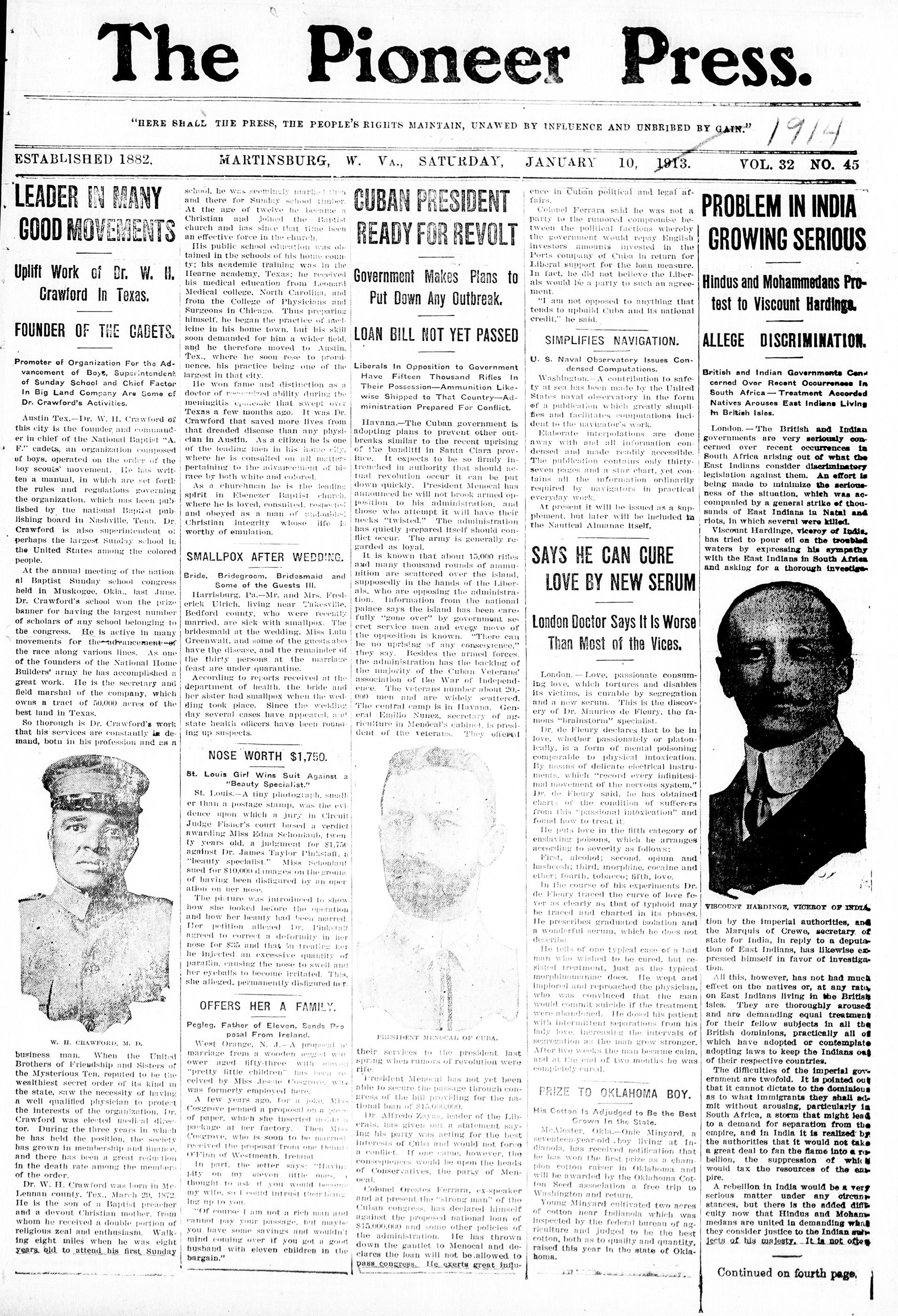
Austin Tex.—Dr. W. H. Crawford of this city is the founder and commander in chief of the National Baptist "A.F." cadets, an organization composed of boys, operated on the order of the boy scouts' movement. He has written a manual, in which are set forth the rules and regulations governing the organization, which has been published by the national Baptist publishing board in Nashville, Tenn. Dr. Crawford is also superintendent of perhaps the largest Sunday school in the United States among the colored people.
At the annual meeting of the national Baptist Sunday school congress held in Muskogee, Okla., last June. Dr. Crawford's school won the prize banner for having the largest number of scholars of any school belonging to the congress. He is active in many movements for the advancement of the race along various lines. As one of the founders of the National Home Builders' army he has accomplished a great work. He is the secretary and field marshal of the company, which owns a tract of 50,000 acres of the best land in Texas. So thorough is Dr. Crawford's work that his services are constantly in demand, both in his profession and as a
[Name]
W. H. CRAWFORD, M. D. business man. When the United Brothers of Friendship and Sisters of the Mysterious Ten, reputed to be the wealthiest secret order of its kind in the state, saw the necessity of having a well qualified physician to protect the interests of the organization. Dr. Crawford was elected medical director. During the three years in which he has held the position, the society has grown in membership and finance, and there has been a great reduction in the death rate among the members of the order.
Dr. W. H. Crawford was born in McLennan county, Tex., March 29, 1872. He is the son of a Baptist preacher and a devout Christian mother, from whom he received a double portion of religious zeal and enthusiasm. Walking eight miles when he was eight years old to attend his first Sunday
---
school, he was seemingly marked then and there for Sunday school timber. At the age of twelve he became a Christian and joined the Baptist church and has since that time been an effective force in the church.
His public school education was obtained in the schools of his home county; his academic training was in the Hearne academy, Texas; he received his medical education from Leonard Medical college, North Carolina, and from the College of Physicians and Surgeons in Chicago. Thus preparing himself, he began the practice of medicine in his home town, but his skill soon demanded for him a wider field, and he therefore moved to Austin, Tex., where he soon rose to prominence, his practice being one of the largest in that city.
He won fame and distinction as a doctor of recognized ability during the meningitis epidemic that swept over Texas a few months ago. It was Dr. Crawford that saved more lives from that dreaded disease than any physician in Austin. As a citizen he is one of the leading men in his home city, where he is consulted on all matters pertaining to the advancement of his race by both white and colored. As a churchman he is the leading spirit in Ebenezer Baptist church, where he is loved, consulted, respected and obeyed as a man of undoubted Christian integrity whose life is worthy of emulation.
SMALLPOX AFTER WEDDING.
Bride, Bridegroom, Bridesmaid and Some of the Guests III.
Harrisburg, Pa.-Mr. and Mrs. Frederick Ulrich, living near Takesville, Bedford county, who were recently married, are sick with smallpox. The bridesmaid at the wedding, Miss Lulu Greenwalt, and some of the guests also have the disease, and the remainder of the thirty persons at the marriage feast are under quarantine.
According to reports received at the department of health, the bride and her sister had smallpox when the wedding took place. Since the wedding day several cases have appeared, and state health officers have been rounding up suspects.
NOSE WORTH $1,750
St. Louis Girl Wins Suit Against a "Beauty Specialist."
St. Louis.—A tiny photograph, smaller than a postage stamp, was the evidence upon which a jury in Circuit Judge Fisher's court based a verdict awarding Miss Edna Schonlaub, twenty years old, a judgment for $1,750 against Dr. James Taylor Pinkstaff, a "beauty specialist." Miss Schonlaub sued for $10,000 damages on the ground of having been distigued by an operation on her nose.
The picture was introduced to show how she looked before the operation and how her beauty had been marred. Her petition alleged Dr. Pinkstaff agreed to correct a deformity in her nose for $35 and that in treating her he injected an excessive quantity of parathin, causing the nose to swell and her eyeballs to become irritated. This, she alleged, permanently disfigured her.
OFFERS HER A FAMILY
Pegleg, Father of Eleven, Sends Proposal From Ireland.
West Orange, N. J.-A proposal of marriage from a wooden rogged wooer aged fifty-three with eleven "pretty little children" has been received by Miss Jessie Cosgrove, who was formerly employed here.
A few years ago, for a joke, Miss Cosgrove penned a proposal on a piece of paper, which she inserted inside a package at her factory. Then Miss Cosgrove, who is soon to be married, received the proposal from one Dennis O'Finn of Westmouth, Ireland.
In part, the letter says: "Having pity on my eleven little ones, a thought to ask if you would become my wife, so I could intrust their bring-ing up to you.
"Of course I am not a rich man and cannot pay your passage, but maybe you have some savings and wouldn't mind coming over if you got a good husband with eleven children in the bargain."
CUBAN PRESIDENT READY FOR REVOLT
CUBAN PRESIDENT READY FOR REVOLT
LOAN BILL NOT YET PASSED
Liberals In Opposition to Government Have Fifteen Thousand Rifles In Their Possession—Ammunition Likewise Shipped to That Country—Administration Prepared For Conflict.
Havana.—The Cuban government is adopting plans to prevent other outbreaks similar to the recent uprising of the banditti in Santa Clara province. It expects to be so firmly entrenched in authority that should actual revolution occur it can be put down quickly. President Menocal has announced he will not brook armed opposition to his administration, and those who attempt it will have their necks "twisted." The administration has quietly prepared itself should conflict occur. The army is generally regarded as loyal.
It is known that about 15,000 rifles and many thousand rounds of ammunition are scattered over the island, supposedly in the hands of the Liberals, who are opposing the administration. Information from the national palace says the island has been carefully "gone over" by government secret service men and every move of the opposition is known. "There can be no uprising of any consequence," they say. Besides the armed forces, the administration has the backing of the majority of the Cuban Veterans' association of the War of Independence. The veterans number about 20,000 men and are widely scattered. The central camp is in Havana. General Emilio Nunez, secretary of agriculture in Menocal's cabinet, is president of the veterans. They offered
```markdown
```
PRESIDENT MENOCAL OF CUBA.
their services to the president last spring when rumors of revolution were rife.
President Menocal has not yet been able to secure the passage through congress of the bill providing for the national loan of $15,000,000.
Dr. Alfredo Zayas, leader of the Liberals, has given out a statement saying his party was acting for the best interests of Cuba and would not force a conflict. If one came, however, the consequences would be upon the heads of Conservatives, the party of Menocal.
Colonel Orestes Ferrara, ex-speaker and at present the "strong man" of the Cuban congress, has declared himself against the proposed national loan of $15,000,000 and some other policies of the administration. He has thrown down the gantlet to Menocal and declares the loan will not be allowed to pass congress. He exerts great influ-
JANUARY
ence in Cuban political and legal affairs.
Colonel Ferrara said he was not a party to the rumored compromise between the political factions whereby the government would repay English investors amounts invested in the Ports company of Cuba in return for Liberal support for the loan measure. In fact, he did not believe the Liberals would be a party to such an agreement.
"I am not opposed to anything that tends to upbuild Cuba and its national credit," he said.
SIMPLIFIES NAVIGATION.
U. S. Naval Observatory Issues Condensed Computations.
Washington.—A contribution to safety at sea has been made by the United States naval observatory in the form of a publication which greatly simplifies and facilitates computations incident to the navigator's work.
Elaborate interpolations are done away with and all information condensed and made readily accessible. The publication contains only thirty-seven pages and a star chart, yet contains all the information ordinarily required by navigators in practical everyday work.
At present it will be issued as a supplement, but later will be included in the Nautical Almanac itself.
SAYS HE CAN CURE LOVE BY NEW SERUM London Doctor Says It Is Worse Than Most of the Vices.
London. — Love, passionate consuming love, which tortures and disables its victims, is curable by segregation and a new serum. This is the discovery of Dr. Maurice de Fleury, the famous "brainstorm" specialist.
Dr. de Fleury declares that to be in love, whether passionately or platonically, is a form of mental poisoning comparable to physical intoxication. By means of delicate electrical instruments, which "record every infinitesimal movement of the nervous system," Dr. de Fleury said, he has obtained charts of the condition of sufferers from this "passional intoxication" and found how to treat it.
He puts love in the fifth category of enslaving poisons, which he arranges according to severity as follows:
First, alcohol; second, opium and hasheesh; third, morphine, cocaine and ether; fourth, tobacco; fifth, love.
In the course of his experiments Dr. de Fleury traced the curve of love fever as clearly as that of typhoid may be traced and charted in its phases. He prescribes graduated isolation and a wonderful serum, which he does not describe.
He tells of one typical case of a bad man who wished to be cured, but resisted treatment, just as the typical morphinomanine does. He wept and implored and reproached the physician, who was convinced that the man would commit suicide if the treatment were abandoned. He dosed his patient with intermittent separations from his baby love, increasing the intervals of segregation as the man grew stronger. After five weeks the man became calm, and at the end of two months he was completely cured.
PRIZE TO OKLAHOMA BOY.
His Cotton Is Adjudged to Be the Best Grown In the State.
McAlester, Okla.—Onie Minyard, a seventeen-year-old boy living at Indianola, has received notification that he has won the first prize as a champion cotton raiser in Oklahoma and will be awarded by the Oklahoma Cotton Seed association a free trip to Washington and return.
Young Minyard cultivated two acres of cotton near Indianola which was inspected by the federal bureau of agriculture and judged to be the best cotton, both as to quality and quantity, raised this year in the state of Oklahoma.
VOL. 32 NO. 45
PROBLEM IN INDIA GROWING SERIOUS
Hindus and Mohammedans Protest to Viscount Hardings.
ALLEGE DISCRIMINATION.
British and Indian Governments Concerned Over Recent Occurrences In South Africa—Treatment According Natives Arouses East Indians Living in British Isles.
London. — The British and Indian governments are very seriously concerned over recent occurrences in South Africa arising out of what the East Indians consider discriminatory legislation against them. An effort is being made to minimize the seriousness of the situation, which was accompanied by a general strike of thousands of East Indians in Natal and riots, in which several were killed. Viscount Hardinge, viceroy of India, has tried to pour oil on the troubled waters by expressing his sympathy with the East Indians in South Africa and asking for a thorough investigation.
1
VISCOUNT HARDINGE, VICEBOY OF INDIA tion by the imperial authorities, and the Marquis of Crewe, secretary of state for India, in reply to a deputation of East Indians, has likewise expressed himself in favor of investigation. All this, however, has not had much effect on the natives or, at any rate, on East Indians living in the British isles. They are thoroughly aroused and are demanding equal treatment for their fellow subjects in all the British dominions, practically all of which have adopted or contemplate adopting laws to keep the Indians out of their respective countries.
The difficulties of the imperial government are twofold. It is pointed out that it cannot dictate to the dominious as to what immigrants they shall admit without arousing, particularly in South Africa, a storm that might lead to a demand for separation from the empire, and in India it is realized by the authorities that it would not take a great deal to fan the flame into a rebellion, the suppression of which would tax the resources of the empire.
A rebellion in India would be a very serious matter under any circumstances, but there is the added difficulty now that Hindus and Mohammedans are united in demanding what they consider justice to the Indian subjects of his majesty. It is not often
Continued on fourth page.
AN INDEPENDENT WEEKLY NEWSPAPER DEVOTED TO THE MORAL, RELIGIOUS AND FINANCIAL DEVELOPMENT OF HUMAN IST.
RATES OF SUBSCRIPTION.
[ you.....$1.50 ]
Pay for all advertisements is due in advance unless advertising is run by yearly contract, in which case the advertiser pays every three months.
Reduced Rates to Cluba.
Send for Sample Copies.
J. R. Clifford, Editor & Proprietor.
Drawer 869, and Bell 'Phone,101K. Martinsburg, W. Va.
SATURDAY, JANUARY 10. 1914.
How strange to be examined for service as soldiers, tobacco's color of skin, nails of fingers &c., bars admission, then in its face Secretary Daniels buys at the expense of the government 50, 000 pounds of tobacco for the sailor boys. Where does reason and consistency come in?
The Steel Trust feels hard times so severely that it will distribute a bonus to employees of $2,000,000—or half a million more than a year ago.—Springfield Republican.
The American Negro Academy. This unique organization held its 17th annual meeting December 29-30, 1913, Washington, D.C. The meeting was both pleasant and profitable. It was regretted that every member was not there. Possibly a later date—say May or June, would reunite the brethren.
Mr. Archibald H. Grimke, President, delivered a masterly oration. He is a profound thinker and a sublime orator. The Academy should keep him before the world in rebuke and refutation to all that the Dixons, Vardamans, Tillmans, Bleases, Smiths, et al. say and have said derogatory of us. Let us wake up and do it.
The paper read by Prof. R. C. Bruce, was in composition, diction and logic whipped cream of the richest thought, and his delivery was excellent. The Schools of the District are honored by such a man. Prof. Williams of the M. Street High School is a top-notcher, energetic, scholarly and brave: He is a searcher of interesting facts, and tells them in a way that they tiptoe your soul, and take a tiptop place in your memory. Not feeling well and knowing home was the best place for us, we did not get to hear Mr. L. M. Hershaw, whose orations are always excellent, and we know, or feel sure it measured up even with the rest, and at points boiled over.
---
Wm. M. Trotter, of the Boston Guardian, is grossly insulted because Dr. W. E. B. DuBois failed to see anything worth while to write about in the Crisis relative to his money-making trip to Washington to see President Wilson. If the Pioneer Press had said anything it would have been in the language of Lincoln about fooling all the people some of the time, but not fooling all the people all the time. Never did a bigger fakir, or humbug call on a President of the United States.
Print on paper and his lips told lies, that he was and is President of The National Independent Political League. He had no more right to go there as aforesaid than the devil had to offer the Savior of men, the kingdom of the earth if He would fall down and worship him. Having demanded a big sum of money to support the democratic party and got it, with no promises of performance for loyalty, Mr. Wilson no doubt said in his heart, "get thee behind me Satan" &c.
That Trotter's interest in any cause is bounded by his own selfishness and whims, is known by all who have had dealings with him. His only standard of conduct is the gratification of an inordinate vanity. He seceded from the Niagara Movement for no other reason than that a majority of its members did not see things as he saw them. He has quarreled with every man who has ever had any connection with him in race uplift. There is not a single educated man of the race who now cooperates with him who is not actuated by some motive of material gain. Trotter seceded from the National Independent Political League and as a secessionist he has Jeff Davis beaten to a frazzle.
ARRAIGNS OFFICERS FOR THEIR FAILURE
CABIN CREEK AND
In Individual Report the Senator Condemns State Authorities—No Evidence That Civil Courts Could Not Have Performed Duties If They Have Tried to Do So.
Severe arraignment of the authorities who administered marital law in West Virginia from September, 1912, to June, 1913, when the Cabin Creek and Paint Creek coal mine strike troubles were in progress, is contained in a subcommittee report made public last night by Senator Borah, a member of the Senate committee that conducted an investigation into all phrases of the West Virginia disturbances.
Says Courts Were Superseded.
Senator Korah's statement holds that the military authorities, acting under the direction of the governor, superseded all constitutional courts in West Virginia, imposed sentences not authorized by any standing laws and took over all the duties of the civil courts of the district, and that at the time such martial law was being enforced there was no evidence that the civil courts had been intimidated or that they would have failed to perform their duties faithfully.
Restricted In Its Inquiry.
The absence of recommendations is due to the restrictions placed upon the special committee by the resolution, under which it made the investigation. The inquiry itself was stubbornly opposed by Southern senators on the ground that it invaded the powers of the State, and was not properly a subject matter for Federal inquiry. This opposition was dissipated only when the resolution was so worded as to restrict the committee solely to a report on the facts disclosed.
Tried Without Indictment.
After briefly reviewing the incidents of the establishment of martial law and its maintenance in the Cabin Creek and Paint Crek districts for nearly a year, Senator Borah's statement sets forth:
"That during the reign of martial law a number of individuals were arrested, tried, and convicted and sentenced and punished for offenses alleged to have been committed by them.
"That these parties were arrested upon orders issued by the military authorities and not by virtue of any warrant issuer by the authorities or from the established courts of the State, and were put upon their trial, without the finding of any indictment by the grand jury, before a court martial created by the order of the commander-in-chief and composed of individuals selected by him.
"That the charges made against these parties thus put upon their trial were in the nature of specifications drawn up and presented by the military authorities, and upon these they were put upon their trial before said court-martial without a jury.
The Constitution Disregarded.
"That in the trial of these parties and in the assessing of punishments the court before which they were tried deemed itself bound alone by the orders of the commander-in-chief, the governor of the State, and in no respects bound to observe the Constitution of the United States or the constitution or the statutes of the State of West Virginia, relative to the trial and punishment of parties charged with crime. That they acted under the claim that all the provisions of the constitution, both State and national, and the statutes of the State relative to such matters were suspended and for the time inoperative by reason of the existence of martial law.
"That at the time these arrests were made and the trials and convictions had, the civil courts were open, holding their terms as usual, disposing of cases and dispensing justice in the usual and ordinary manner.
"That in some instances arrests were made outside the military zone for offenses alleged to have been committed outside the military zone and at a time when martial law did not prevail, and when such arrests were made the parties were turned over by the civil authorities to the military authorities for detention, trial, and punishment.
"That in rendering judgment and assessing punishment the parties were punished by terms of imprisonment unknown to the statutes or in excess of the punishment provided for such offenses under the laws of the State.
"That a number of these parties were sent to jail and many to the State penitentiary under sentence from this court-martial as approved by the governor. Most of those who were sent to the penitentiary were given a conditional pardon before the term for which they were sentenced had expired, the pardon being conditional in a general way upon good behavior. That the parties sentenced to the penitentiary were received into the penitentiary as ordinary convicts and treated in every respect as parties sentenced for crimes by the criminal courts of the State.
"That under the laws of West Virginia a warrant of arrest may be issued from one justice of the peace court, and the hearing and trial upon the said warrant of arrest may be transferred and brought on for hearing before any other justice of the peace in the same county.
"That the place of holding court—that is, for the civil or common law courts—was at Charleston, W. Va., a distance of several miles from the disturbed district or military zone.
"That no threats of violence or use of force was made or had against the judges or the courts at any time during the existence of the disturbance or the reign of martial law. No Threats Against Courts.
That great feeling and interest doubtless prevailed generally through out the county, but the existence of this feeling, and its effect upon the grand and petit juries were not tested by the calling of a grand jury or the submitting of the charges against these persons to a grand jury, and no attempt was made to try them before the petit jury—the officers of the county, after the declaration of martial law, proceeding upon the assumption that the feeling and prejudice were so strong as to prevent the operation of the civil authorities, together with a further belief that the declaration of martial law had the effect of suspending and nulifying all constitutional and satutory rights of the accused."
CHECK FOR HALF MILLION
Money Represents Knights of Columbus' Gift to the Catholic University.
BALTIMORE, Jan. 7.—A check for $500,000 from the Knights of Columbus of the United States for the Catholic University at Washington, was presented to Cardinal Gibbons yesterday by Edward H. Doyle, of Detroit, chairman in charge of the fund. Mgr. Thomas J. Shahan, president of the university, and member of the faculty attended the presentation ceremony, which took place at the cardinal's residence. The large sum has been collected by the knights in the last four years. It will be used to establish fifty scholarships at the university.
In accepting the gift Cardinal Gibbons thanked the donors through Mr. Flaherty in the name of the Holy See and of the trustees of the university.
"I find only one parallel for your magnanimous deed, the building of a great medieval cathedral by loyal and devoted guilds of those former Catholic days," he sail "In an age of spiritual unrest and despair you have renewed that miracle of faith—the steady and affectionate co-operation of a multitude of men in the fulfillment of one mighty purpose whose immortal influence shall run like a fertilizing river through all time and spread on all sides most welcome benefits."
FRUIT PROSPECTS GOOD
Prominent Orchardists Believe the Yield Will be Exceedingly Good.
Messrs. G. P. Miller, of Romney, and H. W. Miller, of Paw Paw, two prominent fruit growers, were in the city late yesterday. They had just completed a tour of inspection of their orchard holdings from Mineral county throughout the Eastern Panhandle of the state and were enthusiastic over the bright prospects for a record-breaking crop this year.
They said the late fall had fully developed both wood and bud of all fruit bearing trees, which have since been held dormant by the excessive cool weather, and besides the trees are thrifty from having borne little or no fruit last year.
Middleen Are Taking A Much Larger Toll Than They Did
Along in the middle and late nineties hogs were selling at $3 and $4 per 100, and bacon was selling at 10 or 11 cents a pound. Now hogs are selling around 7 or 8 cents and bacon is selling for 35 cents a pound.
In 15 years improvements have been made in marketing, and in making bacon. The crude methods of 15 or 20 years ago, in selling and producing bacon, the Beef Trust and the packing house machinery should count for something to the consumer. The savings effected by machinery and the trusts should give the workingman more bacon for a day's work. But whatever apparent rise of wages the workman has received has largely been absorbed by the higher cost of living, and he actually gets less bacon for his day's
Annual Convention at Lynchburg.
LYNCHBURG, Va., Jan. 6.—The annual convention and exhibition of the Virginia Corn Growers' association met in this city today and was opened with an address by President W. P. Moore. The gathering will continue over tomorrow.
BALTIMORE & OHIO
RAILROAD
in leave Martinsburg as follows
WEST BOUND
No 55 Daily at 11.21 a m for Pittsburg
Girrati, Louisville and St. Louis
Connects for Romney except Sunday and
at Grafton for Wheeling
No 15 Daily at 11.59 a m for Grafton
Pittsburg and Chicago.
No 5 Daily at 3.17 p m for Grafton
Pittsburg and Chicago.
No. 7 Daily 7.42 p m for Wheeling. Col-
umbus and Chicago.
No, 1 Daily at 6.20 p m for Cincinnati
Louisville and St. Louis.
No 3 Daily at 2.36 a m for Cincinnati
Louisville and St. Louis.
For Cumberland and way Stations, No
19 5.37 p. m.
No. 9 Daily at 11.28 p.m; for Pittsburg
No. 23 Daily except Sunday at 6.30 a.m
for Cumberland and intermediate stations.
Connects for Berkley Springs.
No 16 Daily except Sunday at 11,55 a.m. for Frederick, Baltimore and all intermediate stations via old line.
No 18 Daily except Sunday at 6,30 p.m. for Washington and Baltimore and all intermediate stations, Connects for, Frederick.
G W. SQUIGGINS, Gen. Pass Agent.
Baltimore- Md.
R. : BOUIC, Ticket Agent,
Martinsburg, W. Va.
GIVES E. G. WILSON FOURTEEN YEARS
APPEAL TAKEN TO SUPREME COURT E. Graham Wilson Takes in His Fight on the Charge of Criminally Assaulting Miss Kate Turner Last June-Judge Woods Sentenced Prisoner Today.
At Charles Town this morning a special term of circuit court was held by Judge J. M. Woods for the purpose of passing on the motion made by the defense in the case of E. Graham Wilson, who was found guilty at the last term of court on the charge of criminally assaulting Miss Kate Turner in June. 1913.
When court convened Mr. Wilson and his attorneys, Clarence E. Martin, of this city, and C. W. Campbell, of Charles Town, appeared to hear the court's decision. The state was represented by Prosecuting Attorney Moore and Col. Forrest Brown. In a lengthy opinion Judge Woods overruled the motion for a new trial, setting forth his reasons very logically and conclusively.
He then asked the prisoner to arise, and when he did so sentenced him to serve fourteen years in the state penitentiary at Moundsville. Mr. Wilson received the sentence without a move, and appeared to be the most composed man in the court room. Immediately after the sentence had been pronounced the defense served notice of an appeal to the state supreme court and pending a decision from that court Mr. Wilson will remain in jail.
TO HUNTINGTON
Will Franklin Heironimus Be Taken At Once. This morning Sheriff E. H. Tables went to Ganotown after. Franklin colornimus, whom was admitted to the West Virgin a Asyium at Huntington, and he will be taken there a once.
STAMPS SOLD WELL
Internal Revenue Office Disposed of
The month just closed was a fine one at the internal revenue office. The total receipts for stamps amounted to $20,268.52, which was a gain over November of $7,114.14, or during November the deputy sold $13,154.37. For October the sales amounted to $12,517.44; September $13,443.64, and August $7,554.60. W. E. Gordon, former deputy, stated this morning during December he only disposed of 30 cents worth of cigar stamps, and the remainder was for spirituous liquors. He also stated that the first year, 1910, he was in charge he sold to the Hannisville distillery $524,000 worth of stamps.
So it can be seen when the prohibition law becomes effective next July what the loss of revenue will be. Today the deputies are making up their reports for December, and will forward them immediately to the head office in Parkersburg.
PARCEL POST PROFITING.
Baltimore Alone, In Holidays Ceared $20,000.
Uncle Sam made a clean profit of about $20,000 on the parcel post business handled at the Baltimore office alone in the Christmas season, according to a preliminary report to Postmaster General Burleson The Maryland city was the first large office to report for the rush period. The number of parcels handled was nearly 1,000,000. Of these about half were light packets formerly called fourth class. The remainder were of an average weight of about four pounds, with a charge of about five cents, of which three cents was profit to the Government.
HOGS AND BACON
HOGS AND BACON
10 or 20 Years Ago.
VIRGINIA CORN GROWERS
Conected to Dec. 1st, 1913.
EAST BOUND.
Entered in Post Office at Martinsburg
4. Va., as Second Class Matter
Federal Refining Company to Make Payment On Preferred. NEW YORK, Jan. 7.—The directors of the Federal Sugar and Refining Company of Philadelphia and New York yesterday voted to pass the current quarterly dividend of 1 1-4 per cent on the common stock, but the dividend of 1 1-2 on the preferred stock will be paid at the end of the month.
GONE TO MORGANTOWN.
M. H. L. Smith Will Attend Farmers' Course At University. This morning H. L. Smith, president of the State Horticultural society, left for Morgantown to attend the farmers' short course at the university, and also a meeting of the horticultural society. He was accompanied by Mrs. Smith, and they will be absent two weeks.
Enlargement of Power Plant
The Martinsburg (W. Va.) Power Co. has filed a mortgage for $5,000,000 to secure its bond issue of that amount, the Safe Deposit & Trust Co., of Baltimore being trustee. The securities, it is said, will be issued in such sums as may be desired from time to time. It is expected that the company will provide current for the new electric street railway at Martinsburg, besides furnishing light and power to other corporations and individuals. It is reported that the existing plant will be enlarged and improved.—Manufacturers record.
DECLINE IN GOLD.
Decreased Production Shown For Year 1913.
The "gold value" of the year 1913 to the world was $445,000,000. The production of the previous year exceeded this total by $11,000,000. This was the first estimate of the director of the mint, George E Roberts made in the year 1914.
According to Director Roberts' announcement the United States gold dpruction for the year just passed amounted to $88.301,423, a decrease of $5.000,000.
Nevada led the gold producing states of the United States yielding ore to the commercial value of $9,123,299.
BOLD ROBBERY
Three Accused Later Arrested In Cumberland and Taken to Headquarters.
Charged with holding up and robbing Edward F. Lewis, a laborer employed on railroad construction work at Magnolia, in the rear of the Brunswick Hotel about 7:30 o'clock last night, Gordon H. Ward, Frank Smith and Samuel Faber were arrested at Cumberland a few minutes later and locked up in the police station, where they will be given a hearing before Magistrate Humbird this afternoon.
Lewis alleges that he walked in the toilet room in the rear of the hotel, where he had engaged lodging for the night, and was knocked down by one of his assailants, while the other two went through his pockets and relieved him of his money, amounting to $5 in currency. He ran out of the room after the three men and told the proprietor that he had been robbed and pointed out the men who had perpetrated the crime.
The police were soon notified and with the assistance of Sheriff Irvine and Deputy Sheriff Hutchinson, the three men were rounded up and handcuffed together, and later taken to the police station in the patrol wagon. Smith and Faber were both recently released from the Allegany county jail, where they were locked up on a charge of holding up Edward Jones, colored, and robbing him of a basket of bee in Cumberland.
TRACTION EARNINGS
Fairmont, Clarksburg and Weston Electric Railways Show Handsome Earnings.
(Manufacturers Record.)
The Monongahela Valley Traction Co., operating electric railways connecting Fairmont, Clarksburg, Weston and other places in West Virginia, has issued a statement of earnings for November and the 11 months ended November 30, comparisons being made with the corresponding periods of 1912. It shows for November, 1913, gross earnings, $83,639; operating expenses, $32,294; net earnings, $51,345; net surplus after fixed charges, taxes, etc. $25,562. Gross earnings November, 1912, were $70,714; net earnings, $44,719; net surplus, $19,91.
For 11 months, gross earnings, 1913, $872,470; operating expenses, $312,446; net earnings, $560,024; net surplus after fixed charges, taxes, etc. $288,150. Gross earnings for the same period in 1912 were $776, 164; net earnings, $469,830; net surplus, $233,506.
RESUMES DUTIES.
As Traveling Salesman With Cumberland Concern.
Thomas Comisky, who spent the holiday season with friends, here left last night for Cumberland, Md. where he will at once resume work is travelling representative for Neff brothers.
"U$E LIME NOW"
The above is the title of an interesting article in this issue of The World, to which the attention of farmers is directed. Dr. Karl Langback, Chemical Engineer. Southern Building. Washington. D. C., is the author and is ready and willing to assist farmers without cost other than sending of samples of soil for analysis.
Dr. Langenbeck, who is a soil chemist with considerable experience in soil conditions both in this country and in Europe, will attempt with the assistance of the U. S Soil Surveys, to analyze and determine for the different localities what the soil needs in a general way to maintain fertility, thereby producing a greater and finer crop. This will be a specific work, therefore one that will touch the condition of the soil in the every community.
When the soil needs lime, he will say so. If it needs something else, he will say so. The successful farmer is the one who reaches out for every aid. He buys the best implements. He keeps the best stock. He utilizes that which others call 'waste.' He strives to increase his crops and he does so. He makes two blades of grass grow where one crew before. He doubles his crops, if possible, and makes his farm yield him more money. Help is offered him without money and without price. No one can afford to neglect the opportunity now offered. It may not pay this year. But as constant dropping of water will wear the hardest stone, so will persistent seeking after knowledge. Better methods, better farming, pay big dividends in the end.
The World asks one favor: That is to notify The World if you send a sample or samples of soil to Dr Langenbeck. That will be but lit the trouble and may pay in the final result of the experiment, if it is such.—World.
Captures Large Eagle.
YORK, Pa., Jan. S.—William H. Liphart, of Long Level, yesterday captured a large eagle in a trap, measuring 7 feet 7 inches from tip to tip.
The trap had been set for young foxes. He had caught one and was trying to catch the old one. When he went back in the morning to see how he had succeeded he found the eagle there ready to greet him.
It immediately showed fight, and it was some time before he could release it and get it under control.
It is a fine specimen and brought him $10.
DEATH TAKESTHREE
Three B. & O. Officials Die In Less Than a Week—C. C. Riley the Last.
Three prominent officials of the Baltimore and Ohio railroad—all of whom have risen from minor positions to office of trust and responsibility in the service of the corporation—have died suddenly within less than a week, two having passed away at a most the same hour yesterday. Capt. George W. Booth, the comptroller of the road and one of the best known railroad men in the country, died shortly after 7 o'clock Tuesday evening at his home, 3022 St. Paul street, Baltimore, and only a short while after Captain Booth's death C. C. Riley, general superintendent of transportation of the Baltimore and Ohio, died at the home of his sister in Washington. Captain Booth's death was caused by hemorrhages of the brain.
The deaths of Captain Booth and Mr. Riley follow within less than a week that of Charles E. Ways, assistant general traffic manager of the Baltimore and Ohio, who died at his home in the Mount Royal Apartments last Thursday.
CURRENT COMMENT.
MAKING MURDER SAFE
To understand the lengths to which a defence of insanity may now go with success in protecting murderers in this State it is necessary to have in mind the facts of the Hans Schmidt case.
This priest in active orders had consorted with a young and attractive woman, Ann Aumueller, and faced the time when their secret must come out. He provided a room for her, where he went late one night equipped with a knife and saw. He found her asleep, as he later admitted, and plunged the knife through her throat. He then cut up the still-warm body into nine parts, and at his leisure wrapped up the parts in neat bundles and carried them one by one to a ferry-boat. whence they were dropped into the North river. He took the mattress on which the butchery had been done to a vacant lot and burned it. He cleaned up other traces of blood and crime.
Fresh from the murder and his butchery, he returned to the performance of his sacred offices and mingled hearing confessions and conducting moss with the bearing of his bloody burdens to the river. So well done was his work of concealment that but for the chance of wrapping a part of the torso in a low-case which the river gave up and whose sale could be traced by a peculiar trade-mark, he would have escaped detection.
The annuals of crime can be searched in vain for a murder more deliberate, more coldly calculated, more sanely conducted to escape detection, than this. Yet with a story of acting under orders from his patron saint, this calculating butcher of a betrayed girl can command in court a serious defense of insanity, can find alienists to help the defense and can finally impress enough jurymen with the theory to hang up the trial.
If such a murderer is insane the gunmen who killed Rosenthal must have been insane, the man and woman who cut up Guidonsuppe in like manner were insane, the Rev. Richerson, who sent poison to his abandoned sweetheart, was insane.
That plea could not be made to work in the Richeson case in Massachusetts. Are there now any limits to its working in this State?—New York World.
SUPPORTING THE PRESIDENT. (New York Herald.) The practically unanimous support President Wilson is receiving for his policy of "watchful waiting" toward Mexico furnishes striking demonstration of the folly of those who are attempting to manufacture false issues. They get nowhere. Mr. Wilson is President of no party. He is President of the United States and that means the President of and for all the people. It is entirely im- material what party is in charge of
the government so long as the affairs of government are conducted so as to promote the highest and best interests of the American people. Nobody questions the sincerity of President Wilson's desire to do this. He will be successful if he receives the cordial support of his party associates, and if politicians of other parties permit party issues to "stay dead." Then can President Wilson, like President Monroe, devote himself to promoting the economic development of the country, and by so doing give us another Era of Good Feeling
Are You a Woman?
Take Cardui
The Woman's Tonic
FOR SALE AT ALL DRUGGISTS
F4
HOWARD UNIVERSITY,
WASHINGTON, D.C.
STEPHEN M. NEWMAN, D. D
Located in Capitol of the Nation. Campus of over twenty acres. Advantages unsurpassed. Modern scientific and general equipment. New Carnegie Library. New Science Hall. Faculty of over one hundred. 1382 students from 37 states and 10 other countries. Unusual opportunities for self-support. No young man or woman of energy or capacity need be deprived of its advantages. THE COLLEGE OF ARTS AND
SCIENCES.
Devoted to liberal studies. Courses in English, Mathematics, Latin, Greek, French, German, Physics, Chemistry Biology, History, Philosophy, and the Social Sciences, such as are given in the best approved colleges. 16 professors. Kelly Miller, A. M., Dean.
THE TEACHERS' COLLEGE.
Special opportunities for teachers. Regular college courses in Psychology. Pedagogy, Education, &c., with degree of A. B.; Pedagogical courses leading to Ph. B. degree. High-grade courses in Normal Training. Music, Manual Arts, and Domestic Sciences. Graduates helped to positions. Lewis B. Moore A. M., Ph. D., Dean.
THE ACADEMY.
Faculty of 13. Three courses of four years each. High grade preparatory school. George J. Cummings, A. M., Dean.
THE COMMERCIAL COLLEGE.
Courses in Bookkeeping, Stenography Commercial Law. History, Civics, &c. Business and English high school education combined. George W. Cook, A. M. Dean.
SCHOOL OF MANUAL ARTS AND APPLIED SCIENCES.
Furinshes thorough courses. Six instructors. Offers four-year courses in Mechanical and Civil Engineering, and Architecture.
Professional Schools
THE SCHOOL OF THEOLOGY. Interdenominational. Five professors. Broad and thorough co-uses. Advantages of connection with a great University. Students' Aid. Low expenses. Isaac Clark, D.D., Dean.
THE SCHOOL OF MEDICINE
Forty-nine professors. Modern laboratories and equipment. Connected with new Freedmen's Hospital, costing half million dollars. Clinical facilities not surpassed in America. Post-graduate School and Polyclinic. Edward A. Balloch, M. D., Dean, 5th and W. Streets N. W. W. C. McNeill, M. D., Secretary, 901 R St., N. W.
THE SCHOOL OF LAW.
Faculty of eight. Courses of three years, giving a thorough knowledge of theory and practice of law. Occupies own building opposite the court house. Benjamin F. Leighton, LL.B., Dean, 420 5th street N.W. For catalogue and special information address Dean of Department.
HENEY OUT FOR THE SENATE.
Follows Gov. Johnson's Determination to Seek Re-election.
SACRAMENTO, Cal., Jan. 7.—Hiram W. Johnson announced yesterday that he would seek reelection as governor. He said he would prefer to be a candidate for the United States Senate, but has decided to seek the governorship again.
Gov. Johnson has announced recently that he desired to retire from politics because of failing health. He finally decided to stay in politics, "to save the Progressive State machine."
SAN FRANCISCO, Jan. 7.—Francis J. Heney, when told of Gov. Johnson's decision, announced that he would run for the United States Sen-
A NEW STATE HIGHWAY.
Announcement has been made that plans are on foot at the office of the State Road Engineer Williams for the building of a turnpike from Bristol, Va., through the entire State of West Virginia, to Pittsburg, Pa. At present the road has been completed to within 25 miles of Bluefield, and this week a special bond election was carried in Mercer county for $500,000 road bonds. The proposed road will go through Morgantown, Clarksburg, Weston, Fayetteville and intermediate cities.
If built, it will open a section of untold richness and scenic beauty. dividing the state into two nearly equal parts and will blsect roads now running across the state from east to west, and will be of mestimable value.
Just now the attention of the people of the United States is attracted to the labor troubles of the copper courty Upper Peninsula of Michigan. Reports show that a great majority of the men concerned are foreign-born. Just a short time ago the labor troubles of the miners of West Virginia were in the spotlight. At that time it was shown the foreign-born element predominated.
Going back a little farther the same reports came from other places, and it was always because for eign-born people are in the majority. The United States is the world's great melting pot, and while every thinking person knows that immigrants who are lawfully eligible finally become good Americans, the record shows that the process of eliminating the dross is a most costly one.
The United States needs and must have workers to do its drudgery, men to do its rough and dirty work, work which requires brawn, rather than brain, yet as these same immigrants became Americanized and their children educated this kind of work is scorned with the result more immigrants are needed, and so it goes on like Tennyson's brook.
What will be the final analysis? It's a hard question to answer, and the only solution we can think of is that "honest labor must be more highly respected and renumerated."
—Washington Herald.
BIOGRAPHY OF
EMINENT NEGRO MEN AND WOMEN OF EUROPE AND THE UNITED STATES
Adapted to the use of Students of race history, and of Negro youth. A valuable and handy reference book with questions and answers. Is printed on heavy paper in good, large clear type. And compactly bound in boards. A copy of this book should be in every Negro home. Price one dollar per volume—$1.00 Cash must invariably accompany all orders postage paid. Good live agents wanted for West Virginia. No sample outfits. Stamps not accepted. For further information and terms to Agents, Address.
John E. Bruce Grit, Author and Pub Sunnylope Cottage, Yonkers, N. Y. Refers to J. R. Clifford, Esq., Editor Pioneer Press
PROBLEM IN INDIA
Continued from first page.
that the two sects join together, but in this case they have been acting as one; and have been holding joint meetings of protest and making joint representations to the India office. The meetings have been scarcely noticed in the papers, although the speeches delivered at some of them have been of such an inflammatory character that on other occasions the speakers would have been charged with sedition.
Another matter irritating the Indians is that they have found out that some of the men who professed to be heart and soul in their campaign for redress were in the pay of the imperial government. One very prominent Indian, whose speeches at some of the meetings verged very closely upon sedition has been found to have been in the pay of the Indian government for years. He is now receiving police protection for fear of assassination.
NO LIMIT TO POSTAL SAVINGS.
House Passes a Bill to Revise the System.
Washington.—The house has passed a bill increasing the limit for individual depositors in the postal savings system by removing all limitations as to the amount a depositor may keep to his credit. Heretofore there has been a limit of $500 for a depositor.
Under the terms of the bill interest will be paid on amounts up to $1,000 only, but no limit is placed on the amount of noninterest bearing funds which a depositor may place in Uncle Sam's care.
HAD PRESENTIMENT OF A TRAGIC DEATH Young Woman Who Had Shot Husband Bought Goffin.
Fort Worth, Tex.—A presentiment that she would soon die a violent death induced Mrs. Etta Miller of this city to select her own coffin only three days before she was shot and killed by her father-in-law, Joe Miller. When she told friends that she had called at an undertaker's and bought a coffin they jested her. She said no threats had been made against her life, but fear of being killed haunted her day and night.
Mrs. Miller a few months ago shot and killed her husband, John Miller. The latter's father brooded over his son's death, but he had made no threats of violence. Mrs. Miller owned a rooming house and was worth considerable money.
The shooting on a crowded downtown street caused a panic. Mrs. Miller and her sixteen-year-old daughter Pauline, had been resting in a small park near the Flatiron building, and Miller lurked behind a corner, listening to their laughter. When they started to walk off he approached them hurriedly, drew his revolver and shot Mrs. Miller through the forehead. While the woman's body was on the side walk he fired two more shots into it. He did not speak a word.
Mrs. Miller was convicted of killing her husband and received a two-year sentence. The court, however, suspended her sentence and she was an liberty pending good behavior. She had asserted that she loved her husband and expected to live with him again if he recovered. Next day after she made this statement he filed suit for divorce, but died while the suit was pending.
The elder Miller paces his cell in the county jail and is showing signs of remorse. "I must have been crazy to do it," he says, "but how I loved that boy! He was all I had."
TO URGE GHOSTS TO GO.
Spiritualists Will Try to "Shoo" Vander Piles' Guests.
Passaic, N. J.-Spiritualists visited the home of Mr. and Mrs. Peter Vander Pile to "shoo away" ghosts that have been haunting the Vander Piles for the last few weeks.
About two months ago the Vander Piles were awakened one night by knockings inside the walls of the house. They thought little of the matter, but when the knockings came the second night it was decided they were made by ghosts.
All sorts of plans were tried to lay the ghosts, but all to no avail. The Rev. Nicholas Boer of the Christian Reformed church sat up with them one night. The sounds came, and Mr. Boer refused to call again.
Spiritualists in Paterson read of the ghosts and offered to persuade these to go away.
REVENUE CUTTERS SAVE HUNDREDS
Little Vessels Earn Titles of Samaritans of Sea.
MANY DEEDS OF DARING.
Fleet In Aiding Distressed Ships Prevents Loss of $10,620,000—Brief Tales of Thrilling Rescuers—How the Cutters Learn When Vessels Need Succor and How They Rush to Scene.
Washington.—The benevolent cruisers of Uncle Sam, known otherwise as the revenue cutter squadrons, plying in arctic, tropic and temperate seas and on the great lakes, did a lot of splendid work in the last fiscal year. The annual report of the United States revenue cutter service, just published, tells without ornamentation some of the deeds of the ablest seamen in all the waters of America and maybe in all the world.
A summary of the operations of the ships of the several squadrons shows that 327 persons were saved from death or peril; that 264 persons in distress were taken aboard the cutters and cared for; that 31 derelicts and obstructions to navigation were destroyed or removed; that derelicts valued at $18,000 were recovered and delivered to owners.
The report says that last winter, although milder than the one before, gave much work for the cutters, and the result of their operations was the salvaging "of $10,626,610 worth of property from the perils of the sea, and as the total cost for the maintenance of the service during the fiscal period was $2,471,532.51, the year's efforts represent a conservation of $4.20 for each dollar thus invested by the government."
A new use for the cutter has been the salvaging of aerohydroplanes and hydroplanes on sea and lake.
All the big and little adventures of the cutters related in the newspapers are retold in cameo-like form in marginal notes of the report. The cutter Woodbury tells paragraphically how she saved the schooner Ravola at little Duck Island, Maine:
"Ashore on ledge; blasted rock under vessel and hauled off."
The work of the cutter Seminole assisting the steamship Berkshire a Lookout bight, North Carolina, is summarized:
"Steamship on fire. Seminole extinguished same and pumped steam ship out."
The coal barge Charmer's unship and what the Onondaga did for her off Cape Henry are thus described:
"Aground. Attempted to float, but vessel began to break up. Took off three persons."
The Seminole found at Lookout bight the schooner Thomas Winsmore flying signals of distress. This is the thumbnail yarn:
"Leaking badly and about to sink gasoline engine for handling pumps, sails and anchors disabled. Repaired by engineer's force of Seminole."
The above are characteristic instances. The commonest form is helping sailing vessels off shoals. Other forms were the righting of small vessels that had been capsized, assisting in repairing machinery, provisioning hungry craft, the recovery of stolen vessels masquerading under new names and altered rig, the burying of the dead after collision, supplying disabled motor vessels with gasoline, putting out fires in warehouses, boat houses, lighthouses and Eskimo dwellings in the arctic zone.
In the extended reports of the commanders of cutters there are some stories worth telling again in the language of the skippers. Captain Gamble of the Mareel tells how he assisted is restoring uncharted aboard a Yankee fore and after. He writes to the secretary of the treasury under date of Nov. 7 last year:
"On Nov. 3, when at out ten miles outside of the Charleston lightship, a schooner was sighted with her flag in the mizzen rigging Union down. The Miami stood out to her and found that she was the four masted schooner Blanche H. King of New York, J. H. Toole, master, who informed me that he had a man on board that he could not handle. An officer boarded her and, upon investigation, learned that, while the man was not violent, he was insubordinate and a constant menace to discipline. He was placed in a set of our irons, for which a receipt was taken. The master requested the loan of a ship's revolver, but as the remainder of the crew showed no indications of insubordination the request was not granted."
COULD SCARCELY WALK ABOUT
And For Three Summers Mrs. Vincent Was Unable to Attend to Any of Her Housework.
Pleasant Hill, N. C.—"I suffered for three summers," writes Mrs. Walter Vincent, of this town, "and the third and last time, was my worst.
I had dreadful nervous headaches and prostration, and was scarcely able to walk about. Could not do any of my housework.
I also had dreadful pains in my back and sides and when one of those weak, sinking spells would come on me, I would have to give up and lie down, until it wore off.
I was certainly in a dreadful state of health, when I finally decided to try Cardui, the woman's tonic, and I firmly
HON. A. I. BOREMAN
The First Governor of West Virginia.
Arthur Ingram Boreman, the first Governor of West Virginia, was born at Waynesburg, Penn., July 24, 1823. At the age of four years he came with
A. B.
HON. ARTHUR I. BOREMAN,
First Governor of West Virginia,
his parents to Tyler county, West Virginia, where he attended the school of that day. He studied law and was admitted to the bar in 1843, in which year he located in Parkersburg, and began the practice of his profession, in which he soon rose to distinction. In 1855 he represented Wood county in the General Assembly of Virginia, and by successive elections continued in that capacity until 1860. He became an ardent new State man, and was president of the Second Wheeling Convention which assembled June 11, 1861, and which reorganized the Restored Government of Virginia and prepared the way for the formation of West Virginia. He was elected first Governor of West Virginia; was inaugurated June 20, 1863, and by successive elections served until 1869, when he was elected a member of the United States Senate, in which body he served six years. Thereafter he resumed the practiced of law in Parkersburg, where he was later elected Judge of the Circuit Court, and served eight years, his term beginning January 1, 1889. He was a leader of men in the time in which he lived, not from the intrigues of craft and cunning, but from an innate and rightful sovereignty of human nature.
TRUST ACTION NEXT SESSION.
President Then Will Recommend Strengthening of Shcrman Law.
Washington.—There will be no antitrust legislation at this extra session of congress. It was stated on the highest authority. President Wilson will recommend to congress soon after the beginning of the regular session in December the strengthening of the Sherman law.
Between how and then he and his advisers will go over the Sherman law, dig into the history of its operation and make a careful study of what has been done with the law and its effect on business. It became known that the president will have before him the anti-trust laws of New Jersey, known as "the seven sisters" acts enacted during the last year of Mr. Wilson's administration as governor of that state.
believe I would have died if I hadn't taken it.
After I began taking Cardui, I was greatly helped, and all three bottles relieved me entirely.
I fattened up, and grew so much stronger in three months, I felt like another person altogether."
Cardui is purely vegetable and gentle-acting. Its ingredients have a mild, tonic effect, on the womanly constitution.
Cardui makes for increased strength, improves the appetite, tones up the nervous system, and helps to make pale, sallow cheeks, fresh and rosy.
Cardui has helped more than a million weak women, during the past 50 years. It will surely do for you, what it has done for them. Try Cardui today.
Write to: Chattanooga Medicine Co., Ladies' Advisory Dept., Chattanooga, Tenn., for Special Instructions on your case and 64-page book, "Home Treatment for Women," seat in plain wrapper, Ladie.
ALPHEUS GARRISON.
Alpheus Garrison was born in Green county, Pennsylvania, February 26, 1833; moved to Guernsey county, Ohio, in 1836; in 1842 moved to Monongalia county, Virginia, now West Virginia, where he still resides. Mr. Garrison was married to Charlotte Henderson in 1853. In 1856 he was elected constable and served the term; in 1859 was appointed deputy sheriff and served until May, 1861, when he resigned and was appointed a delegate to the Wheeling convention. He was appointed recruiting agent for soldiers and deputy provost marshal until 1864. He joined the Union army as 2d lieutenant and later was promoted to captain of Company E, 17th W. Va. Infantry. He served until June 30, 1865, and returned home in 1866. He was appointed assessor to fill a vacancy and in 1866 was elected assessor; in 1868 he was elected to the legislature and served the winter of 1869 in Wheeling, Wa. Va.; in 1870 was elected sheriff of the county and in 1890 was elected to the state senate from the Eleventh Senatorial district and served in Charleston, W. Va., 1891 and 1893. Since that time Mr. Garrison has lived on his farm. He has been a member of the Christian church for more than 52 years and is a prominent Mason. He is now in his 81st year, well preserved, active and keenly interested in the current events of the day.
GEORGE ROBERT LATHAM.
George Robert Latham was born in Prince William county, Virginia, in sight of the Bull Run battle ground, March 9, 1832, and was reared on a farm. In November, 1849, his father moved his family into Western Virginia and settled in Taylor county. In January, 1850, Mr. Latham had a severe attack of pleurisy followed by general prostration, from which he was totally disabled for farm work for three years. In 1852, having partially regained his health, he taught school in Taylor and Barbour counties, Virginia, until the winter of 1859. From 1855 to 1861 he was a citizen of Grafton, where he was married on December 24, 1857, to Caroline A. Thayer, then of Monongalia county, Virginia.
Sho Says We're Much Too Slender
A Russian princess who is now in Washington has created a commotion in social circles by criticising the American women for being much too thin. "American women of good breeding are slender to the point of emaciation," says the princess. "They hurry too much, that is the reason. Everywhere you see the American, whether she is going shopping, visiting or elsewhere, she is moving fast, as she did not have a second to lose." The princess doesn't seem to realize that just now the one aim of the American woman is the extreme slenderness which she finds so unlovely.
REVEALS SECRET MARRIAGE
Mrs. Phillips of New York Was Wedded Last December.
Wilmington. Del.—Mrs. Edith Slosson Phillips of 102 West Forty-first street. New York. called the Rev. George L. Wolfe by telephone and asked him to announce her marriage on Dec. 18 last to Wallace B. Phillips. The couple were wedded here by Mr Wolfe.
"Wasn't your marriage published at the time?" the preacher asked.
"No." was the answer.
The woman would not give her reason for desiring the belated announcement. She said her husband was from Greensboro, N. C.
Billy Was Slapped and Then Ran Is Front of Automobile.
Bloomfield, N. J.—Miss Lucy Bergen of Washington street, in this town, is sure that her large black cat committed suicide deliberately, and many persons who saw the tragic end of her pet agreed with her.
The cat ran out to the middle of the street in front of its home and awaited the approach of an automobile. The chauffeur saw the animal and steered in next the curb to avoid hitting it. But the cat crawled toward the curb, judging the distance so as to get exactly in front of the wheels of the auto, which ran over it.
Miss Bergen said: "I was putting a pink ribbon on Billy's neck in honor of his thirteenth birthday, when he scratched my hand, for which I gave him a sharp blow on the side of the head with my open hand. He jumped off the table and sought refuge behind a gas range in the kitchen. I felt sorry for what I had done and tried to coax him out, but he paid no attention to me, and at the first opportunity he ran out the kitchen door.
"I thought he would soon return, and after bathing my wound I went into the parlor and sat by the window. From there I saw Billy lying in the street. Then I saw the automobile coming and I ran to the door. Billy's actions prove to me that he wanted to die, for the driver of the automobile did everything possible to avoid running over him."
TRYING TO CURE AN "UPSIDEDOWN"YOUTH
Detroit, Mich. - Physicians throughout the country are interested as to the experiments which are to be made to try to cure Joseph W. Darling of this city. The boy is suffering from an unusual malady which results in his writing and drawing everything upside down. Everything reverses itself to his vision, and it is believed that a surgical operation will be able to remedy the ailment.
The leading physicians of the city are taking a great interest in the boy, and several schemes are being worked out in the hope of bettering the boy's sight and making his vision in every way normal. Dr. W. P. Melody, city physician, is convinced that the ailment comes from a lesion of the brain as a result of an accident, and the boy is to be treated by him first to give him an opportunity to disprove or substantiate that theory.
Joseph is a remarkably intelligent boy. He is nine years old, but his physical development is that of a boy of four, as he has spent months at a time in various hospitals following an accident which affected his sight and ruined his health. This happened when he was two and a half years old. He was lifted from the floor by his head by a caller at his home and so injured that his neck and spine became practically useless. Abscesses formed at either side of his neck, and his spine finally developed a bad curvature.
The boy was treated at a local hospital for nearly a year following the mishap, and, as in that time he did not have one sound sleep because of his pain, the physicians were assured that he could not live and had him taken to his home to die.
It was not until Joseph was well enough to go to school that it was found that his sight was affected. He was an apt pupil, but his teachers sent word to Mrs. Webb that he insisted upon fooling at his work and did everything upside down. He protested that he was doing the best that he could and insisted that he never had written or drawn anything upside down since he had been at the school. They asked him then if he knew what upside down meant. He said yes and immediately drew a picture as it should be, right side up. "That," said he. "is upside down, and I never do my work that way."
Continued surveillance convinced his teachers that the boy was suffering with some defect of vision, and since that time he has been examined by almost all of the physicians in Detroit, all of whom have been unable to say just what causes the ailment.
Neville Metal Sewed In Head.
Eau Claire. Wis.—The breechpin of an old Norwegian shotgun was sewed up in the forehead of Alfred Johnson of Minneapolis by a doctor who was called to attend him after he had fired the ancient weapon and had been struck by the flying pin. Johnson's condition did not improve, so he was brought to a hospital here, where the pin was removed. That Johnson will survive is confidently predicted.