The Pioneer Press
Saturday, January 17, 1914
Martinsburg, West Virginia
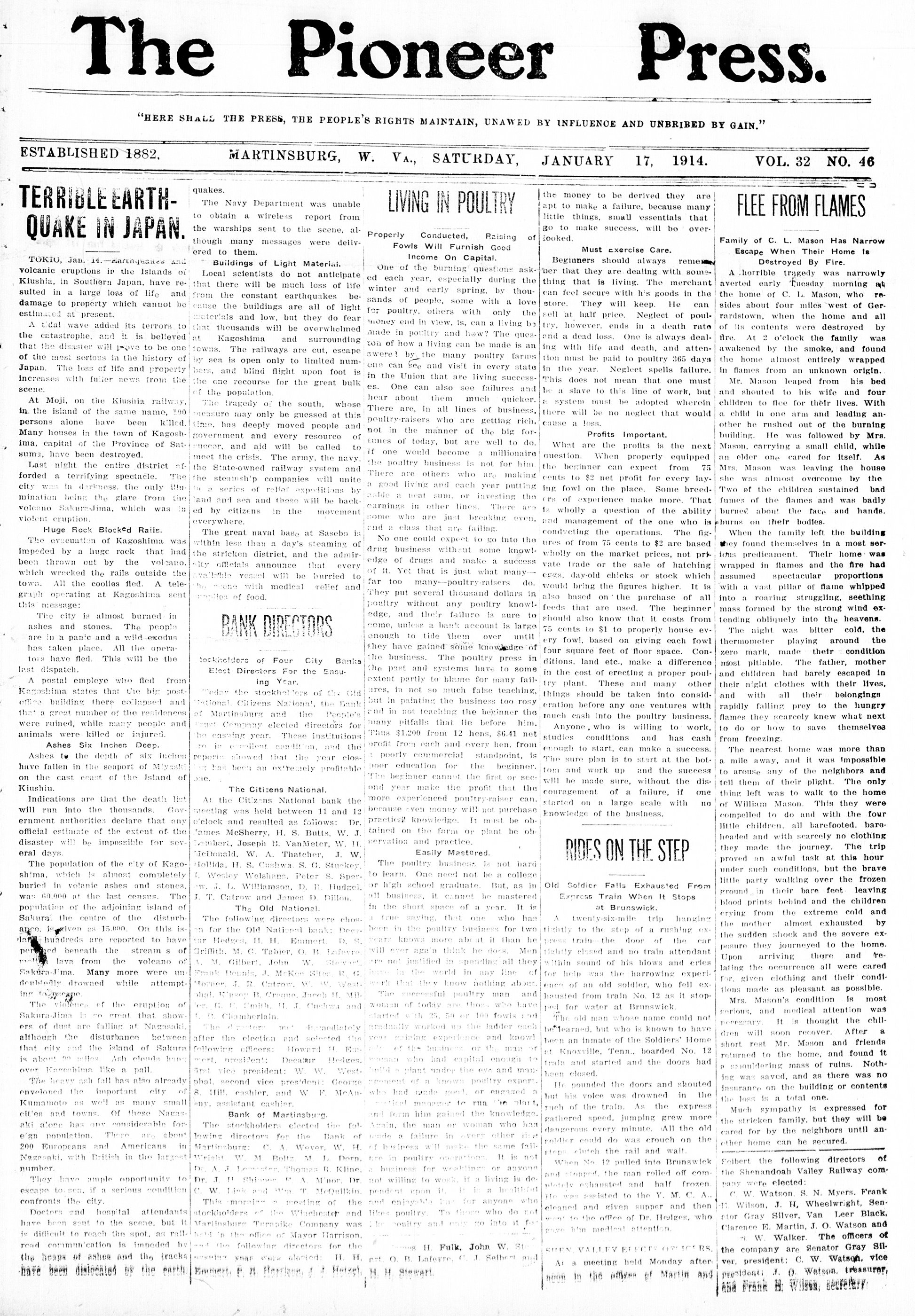
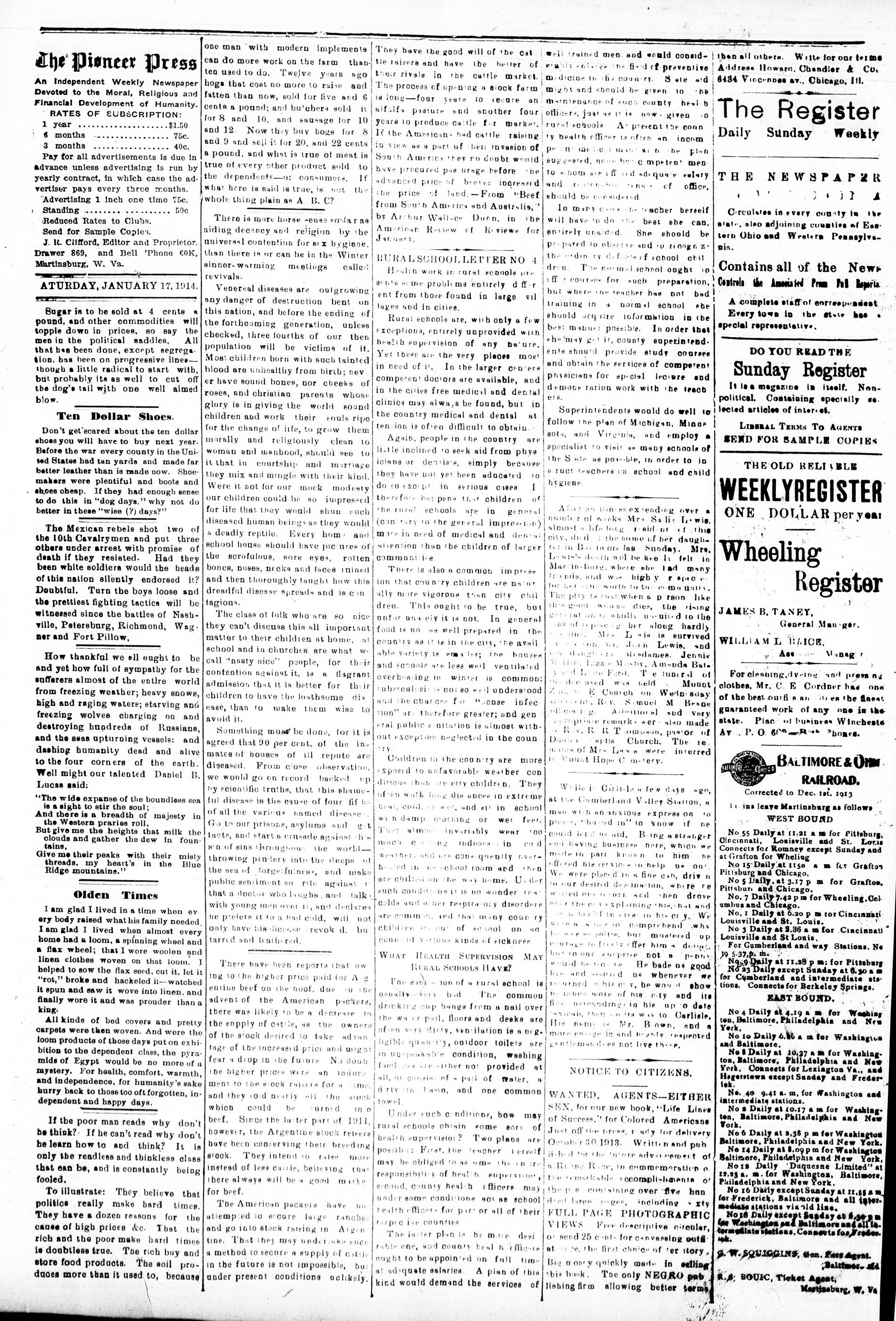
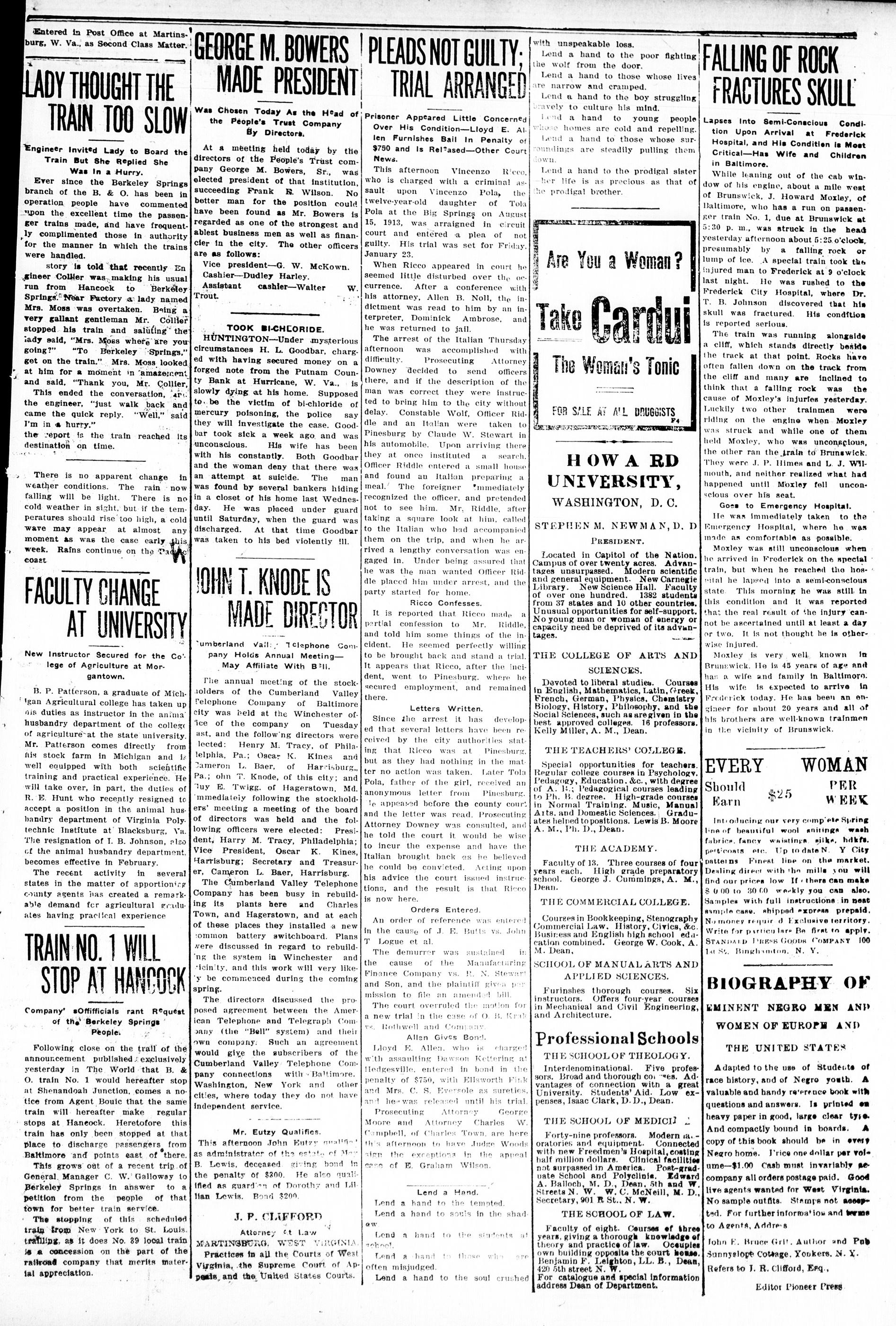
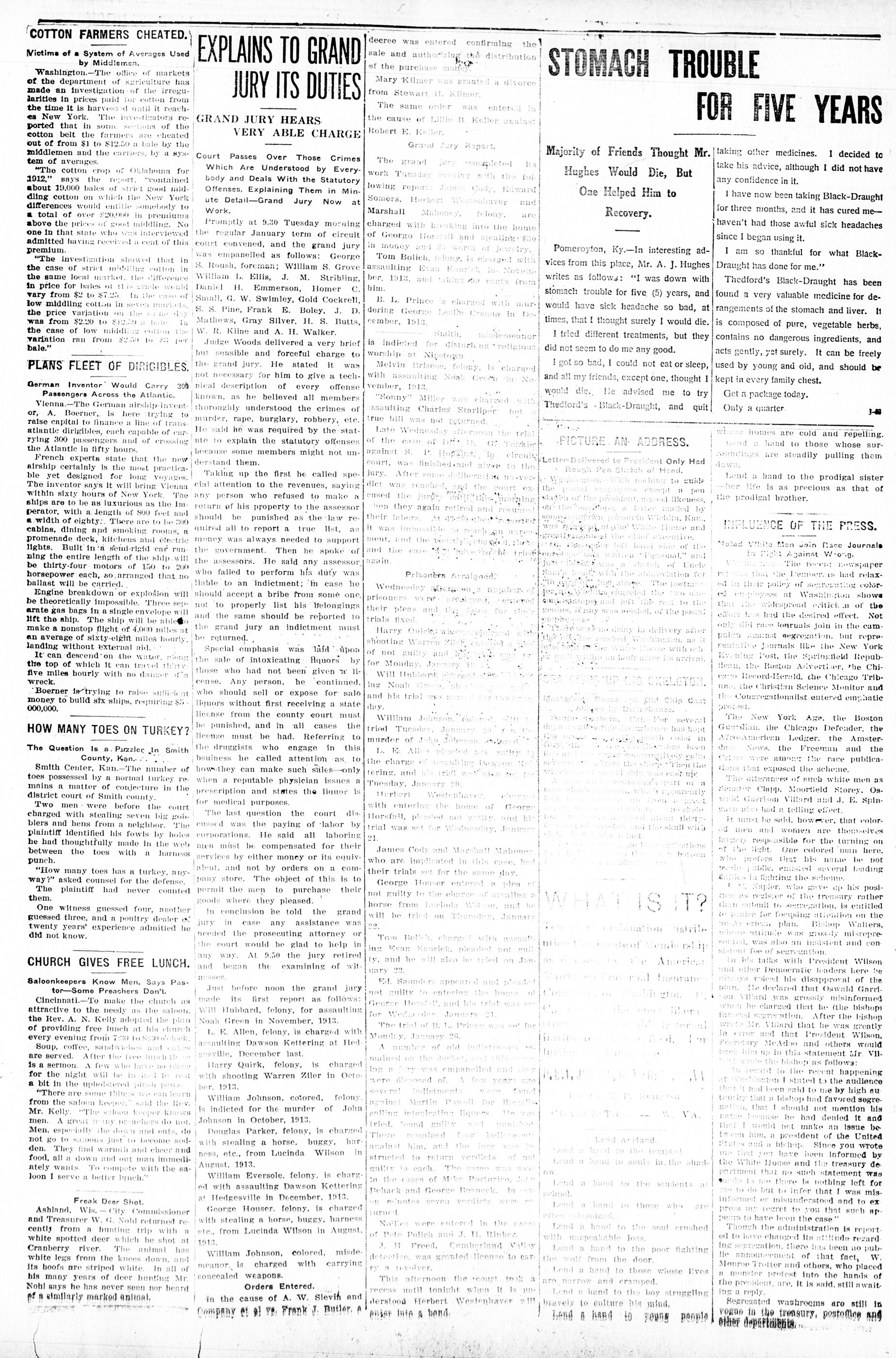
Page text (machine-generated)
The Pioneer Press.
"HERE SHALL THE PRESS, THE PEOPLE'S RIGHTS MAINTAIN, UNAWED BY INFLUENCE AND UNBRIBED BY GAIN."
ESTABLISHED 1882.
TERRIBLE EARTH- QUAKE IN JAPAN.
TERRIBLE EARTH- QUAKE IN JAPAN.
TOKIO, Jan. 14.—Earthquakes and volcanic eruptions in the Islands of Kiushia, in Southern Japan, have resulted in a large loss of life and damage to property which cannot be estimated at present.
A tidal wave added its terrors to the catastrophe, and it is believed that the disaster will prove to be one of the most serious in the history of Japan. The loss of life and property increases with fuller news from the scene.
At Moji, on the Kiushia railway, in the island of the same name, 100 persons alone have been killed. Many houses in the town of Kagoshima, capital of the Province of Satsuma, have been destroyed. Last night the entire district afforded a terrifying spectacle. The city was in darkness, the only illumination being the glare from the volcano Sakura-Jima, which was in violent eruption.
Huge Rock Blocked Rails.
The evacuation of Kagoshima was impeded by a huge rock that had been thrown out by the volcano, which wrecked the rails outside the town. All the coolies fled. A telegraph operating at Kagoshima sent this message:
The city is almost burned in ashes and stones. The people are in a panic and a wild exodus has taken place. All the operators have fled. This will be the last dispatch.
A postal employee who fled from Kagoshima states that the big post office building there collapsed and that a great number of the residences were ruined, while many people and animals were killed or injured.
Ashes Six Inches Deep.
Ashes to the depth of six inches have fallen in the seaport of Miyasaki on the cast coast of the Island of Kiushiu. Indications are that the death list will run into the thousands. Government authorities declare that any official estimate of the extent of the disaster will be impossible for several days.
The population of the city of Kagoshima, which is almost completely buried in volcanic ashes and stones, was 60,000 at the last census. The population of the adjoining island of Sakura, the centre of the disturbance, is given as 15,000. On this island, hundreds are reported to have perished beneath the streams of volcanic lava from the volcano of Sakura-Jima. Many more were undoubtedly drowned while attempting to escape.
The violence of the eruption of Sakura-Jima is so great that showers of dust are falling at Nagasaki, although the disturbance between that city and the island of Sakura is about 20 miles. Ash clouds hang over Kagoshima like a pall. The heavy ash fall has also already enveloped the important city of Kumamoto as well as many small cities and towns. Of these Nagasaki alone has any considerable foreign population. There are about 200 Europeans and Americans in Nagasaki, with British in the largest number.
They have ample opportunity to escape to sea, if a serious condition confronts the city. Doctors and hospital attendants have been sent to the scene, but it is difficult to reach the spot, as railroad communication is impeded by the heaps of ashes and the tracks have been dislocated by the earth.
The Navy Department was unable to obtain a wireless report from the warships sent to the scene, although many messages were delivered to them.
Buildings of Light Material.
Buildings of Light Material. Local scientists do not anticipate that there will be much loss of life from the constant earthquakes because the buildings are all of light materials and low, but they do fear that thousands will be overwhelmed at Kagoshima and surrounding towns. The railways are cut, escape by sea is open only to limited numbers, and blind flight upon foot is the one recourse for the great bulk of the population.
The tragedy of the south, whose measure may only be guessed at this time, has deeply moved people and government and every resource of succor, and aid will be called to meet the crisis. The army, the navy, the State-owned railway system and the steamship companies will unite in a series of relief expeditions by land and sea and these will be backed by citizens in the movement everywhere.
The great naval base at Sasebo is within less than a day's steaming of the stricken district, and the admiralty officials announce that every available vessel will be burried to the scene with medical relief and supplies of food.
BANK DIRECTORS
BANK DIRECTORS
stockholders of Four City Banks Elect Directors For the Ensuing Year. Today the stockholders of the Old National Citizens National, the Bank of Martinsburg and the People's Trust Company elected directors for the ensuing year. These institutions are in excellent condition, and the reports showed that the year closing has been an extremely profitable one.
The Citizens National.
At the Citizens National bank the meeting was held between 11 and 12 o'clock and resulted as follows: Dr. James McSherry, H. S. Butts, W. J. Lambert, Joseph B. VanMeter, W. H. McDonald, W. A. Thatcher, J. W. Hollida, H. S. Cushwa, S. G. Stuckey, G. Wesley Welshans, Peter S. Sperw, J. L. Williamson, D. R. Hudgel, J. T. Catrow and James D. Dillon.
The following directors were chosen for the Old National bank: Decatur Hedges, H. H. Emmert, D. S. Griffith, M. G. Tabier, O. B. Lafeyre, A. M. Gilbert, John W. Stewart, Frank Dennis, J. McKee Sites, R. G. Howner, J. R. Catrow, W. W. Westphal, Winsey B. Creque, Jacob H. Miller, G. C. Smith, H. J. Cuebma and F. B. Chamberlain.
The directors met immediately after the election and selected the following officers: Howard H. Earmer, president; Decatur Hedges, first vice president; W. W. Westphal, second vice president; George S. Hill, cashier, and W. F. McAneny, assistant cashier.
Bank of Martinsburg.
The stockholders elected the following directors for the Bank of Martinsburg: C. A. Wever, W. H. Wright, W. M. Boltz, M. L. Dorn, Dr. A. J. Lester, Thomas R. Kline, Dr. J. H. Shimer, E. A. Minor, Dr. C. W. Link, and Wm. T. McQuilkin. This morning a meeting of the stockholders of the Winchester and Martinsburg Turnpike Company was held in the office of Mayor Harrison, and the following directors for the meeting year were elected: H. H. Emmert, F. H. Harrison, J. J. Hetzei.
LIVING IN POULTRY
One of the burning questions asked each year, especially during the winter and early spring, by thousands of people, some with a love for poultry, others with only the money end in view, is, can a living be made in poultry and how? The question of how a living can be made is an awered by the many poultry farms one can see and visit in every state in the Union that are living successes. One can also see failures and hear about them much quicker. There are, in all lines of business, poultry-raisers who are getting rich, not in the manner of the big fortunes of today, but are well to do, if one would become a millionaire the poultry business is not for him. There are others who are making a good living and each year putting aside a neat sum, or investing the earnings in other lines. There are some who are just breaking even, and a class that are failing.
No one could expect to go into the drug business without some knowledge of drugs and make a success of it. Yet that is just what many far too many—poultry-raisers do. They put several thousand dollars in poultry without any poultry knowledge, and their failure is sure to come, unless a bank account is large enough to tide them over until they have gained some knowledge of the business. The poultry press in the past and systems have to some extent partly to blame for many failures, in not so much false teaching, but in painting the business too rosy and in not teaching the beginner the many pitfalls that lie before him. Thus $1,200 from 12 hens, $6.41 net profit from each and every hen, from a poorly commercial standpoint, is poor education for the beginner. The beginner cannot the first or second year make the profit that the more experienced poultry-raiser can, because even money will not purchase practical knowledge. It must be obtained on the farm or plant be observation and practice.
Easily Mastered.
The poultry business is not hard to learn. One need not be a college or high school graduate. But, as in all business, it cannot be mastered in the short space of a year. It is a true saying, that one who has been in the poultry business for two years knows more about it than he will ever again think he does. Men are not justified in spending all they have in the world in any line of work that they know nothing about.
The successful poultry man and woman of today are those who have started with 25, 50 or 100 fowls and gradually worked up the ladder each year gaining experience and knowledge of the business or the man or woman who had capital enough to build a plant under the eye and management of a known poultry expert, who had made good, or engaged a technical manager to run the plant, and form him gained the knowledge. Again, the man or woman who had made a failure in every other type of business will make the same failure in poultry operations. It is not a business for weaklings or anyone not willing to work, if a living is dependent upon it. It is a healthful and enjoyable line for anyone who likes poultry. To those who do not like poultry and enjoy go into it for
H. Fulk, John W. St
rt. O. B. Lafeyre, C. J. Seibert and
H. H. Stewart.
the money to be derived they are apt to make a failure, because many little things, small essentials that go to make success, will be overlooked.
Must exercise Care.
Beginners should always remember that they are dealing with something that is living. The merchant can feel secure with his goods in the store. They will keep. He can sell at half price. Neglect of poultry, however, ends in a death rate and a dead loss. One is always dealing with life and death, and attention must be paid to poultry 365 days in the year. Neglect spells failure. This does not mean that one must be a slave to this line of work, but a system must be adopted wherein there will be no neglect that would cause a loss.
Profits Important.
What are the profits is the next question. When properly equipped the beginner can expect from 75 cents to $2 net profit for every laying fowl on the place. Some breeders of experience make more. That is wholly a question of the ability and management of the one who is conducting the operations. The figures of from 75 cents to $2 are based wholly on the market prices, not private trade or the sale of hatching eggs, day-old chicks or stock which would bring the figures higher. It is also based on the purchase of all feeds that are used. The beginner should also know that it costs from 75 cents to $1 to properly house every fowl, based on giving each fowl four square feet of floor space. Conditions, land etc., make a difference in the cost of erecting a proper poultry plant. These and many other things should be taken into consideration before any one ventures with much cash into the poultry business.
Anyone, who is willing to work, studies conditions and has cash enough to start, can make a success. The sure plan is to start at the bottom and work up and the success will be made sure, without the discouragement of a failure, if one started on a large scale with no knowledge of the business.
RIDES ON THE STEP
Old Soldier Falls Exhausted From Express Train When It Stops at Brunswick
at Brunswick.
A twenty-six-mile trip hanging tightly to the step of a rushing express train—the door of the car tightly closed and no train attendant within sound of his blows and cries for help was the harrowing experience of an old soldier, who fell exhausted from train No. 12 as it stopped for water at Brunswick.
The old man whose name could not be learned, but who is known to have been an inmate of the Soldiers' Home at Knoxville, Tenn., boarded No. 12 train and started and the doors had been closed.
He pounded the doors and shouted but his voice was drowned in the ruck of the train. As the express gathered speed, jumping grew more dangerous every minute. All the old soldier could do was crouch on the steps, clutch the rail and wait. When No. 12 pulled into Brunswick and stopped, the man rolled off completely exhausted and half frozen. He was assisted to the Y. M. C. A. cleaned and given supper and then went to the office of Dr. Hedges, who gave him medical attention.
SHEN. VALLEY ELECTIONS OFFICERS.
At a meeting held Monday afternoon in the office of Martin and
VOL. 32 NO. 46
FLEE FROM FLAMES
Family of C. L. Mason Has Narrow Escape When Their Home Is Destroyed By Fire. A horrible tragedy was narrowly averted early Tuesday morning at the home of C. L. Mason, who resides about four miles west of Gerrardstown, when the home and all of its contents were destroyed by fire. At 2 o'clock the family was awakened by the smoke, and found the home almost entirely wrapped in flames from an unknown origin.
Mr. Mason leaped from his bed and shouted to his wife and four children to flee for their lives. With a child in one arm and leading another he rushed out of the burning building. He was followed by Mrs. Mason, carrying a small child, while an elder one cared for itself. As Mrs. Mason was leaving the house she was almost overcome by the Two of the children sustained bad fumes of the flames and was badly burned about the face and hands. Burns on their bodies.
When the family left the building they found themselves in a most serious predicament. Their home was wrapped in flames and the fire had assumed spectacular proportions with a vast pillar of flame whipped into a roaring struggling, seething mass formed by the strong wind extending obliquely into the heavens.
The night was bitter cold, the thermometer playing around the zero mark, made their condition most pitiable. The father, mother and children had barely escaped in their night clothes with their lives, and with all their belongings rapidly falling prey to the hungry flames they scarcely knew what next to do or how to save themselves from freezing.
The nearest home was more than a mile away, and it was impossible to arouse any of the neighbors and tell them of their plight. The only thing left was to walk to the home of William Mason. This they were compelled to do and with the four little children, all barefooted, bareheaded and with scarcely no clothing they made the journey. The trip proved an awful task at this hour under such conditions, but the brave little party walking over the frozen ground in their bare feet leaving blood prints behind and the children crying from the extreme cold and the mother almost exhausted by the sudden shock and the severe exposure they journeyed to the home. Upon arriving there and relating the occurrence all were cared for, given clothing and their conditions made as pleasant as possible.
Mrs. Mason's condition is most serious, and medical attention was necessary. It is thought the children will soon recover. After a short rest Mr. Mason and friends returned to the home, and found it a shouldering mass of ruins. Nothing was saved, and as there was no insurance on the building or contents the loss is a total one. Much sympathy is expressed for the stricken family, but they will be cared for by the neighbors until another home can be secured.
Sebert the following directors of the Shenandoah Valley Railway company were elected:
C. W. Watson, S. N. Myers, Frank
H. Wilson, J. H. Wheelwright, Senator Gray Silver, Van Leer Black, Clarence E. Martin, J. O. Watson and
W. Walker. The officers of the company are Senator Gray Silver, president; C. W. Watson, vice president; J. O. Watson, treasurer, and Frank H. Wilson, secretary
The Pioneer Press
An Independent Weekly Newspaper Devoted to the Moral, Religious and Financial Development of Humanity. RATES OF SUBSCRIPTION:
Pay for all advertisements is due in advance unless advertising is run by yearly contract, in which case the advertiser pays every three months.
J. lt. Clifford, Editor and Proprietor. Drawer 869, and Bell 'Phone 60K, Martinsburg, W. Va. ATURDAY, JANUARY 17, 1914.
Sugar is to be sold at 4 cents a pound, and other commodities will topple down in prices, so say the men in the political saddles. All that has been done, except segregation, has been on progressive lines though a little radical to start with, but probably its as well to cut off the dog's tail with one well aimed blow.
Ten Dollar Shoes.
Don't get scared about the ten dollar shoes you will have to buy next year. Before the war every county in the United States had ten yards and made far better leather than is made now. Shoemakers were plentiful and boots and shoes cheap. If they had enough sense to do this in "dog days." why not do better in these "wise (?) days?"
The Mexican rebels shot two of the 10th Cavalrymen and put three others under arrest with promise of death if they resisted. Had they been white soldiers would the heads of this nation silently endorsed it? Doubtful. Turn the boys loose and the prettiest fighting tactics will be witnessed since the battles of Nashville, Petersburg, Richmond, Wagner and Fort Pillow,
How thankful we all ought to be and yet how full of sympathy for the sufferers almost of the entire world from freezing weather; heavy snows, high and raging waters; starving and freezing wolves charging on and destroying hundreds of Russians, and the seas upturning vessels: and dashing humanity dead and alive to the four corners of the earth. Well might our talented Daniel B. Lucas said:
"The wide expanse of the boundless sea is a sight to stir the soul; And she is the earth."
But give me the heights that milk the clouds and gather the dew in fountains.
Give me their peaks with their misty threads, my heart's in the Blue Ridge mountains."
Olden Times
I am glad I lived in a time when every body raised what his family needed. I am glad I lived when almost every home had a loom, a spinning wheel and a flax wheel; that I wore woolen and linen clothes woven on that loom. I helped to sow the flax seed, cut it, let it "rot," broke and hackeled it—watched it spun and saw it wove into linen, and finally wore it and was prouder than a king.
All kinds of bed covers and pretty carpets were then woven. And were the loom products of those days put on exhibition to the dependent class, the pyramids of Egypt would be no more of a mystery. For health, comfort, warmth, and independence, for humanity's sake hurry back to those too oft forgotten, independent and happy days.
If the poor man reads why don't he think? If he can't read why don't he learn how to and think? It is only the readless and thinkless class that can be, and is constantly being fooled.
To illustrate: They believe that politics really make hard times. They have a dozen reasons for the cause of high prices &c. That the rich and the poor make hard times is doubtless true. The rich buy and store food products. The soil produces more than it used to, because
one man with modern implements can do more work on the farm than ten used to do. Twelve years ago hogs that cost no more to raise and fatten than now, sold for five and 6 cents a pound; and butchers sold it for 8 and 10, and sausage for 10 and 12. Now they buy hogs for 8 and 9 and sell it for 20, and 22 cents a pound, and what is true of meat is true of every other product sold to the dependents—or consumers. If what here is said is true, is not the whole thing plain as A. B. C?
There is more horse sense so far as aiding decency and religion by the universal contention for sex hygiene, than there is or can be in the Winter sinner-warming meetings called revivals.
Venereal diseases are outgrowing any danger of destruction bent on this nation, and before the ending of the forthcoming generation, unless checked, three fourths of our then population will be victims of it. Most children born with such tainted blood are unhealthy from birth; never have sound bones, nor cheeks of roses, and christian parents whose glory is in giving the world sound children and work their souls ripe for the change of life, to grow them morally and religiously clean to woman and manhood, should see to it that in courtship and marriage they mix and mingle with their kind. Were it not for our mock modesty our children could be so impressed for life that they would shun such diseased human beings as they would a deadly reptile. Every home and school house should have pictures of the scrofulous, sore eyes, rotten bones, noses, necks and faces ruined and then thoroughly taught how this dreadful disease spreads and is contagious.
The class of folk who are so nice they can't discuss this all important matter to their children at home, at school and in churches, are what we call "nasty nice" people, for their contention against it, is a flagrant admission that it is better for their children to have the loathsome disease, than to make them wise to avoid it.
Something must be done, for it is agreed that 90 per cent. of the inmates of houses of ill repute are diseased. From close observation, we would go on record backed up by scientific truths, that this shameful disease is the cause of four fifth of all the various named diseases. Go to our prisons, asylums and get facts, and start a crusade against this sin of sins throughout the world—throwing prudery into the deeps of the sea of forgetfulness, and make public sentiment so rife against it that a doctor who laughs, and talks with young men over it, and declares he prefers it to a bad cold, will not only have his license revoked, but tarred and feathered.
```markdown
```
There have been reports that owing to the higher price paid for Argentine beef on the hoof, due to the advent of the American packers, there was likely to be a decrease in the supply of cattle, as the owners of the stock desired to take advantage of the increased price and might fear a drop in the future. No doubt the higher prices were an inducement to the stock raisers for a time, and they sold nearly all the stock which could be turned into beef. Since the latter part of 1911, however, the Argentine stock raisers have been conserving their breeding stock. They intend to raise more instead of less cattle, believing that there always will be a good market for beef.
The American packers have no attempt to secure large ranches and go into stock raising in Argentina. That they may undertake such a method to secure a supply of cattle in the future is not impossible, but under present conditions unlikely.
They have the good will of the cattle raisers and have the better of their rivals in the cattle market. The process of opening a stock farm is long—four years to secure an alfalfa pasture and another four years to produce cattle for market. If the Americans had cattle raising in view as a part of their invasion of South America they no doubt would have procured passage before the advanced price of breves increased the price of land.—From "Beef from South America and Australia," by Arthur Wallace Dunn, in the American Review of Reviews for January.
Health work in rural schools present some problems entirely different from those found in large villages and in cities. Rural schools are, with only a few exceptions, entirely unprovided with health supervision of any nature. Yet these are the very places most in need of it. In the larger centers competent doctors are available, and in the cities free medical and dental clinics may always be found, but in the country medical and dental attention is often difficult to obtain.
Again, people in the country are little inclined to seek aid from physicians or dentists, simply because they have not yet been educated to do so except in serious cases. I therefore happen that children of the rural schools are in general (contrary to the general impression) more in need of medical and dental attention than the children of larger communities.
There is also a common impression that country children are naturally more vigorous than city children. This ought to be true, but unforunately it is not. In general food is no so well prepared in the country as it is in the city, the available variety is smaller; the houses and schools are less well ventilated overheating in winter is common; tuberculosis is not so well understood and the chances for "house infection" are therefore greater; and general public sanitation is almost without exception neglected in the country.
Children in the country are more exposed to unfavorable weather conditions than are city children. They often work long distances in extreme heat, cold, or wet, and sit in school with damp clothing or wet feet. They almost invariably wear too much clothing indoors in cold weather, and are consequently overheated in the school room and then are chilled on the way home. Under such conditions it is no wonder that colds and other respiratory disorders are common, and that many country children are out of school on no count of various kinds of sickness.
WHAT HEALTH SUPERVISION MAY RURAL SCHOOLS HAVE?
The application of a rural school is usually very bad. The common drinking cup hangs from a nail over the water pool, floors and decks are often very dirty, ventilation is a negligible quantity, outdoor toilets are in unspeakable condition, washing facilities are either not provided at all, or consist of a pool of water, a dirty tap basin, and one common towel.
Under such conditions, how may rural schools obtain some sort of health supervision? Two plans are possible: First, the teacher herself may be obliged to assume the entire responsibility of health supervision, second, county health officers may under some conditions act as school health officers for port or all of their respective counties. The latter plan is the more desirable one, and county health officers ought to be appointed on full time at adequate salaries. A plan of this kind would demand the services of
well trained men, and would considerably enlarge the field of preventive medicine to the country. State and might and should be given to the maintenance of such county health officers, just as it is now given to rural schools. At present the county health officer is often an incomprent medical man with the plan suggested, none but competent men to whom are offered adequate salary and reasonable tenure of office, should be considered.
In many cases the teacher herself will have to do the best she can, entirely unaided. She should be prepared to observe and to recognize the ordinary deficits of school children. The normal school ought to offer courses for such preparation, but where the teacher has not bad training in a normal school she should acquire information in the best manner possible. In order that she may get it, county superintendents should provide study courses and obtain the services of competent physicians for special lecture and demonstration work with the teachers.
Superintendents would do well to follow the plan of Michigan, Minnesota, and Virginia, and employ a specialist to visit as many schools of the State as possible, in order to in struct teachers on school and child hygiene.
After an illness extending over a number of weeks Mrs Salia Lewis, almost a lifelong resident of this city, died at the home of her daughter in Baltimore on Sunday. Mrs. Lewis's death will be keeled felt in Martinburg, where she had many friends, and was highly respected for her true worth to the community. The pity is that when a person like this good woman dies, the rising general on to wholly unsuited to the task of replacing her along hardly survives. Mrs. Lewis is survived by a son, Mr. John Lewis, and two daughters, Madame Jennie M. Gill, Lozzie Mossby, Amanda Baty and Linda Ford. The funeral of the deceased was held at Mount Zion E Church on Wednesday afternoon. Rev. Samuel M. Brane officiating. Additional and very impressive remarks were also made by Rev. R. R. Tompson, pastor of Dauley Coptis Church. The re-motions of Mrs. Lewis were interred in Mount Hope Cemetery.
While in Girticle a few days ago, at the Cumberland Valley Station, a man with an anxious expression on his face, "buried in" to know if he could lend us aid. Being a stronger and having business here, which we made in part known to him, we offered his service to help us out. We were placed in a fine can, driven to our desired destination, where we waited our return, and then drove over the city explaining this, that and why he had to creat in his city. We wrote a note to comprehend why he was so polite, but mustered up courage to freely offer him a detour, but to our surprise not a penny would he receive. He bade us good, fine and assured us whenever we returned a his city, he would show us much more of his city and its fine surroundings to his up to date taxi cab, then on its way to Carlisle. His name is Mr. Brown, and a more energetic and highly respected gentleman does not live there.
NOTICE TO CITIZENS.
WANTED, AGENTS-EITHER SEX, for our new book, "Life Lines of Success," for Colored Americans Just off the press, ready for delivery October 30, 1913. Written and published for the future advancement of a Rising Race, in commemoration of the remarkable accomplishments of the past containing over five hundred large pages, including twenty FULL PAGE PHOTOGRAPHIC VIEWS. Free descriptive circular, or send 25 cents for canvassing out at once, the first choice of story. Big money quickly made in selling this book. The only NEGRO publishing firm allowing better terms.
than all others. Write for our terms Address Howard, Chandler & Co. 6434 Vincennes av., Chicago, Ill.
The Register Daily Sunday Weekly
THE NEWSPAPER
Circulates in every county in the state, also adjoining counties of Eastern Ohio and Western Pennsylvania.
Contains all of the News Controls the Associated Press Pull Reports.
A complete staff of correspondent. Every town in the state has a special representative.
DO YOU READ THE Sunday Register It is a magazine in itself. Nonpolitical. Containing specially selected articles of interest. LIDERAL TERMS TO AGENTS SEND FOR SAMPLE COPIES
THE OLD RELIABLE WEEKLYREGISTER ONE DOLLAR per year Wheeling Register
JAMES B. TANEY,
General Manager.
WILLIAM L. BAICE.
For cleaning, drying and pressing clothes, Mr. C. E. Cordner has one of the best outfits and often the finest guaranteed work of any one in the state. Place of business Winchester Av. P. O. 609 RAILROAD.
BALTIMORE & O'RIA RAILROAD.
Corrected to Dec. 1st, 1913
Itains leave Martinsburg as follows
WEST BOUND
No 55 Daily at 11:21 a.m for Pittsburgh,
Cincinnati, Louisville and St. Louis
Connects for Romney except Sunday and
at Grafton for Wheeling
No 15-Daily at 11:50 a.m for Grafton
Pittsburg and Chicago.
No 5 Daily, at 3:17 p.m for Grafton,
Pittsburgh and Chicago.
No, 7 Daily, 7:42 p.m for Wheeling, Columbus and Chicago.
No, I Daily at 6:20 p.mor Cincinnati Louisville and St. Louis.
No 3 Daily at 2.36 a.m for Cincinnati Louisville and St Louis.
For Gumberland and way Stations. No 39 5-37 p.m.
No 29 Daily at 11.28 p.m; for Pittsburgh
No 23 Daily except Sunday at 6.90 a.m for Gumberland and intermediate stations.
Connects for Berkeley Springs.
No 16 Daily except Sunday at 11.55 a.m. for Frederick, Baltimore and all intermediate stations in old line.
No 16 Daily except Sunday at 6.30 p.m. for Washington and Baltimore and all intermediate stations, Connects for Frederick.
R. W. SQUIGGINS, Gen. Pass Agent.
Baltimore, Md.
R. B. BOUIC, Ticket Agent;
Martinsburg, W. Va.
Entered in Post Office at Martinsburg, W. Va., as Second Class Matter.
LADY THOUGHT THE TRAIN TOO SLOW
Engineer Invited Lady to Board the Train But She Replied She Was In a Hurry. Ever since the Berkeley Springs branch of the B. & O. has been in operation people have commented upon the excellent time the passenger trains made, and have frequently complimented those in authority for the manner in which the trains were handled.
story is told that recently Engineer Collier was making his usual run from Hancock to Berkeley Springs. Near Factory a lady named Mrs. Moss was overtaken. Being a very gallant gentleman Mr. Collier stopped his train and saluting the lady said, "Mrs. Moss where are you going?" "To Berkeley Springs," get on the train." Mrs. Moss looked at him for a moment in amazement and said, "Thank you, Mr. Collier. This ended the conversation, are the engineer, "just walk back and came the quick reply. "Well," said I'm in a hurry." the report is the train reached its destination on time.
There is no apparent change in weather conditions. The rain now falling will be light. There is no cold weather in sight, but if the temperatures should rise too high, a cold wave may appear at almost any moment as was the case early this week. Rains continue on the Pacific coast
FACULTY CHANGE AT UNIVERSITY
New Instructor Secured for the Co-lege of Agriculture at Morgantown.
B. P. Patterson, a graduate of Michigan Agricultural college has taken up his duties as instructor in the animal husbandry department of the college of agriculture at the state university. Mr. Patterson comes directly from his stock farm in Michigan and is well equipped with both scientific training and practical experience. He will take over, in part, the duties of R. E. Hunt who recently resigned to accept a position in the animal husbandry department of Virginia Polytechnic Institute at Blacksburg, Va. The resignation of I. B. Johnson, also of the animal husbandry department, becomes effective in February.
The recent activity in several states in the matter of apportioning county agents has created a remarkable demand for agricultural graduates having practical experience
TRAIN NO.1 WILL STOP AT HANCOCK
Company's Offifficials rant Request of the Berkeley Springs People.
Following close on the trail of the announcement published exclusively yesterday in The World that B. & O. train No. 1 would hereafter stop at Shenandoah Junction, comes a notice from Agent Bouic that the same train will hereafter make regular stops at Haneock. Heretofore this train has only been stopped at that place to discharge passengers from Baltimore and points east of there.
This grows out of a recent trip of General Manager C. W. Galloway to Berkeley Springs in answer to a petition from the people of that town for better train service. The stopping of this scheduled train from New York to St. Louis, trailing, as it does No. 39 local train is a concession on the part of the railroad company that merits material appreciation.
GEORGE M. BOWERS MADE PRESIDENT
Was Chosen Today As the Head of the People's Trust Company By Directors.
At a meeting held today by the directors of the People's Trust company George M. Bowers, Sr., was elected president of that institution, succeeding Frank R. Wilson. No better man for the position could have been found as Mr. Bowers is regarded as one of the strongest and ablest business men as well as financier in the city. The other officers are as follows:
Vice president—G. W. McKown.
Cashier—Dudley Harley.
Assistant cashler—Walter
Trout.
TOOK BI-CHLORIDE
HUNTINGTON—Under mysterious circumstances H. L. Goodbar, charged with having secured money on a forged note from the Putnam County Bank at Hurricane, W. Va., is slowly dying at his home. Supposed to be the victim of bi-chloride of mercury poisoning, the police say they will investigate the case. Goodbar took sick a week ago and was unconscious. His wife has been with his constantly. Both Goodbar and the woman deny that there was an attempt at suicide. The man was found by several bankers hiding in a closet of his home last Wednesday. He was placed under guard until Saturday, when the guard was discharged. At that time Goodbar was taken to his bed violently ill.
JOHN T. KNODE IS MADE DIRECTOR
Cumberland Valley Telephone Company Holds Annual Meeting— May Affiliate With Bell.
The annual meeting of the stockholders of the Cumberland Valley Telephone Company of Baltimore city was held at the Winchester office of the company on Tuesday last, and the following directors were elected: Henry M. Tracy, of Philadelphia, Pa.; Oscar K. Kines and Cameron L. Baer, of Harrisburg., Pa.; ohn T. Knode, of this city; and Guy E. Twigg, of Hagerstown, Md. immediately following the stockholders' meeting a meeting of the board of directors was held and the following officers were elected: President, Harry M. Tracy, Philadelphia; Vice President, Oscar K. Kines, Harrisburg; Secretary and Treasurer, Cameron L. Baer, Harrisburg.
The Cumberland Valley Telephone Company has been busy in rebuilding its plants here and Charles Town, and Hagerstown, and at each of these places they installed a new common battery switchboard. Plans were discussed in regard to rebuilding the system in Winchester and vicinity, and this work will very likely be commenced during the coming spring.
The directors discussed the proposed agreement between the American Telephone and Telegraph Company (the "Bell" system) and their own company. Such an agreement would give the subscribers of the Cumberland Valley Telephone Company connections with Baltimore. Washington, New York and other cities, where today they do not have independent service.
Mr. Eutzy Qualifies
This afternoon John Eutzy qualified as administrator of the estate of Mary B. Lewis, deceased, giving bond in the penalty of $200. He also qualified as guardian of Dorothy and Lillian Lewis. Bond $200.
J. P. CLIFFORD
Attorney at Law
MARTINGBURG, WEST VIRGINIA
Practices in all the Courts of West
Virginia, the Supreme Court of Appeals and the United States Courts.
PLEADS NOT GUILTY; TRIAL ARRANGED
Prisoner Appeared Little Concerned Over His Condition—Lloyd E. Allen Furnishes Bail In Penalty of $750 and Is Released—Other Court News. This afternoon Vincenzo Ricco, who is charged with a criminal assault upon Vincenzo Pola, the twelve-year-old daughter of Tola Pola at the Big Springs on August 15, 1913, was arraigned in circuit court and entered a plea of not guilty. His trial was set for Friday, January 23.
When Ricco appeared in court he seemed little disturbed over the occurrence. After a conference with his attorney, Allen B. Noll, the indictment was read to him by an interpreter, Dominick Ambrose, and he was returned to jail.
The arrest of the Italian Thursday afternoon was accomplished with difficulty. Prosecuting Attorney Downey decided to send officers there, and if the description of the man was correct they were instructed to bring him to the city without delay. Constable Wolf, Officer Riddle and an Italian were taken to Pinesburg by Claude W. Stewart in his automobile. Upon arriving there they at once instituted a search. Officer Riddle entered a small house and found an Italian preparing a meal. The foreigner immediately recognized the officer, and pretended not to see him. Mr. Riddle, after taking a square look at him, called to the Italian who had accompanied them on the trip, and when he arrived a lengthy conversation was engaged in. Under being assured that he was the man wanted Officer Riddle placed him under arrest, and the party started for home.
Ricco Confesses.
It is reported that Ricco made a partial confession to Mr. Riddle, and told him some things of the incident. He seemed perfectly willing to be brought back and stand a trial. It appears that Ricco, after the incident, went to Pinesburg, where he secured employment, and remained there.
Letters Written.
Since the arrest it has developed that several letters have been received by the city authorities stating that Ricco was at Pinesburg, but as they had nothing in the matter no action was taken. Later Tola Pola, father of the girl, received an anonymous letter from Pinesburg. He appeared before the county court and the letter was read. Prosecuting Attorney Downey was consulted, and he told the court it would be wise to incur the expense and have the Italian brought back as he believed he could be convicted. Acting upon his advice the court issued instructions, and the result is that Ricco is now here.
Orders Entered.
An order of reference was entered in the cause of J. E. Butts vs. John T Logue et al.
The demurrer was sustained in the cause of the Manufacturing Finance Company vs. R. N. Stewart and Son, and the plaintiff given permission to file an amended bill.
The court overruled the motion for a new trial in the case of O. B. Kruk vs. Rothwell and Company.
Allen Gives Bond.
Lloyd E. Allen, who is charged with assaulting Dawson Kettering at Hedgesville, entered in bond in the penalty of $750, with Ellsworth Fink and Mrs. C. S. Eversole as sureties, and he was released until his trial.
Prosecuting Attorney George Moore and Attorney Charles W. Campbell, of Charles Town, are here this afternoon to have Judge Woods sign the exceptions in the appeal case of E. Graham Wilson.
Lend a Hand.
Lend a hand to the tempted.
Lend a hand to souls in the shadow.
Lend a hand to the students at school.
Lend a hand to those who are often misjudged.
Lend a hand to the soul crushed
with unspeakable loss.
Lend a hand to the poor fighting
the wolf from the door.
Lend a hand to those whose lives
are narrow and cramped.
Lend a hand to the boy struggling
bravely to culture his mind.
Lend a hand to young people
whose homes are cold and repelling.
Lend a hand to those whose surroundings are steadily pulling them down.
Lend a hand to the prodigal sister
her life is as precious as that of
the prodigal brother.
Are You a Woman?
Take Cardui
The Woman's Tonic
FOR SALE AT ALL DRUGGISTS
P4
HOWARD UNIVERSITY,
WASHINGTON, D.C.
STEPHEN M. NEWMAN, D. D
Located in Capitol of the Nation. Campus of over twenty acres. Advantages unsurpassed. Modern scientific and general equipment. New Carnegie Library. New Science Hall. Faculty of over one hundred. 1382 students from 37 states and 10 other countries. Unusual opportunities for self-support. No young man or woman of energy or capacity need be deprived of its advantages. THE COLLEGE OF ARTS AND
SCIENCES.
Devoted to liberal studies. Courses in English, Mathematics, Latin, Greek, French, German, Physics, Chemistry Biology, History, Philosophy, and the Social Sciences, such as aregiven in the best approved colleges. 16 professors. Kelly Miller, A. M., Dean.
THE TEACHERS' COLLEGE.
Special opportunities for teachers. Regular college courses in Psychology. Pedagogy, Education, &c., with degree of A. B.; Pedagogical courses leading to Ph. B. degree. High-grade courses in Normal Training. Music, Manual Arts, and Domestic Sciences. Graduates helped to positions. Lewis B. Moore A. M., Ph. D., Dean.
THE ACADEMY.
Faculty of 13. Three courses of four years each. High grade preparatory school. George J. Cummings, A. M., Dean.
THE COMMERCIAL COLLEGE.
Courses in Bookkeeping, Stenography Commercial Law. History, Civics, &c. Business and English high school education combined. George W. Cook, A. M. Dean.
SCHOOL OF MANUAL ARTS AND APPLIED SCIENCES.
Furinshes thorough courses. Six instructors. Offers four-year courses in Mechanical and Civil Engineering, and Architecture.
Professional Schools
THE SCHOOL OF THEOLOGY. Interdenominational. Five professors. Broad and thorough courses. Advantages of connection with a great University. Students' Aid. Low expenses, Isaac Clark, D.D., Dean.
THE SCHOOL OF MEDICI
Forty-nine professors. Modern a. oratories and equipment. Connected with new Freedmen's Hospital, costing half million dollars. Clinical facilities not surpassed in America. Post-graduate School and Polyclinic. Edward A. Balloch, M. D., Dean, 5th and W. Streets N. W., W. C. McNeill, M. D., Secretary, 901 R St., N. W.
THE SCHOOL OF LAW.
Faculty of eight. Courses of three years, giving a thorough knowledge of theory and practice of law. Occupies own building opposite the court house. Benjamin F. Leighton, LL. B., Dean, 420 5th street N. W.
For catalogue and special information address Dean of Department.
FALLING OF ROCK FRACTURES SKULL
Lapses Into Semi-Conscious Condition Upon Arrival at Frederick Hospital, and His Condition is Most Critical—Has Wife and Children in Baltimore.
While leaning out of the cab window of his engine, about a mile west of Brunswick, J. Howard Moxley, of Baltimore, who has a run on passenger train No. 1, due at Brunswick at 5:30 p. m., was struck in the head yesterday afternoon about 5:25 o'clock, presumably by a falling rock or lump of ice. A special train took the injured man to Frederick at 9 o'clock last night. He was rushed to the Frederick City Hospital, where Dr. T. B. Johnson discovered that his skull was fractured. His condition is reported serious.
The train was running alongside a cliff, which stands directly beside the track at that point. Rocks have often fallen down on the track from the cliff and many are inclined to think that a falling rock was the cause of Moxley's injuries yesterday. Luckily two other trainmen were riding on the engine when Moxley was struck and while one of them held Moxley, who was unconscious, the other ran the train to Brunswick. They were J. P. Himes and L. J. Wilmouth, and neither realized what had happened until Moxley fell unconscious over his seat.
Goes to Emergency Hospital. He was immediately taken to the Emergency Hospital, where he was made as comfortable as possible. Moxley was still unconscious when he arrived in Frederick on the special train, but when he reached the hospital he lapsed into a semi-conscious state. This morning he was still in this condition and it was reported that the real result of the injury cannot be ascertained until at least a day or two. It is not thought he is otherwise injured.
Moxley is very well known in Brunswick. He is 45 years of age and has a wife and family in Baltimore. His wife is expected to arrive in Frederick today. He has been an engineer for about 20 years and all of his brothers are well-known trainmen in the vicinity of Brunswick.
Introducing our very complete Spring line of beautiful wool anilings wash fabrics, fancy waistings, gilks, hdkfs, peticoats etc. Up to date N. Y City patterns Finest line on the market. Dealing direct with the mills you will find our prices low If others can make $ 0.00 to 30.00 weekly you can also. Samples with full instructions in neat sample case, shipped express prepaid. No money required Exclusive territory. Write for particulars Be first to apply. STANDALD PRESS GOODS COMPANY 100 14 Sz. Binghamton, N. Y.
BIOGRAPHY OF
EMINENT NEGRO MEN AND WOMEN OF EUROPE AND THE UNITED STATES
Adapted to the use of Students of race history, and of Negro youth. A valuable and handy reference book with questions and answers. Is printed on heavy paper in good, large clear type. And compactly bound in boards. A copy of this book should be in every Negro home. Price one dollar per volume—$1.00 Cash must invariably accompany all orders postage paid. Good live agents wanted for West Virginia. No sample outfits. Stamps not accepted. For further information and terms to Agents, Address
John E. Bruce Griff. Author and Pub Sunnylope Cottage, Yonkers, N. Y. Refers to J. R. Clifford, Esq. Editor Pioneer Press.
COTTON FARMERS CHEATED.
Victims of a System of Averages Used by Middlemen.
Washington.—The office of markets of the department of agriculture has made an investigation of the irregularities in prices paid for cotton from the time it is harvested until it reaches New York. The investigators reported that in some sections of the cotton belt the farmers are cheated out of from $1 to $12.50 a bale by the middlemen and the carriers, by a system of averages.
"The cotton crop of Oklahoma for 1012," says the report, "contained about 19,000 bales of strict good middling cotton on which the New York differences would entitle somebody to a total of over $20,000 in premiums above the prices of good middling. No one in that state who was interviewed admitted having received a cent of this premium.
"The investigation showed that in the case of strict middling cotton in the same local market, the difference in price for bales of this grade would vary from $2 to $7.25. In the case of low middling cotton in seven markets, the price variation on the same day was from $2.20 to $42.50 a bale. In the case of low middling cotton the variation run from $2.50 to $3 per bale."
PLANS FLEET OF DIRIGIBLES
German Inventor Would Carry 300
Passengers Across the Atlantic.
Vienna.—The German airship-inventor, A. Boerner, is here trying to raise capital to finance a line of transatlantic dirigibles, each capable of carrying 300 passengers and of crossing the Atlantic in fifty hours.
French experts state that the new airship certainly is the most practicable yet designed for long voyages. The inventor says it will bring Vienna within sixty hours of New York. The ships are to be as luxurious as the Imperator, with a length of 800 feet and a width of eighty. There are to be 300 cabins, dining and smoking rooms, a promenade deck, kitchens and electric lights. Built in a semi-rigid car running the entire length of the ship will be thirty-four motors of 150 to 200 horsepower each, so arranged that no ballast will be carried.
Engine breakdown or explosion will be theoretically impossible. Three separate gas bags in a single envelope will lift the ship. The ship will be able to make a nonstop flight of 4,000 miles at an average of sixty-eight miles hourly, landing without external aid.
It can descend on the water, along the top of which it can travel thirty-five miles hourly with no danger of a wreck.
Boerner is trying to raise sufficient money to build six ships, requiring $5,000,000.
HOW MANY TOES ON TURKEY?
The Question Is a Puzzler in Smith County, Kan.
Smith Center, Kan. The number of toes possessed by a normal turkey remains a matter of conjecture in the district court of Smith county.
Two men were before the court charged with stealing seven big gobblers and hens from a neighbor. The plaintiff identified his fowls by holes he had thoughtfully made in the web between the toes with a harness punch.
"How many toes has a turkey, anyway?" asked counsel for the defense.
The plaintiff had never counted them.
One witness guessed four, another guessed three, and a poultry dealer of twenty years' experience admitted he did not know.
CHURCH GIVES FREE LUNCH.
Saloonkeepers Know Men, Says Pastor—Some Preachers Don't.
Cincinnati.—To make the church as attractive to the needy as the saloon, the Rev. A. N. Kelly adopted the plan of providing free lunch at his church every evening from 7:30 to 8:30 o'clock. Soup, coffee, sandwiches and coffee are served. After the free lunch there is a sermon. A few who have no place for the night will be invited to read a bit in the upholstered plush pews. "There are some things we can learn from the saloon keeper," said the Rev. Mr. Kelly. "The saloon keeper known men. A great many preachers do not. Men, especially the down and outs, do not go to saloons just to become sodden. They find warmth and cheer and food, all a down and out man immediately wants. To compete with the saloon I serve a better lunch."
Freak Deer Shot.
Ashland. Wis. - City Commissioner and Treasurer W. G. Nohl returned recently from a hunting trip with a white spotted deer which he shot at Cranberry river. The animal has white legs from the knees down, and its hoofs are striped white. In all of his many years of deer hunting Mr. Nohl says he has never seen nor heard of a similarly marked animal.
EXPLAINS TO GRAND JURY ITS DUTIES
GRAND JURY HEARS VERY ABLE CHARGE Court Passes Over Those Crimes Which Are Understood by Everybody and Deals With the Statutory Offenses, Explaining Them in Minute Detail—Grand Jury Now at Work.
Promptly at 9.30 Tuesday morning the regular January term of circuit court convened, and the grand jury was empanelled as follows: George S. Roush, foreman; William S. Grove William L. Ellis, J. M. Stribling, Daniel H. Emmerson, Homer C. Small, G. W. Swimley, Gold Cockrell, S. S. Pine, Frank E. Boley, J. D. Mathews, Gray Silver, H. S. Butts, W. R. Kline and A. H. Walker.
Judge Woods delivered a very brief but sensible and forceful charge to the grand jury. He stated it was not necessary for him to give a technical description of every offense known, as he believed all members thoroughly understood the crimes of murder, rape, burglary, robbery, etc. He said he was required by the statute to explain the statutory offenses because some members might not understand them.
Taking up the first he called special attention to the revenues, saying any person who refused to make a return of his property to the assessor should be punished as the law required all to report a true list, as money was always needed to support the government. Then he spoke of the assessors. He said any assessor who failed to perform his duty was liable to an indictment; in case he should accept a bribe from some one not to properly list his belongings and the same should be reported to the grand jury an indictment must be returned.
Special emphasis was laid upon the sale of intoxicating liquors by those who had not been given a license. Any person, he continued, who should sell or expose for sale liquors without first receiving a state license from the county court must be punished, and in all cases the license must be had. Referring to the druggists who engage in this bsuiness he called attention as, to how they can make such sales—only when a reputable physician issues a prescription and states the liquor is for medical purposes.
The last question the court discussed was the paying of labor by corporations. He said all laboring men must be compensated for their services by either money or its equivalent, and not by orders on a company store. The object of this is to permit the men to purchase their goods where they pleased.
In conclusion he told the grand jury in case any assistance was needed the prosecuting attorney or the court would be glad to help in any way. At 9.50 the jury retired and began the examining of witnesses.
Just before noon the grand jury made its first report as follows: Will Hubbard, felony, for assaulting Noah Green in November, 1913. L. E. Allen, felony, is charged with assaulting Dawson Kettering at Hedgesville, December last. Harry Quirk, felony, is charged with shooting Warren Ziler in October, 1913. William Johnson, colored, felony, is indicted for the murder of John Johnson in October, 1913. Douglas Parker, felony, is charged with stealing a horse, buggy, harness, etc., from Lucinda Wilson in August, 1913.
William Eversole, felony, is charged with assaulting Dawson Kettering at Hedgesville in December, 1913.
George Houser, felony, is charged with stealing a horse, buggy, harness etc., from Lucinda Wilson in August, 1913.
William Johnson, colored, misdemeanor, is charged with carrying concealed weapons.
Orders Entered.
In the cause of A. W. Slevih and Company at 41 vs. Frank J. Butler.
decree was entered confirming the sale and authorizing the distribution of the purchase money.
Mary Kilmer was granted a divorce from Stewart H. Kilmer.
The same order was entered in the cause of Lillie B. Keller against Robert E. Keller.
Grand Jury Report.
The grand jury completed its work Tuesday evening with the following report: James Cody, Edward Somers, Herbert Westenhaver and Marshall Mahoney, felony, are charged with breaking into the home of George Horsfall and stealing $30 in money and $5 worth of jewelry. Tom Bolich, felony, is charged with assaulting Evan Kaurick in November, 1913, and taking 90 cents from him. B. L. Prince is charged with murdering George Leslie Creague in December, 1913.
Smith, misdemeanor is indicted for disturbing religious worship at Nipetown. Melvin Briscoe, felony, is charged with assaulting Noah Groen in November, 1913. "Sonny" Miller was charged with assaulting Charles Starliper, but a true bill was not returned.
Late Wednesday afternoon the trial of the case of J.D. H. G. Toorkin against S. P. Hopkins, in circuit court, was finished and given to the jury. After some deliberation no verdict was reached, and the court excused the jurors until this morning when they again retired and resumed their labors. At that time they reported it was impossible to reach an agreement, and the vounty charged them, and the case will have to be tried again.
Prisoners Arraigned
Wednesday afternoon, a number of prisoners were arrested, entered their pleas and the dates for their trials fixed.
Harry Outcide, who is charged with shooting Warren Zillie, entered a plea of not guilty and his trial was set for Monday, January 19.
Will Hubbard, charged with killing Noah Groop, pleaded guilty and his trial was named for the same day.
William Johnson, colored, will be tried Tuesday, January 20, for the murder of John Johnson, colored.
L. E. Allen pleaded not guilty to the charge of assaulting Dawson Kettering, and his trial was also set for Tuesday, January 20.
Herbert Westenhaven, charged with entering the home of George Horsfall, pleaded not guilty, and his trial was set for Wednesday, January 21.
James Cody and Marshall Mahoney, who are implicated in this case, had their trials set for the same day.
George Houser entered a plea of not guilty to the charge of stealing a horse from Lucinda Wilson, and he will be tried on Thursday, January 22.
Tom Bolich, charged with assaulting Evan Knurick, pleaded not guilty, and he will also be tried on January 22.
Ed. Saunders appeared and pleaded not guilty to entering the home of George Hersfall, and his trial was set for Wednesday, January 24.
The trial of B. L. Prince was set for Monday, January 26.
A number of old indictments remained on the stocket, and this covering a jury was empanelled and they were disposed of. A few years ago several indictments were found against Martin Powell for illegally selling intoxicating liquers. He was tried, found guilty and punished. There remained four indictments against him, and the jury was instructed to return verdicts of not guilty in each. The game was done in the cases of Mike Porturice, John Behack and George Bosneck. In seven minutes seven verdicts were returned.
Noilles were entered in the cases of Pete Polich and J. H. Rinker. J. H. Freed, Cumberland Valley detective, was granted license to carry a revolver. This afternoon the court took a recess until tonight when it is understood Herbert Westenhaver will enter into a hand.
STOMACH TROUBLE FOR FIVE YEARS
Majority of Friends Thought Mr. Hughes Would Die, But One Helped Him to Recovery.
Recovery.
Pomeroyton, Ky.—In interesting advices from this place, Mr. A. J. Hughes writes as follows: "I was down with stomach trouble for five (5) years, and would have sick headache so bad, at times, that I thought surely I would die. I tried different treatments, but they did not seem to do me any good. I got so bad, I could not eat or sleep, and all my friends, except one, thought I would die. He advised me to try Thedford's - Black-Draught, and quit
PICTURE. AN ADDRESS.
Letter Delivered to President Only Had Rough Pen Sketch of Hand.
With nothing to guide the postal employees except a pen sketch of the president, a good likeness, on the oyster, a letter mailed by some unidentified person in Wichita, Kan., was received at the White House and greatly appreciated the chief executive. On the upper left hand side of the envelope was written "Personal," and just below was a sketch of Uncle Sam's hand with the abbreviation for "in ship's just above." The postmaster, as Wichita enclosed the two one-cent stamps, and left the rest to the genius, if any was needed, of the postal employees.
There was no delay in delivery after the ship reached Washington, as it was built in the White House with other mail within an hour after its arrival.
SEA CLOSE UP LIG SKELETON.
Mastodon Bones and Old Ship Cast
Wichita by Disturbance.
Squire garber, Ont. For several days a railway disturbance has kept the ocean and the growth coast in fury, while the Wichita has been lime and the water turgidly palm several miles from the ship. Then the wreckage of an old ship was cast up.
A large tide southwarm's part of a mastodon's stention, which apparently had been brought up from a great depth, was cannot restore. This stention remains about thirty-five feet of seabed and the skull with a thick crust is intact.
The coast of Newfoundland has indications from the Wichita on the bottom of a handwritten letter.
Ten year combination distribution Committee of Membership as divisors of the American Northern Federal Insurance Company in Washington, J. C. one of the most liberal strongmen in the public financial instituition in the field. For further information
P. B. J. JOHNSON, BENNINGTON
CHARLESTON, W. VA.
Lend a·Hand.
Lend a hand to the tempted.
Lend a hand to souls in the shadow.
Lend a hand to the students at school.
Lend a hand to those who are often toljudged.
Lend a hand to the soul crushed with unspeakable loss.
Lend a hand to the poor fighting the wolf from the door.
Lend a hand to those whose lives are narrow and cramped.
Lend a hand to the boy struggling bravely to culture his mind.
bend a hand to young people
taking other medicines. I decided to take his advice, although I did not have any confidence in it.
I have now been taking Black-Draught for three months, and it has cured me—haven't had those awful sick headaches since I began using it.
I am so thankful for what Black-Draught has done for me."
Thedford's Black-Draught has been found a very valuable medicine for derangements of the stomach and liver. It is composed of pure, vegetable herbs, contains no dangerous ingredients, and acts gently, yet surely. It can be freely used by young and old, and should be kept in every family chest.
Get a package today.
Only a quarter.
whose homes are cold and repelling. Lend a hand to those whose surroundings are steadily pulling them down. Lend a hand to the prodigal sister —her life is as precious as that of the prodigal brother.
```markdown
```
INFLUENCE OF THE PRESS.
Noble White Men Join Race Journals
In Night Against Wrong.
Washington. The recent newspaper reports that the Democrats had relaxed in their policy of segregating colored employees at Washington shows that the widespread criticism of the effort has had the desired effect. Not only did race journals join in the campaign against segregation, but representative journals like the New York Evening Post, the Springfield Republican, the Boston Advertiser, the Chicago Record-Herald, the Chicago Tribune, the Christian Science Monitor and the Congregationalist entered emphatic protest.
The New York Age, the Boston Guardian, the Chicago Defender, the Afro-American Ledger, the Amsterdam News, the Freeman and the Crime were among the race publications that exposed the scheme.
The attentances of such white men as Senator Chapp, Moorfield Storey, Oswald Garrison Villard and J. E. Spingarn also had a telling effect.
It must be said, however, that colored men and women are themselves largely responsible for the turning on of the light. One colored man here, who prefers that his name be not made public, enlisted several leading allies in fighting the scheme.
17. Napier, who gave up his position as register of the treasury rather than submit to segregation, is entitled to praise for focusing attention on the un-American plan. Bishop Walters, whose attitude was grossly misrepresented, was also an insistent and consistent foe of segregation. In his talks with President Wilson and other Democratic leaders here he always voiced his disapproval of the plan. He declared that Oswald Garrison Villard was grossly misinformed when he charged that he (the bishop) favored segregation. After the bishop wrote Mr. Villard that he was greatly in error and that President Wilson, Secretary McAdoo and others would break him up in this statement Mr. Villard wrote the bishop as follows:
In record to the recent happening of Washington I stated to the audience that it had been said to me by high authority that a bishop had favored segregation, that I should not mention his name because he had denied it and that I would not make an issue between him, a president of the United States and a bishop. Since you wrote me that you have been informed by the White House and the treasury department that no such statement was made to me there is nothing left for me to do but to infer that I was misinformed or misunderstood and to express my regret to you that such appears to have been the case."
Though the administration is reported to have changed its attitude regarding segregation, there has been no public announcement of that fact, W. Monroe Trotter and others, who placed a monster protest into the hands of the president, are, it is said, still awaiting a reply.
Segregated washrooms are still in vogue in the treasury, postoffice and other departments.