The Pioneer Press
Saturday, January 24, 1914
Martinsburg, West Virginia
Page text (machine-generated)
The Pioneer Press.
"HERE SHALL THE PRESS, THE PEOPLE'S RIGETS MAINTAIN, UNAWED BY INFLUENCE AND UNBRIBED BY GAIN."
ESTABLISHED 1882.
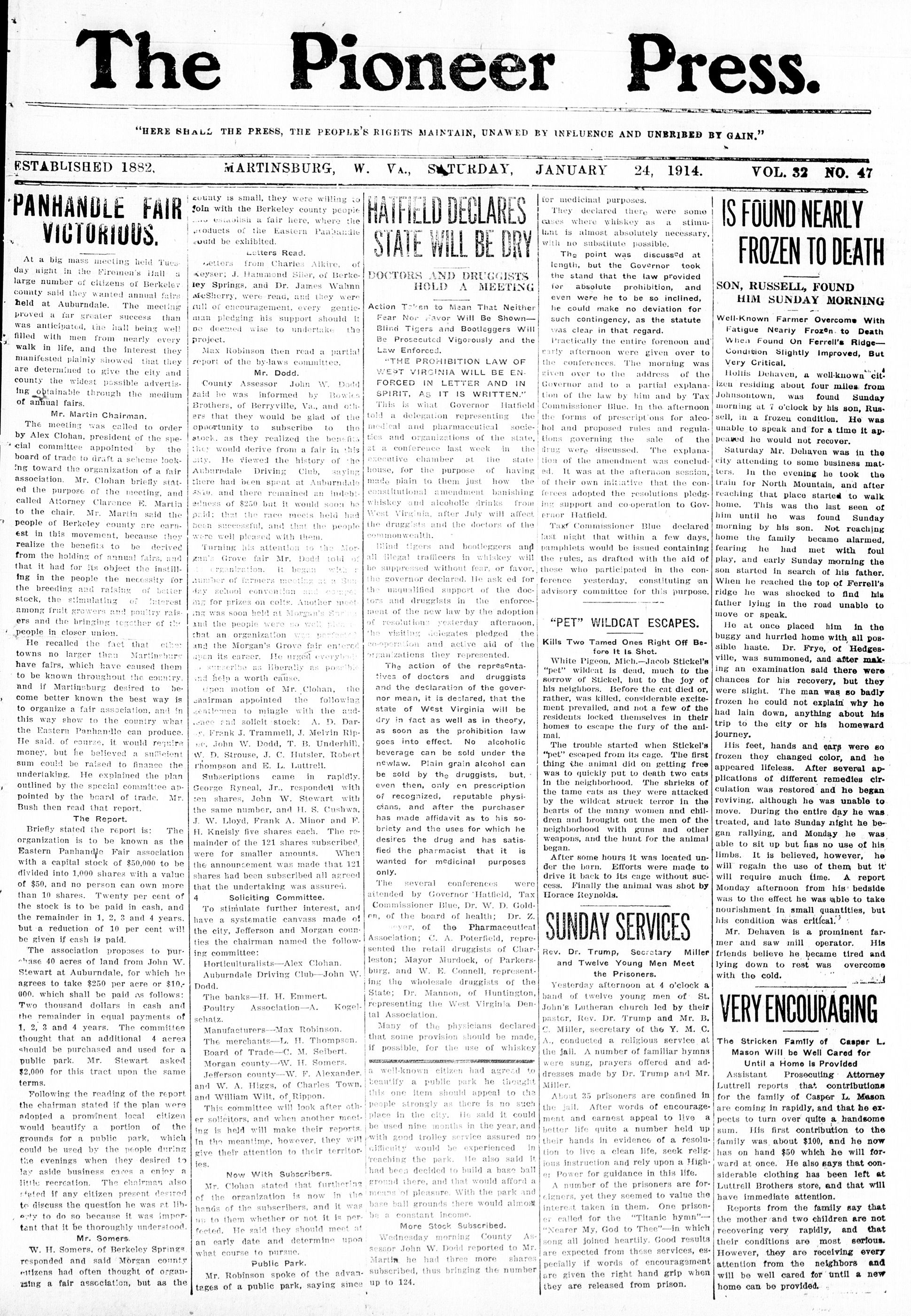
PANHANDLE FAIR VICTORIOUS.
At a big mass meeting held Tuesday night in the Firemen's Hall a large number of citizens of Berkeley county said they wanted annual fairs held at Auburndale. The meeting proved a far greater success than was anticipated, the hall being well filled with men from nearly every walk in life, and the interest they manifested plainly showed that they are determined to give the city and county the widest possible advertising obtainable through the medium of annual fairs.
Mr. Martin Chairman.
The meeting was called to order by Alex Clohan, president of the special committee appointed by the board of trade to draft a scheme looking toward the organization of a fair association. Mr. Clohan briefly stated the purpose of the meeting, and called Attorney Clarence E. Martin to the chair. Mr. Martin said the people of Berkeley county are earnest in this movement, because they realize the benefits to be derived from the holding of annual fairs, and that it had for its object the instilling in the people the necessity for the breeding and raising of better stock, the stimulating of interest among fruit growers and poultry raisers and the bringing together of the people in closer union.
He recalled the fact that other towns no larger than Martinsburg have fairs, which have caused them to be known throughout the country, and if Martinsburg desired to become better known the best way is to organize a fair association, and in this way show to the country what the Eastern Panhandle can produce. He said, of course, it would require money, but he believed a sufficient sum could be raised to finance the undertaking. He explained the plan outlined by the special committee appointed by the board of trade. Mr. Bush then read that report.
The Report.
Briefly stated the report is: The organization is to be known as the Eastern Panhandle Fair association with a capital stock of $50,000 to be divided into 1,000 shares with a value of $50, and no person can own more than 10 shares. Twenty per cent of the stock is to be paid in cash, and the remainder in 1, 2, 3 and 4 years. but a reduction of 10 per cent will be given if cash is paid.
The association proposes to purchase 40 acres of land from John W. Stewart at Auburndale, for which he agrees to take $250 per acre or $10,000, which shall be paid as follows: Two thousand dollars in cash and the remainder in equal payments of 1, 2, 3 and 4 years. The committee thought that an additional 4 acre should be purchased and used for a public park. Mr. Stewart asked $2,000 for this tract upon the same terms.
Following the reading of the report the chairman stated if the plan were adopted a prominent local citizen would beautify a portion of the grounds for a public park, which could be used by the people during the evenings when they desired to lay aside business cares a enjoy a little recreation. The chairman also stated if any citizen present desired to discuss the question he was at liberty to do so because it was important that it be thoroughly understood.
Mr. Somers.
W. H. Somers, of Berkeley Springs responded and said Morgan county citizens had often thought of organizing a fair association, but as the
county is small, they were willing to join with the Berkeley county people to establish a fair here, where the products of the Eastern Panhandle could be exhibited.
Letters Read.
Letters from Charles Alkire, of Keyser; J. Hammond Siler, of Berkeley Springs, and Dr. James Wahnu McSherry, were read, and they were full of encouragement, every gentleman pledging his support should it be deemed wise to undertake the project. Max Robinson then read a partial report of the by-laws committee.
Mr. Dodd.
County Assessor John W. Dodd said he was informed by Bowles Brothers, of Berryville, Va., and others that they would be glad of the opportunity to subscribe to the stock, as they realized the benefits they would derive from a fair in this city. He viewed the history of the Auburndale Driving Club, saying there had been spent at Auburndale $810, and there remained an indebtedness of $250 but it would soon be paid; that the race meets held had been successful, and that the people were well pleased with them.
Turning his attention to the Morgan's Grove fair Mr. Dodd told of the organization. It began with a number of farmers meeting at a Sunday school convention and competing for prizes on colts. Another meeting was soon held at Morgan's Shrine and the people were so well planned that an organization was perfected and the Morgan's Grove fair entered upon its career. He urged everybody to subscribe as liberally as possible and help a worth cause.
Open motion of Mr. Clohan, the chairman appointed the following gentlemen to mingle with the audience and solicit stock: A. D. Darcy, Frank J. Trammell, J. Melvin Rippe, John W. Dodd, T. B. Underhill, W. D. Strouse, J. C. Hutsler, Robert rhompson and E. L. Luttrell.
Subscriptions came in rapidly. George Ryneal, Jr., respondd with ten shares, John W. Stewart with the same number, and H. S. Cushwa, J. W. Lloyd, Frank A. Minor and F. H. Kneisly five shares each. The remainder of the 121 shares subscribed were for smaller amounts. When the announcement was made that 121 shares had been subscribed all agreed that the undertaking was assured.
4 Soliciting Committee.
To stimulate further interest, and have a systematic canvass made of the city, Jefferson and Morgan counties the chairman named the following committee:
Horticulturalists—Alex Clohan.
Auburndale Driving Club—John W.
Dodd.
The banks—H. H. Emmert.
Poultry Association—A. Kogel-
schatz.
Manufacturers—Max Robinson.
The merchants—L. H. Thompson.
Board of Trade—C. M. Seibert.
Morgan county—W. H. Somers.
Jefferson county—W. F. Alexander.
and W. A. Higgs, of Charles Town,
and William Wilt, of Rippon.
This committee will look after other solicitors, and when another meeting is held will make their reports. In the meantime, however, they will give their attention to their territories.
Now With Subscribers.
Mr. Clohan stated that furthering of the organization is now in the hands of the subscribers, and it was up to them whether or not it is perfected. He said they should meet at an early date and determine upon what course to pursue.
Public Park.
Mr. Robinson spoke of the advantages of a public park, saying since
HATFIELD DECLARES STATE WILL BE DRY
DOCTORS AND DRUGGISTS HOLD A MEETING Action Taken to Mean That Neither Fear Nor Favor Will Be Shown Blind Tigers and Bootleggers Will Be Prosecuted Vigorously and the Law Enforced.
"THE PROHIBITION LAW OF WEST VIRGINIA WILL BE ENFORCED IN LETTER AND IN SPIRIT, AS IT IS WRITTEN." This is what Governor Hatfield told a delegation representing the medical and pharmaceutical societies and organizations of the state, at a conference last week in the executive chamber at the state house, for the purpose of having made plain to them just how the constitutional amendment banishing whiskey and alcoholic drinks from West Virginia, after July will affect the druggists and the doctors of the commonwealth.
Blind tigers and bootleggers and all illegal trafficers in whiskey will be suppressed without fear, or favor, the governor declared. He asked for the unqualified support of the doctors and druggists in the enforcement of the new law by the adoption of resolutions yesterday afternoon, the visiting delegates pledged the cooperation and active aid of the organizations they represented.
The action of the representatives of doctors and druggists and the declaration of the governor mean, it is declared, that the state of West Virginia will be dry in fact as well as in theory, as soon as the prohibition law goes into effect. No alcoholic beverage can be sold under the newlaw. Plain grain alcohol can be sold by the druggists, but, even then, only on prescription of recognized, reputable physicians, and after the purchaser has made affidavit as to his sobriety and the uses for which he desires the drug and has satisfied the pharmacist that it is wanted for medicinal purposes only.
The several conferences were attended by Governor Hatfield, Tax Commissioner Blue, Dr. W. D. Golden, of the board of health; Dr. Z. Meyer, of the Pharmaceutical Association; C. A. Poterfield, represented the retail druggists of Charleston; Mayor Murdock, of Parkersburg, and W. E. Connell, representing the wholesale druggists of the State; Dr. Mannon, of Huntington, representing the West Virginia Dental Association. Many of the physicians declared that some provision should be made, if possible, for the use of whiskey
a well-known citizen had agreed to beautify a public park he thought this one item should appeal to the people strongly as there is no such place in the city. He said it could be used nine months in the year, and with good trolley service assured no difficulty would be experienced in reaching the park. He also said it had been decided to build a base ball ground there, and that would afford a means of pleasure. With the park and base ball grounds there would almost be a constant income.
More Stock Subscribed.
Wednesday morning County Assessor John W. Dodd reported to Mr. Martin he had three more shares subscribed, thus bringing the number up to 124.
They declared there were some cases where whiskey as a stimulant is almost absolutely necessary, with no substitute possible. The point was discussed at length, but the Governor took the stand that the law provided for absolute prohibition, and even were he to be so inclined, he could make no deviation for such contingency, as the statute was clear in that regard.
Practically the entire forenoon and early afternoon were given over to the conferences. The morning was given over to the address of the Governor and to a partial explanation of the law by him and by Tax Commissioner Blue. In the afternoon the forms of prescriptions for alcohol and proposed rules and regulations governing the sale of the drug were discussed. The explanation of the amendment was concluded. It was at the afternoon session, of their own initiative that the conferences adopted the resolutions pledging support and co-operation to Governor Hatfield.
Taxf Commissioner Blue declared last night that within a few days, pamphlets would be issued containing the rules, as drafted with the aid of those who participated in the conference yesterday, constituting an advisory committee for this purpose.
"PET" WILDCAT ESCAPES.
Kills Two Tamed Ones Right Off Before It Is Shot. White Pigeon, Mich.—Jacob Stickel's "pet" wildcat is dead, much to the sorrow of Stickel, but to the joy of his neighbors. Before the cat died or, rather, was killed, considerable excitement prevailed, and not a few of the residents locked themselves in their homes to escape the fury of the animal.
The trouble started when Stickel's "pet" escaped from its cage. The first thing the animal did on getting free was to quickly put to death two cats in the neighborhood. The shrieks of the tame cats as they were attacked by the wildcat struck terror in the hearts of the many women and children and brought out the men of the neighborhood with guns and other weapons, and the hunt for the animal began.
After some hours it was located under the barn. Efforts were made to drive it back to its cage without success. Finally the animal was shot by Horace Reynolds.
SUNDAY SERVICES
SUNDAY SERVICES
Rev. Dr. Trump, Secretary Miller and Twelve Young Men Meet the Prisoners. Yesterday afternoon at 4 o'clock a band of twelve young men of St. John's Lutheran church led by their pastor, Rev. Dr. Trump and Mr. B. C. Miller, secretary of the Y. M. C. A., conducted a religious service at the jail. A number of familiar hymns were sung, prayers offered and addresses made by Dr. Trump and Mr. Miller.
About 35 prisoners are confined in the jail. After words of encouragement and earnest appeal to live a better life quite a number held up their hands in evidence of a resolution to live a clean life, seek religious instruction and rely upon a Higher Power for guidance in this life.
A number of the prisoners are foreigners, yet they seemed to value the interest taken in them. One prisoner called for the "Titanic hymn"—"Nearer My, God to Thee"—in which song all joined heartily. Good results are expected from these services, especially if words of encouragement are given the right hand grip when they are released from prison.
VOL. 32 NO. 47
IS FOUND NEARLY FROZEN TO DEATH
SON, RUSSELL, FOUND HIM SUNDAY MORNING
Well-Known Farmer Overcome With Fatigue Nearly Frozen to Death When Found On Ferrell's Ridge—Condition Slightly Improved, But Very Critical.
Hollis Dehaven, a well-known citizen residing about four miles from Johnsontown, was found Sunday morning at 7 o'clock by his son, Russell, in a frozen condition. He was unable to speak and for a time it appeared he would not recover.
Saturday Mr. Dehaven was in the city attending to some business matters. In the evening he took the train for North Mountain, and after reaching that place started to walk home. This was the last seen of him until he was found Sunday morning by his son. Not reaching home the family became alarmed, fearing he had met with foul play, and early Sunday morning the son started in search of his father. When he reached the top of Ferrell's ridge he was shocked to find his father lying in the road unable to move or speak.
He at once placed him in the buggy and hurried home with all possible haste. Dr. Frye, of Hedgesville, was summoned, and after making an examination said there were chances for his recovery, but they were slight. The man was so badly frozen he could not explain why he had lain down, anything about his trip to the city or his homeward journey.
His feet, hands and ears were so frozen they changed color, and he appeared lifeless. After several applications of different remedies circulation was restored and he began reviving, although he was unable to move. During the entire day he was treated, and late Sunday night he began rallying, and Monday he was able to sit up but has no use of his limbs. It is believed, however, he will regain the use of them but it will require much time. A report Monday afternoon from his bedside was to the effect he was able to take nourishment in small quantities, but his condition was critical.
Mr. Dehaven is a prominent farmer and saw mill operator. His friends believe he became tired and lying down to rest was overcome with the cold.
VERY ENCOURAGING
VERY ENCOURAGING
The Stricken Family of Casper L. Mason Will be Well Cared for Until a Home is Provided Assistant Prosecuting Attorney Luttrell reports that contributions for the family of Casper L. Mason are coming in rapidly, and that he expects to turn over quite a handsome sum. His first contribution to the family was about $100, and he now has on hand $50 which he will forward at once. He also says that considerable clothing has been left at Luttrell Brothers store, and that will have immediate attention.
Reports from the family say that the mother and two children are not recovering very rapidly, and that their conditions are most serious. However, they are receiving every attention from the neighbors and will be well cared for until a new home can be provided.
An Independent Weekly Newspaper
Devoted to the Moral, Religious and
Financial Development of Humanity.
RATES OF SUBSCRIPTION:
1 year ..... $1.50
6 months ..... 75c.
8 months ..... 40c.
Pay for all advertisements is due in
advance unless advertising is run by
yearly contract, in which case the ad-
vertiser pays every three months.
J. H. Clifford, Editor and Proprietor. Drawer 869. and Bell 'Phone 60K, Martinsburg, W. Va.
SATURDAY, JANUARY 24, 1914
For a critic to read and understand the Bible is impossible. The same may be said of Woodrow Wilson, who instead of putting the mark of Cain on a certain class, is now imploring the help of all.
The Progressive Party is busy as bees after honey and they are going to fill the hives with honey for the benefit of the poor in 1916. It is going on from ocean to ocean and from the lakes to the Gulf. One has but to read history closely of the forties and fifties to see what must follow.
The Charleston Advocate took up some space editorially on the fallacy of dubbing Tom, Dick and Harry. "Hon." He might as well included and took a swipe at "Prof." and given "D. D." the devil. They are disgusting and because they are not rigidly rebuked and laughed to oblivion they think the public is deceived.
Editor Harry C. Smith is always on the tower looking out for the best for his people. He thinks he sees a possibility to get Joseph Benson Foraker back in the Senate—hope so for his ilk are few and far between. If Ohio would reedoom herself and send to Congress Judge John A. Mansfield with Foraker, and others, tried and true, and our old man great William E. Chandler of New Hampshire and many others to keep company with the lonely Clapp, who is treading the wine press alone, wouldn't the fur fly? Let us work and hope, Wonderful things happen at times.
Our County Jail.
We give Judge Dayton credit for condemning the filth in any jail, for if there is a place that ought to be kept clean it is a prison, and many have been disease breeders. But when he condemns this jail under its present management as too dirty to send U. S. prisoners to it, we think he has unintentionally done Mr. Miller, our jailor an injustice. We are a frequent visitor there, and religious meetings are held therein weekly, and we are free to say we have never seen it on an average in better condition, and feel confident if Judge Dayton will take the time and pains to visit this jail, he will publicly apologize to Mr. Miller.
A Good Man Gone.
Early last Sunday morning the angel of death rapped on the door of the house of Mr. John Reed. Having lived an exemplary life of a christian for 50 years, and being ripe in old age and religion, his angelic spirit ready and anxious to leave its worn out and sickly home, said, "come in!" Each knew the other—perchance it was a dear loving soul over whose suffering form he had stood and wept years ago and homeward they took their flight. He was born 1835 near Bunker Hill, and
belonged to Dr. Snodgrass' father—Stephen Snodgrass. Mr. Reed was one of the many who was blessed in his ownership by a fine white mar, who delighted in teaching his slaves honesty, industry, sobriety, self respect and religious duty—for all of which he was loved and noted.
There were many white people at his funeral and some of them sobbed and bathed their cheeks with tears. If colored men and women could so endear themselves in slave days why can't the two races so live and love in these days?
Men by the thousands have died in palaces surrounded with earth's best doctors, with millions of dollars at their command and loved ones to care for them to the last. But poor and humble as was the home wherein John Reed lived and at last winged out, was joy's dove cove to him. Four years a paralytic, all of which time he had the tender care of a helpless babe by a loving mother. If Carnegie medals were to be given for unalloyed devotion of a long married life, and a committee of angels were to award it, Charlotte, his wife, would get it. The ministerial eulogies were excellent.
A poet, as follows, honors her.
His house she entered there to be a light,
Singing within when all without was night:
A guarding angel o'er his life presiding.
Doubling his pleasures and his cares dividing.
Winning him back when mingling in the throng,
From a vain world alas, we love too long.
To fireside happiness and hours of case,
Blest with that charm, the certainty to please.
And oft her eyes read his her gentle mind,
To all his wishes, all his thoughts inclined,
Still subject—ever on the watch to borrow,
Mirtn of his mirth and sorrow of his sorrow.
The Fight Is On Again.
We went to jail a few years ago to break up the rottenness that fattened the pockets of United States Marshals. This rascality was allowed by the United States District Attorneys and it was done as follows; W. D. Brown, U. S. Marshal, got the lowest blacks in this neck of the woods that he could find. Lester Tutt, "Mooney" and Hale were the black pimps. It was their business to maks business for Marshal Brown and they did. That they had arrested many a poor innocent fellaw, is as true as gospel. Tutt swore to Mr. M. C. Masterson, who was sent here at our request by the Department of Justice at Washington, that Mr. Brown had Paid him to lie on men, and that he, Hale and Mooney worked for Brown, because they made money by being taken to Clarksburg, Parkersburg and Wheeling to indict their dupes and testify against them.
They make forty odd dollars every time one of these helpless victims is taken over the state to far off courts, when they should be tried in their own bailiwick. Why are they not? Simply because they have no standing here and could neither indict nor convict. Add to these black vampires ten cents a mile for the Marshal and his prisoners, sometimes three, and then his and his convicted prisoners return to Martinsburg or Charles Town, and you'll easily see where thousands of the government's money goes. We had Marshal Brown put out by proving the above stated facts. Why was he put back? When he takes these poor helpless fellows to Parkersburg, Wheeling &c., where they know no one he always insists that the best thing to do is to plead guilty and get 30 days, and as a rule they lie on themselves and get back home.
Judge Dayton ordered Tutt to never come into his court again and Tutt hasn't. Why allow Mooney and Hale to keep up Tutt's hellish work? Has Judge Dayton had a court for years and not seen Mooney there? Let us all thank God that Col. Stuart W. Walker, the new District Attorney will not allow it.
The death of Mrs. A. B. Ramer, was a shock to this community, where she was born and reared. She was for years a pluckey, patient sufferer, and many would have given up life on青岛 had they lived here. Finally when she fully realized the coming of the end, though in the City Hospital, she insisted to be taken there from her home to die. She leaves two children, Nannie and Fred and Mr. F. R Ramer her husband and a loving community to mourn their loss. Funeral at Ebenezer church, Rev. G. H. Carter officiated and her remance were consigned to Mount Hope: farewell.
The President
Continued from third page. business are rectified and squared with the general conscience.
I have laid the case before you, no doubt as it lies in your own mind, as it lies in the thought of the country. What must every candid man say of the suggestions I have laid before you, of the plain obligations of which I have reminded you? That these are new things for which the country is not prepared? No; but that they are old things, now familiar, and must, of course, be undertaken if we are to square our laws with the thought and desire of the country.
Until these things are done, conscientious business men the country over will be unsatisfied. They are in these things our mentors and colleagues. We are now about to write the additional articles of our constitution of peace—the peace that is honor and freedom and prosperity.
WHAT IS IT?
Ten year Combination Distribution Certificate of Membership as devised by the American Workmen Fraternal Insurance Company, of Washington, D. C., one of the most liberal strongest and reliable fraternal institutions in the field. I or further particulars see
D.E.V. JORDAN. GEN AGENT. W.VA.
ROOM 2. K. P. BUILDING.
CHARLESTON. - W. VA.
EVERY
WOMAN
Introducing our very complete Spring line of beautiful wool snitings wash fabrics, fancy waistings, silks, hdkfs, petticoats, etc. Up to date N. Y. City patterns. Finest line on the market. Dealing direct with the mills you will find our prices low If others can make $10.00 to 30.00 weekly you can also. Samples with full instructions in neat sample case, shipped express prepaid. No money required. Exclusive territory. Write for particulars Be first to apply. STANDARD DRESS GOODS COMPANY, 100 1st St, Binghamton, N. Y.
NOTICE TO CITIZENS
WANTED. AGENTS-EITHER SEX, for our new book,"Life Lives of Success," for Colored Americans. Just off the press, ready for delivery October 30,1913. Written and published for the future advancement of a Rising Race, in commemoration of the remarkable accomplishments of the past containing over five hundred large pages, including every FULL PAGE PHOTOGRAPHIC VIEWS Free descriptive circular, or send 25 cents for convassing outfit at once, the first choice of her story. Big money quickly made in selling this book. The only NEGRO publishing firm allowing better terms than all others. Write for our terme Address Howard, Chandler & Co., 6434 Vincennes ave., Chicago, Ill.
Thompson and Thompson's mid winter and spring stock is said to be the best ever seen in a Martinsburg clothing house. It will pay every body to give them a call before buying elsewhere.
Are You a Woman?
Take Cardui
The Woman's Tonic
FOR SALE AT ALL DROUGGISTS
F4
HOWARD UNIVERSITY WASHINGTON, D. C.
STEPHEN M, NEWMAN, D. D.
Located in Capitol of the Nation. Campus of over twenty acres. Advantages unsurpassed. Modern scientific and general equipment. New Carnegie Library. New Science Hall. Faculty of over one hundred. 1382 students from 37 states and 10 other countries. Unusual opportunities for self-support. No young man or woman of energy or capacity need be deprived of its advantages.
THE COLLEGE OF ARTS AND SCIENCES.
Devoted to liberal studies. Con ses in English, Mathematics, Latin, Greek, French, German, Physics, Chemistry Biology, History, Philosophy, and the Social Sciences, such as are given in the best approved colleges. 16 pro essors, Kelly Miller, A. M., Dean.
THE TEACHERS' CO. LEGE
Special opportunities for teachers. Regular college courses in Psychology, Pedagogy, Education, &c., with degree of A. B.; Pedagogical courses leading to Ph. B degree. High-grade courses in Normal Training, Music, Manual Arts, and Domestic Services. Graduates helped to positions. Lewis B. Moore A. M., Ph. D., Dean.
THE ACADEMY.
Faculty of 13. Three courses of four years each. High grade preparatory school. George J. Cummings, A M. Dean.
THE COMMERCIAL COLLEGE
Courses in Bookkeeping, Stenography Commercial Law, History, Civics, &c Business and English high school education combined. George W. Cook, A M. Dean.
SCHOOL OF MANUAL ARTS AND APPLIED SCIENCES.
Furmshes thorough courses. Six instructors. Offers four-year courses in Mechanical and Civil Engineering, and Architecture.
Professional Schools
THE SCHOOL OF THEOLOGY. Interdenominal. Five professors. Broad and thorough co. s. Advantages of connection with a great University. Students'Aid. Low expenses, Isaac Clark, D.D., Dean.
THE SCHOOL OF MEDICI
Forty-nine professors. Modern laboratories and equipment. Connected with new Freedmen's Hospital, costing half million dollars. Clinical facilities not surpassed in America. Post-graduate School and Polyclinic. Edward A. Balloch, M. D., Dean, 5th and W. Streets N. W. W. C. McNeill, M. D. Secretary, 901 R St., N. W.
THE SCHOOL OF LAW.
Faculty of eight. Courses of three years, giving a thorough knowledge of theory and practice of law. Occupies own building opposite the court house Benjamin F. Leighton, LL.B., Dean. 420 5th street N.W. For catalogue and special information address Dean of Department.
SALESMAN WANTED to look after our interest in Berkeley and nject counties. Solary or Commission. Address the Harvey Oil Company, Cleveland, Ohio.
J. R. CLIFFORD
MARTINSBURG, WEST VIRGINIA.
Practices in all the Courts of West Virginia, the Supreme Court of Appeals and the United States Courts.
The Register
Daily Sunday Weekly
THE NEWSPAPER
of WEST VIRGINIA. Circulates in every county in the state, also adjoining counties of Eastern Ohio and Western Pennsylvania.
Contains all of the News Controls the Associated Press Full Reports.
A complete staff of correspondents Every town in the state has a special representative.
DO YOU READ THE Sunday Register
It is a magazine in itself. Nonpolitical. Containing specially selected articles of interest.
LIBERAL TERMS To AGENTS
SEND FOR SAMPLE COPIES
THE OLD RELIABLE
WEEKLYREGISTER ONE DOLLAR per year Wheeling Register
JAMES B. TANEY,
General Manager.
WILLIAM L. BRICE,
Assistant Manager.
For cleaning, dyeing and pressing clothes, Mr. C. E. Cordner has one of the best outfits and does the finest guaranteed work of any one in the state. Place of business, Wincheste Ave., P. O. 608 Path Phones.
Baltimore & Ohio
RAILROAD.
Corrected to Dec. 1st, 1814
To insure Mattinsburg as follows
A EST. BOU (D)
No 55 Daily at 11 a.m. for Pittsburg,
Cincinnati, Loosville and St. Louis
Connects for Romney except Sunday and
at Grafton for Whiting.
No 15 Daily at 11 a.m. for Grafton
Pittsburg and Chicago.
No 5 Daily at 3:17 p.m. for Grafton
Pittsboro and Chicago.
No. 7 Daily 7:12 p.m. for Wheeling, Col-
umbus and Chicago.
No. 1 Daily at 6:20 p.m. for Cincinnati
Louisville and St. Louis.
No 3 Daily at 8:36 a.m. for Cincinnati
Louisville and St. Louis.
For Cumberland and way Stations. No
19 5:37 p.m.
No. 9 Daily at 11:28 p.m. for Pittsburg
No 23 Daily except Sunday at 6:30 a.m.
for Cumberland and intermediate
stations. Connects for Berkley Springs.
EAST BOUND.
No 16 Daily except Sunday at 11.55 a m
for Frederick, Baltimore and all inter-
mediate stations via old line.
No 18 Daily except Sunday at 6.30 p m
for Washington and Baltimore and all inter-
mediate stations, Connects for, Freder-
tick.
G. W. SQUIGGINS, Gen. Pass Agent.
Baltimore, Md.
Entered in Post Office at Martinsburg, W. Va., as Second Class Matter.
A FINE BUSINESS MAN.
While in Carlisle a few days ago, at the Cumberland Valley Station, a man with an anxious expression to please, butted in" to know if he could lend us aid. Being a stranger and having business there, which we made in part known to him, he offered his services to help us out. We were placed in a fine cab, driven to our desired destination, where he waited for return and then drove over to city explaining this, that and the other of interest in his city. We were at a loss to comprehend why he was so polite, but mustered up courage to freely offer him a dollar, but to our surprise not a penny would be receive. He bade us good bye, and assured us whenever we returned to his city, he would show us much more of his city and its fine surroundings in his up-to-date taxicab, then on its way to Carlisle. His name is Mr. Brown, and a more energetic and highly respected gentleman does not live there.
DEATH OF MRS. LEWIS.
After an illness extending over a number of weeks, Mrs. Sallie Lewis, almost a life long resident of this city, died at the home of her daughter in Baltimore last Sunday. Mrs. Lewis's death will be keenly felt in Martinsburg, where she had many friends, and was highly respected for her true worth to the community. The pity is that when a person like this good woman dies, the rising generation is wholly unsuited to the task of replacing her along hardly any line. Mrs. Lewis is survived by one son, Mr. John Lewis, and four daughters, Meedames. Jennie McGill, Lizzie Mosby, Amanda Brity and Lillie Ford. The funeral of the deceased was held at Mount Zion M. E. Church on Wednesday afternoon, Rev. Samuel M. Beane officiating. Additional and very appropriate remarks were also made by Rev. R. R. Thompson, pastor of Dudley Baptist Church. The remains of Mrs. Lewis were interred in Mount Ho.
BooGkA+HY w
EMINENT NEGRO MEN AND WOMEN OF EUROPE AND
THE UNITED STATE
Adapted to the use of Students of race history, and of Negro youth. A valuable and handy reference book with questions and answers. Is printed on heavy paper in good, large clear type. And compactly bound is boards. A copy of this book should be in every Negro home. Price one dollar per volume—$1.00. Cash must invariably accompany all orders postage paid. Goodive agents wanted for West Virginia. No sample outfits. Stamps not accepted. For further information and contact Agents, Address.
John E. Bruce Grit, Author and Pub
Sunnyslope Collage, Yonkers, N. Y.
OVER 85 YEARS
EXPERIENCE
PATENTS
Copyright of
Anson's acting patent office
quitely miscreant our company (see above)
invention is probably presently (compete
strictly confidential, prohibit any
contact from the public)
Patents taken through Hunt & Co. record
special notice, without charge, in the
Scientific American.
A handsomely illustrated monthly, largest citation of any scientific journal, for four months, in high powers.
MUNN & Co. 3f
Branch Office, 025
New York
Un. B. C.
The President On Trusts.
Congress Told to Approach Task in Spirit of Fairness. No Sweeping Changes Needed, and Nothing to be Torn Up by Roots-Wider Control of Railways-Interlocking Directorates Barred-Will Develop New Men.
Gentlemen of the Congress: In my report "on the state of the Union," which I had the privilege of reading to you on December 1st, I ventured to reserve for discussion at a later date the subject of additional legislation regarding the very difficult and intricate matter of trusts and monopolies. The time now seems opportune to turn to that great question, not only because the currency legislation, which absorbed your attention and the attention of the country in December, is now disposed of, but also because opinion seems to be clearing about us with singular rapidity in this great field of action.
In the matter of the currency it cleared suddenly and very happily after the much-debated act was passed; in respect of the monopolies which have multiplied about us and in regard to the various means by which they have been organized and maintained it seems to be coming to a clear and all but universal agreement in anticipation of our action, as if by way of preparation, making the way easier to see and easier to set out upon with confidence and without confusion of counsel.
Task Made Easier
Legislation has its atmosphere like everything else, and the atmosphere of accommodation and mutual understanding which we now breathe will so much refreshment is matter of sincere congratulation. It ought to make our task very much less difficult and embarrassing than it would have been had we been obliged to continue to act amid the atmosphere of suspicion and antagonism which has so long made it impossible to approach such questions with dispassionate fairness. Constructive legislation, when successful, is always the embodiment of convincing experience, and of the mature public opinion which finally springs out of that experience.
Legislation is a business of interpretation, not of origination; and it is now plain what the opinion is to which we must give effect in this matter. It is not recent or hasy opinion. It springs out of the experience of a whole generation. It has clarified itself by long contest, and those who for a long time battled with it and sought to change it are now frankly and honorably yielding to it and seeking to conform their actions to it.
Masters of Business Yielding
The great business men who organized and financed monopoly and those who administered it in actual everyday transactions have year after year, until now, either denied its existence or justified it as necessary for the effective maintenance and development of the vast business processes of the country in the modern circumstances of trade and manufacture and finance; but all the while opinion has made head against them. The average business man is convinced that the ways of liberty are also the ways of peace and the ways of success as well; and at last the masters of business on the great scale have begun to yield their preference and purpose, perhaps their judgment also, in honorable surrender.
What we are purposing to do, therefore, is, happily, not to hamper or interfere with business as enlightened business men prefer to do it, or in any sense to put it under the ban. The antagonism between business and government is over. We are now about to give expression to
the best business judgment of America to what we know to be the business conscience and honor of the land.
The government and business men are ready to meet each other half way in a common effort to square business methods with both public opinion and the law. The best informed men of the business world condemn the methods and processes and consequences of monopoly as we condemn them; and the instinctive judgment of the vast majority of business men everywhere goes with them. We shall now be their spokesman. That is the strength of our position and the sure prophecy of what will ensue when our reasonable work is done.
When serious contest ends, when men unite in opinion and purpose, those who are to change their ways of business joining with those who ask for the change, it is possible to effect it in the way in which prudent and thoughtful and patriotic men would wish to see it brought about, with as few, as slight, as easy and simple business readjustments as possible in the circumstances, nothing essential disturbed, nothing turn up by the roots, no parts rent asunder which can be left in wholesome combination.
Sweeping Changes Unnecessary.
Fortunately, no measures of sweeping or novel change are necessary. It will be understood that our object is not to unsettle business or anywhere seriously to break its established courses athwart. On the contrary, we desire the laws we are now about to pass to be the bulwarks and safeguards of industry against the forces that have disturbed it. What we have to do can be done in a new spirit, in thoughtful modernization, without revolution of any untoward kind.
We are all agreed that "private monopoly is indefensible and intolerable." and our program is founded upon that conviction. It will be a comprehensive but not a radical or unacceptable program, and these are its items, the changes which opinion deliberately sanctions and for which business waits.
Bar Interlocking Directorates
Bar Interlocking Directorates. It waits with acquiescence, in the first place, for laws which will effectually prohibit and prevent such interlocking of the personnel of the directorates of great corporations banks and railroads, industrial, commercial, and public service bodies as in effect result in making those who borrow and those who lend practically one and the same, those who sell and those who buy but the same persons trading with one another under different names and in different combinations, and those who affect to compete in fact partners and masters of some whole field of business. Sufficient time should be allowed, of course, in which to effect these changes of organization without inconvenience or confusion.
Will Develop New Men.
Will Develop New Men.
Suen a prohibition will work much more than a mere negative good by correcting the serious evils which have arisen, because, for example, the men who have been the directing spirits of the great investment banks have usurped the place which belongs to independent industrial management working in its own behoof. It will bring new men, now energies, a new spirit of initiative, new blood, into the management of our great business enterprises.
It will open the field of industrial development and origination to scores of men who have been obliged to serve when their abilities entitled them to direct. It will immensely hearten the young men coming on and will greatly enrich the business activities of the whole country.
Wider Control of Railways.
In the second place, business men as well as those who direct public affairs now recognize, and recognize with painful clearness, the great harm and injustice which has been done to many, if not all, of the great railroad systems of the country by the way in which they have been financed and their own distinctive interests subordinated to the interests of the men who financed them and of other business enterprises which those men wished to promote. The
and accept with relief as well as approval, a law which, will confer upon the Interstate Commerce Commission the power to superintend and regulate the financial operations by which the railroads are henceforth country is ready, therefore, to accept to be supplied with the money they need for their proper development to meet the rapidly growing requirements of the country for increased and improved facilities of transportation. We cannot postpone action in this matter without leaving the railroads exposed to many serious handicaps and hazards; and the prosperity of the railroads and the prosperity of the country are inseparably connected.
Upon this question those who are chiefly responsible for the actual management and operation of the railroads have spoken very plainly and very earnestly, with a purpose we ought to be quick to accept. It will be one step, and a very important one, toward the necessary separation of the businesses of production from the business of transportation.
Antitrust Law Definitions.
Antitrust Law Definitions. The business of the country awaits also, has long awaited, and has suffered because it could not obtain further and more explicit legislative definition of the policy and meaning of the existing antitrust law. Nothing hampers business like uncertainty. Nothing daunts or discourages it like the necessity to take chances, to run the risk of falling under the condemnation of the law before it can make sure just what the law is. Surely we are sufficiently familiar with the actual processes and methods of monopoly and of the many hurtful restraints of trade to make definition possible, at any rate up to the limits of what experience has disclosed. These practices, being now abundantly disclosed, can be explicitly and item by item forbidden by statute in such terms as will practically eliminate uncertainty, the law itself and the penalty being made equally plain.
Trade Commission Needed.
And the business men of the country desire something more than that the menace of legal process in these matters be made explicit and intelligible. They desire the advice, the definite guidance, and information which can be supplied by an administrative body, an interstate trade commission.
Sherman Law Resolution Should be Defined and Individuals Held Responsible for Acts. Curb on Private Fortunes Dominating Varied Businesses Suggested—Reparation for Injuries by Monopolies.
The opinion of the country would instantly approve of such a commission. It would not wish to see it empowered to make terms with monopoly or in any sort to assume control of business, as if the government made itself responsible. It demands such a commission only as an indispensable instrument of information and publicity, as a clearing house for the facts by which both the public mind and the managers of great business undertakings should be guided, and as an instrumentality for doing justice to business where the processes of the courts or the natural forces of correction outside the courts are inadequate to adjust the remedy to the wrong in a way that will meet all the equities and circumstances of the case.
Would Administer Dissolutions
shaping such corrective processes, not only in aid of the courts but also by independent suggestion, if necessary.
Inasmuch as our object and the spirit of our action in these matters is to meet business half way in its processes of self-correction and disturb its legitimate course as little as possible, we ought to see to it, and the judgment of practical and sagacious men of affairs everywhere would applaud us if we did see to it, that penalties and punishments should fall, not upon business itself, to its confusion and interruption, but upon the individuals who use the instrumentalities of business to do things which public policy and sound business practice condemn.
Hold Individuals Responsible
Every act of business is done at the command or upon the initiative of some ascertainable person or group of persons. These should be held individually responsible and the punishment should fall upon them, not upon the business organization of which they make illegal use. It should be one of the main objects of our legislation to divest such persons of their corporate cloak and deal with them as with those who do not represent their corporations, but merely by deliberate intention break the law.
Business men the country through would, I am sure, applaud us if we were to take effectual steps to see that the officers and directors of great business bodies were prevented from bringing them and the business of the country into disrepute and danger.
Controlling Private Fortunes.
Other questions remain which will need very thoughtful and practical treatment. Enterprises, in these modern days of great individual fortunes, are oftentimes interlooked, not by being under the control of the same directors but by the fact that the greater part of their corporate stock is owned by a single person or group of persons who are in some way intimately related in interest. We are agreed, I take it, that holding companies should be prohibited, but what of the controlling private ownership of individuals or actually cooperative groups of individuals? Shall the private owners of capital stock be suffered to be themselves in effect holding companies?
We do not wish, I suppose, to forbid the purchase of stocks by any person who pleases to buy them in such quantities as he can afford, or in any way arbitrarily to limit the sale of stocks to bona fide purchasers. Shall we require the owners of stock, when their voting power or usno quum seguendo parens ube independent of one another would constitute actual control, to make election in which of them they will exercise their right to vote? This question I venture for your consideration.
Reparation For Injuries.
There is another matter in which imperative considerations of justice and fair play suggest thoughtful remedial action. Not only do many of the combinations affected or sought to be affected in the industrial world work an injustice upon the public in general; they also directly and seriously injure the individuals who are put out of business in one unfair way or another by the many dislodging and exterminating forces of combination I hope that we shall agree in giving private individuals who claim to have been injured by these processes the right to found their suits for redress upon the facts and judgments proved and entered in suits by the government where the government has upon its own initiative sued the combinations complained of and won its suit, and that the statute of limitations shall be suffered to run against such litigants only from the date of the conclusion of the government's action.
It is not fair that the private litigant should be obliged to set up and establish again the facts which the government has proved. He cannot afford, he has not the power, to make use of such processes of inquiry as the government has command of. Thus shall individual justice be done while the processes of
AGAIN RE-ELECTED HEAD OF SOCIETY
CEDAR RUST COMES UP FOR DISCUSSION Report Shows More Than 11,000 Acres in Orchards and There are 549,815 Apple Trees Reported Membership Campaign is Urged Society Recognized Everywhere. In the City Council chamber Tuesday afternoon the Berkeley County Horticultural society held their annual meeting, elected officers and discussed many questions pertaining to the society's work. President Alex Clohan presided, and in the absence of Secretary Nat T. Frame, C. W Boyer was chosen secretary.
The first matter taken up was the election of officers and resulted as follows:
President—Alex Clohan.
Vice president—D. Gold Miller.
Secretary—C. W. Boyer.
Treasurer—C. W. Thetle
Treasurer—C. W. Thatcher.
The treasurer's report since he was elected, September 1, 1910, shows he has collected from the members and apple carnivals $1,271.55, and the disbursements have been $1,189.13, leaving a balance in the treasury of $82.42.
H. L. Smith urged that a membership campaign be inaugurated, as it appears there are not more than one-half of the fruit growers in the county members. With all working for the good of the society there would always be on hand sufficient money to defray the expenses of representatives who are sent to Charleston and Washington in the interest of legislation.
President Clohan said the society had done more for the fruit growers of the state and nation than any other body known. He cited the recent laws enacted by the state legislature; and the law by congress regarding the standard apple barrel. In the latter instance every other society in the country had failed to interest their representatives in the Sulzer bill, but when the Berkeley county men got behind it in a few days the measure had passed both houses and was signed by the President.
Mr. Smith again spoke of the society and its reputation abroad. He said during his travels over the state the people frequently said if they had such an organization it would be no trouble to grow fruit.
The following report made public by the society will prove very interesting and give the people some idea what the apple growers are doing:
No. acres in orchard in county 11,000
No. of apple trees 549,815
No. of peach trees 148,643
No. of plum trees 6,250
No. of pear trees 18,623
No. of cherry trees 4,923
No. of quince trees 1,742
At 3:30 the society was discussing the cedar rust. County Inspector Hansbarger gave the society a full report of his work.
Resolutions.
Resolved, That this society feels grateful to the State Entomologist for the steps he has taken towards the elimination of the cedars in Berkeley county where the same are affecting orchards and respectfully urge him toward further action in carrying the law into effect, and do further respectfully request him to report to the secretary of the society the names of all persons in the county notified by him to cut their oedars and that Mr. Hansbarger, his assistant, be requested to make his report to the Entomologist daily, and that the Entomologist is requested to act at once on all reports made to him by Mr. Hansberger.
Resolved, That this society feeling the pressing importance of having the cedar rust eradicated and that the time for doing this work is very short pledges itself to advance the funds necessary to carry the law into effect and to wait until the money is available for its reimbursment and respectfully urge that the work be done at once that it may be completed by March the 1st, 1914. Resolved, That we feel that the State Entomologist having the law necessary for the elimination of
cedar rust in this county, he must assume the responsibility for the carrying the law into effect. The meeting adjourned until the first Tuesday in February.
OFFICERS CHOSEN
OFFICERS CHOSEN
Merchants and Farmers and Citizens National Banks Hold Their Elections.
At a meeting of the stockholder of the Merchants and farmers Bank held today the following directors for the ensuing year were elected: Dr. S. N. Myers, J. E. Boyd, J. H. Fulk, H. T. Small, C. L. Stuckey, W. B. Clendening, W. R. Caskey and Max von Schlegell. Thursday the directors will hold a regular meeting and elect officers.
Citizens National Bank.
The directors of the Citizens National Bank held their regular meeting today and elected officers as follows:
President—Dr. James Whann McSherry.
First vice president—W. J. Lambert, who succeeds Charles H. Thumel
Second vice president—Peter S. Sperow.
Cashier—Edward Rutledge.
Assistant cashier — Charles A. Young.
Discount clerk—Edgar C. Trout.
Bookkeeper—Frank S. Trimble.
Messrs. Trout and Trimble were given substantial increases in sa ary.
ORPHAN BOY, SEEKS SELF-DESTRUCTION
ORPHAN BOY, SEEKS SELF-DESTRUCTION
LIFELESS BODY FOUND LATE MONDAY EVENING Young Lad Left the Home in the Morning and Failing to Return a Search Was Instituted—Had Become Great Reader of Novels Came From Wilmington, Ohio. Orphanage.
Fred B. Crawford, an orphan boy who made his home with Mr. and Mrs. Robert B. VanMetre. 2 miles northwest of Vancelesville, committed suicide Monday by hanging himself to a rafter in a sheep shed. About 10 o'clock in the morning he left the home, and not returning at noon the family did not become suspicious or entertain any fears, but when he failed to return for supper a search was instituted for him.
After several places had been visited the lifeless body was found suspended from a rafter in the sheep shed. The body was cold, which indicated he had been dead several hours. Dr. Osburn, county coroner, was notified and he went to the home. The body was removed to the house and after hearing the statements of several persons the doctor decided an inquest was not necessary.
Eight years ago Mr. VanMetre got the boy from the Wilmington, Ohio, Orphanage. He seemed perfectly satisfied with his new home and was contented for a time, but growing weary of his surroundings left. After several attempts to locate him he was found in Virginia. He willingly accompanied Mr. VanMetre to his home, and never showed any signs of being discontented, and why he should seek self-destruction is more than the family can explain.
It was stated Monday during recent years the boy became a great reader. It was said he read all manner and sorts of books, and the belief is entertained that he came in contact with dime novels and other bad reading, and his mind was affected. To make sure death would result the boy used four strands of binder twine. The evidence showed he died from strangulation.
The funeral will be held Wednesday morning at the home at 10 o'clock, and will be taken to Shep hercstown and funeral made in Elmwood cemetery.
SIMPLIFIES NAVIGATION.
U. 8. Naval Observatory Issues Condensed Computations. Washington.—A contribution to safety at sea has been made by the United States naval observatory in the form of a publication which greatly simpli-
des and facilitates computations incident to the navigator's work.
Elaborate interpolations are done away with and all information condensed and made readily accessible. The publication contains only thirty seven pages and a star chart, yet contains all the information ordinarily required by navigators in practical everyday work.
At present it will be issued as a supplement, but later will be included in the Nautical Almanac itself.
BACK CREEK VALLEY
In Big Fruit Shows of This Country Owners Refuse Fabulous Prices
Berkeley county apples have won more name and fame for the county. Mr. Charles E. Thompson has on exhibit in his shoe store show window a basket of Arkansas Black apples that have won a string of blue ribbons in some of the biggest shows in the United States. The apples—6 plates or 30 in all—were first shown in an exhibit in Martinsburg late in December, then in care of H. L. Smith, president of the West Virginia Horticultural Society, they were shown successively at Washington and Baltimore at the Chicago Land Show, and at Wheeling, Morgantown and Charleston. From the latter place they were returned to Mr. Thompson by parcel post. At each of the shows they won blue ribbons and were a common center of interest.
These apples were grown by the Cavern Orchard Company, W. W. Downey and Chas. E. Thompson, owners, on a tree about twenty years old, one in an orchard which Mr. Thompson states, had been neglected until recently, yet, these specimens are as perfect as it seems possible to produce—of large size, true to type in shape and of a dark, rich velvety, red, and of delicious flavor. They are in a good state of preservation after their handling.
Mr. Thompson refused $7.50 for the 30 apples, at 25 cents apiece, from a party who wanted to send them to England.
All this speaks volumes for Back Creek Valley, which for generations has been producing prize-winning apples for the Berkeley county region of West Virginia.
FARMS HAVE 5 BILLIONS
Decrease In Number of Meat-Producing Animals Only Discordant Note In Report
Note In Report.
CHICAGO, Jan. 22.—The annual live stock report of the Orange Judd Farmer shows a farm wealth in this form of property that breaks all records. The increase in value in 12 months was placed at $443,750,000, while the total value of all classes of farm animals reached $5,506,024,000.
Of this total horses furnished $2.185.555,000; mules $529,339,000, and milch cows, $1,032,960,000. By way of comparison the total value represented 50 per cent more than the total money in circulation in this country, and was almost equal to all deposits in the 7400 national banks in existence.
The numbers of meat-producing animals, however, showed a decrease, beef cattle recording a failing off of 1,762,000 head, or 5 per cent; hogs, a decrease of 4,982,000, or 7 per cent. Milch cows showed no material change, while horses increased slightly in number. The decrease in numbers caused a heavy increase in average value per head; milch cows advancing 21 per cent; other cattle, 18 per cent; hogs, 17 per cent; and sheep, 8 per cent.
The decrease in hogs was the result of heavy cholera losses in important States, coupled with a shortage in corn, while the decrease in sheep resulted from low-priced wool and dissatisfaction with the wool tariff. The decline in the number of beef cattle has been under way for several years, and with the increasing shortage of beef. The only hope of relief held out in the report was a calculation that an increase of 30 per cent in the number of silos indicated a complete utilization of the forage of the cornfields, thereby reducing the cost of producing beef.
says Mrs. Sylvania Woods, of Clifton Mills, Ky., in writing of her experience with Cardui, the woman's tonic. She says further: "Before I began to use Cardui, my back and head would hurt so bad, I thought the pain would kill me. I was hardly able to do any of my housework. After taking three bottles of Cardui, I began to feel like a new woman. I soon gained 35 pounds, and now, I do all my housework, as well as run a big water mill.
I wish every suffering woman would give
CARDUI
GARDUI
The Woman's Tonic
a trial. I still use Cardu and it always does me go Headache, backache tired, worn-out feelings, et ally trouble. Signs that you tonic. You cannot make for your trouble. It has women for more than fifty
Get a Bot
a trial. I still use Cardui when I feel a little bad, and it always does me good."
Headache, backache, side ache, nervousness, tired, worn-out feelings, etc., are sure signs of womanly trouble. Signs that you need Cardui, the woman's tonic. You cannot make a mistake in trying Cardui for your trouble. It has been helping weak, ailing women for more than fifty years.
BUILDS 15 CCEAN STEAMSHIPS
Royal Mail Company to Spend $30,000,000 For New Vessels.
Tacoma, Wash. - The Royal Mail Steam Packet company is building seven 15,000 ton freight and passenger steamships, costing $1,500,000 each, for service between Europe and Pugest sound via the orient.
This announcement was recently made by E. J. Martyn Nash, American representative of the company, with headquarters at New York.
The first vessel will leave London for Tacoma Nov. 22.
After the Panama canal is opened the steamships will return to Europe via Panama and New York.
For the West Indies and South America service Mr. Nash says the company is building eight triple screws steamships, costing nearly $26,000,000.
New Jersey Women In Uplift Work. Under the auspices of an organization known as the Women's congress, an effort is being made to raise funds with which to build a house for orphans and aged persons in South Plainfield, N. J. The congress is composed of women from the various churches of the state, with Mrs. P. H. Brown as president. The organization recently held a successful series of meetings in Newark in the interest of the project. Mrs. P. H. Brown is one of the most widely known missionary workers in the northern and New England states, having been for many years president of the woman's branch of the New England Baptist Missionary convention, of which the Rev. W. Bishop Johnson, LL. D. of Washington is president
EXPECT INCREASE IN PRICE OF COAL
Tax In Pennsylvania May Affect Entire Country.
New York. - Although the retail prices of anthracite coal may be increased 10 cents a ton on account of the new Pennsylvania state tax on the product, there is practically no chance of a raise before the first of next year, said dealers in this city. The Pennsylvania legislature imposed a tax of $21 per cent on the value of all anthracite at the mines, expecting that it would bring $3,000,000 or $4,000,000 into the treasury of the state.
Political economists agree that it is the consumer who pays the tax. The fear has been that in addition to having to do this the retail coal dealer might utilize the new tax as an excuse for jacking up the prices on the consumer away above those actually warranted by the state levy. The tax of $ 2 \frac{1}{2} $ per cent on the value of the coal at the mines would actually amount to about 5 cents a ton of the smallest or steam making coal and from 8 to 10 cents a ton on the larger or domestic sizes, such as chestnut, stove and egg.
MARK OLD MISSOURI TRAIL
Woman Drives First Stake to Show Way Pioneers Traveled. St. Louis, Mo.-Mrs. John N. Booth.
DUI
when I feel a little bad,
good."
side ache, nervousness,
are sure signs of woman-
need Cardui, the woman's
a mistake in trying Cardui
been helping weak, ailing
years.
Little Today!
chairman of the old trails committee
of the Daughters of the American Revolu-
tion, drove the first of the stakes
that are to mark the old trail from St.
Louis to Kansas City.
This trail was traveled by pioneers who went overland to Independence,
INFLUENCE OF THE PRESS.
Noted White Men Join Race Journals In Fight Against Wrong.
Washington. The recent newspaper reports that the Democrats had relaxed in their policy of segregating colored employees at Washington shows that the widespread criticism of the effort has had the desired effect. Not only did race journals join in the campaign against segregation, but representative journals like the New York Evening Post, the Springfield Republican, the Boston Advertiser, the Chicago Record-Herald, the Chicago Tribune, the Christian Science Monitor and the Congregationalist entered emphatic protest.
The New York Age, the Boston Guardian, the Chicago Defender, the Afro-American Ledger, the Amsterdam News, the Freeman and the Crisis were among the race publications that exposed the scheme.
The utterances of such white men as Senator Clapp, Moorfield Storey, Oswald Garrison Villard and J. E. Spingarn also had a telling effect.
It must be said, however, that colored men and women are themselves largely responsible for the turning on of the light. One colored man here, who prefers that his name be not made public, enlisted several leading dailies in fighting the scheme.
J. C. Napier, who gave up his position as register of the treasury rather than submit to segregation, is entitled to praise for focusing attention on the un-American plan. Bishop Walters, whose attitude was grossly misrepresented, was also an insistent and consistent foe of segregation.
In his talks with President Wilson and other Democratic leaders here he always voiced his disapproval of the plan. He declared that Oswald Garrison Villard was grossly misinformed when he charged that he (the bishop) favored segregation. After the bishop wrote Mr. Villard that he was greatly in error and that President Wilson, Secretary McAdoo and others would back him up in this statement Mr. Villard wrote the bishop as follows:
"I in regard to the recent happening at Washington I stated to the audience that it had been said to me by high authority that a bishop had favored segregation, that I should not mention his name because he had denied it and that I would not make an issue between him, a president of the United States and a bishop. Since you wrote me that you have been informed by the White House and the treasury department that no such statement was made to me there is nothing left for me to do but to infer that I was misinformed or misunderstood and to express my regret to you that such appears to have been the case."
Though the administration is reported to have changed its attitude regarding segregation, there has been no public announcement of that fact. W. Monroe Trotter and others, who placed a monster protest into the hands of the president, are, it is said, still awaiting a reply. Segregated washrooms are still in vogue in the treasury, postoffice and other departments.