The Pioneer Press
Saturday, February 7, 1914
Martinsburg, West Virginia
Page text (machine-generated)
The Pioneer Press.
"HERE SHALL THE PRESS, THE PEOPLE'S RIGHTS MAINTAIN, UNAWED BY INFLUENCE AND UNBRIBED BY GAIN."
ESTABLISHED 1882.
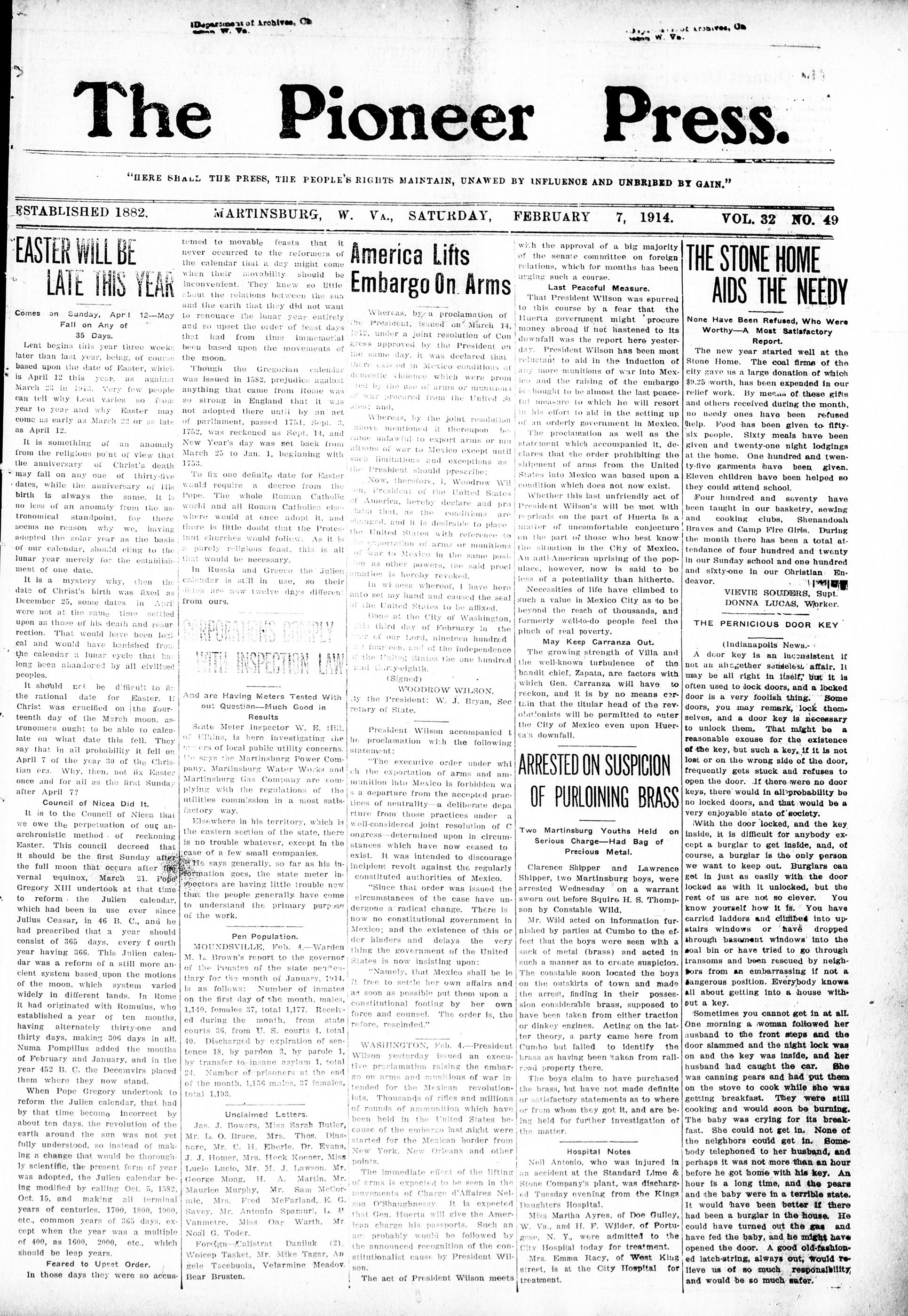
EASTER WILL BE LATE THIS YEAR
EASTER WILL BE LATE THIS YEAR
Comes on Sunday, April 12—May Fall on Any of 35 Days. Lent begins this year three weeks later than last year, being, of course based upon the date of Easter, which is April 12 this year, as against March 23 in 1915. Very few people can tell why Lent varies so from year to year and why Easter may come as early as March 22 or as late as April 12.
It is something of an anomaly from the religious point of view that the anniversary of Christ's death may fall on any one of thirty-five dates, while the anniversary of His birth is always the same. It is no less of an anomaly from the astronomical standpoint, for there seems no reason why we, having adopted the solar year as the basis of our calendar, should cling to the lunar year merely for the establishment of one date.
It is a mystery why, then the date of Christ's birth was fixed as December 25, some dates in April were not at the same time settled upon as those of his death and resurrection. That would have been logical and would have banished from the calendar a lunar cycle that has long been abandoned by all civilized peoples.
It should not be difficult to fit the rational date for Easter. If Christ was crucified on the fourteenth day of the March moon, astronomers ought to be able to calculate on what date this fell. They say that in all probability it fell on April 7 of the year 30 of the Christian era. Why, then, not fix Easter once and for all as the first Sunday after April 7?
Council of Nicea Did It.
It is to the Council of Nicea that we owe the perpetuation of our anarchonistic method of reckoning Easter. This council decreed that it should be the first Sunday after the full moon that occurs after the vernal equinox, March 21. Pope Gregory XIII undertook at that time to reform the Julien calendar, which had been in use ever since Julius Ceasar, in 46 B. C., and he had prescribed that a year should consist of 365 days, every f fourth year having 366. This Julien calendar was a reform of a still more ancient system based, upon the motions of the moon, which system varied widely in different lands. In Rome it had originated with Romulus, who established a year of ten months, having alternately thirty-one and thirty days, making 306 days in all. Numa Pompillus added the months of February and January, and in the year 452 B. C. the Decemvirs placed them where they now stand.
When Pope Gregory undertook to reform the Julien calendar, that had by that time become incorrect by about ten days, the revolution of the earth around the sun was not yet fully understood, so instead of making a change that would be thoroughly scientific, the present form of year was adopted, the Julien calendar being modified by calling Oct. 5, 1582, Oct. 15, and making all terminal years of centuries. 1700, 1800, 1900, etc., common years of 365 days, except when the year was a multiple of 400, as 1600, 2000, etc., which should be leap years.
Feared to Upset Order. In those days they were so accus
Departments of Archives, Ch
ampus, W. Va.
e Pi
MALL THE PRESS, THE PEOPLE'
MARTINSBURG, W
tomed to movable feasts that it never occurred to the reformers of the calendar that a day might come when their movability should be inconvenient. They knew so little about the relations between the sun and the earth that they did not want to renounce the lunar year entirely and so upset the order of feast days that had from time immemorial been based upon the movements of the moon.
Though the Gregorian calendar was issued in 1582, prejudice against anything that came from Rome was so strong in England that it was not adopted there until by an act of parliament, passed 1751, Sept. 3, 1752, was reckoned as Sept. 14, and New Year's day was set back from March 25 to Jan. 1, beginning with 1753.
To fix one definite date for Easter would require a decree from the Pope. The whole Roman Catholic world and all Roman Catholics elsewhere would at once adopt it, and there is little doubt that the Protestant churches would follow. As it is a purely religious feast, this is all that would be necessary.
In Russia and Greece the Julien calendar is still in use, so their dates are now twelve days different from ours.
CORPORATIONS COMPLIY WITH INSPECTION LAW
And are Having Meters Tested Without Question—Much Good in
Results
State Meter Inspector W. E. Hill, of Elkins, is here investigating the matters of local public utility concerns. He says the Martinsburg Power Company, Martinsburg Water Works and Martinsburg Gas Company are complying with the regulations of the utilities commission in a most satisfactory way. Elsewhere in his territory, which is the eastern section of the state, there is no trouble whatever, except in the case of a few small companies.
He says generally, so far as his information goes, the state meter inspectors are having little trouble now that the people generally have come to understand the primary purpose of the work.
Pen Population.
MOUNDSVILLE, Feb. 4.—Warden M. L. Brown's report to the governor of the inmates of the state penitentiary for the month of January, 1914, is as follows: Number of inmates on the first day of the month, males, 1,140, females 37, total 1,177. Received during the month, from state courts 36, from U. S. courts 4, total 40. Discharged by expiration of sentence 18, by pardon 3, by parole 1, by transfer to insane asylum 1, total 24. Number of prisoners at the end of the month, 1,156 males, 37 females, total 1,192.
Unclaimed Letters:
Jas. J. Bowers, Miss Sarah Butler, Mr. L. O. Bruce, Mrs. Thos. Dinnore, Mr. C. H. Eberle, Dr. Evans, J. J. Homer, Mrs. Heck Koener, Miss Lucie Lucio, Mr. M. J. Lawson, Mr. George Mong, H. A. Martin, Mr. Maurice Murphy, Mr. Sam McCormic, Mrs. Fred McFarland, E. G. Savey, Mr. Antonio Spamuri, L. R. Vanmetre, Miss Oar Warth, Mr. Noal G. Toder.
Foreign-Kalistrat Daniluk (2).
Woicep Tasket, Mr. Mike Tagar, Angele Tacebuoia, Velarmine Meadow.
Bear Brusten.
America Lifts Embargo On Arms
Whereas, by a proclamation of the President, issued on March 14, 1912, under a joint resolution of Congress approved by the President on the same day, it was declared that there existed in Mexico conditions of domestic violence which were promoted by the use of arms or munitions of war procured from the United States; and,
Whereas, by the joint resolution above mentioned it thereupon became unlawful to export arms or munitions of war to Mexico except until such limitations and exceptions as the President should prescribe:
Now, therefore, I, Woodrow Wilson, President of the United States of America, hereby declare and proclaim that, as the conditions are changed, and it is desirable to place the United States with reference to the exportation of arms or munitions of war to Mexico in the same position as other powers, the said proclamation is hereby revoked.
In witness whereof, I have here unto set my hand and caused the seal of the United States to be affixed.
Done at the City of Washington, this third day of February in the
tour of our Lord, nineteen hundred and fourteen, and of the independence
of the United States the one hundred and thirty-eighth.
(Signed)
WOODROW WILSON.
By the President: W. J. Bryan, Secretary of State.
President Wilson accompanied us
the proclamation with the following
statement:
"The executive order under which the exportation of arms and ammunition into Mexico is forbidden was a departure from the accepted practices of neutrality—a deliberate departure from those practices under a well-considered joint resolution of Congress—determined upon in circumstances which have now ceased to exist. It was intended to discourage incipient revolt against the regularly constituted authorities of Mexico
"Since that order was issued the circumstances of the case have undergone a radical change. There is now no constitutional government in Mexico; and the existence of this order hinders and delays the very thing the government of the United States is now insisting upon:
"Namely, that Mexico shall be left free to settle her own affairs and as soon as possible put them upon a constitutional footing by her own force and counsel. The order is, the refore, rescinded."
WASHINGTON, Feb. 4.—President Wilson yesterday issued an executive proclamation raising the embargo on arms and munitions of war intended for the Mexican revolutionists. Thousands of rifles and millions of rounds of ammunition which have been held in the United States because of the embargo last night were started for the Mexican border from New York, New Orleans and other points.
The immediate effect of the lifting of arms is expected to be seen in the movements of Charge d'Affaires Nelson O'Shaughnessy. It is expected that Gen. Haerta will give the American charge his passports. Such an act probably would be followed by the announced recognition of the constitutionalist cause by President Wilson. The act of President Wilson meets
Oklahoma State Archives, Oa
W. Va.
BY INFLUENCE AND UNBRIBED
FEBRUARY 7, 1914.
with the approval of a big majority of the senate committee on foreign relations, which for months has been urging such a course.
Last Peaceful Measure.
That President Wilson was spurred to this course by a fear that the Huerta government might procure money abroad if not hastened to its downfall was the report here yesterday. President Wilson has been most reluctant to aid in the induction of any more munitions of war into Mexico and the raising of the embargo is thought to be almost the last peaceful measure to which he will resort in his effort to aid in the setting up of an orderly government in Mexico. The proclamation as well as the statement which accompanied it, declares that the order prohibiting the shipment of arms from the United States into Mexico was based upon a condition which does not now exist.
Whether this last unfriendly act of President Wilson's will be met with reprisals on the part of Huerta is a matter of uncomfortable conjecture on the part of those who best know the situation in the City of Mexico. An anti-American uprising of the populace, however, now is said to be less of a potentiality than hitherto. Necessities of life have climbed to such a value in Mexico City as to be beyond the reach of thousands, and formerly well-to-do people feel the pinch of real poverty.
May Keep Carranza Out.
The growing strength of Villa and the well-known turbulence of the bandit chief, Zapata, are factors with which Gen. Carranza will have to reckon, and it is by no means certain that the titular head of the revolutionists will be permitted to enter the City of Mexico even upon Huergas downfall.
ARRESTED ON SUSPICION OF PURLOINING BRASS
ARRESTED ON SUSPICION OF PURLOINING BRASS
Two Martinsburg Youths Held on Serious Charge—Had Bag of Precious Metal. Clarence Shipper and Lawrence Shipper, two Martinsburg boys, were arrested Wednesday on a warrant sworn out before Squire H. S. Thompson by Constable Wild.
Mr. Wild acted on information furnished by parties at Cumbo to the effect that the boys were seen with a sack of metal (brass) and acted in such a manner as to create suspicion. The constable soon located the boys on the outskirts of town and made the arrest, finding in their possession considerable brass, supposed to have been taken from either traction or dinkey engines. Acting on the latter theory, a party came here from Cumbo but failed to identify the brass as having been taken from railroad property there.
The boys claim to have purchased the brass, but have not made definite or satisfactory statements as to where or from whom they got it, and are being held for further investigation of the matter.
Nell Antonio, who was injured in an accident at the Standard Lime & Stone Company's plant, was discharged Tuesday evening from the Kings Daughters Hospital.
Miss Martha Ayres, of Doe Gulley, W. Va., and H. F. Wilder, of Portugese, N. Y., were admitted to the City Hospital today for treatment.
Mrs. Emma Racy, of West King street, is at the City Hospital for treatment.
Hospital Notes
VOL. 32 NO. 49
THE STONE HOME AIDS THE NEEDY
THE STONE HOME AIDS THE NEEDY
None Have Been Refused, Who Were Worthy—A Most Satisfactory Report.
The new year started well at the Stone Home. The coal firms of the city gave us a large donation of which $9.25 worth, has been expended in our relief work. By means of these gifts and others received during the month, no needy ones have been refused help. Food has been given to fifty-six people. Sixty meals have been given and twenty-one night lodgings at the home. One hundred and twenty-five garments have been given. Eleven children have been helped so they could attend school.
Four hundred and seventy have been taught in our basketry, sewing and cooking clubs, Shenandoah Braves and Camp Fire Girls. During the month there has been a total attendance of four hundred and twenty in our Sunday school and one hundred and sixty-one in our Christian Endeavor.
VIEVIE SOUDERS, Supt.
DONNA LUCAS, Worker.
THE PERNICIOUS DOOR KEY
(Indianapolis News.
A door key is an inconsistent if not an altogether senseless affair. It may be all right in itself, but it is often used to dock doors, and a locked door is a very foolish thing. Some doors, you may remark, lock themselves, and a door key is necessary to unlock them. That might be a reasonable excuse for the existence of the key, but such a key, if it is not lost or on the wrong side of the door, frequently gets stuck and refuses to open the door. If there were no door keys, there would in all probability be no locked doors, and that would be a very enjoyable state of society.
With the door locked, and the key inside, it is difficult for anybody except a burglar to get inside, and, of course, a burglar is the only person we want to keep out. Burglars can get in just as easily with the door locked as with it unlocked, but the rest of us are not so clever. You know yourself how it is. You have carried ladders and climbed into upstairs windows or have dropped through basement windows into the soal bin or have tried to go through transoms and been rescued by neighbors from an embarrassing if not a dangerous position. Everybody knows all about getting into a house without a key.
Sometimes you cannot get in at all. One morning a woman followed her husband to the front steps and the door slammed and the night lock was on and the key was inside, and her husband had caught the car. She was canning pears and had put them on the stove to cook while she was getting breakfast. They were still cooking and would soon be burning. The baby was crying for its breakfast. She could not get in. None of the neighbors could get in. Somebody telephoned to her husband, and perhaps it was not more than an hour before he got home with his key. An hour is a long time, and the pears and the baby were in a terrible state. It would have been better if there had been a burglar in the house. He could have turned out the gas and have fed the baby, and he might have opened the door. A good old-fashioned latch-string, always out, would relieve us of so much responsibility and would be so much safer.
As Independent Weekly Newspaper Devoted to the Moral, Religious and Financial Development of Humanity. DATE OF SUBSCRIPTION:
Pay for all advertisements is due in advance unless advertising is run by yearly contract, in which case the advertiser pays every three months.
Bond for Sample Copies.
J. K. Clifford, Editor and Proprietor.
Drawer 869, and Bell 'Phone 60K,
Martinsburg, W. Va.
SATURDAY,FEBRUARY 7.1914.
Now, that President Wilson has at last sided with that ignorant outlaw, Villa, watch, in the face of the closed gate-way to this country of all races except the whites, what hand Japan is going to take will down go the Philippines and Hawaii? and will worse follow? for "war is hell."
That one of, if not the worst of vices, is lying, any community can attest. And strange to say, when this class of people once get in that habit, it is like the clapper in a bell on a sheep—always clapping except when the sheep is asleep. No wonder the Bible consigns such to the hottest places in the fiery regions.
The Pioneer Press sees no more wisdom in the Wilson administration playing peekaboo with Villa, a Mexican outlaw, who can neither read nor write, than it does in it allowing Vardaman and John Sharpe Williams to dictate to the law makers of a country as big and great as is this. They deserve the same condemnation that Chicagoans gave one-eye Ben Tillman, when he yelled out—"to hell with the constitution." Let us hope that God will create another Nat Turner for that class of Southern hotheads.
Religion is like everything in life—in that perfection is never reached and never will be. Its beginning is like the pine knot light we used to chat and spell by when a boy. But evolution put the dip lights in the knot's place; then the candle; then the lamp; next the gas and now electricity. And those who are "heaven bent and heaven bound" and see heaven and hell in their sentimental imagination are nothing more than pine knot christians. Religion is a life of love of mankind the world over. When that isn't true your religion is a shadow and a curse.
Right never compromises. Wrong always wants to. Why should a new party fighting wrong and ballot robbing, starting out and getting 5,000,000 votes and sending the bosses' standard bearer to private life with only 7 electoral votes, go back? Forward is the slogan and onward we're going. The State Executive Committee did exactly right at Parkersburg to declare for nominees of all grades in all West Virginia counties. Because we helped or elected a governor and a legislature in 1912, is no reason why we should do it in 1914. If you wrong doers and advocates of it, will come over and help us save the nation all right. Otherwise you'll go down to defeat with the blame of all good citizens resting on you.
The Governor of Michigan declares that "girls are little brutes." Possibly if many fathers were not called "brutes" for strapping them, and the law(?) punish them for it, the little things wouldn't be so called.
We advocate Solomon's wisdom, for if the fear of the Lord—all love and meroitic—is the beginning of wisdom," why should it not be as true on earth where earthly parents have the training of children for the kingdom above? We are firm in the belief that a good flogging to obstreperous youngsters is as essential to obedience, morals y, industry and religion as a good foundation is to the building of a house to stand the storms; and may as well go a step further and say, when the father is right and the mother interferes, the same medicine would do her good.
Impudence, Rowdyism, Fashion. That these three contempts in conduct, firmly fixed by tolerance, have grown and spread all over this country within the past fifty years is shamefully true. Is it possible to get back to that obedient and deferential period of children to parents? As we see it, there is but one way to get back, and that is to resume the home devotion—read the Bible, sing hymns and have prayers; teach children to respect the Sabbath and take them to church. Some will claim it can't be done, and if left to them it can't. To try it with this half grown generation would threadbare the patience of a Job. But it can be done if parents of the unborn will begin it. It is impossible for children to forget such rearing, and God only knows the good it would do, and this otherwise woebegone country be madebetter.
Not since 1854, has such a political stir been going on as there is at present among Progressives. It is forcibly felt from the Pacific to the Atlantic. The principles it is preserving were then born. They were right then, and no less right now, and the Progressives are not going to see them trampled in the filth of political sin by the hungry horde of politicians. As the birth of these principles destroyed the Whig party, so has the Progressives' resulfirmation of them sapped the life of the ring rulers.
If in three months the Progressives got together five million voters—and they did—and astounded the world, what can't they do through unific efforts in 1967? The like, the world over has never before been known. The old rule or ruin element of the G. O. P. like Jeffries, once the fistic boss—can brag and blow, but it can no more "come back" and absorb the Progressives than Jeffries could meet and whip Johnson. We are on the right track and victory in 1916 is perching itself on our banner.
Draw Down or Put The Windows Up.
If people only knew the necessity of fresh air in churches and halls, and the danger of sickness and its avenues to death because of its want, none would sit in either place unless properly ventilated. How long could two persons live if they had to breathe exclusively each others breath? Not ten minutes. Look up and read the story of the black hole of Calcutta.
A person who knows the value of pure air, would rather be spat on outside of a hall or church than to sit in either when crowded with windows closed. The window panes, covered with fumes from the breath, contains an alkaloid poison that will if injected into a rabbit or cat, kill either instantly with convulsions, leaving the large blood vessels and heart gorged with blood. The expired air of men and animals is a more deadly poison than carbonic acid. If the condensed breath on the panes of windows would be burned it would smell like singed hair. And if it be allowed to stay there a few days a good microscope would show millions of living animalcules. Hence, how sad and harmful to breath such prurescent matter. The idea last Sunday night when the sexton pulled down the windows for Rogers Green to jump up and close them. Such gatherings have all classes of people, and all kinds of diseases, and all kinds of sickening perfumes, all of which added to other odors ought not to be taken into one another's lungs—and if this goggle eyed gentry don't want fresh air in the church, we suggest that he pray in his secret closet at home.
VIRGINIA TO BE DRY.
There are strong indications that Virginia will join her youngest daughter and go dry soon as the machine can work it out. Debate on a prohibition amendment will begin Wednesday and times will be lively in Richmond.
It is not generally known, but the proposition to trade the Eastern Panhandle to Virginia in settlement of the claim against this State, by the holders of bonds, had its inception among the "wet" contingent after the adoption of the prohibition amendment. It did not work for two or three reasons, one of which was that we do not owe anything and another was the people would not stand for it. The only effect was to cause many persons to doubt the loyalty of the people in this section. The party who gave the proposition publicity should have been bored for the simples.
FOUR PRISONERS ARE SENTENCED
TWO PRISONERS TO COUNTY JAIL
Eddie Sonners Goes to the Industrial School for Boys While Lloyd E. Allen and Tom Balich Will Expiate His Offense on County Roads. Other Court News.
were brought into circuit court and received their sentences from Judge Woods. One was sent to the state penitentiary to serve a minimum sentence, a lad was given a term in the industrial school for boys at Prunty-town, and two received jail sentences
Vincenzo Ricco, who was found guilty of criminally assaulting Tola Pola at Big Springs on August 15, 1913, was sentenced to serve a term of seven years in the state penitentiary at Moundsville. Being unable to understand English, O. Ferrari acted as an interpreter. The prisoner heard the sentence calmly and showed but little emotion. He declared he is not guilty.
Eddie Sonners, who acted as guard while three of his friends entered the home of Thomas Horsfall, was sentenced to the industrial school for boys at Prunytown until he is 21 years of age. Judge Woods told him if he obeyed the officials of that institute he would remain until his term expired, if not he would be brought back and sentenced to the penitentiary. Lloyd Allen, who confessed to unlawfully cutting Dawson Kettering in December, 1913, was sentenced to serve six months in the county jail, and work during that period on the county highways.
Tom Balich, who was charged with stealing 90 cents from Evan Carrick in November, 1913, changed his plea to chat of petit larceny and was given 30 days in jail. He has already served 80 days.
Orders Entered.
An answer was filed in the cause of Allen B. Noll, admr, vs. Nannie Robinson et al.
In the cause of W. O. C. Payne vs. Charles W. Payne et al a decree construing the will of Elizabeth M. Snepherd was entered.
The cause of C. D. Burns vs. Claudie M. Lemaster was dropped; settled.
The report of the commissioner in the cause of the Cacapon Power Company vs. E. H. Tabler was filed.
Lillie Blanche Keller was granted a divorce from Robert E. Keller.
The cause of William Gerhardt et al vs. Knelia Henry et al was referred to Special Commissioner W. B. Colston to ascertain the funds received by the defendant.
A decree was entered dismissing the cause of Nobie D. Kaith vs. F. R. Kain was entered.
A decree directing the distribution of funds and directing a deed be made was entered in the cause of C. S. Bailey vs. Travers Bailey et al.
The cause of Lee M. Bender vs. Rosa Basor et al was referred to John H. Zirkle, commissioner.
The cause of Allen B. Noll vs. Daisy M. Davis was referred to R. H. Boyd, D. W. Snyder, Jr., and E. L. Luttrell.
DAILY GROWING
DAILY GROWING
Twenty-Four New Ones Added Wed-
Total subscriptions to date to the Eastern Panhandle Fair Association is 448, there being added Wednesday twenty-four new shares. This report is very encouraging and shows that the people are becoming more determined than ever to make the undertaking a go. Those who are engaged in the work report they are not meeting with many difficulties and are finding the people very much in earnest in their support.
Those subscribing Wednesday are Charles J. Alkire, D. A. Arnold, L. C. Bender, H. H. Hoffman, M. Belle Stewart. Floyd VanMeter, Nat T Frame, Harry H. Stewart, J. R. Poland, George E. Tabler, L. A. Tabler William. H. Brown, S. P. Douglas, Howard C. Hinkins, M. V. McCune.
HOWARD UNIVERSITY, WASHINGTON, D. C.
STEPHEN M. NEWMAN, D. D.
PRESIDENT.
Located in Capitol of the Nation. Campus of over twenty acres! Advantages unsurpassed. Modern scientific and general equipment. New Carnegie Library. New Science Hall. Faculty of over one hundred. 1382 students from 37 states and 10 other countries. Unusual opportunities for self-support. No young man or woman of energy or capacity need be deprived of its advantages.
Devoted to liberal studies. Courses in English, Mathematics, Latin, Greek, French, German, Physics, Chemistry Biology, History, Philosophy, and the Social Sciences, such as are given in the best approved colleges. 16 professors, Kelly Miller, A. M., Dean.
THE TEACHERS' COLLEGE
Special opportunities for teachers: Regular college courses in Psychology, Pedagogy, Education, &c., with degree of A. B.; Pedagogical courses leading to Ph. B. degree. High-grade courses in Normal Training. Music, Manual Arts, and Domestic Sciences. Graduates helped to positions. Lewis B. Moore A. M., Ph. D., Dean.
THE ACADEMY.
Faculty of 13. Three courses of four years each. High grade preparatory school. George J. Cummings, A. M.. Dean.
THE COMMERCIAL COLLEGE.
Courses in Bookkeeping, Stenography Commercial Law, History, Civics, &c Business and English high school education combined. George W. Cook, A. M. Dean.
SCHOOL OF MANUAL ARTS AND APPLIED SCIENCES.
Furinshes thorough courses. Six instructors. Offers four-year courses in Mechanical and Civil Engineering and Architecture.
Professional Schools
THE SCHOOL OF THEOLOGY.
Interdenominational. Five professors. Broad and thorough co. es. Advantages of connection with a great University. Students' Aid. Low expenses, Isaac Clark, D.D., Dean.
THE SCHOOL OF MEDICI
Forty-nine professors. Modern a- oratories and equipment. Connected with new Freedmen's Hospital, costing half million dollars. Clinical facilities not surpassed in America. Post-graduate School and Polyclinic. Edward A. Balloch, M. D., Dean, 5th and W. Streets N. W. W. C. McNeill, M. D., Secretary, 901 R St., N. W.
THE SCHOOL OF LAW.
Faculty of eight. Courses of three years, giving a thorough knowledge of theory and practice of law. Occupied building opposite the court house. Benjamin F. Leighton, LL.B., Dean, 420 5th street N.W. For catalogue and special information address Dean of Department.
VIRGINIAN DEAD
Wm. J. Crocken Passes Away at His Home at East St. Louis
Last Friday
Mrs. J. H. Lyeth, of East Martin street, is prostrated over the sad news of the death of a cherished brother, Wm. J. Cockren, of East St. Louis, Illinois, on Friday last. He was 53 years old and had been in a hopeless condition for several months, but the long-drawn out anticipation of the end did not lessen the intense sorrow among his relatives and many close friends.
He is survived by a wife, son and one daughter. He married Miss Catherine Authis, of Indianapolis. The other surviving relatives are Mrs. J. H. Lyeth, of this city, a sister, and Mrs. W. L. Wear, of San Francisco, also a sister.
Mr. Crocken comes of a prominent Virginia family at Lexington, Va., his parents, long since departed, were Mr. James and Mrs. Julia Crocken. At 18 years of age he graduated with high honors from the Virginia Military Institute at his home. He located in the central west when young. For several years he was city engineer in East St. Louis. He was prominent in Masonic circles and an active member of the B. P. O. E. and many other secret and social orders.
J. R. CLIFFORD
MARTINSBURG, WEST VIRGINIA
Practices in all the Courts of West
Virginia, the Supreme Court of
Appeals and the United States Courts
BALTIMORE & OHIO
RAILPOAD.
Corrected to Dec. 1st, 1014.
Trains leave Martinsburg as follows.
WEST BOUND
No 15 Daily at 11:21 a.m for Pittsburg
Cincinnati, Louisville and St. Louis
Connects for Romney except Sunday an
at Grafton for Wheeling
No 15 Daily at 11:50 a.m for Grafto
Pittsburg and Chicago.
No 5 Daily, at 3:17 p.m for Grafto
Pittsburg and Chicago.
No. 7 Daily 7:24 p.m for Wheeling, Co
umbus and Chicago.
No. 1 Daily at 6:20 p.m for Cincinnati
Louisville and St. Louis.
No 3 Daily at 2:36 a.m for Cincinnati
Louisville and St Louis.
For Cumberland and way Stations, N
19 5.37 p.m.
No.9 Daily at 11.28 p.m. for Pittsbu
No 23 Daily except Sunday at 0.50 a.m.
for Cumberland and intermediate
stations. Connects for Berkshire Springs.
EAST BOUND.
No 10 Daily except Sunday at 11.55 a.m.
for Freeriver, Baltimore and all inter-
mediate stations via old line.
No 18 Daily except Sunday at 6.30 p.m.
for Washington and Baltimore and all inter-
mediate stations, Connects for, Freeriver.
G. W. SQUIGGINS, Glen, Pass Agent.
Baltimor M.
R. S. BOUIC Ticket Agent.
MEN WHO MAKE THE WORLD.
Men who make the world of today are making The Youth's Companion what it is today. It is very much more than The Companion you may remember; no higher in purpose, but more lavish in material-larger and improved. I special Family Pages, Boys' Pages Girls' Pages, and a constant supply of serials and shorter stories.
The editorial page of information comment, science and events will keep any man well informed, while the Family Page helps on home improvement and ideas, and both boys and girls have special pages for themselves.
You do the family a good turn when the Youth's Companion "as it is today" is sent to the home. Fifty-two issues a year—not twelve. More reading than is found in any monthly magazine at any price.
You may not know the Companion as it is today. Let us send you three current issues free, that you may then oughly test the paper's quality.
THE YOUTH'S COMPANION.
144 Berkeley St. Boston, Mass.
NEW SUBSCRIPTIONS RECEIVED AT THIS
WHAT IS IT?
WHAT IS IT?
Ten year Combination Distribution Certificate of Membership as devised by the American Workmen Fraternal Insurance Company, of Washington. D. C., one of the most liberal strongest and rehable fraterna institutions in the field. I or further particulars see
D.E.V. JORDAN. GEN AGENT. W.VA.
ROM 2 K P. BUILDING
CHARLESTON. - W VA.
The county court is busy today with routine business, including eroneous assessments, public roads and bridge matters.
An Open Letter to the People of West Virginia:
What Do You Think About the Oil and Gas Business?
After the Public Service Commission was established in West Virginia by act of the last legislature, and the members had been appointed, the Manufacturers Light & Heat Company filed with the said Commission its schedule of rates, as required by law. The Public Service Commission, on its own motion, has called upon this company to show not only that the proposed rates, but also that those theretofore charged, are reasonable. There have been a number of hearings before the Commission, the proceedings have been published, discussion by the public is now going on as to what is a reasonable rate for domestic consumption and what for industrial consumption.
It is more important to the people of this State, than to the gas companies, for reasons which will presently be apparent, that there should be intelligent, well-informed consideration of this question, and it is also so important to the gas companies, that we are addressing to the people of this State this letter, and instead of stating what we think to be the facts in the case at issue, we ask you some questions, so that you may for yourselves ascertain what those facts are.
HERE ARE THE QUESTIONS
You know that the gas and oil people have made some money in the business. We know that your share in the profits has been greater than ours, as the best data we can get shows. Did YOU know that since 1890 about 36,000 oil and gas wells have been completed in West Virginia, for which there were paid out by the investors to you as landowners, supplymen, teamsters, workmen, and so on, the enormous sum of about
$250,000,000 IN CASH
not to mention the additional millions paid in taxes, and for franchises and rights of various kinds and spent among you in a thousand ways to hotels, stores, merchants, liverymen, boarding houses, and so on. making your share in the business amount to at least $400,000,000
$400,000,000
of which, incidentally, just about one-fourth went for dry holes, representing a dead loss to the investor of, say, 75 to 100 millions of dollars? In other words, that the oil and gas people have spent in the State in the last few years an amount equal to about one-half of the whole taxable value of all the property of everybody in the whole State?
furthermore, will you please note that the population of your State being, say, 1,250,000 (1910 census, 1,221,119), this expenditure of two hundred and fifty millions among you by the oil and gas people represents just $200 for each of you, man, woman, or child, and the $400,000,000 represents an expenditure of nearly $350 for each man, woman and child in the State?
Are you aware that the oil and gas people are paying into the treasury of the State of West Virginia taxes which would wipe out the entire principal of the Virginia debt in less than seven years; in fact, that the oil, and gas people are today paying one-half of
January 30, 1914.
---
the taxes paid by all of the Public Utilities and over one-sixth of the taxes paid on all the real and personal property of all the corporations and of all the people in the State of West Virginia?
To give you an idea of what the oil and gas business means to you as tax payers, we give here some interesting data:
During the 24 years, 1889 to 1912, inclusive, there were 35,463 wells completed.
For each of these there were paid to West Virginians for labor, teaming, material, drillers' board, rig timbers, etc., not less than $1,333.
Or a total of $47,274,179.
Including $11,595,767 for the 8,699 dry holes.
For the operation of the 26,764 productive oil and gas wells and the caring for the product there has been paid in West Virginia for labor, material, teaming, etc., not less than $99,000,000.
In oil royalties West Virginia land owners have received $37,000,796.
In rentals on lands held for oil purposes, before drilling the land owners have received not less than $12,000,000.
In rentals on lands held for gas they have been paid $36,048,918.
And in royalties on gas from gas wells they have received more than $6,426,416.
This makes a grand total of $209,750,309, the amount by which West Virginia has been enriched by these industries during 1889 to 1912.
The amounts may thus be recapitulated:
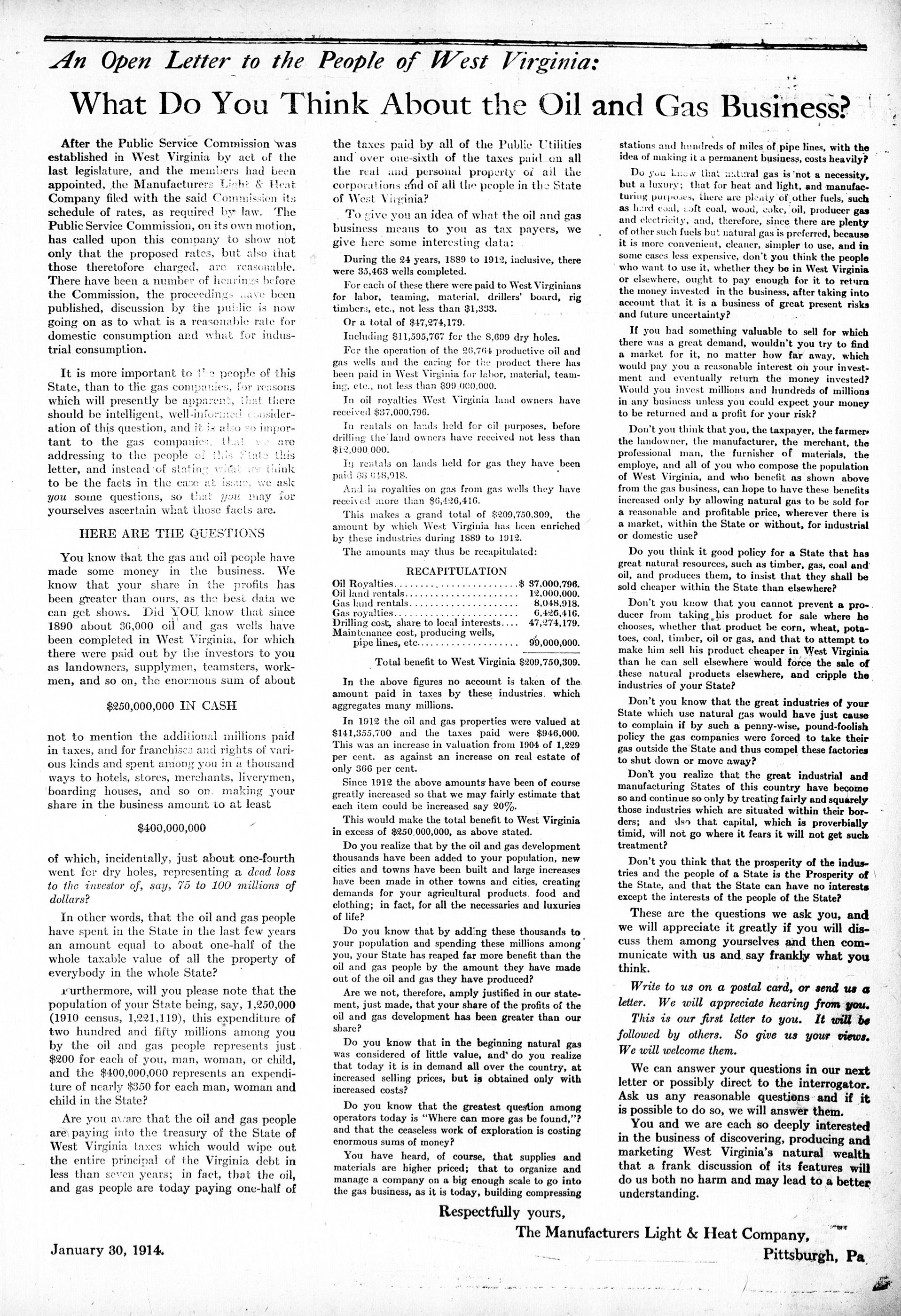
RECAPITULATION
Oil Royalties..... $ 37,000,796.
Oil land rentals..... 12,000,000.
Gas land rentals..... 8,048,918.
Gas royalties..... 6,426,416.
Drilling cost, share to local interests..... 47,274,179.
Maintenance cost, producing wells,
pine lining, etc. 00,000,000
pipe lines, etc..... 99,000,000.
Total benefit to West Virginia $209,750,309.
In the above figures no account is taken of the amount paid in taxes by these industries, which aggregates many millions.
In 1912 the oil and gas properties were valued at $141,355,700 and the taxes paid were $946,000. This was an increase in valuation from 1904 of 1,229 per cent. as against an increase on real estate of only 366 per cent.
Since 1912 the above amounts have been of course greatly increased so that we may fairly estimate that each item could be increased say 20%.
This would make the total benefit to West Virginia in excess of $250,000,000, as above stated.
Do you realize that by the oil and gas development thousands have been added to your population, new cities and towns have been built and large increases have been made in other towns and cities, creating demands for your agricultural products. food and clothing; in fact, for all the necessaries and luxuries of life?
Do you know that by adding these thousands to your population and spending these millions among you, your State has reaped far more benefit than the oil and gas people by the amount they have made out of the oil and gas they have produced?
Are we not, therefore, amply justified in our statement, just made, that your share of the profits of the oil and gas development has been greater than our share?
Do you know that in the beginning natural gas was considered of little value, and do you realize that today it is in demand all over the country, at increased selling prices, but is obtained only with increased costs?
Do you know that the greatest question among operators today is "Where can more gas be found,"? and that the ceaseless work of exploration is costing enormous sums of money?
You have heard, of course, that supplies and materials are higher priced; that to organize and manage a company on a big enough scale to go into the gas business, as it is today, building compressing Respectfully yours.
stations and hundreds of miles of pipe lines, with the idea of making it a permanent business, costs heavily? Do you know that natural gas is not a necessity, but a luxury; that for heat and light, and manufacturing purposes, there are plenty of other fuels, such as hard coal, soft coal, wood, coke, oil, producer gas and electricity, and, therefore, since there are plenty of other such fuels but natural gas is preferred, because it is more convenient, cleaner, simpler to use, and in some cases less expensive, don't you think the people who want to use it, whether they be in West Virginia or elsewhere, ought to pay enough for it to return the money invested in the business, after taking into account that it is a business of great present risks and future uncertainty?
If you had something valuable to sell for which there was a great demand, wouldn't you try to find a market for it, no matter how far away, which would pay you a reasonable interest on your investment and eventually return the money invested? Would you invest millions and hundreds of millions in any business unless you could expect your money to be returned and a profit for your risk?
Don't you think that you, the taxpayer, the farmer the landowner, the manufacturer, the merchant, the professional man, the furnisher of materials, the employe, and all of you who compose the population of West Virginia, and who benefit as shown above from the gas business, can hope to have these benefits increased only by allowing natural gas to be sold for a reasonable and profitable price, wherever there is a market, within the State or without, for industrial or domestic use?
Do you think it good policy for a State that has great natural resources, such as timber, gas, coal and oil, and produces them, to insist that they shall be sold cheaper within the State than elsewhere?
Don't you know that you cannot prevent a producer from taking his product for sale where he chooses, whether that product be corn, wheat, potatoes, coal, timber, oil or gas, and that to attempt to make him sell his product cheaper in West Virginia than he can sell elsewhere would force the sale of these natural products elsewhere, and cripple the industries of your State?
Don't you know that the great industries of your State which use natural gas would have just cause to complain if by such a penny-wise, pound-foolish policy the gas companies were forced to take their gas outside the State and thus compel these factories to shut down or move away?
Don't you realize that the great industrial and manufacturing States of this country have become so and continue so only by treating fairly and squarely those industries which are situated within their borders; and also that capital, which is proverbially timid, will not go where it fears it will not get such treatment?
Don't you think that the prosperity of the industries and the people of a State is the Prosperity of the State, and that the State can have no interests except the interests of the people of the State?
These are the questions we ask you, and we will appreciate it greatly if you will discuss them among yourselves and then communicate with us and say frankly what you think.
Write to us on a postal card, or send us a letter. We will appreciate hearing from you.
This is our first letter to you. It will be followed by others. So give us your views. We will welcome them.
We can answer your questions in our next letter or possibly direct to the interrogator. Ask us any reasonable questions and if it is possible to do so, we will answer them. You and we are each so deeply interested in the business of discovering, producing and marketing West Virginia's natural wealth that a frank discussion of its features will do us both no harm and may lead to a better understanding.
Pittsburgh, Pa
AFTERU.S.JURIST
WASHINGTON, Feb. 4. It seems to be difficult to determine who are to be the assistant district attorneys for the northern district of West Virginia, under District Attorney Stewart W. Walker. Mr. Walker has been here several times in conference with Senator Chilton in regard to the matter and the two have been at the Department of Justice, but still there has been no appointment. The understanding is the Senator is trying to do for the northern district what he did for the southern district and have the number of assistants increased. In the southern district there was but one assistant under the predecessor of William G. Barnhart, the present attorney. There was also a law clerk. Senator Chilton managed to have the salaries of the two split three ways and instead of one assistant district attorney and one law clerk there are now three assistant attorneys. There are so many applicants from the northern district that the effort has been made to have the number of assistants increased to three, whereas there has been but two heretofore. The guesses are the three who will get the places if the third place is created are C. M. Seibert, of Martinsburg; Harry H. Byrer., of Philippi, secretary of the Democratic State Committee; and J. J. P. O'Brien, of Wheeling, Harry D. Perkins, of Parkersburg, is also spoken of for one of the places, as are several others, none of whom seem to have much chance of appointment. Mr. Byrer, O'Brien and Mr. Seibert have all been here and if the Department of Justice can be persuaded to increase the number of positions it is believed these three will get them. Should the Department hold that the present number of places is sufficient it is difficult to tell which two of the applicants will get the places.
Little importance is attached here to the reported effort on the part of labor interests in West Virginia to have Alston G. Dayton, judge of the United States district court for the northern district of West Virginia, removed from office. He could only be removed by impeachment by Congress and conviction by the Senate, and it is well known that both the House and the Senate have had enough of impeachment charges to let further charges alone, unless it is evident that they are of such a nature that they cannot be overlooked. So far as can be ascertained here, no charges have been brought against Judge Dayton and no effort will be made to bring any, except in connection with labor troubles, and it is doubtful if the House would give very serious consideration to charges of that nature. Judge Dayton was here Tuesday on his way to Richmond to attend the term of the Court of Appeals there, and stopped off in Washington on his way. He did not seem to be at all worried over the reported effort to bring charges against him.
If the plans of the War Department are carried out the West Virginia National Guardsmen will have a fine outing next fall. It is proposed to have a mimic attack on the national capital. The National Guard of Pennsylvania is to be detailed to assist the regular troops from Fort Myer, Va., to defend the city of Washington against a hostile attack by the National Guard of Virginia and that of West Virginia. Several weeks will be spent in the field in the attacks upon the capital and after the West Virginians take the city and capture the White House and the capital, they will have things pretty well their own way for a time. The brief of the State of West Virginia in the Paint Creek strike investigation by the Senate has been filed with the sub-committee of the Senate committee on education and labor, which conducted the investigation. The brief was prepared by Attorney General Lilly and was at his request presented to the sub-committee by Congressman Neely.
Assurances have been given Congressman Neely that a station of the
Clarksburg postoffice will be established at Northview, a suburb of that city, and that it will meet all the requirements of a postoffice. The Department is not inclined to establish a postoffice there but is willing to establish a sub-station of the Clarksburg office, which will mean that patrons of the sub-station may get stamps, money orders and mail at any time and that the parcel post and postal savings branches of the postoffice will be carried on there.
The people of Fink, Lewis county, are complaining of their mail service. They have reported to Congressman Neely that they have had no mail of the third or fourth class since before Christmas and that recently even daily newspapers have not been carried to their office. They are asking for a mail route between Weston and Fink in the hope that that will bring improvement in their service.
The order for the discontinuance of the mail route from Keyser to Twin Mountain on the Twin Mountain and Potomac Railroad has been rescinded, at the request of Congressman Brown and the mail will continue to be carried as heretofore, a distance of 27 miles.
Following the establishment of two new rural mail routes out of Terra Alta, established through the influence of Congressman Brown, the postoffices at Caddell and Whetzell, both in Preston county, will be discontinued February 28.
Congressman Moss has introduced a bill to provide for the payment of a pension to Mrs. Angeline Battin, of Sandyville.
The appointment of Ezra B. Hall to be rural mail carrier out of Mount Clare, effective February 1, is expected to end the difficulties the patrons of that office have been experiencing with their mails. Complaint was made to Congressman Neely that mail delivery was irregular, and he took the matter up with the department with the result that a new carrier was named.
Request has been made by Congressman Neely for the re-establishment of the postoffice at Birchfield, Wetzel county, and the extension of the mail route from Earnshaw by Sincerity and Coburn to the new office.
Sam V. Woods, president of the State Senate, was here Tuesday, accompanied by his wife and daughter on their way to Florida, for a stay of a few weeks.
Edward G. Cooper, of Bramwell, one of the prominent Norfolk and Western coal operators, who has been widely discussed in connection with the Republican nomination for Congressman from the fifth district to succeed James A. Hughes, is in Washington, going over the political situation. Robert and Marshall Brown, of Parkersburg, are guests of Congressman Brown for a few days.
Auto Men.
PARKERSBURG, Feb. 4.—A business meeting of the board of directors of the West Virginia Automobile association was held here Monday, largely in furtherance of the good roads movement in this section. No matters of state-wide importance being acted upon. Those present were President Elmer Hough, of Wellsburg, Secretary Francis L. Ferguson, of Wheeling, Frank Morris, of Fairmont, and A. L. Carter, of Folansbee. One hundred automobile owners of this city and county gave a brilliant banquet that night, at which the state officials were honored guests and the principal speakers. The keynote of the gathering was "better and more improved roads."
It is barely possible that some of those Pennsylvania, statesmen will find it easier than William Howard Taft did to dispose of Gifford Pinchot. —Washington Star.
In choosing to remain as Governor of the Canal Zone instead of going to New York to suppress the gunmen and crooks, we somehow feel that Colonel Goethals has saved his reputation for splendid efficiency. Kansas City Journal.
It Always Helps
says Mrs. Sylvania Wood writing of her experience tonic. She says further Cardui, my back and I thought the pain would be to do any of my housewife of Cardui, I began to feel gained 35 pounds, and as well as run a big wa
says Mrs. Sylvania Woods, of Clifton Mills, Ky., in writing of her experience with Cardui, the woman's tonic. She says further: "Before I began to use Cardui, my back and head would hurt so bad, I thought the pain would kill me. I was hardly able to do any of my housework. After taking three bottles of Cardui, I began to feel like a new woman. I soon gained 35 pounds, and now, I do all my housework, as well as run a big water mill. I wish every suffering woman would give
GAF
The Wom
a trial. I still use Cardiac
and it always does me
Headache, backache
fired, worn-out feelings, e
ly trouble. Signs that you
tonic. You cannot make
for your trouble. It has
women for more than fif
Get a Bot
CARDUI
a trial. I still use Cardui when I feel a little bad, and it always does me good."
Headache, backache, side ache, nervousness, tired, worn-out feelings, etc., are sure signs of womanly trouble. Signs that you need Cardui, the woman's tonic. You cannot make a mistake in trying Cardui for your trouble. It has been helping weak, ailing women for more than fifty years.
CALLS BIRDS "AIR POLICE."
Audubon Secretary Says Hunters Let In Boll Wesvil.
Atlanta, Ga.—James Henry Rice, Jr. field secretary of the National Association of Audubon Societies, addressed a meeting of bird lovers here on the value of birds to mankind.
Mr. Rice began by explaining how birds were made with marvelous sight, muscles of enormous strength, high body temperature and with ability to move over great space of country in a short interval. For these reasons birds were fitted to be great air police, for they could concentrate in a small area, subdue an insect outbreak and return to their appointed places with incredible swiftness.
The stark and terrible world of insects was described with vivid power as "not only outnumbering all other kingdoms in nature, but actually outweighing men, mammals of all kinds, birds, fishes, reptiles, all taken together."
How insects multiply and spread from country to country was told in detail. A monumental case in point was the entry of the Mexican cotton boll weevil into the United States. The weevil, a native of Guatemala, followed the cotton fields through Mexico to the state of Coahuila and entered Texas at Brownsville, on the Río Grande, in 1892. Texas had slaughtered its birds. Every town had its shooting clubs. From pioneer days Texas had been brought up to shoot, first at Indians and buffaloes, then small game, and to keep up practice nongame birds were killed wantonly until the bird population was reduced far below the danger point. There is a record for thirty-four carloads of prairie chickens having been shipped to New York city in a single day.
PICTURE AN ADDRESS.
Letter Delivered to President Only Had Rough Pen Sketch of Head.
Washington...With nothing to guide the postal employees except a pen sketch of the president, a good likeness, on the envelope, a letter mailed by some unknown person in Wichita, Kan., was received at the White House and greatly amused the chief executive.
On the upper left hand side of the envelope was written "Personal," and just below was a sketch of Uncle Sam's head, with the abbreviation for "in care of" just above. The postmaster at Wichita canceled the two one-cent stamps and left the rest to the genius, if any was needed, of the postal employees.
There was no delay in delivery after the missive reached Washington, as it was sent to the White House with other mail within an hour after its arrival.
SEA GIVES UP BIG SKELETON.
Mastodon's Bones and Old Ship Cast Ashore by Disturbance.
Santa Barbara, Cal.-For several days a submarine disturbance has kept the ocean along the south coast in fury, though the weather has been fine and the water comparatively calm several miles from the shore. Then the wreckage of an old ship was cast up.
A few miles southward part of a mastodon's skeleton, which apparently had been brought up from a great depth, was washed ashore. The skeleton fragments included about thirty-five feet of vertebra and the skull with eight foot tusks intact.
The ship's wreckage bore indications that it had lain on the ocean bottom for perhaps a hundred years.
s, of Clifton Mills, Ky., in with Cardui, the woman's "Before I began to use bad would hurt so bad, I till me. I was hardly able k. After taking three bottles like a new woman. I soon ow, I do all my housework, her mill.
RDUI
man's Tonic
when I feel a little bad,
good."
side ache, nervousness,
are sure signs of woman-
need Cardui, the woman's
a mistake in trying Cardui
been helping weak, ailing
years.
le Today!
TRYING TO CURE AN "UPSIDEDOWN"YOUTH
Physicians Interested In Poculiar Case of Detroit Boy.
Detroit, Mich. — Physicians throughout the country are interested as to the experiments which are to be made to try to cure Joseph W. Darling of this city. The boy is suffering from an unusual malady which results in his writing and drawing everything upside down. Everything reverses itself to his vision, and it is believed that a surgical operation will be able to remedy the ailment.
The leading physicians of the city are taking a great interest in the boy, and several schemes are being worked out in the hope of bettering the boy's sight and making his vision in every way normal. Dr. W. P. Melody, city physician, is convinced that the ailment comes from a lesion of the brain as a result of an accident, and the boy is to be treated by him first to give him an opportunity to disprove or substantiate that theory.
Joseph is a remarkably intelligent boy. He is nine years old, but his physical development is tant of a boy of four, as he has spent months at a time in various hospitals following an accident which affected his sight and ruined his health. This happened when he was two and a half years old. He was lifted from the floor by his head by a caller at his home and so injured that his neck and spine became practically useless. Abscesses formed at either side of his neck, and his spine finally developed a bad curvature. The boy was treated at a local hospital for nearly a year following the mishap, and, as in that time he did not have one sound sleep because of his pain, the physicians were assured that he could not live and had him taken to his home to die.
It was not until Joseph was well enough to go to school that it was found that his sight was affected. He was an apt pupil, but his teachers sent word to Mrs. Webb that he insisted upon fooling at his work and did everything upside down. He protested that he was doing the best that he could and insisted that he never had written or drawn anything upside down since he had been at the school. They asked him then if he knew what upside down meant. He said yes and immediately drew a picture as it should be, right side up.
"That." said he, "is upside down, and I never do my work that way."
Continued surveillance convinced his teachers that the boy was suffering with some defect of vision, and since that time he has been examined by almost all of the physicians in Detroit, all of whom have been unable to say just what causes the ailment.
Run Over by Blind Steer.
Nashville, Tenn. - "Uncle Billy" Hunter, mate on the steamboat Henry Harley and one of the oldest men in active service on the Cumberland river, met with a serious accident.
Some cattle were being loaded at Cedar Bluff, and there was a blind steer in the lot. Not knowing that the steer was blind, Mr. Hunter stood in front of the gate to the cattle pen when it was opened, and the blind animal ran over and trampled on him, bruising and injuring him badly.
A BIASED OPINION.
The Philadelphia Record, usually
compare in its estimates of others, is
widely biased in its opinion of
people of Kentucky, especially
the mountainous section. It says, ed-
formally:
Kentucky's Senate has passed
when seriously a bill that punishes
the carrying of confiscated deadly
ammunition with a disfranchisement
or two years, a one of from $10
to $100, and a jail sentence of
ten to 10 to 40 days on a first con-
currence. For a second conviction
the offender can be sent to the
punishment for from one to five
years. This season drastic enough,
and such termination is of little
value unless supported by public
comment. The mourn alneers
who vehemently have given Kentucky such a bad name would not
apparently be much affected by
such a law. They carry their
guns or pistols openly, and with
no effort at concealment. It is
the hidden revolver, which is
confirmed on the legal prosecution, that is especially blind at.
This is not a easy estimate of those people. They are usually related to the inhabitants of the southern portion of this state. When the royal drastic "pistoloting law" in this country was enacted, those people accepted it and from that day to this, there have been but very few cases of its violation. The majority of infractions have been by people from other states who were not aware of the law or who attempted to defy it. In almost every instance they were soon wiser and saddder.
Fueds in that section are no more. Who has heard in recent years of any trouble between the Hatfield's and McCoy's? Or in fact between any of the other clans? There is no more peaceful section than that portion of West Virginia. Kentuckians are honorable men. They are not wilful violators of the law. They have certain rules by which they are guided. As long as the laws give them permission to carry concealed weapons, they will carry them and—use them. Let them be prohibited by law and that will end the whole matter. Better acquaintance with those people would convince the Record.
With tears, ex-Representative Ebenozer J. Hill, of Connecticut, contemplates his lock factory at Terryville working over-time in spite of rascally tariff revision. There would hardly be such a demand for locks if there were nothing left to lock up. Will such a consistent standpatter as Mr. Hill accept the tainted money that is coming to him out of tariff reform?—New York World.
Spurious Coin.
CLARKSBURG, Feb. 4.—Resulting from the circulation of a large number of spurious dollars which imitate the issue of 1878, local officers are trying to locate a band of foreigners who are said to have purchased a quantity of the counterfeits at a certain place in New York City at the rate of $20 a hundred and circulated them here. Many merchants of the city and suburbs brought the coins into banks and told they were counterfeits. Only one or two of the coins were passed a any one place and usually with other good dollars. The counterfeits give a silvery ring when thrown upon a hard substance and are quite deceiving, but they are light in weight and have dull marks.
Great Revival
GRAFTON, Feb. 4.—With over one hundred conversions having been made already and the interest increasing at nearly every meeting, the revival which has been in progress for the past two weeks at the U. B. church premises to be the most successful ever held by this church. The pastor, Rev. Waters, is being assisted by Rev. Bauman, of Mt. Lake Park. Nearly a half dozen of the local churches have now had big revival services at which five hundred people have been converted. The pastors and congregations are all delighted with the increased interest which is thus being shown in religious activities.