The Pioneer Press
Saturday, April 4, 1914
Martinsburg, West Virginia
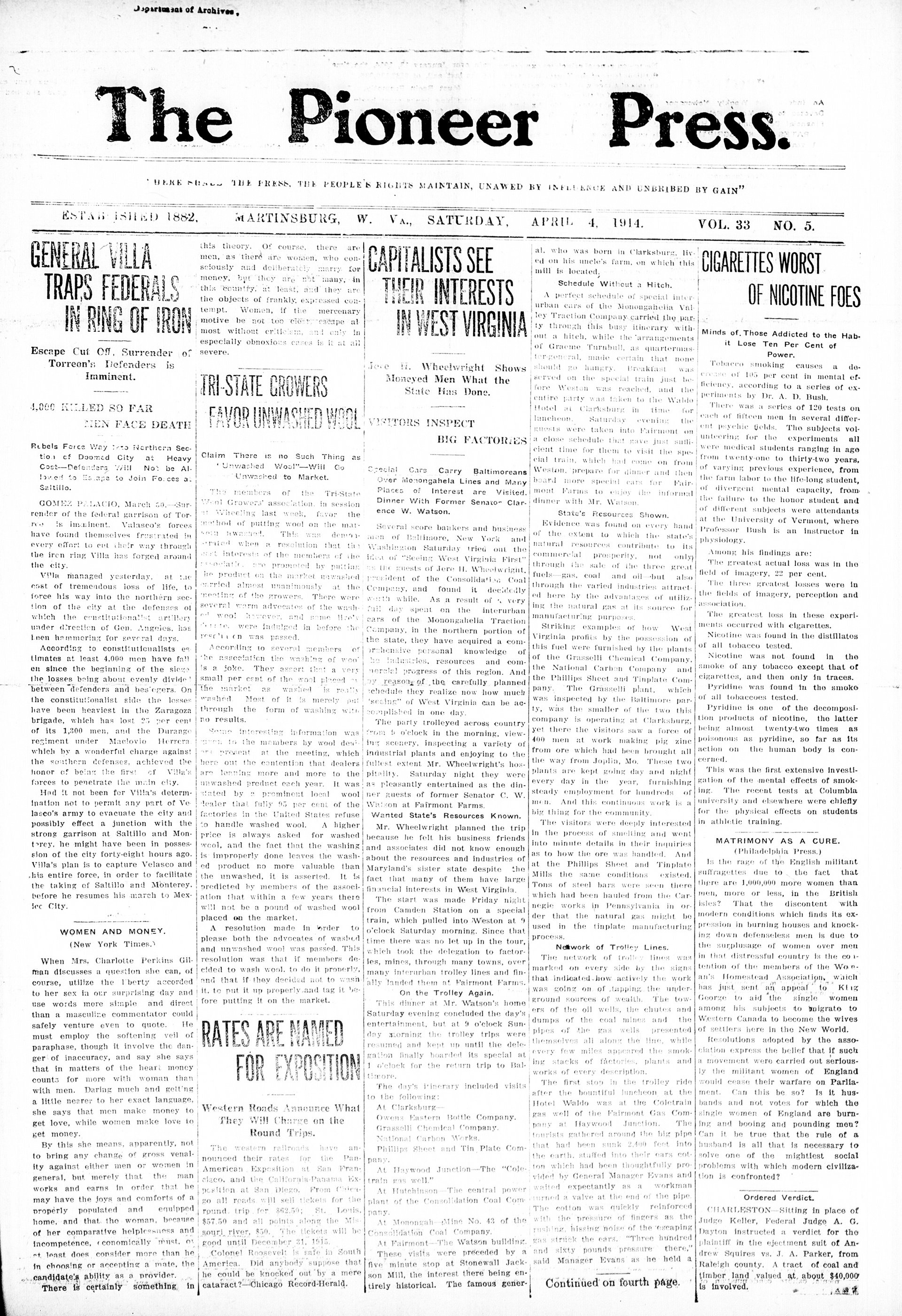
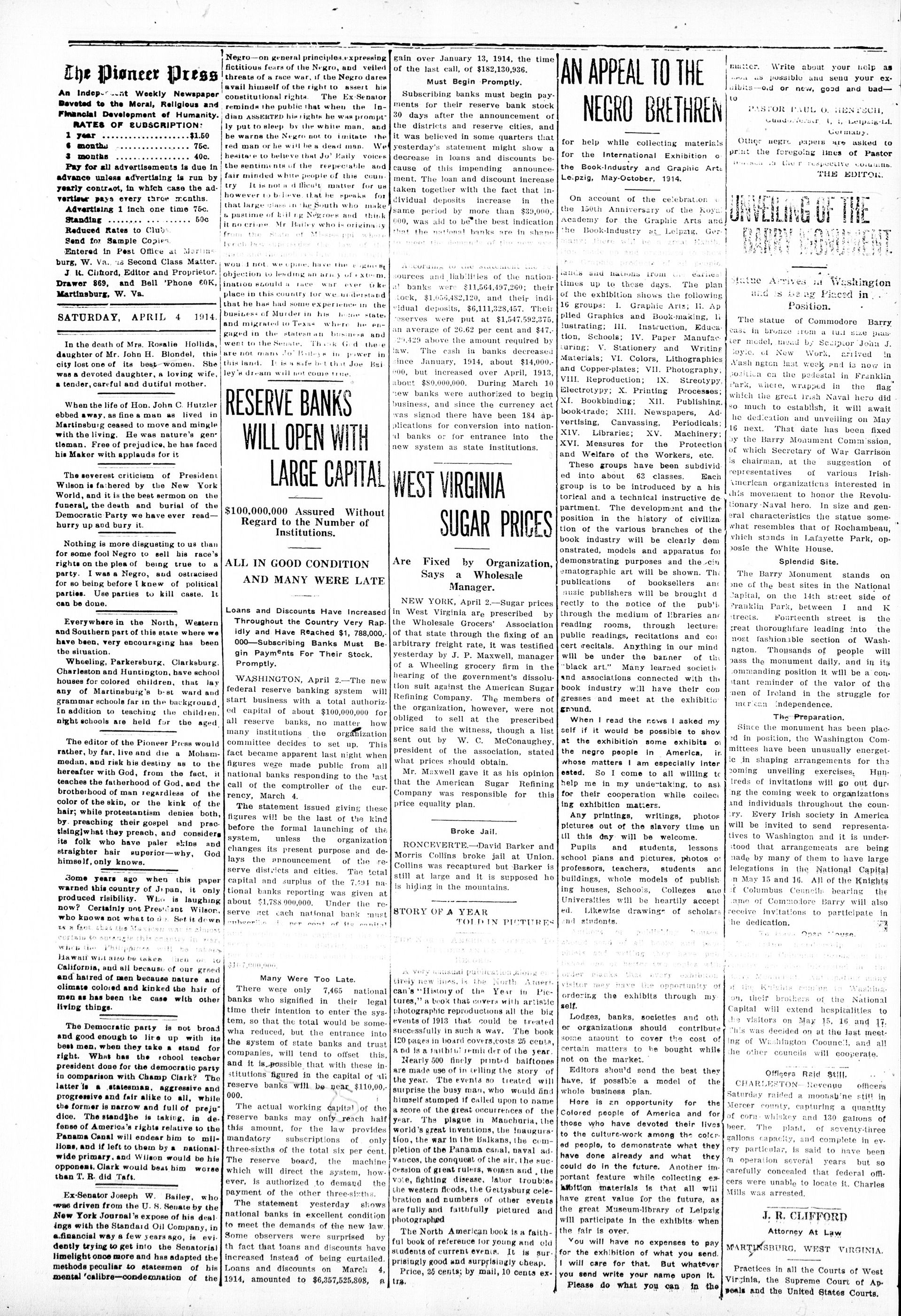
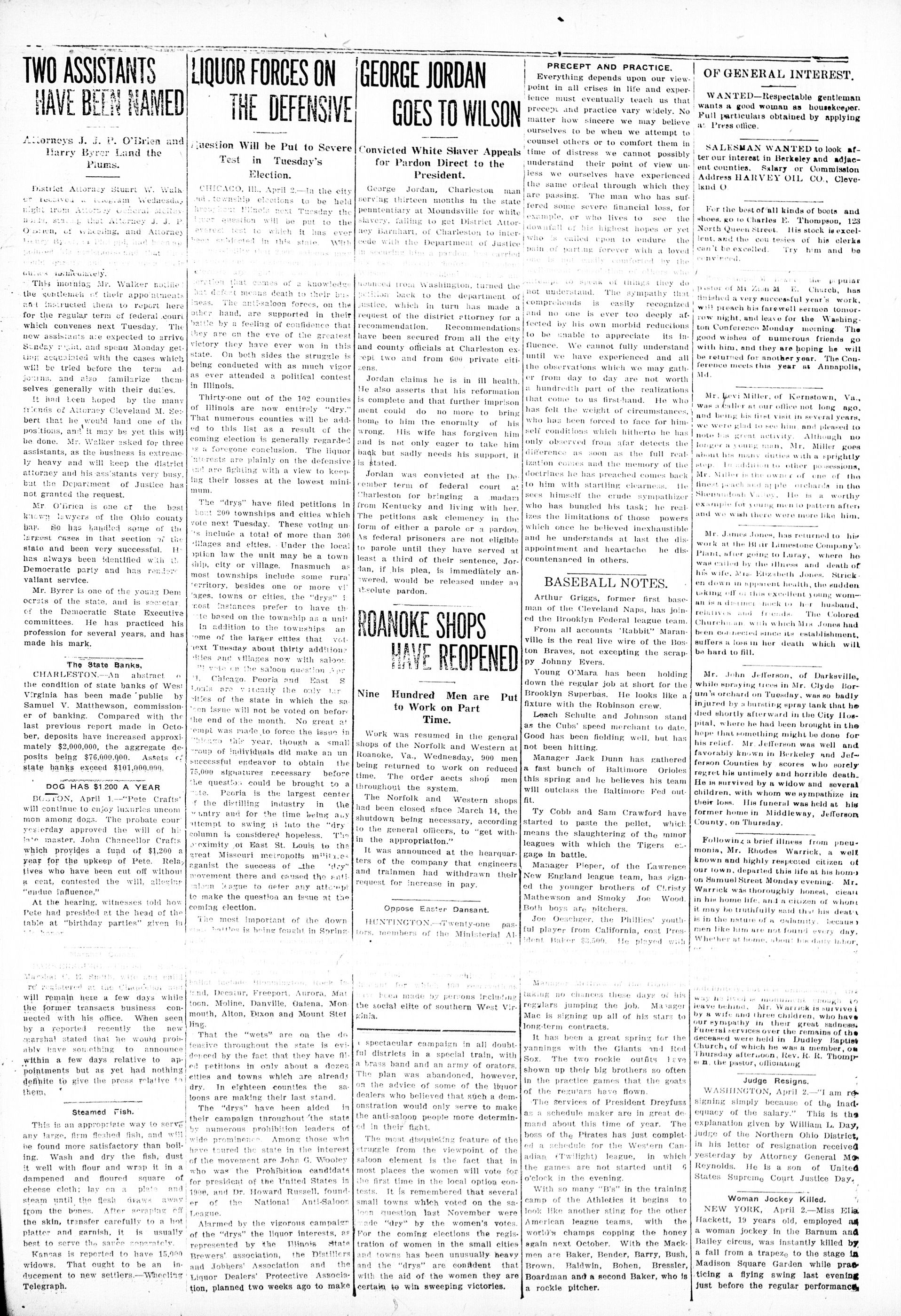
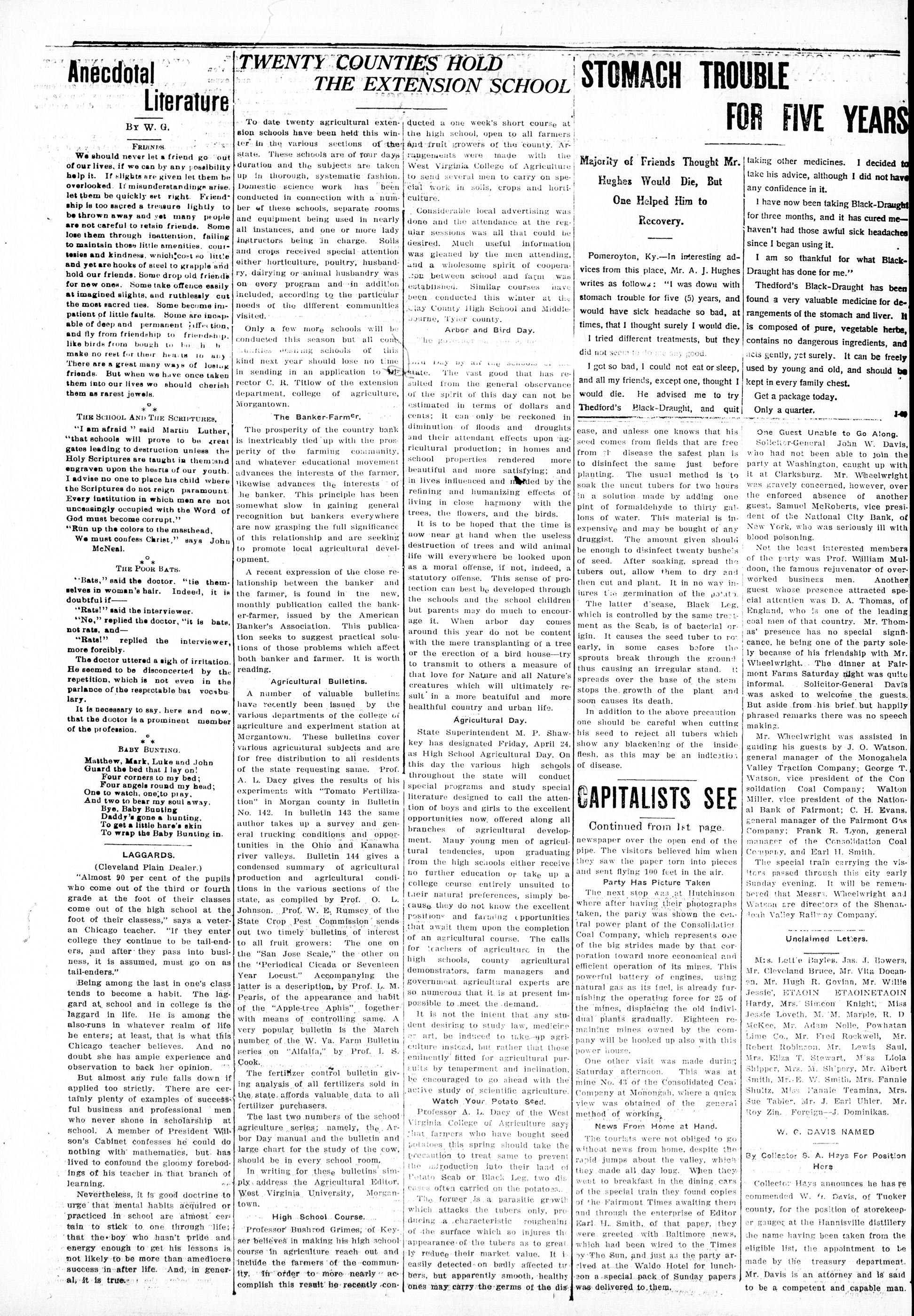
Page text (machine-generated)
The Pioneer Press.
"HERE SHOULD THE PRESS, THE PEOPLE'S RIGHTS MAINTAIN, UNAWED BY INFLUENCE AND UNBRIBED BY GAIN"
Department of Archives
The
ESTABLISHED 1882
GENERAL VILLA TRAPS FEDERALS IN RING OF IRON
Escape Cut Off, Surrender of Torreon's Defenders is Imminent.
MEN FACE DEATH
Rebels Force Way into Northern Section of Doomed City at Heavy Cost—Defenders Will Not be Allowed to Escape to Join Forces at Saltillo.
GOMEZ PALACIO, March 50.—Surrender of the federal garrison of Torre is imminent. Valasco's forces have found themselves frustrated in every effort to cut their way through the iron ring Villa has forged around the city.
Villa managed yesterday, at the cost of tremendous loss of life, to force his way into the northern section of the city at the defenses of which the constitutionalist artillery under direction of Gen. Angeles, has been hammering for several days.
According to constitutionalists estimates at least 4,000 men have fallen since the beginning of the siege the losses being about evenly divided between defenders and besiegers. On the constitutionalist side the losses have been heaviest in the Zaragoza brigade, which has lost 25 per cent of its 1,300 men, and the Durango regiment under Maclovio Herrera which by a wonderful charge against the southern defenses, achieved the honor of being the first of Villa's forces to penetrate the main city.
Had it not been for Villa's determination not to permit any part of Velasco's army to evacuate the city and possibly effect a junction with the strong garrison at Saltillo and Monterey, he might have been in possession of the city forty-eight hours ago. Villa's plan is to capture Velasco and his entire force, in order to facilitate the taking of Saltillo and Monterey, before he resumes his march to Mexico City.
WOMEN AND MONEY. (New York Times.)
When Mrs. Charlotte Perkins Gilman discusses a question she can, of course, utilize the liberty accorded to her sex in our surprising day and use words more simple and direct than a masculine commentator could safely venture even to quote. He must employ the softening veil of paraphase, though it involve the danger of inaccuracy, and say she says that in matters of the heart money counts for more with woman than with men. Daring much and getting a little nearer to her exact language, she says that men make money to get love, while women make love to get money.
By this she means, apparently, not to bring any change of gross venality against either men or women in general, but merely that the man works and earns in order that he may have the joys and comforts of a properly populated and equipped home, and that the woman, because of her comparative helplessness and incompetence, economically must, or at least does consider more than he in choosing or accepting a mate, the candidate's ability as a provider. There is certainly something in
4,000 KILLED SO FAR
this theory. Of course, there are men, as there are women, who consciously and deliberately marry for money, but they are not many, in this country, at least, and they are the objects of frankly expressed contempt. Women, if the mercenary motive be not too elderly, escape almost without criticism, and only in especially obnoxious cases is it at all severe.
Claim There is no Such Thing as 'Unwashed Wool"—Will Go Unwashed to Market.
The members of the Tri-State Wool Growers' association, in session at Wheeling last week, favor the method of putting wool on the maize unwashed. This was demonstrated when a resolution that they must interests of the members of the association are promoted by putting the product on the market unwashed carried almost unanimously at the meeting of the growers. There were several warm advocates of the washed wool however, and some likely detrite were indulged in before the resolution was passed.
According to several members of the association the washing of wool is a joke. They assert that a very small per cent of the wool placed in the market as washed is really washed. Most of it is merely put through the form of washing with no results.
Some interesting information was given to the members by wool dealers present at the meeting, which here out the contention that dealers are leaning more and more to the unwashed product each year. It was stated by a prominent local wool dealer that fully 95 per cent of the factories in the United States refuse to handle washed wool. A higher price is always asked for washed wool, and the fact that the washing is improperly done leaves the washed product no more valuable than the unwashed, it is asserted. It is predicted by members of the association that within a few years there will not be a pound of washed wool placed on the market.
A resolution made in order to please both the advocates of washed and unwashed wool was passed. This resolution was that if members decided to wash wool, to do it properly, and that if they decided not to wash it, to put it up properly and tag it before putting it on the market.
RATES ARE NAMED FOR EXPOSITION
Western Roads Announce What They Will Charge on the Round Trips.
The western railroads have announced their rates for the Pan-American Exposition at San Francisco, and the California-Panama Exposition at San Diego. From Chicago all roads will sell tickets for the round trip for $62.50; St. Louis, $57.50 and all points along the Missouri river, $50. The tickets will be good until December 21, 1915.
Colonel Roosevelt is safe in South America. Did anybody suppose that he could be knocked out by a mere cataract?—Chicago Record-Herald.
CAPITALISTS SEE THEIR INTERESTS IN WEST VIRGINIA
Joe H. Wheelwright Shows Moneyed Men What the State Has Done.
VISITORS INSPECT
BIG FACTORIES
Special Cars Carry Baltimoreans Over Monongahela Lines and Many Places of Interest are Visited. Dinner With Former Senator Clarence W. Watson.
Several score bankers and business men of Baltimore, New York and Washington Saturday tried out the idea of "Seeing West Virginia First" as the guests of Jere H. Wheelwright, president of the Consolidation Coal Company, and found it decidedly worth while. As a result of a very full day spent on the interurban cars of the Monongahela Traction Company, in the northern portion of the state, they have acquired a comprehensive personal knowledge of the industries, resources and commercial progress of this region. And by reason of the carefully planned schedule they realize now how much 'seeing' of West Virginia can be accomplished in one day.
The party trolleyed across country from 9 o'clock in the morning, viewing scenery, inspecting a variety of industrial plants and enjoying to the fullest extent Mr. Wheelwright's hospitality. Saturday night they were as pleasantly entertained as the dinner guests of former Senator C. W. Watson at Fairmont Farms.
Wanted State's Resources Known.
Mr. Wheelwright planned the trip because he felt his business friends and associates did not know enough about the resources and industries of Maryland's sister state despite the fact that many of them have large financial interests in West Virginia.
The start was made Friday night from Camden Station on a special train, which pulled into Weston at 9 o'clock Saturday morning. Since that time there was no let up in the tour, which took the delegation to factories, mines, through many towns, over many interurban trolley lines and finally landed them at Fairmont Farms.
On the Trolley Again.
This dinner at Mr. Watson's home Saturday evening concluded the day's entertainment, but at 9 o'clock Sunday morning the trolley trips were resumed and kept up until the delegation finally boarded its special at 1 o'clock for the return trip to Baltimore.
The day's itinerary included visits to the following:
At Clarksburg
Owens Eastern Bottle Company.
Grasselli Chemical Company.
National Carbon Works.
Phillips Sheet and Tin Plate Company.
At Haywood Junction—The "Cole-train gas well."
At Hutchinson—The central power plant of the Consolidation Coal Company.
At Monongah—Mine No. 43 of the Consolidation Coal Company.
At Fairmont—The Watson building. These visits were preceded by a five minute stop at Stonewall Jackson Mill, the interest there being entirely historical. The famous gener-
al, who was born in Clarksburg, lived on his uncle's farm, on which this mill is located. Schedule Without a Hitch.
A perfect schedule of special interurban cars of the Monongahela Valley Traction Company carried the party through this busy itinerary with out a hitch, while the arrangements of Graeme Turnbull, as quartermaster general, made certain that none should go hangry. Breakfast was served on the special train just before Weston was reached, and the entire party was taken to the Waldo Hotel at Clarksburg in time for luncheon. Saturday evening the guests were taken into Fairmont on a close schedule that gave just sufficient time for them to visit the special train, which had come on from Weston, prepare for dinner and then board more special cars for Fairmont Farms to enjoy the informal dinner with Mr. Watson.
Evidence was found on every hand of the extent to which the state's natural resources contribute to its commercial prosperity, not only through the sale of the three great fuels—gas, coal and oil—but also through the varied industries attracted here by the advantages of utilizing the natural gas at its source for manufacturing purposes.
Striking examples of how West Virginia profits by the possession of this fuel were furnished by the plants of the Grasselli Chemical Company, the National Carbon Company and the Phillips Sheet and Tinplate Company. The Grasselli plant, which was inspected by the Baltimore party, was the smaller of the two this company is operating at Clarksburg, yet there the visitors saw a force of 400 men at work making pig zinc from ore which had been brought all the way from Joplin, Mo. These two plants are kept going day and night every day in the year, furnishing steady employment for hundreds of men. And this continuous work is a big thing for the community.
The visitors were deeply interested in the process of smelting and went into minute details in their inquiries as to how the ore was handled. And at the Phillips Sheet and Tinplate Mills the same conditions existed. Tons of steel bars were seen there which had been hauled from the Carnegie works in Pennsylvania in order that the natural gas might be used in the tinplate manufacturing process.
Network of Trolley Lines.
The network of trolley lines was marked on every side by the signs that indicated how actively the work was going on of trapping the underground sources of wealth. The towers of the oil wells, the chutes and dumps of the coal mines and the pipes of the gas wells presented themselves all along the line, while every few miles appeared the smoking stacks of factories, plants and works of every description.
The first stop in the trolley ride after the bountiful luncheon at the Hotel Waldo was at the Coletrain gas well of the Fairmont Gas Company at Haywood Junction. The tourists gathered around the big pipe that had been sunk 2,400 feet into the earth, staffed into their ears cotton which had been thoughtfully provided by General Manager Evans and waited expectantly as a workman turned a valve at the end of the pipe. The cotton was quickly reinforced with the pressure of fingers as the rushing, hissing noise of the escaping gas struck the ears. "Three hundred and sixty pounds pressure there," said Manager Evans as he held a
Continued on fourth page
CIGARETTES WORST OF NICOTINE FOES
CIGARETTES WORST OF NICOTINE FOES
Minds of. Those Addicted to the Habit Lose Ten Per Cent of Power.
Tobacco smoking causes a decrease of 105 per cent in mental efficiency, according to a series of experiments by Dr. A. D. Bush.
There was a series of 120 tests on each of fifteen men in several different psychic fields. The subjects volunteering for the experiments all were medical students ranging in age from twenty-one to thirty-two years, of varying previous experience, from the farm labor to the life-long student, of divergent mental capacity, from the failure to the honor student and of different subjects were attendants at the University of Vermont, where Professor Bush is an instructor in physiology.
Among his findings are:
The greatest actual loss was in the field of imagery, 22 per cent.
The three greatest losses were in the fields of imagery, perception and association.
The greatest loss in these experiments occurred with cigarettes.
Nicotine was found in the distillates of all tobacco tested.
Nicotine was not found in the smoke of any tobacco except that of cigarettes, and then only in traces.
Pyridine was found in the smoke of all tobaccoes tested.
Pyridine is one of the decomposition products of nicotine, the latter being almost twenty-two times as poisonous as pyridine, so far as its action on the human body is concerned.
This was the first extensive investigation of the mental effects of smoking. The recent tests at Columbia university and elsewhere were chlefly for the physical effects on students in athletic training.
MATRIMONY AS A CURE.
Is the rage of the English militant suffragettes due to the fact that there are 1,000,000 more women than men, more or less, in the British isles? That the discontent with modern conditions which finds its expression in burning houses and knocking down defenseless men is due to the surplusage of women over men in that distressful country is the contention of the members of the Women's Homestead Association, which has just sent an appeal to King George to aid the single women among his subjects to migrate to Western Canada to become the wives of settlers here in the New World.
Itesolutions adopted by the association express the belief that if such a movement were carried out seriously the militant women of England would cease their warfare on Parliament. Can this be so? Is it husbands and not votes for which the single women of England are burning and booing and pounding meu? Can it be true that the rule of a husband is all that is necessary to solve one of the mightiest social problems with which modern civilization is confronted?
Ordered Verdict.
CHARLESTON—Sitting in place of Judge Keller, Federal Judge A. G. Dayton instructed a verdict for the plaintiff in the ejectment suit of Andrew Squires vs. J. A. Parker, from Raleigh county. A tract of coal and timber land valued at about $40,000 is involved.
The Pioneer Press
An Independent Weekly Newspaper Devoted to the Moral, Religious and Financial Development of Humanity.
Pay for all advertisements is due in advance unless advertising is run by yearly contract, in which case the advertiser pays every three months.
Advertising 1 inch one time 75c.
Standing ..... 50c
Reduced Rates to Clubs.
Send for Sample Copies.
Entered in Post Office at Martinsburg, W. Va. as Second Class Matter.
J. L. Clifford, Editor and Proprietor.
Drawer 869, and Bell 'Phone 60K, Martinsburg, W. Va.
SATURDAY, APRIL 4 1914.
In the death of Mrs. Rosalie Hollida, daughter of Mr. John H. Blondel, this city lost one of its best women. She was a devoted daughter, a loving wife, a tender, careful and dutiful mother.
When the life of Hon. John C. Hutzler ebbed away, as fine a man as lived in Martinsburg ceased to move and mingle with the living. He was nature's gentleman. Free of prejudice, he has faced his Maker with applauds for it
The severest criticism of President Wilson is fathered by the New York World, and it is the best sermon on the funeral, the death and burial of the Democratic Party we have ever read—hurry up and bury it.
Nothing is more disgusting to us than for some fool Negro to sell his race's rights on the plea of being true to a party. I was a Negro, and ostracised for so being before I knew of political parties. Use parties to kill caste. It can be done.
Everywhere in the North, Western and Southern part of this state where we have been, very encouraging has been the situation.
Wheeling, Parkersburg, Clarksburg. Charleston and Huntington, have school houses for colored children, that lay any of Martinsburg's best ward and grammar schools far in the background. In addition to teaching the children, night schools are held for the aged
The editor of the Pioneer Press would rather, by far, live and die a Mohammedan, and risk his destiny as to the hereafter with God, from the fact, it teaches the fatherhood of God, and the brotherhood of man regardless of the color of the skin, or the kink of the hair; while protestantism denies both, by preaching their gospel and practising]what they preach, and considers its folk who have paler skins and straighter hair superior—why, God himself, only knows.
Some years ago when this paper warned this country of Japan, it only produced reliability. Who is laughing now? Certainly not President Wilson, who knows not what to do. Set it down as a fact, that the Mexican war is almost constant to encourage this country in years when the Philippines will be taken over Hawaii not also be taken then on to California, and all because of our greed and hatred of men because nature and climate colored and kinked the hair of men as has been the case with other living things.
The Democratic party is not broad and good enough to live up with its best men, when they take a stand for right. What has the school teacher president done for the democratic party in comparison with Champ Clark? The latter is a statesman, aggressive and progressive and fair alike to all, while the former is narrow and full of prejudice. The standshe is taking, in defense of America's rights relative to the Panama Canal will endear him to millions, and if left to them by a national-wide primary, and Wilson would be his opponent, Clark would beat him worse than T. R. did Taft.
Ex-Senator Joseph W. Bailey, who was driven from the U. S. Senate by the New York Journal's expose of his dealings with the Standard Oil Company, in a financial way a few years ago, is evidently trying to get into the Senatorial limelight once more and has adapted the methods peculiar to statesmen of his mental 'calibre—condemnation of the
Negro—on general principles expressing fictitious fears of the Negro, and veiled threats of a race war, if the Negro dares avail himself of the right to assert his constitutional rights. The Ex-Senator reminds the public that when the Indian ASSERTED his rights he was promptly put to sleep by the white man, and he warns the Negro not to imitate the red man or he will be a dead man. We hesitate to believe that Jo' Eaily voices the sentiments of the respectable and fair minded white people of this country. It is not a difficult matter for us however to believe, that he speaks for that large class in the South who make a pastime of killing Negroes and think it no crime. Mr Bailey who is originally from the State of Mississippi where he chased impersonated the law
would not, we opine, have the highest objection to leading an army of extermination should a race war ever take place in this country for we understand that he has had some experience in the business of Murder in his home state, and migrated to Texas where he engaged in the statesman business and went to the Senate. Think God, there are not many Jo' Baileys in power in this land. It is a safe bet that Joe Bailey's dream will not come true.
RESERVE BANKS WILL OPEN WITH LARGE CAPITAL
$100,000,000 Assured Without Regard to the Number of Institutions.
ALL IN GOOD CONDITION AND MANY WERE LATE
Loans and Discounts Have Increased Throughout the Country Very Rapidly and Have Reached $1,788,000,000—Subscribing Banks Must Begin Payments For Their Stock. Promptly.
WASHINGTON, April 2.—The new federal reserve banking system will start business with a total authorized capital of about $100,000,000 for all reserve banks, no matter how many institutions the organization committee decides to set up. This fact became apparent last night when figures were made public from all national banks responding to the last call of the comptroller of the currency, March 4.
The statement issued giving these figures will be the last of the kind before the formal launching of the system, unless the organization changes its present purpose and delays the announcement of the reserve districts and cities. The total capital and surplus of the 7,494 national banks reporting was given at about $1,788,000,000. Under the reserve act each national bank must subscribe i per cent of its capital
Many Were Too Late.
There were only 7,465 national banks who signified in their legal time their intention to enter the system, so that the total would be somewha reduced, but the entrance into the system of state banks and trust companies, will tend to offset this, and it is possible that with these institutions figured in the capital of all reserve banks will be near $110,000.
The actual working capital of the reserve banks may only reach half this amount, for the law provides mandatory subscriptions of only three-sixths of the total six per cent. The reserve board, the machine which will direct the system, however, is authorized to demand the payment of the other three-sixths.
The statement yesterday shows national banks in excellent condition to meet the demands of the new law. Some observers were surprised by th fact that loans and discounts have increased instead of being curtailed. Loans and discounts on March 4, 1914, amounted to $6,357,525,808, a
gain over January 13, 1914, the time of the last call, of $182,130,936.
Must Begin Promptly.
Subscribing banks must begin payments for their reserve bank stock 30 days after the announcement of the districts and reserve cities, and it was believed in some quarters that yesterday's statement might show a decrease in loans and discounts because of this impending announcement. The loan and discount increase taken together with the fact that individual deposits increase in the same period by more than $39,000,000, was aid to be the best indication that the national banks are in shape to meet the demands of the new
According to the statement the resources and liabilities of the national banks were $11,564,497,260; their stock, $1,056,482,120, and their individual deposits, $6,111,328,457. Their reserves were put at $1,547,592,375, an average of 20.62 per cent and $47.29,429 above the amount required by law. The cash in banks decreased since January, 1914, about $14,000,000, but increased over April, 1913, about $80,000,000. During March 10 new banks were authorized to begin business, and since the currency act was signed there have been 184 applications for conversion into national banks or for entrance into the new system as state institutions.
WEST VIRGINIA SUGAR PRICES
Are Fixed by Organization, Says a Wholesale Manager.
NEW YORK, April 2.—Sugar prices in West Virginia are prescribed by the Wholesale Grocers' Association of that state through the fixing of an arbitrary freight rate, it was testified yesterday by J. P. Maxwell, manager of a Wheeling grocery firm in the hearing of the government's dissolution suit against the American Sugar Refining Company. The members of the organization, however, were not obliged to sell at the prescribed price said the witness, though a list sent out by W. C. McConaughey, president of the association, stated what prices should obtain.
Mr. Maxwell gave it as his opinion that the American Sugar Refining Company was responsible for this price equality plan.
Broke Jail.
RONCEVERTE.—David Barker and Morris Collins broke jail at Union. Collins was recaptured but Barker is still at large and it is supposed he is hiding in the mountains.
STORY OF A YEAR
TOLD IN PICTURES
HUCKLEBERRY
In very unusual publication along entirely new lines, is the North American's "History of the Year in Pictures," a book that covers with artistic photographic reproductions all the big events of 1913 that could be treated successfully in such a way. The book 120 pages in board covers, costs 25 cents, and is a faithful reminder of the year
Nearly 500 finely printed halftones are made use of in telling the story of the year. The events so treated will surprise the busy man, who would find himself stumped if called upon to name a score of the great occurrences of the year. The plague in Manchuria, the world's great inventions, the inauguration, the war in the Balkans, the completion of the Panama canal, naval advances, the conquest of the air, the succession of great rulers, women and, the vote, fighting disease, labor troubles the western floods, the Gettysburg celebration and numbers of other events are fully and faithfully pictured and photographed
The North American book is a faithful book of reference for young and old students of current events. It is surprisingly good and surprisingly cheap. Price, 25 cents; by mail, 10 cents extra.
AN APPEAL TO THE NEGRO BRETHREN
for help while collecting materials
for the International Exhibition of
the Book-Industry and Graphic Arts
Le.pzig, May-October, 1914.
On account of the celebration
of the 150th Anniversary of the Royal
Academy for the Graphic Arts and
the Book-Industry at Leipzig, Gern-
many; there will be a great Exhibit.
lands and nations from the earliest times up to these days. The plan of the exhibition shows the following 16 groups: I. Graphic Arts; II. Applied Graphics and Book-making, Illustrating; III. Instruction, Education, Schools; IV. Paper Manufacturing; V. Stationery and Writing Materials; VI. Colors, Lithographies and Copper-plates; VII. Photography, VIII. Reproduction; IX. Streotypy, Electrotypy; X. Printing Processes; XI. Bookbinding; XII. Publishing, book-trade; XIII. Newspapers, Advertising, Canvassing, Periodicals; XIV. Libraries; XV. Machinery; XVI. Measures for the Protection and Welfare of the Workers, etc.
These groups have been subdivided into about 62 classes. Each group is to be introduced by a historical and a technical instructive department. The development and the position in the history of civilization of the various branches of the book industry will be clearly demonstrated, models and apparatus for demonstrating purposes and the cinematographic art will be shown. The publications of booksellers and music publishers will be brought directly to the notice of the public through the medium of libraries and reading rooms, through lectures, public readings, recitations and concert recitals. Anything in our mind will be under the banner of the "black art." Many learned societic and associations connected with the book industry will have their congresses and meet at the exhibition ground.
When I read the news I asked my self if it would be possible to show at the exhibition some exhibits of the negro people in America, in whose matters I am especially interested. So I come to all willing to help me in my undertaking, to ask for their cooperation while collecting exhibition matters. Any printings, writings, photos pictures out of the slavery time until this day will be welcome.
Pupils and students, lessons school plans and pictures, photos of professors, teachers, students and buildings, whole models of publishing houses, Schools, Colleges and Universities will be heartily accepted. Likewise drawings of scholars and students.
Authors of publishing houses should send all books and pictures and writing they have published one or more copies with order books that every exhibition visitor may have the opportunity of ordering the exhibits through myself.
Lodges, banks, societies and other organizations should contribute some amount to cover the cost of certain matters to be bought while not on the market. Editors should send the best they have, if possible a model of the whole business plan.
Here is an opportunity for the Colored people of America and for those who have devoted their lives to the culture-work among the colored people, to demonstrate what they have done already and what they could do in the future. Another important feature while collecting exhibition materials is that all will have great value for the future, as the great Museum-library of Leipzig will participate in the exhibits when the fair is over.
You will have no expenses to pay for the exhibition of what you send. I will care for that. But whatever you send write your name upon it. Please do what you can in the
matter. Write about your help as soon as possible and send your exhibits—old or new, good and bad—to
PASTOR PAUL O. HENTSCH,
Grundsberger U. I. Leipzig-Li.
Germany.
Other negro papers are asked to print the foregoing lines of Pastor Rosen in their respective columns.
THE EDITOR.
HOMIL
Statue Arrives in Washington and is being Placed in Position.
The statue of Commodore Barry, cast in bronze from a tall size paster model, mead by Sculptor John J. Joyce, of New Work, arrived in Washington last week and is now in position on the pedestal in Franklin Park, where, wrapped in the flag which the great Irish Naval hero did so much to establish, it will await the dedication and unveiling on May 16 next. That date has been fixed by the Barry Moaument Commission, of which Secretary of War Garrison is chairman, at the suggestion of representatives of various Irish-American organizations interested in this movement to honor the Revolutionary Naval hero. In size and general characteristics the statue somewhat resembles that of Rochambeau, which stands in Lafayette Park, opposite the White House.
Splendid Site.
The Barry Monument stands on one of the best sites in the National Capital, on the 14th street side of Franklin Park, between I and K streets. Fourteenth street is the great thoroughfare leading into the most fashionable section of Washington. Thousands of people will pass the monument daily, and in its commanding position it will be a constant reminder of the valor of the men of Ireland in the struggle for american independence.
The Preparation.
Since the monument has been placed in position, the Washington Committees have been unusually energetic in shaping arrangements for the coming unveiling exercises. Hundreds of invitations will go out during the coming week to organizations and individuals throughout the country. Every Irish society in America will be invited to send representatives to Washington and it is understood that arrangements are being made by many of them to have large delegations in the National Capital in May 15 and 16. All of the Knights of Columbus Councils bearing the name of Commodore Barry will also receive invitations to participate in the dedication.
The above meeting, held on the Saturday of University Day, on the Saturday and also attended in the Mary Monument. Another number of the Knights coming in Washington, their brothers of the National Capital will extend hospitalities to the visitors on May 15, 16 and 17. This was decided on at the last meeting of Washington Co Council, and all the other councils will cooperate.
Officers Raid Still.
CHARLESTON—Revenue officers Saturday raided a moonshine still in Mercer county, capturing a quantity of corn whiskey and 130 gallons of beer. The plant, of seventy-three gallons capacity, and complete in every particular, is said to have been in operation several years but so carefully concealed that federal officers were unable to locate it. Charles Mills was arrested.
J. R. CLIFFORD
Attorney At Law
MARTINSBURG, WEST VIRGINIA. Practices in all the Courts of West Virginia, the Supreme Court of Appeals and the United States Courts
TWO ASSISTANTS HAVE BEEN NAMED
Attorneys J. J. P. O'Brien and Harry Byrer Land the Plums.
District Attorney Stuart W. Walker received a telegram Wednesday night from Attorney General McLevoy, stating that Attorney J. J. P. O'Brien, of wheeling, and Attorney Henry Byrer, of that polly had been appointed to the commission and that he would be granted the office of attorney.
This morning Mr. Walker notify the gentlemen of their appointments and instructed them to report here for the regular term of federal court which convenes next Tuesday. The new assistants are expected to arrive Sunday right, and spend Monday getting acquainted with the cases which will be tried before the term adjourns, and also familiarize themselves generally with their duties.
It had been hoped by the many friends of Attorney Cleveland M. Sextert that he would land one of the positions, and it may be yet this will be done. Mr. Walker asked for three assistants, as the business is extremely heavy and will keep the district attorney and his assistants very busy, but the Department of Justice has not granted the request.
Mr O'Brien is one or the best known lawyers of the Ohio county hap. He has handled some of the largest cases in that section of the state and been very successful. He has always been identified with the Democratic party and has rendered valiant service. Mr. Byrer is one of the young Democrats of the state, and is secretary of the Democratic State Executive committees. He has practiced his profession for several years, and has made his mark.
The State Banks.
CHARLESTON.—An abstract to the condition of state banks of West Virginia has been made public by Samuel V. Matthewson, commissioner of banking. Compared with the last previous report made in October, deposits have increased approximately $2,000,000, the aggregate deposits being $76,000,000. Assets of state banks exceed $101,000,000.
DOG HAS $1,200 A YEAR
Boston, April 1.—"Pete Crafts' will continue to enjoy luxuries uncommon among dogs. The probate court yesterday approved the will of his late master, John Chancellor Crafts which provides a fund of $1,200 a year for the upkeep of Pete. Relatives who have been cut off without a cent, contested the will, alleging "undue influence." At the hearing, witnesses told how Pete had presided at the head of the table at "birthday parties" given in the hearer.
```markdown
```
Marshal C. E. Smith, wife and child are registered at the Chancellor, and will remain here a few days while the former transacts business connected with his office. When seen by a reported recently the new marshal stated that he would probably have something to announce within a few days relative to appointments but as yet had nothing definite to give the press relative to them.
Steamed Fish.
This is an appropriate way to serve any large, firm fleshed fish, and will be found more satisfactory than boiling. Wash and dry the fish, dust it well with flour and wrap it in a dampened and floured square of cheese cloth; lay on a plate and steam until the flesh draws away from the bones. After scraping off the skin, transfer carefully to a hot platter and garnish, it is usually best to serve the sauce separately. Kansas is reported to have 15,000 widows. That ought to be an inducement to new settlers.—Wheeling Telegraph.
LIQUOR FORCES ON THE DEFENSIVE
Question Will be Put to Severe Test in Tuesday's Election.
CHICAGO, Ill., April 2.—In the city and township elections to be held throughout Illinois next Tuesday the lower question will be put to the everest test to which it has ever been subjected in this state. With respect that 2,000 subpoenas may
situation that comes of a knowledge but defeat means death to their business. The antisaloon forces, on the other hand, are supported in their battle by a feeling of confidence that they are on the eve of the greatest victory they have ever won in this state. On both sides the struggle is being conducted with as much vigor as ever attended a political contest in Illinois.
Thirty-one out of the 102 counties of Illinois are now entirely "dry." That numerous counties will be added to this list as a result of the coming election is generally regarded as a foregone conclusion. The liquor interests are plainly on the defensive and are fighting with a view to keeping their losses at the lowest minimum.
The "drys" have filed petitions in about 200 townships and cities which vote next Tuesday. These voting units include a total of more than 300 villages and cities. Under the local option law the unit may be a township, city or village. Inasmuch as most townships include some rural territory, besides one or more villages, towns or cities, the "drys" if most instances prefer to have the
state based on the township as a unit. In addition to the townships and some of the larger cities that voted Tuesday about thirty additional cities and villages now with saloon. It vote on the saloon question April 11. Chicago, Peoria and East St. Louis are virtually the only cities of the state in which the saloon issue will not be voted on before the end of the month. No great attempt was made to force the issue in Chicago this year, though a small group of individuals did make an unsuccessful endeavor to obtain the 75,000 signatures necessary before the question could be brought to a vote. Peoria is the largest center of the distilling industry in the country and for the time being any attempt to swing it into the "dry" column is considered hopeless. The proximity of East St. Louis to the great Missouri metropolis militates against the success of the "dry" movement there and caused the saloon league to defer any attempt to make the question an issue at the coming election.
The most important of the down battles is being fought in Spring
kind, Decatur, Freeport, Aurora, Mattoon, Moline, Danville, Galena, Monmouth, Alton, Dixon and Mount Sterling.
That the "wets" are on the defensive throughout the state is evidenced by the fact that they have filled petitions in only about a dozen cities and towns which are already dry. In eighteen counties the saloons are making their last stand.
The "drys" have been aided in their campaign throughout the state by numerous prohibition leaders of wide prominence. Among those who have toured the state in the interest of the movement are John G. Wooley who was the Prohibition candidates for president of the United States in 1900, and Dr. Howard Russell, founder of the National Anti-Saloon League.
Alarmed by the vigorous campaign of the "drys" the liquor interests, as represented by the Illinois State Brewers' association, the Distillers and Jobhers' Association and the Liquor Dealers' Protective Association, planned two weeks ago to make
GEORGE JORDAN GOES TO WILSON
Convicted White Slaver Appeals for Pardon Direct to the President.
George Jordan, Charleston man serving thirteen months in the state penitentiary at Moundsville for white slavery, failing to get District Attorney Barnhart, of Charleston to intercede with the Department of Justice in securing him a pardon, has carried his case through the court. Witnesses in the courtroom have announced from Washington, turned the petition back to the department of justice, which in turn has made a request of the district attorney for a recommendation. Recommendations have been secured from all the city and county officials at Charleston except two and from 600 private citizens.
Jordan claims he is in ill health. He also asserts that his reformation is complete and that further imprisonment could do no more to bring home to him the enormity of his wrong. His wife has forgiven him and is not only eager to take him back but sadly needs his support, it is stated.
Jordan was convicted at the December term of federal court at Charleston for bringing a madam from Kentucky and living with her. The petitions ask clemency in the form of either a parole or a pardon. As federal prisoners are not eligible to parole until they have served at least a third of their sentence, Jordan, if his plea, is immediately answered, would be released under an absolute pardon.
ROANOKE SHOPS HAVE REOPENED
ROANOKE SHOPS HAVE REOPENED
Nine Hundred Men are Put to Work on Part Time.
Work was resumed in the general shops of the Norfolk and Western at Roanoke, Va., Wednesday, 900 men being returned to work on reduced time. The order aects shop men throughout the system.
The Norfolk and Western shops had been closed since March 14, the shutdown being necessary, according to the general officers, to "get within the appropriation."
It was announced at the hearquarters of the company that engineers and trainmen had withdrawn their request for increase in pay.
Oppose Easter Dansant.
HUNTINGTON.—Twenty-one pastors, members of the Ministerial Al
been made by persons including the social elite of southern West Virginia.
a spectacular campaign in all doubtful districts in a special train, with a brass band and an army of orators. The plan was abandoned, however, on the advice of some of the liquor dealers who believed that such a demonstration would only serve to make the anti-saloon people more determined in their fight.
The most disquieting feature of the struggle from the viewpoint of the saloon element is the fact that in most places the women will vote for the first time in the local option contests. It is remembered that several small towns which voted on the saloon question last November were made "dry" by the women's votes. For the coming elections the registration of women in the small cities and towns has been unusually heavy and the "drys" are confident that with the aid of the women they are certain to win sweeping victories.
PRECEPT AND PRACTICE.
Everything depends upon our viewpoint in all crises in life and experience must eventually teach us that precept and practice vary widely. No matter how sincere we may believe ourselves to be when we attempt to counsel others or to comfort them in time of distress we cannot possibly understand their point of view unless we ourselves have experienced the same ordeal through which they are passing. The man who has suffered some severe financial loss, for example, or who lives to see the downfall of his highest hopes or yet who is called upon to endure the pain of parting forever with a loved one is not easily comforted by the
attempt to speak of things they do not understand. The sympathy that comprehends is easily recognized and no one is ever too deeply affected by his own morbid reductions to be unable to appreciate its influence. We cannot fully understand until we have experienced and all the observations which we may gather from day to day are not worth a hundredth part of the realizations that come to us first-hand. He who has felt the weight of circumstances, who has been forced to face for himself conditions which hitherto he has only observed from afar detects the difference as soon as the full realization comes and the memory of the doctrines he has preached comes back to him with startling clearness. He sees himself the crude sympathizer who has bungled his task; he realizes the limitations of those powers which once he believed inexhaustible and he understands at last the disappointment and heartache he discountenanced in others.
BASEBALL NOTES
Arthur Griggs, former first baseman of the Cleveland Naps, has joined the Brooklyn Federal league team. From all accounts 'Rabbit' Maranville is the real live wire of the Boston Braves, not excepting the scrapy Johnny Evers. Young O'Mara has been holding down the regular job at short for the Brooklyn Superbas. He looks like a fixture with the Robinson crew. Leach Schulte and Johnson stand as the Cubs' speed merchant to date. Good has been fielding well, but has not been hitting.
Manager Jack Dunn has gathered a fast bunch of Baltimore Orioles this spring and he believes his team will outclass the Baltimore Fed outfit.
Ty Cobb and Sam Crawford have started to paste the pellet, which means the slaughtering of the minor leagues with which the Tigers engage in battle.
Manager Pieper, of the Lawrence New England league team, has signed the younger brothers of Christy Mathewson and Smoky Joe Wood. Both boys are pitchers.
Joe Oeschger, the Phillies' youthful player from California, cost President Baker $3.500. He played with
Manager Matthews of the troubled team is taking no chances these days of his regulars jumping the job. Manager Mac is signing up all of his stars to long-term contracts.
It has been a great spring for the yannings with the Giants and Red Sox. The two rockie outfits have shown up their big brothers so often in the practice games that the goats of the regulars have flown.
The services of President Dreyfuss as a schedule maker are in great demand about this time of year. The boss of the Pirates has just completed a schedule for the Western Canadian (Twilight) league, in which the games are not started until 6 o'clock in the evening.
With so many "B's" in the training camp of the Athletics it begins to look like another sting for the other American league teams, with the world's champs copping the honey again next October. With the Mackmen are Baker, Bender, Barry, Bush, Brown. Baldwin, Bohen, Bressler, Boardman and a second Baker, who is a rockie pitcher.
OF GENERAL INTEREST
WANTED—Respectable gentleman wants a good woman as housekeeper. Full particulars obtained by applying at Press office.
SALESMAN WANTED to look after our interest in Berkeley and adjacent counties. Salary or Commission Address HARVEY OIL CO., Cleveland O.
For the best of all kinds of boots and shoes, go to Charles E. Thompson, 123 North Queen Street. His stock is excellent, and the coutesies of his clerks can't be excelled. Try him and be convinced.
the popular pastor of Mt Zion M. E. Church, has finished a very successful year's work, will preach his farewell sermon tomorrow night, and leave for the Washington Conference Monday morning. The good wishes of numerous friends go with him, and they are hoping he will be returned for another year. The Conference meets thus year at Annapolis, Md.
Mr. Levi Miller, of Kernstown, Va., was a caller at our office not long ago, and being his first visit in several years, we were glad to see him, and pleased to note his great activity. Although no longer a young man, Mr. Miller goes about his many duties with a sprightly step. In addition to other possessions, Mr. Miller is the owner of one of the finest peach and apple orchards in the Shenandoah Valley. He is a worthy example for young men to pattern after, and we wish there were more like him.
Mr. James Jones, has returned to his work at the Blair Limestone Company's Plant, after going to Luray, where he was called by the illness and death of his wife, Mrs. Elizabeth Jones. Stricken down in apparent health, the sudden taking off of this excellent young woman is a distinct shock to her husband, relatives and friends. The Colored Churchman, with which Mrs. Jones had been connected since its establishment, suffers a loss in her death which will be hard to fill.
Mr. John Jefferson, of Darksville, while spraying trees in Mr. Clyde Borum's orchard on Tuesday, was so badly injured by a bursting spray tank that he died shortly afterward in the City Hospital, where he had been brought in the hope that something might be done for his relief. Mr. Jefferson was well and favorably known in Berkeley and Jefferson Counties by scores who sorcely regret his untimely and horrible death. He is survived by a widow and several children, with whom we sympathize in their loss. His funeral was held at his former home in Middleway, Jefferson County, on Thursday.
Following a brief illness from pneumonia, Mr. Rhodes Warrick, a well known and highly respected citizen of our town, departed this life at his home on Samuel Streat Monday evening. Mr. Warrick was thoroughly honest, clean in his home life, and a citizen of whom it may be truthfully said that his death is in the nature of a palamity, because men like him are not found every day. Whether at home, about his daily labor,
identified by the authorities, the way he lived is motionless enough to leave behind. Mr. Warrick is survived by a wife and three children, who have our sympathy in their great sadness. Funeral services over the remains of the deceased were held in Dudley Baptist Church, of which he was a member, on Thursday afternoon, Rev. R. R. Thompson, the pastor, officiating.
Judge Resigns.
WASHINGTON, April 2. "I am resigning simply because of the inadequacy of the salary." This is the explanation given by William L. Day, judge of the Northern Ohio District, in his letter of resignation received yesterday by Attorney General McReynolds. He is a son of United States Supreme Court Justice Day.
Woman Jockey Killed.
NEW YORK, April 2.—Miss Elia Hackett, 19 years old, employed as a woman jockey in the Barnum and Bailey circus, was instantly killed by a fall from a trapeze to the stage in Madison Square Garden while practicing a flying swing last evening just before the regular performance.
We should never let a friend go out of our lives, if we can by any possibility help it. If slights are given let them be overlooked. If misunderstandings arise let them be quickly set right. Friendship is too sacred a treasure lightly to be thrown away and yet many people are not careful to retain friends. Some lose them through inattention, failing to maintain those little amenities, courtesies and kindness, which cost so little and yet are hooks of steel to grapple and hold our friends. Some drop old friends for new ones. Some take offence easily at imagined slights, and ruthlessly cut the most sacred ties. Some become impatient of little faults. Some are incapable of deep and permanent inflection, and fly from friendship to friendship, like birds from bough to bough, make no rest for their hearts in any. There are a great many ways of losing friends. But when we have once taken them into our lives we should cherish them as rarest jewels.
THE SCHOOL AND THE SCRIPTURES.
"I am afraid" said Martin Luther, "that schools will prove to be great gates leading to destruction unless the Holy Scriptures are taught in them; and engraven upon the hearts of our youth. I advise no one to place his child where the Scriptures do not reign paramount. Every institution in which men are not unceasingly occupied with the Word of God must become corrupt."
"Run up the colors to the masthead,
We must confess Christ," says John
McNeal.
THE POOR BATS
"Bats," said the doctor, "tie themselves in woman's hair. Indeed, it is doubtful if—
"Rats!" said the interviewer.
"No," replied the doctor, "it is bats, not rats, and—
"Rats!" replied the interviewer, more forcibly.
The doctor uttered a sigh of irritation. He seemed to be disconcerted by the repetition, which is not even in the parlance of the respectable bat vocabulary.
It is necessary to say, here and now, that the doctor is a prominent member of the profession.
BABY BUNTING.
Matthew, Mark, Luke and John
Guard the bed that I lay on!
Four corners to my bed;
Four angels round my head;
One to watch, one to pray.
And two to bear my soul away.
Bye, Baby Bunting
Daddy's gone a hunting.
To get a little hare's skin
To wrap the Baby Bunting in
LAGGARDS.
(Cleveland Plain Dealer.)
"Almost 90 per cent of the pupils who come out of the third or fourth grade at the foot of their classes come out of the high school at the foot of their classess," says a veteran Chicago teacher. "If they enter college they continue to be tail-enders, and after they pass into business, it is assumed, must go on as tail-enders."
Being among the last in one's class tends to become a habit. The laggard at school and in college is the laggard in life. He is among the also-runs in whatever realm of life he enters; at least, that is what this Chicago teacher believes. And no doubt she has ample experience and observation to back her opinion.
But almost any rule falls down if applied too strictly. There are certainly plenty of examples of successful business and professional men who never shone in scholarship at school. A member of President Wilson's Cabinet confesses he could do nothing with mathematics, but has lived to confound the gloomy forebodings of his teacher in that branch of learning.
Nevertheless, it is good doctrine to urge that mental habits acquired or practiced in school are almost certain to stick to one through life; that the boy who hasn't pride and energy enough to get his lessons is not likely to be more than amediocre success in after life. And, in general, it is true.
TWENTY COUNTIES HOLD THE EXTENSION SCHOOL
To date twenty agricultural extension schools have been held this winter in the various sections of the state. These schools are of four days duration and the subjects are taken up in thorough, systematic fashion. Domestic science work has been conducted in connection with a number of these schools, separate rooms and equipment being used in nearly all instances, and one or more lady instructors being in charge. Soils and crops received special attention either horticulture, poultry, husbandry, dairying or animal husbandry was on every program and in addition included, according to the particular needs of the different communities visited.
Only a few more schools will be conducted this season but all constituencies desiring schools of this kind next year should lose no time in sending in an application to Director C. R. Titlow of the extension department, college of agriculture, Morgantown.
The Banker-Farm $ ^{e r} $ .
The prosperity of the country bank is inextricably tied up with the prosperity of the farming community, and whatever educational movement advances the interests of the farmer, likewise advances the interests of the banker. This principle has been somewhat slow in gaining general recognition but bankers everywhere are now grasping the full significance of this relationship and are seeking to promote local agricultural development.
A recent expression of the close relationship between the banker and the farmer, is found in the new, monthly publication called the banker-farmer, issued by the American Banker's Association. This publication seeks to suggest practical solutions of those problems which affect both banker and farmer. It is worth reading.
Agricultural Bulletins.
A number of valuable bulletins have recently been issued by the various departments of the college of agriculture and experiment station at Mergantown. These bulletins cover various agricultural subjects and are for free distribution to all residents of the state requesting same. Prof. A. L. Dacy gives the results of his experiments with "Tomato Fertilization" in Morgan county in Bulletin No. 142. In bulletin 143 the same author takes up a survey and general trucking conditions and opportunities in the Ohio and Kanawha river valleys. Bulletin 144 gives a condensed summary of agricultural production and agricultural conditions in the various sections of the state, as compiled by Prof. O. L. Johnson. Prof. W. E. Rumsey of the State Crop Pest Commission sends out two timely bulletins of interest to all fruit growers: The one on the "San Jose Scale," the other on the "Periodical Cicada or Seventeen Year Locust." Accompanying the latter is a description, by Prof. L. M. Pearis, of the appearance and habit of the "Apple-tree Aphis" together with means of controlling same. A very popular bulletin is the March number of the W. Va. Farm Bulletin series on "Alfalfa," by Prof. I. S. Cook.
The fertilizer control bulletin giving analysis of all fertilizers sold in the state affords valuable data to all fertilizer purchasers. The last two numbers of the school agriculture series; namely, the Arbor Day manual and the bulletin and large chart for the study of the cow, should be in every school room. In writing for these bulletins simply address the Agricultural Editor, West Virginia University, Morgantown.
High School Course.
Professor Bushrod Grimes; of Keyser believes in making his high school course in agriculture reach out and include the farmers of the community. In order to more nearly accomplish this result he recently con-
ducted a one week's short course at the high school, open to all farmers and fruit growers of the county. Arrangements were made with the West Virginia College of Agriculture to send several men to carry on special work in soils, crops and horticulture.
Considerable local advertising was done and the attendance at the regular sessions was all that could be desired. Much useful information was gleaned by the men attending, and a wholesome spirit of cooperation between school and farm was estabtised. Similar courses have been conducted this winter at the Clay County High School and Middlebourne, Tyler county.
ford Day by all the schools of the state. The vast good that has resulted from the general observance of the spirit of this day can not be estimated in terms of dollars and cents; it can only be reckoned in diminution of floods and droughts and their attendant effects upon agricultural production; in homes and school properties rendered more beautiful and more satisfying; and in lives influenced and burdened by the refining and humanizing effects of living in close harmony with the trees, the flowers, and the birds.
It is to be hoped that the time is now near at hand when the useless destruction of trees and wild animal life will everywhere be looked upon as a moral offense, if not, indeed, a statutory offense. This sense of protection can best be developed through the schools and the school children but parents may do much to encourage it. When arbor day comes around this year do not be content with the mere transplanting of a tree or the erection of a bird house—try to transmit to others a measure of that love for Nature and all Nature's creatures which will ultimately result in a more beauiful and more healthful country and urban life.
Agricultural Day.
State Superintendent M. P. Shawkey has designated Friday, April 24, as High School Agricultural Day. On this day the various high schools throughout the state will conduct special programs and study special literature designed to call the attention of boys and girls to the excellent opportunities now, offered along all branches of agricultural development. Many young men of agricultural tendencies, upon graduating from the high schools either receive no further education or take up a college course entirely unsuited to their natural preferences, simply because they do not know the excellent positions and farming opportunities that await them upon the completion of an agricultural course. The calls for teachers of agriculture in the high schools, county agricultural demonstrators, farm managers and government agricultural experts are so numerous that it is at present impossible to meet the demand.
It is not the intent that any student desiring to study law, medicine or art, be induced to take-up agriculture instead, but rather that those eminently fitted for agricultural pursuits by temperment and inclination, be encouraged to go ahead with the active study of scientific agriculture. Watch Your Potato Seed.
Professor A. L. Dacy of the West Virginia College of Agriculture says that farmers who have bought seed potatoes this spring should take the precaution to treat same to prevent the introduction into their land of Potato Scab or Black Leg, two diseases often carried on the potatoes.
The former is a parasitic growth which attacks the tubers only, producing a characteristic roughening of the surface which so injures the appearance of the tubers as to greatly reduce their market value. It is easily detected on badly affected tubers, but apparently smooth, healthy ones may carry the germs of the dis
STOMACH TROUBLE FOR FIVE YEARS
Majority of Friends Thought Mr. Hughes Would Die, But One Helped Him to Recovery.
Pomeroyton, Ky.—In interesting advices from this place, Mr. A. J. Hughes writes as follows: "I was down with stomach trouble for five (5) years, and would have sick headache so bad, at times, that I thought surely I would die.
I tried different treatments, but they did not seem to do me any good.
I got so bad, I could not eat or sleep, and all my friends, except one, thought I would die. He advised me to try Thedford's Black-Draught, and quit
ease, and unless one knows that his seed comes from fields that are free from disease the safest plan is to disinfect the same just before planting. The usual method is to soak the uncut tubers for two hours in a solution made by adding one pint of formaldehyde to thirty gallons of water. This material is inexpensive and may be bought of any druggist. The amount given should be enough to disinfect twenty bushels of seed. After soaking, spread the tubers out, allow them to dry and then cut and plant. It in no way injures the germination of the potato.
The latter disease, Black Legs, which is controlled by the same treatment as the Scab, is of bacterial origin. It causes the seed tuber to rot early, in some cases before the sprouts break through the ground thus causing an irregular stand. It spreads over the base of the stem stops the growth of the plant and soon causes its death.
In addition to the above precaution one should be careful when cutting his seed to reject all tubers which show any blackening of the inside flesh, as this may be an indication of disease.
CAPITALISTS SEE
Continued from 1st page. newspaper over the open end of the pipe. The visitors believed him when they saw the paper torn into pieces and sent flying 100 feet in the air.
The next stop was at Hutchinson where after having their photographs taken, the party was shown the central power plant of the Consolidation Coal Company, which represents one of the big strides made by that corporation toward more economical and efficient operation of its mines. This powerful battery of engines, using natural gas as its fuel, is already furnishing the operating force for 25 of the mines, displacing the old individual plants gradually. Eighteen remaining mines owned by the company will be hooked up also with this power house.
One other visit was made during Saturday afternoon. This was at mine No. 43 of the Consolidated Coal Company at Monongah, where a quick view was obtained of the general method of working.
News From Home at Hand.
The tourists were not obliged to go without news from home, despite the rapid jumps about the valley, which they made all day long. When they went to breakfast in the dining cars of the special train they found copies of the Fairmont Times awaiting them and through the enterprise of Editor Earl H. Smith, of that paper, they were greeted with Baltimore news, which had been wired to the Times by The Sun, and just as the party arrived at the Waldo Hotel for lunch on a special pack of Sunday papers was delivered to them.
taking other medicines. I decided to take his advice, although I did not have any confidence in it.
I have now been taking Black-Draught for three months, and it has cured me—haven't had those awful sick headaches since I began using it.
I am so thankful for what Black-Draught has done for me."
Thedford's Black-Draught has been found a very valuable medicine for derangements of the stomach and liver. It is composed of pure, vegetable herbs, contains no dangerous ingredients, and acts gently, yet surely. It can be freely used by young and old, and should be kept in every family chest.
One Guest Unable to Go Along.
Solekeir-General John W. Davis,
who had not been able to join the
party at Washington, caught up with
it at Clarksburg. Mr. Wheelwright
was gravely concerned, however, over
the enforced absence of another
guest, Samuel McRoberts, vice president of the National City Bank, of New York, who was seriously ill with blood poisoning.
Not the least interested members of the party was Prof. William Muldoon, the famous rejuvenator of overworked business men. Another guest whose presence attracted special attention was D. A. Thomas, of England, who is one of the leading coal men of that country. Mr. Thomas' presence has no special significance, he being one of the party solely because of his friendship with Mr. Wheelwright. The dinner at Fairmont Farms Saturday night was quite informal. Solicitor-General Davis was asked to welcome the guests. But aside from his brief, but happily phrased remarks there was no speech making.
Mr. Wheelwright was assisted in guiding his guests by J. O. Watson, general manager of the Monogahela Valley Traction Company; George T. Watson, vice president of the Consolidation Coal Company; Walton Miller, vice president of the National Bank of Fairmont; C. H. Evans, general manager of the Fairmont Gas Company; Frank R. Lyon, general manager of the Consolidation Coal Company, and Earl H. Smith.
The special train carrying the visitors passed through this city early Sunday evening. It will be remembered that Messrs. Wheelwright and Watson are directors of the Shenandoah Valley Railway Company.
Unclaimed Letters
Mrs. Lettie Bayles, Jas. J. Bowers,
Mr. Cleveland Bruce, Mr. Vita Docanen,
Mr. Hugh R. Govinn, Mr. Willie
Jessie', ETAOIN ETAOINETAOIN
Hardy, Mrs. Simcon Knight, Miss
Jessie Loveth, M. M. Marple, R. D
McKee, Mr. Adam Nolle, Powhatan
Lime Co., Mr. Fred Rockwell, Mr.
Robert Robinson, Mr. Lewis Saul,
Mrs. Eliza T. Stewart, Miss Liola
Shipper, Mrs. M. Shipery, Mr. Albert
Smith, Mr.-E. W. Smith, Mrs. Fannie
Shultz, Miss Fannie Teamina, Mrs.
Sue Tabier, Mr. J. Earl Uhler, Mr.
Roy Zin, Foreign--J. Dominikas.
W. C. DAVIS NAMED
By Collector S. A. Hays For Position Here
Collector Hays announces he has recommended W. G. Davis, of Tucker county, for the position of storekeeper gauger at the Hannisville distillery the name having been taken from the eligible list, the appointment to be made by the treasury department. Mr. Davis is an attorney and is said to be a competent and capable man.