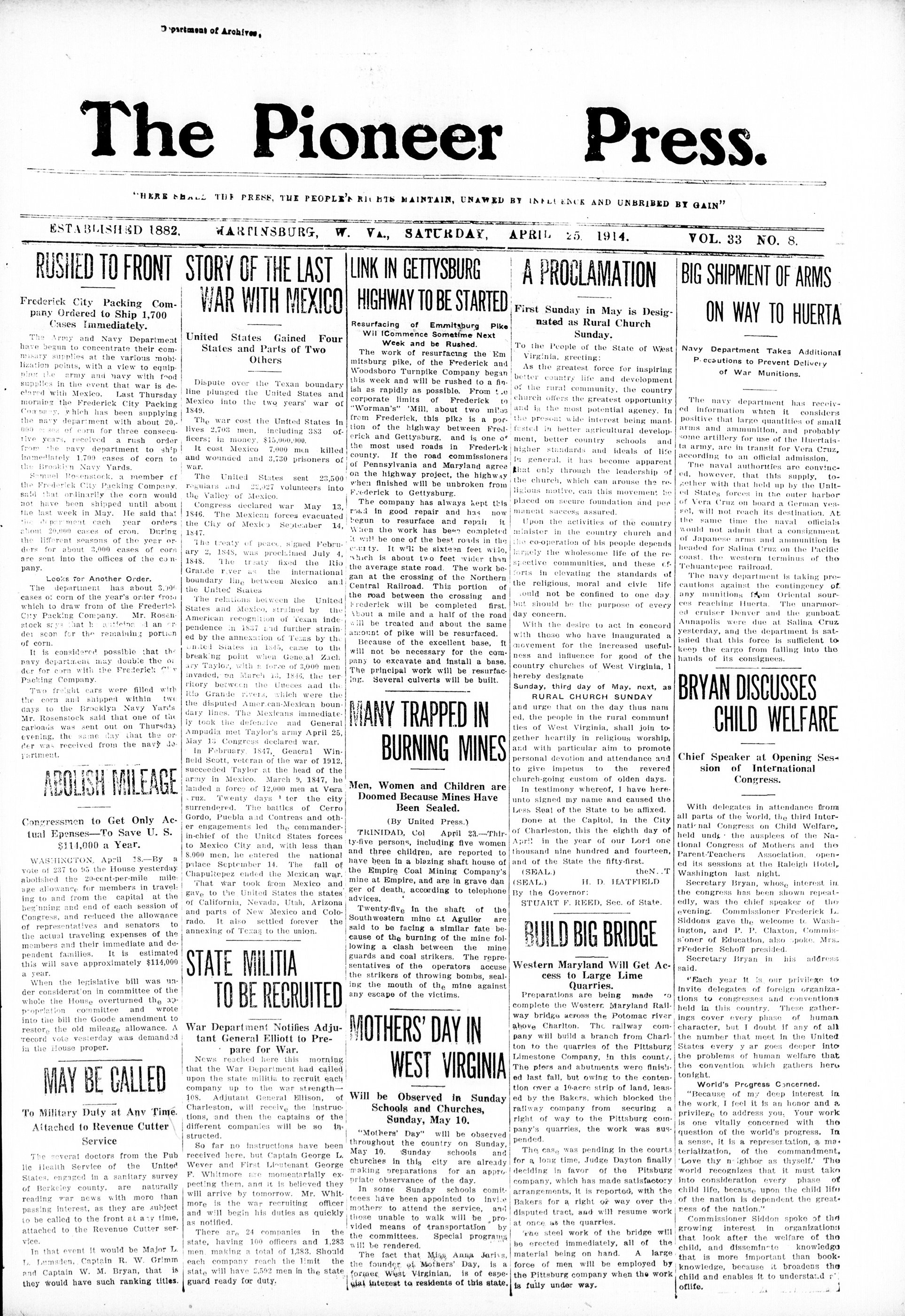
The Pioneer Press
Saturday, April 25, 1914
Martinsburg, West Virginia
Page text (machine-generated)
The Pioneer Press.
"HERE SHALL THE PRESS, THE PEOPLE'R RIGHTS MAINTAIN, UNAWED BY INFLUENCE AND UNBRIBED BY GAIN"
ESTABLISH&D 1882
RUSHED TO FRONT
Frederick City Packing Company Ordered to Ship 1,700 Cases Immediately. The Army and Navy Department have begun to concentrate their commissary supplies at the various mobilization points, with a view to equipping the army and navy with food supplies in the event that war is declared with Mexico. Last Thursday morning the Frederick City Packing Company, which has been supplying the navy department with about 20,000 cases of corn for three consecutive years, received a rush order from the navy department to ship immediately 1,700 cases of corn to the Brooklyn Navy Yards.
Samuel Rosenstock, a member of the Frederick City Packing Company, said that ordinarily the corn would not have been shipped until about the last week in May. He said that the department each year orders about 20,000 cases of corn. During the different seasons of the year orders for about 3,000 cases of corn are sent into the offices of the company.
Looks for Another Order.
The department has about 3,000 cases of corn of the year's order from which to draw from of the Frederick City Packing Company. Mr. Rosenstock says that it anticipates an order soon for the remaining portion of corn.
It is considered possible that the navy department may double the order for corn with the Frederick City Packing Company.
Two freight cars were filled with the corn and shipped within two days to the Brooklyn Navy Yards. Mr. Rosenstock said that one of the carloads was sent out on Thursday evening, the same day that the order was received from the navy department.
ABOLISH MILEAGE
Congressmen to Get Only Actual Epenses—To Save U. S. $114,000 a Year.
WASHINGTON, April 18.—By a vote of 237 to 95 the House yesterday abolished the 20-cent-per-mile mileage allowance for members in traveling to and from the capital at the beginning and end of each session of Congress, and reduced the allowance of representatives and senators to the actual traveling expenses of the members and their immediate and dependent families. It is estimated this will save approximately $114,000 a year.
When the legislative bill was under consideration in committee of the whole the House $ _{e} $ overturned the $ _{e} $ appropriation committee and wrote into the bill the Goode amendment to restor $ _{e} $ the old mileage $ _{e} $ allowance. A record vote yesterday was demanded in the House proper.
MAY BE CALLED
To Military Duty at Any Time Attached to Revenue Cutter Service
The several doctors from the Public Health Service of the United States, engaged in a sanitary survey of Berkeley county, are naturally reading war news with more than passing interest, as they are subject to be called to the front at any time, attached to the Revenue Cutter service.
In that event it would be Major L. L. Lumsden, Captain R. W. Grimm and Captain W. M. Bryan, that is they would have such ranking titles.
Department of Archives
ne
WE SHALL THE PRE
1882. MARTH
e Pic
HALL THE PRESS, THE PEOPLE
MARTINSBURG, W
STORY OF THE LAST WAR WITH MEXICO
United States Gained Four States and Parts of Two Others
Dispute over the Texan boundary line plunged the United States and Mexico into the two years' war of 1849.
The war cost the United States In lives 2,703 men, including 383 officers; in money, $15,000,000.
It cost Mexico 7,000 men killed and wounded and 3,730 prisoners of war.
The United States sent 23,500 regulars and 22,027 volunteers into the Valley of Mexico.
Congress declared war May 13, 1846. The Mexican forces evacuated the City of Mexico September 14, 1847.
The treaty of peace, signed February 2, 1848, was proclaimed July 4, 1848. The treaty fixed the Rio Grande river as the international boundary line between Mexico and the United States
The relations between the United States and Mexico, strained by the American recognition of Texan independence in 1837 and further strained by the annexation of Texas by the United States in 1845, came to the breaking point when General Zachary Taylor, with a force of 3,000 men invaded, on March 13, 1846, the territory between the Uteces and the Rio Grande rivers, which were the disputed American-Mexican boundary lines. The Mexicans immediately took the defensive and General Ampudia met Taylor's army April 25, May 13 Congress declared war.
In February, 1847, General Winfield Scott, veteran of the war of 1912, succeeded Taylor at the head of the army in Mexico. March 9, 1847, he landed a force of 12,000 men at Vera cruz. Twenty days later the city surrendered. The battles of Cerro Gordo, Puebla and Contreas and other engagements led the commander-in-chief of the United States forces to Mexico City and, with less than 8,000 men, he entered the national palace September 14. The fall of Chapultepez ended the Mexican war.
That war took from Mexico and gave to the United States the states of California, Nevada, Utah, Arizona and parts of New Mexico and Colorado. It also settled forever the annexing of Texas to the union.
STATE MILITIA TO BE RECRUITED
STATE MILITIA TO BE RECRUITED
War Department Notifies Adjutant General Elliott to Prepare for War. News reached here this morning that the War Department had called upon the state militia to recruit each company up to the war strength 108. Adjutant General Ellison, of Charleston, will receive the instructions, and then the captains of the different companies will be so instructed.
So far no instructions have been received here, but Captain George L. Wever and First Lieutenant George F. Whitmore are momentarily expecting them, and it is believed they will arrive by tomorrow. Mr. Whitmore is the war recruiting officer and will begin his duties as quickly as notified.
There are 24 companies in the state, having 100 officers and 1,283 men, making a total of 1,383. Should each company reach the limit the state will have 2,592 men in the state guard ready for duty.
LINK IN GETTYSBURG HIGHWAY TO BE STARTED
Resurfacing of Emmitsburg Pike Wil ICommence Sometime Next Week and be Rushed.
The work of resurfacing the Emmitsburg pike, of the Frederick and Woodsboro Turnpike Company began this week and will be rushed to a finish as rapidly as possible. From the corporate limits of Frederick to "Worman's" 'Mill, about two miles from Frederick, this pike is a portion of the highway between Frederick and Gettysburg, and is one of the most used roads in Frederick county. If the road commissioners of Pennsylvania and Maryland agree on the highway project, the highway when finished will be unbroken from Frederick to Gettysburg.
The company has always kept this road in good repair and has now begun to resurface and repair it. When the work has been completed it will be one of the best roads in the county. It will be sixteen feet wide, which is about two feet wider than the average state road. The work began at the crossing of the Northern Central Railroad. This portion of the road between the crossing and Frederick will be completed first. About a mile and a half of the road will be treated and about the same amount of pike will be resurfaced. Because of the excellent base, it will not be necessary for the company to excavate and install a base. The principal work will be resurfacing. Several culverts will be built.
MANY TRAPPED IN BURNING MINES
MANY TRAPPED IN BURNING MINES
Men, Women and Children are Doomed Because Mines Have Been Sealed.
(By United Press.)
TRINIDAD, Col April 23.—Thirty-five persons, including five women and three children, are reported to have been in a blazing shaft house of the Empire Coal Mining Company's mine at Empire, and are in grave danger of death, according to telephone advices.
Twenty-five in the shaft of the Southwestern mine at Aguller are said to be facing a similar fate because of the burning of the mine following a clash between the mine guards and coal strikers. The representatives of the operators accuse the strikers of throwing bombs, sealing the mouth of the mine against any escape of the victims.
MOTHERS' DAY IN WEST VIRGINIA
MOTHERS' DAY IN WEST VIRGINIA
Will be Observed in Sunday Schools and Churches, Sunday, May 10.
"Mothers' Day" will be observed throughout the country on Sunday, May 10. Sunday schools and churches in this city are already making preparations for an appropriate observance of the day.
In some Sunday schools committees have been appointed to invite mothers to attend the service, and those unable to walk will be provided means of transportation by the committees. Special programs will be rendered.
The fact that Miss Anna Jarvis, the founder of Mothers' Day, is a former West Virginian, is of especial interest to residents of this state.
A PROCLAMATION
First Sunday in May is Design nated as Rural Church Sunday.
To the People of the State of West Virginia, greeting:
As the greatest force for inspiring better country life and development of the rural community, the country church offers the greatest opportunity and is the most potential agency. In the present wide interest being manifested in better agricultural development, better country schools and higher standards and ideals of life in general, it has become apparent that only through the leadership of the church, which can arouse the religious motive, can this movement be placed on secure foundation and permanent success assured.
Upon the activities of the country minister in the country church and the co-operation of his people depends largely the wholesome life of the respective communities, and these efforts in elevating the standards of the religious, moral and civic life could not be confined to one day, but should be the purpose of every day concern. With the desire to act in concord with those who have inaugurated a movement for the increased usefulness and influence for good of the country churches of West Virginia, I hereby designate
Sunday, third day of May, next, as
RURAL CHURCH SUNDAY
RURAL CHURCH SUNDAY and urge that on the day thus named, the people in the rural communities of West Virginia, shall join together heartily in religious worship, and with particular aim to promote personal devotion and attendance and to give impetus to the revered church-going custom of olden days. In testimony whereof, I have hereunto signed my name and caused the Less Seal of the State to be affixed. Done at the Capitol, in the City of Charleston, this the eighth day of April in the year of our Lord one thousand nine hundred and fourteen, and of the State the fifty-first.
(SEAL.) theN..T
(SEAL.) H. D. HATFIELD
By the Governor:
STUART F. REED. Sec. of State.
BUILD BIG BRIDGE
BUILD BIG BRIDGE
Western Maryland Will Get Access to Large Lime Quarries.
Preparations are being made to complete the Western Maryland Railway bridge across the Potomac river above Charlton. The railway company will build a branch from Charlton to the quarries of the Pittsburg Limestone Company, in this county. The pliers and abutments were finished last fall, but owing to the contention over a 10-acre strip of land, leased by the Bakers, which blocked the railway company from securing a right of way to the Pittsburg company's quarries, the work was suspended.
The caso was pending in the courts for a long time, Judge Dayton finally deciding in favor of the Pitsburg company, which has made satisfactory arrangements, it is reported, with the Bakers for a right of way over the disputed tract, and will resume work at once at the quarries. The steel work of the bridge will be erected immediately, all of the material being on hand. A large force of men will be employed by the Pittsburg company when the work is fully under way.
VOL. 33 NO. 8.
BIG SHIPMENT OF ARMS ON WAY TO HUERTA
Navy Department Takes Additional Precautions to Prevent Delivery of War Munitions.
The navy department has received information when it considers positive that large quantities of small arms and ammunition, and probably some artillery for use of the Huertaista army, are in transit for Vera Cruz, according to an official admission.
The naval authorities are convinced, however, that this supply, together with that held up by the United States forces in the outer harbor of Vera Cruz on board a German vessel, will not reach its destination. At the same time the naval officials would not admit that a consignment of Japanese arms and ammunition is headed for Salina Cruz on the Pacific coast, the western terminus of the Tehuantepec railroad.
The navy department is taking precautions against the contingency of any munitions from Oriental sources reaching Huerta. The unarmored cruiser Denver and the gunboat Aunapolis were due at Salina Cruz yesterday, and the department is satisfied that this force is sufficient to keep the cargo from falling into the hands of its consignees.
BRYAN DISCUSSES CHILD WELFARE
BRYAN DISCUSSES CHILD WELFARE
Chief Speaker at Opening Session of International Congress.
With delegates in attendance from all parts of the world, the third International Congress on Child Welfare, held under the auspices of the National Congress of Mothers and the Parent-Teachers Association, opened its sessions at the Raleigh Hotel, Washington last night.
Secretary Bryan, whose interest in the congress has been shown repeatedly, was the chief speaker of the evening. Commissioner Frederick L. Siddons gave the welcome to Washington, and P. P. Claxton, Commissoner of Education, also spoke. Mrs. rFederic Schoff presided.
Secretary Bryan in his address said.
"Each year it is our privilege to invite delegates of foreign organizations to congresses and conventions held in this country. These gatherings cover every phase of human character, but I doubt if any of all the number that meet in the United States every y ar goes deeper into the problems of human welfare that the convention which gathers here tonight. World's Progress Concerned.
"Because of my deep interest in the work, I feel it is an honor and a privilege to address you. Your work is one vitally concerned with the question of the world's progress. In a sense, it is a representation, a materialization, of the commandment, 'Love thy neighbor as thyself.' The world recognizes that it must take into consideration every phase of child life, because upon the child life of the nation is dependent the greatest of the nation."
Commissioner Siddon spoke of the growing interest in organizations that look after the welfare of the child, and disseminate knowledge that is more important than book knowledge, because it broadens the child and enables it to understand oflife.
jail alate aoe SM a aR Ne an vl ial egraip Cae coer aP Emer NPT Ma ae meee MSS en Rca Voom eee |S Th
igs mi esas oe ede ee mie rey fii NS et i alee an Meee pe ane ta eee en i oes Te
i : : q Hr | ec eR) fy aCe ape a Mea eed ee SS aaa Lina
fis F oy Grate Lit * aT ah a Wing
i re a bet paternal nade tonite a bilTh el | 5 shion| See aN mnratd HAS EHO tales MUN Prieta Medefrieim sulky da ffrcs. Li i
> :
The Pioneer reas
An Indeper .nt Weekly Newspaper
Devoted to the Moral, Religious and
Financial Development of Humanity
RATES OF SUBSCRIPTION:
Lo year .... 0... eee eee eet. $1.60
6 monthy .............e0e6 TEC.
3 months ............000- 400.
Pay for all advertisements is due in
advance unless advertising is run by
yearly contract, in which case the ad.
vertiser pays every tirce mcnths.
Advertising 1 inch one time 75c.
Btanding ........ .0--.+.255 Bde
Reduced Rates to Clubs.
Send for Sample Copies.
Entered in Post Office at Martins-
burg, W. Va., us Second Class Matter.
J. W. Clitord, Editor and Proprietor.
Drawer 869, and Bell 'Phone €0K,
Martinsburg, W. Va.
=
SATURDAY, APRIL 25 1914.
The death of Mr. William Mosby took
from Darkevilie, as brave a man as over
lived in Berkeley county, and in rever-
ence shall his devotion to us be held
long ae we live.
We have addressed many audiences.
but never stood before a fiver one than
last Bunday in the Forum at Baltimore.
Md. Educated and refined; facea and
physiques charming to look at; in vo-
cal and instrumental music captivating,
with W. Ashbie Hawkins, agraduat of
Maryland’s famous Law School, and
cne of the brayest and best lawyers in
this country, as its President.
When, (and no living mortal can tell)
the war with Mexico ends, possibly a
million and more of Americans will be
under the sod, and millions more die-
eased to death, with a debt of many
billions of dollars, If the President’s
defence of this war now going on, and
going on before Congress authorized it
—the only war making power. be rens-
onably and cooly looked into, judging
from his explanation of the purpose of
aid war, it is aimed at but one person
—Huerta. Why involve this nation in
a bloody war, that may become a world
wide affair,and ending God only knowe
when and how only to make ore man
honor the stare and siripos? Under
this flag, hundreds and thousands of
our own citizens a! home have been
ruthlessly murdered and nothing done
about it. Under the folds of this flag,
not long ago, a poor old Negro arose,
tipped bis hat and gave his seat to «
white lady standiog, and for so doing
some hoodlume sprang upon and would
have killed him, had not the woman
thrown over him the skirt of her dres:
and defied them to strike him another
blow, When s woman’s skirt bas more
protection foran American than the
stars and stripes, God will not endorsc
a war for the flag. In short as slavery
was the cause of the war of the rebel
lion, is not the color of men’s skins the
cause,of it now? Will God go back or
Hie different colored children for thos
who acorn them?
It is more than necessary that the
whole world should now and hence-
forth take seriously into considera-
tion the word white. It has been
held up as a supreme sign of super-
fority and with little or no investi-
gation to prove to the contrary, it
1s the dominating and unific power
to rule or ruin, There is no color
on earth that the power or absence
of the sun did not make. To illus-
trate: In the extreme north every-
thing is white, and the same is true
at the south pole. Leave either or
both poles and travel toward the cen-
ter, and as gradually as you go, color
changes, until the torrid zone 1s
Teached where no white can be
found, but earth’s rarest beauties are.
That people have gone as crazy
over the word white as they have
over fashion is demonstrated every
day and hour. It is possible that the
narrowly contracted ones with all
they have on their backs, believe
it is a passport into glory. It is the
mind and not the color that makes
the man. So crazy are American peo-
ple over what never has existed,
“white people’ that congress was
afraid to pass a law to prevent the
use of arsenic in food products for
no other purpose than to bleach them
whiter.
‘As to white: whoever saw a white
living being? Snow is white. What
hey people look like were they
white as snow?
When cating meat no difference 5
ate whether the sheep, beef or hog
had white or black skins; and even
if the extreme hot heads in hatred
on color, know it they would eat the
meat and declare that the black
skins did not hurt or change the
meat. Feed hogs, horses, sheep, cat
tle and all kinds of fowls,-do the
white ones refuse to eat with the
black ones, or vice versa? No and
No again. Why then should people
be silly over their color? and unite to
deprive, destroy and deny all others
of their common rights?
Literature
By W. G.
+ THE PROVIDENTIAL Fy.
Col. Tom Keller, of New York, a fa-
mous old-time hunter, entertained a
party of New York newspaper men on a
hunting trip at Camp Bryan, in North
Carolina.
Dave was the cook. Now, Dave ia a
small, yellow person, with a quick and
roving eye, a ready tongue and a mirac-
ulous thirst. He excelled as @ cook,
but in the matter of liquor it was de
cided to keep him on stric: rations—four
large drinks a day at regular intervals
One morning Col. Ketler forgot and
left the locker unfustened. A few
minutes later. when Dive came to bring
him his slippers,an uomietakable aroma
of rye accompanied him.
“took here, Daye!” demanded Col.
Keller, “haven’t you had a drink?”
Dave was caught with the goods ou
him
“Yas, auh, boss,” he confessed, “I
had one.””
“How did you get it?” asked the
Col. Dave's eyes rolled about the room,
seeking au excuse, and an inspira ion
came to him.
“One of de gentlemen lef’ bis’n, cause
‘there was a fly in it:??
Ho.pinc Up America.
James J. Hill, on the occasion of hia
75th birthday, talked of the great speed
of American traine. A Frenchman. an
Englishman and an American were once
severally praising ther railronds
The Engl shman said, “Our expresa
trains run so fast that the tele. raph
poles look like a high board fence.”
The Frenchman said, “Our rapidest
Ko 80 fast that the stations along the
line seem continuous, like # city b.ock ”
The American puffing at his cigar.
enid thoughtfully: *‘Once on an Amer-
ican ¢ xpress, I passed a field of carrots
fa field of cabbages and a cow, and the
train, gentler en, was gomg so fast—vo
vory fast—I thought it was an Tiwh
stew.’?
ok
Home, Sweet Home.
A wellknown Jawyer was talking
about a brilliant but unsuccessful dis-
ciple of Blacksione
“His habits are to blame for his fail-
ure,” said he. “One of his rema ke
illustrates his habits well He said to
me in the Union Club:”
"There's no place like ~home—espec-
ially at2or3a.m, when you've ex
hausted the pleasures of all the other
places, and you’re tired. and everything
shut up anyway.
*®
Mr. HEARST’s Goat.
The firat time Hearst made a public
speech was when he was nominated for
Congress some years ago.
He was pervous about it, and said to
I. D. Sullivan. ‘That convention is
going to nominate mo for Congress, and
I suppose I've got to make a speech to
the delegates. I never in my life made
a speech and I’m scared, what shall I
do?”
“It’s simple enough” Sullivan re:
plied. “The thing to dois to pick out
one man in actowd and talk to him
jnst as you would talk to him if he was
alone with youin a room. Select one
man and make your speech to him, and
forget that there is any one else in the
audience.”
Sullivan was curious to see how
Hearet would meke out, and sent une of
his men down to watch the proceedings
and report; and when the man can
back Sullivan asked—"*How did Hearet
do?”
“Well,”’ said tbe scout.” He lost one
good vote, He talked all the time to
one man in the crowd, and ,tuat fellow
got mad,aod left the hall cussing Hearst
for making a goatofhim,’ —_
WEST VIRGINIANS
AMONG OFFICERS
OF THE U.S. NAVY
Many Native Sons Are Actively En-
gaged While Others Will Soon Be
In the Midst of the Conflict—Many
of Them Have Made Enviable Rec
ords and Others Will.
(By Geo. W. Summers.)
NY CREASE LAN, 86S <9.— WSL
Virginia is well represented among
the officers of the United States
Navy, most of whom are now in ac:
tive service in or near Mexico, and
in the Marine Corps. whose members
were among the first to land in Mex.
ico dur ng the present trouble. Many
of the older West Virginians whose
names have been in the Naval Reg-
ister for years are now on the retir-
ed list, including Rear Admiral
‘French Ensor Chadwick, who was
advanced for eminent and conspicu-
ous conduct in battle during the war
with Spain, ane who is now at New-
port, R. I.; Rear Admiral Sidney Au-
Jgustus Staunton, who is now at Char-
leston; Commander John §. Dod-
dridge, who is now at Wheeling;
‘Lieutenant Guilford Darst, who is
jnow at Charleston, and others with
lowe rank. But, while some of the
Better known officers from West Vir-
sinia are retired, there are a good
‘man yleft from the state, whose
‘names doubtless will become as well
|known in a short time as were those
of their predecessors who fought in
the war with Spain. Taking the offi-
cers from West Virginia in the order
of their rank, that state is represent:
ed in the navy by the following offi-
cers on active duty.
| Commander Julian Lane Latimer,
lborn in West Virginia, appointed
from West Virginia Sept. 20, 1896.
Hsa had 15 years and 8 months of
|sea duty, 10 years and 11 months of
|shore duty, and eight months unem-
| ployed. Is now in command of the
|squadron consisting of the Alabama,
‘Illinois, Kearsarge and Kentucky.
| Commander Powers Symington,
|born in Maryland and appointed from
‘West Virginia September 7, 1888.
|Has had 15 years and 8 months of
sea service, one year of land service
[beyond seas and 8 years and 9
months of land service at home. He
is now the naval attache of London.
| Lieutenant Commander Earl Percy
|Jéssop, born in West Virginia, ap-
| Pointed from West Virginia Sept. 6,
1892. Has had 12 years and 11
|months of sea service, eight years
years and one month of shore duty
and three months unemployed. Is
‘now on the battleship Arkansas.
| Lieutenant Commander — Charles
Philip Snyden born in West Virginia,
j appointed from West Virginia May 20,
|1896. Has had 9 years and 5 months
‘of sea service; 8 years and 1 month
of shore duty and ong month unerm-
ployed. Is now on the dattleship
Delaware.
Leiutenant Macgillivray Milne,
born in West Virginia but appointed
from Ohio Sept. 8, 1899, Has had
nine years and two months of sea
| duty, four years and nine months of
ishore duty and four months unem-
ployed. Is at present on the transport
Prairie.
Lieutenant smugo Frankenberger,
born in West Virginia and appointed
from West Virginia May 21, 1901.
Has had seven years and four months
of sea duty, five years two months
of shore duty and one month unem-
ployed. Is at present attached to the
transport Buffalo.
Lieutenant Grafton Asbury Beall,
Jr, born in West Virginia and ap-
pointed from West Virginia Sept. 23,
1901, Has had six years, nine months
of sea service, five years three months
shore duty and three months unem-
ployed. Is now connected with the
navy yard at Charleston, S. C.
Lieutenant Edward Davis Wash-
burn, Jr, born in Virginia and ap-
pointed from West Virginia Sept. 25,
1902. Has had eight years five
months of sea service, two years
eight months of shore duty and two
months unemployed. Is now attach-
ed to the battleship Texas. _
: '
NEGO BRETHREN
i Ye i
for help while collecting material
for the International Exhibition of
the Book-Industry and Grapiic Arte
Leipzig, May-October, 1914,
Academy for the Graphic Arts and
the Book-lndustry at Leipaly. Ue
wmany; there will be a great Wxhib
lion made up and organized to show
she Graphic products of all peopie
jands and uations from the earlies
:imes up to these days. ‘The plan
Is: the exhibition shows the following
}{6 groups: I. Graphic Arts; Il. Ap
vlied Graphics apd Book-making, IL
lustrating; Il. Instruction, Educa.
tion, Schools; IV. Paper Manufac-
vuring; V. Stationery and Writing
Materials; VI. Colors, Lithographics
and Copper-plates; VII. Photography;
VIII, Reproduction; 1X. Streotypy,
| Wlectrotypy; X. Printing Processes;
/XI. Bookbinding; Xl. Publishing,
| book-trade; XIII. Newspapers, Ad-
| vertising, Canvassing, Periodicals;
XIV. Libraries; XV. Machinery;
a Measures for the Protection
and Welfare of the Workers, etc.
These groups have been subdivid-
ed into about 63 classes. Each
group is to be introduced by a his.
torical and a technical instructive de.
partment. The development and the
position in the history of civiliza
tion of the various branches of the
book industry will be clearly dem-
onstrated, models and apparatus for
demonstrating purposes and the cin
ematographic art will be shown. Th.
publications of booksellers and
nusic publishers will be brought d:
rectly to the notice of the public
through the medium of Libraries anc
reading rooms, through lectures
public readings, recitations and con
cert ecitals. Anything in our mind:
will be under the banner of the
‘black art.” Many learned societies
and associations connected with the
{book industry will have their con
sresses and meet at the exhibitio:
ground.
When I read the news I asked my
self if it would be possible to show
at the exhibition some exhibits of
the negro people in America, in
whose matters | am especially inter
ested. So I come to all willing te
help me in my undertak‘ng, to ask
for their cooperation while collect
ing exhibiticn matters.
Any printings, writings, _ photos.
pictures out of the slavery time un
Ul this day will be welcome.
Pupils and students, lessons
school plans and pictures, photos o!
professors, teachers, students anu
buildings, whole models of publish
ing houses, Schools, Colleges ana
Universities will be heartily accept
ed. Likewise drawings of scholars
and students.
Authors or publishing houses
should send of all books and pam-
phlets and writing they have pub-
lished one or better two copies wih
order blanks that every exhibiton
visitor may have the opportunity ot
ordering the oxhibits through my-
self.
| Lodges, banks, societies and oth
er organizations should contribute
sowe amount to cover the cost of
(certain matters to be bought while
not on the marke.
Editors shou'd send the best they
‘have, if possibie a model of the
whole business plan.
Here is an opportunity for the
Colored, people of America and for
those who have devoted their lives
to the culture-work among the colcr-
ed people, to demonstrate what they
have done already and what they
could do in the future. Another im-
portant feature while collecting ex-
‘kibition materials is that all will
Silent leet ts the ete ee in
Lieutenant, Junior Grade, Vaughan
Veazey Woodward, born in and ap-
pointed from West Virginia, ee
You will have no expenses to p2y
fo. We exn bition of wnat you send.
wilt care tor that. But whatever
YOu send write your vane upon it.
| Pleare UO What You can om the
mater, Write about your help us
BO AS PUSsvie UN sow YouL Ex
Vibiis--o:d or new, gosd ara bad—
to
| PASTOR PAUL 0. HEN TSCII,
| Gundorfersir 1, L, ueiyous-ul.
. Germauy.
Other negre papers ae asked to
print the foregoing lines or raster
Hentsch in the'r respecuve co.cans.
THE SUITrOK
vy t
NEW COURT FOR
NL WOU i
THE CHILCREN
Li
is Established in the City of
Charleston by Judge of the
Poiice Tribunai.
CHARLESTON, April 23.—Charles-
ton has a juvenile court. vecause of
the tact that uo special Provision for
this court is made by jaw, as fune-
ons will be of an advisory uacur
though it will be connecied wiih tae
police court.
‘The members of the new court,
who have agreed to do ali they pos-
sibiy can to curb juvenue colinquea-
cies in this city, are W. CG. BL
Moore, head of che Assoc aicd Char-
ities in Charleston; Capt. W. D.
Swan, at the head of tie local Sale
vation Army corps, and A. J. lium:
phreys, of the Hk bank ng Company,
the latter as the West Side represen-
tative of the court.
Boairsky's Idea.
The juvenile court idea is that of
Police Judge M. Boarisky, who, dur-
ing the last few weeks, has found it
lifficult. to dispose of some of the
juvenile cases wheih involved deli-
cate stuations that hardly come
vithin the province of a potice court.
He stated that advice of a number
of leading citizens, and all are favor-
ably impressed with the move to get
am advisory court that will assist in
ealing with such cases as properly
some before it, looking to the sensi-
vie disposition of cases in which
children are to by handled es they
should be to get the best resulis.
In many instances Judge Boarisky
has found that punishment should
be meted out to youthful violators,
‘lthough he appreciates the fret
hey sheuid not be sent to jril, Of
ren he has turned young oYexders
over to the Salvation Army and Caz-
tain Swan has cared for a nwaber of
‘them, some of whom have been given
zood homes end are thus removed
from the surroundings which led to
heir derelictions.
| Sits In Afternoon.
| Under the plan tor the formation
oof this court, sittings will by held ot
2 o'clock afternoons, when sucir cases
as should rghtly come under its su-
pervision will appear in police court.
From the:e sess ons the usavt police
court loafers 21d the morbidly car-
ous will be excluded, and the advis-
ory court wil’ tuk. stich steps as are
reasonable it, handling cases involy-
ing the future of children,
| These cases will not develop daily,
and membe:s of the aivivuy court
will be rvuested to eppear when
there is work for their departineat.
TD Lue Ma
COUNTRY PHYSICIRE 1S
| amin ame
SUNTAN: AgVEC TE
:
‘Dr. Swimley Says Berkeley County
| is Now Offered Unprecedented
Opportunity by Goveramrent
Dr G. W. Swimiey, of Munker Titi,
an old and respected physician of
that place, was in town Saturday.
He is taking a very active interest
in the county-wide sanitary compaiar
now being made. With Sis many
years of experience. he has ial to
do ‘vith numerous typhoid fever ep
idemics, and realizes the great need
of improved sanitary conditions, to
the end of conserving health and pro-
ionging life. He looks upon the
present opportunity offered ‘by the
government to make Berkeley coun,
ty an ideal one as far as is possible.
one that people cannot afford to ia-
nore or even treat without duc con-
sideration of ‘the great importance
to human welfare,
DOClOR GUTHRIE
I) ENINERATED
That Dr. Lewis V. Guthrie, super-
intendent cf the West Virginia asy-
lum at Huntington, is not guilty of
neglect of duty, nor of any other
charge made against him by C. H
Sayre, is ig unanimous report of
ihe incimicés ci the State Board oi
Control, who have just completed au
investigat.on of the charges. The re.
Port of the investigation will be pre
sented to Governor Hatfield in 2
few days, and uncil that time wili
not be made public.
Sayre was formerly supervisor at
the institution, and his connection
was severed last September. In Oc-
tober he filed charges against Dr.
Guthric, charg'ng inattention to duty,
that he used state employes for per:
sonal work, and that he made false
reports of his official acts.
Asks Official Investigation.
President James S. Lakin, of the
board of control, and — ex-Goveraor
Willlim M. O, Dawson, member of
the board, made an investigation of
the charges several months ago
Whhin the past month Dr. Guthrie
follow'ng a renewal of the charges
requested that an official investiga-
tion be made. Dr. J. M. Williamsor,
a newly appointed member of the
bow.d, has just completed an investi
gation, having spent several days at
the institution.
‘The report and finding of the boar’
has just been completed and entirely
exonerated Dz, Guthrie of the charg
es. Ex-Governor Dawson stated yes
terdoy that nothing further than th
official finding will be made publi
itil after it is presented to Gover
nor Hatfield. President Lakin was
called to Columbus, O., Tuesday, dy
the death of his mother-in-law, an!
the report will be presented to the
governor upon his retura,
RAINY CHARTERS
UURING THE MONT:
Secretary Reeu's Report Shows
Sevciy-three Were Issued.
iweive Non-Residents.
Sevemiy-ihre, charters were issued
by Secretary of Siate Reed during
the imond: uf March as shown by the
seport of the scaetary of state for
that month. In addition to these
Casisvers, of which sixty-one were to
vesident corporations and twelve to
howresilent corporations, seven for.
eign corporations were authorized to
vy Otisiess in West Virginia; eigh-
deca corporations increased their au-
thor.zed capital stock; six decreased,
aid twenty-six either surrendered,
Cissolved or withdrew from the state.
The rece‘pts for the month were
$4516.30, divided as follows: From
increase in authorized capital stock,
2418; Dom foreign corporations, $190;
charters to resident corporations, $1,
007; from non-resident corporations,
Sad; tax on great seal, $306; sale of
books, $112; fees. $1,689.30; attorney
fees Wo auditor, 77
Among the larger resident corpora-
tions chettered were: Columbus Pro-
ducing Compinay, of Charleston, $2,
£00,000; Wayland Oi and Gas Com.
pany, of Cuarleston, $2,000,000; Grif.
fith Collieries Company, of Charles.
ton, $1,960000; Pickering Paint and
Pigment Company, of Charleston, « 4-
600,000; Industro- hemical — Utilities
Company, of Charleston, $50,000; The
Cheat River Coal Company, of Al-
brght, $596,000; Old Lick Run Coal
& Coke Company, $590,000; Blacks:
burg Coal Company, of Palmer, $200,
00
The iargest charter issued was to
the U. 3s. Drug Company, of Detroit,
Mich., capitalized at $10,000,000,
Among the larger increases were
the E. BE. White Coal Company from
$700000 to $1,200,000; American Re-
‘sactories Company from $500,000 to
$2,000,000; Washington and Southern
Tank, from 100.000 to $300,000; West
Vircinia. Malleable Iron Company
from $100,000 to $200,000; MacAlpin
Coal Company ‘rom 200,000 to $400,
000; Noyes, Thomas & Co, from $300,
000 to $500,000; Farmers & Consum-
ers Dairy Company from $10,000 to
$1,000,000,
The Standard Fuet Company de.
creased from $7,000,000 to $2,811,800,
and the Stonewall ol & Coke Com-
pany from $500,000 to $150,000.
’
VERA CRUZ HAS FALLEN
ae) 4
An
: lil
1 k
‘Twice Taken by Americans, First
Time by Gen. Scott—cap-
tured by French in 183g,
(By W. Nepnaw ian’
i ot aie
Thrice-heroie Vera Cruz, as Mex:
‘co's little seaport on the gulf is
‘nown in history, has falled for the
fourth time, and for the second time
to American forces
It was taken by the French in 1838,
by the Americans under Gen. Win.
field Scott in 1847 and by the allied
forces of Great Britain, France and
Spain in 1865, during the abortive at-
tempt to establish an empire and
place Maximillian upon the throne. In
mach of these engagements the Vera
Cruzanos offered such a spirited re-
sistance that the port has been hon-
red by historians with the — title
“thrice heroic.”
In addition to these investments by
sivilized powers, Vera Cruz was ever
in alluring morsel to the pirate hordes
hat swarmed over the Caribbean Sea
and the Gulf of Mexico during the
carly Spanish regime. In the seven-
eenth century both Van Horn and
orenzo, sometimes known as “Loren-
‘io” snrprised the city during the
aight with their pirate fleet, and be-
‘ore daybreak had imprisoned — six
housand of its inhabitants in the
ferent church, while they sacked,
ooted and burned their homes. The
‘tory of this midnight raid and the
ruel torture that followed from one
f the most thrilling and pathetic
hapters in modern history.
Even to this day the name of these
nonsters is reealled with awe, — s¢
nuch so that nurses frighten thei
ittle charges with a threat that i!
hey are not good, they will give
em to Ven Pham
Ever since the landing of Grijalvi
21518, Vera Crnz has been the chie
aport of Mexico, Tt was there alse
hat Cortez landed April 21, 1519, jus
©5 vears hefore the landing of Ad
niral Fletcher's marines. The da
as Good Fridey, and owing to this
act and the reputed wealth of the
and, the place was named Villa Rica
te la Santa Vera Cruz (the rich city
£ the Holy True Cross.)
In addition to being the first com-
| rereial port of the republic, it is
one of the oldest, quaintest and most
‘cosmopolitan yf the Mexican coast
cities.
"It is practicaliy on the level of the
sea, having an clevation of only four
‘eet above tide water. This fact
combined with an absence of any
‘iygienic regulations, is perhaps the
reason that it has always been con-
sidered the home of “yellow fever”
ind of the worst type known as.
“vomito"; in fact, the death rate was
so appalling at one time in its early|
history that the Spaniards seriously
considered abandoning the place and
locating further up the coast. :
Within the last ten years, however,
a street cleaning department has been
organized, underground sewers con-
tructed, instead of surface drains,
and wellow fever is now almost un-
known. The population is about 30.
000, and one-fourth of the total im-
ports into the republic come through
the custom house at Vera Cruz. It
is said to yield an income of nearly
2,000,000 pesos—$1,990,000—a month
under normal conditions, and its loss
will make a serious deficit in the
Huerta treasury.
FELL FROM WINDOW.
PARKPRSBURG-—-D. fl. MeGar-
vey, an oil man, went to sleep in a
window of the third floor of Cook's
hotel here Tuesdsy afternoon and
fell to the ground. He was picked
up unconscious and rushed to the
City Hospital, where surgeons, upon
a thorough examination, could find
no injury other than ? slight cus on
his lip. Upon reviving at the hos-
pital McGarvey's first words were
“Has war been declared iu Mexico?”
J. R. CLIFFORD
Attorney At Law
MARTINSBURG, WEST VIRGINIA.
Practices in all the Courts of West
Virginia, the Supreme Court of Ap
peals and the United States Courts.
FOUR: AMERICANS ARE
HOMES OF THE AMERICANS ARE sudan s FOR FIRE
ARMS SO THEY WILL HAVE NO MEANS
OF PROTECTION
VILLA THREATENS 10 JUN WITH UL S.
“lain Work Now Before the American Yorces is to Pacify the
People—intense Interest Prevails Pending the Arrival ot
General Funston’s Troops on Monday—Price of Food Stuffs
Increasing Tremendously and Municipal Situation is Daily
Growing More Serious and Succor is Needed if the Peopk
Are Not Permitted to Suffer.
VERA CRUZ, April 25.—Four Americans have been killed
an Mexico City, according to reports from the capital, The re-
pert was published in the local newspapers.
MAIN WORK OF THE ARMY.
The main work now before theAmerican forces here is admin-
istrative and pacification of the people concerning the wild rumors
that an attack by the Federals is pending. The native Ameri-
cans completely ignore them. Great interést is manifested in the
arrival of troops under General Funsion, who is expected here
Monday. The price of food stuffs is increasing tremendously,
sid the municipal authorities refuse to co-operate. The situa-
tion is daily growing more serious, and help must be had or the
people will suffer.
VILLA THREATENS 'TO JOIN U.S.
_ JUAREZ, Mexico, April 25.—Villa threatens an open break
vith Carranza and join his forces with those of the United
“States, and secure the complete desiruction of Huerta before
ie will permit his men to join Carranza in any scheme looking to-
vard a combination with Huerta. His closest friends among. the
“Sonstitutionalists declare he has made his plan plain to all who
.ave approached him.
HELD AS HOSTAGES.
Every interior city in Mexico is holding American prisoners
s hostages. Members of the American embassy, which fled
rom the City of Mexico last night, expressed opinions that only
he early arrival of American troops will save the imprisoned
\mericans. At every railroad station las! night the Americans
beseiged the O’Shaughnessy train pleading for permission to ac-
company the fleeing party.
ALL FAVORS REFUSED.
The Mexican escort flatly refused them any favors, and in many
cases the hostages were taken off of the trains, bound for Vera
Cruz, to be held in case the American troops attack the towns
when O’Shaughnessy left Mexico.
SEARCH HOMES OF AMERICANS.
Huerta has ordered that the homes of all Americans be search-
ed for arms, leaving them no means of defense in case of an up-
rising.
And For Three Summers Mrs. Vin-| believe 1 would have died if I hada’
taken it.
ernt Was Unable to Attend to | pier 4 began taking Cardui, 1 wa
Any of Her Housework, greatly helped, and all three bottles re-
Pleasant Hill, N. C.—I suffered for
three summers,” writes Mrs. Walter
Vincent, of this town, “‘and the third and
last time, was my worst.
had dreadful nervous headaches and
Prostration, and was scarcely able to
walk about, Could not do any of my
housework.
1 also had dreadtu! pains in my back
and sides and when one of those weak,
sinking spells would come on me, I
would have to give up and lie down,
until it wore off.
I was certainly in a dreadful state of
health, when I finally decided to try
Cardui, the woman’s tonic, and I firmly
ee Re
DATES FIXED FOR HEARINGS.
CHARLESTON—The State Board
of Public “Vorks has fixed May 11, 12
and 13 as dates for public hearings
of public service corporations prior
to assessing their property for 1914.
believe 1 would have died if I hadn't
taken it.
After 1 began taking Cardui, I was
greatly helped, and all three bottles re-
lieved me entirely,
I fattened up, and grew so much
stronger in three months, I felt like an-
other person altogether.”
Cardui is purely vegetable and gentle-
acting. Its ingredients have a mild, tonic
effect, on the womanly constitution.
_ Cardui makes for increased strength,
improves the appetite, tones up the ner-
vous system, and helps to make pala,
sallow cheeks, fresh and rosy.
Cardui has helped more than a million
weak women, during the past 5 years,
It will surely do for you, what it has
done for them. Try Cardui today.
Write to: Chattanooga Medicine Co., "Ade
visory Dept., Chattanooga, Tenne, for ie
structions on your case and 64-page book, "
Treatment ‘or Woaen,’” seat In pial ae
A Result Getter,
A spinster got married at the age
of seventytwo in Boston the other
day which proves that the watchful
waiting policy gets results.—Parkers-
burg, Dispatch-News,
NOTED WOMAN ADDRESSES Fa-
MOUS SOCIETY.
Mre, Alice M- Duntar, of Wilmington,
Dei, wife of the poet Dunbar, was) the
eueston Saturday evening lest of the
Negro Society for Historical Research,
Yonkere, New York and delivered) a
notable address before that’ body, her
subject being: “The influence of the
Negroon American Literature.” She
said, among other things: The Negro in
Aucrica bas been written about and
talked about within the past one hun-
dred years more than any other race
and that this is signifleant as showing
that he isa problem of more than spec-
ialinterest to the Anglo Saxon race,
which has been trying to solve it’ with-
out applying the golden rule. If this
were done it would greatly facilitate its
solution.”” The epeakor cited instance
after instance. showing that white wri-
ters of all shades of opinion havo dis-
cussed the Negro from every angle both
in slavery and freedom, each seeming to
try his or her best to find an answer to
the riddle which his presence in this
country propound to those who are
responsible for his being here. ‘Tho
speaker brought. out many valuable
points in supp rtof her argument which
thy xudience keenly appreciated. Mra,
Dunbar has a pleasing voice and excol-
lent control of it, Sho made a splendid
impression upon her hearers and they
scomed to be sorry when sho reached
her "And now lastly my brethren.’?
Mrs. Charles Vezin, a wealthy lady of
Palinudes Ave., carly in the day sent a
large basket of beautiful Tea roses to
Mra Dunbar with her compliments and
this message: “Thave been for many
years a lover of your husband's poems?”
A fine literary and musical prograns
preceded Mre, Dunbur’s address,
Ouverture, Evening Song—Butler’s
Stringed Orchestra.
Viuno Solo, “The Dying Poet,’ Miss
Lula Nickelson, of Ossining.
Recituuion-—-Master Wan, Hf. Butler,
Ve cal Solo, “For You" Written by
D.K. Fulton, Librarian of the Historica,
Society,und sung by Miss Bertie Thomp-
yon,
duio, doration Madame = M. W.
French, New York City Boe. J.
TWO W. VA. ROADS
They Cross the State From East
to West and North to
South
According to the Automobile Ilue
Book for the year of 191% West Vir-
Kinia was the only state not having
a road in it, It will be pleasing to
West Virginians to note that in the
year of 1914 the book will show two
roads crossing tho state from east
lo west and one from north to south.
If the right action is taken by the
official by the year of 1915 West
Virginia should show a road over
which a tourist could pass through
any county in the state
Every year there is over 200. mil
lion dollars of American money %o-
ing to Burope, being taken there by
tourists who seek rest and recres-
Von there on account of the — good
roads. A prominent railroad official
stated that one fourth of this money
could be saved in West Virginia if
we only had the roads.
The Barrels 7 <+ ~
and Lugs of 12... 4
STEVENS 34)
Double and Single Barrel
SHOTGUNS |p weir aid
soecialy etectod teat JJ -"Staanttst where
Gther cons aro. /Pweantst Compare
Stevens with zine JY at any ere acu the
Ne fe SAN Keay
A j
N\ Hee so MUL
WEN SA a
VAN Weteeftsst = =S=
WAN Seaeeo* ro
a daualge ante
famous tine of Stevens Raneaters eosin ese
gis, ar ana hn Sth tm yo
Sree prepa: aocn tect af Coan bee”
J. STEVENS ARMS
& TOOL COMPANY
P.0.80x 5005,
CHICOPEE FALLS, BASS.
Arrested When Released.
MOUNDSVILLE.— After serving
one year and one day in the state
penitentiary here for swindling, Geo.
LaPorte, a federal prisoner, was ree
leased and taken to New York to
answer another charge for swindling,
RAILROAD OFFICIALS IN ALL STATES RUSH PLANS
Railroad officials from Portland, Me., to Portland, Ore., and from northern Michigan to the southeastern corner of Texas are engaged in working out the transportation plans to meet a possible call by the war department for the carrying of 250,000 men to the most convenient point on the southern coast or border for transportation to Mexico.
Freight and passenger men alike are at work on this tentative problem, and the figures which they will furnish today or tomorrow to the quartermaster's department of the army should give an excellent idea of the abilities of the American railroads to meet an emergency and deliver the goods—the goods in this case being fighting men, and the material for them to use in fighting.
Unlike Spanish War Problem.
Unlike the plans of mobilization and movement made at the time of the war with Spain in 1898, when the centralization of troops was such that practically only the trunk lines had to do any great amount of figuring on the handling of trains, this time the war department plans to call on the different states of the Union for a number of men, which has been figured down even to the units, and this will get into action division superintendents of branches and of small lines as well as the general managers of the great trunk lines which traverse the country both east and west, and north and south.
This new scheme of transportation will apply to every state in the Union, from New York, which under the war department estimate would be called upon to furnish 25,024 men, to Arizona, whose quota which, while only 362, would come from a territory practically as large as New York, and with more difficulty of transportation.
Conditions in New England.
There will be many places where it will be easy to figure out this transportation problem, and other places where it will be hard. War department officials yesterday pointed to New England as one of the places classified as easy of estimating. "It should not be at all difficult to figure and arrange the movement of any troops needed from this section," said one of the officials, "for in the event of the call being made, the entire six New England states all told would be required to furnish less than 20,000 men.
"The New England states are a very fair example of what may be the immediate needs in the closely-populated sections of the country. The assignment of men from these states is as follows: Connecticut, 3,214; Maine, 2,512; Massachusetts, 9,442; New Hampshire, 1,504; Rhode Island, 1,420; and Vermont 1,266. This totals in exact war department figures 19,358.
Can Expect Quick Action
This number of men, to the layman who does not deal in crowds, might seem like a large number to be provided with transportation on short notice, but when one takes into consideration that it is about one-half of the number of people who are moved in the same territory in one day to a Harvard-Yale boat race or football game—the burden of carrying also including the return of the same number of people to their starting point within a few hours—it can easily be seen that the government can expect quick action.
"Of course the question of the movement of equipment makes the problem somewhat different from the transportation of a purely passenger crowd, but as this is a fixed and known quantity, information regarding which is furnished along with the number of men to be transported it comes in the last analysis down to a mere question of furnishing a sufficient number of a different type.
On the Pacific Const.
The two ends of the country—east and west—furnish two different transportation problems. In the far west it is a matter of long-distance movements, with the mileage and time as the main consideration; also, the par-
ticular trunk lines which will land the soldiers at the most desirable point on the Mexican border. For instance, Oregon is on the war department list for 1,568 men, while Washington is due to furnish 2,365, a total of 3,924. There are two ways in which these men could be moved. The most direct route would be down the Pacific coast to California, to make a general concentration with California's quota at Los Angeles or San Diego, from which points they could be sent by rail to any point on the border west of El Paso or by transport to a port or ports on the Pacific coast of Mexico.
Might Mobilize at El Paso.
Might Mobilize at El Paso. It might, however, be deemed more advisable to have the soldiers from the far western states mobilize at a central point—say El Paso—in which case the routing of the Oregon and Washington contingent would be much different. The men from Washington would combine with the Oregon soldiers at Portland, Ore. The combined force would then travel by the Oregon Railway and Navigation Company's line to Salt Lake then to Denver, thence south to El Paso. This arrangement would result in bringing the troops from Washington, Oregon, Idaho, Wyoming, Utah and Colorado, to a common point, and would make Denver, Colo, the transportation center that would have to bear the brunt of the mobilization en route to the border.
Plans for California Troops
Troops from the northern part of California might be sent by way of Denver, also with the advantage of general mobilization with those from the northwestern coast states. But it is considered more likely that all the California troops will be sent to the southern part of the state, and then transported over the Southern Pacific lines, which would enable them to be set down at any point on the border desired, from Douglas, Ariz., to Brownsville, Tex. or be conveyed through to Galveston for water transportation, to east coast ports, the same as already arranged for the expenditure army, now awaiting orders at Texas City.
It so happens that the railroads of the country are peculiarly well located so far as the north and the south trunk lines are concerned, for mobilization purposes. The lines from St. Louis and Chicago to New Orleans, can carry without difficulty all the troops from the middle west, and can also care for those from Montana, the Dakotas and Minnesota.
New Orleans Important Point.
It appears certain from present tentative plans for the army that New Orleans will be an important army point in the event of an actual invasion of Mexico. From New Orleans, troops can be sent west by rail to any point on the border desired, to Galveston, to the transports, to Texas City, to be held in reserve, or sent to sea direct from New Orleans, itself. If the railroad plans work out to army officials' liking, Washington is likely to see a large majority of the men from the eastern states, as the logical route for all the forces not sent by transport from Atlantic coast ports would be through this city en route to New Orleans, Galveston, San Antonia, or El Paso.
Mobiliez at Washington.
As the quartermaster's department has figured out the movement of the land forces so far, the principal points of mobilization in this country will be New York, Washington, Chicago, St. Louis, Kansas City, and Denver. The term "mobilization" as applied to these cities means, of course, merely a centralization point for transportation purposes, with as little delay as possible in railroad movements.
The places adjacent to Mexico at which army forces would most likely be held for division in making up various commands to enter Mexico would, it is said, be New Orleans, Galveston, San Antonia, El Paso, Douglas, Ariz., and Los Angeles Cal. From these points every avenue of approach to Mexico can be reached. From New Orleans and Galveston
transports can convey men to all points on the east coast of Mexico; rfrom San Antonio they can be sent across the border at Brownsville or Laredo, to follow the "Zachary Taylor route" to Mexico City by way of Monterey, made famous in the war of 1846; from El Paso, through the state of Chihuahua, and on to Torreon, where a natural junction could be accomplished, if desired, with the forces which started by the Monterey route, while Los Angeles would be the Pacific mobilization point, whence men might be sent overland to northwestern Mexico or by sea to any point desired on the Pacific coast.
FOR BOYS AND GIRLS
Our Public Schools Trained to Serve Interests of the Numbers.
Our public schools are maintained primarily to serve the interests of the greatest numbers. The demand that subjects be taught which have a direct bearing up on the activities of life, is a natural result of our free school system and popular education. The greatest problem before the American people at the present time is to readjust our educational system to meet these new demands. The new education or the education which will fit young people for the duties of life is coming, but in many parts of West Virginia it is coming all too slowly. In the meantime our best young blood is being drawn to the city. We can expect little else when we examine the work which is being done in many of our schools. The average high school teaches topics, holds up ideals which will necessarily leave boys and girls to sigh for the city life. Who is to blame for this condition. You answer, those who make our courses of study. No, it is only necessary for the parents, taxpayers, and those who have the interests of our boys and girls at heart to demand that an education that is so old that it is musty be supplanted by one that fits for life.
The city movement can be most effectively checked when we give the same attention to such subjects as agriculture, manual training, domestic science, and domestic art as we are giving the dead languages and ancient history. Less than 5 per cent of the boys and girls who enter the public schools ever take a college course, yet our high school courses are arranged to promote the interests of this email number and the 95 per cent are sacrificed. At the present time teachers are being engaged, courses of study arranged—let us consider the boy and girl who will never attend college.
RURAL CHURCH DAY
Is to Arouse the Religious Motive and Create More Interest in the Work
Acting upon the suggestion of church leaders in this and other states who have inaugurated a movement for the increased usefulness and influence $ ^{e} $ for the good of our country churches, Governor Hatfield has issued a special proclamation designating Sunday, May 3, as Rural Church Day and urges all who can to meet at their respective churches on that day.
The movement has the hearty support of the committee composed of leaders and officials of the various religious denominations of this state. A letter has been issued by this committee to all ministers and Sunday school superintendents asking that every church observe this day with suitable service.
It is now recognized that the rural church may take a position of leadership in the development of better agriculture, better roads, better schools, better homes, and better citizenship in the community which it serves by infusing the spirit of Christian service into this community development. Only by thus arousing regligious motive can this government be placed on a secure foundation and permanent success be assured. It is hoped that all of our country people will consider how their church may help the community and that they will enter heartily into the spirit of the day.
WEST VIRGINIA SUNDAY SCHOOLS
---
Will Observe Interntional Day Celebration Set for June 28 This Year.
An international Sunday School Day has been planned for Sunday June 28, and the schools of West Virginia are to be asked to appropriately observe the day with the schools of all the states and provinces of North America. Plans and sample programs for the celebrator of the day will be sent out from the office of the West Virginia Sunday School Association at Wheeling very soon.
An appropriate opening responsive service is to be furnished free to all schools who will observe the day.
The pastors who will preach an appropriate sermon on the day, a 600 page book will be presented, without charge, (as long as they last) upon application.
The day is also to be observed as a day of prayer for Sunday schools.
POLITICS AND POLITICIANS
West Virginia Republicans will hold a State conference in Charleston next month.
0
Dow H. Drukker the new congressman from the Seventh New Jersey district, is a native of Holland.
The Socialists made some notable gains in the recent city elections in Butte and Missoula, Mont.
Governor Morehead, of Nebraska, will run for Congress instead of trying for re-election as governor.
---
Pennsylvania Prohibitionists have selected Madison . Larkin, of Scranton, as candidate for United States senator.
0
William H. Race, who helped to found the Republican party in 1854, died recently in the Masonic home in Helena, Mont.
It is generally predicted that District Attorney Charles S. Whitman will be the next Republican candidate for governor of New York.
Captain Frank S. White, who is to fill the unexpired term of the late Senator Johnston, of Alabama, is 70 years old and a Confederate veteran.
Charles W. Bryan, brother of the Secretary of State, has announced his candidacy for the governorship of Nebraska, as a Democratic Progressive.
---
Ralph D. Cole, formerly a representative in Congress, has entered the contest for the Republican nomination for United States senator from Ohio.
0
Three candidates now are in the field for the seat of United States Senator Gore, of Oklahoma, who is up for re-election next November.
---
Congressman Henry T. Rainey is now mentioned as the likely choice of the "administration" to oppose Roger Sullivan in his contset for the Democratic nomination for United States senator from Illinois.
Former Congressman Washington Gardner, the present commander-in-chief of the Grand Army of the republic, may decide to become a candidate for the Republican nomination for governor of Michigan this year.
John H. Clarke, candidate for the Democratic nominati n to succeed Senator Burton, of Ohio, is a well known Cleveland lawyer, with some experience $ ^{o} $ as a newspaper man. He was nominee for United States senator in 1908.
---
The congressional executive committee of the Eighth Alabama district has selected Col. C. C. Harris, of Decatur to fill the unexpired term of the late Representative Richardson. Col. Harris will be formally elected on May 11.
Dr. John H. Worst, president of the State Agricultural College at Fargo and one of the best known farming experts of America, is being urged by his friends to become a candidate for the seat of United States Senator Gronna, of North Dakota, whose term
w'll expire next March. Dr. Worst is not without experience in public life, having served in the North Dakota legislature and as heutenant governor of the state.
30.
The case "I W. L. Brannon vs. J. E. Baker was set for Monday, April 27. Judge Robert W Dailey of Romney, will be here then and remain three days, sitting in cases in which Judge Woods is disqualified.
The jury in the case of Bender & Harris vs. M. L. Compton gave a verdict of $5 in favor of the plaintiff.
A decree $ confirming the commissioner's report was entered in the cause of J. E. Butte vs. John T. Lague.
WARSHIPS ON FIGHTING LINE AROUND MEXICO
Seven Dreadnaughts With Attendant Cruisers and Transports Now Off Ver Cruz.
WASHINGTON, D. C., April 23.—The Navy Department has issued a statement giving the location of the American ships in Mexican waters at 6 o'clock last evening as follows:
Tampico—Cruiser Des Mohnes, hospital ship Solace, Dolphin collier Cycops.
Vera Cruz—Bottleships Arkansas, Florida, Utah, Vermout, New Jersey, New Hampshire South Carolina Minnesota, transports Hancock and Prairie, scout cruiser Chester, mine layer San Francisco, fuel ship Orion.
Guaymas—Collier Justan.
Mazacian—Armored cruiser California, cruiser Raleigh.
Topolobambo—Coilier Glacier, gunboat Yorktown.
Salina Cruz—Gunboat Annapolis, route from Acapulco; cruiser Denver, en route from Corinto.
The department also announced that with an allowance of 2,500 men, the following vessels now on the Atlantic coast could be commissioned for services in Mexican waters: North Carolina, Washington, Tennessee, Brooklyn, Salem, Sacramento, Gastine.
The complement of the following torpedo destroyeds can be raised to full strength for use in a Mexican campaign: Flusser, Re'd Preston, Monaghan Sterett and Walke. In addition to th se the gunboats Marietta, Newport Dubuque, Mathias and Isle de Luzon, which have been loaned to State Naval Militia, can be used if necessary.
EXODUS OF AMERICANS FROM NORTHERN MEXICO
Terror-Strickent Refugees Harry Across Rio Grande*; Fearing Violence From Constitutionalists.
EL PASO, Tex., April 23.—A general exodus of Americans from Northern Mexico set out yesterday. A trailload of terror-stricken refugees from Chihuahua and Durango arrived in Juarez and the passengers hurried across the Rio Grande. There were sixty abroad, including a few Germans, Frenchmen, and Spaniards.
They reported that all mines in the Parral and Santa Barbara districts had closed down, and that all the American employees were en route here, anticipating that the constitutionalists will unite with Huerta against the United tates.
According to a story told by American refugees from Torreon, an American known as "Maj." McDonald, an officer in the constitutionalist army, was captured by the federalals and cruelly tortured. According to the story, Maj. McDonald, who is a native of Berkeley, Cal., was with Benavides' column when it was dispatched toSan Pedro. He was said to have been captured by the federalals, the soles of his feet cut off, then marched through the streets and finally shot and burned at the stake. Maj. McDonald figured once before in an adventure in Mexico which proved to have no foundation, and the latest story finds few believers.
The Texas civil authorities will appeal to the military officials for the removal of the 3,500 intermed Mexican prisoners at Fort Bliss to some other point far inland. They assert that the presence of this Mexican force near El Paso is a constant menace, which would become much worse if any of the troops guarding them should be withdrawn because of war exigences.