The Pioneer Press
Saturday, November 21, 1914
Martinsburg, West Virginia
Page text (machine-generated)
"HERE SHALL THE PRESS, THE PEOPLE'S RIGHTS MAINTAIN, UNAWED BY INFLUENCE AND UNBRIBED BY GAIN"
The Pioneer
ESTABLISHED 1882.
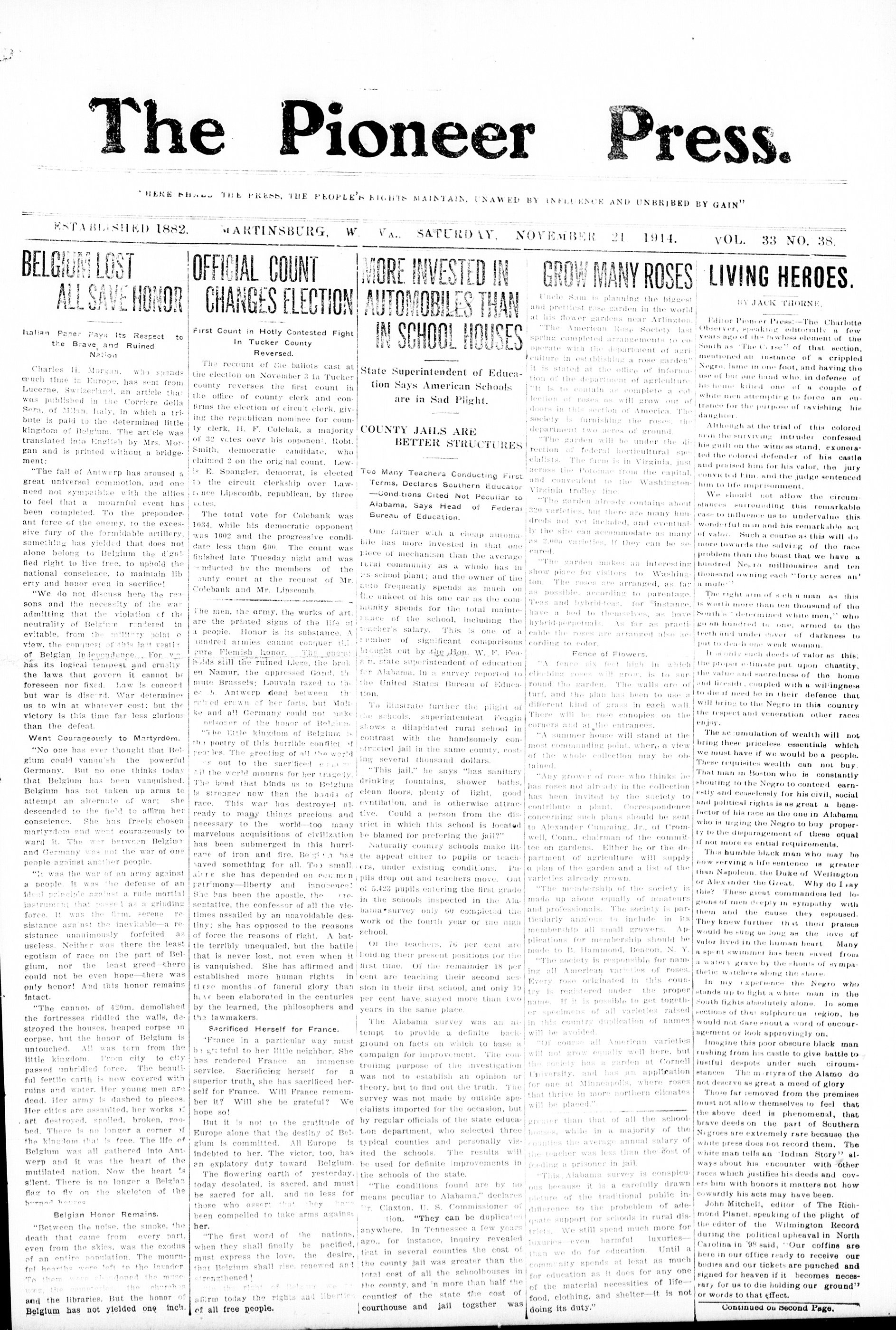
BELGIUM LOST ALL SAVE HONOR
Italian Paper Days Its Respect to the Brave and Ruined Nation
Charles H. Morgan, who spends much time in Europe, has sent from Lucerne, Switzerland, an article that was published in the Corriere della Sera, of Milan, Italy, in which a tribute is paid to the determined little kingdom of Belgium. The article was translated into English by Mrs. Morgan and is printed without a bridgement:
"The fail of Antwerp has aroused a great universal commotion, and one need not sympathize with the allies to feel that a mournful event has been completed. To the preponderant force of the enemy, to the excessive fury of the formidable artillery, something has yielded that does not alone belong to Belgium the d'guified right to live free, to uphold the national conscience, to maintain liberty and honor even in sacrifice!
"We do not discuss here the reasons and the necessity of the war admitting that the violation of the neutrality of Belgium rendered invitable, from the military point of view, the conquest of this last vestige of Belgian independence. For war has its logical tempest and cruelty the laws that govern it cannot be foreseen nor fixed. Law is concord but war is discord. War determines us to win at whatever cost; but the victory is this time far less glorious than the defeat.
Went Courageously to Martyrdom.
"No one has ever thought that Belgium could vanquish the powerful Germany. But no one thinks today that Belgium has been vanquished. Belgium has not taken up arms to attempt an alternate of war; she descended to the field to affirm her conscience. She has freely chosen martyrdom and went courageously to ward it. The war between Belgium and Germany was not the war of one people against another people.
"It was the war of an army against a people. It was the defense of an ideal principle against a rude martial instrument that passed as a grinding force. It was the firm, serene resistance against the inevitable—a resistance unanimously forfeited as useless. Neither was there the least egotism of race on the part of Belgium, nor the least greed—there could not be even hope—there was only honor! And this honor remains intact.
"The cannon of 420m. demolished the fortresses riddled the walls, destroyed the houses, heaped corpse on corpse, but the honor of Belgium is untouched. All was torn from the little kingdom. Free city to city passed unbridled force. The beautiful fertile earth is now covered with ruins and water. Her young men are dead. Her army is dashed to pieces. Her cities are assaulted, her works of art destroyed, spoiled, broken, rooed. There is no longer a corner of the kingdom that is free. The life of Belgium was all gathered into Autwerp and it was the heart of the mutilated nation. Now the heart is silent. There is no longer a Belgian flag to fly on the skeleton of the burned houses.
Belgian Honor Remains.
"Between the noise, the smoke, the death that came from every part, even from the skies, was the exodus of an entire population. The mournful hearths were left to the invader. So them were shrouded the museums, the museums, the churches and the libraries. But the honor of Belgium has not yielded one inch.
OFFICIAL COUNT CHANGES ELECTION
First Count in Hotly Contested Fight In Tucker County
Reversed.
The recount of the ballots cast at the election on November 3 in Tucker county reverses the first count in the office of county clerk and confirms the election of circuit clerk, giving the republican nominee for county clerk, H. F. Colebak, a majority of 32 votes oevr his opponent. Robt. Smith, democratic candidate, who claimed 2 on the original count. Lewis E. Spangler, democrat, is elected to the circuit clerkship over Lawrence Lipscomb, republican, by three votes.
The total vote for Colebank was 1034, while his democratic opponent was 1002 and the progressive candidate less than 600. The count was finished late Tuesday night and was conducted by the members of the county court at the request of Mr. Colebank and Mr. Libscomb.
the men, the army, the works of art are the printed signs of the life of a people. Honor is its substance. A hundred armies cannot conquer the pure Flemish honor. The enchant holds still the ruined Liege, the broken Namur, the oppressed Gand, the mute Brussels; Louvain razed to the ex. 5 Antwerp dead between the ruined crown of her forts, but Molke and all Germany could not make
president of the honor of Belgium. "The little kingdom of Belgium is the poetry of this horrible conflict of peoples. The greeting of all the world is out to the sacrifice of all the world mourns for her tragedy. The bond that blinds us to Belgium is stronger now than the bonds of race. This war has destroyed already to many things precious and necessary to the world—too many marvelous acquisitions of civilization has been submerged in this hurricane of iron and fire. Belgium has saved something for all. To) small alire she has depended on common patrimony—liberty and innocence! She has been the apostle, the presentative, the confessor of all the victimes assailed by an unavoidable destiny; she has opposed to the reasons of force the reasons of right. A battle terribly unequaled, but the battle that is never lost, not even when it is vanquished. She has affirmed and established more human rights in these months of funeral glory than have been elaborated in the centuries by the learned, the philosophers and the lawmakers.
Sacrificed Herself for France.
'France in a particular way must be grateful to her little neighbor. She has rendered France an immense service. Sacrificing herself for a superior truth, she has sacrificed herself for France. Will France remember it? Will she be grateful? We hope so!
But it is not to the gratitude of Europe alone that the destiny of Belgium is committed. All Europe is indebted to her. The victor, too, has an expiatory duty toward Belgium. The flowering earth of yesterday, today desolated, is sacred, and must be sacred for all, and no less for those who assert that they have been compelled to take arms against her. "The first word of the nations, when they shall finally be pacified, must express the love, the desire, that Belgium shall rise, renewed and strengthened."
afirm today the rights and liberties cf all free people.
State Superintendent of Education Says American Schools are in Sad Plight.
COUNTY JAILS ARE BETTER STRUCTURES
Too Many Teachers Conducting First Terms, Declares Southern Educator —Conditions Cited Not Peculiar to Alabama, Says Head of Federal Bureau of Education.
One farmer with a cheap automobile has more invested in that one piece of mechanism than the average rural community as a whole has in its school plant; and the owner of the auto frequently spends as much on the unkeef of his one car as the community spends for the total maintenance of the school, including the teacher's salary. This is one of a number of significant comparisons brought out by the Hon. W. F. Feaun, state superintendent of education for Alabama, in a survey reported to the United States Bureau of Education.
To illustrate further the plight of the schools, superintendent Icagin shows a dilapidated rural school in contrast with the handsomely constructed jail in the same county, costing several thousand dollars. "This jail," he says "has sanitary drinking fountains, shower baths, clean floors, plenty of light, good evntilation, and is otherwise attractive. Could a person from the district in which this school is located be blamed for preferring the jail?"
Naturally country schools make little appeal either to pupils or teachers, under existing conditions. Pupils drop out and teachers move. Out of 5,423 pupils entering the first grade in the schools inspected in the Alabama survey only 60 completed the work of the fourth year of the high school.
Of the teachers, 76 per cent are holding their present positions for the first time. Of the remainder 18 per cent are teaching their second session in their first school, and only 19 per cent have stayed more than two years in the same place.
The Alabama survey was an attempt to provide a definite background on facts on which to base a campaign for improvement. The controlling purpose of the investigation was not to establish an opinion or theory, but to find out the truth. The survey was not made by outside specialists imported for the occasion, but by regular officials of the state education department, who selected three typical counties and personally visited the schools. The results will be used for definite improvements in the schools of the state.
"The conditions found are by no means peculiar to Alabama," declares Dr. Claxton, U. S. Commissioner of tion. "They can be duplicated anywhere. In Tennessee a few years ago., for instance, inquiry revealed that in several counties the cost of the county jail was greater than the total cost of all the schoolhouses in the county, and in more than half the counties of the state the cost of courthouse and jail together was
GROW MANY ROSES LIVING HEROES.
GROW MANY ROSES LIVING HEROES.
Uncle Sam is planning the biggest and prettiest rose garden in the world at his flower gardens near Arlington. "The American Rose Society last spring completed arrangements to cooperate with the department of agriculture in establishing a rose garden" it is stated at the office of information of the department of agriculture. "It is to contain as complete a collection of roses as will grow out of doors in this section of America. The society is furnishing the roses, the department two acres of ground.
"The garden will be under the direction of federal horticultural specialists. The farm is in Virginia, just across the Potomac from the capital, and convenient to the Washington Virginia trolley line.
"The garden already contains about 329 varieties, but there are many hundreds not yet included, and eventually the site can accommodate as many as 2,000 varieties, if they can be secured.
"The garden makes an interesting show place for visitors to Washington. The roses are arranged, as far as possible, according to parentage. Teas and hybrid-teas, for instance, have a bed to themselves, as have hybrid perpetuals. As far as practicable the roses are arranged also according to color.
Fence of Flowers.
"A fence six feet high in which clobbing roses will grow, is to sur round the garden. The walls are of turf, and the plan has been to use a different kind of grass in each wall. There will be rose canopies on the corners and at the entrances.
"A summer house will stand at the most commanding point, where a view of the whole collection may be obtained.
"Any grower of rose who thinks he has roses not already in the collection has been invited by the society to contribute a plant. Correspondence concerning such plans should be sent to Alexander Cumming, Jr., of Cromwell, Conn., chairman of the committee on gardens. Either he or the department of agriculture will supply a plan of the garden and a list of the varieties already grown.
"The membership of the society is made up about equally of amateurs and professionals. The society is particularly anxious to include in its membership all small growers. Applications for membership should be made to L. Hammond, Beacon, N. Y. "The society is responsible for naming all American varieties of roses. Every rose originated in this country is registered under the proper name. If it is possible to get together specimens of all varieties raised in this country duplication of names will be avoided.
"Of course all American varieties will not grow equally well here, but the society has a garden at Cornell University, and has an application for one at Minneapolis, where roses that thrive in more northern climates will be placed."
greater than that of all the schoolhouses, while in a majority of the counties the average annual salary of the teacher was less than the cost of feeding a prisoner in jail.
"This, Alabama survey is conspicuous because it is a carefully drawn picture of the traditional public indifference to the probeblem of adequate support for schools in rural districts. We still spend much more for luxuries even harmful luxuries than we do for education. Until a community spends at lesat as much for education as it does for any one of the material necessities of life—food, clothing, and shelter—it is not doing its duty."
VOL. 33 NO. 38.
BY JACK THORNE.
Editor Pioneer Press:—The Charlotte Observer, speaking editorially, a few years ago of the lawless element of the South as "The Crise" of that section, mentioned an instance of a crippled Negro, hame in one foot, and having the use of but one hand who, in defense of his home killed one of a couple of white men attempting to force an entrance for the purpose of invishing his daughter.
Although at the trial of this colored man the surviving intruder confessed his guilt on the witness stand, exonerated the colored defender of his castle and praised him for his valor, the jury convicted him, and the judge sentenced him to life imprisonment.
We should not allow the circumstances surrounding this remarkable case to influence us to undervalue this wonderful man and his remarkable act of valor. Such a course as this will do more towards the solving of the race problem than the boast that we have a hundred Negro millionaires and ten thousand owning each "forty acres an' a mule."
The right aim of such a man as this is worth more than ten thousand of the South is "determined white men," who go an hundred to one, armed to the teeth and under cover of darkness to put to death one weak woman.
It is only such deeds of valor as this, the proper estimate put upon chastity, the value and sacredness of the homo and lice side, coupled with a willingness to die if need be in their defence that will bring to the Negro in this country the respect and veneration other races enjoy.
The accumulation of wealth will not bring these priceless essentials which we must have if we would be a people. These requisites wealth can not buy. That man in Boston who is constantly shouting to the Negro to contend earnestly and ceaselessly for his civil, social and political rights is as great a benefactor of his race as the one in Alabama who is urging the Negro to buy property to the disarrangement of these equal if not more esential requirements.
This humble black man who may be now serving a life sentence is greater than Napoleon, the Duke of Wellington or Alex under the Great. Why do I say this? These great commanders led legions of men deeply in sympathy with them and the cause they espoused. They knew further that their praises would be sung as long as the love of valor lived in the human heart. Many a sport swimmer has been saved from a watery grave by the shouts of sympathetic watchers along the shore. In my experience the Negro who stands up to fight a white man in the South fights absolutely alone. In some sections of that sulphurous region, he would not dare snout a word of encouragement or look approvingly on.
Imagine this poor obscure black man rushing from his castle to give battle to bustful despots under such circumstances. The mortyrs of the Alamo do not deserve as great a meed of glory. Those far removed from the premises must not allow themselves to feel that the above deed is phenomenal, that brave deeds on the part of Southern Negroes are extremely rare because the white press does not record them. The white man tells an "Indian Story" always about his encounter with other races which justifies his deeds and covers him with honors it matters not how cowardly his acts may have been.
John Mitchell, editor of The Richmond Planet, speaking of the plight of the editor of the Wilmington Record during the political upheaval in North Carolina in '88 said, "Our coffins are here in our office ready to receive our bodies and our tickets are punched and signed for heaven if it becomes necessary for us to die holding our ground" or words to that effect.
Continued on Second Page.
The Pioneer Press
Dvoted to the Moral, Religious and
Financial Development of Humanity.
RATES OF SUBSCRIPTION:
1 year ..... $1.50
6 months ..... 75c.
3 months ..... 40c.
Pay for all advertisements is due in
advance unless advertising is run by
yearly contract, in which case the ad-
vertiser pays every three months.
Entered in Post Office at Martinsburg, W. Va. as Second Class Matter. J lt. Cifford, Editor and Proprietor. Drawer 869, and Bell 'Phone 60K Martinsburg, W. Va.
SATURDAY, NOVEMBER 21, 1914
When will the Negro learn, and very thoroughly, that race solidarity will prove a boon for all the ills from which he suffers?
One of the meanest men on earth is the fellow who subscribes for your paper, gets it from the post office for several years, and then has the postmaster to stamp on it "refused"
We hope all who are in arrests on their subscriptions to the Pioneer Press will pay up in full. It takes money to run a newspaper, and for that reason we can see why people expect to read them, and then not pay what they owe
No incident in recent years has created as much of a sensation as the meeting between President Wilson and William Munroe Trotter, at the White House. Opinions differ as to the wisdom of Trotter in going to the President, but of one thing everybody is sure, and that is, the coming together of the foremost man (at this time) of the Nation and the defiant Negro has certainly kicked up a "tempest in a teapot."
The Pioneer Press is in receipt of a communication from Douglass Grove, this county, relative to an attempted assault that came near being committed on a young colored girl of that vicinity by an unknown white man. On account of the fact that the writer of the article in question failed to sign his name, we absolutely will not publish it. Unsigned communications should never be sent to a newspaper, and we hope to see the dawn of the day when people will see the futility of violating a rule made for the protection of the newspaper man and the writer
In answer to our query, sent to Hon. Harry C. Smith, editor of the Cleveland Gazette, regarding the Reverend(?) McDuffie, who cut such capers here recently, and got away with the hard-earned dollars of many of our people, the following from the Gazette of Saturday, November 21, is a highly interesting bit of information.
"To the Martinsburg (W. Va.) Pioneer Press, The Gazette would say that "Rev." S. S. or S. D McDuffie did not linger long in Cleveland, and that we do not know where he is "from." Make him move again, Brother Clifford."
In connection with the above excerpt it is not amiss to state that McDuffie said his home was in Cleveland, had bills distributed to the same effect, and made many other extravagant claims which doubtless he could not substantia e had he lingered here long enough to have his record thoroughly looked into.
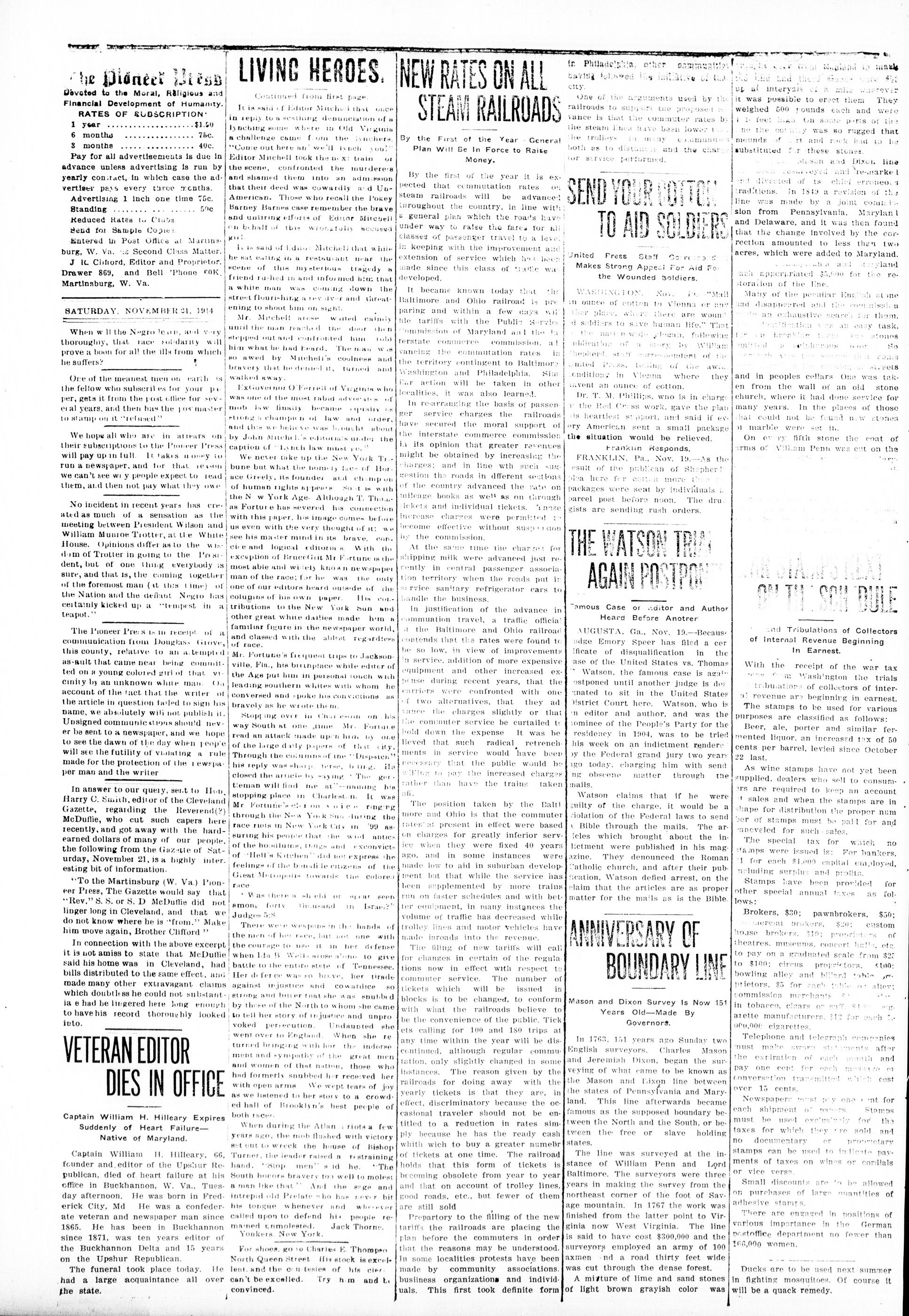
VETERAN EDITOR DIES IN OFFICE
Captain William H. Hilleary Expires Suddenly of Heart Failure— Native of Maryland.
Captain William H. Hilleary, 66, founder and editor of the Upshur Republican, died of heart failure at his office in Buckhannon, W. Va., Tuesday afternoon. He was born in Frederick City, Md. He was a confederate veteran and newspaper man since 1865. He has been in Buckhannon since 1871, was ten years editor of the Buckhannon Delta and 15 years on the Upshur Republican.
The funeral took place today. He had a large acquaintance all over the state.
LIVING HEROES.
Continued from first page.
It is said of Editor Mitchell that once in reply to a scathing denunciation of a lynching some where in Old Virginia a challenge came from the lynchers. "Come out here and we'll lynch you!" Editor Mitchell took the next train or the scene, confronted the murderers and shamed them into an admission that their deed was cowardly and Un-American. Those who recall the Pokey Barney Barnes case remember the brave and untiring efforts of Editor Mitchell on behalf of this wrongfully accused girl.
It is said of Editor Mitchell that white he sat eating in a restaurant near the scene of this mysterious tragedy a friend rushed in and informed him that a white man was coming down the street flourishing a revolver and threatening to shoot him on sight.
Mr. Mitchell arose waited calmly until the man reached the door then stepped out and confronted him, told him what he had heard. The man was so awed by Mitchell's coolness and bravery that he denied it, turned and walked away.
ExGovernor O'Ferrell of Virginia who was one of the most rabid advocates of mob law finally became equally as strong a champion of law and order, and this we believe was bought about by John Mitchell's editorials under the caption of "Lynch law must be."
We never take up the New York Tribune but what the honest face of Horace Greely, its founder and champion of human rights appears. So it is with the New York Age. Although T. Thomas Fortune has severed his connection with this paper, his image comes before us even with the very thought of it: we see his master mind in its brave, concise and logical editions. With the exception of BruceGrit Mr Fortune is the most able and wisely known newspaper man of the race; for he was the only one of our editors heard outside of the columns of his own paper. His contributions to the New York Sun and other great white dailies made him a familiar figure in the newspaper world, and classed with the ablest regardless of race.
Mr. Fortune's frequent trips to Jacksonville, Fla., his birthplace while editor of the Age put him in personal touch with leading southern whites with whom he conversed and spoke his convictions as bravely as he wrote them.
Stopping over in Charleston on his way South at one time Mr. Fortune read an attack made upon him by one of the large dirty papers of that city. Through the columns of the "Dispatch" his reply was sharp, terse, biting. He closed the article by saying: "The gentleman will find me at" naming his stopping place in Charleston. It was Mr. Fortune's clot on voice ringing through the New York Sun during the race riots in New York City in '99 assuring his people that the wild antics of the hoodlums, drugs and exconvicts of "Hell's Kitchen" did not express the feelings of the bonafide citizens of the Great Metropolis towards the colored race
"Was there a shield or spear seen among forty thousand in Israel?" Judge 5:8
There were weapons in the hands of the men of her race, but not one with the courage to use it in her defense when Lila B Wellsrose alone to give battle to the entire state of Tennessee. Her defence was so brave, her tirade against injustice and cowardice so strong and butter that she was snubbed by those of the North to whom she came to tell her story of injustice and unprovoked persecution. Undaunted she went over to England. When she returned bringing with her the indorsement and sympathy of the great men and women of that nation, those who had formerly snubbed her received her with open arms. We wept tears of joy as we listened to her story to a crowded hall of Brooklyn's best people of both races.
When during the Atlan riots a few years ago, the mob flushed with victory set out to wreck the house of Bishop Turner, the leader raised a restraining hand. "Stop men" is id he. "The South honors bravery too well to molest a man like that." And the sage and intrepid old Prelate who has never bit his tongue whenever and wherever called upon to defend his people remained unmolested. Jack Thorne. Yonkers, New York.
For shoes, go to Charles E. Thompson North Queen Street. His stock is excellent, and the courtesy of his clerics can't be excelled. Try him and be convinced.
NEW RATES ON ALL STEAM RAILROADS
By the First of the Year - General Plan Will Be In Force to Raise Money.
By the first of the year it is expected that commutation rates on steam railroads will be advanced throughout the country, in line with a general plan which the roads have under way to raise the fares for all classes of passenger travel to a level in keeping with the improvement and extension of service which has been made since this class of traffic was developed.
It became known today that the Baltimore and Ohio railroad is preparing and within a few days will file tariffs with the Public Service Commission of Maryland and the Interstate commerce commission, advancing the commutation rates in the territory contingent to Baltimore Washington and Philadelphia. Similar action will be taken in other localities, it was also learned.
In rearranging the basis of passenger service charges the railroads have secured the moral support of the interstate commerce commission in its opinion that greater revenues might be obtained by increasing the charges; and in line with such suggestion the roads in different sections of the country advanced the rate on mileage books as well as on through tickets and individual tickets. These increase charges were permitted to become effective without suspension by the commission.
At the same time the charge for shipping milk were advanced just recently in central passenger association territory when the roads put in service sanitary refrigerator cars to handle the business.
In justification of the advance in commutation travel, a traffic official at the Baltimore and Ohio railroad contends that the rates were found to be so low, in view of improvements in service, addition of more expensive equipment and other increased expense during recent years, that the carriers were confronted with one of two alternatives, that they advance the charges slightly or that the commuter service be curtailed to bold down the expense. It was believed that such radical retrenchments in service would have been necessary that the public would be willing to pay the increased charges rather than have the trains taken off.
The position taken by the Baltimore and Ohio is that the commuter rates at present in effect were based on charges for greatly inferior service when they were fixed 40 years ago, and in some instances were made low to aid in suburban development but that while the service has been supplemented by more trains run on faster schedules and with better equipment, in many instances the volume of traffic has decreased while trolley lines and motor vehicles have made inroads into the revenue.
The filing of new tariffs will call for changes in certain of the regulations now in effect with respect to commuter service. The number of tickets which will be issued in blocks is to be changed, to conform with what the railroads believe to be the convenience of the public. Tickets calling for 100 and 180 trips at any time within the year will be discontinued, although regular commutation, only slightly changed in some instances. The reason given by the railroads for doing away with the yearly tickets is that they are, in effect, discriminatory because the occasional traveler should not be entitled to a reduction in rates simply because he has the ready cash whith wich to buy a greater numebr of tickets at one time. The railroad holds that this form of tickets is becoming obsolete from year to year and that on account of trolley lines, good roads, etc., but fewer of them are still sold
Prepartory to the filling of the new tariffs the railroads are placing the plan before the commuters in order that the reasons may be understood. In some localities protests have been made by community associations business organizations and individuals. This first took definite form
in Philadelphia, other communities having followed the initiative of the city.
One of the arguments used by the railroads to support the proposed advance is that the commuter rates by the steam lines have been lower than the trolleys in many communities both as to distances and the charge for service performed.
SEND YOUR COTTON TO AID SOLDIERS
United Press Staff correspond
Makes Strong Appeal For Aid For
the Wounded Soldiers.
WASHINGTON. Nov. 10. "Mail
in ounce of cotton to Vienna or any
other place, where there are wounded
soldiers to save human life." That
is the nation wide began, following
publication of a story by William
thepherd, staff correspondent of the
United Press, testing of the awa-
condition; in Vienna where they
invent an ounce of cotton.
Dr. T. M. Phillips, who is in charge of the Red Cross work, gave the plan his heartiest support, and said if every American sent a small package the situation would be relieved.
Franklin Responds.
FRANKLIN, Pa., Nov. 19.—As the result of the publican of Shepherd's idea here for cotton more than packages were sent by individuals in parcel post before noon. The drugists are sending rush orders.
THE WATSON TRAN AGAIN POSTPON
Famous Case of Editor and Author Heard Before Anotrer
AUGUSTA, Ga., Nov. 19.—Because Judge Emory Speer has filed a certificate of disqualification in the case of the United States vs. Thomas W. Watson, the famous case is again postponed until another judge is designated to sit in the United States District Court here. Watson, who is an editor and author, and was the nominee of the People's Party for the presidency in 1904, was to be tried this week on an indictment rendered by the Federal grand jury two years ago today, charging him with sending obscene matter through the mails.
Watson claims that if he were guilty of the charge, it would be a violation of the Federal laws to send a Bible through the mails. The articles which brought about the indictment were published in his magazine. They denounced the Roman Catholic church, and after their publication, Watson defied arrest, on the claim that the articles are as proper matter for the mails as is the Bible.
ANNIVERSARY OF BOUNDARY LINE
Mason and Dixon Survey Is Now 151 Years Old—Made By Governors.
In 1763, 151 years ago Sunday two English surveyors. Charles Mason and Jeremiah Dixon, began the surveying of what came to be known as the Mason and Lixon line between the states of Pennsylvania and Maryland. This line afterwards became famous as the supposed boundary between the North and the South, or between the free or slave holding states.
The line was surveyed at the instance of William Penn and Lord Baltimore. The surveyors were three years in making the survey from the northeast corner of the foot of Savage mountain. In 1767 the work was finished from the latter point to Virginia now West Virginia. The line is said to have cost $300,000 and the surveyors employed an army of 100 axmen and a road thirty feet wide was cut through the dense forest. A mixture of lime and sand stones of light brown grayish color was
might ever come implanted to mount the line and thread stones were set up at intervals of a mile wherever it was possible to erect them. They weighed 500 pounds each and were 11 feet high. On some parts of the one the country was so rugged that mounds of dirt and rock had to be substituted for these stones.
Mason and Dixon line
each resurveyed and re-marked
and diverted of its chief erroneous
traditions. In 1849 a revision of the
line was made by a joint commission from Pennsylvania, Maryland
and Delaware, and it was then found
that the change involved by the correction amounted to less than two
acres, which were added to Maryland.
each appropriated $5,000 for the restoration of the line.
and in peoples cellars. One was taken from the wall of an old stone church, where it had done service for many years. In the places of those that could not be found new stones on marble were set in.
On every fifth stone the coat of arms of William Penn was cut on the
and Tribulations of Collectors of Internal Revenue Beginning In Earnest.
With the receipt of the war tax taxes from Washington the trials distributions of collectors of internal revenue are beginning in earnest. The stamps to be used for various purposes are classified as follows: Beer, ale, porter and similar fermented liquor, an increased tax of 50 cents per barrel, levied since October 22 last. As wine stamps have not yet been supplied, dealers who sell to consumers are required to keep an account of sales and when the stamps are in shape for distribution the proper number of stamps must be paid for and canceled for such sales.
The special tax for which no stamps were issued is: For bankers, '1 for each $1,000 capital employed, including surplus and profits. Stamps have been provided for other special annual taxes as follows:
Brokers, $20; pawnbrokers. $50;
aercat brokers. $20; custom
house brokers. $10; proprietors of
theatres, museums, concert halls, etc.
to pay on a graduated scale from $25
to $100; circus proprietors. $100;
bowling alley and billard table
proprietors. $5 for each table or alter;
commission merchants $10;
in tobacco, cigars or soft. $450;
cigarette manufacturers. $12 for each
1,000,000 cigarettes.
Telephone and telegraph companies
must make swarm statements after
the expiration of each month and
pay one cent for each message or
conversation transmitted which cost
over 15 cents.
Newspapers must pay one cent for each shipment of papers. Stamps must be used exclusively for the taxes for which they are sold and no documentary or proprietary stamps can be used to indicate payments of taxes on wines or cordials or vice versa.
Small discounts are to be allowed on purchases of large quantities of adhesive stamps.
There are engaged in positions of various importance in the German postoffice department no fewer than 168,000 women.
Ducks are to be used next summer in fighting mosquitoes. Of course it will be a quack remedy.
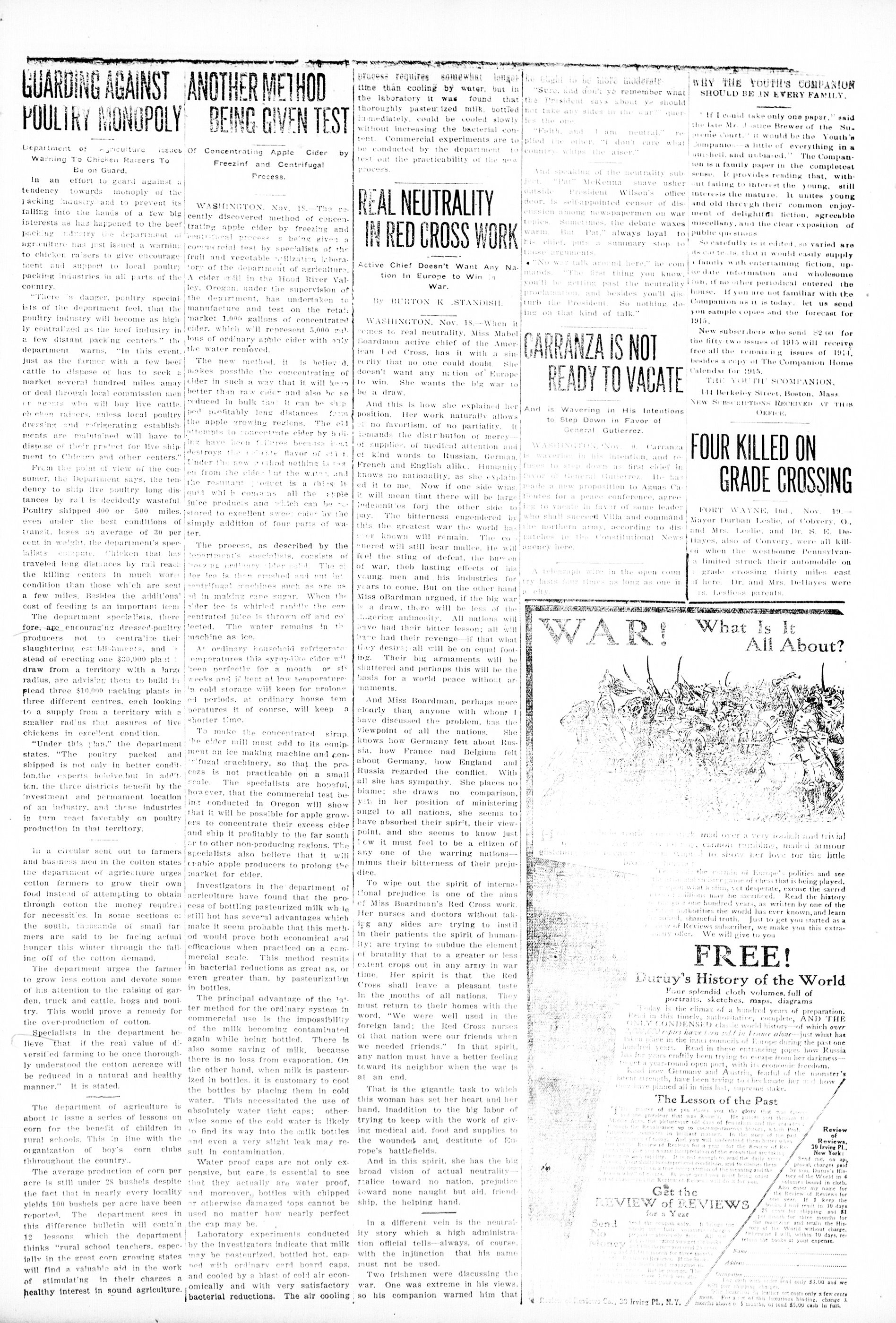
GUARDING AGAINST POULTRY MONOPOLY
Department of Agriculture Issues Warning To Chicken Raiders To Be on Guard.
In an effort to guard against a tendency towards monoply of the packing industry and to prevent its falling into the hands of a few big interests as has happened to the beef packing industry the department of agriculture has just issued a warning to chicken raiders to give encouragement and support to local poultry packing industries in all parts of the country.
"There is danger, poultry specialists of the department feel, that the poultry industry will become as highly centralized as the beef industry in a few distant packing centers" the department warns. "In this event, just as the farmer with a few beef cattle to dispose of has to seek a market several hundred miles amay or deal through local commission men or agents who will buy live cattle, chicken raiders, unless local poultry dressing and refrigerating establishments are maintained will have to dispose of their protest for live shipment to Chicago and other centers."
From the point of view of the consumer, the Department says, the tendency to ship live poultry long distances by rail is decidedly wasteful. Poultry shipped 400 or 500 miles, even under the best conditions of transit, loses an average of 30 per cent in weight, the department's specialists compute. Chicken that has traveled long distances by rail reach the killing centers in much worse condition than those which are sent a few miles. Besides the additional cost of feeding is an important item.
The department specialists, therefore, are encouraging dressed-poultry producers not to centralise their slaughtering establishments, and to stead of erecting one $30,000 plant to draw from a territory with a large radius, are advising them to build in stead three $10,000 packing plants in three different centres, each looking to a supply from a territory with a smaller radius that assures of live chickens in excellent condition.
"Under this plan," the department states. "The poultry packed and shipped is not only in better condition, the experts believe, but in addition, the three districts benefit by the investment and permanent location of an industry, and these industries in turn react favorably on poultry production in that territory.
In a circular sent out to farmers and business men in the cotton states the department of agriculture urges cotton farmers to grow their own food instead of attempting to obtain through cotton the money required for necessities. In some sections of the south, thousands of small farmers are said to be facing actual hunger this winter through the falling off of the cotton demand. The department urges the farmer to grow less cotton and devote some of his attention to the raising of garden, truck and cattle, hogs and poultry. This would prove a remedy for the over-production of cotton.
Specialists in the department believe that if the real value of diversified farming to be once thoroughly understood the cotton acreage will be reduced in a natural and healthy manner." It is stated.
The department of agriculture is about to issue a series of lessons on corn for the benefit of children in rural schools. This in line with the organization of boy's corn clubs throughout the country.
The average production of corn per acre is still under 28 bushels despite the fact that in nearly every locality yields 100 bushels per acre have been reported. The department sees in this difference bulletin will contain 12 lessons which the department thinks "rural school teachers, especially in the great corn growing states will find a valuable aid in the work of stimulating in their charges a healthy interest in sound agriculture.
ANOTHER METHOD BEING GIVEN TEST
Of Concentrating Apple Cider by Freezinf and Centrifugal Process.
WASHINGTON, Nov. 18.—The recently discovered method of concentrating apple cider by freezing and centrifugal process is being given a commercial test by specialists of the fruit and vegetable civilization laboratory of the department of agriculture. A cider mill in the Hood River Valley, Oregon, under the supervision of the department, has undertaken to manufacture and test on the retail market 1,000 gallons of concentrated cider, which will represent 5,000 gallons of ordinary apple cider with only the water removed.
The new method, it is believed, makes possible the concentrating of cider in such a way that it will keep better than raw cider and also be so reduced in bulk that it can be shipped profitably long distances from the apple growing regions. The old attempts to concentrate cider by boiling have been failures because it destroys the delicate flavor of cider. Under the new method nothing is torn from the cider but the water, and the resultant product is a chicle it quit which concerns all the apple juice products and which can be restored to excellent sweet cider by the simply addition of four parts of water.
The process, as described by the department's specialists, consists of freezing ordinary cider cold. The cider ice is then crushed and put in centrifugal machines such as are used in making cane sugar. When the cider ice is whirled rapidly the concentrated juice is thrown off and collected. The water remains in the machine as ice.
At ordinary household refrigerate temperatures this syrup-like cider will keep perfectly for a month or six weeks and if kept at low temperature in cold storage will keep for prolonged periods, at ordinary house temperatures it of course, will keep a shorter time.
To make the concentrated sirap, the cider mill must add to its equipment an ice making machine and centrifugal machinery, so that the process is not practicable on a small scale. The specialists are hopeful, however, that the commercial test being conducted in Oregon will show that it will be possible for apple growers to concentrate their excess cider and ship it profitably to the far south or to other non-producing regions. The specialists also believe that it will crable apple producers to prolong the market for cider.
Investigators in the department of agriculture have found that the process of bottling pasteurized milk while still hot has several advantages which make it seem probable that this method would prove both economical and efficacious when practiced on a commercial scale. This method results in bacterial reductions as great as, or even greater than, by pasteurization in bottles.
The principal advantage of the latter method for the ordinary system in commercial use is the impossibility of the milk becoming contaminated again while being bottled. There is also some saving of milk, because there is no loss from evaporation. On the other hand, when milk is pasteurized in bottles, it is customary to cool the bottles by placing them in cold water. This necessitated the use of absolutely water tight caps; otherwise some of the cold water is likely to find its way into the milk bottles and even a very slight leak may result in contamination.
Water proof caps are not only expensive, but care is essential to see that they actually are water proof, and moreover, bottles with chipped or otherwise damaged tops cannot be used no matter how nearly perfect the cap may be.
Laboratory experiments conducted by the investigators indicate that milk may be pasteurized, bottled hot, capped with ordinary card board caps, and cooled by a blast of cold air economically and with very satisfactory bacterial reductions. The air cooling
---
process requires somewhat longer time than cooling by water, but in the laboratory it was found that thoroughly pasteurized milk, bottled immediately, could be cooled slowly without increasing the bacterial content. Commercial experiments are to be conducted by the department to test out the practicability of the new process.
REAL NEUTRALITY IN RED CROSS WORK
Active Chief Doesn't Want Any Nation In Europe to Win in War.
BY BURTON K. STANDISH.
WASHINGTON, Nov. 18.—When it comes to real neutrality, Miss Mabel Boardman active chief of the American Led Cross, has it with a sincerity that no one could doubt. She doesn't want any nation of Europe to win. She wants the big war to be a draw.
And this is how she explained her position. Her work naturally allows it no favoritism, of no partiality. It demands the distribution of mercy—of supplies, of medical attention and et kind words to Russian, German, French and English alike. Humanity knows no nationality, as she explained it to me. Now if one side whis, it will mean that there will be large indemnities forj the other side to pay. The bitterness engendered by this the greatest war the world has ever known will remain. The co-quered will still bear malice. He will feel the sting of defeat, the buren of war, the bleb lasting effects of his young men and his industries for years to come. But on the other hand Miss oBardman argued, if the big war is a draw, there will be less of the shattering animosity. All nations will leave had their bitter lesson; all will have had their revenge—if that what they desire; all will be on equal footing. Their big armaments will be shattered and perhaps this will be the basis for a world peace without armaments.
And Miss Boardman, perhaps more clearly than anyone with whom I have discussed the problem, has the viewpoint of all the nations. She knows how Germany felt about Russia, how France had Belgium felt about Germany, how England and Russia regarded the conflict. With all she has sympathy. She places no blame; she draws no comparison, yet in her position of ministering angel to all nations, she seems to have absorbed their spirit, their viewpoint, and she seems to know just how it must feel to be a citizen of any one of the warring nations—minus their bitterness of their prejudice.
To wipe out the spirit of international prejudice is one of the aims of Miss Boardman's Red Cross work. Her nurses and doctors without taking any sides are trying to instil in their patients the spirit of humanity; are trying to subdue the element of brutality that to a greater or less extent crops out in any army in war time. Her spirit is that the Red Cross shall leave a pleasant taste in the mouths of all nations. They must return to their homes with the word, "We were well used in the foreign land; the Red Cross nurses of that nation were our friends when we needed friends." In that spirit, any nation must have a better feeling toward its neighbor when the war is at an end.
That is the gigantic task to which this woman has set her heart and her hand, inaddition to the big labor of trying to keep with the work of giving medical aid, food and supplies to the wounded and destitute of Europe's battlefields.
And in this spirit, she has the big broad vision of actual neutrality—realice toward no nation, prejudice toward none naught but aid, friendship, the helping hand.
In a different vein is the neutrality story which a high administration official tells—always, of course, with the injunction that his name must not be used.
Two Irishmen were discussing the war. One was extreme in his views, so his companion warned him that
he Caught to be those moderate
"Sure, had don't ye remember what
the President says about ye should
not take any sides in the war" queries the one
And speaking of the neutrality subject, "Pat" McKeenna suave usher outside President Wilson's office door, is soft-appointed censor of discussion among newspapers on war topics. Sometimes, the debate waxes warm. Bat Pat," always loyal to his chief, puts a summary stop to those arguments.
What Is It
All About?
WAR! What Is It All About?
mad over a very foolish and trivial
cannon trembling, mutilated armour
to show her love for the little
fairy tale
The captain of Europe's politics and see
the man and an intergame of chess that is being played,
he knows what a fish, yet desperate, excuse the sacred
militions may be surrendered. Read the history
that past one hundred years, as written by one of the
authorities the world has ever known, and learn
shameful truth. Just to get you started as a
guy of Reviews subscriber, we make you this extra-
cary offer. We will give to you
FREE!
Duruy's History of the World
Four splendid cloth volumes, full of portraits, sketches, maps, diagrams
oohay is the climax of a hundred years of preparation.
I in this timely, authoritative, complete, AND THE
WY CONDENSED classic world history—of which over
eagles have been told in France alone—just what has
place in the liner councils of Europe during the past one
ed years. Read in these entrancing pages how Russia
years craftily been trying to escape from her darkness—
a year-round open port, with its economic freedom.
I show Germany and Austria, fearful of the monster's
strength, have been trying to checkmate her and how
we pinned all in this last, supreme stake.
Today is the climax of a hundred years of preparation. Read in this timely, authoritative, complete, AND THE ONLY CONDENSED classic world history—of which over 100 copies have been sold in France alone—just what has taken place in the inner countrys of Europe during the past one hundred years. Read in these entrancing pages how Russia has for years craftily been trying to escape from her darkness—to get a year-round open port, with its economic freedom. Read how Germany and Austria, fearful of the monster's latent strength, have been trying to checkmate her and how they have pinned all in this last supreme stake.
The Lesson of the Past
over of the pen shows you the glory that was Greenystudeer that was Roses. He goes to go through the sth of the pictureque old days of famous in and the car. Reaction up to contemporaneous history, which Prof. of the number of brilliant manner. In the story of the past of history. And you will understand them better when it is true of Reviews for a year for the Review of Res. you a some interpretation of the exesthat are taking responsibility. It is not enough to read the daily news of the most comprehensive news and to discuss them.
Send me, on approach, charges paid by you, Durru's His history of the World in 14th Review of Reviews will do it for you.
Get the
W of REVIEWS
for a Year
the opinion only. It brings me
to the day youmeet charges
of about $1000000 from $1000000
that after you get it books
the best $1000000 from $1000000
to the end of the month.
Name: _____
The number of the pen shows you the glory that was Greenfield and the grandeur that was Romeo. He gives you through the Middle Ages, the pictureque old days of femininity and the caudales, through the Renaissance up to contemporaneous history, which Prof. Grosseau compiles in brilliant manure. In the story of the past the story of today. And you will understand them better when he reviews of Reviews for a year, for the Review of Reviews, a state interpretation of the events that are taking place, not enough to read the daily news, send me, on appraisal, to complete conditions, and to discuss them, professional charges paid, to explain the meaning and the why and what of events. In your inquiry not living, other by von. Duruvu's History of the Review of Reviews.
PUBLIC REVIEWS CO., 20 Irving PLA., N.Y. more. For a copy of this luxurious binding, change
months above $ 6 months, or send $ 5,000 cash to F.A.
"Faith, and I am neutral," replied the other. "I don't care what country, whips the aiser."
• "No war talk around here," he commands. "The first thing you know you'll be getting past the neutrality proclamation, and besides you'll disturb the President. So nothing doing on that kind of talk."
CARRANZA IS NOT READY TO VACATE
And is Wavering in His Intentions to Step Down in Favor of General Gutierrez.
WASHINGTON, Nov. 0. Carranza is wavering in his intention, and refuses to step down as first chief in favor of general Gutierrez. He has made a new proposition to Aguas Calientes for a peace conference, agreeing to vacate in favor of some leader who shall succeed Villa and command the northern army, according to dispatches to the Constitutional News agency here.
A telegraph wire in the open country lasts four times as long as one in a city.
WHY THE YOUTH'S COMPANION SHOULD BE IN EVERY FAMILY.
"If I could take only one paper," said the late Mr. Justice Brewer of the Supreme Court, "it would be the Youth's Company—a little of everything in a nutshell, and unbased." The Companion is a family paper in the completest sense. It provides reading that, without failing to interest the young, still interests the mature. It unites young and old through their common enjoyment of delightful fiction, agreeable miscellany, and the clear exposition of public questions.
So carefully is it edited, so varied are its contents, that it would easily supply a family with entertaining fiction, up-to-date information and wholesome information, if no other periodical entered the house. If you are not familiar with the Companion as it is today, let us send you sample copies and the forecast for 1915.
New subscribers who send $2.00 for the fifty two issues of 1915 will receive free all the remaining issues of 1911, besides a copy of The Companion Home Calendar for 1915.
THE YOUTH SCOMPANION,
144 Berkeley Street, Boston, Mass.
NEW SUBSCRIPTIONS RECEIVED AT THIS OFFICE.
FOUR KILLED ON GRADE CROSSING
FORT WAYNE, Ind., Nov. 19. Mayor Durban Leslie, of Cobvery, O., and Mrs. Leslie, and Dr. S. E. DeHayes, also of Convery, were all killed when the westboung Peninsylvan-a limited struck their automobile on a grade crossing thirty miles east of here. Dr. and Mrs. DeHayes were in Lesliess parents.
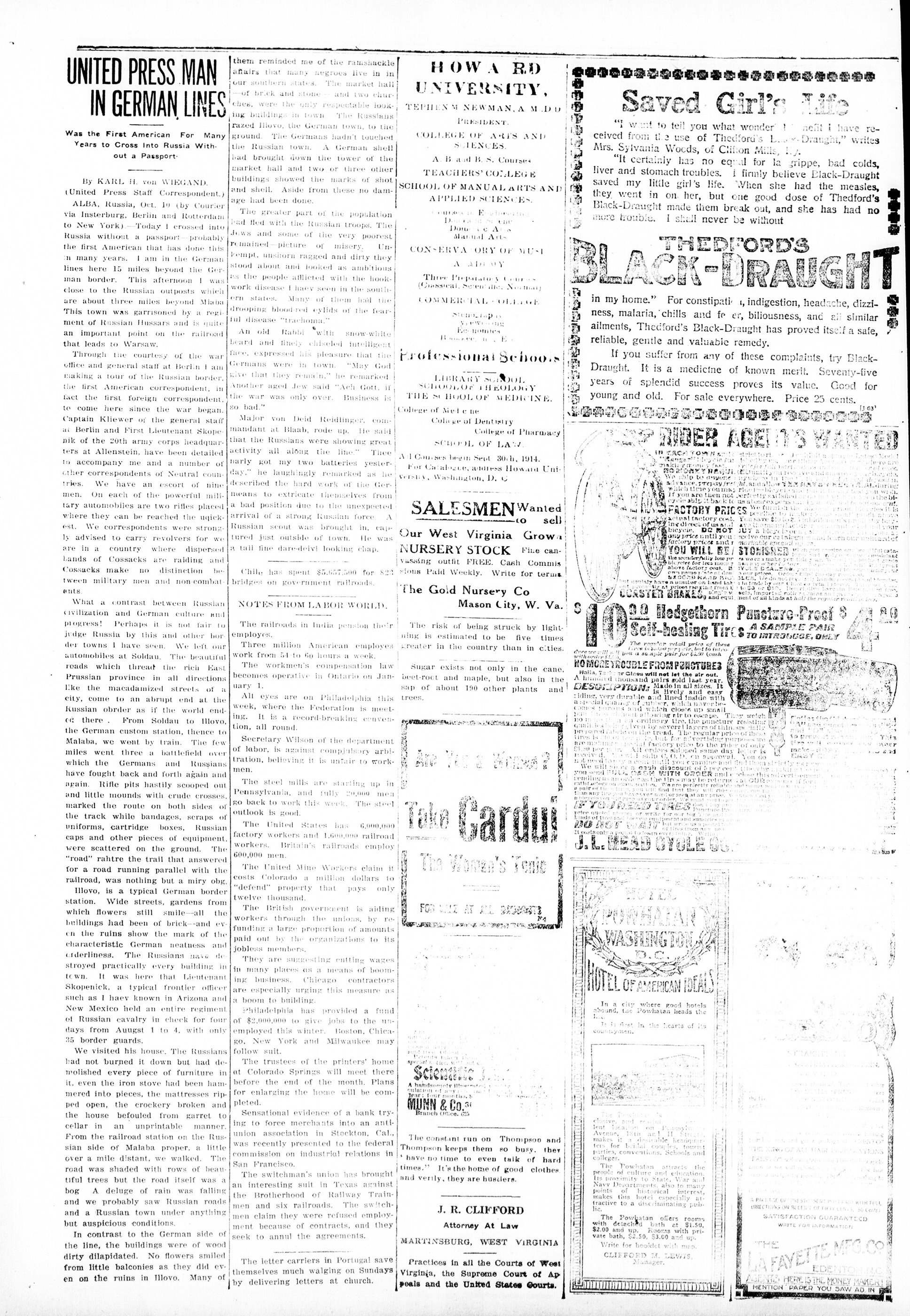
UNITED PRESS MAN IN GERMAN LINES
Was the First American For Many Years to Cross Into Russia Without a Passport
---
By KARL H. von WIEGAND. (United Press Staff Correspondent.) ALBA, Russia, Oct. 10 (by Courier via Insterburg, Berlin and Rotterdam to New York)—Today I crossed into Russia without a passport—probably the first American that has done this in many years. I am in the German lines here 15 miles beyond the German border. This afternoon I was close to the Russian outposts which are about three miles beyond Miaba. This town was garrisoned by a regiment of Russian Hussars and is quite an important point on the railroad that leads to Warsaw.
Through the courtesy of the war office and general staff at Berlin I am making a tour of the Russian border, the first American correspondent, impact the first foreign correspondent, to come here since the war began. Captain Kliewer of the general staff at Berlin and First Lieutenant Skopenik of the 20th army corps headquarters at Allenstein, have been detailed to accompany me and a number of other correspondents of Neutral countries. We have an escort of nine men. On each of the powerful military automobiles are two rifles placed where they can be reached the uqickest. We correspondents were strongly advised to carry revolvers for we are in a country where dispersed bands of Cossacks are raiding and Cossacks make no distinction between military men and non-combatants.
What a contrast between Russian civilization and German culture and progress! Perhaps it is not fair to judge Russia by this and other border towns I have seen. We left our automobiles at Soldau. The beautiful roads which thread the rich East Prussian province in all directions like the macadamized streets of a city, come to an abrupt end at the Russian obrder as if the world ended there. From Soldau to Illovo, the German custom station, thence to Malaba, we went by train. The few miles went three a battlefield over which the Germans and Russians have fought back and forth again and again. Rifle pits hastily scooped out and little mounds with crude crosses, marked the route on both sides of the track while bandages, scraps of uniforms, cartridge boxes, Russian caps and other pieces of equipment, were scattered on the ground. The "road" rahtre the trail that answered for a road running parallel with the railroad, was nothing but a miry obg.
Illovo, is a typical German border station. Wide streets, gardens from which flowers still smile—all the buildings had been of brick—and even the ruins show the mark of the characteristic German neatness and orderliness. The Russians have destroyed practically every building in town. It was here that Lieutenant Skopenick, a typical frontier officer such as I haev known in Arizona and New Mexico held an entire regiment of Russian cavalry in check for four days from Auugst 1 to 4, with only 35 border guards.
We visited his house. The Russians had not burned it down but had demolished every piece of furniture in it, even the iron stove had been hammered into pieces, the mattresses ripped open, the crockery broken and the house befouled from garret to cellar in an unprintable manner. From the railroad station on the Russian side of Malaba proper, a little over a mile distant, we walked. The road was shaded with rows of beautiful trees but the road itself was a bog. A deluge of rain was falling and we probably saw Russian roads and a Russian town under anything but auspicious conditions.
In contrast to the German side of the line, the buildings were of wood dirty dilapidated. No flowers smiled from little balconies as they did even on the ruins in Illovo. Many of
them reminded me of the ramshackle affairs that many negroes live in in our southern states. The market hall of brick and stone—and two churches, were the only respectable looking buildings in town. The Russians razed Illovo, the German town, to the ground. The Germans hadn't touched the Russian town. A German shell had brought down the tower of the market hall and two or three other buildings showed the marks of shot and shell. Aside from these no damage had been done.
The greater part of the population had fled with the Russian troops. The Jews and some of the very poorest remained—picture of misery. Unkempt, unshorn ragged and dirty they stood about and looked as ambitious as the people afflicted with the hookwork disease I haey seen in the southern states. Many of them had the drooping blood red cylids of the fearful disease "trachoma."
An old Rabbi with snow-white beard and finely chiseled intelligent face, expressed his pleasure that the Germans were in town. "May God give that they remain," he remarked. Another aged Jew said "Ach Gott, if the war was only over. Business is so bad."
Major von Deid Reidlinger, commandant at Blaab, rode up. He said that the Russians were showing great activity all along the line." Three early got my two batteries yesterday," he laughingly remarked as he described the hard work of the Germans to extricate themselves from a bad position due to the unexpected arrival of a strong Russian force. A Russian scout was brought in, captured just outside of town. He was a tail fine dare-deivl looking chap.
Chile has spent $5.657,500 for $22 bridges on government railroads.
NOTES FROM LABOR WORLD.
The railroads in India pension their employes.
Three million American employees work from 54 to 60 hours a week.
The workmen's compensation law becomes operative in Ontario on January 1.
All eyes are on Philadelphia this week, where the Federation is meeting. It is a record-breaking convention, all round.
Secretary Wilson of the department of labor, is against compulsory arbitration, believing it is unfair to workmen.
The steel mills are starting up in Pennsylvania, and fully 20,000 men go back to work this week. The steel outlook is good.
The United States has 6,000,000 factory workers and 1,600,000 railroad workers. Britain's railroads employ 600,000 men.
The United Mine Workers claim it costs Colorado a million dollars to "defend" property that pays only twelve thousand.
The British government is aiding workers through the unions, by refunding a large proportion of amounts paid out by the organizations to its jobless members.
They are suggesting cutting wages in many places as a means of booming business. Chicago contractors are especially urging this measure as a boom to building.
Philadelphia has provided a fund of $2,000,000 to give jobs to the unemployed this winter. Boston, Chicago, New York and Milwaukee may follow suit.
The trustees of the printers' home at Colorado Springs will meet there before the end of the month. Plans for enlarging the home will be completed.
Sensational evidence of a bank trying to force merchants into an antiunion association in Stockton, Cal., was recently presented to the federal commission on industrial relations in San Francisco. The switchman's union has brought an interesting suit in Texas against the Brotherhood of Railway Trainmen and six railroads. The switchmen claim they were refused employment because of contracts, and they seek to annul the agreements.
The letter carriers in Portugal save themselves much walging on Sundays by delivering letters at church.
HOWARD UNIVERSITY.
TEPHEN M NEWMAN, A. M. D.
PRESIDENT.
COLLEGE OF ARTS AND
SCIENCES.
A. B. and B. S. Courses
TEACHERS' COLLEGE
SCHOOL OF MANUAL ARTS AND
APPLIED SCIENCES.
Courses in Engineering
Dance and Science
Dance Arts
Manual Arts
CONSERVATORY OF MUSI
A ADMISY
Three Preparatory Courses
(Classical, Scientific, Norman)
COMMERCIAL OLLEGE
Science
Foreword
Economics
Business, Ec.
Professional Schools
LIBRARY SCHOOL
SCHOOL OF THEOLOGY
THE SCHOOL OF MEDICINE.
College of Medicine
College of Dentistry
College of Pharmacy
SCHOOL OF LAW.
All Courses begin Sept. 30th, 1914.
For Catalogue, address Howard University, Washington, D. C.
SALESMEN Wanted (o sell)
Our West Virginia Grown NURSERY STOCK Fine canvassing outfit FREE. Cash Commissions Paid Weekly. Write for terms
The Gold Nursery Co
The risk of being struck by lightning is estimated to be five times greater in the country than in cities. Sugar exists not only in the cane, beet-root and maple, but also in the sap of about 190 other plants and trees.
Are You a Writer?
Take Cardui
The Women's Tonic
FOR USE AT ALL 02300073
Scientific
A handsomely illustrated
culation of any
Jour. four months.
MUNN & Co. 31
Branch Office, 025
The constant run on Thompson and Thompson keeps them so busy, they have no time to even talk of hard times." It's the home of good clothes and verily, they are husbands.
J. R. CLIFFORD
MARTINSBURG, WEST VIRGINIA
Practices in all the Courts of West Virginia, the Supreme Court of Appeals and the United States Courts.
"I want to tell you what wonder I need it I have received from the use of Thedford's Black-Draught," writes Mrs. Sylvania Woods, of Clifton Mills, Lly.
"It certainly has no equal for la gripe, bad colds, liver and stomach troubles. I firmly believe Black-Draught saved my little girl's life. When she had the measles, they went in on her, but one good dose of Thedford's Black-Draught made them break out, and she has had no more trouble. I shall never be without
THEDFORD'S
BLACK-DRAUGHT
in my home." For constipation, indigestion, headache, dizziness, malaria, chills and fever, billiousness, and all similar ailments, Thedford's Black-Draught has proved itself a safe, reliable, gentle and valuable remedy.
If you suffer from any of these complaints, try Black-Draught. It is a medicine of known merit. Seventy-five years of splendid success proves its value. Good for young and old. For sale everywhere. Price 25 cents.
RIDER A
IN BACK TOWN
whatever will happen in fur-
making many fast.
NO MONEY DRAIN.
We ship to anyone
advance, prepay free
which time you may.
If you are then not
evolve it back to
FACTORY PRICE
actual factory cost.
ing direct of us and
bicycle. DO NOT
any price until your
factory prices and r
YOU WILL BE!
the wonderfully low pre-
bable color for less money
always factory cost.
B even less money
& COOBRAND BOC
if you only have a number on land tax
at all prices ranging from 1
to 10 per person from 1 to
COASTER BRAZES
and equi
10.00 Hedgethern Self-healing Tire
The regular retail price of these tires we will sell is school yard price, but to purchase a pair please pay £20 (cash with order) or £30 (money order).
NO MORE CROUBLE FROM PUNCTURES
Halia, Truck or Closet will not let the air out.
A hundred thousand pairs gold last year.
DESCRIPTION: Made in all sizes. It is lively and easy riding, very durable and lined inside with a special quality of foam in mylar. Comes pursuits and within close proximity to the road and all wing rite to escape. The no-motor vehicle ordinary tire, the puncture quilt is being given by several layers of thin, prepared leather on the tread. The regular price is made for advertising purposes and for factual use to the road. Also per pair. All orders subject to the price received. All sold with C.O.D. on a coupon. Needed to pay a cash until your payment.
J. L. MEAD CYOLE CO.
HOTEL
POWHAHAN
WASHINGTON
D.C.
HOTEL OF AMERICAN IDEALS
In a city where good hotels abound, the Powhatan heads the Lake. It is first in the hearts of its countrymen.
This beautiful and residential location on Pennsylvania Avenue, 18th and 11th streets, makes it a desirable headquarters for bachelor couples, tourist parties, conventions, Schools and colleges.
The Powhatan attracts the people of culture and education. Its proximity to State, War and Navy Departments, also to many points of historical interest, makes this hotel especially attractive to a discriminating public.
The Powhatan offers rooms with detached bath at $1.50, $2.00 and up. Rooms with private bath, $2.50, $3.00 and up.
Write for booklet with map.
CLIFFORD M. LEWIS,
Manager.
We are proud to offer a range of luxury models
that are designed to meet your needs. Here are
some of our favorite pieces and allow us to
delight you in the way we design them.
and allow us to make you feel at home.
During
rhethmology we designed a bespoke
gift you wish
perfectly satisfied in our design with the
bliss of our personality.
We thank the many people who helped us
You save us time and money with our
design. We are thankful for your
support. We are proud to offer our
markable special offers.
STRAKHT. 1830.
A CENTRAL DISTRICT.
AND WATER.
FOR THE USE OF THE MUNICIPAL CITY OF BOSTON.
FOR THE USE OF THE MUNICIPAL CITY OF BOSTON.
A PACKAGE OF ONE STOCK SENT POSTPAID WITH FULL
DIRECTIONS ON RECENT OF FIFTY CLIENTS. 50 Centes.
SATISFACTION GUARANTEED
WRITE FOR INFORMATION
THE
LA FAYETTE MFG. CO.
EDENTON, N.C.
AGENT 13. HERE IS THE MONEY MAKER!
MENTION PAPER YOU SAW AD. IN