The Pioneer Press
Saturday, December 5, 1914
Martinsburg, West Virginia
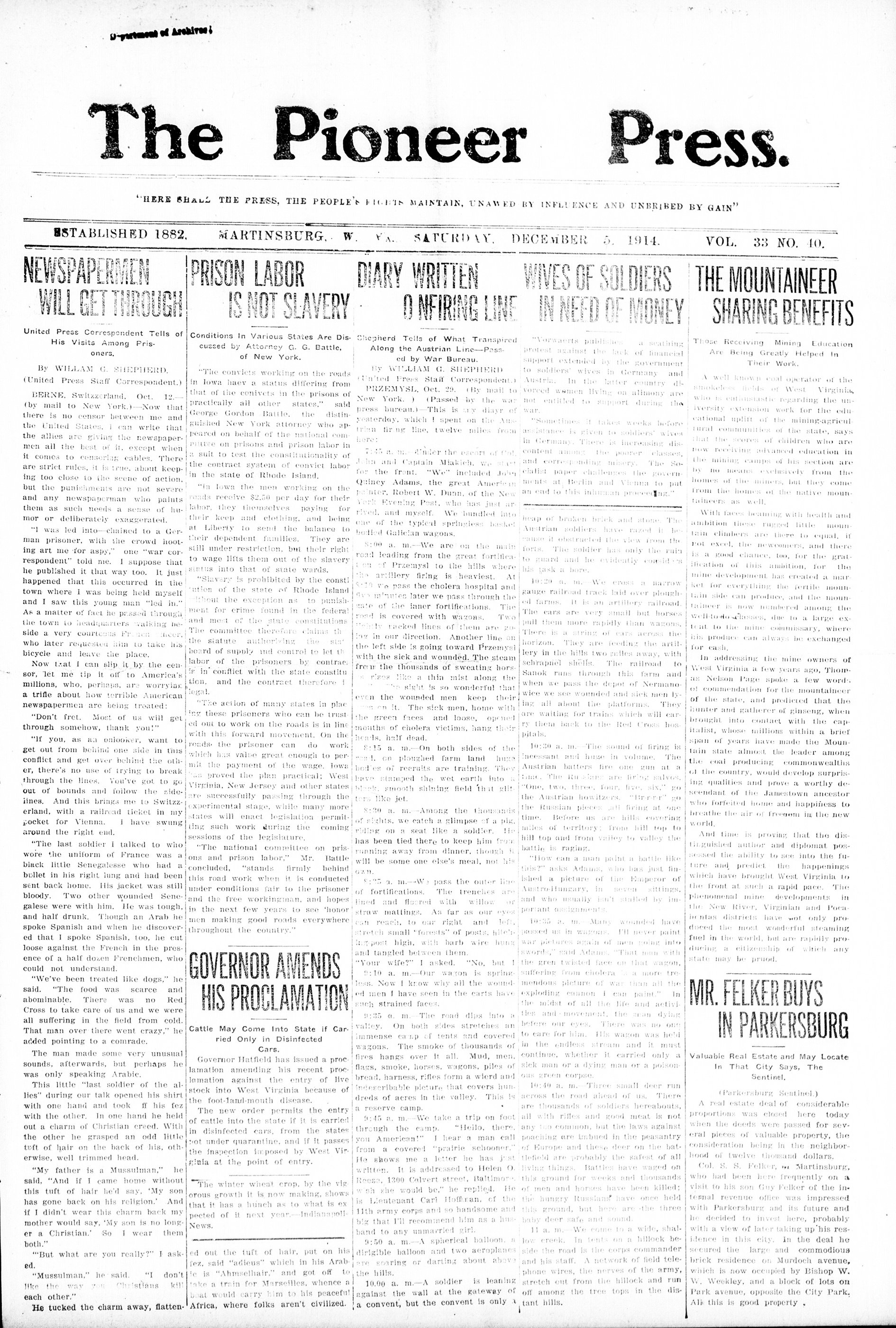
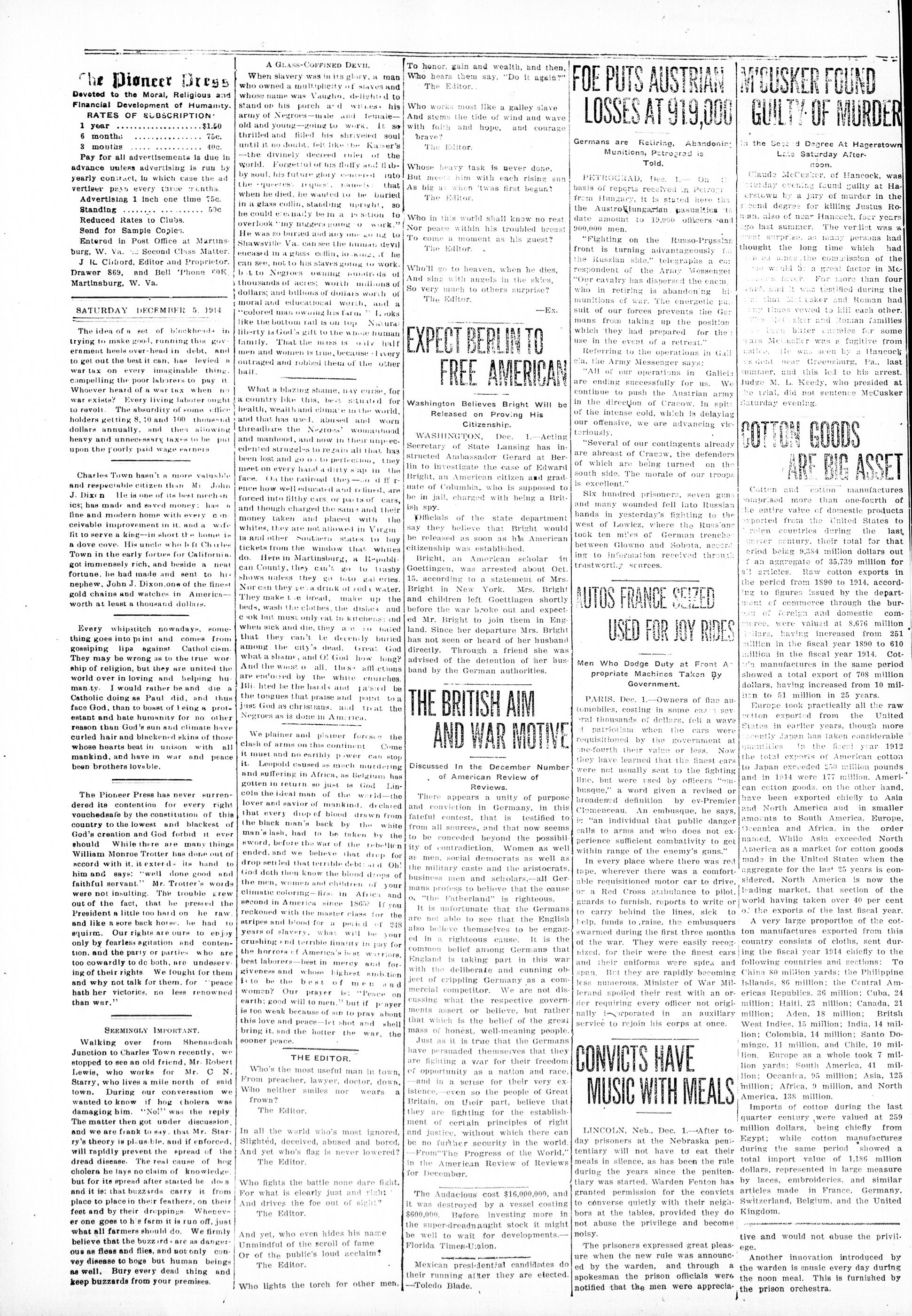
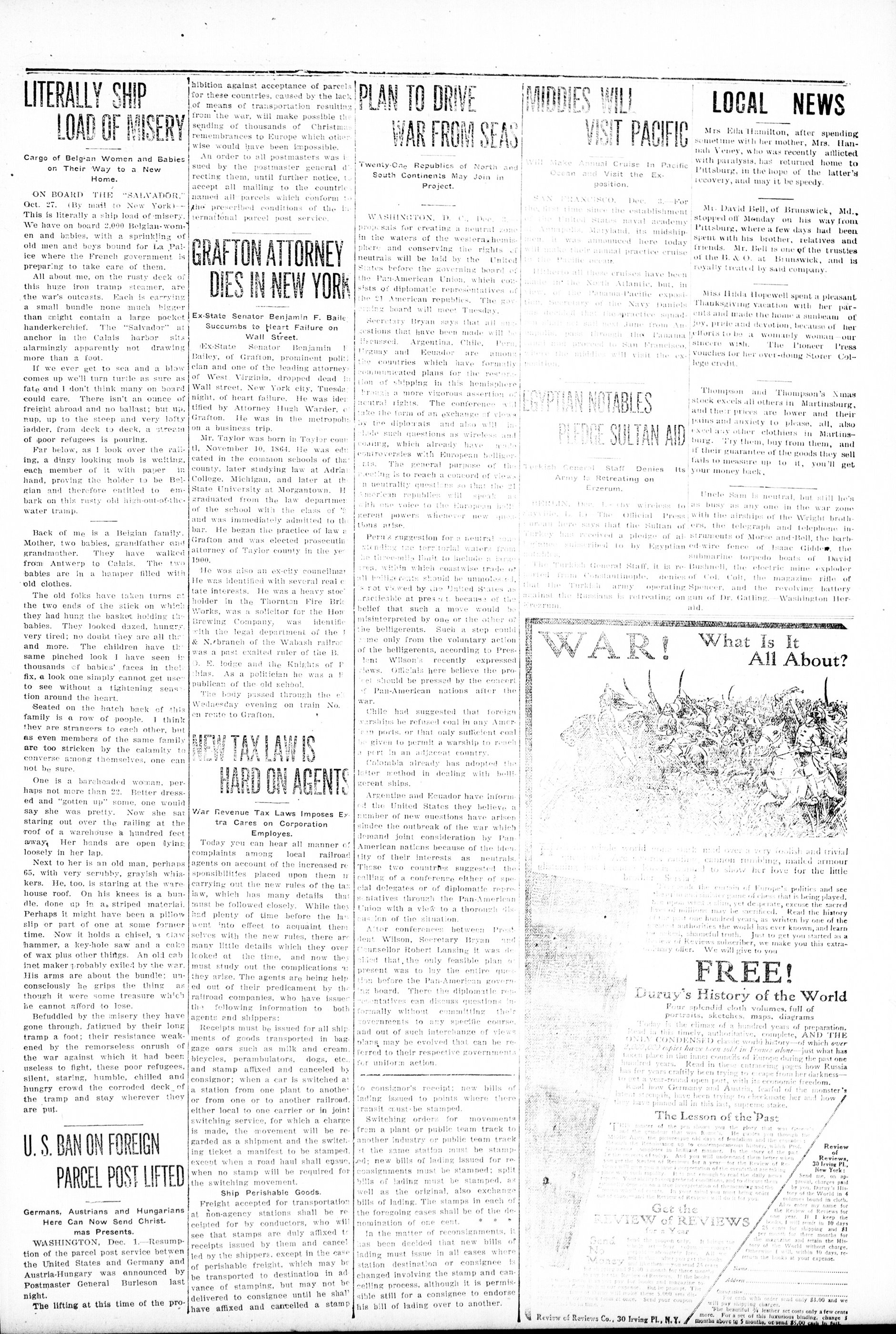
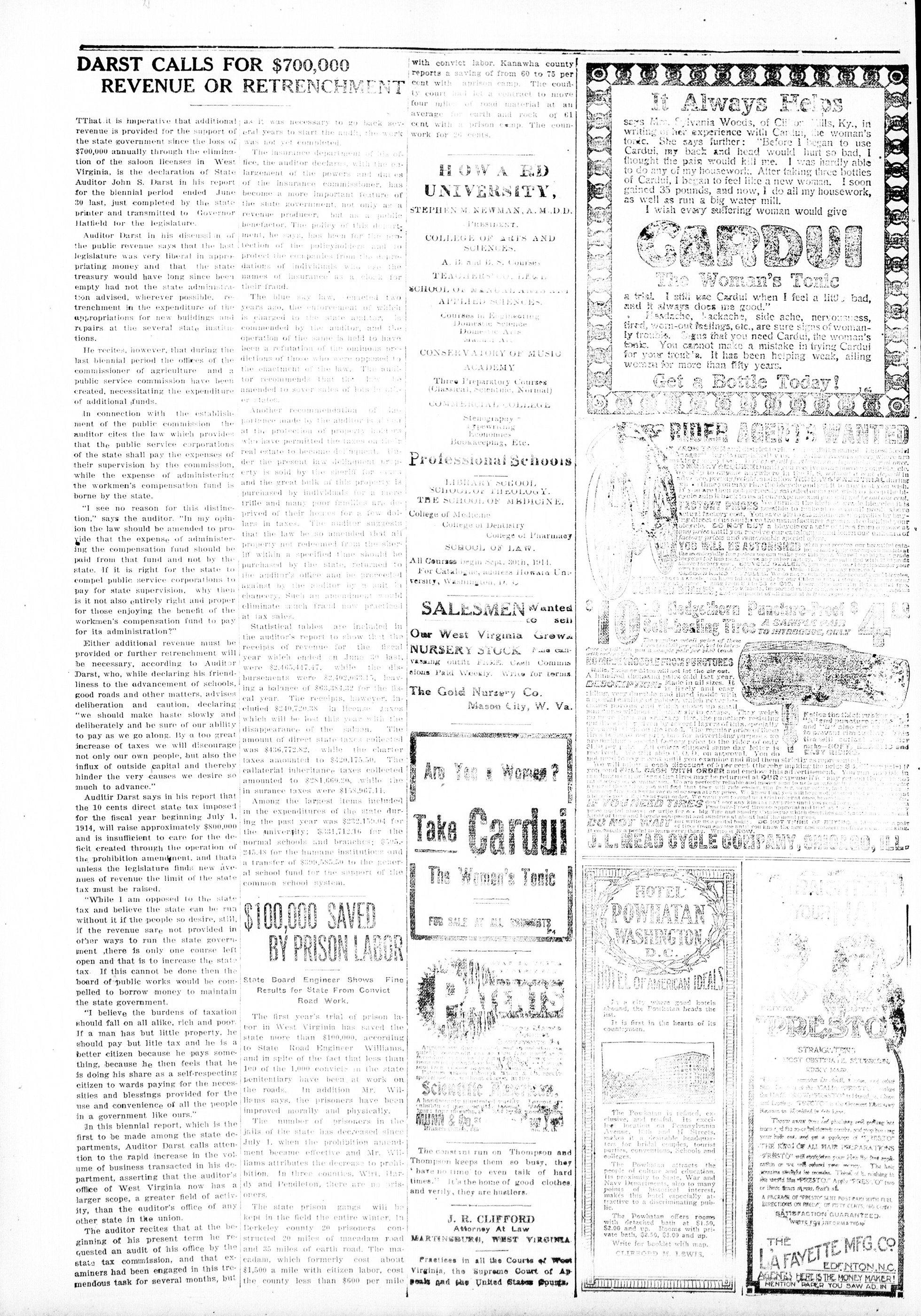
Page text (machine-generated)
The Pioneer Press.
"HERE SHALL THE PRESS, THE PEOPLE'S FIGHTS MAINTAIN, UNAWED BY INFLUENCE AND UNBRIBED BY GAIN"
department of Archives
The
"HERE SHALL
STABLISHED 1882
NEWSPAPERMEN WILL GET THROUGH United Press Correspondent Tells of His Visits Among Prisoners. By WILLIAM G. SHEPHERD. (United Press Staff Correspondent)
BERNE, Switzerland, Oct. 12. (by mail to New York.)—Now that there is no censor between me and the United States, I can write that the allies are giving the newspapermen all the best of it, except when it comes to censoring cables. There are strict rules, it is true, about keeping too close to the scene of action, but the punishments are not severe and any newspaperman who paints them as such needs a sense of humor or deliberately exaggerated.
"I was led into—chained to a German prisoner, with the crowd hooting art me for aspy," one "war correspondent" told me. I suppose that he published it that way too. It just happened that this occurred in the town where I was being held myself and I saw this young man "led in." As a matter of fact he pressed through the town to headquarters walking beside a very courteous French officer, who later requested him to take his bicycle and leave the place. Now that I can slip it by the sensor, let me tip it off to America's millions, who, perhaps, are worrying a trifle about how terrible American newspapermen are being treated:
"Don't fret. Most of us will get through somehow, thank you!" "If you, as an onlooker, want to get out from behind one side in this conflict and get over behind the other, there's no use of trying to break through the lines. You've got to go out of bounds and follow the sidelines. And this brings me to Switzerland, with a railroad ticket in my pocket for Vienna. I have swung around the right end.
"The last soldier I talked to who wore the uniform of France was a black little Senegalese who had a bullet in his right lung and had been sent back home. His jacket was still bloody. Two other wounded Senegalese were with him. He was tough, and half drunk. Though an Arab he spoke Spanish and when he discovered that I spoke Spanish, too, he cut loose against the French in the presence of a half dozen Frenchmen, who could not understand.
"We've been treated like dogs," he said. "The food was scarce and abominable. There was no Red Cross to take care of us and we were all suffering in the field from cold. That man over there went crazy," he added pointing to a comrade.
The man made some very unusual sounds, afterwards, but perhaps he was only speaking Arabic.
This little "last soldier of the allies" during our talk opened his shirt with one hand and took off his fez with the other. In one hand he held out a charm of Christian creed. With the other he grasped an odd little tuft of hair on the back of his, otherwise, well trimmed head.
"My father is a Mussulman," he said. "And if I came home without this tuft of hair he'd say, 'My son has gone back on his religion.' And if I didn't wear this charm back my mother would say, 'My son is no longer a Christian.' So I wear them both."
"But what are you really?" I asked.
"Mussulman," he said. "I don't like the way you Christians kill each other."
He tucked the charm away, flatten-
Conditions In Various States Are Discussed by Attorney G. G. Battle, of New York.
"The convicts working on the roads in Iowa haev a status differing from that of the convicts in the prisons of practically all other states," said George Gordon Battle, the distinguished New York attorney who appeared on behalf of the national committee on prisons and prison labor in a suit to test the constitutionality of the contract system of convict labor in the state of Rhode Island.
"In Iowa the men working on the roads receive $2.50 per day for their labor, they themselves paying for their keep and clothing, and being at Liberty to send the balance to their dependent families. They are still under restriction, but their right to wage lifts them out of the slavery status into that of state wards.
"Slavery is prohibited by the constitution of the state of Rhode Island without the exception as to punishment for crime found in the federal and most of the state constitutions. The committee therefore claims that the statute authorizing the state board of supply and control to let the labor of the prisoners by contract is in conflict with the state constitution, and the contract therefore is legal.
"The action of many states in placing these prisoners who can be trusted out to work on the roads is in line with this forward movement. On the roads the prisoner can do work which has value great enough to permit the payment of the wage. Iowa has proved the plan practical; West Virginia, New Jersey and other states are successfully passing through the experimental stage, while many more states will enact legislation permitting such work during the coming sessions of the legislature.
"The national committee on prisons and prison labor." Mr. Battle concluded, "stands firmly behind this road work when it is conducted under conditions fair to the prisoner and the free workingman, and hopes in the next few years to see 'honor men making good roads everywhere throughout the country.'"
GOVERNOR AWENDS HIS PROCLAIMATION
Cattle May Come Into State if Carried Only in Disinfected Cars.
Governor Hatfield has issued a proclamation amending his recent proclamation against the entry of live stock into West Virginia because of the foot-land-mouth disease.
The new order permits the entry of cattle into the state if it is carried in disinfected cars, from the states not under quarantine, and if it passes the inspection imposed by West Virginia at the point of entry.
The winter wheat crop, by the vigorous growth it is now making, shows that it has a hunch as to what is expected of it next year.—Indianapoli News.
ed out the tuft of hair, put on his fez, said "adieus" which in his Arabic is "Ahmselhair," and got off to take a train for Marseilles, whence a boat would carry him to his peaceful Africa, where folks aren't civilized.
SATURDAY.
DIARY WRITTEN
ONEIRING LOVE
Shepherd Tells of What Transpired Along the Austrian Line—Passed by War Bureau.
BY WILLIAM G. SHEPHERD
(United Press, Staff, Correspondent)
COLLEGE PRESS STAIR CORPORATION.
PRZEMYSL, Oct. 29. (By mail to New York. ) (Passed by the war press bureau.)—This is any diary of yesterday, which I spent on the Austrian firing line, twelve miles from here:
7:45 a. m.—under the escort of Col. John and Captain Mlakich, we start for the front. "We" included Jober Quiney Adams, the great American painter, Robert W. Dunn, of the New York Evening Post, who has just arrived, and myself. We bundled into one of the typical springless basket bodied Galician wagons.
8:00 a. m.—We are on the main road leading from the great fortification of Przemysl to the hills where the artillery firing is heaviest. At 8:10 we pass the cholera hospital and five minutes later we pass through the gate of the inner fortifications. The road is covered with wagons. Two tightly packed lines of them are going in our direction. Another line on the left side is going toward Przemysl with the sick and wounded. The steam from the thousands of sweating horses
seems like a thin mist along the sight is so wonderful that even the wounded men keep their on it. The sick men, home with the green faces and loose, opened mouths of cholera victims, hang their heads, half dead. 8:15 a. m.—On both sides of the wall, on ploughed farm land, huge bodies of recruits are training. They have stamped the wet earth into a block, smooth shining field that glitters like jet.
8:30 a. m. —Among the thousands of sights, we catch a glimpse of a pig, riding on a seat like a soldier. He has been tied there to keep him from running away from dinner, though he will be some one else's meal, not his own.
8:35 a. m. —We pass the outer line of fortifications. The trenches are lined and flared with willow or straw mattings. As far as our eyes can reach, to our right, and left, stretch small "forests" of posts, hilly-tinged post high, with barb wire hung and tangled between them.
"Your wife?" I asked. "No, but I 9:10 a. m.—Our wagon is springless. Now I know why all the wounded men I have seen in the carts have such strained faces. 9:35 a. m.—The road dips into a valley. On both sides stretches an immense camp of tents and covered wagons. The smoke of thousands of fires hangs over it all. Mud, men, flags, smoke, horses, wagons, piles of bread, harness, rifles form a wierd and indecisible picture that covers hundreds of acres in the valley. This is a reserve camp.
9:45 a. m.—We take a trip on foot through the camp. "Heilo, there, you American!" I hear a man call from a covered "prairie schooner." He shows me a letter he has just written. It is addressed to Helen O. Reese, 1300 Calvert street, Baltimore, she would be," he replied. He is Lieutenant Carl Hoffman, of the 11th army corps and so handsome and big that I'll recommend him as a husband to any unmarried girl.
9:50 a. m.—A spherical balloon, a dirigible balloon and two aeroplanes are soaring or darting about above the hills.
10.00 a. m.—A soldier is leaning against the wall at the gateway of a convent, but the convent is only a
AUTHORIZED USER
"Werwaerts publishes a scathing protest against the lack of financial support extended by the government to soldiers' wives in Germany and Austria. In the latter country divorced women living on alimony are not entitled to support during the war.
"Sometimes it takes weeks before assistance is given to soldiers' wives in Germany. There is increasing discontent among the poorer classes, and corresponding misery. The Socialist paper challenges the governments at Berlin and Vienna to put an end to this inhuman proceeding."
heap of broken brick and stone. The Austrian soldiers have razed it because it obstructed the view from the forts. The soldier has only the ruin to guard and he evidently considers his gask a bore.
10:20 a.m. We cross a narrow gauge railroad track laid over ploughed farms. It is an artillery railroad. The cars are very small but horses pull them more rapidly than wagons. There is a string of cars across the horizon. They are feeding the artillery in the hills two gullies away, with schrapnel shells. The railroad to Sanok runs through this farm and when we pass the depot of Nermanowice we see wounded and sick men lying all about the platforms. They are waiting for trains which will carry them back to the Red Cross hospitals.
10:30 a. m. —The sound of firing is incessant and huge in volume. The Austrian batters fire one gun at a time. The Russians are firing salvos. "One, two, three, four, five, six," go the Austrian howitzers. "Brass rr" go the Russian pieces all firing at one time. Before us are hills covering miles of territory; from hill top to hill top and from valley to valley the battle is raging.
"How can a nun paint a battle like this?" asks Adams, who has just finished a picture of the Emperor of Austro-Hungary, in seven sittings, and who usually isn't stalked by important assignments.
10:35 a. m. Many wounded have passed us in wagons. I'll never paint war pictures again of men going into swords," said Adams. "That man with the green twisted face on that wagon, suffering from cholera is a more tremendous picture of war than all the exploding cannon I can paint." In the midst of all the life and activities and movement, the man dying before our eyes. There was no one to care for him. His wagon was held in the endless stream and it must continue, whether it carried only a sick man or a dying man or a poisonous green corpse.
10:40 a. m.—Three small deer run across the road ahead of us. There are thousands of soldiers hereabouts, all with rifles and good meat is not any too common, but the laws against poaching are imbued in the peasantry of Europe and these deer on the battlefield are probably the safest of all living things. Battles have waged on this ground for weeks and thousands of men and horses have been killed; the hungry Russians have once held this ground, but here are the three baby deer safe and sound.
11 a. m.—We come to a wide, shallow creek. In tents on a hillock beside the road is the corps commander and his staff. A network of field telephone wires, the nerves of the army, stretch out from the hillock and run off among the tree tops in the distant hills.
VOL. 33 NO. 40.
THE MOUNTAINEER SHARING BENEFITS
THE MOUNTAINEER SHARING BENEFITS
Those Receiving Mining Education Are Being Greatly Helped In Their Work.
A well known coal operator of the smokeless fields of West, Virginia, who is enthusiastic regarding the university extension work for the educational uplift of the mining-agricultural communities of the state, says that the scores of children who are now receiving advanced education in the mining camps of his section are by no means exclusively from the homes of the miners, but they come from the homes of the native mountaineers as well.
With faces beaming with health and ambition these rugged little mountain climbers are there to equal, if not excel, the newcomers, and there is a good chance, too, for the gratification of this ambition, for the mine development has created a market for everything the fertile mountain side can produce, and the mountaineer is now numbered among the well-to-do classes, due to a large extent to the mine commissary, where his produce can always be exchanged for cash.
In addressing the mine owners of West Virginia a few years ago, Thomas Nelson Page spoke a few words of commendation for the mountaineer of the state, and predicted that the hunter and gatherer of ginseng, when brought into contact with the capitalist, whose millions within a brief span of years have made the Mountain state almost the leader among the coal producing commonwealths of the country, would develop surprising qualities and prove a worthy descendant of the Jamestown ancestor who forfeited home and happiness to breathe the air of freedom in the new world.
And time is proving that the distinguished author and diplomat possessed the ability to see into the future and predict the happenings which have brought West Virginia to the front at such a rapid pace. The phenomenal mine developments in the New River, Virginian and Poebentas districts have not only produced the most wonderful steaming fuel in the world, but are rapidly producing a citizenship of which any state may be prued.
MR. FELKER BUYS IN PARKERSBURG
Valuable Real Estate and May Locate In That City Says, The Sentinel.
(Parkersburg Sentinel.)
A real estate deal of considerable proportions was closed here today when the deeds were passed for several pieces of valuable property, the consideration being in the neighborhood of twelve thousand dollars.
Col. S. S. Felker, Martinsburg, who had been here frequently on a visit to his son Guy Felker of the internal revenue office was impressed with Parkersburg and its future and he decided to invest here, probably with a view of later taking up his residence in this city. In the deal he secured the large and commodious brick residence on Murdoch avenue, which is now occupied by Bishop W. W. Weekley, and a block of lots on Park avenue, opposite the City Park. All this is good property.
Pay for all advertisements is due in advance unless advertising is run by yearly contract, in which case the advertiser pays every three months.
Advertising 1 inch one time 75c.
Standing ..... 50c
Reduced Rates to Clubs.
Send for Sample Copies.
Entered in Post Office at Martinsburg, W. Va. in Second Class Matter.
J. L. Clifford, Editor and Proprietor.
Drawer 869, and Bell 'Phone 60K.
Martinsburg, W. Va.
SATURDAY DECEMBER 5. 1914
The idea of a set of blockheads in trying to make good, running this government heels over-head in debt, and to get out the best it can, has levied a war tax on every imaginable thing, compelling the poor laborers to pay it Whoever heard of a war tax when no war exists? Every living laborer ought to revolt. The absurdity of some office holders getting 8,10 and 100 thousand dollars annually, and then allowing heavy and unnecessary taxes to be put upon the poorly paid wage earners
---
Charles Town hasn't a more valuable and respectable citizen than Mr. John J. Dixon. He is one of its best mechanics; has made and saved money; has a fine and modern home with every conceivable improvement in it; and a wife fit to serve a king—in short the home is a dove cove. His uncle who left Charles Town in the early forties for California got immensely rich, and beside a neat fortune, he had made and sent to his nephew, John J. Dixon, one of the finest gold chains and watches in America—worth at least a thousand dollars.
---
Every whipstitch nowadays, something goes into print and comes from gossiping lips against Catholism. They may be wrong as to the true worship of religion, but they are united the world over in loving and helping humanity. I would rather be and die a Catholic doing as Paul did, and thus face God, than to boast of being a protestant and hate humanity for no other reason than God's sun and climate have curled hair and blackened skins of those whose hearts beat in unison with all mankind, and have in war and peace been brothers lovable.
---
The Pioneer Press has never surrendered its contention for every right vouchedsafe by the constitution of this country to the lowest and blackest of God's creation and God forbid it ever should. While there are many things William Monroe Trotter has done out of accord with it, it extends its hand to him and says: "well done good and faithful servant." Mr. Trotter's words were not insulting. The trouble grew out of the fact, that he pressed the President a little too hard on he raw, and like a sore back horse, he had to squirm. Our rights are ours to enjoy only by fearless agitation and contention, and the party or parties who are too cowardly to do both, are undeserving of their rights. We fought for them and why not talk for them, for "peace hath her victories, no less renowned than war."
SEEMINGLY IMPORTANT.
Walking over from Shenandoah Junction to Charles Town recently, we stopped to see an old friend, Mr. Robert Lewis, who works for Mr. C N. Starry, who lives a mile north of said town. During our conversation we wanted to know if hog cholera was damaging him. "No!" was the reply. The matter then got under discussion, and we are frank to say, that Mr. Starry's theory is plausible, and if enforced, will rapidly prevent the spread of the dread disease. The real cause of hog cholera he lays no claim of knowledge, but for its spread after started he does, and it is: that buzzards carry it from place to place in their feathers, on their feet and by their droppings. Whenever one goes to his farm it is run off, just what all farmers should do. We firmly believe that the buzzards are as dangerous as fleas and flies, and not only convey disease to hogs but human beings as well. Bury every dead thing and keep buzzards from your premises.
A GLASS-COFFINED DEVIL
When slavery was in its glory, a man who owned a multiplicity of slaves and whose name was Vaughn, delighted to stand on his porch and witness his army of Negroes—male and female—old and young—going to work. It so thrilled and filled his shriveled soul until it no doubt, felt like the Kaiser's—the divinely decreed ruler of the world. Forgetful of his fluffy and tlubby soul, his future glory centered into the squeeres, requests, namely that when he died, he wanted to be buried in a glass collin, standing upright, so he could eventually be in a position to overlook "my niggers going to work." He was so buried and any one going to Shawsville Va. can see the human devil encased in a glass collin, looking, if he can see, not to his slaves going to work, but to Negroes owning hundreds of thousands of acres; worth millions of dollars; and billions of dollars worth of moral and educational worth, and a "colored man owning his farm." Looks like the bottom rail is on top. Natural liberty is God's gift to the whole human family. That the mass is only half men and women is true, because slavery outraged and robbed them of the other half.
What a blazing shame, nay curse, for a country like this, best saturated for health, wealth and climate in the world, and that has used, abused and worn threadbare the Negroes' womanhood and manhood, and now in their unprecedented struggles to regain all that, has been lost and go on to perfection, they meet on every hand a dirty ship in the face. On the railroad they—so if frence how well educated and refined, are forced into filthy cars, or parts of cars, and though charged the same and their money taken and placed with the whites, they are not allowed in Virginia and other Southern states to buy tickets from the window that whites do. Here in Martinsburg, a Republican County, they can't go to trashy shows unless they go into galeries. Nor can they get a drink of soda water. They make the bread, make up the beds, wash the clothes, the dishes and cook but must only eat in kitchens; and when sick and die, they are naked that they can't be decently buried among the city's dead. Great God what a shame, and O! God how long? And the worst o all, these afflictions are endorsed by the white churches. Blithed be the hands and passed be the tongues that praise and point to a just God as Christians, and treat the Negroes as is done in America.
We plainer and plainer foresee the clash of arms on this continent. Come it must and no earthly power can stop it. Leopold caused as much murdering and suffering in Africa, as Belgium has gotten in return so just is God. Lincoln the ideal man of the world—the lover and savior of mankind, declared that every drop of blood drawn from the black man's back by the white man's lash, had to be taken by the sword, before the war of the rebellion ended, and we believe that drop for drop settled that terrible debt; and Oh! God doth then know the blood drops of the men, women and children of your climatic coloring—first in Africa and second in America since 1865? If you reckoned with the master class for the stripes and blood for a period of 248 years of slavery, what will be your crushing and terrible finality in pay for the horrors of America's best warriors, best laborers—best in mercy and forgiveness and whose highest ambition is to be the best of men and women? Our prayer is: "Peace on earth; good will to men," but if prayer is too weak because of sun to pray about this love and peace—let shot and shell bring it, and the hotter the war, the sooner peace.
THE EDITOR.
Who's the most useful man in town,
From preacher, lawyer, doctor, down,
Who neither smiles nor wears a
frown?
The Editor.
In all the world who's most ignored,
Slighted, deceived, abused and bored,
And yet who's flag is never lowered?
The Editor.
Who fights the battle none dare fight,
For what is clearly just and right
And drives the foe out of sight?
And yet, who even hides his name Unmindful of the scroll of fame Or of the public's loud acclaim?
Who lights the torch for other men.
To honor, gain and wealth, and then,
Who hears them say, "Do it again?"
The Editor.
Who works most like a galley slave
And stems the tide of wind and wave
with faith and hope, and courage
brave?
The Editor.
Whose heavy task is never done.
But meets him with each rising sun
As big as when 'twas first begun?
The Editor.
Who in this world shall know no rest Nor peace within his troubled breast To come a moment as his guest? The Editor.
Who'll go to heaven, when he dies, And sing with angels in the skies, So very much to others surprise? The Editor.
-Ex.
EXPECT BERLIN TO FREE AMERICAN
Washington Believes Bright Will be Released on Proving His
Citizenship.
WASHINGTON, Dec. 1.—Acting Secretary of State Lansing has instructed Ambassador Gerard at Berlin to investigate the case of Edward Bright, an American citizen and graduate of Columbia, who is supposed to be in jail, charged with being a British spy. Officials of the state department say they believe that Bright would be released as soon as his American citizenship was established.
Bright, an American scholar in Goettingen, was arrested about Oct. 15, according to a statement of Mrs. Bright in New York. Mrs. Bright and children left Goettingen shortly before the war broke out and expected Mr. Bright to join them in England. Since her departure Mrs. Bright has not seen or heard of her husband directly. Through a friend she was advised of the detention of her husband by the German authorities.
THE BRITISH AIM AND WAR MOTIVE
Discussed In the December Number of American Review of Reviews. There appears a unity of purpose and conviction in Germany, in this fateful contest, that is testified to from all sources, and that now seems to be conceded beyond the possibility of contradiction. Women as well as men, social democrats as well as the military caste and the aristocrats, business men and scholars,--all Germans profess to believe that the cause o. "the Fatherland" is righteous.
It is unfortunate that the Germans are not able to see that the English also believe themselves to be engaged in a righteous cause. It is the common belief among Germans that England is taking part in this war with the deliberate and cunning object of crippling Germany as a commercial competitor. We are not discussing what the respective governments assert or believe, but rather that which is the belief of the great mass of honest, well-meaning people. Just as it is true that the Germans have persuaded themserves that they are fighting a war for their freedom of opportunity as a nation and race,—and in a sense for their very existence,—even so the people of Great Britain, on their part, believe that they are fighting for the establishment of certain principles of right and justice, without which there can be no further security in the world.—From"The Progress of the World," in the American Review of Reviews for December.
The Audacious cost $16,000,000, and it was destroyed by a vessel costing $600,000. Before investing more in the super-dreadnaught stock it might be well to wait for developments. Florida Times-Union.
Mexican presidential candidates do their running after they are elected. Toledo Blade.
FOE PUTS AUSTRIAN LOSSES AT 919,000
Germans are Retiring, Abandoning Munitions, Petrograd is Told.
PETROGRAD, Dec. 1. On the basis of reports received in Petrograd from Hungary, it is stated here that the Austro-Hungarian casualties to date amount to 19,090 officers and 900,000 men.
"Fighting on the Russo-Prussian front is turning advantageously for the Russian side," telegraphs a correspondent of the Army Messenger "Our cavalry has dispersed the enemy who in retiring is abandoning his munitions of war. The energetic pursuit of our forces prevents the Germans from taking up the position which they had prepared for their use in the event of a retreat."
Referring to the operations in Galicia, the Army Messenger says:
"All of our operations in Galicia are ending successfully for us. We continue to push the Austrian army in the direction of Cracow. In spite of the intense cold, which is delaying our offensive, we are advancing victoriously.
"Several of our contingents already are abreast of Cracow, the defenders of which are being turned on the south side. The morale of our troops is excellent."
Six hundred prisoners, seven guns and many wounded fell into Russian hands in yesterday's fighting to the west of Lowicz, where the Russians took ten miles of German trencher between Glowno and Sobota, according to information received through trustworthy sources.
AUTOS FRANCE SEIZED USED FOR JOY RIDES
AUTOS FRANCE SEIZED USED FOR JOY RIDES
Men Who Dodge Duty at Front Appropriate Machines Taken By Government
PARIS, Dec. 1.—Owners of fine automobiles, costing in some cases several thousands of dollars, felt a wave of patriotism when the cars were requisitioned by the government at one-fourth their value or less. Now they have learned that the finest cars were not usually sent to the fighting line, but were used by officers "embusque," a word given a revised or broadened definition by ev-Premier Clemenceau. An embusque, he says, is "an individual that public danger calls to arms and who does not experience sufficient combativity to get within range of the enemy's guns."
In every place where there was red tape, wherever there was a comfortable requisitioned motor car to drive, or a Red Cross ambulance to pilot, guards to furnish, reports to write or to carry behind the lines, sick to help, funds to raise, the ambusquers swarmed during the first three months of the war. They were easily recognized, for their were the finest cars and their uniforms were spike and span. But they are rapidly becoming less numerous. Minister of War Millerand spoiled their rest with an order requiring every officer not originally incorporated in an auxiliary service to rejoin his corps at once.
CONVICTS HAVE MUSIC WITH MEALS
CONVICTS HAVE MUSIC WITH MEALS
LINCOLN, Neb., Dec. 1. After today prisoners at the Nebraska penitentiary will not have to eat their meals in silence, as has been the rule during the years since the penitentiary was started. Warden Fenton has granted permission for the convicts to converse quietly with their neighbors at the tables, provided they do not abuse the privilege and become noisy.
The prisoners expressed great pleasure when the new rule was announced by the warden, and through a spokesman the prison officials were notified that the men were apprecia-
MY CUSKER FOUND GUILTY OF MURDER
in the Second Degree At Hagerstown Late Saturday Afternoon.
Claudia McCusker, of Hancock, was Saturday evening found guilty at Haerstown by a jury of murder in the second degree for killing Justus Roman, also of near Hancock, four years ago last summer. The verdict was a great surprise, as many persons had thought the long time which had
ubed since the commission of the one would be a great factor in McCusker's favor. For more than four years, and it was testified during the trial that McCusker and Roman had any times viewed to kill each other. The McCusker and Roman families have been bitter enemies for some years McCusker was a fugitive from justice. He was seen by a Hancock as dead near Greensburg, Pa., last summer, and this led to his arrest. Judge M. L. Keedy, who presided at the trial, did not sentence McCusker Saturday evening.
Cotton and cotton manufactures comprised more than one-fourth of the entire value of domestic products exported from the United States to foreign countries during the last quarter century, their total for that period being 9,384 million dollars out of an aggregate of 35,739 million for all articles. Raw cotton exports in the period from 1890 to 1914, according to figures issued by the department of commerce through the bureau of foreign and domestic commerce, were valued at 8,676 million dollars, having increased from 251 million in the fiscal year 1890 to 610 million in the fiscal year 1914. Cotton manufactures in the same period showed a total export of 708 million dollars, having increased from 10 million to 51 million in 25 years.
Europe took practically all the raw cotton exported from the United States in earlier years, though more recently Japan has taken considerable quantities. In the fiscal year 1912 the total exports of American cotton to Japan exceeded 250 million pounds and in 1914 were 177 million. American cotton goods, on the other hand, have been exported chiefly to Asia and North America and in smaller amounts to South America, Europe, Oceanica and Africa, in the order named. While Asia exceeded North America as a market for cotton goods made in the United States when the aggregate for the last 25 years is considered, North America is now the leading market, that section of the world having taken over 40 per cent of the exports of the last fiscal year.
A very large proportion of the cotton manufactures exported from this country consists of cloths, sent during the fiscal year 1914 chiefly to the following countries and sections: To China 80 million yards; the Philippine Islands, 86 million; the Central Americas Republics. 36 million; Cuba, 24 million; Haiti. 23 million; Canada, 21 million; Aden, 18 million; British West Indies, 15 million; India, 14 million; Colombia, 14 million; Santo Domingo, 11 million, and Chile, 10 million. Europe as a whole took 7 million yards; South America, 41 million; Oceanica, 95 million; Asia, 125 million; Africa, 9 million, and North America, 138 million.
Imports of cotton during the last quarter century were valued at 259 million dollars, being chiefly from Egypt; while cotton manufactures during the same period showed a total import value of 1,186 million dollars, represented in large measure by laces, embroideries, and similar articles made in France, Germany, Switzerland, Belgium, and the United Kingdom.
tive and would not abuse the privilege. Another innovation introduced by the warden is music every day during the noon meal. This is furnished by the prison orchestra.
LITERALLY SHIP
LOAD OF WISERY
Cargo of Belgian Women and Babies on Their Way to a New Home.
ON BOARD THE "SALVADOR."
Oct. 27. (By mail to New York)—This is literally a ship load of misery. We have on board 2,000 Belgian-women and babies, with a sprinkling of old men and boys bound for La Palice where the French government is preparing to take care of them.
All about me, on the rusty deck of this huge iron tramp steamer, are the war's outcasts. Each is carrying a small bundle none much bigger than might contain a large pocket handkerchief. The "Salvador" at anchor in the Calais harbor sits alarmingly apparently not drawing more than a foot. If we ever get to sea and a blow comes up we'll turn turtle as sure as fate and I don't think many on board could care. There isn't an ounce of freight abroad and no ballast; but up, nup, up to the steep and very lofty iadder, from deck to deck, a stream of poor refugees is pouring.
Far below, as I look over the railing, a dingy looking mob is waiting, each member of it with paper in hand, proving the holder to be Belgian and therefore entitled to embark on this rusty old high-out-of-the-water tramp.
Back of me is a Belgian family. Mother, two babies, grandfather and grandmother. They have walked from Antwerp to Calais. The two babies are in a hamper filled with old clothes.
The old folks have taken turns at the two ends of the stick on which they had hung the basket holding the babies. They looked dazed, hungry, very tired; no doubt they are all thre and more. The children have the same pinched look I have seen in thousands of babies' faces in their fix, a look one simply cannot get used to see without a tightening sensation around the heart.
Seated on the hatch back of this family is a row of people. I think they are strangers to each other, but as even members of the same family are too stricken by the calamity to converse among themselves, one cannot be sure.
One is a barheaded woman, perhaps not more than 22. Better dressed and "gotten up" some, one would say she was pretty. Now she sat staring out over the railing at the roof of a warehouse a hundred feet away. Her hands are open lying loosely in her lap.
Next to her is an old man, perhaps 65, with very scrubby, grayish whiskers. He, too, is staring at the warehouse roof. On his knees is a bundle, done up in a striped material. Perhaps it might have been a pillow slip or part of one at some former time. Now it holds a chisel, a claw hammer, a key-hole saw and a cake of wax plus other things. An old cabinet maker probably exiled by the war. His arms are about the bundle; unconsciously he grips the thing as though it were some treasure which he cannot afford to lose.
Befuddled by the misery they have gone through, fatigued by their long tramp a foot; their resistance weakened by the remorseless onrush of the war against which it had been useless to fight, these poor refugees, silent, staring, humble, chilled and hungry crowd the corroded deck of the tramp and stay wherever they are put.
U. S. BAN ON FOREIGN PARCEL POST LIFTED
U. S. BAN ON FOREIGN PARCEL POST LIFTED
Germans, Austrians and Hungarians Here Can Now Send Christmas Presents. WASHINGTON, Dec. 1.—Resumption of the parcel post service between the United States and Germany and Austria-Hungary was announced by Postmaster General Burleson last night. The lifting at this time of the pro-
hibition against acceptance of parcels for these countries, caused by the lack of means of transportation resulting from the war, will make possible the sending of thousands of Christmas remembrances to Europe which other wise would have been impossible. An order to all postmasters was issued by the postmaster general directing them, until further notice, to accept all mailing to the countries named all parcels which conform to the prescribed conditions of the international parcel post service.
GRAFTON ATTORNEY
DIES IN NEW YORK
Ex-State Senator Benjamin F. Bailey. Succumbs to Heart Failure on Wall Street. Ex-State Senator Benjamin F. Bailey, of Grafton, prominent politician and one of the leading attorneys of West Virginia, dropped dead in Wall street, New York city, Tuesday night, of heart failure. He was identified by Attorney Hugh Warder, of Grafton. He was in the metropolis on a business trip.
Mr. Taylor was born in Taylor court, November 10, 1864. He was educated in the common schools of the county, later studying law at Adrian College, Michigan, and later at the State University at Morgantown. He graduated from the law department of the school with the class of 19 and was immediately admitted to the bar. He began the practice of law a Grafton and was elected prosecuting attorney of Taylor county in the year 1900.
He was also an ex-city councilman. He was identified with several real estate interests. He was a heavy stock holder in the Thornton Fire Brick Works, was a solicitor for the Hon Brewing Company, was identified with the legal department of the F & N./branch of the Wabash railroad was a past exalted ruler of the B. O. E. lodge and the Knights of Pythias. As a politician he was a F publican of the old school. The body passed through the el Wednesday evening on train No. en route to Grafton.
War Revenue Tax Laws Imposes Extra Cares on Corporation Employees
Today you can hear all manner of complaints among local railroad agents on account of the increased responsibilities placed upon them in carrying out the new rules of the tax law, which has many details that must be followed closely. While they had plenty of time before the law went into effect to acquaint themselves with the new rules, there are many little details which they overlooked at the time, and now they must study out the complications of they arise. The agents are being helped out of their predicament by the railroad companies, who have issued the following information to both agents and shippers:
Receipts must be issued for all shipments of goods transported in baggage cars such as milk and cream bicycles, perambulators, dogs, etc. and stamp affixed and canceled by consignor; when a car is switched as a station from one plant to another or from one or to another railroad, either local to one carrier or in joint switching service, for which a charge is made, the movement will be regarded as a shipment and the switching ticket a manifest to be stamped, except when a road haul shall epsue, when no stamp will be required for the switching movement.
Freight accepted for transportation at non-agency stations shall be receipted for by conductors, who will see that stamps are duly affixed to receipts issued by them and cancelled by the shippers, except in the case of perishable freight, which may be transported to destination in advance of stamping, but may not be delivered to consignee until he shall have affixed and cancelled a stamp
PLAN TO DRIVE WAR FROM SEAS
Twenty-One Republics of North and South Continents May Join in Project.
WASHINGTON, D. C., Dec. 8. proposals for creating a neutral zone in the waters of the western hemisphere and conserving the rights of neutrals will be laid by the United States before the governing board of the Pan-American Union, which consists of diplomatic representatives of the 21 American republics. The governing board will meet Tuesday.
Secretary Bryan says that all suggestions that have been made will be discussed. Argentina, Chile, Peru, Uruguay and Ecuador are among the countries which have formally communicated plans for the restoration of shipping in this hemisphere through a more vigorous assertion of neutral rights. The conference will take the term of an exchange of views by the diplomats and also will include such questions as wireless and coaling, which already have made controversies with European belligerents. The general purpose of the meeting is to reach a concord of views in neutrality questions so that the 21 American republics will speak as with one voice to the European belligerent powers whenever new questions arise.
Pern's suggestion for a neutral concerning the territorial waters from the three-mile limit to include a large area, within which coastwise trade of all belligerents should be unmolested, is not viewed by the United States as practicable at present because of the belief that such a move would be misinterpreted by one or the other of the belligerents. Such a step could come only from the voluntary action of the belligerents, according to President Wilson's recently expressed views. Officials here believe the project should be pressed by the concert of Pan-American nations after the war.
Chile had suggested that foreign warships be refused coal in any American ports, or that only sufficient coal be given to permit a warship to reach a port in an adjacent country. Colombia already has adopted the latter method in dealing with belligerent ships.
Argentine and Ecuador have informed the United States they believe a number of new questions have arisen since the outbreak of the war which demand joint consideration by Pan-American nations because of the identity of their interests as neutrals. These two countries suggested the calling of a conference either of special delegates or of diplomatic representatives through the Pan-American Union with a view to a thorough discussion of the situation.
After conferences between President Wilson, Secretary Bryan, and Counsellor Robert Lansing it was decided that, the only feasible plan of present was to lay the entire question before the Pan-American governing board. There the diplomatic representatives can discuss questions informally without committing their governments to any specific course, and out of such interchange of views plans may be evolved that can be referred to their respective governments for uniform action.
to consiglanor's receipt; new bills of
ladling issued to points where there
transit must be stamped.
In the matter of reconsignments, it has been decided that new bills of lading must issue in all cases where station destination or consignee is changed involving the stamp and cancelling process, although it is permissible still for a consignee to endorse his bill of lading over to another.
BEST PACIFIC
Will Make Annual Cruise In Pacific Ocean and Visit the Exposition.
SAN FRANCISCO. Dec. 3.—For the first time since the establishment of the United States naval academy of Annapolis, Maryland, its midshipmen, it was announced here today will make their annual practice cruise to the Pacific ocean.
Hitherto all those cruises have been made in the North Atlantic, but, in view, of the Panama-Pacific exposition, Secretary of the Navy Panels has described that the practice squadron shall not sail next June from Antarctica, pass through the Panama canal not proceed to San Francisco, where the middles will visit the exposition.
EGYPTIAN NOTABLES
PLEDGE SULTAN AID
Turkish General Staff Denies Its Army is Retreating on Erzerum.
BERGLIN, Dec. 1. (by wireless to rauville, L. L.) The Official Press current here says that the Sultan of Turkey has received a pledge of allegiance subscribed to by Egyptian notables.
The Turkish General Staff, it is reported from Constantinople, denies that the Turkish army operating against the Russians is retreating on Erzerum.
WAR!
What Is It
All About?
I must rush mad over a very foolish and trivial
war, raiding, cannon rumbling, mailed armour
loss, armed to show her love for the little
lady. Serena?
WAR! What Is It All About?
For the whole world more such and over a very foolish and trivial time of life, and even coming, cannot rembling, mailed armour thaning most and less to show her love for the little brother. S. via ?
Toe made the certain of Europe's politics and see start to an insider game of chess that is being played. So even when a slim, yet de perate, excuse the sacred lives of millions may be sacrificed. Read the history of the past one hundred years, as written by one of the greatest authorities the world has ever known, and learn of the , shameful truth. Just to get you started as a view of Reviews subscriber, we make you this extraordinary offer. We will give to you
Duruy's
Four
portraits
Today is the
Read in this time
ONLY CONDE
FREE!
Duruy's History of the World
Four splendid cloth volumes, full of
portraits, sketches, maps, diagrams
today is the climax of a hundred years of preparation.
In this timely, authoritative, complete, AND THE
NEW CONDENSED classic world history—of which over
4,000 copies have been sold in France alone—just what has
place in the inner councils of Europe during the past one
ed years. Read in these entrancing pages how Russia
years craftly been trying to escape from her darkness—
a year-round open port, with its economic freedom.
How Germany and Austria, fearful of the monster's
trepels, have been trying to checkmate her and how
we pinned all in this last, supreme stake.
Today is the climax of a hundred years of preparation. Read in this timely, authoritative, complete, AND THE ONLY CONDENSED classic world history—of which over 2,000,000 copies have been sold in France alone—just what has taken place in the inner councils of Europe during the past one hundred years. Read in these entrenching pages how Russia has for years craftily been trying to escape from her darkness—to get a year-round open port, with its economic freedom.
Read how Germany and Austria, fearful of the monster's latent strength, have been trying to checkmate her and how they have pinned all in this last, supreme stake.
The Lesson of the Past
later of the pen shows you the glory that was Green's grandour that was Rome's. He writes you through the the picturesque old days of feudalism and the crumble of rejuvenation up to contemporaneous history, which Hid. maylets in brilliant manner. In the story of the past of today, And you will understand them better when review of Reviews for a year—for the Review of Review for a year (or a pre-production of the event) that are taking up the pre-production of the event.
Get the W of REVIEWS for n Year
the coupon only. It brings the set year volume in changes to the after-year. All we return the books then—you send 25 events.
Name: _____
Review: _____
CHILD monster of the pen shows you the glory that was Greece,
and the grandour that was Rome. He guides you through the
Middle Ages, the pictureque old days of feudalism and the eras of
through the Renaissance up to contemporaneous history, which prod
conservative completes in initial manner. In the story of the past
of history. And you will understand them better when
you get the Review of Reviews for a year, for the Review of Re-
views will give you much realism. It is important the recounting we take
phone with such rapidity. It is important the daily news
seen on app-
titudes. Your ability to preheat conditions and to display charges
painful dedication on a fine interpretation of the meaning and the
intensity of events. In your mind you must be order
history of the World in 4
out of 10 books—and the Review of Reviews will do it for you.
---
LOCAL NEWS
Mrs. Ella Hamilton, after spending sometime with her mother, Mrs. Hannah Veney, who was recently allied with paralysis, has returned home to Pittsburg, in the hope of the latter's recovery, and may it be speedy.
Mr. David Bell, of Brunswick, Md., stopped off Monday on his way from Pittsburg, where a few days had been spent with his brother, relatives and friends. Mr. Bell is one of the trusties of the B. & O. at Brunswick, and is royally treated by said company.
Miss Hilda Hopewell spent a pleasant Thanksgiving vacation with her parents and made the home a sunbeam of joy, pride and devotion, because of her efforts to be a womanly woman—our sincere wish. The Pioneer Press vouches for her over-doug Storer College credit.
Thompson and Thompson's Nmas stock excels all others in Martinsburg, and their prices are lower and their pains and anxiety to please, all, also excel any other clothiers in Martinsburg. Try them, buy from them, and if their guarantee of the goods they sell fails to measure up to it, you'll get your money back.
Uncle Sam is neutral, but still he's as busy as any one in the war zone with the airships of the Wright brothers, the telegraph and telephone instruments of Morse and Bell, the barbed-wire fence of Isaac Gidde, the submarine torpedo boats of David Bushnell, the electric mine explorer of Col. Colt, the magazine rifle of Spencer, and the revolving battery gun of Dr. Gatling.—Washington Herald.
DARST CALLS FOR $700,000 REVENUE OR RETRENCHMENT
TThat it is imperative that additional revenue is provided for the support of the state government since the loss of $700,000 annually through the elimination of the saloon licenses in West Virginia, is the declaration of State Auditor John S. Darst in his report for the biennial period ended June 30 last, just completed by the state printer and transmitted to Governor Hatfield for the legislature.
Auditor Darst in his discussion of the public revenue says that the last legislature was very liberal in appropriating money and that the state treasury would have long since been empty had not the state administration advised, wherever possible, retrenchment in the expenditure of the appropriations for new buildings and repairs at the several state institutions.
He recites, however, that during the last biennial period the offices of the commissioner of agriculture and a public service commission have been created, necessitating the expenditure of additional funds.
In connection with the establishment of the public commission the auditor cites the law which provides that the public service corporations of the state shall pay the expenses of their supervision by the commission, while the expense of administering the workmen's compensation fund is borne by the state.
"I see no reason for this distinction," says the auditor. "In my opinion the law should be amended to provide that the expense of administering the compensation fund should be paid from that fund and not by the state. If it is right for the state to compel public service corporations to pay for state supervision, why then is it not also entirely right and proper for those enjoying the benefit of the workmen's compensation fund to pay for its administration?"
Either additional revenue must be provided or further retrenchment will be necessary, according to Auditor Darst, who, while declaring his friendliness to the advancement of schools, good roads and other matters, advises deliberation and caution, declaring "we should make haste slowly and deliberately and be sure of our ability to pay as we go along. By a too great increase of taxes we will discourage not only our own people, but also the influx of outside capital and thereby hinder the very causes we desire so much to advance."
Auditir Darst says in his report that the 10 cents direct state tax imposed for the fiscal year beginning July 1, 1914, will raise approximately $800,000 and is insufficient to care for the deficit created through the operation of the prohibition amendment, and that unless the legislature finds new avenues of revenue the limit of the state tax must be raised.
"While I am opposed to the state tax and believe the state can be run without it if the people so desire, still, if the revenue sare not provided in other ways to run the state government, there is only one course left open and that is to increase the state tax. If this cannot be done then the board of public works would be compelled to borrow money to maintain the state government.
"I believe the burdens of taxation should fall on all alike, rich and poor. If a man has but little property, he should pay but little tax and he is a better citizen because he pays something, because he then feels that he is doing his share as a self-respecting citizen to wards paying for the necessities and blessings provided for the use and convenience of all the people in a government like ours."
In this biennial report, which is the first to be made among the state departments, Auditor Darst calls attention to the rapid increase in the volume of business transacted in his department, asserting that the auditor's office of West Virginia now has a larger scope, a greater field of activity, than the auditor's office of any other state in the union. The auditor recites that at the beginning of his present term he requested an audit of his office by the state tax commission, and that examiners had been engaged in this tremendous task for several months, but
as it was necessary to go back several years to start the audit, the work was not yet completed.
The insurance department of his office, the auditor declares, with the enlargement of the powers and duties of the insurance commissioner, has become a more important feature of the state government, not only as a revenue producer, but as a public benefactor. The policy of this department, he says, has been for the protection of the policyholders and to protect the companies from the depredations of individuals who use the names of insurance as a cloak for their fraud.
The blue sky law, enacted two years ago, the enforcement of which is charged to the state auditor, is commended by the auditor, and the operation of the same is held to have been a refutation of the ominous predictions of those who were opposed to the enactment of the law. The auditor recommends that the law be amended to sover sales of lots in other states.
Another recommendation of importance made by the auditor is a clear at the protection of property holders who have permitted the taxes on their real estate to become delinquent. Under the present law delinquent property is sold by the sheriff for taxes and the great bulk of this property is purchased by individuals for a more trifle and many poor families are deprived of their homes for a few dollars in taxes. The auditor suggests that the law be so amended that all property not redeemed from the sheriff within a specified time should be purchased by the state, returned to the auditor's office and be proceeded against by the auditor by a suit in chancery. Such an amendment would eliminate much fraud now practiced at tax sales.
Statistical tables are included in the auditor's report to show that the receipts of revenue for the fiscal year which ended on June 30 last, were $2,465,447.47, while the disbursements were $2,492,663.15, leaving a balance of $63,384.32 for the fiscal year. The receipts, however, included $240,720.38 in license taxes which will be lost this year with the disappearance of the salmon. The amount of direct state taxes collected was $436,772.82, while the charter taxes amounted to $420,175.50. The callateral inheritance taxes collected amounted to $281,660.20, while the in surance taxes were $158,967.11.
Among the largest items included in the expenditures of the state during the past year was $232,159.04 for the university; $331,712.16 for the normal schools and branches; $795,245.48 for the humane institutions and a transfer of $399,585.50 to the general school fund for the support of the common school system.
$100,000 SAVED BY PRISON LABOR
State Board Engineer Shows Fine Results for State From Convict Road Work. The first year's trial of prison labor in West Virginia has saved the state more than $100,000, according to State Road Engineer Williams, and in spite of the fact that less than 100 of the 1,000 convicts in the state penitentiary have been at work on the roads. In addition Mr. Williams says, the prisoners have been improved morally and physically.
The number of prisoners in the jails of the state has decreased since July 1, when the prohibition amendment became effective and Mr. Williams attributes the decrease to prohibition. In three counties, Wirt, Hardy and Pendleton, there are no prisoners.
The state prison gangs will be kept in the field the entire winter. In Berkeley county 20 prisoners constructed 20 miles of macadam road and 35 miles of earth road. The macadam, which formerly cost about $1,500 a mile with citizen labor, cost the county less than $600 per mile
with convict labor. Kanawha county reports a saving of from 60 to 75 per cent with imprison camp. The county court had let a contract to move four miles of road material at an average for earth and rock of 61 cent with a prison camp. The counwork for 26 cents.
HOWARD UNIVERSITY.
STEPHEN M. NEWMAN, A. M. D. D.
PRESIDENT.
COLLEGE OF ARTS AND
SCIENCES.
A. B. and B. S. Courses
TEACHERS' CO. LEVEL
SCHOOL OF MANUAL ARTS AND
APPLLED SCIENCES.
Courses in Engineering
Domestic Science
Domestic Arts
Manual Arts
CONSERVATORY OF MUSIC
Three Preparatory Courses
(Classical, Scientific, Normal)
COMMERCIAL COLLEGE
Stenography
Typewriting
Economics
Bookkeeping, Etc.
Professional Schools
LIBRARY SCHOOL
SCHOOL OF THEOLOGY.
THE SCHOOL OF MEDICINE.
College of Medicine
College of Dentistry
College of Pharmacy
SCHOOL OF LAW.
All Courses begin Sept. 30th, 1914.
For Catalogue, address Howard University, Washington, D.C.
SALESMEN Wanted
to sell
Our West Virginia Grown
NURSERY STOCK. This conveying outfit FREE. Cash Commissions Paid Weekly. Write for terms
The Gold Nursery Co.
Mason City, W. Va.
AID YOU A WOMEN?
take Cardui
The Woman's Tonic
FOR SALE AT ALL CONSTRUCTION
PARTS
Scientific Advertiser.
A hand-drawn illustrated weekly. Territory of
colonization of the United States. With a
tourist theme throughout.
WILLIAM 2.0g., 1850.
Branson County, 1850.
The constant run on Thompson and
Thompson keeps them so busy, they
'have no time' to even talk of hard
times." It's the home of good clothes,
and verily, they are hustlers.
J. R. CLIFFORD
Attorney At Law
MARTINSBURG, WEST VIRGINIA
Practices in all the Courts of West Virginia, the Supreme Court of Appeals and the United States Courts,
says Mrs. Sylvania Woods, of Clifton Hills, Ky., in writing of her experience with Cardui, the woman's torment. She says further: "Before I began to use Cardui, my back and head would hurt so bad, I thought the pain would kill me. I was hardly able to do any of my housework. After taking three bottles of Cardui, I began to feel like a new woman. I soon gained 35 pounds, and now, I do all my housework, as well as run a big water mill. I wish every suffering woman would give
CARDUI
The Woman's
a trial. I still use Cardui when
and it always does me good."
Headache, backache, side
tired, worn-out feelings, etc., are su-
ply troubles. Signs that you need C
books. You cannot make a mistake
for your trouble. It has been ho
women for more than fifty years.
CARDUI
The Woman's Tonic
I still use Cardui when I feel a little bad,
it always does me good."
Headache, backache, side ache, nervousness,
worn-out feelings, etc., are sure signs of woman-
toubles. Signs that you need Cardui, the woman's
tic. You cannot make a mistake in trying Cardui
your trouble. It has been helping weak, ailing
mom for more than fifty years.
CARDUI
a trial I still use Cardui when I feel a lit00 bad, and it always does me good." Headache, backache, side ache, nervousness, tired, worn-out feelings, etc., are sure signs of womanly troubles. Signs that you need Cardui, the woman's books. You cannot make a mistake in trying Cardui for your trouble. It has been helping weak, ailing women for more than fifty years. Get a Bottle Today!
AGENTS
A SON OF THE LORD and selected victor . . . established a stamp. Laws socialized
their own property. It was well paid for by the landowners. We were not
required to pay any money in the Lords, although it was required in
adherence to present proof and not to pay any money to keep the bible
and back to us at our expense and we will not be on our own.
FASTORY PRICES. It is possible to present to our small proof above
factory cost. You have given us much and profits by buying
the bible. DO NOT buy a manufacturer's proof to buy your
bible. DO NOT buy our own proof from our own proof of
factory prices and vermont special prices.
YOU WILL BE ASTONISHED when we receive our first order, enter
the immortality law prices we can make this year. We will have a higher grade
than ever for any other industry. We are proud with the immortality law prices
our customers pay. Only the new proof is our own proof.
2 Hedgehorn Puncture Proof $4.99
Self-healing Tires 4 SAMPLE PACK
TO INTRODUCE, ONLY
The average retail price of these
products will put you in to tears.
YOU WILL REACTONSSED when you receive our business rates
the instantly below. We can make your calls. We are proud to
bring you for less than we may offer other retailers. We are proud to
provide you with our competitive pricing. We are proud to
communicate with you. We are proud to share our
competitive pricing. Our prices are based on our
competitive pricing. Our prices are based on our
10 Hedgehorn Puncture-Proof Self-heating Tires A SAMPLE PAID TO INTRODUCE, ONLY
For a written notice价 of these tires suitable for patios but to laters you will get a sample pair for price (each HOUSE PROBLEM FROM FUNCTURES) These or ditto will not set the air out. mind thousand patios sold last year. GO STOP & SAVE! Made in all sizes. It is durable and hardy, and easy to year due to and hardy, with self-heating of rubber, which pervades porous, and which causes no sound.
EFFECTIVE HOUSEFURNITURE
A new vault will not let the air out.
A humidified room will not let the air out.
Furniture made in all sizes.
EFFECTIVE HOUSEFURNITURE is firmly and easy to tilt, very durable and lined inside with a special insulation of rubber, which provides protection and helps to keep up small amounts of moisture.
We will allow a cash discount of 5 percent (the reb
you send FULL CASH WITH ORDER and endorse this
repayment notice) unless the times may be returned at OUR
website or by mail. We are a perfectly reliable and impo-
rensive service with a full range of offers. We will be
available to you by e-mail or at your price. We know that
a business is an order. We want you to send a rela-
tion if YOU NEED TIRES. We don't any kind of money
priced in invoices or write for it. Big fire and sandy crum-
ble of tires and bicycle equipment and sunsets at about half
the price. Do NOT WAIT. We will not write a postal code. DO
not be afraid to learn everything. Write to NCW.
J. L. HEAD CYCLE COMPANY
e cash discount of 5 per cent. (the eBay making the price $1.00 per price) if
CASH WITH ORDER and enclose this advertisement. You can not buy this
advertise unless the tires may be returned at OUR expense if they are not on their
wheel. We are a perfectly reliable and money-saving tool to use as an advertisement.
We will find a way to sell you our tires without having to sell them or pay any price. We know that you will be well served by our tire order. We want you to send us a relief card once upon a time.
FEED TIMES don't body any skin on a price until you send our card. We will find a way to sell you our tires without having to sell them or pay any price. We know that you will be well served by our tire order. We want you to send us a relief card once upon a time.
FIRE and safety statistics which describes and informs you about vehicle equipment and safety at about half the usual prices.
MAIL not write us a postal card. DO NOT TURN OFF BINDER. If you are a party to the sale of our goods you know the new and women too are making
it to learn everything you know.
HOTEL
POWHATAN
WASHINGTON
D.C.
HOTEL OF AMERICAN IDEALS
In a city where good hotels
abound, the Powhatan heads the
list.
It is first in the hearts of its
countyman.
The Powhatan is refined, exclusive, and restful. Its executive location on Pennsylvania Avenue, Fifth and 11 Streets, makes it a desirable headquarters for bridal couples, tourist parties, conventions, Schools and colleges. The Powhatan attracts the people of culture and education. Its proximity to State, Way and Navy Departments, also to many points of historical interest, makes this hotel especially attractive to a discriminating public.
The Powhatan offers rooms with detached bath at $1.50, $2.00 and up. Rooms with private bath, $2.50, $3.00 and up.
Write for booklet with map.
CLIFFORD H. LEWIS.
Notice that the U.S. public has 1000 and 10000 people and 10000 people and 10000 people. While the will outlaw many more—GOFTo, ELLUILC and EASY REDIRES.
STRAIGHTEN YOUR HAIR
PLINTRE
PRESTO
STRAIGHTEN
WHERE COMMON DAY, SHELL, WOOD, and other
things of the VALLEY "PRESTO" shall
the HAFF, SOUTH PRESTO" Harwich, Chester
and Leamington "PRESTO" in George District
Barnsworth to be delivered to Gate Lines.
Those names from the geography will posthit
trains of the so-called elephant roads, and stop them
your high road, and get a postage of "PRESTO"
"THE KIND OF ALL FLAT PREPARATIONS"
"PRESTO" will accommodate your Hail the first application or the second your money. The last
permanent shelter will remain. thereof it rests in the world "PRESTO" Apply "PRESTO" two or three times any year, first of all.
A PACKAGE OF "PRESTO" SENT POSTPADD WITH FULL
DIRECTIONS ON PRESTO" OF FIFTY CENTS, NO COSTS.
SATISFACTION GUARANTEED.
WRITE FOR INFORMATION.
THE LA FAYETTE MFG. CO.
EDENTON, N.C.
AGENTS HERE IS THE MONEY MAKER!
NENTION PAPER YOU SAW AD. IN