The Pioneer Press
Saturday, January 16, 1915
Martinsburg, West Virginia
Page text (machine-generated)
The Pioneer Press.
"HERE SHALL THE PRESS, THE PEOPLE'S RIGHTS MAINTAIN, UNAWED BY INFLUENCE AND UNBRIBED BY GAIN"
ESTABLISHED 1882.
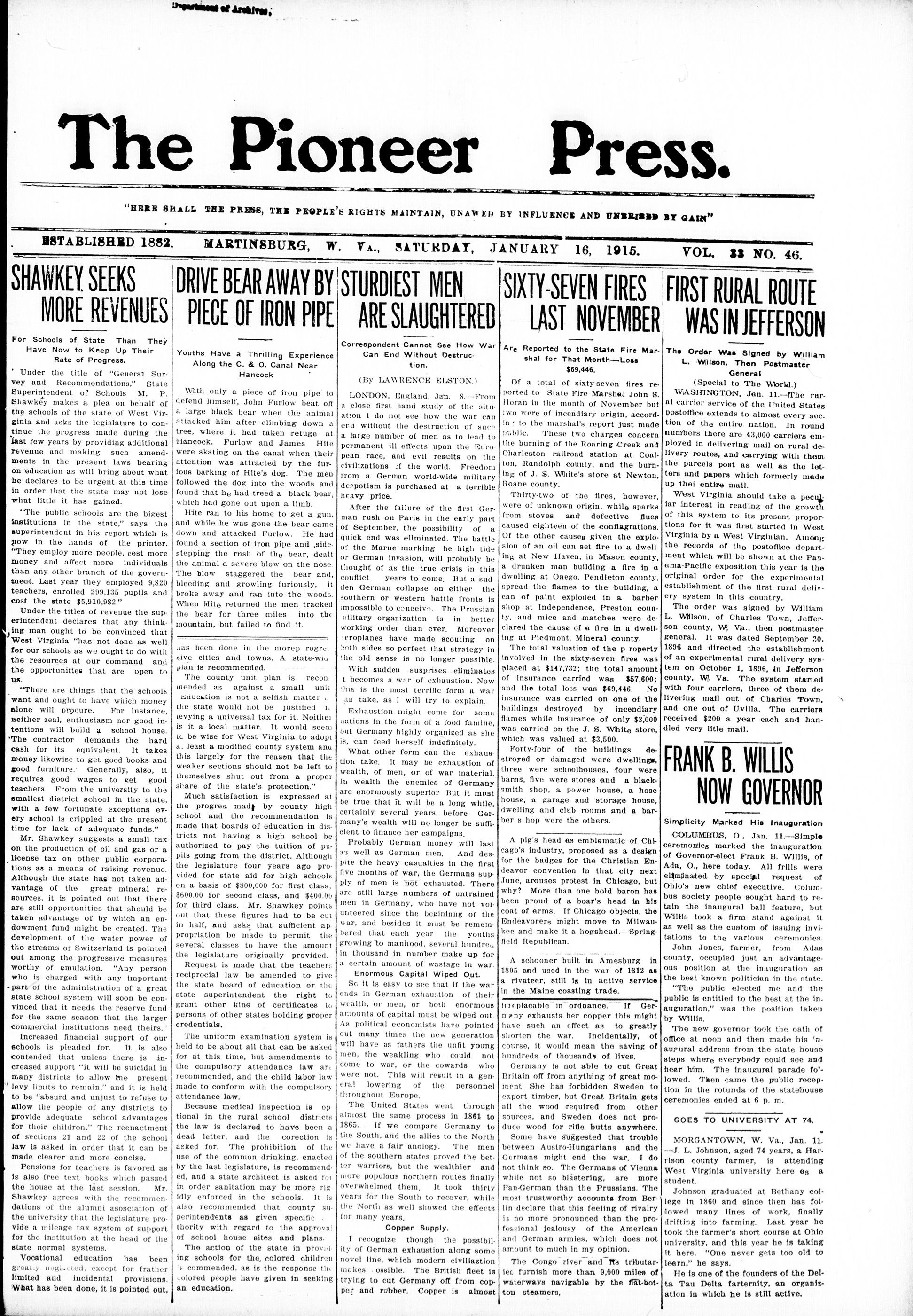
SHAWKEY SEEKS MORE REVENUES
For Schools of State Than They Have Now to Keep Up Their Rate of Progress.
Under the title of "General Survey and Recommendations," State Superintendent of Schools M. P. Shawkey makes a plea on behalf of the schools of the state of West Virginia and asks the legislature to continue the progress made during the last few years by providing additional revenue and making such amendments in the present laws bearing on education as will bring about what he declares to be urgent at this time in order that the state may not lose what little it has gained.
"The public schools are the biggest institutions in the state," says the superintendent in his report which is now in the hands of the printer. "They employ more people, cost more money and affect more individuals than any other branch of the government. Last year they employed 9,820 teachers, enrolled 299,135 pupils and cost the state $5,910,982."
Under the titles of revenue the superintendent declares that any thinking man ought to be convinced that West Virginia "has not done as well for our schools as we ought to do with the resources at our command and the opportunities that are open to us.
"There are things that the schools want and ought to have which money alone will procure. For instance, neither zeal, enthusiasm nor good intentions will build a school house. The contractor demands the hard cash for its equivalent. It takes money likewise to get good books and good furniture. Generally, also, it requires good wages to get good teachers. From the university to the smallest district school in the state, with a few fortunate exceptions every school is crippled at the present time for lack of adequate funds."
Mr. Shawkey suggests a small tax on the production of oil and gas or a license tax on other public corporations as a means of raising revenue. Although the state has not taken advantage of the great mineral resources, it is pointed out that there are still opportunities that should be taken advantage of by which an endowment fund might be created. The development of the water power of the streams of Switzerland is pointed out among the progressive measures worthy of emulation. "Any person who is charged with any important part of the administration of a great state school system will soon be convinced that it needs the reserve fund for the same season that the larger commercial institutions need theirs."
Increased financial support of our schools is pleaded for. It is also contended that unless there is increased support "it will be suicidal in many districts to allow the present levy limits to remain," and it is held to be "absurd and unjust to refuse to allow the people of any districts to provide adequate school advantages for their children." The reenactment of sections 21 and 22 of the school law is asked in order that it can be made clearer and more concise.
Pensions for teachers is favored as is also free text books which passed the house at the last session. Mr. Shawkey agrees with the recommendations of the alumni association of the university that the legislature provide a mileage tax system of support for the institution at the head of the state normal systems. Vocational education has been greatly neglected, except for frather limited and incidental provisions. What has been done, it is pointed out.
DRIVE BEAR AWAY BY STURDIEST MEN PIECE OF IRON PIPE ARE SLAUGHTERED
DRIVE BEAR AWAY BY STURDIEST MEN PIECE OF IRON PIPE ARE SLAUGHTERED
Department of Archives.
e Pio
HALL THE PRESS, THE PEOPLE
MARTINSBURG, W
DRIVE BEAR AWAY BY
PIECE OF IRON PIPE
Youths Have a Thrilling Experience Along the C. & O. Canal Near Hancock
With only a piece of iron pipe to defend himself, John Furlow beat off a large black bear when the animal attacked him after climbing down a tree, where it had taken refuge at Hancock. Furlow and James Hite were skating on the canal when their attention was attracted by the furious barking of Hite's dog. The men followed the dog into the woods and found that he had treed a black bear, which had gone out upon a limb.
Hite ran to his home to get a gun, and while he was gone the bear came down and attacked Furlow. He had found a section of iron pipe and side-stepping the rush of the bear, dealt the animal a severe blow on the nose. The blow staggered the bear and, bleeding and growling furiously, it broke away and ran into the woods. When Hite returned the men tracked the bear for three miles into the mountain, but failed to find it.
has been done in the morep rogressive cities and towns. A state-wid plan is recommended.
The county unit plan is recommended as against a small unit Education is not a selfish matter the state would not be justified in levying a universal tax for it. Noither is it a local matter. It would seem to be wise for West Virginia to adopt a least a modified county system and this largely for the reason that the weaker sections should not be left to themselves shut out from a proper share of the state's protection."
Much satisfaction is expressed at the progress mad by county high school and the recommendation is made that boards of education in districts not having a high school be authorized to pay the tuition of pupils going from the district. Although the legislature four years ago provided for state aid for high schools on a basis of $800,000 for first class, $600.00 for second class, and $400.00 for third class. Mr. Shawkey points out that these figures had to be cut in half, and asks that sufficient appropriation be made to permit the several classes to have the amount the legislature originally provided.
Request is made that the teachers reciprocial law be amended to give the state board of education or the state superintendent the right to grant other kins of certificates to persons of other states holding proper credentials.
The uniform examination system is held to be about all that can be asked for at this time, but amendments to the compulsory attendance law are recommended, and the child labor law made to conform with the compulsory attendance law.
Because medical inspection is optional in the rural school districts the law is declared to have been a dead letter, and the correction is asked for. The prohibition of the use of the common drinking, enacted by the last legislature, is recommended, and a state architect is asked for in order sanitation may be more rigidly enforced in the schools. It is also recommended that county superintendents as given specific thority with regard to the approval of school house sites and plans.
The action of the state in providing schools for the, colored children is commended, as is the response the colored people have given in seeking an education.
Correspondent Cannot See How War Can End Without Destruction.
(By LAWRENCE ELSTON.)
LONDON, England, Jan. 8. From a close first hand study of the situation I do not see how the war can end without the destruction of such a large number of men as to lead to permanent ill effects upon the European race, and evil results on the civilizations of the world. Freedom from a German world-wide military despotism is purchased at a terrible heavy price.
After the failure of the first German rush on Paris in the early part of September, the possibility of a quick end was eliminated. The battle of the Marne marking the high tide or German invasion, will probably be thought of as the true crisis in this conflict years to come. But a sudden German collapse on either the southern or western battle fronts is impossible to conceive. The Prussian military organization is in better working order than ever. Moreover, aeroplanes have made scouting on both sides so perfect that strategy in the old sense is no longer possible. With sudden surprises eliminates it becomes a war of exhaustion. Now this is the most terrific form a war can take, as I will try to explain.
Exhaustion might come for some nations in the form of a food famine, but Germany highly organized as she is, can feed herself indefinitely. What other form can the exhaustion take. It may be exhaustion of wealth, of men, or of war material. In wealth the enemies of Germany are enormously superior. But it must be true that it will be a long while, certainly several years, before Germany's wealth will no longer be sufficient to finance her campaigns
Probably German money will last as well as German men. And despite the heavy casualties in the first five months of war, the Germans supply of men is not exhausted. There are still large numbers of untrained men in Germany, who have not volunteered since the beginning of the war, and besides it must be remembered that each year the youths growing to manhood, several hundred in thousand in number make up for a certain amount of wastage in war.
Enormous Capital Wiped Out. So it is easy to see that if the war ends in German exhaustion of their wealth, or men, or both enormous amounts of capital must be wiped out. As political economists have pointed out many times the new generation will have as fathers the unfit young men, the weakling who could not come to war, or the cowards who were not. This will result in a general lowering of the personnel throughout Europe.
The United States went through almost the same process in 1861 to 1865. If we compare Germany to the South, and the allies to the North we have a fair anology. The men of the southern states proved the better warriors, but the wealthier and more populous northern routes finally overwhelmed them. It took thirty years for the South to recover, while the North as well showed the effects for many years.
Copper Supply.
I recognize though the possibility of German exhaustion along some novel line, which modern civilization makes possible. The British fleet is trying to cut Germany off from copper and rubber. Copper is almost
SIXTY-SEVEN FIRES LAST NOVEMBER
Are Reported to the State Fire Marshal for That Month—Loss $69,446.
Of a total of sixty-seven fires reported to State Fire Marshal John S. Horan in the month of November but two were of incendial origin, according to the marshal's report just made public. These two charges concern the burning of the Roaring Creek and Charleston railroad station at Coalton, Randolph county, and the burning of J. S. White's store at Newton, Roan county.
Thirty-two of the fires, however, were of unknown origin, while sparks from stoves and defective flues caused eighteen of the conflagrations. Of the other causes given the explosion of an oil can set fire to a dwelling at New Haven, in Mason county, a drunken man building a fire in a dwelling at Onego, Pendleton county, spread the flames to the building, a can of paint exploded in a barber shop at Independence, Preston county, and mice and matches were declared the cause of a fire in a dwelling at Pledmont, Mineral county.
The total valuation of the property involved in the sixty-seven fires was placed at $147,732; the total amount of insurance carried was $57,600; and the total loss was $69,446. No insurance was carried on one of the buildings destroyed by incendiary flames while insurance of only $3,000 was carried on the J. S. White store, which was valued at $3,500. Forty-four of the buildings destroyed or damaged were dwellings, three were schoolhouses, four were barns, five were stores and a blacksmith shop, a power house, a hose house, a garage and storage house, dwelling and club rooms and a barber shop were the others.
A pig's head as emblematic of Chicago's industry, proposed as a design for the badges for the Christian Endeavor convention in that city next June, arouses protest in Chicago, but why? More than one bold baron has been proud of a boar's head in his coat of arms. If Chicago objects, the Endeavorers might move to Milwaukee and make it a hogshead.—Springfield Republican.
A schooner built in Amesburg in 1805 and used in the war of 1812 as a rivateer, still is in active service in the Maine coasting trade.
irreplacable in ordnance. If Germany exhausts her copper this might have such an effect as to greatly shorten the war. Incidentally, of course, it would mean the saving of hundreds of thousands of lives. Germany is not able to cut Great Britain off from anything of great moment. She has forbidden Sweden to export timber, but Great Britain gets all the wood required from other sources, and Sweden does not produce wood for rifle butts anywhere.
Some have suggested that trouble between Austro-Hungarians and the Germans might end the war. I do not think so. The Germans of Vienna while not so blastering, are more Pan-German than the Prussians. The most trustworthy accounts from Berlin declare that this feeling of rivalry is no more pronounced than the professional jealousy of the American and German armies, which does not amount to much in my opinion.
The Congo river and its tributaries furnish more than 9,000 miles of waterways navigable by the flat-bottom steamers.
VOL. 33 NO. 46.
FIRST RURAL ROUTE WAS IN JEFFERSON
The Order Was Signed by William L. Wilson, Then Postmaster General (Special to The World.)
WASHINGTON, Jan. 11. The rural carrier service of the United States postoffice extends to almost every section of the entire nation. In round numbers there are 43,000 carriers employed in delivering mail on rural delivery routes, and carrying with them the parcels post as well as the letters and papers which formerly made up the entire mail.
West Virginia should take a peculiar interest in reading of the growth of this system to its present proportions for it was first started in West Virginia by a West Virginian. Among the records of the postoffice department which will be shown at the Panama-Pacific exposition this year is the original order for the experimental establishment of the first rural delivery system in this country.
The order was signed by William L. Wilson, of Charles Town, Jefferson county, W. Va., then postmaster general. It was dated September 20, 1896 and directed the establishment of an experimental rural delivery system on October 1, 1896, in Jefferson county, W. Va. The system started with four carriers, three of them delivering mail out of Charles Town, and one out of Uvilla. The carriers received $200 a year each and handled very little mail.
FRANK B. WILLIS NOW GOVERNOR
FRANK B. WILLIS NOW GOVERNOR
Simplicity Marked His Inauguration
Simplicity Marked His Inauguration COLUMBUS, O., Jan. 11.—Simple ceremonies marked the inauguration of Governor-elect Frank B. Willis, of Ada, O., here today. All frills were eliminated by special request of Ohio's new chief executive. Columbus society people sought hard to retain the inaugural ball feature, but Willis took a firm stand against it as well as the custom of issuing invitations to the various ceremonies. John Jones, farmer, from Adas county, occupied just an advantageous position at the inauguration as the best known politician in the state.
"The public elected me and the public is entitled to the best at the inauguration," was the position taken by Willis. The new governor took the oath of office at noon and then made his 'naugural address from the state house steps where everybody could see and hear him. The inaugural parade followed. Then came the public reception in the rotunda of the statehouse ceremonies ended at 6 p. m.
GOES TO UNIVERSITY AT 74.
MORGANTOWN, W. Va., Jan. 11.
J. L. Johnson, aged 74 years, a Harrison county farmer, is attending West Virginia university here as a student.
Johnson graduated at Bethany college in 1860 and since then has followed many lines of work, finally drifting into farming. Last year he took the farmer's short course at Ohio university, and this year he is taking it here. "One never gets too old to learn," he says.
He is one of the founders of the Delta Tau Delta farternity, an organization in which he is still active.
Entered in Post Office at Martinsburg, W. Va. as Second Class Matter. J. L. Cifford, Editor and Proprietor. Drawer 869, and Bell 'Phone 60K. Martinsburg, W. Va.
Everything that has the semblance of correcting jury evils should be tried. Would it not be better for the clerks of the circuit and county courts to select jurors than a jury commissioner? Let Berkeley County try it.
The House of Representatives defeated the Woman suffrage amendment by a vote of 204 to 174. The women are undaunted, though, and say they are going to keep on until they win. Their example is a good one for the Negroes to pattern after.
The ignominious death of the Reed anti African amendment to the immigration bill in Congress, proves conclusively that the darker people of the one blood family, have in their own hands the remedial instrumentalities to correct, conserve and utilize the political powers of this country.
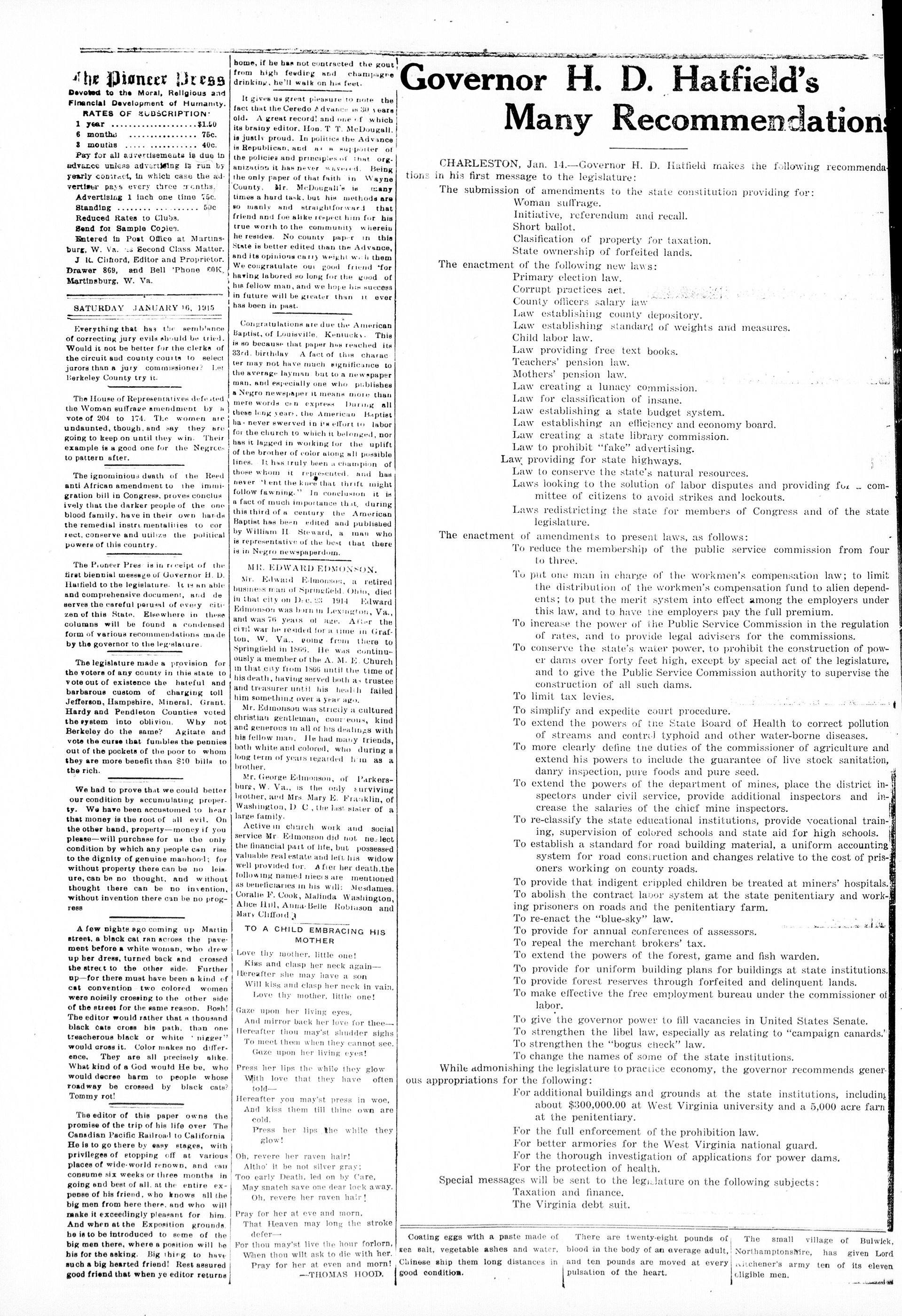
The Pioneer Press is in receipt of the first biennial message of Governor H. D. Hatfield to the legislature. It is an able and comprehensive document, and deserves the careful perusal of every citizen of this State. Elsewhere in these columns will be found a condensed form of various recommendations made by the governor to the legislature.
The legislature made a provision for the voters of any county in this state to vote out of existence the hateful and barbarous custom of charging toll Jefferson, Hampshire, Mineral, Grant. Hardy and Pendleton Counties voted the system into oblivion. Why not Berkeley do the same? Agitate and vote the curse that fumbles the pennies out of the pockets of the poor to whom they are more benefit than $10 bills to the rich.
We had to prove that we could better our condition by accumulating property. We have been accustomed to hear that money is the root of all evil. On the other hand, property—money if you please—will purchase for us the only condition by which any people can rise to the dignity of genuine manhood; for without property there can be no leisure, can be no thought, and without thought there can be no invention, without invention there can be no progress
A few nights ago coming up Martin street, a black cat ran across the pavement before a white woman, who drew up her dress, turned back and crossed the street to the other side. Further up—for there must have been a kind of cat convention—two colored women were noisily crossing to the other side of the street for the same reason. Bosh! The editor would rather that a thousand black cats cross his path, than one treacherous black or white 'nigger' would cross it. Color makes no difference. They are all precisely alike. What kind of a God would He be, who would decree harm to people whose roadway be crossed by black cats? Tommy rot!
The editor of this paper owns the promise of the trip of his life over The Canadian Pacific Railroad to California. He is to go there by easy stages, with privileges of stopping off at various places of wide-world renown, and can consume six weeks or three months in going and best of all, at the entire expense of his friend, who knows all the big men from here there, and who will make it exceedingly pleasant for him. And when at the Exposition grounds, he is to be introduced to some of the big men there, where a position will be his for the asking. Big thing to have such a big hearted friend! Rest assured good friend that when ye editor returns
home, if he has not contracted the gout from high feeding and champagne drinking, he'll walk on his feet.
It gives us great pleasure to note the fact that the Ceredo Advance is 30 years old. A great record! and one of which its brainy editor, Hon. T. T. McDougall, is justly proud. In politics the Advance is Republican, and as a supporter of the policies and principles of that organization it has never wavered. Being the only paper of that faith in Wayne County, Mr. McDougall's is many times a hard task, but his methods are so manly and straightforward that friend and foe alike respect him for his true worth to the community wherein he resides. No county paper in this State is better edited than the Advance, and its opinions carry weight with them. We congratulate our good friend for having labored so long for the good of his fellow man, and we hope his success in future will be greater than it ever has been in past.
Congratulations are due the American Baptist, of Louisville, Kentucky. This is so because that paper has reached its 33rd birthday. A fact of this character may not have much significance to the average layman, but to a newspaper man, and especially one who publishes a Negro newspaper it means more than mere words can express. During all these long years, the American Baptist has never swerved in its effort to labor for the church to which it belonged, nor has it lagged in working for the uplift of the brother of color along all possible lines. It has truly been a champion of those whom it represented, and has never "ent the knee that thrift might follow fawning." In conclusion it is a fact of much importance that, during this third of a century the American Baptist has been edited and published by William H. Steward, a man who is representative of the best that there is in Negro newspaperdom.
MR. EDWARD EDMONSON.
Mr. Edward Edmonson, a retired business man of Springfield, Ohio, died in that city on Dec. 23, 1914. Edward Edmonson was born in Lexington, Va., and was 76 years of age. After the civil war he resided for a time in Grafton, W. Va., going from there to Springfield in 1866. He was continuously a member of the A. M. E. Church in that city from 1866 until the time of his death, having served both as trustee and treasurer until his health failed him something over a year ago.
Mr. Edmonson was strictly a cultured christian gentleman, courteous, kind and generous in all of his dealings with his fellow man. He had many friends, both white and colored, who during a long term of years regarded him as a brother.
Mr. George Edmonson, of Parkersburg, W. Va., is the only surviving brother, and Mrs. Mary E. Franklin, of Washington, D.C., the last sister of a large family.
Active in church work and social service Mr. Edmonson did not neglect the financial part of life, but possessed valuable real estate and left his widow well provided tor. After her death the following named nieces are mentioned as beneficiaries in his will: Mendames. Coralie F. Cook, Malinda Washington, Alice Hull, Anna-Belle Robinson and Mary Clifford 3.
TO A CHILD EMBRACING HIS
MOTHER
Love thy mother, little one!
Kiss and clasp her neck again—
Hereafter she may have a son
Will kiss and clasp her neck in vain,
Love thy mother, little one!
Gaze upon her living eyes,
And mirror back her love for thee—
Hereafter thou may'st shudder sighs
To meet them when they cannot see.
Gaze upon her living eyes!
Press her lips the while they glow
With love that they have often told—
Hereafter you may'st press in woe,
And kiss them till thine own are cold.
Press her lips the while they glow!
Oh, revere her raven hair!
Altho' it be not silver gray;
Too early Death, led on by Care,
May snatch save one dear lock away.
Oh, revere her raven hair!
Pray for her at eve and morn,
That Heaven may long the stroke defer—
For thou may'st live the hour forlorn,
When thou wilt ask to die with her.
Pray for her at even and morn!
—THOMAS HOOD.
Governor H. D. Hatfield's Many Recommendations
Coating eggs with a paste made of sea salt, vegetable ashes and water, Chinese ship them long distances in good condition.
There are twenty-eight pounds of blood in the body of an average adult, and ten pounds are moved at every pulsation of the heart.
HORSE POWER WAR RAGING IN EUROPE
Animals are Given Good Treatment But Their Lives are Short in the Army.
BY WILLIAM G. SHEPHERD
BUDA PESTH. Dec. 1. (By mail to New York.)—It's not a gasoline power war in Austria but a horse power war, and the tragedy of the horse is seen at every turn. The great roads in Galicia, leading through the Carpathians, were literally jammed, for miles, with wagon trains, in October and early November and the steam from the backs of the thousands of faithful toiling animals, ascended like clouds in the cold wintry air.
These wagon trains on the narrow roads are like endless chains. They can't be delayed. And woe to the horse that falls! He is coaxed to his feet again and again. Every last ounce of strength in his tired body is out of him and he gives his last pull with bulging eyes and then topples over.
But that isn't the last that the Austrains expect from him. At the beginning of the war the orders were that any horse which fell must be shot immediately. However, horse flesh began to grow scare, after the first six weeks of fighting, and the armies on the Russian frontier were helpless without the hundreds of thousands of tons of supplies which must be carried to them over the mountain roads in the odd willow bodies basket wagons of the Galician farmers. So a new order was issued that no horse was to be shot unless one of his limbs were broken.
The result of this order was that when an animal fell from exhaustion and had given to his masters even the strength that was necessary to keep him on his feet, he was dragged aside, preferably into a field where there was grass, and left to work out his own fate. Usually, he died, uncaused for, but, now and then, a horse survived and became strong again whereupon he would be seized by some passing soldiers and put back into the daily grind.
I watch a horse "come back" this way, in a field near Przemysl. He had fallen in the middle of a steep hill. a hill which has caused the death of many an exhausted horse. He was lying with scores of other horses in a field alongside the hill road. Evidently he had an ounce or two, more of vitality than they, for he was stretched out, with his legs curled up under hih while they were lying on their sides with their heads on the ground. His head was raised and I fancied that he was watching with a horse's interest, the never-ending train of wagons that was passing him.
I was sorry for him, too. To get well only meant more horrors for him. When I returned that way in the evening he was still lying down but there was a circle of nibbled grass about his head. The next morning he was weakly standing up, with his legs stretched wide apart, and he had gone away from the other dead and dying horses, to a lonely corner of the field. Incidentally, I noticed time and again that there is nothing that frightens a horse so much as the body of a dead horse, and I suppose that it was sheer terror that got this fellow to his feet and helped him to struggle away to more cheerful surroundings. He was nibbling gingerly at the dry grass and now and then he raised his head and seemed to look at the mighty tide of horses and wagons and men that filled the road.
"There's a horse that will be all right, within a couple of weeks," said the Austrian officer who was with me. He's a Siberian horse. They're wonderful animalus. They're the only horses in the world that will make two pulls at an immovable object. You can hitch one of them to an object, a tree or a house, that cannot possibly be moved and he will put his last ounce of strength into it. An ordinary horse would stop at that end would refuse the next pull, but not Siberian pony. He's all sand and he'll make his second try just as brevel yas he did his first. Yes indeed, that little fellow will be back in the wagon trains again within a
count of weeks."
And I suppose he was for by evening he had nibbled a huge circle of grass in his private corner of the field and when I went by that way two days later he was gone.
Even in the midst of war the horse skinners were at work. I saw them in a field near Przemysl four gruesome looking men, covered with blood, taking the hides from the skeleton like bodies of the horses who had given their lives in war.
Three weeks of steady work in Ga-
ficia and in the Carpathians killed
the average horse. The fields were
dotted with their bodies. The Austrians told me that hundreds of horses died daily in the Carpathian passes from broken lungs, broken courage or broken hearts.
$2,82; and Delaware, seventh $8,85.
Mr. Campbell, Mr. Muldoan and Mr. Jones were the judges for West Virginia.
One thousand plates of apples were in the exhibit, which represented the choicest specimens of fruit grown in the states under the best of conditions brought about by the experimenting of the various agriculture colleges.
The exhibits in the girls' canning and garden club were also judged. Three hundred specimens of fruit and vegetable canning was in the exhibit.
Forty counties were represented at the boys' corn club show, which had a 1,000 choice prize winning ears of corn in the exhibit.
THEY MUST HOLD PRZEMYSL OR DIE
That Order Was Issued to the Men Who Were Called Upon to Hold the Fort.
BUDA PESTH, Dec. 2, (by mail to New York.)—What's the use of wishing good luck to a man who's going to die? There's no luck about it. But I did it, just the same, in those two days at Prezemysl; in those forty-eight hours before we pile better skelter out of the city, before the Russian onrush. It was hard business, too. These men were going to stay in the city, to defend it. There were thousands of us who had been ordered out but these men were of the few thousands who had been ordered to remain and to fight to the last drop of their blood. They could not go. They must hold Prezemys or die.
I had dined thrice daily for some weeks with some of these officers who had received the orders to remain and saying goodbye to them was one of the hardest things I've ever had to do. I knew their smiles, I knew their voices, I knew their jokes, their favorite wines, their favorite cigarettes, something about this fellow's home life, something about this chap's three children, I had dipped into their lives just enough to know and to form friendships. And then the end of the Russian line began to snap around the circle of Przemysl's forts, like a whip around a sayling. Przemysl was doomed. And that last evening, when I said goodbye to those men who must stay in Przemysl through the siege, my smile must have been glassy.
I saw one of them once more. It was the next morning, at 7 o'clock, in the Przemysi cathedral, barely daylight. The evening before, the man who is to be the next emperor of Austria, had come into Przemysi in his automobile, after a hundred mile ride. He had come to go to church with these men; to join them in a farewell mass; to say "goodbye" to them and to tell them that Austria-Hungary depended on them to hold the forts of Przemysi or die in their wreckage.
And, in this the audience of officers, I saw a few of my Austrian officer friends, earnest-faced, devout, kneeling, bowing, crossing themselves, reading the prayers, partaking in the death-mass with a man of whose kingdom-to-be they were going to give their lives. I thought of the storm of Russian shell and shrapnel that would beat over Przemysi as soon as our batteries had been brought in from the outskirts and this quiet mass seemed to me like the moment of calm before a tornado. When the mass was ended the em-
peror-to-be climber into his auto and was whirled out of the rings of forts a hundred miles away to be safe shelter of the Carpathians at Neu Senden. The streets of Przemysl were filled with marching soldiers. They had been brought in from the riffle trenches some miles outside the city and were to be rushed away from Przemysl to some other part of the line; at least were not to die in Przemysl. Then, later in the morning, the artillery began to come into the city. This was the beginning of the end. It meant that the outer defences of the city had been withdrawn; from the farms and the hills and the valleys, where I had seen these battles holding back the Russian tide they were being taken to the railroad yards to be loaded onto cars that would carry them out of the reach of the Russians.
The safety of Przemysl could not last many hours. It wouldn't take the Russians long to notice that the Russian field batteries were silent and it wouldn't take them much longer to send out their Cossack patrol to discover why the Austrian guns were keeping the peace. Then, after that, it would be only a matter of a few hours for the Russians to advance.
That evening when I dined in the officers casins there were no officers there. They were out in the great steel forts, ready to begin their resistance to the Russian storm.
We left that evening in a Red Cross train. The Russian guns were scunding nearer than they had ever sounded before. The sound of a rifle battle came to our ears some mile outside the town; the noise of some Austrian infantry regiment holdin back the Russian onrush, until the last possible man, gun and horse who wouldn't be needed in the town could get out of it.
Before the sun set the next day the Russian army had surrounded Przemysl and my friends in the great steel sound-roofed houses were working their great guns for their very lives. But only a few tens of thousands of Russians hovered around Przemysl. More of them went on into Gabiein and, within a few days they were a hundred miles nearer. Vienna than they had ever been before.
Przemysl is still an Austrian island in the Russian flood. It's forts have not yet been battered down. Daily it sends its wireless message over the Russian armies, over the Carpathians, saying "We are still holding out." But it is now on an island a hundred miles from an Austrian shore and some day, if the wireless doesn't come we'll know that the steel of the Russian shells was stronger than the steel of the Jrzemysl forts, or the hearts of those brave Austrian officers who stayed in Przemysl to hold it or die.
PUBLIC HEALTH TO FIGHT SQUIRRELS
War of Extermination Started Against The min California by the Government.
WASHINGTON, Jan. 13.—The war of extermination against qsuirrels being conducted in California by the United States Public Health Service in connection with the precautions against plague has resulted in the death of 20,150,000 rodents, according to figures just tannounced.
During the epidemic of plague in San Francisco in 1907-1909, it was discovered that the ground squirrel a rural rodent which abounds on the Pacific coast, had acquired the infection. Cases of plague in human beings which had occurred in rural districts were traced to these rodents. The health service at once decreed their death.
Since 1908, the chief efforts of the public health service and the California state board of health, acting in co-operation, have been directed to eradication of plague from among ground squirrels. The most satisfactory work, it is stated has been accomplished since July 1, 1912, due to the fact that sufficient funds and adequate legislation were provided by the state legislature at its last session.
SECURITY CEMENT AND LAYER COMPANY
SECURITY
PONTLAND
CEMENT
SECURITY MD
Don't Be F
JIM Brown he built a thought the job was p
he used the best cement when he
ment. And in ten years Brown's
it let in rain and snow and cold; w
snug, secure from sleet, inside his
trim and neat. Jim soon learned 't
wise the age of progress to des
Smith lived on in great content,
built of firm cement. (The Ce
JIM Brown he built a house of wood and thought the job was pretty good, but Smith he used the best cement when he put up his tenement. And in ten years Brown's shack was old; it let in rain and snow and cold; while Smith lived snug, secure from sleet, inside his house, still trim and neat. Jim soon learned 'twas pennywise the age of progress to despise; while Smith lived on in great content, because he built of firm cement. (The Cement Era.)
Concrete for Permanence
SECURITY for Concrete
Ask Your Dealer
SECURITY CEMENT and LIME COMPANY HAGERSTOWN, MARYLAND
Ninety per cent of the squirrels on an area of 3,100,000 acres, or about equal the size of Connecticut, have been destroyed since July 1, 1913. The infection has almost disappeared in this area. So effective has been the work of the hunters that they have to cover a area of 26 acres to catch one squirrel.
"In view of these facts it is believed that all discoverable plague has been eliminated from California," says the public health service, "and that the danger of its further spread has been removed. Observation will be maintained until after the next breeding season, which begins in April, when if no further infection has made its appearance—the statement can be made with certainty that no further plague exists in California. Large economic benefits have accrued to farmers as a result of squirrel destruction and all are now interested in finally destroying these animals.
Pig clubs are the latest fad in Louisiana, says the department of agriculture in a bulletin just issued. The contest of members of the pig clubs at the Louisiana state fair at Shreveport was highly successful the department reports. Although the fair authorities limited the number of entries to 150, boys from all parts of the state shipped 185 pigs.
Southern Farmer Best
The southern farmer, by virtue of his location and climate, is splendidly situated for the production of fowl and eggs, says the department of agriculture in a bulletin just issued. The mild winters and early springs make the production of eggs in easy matter when prices are high. "On many farms throughout the country," says the department, "the money derived from the sale of poultry and eggs buys the groceries and clothing for the entire family. Every southern farmer can do as well, and should also to keep at least 50 heens for laying purposes and home consumption. Select some of the American breeds, such as the Plymouth Rocks, Wyandottes, or the Rhode Island Reds, The Orpingtons are also a good general-purpose species."
While prices are good, the department of agriculture advises farmers should get busy and make contracts with city folks to ship eggs by parcel post throughout the year. With a parcel post egg market established the farmer can depend upon a reliable income all the year around and utilize the mails for marketing other products if the egg experiment proves successful. Once having secured a parcel post market for eggs, it will be a very easy matter to market many other things by the same method such as butter, poultry, fresh and cured meats, sauce, fruits, vegetables, honey and so on.
GERMANS KICKEK 'EM OUT, PRISONERS SAY
"They simply escorted us to the frontier and kicked us out." was the casual way in which five British army doctors who have been prisoners of
SECURITY CEMENT AND LABOR COMPANY
PORTLAND CEMENT
SECURITY MD
Don't B
JIM Brown he thought the i
```markdown
```
SALESMAN WANTED to look after our interest in Berkeley and adjacent counties. Address THE HARVEY OIL CO., Cleveland, O.
Mrs. Ella James is sufficiently improved from her recent illness to get around again, a fact very pleasing to her many friends.
Thompson and Thompson's Xmas stock excels all others in Martinsburg, and their prices are lower and their pains and anxiety to please, all, also excel any other clothiers in Martinsburg. Try them, buy from them, and if their guarantee of the goods they sell tails to measure up to it, you'll get your money back.
Mr. Samuel Bailey, who had been sick a long time, and who went to Washington about the middle of December, died at the Georgetown University Hospital, that city, on the 26th alt. During his illness Mr. Bailey bore up bravely, and championed the admiration of all who came in contact with him by his efforts to combat the ailment which held him so tightly within its grasp. He was a likable-person, had pride in his race, and is mourned here and elsewhere by many friends who will ever remember him for his hearty bandshake and genial smile. Funeral services over the remains of the deceased were conducted at Rosslyn, Va. He is survived by his wife, Mrs. Estella Bailey, this city, his mother, sisters and other relatives, who reside near Washington all of whom have our sympathy.
Chief Justice Covington took all the joy out of a joy ride yesterday when he sentenced to two years in the penitentiary a man who rode about in an automobile belonging to another and smashed it—Washington Herald.
It is something to live in a country where a man never needs a passport. New York World.
war in Germany for the last five months described their release from captivity in Germany to a Chronicle representative in Holland
The five officers are Capt. C. T. Edmunds, R. A. M. C., attached to the Royal Scots Fusilliers; Capt. E. S D Hamilton, R. A. M. C., of the Seventh Field Ambulance Corps; Lieut W. S. Banks, R. A. M. C., of the Fourteenth Field Ambulance Corps, and Dr L. J. Austin and Dr. A. R. Elliott, of the First Belgian Unit British Red Cross Society They reached Flushing late yesterday, having been released from Magdeburg, Prussian Saxony, on Sunday.
The American gold dollar is now worth $1.05 in Switzerland, and if it is as scarce there as it is here, there is nothing surprising about that state of affairs. Indianapolis News.
J. R. CLIFFORD
MARTINSBURG, WEST VIRGINIA
Practices in all the Courts of West Virginia, the Supreme Court of Appoala and the United States Courts.
Be Pennywise
built a house of wood and
b was pretty good, but Smith
then he put up his tene-
Brown's shack was old;
cold; while Smith lived
side his house, still
arned 'twas penny-
to despise; while
content, because he
The Cement Era.)
SECURITY CEMENT AND
LIME
BERKELEY
PRODUCTS
BERKELEY WY VA 03740
LIEUTENANT GIVES VIVID ACCOUNT
Of the Galician Marshes, One of the Worst Horrors of the European War.
VIENNA, Dec. 10, (By mail to New York.)—Lieutenant Franz Koaleski, recovering in al ocal hospital from a bullet wound through his right lung, today gave a wonderful vivid and gripping account of one more horror of the present great European war—the horror of the Galician marshes.
These marshes extend for almost endless miles through great stretches of Galicia. Their almost fathomless mires are the accumulation of centuries of docayed vegetable and animal matter. From them there arises constantly malaria and other miasmatic exhalations equally as deadly as the treacherous and which a rank growth of grass conceals. Once a man by chance steps in this, he never comes for it again. And into one of these Lieutenant Koaleski saw a whole regiment of Russian soldiers sink, sink, sink, sink.—until the sickening death-dealing mire closed over the last feeble gurgle of its struggling victims.
"Forward! Charge, to the assault!" was the cry that rang down our ranks," said Lieut. Koaleski.
"The Russians saw us coming and for a mement stood still, as if too confused, too perplexed to move. Then out rang their cry of 'about face' and away they went.
"But it was only for an instant. For at the next instant something strange and unusual happened. From what could be ascertained at the moment the Russians who had been the first to turn and run, had stopped suddenly. Perhaps it was for the purpose of reorganizing, perhaps forone purpose of opposing resistance.
"Yet, so burning were the Austrians with the lust of the chase that they barely perceived this strange fact. They perceived only that they were constantly and rapidly approaching with every leap and bound to the ranks of the Russians, and then in an instant more they were all upon them.
"Then it was that they perceived that the Russians who had so suddenly stopped themselves still kept backs turned to the pursuing enemy. For the instant it aroused sudden suspicions. Perhaps they intended to defend themselves, to defend themselves as they remained there steadfast up,right, as though impaled.
"The nearest files also, one would have said, might suddenly have arrived at the edge of a precipice so sharp was their stop. They found a solid cordon of men toward which the Austrians hurried themselves as towards a wall of stone. But even as the first of the Austrians all but reached the solid rank of Russions they became stupified to see the latter still unmoved, their backs still turned, and apparently without one thought of making the least defense.
"What is it?" the Austrians demanded of themselves. 'Was it another of those tricks of war? Was some terrible mine about to explode beneath their feet? Were the Russians merely waiting unmoved to see their pursuers suddenly wiped from the face of the earth?"
"An uncanny fear ran down the lines of the entire Austrian force at the spectacle, an uncanny fear that the next instant crystalized as there again rang out from the officers the cry of 'Halt! halt! halt!'
"The officers, not an instant too soon, had solved the mystery and then it was that there was unfolded a scene that made uor blood run cold.
"Terrifying, frightful cries rose from those masses of Russian soldiers as with a supereme effort they turned their heads towards us and stretched out supplicating hands. Then it was, that even a stranger fact dawned upon our appaled senses. The Russians were rapidly growing smaller and smaller. Their legs, little by little, went disappearing down through the rank grass; giving the impression as though all had suddenly squatted.
"Then, too, we perceived that all had freed themselves of their rifles.
had thrown them away, and with contracted, contented faces as though with one final collective spasm they stretched, not out, put up, up, up their supplicating hands.
Not one of us fired against the enemy.
"At first only perplexed, we became suddenly terrorized, when finally we grasped that which was happening before our eyes—the treacherous mire, under which was hidden the fathomless marshes, had opened to swallow them up.
"All the efforts, persistent, desperate, which each made to liberate himself from the clammy element only engulfed him the deeper. If a poor soldier, after a thousand efforts, succeeded at last in extricating a leg, he found only the other more hopelessly than ever imbedded.
"First one, than another, then another, and finally all of that mass of writhing humanity, as if by a sudden inspiration of salvation, as from some inner subtle intuition that urged the distinction of the body's weight over the greatest surface posisble or even that urged the tearing of the upper portion from that lower portion already imbedded, threw their bodies at full length on the receiving grass before them. But already doomed, it served only to lengthen their torture.
Cries, shrieks, groans, sighs, prayers and invocations some high, some insistent, some supplicating and some desperate, increased ever and ever as there increased before their vision the reality of the death that every moment made itself some closer and closer apparent.
"Our soldiers, whose humanity never for an instant deserted them even in the face of the greatest horror of the war, reached out the stocks of their rifles to the men whom but a moment before they had hoped to slain. The Russians grasped them—but it was a grasp that was utterly futile. No power on earth could save them, and with an about face' the Austrian flicers, turned their men, already terrified, white and trembling, and marched them away with a never a look backwards at the horror that lay behind."
NEW JERSEY LED IN FRUIT SHOW
Seven State Agricultural Schools Had Contest in Judging Its Fruit.
An apple judging contest between teams from seven different states agriculture colleges featured Friday's program at the farmers' show at the state university at Morgantown. Apples representing 20 specimens of the fruit were judged and the following states were classed and given percentages by the judges:
New Jersey, first 91.8; Kentucky, second 87.16; Pennsylvania, third 86.22; Ohio, fourth 85.91; West Virginia, fifth 85.86; Maryland, sixth
THE NAKED TRUTH.
I am the Naked Truth,
'Way out here in the park.
I sit and feel, forsooth,
So lonesome in the dark.
In summertime at night
On becoming filled with loons,
My eyes looked with delights
Upon a thousand spoons.
But now it's cold and drear,
No passer stops to ask,
"Its Dantzer living here?
Is this Carl Schurz's mask?
Alas, no question thus.
Alas, no question thus,
'Mid snow and ice to cheer.
I should have made the fuss
Before they placed me here.
—R. D. K. in St. Louis Post
A rancher has applied for rental of 320 acres of the Pike national forest, Colorado, to be used in connection with private land for raising elk as a commercial venture.
HOWARD UNIVERSITY.
STEPHEN M. NEWMAN. A M. D. D.
COLLEGE OF ARTS AND
SCIENCES.
SCHOOL OF MANUAL ARTS AND
APPLIED SCIENCES
Domestic Arts
Manual Arts
CON<sup>N</sup>ERVATORY OF U.S.
Three Preparatory Universities
(Classical, Scientific, Normal)
COMMERCIAL COLLEGE
Stenographer
Typewriting
Economics
Bookkeeper, Ete
Professional School
LIBRARY SCHOOL
SCHOOL OF THEOLOGY.
THE SCHOOL OF MEDICINE.
College of Medicine
College of Dentistry
College of Pharmacy
SCHOOL OF LAW.
All Courses begin Sept. 30th, 1914.
For Catalogue, address Howard Un-
versity, Washington, D. C.
SALESMEN Wanted
to sell
Our West Virginia Grow
NURSERY STOCK
vassing outfit Fitzgerald. Cash comm
sions Paid Weekly. Write for terms
The Gold Nursery Co
Mason City, W. Va
Are You a Woman?
Take Card
The Woman's Trust
FOR SALE AT ALL BRIDGESTS
The constant gun on Thompson Thompson keeps them so to have no time to even talk for times." It's the home of good and verily, they are hustlers.
PAGE 2
ARTICLE
POPULAR
MECHANICS
MAGAZINE
For Father and Son
AND ALL THE FAMILY
Two and a half million readers find it of
absorbing interest. Everything in it is
Written So You Can Understand It
We sell 400,000 copies every month without
giving premiums and have no solicitors. Any
publisher will show you a copy; or write the
publisher for free sample — a postal will do.
ELIC A YEAR
15c A COPY
Star Mechanics Magazine
10 W. Michigan Ave., CHICAGO
For shoes, go to Charles E. Thompson North Queen Street. His stock is excellent, and the courtesies of his clerks can't be excelled. Try him and be convinced.
Saved Girl's Life
"I want to tell you what wonderful benefit I have received from the use of Thedford's Black-Draught," writes Mrs. Sylvania Woods, of Clifton Mills, Ky.
"It certainly has no equal for la grippe, bad colds, liver and stomach troubles. I firmly believe Black-Draught saved my little girl's life. When she had the measles, they went in on her, but one good dose of Thedford's Black-Draught made them break out, and she has had no more trouble. I shall never be without
THEDFORD'S
BLACK-DRAUGHT
in my home." For constipation, indigestion, headache, dizziness, malaria, chills and fever, biliousness, and all similar ailments, Thedford's Black-Draught has proved itself a safe, reliable, gentle and valuable remedy.
If you suffer from any of these complaints, try Black-Draught. It is a medicine of known merit. Seventy-five years of splendid success proves its value. Good for young and old. For sale everywhere. Price 25 cents.
By Makers of Hog Cholera Remedy. Federal Agents are Investigating
The attention of the bureau of animal industry of the United States department of agriculture has been called to the fact that the makers of a medicine sold as a hog-cholera remedy are misusing government figures of the results obtained by federal agents by the use of anti-hog cholera serum, as evidence of the efficacy of their medicine. In several magazines there have appeared reading notices in which there are statements that this medicine has resulted in saving many hogs from cholera in Pattis county, Missouri, Montgomery county, Indiana, and Dallas county, Iowa. The figures given to indicate the results are exactly those reported to the department by its agents as showing the use and effect of anti-hog cholera serum in sick herds.
For example, the government figures on the use of serum, which are misused in this way by the medicine concern, are as follows:
Pettis County, Mo.
Hogs in infected herds treated...5,904
Hogs lost .....1,038
Montgomery County, Ind.
Number of sick hogs in infect-
HOTEL
POWHATAN
WASHINGTON
D.C.
HOTEL OF AMERICAN IDEALS
In a city where good hotels
abound, the Powhatan heads the
Hot.
It is first in the hearts of its
countrymen.
The Powhatan is refined, exclusive, and resilient. Its excellent location on Pennsylvania Avenue, 18th and II Street makes it a desirable headquarters for bridal couples, tourist parties, conventions, Schools and colleges.
The Powhatan attracts the people of culture and education, Its proximity to State, War and Navy Departments, also to many points of historical interest, makes this hotel especially attractive to a discriminating public.
The Powhatan offers rooms with detached bath at $1.50, $2.00 and up. Rooms with private bath, $2.50, $3.00 and up.
Write for booklet with map.
CLIFFORD M. LEWIS,
Manager.
en herds treated .....5,016
hogs lost .....1,998
it is scarcely possible that any remedy could have used on identically the same number of hogs and with exactly the same results as the anti-hog cholera serum. On this point the inspector in charge in Pettis county, Missouri, states: "As far as we are able to ascertain none of this remedy has been used in Pettis county."
Farmers and others, therefore, are warned not to confuse this "remedy" with the anti-hog cholera serum which is the one method of treatment used by the federal department of agriculture.
EXCHANGE SURGEONS ON ONE TO ONE BASIS
"The French government announces that because the Germans are holding French surgeons and nurses it will hereafter repatriate German surgeons and nurses held as prisoners only in proportion to the return of French surgeons and nurses who are prisoners in Germany. The government in the future will accord other German prisoners only the same treatment as are accorded French prisoners in Germany."
STRAIGHTEN
YOUR HAIR
BEFORE AFTER
PRESTO
"PRESTO" removes Dandruff, Tetter, and other Skin Diseases of the SCALP; "PRESTO" makes the HAIR GROW; "PRESTO" is Harmless, Clean and Lasting; "PRESTO" is the Greatest Discovery Known to Mankind in this Line.
Throw away your old pinching and pulling hot irons and the so-called electric combs, and stop burning your hair out, and get a package of "PRESTO" THE KING OF ALL HAIR PREPARATIONS "PRESTO" will straighten your Hair the first application or we will refund your money. The hair retains straight for months. Think of it, nothing in the world like "PRESTO." Apply "PRESTO" two or three times a year, that's all.