The Pioneer Press
Saturday, March 20, 1915
Martinsburg, West Virginia

Page text (machine-generated)
"HERE SHALL THE PRESS, THE PEOPLE'S RIGHTS MAINTAIN, UNAWED BY INFLUENCE AND UNBRIBED BY GAIN"
The Pioneer
ESTABLISHED 1882.
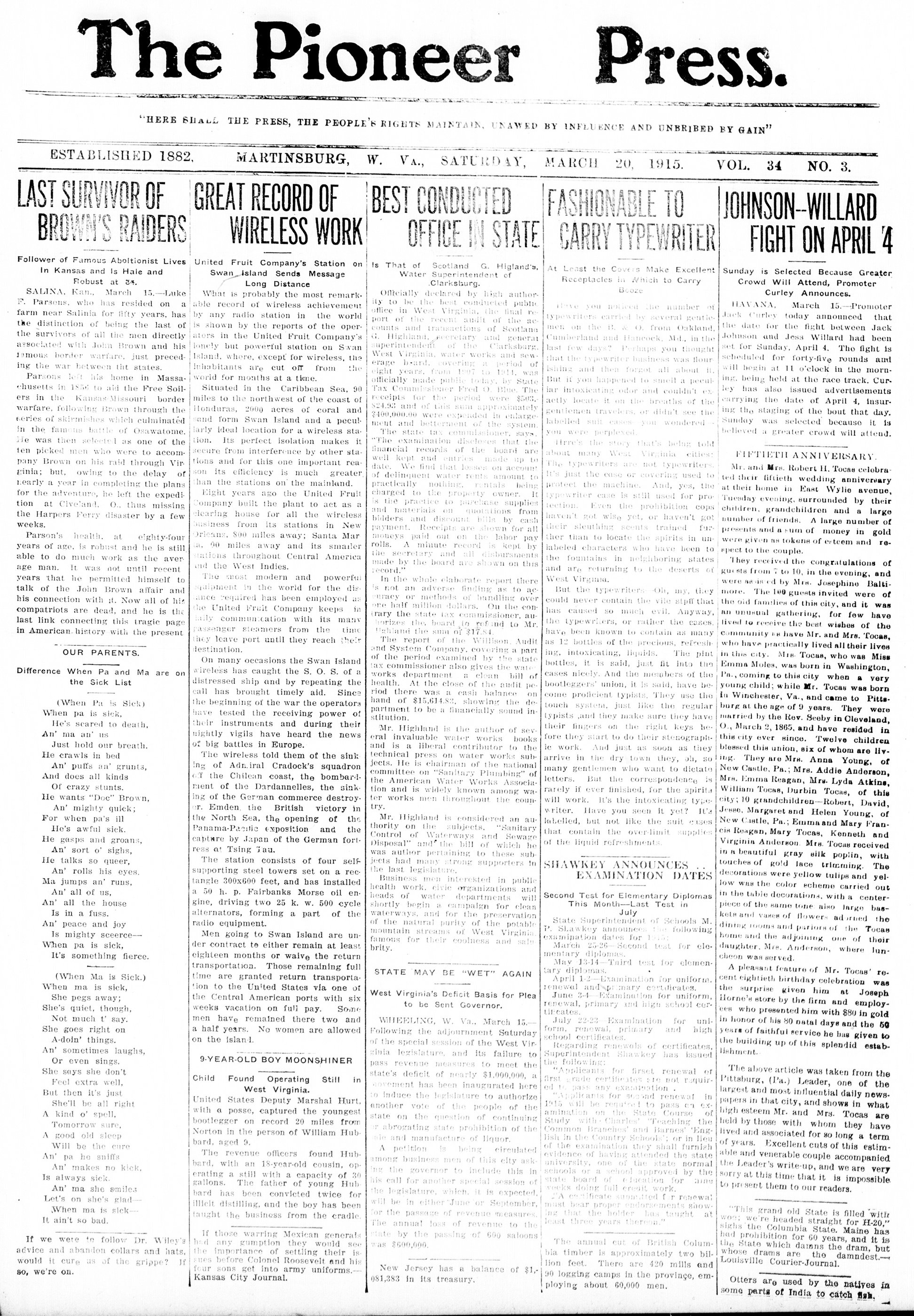
LAST SURVIVOR OF BROWNS RAIDERS
Follower of Famous Abolitionist Lives In Kansas and Is Hale and Robust at 84. SALINA, Kan., March 15.—Luke F. Parsons, who has resided on a farm near Salinia for fifty years, has the distinction of being the last of the survivors of all the men directly associated with John Brown and his famous border warfare, just preceding the war between the states.
Parsons left his home in Massachusetts in 1856 to aid the Free Soilers in the Kansas-Missouri border warfare, following Brown through the series of skirmishes which culminated in the famous battle of Osawatome. He was then selected as one of the ten picked men who were to accompany Brown on his raid through Virginia; but, owing to the delay of nearly a year in completing the plans for the adventure, he left the expedition at Civeland. O., thus missing the Harpers Ferry disaster by a few weeks.
Parson's health, at eighty-four years of age, is robust and he is still able to do much work as the average man. It was not until recent years that he permitted himself to talk of the John Brown affair and his connection with it. Now all of his compatriots are dead, and he is the last link connecting this tragic page in American history with the present.
(When Pa is Sick)
When pa is sick,
He's scared to death,
An' ma an' us
Just hold our breath.
He crawls in bed
An' puffs an' grunts,
And does all kinds
Of crazy stunts.
He wants "Doc" Brown,
An' mighty quick;
For when pa's ill
He's awful sick.
He gasps and groans,
An' sort o' sighs,
He talks so queer,
An' rolls his eyes.
Ma jumps an' runs,
An' all of us,
An' all the house
Is in a fuss.
An' peace and joy
Is mighty sceerce—
When pa is sick,
It's something fierce.
(When Ma is Sick.)
When ma is sick,
She pegs away;
She's quiet, though,
Not much t' say.
She goes right on
A-doin' things.
An' sometimes laughs,
Or even sings.
She says she don't
Feel extra well,
But then it's just
She'll be all right
A kind o' spell,
Tomorrow sure,
A good old sleep
Will be the cure
An' pa he sniffs
An' makes no kick,
Is always sick.
An' ma she smiles
Let's on she's glad—
When ma is sick—
It ain't so bad.
If we were to follow Dr. Wiley's advice and abandon collars and hats, would it cure us of the grippe? If so, we're on.
GREAT RECORD OF WIRELESS WORK
GREAT RECORD OF WIRELESS WORK
United Fruit Company's Station on Swan Island Sends Message Long Distance What is probably the most remarkable record of wireless achievement by any radio station in the world is shown by the teports of the operators in the United Fruit Company's lonely but powerful station on Swan Island, where, except for wireless, the inhabitants are cut off from the world for months at a time.
Situated in the Caribbean Sea, 90 miles to the northwest of the coast of Honduras, 2000 acres of coral and sand form Swan Island and a peculiarly ideal location for a wireless station. Its perfect isolation makes it secure from interference by other stations and for this one important reason its efficiency is much greater than the stations on the mainland. Eight years ago the United Fruit Company built the plant to act as a clearing house for all the wireless business from its stations in New Orleans, 800 miles away; Santa Mara, 90 miles away and its smaller stations throughout Central America and the West Indies.
The most modern and powerful equipment in the world for the distance required has been employed as the United Fruit Company keeps in daily communication with its many passenger steamers from the time they leave port until they reach their destination. On many occasions the Swan Island wireless has caught the S. O. S. of a distressed ship and by repeating the call has brought timely aid. Since the beginning of the war the operators have tested the receiving power of their instruments and during their nightly vigils have heard the news of big battles in Europe.
The wireless told them of the sinking of Admiral Cradock's squadron of the Chilean coast, the bombardment of the Dardannelles, the sinking of the German commerce destroyer. Emden, the British victory in the North Sea, the opening of the Panama-Pacific exposition and the capture by Japan of the German fortress at Tsing Tau.
The station consists of four self-supporting steel towers set on a rectangle 300x600 feet, and has installed a 50 h. p. Fairbanks Morse oil engine, driving two 25 k. w. 500 cycle alternators, forming a part of the radio equipment.
Men going to Swan Island are under contract to either remain at least eighteen months or waive the return transportation. Those remaining full time are granted return transportation to the United States via one of the Central American ports with six weeks vacation on full pay. Some men have remained there two and a half years. No women are allowed on the island.
9-YEAR-OLD BOY MOONSHINER
United States Deputy Marshal Hurt, with a posse, captured the youngest bootlegger on record 20 miles from Norton in the person of William Hubbard, aged 9. The revenue officers found Hubbard, with an 18-year-old cousin, operating a still with a capacity of 30 gallons. The father of young Hubbard has been convicted twice for illicit distilling, and the boy has been taught the business from the cradle.
If those warring Mexican generals had any gumption they would see the importance of settling their issues before Colonel Roosevelt and his four sons get into army uniforms. Kansas City Journal.
MARCH
EASY ON LABLE TO CARRY TYPE RIVER
At Least the Covers Make Excellent Receptacles in Which to Carry Booze
Have you noticed the number of typewriters carried by several gentlemen on the it, & O. from Oakland, Cumberland and Hancock, Md., in the last few days? Perhaps you thought that the typewriter business was flourishing and then forgot all about it. But if you happened to smell a peculiar intoxicating odor and couldn't exactly locate it on the breaths of the gentlemen travelers, or didn't see the labelled suit cases you wondered - you were perplexed.
Here's the story that's being told about many West Virginia cities: The typewriters are not typewriters. It's just the case or covering used to protect the machine. And, yes, the typewriter case is still used for protection. Even the prohibition cops haven't got wis yet, or haven't got their sleuthing scents trained further than to locate the spirits in unlabeled characters who have been to the fountains in neighboring states and are returning to the deserts of West Virginia.
But the typewriters: Oh, my, they could never contain the vile stpff that has caused so much evil. Anyway, the typewriters, or rather the cases, have been known to contain as many as 12 bottles of the precious, refreshing, intoxicating, liquids. The pint bottles, it is said, just fit into the cases nicely. And the members of the bootleggers' union, it is said, have become proficient typists. They use the touch system, just like the regular typists, and they make sure they have their fingers on the right keys before they start to do their stenographic work. And just as soon as they arrive in the dry town they, oh, so many gentlemen who want to dictate letters. But the correspondence is rarely if ever finished, for the spirits will work. It's the intoxicating typewriter. Have you seen it yet? It's labelled, but not like the suit cases that contain the over-limit supplies of the liquid refreshments.
SHAWKEY ANNOUNCES .. EXAMINATION DATES
Second Test for Elementary Diplomas This Month—Last Test in
State Superintendent of Schools M.
P. Shawkey announces the following examination dates for 1915:
March 25-26—Second test for elementary diplomas.
May 13-14—Third test for elementary diplomas.
April 1-2—Examination for uniform, renewal and primary certificates.
June 3-4—Examination for uniform, renewal, primary and high school certificates.
July 22-23—Examination for uniform, renewal, primary and high school certificates.
Regarding renewals of certificates, Superintendent Shawkey has issued the following:
"Applicants for first set renewal or first grade certificates are not required to pass any examination."
"Applicants for second renewal in 1915 will be required to pass an examination on the State Course of Study with Charles' 'Teaching the Common Branches' and Barnes' 'English in the Country Schools'; or in lieu of the examination they shall furnish evidence of having attended the state university, one of the state normal schools or a school approved by the state board of education for nine weeks doing full credit work.
"A certificate submitted for renewal must bear proper endorsements showing that the holder has taught, at least three years thereon."
The annual cut of British Columbia timber is approximately two billion feet. There are 420 mills and 90 logging camps in the province, employing about 60,000 men.
BEST CONDUCTED OFFICE IN STATE
Is That of Scotland G. Higland's, Water Superintendent of, Clarksburg.
Officially declared by high authority to be the best conducted public office in West Virginia, the final report of the recent audit of the accounts and transactions of Scotland G. Highland, secretary and general superintendent of the Clarksburg, West Virginia, water works and sewerage b-ard, covering a period of eight years, from 1907 to 1914, was officially made public today, by State Tax Commissioner Fred O. Blue. The receipts for the period were $503,824.93 and of this sum approximately $400,000.00 were expended in enlargement and betterment of the system.
The state tax commissioner, says, "The examination discloses that the financial records of the board are well kept and entries made up to date. We find that losses on account of delinquent water rents amount to practically nothing, rentals being charged to the property owner. It is the practice to purchase supplies and materials on quotations from bidders and discount bills by cash payment. Receipts are shown for all moneyes paid out on the labor pay rolls. A minute record is kept by the secretary and all disbursements made by the board are shown on this record."
In the whole elaborate report there is not an adverse finding as to accuracy or methods of handling over one half million dollars. On the contrary the state tax commissioner, authorizes the board to refund to Mr. Highland the sum of $17.84.
The report of the Willison, Audit and System Company, covering a part of the period examined by the state tax commissioner also gives the waterworks department a clean bill of health. At the close of the audit period there was a cash balance on hand of $15,614.83, showing the department to be a financially sound institution.
Mr. Highland is the author of several invaluable water works books and is a liberal contributor to the technical press on water works subjects. He is chairman of the national committee on "Sanitary Plumbing" of the American Water Works Association and is widely known among water works men throughout the country.
Mr. Highland is considered an authority on the subjects. "Sanitary Control of Waterways and Sewage Disposal" and the bill of which he was author pertaining to these subjects had many strong supporters in the last legislature.
Business men interested in public health work, civic organizations and heads of water departments will shortly begin a campaign for clean waterways, and for the preservation of the natural purity of the potable mountain streams of West Virginia, famous for their coolness and salubriity.
STATE MAY BE "WET" AGAIN
West Virginia's Deficit Basis for Plea to be Sent Governor.
WHEELING, W. Va., March 15. Following the adjournment Saturday of the special session of the West Virginia legislature, and its failure to pass revenue measures to meet the state's deficit of nearly $1,000,000, a movement has been inaugurated here to induce the legislature to authorize another vote of the people of the state on the question of continuing or abrogating state prohibition of the sale and manufacture of liquor.
A petition is being circulated among business men of this city asking the governor to include this in his call for another special session of the legislature, which, it is expected, will be in either June or September, for the passage of revenue measures. The annual loss of revenue to the state by the passing of 600 saloons was $600,000.
New Jersey has a balance of $1,081,383 in its treasury.
Press.
JOHNSON--WILLARD FIGHT ON APRIL 4
Sunday is Selected Because Greater Crowd Will Attend, Promoter Curley Announces. HAVANA, March 15.—Promoter Jack Curley today announced that the date for the fight between Jack Johnson and Jess Willard had been set for Sunday, April 4. The fight is scheduled for forty-five rounds and will begin at 11 o'clock in the morning, being held at the race track. Curley has also issued advertisements carrying the date of April 4, insuring the staging of the bout that day. Sunday was selected because it is believed a greater crowd will attend.
FIFTIETH ANNIVERSARY
Mr. and Mrs. Robert H. Tocas celebrated their fiftieth wedding anniversary at their home in East Wylie avenue, Tuesday evening, surrounded by their children, grandchildren and a large number of friends. A large number of presents and a sum of money in gold were given as tokens of esteem and respect to the couple.
They received the congratulations of guests from 7 to 10, in the evening, and were assisted by Mrs. Josephine Baltimore. The 100 guests invited were of the old families of this city, and it was an unusual gathering, for few have lived to receive the best wishes of the community as have Mr. and Mrs. Tocas, who have practically lived all their lives in this city. Mrs. Tocas, who was Miss Emma Moles, was born in Washington, Pa., coming to this city when a very young child; while Mr. Tocas was born in Winchester, Va., and came to Pittsburgh at the age of 9 years. They were married by the Rev. Seeby in Cleveland, O., March 2, 1865, and have resided in this city ever since. Twelve children blessed this union, six of whom are living. They are Mrs. Anna Young, of New Castle, Pa.; Mrs. Addie Anderson, Mrs. Emma Reagan, Mrs. Lyda Atkins, William Tocas, Durbin Tocas, of this city; 10 grandchildren—Robert, David, Jesse, Margaret and Helen Young, of New Castle, Pa.; Emma and Mary Francis Reagan, Mary Tocas, Kenneth and Virginia Anderson. Mrs. Tocas received in a beautiful gray silk poplin, with touches of gold face trimming. The decorations were yellow tulips and yellow was the color scheme carried out in the table decorations, with a centerpiece of the same tone also large baskets and vases of flowers adorned the dining rooms and parlor of the Tocas home and the adjoining one of their daughter. Mrs. Anderson, where luncheon was served.
A pleasant feature of Mr. Tocas' recent eightieth birthday celebration was the surprise given him at Joseph Horne's store by the firm and employees who presented him with $80 in gold in honor of his 80 natal days and the 50 years of faithful service he has given to the building up of this splendid establishment.
The above article was taken from the Pittsburg, (Pa.) Leader, one of the largest and most influential daily newspapers in that city, and shows in what high esteem Mr. and Mrs. Tocas are held by those with whom they have lived and associated for so long a term of years. Excellent cuts of this estimable and venerable couple accompanied the Leader's write-up, and we are very sorry at this time that it is impossible to present them to our readers.
"This grand old State is filled with woe; we're headed straight for H-20," sighs the Columbia State. Maine has had prohibition for 60 years, and it is the State which daims the dram, but whose dreams are the damndest. Louisville Courier-Journal. Otters are used by the natives in some parts of India to catch fish.
Entered in Post Office at Martinsburg, W. Va. as Second Class Matter. J. K. Clifford, Editor and Proprietor. Drawer 869, and Bell 'Phone 60K. Martinsburg, W. Va.
SATURDAY, MARCH 20, 1915.
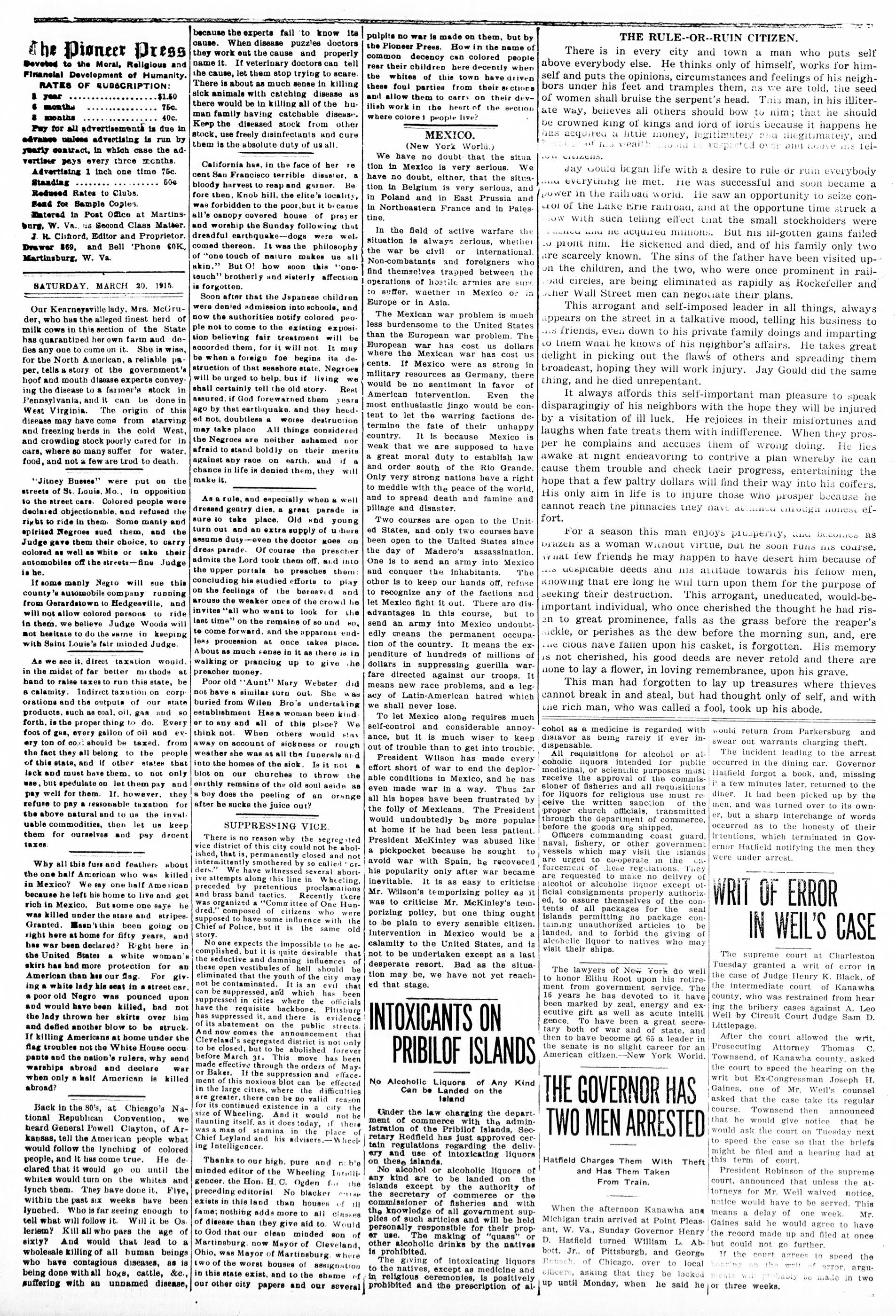
Our Kearneysville lady, Mrs. McGruder, who has the alleged finest herd of milk cows in this section of the State has quarantined her own farm and defies any one to come on it. She is wise, for the North American, a reliable paper, tells a story of the government's hoof and mouth disease experts conveying the disease to a farmer's stock in Pennsylvania, and it can be done in West Virginia. The origin of this disease may have come from starving and freezing herds in the cold West, and crowding stock poorly cared for in cars, where so many suffer for water, food, and not a few are trod to death.
"Jitney Busses" were put on the streets of St. Louis, Mo., in opposition to the street cars. Colored people were declared objectionable, and refused the right to ride in them. Some manly and spirited Negroes sued them, and the Judge gave them their choice, to carry colored as well as white or take their automobiles off the streets—fine Judge is he.
If some manly Negro will sue this county's automobile company running from Gerardstown to Hedgesville, and will not allow colored persons to ride in them, we believe Judge Woods will not hesitate to do the same in keeping with Saint Louis's fair minded Judge.
As we see it, direct taxation would, in the midst of far better methods at hand to raise taxes to run this state, be a calamity. Indirect taxation on corporations and the outputs of our state products, such as coal, oil, gas and so forth, is the proper thing to do. Every foot of gas, every gallon of oil and every ton of coal should be taxed, from the fact they all belong to the people of this state, and if other states that lack and must have them, to not only use, but speculate on let them pay and pay well for them. If, however, they refuse to pay a reasonable taxation for the above natural and to us the invaluable commodities, then let us keep them for ourselves and pay decent taxes.
Why all this fuss and feathers about the one half American who was killed in Mexico? We say one half American because he left his home to live and get rich in Mexico. But some one says he was killed under the stars and stripes. Granted. Hasn't this been going on right here at home for fifty years, and has war been declared? Right here in the United States a white woman's skirt has had more protection for an American than has our flag. For giving a white lady his seat in a street car, a poor old Negro was pounced upon and would have been killed, had not the lady thrown her skirts over him and defied another blow to be struck. If killing Americans at home under the flag troubles not the White House occupants and the nation's rulers, why send warships abroad and declare war when only a half American is killed abroad?
Back in the 80's, at Chicago's National Republican Convention, we heard General Powell Clayton, of Arkansas, tell the American people what would follow the lynching of colored people, and it has come true. He declared that it would go on until the whites would turn on the whites and lynch them. They have done it. Five, within the past six weeks have been lynched. Who is far seeing enough to tell what will follow it. Will it be Osslerism? Kill all who pass the age of sixty? And would that lead to a wholesale killing of all human beings who have contagious diseases, as is being done with all boys, cattle, &c., suffering with an unnamed disease.
because the experts fail to know its cause. When disease puzzles doctors they work out the cause and properly name it. If veterinary doctors can tell the cause, let them stop trying to scare. There is about as much sense in killing sick animals with catching disease as there would be in killing all of the human family having catchable disease. Keep the diseased stock from other stock, use freely disinfectants and cure them is the absolute duty of us all.
California has, in the face of her recent San Francisco terrible disaster, a bloody harvest to reap and garner. Before then, Knob hill, the elite's locality, was forbidden to the poor, but it became all's canopy covered house of prayer and worship the Sunday following that dreadful earthquake—dogs were welcomed thereon. It was the philosophy of "one touch of nature makes us all akin." But O! how soon this "one-touch" brotherly and sisterly affection is forgotten.
Soon after that the Japanese children were denied admission into schools, and now the authorities notify colored people not to come to the existing exposition believing fair treatment will be accorded them, for it will not. It may be when a foreign foe begins its destruction of that seashore state. Negroes will be urged to help, but if living we shall certainly tell the old story. Rest assured, if God forewarned them years ago by that earthquake, and they heeded not, doubtless a worse destruction may take place. All things considered the Negroes are neither ashamed nor afraid to stand boldly on their merits against any race on earth, and if a chance in life is denied them, they will make it.
As a rule, and especially when a well dressed gentry dies, a great parade is sure to take place. Old and young turn out and an extra supply of ushers assume duty—even the doctor goes on dress parade. Of course the preacher admits the Lord took them off, and into the upper portals he preaches them: concluding his studied efforts to play on the feelings of the bereaved and arouse the weaker once of the crowd he invites "all who want to look for the last time" on the remains of so and so, to come forward, and the apparent endless procession at once takes place. About as much sense in it as there is in walking or prancing up to give the preacher money.
Poor old "Aunt?" Mary Webster did not have a similar turn out. She was buried from Wilen Bro's undertaking establishment. Has a woman been kinder to any and all of this place? We think not. When others would stay away on account of sickness or rough weather she was at all the funerals and into the homes of the sick. Is it not a blot on our churches to throw the earthly remains of the old soul aside as a boy does the peeling of an orange after he sucks the juice out?
SUPPRESSING VICE
There is no reason why the segregated vice district of this city could not be abolished, that is, permanently closed and not intermittently smothered by so called "cruders." We have witnessed several abortive attempts along this line in Wheeling, preceded by pretentious proclamations and brass band tactics. Recently there was organized a "Committee of One Hundred," composed of citizens who were supposed to have some influence with the Chief of Police, but it is the same old story.
No one expects the impossible to be accomplished, but it is quite desirable that the seductive and damning influences of these open vestibules of hell should be eliminated that the youth of the city may not be contaminated. It is an evil that can be suppressed, and which has been suppressed in cities where the officials have the requisite backbone, Plitsburg has suppressed it, and there is evidence of its abatement on the public streets. And now comes the announcement that Cleveland's segregated district is not only to be closed, but to be abolished forever before March 31. This move has been made effective through the orders of Mayor Baker. If the suppression and effacement of this noxious blot can be effected in the large cities, where the difficulties are greater, there can be no valid reason for its continued existence in a city the size of Wheeling. And it would not be flaunting itself, as it does today, if there was a man of stamina in the place of Chief Leyland and his advisers.—Wheeling Intelligencer.
Thanks to our high, pure and noble minded editor of the Wheeling Intelligencer, the Hon. H. C. Ogden for the preceding editorial No blacker course exists in this land than houses of all fame; nothing adds more to all classes of disease than they give aid to. Would to God that our clean minded son of Martinsburg, now Mayor of Cleveland, Ohio, was Mayor of Martinsburg, where two of the worst houses of assignation in this state exist, and to the shame of our other city papers and our several
pulpits no war is made on them, but by the Pioneer Press. How in the name of common decency can colored people rear their children here decently when the whites of this town have driven these foul parties from their sections and allow them to carry on their devilish work in the heart of the section where colorist people live?
MEXICO.
We have no doubt that the situation in Mexico is very serious. We have no doubt, either, that the situation in Belgium is very serious, and in Poland and in East Prussia and in Northeastern France and in Palestine.
In the field of active warfare the situation is always serious, whether the war be civil or international. Non-combatants and foreigners who find themselves trapped between the operations of hostile armies are sure to suffer, whether in Mexico or in Europe or in Asia.
The Mexican war problem is much less burdensome to the United States than the European war problem. The European war has cost us dollars where the Mexican war has cost us cents. If Mexico were as strong in military resources as Germany, there would be no sentiment in favor of American intervention. Even the most enthusiastic jingo would be content to let the warring factions determine the fate of their unhappy country. It is because Mexico is weak that we are supposed to have a great moral duty to establish law and order south of the Rio Grande. Only very strong nations have a right to meddle with the peace of the world, and to spread death and famine and pillage and disaster.
Two courses are open to the United States, and only two courses have been open to the United States since the day of Madero's assassination. One is to send an army into Mexico and conquer the inhabitants. The other is to keep our hands off, refuse to recognize any of the factions and let Mexico fight it out. There are disadvantages in this course, but to send an army into Mexico undoubtedly means the permanent occupation of the country. It means the expenditure of hundreds of millions of dollars in suppressing guerilla warfare directed against our troops. It means new race problems, and a legacy of Latin-American hatred which we shall never lose.
To let Mexico alone requires much self-control and considerable annoyance, but it is much wiser to keep out of trouble than to get into trouble.
President Wilson has made every effort short of war to end the deplorable conditions in Mexico, and he has even made war in a way. Thus far all his hopes have been frustrated by the folly of Mexicans. The President would undoubtedly be more popular at home if he had been less patient. President McKinley was abused like a pickpocket because he sought to avoid war with Spain, he recovered his popularity only after war became inevitable. It is as easy to criticise Mr. Wilson's temporizing policy as it was to criticise Mr. McKinley's temporizing policy, but one thing ought to be plain to every sensible citizen. Intervention in Mexico would be a calamity to the United States, and is not to be undertaken except as a last desperate resort. Bad as the situation may be, we have not yet reached that stage.
INTOXICANTS ON PRIBILOF ISLANDS
No Alcoholic Liquors of Any Kind
Can be Landed on the
Island
Under the law charging the department of commerce with the administration of the Pribilof Islands, Secretary Redfield has just approved certain regulations regarding the delivery and use of intoxicating liquors on these islands.
No alcohol or alcoholic liquors of any kind are to be landed on the islands except by the authority of the secretary of commerce or the commissioner of fisheries and with the knowledge of all government supplies of such articles and will be held personally responsible for their proper use. The making of "quass" or other alcoholic drinks by the natives is prohibited.
The giving of intoxicating liquors to the natives, except as medicine and in religious ceremonies, is positively prohibited and the prescription of al-
There is in every city and town a man who puts self above everybody else. He thinks only of himself, works for himself and puts the opinions, circumstances and feelings of his neighbors under his feet and tramples them, as we are told, the seed of women shall bruise the serpent's head. This man, in his illiterate way, believes all others should bow to him; that he should be crowned king of kings and lord of lords because it happens he has acquired a little money, legitimately and illegitimately, and the value of his wealth should be respected over and above his fellow citizens.
Jay Gould began life with a desire to rule or ruin everybody and everything he met. He was successful and soon became a power in the railroad world. He saw an opportunity to seize control of the Lake Erie railroad, and at the opportune time struck a blow with such telling effect that the small stockholders were crushed and he acquired millions. But his ill-gotten gains failed to pront him. He sickened and died, and of his family only two are scarcely known. The sins of the father have been visited upon the children, and the two, who were once prominent in railroad circles, are being eliminated as rapidly as Rockefeller and other Wall Street men can negotiate their plans.
This arrogant and self-imposed leader in all things, always appears on the street in a talkative mood, telling his business to his friends, even down to his private family doings and imparting to them what he knows of his neighbor's affairs. He takes great delight in picking out the flaws of others and spreading them broadcast, hoping they will work injury. Jay Gould did the same thing, and he died unrepentant.
It always affords this self-important man pleasure to speak disparagingly of his neighbors with the hope they will be injured by a visitation of ill luck. He rejoices in their misfortunes and laughs when fate treats them with indifference. When they prosper he complains and accuses them of wrong doing. He lies awake at night endeavoring to contrive a plan whereby he can cause them trouble and check their progress, entertaining the hope that a few paltry dollars will find their way into his coffers. His only aim in life is to injure those who prosper because he cannot reach the pinnacles they have attained through honest effort.
For a season this man enjoys prosperity, and becomes as brazen as a woman without virtue, but he soon runs his course. What few friends he may happen to have desert him because of his despicable deeds and his attitude towards his fellow men, knowing that ere long he will turn upon them for the purpose of seeking their destruction. This arrogant, uneducated, would-be-important individual, who once cherished the thought he had risen to great prominence, falls as the grass before the reaper's sickle, or perishes as the dew before the morning sun, and, ere the cious have fallen upon his casket, is forgotten. His memory is not cherished, his good deeds are never retold and there are none to lay a flower, in loving remembrance, upon his grave.
This man had forgotten to lay up treasures where thieves cannot break in and steal, but had thought only of self, and with the rich man, who was called a fool, took up his abode.
cohol as a medicine is regarded with disfavor as being rarely if ever indispensable. All requisitions for alcohol or alcoholic liquors intended for public medicinal, or scientific purposes must receive the approval of the commissioner of fisheries and all requisitions for liquors for religious use must receive the written sanction of the proper church officials, transmitted through the department of commerce, before the goods are shipped.
Officers commanding coast guard, naval, fishery, or other government vessels which may visit the islands are urged to cooperate in the enforcement of these regulations. They are requested to make no delivery of alcohol or alcoholic liquor except official consignments properly authorized, to assure themselves of the contents of all packages for the seal islands permitting no package containing unauthorized articles to be landed, and to forbid the giving of alcoholic liquor to natives who may visit their ships.
The lawyers of New York do well to honor Elihu Root upon his retirement from government service. The 16 years he has devoted to it have been marked by zeal, energy and executive gift as well as acute intelligence. To have been a great secretary both of war and of state, and then to have become at 65 a leader in the senate is no slight career for an American citizen—New York World.
THE GOVERNOR HAS TWO MEN ARRESTED
Hatfield Charges Them With Theft and Has Them Taken From Train.
When the afternoon Kanawha and Michigan train arrived at Point Pleasant, W. Va., Sunday Governor Henry D. Hatfield turned William L. Abbott, Jr., of Pittsburgh, and George Rouseh, of Chicago, over to local officers, asking that they be locked up until Monday, when he said he
would return from Parkersburg and swear out warrants charging theft. The incident leading to the arrest occurred in the dining car. Governor Hatfield forgot a book, and, missing it a few minutes later, returned to the diner. It had been picked up by the men, and was turned over to its owner, but a sharp interchange of words occurred as to the honesty of their intentions, which terminated in Governor Hatfield notifying the men they were under arrest.
WRIT OF ERROR IN WEIL'S CASE
The supreme court at Charleston Tuesday granted a writ of error in the case of Judge Henry K. Black, of the intermediate court of Kanawha county, who was restrained from hearing the bribery cases against A. Leo Weil by Circuit Court Judge Sam D. Littlepage.
After the court allowed the writ, Prosecuting Attorney Thomas C. Townsend, of Kanawha county, asked the court to speed the hearing on the writ but Ex-Congressman Joseph H. Gaines, one of Mr. Weil's counsel asked that the case take its regular course. Townsend then announced that he would give notice that he would ask the court on Tuesday next to speed the case so that the briefs might be filed and a hearing had at this term of court.
President Robinson of the supreme court, announced that unless the attorneys for Mr. Weil waived notice, notice would have to be served. This means a delay of one week. Mr. Gaines said he would agree to have the record made up and filed at once but could not go further.
If the court agrees to speed the hearing on the writ of error, arguments will probably be made in two or three weeks.
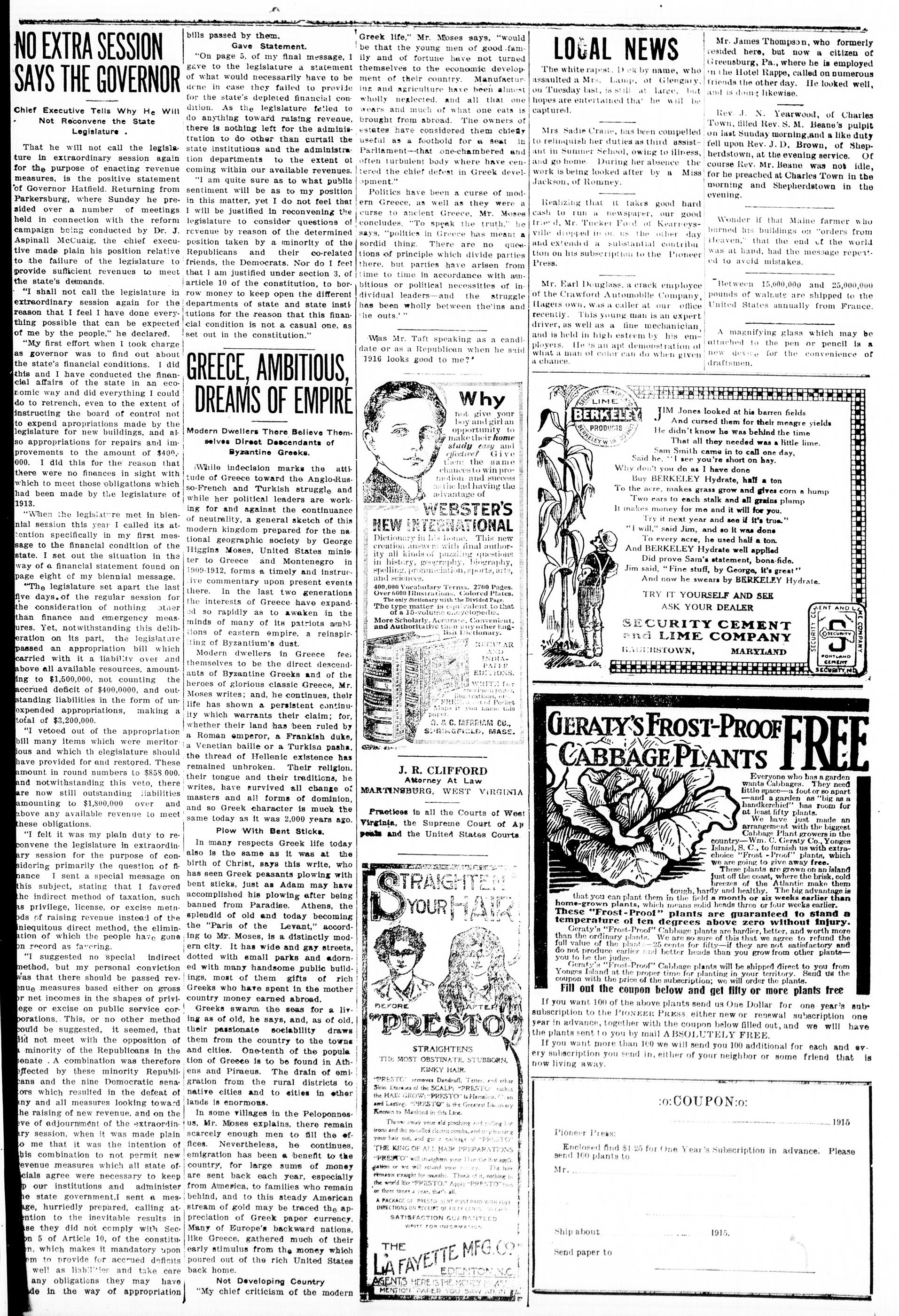
NO EXTRA SESSION
SAYS THE GOVERNOR
oe enone ees
ture in extraordinary session again
for the purpose of enacting revenue
measures, is the positive statement
‘ot Governor Hatfield. Returning from
Parkersburg, where Sunday he pre
sided over a number of meetings
held in connection with the reform
campaign being conducted by Dr. J
Aspinall McCuaig, the chief execu
tive made plain his position relative
to the failure of the legislature t
provide sufficient revenues to meet
the state’s demands.
| “I shall not call the legislature ix
extreordinary session again for the
reason that I feel I have done every.
thing possible that can be expected
lof me by the people,” he declared.
“My first effort when I took charge
jas. governor was to find out abou
the state’s financial conditions. 1 dic
this and I have conducted the finan
cial affairs of the state in an eco
omic way and did everything I coult
ldo to retrench, even to the extent o'
instructing the board of control no’
to expend apropriations made by the
Negislature for new buildings, and al
iso appropriations for repairs and im
provements to the amount of $404,
1000. 1 did this for the reason that
there were no finances in sight with
which to meet those obligations which
Ihad been made by the legislature o|
1913.
“When the legisiatvre met in bien
Injal session this year I called its at
tention specifically in my first mes
sage to the financial condition of the
state. I set out the situation in th:
Wway of @ financial statement found or
page eight of my biennial message.
“The legislature set apart the las
ive days,of the regular session fo1
he consideration of nothing otae!
than finance and emergency meas
res. Yet, notwithstanding this detib
ration on its part, the legislatar
assed an appropriation bill whicl
rried with it a liability over anc
bove all available resources, amount
iB to $1,500,000, not counting — the
ecrued deficit of $400,0000, and out
tanding liabilities in the form of un
loxpended appropriations, making <
total of $3,200,000.
“I vetoed out of the appropriatior
ill many items which were meritor
ious and which th elegislature shoul
have provided for and restored. Thes:
mount in round numbers lo $858 000
nd notwithstanding this veto, ther
re now still outstanding Jiabilitie:
mounting to $1,800,000 over an¢
“bove any available revenue io mee
these obligations.
“I felt it was my plain duty to re
nvene the legislature in extraordin
Ty session for the purpose of con
idering primarily the question of fi
ance I sent a special message or
his subject, stating that I favorec
he indirect method of taxation, suct
8 privilege, license, or excise metn
ds of raising revenue instead of th
iniequitous direct method, the elimin
tion of which the people have gon
mn record as favoring.
“I suggested no special — indiree’
ethod, but my personal convictioz
Yas that there should be passed rev
Ue measures based either on gros:
r net incomes in the shapes of privi
lege or excise on public service cor
rations. This, or no other methoc
uid be suggested, it seemed, tha
id not meet with the opposition o:
minority of the Republicans in th:
nate . A combination was therefor:
ffected by these minority Republi
ans and the nine Democratic sena
ors which resulted in the defeat o
ny and all measures looking towacc
he raising of new revenue, and on th
ve of adjournmént of the extraordin
Mae
bills passed by them.
Gave Statement.
“On page 5, of my final message, |
geve to the legislature a statement
of what would necessarily have to be
dene in case they failed to provide
tor the state's depleted financixl con:
dition, As the legislature fetled to
do anything toward raismg reveaue,
there is nothing left for the adminis.
tration to do other than curtail the
state institutions and the administra.
tion departments to the extent ol
coming within our available revenues.
“I am quite sure as to what public
sentiment will be as to my position
in this matter, yet I do not feel that
1 will be justified in reconvening the
legislature to consider questions of!
revenue by reason of the determined
pesition taken by a minority of the
Republicans and their o-relatea
friends, the Democrats. Nor do I feet
that 1 am justified under section 3, of
article 10 of the constitution, to bor-
row money to keep open the different
departments of state and state insti
tutions for the reason that this finan-
cial condition is not a casual one, as
set out in the constitution.”
GREECE, AMBITIOUS,
DREAMS OF EMPIRE
Wile indecision marks the atti
‘tude of Greece toward the AngloRus-
/so-Freneh and Turkish struggle and
|while her political leaders are work-
ing for and against the continuance
of neutrality, a general sketch of this
modern kingdom prepared for the na
tional geographic society by George
Higgins Moses, United States minis
ter to Greece dnd Montenegro in
1909-1912, forms a timely and instruc.
ive commentary upon present events
there. In the last two generations
the interests of Greece have expand-
vl so rapidly as to awaken in the
minds of many of its patriots ambi
tions of eastern empire, a reinspir-
ting ef Byzantium’s dust.
Modern dwellers in Greece fees
themselves to be the direct descend-
fants of Byzantine Greeks and of the
heroes of glorious classic Greece, Mr.
Moses writes; and, he continues, their
[life has shown a persistent continu-
ity which warrants their claim; for,
| whether their land has been ruled by
a Roman emperor, a Frankish duke,
a Venetian baile or a Turkisa pasha,
the thread of Hellenic existence has
remained unbroken. Their religion.
their tongue and their traditions, he
writes, have survived all change of
masters and al! forms of dominion,
‘and so Greek character is muck the
same today as it was 2,000 years ago.
Plow With Bent Sticks.
| In many respects Greek life today
also is the same as it was at the
birth of Christ, says this write, who
has seen Greek peasants plowing with
bent sticks, Just as Adam may have
accomplished his plowing after being
banned from Paradise. Athens, the
splendid of old and today becoming
the “Paris of the Levant,” accord-
Ing to Mr. Moses, is a distinctly mod-
jern city. It has wide and gay streets,
dotted with small parks and edorn-
ed with many handsome public butld-
‘ings, most of them gifts of rich
Greeks who have spent in the mother
country money earned abroad.
| Greeks swanm the seas for a liv-
ing as of old, he says, and, as of old,
their passionate soelability draws
them from the country to the towns
and cities. Onetenth of the popula
tion of Greeee is to be found in Ath-
jens and Piraeus. The drain of emi-
‘gration from the rural districts to
native cities and to eities in ether
lands is enormous.
| Im somo villages in the Peloponnos-
‘us, Mr. Moses explains, there remain
scarcely enough men to fill the ef-
fices. Nevertheless, he continues,
‘emigration has been @ benefit to the
/country, for large sums of money
‘are sent back each year, especially
from America, to families who remain
; behind, and to this steady American
stream of gold may be traced the ap-
|preciation of Greek paper currency.
|Many of Europe's backward nations,
| ike Greece, gathered much of their
early stimulus from the money whioh
poured out of the rich United States
back home.
Not Developing Country
| “My chief criticism of the modern
Greek life,” Mr. Moses says, “would
be that the young men of good -fam.
ily and of fortune have not turned
themselves to the economic develop-
ment of their country. Manufactur
ing and agriculture have been almost
wholly neglected, and all that one
wears and much of what one eats is
brought from abroad. ‘The owners of
estates have considered them chiefly
useful as a foothold for a seat in
Parlament—that one-chambered and
often turbulent body where have cen-
tered the chief defest in Greek devel.
ypment.”
Politics have been a curse of mod-
ern Greece, as well as they were a
curse to ancient Greece, Mr. Moses
concludes, “To spgak the truth.” he
Says, “politics in Greece has meant a
sordid thing. There are no ques.
tions of principle which divide parties
there, but parties have arisen from
time to time in accordance with am-
bitious or political necessities of in-
dividual leaders—and the — struggle
has been wholly between the'ins and
‘he outs.’ ”
Was Mr. Taft speaking as a candi
date or as a Republican when he said
1916 looks good to me?*
SAE. iaucttnoomeME
ge Wh
i= .
Aga? * . y :
ie, SA) not vive your |
Oe SY boy and girl an
te Zs GON. onporuunity to
(aN oP WB G9 make their home
NE = study etsy and
sk egvclire? Give
wo FY vem the same
é 2 chuncesto win pro- |
SR sution and snecess
gear. the lad having the
& Wee wea) advantage of :
ane at ag Re
; Fm <
WEBSTERS
IMVTESRAT,
REW UR PES NATIONAL
2 Dictionary in iis hore, This new
2 creation sinswers with dinal author-
| ity all kinds of puzzicnge questions
£ in history, georrsphy, biography,
spelling, pronunciation, sports, ats,
band scicnees.
2 400,000 Vocabulary Terms. 2700 Pages.
F Over avon Titustrations. Colored Phites.
2 “Phe only dictionary with the Divided Page,
4 The type matter is cu valent to that
3 of a 15-volume c..cyclopedia,
3 More Scholarly, Aceurare, Convenient,
2 and Authoritative ti. why other bag?
= mtb.» tinit Dictionary.
(Re oan 7 RSCULAR
| Po Bua: see
cm Fo RN i og NDtae
eae ello es Day
ng | Sa i bi CN GRe.
at ee oar pitaa ght BUT -20NS.
Ree Brice ots Mwirns ter
Ramee oo munane
peer 22 SSF ita vations, ot
See ie ren itt
| poten elt Ar Naps at vou iiame tis
mene 3) Pay Hh! :
as odes Gk C. MRRIAM Cu.
Winn (2h) SH NGTCLR, MASE.
ae il ao
J. R. CLIFFORD
Attorney At Law
MAR'NINSBURG, WEST VIRGINIA
Practices in all the Courts of West
Virginia, the Supreme Court of Ap
peats and the United States Courts
a ZETIA UR
NT CO AIEEE it
BT RAG! itis
me Rn stn
Y BED fue 2a all 3
NYOQUR ee ie
CG ae |
| SE a pare
ey RO heel £0
f SS ah “B- (eh *
4 eh Bie — is ads,
IZA & fae
“ad, SL i} HS ie pes
BEFORE ‘ eT ere sf
PRESTO?
a —) ki, Wt!
STRAIGHTENS.
Silt MOST OBSTINATE, STUBBORN,
KINKY HAIR ;
“PRESTO removes Dandruff, Teter. rod other
Skin Lucess of the SCALP; “PRESTO snckes
the HAI GROW: "PRESTO" ts Harlow an
and Lartivg. “RESTO” i the Greatest Da overy
Karows to Maniind it: thts Line.
Theow sway your eld pinching a4 pulling Jot
“THE KING OF ALL MAIR PREPARATIONS
PRESTO" will sraighten your [ue the tistappti |
temas tirsght for unt. Thiet, nothing io
te world ee "PRESTON" Ayre “PRESTON, E
Sareea tere i
APAGIAGE Of raisro:seat-nostoninwien sina p
SATISFACTION Gué RITE:
THE Glo
ima 1
La FA M7 EDENTON NC
TiS HERE ISTHE MONEY IA?
MENF IC PAPER J Sed AD 4 Be
RI a et) oh Fae ee eee
FRR TS TOE EER
VAume os i Le
BERKE ney JIM Jones looked at his barren fields Het
\ sh +” And cursed them for their meagre yields ih
SPOS PRawucIE S/ He didn’t know he was behind the time Lae
KY Cee y ad That all they needed was a little lime. La
4 ¥ a Sam Smith came in to call one day, Hee
IA ") Said he, ‘1 see you're short on hay. Hah
\ Why dou't you do as I have done Ear
1" ‘ Buy BERKELEY Hydrate, haff a ton i.
\, ; To the acre, makes grass grow and gives corn a hump Hg
aN ne “Two ears to each stalk and all grains plump Hat
4) F It inakes money for mo and it will for you. Ha
(( Ay) try it next year and see if {t's true." .|
dj “J will,” said Jim, and so it was done Hi
(FN At Yo every acre, he used half a ton. A
\ re And BERKELEY Hydrate well applied Fat
Pr Did prove Sam's statement, bona-fide. Ha
ms AY BO) Jim said, “Fine stuff, by George, it’s great!” Ca
(7: ee And now he swears by BERKELEY Hydrate. ta
My TRY ' YOURSELF AND SEK Het
tate ASK YOUR DEALER (ERT AND CaN
} ie y Sy
Vid eet SECURITY CEMENT |: ha 88
al ¥ end LIME COMPANY 3 g
po Gh: KACURSTOWN, MARYLAND =f”) ,.Saw, |<
Siig LB cemeny
Gilde, fee, sccuaahy
%
GERATY’S FROST-PROOF
~ i AVL Ss :
/ABBAGE PDANTS i
4 =*
oF - Everyone who has a garden
) Wi PS ) oe wants Cabbages. They need
ez [B Little space—a foot or 6o apart
as , : —and agarden as “big as a
A= aA Hy handkerchief” has room for
yr i) Pri ot Icast fifty plunts.
im = CNW We hive just made an
Lf Zi arrangement with the biggest
a Cabbage Plant growers in the
al Ly country—Wm. C. Geraty Co., Yongea
WY y — Island, S. C., to furnish us with extra-
am 7/1 /) choice’ “Frost Proof” plants, which
h we are going to give away free.
These plants are grown on an island
—— Just off the coast, where the brisk, cold
_— a breezes of the Atlantic make them
—_— : 2 tour, hardy und healthy, ‘The bir advantage is
that you can plant them in the field a month or six weeks earlier than
home-grown plants, which means solid heads thrco or four weeks earlier.
These “Frost-Proot” plants are guaranteed to stand a
temperature of ten degrees above zero without injury.
Geraty's “Frost-Proof” Cabbage plants are hardier, better, and worth moro
than the ordinary plants. We are so sure of this that we agree to refund the
B full value of the plant ~25 cents for filly—if they are not satisfactory and
do not produce extlier +i) better heads than you grow from other plante—
you to be the judge. ;
Geraty’s “Prost-Proof” Cabbage plants will be shipped direct to you from
Yonges Island at the proper time for planting in your territory. Send us the
ae Coupon with the price of the subecription; we will order the plants.
a Fill ont the coupon below and get fifty or more plants free
If you want 100 of the above plants send us One Dollar for one year’s subs
subscription to the Pion wen Press either new or renewal subscription one
year in advance, together with the coupon below filled out, and we will have
the plants sent to you by mail ABSOLUTELY FREE,
If you want more than 160 we will send you 100 additional for each and ev-
ery subscription you send in, either of your neighbor or some friend that is
now living away
:0: COU PON:0:
wa a2 2 1915
Pioneer Press:
Enclosed find 31.25 for One Year’s Subscription in advance: Please
send 100) plants Lo
Mr..
Ship about 1915.
Send paper to
LOUAL NEWS
The white rapest. 2) ok by name, who
assaulted a Mrs. Lamy, ot Glengary,
on Tuesday last as still at daree, but
hopes are entertained thay he will be
captured.
Mrs Sadie Crave, tins been compelled
to relinquish her duties as third assist-
ANC in Summer Sehool, owing to illness,
and gohome During herabsenee the
work is being looked after by a Miss
Jackson, of Romney.
Realizing that ait takes good) bard
cash too run iw newspaper, our good
fred, Mr. Pheker Pood of Kearneys=
ville dropped itor us the ober day
and extended a substantial contribu
ion ou his subseription to the Pioneer
Press.
Mr, Earl Douglass. a crack employee
of the Crawford Automobile Company,
Hagets own, was a caller at our oftice
recenuy. ‘This young man is an expert
driver, as well as a tine wechanician,
and is held in high esteem by his) em-
ployers. He os an apt demonstration of
what a man of Color can do when given
a chance.
| Mr. James Thompson, who formerly
‘‘esided here, but now a citizen of
Greensburg, Pa., where he is employed
‘nthe Hotel Rappe, called on numerous
‘friends the other day. He looked well,
and is domes likewise,
Kev J. N. Yearwood, of Charles
‘Town, tilled Rey. 5. M. Beane’s pulpit
on last Sunday morning,and a like duty
fell upon Rey. J.D, Brown, of Shep-
herdstown, at the evening service. Of
course Rev. Mr. Beane was nob idle,
for he preached at Charles ‘Town in the
morning and Shepherdstown in the
evening.
Wonder if that Maine farmer who
burned his buildings on “orders from
ileaven,” that the end of the world
Was at hand, had the message repeat:
ed to avoid mistakes,
“Between 15,000,000 and 25,000,000
pounds of walnuts are shipped to the
United States annually from France.
A magnifying glass which may be
attached to the pen or peneil is a
new devce for the convenience of
draftsmen,
Volume of Foreign Commerce of the United States During 1914
The volume of foreign commerce of the customs service, effective at the beginning of the fiscal year 1914, which passed through the various customs districts of the United States in the calendar year 1914 is indicated by the following memorandum prepared in the bureau of foreign and domestic commerce, department of commerce. Owing to the reorganization comparisons with earlier years are not available, but comparing December, 1914, with the corresponding period of the preceding year, it is known that considerable increases in exports occurred at the ports of New York, Galveston, New Orleans, Baltimore, Boston and Philadelphia, in the closing months of the year.
New York, which does about 40 per cent of the countrys export business, handles practically all lines of merchandise. Gaiveston, second in point of export sales, handles chiefly cotton, cottonseed oil cake and meal, wheat, flour, and rice. New Orleans is not only a great cotton market, but an important distributor of wheat, flour, mineral oil, lumber, meat products, cottonseed oil, oil cake, rice and tobacco. Baltimore, fourth in value of exports, handles wheat and other grains, iron and steel, leaf tobacco, copper, and many lines of manufactures. Detroit, the fifth largest exporting center, is an important seller of automobiles and carriages, hides, fruits, oils, lumber, iron and steel, meats, and miscellaneous manufactures. Buffalo is a great shipper of iron products, coal, and mineral oils. Boston exports chiefly leather manufactures, meats, printing paper, and wheat. Philadelphia, which is the eighth port in point of exports, ships chiefly grains and flour, coal, leather, meat products, kerosene oil, and miscellaneous manufactures. San Francisco, ninth in export sales, is a leading exporter of fruits, salmon, cotton, iron and steel, and leather goods and ships largely of oils to the oriental countries. The district of Georgia, with headquarters at Savannah, exports a large quantity of cotton and cottonseed oil cake, and is the leading export market for naval stores. Seattle and Tacoma are important distributors of canned salmon, cotton, lumber, oil, grains, and automobiles. Norfolk and Newport News are great coal shipping points. Tampa and other Florida points handle most of the phosphates and a considerable share of the naval stores, tobacco and lumber exported. Port Arthur exports largely of cotton, cottonseed cake, wheat, and mineral oils and is the leading exporter of sulphur.
These are merely examples of the details obtainable in Table 6, "Exports by Articles from the various Customs Districts," shortly to be issued by the above-named bureau as a part of the annual report on "Commerce and Navigation of the United States."
The following table shows in millions of dollars the imports and exports of the United States at the 22 leading customs districts of the country, arranged in order of magnitude of exports:
District. Imports. Exports
(Million dollars.) (Million dollars.)
New York 974 833
Galveston 12 197
New Orleans 80 181
Baltimore 30 107
Detroit 26 95
ualo 30 75
Boston 163 72
Philadelphia 88 66
San Francisco 70 66
Georgia 6 52
Washington 63 48
Mobile 8 32
St. Lawrence 39 31
Dakota 12 30
Vermont 20 28
Port Arthur 1 28
Virginia 7 27
Florida 8 26
Chicago 35 26
Oregon 4 14
Ohio 10 13
Duluth 6 11
Other districts 97 50
Total 1789 2114
WHEN IS GARDEN SOIL READY FOR PLANTING?
The Average Backyard Soil Is Poor and Should Have Careful Preparation.
"When is the proper time for preparing to plant one's garden?"
The United States department of agriculture's specialist says that in the spring as soon as the soil has dried so that a handful when grasped in the hand and gripped by the fingers will slowly fall apart upon being released, it is in a fit mechanical condition to prepare for planting. Clay or heavy soils should never be worked while wet. More injury may be done by doing this than can be overcome in several years of careful culture.
When the soil is found dry, as described above, the upper three inches should be made fine by the use of the hoe and steel-tooth rake; all rubish, stones, and clods should be re-
moved and the surface made even, somewhat compact, and as level as the contour of the area will permit. It may then be marked off for planting in conformity to the general plan of the garden. Much of the soil in the average back yard is not only poor in plant food and deficient in decaying vegetable matter, but it is hard and unyielding. However, such is the basis which many a housewife or child has to use for the making of a garden. Teachers who plan school gardens for their pupils also have similar conditions to meet. Therefore, in order to get good results, careful attention must be given to the preparation of the soil.
Soils which are naturally moist are likely to be sour and so not in the best condition for the crop. Whether sour or not it will be well to have the pupilstest them, which can be done as follows: Secure from a drug store a piece of blue litmus paper; then take a handful of the soil slightly moistened and place the paper in it. If sour the paper will turn red. To correct such a condition lime should be used. Cover the ground with a thin coat of air-slaked which can probably be secured nearby at a small cost, and work this in well. The use of the lime, while not a plant food, will correct the acidity and will improve the physical condition of the soil.
If the soil is clayey or a stiff clay loam and the location is in a section where severe freezing occurs, it will be found a decided advantage to give the area a heavy drasing of decomposed manure in the autumn, and before freezing weather sets in spadethe land so as to turn the manure under and leave the soil in a rough, lumpy condition so as to secure the benefit of the digestive action of the winter freezes in reducing the soils. This should be repeated annually at the North. If the soil is light and sandy, a mulch of manure may be spread over it in the fall and the spading delayed until spring.
In localities where the soil does does not freeze, the manure may be applied in the autumn and the soil repeatedly spaded during the winter whenever it is dry enough to be worked. The value of freezing at the North can to an extent be attained by repeated spadings at the South. The one general precaution which should always be boserved is never stir the soil while it is wet.
"The daily ration of a Japanese soldier consists of three little bags of rice and one of dried fruit." Fine arrangement. The rice keeps him alive and the prunes keep him angry enough to lick he weight in wildcats.
LINCOLN BEACHEY IS FATALLY HURT
Noted Airman Losea His Life at San Francisco Sunday Afternoon. Death came to Lincoln Bachey, the world's famed aviator Sunday afternoon, when he dropped through the air at San Francisco 2,500 feet before thousands of spectators at the Panama-Pacific International Exposition. The accident, which ended the life of the man that had defied death so long came when the wings of his new monoplane collapsed, when he attempted to right the machine after a perpendicular drop through space.
The strain on the new monoplane was too great and one of the wings was seen to fly up as that of a wounded bird. In a flash the second wing of the monoplane gave away and the shining engine and propeller gleamed in the sunshine as the crippled machine fell.
There was no chance for escape although Beachey and his collapsed monoplane landed in the waters of San Francisco Bay. The force of the fall was so great that they were buried in the mud of the bay, in 40 feet of water.
He struck the water near the U. S. army transport docks in a narrow patch of water between two monster transports swinging at anchor. A rescue crew was dispatched from the battleship Oregon which was lying in the stream. After two hours, the machine and body were dug from the mud by a diver from the Oregon's crew. Beachey was found entangled in the wires of the wrecked machine and all of the bones of his body were broken.
"I am done with politics," said Victor Murdock. Whereupon they elected him national chairman of the Progressive party.—Springfield Republican.
The average ostrich lives 30 years and yields from two to four pounds of plumes.
HOTEL
POWHATAN
WASHINGTON
D.C.
HOTEL OF AMERICAN IDEALS
In a city where good hotels abound, the Powhatan heads the list.
It is first in the heart of the countrymen.
The Powhatan is refined, exclusive, and restful. Its excellent location on Pennsylvania Avenue, 18th and H Streets, makes it a desirable headquarters for bridal couples, tourist parties, conventions, Schools and colleges.
The Powhatan attracts the people of culture and education. Its proximity to State, War and Navy Departments, also to many points of historical interest, makes this hotel especially attractive to a discriminating public.
The Powhatan offers rooms with detached bath at $1.50, $2.00 and up. Rooms with private bath, $2.50, $3.00 and up.
Write for booklet with map.
E. C. OWEN,
MANAGER.
SALESMEN Wanted to sell Our West Virginia Grow NURSERY STOCK Free can vassing outfit FREE. Cash Commis sions Paid Weekly. Write for terms
Mason City, W. V
Are You a Woman?
Take Cardui
The Woman's Tonic
FOR SALE AT ALL DRUggISTS
The constant run on Thompson and Thompson keeps them so busy, they have no time to even talk of hard times." It's the home of good clothes and verily, they are hustlers.
BUY IT TO-DAY
300 PICTURES
250
300 PAGES
ARTICLES
POPULAR MECHANICS MAGAZINE
For Father and Son AND ALL THE FAMILY
Two and a half million readers find it of absorbing interest. Everything in it is Written So You Can Understand It
We sell 400,000 copies every month without giving premiums and have no solicitors. Any new seller will show you a copy; or write the publisher for free sample — a postal will do.
11 TO A YEAR 15c A COPY
Popular Mechanics Magazine
No. 1, Chicago Ave., CHICAGO
For shoes, go to Charles E. Thompson North Queen Street. His stock is excellent, and the courtesies of his clerks can't be excelled. Try him and be convinced!
THE MONTROSE ASHORE.
13.—The Canadian Pacific liner Montrose is ashore near Ebrau Senegal on the west coast of Africa, andages received here, her wireless calling for assistance, 900-ton four masted steamer with a length of 450 feet, and accommodation for several hundred passengers, the war the Montrose was commanded by the Bride as a troop ship. It was used as a transport for the Europe, and it is believed that it is still in use as she was either returning with British troops from transporting Portugese troops to Africa for offensi German colonies. The Montrose is the vessel upon Crippen was intercepted in his flight from Louis.
Loved Girl's Life
tell you what wonderful benefit I have re-use of Thedford's Black-Draught," writes Woods, of Clifton Mills, Ky.
He has no equal for la grippe, bad colds, such troubles. I firmly believe Black-Draught is girl's life. When she had the measles, on her, but one good dose of Thedford's amade them break out, and she has had no shall never be without.
THEDFORD'S
BLACK-DRAUGHT
For constipation, indigestion, headache, dizziness and fever, biliousness, and all similar Thedford's Black-Draught has proved itself a safe, and valuable remedy.
Or from any of these complaints, try Black-a medicine of known merit. Seventy-five did success proves its value. Good for sale everywhere. Price 25 cents.
R! What Is It
All About?
world gone stark mad over a very foolish and trivial swords rattling, cannon rumbling, mailed armour use Russia wanted to show her love for the little brother—Servia?
BORDEAUX, March 13.—The Canadian Pacific liner Montrose is ashore on the Portugal bank near Ebrau Senegal on the west coast of Africa, according to cable messages received here, her wireless calling for assistance. The Montrose is a 7,000-ton four masted steamer with a length of 450 feet and breadth of 52 feet, and accommodation for several hundred passengers. At the outbreak of the war the Montrose was commandered by the British government for use as a troop ship. It was used as a transport for the Canadian contingent to Europe, and it is believed that it is still in use as a transport. It is assumed she was either returning with British troops from South Africa or was transporting Portugese troops to Africa for offensive movements against the German colonies. The Montrose is the vessel upon which the notorious Dr. Crippen was intercepted in his flight from London to America.
Saved Girl's Life
"I want to tell you what wonderful benefit I have received from the use of Thedford's Black-Draught," writes Mrs. Sylvania Woods, of Clifton Mills, Ky.
"It certainly has no equal for la grippe, bad colds, liver and stomach troubles. I firmly believe Black-Draught saved my little girl's life. When she had the measles, they went in on her, but one good dose of Thedford's Black-Draught made them break out, and she has had no more trouble. I shall never be without
in my home." For constipation, indigestion, headache, dizziness, malaria, chills and fever, biliousness, and all similar ailments, Thedford's Black-Draught has proved itself a safe, reliable, gentle and valuable remedy.
If you suffer from any of these complaints, try Black-Draught. It is a medicine of known merit. Seventy-five years of splendid success proves its value. Good for young and old. For sale everywhere. Price 25 cents.
HAS the whole world gone stark mad over a very foolish and trivial question? Are swords rattling, cannon rumbling, mailed armour glistening just because Russia wanted to show her love for the little brother—Servia?
Tear inside the curtain of Europe's politics and see the grim and sinister game of chess that is being played. See upon what a slim, yet desperate, excuse the sacred lives of millions may be sacrificed. Read the history of the past one hundred years, as written by one of the greatest authorities the world has ever known, and learn the naked, shameful truth. Just to get you started as a Review of Reviews subscriber, we make you this extraordinary offer. We will give to you
FREE!
Duruy's History of the World
Four splendid cloth volumes, full of
portraits, sketches, maps, diagrams
Today is the climax of a hundred years of preparation.
Read in this timely, authoritative, complete, AND THE
ONLY CONDENSED classic world history—of which over
2,000,000 copies have been sold in France alone—just what has
taken place in the inner councils of Europe during the past one
hundred years.
Read in these entrancing pages how Russia
has for years craftily been trying to escape from her darkness—
to get a year-round open port, with its economic freedom.
Read how Germany and Austria, fearful of the monster's
cent strength, have been trying to checkmate her and how
they have pinned all in this last, supreme stake.
Today is the climax of a hundred years of preparation. Read in this timely, authoritative, complete, AND THE ONLY CONDENSED classic world history—of which over 2,000,000 copies have been sold in France alone—just what has taken place in the inner councils of Europe during the past one hundred years. Read in these entrancing pages how Russia has for years craftily been trying to escape from her darkness—to get a year-round open port, with its economic freedom.
Read how Germany and Austria, fearful of the monster's latent strength, have been trying to checkmate her and how they have pinned all in this last, supreme stake.
The Lesson of the Past
15 master of the pen shows you the glory that was Greece, and the grandeur that was Rome. He guides you through the ages, the picturesque old days of fendishness, and the Renaissance up to contemporaneous history, which Prof. Nor completes in brilliant manner. In the story of the past secrets of today. And you will understand them better when the Review of Reviews for a year—for the Review of Res. will give you a same interpretation of the events that are taking such rapidity. It is not enough to read the daily news, to prowl, charged paid by you, Durru's History of events. In your mind you must bring order bound in cloth. Also your name for the Review of Res. will be for you. and the Review of Reviews will do it for you.
Get the IIEW of REVIEWS for a Year
Send the coupon only. It brings the whole set—four volumes—charges prepaid—absolutely free. All we ask is that after you get the books and like them—you send 25 cents $1.00 a month for three months.
Review of Reviews, 30 Irving St., New York:
Send the book, on an app, your ability to comprehend conditions, and to discuss them, depends on the interpretation of the meaning and the history of the World in 4 books bound in cloth. Also your name for the Review of Res. will be for you. and the Review of Reviews will do it for you.
Get the IIEW of REVIEWS for a Year
Send the coupon only. It brings the whole set—four volumes—charges prepaid—absolutely free. All we ask is that after you get the books and like them—you send 25 cents $1.00 a month for three months.
Review of Reviews Co., 30 Irving Pl., N.Y. more. For a set of this insurance policy, change 3 months above to 5 months, or send $5,000 cash.