The Pioneer Press
Saturday, March 27, 1915
Martinsburg, West Virginia
Page text (machine-generated)
The Pioneer Press.
"HERE SHALL THE PRESS, THE PEOPLE'S RIGHTS MAINTAIN, UNAWED BY INFLUENCE AND UNBRIBED BY GAIN"
ESTABLISHED 1882.
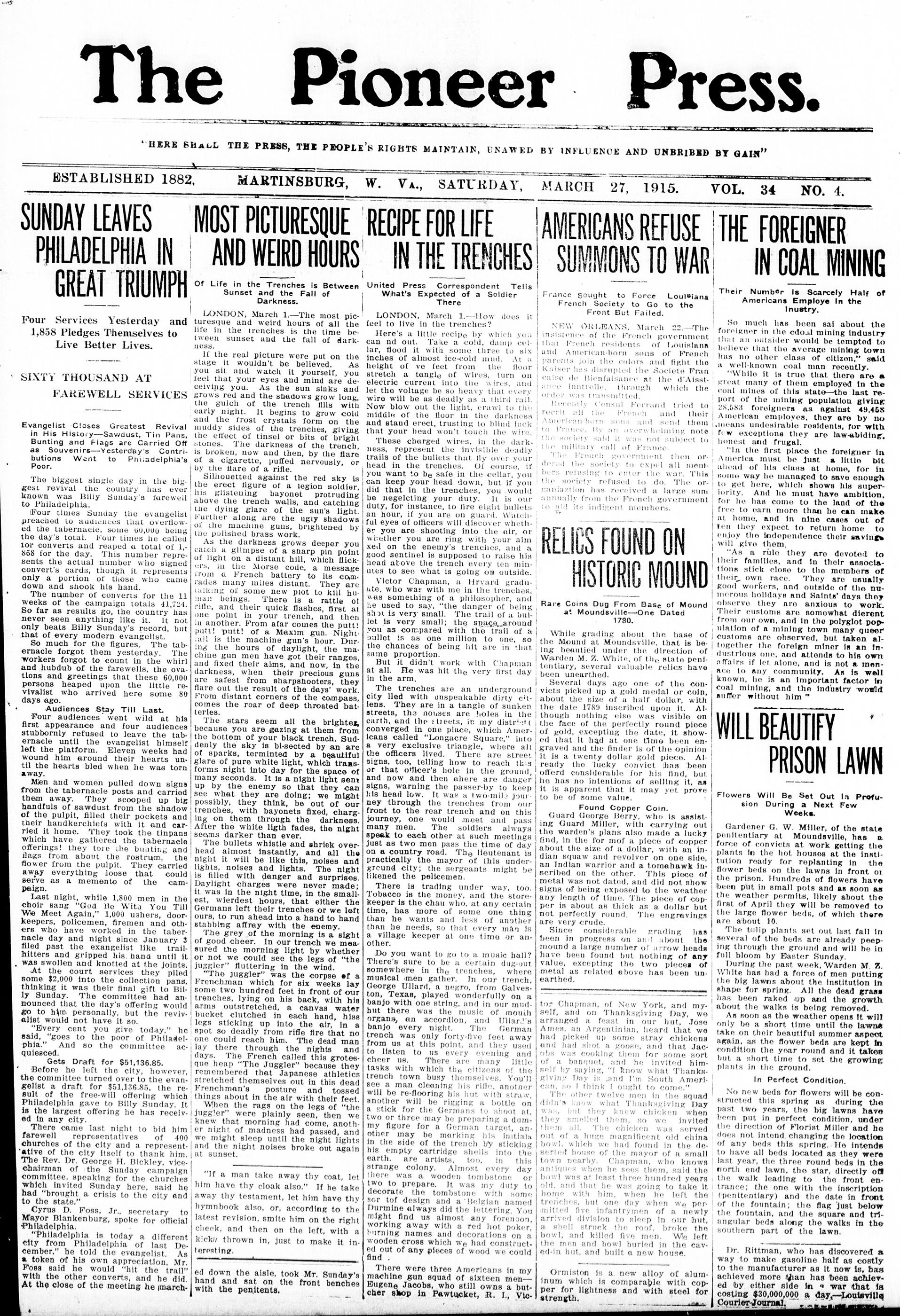
SUNDAY LEAVES PHILADELPHIA IN GREAT TRIUMPH
Four Services Yesterday and 1,858 Pledges Themselves to Live Better Lives.
SIXTY THOUSAND AT FAREWELL SERVICES
Evangelist Closes Greatest Revival in His History—Sawdust, Tin Pans, Bunting and Flags are Carried Off as Souvenirs—Yesterday's Contributions Went to Philadelphia's Poor.
The biggest single day in the biggest revival the country has ever known was Billy Sunday's farewell to Philadelphia.
Four times Sunday the evangelist preached to audiences that overflowed the tabernacle, some 60,000 being the day's total. Four times he called for converts and reaped a total of 1,858 for the day. This number represents the actual number who signed convert's cards, though it represents only a portion of those who came down and shook his hand.
The number of converts for the 11 weeks of the campaign totals 41,724. So far as results go, the country has never seen anything like it. It not only beats Billy Sunday's record, but that of every modern evangelist.
So much for the figures. The tabernacle forgot them yesterday. The workers forgot to count in the whirl and hubdub of the farewells, the ovations and greetings that these 60,000 persons heaped upon the little revivalist who arrived here some 80 days ago.
Audiences Stay Till Last.
Four audiences went wild at his first appearance and four audiences stubbornly refused to leave the tabernacle until the evangelist himself left the platform. Eleven weeks had wound him around their hearts until the hearts bled when he was torn away.
Men and women pulled down signs from the tabernacle posts and carried them away. They scooped up big handfuls of sawdust from the shadow of the pulpit, filled their pockets and their handkerchiefs with it and carried it home. They took the tinpans which have gathered the tabernacle offerings! they tore the bunting and flags from about the rostrum, the flower from the pulpit. They carried away everything loose that could serve as a memento of the campaign.
Last night, while 1,800 men in the choir sang "God Be Witu You Till We Meet Again," 1,000 ushers, doorkeepers, policemen, firemen and others who have worked in the tabernacle day and night since January 3 filed past the exangelist like trail-hitters and gripped his hand until it was swollen and knotted at the joints.
At the court services they piled some $2,000 into the collection pans, thinking it was their final gift to Billy Sunday. The committee had announced that the day's offering would go to him personally, but the revivalist would not have it so.
"Every cent you give today," he said, "goes to the poor of Philadelphia." And so the committee acquiesced.
Gets Draft for $51,136.85.
Before he left the city, however, the committee turned over to the evangelist a draft for $51,136.85, the result of the free-will offering which Philadelphia gave to Billy Sunday. It is the largest offering he has received in any city.
There came last night to bid him farewell representatives of 400 churches of the city and a representative of the city itself to thank him. The Rev. Dr. George H. Bickley, vice-chairman of the Sunday campaign committee, speaking for the churches which invited Sunday here, said he had "brought a crisis to the city and to the state."
Cyrus D. Foss, Jr., secretary to Mayor Blankenburg, spoke for official Philadelphia.
"Philadelphia is today a different city from Philadelphia of last December," he told the evangelist. As token of his own appreciation, Mr. Foss said he would "hit the trail" with the other converts, and he did. At the close of the meeting he march-
MOST PICTURESQUE AND WEIRD HOURS
MOST PICTURESQUE AND WEIRD HOURS
Of Life in the Trenches is Between Sunset and the Fall of Darkness.
LONDON, March 1.—The most picturesque and weird hours of all the life in the trenches is the time between sunset and the fall of darkness.
If the real picture were put on the stage it wouldn't be believed. As you sit and watch it yourself, you feel that your eyes and mind are deceiving you. As the sun sinks and grows red and the shadows grow long, the gulch of the trench fills with early night. It begins to grow cold and the frost crystals form on the muddy sides of the trenches, giving the effect of tinsel or bits of bright stones. The darkness of the trench, is broken, now and then, by the flare of a cigarette, puffed nervously, or by the flare of a rifle.
Silhouetted against the red sky is the erect figure of a legion soldier, his glistening bayonet protruding above the trench walls, and catching the dying glare of the sun's light. Further along are the ugly shadows of the machine guns, brightened by the polished brass work.
As the darkness grows deeper you catch a glimpse of a sharp pin point of light on a distant hill, which flickers, in the Morse code, a message from a French battery to its comrades many miles distant. They are talking of some new plot to kill human beings. There is a rattle of riffle, and their quick flashes, first at one point in your trench, and then in another. From afar comes the putt! putt! putt! of a Maxim gun. Nightfall is the machine gun's hour. During the hours of daylight, the machine gun men have got their ranges, and fixed their alms, and now, in the darkness, when their precious guns are safest from sharpshooters, they flare out the result of the days' work. From distant corners of the compass, comes the roar of deep throated batteries.
The stars seem all the brighter, because you are gazing at them from the bottom of your black trench. Suddenly the sky is bi-sected by an arc of sparks, terminated by a beautiful glare of pure white light, which transforms night into day for the space of many seconds. It is a night light sent up by the enemy so that they can see what they are doing; we might possibly, they think, be out of our trenches, with bayonets fixed, charging on them through the darkness. After the white lign fades, the night seems darker than ever.
The bullets whistle and shriek overhead almost instantly, and all the night it will be like this, noises and lights, noises and lights. The night is filled with danger and surprises. Daylight charges were never made; it was in the night time, in the smallest, wierdest hours, that either the Germans left their trenches or we left ours, to run ahead into a hand to hand stabbing affray with the enemy.
The grey of the morning is a sight of good cheer. In our trench we measured the morning light by whether or not we could see the legs of "the juggler" fluttering in the wind.
"The juggler" was the corpse of a Frenchman which for six weeks lay some two hundred feet in front of our trenches, lying on his back, with his arms outstretched, a canvas water bucket clutched in each hand, his legs sticking up into the air, in a spot so deadly from riffle fire that no one could reach him. The dead man lay there through the nights and days. The French called this grotesque heap "The Juggler" because they remembered that Japanese athletics stretched themselves out in this dead Frenchman's posture and tossed things about in the air with their feet
When the rags on the legs of "the juggler" were plainly seen, then we knew that morning had come, another night of madness had passed, and we might sleep until the night lights and the night noises broke out again at sunset.
"If a man take away thy coat, let him have thy cloak also." If he take away thy testament, let him have thy hymnbook also, or, according to the latest revision, smite him on the right cheek, and then on the left, with a kick/ thrown in, just to make it interesting.
ed down the aisle, took Mr. Sunday's hand and sat on the front benches with the penitents.
RECIPE FOR LIFE IN THE TRENCHES
RECIPE FOR LIFE IN THE TRENCHES
United Press Correspondent tells What's Expected of a Soldier There
LONDON, March 1.—How does it feel to live in the trenches?
Here's a little recipe by which you can nd out. Take a cold, damp cellar, flood it with some three to six inches of almost ice-cold mud. At a height of ve feet from the floor stretch a tangle of wires, turn on electric current into the wires, and let the voltage be so heavy that every wire will be as deadly as a third rail. Now blow out the light, crawl to the middle of the floor in the darkness and stand erect, trusting to blind luck that your head won't touch the wire.
These charged wires, in the darkness, represent the invisible deadly trails of the bullets that fly over your head in the trenches. Of course, if you want to be safe in the cellar, you can keep your head down, but if you did that in the trenches, you would be neglecting your duty. It is our duty, for instance, to fire eight bullets an hour, if you are on guard. Watchful eyes of officers will discover whether you are shooting into the air, or whether you are ring with your aimed on the enemy's trenches, and a good sentinel is supposed to raise his head above the trench every ten minutes to see what is going on outside.
Victor Chapman, a Hryard graduate, who was with me in the trenches, was something of a philosopher, and he used to say, "the danger of being shot is very small. The trail of a bullet is very small; the space around you as compared with the trail of a bullet is as one million to one, so the chances of being hit are in that same proportion.
But it didn't work with Chapman at all. He was hit the very first day in the arm.
The trenches are an underground city lled with unspeakable dirty citizens. They are in a tangle of sunken streets, the nouses are holes in the earth, and the streets, in my district converged in one place, which Americans called "Longacre Square," into a very exclusive triangle, where all the officers lived. There are street signs, too, telling how to reach this or that officer's hole in the ground, and now and then there are danger signs, warning the passer-by to keep his head low. It was a two-mile journey through the trenches from our front to the rear trench and on this journey, one would meet and pass many men. The soldiers always speak to each other at such meetings just as two men pass the time of day on a country road. The lieutenant is practically the mayor of this underground city; the sergeants might be likened the policemen.
There is trading under way, too. Tobacco is the money, and the store- keeper is the chau who, at any certain time, has more of some one thing than he wants and less of another than he needs, so that every man is a village keeper at one time or another.
Do you want to go to a music hall? There's sure to be a certain dug-out somewhere in the trenches, where musical men gather. In our trench, George Ullard, a negro, from Galveston, Texas, played wonderfully on a banjo with one string, and in our mud-hut there was the music of mouth organs, an accordion, and Ullard's banjo every night. The German trench was only forty-five feet away from us at this point, and they used to listen to us every evening and cheer us. There are many little tasks with which the citizens of the trench town busy themselves. You'll see a man cleaning his rifle, another will be re-flooring his hut with straw, another will be rigging a bottle on a stick for the Germans to shoot at, two or three may be preparing a dummy figure for a German target, another may be marking his initials in the side of the trench by sticking his empty cartridge shells into the earth. are artists, too, in this strange colony. Almost every day there was a wooden tombstone or two to prepare. It was my duty to decorate the tombstone with some sorl to design and a Belgian named Durmine always did the lettering. You might find us almost any forenoon, working away with a red hot poker, burning names and decorations on a wooden cross which we had constructed out of any pieces of wood we could find.
There were three Americans in my machine gun squad of sixteen men—Eugene Jacobs, who still owns a butcher shop in Pawtucket, R. L. Vic.
AMERICANS REFUSE SUMMONS TO WAR
AMERICANS REFUSE SUMMONS TO WAR
France Sought to Force Louliana French Society to Go to the Front But Failed.
NEW ORLEANS, March 22.—The insistence of the French government that French residents of Louisiana and American-born sons of French parents join the colors and fight the Kaiser has disrupted the Societe Française de Bienfaisance at the d'Aisstance imutrelle, through which the order was transmitted.
Recently Consul Ferrand tried to recruit all the French and their American-born sons and send them to France. By an overwhelming note the society said it was not subject to the military call of France.
The French government then ordered the society to expel all members refusing to enter the war. This the society refused to do. The organization has received a large sum annually from the French government to aid its indigent members.
RELICS FOUND ON HISTORIC MOUND
Rare Coins Dug From Base of Mound at Moundsville—One Dated 1780. While grading about the base of the Mound at Moundsville, that is being beautied under the direction of Warden M. Z. White, of the state penitentiary, several valuable relics have been unearthed.
Several days ago one of the convicts picked up a gold medal or coin, about the size of a half dollar, with the date 1789 inscribed upon it. Although nothing else was visible on the face of the perfectly round piece of gold, excepting the date, it showed that it had at one time been engraved and the finder is of the opinion it is a twenty dollar gold piece. Already the lucky convict has been offered considerable for his find, but he has no intentions of selling it, as it is apparent that it may yet prove to be of some value.
Found Copper Coin.
Guard George Berry, who is assisting Guard Miller, with carrying out the warden's plans also made a lucky find, in the for mof a piece of copper about the size of a dollar, with an indian squaw and revolver on one side, an Indian warrior and a tomahawk inscribed on the other. This piece of metal was not dated, and did not show signs of being exposed to the weather any length of time. The piece of copper is about as thick as a dollar but not perfectly round. The engravings are very crude.
Since considerable grading has been in progress on and about the mound a large number of arrow heads have been found but nothing of any value, excepting the two pieces of metal as related above has been unearthed.
tor Chapman, of New York, and myself, and on Thanksgiving Day, we arranged a feast in our hut, Jose Ames, an Argentinian, heard that we had picked up some stray chickens and had shot a goose, and that Jacobs was cooking them for some sort of a banquet, and he invited himself by saying, "I know what Thanksgiving Day is and I'm South American, so I think I ought to come."
The other twelve men in the squad didn't know what Thanksgiving Day was, but they knew chicken when they smelled them, so we invited them all. The chicken was served out of a huge magnificent old china bowl, which we had found in the deserted house of the mayor of a small town nearby. Chapman, who knows antiques when he sees them, said the bowl was at least three hundred years old, and that he was going to take it home with him, when he left the treinches, but one day when we permitted five infantrymen of a newly arrived division to sleep in our hut, a shell struck the roof, broke the bowl, and killed five men. We left the men and bowl buried in the caved-in hut, and built a new house.
Ormiston is a new alloy of aluminum which is comparable with copper for lightness and with steel for strength.
THE FOREIGNER IN COAL MINING
THE FOREIGNER IN COAL MINING
Their Number Is Scarcely Half of Americans Employe In the Inustry.
So much has been sal about the foreigner in the edoal mining industry that an outsider would be tempted to believe that the average mining town has no other class of citizen," said a well-known coal man recently.
"While it is true that there are a great many of them employed in the coal mines of this state—the last report of the mining population giving 28,583 foreigners as against 49,458 American employees, they are by no means undesirable residents, for with few exceptions they are law-abiding, honest and frugal.
"In the first place the foreigner in America must be just a little bit ahead of his class at home, for in some way he managed to save enough to get here, which shows his superiority. And he must have ambition, for he has come to the land of the free to earn more than he can make at home, and in nine cases out of ten they expect to return home to enjoy the independence their savings will give them.
"As a rule they are devoted to their families, and in their associations stick close to the members of their own race. They are usually good workers, and outside of the numerous holidays and Saluts' days they observe they are anxious to work. Their customs are somewhat dierent from our own, and in the polyglot population of a mining town many queer customs are observed, but taken altogether the foreign miner is an industrious one, and attends to his own affairs if let alone, and is not a menace to any community. As is well known, he is an important factor in coal mining, and the industry would suffer without him."
WILL BEAUTIFY PRISON LAWN
WILL BEAUTIFY PRISON LAWN
Flowers Will Be Set Out In Profusion During a Next Few Weeks.
Gardener G. W. Miller, of the state penitentiary at Moundsville, has a force of convicts at work getting the plants in the hot houses at the institution ready for replanting in the flower beds on the lawns in front of the prison. Hundreds of flowers have been put in small pots and as soon as the weather permits, likely about the first of April they will be removed to the large flower beds, of which there are about 10.
The tulip plants set out last fall in several of the beds are already peeping through the ground and will be in full bloom by Easter Sunday.
During the past week, Warden M. Z. White has had a force of men putting the big lawns about the institution in shape for spring. All the dead grass has been raked up and the growth about the walks is being removed. As soon as the weather opens it will only be a short time until the lawns take on their beautiful summer aspect again, as the flower beds are kept in condition the year round and it takes but a short time to set the growing plants in the ground.
In Perfect Condition
No new beds for flowers will be constructed this spring as during the past two years, the big lawns have been put in perfect condition, under the direction of Florist Miller and he does not intend changing the location of any beds this spring. He intends to have all beds located as they were last year, the three round beds in the north end lawn, the star, directly off the walk leading to the front entrance; the one with the inscription (penitentiary) and the date in front of the fountain; the flag just below the fountain, and the square and triangular beds along the walks in the southern part of the lawn.
Dr. Rittman, who has discovered a way to make gasoline half as costly to the manufacturer as it now is, has achieved more than has been achieved by either side in a war that is costing $30,000,000 a day.—Louisville Courier-Journal.
Entered in Post Office at Martinsburg, W. Va. as Second Class Matter, J. H. Clifford, Editor and Proprietor, Drawer 869, and Bell 'Phone £0K, Martinsburg, W. Va.
SATURDAY. MARCH 27, 1915.
The Berryville lady who is not "interested in your paper" will please take notice that the subscription referred to is several years in arrears, and when that is paid up, we will not be further "interested" in her.
It is a hard thing to say, and we are sorry to be compelled to make such an admission, but there is more democracy in the average American saloon than there is in the average American church. Conditions are radically wrong in a country where such conditions can long endure, and we say God speed the day when they shall change.
George W. Perkins, the great New York financier, was recently saved from drowning by a Negro in Florida. It is to be hoped that he will appreciate his rescuer sufficiently, and show his gratitude in a manner that will leave no doubt in the mind of anyone that the man who rescued him from a watery grave has been amply rewarded.
For many years the Registorship of the United States treasury has been given to some prominent Negro. But since the advent of Hon. Woodrow Wilson into the Executive Maneion, the Red Man seems to have the call for that position. Our conclusion is reached because of the appointment of Cabe Parker, and Hudson Teehee, both Indians, to the Registorship.
A. Leo Weil, the Pittsburg corporation lawyer, is a pretty shrewd individual, but by the time he has gotten through with the State of West Virginia and those who have the conservation of its interests and natural resources at heart, he will doubtless be able to give an experience akin to a man who has been in very close proximity to a buzz saw.
Governor Brumbaugh, of Pennsylvania, is making a brave fight to get a local option measure through the legislature of the Keystone State. This is a laudable effort on the part of the governor, but we think it equally as important that he lend an earnest effort to the passage of the Stein civil rights bill, a measure greatly needed in the State over whose destinies he presides.
Editor W. P. Dabney, of the Cincinnati Union, is busy day and night these days fighting segregation and all other forms of discrimination in the Queen City. This is noble in him, too, and especially so when it is known that Mr. Dabney is in an official position. Men of that sort are generally as mum as a clam, but this is not so in the case of Mr. Dabney. He is a man.
When he relinquished' his seat in Congress, Victor Murdock, he from wild and wooly Kansas, announced his retirement from politics. Almost immediately thereafter he was elected Chairman of the Progressive party. In view of the above, it looks like he is done, then again he might not be done, and still yet he may be done. Anyway, time will rate things properly for him, and eventually everybody will know whether he is done for politically or not.
Hon. Charles D. Elliott Ex-United States Marshal, former Adjutant General, and erstwhile candidate for Congress on the Progressive ticket, is looming large in the State these days. One time he is giving evidence before a Special Master, at another period he is a witness in impeachment proceedings and ere long he will doubtless be giving testimony somewhere else. Great is "General Cholly". There is none other like him in West Virginia. He is strictly in a class all by himself.
Prof. W. W. Saunders, Former State Librarian, and now Supervisor of Rural Negro Schools of West Virginia, is in the city for a few days in connection with the duties of his office. He is a pleasant gentleman, thoroughly interested in his work, and is giving very satisfactory service in the position which he now fills. Prof. Saunders goes into every section of the State and by virtue of the authority vested in him and his opportunity to see things as they are in the average school roo in, he is peculiarly well fitted to suggest the needed reforms as regards education for Negro youth. We are glad to have him with us.
England and France are coming in for quite a share of criticism on account of their ordered blockade of ships from neutral nations, which are en route to, or off of German ports. The like is unheard of, and is mighty sure to lead to serious complications between the several governments unless the blockading order is modified to an appreciable degree. The United States could not be pleased with this latest move of the allies, because she has legitimate commercial relations with Germany and countries contiguous thereto, therefore if this blockade is maintained, she will be the loser of many millions which are rightfully hers.
The meeting held at Parkersburg by Dr. Aspinal McCuaig and Prohibition Commissioner Blue, was doubtless held for the betterment of humanity, but we would be more impressed with their sincerity of purpose had they not drawn the color line and held one meeting for Negroes and one for whites. There is no color line in morals, neither is there one in evils, therefore we can never see a semblance of wisdom in drawing distinctions as between races when they are being addressed in the interest of public welfare. This paper may be mistaken, but it subscribes to the belief that "reformers" should know no color, and that is why it takes exception to the methods of McCuaig and Blue in holding their meetings in Parkersburg.
John Mitchell, Jr., editor of the Richmond Planet, makes up a great case for the Negroes in their contentions relative to Richmond's nefarious and cordiscatory segregation law. His presentation of the illegal aspect of this iniquitous measure and its effect on black and white people alike is an argument par excellent. It is threaded throughout with stern facts, unanswerable logic, and from an absolutely legal standpoint would do credit to almost any lawyer. City Attorney Pollard, Richmond's chief counsel, action of a noble family, learned lawyer, and a man of great prominence, made up the brief for the City of Richmond vs. the Negroes involved in the controversy, and while, as legal documents go, it is considered hard to refute, bubbling with irrelevant phrases and purely technical deductions, John Mitchell has answered it in a manner that leaves no doubt in the minds of fair and impartial people as to the correctness of his premise. And we believe as John Mitchell has concluded, so will the Supreme Court of the state of Virginia conclude.
RIGHTS THAT WE MUST MAIN- TAIN.
Events, rather than diplomatic notes professing friendship and prescribing unheard-of rules of blockade, will have to determine the American position relative to the dangers that confront our commerce in the Europea nwar zones. We have been warned away from the British Islands by Germany, which, proclaiming no true blockade, has explained that its submarines may "accidentally" sink our ships or cargoes. We have been warned away from Germany, Holland and the Scandinavian states by Great Britain and France, which, proclaiming no true blockade, are kind enough to say that, while they intend to hold up our ships and cargoes, they will not, in the case of non-contraband goods, either sink or confiscate them.
The three principal belligerents are thus on record as to their intentions. We must now await their acts.
Meantime it is folly to threaten embargoes, non-intercourse or war. Nothing has happened as yet to justify any of these courses. An embargo would indeed be damaging to Great Britain and France, but it would be ruinous to ourselves. War is not to be entered upon except in the presence of the gravest provocation and after every honorable method of gaining reparation is exhausted. In any new protests that we may offer, it will be well to make it very plain that injury inflicted upon our people by the novel methods of warfare now threatened is not to be computed in dollars and cents according to the whim of British, French or German prize courts. If there is to be a price-mark upon afflicted United States commerce, the tag will be
prepared here and not in London or Paris or Berlin.
The books that we open today will be the books that will determine many a controversy some years hence. In them we shall enter principles as well as figures. What the nations now at war compel us to write in those books is likely to prove more troublesome to them than to anybody else. The outcome is in their hands exclusively.
A sudden change in the fortunes of war would give these unwarranted decrees of desperate nations a foolish appearance. It Germany's great fleet should chance to win a notable victory and gain the high seas, the British government would retract every word of them. It is easier to starve Britain than it is to starve Germany. Recognition of this fact in the past made Great Britain a powerful supporter of the principle of international law that foodstuffs consigned to non-belligerents are exempt from seizure. A great German naval victory would at once restore respect for the law of nations in Great Britain. What is to restore it in Germany?
The pretense maintained in London that the reversal of the historic British position is justified by Germany's submarine warfare is hardly deserving of notice. Germany has agreed to abandon its undersea savagery if its enemies will respect international law in the matter of blockades and foodstuffs. The character of the British and French responses does not justify the "accidental" sinking of American ships or cargoes. It does leave Germany free to act in the deadliest way possible against its foes. Germany needs no new invitation to fight, but it cannot afford to have any "accidents" in which Americans will appear in the casualty lists.
In this conflict, already carried beyond the bounds of law and reason, we are more than innocent bystanders. We also have rights, and in some respects we are trustees of the rights of the belligerents themselves. On the manner in which we shall discharge our plain duty to maintain those rights a great deal will depend, now and hereafter.—New York World.
SUNDAY'S AUTOBIOGRAPHY. (From one of his sermons.)
Please pardon a personal reference, I was born and bred, not in old Kentucky, although my great-grandmother was born in Lexington, but in old Iowa. I was a rube of the rubes, a hayseed of the hayseeds. I have greased my hair with goosegrease. I have blacked my boots with stove blacking. I have wiped my face on a gunnysack towel. I have eaten with my knife. I have drank coffee out of my saucer. I have said "done it, when I should have said "did it;" "came," when I should have said "come;" "seen," when I should have said "saw.' I am a graduate from the university of poverty and hard knocks and I have taken post graduate courses. My autobiography could be summed up in one line from Gray's Elegy: "The short and simple annals of the poor."
WOMAN ARRESTED AS MAN
In Cell With Male Companion Since November 6.
Jailer C. J. Hyer at Elkins, Saturday got a jolt when he received a note from a prisoner known as Frank Morris, which read:
"I wish you would move me downstairs, as I am not a boy and it won't be necessary to have a doctor's examination. Don't let these people in here know I am a woman, and oblige.
"Frankie Dawson."
Sheriff Hyer secured the services of a woman neighbor to call upon the prisoner, and soon word came back that she was a woman. Female attire was procured and the prisoner taken to the woman's quarters.
"Frank Morris," together with a young man named Robert Stewart, had been committed to the county jail November 6 last on a charge of robbing the residence of Hanse Marple, at Burnsville. The two prisoners have occupied a cell in the county jail since then. Frankie declares that this is her third escapade masquerading as a man.
Uncle Sam has made vaccination free, Billy Sunday is trying to make salvation free, and why, shouldn't everybody be happy?—Baltimore Sun.
GAME LAW PASSED BY LEGISLATURE
Shortens Certain Seasons — Became Law Without Governor's Signature.
For the benefit of our readers, The Prss presents a portion of the new game law, which became a law without the governor's signature. The new sections of the game law follow: Sec. 6. The forest, game and fish warden and the chief deputy wardens, shall each, before entering upon the
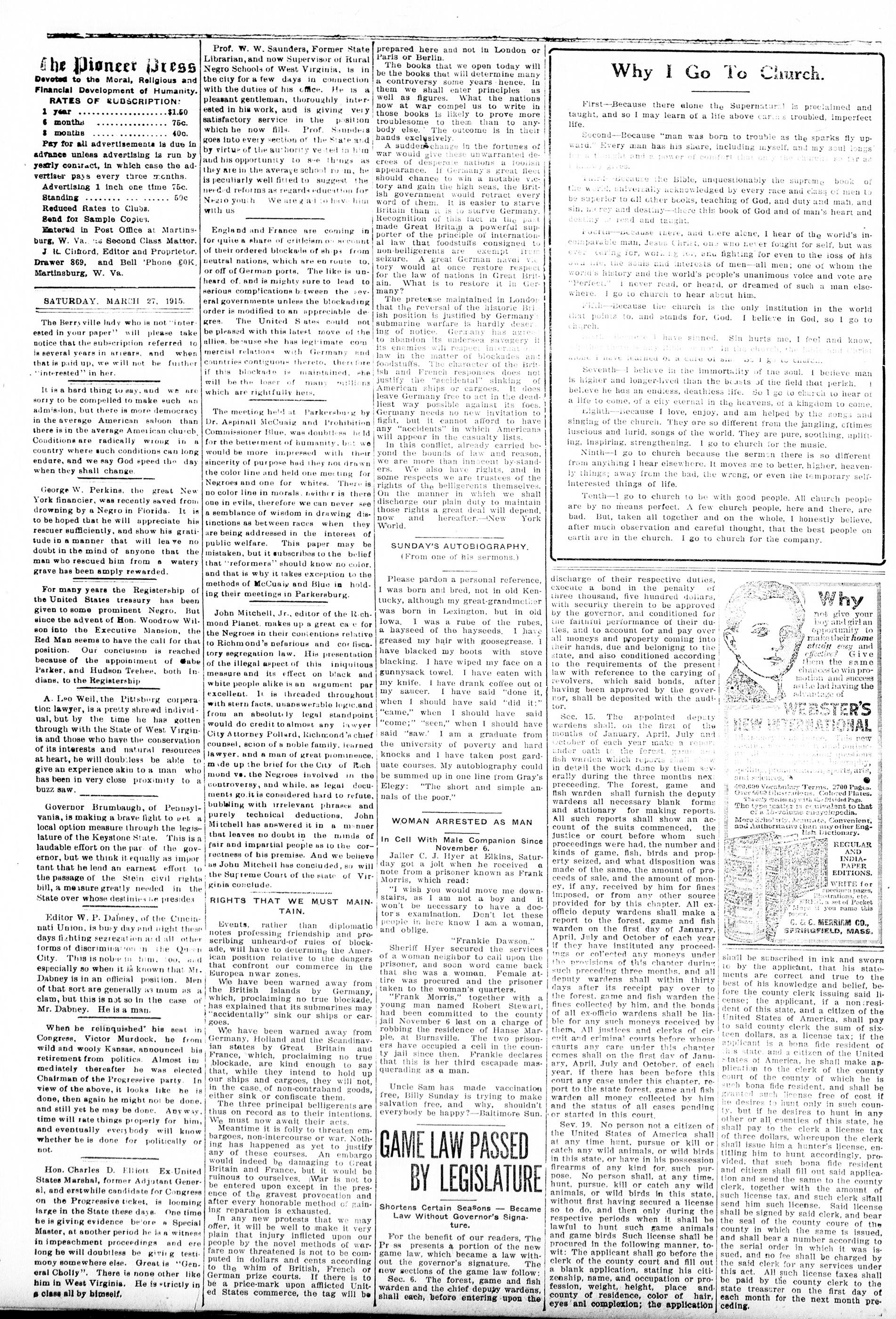
Why I Go To Church.
First—Because there alone the taught, and so I may learn of a life life.
Second—Because "man was be ward." Every man has his share, for a thought and a power of com-
munity gives.
Third—Because the Bible, and the world, universally acknowledge be superior to all other books, teach sin, mercy and destiny—there this destiny is read and taught.
Fourth—Because there, and the comparable man, Jesus Christ, one ever caring for, working for, and own life, the souls and interests of world's history and the world's per-
perfect." I never read, or hear where. I go to church to hear al-
Fifth—Because the church is that points to, and stands for, O church.
Sixth—Because I have sinned, and there is any Bible or not alone I have learned 0, a cure of
Seventh—I believe in the imm-
is higher and longer-lived than the believe he has an endless, deathless a life to come, of a city eternal in-
Lighth—Because I love, enjoy singing of the church. They are so luscious and lurid, songs of the wi-
ing, inspiring, strengthening. I go
Ninth—I go to church because from anything I hear elsewhere. It ly things; away from the bad, the interested things of life.
Tenth—I go to church to be w are by no means perfect. A few bad. But, taken all together and after much observation and caref-
earth are in the church. I go to
First—Because there alone the Supernatural is proclaimed and taught, and so I may learn of a life above earths troubled, imperfect life.
Second—Because "man was born to trouble as the sparks fly upward." Every man has his share, including myself, and my soul longs for a thought and a power of comfort that only the church so far as I know gives.
Third—Because the Bible, unquestionably the supreme book of the world, universally acknowledged by every race and class of men to be superior to all other books, teaching of God, and duty and man, and sin, mercy and destiny—there this book of God and of man's heart and destiny is read and taught.
Fourth—Because there, and there alone, I hear of the world's incomparable man, Jesus Christ, one who never fought for self, but was ever caring for, working for, and fighting for even to the loss of his own life, the souls and interests of men—all men; one of whom the world's history and the world's people's unanimous voice and vote are "Perfect." I never read, or heard, or dreamed of such a man elsewhere. I go to church to hear about him.
Fifth—Because the church is the only institution in the world that points to, and stands for, God. I believe in God, so I go to church.
Sixth—Because I have sinned. Sin hurts me, I feel and know, although there is any little or not. In the church, the Bible and Christ alone I have learned 6, a cure of sin. So I go to church.
Seventh—I believe in the immortality of the soul. I believe man is higher and longer-lived than the beasts of the field that perish. I believe he has an endless, deathless life. So I go to church to hear of a life to come, of a city eternal in the heavens, of a kingdom to come.
Lighth—because I love, enjoy, and am helped by the songs and singing of the church. They are so different from the jangling, oftimes luscious and lurid, songs of the world. They are pure, soothing, uplifting, inspiring, strengthening. I go to church for the music.
Ninth—I go to church because the sermon there is so different from anything I hear elsewhere. It moves me to better, higher, heavenly things; away from the bad, the wrong, or even the temporary self-interested things of life.
Tenth—I go to church to be with good people. All church people are by no means perfect. A few church people, here and there, are bad. But, taken all together and on the whole, I honestly believe, after much observation and careful thought, that the best people on earth are in the church. I go to church for the company.
discharge of their respective duties, execute a bond in the penalty of three thousand, five hundred dollars, with security therein to be approved by the governor, and conditioned for the faithful performance of their duties, and to account for and pay over all moneys and property coming into their hands, due and belonging to the state, and also conditioned according to the requirements of the present law with reference to the carying of revolvers, which said bonds, after having been approved by the governor, shall be deposited with the auditor.
Sev. 19. No person not a citizen of the United States of America shall at any time hunt, pursue or kill or catch any wild animals, or wild birds in this state, or have in his possession firearms of any kind for such purpose. No person shall, at any time, hunt, pursue, kill or catch any wild animals, or wild birds in this state, without first having secured a license so to do, and then only during the respective periods when it shall be lawful to hunt such game animals and game birds. Such license shall be procured in the following manner, towit: The applicant shall go before the clerk of the county court and fill out a blank application, stating his citizenship, name, and occupation or profession, weight, height, place and county of residence, color of hair, eyes' angl complexion; the application
The Supernatural is proclaimed and above earths troubled, imperfect.
turn to trouble as the sparks fly up, including myself, and my soul longs for that only the church so far as questionably the supreme book of God by every race and class of men to thing of God, and duty and man, and book of God and of man's heart and here alone, I hear of the world's in- who never fought for self, but was fighting for even to the loss of his of men—all men; one of whom the people's unanimous voice and vote are, or dreamed of such a man else- out him.
the only institution in the world God. I believe in God, so I go to Sin hurts me, I feel and know, in the church, the Bible and Christ sin. So I go to church.
portality of the soul. I believe man the beasts of the field that perish. I is life. So I go to church to hear of the heavens, of a kingdom to come, and am helped by the songs and different from the jangling, oftimes world. They are pure, soothing, uplift to church for the music.
the sermon there is so different moves me to better, higher, heaven-wrong, or even the temporary self.
with good people. All church people church people, here and there, are on the whole, I honestly believe, soul thought, that the best people on church for the company.
Why not give your boy and girl an opportunity to make their home study easy and effective? Give them the same chances to win promotion and success as the lad having the advantage of WEBSTER'S NEW INTERNATIONAL MATERIALS. This new material includes authoritative questions and answers, vocabulary, spelling, pronunciation, sports, arts, and sciences. 400,630 Vocabulary Terms. 2700 Pages. Over 6600 illustrations. Colored Plates. The only dictionary with the Divided Pages. The type matter is equivalent to that of a 15-volume encyclopedia. More scholarly Accurate, Convenient, and Authoritative than any other English Dictionary.
REGULAR AND INDIA-PAPER EDITIONS.
WRITE for specimen pages, illustrations, etc. WRITE a set of Pocket Maps if you name this power.
C. & C. MERRIAM CO., SPRINGFIELD, MASS.
shall be subscribed in ink and sworn to by the applicant, that his statements are correct and true to the best of his knowledge and belief, before the county clerk issuing said license; the applicant, if a non-resident of this state, and a citizen of the United States of America, shall pay to said county clerk the sum of sixteen dollars, as a license tax; if the applicant is a bona fide resident of this state and a citizen of the United States of America, he shall make application to the clerk of the county court of the county of which he is such bona fide resident, and shall be granted such license free of cost if he desires to hunt only in such county, but if he desires to hunt in any other or all counties of this state, he shall pay to the clerk a license tax of three dollars, whereupon the clerk shall issue him a hunter's license, entitling him to hunt accordingly, provided, that such bona fide resident and citiezn shall fill out said application and send the same to the county clerk, together with the amount of such license tax, and such clerk shall send him such license. Said license shall be signed by said clerk, and bear the seal of the county course of the county in which the same is issued, and shall bear a number according to the serial order in which it was issued, and no fee shall be charged by the said clerk for any services under this act. All such license taxes shall be paid by the county clerk to the state treasurer on the first day of each month for the next month preceding.
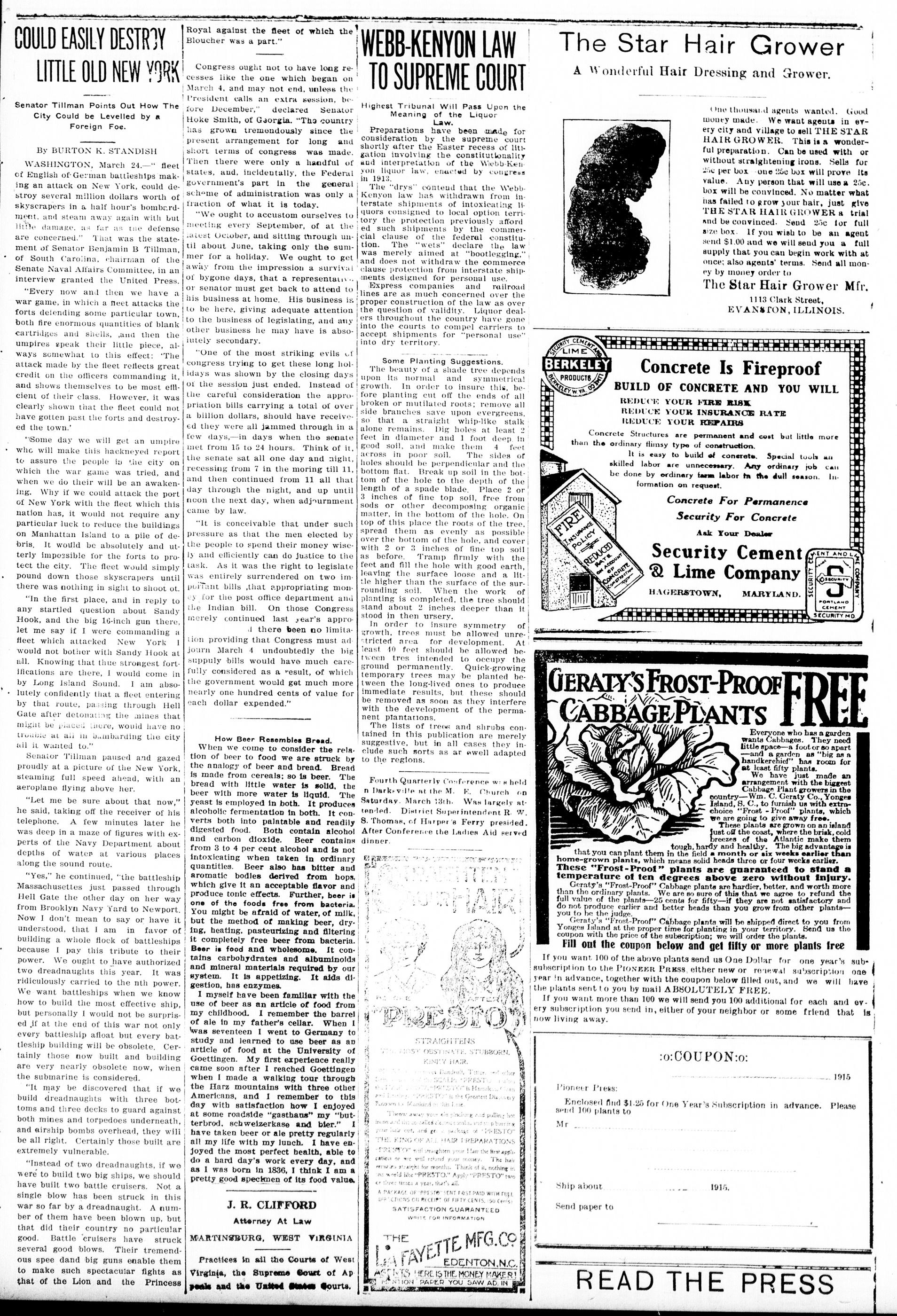
COULD EASILY DESTRIY
LITTLE OLD NEW ¥SRX
ing an attack on New York, could de-
stroy several million dollars worth of
skyscrapers in a half hour's bomberd-
ment, and steam away again with but
Hide damage, us far as wie defense
are concerned.” ‘That was the state-
ment of Senator Benjamin B Tillman,
of South Carolina, chairman of the
Senate Naval Alfairs Committee, in an
interview granted the United Press.
“Every now and then we have a
war game, in which a neet attacks the
forts detending some particular town,
both fire cnormous quantities of blank
cartridges and shells, jana then the
umpires speak their little piece, al-
ways somewhat to this effect: ‘The
attack made by the fleet reflects great
credit on the officers commanding it,
and shows themselves to be most efll-
cient of their class. However, it was
clearly shown that the fleet could not
have gotten past the forts and destroy-
ed the town.’
“Some day we will get an umpire
whe will make tiis hackneyed report
te assure the people iy the city on
which the war game was tried, and
when we do their will be an awaken-
ing. Why if we could attack the port
of New York with the fleet which this
nation has, it would not require any
particular luck to reduce the buildings
on Manhattan Island to a pile of de-
bris, It would be absolutely and ut-
terly impossible for the forts to pro-
tect the city. The fleet would simply
pound down those skyscrapers until
there was nothing in sight to shoot ot.
“In the first place, and in reply to
any startled question about Sandy
Hook, and the big 16-inch gun there,
Jet me say if I were commanding a
fleet which attacked New York 1
would not bother with Sandy Hook at
all. Knowing that thue strongest fort-
iications are there, | would come in
by Long Island Sound. I am abso-
lutely confidently that a fleet entering
by that route, passing through Hell
Gate after detonating the mines that
might be piuced Lacre, would have no
Goubie wt aii im bombarding Une city
ail it wanted to.”
Senaior Tillman paused and gazed
proudly at a picture of tle New York,
steaming full speed ahead, with an
aeroplane flying above her.
“Let me be sure about that now,”
he said, taking off the receiver of his
telephone. A few minutes later he
was deep in a maze of figures with ex-
perts of the Navy Department about
depths of water at various places
along the sound route.
“Yes,” he continued, “the battleship
Massachusettes just passed through
Hell Gate the other day on her way
from Brooklyn Navy Yard to Newport.
Now J don’t mean to say or have it
understood, that 1 am in favor of
building a whole flock of battleships
because 1 pay this tribute to their
power. We ought to have authorized
two dreadnaughts this year. It was
ridiculously carried to the nth power.
We want battleships when we know
how to build the most effective ship,
but personally I would not be surpris-
ed Jf at the end of this war not only
every battleship afloat but every bat-
tleship building will be obsolete, Cer-
tainly those now built and building
are very nearly obsolete now, when
the submarine is considered.
“It may be discovered that if we
build dreadnaughts with three bot-
toms and three decks to guard against
both mines and torpedoes underneath,
and airship bombs overhead, they wili
be all right. Certainly those built are
extremely vulnerable.
“Instead of two droadnanchte if wa
Royal against the fleet of which the
Bloucher was a part.”
Congress ought not to have long re-
cesses like the one which began on
March 4, and may not end, unless the
Vresident calls an extra session, be:
jore December,” declared Senator
Hoke Smith, of Gsorgia. “Tho country
has growa tremendously since the
present arrangement for long and
short terms of congress was made.
‘Then there were only a haodful of
sites, and, incidentally, the Federal
government’s part In the general
scheme of administration was only a
traction of what it is today.
“We ought to accustom ourselves to
meeting every September, of at the
stiest Ociober, and sitting through un-
til about June, taking only the sum-
mer for a holiday. We ought to get
away from the impression a survival
ot bygone days, that a representat-.
or senator must get back to attend to
his business at home, His business is
to be here, giving adequate attention
to the business of legislating, and any
other business he may have is abso-
iutely secondary.
“One of the most striking evils uf
congress trying to get these long hol-
idays was shown by the closing days
ot the session just ended. Instead of
the careful consideration the appro-
priation bills carrying a total of over
a billion dollars, should have receive-
ed they were all jammed through in a
tew days,—in days when the senate
amet from 15 to 24 hours. Think of it,
the senate sat all one day and aight,
recessing trom 7 in the moring till 11,
and then continued from 11 all that
day through the night, and up until
con the next day, when adjournment
came by law.
“It is conceivable that under such
pressure as that the men elected by
the people to spend their money wise-
!y and clliciently can do justice to the
task. As it was the right to legislate
‘Was entirely surrendered on two im-
poiTant bills ,that appropriating mon-
| } for the post office department and
ihe Indian bill. On those Congress
merely continued last year’s appro-
d there been no limita-
iion providing that Congress must ad
journ March 4 undoubtedly the big
suppuly bills would have much care-
fully considered as a result, of which
the government would get much more
nearly one hundred cents of value for
each dollar expended.”
How Beer Resembles Bread.
‘When we come to consider the rela-
tion of beer to food we are struck by
the analogy of beer and bread. Bread
is made from cereals; so is beer. The
bread with little water is solid, the
beer with more water ts liquid. The
yeast Is employed in both. It produces
alcoholic fermentation tn both. It con-
verts both into palatable and readily
digested food. Both contain alcohol
and carbon dioxide. Beer contains
from 3 to 4 per cent alcohol and is not
intoxicating when taken in ordinary
quantities. Beer also has bitter and
aromatic bodies derived from hops,
which give it an acceptable flavor and
Produce tonic effects. Further, beer is
one of the foods free from bacteria.
You might be afraid of water, of milk,
but the method of making beer, dry-
ing, heating, pasteurizing and filtering
it completely free beer from bacteria.
Beer is food and wholesome. It con-
tains carbohydrates and albuminolds
and mineral materials required by our
system. It Is appetizing. It aids di-
gestion, has enzymes.
I myself have been femiliar with the
use of beer as an article of food from
my childhood. 1 remember the barrel
of ale in my father’s cellar. When 1
‘was seventeen I went to Germany to
study and learned to use beer as ap
article of food at the University of
Goettingen. My first experience really
came soon after I reached Goettingen
when I made a walking tour through
the Harz mountains with three other
Americans, and I remember to this
day with satisfaction how I enjoyed
at some roadside “gasthaus” my “but-
terbrod, schweizerkase and bier.” I
have taken beer or ale pretty regularly
all my life with my lunch. I have en-
joyed the most perfect health, able to
do a bard day’s work every day, and
as 1 was born In 1836, I think I am a
pretty good spectmen of its food value,
J. R. CLIFFORD
Atterney At Law
MARTINSBURG, WEST VIRGINIA
Se ee ee ee eR fOr ae || (eee) eee
Practices in ail the Courts of West
Virginia, the Supreme Gouwrt of Ap
pedis and the United Gentes Gourts,
WEBB-KENYON LAW
TO SUPREME COURT
Preparations have been made for
consideration by the supreme court
shortly after the Easter recess of litt
gation involving the constitutionality
aud interpretation of the Wiebb-Ken
yon liquor law, enacted by cougress
in 1913.
| The “drys” conteud that the Webb.
‘Kenyon law has withdrawn from in-
‘terstate shipments of intoxicating I
| quors consigned to local option terri-
tory the protection previously afford
‘ed such shipments by the commer-
jcial clause of the federal constitu
tion. The “wets” declare the law
was merely aimed at “bootlegging,”
and does not withdraw the commerce
clause protection from interstate ship-
ments designed for personal use.
| Express companies and railroad
lines are as much concerned over the
proper construction of the law as over
‘the question of validity. Liquor deal-
ers throughout the country have gone
into the courts to compel carriers to
abet shipments for “personal use”
into dry territory.
| seeemol in Se
Some Planting Suqgestions.
The beauty of a shade tree depends
upon its normal and symmetrical
growth. In order to insure this, be-
fore planting eut off the ends of all
broken or mutilated roots; remove all
side branches save upon evergreens,
so that a straight whip-like stalk
alone remains. Dig holes at least 2
feet in diameter and 1 foot deep. in
geod soil, and make them 4 feet
across in poor soil. The sides of
holes should be perpendicular and the
bottom flat. Break up soil in the bot-
tom of the hole to the depth of the
length of a spade blade, Place 2 or
3 inches of fine top soil, free from
sods or other decomposing organic
matter, in the bottom of the hole. On
top of this place the roots of the tree,
spread them as evenly as_ possible
over the bottom of the hole, and cover
with 2 or 3 inches of fine top soil
as before. ‘Tramp firmly with the
feet and fill the hole with good earth,
leaving the surface loose and a Ht:
tle higher than the surface of the sur-
rounding soil. When the work of
planting is completed, the tree should
stand about 2 inches deeper than it
stood in then ursery.
In order to insure symmetry of
growth, treos must be allowed unre-
stricted arca for development. At
east 40 feet should be allowed be-
tween tres intended to oceupy the
ground permanently. Quick-growing
temporary trees may be planted be-
tween the long-lived ones to produce
immediate results, but these should
be removed as soon as they interfere
with the development of the perma.
nent plantations.
The lists of trees and shrubs con.
tained in this publication are merely
suggestive, but in all cases they in-
clude such sorts as ar awell adapted
to the regions.
Fourth Quarterly Conference w: «held
n Darkeville atthe Mo oB. Church on
Saturday. March 13th. Was largely at:
tented. District Superintendent R. W.
8, Thomas, of Harper's Ferry presided.
After Conference the Ladies Aid served
dinner.
ARE ES ty * OT BL YF
El *
fu bao wt BY ES t
+N a th in woe &
Tg ge ether
ge ee
Yt feta Van
- i Fan He yee Ts
hs Necedt te |
RRL toe ee TY
Lustig, sn. meh, gett fmeb, gee ates
UES ye ERLTAL HY.
Wea hae Sil VD) QM
STRAIGH TENS
; F ma SV CN tk Han ;
1 TRE KING OF ALL HAIR PREPARATIONS
{ PRESTO" will staghien your Ham the lea appt
F remsies stzaithi for rronths. ‘Think. 4 ii, nothing
Bons weaid like “PRESTO.” Apply "PRESTO" toro
FCTIONS CH RECEIPT OF FIFTY CENES. 50 Cen)
A
THE -qTE MFG.Co
aE
Ls if AY Ee oenTonc,
age WIS HERES THE MONEY MAKER!
rE SOM PAPER YOU SAW AD. IN
A
The Star Hair Grower
A Wonderful Hair Dressing and Grower.
lee ete ee ey
(Siin EEE E e Ha
Be:
dTa§ = Concrete Is Fireproof
PRODUCTS, 4
Reedy) BUILD OF CONCRETE AND YOU WILL fR
REDUCK YOUR FIRE pat) @ He
REDUCE YOUR INSURANCE RATE Ha
REDUCE YOUR REPAIRS Ha
Concrete Structures are permanent and cost but little more Ha
than the ordinary flimsy type of construction. Hy
It is eusy to build of conerete. Special tools au ae
] skilled labor are unnecessary. Any ordinary job can 4
ko be done by ordinary farm labor tn the dull season. In. Hf
formation on request. Hi
P PA] Concrete For Permanence He
‘ AEN Security For Concrete if
: Cen Ask Your Dealer t
fe Ye?” e mt
1 XAS\. Security Cement g@e==5
a NCCION i FI
Lo excee @ Lime Company [:.0-
bs Re HAGERSTOWN, MARYLAND. |% E
Ey i Lo
EERE Be secu 0
GERATY'S FROST-PROOF
a i 4M —~_ “ d "i
4 oy ;
C DF ;
4 =)
WWF - Everyone who has a garden
) Vip Wy ¢ wants Cabbagen- ‘They need
zs Al Little space—a foot or so apart.
As i 4 Jando garden, an big ann
A = LA Hi handkerchicf” has roan for
py mn a (L at Icast fifty planta.
yy: : aphid! We have just made an
/ Ly errangement with the bigeest
p <a Z, Sabbage Plant growers in the
aay VP a country—Wm. C. Geraty Co., Yonges
thy. — Island, 8. C., to furnish us with extra-
ae /// I choice “Frost - Proof” plants, which
f wo are going to give away free.
a These plants are grown on ap ieland
ore fust off the coast, where the brink, cold
= reczes of the Atlantic make them
— tough, hardy and healthy. The big advantage is
that you can plant them in the field a month or six weeks earlier than
home-grown plants, which means solid heads three or four weeks earlier.
These “Frost-Proot” plants are guaranteed to stand a
temperature of ten degrees above zero without injury.
Geraty’s "Frost-Proof” Cabbage planta are hardier, better, and worth more
than the ordinary plants. We are ao sure of this that we agroe to refund the
full value of the plants—25 cents for fifty—if they are not satisfactory and
o not produce carlier and better heads than you grow from other plante—
you to be the judge. i ‘i
Geraty’s “Frost-Proof” Cabbage plants will be shipped direct to you from
Yonges Island at the proper time for planting in your territory. Send us tho
coupon with the price of the subscription; we will order tho planta.
Fill ont the coupon below and get fifty or more plants free
Tf you want 100 of the above plants send us One Dollar for one yeac’s sub-
subscription to the PIONEER Preuss, either new or reaewal subscription one
year in advance, together with the coupon below filled out, and we will have
he plants sent to you by mail ABSOLUTELY FREE.
If you want more than 100 we will send you 100 additional for each and ey-
ery subscription you scnd in, either of your neighbor or some friend that {¢
now living away.
| :0:COU PON:0:
| eer - 1915
Vioneer Press:
Enclosed find $1.25 for One Year’s Subscription in advance. Please
send 100 plants to
Mr
| Ship about el 1915.
:
| Send paper to
|
a
READ THE PRESS
a i
a ~
eee
ie
Ae
Ree
rr
wae
ey oe
Sr
Sey
Crees
CS
One thousand agents wanted. Good
toney wade. We want agents in ey-
ery city and village to sell THE STAR
HAIR GROWER. This isa wonder-
ful preparation. Can be used with or
without straightening irons. Sells for
25 per Lox -one 24 box will prove its
value. Any person that will usea 25c.
box will be convinced. No matter what
bas failed to grow your bair, just give
THE STAR HAIR GROWER a trial
and be convinced. Send 25¢ for full
size ox. Lf you wish to be an agent
send $1.00 and we will seud you a full
supply that you can begin work with at
once; also agents’ terms. Send all mon-
ey by money order to
The Star Hair Grower Mfr,
1113 Clark Street, 5
EVANSLON, ILLINOIS.
the Cazr’s only niece, the Princesa] y= ———— | RAISES NEW QUESTIONS. {to or coming trom Germany. The
Trene, daughter of the Grand Duchess] |f UN Sa ioe i | prockwvation of the blockade or the ~
Xenia. The Order of St. George waa| |F4 cP aS els This new blockade or embargo, de: jublic knowledge of its existence will
founded in 1769 by Catherine the| I Fz, ROTEL | F{| signed to starve Germany by isolat- be held by England to justify the
Great ay a reward for military service,} [AMP ~- ® (3 ing her from commercial inter. | seizure of @ Germany-bound cargo of
and was revived in 1931 by Alexan- any NWA] course with the neutral countries ot trian d a a neutral bottom,
der I, The decorations of the first may | Hy , WE the sore, pee nited States included, ya my es toe
second class can be conferred only | |H aises questions which can be at ' ir Ambrese Chan
— vy the czar, but fleld marshals are} [FA Ah WASHINGTON. ad| sored only in tueir applica 3 “
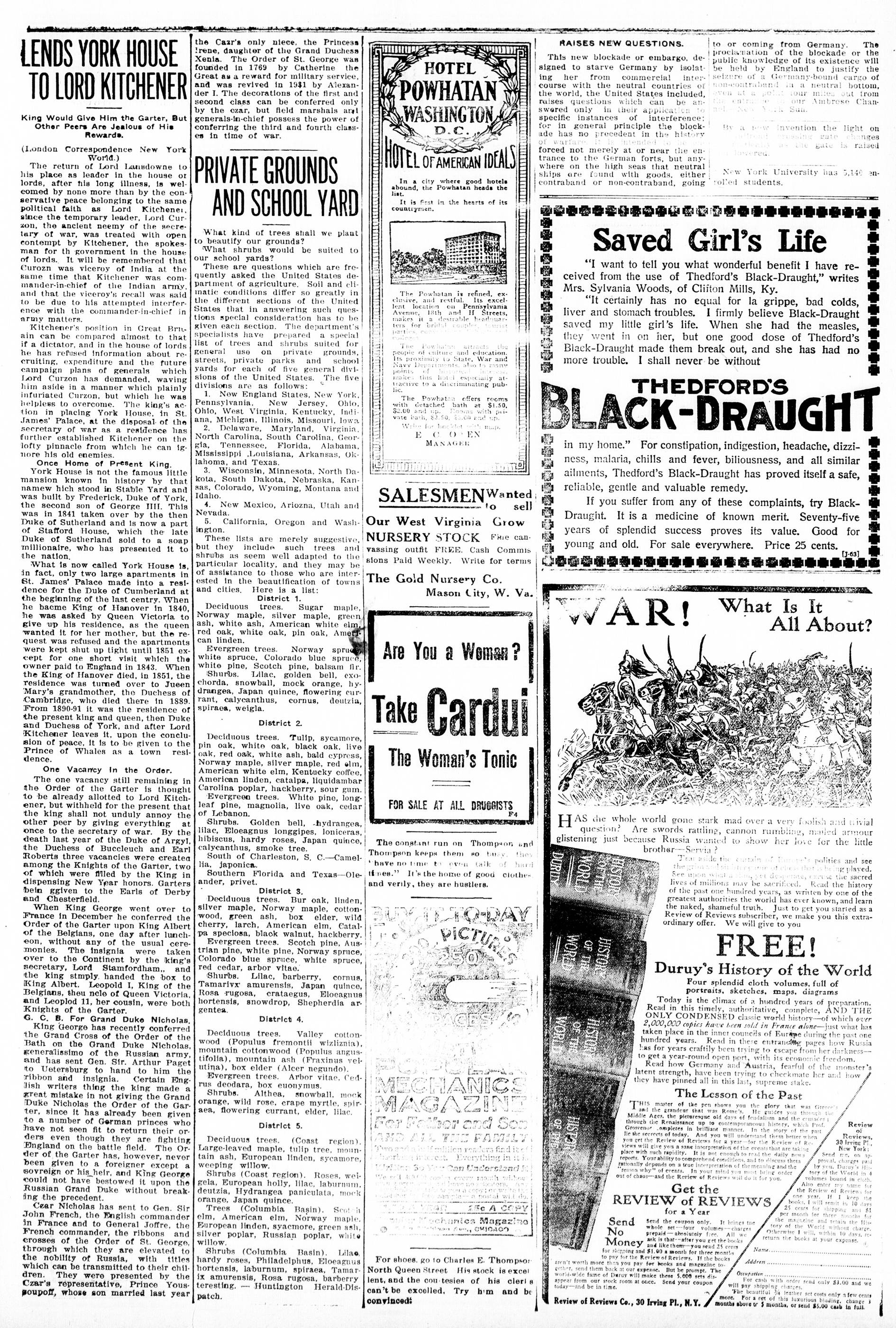
King Would Give Him the Garter, But} generals-in-chief possess the power of| |= NY Ie E Specific inphaucey Z of interference ! ~ -
Other Peers Are Jealous of His | conferring the third and fourth class- RK Dc UF | tor in scucral priaciple: the: pleck- \ vention the Heht om
Rewards. es in time of war. a eB 47 ye EY sade has no precedent in the history eae
World.) '
The return of Lord Lansdowne to
his place as leader in the house or
lords, after his long illness, is wel-
comed by none more than by the con-
servative peace belonging to the same
political faith as Lord Kitchener,
since the temporary leader, Lord Cur.
zon, the ancient neemy of the secre-
lary of war, was treated with open
contempt by Kitchener, the spokes- |
man for th government in the house
of lords. It will be remembered that
Curozn was viceroy of India at the
sume time that Kitchener was com-
mander-in-chief of the Indian army,
and that the viceroy’s recall was said
to be due to his attempted interfer.
ence with the commander-in-chief in
army matters. |
Kitchener's position in Great Brn
ain can be compared almost to that
if a dictator, and in the house of lords
he has refused Information about re-
eruiting, expenditure and the future
campaign plans of generals which
ford Curzon has demanded, waving
him aside in a manner which plainly
infuriated Curzon, but which he was
helpless to overcome. The king’s ac
tion in placing York House, in St.
James’ Palace, at the disposal. of the
secretary of war as a residence has
further ‘established Kitchener on the
lofty pinnacle from which he can ig-
nore his old enemies.
Once Home of Pre8ent King.
York House is not the famous little
mansion known in history by that
namew hich stood in Stable Yard and
was built by Frederick, Duke of York,
the second son of George III. This
was in 1841 taken over by the then
Duke of Sutherland and 1s now a part
of Stafford House, which the late
Duke of Sutherland sold to a soap
millionaire, who has presented it to
the nation,
What ts now called York House 1s,
in fact, only two large apartments in
St. James’ Palace made into a resi-
dence for the Duke of Cumberland at
the beginning of the last centry. When
he baeme King of Hanover in 1840,
he was asked by Queen Victoria to
give up his residence, as the queen
‘wanted it for her mother, but the re-
quest was refused and the apartments
were kept shut up tight until 1851 ex-
cept for one short visit which the
owner paid to England in 1843. When
the King of Hanover died, in 1851, the
Tesidence was turned over to Jueen
‘Mary’s grandmother, the Duchess of
Cambridge, who died there in 1889.
From 1890-91 it was the residence of
the present king and queen, then Duke
and Duchess of York, and after Lord
‘Kitchener leaves {t, upon the conclu.
sion of peace, It Is to be given to the
Prince of Whales as a town rest.
dence.
One Vacancy In the Order.
The one vacancy still remaining in
the Order of the Garter is thought
to be already allotted to Lord Kitch.
ener, but withheld for the present that
the king shall not unduly annoy the
other peer by giving everything at
‘once to the secretary of war. By the
death last year of the Duke of Argyl,
the Duchess of Buccleuch and Karl
Roberts three vacancies were createa
among the Knights of the Garter, two
of which were filled by the King in
‘dispensing New Year honors. Garters
bein ggiven to the Earls of Derby
and _ Chesterfield.
When King George went over to
‘France in December he conferred the
Order of the Garter upon King Albert
of the Belgians, one day after lunch-
eon, without any of the usual cere.
monies. The insignia were taken
over to the Continent by the king’s
secretary, Lord Stamfordham,, and
the king stmply. handed the box to
King Albert. Leopold I, King of the
Belgians, theu nele of Queen Victoria,
and Leoplod 11, her cousin, were both
Knights of the Garter.
G. C. B. For Grand Duke Nicholas,
King George has recently conferred
the Grand Cross of the Order of the
Bath on the Grand Duke Nicholas
eeneralissimo of the Russian army.
and has sent Gen. Sir. Arthur Pagot
to Uetersburg to hand to him the
ribbon ahd insignia. Certain Eng:
Jish writers thing the king made a
zreat mistake in not giving the Grand
‘Duke Nicholas the Order of the Gar
ter, since it has already been given
to a number of German princes who
have not seen fit to return their or-
ders even though they are fighting
the Caar’s only niece, the Princess
Irene, daughter of the Grand Duchess
Xenia. The Order of St. George waa
founded in 1769 by Catherine the
Great ay a reward for military service,
and was revived in 19$1 by Alexan-
der I. The decorations of the first and
second class can be conferred only
vy the czar, but field marshals arel
generals-In-chief possess the power of
conferring the third and fourth class-
es in time of war.
eM UTR eT eae | RRS eee: ERO
our school yards?
These are questions which are fre-
quently asked the United States de-
partment of agriculture. Soil and cli-
matic conditions differ so greatly in
the different sections of the United
States that in answering such ques-
tions special consideration has to be
given each section. The department's
specialists have prepared a special
list of trees and shrubs suited for
general uso on private grounds,
streets, private parks and — school
yards for each of five general divi-
sions of the United States. ‘The five
divisions are as follows: ©
1, Now England States, New York,
Pennsylvania, New Jersey, Ohio,
Ohlo, West Virginia, Kentucky, Indi
ana, Michigan, Mlinois, Missouri, lowa
2. Delaware, Maryland, Virginia
North Carolina, South Carolina, Geor-
gia, Tennessee, Florida, Alabama,
Mississippi ,Louisiana, Arkansas, Ok
lahoma, and Texas.
3. Wisconsin, Minnesota, North Da-
kota, South Dakota, Nebraska, Kan
sas, Colorado, Wyoming, Montana and
Idaho.
4. New Mexico, Ariozna, Utah and
Nevada.
5. California, Oregon and Wash-
ington.
These lists are merely suggestive,
but they include such trees and
shrubs as seem well adapted to the
particular locality, and they may be
of assistance to those who are inter-
ested In the beautification of towns
and cities, Here is a list:
District 1.
Deciduous trees. Sugar maple,
Norway maple, silver maple, green
ash, white ash, American white elm
red oak, white oak, pin oak, Ameff
can linden,
Evergreen trees. Norway spru
white spruce, Colorado blue spruce,
white pine, Scotch pine, balsam fir.
Shurbs. Lilac, golden bell, exo-
chorda, snowball, mock orange, hy-
drangea, Japan quince, flowering cur-
rant, calycanthus, cornus, deutzia,
spiraca, weigla.
. District 2.
Deciduous trees. Tulip, sycamore,
pin oak, white oak, black oak, live
oak, red oak, white ash, bald cypress,
Norway maple, silver maple, red lm.
American white elm, Kentucky coffee.
American linden, catalpa, liquidambar
Carolina poplar, hackberry, sour gum.
Evergreen trees. White pine, long
leaf pine, magnolia, live oak, cedar
of Lebanon.
Shrubs. Golden bell, -hydrangea
lilac, Bloeagnus longgipes, loniceras
hibiscus, hardy roses, Japan quince,
calycanthus, smoke tree.
South of Charleston, S, C.—Camel.
lia, japonica.
Southern Florida and Texas—Ole
ander, privet.
E District 3,
Deciduous trees. Bur oak, linden,
silver maple, Norway maple, cotton:
wood, green ash, box elder, wild
cherry, larch, American elm, Catal
pa_speciosa, black walnut, hackberry.
Evergreen trees. Scotch pine, Aus
trian pine, white pine, Norway spruce
Colorado blue spruce, white spruce,
Ted cedar, arbor vitac.
‘Shurbs. Lilac, barberry, cornus,
Tamarivx amurensis, Japan quince
Rosa rugosa, crataegus, Wloeagnus
hortensis, snowdrop, Shepherdia ar
gentea,
District 4.
Deciduous trees. Valley cotton:
wood (Populus fremontii wizliznia),
mountain cottonwood (Populus angus
tifolia), mountain ash (Fraxinus vel
utina), box elder (Alcer negundo)
Evergreen trees. Arbor vitae, Ced.
rus deodara, box euonymus.
Shrubs. — Althea, snowball, mock
orange, wild rose, crape myrtle, spir.
aea, flowering currant, elder, lilac.
District 5.
Deciduous trees. (Coast region).
Large-leaved maple, tulip tree, moun:
tain ash, European linden, sycamore,
weeping willow.
Shrubs (Coast region). Roses, wei.
gela, European holly, lilac, laburnim,
deutzia, Hydrangea paniculata, mock
orange, Japan quince.
Trees (Columbia Basin). Sco!
elm, American elm, Norway maple,
European linden, syacmore, green ash,
silver poplar, Russian poplar, white
willaw
SR
se HOTEL y
‘ia WE
Roni
he De el
Rae = Se ib
Hore, OF AMERICAN wohl)
goed, HY SURES: |
| els fot in the hearts of its S
es Eo E
| esateey Ey
a el Sa |
ms Sm ame Semel |
i eee |B
salty, Pompatan i refed cts
[cries |p
j Resse |
| cage ata ee
| ee bar M Be 0, sf 2 oe t |
4 a Me 08 co uM
y y
SALESMENWsnted
10 sell
Our West Virginia Grow
NURSERY STOCK Five can-
vassing outfit FREE. Cash Commis
sions Paid Weekly. Write for terms
The Gold Nursery Co.
| Mason City, W. Va.
| Are You a Woman ? |
Take Garcui
The Woman's Tonic
FOR SALE a DRUGEISTS
The constant run on Thompson end
Thompson keeps them 8o buoy th
Shave no time ty owen talk of a
tines.” Is the home of good ciothe=
and verily, they are hustlers.
“NA Pay) neo ea gry ons
SA hol COA
ree” BiCT yn oF!
L A gece” bY
ey 5 ENE, Ss
tip YN ait Zao o
jer. TRS rep IES
Wir = | Phe ae “ nase
NE Eee
Ht <8 TERE fn
: EEE als
neh
Ree ad a = Nace Bont a
fom pete csr a
ay gE et by IAN IGe
MA LN eF =I PPS
DMAGAZING
iFor Kethor ond Son
VAS ALA Fil FARUILT:
‘fe freiiien readers find ie-
As rt a est Lvorything ia sti
Wipines S * an Undersizad &
Meerd a overs month shew +
ye Ee sipie peal gf
LEAR afte A copy]
% oahkantes Mogazo|
> + uy Lue, OMIGAOD
For shoes, go to Charles E. Thompsor
North Queen Street His atock is exce!
lent, and the cou tesies of his cleri a
can’t be excelled, Try him and be
convinced:
BSCS SOSRG DHS SPSS SSAS
2 hs Ti :
3 saved Girl’s Life 3
Ly “want to tell you what wonderful benefit I have re- =
Ly ceived from the use of Thedford’s Black-Draught,” writes =
" Mrs. Sylvania Woods, of Clifton Mills, Ky. *
VI “Tt certainly has no equal for la grippe, bad colds, s
eh liver and stomach troubles. I firmly believe Black-Draught -
us saved my little girl’s life. When she had the measles, s
id they went in on her, but one good dose of Thedford’s 2
aA Black-Draught made them break out, and she has had no 2
a more trouble. I shall never be without 2
co 2
°,
mp . THEDFORDS _
SLACK-DRAUGH
b bere
Wa in my home.” For constipation, indigestion, headache, dizzi- os
o ness, malaria, chills and fever, biliousness, and all similar 2
ea ailments, Thedford’s Black-Draught has proved itself a safe, o
Ba reliable, gentle and valuable remedy. =
& If you suffer from any of these complaints, try Black-
& Draught. It is a medicine of known merit. Seventy-five =
. years of splendid success proves its value. Good for 2
eh young and old. For sale everywhere. Price 25 cents. oon
Ope SSeS ESS CBE CSSeSESSSSES
be <P ech ct a as SS I IT TE
= ro A
i &
g ef
i wy R ! Whit a
Lv ° All A
Il About?
bed if a
| te 48
OGM A
iH UA SY Fie acd Ae ce ig sivas 9)
beet Spee SUNN B28 eae Si
ys Fs 29 <a Cae By OO. i
BS, VER eat IES. oa
‘ y ZS A Se Nt Tepe USS
1 MESS ONS ae< OR
LD: be eae NI Oey es Ne
LE a eae Bape: 76 SN
SSS MIRE EERE Vrnie CM
LS Ke yee Meat Bg) RYO
| Ja eS BN aoe My Lai
fe eee oe SO IP es ee
SAO ROY S ee
SS ELSE DT ON OE ER et Sh
LEE CONE Ty | Bd BPE
d ORS ONTENTS ie SSRN
HAS she whole world go: ee
li: questh on? Are sw oni Gs sng nara ce feel
: . é sword attling . st Joplin aus
glistening: jist Becuise Russia svaneid wo chow ter ie ne aa
pa, vse Russia wand co show her love for the litle
F rae i ant e for the little
Wad Ummm Ii "
pe Ee or PIR! lives of mill i ace
— Pie Of tlle pare one Halen pee eat ie Nay
; po Fe | reat = Bait one Hundred years; as! wri cn by-onevgt te
oe eeiseamicies te por hm ver inoviaynad levee
Review eRe iheetbee ee oee voi ie
es oe a views subscriber, we mak yon ih cee
is 2] inwy offer. We willavetogen e ee
Bea ehh
| eens ea D ” w
ee " ’
| ee Duruy’s Hi
ee i
i ay Four splendid cl z no a
: oe! sone loth volumes, full of
= * P + etches, ma; dis
H ae ‘oday is’ the ‘cli ps, diagram,
i ae Renee ie climax of a hund :
eae Ree Read in this timely, uthoritatiy Se eanlle AND
ee ecw ssees Pier FOO Ge, classle WOH Nitory oot NP ne
bs Figs toaee Recep * , tes have b y Preneeele ite oe
‘S Zearetetag, ttken place in the i fe heen soldin: France Shut hat
‘Eas ie ce In the inner eoues of Baran dine tiem
2 ey has tor years orally beennnnene Ce mages hey Ros
es tet a vearssound ced son CHR escape fing her dah mone
ioe f) | Read how round open port, with its econo: er darkness—~
| oa ees " és ti ner strength, have | hen te aati, fenetul of th Srermster
2 : i 7 tent cenethy lave been tii to ma deel Sy tbe apenticn’s
oe Rae: eae ° » Supreme stake, : rs
eee | The L ¢ stake, é
meas ee HT sites fs i
PA) Tis core teeny. mw :
eee BY saith! fe, ttandeae that an em he-aloti thin, as f
a Grosvenor pietes th Hich enter m tatty, i ‘
be So eres completes in brilliant Meee da ane eee cad :
ee sic mpletes in briliane tanner. Tn the wet, wh Pick Review
PEE venti ete yen ade ectinirkncs es / a
Sea teeta Zhe
¢ bt / eh ince erm t0 ral the dally news yf) Sena New York
egret Mies, Ou seen why of events, a your tiled feet me wean fr sm
eg) etka ite as bs
ORE Je” Get tt jelumes bound in
Beem, REVIEW of REVIEW ry
2 te the Review of Revie i
oy IEW of REVIEWS Pe ag
Oe Eee jf Mega a aire ee
ek Send ser th spn on “ore :
2 o> os viet the coupon only. It bri t the inca :
SER] No Fro” smut tn” wears” fers of the eae
BLED Money savetartincsgetnan Jo" canes
acne to pay for the 100 a month for three mont a oe oe
t, Soh Neth Hace ec vet See macezi con :
Scie ie earuatiar it geet / ra '
fs ; SH na ig ii i aa
Jv of Reviews Co, 30 frviag PL, WY, Jno wl Sache eat
sty, Jat be Takats wil ated eet
athe, oF keud $5,00 cash in Tull
RAISES NEW QUESTIONS.
This new blockade or embargo, de-
signed to starve Germany by isolat
ing her from commercial _inter-
course with the neutral countries of
the world, the United States included,
raises questions which can be an
swered only in thelr appiicarc
specific instances of interference:
for in general principle the block-
ade has no precedent in the history
forced not merely at or near the en
trance to the German forts, but any-
where on the high seas that neutral
ships are found with goods, either
contraband or non-contraband, going
to or coming from Germany. The
proclwnation of the blockade or the
public knowledge of its existence will
be held by England to justify the
seizure of a Germany-bound cargo of
homeontraband sa a neutral bottom,
en at @ yur nies out trom
vn ‘ ur Ambrese Chan
By ad nvention the light on
ra ges
gut raised
New York University has 3,142. an.
rol'ed students,