The Pioneer Press
Saturday, April 3, 1915
Martinsburg, West Virginia

Page text (machine-generated)
"HERE SHALL THE PRESS, THE PEOPLI'S RIGHTS MAINTAIN, UNAWED BY INFLUENCE AND UNBRIBED BY GAIN"
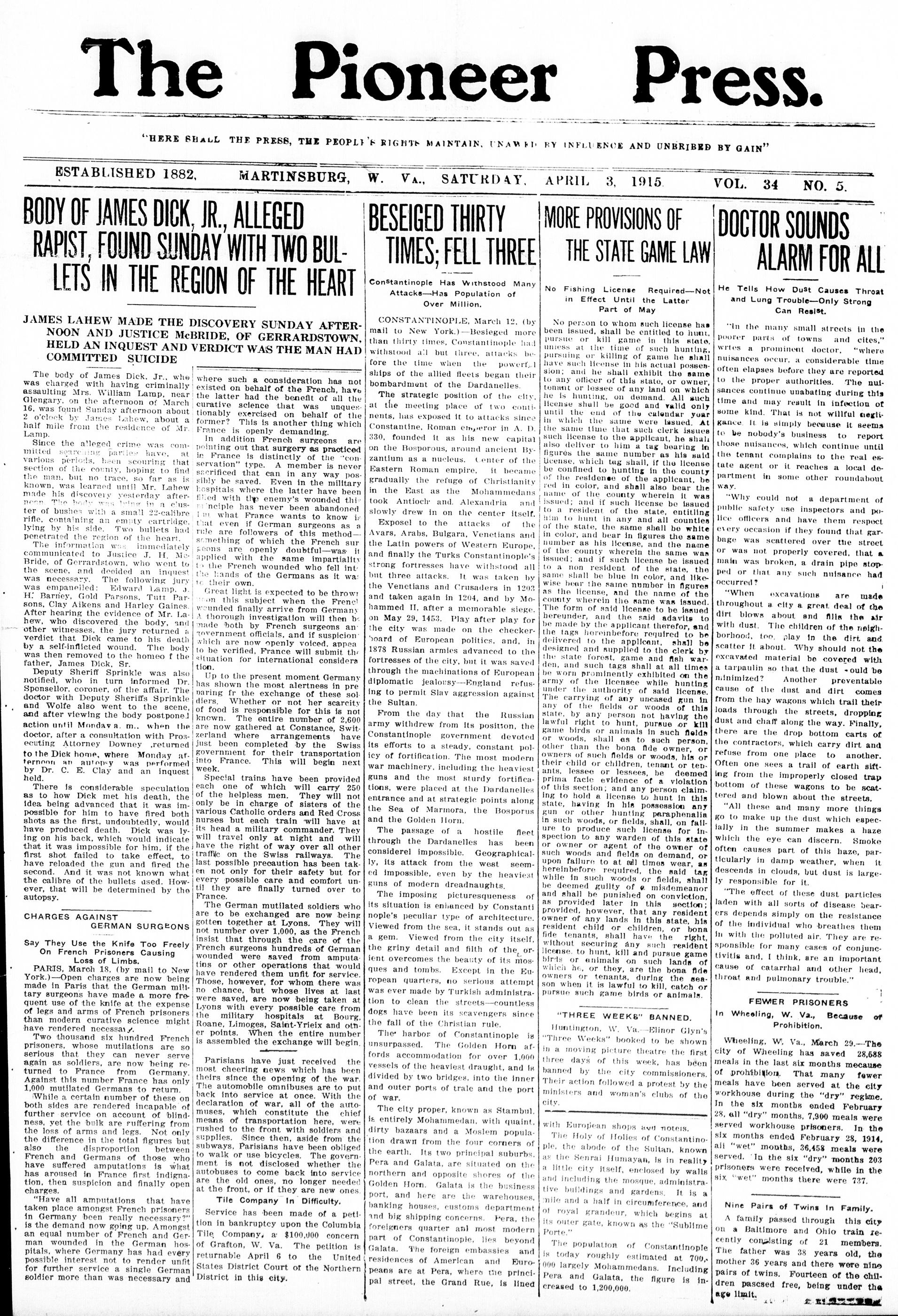
BODY OF JAMES DICK, JR., ALLEGED RAPIST, FOUND SUNDAY WITH TWO BULLETS IN THE REGION OF THE HEART
JAMES LAHEW MADE THE DISCOVERY SUNDAY AFTERNOON AND JUSTICE McBRIDE, OF GERRARDSTOWN, HELD AN INQUEST AND VERDICT WAS THE MAN HAD COMMITTED SUICIDE
ESTABLISHED 1882.
BODY OF JAMES DICK,
RAPIST, FOUND SUND
LETS IN THE REG
JAMES LAHEW MADE THE D
NOON AND JUSTICE McB
HELD AN INQUEST AND V
COMMITTED SUICIDE
The body of James Dick, Jr., who was charged with having criminally assaulting Mrs. William Lamp, near Glengary, on the afternoon of March 16, was found Sunday afternoon about 2 o'clock by James Lahew, about a half mile from the residence of Mr. Lamp. Since the alleged crime was committed searching parties have, at various periods, been scouring that section of the county, hoping to find the man, but no trace, so far as is known, was learned until Mr. Lahew made his discovery yesterday afternoon. The body was being in a cluster of bushes with a small 22-calibre rifle, containing an empty cartridge, lying by his side. Two bullets had penetrated the region of the heart.
The information was immediately communicated to Justice J. H. McBride, of Gerrardstown, who went to the scene, and decided an inquest was necessary. The following jury was empanelled: Edward Lamp, J. H. Barney, Gold Parsons, Tutt Parsons, Clay Aikens and Harley Gaines. After hearing the evidence of Mr. Lahew, who discovered the body, and other witnesses, the jury returned a verdict that Dick came to his death by a self-inflicted wound. The body was then removed to the homeo f the father, James Dick, Sr.
Deputy Sheriff Sprinkle was also notified, who in turn informed Dr. Sponsellor, coroner, of the affair. The doctor with Deputy Sheriffs Sprinkle and Wolfe also went to the scene, and after viewing the body postponed action until Monday a.m., when the doctor, after a consultation with Prosecuting Attorney Downey, returned to the Dick home, where Monday afternoon an autopsy was performed by Dr. C. E. Clay and an inquest held.
There is considerable speculation as to how Dick met his death, the idea being advanced that it was impossible for him to have fired both shots as the first, undoubtedly, would have produced death. Dick was lying on his back, which would indicate that it was impossible for him, if the first shot failed to take effect, to have reloaded the gun and fired the second. And it was not known what the calibre of the bullets used. However, that will be determined by the autopsy.
CHARGES AGAINST
GERMAN SURGEONS
Say They Use the Knife Too Freely On French Prisoners Causing
PARIS, March 18, (by mail to New York.)—Open charges are now being made in Paris that the German military surgeons have made a more frequent use of the knife at the expense of legs and arms of French prisoners than modern curative science might have rendered necessa. Two thousand six hundred French prisoners, whose mutilations are so serious that they can never serve again as soldiers, are now being returned to France from Germany. Against this number France has only 1,000 mutilated Germans to return
While a certain number of these on both sides are rendered incapable of further service on account of blindness, yet the bulk are suffering from the loss of arms and legs. Not only the difference in the total figures but also the disproportion between French and Germans of those who have suffered amputations is what has aroused in France first indignation, then suspicion and finally open charges.
"Have all amputations that have taken place amongst French prisoners in Germany been really necessary?" is the demand now going up. Amongst an equal number of French and German wounded in the German hospitals, where Germany has had every possible interest not to render unfit for further service a single German soldier more than was necessary and
where such a consideration has not existed on behalf of the French, have the latter had the benefit of all the curative science that was unquestionably exercised on behalf of the former? This is another thing which France is openly demanding.
In addition French surgeons are pointing out that surgery as practiced in France is distinctly of the "conservation" type. A member is never sacrificed that can in any way possibly be saved. Even in the military hospitals where the latter have been filled with the enemy's wounded this principle has never been abandoned. But what France wants to know is that even if German surgeons as a rule are followers of this method—something of which the French surgeons are openly doubtful—was it applied with the same impartiality to the French wounded who fell into the hands of the Germans as it was to their own.
Great light is expected to be thrown upon this subject when the French wounded finally arrive from Germany. A thorough investigation will then be made both by French surgeons and government officials, and if suspicion which are now openly voiced, appeal to be verified. France will submit the situation for international consideration.
Up to the present moment Germany has shown the most alertness in preparing fr the exchange of these soldiers. Whether or not her scarcity of food is responsible for this is not known. The entire number of 2,600 are now gathered at Constance, Switzerland where arrangements have just been completed by the Swiss government for their transportation into France. This will begin next week.
Special trains have been provided each one of which will carry 250 of the helpless men. They will not only be in charge of sisters of the various Catholic orders and Red Cross nurses but each train will have at its head a military commander. They will travel only at night and will have the right of way over all other traffic on the Swiss railways. The last possible precaution has been taken not only for their safety but for every possible care and comfort until they are finally turned over to France.
The German mutilated soldiers who are to be exchanged are now being gotten together at Lyons. They will not number over 1,000, as the French insist that through the care of the French surgeons hundreds of German wounded were saved from amputations or other operations that would have rendered them unfit for service. Those, however, for whom there was no chance, but whose lives at last were saved, are now being taken at Lyons with every possible care from the military hospitals at Bourg, Roane, Limoges, Saint-Yrieix and other points. When the entire number is assembled the exchange will begin
Parisians have just received the most cheering news which has been theirs since the opening of the war. The automobile omnibuses are to put back into service at once. With the declaration of war, all of the automuses, which constitute the chief means of transportation here, were rushed to the front with soldiers and supplies. Since then, aside from the subways, Parisians have been obliged to walk or use bicycles. The government is not disclosed whether the autobuses to come back into service are the old ones, no longer needed at the front, or if they are new ones.
Tile Company In Difficulty.
Service has been made of a petition in bankruptcy upon the Columbia Tile Company, x $100,000 concern of Grafton, W. Va. The petition is returnable April 6 to the United States District Court of the Northern District in this city.
BESEIGED THIRTY TIMES; FELL THREE
Constantinople Has Withstood Many Attacks—Has Population of Over Million.
CONSTANTINOPLE, March 12. (by mail to New York.)—Besieged more than thirty times, Constantinople had withstood all but three, attacks before the time when the powerful ships of the allied fleets began their bombardment of the Dardanelles.
The strategic position of the city, at the meeting place of two continents, has exposed it to attacks since Constantine, Roman emperor in A. D. 330, founded it as his new capital on the Bosporous, around ancient Byzantium as a nucleus. Center of the Eastern Roman empire, it became gradually the refuge of Christianity in the East as the Mohammedans took Antiochr and. Alexandria and slowly drew in on the center itself
Exposel to the attacks of the Avars, Arabs, Bulgara, Venetians and the Latin powers of Western Europe, and finally the Turks Constantinople's strong fortresses have withstood all but three attacks. It was taken by the Venetians and Crusaders in 1203 and taken again in 1204, and by Mohammed II, after a memorable siege, on May 29, 1453. Play after play for the city was made on the checkerboard of European politics, and, in 1878 Russian armies advanced to the fortresses of the city, but it was saved through the machinations of European diplomatic jealousy—England refusing to permit Slav aggression against the Sultan.
From the day that the Russian army withdrew from its position, the Constantinople government devoted its efforts to a steady, constant policy of fortification. The most modern war machinery, including the heaviest guns and the most sturdy fortifications, were placed at the Dardanelles entrance and at strategic points along the Sea of Marmora, the Bosporus and the Golden Horn.
The passage of a hostile fleet through the Dardanelles has been considererel impossible. Geographically, its attack from the west seemed impossible, even by the heaviest guns of modern dreadnaughts.
The imposing picturesqueness of its situation is enhanced by Constanti nople's peculiar type of architecture. Viewed from the sea, it stands out as a gem. Viewed from the city itself, the griny detail and filth of the orient overcomes the beauty of its mosques and tombs. Except in the European quarters, no serious attempt was ever made by Turkish administration to clean the streets—countless dogs have been its scavengers since the fall of the Christian rule.
The harbor of Constantinople is unsurpassed. The Golden Horn affords accommodation for over 1,000 vessels of the heaviest draught, and is divided by two bridges, into the inner and outer ports of trale and the port of war.
The city proper, known as Stambul, is entirely Mohammedan, with quaint, dirty bazaars and a Moslem population drawn from the four corners of the earth. Its two principal suburbs, Pera and Galata, are situated on the northern and opposite shores of the Golden Horn. Galata is the business port, and here are the warehouses, banking houses, customs department and big shipping concerns. Pera, the foreigners quarter and most modern part of Constantinople, lies beyond Galata. The foreign embassies and residences of American and Europeans are at Pera, where the principal street, the Grand Rue, is lined
Press.
MORE PROVISIONS OF THE STATE GAME LAW
No Fishing License Required—Not in Effect Until the Latter Part of May
No person to whom such license has been issued, shall be entitled to hunt, pursue or kill game in this state, unless at the time of such hunting, pursuing or killing of game he shall have such license in his actual possession; and he shall exhibit the same to any officer of this state, or owner, tenant or lessee of any land on which he is hunting, on demand. All such license shall be good and valid only until the end of the calendar year in which the same were issued. At the same time that such clerk issues such license to the applicant, he shall also deliver to him a tag bearing in figures the same number as his said license, which tag shall, if the license be confined to hunting in the county of the residence of the applicant, be red in color, and shall also bear the name of the county wherein it was issued; and if such license be issued to a resident of the state, entitling him to hunt in any and all counties of the state, the same shall be white in color, and bear in figures the same number as his license, and the name of the county wherein the same was issued; and if such license be issued to a non resident of the state, the same shall be blue in color, and likewise bear the same number in figures as the license, and the name of the county wherein the same was issued. The form of said license to be issued hereunder, and the said adavits to be made by the applicant therefor, and the tags hereinbefore required to be delivered to the applicant, shall be designed and supplied to the clerk by the state forest, game and fish warden, and such tags shall at all times be worn prominently exhibited on the army of the licensee while hunting under the authority of said license. The carrying of any uncased gun in any of the fields or woods of this state, by any person not having the lawful right to hunt, pursue or kill game birds or animals in such fields or woods, shall as to such person, other than the bona fide owner, or owners of such fields or woods, his or their child or children, tenant or tenants, lessee or leseses, be deemed prima facie evidence of a violation of this section; and any person claiming to hold a license to hunt in this state, having in his possession any gun or other hunting paraphenalia in such woods, or fields, shall, on failure to produce such license for inspection to any warden of this state or owner or agent of the owner of such woods and fields on demand, or upon failure to at all times wear, as hereinbefore required, the said tag while in such woods or fields, shall be deemed guilty of a misdemeanor and shall be punished on conviction, as provided later in this section; provided, however, that any resident owner of any lands in this state, his resident child or children, or bona fide tenants, shall have the right, without securing any such resident license, to hunt, kill and pursue game birds or animals on such lands of which he, or they, are the bona fide owners or tenants, during the season when it is lawful to kill, catch or pursue such game birds or animals.
"THREE WEEKS" BANNED
Huntington, W. Va.—Elinor Glyn's "Three Weeks" booked to be shown in a moving picture theatre the first three days of this week, has been banned by the city commissioners. Their action followed a protest by the ministers and woman's clubs of the city.
The Holy of Holies of Constantinople, the abode of the Sultan, known as the Senrai Humayan, is in reality a little city itself, enclosed by walls and including the mosque, administrative buildings and gardens. It is a mile and a half in circumference, and of royal grandeur, which begins at its outer gate, known as the "Sublime Porte."
The population of Constantinople is today roughly estimated at 700,000 largely Mohammedans. Including Pera and Galata, the figure is increased to 1,200,000.
APRIL 3, 1915
VOL. 34 NO. 5.
DOCTOR SOUNDS ALARM FOR ALL
DOCTOR SOUNDS ALARM FOR ALL
He Tells How Dust Causes Throat and Lung Trouble—Only Strong Can Resist.
"In the many small streets in the poorer parts of towns and cites," writes a prominent doctor, "where nuisances occur, a considerable time often elapses before they are reported to the proper authorities. The nuisances continue unabating during this time and may result in infection of some kind. That is not willful negligence. It is simply because it seems to be nobody's business to report those nuisances, which continue until the tenant complains to the real estate agent or it reaches a local department in some other roundabout way.
"Why could not a department of public safety use inspectors and police officers and have them respect every occasion if they found that garbage was scattered over the street or was not properly covered, that a main was broken, a drain pipe stopped or that any such nuisance had occurred?
"When excavations are made throughout a city a great deal of the dirt blows about and fills the air with dust. The children of the neighborhood, too, play in the dirt and scatter it about. Why should not the excavated material be covered with a tarpaulin so that the dust could be minimized? Another preventable cause of the dust and dirt comes from the hay wagons which trail their loads through the streets, dropping dust and chaff along the way. Finally, there are the drop bottom carts of the contractors, which carry dirt and refuse from one place to another. Often one sees a trail of earth sifting from the improperly closed trap bottom of these wagons to be scattered and blown about the streets.
"All these and many more things go to make up the dust which especially in the summer makes a haze which the eye can discern. Smoke often causes part of this haze, particularly in damp weather, when it descends in clouds, but dust is largely responsible for it.
"The effect of these dust particles laden with all sorts of disease bearers depends simply on the resistance of the individual who breathes them in with the polluted air. They are responsible for many cases of conjunctivitis and, I think, are an important cause of catarrhal and other head, throat and pulmonary trouble."
FEWER PRISONERS
In Wheeling, W. Va., Because of Prohibition.
Wheeling, W. Va., March 29.—The city of Wheeling has saved 28,688 meals in the last six months mecause of prohibition. That many fewer meals have been served at the city workhouse during the "dry" regime. In the six months ended February 28, all "dry" months, 7,900 meals were served workhouse prisoners. In the six months ended February 28, 1914, all "wet" months, 36,458 meals were served. In the six "dry" months 203 prisoners were received, while in the six "wet" months there were 737.
Nine Pairs of Twins In Family.
A family passed through this city on a Baltimore and Ohio train recently consisting of 21 members. The father was 38 years old, the mother 36 years and there were nine pairs of twins. Fourteen of the children pascsed free, being under the age limit.
The Pioneer Press Devoted to the Moral, Religious and Financial Development of Humanity. RATES OF SUBSCRIPTION:
Pay for all advertisements is due in advance unless advertising is run by yearly contract, in which case the advertiser pays every three months.
Entered in Post Office at Martinsburg, W. Va., as Second Class Matter. J R. Clifford, Editor and Proprietor. Drawer 869, and Bell 'Phone 60K. Martinsburg, W. Va.
SATURDAY, APRIL 3, 1915.
If all the dictionaries in the world were lying side by side and we needed one and wanted the best, in our judgment, Webster's International would be our selection.
It appears in print that the new Nor bourne Cemetery is non sectarian. In the name of death, God and decency, let it be non color, for when prejudice by the living goes down into the ground grave deep, there is no possible chance of such shriveled souls going upward.
It is too bad Negroes can be so easily Barnumized. And it is too bad that Trotter's the Barnum. That he is commercializing that Presidential tempest in a teapot is as plain as the nose on a man's face. The merit of it if there ever was any, has gone to pot, wherein Trotter must be cooked.
The question is going the rounds—"What is the finest product of America?" The Pioneer Press thinks man, if his blood is pure, body strong and healthy, his mind free of prejudice and clear and whose heart would stretch out its arms if it could and draw the whole world unto God as children of the one-blood-family, is our answer.
It is high time the public generally should know that the reputation of any one is not what the public see and know of a person. If it be so bad that men of reliability swear they would not believe him on oath, that impaaches him; or if they swear that his reputation for peace and quiet is bad, its bad for him. Keep in mind that what you know, no difference if it be criminal your knowledge of it would not make his reputation bad, but constant evil reports of one does.
To think of a man who bared his breast on the battlefields during the sixties to save this union and free the slaves, not being allowed to stop at hotels, or eat in restaurants because and only because God's climatic laws darkened his skin. When Mr. Sanders came here, we left our bed of affliction and took him to five places before getting him a place to sleep and eat. Too bad It's a curse on Christianity that ought to be blotted out forever.
There was some beautiful, nay divine poetry on page 12 of the December No. of the "West Virginia Educator." And we are puzzled to comprehend how such lovers of such writers can reproduce such sentiment and not contend for mixed schools and Christ-like teaching to every child in this state. Those world famed writers believed in freedom and equal education, why not these?
May God hasten the day,
When prejudice shall die away,
And the color of men be forgotten,
Among the things dead and rotten.
How people can trifle with God and spit on justice we are unable to tell. Martinique, San Francisco and Columbia, South Carolina, are reminders of worse to follow—precisely as agitation for the destruction of slavery was a forewarner of the bloody war it took to kill it, and unless its constitutional provisions are fulfilled to the letter, the constant agitation going on is warning the thoughtful that punishment must follow sin—Lincoln declared it—and his word and prophecy with us, ranks next to God's.
An American writer, with "father wish to the thought," after describing the horrors of the war by bomb dropping, believes, if the English people ever catch one of the German air men, he will be lynched. No doubt should England do so. it would more than please that writer and his type of Americans. It is as fair for Germany as it is for England to throw bombs, and it is
hoped that neither country will ever resort to America's blackest earthy crime. No difference what the war foeing parties do, if caught apply law and let freedom, imprisonment or death follow.
MR. J. A. BLONDEL
Last Sunday early in the morning the spirit of Mr. J Anthony Blondel took its flight to that 'beautiful Isle of somewhere, land of the true, where we live anew.' He was a big, kind hearted man, always willing and ready to help the needy and defend a friend. Martinsburg honored him as a business man and mechanical genius. Never saw him in the prime of life took finer than when asleep in death. Peaceful be thy sleep and eternal joy to thy soul—is the wish of your friend—the editor.
That human beings are made men by two processes is patent to us. One is in embryo, the other environments. Rest assured however, that the former must have the best material to mold them and the latter's duty, is the proper pruning. No one is the physical, moral and intellectual equal of those who have come down the ages of time cultured and polished by centuries of rare opportunities. But what others are, millions can be, if love, liberty and equal chances in life are given everybody, regardless of the color of skin.
Clean association is one of the essentials of well bred people. It is to one's reputation, what good food is to his body. Hence, the old adage: "Men are judged by the company they keep." No class of people were ever benefited by no set standard of morals. Hon. C. H. Payne while making a speech in our court house, some one yelled out—"Yes, we are all Negroes and all alike." Payne denied it in as rich and high-toned rebuke as we ever heard. Talmage passing along a street in New York, saw a drunken man lying in the gutter. He stopped, looked at him and said: "There lays Talmage, but for the religion of Jesus Christ." It separates the goats from the sheep.
It is ridiculous to hear some men praise the doings of the South's conduct and destruction in the Congress that died in groans and disgrace on March 4 1915. The only thing it can boast of is our prosperity and profits on the seas caused by sickness, starvation, death and devastation. Had there been no war they would had nothing to boast of. It was too busy trying ta reenslave "the niggers" and change Ben Tillman's 'To-hell constitution,' to get out of that channel—into which it has buried itself for at least 80 years to come. Unfortunately for this party it has never been able to forget and forgive the results of the war it brought on. To boast of our exports is only to admit that the bloodiest war of the world's history, is the cause of it. It recalls a wayward child rejoicing over the death of a rich parent.
However, this paper does not include in this editorial the broad, rich and fair minded democrats of the North, East and West and some scattering ones of the South, who are responsible for the ignominious death of every hellish bill of the South's cracker congressmen, whose greatest efforts were to jimcrow, disfranchise and imprison for intermarriage, while at the very time in Columbia South Carolina, twelve houses of ill fame with fifty colored women in them, were in full blast and "only for the use of white men."
For an appointee, we think Mr. Sanders is a little too tame. Think of a man getting fourteen hundred dollars yearly and traveling expenses over the state, making fully $2000, and knowing there is no jimcrow car law in this state submitting to it on the Norfolk and Western Railroad from Shepherd town to Shenandoah Junction—a distance of five miles only. He also informed us that at Shepherdstown said Railroad Co., has separate waiting rooms. Old as we are, when we have business in Charles Town, and must be there in time for court, we always when going by rail, walk the five miles over the territory the N. & W. goes. And as an example to his oppressed people Mr. Sanders should have done the same. We are losing rights every day by that devilish servility that streaks most all Negroes' bodies. Mr. Sanders should have refused to go into that "nigger waiting room"—the first and only one in the state to our knowledge, and also gone into the "car for whites," then brought suit against both, and won his case. Every Negro so treated should do likewise. It would break the whole thing up.
Many would fight these wrongs in Court but they fear to try it owing to being poor. No need of that, for all
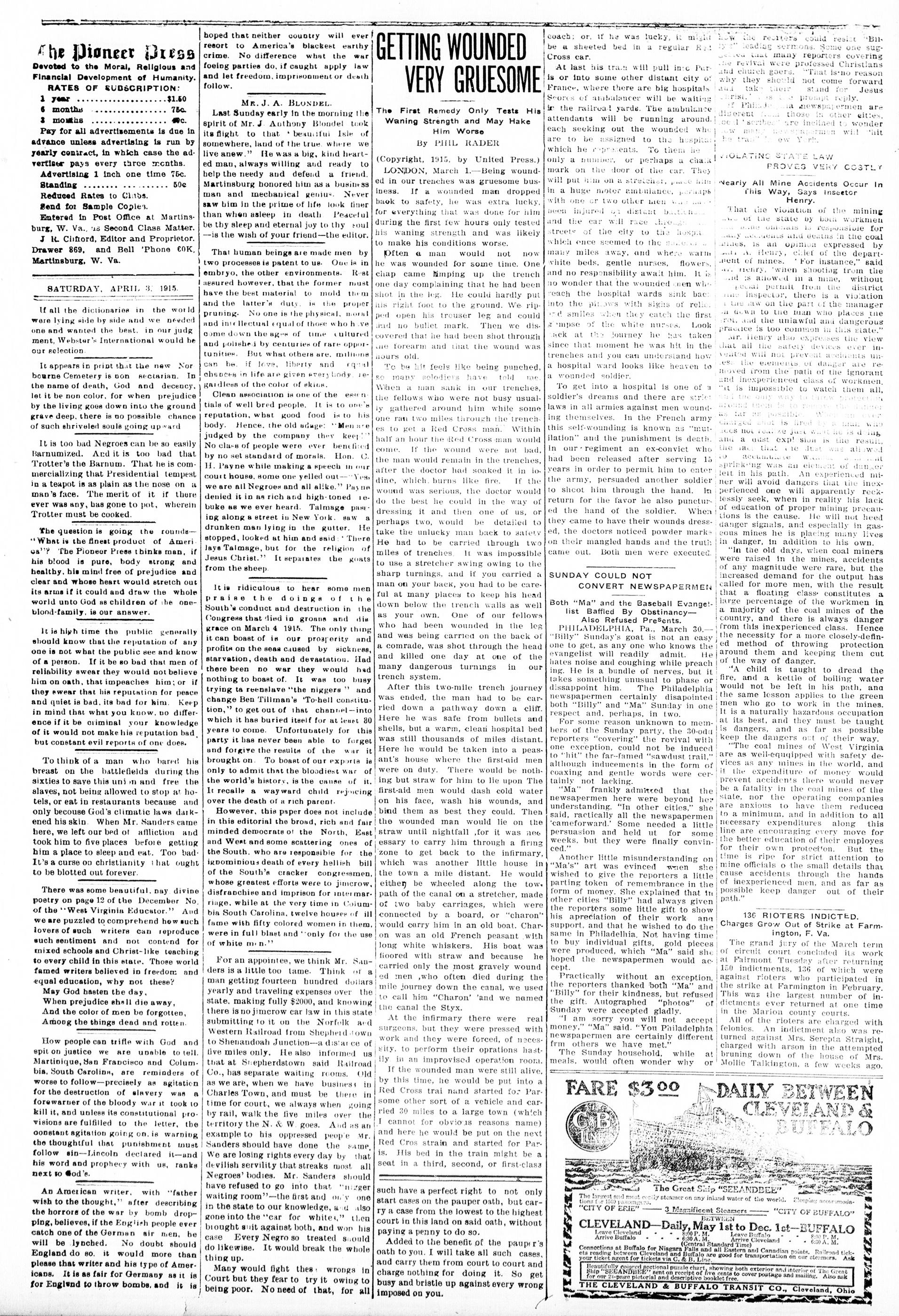
GETTING WOUNDED VERY GRUESOME
The First Remedy Only Tests His Waning Strength and May Hake Him Worse
By PHIL RADER
(Copyright, 1915, by United Press.)
LONDON, March 1.—Being wounded in our trenches was gruesome business. If a wounded man dropped back to safety, he was extra lucky, for everything that was done for him during the first few hours only tested his waning strength and was likely to make his conditions worse.
Often a man would not now he was wounded for some time. One chap came limping up the trench one day complaining that he had been shot in the leg. He could hardly put his right foot to the ground. We ripped open his trouser leg and could had no bullet mark. Then we discovered that he had been shot through the forearm and that the wound was hours old.
To be hit feels like being punched, so many soldiers have told me. When a man sank in our trenches, the fellows who were not busy usually gathered around him while some one ran two miles through the trenches to get a Red Cross man. Within half an hour the Red Cross man would come. If the wound were not bad, the man would remain in the trenches, after the doctor had soaked it in iodine, which burns like fire. If the wound was serious, the doctor would do the best he could in the way of dressing it and then one of us, or perhaps two, would be detailed to take the unlucky man back to safety. He had to be carried through two miles of trenches. It was impossible to use a stretcher swing owing to the sharp turnings, and if you carried a man on your back, you had to be careful at many places to keep his head down below the trench walls as well as your own. One of our fellows who had been wounded in the leg and was being carried on the back of a comrade, was shot through the head and killed one day at one of the many dangerous turnings in our trench system.
After this two-mile trench journey was ended, the man had to be carried down a pathway down a cliff. Here he was safe from bullets and shells, but a warm, clean hospital bed was still thousands of miles distant. Here he would be taken into a peasant's house where the first-aid men were on duty. There would be nothing but straw for him to lie upon The first-aid men would dash cold water on his face, wash his wounds, and bind them as best they could. Then the wounded man would lie on the straw until nightfall, for it was necessary to carry him through a firing zone to get back to the infirmary, which was another little house in the town a mile distant. He would either be wheeled along the towpath of the canal on a stretcher, made of two baby carriages, which were connected by a board, or "charon" would carry him in an old boat. Charon was an old French peasant with long white whiskers. His boat was floored with straw and because he carried only the most gravely wounded men, who often died during the mile journey down the canal, we used to call him "Charon' and we named the canal the Styx.
At the infirmary there were real surgeons, but they were pressed with work and they were forced, of necessity, to perform their operations hastily in an improvised operation room. If the wounded man were still alive, by this time, he would be put into a Red Cross trai nand started for Parsome other sort of a vehicle and carried 30 miles to a large town (which I cannot for obvious reasons name) and here he would be put on the next Red Cros strain and started for Paris. His bed in the train might be a seat in a third, second, or first-class
such have a perfect right to not only start cases on the pauper oath, but carry a case from the lowest to the highest court in this land on said oath, without paying a penny to do so. Added to the benefit of the pauper's oath to you. I will take all such cases, and carry them from court to court and charge nothing for doing it. So get busy and bristle up against every wrong imposed on you.
FARE $3.00
DAILY BETWEEN
CLEVELAND &
BUFFALO
The Great Ship "SEEANDBEE"
The largest and most easily steamer on any inland water of the world. Sleeping accommodations for 1500 passengers.
"CITY OF ERIE" — 3 Magnificent Steamers — "CITY OF BUFFALO"
BETWEEN
CLEVELAND—Daily, May 1st to Dec. 1st—BUFFALO
Leave Cleveland 8:00 P.M. Leave Buffalo 8:00 P.M.
Arrive Buffalo 6:30 A.M. Arrive Cleveland 6:30 A.M.
(Central Standard Time)
Connections at Buffalo for Niagara Falls and all Eastern and Canadian points. Railroad tickets reading between Cleveland and Buffalo are good for transportation on our steamers. Ask your ticket agent for tickets via C. & B. Line.
Beautifully coated sectional puzzle chart, showing both exterior and interior of The Great Ship "SEEANDBEE" sent on receipt of five cents to cover postage and mailing. Also ask for our 21-page pictorial and descriptive booklet free.
THE CLEVELAND & BUFFALO TRANSIT CO., Cleveland, Ohio
coach; or, if he was lucky, it might be a sheeted bed in a regular R.1. Cross car.
At last his train will pull into Paris or into some other distant city of France, where there are big hospitals. Scores of ambulance will be waiting in the railroad yards. The ambulance attendants will be running around, each seeking out the wounded who are to be assigned to the hospital which he represents. To them he only a number, or perhaps a chalk mark on the door of the car. They will put him on a stretcher, place him in a huge motor ambulance, perhaps with one or two other men who have been injured by distant battles and the car will race through the streets of the city to the hospital which once seemed to the sound of many miles away, and where warm white beds, gentle nurses, flowers, and no responsibility await him. It is no wonder that the wounded men reach the hospital wards sink back into the pitrows with sighs of relief and smiles when they catch the first gimpse of the white nurses. Look back at the journey he has taken since that moment he was hit in the trenches and you can understand how a hospital ward looks like heaven to a wounded soldier.
To get into a hospital is one of a soldier's dreams and there are strict laws in all armies against men wounding themselves. In the French army this self-wounding is known as "mutilation" and the punishment is death. In our regiment an ex-convict who had been released after serving 15 years in order to permit him to enter the army, persuaded another soldier to shoot him through the hand. In return for the favor he also punctured the hand of the soldier. When they came to have their wounds dressed, the doctors noticed powder marks on their mangled hands and the truth came out. Both men were executed.
SUNDAY COULD NOT
Both "Ma" and the Baseball Evangelist Baffled By Obstinancy— Also Retired Present
Also Refused Presents.
PHILADELPHIA, Pa., March 30.—"Billy" Sunday's goat is not an easy one to get, as any one who knows the evangelist will readily admit. He hates noise and coughing while preaching. He is a bundle of nerves, but it takes something unusual to phase or dissappoint him. The Philadelphia newspapermen certainly disapointed both "Billy" and "Ma" Sunday in one respect and, perhaps, in two.
For some reason unknown to members of the Sunday party, the 30-o-d reporters "covering" the revival with one exception, could not be induced to "hit" the far-famed "sawdust trail," although inducements in the form of coaxing and gentle words were certainly not lacking.
"Ma" frankly admitted that the newsapermen here were beyond her understanding. "In other cities," she said, ractically all the newspapermen 'cameforward.' Some needed a little persuasion and held ut for some weeks, but they were finally convinced."
Another little misunderstanding on "Ma's" art was evinced when she wished to give the reporters a little parting token of remembrance in the form of money. She explained that in other cities "Billy" had always given the reporters some little gift to show his appreciation of their work and support, and that he wished to do the same in Philadelphia. Not having time to buy individual gifts, gold pieces were produced, which "Ma" said she hoped the newspapermen would accept.
Practically without an exception, the reporters thanked both "Ma" and "Billy" for their kindness, but refused the gift. Autographed "photos" of Sunday were accepted gladly.
"I am sorry you will not accept money," "Ma" said. "You Philadelphia newspapermen are certainly different frm others we have met."
The Sunday household, while at meals, would often wonder why or
how the recruiters could resist "Billy" leading sermons. Some one suggested that many reporters covering the revival were professed Christians and church goers. "That is no reason why they should not come forward and take their stand for Jesus Christ." It was the prompt reply.
Of Philadelphia newspapermen are different from those in other cities, local scribes are inclined to wonder how many newspapermen will "hit the train" in New York.
Nearly All Mine Accidents Occur In This Way, Says Insector Henry
That the violation of the mining laws of the state by both workmen and mine officials is responsible for many accidents and deaths in the coal mines, is an opinion expressed by Carl A. Henry, chief of the department of mines. "For instance," said Carl A. Henry, "when shooting from the land is allowed in a mine without
A special permit from the district time inspector, there is a violation if the saw on the part of the manager is down to the man who places the rot, and the unlawful and dangerous practice is too common in this state." Mr. Henry also expresses the view that all the safety devices ever invented will not prevent accidents unless the elements of danger are removed from the path of the ignorant and inexperienced class of workmen, "it is impossible to watch them all, and the only way to show protection, around them is to remove the danger as far as possible. When an ever changed shot is fired by a man who does not realize just what he is doing and a dust explosion is the result, the fact that the dust was allowed to accumulate without sprinkling was an element of danger left in his path. An experienced miner will avoid dangers that the inexperienced one will apparently recklessly seek, when in reality his lack of education of proper mining precautions is the cause. He will not heed danger signals, and especially in gaseous mines he is placing many lives in danger, in addition to his own.
"In the old days, when coal miners were raised in the mines, accidents of any magnitude were rare, but the increased demand for the output has called for more men, with the result that a floating class constitutes a large percentage of the workmen in a majority of the coal mines of the country, and there is always danger from this inexperienced class. Hence the necessity for a more closely-defined method of throwing protection around them and keeping them cut of the way of danger.
"A child is taught to dread the fire, and a kettle of boiling water would not be left in his path, and the same lesson applies to the green men who go to work in the mines. It is a naturally hazardous occupation at its best, and they must be taught is dangers, and as far as possible keep the dangers out of their way.
"The coal mines of West Virginia are as well-equipped with safety devices as any mines in the world, and if the expenditure of money would prevent accidents there would never be a fatality in the coal mines of the state, nor the operating companies are anxious to have them reduced to a minimum, and in addition to all necessary expenditures along this line are encouraging every move for the better education of their employees for their own protection. But the time is ripe for strict attention to mine officials o the small details thau cause accidents through the hands of inexperienced men, and as far as possible keep danger out of their path."
136 RIOTERS INDICTED.
Charges Grow Out of Strike at Farmington, F. Va.
The grand jury of the March term of circuit court concluded its work at Fairmont Tuesday after returning 150 indictments, 136 of which were against rioters who participated in the strike at Farmington in February. This was the largest number of indictments ever returned at one time in the Marion county courts. All of the rioters are charged with felonies. An indictment also was returned against Mrs. Serepta Straight, charged with arson in the attempted bruning down of the house of Mrs. Mollie Talkington, a few weeks ago
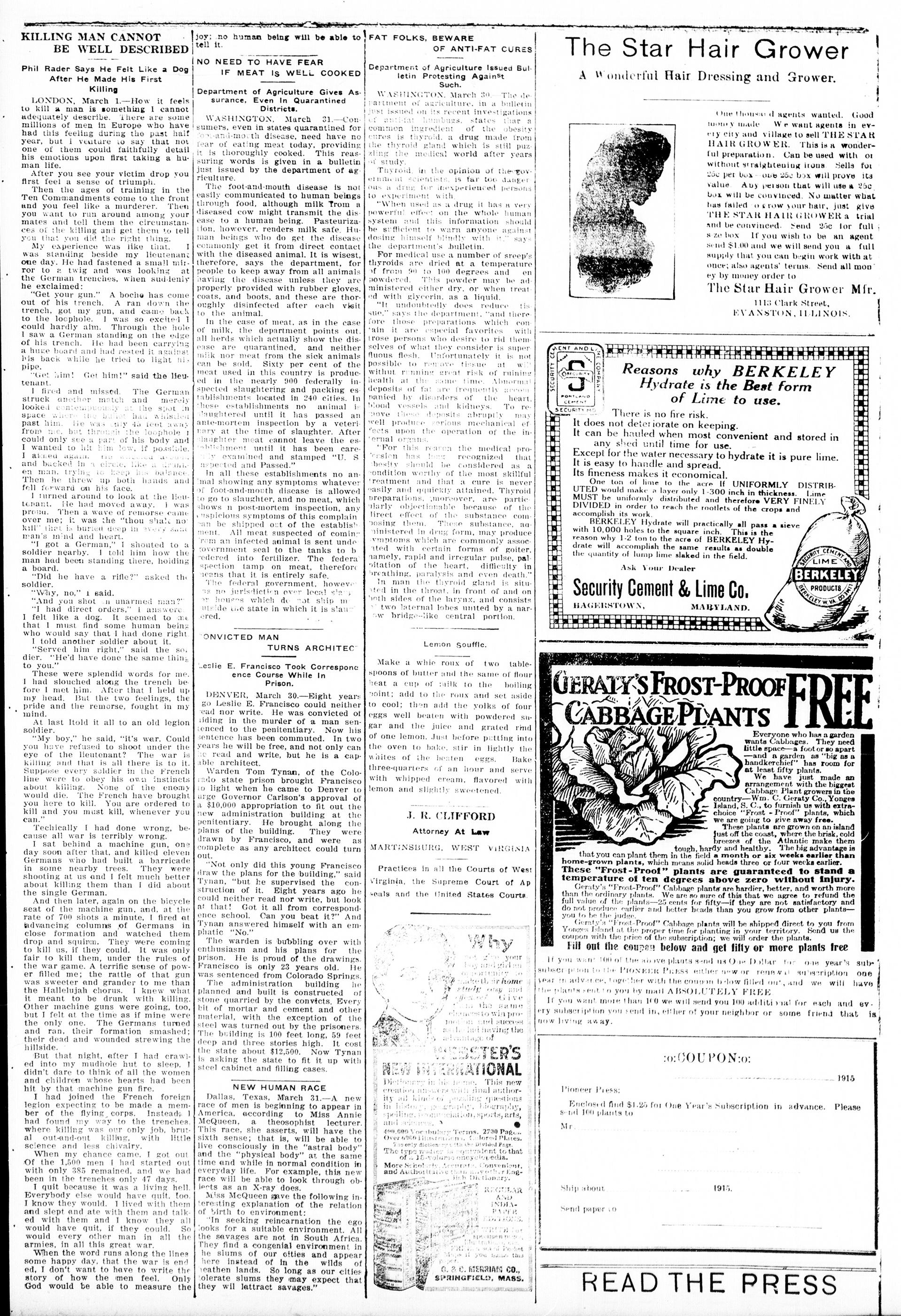
KILLING MAN CANNOT BE WELL DESCRIBED
Phil Rader Says He Felt Like a Dog After He Made His First Killing
LONDON, March 1.—How it feels to kill a man is something I cannot adequately describe. There are some millions of men in Europe who have had this feeling during the past half year, but I venture to say that not one of them could faithfully detail his emotions upon first taking a human life.
After you see your victim drop you first feel a sense of triumph.
Then the ages of training in the Ten Commandments come to the front and you feel like a murderer. Then you want to run around among your mates and tell them the circumstances of the killing and get them to tell you that you did the right thing.
My experience was like that. I was standing beside my lieutenant one day. He had fastened a small mirror to a twig and was looking at the German trenches, when suddenly he exclaimed:
"Get your gun." A bochо has come out of his trench. A ran down the trench, got my gun, and came back to the loophole. I was so excited I could hardly aim. Through the hole I saw a German standing on the edge of his trench. He had been carrying a huge board and had rested it against his back while he tried to light his pipe.
"Get him! Get him!" said the lieutenant.
I fired and missed. The German struck another match and merely looked contempuously at the spot in space where the ballet had whisled past him. He was only 40 feet away from me, but through the loophole I could only see a part of his body and I wanted to hit him low, if possible. I aimed again. He whimped around and backed in a circle, like a drumman, trying to keep his balance. Then he threw up both hands and fell forward on his face.
I turned around to look at the lieutenant. He had moved away. I was proud. Then a wave of remorse came over me; it was the "thou shalt not kill" that is buried deep in every same man's mind and heart.
"I got a German," I shouted to a soldier nearby. I told him how the man had been standing there, holding a board.
"Did he have a rifle?" asked the soldier.
"Why, no," I said.
"And you shot an unarmed man?"
"I had direct orders," I answered.
I felt like a dog. It seemed to me that I must find some human being who would say that I had done right.
I told another soldier about it.
"Served him right," said the soldier.
"He'd have done the same thing to you."
These were splendid words for me. I had slouched along the trench before I met him. After that I held up my head. But the two feelings, the pride and the remorse, fought in my mind.
At last Itold it all to an old legion soldier.
"My boy," he said, "it's war. Could you have refused to shoot under the eye of the lieutenant? The war is killing and that is all there is to it. Suppose every soldier in the French line were to obey his own instincts about killing. None of the enemy would die. The French have brought you here to kill. You are ordered to kill and you must kill, whenever you can."
Techically I had done wrong, because all war is terribly wrong.
I sat behind a machine gun, one day soon after that, and killed eleven Germans who had built a barricade in some nearby trees. They were shooting at us and I felt much better about killing them than I did about the single German.
And then later, again on the bicycle seat of the machine gun, and, at the rate of 700 shots a minute, I fired at advancing columns of Germans in close formation and watched them drop and squirm. They were coming to kill us, if they could. It was only fair to kill them, under the rules of the war game. A terrific sense of power filled me; the rattle of that gun was sweeter and grander to me than the Hallelujah chorus. I knew what it meant to be drunk with killing. Other machine guns were going, too, but I felt at the time as if mine were the only one. The Germans turned and ran, their formation smashed; their dead and wounded strewing the hillside.
But that night, after I had crawled into my mudhole hut to sleep. I didn't dare to think of all the women and children whose hearts had been hit by that machine gun fire.
I had joined the French foreign legion expecting to be made a member of the flying corps. Instead, I had found my way to the trenches, where killing was our only job, brutal out-and-out killing, with little science and less chivalry.
When my chance came, I got out. Of the 1,500 men I had started out with only 385 remained, and we had been in the trenches only 47 days.
I quit because it was a living hell. Everybody else would have quit, too. I know they would. I lived with them and slept and ate with them and talked with them and I know they all would have quit, if they could. So would every other man in all the armies, in all this great war.
When the word runs along the lines some happy day, that the war is ended, I don't want to have to write the story of how the men feel. Only God would be able to measure the
joy; no human being will be able to tell it.
NO NEED TO HAVE FEAR
Department of Agriculture Gives Assurance, Even In Quarantined Districts.
WASHINGTON, March 31.—Consumers, even in states quarantined for foot-and-mouth disease, need have no fear of eating meat today, providing it is thoroughly cooked. This reassuring words is given in a bulletin just issued by the department of agriculture.
The foot-and-mouth disease is not easily communicated to human beings through food, although milk from a diseased cow might transmit the disease to a human being. Pasteurization, however, renders milk safe. Human beings who do get the disease commonly get it from direct contact with the diseased animal. It is wisest, therefore, says the department, for people to keep away from all animals having the disease unless they are properly provided with rubber gloves, coats, and boots, and these are thoroughly disinfected after each visit to the animal.
In the case of meat, as in the case of milk, the department points out all herds which actually show the disease are quarantined, and neither milk nor meat from the sick animals can be sold. Sixty per cent of the meat used in this country is produced in the nearly 900 federally inspected slaughtering and packing establishments located in 240 cities. In these establishments no animal is slaughtered until it has passed an ante-mortem inspection by a veterinary at the time of slaughter. After slaughter meat cannot leave the establishment until it has been carefully examined and stamped "U. S inspected and Passed."
In all these establishments no animal showing any symptoms whatever of foot-and-mouth disease is allowed to go to slaughter, and no meat, which shows in post-mortem inspection, any suspicious symptoms of this complaint can be shipped out of the establishment. All meat suspected of coming from an infected animal is sent under government seal to the tanks to be redered into fertilizer. The federal spection tamp on meat, therefore means that it is entirely safe. The federal government, however, is no jurisdiction over local slay or houses which do not ship in outside the state in which it is slaughtered.
CONVICTED MAN
TURNS ARCHITEC
Leslie E. Francisco Took Correspondence Course While In
DENVER, March 30.—Eight years ago Leslie E. Francisco could neither read nor write. He was convicted ofiding in the murder of a man sentenced to the penitentiary. Now his sentence has been commuted. In two years he will be free, and not only can he read and write, but he is a capable architect.
Warden Tom Tynan, of the Colorado state prison brought Francisco to light when he came to Denver to urge Governor Carlson's approval of a $10,000 appropriation to fit out the new administration building at the penitentiary. He brought along the plans of the building. They were drawn by Francisco, and were as complete as any architect could turn out.
"Not only did this young Francisco draw the plans for the building," said Tynan, "but he supervised the construction of it. Eight years ago he could neither read nor write, but look at that! Got it all from correspondence school. Can you beat it?" And Tynan answered himself with an emphatic "No."
The warden is bubbling over with enthusiasm and his plans for the prison. He is proud of the drawings. Francisco is only 23 years old. He was sentenced from Colorado Springs
The administration building he planned and built is constructed of stone quarried by the convicts. Every bit of mortar and cement and other material, with the exception of the steel was turned out by the prisoners. The building is 100 feet long, 59 feet deep and three stories high. It cost the state about $12,500. Now Tynan is asking the state to fit it up with steel cabinet and filling cases.
NEW HUMAN RACE
Dallas, Texas, March 31.—A new race of men is beginning to appear in America, according to Miss Annie McQueen, a theosophist lecturer. This race, she asserts, will have the sixth sense; that is, will be able to live consciously in the "astral body" and the "physical body" at the same time and while in normal condition in everyday life. For example, this new race will be able to look through objects as an X-ray does.
Miss McQueen gave the following interesting explanation of the relation of birth to environment:
"In seeking reincarnation the ego looks for a suitable environment. All the savages are not in South Africa. They find a congenial environment in the slums of our cities and appear here instead of in the wilds of neathlands. So long as our cities tolerate slums they may expect that they wil lattract savages."
FAT FOLKS, BEWARE
Department of Agriculture Issued Bulletin Protesting Against
WASHINGTON, March 30.—The department of agriculture, in a bulletin just issued on its recent investigations of anatit humbugs, states that a common ingredient of the obesity cures is thyroid, a drug made from the thyroid gland which is still puzzling the medical world after years of study.
Thyroid, in the opinion of the government scientists, is far too dangerous a drug for inexperienced persons to experiment with.
"When used as a drug it has a very powerful effect on the whole human system and this information should be sufficient to warn anyone against dosing himself blindly with it," says the department's bulletin.
For medical use a number of sweep's thyroids are dried at a temperature of from 90 to 100 degrees and en powdered. This powder may be administered either dry, or when treated with givererin, as a liquid.
"It undoubtedly does reduce tissue," says the department, "and therefore those preparations which contain it are especial favorites with trose persons who desire to rid themselves of what they consider is superfluous flesh. Unfortunately it is not possible to remove tissue at will without running great risk of ruining health at the same time. Abnormal deposits of fat are frequently accompanied by disorders of the heart, blood vessels and kidneys. To remove these deposits abruptly may well produce serious mechanical effects upon the operation of the internal organs.
"For this reason the medical profession has long recognized that obesity should be considered as a condition worthy of the most skillful treatment and that a cure is never easily and quickly attained. Thyroid preparations, moreover, are particularly objectionable because of the direct effect of the substance composing them. These substance, administered in drug form, may produce symptoms which are commonly associated with certain forms of goiter, namely, rapid and irregular pulse, palpitation of the heart, difficulty in breathing, paralysis and even death." In man the thyroid gland is situated in the throat, in front of and on both sides of the larynx, and consists of two lateral lobes united by a narrow bridge-like central portion.
Lemon Souffle.
Make a white roux of two tablespoons of butter and the same of flour beat a cup of milk to the boiling point; add to the roux and set aside to cool; then add the yolks of four eggs well beaten with powdered sugar and the juice and grated rind of one lemon. Just before putting into the oven to bake, stir in lightly the whites of the beaten eggs. Bake three-quarters of an hour and serve with whipped cream, flavored with lemon and slightly sweetened.
J. R. CLIFFORD
Attorney At Law
MARTINSBURG, WEST VIRGINIA Practices in all the Courts of West Virginia, the Supreme Court of Appeals and the United States Courts
Why
not give your
boy and girl an
opportunity to
make their home
study easy and
affected. Give
the same
chances to win pro-
motion and success
as he had having the
advantage of
Dictionary in his name. This new creation answers with final authority all kinds of puzzling questions in history, geography, biography, spoiling, communication, sports, arts, and sciences.
The Star Hair Grower A Wonderful Hair Dressing and Grower.
One thousand agents wanted. Good money made. We want agents in every city and village to sell THE STAR HAIR GROWER. This is a wonderful preparation. Can be used with or without straightening irons. Sells for 25c per box - one 25c box will prove its value. Any person that will use a 25c box will be convinced. No matter what has failed to grow your hair, just give THE STAR HAIR GROWER a trial and be convinced. Send 25c for full size box. If you wish to be an agent send $1.00 and we will send you a full supply that you can begin work with at once; also agents' terms. Send all money by money order to The Star Hair Grower Mfr.
SECURITY CEMENT AND L
THE COMPANY
SECURITY
PORTLAND
CEMENT
Reasons why BER
Hydrate is the Best
of Lime to us
hy BERKELEY
is the Best form
time to use.
keeping.
best convenient and stored in
or use.
try to hydrate it is pure lime.
head.
chemical.
There If UNIFORMLY DISTRIB-
-300 inch in thickness. Lime
and therefore VERY FINELY
Reasons why BERKELEY Hydrate is the Best form of Lime to use.
It does not deteriorate on keeping.
It can be hauled when most convenient
any shed until time for use.
Except for the water necessary to hydrate
It is easy to handle and spread.
Its fineness makes it economical.
One ton of lime to the acre If UNIFOR
UTED would make a layer only 1-300 inch in the
MUST be uniformly distributed and therefore W
DIVIDED in order to reach the rootlets of the c
accomplish its work.
BERKELEY Hydrate will practically all pass
with 10,000 holes to the square inch. This is the
reason why 1-2 ton to the acre of BERKELEY H
drate will accomplish the same results as doub
the quantity of lump lime slaked in the field.
any shed until time for use.
Except for the water necessary to hydrate it is pure lime. It is easy to handle and spread.
Its fineness makes it economical.
One ton of lime to the acre If UNIFORMLY DISTRIBUTED would make a layer only 1-300 inch in thickness. Lime MUST be uniformly distributed and therefore VERY FINELY DIVIDED in order to reach the rootlets of the crops and accomplish its work.
BERKELEY Hydrate will practically all pass a sieve with 10,000 holes to the square inch. This is the reason why 1-2 ton to the acre of BERKELEY Hydrate will accomplish the same results as double the quantity of lump lime slaked in the field.
Security Cement & Lime Co.
```markdown
```
GERATY'S FROST-PROOF
CABBAGE PLANTS
Every want is little else—and handle at least. We arrange Cabbage country—Wm. Island, S. C., choice "Frost-Proof" we are going to. These plants just off the coast breezes of the tough, hardy and healthy that you can plant them in the field a month or two home-grown plants, which means solid heads three or these "Frost-Proof" plants are guaranteed temperature of ten degrees above zero.
Geraty's "Frost-Proof" Cabbage plants are harder, than the ordinary plants. We are so sure of this that we full value of the plants—25 cents for fifty—if they are do not produce earlier and better heads than you grow you to be the judge.
Geraty's "Frost-Proof" Cabbage plants will be shipped Yonges Island at the proper time for planting in your coupon with the price of the subscription; we will order.
Fill out the coupon below and get fifty or one dollar.
If you want 100 of the above plants send us One Dollar subscription to the PIONEER PRESS either new or reeared in advance, together with the coupon below filled with the plants sent to you by mail ABSOLUTELY FREE.
If you want more than 100 we will send you 100 additional subscription you send in, either of your neighbor or now living away.
T-PROOF FREE
GERATY'S FROST-PROOF FREE CABBAGE PLANTS
country—Wm. C. Geraty Co., Yonges Island, S. C., to furnish us with extra-choice "Frost - Proof" plants, which we are going to give away free. These plants are grown on an island just off the coast, where the brisk, cold breezes of the Atlantic make them hardy and healthy. The big advantage is old a month or six weeks earlier than old heads three or four weeks earlier. Are guaranteed to stand above zero without injury. Plants are hardier, better, and worth more cure of this that we agree to refund the fifty—if they are not satisfactory and adults than you grow from other plants—plants will be shipped direct to you from planting in your territory. Send us the on; we will order the plants. And get fifty or more plants free
that you can plant them in the field a month or six weeks earlier than home-grown plants, which means solid heads three or four weeks earlier.
These "Frost-Proof" plants are guaranteed to stand a temperature of ten degrees above zero without injury.
Geraty's "Frost-Proof" Cabbage plants are harder, better, and worth more than the ordinary plants. We are so sure of this that we agree to refund the full value of the plants—25 cents for fifty—if they are not satisfactory and do not produce earlier and better heads than you grow from other plants—you to be the judge.
Geraty's "Frost-Proof" Cabbage plants will be shipped direct to you from Yonges Island at the proper time for planting in your territory. Send us the coupon with the price of the subscription; we will order the plants.
Fill out the coupon below and get fifty or more plants free
If you want 100 of the above plants send us One Dollar for one year's subscriber to the PIONEER PRESS either new or renewal subscription one year in advance, together with the coupon below filled out, and we will have the plants sent to you by mail ABSOLUTELY FREE.
If you want more than 100 we will send you 100 additional for each and every subscription you send in, either of your neighbor or some friend that is now living away.
:o:COUPON:o:
Pioneer Press:
Enclosed find $1.25 for One Year's Subscription
send 100 plants to
Mr.
Ship about..... 1915.
```markdown
```
ENT AND L
THE COMPANY
SECURITY CO.
SECURITY
PORTLAND
CEMENT
SECURITY CO.
There is no fire risk
Ask Your Dealer
1113 Clark Street,
EVANSTON, ILINOIS.
SECURITY CEMENT AND
LIME
BERKELEY
PRODUCT18
BERKELEY W. VA. DOWNTI
Everyone who has a garden wants Cabbages. They need little space—a foot or so apart—and a garden as "big as a handkerchief" has room for at least fifty plants.
Washington Notes
House of Representatives,
It is very quiet about the Capitol since the adjournment of Congress; the law-makers have nearly all left the city for their homes in the various States. Speaker Clark left last Friday and will join his family in Mississippi, where they will spend some time before going to their home in Missouri.
The West Virginia delegation have all gone with the exception of Senator Chilton, who was appointed one of a committee to investigate the workings of the half and half plan between the United States Government and the District of Columbia, and of which committee he was elected Chairman.
Visitors to the Capitol from West Virginia have been scarce since the adjournment of Congress. Hon. Tracey L. Jeffords of Harper's Ferry was seen here one day last week greeting everybody with his usual pleasant smile. It would not surprise me much to hear of him announcing himself as a candidate for Congress in the second district of West Virginia in the event that two other strong men are out of the race, one a democrat and the other a republican.
Attorney John R. Clifford of Martinburg paid his old friends at the Capitol a pleasant call on last Saturday while entoure to his home from Perryman, Maryland, where he had gone to make a speech for an organization.
Mr. Editor, you will find enclosed a bill, or an amendment to the hotel laws of the State of West Virginia, which was submitted to two republicans for their consideration and introduction if considered worthy in the last legislature, and it was expected at least a gentlemanly reply would be made as to the reasons why not. This bill is almost identically the same as the New York Equal Rights bill that was passed by the legislature two years ago, and was signed by Governor Sulzer, a democrat and thus become a law. The only difference between this bill and that is, we have eliminated all of the social features.
I hope you will publish this letter and that you will freely give your views as to the bill, for that is what we want, an expression as to the justice of such a law. The bill is as follows:
AN ACT TO AMEND THE CIVIL RIGHTS LAW, IN RELATION TO EQUAL RIGHTS IN PLACES OF PUBLIC ACCOMMODATION AND PROVIDING A PENALTY FOR VIOLATION THEREOF
The people of the State of West Virginia in Senate and House of Delegates assembled, do enact as follows:
SECTION 612 is hereby amended to read: All persons within the jurisdiction of this State shall be entitled to the full and equal accommodation, advantages and privileges of any place of public accommodation, subject only to the conditions and limitations established by law and applicable alike to all persons. No person, being the owner, lessee, proprietor, manager, superintendent, agent or employee of any such place, shall directly or indirectly refuse, withhold from or deny to any person any of the accommodations, advantages, or privileges thereof, publish circulate, issue, display, post or mail any written communication, notice or advertisement to the effect that any of the accommodations, advantages and privileges of any such place shall be refused, withheld from or denied to any person on account of race, creed or color, that the patronage or custom thereof, of any person belonging to or purporting to be any particular race, creed or color is unwelcome, objectionable or not acceptable, desired or solicited. The production of any such written or printed communication, notice or advertisement, purporting to relate to any such place and to be made by any person being the owner, lessee, proprietor, superintendent or manager thereof, shall be presumptive evidence in any civil or criminal action that the same was authorized by such person. A place of public accommodation, within the meaning of this Article, shall be deemed to include any inn, tavern or hotel, whether conducted for the entertainment of transient guests, or for the accommodation of those seeking health, recreation or rest, any restaurant, eating-house, public conveyance on land or water. Nothing herein contained shall be construed to prohibit the mailing of a private communication in writing sent in response to a specific inquiry.
PENALTY FOR VIOLATION.
Any person who shall violate any of the provisions of the foregoing section, or who shall aid in or incite the violation of any of said provisions shall for each and every violation thereof be liable to a penalty of not less than One Hundred Dollars, nor more than Five Hundred to be recovered by the person aggrieved, or any resident of this State, to whom such person shall assign his cause of action, in any Court of competent jurisdiction in the county in which the plaintiff of the defendant shall reside; and shall also for every such offense be deemed guilty of a misdemeanor and, upon conviction thereof shall be fined not less than One Hundred Dollars, or shall be imprisoned not less than thirty days nor more than ninety days, or both such fine and imprisonment.
This Act shall take effect immediately upon approval by the Governor. R, G, N.
In his Philadelphia speech Elihu Root declared that "the men who control the government today are the men who have been fighting the tariff and the trusts and the railroads so long that when they come to administer the government they cannot rid themselves of an underlying hostility to American enterprise."
Is this true, or is it mere assertion?
So far as the tariff is concerned, the Democratic revision of 1913 was about what the Republican revision of 1909 was expected to be. It was not radical. It was not a more radical revision than the Republicans themselves had promised in the 1908 campaign. Nor did it indicate hostility to business, for the agricultural schedules were reduced in greater degree than the manufacturing schedules.
There was no hostility to business In this revision of the tariff unless every revision that reduces rates of duty mus the interpreted as hostile to business.
As for the trusts, there has been no adverse legislation against them under the Wilson administration. The only legislation enacted was adopted at the request of the business interests themselves to clarify the law. There has been less trust prosecution under the Wilson administration than under the Taft administration. There has been less political agitation against trusts and corporations since Mr. Wilson became President than at any time since the Sherman law was enacted in 1890.
As to railroads, all the restrictive legislation now on the federal statute books was adopted by Republican Congresses. The only important action affecting railroads which has been taken since Mr. Wilson became President was the granting of permission to increase their freight and passenger rates. The ruling of the interstate Commerce Commission in this instance was favored not only by the Administration but by the American people as a whole.
As to finance, the only constructive measure enacted by the United States government since the Civil War is the new Banking and Currency law, under which the United States has been able to weather the financial storms of the most disastrous war in history without the shadow of a panic. Even Mr. Bryan, who led the free-silver crusade in 1896, used all his influence to put this great measure on the statute books.
Where is the hostility of which Mr. Root speaks? Where, for that matter, is there any general hostility toward business, such as that which raged during the Cleveland administration and was erected into the form of a political religion under the Roosevelt administration? Where is there a disposition in the States or in the Nation to harass or persecute legitimate business of any kind, big or little?
What, then, is business afraid of? We do not know and we cannot even surmise. Not in twenty years has it had so little to fear from government. Not in twenty years was it known so clearly what was expected of it under the law. What more can it ask?
The great weakness of American business at this time is the great weakness of Mr. Root himself. It refuses to trust the people. Mr. Root retired from the Senate because, as it is generally believed, he was afraid to submit his candidacy to a popular vote; yet he would have been reelected by an overwhelming majority. Business seems to be in much the same state of mind as Mr. Root, and for the same reason. It is afraid to trust the people because it is ignorant of popular opinion and suspicious of popular good faith. That is madness. The government of the United States is not hostile to business. The people of the United States are not hostile to business. If business cannot see these plain, unmistakable facts, then business is blind and ignorant and weak-witted. —New York World.
LEASE ON 50,000 ACRES PURCHASED FOR GAME
Game Warden Viquensey and H. M. Lockridge ti Establish Biggest Preserve. A deal has just been closed at Charleston by which J. A. Viquensey, state game and fish warden and H. M. Lockridge, president and vice-president respectively of the Allegheny Sportsmen's Association, take over the lease of more than fifty thousand acres of land and establish the largest game preserve in the United States. The lease was purchased of Col. William Seymour Edwards and originally ran for fifty years.
The land, which is located in Rendolph and Pocahontas counties, is owned by the West Virginia Pulp and Paper Co., having been purchased by them in 1899 from the Dewings, of Kalamazoo, Mich., at a consideration of $595,000. The preserve is located on the Richmond and Parkersburg turnpike and on the Cheat river. It is estimated that there are two hundred miles of trout streams through the land and the forests are infested with thousands of deer, bear and wild turkeys. The Allegheny Sportsmen's Association is a successor to the old Cheat Mountain club, organized a number of years ago by William Seymour Edwards, W. G. Brown, of Kingwood:
R. C. Dalzell and J. J. Holloway, of Wheeling, Henry G. Davis and Stephen B. Elkins, of Elkins. The new organization to get the lease, agreed to carry out the original plans of the founders of the old.
HOTEL
POWHATAN
WASHINGTON
D.C.
HOTEL OF AMERICAN IDEALS
In a city where good hotels
abound, the Powhatan heads the
list.
It is first in the hearts of its
countrymen.
The Powhatan is refined, exclusive, and restful. Its excellent location on Pennsylvania Avenue, 18th and H Streets, makes it a desirable headquarters for bridal couples, tourist parties, conventions, schools and colleges.
The Powhatan attracts the people of culture and education. Its proximity to State, War and Navy Departments, also to many points of historical interest, makes this hotel especially attractive to a discriminating public.
The Pounder with detached bath at $2.00 and up. Rooms with private bath, $2.50, $3.00 and up. Write for booklet with map. E. C OWEN, MANAGER.
SALESMEN and
Our West Virginia Grow NURSERY STOCK
vassing outfit FREE. Cash Commissions Pald Weekly. Write for terms
The Gold Nursery Co
Mason City, W. V.
Are You a Woman?
Tako Cardui
The Woman's Tonic
FOR SALE AT ALL DRUGGISTS
F4
BUY IT TO DAY PICTURE
PACIFIC ARTICLES
POPULAR MECHANICS MAGAZINE
For Father and Can
AND ALL, THE FAMILY
Two and a half million readers and it is
absolutely interest. Everything in it is
Written Go You Can Understand.
No sell 200,000 copies every month without
mating premiums and have no closings.
An newsletter will show a copy of every
publishing piece—a postal will da.
MAGAZINE
PACIFIC ARTICLES
POPULAR MECHANICS MAGAZINE
For Father and Can
AND ALL, THE FAMILY
For shoes, go to Charles E. Thompson North Queen Street. His stock is excellent, and the courtesies of his clerks can't be excelled. Try him and be convinced:
Bad Girl's Life
You what wonderful benefit I have re-
ceived of Thedford's Black-Draught," writes
Mills, of Clifton Millis, Ky.
It is no equal for la grippe, bad colds,
doubles. I firmly believe Black-Draught
Mills's life. When she had the measles,
winer, but one good dose of Thedford's
them break out, and she has had no
all never be without.
THEDFORD'S
K-DRAUGHT
Constipation, indigestion, headache, dizzi-
ness and fever, biliousness, and all similar
Thedford's Black-Draught has proved itself a safe,
valuable remedy.
From any of these complaints, try Black-
medicine of known merit. Seventy-five
success proves its value. Good for
sale everywhere. Price 25 cents.
R! What Is It
All About?
A gone stark mad over a very foolish and trivial
words ratting, cannon rumbling, mailed armour
Russia wanted to show her love for the little
ther—Servia?
Saved Girl's Life
"I want to tell you what wonderful benefit I have received from the use of Thedford's Black-Draught," writes Mrs. Sylvania Woods, of Clifton Milis, Ky.
"It certainly has no equal for la grippe, bad colds, liver and stomach troubles. I firmly believe Black-Draught saved my little girl's life. When she had the measles, they went in on her, but one good dose of Thedford's Black-Draught made them break out, and she has had no more trouble. I shall never be without
THEDFORD'S
BLACK-DRAUGHT
in my home." For constipation, indigestion, headache, dizziness, malaria, chills and fever, biliousness, and all similar ailments, Thedford's Black-Draught has proved itself a safe, reliable, gentle and valuable remedy.
If you suffer from any of these complaints, try Black-Draught. It is a medicine of known merit. Seventy-five years of splendid success proves its value. Good for young and old. For sale everywhere. Price 25 cents.
WAR! What Is It All About?
HAS the whole world gone stark mad over a very foolish and trivial question? Are swords rattling, cannon rumbling, mailed armour glistening just because Russia wanted to show her love for the little brother—Servia?
Tear aside the curtain of Europe's politics and see the grim and sinister game of chess that is being played. See upon what a slim, yet desperate, excuse the sacred lives of millions may be sacrificed. Read the history of the past one hundred years, as written by one of the greatest authorities the world has ever known, and learn the naked, shameful truth. Just to get you started as a Review of Reviews subscriber, we make you this extraordinary offer. We will give to you
FREE!
Duruy's History of the World
Four splendid cloth volumes, full of
portraits, sketches, maps, diagrams
Today is the climax of a hundred years of preparation.
In this timely, authoritative, complete, AND THE
ALLY CONDENSED classic world history—of which over
10,000 copies have been sold in France alone—just what has
place in the inner councils of Europe during the past one
ed years. Read in these entrancing pages how Russia
or years craftily been trying to escape from her darkness—
a year-round open port, with its economic freedom.
And how Germany and Austria, fearful of the monster's
strength, have been trying to checkmate her and how
we pinned all in this last, supreme stake.
Today is the climax of a hundred years of preparation. Read in this timely, authoritative, complete, AND THE ONLY CONDENSED classic world history—of which over 2,000,000 copies have been sold in France alone—just what has taken place in the inner councils of Europe during the past one hundred years. Read in these entrancing pages how Russia has for years craftily been trying to escape from her darkness—to get a year-round open port, with its economic freedom.
Read how Germany and Austria, fearful of the monster's latent strength, have been trying to checkmate her and how they have pinned all in this last, supreme stake.
THIS master of the pen shows you the glory that was Greece, and the grander that was Rome's. He guides you through the Middle Ages, the pictureque old days of feudalism and the crusades through the Renaissance up to contemporaneous history, which Prof. Grewerwien completes in brilliant manner. In the story of the past you see it today. And you will understand then better when you get the Review of Reviews for a year—for the Review of Reviews will give you a size increase of the event that are taking place with such rapidity. It is not enough to the daily news reports. Your ability to comprehend conditions, and the them by you. Dusky's rationally depend on a true interpretation of the meaning and the "reason why" of events. In your mind you must bring order out of chaos—and the Review of Reviews will do it for you.
for a Year
Fairmont boasts of a government revenue stamp office which is open during all hours. Internal Revenue Collector Sam A. Hays, of Parkersburg, has appointed Earl H. Smith, editor of the Fairmont Times, stamp deputy here and an office has been established in the Times Building. The Times is 6 morning paper and Mr. Smith's mail comes to him after every train, night and day.
Desides keeping his office open during the regulation hours from 8 a. m. to 4:30 p. m. the local stamp deputy fills mail orders received at
any hour, immediately after their receipt. Besides the usual tobacco and cigar stamps, the local office carries the documentary and proprietary stamps which are much used at this time. Users of these stamps throughout central West Virginia will receive prompt attention to their orders sent the local office.
keeps them so busy, they
are took of hard
i.e., It is the home of good clothes,
not verily, they are hustlers
The Lesson of the Past