The Pioneer Press
Saturday, April 10, 1915
Martinsburg, West Virginia
Page text (machine-generated)
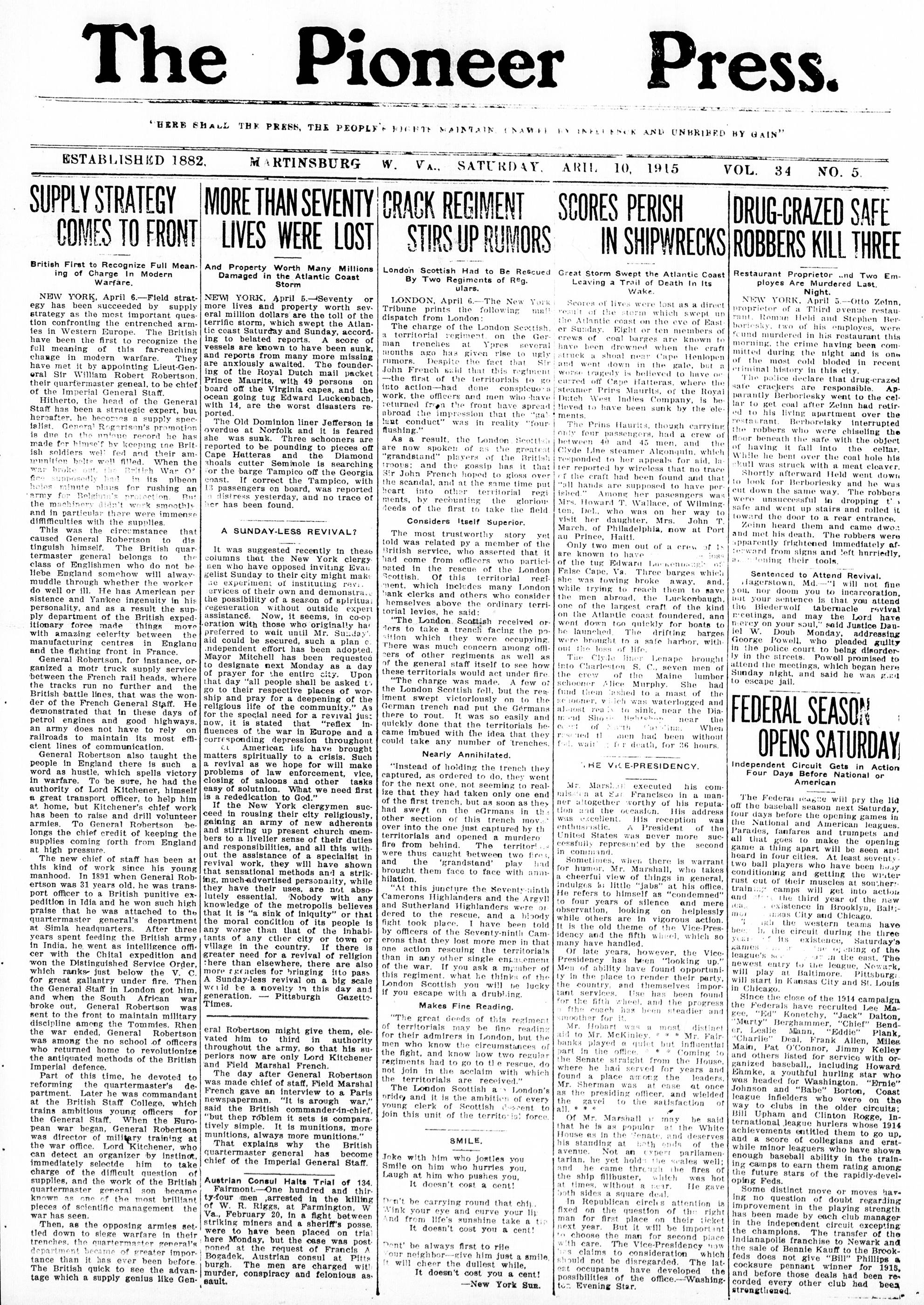
The Pioneer Press.
" HERE SHALL THE PRESS, THE PEOPLE'S EIGHTH MAINTAIN, CNAWEI BY INFLUENCE AND UNBRIBED BY GAIN "
ESTABLISHED 1882
SUPPLY STRATEGY COMES TO FRONT
British First to Recognize Full Meaning of Charge In Modern Warfare.
NEW YORK, April 6.—Field strategy has been succeeded by supply strategy as the most important question confronting the entrenched armies in Western Europe. The British have been the first to recognize the full meaning of this far-reaching change in modern warfare. They have met it by appointing Lieut-General Sir William Robert Robertson, their quartermaster general, to be chief of the Imperial General Staff.
Hitherto, the head of the General Staff has been a strategic expert, but hereafter, he becomes a supply specialist. General Rogertson's promotion is due to the unique record he has made for himself by keeping the British soldiers well fed and their ammunition bolts well filled. When the war broke out, the British War O'fice supposedly had in its pibeon holes minute plans for rushing an army for Belgium's protection. But the machinery didn't work smoothly and in particular there were immense difficulties with the supplies.
This was the circumstance that caused General Robertson to distinguish himself. The British quartermaster general belongs to the class of Englishmen who do not believe England somehow will always muddle through whether the worker do well or ill. He has American persistence and Yankee ingenuity in his personality, and as a result the supply department of the British expeditionary force made things move with amazing celerity between the manufacturing centres in England and the fighting front in France.
General Robertson, for instance, organized a motr truck supply service between the French rail heads, where the tracks run no further and the British battle lines, that was the wonder of the French General Staff. He demonstrated that in these days of petrol engines and good highways, an army does not have to rely on railroads to maintain its most efficient lines of communication.
General Robertson also taught the people in England there is such a word as hustle, which spells victory in warfare. To be sure, he had the authority of Lord Kitchener, himself a great transport officer, to help him at home, but Kitchener's chief work has been to raise and drill volunteer armies. To General Robertson belongs the chief credit of keeping the supplies coming forth from England at high pressure.
The new chief of staff has been at this kind of work since his young manhood. In 1891 when General Robertson was 31 years old, he was transport officer to a British punitive expedition in Idia and he won such high praise that he was attached to the quartermaster general's department at Simla headquarters. After three years spent feeding the British army in India, he went as intelligence officer with the Chital expedition and won the Distinguished Service Order, which ranks just below the V. C. for great gallantry under fire. Then the General Staff in London got him, and when the South African war broke out, General Robertson was sent to the front to maintain military discipline among the Tommies. Rhen the war ended, General Robertson was among the no school of officers who returned home to revolutionize the antiquated methods of the British Imperial defence.
Part of this time, he devoted to reforming the quartermaster's department. Later he was commandant at the British Staff College, which trains ambitious young officers for the General Staff. When the European war began, General Robertson was director of military training at the war office. Lord Kitchener, who can detect an organizer by instinct, immediately selecte him to take charge of the difficult question of supplies, and the work of the British quartermaster general son became known as one of the most brilliant pieces of scientific management the war has seen.
Then, as the opposing armies settled down to siege warfare in their trenches, the quartermaster general's department became of greater importance than it has ever been before. The British quick to see the advantage which a supply genius like Gen-
MORE THAN SEVENTY LIVES WERE LOST
And Property Worth Many Millions Damaged in the Atlantic Coast Storm
NEW YORK, April 5.—Seventy or more lives and property worth several million dollars are the toll of the terrific storm, which swept the Atlantic coast Saturday and Sunday, according to belated reports. A score of vessels are known to have been sunk, and reports from many more missing are anxiously awaited. The foundering of the Royal Dutch mail packet Prince Maurits, with 49 persons on board off the Virginia capes, and the ocean going tug Edward Luckenbach, with 14, are the worst disasters reported.
The Old Dominion liner Jefferson is overdue at Norfolk and it is feared she was sunk. Three schooners are reported to be pounding to pieces off Cape Hatteras and the Diamond shoals cutter Seminole is searching for the barge Tampico off the Georgia coast. If correct the Tampico, with 13 passengers on board, was reported a distress yesterday, and no trace of her has been found.
A SUNDAY-LESS REVIVAL?
It was suggested recently in these columns that the New York clergy men who have opposed inviting Evangelist Sunday to their city might make the experiment of instituting revival services of their own and demonstrate the possibility of a season of spiritual regeneration without outside expert assistance. Now, it seems, in cooperation with those who originally had preferred to wait until Mr. Sunday's aid could be secured, such a plan independent effort has been adopted. Mayor Mitchell has been requested to designate next Monday as a day of prayer for the entire city. Upon that day "all people shall be asked to go to their respective places of worship and pray for a deepening of the religious life of the community." As for the special need for a revival just now, it is stated that "reflex influences of the war in Europe and a corresponding depression throughout
American life have brought matters spiritually to a crisis. Such a revival as we hope for will make problems of law enforcement, vice, closing of saloons and other tasks easy of solution. What we need first is a rededication to God."
If the New York clergymen succeed in rousing their city religiously, gaining an army of new adherents and stirring up present church members to a livellier sense of their duties and responsibilities, and all this without the assistance of a specialist in revival work, they will have shown that sensational methods and a striking, much-advertised personality, while they have their uses, are not absolutely essential. Nobody with any knowledge of the metropolis believes that it is "a sink of iniquity" or that the moral condition of its people is any worse than that of the inhabitants of any other city or town or village in the country. If there is greater need for a revival of religion there than elsewhere, there are also more agencies for bringing it into pass. A Sunday-less revival on a big scale would be a novelty in this day and generation. — Pittsburgh Gazette- Times.
eral Robertson might give them, elevated him to third in authority throughout the army, so that his superiors now are only Lord Kitchener and Field Marshal French. The day after General Robertson was made chief of staff, Field Marshal French gave an interview to a Paris newspaperman. "It is arough war," said the British commander-in-chief, "but thep róblem it sets is comparatively simple. It is munitions, more munitions, always more munitions." That explains why the British quartermaster general has become chief of the Imperial General Staff.
Austrian Consul Halts Trial of 134,
Fairmont: One hundred and thirty-four men, arrested in the killing
of W. R. Riggs, at Farmington, W. Va., February 20, in a fight between
striking miners and a sheriff's posse,
were to have been placed on trial
here Monday, but the case was post-
poned at the request of Francis A.
Bogadek, Austrian consul at Pitts-
burgh. The men are charged with
murder, conspiracy and felonious assaul.
CRACK REGIMENT STIRS UP RUMORS
CRACK REGIMENT STIRS UP RUMORS
London Scottish Had to Be Rescued By Two Regiments of Reg. ulars.
LONDON, April 6.—The New York Tribune prints the following mail dispatch from London:
The charge of the London Scottish, a territorial regiment, on the German trenches at Ypres several months ago has given rise to ugly rumors. Despite the fact that Sir John French said that this regiment—the first of the territorials to go into action—had done conspicuous work, the officers and men who have returned from the front have spread abroad the impression that the "galant conduct" was in reality "four-flushing."
As a result, the London Scottish are now spoken of as the greatest "grandstand" players of the British troops; and the gossip has it that Sir John French hoped to gloss over the scandal, and at the same time put heart into other territorial regiments, by recounting the glorious deeds of the first to take the field.
Considers Itself Superior.
The most trustworthy story yet told was related py a member of the British service, who asserted that it had come from officers who participated in the rescue of the London Scottish. Of this territorial regiment, which includes many London bank clerks and others who consider themselves above the ordinary territorial levies, he said:
"The London Scottish received orders to take a trench facing the position which they were occupying. There was much concern among officers of other regiments as well as of the general staff itself to see how these territorials would act under fire
"The charge was made. A few of the London Scottish fell, but the resiment swept victoriously on to the German trench nad put the Germans there to rout. It was so easily and quickly done that the territorials became imbued with the idea that they could take any number of trenches
Nearly Annihilated.
"Instead of holding the trench they captured, as ordered to do, they went for the next one, not seeming to realize that they had taken only one end of the first trench, but as soon as they had sweft on the eGrmans in the other section of this trench moved over into the one just captured by the territorials and opened a murder fire from behind. The territorials were thus caught between two fires, and the 'grandstand' play had brought them face to face with annihilation.
"At this juncture the Seventy-ninth Camerons Highlanders and the Argyll and Sutherland Highlanders were ordered to the rescue, and a bloody fight took place. I have been told by officers of the Seventy-ninth Camerons that they lost more men in that one action rescuing the territorials than in any other single engagement of the war. If you ask a member of this regiment, what he thinks of the London Scottish you will be lucky if you escape with a drubbling.
Makes Fine Reading.
"The great deeds of this regiment of territorials may be fine reading for their admirers in London, but the men who know the circumstances of the fight, and know how two regular regiments had to go to the rescue, do not join in the acclaim with which the territorials are received."
The London Scottish a London's pride, and it is the ambition of every young clerk of Scottish descent to join this unit of the territorial force
SMILE.
Joke with him who jostles you
Smile on him who hurries you,
Laugh at him who pushes you,
It doesn't cost a cent!
Don't be carrying round that chip.
Wink your eye and curve your lip.
And from life's sunshine take a tip
It doesn't cost you a cent!
Don't be always first to rile
Your neighbor—give him just a smile,
It will cheer the dullest while,
It doesn't cost you a cent!
—New York Sun.
SCORES PERISH IN SHIPWRECKS
Great Storm Swept the Atlantic Coast Leaving a Trail of Death In Its Wake. Scores of lives were lost as a direct result of the storm which swept up the Atlantic coast on the eve of Easter Sunday. Eight or ten members of crews of coal barges are known to have been drowned when the craft struck a shoal near Cape Henlopen and went down in the gale, but a worse tragedy is believed to have occurred off Cape Hatteras, where the steamer Prips Mauurls, of the Royal Dutch West Indies Company, is believed to have been sunk by the elements.
The Prins Haurits, though carrying only four passengers, had a crew of between 40 and 45 men, and the Clyde Line steamer Algonquin, which responded to her appeals for aid, later reported by wireless that no trace of the craft had been found and that "all hands are supposed to have perished." Among her passengers was Mrs. Howard T. Wallace, of Wilmington, Del., who was on her way to visit her daughter, Mrs. John T. March, of Philadelphia, now at Port au Prince, Haitt.
Only two men out of a crew of 14 are known to have lost of the tug Edward Luckenbaugh of False Cape, Va. Three barges which she was towing broke away, and, while trying to reach them to save the men abroad, the Luckenbaugh, one of the largest craft of the kind on the Atlantic coast foundered, and went down too quickly for boats to be launched. The drifting barges were brought to a safe harbor, without the loss of life.
The Clyde liner Lenape brought into Charleston S. C., seven men of the crew of the Maine lumber schooner Alice Murphy. She had fund them lashed to a mast of the schooner, which was waterlogged and almost ready to sink, near the Diamond Shore Lightship near the coast of North Carolina. When rescuedtl men had been without fuel wait for death, for 36 hours.
THE VICE-PRESIDENCY
Mr. Marshall executed his commission at San Francisco in a manner altogether worthy of his reputation and the occasion. His address was excellent. His reception was enthusiastic. A President of the United States was never more successfully represented by the second in command. Sometimes, when there is warrant for humor, Mr. Marshall, who takes a cheerful view of things in general, indulges in little "jabs" at his office. He refers to himself as "condemned" to four years of silence and mere observation, looking on helplessly while others are in vigorous action. It is the old theme of the Vice-Presidency and the fifth wheel, which so many have handled.
Of late years, however, the Vice-Presidency has been "looking up." Men of ability have found opportunity in the place to render their party, the country, and themselves important services. Use has been found for the fifth wheel, and the progress of the coach has been steadier and smoother for it.
Mr. Hobart was a most distinct aid to Mr. McKinley. * * * Mr. Fairbanks played a quiet but influential part in the office. * * * Coming to the Senate straight from the House, where he had served for years and found a place among the leaders. Mr. Sherman was at ease at once as the presiding officer, and wielded the gavel to the satisfaction of all. * * *
Of Mr. Marshall it may be said that he is as popular at the White House as in the Senate, and deserves his standing at both ends of the avenue. Not an expert parliamentarian, he yet holds the scales well; and he came through the fires of the ship filibuster, which was hot at times, without a near. He gave both sides a square deal.
In Republican circles attention is fixed on the question of the right man for first place on their ticket next year. But it will be important to choose the man for second place with care. The Vice-Presidency now has claims to consideration which should not be disregarded. The latest occupants have developed the possibilities of the office.—Washington Evening Star.
DRUG-CRAZED SAFE ROBBERS KILL THREE
Restaurant Proprietor and Two Employes Are Murdered Last. Night.
NEW YORK, April 5.—Otto Zelnn, proprietor of a Third avenue restaurant, Roman Held and Stephen Berborsky, two of his employees, were found murdered in his restaurant this morning, the crime having been committed during the night and is one of the most cold blodied in recent criminal history in this city.
The police declare that drug-crazed safe crackers are responsible. Apparently Berboriesky went to the cellar to get coal after Zeinn had retired to his living apartment over the restaurant. Berboriesky interrupted the robbers who were chiselling the floor beneath the safe with the object of having it fall into the cellar. While he bent over the coal hole his skull was struck with a meat cleaver. Shortly afterward Held went down to look for Berboriesky and he was cut down the same way. The robbers were unsuccessful in dropping t' safe and went up stairs and rolled it toward the door to a rear entrance.
Zehn heard them and came dwox and met his death. The robbers were apparently frightened immediately afterward from signs and left hurriedly, a cloning their tools.
Sentenced to Attend Revival
Jagerstown, Md.—"I will not fine you, nor doom you to incarceration, but your sentence is that you attend the Bledderwolf tabernacle revival meetings, and may the Lord have mercy on your soul," said Justice Daniel W. Doub Monday, addressing George Powell, who pleaded guilty in the police court to being disorderly in the streets. Powell promised to attend the meetings, which began here Sunday night, and said he was good to escape jail.
FEDERAL SEASON OPENS SATURDAY
Independent Circuit Gets in Action Four Days Before National or American
The Federal league will pry the lid off the baseball season next Saturday, four days before the opening games in the National and American leagues. Parades, fanfares and trumpets and all that goes to make the opening game a thing apart will be seen and heard in four cities. At least seventy-two ball players who have been body conditioning and getting the winter rust out of their muscles at southern training camps will get into action and after the third year of the new existence in Brooklyn, Baltimore, Kansas City and Chicago.
Though the western teams have been in the circuit during the three year of its existence, Saturday's games are the opening of the league's second year in the east. The newest entry to the league, Newark, will play at Baltimore. Pittsburg will start in Kansas City and St. Louis in Chicago.
Since the close of the 1914 campaign the Federals have recruited Lee Magee, "Ed" Konetchy, "Jack" Dalton, "Murly" Berghammer, "Chief" Bender, Leslie Mann, "Eddie" Plank, "Charlie" Deal, Frank Allen, Miles Main, Pat O'Connor, Jimmy Kelley and others listed for service with organized baseball, including Howard Ehmke, a youthful hurling star who was headed for Washington. "Ernie" Johnson and "Babe" Borton, Coast league infielders who were on the way to clubs in the older circuits; Bill Upham and Clinton Rogge, International league hurlers whose 1914 achievements entitled them to go up, and a score of collegians and erstwhile minor leaguers who have shown enough baseball ability in the training camps to earn them rating among the future stars of the rapidly-developing Feds.
Some distinct move or moves having no question of doubt regarding improvement in the playing strength has been made by each club manager in the independent circuit excepting the champions. The transfer of the Indianapolis franchise to Newark and the sale of Bennie Kauff to the Brookfeds does not give "Bill" Phillips a cocksure pennant winner for 1915, and before those deals had been recorded every other club had been strengthened.
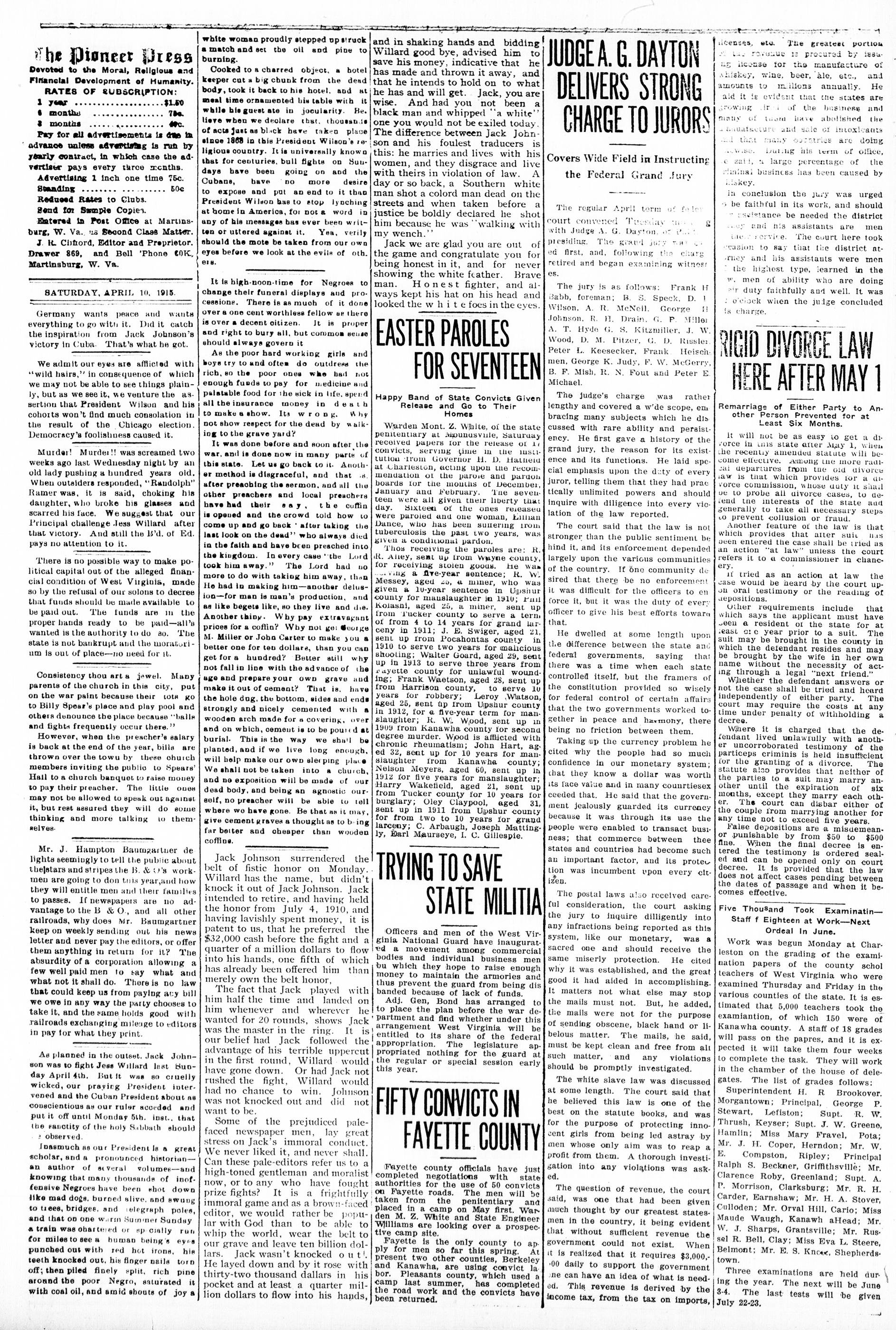
The Pioneer Press
Devoted to the Moral, Religious and
Financial Development of Humanity.
RATES OF SUBSCRIPTION:
1 year ..... $1.50
6 months ..... 75c.
3 months ..... 40c.
Pay for all advertisements is due in
advance unless advertising is run by
yearly contract, in which case the ad-
vertiser pays every three months.
Advertising 1 inch one time 75c.
Standing ..... 50c
Reduced Rates to Clubs.
Send for Sample Copies.
Entered in Post Office at Martinsburg, W. Va. as Second Class Matter. J. K. Clifford, Editor and Proprietor. Drawer 869, and Bell 'Phone 60K, Martinsburg, W. Va.
SATURDAY, APRIL 10, 1915
Germany wants peace and wants everything to go with it. Did it catch the inspiration from Jack Johnson's victory in Cuba. That's what he got.
We admit our eyes are afflicted with "wild hairs," in consequence of which we may not be able to see things plainly, but as we see it, we venture the assertion that President Wilson and his cohorts won't find much consolation in the result of the Chicago election. Democracy's foolishness caused it.
Murder! Murder!! was screamed two weeks ago last Wednesday night by an old lady pushing a hundred years old. When outsiders responded, "Randolph" Ramer was, it is said, choking his daughter, who broke his glasses and scarred his face. We suggest that our Principal challenge Jess Willard after that victory. And still the B'd. of Ed. pays no attention to it.
There is no possible way to make political capital out of the alleged financial condition of West Virginia, made so by the refusal of our solons to decree that funds should be made available to be paid out. The funds are in the proper hands ready to be paid—all's wanted is the authority to do so. The state is not bankrupt and the moratorium is out of place—no need for it.
Consistency thou art a jewel. Many parents of the church in this city, put on the war paint because their tots go to Billy Spear's place and play pool and others denounce the place because "balls and fights frequently occur there."
However, when the preacher's salary is back at the end of the year, bills are thrown over the town by these church members inviting the public to Spears' Hall to a church banquet to raise money to pay their preacher. The little ones may not be allowed to speak out against it, but rest assured they will do some thinking and more talking to themselves.
Mr. J. Hampton Baumgartner delights seemingly to tell the public about the stars and stripes the B. & O.'s workmen are going to don this year, and how they will entitle men and their families to passes. If newspapers are no advantage to the B & O., and all other railroads, why does Mr. Baumgartner keep on weekly sending out his news letter and never pay the editors, or offer them anything in return for it? The absurdity of a corporation allowing a few well paid men to say what and what not it shall do. There is no law that could keep us from paying any bill we owe in any way the party chooses to take it, and the same holds good with railroads exchanging mileage to editors in pay for what they print.
As planned in the outset, Jack Johnson was to fight Jess Willard last Sunday April 4th. But it was so cruelly wicked, our praying President intervened and the Cuban President about as conscientious as our ruler acceded and put it off until Monday 5th. inst., that the sanctity of the holy Sabbath should be observed.
Inasmuch as our President is a great scholar, and a pronounced historian—an author of several volumes—and knowing that many thousands of inoffensive Negroes have been shot down like mad dogs, burned alive, and swung to trees, bridges, and telegraph poles, and that on one warm Summer Sunday a train was obartered or specially run for miles to see a human being's eyes punched out with red hot irons, his teeth knocked out, his finger nails torn off; then piled finely split, rich pine around the poor Negro, saturated it with coal oil, and amid shouts of joy a
white woman proudly stepped up struck a match and set the oil and pine to burning.
Cooked to a charred object, a hotel keeper cut a big chunk from the dead body, took it back to his hotel, and at meal time ornamented his table with it while his guest ate in jocularity. Believe when we declare that, thousands of acts just as block have taken place since 1868 in this President Wilson's religious country. It is universally known that for centuries, bull fights on Sundays have been going on and the Cubans, have no more desire to expose and put an end to it than President Wilson has to stop lynching at home in America, for not a word in any of his messages has ever been written or uttered against it. Yea, verily should the mote be taken from our own eyes before we look at the evils of others.
It is high-noon-time for Negroes to change their funeral displays and processions. There is as much of it done over a one cent worthless fellow as there is over a decent citizen. It is proper and right to bury all, but common sense should always govern it.
As the poor hard working girls and boys try to and often do outdress the rich, so the poor ones who had not enough funds to pay for medicine and palatable food for the sick in life, spend all the insurance money in death to make a show. Its wrong. Why not show respect for the dead by walking to the grave yard?
It was done before and soon after the war, and is done now in many parts of this state. Let us go back to it. Another method is disgraceful, and that is after preaching the sermon, and all the other preachers and local preachers have had their say, the coffin is opened and the crowd told how to come up and go back after taking the last look on the dead" who always died in the faith and have been preached into the kingdom. In every case "the Lord took him away." The Lord had no more to do with taking him away, than He had in making him—another delusion—for man is man's production, and as like begets like, so they live and die. Another thing. Why pay extravagant prices for a coffin? Why not get George M. Miller or John Carter to make you a better one for ten dollars, than you can get for a hundred? Better still why not fall in line with the advance of the age and prepare your own grave and make it out of cement? That is, have the hole dug, the bottom, sides and ends strongly and nicely cemented with a wooden arch made for a covering, over and on which, cement is to be poured at burial. This is the way we shall be planted, and if we live long enough, will help make our own sleeping place. We shall not be taken into a church, and no exposition will be made of our dead body, and being an agnostic ourself, no preacher will be able to tell where we have gone. Be that as it may, give cement graves a thought as to being far better and cheaper than wooden coffins.
Jack Johnson surrendered the belt of fistic honor on Monday. Willard has the name, but didn't knock it out of Jack Johnson. Jack intended to retire, and having held the honor from July 4, 1910, and having lavishly spent money, it is patent to us, that he preferred the $32,000 cash before the fight and a quarter of a million dollars to flow into his hands, one fifth of which has already been offered him than merely own the belt honor.
The fact that Jack played with him half the time and landed on him whenever and wherever he wanted for 20 rounds, shows Jack was the master in the ring. It is our belief had Jack followed the advantage of his terrible uppercut in the first round, Willard would have gone down. Or had Jack not rushed the fight, Willard would had no chance to win. Johnson was not knocked out and did not want to be.
Some of the prejudiced palefaced newspaper men, lay great stress on Jack's immoral conduct. We never liked it, and never shall. Can these pale-editors refer us to a high-toned gentleman and moralist now, or to any who have fought prize fights? It is a frightfully immoral game and as a brown-faced editor, we would rather be popular with God than to be able to whip the world, wear the belt to our grave and leave ten billion dollars. Jack wasn't knocked out! He layed down and by it rose with thirty-two thousand dollars in his pocket and at least a quarter million dollars to flow into his hands,
and in shaking hands and bidding Willard good bye, advised him to save his money, indicative that he has made and thrown it away, and that he intends to hold on to what he has and will get. Jack, you are wise. And had you not been a black man and whipped "a white" one you would not be exiled today. The difference between Jack Johnson and his foulest traducers is this: he marries and lives with his women, and they disgrace and live with theirs in violation of law. A day or so back, a Southern white man shot a colord man dead on the streets and when taken before a justice be boldly declared he shot him because he was "walking with my wench."
Jack we are glad you are out of the game and congratulate you for being honest in it, and for never showing the white feather. Brave man. Honest fighter, and always kept his hat on his head and looked the white foes in the eyes.
EASTER PAROLES FOR SEVENTEEN
Happy Band of State Convicts Given Release and Go to Their Homes
Warden Mont. Z. White, of the state penitentiary at Mountsville, Saturday received papers for the release of 14 convicts, serving time in the institution from Governor H. D. Hatnend at Charleston, acting upon the recommendation of the parole and pardon boards for the months of December, January and February. The seventeen were all given their liberty that day. Sixteen of the ones released were paroled and one woman, William Dance, who has been suffering from tuberculosis the past two years, was given a conditional pardon.
Thos receiving the paroles are: R. R. Alley, sent up from Wayne county, for receiving stolen goods. He was saving a five-year sentence; R. W. Messey, aged 25, a miner, who was given a 10-year sentence in Upshur county for manslaughter in 1910; Phil Kolasni, aged 25, a miner, sent up from Tucker county to serve a term of from 4 to 14 years for grand larceny in 1911; J. E. Swiger, aged 21, sent up from Pocahontas county in 1910 to serve two years for malicious shooting; Walter Goard, aged 29, sent up in 1913 to serve three years from Rayette county for unlawful wounding; Frank Waetson, aged 28, sent up from Harrison county, to serve 10 years for robbery; Leroy Watson, aged 25, sent up from Upshur county in 1912, for a five-year term for manslaughter; R. W. Wood, sent up in 1909 from Kanawha county for second degree murder. Wood is afflicted with chronic rheumatism; John Hart, aged 32, sent up for 10 years for manslaughter from Kanawha county; Nelson Meyers, aged 60, sent up in 1912 for five years for manslaughter; Harry Wakefield, aged 21, sent up from Tucker county for 10 years for burglary; Oley Claypool, aged 31, sent up in 1911 from Upshur county for from two to 10 years for grand larceny; C. Arbaugh, Joseph Mattingly, Earl Maurseye, I. C. Gillespie.
TRYING TO SAVE STATE MILITIA
TRYING TO SAVE STATE MILITIA
Officers and men of the West Virginia National Guard have inaugurated a movement among commercial bodies and individual business men bu which they hope to raise enough money to maintain the armories and thus prevent the guard from being disbanded because of lack of funds. Adj. Gen, Bond has arranged to place the plan before the war department and find whether under this arrangement West Virginia will be entitled to its share of the federal appropriation. The legislature appropriated nothing for the guard at the regular or special session early this year.
FIFTY CONVICTS IN FAYETTE COUNTY
Fayette county officials have just completed negotiations with state authorities for the use of 50 convicts on Fayette roads. The men will be taken from the penitentiary and placed in a camp on May first. Warden M. Z. White and State Engineer Williams are looking over a prospective camp site. Fayette is the only county to apply for men so far this spring. At present two other counties, Berkeley and Kanawha, are using convict labor. Pleasants county, which used a camp last summer, has completed the road work and the convicts have been returned.
JUDGE A. G. DAYTON DELIVERS STRONG CHARGE TO JURORS
Covers Wide Field in Instructing the Federal Grand Jury
The regular April term of felon court convened Tuesday morning with Judge A. G. Dayton, of Patterson presiding. The grand jury was convened first, and, following the charge retired and began examining witnesses.
The jury is as follows: Frank H Babb, foreman; B. S. Speck, D. I Wilson, A. R. McNeil, George H Johnson, R. H. Drain, G. P. Miller A. T. Hyde G. S. Kitzmiller, J. W Wood, D. M. Pitzer, G. D. Rissler Peter L. Keesecker, Frank Heischmen, George K. Judy, F. W. McGerry B. F. Mish, R. N. Fout and Peter E Michael.
The judge's charge was rather lengthy and covered a wide scope, embracing many subjects which he discussed with rare ability and persistency. He first gave a history of the grand jury, the reason for its existence and its functions. He laid special emphasis upon the duty of every juror, telling them that they had practically unlimited powers and should inquire with diligence into every violation of the law reported.
The court said that the law is not stronger than the public sentiment be hind it, and its enforcement depended largely upon the various communities of the country. If one community desired that there be no enforcement it was difficult for the officers to enforce it, but it was the duty of every officer to give his best efforts toward that.
He dwelled at some length upon the difference between the state and federal governments, saying that there was a time when each state controlled itself, but the framers of the constitution provided so wisely for federal control of certain affairs that the two governments worked together in peace and harmony, there being no friction between them.
Taking up the currency problem he cited why the people had so much confidence in our monetary system; that they know a dollar was worth its face value and in many counrtiesexceeded that. He said that the government jealously guarded its currency because it was through its use the people were enabled to transact business; that commerce between the states and countries had become such an important factor, and its protection was incumbent upon every citizen.
The postal laws also received careful consideration, the court asking the jury to inquire diligently into any infractions being reported as this system, like our monetary, was a sacred one and should receive the same miserly protection. He cited why it was established, and the great good it had aided in accomplishing. It matters not what else may stop the mails must not. But, he added, the mails were not for the purpose of sending obscene, black hand or libelous matter. The mails, he said, must be kept clean and free from all such matter, and any violations should be promptly investigated.
The white slave law was discussed at some length. The court said that he believed this law is one of the best on the statute books, and was for the purpose of protecting innocent girls from being led astray by men whose only aim was to reap a profit from them. A thorough investigation into any violations was asked.
The question of revenue, the court said, was one that had been given much thought by our greatest statesmen in the country, it being evident that without sufficient revenue the government could not exist. When it is realized that it requires $3,000,-00 daily to support the government one can have an idea of what is needed. This revenue is derived by the income tax, from the tax on imports.
licenses, etc. The greatest portion of the revenue is procured by issuing license for the manufacture of whiskey, wine, beer, ale, etc., and amounts to millions annually. He said it is evident that the states are growing first of the business and many of them have abolished the manufacture and sale of intoxicants and that many countries are doing likewise. During his term of office, he said, a large percentage of the criminal business has been caused by hiskey.
in conclusion the jury was urged to be faithful in its work, and should in assistance be needed the district jury and his assistants are men in the service. The court here took occasion to say that the district attorney and his assistants were men in the highest type, learned in the law, men of ability who are doing air duty faithfully and well. It was no clock when the judge concluded is charge.
RIGID DIVORCE LAW HERE AFTER MAY 1
Remarriage of Either Party to Another Person Prevented for at Least Six Months.
It will not be as easy to get a divorce in this state after May 1, when the recently amended statute will become effective. Among the more radical departures from the old divorce law is that which provides for a divorce commission, whose duty it shall be to probe all divorce cases, to defend the interests of the state and generally to take all necessary steps to prevent collusion or fraud.
Another feature of the law is that which provides that alter suit has been entered the case shall be tried as an action "at law" unless the court refers it to a commissioner in chancery.
If tried as an action at law the case would be heard by the court upon oral testimony or the reading of depositions. Other requirements include that which says the applicant must have been a resident or the state for at least one year prior to a suit. The suit may be brought in the county in which the defendant resides and may be brought by the wife in her own name without the necessity of acting through a legal "next friend." Whether the defendant answers or not the case shall be tried and heard independently of either party. The court may require the costs at any time under penalty of withholding a decree.
Where it is charged that the defendant lived unlawrfully with another uncorroborated testimony of the particeps criminis is held insufficient for the granting of a divorce. The statute also provides that neither of the parties to a suit may marry another until the expiration of six months, except they marry each other. The court can disbar either of the couple from marrying another for any time not to exceed five years. False depositions are a misuseanor punishable by from $50 to $500 fine. When the final decree is entered the testimony is ordered sealed and can be opened only on court decree. It is provided that the law does not affect cases pending between the dates of passage and when it becomes effective.
Five Thousand Took Examinatin— Staff f Eighteen at Work—Next Ordeal in June.
Work was begun Monday at Charleston on the grading of the examination papers of the county school teachers of West Virginia who were examined Thursday and Friday in the various counties of the state. It is estimated that 5,000 teachers took the examination, of which 150 were of Kanawha county. A staff of 18 grades will pass on the papres, and it is expected it will take them four weeks to complete the task. They will work in the chamber of the house of delegates. The list of grades follows:
Superintendent H. R Brookover; Morgantown; Principal, George P. Stewart, Lefiston; Supt. R. W. Thrush, Keyser; Supt. J. W. Greene, Hamlin; Miss Mary Fravel, Pota; Mr. J. H. Coper, Herndon; Mr. W. E. Compston, Ripley; Principal Ralph S. Beckner, Griffithsville; Mr. Clarence Roby, Greenland; Supt. A. P. Morrison, Clarksburg; Mr. R. H. Carder, Earnshaw; Mr. H. A. Stover, Culloden; Mr. Orval Hill, Carlo; Miss Maude Waugh, Kanawh aHead; Mr. W. J. Sharps, Grantsville; Mr. Russel R. Bell, Clay; Miss Eva L. Steere, Belmont; Mr. E. S. Knox, Shepherdstown.
Three examinations are held during the year. The next will be June 3-4. The last tests will be given July 22-23.
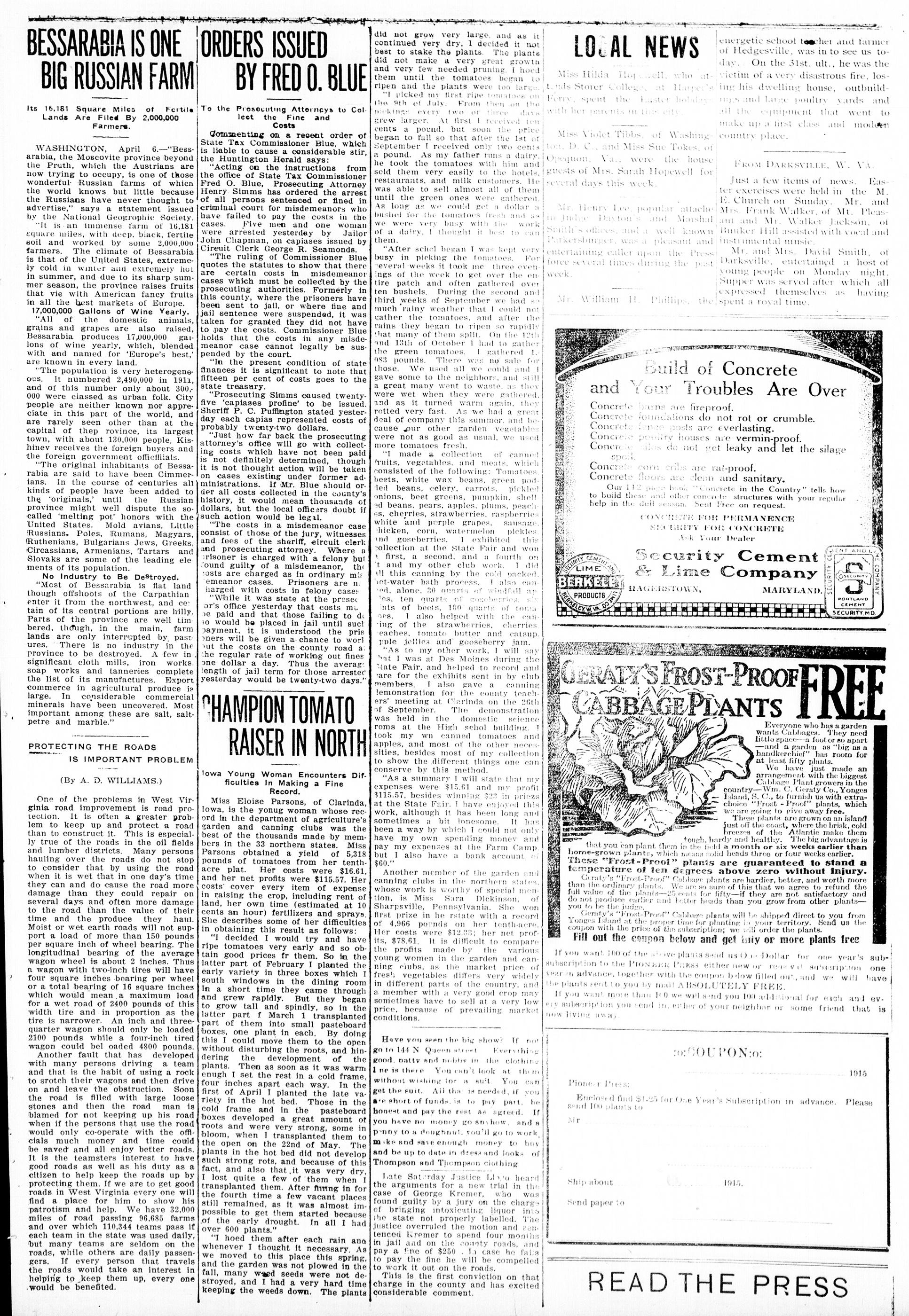
BESSARABIA IS ONE
BIG RUSSIAN FARM
WASHINGTON, April 6.—'Bess-
arabia, the Moscovite province beyond
the Pruth, which the Austrians are
now trying to occupy, is one of those
wonderful’ Russian farms of whicn
the world knows but little because
the Russians have never thought to
advertise,” says a statement issued
by the National Geoxrophic Society.
“It is-um immense farm of 16,181
equare iniles, with deep, black, fertile
soil and worked by some 2,000,000
farmers. The climate of Bessarabia
is that of the United States, extreme-
ly cold in winter aad extremely hot
in summer, and due to its sharp sum-
mer season, the province raises fruits
that vie with American fancy fruits
in all the best markets of Kurope.
17,000,000 Gallons of Wine Yearly.
“AIL of the domestic animals,
grains and grapes are also raised,
Bessarabia produces 17,000,000 — gat-
Jons of wine yearly, which, blended
with and named for ‘Europe’s best,’
are known in every land.
“The population is very heterogene-
ous. It numbered 2,490,000 in 191:,
and of this number only about 300;
000 were classed as urban folk. City
People are neither known nor appre-
ciate in this part of the world, and
are rarely seen other than at the
capital of thep rovince, its largest
town, with about 130,000 people, Kis-
hinev receives the foreign buyers and
the foreign government offictliials.
“The original inhabitants of Bessa-
rabia are said to have been Cimmer-
ians. In the course of centuries alt
kinds of people have been added to
the ‘originals,’ until the Russian
province might well dispute the so-
called ‘melting pot’ honors with the
United States. Mold avians, Little
‘Russians, Poles, Rumans, Magyars,
Ruthenians, Bulgarians Jews, Greeks,
Circassians, Armenians, Tartars and
Slovaks are some of the leading ele
ments of its population.
No Industry to Be DeStroyed.
“Most of Bessarabia is flat land
though offshoots of the Carpathian
enter it from the northwest, and ce:
tain of its central portions are hilly.
Parts of the province are well tim
bered, thdugh, in the main, farm
lands are oaly interrupted by, pas:
ures. There is no industry in the
province to be destroyed. A few in
significant cloth mills, iron works.
soap works and tanneries complete
the list of its manufactures. Export
commerce in agricultural produce is
large. In considerable commercial
minerals have been uncovered. Most
important among these are salt, salt-
petre and marble.”
PROTECTING THE ROADS
1S IMPORTANT PROBLEM
(By A. D. WILLIAMS.)
One of the problems in West Vir-
ginia road improvement is road pro-
tection. It is often a greater prob-
lem to keep up and protect a road
than to construct it. This is especial-
ly true of the roads in the oil fields
and lumber districts. Many persons
hauling over the roads do not stop
to consider that by using the road
when it is wet that in one day's time
they can and do cause the road more
damage than they could repair on
several days and often more damage
to the road than the value of their
time and the produce they haul.
Moist or wet earth roads will not sup-
port a load of more than 150 pounds
per square inch of wheel bearing. The
longitudinal bearing of the average
wagon wheel is about 2 inches. Thus
a wagon with two-inch tires will have
four square inches bearing per wheel
or a total bearing of 16 square inches
which would mean,.a maximum load
for a wet road of 2400 pounds of this
width tire and in proportion as the
tire is narrower. An inch and three-
quarter wagon should only be loaded
2100 pounds while a four-inch tired
wagon could bel oaded 4800 pounds.
Another fault that has developed
with many persons driving a team
and that is the habit of using a rock
to srotch their wagons and then drive
on and leave the obstruction. Soon
the road is filled with large loose
stones and then the road man is
blamed for not keeping up his road
when if the persons that use the road
would only co-operate with the offi-
cials much money and time could
be saved and all enjoy better roads.
It is the teamsters interest to have
good roads as well as his duty as a
citizen to help keep the roads up by
protecting them. If we are to get good
roads in West Virginia every one will
find a place for him to show his
patrotism and help. We have 32,000
miles of road passing 96,685 farms
and over which 110,344 teams pass if
each team in the state was used daily,
‘but many teams are seldom on the
roads, while others are daily passen-
gers. If every person that travels
the roads would take an interest in
helpirig to keep them up, every one
-would be benefited.
ORDERS ISSUED
BY FRED O. BLUE
Gommenting on a recent order of
State Tax Commissioner Blue, which
is liable to cause a considerable stir,
the Huntington Herald says:
“Acting om the instructions from
the office of State Tax Commissioner
Fred O. Blue, Prosecuting Attorney
Henry Simms has ordered the arrest
of all persons sentenced or fined in
criminal court for misdemeanors who
have failed to pay the costs in tho
cases. Five men and one woman
were arrested yesterday by Jailor
John Chapman, on capiases issued by
Cireuit Clerk George R. Seamonds.
“The ruling of Commissioner Blue
quotes the statutes to show that there
are certain costs in misdemeanor
cases which must be collected by the
prosecuting authorities. Formerly in
this county, where the prisoners have
been sent to jail, or where fine and
jail sentence were suspended, it was
taken for granted they did not have
to pay the costs. Commissioner Blue
holds that the costs in any misde-
meanor case cannot legally be sus-
pended by the court.
“Ia the present condition of state
finances it is signiflcant to note that
fifteen per cent of costs goes to the
state treasury.
“Prosecuting Simms caused twenty-
five ‘capiases profine’ to be issued.
Sheriff P. C. Puffington stated yester-
day each capias represented costs of
probably twenty-two dollars.
“Just how far back the prosecuting
attorney’s office will go with collect:
ing costs which have not been paid
is not definitely determined, though
it is not thought action will be taken
on cases existing under former ad-
ministrations. If Mr. Blue should or-
der all costs collected in the county's
history, it would mean thousands of
dollars, but the local officers doubt if
such action would be legal.
“The costs in a misdemeanor case
consist of those of the jury, witnesses
and fees of the sheriff, eircuit clerk
and prosecuting attorney. Where a
risoner is charged with a felony but
‘ound guilty of a misdemeanor, th:
‘osts are charged as in ordinary mis
emeanor cases. Prisoners are n
harged with costs in felony cases
“While it was state at the prosec
or's office yesterday that costs mu
ve paid and that those failing to d
so would be placed in jail until suc!
oayment, it is understood the pris
oners will be given a chance to worl
nut the costs on the county road a.
che regular rate of working out fines
one dollar a day. Thus the averag:
tength of jail term for those arrester
yesterday would be twenty-two days.”
"HAMPION TOMATO
RAISER IN HORT
Miss Eloise Parsons, of Clarinda,
lowa, is the yonug woman whose rec-
ord in the department of agriculture’s
garden and canning clubs was the
best of the thousands made by mem-
bers in the 33 northern states. Miss
Parsons obtained a yield of 5,318
pounds of tomatoes from her tenth-
acre plat. Her costs were $16.61,
and her net profits were $115.57. Her
‘costs’ cover every item of expense
in raising the crop, including rent of
land, her own time (estimated at 10
cents an hour) fertilizers and sprays.
She describes some of her difficulties
in obtaining this result as follows:
“I decided I would try and have
ripe tomatoes very early and so ob-
tain good prices fr them. So in the
latter part of February I planted the
early variety in three boxes which T
south windows in the dining room
In a short time they came through
and grew rapidly. But they began
to grow tall and spindly, so in the
latter part f March 1 transplanted
part of them into small pasteboard
boxes, one plant in each. By doing
this 1 could move them to the open
without disturbing the roots, and hin-
dering the development of the
plants. Then as soon as it was warm
enugh T set the rest in a cold frame,
four inches apart each way. In the
first of April I planted the late va-
Tiety in the hot bed. Those in the
cold frame and in the pasteboara
boxes developed a great amount of
Toots and were very strong, some in
bloom, when I transplanted them to
the open on the 22nd of May. The
plants in the hot bed did not develop
such strong rots, and because of this
fact, and also that it was very dry,
I lost quite a few of them when I
transplanted them. After fiirmg in for
the fourth time a few vacant places
still remained, as it was almost im-
possible to get them started because
of the early drought. In all I had
over 600 plants.”
“I hoed them after each rain ana
whenever T thought {t necessary, As
we moved to this place this spring,
and the garden was not plowed in the
fall, many waed seeds were not de-
stroyed, and I had a very hard time
keeping the weeds down. The plants
Fest to stake the plants. Phe plante
‘did not make a very great growtn
and very few needed pruning. I hoed
them until the tomatoes beran io
ripen and the plants were too lar
“Lplcked my frst ripe tomatooe
The 8th oot July From then on the
mehinas every two or ee haves
grew Jarger. At first 1 received ten
cents a pornd, but soon the pric:
began to fall so that after the Ist of
September T received only two cents
# pound. As my father rans a dairy
he took the tomatoes with him and
sold them very easily to the hotels.
restaurants, and milk customers. He
was able to sell almost all of them
until the green ones were gathered
As long as we could get a dolar a
bushel Yor the Commtoes fresh and as
we were very busy with the work
of a dairy, Pthoneht it best to can
them.
“After schel began Twas kept very
busy in picking the fometoes, For
veveral weeks it took ime three even
ings of the week to get over the en
tire pateh and often gathered over
ten bushels, During the second and
third Weeks of September we had s+
much ‘rainy weather that | could not
sather the tomatoes, and after ihe
rains they began to ripen so rapids
hat many of them split. On the ttl
and HU1 of October 1 had to gather
the green tomatoes. 1 nathered 1
983 pounds. There wes no sale for
those. We used ail we could and |
gave some to the neighbors, and still
a great many went to waste, as they
were wet when they were gathered,
and as it turned warm again, thes
rotted very fast. As we had a great
deal of company this summar. and be.
cause ur other garden vegotah!
were not as good as usual, we used
more tomatoes fresh.
“I made a collection of canne?
‘ruits, vegetables, and meats, which
consisted of the following: Tomatoes
beets, white wax beans, green pod
led beans, celery, carrots, pickle,
onions, beet greens, pumpkin, shel!
ad beans. pears, apples, plums, peach.
es, cherries, strawberries, raspherries
white ‘and prrple grapes, sausage
chieken, corn, watermelon — pickle |
ind goseberries, 1 exhibited — this
collection at the State Fair and won
. first, a second, and a fourth on
t and my other club work. 1 did
U1 this canning by the cold vacked
iot-water bath process. | also can
od, alone, 80 amarts of ceindt al an |
‘es, ten quart Of qoneberries, s
nls of beets, 190 quarts of tonsa
aes. T also helped with the can
Sing of the strawherries, cherries
caches, tomate butter and catsup
| pple jellies and geoseberry jam,
| As to my other work, 1 will say
hat Twas at Des Moines during the
Mate Fair, and helped to record and
rare for the exhibits sent in by club
members, [ also gave a canning
‘femonstration for the county teach
ers’ meeting at (arinda on the 26th
jaf September. The demonstration
fwas held in the domestic — science
Toms at the High schol building. +
took my wn canned tomatoes and
apples, and most of the other neces
‘sities, besides most of my collection
to show the different things one can
conserve by this method.
“As a summary I will state that my
expenses were $15.61 and my. profit
$115.57, besides winning $22 in priczs|
at the State Fair. 1 have enjoyed this
work, although it has heen long and
sometimes a bit lonesome. It has
been a way by whieh T could not only
have my own spending money and
pay my expenses at the Farm Camp
but I also have a bank account «
$60."
Another member of the garden emi
canning clubs in the northern states.
whose work is worthy of special men
tion, is Miss Sara Dickinson, of |
Sharpsville, Pennsylvania. She won
first prize in he rstate with a record,
of 4,966 pornds on her tenth-acre.
Her costs were $12.05: her net prot. |
its, $78.61, I is diMeult to compare
the profits made by the — various
young women in the garden and can
ning ciubs, as the market price of
fresh vegetables differs very widely
in different parts of the country, and_
a@ member with a very good crop may |
sometimes have to sell at a very low
price, because of prevailing market,
conditions |
Have you seen the big shows Tf not
KOO TAN Qaeensreet Eversthiog
good. natty And nebhe in the clothiny
Tne is there You can't look at ther
without wishing for a aut You can
get the suit, Ail the i needed, if vou
are short of funds. ia to pay part. be
honest and pay the rest aa ageend. If
you have no money goanyhow, anda
Penny tow doughnut, roull go to work,
mike and save enough money to boy
and be up to date in dressand looks of
Thompson and Thempaon clothing
Wate Saterday Justice Llyra heard
the arguments for a new trial in the
case of George Kremer, who was
found guilty by a jury on the chargs
of bringing intoxicating liquor ints
ihe state not properly labelled. ‘ihe
justice overruled the motion and sen.
tenced Kremer to spend four monilis
in jail aad on the county roads, and
pay a f'ne of $250 . Ia Case he fais
to pay the fine he will be compelled
to work it out on the roads.
This is the first conviction on that
charge in the county and has excited
considerable comment.
eee CA Nae eee A 8 8 § |e = =as Rat na Oke ae
Pep = Soe
Reeae pare se ITY Sipe
oe . ogo) 7 ORR TE re OR A
3 Sees +] £ RY
souild of Concrete ee
Ae and “‘vorr ‘Troubles Are Over “J
le Conerete Sarns are fireproof. Ae
Bie: = Concer rouecations do not rot or crumble. mS
Ee; Concrete ors Is arc everlasting, ie
mee: = Coney ‘ ry houses ave yermunprool. MH
Bes Cones do net vet leaky and let the silage iq
Roe spon fe
Fs Concer orn are vat-proof, a
2 Concrets 2 wee cleo and sanitary. be:
eu’ Our The pace bos. Concrete in the Country” tells how fs
ae to build the and oth concects structure: ith your regula hy
BIS! help inthe dull aetsan. Sent Hree-on recess Ce Teele ca
Be CONCHITE POR PERMANENCE :
be HebREPY POR CONCRETE
bi Lek Your Dealer at
Agia: Seeurity Cement {o—
Este 3) « inf Re
Wectime 6 Time Company fe Gecary lg
py SE AGinsrown, MARYLAND. i J z
Se), PRODUCTS Z= Pontiano.
OY a eee yy | CEMENT
Eager 2a eB Ph ecco
Bek £Rrse AD A, ST A SC a
sGoRATYS FROST-PR
Le Py By Sy foe
ie Sed US oh AL OOF
Bw on RNG ge
UABBAREPDANT i
my OS aH
Bo EME a
er ; Nene gree 4 =
ay 2 eee sli] Ul WS Everyone who has garden
pede AL & SRP jh wants Cabbages. They necd
BAS eM G Little space—a foot or ao apart
Bek Bae! /Y, V3 —— and a garden us “big as a
Pama Sia felt ; oe handkerchief” has room for
BGS = EG MH BA at least fifty planta.
BR ihe 2B ht , a Nf We have Just nade an
ee 4 Sp oo Zs, ' arrangement with the biggest:
ee RN AE GN, a Cabbase Viant growers in the
Ee SU ade VW, . country—Wm. C. Geraty Co., Yonges
an BES NZ we? Py Qe Bilan. C., to furnish us with extra~
ARGU em, = choice’ “Hrost - Proof” plants, which
mR LZ yy 05 we are foing to pive away free.
a era! 7 he \ These plants are grown on an island
i morse em / yg just off the cou: ty where the brisk, cold
Fe ARETE, Sti, rreezes of the Atlantic make them
34 em et donalichiontly anil Healthy, ‘Theble advantage ts
thet you can plant, ther in the jicld a month or six weeks earlier than
mA home-grown plants, whieh means solid heads three or four weeks earlier.
td ‘Pliese “Frost-Prooi” planis are guaranteed to stand a
Wd temperature of ten degrees above zero without injury.
Ky Gorty's “Vroot-Proof” Cabbage plants are hardier, better, and worth more
fee than the ordinary plunt We are so sure of this that we agree to refund the
Big fall velue of the planis—zh cents for fifty—if they are not satisfactory and
Bay COOL potuee cattier vod better heads than you grow from other plints—
WA you to he the jude
fae! Geraty's “Frost-Proof” Cabbage plants will Le shipped direct to you: from
Bg) Yonees Gland at the proper tine for planting. in your. territory. Bend us the
ta a ! i
Ba coupon with the price of the subseription; we will order the plants.
2 Fill out the eonoa below and get iaiy or more plants free
If you want 100 0f the above plants sead us Ou Dollar for ane year’s subs
subscription to the PioNien Pikss either newor rene vil an soripiion one
sear in advance, together with the coupon below Glled out, and we will have
hy plants rect lo you by mail ABSOLUTELY FREE
Hyon want more thaw 160 we will send you 100 addiioual for eich and eve
Hy Subscription you send in, either of your neighbor or some Criend thab is
iow Tiving awa
or SOU PON:o:
1915
Pion t Pre
Enclosed find $1.25 for Ose Year Subscription in advance. Please
send 100 plants to
Ship about 191s,
Send papor so
READ THE PRESS
LO.AL NEWS
energetic school tegcher and farmer
of Hledgesville, was in to see us to-
day. On the 3st. ult., he was the
ictiin of a very disastrous fire, los-
ing his dwelling house, outbuild
sad laree poultry wards and
HW the eetpiment Uhat went to
Make up dirst class and imodeen
country: place. .
Prom Dagksvinte, W.VA
Justa few items of news. Eas
ter exercises were held in the = M
WH. Church on Sunday. Mr. and
Mis. Prank Walker, of Mtl Meas
mtn Mia. Walker dackson, of
Bioiker Tan assisted with wood aad
Mustvimental music
Mroand Mis. David) Sinith, of
Darksville, entertaingd a) host of
young people on Monday might.
Supper was served after which all
expressed themselves as having:
spent a roval time