The Pioneer Press
Saturday, March 11, 1916
Martinsburg, West Virginia
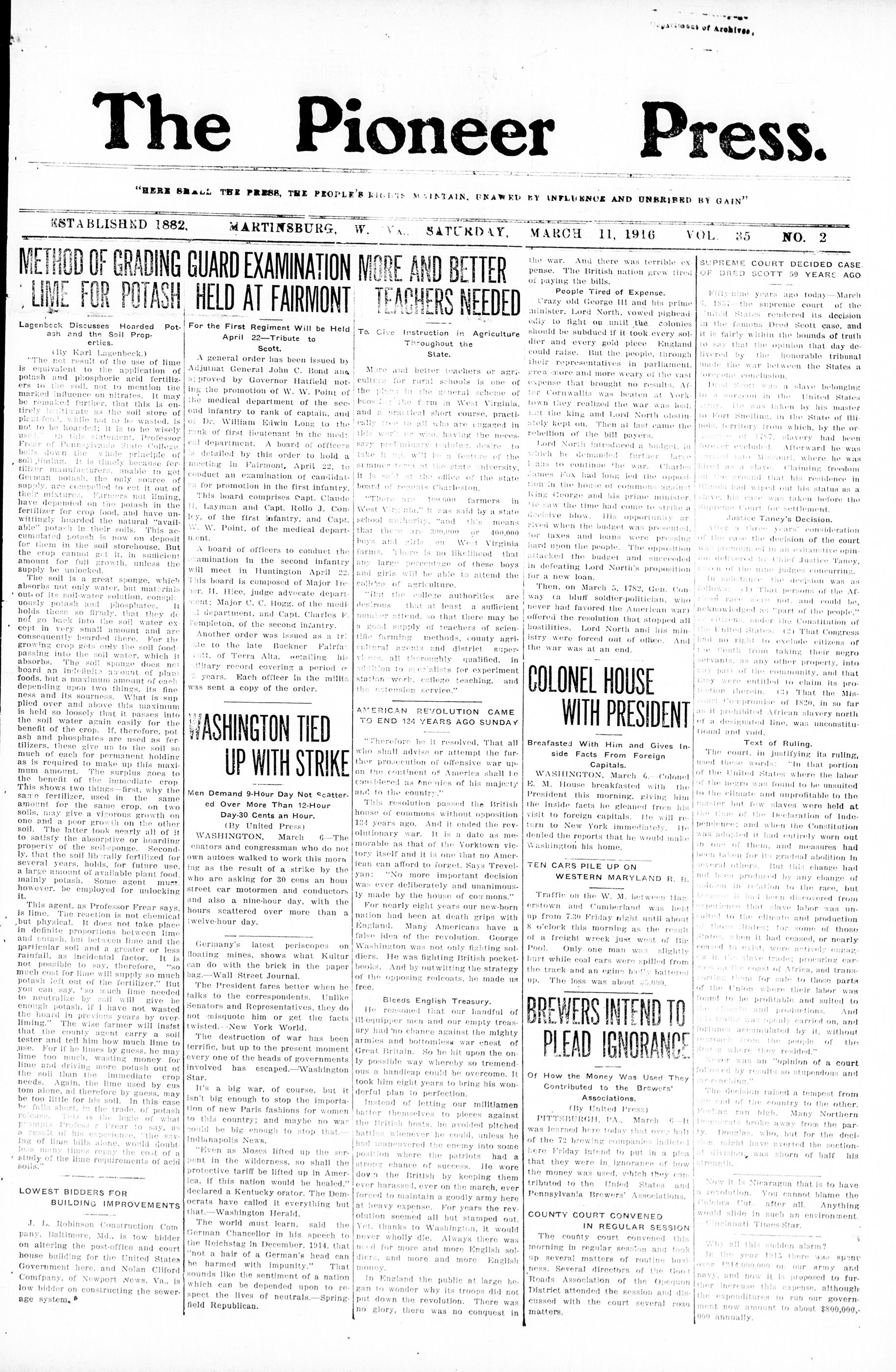
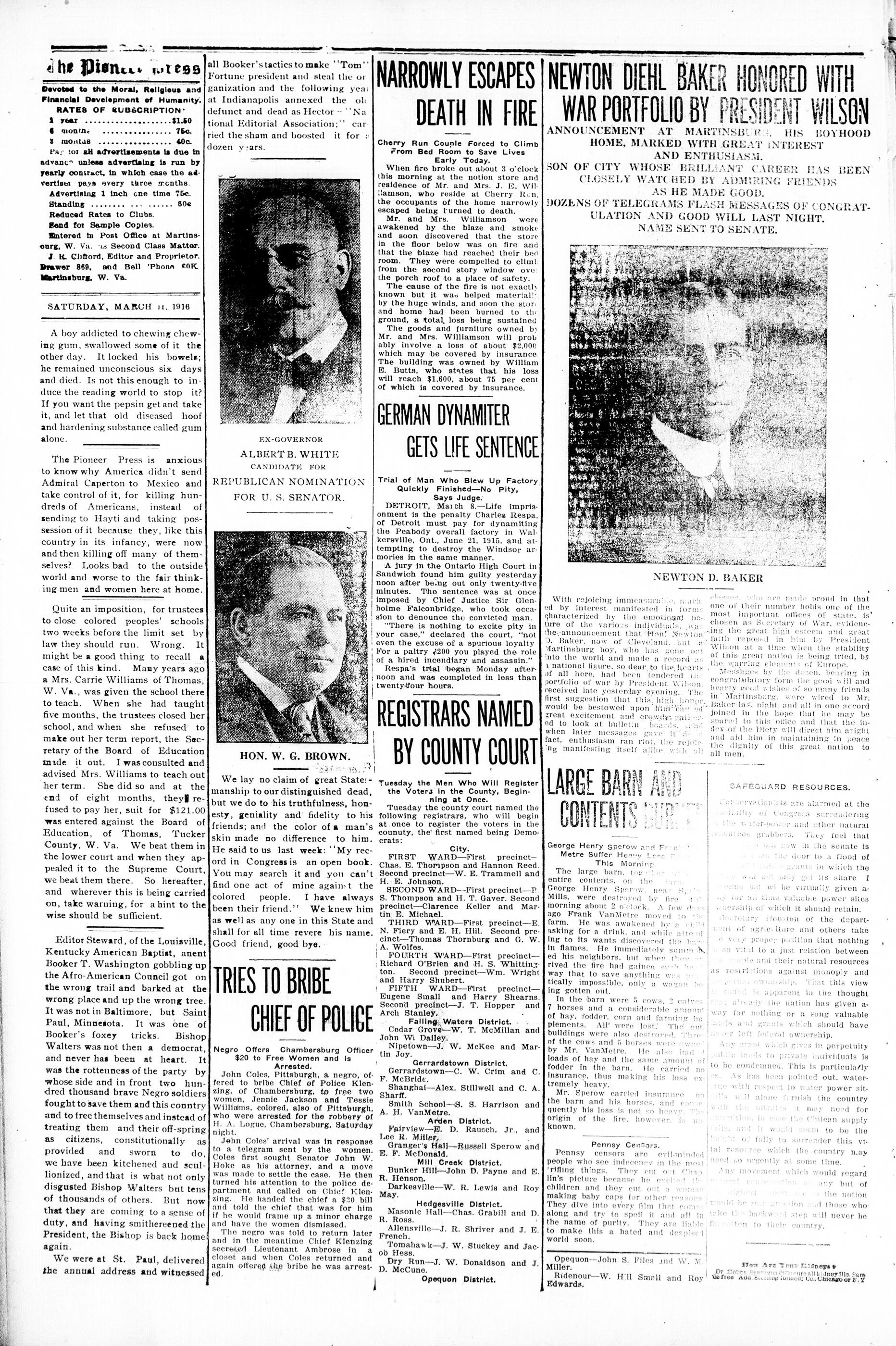
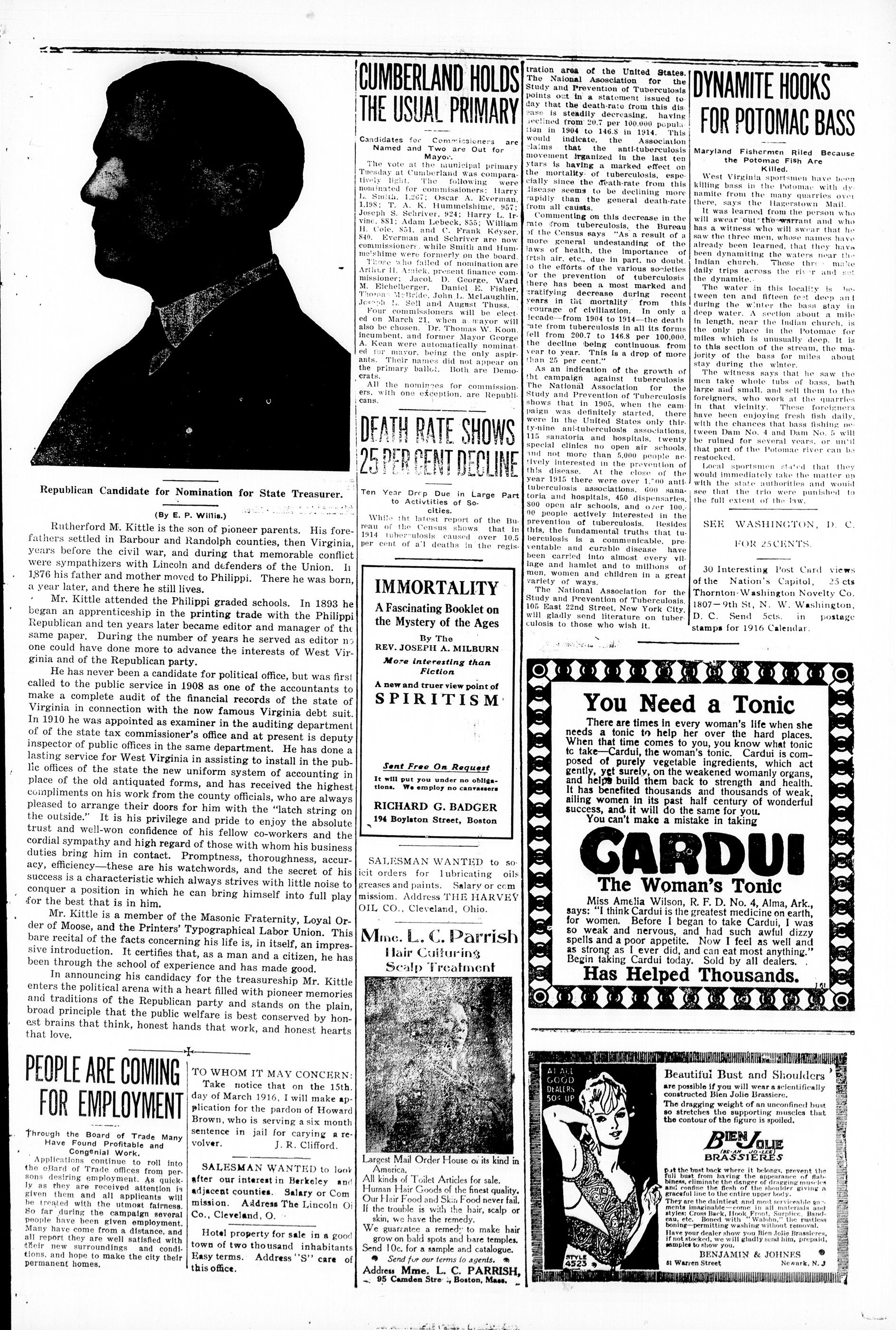
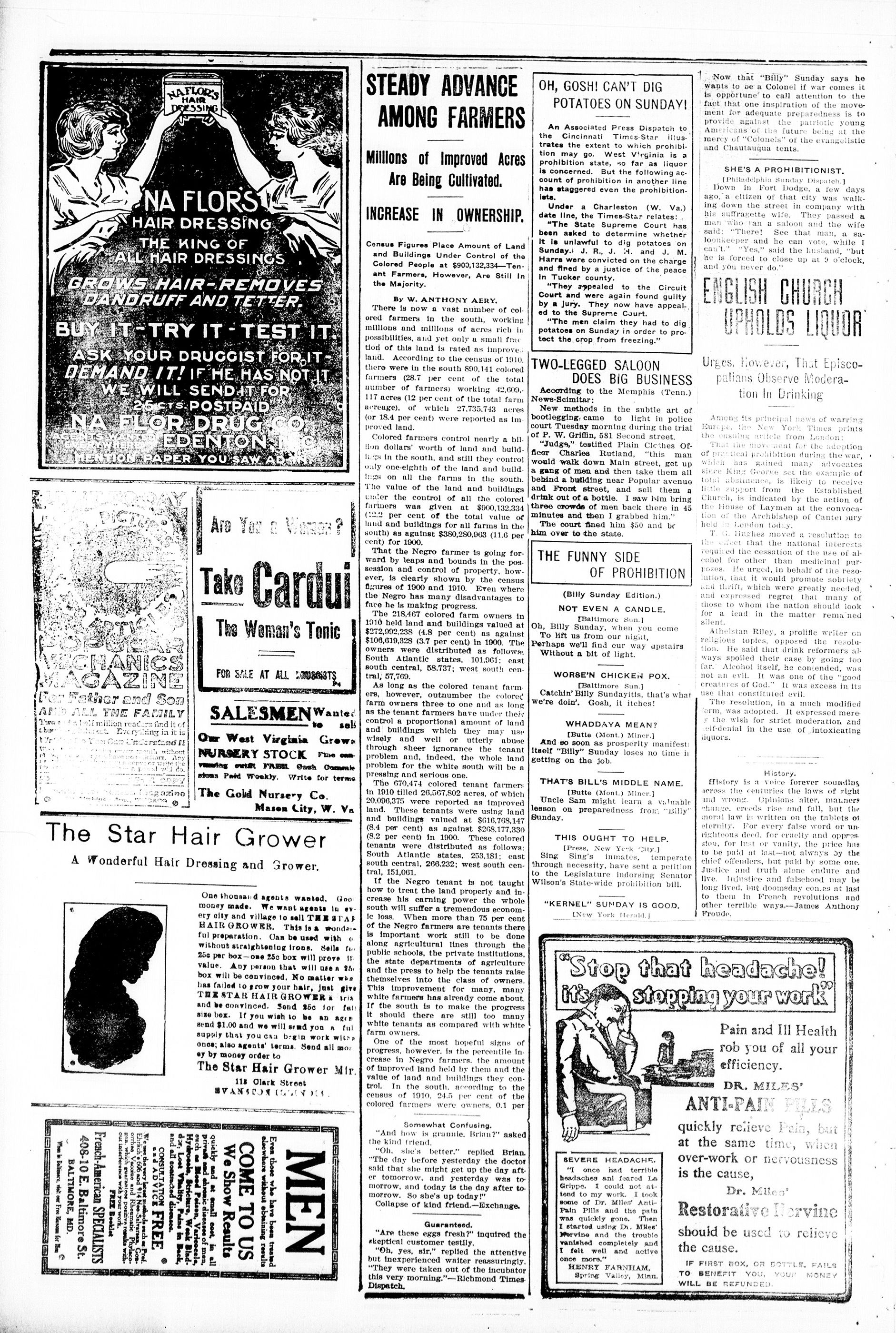
Page text (machine-generated)
The Pioneer Press.
"HERE SMALL THE PRESS, THE PEOPLE'S RIGHTS MAINTAIN, DRAWED BY INFLUENCE AND UNBRIBED BY GAIN"
ESTABLISHED 1882
Lagenbeck Discusses Hoarded Potash and the Soil Properties.
(By Karl Lagenheck)
"The net result of the use of lime is equivalent to the application of potash and phosphoric acid fertilizers to the soil, not to mention the marked influence on nitrates. It may be remaked further, that this is entirely legitimate as the soil store of plant food, while not to be wasted, is not to be hoarded; it is to be wisely used" in this statement. Professor Frear of Pennsylvania State College, boils down the whole principle of soil liming. It is timely because fertilizer manufacturers, unable to get German potash, the only source of supply, are compelled to cut it out of their mixtures. Farmers not liming, have depended on the potash in the fertilizer for crop food, and have unwittingly hoarded the natural "available" potash in their soils. This accumulated potash is now on deposit for them in the soil storehouse. But the crop cannot get it, in sufficient amount for full growth, unless the supply be unlocked.
The soil is a great sponge, which absorbs not only water, but materials out of its soil-water solution, conspicuously potash and phosphates. It holds these so firmly, that they do not go back into the soil water except in very small amount and are consequently boarded there. For the growing crop gets only the soil food, passing into the soil water, which it absorbs. The soil sponge does not board an indefinite amount of plant foods, but a maximum amount of each, depending upon two things, its fineness and its sourness. What is supplied over and above this maximum is held so loosely that it passes into the soil water again easily for the benefit of the crop. If, therefore, potash and phosphates are used as fertilizers, these give up to the soil so much of each for permanent holding as is required to make up this maximum amount. The surplus goes to the benefit of the immediate crop. This shows two things—first, why the same fertilizer, used in the same amount for the same crop, on two soils, may give a vigorous growth on one and a poor growth on the other soil. The latter took nearly all of it to satisfy the absorptive or hoarding property of the soil-sponge. Secondly, that the soil liberally fertilized for several years, holds, for future use, a large amount of available plant food, mainly potash. Some agent must, however, be employed for unlocking it.
This agent, as Professor Frear says, is lime. The reaction is not chemical but physical. It does not take place in definite proportions between lime and potash, but between lime and the particular soil and a greater or less rainfall, as incidental factor. It is not possible to say, therefore, "so much cost for lime will supply so much potash left out of the fertilizer." But you can say, "so much lime needed to neutralize by soil will give be enough potash, if I have not wasted the hoard in previous years by overliming." The wise farmer will insist that the county agent carry a soil tester and tell him how much lime to use. For if he limes by guess, he may lime too much, wasting money for lime and driving more potash out of the soil than the immediate crop needs. Again, the lime used by custom alone, and therefore by guess, may be too little for his soil. In this case be falls short, in the trade, of potash release. This is the logic of what prompts Professor Frear to say, as a result of his experience, "the saving of lime bills alone, would doubtless many times repay the cost of a study of the lime requirements of acid soils."
LOWEST BIDDERS FOR BUILDING IMPROV
J. L. Robinson Construction Company. Baltimore, Md., is tow bidder on altering the post-office and court house building for the United States Government here, and Nolan Cliford Comfany, of Newport News, Va., is low bidder on constructing the sewerage system.
For the First Regiment Will be Held April 22—Tribute to
A general order has been issued by Adjutnat General John C. Bond and approved by Governor Hatfield noting the promotion of W. W. Point of the medical department of the second infantry to rank of captain, and of Dr. William Edwin Long to the rank of first lieutenant in the medical department. A board of officers is detailed by this order to hold a meeting in Fairmont, April 22, to conduct an examination of candidates for promotion in the first infantry. This board comprises Capt. Claude H. Layman and Capt. Rollo J. Conley, of the first infantry, and Capt. W. W. Point, of the medical department.
A board of officers to conduct the examination in the second infantry will meet in Huntington April 22. This board is composed of Major Freder, H. Hice, judge advocate department; Major C. C. Hogg, of the medical department, and Capt. Charles F. Templeton, of the second infantry. Another order was issued as a tribute to the late Buckner Fairfax, of Terra Alta, retailing his military record covering a period of 23 years. Each officer in the militia was sent a copy of the order.
WASHINGTON TIED UP WITH STRIKE
WASHINGTON TIED UP WITH STRIKE
Men Demand 9-Hour Day Not Scattered Over More Than 12-Hour Day-30 Cents an Hour.
(By United Press)
WASHINGTON, March 6—The enators and congressman who do not own autos walked to work this morning as the result of a strike by the who are asking for 30 cens an hour street car motormen and conductors and also a nine-hour day, with the hours scattered over more than a twelve-hour day.
Germany's latest periscopes on floating mines, shows what Kultur can do with the brick in the paper bag.—Wall Street Journal.
The President fares better when he talks to the correspondents. Unlike Senators and Representatives, they do not misquote him or get the facts twisted.—New York World.
The destruction of war has been terrific, but up to the present moment every one of the heads of governments involved has escaped.—Washington Star.
It's a big war, of course, but it isn't big enough to stop the importation of new Paris fashions for women to this country; and maybe no war could be big enough to stop that.—Indianapolis News.
"Even as Moses lifted up the serpent in the wilderness, so shall the protective tariff be lifted up in America, if this nation would be healed," declared a Kentucky orator. The Democrats have called it everything but that.—Washington Herald.
The world must learn, said the German Chancellor in his speech to the Reichstag in December, 1914, that "not a hair of a German's head can be harmed with impunity." That sounds like the sentiment of a nation which can be depended upon to respect the lives of neutrals.—Springfield Republican.
MORE AND BETTER TEACHERS NEEDED
To Give Instruction in Agriculture Throughout the State.
More and better teachers or agriculture for rural schools is one of the plans in the general scheme of boosting the farm in West Virginia, and a practical short course, practically free to all who are engaged in this work or who, having the necessary preliminary training, desire to take it up, will be a feature of the summer term at the state university. it is said at the office of the state board of regents Charleston.
"There are 100,000 farmers in West Virginia," it was said by a state school authority, "and this means that there are 300,000 or 400,000 boys and girls on West Virginia farms. There is no likelihood that any large percentage of these boys and girls will be able to attend the college of agriculture.
"But the college authorities are desirous that at least a sufficient number attend, so that there may be a good supply of teachers of scientific farming methods, county agricultural agents and district supervisors, all thoroughly qualified, in addition to specialists for experiment station work, college teaching, and the extension service."
AMERICAN REVOLUTION CAME TO END 134 YEARS AGO SUNDAY
"Therefore be it resolved. That all who shall advise or attempt the further prosecution of offensive war upon the continent of America shall be considered as enemies of his majesty and to the country."
This resolution passed the British house of commons without opposition 134 years ago. And it ended the revolutionary war. It is a date as memorable as that of the Yorktown victory itself and it is one that no American can afford to forget. Says Trevelyan: "No more important decision was ever deliberately and unanimously made by the house of commons."
For nearly eight years our new-born nation had been at death grips with England. Many Americans have a false idea of the revolution. George Washington was not only fighting soldiers. He was fighting British pocketbooks. And by outwitting the strategy of the opposing redcoats, he made us free.
Bleeds English Treasury.
He reasoned that our handful of ill-equipped men and our empty treasury had no chance against the mighty armies and bottomless war chest of Great Britain. So he hit upon the only possible way whereby so tremendous a handicap could be overcome. It took him eight years to bring his wonderful plan to perfection.
Instead of letting our militiamen batter themselves to pieces against the British hosts, he avoided pitched battles whenever he could, unless he had maneuvered the enemy into some position where the patriots had a strong chance of success. He wore down the British by keeping them ever harassed, ever on the march, ever forced to maintain a goodly army here at heavy expense. For years the revolution seemed all but stamped out. Yet, thanks to Washington, it would never wholly die. Always there was need for more and more English soldiers, and more and more English money.
In England the public at large began to wonder why its troops did not put down the revolution. There was no glory, there was no conquest in
the war. And there was terrible expense. The British nation grew tired of paying the bills.
People Tired of Expense.
Crazy old George III and his prime minister, Lord North, vowed pigheadly to fight on until the colonies should be subdued if it took every soldier and every gold piece England could raise. But the people, through their representatives in parliament, grew more and more weary of the vast expense that brought no results. After Cornwallis was beaten at Yorktown they realized the war was lost. But the king and Lord North obstinately kept on. Then at last came the rebellion of the bill payers.
Lord North introduced a budget, in which he demanded further large loans to continue the war. Charles James Fox had long led the opposition in the house of commons against King George and his prime minister, he saw the time had come to strike a decisive blow. His opportunity arrived when the budget was presented, for taxes and loans were pressing hard upon the people. The opposition attacked the budget and succeeded in defeating Lord North's proposition for a new loan.
Then, on March 5, 1782, Gen. Conway (a bluff soldier-politician, who never had favored the American war) offered the resolution that stopped all hostilities. Lord North and his ministry were forced out of office. And the war was at an end.
COLONEL HOUSE WITH PRESIDENT
COLONEL HOUSE WITH PRESIDENT
Breadasted With Him and Gives Inside Facts From Foreign Capitals.
WASHINGTON, March 6.—Colonel E. M. House breakfasted with the President this morning, giving him the inside facts he gleaned from his visit to foreign capitals. He will return to New York immediately. He denied the reports that he would make Washington his home.
TEN CARS PILE UP ON
Traffic on the W. M. between Hagerstown and Cumberland was held up from 7.30 Friday night until about 8 o'clock this morning as the result of a freight wreck just west of Big Pool. Only one man was slightly hurt while coal cars were spilled from the track and an egine badly battered up. The loss was about 25,000.
BREWERS INTEND TO PLEAD IGNORANCE
BREWERS INTEND TO PLEAD IGNORANCE
Of How the Money Was Used They Contributed to the Brewers'
PITTSBURGH, PA., March 6—It was learned here today that over half of the 72 brewing companies indicted here Friday intend to put in a plea that they were in ignorance of how the money was used, which they contributed to the United States and Pennsylvania Brewers' Associations.
COUNTY COURT CONVENED
IN REGULAR SESSION The county court convened this morning in regular session and took up several matters of routine business. Several directors of the Good Roads Association of the Opequon District attended the session and discussed with the court several road matters.
SUPREME COURT DECIDED CASE OF DRED SCOTT 59 YEARS AGO
Fifty nine years ago today—March 5, 1857—the supreme court of the United States rendered its decision in the famous Dred Scott case, and it is fairly within the bounds of truth to say that the opinion that day delivered by the honorable tribunal made the war between the States a foregone conclusion.
Dred Scott was a slave belonging to a surgeon in the United States army. He was taken by his master to Fort Snelling, in the State of Illinois, territory from which, by the ordinance of 1787, slavery had been forever excluded. Afterward he was carried into Missouri, where he was hired as a slave. Claiming freedom on the ground that his residence in Illinois had wiped out his status as a slave, his case was taken before the Supreme Court for settlement.
Justice Taney's Decision.
After a three years' consideration of the case the decision of the court was pronounced in an exhaustive opinion delivered by Chief Justice Taney, seven of the nine judges concurring. In substance, the decision was as follows: (1) That persons of the African race were not, and could be, acknowledged as "part of the people," or citizens, under the Constitution of the United States. (2) That Congress had no right to exclude citizens of the South from taking their negro servants, as any other property, into any part of the community, and that they were entitled to claim its protection therein. (3) That the Missouri Compromise of 1820, in so far as it prohibited African slavery north of a designated line, was unconstitutional and void.
Text of Ruling.
The court, in justifying its ruling, used these words: "In that portion of the United States where the labor of the negro was found to be unsuited to the climate and unprofitable to the master but few slaves were held at the time of the Declaration of Independence; and when the Constitution was adopted it had entirely worn out in one of them, and measures had been taken for its gradual abolition in several others. But this change had not been produced by any change of opinion in relation to the race, but because it had been discovered from experience that slave labor was unsuited to the climate and production of those States; for some of those States, when it had ceased, or nearly ceased to exist, were actively engaged in the slave trade; procuring carcasses on the coast of Africa, and transporting them for sale to those parts of the Union where their labor was found to be profitable and suited to the climate and productions. And this traffic was openly carried on, and fortunes accumulated by it, without research from the people of the States where they resided."
Never was an "opinion of a court followed by results so stupendous and in-reaching."
"The decision raised a tempest from one end of the country to the other. Feeling rau high. Many Northern Democrats broke away from the party. Douglas, who, but for the decision, might have averted the sectional division, was shorn of half his strength.
Now it is Nicaragua that is to have a revolution. You cannot blame the Culebra Cut, after all. Anything would slide in such an environment. Cincinnati Times Star.
Why all this sudden alarm?
In the year 1915 there was spent over $214,000,000 on our army and navy, and now it is proposed to further increase this expense, although the expenditures to run our government now amount to about $800,000,000 annually.
---
Entered in Post Office at Martins-
ourg, W. Va. as Second Class Matter.
J. K. Clifford, Editor and Proprietor.
Drawer 869, and Bell 'Phone 60K.
Martinsburg, W. Va.
SATURDAY, MARCH 11. 1916
A boy addicted to chewing chewing gum, swallowed some of it the other day. It locked his bowels; he remained unconscious six days and died. Is not this enough to induce the reading world to stop it? If you want the pepsin get and take it, and let that old diseased hoof and hardening substance called gum alone.
The Pioneer Press is anxious to know why America didn't send Admiral Caperton to Mexico and take control of it, for killing hundreds of Americans, instead of sending to Hayti and taking possession of it because they, like this country in its infancy, were now and then killing off many of themselves? Looks bad to the outside world and worse to the fair thinking men and women here at home.
Quite an imposition, for trustees to close colored peoples' schools two weeks before the limit set by law they should run. Wrong. It might be a good thing to recall a case of this kind. Many years ago a Mrs. Carrie Williams of Thomas, W. Va., was given the school there to teach. When she had taught five months, the trustees closed her school, and when she refused to make out her term report, the Secretary of the Board of Education made it out. I was consulted and advised Mrs. Williams to teach out her term. She did so and at the end of eight months, they refused to pay her, suit for $121.00 was entered against the Board of Education, of Thomas, Tucker County, W. Va. We beat them in the lower court and when they appealed it to the Supreme Court, we beat them there. So hereafter, and wherever this is being carried on, take warning, for a hint to the wise should be sufficient.
Editor Steward, of the Louisville, Kentucky American Baptist, anent Booker T. Washington gobbling up the Afro-American Council got on the wrong trail and barked at the wrong place and up the wrong tree. It was not in Baltimore, but Saint Paul, Minnesota. It was one of Booker's foxey tricks. Bishop Walters was not then a democrat, and never has been at heart. It was the rottenness of the party by whose side and in front two hundred thousand brave Negro soldiers fought to save them and this country and to free themselves and instead of treating them and their off-spring as citizens, constitutionally as provided and sworn to do, we have been kitchened and scullionized, and that is what not only disgusted Bishop Walters but tens of thousands of others. But now that they are coming to a sense of duty, and having smithereened the President, the Bishop is back home again.
We were at St. Paul, delivered the annual address and witnessed
all Booker's tactics to make "Tom" Fortune president and steal the organization and the following year at Indianapolis annexed the old defunct and dead as Hector - "National Editorial Association;" carried the sham and boosted it for a dozen years.
J.
PETER H.
HON. W. G. BROWN.
We lay no claim of great Statesmanship to our distinguished dead, but we do to his truthfulness, honesty, geniality and fidelity to his friends; and the color of a man's skin made no difference to him. He said to us last week: "My record in Congress is an open book. You may search it and you can't find one act of mine against the colored people. I have always been their friend." We knew him as well as any one in this State and shall for all time revere his name. Good friend, good bye.
TRIES TO BRIBE CHIEF OF POLICE
Negro Offers Chambersburg Officer $20 to Free Women and is Arrested.
John Coles, Pittsburgh, a negro, offered to bribe Chief of Police Klenzing, of Chambersburg, to free two women, Jennie Jackson and Tessie Williams, colored, also of Pittsburgh, who were arrested for the robbery of H. A. Logue, Chambersburg, Saturday night.
John Coles' arrival was in response to a telegram sent by the women. Coles first sought Senator John W. Hoke as his attorney, and a move was made to settle the case. He then turned his attention to the police department and called on Chie? Klenzing. He handed the chief a $20 bill and told the chief that was for him if he would frame up a minor charge and have the women dismissed.
The negro was told to return later and in the meantime Chief Klenzing secreted Lieutenant Ambrose in a closet and when Coles returned and again offered the bribe he was arrested.
NARROWLY ESCAPES DEATH IN FIRE
Cherry Run Couple Forced to Climb From Bed Room to Save Lives Early Today. When fire broke out about 3 o'clock this morning at the notion store and residence of Mr. and Mrs. J. E. Williamson, who reside at Cherry Run, the occupants of the home narrowly escaped being turned to death. Mr. and Mrs. Williamson were awakened by the blaze and smoke and soon discovered that the store in the floor below was on fire and that the blaze had reached their bed room. They were compelled to climb from the second story window over the porch roof to a place of safety.
The cause of the fire is not exactly known but it was helped materially by the huge winds, and soon the store and home had been burned to the ground, a total loss being sustained. The goods and furniture owned by Mr. and Mrs. Williamson will probably involve a loss of about $2,000 which may be covered by insurance. The building was owned by William E. Butts, who states that his loss will reach $1,600, about 75 per cent of which is covered by insurance.
GERMAN DYNAMITER GETS LIFE SENTENCE
Trial of Man Who Blew Up Factory Quickly Finished—No Pity, Says Judge. DETROIT, March 8—Life imprisonment is the penalty Charles Respa, of Detroit must pay for dynamiting the Peabody overall factory in Walkersville, Ont., June 21, 1915, and attempting to destroy the Windsor armories in the same manner. A jury in the Ontario High Court in Sandwich found him guilty yesterday noon after being out only twenty-five minutes. The sentence was at once imposed by Chief Justice Sir Glenholme Falconbridge, who took occasion to denounce the convicted man.
"There is nothing to excite pity in your case," declared the court, "not even the excuse of a spurious loyalty. For a paltry $200 you played the role of a hired incendiary and assassin." Respa's trial began Monday after noon and was completed in less than twenty-four hours.
REGISTRARS NAMED BY COUNTY COURT
Tuesday the Men Who Will Register the Voters in the County, Beginning at Once.
Tuesday the county court named the following registrars, who will begin at once to register the voters in the county, the first named being Democrats:
City.
Nipetown—J. W. McKee and Martin Joy.
Gerrardstown District.
Gerrardstown—C. W. Crim and C.
F. McBride.
Shanghai—Alex. Stillwell and C. A.
Sharff.
Smith School—S. S. Harrison and
A. H. VanMetre.
Arden District.
Fairview—E. D. Rausch, Jr., and
Lee R. Miller.
Granger's Hall—Russell Sperow and
E. F. McDonald.
Mill Creek District.
Bunker Hill—John D. Payne and E.
R. Henson.
Darkesville—W. R. Lewis and Roy
May.
Hedgesville District.
Masonic Hall—Chas. Grabill and D.
R. Ross.
Allensville—J. R. Shriver and J. E.
French.
Tomahawk—J. W. Stuckey and Jacob Hess.
Dry Run--J. W. Donaldson and J. D. McCune. Opequon District.
NEWTON DIEHL BAKER HONORED WITH WAR PORTFOLIO BY PRESIDENT WILSON
ANNOUNCEMENT AT MARTINSBURG. HIS BOYHOOD HOME, MARKED WITH GREAT INTEREST AND ENTHUSIASM. SON OF CITY WHOSE BRILLIANT CAREER HAS BEEN CLOSELY WATCHED BY ADMIRING FRIENDS AS HE MADE GOOD. DOZENS OF TELEGRAMS FLASH MESSAGES OF CONGRATULATION AND GOOD WILL LAST NIGHT.
THE
MARTIN
MARTIN
rubble, marked in forms notional individuals, was Ton! Newton land, but as was gone out a record as to the hearts endured theident Wilson, evening. The high honor, him, far off wedge, gates, boards, and have it done, the rejoice like with all classes, who are made proud in that one of their number holds one of the most important offices of state, is chosen as Secretary of War, evidencing the great high esteem and great faith reposed in him by President Wilson at a time when the stability of this great nation is being tried, by the warring elements of Europe.
Messages by the dozen, bearing in congratulatory form the good will and hearty good wishes of so many friends in Martinsburg, were wired to Mr. Baker last night, and all in one accord joined in the hope that he may be spared to this office and that the index of the Diety will direct him aright and aid him in maintaining in peace the dignity of this great nation to all men.
LARGE BARN AND CONTENTS DURT
Conservationists are alarmed at the inability of Congress surrounding to the water-power and other natural resources grabbers. They feel that
and public grants in which the law will not only get its share f requence but wi be virtually given away for all time valuable power sites ownership of which it should retain. Secretary Houston of the department of agriculture and others take a very proper position that nothing is so vital to a just relation between people and their natural resources as restrictions against monoply and personal ownership. That this view is sound is apparent in the thought that already the nation has given away for nothing or a song valuable lands and grants which should have a lesser left federal ownership.
Any great which gives in perpetuity public needs to private individuals is to be condemned. This is particularly es. As has been pointed out, water-rise with respect to water power sit-tails will alone furnish the country with the nitrates it may need for irrigation, in case the Chilean supply fails, and it would seem to be the height of folly to surrender this vital resource which the country may need so urgently at some time.
Any movement which would regard national conservation as any but of the highest importance to the notion would be re-regression and those who take the backward step will never be forbidden to their country.
How Are Your Kidsneys v
Dr. Robbins Spanning Gilletts Lidney Ills. Sam
the free Add. Serving Remedy: Co. Chicago or N.Y.
---
With rejoicing immeasurable, marked by interest manifested in forms characterized by the emotional nature of the various individuals, was the announcement that Hon' Newton D. Baker, now of Cleveland, but a Martinsburg boy, who has gone out into the world and made a record as a national figure, so dear to the hearts of all here, had been tendered the portfolio of war by President Wilson, received late yesterday evening. The first suggestion that this high honor would be bestowed upon him, carried great excitement and crowds gathered to look at bulletin boards and when later messages gave it a fact, enthusiasm ran riot, the rejoicing manifesting itself alike with all
CONTENTS BURNT
George Henry Sperow and Frank
Metre Suffer Heavy Lore
The large barn, together with entire contents, on the farm, George Henry Sperrow, near S. Mills, were destroyed by fire this morning about 2 o'clock. A few days ago Frank VanMetre moved to the farm. He was awakened by a child asking for a drink, and while attending to its wants discovered the barn in flames. He immediately summoned his neighbors, but when they arrived the fire had gained such a way that to save anything was practically impossible, only a wagon be ing gotten out.
In the barn were 5 cows, 2 calves, 7 horses and a considerable amount of hay, fodder, corn and farming implements. All were lost. The out buildings were also destroyed. Three of the cows and 5 horses were owned by Mr. VanMetre. He also had 4 loads of hay and the same amount of fodder in the barn. He carried no insurance, thus making his loss extremely heavy.
Mr. Sperow carried insurance on the barn and his horses, and consequently his loss is not so heavy. The origin of the fire, however, is unknown.
Pennsy Censors
Pennsy censors are evil-minded people who see indecency in the most trifling things. They cut out Chaplin's picture because he excited the children and they cut out a woman making baby caps for other reasons. They dive into every film that comes along and try to spoil it and all in the name of purity. They are liable to make this a hated and despised world soon.
Opequon—John S. Files and W. M. Miller.
Ridenour—W. Hill Small and Roy Edwards.
SAFEGUARD RESOURCES.
```markdown
```
S.
Republican Candidate for Nomination for State Treasurer.
Rutherford M. Kittle is the son of pioneer parents. His forefathers settled in Barbour and Randolph counties, then Virginia, years before the civil war, and during that memorable conflict were sympathizers with Lincoln and defenders of the Union. In 1876 his father and mother moved to Philippi. There he was born, a year later, and there he still lives.
Mr. Kittle attended the Philippi graded schools. In 1893 he began an apprenticeship in the printing trade with the Philippi Republican and ten years later became editor and manager of the same paper. During the number of years he served as editor no one could have done more to advance the interests of West Virginia and of the Republican party.
He has never been a candidate for political office, but was first called to the public service in 1908 as one of the accountants to make a complete audit of the financial records of the state of Virginia in connection with the now famous Virginia debt suit. In 1910 he was appointed as examiner in the auditing department of of the state tax commissioner's office and at present is deputy inspector of public offices in the same department. He has done a lasting service for West Virginia in assisting to install in the public offices of the state the new uniform system of accounting in place of the old antiquated forms, and has received the highest compliments on his work from the county officials, who are always pleased to arrange their doors for him with the "latch string on the outside." It is his privilege and pride to enjoy the absolute trust and well-won confidence of his fellow co-workers and the cordial sympathy and high regard of those with whom his business duties bring him in contact. Promptness, thoroughness, accuracy, efficiency—these are his watchwords, and the secret of his success is a characteristic which always strives with little noise to conquer a position in which he can bring himself into full play for the best that is in him.
Mr. Kittle is a member of the Masonic Fraternity, Loyal Order of Moose, and the Printers' Typographical Labor Union. This bare recital of the facts concerning his life is, in itself, an impressive introduction. It certifies that, as a man and a citizen, he has been through the school of experience and has made good
In announcing his candidacy for the treasureship Mr. Kittle enters the political arena with a heart filled with pioneer memories and traditions of the Republican party and stands on the plain, broad principle that the public welfare is best conserved by honest brains that think, honest hands that work, and honest hearts that love.
PEOPLE ARE COMING FOR EMPLOYMENT
Through the Board of Trade Many Have Found Profitable and Congenial Work. Applications continue to roll into the eBard of Trade offices from persons desiring employment. As quickly as they are received attention is given them and all applicants will be treated with the utmost fairness. So far during the campaign several people have been given employment. Many have come from a distance, and all report they are well satisfied with their new surroundings and conditions, and hope to make the city their permanent homes.
TO WHOM IT MAY CONCERN:
Take notice that on the 15th day of March 1916, I will make application for the pardon of Howard Brown, who is serving a six month sentence in jail for carying a revolver. J. R. Clifford.
SALESMAN WANTED to look after our interest in Berkeley and adjacent counties. Salary or Commission. Address The Lincoln Oi Co., Cleveland, O.
Hotel property for sale in a good town of two thousand inhabitants Easy terms. Address "S" care of this office.
CUMBERLAND HOLDS THE USUAL PRIMARY
Candidates for Commissioners are Named and Two are Out for Mayo.
The vote at the municipal primary Tuesday at Cumberland was comparatively light. The following were nominated for commissioners: Harry L. Smith, 1,267; Oscar A. Everman, 1,198; T. A. K. Hummelshime, 957; Joseph S. Schriver, 924; Harry L. Irvine, 881; Adam Lebeck, 855; William H. Cole, 851, and C. Frank Kéyser, 840. Everman and Schriver are now commissioners, while Smith and Hummelshime were formerly on the board.
Those who failed of nomination are Arthur H. Amick, present finance commissioner; Jacol D. George, Ward M. Eichelberger, Daniel E. Fisher, Thomas McBride, John L. McLaughlin, Joseph L. Sell and August Thuss
Four commissioners will be elected on March 21, when a mayor will also be chosen. Dr. Thomas W. Koon, incumbent, and former Mayor George A. Kean were automatically nominated for mayor, being the only aspirants. Their names did not appear on the primary ballot. Both are Democrats.
All the nominees for commissioners, with one exception, are Republicans.
DEATH RATE SHOWS
25 PER CENT DECLINE
Ten Year Drop Due in Large Part to Activities of Societies.
While the latest report of the Bureau of the Census shows that in 1914 tuberculosis caused over 10.5 per cent of all deaths in the regis-
IMMORTALITY
A Fascinating Booklet on the Mystery of the Ages
By The
REV. JOSEPH A. MILBURN
More interesting than Fiction
A new and truer view point of
SPIRITISM
Sent Free On Request
It will put you under no obliq-
tions. We employ no canvassers
RICHARD G. BADGER
194 Boylston Street, Boston
SALESMAN WANTED to solicit orders for lubricating oils greases and paints. Salary or commission. Address THE HARVEY OIL CO., Cleveland, Ohio.
Mme. L. C. Parrish
Hair Culturing
Scalp Treatment
1830
Largest Mail Order House of its kind in America.
All kinds of Toilet Articles for sale.
Human Hair Goods of the finest quality.
Our Hair Food and Skin Food never fail.
If the trouble is with the hair, scalp or skin, we have the remedy.
We guarantee a remedy to make hair grow on bald spots and bare temples.
Send 10c. for a sample and catalogue.
Address Mme. L. C. PARRISH,
95 Camden Street, Boston, Mass.
You Need a Tonic
There are times in every woman's life when she needs a tonic to help her over the hard places. When that time comes to you, you know what tonic to take—Cardui, the woman's tonic. Cardui is composed of purely vegetable ingredients, which act gently, yet surely, on the weakened womanly organs, and helps build them back to strength and health. It has benefited thousands and thousands of weak, ailing women in its past half century of wonderful success, and it will do the same for you.
Miss Amelia Wilson, R. F. D. No. 4, Alma, Ark., says: "I think Cardui is the greatest medicine on earth, for women. Before I began to take Cardui, I was so weak and nervous, and had such awful dizzy spells and a poor appetite. Now I feel as well and as strong as I ever did, and can eat most anything." Begin taking Cardui today. Sold by all dealers.
tration area of the United States. The National Asociation for the Study and Prevention of Tuberculosis points out in a statement issued today that the death-rate from this disease is steadily decreasing, having declined from 20.7 per 100,000 population in 1904 to 146.8 in 1914. This would indicate, the Association claims that the anti-tuberculosis movement organized in the last ten years is having a marked effect on the mortality of tuberculosis, especially since the death-rate from this disease seems to be declining more rapidly than the general death-rate from all causes.
Commenting on this decrease in the rate from tuberculosis, the Bureau of the Census says "As a result of a more general understanding of the laws of health, the importance of Irish air, etc., due in part, no doubt, to the efforts of the various societies for the prevention of tuberculosis there has been a most marked and gratifying decrease during recent years in this mortality from this courage of civilization. In only a decade—from 1004 to 1914—the death rate from tuberculosis in all its forms fell from 200.7 to 146.8 per 100,000, the decline being continuous, from year to year. This is a drop of more than 25 per cent."
As an indication of the growth of the campaign against tuberculosis The National Association for the Study and Prevention of Tuberculosis shows that in 1905, when the campaign was definitely started, there were in the United States only thirty-nine anti-tuberculosis associations, 115 sanatoria and hospitals, twenty special clinics no open air schools, and not more than 5,000 people actively interested in the prevention of this disease. At the close of the year 1915 there were over 1,700 anti-tuberculosis associations, 600 sanatoria and hospitals, 450 dispensaries, 800 open air schools, and over 100,000 people actively interested in the prevention of tuberculosis. Besides this, the fundamental truths that tuberculosis is a communicable, preventable and curable disease have been carried into almost every village and hamlet and to millions of men, women and children in a great variety of ways.
The National Association for the Study and Prevention of Tuberculosis. 105 East 22nd Street, New York City, will gladly send literature on tuberculosis to those who wish it.
You Need
There are times in every needs a tonic to help her. When that time comes to take—Cardui, the woman posed of purely vegetably, yet surely, on the earth and helps build them back. It has benefited thousands ailing women in its past success, and it will do the You can't make a mi
CAR
The Woman
Miss Amelia Wilson, says: "I think Cardui is the for women. Before I be so weak and nervous, a spells and a poor appetite as strong as I ever did, a Begin taking Cardui today
Has Helped
AT ALL
GOOD
DEALERS
50% UP
STYLE
4523
---
DYNAMITE HOOKS FOR POTOMAC BASS
Maryland Fishermen Riled Because the Potomac Fish Are Killed.
West Virginia sportsmen have been killing bass in the Potomac with dynamite from the many quarries over there, says the Hagerstown Mail.
It was learned from the person who will swear out the warrant and who has a witness who will swear that he saw the three men, whose names have already been learned, that they have been dynamiting the waters near the Indian church. These three make daily trips across the river and set the dynamite.
The water in this locality is between ten and fifteen feet deep and during the winter the bass stay in deep water. A section about a mile in length, near the Indian church, is the only place in the Potomac for miles which is unusually deep. It is to this section of the stream, the majority of the bass for miles about stay during the winter.
The witness says that he saw the men take whole tubs of bass, both large and small, and sell them to the foreigners, who work at the quarries in that vicinity. These foreigners have been enjoying fresh fish daily, with the chances that bass fishing between Dam No. 4 and Dam No. 5 will be ruined for several years, or until that part of the Potomac river can be restocked.
Local sportsmen stated that they would immediately take the matter up with the state authorities and would see that the trio were punished to the full extent of the law.
FOR 25CENTS
30 Interesting Post Card views of the Nation's Capitol, 25 cts Thornton-Washington Novelty Co. 1807-9th St, N. W. Washington, D.C. Send 5 cts. in postage stamps for 1916 Calendar.
need a Tonic
in every woman's life when she
help her over the hard places.
mes to you, you know what tonic
woman's tonic. Cardui is com-
vegetable ingredients, which act
in the weakened womanly organs,
in back to strength and health.
thousands and thousands of weak,
past half century of wonderful
do the same for you.
a mistake in taking
RDUI
woman's Tonic
Nilson, R. F. D. No. 4, Alma, Ark.,
is the greatest medicine on earth,
I began to take Cardui, I was
ous, and had such awful dizzy
petite. Now I feel as well and
did, and can eat most anything."
today. Sold by all dealers.
ped Thousands.
Beautiful Bust and Shoulders are possible if you will wear a scientifically constructed Bien Jolie Brassiere. The dragging weight of an unconfined bust so stretches the supporting muscles that the contour of the figure is spoiled.
BIEN JOLIE
(BE-AN JO-LER)
BRASSIERES
Put the bust back where it belongs, prevent the full bust from having the appearance of flabbiness, eliminate the danger of dragging muscles and confine the flesh of the shoulder giving a graceful line to the entire upper body.
They are the daintest and most serviceable gaments imaginable—come in all materials and styles: Cross Back, Hook Front, Surplice, Band-eau, etc. Boned with "Wabohn," the rustless boning—permitting washing without removal.
Have your dealer show you Bien Jolie Brassieres, if not stocked, we will gladly send him, prepaid, samples to show you.
BENJAMIN & JOHNES
51 Warren Street Newark, N. J
NA FLOR'S
HAIR
DRESSING
THE KING OF
ALL HAIR DRESSINGS
GROWS HAIR-REMOVES
DANDRUFF AND TETTER.
BUY IT-TRY IT-TEST IT.
ASK YOUR DRUGGIST FOR IT-
DEMAND IT! IF HE HAS NOT IT
WE WILL SEND IT FOR
25 CTS. POSTPAID
NA FLOR DRUG CO.
AGENTS WANTED.
EDENTON, TN.
MENTION PAPER YOU SAW ADVEN.
POPULAR MECHANICS MAGAZINE
For Father and Son
AND ALL THE FAMILY
Two and a half million readers find it of
thought worth. Everything in it is
written in the most concise and
clever way without
any clutter or noise.
Any
customer who wishes to
write to the Gold Nursery Co.
will be welcome.
Are You a Woman?
Take Cardui
The Woman's Tonic
FOR SALE AT ALL 1200663TS
SALESMEN Wanted
to sell
Our West Virginia Grown
NURSERY STOCK Fine con-
vancing outfit PAGE Cash Commen-
tions Paid Weekly. Write for terms
The Gold Nursery Co.
Mason City, W. Va.
The Star Hair Grower A Wonderful Hair Dressing and Grower.
MEN
Even those who have been treated elsewhere without obtaining results
COME TO US
We Show Results
quickly and at small cost, in all priced and chronic disease of men, such as Blood Poison, Varicocele, Hydrocele, Stricture, Wear Blindness, Lost Vision, Pain in Back, and all contracted disease.
CONSULTATION FREE
and ADVICE
We serve the very latest methods such as Prof. Elichch, 606 and 914 No.52hern, Comorbies, Vaccose and Riesematic Physiotherapie, which guarantee positive results without interference with your work.
FREE Booklet
French-American SPECIALISTS
408-10 E. Baltimore St.
BALTIMORE, MD.
Woman in Baltimore, who are Fire Museum for Men.
€
£
One thousand agents wanted. Good money made. We want agents in every city and village to sell THE STAR HAIR GROWER. This is a wonderful preparation. Can be used with or without straightening irons. Sells for 25c per box—one 25c box will prove its value. Any person that will use a 25c box will be convinced. No matter what has failed to grow your hair, just give THE STAR HAIR GROWER a trial and be convinced. Send 25c for full size box. If you wish to be an agent send $1.00 and we will send you a full supply that you can begin work with once; also agents' terms. Send all money by money order to
e Star Hair Grower MIR
118 Clark Street
BVANSON (LONDON)
STEADY ADVANCE AMONG FARMERS
STEADY ADVANCE AMONG FARMERS
Millions of Improved Acres Are Being Cultivated.
Census Figures Place Amount of Land and Buildings Under Control of the Colored People at $900,132,334—Tenant Farmers, However, Are Still In the Majority.
There is now a vast number of colored farmers in the south, working millions and millions of acres rich in possibilities, and yet only a small fraction of this land is rated as improved land. According to the census of 1910, there were in the south 890,141 colored farmers (28.7 per cent of the total number of farmers) working 42,609,117 acres (12 per cent of the total farm acreage), of which 27,735,743 acres (or 18.4 per cent) were reported as improved land.
Colored farmers control nearly a billion dollars' worth of land and buildings in the south, and still they control only one-eighth of the land and buildings on all the farms in the south. The value of the land and buildings under the control of all the colored farmers was given at $900,132,334 (22.2 per cent of the total value of land and buildings for all farms in the south) as against $380,280,963 (11.6 per cent) for 1900. That the Negro farmer is going forward by leaps and bounds in the possession and control of property, however, is clearly shown by the census figures of 1900 and 1910. Even where the Negro has many disadvantages to face he is making progress.
The 218,467 colored farm owners in 1910 held land and buildings valued at $272,902,238 (4.8 per cent) as against $106,619,328 (3.7 per cent) in 1900. The owners were distributed as follows: South Atlantic states, 101,961; east south central, 58,737; west south central, 57,769.
As long as the colored tenant farmers, however, outnumber the colored farm owners three to one and as long as the tenant farmers have under their control a proportional amount of land and buildings which they may use wisely and well or utterly abuse through sheer ignorance the tenant problem and, indeed, the whole land problem for the white south will be a pressing and serious one.
The 670,474 colored tenant farmers in 1910 tilled 26,567,802 acres, of which 20,096,375 were reported as improved land. These tenants were using land and buildings valued at $616,768,147 (8.4 per cent) as against $268,177,300 (8.2 per cent) in 1900. These colored tenants were distributed as follows: South Atlantic states, 253,181; east south central, 266,232; west south central, 151,061.
If the Negro tenant is not taught how to treat the land properly and increase his earning power the whole south will suffer a tremendous economic loss. When more than 75 per cent of the Negro farmers are tenants there is important work still to be done along agricultural lines through the public schools, the private institutions, the state departments of agriculture and the press to help the tenants raise themselves into the class of owners. This improvement for many, many white farmers has already come about. If the south is to make the progress it should there are still too many white tenants as compared with white farm owners.
One of the most hopeful signs of progress, however, is the percentile increase in Negro farmers, the amount of improved land held by them and the value of land and buildings they control. In the south, according to the census of 1910, 24.5 per cent of the colored farmers were owners, 0.1 per
Somewhat Confusing.
"And how is grannie, Brian?" asked the kind friend.
"Oh, she's better," replied Brian.
"The day before yesterday the doctor said that she might get up the day after tomorrow, and yesterday was tomorrow, and today is the day after tomorrow. So she's up today."
Collapse of kind friend.—Exchange.
Guaranteed.
"Are these eggs fresh?" inquired the skeptical customer testily. "Oh, yes, sir," replied the attentive but inexperienced waiter reassuringly. "They were taken out of the incubator this very morning."—Richmond Times Dispatch.
"Stop that headache! it's stopping your work"
Pain and Ill Health rob you of all your efficiency.
DR. MILES'
ANTI-PAIN PILLS quickly relieve Pain, but at the same time, when over-work or nervousness is the cause,
Dr. Miles'
Restorative Nervine should be used to relieve the cause.
IF FIRST BOX, OR BOTTLE, FAILS TO BENEFIT YOU, YOUR MONEY WILL BE REFUNDED.
SEVERE HEADACHE.
"I once had terrible headaches and feared La Grippe. I could not attend to my work. I took some of Dr. Miles' Anti-Pain Pills and the pain was quickly gone. Then I started using Dr. Miles' Nervine and the trouble vanished completely and I felt well and active once more."
HENRY FARNHAM,
Spring Valley, Minn.
OH, GOSH! CAN'T DIG POTATOES ON SUNDAY!
An Associated Press Dispatch to the Cincinnati Times-Star illustrates the extent to which prohibition may go. West Virginia is a prohibition state, so far as liquor is concerned. But the following account of prohibition in another line has staggered even the prohibitionists.
Under a Charleston (W. Va.) date line, the Times-Star relates:
"The State Supreme Court has been asked to determine whether it is unlawful to dig potatoes on Sunday, J. R., J. H. and J. M. Harris were convicted on the charge and fined by a justice of the peace in Tucker county.
"They appealed to the Circuit Court and were again found guilty by a jury. They now have appealed to the Supreme Court.
"The men claim they had to dig potatoes on Sunday in order to protect the crop from freezing."
TWO-LEGGED SALOON
DOFS BIG BUSINE
According to the Memphis (Tenn.) News-Scimitar:
New methods in the subtle art of bootlegging, came to light in police court Tuesday morning during the trial of P. W. Griffin, 581 Second street.
"Judge," testified Plain Clothes Officer Charles Rutland, "this man would walk down Main street, get up a gang of men and then take them all behind a building near Popular avenue and Front street, and sell them a drink out of a bottle. I saw him bring three crowds of men back there in 45 minutes and then I grabbed him."
The court fined him $50 and be him over to the state.
THE FUNNY SIDE
OF PROHIBITION
(Billy Sunday Edition.)
NOT EVEN A CANDLE.
[Baltimore Sun.]
Oh, Billy Sunday, when you come
To lift us from our night,
Perhaps we'll find our way upstairs
Without a bit of light.
WORSE'N CHICKEN POX.
[Baltimore Sun.]
Catchin' Billy Sundayitis, that's what
we're doin', Gosh, it itches!
And so soon as prosperity manifests itself "Billy" Sunday loses no time in getting on the job.
[Butte (Mont.) Miner.]
Uncle Sam might learn a valuable lesson on preparedness from "Billy" Sunday.
[Press, New York City.]
Sing Sing's inmates, temperate through necessity, have sent a petition to the Legislature indorsing Senator Wilson's State-wide prohibition bill.
"KERNEL" SUNDAY IS GOOD.
[New York Herald.]
"Stop that it's stopp
Now that "Billy" Sunday says he wants to be a Colonel if war comes it is opportune to call attention to the fact that one inspiration of the movement for adequate preparedness is to provide against the patriotic young Americans of the future being at the mercy of "Colonels" of the evangelistic and Chautauqua tents.
SHE'S A PROHIBITIONIST.
Down in Fort Dodge, a few days ago, a citizen of that city was walking down the street in company with his suffragette wife. They passed a man who ran a saloon and the wife said: "There! See that man, a saloonkeeper and he can vote, while I can't." "Yes," said the husband, "but he is forced to close up at 9 o'clock, and you never do." ENGLISH CHURCH UPHOLDS LIQUOR
Urges, However, That Episcopalians Observe Moderation In Drinking
Among its principal news of warring Europe, the New York Times prints the ensuing article from London:
That the movement for the adoption of practical prohibition during the war, which has gained many advocates since King George set the example of total abstinence, is likely to receive little support from the Established Church, is indicated by the action of the House of Laymen at the convocation of the Archbishop of Canterbury held in London today.
T G. Hughes moved a resolution to the effect that the national interests required the cessation of the use of alcohol for other than medicinal purposes. He urged, in behalf of the resolution, that it would promote sobriety and thrift, which were greatly needed, and expressed regret that many of those to whom the nation should look for a lead in the matter remained silent. Athelstan Riley, a prolific writer on religious topics, opposed the resolution. He said that drink reformers always spoiled their case by going too far. Alcohol itself, he contended, was not an evil. It was one of the "good creatures of God." It was excess in its use that constituted evil.
The resolution, in a much modified form, was adopted. It expressed merely the wish for strict moderation and self-denial in the use of intoxicating liquors.
History.
History is a voice forever sounding across the centuries the laws of right and wrong. Opinions alter, manners change, creeds rise and fall, but the moral law is written on the tablets of eternity. For every false word or unrighteous deed, for cruelty and oppression, for lust or vanity, the price has to be paid at last—not always by the chief offenders, but paid by some one. Justice and truth alone endure and live. Injustice and falsehood may be long lived, but doomsday cones at last to them in French revolutions and other terrible ways.—James Anthony Froude.