The Pioneer Press
Saturday, March 18, 1916
Martinsburg, West Virginia
Page text (machine-generated)
The Pioneer Press.
"HERE SHALL THE PRESS, THE PEOPLE'S RIGHTS MAINTAIN, DRAWED BY INFLUENCE AND UNBRIBED BY GAIN"
ESTABLISHED 1882.
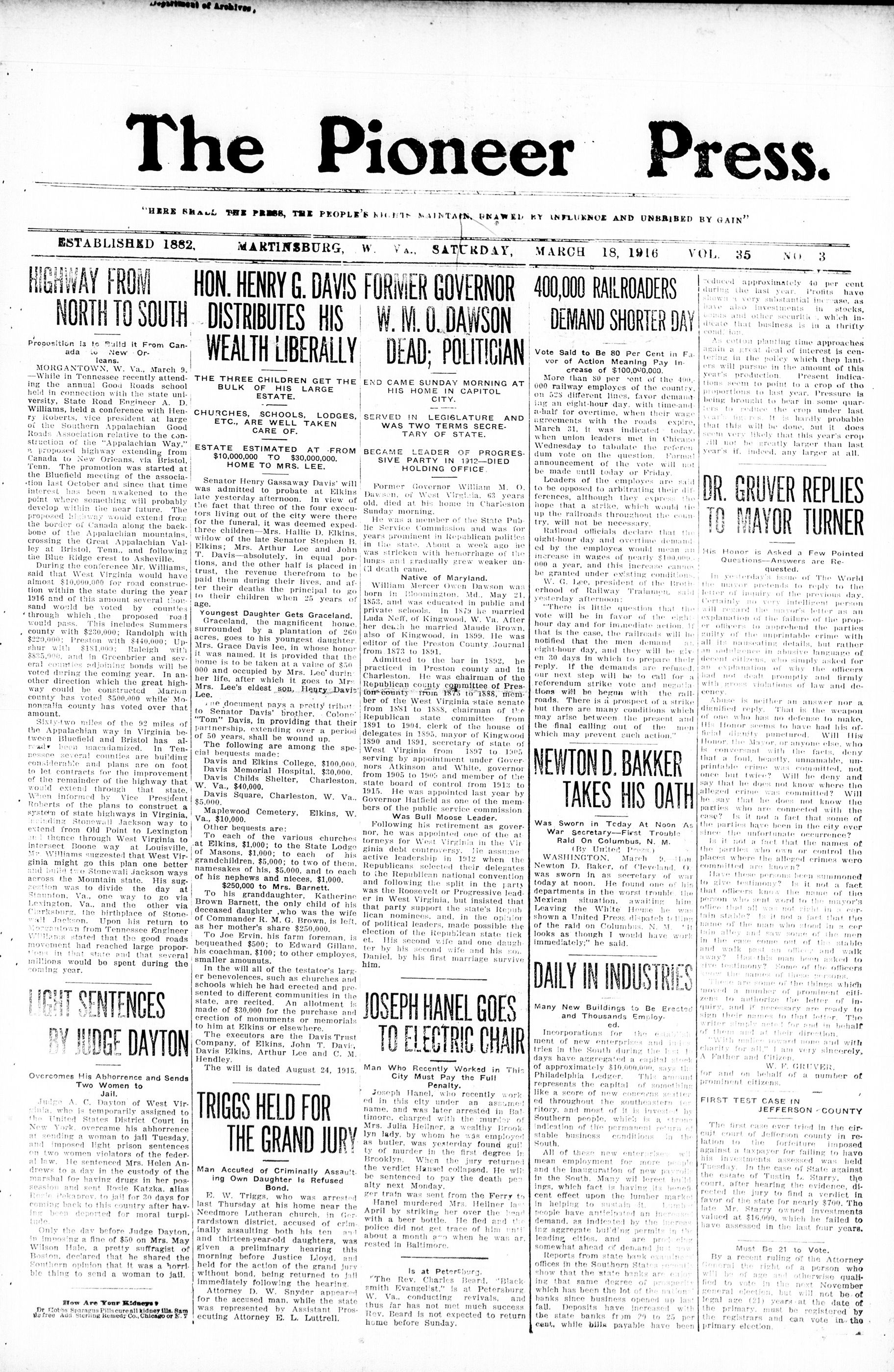
HIGHWAY FROM NORTH TO SOUTH
Proposition is to Build it From Canada to New Or-
MORGANTOWN, W. Va., March 9. While in Tennessee recently attending the annual Good Roads school held in connection with the state university, State Road Engineer A. D. Williams, held a conference with Henry Roberts, vice president at large of the Southern Appalachian Good Roads Association relative to the construction of the "Appalachian Way," a proposed highway extending from Canada to New Orleans, via Bristol, Tenn. The promotion was started at the Bluefield meeting of the association last October and since that time interest has been awakened to the point where something will probably develop within the near future. The proposed highway would extend from the border of Canada along the backbone of the Appalachian mountains, crossing the Great Appalachian Valley at Bristol, Tenn., and following the Blue Ridge crest to Asheville
During the conference Mr. Williams, said that West Virginia would have almost $10,000,000 for road construction within the state during the year 1916 and of this amount several thousand would be voted by counties through which, the proposed road would pass. This includes Summers county with $230,000; Randolph with $220,000; Preston with $440,000; Upshur with $181,000; Raleigh with $855,000, and in Greenbrier and several counties adjoining bonds will be voted during the coming year. In another direction which the great highway could be constructed Marion county has voted $500,000 while Monongalia county has voted over that amount.
Sixty-two miles of the 92 miles of the Appalachian way in Virginia between Bluefield and Bristol has already been macadamized. In Tennessee several counties are building considerable and plans are on foot to let contracts for the improvement of the remainder of the highway that would extend through that state. When informed by Vice President Roberts of the plans to construct a system of state highways in Virginia, including Stonewall Jackson way to extend from Old Point to Lexington and thence through West Virginia to intersect Boone way at Louisville, Mr. Williams suggested that West Virginia might go this plan one better and build two Stonewall Jackson ways across the Mountain state. His suggestion was to divide the day at Staunton, Va., one way to go via Lexington, Va., and the other via Clarksburg, the birthplace of Stonewall Jackson. Upon his return to Norgutown from Tennessee Engineer Williams stated that the good roads movement had reached large proportions in that state and that several millions would be spent during the coming year.
LIGHT SENTENCES BY JUDGE DAYTON
Overcomes His Abhorrence and Sends Two Women to Jail.
Judge A. C. Dayton of West Virginia, who is temporarily assigned to the United States District Court in New York, overcame his abhorrence at sending a woman to jail Tuesday, and imposed light prison sentences on two women violators of the federal law. He sentenced Mrs. Helen Andrews to a day in the custody of the marshal for having drugs in her possession and sent Rosie Katzka, alias Rene Pekaprov, to jail for 30 days for coming back to this country after having been deported for moral turpitude.
Only the day before Judge Dayton, in imposing a fine of $50 on Mrs. May Wilson Hale, a pretty suffragist of Boston, declared that he shared the Southern opinion that it was a horrible thing to send a woman to jail.
How Are Your Kidsneys?
Dr. Roberts Spagnuola Fillscuroli kidney illness. Sam
Ursifr. Dr. Roberts Spagnuola Fillscuroli kidney illness. Sam
HON. HENRY G. DAVIS DISTRIBUTES HIS WEALTH LIBERALLY
THE THREE CHILDREN GET THE
BULK OF HIS LARGE
ESTATE.
CHURCHES, SCHOOLS, LODGES,
ETC., ARE WELL TAKEN
CARE OF.
ESTATE ESTIMATED AT FROM
$10,000,000 TO $30,000,000.
HOME TO MRS. LEE.
Senator Henry Gassaway Davis' will was admitted to probate at Elkins late yesterday afternoon. In view of the fact that three of the four executors living out of the city were there for the funeral, it was deemed exped three children—Mrs. Hallie D. Elkins, widow of the late Senator Stephen B. Elkins; Mrs. Arthur Lee and John T. Davis—absolutely, in equal portions, and the other half is placed in trust, the revenue therefrom to be paid them during their lives, and after their deaths the principal to go to their children when 25 years of age.
Youngest Daughter Gets Graceland.
Graceland, the magnificent home,
surrounded by a plantation of 260
acres, goes to his youngest daughter.
Mrs. Grace Davis Lee, in whose honor
it was named. It is provided that the
home is to be taken at a value of $50,
000 and occupied by Mrs. Lee' durin-
her life, after which it goes to Mrs.
Mrs. Lee's eldest son, Henry Davis
Lee.
The document pays a pretty tribute
to Senator Davis' brother. Colonel'
"Tom" Davis, in providing that their
partnership, extending over a period
of 50 years, shall be wound up.
The following are among the special
bequests made:
Davis and Elkins College, $100,000.
Davis Memorial Hospital, $30,000.
Davis Childs Shelter, Charleston,
W. Va., $40,000.
Davis Square, Charleston, W. Va.,
$5,000.
Maplewood Cemetery, Elkins, W.
Va. $10,000.
Other bequests are:
To each of the various churches
at Elkins, $1,000; to the State Lodge
of Masons, $1,000; to each of his
grandchildren, $5,000; to two of them,
namesakes of his, $5,000, and to each
of his nephews and nieces, $1,000.
$250,000 to Mrs. Barnett.
To his granddaughter, Katherine
Brown Barnett, the only child of his
deceased daughter ,who was the wife
of Commander R. M. G. Brown, is left,
as her mother's share $250,000.
To Joe Ervin, his farm foreman, is
bequeathed $500; to Edward Gillam,
his coachman, $100; to other employes,
smaller amounts.
In the will all of the testator's larger benevolences, such as churches and schools which he had erected and presented to different communities in the state, are recited. An allotment is made of $30,000 for the purchase and erection of monuments or memorials to him at Elkins or elsewhere. The executors are the Davis Trust Company, of Elkins, John T. Davis, Davis Elkins, Arthur Lee and C. M. Hendley. The will is dated August 24, 1915
TRIGGS HELD FOR THE GRAND JURY
Man Accused of Criminally Assaulting Own Daughter Is Refused Bond.
E. W. Triggs, who was arrested last Thursday at his home near the Needmore Lutheran church, in Gerardstown district, accused of criminally assaulting both his ten and thirteen-year-old daughters, was given a preliminary hearing this morning before Justice Lloyd, and held for the action of the grand jury without bond, being returned to full immediately following the hearing.
Attorney D. W. Snyder appeared for the accused man, while the state was represented by Assistant Prosecuting Attorney E. L. Luttrell.
END CAME SUNDAY MORNING AT
HIS HOME IN CAPITOL
CITY.
SERVED IN LEGISLATURE AND
WAS TWO TERMS SECRE-
TARY OF STATE.
BECAME LEADER OF PROGRESSIVE PARTY IN 1912—DIED HOLDING OFFICE.
Former Governor William M. O.
Dawson, of West Virginia, 63 years
old, died at his home in Charleston
Sunday morning.
He was a member of the State Public
Service Commission and was for
years prominent in Republican politics
in the state. About a week ago he
was stricken with hemorrhage of the
lungs and gradually grew weaker un-
CI death came.
William Mercer Owen Dawson was born in Bloomington, Md., May 21, 1853, and was educated in public and private schools. In 1879 he married Luda Neff, of Kingwood, W. Va. After her death he married Maude Brown, also of Kingwood, in 1899. He was editor of the Preston County Journal from 1873 to 1891.
Admitted to the bar in 1892, he practiced in Preston county and in Charleston. He was chairman of the Republican county committee of Preston county from 1875 to 1888, member of the West Virginia state senate from 1881 to 1888, chairman of the Republican state committee from 1891 to 1904, clerk of the house of delegates in 1895, mayor of Kingwood 1890 and 1891, secretary of state of West Virginia from 1897 to 1905 serving by appointment under Governors Atkinson and White, governor from 1905 to 1905 and member of the state board of control from 1913 to 1915. He was appointed last year by Governor Hatfield as one of the members of the public service commission
Following his retirement as governor, he was appointed one of the attorneys for West Virginia in the Virginia debt controversy. He assume active leadership in 1912 when the Republicans selected their delegates to the Republican national convention and following the split in the party was the Roosevelt or Progressive leader in West Virginia, but insisted that that party support the state's Republican nominees, and, in the opinion of political leaders, made possible the election of the Republican state ticket. His second wife and one daughter by his second wife and his son, Daniel, by his first marriage survive him.
JOSEPH HANEL GOES TO ELECTRIC CHAIR
Man Who Recently Worked in This City Must Pay the Full Penalty.
Joseph Hanel, who recently worked in this city under an assumed name, and was later arrested in Baltimore, charged with the murder of Mrs. Julia Heilner, a wealthy Brooklyn lady, by whom he was employed as butler, was yesterday found guilty of murder in the first degree in Brooklyn. When the jury returned the verdict Hanel collapsed. He will be sentenced to pay the death penalty next Monday.
ger train was sent from the Ferry to Hanel murdered Mrs. Heilner last April by striking her over the head with a beer bottle. He fled and the police did not get trace of him until about a month ago when he was arrested in Baltimore.
Is at Petersburg.
"The Rev. Charles Beard. "Blacksmith Evangelist." is at Petersburg W. Va. conducting revivals, and thus far has not met much success Rev. Beard is not expected to return home before Sunday.
400,000 RAILROADERS DEMAND SHORTER DAY
400,000 RAILROADERS DEMAND SHORTER DAY
Vote Sald to Be 80 Per Cent in Favor of Action Meaning Pay increase of $100,000,000.
More than 80 per cent of the 400,000 railway employees of the country, on 528 different lines, favor demanding an eight-hour day, with time-and-a-half for overtime, when their wage agreements with the roads expire, March 31, it was indicated today, when union leaders met in Chicago Wednesday to tabulate the referendum vote on the question. Formal announcement of the vote will not be made until today or Friday. Leaders of the employees are said to be opposed to arbitrating their differences, although they express the hope that a strike, which would the up the railroads throughout the country, will not be necessary.
Railroad officials declare that the eight-hour day and overtime demanded by the employees would mean an increase in wages of nearly $100,000-000 a year, and this increase cannot be granted under existing conditions. W. G. Lee, president of the Brotherhood of Railway Trainmen, said yesterday afternoon:
"There is little question that the vote will be in favor of the eight-hour day and for immediate action. If that is the case, the railroads will be notified that the men demand an eight-hour day, and they will be given 30 days in which to prepare their reply. If the demands are refused, our next step will be to call for a referendum strike vote and negotiations will be begun with the railroads. There is a prospect of a strike but there are many conditions which may arise between the present and the final calling out of the men which may prevent such action."
NEWTON D. BAKKER TAKES HIS OATH
NEWTON D. BAKKER TAKES HIS OATH
Was Sworn in in Tcday At Noon As War Secretary—First Trouble Rald On Columbus, N. M. (By United Press.) WASHINGTON, March 9.—from Newton D. Baker, of Cleveland, O. was sworn in as secretary of war today at noon. He found one of his departments in the worst trouble the Mexican situation, awaiting him. Leaving the White House he was shown a United Press dispatch telling of the raid on Columbus, N. M. "It looks as though I would have work immediately," he said.
DAILY IN INDUSTRIES
Many New Buildings to Be Erected and Thousands Employed.
Incorporations for the establishment of new enterprises and industries in the South during the last days have aggregated a capital stock of approximately $10,000,000, says the Philadelphia Ledger. This amount represents the capital of something like a score of new concerns scattered throughout the southeastern territory, and most of it is invested by Southern people, which is a strong indication of the permanent return of stable business conditions in the South.
All of these new enterprises will mean employment for more people and the inauguration of new payrolls in the South. Many will lest erect buildings, which fact is having its beneficial effect upon the lumber market in helping to sustain it. Lumber people have anticipated an increased demand, as indicated by the increasing aggregate building permits in the leading cities, and are producing somewhat ahead of demand just now. Reports from state bank examiners offices in the Southern States recently show that the state banks are enjoying that same degree of prosperity which has been the lot of the national banks since business opened up last fall. Deposits have increased with the state banks from 29 to 25 per cent, while bills payable have been
reduced approximately 40 per cent during the last year. Profits have shown a very substantial increase, as have also investments in stocks, bonds and other securities, which indicate that business is in a thrifty condition. As cotton planting time approaches again a great deal of interest is centering in the policy which thep lanters will pursue in the amount of this year's production. Present indications seem to point to a crop of the proportions to last year. Pressure is being brought to bear in some quarters to reduce the crop under last year's ingress. It is hardly probable that this will be done, but it does seem very likely that this year's crop will not be greatly larger than last year's if, indeed, any larger at all.
DR. GRUVER REPLIES TO MAYOR TURNER
DR. GRUVER REPLIES TO MAYOR TURNER
His Honor is Asked a Few Pointed Questions—Answers are Requested.
In yesterday's issue of The World the mayor pretends to reply to the letter of inquiry of the previous day. Certainly no very intelligent person will regard the mayor's letter as an explanation of the failure of the proper officers to apprehend the parties guilty of the unprintable crime with all its nauseating details, but rather an odiouscence in abusive language of decent citizens, who simply asked for an explanation of why the officers had not dealt promptly and firmly with gross violations of law and decency.
Abuse is neither an answer nor a dignified reply. That is the weapon of one who has no defense to make, His Honor seems to have had his official dignity punctured. Will His Honor, the Mayor, or anyone else, who is conversant with the facts, deny that a foul, beastly, unmanable, unprintable crime was committed, not once but twice? Will he deny and say that he does not know where the alleged crime was committed? Will he say that he does not know the parties who are connected with the case? Is it not a fact that some of the parties have been in the city ever since the unfortunate occurrence? Is it not a fact that the names of the parties who own or control the places where the alleged crimes were committed are known?
Have these persons been summoned to give testimony? Is it not a fact that officers know the name of the person who sent word to the mayor's office that all was not right in a certain stable? Is it not a fact that the name of the man who stood in a certain alley and saw some of the men in the case come out of the stable and walk past an officer and walk away? Has this man been asked to give testimony? Some of the officers know the names of these persons. These are some of the things which moved a number of prominent citizens to authorize the letter of inquiry, and if necessary are ready to sign their names to that letter. The writer simply acted for and in behalf of them and at their direction.
"With maize toward none and with charity for all," I am very sincerely, A Father and Citizen.
for and on behalf of a number of prominent citizens.
FIRST TEST CASE IN
JEFFERSON COUNTY
The first case ever tried in the circuit court of Jefferson county in relation to the forfeiture imposed against a taxpayer for failing to have his investments assessed was held Tuesday. In the case of State against the estate of Tustin L. Starry, the court, after hearing the evidence, directed the jury to find a verdict in favor of the state for nearly $700. The late Mr. Starry owned investments valued at $16,000, which he failed to have assessed in the last four years.
By a recent ruling of the Attorney General the right of a person who will be of age and otherwise qualified to vote in the next November general election, but will not be of legal age (21) years at the date of the primary. must be registered by the registrars and can vote in the primary election.
---
Entered in Post Office at Martinsburg, W. Va., as Second Class Matter. J. R. Clifford, Editor and Proprietor. Drawer 869, and Bell 'Phone 60K, Martinsburg, W. Va.
SATURDAY, MARCH 18 1916
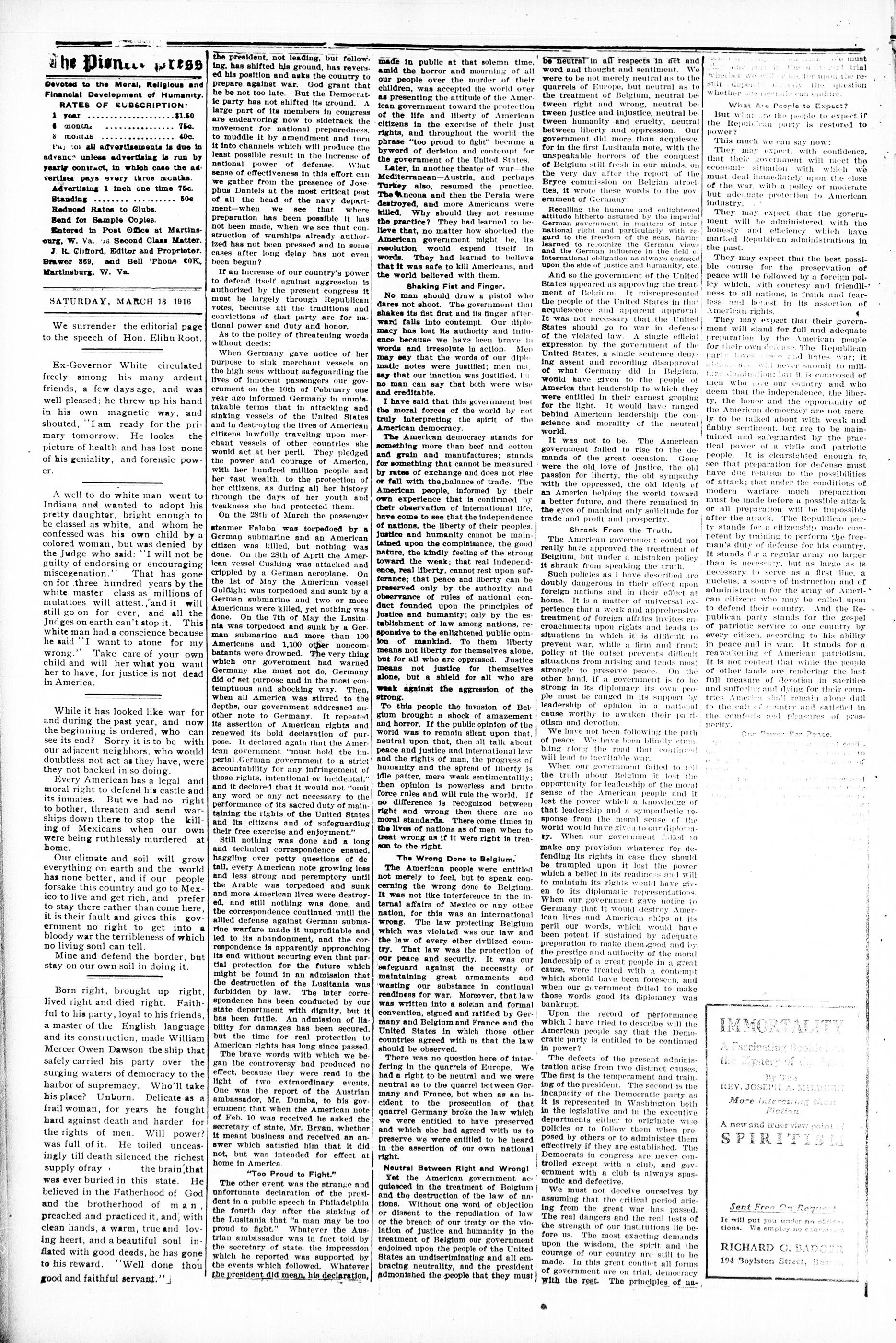
We surrender the editorial page to the speech of Hon. Elihu Root.
Ex-Governor White circulated freely among his many ardent friends, a few days ago, and was well pleased; he threw up his hand in his own magnetic way, and shouted, "I am ready for the primary tomorrow. He looks the picture of health and has lost none of his geniality, and forensic power.
A well to do white man went to Indiana and wanted to adopt his pretty daughter, bright enough to be classed as white, and whom he confessed was his own child by a colored woman, but was denied by the Judge who said: "I will not be guilty of endorsing or encouraging miscegenation." That has gone on for three hundred years by the white master class as millions of mulattoes will attest, and it will still go on for ever, and all the Judges on earth can't stop it. This white man had a conscience because he said "I want to atone for my wrong." Take care of your own child and will her what you want her to have, for justice is not dead in America.
While it has looked like war for and during the past year, and now the beginning is ordered, who can see its end? Sorry it is to be with our adjacent neighbors, who would doubtless not act as they have, were they not backed in so doing. Every American has a legal and moral right to defend his castle and its inmates. But we had no right to bother, threaten and send warships down there to stop the killing of Mexicans when our own were being ruthlessly murdered at home.
Our climate and soil will grow everything on earth and the world has none better, and if our people forsake this country and go to Mexico to live and get rich, and prefer to stay there rather than come here, it is their fault and gives this government no right to get into a bloody war the terribleness of which no living soul can tell. Mine and defend the border, but stay on our own soil in doing it.
Born right, brought up right, lived right and died right. Faithful to his party, loyal to his friends, a master of the English language and its construction, made William Mercer Owen Dawson the ship that safely carried his party over the surging waters of democracy to the harbor of supremacy. Who'll take his place? Unborn. Delicate as a frail woman, for years he fought hard against death and harder for the rights of men. Will power? was full of it. He toiled unceasingly till death silenced the richest supply ofray the brain that was ever buried in this state. He believed in the Fatherhood of God and the brotherhood of man, preached and practiced it, and with clean hands, a warm, true and loving heart, and a beautiful soul inflated with good deeds, he has gone to his reward. "Well done thou good and faithful servant."
the president, not leading, but following, has shifted his ground, has reversed his position and asks the country to prepare against war. God grant that he be not too late. But the Democratic party has not shifted its ground. A large part of its members in congress are endeavoring now to sidetrack the movement for national preparedness, to muddle it by amendment and turn it into channels which will produce the least possible result in the increase of national power of defense. What sense of effectiveness in this effort can we gather from the presence of Josephus Daniels at the most critical post of all—the head of the navy department—when we see that where preparation has been possible it has not been made, when we see that construction of warships already authorized has not been pressed and in some cases after long delay has not even been begun?
If an increase of our country's power to defend itself against aggression is authorized by the present congress it must be largely through Republican votes, because all the traditions and convictions of that party are for national power and duty and honor. As to the policy of threatening words without deeds:
When Germany gave notice of her purpose to sink merchant vessels on the high seas without safeguarding the lives of innocent passengers our government on the 10th of February one year ago informed Germany in unmistakable terms that in attacking and sinking vessels of the United States and in destroying the lives of American citizens lawfully travelling upon merchant vessels of other countries she would act at her peril. They pledged the power and courage of America, with her hundred million people and her vast wealth, to the protection of her citizens, as during all her history through the days of her youth and weakness she had protected them.
On the 28th of March the passenger
steamer Falaba was torpedoed by a German submarine and an American citizen was killed, but nothing was done. On the 28th of April the American vessel Cushing was attacked and crippled by a German aeroplane. On the 1st of May the American vessel Gulflight was torpedoed and sunk by a German submarine and two or more Americans were killed, yet nothing was done. On the 7th of May the Lusitania was torpedoed and sunk by a German submarine and more than 100 Americans and 1,100 other noncombatants were drowned. The very thing which our government had warned Germany she must not do, Germany did of set purpose and in the most contemptuous and shocking way. Then, when all America was stirred to the depths, our government addressed another note to Germany. It repeated its assertion of American rights and renewed its bold declaration of purpose. It declared again that the American government "must hold the imperial German government to a strict accountability for any infringement of those rights, intentional or incidental," and it declared that it would not "omit any word or any act necessary to the performance of its sacred duty of maintaining the rights of the United States and its citizens and of safeguarding their free exercise and enjoyment."
Still nothing was done and a long and technical correspondence ensued, haggling over petty questions of detail, every American note growing less and less strong and peremptory until the Arabic was torpedoed and sunk and more American lives were destroyed, and still nothing was done, and the correspondence continued until the allied defense against German submarine warfare made it unprofitable and led to its abandonment, and the correspondence is apparently approaching its end without securing even that partial protection for the future which might be found in an admission that the destruction of the Lusitania was forbidden by law. The later correspondence has been conducted by our state department with dignity, but it has been futile. An admission of liability for damages has been secured, but the time for real protection to American rights has long since passed.
The brave words with which we began the controversy had produced no effect, because they were read in the light of two extraordinary events. One was the report of the Austrian ambassador, Mr. Dumba, to his government that when the American note of Feb. 10 was received he asked the secretary of state, Mr. Bryan, whether it meant business and received an answer which satisfied him that it did not, but was intended for effect at home in America.
"Too Proud to Fight."
The other event was the strange and unfortunate declaration of the president in a public speech in Philadelphia the fourth day after the sinking of the Lusitania that "a man may be too proud to fight." Whatever the Austrian ambassador was in fact told by the secretary of state, the impression which he reported was supported by the events which followed. Whatever the president did mean, his declaration,
made in public at that solemn time, amid the horror and mourning of all our people over the murder of their children, was accepted the world over as presenting the attitude of the American government toward the protection of the life and liberty of American citizens in the exercise of their just rights, and throughout the world the phrase "too proud to fight" became a byword of derision and contempt for the government of the United States.
Later, in another theater of war—the Mediterranean-Austria, and perhaps Turkey also, resumed the practice. The Ancona and then the Persia were destroyed, and more Americans were killed. Why should they not resume the practice? They had learned to believe that, no matter how shocked the American government might be, its resolution would expend itself in words. They had learned to believe that it was safe to kill Americans, and the world believed with them.
Shaking Fist and Finger.
No man should draw a pistol who dares not shoot. The government that shakes its first first and its finger afterward falls into contempt. Our diplomacy has lost its authority and influence because we have been brave in words and irresolute in action. Men may say that the words of our diplomatic notes were justified; men may say that our inaction was justified, but no man can say that both were wise and creditable.
I have said that this government lost the moral forces of the world by not truly interpreting the spirit of the American democracy.
The American democracy stands for something more than beef and cotton and grain and manufactures; stands for something that cannot be measured by rates of exchange and does not rise or fall with the balance of trade. The American people, informed by their own experience that is confirmed by their observation of international life, have come to see that the independence of nations, the liberty of their peoples, justice and humanity cannot be maintained upon the complaisance, the good nature, the kindly feeling of the strong toward the weak; that real independence, real liberty, cannot rest upon sufferance; that peace and liberty can be preserved only by the authority and observance of rules of national conduct founded upon the principles of justice and humanity; only by the establishment of law among nations, responsive to the enlightened public opinion of mankind. To them liberty means not liberty for themselves alone, but for all who are oppressed. Justice means not justice for themselves alone, but a shield for all who are weak against the aggression of the strong.
To this people the invasion of Belgium brought a shock of amazement and horror. If the public opinion of the world was to remain silent upon that, neutral upon that, then all talk about peace and justice and international law and the rights of man, the progress of humanity and the spread of liberty is idle patter, mere weak sentimentality; then opinion is powerless and brute force rules and will rule the world. If no difference is recognized between right and wrong then there are no moral standards. There come times in the lives of nations as of men when to treat wrong as if it were right is treason to the right.
The Wrong Done to Belgium.
The American people were entitled not merely to feel, but to speak concerning the wrong done to Belgium. It was not like interference in the internal affairs of Mexico or any other nation, for this was an international wrong. The law protecting Belgium which was violated was our law and the law of every other civilized country. That law was the protection of our peace and security. It was our safeguard against the necessity of maintaining great armaments and wasting our substance in continual readiness for war. Moreover, that law was written into a solemn and formal convention, signed and ratified by Germany and Belgium and France and the United States in which those other countries agreed with us that the law should be observed.
There was no question here of interfering in the quarrels of Europe. We had a right to be neutral, and we were neutral as to the quarrel between Germany and France, but when as an incident to the prosecution of that quarrel Germany broke the law which we were entitled to have preserved and which she had agreed with us to preserve we were entitled to be heard in the assertion of our own national right.
Neutral Between Right and Wrong!
be neutral in all respects in act and word and thought and sentiment. We were to be not merely neutral as to the quarrels of Europe, but neutral as to the treatment of Belgium, neutral between right and wrong, neutral between justice and injustice, neutral between humanity and cruelty, neutral between liberty and oppression. Our government did more than acquiesce. for in the first Lusitania note, with the unspeakable horrors of the conquest of Belgium still fresh in our minds, on the very day after the report of the Bryce commission on Belgian atrocities, it wrote these words to the government of Germany:
Recalling the humane and enlightened attitude hitherto assumed by the imperial German government in matters of international right and particularly with regard to the freedom of the seas, having learned to recognize the German views and the German influence in the field of international obligation as always engaged upon the side of justice and humanity, etc.
And so the government of the United States appeared as approving the treatment of Belgium. It misrepresented the people of the United States in that acquiescence and apparent approval. It was not necessary that the United States should go to war in defense of the violated law. A single official expression by the government of the United States, a single sentence denying assent and recording disapproval of what Germany did in Belgium, would have given to the people of America that leadership to which they were entitled in their earnest grouping for the light. It would have ranged behind American leadership the conscience and morality of the neutral world.
It was not to be. The American government failed to rise to the demands of the great occasion. Gone were the old love of justice, the old passion for liberty, the old sympathy with the oppressed, the old ideals of an America helping the world toward a better future, and there remained in the eyes of mankind only solicitude for trade and profit and prosperity.
Shrank From the Truth.
The American government could not really have approved the treatment of Belgium, but under a mistaken policy it shrank from speaking the truth.
Such policies as I have described are doubly dangerous in their effect upon foreign nations and in their effect at home. It is a matter of universal experience that a weak and apprehensive treatment of foreign affairs invites encroachments upon rights and leads to situations in which it is difficult to prevent war, while a firm and frank policy at the outset prevents difficult situations from arising and tends most strongly to preserve peace. On the other hand, if a government is to be strong in its diplomacy its own people must be ranged in its support by leadership of opinion in a national cause worthy to awaken their patriotism and devotion.
We have not been following the path of peace. We have been blindly strurbling along the road that continued will lead to invitable war.
When our government failed to tell the truth about Belgium it lost the opportunity for leadership of the moral sense of the American people and it lost the power which a knowledge of that leadership and a sympathetic response from the moral sense of the world would have given to our diplomacy. When our government failed to make any provision whatever for defending its rights in case they should be trampled upon it lost the power which a belief in its readiness and will to maintain its rights would have given to its diplomatic representations. When our government gave notice to Germany that it would destroy American lives and American ships at its peril our words, which would have been potent if sustained by adequate preparation to make them good and by the prestige and authority of the moral leadership of a great people in a great cause, were treated with a contempt which should have been foreseen, and when our government failed to make those words good its diplomacy was bankrupt.
Upon the record of performance which I have tried to describe will the American people say that the Democratic party is entitled to be continued in power?
The defects of the present administration arise from two distinct causes. The first is the temperament and training of the president. The second is the incapacity of the Democratic party as it is represented in Washington both in the legislative and in the executive departments either to originate wise policies or to follow them when proposed by others or to administer them effectively if they are established. The Democrats in congress are never controlled except with a club, and government with a club is always spasmodic and defective.
We must not deceive ourselves by assuming that the critical period arising from the great war has passed. The real dangers and the real tests of the strength of our institutions lie before us. The most exacting demands upon the wisdom, the spirit and the courage of our country are still to be made. In this great conflict all forms of government are on trial, democracy with the rest. The principles of na-
#
when we are in the court we must
then one person in the court will trial
whether we will or not for upon the result
dependent on the question
whether another person can endure.
What Are People to Expect?
What Are People to Expect?
But what are the people to expect if the Republican party is restored to power?
This much we can say now:
They may expect, with confidence, that their government will meet the economic situation with which we must deal immediately upon the close of the war, with a policy of moderate but adequate protection to American industry.
They may expect that the government will be administered with the honesty and efficiency which have marked Republican administrations in the past.
They may expect that the best possible course for the preservation of peace will be followed by a foreign policy which, with courtesy and friendliness to all nations, is frank and fearless and honest in its assertion of American rights.
They may expect that their government will stand for full and adequate preparation by the American people for their own defense. The Republican party loves peace and hates war; it abhorrence will never submit to military domination; but it is composed of men who love our country and who deem that the independence, the liberty, the honor and the opportunity of the American democracy are not merely to be talked about with weak and flabby sentiment, but are to be maintained and safeguarded by the practical power of a virile and patriotic people. It is clear sighted enough to see that preparation for defense must have due relation to the possibilities of attack; that under the conditions of modern warfare much preparation must be made before a possible attack or all preparation will be impossible after the attack. The Republican party stands for a citizenship made competent by training to perform the freeman's duty of defense for his country. It stands for a regular army no larger than is necessary, but as large as is necessary to serve as a first line, a nucleus, a source of instruction and of administration for the army of American citizens who may be called upon to defend their country. And the Republican party stands for the gospel of patriotic service to our country by every citizen, according to his ability in peace and in war. It stands for a reawakening of American patriotism. It is not content that while the people of other lands are rendering the last full measure of devotion in sacrifice and suffering and dying for their countries America shall remain alone dull to the call of country and satisfied in the comforts and pleasures of prosperity.
Our Power for Peace.
IMMORTALITY
A Fascinating Book for the Mystery of Life
By The
REV. JOSEPH A. MILLBURN
More interesting than Fiction
A new and true view point of
SPIRITISM
Sent Free On Request
It will put you under no obliqu
tions. We employ no convicts
RICHARD G. BADGER
194 Boylston Street, Boston
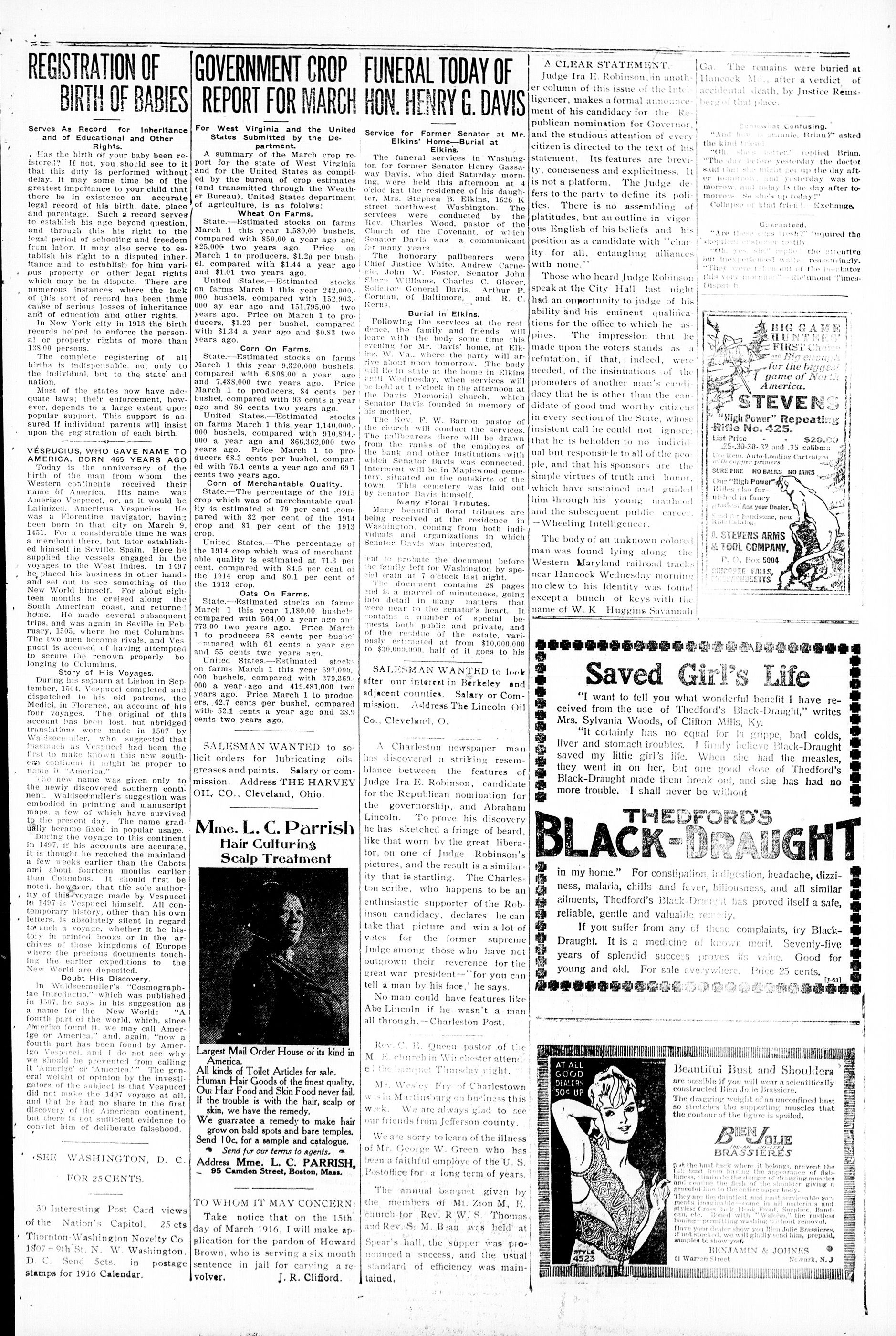
REGISTRATION OF BIRTH OF BABIES
Serves As Record for Inheritance and of Educational and Other Rights
Has the birth of your baby been registered? If not, you should see to it that this duty is performed without delay. It may some time be of the greatest importance to your child that there be in existence an accurate legal record of his birth, date, place and parentage. Such a record serves to establish his age beyond question, and through this his right to the legal period of schooling and freedom from labor. It may also serve to establish his right to a disputed inheritance and to establish for him various property or other legal rights which may be in dispute. There are numerous instances where the lack of this sort of record has been thine cause of serious losses of inheritance and of education and other rights.
In New York city in 1913 the birth records helped to enforce the personal or property rights of more than 138,00 persons. The complete registering of all births is indispensable, not only to the individual, but to the state and nation. Most of the states now have adequate laws; their enforcement, however, depends to a large extent upon popular support. This support is assured if individual parents will insist upon the registration of each birth.
.
VÉSPUCIUS, WHO GAVE NAME TO
AMERICA, BORN, 465, YEARS, AGO
Today is the anniversary of the birth of the man from whom the Western continents received their name of America. His name was Amerigo Vespucci, or, as it would be Latinized, Americus Vespucius. He was a Florentine navigator, having been born in that city on March 9, 1451. For a considerable time he was a merchant there, but later established himself in Seville, Spain. Here he supplied the vessels engaged in the voyages to the West Indies. In 1497 he placed his business in other hands and set out to see something of the New World himself. For about eighteen months he cruised along the South American coast, and returned home. He made several subsequent trips, and was again in Seville in February, 1505, where he met Columbus. The two men became rivals, and Vespucci is accused of having attempted to secure the renown properly be longing to Columbus.
Story cf His Voyages.
During his sojourn at Lisbon in September, 1504, Vespucci completed and dispatched to his old patrons, the Medici, in Florence, an account of his four voyages. The original of this account has been lost, but abridged translations were made in 1507 by Waldisecruller, who suggested that insmuch as Vespucci had been the first to make known this new southern continent it might be proper to name it "America."
The new name was given only to the newly discovered southern continent. Waldisecruller's suggestion was embodied in printing and manuscript maps, a few of which have survived to the present day. The name gradually became fixed in popular usage.
During the voyage to this continent in 1497, if his accounts are accurate, it is thought he reached the mainland a few weeks earlier than the Cabots and about fourteen months earlier than Columbus. It should first be noted, however, that the sole authority of this voyage made by Vespucci in 1497 is Vespucci himself. All contemporary history, other than his own letters, is absolutely silent in regard to such a voyage, whether it be history in printed books or in the archives of those kingdoms of Europe where the precious documents touching the earlier expeditions to the New World are deposited.
Doubt His Discovery.
In Waidseemuller's "Cosmographiae Introductio," which was published in 1507, he says in his suggestion as a name for the New World: "A fourth part of the world, which, since Amerigo found it, we may call Amerige or America," and, again, "now a fourth part has been found by Amerigo Vespucci, and I do not see why we should be prevented from calling it 'Amerige' or 'America.'" The general weight of opinion by the investigators of the subject is that Vespucci did not make the 1497 voyage at all, and that he had no share in the first discovery of the American continent, but there is not sufficient evidence to convict him of deliberate falsehood.
·SEE WASHINGTON, D. C FOR 25 CENTS.
30 Interesting Post Card views of the Nation's Capitol. 25 cts Thornton-Washington Novelty Co. 1807-9th St. N. W. Washington. D. C. Send 5 cts. in postage stamps for 1916 Calendar.
GOVERNMENT CROP FUNERAL TODAY OF REPORT FOR MARCH HON. HENRY G. DAVIS
For West Virginia and the United States Submitted by the Department.
A summary of the March crop report for the state of West Virginia and for the United States as compiled by the bureau of crop estimates (and transmitted through the Weather Bureau). United States department of agriculture, is as follows:
Wheat On Farms.
State.—Estimated stocks on farms March 1 this year 1,580,00 bushels, compared with 850,00 a year ago and 825,00€ two years ago. Price on March 1 to producers, $1.20 per bushel, compared with $1.44 a year ago and $1.01 two years ago.
United States.—Estimated stocks on farms March 1 this year 242,000,000 bushels, compared with 152,903,000 ay ear ago and 151,795,00 two years ago. Price on March 1 to producers, $1.23 per bushel, compared with $1.34 a year ago and $0.83 two years ago.
Corn On Farms.
State.—Estimated stocks on farms March 1 this year 9,320,000 bushels, compared with 6,808,00 a year ago and 7,488,000 two years ago. Price March 1 to producers, 84 cents per bushel, compared with 93 cents a year ago and 86 cents two years ago. United States.—Estimated stocks on farms March 1 this year 1,140,000,000 bushels, compared with 910,894,000 a year ago and 866,362,000 two years ago. Price March 1 to producers 68.3 cents per bushel, compared with 75.1 cents a year ago and 69.1 cents two years ago. Corn of Merchantable Quality. State.—The percentage of the 1915 crop which was of merchantable quality is estimated at 79 per cent, compared with 82 per cent of the 1914 crop and 81 per cent of the 1913 crop.
United States. The percentage of the 1914 crop which was of merchantable quality is estimated at 71.3 per cent. compared with 84.5 per cent of the 1914 crop and 80.1 per cent of the 1913 crop.
Oats On Farms.
State.—Estimated stocks on farms March 1 this year 1,180.00 bushels compared with 504.00 a year ago and 773.00 two years ago. Price March 1 to producers 58 cents per bushel compared with 61 cents a year ago and 55 cents two years ago. United States.—Estimated stocks on farms March 1 this year 597,000,000 bushels, compared with 379,369,000 a year ago and 419,481,000 two years ago. Price March 1 to producers, 42.7 cents per bushel, compared with 52.1 cents a year ago and 38.9 cents two years ago.
SALESMAN WANTED to solicit orders for lubricating oils greases and paints. Salary or commission. Address THE HARVEY OIL CO., Cleveland, Ohio.
Mme. L. C. Parrish Hair Culturing Scalp Treatment
Mme. L. C. Parrish Hair Culturing Scalp Treatment
A
Largest Mail Order House of its kind in America.
All kinds of Toilet Articles for sale.
Human Hair Goods of the finest quality.
Our Hair Food and Skin Food never fail.
If the trouble is with the hair, scalp or skin, we have the remedy.
We guarantee a remedy to make hair grow on bald spots and bare temples.
Send 10c, for a sample and catalogue.
Send for our terms to agents.
Address Mme. L. C. PARRISH.
95 Camden Street, Boston, Mass.
TO WHOM IT MAY CONCERN: Take notice that on the 15th day of March 1916, I will make application for the pardon of Howard Brown, who is serving a six month sentence in jail for carving a revolver. J. R. Clifford.
Service for Former Senator at Mr. Elkins' Home—Burial at Elkins.
The funeral services in Washington for former Senator Henry Gassaway Davis, who died Saturday morning, were held this afternoon at 4 o'clock kat the residence of his daughter, Mrs. Stephen B. Elkins, 1626 K street northwest, Washington. The services were conducted by the Rev. Charles Wood, pastor of the Church of the Covenant, of which Senator Davis was a communicant for many years.
The honorary pallbearers were Chief Justice White, Andrew Carnerie, John W. Foster, Senator John Sharp Williams, Charles C. Glover, Solicitor General Davis, Arthur P. Gorman, of Baltimore, and R. C. Kerns.
Burial in Elkins
Following the services at the residence, the family and friends will leave with the body some time this evening for Mr. Davis' home, at Elkins, W. Va., where the party will arrive about noon tomorrow. The body will lie in state at the home in Elkins until Wednesday, when services will be held at 1 o'clock in the afternoon at the Davis Memorial church, which Senator Davis founded in memory of his mother.
The Rev. F. W. Barron, pastor of the church will conduct the services. The pallboarers there will be drawn from the ranks of the employees of the bank and other institutions with which Senator Davis was connected. Interment will be in Maplewood cemetery, situated on the outskirts of the town. This cemetery was laid out by Senator Davis himself.
Many Floral Tributes.
Many beautiful floral tributes are being received at the residence in Washington, coming from both individuals and organizations in which Senator Davis was interested.
Ient to probate the document before the family left for Washington by special train at 7 o'clock last night.
The document contains 28 pages and is a marvel of minuteness, going into detail in many matters that were near to the senator's heart. It contains a number of special bequests both public and private, and of the residue of the estate, variously estimated at from $10,000,000 to $20,000,000, half of it goes to his
SALESMAN WANTED to look after our interest in Berkeley and adjacent counties. Salary or Commission. Address The Lincoln Oil Co., Cleveland, O.
A Charleston newspaper man has discovered a striking resemblance between the features of Judge Ira E. Robinson, candidate for the Republican nomination for the governorship, and Abraham Lincoln. 'To prove his discovery he has sketched a fringe of beard, like that worn by the great liberator, on one of Judge Robinson's pictures, and the result is a similarity that is startling. The Charleston scribe, who happens to be an enthusiastic supporter of the Robinson candidacy, declares he can take that picture and win a lot of votes for the former supreme Judge among those who have not outgrown their reverence for the great war president--"for you can tell a man by his face,' he says.
No man could have features like Abe Lincoln if he wasn't a man all through. — Charleston Post.
Rev. C. E. Queen pastor of the M. E. church in Winchester attended the banquet Thursday night.
Mr. Wesley Fry of Charlestown was in Martinsburg on business this week. We are always glad to see our friends from Jefferson county.
We are sorry to learn of the illness of Mr. George W. Green who has been a faithful employee of the U. S. Postoffice for a long term of years.
The annual banquet given by the members of Mt. Zion M, E. church for Rev. R W. S. Thomas and Rev. S. M. Bean was held at Spear's hall, the supper was pronounced a success, and the usual standard of efficiency was maintained.
Saved Girl's Life
"I want to tell you what wonderful benefit I have received from the use of Thedford's Black-Draught," writes Mrs. Sylvania Woods, of Clifton Mills, Ky.
"It certainly has no equal for la grippe, bad colds, liver and stomach troubles. I firmly believe Black-Draught saved my little girl's life. When she had the measles, they went in on her, but one good dose of Thedford's Black-Draught made them break out, and she has had no more trouble. I shall never be without
THEDFORD'S
BLACK-DRAUGHT
in my home." For constipation, indigestion, headache, dizziness, malaria, chills and fever, biliousness, and all similar ailments, Thedford's Black-Draught has proved itself a safe, reliable, gentle and valuable remedy.
If you suffer from any of these complaints, try Black-Draught. It is a medicine of known merit. Seventy-five years of splendid success proves its value. Good for young and old. For sale everywhere. Price 25 cents.
Judge Ira E. Robinson, in another column of this issue of the Intelligence, makes a formal announcement of his candidacy for the Republican nomination for Governor, and the studious attention of every citizen is directed to the text of his statement. Its features are brevity, conciseness and explicitness. It is not a platform. The Judge defers to the party to define its politics. There is no assembling of platitudes, but an outline in vigorous English of his beliefs and his position as a candidate with "charity for all, entangling alliances with none."
Those who heard Judge Robinson speak at the City Hall last night had an opportunity to judge of his ability and his eminent qualifications for the office to which he aspires. The impression that he made upon the voters stands as a refutation, if that, indeed, were needed, of the insinuations of the promoters of another man's candidacy that he is other than the candidate of good and worthy citizens in every section of the State, whose insistent call he could not ignore; that he is beholden to no individual but responsible to all of the people, and that his sponsors are the simple virtues of truth and honor, which have sustained and guided him through his young manhood and the subsequent public career. - Wheeling Intelligencer.
The body of an unknown colored man was found lying along the Western Maryland railroad tracks near Hancock Wednesday morning no clew to his Identity was found except a bunch of keys with the name of W. K Huggins Savannah
Saved G
"I want to tell you what received from the use of Theodora Mrs. Sylvania Woods, of Clifton.
"It certainly has no equal liver and stomach troubles. saved my little girl's life. they went in on her, but Black-Draught made them brighter trouble. I shall never"
THEDORA BLACK-
in my home." For constipation, malaria, chills and fewailments, Thedford's Black-Draught reliable, gentle and valuable.
If you suffer from any of Draught. It is a medicine years of splendid success young and old. For sale every
```markdown
```
```markdown
```
AT ALL
GOOD
DEALERS
50% UP
STYLE
4523
---
Ga. The remains were buried at Hancock Md., after a verdict of accidental death, by Justice Remsberg of that place.
Somewhat Confusing.
"And how is grannie, Brian?" asked the kind friend.
"Oh, she's better!" replied Brian.
"The day before yesterday the doctor said that she might get up the day after tomorrow, and yesterday was tomorrow, and today is the day after tomorrow. So she's up today."
Collapse of kind friend—Exchange
Guaranteed.
"Are these ears fresh?" required the
shaptiful customer testily.
"Oh, yes, sir!" replied the attentive
but experienced waiter, reastringly.
"They were taken out of the incubator
this very morning"—Richmond Times
Dispatch.
BIG GAME
HUNTER'S
FIRST Choice
and Big enough
for the biggest
game of North
America.
STEVENS
"High Power" Repeating
Rifle No. 425.
List Price - $20.00
.25-.30-.30-.32 and .35 calibers
Use Item Auto Loading Cartridges
with copper primers
SURE FIRE NO BALKS NO JAMS
Our "High Power"
Rifles also furnished in fancy
gradez. Ask your Dealer.
Send for handsome, new
Rifle Catalog.
J. STEVENS ARMS
& TOOL COMPANY,
P. O. Box 5004
CHICAGO FALLS,
MICHIGAN
Girl's Life
What wonderful benefit I have re-
Thedford's Black-Draught," writes
of Clifton Mills, Ky.
No equal for la grippe, bad colds,
ties. I firmly believe Black-Draught
life. When she had the measles,
but one good dose of Thedford's
trem break out, and she has had no
never be without.
EDFORD'S
-DRAUGHT
Pitipation, indigestion, headache, dizzi-
d fever, billiousness, and all similar
black-Draught has proved itself a safe,
unable remedy.
Many of these complaints, try Black-
cine of known merit. Seventy-five
cess proves its value. Good for
le everywhere. Price 25 cents.
Beautiful Bust and Shoulders are possible if you will wear a scientifically constructed Bien Jolie Brassiere.
BENJOLIE
(BEAR JOIE-LIE)
BRASSIERES
pick the bust where it belongs, present the full bust from having the appearance of dabiness, eliminate the danger of dragging muscles and continue the flesh of the shoulder giving a graceful line to the entire upper body.
They are the daintest and most serviceable gears imaginable—come in all materials and styles; Cross Back, Hook Front, Surplice, Bandite, etc. Boned with "Waboin," the rustless boning—permitting washing without removal.
Have your dealer show you Ben Jolie Brassieres, if not stocked, we will gladly send him, prepaid, samples to show you.
BENJAMIN & JOHNES
51 Warren Street
N. J. Wark
---
NA FLOR'S
HAIR
DRESSING
NA FLORS
HAIR DRESSING
THE KING OF
ALL HAIR DRESSINGS
GROWS HAIR-REMOVES
DANDRUFF AND TETTER.
BUY IT-TRY IT-TEST IT.
ASK YOUR DRUGGIST FOR IT-
DEMAND IT! IF HE HAS NOT IT
WE WILL SEND IT FOR
25 CTS. POSTPAID
NA FLOR DRUG CO.
AGENTS WANTED
EVERYWHERE
EDENTON, N.C.
MENTION PAPER YOU SAW AD IN.
BUY IT TODAY
E. 360 Pictures
300 Pages
Articles
POPULAR
MECHANICS
MAGAZINE
For Father and Son
AND ALL THE FAMILY
Two and a half million readers find it of
absorbing interest. Everything in it is
Written So You Can Understand It.
We sell 400,000 copies every month without
doing premiums and have no solicitors. Any
order will show you a copy; or write the
order for free. A postal will da-
nied a year. See a COPY
Enter Mechanics Magazine
Are You a Woman?
Take Cardui
The Woman's Tonic
FOR SALE AT ALL DRUGGISTS
F4
SALESMEN Wanted
to sell
Our West Virginia Grown
NURSERY STOCK Fine con-
vancing outlet FREE. Cash Commis-
sions Paid Weekly. Write for terms.
The Gold Nursery Co.
Mason City, W. Va
The Star Hair Grower
MEN
Even those who have been treated elsewhere without obtaining results
COME TO US
We Show Results quickly and at small cost, in all privates and chronic diseases of men, such as Blood Poison, Vitrocolite, Hydrocolite, Stricture, Wear Blind-zer, Lost Viability, Pain in Back, and all contracted diseases.
CONSULTATION FREE
and ADVICE
We offer the very latest methods as Prof. Eibhich, 606 and 914 Noo-Salivan, Coorbon, Vaconia and Rilasenic物理, which guarantee positive results without interference with your work.
FREE Booklet
French-American SPECIALISTS
408-10 E. Baltimore St.
BALTIMORE, MD.
When in Baltimore, ask our Free Booklet for Price.
9
One thousand agents wanted. Good money made. We want agen in every city and village to sell THE STAR HAIR GROWER. This is a wonderful preparation. Can be used with or without straightening irons. Sells for 25c per box—one 25c box will prove its value. Any person that will use a 25c box will be convinced. No matter what has failed to grow your hair, just give THE STAR HAIR GROWER a trial and be convinced. Send 25c for full size box. If you wish to be an agent send $1.00 and we will send you a full supply that you can begin work with once; also agents' terms. Send all money by money order to
e Star Hair Grower Mir
118 Clark Street
EVANSTON, ILLINOIS.
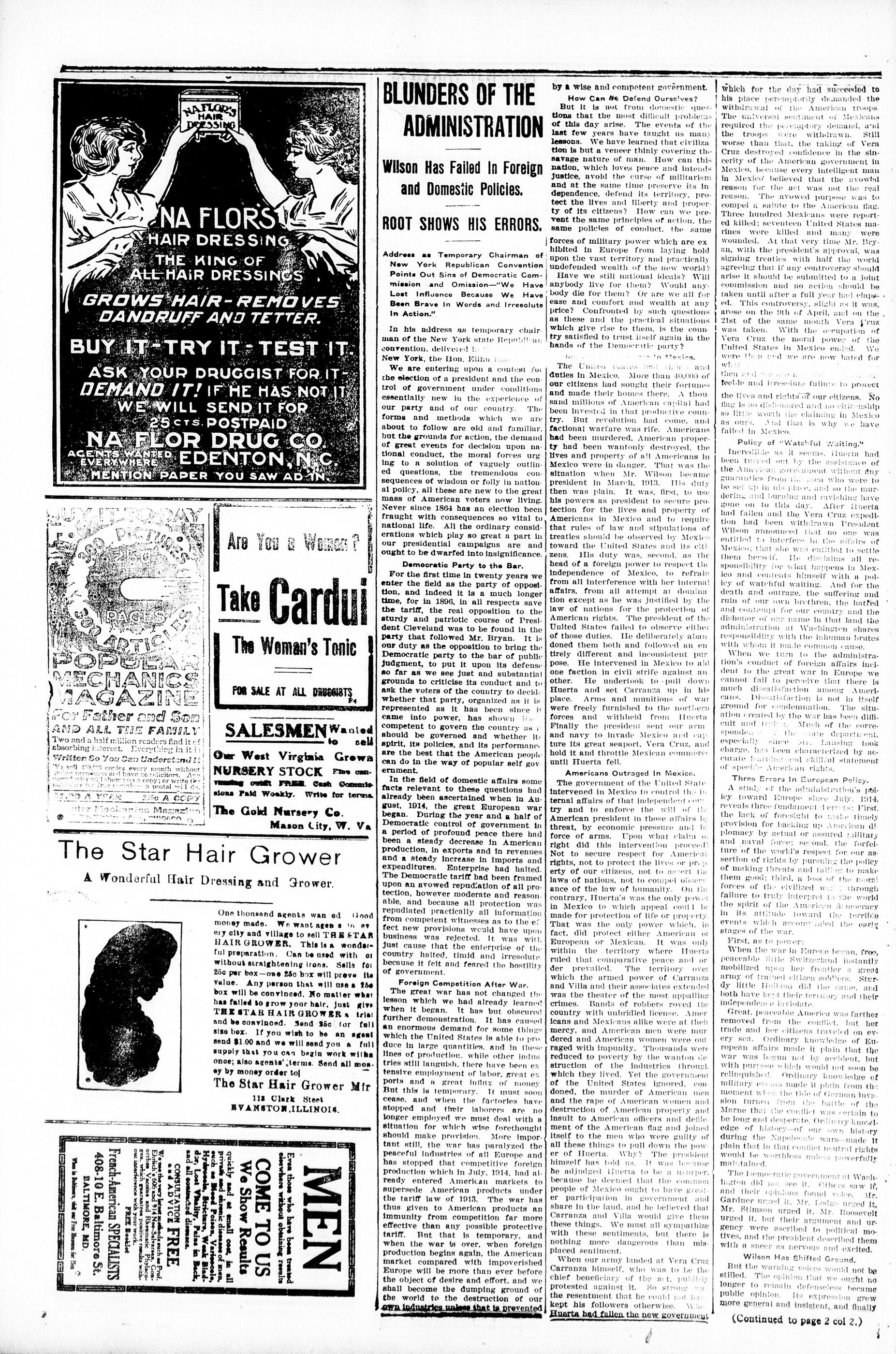
BLUNDERS OF THE ADMINISTRATION
Wilson Has Failed In Foreign and Domestic Policies.
ROOT SHOWS HIS ERRORS.
Address as Temporary Chairman of New York Republican Convention Points Out Sins of Democratic Commission and Omission—"We Have Lost Influence Because We Have Been Brave In Words and Irresolute In Action." In his address as temporary chairman of the New York state Republican convention, delivered in
We are entering upon a contest for the election of a president and the control of government under conditions essentially new in the experience of our party and of our country. The forms and methods which we are about to follow are old and familiar, but the grounds for action, the demand of great events for decision upon national conduct, the moral forces urging to a solution of vaguely outlined questions, the tremendous consequences of wisdom or folly in national policy, all these are new to the great mass of American voters now living. Never since 1864 has an election been fraught with consequences so vital to national life. All the ordinary considerations which play so great a part in our presidential campaigns are and ought to be dwarfed into insignificance.
Democratic Party to the Bar.
For the first time in twenty years we enter the field as the party of opposition, and indeed it is a much longer time, for in 1896, in all respects save the tariff, the real opposition to the sturdy and patriotic course of President Cleveland was to be found in the party that followed Mr. Bryan. It is our duty as the opposition to bring the Democratic party to the bar of public judgment, to put it upon its defense so far as we see just and substantial grounds to criticise its conduct and to ask the voters of the country to decide whether that party, organized as it is represented as it has been since it came into power, has shown its competent to govern the country as it should be governed and whether its spirit, its policies, and its performance are the best that the American people can do in the way of popular self government.
In the field of domestic affairs some facts relevant to these questions had already been ascertained when in August, 1014, the great European war began. During the year and a half of Democratic control of government in a period of profound peace there had been a steady decrease in American production, in exports and in revenues and a steady increase in imports and expenditures. Enterprise had halted. The Democratic tariff had been framed upon an avowed repudiation of all protection, however moderate and reasonable, and because all protection was repudiated practically all information from competent witnesses as to the effect new provisions would have upon business was rejected. It was with just cause that the enterprise of the country halted, timid and irresolute because it felt and feared the hostility of government.
Foreign Competition After War
Foreign Competition After War.
The great war has not changed the lesson which we had already learned when it began. It has but obscured further demonstration. It has caused an enormous demand for some things which the United States is able to produce in large quantities, and in these lines of production, while other industries still languish, there have been extensive employment of labor, great exports and a great influx of money. But this is temporary. It must soon cease, and when the factories have stopped and their laborers are no longer employed we must deal with a situation for which wise forethought should make provision. More important still, the war has paralyzed the peaceful industries of all Europe and has stopped that competitive foreign production which in July, 1914, had already entered American markets to supersede American products under the tariff law of 1913. The war has thus given to American products an immunity from competition far more effective than any possible protective tariff. But that is temporary, and when the war is over, when foreign production begins again, the American market compared with impoverished Europe will be more than ever before the object of desire and effort, and we shall become the dumping ground of the world to the destruction of our own industries unless that is prevented
by a wise and competent government.
How Can We Defend Ourselfs?
But it is not from domestic questions that the most difficult problems of this day arise. The events of the last few years have taught us many lessons. We have learned that civilization is but a veneer thinly covering the savage nature of man. How can this nation, which loves peace and intends justice, avoid the curse of militarism and at the same time preserve its independence, defend its territory, protect the lives and liberty and property of its citizens? How can we prevent the same principles of action, the same policies of conduct, the same forces of military power which are exhibited in Europe from laying hold upon the vast territory and practically undefended wealth of the new world?
Have we still national ideals? Will anybody live for them? Would anybody die for them? Or are we all for ease and comfort and wealth at any price? Confronted by such questions as these and the practical situations which give rise to them, is the country satisfied to trust itself again in the hands of the Democratic party?
In Mexico.
The United States had high and duties in Mexico. More than 40,000 of our citizens had sought their fortunes and made their homes there. A thousand millions of American capital had been invested in that productive country. But revolution had come, and factional warfare was rife. Americans had been murdered, American property had been wantonly destroyed, the lives and property of all Americans in Mexico were in danger. That was the situation when Mr. Wilson became president in March, 1913. His duty then was plain. It was, first, to use his powers as president to secure protection for the lives and property of Americans in Mexico and to require that rules of law and stipulations of treaties should be observed by Mexico toward the United States and its citizens. His duty was, second, as the head of a foreign power to respect the independence of Mexico, to refrain from all interference with her internal affairs, from all attempt at domination except as he was justified by the law of nations for the protection of American rights. The president of the United States failed to observe either of those duties. He deliberately abandoned them both and followed an entirely different and inconsistent purpose. He intervened in Mexico to aid one faction in civil strife against another. He undertook to -pull down Huerta and set Carranza up in his place. Arms and munitions of war were freely furnished to the northern forces and withheld from Huerta. Finally the president sent our army and navy to invade Mexico and capture its great seaport, Vera Cruz, and hold it and throttle Mexican commerce until Huerta fell.
Americans Outraged In Mexico
The government of the United States intervened in Mexico to control the internal affairs of that independent country and to enforce the will of the American president in those affairs by threat, by economic pressure and by force of arms. Upon what claim or right did this intervention proceed? Not to secure respect for American rights, not to protect the lives or property of our citizens, not to assert the laws of nations, not to compel observance of the law of humanity. On the contrary, Huerta's was the only power in Mexico to which appeal could be made for protection of life or property. That was the only power which, in fact, did protect either American or European or Mexican. It was only within the territory where Huerta ruled that comparative peace and order prevailed. The territory over which the armed power of Carranza and Villa and their associates extended was the theater of the most appalling crimes. Bands of robbers roved the country with unbridled license. Americans and Mexicans alike were at their mercy, and American men were murdered and American women were out raged with impunity. Thousands were reduced to poverty by the wanton destruction of the industries through which they lived. Yet the government of the United States ignored, condoned, the murder of American men and the rape of American women and destruction of American property and insult to American officers and defilement of the American flag and joined itself to the men who were guilty of all these things to pull down the power of Huerta. Why? The president himself has told us. It was because he adjudged Huerta to be a usurper, because he deemed that the common people of Mexico ought to have greater participation in government and share in the land, and he believed that Carranza and Villa would give them these things. We must all sympathize with these sentiments, but there is nothing more dangerous than misplaced sentiment.
When our army landed at Vera Cruz Carranza himself, who was to be the chief beneficiary of the act, publicly protested against it. So strong was the resentment that he could not have kept his followers otherwise. When Huerta had fallen the new government
which for the day had succeeded to his place peremptorily demanded the withdrawal of the American troops. The universal sentiment of Mexicans required the peremptory demand, and the troops were withdrawn. Still worse than that, the taking of Vera Cruz destroyed confidence in the sincerity of the American government in Mexico, because every intelligent man in Mexico believed that the avowed reason for the act was not the real reason. The avowed purpose was to compel a salute to the American flag. Three hundred Mexicans were reported killed; seventeen United States marines were killed and many were wounded. At that very time Mr. Bryan, with the president's approval, was signing treaties with half the world agreeing that if any controversy should arise it should be submitted to a joint commission and no action should be taken until after a full year had elapsed. This controversy, slight as it was, arose on the 9th of April, and on the 21st of the same month Vera Cruz was taken. With the occupation of Vera Cruz the moral power of the United States in Mexico ended. We were then red we are now hated for what
feeble and irresolute failure to protect the lives and rights of our citizens. No flag is so dishonored and no citizenship so little worth the claiming in Mexico as ours. And that is why we have failed in Mexico.
Policy of "Watchful Waiting"
Incredible as it seems, Huerta had been turned out by the assistance of the American government without any guarantees from the men who were to be set up in his place, and so the murdering and burning and ravishing have gone on to this day. After Huerta had fallen and the Vera Cruz expedition had been withdrawn President Wilson announced that no one was entitled to interfere in the affairs of Mexico; that she was entitled to settle them herself. He disclaims all responsibility for what happens in Mexico and contents himself with a policy of watchful waiting. And for the death and outrage, the suffering and ruin of our own brethren, the hatted and contempt for our country and the dishonor of our name in that land the administration at Washington shares responsibility with the inhuman brutes with whom it made common cause.
When we turn to the administration's conduct of foreign affairs incident to the great war in Europe we cannot fail to perceive that there is much dissatisfaction among Americans. Dissatisfaction is not in itself ground for condemnation. The situation created by the war has been difficult and trying. Much of the correspondence of the state department, especially since 1917, Lausing took charge, has been characterized by accurate learning and skillful statement of specious American rights.
Three Errors In European Policy
A study of the administration's policy toward Europe since July, 1914, reveals three fundamental errors: First, the lack of foresight to make timely provision for backing up American diplomacy by actual or assured military and naval force; second, the forfeiture of the world's respect for our assertion of rights by pursuing the policy of making threats and failing to make them good; third, a loss of the moral forces of the civilized world through failure to truly interpret to the world the spirit of the American democracy in its attitude toward the terrible events which accounted the early stages of the war.
First, as to power;
When the war in Europe began, free, peaceable little Switzerland instantly mobilized upon her frontier a great army of trained citizen soldiers. Sturdy little Holtland did the game, and both have kept their territory and their independence violate.
Great, peaceable America was farther removed from the conflict, but her trade and her citizens traveled on every sea. Ordinary knowledge of European affairs made it plain that the war was begun not by accident, but with purpose which would not soon be relinquished. Ordinary knowledge of military evasions made it plain from the moment when the tide of German invasion turned from the battle of the Marne that the conflict was certain to be long and desperate. Ordinary knowledge of history—of our own history during the Napoleonic wars—made it plain that in that conflict neutral rights would be worthless unless powerfully maintained.
The Democratic government at Washington did not see it. Others saw it, and their opinions found voice. Mr. Gardner urged it. Mr. Lodge urged it, Mr. Stimson urged it. Mr. Roosevelt urged it, but their argument and urgency were ascribed to political motives, and the president described them with a sneer as nervous and excited.
Wilson Has Shifted Ground.
But the warning voices would not be stilled. The opinion that we ought no longer to remain defenseless became public opinion. Its expression grew more general and insistent, and finally
(Continued to page 2 col 2.)