The Pioneer Press
Saturday, July 22, 1916
Martinsburg, West Virginia
Page text (machine-generated)
The Pioneer Press.
"HERE SHALL THE PRESS, THE PEOPLE'S RIGHTS MAINTAIN, UNAWED BY INFLUENCE AND UNBRIED BY GAIN"
ESTABLISHED 1882.
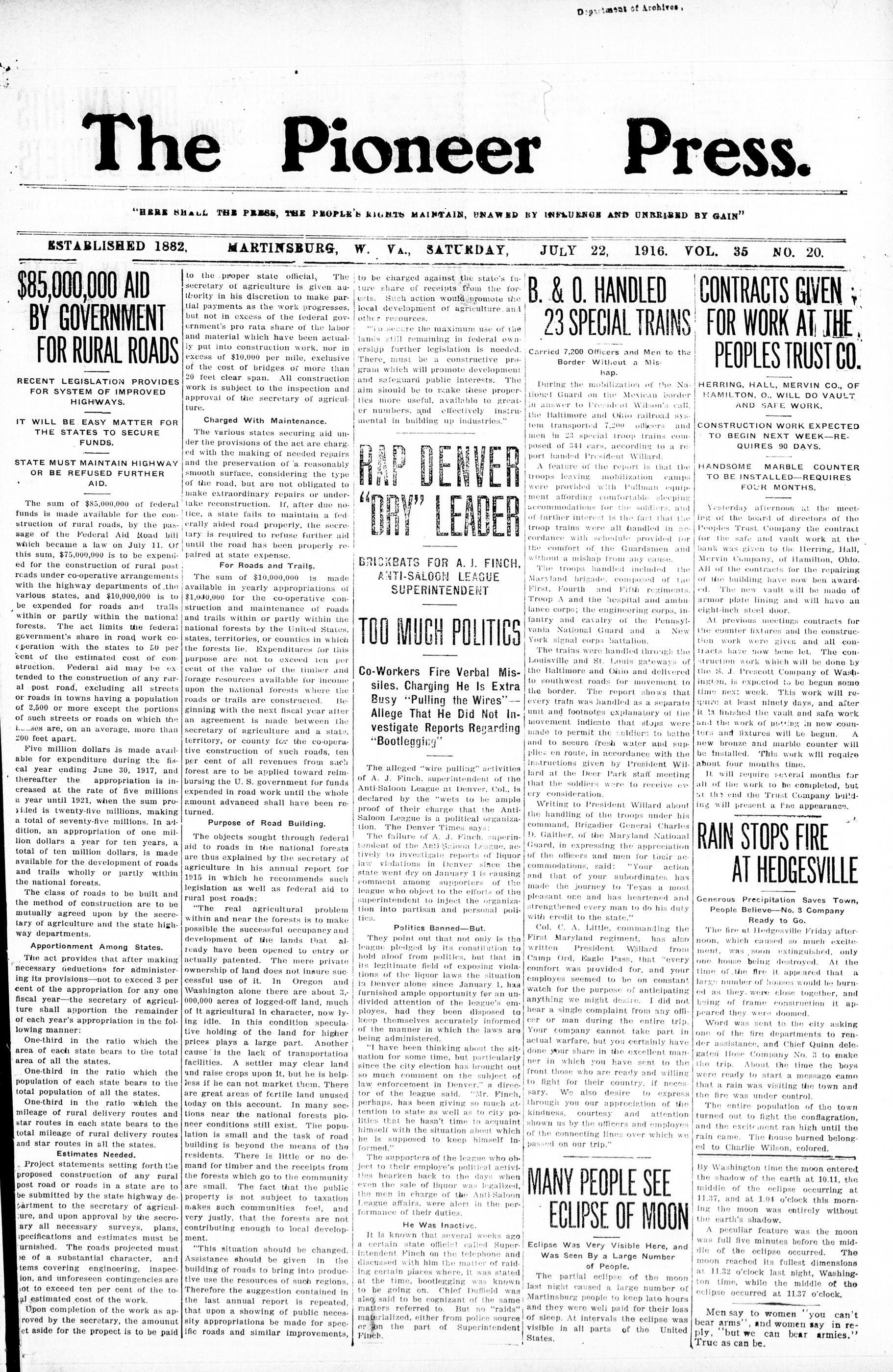
$85,000,000 AID BY GOVERNMENT FOR RURAL ROADS
RECENT LEGISLATION PROVIDES FOR SYSTEM OF IMPROVED HIGHWAYS.
IT WILL BE EASY MATTER FOR THE STATES TO SECURE FUNDS.
STATE MUST MAINTAIN HIGHWAY OR BE REFUSED FURTHER AID.
The sum of $85,000,000 of federal funds is made available for the construction of rural roads, by the passage of the Federal Aid Road bill which became a law on July 11. Of this sum, $75,000,000 is to be expended for the construction of rural post roads under co-operative arrangements with the highway departments of the various states, and $10,000,000 is to be expended for roads and trails within or partly within the national forests. The act limits the federal government's share in road work cooperation with the states to 50 percent of the estimated cost of construction. Federal aid may be extended to the construction of any rural post road, excluding all streets or roads in towns having a population of 2,500 or more except the portions of such streets or roads on which the houses are, on an average, more than 200 feet apart.
Five million dollars is made available for expenditure during the fiscal year ending June 30, 1917, and thereafter the appropriation is increased at the rate of five millions a year until 1921, when the sum provided is twenty-five millions, making a total of seventy-five millions. In addition, an appropriation of one million dollars a year for ten years, a total of ten million dollars, is made available for the development of roads and trails wholly or partly within the national forests. The class of roads to be built and the method of construction are to be mutually agreed upon by the secretary of agriculture and the state highway departments.
Apportionment Among States.
The act provides that after making necessary deductions for administering its provisions—not to exceed 3 per cent of the appropriation for any one fiscal year—the secretary of agriculture shall apportion the remainder of each year's appropriation in the following manner:
One-third in the ratio which the area of each state bears to the total area of all the states.
One-third in the ratio which the population of each state bears to the total population of all the states.
One-third in the ratio which the mileage of rural delivery routes and star routes in each state bears to the total mileage of rural delivery routes and star routes in all the states.
Estimates Needed.
Project statements setting forth the proposed construction of any rural post road or roads in a state are to be submitted by the state highway department to the secretary of agriculture, and upon approval by the secretary all necessary surveys, plans, specifications and estimates must be furnished. The roads projected must be of a substantial character, and tems covering engineering, inspection, and unforeseen contingencies are not to exceed ten per cent of the total estimated cost of the work.
Upon completion of the work as approved by the secretary, the amount set aside for the project is to be paid
to the proper state official. The secretary of agriculture is given authority in his discretion to make partial payments as the work progresses, but not in excess of the federal government's pro rata share of the labor and material which have been actually put into construction work, nor in excess of $10,000 per mile, exclusive of the cost of bridges of more than 20 feet clear span. All construction work is subject to the inspection and approval of the secretary of agriculture.
Charged With Maintenance.
The various states securing aid under the provisions of the act are charged with the making of needed repairs and the preservation of a reasonably smooth surface, considering the type of the road, but are not obligated to make extraordinary repairs or undertake reconstruction. If, after due notice, a state fails to maintain a federally aided road properly, the secretary is required to refuse further aid until the road has been properly repaired at state expense.
For Roads and Trails.
The sum of $10,000,000 is made available in yearly appropriations of $1,040,000 for the co-operative construction and maintenance of roads and trails within or partly within the national forests by the United States, states, territories, or counties in which the forests lie. Expenditures for this purpose are not to exceed ten per cent of the value of the timber and forage resources available for income upon the national forests where the roads or trails are constructed. Beginning with the next fiscal year after an agreement is made between the secretary of agriculture and a state, territory, or county for the co-operative construction of such roads, ten per cent of all revenues from such forest are to be applied toward reimbursing the U. S. government for funds expended in road work until the whole amount advanced shall have been returned.
Purpose of Road Building.
The objects sought through federal aid to roads in the national forests are thus explained by the secretary of agriculture in his annual report for 1915 in which he recommends such legislation as well as federal aid to rural post roads;
"The real agricultural problem within and near the forests is to make possible the successful occupancy and development of the lands that already have been opened to entry or actually patented. The mere private ownership of land does not insure successful use of it. In Oregon and Washington alone there are about 3,000,000 acres of logged-off land, much of it agricultural in character, now lying idle. In this condition speculative holding of the land for higher prices plays a large part. Another cause is the lack of transportation facilities. A settler may clear land and raise crops upon it, but he is helpless if he can not market them. There are great areas of fertile land unused today on this account. In many sections near the national forests pioneer conditions still exist. The population is small and the task of road building is beyond the means of the residents. There is little or no demand for timber and the receipts from the forests which go to the community are small. The fact that the public property is not subject to taxation makes such communities feel, and very justly, that the forests are not contributing enough to local development.
"This situation should be changed. Assistance should be given in the building of roads to bring into productive use the resources of such regions. Therefore the suggestion contained in the last annual report is repeated, that upon a showing of public necessity appropriations be made for specific roads and similar improvements.
to be charged against the state's future share of receipts from the forests. Such action would promote the local development of agriculture and other resources. "To secure the maximum use of the lands still remaining in federal ownership further legislation is needed. There, must be a constructive program which will promote development and safeguard public interests. The aim should be to make these properties more useful, available to greater numbers, and effectively instrumental in building up industries."
RAP DENVER
"DRY" LEADER
BRICKBATS FOR A. J. FINCH.
ANTI-SALOON LEAGUE
SUPERINTENDENT
Co-Workers Fire Verbal Missiles, Charging He Is Extra Busy "Pulling the Wires" Allege That He Did Not Investigate Reports Regarding "Bootlegging"
The alleged "wire pulling" activities of A. J. Finch, superintendent of the Anti-Saloon League at Denver, Col., is declared by the "wets to be ample proof of their charge that the Anti-Saloon League is a political organization. The Denver Times says: The failure of A. J. Finch, superintendent of the Anti-Saloon League, actively to investigate reports of liquor law violations in Denver since the state went dry on January 1 is causing comment among supporters of the league who object to the efforts of the superintendent to inject the organization into partisan and personal politics.
Politics Banned-But.
They point out that not only is the league pledged by its constitution to hold aloof from politics, but that in its legitimate field of exposing violations of the liquor laws the situation in Denver alone since January 1, has furnished ample opportunity for an undivided attention of the league's employees, had they been disposed to keep themselves accurately informed of the manner in which the laws are being administered.
"I have been thinking about the situation for some time, but particularly since the city election has brought out so much comment on the subject of law enforcement in Denver," a director of the league said. "Mr. Finch, perhaps, has been giving so much attention to state as well as to city politics that he hasn't time to acquaint himself with the situation about which he is supposed to keep himself informed."
The supporters of the league who object to their employee's political activities hearken back to the days when even the sale of liquor was legalized, the men in charge of the Anti-Saloon League affairs, were alert in the performance of their duties.
He Was Inactive.
It is known that several weeks ago a certain state official called Superintendent Finch on the telephone and discussed with him the matter of raiding certain places where, it was stated at the time, bootlegging was known to be going on. Chief Duffield was also said to be cognizant of the same matters referred to. But no "raids" materialized, either from police source or on the part of Superintendent Finch.
Department of Archives
BY INFLUENCE AND UNBRIBED
JULY 22, 1916. V
B. & O. HANDLED 23 SPECIAL TRAINS
Carried 7,200 Officers and Men to the Border Without a Mishap.
During the mobilization of the National Guard on the Mexican border in answer to President Wilson's call, the Baltimore and Ohio railroad system transported 7,200 officers and men in 23 special troop trains composed of 344 cars, according to a report handed President Willard.
A feature of the report is that the troops leaving mobilization camps were provided with Pullman equipment affording comfortable sleeping accommodations for the soldiers, and of further interest is the fact that the troop trains were all handled in accordance with schedule provided for the comfort of the Guardsmen and without a mishap from any cause. The troops handled included the Maryland brigade, composed of the First, Fourth and Fifth regiments. Troop A and the hospital and ambulance corps; the engineering corps, infantry and cavalry of the Pennsylvania National Guard and a New York signal corps battalion.
The trains were handled through the Louisville and St. Louis gateways of the Baltimore and Ohio and delivered to southwest roads for movement to the border. The report shows that every train was handled as a separate unit and footnotes explanatory of the movement indicate that stops were made to permit the soldiers to bathe and to secure fresh water and supplies en route, in accordance with the instructions given by President Willard at the Deer Park staff meeting that the soldiers were to receive every consideration.
Writing to President Willard about the handling of the troops under his command, Brigadier General Charles D. Gaither, of the Maryland National Guard, in expressing the appreciation of the officers and men for their accommodations, said: "Your action and that of your subordinates has made the journey to Texas a most pleasant one and has heartened and strengthened every man to do his duty with credit to the state."
Col. C. A. Little, commanding the First Maryland regiment, has also written President Willard from Camp Ord, Eagle Pass, that "every comfort was provided for, and your employees seemed to be on constant watch for the purpose of anticipating anything we might desire. I did not hear a single complaint from any officer or man during the entire trip. Your company cannot take part in actual warfare, but you certainly have done your share in the excellent manner in which you have sent to the front those who are ready and willing to fight for their country, if necessary. We also desire to express through you our appreciation of the kindness, courtesy and attention shown us by the officers and employees of the connecting lines over which we passed on our trip."
MANY PEOPLE SEE ECLIPSE OF MOON
MANY PEOPLE SEE ECLIPSE OF MOON
Eclipse Was Very Visible Here, and Was Seen By a Large Number of People. The partial eclipse of the moon last night caused a large number of Martinsburg people to keep late hours and they were well paid for their loss of sleep. At intervals the eclipse was visible in all parts of the United States.
CONTRACTS GIVEN FOR WORK AT THE PEOPLE'S TRUST CO.
HERRING, HALL, MERVIN CO., OF
HAMILTON, O., WILL DO VAULT
AND SAFE WORK.
CONSTRUCTION WORK EXPECTED
TO BEGIN NEXT WEEK—REQUIRES 90 DAYS.
HANDSOME MARBLE COUNTER
TO BE INSTALLED—REQUIRES
FOUR MONTHS.
Yesterday afternoon at the meeting of the board of directors of the Peoples Trust Company the contract for the safe and vault work at the bank was given to the Herring, Hall, Mervin Company, of Hamilton, Ohio. All of the contracts for the repairing of the building have now been awarded. The new vault will be made of armor plate lining and will have an eight-inch steel door.
At previous meetings contracts for the counter fixtures and the construction work were given and all contracts have now bene let. The construction work which will be done by the S. J. Prescott Company of Washington, is expected to be begun some time next week. This work will require at least ninety days, and after it is finished the vault and safe work and the work of putting in new counters and fixtures will be begun. A new bronze and marble counter will be installed. This work will require about four months time. It will require several months for all of the work to be completed, but at the end the Trust Company building will present a fine appearance.
RAIN STOPS FIRE AT HEDGESVILLE
Generous Precipitation Saves Town, People Believe—No. 3 Company Ready to Go.
The fire at Hedgesville Friday afternoon, which caused so much excitement, was soon extinguished, only one house being destroyed. At the time of the fire it appeared that a large number of houses would be burned as they were close together, and being of frame construction it appeared they were doomed.
Word was sent to the city asking one of the fire departments to render assistance, and Chief Quinn delegated Hose Company No. 3 to make the trip. About the time the boys were ready to start a message came that a rain was visiting the town and the fire was under control.
The entire population of the town turned out to fight the conflagration, and the excitement ran high until the rain came. The house burned belonged to Charlie Wilson, colored.
By Washington time the moon entered the shadow of the earth at 10.11, the middle of the eclipse occurring at 11.37, and at 1.04 o'clock this morning the moon was entirely without the earth's shadow.
A peculiar feature was the moon was full five minutes before the middle of the eclipse occurred. The moon reached its fullest dimensions at 11.32 o'clock last night, Washington time, while the middle of the eclipse occurred at 11.37 o'clock.
Men say to women "you can't bear arms", and women say in reply, "but we can bear armies." True as can be.
Entered in Post Office at Martinsburg, W. Va., as Second Class Matter.
J. M. Clifford, Editor and Proprietor.
Dawner 869, and Bell 'Phone 60K.
Martinsburg, W. Va.
SATURDAY, JULY 22 1916
We have no recollection of an army of man-eating sharks ever appearing on the northeastern shore of America. Is it a warning of what the European war will send over here in human sharks?
What respect have Negro soldiers gotten for their daring deeds in taking El Caney at San Juan Hill? The country now is full of praise for their singing while fighting and dying, the Star Spangled Banner at Carrizal. It reminds us of America's shaving-fire sentimental religion. Bad to live on; worse to die on.
If we have read closely and correctly, not one southern state has sent a regiment to the front. Most all have come from the North and West. Why is this? If the South is not patriotic enough to defend itself, why should the sections above named do it?
Germans having come to America 4000 miles under water with tons of dye stuff, valued at $1,000,-000 for this country, is now planning to cross the ocean in an airship. If that can be done, she will open wide the eyes of the entire world,
The burning thirst for office is the curse of this country and unless it be checked it will continue to increase to a culmination of a bloody struggle. It ought to be a standing rule that any one who trots himself out for office and pays nincompoops to vote for him is a rascal and will rob the government if elected.
The lowest and meanest thing we have ever seen in print or had to have dealings with was the primary ballot. No decent and honest citizen can endorse it. It is not only a travesty on a man's liberty, but truly a sly method to disfranchise the class that works too hard and long to find time to properly inform themselves. Every voter should condemn it, and boldly let it be known that he will not vote for any one who sanctions it.
It has been suggested that a hundred thousand Negro soldiers of the South be enlisted for the protection of the flag.
What has the flag of the South done for the Negroes of that section? So far as we are concerned our advice is, stay out of the army and fight for your rights your butter and bread. They have fought in every war this country has had and only got damns for their devotion. Washington took them from the slave pens, and after they saved this country, back to slavery he sent them. Jackson for their fighting love for America, having promised to free them, reenslaved them. The first blood of, n every war was that of Negroes.
In America we are "niggers". Jimcrowed in cars, hotels, restaurants and all other places. In West Virginia at Shepherdstown and Charles Town, the Norfolk and Western not only jim crows them, but has separate waiting rooms, and the Republicans lack the manhood to wipe them out.
Possibly no one who assumes to do business for a living is more imposed on than a certain class of newspaper men. The big dailies are not, because they will not allow it. For everything they print big pay follows. And the brassy sharks who impose on the country papers couldn't be induced to ask for free space in metropolitan papers. Since to these sharks richest profits come from the country, why not country editors ignore their offers as insults?
The National Committees are at it. What will they care for country editors after election and they are in fat places? Why should we give a column free for months, hard run as we are, carrying names, of the nominees who will get thousands of dollars when elected? The Pioneer Press expects nothing and has nothing to give free thru its columns.
Naturally we believe we are not only living in a period of miracles, but that we are the producers of them, and that few things are in the dark to be evolved. Far from it. Could we lift the veil in advance of a hundred years we would not, could not believe what we would see, for the reason they would be shrouded in mysteries. The vast bulk of us are doubters and have branded every prospective wonder a lie. Thousands of people can house themselves and talk over the world on land and sea. Thirty odd cities the other day talked with Boston; New Orleans spoke to Seattle; Milwaukee sang a song for the United States; a band in Washington played the Star Spangled Banner and all the thirty odd ebbles joined in singing it; Baltimore laughed with Salt Lake City and Chicago praised Birmingham. Men like birds are flying through air and like fish running boats under water 4,000 miles with a million dollar cargo of needed and valuable commodities.
MOBILIZATION IS NOT RESPONSIBLE
Will Not Cause Higher Prices, Packers Say—Has Now Decreased Thirty-one Cents. CHICAGO, Ill., July 20.—The meat packers today declared that the militia mobilization did not and will not mean higher prices, but stated that the wholesale beef prices were actually decreased. In the third week of June, meat sold at $12.76 per hundred weight as compared with the present price of $12.45 or a decrease of 31 cents.
NEBRASKA'S WHEAT CROP IS IN STACK
And Is An Excellent Quality—Farmers Expect 100,000,000 Bushels.
LINCOLN, Neb., July 20:—Nebraska's big wheat crop today is in the shock and stack in splendid condition.
While less wheat acreage was planted in this state this year than last, weather conditions more than made up for this difference and Nebraska has one of the best wheat crops in her history. It is believed that the total crop will not be far below 100,000,000 bushels. The grain is of good qualitp.
Last year the crop was enormous, but the value was cut about 30 per
vest time. This year, weather conditions have been ideal. The dry early part of the season prevented the grain running to stalk, and the later plentiful rains brought out the heads well. There also was very slight damage by hall this year, while a year ago there was considerable damage in some sections of the state. The wheat this year is also heavier than usual. Cutting began at the southern Nebraska line about July 1, and practically all the Nebraska crop is now in the stack or being threshed.
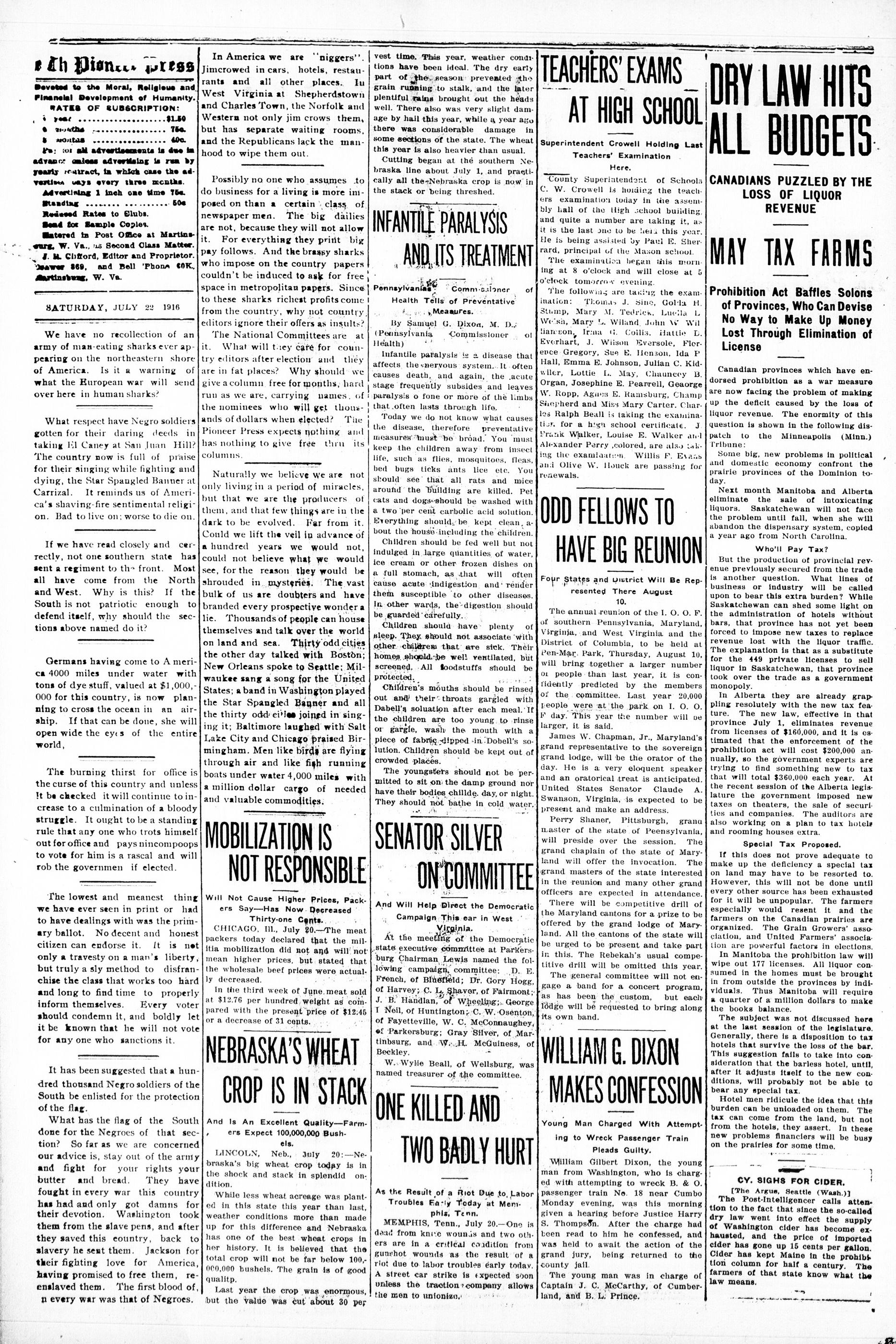
INFANTILE PARALYSIS AND ITS TREATMENT
By Samuel G. Dixon, M. D. (Pennsylvania Commissioner of Health) Infantile paralysis is a disease that affects the nervous system. It often causes death, and again, the acute stage frequently subsides and leaves paralysis o fone or more of the limbs that often lasts through life.
Today we do not know what causes the disease, therefore preventative measures must be broad. You must keep the children away from insect life, such as flies, mosquitoes, fleas, bed bugs ticks ants lice etc. You should see that all rats and mice around the building are killed. Pet cats and dogs should be washed with a two per cent carbolic acid solution. Everything should be kept clean about the house including the children
Children should be fed well but not indulged in large quantities of water, ice cream or other frozen dishes on a full stomach, as that will often cause acute indigestion and render them susceptible to other diseases. In other wards, the digestion should be guarded carefully.
Children should have plenty of sleep. They should not associate with other children that are sick. Their homes should be well ventilated, but screened. All foodstuffs should be protected.
Children's mouths should be rinsed out and their throats gargled with Dabell's soluation after each meal. If the children are too young to rinse or gargle, wash the mouth with a piece of fabric dipped in Dobell's solution. Children should be kept out of crowded places.
The youngsters should not be permitted to sit on the damp ground nor have their bodies chillde, day, or night. They should not bathe in cold water.
SENATOR SILVER ON COMMITTEE
And Will Help Direct the Democratic Campaign This ear in West Virginia.
At the meeting of the Democratic state executive committee at Parkersburg Chairman Lewis named the following campaign committee: D. E. French, of Bineffield; Dr. Gory Hogg, of Harvey; C. L. Shaver, of Fairmont; J. B. Handlan, of Wheeling; George I Neil, of Huntington; C. W. Osenton, of Fayetteville, W. C. McConnaughey, of Parkersburg; Gray Silver, of Martinbsurg, and W. H. McGuiness, of Beckley.
W. Wylie Beall, of Wellsburg, was named treasurer of the committee.
ONE KILLED AND TWO BADLY HURT
As the Result of a Riot Due to Labor Troubles Early Today at Memphis, Tenn.
MEMPHIS, Tenn., July 20.—One is dead from knife wounds and two others are in a critical condition from gunshot wounds as the result of a riot due to labor troubles early today. A street car strike is expected soon unless the traction company allows the men to unionize.
TEACHERS' EXAMS AT HIGH SCHOOL
Superintendent Crowell Holding Last Teachers' Examination Here.
County Superintendent of Schools C. W. Crowell is holding the teachers examination today in the assembly hall of the High school building, and quite a number are taking it, as it is the last one to be here this year. He is being assisted by Paul E. Sherrard, principal of the Mason school.
The examination began this morning at 8 o'clock and will close at 5 o'clock tomorrow evening.
The following are taking the examination: Thomas J. Sine, Golla H. Stump, Mary M. Tedrick, Lucella L. Wesha, Mary L. Wiland, John W. Williamson, Irna G. Collis, Hattie D. Everhart, J. Wilson Eversole, Florence Gregory, Sue E. Henson, Ida P. Hall, Emma E. Johnson, Julian C. Kiddwiler, Lottie L. May, Chauncey B. Organ, Josephine E. Pearrell, Geaorge W. Ropp, Agnes E. Ramsburg, Champ Shepherd and Miss Mary Carter. Charles Ralph Beall is taking the examination, for a high school certificate. J. Frank Walker, Louise E. Walker and Alexander Perry colored, are also taking the examination. Willis F. Evans and Olive W. Houck are passing for renewals.
ODD FELLOWS TO HAVE BIG REUNION
ODD FELLOWS TO HAVE BIG REUNION
Four States and District Will Be Represented There August 10.
The annual reunion of the I. O. O. F. of southern Pennsylvania, Maryland, Virginia, and West Virginia and the District of Columbia, to be held at Pen-Mar. Park, Thursday, August 10, will bring together a larger number of people than last year, it is confidently predicted by the members of the committee. Last year 20,000 people were at the park on I. O. O. F. day. This year the number will be larger, it is said.
James W. Chapman, Jr., Maryland's grand representative to the sovereign grand lodge, will be the orator of the day. He is a very eloquent speaker and an oratorical treat is anticipated. United States Senator Claude A. Swanson, Virginia, is expected to be present and make an address.
Perry Shaner, Pittsburgh, grand master of the state of Peensylvania, will preside over the session. The grand chaplain of the state of Maryland will offer the invocation. The grand masters of the state interested in the reunion and many other grand officers are expected in attendance. There will be competitive drill of the Maryland cantons for a prize to be offered by the grand lodge of Maryland. All the cantons of the state will be urged to be present and take part in this. The Rebekah's usual competitive drill will be omitted this year.
The general committee will not engage a band for a concert program, as has been the custom, but each lodge will be requested to bring along its own band.
WILLIAM G. DIXON MAKES CONFESSION
Young Man Charged With Attempting to Wreck Passenger Train Pleads Guilty.
William Gilbert Dixon, the young man from Washington, who is charged with attempting to wreck B. & O. passenger train No. 18 near Cumbo Monday evening, was this morning given a hearing before Justice Harry S. Thompson. After the charge had been read to him he confessed, and was held to await the action of the grand jury, being returned to the county jail.
The young man was in charge of Captain J. C. McCarthy, of Cumberland, and B. L. Prince.
DRY LAW HITS ALL BUDGETS
CANADIANS PUZZLED BY THE LOSS OF LIQUOR REVENUE
MAY TAX FARMS
Prohibition Act Baffles Solons of Provinces, Who Can Devise No Way to Make Up Money Lost Through Elimination of License
Canadian provinces which have endorsed prohibition as a war measure are now facing the problem of making up the deficit caused by the loss of liquor revenue. The enormity of this question is shown in the following dispatch to the Minneapolis (Minn.) Tribune:
Some big, new problems in political and domestic economy confront the prairie provinces of the Dominion today.
Next month Manitoba and Alberta eliminate the sale of intoxicating liquors. Saskatchewan will not face the problem until fall, when she will abandon the dispensary system, copled a year ago from North Carolina.
Who'll Pay Tax?
But the production of provincial revenue previously secured from the trade is another question. What lines of business or industry will be called upon to bear this extra burden? While Saskatchewan can shed some light on the administration of hotels without bars, that province has not yet been forced to impose new taxes to replace revenue lost with the liquor traffic. The explanation is that as a substitute for the 449 private licenses to sell liquor in Saskatchewan, that province took over the trade as a government monopoly.
In Alberta they are already grappling resolutely with the new tax feature. The new law, effective in that province July 1, eliminates revenue from licenses of $160,000, and it is estimated that the enforcement of the prohibition act will cost $200,000 annually, so the government experts are trying to find something new to tax that will total $360,000 each year. At the recent session of the Alberta legislature the government imposed new taxes on theaters, the sale of securities and companies. The auditors are also working on a plan to tax hotels and rooming houses extra.
Special Tax Proposed.
If this does not prove adequate to make up the deficiency a special tax on land may have to be resorted to. However, this will not be done until every other source has been exhausted for it will be unpopular. The farmers especially would resent it and the farmers on the Canadian prairies are organized. The Grain Growers' association, and United Farmers' association are powerful factors in elections. In Manitoba the prohibition law will wipe out 177 licenses. All liquor consumed in the homes must be brought in from outside the provinces by individuals. Thus Manitoba will require a quarter of a million dollars to make the books balance.
The subject was not discussed here at the last session of the legislature. Generally, there is a disposition to tax hotels that survive the loss of the bar. This suggestion fails to take into consideration that the barless hotel, until, after it adjusts itself to the new conditions, will probably not be able to bear any special tax. Hotel men ridicule the idea that this burden can be unloaded on them. The tax can come from the land, but not from the hotels, they assert. In these new problems financiers will be busy on the prairies for some time.
The Post-Intelligencer calls attention to the fact that since the so-called dry law went into effect the supply of Washington cider has become exhausted, and the price of imported cider has gone up 15 cents per gallon. Cider has kept Maine in the prohibition column for half a century. The farmers of that state know what the law means.
FARE $300 DAILY BETWEEN CLEVELAND & BUFFALO
C&B LINE
The Great Ship "SEEANDBEEZ"
The largest and most costly steamer on any inland water of the world. Sleeping accommodations for 1500 passengers.
"CITY OF ERIE" — 3 Magnificent Steamers — "CITY OF BUFFALO"
BETWEEN
CLEVELAND-Daily, May 1st to Nov. 15th-BUFFALO
Leave Cleveland 8:00 P.M. Leave Buffalo 8:00 P.M.
Arrive Buffalo 8:00 A.M. Arrive Cleveland 8:00 A.M.
(Central Standard Time)
Connections at Buffalo for Niagara Falls and all Eastern and Canadian points. Railroad ticketing reselling between Cleveland and Buffalo are good for transportation on our steamers. Ask your ticket agent for ticket with G. & B. Line.
Beautifully colored sectional puzzle chart showing both exterior and interior of The Great Ship "SEEANDBEEF" sent on receipt of five cents to cover postage and mailing. Also ask for our 24-page pictorial and descriptive booklet free.
THE CLEVELAND & BUFFALO TRANSIT CO., Cleveland, Ohio
HUSBAND RESCUED DESPAIRING WIFE
LOCAL NOTES.
LOCAL NOTES.
Go to John D & Co., for everything in the clothing line. They have it, and insist you call and look it over. Prices reasonaable and anxiety on tiptoe to please you. Every new buyer brings another.
Mr. Dade Green, a high type of the Virginia gentleman is in our midst again, a fact highly gratifying to his many friends hereabouts.
BE PREPARED
POPULAR MECHANICS
MAGAZINE
300 ARTICLES - 300 ILLUSTRATIONS
KEEP informed of the World's Progress in
Engineering, Mechanics and Invention. For
Father and Son and All the Family. He appeals
to all classes - Old and Young - Men and Women.
It is the Favorite Magazine in thousands of
homes throughout the world. Our Foreign
Correspondents are constantly on the watch
for things new and interesting and it is
Written So You Can Understand It
(The Shops Need Some Pages) contains
Practical Hints for Shop Work and enrages for the
lawman to do things around the Home.
Lawman Mechanics (17 Pages) for the Boys and
Girls in Law School. Engineers, Boats, Snow-
shoes, Jewelry, Read Furniture, etc. Contains instructions for the Mechanic, Camper and Sportman.
$1.50 PER YEAR
SINGLE COPIES, 15c
Order or enclosure number required
Sample copy will be sent on request.
POPULAR MECHANICS
MAGAZINE
O No. Michigan Avenue, CHICAGO
Thompson and Thompson have the most attractive stock of men's ready made clothing to be found in the city, and the nobbiest and nattiest stock of hats, shirts and summer wear you ever saw. Give them a call-144 North Queen Street.
FARE $300
C&B LINE
The Great Ship
The largest and most costly steamer on any inland
tions for 1500 passengers.
"CITY OF ERIE" — 3 Magnificent
BET
CLEVELAND-Daily, May
Leave Cleveland 8:00 P.M.
Arrive Buffalo 6:30 A.M.
Central Star
Connections at Buffalo for Niagara Falls and
oats reading between Cleveland and Buffalo area
your ticket agent for tickets via C. & B. Line.
Beautifully colored sectional puzzle chart, shi
Ship "SEEANDBEE" sent on receipt of five
for our 24-page pictorial and descriptive book
THE CLEVELAND & BUFFALO
HUSBAND
DESPA
After Four Years of Discouraging Conditions, Mrs. Bullock Gave Up in Despair. Husband Came to Rescue.
Catron, Ky.—In an interesting letter from this place, Mrs. Bettie Bullock writes as follows: "I suffered for four years, with womanly troubles, and during this time, I could only sit up for a little while, and could not walk anywhere at all. At times, I would have severe pains in my left side.
The doctor was called in, and his treatment relieved me for a while, but I was confined to my bed again. After that, nothing seemed to do me any good.
---
Mrs. S. H. Norwood was called out of the city by the death of her father in Frederick City.
Are You a Woman?
Take Cardui
The Woman's Tonic
FOR SALE AT ALL DISCOUNTS
Mme. L. C. Parrish Hair Culturing Scalp Treatment
Mme. L. C. Parrish Hair Culturing Scalp Treatment
谈
All kinds of Toilet Articles for sale.
Human Hair Goods of the finest quality.
Our Hair Food and Skin Food never fail.
If the trouble is with the hair, scalp or skin, we have the remedy.
We guarantee a remedy to make hair grow on bald spots and bare temple. Send 10a. for a sample and catalogue. Send for our terms to agents.
Address Mme. L. C. PARRISH, 95 Camden Street, Boston, Mass.
DAILY BETWEEN CLEVELAND & BUFFALO
"SEEANDBEEZ"
and water of the world. Sleeping accommodations.
Steamers — "CITY OF BUFFALO"
WEEN
1st to Nov. 15th-BUFFALO
Leave Buffalo • 8:00 P. M.
Arrive Cleveland • 6:30 A. M.
Standard Time)
Eastern and Canadian points. Railroad ticking good for transportation on our steamers. Ask
owing both exterior and interior of The Great cents to cover postage and mailing. Also ask late free.
D TRANSIT CO., Cleveland, Ohio
RESCUED
IRING WIFE
I had gotten so weak I could not stand, and I gave up in despair.
At last, my husband got me a bottle of Cardul, the woman's tonic, and I commenced taking it. From the very first dose, I could tell it was helping me. I can now walk two miles without its tiring me, and am doing all my work."
If you are all run down from womanly troubles, don't give up in despair. Try Cardul, the woman's tonic. It has helped more than a million women, in its 50 years of continuous success, and should surely help you, too. Your druggist has sold Cardul for years. He knows what it will do. Ask him. He will recommend it. Begin taking Cardul today.
Write to: Chattanooga Medicina Co., Letter Advisory Dept., Chattanooga, Tenn., for instructions on your case and 64-page book. Treatment for Women," sent in plain vase.
---
RAILROAD WAGES
Shall they be determined by Industrial Warfare or Federal Inquiry?
To the American Public:
Do you believe in arbitration trial warfare?
The train employees on all are voting whether they will give authority to tie up the country to enforce their demand million dollar wage increase.
The railroads are in the public service. This army of the public service—your service.
You pay for rail transport dollars a year, and 44 cents dollar from you goes to the economy.
On all the Eastern Railroads in 1915, seventy train employees earned these wages (lowest, of all) as shown by the payrolls—
Passenger Average Passenger Average
Engineers. $1641 $1931 $1585 $1781
3224 2992 2992
Conductors 1553 1831 1552 1041
3004 2901 2901
Pilgrims 961 1128 933 1101
1704 1702
Brahms. 867 1141 862 971
1707 1521
The average yearly wage payments to train employees (including those who worked only shown by the 1915 payrolls were—
Passenger Average Passenger Average
Engineers. $1706 $1181
Conductors 1724 141
Pilgrims 1033 0
Brahms 1018
A 100 million dollar wage men in freight and yard service one-fifth of all employees) is equal advance in all freight rates.
The managers of the railroads for the public, have no right burden on the cost of transport without a clear mandate from the bunal speaking for you.
The railroads have proposed this controversy either existing national arbitration law or the Interstate Commission. This offer has been re-employees' representatives.
Shall a nation-wide investigation under the term determine the
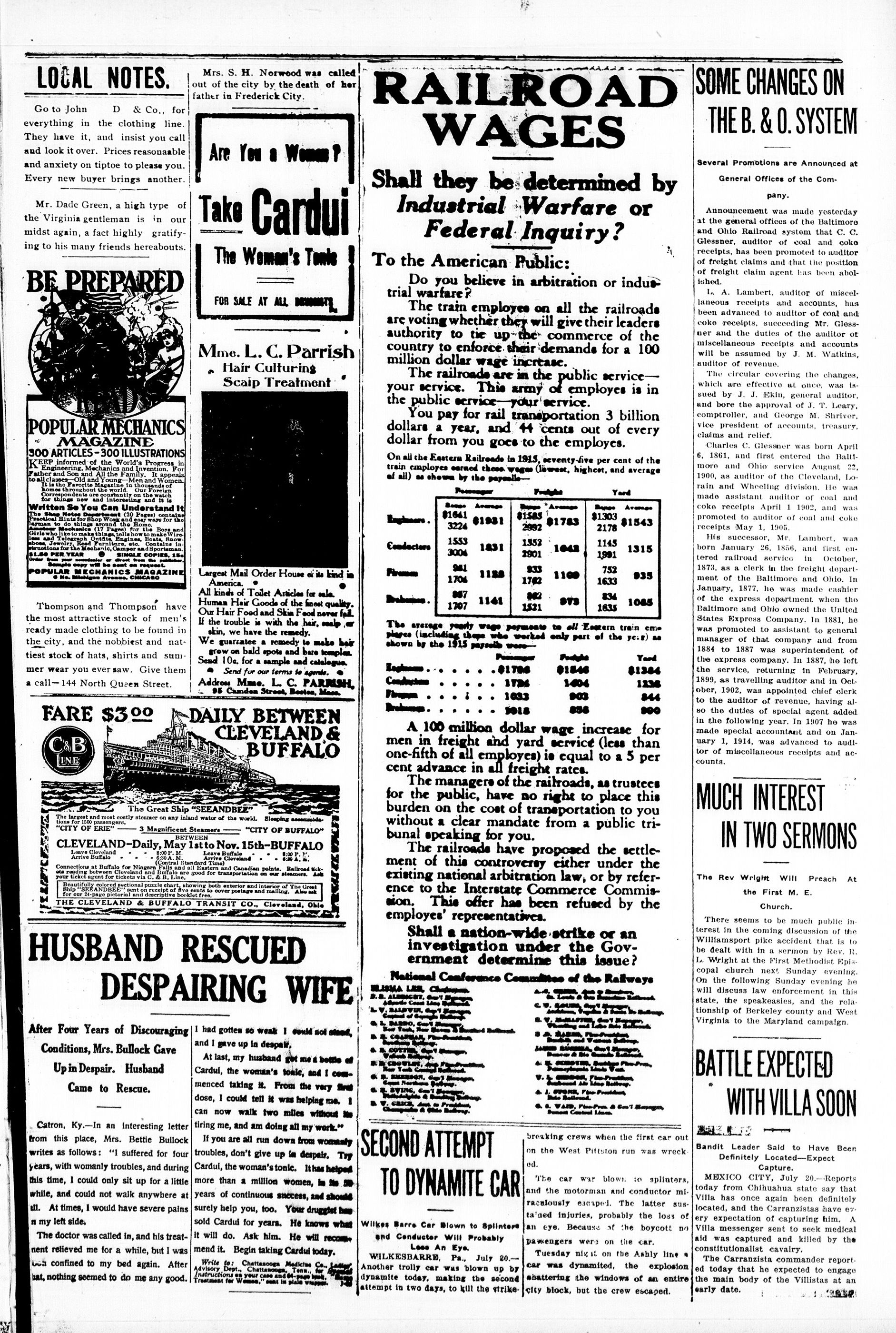
Do you believe in arbitration or industrial warfare? The train employees on all the railroads are voting whether they will give their leaders authority to tie up the commerce of the country to enforce their demands for a 100 million dollar wage increase. The railroads are in the public service your service. This army of employees is in the public service your service. You pay for rail transportation 3 billion dollars a year, and 44 cents out of every dollar from you goes to the employees.
On all the Eastern Railroads in 1915, seventy-five per cent of the train employees earned these wages (lowest, highest, and average of all) as shown by the payroll—
Possenger
Barge
$1641
3224
Average
$1981
2992
Barge
$1585
2992
Average
$1783
2992
Barge
$1303
2178
Average
$1543
2178
Conductors
1553
3004
1831
1552
2901
1042
1145
1991
1315
Firemen
961
1704
1128
833
1762
1100
752
1633
935
Brokers.
857
1707
1141
962
1521
973
834
1635
1085
The average yearly wage payment to all Eastern train employees (including those who worked only part of the year) as shown by the 1915 payroll work—
Pannager: Fudgik: Yard
EnglISH: £1796: £1546: £1364
Conductors: 1734: 1404: 1238
Firemen: £1033: 903: 844
Brahmins: £918: 858: 900
A 100 million dollar wage increase for men in freight and yard service (less than one-fifth of all employees) is equal to a 5 per cent advance in all freight rates.
The managers of the railroads, as trustees for the public, have no right to place this burden on the cost of transportation to you without a clear mandate from a public tribunal speaking for you.
The railroads have proposed the settlement of this controversy either under the existing national arbitration law, or by reference to the Interstate Commerce Commission. This offer has been refused by the employees' representatives.
Shall a nation-wide strike or an investigation under the Government determine this issue?
breaking crews when the first car out on the West Pittston run was wrecked.
The car war blown to splinters, and the motorman and conductor miraculously escaped. The latter sustained injuries, probably the loss of an eye. Because of the boycott no passengers were on the car.
Tuesday night on the Ashly line a car was dynamited, the explosion shattering the windows of an entire city block, but the crew escaped.
B. R. ALLEGGET, Gov. I Merganser,
Albany Coast Line Railroad.
L. V. BALVIN, Gov. I Merganser,
Capital of Sopragh Railway.
G. L. BABO, Gov. I Merganser,
New York, New Haven & Northfield Railroad.
H. R. CRAHAN, Pine Grove Railroad,
Borough Railway.
G. R. CUTTER, Gov. I Merganser,
Watertown Railway.
H. R. CROWLEY, Amt. Pipe Manufacturer,
New York City Railroad.
G. R. BREESON, Gov. I Merganser,
Count Northern Railway.
G. R. EVING, Gov. I Merganser,
Midland Railway & Bingham Railway.
B. V. CREEK, Amt. to President,
Champaign & Ohio Railway.
SECOND ATTEMPT TO DYNAMITE CAR
Wilkes Barre Car Blown to Splinters and Conductor Will Probably Lose An Eye. WILKESBARRE, Pa., July 20. Another trollly car was blown up by dynamite today, making the second attempt in two days, to kill the strike-
SOME CHANGES ON THE B. & O. SYSTEM
Several Promotions are Announced at General Offices of the Com-
pany.
Announcement was made yesterday at the general offices of the Baltimore and Ohio Railroad system that C. C. Glessner, auditor of coal and coke receipts, has been promoted to auditor of freight claims and that the position of freight claim agent has been abolished.
L. A. Lambert, auditor of miscellaneous receipts and accounts, has been advanced to auditor of coal and coke receipts, succeeding Mr. Glessner and the duties of the auditor of miscellaneous receipts and accounts will be assumed by J. M. Watkins, auditor of revenue.
The circular covering the changes, which are effective at once, was issued by J. J. Ekin, general auditor, and bore the approval of J. T. Leary, comptroller, and George M. Shriver, vice president of accounts, treasury, claims and relief.
Charles C. Glessner was born April 6, 1861, and first entered the Baltimore and Ohio service August 22, 1900, as auditor of the Cleveland, Lorain and Wheeling division. He was made assistant auditor of coal and coke receipts April 1 1902, and was promoted to auditor of coal and coke receipts May 1, 1905.
His successor, Mr. Lambert, was born January 26, 1856, and first entered railroad service in October, 1873, as a clerk in the freight department of the Baltimore and Ohio. In January, 1877, he was made cashier of the express department when the Baltimore and Ohio owned the United States Express Company. In 1881, he was promoted to assistant to general manager of that company and from 1884 to 1887 was superintendent of the express company. In 1887, he left the service, returning in February, 1899, as travelling auditor and in October, 1902, was appointed chief clerk to the auditor of revenue, having also the duties of special agent added in the following year. In 1907 he was made special accountant and on January 1, 1914, was advanced to auditor of miscellaneous receipts and accounts.
MUCH INTEREST IN TWO SERMONS
The Rev Wright Will Preach At the First M. E. Church.
There seems to be much public interest in the coming discussion of the Williamport pike accident that is to be dealt with in a sermon by Rev. R. L. Wright at the First Methodist Episcopal church next Sunday evening. On the following Sunday evening he will discuss law enforcement in this state, the speakeasies, and the relationship of Berkeley county and West Virginia to the Maryland campaign.
BATTLE EXPECTED WITH VILLA SOON
Bandit Leader Said to Have Been Definitely Located—Expect Capture.
MEXICO CITY, July 20.—Reports today from Chihuahua state say that Villa has once again been definitely located, and the Carranzistas have every expectation of capturing him. A Villa messenger sent to seek medical aid was captured and killed by the constitutionalist cavalry.
The Carranzista commander reported today that he expected to engage the main body of the Villistas at an early date.
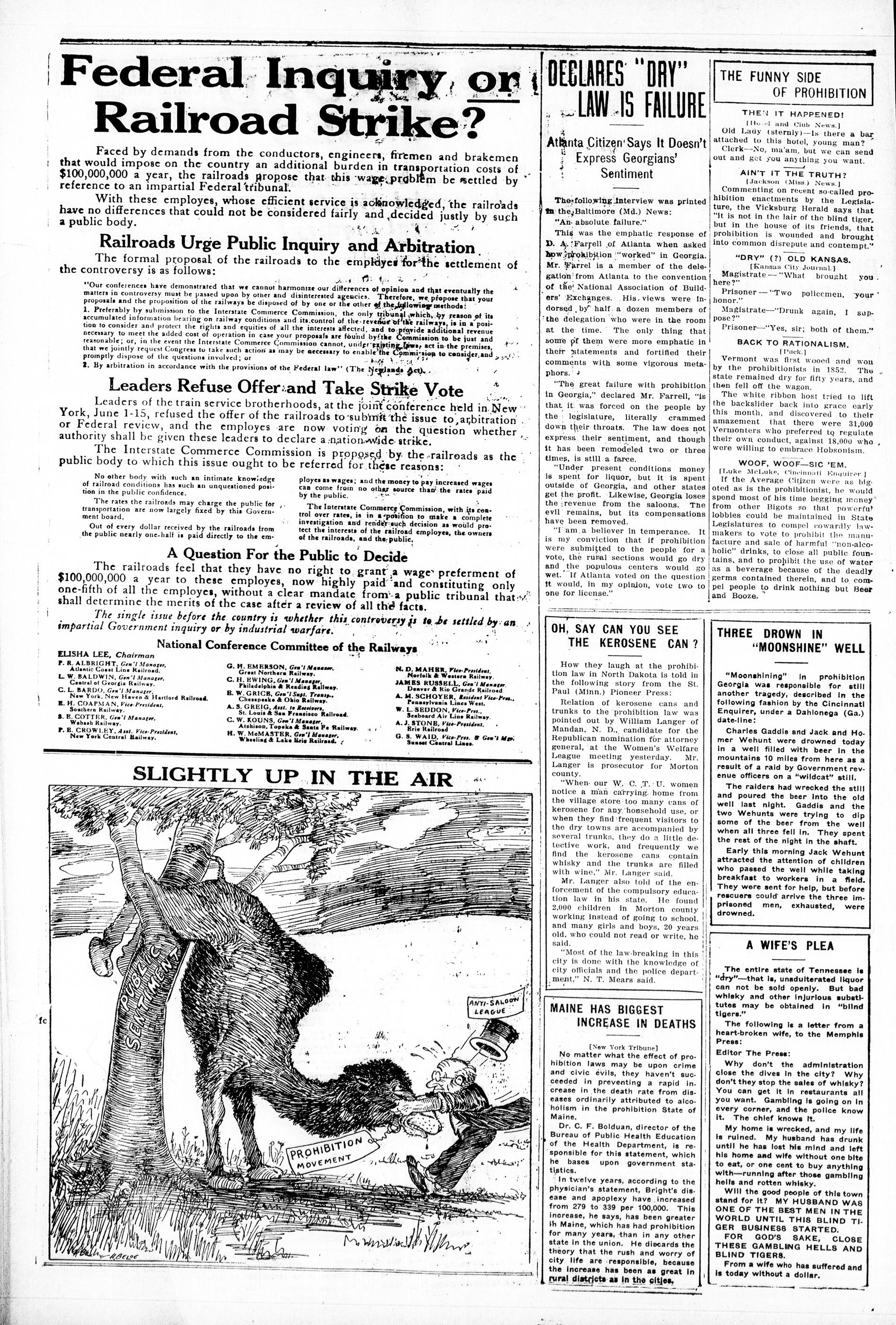
Federal Inquiry or Railroad Strike?
Faced by demands from the conductors, engineers, firemen and brakemen that would impose on the country an additional burden in transportation costs of $100,000,000 a year, the railroads propose that this wage problem be settled by reference to an impartial Federal tribunal. With these employes, whose efficient service is acknowledged, the railroads have no differences that could not be considered fairly and decided justly by such a public body.
Railroads Urge Public Inquiry and Arbitration
The formal proposal of the railroads to the employees for the settlement of the controversy is as follows:
"Our conferences have demonstrated that we cannot harmonize our differences of opinion and that eventually the matters in controversy must be passed upon by other and disinterested agencies. Therefore, we propose that your proposals and the proposition of the railways be disposed of by one or the other of the following methods:
1. Preferably by submission to the Interstate Commerce Commission, the only tribunal which, by reason of its accumulated information bearing on railway conditions and its control of the revenue of the railways, is in a position to consider and protect the rights and equities of all the interests affected, and to provide additional revenue necessary to meet the added cost of operation in case your proposals are found by the Commission to be just and reasonable; or, in the event the Interstate Commerce Commission cannot, under existing laws, act in the premises, that we jointly request Congress to take such action as may be necessary to enable the Commission to consider, and promptly dispose of the questions involved; or
2. By arbitration in accordance with the provisions of the
Leaders Refuse Offer and Take Strike Vote
Leaders of the train service brotherhoods, at the joint conference held in New York, June 1-15, refused the offer of the railroads to submit the issue to arbitration or Federal review, and the employees are now voting on the question whether authority shall be given these leaders to declare a nation-wide strike.
The Interstate Commerce Commission is proposed by the railroads as the public body to which this issue ought to be referred for these reasons:
No other body with such an intimate knowledge of railroad conditions has such an unquestioned position in the public confidence.
The rates the railroads may charge the public for transportation are now largely fixed by this Government board.
Out of every dollar received by the railroads from the public nearly one-half is paid directly to the employees as wages; and the money to pay increased wages can come from no other source than the rates paid by the public.
The Interstate Commerce Commission, with its control over rates, is in a position to make a complete investigation and render such decision as would protect the interests of the railroad employees, the owners of the railroads, and the public.
A Question For the railroads feel that they have $100,000,000 a year to these employees one-fifth of all the employees, without a shall determine the merits of the case af The single issue before the country is impartial Government inquiry or by industry National Conference
Action For the Public to Declare they have no right to grant employees, now highly paid without a clear mandate from the case after a review of all the country is whether this contract by industrial warfare. Conference Committee of the R
A Question For the Public to Decide
The railroads feel that they have no right to grant a wage preferment of $100,000,000 a year to these employes, now highly paid and constituting only one-fifth of all the employes, without a clear mandate from a public tribunal that shall determine the merits of the case after a review of all the facts.
The single issue before the country is whether this controversy is to be settled by an impartial Government inquiry or by industrial warfare.
National Conference Committee of the Railways
G. H. EMERSON, Gen'l Manager.
Great Northern Railway.
C. H. EWING, Gen'l Manager.
Philadelphia & Reading Railway.
B. W. GRICE, Gen'l Sept. Trans.
Chesapeake & Ohio Railway.
A. S. GREIG, Asst. to Recivers.
St. Louis & San Francisco Railroad.
C. W. KOUNS, Gen'l Manager.
Atchison, Topeka & Santa Fe Railway.
H. W. McMASTER, Gen'l Manager.
Wheeling & Lake Erie Railroad.
SLIGHTLY I
LY UP IN TH
PUBLIC SENTIMENT
ANTI-SALOON LEAGUE
PROHIBITION MOVEMENT
ELISHA LEE, Chairman
P. R. ALBRIGHT, Gen'l Manager,
Atlantic Coast Line Railroad.
L. W. BALDWIN, Gen'l Manager,
Central of Georgia Railway.
C. L. BARDO, Gen'l Manager,
New York, New Haven & Hartford Railroad.
E. H. COAPMAN, Vice President,
Southern Railway.
S. E. COTTER, Gen'l Manager,
Wabash Railway.
P. E. CROWLEY, Asst. Vice-President,
New York Central Railway.
ployees as wages; and the money to pay increased wages can come from no other source than the rates paid by the public.
The Interstate Commerce Commission, with its control over rates, is in a position to make a complete investigation and render such decision as would protect the interests of the railroad employees, the owners of the railroads, and the public.
Public to Decide
to right to grant a wage prefermen now highly paid and constituting a mandate from a public tribunal a review of all the facts.
whether this controversy is to be settled by warfare.
mittee of the Railways
IN THE AIR
de
a wage preferment of
and constituting only
a public tribunal that
facts.
rsey is to be settled by an
ways
N. D. MAHER, Vice-President,
Norfolk & Western Railway.
JAMES RUSSELL, Gun'l Manor,
Denver & Rio Grande Railroad
A. M. SCHOYER, Resident Vice-Pres.,
Pennsylvania Lines West.
W. L. SEDDON, Vice-Pres.,
Seaboard Air Lines Railway.
A. J. STONE, Vice-President,
Erie Railroad
G. 8. WAID, Vice-Pres. & Gun'l Mgr.
Sunset Central Lines.
DECLARES "DRY" LAW IS FAILURE
Atlanta Citizen Says It Doesn't Express Georgians' Sentiment
The following interview was printed in the, Baltimore (Md.) News:
"An absolute failure."
This was the emphatic response of D. A. Farrell of Atlanta when asked how prohibition "worked" in Georgia. Mr. Farrel is a member of the delegation from Atlanta to the convention of the National Association of Builders' Exchanges. His views were indorsed by half a dozen members of the delegation who were in the room at the time. The only thing that some of them were more emphatic in their statements and fortified their comments with some vigorous metaphors.
"The great failure with prohibition in Georgia," declared Mr. Farrell, "is that it was forced on the people by the legislature, literally crammed down their throats. The law does not express their sentiment, and though it has been remodeled two or three times, is still a farce.
"Under present conditions money is spent for liquor, but it is spent outside of Georgia, and other states get the profit. Likewise, Georgia loses the revenue from the saloons. The evil remains, but its compensations have been removed.
"I am a believer in temperance. It is my conviction that if prohibition were submitted to the people for a vote, the rural sections would go dry and the populous centers would go wet." If Atlanta voted on the question it would, in my opinion, vote two to one for license."
OH, SAY CAN YOU SEE
THE KEROSENE CAN?
How they laugh at the prohibition law in North Dakota is told in the following story from the St. Paul (Minn.) Pioneer Press: Relation of kerosene cans and trunks to the prohibition law was pointed out by William Langer of Mandan, N. D., candidate for the Republican nomination for attorney general, at the Women's Welfare League meeting yesterday. Mr. Langer is prosecutor for Morton county.
"When our W. C. T. U. women notice a man carrying home from the village store too many cans of kerosene for any household use, or when they find frequent visitors to the dry towns are accompanied by several trunks, they do a little detective work, and frequently we find the kerosene cans contain whisky and the trunks are filled with wine," Mr. Langer said.
Mr. Langer also told of the enforcement of the compulsory education law in his state. He found 2,000 children in Morton county working instead of going to school, and many girls and boys, 20 years old, who could not read or write, he said.
"Most of the law-breaking in this city is done with the knowledge of city officials and the police department," N. T. Mears said.
MAINE HAS BIGGEST INCREASE IN DEATHS
MAINE HAS BIGGEST INCREASE IN DEATHS
[New York Tribune]
No matter what the effect of prohibition laws may be upon crime and civic evils, they haven't succeeded in preventing a rapid increase in the death rate from diseases ordinarily attributed to alcoholism in the prohibition State of Maine.
Dr. C. F. Bolduan, director of the Bureau of Public Health Education of the Health Department, is responsible for this statement, which he bases upon government statistics.
In twelve years, according to the physician's statement, Bright's disease and apoplexy have increased from 279 to 339 per 100,000. This increase, he says, has been greater in Maine, which has had prohibition for many years, than in any other state in the union. He discards the theory that the rush and worry of city life are responsible, because the increase has been as great in rural districts as in the cities.
THE FUNNY SIDE OF PROHIBITION
THE FUNNY SIDE OF PROHIBITION
THEN IT HAPPENED!
[Hotel and Club News.]
Old Lady (sternly)—Is there a bar attached to this hotel, young man?
Clerk—No, ma'am, but we can send out and get you anything you want
Commenting on recent so-called prohibition enactments by the Legislature, the Vicksburg Herald says that "it is not in the lair of the blind tiger, but in the house of its friends, that prohibition is wounded and brought into common disrepute and contempt."
"DRY" (?) OLD KANSAS.
[Kansas City Journal.]
Magistrate—"What brought you here?"
Prisoner—"Two policemen, your honor."
Magistrate—"Drunk again, I suppose?"
Prisoner—"Yes, sir; both of them."
BACK TO RATIONALISM
Vermont was first wooed and won by the prohibitionists in 1852. The state remained dry for fifty years, and then fell off the wagon. The white ribbon host tried to lift the backslider back into grace early this month, and discovered to their amazement that there were 31,000 Vermonters who preferred to regulate their own conduct, against 18,000 who were willing to embrace Hobsonism
WOOF, WOOF—SIC 'EM
[Luke McLuke, Cincinnati Enquirer]
If the Average Citizen were as bigoted as is the prohibitionist, he would spend most of his time begging money from other Bigots so that powerful lobbies could be maintained in State Legislatures to compel cowardly lawmakers to vote to prohibit the manufacture and sale of harmful "non-alcoholic" drinks, to close all public fountains, and to prohibit the use of water as a beverage because of the deadly germs contained therein, and to compel people to drink nothing but Beer and Booze.
THREE DROWN IN "MOONSHINE" WELL
"Moonshining" in prohibition Georgia was responsible for still another tragedy, described in the following fashion by the Cincinnati Enquirer, under a Dahlonega (Ga.) date-line:
Charles Gaddis and Jack and Homer Wehunt were drowned today in a well filled with beer In the mountains 10 miles from here as a result of a raid by Government revenue officers on a "wildcat" still.
The raiders had wrecked the still and poured the beer into the old well last night. Gaddis and the two Wehunts were trying to dip some of the beer from the well when all three fell in. They spent the rest of the night in the shaft.
Early this morning Jack Wehunt attracted the attention of children who passed the well while taking breakfast to workers in a field. They were sent for help, but before rescuers could arrive the three imprisoned men, exhausted, were drowned.
A WIFE'S PLEA
The entire state of Tennessee is "dry"—that is, unadulterated liquor can not be sold openly. But bad whisky and other injurious substitutes may be obtained in "blind tigers."
The following is a letter from a heart-broken wife, to the Memphis Press:
Editor The Press:
Why don't the administration close the dives in the city? Why don't they stop the sales of whisky? You can get it in restaurants all you want. Gambling is going on in every corner, and the police know it. The chief knows it.
My home is wrecked, and my life is ruined. My husband has drunk until he has lost his mind and left his home and wife without one bite to eat, or one cent to buy anything with—running after those gambling hells and rotten whisky.
Will the good people of this town stand for it? MY HUSBAND WAS ONE OF THE BEST MEN IN THE WORLD UNTIL THIS BLIND TIGER BUSINESS STARTED.
FOR GOD'S SAKE, CLOSE THESE GAMBLING HELLS AND BLIND TIGERS.
From a wife who has suffered and is today without a dollar.