The Pioneer Press
Saturday, July 29, 1916
Martinsburg, West Virginia
Page text (machine-generated)
"HERE SHALL THE PRESS, THE PEOPLE'S FUCHS MAINTAIN, UNAWED BY INFLUENCE AND UNBRIBED BY GAIN"
The Pioneer
ESTABLISHED 1882.
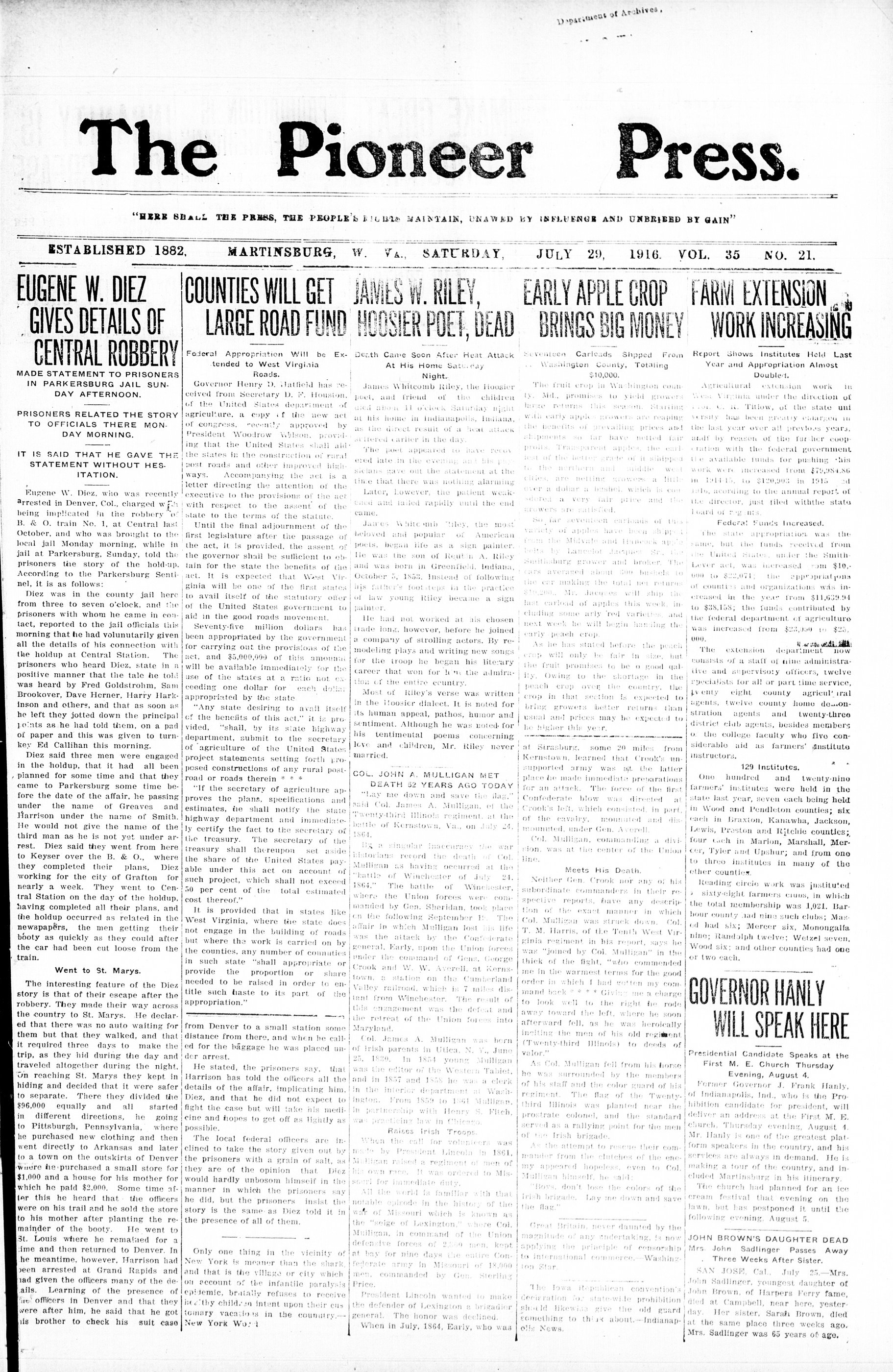
EUGENE W. DIEZ GIVES DETAILS OF CENTRAL ROBBERY
MADE STATEMENT TO PRISONERS
IN PARKERSBURG JAIL SUN-
DAY AFTERNOON.
PRISONERS RELATED THE STORY
TO OFFICIALS THERE MON-
DAY MORNING.
IT IS SAID THAT HE GAVE THE
STATEMENT WITHOUT HES-
ITATION.
Eugene W. Diez, who was recently arrested in Denver, Col., charged with being implicated in the robbery of B. & O. train No. 1, at Central last October, and who was brought to the local jail Monday morning, while in jail at Parkersburg, Sunday, told the prisoners the story of the hold-up. According to the Parkersburg Sentinel, it is as follows:
Diez was in the county jail here from three to seven o'clock, and the prisoners with whom he came in contact, reported to the jail officials this morning that he had voluntarily given all the details of his connection with the holdup at Central Station. The prisoners who heard Diez, state in a positive manner that the tale he told was heard by Fred Goldstrohm, Sam Brookover, Dave Herner, Harry Harkinson and others, and that as soon as he left they jotted down the principal points as he had told them, on a pad of paper and this was given to turnkey Ed Callihan this morning.
Diez said three men were engaged in the holdup, that it had all been planned for some time and that they came to Parkersburg some time before the date of the affair, he passing under the name of Greaves and Harrison under the name of Smith. He would not give the name of the third man as he is not yet under arrest. Diez said they went from here to Keyser over the B. & O., where they completed their plans, Diez working for the city of Grafton for nearly a week. They went to Central Station on the day of the holdup, having completed all their plans, and the holdup occurred as related in the newspapers, the men getting their booty as quickly as they could after the car had been cut loose from the train.
Went to St. Marys.
The interesting feature of the Diez story is that of their escape after the robbery. They made their way across the country to St. Marys. He declared that there was no auto waiting for them but that they walked, and that it required three days to make the trip, as they hid during the day and traveled altogether during the night. On reaching St. Marys they kept in hiding and decided that it were safer to separate. There they divided the $96,000 equally and all started in different directions, he going to Pittsburgh, Pennsylvania, where he purchased new clothing and then went directly to Arkansas and later to a town on the outskirts of Denver where he purchased a small store for $1,000 and a house for his mother for which he paid $2,000. Some time after this he heard that the officers were on his trail and he sold the store to his mother after planting the remainder of the booty. He went to St. Louis where he remained for a time and then returned to Denver. In he meantime, however, Harrison had been arrested at Grand Rapids and had given the officers many of the details. Learning of the presence of the officers in Denver and that they were after him, he said that he got his brother to check his suit case
MARTINSBURG.
COUNTIES WILL GET LARGE ROAD FUND
Federal Appropriation Will be Extended to West Virginia Roads.
Governor Henry D. Hatfield has received from Secretary D. F. Houston, of the United States department of agriculture, a copy of the new act of congress, recently approved by President Woodrow Wilson, providing that the United States shall aid the states in the construction of rural post roads and other improved highways. Accompanying the act is a letter directing the attention of the executive to the provisions of the act with respect to the assent of the state to the terms of the statute.
Until the final adjournment of the first legislature after the passage of the act, it is provided, the assent of the governor shall be sufficient to obtain for the state the benefits of the act. It is expected that West Virginia will be one of the first states to avail itself of the statutory offer of the United States government to aid in the good roads movement.
Seventy-five million dollars has been appropriated by the government for carrying out the provisions of the act, and $5,000,000 of this amount will be available immediately for the use of the states at a ratio not exceeding one dollar for each dollar appropriated by the state.
"Any state desiring to avail itself of the benefits of this act," it is provided, "shall, by its state highway department, submit to the secretary of agriculture of the United States project statements setting forth proposed constructions of any rural postroad or roads therein * * *
"If the secretary of agriculture approves the plans, specifications and estimates, he shall notify the state highway department and immediately certify the fact to the secretary of the treasury. The secretary of the treasury shall thereupon set aside the share of the United States payable under this act on account of such project, which shall not exceed 50 per cent of the total estimated cost thereof."
It is provided that in states like West Virginia, where the state does not engage in the building of roads but where the work is carried on by the counties, any number of counties in such state "shall appropriate or provide the proportion or share needed to be raised in order to entitle such haste to its part of the appropriation."
from Denver to a small station some distance from there, and when he called for the baggage he was placed under arrest.
He stated, the prisoners say, that Harrison has told the officers all the details of the affair, implicating him, Diez, and that he did not expect to fight the case but will take his medicine and hopes to get off as lightly as possible.
The local federal officers are inclined to take the story given out by the prisoners with a grain of salt, as they are of the opinion that Diez would hardly unbosom himself in the manner in which the prisoners say he did, but the prisoners insist the story is the same as Diez told it in the presence of all of them.
Only one thing in the vicinity of New York is meaner than the shark, and that is the village or city which on account of the infantile paralysis epileptic, bratally refuses to receive healthy children intent upon their customary vacations in the country.—New York World
SATURDAY.
JAMES W. RILEY,
HOOSIER POET, DEAD
Death Came Soon After Heat Attack
At His Home Saturday
Night.
James Whitcomb Riley, the Hoosier
poet, and friend of the children
died about 11 o'clock Saturday night
at his home in Indianapolis, Indiana,
as the direct result of a heat attack
sattered earlier in the day.
The poet appeared to have recover
ed late in the evening and his physi-
sicians gave out the statement at the
time that there was nothing alarming
Later. However, the patient weak-
ened and failed rapidly until the end
came.
James White emb Tiley, the most beloved and popular of American poets, began life as a sign painter. He was the son of Routin A. Riley and was born in Greenfield, Indiana, October 5, 1853. Instead of following his father's footsteps in the practice of law young Riley became a sign painter.
He had not worked at his chosen trade long, however, before he joined a company of strolling actors. By remodeling plays and writing new songs for the troop he began his literary career that won for him the admiration of the entire country.
Most of Riley's verse was written in the loosier dialect. It is noted for its human appeal, pathos, humor and sentiment. Although he was noted for his tentimental poems concerning love and children, Mr. Riley never married.
COL. JOHN A. MULLIGAN MET
DEATH 52 YEARS AGO TODAY
"Lay me down and save the flag," said Col. James A. Mulligan, of the Twenty-third Illinois regiment, at the battle of Kernstown, Va., on July 24, 1861.
By a singular inaccuracy the war historians record the death of Col. Mulligan as having occurred at the "battle of Winchester of July 24, 1864." The battle of Winchester, where the Union forces were commanded by Gen. Sheridan, took place on the following September 14. The affair in which Mulligan lost his life was the attack by the Confederate general, Early, upon the Union forces under the command of Gens. George Crook and W. W. Averell, at Kernstown, a station on the Cumberland Valley railroad, which is 7 miles distant from Winchester. The result of this engagement was the defeat and the retreat of the Union forces into Maryland.
Col. James A. Mulligan was born of Irish parents in Utica, N. Y., June 25, 1829. In 1854 young Mulligan was the editor of the Western Tablet, and in 1857 and 1858 he was a clerk in the interior department at Washington. From 1859 to 1861 Mulligan, in partnership with Henry S. Fitch, was practicing law in Chicago.
Raises Irish Troops.
When the call for volunteers was made by President Lincoln in 1861, Mulligan raised a regiment of men of his own race. It was ordered to Missouri for immediate duty.
All the world is familiar with that notable episode in the history of the war of Missouri which is known as the "seige of Lexington," where Col. Mulligan, in command of the Union defensive forces of 2,300 men, kept afay for nine days the entire Confederate army in Missouri of 18,000 men, commanded by Gen. Sterling Price.
President Lincoln wanted to make the defender of Lexington a brigadier general. The honor was declined.
When in July, 1864, Early, who was
Department of Archives
Press.
EARLY APPLE CROP BRINGS BIG MONEY
EARLY APPLE CROP BRINGS BIG MONEY
Seventeen Carleads Shipped From
... Washington County, Totaling
$10,000.
The fruit crop in Washington county,
Md., promises to yield growers
large returns this season. Starring
with early apples growers are reaping
the benefits of prevailing prices and
shipments so far have netted fair
profits. Transparent apples, the earliest
of the better grade of it shipped
to the northern and middle west
cities, are netting growers a little
over a dollar a bushel, which is co-
sidered a very fair price and the
growers are satisfied.
So far seventeen earlobes of this variety of apples have been shipped from the Midvale and Honeock apples belts by Lancelot Jacques Sr., the Smithsburg grower and broker. The cars averaged about 500 bushels to the car making the total net returns $10,200. Mr. Jacques will ship the last earlobed of apples this week, including some arly 'red' varieties, and next week he will begin handling the early pesh crop.
As he has stated before the peach crop will only be fair in size, but the fruit promises to be o good quality. Owing to the shortage in the peach crop over the country, the crop in that section is expected to bring growers better returns than usual and prices may be expected to be higher this year.
at Strasburg, some 20 miles from Kernstown, learned that Crook's unsupported army was at the latter place he made immediate preparations for an attack. The force of the first Confederate blow was directed at Crook's left, which consisted, in part, of the cavalry, mounted and dismounted, under Gen. Averell.
Col. Mulligan, commanding a division, was at the center of the Union line.
Neither Gen. Crook nor any of his subordinate commanders in their respective reports, have any description of the exact manner in which Col. Mulligan was struck down. Col. T. M. Harris, of the Tenth West Virginia regiment in his report, says he was "joined by Col. Mulligan" in the thick of the fight, "who commended me in the warmest terms for the good order in which I had gotten my command back * * * * Giving me a charge to look well to the right he rode away toward the left, where he soon afterward fell, as he was heroically iniciting the men of his old regiment (Twenty-third Illinois) to deeds of valor."
As Col. Mulligan fell from his horse he was surrounded by the members of his staff and the color guard of his regiment. The flag of the Twenty-third Illinois was planted near the prostrate colonel, and the standard served as a rallying point for the men of the Irish brigade.
As the attempt to rescue their commander from the clutches of the enemy appeared hopeless, even to Col. Mulligan himself, he said:
"Boys, don't lose the colors of the Irish brigade. Lay me down and save the flag."
Great Britain, never daunted by the magnitude of any undertaking, is now applying the principle of censorship to international commerce.—Washington Star.
The Iowa Republican convention's declaration for state-wide prohibition should likewise give the old guard something to think about.—Indianapolis News.
Meets His Death.
BY GAIN"
VOL. 35 NO. 21.
FARM EXTENSION
WORK INCREASING
Report Shows Institutes Held Last
Year and Appropriation Almost
Doubled.
Agricultural extension work in West Virginia under the direction of Ivor, C. K. Titlow, of the state university has been greatly enlarged in the last year over all previous years, and by reason of the further cooperation with the federal government the available funds for pushing this work were increased from $79,984.86 in 1914.15, to $120,903 in 1915 and 1916, according to the annual report of the director, just filed with the state board of regents.
Federal Funds Increased.
The state appropriation was the same, but the funds received from the United States, under the Smith-Lever act, was increased from $10,000 to $22,071; the appropriations of counties and organizations was increased in the year from $11,639.94 to $38,158; the funds contributed by the federal department of agriculture was increased from $23,990 to $25,000.
The extension department now consists of a staff of nine administrative and supervisory officers, twelve specialists for all or part time service, twenty eight county agricultural agents, twelve county home demonstration agents and twenty-three district club agents, besides members o the college faculty who five considerable aid as farmers' institute instructors.
129 Institutes.
One hundred and twenty-nine farmers' institutes were held in the state last year, seven each being held in Wood and Pendleton counties; six each in Braxton, Kanawha, Jackson, Lewis, Preston and Ritchie counties; four each in Marion, Marshall, Mercer, Tyler and Upshur; and from one to three institutes in many of the other counties.
Reading circle work was instituted sixty-eight farmers' clubs, in which the total membership was 1,021. Barbour county and nine such clubs; Mased had six; Mercer six, Monongalla nine; Randolph twelve; Wetzel seven, Wood six; and other counties had one or two each.
GOVERNOR HANLY WILL SPEAK HERE
Presidential Candidate Speaks at the First M. E. Church Thursday Evening, August 4.
Former Governor J. Frank Hanly, of Indianapolis, Ind., who is the Prohibition candidate for president, will deliver an address at the First M. E. church, Thursday evening, August 4. Mr. Hanly is one of the greatest platform speakers in the country, and his services are always in demand. He is making a tour of the country, and included Martinsburg in his itinerary. The church had planned for an ice cream festival that evening on the lawn, but has postponed it until the following evening. August 5.
JOHN BROWN'S DAUGHTER DEAD
Mrs. John Sadlinger Passes Away
Three Weeks After Sister.
SAN JOSE, Cal., July 25.—Mrs.
John Sadlinger, youngest daughter of
John Brown, of Harpers Ferry fame,
died at Campbell, near here, yesterday.
Her sister, Sarah Brown, died
at the same place three weeks ago.
Mrs. Sadlinger was 65 years of age.
SATURDAY, JULY 29. 1916
Abuse the Progressive party as you may-one thing is certain, it saved the once grand old Republican party, for it had become boss-ridden.
Why is it that the Hon. Geo. M. Bowers has been given power to appoint 4th. class postmasters? No other congressman but him has it. To keep himself in congress for life we suggest that he have a government building put up at Hard Scrabble.
Why jail and abuse little tots for stealing for men and church members at that who pay them for the stolen goods? They, not the boys should be behind the bars. Crush the recievers and you stop the thief.
One of the most important essentials to health is well made homemade bread. It is an art that no woman should let slip away from her. To vote absorbs too much of their time to bake bread, and we suggest men don aprons and go at it.
Elsewhere in this issue will be found the heroism and the place where Col. John A. Mulligan was mortally wounded. He was taken to Staunton where he died. His wife hurried to him and reclined on his coffin from Staunton to Chicago. We knew Col Mulligan and "Joe" his vallet. Captain John J. Healy our loving friend was shot at Kearnstown at the same time. Col. Mulligan built the fort where Keyser's college stands, and the one at Petersburg exists to tell its own story.
The 23rd Irish Brigade was the first to get "16 shooters," and no two braver men wore the blue than John A. Mulligan and John J. Healy who saved General Goff's life at Medley.
As we stated in the Pioneer Press several weeks ago, the opportunities for Negroes along industrial lines are many and varied. This condition ensues because of the fact that the great influx of foreigners to our shores has been decreased to a very appreciable extent, traceable, of course, to the great war now raging throughout the greater portion of Europe. What our men of influence should do in view of the favorable conditions that attach to working chances now, is to impress upon colored men the absolute necessity, (if they would serve themselves well,) of proving themselves thoroughly reliable, apt and intelligent. By doing as suggested, they can hold what they have gained industrially, and get into fields of labor which in times past have been closed against them. Colored men, the opportunity is yours, now the only injunction we can impose upon you is to take advantage of it.
Had it not been for gentlemanly democrats in the present Congress, the amendments would have been voted down, disfranchisements nationalized and many devilish restrictions enforced. Had it not been for the same class of men, fourteen of the unlawfully and shamefully discharged Brownsville soldiers would not have been reinstated. Had it not been for such men in the Saint Louis Convention, a plank asking for our support would never have been put there.
If Republicans could and would not protect our rights, can and won't in Republican states, it's getting time to declare we are progressives. Of course we expect nothing from the Vardaman, Tillman, Bailey and Smith classes of the South, but the manly Northern and Western democrats are O.K.
We voted against saloons and detest a sot, but seeing what goes on daily here and everywhere we have been we could not be induced to do it again. Prohibition is applicable to human beings for good only in one time in life and then most effectively in embryo, but may be made lasting if begun with birth. To try it any other time and especially with adults, makes them worse in anything they crave to do. More whiskey has been bought and drunk, more sin committed, more suffering and affliction in Berkeley county than ever was during the existence of five times as long as our fake "dry spell." It certainly has by this time proved, the United States over that two things are here to stay, whiskey and bad women. The all absorbing question is, what is the best thing to do? In sin, disgrace and as disease breeders, bad women by far excel whiskey, and unless the homes start an unielentless and rigid crusade on both, nothing can save us from the woes of Sodom and Gomorrah.
James Whitcomb Riley was ignored by men dead and forgotten because he did not do to please them. College editors and professors spurned his early poetry and even his parents were made sad over the public's criticism of him. Thus it has been the way of the world. Beecher, Grant, Lincoln, Webster, Elbert Hubbard and others, including Shakespeare and Sir Isaac Newton were this world's targets, but what of them and their everlasting deeds?
No one whoever loved and studied nature ever failed. Why? Because it's loving and studying God. The greatest blessing the world has for any one, is following his natural tendencies. Such make men, others misfits and the world is full of them.
James Whitcomb Riley was born a poet, and the more he knew of nature the better poet he became and left the world its master in love and goodness. If the whole world truly loves him, it must love his preaching—the major part of which was for the American Negro and his fullest rights. One of our best friends sleeps here we say, but he is our more forceful advocate where he has gone. Let us exemplify his life, by loving nature and humanity, making "the world our home and to do good our religion."
INFANTILE PARALYSIS IN VA. First Case Known in This Section Reported Near Luray. Infantile paralysis made its first appearance in this section of the country in the past few days, a family at "Piney Woods," a few miles from Luray, Va., and the people of that neighborhood are greatly alarmed. Dr. Roy Flannigan, a member of the Virginia state board of health, was called to Page county to make an investigation and says the diagnosis made by Luray physicians is correct.
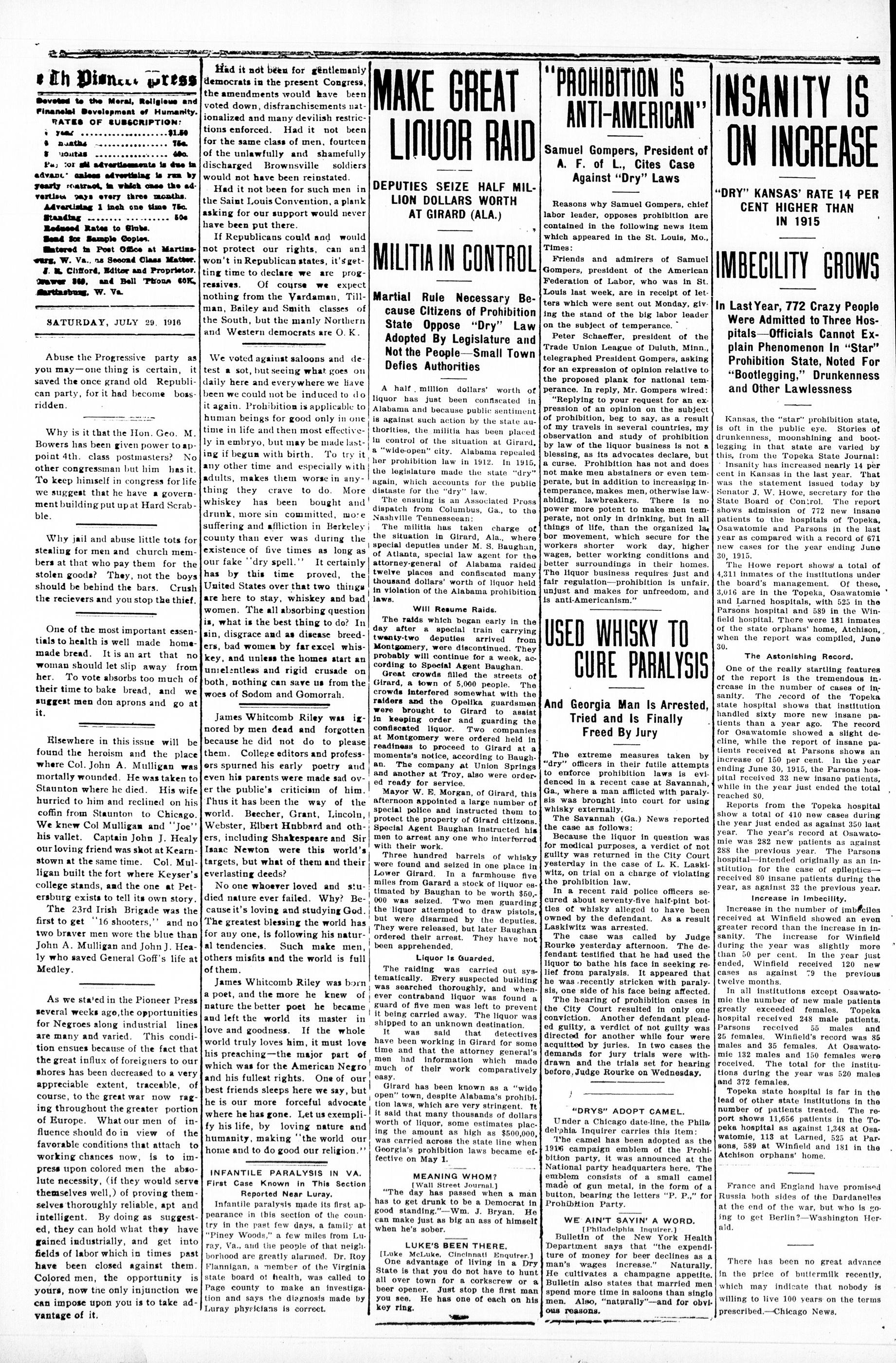
MAKE GREAT LINUOR RAID
DEPUTIES SEIZE HALF MILLION DOLLARS WORTH AT GIRARD (ALA.)
MILITIA IN CONTROL
Martial Rule Necessary Because Cltizens of Prohibition State Oppose "Dry" Law Adopted By Legislature and Not the People—Small Town Defies Authorities
A half million dollars' worth of liquor has just been confiscated in Alabama and because public sentiment is against such action by the state authorities, the militia has been placed in control of the situation at Girard, a "wide-open" city. Alabama repealed her prohibition law in 1912. In 1915, the legislature made the state "dry" again, which accounts for the public distaste for the "dry" law. The ensuing is an Associated Press dispatch from Columbus, Ga., to the Nashville Tennessee;
The militia has taken charge of the situation in Girard, Ala., where special deputies under M. S. Baughan, of Atlanta, special law agent for the attorney-general of Alabama raided twelve places and confiscated many thousand dollars' worth of liquor held in violation of the Alabama prohibition laws.
WILL Resume Raids.
The raids which began early in the day after a special train carrying twenty-two deputies arrived from Montgomery, were discontinued. They probably will continue for a week, according to Special Agent Baughan. Great crowds filled the streets of Girard, a town of 5,000 people. The crowds interfered somewhat with the raiders and the Opellika guardsmen were brought to Girard to assist in keeping order and guarding the confiscated liquor. Two companies at Montgomery were ordered held in readiness to proceed to Girard at a moment's notice, according to Baughan. The company at Union Springs and another at Troy, also were ordered ready for service.
Mayor W. E. Morgan, of Girard, this afternoon appointed a large number of special police and instructed them to protect the property of Girard citizens. Special Agent Baughan instructed his men to arrest any one who interfered with their work.
Three hundred barrels of whisky were found and seized in one place in Lower Girard. In a farmhouse five miles from Garard a stock of liquor estimated by Baughan to be worth $50,000 was seized. Two men guarding the liquor attempted to draw pistols, but were disarmed by the deputies. They were released, but later Baughan ordered their arrest. They have not been apprehended.
Liquor Is Guarded.
The raiding was carried out systematically. Every suspected building was searched thoroughly, and whenever contraband liquor was found a guard of five men was left to prevent it being carried away. The liquor was shipped to an unknown destination.
It was said that detectives have been working in Girard for some time and that the attorney general's men had information which made much of their work comparatively easy.
Girard has been known as a "wide open" town, despite Alabama's prohibition laws, which are very stringent. It it said that many thousands of dollars worth of liquor, some estimates placing the amount as high as $500,000, was carried across the state line when Georgia's prohibition laws became effective on May 1.
MEANING WHOM?
"The day has passed when a man has to get drunk to be a Democrat in good standing."—Wm. J. Bryan. He can make just as big an ass of himself when he's sober.
LUKE'S BEEN THERE
[Luke McLuke, Cincinnati Enquirer.]
One advantage of living in a Dry State is that you do not have to hunt all over town for a corkscrew or a beer opener. Just stop the first man you see. He has one of each on his key ring.
Samuel Gompers, President of A. F. of L., Cites Case Against "Dry" Laws
Reasons why Samuel Gompers, chief labor leader, opposes prohibition are contained in the following news item which appeared in the St. Louis, Mo., Times:
Friends and admirers of Samuel Gompers, president of the American Federation of Labor, who was in St. Louis last week, are in receipt of letters which were sent out Monday, giving the stand of the big labor leader on the subject of temperance.
Peter Schaeffer, president of the Trade Union League of Duluth, Minn., telegraphed President Gompers, asking for an expression of opinion relative to the proposed plank for national temperance. In reply, Mr. Gompers wired: "Replying to your request for an expression of an opinion on the subject of prohibition, beg to say, as a result of my travels in several countries, my observation and study of prohibition by law of the liquor business is not a blessing, as its advocates declare, but a curse. Prohibition has not and does not make men abstainers or even temperate, but in addition to increasing intemperance, makes men, otherwise law-abiding, lawbreakers. There is no power more potent to make men temperate, not only in drinking, but in all things of life, than the organized labor movement, which secure for the workers shorter work day, higher wages, better working conditions and better surroundings in their homes. The liquor business requires just and fair regulation—prohibition is unfair, unjust and makes for unfreedom, and is anti-Americanism."
USED WHISKY TO CURE PARALYSIS
USED WHISKY TO CURE PARALYSIS
And Georgia Man Is Arrested, Tried and Is Finally Freed By Jury
The extreme measures taken by "dry" officers in their futile attempts to enforce prohibition laws is evidenced in a recent case at Savannah, Ga., where a man afflicted with paralysis was brought into court for using whisky externally.
The Savannah (Ga.) News reported the case as follows:
Because the liquor in question was for medical purposes, a verdict of not guilty was returned in the City Court yesterday in the case of L. K. Laskiwitz, on trial on a charge of violating the prohibition law.
In a recent raid police officers secured about seventy-five half-pint bottles of whisky alleged to have been owned by the defendant. As a result Laskiwitz was arrested.
The case was called by Judge Rourke yesterday afternoon. The defendant testified that he had used the liquor to bathe his face in seeking relief from paralysis. It appeared that he was recently stricken with paralysis, one side of his face being affected. The hearing of prohibition cases in the City Court resulted in only one conviction. Another defendant pleaded guilty, a verdict of not guilty was directed for another while four were acquitted by juries. In two cases the demands for jury trials were withdrawn and the trials set for hearing before, Judge Rourke on Wednesday.
"DRYS" ADOPT CAMEL.
Under a Chicago date-line, the Philadelphi Inquirer carries this item:
The camel has been adopted as the 1916 campaign emblem of the Prohibition party, it was announced at the National party headquarters here. The emblem consists of a small camel made of gun metal, in the form of a button, bearing the letters "P. P.," for Prohibition Party.
WE AIN'T SAYIN' A WORD
-Ullibolphia, Indiana 3
Bulletin of the New York Health Department says that "the expenditure of money for beer declines as a man's wages increase." Naturally. He cultivates a champagne appetite. Bulletin also states that married men spend more time in saloons than single men. Also, "naturally"—and for obvious reasons.
INSANITY IS ON INCREASE
"DRY" KANSAS' RATE 14 PER CENT HIGHER THAN IN 1915
In Last Year, 772 Crazy People Were Admitted to Three Hospitals—Officials Cannot Explain Phenomenon In "Star" Prohibition State, Noted For "Bootlegging," Drunkenness and Other Lawlessness
Kansas, the "star" prohibition state, is oft in the public eye. Stories of drunkenness, moonshining and boot-legging in that state are varied by this, from the Topeka State Journal: Insanity has increased nearly 14 per cent in Kansas in the last year. That was the statement issued today by Senator J. W. Howe, secretary for the State Board of Control. The report shows admission of 772 new insane patients to the hospitals of Topeka, Osawatomie and Parsons in the last year as compared with a record of 671 new cases for the year ending June 30. 1915.
The Howe report shows a total of 4,311 inmates of the institutions under the board's management. Of these, 3,016 are in the Topeka, Osawatomie and Larned hospitals, with 525 in the Parsons hospital and 589 in the Winfield hospital. There were 181 inmates of the state orphans' home, Atchison, when the report was compiled, June 30.
The Astonishing Record.
One of the really startling features of the report is the tremendous increase in the number of cases of insanity. The record of the Topeka state hospital shows that institution handled sixty more new insane patients than a year ago. The record for Osawatomie showed a slight decline, while the report of insane patients received at Parsons shows an increase of 150 per cent. In the year ending June 30, 1915, the Parsons hospital received 33 new insane patients, while in the year just ended the total reached 80.
Reports from the Topeka hospital show a total of 410 new cases during the year just ended as against 350 last year. The year's record at Osawatomie was 282 new patients as against 288 the previous year. The Parsons hospital—intended originally as an institution for the case of epileptics—received 80 insane patients during the year, as against 33 the previous year.
Increase in Imbecility.
Increase in the number of imbeciles received at Winfield showed an even greater record than the increase in insanity. The increase for Winfield during the year was slightly more than 50 per cent. In the year just ended, Winfield received 120 new cases as against 79 the previous twelve months.
In all institutions except Osawatomie the number of new male patients greatly exceeded females. Topeka hospital received 248 male patients. Parsons received 55 males and 25 females. Winfield's record was 85 males and 35 females. At Osawatomie 132 males and 150 females were received. The total for the institutions during the year was 520 males and 372 females.
Topeka state hospital is far in the lead of other state institutions in the number of patients treated. The report shows 11,656 patients in the Topeka hospital as against 1,348 at Osawatomie, 113 at Larned, 525 at Parsons, 589 at Winfield and 181 in the Atchison orphans' home.
France and England have promised Russia both sides of the Dardanelles at the end of the war, but who is going to get Berlin?—Washington Herald.
There has been no great advance in the price of buttermilk recently, which may indicate that nobody is willing to live 100 years on the terms prescribed.—Chicago News.
FARE $3.00
DAILY BETWEEN
CLEVELAND &
BUFFALO
C&B
LINE
The Great Ship "SEEANDBEE"
The largest and most costly steamer on any inland water of the world. Sleeping accommodations for 1500 passengers.
"CITY OF ERIE" — 3 Magnificent Steamers — "CITY OF BUFFALO"
BETWEEN
CLEVELAND-Daily, May 1st to Nov. 15th-BUFFALO
Leave Cleveland • • 8:00 P.M.
Arrive Buffalo • • 8:00 P.M.
Leave Buffalo • • 8:00 P.M.
Arrive Buffalo • • 6:00 A.M.
(Central Standard Time)
Connections at Buffalo for Niagara Falls and on Eastern and Canadian points. Bullethead tickets reading between Cleveland and Buffalo are good for transportation on our steamers. Ask your ticket agent for tickets via C. & B. Line.
For carefully colored reactional puzzle chart, showing both exterior and interior of The Great Ship "SEEANDBEE" on receipt of the coupon to cover postage and mailing. Also ask for our 24-page pictorial and descriptive booklet free.
THE CLEVELAND & BUFFALO TRANSIT CO., Cleveland, Ohio
"I want to tell you what wonderful benefit I have received from the use of Thedford's Black-Draught," writes Mrs. Sylvania Woods, of Clifton Mills, Ky.
"It certainly has no equal for la gripe, bad colds, liver and stomach troubles. I firmly believe Black-Draught saved my little girl's life. When she had the measles, they went in on her, but one good dose of Thedford's Black-Draught made them break out, and she has had no more trouble. I shall never be without
in my home." For constipation, indigestion, headache, dizziness, malaria, chills and fever, billiousness, and all similar ailments, Thedford's Black-Draught has proved itself a safe, reliable, gentle and valuable remedy.
If you suffer from any of these complaints, try Black-Draught. It is a medicine of known merit. Seventy-five years of splendid success proves its value. Good for young and old. For sale everywhere. Price 25 cents.
LOCAL NOTES.
Go to John W. Dean Co., for everything in the clothing line. They have it, and insist you call and look it over. Prices reasonaable and anxiety on tiptoe to please you. Every new buyer brings another.
Mme. L. C. Parrish Hair Culturing Scaip Treatment
MARY MAY
Largest Mail Order House of its kind in America.
All kinds of Toilet Articles for sale.
Human Hair Goods of the finest quality.
Our Hair Food and Skin Food never fail.
If the trouble is with the hair, scalp or skin, we have the remedy.
We guarantee a remedy to make hair grow on bald spots and bare temples.
Send 10e. for a sample and catalogue.
Send for our terms to agents.
Address Mme. L. C. PARRISH,
95 Camden Street, Boston, Mass.
Thompson and Thompson have the most attractive stock of men's ready made clothing to be found in the city, and the nobbiest and nattiest stock of hats, shirts and summer wear you ever saw. Give them a call-144 North Queen Street.
Mrs. S. H. Norwood was called out of the city by the death of her father in Frederick City.
Are You a Woman?
Take Cardui
The Woman's Tonic
FOR SALE AT ALL DRUGISTS
P4
Oppose Drunkenness.
Many persons seem to believe that the liquor interests encourage drunkenness, but this, according to officials of the association, which has its headquarters in Cincinnati, is an untruth. Joseph Debar, of Cincinnati, secretary of that body, explained that the special purpose of the coming convention "will be to continue the fight against prohibition and intemperance, especially that form which prevails in dry territory." In his call for the meeting he states:
"We believe that long experience teaches and history proves that license, regulation and control offer the only real solution of the so-called liquor problem.
"We believe in protecting our interests in keeping with the decision of the United States Supreme Court, handed down January 26, 1914, which says in part: 'But we know of no ground for thus condemning honest transactions which grow out of the recognized necessities of a lawful business.' "While the latest report of the United States Internal Revenue Commissioners of Washington states that withdrawals of whiskey from bond show a 25 per cent increase over the corresponding periods of last year, the best records and statistics prove that moderate use of liquors has steadily increased, while the excessive use of alcoholic stimulants has greatly diminished.
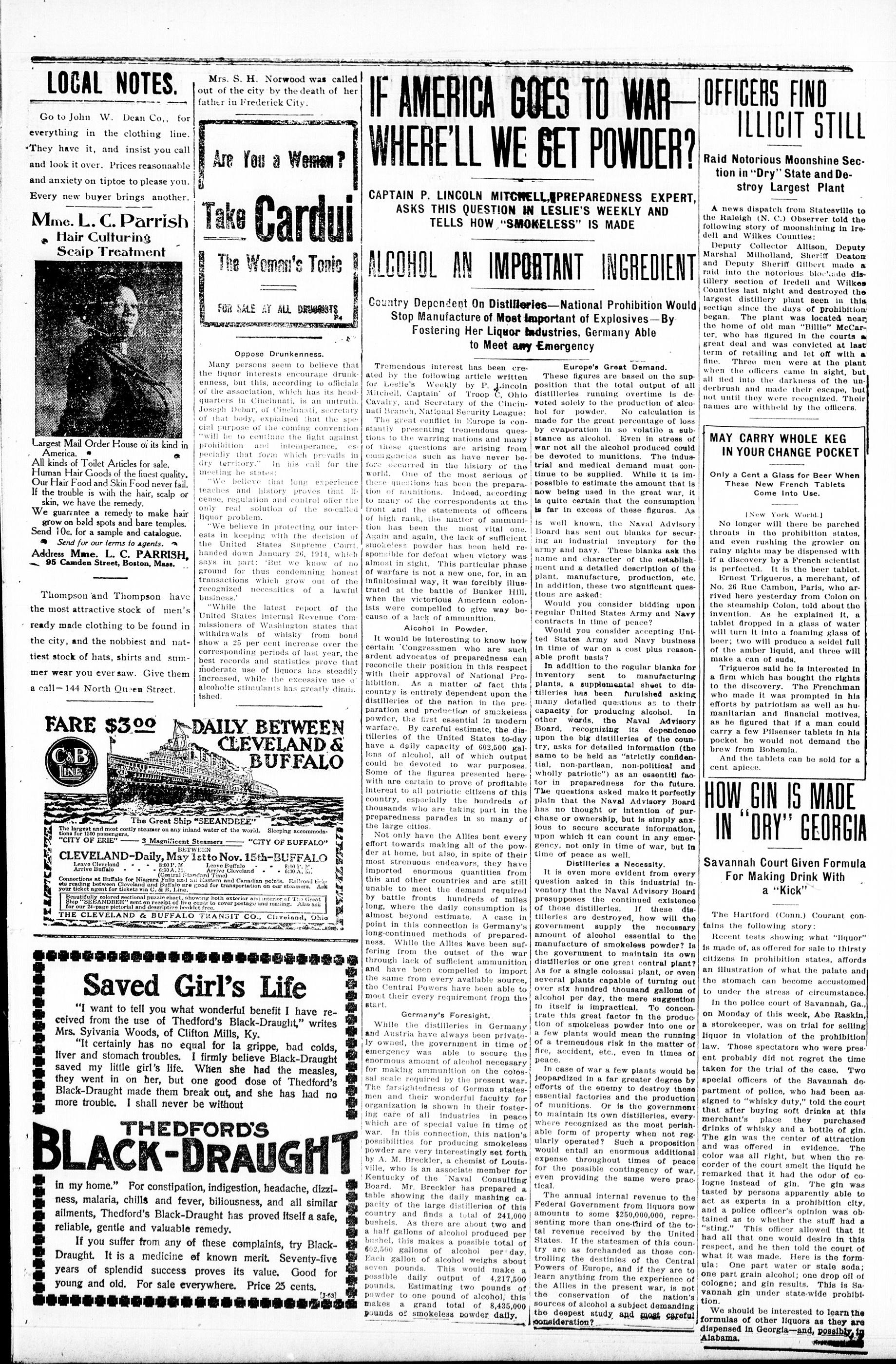
IF AMERICA GOES TO WAR WHERE'LL WE GET POWDER?
CAPTAIN P. LINCOLN MITCHELL, PREPAREDNESS EXPERT, ASKS THIS QUESTION IN LESLIE'S WEEKLY AND TELLS HOW "SMOKELESS" IS MADE
Country Dependent On Distilleries—National Prohibition Would Stop Manufacture of Most Important of Explosives—By Fostering Her Liquor Industries, Germany Able to Meet any Emergency
Tremendous interest has been created by the following article written for Leslie's Weekly by P. Lincoln Mitchell, Captain' of Troop C, Ohio Cavalry, and Secretary of the Cincinnati Branch, National Security League;
Europe's Great Demand.
These figures are based on the supposition that the total output of all distilleries running overtime is devoted solely to the production of alcohol for powder. No calculation is
The great conflict in Europe is constantly presenting tremendous questions to the warring nations and many of these questions are arising from emergencies such as have never before occurred in the history of the world. One of the most serious of these questions has been the preparation of munitions. Indeed, according to many of the correspondents at the front and the statements of officers of high rank, the matter of ammunition has been the most vital one. Again and again, the lack of sufficient smokeless powder has been held responsible for defeat when victory was almost in sight. This particular phase of warfare is not a new one, for, in an infinitesimal way, it was forcibly illustrated at the battle of Bunker Hill, when the victorious American colonists were compelled to give way because of a lack of ammunition.
Acohol in Powder.
It would be interesting to know how certain Congressmen who are such ardent advocates of preparedness can reconcile their position in this respect with their approval of National Prohibition. As a matter of fact this country is entirely dependent upon the distilleries of the nation in the preparation and production of smokeless powder, the first essential in modern warfare. By careful estimate, the distilleries of the United States to-day have a daily capacity of 602,500 gallons of alcohol, all of which output could be devoted to war purposes. Some of the figures presented herewith are certain to prove of profitable interest to all patriotic citizens of this country, especially the hundreds of thousands who are taking part in the preparedness parades in so many of the large cities.
Not only have the Allies bent every effort towards making all of the powder at home, but also, in spite of their most strenuous endeavors, they have imported enormous quantities from this and other countries and are still unable to meet the demand required by battle fronts hundreds of miles long, where the daily consumption is almost beyond estimate. A case in point in this connection is Germany's long-continued methods of preparedness. While the Allies have been suffering from the outset of the war through lack of sufficient ammunition and have been compelled to import the same from every available source, the Central Powers have been able to meet their every requirement from the start.
Germany's Foresight.
While the distilleries in Germany and Austria have always been privately owned, the government in time of emergency was able to secure the enormous amount of alcohol necessary for making ammunition on the cotossal scale required by the present war. The farsightedness of German statesmen and their wonderful faculty for organization is shown in their fostering care of all industries in peace which are of special value in time of war. In this connection, this nation's possibilities for producing smokeless powder are very interesting set forth by A. M. Breckler, a chemist of Louisville, who is an associate member for Kentucky of the Naval Consulting Board. Mr. Breckler has prepared a table showing the daily mashing capacity of the large distilleries of this country and finds a total of 241,000 bushels. As there are about two and a half gallons of alcohol produced per bushel, this makes a possible total of 602,500 gallons of alcohol per day. Each gallon of alcohol weighs about seven pounds. This would make a possible daily output of 4,217,500 pounds. Estimating two pounds of powder to one pound of alcohol, this makes a grand total of 8,435,000 pounds of smokeless powder daily.
Europe's Great Demand.
Europe's Great Demand.
These figures are based on the supposition that the total output of all distilleries running overtime is devoted solely to the production of alcohol for powder. No calculation is made for the great percentage of loss by evaporation in so volatile a substance as alcohol. Even in stress of war not all the alcohol produced could be devoted to munitions. The industrial and medical demand must continue to be supplied. While it is impossible to estimate the amount that is now being used in the great war, it is quite certain that the consumption is far in excess of these figures. As
is well known, the Naval Advisory Board has sent out blanks for securing an industrial inventory for the army and navy. These blanks ask the name and character of the establishment and a detailed description of the plant, manufacture, production, etc. In addition, these two significant questions are asked:
Would you consider bidding upon regular United States Army and Navy contracts in time of peace?
Would you consider accepting United States Army and Navy business in time of war on a cost plus reasonable profit basis?
In addition to the regular blanks for inventory sent to manufacturing plants, a supplemental sheet to distilleries has been furnished asking many detailed questions as to their capacity for producing alcohol. In other words, the Naval Advisory Board, recognizing its dependenoe upon the big distilleries of the country, asks for detailed information (the same to be held as "strictly confidential, non-partisan, non-political and wholly patriotic") as an essential factor in preparedness for the future. The questions asked make it perfectly plain that the Naval Advisory Board has no thought or intention of purchase or ownership, but is simply anxious to secure accurate information, upon which it can count in any emergency, not only in time of war, but in time of peace as well.
Distilleries a Necessity.
It is even more evident from every question asked in this industrial inventory that the Naval Advisory Board presupposes the continued existence of these distilleries. If these distilleries are destroyed, how will the government supply the necessary amount of alcohol essential to the manufacture of smokeless powder? Is the government to maintain its own distilleries or one great central plant? As for a single colossal plant, or even several plants capable of turning out over six hundred thousand gallons of alcohol per day, the mere suggestion in itself is impractical. To concentrate this great factor in the production of smokeless powder into one or a few plants would mean the running of a tremendous risk in the matter of fire, accident, etc., even in times of peace.
In case of war a few plants would be jeopardized in a far greater degree by efforts of the enemy to destroy these essential factories and the production of munitions. Or is the government to maintain its own distilleries, everywhere recognized as the most perishable form of property when not regularly operated? Such a proposition would entail an enormous additional expense throughout times of peace for the possible contingency of war, even providing the same were practical.
The annual internal revenue to the Federal Government from liquors now amounts to some $250,000,000, representing more than one-third of the total revenue received by the United States. If the statesmen of this country are as forehanded as those controlling the destinies of the Central Powers of Europe, and if they are to learn anything from the experience of the Allies in the present war, is not the conservation of the nation's sources of alcohol a subject demanding the deepest study and most careful consideration?
Raid Notorious Moonshine Section in "Dry" State and Destroy Largest Plant
A news dispatch from Statesville to the Raleigh (N. C.) Observer told the following story of moonshining in Iredell and Wilkes Counties:
Deputy Collector Allison, Deputy Marshal Millholland, Sheriff Deaton and Deputy Sheriff Gilbert made a raid into the notorious blockade distillery section of Iredell and Wilkes Counties last night and destroyed the largest distillery plant seen in this section since the days of prohibition began. The plant was located near the home of old man "Billie" McCarter, who has figured in the courts a great deal and was convicted at last term of retailing and let off with a fine. Three men were at the plant when the officers came in sight, but all fled into the darkness of the underbrush and made their escape, but not until they were recognized. Their names are withheld by the officers.
MAY CARRY WHOLE KEG IN YOUR CHANGE POCKET
Only a Cent a Glass for Beer When These New French Tablets Come Into Use.
[New York World.]
No longer will there be parched throats in the prohibition states, and even rushing the growler on rainy nights may be dispensed with if a discovery by a French scientist is perfected. It is the beer tablet. Ernest Trigueros, a merchant, of No. 26 Rue Cambon, Paris, who arrived here yesterday from Colon on the steamship Colon, told about the invention. As he explained it, a tablet dropped in a glass of water will turn it into a foaming glass of beer; two will produce a seidel full of the amber liquid, and three will make a can of suds.
Trigueros said he is interested in a firm which has bought the rights to the discovery. The Frenchman who made it was prompted in his efforts by patriotism as well as humanitarian and financial motives, as he figured that if a man could carry a few Pilsenser tablets in his pocket he would not demand the brew from Bohemia.
And the tablets can be sold for a cent apiece.
HOW GIN IS MADE IN "DRY" GEORGIA
Savannah Court Given Formula For Making Drink With a "Kick"
The Hartford (Conn.) Courant contains the following story:
Recent tests showing what "liquor" is made of, as offered for sale to thirsty citizens in prohibition states, affords an illustration of what the palate and the stomach can become accustomed to under the stress of circumstance.
In the police court of Savannah, Ga., on Monday of this week, Abe Raskin, a storekeeper, was on trial for selling liquor in violation of the prohibition law. Those spectators who were present probably did not regret the time taken for the trial of the case. Two special officers of the Savannah department of police, who had been assigned to "whisky duty," told the court that after buying soft drinks at this merchant's place they purchased drinks of whisky and a bottle of gin. The gin was the center of attraction and was offered in evidence. The color was all right, but when the recorder of the court smelt the liquid he remarked that it had the odor of cologne instead of gin. The gin was tasted by persons apparently able to act as experts in a prohibition city, and a police officer's opinion was obtained as to whether the stuff had a "sting." This officer allowed that it had all that one would desire in this respect, and he then told the court of what it was made. Here is the formula: One part water or stale soda; one part grain alcohol; one drop oil of cologne; and gin results. This is Savannah gin under state-wide prohibition.
We should be interested to learn the formulas of other liquors as they are dispensed in Georgia—and, possibly, in Alabama.
A FRENCH FLIER BREAKS RECORD
Roulet Soars 18,530 Feet With Two Passengers, Beating the
PARIS, July 24:—By establishing a new altitude record of 19,530 feet with three passengers aboard and a new record of 18,530 feet with two passengers, Aviator Sergeant Etienne Poulet has just wrested the laurel from the Germans.
In establishing the new world's record for altitude with 2 passengers Poulet was obliged to fly in unfavorable weather, reaching a height of 18,530 feet, sufficient to lower the 18,100 record held by German Lieut. Bien.
A few days later, Poulet was blessed with ideal weather and motor conditions. With three men aboard: M. Proust weighing 145 pounds, M. Duche weighing 148 pounds and M. Iallard weighing 125 pounds together with 21 pounds of ballast, Poulet reached an altitude of 19,530, taking the previous record of 17,500 feet from Germany flyer Sabatling. This leaves the Frenchman in possession of all records previously held by the German flyers, it is said.
SIMON BOLIVAR, LIBERATOR
Today is the birthday of Simon Bolivar, the American patriot, who is usually referred to as the liberator. The place was Caracas, Venezuela, and the year 1783. His parents were a noble and wealthy family of that South American city. He received his preliminary education at home; studied law in Madrid, and then traveled extensively on the continent. After marrying in Europe he returned to his native country. In 1809 he visited the United States and became an enthusiastic admirer of the republican institutions and resolved to free his own country from foreign despotism.
Upon Bolivar's return to Venezuela, he associated himself with a set of patriots there, and after the insurrection of Caracas, April 19, 1810, he was sent to London to gain the interest of the British cabinet. In this he was unsuccessful. Returning home disappointed, he continued his fight for the freedom of his country, and when the Spaniards finally recovered possession, he fled to Curacao.
Soon Becomes a Conguerer.
He did not, however, remain long active, but won the sympathy of the republican president of New Granada, raised a force of volunteers, defeated the Spaniards several times, his army increasing with each victory, and on August 4, 1813, entered Caracas as a conquerer.
Bolivar was hailed as the liberator of Venezuela, and was made absolute dictator in civil and military affairs. After defeating the Spaniards in several engagements he was himself beaten in the battles of la Puerta and Aragua. He fled to Haiti, where he assembled the insurgent refugees, convoked a congress and instituted a government. He gained power rapidly, and was uniting in his energies for the next few years, and in 1822 the republic was completely cleared of royalist troops.
Bolivar was summoned the same year to help the Peruvians, when in February, 1824, he was named dictator of that country. The following year the Spaniards were driven from Peru also; and Bolivar, calling a congress at Lima, formerly resigned the dictatorship. The southern part of the country was made into a separate state and named Bolivia, of which he was chosen president for life.
Complain of Ingratitude
In 1829 Venezuela separated itself from the republic of Colombia. Bolivar's ambition was loudly denounced, and, virtually forced to resign, he retired to Cartagena. He died at San Pedro, December 10, 1830, having shortly before his death written a farewell address to the people of Colombia, in which he vindicated his character from the aspersions that had been passed on it, and complained bitterly of ingratitude.
Bolivar's remains were removed to Caracas in 1842, and in 1859 the city of Lima erected an equestrian statue to him, describing him in the inscrin-
W. VA. TRAIN ROBBER MISSISSIPPI IS WAS BROUGHT HERE OFFICIALLY "DRY"
W. Eugene Deltz, Charged With Be- ing Implicated In Train Robbery, Now in Jail.
Deputy Marshal C. P. Cook, of Parkersburg, arrived here last night with W. Eugene Deltz, arrested in Colorado, a few weeks ago as one of the alleged bandits connected with the hold-up of train No. 1 at Central, W. Va., in October last year.
He will be kept here until his trial, which is scheduled for the special term of federed court in September. Messrs. Mason and McDonald are keeping guard over the man.
tion as the "Liberator of the Peruvian nation."
It was Bolivar's hope and ambition to unite the South American republics into a strong confederation. The example of Napoleon led him into arbitrary acts and a policy too autocratic to please the independent temper of his compatriots. During the factional fights that prevailed in his lifetime he was a mark for virulent calumnies; but succeeding generations of South Americans have paid due honor to his memory. His sacrifices and sufferings voluntarily undergone for the sake of the cause in which he engaged are sufficient to disprove the charge brought against him of ignoble ambition and egotism.
MRS. LOUS JAMES IS
HELD FOR GRAND JURY Justice Lloyd held today Mrs. Louis James to await the action of the grand jury, charged with shooting William Smeltzer. She failed to give bond and was remanded to jail. Gold Faircloth and G. W. Horner were dismissed.
RECEIVE CERTIFICATES Misses Doris Siler, Ada Locke, Eathel Gosnell, Alice Barksdale, Janette Pownall and Raye Conrad the six members of the 1916 class at the City Hospital, who took the examination at Wheeling before the state board of examiners to become registered nurses, have received their certificates and can now practice. All passed the examination with high averages.
"FRESH KID" IS DEAD; ONLY 99 YEARS OLD
"FRESH KID" IS DEAD; ONLY 99 YEARS OLD
From Chicago (Ill.) comes this story to the Cincinnati Commercial Tribune:
Marquis de Lafayette Williams, known to the patriarchs of the James C. King Home for Aged Men as "Fresh Kid" Williams, is dead. He would have been 100 years old four months from today. Until a few days ago "Fresh Kid" Williams was in excellent health, but old age, at which he laughed as a youth of 99, caused his death. "The boys" at the Home for Aged Men found no rubber in their tobacco and no water in their shoes today. These were the favorite pranks of the "Fresh Kid." Williams was born in Saratoga, N. Y., and throughout his life he was associated with railroads, chiefly the New York Central. It was his boast that he smoked and drank since he was 14 years old.
SOME INVENTION, THIS
SOME INVENTION, THIS
Following is another comment on farmers making liquor at home, a practice which enables many of them to laugh at prohibition laws. The Minneapolis Tribune says:
The fact that Oregon has gone dry seems to have had a stimulating effect upon the inventive genius of her people, if we are to credit the report in the reliable New York Times that a Clackhamas farmer has discovered that it is possible to make practically pure alcohol by running apple cider through a cream separator. Wouldn't it be a curious development if the cream separator of the Hood river apple country should become a more serious menace to the internal revenue of the country than the mountain still of Kentucky?
It is a death struggle on the Somme, and the victor will not be much better off than the victim.—Rochester Herald.
EDITOR OF POST-DISPATCH TAKES DRY LEADER TO TASK
Anti-Saloon Leaguer Believes People Should Be Denied the Right to Referendum, But St. Louis Paper Thinks Otherwise
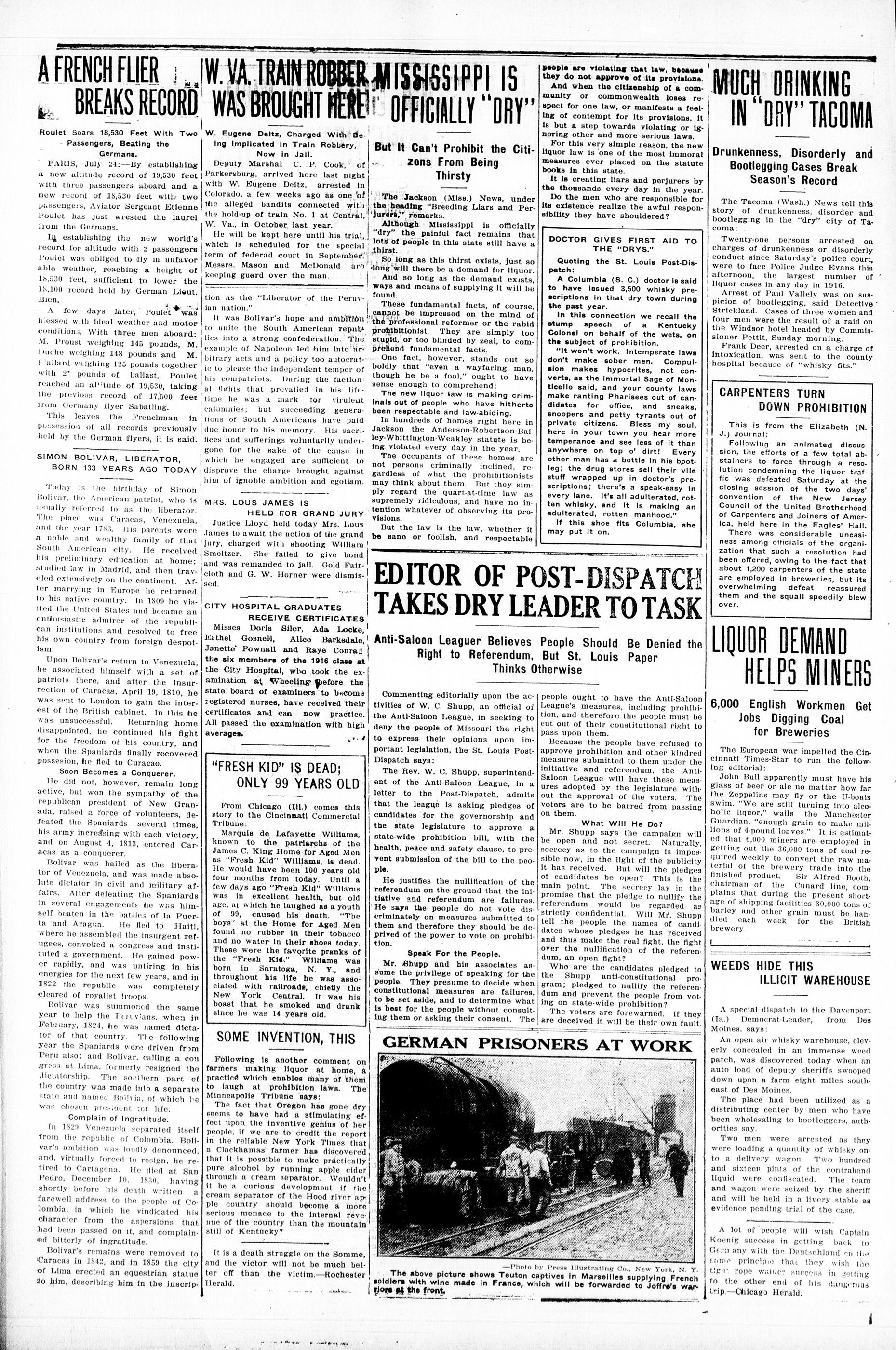
GERMAN PRISONERS AT WORK
Photo by Press Illustrating Co. New York, N. Y. The above picture shows Teuton captives in Marselles supplying French soldiers with wine made in France, which will be forwarded to Joffre's warriors at the front.
But It Can't Prohibit the Citizens From Being Thirsty
The Jackson (Miss.) News, under the heading "Breeding Liars and Perjurers," remarks.
Although Mississippi is officially "dry" the painful fact remains that lots of people in this state still have a thirst.
So long as this thirst exists, just so long will there be a demand for liquor.
And so long as the demand exists, ways and means of supplying it will be found.
These fundamental facts, of course, cannot be impressed on the mind of the professional reformer or the rabid prohibitionist. They are simply too stupid, or too blinded by zeal, to comprehend fundamental facts.
One fact, however, stands out so boldly that "even a wayfaring man, though he be a fool," ought to have sense enough to comprehend:
The new liquor law is making criminals out of people who have hitherto been respectable and law-abiding.
In hundreds of homes right here in Jackson the Anderson-Robertson-Bailey-Whittlington-Weakley statute is being violated every day in the year.
The occupants of these homes are not persons criminally inclined, regardless of what the prohibitionists may think about them. But they simply regard the quart-at-time law as supremely ridiculous, and have no intention whatever of observing its provisions.
But the law is the law, whether it be sane or foolish, and respectable
EDITOR OF PO
TAKES DRY LE
Anti-Saloon Leaguer Believes
Right to Referendum,
Thinks O
Commenting editorially upon the activities of W. C. Shupp, an official of the Anti-Saloon League, in seeking to deny the people of Missouri the right to express their opinions upon important legislation, the St. Louis Post-Dispatch says:
The Rev. W. C. Shupp, superintendent of the Anti-Saloon League, in a letter to the Post-Dispatch, admits that the league is asking pledges of candidates for the governorship and the state legislature to approve a state-wide prohibition bill, with the health, peace and safety clause, to prevent submission of the bill to the people.
He justifies the nullification of the referendum on the ground that the initiative and referendum are failures. He says the people do not vote discriminately on measures submitted to them and therefore they should be deprived of the power to vote on prohibition.
Speak For the People.
Mr. Shupp and his associates assume the privilege of speaking for the people. They presume to decide when constitutional measures are failures, to be set aside, and to determine what is best for the people without consulting them or asking their consent. The
GERMAN PRISO
people are violating that law, because they do not approve of its provisions. And when the citizenship of a community or commonwealth loses respect for one law, or manifests a feeling of contempt for its provisions, it is but a step towards violating or ignoring other and more serious laws. For this very simple reason, the new liquor law is one of the most immoral measures ever placed on the statute books in this state. It is creating liars and perjurers by the thousands every day in the year. Do the men who are responsible for its existence realize the awful responsibility they have shouldered?
DOCTOR GIVES FIRST AID TO THE "DRYS."
Quoting the St. Louis Post-Dispatch:
A Columbia (S. C.) doctor is said to have issued 3,500 whisky prescriptions in that dry town during the past year.
In this connection we recall the stump speech of a Kentucky Colonel on behalf of the wets, on the subject of prohibition.
"It won't work. Intemperate laws don't make sober men. Compulsion makes hypocrites, not converts, as the immortal Sage of Monticello said, and your county laws make ranting Pharisees out of candidates for office, and sneaks, snoopers and petty tyrants out of private citizens. Bless my soul, here in your town you hear more temperance and see less of it than anywhere on top o' dirt! Every other man has a bottle in his bootleg; the drug stores sell their vile stuff wrapped up in doctor's prescriptions; there's a speak-easy in every lane. It's all adulterated, rotten whisky, and it is making an adulterated, rotten manhood." If this shoe flits Columbia, she may put it on.
OST-DISPATCH
ADER TO TASK
People Should Be Denied the
But St. Louis Paper
otherwise
people ought to have the Anti-Saloon League's measures, including prohibition, and therefore the people must be cut out of their constitutional right to pass upon them. Because the people have refused to approve prohibition and other kindred measures submitted to them under the initiative and referendum, the Anti-Saloon League will have these measures adopted by the legislature without the approval of the voters. The voters are to be barred from passing on them.
What Will He Do?
Mr. Shupp says the campaign will be open and not secret. Naturally, secrecy as to the campaign is impossible now, in the light of the publicity it has received. But will the pledges of candidates be open? This is the main point. The secrecy lay in the promise that the pledge to nullify the referendum would be regarded as strictly confidential. Will Mr. Shupp tell the people the names of candidates whose pledges he has received and thus make the real fight, the fight over the nullification of the referendum, an open fight?
Who are the candidates pledged to the Shupp anti-constitutional program; pledged to nullify the referendum and prevent the people from voting on state-wide prohibition?
The voters are forewarned. If they are deceived it will be their own fault.
NERS AT WORK
MUCH DRINKING IN "DRY" TACOMA
Drunkenness, Disorderly and Bootlegging Cases Break Season's Record
The Tacoma (Wash.) News tell this story of drunkenness, disorder and bootlegging in the "dry" city of Tacoma:
Twenty-one persons arrested on charges of drunkenness or disorderly conduct since Saturday's police court, were to face Police Judge Evans this afternoon, the largest number of liquor cases in any day in 1916.
Arrest of Paul Vallely was on suspicion of bootlegging, said Detective Strickland. Cases of three women and four men were the result of a raid on the Windsor hotel headed by Commissioner Pettit, Sunday morning.
Frank Deer, arrested on a charge of Intoxication, was sent to the county hospital because of "whishy 6its."
CARPENTERS TURN
DOWN PROHIBITION
This is from the Elizabeth (N. J.) Journal:
Following an animated discussion, the efforts of a few total abstainers to force through a resolution condemning the liquor traffic was defeated Saturday at the closing session of the two days' convention of the New Jersey Council of the United Brotherhood of Carpenters and Joiners of America, held here in the Eagles' Hall.
There was considerable uneasiness among officials of the organization that such a resolution had been offered, owing to the fact that about 1,200 carpenters of the state are employed in breweries, but its overwhelming defeat reassured them and the squall speedily blew over.
LIQUOR DEMAND HELPS MINERS
6,000 English Workmen Get Jobs Digging Coal for Breweries
The European war impelled the Cincinnati Times-Star to run the following editorial:
John Bull apparently must have his glass of beer or ale no matter how far the Zeppelins may fly or the U-boats swim. "We are still turning into alcoholic liquor," walls the Manchester Guardian, "enough grain to make millions of 4-pound loaves." It is estimated that 6,000 miners are employed in getting out the 36,000 tons of coal required weekly to convert the raw material of the brewery trade into the finished product. Sir Alfred Booth, chairman of the Cunard line, complains that during the present shortage of shipping facilities 30,000 tons of barley and other grain must be handled each week for the British brewery.
WEEDS HIDE THIS
ILLICIT WAREHOUSE
WEEDS HIDE THIS
ILLICIT WAREHOUSE
A special dispatch to the Davenport (Ia.) Democrat-Leader, from Des Moines, says:
An open air whisky warehouse, cleverly concealed in an immense weed patch, was discovered today when an auto load of deputy sheriffs swooped down upon a farm eight miles southeast of Des Moines.
The place had been utilized as a distributing center by men who have been wholesaling to bootleggers, authorities say.
Two men were arrested as they were loading a quantity of whisky onto a delivery wagon. Two hundred and sixteen pints of the contraband liquid were confiscated. The team and wagon were seized by the sheriff and will be held in a livery stable as evidence pending trial of the case.
A lot of people will wish Captain Koenig success in getting back to Germany with the Deutschland on the same principle that they wish the tight rope walker success in getting to the other end of his dangerous trip.—Chicago Herald.
1