The Pioneer Press
Saturday, August 5, 1916
Martinsburg, West Virginia
Page text (machine-generated)
The Pioneer Press.
"HERE SHALL THE PRESS, THE PEOPLE'S LIGHTS MAINTAIN, DRAWED BY INFLUENCE AND UNBRIBED BY GAIN"
ESTABLISHED 1882.
JUDGE WOODS HOLDS A SPECIAL SESSION OF CIRCUIT COURT
FORMER JUDGE FAULKNER PRESENTS INTERESTING CASE IN LENGTHY ARGUMENT.
J. W. FRYE WINS HIS SUIT FOR $328.86 AGAINST TOMAHAWK ORCHARD COMPANY.
OTHER CASES DECIDED AT SPECIAL SESSION OF COURT
A very interesting and important case was presented to Judge Woods this morning and placed in his hands for decision. Judge Faulkner representing Elizabeth C. Hess, executrix of Edward L. Hess, dec'd., has filed a proceeding against Mary Becker Hess and James Frederick Hess, infant child of said E. L. Hess, for a construction of the statute in case of pretermitted children. About the middle of 1914 E. L. Hess made his will, and within a few months thereafter he was killed in an automobile accident. His will was probated in the fall of 1914. In March 1915, a son, James Frederick Hess, was born. The will provided, after a very small bequest to his wife, Mary Becker Hess, that the decedent's whole estate should go to his mother. the plaintiff. The birth of a child after the death of a parent changes the method of distribution of a decedent's estate, if the child is unprovided for. The statute reads:
"If any person die leaving a child, or his wife enciente of a child, which shall be born alive, and leaving a will made when such person had no child living, wherein any child he might have is not provided for or mentioned, such will, except so far as it provides for the payment of the debts of the testator, shall be construed as if the devises and bequests therein had been limited to take effect, in the event that the child should die unmarried and without issue."
It will readily be seen that the estate of Edward L. Hess may be held for distribution by the court for many years, the contingency of his child dying unmarried and without issue being very remote.
Other questions arise—that of the widow's dower, she having renounced the provisions of the will—as she had the privilege of doing under the law. The argument of Judge Faulkner was quite lengthy and interesting from start to finish. The court has now taken the case under advisement and will probably render his decision at the September term next. Frye Wins Suit. In the case of J. W. Frye against the Tomahawk Orchard Company, which has been hanging for several terms of court, was ended this morning, when the court overruled the motion for a new trial and entered judgment in favor of the plaintiff for $328.86 interest and cost.
In the case of J. Frank Thompson against E. H. Tabler and others, a decree was entered confirming sale of the real estate and making a partial distribution of funds.
In the divorce suit of Harry Lord against Estelle Lord an order was entered submitting all matters to the court.
Evidence that the Germans are reaching the end of their human resources is furnished by the news that the Crown Prince's 10-year-old son has been drafted, as lieutenant, into the Prussian Guard.—New York Evening Post.
C. V. NET INCOME INCREASED MUCH
During the Past Six Months, According to The Recent Report
The Pennsylvania Railroad statement for June and for the half year, issued Tuesday, shows that the extraordinary business had since la tsOctober still is being maintained. For June gross earnings of the system were $37,541,060, and increase of $8,110,418 and net earning were $10,222,160, a gain of $1,761,443. Neither in total revenues nor in percentage of gain were the month's results equal to those for May, but it should be remembered that current earnings of the railroads now are running in comparison exceptional revenues recorded in the same months of last year. Such comparative increases as have been recorded for the last several months could not be expected to continue indefinitely.
June gross of the system amounted to something over $37,500,000, compares with May gross of $38,197,694, which was the best month for the company since November of last year. Net earnings for June, of $10,222,160, compare with $10,845,891 for May. For the half year net earnings are $50,767,745, an increase of $27,959,004 over the corresponding period of last year.
The Cumberland Valley's figures show a net income for June of $138,127, which is an increase of $27,374 over May. The net income for the six months is $783,682, an increase of $352,903.
MARTINSBURG UP AMONG LEADERS
As to the Manufacturing Industries In the State—We Have Forty Seven
One fourth of the 2,749 manufacturing industries in West Virginia are located in the ten leading cities—Bluefield, Charleston, Clarksburg, Fairmont, Huntington, Martinsburg, Morgantown Moundsville, Parkersburg and Wheeling, according to figures just released from the United States census bureau and received at the office of the state commissioner of agriculture. The ten cities have a total of 705 manufacturing industries. Wheeling ranking first with 201, Huntington second with 102. Charlestown third with 89, and the other seven ranking as follows:
Parkersburg, 83; Fairmont, 50;
Morgantown 49; Clarksburg, 43;
Martinsburg 37, Moundsville, 27;
and Bluefield, 24.
POPE BENEDICT PLEADS FOR PEACE
Begs of Germany Not to Resume General Submarine Warfare—Vatican Sends Note
Rome, Aug. 3.—Pope Benedict is said to be pleading with Germany not to resume her extensive submarine warfare.
Instead of the Papal encyclical, which was expected today, the vatican substituted Pope Benedict's expression of hope that the prayers of the children might bring the war to an end.
ENGLAND EXACTS FINAL PENALTY FROM CASEMENT
ENGLAND EXACTS FINAL PENALTY FROM CASEMENT
IRISH LEADER IS HANGED TODAY WITH A HEMPEN ROPE.
WALKS TO SCAFFOLD AND ASSISTS EXECUTIONEER TO ADJUST NOOSE.
POLICE QUICKLY QUELL DEMONSTRATION STARTED BY IRISH PARLIAMENT LEADER.
LONDON, Aug. 3.—England exacted the final penalty from Sir Roger Casement today when she hanged him with a hempen rope in the yard of the Pentenville jail. "I die for my country," were his last words.
the trap was sprung at 9:07. Ten minutes later the Irish leader, who had been stripped of his titles for crimes of treason, was pronounced dead. Casement's hope that he might die at the end of a silken rope was blasted several days ago, and the only request allowed him was that he be permitted to wear a civilian garb.
The prisoner was slightly nervous, but showed no sign of a breakdown. When he left his cell with the guards he said: "It is a beautiful morning," and on the scaffold he assisted the Rochdale barber, Ellis, his executioner, to adjust the noose and pinion bis arms.
There was no disorder. Cheers and groans were mixed, when the bell tollled the news for the waiting crowd outside the jail. Several women, led by an Irish member of parliament, started a demonstration, but were quickly hushed by the police. Several Irishmen fell on their knees and prayed, while others in the crowd waved their hats and handkerchiefs.
B. & O. RAILROAD BIGGEST TAXPAYER
B. & O. RAILROAD BIGGEST TAXPAYER
According to the State Auditor's Report Increased Big This Year
According to the certifications made to the auditor of the state, the total valuation of all public corporations subject to state taxes at the rate of ten cents on the hundred dollars for state purposes of the year 1916 is $325,975,380.47 or $1,250,742.60 in excess of the valuation fixed by the board of public works, the assessing body for 1915.
Divided among the different classes of public utilities, the railroads are assessed at $187,330,300, street railways, $14,956,000, oil and gas companies $101,630,492, electric light, water and power companies $10,211,866, telephone and telegraph lines $6,071,323.47, express companies, $515,600 and private car lines $633,000.
The largest taxpayers are the Baltimore and Ohio railroads, assessed at $78,575,000; the Norfoik and Western railway, $35,250,000; Chesapeake and Ohio $34,755,000; Hope Natural Gas company, $30,000000 and Eureka Pipe Line company $20,000,000. The valuation of the Hope Natural Gas Company was increased $5,000,000 and the Eureka Pipe Line Company reduced $3,000,000. Very little change was made in other utilities.
More Kultur! Senseless murder of a merchant captain just when the blacklist was swinging neutral sympathy toward the Central Powers.—Wall Street Journal.
Departments of Archives
LY INFLUENCE AND UNBRIBED
AU UST 5, 1916. VO
THE DEUTSCHLAND SAFELY GOING HOME
Eludes the British Patrol and is Now Boring Throught the Atlantic
Norfolk, Va... August 3.—Some where in the direction of Germany, safely past the Britisch patrol, the submarine Deutschland is boring her way through the Atlantic toward her home port Bremen.
Reports at noon indicate that the submarine blockade runner has not poked her periscope above the water since she submerged near the capes last night.
In the dark of the night the Deutscher land slipped out to the boundary edge of the United States territorial waters, ducked and disappeared. That was all.
COMMISSIONERS
NAMED BY MEXICO
Who Will Meet With Those of the United States and Settle Questions
MEXICO CITY, Aug. 3. The Mexican government has formally appointed Luis Cabrera, Ignacio Bodillas and Alberto Pani as commissioners to represent Mexico in the joint conferences with the United States commission to effect, if possible, the settlement of the questions between the two countries. Juan Rojo was named secretary of the commission.
MEDIATION BOARD TO SETTLE TROUBLE
MEDIATION BOARD TO SETTLE TROUBLE
Between the Baltimore and Ohio Railroad Company and Telegraphers
Baltimore, Md., Aug. 3.—Failing to reach an agreement in their conferences over increases in rates of pay and adjustment of working conditions of telegraphers of the Baltimore and Ohio Railroad, J. M. Davis, vice-president of operations, and J. J. Dermody, fourth vice-president of the telegraphers' organizations, sent a letter to the United States Board of Mediation, asking the good offices on the federal authorities in adjusting the differences between the company and its employees.
Officials of the railroad explain that the demands of the telegraphers, which would mean an increase of approximately $500,000 in the yearly pay-roll expense, are for a flat increase of 15 per cent in the rates or pay, reduction from 10 hours to 9 hours for a day's work in one-truck telegraph offices, from 19 and 9 hours to 8 hours in two-trick offices and that the agents for whom they request representation work 10 1-2 hours and 11 hours a day, during which period they be allowed a meal hour. The telegraphers demand that all agents receiving between $25 and $125 a month be included in their wage schedule, there being 558 agents involved if the railroads accede to this clause of the proposed schedule.
Conferences were begun early in June. When the federal mediators will begin the adjustment of the differences will depend upon the press of other work upon them, but it is expected that the conferences will be started without delay.
Uncle Sam's latest speculation in real estate reminds one that if Steward's deal for the Alaskan parcel had fallen through there wouldn't be money enough in the country now to buy it.—Boston Transcript.
MEXICANS HAVE CROSSED BORDER
Large Number Said to be Near Fort Hancock and Troops are Rushed There.
EL PASO, Texas, Aug. 2. - One hundred and fifty Mexicans are reported to have crossed the Rio Grande at Finley, Texas, eight miles west of Fort Hancock, today. Two troops of cavalry, motorcycle corps and ten truck loads of infantry were immediately rushed from Fort Bliss to Fort Hancock to either engage the raiders or pursue them.
The Mexicans are presumably Villistas, who hope to retaliate for the killing of four bandits near Fort Hancock Monday.
General Bell said this afternoon he had received no reports of any fighting, and his information merely was that the bandits had crossed the border. He said: "I do not propose to allow them to remain."
Report Untrue
Captain William Kelley, commanding the cavalry which was rushed from Fort Bliss to Finley, reported to General Bell that there is absolutely no truth in the report that 150 Mexican bandits have invaded the United States near there. The report was received here late last night by General Bell from the Militia officers at Fort Hancock.
DAYTON DECIDES IN PHELPS' FAVOR
In His Suit Against Auburn Wagon Company Concerning Dumping Attachment.
News was received here this morning that Judge A. G. Dayton has handed down a decision, in the case of Homer L. Phelps vs. The Auburn Wagon Company. Some months ago the plaintiff instituted proceedings against the company, alleging that he was not being properly reimbursed for the use of a patent attachment to a dumping wagon, and asked that the court allow him $3 for each attachment used.
The case was tried here, and Judge Dayton took it under advisement. According to the opinion Mr. Phelps is allowed 50 cents for each attachment formerly used and those used in the future. D. H. Rodgers represented the plaintiff and Howard H. Emmert the defendant company.
N. Y. MILITIAMEN GET FIRST PAY
N. Y. MILITIAMEN GET FIRST PAY
Troops From That State Receive Money Today While Encamped at McAllen, Tex.
McAllen, Tex., Aug. 3.—This is scheduled to be the first pay day for New York militia troops on border protection duty for Uncle Sam. They will receive pay only for the days they have served the federal government, not for the time they spent under regular army officers in armories at home for which the state must pay.
Hundreds of the guardsmen asked that the government send their pay direct to their families, where cash is most needed. The government declined to do this saying it was impossible under army rules. The men will have to wait until their money gets here, then forward it to New York.
Entered in Post Office at Martins-
burg, W. Va., as Second Class Matter.
J. M. Clifford, Editor and Proprietor,
Drawer 869, and Bell 'Phone 60K,
Martinsburg, W. Va.
SATURDAY, AUGUST 5 1916.
As we see it, America had better let the Danish West Indies alone—it will bring trouble in the long run.
Viewed from all angles, Carranza is Mexico and this country's worst foe. Nothing he says or does should be heeded, as friendly. To sum it up in short, he thoroughly represents a devil of a monk when well.
Including our war stamp enterprise and this nation's greatest period of prosperity ever known, and the best all round crops known in history, why should we have hard times and high prices?
For many years we have been getting a little monthly paper published by Mr. G. L. D. Harris, of Berryville, Va., called the Journal. It is a credit to that little village, its editor and his people. It is clean in print and sound on morals.
To West Virginia's credit, Congressman Neely, a democrat, fell in line and marched with the crowd that went to Arlington to pay their last and highest respect to the heroes of Carrizal. When we meet we'll shake glad hands in its honor.
After all, General Lilly is a bigger man than he was claimed. His withdrawal from the contest gives Judge Robinson clear sailing to the port of victory. If democratic editors continue to praise Lilly as they did while the contest went on the judge's election will be next to unanimous.
Rev. S. M. Beane, whose field of labor is Roanoke, Va., is off on a three week's vacation. Some of it being spent here, from where he goes to Pittsburg and intends to go from there to Niagara Falls. While here a great reception was given him at which time his picture was unveiled in Mt. Zion M. E. Church being part of the program.
It is said Chicago has, owing to robber prices for board and lodging during her last convention lost all hopes of ever getting another. Too bad. And the idea of the Windy City having the gall to lay the cause to the President. However, they may even up on the prophesy Wilson will never be president again.
It is a pity our American churches lack Parkers, Moodys, Wesleys, Dowes, Spurgeons, Latimers, Ridleys, Luthers and many others—men who would preach Christ and His teachings, the fatherhood of God and the brotherhood of man, if they had to trust God and work to do it. Men, who above all else would fight prejudice until it was dead and buried. As it is it masters the church and the preachers are afraid to fight it because their hope and trust is in getting dollars.
No party is going to make good for its life by trying to muzzle the press. Might as well try to stop volcanoes. All the press needs to do is to be strictly honest and battle for the right.
The object of it is to check the press from flailing our public rascals. This the constitution guarantees to every editor and there is no law to prevent and if the newspaper fraternity will battle for the poor laboring elements rights' they will stand by and support them and by and through the newspapers will hamstring that rotten element of which law making bodies have too many for their and this country's good.
That Waco, Texas, lynching is another testimony of what the effects of American christianity is doing. Ten thousand men, women and children, witnessed it with a Ghoulish glee. The poor fellow had no legal protection at all. As he was being taken to the tree he was stoned, beaten with clubs and many times stabbed. His fingers, ears, toes &c were cut off. After he was dead a cowboy lassoed the dangling body and with crowds following, dragged it over the principal streets until his head was jerked off, when small boys set it on a porch, knocked out its teeth and sold them; and the undertaker gathered up the fragments of the body and put them into an ash can. Waco has a population of forty thousand, is a college town and boasts of being a christian city:
The Old Reliable Gazette. Last week's issue of the Cleveland,Ohio, Gazette made it 34 years old. It denotes pluck, ability and success. It also shows that its editor found the path for which and kept therein nature fitted him. We have read no paper truer to its contention for manhood rights. It has unceasingly labored for better citizenship; better homes, better schools, better churches and a better government.
Its editor has his peculiarities—we all have—but the life he has lived will never die, because he has made the world better by having lived in it. He has made but one serious blunder: he should have had a Mrs. Smith and a half dozen or a dozen little Smiths to turn to and perpetuate his excellent paper. However, long may he and his paper live—is the sincere wish of the Pioneer Press.
Mrs. Maria Edmonson, of Parkersburg, W. Va., having outlived the time allotted to mankind, peacefully slept out this life last Friday, in the happy consciousness of a well spent and useful life. But few of God's people have passed through a like number of years with so few asperities in their intercourse with their companions, their neighbors and fellow citizens
When she heard angels whisper "come", without murmur she followed the flight heavenward, guided by the glittering light of their shining wings, straight to the golden gate. She was an exemplary woman, full of christian integrities, and loved by all who knew her. She mothered a splendid family; her husband, Mr. George Edmonson, who mourns her leaving is a noble man—Thomas Jefferson's great grandson. The interest of the husband, her children and grand children is greater in heaven.
If protection is such a wonderful blessing to this country why is every thing so high? Plentiful as meat, wool, coal and other necessaries are in South America, could all come in free, would prices be high as they are? If those apply to them
then all other things must apply to every other thing. As we see it, there is no competition, hence high prices must be paid. The most important thing in this or any other country is for the poor man to learn to pay for what he gets at the time he buys it, and carefully overlook it for the best for which his money can pay. This is the real secret of his succesful buying.. But as it is protection makes his employer his master and many of them are hard ones. Most of them have company stores, shanties for their toilers and as a rule keep back the first two weeks or month's pay to force them into their stores. Is that right? We favor free competition the world over, with men and women educated to select the best and let the worst go to pot. Would not such a system eventually result in a rivalry to make and put the best on the market?
THE FUNNY SIDE OF PROHIBITION
[Waterloo (th.) Times-Tribune.]
How long are we to be afflicted? Is this talk about the saloon and prohibition in Iowa to hold the boards as long as "Ten'Nights In a Barroom?"
OUR UNPOPULARITY CONTEST.
[Luke McLuke, Cincinnati Enquirer.]
Candidate. Votes.
W. J. Bryan 99,987,654
Prohibition 67,523,176
William Sabbathday 55,843,176
Smallpox 31,111,542
Castor Oil 23,598,761
Stranger—"Have you a good hair tonic you can recommend? Druggist (prohibition town)—"Here is something that is spoken of very favorably by the people who have drunk it.
TELL US, MR. WHITE
[Boston, Transcript.]
"Lemon extract seems to be the main drink of some of our local drunks this week."—Clayton Correspondence Jennings (Kas.) Gazette.
Why is it that William Allen White never mentions any of these things in his interesting articles on the millennium in the Sunflower State?
[Written in a Promotion State.]
The Pink Snakes go off duty for the day,
While Green Giraffes wind slowly o'er the lea;
The happy Prohib wends his home-ward way,
His skin well filled with strong Blind Tiger skee.
AND HE KEPT ON SMOKING.
[Baltimore Sun.]
About noon yesterday a young man was walking down Twenty-eighth street outside the Tabernacle with a cigarette in his mouth.
"Take that cigarette out of your mouth," exclaimed a woman. "If you had heard Mr. Sunday Sunday night you wouldn't smoke that thing."
"Well, I didn't hear Mr. Sunday," replied the youth. "Ain't I the lucky guy?" and he kept on smoking.
To Discuss the Threatened Strike of the Railroad Men and Prevent Tie-Up
Washington, August 3.—President Wilson has requested a conference with Commissioner Chambers, and the United States Board of Mediation and Conciliation, presumably to discuss the threatened strike of the Big Four Brotherhoods of railway men, which would cause a nation-wide tie-up of transportation.
Are You a Woman?
Take Cardui
The Woman's Tonic
FOR SALE AT ALL DRUGISTS.
LABOR PAPER DENOUNCES DOCTRINE OF PROHIBITION
Grand Rapids (Mich.) Observer Terms It "A Reactionary Class Movement" Which Will Deprive Poor Man of Liquor and Let the Rich Have It
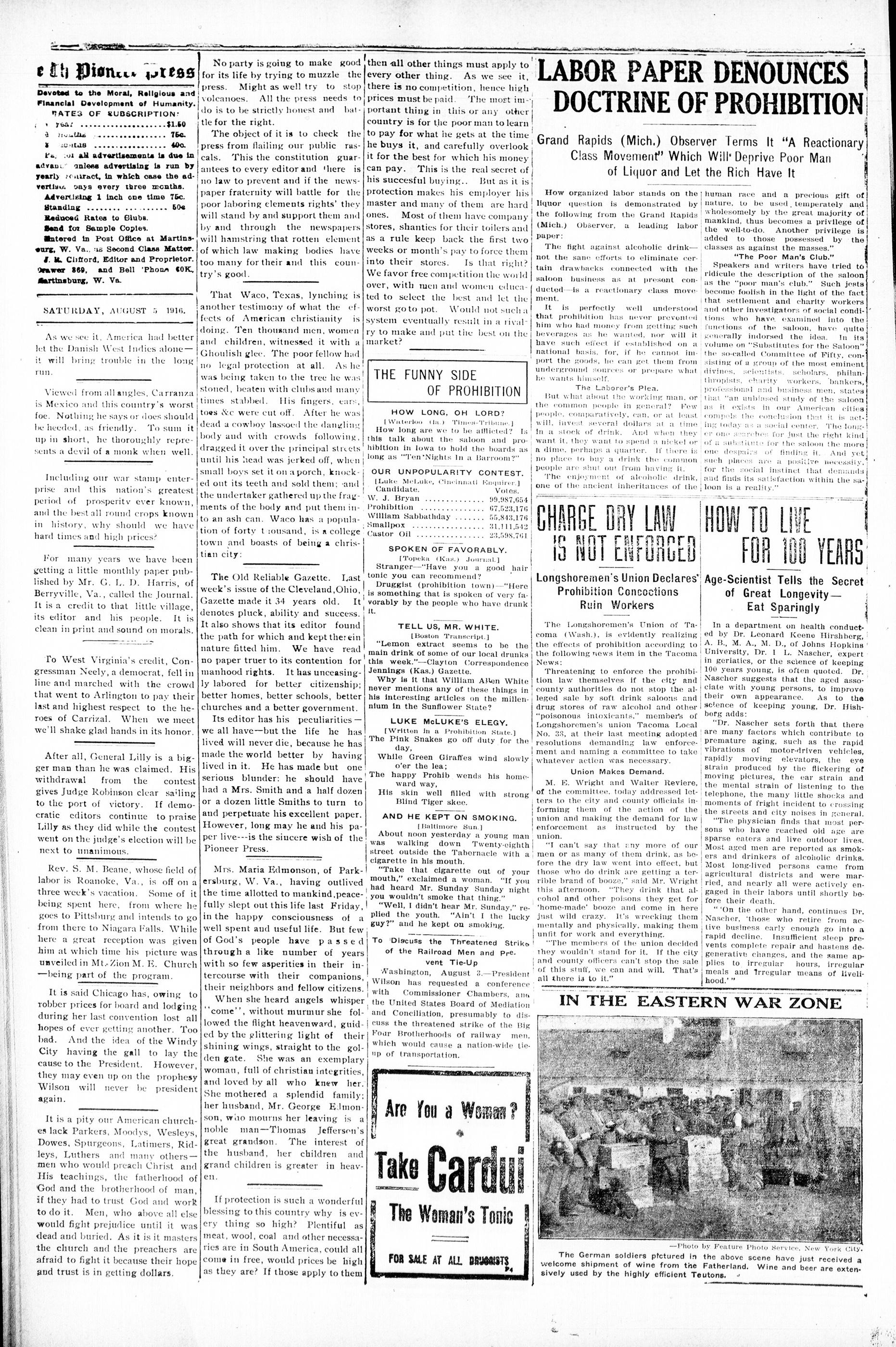
IN THE EASTERN WAR ZONE
THE CITY OF NEW YORK IS IN THE WORLD'S FIRST CITY TO HAVE A MASSIVE CITY CENTER. THE CITY IS A MULTIPLE CITY, WITH A MASSIVE CITY CENTER. THE CITY IS A MULTIPLE CITY, WITH A MASSIVE CITY CENTER. THE CITY IS A MULTIPLE CITY, WITH A MASSIVE CITY CENTER.
The German soldiers pictured in the above scene have just received a welcome shipment of wine from the Fatherland. Wine and beer are extensively used by the highly efficient Teutons.
How organized labor stands on the liquor question is demonstrated by the following from the Grand Rapids (Mich.) Observer, a leading labor paper:
The fight against alcoholic drink—not the same efforts to eliminate certain drawbacks connected with the saloon business as at present conducted—is a reactionary class movement.
It is perfectly well understood that prohibition has never prevented him who had money from getting such beverages as he wanted, nor will it have such effect if established on a national basis, for, if he cannot import the goods, he can get them from underground sources or prepare what he wants himself.
The Laborer's Plea.
But what about the working man, or the common people in general? Few people, comparatively, can, or at least will, invest several dollars at a time in a stock of drink. And when they want it, they want to spend a nickel or a dime, perhaps a quarter. If there is no place to buy a drink the common people are shut out from having it. The enjoyment of alcoholic drink, one of the ancient inheritances of the
CHARGE DRY LAW IS NOT ENFORCED
CHARGE DRY LAW IS NOT ENFORCED
Longshoremen's Union Declares' Prohibition Concoctions Ruin Workers
The Longshoremen's Union of Tacoma (Wash.), is evidently realizing the effects of prohibition according to the following news item in the Tacoma News:
Threatening to enforce the prohibition law themselves if the city and county authorities do not stop the alleged sale by soft drink saloons and drug stores of raw alcohol and other "poisonous intoxicants," members of Longshoremen's union Tacoma Local No. 33, at their last meeting adopted resolutions demanding law enforcement and naming a committee to take whatever action was necessary.
Union Makes Demand.
M. E. Wright and Walter Reviere, of the committee, today addressed letters to the city and county officials informing them of the action of the union and making the demand for law enforcement as instructed by the union.
"I can't say that any more of our men or as many of them drink, as before the dry law went into effect, but those who do drink are getting a terrible brand of booze," said Mr. Wright this afternoon. "They drink that alcohol and other poisons they get for 'home-made' booze and come in here just wild crazy. It's wrecking them mentally and physically, making them unfit for work and everything.
"The members of the union decided they wouldn't stand for it. If the city and county officers can't stop the sale of this stuff, we can and will. That's all there is to it."
human race and a precious gift of nature, to be used, temperately and wholesomely by the great majority of mankind, thus becomes a privilege of the well-to-do. Another privilege is added to those possessed by the classes as against the masses."
"The Poor Man's Club."
Speakers and writers have tried to ridicule the description of the saloon as the "poor man's club." Such jests become foolish in the light of the fact that settlement and charity workers and other investigators of social conditions who have examined into the functions of the saloon, have quite generally indorsed the idea. In its volume on "Substitutes for the Saloon" the so-called Committee of Fifty, consisting of a group of the most eminent divines, scientists, scholars, philanthropists, charity workers, bankers, professional and business men, states that "an unbiased study of the saloon as it exists in our American cities compels the conclusion that it is acting today as a social center. The longer one searches for just the right kind of a substitute for the saloon the more one despares of finding it. And yet such places are a positive necessity, for the social instinct that demands and finds its satisfaction within the saloon is a reality."
HOW TO LIVE FOR 100 YEARS
Age-Scientist Tells the Secret of Great Longevity— Eat Sparingly
In a department on health conducted by Dr. Leonard Keene Hirshberg, A. B., M. A., M. D., of Johns Hopkins University, Dr. I L. Nascher, expert in geriatics, or the science of keeping 100 years young, is often quoted. Dr. Nascher suggests that the aged associate with young persons, to improve their own appearance. As to the science of keeping young, Dr. Hishberg adds:
"Dr. Nascher sets forth that there are many factors which contribute to premature aging, such as the rapid vibrations of motor-driven vehicles, rapidly moving elevators, the eye strain produced by the flickering of moving pictures, the ear strain and the mental strain of listening to the telephone, the many little shocks and moments of fright incident to crossing the streets and city noises in general. "The physician finds that most persons who have reached old age are sparse eaters and live outdoor lives. Most aged men are reported as smokers and drinkers of alcoholic drinks. Most long-lived persons came from agricultural districts and were married, and nearly all were actively engaged in their labors until shortly before their death.
"On the other hand, continues Dr. Nascher, 'those who retire from active business early enough go into a rapid decline. Insufficient sleep prevents complete repair and hastens degenerative changes, and the same applies to irregular hours, irregular meals and irregular means of livelihood.'"
PME Ee aultc HU WL MMe raty |
Pape Mora ease ese (PFI ue “3 PRE ee 4 on
libations Lh ai i ac a ie eee era al taal tents ihe 7 eet res et ie
¥ Lets is Poet iemae eee te Ree Ey" ciple reales cress eda eee eR AG “ whe
COE ee Teams a Panniers ie erat = Coe cee ee ic en ce ee on | m |
Bra ennee rn athe aor Nias eerste eee ea pete Soieenne Ke: 2 Zs
e Ee Snel hy erees See iste ae ae eateries. il Wotan The ee edmentans fal UOC BOe re Wt py De) ee
ee ee PA eee eee ae Sas eerie 21 bea set
Piatra te oreuliy ash ile mare eee tba ene ats ee
s EY Sig’ Sar Sa cm aur SER San Son a a
FO) DG SO Oe ie Se bY be oS
y\ ithe ae ei, i, iM ED it Oi DH
m It Always Helps S
ee says Mrs, Sylvania Woods, of Clifton Mills, Ky., In sj
<p writing of her experience with Cardui, the woman’s
ign tonic. She says further: “Before I began to use ca
a Cardui, my back and head would hurt so bad, 1 Po
gj thought the pain would kill me. 1 was hardly able =
es to do any of my housework. After taking three bottles S
ee of Cardui, I began to feel like anew woman. I soon
geet) gained 35 pounds, and now, I do all my housework, jad
oe as well as run a big water mill.
ha 1 wish every suffering woman would give =
pO AA Ed 2
mad UD) a
x ; 7 eS
be The Woman’s Tonic a
C4 atrial. 1 still use Cardui when I feel a little bad,
= and it always does me good.” =
ys Headache, backache, side ache, nervousness, ~
a tired, worn-out feelings, etc., are sure signs of woman— oS
OS ly trouble. Signs that you need Cardui, the woman’s [eS
tonic. You cannot make a mistake in trying Cardui Q 3
fei = for your trouble. It has been helping weak, ailing Zz
i women for more than fifty years.
a Get a Bottle Today! ,, 2
ae EY IY TR” NEY OEY SR” NR er Se Sp
Chee reo ee eh SS
2 O29 fon TD ogee)
FARE $592 DAILY BETWEEN
b sf p. *
Bp | coisa CLEVELAND &
ACVB) Cesc eee ts Re
ND aA reS ye SOSS _BUFFALO
SONI Bae: Bie tant |
ae aay p Mam remanae Ta ha
tree Outer beg ey io A
Go Oe Sena 5
Secpeawt 8 Sgt Ans A et a es re EO
PM Gpeets ‘tho Great Ship “SEEANDDEE” eat aad
{ RSceeisndzetcaty stanton ey and water of the wort, sleeping aeons
€ “CITY OF ERIE” —— 3 Magnificent Stesmers ——~ “CITY OF BUFFALO” 4
BETWEEN
{ CLEVELAND-Daily, Mev lstto Nov. 15th-BUFTALO §
§ Krell? 7. TRA. | Aerating’ «EKITS
HN conncctions at Bultale tor Niagard Esti an fait fate aaa Canadien pointe, Rarerad Giz. MS
/ av randing’ Between Cleveland fatalo"are good for toseportaton eo ateucte ‘aa b
1 ore nee oe reine a SE TE a
| [BERETS] BE
| THE CLEVELAND & BUFFALO TRANSIT CO, Cleveland, Ohio *
ee EE SCENERY Aes cnet en ne eat = — eu een
tbls
4 es
The many friends of “Jolin Ed?
Green will regret very much to
learn that he is quite sick
If you are in need of ice cream,
delicious pop, or any thing else7 in
the refreshment line, sec James
Allen, on Charles street.
Mr. Harley Cage, a native’ of
Bunker Hill, but lately a resident
of Pittsburg, is spending some time
in the old heme section
"Mr. John Corsey and wife, and
Mrs. Jagob “illiams left Thursday
over the Cumberland Valley Rail-
road for Atlantic City, Ocean City
and other Jersey seashore resorts
Mrs. Jane C. Lowe,a well known
Jaiy of Wheeling, who spends a
portion of her time in) doing mis-
sionary work, visited in) our city
during the week.
Mr. Henry Ford, of Darksville,
was in town the other day. and
told. us that the Darksville Cirenit
of the Methodist Episcopal Charei:,
raised the neat sum of S17 at a
rally which washeld last Sunday
Mr. Daniel Holmes, the popular
and obliging janitor at the Balti-
more and Ohio passenger station
spent last Sunday in Washington,
Where he went to visita sick broth
er.
Go to John W. Dean Co,, fo:
everything in the clothing line
They have it, and insist you cali
and look it over. Prices reasonaabic
and anxiety on tiptoe to please you.
Every new buyer brings another
S88 88
o,
Bees says Mrs. Sylvania Woo
Pg «(Writing of her experience
Mrs. Frank Harris, of Union-
town, Pa., is in our city, and is
the guest of Mr. Abraham Miller
and his madam. Her presence here
is alike pleasurable to herself and
friends, and she looks the picture
of health.
Thompson and Thompson have
the most attractive stock of men’s
ready made clothing to be found in
the city, and the nobbiest and nat-
tiest stock of hats, shirts and sum-
mer wear you eversaw. Give them
a call—144 North Queen Street.
WiLL SEND FEW
DAYS IN VIRGINIA
The Rev. G. C. Smith Leaves to Visit
His Family and New
Field. °
The Rev, GC. Smith lett this after-
noon on train No. 6 for Richmond,
Va. and on Saturday he will go to
Salem, where he will remain over
Sunday, returning to Martinsburg the
latter part of next: week
The Rev. Smith today reecived a
letter from his wife, who is in’ Rich-
vomd. stating that their litte deugh-
vr, Olivia, who is UM with whooping
cough Wat much worse, and he lett
eartion than he expected
SPECIAL SERMON
TO TRE CHILDREN
At theWinghester Avenue Christian
Church Sunday Morning
at 11 O'Clock
The Rey, Roy Schmucker, pastor of
the Winchester Avenue Christian
church, will deliver a special sermon
Sunday morning to the children, Sub:
fect: “Flowers.” AN children, young
and old, are invited.
There has been no great advance
in the price of buttermilk recently.
which may indicate that nobody is
willing to live 708 years on the terms
prescribed.—Chicago News.
DRY LAWS ARE
HURTING CH
Hts wt HIT
Former Butte. Montana, Busi-
ness Man, DescribesTroubles
of Colorado Metropolis, Which
Sadly Misses $275.000aYear
Revenue From Nearly 500
Saloons
‘The word of the “man on the inside”
is always interesting, and the fol
lowing story of the failure of prohibi
tion in Denver, Colo. as told by the
Butte (Mont.) Miner is not only inter-
esting but instructive as well,
Ceorge L. Symons, for years a well
known citizen of Butte, where he has
been engaged in business and who is
recognized as one of the best posted
men on current events who visits the
larger cities of the country, has writ
ten a very interesting letter here to
Jesse Silverman, one of the Caplice
Commercial Co., pertaining to the cf-
fect on business prohibition has had
in Denver, once one of the greatest
convention and business cities in. the
West. Mr. Symons is well posted on
business conditions generally and his
letter, which follows, will prove of
interest locally. Says Mr. Symons
“L arrived in the “Sunlight city” last
evening. ‘The change, since prohibi-
tion has taken possession of the state,
strikes one forcibly, to say the least.
“I had occasion, this morning, to
talk with Mr. Rector, one of the fa-
mous ‘Rector brothers.’ He says the
loss to the hotels has been very
marked and that business in general
thas suffered severely. In the past
‘Denver has been one of the most
popular convention cities in the coun-
try. Mr, Rector says the conventions
are now all making Salt Lake their
headquarters: This means that the
hotels here—and business in general
must suffer during the summer sea-
son.
| Property Owners Complaining.
; “The property holders are complain-
ing of the usual change that follows
prohibition—reduced income and in-
creased taxes. As an instance, an
apartment in the exclusive residence
‘district, renting formerly for $125, was
offered to a permanent tenant recently
at $75. There is an alarming percent-
‘age of the vacancles in the business
district and the finest office buildings,
‘with two exceptions, are half empty.
‘I found within a radius of 36 blocks a
hundred vacant storerooms.
“Denver formerly had in the neigh:
‘borhood of 400 to 450 saloons. ‘The
city and county derived from these sa-
loops a revenue in the neighborhood
of r5.000, besides the returns to the
merchants and business men of the
ty for groceries and merchandise
consumed by the saloon people in
‘their business. ‘This would run into
‘the hundreds of thousands, not count-
ing the expenditures of the individuals
‘employed by the saloon people.
“There is only one source from
which the city and county can replace
this $275,000 of revenue.—increased
‘taxation. The loss to the merchants,
‘the hotels, the mountain resorts and
outlying camps cannot be replaced at
oe The greater number of the con-
ventions, the hotel men claim. will not
‘come here, and the city can only
“pocket the loss.
; “Get All You Want.”
| “At the same time, Denver is expert:
-encing one of the many failures of pros
“hibition that doesn’t prohibit. One
can get all he wants to drink—but by
‘the back door entrance.
“In conclusion, the people of Denver
don’t want prohibition, ‘The city has
“existed, since its birth, upon broad and
liberal principles. ‘The saloon bust
ness, as it existed here, was conduct:
ed by men who were good citizens.
In their hands it was a well-regulated
business, and it was not the will of
the people of the city that it was over:
thrown. Public sentiment is strong:
ly in favor of the reopening of the
“question in the near future.
“I believe prohibition would have
[proved more disastrous to Denver I
the unusual condition of the war and
the ateatine tA tatsle Gia ns acecd
IN “DRY” TOWN
HUNDREDS OF ARRESTS FOR
DRUNKENNESS MADE
IN SEATTLE
Judge Orders Guardians of the
Law To Return Quantity of
Liquor To Druggist From
Whose Store It Had Been
Taken In a Raid
The startling story of increased
drunkenness in “dry” Seattle is told
in the following item which made its
appearance in the Seattle (Wash)
PostIntelligencer
Arrests for drunkenness for tie
month of May totaled nearly os per
cent of the number for that offense:
during the preceding four montis the
dry law has been in operation, ant
those for violation of the liquor ordi
nance execeded any single moni
since the first of the year
Four hundred and ninetytive per
sons were, booked at ihe police st
tion in the month of May charged with
intoxication, ‘The number irom Janu:
ary 1 to May 1 was Sau, January re-
corded ninety-three on drunkenness
charges; February, 115; March, 291,
and April, 357. The total number of
arrests for May was 1,004, the greatest
number of arrests since the dry law
went into effect
Sixty-eight were arrested on tho
charge of illegally selling or possess:
ing liquor, which is 41 per cent of the
total for the first four months of the
year. January ranks second in this
regard with 62 arrests! February, 235
March, 36; April, 43; total, 164
Police Go Wrong.
| Simultancously with the above there
appeared the following account of a
gross blunder on the part of the police
in attempting to enforce the prohibi-
tion law:
| Five truckloads of select cham:
pagnes and other wines and bonded
whiskies, storied in the police station
since May 12, when the Chartier drag
store, on Second avenue near Univer-
Silty street, was raided. have been re
Heased and will again grace ths ',
dark cellar of the Hote! vo: 1
ing. Judge Gordon on ‘Pharsié
‘noon signed an order for the return
‘the liquors. At tie saime tine clones
of unlawfully having aie °
possession were dism
C. Chartier, of the druv si
G. King, manager and po i
ithe Hotei Savoy
| One of the rarest sights tet
in Seattle will be witn hf pious
Ssersby on Secon avenue sid ww
Hing when several heavily dated dea
will drive up to the curhin foot og
the Chartier dau store in
Savoy building and vr toad '
worth of liquor on tie sid sh
dudge Gordou dismic: od «
against Mr. King and Mr. Cuastier oad
‘ordered the liquors returned whew it
was shown in const that (ie )
had been purchased » to Jameary
and distributed only the manner
prescribed by law. ‘There was no at
tempt on the part of the city attorney
‘to show that the liquor had becn un.
‘Jawlully sold.
VERMONT AGAIN.
Iamden OX.) Press]
Vermont's recent refusal to go back
to statewide prohibition will have a
tendency to boost the local option
movement in this and other states.
Some fifty years ago Vermont went
dry and remained dry until 190%, when
the present local option law was adopt-
ed, on referendum, by a majority of
729 votes. ‘The law has worked well,
but the prohibitionists were not satis-
fied and finally succeeded in having
the question referred to the poople
There will be no further effort to force
prohibition upon tiat state, And pub-
He sentiment is the same §n other
states where iocal option prevails,
Beriin officially denies that the Au
trians are thinking of making a sep-
arate peace. Of course, they are not
Austria is not orivilered to think
of anything without Prussia’s permis.
sion.~-Providence Journal.
Evidently we shail have to avoid
“the next war" until the railroads
prepare a sufficient number of Pull
man palace cars.—lochester Herald.
MOBILE IS IN
AWFUL SHAPE
Alabama is one of the states that
were made “dry” CM by legislature
and not by vote of the people. The
following from the Cincinnati Euqutrer
flustrates the result of such proe
codure
With the advent of rohibition a
fecling, of depression ho + <t Moe
bile, Mla, according to former Stato
Senator Alfred ML Cohen, who. ror
(arned yesterday from a tomday visit
fo the city, weve le iyspectod the
plant of he opitlar Lumber Com-
bs w iim
ber « . President
“sin nyt tthere a your ago
ther Lon le change,” said
Mr. Cohen, “It wet then, but now,
wy li wy 40. store.
roo ay tly were
T 1 the
bi facie
aw what
p
( nthe
Teal wed Lgres are
vac ants
wi sons,
Ther t Dist
nm
Ordinarit notin every one ens
thusiastio and busy, but now there is
a fooliae of depressina. No, did not
Bee np liquor hein; id, bat To was
told Po would have nm Me in yoote
ting: Hiquer th ald ae y inn
teaeup, E owas informed le has
Jost all the money fr we evived
fron: the Heensing af the tratth
“The public finunees are in a bad
shape, ‘There is talk of paying the
salaries of teachers and other officials
in serip. ‘There is no cominunity that
has a finer class of poopie than Mobile,
and they are not in favor of sumptuary
logislation, Alabama was made dry,
Twas told, by a hand picked logisla-
ture.”
DRUNKEN POLICEMAN TRIES
TO ARREST A DRUNKEN MAN.
The ‘Topeka Capital, owned by
Arthur Capper, the “very-dry” Gov-
ernor of prohibition Kansas, ear-
ried this Hem from Kansas City the
other day:
Tho dificulty experienced last
night by Peter Nudich, a grocer at
523 Contral avenue, who has a spo-
cial police commission, in arresting,
a drunk, caused the embryo police:
Iman to be locked up also.
Henry Smith, a patrohinen on
Contral avenue, heard five shots
fired from the Nudich Krocery store
Rushing into the store he found
that Nudich, being too drunk him-
self to arrest Adam Domblatz, Sixth
Stroct and Simpson avenue, had
fired into the air to call help.
Smith called the police patrol wass-
on and sent both Nudieh and Dog,
Dlatz to the station
Nudich was not hooked, because
he had @ police commission. In po:
Jiee court this morning Judie J.
Brady discharged Doxgilatz and rec
ommended that Nudieh's commis
sion be revoked
Mine. 1. €. Parrish
a Hair Culfuring
* + « f
Scalp Proatment
Br reco ar
LO at aaa
Vee onal rag) iran
ee 4 te Bag Me hi ay
ene meng, eae
anne SUA
ee mee pe Con
VAG dasa AM ke eeagmeM Ene
CMC ERIN i, i AOD
ETE MES. Fo
Were. SM EII” ks, POS
ee pre ce
Ck Rie zi ae
Cee ae. i WGA
Pees ia, ai ee
bike Bale. Geeta a
i) Ye ae, aed ans
Cs fee a Ea
‘Largest Vail Order Flouse of its kind in
America. © m
All kinds of Toilet Articles for sale.
Human Hair Goods of the finest quality.
Our Hair Food and Skin Food never fail.
If the trouble is with the hair calp o
skin, we have the remedy.
We guarentee a remedy to make hair
grow on bald spots and bare temples.
Send 106, for a sample and catalogue.
@ Send for our terms to agents, > |
Address Mme. L. C. PARRISH,
saa, 95 Camden Street, Boston, Maggy was
E. P. C. T. Association Starts Work
President—I. D. VanMetre.
Secretary—J. Holland Sperow.
Treasurer—Edgar L. Henshaw.
County Agent—W. M. Bewick.
The Eastern Panhandle Cow Testing association, a department of the farm bureaus of Jefferson and Berkeley counties, began its first year's work on Tuesday. The supervisor, Mr. Eason, of North Carolina, entered upon his duties at the farm of C. S. Billmyer, near Shepherdstown. Today he is at the farm of D. Z. Reyer. His probable course during the rest of the month is as follows: Tabb Bros., Locetown; M. K. Bowers, Kearneysville; C. Marshall, Kearneysville; I. D. VanMetre, Kearneysville; C. J. Cavallier, Harpers Ferry; McDonald Bros., Charles Town; Messrs. Stull and Albin, Summitte Point; E. Conklyn, Rippon; Bruce McDonald, Darkesville; J. B. Fisher, Arden; Allen Weller, Arden; Elmer Seibert, Martinsburg; J. Snyder, Tuscarora; H. Snyder, Tuscarora; J. N. Thatcher Co., Tuscarora; J. Holland Sperer, Spring Mills; A. R. Tabler, Greensburg; W. L. Folk, Swan Pond; G. Harry Whiting, Shepherdstown; J. D. Foreman, Shepherdstown; James Staley, Scrabble; Luther Cickers, Shepherdstown. One or two others are expected to be entered before the end of the month which will finish out the month.
Mr. Bason is making friends wherever he goes and rapidly becoming an adept at his work. We predict that he will be of great assistance to the open-minded dairymen, such as the members of this association are. The Farm Bureau of the two counties are congratulating themselves on their success in inaugurating such a worthy movement. They are not forgetting, however, to give a large part of the credit to G. L. Oliver, agent in dairying from Morgantown, who has labored so faithfully to help us in this work. That he is a true friend to the dairymen of this and our neighboring county, later results will demonstrate.
Nothing has been attempted in years that can compare with this work in the possibilities for good to the dairymen. The amount of good to the individual farmer depends just as much on the farmer himself as on the tester. The value seems chiefly in a knowledge of the economic value of each cow in the herd and the help in feeding more economically. In addition, watch for the last of cows producing 40 pounds of butter fat per month or more, as it will appear in the papers of the two counties. Dairyman, will your name be written there?
The buying committee of the farm bureau met at the office of the bureau last Saturday and placed the fall order for fertilizers and timothy seed. They consider that some very attractive prices were obtained. Farmers who are interested in saving money, are invited to consult the secretary, J. Holland Sperow, or call at the office of the bureau for information.
The work of Dr. C. A. Lueder who was with us last week, was of its usual high order. His hearers were entertained and instructed and many farmers feel better prepared to cope with hog cholera this fall, if it must appear, than they were before. If you hear of any cases of the disease in this section, kindly report the same to the county agent. He is very anxious to help you in its control this fall. Will you co-operate in this fight?
Next week we are to be favored once more when H. L. Smith, a son of Berkeley county, now agricultural agent in Marion county, will be with us. Several meetings are to be held at which he will speak. He will also accompany our agent on his regular trips over the county. The following meetings have been regularly arranged for and others are being considered:
Shanghai—August 7; 8 p. m.
Falling Waters—Tuesday; hour to be set.
Swan Pond—Thursday, August 10, 1:30 p. m. G. H. Whiting farm.
You are cordially invited to attend these meetings, whether a member or not. The Swan Pond meeting is a field meeting on Mr. Whiting's demonstration fields of soy beans and corn.
If the Internal Revenue Department is Not Satisfied With Explanation
A failure to grasp the requirements of the U. S. Internal Revenue laws, which even apply to agricultural concerns that are not intended to pay dividends, has caused a slight flurry in matters concerning the Hagerstown Fair Board. It is said that a failure to make a report to the Internal Revenue officers carries a penalty of $10,000 and if the Fair had to pay that it would have to keep open a month or so to get even.
It is said that several reports have been made to various departments and some taxes have been paid, but under the law there is a report required of all stock concerns, no matter of what kind they may be, and whether dividend paying or not and our fair comes under it. So down to see the Chief of the Internal Revenue bureau will go President Poffenberger and stockholder Dr. J. H. Wade and they will meet Hon. D. J. Lewis and make the call and explain the misunderstanding. It is expected that the fine will not be assessed.
A high authority says that the requirement in this case is a purely formal matter and upon presentation it is very likely there will be na fine. The trouble arose from the peculiar phrasing of the law.
NEWS RECEIVED OF MR. HILL'S DEATH
NEWS RECEIVED OF MR. HILL'S DEATH
Charles Hill Fails to Recover from An Operation for a Tumor Misses Minnie and Della Hill, of West Martin street, received a telegram last night from Baltimore announcing the death of their cousin, Charles Hill. Mr. Hill recently underwent a serious operation at the Johns Hopkins Hospital for the removal of a tumor and the news of his death comes as a great shock to his relatives and friends in this city.
The deceased was well and favorably known in this city, having been born and spent a number of years here. He was the son of the late Mr. and Mrs. John Hill. The death of his mother occurred about a month ago. Mr. Hill was employed with the B. & O. Railroad company at Camden Station. Surviving are his wife and three children. The Misses Moxley of West Martin, street, are cousins also on the deceased man.
COUNTY COURT IS SUED FOR $2,500
COUNTY COURT IS SUED FOR $2,500
By H. D. Sperow, Who Alleges He Was Injured When His Horse
Broke Through a Bridge.
This morning Senator A. C. Mo Intyre instituted a suit against the county court on behalf of H. D. Sperow. asking $2,500 for injuries sustained when his horse broke through a bridge, throwing him violently, breaking his collar bone and bruising his severely.
On May 4 Mr. Sperow and a neighbor were crossing a bridge in Hedgesville district, which spans a ravine on the road leading to Marlowe. The floor of the bridge gave way, causing the horse to fall and throwing its rider. Mr. Sperow was given treatment, and to date, it is alleged, he is not able to use his left arm.
The matter was brought to the court's attention, but no settlement was made before adjournment was taken Thursday evening, hence the suit.
Come and see them and hear Mr. Whiting's story about them.
It is likely that the regular meeting of the directors of the farm bureau will be postponed from the 5th to the 12th, on account of the picnic at Tomahawk.
DES MOINES (IA.) HIT BY CRIME AND DRUNKENNESS WAVE
INTOXICATED THUGS, WITH KNIVES AND BLACKJACKS, ATTACK MANY PEOPLE AND TERRORIZE ENTIRE COMMUNITY OF "DRY" TOWN
HUNDREDS SEE THREE MEN STABBED
Robbers Attempt Hold-Up—Minister Who Witnessed Cutting, Denounces City Officials, Declaring There is More Intemperance in That City Now Than Ever Before
"MOTHER, MOTHER, MOTHER, TURN THAT HOSE ON ME!"
They Are Singing This Tune in Georgia Where the Thomas Edison of Tomato Peddlers Has Invented a Way to Beat the "Dry" Law
A crime wave has engulfed Des Moines (Ia.) Never before in the history of that city has there been such an epidemic of drunkenness and offenses against the law. It is unsafe for good people to walk the streets of Des Moines.
Iowa became officially dry last January 1. The results of prohibition are thus described by the Des Moines Evening Tribune:
Rev. J. Edward Kirbye, "the Des Moines workingman's friend," declared today that in his five years in Des Moines he had never seen more drunken men on the streets here than there were last night.
Only eight arrests for intoxication were made by the police.
Three drunken thugs, armed with knives and blackjacks, roamed the downtown district last night. They brutally assaulted three men. They attempted to hold up a third. Finance Superintendent Tom Fairweather asked for armed detectives to guard the city treasurer's office today because "of the criminals and robbers in the city." Two detectives stood guard outside the treasurer's window.
What Rev. Kirbye Says.
"There is not the slightest doubt that there has been an increase in crime and intoxication since the present police officials have been in office.
"Anyone with eyes can see it. I think I have rarely ever seen so many drunken men abroad as I did last night.
The assault committed on the man in front of the Elliot hotel, which I witnessed, was boldly done. Mrs. Kirby, who saw the police arrive, say they seemed to take the affair almost as a matter of course.
"Something surely should be done about it. If a mass meeting is called I for one would be glad to go before the people and tell them of the conditions now as I see them.
"I would like to tell them of the facts I have discovered at the Workingmen's home and let them know how drunkenness has increased among the workingmen.
"I believe my feelings on this subject are general."
"MOTHER, MOT
TURN THAT H
They Are Singing This Tune
Edison of Tomato Pe
Way to Beat
Even Georgia's newest prohibition law can be beaten. The second law was recently put into operation, after the original statute adopted in 1908, failed to prohibit the use of liquor. The Atlanta Morning Journal states: Selling whisky by the drink through a rubber hose concealed in a farm produce wagon is the newest method of violating the prohibition law according to police charges against J. C. Nash, age 66, who was arrested Saturday afternoon for dispensing "mountain corn" through a rubber siphon. Nash, according to the police, was driving along Decatur street with his wagon loaded with chickens, tomatoes, cabbages, turnips and corn whisky, the latter concealed from view by the produce.
Hosel Not Hoslery.
A rubber hose sticking up through a chicken coop attracted the attention of detectives who, seeing no use the chickens could have for a rubber hose, advanced to investigate.
Detectives traced the rubber hose back to two half barrels in the bottom of the wagon, one filled with newly distilled liquor and the other recently
Three desperadoes running amuck in the crowded downtown district of Des Moines last night flashed knives and blackjacks at every man and woman who crossed their path.
Cut Down in Cold Blood.
Within twenty minutes after they were first noticed on the street, about 10 p. m., they had cut down in cold blood three innocent passersby, and attempted a holdup of a fourth man.
The police believe the men to have been armed with revolvers besides carrying the weapons which they used on their victims. A desperate pistol battle between detectives and the bandits is expected by the police when the officers catch their men.
Chief of Detectives MacDonald declared at 9 o'clock to-day that he expected his men would close in on the desperadoes before sundown.
The work done by the highwaymen before they calmly strolled away from the scene of their crimes was: J. E. McKinney, Perry, Ia., slashed with knives about the face and kicked into insensibility in front of the Elliott hotel, 219 Fourth street.
John Boyle, Decatur, Ill., was cut across the face, neck and shoulders when he told the bandits he did not know where to get booze for them. He was attacked at the corner of Court avenue and Fifth street.
James Riley, New York City, was stabbed in the left side just below the ribs by one of the holdup men when he met them at Tenth and mulberry streets. He was taken to Mercy hospital where is was declared he would live.
One Man Escapes.
An unknown traveling man, said to be staying at the Randolph hotel, escaped from the trio when they attempted to hold him up.
The desperadoes were last seen going leisurely west on Mulberry street. two of them were said to have been tall men, the third a small individual. All three were roughly dressed and dirty.
The attacks took place before hundreds of spectators.
McKinney was sent to the county jail for ten days today on a charge of intoxication.
THER, MOTHER,
HOSE ON ME!"
in Georgia Where the Thomas
ddlers Has Invented a
the "Dry" Law
emptied of the same substance. The
hose was operated on the syphon princi-
ple and by a slight suck the "mount-
tain corn" would run freely up through
the chicken coop and over the back
of the wagon.
Nash made no detailed statement and the police do not charge definitely whether he was selling whisky by the suck—allowing the customer to take the hose in his mouth under the pretense of inspecting the chickens—or in cans furnished by the consumer
Couldn't Give Bond.
Nash, who stated that his residence was at Luxomni, Ga., and that he drove to Atlanta from that point, is being held at police station because of his inability to make the $500 bond demanded by the police.
Officers of the internal revenue department Saturday afternoon began an investigation to trace the liquor to the still where it was manufactured. Nash, when questioned regarding the still, told the police to go to Luxomni, where it could be found without difficulty.
The peddler will face Recorder Johnson Wednesday on charges of violating the new prohibition law.
---
ALCOHOL IS A VERY,
A VERY SLOW POISON
It Required a Century to Kill Abraham Wilcox.
This story comes by telegraph from Fort Worth, Tex.:
Abraham Wilcox, 107 years old, died Saturday at the home of his son, Edward Wilcox, 606 West Tenth street, after two days' illness. Prior to that he had enjoyed good health all his life.
Grandpa Wilcox, as he was familiarly called, had lived in Fort Worth three years. He came here when 104 from Mexico. Seventy-seven years ago he came to America from Devonshire, England. He lived in Rochester, N. Y., and later in Michigan, going to Mexico thirteen years ago.
```markdown
```
He maintained that his age was 115 years, but relatives say this is incorrect. Three times a day it was his custom to drink a toddy. "I was a little lit up once eighty years ago," he said in his interview. "A man ought to be careful." While in Fort Worth he took a walk three times a day. Every Sunday morning found him at St. Andrews' Episcopal church. A son, 84 years old, lives in Michigan.
"WET" TOWN IS POPULAR
According to the Cumberland (Md.) Dally News:
Licensed saloons have again opened in this city after five years of no license conditions. Both retail and wholesale dealers did an extensive business all day. Special coaches had to be added to the Pennsylvania train running from Mercer, Leesburg and other points in Mercer county, which is now dry. Standing room was at a premium in the train and it is rumored that additional train service will be arranged to take care of the increased traffic originating in Mercer county.
HEZEKIAH SNYDER BURIED TUESDAY
Unfortunate Man is Laid at Rest In Green. Hill Cemetery Yesterday
The funeral of Hezekiah Snyder, who died Monday afternoon at his home in North Martinsburg, was held yesterday afternoon at 3.30 from the Second Baptist church, though deceased was not a member of this church. Deceased, as it will be remembered, sustained a broken back in an automobile wreck on the Williamsport pike near this city, Saturday night, July 8th. He received professional attention at one of the local hospitals until two days before his death, when he was taken to his home. His case was recognized as hopeless from the firt until death came to the relief of his terrible suffering. Interment was made in Green Hill cemetery.
LIVESTOCK SELLS AT GOOD PRICES
Buyers From Three States Make Bid ing Lively at I. D. Van Metre's Sale A livestock sale of I. D. VanMetre's at his Stone House farms Tuesday, attracted a big crowd of buyers from the Eastern Panhandle counties of West Virginia, from Washington county, Maryland, and the Valley of Virginia, and the bidding was most
sprightly. Auctioneer J. W. Dodd facing a body of real livestock men throughout the day. Mr. Van Metre who operates one of the largest and most modern dairies not only in West Virginia and this part of the south, and is also a big live-stock dealer, offered the buyers a lot of high-grade Jersey and Holstein cows, with young cattle, sheep and hogs. Twenty-five cows brought an average of $60 a head; fifty young cattle ranged around $40 per head; one hundred and seventy-five stock ewes averaged $7; thirty young hogs (shoats), per head, $5. The sale totaled something over $5,000.
1