The Pioneer Press
Saturday, September 30, 1916
Martinsburg, West Virginia
Page text (machine-generated)
The Pioneer Press.
"HERE SHALL THE PRESS, THE PEOPLE'S RIGHTS MAINTAIN, UNAWED BY INFLUENCE AND UMBRIDED BY GAIN"
ESTABLISHED 1882
TAMPICO SCUTTLE A CRAVEN AFFAIR SAYS ROOSEVELT
Constituted So Grave an Offense Against the Nation's Honor and Duty That the Man Responsible Should Be Removed From Office.
WILSON CANNOT SHIELD
HIMSELF BEHIND DANIELS
Authentic Proof That Americans In Peril Were Deserted by Their Own Government Against the Protest of the Senior Naval Officer Present Most Pusillanimous Episode In the Naval Annals of Our Country.
Theodore Roosevelt in a letter to Henry Reuterdahl, the naval critic, criticises President Wilson and Secretary Daniels in connection with the Tampico affair, when the American warships were withdrawn by order of the Administration. The colonel says:
"You have presented authentic proof of how the Americans in peril at Tampico were deserted by their own government against the protest of the senior American naval officer present. You have shown that the government at Washington had full knowledge of the danger of the situation through telegrams from Admiral Mayo sent by wireless to the navy department on April 11, 12 and 13. You also give the telegram of Mr. Daniels of April 20 directing the admiral to proceed to Vera Cruz.
Mayo Feared Loss of Life.
"You have shown that Admiral Mayo made an emphatic protest to the navy department, stating that he feared the result of the squadron's leaving would be the loss of American lives and property. You also quote the telegrams sent by Admiral Mayo the following day, containing the protest of the American consul, Mr. Miller, and requesting authority to remain at Tampaico. You have shown that, nevertheless, the navy department on the 21st confirmed its previous orders and directed the ships to leave at once.
"You have shown that the admiral put out into the ocean eight miles distant, but received a protest from Consul Miller reiterating his demand for protection. You then quote the telegrams and signals of Admiral Mayo, who, in spite of his orders, nobly refused to run from the post of duty while the lives of American men, women and children were in danger."
Can't Hide Behind Daniels.
"President Wilson cannot shield himself behind Mr. Daniels, for Mr. Daniels could do nothing that the president does not order or sanction. When Mr. Daniels's actions have been brought to the attention of Mr. Wilson, and are not repudiated by him, they become Mr. Wilson's; and Mr. Wilson is fully and completely responsible for Mr. Daniels, for all that he has done and left undone.
"The proof is absolute that when Admiral Mayo was at Tampico he had received full knowledge of the rioting and of the imminent danger to American lives; but that, nevertheless, he steamed away into the ocean, and that the Americans were rescued by German and British ships. This action constituted so grave an offense from the standpoint of national duty and self-respect, that any man responsible for it should be at once taken out of office.
Facts Made Public In U. S.
"Shortly thereafter the facts were made public in the United States. If Admiral Mayo had been responsible and had not acted under orders, then the only proper course for Secretary Daniels would have been to order his instant court-martial, and in such case the failure to do so would have shifted
the blame at once from the shoulders of Admiral Mayo to the shoulders of superiors, President Wilson and Secretary Daniels.
"Therefore, even if these telegrams did not exist, even if there had been no such orders, or those actually issued by the secretary of the navy to Admiral Mayo, nevertheless his superiors, Secretary Daniels and President Wilson, would both have become fully responsible for the guilty transaction by their acquiescence therein. They cannot, as they have sought to do, shift the blame to the shoulders of the admiral."
The Soldier Vote.
A significant feature following the Maine election was the nature of the soldier vote.
It is reported that one Maine battalion hiked sixty miles in two days for the purpose of exercising the franchise.
And we know how they voted!
Latin politeness is proverbial, but aren't these Mexican commissioners exceeding the limit when they persist in likening Woodrow Wilson to Venustiano Carranza?
Josephus Daniels might have made a passable secretary of the Salvation Navy, but it was pretty rough to impose him on Uncle Sam's fighting navy.
EDITORIAL COMMENTS.
If you had two dollars to invest would you trust it to the business sagacity of Josephus Daniels? Then, why let him handle the millions that are to be spent on the new navy?
Judging by the signs of War Department activity the Administration is cunningly arranging to bring the militiamen home just in time to enable them to vote for Mr. Hughes.
A train of thought on a one-track mind has to be composed of shuttle cars.
Three years ago Woodrow Wilson was explaining that hard times were psychological, but he isn't trying to squirm out of responsibility for the present prosperity.
The disaster to the Memphis caused very little excitement, Americans being used nowadays to seeing the navy on the rocks.
This Democratic Congress has passed into history—profane history.
President Wilson's speech of acceptance could have been phrased even more succinctly in the graphic words of Boss Tweed, "What are you going to do about it?"
We see by the interviews with the Mexican commissioners that the campaign slogan this year in the Sonora bandit belt is "Thank God for Woodrow Wilson."
Mr. Wilson's eulogy of Lincoln at Hodgenville was more literary but less sincere than the one he pronounced upon himself at Shadow Lawn.
The new half dollars will have an olive branch on one side and on the other an eagle, in full flight. Wilson money.
Motto of the McAdoo shipping law: "The sun never rises on the American flag."
A Democrat's idea of an ideal watchdog of the Treasury is a Pommeranian.
Mr. Wilson is now busily engaged working the other side of the suffrage street.
The campaign agents who two years ago were busily engaged thanking God for Woodrow Wilson seem to be taking their vacations just now.
A record wasn't the only thing the late Congress broke—there's the Federal Treasury.
Congress didn't want a Tariff Commission composed of $12,000 men, those $7,500 salaries being designed for $1,200 men.
HUGHES PITILESS ON MEXICAN DISGRACE
HUGHES PITILESS ON MEXICAN DISGRACE
In His Mind and on His Tongue More Than Any Other Single Problem With Which Mr. Wilson Has Paltered.
CRAZY CHAPTER OF BLUNDERS
No One Can Hear Him Speak Without Seeing: the Reality of His Indignation Over the Heartless Policy of the Democratic Administration Toward American Men, Women and Children, American Citizens, Soldiers and Sailors Along and Across the Rio Grande.
Soon after Mr. Hughes was nominated a friend said to him, "Governor, if the American people forget the Mexican disgrace they do not deserve to have you for president." Quick as a flash he replied, "The candidate who dodges the Mexican disgrace does not deserve to be president." He did not pass around his address of acceptance for compliment or criticism in advance of its delivery, but the amount of space he devoted to the Mexican disgrace—"that confused chapter of blunders"—surprised no one who had talked with him since his nomination. It has been in his mind and on his mind more than any other single problem with which Mr. Wilson has paltered. To talk with him is to see at once the reality of his indignation over the heartless manner in which American men, women and children, American citizens, soldiers and sailors have been abandoned by the administration along and across the Rio Grande, the victims of Mexican armed forces, outfitted with American ammunition and American rifles. Mexicans whom Mr. Wilson has coddled one day as patriots only to chase the next as bandits.
It is apparently the belief of Mr. Wilson that the people of the United States are not interested in Mexico. His defenders have declared that it was an "old story and out of date." Mr. Hughes has a better opinion of his fellow countrymen. He has proved himself a better judge of their feelings. He has made "the Mexican disgrace" a foremost issue of his campaign. He has assailed the record of the administration in that respect in almost every speech he has made. He has never failed to strike a responsive chord in the hearts of his audience, whether speaking in Carnegie hall, New York, from the platform of his train at Grand Forks, N. D., to a vast audience at Portland, at the exposition at San Diego or in the prairie states of the middle west. He has refuted the slander, sometimes heard in the effeet east, that the people of the great west do not care what happens to their fellow citizens in Mexico or to the flag beyond the border. No man born in the west has a firmer faith in the fundamental patriotism and "dominant Americanism" of the people of that section than Mr. Hughes. He holds them responsible in large measure for the encouragement and support he received while governor of New York in his war upon political graft and political bossism. He thinks they had much to do with conscripting him as the champion of nationalism in the current campaign. He showed his confidence in their practical idealism when he made "the Mexican disgrace" an uppermost issue of his campaign. He has been vindicated by the response his arraignment of the administration on this score has everywhere evoked. From Maine to California "the Mexican disgrace" is a sore subject with red blooded Americans today. But nowhere between the oceans are the outrages inflicted in Mexico upon American honor, life and property more keenly resented than around the firesides of the great west. Mr. Hughes is no stranger to the west. His straightforward talk on Mexico proves it.
Department of Archives,
BY INFLUENCE AND UMBRIBED
SEPTEMBER 30, 1916.
WHAT HUGHESWOULD HAVE LEFT UNDONE
WHAT HUGHESWOULD HAVE LEFT UNDONE
That Is Campaign's True Angle and Not the Trite Question With Which Hecklers Are Nagging the Republican Standard Bearer.
ACHIEVEMENTS ASSURANCE BLUNDERING IS NO HABIT
Wincing Democrats Trying to Run Away From the Record of the Administration and to Inveigle the Voters Down Rhetorical Bypaths, All In the Thinly-Disguised Effort to Change the Subject.
When Mr. Hughes criticises the record of the Administration the spokesmen of Mr. Wilson cry: "What would you have done?" They forget that it is Mr. Wilson and not Mr. Hughes who is on trial. They forget that four years ago Mr. Wilson criticised Mr. Taft and Mr. Roosevelt throughout the campaign and that Mr. Taft and Mr. Roosevelt defended their respective records, instead of crying, "What would you have done?" They forget these things or they refuse to confess them. They are trying to run away from the record of the Administration and induce the people to follow them down some bypath of rhetorical hypothesis, all in the effort to change the subject.
"By their fruits ye shall know them." When Mr. Hughes was Governor of New York he did not pay political debts by filling the public offices with unfit men. He did not champion certain principles during his campaign and repudiate them after he entered office. As Governor, he did not resort to brave and beautiful words as a substitute for firm and consistent deeds. He was careful in his use of words, but he backed his words with deeds. He did not promise what he could not perform. He did not plaster the people with compliments they did not deserve. He was not a rhetorician, he was not a flatterer, he was not "too proud to fight" for labor or for capital, for the strong or the weak, when the right was on their side.
Mr. Wilson's spokesmen seek to divert attention from the attacks Mr. Hughes is making upon the record of the Administration by asking him, "What would you do?" They are unconsciously helping Mr. Hughes. They are recalling to the memory of the people the record he made throughout his two terms as Governor of New York. It was then that he first said "public office shall not be a private snap under my administration," and made performance square with promise. There is this about Mr. Hughes that makes him so different from Mr. Wilson: "Hughes means what he says." So it is that the campaign is really a contest of character between two men, with sincerity as the differentiating and deciding factor.
FIERY WORD$
"Direct violations of a nation's sovereignty cannot await vindication in suits for damage. The nation which violates those essential rights must be checked and called to account by direct challenge and resistance." — From Woodrow Wilson's Speech Accepting the Democratic Nomination For Presidency.
BUT—
The American flag is still unsaluted at Vera Cruz.
Villa is still uncaptured and unpunished.
Carranza still slaps the United States.
There still has been no accounting for American lives and property destroyed in Mexico.
The whole question of reparation for invasion of American rights by various warring nations is still sleeping in
NO. 30.
a pigeonhole.
AND—
All the "direct challenge and resistance" noticeable to the average American is included in a series of notes said to possess high literary quality, if nothing else in particular.
Wabbling Woodrow
Opportunism has claims that every statesman must respect. But never has there been an opportunist in the White House of greater willingness to change than the present incumbent. The country feared it had placed power in the hands of a doctrinaire schoolmaster incapable of bending. It finds that it has a man of remarkable plasticity of judgment, who one moment stands for states' rights and the next for nationalism, who one day is a pacifist, and the next is out-shouting Col. Roosevelt for arms and ships, who one week is for a barren neutrality and the next for war in behalf of general righteousness, who one night is for collective wage bargaining and arbitration of industrial disputes and the next is waving the flag of decreeing wages up or down as the votes of the larger number can be controlled. New York Globe and Commercial Advertiser.
Gen. Pershing's army continues in fine fettle, "fit for a fight or a frolic." To its credit let it be said it went as far as politics permitted.
President Wilson's scheme for commissions for everything has been adroitly planned to make three jobs for deserving Democrats grow where only one would grow before.
Vice-President Marshall says Mr. Hughes is an echo of the past. Quite true. Of statesmanship, of patriotic performance and safe legislation.
First fruits of the Adamson bill; The New York street car strike.
SINFUL MUTILATION
We notice that the editor of the Democratic campaign book, made up of samples of "Woodrow Wilson's Wit and Wisdom," has tampered with one specimen speech by omitting the phrase "too proud to fight."
This smacks of lese majeste, to say the least.
The only possible excuse for this sin of omission that we can think of is that there may also be times when a haughty handbook compiler is too proud to print.
HOME OF THE BRAVE.
"This is the land of the free and the home of the brave, and if it ceases to be the home of the brave it will soon cease to be the land of the free."—Charles E. Hughes in a Speech Delivered at Plattsburgh, N. Y.
POLITICAL JOTTINGS
If plans "to get Villa" are abandoned Villa should reciprocate and refrain from organizing expeditions "to get" American citizens.
The fact that Mr. Wilson could endorse this Pork Congress shows that he isn't seasick, anyway.
Mr. Pinchot also seems of the opinion that God Hates a Quitter.
The man who quotes the Baltimore platform is regarded as a political archeologist.
"He kept the country out of war," but he robbed it of its peace.
Up in Maine they are now rhyming Hughes with Moose. And there is reason as well as rhyme connecting the two words.
"Victory," Mr. Fairbanks told Oklahoma Republicans, "surely will perch on our banner." But Champ Clark tled it up in a neater and more compact bundle when he said: "They licked hell out of us."
Entered in Post Office at Martinsburg, W. Va., as Second Class Matter,
w. Clifford, Editor and Proprietor,
Drawei 869, and Bell 'Phone 60K,
Martinsburg, W. Va.
Senator Borah's Wheeling speech laid bare the fallacies of the Wilson administration.
Has President Wilson's re. and preelection gift of a $100,00 monthly position to the wife of Bishop Walters clamped his mouth?
Its quite probable that if it were not near the Presidential election, people would still be affixing war-tax stamps to telegraph blanks, bills of lading, &c. Its time too, because this country has been the laughing stock of the world with its war-tax and no war.
"The Administration Orders Soldiers Home" and other headings of a similar nature adorn the front pages of the metropolitan dailies these days. Wonder if just such moves as those referred to above are not made with the idea in mind of making votes for the democratic candidates?
T. Thomas Fortune, the old editorial war horse, is doing some fine editorial work on the Philadelphia Tribune at this time. It is not hard to decipher his writings, because once read after, you never forget the Fortunesque style, and we wish it were possible for it to endure forever.
If the foolhardy whites who proposed a ghetto for Martinsburg, would have been so foolish as to have tried out their segregation scheme, its dollars to doughnuts that Judge Alston Gordon Dayton, of the United States Court for the Northern District of West Virginia, would have done as did the Hon. Edmund Waddill,—seen that it "died a-bornin," he playing the part of executioner.
Evangelist George Stevens is preaching at his tabernacle to capacity crowds daily. Its truly, as it were, "an awakening in Zion", as the preacher men say, but the question that interests us, is the religion he preaches, big enough, broad enough and grand enough to embrace all manner of mankind? If so, then he is a man after our heart, and if not, well then we will be compelled to accept his preachments in a spirit that betokens lack of conviction.
The funeral of Mrs. Susan Sandridge will be held from Mt. Zion M. E. Church on Monday, October 2, at 2 p. m. It will be remembered that this old lady was a stranger to this community when stricken on the street and died in the City Hospital. Mrs. Susan Sandridge, since her death has been at the undertaking establishment of undertaker H. M. Cole, where she is in a remarkable state of preservation, she having been embalmed by him, and kept by him for the past eight weeks, adjacent to his dining room, where he could, sanitarily keep her for fifty or a hundred years, if he wanted to and lived that long.
Gratitude to public sentiment for tearing down the old one-story school house to immediately build an up-to-date modern stucture of eight rooms, fills and thrills us.
For twenty odd years this paper has contended for what is being done, and if at times it seemed cruel, it meant to be kind. Also the school board has our thanks. This paper asks no favors because of color, but equal and exact justice because we are tax-paying citizens. Giving us equal chances and failure follows, it will be our fault, not yours.
The Race Congress to be held in Washington, October 4, can be productive of much good if wisdom prevails and the right things are said in the possible address to the country. Agitation of the proper sort was a great lever in freeing the bondmen in the dark days of slavery, and it is just as effective today as it was then. Calm, temperate and dispassionate should be the spirit pervading the gathering, but none the less vigorous should its utterances be. No place in this country is better fitted for a meeting of protest than this country's Capitol.
The Pioneer Press is very glad to see that Judge John Mitchel Woods is determined to punish real violations of the Yost prohibition law—in fact he has already done it but we are also glad that he has enough liberality, coupled with his great grasp of the law, to fail to summarily commit a man to jail when no infractions of statutory enactments are intended. A judge who tempers justice with mercy, and one who is also a terror to evil doers, is a real asset to any community, and that is exactly what Judge Woods is to the eighteenth judicial circuit.
Judge Edmund Waddill, Jr., of the United States District Court, with residence in Richmond, one of the greatest jurists in the South, has issued an injunction against the city of Norfolk in the segregation which that place sought to impose upon the thrifty Negroes of that prosperous Southern metropolis. This is the natural and logical thing to do, and we take pleasure in commending the noted judge for his absolute fairness to the Negroes. The colored people were represented by Attorneys J. Thomas Newsome and W. R. Walker, and it is said that their presentation of the matter at issue was able, comprehensive, and calculated to carry conviction to the presiding judge. Their handling of this case is an apt refutation of the oft repeated and time-worn statement that Negro lawyers haven't the grasp of legal ideas and cannot properly interpret the law. The injunction issued by Judge Waddill is permanent, and is quite likely a probable forecast of what the United States Supreme Court is going to do with the segregation question, when it finally adjudicates it with the full bench of nine members passing on the validity of a measure designed in iniquity and having for its basic principle the confiscation of the property rights of native born and intensely loyal Americans, whose only crime consists in possessing skins which are a little darker hued than those covering some other people.
Of the 38 electors who cast Pennsylvania's vote for Roosevelt in 1912, 85 are living and 27 of them have pledged, unitedly, their support to Mr. Hughes.
The President must be credited with having put a slick one over if he can get the votes and make the people pay the freight.
STATEMENT OF THE OWNERSHIP MANAGEMENT
SHIP, MANAGEMENT. Circulation, Etc., Required by the Act of Congress of August 24,1912, of Pioneer Press, published weekly at Martinsburg, W. Va., for Oct. 1, 1916. State of West Virginia County of Berkeley ss
Before me, a Notary Public in and for the State and county aforesaid, personally appeared J. R. Clifford, who, having been duly sworn according to law, deposes and says that he is the Editor of the Pioneer Press, and that the following is, to the best of his knowledge and belief, a true statement of the ownership, management, (and if a daily paper, the circulation,) etc., of the aforesaid publication for the date shown in the above caption, required by the Act of August 24, 1912, embodied in section 443, Postal Laws and Regulations, printed on the reverse of this form, to wit:
Publisher, Editor, Managing Editor, Business Manager, Owner, J. R. Clifford, Martinsburg, W. Va. No bondholders
J. R. Clifford
Sworn to and subscribed before me this 30th. day of Sept 1916.
"HE DIDN'T DO RIGHT."
Independent Voters Turning This Conviction Over and Over In Their Minds and It Will Cost Mr. Wilson Many a Vote.
A Democrat who never voted for a Republican candidate for President except in 1872, when he was forced by the lack of a Democratic nominee to cast his ballot for Horace Greeley, says: "I expect to vote for Woodrow Wilson, but I don't like his course in the railroad dispute. He didn't do right."
The railroad controversy has introduced a moral issue into the campaign. Mr. Wilson sacrificed principle to expediency, or what he judges to be expediency, when he tamely surrendered to the demands of the train-service brotherhoods.
He put his own personal and party need before the public good. He angled for votes. He almed a body blow at the tried and tested arbitration method of settling differences.
"God help you; I cannot," he is said to have exclaimed to the railroad managers, who do not poll as many votes as their employees. But he could have helped them if he had stood impartially between them and the utterly reckless train-service representatives who were bent on their rule-or-ruin programme.
"He didn't do right." The consciousness of that fact is sinking deep into the American mind.
"He didn't do right." That widespread conviction will cost him thousands of votes on election day.
"He didn't do right." He preferred the weak, the timid attitude of the born compromisler.
The American people like courage. They like convictions. They like a man who has the courage of his convictions. They like a man who is willing to risk consequences for the sake of a just cause.
It was an unjust cause in which Woodrow Wilson enlisted when he accepted the brotherhood view that the chief item in their demands could not be arbitrated.—Providence Journal
FIVE THOUSAND A DAY
Enrollments in the Hughes National College League.
The Hughes National College League, 511 Fifth avenue, New York, is receiving enrollments at the rate of five thousand a day. They are coming from all parts of the country, and the work of organizing branches in all states and most of the important cities has been started. A large percentage of the enrollments are from men who give their usual political affiliations as Progressive, Democratic or Independent.
The league has received the endorsement of Governor Hughes, who wired: "If there was ever a time when the educated men of the country who have its welfare at heart should work for right principles and strong government it is now." Chairman Willecox of the Republican National Committee, expressent Taft, and John Hays Hammond have also praised the work enthusiastically, as much on the score of the benefit to the men themselves as of the real work it will do to help elect Governor Hughes.
"Buffalo Bill" will be here Oct. 3.
BROTHERHOODS WIN FARMERS' WIVES LOSE
Democrats Unctuously but Vainly Flatter Themselves That Tillers of the Soil Believe Their Bunk Uplift Laws Will Improve Agricultural Conditions.
FARING WORSE THAN LOWLIEST RAILROAD HAND
Plight of Women Laborers In the Fields Described by President Pope of the Association of State Presidents of the Farmers' Union as More Deplorable Than During the Days of Slavery, and Yet Not a Word Was Spoken In the Last Congress, Which Is Boasting of Its Farm Legislation, About the Woman Who Rakes the Hay and Gathers the Sheaves.
That the increase in pay of the members of the four railroad brotherhoods, caused by the enactment of the eight hour day law by congress, will rest ultimately upon the farmer was asserted by Henry N. Pope, newly elected president of the Association of State Presidents of the Farmers' union, in a statement issued by him.
Mr. Pope declared that the farmers of the country stand for a fair wage for both labor and capital and favor an eight hour working day, but that he personally doubted the wisdom of congress fixing wages for labor employed by private enterprise "doubt," said he, "if it is in the interest of either labor, capital or the people to make the wage schedule of railroad employees a political issue."
The condition of the farmers of the country is worse than that of the most lowly railroad laborer, Mr. Pope stated, with an average farm income of only $1.47 a day, out of which must be paid the expenses of the family. The condition of women laborers in the fields he described as worse than during the days of slavery.
Not a Word For Farmers.
"Not a word has been spoken by congress in defense of the woman who rakes the hay and gathers the sheaves," said Mr. Pope. "Little has been done that has increased the income of the farmer or enabled him to pay a higher wage to his laborers.
"But today we find the highest paid laborers in the world making three times more money than a farmer demanding 25 per cent increase, and congress hastening to their relief. This increase must in the end rest upon the back of the farmer and will reduce his income, increase his hours of labor and call for another levy of farm mothers from the home to the field.
"The farmers of this nation must fight through organization to hold what they have and to get what is rightfully theirs from the government."
Mr. Pope stated that by the enactment of the eight hour day law congress had thrust upon the people of the country a new responsibility and organized labor now stands committed to the principle of government regulation of wages. The government, he said, should fix wages for all classes of railroad employees and should have the power to decrease as well as to increase wages to remedy comparative inequalities.
"Square Deal" For All.
"In my opinion," he continued, "the next session of congress should read just the wages of all railroad employees, from railroad president to section laborer, giving all a square deal and fixing a schedule of pay based upon business justice and human rights. I submit a schedule of wages taken from official government reports which presents conclusive evidence of the inequalities of the present daily wages: "General officers, $16.11; other officers, $6.49; general office clerks, $2.53; station agents, $2.37; other station men, $1.99; enginemen, $5.28; firemen, $3.23; conductors, $4.49; other trainmen, $3.11; all shopmen, $2.37, and trackmen, $1.50."
Mr. Pope declared that the foregoing schedule showed that the 350,000 section hands in the country were condemned to a life of poverty. He said he believed that congress, having undertaken to regulate the wages of higher paid employees, should review their wages.
"We don't want to maintain a political almshouse," remarked Mr. Hughes to the North Dakota farmers, and a nation applauds him. Americans are beginning to see a possibility in the near future of regaining their self respect.
101 Ranch Shows next Tuesday
"What if I?" asked Emmigan. "Sure at Injjinjinpoes he said he was fun of Annymuned Cooper. What's that, ye say? It's the tumble on the wan thunk mind. It is pos spainin' round and round and round a man can tell what sort it will peep up. It dinman itself, ye ve omnian where to lay for it.
"Twas so wid the arranged treight ships. 'They're not warriors,' he says, 'onless I change me road,' he says, 'which I have,' he says, 'an' amnywan who says so is a fair,' he says, 'but I refuse to discuss it,' he says, 'I'll pass the buck to Congress,' he says, 'only I won't,' he says, 'for 'too no business of theirs,' he says, 'through they must vote on the resolution,' he says, 'to show where they stand,' he says, 'hince ye'll lay it on the table,' he says, 'an' thin they can't vote,' says, 'what throw te Stone.
"1—1—thought I seen a treighty says, Stone, timid like, but the Great Daylily brung down his sight wid a t'ump.
"Table the resolution,' says he—an' away goes Stone.
" 'Pwhat does this mean? axes the Sinit.
" 'Ghittemen,' says Stone, weepin' bitterly, 'we can frisk me. But thina's the orders,' says Stone, 'an' it many man liver knew, 'what it weant heck quiet about it."
"So will the fightin' wurd. 'We're too proud to fight,' says this turrible man to a bunch iv just overs at Philadelphia. 'Haw-haw-haw,' says they wauched a laugh gets his goat. Jawno' I was thinkin' iv somehin' I didn't say,' yells Wudthrow. 'Haw-haw-haw,' says the world, laughin' to split.
"Be this an' be that 'Too Proud to Fight' has made the reppytashum iv Wudthrow. 'Tis title the Monroe Doctrine to Monroe or Emmanushipashun to Lincoln. 'Twas translated into ivy tongue. 'Tis better known than the twenty-third psalm or the famous oration iv the Guv'nor iv North Carliny. If an Ashantee poked another in the eye he's give him the coon fr 'Are Ye Too Proud to Fight?' an' they'd both laugh before they wint to the fire. All the recrithin' signs abroad had it, an' the shame 'un' bring three recruits where 'Tipperary' or rum wud bring wan. 'Oh, won't ye plaze stop laughin'? says Wudthrow, but they laughed the more. So he sinds Jim Hiam Lewis to explain. He's called Ham by reason he's so fond of pork.
"Three thousand years alone," says Jim Ham, 'or maybe less,' says he, 'an owl Dago said, "Non Dinny Carey win Kerry"" **(or the like o' that, Jawn. It means not to have a chip on yer shoulder.) 'Non Dinny Carey win Kerry,' says Jim Ham, 'an' Julius Sayzer 'he, an' Tolmy Philadelphia,' says he, 'an' the Earl iv Cheatem,' says Jim, 'an' William Haitch Seward,' says Ham, 'an' a lot more I forget,' says Ham, 'who felt the same way,' says Jim, 'although,' he says, 'they nivir said so,' says Jim Ham to the Sinit.
"Now,' says he, 'how, I axe ye, cud the Prisidist know that the cultivated Christian adjusence,' he says, 'iv immygrants,' says he, 'wud fail to grasp the noonance,' says Jim Ham. 'An' Jawn, they shut the dures the way the people wudden't see the Sinit lose its dignity.'
"Fhwat's a noonance?' asked Malumphy.
"Tis a sort iv intellectual gold brick,' replied Finnegan, slightly puzzled, 'be which ye say thwat ye don't mane an' mane wye doan't say. The noonance comes out iv it somehow. 'Tis like I dinau what, just exactly like it,' he added after a short pause. 'I cudden't tell thim apart.'
"Well,' said Malumphy, 'the single thrack mind gets nowhere. I'm thinkin'."
"Th' gauge is none too broad,' replied his friend. 'ab' the thraffic's heavy,' he added."
*Non Dincure est Vincere*
```markdown
```
When Mr. Wilson forgets himself he admits that we have been at war. For example, on May 11, 1914, in an address over the dead marines at the navy yard in Brooklyn he said that the marines had been engaged in "a war of service." A war of service to whom or to what? Certainly not to the United States, nor to Mexico, nor to humanity at large. Was it to Mr. Wilson?—From the Speech of Colonel Theodore Roosevelt, Delivered at Lewiston, Me., in Behalf of Charles E. Hughes.
When President Wilson called upon the Mexican commissioners at New London he revived old precedents, but did he wave the Stars and Stripes?
LOCAL NOTES.
The pageafft "Preparednes" with the Buffalo Bill" and Miller Brothers 101 Ranch Shows is one of the most gorgeous and realistic spectacles extant. Everybody see it!
---
After a very pleasant vacation spent with her parents, Mr. and Mrs. H. N. Hopewell, Miss Hilda has returned to her studies at Storer College.
Rev. Dr. Sylvester H. Norwood, pastor of Mount Zion M. E. Church, has moved from Mr. William O. Turner's on King Street to 5 w Martin Street. The Press is glad to have him and his genial madam as its near neighbors.
Mr. John Ed. Green, son of Mr. and Mrs. Joseph Green, departed this life today after a long illness from consumption. He was a kindly natured young man, and has many friends in this town who regret his untimely end very much. Funeral arrangements have not as yet been made.
Editorial Comments
Mr. Hughes has made Mr. Wilson's policy of deciding a case and then getting the facts inward one of the most pitiable exhibitions of weakness that even the present administration can give.
"Peace, preparedness and prosperity" are claimed as the Democratic campaign cries. More appropriate ones would be "The pork and pifile."
And now nobody seems to know exactly what the new wage law means or to whom it applies. Another illustration of Democratic inefficiency.
The Democratic congress has voted a tariff on dyes, thereby declaring in favor of the principle of protection. How the party does change its colors.
If President Wilson were really earnest in telling the suffrage women "I came to fight for you" he would have put a suffrage measure through congress by the same stop watch method that he used to force the railway wage increase bill through.
Shadow Lawn, as a residence for the next few weeks, will give its occupant an opportunity to get accustomed to the after election gloom.
Here is reason enough why Mr. Wilson should be defeated. Why should Mr. Hughes be preferred? Gifford Pinchot, the Progressive, answers, giving facts to support his statements: "Hughes is a man of his word. * * * I cannot vote for Wilson because I cannot trust him. He does not do what he says. Hughes does. Therefore my choice is Hughes."
```markdown
```
NOT AN EIGHT HOUR DAY.
Recent Hold-up Legislation Does Not Shorten Workday a Minute.
As a matter of fact, it is not an eight hour law at all. It does not curtail the trainmen's work day by a single minute. If an engineer has been receiving $5 for working ten hours a day this law will raise his pay to $6.25, but it will not shorten his work day even the tenth part of a second. This is no more like the true eight hour principle than chalk is like cheese.
The reason why people call this an eight hour law is because it says that in the case of railroad trainmen they shall get their day's pay for the first eight hours' work, and all the rest is to be considered overtime.
Do not tell me that this strike could not have been called off or postponed if President Wilson had shown that he meant business. I do not for one minute believe that those four brotherhood leaders started the blaze going without knowing how to put it out. One of them admitted that he could put it out so far as his own brotherhood was concerned, but that his followers would think that he had gone back on them if he were to do so.
—Statement of Congressman A. P. Gardner.
---
The Injustice of It.
"On the contrary, it specifically submits the question to the legislators (that is, the politicians), the result of which will be that a state like Idaho with less than 200,000 population, will have the same voice in determining the question as New York state with nearly ten million population. Arizona with less than 200,000 population will have the same voice as Pennsylvania with nearly eight million and Ohio with nearly five million population.
"Proof of the fact that the drys are opposed to this question being left up to all the people is much in evidence right now. Ex-Governor J. F. Hanly, of Indiana, accepted the nomination as president of the Prohibition party, but only on condition that the plank favoring the initiative and referendum adopted at the St. Paul convention should be eliminated. The initiative and referendum primarily stands for rule by the people instead of rule by the politicians.
"This is not only the attitude of Attorney Wheeler, but of Ex-Governor Hanly, presidential nominee of the Prohibitionists, who refuses to run as a candidate of that party until the plank granting rule by the people is eliminated from the platform."
AND STILL THEY DRINK.
Iowa has been "dry" nearly a year, now. Yet actual conditions in Iowa are illustrated by this squib from the Des Moines Capital: Thirty-two persons were charged with intoxication in municipal court to-day. The arrests included those made Saturday and Sunday. Most of them pleaded guilty and were presented with fines or jail sentences
THE FUNNY SIDE OF PROHIBITION
WHAT! GUESS YOU'RE RIGHT.
[Luke McLuke, Cincinnati Enquirer.]
Every Prohibitionist is a booze fighter.
[Waterloo (Ia.) Times-Tribune.]
A Dubuque bootlegger told the judge he resorted to it because he couldn't get work. Perhaps the excuse was as good as any.
[Butte (Mont.) Miner.]
And it is very evident that the prohibition laws in some of the "dry" states do not prevent visitors from making some very caustic remarks about "prohibition failing to prohibit."
A KANSAS ALIBI.
An Atchison reporter was horrified when he thought he smelled whiskey upon the breath of a prominent Atchison banker who has the reputation of being a teetotaler. Investigation revealed instead of whisky the banker was eating onions and was chewing champagne-flavored tobacco.
DON'T, OUR LIPS ARE CHAPPED. [Philadelphia Ledger.]
It will be observed that William Jennings Bryan is campaigning for the President with a self-sacrificing energy which leave no doubt of his devotion
HOTELS CLOSED BY "DRY" LAWS
Financial ruin is faced by the hotels of Manitoba, Canada, as a result of the prohibition law of that province according to the following dispatch from Winnipeg to the Minneapolis Tribune: The economic distress of the hotel trade of Manitoba, after one month's experience with prohibition, is strikingly illustrated by the closing of a large number of places and by requests for relief of some character by those remaining open. A conference of the representatives of the government, Commercial Travelers' association, the Social Service counsel and the Hotel Men's league has been arranged to see what can be done in the interest of public accommodation.
The government's first concession to the trade was the announcement that, by order in council, the hotels under long leases at high figures, based upon liquor licenses, would be relieved of the lease terms. This proclamation automatically resulted in the rent of many hotels all over the province being reduced substantially by the owner at once. But this is declared not to have been sufficient inducement if an adequate number of hotels are to continue operation. Of the 180 hotels in Winnipeg, one-third have closed and the proprietors of those remaining insist that they are losing money and must ultimately suspend unless they receive assistance.
THE WINE CELLAR
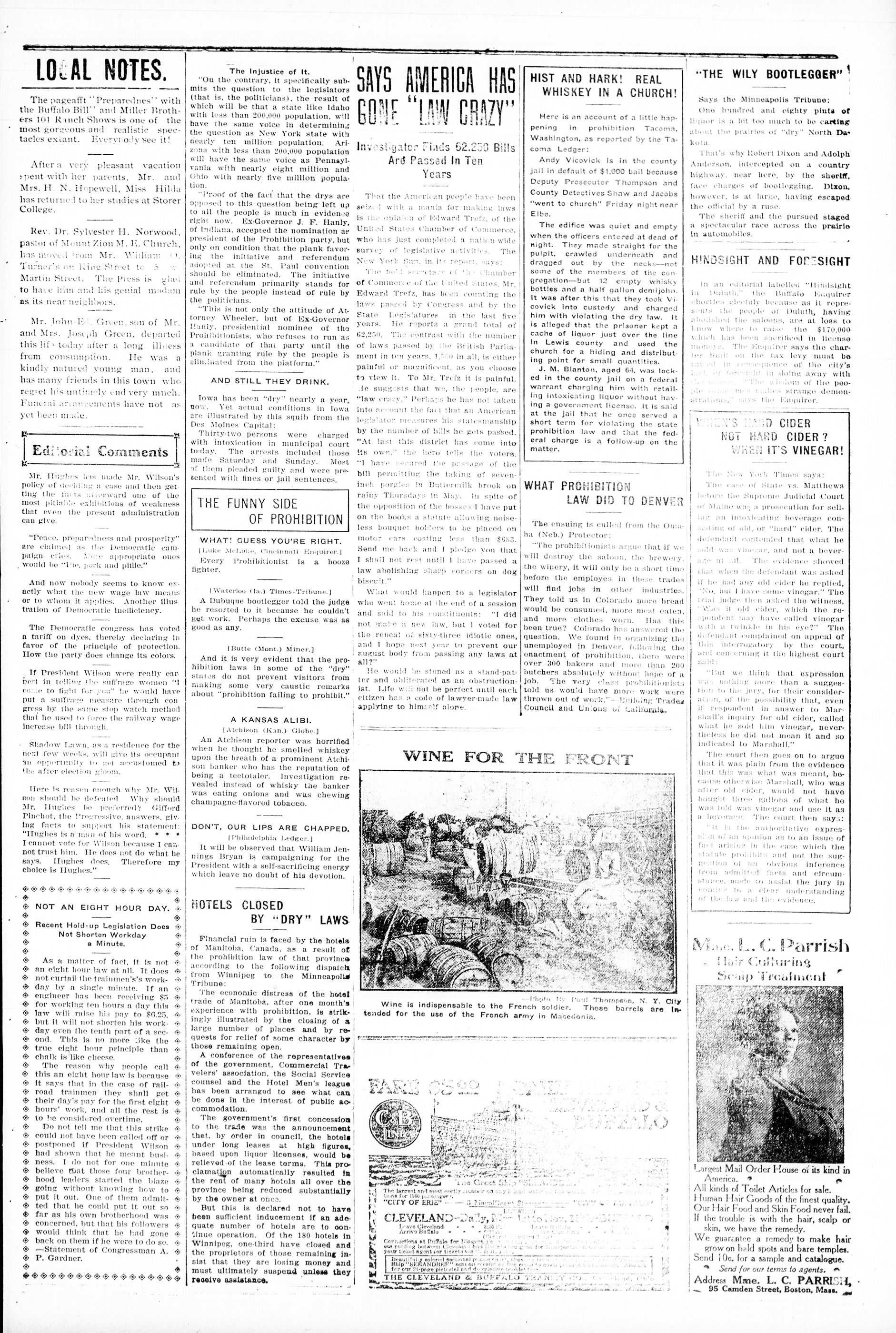
Wine is indispensable to the French soldier. These barrels are intended for the use of the French army in Macedonia.
Wine is indispensable to the French soldier. These barrels are intended for the use of the French army in Macedonia.
SAYS AMERICA HAS GONE "LAW CRAZY"
Investigator Finds 62,250 Bills Are Passed In Ten Years
That the American people have been seized with a mania for making laws is the opinion of Edward Trefz, of the United States Chamber of Commerce, who has just completed a nation-wide survey of legislative activities. The New York Sun, in its report, says:
The field secretary of the Chamber of Commerce of the United States, Mr. Edward Trefz, has been counting the laws passed by Congress and by the State Legislatures in the last five years. He reports a grand total of 62,250. The contrast with the number of laws passed by the British Parliament in ten years, 1,500 in all, is either painful or magnificent, as you choose to view it. To Mr. Trefz it is painful. He suggests that we, the people, are "law crazy." Perhaps he has not taken into account the fact that an American legislator measures his statesmanship by the number of bills he gets passed. "At last this district has come into its own," the hero tells the voters. "I have secured the passage of the bill permitting the taking of seven-inch porgles in Buttermilk brook on rainy Thursdays in May. In spite of the opposition of the bosses I have put on the books a statute allowing noiseless bouquet holders to be placed on motor cars costing less than $683. Send me back and I pledge you that I shall not rest until I have passed a law abolishing sharp corners on dog biscuit."
What would happen to a legislator who went home at the end of a session and said to his constituents: "I did not make a new law, but I voted for the repeat of sixty-three idiotic ones, and I hope next year to prevent our august body from passing any laws at all?" He would be stoned as a stand-patter and obliterated as an obstructionist. Life will not be perfect until each citizen has a code of lawyer-made law applying to himself alone.
WINE FOR
Wine is indispensable to the French tended for the use of the French a
CIB
LIMA
The largest and most creatively cleaner on any list for 1500 passengers.
"CITY OF ERIE" — 3 Microliters
CLEVELAND-Daily, P.
Leave Cleveland
Arrive Buffalo
Connections at Buffalo for Nisquam, P.
on reading between Cleveland and Buffalo, or
your ticket agent for tickets via Buffalo.
Beautifully colored seasonal pizzas on the
Billy HURKANDJIP!'s menu, with decorative
for our 250-piece pictorial dinner menu.
HIST AND HARK! REAL WHISKEY IN A CHURCH!
Here is an account of a little happening in prohibition Tacoma, Washington, as reported by the Tacoma Ledger:
Andy Vicovick is in the county jail in default of $1,000 bail because Deputy Prosecutor Thompson and County Detectives Shaw and Jacobs "went to church" Friday night near Elbe.
The edifice was quiet and empty when the officers entered at dead of night. They made straight for the pulpit, crawled underneath and dragged out by the necks—not some of the members of the congregation—but 12 empty whisky bottles and a half gallon demijohn. It was after this that they took Vicovick into custody and charged him with violating the dry law. It is alleged that the prisoner kept a cache of liquor just over the line in Lewis county and used the church for a hiding and distributing point for small quantities.
J. M. Blanton, aged 64, was locked in the county jail on a federal warrant charging him with retailing intoxicating liquor without having a government license. It is said at the jail that he once served a short term for violating the state prohibition law and that the federal charge is a follow-up on the matter.
WHAT PROHIBITION
LAW DID TO DENVER
The ensuing is culled from the Omaha (Neb.) Protector:
"The prohibitionists argue that if we will destroy the saloon, the brewery, the winery, it will only be a short time before the employees in these trades will find jobs in other industries. They told us in Colorado more bread would be consumed, more meat eaten, and more clothes worn. Has this been true? Colorado has answered the question. We found in organizing the unemployed in Denver, following the enactment of prohibition, there were over 300 bakers and more than 200 butchers absolutely without hope of a job. The very class prohibitionists told us would have more work were thrown out of work."—Building Trades Council and Unions of California.
"THE WILY BOOTLEGQER"
Says the Minneapolis Tribune:
One hundred and eighty pints of liquor is a bit too much to be carting about the prairies of "dry" North Dakota.
That's why Robert Dixon and Adolph Anderson, intercepted on a country highway, near here, by the sheriff, face charges of bootlegging. Dixon, however, is at large, having escaped the official by a ruse.
The sheriff and the pursued staged a spectacular race across the prairie in automobiles.
HINDSIGHT AND FORESIGHT
In an editorial labelled "Hindsight in Duluth," the Buffalo Enquirer chortles gleefully because as it represents the people of Duluth, having abolished the saloons, are at loss to know where to raise the $170,000 which has been sacrificed in license money. The Enquirer says the charter limit on the tax levy must be raised in consequence of the city's high rate of foreclosure in doing away with the saloons. "The wisdom of the people sometimes makes strange demonstrations," says the Enquirer.
WHEN'S HARD CIDER
NOT HARD CIDER?
WHEN IT'S VINEGAR!
The New York Times says:
The case of State vs. Matthews before the Supreme Judicial Court of Maine was a prosecution for selling an intoxicating beverage consisting of old, or "hard" cider. The defendant contended that what he sold was vinegar, and not a beverage at all. The evidence showed that when the defendant was asked if he had any old cider he replied, "No, but I have some vinegar." The trial judge then asked the witness, "Was it old cider, which the respondent may have called vinegar with a twinkle in his eye?" The defendant complained on appeal of this interrogatory by the court, and concerning it the highest court said:
"But we think that expression was nothing more than a suggestion to the jury, for their consideration, of the possibility that, even if respondent in answer to Marshall's inquiry for old cider, called what he sold him vinegar, nevertheless he did not mean it and so indicated to Marshall."
The court then goes on to argue that it was plain from the evidence that this was what was meant, because otherwise Marshall, who was after old cider, would not have bought three gallons of what he was told was vinegar and use it as a beverage. The court then says:
"It is the authoritative expression of an opinion as to an issue of fact arising in the case which the statute prohibits and not the suggestion of an obvious inference from admitted facts and circumstance, made to assist the jury in coming to a clear understanding of the law and the evidence.
THE WOMEN'S HISTORY OF THE UNION
America.
All kinds of Toilet Articles for sale.
Human Hair Goods of the finest quality.
Our Hair Food and Skin Food never fail.
If the trouble is with the hair, scalp or skin, we have the remedy.
We guarantee a remedy to make hair grow on bald spots and bare temples.
Send 10c, for a sample and catalogue.
Send for our terms to agents.
Address Mme. L. C. PARRISH,
95 Camden Street, Boston, Mass.
Slip a few Prince Albert smokes into your system!
You've heard many an earful about the Prince Albert patented process that cuts out bite and parch and lets you smoke your fill without a comeback! Stake your bank roll that
it proves out every hour of the day. Prince Albert has always been sold without coupons or premiums. We prefer to give quality!
PROHIBITION
$325,000,000
LOSS OF
REVENUE
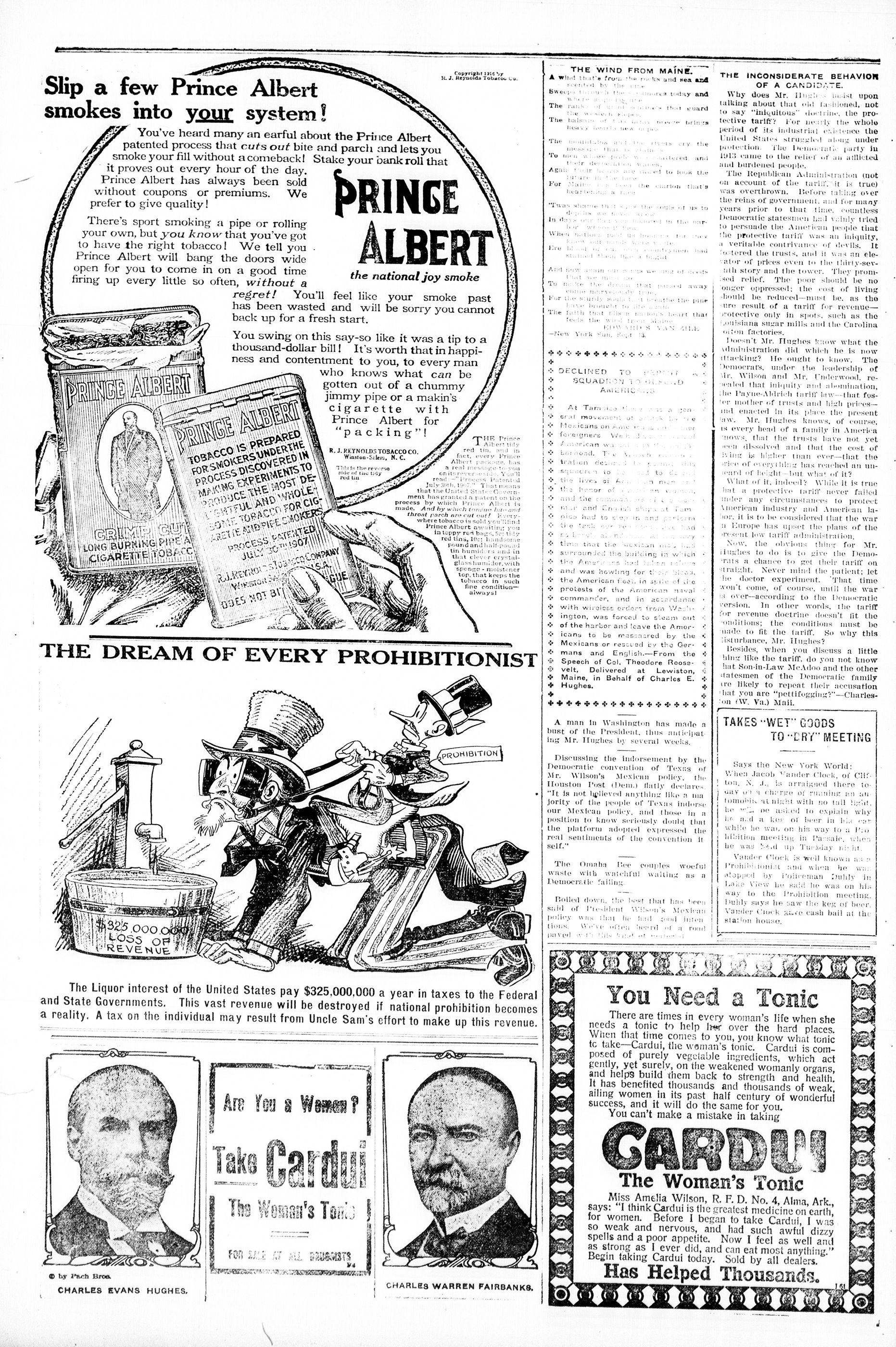
The Liquor interest of the United States pay $325,000,000 a year in taxes to the Federal and State Governments. This vast revenue will be destroyed if national prohibition becomes a reality. A tax on the individual may result from Uncle Sam's effort to make up this revenue.
O.
the Prince Albert and lets you take your bank roll that
PRINGE ALBERT
the national joy smoke
feel like your smoke past
and will be sorry you cannot
h start.
say-so like it was a tip to a
all! It’s worth that in happi-
ment to you, to every man
who knows what can be
otten out of a chummy
jimmy pipe or a makin’s
cigarette with
Prince Albert for
“packing”!
R. J. REYNOLDS TOBACCO CO.
Winston-Sikoe, N. C.
This is the reverse
side of the tidy
red tin
THE Prince
Albert tidy
red tin, and in
fact, every Prince
Albert package, has
a real message to you
on its reverse side. You’ll
read—“Process Patented
July 30th, 1907.” That means
that the United States Government has granted a patent on the
process by which Prince Albert is
made. And by which tenure later and
threat parch are cut out! Every-
where tobacco is sold you find
Prince Albert awaiting you
in tappy red bags, set tidy
red tins, 10c; handsome
pound and half-pound
tin humidifiers and in
that clever capillary
glass humidifier with
sponge-moistener
top, that keeps the
tobacco in such
fine condition—
always!
PROHIBITIONIST
1,000,000 a year in taxes to the Federal
destroyed if national prohibition becomes
the Sam’s effort to make up this revenue.
regret! You'll feel like your smoke past has been wasted and will be sorry you cannot back up for a fresh start.
Are You a Women?
Take Cardui
The Women's Tonic
FOR SALE AT ALL DRUGISTS
---
Copyright 1916 by
R.J. Reynolds Tobacco Co.
M.
CHARLES WARREN FAIRBANKS.
You Need a Tonic
There are times in every woman's life when she needs a tonic to help her over the hard places. When that time comes to you, you know what tonic to take—Cardui, the woman's tonic. Cardui is composed of purely vegetable ingredients, which act gently, yet surely, on the weakened womanly organs, and helps build them back to strength and health. It has benefited thousands and thousands of weak, ailing women in its past half century of wonderful success, and it will do the same for you. You can't make a mistake in taking GARDUI
Miss Amelia Wilson, R. F. D. No. 4, Alma, Ark., says: "I think Cardui is the greatest medicine on earth, for women. Before I began to take Cardui, I was so weak and nervous, and had such awful dizzy spells and a poor appetite. Now I feel as well and as strong as I ever did, and can eat most anything." Begin taking Cardui today. Sold by all dealers.
A wind that's from the rocks and sea and
scented by the ocea
Sweeps through the s.cores today and
where as possible.
The
The ranks of guard soldiers that guard
the western skies.
The balcony of this heavy treecrete brings
heavy hearts new hopes.
The mountains and the rivers cry the
message that is plains.
To men whose pride was chattered, and their decoration wakes,
Again their hearts are raised to look the future in the face
For Maine has been the charion that's begging a they
"Twas shame that sway the souls of us to depths we never know
In days our that was honored in the curborr where it they
When methods hold us bound, but they
know our minds write wise.
Ere blood to oil, over countrymen had
stirred them like a bight.
And now again our sins we sing of deeds
that we must so.
To make the dream that passed away
come miraculously true.
For the surdy soul that beats the pine
have brought to life a note
are proud to the nation
The faith that fills a nation's heart that
feels the wind from Maine.
EDWARD S. VAN ZILLE
—New York Sun, Sept. 13.
DECLINED TO PERMIT
SQUADRON TO OLSCUND
AMERICANS
At Tampaico there was a general movement of attack by the Mexicans on American sailors and other foreigners. We had encountered American warships in the harbor borne. The Vinson vessel traction designed to pursue this squadron to be used to deal with the lives of American men and the honor of coalition women, and the commanders of the German and English ships at Tampaio had to step in and perform the task our new forces had no borne and all alone. At any time that the Mexican men had surrounded the building in which the Americans had taken refuge and was howling for their blood, the American fleet, in spite of the protests of the American naval commander, and in accordance with wireless orders from Washington, was forced to steam out of the harbor and leave the Americans to be measured by the Mexicans or rescued by the Germans and English.—From the Speech of Col. Theodore Roosevelt, Delivered at Lewiston, Maine, in Behalf of Charles E. Hughes.
```markdown
```
A man in Washington has made a bust of the President, thus anticipating Mr. Hughes by several weeks.
Discussing the indorsement by the Democratic convention of Texas of Mr. Wilson's Mexican policy, the Houston Post (Dem.) flatly declares "It is not believed anything like a majority of the people of Texas indorse our Mexican policy, and those in a position to know seriously doubt that the platform adopted expressed the real sentiments of the convention itself."
The Omaha Bee couples woeful waste with watchful waiting as a Democratic failing.
Boiled down, the best that has been said of President Wilson's Mexican policy was that he had good intentions. We've often heard of a road paved with this kind of material.
THE INCONSIDERATE BEHAVIOR OF A CANDIDATE.
Why does Mr. Hughes insist upon talking about that old fashioned, not to say "inliquitous" doctrine, the protective tariff? For nearly the whole period of its industrial existence the United States struggled along under protection. The Democratic party in 1913 came to the relief of an allied and burdened people.
The Republican Administration (not on account of the tariff, it is true) was overthrown. Before taking over the reins of government, and for many years prior to that time, countless Democratic statesmen had vainly tried to persuade the American people that the protective tariff was an iniquity, a veritable contrivance of devils. It fostered the trusts, and it was an elevator of prices even to the thirty-seventh story and the tower. They promised relief. The poor should be no longer oppressed; the cost of living should be reduced—must be, as the sure result of a tariff for revenue—protective only in spots, such as the Louisiana sugar mills and the Carolina cotton factories.
Doesn't Mr. Hughes know what the administration did which he is now attacking? He ought to know. The Democrats, under the leadership of Mr. Wilson and Mr. Underwood, revealed that iniquity and abomination, the Payne-Midrich tariff law—that foster mother of trusts and high prices—and enacted in its place the present law. Mr. Hughes knows, of course, is every head of a family in America knows, that the trusts have not yet been dissolved and that the cost of living is higher than ever—that the price of everything has reached an uncard of height—but what of it?
What of it, indeed? While it is true that a protective tariff never failed under any circumstances to protect American industry and American labor, it is to be considered that the war in Europe has upset the plans of the present low tariff administration.
Now, the obvious thing for Mr. Hughes to do is to give the Democrats a chance to get their tariff on straight. Never mind the patient; let the doctor experiment. That time won't come, of course, until the war is over—according to the Democratic version. In other words, the tariff for revenue doctrine doesn't fit the conditions; the conditions must be made to fit the tariff. So why this disturbance, Mr. Hughes?
Besides, when you discuss a little thing like the tariff, do you not know that Son-in-Law McAdoo and the other statesmen of the Democratic family are likely to repeat their accusation that you are "pettifogging?"—Charleson (W. Va.) Mail.
TAKES WET GOODS
TO DRY MEETING
Says the New York World: When Jacob Vander Clock, of Clifton, N. J., is arraigned there today on a charge of running an automobile at night with no tail light, he will be asked to explain why he had a key of beer in his car while he was, on his way to a Prohibition meeting in Passaic, when he was held up Tuesday night.
Vander Clock is well known as a Prohibitionist and when he was stopped by Policeman Duhly in Lake View he said he was on his way to the Prohibition meeting. Duhly says he saw the key of beer. Vander Clock gave cash bail at the station house.