The Pioneer Press
Saturday, October 14, 1916
Martinsburg, West Virginia
Page text (machine-generated)
"HERE SHALL THE PRESS, THE PEOPLE'S RIGHTS MAINTAIN, ENAWED BY INFLUENCE AND UNBRIBED BY GAIN"
The Pioneer
Department of Archives
The
"HERE SH
ESTABLISHED 1882.
SHIFTY WILSON ON COLONEL'S BODKIN
Elusive Balancer on String of Words Pinned Down by Proof That In Fifteen Public Utterances He Took Forty- One Different Positions on Preparedness. EACH STAND CONTRADICTED FROM 1 TO 6 OF THE OTHERS
Democratic Candidate Said That Our Army Was Ample and That We Did Not Have Enough Troops to Patrol the Border; That We Were on the Verge of a Maelstrom and That There Was No Critical Situation; That the National Guard Would Not Do and Then That It Must Do.
In the fourteen months extending from December 8th, 1914, to February 10th, 1916, there were fifteen messages, letters and speeches of President Wilson which I have read. in these fifteen messages, letters and speeches, during those fourteen months, President Wilson took forty-one different positions about preparedness and the measures necessary to secure it; and each of these forty-one positions contradicted from one to six of the others. In many of his speeches the weasel words of one portion of the speech took all the meaning out of the words used in another portion of that speech, and these latter words themselves had a weasel significance as regards yet other words. He argued for preparedness and against preparedness. He stated that our army was ample; and that we did not have enough troops to patrol the Mexican border in time of peace. He said the world was on fire, and that sparks were liable to drop anywhere and cause us to burst into flame; and he also said that there was no immediate danger. He said that there was no sudden crisis; and then again that he did not know what a single day would bring forth. He said that we were on the verge of a maclostrom; and then that there was no special or critical situation. He said the danger was constant and immediate; and also that we were not threatened from any quarter. He said that there was no fear among us; and also that we were in daily danger of seeing the vital interest and honor of the country menacled and the flag of the United States stained with impunity. He said that we were in very critical danger of being involved in the great European struggle; and also that there was no need to discuss the question of defense, or to get nervous or excited about it. In one and the same speech, he said that a sufficient number of men would volunteer, and that if they did not he would be ashamed of America; and he also said that he did not know of any law which laid upon them the duty of coming into the army, if it should be necessary to call for volunteers. He said that we needed 500,000 volunteers, and that if there was any legitimate criticism of this demand it was because it was too small; and as soon as Congressman Hay objected to the plan, he promptly abandoned it. He said that the National Guard was not the proper body upon which to rely; and then not only changed his mind but forced his own Secretary of War out of his cabinet, because this Secretary possessed less flexible convictions and was unable instantly to reverse himself when going at full speed.—From the Speech of Colonel Roosevelt at Battle Creek, Michigan, in Behalf of Mr. Hughes.
Mr. Hughes is seeing how big the west is, and the west is seeing how big Mr. Hughes is. It is a happy arrangement.
"IGNOBLE EASE" AND PEACE
FUL SLOTH ARE
NOT PEACE.
There is nothing that we of this country so much need as to practice the doctrine of service. As a people we need the sterner virtues even more than we need the softer virtues. Material prosperity, bodily case, money, pleasure, are all desirable; but woe to us if we consider them as the be-all and end all of our private lives or of our collective national life! Woe to us if our material prosperity brings in its wake lethargy of spirit and deadness of soul! Let us in our lives apply the great doctrines of duty and of service. Above all let us realize that lofty profession is a mischievous sham when it is not translated into efficient performance. Among the companions of Lucifer in Milton's mighty epic there was none among the fiercer fiends so dangerous as he who "Wash words clothed in rea-
* Counselled ignoble ease and
* peaceful sloth.
* Not peace."
* From the Speech of Colonel
* Roosevelt at Battle Creek, Michigan, in Behalf of Mr. Hughes.
*
A BIG LEAK IN THE "DRY" LAWS
A BIG LEAK IN THE "DRY" LAWS
Missourian Describes Process of Purchasing a Drink In Oklahoma
Under the caption, "Kansas Brand of Prohibition," the Washington Post printed the following interview, describing the sale of liquor in "dry" Kansas: The Kansas brand of prohibition does not seem to have particularly impressed Nat Rosenheim, a resident of Kansas City, Mo., who is stopping at the New Willard.
"Prohibition in Kansas," said the visitor, "is not an economic or moral question, but a political one. It is the 'football of Kansas politicians. At times a town is wide open and the stranger has merely to mention his desire for a little refreshment in order to have his choice of a score of brands. It will go on this way for a while until the reform element makes a loud outcry, and a new administration soon makes the town as dry as Sahara.
Business made it necessary for me to visit a certain medium-sized town in Oklahoma, and while there I was unfortunate enough to sprain my ankle. Painfully limping into a nearby drug store, I called for a bottle of tintment which could be plainly seen in a show case. The clerk in charge looked at me in unconcealed disgust. "If I sell you that, I'll have to buy another bottle," he said.
"I was about to leave when an inspiration seized me.
"Have you any peroxide," I asked.
"What in the dickens is peroxide?" asked the clerk.
"Lowering my voice and winking, I said in my state they don't call it peroxide. The clerk's smile instantly changed, and going into an adjoining room for a brief space he reappeared with a wrapped package. This he handed over and I put two dollars into his hand. It was a full quart of bourbon.
A KANSAS ALIBI
An Atchison reporter was horrified when he thought he smelled whisky upon the breath of a prominent Atchison banker who has the reputation of being a teetotaler. Investigation revealed instead of whisky the banker was eating onions and was chewing champagne-flavored tobacco.
SOLILOQUY AT SHADOW LAWN
Where are they gone, the old familiar faces?
I had a friend—McCombs, but his left me.
Left me slowly but surely, when I did not need him.
All, all are gone, the old familiar faces!
Once I had Bryan; he was my friend
In my hours of struggling in that great convention.
But now he's gone. Left me with "God bless you!"
Upon his lips. Gone, are the old familiar faces
I had a friend; a truer friend had no man.
Like an ingrate, I wounded my friend acutely;
And he, good Colonel Harvey, left me.
Left me
To nause on the old familiar faces!
At my right hand sat my friend
Who was the strong arm of my Administr-
tation—
Garrison, upright and honest—but he too
has left me;
Left me, when I deceived him—gone are
the old familiar faces!
At Shadow Lawn, where new friends
swarm around me.
Earth seems a desert I am bound to traverse.
Seeking to find the friends who've left me:
CHARLES LAMB, 34
In New York Sun.
No; the Democratic party will not be saved by the European war. If you would know what our condition will be when that war ends think of what our condition was before that war began if you think these nations are so impoverished that they cannot again turn to work. Those millions of men now tighting are better able to work than ever before in their lives. * * *
Their factories are there; their plants are there; they know themselves better than ever before. They are better disciplined, more alert, keener, stronger, better physically, than ever before in the main, and they are ready to turn great national energies into the pursuits of peace to pay their war bills, to produce up to the limit, to send their goods throughout the world.
I propose that we shall study this out,
applying a principle that we believe in,
and secure intelligently and honestly
adequate protection to American indust-
ries in every part of this land.
WHY HUGHES IS NEEDED IN
THIS TREMENDOUS CRISIS.
Against Mr. Wilson's combination of grace in elocution with futility in action, against his record of words unbacked by deeds or betrayed by deeds, we set Mr. Hughes' rugged and uncompromising straightforwardness of character and action in every office he has held. We put the man who thinks and speaks directly and whose words have always been made good against the man whose adroit and facile elocution is used to conceal his plans or his want of plans. The next four years may well be years of tremendous national strain. Which of the two men do you, the American people, wish at the helm during these four years—the man who has been actually tried and found wanting or the man whose whole career in public office is a guarantee of his power and good faith? But one answer is possible, and it must be given by the American people through United States. — From the Speech of Colonel Theodore Roosevelt, Delivered at Lewiston, Me., In Behalf of Charles E. Hughes.
"We don't want to maintain a political almshouse," remarked Mr. Hughes to the North Dakota farmers, and a nation applauds him. Americans are beginning to see a possibility in the near future of regaining their self respect.
A Democrat's idea of an ideal watchdog of the Treasury is a Pomeranian.
Mr. Wilson is now busily engaged working the other side of the suffrage street.
FINNEGAN'S PHILOSOPHY
Pitiless Publicity
"I see Mr. Hughes wud like to know what's come to 'Pititless Publicity.' Meself could tell him. 'Where's 'Pititless Publicity?'' says Hughes. 'In the Ash Can,' says I. 'Twas all right on the stump, but in Washington' tis differ. 'The Harp that waist through Trenton's halls — I mame 'Tumulty.' Whin he bursts into song now he picks his chune!"
"Tis not that Prisididut Wilson is less public than Canlydate Wilson—he's less pititless. 'Tis like the showman. He tells ye all, an' more, about th' illyfaut, but he has mental res-vashune about the spotted baby.
"So it is wild Wilson. He's so much the hard heart in 'Fittless Publicity.' 'How about the Postmasters?' axes the refawriness. 'We'll never tell ye,' says the Cunishun. 'For why?' says the League. 'Twid embarrass th' Admiristhrashun,' says the Cunishun. And the people laughs. 'Ye fired th' Hid of the Census,' says Hughes. 'Ye lie,' says Redfield. 'He rayshed without bein' axed,' says he. 'Ye lie yer self,' says Durand. 'Ye towld me ye'd fire me, an' ye gey me place to a politician,' says Durand. 'Ixactly fwhat I said,' yells Pink Whiskers. 'I was goin' to fire ye amnyway, but I niver axed ye to raysine,' says Pinky. An' the people roars.
"Tell us about all thim 'Dishurvin' Dimmycrats,' says the people. An' Washin'ton is swep' be a storm iv silence.
"But don't ye think there's no publicity at all. Teddy himself was none gunshy with the papers, but he cud be quiet too.
"We'll grab some land in Vinzueely,' says the Ambassydure, 'tem'prily,' says he, 'Yell not,' says Teddy, 'ye'll agree to arbitrate,' says he, 'or,' he says, 'in tin days Dewey'll be there,' says Teddy.
"Me Ry'e the Masther will never consint,' says th' other, 'Thin,' says Teddy, 'I'll shd Dewey at wanst. There's no use waitin'. Teddy says, 'Howld 'em,' says the Ambassydure. 'We agree,' says he, an' divit'a bit did we know how it was for a dozen year.
"We'll have Ferdy Carey alive or the Bashi Bazook dead," says Teddy, an' back comes Ferdy. An' the papers says, 'On demand iv the State Department Ferdy Carey has been released.' An' that's all.
"How is it now? The greasers slaughters twinty at Santy Isabel, 'Another Mexican Crisis,' says the headlines, 'Twinty Americans killed,' they says, 'The Presidint Calm,' says they, 'Ates Bacon and Eggs, Plays Goluf,' says the headlines. An' the paper goes on:
"The Prisdint's appytilite at breakfast was good, tb' leader iv the nashun gettin' outside iv grape fruit, bacon an' eggs, hot biscuits an' coffee. Whin Doether Grayson announced the blit iv fare the tinshun over Mexico was much relaxed.
"The Prisidint is solvin' in privacy the fateful question, "Will me throat last?" The answer is waited wid feverish anxiety.'
"Mondah the papers says: 'Nashunal Disaster! Sore Throat Feared! Panic at the Capital! The Prisidint Calm!'
"Consternation was spread among all classes today be the report that the Prisidint awoke with a sore throat. Strong men fainted before they end reach the nearest saloon. There is talk iv appatinin' a day iv prayer. It is honored that Senior Arreye-on though will claim that the dead Americans raysisted iv cochum. A high authority states that this wud end the crisis. The Prisidint made but wan remark: 'Av they'd not been there they'd not iv been kill.'"
"Choosdah, they says, 'Hope revives. No sore throat. Bitten by insect. President calm. All Phrases iv Mattter to be considered.
"The anxiety in the Capital was relaved today be the followin' bulletin.
"*The Prisidint has a slight perforation in the cuticle over the infaryure maximary caused be a insect bitin' him whin asleep. The patient was too proud to scratch. (Signed) Grayson."
"It is reported also that General Scott will go to the border to bury the
dead, and apologize to the insurgents.
He will awe Carranzy, whether he wud accept a loan if offered. This is considered the thrue s'ultion iv the difficulty.'
"Winsdah the Pristidint goes motorin'. Thursdah he writes a note and General Scott starts for the border. Fridah the headlines says 'Peace in Europe near. Prisident studyin' terms. Will he stop the war? Another note expected. Capital excited over report.'
"But we're comforted be bein' towld the Pristidint will not be bethrayed into basty ackshum.
"Sundah, he's considerin' th' Armenyan question, nu' Mondah he advises Grandmothers about suckin' eggs. And another erisis is past."
"So it goes every day. As I was sayin', there's a plenty publicity, but 'tis not the brand in 1912."
Evidently Mr. Wilson has made up his mind about something. He refers in his acceptance speech to "the sovereign authority of Mexico." He may have decided to whom he was referring. Less than two years ago he was not sure whether it was the soldier-bandit Villa or the grocer grafter Carranza.
It's not to be wondered that Thomas A. Edison favors Wilson's re-election. The electrical wizard naturally likes anything that switches on and off.
Up in Maine they are now rhyming Hughes with Moose. And there is reason as well as rhyme connecting the two words.
"Victory," Mr. Fatrbanks told Oklahoma Republicans, "surely will perch on our banner." But Champ Clark tied it up in a neater and more compact bundle when he said: "They licked hell out of us."
Villa is still uncaptured and unpunished.
Carranza still slaps the United States.
There still has been no accounting for American lives and property destroyed in Mexico.
The whole question of reparation for invasion of American rights by various warring nations is still sleeping in
If you had two dollars to invest would you trust it to the business sagacity of Josephus Daniels? Then, why let him handle the millions that are to be spent on the new navy?
Judging by the signs of War Department activity the Administration is cunningly arranging to bring the militiamen home just in time to enable them to vote for Mr. Hughes.
A train of thought on a one-track mind has to be composed of shuttle cars.
Three years ago Woodrow Wilson was explaining that hard times were psychological, but he isn't trying to squirrel out of responsibility for the present prosperity.
The disaster to the Memphis caused very little excitement, Americans being used nowadays to seeing the navy on the rocks.
This Democratic Congress has passed into history—profane history.
President Wilson's speech of acceptance could have been phrased even more sincerely in the graphic words of Boss Tweed, "What are you going to do about it?"
We see by the interviews with the Mexican commissioners that the campaign wagon this year in the Sonora bandit belt is "Thank God for Woodrow Wilson."
Mr. Wilson's eulogy of Lincoln at Hodgenville was more literary but less sincere than the one he pronounced upon himself at Shadow Lawn.
The new half dollars will have an olive branch on one side and on the other an eagle, in full flight. Wilson money.
Motto of the McAdoo shipping law: "The sun never rises on the American flag."
in all advertisements in the in ad and unless advertising is by yearly contract, in which case the advertises every three months.
Entered in Post Office at Martinsburg, W. Va., as Second Class Matter.
S. Clifford, Editor and Proprietor.
Drawnu 869, and Bell 'Phone 60K.
Martinsburg, W. Va.
SATURDAY, OCTOBER 14, 1916
It is a foregone conclusion that not only for the Negro, but this country as well, "The Republican Party is the ship; all else is the sea."
The busiest beehive in politics we ever saw is making honey at Clarksburg's Republican Headquarters and every citizen can smere it over his buttered bread after the 7th of November 1916.
Prof. Charles E. Mitchell and Miss Ethel Spriggs his swift and accurate stenographer and typewriter are an invaluable annex and asset to the State Republican Headquarters. They so mix and mingle that one can't tell who is who or which is which in matters of business and the great work going on.
That contemptible dirty hypocrite Rev. (?) McDuffy, who dittied and danced up and down the aisles of the Ebenezer Church here two years ago and tried to insult us, is said to be in jail for his rascality. The sisters who went wild over him, gave him 30 odd dollars and kissed him at the train as he left, better pray for him.
The Germans—undersea sharks—played havoc with the Allies, not far from Boston. Do as you please and think as you may, Germany "is a hard road to travel." Whip her? Doubtest and greatest nation on earth. If one man has enough scientific sense and ingenuity, he can destroy every person and house in Martinsburg, and the same holds good in war.
Judge Ira E. Robinson is a well-known nation-wide scholar, jurist and statesman. He is a son of the hills of West Virginia and everyone who knows him loves him. His election is sure by a majority not less than fifty thousand mountainers—freemen. This is no Southern State. It's a State whose natural resources abound in astonishment, but they need to be protected as much as a babe needs its mothers milk, and the father of protection is the Republican party. No poor man will ever regret having voted for Judge Robinson and all the good men on the ticket.
Butchered as Negroes have been in the South; jimcrewed and disfranchised by the South; segregated and hated by the South's worst people, and it all, endorsed by Woodrow Wilson's silence and non interference. how can any living Negro vote to put him back in office?
Man's extremity can only be God's time to act and then, man must have done all he can, and would do more if he could. This is the Negroes' position in America politically. His status was no worse in the early and middle sixties than it is now. If he born, reared and trained Lincoln for that crisis, trust him for training another, similar in
type and wisdom to Lincoln to carry on his divine plans—equal justice to all thy well-done servant is Charles Evans Hughes.
Editor Harry C. Smith, of the Cleveland Gazette, is pointing out to our good people there the danger they are incident to from the rowdy class of Negroes who have been coming to the "Forest City" of late months from the Southland. Ignorant, venal, immoral, loud-mouthed, and disregarding the rights and privileges of others, they are an almost constant source of irritation between their particular class and a like grade of white people. In view of what we have said above, it is the bounden duty of all good citizens to band themselves together and see that these undesirables are either made behave themselves, or be made to leave a section which, barring their presence, is a fine section to dwell in.
Judging from the import of a letter written to Hon. Harry C. Smith, of Cleveland, by Chief of Police R. H. McKinney, of Lima Ohio, the three recent "assaults" by Negroes upon white women in that city have been more the result of the deluded imaginations of the three females who underwent the supposed "attacks" and the creative genius of an enterprising and prejudiced Associated Press correspondent, whose sole aim was to injure our race. In all candor, it can be stated that in not one single instance so far, has it been fully proven that a Negro was the assailant of any one of the three women. Our conclusions are pretty strong, but we have arrived at them after careful consideration of what Lima's Chief has to say, and if anybody ought to know the true condition of things there he is one of the men.
THE OLD SCHOOL HOUSE.
"Our School Houre" has a history. The late Prof. N. C. Brackett, and others at the close of the war built it of brick from the old government brick at Harper's Ferry. At that time it was the only brick school house and the best one in Martinsburg. It served all kinds of purposes—a meeting house, Sunday School; political meetings etc. Fifty-one years have changed things wonderfully. Time and its changes made it then best, now the worst, and down it goes to be replaced by a fine eight room modern school house. It will be a credit to Martinsburg. No better signs of the future of any community can be seen than the best of school houses with none but the best of teachers within them.
We took the Principalship of "the old school house," nine years after it was built and held it for 10 years and 3 months during which time we turned out or fitted nineteen teachers, and scores can be scattered over this country doing well and with gratitude remember the teachers and the old school house.
The Negro Year Book for 1916- 1917, the fourth annual edition, has been enlarged and improved. There are 60 more pages of matter than in the 1915 edition, which contained 517 pages. The new addition has over 100 pages of new matter. The information contained in previous volumes has been revised and brought down to date. 75 pages are devoted to a review of the events of 1912-5 as they effect the interest and indicate the progress of the race. The success of previous editions has encouraged the publishers to believe that the Negro Year Book is filling the need
of a publication which impartially gives a review of current events as they relate to our people and at the same time provides a complete and comprehensive statement of historical and statistical facts arranged for ready reference. In its 375 pages one finds in a succinct form not only the important facts or history, but also a great mass of detailed information concerning present conditions and the progress of the race. It is now the standard authority on matters pertaining to our people. Price, 33 cents postpaid. Address, The Negro Year Book Company, Tuskegee Institute, Alabama.
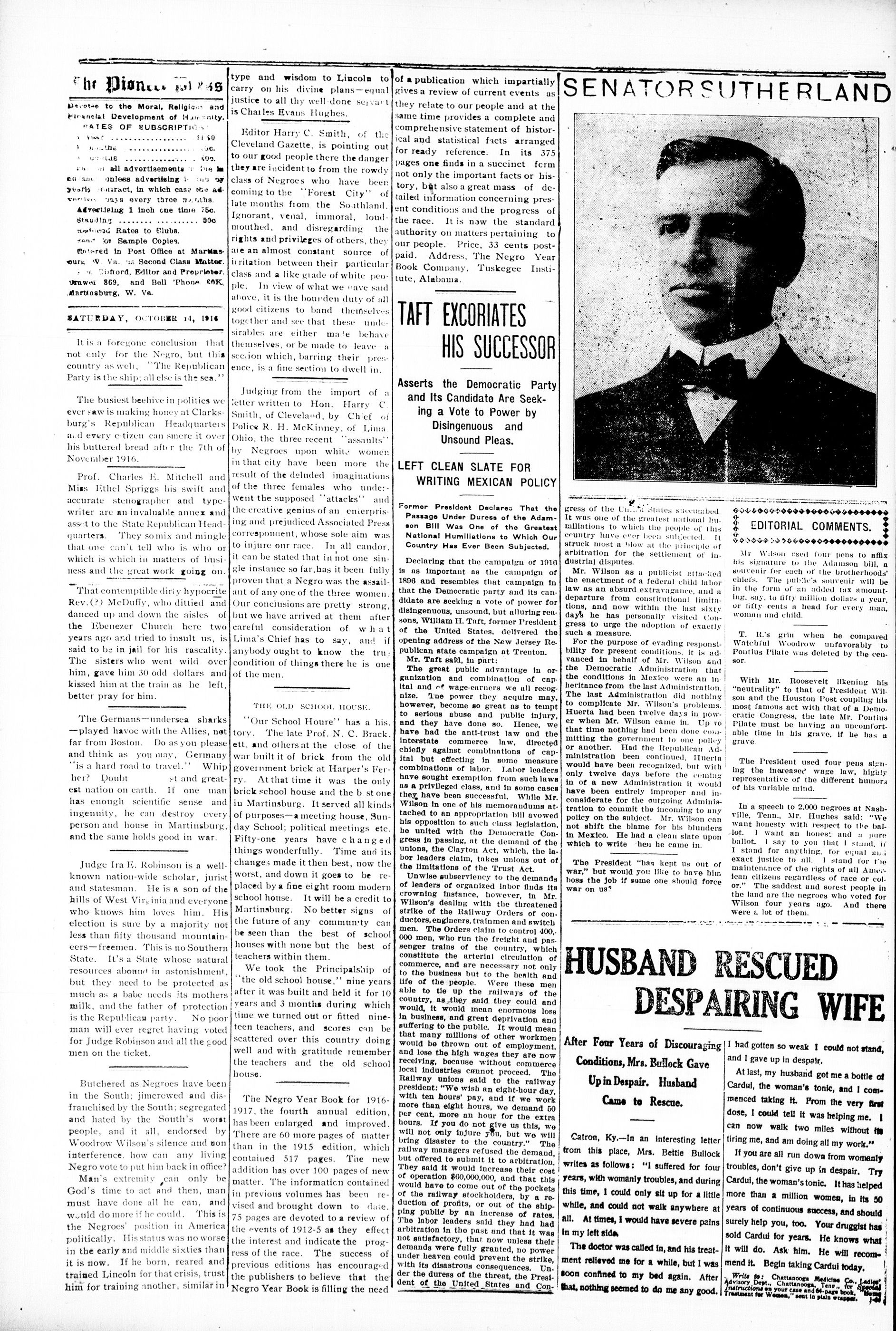
TAFT EXCORIATES HIS SUCCESSOR
Asserts the Democratic Party and Its Candidate Are Seeking a Vote to Power by Disingenuous and Unsound Pleas.
LEFT CLEAN SLATE FOR WRITING MEXICAN POLICY
Former President Declares That the Passage Under Duress of the Adamson Bill Was One of the Greatest National Humiliations to Which Our Country Has Ever Been Subjected.
Declaring that the campaign of 1910 is as important as the campaign of 1896 and resembles that campaign in that the Democratic party and its candidate are seeking a vote of power for disingenuous, unsound, but alluring reasons, William II. Taft, former President of the United States, delivered the opening address of the New Jersey Republican state campaign at Trenton. Mr. Taft said in part:
The great public advantage in organization and combination of capital and of wage-earners we all recognize. The power they acquire may, however, become so great as to tempt to serious abuse and public injury, and they have done so. Hence, we have had the anti-trust law and the interstate commerce law, directed chiefly against combinations of capital but effecting in some measure combinations of labor. Labor leaders have sought exemption from such laws as a privileged class, and in some cases they have been successful. While Mr. Wilson in one of his memorandums attached to an appropriation bill avowed his opposition to such class legislation, he united with the Democratic Congress in passing, at the demand of the unions, the Clayton Act, which, the labor leaders claim, takes unions out of the limitations of the Trust Act.
Unwise subserviency to the demands of leaders of organized labor finds its crowning instance, however, in Mr. Wilson's dealing with the threatened strike of the Railway Orders of conductors, engineers, trainmen and switchmen. The Orders claim to control 400,000 men, who run the freight and passenger trains of the country, which constitute the arterial circulation of commerce, and are necessary not only to the business but to the health and life of the people. Were these men able to tie up the railways of the country, as they said they could and would, it would mean enormous loss in business, and great deprivation and suffering to the public. It would mean that many millions of other workmen would be thrown out of employment, and lose the high wages they are now receiving, because without commerce local industries cannot proceed. The Railway unions said to the railway president: "We wish an eight-hour day, with ten hours' pay, and if we work more than eight hours, we demand 50 per cent, more an hour for the extra hours. If you do not give us this, we will not only injure you, but we will bring disaster to the country." The railway managers refused the demand, but offered to submit it to arbitration. They said it would increase their cost of operation $60,000,000, and that this would have to come out of the pockets of the railway stockholders, by a reduction of profits, or out of the shipping public by an increase of rates. The labor leaders said they had had arbitration in the past and that it was not satisfactory, that now unless their demands were fully granted, no power under heaven could prevent the strike, with its disastrous consequences. Under the duress of the threat, the President of the United States and Con-
THE MAYOR OF BROOKLYN
HUSBAND RESCUED DESPAIRING WIFE
gress of the United States succumbed. It was one of the greatest national humiliations to which the people of this country have ever been subjected. It struck most a blow at the principle of arbitration for the settlement of industrial disputes. Mr. Wilson as a publicist attacked the enactment of a federal child labor law as an absurd extravagance, and a departure from constitutional limitations, and now within the last sixty days he has personally visited Congress to urge the adoption of exactly such a measure.
For the purpose of evading responsibility for present conditions, it is advanced in behalf of Mr. Wilson and the Democratic Administration that the conditions in Mexico were an inheritance from the last Administration. The last Administration did nothing to complicate Mr. Wilson's problems. Huerta had been twelve days in power when Mr. Wilson came in. Up to that time nothing had been done committing the government to one policy or another. Had the Republican Administration been continued, Huerta would have been recognized, but with only twelve days before the coming in of a new Administration it would have been entirely improper and inconsiderate for the outgoing Administration to commit the incoming to any policy on the subject. Mr. Wilson can not shift the blame for his blunders in Mexico. He had a clean slate upon which to write then he came in.
The President "has kept us out of war," but would you like to have him boss the job if some one should force war on us?
HUSBAND I DESPAIR
After Four Years of Discouraging Conditions, Mrs. Bullock Gave Up in Despair. Husband Came to Rescue.
Catron, Ky.—In an interesting letter from this place, Mrs. Bettie Bullock writes as follows: "I suffered for four years, with womanly troubles, and during this time, I could only sit up for a little while, and could not walk anywhere at all. At times, I would have severe palms in my left side.
The doctor was called in, and his treatment relieved me for a while, but I was soon confined to my bed again. After that, nothing seemed to do me any good.
EDITORIAL COMMENTS.
Mr. Wilson used four pens to affix his signature to the Adamson bill, a souvenir for each of the brotherhoods' chiefs. The public's souvenir will be in the form of an added tax amounting, say, to fifty million dollars a year, or fifty cents a head for every man, woman and child.
T. R.'s grin when he compared Watchful Woodrow unfavorably to Pontius Pilate was deleted by the censor.
With Mr. Roosevelt likening his "neutrality" to that of President Wilson and the Houston Post coupling his most famous act with that of a Democratic Congress, the late Mr. Poutius Pilate must be having an uncomfortable time in his grave, if he has a grave.
The President used four pens signing the increased wage law, highly representative of the different humors of his variable mind.
In a speech to 2,000 negroes at Nashville, Tenn., Mr. Hughes said: "We want honesty with respect to the ballot. I want an honest and a pure ballot. I say to you that I stand, if I stand for anything, for equal and exact justice to all. I stand for the maintenance of the rights of all American citizens regardless of race or color." The saddest and soorest people in the land are the negroes who voted for Wilson four years ago. And there were a lot of them.
RESCUED
IRING WIFE
I had gotten so weak I could not stand,
and I gave up in despair.
At last, my husband got me a bottle of Cardul, the woman's tonic, and I commenced taking it. From the very first dose, I could tell it was helping me. I can now walk two miles without tiring me, and am doing all my work."
If you are all run down from womanly troubles, don't give up in despair. Try Cardui, the woman's tonic. It has helped more than a million women, in its 50 years of continuous success, and should surely help you, too. Your druggist has sold Cardui for years. He knows what it will do. Ask him. He will recommend it. Begin taking Cardui today.
Write to: Chattanooga Medicine Co., Ladies Advisory Dept., Chattanooga, Tenn., for Special Instructions on your case and 64-page book. Home Treatment for Women, sent in plain wrapper.
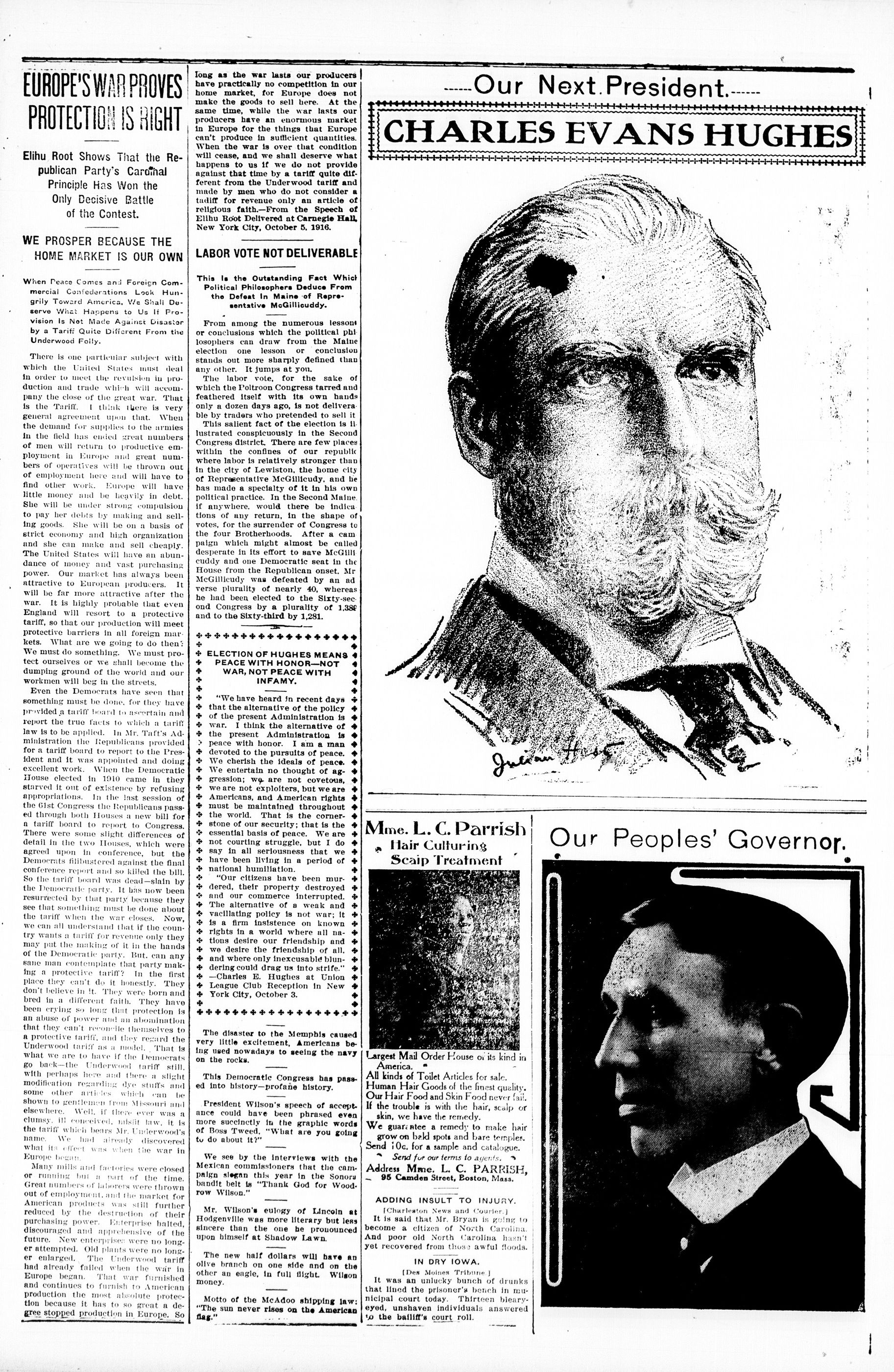
EUROPE'S WAR PROVES PROTECTION IS RIGHT
Elihu Root Shows That the Republican Party's Cardinal Principle Has Won the Only Decisive Battle of the Contest.
WE PROSPER BECAUSE THE HOME MARKET IS OUR OWN
When Peace Comes and Foreign Commercial Confederations Look Hungrily Toward America, We Shall Deserve What Happens to Us If Provision Is Not Made Against Disaster by a Tariff Quite Different From the Underwood Folly.
There is one particular subject with which the United States must deal in order to meet the revulsion in production and trade which will accompany the close of the great war. That is the Tariff. I think there is very general agreement upon that. When the demand for supplies to the armies in the field has ended great numbers of men will return to productive employment in Europe and great numbers of operatives will be thrown out of employment here and will have to find other work. Europe will have little money and be heavily in debt. She will be under strong compulsion to pay her debts by making and selling goods. She will be on a basis of strict economy and high organization and she can make and sell cheaply. The United States will have an abundance of money and vast purchasing power. Our market has always been attractive to European producers. It will be far more attractive after the war. It is highly probable that even England will resort to a protective tariff, so that our production will meet protective barriers in all foreign markets. What are we going to do then? We must do something. We must protect ourselves or we shall become the dumping ground of the world and our workmen will beg in the streets.
Even the Democrats have seen that something must be done, for they have provided a tariff board to ascertain and report the true facts to which a tariff law is to be applied. In Mr. Taft's Administration the Republicans provided for a tariff board to report to the President and it was appointed and doing excellent work. When the Democratic House elected in 1910 came in they starved it out of existence by refusing appropriations. In the last session of the 61st Congress the Republicans passed through both Houses a new bill for a tariff board to report to Congress. There were some slight differences of detail in the two Houses, which were agreed upon in conference, but the Democrats filibustered against the final conference report and so killed the bill. So the tariff board was dead—slain by the Democratic party. It has now been resurrected by that party because they see that something must be done about the tariff when the war closes. Now, we can all understand that if the country wants a tariff for revenue only they may put the making of it in the hands of the Democratic party. But, can any same man contemplate that party making a protective tariff? In the first place they can't do it honestly. They don't believe in it. They were born and bred in a different faith. They have been crying so long that protection is an abuse of power and an abomination that they can't reconcile themselves to a protective tariff, and they regard the Underwood tariff as a model. That is what we are to have if the Democrats go back—the Underwood tariff still, with perhaps here and there a slight modification regarding dye stuffs and some other articles which can be shown to gentlemen from Missouri and elsewhere. Well, if there ever was a clumsy, ill conceived, misfit law, it is the tariff which bears Mr. Underwood's name. We had already discovered what its effect was when the war in Europe began.
Many mills and factories were closed or running but a part of the time. Great numbers of laborers were thrown out of employment, and the market for American products was still further reduced by the destruction of their purchasing power. Enterprise halted, discouraged and apprehensive of the future. New enterprises were no longer attempted. Old plants were no longer enlarged. The Underwood tariff had already failed when the war in Europe began. That war furnished and continues to furnish to American production the most absolute protection because it has to so great a degree stopped production in Europe. So
long as the war lasts our producers have practically no competition in our home market, for Europe does not make the goods to sell here. At the same time, while the war lasts our producers have an enormous market in Europe for the things that Europe can't produce in sufficient quantities. When the war is over that condition will cease, and we shall deserve what happens to us if we do not provide against that time by a tariff quite different from the Underwood tariff and made by men who do not consider a tariff for revenue only an article of religious faith.—From the Speech of Ellhu Root Delivered at Carnegie Hall, New York City, October 5, 1916.
LABOR VOTE NOT DELIVERABLE
This Is the Outstanding Fact Which Political Philosophers Deduce From the Defeat In Maine of Representative McGillicuddy.
From among the numerous lessons or conclusions which the political philosophers can draw from the Maine election one lesson or conclusion stands out more sharply defined than any other. It jumps at you.
The labor vote, for the sake of which the Poltroon Congress tarred and feathered itself with its own hands only a dozen days ago, is not deliverable by traders who pretended to sell it
This salient fact of the election is illustrated conspicuously in the Second Congress district. There are few places within the confines of our republic where labor is relatively stronger than in the city of Lewiston, the home city of Representative McGillicudy, and he has made a specialty of it in his own political practice. In the Second Malne, if anywhere, would there be indications of any return, in the shape of votes, for the surrender of Congress to the four Brotherhoods. After a campaign which might almost be called desperate in its effort to save McGillicuddy and one Democratic seat in the House from the Republican onset. Mr McGillicudy was defeated by an ad verse plurality of nearly 40, whereas he had been elected to the Sixty-second Congress by a plurality of 1,388 and to the Sixty-third by 1,281.
ELECTION OF HUGHES MEANS PEACE WITH HONOR—NOT WAR, NOT PEACE WITH INFAMY.
"We have heard in recent days that the alternative of the policy of the present Administration is war. I think the alternative of the present Administration is peace with honor. I am a man devoted to the pursuits of peace. We cherish the ideals of peace. We entertain no thought of aggression; we are not covetous, we are not exploiters, but we are Americans, and American rights must be maintained throughout the world. That is the cornerstone of our security; that is the essential basis of peace. We are not courting struggle, but I do say in all seriousness that we have been living in a period of national humiliation.
"Our citizens have been murdered, their property destroyed and our commerce interrupted. The alternative of a weak and vacillating policy is not war; it is a firm insistence on known rights in a world where all nations desire our friendship and we desire the friendship of all, and where only inexcusable blundering could drag us into strife."—Charles E. Hughes at Union League Club Reception in New York City, October 3.
The disaster to the Memphis caused very little excitement, Americans being used nowadays to seeing the navy on the rocks.
This Democratic Congress has passed into history—profane history.
President Wilson's speech of acceptance could have been phrased even more succinctly in the graphic words of Boss Tweed, "What are you going to do about it?"
We see by the interviews with the Mexican commissioners that the campaign slogan this year in the Sonors bandit belt is "Thank God for Woodrow Wilson."
Mr. Wilson's eulogy of Lincoln at Hodgenville was more literary but less sincere than the one he pronounced upon himself at Shadow Lawn.
The new half dollars will have an olive branch on one side and on the other an eagle, in full flight. Wilson money.
Motto of the McAdoo shipping law: "The sun never rises on the American flag."
Julian Hunt
Mme. L.C. Parrish Hair Culturing Scaip Treatment
Our Peoples' Governor.
2
MARY MAYER
Largest Mail Order House of its kind in America.
All kinds of Toilet Articles for sale.
Human Hair Goods of the finest quality.
Our Hair Food and Skin Food never fail.
If the trouble is with the hair, scalp or skin, we have the remedy.
We guarantee a remedy to make hair grow on bald spots and bare temples.
Send 10c. for a sample and catalogue.
Send for our terms to agents.
Address Mme. L. C. PARRISH,
95 Camden Street, Boston, Mass.
[Charleston News and Courier.]
It is said that Mr. Bryan is going to become a citizen of North Carolina. And poor old North Carolina hasn't yet recovered from those awful floods.
It was an unlucky bunch of drunks that lined the prisoner's bench in municipal court today. Thirteen bleary-eyed, unshaven individuals answered to the bailiff's court roll.
1
P. A. puts new joy into the sport of smoking!
YOU may live to be 110 and never feel old enough to vote, but it's certain-sure you'll not know the joy and contentment of a friendly old jimmy pipe or a hand rolled cigarette unless you get on talking-terms with Prince Albert tobacco!
P. A. comes to you with a real reason for all the goodness and satisfaction it offers. It is made by a patented process that removes bite and parch! You can smoke it long and hard without a come-back! Prince Albert has always been sold without coupons or premiums. We prefer to give quality!
Prince Albert affords the keenest pipe and cigarette enjoyment! And that flavor and fragrance and coolness is as good as that sounds. P. A. just answers the universal demand for tobacco without bite, parch or kick-back!
Introduction to Prince Albert isn't any harder than to walk into the nearest place that sells tobacco and ask for "a supply of P. A." You pay out a little change, to be sure, but it's the cheerfulest investment you ever made!
PRINSE the national joy smoke
R. J. Reynolds Tobacco Co., Winston-Salem, N.C. Copyright 1916 by R. J. Reynolds Tobacco Co.
LIQUOR RAID IN PORTLAND
POLICE IN "DRY" OREGON CITY DISCOVER QUANTITY OF ILLICIT WHISKY
FOUND IN TRUNKS
Seventy-Five Gallons Seized in a Few Days Leads to Belief That Prohibition Law Has Been Flagrantly Violated and Many Illegal Shipments Have Been Made
That large quantities of liquor have been illegally shipped into Portland, Ore., which is under a prohibition law, is evident from the following account of a seizure as reported by the Portland Oregonian:
Whisky—nearly 75 gallons of it—has been shipped into Portland in the last few days in innocent-appearing trunks, and no one knows how many thousand gallons may have entered the city in the same way since the state went dry.
Sheriff Hurlburt has confiscated six trunks of illegal whisky, has one violator under arrest, and has three suspected persons under surveillance, with more arrests probable. District Attorney Evans and Sheriff Hurlburt have opened a campaign that will have a marked effect on the number of trunks coming into Oregon with or without returning California travelers. With one exception, all the trunks were consigned to supposedly fictious persons, but Sheriff Hurlburt's deputies believe they have all but two correctly traced. Though four of the trunks have remained at the Union Depot or at a transfer company's office since early in the week, the watchers for the sheriff's office have been unrewarded, as the consignees have not called.
Fred Peterson Arrested.
Fred Peterson, 144 North Fifteenth street, was arrested Monday by Deputy Sheriffs Phillips and Beckman
and later released on $1,000 bond. His arrest was not made public until recently for fear other importers of illegal liquor might be frightened away.
Of the other four trunks, three were addressed to supposedly fictitious persons, Peter J. Moore, James R. Hartman and Joseph H. Marley, in care of the express company. One was addressed to Frank Tregaskis, who is known to the authorities. Telegraphic notice was received by an express company yesterday to ship back the Tregaskis trunk to San Francisco, but District Attorney Evans ordered it seized.
Several of the trunks were packed with case goods, but others contained ten-gallon kegs, ingeniously fitted inside the trunks, and wrapped in blankets. Bottles broke in transit in several of the trunks and in the others the odor of whisky was strong enough to attract the attention. The secret of the great popularity of patent medicine in prohibition states has been disclosed by a trial now going on in Federal Judge Carpenter's Court, in Chicago. Most patent medicines, according to chemists, contains a large percentage of alcohol, which accounts for its "repeating" qualities.
In Judge Carpenter's Court, John A. Patten and Z. C. Patten, Jr., brothers, also prominent members of the Anti-Saloon League and the Methodist Episcopal Church, who manufacture Wine of Cardui at Chattanooga, Tenn., are suing the American Medical Association, composed of 70,000 leading physicians, for ibel. John Patten formerly was chairman of the Book Committee of the M. E. Church.
The Chicago Tribune thus describes the trial:
The judge failed dismally in his attempt to look stern. The wearied jury straightened up a little and grinned tiredly. The courtroom crowd laughed outright. The officious bailiff forgot, for a moment, to maintain his monitorial air.
How He Got the Habit
But the unmindful witness kept right on talking:
"I jes nach'ally run plumb out of drinkin' liquor, so I crope into the pantry when Lizzie went out to milk the cow and guilped down about a half a bottle of Wine of Cardui," he said.
"Lizzie come back and when she spied that half empty bottle she knew somebody had been there while she was gone.
"Co'se I denied tapping the bottle of Wine of Cardui, but she knew better. We jawed around a bit and I up and gives her a few spending nickels and we jest nach'ally come to an agreement.
FIFTH INSANE HOSPITAL IS NEEDED IN "DRY" IOWA
While Prohibitionists are heralding prohibition as a cure for insanity, the following story, appearing in the Des Moines Register and Leader, indicates that Iowa, dry since the first of the year, is unable to take care of her insane with her present facilities and is in need of another insane asylum:
Col. J. H. McConlogue, member of the state board of control recently reported that the insane hospitals of Iowa are filled practically to capacity and that the time has arrived when the state must consider the establishment of a fifth hospital.
Colonel McConlogue spent last week inspecting the insane hospitals. He found them in good shape but crowded. At the Clarinda insane hospital twenty-four patients were received during the thirty days prior to July 25. Of this number twenty-two were men and two were women. This is contrary to the rule that six men go crazy to every five women who become mentally unbalanced, established by the records of the Iowa institution.
"Iowa must soon consider another insane hospital," said Colonel McConlogue. "As the four hospitals now in operation are in the four corners of the state, I presume the fifth one should be centrally located."
"If the psychopathic hospital is established at the state university by the next general assembly, it may relieve the strain of the present insane hospitals somewhat so that it would not be necessary to establish a fifth one for a number of years."
IN "DRY" LYNCHING KANSAS.
In Kansas capital punishment is denied the law and reserved for the mob.
AND IOWA IS "DRY."
[Des Mothes (la) Tribune]
Over 1,000 arrests in this city during the month of August! Looks as if Billy Sunday could put in another six weeks here to good advantage.
QUICK; THE CYCLONE CELLAR!
[Luke McLuke, Cinchnati Enquirer.] We would hate to live in a prohibition state when aeroplanes get to be as plentiful as automobiles. Imagine having to dodge a shower of empty booze bottles all the time.
PROHIBITION WRECKS BUSINESS AND HE CANNOT PAY DEBTS
Anti-Saloon League Harasses Victim of "Dry" Law—His Health Shattered, He Will Spend His Last Years In Masonic Home for the Aged
The Syracuse (N. Y.) Journal tells his story of a wrecked life
The Masonic Home in Utica is the place where Charles I. Cardée hopes to spend the rest of his life. The former Onondaga Valley hotel proprietor who also was a widerman of the old Sixth Ward for nearly a decade many years ago has made application to be admitted to the home maintained by the order in which he has been an active member for over half a century. That such a step had been taken by him was confirmed by Mr. Cardée on Monday afternoon when he appeared in County Court and board the trial of the coarse indictments against him adjudged until next call.
Fern Chap Old Man.
Broken in health and financially ruined by the developments of the past few years, Mr. Camble admits that he is practically penniless and is dependent upon his relatives. He has seen his flourishing hotel business fade before the light of prohibition, his hotel sold on a mortgage foreclosure bringing much less than he invested in it, and the furniture disposed of on a chattel mortgage sale for an amount diligently inadequate to the sum paid for the furnishings of the suburban hostelry.
Having passed his seventy-fourth birthday, Mr. Candee realizes his misfortune came too late in life for him to have a half chance to recoup his losses and get on his feet again. His hotel investment represented about $16,000 in the first instance. About five years ago fire destroyed the place. Nearly $30,000 was spent, the profits of many years, in rebuilding a more modern inn.
Then the prohibition wave hit Onondaga Valley. Receipts gradually fell off and soon Mr. Candee was unable to meet his interest payments on the mortgages and had difficulty in even keeping up appearances. Hard times put him in even worse position and finally he found himself a bankrupt and his property taken away. The hotel furnishings worth nearly $10,000, sold for less than $1,000 and Mr. Candee says he disposed of his jewelry to help liquidate his debts.
"The Last Straw."
The last straw was the recent investigation carried on by Anti-Saloon League agents who claimed they caught Mr. Candee in their net of evidence spread for all the hotel keepers in the suburb. The case was slated for trial Monday afternoon but Assistant District Attorney John H. Mocker made application to Judge William G. Cady to postpone it until fall.
Miss Ethel Kauffmann, the woman investigator in the pay of the Anti-Saloon League, failed to come to Syracuse to testify and her absence made the chain of evidence one link short, and the most important link at that. Efforts will be made to guarantee her presence in the fall when the cases against Mr. Candee and Duane Howard, another hotel keeper in the Valley, come up for trial in County Court. Attorney Lawrence T. Jones, representing Mr Cadee, was also anxious to have the trial adjourned on account of the continued absence of a material witness who is expected to aid Mr. Candee in attempting to prove that no liquor was sold at his place to the Anti-Saloon League agents.
WHO INVENTED REFORMERS?
[Douce McClure, Cincinnati Enquirer.]
Sunday was intended as a day of worship, rest and recreation. A space was devoted to worship of the Creator. A space was devoted to rest. And a space was devoted to recreation after the six days of toil. Our fathers liked to see Sunday come around. But when the Reformers get through tinkering with Sunday they will fix things so people will hate to see the day come around.
That leading Prohibition advocates have been interested in the flagrant violations of Alabama's "dry" laws is the finding of John Barry Selkirk in an article in the National Monthly. The article, entitled "Cheating the State," rea
The fact that Alabama's prohibition law has been flagrantly violated in rural communities ever since it became operative two years ago, has been generally known; that men in high official station claiming to be prohibitionists were financially concerned in this wholesale violation of law has been suspected; that Representatives in the Legislature who voted for the passage of the prohibition bills two years ago were parties to a conspiracy to make money out of the law, has been an open secret for a long time. However, the best informed men in the state were not prepared for the revelation that millions of dollars are invested in the lawless enterprise.
Prohibition members of the Legislature have been caught in a net spread by the Attorney General's office. Municipal and county officials have become hopelessly entangled in the same net. Liquor of every conceivable kind and in astonishingly large quantity is known to be secreted in small towns throughout the state to be served to the population by boot-toppers and operators of blind tigers at $150 a quart, the same costing one combine $2 a gallon.
"Drys" Own the Liquor.
This assurance of liquor does not require licensed dealers in neighborhood streets. It is the property of criminal legislators, mayors of cities, mariners of counties, probate judges, who try email offenders against the law, and those private traders who can be induced to invest in the savings in a lawless conspiracy, such classes of offenses seem to be in the majority in some communities. The sheriff controls the law-enforcing machinery of the county. His deputies can make a law effective, or render it worse than useless. They follow the orders of the sheriff. If a district constable shows symptoms of revoit, he is promptly taken into the combine, his official badge being his capital stock. The mayor controls the police department, and his friends and tools are put on the force. They never see anything that the mayor does not want them to see. The prohibition member of the Legislature is influential at the state capital and useful to quiet any possible outbreak among the highly moral and auspicious element of the community. He assures them that all is well and quietes their fears. Probate judges are not devoid of useful quality. They are influential men in their communities.
Liquor Valued at $1,500,000.
Law agents from the office of the Attorney General of Alabama have seized at Girard, Ala., more than $1,500,000 worth of contraband liquors. The value of the seizure is attested by the Attorney General himself in a public statement. Girard is a small town of less than 5,000 inhabitants, situated on the Chattahoochee river in Southern Alabama, near the more pretentious city of Columbus, Ga. It is in the heart of a section of country that has been more insistent for the enactment of prohibition laws for both Alabama and Georgia.
The story of the ownership and storing of this enormous amount of liquor could not be given credence in any conservative company in the absence of official testimony; but the official testimony is not lacking. It is of record in the office of the Attorney General in the city of Montgomery, and on the dockets of justices of the peace at Girard, where returns were made by the raiding officers.
In the matter of ownership, the authorities have proceeded upon the assumption that it is the property of the owners of premises upon which it was found. If this assumption proves the correct one, the chief owners are the mayor of the town, the sheriff of the county, a probate judge and two prohibition members of the General Assembly of Alabama, with a large number of private citizens holding a minority interest. These officials and private citizens seem to have formed a pool for the purchase of the stock and agreed among themselves that it would be retailed throughout the southern portion of Alabama and Georgia by bootleggers and blind tiger operators at a large profit to them-
[Waterloo (Ia.) Times-Tribune]
A Dubuque bootlegger told the judge he resorted to it because he couldn't get work. Perhaps the excuse was as good as any.
[Butte (Mont.) Miner.]
And it is very evident that the prohibition laws in some of the "dry" states do not prevent visitors from making some very caustic remarks about "prohibition failing to prohibit."