The Pioneer Press
Saturday, January 20, 1917
Martinsburg, West Virginia
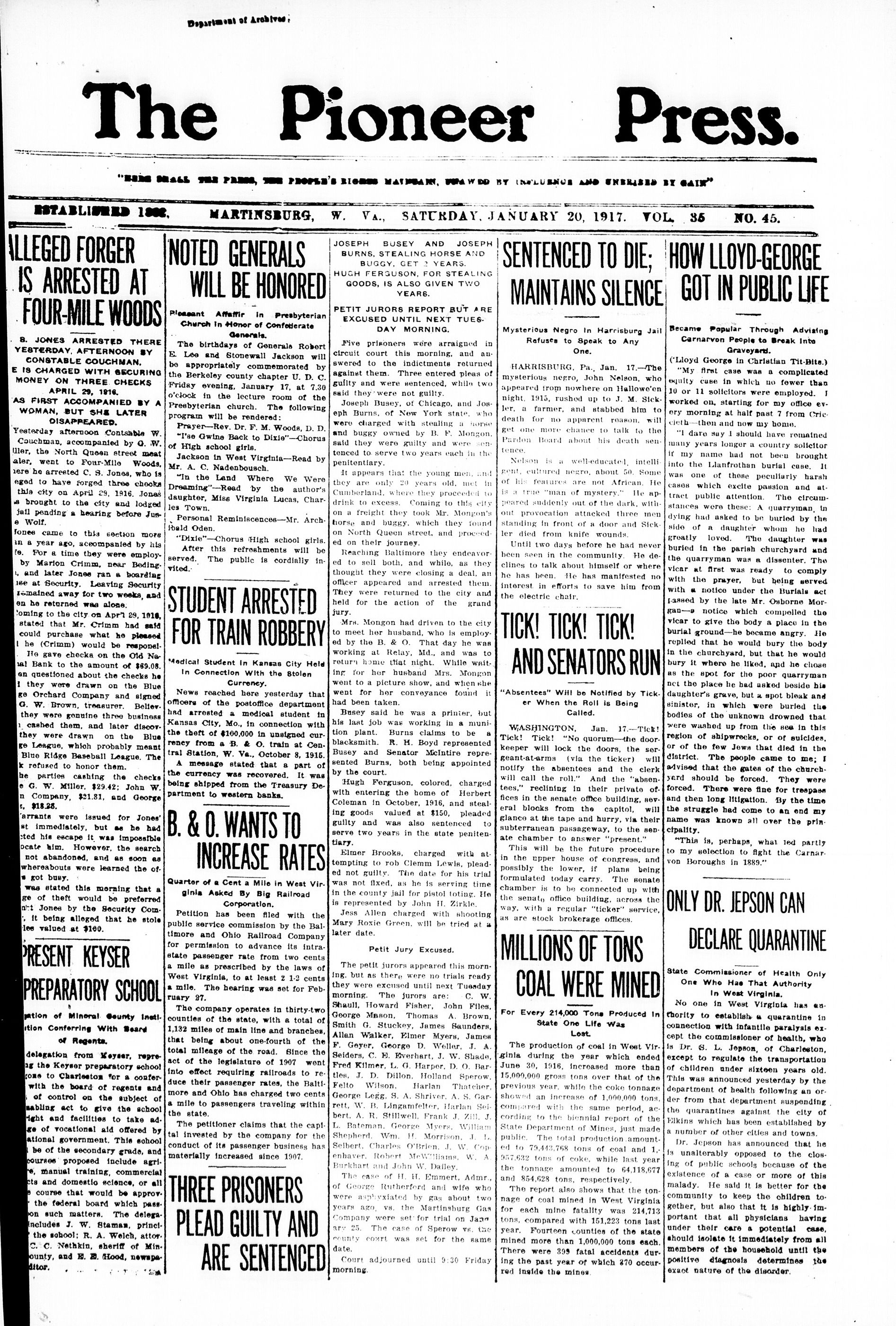
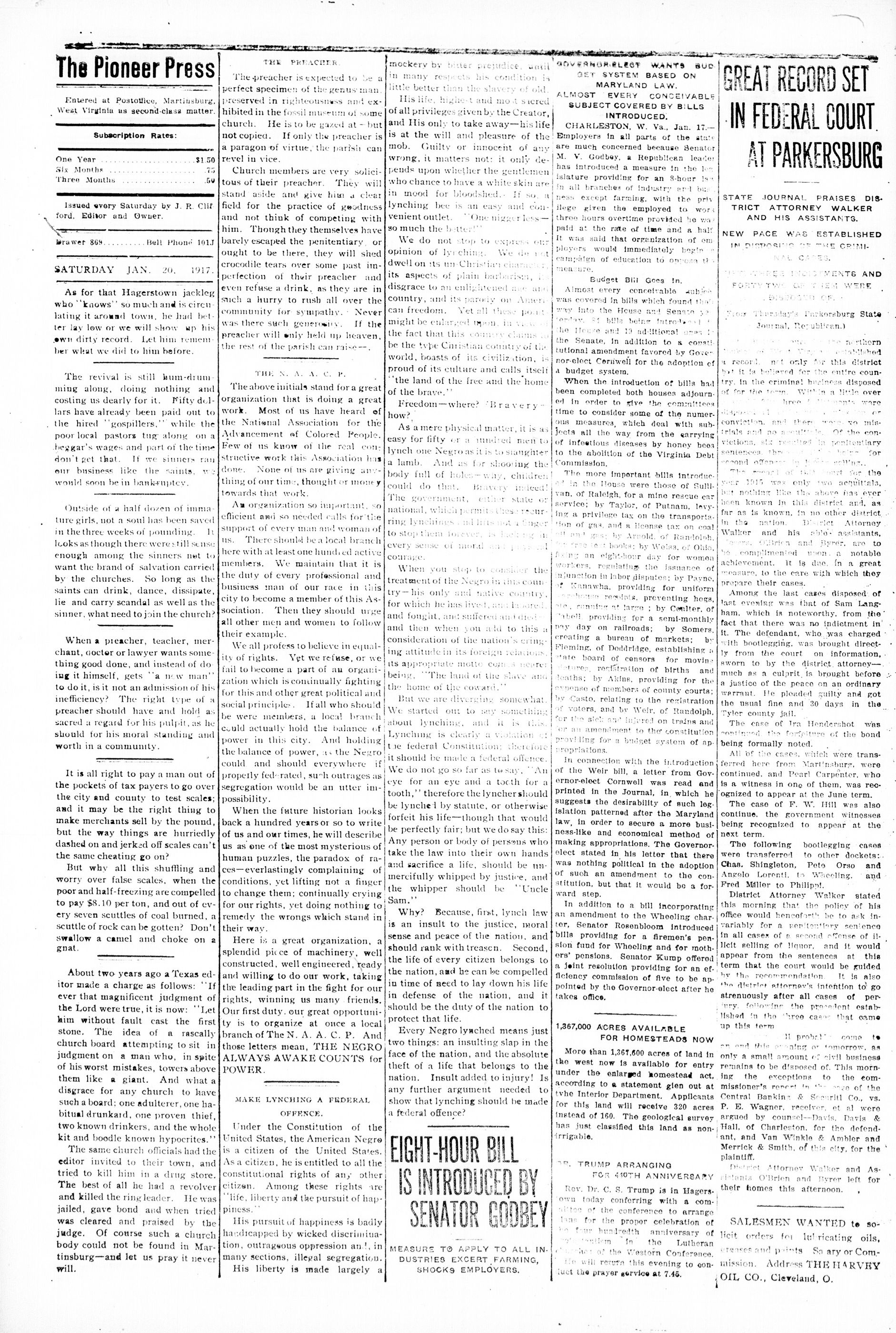
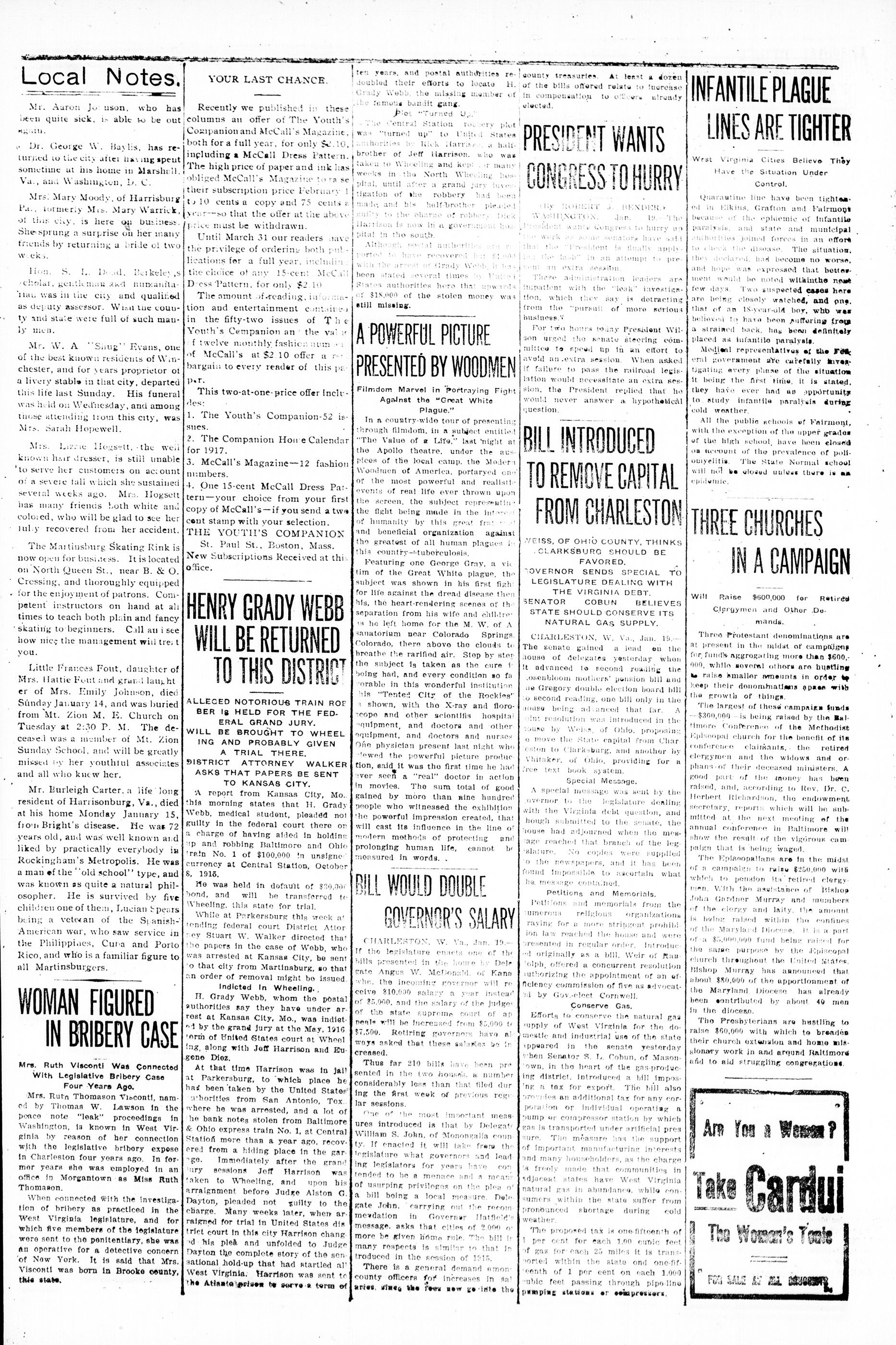
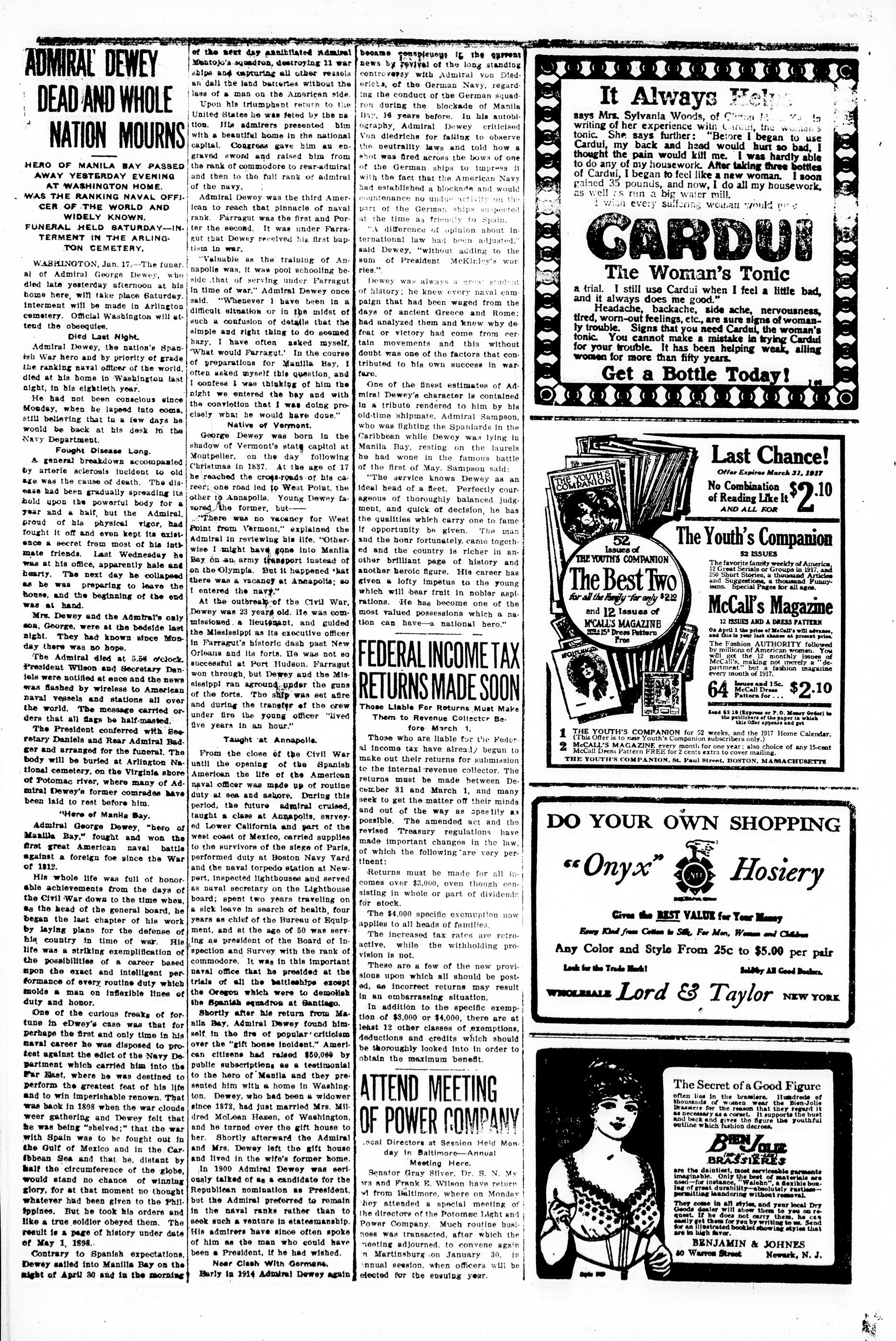
Page text (machine-generated)
The Pioneer Press.
ESTABLISHED 1882.
ALLEGED FORGER IS ARRESTED AT FOUR-MILE WOODS
B. JONES ARRESTED THERE YESTERDAY, AFTERNOON BY CONSTABLE COUCHMAN.
CONSTABLE COUCHMAN,
E IS CHARGED WITH SECURING
MONEY ON THREE CHECKS
APRIL 29, 1916.
AS FIRST ACCOMPANIED BY A
WOMAN, BUT SHE LATER
DISAPPEARED.
Yesterday afternoon Contsable W.
Couchman, accompanied by Q. W.
Iller, the North Queen street meat
aler, went to Four-Mile Woods,
here he arrested C. S. Jones, who is
egged to have forged three checks
this city on April 29, 1916. Jones
is brought to the city and lodged
fall pending a hearing before June
Wolf.
Jones came to this section more in a year ago, accompanied by his fe. For a time they were employ- by Marion Crimm, near Bedding, and later Jones ran a boarding use at Security. Leaving Security remained away for two weeks, and en he returned was alone.
coming to the city on April 29, 1910, stated that Mr. Crimm had said could purchase what he pleased he (Crimm) would be respondel. He gave checks on the Old Naval Bank to the amount of $69.08. on questioned about the checks he they were drawn on the Blue ge Orchard Company and signed G. W. Brown, treasurer. Believe they were genuine three business cashed them, and later discovethey were drawn on the Blue ge League, which probably meant Blue Ridge Baseball League. The k refused to honor them.
he parties cashing the checks
e G. W. Miller, $29.42; John W.
n Company, $21.81, and George
t, $18.25.
'arrants were issued for Jones'
at immediately, but as he had
sted his escape it was impossible
ocate him. However, the search
not abandoned, and as soon as
whereabouts were learned the of-
got busy.
was stated this morning that a
age of theft would be preferred
not Jones by the Security Com-
it, it being alleged that he stole
les valued at $160.
PRESENT KEYSER PREPARATORY SCHOOL
ation of Mineral County Institution Conferring With Board of Regents.
delegation from Keyser, repre-
ring the Keyser preparatory school
gone to Charleston for a confer-
with the board of regents and
of control on the subject of
sabling act to give the school
right and facilities to take adge
of vocational aid offered by
national government. This school
be of the secondary grade, and
course proposed include agrite,
manual training, commercial
acts and domestic science, or all
course that would be approv-
r the federal board which pass-
son such matters. The delega-
includes J. W. Staman, princi-
the school; R. A. Welch, attor-
C. C. Nethkin, sheriff of Min-
county, and E. E. Hood, newspa-
ditor.
Department of Archives
he P
RAILS THE PRESS, THE PEOPLE
MARTINSBURG,
NOTED GENERALS WILL BE HONORED
Pleasant Affaffir in Presbyterian Church in Honor of Confederate Generals.
The birthdays of Generals Robert E. Lee and Stonewall Jackson will be appropriately commemorated by the Berkeley county chapter U. D. C. Friday evening, January 17, at 7.30 o'clock in the lecture room of the Presbyterian church. The following program will be rendered:
Prayer—Rev. Dr. F. M. Woods, D. D.
"Ise Gwine Back to Dixie"—Chorus of High school girls.
Jackson in West Virginia—Read by Mr. A. C. Nadenbousch.
"In the Land Where We Were Dreaming"—Read by the author's daughter, Miss Virginia Lucas, Charles Town.
Personal Reminiscences—Mr. Archibald Oden.
"Dixie"—Chorus High school girls.
After this refreshments will be served. The public is cordially invited.
STUDENT ARRESTED FOR TRAIN ROBBERY
STUDENT ARRESTED FOR TRAIN ROBBERY
Medical Student in Kansas City Held In Connection With the Stolen Currency. News reached here yesterday that officers of the postoffice department had arrested a medical student in Kansas City, Mo., in connection with the theft of $100,000 in unsigned currency from a B. & O. train at Central Station, W. Va., October 8, 1915. A message stated that a part of the currency was recovered. It was being shipped from the Treasury Department to western banks.
B. & O. WANTS TO INCREASE RATES
Quarter of a Cent a Mile in West Virginia Asked By Big Railroad Corporation. Petition has been filed with the public service commission by the Baltimore and Ohio Railroad Company for permission to advance its intrastate passenger rate from two cents a mile as prescribed by the laws of West Virginia, to at least 2 1-2 cents a mile. The hearing was set for February 27.
The company operates in thirty-two counties of the state, with a total of 1,132 miles of main line and branches, that being about one-fourth of the total mileage of the road. Since the act of the legislature of 1907 went into effect requiring railroads to reduce their passenger rates, the Baltimore and Ohio has charged two cents a mile to passengers traveling within the state. The petitioner claims that the capital invested by the company for the conduct of its passenger business has materially increased since 1907.
THREE PRISONERS PLEAD GUILTY AND ARE SENTENCED
---
JOSEPH BUSEY AND JOSEPH
BURNS, STEALING HORSE AND
BUGGY, GET 2 YEARS.
HUGH FERGUSON, FOR STEALING
GOODS, IS ALSO GIVEN TWO
YEARS.
PETIT JURORS REPORT BUT ARE EXCUSED UNTIL NEXT TUESDAY MORNING.
Five prisoners were arraigned in circuit court this morning, and answered to the indictments returned against them. Three entered pleas of guilty and were sentenced, while two said they were not guilty.
Joseph Busey, of Chicago, and Joseph Burns, of New York state, who were charged with stealing a horse and buggy owned by B. F. Mongon, said they were guilty and were sentenced to serve two years each in the penitentiary.
It appears that the young men, and they are only 20 years old, met in Cumberland, where they proceeded to drink to excess. Coming to this city on a freight they took Mr. Mongon's horse and buggy, which they found on North Queen street, and proceeded on their journey. Reaching Baltimore they endeavored to sell both, and while, as they thought they were closing a deal, an officer appeared and arrested them. They were returned to the city and held for the action of the grand jury.
Mrs. Mongon had driven to the city to meet her husband, who is employed by the B. & O. That day he was working at Relay, Md., and was to return home that night. While waiting for her husband Mrs. Mongon went to a picture show, and when she went for her conveyance found it had been taken. Busey said he was a printer, but his last job was working in a muniition plant. Burns claims to be a blacksmith. R. H. Boyd represented Busey and Senator McIntire represented Burns, both being appointed by the court.
Hugh Ferguson, colored, charged with entering the home of Herbert Coleman in October, 1916, and stealing goods valued at $150, pleaded guilty and was also sentenced to serve two years in the state penitentiary.
Elmer Brooks, charged with attempting to rob Clemm Lewis, pleaded not guilty. The date for his trial was not fixed, as he is serving time in the county jail for pistol toting. He is represented by John H. Zirkle.
Jess Allen charged with shooting Mary Roxie Green, will be tried at a later date.
Petit Jury Excused.
The petit jurors appeared this morning, but as there were no trials ready they were excused until next Tuesday morning. The jurors are: C. W. Shaull, Howard Fisher, John Files, George Mason, Thomas A. Brown, Smith G. Stuckey, James Saunders, Allan Walker, Elmer Myers, James F. Geyer, George D. Weller, J. A. Seiders, C. E. Everhart, J. W. Shade, Fred Kilmer, L. G. Harper, D. O. Bartles, J. D. Dillon, Holland Sperow, Felto Wilson, Harlan Thatcher, George Legg, S. A. Shriver, A. S. Garrett, W. B. Lingamfelter, Harlan Seibert, A. R. Stillwell, Frank J. Zill, J. L. Bateman, George Myers, William Shepherd, Wm. H. Morrison, J. L. Selbert, Charles O'Brien, J. W. Copenhaver, Robert McWilliams, W. A. Burkhart and John W. Dailey.
The case of H. H. Emmert, Admr. of George Rutherford and wife who were asphyxiated by gas about two years ago, vs. the Martinsburg Gas Company were set for trial on January 25. The case of Sperow vs. the county court was set for the same date. Court adjourned until 9:30 Friday morning.
SENTENCED TO DIE; MAINTAINS SILENCE
Mysterious Negro In Harrisburg Jail Refuses to Speak to Any One.
HARRISBURG, Pa., Jan. 17.—The mysterious negro, John Nelson, who appeared from nowhere on Hallowe'en night, 1915, rushed up to J. M. Sickler, a farmer, and stabbed him to death for no apparent reason, will get one more chance to talk to the Pardon Board about his death sentence.
Nelson is a well-educated, intelligent, cultured negro, about 50. Some of his features are not African. He is a true "man of mystery." He appeared suddenly out of the dark, without provocation attacked three men standing in front of a door and Sickler died from knife wounds.
Until two days before he had never been seen in the community. He declines to talk about himself or where he has been. He has manifested no interest, in efforts to save him from the electric chair.
TICK! TICK! TICK! AND SENATORS RUN
TICK! TICK! TICK! AND SENATORS RUN
"Absentees" Will be Notified by Ticker When the Roll is Being Called.
WASHINGTON, Jan. 17.—Tick! Tick! Tick! "No quorum—the door-keeper will lock the doors, the sergeant-at-arms (via the ticker) will notify the absentees and the clerk will call the roll." And the "absentees," reclining in their private offices in the senate office building, several blocks from the capitol, will glance at the tape and hurry, via their subterranean passageway, to the senate chamber to answer "present."
This will be the future procedure in the upper house of congress, and possibly the lower, if plans being formulated today carry. The senate chamber is to be connected up with the senat $ _{0} $ office building, across the way, with a regular "ticker" service, as are stock brokerage offices.
MILLIONS OF TONS COAL WERE MINED
For Every 214,000 Tons Produced In
State One Life Was
Lost.
The production of coal in West Virginia during the year which ended June 30, 1916, increased more than 15,000,000 gross tons over that of the previous year, while the coke tonnage showed an increase of 1,000,000 tons, compared with the same period, according to the biennial report of the State Department of Mines, just made public. The total production amounted to 79,443,768 tons of coal and 1,957,632 tons of coke, while last year the tonnage amounted to 64,118,677 and 854,628 tons, respectively.
The report also shows that the tonnage of coal mined in West Virginia for each mine fatality was 214,713 tons, compared with 151,223 tons last year. Fourteen counties of the state mined more than 1,000,000 tons each. There were 399 fatal accidents during the past year of which 270 occurred inside the mines.
HOW LLOYD-GEORGE GOT IN PUBLIC LIFE
Became Popular Through Advising Carnarvon People to Break Into Graveyard. ('Lloyd George in Christian Tit-Bite.) "My first case was a complicated equity case in which no fewer than 10 or 11 solicitors were employed. I worked on, starting for my office every morning at half past 7 from Cricleth—then and now my home.
"I dare say I should have remained many years longer a country solicitor if my name had not been brought into the Llanfrothan burial case. It was one of those peculiarly harsh cases which excite passion and attract public attention. The circumstances were these: A quarryman, in dying had asked to be buried by the side of a daughter whom he had greatly loved. The daughter was buried in the parish churchyard and the quarryman was a dissenter. The vicar at first was ready to comply with the prayer, but being served with a notice under the Burials act passed by the late Mr. Osborne Morgan—a notice which compelled the vicar to give the body a place in the burial ground—he became angry. He replied that he would bury the body in the churchyard, but that he would bury it where he liked, and he chose as the spot for the poor quarryman not the place he had asked beside his daughter's grave, but a spot bleak and sinister, in which were buried the bodies of the unknown drowned that were washed up from the sea in this region of shipwrecks, or of suicides, or of the few Jews that died in the district. The people came to me; I advised that the gates of the churchyard should be forced. They were forced. There were fine for trespass and then long litigation. By the time the struggle had come to an end my name was known all over the principality.
"This is, perhaps, what led partly to my selection to fight the Carnarvon Boroughs in 1889."
ONLY DR. JEPSON CAN DECLARE QUARANTINE
State Commissioner of Health Only
One Who Has That Authority
In West Virginia.
No one in West Virginia has authority to establish a quarantine in connection with infantile paralysis except the commissioner of health, who is Dr. S. L. Jepson, of Charleston, except to regulate the transportation of children under sixteen years old. This was announced yesterday by the department of health following an order from that department suspending the quarantines against the city of Elkins which has been established by a number of other cities and towns.
Dr. Jepson has announced that he is unalterably opposed to the closing of public schools because of the existence of a case or more of this malady. He said it is better for the community to keep the children together, but also that it is highly important that all physicians having under their care a potential case, should isolate it immediately from all members of the household until the positive diagnosis determines the exact nature of the disorder.
The Pioneer Press
Entered at Postoffice, Martinsburg, West Virginia as second-class matter.
Subscription Rates:
One Year ..... $1.50
Six Months ..... 75
Three Months ..... 50
Issued every Saturday by J. R. Clifford, Editor and Owner.
Drawer 869.....Belt Phone 101J
SATURDAY JAN. 20. 1917.
As for that Hagerstown jackleg who "knows" so much and is circulating it around town, he had better lay low or we will show up his own dirty record. Let him remember what we did to him before.
The revival is still hum-drumming along, doing nothing and costing us dearly for it. Fifty dollars have already been paid out to the hired "gospillers," while the poor local pastors tug along on a beggar's wages and part of the time don't get that. If we sinners ran our business like the saints, we would soon be in bank+uptev.
Outside of a half dozen of immature girls, not a soul has been saved in the three weeks of pounding. It looks as though there were still sense enough among the sinners not to want the brand of salvation carried by the churches. So long as the saints can drink, dance, dissipate, lie and carry scandal as well as the sinner, what need to join the church?
When a preacher, teacher, merchant, doctor or lawyer wants something good done, and instead of doing it himself, gets "a new man" to do it, is it not an admission of his inefficiency? The right type of a preacher should have and hold as sacred a regard for his pulpit, as he should for his moral standing and worth in a community.
It is all right to pay a man out of the pockets of tax payers to go over the city and county to test scales; and it may be the right thing to make merchants sell by the pound, but the way things are hurriedly dashed on and jerked off scales can't the same cheating go on?
But why all this shuffling and worry over false scales, when the poor and half-freezing are compelled to pay $8.10 per ton, and out of every seven scuttles of coal burned, a scuttle of rock can be gotten? Don't swallow a camel and choke on a gnat.
About two years ago a Texas editor made a charge as follows: "If ever that magnificent judgment of the Lord were true, it is now: "Let him without fault cast the first stone. The idea of a rascally church board attempting to sit in judgment on a man who, in spite of his worst mistakes, towers above them like a giant. And what a disgrace for any church to have such a board; one adulterer, one habitual drunkard, one proven thief, two known drinkers, and the whole kit and boodle known hypocrites."
The same church officials had the editor invited to their town, and tried to kill him in a drug store. The best of all he had a revolver and killed the ring leader. He was jailed, gave bond and when tried was cleared and praised by the judge. Of course such a church body could not be found in Martinsburg—and let us pray it never will.
The preacher is expected to be a perfect specimen of the genius man, preserved in righteousness and exhibited in the fossil museum of some church. He is to be gazed at -but not copied. If only the preacher is a paragon of virtue, the parish can revel in vice.
Church members are very solicitous of their preacher. They will stand aside and give him a clear field for the practice of goodness and not think of competing with him. Though they themselves have barely escaped the penitentiary, or ought to be there, they will shed crocodile tears over some past imperfection of their preacher and even refuse a drink, as they are in such a hurry to rush all over the community for sympathy. Never was there such generosity. If the preacher will only held up heaven, the rest of the parish can raise
THE N. A. A. C. P.
The above initials stand for a great organization that is doing a great work. Most of us have heard of the National Association for the Advancement of Colored People. Few of us know of the real constructive work this Association has done. None of us are giving anything of our time, thought or money towards that work.
An organization so important, so efficient and so needed calls for the support of every man and woman of us. There should be a local branch here with at least one hundred active members. We maintain that it is the duty of every professional and business man of our race in this city to become a member of this Association. Then they should urge all other men and women to follow their example.
We all profess to believe in equality of rights. Yet we refuse, or we fail to become a part of an organization which is continually fighting for this and other great political and social principles. If all who should be were members, a local branch could actually hold the balance of power in this city. And holding the balance of power, as the Negro could and should everywhere if properly federated, such outrages as segregation would be an utter impossibility.
When the future historian looks back a hundred years or so to write of us and our times, he will describe us as one of the most mysterious of human puzzles, the paradox of races—everlastingly complaining of conditions, yet lifting not a finger to change them; continually crying for our rights, yet doing nothing to remedy the wrongs which stand in their way.
Here is a great organization, a splendid piece of machinery, well constructed, well engineered, ready and willing to do our work, taking the leading part in the fight for our rights, winning us many friends. Our first duty, our great opportunity is to organize at once a local branch of The N. A. A. C. P. And those letters mean, THE NEGRO ALWAYS AWAKE COUNTS for POWER.
MAKE LYNCHING A FEDERAL
Under the Constitution of the United States, the American Negro is a citizen of the United States. As a citizen, he is entitled to all the constitutional rights of any other citizen. Among these rights are "life, liberty and the pursuit of happiness." His pursuit of happiness is badly handicapped by wicked discrimination, outrageous oppression and, in many sections, illegal segregation. His liberty is made largely a
mockery by bitter prejudice, until in many respects his condition is little better than the slavery of old. His life, highest and most sacred of all privileges given by the Creator, and His only to take away—his life is at the will and pleasure of the mob. Guilty or innocent of any wrong, it matters not: it only depends upon whether the gentlemen who chance to have a white skin are in mood for bloodshed. If so, a lynching bee is an easy and convenient outlet. "One nigger less—so much the better!"
We do not stop to express our opinion of lynching. We do not dwell on its un-Christian character, its aspects of plain barbarism, its disgrace to an enlightened age and country, and its parody on American freedom. Yet all these points might be enlarged upon, in view of the fact that this country claims to be the type Christian country of the world, boasts of its civilization, is proud of its culture and calls itself "the land of the free and the home of the brave."
Freedom—where? "Bravery—how?"
As a mere physical matter, it is as easy for fifty or a hundred men to lynch one Negro as it is to slaughter a lamb. And as for shooting the body full of holes—why, children could do that. Bravery indeed! The government, either state or national, which permits these recurring lynchings and hits not a finger to stop them forever, is lacking in every sense of moral and physical courage.
When you stop to consider the treatment of the Negro in this country—his only and native country, for which he has lived, and hated, and fought, and suffered and died—and then when you add to this a consideration of the nation's cringing attitude in its foreign relations, its appropriate motto cognis nearest being, "The land of the slave and the home of the coward."
But we are diverging somewhat. We started out to say something about lynching, and it is this. Lynching is clearly a violation of the federal Constitution; therefore it should be made a federal offence. We do not go so far as to say, "An eye for an eye and a tooth for a tooth," therefore the lyncher should be lynched by statute, or otherwise forfeit his life—though that would be perfectly fair; but we do say this: Any person or body of persons who take the law into their own hands and sacrifice a life, should be unmercifully whipped by justice, and the whipper should be "Uncle Sam."
Why? Because, first, lynch law is an insult to the justice, moral sense and peace of the nation, and should rank with treason. Second, the life of every citizen belongs to the nation, and he can be compelled in time of need to lay down his life in defense of the nation, and it should be the duty of the nation to protect that life.
Every Negro lynched means just two things: an insulting slap in the face of the nation, and the absolute theft of a life that belongs to the nation. Insult added to injury! Is any further argument needed to show that lynching should be made a federal offence?
EIGHT-HOUR BILL IS INTRODUCED BY SENATOR GODBEY
MEASURE TO APPLY TO ALL INDUSTRIES EXCEPT FARMING, SHOCKS EMPLOYERS.
GOVERNOR ELEGIST WANTS BUD GET SYSTEM BASED ON MARYLAND LAW. ALMOST EVERY CONCEIVABLE SUBJECT COVERED BY BILLS INTRODUCED.
CHARLESTON, W. Va., Jan. 17. Employers in all parts of the state are much concerned because Senator M. V. Godbey, a Republican leader has introduced a measure in the legislature providing for an 8-hour law in all branches of industry and business except farming, with the privilege given the employed to work three hours overtime provided he was paid at the rate of time and a half. It was said that organization of employers would immediately begin a campaign of education to oppose the measure.
Budget Bill Goes In.
Almost every conceivable subject was covered in bills which found their way into the House and Senate yesterday. 84 bills being introduced in the House and 19 additional ones in the Senate, in addition to a constitutional amendment favored by Governor-elect Cornwell for the adoption of a budget system.
When the introduction of bills had been completed both houses adjourned in order to give the committees time to consider some of the numerous measures, which deal with subjects all the way from the carrying of infectious diseases by honey bees to the abolition of the Virginia Debt Commission.
The more important bills introduced in the House were those of Sullivan, of Raleigh, for a mine rescue car service; by Taylor, of Putnam, levying a privilege tax on the transportation of gas, and a license tax on coal off and gas; by Arnold, of Randolph, for free test books; by Welss, of Ohio, fixing an eighth hour day for women workers, regulating the issuance of injunction in labor disputes; by Payne, of Kanawha, providing for uniform warehouse residents, preventing hogs, etc., running at large; by Coulter, of Tabell providing for a semi-monthly pay day on railroads; by Somers, creating a bureau of markets; by Fleming, of Doddridge, establishing a state board of censors, for moving distances, registration of births and deaths; by Akins, providing for the expense of members of county courts; by Casto, relating to the registration of voters, and by Weir, of Randolph, for the sick and injured on trains and for an amendment to the constitution providing for a budget system of appropriations.
In connection with the introduction of the Weir bill, a letter from Governor-elect Cornwell was read and printed in the Journal, in which he suggests the desirability of such legislation patterned after the Maryland law, in order to secure a more business-like and economical method of making appropriations. The Governor-elect stated in his letter that there was nothing political in the adoption of such an amendment to the constitution, but that it would be a forward step.
In addition to a bill incorporating an amendment to the Wheeling charter, Senator Rosenbloom introduced bills providing for a firemen's pension fund for Wheeling and for mothers' pensions. Senator Kump offered a joint resolution providing for an efficiency commission of five to be appointed by the Governor-elect after he takes office.
1,367,000 ACRES AVAILABLE FOR HOMESTEADS
More than 1,367,600 acres of land in the west now is available for entry under the enlarged homestead act, according to a statement glen out at the Interior Department. Applicants for this land will receive 320 acres instead of 160. The geological survey has just classified this land as nonirrigable.
29. TRUMP ARRANGING
Rev. Dr. C. S. Trump is in Hagersown today conferring with a committee of the conference to arrange lans for the proper celebration of the four hundredth anniversary of protestism in the Lutheran Church of the Western Conference. He will return this evening to conduct the prayer service at 7.45.
GREAT RECORD SET IN FEDERAL COURT AT PARKERSBURG
STATE JOURNAL PRAISES DISTRICT ATTORNEY WALKER AND HIS ASSISTANTS. NEW PACE WAS ESTABLISHED IN DISPOSITION OF THE CRIMI-
THREE INDIGENTS AND
FORTY TWO OF THEM WERE
DISPOSSED OF.
From Thursday's Parkorsburg State
Journal, Republican.
a record, not only for this district but it is believed for the entire country, in the criminal business disposed of for the town. Within a little over three months were disposed of conviction, and there were no trials and no acquittals. Of the convictions, six resulted in penitentiary sentences, three in prison for second offence in labour colling.
The record of this court for the year 1915 was only two acquittals, but nothing like the above has ever been known in this district and, as far as is known, in no other district in the nation. District Attorney Walker and his able assistants, Jones, Olbrich and Byer, are to be complimented upon, a notable achievement. It is due, in a great measure, to the care with which they prepare their cases.
Among the last cases disposed of last evening was that of Sam Langham, which is noteworthy, from the fact that there was no indictment in it. The defendant, who was charged with bootlegging, was brought directly from the court on information, sworn to by the district attorney—much as a culprit, is brought before a justice of the peace on an ordinary warrant. He pleaded guilty and got the usual fine and 30 days in the Tyler county jail. The case of Ira Hendershot was continued, the forfeiture of the bond being formally noted.
All of the cases, which were transferred here from Martinsburg, were continued, and Pearl Carpenter, who is a witness in one of them, was recognized to appear at the June term.
The case of F. W. Hill was also continue, the government witnesses being recognized to appear at the next term.
The following bootlegging cases were transferred to other dockets: Chas. Shingleton, Pete Orso and Angelo Lorentti, to Wheeling, and Fred Miller to Phillipt.
District Attorney Walker stated this morning that the policy of his office would henceforth be to ask invariably for a penitentiary sentence in all cases of a second offense of illicit selling of liquor, and it would appear from the sentences at this term that the court would be guided by the recommendation. It is also the district attorney's intention to go strenuously after all cases of perjury, following the precedent established in the three cases that came up this term.
It probably come to an end this evening or tomorrow, as only a small amount of civil business remains to be disposed of. This morning the exceptions to the commissioner's report in the case of the Central Banking & Securitil Co., vs. P. E. Wagner, receiver, et al were argued by counsel--Davis, Davis & Hall, of Charleston, for the defendant, and Van Winkle & Ambler and Merrick & Smith, of this city, for the plaintiff.
District Attorney Walker and Assistant O'Brien and Byrer left for their homes this afternoon.
SALESMEN WANTED to solicit orders for lubricating oils, creases and prints. Soary or Commission. Address THE HARVEY OIL CO., Cleveland, O.
Mr. Aaron Johnson, who has been quite sick, is able to be out again.
Dr. George W. Baylis, has returned to the city after having spent sometime at his home in Marshall, Va., and Washington, D. C.
Mrs. Mary Moody, of Harrisburg Pa., formerly Mrs. Mary Warrick, of this city, is here on business. She sprung a surprise on her many friends by returning a bride of two weeks.
Hon. S. L. Dodd, Berkeley, s. scholar, gentleman and humanitarian was in the city and qualified as deputy assessor. Wish the county and state were full of such manly men.
Mr. W. A. "Shug" Evans, one of the best known residents of Winchester, and for years proprietor of a livery stable in that city, departed this life last Sunday. His funeral was held on Wednesday, and among those attending from this city, was Mrs. Sarah Hopewell.
Mrs. Lizzie Hogsett, the well known hair dresser, is still unable to serve her customers on account of a severe fall which she sustained several weeks ago. Mrs. Hogsett has many friends both white and colored, who will be glad to see her fully recovered from her accident.
The Martinsburg Skating Rink is now open for business. It is located on North Queen St., near B. & O. Crossing, and thoroughly equipped for the enjoyment of patrons. Competent instructors on hand at all times to teach both plain and fancy skating to beginners. Call an i see how nice the management will treat you.
Little Frances Fout, daughter of Mrs. Hattie Fout and grand lauher of Mrs. Emily Johnson, died Sunday January 14, and was buried from Mt. Zion M. E. Church on Tuesday at 2:30 P. M. The deceased was a member of Mt. Zion Sunday School, and will be greatly missed by her youthful associates and all who knew her.
Mr. Burleigh Carter, a life long resident of Harrisonburg, Va., died at his home Monday January 15, from Bright's disease. He was 72 years old, and was well known and liked by practically everybody in Rockingham's Metropolis. He was a man of the "old school" type, and was known as quite a natural philosopher. He is survived by five children one of them, Lucian Spears being a veteran of the Spanish-American war, who saw service in the Philippines, Cuba and Porto Rico, and who is a familiar figure to all Martinsburgers.
WOMAN FIGURED IN BRIBERY CASE
Mrs. Ruth Visconti Was Connected With Legislative Bribery Case Four Years Ago.
Mrs. Ruth Thomason Visconti, named by Thomas W. Lawson in the peace note "leak" proceedings in Washington, is known in West Virginia by reason of her connection with the legislative bribery expose in Charleston four years ago. In former years she was employed in an office in Morgantown as Miss Ruth Thomason.
When connected with the investigation of bribery as practiced in the West Virginia legislature, and for which five members of the legislature were sent to the penitentiary, she was an operative for a detective concern of New York. It is said that Mrs. Visconti was born in Brooke county, this state.
YOUR LAST CHANCE.
Recently we published in these columns an offer of The Youth's Companion and McCall's Magazine, both for a full year, for only $2.10, including a McCall Dress Pattern. The high price of paper and ink has obliged McCall's Magazine to raise their subscription price February 1 to 10 cents a copy and 75 cents a year—so that the offer at the above price must be withdrawn.
Until March 31 our readers have the privilege of ordering both publications for a full year, including the choice of any 15-cent McCall Dress Pattern, for only $2.10.
The amount of reading, information and entertainment contained in the fifty-two issues of The Youth's Companion and the value of twelve monthly fashion numbers of McCall's at $2.10 offer a rebargain to every reader of this paper.
This two-at-one-price offer includes:
1. The Youth's Companion-52 issues.
2. The Companion House Calendar for 1917.
3. McCall's Magazine—12 fashion numbers.
4. One 15-cent McCall Dress Pattern—your choice from your first copy of McCall's—if you send a two cent stamp with your selection.
THE YOUTH'S COMPANION
St. Paul St., Boston, Mass.
New Subscriptions Received at this office.
HENRY GRADY WEBB WILL BE RETURNED TO THIS DISTRICT
ALLECED NOTORIOUS TRAIN ROE
BER IS HELD FOR THE FEDERAL GRAND JURY.
WILL BE BROUGHT TO WHEEL
ING AND PROBABLY GIVEN
A TRIAL THERE.
DISTRICT ATTORNEY WALKER
ASKS THAT PAPERS BE SENT
TO KANSAS CITY.
A report from Kansas City, Mo.
this morning states that H. Grady
Webb, medical student, pleaded not
guilty in the federal court there on
a charge of having aided in holding
up and robbing Baltimore and Ohio
train No. 1 of $100,000 in unsigned
currency at Central Station, October
8, 1916.
He was held in default of $30,000 bond, and will be transferred to Wheeling, this state for trial.
While at Parkersburg this week at tending federal court District Attorney Stuart W. Walker directed that the papers in the case of Webb, who was arrested at Kansas City, be sent to that city from Martinsburg, so that an order of removal might be issued. Indicted In Wheeling.
H. Grady Webb, whom the postal authorities say they have under arrest at Kansas City, Mo., was indicted by the grand jury at the May, 1916 term of United States court at Wheeling, along with Jeff Harrison and Eugene Diez.
At that time Harrison was in jail at Parkersburg, to which place he has been taken by the United States authorities from San Antonio, Tex. where he was arrested, and a lot of the bank notes stolen from Baltimore & Ohio express train No. 1, at Central Station more than a year ago, recovered from a hiding place in the garage. Immediately after the grand jury sessions Jeff Harrison was taken to Wheeling, and upon his arraignment before Judge Alston G. Dayton, pleaded not guilty to the charge. Many weeks later, when arraigned for trial in United States district court in this city Harrison changed his plea and unfolded to Judge Dayton the complete story of the sensational hold-up that had startled all West Virginia. Harrison was sent to the Atlanta prison to serve a term of
ten years, and postal authorities redoubled their efforts to locate H. Grady Webb, the missing member of the famous bandit gang.
Plot "Turned Up."
The Central Station robbery plot was "turned up" to United States authorities by Rick Harrison, a half-brother of Jeff Harrison, who was taken to Wheeling and kept or many weeks in the North Wheeling hospital, until after a grand jury investigation of the robbery had been made, and his half-brother pleaded guilty to the charge of robbery. Rick Harrison is now in a government hospital in the south.
Although postal authorities are reported to have recovered but $1,000 with the arrest of Grady Webb, it has been stated several times by United States authorities here that upwards of $18,000 of the stolen money was still missing.
A POWERFUL PICTURE PRESENTED BY WOODMEN
Filmdom Marvel in Portraying Fight Against the "Great White Plague."
In a country-wide tour of presenting through filmdom, in a subject entitled "The Value of a Life," last night at the Apollo theatre, under the auspices of the local camp, the Modern Woodmen of America, portaryed one of the most powerful and realistic events of real life ever thrown upon the screen, the subject representing the fight being made in the interest of humanity by this great frat and beneficial organization against the greatest of all human plagues in this country—tuberculosis.
Featuring one George Gray, a victim of the Great White plague, the subject was shown in his first fight for life against the dread disease then his, the heart-rendering scenes of the separation from his wife and children he left home for the M. W. of A sanatorium near Colorado Springs Colorado, there above the clouds to breathe the rarified air. Stop by step the subject is taken as the cure is being had, and every condition so favorable in this wonderful institution his "Tented City of the Rockies" is shown, with the X-ray and floroscope and other scientific hospital equipment, and doctors and other equipment, and doctors and nurses. One physician present last night who viewed the powerful picture production, said it was the first time he had ever seen a "real" doctor in action in movies. The sum total of good gained by more than nine hundred people who witnessed the exhibition the powerful impression created, that will cast its influence in the line of modern methods of protecting and prolonging human life, cannot be measured in words.
BILLWOULD DOUBLE GOVERNOR'S SALARY
BILLWOULD DOUBLE GOVERNOR'S SALARY
CHARLESTON, W. Va., Jan. 19.—If the legislature enacts one of the bills presented in the house by Delgate Angus W. McDonald, of Kana, who, the incoming governor will receive $10,000 salary a year instead of $5,000, and the salary of the judges of the state supreme court of apneals will be increased from $5,000 to $7,500. Retiring governors have always asked that these salaries be increased.
Thus far 210 bills have been presented in the two houses, a number considerably less than that filed during the first week of previous regular sessions.
One of the most important measures introduced is that by Delegate William S. John, of Monongalia county. If enacted it will take from the legislature what governors and leading legislators for years have contended to be a menace and a means of usurping privileges on the plea of a bill boing a local measure. Delegate John, carrying out the recommendation in Governor Hatfield's message, asks that cities of 2,000 or more be given home rule. The bill in many respects is similar to that introduced in the session of 1915. There is a general demand among county officers for increases in salaries, since the fees now go into the
county treasuries. At least a dozen of the bills offered relate to increase in compensation to officers already elected.
PRESIDENT WANTS CONGRESS TO HURRY
(By ROBERT J. BENDER.)
WASHINGTON, Jan. 19.—The President wants Congress to hurry up the work as some senators have said that the "President is finally applying the lash" in an attempt to prevent an extra session.
These administration leaders are impatient with the "leak" investigation, which they say is detracting from the "pursuit of more serious business."
For two hours today President Wilson urged the senate steering committee to speed up in an effort to avoid an extra session. When asked if failure to pass the railroad legislation would necessitate an extra session, the President replied that he would never answer a hypothetical question.
BILL INTRODUCED TO REMOVE CAPITAL FROM CHARLESTON
WEISS, OF OHIO COUNTY, THINKS
CLARKSBURG SHOULD BE
FAVORED.
GOVERNOR SENDS SPECIAL TO
LEGISLATURE DEALING WITH
THE VIRGINIA DEBT
THE VIRGINIA DEBT.
SENATOR COBUN BELIEVES
STATE SHOULD CONSERVE ITS
NATURAL GAS SUPPLY.
CHARLESTON, W. Va., Jan. 19.
The senate gained a lead on the house of delegates yesterday when it advanced to second reading theosenbloom mothers' pension bill and the Gregory double election board bill to second reading, one bill only in the house being advanced that far. A joint resolution was introduced in the house by Weiss, of Ohio, proposing to move the State capital from Charleston to Clarkesburg, and another by Whitaker, of Ohio, providing for a free text book system.
Special Message:
A special message was sent by the governor to the legislature dealing with the Virginia debt question, and though submitted to the senate, the house had adjourned when the message reached that branch of the legislature. No copies were supplied to the newspapers, and it has been found impossible to ascertain what the message contained.
Petitions and Memorials
Petitions and memorials from the numerous religious organizations praying for a more stringent prohibition law reached the house and were presented in regular order. Introduced originally as a bill, Weir of Randolph, offered a concurrent resolution authorizing the appointment of an efficiency commission of five as advocated by Gov.elect Cornwell.
Conserve Gas.
Efforts to conserve the natural gas supply of West Virginia for the domestic and industrial use of the state appeared in the senate yesterday when Senator S. L. Cobun, of Mason-town, in the heart of the gas-producing district, introduced, a bill imposing a tax for export. The bill also provides an additional tax for any corporation or individual operating a pump or compressor station by which gas is transported under artificial pressure. The measure has the support of important manufacturing interests and many householders, as the charge is freely made that communities in adjacent states have West Virginia natural gas in abundance, while consumers within the state suffer from pronounced shortage during cold weather.
The proposed tax is one-fifteenth of 1 per cent for each 1.00 cubic feet of gas for each 25 miles it is transported within the state and one-fifteenth of 1 per cent on each 1.000 cubic feet passing through pipeline pumping stations or compressors.
INFANTILE PLAGUE LINES ARE TIGHTER
West Virginia Cities Believe They Have the Situation Under Control.
Quarautine line have been tightened in Elkins, Grafton and Fairmont because of the epidemic of infantile paralysis, and state and municipal authorities joined forces in an effort to check the disease. The situation, they declared, had become no worse, and hope was expressed that betterment would be noted withinthe next few days. Two suspected cases here are being closely watched, and one, that of an 15-year-old boy, who was believed to have been suffering from a strained back, has been definitely placed as infantile paralysis.
Medical representatives of the Federal government are carefully investigating every phase of the situation it being the first time, it is stated, they have ever had an opportunity to study infantile paralysis during cold weather.
All the public schools of Fairmont, with the exception of the upper grades of the high school, have been closed on account of the prevalence of poliomyelitis. The State Normal school will not be closed unless there is an epidemic.
THREE CHURCHES IN A CAMPAIGN
Will Raise $600,000 for Retired
Clergymen and Other De-
Three Protestant denominations are at present in the midst of campaigns for funds aggregating more than $600,000, while several others are hustling to raise smaller amounts in order to keep their denominations space with the growth of things.
The largest of these campaign funds — $300,000 — is being raised by the Baltimore Conference of the Methodist Episcopal church for the benefit of its conference claimants, the retired clergymen and the widows and orphans of their deceased ministers. A good part of the money has been raised, and, according to Rev. Dr. C. Herbert Richardson, the endowment secretary, reports which will be submitted at the next meeting of the annual conference in Baltimore will show the result of the vigorous campaign that is being waged.
The Episcopalians are in the midst of a campaign to raise $250,000 with which to pension its retired clergymen. With the assistance of Bishop John Gardner Murray and members of the clergy and laity, the amount is being raised within the confines of the Maryland Diocese. It is a part of a $5,000,000 fund being raised for the same purpose by the Episcopal church throughout the United States. Bishop Murray has announced that about $80,000 of the apportionment of the Maryland Diocese has already been contributed by about 49 men in the diocese.
The Presbyterians are hustling to raise $60,000 with which to breaden their church extension and home missionary work in and around Baltimore and to aid struggling congregations.
Are You a Woman?
Take Cardui
The Woman's Tonic
FOR SALE AT ALL DURCH
ADMIRAL DEWEY DEAD AND WHOLE NATION MOURNS
HERO OF MANILA BAY PASSED AWAY YESTERDAY EVENING AT WASHINGTON HOME. WAS THE RANKING NAVAL OFFICER OF THE WORLD AND WIDELY KNOWN. FUNERAL HELD SATURDAY—IN TERMENT IN THE ARLINGTON CEMETERY. WASHINGTON, Jan. 17.—The funeral of Admiral George Dewey, who died late yesterday afternoon at his home here, will take place Saturday. Interment will be made in Arlington cemetery. Official Washington will attend the obsequies.
Died Last Night
Admiral Dewey, the nation's Spanish War hero and by priority of grade the ranking naval officer of the world, died at his home in Washington last night, in his eighteenth year.
He had not been conscious since Monday, when he lapeed into some, still believing that in a few days he would be back at his desk in the Navy Department.
Fought Disease Long.
A general breakdown accompanied by arterie sclerosis incident to old age was the cause of death. The disease had been gradually spreading its hold upon the powerful body for a year and a half, but the Admiral, proud of his physical vigor, had fought it off and even kept its existence a secret from most of his intimate friends. Last Wednesday he was at his office, apparently hale and hearty. The next day he collapsed as he was preparing to leave the house, and the beginning of the end was at hand.
Mrs. Dewey and the Admiral's only son, George, were at the bedside last night. They had known since Monday there was no hope. The Admiral died at 5.58 o'clock. President Wilson and Secretary Daniels were notified at once and the news was flashed by wireless to American naval vessels and stations all over the world. The message carried orders that all flags be half-masted.
The President conferred with Secretary Daniels and Rear Admiral Badger and arranged for the funeral. The body will be buried at Arlington National cemetery, on the Virginia shore of Potomac river, where many of Admiral Dewey's former comrades have been laid to rest before him
"Here of ManHa Bay.
Admiral George Dewey, "hero of Mamilla Bay," fought and won the first great American naval battle against a foreign foe since the War of 1812.
His whole life was full of honorable achievements from the days of the Civil War down to the time when, as the head of the general board, he began the last chapter of his work by laying plans for the defense of his country in time of war. His life was a striking exemplification of the possibilities of a career based upon the exact and intelligent performance of every routine duty which molds a man on inflexible lines of duty and honor.
One of the curious freaks of fortune in eDwey's case was that for perhaps the first and only time in his naval career he was disposed to protest against the edict of the Navy Department which carried him into the Far East, where he was destined to perform the greatest feat of his life and to win imperishable renown. That was back in 1898 when the war clouds weer gathering and Dewey felt that he was being "shelved;" that the war with Spain was to be fought out in the Gulf of Mexico and in the Caribbean Sea and that he, distant by half the circumference of the globe, would stand no chance of winning glory, for at that moment no thought whatever had been given to the Philippines. But he took his orders and like a true soldier obeyed them. The result is a page of history under date of May 1, 1898.
Contrary to Spanish expectations, Dewey sailed into Manilla Bay on the night of April 30 and in the morning
of the next day annihilated Admiral Mantojo's squadron, destroying 11 war ships and capturing all other recessals an dall the land batteries without the loss of a man on the American side. Upon his triumphant return to the United States he was feted by the nation. His admirers presented him with a beautiful home in the national capital. Congress gave him an engraved sword and raised him from the rank of commodore to rear-admiral and then to the full rank of admiral of the navy.
Admiral Dewey was the third American to reach that pinnacle of naval rank. Farragut was the first and Porter the second. It was under Farragut that Dewey received his first baptism in war.
"Valuable as the training of Annapolis was, it was pool schooling beside that of serving under Farragut in time of war," Admiral Dewey once said. "Whenever I have been in a difficult situation or in the midst of such a confusion of details that the simple and right thing to do seemed hazy, I have often asked myself, What would Farragut.' In the course of preparations for Manilla Bay, I often asked myself this question, and I confess I was thinking of him the night we entered the bay and with the conviction that I was doing precisely what he would have done."
Native of Vermont.
George Dewey was born in the shadow of Vermont's state capitol at Montpellier, on the day following Christmas in 1837. At the age of 17 he reached the cross-roads of his career; one road led to West Point, the other to Annapolis. Young Dewey favored the former, but——
"There was no vacancy for West Point from Vermont," explained the Admiral in reviewing his life. "Otherwise I might have gone into Manila Bay on an army transport instead of on the Olympics. But it happened that there was a vacancy at Annapolis; so I entered the navy."
At the outbreak of the Civil War, Dewey was 23 years old. He was commissioned a lieutenant, and guided the Mississippi as its executive officer in Farragut's historic dash past New Orleans and its forts. He was not so successful at Port Hudson. Farragut won through, but Dewey and the Mississippi ran aground under the guns of the forts. The ship was set afire and during the transfer of the crew under fire the young officer "lived five years in an hour."
Taught at Annapolis
From the close of the Civil War until the opening of the Spanish American the life of the American naval officer was made up of routine duty at sea and ashore. During this period, the future admiral cruised, taught a class at Annapolis, surveyed Lower California and part of the west coast of Mexico, carried supplies to the survivors of the siege of Paris, performed duty at Boston Navy Yard and the naval torpedo station at Newport, inspected lighthouses and served as naval secretary on the Lighthouse board; spent two years traveling on a sick leave in search of health, four years as chief of the Bureau of Equipment, and at the age of 50 was serving as president of the Board of Inspection and Survey with the rank of commodore. It was in this important naval office that he presided at the trials of all the battleships except the Oregon which were to demolish the Spanish squadron at Santiago.
Shortly after his return from Manila Bay, Admiral Dewey found himself in the fire of popular criticism over the "gift house incident." American citizens had raised $50,000 by public subscriptions as a testimonial to the hero of Manila and they presented him with a home in Washington. Dewey, who had been a widower since 1872, had just married Mrs. Milfred McLoan Hazen, of Washington, and he turned over the gift house to her. Shortly afterward the Admiral and Mrs. Dewey left the gift house and lived in the wife's former home.
In 1900 Admiral Dewey was seriously talked of as a candidate for the Republican nomination as President, but the Admiral preferred to remain in the naval ranks rather than to seek such a venture in statesmanship. His admirers have since often spoke of him as the man who could have been a President, if he had wished.
Near Clash With Germans.
Early in 1914 Admiral Dewey again
became conspicuous in the current news by revival of the long standing controversy with Admiral von Diedericks, of the German Navy, regarding the conduct of the German squadron during the blockade of Manila Bay, 16 years before. In his autobiography, Admiral Dewey criticised Von diedrichs for failing to observe the neutrality laws and told how a shot was fired across the bows of one of the German ships to impress it with the fact that the American Navy had established a blockade and would countenance no undue activity on the part of the German ships suspected at the time as friendly to Spain.
"A difference of opinion about international law had been adjusted," said Dewey, "without adding to the sum of President McKinley's worries."
Dewey was always a great student of history; he knew every naval campaign that had been waged from the days of ancient Greece and Rome; had analyzed them and knew why defeat or victory had come from certain movements and this without doubt was one of the factors that contributed to his own success in warfare.
One of the finest estimates of Admiral Dewey's character is contained in a tribute rendered to him by his old-time shipmate, Admiral Sampson, who was fighting the Spaniards in the Caribbean while Dewey was lying in Manila Bay, resting on the laurels he had wone in the famous battle of the first of May. Sampson said:
"The service knows Dewey as an ideal head of a fleet. Perfectly courageous of thoroughly balanced judgment, and quick of decision, he has the qualities which carry one to fame if opportunity be given. The man and the hour fortunately came together and the country is richer in another brilliant page of history and another heroic figure. His career has given a lofty impetus to the young which will bear fruit in nobler aspirations. He has become one of the most valued possessions which a nation can have—a national hero."
FEDERAL INCOMETAX RETURNS MADE SOON
Those Liable For Returns Must Make Them to Revenue Collector Before March 1.
Those who are liable for the Federal income tax have already begun to make out their returns for submission to the internal revenue collector. The returns must be made between December 31 and March 1, and many seek to get the matter off their minds and out of the way as speedily as possible. The amended act and the revised Treasury regulations have made important changes in the law, of which the following are very pertinent:
Returns must be made for all incomes over $3,000, even though consisting in whole or part of dividends for stock.
The $4,000 specific exemption now applies to all heads of families.
The increased tax rates are retroactive, while the withholding provision is not.
These are a few of the new provisions upon which all should be posted, as incorrect returns may result in an embarrassing situation.
In addition to the specific exemption of $3,000 or $4,000, there are at least 12 other classes of exemptions, deductions and credits which should be thoroughly looked into in order to obtain the maximum benefit.
ATTEND MEETING OF POWER COMPANY
Local Directors at Session Held Monday in Baltimore—Annual Meeting Here. Senator Gray Silver, Dr. S. N. Myers and Frank E. Wilson have returned from Baltimore, where on Monday they attended a special meeting of the directors of the Potomac Light and Power Company. Much routine business was transacted, after which the meeting adjourned, to convene again in Martinsburg on January 30, in annual session, when officers will be elected for the ensuing year.
It Always Hek
Ms Mrs. Sylvanla Woods, of Clinton H.
ning of her experience with Cardui, the w
c. She says further: "Before I began to
Cardui, my back and head would hurt so b
ought the pain would kill me. I was hardly
no any of my housework. After taking three be
Cardui, I began to feel like a new woman. I
need 35 pounds, and now, I do all my housew
well as run a big water mill.
says Mrs. Sylvanla Woods, of Clinton H. K. in writing of her experience with Cardui, the woman's tonic. She says further: "Before I began to use Cardui, my back and head would hurt so bad, I thought the pain would kill me. I was hardly able to do any of my housework. After taking three bottles of Cardui, I began to feel like a new woman. I soon gained 35 pounds, and now, I do all my housework, as well as run a big water mill.
I wish every suffering woman would give
CARDUI
Headache, backache, side ache, nervousness, tired, worn-out feelings, etc., are sure signs of womanly trouble. Signs that you need Cardul, the woman's tonic. You cannot make a mistake in trying Cardul for your trouble. It has been helping weak, ailing women for more than fifty years.
Last Chance!
Offer Expires March 31, 1917
No Combination of Reading Like It $2.10
AND ALL FOR
52 Issues of
THE YOUTH'S COMPANION
The Best Two
for all the family for only $2.12
and 12 Issues of
M'CALL'S MAGAZINE
with 15' Dress Pattern Free
The Youth's Companion
52 ISSUES
The favorite family weekly of America,
12 Great Serials or Groups in 1917, and
250 Short Stories, a thousand Articles
and Suggestions, a thousand Funny-
isms. Special Pages for all ages.
McCall's Magazine
12 ISSUES AND A DRESS PATTERN
On April 1 the price of McCall's will advance,
and this is your last chance at present price.
The Fashion AUTHORITY followed
by millions of American women. You
will get the 12 monthly issues of
McCall's, making not merely a "de-
partment" but a fashion magazine
every month of 1917.
64 Issues and 15c.
McCall Dress
Pattern for ...
$2.10
Read $2.10 (Express or P.O. Money Order) to
the publishers of the paper in which
this Offer appears and get
1 THE YOUTH'S COMPANION for 52 weeks, and the 1917 Home Calendar.
(This Offer is to new Youth's Companion subscribers only.)
2 McCALL'S MAGAZINE every month for one year; also choice of any 15-cent
McCall Dress Pattern FREE for 2 cents to cover mailing.
THE YOUTH'S COMPANION, 84. Paul Street, BOSTON, MASSACHUSETTS
DO YOUR OWN SHOPPING
"Onyx" Hosiery
Gives the BEST VALUE for Your Money
Every Kind from Cotton to Silk, For Men, Women and Children
Any Color and Style From 25c to $5.00 per pair
Look for the Trade Mark!
Sold by All Good Bakers.
WHOLESALE Lord & Taylor NEW YORK
The Secret of a Good Figure
often lies in the brassiere. Hundreds of
thousands of women wear the Bien-Jolie
Brassiere for the reason that they regard it
as necessary as a cornet. It supports the bust
and back and gives the figure the youthful
outline which fashion decreses.
BENJOLIE
BRASSIERES
are the daintiest, most serviceable garments
imaginable. Only the best of materials are
used—for instance, "Walohn", a flexible bo-
ing of great durability—absolutely rustien-
permitting laundering without removal.
They come in all styles and your local Dry
Goods dealer will show them to you on re-
quest. If he does not carry them, he can
easily get them for you by writing to us. Send
for an illustrated booklet showing styles that
are in high favor.
BENJAMIN & JOHNES
50 Warren Street Newark, N. J.