The Pioneer Press
Saturday, April 7, 1917
Martinsburg, West Virginia
Page text (machine-generated)
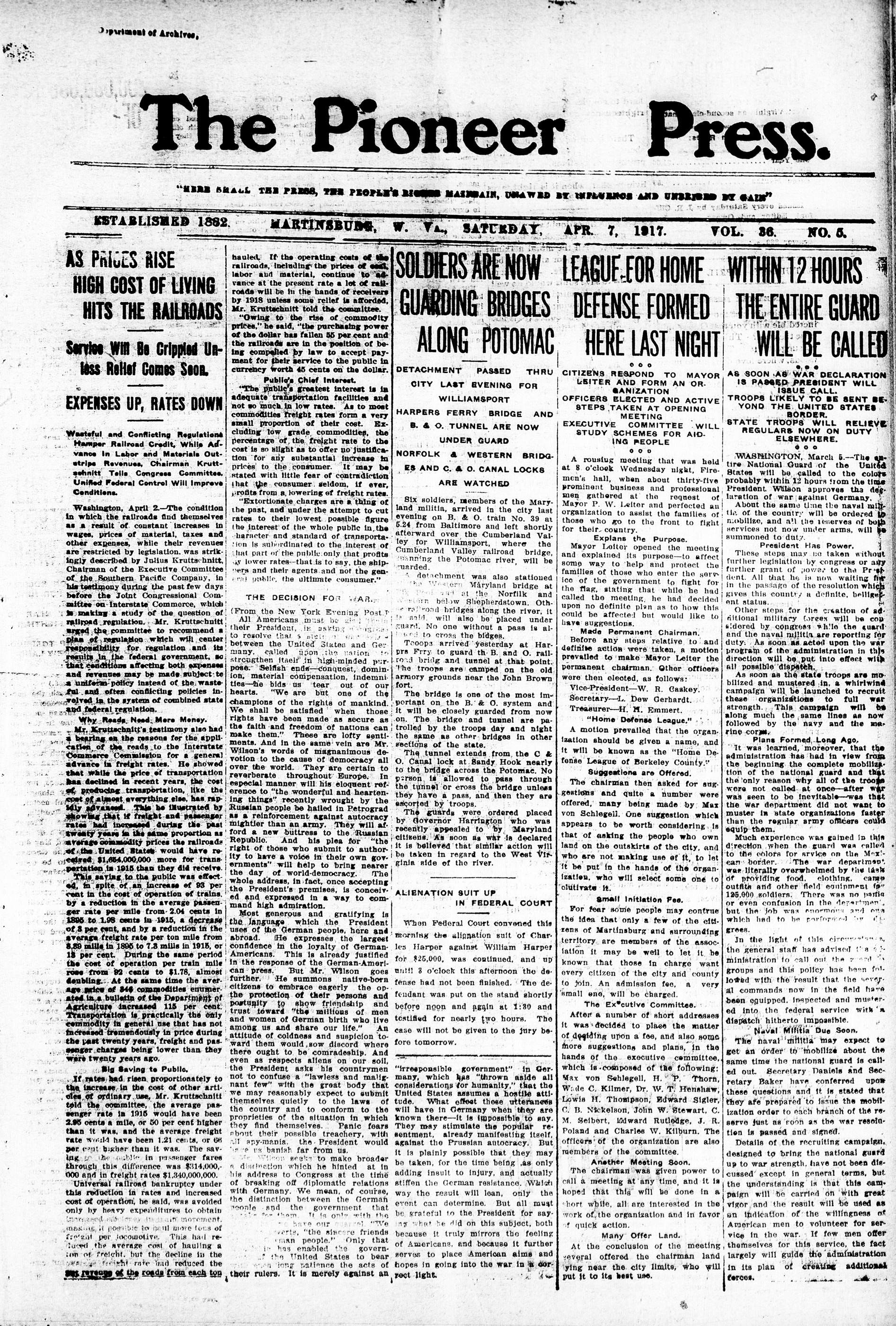
The Pioneer Press.
Department of Archives.
ESTABLISHED 1882
AS PRICES RISE
HIGH COST OF LIVING
HITS THE RAILROADS
Service Will Be Crippled Unless Relief Comes Soon.
EXPENSES UP, RATES DOWN
Wasteful and Conflicting Regulations Hamper Railroad Credit, While Advance In Labor and Materials Outstrips Revenues, Chairman Kruttsohnitt Tells Congress Committee. Unified Federal Control Will Improve Conditions.
Washington, April 2.—The condition in which the railroads find themselves as a result of constant increases in wages, prices of material, taxes and other expenses, while their revenues are restricted by legislation, was strikingly described by Julius Kruttschnitt, Chairman of the Executive Committee of the Southern Pacific Company, in his testimony during the past few days before the Joint Congressional Committee on Interstate Commerce, which is making a study of the question of rallippad regulation. Mr. Kruttschnitt urged the committee to recommend a plan of regulation which will center responsibility for regulation and its results in the federal government, so that conditions affecting both expenses and revenues may be made subject to a uniform policy instead of the wasteful, and often conflicting policies involved in the system of combined state and federal regulation.
Why Reads Need More Money.
Mr. Kruttschnitz's testimony also had a bearing on the reasons for the application of the roads to the Interstate Commerce Commission for a general advance in freight rates. He showed that while the price of transportation has declined in recent years, the cost of producing transportation, like the cost of almost everything else, has rapidly advanced. This he illustrated by showing that freight and passenger rates had increased during the past twenty years in the same proportion as average commodity prices the railroads of the United States would have received $1,654,000,000 more for transportation in 1915 than they did receive. This saying to the public was effected, in spite of an increase of 93 per cent in the cost of operation of trains, by a reduction in the average passenger rate per mile from 2.04 cents in 1895 to 1.98 cents in 1915, a decrease of 3 per cent, and by a reduction in the average freight rate per ton mile from 8.59 mills in 1895 to 7.3 mills in 1915, or 18 per cent. During the same period the cost of operation per train mile rose from 92 cents to $1.78, almost denbiling. At the same time the average price of 244 commodities enumerated in a bulletin of the Department of Agriculture increased 115 per cent. Transportation is practically the only commodity in general use that has not increased tremendously in price during the past twenty years, freight and passenger charges being lower than they were twenty years ago.
Big Saving to Public.
Big Saving to Public.
If rates had risen proportionately to the increase in the cost of other articles of ordinary use, Mr. Kruttschnitt told the committee, the average passenger rate in 1915 would have been 2.95 cents a mile, or 50 per cent higher than it was, and the average freight rate would have been 1.21 cents, or 66 per cent higher than it was. The saving on the public in passenger fares through this difference was $314,000,000 and in freight rates $1,340,000,000.
Universal railroad bankruptcy under this reduction in rates and increased cost of operation, he said, was avoided only by heavy expenditures to obtain increased and less train movement, making it possible to pull more tons of freight per locomotive. This had reduced the average cost of hauling a ton of freight, but the decline in the average freight rate had reduced the net revenue of the roads from each ton
hauled. If the operating costs of the railroads, including the prices of cost, labor and material, continue to advance at the present rate a lot of railroads will be in the hands of receivers by 1918 unless some relief is afforded, Mr. Kruttschmitt told the committee. "Owing to the rise of commodity prices," he said, "the purchasing power of the dollar has fallen 55 per cent and the railroads are in the position of being compelled by law to accept payment for their service to the public in currency worth 45 cents on the dollar. Public's Chief Interest.
"The public's greatest interest is in adequate transportation facilities and not so much in low rates. As to most commodities freight rates form a very small proportion of their cost. Excluding low grade commodities, the percentage of the freight rate to the cost is so slight as to offer no justification for any substantial increase in prices to the consumer. It may be stated with little fear of contradiction that the consumer, seldom, if ever, profits from a lowering of freight rates.
"Extortionate charges are a thing of the past, and under the attempt to cut rates to their lowest possible figure the interest of the whole public in the character and standard of transportation is subordinated to the interest of that part of the public only that profits by lower rates—that is to say, the shipers and their agents and not the general public, the ultimate consumer."
THE DECISION FOR WAR
(From the New York Evening Post.)
All Americans must be able to their President, in asking rights to resolve that a slight between the United States and Germany, called upon the nation to strengthen itself in high-minded purpose. Selfish ends—conquest, dominion, material compensation, indemnities—the bids us tear out of our hearts. "We are but one of the champions of the rights of mankind. We shall be satisfied when those rights have been made as secure as the faith and freedom of nations can make them." These are lofty sentiments. And in the same vein are Mr. Wilson's words of magnanimous devotion to the cause of democracy all over the world. They are certain to reverberate throughout Europe. In especial manner will his eloquent reference to "the wonderful and heartening things" recently wrought by the Russian people be hailed in Petrograd as a reinforcement against autocracy mightier than an army. They will afford a new buttress to the Russian Republic. And his plea for "the right of those who submit to authority to have a voice in their own governments" will help to bring nearer the day of world-democracy. The whole address, in fact, once accepting the President's premises, is conceived and expressed in a way to command high admiration.
Most generous and gratifying is the language which the President uses of the German people, here and abroad. He expresses the largest confidence in the loyalty of German-Americans. This is already justified in the response of the German-American press. But Mr. Wilson goes further. He summons native-born citizens to embrace eagerly the opte protection of their pensions and postunity to show friendship and trust toward "the millions of men and women of German birth who live among us and share our life." An attitude of coldness and suspicion toward them would, sow discord where there ought to be comradeship. And even as respects alliens on our soil, the President asks his countrymen not to confuse a "lawless and malignant few" with the great body that we may reasonably expect to submit themselves quietly to the laws of the country and to conform to the proprieties of the situation in which they find themselves. Panic fears about their possible treachery, with all apymanis, the President would have us banish far from us.
Wilson seeks to make broader a distinction which he hinted at in his address to Congress at the time of breaking off diplomatic relations with Germany. We mean, of course, the distinction between the German people and the government that makes for them. It is only with the power to have our counsel "We assert, "the sincere friends of human people." Only that it has enabled the govern-ment of the United States to bear long patience the acts of their rulers. It is merely against an
SOLDIERS ARE NOW GUARDING BRIDGES ALONG POTOMAC
DETACHMENT PASSED THRU CITY LAST EVENING FOR WILLIAMSPORT HARPERS FERRY BRIDGE AND B. & O. TUNNEL ARE NOW UNDER GUARD NORFOLK & WESTERN BRIDGES AND C. & O. CANAL LOCKS
Six soldiers, members of the Maryland militia, arrived in the city last evening on B. & O. train No. 39 at 5.24 from Baltimore and left shortly afterward over the Cumberland Valley for Williamsport, where the Cumberland Valley railroad bridge, mapping the Potomac river, will be guarded. A detachment was also stationed the Western Maryland bridge at Brownsville at the Norfilk and Western below Shepherdstown. Other railroad bridges along the river, it said, will also be placed under guard. No one without a pass is allowed to cross the bridges.
Troops arrived yesterday at Harps Fryt to guard th B. and O. railroad bridge and tunnel at that point. The troops are camped on the old armory grounds near the John Brown fort.
The bridge is one of the most important on the B. & O. system and it will be closely guarded from now on. The bridge and tunnel are patrolled by the troops day and night the same as other bridges in other sections of the state.
The tunnel extends from the C & O. Canal lock at Sandy Hook nearly to the bridge across the Potomac. No person is allowed to pass through the tunnel or cross the bridge unless they have a pass, and then they are escorted by troops.
The guards were ordered placed by Governor Harrington who was recently appealed to by Maryland citizens. As soon as war is declared it is believed that similar action will be taken in regard to the West Virginia side of the river.
ALIENATION SUIT UP
When Federal Court convened this morning the allegation suit of Charles Harper against William Harper for $25,000, was continued, and up until 3 o'clock this afternoon the defense had not been finished. The defendant was put on the stand shortly before noon and again at 1:30 and testified for nearly two hours. The case will not be given to the jury before tomorrow.
"irresponsible government" in Germany, which has "thrown aside all considerations for humanity," that the United States assumes a hostile attitude. What effect these utterances will have in Germany when they are known there—it is impossible to say. They may stimulate the popular resentment, already manifesting itself, against the Prussian autocracy. But it is plainly possible that they may be taken, for the time being, as only adding insult to injury, and actually stiffen the German resistance. Which way the result will lean, only the event can determine. But all must be grateful to the President for saying what he did on this subject, both because it truly mirrors the feeling of Americans, and because it further serves to place American aims and hopes in going into the war in a correct light.
LEAGUE FOR HOME DEFENSE FORMED HERE LAST NIGHT
CITIZENS RESPOND TO MAYOR LEITER AND FORM AN ORGANIZATION
OFFICERS ELECTED AND ACTIVE STEPS TAKEN AT OPENING MEETING
EXECUTIVE COMMITTEE WILL STUDY SCHEMES FOR AIDING PEOPLE
A rousing meeting that was held at 8 o'clock Wednesday night, Firemen's hall, when about thirty-five prominent business and professional men gathered at the request of Mayor P. W. Leiter and perfected an organization to assist the families of those who go to the front to fight for their country.
Explans the Purpose.
Mayor Leiter opened the meeting and explained its purpose—to affect some way to help and protect the families of those who enter the service of the government to fight for the flag, stating that while he had called the meeting, he had decided upon no definite plan as to how this could be affected but would like to have suggestions.
Made Permanent Chairman.
Before any steps relative to and definite action were taken, a motion prevailed to make Mayor Leiter the permanent chairman. Other officers were then elected, as follows:
Vice-President—W. R. Caskey.
Secretary—L. Dew Gerhardt.
Treasurer—H. M. Emmert.
A motion prevailed that the organization should be given a name, and it will be known as the "Home Defense League of Berkeley County."
Suggestions are Offered.
The chairman then asked for suggestions and quite a number were offered, many being made by Max von Schlegeil. One suggestion which appears to be worth considering is that of asking the people who own land on the outskirts of the city, and who are not making use of it, to let it be put in the hands of the organization, who will select some one to cultivate it.
small initiation Fee.
For fear some people may contrue the idea that only a few of the citizens of Martinsburg and surrounding territory are members of the association it may be well to let it be known that those in charge want every citizen of the city and county to join. An admission fee, a very small one, will be charged.
The Executive Committee. After a number of short addresses it was decided to place the matter of deciding upon a fee, and also some more suggestions and plans, in the hands of the executive committee, which is composed of the following: Max von Schlegell, H. P. Thorn, Wade C. Kilmer, Dr. W. T. Henshaw, Lewis H. Thompson, Edward Sigler, C. B. Nickelson, John W. Stewart, C. M. Seibert, Edward Rutledge, J. R. Poland and Charles W. Kilburn. The officers of the organization are also members of the committee.
Another meeting soon. The chairman was given power to call a meeting at any time, and it is hoped that this will be done in a short while, all are interested in the work of the organization and in favor of quick action.
Many Offer Land.
At the conclusion of the meeting several offered the chairman landying near the city limits, who will put it to its best use.
#
WITHIN 12 HOURS THE ENTIRE GUARD WILL BE CALLED
AS SOON AS WAR DECLARATION IS PASSED PRESIDENT WILL ISSUE CALL.
TROOPS LIKELY TO BE SENT BEYOND THE UNITED STATES
```markdown
```
WASHINGTON, March 5.—The entire National Guard of the United States will be called to the colors probably within 12 hours from the time President Wilson approves the declaration of war against Germany. About the same time the naval militia of the country will be ordered to mobilize, and all the reserves of both services not now under arms, will be summoned to duty.
President Has Power.
These steps may be taken without further legislation by congress or any further grant of power to the President. All that he is now waiting for in the passage of the resolution which gives this country a definite, belligerent status.
Other steps for the creation of additional military forces will be considered by congress while the guard and the naval militia are reporting for duty. As soon as acted upon the war program of the administration in this direction will be put into effect with all possible dispatch.
As soon as the state troops are mobilized and mustered in, a whirlwind campaign will be launched to recruit these organizations to full war strength. This campaign will be along much the same lines as now followed by the navy and the marine corps.
Plans Formed. Long Ago.
Plans Formed, Long Ago.
It was learned, moreover, that the administration has had in view from the beginning the complete mobilization of the national guard and that the only reason why all of the troops were not called at once-after war was seen to be inevitable—was that the war department did not want to muster in state organizations faster than the regular army officers could equip them.
Much experience was gained in this direction when the guard was called to the colors for service on the Mexican border. The war department was literally overwhelmed by the task of providing food, clothing, camp outfits and other field equipment for 125,000 soldiers. There was no parity or even confusion in the department, but the job was enormous and one which had to be performed by degrees.
In the light of this circumstance the general staff has advised the administration to call out the groups and this policy has been followed with the result that the several commands now in the field have been equipped, inspected and mustered into the federal service with a dispatch hitherto impossible.
Naval Militia Due Soon.
The naval militia may expect to get an order to mobilize about the same time the national guard is called out. Secretary Daniels and Secretary Baker have conferred upon these questions and it is stated that they are prepared to issue the mobilization order to each branch of the reserve just as soon as the war resolution is passed and signed.
Details of the recruiting campaign, designed to bring the national guard up to war strength, have not been discussed except in general terms, but the understanding is that this campaign will be carried on with great vigor and the result will be used as an indication of the willingness of American men to volunteer for service in the war. If few men offer themselves for this service, the fact largely will guide the administration in its plan of creating additional
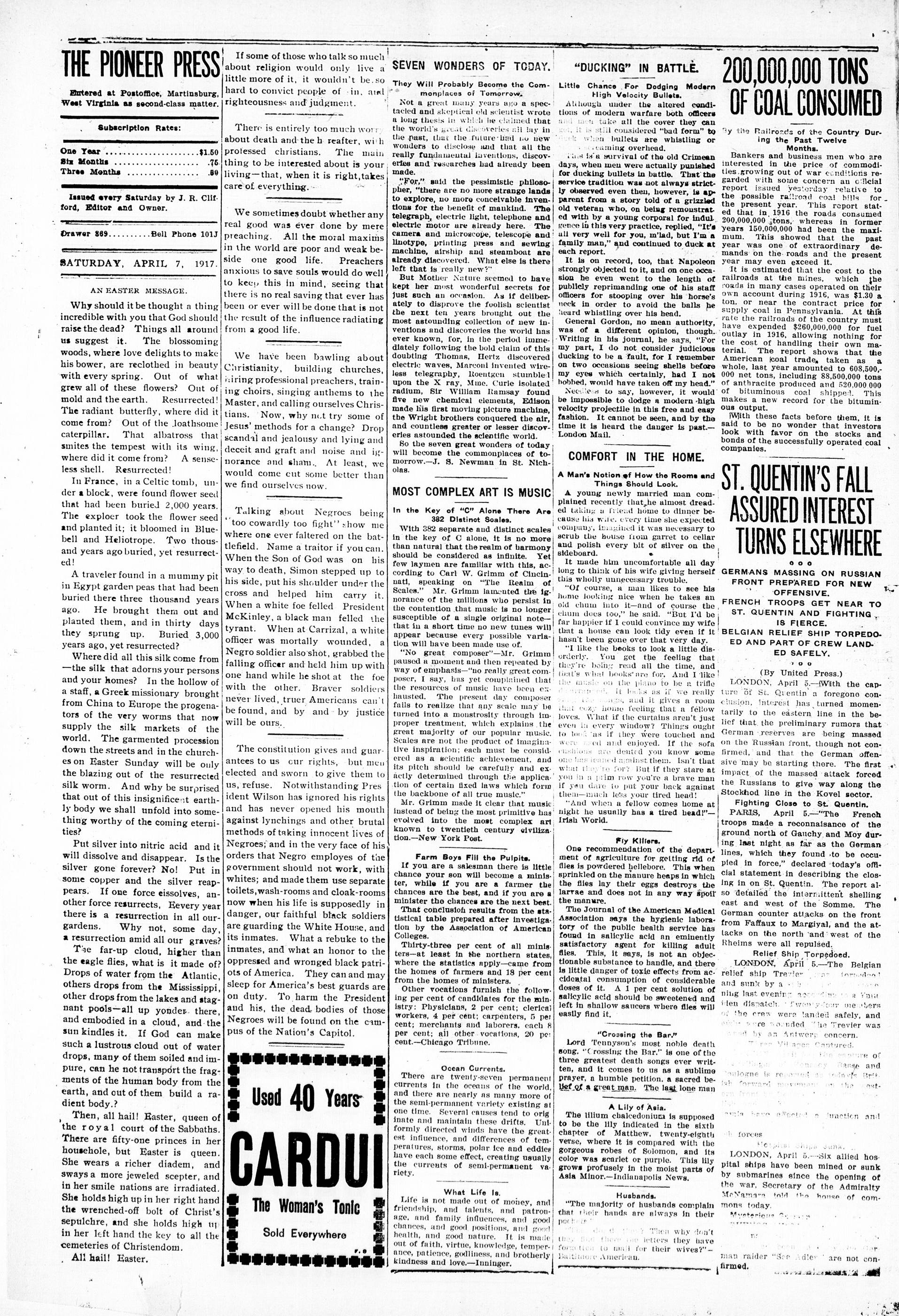
THE PIONEER PRESS
Entered at Postoffice, Martinsburg, West Virginia as second-class matter.
Subscription Rates:
One Year ..... $1.50
Six Months ..... 75
Three Months ..... 89
Issued every Saturday by J. R. Clifford, Editor and Owner.
Drawer 869.....Bell Phone 101J
SATURDAY, APRIL 7, 1917.
AN EASTER MESSAGE.
Why should it be thought a thing incredible with you that God should raise the dead? Things all around us suggest it. The blossoming woods, where love delights to make his bower, are reclothed in beauty with every spring. Out of what grew all of these flowers? Out of mold and the earth. Resurrected! The radiant butterfly, where did it come from? Out of the loathsome caterpillar. That albatross that smites the tempest with its wing, where did it come from? A senseless shell. Resurrected!
In France, in a Celtic tomb, under a block, were found flower seed that had been buried 2,000 years. The explorer took the flower seed and planted it; it bloomed in Bluebell and Heliotrope. Two thousand years ago buried, yet resurrected!
A traveler found in a mummy pit in Egypt garden peas that had been buried there three thousand years ago. He brought them out and planted them, and in thirty days they sprung up. Buried 3,000 years ago, yet resurrected?
Where did all this silk come from—the silk that adorns your persons and your homes? In the hollow of a staff, a Greek missionary brought from China to Europe the progenators of the very worms that now supply the silk markets of the world. The garmented procession down the streets and in the churches on Easter Sunday will be only the blazing out of the resurrected silk worm. And why be surprised that out of this insignificent earthly body we shall unfold into something worthy of the coming eternities?
Put silver into nitric acid and it will dissolve and disappear. Is the silver gone forever? No! Put in some copper and the silver reappears. If one force eissolves, another force resurrects. Every year there is a resurrection in all our gardens. Why not, some day, a resurrection amid all our graves?
The far-up cloud, higher than the eagle flies, what is it made of? Drops of water from the Atlantic, others drops from the Mississippi, other drops from the lakes and stagnant pools—all up yonder there, and embodied in a cloud, and the sun kindles it. If God can make such a lustrous cloud out of water drops, many of them soiled and impure, can he not transport the fragments of the human body from the earth, and out of them build a radient body.?
Then, all hail! Easter, queen of the royal court of the Sabbaths. There are fifty-one princes in her househole, but Easter is queen. She wears a richer diadem, and sways a more jeweled scepter, and in her smile nations are irradiated. She holds high up in her right hand the wrenched-off bolt of Christ's sepulchre, and she holds high up in her left hand the key to all the cemeteries of Christendom. All hail! Easter.
If some of those who talk so much about religion would only live a little more of it, it wouldn't be so hard to convict people of sin, and righteousness and judgment.
There is entirely too much worry about death and the reafter, with professed christians. The main thing to be interested about is your living—that, when it is right, takes care of everything.
We sometimes doubt whether any real good was ever done by mere preaching. All the moral maxims in the world are poor and weak beside one good life. Preachers anxious to save souls would do well to keep this in mind, seeing that there is no real saving that ever has been or ever will be done that is not the result of the influence radiating from a good life.
---
We have been bawling about Christianity, building churches, airing professional preachers, training choirs, singing anthems to the Master, and calling ourselves Christians. Now, why not try some of Jesus' methods for a change? Drop scandal and jealousy and lying and deceit and graft and noise and ignorance and sham. At least, we would come cut some better than we find ourselves now.
Talking about Negroes being "too cowardly too fight" show me where one ever faltered on the battlefield. Name a traitor if you can. When the Son of God was on his way to death, Simon stepped up to his side, put his shoulder under the cross and helped him carry it. When a white foe felled President McKinley, a black man felled the tyrant. When at Carrizal, a white officer was mortally wounded, a Negro soldier also shot, grabbed the falling officer and held him up with one hand while he shot at the foe with the other. Braver soldiers never lived, truer Americans can't be found, and by and by justice will be ours.
The constitution gives and guarantees to us our rights, but men elected and sworn to give them to us, refuse. Notwithstanding President Wilson has ignored his rights and has never opened his mouth against lynchings and other brutal methods of taking innocent lives of Negroes; and in the very face of his orders that Negro employes of the government should not work, with whites; and made them use separate toilets, wash-rooms and cloak-rooms now when his life is supposedly in danger, our faithful black soldiers are guarding the White House, and its inmates. What a rebuke to the inmates, and what an honor to the oppressed and wronged black patriots of America. They can and may sleep for America's best guards are on duty. To harm the President and his, the dead bodies of those Negroes will be found on the campus of the Nation's Capitol.
Used 40 Years
CARDUI
The Woman's Tonic
Sold Everywhere
SEVEN WONDERS OF TODAY.
They Will Probably Become the Commonplaces of Tomorrow.
Not a great many years ago a spectacled and skeptical old scientist wrote a long thesis in which he claimed that the world's great discoveries all lay in the past, that the future had no new wonders to disclose and that all the really fundamental inventions, discoveries and researches had already been made.
"For," said the pessimistic philosopher, "there are no more strange lands to explore, no more conceivable inventions for the benefit of mankind. The telegraph, electric light, telephone and electric motor are already here. The camera and microscope, telescope and linotype, printing press and sewing machine, airship and steamboat are already discovered. What else is there left that is really new?"
But Mother Nature seemed to have kept her most wonderful secrets for just such an occasion. As if deliberately to disprove the foolish scientist the next ten years brought out the most astounding collection of new inventions and discoveries the world has ever known, for, in the period immediately following the bold claim of this doubting Thomas, Hertz discovered electric waves, Marconi invented wireless telegraphy, Roentgen stumbled upon the X ray, Mine, Curie isolated radium, Sir William Ramsay found five new chemical elements, Edison made his first moving picture machine, the Wright brothers conquered the air, and countless greater or lesser discoveries astounded the scientific world.
So the seven great wonders of today will become the commonplaces of tomorrow.-J. S. Newman in St. Nicholas.
MOST COMPLEX ART IS MUSIC
In the Key of "C" Alone There Are 382 Distinct Soales. With 382 separate and distinct scales in the key of C alone, it is no more than natural that the realm of harmony should be considered as infinite. Yet few laymen are familiar with this, according to Carl W. Grimm of Cincinnati, speaking on "The Realm of Scales." Mr. Grimm lamented the ignorance of the millions who persist in the contention that music is no longer susceptible of a single original note—that in a short time no new tunes will appear because every possible variation will have been made use of.
"No great composer"—Mr. Grimm paused a moment and then repeated by way of emphasis "no really great composer, I say, has yet complained that the resources of music have been exhausted. The present day composer fails to realize that any scale may be turned into a monstrosity through improper treatment, which explains the great majority of our popular music. Scales are not the product of imaginative inspiration; each must be considered as a scientific achievement, and its pitch should be carefully and exactly determined through the application of certain fixed laws which form the backbone of all true music."
Mr. Grimm made it clear that music instead of being the most primitive has evolved into the most complex art known to twentleth century civilization.—New York Post.
Farm Boys Fill the Pulpita
If you are a salesman there is little chance your son will become a minister, while if you are a farmer the chances are the best, and if you are a minister the chances are the next best. That conclusion results from the statistical table prepared after investigation by the Association of American Colleges. Thirty-three per cent of all ministers—at least in the northern states, where the statistics apply—came from the homes of farmers and 18 per cent from the homes of ministers. Other vocations furnish the following per cent of candidates for the ministry: Physicians, 2 per cent; clerical workers, 4 per cent; carpenters, 5 per cent; merchants and laborers, each 8 per cent; all other vocations, 20 per cent.—Chicago Tribune.
Ocean Currents
There are twenty-seven permanent currents in the oceans of the world, and there are nearly as many more of the semi-permanent variety existing at one time. Several causes tend to originate and maintain these drifts. Uniformly directed winds have the greatest influence, and differences of temperatures, storms, polar ice and eddies have each some effect, creating usually the currents of semi-permanent variety.
What Life Is
Life is not made out of money, and friendship, and talents, and patronage, and family influences, and good chances, and good positions, and good health, and good nature. It is made out of faith, virtue, knowledge, temperance, patience, godliness, and brotherly kindness and love.—Inninger.
"DUCKING" IN BATTLE
Little Chance For Dodging Modern High Velocity Bullets.
Although under the altered conditions of modern warfare both officers and men take all the cover they can get. It is still considered "bad form" to duck when bullets are whistling or screaming overhead.
This is a survival of the old Crimean days, when men were actually punished for ducking bullets in battle. That the service tradition was not always strictly observed even then, however, is apparent from a story told of a grizzled old veteran who, on being remonstrated with by a young corporal for indulgence in this very practice, replied, "It's all very well for you, m'lad, but I'm a family man," and continued to duck at each report.
It is on record, too, that Napoleon strongly objected to it, and on one occasion he even went to the length of publicly reprimanding one of his staff officers for stooping over his horse's neck in order to avoid the balls he heard whistling over his head.
General Gordon, no mean authority, was of a different opinion, though. Writing in his journal, he says, "For my part, I do not consider judicious ducking to be a fault, for I remember on two occasions seeing shells before my eyes which certainly, had I not bobbed, would have taken off my head."
Neceless to say, however, it would be impossible to dodge a modern high velocity projectile in this free and easy fashion. It cannot be seen, and by the time it is heard the danger is past.—London Mail.
COMFORT IN THE HOME.
A Man's Notion of How the Rooms and Things Should Look.
A young newly married man complained recently that he almost dreaded taking a friend home to dinner because his wife, every time she expected company, imagined it was necessary to scrub the house from garret to cellar and polish every bit of silver on the sideboard.
It made him uncomfortable all day long to think of his wife giving herself this wholly unnecessary trouble.
"Of course, a man likes to see his home looking nice when he takes an old chum into it—and of course the chum does too," he said. "But I'd be far happier if I could convince my wife that a house can look tidy even if it hasn't been gone over that very day.
"I like the books to look a little disorderly. You get the feeling that they're being read all the time, and that's what books' are for. And I like the music on the piano to be a trifle disturbed. It books as if we really are the songs, and it gives a room that cozy home feeling that a fellow loves. What if the curtains aren't just even in every window? Things ought to look as if they were touched and were used and enjoyed. If the sofa cushions are dented you know some one has leashed against them. Isn't that what they're for? But if they stare at you in a prim row you're a brave man if you dare to put your back against them—much less your tired head!
"And when a fellow comes home at night he usually has a tired head!"—Irish World.
Fly Killers.
One recommendation of the department of agriculture for getting rid of files is powdered hellebore. This when sprinkled on the manure heaps in which the files lay their eggs destroys the larvae and does not in any way spoil the manure.
The Journal of the American Medical Association says the hygienic laboratory of the public health service has found in salicylic acid an eminently satisfactory agent for killing adult files. This, it says, is not an objectionable substance to handle, and there is little danger of toxic effects from accidental consumption of considerable doses of it. A 1 per cent solution of salicylic acid should be sweetened and left in shallow saucers where files will easily find it.
"Crossing the Bar."
Lord Tennyson's most noble death song. "Crossing the Bar," is one of the three greatest death songs ever written, and it comes to us as a sublime prayer, a humble petition, a sacred belief of a great man. The last lone man
A Lily of Asia.
The illium chalcedoniuza is supposed to be the lily indicated in the sixth chapter of Matthew, twenty-eighth verse, where it is compared with the gorgeous robes of Solomon, and its color was scarlet or purple. This lily grows profusely in the moist parts of Asia Minor.—Indianapolis News.
Husbands.
"The majority of husbands complain that their hands are always in their porch."
"What do they? Then why don't they find there one letters they have formation to mail for their wives?"—Baltimore American.
200,000,000 TONS OF COAL CONSUMED
By the Railroads of the Country During the Past Twelve Months.
Bankers and business men who are interested in the price of commodities growing out of war conditions regarded with some concern an official report issued yesterday relative to the possible railroad coal bills for the present year. This report stated that in 1916 the roads consumed 200,000,000 tons, whereas in former years 150,000,000 had been the maximum. This showed that the past year was one of extraordinary demands on the roads and the present year may even exceed it.
It is estimated that the cost to the railroads at the mines, which the roads in many cases operated on their own account during 1916, was $1.30 a ton, or near the contract price for supply coal in Pennsylvania. At this rate the railroads of the country must have expended $260,000,000 for fuel outlay in 1916, allowing nothing for the cost of handling their own material. The report shows that the American coal trade taken as a whole, last year amounted to 608,500,000 net tons, including 88,500,000 tons of anthracite produced and 520,000,000 of bituminous coal shipped. This makes a new record for the bituminous output.
With these facts before them, it is said to be no wonder that investors look with favor on the stocks and bonds of the successfully operated coal companies.
ST. QUENTIN'S FALL ASSURED INTEREST TURNS ELSEWHERE
GERMANS MASSING ON RUSSIAN FRONT PREPARED FOR NEW OFFENSIVE.
FRENCH TROOPS GET NEAR TO ST. QUENTIN AND FIGHTING IS FIERCE.
BELGIAN RELIEF SHIP TORPEDOED AND PART OF CREW LAND-
LONDON, April 5.—With the capture of St. Quentin a foregone conclusion, interest has turned momentarily to the eastern line in the belief that the preliminary rumors that German reserves are being massed on the Russian front, though not confirmed, and that the German offensive may be starting there. The first impact of the massed attack forced the Russians to give way along the Stockhod line in the Kovel sector.
Fighting Close to St. Quentin. PARIS, April 5.—"The French troops made a reconnaissance of the ground north of Gauchy and Moy during last night as far as the German lines, which they found to be occupied in force," declared today's official statement in describing the closing in on St. Quentin. The report also detailed the intermittent shelling east and west of the Somme. The German counter attacks on the front from Faffaux to Margiyal, and the attacks on the north and west of the Rheims were all repulsed.
Relief Ship Torpedoed.
LONDON, April 5.—The Belgian relief ship Trevier was forded and sunk by a ship ning last evening according to a vain iden dispatch. Two four members of the crew were landed safely, and eight were bounded. The Trevier was aided by an Antwerp concern.
Three Villages Captured.
The capture of the village of Antwerp by Range and Cologne is reported as follows: British forward movement on the west-ern front.
LONDON, April 5. Six allied hospital ships have been mined or sunk by submarines since the opening of the war. Secretary of the Admiralty McNamara told the house of commons today.
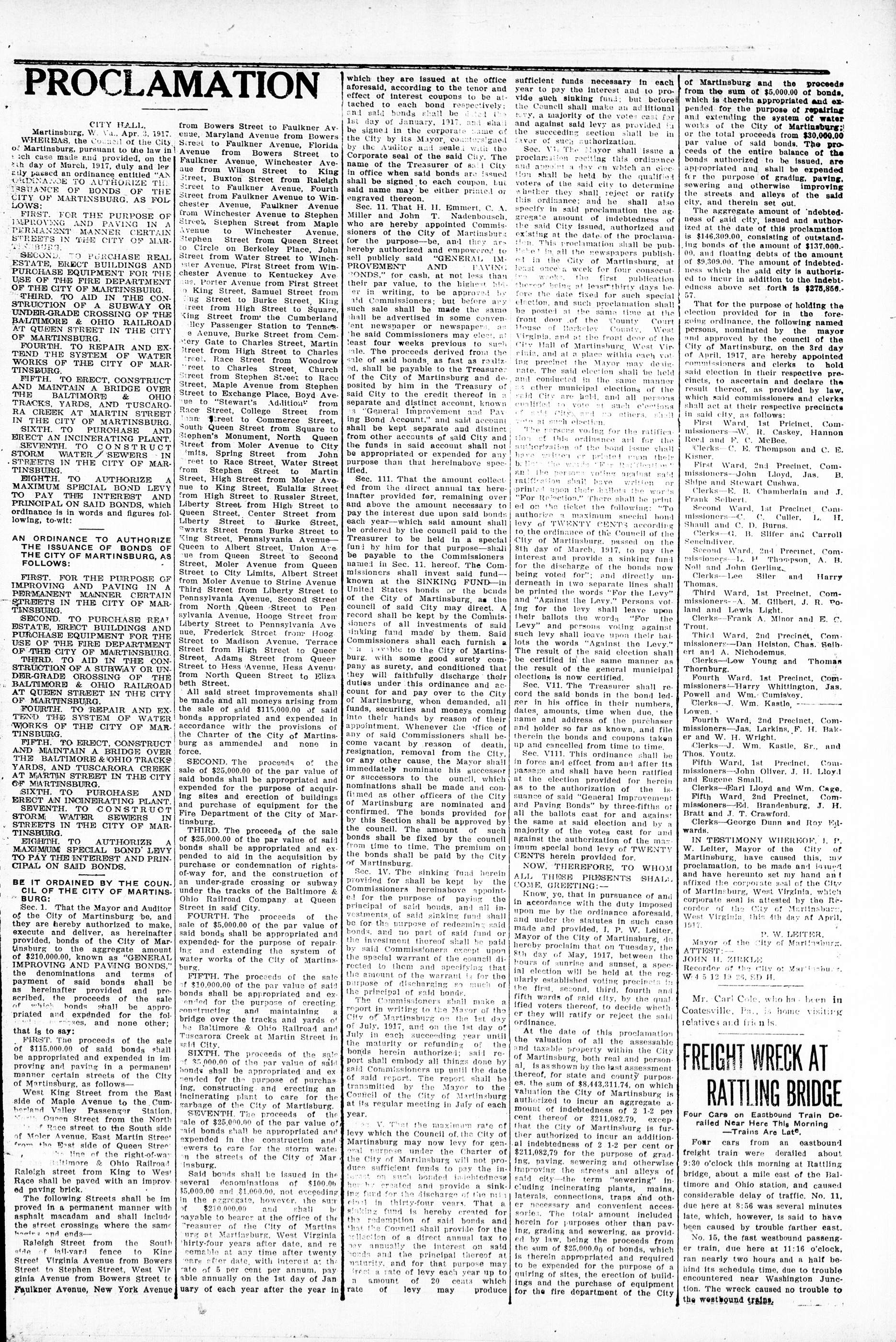
PROCLAMATION
aartinsbirg, W. \a.. Apr. 3, 1917.
WHERBAS, the Co.uci! of the City
o? Martinsburg, pursuant to the law in
sich case made and provided, on the
ih day of March, 1917, duly and leg
cily passed an ordinance entitled “AX
LHINNA OE TO AUTHORIZE ‘TH
iSSUANCR OF BONDS OF ‘THE
CITY OF MARTINSBURG, AS FOL.
LOWS:
FIRST. FOR THE PURPOSE OF
IMPROVING AND PAVING IN. A
PERMANSNT MANNER CERTAIN
STREETS IN CHE CIPFY OF MAR-
SESUBURD,
SECOND. 79 PURCHASE REAL
ESTATE, BRECT BUILDINGS AND
PURCHASE EQUIPMENT FOR THE
USE OF THE FIRE DEPARTMENT
OF THE CITY OF MARTINSBURG.
THIRD. TO AID IN THE CON-
STRUCTION OF A SUBWAY OR
UNDER-GRADE CROSSING OF THE
BALTIMORE & OHIO RAILROAD
AT QUMEN STREET IN THE CITY
OF MARTINSBURG.
FOURTH. TO REPAIR AND EX:
TEND THE SYSTEM OF WATER
WORKS OF THE CITY OF MAR-
TINSBURG.
FIFTH. TO ERECT, CONSTRUCT
AND MAINTAIN A BRIDGE OVER
THE BALTIMORE & OHIO
TRACKS, YARDS, AND TUSCARO-
RA CREEK AT MARTIN STREET
IN THE CITY OF MARTINSBURG.
SIXTH. TO PUROHASE AND
ERECT AN INCINERATING PLANT.
SEVENTH. TO CONSTRUCT
STORM WATER /'SEWERS - IN
+STREETS IN THE CITY OF MAR-
TINSBURG.
BIGHTH. TO AUTHORIZE A
MAXIMUM SPHCIAL BOND LEVY
TO PAY THE INTEREST AND
PRINCIPAL ON SAID BONDS, which
ordinance is in words and figures fol-
lowing, to-wit:
AN ORDINANCE TO AUTHORIZE
THE ISSUANCE OF BONDS OF
THE CITY OF MARTINSBURG, AS
FOLLows: s
FIRST. FOR THE PURPOSE OF
IMPROVING AND PAVING IN A
PERMANENT MANNER CERTAIN
“STREETS IN THE CITY OF MAR-
TINSBURG.
SECOND. TO PURCHASE REAT
BPSTATE, ERACT BUILDINGS AND
PURCHASE EQUIPMENT FOR THE
USE OF THE MIRE DEPARTMENT
OF THE CITY OF MARTINSBURG.
THIRD. TO AID IN THE CON-
STRUCTION OF A SUBWAY OR UN-
DER-GRADE OROSSING OF THE
BALTIMORD & OHIO RAILROAD
AT QUEEN STREET IN THE CITY
OF. MARTINSBURG.
FOURTH. TO REPAIR AND EX:
TEND THE SYSTEM OF WATER
‘WORKS OF THE CITY OF MAR-
TINSBURG.
FIFTH. TO ERECT, CONSTRUCT
AND MIAINTAIN A BRIDGE OVER
THE BALTIMORE & OHIO TRACKS
YARDS, AND TUSCARORA CREEK
AT MARTIN STREET IN THE CITY
6F MARTINSBURG,
SIXTH. TO PURCHASE AND
ERECT AN INCINERATING PLANT.
SEVENTH. TO CONSTRUCT
STORM WATER SEWERS IN
STREETS IN THE CITY OF MAR-
TINSBURG.
> EIGHMH. TO AUTHORIZE A
MAXIMUM SPECLAL BOND’ LEVY
TO PAY THE INTEREST AND PRIN-
CIPAL ON SAID BONDS.
BE IT ORDAINED BY THE COUN-
CIL OF THE CITY OF MARTINS-
~ BURG:
Sec. 1. That the Mayor and Auditor
of the City of Martinsburg be, and
they are hereby authorized to make,
execute and deliver, as hereinafter
provided, bonds of the City of Mar-
tinsburg to the aggregate amount
of $210,000.00, known as “GENERAL
IMPROVING AND PAVING BONDS,”
the denominations and terms of
payment of said bonds shall be
as hereinafter provided and_pre-
scribed, the proceeds of the sale
af which honds shall be appro-
priated ard expénded for the fol-
wt "“>ses, and none other;
that ig to say:
. FIRST. The proceeds of the sale
of $115,000.00 of said bonds shan
be appropriated and expended in im
proving and paving in a permanent
manner certain streets of the City
of Martinsburg, as follows—
West King Street from the Bast
side of Maple Avenue to the Cum-
hortand Valley Passenger Station,
REN Gia PINAR Meaeak Waka icc Mec
oe ee OWers §=6Street. to
Faulkner Avenue, Winchester Ave-
aue from Wilson Street to King
street, Buxton Street from Raleigh
Street to Faulkner Avenue, Fourth
Street from Faulkner Avenue to Win-
chester Avenue, Faulkner Avenue
trom Winchester Avenue to Stephen
Strcet, Stephen Street from Maple
‘Avenue to Winchester Avenue,
Stephen Street from Queen Street
to Circle on Berkeley Place, John
Street from Water Street to Winch-
‘ster Avenue, First Street from Win-
chester Avenue to Kentuckey Ave
ue, Porter Avenue from First Street
) King Street, Samuel Street from
ng Street to Burke Street, King
reet from High Street to Square,
ting Street from: the Cumberland
Hey Passenger Station to Tenncs-
@ Aenuve, Burke Street from Cem-
“ery Gate to Charles Street, Martin
‘treet from High Street to Charles
“reel, Race Street from Woodrow
“reet to Charles Street, Church
ireet from Stephen Street to Race
Street, Maple Avenue from Stephen
Street to Exchange Place, Boyd Ave-
ue to “Stewart’s Addition from
Race Street, College Street from
‘cnn ‘$ireet to Commerce Street,
South Queen Street from Square to
Stephen's Monument, North Queen
Street from Moler Avenue to City
‘mits, Spring Street from John
reet to Race Street, Water Street
from Stephen Street to Martin
Street, High Street from Moler Ave-
nue to King Street, Eulalia Street
from High Street to. Russler Street,
Liberty Street. from High Street to
Queen Street, Center Street from
Ulberty Street to Burke Street,
Swartz Street from Burke Street to
“ing Street, Pennslyvania Avenue—
Queen to Albert Street, Union Ave
ue from Queen Street to Second
Street, Moler Avenue from Queen
Street to City Limits, Albert Street
from Moler Avenue to Strine Avenue
Third Street from Liberty Street to
Pennsylvania Avenue, Second Street
from North Queen ‘Street to Pen
sylvania Avenue, Hooge Street from
Liberty Street to Pennsylvania Ave
nue, Frederick Street from Hoog
Street to Madison Avenue, Terrace
Street from High Street to Queer
Street, Adams Street from Queer
Street to Hess ‘Avenue, Hess Avenu'
from North Queen Street to Eliza
beth Street.
All said street improvements shal!
be mado and all moneys arising from
the sale of said $115,000.00 of said
bonds appropriated and expended in
accordance with the provisions of
the Charter of the City of Martins-
burg as ammended and none in
force.
SECOND. The proceeds 0? the
sale of $25,000.00 of the par value of
said bonds shall be appropriated and
expended for the purpose of acquir-
ing sites and erection of buildings
and purchase of equipment for the
Fire Department of the City of Mar-
tinsburg.
THIRD. The proceeds of the sale
of $25,000.00 of the par value of said
bonds shall be appropriated and ex-
pended to aid in the acquisition by
purchase or condemnation of rights-
of-way for, and the construction of
an _under-grade crossing or subway
under the tracks of the Baltimore &
Ohio Railroad Company at Queen
Street in said City.
FOURTH. The proceeds of the
sale of $5,000.00 of the par value of
said bonds shall be appropriated and
expended: for the purpose of repair.
ing and extending the system of
water works of the City of Martins-
burg.
FIFTH. The procceds of the sale
f $10,000.00 of the par value of said
bonds shall be appropriated and ex.
ented for the purpose of erecting
constructing. and maintaining a
bridge over the tracks and yards of
he Baltimore & Ohio Railroad and
Tuscarora Creek at Martin Street in
seid City.
SIXTH. The proceeds of the sale
£ 82,900.00 of the par value of said
honds shall be appropriated and ex
vended for the purpose of purchas
ing, constructing and erecting an
incinerating plant to care for the
warbage of the City of Martisburg.
SEVENTH. The proceeds of the
“ale of $25,0°0.90 of the par value of
vaid bonds shall be appropriated ane
expended in the construction and.
ewers to care for the storm wate:
Se On ee en See Mere en (Wiens
PDs tall YEA ha ahh SEER eh Tee eT RTE Ne Oe ee
effect of interest coupons to be al-
tached to each bond respectively;
and said bonds shatl be 1 ths
Ist day of January, 1917, and sha‘
be signed in the corporate same of
the City by its Mayor, eousters'gned
by the Auditor asd sealei wii tho
Corporate seal of the said Ciiy. The
name of the Treasurer of sx 1 City
in office when said bonds are issued
shall be signed to each coupon, Lui
said name may be either printed or
engraved thereon,
Sec. 11. That H. H. Bmmert, C. A.
Miller and John TT. Nadenbousch,
who are hereby appointed Commis.
sioners of the City of Martinsbur:
for the purpose—be, and they ars
hereby authorized and empoweres to
sell publicly said “GENERAL IM-
PROVEMENT — AND PAVING
‘ONDS,” for cash, at not less than
their par value, to the highest! pi
ev in writing, to be approvat hv
uid Commissioners; but before asy
‘such sale shall be made the samo
/shall be advertised in some conven
‘ent newspaper or newspaper. a
‘he said Commissioners may ele*', 21
least four weeks previous to su)
ule. The proceeds derived from the
sue of said bonds, as fast as roaliz,
ed, shall be payable to the Treasure
of the City of Martinsburg and de.
posited by him in the Treasury of
said City to the credit thereof in 2
separate and distinct account, known
3 “Genera! Improvement and Pay
ing Bond Account.” and said account
shall be kept separate and distinct
from other accounts of said City and
the funds in said account shall not
be appropriated or expended for any
purpose than that hereinabove spac-
ified.
Sec. 111. That the amount collect
ed from the direct annual tax here-
Inafter provided for, remaining over
and above the amount necessary to
Pay the interest due upon said bonds
each year—which said amount shall
be ordered by the council paid to the
Treasurer to be held in a special
funi by him for that purpose—shali
be payable to the Commissioners
named in Sec. 11. hereof. The Com-
missioners shall invest said fund—
‘known at the SINKING FUND—in
United States bonds or the bends
of the City of Martinsburg, as the
council of said City may direet. A
record shall be kept by the Cominis-
sioners of all investments of suid
sinking fund made by them. Said
‘Commissioners shall each furnish a
“i johle to the City of Martins-
burg. with some good surety com-
‘Pany as surety, and conditioned that
they will faithfully discharge their
duties under this ordinance and ac-
‘count for and pay over tc the City
of Martinsburg, when demanded, ail
funds, securities and moneys coming
into their hands by reason of their
appointment, Whenever the *ffice of
any of said Commissioners shall be-
come vacant by reason of deatit,
resignation, removal from the City,
or any other cause, the Mayor shall
immediately nominate his successor
or successors to the ounc!l, which
nominations shall be made and con-
firmed as other officers of the City
of Martinsburg are nominated and
confirmed. The bonds provided for
by this Section shall be approved by
the council. The amount of such
bonds shall be fixed by the council
from time to time. The premium on
the bonds shall be paid by the City
of Martinsburg.
See. 1V. The sinking fund herein
provided for shall be kept by the
Commissioners hereinabove appoint
el for the purpose of payius the
principal of said bonds, and all ine
vestments, of said sinking fund shall
be for the purpose of redeaminy said
bonds. ard no part of said fund or
the investment thereof shall he paid
by said Commissfoners exerpt upon
the special warrant of the council di-
rected to them and specifying that
the amount of the warrant i: for the
Durpose of discharging #9 much of
the principal ef eafd bonds,
The Commissioners shail make a
report in writing to the Mavor of tho
City of Martinsburg om the tet day
of July, 1917, and on the tst day of
July in each succeeding year until
the maturity or refunding of the
bonds herein authorized; sail re-
‘port shail embody all things done by
said Commissioners up until the date
of said report. The report shall bo
WeAHAETiGA “Has MENG. Adawan facut
year to pay the interest and to pro-
Vide such sinking fund: but before
the Council shall make itu ad Utional
vy, a majority of the votes casi for
and against sald levy as provided f4
the succeeding section shall be in
awor of such cuthorization.
See. Vi. The Stayor shall issue a
proclamiiten reciting this ordinance
and appoint a day en whieh an cise
Hou shall be hetd by the qualified
voters of (he said city to determine
shether they shall. reject or ratify
this ordisance; and he shall also
specify in said proclamation the ag-
aregate amount of indebtedness of
the said City issued, authorized and
ex'sting at the date. of the proclama-
fon. This proclamation shall be pub-
Vere’ fy all the newspapers publish-
et ia the City of Martinsburg, at
lonst onecea week for four consecut
ve owonte, the first publication
thereat being of loast™thirty days be
fove the date fixed for such special
election, and stich proclamation. shall
be posted at the sama time at the
front door of the ‘County Court
Mouse of Berkeley Counts West
Virginia. and at the front deor of the
City Mall of Martinsburg, West Vir.
sini, and at a place withia eaen vot
ing precinct the Mayor may desis:
rate. The said election shall be held
and conducted i the same mannor
x other municipal elections of the
seid City are helt, and all persons
cvalified to vate ot such elections
wf Ay OPMLY 1 y others, stellt
eat oooh election
The porscrs vocdng for the ratifies
How of (his ordinanee arl for. the
authertvation at the bond issue shail
Nave onder er priate? enon thelr
Henares Ace Bai flenitan
an) the perions vottme agatist sate
ralifivovion shalt bave written or
prints? appa thetr blots the warts
“For Reteetion.” (There shall he print
ed on the ticket the followin: “To
authorive a maximum snecial bond
levy of TWENTY CENTS according
to. the ordinance of the Council of the
‘City of Martinsburg. passed on the
Sth day of Mareh, 1917, to pay the
interest and provide a sinking fund
for the discharge of the bonds now
being voted for"; and directly un-
derneath in two separate lines shal!
be printed the words “For the Levy”
and “Against the Levy.” Persons vot
ing for the levy shall leave upon
‘heir ballots the words “For the
Levy” and persons voting against
such levy shall loave upon their bat
lots the words “Against the Levy.”
The result of the said clection shall
be certified in the same manner as
the result of the general municipal
elections is now certified.
See. Vil. The Treasurer shall re-
cord the said bonds in the bond led-
rer in his office in their numbers,
dates, amounts, time when due, the
name and address of the purchaser
nnd holder so far as known, and file
therein the bonds and coupons taken
up and cancelled from time to time
See. V111. This ordinance shall be
in foree and effect from an’ after its
passaxe and shall have been ratified
at the clection provided for herein
as to the authorization of the is-
suance of said “General Improvemon!
and Paving Bonds” by three-fifths or
all the ballots cast for and agains?
the same at said election and by a
majority of the votes cast for and
against the authcrization of the ma~
imum special bond levy of TWENTY
CENTS herein provided for.
NOW. THEREFORE, TO WHOM
ALL THESH PROSENTS SHAL:.
COME, GREETING:—
Know, yo, that in pursuance of and
in accordance with the duty Imposed
upon me by the ordinance aforesaid,
and under the statutes in such ease
made and provided, I, P. W. Leiter,
Mayor of the City of Martinsburg, ic
hereby proclaim that on ‘Tuesday, the
fn day of May, 1917, between’ the
hours of «unrise and sunset, a spee-
ial election will be held at the reg-
ularly established voting precinets {1
‘he first, second, third, fourth and
fifth wards of sald city, by the qual
ified voters thereof, to decide wheth
cr they will ratify or reject the sai
ordinance.
At the date of this proclamation
the valuation of all the assessable
and taxable property within the City
of Martinsburg, both real and person
al, {sas shown by the last asseasment
thereof, for state and count¥ purpos-
es. the sum of $8.443.211.74. an which
of Martinsburg and the proceeds
from the sum of $5,000.00 of bonds,
which is therein appropriated and ex-
pended for the purpose of repairing
ant extending the ayatem of water
works of the City of Martinsburg;!
or the total proceeds from $30,000.00
par value of said bonds. The pro
ceeds of the entire balance of the
bonds authorized to be Issued, are
appropriated and shall be expended
fcr tho purpose of grading, paving,
sewering and otherwise improving
the streets and alleys of the said
city, and therein set out.
The aggregate amount of ‘ndebted-
ness of said city, issued and author
ized at the date of thie proclamation
is $146,309.00, consisting of outstand-
ing bonds of the amount of $137,000.-
00, and floating debts of the amount
of $9,309.00, The amount of indebted-
ness which the said city is authoriz-
ed to incur in addition to the indebt-
edness above set forth {8 $275,856.-
5T.
That for the purpose of holding the
election provided for in’ the — fore-
xoing ordinance, the following named
persons, nominated by the mayor
snd approved by the council of the
City of Martinsburg, on the 8rd day
of April, 1917, are hereby appointed
commissioners and clerks to hold
said election in their respective pre-
cincts, to ascertain and declare the
result thereof, as provided by law,
which said commissioners and clerks
shall act at their respective precincts
in said city, as follows:
Wrst Ward, 1st Prictnet, Com:
missioners —W. R. Caskey, Hannon
Reed and F.C. MeBee
Clerks- C. 8. Thompson and C. B.
Kisner.
First) Ward, 2nd Preeinet, Com-
missioners—John Lloyd, Jas. B,
Shipe and Stewart Cushwa,
Clerks—K, BR. Chamberlain and J.
Prank Seibert
Second Ward, Ist Precinet, Com:
missioners —C, @. Culler, LL
Shaull and C.D. Burns.
Mlerks—G, B. Siifer ang Carroll
Sencindiver.
Second Ward, 204. Preemet, Com:
missioners, Ho ‘Thompson, A. Be
Nol! and John Gerling.
Clerks—Lee Siler and Harry
‘Thomas,
Third Ward, Ist. Precinct, Com-
missioners-~A, M. Gilbert, J. R. Po-
land and Lewis Light.
Clerks--Frank A, Minor and EB. ¢.
‘Trout.
Third Ward, 2nd Precinet, Com-
missioners—Dan Helston, Chas. Selb-
ert_and A. Nichodemus.
Clerks—Low Young and ‘Thomas
Thornburg.
Fourth Ward, Ist Precinct, Com-
missioners:—Harry Whittington, Jas.
Powell and Wm.’ ‘Cumiskoy.
‘Clerks——J. Wm. Kastle, ----——-
Lowen, *
Fourth Ward, 2nd Precinct, Com-
missioners—Jas, Larkins, F. H. Bak-
er and W. H. Wright.
Clerks—J. Wm, Kastle, Sr., and
Thos. Youtz.
Fifth Ward, Ist Precinet, Com-
missioners—John Oliver, J. H. Lloy.t
and Eugene Small,
Clerks—Parl Lloyd and Wm. Cage.
Fifth Ward, 2nd Precinct, Com-
missioners—Id, Brandenburg, J. H.
Bratt and J. T. Crawford.
Clerks—George Dunn and Roy Va-
wards.
IN TPSTIMONY WHERKOF, 1, £.
W. Leiter, Mayor of the City of
Martinsburg, have caused this, my
proclamation, to be made and issurt
and have hereunto set my hand ant
affixed the corporste goal of the Clty
of Martinsburg, West Virginia, which
corporate sea) is attested hy tae Re-
corder of the City of Martinsbars,
West Virginia, this 4th day af April,
191% ‘
PW. LEITER,
Mayor of the city ef Martfasbnrs.
ATTEST:
JOHN UW. “RK
Recorder of the City ot Mariociue +.
W45 1219 25, 8D 1
wm A ee ea
Mr. Car! Cole, who ha. been in
Coatesville, Pa.. is home visiting
relatives and frien ts
Four Cars on Eastbound Train De-
railed Near Here This Morning
—Trains Are Laté,
Four cars from an oastbound
freight train were derailed about
9:30 o'clock this morning at Rattling
bridge, about a mile cast of the Bal-
timore and Ohio station, and caused
considerable delay of traffic. No. 11,
due here at $:56 was several minutes
late, which, however, 1s said to have
been caused by trouble farther east.
No. 16, the fast westbound passeng-
er train, due here at 11:16 o'clock,
ran nearly two hours and a half be-
hind its schedule time, due to trouble
encountered near Washington Junc-
tion. The wreck caused no trouble to
the westbound trains, jet heh
ee : :
Fd Zz
pone, ot Bi
5 CSC
5 ih bit Oe
theqes 40: s30gt
to mplayer
ae
’ e abod
WARI “At Keoure
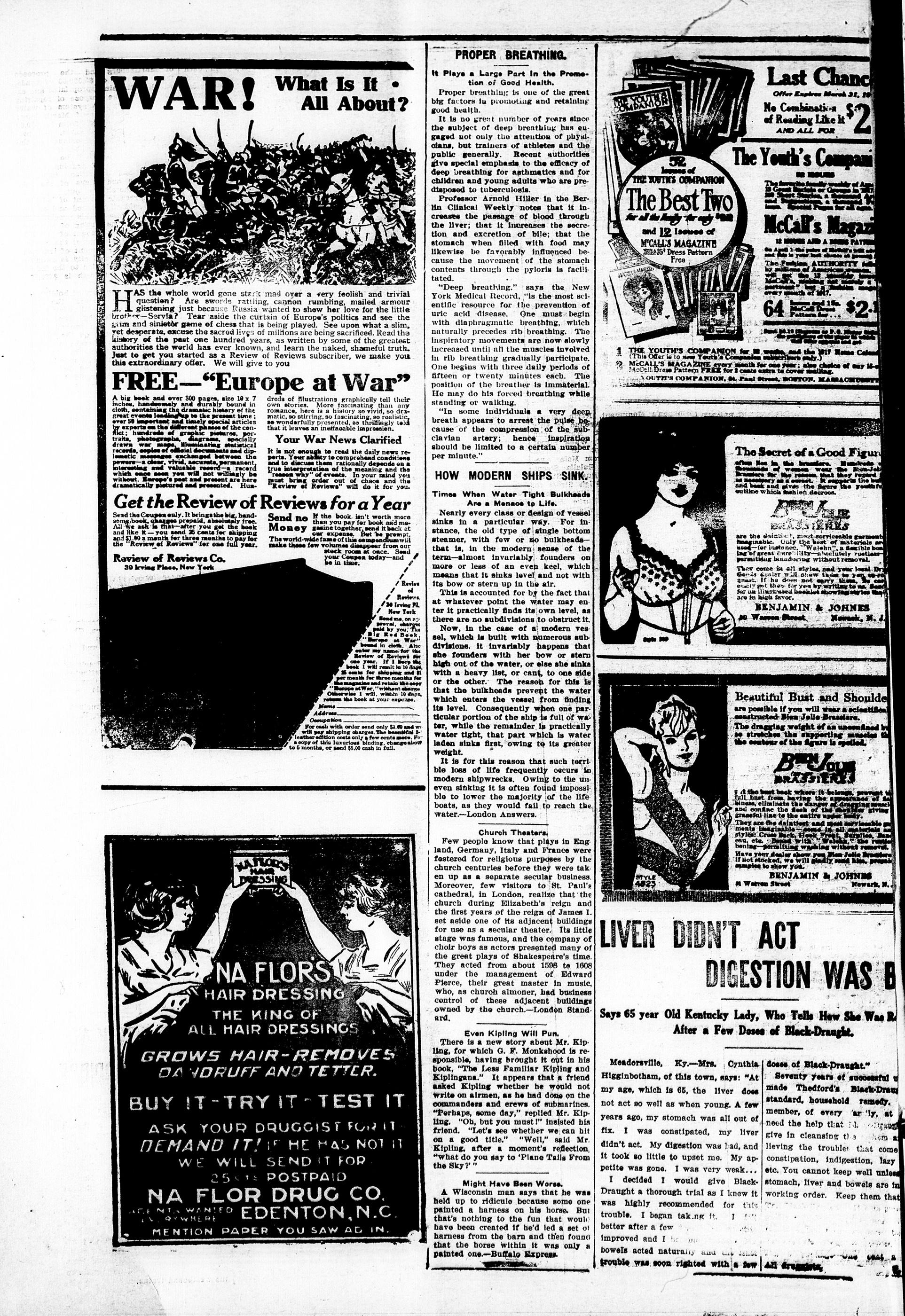
All About?
De 8 Aas nn
ex x: i oe .
= egy! sores Ge
ae NY Ss wey te 5 ES
TR: > i
(te ie y 6 Ss; ee aS) :
PRR OIA ee Bn Ae
ORR Rac 7 Cee
‘AS the whole world gone sters mad over a very feolish and trivial
question? Are swords rattling, cannon rumbting, mailed armour
|. A glistening just because Russia wanted to shew her love for the little
brother—Servia? Tear aside the curtain of Europe's politics and see the
iim and sinietdc game of chess that is being played. See upon what a slim,
yet desperate, excuse the sacrad livgs of milHons are being sacrificed. Read the
history of the pest one hundred years, as written by some of the greatest
authorities the world has ever known, and learn the naked, shameful truth.
Just to get you started as a Review of Reviews subscriber, we make you
this extraordinary offer. We will give to you
SF t War”
FREE—“Europe at War
Get the Review of Reviews fora Year
oS Sh Sime. «
/
t
7 Reston
foo
7 Revie,
130 Irving M.
7 New York
a end ns, on
orevals
by ‘vou Fae
vate Redbook,
rope at War”
5 bound In cloth, Ajzc
Keview 2€ Bavignt st
: one Your. If 1 Becy ths
; book 1 wii remit ia 10
cents for shloping and Mi
eESctagenion ana retain tos oopy
magasion and ro
smarope ot War." wishant sare
A ss x Oveerwise 1 will, wriabin 10 dar
A 5 as retum the book at your expuase.
ij Cs: Name
; 2 Address
pin or cash with ordar send only $2, and w'
AOR oA ENGL DF will yay shipping charges. nc bennstfad &-
r fa ETL a BIR? loatocr edition conta onl few conta mere:
5 La ee scopy of this luxurious ‘bloding, °
‘6 RR Lo ee, PSE 605 rhocths, or pond $20 cass nici
ae ca ee a
oe
a a A A Ne” SE
” ! a ON Yee ;
WNie.. .. “Wiag
7. A ‘ io
Nae: INR ee C= 7
~ Stig ie an x
SSeS T N= DRESSING: BP \W
: Atlant Ks ee NS
4 ALL HAIR ORESSINGS . ° vi
| GROWS HAIR- REMOVES
OL ADRUFF AND TETTER. |
BUY !T-TRY IT’ TEST IT
ASK YOUR DQUGGISE Fu it
Oda PL oe ee ol ek Oe
VESEY a ST | 8) 2
2501s POSTPAID
NA FLOR DRUG CO.
aa eas ies RO) pia som
| > MENTION PAPER YOU SAW OG IN. :
A big book and ever 300 pages, size 10x 7
inches, handsomely and Suraly’ beund in
cloth, containing the dramatic histery of the
Great cvense leadiaghap to the present time:
ever 50 important and ‘special articles,
Rr exrertson the different phases of the con-
; hundreds of Ne piettros, por-
trata, photographs, esclally
drawe war, maps, ies etatisticel
records, copies ial documents and dip-
' ‘Geet, vivid; nectinate, permanent,
a clear, vivid, necul nen
Bing nar enema
Yihowt: Werepe's post und preevat are here
without. e present are here
Yithout. Rarepe’s past and present are here
Seing book, figgee prepaid, aback Me ten
AiMie "sek eke ator 9 eae book
and Hike &t— you send % Conta tor shipping
ap: f},0 a manta for thres months 10 Bay for
fc Review of Reviews" fer one full ven
dreds of Mlustrations graphically tell their
own stories, More fascinating than any
romance, here is a history so vivid, 90 dear
matic, so stirring, so fascinating, so realistic,
80 wonderfully presented, 80 thritingly ted.
that it leaves an ineéfacable impression.
Your War News Clarified
Ie ia not enough te read the daily news re-
perts. Your y te comprehend conditions
Bnd to discuss them rationally depecds on a
fru jatergrotation of the meaning and the
‘reseea why" of events. In your mind you
Tigat ‘bring ordac out’ of Chace and ‘the
Reviaw of Rovicee™ Gil de mine yon
Hf the book isn’t worth more
Send no than you pay fer book asd ma-
Money sainetogether,sena back st
our expense But be pt
‘The world-wide fame of this compendtum will
make these few Volumes disappear from aur
‘Coupon waar and
Our Coupen toda
ele etn Geen one ae
PROPER _ BREATHING.
tt Plays a Large Part In the Prome-
Slem of Gaad Health,
Proper bresthiuj; is one of the great
big factors iu promoting and retaining
good health.
It 1s no grest number of years since
the subject of deep breathiug has en-
gaged not only the attention of phys!
olans, but trainers of athletes and the
public generally. Recent authorities
@ive special emphasis to the efficacy of
deep vreathing for asthmatics and for
children and young adults who are pre-
dtsposed to tuberculosis.
Professor Arnold Hier in the Ber-
Hn Clinical Weekly notes that it in-
creases the passage of blood through
the liver; that it Increases the secre-
tion and excretion of bile; that the
stomach when filled with food may
Hkewise be favorably influenced be-
cause the movement of the stamach
contents through the pyloris is factii-
tated. :
“Deep breathing.” says the New
York Medical Record, “1s the most scl-
entific resource for the prevention of
uric acid disease. Qne must. begin
with diaphragmatic breathing, which
naturally precedes rib breathing. The
Inspiratory movements are now slowly
increased until al the muscles involved
in rib breathing gradually participate.
One begins with three daily periods of
fifteen or twenty minutes each. The
position of the breather is immaterial.
He may do his forced breathing while
standing or walking.
“In some individuals a very deep
breath appears to arrest the pulse be:
cause of the compression of the sub-
clavian artery; hence, _ inspiration
should be limited to a certain number
per minute.” <i ag
HOW MODERN SHIPS. SINK:
Are a Menace to Life. ae)
Nearly every class or design of vessel
sinks in a particular way. For in-
stance, the old type of:single bottom
steamer, with few or mo bulkheads—
that is, in the modern: sense of the
term—almost invariably. founders on
more or less of an evep keel, which
means that it sinks level and not with
its bow or stern up in the air.
‘This is accounted for by the fact that
at whatever point the water may en-
ter it practically finds ite own level, as
there are no subdivisions to obstruct it.
Now, in the case of a: modern ves-
sel, which is built with numerous sub
divisions, it invariably happens that
she founders with her bow or stern
high out of the water, or else she sinks
with a heavy list, or cant, to one side
or the other. The reason for this is
that the bulkheads prevent the water
which enters the vessel from finding
its level. Consequently sree one par-
ticular portion of the ship is full of wa:
ter, while the remainder is practically
water tight, that part which is water
laden sinks first, owing to its greater
weight. z
It is for this reason that such terri.
ble loss of life frequently oecurs ‘fn
modern shipwrecks, Owing to the un-
even sinking it is often found impossi-
ble to lower the majority jof the life-
boats, as they would fail to reach the
water.—London Answers.
Church Theaters,
Few people know that plays in Eng.
land, Germany, Italy and France were
fostered for religious purposes by the
church centuries before they were tak-
en up as a separate seculas business.
Moreover, few visitors to St. Paul's
cathedral, in London, realize that ‘the
church during Elizabeth’s reign and
the first years of the reign of James I.
set aside one of its adjacent buildings
for use as a secular theater. Its little
stage was famous, and the company of
choir boys as actors presented many of
the great plays of Shakespeare's time.
They acted from about 1598 te 1608
under the management of Bdward
Pierce, their great master in music,
who, as church almoner, had business
control of these adjacent buildings
owned by the church.—London Stand.
ard,
Even Kipling Will Pun.
‘There is a new story abeut Mr. Kip-
ling, for which G. F. Monkshood is re-
sponsible, having brought ft out in his
book, “The Less Familiar Kipling and
Kiplingana.” It appears that a friend
asked Kipling whether he would not
Write on airmen, as he had done on the
commanders and erews of submarines.
“Perhaps, some day,” replied Mr. Kip-
Ung. “Ob, but you must!” insisted his
friend. “Let’s see whether we can hit
on a good title.” “Well,” said Mr.
Kipling, after a moment's reflection,
“what do you say to ‘Plane Tails From
the Sky?”
Might Have Been Worse.
A Wisconsin man says that he was
held up to ridicule because some one
painted a harness on his horse, But
that’s nothing to the fun that woul
have been created if he’d led a set o!
harness from the barn and then founc
that the horse within it was only a
painted one.—Buffalo Express.
a) ——
La Last
a ran) ie y i Offer Expires March 31,
URS TAMA «No Combinativn $
RES I i | of Reading Like it 2
i i. x. a AND ALL SOR:
a a a a GaAs. nae
ge The Youth's Compani
| m= a
(The BestTyo\) 2fesncen®
A rman pg Metals
A See i naiemameeas
ose Free | a eM The. AUTHORITY
ae TEVA ce See
mS Ve he estan © i, Le
(\ SWAG] 64 ees $2:
1 = oor, | OC ReAS: 2... aca
Sa Seer
4. THE XQUTH'S CoMpargon ter me. ‘asd the Wi? Hense
pes co} OUTIVS COMPANION, @¢, Pan! Street, BOSTOR. Mam@ACKUSET:
a Lop thes
7 5 eee
os a
- The Secret of a Good Fig:
7 ‘ftom Hes im the bremiere, Mumireds
a Pronto, ot wemen wear the Brua-J:
bt ae. Tears ye they resent.
Sic
| shite PES EK
e hs elo
are the daintiv:t, mevt-serviceabie ty
\ egoane Guly the hese of materials
Mot erent, Ture’ iiity-omeldtety rustian
io 7 peat fot lanadering without removal, _
j Na J her come ott styi0s, pad ome losal
aa) ee Bf Grants If he dow ont ony thean, We
aS a cunts gut tov fi ves by writing tems Sead
. ie ie Bre ia high invor- een eee
f ; [? BENJAMIN: & JOHNES
rig) Pe Mover oes - - Mewesk, ¥, 2.
} a ein ae
Hi =%
LIVER DONT ACT =
DIGESTION: WAS
Says 65 year 1d Reade Se Tells Hew She Was Bi
om a
| We
Ls
ac. ¥
one A
Meadorsville, Ky.—Mrs, , Cynthia
Higginbotham, of this town, says: “At
my age, which fs 65, the ver does
not act 80 well as when young. A few
years ago, my stomach was all out of
fix. I was constipated, my liver
didn’t act, My digestion was bad, and
it took so little to upset me. My ap-
petite was gone. I was very weak...
I decided 1 would give Black.
Draught a thorough trial as I knew it
was highly recommended for tits
trouble. I began tak.ng {t. 7°"
better after a few ant
{mproved and I}: ‘
bowels acted naturaliy auu us ceisi
ftouble was.scon righted with'a few
Beautiful Bust and Should
fhle if you will waar.
‘sonstrapted: Bien Jolie Bressler. Ee
‘The dragging weight of an unconfined
00. stretches the supporting muscles
the contour of the figure ts spetiod, i
st the bunt beek where {t-belona, preven
acne memes
and confine the flesh String
gragetal line te the ‘eatire upder ae fe
Bane cont and towable 25
tau ete. * Sai aie ie rae
Sonine~l ig ne
Mave your. ig shew, hen Jetle Brenton
orn ET AE ate poe
BENJAMIN 2s JOHNES
A Warren Street _, Newark, ¥.
yuthia.| doses.of Black-Draught.” © |
a: “At| Seventy yeats coi
- doos | Ade Thedtord’s Black!
A tew|*andard, household remedy,
member, of every ‘ar ‘ly, at.
out of nocd the help that 21, --:iga
liver | give in cleansing ths sm
id, and | Heving the trouble: that come
My ap-| constipation, indigestion, Yazy
eak... | etc. You cannot keep well unless
Black- | stomach, liver and bowels are ta
new it | working order. Keep them, that
this, TP Pea poss
LP EER e ’
yeh De Lot mae ale ab
stow |atenpgn, |< ®