Plaindealer
Friday, January 5, 1900
Topeka, Kansas
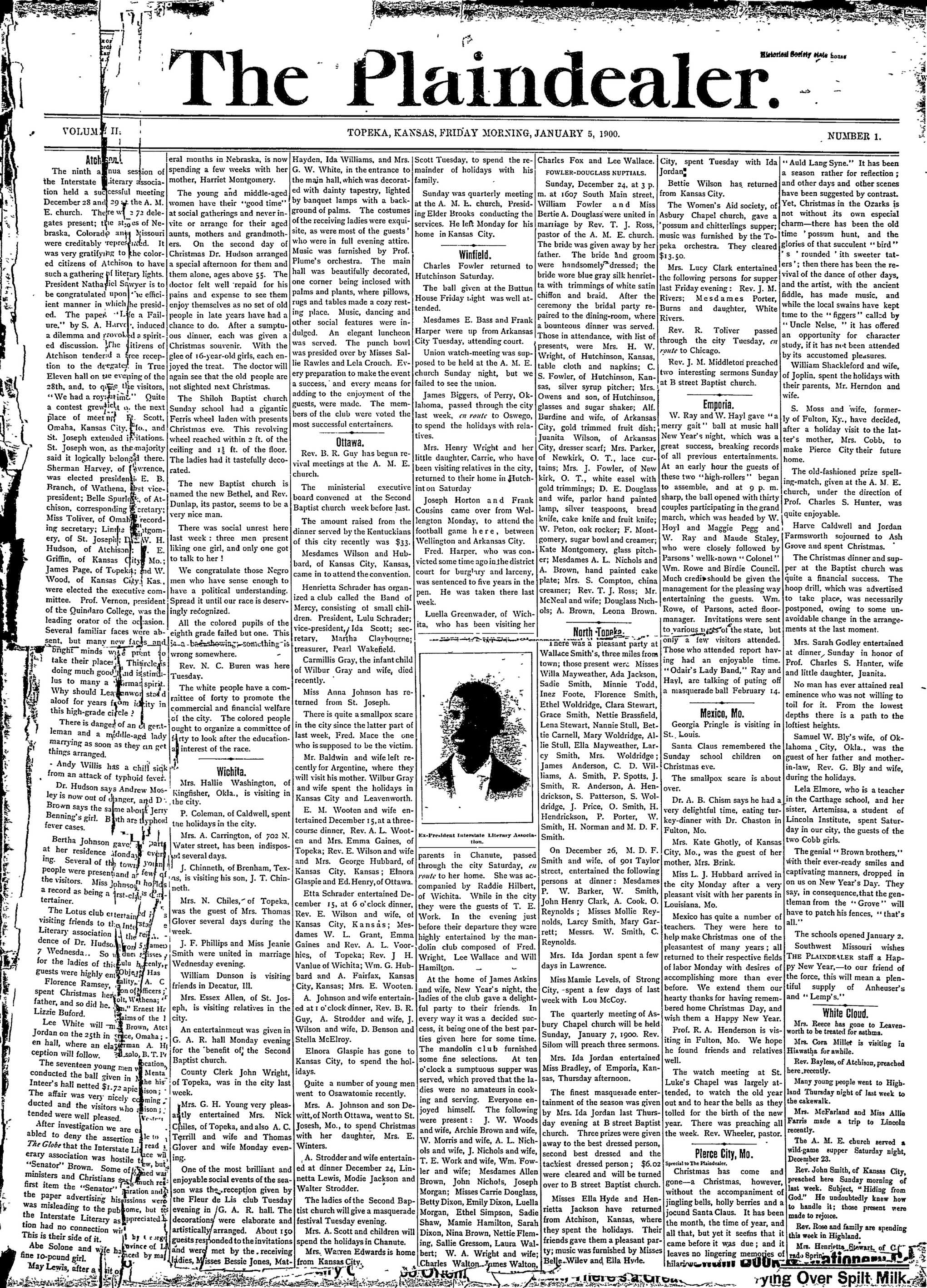
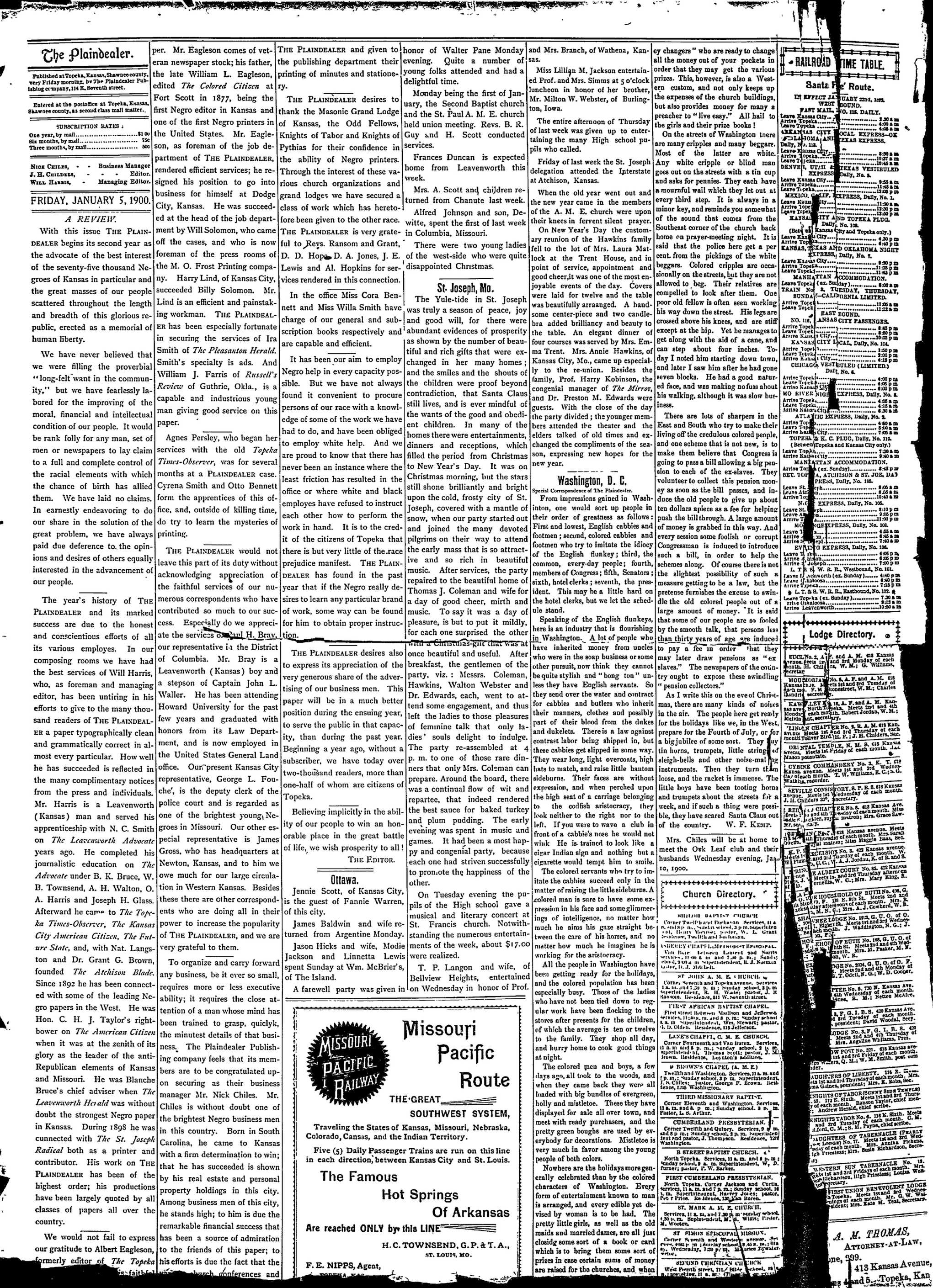
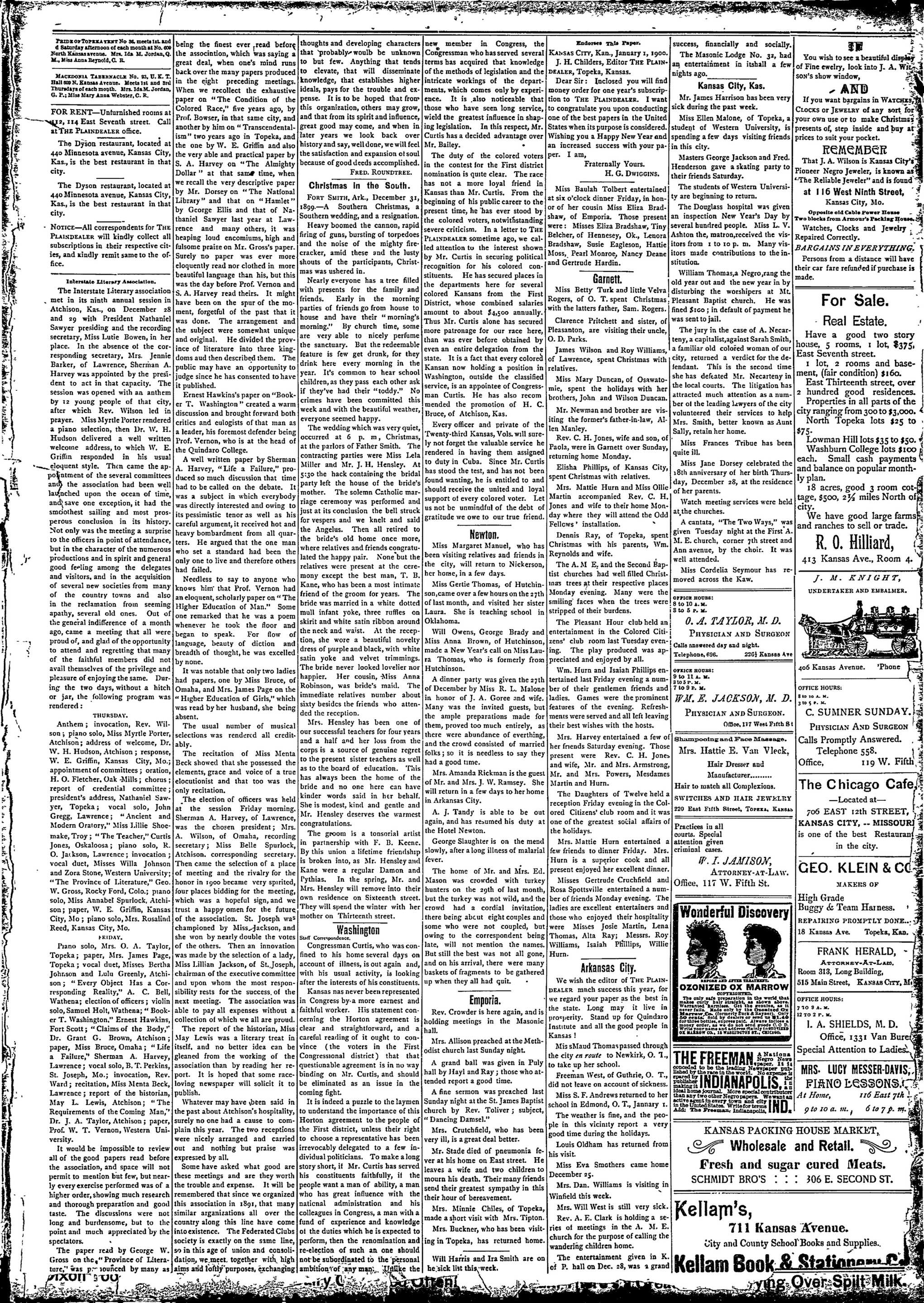
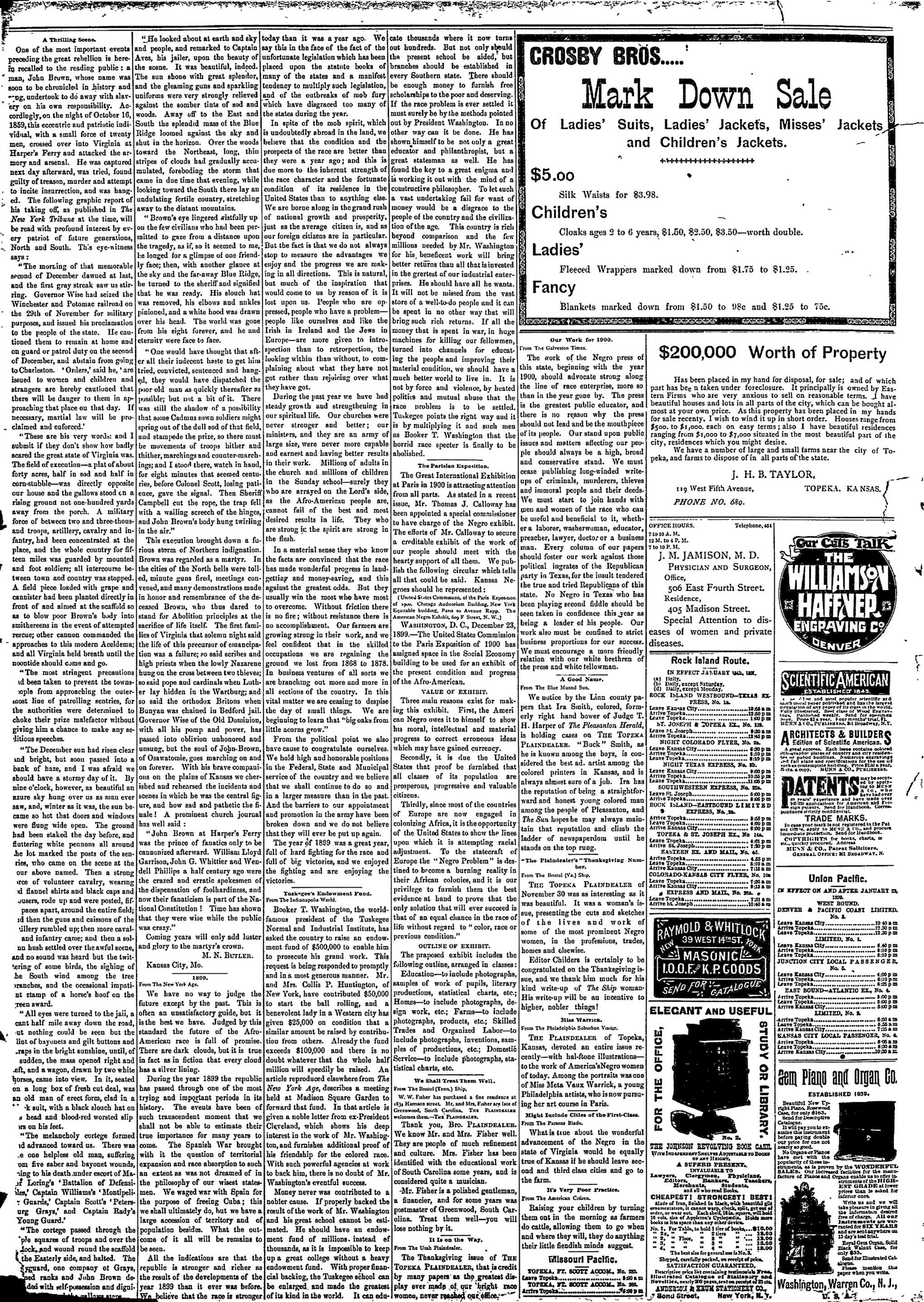
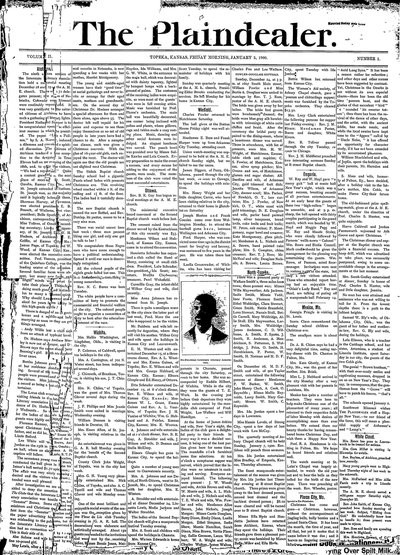
Page text (machine-generated)
The ninth annual session of the Interstate Literary association held a successful meeting December 28 and 29 at the A. M. E. church. There were 272 delegates present; the stars of Nebraska, Colorado and Missouri were creditably represented. It was very gratifying to the colored citizens of Atchison to have such a gathering of literary lights. President Nathadiel Sawyer is to be congratulated upon the efficient manner in which he presided. The paper "Life a Failure." by S. A. Harvey, induced a dilemma and provoked a spirited discussion. The citizens of Atchison tendered a free reception to the deegate, in True Eleven hall on the evening of the 28th, and, to quite the visitors, "We had a royalty time." Quite a contest grew light on the next place of meeting. E. Scott, Omaha, Kansas City, Mo., and St. Joseph extended invitations. St. Joseph won, as the majority said it logically belonged there. Sherman Harvey, of Lawrence, was elected president. E. B. Branch, of Wathena, first vice-president; Belle Spurlee, of Atchison, corresponding secretary; Miss Toliver, of Omaha recording secretary; Linne Wittgomery, of St. Joseph; Dr. W. H. Hudson, of Atchison; J. E. Griffin, of Kansas City, Mo.; James Page, of Topeka; and W. Wood, of Kansas City, Kas., were elected the executive committee. Prof. Vernon, president of the Quindaro College, was the leading orator of the occasion. Several familiar faces were absent, but many new faces and bright minds were present to take their places. This circle is doing much good and is stimulus to many a "Norman spirit." Why should Leavenwor stood aloof for years from identity in this high-grade circle?
There is danger of an gentleman and a middle-aged lady marrying as soon as they can get things arranged.
Andy Willis has a chill sick from an attack of typhoid fever.
Dr. Hudson says Andrew Mosley is now out of danger, and Dr. Brown says the same about Jerry Benning's girl. Both are typhoid fever cases.
Bertha Johnson gave a party at her residence Monday evening. Several of the town young people were present and a few of the visitors. Miss Johnson holds a record as being a first-class entertainer.
The Lotus club entertained its visiting friends to the Interstate Literary association in the reenidence of Dr. Hudson on 5. January 7 Wednesda. So we duet kisses for the ladies of this culu hocently, guests were highly enthused. Objets Has Florence Ramsey, reality, A. C. spent Christmas her holt, Wethena; father, and so did he. "Ernest H. Lizzie Buford.aims of the Lee White will m. Brown, Atch Jordan on the 25th in grace, Omaha; en hall, where an elaverman A. H.ception will follow.
The seventeen young men were location,
conducted the ball given in Miche his
Inteer's hall netted $1.72 apie bison;
The affair was very nicely coming
ducted and the visitors who bison;
tended were well pleased.
After investigation we are able to deny the assertion to The Globe that the Interstate Library will erary association was hostile toew,but "Senator" Brown. Some of them was ministers and Christians seeing much refirst item the "Senator" operation and the paper advertising his ussions were misleading to the pubsome,but to the Interstate Literary as appreciated ination had no connection wit This is their side of it.
Abe Solone and wife hauanced by ma fine 10-pound girl.
The Plaindealer.
eral months in Nebraska, is now spending a few weeks with her mother, Harriet Montgomery.
The young and middle-aged women have their "good time" at social gatherings and never invite or arrange for their aged aunts, mothers and grandmothers. On the second day of Christmas Dr. Hudson arranged a special afternoon for them and them alone, ages above 55. The doctor felt well repaid for his pains and expense to see them enjoy themselves as no set of old people in late years have had a chance to do. After a sumptuous dinner, each was given a Christmas souvenir. With the glee of 16-year-old girls, each enjoyed the treat. The doctor will again see that the old people are not slighted next Christmas.
The Shiloh Baptist church Sunday school had a gigantic Ferris wheel laden with presents Christmas eve. This revolving wheel reached within 2 ft. of the ceiling and $ \frac{1}{2} $ ft. of the floor. The ladies had it tastefully decorated.
The new Baptist church is named the new Bethel, and Rev. Dunlap, its pastor, seems to be a very nice man.
There was social unrest here last week: three men present liking one girl, and only one got to talk to her!
We congratulate those Negro men who have sense enough to have a political understanding. Spread it until our race is deservingly recognized.
All the colored pupils of the eighth grade failed but one. This is a best showing, something is wrong somewhere.
Rev. N. C. Buren was here Tuesday.
The white people have a committee of forty to promote the commercial and financial welfare of the city. The colored people ought to organize a committee of forty to look after the educational interest of the race.
Wichita.
Mrs. Hallie Washington, of Kingfisher, Okla., is visiting in the city.
P. Coleman, of Caldwell, spent the holidays in the city.
Mrs. A. Carrington, of 702 N. Water street, has been indisposed several days.
J. Chinneth, of Brenham, Texas, is visiting his son, J. T. Chinneth.
Mrs. N. Chiles, of Topeka, was the guest of Mrs. Thomas Glover several days during the week.
J. F. Phillips and Miss Jeanie Smith were united in marriage Wednesday evening.
Wichita.
William Dunson is visiting friends in Decatur, Ill.
Mrs. Essex Allen, of St. Joseph, is visiting relatives in the city.
An entertainment was given in G. A. R. hall Monday evening for the benefit of the Second Baptist church.
County Clerk John Wright, of Topeka, was in the city last week.
Mrs. G. H. Young very pleasantly entertained Mrs. Nick Chiles, of Topeka, and also A. C. Terrill and wife and Thomas Glover and wife Monday evening.
One of the most brilliant and enjoyable social events of the season was the reception given by the Fleur de Lis club Tuesday evening in G. A. R. hall. The decorations were elaborate and artistically arranged. About 150 guests responded to the invitations and were met by the receiving ladies, Misses Bessie Jones, Mat-
TOPEKA, KANSAS, FRIDAY MORNING, JANUARY 5. 1900.
Hayden, Ida Williams, and Mrs. G. W. White, in the entrance to the majn hall, which was decorated with dainty tapestry, lighted by banquet lamps with a background of palms. The costumes of the receiving ladies were exquisite, as were most of the guests' who were in full evening attire. Music was furnished by Prof. Plume's orchestra. The main hall was beautifully decorated, one corner being inclosed with palms and plants, where pillows, rugs and tables made a cozy resting place. Music, dancing and other social features were indulged. An elegant luncheon was served. The punch bowl was presided over by Misses Sallie Rawles and Lela Crouch. Every preparation to make the event a success, and every means for adding to the enjoyment of the guests, were made. The members of the club were voted the most successful entertainers.
Ottawa.
Rev. B. R. Guy has begun revival meetings at the A. M. E. church.
The ministerial executive board convened at the Second Baptist church week before last.
The amount raised from the dinner served by the Kentuckians of this city recently was $33.
Mesdames Wilson and Hubbard, of Kansas City, Kansas, came in to attend the convention.
Henrietta Schrader has organized a club called the Band of Mercy, consisting of small children. President, Lulu Schrader; vice-president, Ida Scott; secretary, Martha Claybourne; treasurer, Pearl Wakefield.
Carmillis Gray, the infant child of Wilbur Gray and wife, died recently.
Miss Anna Johnson has returned from St. Joseph.
There is quite a smallpox scare in the city since the latter part of last week, Fred. Mace the one who is supposed to be the victim.
Mr. Baldwin and wife left recently for Argentine, where they will visit his mother. Wilbur Gray and wife spent the holidays in Kansas City and Leavenworth. E. M. Wooten and wife entertained December 15, at a three-course dinner, Rev. A. L. Wooten and Mrs. Emma Gaines, of Topeka; Rev. E. Wilson and wife and Mrs. George Hubbard, of Kansas City. Kansas; Elnora Glaspie and Ed. Henry, of Ottawa.
Etta Schrader entertained December 15, at 6 o'clock dinner, Rev. E. Wilson and wife, of Kansas City, Kansas; Mesdames W. L. Grant, Emma Gaines and Rev. A. L. Voorhies, of Topeka; Rev. J H. Vanlue of Wichita; Wm. G. Hubbard and A. Fairfax, Kansas City, Kansas; Mrs. E. Wooten. A. Johnson and wife entertained at 1 o'clock dinner, Rev. B. R. Guy, A. Strodder and wife, J. Wilson and wife, D. Benson and Stella McEllroy.
Elnora Glaspie has gone to Kansas City, to spend the holidays.
Quite a number of young men went to Osawatomie recently.
Mrs. A. Johnson and son Dewitt, of North Ottawa, went to St. Joseph, Mo., to spend Christmas with her daughter, Mrs. E. Winters.
A. Strodder and wife entertained at dinner December 24, Linnetta Lewis, Modie Jackson and Walter Strodder.
The ladies of the Second Baptist church will give a masquerade festival Tuesday evening.
Mrs. A. Scott and children will spend the holidays in Chanute. Mrs. Warren Edwards is home from Kansas City.
Sunday was quarterly meeting at the A. M. E. church, Presiding Elder Brooks conducting the services. He left Monday for his home in Kansas City.
Winfield.
Charles Fowler returned to Hutchinson Saturday.
The ball given at the Buttun House Friday night was well attended.
Mesdames E. Bass and Frank Harper were up from Arkansas City Tuesday, attending court.
Union watch-meeting was supposed to be held at the A. M. E. church Sunday night, but we failed to see the union.
James Biggers, of Perry, Oklahoma, passed through the city last week, en route to Oswego, to spend the holidays with relatives.
Mrs. Henry Wright and her little daughter, Carrie, who have been visiting relatives in the city, returned to their home in Hutchint on Saturday
Joseph Horton and Frank Cousins came over from Wellington Monday, to attend the football game here, between Wellington and Arkansas City.
Winfield.
Fred. Harper, who was convicted some time ago in the district court for burglary and larceny, was sentenced to five years in the pen. He was taken there last week.
Luella Greenwader, of Wichita, who has been visiting her
JOHN H. HARRIS
parents in Chanute, passed through the city Saturday, euroute to her home. She was accompanied by Raddie Hilbert, of Wichita. While in the city they were the guests of T. E. Work. In the evening just before their departure they were highly entertained by the mandolin club composed of Fred. Wright, Lee Wallace and Will Hamilton.
At the home of James Askins and wife, New Year's night, the ladies of the club gave a delightful party to their friends. In every way it was a decided success, it being one of the best parties given here for some time. The mandolin club furnished some fine selections. At ten o'clock a sumptuous supper was served, which proved that the ladies were no amateurs in cooking and serving. Everyone enjoyed himself. The following were present: J. W. Woods and wife, Archie Brown and wife, W. Morris and wife, A. L. Nichols and wife, J. Nichols and wife, T. E. Work and wife, Wm. Fowler and wife; Mesdames Allen Brown, John Nichols, Joseph Morgan; Misses Carrie Douglass, Betty Dixon, Emily Dixon, Luella Morgan, Ethel Simpson, Sadie Shaw, Mamie Hamilton, Sarah Dixon, Nina Brown, Nettie Fleming, Sallie Gressom, Laura Walbert; W. A. Wright and wife; Charles Walton, James Walton,
Sunday, December 24, at 3 p.m. at 1607 South Main street, William Fowler and Miss Bertie A. Douglass were united in marriage by Rev. T. J. Ross, pastor of the A. M. E. church. The bride was given away by her father. The bride and groom were handsomely dressed; the bride wore blue gray silk henrietta with trimmings of white satin chiffon and braid. After the ceremony the bridal party repaired to the dining-room, where a bountteous dinner was served. Those in attendance, with list of presents, were Mrs. H. W. Wright, of Hutchinson, Kansas, table cloth and napkins; C. S. Fowler, of Hutchinson, Kansas, silver syrup pitcher; Mrs. Owens and son, of Hutchinson, glasses and sugar shaker; Alf. Burdine and wife, of Arkansas City, gold trimmed fruit dish; Juanita Wilson, of Arkansas City, dresser scarf; Mrs. Parker, of Newkirk, O. T., lace curtains; Mrs. J. Fowler, of Newkirk, O. T., white easel with gold trimmings; D. E. Douglass and wife, parlor hand painted lamp, silver teaspoons, bread knife, cake knife and fruit knife; W. Peton, oak rocker; F. Montgomery, sugar bowl and creamer; Kate Montgomery, glass pitcher; Mesdames A. L. Nichols and A. Brown, hand painted cake plate; Mrs. S. Compton, china creamer; Rev. T. J. Ross; Mr. McNeal and wife; Douglass Nichols; A. Brown, Leona Brown.
North Toneka.
There was a pleasant party at Wallace Smith's, three miles from town; those present were Misses Willa Mayweather, Ada Jackson, Sadie Smith, Minnie Todd, Inez Foote, Florence Smith, Ethel Woldridge, Clara Stewart, Grace Smith, Nettie Brassfield, Lena Stewart, Nannie Stull, Bettie Carnell, Mary Woldridge, Allie Stull, Ella Mayweather, Larry Smith, Mrs. Woldridge; James Anderson, C. D. Williams, A. Smith, P. Spotts, J. Smith, R. Anderson, A. Hendrickson, S. Patterson, S. Woldridge, J. Price, O. Smith, H. Hendrickson, P. Porter, W. Smith, H. Norman and M. D. F. Smith.
On December 26, M. D. F. Smith and wife, of 901 Taylor street, entertained the following persons at dinner: Mesdames P. W. Barker, W. Smith, John Henry Clark, A. Cook, O. Reynolds; Misses Mollie Reynolds, Larcy Smith, Mary Garrett; Messrs. W. Smith, C. Reynolds.
Mrs. Ida Jordan spent a few days in Lawrence.
Miss Mamie Levels, of Strong City, -spent a few days of last week with Lou McCoy.
The quarterly meeting of Asbury Chapel church will be held Sunday, January 7, 1900. Rev. Silom will preach three sermons.
The finest masquerade entertainment of the season was given by Mrs. Ida Jordan last Thursday evening at B street Baptist church. Three prizes were given away to the best dressed person, second best dressed and the tackiest dressed person; $6.02 were cleared and will be turned over to B street Baptist church. Misses Ella Hyde and Henrietta Jackson have returned from Atchison, Kansas, where they spent the holidays. Their friends gave them a pleasant party; music was furnished by Misses Belle-Wilev and Ella Hyde.
Historical Society state house
NUM
The Women's Aid society, of Asbury Chapel church, gave a possum and chitterlings supper; music was furnished by the Topeka orchestra. They cleared $13.50.
Mrs. Lucy Clark entertained the following persons for supper last Friday evening: Rev. J. M. Rivers; Mesdames Porter, Burns and daughter, White Rivers.
Rev. R. Toliver passed through the city Tuesday, en route to Chicago.
Rev. J. M. Middleton preached two interesting sermons Sunday at B street Baptist church.
W. Ray and W. Hayl gave "a merry gait" ball at music hall New Year's night, which was a great success, breaking records of all previous entertainments. At an early hour the guests of these two "high-rollers" began to assemble, and at 9 p.m. sharp, the ball opened with thirty couples participating in the grand march, which was headed by W. Hoyl and Maggie Pegg and W. Ray and Maude Staley, who were closely followed by Parsons' wellk-nown "Colonel" Wm. Rowe and Birdie Council. Much credit should be given the management for the pleasing way entertaining the guests. Wm. Rowe, of Parsons, acted floor-manager. Invitations were sent to various parts of the state, but only a few visitors attended. Those who attended report having had an enjoyable time. "Odair's Lady Band," Ray and Hayl, are talking of putting off a masquerade ball February 14.
Georgia Pringle is visiting in St. Louis.
Santa Claus remembered the Sunday school children on Christmas eve.
The smallpox scare is about over.
Dr. A. B. Chism says he had a very delightful time, eating turkey-dinner with Dr. Chaston in Fulton, Mo.
Mrs. Kate Ghotly, of Kansas City, Mo., was the guest of her mother, Mrs. Brink.
Miss L. J. Hubbard arrived in the city Monday after a very pleasant visit with her parents in Louisiana, Mo.
Mexico has quite a number of teachers. They were here to help make Christmas one of the pleasantest of many years; all returned to their respective fields of labor Monday with desires of accomplishing more than ever before. We extend them our hearty thanks for having remembered home Christmas Day, and wish them a Happy New Year.
Prof. R. A. Henderson is visiting in Fulton, Mo. We hope he found friends and relatives well.
The watch meeting at St. Luke's Chapel was largely attended, to watch the old year out and to hear the bells as they toled for the birth of the new year. There was preaching all the week. Rev. Wheeler, pastor.
e hope Mrs. Cora Milli
latives Hiawatha for awhil
at St. Rev. Bayless, of
here_recently.
Christmas has come and gone—a Christmas, however, without the accompaniment of jingling bells, holly berries and a jocund Santa Claus. It has been the month, the time of year, and all that, but yet it seems that it came before it was due; and it leaves no lingering memories of hilariouse.
ying Over Spilt Milk.
Emporia.
Mexico, Mo.
Pierce City, Mo.
NUMBER 1.
"Auld Lang Syne." It has been a season rather for reflection; and other days and other scenes have been suggested by contrast. Yet, Christmas in the Ozarks is not without its own especial charm—there has been the old time 'possum hunt, and the glories of that succulent "bird" 's 'rounded 'ith sweeter taters'; then there has been the revival of the dance of other days, and the artist, with the ancient fiddle, has made music, and while the local swains have kept time to the "figgers" called by "Uncle Nelse," it has offered an opportunity for character study, if it has not been attended by its accustomed pleasures.
William Shackleford and wife, of Joplin, spent the holidays with their parents, Mr. Herndon and wife.
S. Moss and wife, formerly of Fulton, Ky., have decided, after a holiday visit to the latter's mother, Mrs. Cobb, to make Pierce City their future home.
The old-fashioned prize spelling-match, given at the A. M. E. church, under the direction of Prof. Charles S. Hunter, was quite enjoyable.
Harve Caldwell and Jordan Farmsworth sojourned to Ash Grove and spent Christmas.
The Christmas dinner and supper at the Baptist church was quite a financial success. The hoop drill, which was advertised to take place, was necessarily postponed, owing to some unavoidable change in the arrangements at the last moment.
Mrs. Sarah Godley entertained at dinner, Sunday in honor of Prof. Charles S. Hnunter, wife and little daughter, Juanita.
No man has ever attained real eminence who was not willing to toil for it. From the lowest depths there is a path to the loftiest heights.
Samuel W. Bly's wife, of Oklahoma City, Okla., was the guest of her father and mother-in-law, Rev. G. Bly and wife, during the holidays.
Lela Elmore, who is a teacher in the Carthage school, and her sister, Artemissa, a student of Lincoln Institute, spent Saturday in our city, the guests of the two Cobb girls.
The genial "Brown brothers," with their ever-ready smiles and captivating manners, dropped in on us on New Year's Day. They say, in consequence, that the gentleman from the "Grove" will have to patch his fences, "that's all."
The schools opened January 2.
Southwest Missouri wishes THE PLAINDEALER staff a Happy New Year,—to our friend of the force, this will mean a plentiful supply of Anheuser's and "Lemp's."
White Cloud.
Mrs. Reece has gone to Leavenworth to be treated for asthma.
Mrs. Cora Millet is visiting in Hiawatha for awhile.
Rev. Bayless, of Atchison, preached here recently.
Many young people went to Highland Thursday night of last week to the cakewalk.
The A. M. E. church served a wild-game supper Saturday night, December 23.
Rev. John Smith, of Kansas City, preached here Sunday morning of last week. Subject, "Hiding from God." He undoubtedly knew how to handle it; those present were made to rejoice.
Rev. Rose and family are spending this week in Highland.
Mrs. Henrietta Stewart, of C. radio Spring
A REVIEW.
With this issue THE PLAIN-DEALER begins its second year as the advocate of the best interest of the seventy-five thousand Negroes of Kansas in particular and the great masses of our people scattered throughout the length and breadth of this glorious republic, erected as a memorial of human liberty.
We have never believed that we were filling the proverbial "long-felt want in the community," but we have fearlessly labored for the improving of the moral, financial and intellectual condition of our people. It would be rank folly for any man, set of men or newspapers to lay claim to a full and complete control of the racial elements with which the chance of birth has allied them. We have laid no claims. In earnestly endeavoring to do our share in the solution of the great problem, we have always paid due deference to the opinions and desires of others equally interested in the advancement of our people.
The year's history of THE PLAINDEALER and its marked success are due to the honest and conscientious efforts of all its various employes. In our composing rooms we have had the best services of Will Harris, who, as foreman and managing editor, has been untiring in his efforts to give to the many thousand readers of THE PLAINDEALER a paper typographically clean and grammatically correct in almost every particular. How well he has succeeded is reflected in the many complimentary notices from the press and individuals. Mr. Harris is a Leavenworth (Kansas) man and served his apprenticeship with N. C. Smith on The Leavenworth Advocate years ago. He completed his journalistic education on The Advocate under B. K. Bruce, W. B. Townsend, A. H. Walton, O. A. Harris and Joseph H. Glass. Afterward he came to The Topeka Times-Observer, The Kansas City American Citizen, The Future State, and, with Nat. Langston and Dr. Grant G. Brown, founded The Atchison Blade. Since 1892 he has been connected with some of the leading Negro papers in the West. He was Hon. C. H. J. Taylor's right-bower on The American Citizen when it was at the zenith of its glory as the leader of the anti-Republican elements of Kansas and Missouri. He was Blanche Bruce's chief adviser when The Leavenworth Herald was without doubt the strongest Negro paper in Kansas. During 1898 he was connected with The St. Joseph Radical both as a printer and contributor. His work on THE PLAINDEALER has been of the highest order; his productions have been largely quoted by all classes of papers all over the country.
We would not fail to express our gratitude to Albert Eagleson, formerly editor of The Topeka
per. Mr. Eagleson comes of veteran newspaper stock; his father, the late William L. Eagleson, edited The Colored Citizen at Fort Scott in 1877, being the first Negro editor in Kansas and one of the first Negro printers in the United States. Mr. Eagleson, as foreman of the job department of THE PLAINDEALER, rendered efficient services; he resigned his position to go into business for himself at Dodge City, Kansas. He was succeeded at the head of the job department by Will Solomon, who came off the cases, and who is now foreman of the press rooms of the M. O. Frost Printing company. Harry Lind, of Kansas City, succeeded Billy Solomon. Mr. Lind is an efficient and painstaking workman. THE PLAINDEALER has been especially fortunate in securing the services of Ira Smith of The Pleasanton Herald. Smith's specialty is ads. And William J. Farris of Russell's Review of Guthrie, Okla., is a capable and industrious young man giving good service on this paper.
Agnes Persley, who began her services with the old Topeka Times-Observer, was for several months at a PLAINDEALER case. Cyrena Smith and Otto Bennett form the apprentices of this office, and, outside of killing time, do try to learn the mysteries of printing.
THE PLAINDEALER would not leave this part of its duty without acknowledging appreciation of the faithful services of our numerous correspondents who have contributed so much to our success. Especially do we appreciate the services of Paul H. Bray, our representative in the District of Columbia. Mr. Bray is a Leavenworth (Kansas) boy and a stepson of Captain John L. Waller. He has been attending Howard University for the past few years and graduated with honors from its Law Department, and is now employed in the United States General Land office. Our present Kansas City representative, George L. Fouche', is the deputy clerk of the police court and is regarded as one of the brightest young Negroes in Missouri. Our other especial representative is James Gross, who has headquarters at Newton, Kansas, and to him we owe much for our large circulation in Western Kansas. Besides these there are other correspondents who are doing all in their power to increase the popularity of THE PLAINDEALER, and we are very grateful to them.
To organize and carry forward any business, be it ever so small, requires more or less executive ability; it requires the close attention of a man whose mind has been trained to grasp, quiclyk, the minutest details of that business. The Plaindealer Publishing company feels that its members are to be congratulated upon securing as their business manager Mr. Nick Chiles. Mr. Chiles is without doubt one of the brightest Negro business men in this country. Born in South Carolina, he came to Kansas with a firm determination to win; that he has succeeded is shown by his real estate and personal property holdings in this city. Among business men of this city, he stands high; to him is due the remarkable financial success that has been a source of admiration to the friends of this paper; to his efforts is due the fact that the
Traveling the States of Kansas, Missouri, Nebraska Colorado, Cansas, and the Indian Territory.
THE PLAINDEALER desires also to express its appreciation of the very generous share of the advertising of our business men. This paper will be in a much better position during the ensuing year, to serve the public in that capacity, than during the past year. Beginning a year ago, without a subscriber, we have today over two-thousand readers, more than one-half of whom are citizens of Topeka.
Bolieving implicitly in the ability of our people to win an honorable place in the great battle of life, we wish prosperity to all!
THE EDITOR.
Ottawa.
Jennie Scott, of Kansas City,
is the guest of Fannie Warren,
of this city.
James Baldwin and wife returned from Argentine Monday.
Jason Hicks and wife, Modie Jackson and Linnetta Lewis spent Sunday at Wm. McBrier's,
of The Island.
A farewell party was given in
Ottawa.
MISSOURI
PACIFIC
RAILWAY
Traveling the States of I
Colorado, Cansas, and the
Five (5) Daily Passenger
in each direction, between
The Famous
St. Joseph, Mo.
The Yule-tide in St. Joseph was truly a season of peace, joy and good will, for there were abundant evidences of prosperity as shown by the number of beautiful and rich gifts that were exchanged in her many homes; and the smiles and the shouts of the children were proof beyond contradiction, that Santa Claus still lives, and is ever mindful of the wants of the good and obedient children. In many of the homes there were entertainments, dinners and receptions, which filled the period from Christmas to New Year's Day. It was on Christmas morning, but the stars still shone brilliantly and bright upon the cold, frosty city of St. Joseph, covered with a mantle of snow, when our party started out and joined the many devoted pilgrims on their way to attend the early mass that is so attractive and so rich in beautiful music. After services, the party repaired to the beautiful home of Thomas J. Coleman and wife for a day of good cheer, mirth and music. To say it was a day of pleasure, is but to put it mildly, for each one surprised the other with a Christmas-gift that was at once beautiful and useful. After breakfast, the gentlemen of the party, viz.: Messrs. Coleman, Hawkins, Walton Webster and Dr. Edwards, each, went to attend some engagement, and thus left the ladies to those pleasures of feminine talk that only ladies' souls delight to indulge. The party re-assembled at 4 p. m. to one of those rare dinners that only Mrs. Coleman can prepare. Around the board, there was a continual flow of wit and repartee, that indeed rendered the best sauce for baked turkey and plum pudding. The early evening was spent in music and games. It had been a most happy and congenial party, because each one had striven successfully to promote the happiness of the other.
On Tuesday evening the pupils of the High school gave a musical and literary concert at St. Francis church. Notwithstanding the numerous entertainments of the week, about $17.00 were realized.
T. P. Langon and wife, of Bellview Heights, entertained on Wednesday in honor of Prof.
Missouri Pacific Route
THE GREAT SOUTHWEST SYSTEM, Kansas, Missouri, Nebraska, Indian Territory. Her Trains are run on this line in Kansas City and St. Louis. Springs
The entire afternoon of Thursday of last week was given up to entertaining the many High school pupils who called.
When the old year went out and the new year came in the members of the A. M. E. church were upon their knees in fervent silent prayer. On New Year's Day the customary reunion of the Hawkins family fell to the lot of Mrs. Laura Matlock at the Trent House, and in point of service, appointment and good cheer, it was one of the most enjoyable events of the day. Covers were laid for twelve and the table was beautifully arraanged. A handsome center-piece and two candlebra added brilliancy and beauty to the table. An elegant dinner of four courses was served by Mrs. Emma Trent. Mrs. Annie Hawkins, of Kansas City, Mo., came up especially to the re-union. Besides the family, Prof. Harry Kobinson, the congenial manager of The Mirror, and Dr. Preston M. Edwards were guests. With the close of the day the party divided; the younger members attended the theater and the elders talked of old times and exchanged the compliments of the season, expressing new hopes for the new year.
Washington, D. C.
Special Correspondence of The Planteister.
From impressions gained in Washinton, one would sort up people in their order of greatness as follows: First and lowest, English cabbies and footmen; second, colored cabbies and footmen who try to imitate the idiocy of the English flunkey; third, the common, every-day people; fourth, members of Congress; fifth, Senators; sixth, hotel clerks; seventh, the president. This may be a little hard on the hotel clerks, but we let the schedule stand.
Speaking of the English flunkeya, here is an industry that is flourishing in Washington. A lot of people who have inherited money from uncles who were in the soap business or some other pursuit, now think they cannot be quite stylish and "bong ton" unless they have English servants. So they send over the water and contract for cabbies and butlers who inherit their manners, clothes and possibly part of their blood from the dukes and dukelets. There is a law against contrast labor being shipped in, but these cabbies get slipped in some way. They wear long, light overcoats, high hats to match, and raise little bautom sideburns. Their faces are without expression, and when perched upon the high seat of a carriage belonging to the codfish aristocracy, they look neither to the right nor to the left. If you were to wave a club in front of a cabbie's nose he would not wink. He is trained to look like a cigar Indian sign and nothing but a cigarette would tempt him to smile.
The colored servants who try to imitate the cabbies succeed only in the matter of raising the little sideburns. A colored man is sure to have some expression in his face and some glimmerings of intelligence, no matter how much he aims his gaze straight between the care of his horses, and no matter how much he imagines he is working for the aristocracy.
All the people in Washington have been getting ready for the holidays, and the colored population has been especially busy. Those of the ladies who have not been tied down to regular work have been flocking to the stores after presents for the children, of which the average is ten or twelve to the family. They shop all day, and hurry home to cook good things at night.
The colored men and boys, a few days ago, all took to the woods, and when they came back they were all loaded with big bundles of evergreen, holly and mistletoe. These they have displayed for sale all over town, and meet with ready purchasers, and the pretty green boughs are used by everybody for decorations. Mistletoe is very much in favor among the young people of both colors.
Nowhere are the holidays more generally celebrated than by the colored characters of Washington. Every form of entertainment known to man is arranged, and every edible yet devised by woman is to be had. The pretty little girls, as well as the old maids and married dames, are all just closeg some sort of a book or card which is to bring them some sort of prizes in case certain sums of money are raised for the churches, and when
ey changers" who are ready to change all the money out of your pockets in order that they may get the various prizes. This, however, is also a Western custom, and not only keeps up the expenses of the church buildings, but also provides money for many a preacher to "live easy." All hail to the girls and their prize books!
On the streets of Washington there are many cripples and many beggars. Most of the latter are white. Any white cripple or blind man goes out on the streets with a tin cup and asks for pennies. They each have a mournful wail which they let out at every third step. It is always in a minor key, and reminds you somewhat of the sound that comes from the Southeast corner of the church back home on prayer-meeting night. It is said that the police here get a percent from the pickings of the white beggars. Colored cripples are occasionally on the streets, but they are not allowed to beg. Their relatives are compelled to look after them. One poor old fellow is often seen working his way down the street. His legs are crossed above his knees, and are stiff except at the hip. Yet he manages to get along with the aid of a cane, and can step about four inches. Today I noted him starting down town, and later I saw him after he had gone seven blocks. He had a good natured face, and was making no fuss about his walking, although it was slow business.
There are lots of sharpers in the East and South who try to make their living off the credulous colored people, and one scheme that is not new, is to make them believe that Congress is going to pass a bill allowing a big pension to each of the ex-slaves. They volunteer to collect this pension money as soon as the bill passes, and induce the old people to give up about ten dollars apiece as a fee for helping push the bill through. A large amount of money is grabbed in this way. And every session some foolish or corrupt Congressman is induced to introduce such a bill, in order to help the schemes along. Of course there is not the slightest possibility of such a measure getting to be a law, but the pretense furnishes the excuse to swindle the old colored people out of a large amount of money. It is said that some of our people are so fooled by the smooth talk, that persons less than thirty years of age are induced to pay a fee in order that they may later draw pensions as "ex slaves." The newspapers of the country ought to expose these swindling "pension collectors."
As I write this on the eve of Christmas, there are many kinds of noises in the air. The people here get ready for the holidays like we, in the West, prepare for the Fourth of July, or for a big jubilee of some sort. They buy tin horns, trumpets, little strings of sleigh-bells and other noise-making instruments. Then they turn them loose, and the racket is immense. The little boys have been tooting horns and trumpets about the streets for a week, and if such a thing were possible, they have scared Santa Claus out of the country. W. F. KEMP.
Mrs. Chiles will be at home to meet the Oek Leaf club and their husbands Wednesday evening, Jan. 10, 1900.
HOUSE HOUSTOLD OF BUTH No. 498. G.
M. B. 6th Month. G. E. 6th St. Meets 2nd and
4th Wednesday of each month. M. A. M. 8th St.
M. N. G. M.; A. M. J. Cawherd, W. R.
UNEE LODGE No. 192. G. U. O. of O.
8th St. Meets 1st and 4th Wednesday
month. J. Waddington, N. G.; J.
On, P. L.
HOUSE HOUSTOLD OF BUTH No. 168. G. U. O. of
8th St. Meets 2nd and 4th Wednesday
month. Mrs. M. Paaker, M. N.
On, W. R.
LODGE No. 204. G. U. O. of O. F.
8th St. Meets 2nd and 4th Monday of
B. T. Gdell, N. G.; W. D. Cooper.
TEE NO. 5. 720 N. Kansas Ave.
4th Wednesday of each month.
Lanes, R. M.; Nette McAfee.
5. F. G. I. B. S. of 90 Kansas Ave.
4th 2nd Tuesday of each month.
president; David Woodal, Secy.
LODGE No. 3. F. G. I. R. S. 420
Meets 2nd and 4th Thursday of
Mrs. Anguine Williams, Pres.
DW POST No. 321. 618 Kansas ave.
1st and 3rd Tuesday of each month.
Fice Writers, Q. M.; W. M. Smith, post com
AUGHTERS OF LIBERTY. 115 E. Meets 1st and 3rd Tuesday of each month. Mrs. Gaines, president; Mrs. K. Bobs, cee.
KNIGHTS OF TABOR(SUNNY SIDE TEMPLE)
632. 12 E. Kshil. 1st and 3rd Tuesday of each month. Ranson Taylor, chief meny.
Andrew Herald, chief scribe.
KNIGHTS TABOR No. 6. 126 Kshil. Meets and 3rd Tuesday of each month. G. M. Parris, chief scribe.
sford, G. M., B. S.
UGHTERSHIPS OF TABERNAGLE (PEARLY
Masters) must first and 3rd Wed-
dens of each month. Mrs. Elizabeth
high Pictures; Mrs. Sue Richardson, Secu-
rity
(13) WINTERN SUN TABERNACLE No. 19.
1st and 3rd Fridays each month. Mrs.
Sun Richardson, High Priestess; Louisa Webb
FIRST UNION BENEVOLENT LODGE
H Topeka. Meeks lived and 3rd Wednes-
days of each month. Mr. G. W. Wai-
President; Mrs. Kate M. Teal, Secretary.
A. M. THOMAS,
ATTORNEY-AT-LAW,
Interstate Literary Association.
The Interstate Literary association met in its ninth annual session in Atchison, Kas., on December 28 and 29 with President Nathaniel Sawyer presiding and the recording secretary, Miss Lutie Bowen, in her place. In the absence of the corresponding secretary, Mrs. Jennie Barker, of Lawrence, Sherman A. Harvey was appointed by the president to act in that capacity. The session was opened with an anthem by 12 young people of that city, after which Rev. Wilson led in prayer. Miss Myrtle Porter rendered a piano selection, then Dr. W. H. Hudson delivered a well written welcome address, to which W. E. Griffin responded in his usual
eloquent style. Then came the appointment of the several committees and the association had been well launched upon the ocean of time, and save one exception, it had the smoothest sailing and most prosperous conclusion in its history. Not only was the meeting a surprise to the officers in point of attendance, but in the character of the numerous productions and in spirit and general good feeling among the delegates and visitors, and in the acquisition of several new societies from many of the country towns and also in the reclamation from seeming apathy, several old ones. Out of the general indifference of a month ago, came a meeting that all were proud of, and glad of the opportunity to attend and regretting that many of the faithful members did not avail themselves of the privilege and pleasure of enjoying the same. During the two days, without a hitch or jar, the following program was rendered:
THURSDAY.
Anthem; invocation, Rev. Wilson; piano solo, Miss Myrtle Porter, Atchison; address of welcome, Dr. W. H. Hudson, Atchison; response, W. E. Griffin, Kansas City, Mo.; appointment of committees; oration, H. O. Fletcher, Oak Mills; chorus; report of credential committee; president's address, Nathaniel Sawyer, Topeka; vocal solo, John Gregg, Lawrence; "Ancient and Modern Oratory," Miss Lillie Shoemake, Troy; "The Teacher," Curtis Jones, Oskaloosa; piano solo, R. O. Jackson, Lawrence; invocation; vocal duet, Misses Willa Johnson and Zora Stone, Western University; "The Province of Literature," Geo. W. Gross, Rocky Ford, Colo.; piano solo, Miss Annabel Spurlock, Atchison; paper, W. E. Griffin, Kansas City, Mo; piano solo, Mrs. Rosalind Reed, Kansas City, Mo.
FRIDAY.
Piano solo, Mrs. O. A. Taylor, Topeka; paper, Mrs. James Page, Topeka; vocal duet, Misses Bertha Johnson and Lulu Greenly, Atchison; "Every Object Has a Corresponding Reality," A. C. Bell, Wathena; election of officers; violin solo, Samuel Holt, Wathena; "Booker T. Washington," Ernest Hawkins, Fort Scott; "Claims of the Body," Dr. Grant G. Brown, Atchison; paper, Miss Bruce, Omaha; "Life a Failure," Sherman A. Harvey, Lawrence; vocal solo, B. T. Perkins, St. Joseph, Mo.; invocation, Rev. Ward; recitation, Miss Menta Beck, Lawrence; report of the historian, May L. Lewis, Atchison; "The Requirements of the Coming Man," Dr. J. A. Taylor, Atchison; paper, Prof. W. T. Vernon, Western University.
It would be impossible to review all of the good papers read before the association, and space will not permit to mention but few, but nearly every exercise performed was of a higher order, showing much research and thorough preparation and good taste. The discussions were not long and burdensome, but to the point and much appreciated by the spectators. The paper read by George W. Gross on the "Province of Literature," was pronounced by many as
being the finest ever read before the association, which was saying a great deal, when one's mind runs back over the many papers produced in the eight preceding meetings. When we recollect the exhaustive paper on "The Condition of the Colored Race," five years ago, by Prof. Bowser, in that same city, and another by him on "Transcendentalism" two years ago in Topeka, and the one by W. E. Griffin and also the very able and practical paper by S. A. Harvey on "The Almighty Dollar" at that same time, when we recall the very descriptive paper by Mr. Dorsey on "The National Library" and that on "Hamlet" by George Ellis and that of Nathaniel Sawyer last year at Lawrence and many others, it was heaping loud encomiums, high and fulsome praise on Mr. Gross's paper. Surely no paper was ever more eloquently read nor clothed in more beautiful language than his, but this was the day before Prof. Vernon and S. A. Harvey read theirs. It might have been on the spur of the moment, forgetful of the past that it was done. The arrangement and the subject were somewhat unique and original. He divided the province of literature into three kingdoms and then described them. The public may have an opportunity to judge since he has consented to have it published.
Ernest Hawkins's paper on "Booker T. Washington" created a warm discussion and brought forward both critics and eulogists of that man as a leader, his foremost defender being Prof. Vernon, who is at the head of the Quindaro College.
A well written paper by Sherman A. Harvey, "Life a Failure," produced so much discussion that time had to be called on the debate. It was a subject in which everybody was directly interested and owing to its pessimistic tenor as well as his careful argument, it received hot and heavy bombardment from all quarters. He argued that the one man who set a standard had been the only one to live and therefore others had failed.
Needless to say to anyone who knows him that Prof. Vernon had an eloquent, scholarly paper on "The Higher Education of Man." Some one remarked that he was a poem whenever he took the floor and began to speak. For flow of language, beauty of diction and breadth of thought, he was excelled by none.
It was notable that only two ladies had papers, one by Miss Bruce, of Omaha, and Mrs. James Page on the "Higher Education of Girls," which was read by her husband, she being absent.
The usual number of musical selections was rendered all creditably.
The recitation of Miss Menta Beck showed that she possessed the elements, grace and voice of a true elocutionist and that too was the only recitation.
The election of officers was held at the session Friday morning, Sherman A. Harvey, of Lawrence, was the chosen president; Mrs. A. Wilson, of Omaha, recording secretary; Miss Belle Spurlock, Atchison, corresponding secretary. Then came the selection of a place of meeting and the rivalry for the honor in 1900 became very spirited, four places bidding for the meeting, which was a hopeful sign, and we trust a happy omen for the future of the association. St. Joseph was championed by Miss Jackson, and she won by nearly double the votes of the others. Then an innovation was made by the selection of a lady, Miss Lillian Jackson, of St.Joseph, chairman of the executive committee and upon whom the most responsibility rests for the success, of the next meeting. The association was able to pay all expenses without a collection of which we all are proud.
The report of the historian, Miss May Lewis was a literary treat in itself, and no better idea can be gleaned from the working of the association than by reading her report. It is hoped that some race-loving newspaper will solicit it to publish. Whatever may have been said in the past about Atchison's hospitality, surely no one had a cause to complain this year. The two receptions were nicely arranged and carried out and nothing but praise was expressed by all.
Some have asked what good are these meetings and are they worth the trouble and expense. It will be remembered that since we organized this association in 1891, that many similar organizations all over the country along this line have come into existence. The Federated Clubs society is exactly on the same line, so in this age of union and consolidation, we meet, together with high aims and lofty purposes, exchanging
Christmas in the South.
FORT SMITH, Ark., December 31, 1899.—A Southern Christmas, a Southern wedding, and a resignation. Heavy boomed the cannon, rapid firing of guns, bursting of torpedoes and the noise of the mighty firecracker, amid these and the lusty shouts of the participants, Christmas was ushered in.
Nearly everyone has a tree filled with presents for the family and friends. Early in the morning parties of friends go from house to house and have their "morning's morning." By church time, some are very able to nicely perfume the sanctuary. But the redeemable feature is few get drunk, for they drink here every morning in the year. It's common to hear school children, as they pass each other ask if they've had their "toddy." No crimes have been committed this week and with the beautiful weather, everyone seemed happy.
The wedding which was very quiet, occurred at 6 p. m, Christmas, at the parlors of Father Smith. The contracting parties were Miss Lela Miller and Mr. J. H. Hensley. At 5:30 the hack containing the bridal party left the house of the bride's mother. The solemn Catholic marriage ceremony was performed and just at its conclusion the bell struck for vespers and we knelt and said the Angelus. Then all retired to the bride's old home once more, where relatives and friends congratulated the happy pair. None but the relatives were present at the ceremony except the best man, T. B. Kane, who has been a most intimate friend of the groom for years. The bride was married in a white dotted mull infant yoke, three ruffles on skirt and white satin ribbon around the neck and waist. At the reception, she wore a beautiful novelty dress of purple and black, with white satin yoke and velvet trimmings. The bride never looked lovelier nor happier. Her cousin, Miss Anna Robinson, was bride's maid. The immediate relatives number about sixty besides the friends who attended the reception.
Mrs. Hensley has been one of our successful teachers for four years and a half and her loss from the corps is a source of genuine regret to the present sister teachers as well as to the board of education. This has always been the home of the bride and no one here can have kinder words said in her behalf. She is modest, kind and gentle and Mr. Hensley deserves the warmest congratulations.
The groom is a tonsorial artist in partnership with F. B. Keene. By this union a lifetime friendship is broken into, as Mr. Hensley and Kane were a regular Damon and Pythias. In the spring, Mr. and Mrs. Hensley will remove into their own residence on Sixteenth street. They will spend the winter with her mother on Thirteenth street.
Washington
Staff Correspondence.
Congressman Curtis, who was confined to his home several days on account of illness, is out again and, with his usual activity, is looking after the interests of his constituents.
Kansas has never been represented in Congress by a more earnest and faithful worker. His statement concerning the Horton agreement is clear and straightforward, and a careful reading of it ought to convince (the voters in the First Congressional district) that that questionable agreement is in no way binding on Mr. Curtis, and should be eliminated as an issue in the coming fight.
It is indeed a puzzle to the laymen to understand the importance of this Horton agreement to the people of the First district, unless their right to choose a representative has been irrevocably delegated to a few individual politicians. To make a long story short, if Mr. Curtis has served his constituents faithfully, if the people want a man of ability, a man who has great influence with the national administration and his colleagues in Congress, a man with a fund of experience and knowledge of the duties which he is expected to perform, then the renomination and re-election of such an one should not be subordinated to the personal ambition of any man. Unlike the
The duty of the colored voters in the contest for the First district nomination is quite clear. The race has not a more loyal friend in Kansas than Mr. Curtis. From the beginning of his public career to the present time, he has ever stood by the colored voters, notwithstanding severe criticism. In a letter to THE PLAINDEALER sometime ago, we called attention to the interest shown by Mr. Curtis in securing political recognition for his colored constituents. He has secured places in the departments here for several colored Kansans from the First District, whose combined salaries amount to about $4,500 annually. Thus Mr. Curtis alone has secured more patronage for our race here, than was ever before obtained by even an entire delegation from the state. It is a fact that every colored Kansan now holding a position in Washington, outside the classified service, is an appointee of Congressman Curtis. He has also recommended the promotion of H. C. Bruce, of Atchison, Kas.
Every officer and private of the Twenty-third Kansas, Vols. will surely not forget the valuable service he rendered in having them assigned to duty in Cuba. Since Mr. Curtis has stood the test, and has not been found wanting, he is entitled to and should receive the united and loyal support of every colored voter. Let us not be unmindful of the debt of gratitude we owe to our true friend.
Newton.
Miss Margaret Manuel, who has been visiting relatives and friends in the city, will return to Nickerson, her home, in a few days.
Miss Gertie Thomas, of Hutchinson, came over a few hours on the 27th of last month, and visited her sister Laura. She is teaching school in Oklahoma.
Will Owens, George Brady and Miss Anna Brown, of Hutchinson, made a New Year's call on Miss Laura Thomas, who is formerly from Hutchinson.
A dinner party was given the 27th of December by Miss R. L. Malone in honor of J. A. Goree and wife. Many was the invited guests, but the ample preparations made for them, proved too much entirely, as there were abundance of everthing, and the crowd consisted of married folks; so it is needless to say they had a good time.
Mrs. Amanda Rickman is the guest of Mr. and Mrs. J. W. Ramsey. She will return in a few days to her home in Arkansas City.
A. J. Tandy is able to be out again, and has resumed his duty at the Hotel Newton.
George Slaughter is on the mend slowly, after a long illness of malarial fever.
The home of Mr. and Mrs. Ed. Mason was crowded with turkey hunters on the 29th of last month, but the turkey was not wild, and the crowd had a cordial invitation, there being about eight couples and some who were not coupled, but owing to the correspondent being late, will not mention the names. But still the best was not all gone, and on his arrival, there were many baskets of fragments to be gathered up when they all had quit.
Emporia.
Rev. Crowder is here again, and is holding meetings in the Masonic hall.
Mrs. Allison preached at the Methodist church last Sunday night.
A grand ball was given in Puly hall by Hayl and Ray; those who attended report a good time.
A fine sermon was preached last Sunday night at the St. James Baptist church by Rev. Toliver; subject, "Dancing Damsel."
Mrs. Crutchfield, who has been very ill, is a great deal better.
Mr. Stade died of pneumonia fever at his home on East street. He leaves a wife and two children to mourn his death. Their many friends send their greatest sympathy in this their hour of bereavement.
Mrs. Minnie Chiles, of Topeka, made a short visit with Mrs. Tipton.
Mrs. Buckner, who has been visiting in Topeka, has returned home.
Newton.
Emporia.
Will Harris and Ira Smith are on he sick list this week.
Garnett.
Mrs. Harvey entertained a few of her friends Saturday evening. Those present were Rev. C. H. Jones and wife, Mr. and Mrs. Armstrong, Mr. and Mrs. Powers, Mesdames Martin and Hurn.
The Daughters of Twelve held a reception Friday evening in the Colored Citizens' club room and it was one of the greatest social affairs of the holidays.
Mrs. Mattie Hurn entertained a few friends to dinner Friday. Mrs. Hurn is a superior cook and all present enjoyed her excellent dinner.
Misses Gertrude Crutchfield and Rosa Spottsville entertained a number of friends Monday evening. The ladies are excellent entertainers and those who enjoyed their hospitality were Misses Josie Martin, Lena Thomas, Alta Ray; Messrs. Roy Williams, Isaiah Phillips, Willie Hurn.
Arkansas City.
We wish the editor of THE PLAINDEALER much success this year, for we regard your paper as the best in the state. Long may it live in prosperity. Stand up for Quindaro Institute and all the good people in Kansas!
Mis sMaud Thomas passed through the city en route to Newkirk, O. T., to take up her school.
Freeman West, of Guthrie, O. T., did not rise of sickness.
Wonderful Discovery
REPORT AND APPROVAL TREATMENT.
OZONIZED OX MARROW
COPYRIGHTED.
The only safe preparation in the world that makes curly, hair straight, as shown above. Warranted harmless. Get the genuine, as it never fails. Made only by the Ozonized OX Marrow Co. (formerly Euck & Rayner). Only 600 eauclas hold by dealers or send us $1.40 for three bottles, express paid. Always inclose a money order, as we do not send goods C.O.D. Write your name and address mainly to OZONIZED OX MARROW CO., 15 WABLINGTOF ST., CHICAGO.
THE FREEMAN A Nationa
NEGRO News
paper. It is
conceded to be the leading Newspaper pub-
lished by the race in the world. No expense
is spared by the publisher in the
ideal home journal. More special concerts
than any two other Negro papers. We want an
active agent in every town and city
in the United States. Write for terms
Add: The Freeman, Indianapolis,
IND.
KANSAS PACKING
Wholesale
Fresh and suga
SCHMIDT BRO'S ::
Kellam's,
711 Kansas
City and County School
Kellam Book &
For Sale.
Real Estate.
Have a good two story house, 5 rooms, 1 lot, $375, East Seventh street.
1 lot, 2 rooms and basement, (fair condition) $160.
East Thirteenth street, over 2 hundred good residences.
Properties in all parts of the city ranging from 300 to $3,000.
North Topeka lots $25 to $75.
Lowman Hill lots $35 to $50.
Washburn College lots $100 each. Small cash payments and balance on popular monthly plan.
18 acres, good 3 room cottage, $500, 2 1/2 miles North of city.
We have good large farms and ranches to sell or trade.
R. O. Hilliard,
413 Kansas Ave., Room 4.
J. M. KNIGHT,
UNDERTAKER AND EMBALMER.
406 Kansas Avenue. 'Phone
OFFICE HOURS:
8 to 10 A. M.
3 to 5 P. M.
C. SUMNER SUNDAY.
PHYSICIAN AND SURGEON
Calls Promptly Answered.
Telephone 558.
Office, 119 W. Fifth
The Chicago Cafe
Located at
706 EAST 12th STREET,
KANSAS CITY, -- MISSOURI
is one of the best Restaurant
in the city.
GEO. KLEIN & CO.
MAKERS OF
High Grade
Buggy & Team Harness.
REPAIRING PROMPTLY DONE...
18 Kansas Ave. Topeka, Kan.
One of the most important events preceding the great rebellion is here recalled to the reading public: a man, John Brown, whose name was soon to be chronicled in history and rpg, undertook to do away with slavery on his own responsibility. Accordingly, on the night of October 16, 1859, this eccentric and patriotic individual, with a small force of twenty men, crossed over into Virginia at Harper's Ferry and attacked the armory and arsenal. He was captured next day afterward, was tried, found guilty of treason, murder and attempt to incite insurrection, and was hanged. The following graphic report of his taking off, as published in The New York Tribune at the time, will be read with profound interest by every patriot of future generations, North and South. This eye-witness says:
"The morning of that memorable second of December dawned at last, and the first gray streak saw us stirring. Governor Wise had seized the Winchester and Potomac railroad on the 29th of November for military purposes, and issued his proclamation to the people of the state. He cautioned them to remain at home and on guard or patrol duty on the second of December, and abstain from going to Charleston. 'Orders,' said he, 'are issued to women and children and strangers are hereby cautioned that there will be danger to them in approaching that place on that day. If necessary, martial law will be proclaimed and enforced.'
"These are his very words: and I submit if they don't show how badly scared the great state of Virginia was. The field of execution—a plat of about forty acres, half in sod and half in corn-stubble—was directly opposite our house and the gallows stood on a rising ground not one-hundred yards away from the porch. A military force of between two and three-thousand troops, artillery, cavalry and infantry, had been concentrated at the place, and the whole country for fifteen miles was guarded by mounted and foot soldiers; all intercourse between town and country was stopped. A field piece loaded with grape and cannister had been planted directly in front of and aimed at the scaffold so as to blow poor Brown's body into smithereens in the event of attempted rescue; other cannon commanded the approaches to this modern Aceldema, and all Virginia held breath until the noontide should come and go.
"The most stringent precautions had been taken to prevent the town-sople from approaching the outermost line of patrolling sentries, for the authorities were determined to choke their prize malefactor without giving him a chance to make any seditious speeches.
"The December sun had risen clear and bright, but soon passed into a bank of haze, and I was afraid we should have a stormy day of it. By nine o'clock, however, as beautiful an azure sky hung over us as man ever saw, and, winter as it was, the sun became so hot that doors and windows were flung wide open. The ground had been staked the day before, and fluttering white pennons all around the lot marked the posts of the senries, who came on the scene at the our above named. Then a strong force of volunteer cavalry, wearing ad flannel shirts and black caps and users, rode up and were posted, fif-paces apart, around the entire field; id then the guns and caissons of the tillery rumbled up; then more caval-
and infantry came; and then a soln hush settled over the awful scene, and no sound was heard but the twittering of some birds, the sighing of he South wind among the tree branches, and the occasional impatient stamp of a horse's hoof on the reen award.
"All eyes were turned to the jail, a cant half mile away down the road, but nothing could be seen but the lint of bayonets and gilt buttons and raps in the bright sunshine, until, of sudden, the mass opened right and left, and a wagon, drawn by two white horses, came into view. In it, seated on a long box of fresh cut deal, was an old man of erect form, clad in a k suit, with a black slouch hat on a head and blood-red worsted slip us on his feet.
"The melancholy cortege formed and advanced toward us. There was one helpless old man, suffering from five saber and bayonet wounds, anging to his death under escort of Major Loring's 'Battalion of Defensibles,' Captain Williams's 'Montipelier-Guards,' Captain Scott's 'Petersurg Grays,' and Captain Rady's Young Guard."
"The cortege passed through theple squares of troops and over the dock, and wound round the scaffold the Easterly side, and halted. The guard, one company of Grays, met ranks and John Brown deeded with self-possession and digni-
"He looked about at earth and sky and people, and remarked to Captain Aves, his jailer, upon the beauty of the scene. It was beautiful, indeed. The sun shone with great splendor, and the gleaming guns and sparkling uniforms were very strongly relieved against the somber tints of sod and woods. Away off to the East and South the splendid mass of the Blue Ridge loomed against the sky and shut in the horizon. Over the woods toward the Northeast, long, thin stripes of clouds had gradually accumulated, foreboding the storm that came in due time that evening, while looking toward the South there lay an undulating fertile country, stretching away to the distant mountains.
"Brown's eye lingered wistfully up on the few civilians who had been permitted to gaze from a distance upon the tragedy, as if, so it seemed to me, he longed for a glimpse of one friendly face; then, with another glance at the sky and the far-away Blue Ridge, he turned to the sheriff and signified that he was ready. His slouch hat was removed, his elbows and ankles pinioned, and a white hood was drawn over his head. The world was gone from his sight forever, and he and eternity were face to face.
"One would have thought that after all their indecent hoste to get him tried, convicted, sentenced and hanged, they would have dispatched the poor old man as quickly thereafter as possible; but not a bit of it. There was still the shadow of a possibility that some Cadmus sown soldiers might spring out of the dull sod of that field, and stampede the prize, so there must be movements of troops bither and thither, marchings and counter-marchings; and I stood there, watch in hand, for eight minutes that seemed centuries, before Colonel Scott, losing patience, gave the signal. Then Sheriff Campbell cut the rope, the trap fell with a wailing screech of the hinges, and John Brown's body hung twirling in the air."
This execution brought down a furious storm of Northern indignation. Brown was regarded as a martyr. In the cities of the North bells were tolled, minute guns fired, meetings convened, and many demonstrations made in honor and remembrance of the deceased Brown, who thus dared to stand for Abolition principles at the sacrifice of life itself. The first families of Virginia that solemn night said the life of this precursor of emancipation was a failure; so said scribes and high priests when the lowly Nazarene hung on the cross between two thieves; so said pope and cardinals when Luther lay hidden in the Wartburg; and so said the orthodox Britons when Bunyan was chained in Bedford jail. Governor Wise of the Old Dominion, with all his pomp and power, has passed into oblivion unhonored and unsung, but the soul of John-Brown, of Osawatomie, goes marching on and on forever. With his brave companions on the plains of Kansas we cherished and rehearsed the incidents and scenes in which he was the central figure, and how sad and pathetic the finale! A prominent church journal has well said:
"John Brown at Harper's Ferry was the prince of fanatics only to be cannonized afterward. William Lloyd Garrison, John G. Whittier and Wendell Phillips a half century ago were the crazed and erratic spokesmen of the dispensation of foolhardiness, and now their fanaticism is part of the National Constitution! Time has shown that they were wise while the public was crazy." Coming years will only add luster and glory to the martyr's crown.
We have no way to judge the future except by the past. This is often an unsatisfactory guide, but it is the best we have. Judged by this standard the future of the Afro-American race is full of promise. There are dark clouds, but it is true in fact as in fiction that every cloud has a silver lining.
During the year 1899 the republic has passed through one of the most trying and important periods in its history. The events have been of such transcendent moment that we shall not be able to estimate their true importance for many years to come. The Spanish War brought with it the question of territorial expansion and race absorption to such an extent as was not dreamed of in the philosophy of our wisest statesmen. We waged war with Spain for the purpose of freeing Cuba; this we shall ultimately do, but we have a large accession of territory and of population besides. What the outcome of it all will be remains to be seen.
All the indications are that the republic is stronger and richer as the result of the developments of the year 1899 than it ever was before. We believe that the race is stronger
today than it was a year ago. We say this in the face of the fact of the unfortunate legislation which has been placed upon the statute books of many of the states and a manifest tendency to multiply such legislation, and of the outbreaks of mob fury which have disgraced too many of the states during the year.
In spite of the mob spirit, which is undoubtedly abroad in the land, we believe that the condition and the prospects of the race are better than they were a year ago; and this is due more to the inherent strength of the race character and the fortunate condition of its residence in the United States than to anything else. We are borne along in the grand rush of national growth and prosperity, just as the average citizen is, and as our foreign citizens are in particular. But the fact is that we do not always stop to measure the advantages we enjoy and the progress we are making in all directions. This is natural, but much of the inspiration that would come to us by reason of it is lost upon us. People who are oppressed, people who have a problem—people like ourselves and like the Irish in Ireland and the Jews in Europe—are more given to introspection than to retrospection, the looking within than without, to complaining about what they have not got rather than rejoicing over what they have got.
During the past year we have had steady growth and strengthening in our spiritual life. Our churches were never stronger and better; our ministers, and they are an army of large size, were never more capable and earnest and having better results in their work. Millions of adults in the church and millions of children in the Sunday school—surely they who are arrayed on the Lord's side, as the Afro-American people are, cannot fail of the best and most desired results in life. They who are strong in the spirit are strong in the flesh.
In a material sense they who know the facts are convinced that the race has made wonderful progress in laudgeting and money-saving, and this against the greatest odds. But they usually win the most who have most to overcome. Without friction there is no fire; without resistance there is no accomplishment. Our farmers are growing strong in their work, and we feel confident that in the skilled occupations we are regaining the ground we lost from 1868 to 1878. In business ventures of all sorts we are branching out more and more in all sections of the country. In this vital matter we are ceasing to despise the day of small things. We are beginning to learn that "big oaks from little acorns grow."
From the political point we also have cause to congratulate ourselves. We hold high and honorable positions in the Federal, State and Municipal service of the country and we believe that we shall continue to do so and in a larger measure than in the past. And the barriers to our appointment and promotion in the army have been broken down and we do not believe that they will ever be put up again. The year of 1889 was a great year, full of hard fighting for the race and full of big victories, and we enjoyed the fighting and are enjoying the victories.
Tusk-gee's Endowment Fund.
From The Indoapolis World.
Booker T. Washington, the world-famous president of the Tuskegee Normal and Industrial Institute, has asked the country to raise an endowment fund of $500,000 to enable him to prosecute his grand work. This request is being responded to promptly and in a most generous manner. Mr. and Mrs. Collis P. Huntington, of New York, have contributed $50,000 to start the ball rolling, and a benevolent lady in a Western city has given $25,000 on condition that a similar amount be raised by contribution from others. Already the fund exceeds $100,000 and there is no doubt whatever that the whole half million will speedily be raised. An article reproduced elsewhere from The New York Age, describes a meeting held at Madison Square Garden to forward that fund. In that article is given a noble letter from ex-President Cleveland, which shows his deep interest in the work of Mr. Washington, and furnishes additional proof of his friendship for the colored race. With such powerful agencies at work to back him, there is no doubt of Mr. Washington's eventful success.
Money never was contributed to a nobler cause. If properly backed the result of the work of Mr. Washington and his great school cannot be estimated. He should have an endowment fund of millions, instead of thousands, as it is impossible to keep up a great college without a heavy endowment fund. With proper financial backing, the Tuskegee school can be enlarged and made the greatest of its kind in the world. It can edu-
cate thousands where it now turns out hundreds. But not only should the present school be aided, but branches should be established in every Southern state. There should be enough money to furnish free scholarships to the poor and deserving. If the race problem is ever settled it must surely be by the methods pointed out by President Washington. In no other way can it be done. He has shown himself to be not only a great educator and philanthropist, but a great statesman as well. He has found the key to a great enigma and is working it out with the mind of a constructive philosopher. To let such a vast undertaking fail for want of money would be a disgrace to the people of the country and the civilization of the age. This country is rich beyond comparison and the few millions needed by Mr. Washington for his beneficent work will bring better returns than all that is invested in the gretest of our industrial enterprises. He should have all he wants. It will not be missed from the vast store of a well-to-do people and it can be spent in no other way that will bring such rich returns. If all the money that is spent in war, in huge machines for killing our fellowmen, turned into channels for educating the people and improving their material condition, we should have a much better world to live in. It is not by force and violence, by heated politics and mutual abuse that the race problem is to be settled. Tuskegee points the right way and it is by multiplying it and such men as Booker T. Washington that the horrid race specter is finally to be abolished.
The Parisian Exposition
The Great International Exhibition at Paris in 1900 is attracting attention from all parts. As stated in a recent issue, Mr. Thomas J. Calloway has been appointed a special commissioner to have charge of the Negro exhibit. The efforts of Mr. Calloway to secure a creditable exhibit of the work of our people should meet with the hearty support of all them. We publish the following circular which tells all that could be said. Kansas Negroes should be represented:
(United States Commission, of the Paris Exposition of 1900, Chicago Auditorium Building, New York Equitable building, Paris 20 Avenue Rapp. The American Negro Exhibit, 609 F. Street, N. W.) WASHINGTON, D. C., December 23, 1899.—The United States Commission to the Paris Exposition of 1900 has assigned space in the Social Economy building to be used for an exhibit of the present condition and progress of the Afro-American.
VALUE OF EXHIBIT.
Three main reasons exist for making this exhibit. First, the American Negro owes it to himself to show his moral, intellectual and material progress to correct erroneous ideas which may have gained currency. Secondly, it is due the United States that proof be furnished that all classes of its population are prosperous, progressive and valuable citizenes.
Thirdly, since most of the countries of Europe are now engaged in colonizing Africa, it is the opportunity of the United States to show the lines upon which it is attempting racial adjustment. To the statecraft of Europe the "Negro Problem" is destined to become a burning reality in their African colonies, and it is our privilege to furnish them the best evidence at hand to prove that the only solution that will ever succeed is that of an equal chance in the race of life without regard to "color, race or previous condition."
OUTLINE OF EXHIBIT.
We Shall Treat Them Well.
W. W. Fisher has purchased a fine residence at 1834 Harrison street. Mr. and Mrs. Fisher age late of Greenwood, South Carolina. THE PLAINDEALER welcomes them.—THE PLAINDEALER.
Thank you, Bro. PLAINDEALER.
We know Mr. and Mrs. Fisher well.
They are people of much refinement and culture. Mrs. Fisher has been identified with the educational work of South Carolina some years, and is considered quite a musician.
Mr. Fisher is a polished gentleman, a financier, and for some years was postmaster of Greenwood, South Carolina. Treat them well—you will lose nothing by it.
The Thanksgiving issue of THE TOPEKA PLAINDEALER, that is credit by many papers as the greatest display ever made of our bright race women, never reached our office.
Silk Waists for $3.98.
Children's
Cloaks ages 2 to 6 years.
Ladies'
Fleeced Wrappers man
Fancy
Blankets marked down
Our Work for 1900.
From The Galveston Times.
The work of the Negro press of this state, beginning with the year 1900, should advocate strong along the line of race enterprise, more so than in the year gone by. The press is the greatest public educator, and there is no reason why the press should not lead and be the mouthpiece of its people. Our stand upon public issues and matters affecting our people should always be a high, broad and conservative stand. We must cease publishing long-winded writ-ups of criminals, murderers, thieves and immoral people and their deeds. We must start to join hands with men and women of the race who can be useful and beneficial to it, whether a laborer, washerwoman, educator, preacher, lawyer, doctor or a business man. Every column of our papers should foster our work against those political ingrates of the Republican party in Texas, for the insult tendered the true and tried Republicans of this state. No Negro in Texas who has been playing second fiddle should be seen taken in confidence this year as being a leader of his people. Our work also must be confined to strict business proportions for our success. We must encourage a more friendly relation with our white brethren of the press and white fellowman.
A Good Name.
From The Blue Muond Sun.
We notice by the Linn county papers that Ira Smith, colored, formerly right hand bower of Judge T. H. Harper of The Pleasanton Herald, is holding cases on THE TOPEKA PLAINDEALER. "Buck" Smith, as he is known among the boys, is considered the best ad. artist among the colored printers in Kansas, and is always almost sure of a job. Ira has the reputation of being a straightforward and honest young colored man among the people of Pleasanton, and The Sun hopes he may always maintain that reputation and climb the ladder of newspaperdom until he stands on the top rung.
"The Plaindealer's" Thanksgiving Number.
From The Bristol (Va.) Ship.
THE TOPEKA PLAINDEALER of November 30 was as interesting as it was beautiful. It was a woman's issue, presenting the cuts and sketches of the lives and work of some of the most prominent Negro women, in the professions, trades, homes and closewise.
Editor Childers is certainly to be congratulated on the Thanksgiving issue, and we thank him much for his kind write-up of The Ship woman-His write-up will be an incentive to higher, nobler things!
Miss Warrick.
From The Philadelphia Suburban Yutor
THE PLAINDEALER of Topeka, Kansas, devoted an entire issue recently—with hal-fstone illustrations—to the work of America's Negro women of today. Among the portraits was one of Miss Meta Vaux Warrick, a young Philadelphia artists, who is now pursuing her art course in Paris.
Might Include Cities of the First-Class. From The Parsons Blade.
What is true about the wonderful advancement of the Negro in the state of Virginia would be equally true of Kansas if he should leave second and third class cities and go to the farm.
Raising your children by turning them out in the morning as farmers do cattle, allowing them to go when and where they will, they do anything their little fiendish minds suggest.
Missouri Pacific.
TOPEKA, FT. SCOTT ACCOM., No. 235.
Leave Topeka ..... 8:00 a m
TOPEKA, FT. SCOTT ACCOM., No. 235.
Arrive Topeka ..... 8:00 p m
$200,000 Worth of Property
Has been placed in my hand for disposal, for sale; and of which part has bee n taken under foreclosure. It principally is owned by Eastern Firms who are very anxious to sell on reasonable terms. I have beautiful houses and lots in all parts of the city, which can be bought almost at your own price. As this property has been placed in my hands for sale recently, I wish to wind it up in short order. Houses range from $500. to $1,000. each on easy terms; also I have beautiful residences ranging from $1,000 to $7,000 situated in the most beautiful part of the city, residences which you might desire.
We have a number of large and small farms near the city of Topeka, and farms to dispose of in all parts of the state.
J. H. B. TAYLOR.
119 West Fifth Avenue,
PHONE NO. 689.
Avenue, TOPEKA, KANSAS. 680.
OFFICE HOURS. Telephone, 454
7 to 10 A. M.
12 M. to 10 4 P. M.
7 to 10 P. M.
J. M. JAMISON, M. D.
PHYSICIAN AND SURGEON,
Office,
506 East Fourth Street.
Residence,
405 Madison Street.
Special Attention to diseases of women and private diseases.
oute.
with, 182
D-1114.22
10.52 m
12.50 pm
1.00 pm
EL, No. 133.
D-1114.22
9.30 am
12.45 pm
RR, No. 24.
6.30 pm
8.10 pm
8.19 pm
8.50 pm
10.00 pm
10.55 pm
11.00 pm
11.50 pm
58, No. 224.
5.00 pm
8.05 pm
12.00 pm
D-LIMITED
1.00 pm
1.50 pm
2.50 pm
3.50 pm
4.00 pm
6.00 pm
8.00 pm
9.00 pm
10.00 pm
11.00 pm
12.00 pm
1.00 pm
1.50 pm
2.00 pm
2.50 pm
3.00 pm
4.00 pm
5.00 pm
6.00 pm
7.00 pm
8.00 pm
9.00 pm
10.00 pm
11.00 pm
12.00 pm
13.00 pm
14.00 pm
15.00 pm
16.00 pm
17.00 pm
18.00 pm
19.00 pm
20.00 pm
21.00 pm
22.00 pm
23.00 pm
24.00 pm
25.00 pm
26.00 pm
27.00 pm
28.00 pm
29.00 pm
30.00 pm
31.00 pm
32.00 pm
33.00 pm
34.00 pm
35.00 pm
36.00 pm
37.00 pm
38.00 pm
39.00 pm
40.00 pm
41.00 pm
42.00 pm
43.00 pm
44.00 pm
45.00 pm
46.00 pm
47.00 pm
48.00 pm
49.00 pm
50.00 pm
51.00 pm
52.00 pm
53.00 pm
54.00 pm
55.00 pm
56.00 pm
57.00 pm
58.00 pm
59.00 pm
60.00 pm
61.00 pm
62.00 pm
63.00 pm
64.00 pm
65.00 pm
66.00 pm
67.00 pm
68.00 pm
69.00 pm
70.00 pm
71.00 pm
72.00 pm
73.00 pm
74.00 pm
75.00 pm
76.00 pm
77.00 pm
78.00 pm
79.00 pm
80.00 pm
81.00 pm
82.00 pm
83.00 pm
84.00 pm
85.00 pm
86.00 pm
87.00 pm
88.00 pm
89.00 pm
90.00 pm
91.00 pm
92.00 pm
93.00 pm
94.00 pm
95.00 pm
96.00 pm
97.00 pm
98.00 pm
99.00 pm
100.00 pm
101.00 pm
102.00 pm
103.00 pm
104.00 pm
105.00 pm
106.00 pm
107.00 pm
108.00 pm
109.00 pm
110.00 pm
11
IN EFFECT JANUARY 14th, 187.
(8) Daily.
(b) Daily, except Saturday.
(d) Daily, except Monday.
ROCK ISLAND WESTBOUND-TEXAS EX.
PRESS, No. 1a.
Leave Kansas City.....10-58 m
Leave Topeka.....12-20 p.m
Leave Topeka.....1-50 p.m
ST. JOSEPH & TOPEKA EX., No. 139.
Leave St. Joseph.....9-20 m
Arrive Topeka.....13-45 p.m
NIGHT COLORADO FLYER, No. 8a.
Leave Kansas City.....6-30 p.m
Arrive St. Joseph.....10-10 p.m
Leave Topeka.....1-10 p.m
NIGHT TEXAS EXPRESS, No. 5b.
Leave Kansas City.....9-00 p.m
Arrive Topeka.....10-25 p.m
Leave Topeka.....11-05 p.m
SOUTHWESTERN EXPRESS, No. 25a.
Leave St. Joseph.....5-00 p.m
Arrive Topeka.....8-05 p.m
ROCK ISLAND-EASTBOUND LIMITED
EXPRESS, No. 31.
Arrive Topeka.....8-25 p.m
Leave Topeka.....4-00 p.m
Arrive Kansas City.....6-00 p.m
TOPEKA & ST. JOSEPH EX., No. 1ta.
Leave Topeka.....4-50 p.m
Arrive St. Joseph.....7-20 p.m
EASTERN EX. AND MAIL, No. 6d.
Arrive Topeka.....6-55 p.m
Leave Topeka.....5-10 a.m
Arrive Kansas City.....7-15 a.m
COLORADO-KANSAS CITY FLYER, No. 10a
Leave Topeka.....7-20 a.m
Arrive Kansas City.....9-15 a.m
EXPRESS AND MAIL, No. 26a.
Leave Topeka.....7-21 a.m
Arrive St. Joseph.....10-40 a.m
IN EFFECT ON AND AFTER JANUARY 22,
1899.
WEST BOUND.
DENVER & PACIFIC COAST LIMITED.
No. 2.
Leave Kansas City ... 10 40 a m
Arrive Topeka ... 12 20 p m
Leave Topeka ... 12 20 p m
LIMITED, No. 1
Leave Kansas City ... 8 40 p m
Arrive Topeka ... 8 10 p m
Leave Topeka ... 8 10 p m
JUNCTION CITY LOCAL PASSENGER,
No. 5.
Leave Kansas City ... 4 00 p m
Arrive Topeka ... 6 10 p m
Leave Topeka ... 5 25 p m
EAST BOUND-ATLANTIC EX. No. 6
Arrive Topeka ... 3 00 p m
Leave Topeka ... 7 25 p m
Arrive Kansas City ... 5 50 p m
LIMITED, No. 2
Arrive Topeka ... 5 50 a m
Leave Topeka ... 6 55 a m
Arrive Kansas City ... 7 25 a m
KANSAS CITY LOCAL PASSENGER, No. 6
Arrive Topeka ... 6 05 a m
Leave Topeka ... 8 20 a m
Arrive Kansas City ... 10 20 a m
RAYMOLD & WHITLOCK
NEW 39 WEST 14TH ST. YORK
MASONIC
I.O.O.F. & K.P. GOODS
SEND FOR GATALOGUE
THE JOHNSON REVOLVING BOOK CASE
WITH INDEPENDENT SYSTEM ADJUSTABLE TO BOOKS
Lawyers, Clergymen, Phychelane,
Editors, Bankers, Teachers,
Marijuana, Students,
and all who read Books.
CHEAPEST I STRONGEST I BEST!
Made of Iron, finished in black, with beautiful gilt
ornamentation, it cannot warp, check splits, get out of
order, or wear out. Each shelf, 18 in. square, will hold
it. It is built in books less than any other device.
No. 1. For Table, to hold 1 tier of books. $10.00
** 2x, ** 2titer ** 12.00
** 2, ** 2titer ** 12.00
** 3, ** 2titer ** 12.00
** 4, ** 2titer ** 12.00
The best size for general use is No. 3.
Shipped, carefully packed, on receipt of price.
SATISFACTION GUARANTEED.
Descriptive price list containing testimonials. Free.
Illustrated Catalogue of Stationery and
Newspaper Collections. Anderson,
ANDERSON & KRUM STATIONERY CO.
7 Bond Street, New York, M. Y.
Rock Island Route.
No. 2.
Our Cuts Talk
THE
WILLIAMSON
HAFFNER
ENGPAVING CO
DENVER
Union Pacific.
Gem Piano and Organ Co.
by the WONDERFUL
ed facilities for the manu-
Organs enable us to offer in-
struments of the HIGH-
EST GRADE at lower
prices than is asked for
interior ones.
THE
MUSEUM
OF
ART
AND
SCIENCE