Plaindealer
Friday, January 12, 1900
Topeka, Kansas
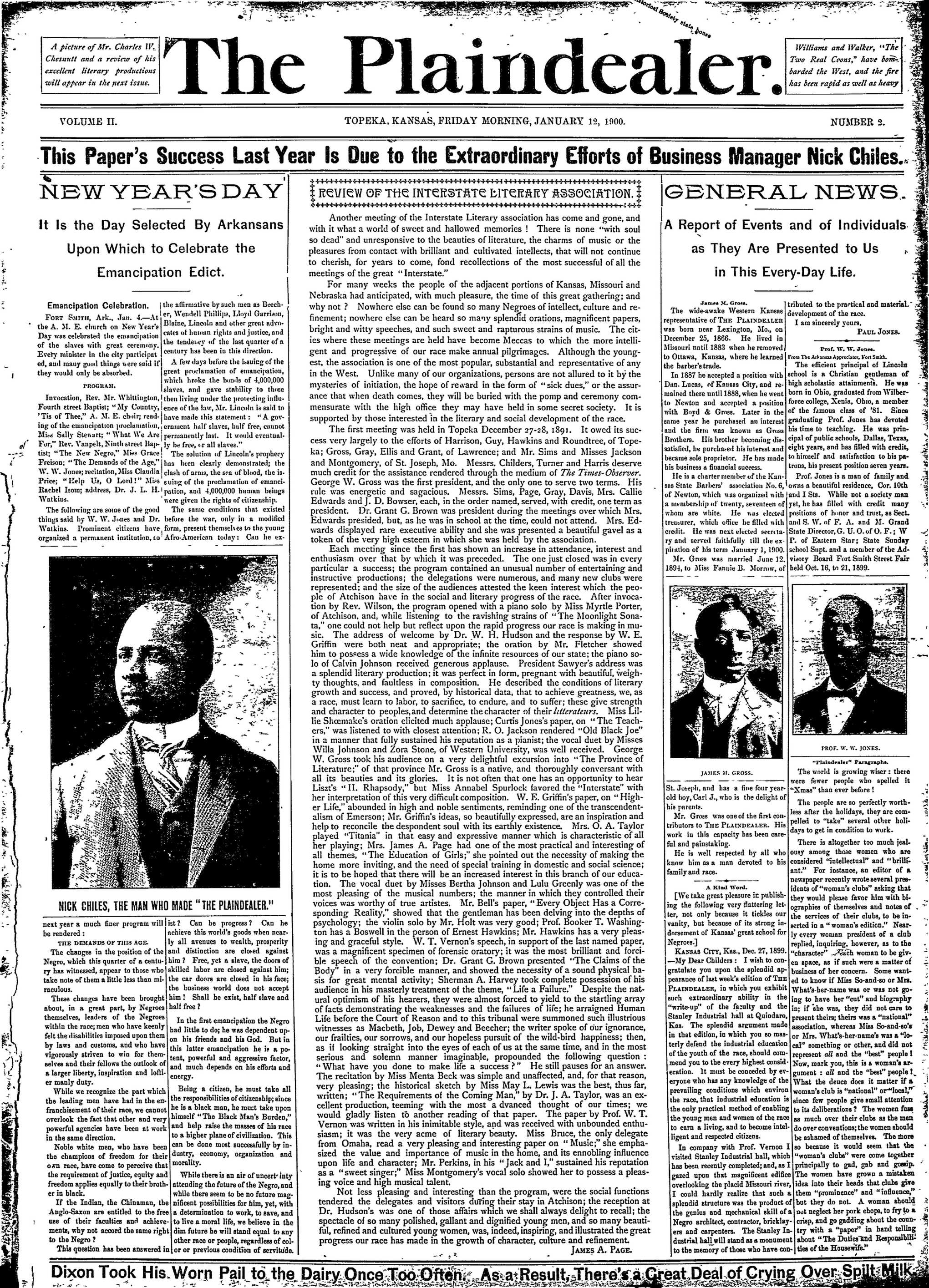
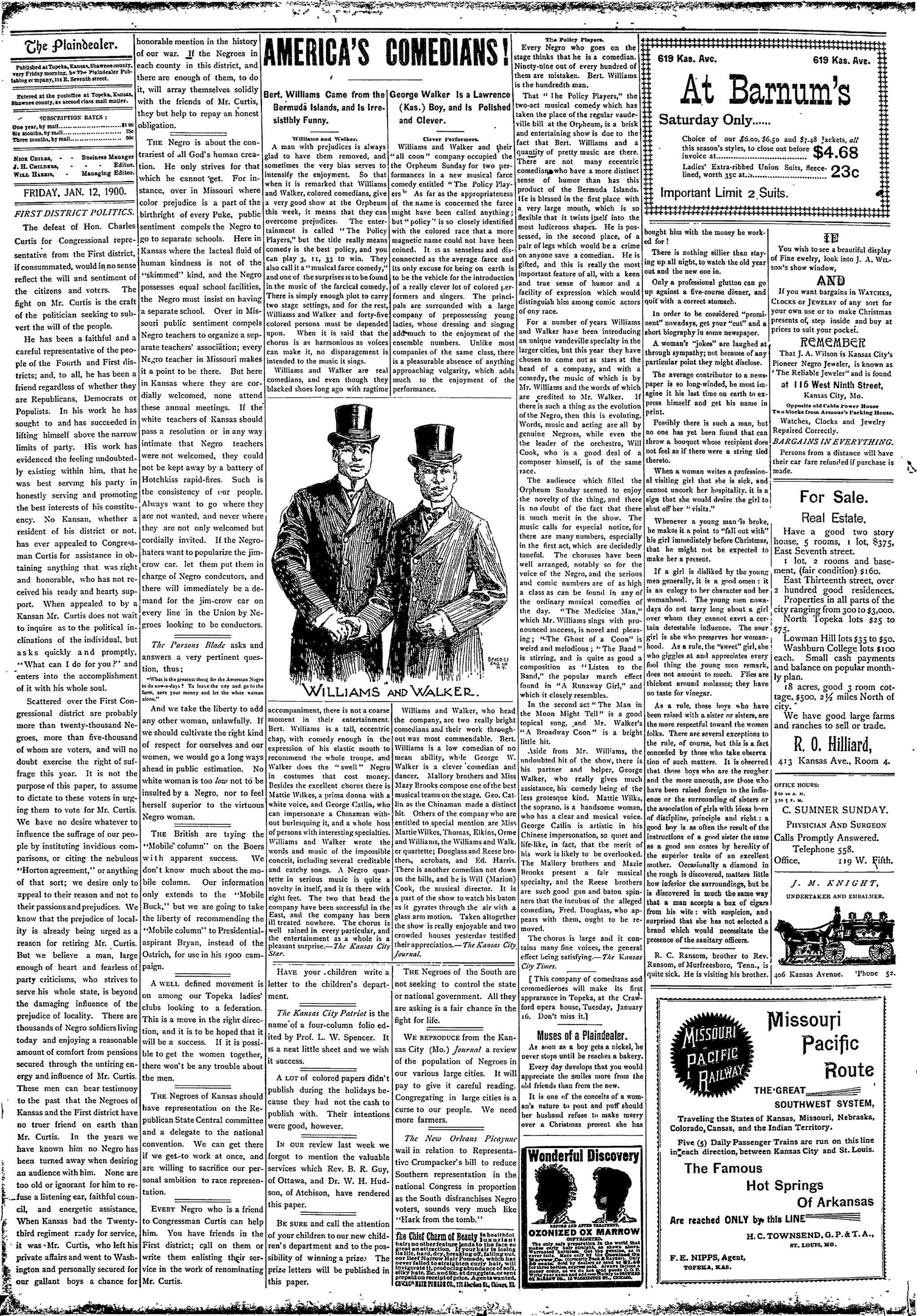
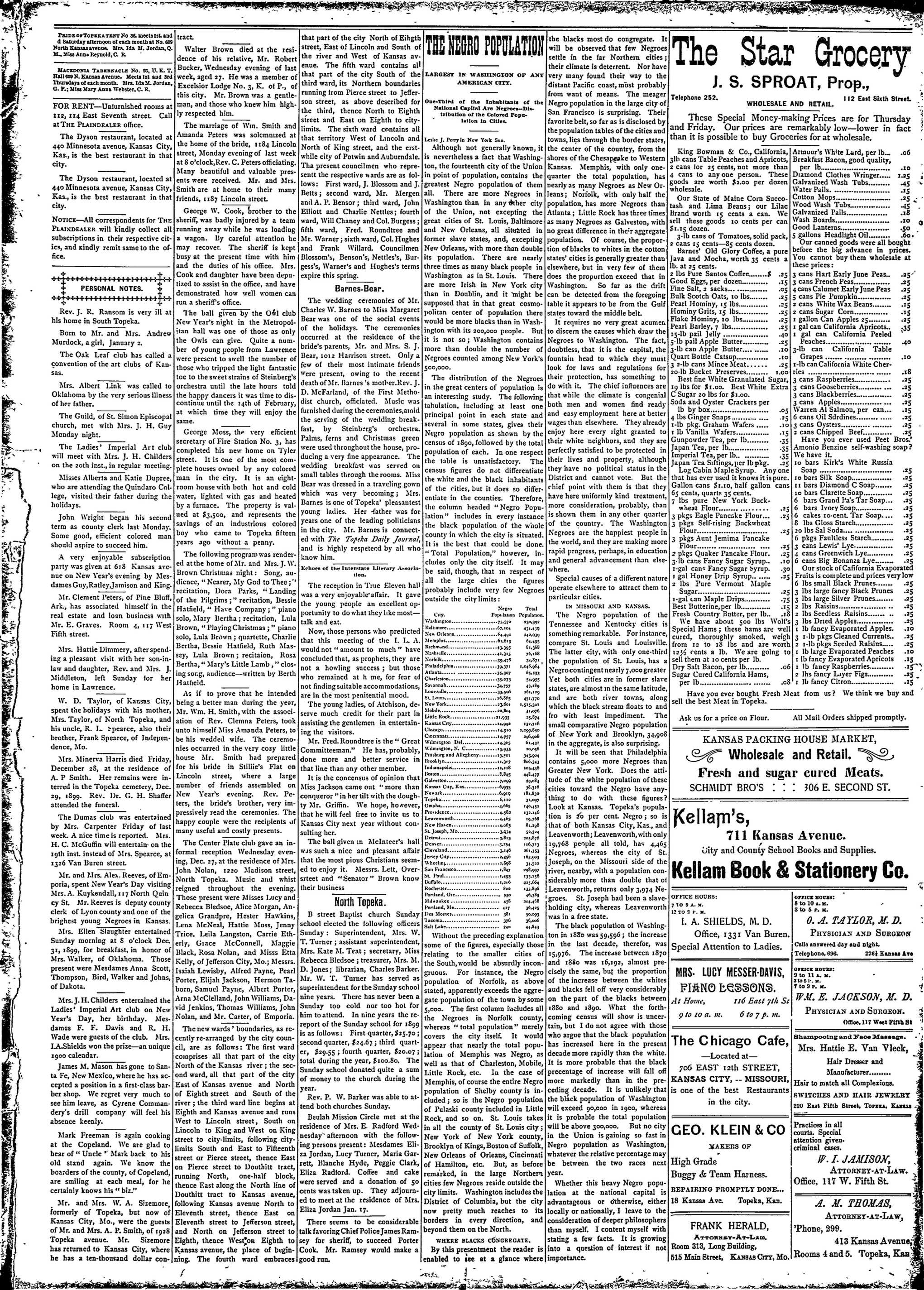
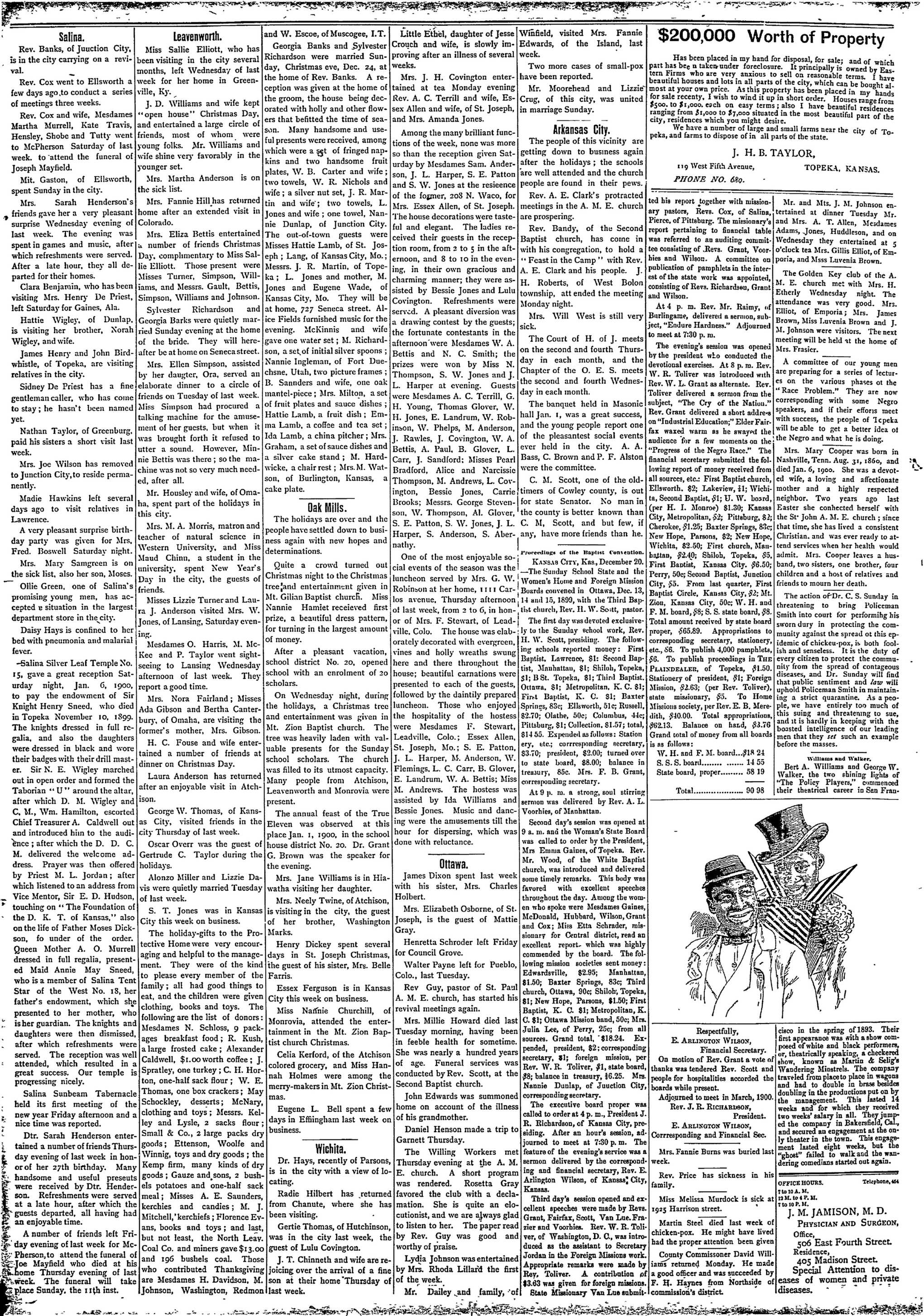
Page text (machine-generated)
Dixon Took His Worn Pail to the Dairy Once Too Often. As a Result, There's a Great Deal of Crying Over Spilt Milk.
A picture of Mr. Charles W. Chesnutt and a review of his excellent literary productions will appear in the next issue.
This Paper's S
NEW YEAR
It Is the Day Select
Upon Which to
NEW YEAR'S DAY
Emancipation Edict.
Emancipation Celebration.
FORT SMITH, Ark., Jan. 4.—At the A. M. E. church on New Year's Day was celebrated the emancipation of the slaves with great ceremony. Every minister in the city participated, and many good things were said if they would only be absorbed.
Invocation, Rev. Mr. Whittington, Fourth street Baptist; "My Country, 'Tis of Thee," A. M. E. choir; reading of the emancipation proclamation, Miss Sally Stewart; "What We Are For," Rev. Vanpelt, Ninth street Baptist; "The New Negro," Miss Grace Freison; "The Demands of the Age," W. W. Jones; recitation, Miss Claudia Price; "Help Us, O Lord!" Miss Rachel Isom; address, Dr. J. L. H. Watkins.
The following are some of the good things said by W. W. Jones and Dr. Watkins. Prominent citizens have organized a permanent institution, to
NICK CHILES, THE MAN WHO
1
next year a much finer program will be rendered :
THE DEMANDS OF THIS AGE.
The changes in the position of the Negro, which this quarter of a century has witnessed, appear to those who take note of them a little less than miraculous.
ist? Can be progress? Can achieve this world's goods when only all avenues to wealth, prosper and distinction are closed against him? Free, yet a slave, the door skilled labor are closed against the car doors are closed in his the business world does not a
These changes have been brought about, in a great part, by Negroes themselves, leaders of the Negroes within the race; men who have keenly felt the disabilities imposed upon them by laws and customs, and who have vigorously striven to win for themselves and their fellows the outlook of a larger liberty, inspiration and loftier manly duty.
While we recognize the part which the leading men have had in the enfranchisement of their race, we cannot overlook the fact that other and very powerful agencies have been at work in the same direction.
Noble white men, who have been the champions of freedom for their own race, have come to perceive that the requirement of justice, equity and freedom applies equally to their brother in black.
If the Indian, the Chinaman, the Anglo-Saxon are entitled to the free use of their faculties and achievements, why not accord the same right to the Negro?
This question has been answered in
VOLUME II.
PROGRAM.
The Plaindealer.
the affirmative by such men as Beecher, Wendell Phillips, Lloyd Garrison, Blaine, Lincoln and other great advocates of human rights and justice, and the tendency of the last quarter of a century has been in this direction.
A few days before the issuing of the great proclamation of emancipation, which broke the bonds of 4,000,000 slaves, and gave stability to those then living under the protecting influence of the law, Mr. Lincoln is said to have made this statement: "A government half slaves, half free, cannot permanently last. It would eventually be free, or all slaves."
The solution of Lincoln's prophecy has been clearly demonstrated; the clash of arms, the sea of blood, the issuing of the proclamation of emancipation, and 4,000,000 human beings were given the rights of citizenship. The same conditions that existed before the war, only in a modified form, present themselves to the young Afro-American today: Cau he ex-
HO MADE "THE PLAINDEALER."
ist? Can he progress? Can he achieve this world's goods when nearly all avenues to wealth, prosperity and distinction are closed against him? Free, yet a slave, the doors of skilled labor are closed against him; the car doors are closed in his face; the business world does not accept him! Shall he exist, half slave and half free?
In the first emancipation the Negro had little to do; he was dependent upon his friends and his God. But in this latter emancipation he is a potent, powerful and aggressive factor, and much depends on his efforts and energy.
Being a citizen, he must take all the responsibilities of citizenship; since he is a black man, he must take upon himself "The Black Man's Burden," and help raise the masses of his race to a higher plane of civilization. This can be done most successfully by industry, economy, organization and morality.
While there is an air of uncertainty attending the future of the Negro, and while there seem to be no future magnificent possibilities for him, yet, with a determination to work, to save, and to live a moral life, we believe in the dim future he will stand equal to any other race or people, regardless of color or previous condition of servitude
Another meeting of the Interstate Literary association has come and gone, and with it what a world of sweet and hallowed memories! There is none "with soul so dead" and unresponsive to the beauties of literature, the charms of music or the pleasures from contact with brilliant and cultivated intellects, that will not continue to cherish, for years to come, fond recollections of the most successful of all the meetings of the great "Interstate."
For many weeks the people of the adjacent portions of Kansas, Missouri and Nebraska had anticipated, with much pleasure, the time of this great gathering; and why not? Nowhere else can be found so many Negroes of intellect, culture and refinement; nowhere else can be heard so many splendid orations, magnificent papers, bright and witty speeches, and such sweet and rapturous strains of music. The cities where these meetings are held have become Meccas to which the more intelligent and progressive of our race make annual pilgrimages. Although the youngest, the association is one of the most popular, substantial and representative of any in the West. Unlike many of our organizations, persons are not allured to it by the mysteries of initiation, the hope of reward in the form of "sick dues," or the assurance that when death comes, they will be buried with the pomp and ceremony commensurate with the high office they may have held in some secret society. It is supported by those interested in the literary and social development of the race.
The first meeting was held in Topeka December 27-28, 1891. It owed its success very largely to the efforts of Harrison, Guy, Hawkins and Roundtree, of Topeka; Gross, Gray, Ellis and Grant, of Lawrence; and Mr. Sims and Misses Jackson and Montgomery, of St. Joseph, Mo. Messrs. Childers, Turner and Harris deserve much credit for the assistance rendered through the medium of The Times-Observer. George W. Gross was the first president, and the only one to serve two terms. His rule was energetic and sagacious. Messrs. Sims, Page, Gray, Davis, Mrs. Callie Edwards and J. D. Bowser, each, in the order named, served, with credit, one term as president. Dr. Grant G. Brown was president during the meetings over which Mrs. Edwards presided, but, as he was in school at the time, could not attend. Mrs. Edwards displayed rare executive ability and she was presented a beautiful gavel as a token of the very high esteem in which she was held by the association.
A Report of Events and of Individuals as They Are Presented to Us in This Every-Day Life.
TOPEKA, KANSAS, FRIDAY MORNING, JANUARY 12, 1900.
The wide-awake Western Kansas representative of THE PLAINDEALER was born near Lexington, Mo., on December 25, 1866. He lived in Missouri until 1883 when he removed to Ottawa, Kansas, where he learned the barber's trade.
In 1887 he accepted a position with Dan. Lucas, of Kansas City, and remained there until 1888, when he went to Newton and accepted a position with Boyd & Gross. Later in the same year he purchased an interest and the firm was known as Gross Brothers. His brother becoming dissatisfied, he purchased his interest and became sole proprietor. He has made his business a financial success.
He is a charter member of the Kansas State Barbers' association No. 6, of Newton, which was organized with a membership of twenty, seventeen of whom are white. He was elected treasurer, which office he filled with credit. He was next elected secretary and served faithfully till the expiration of his term January 1, 1900. Mr. Gross was married June 12, 1894, to Miss Fannie B. Morrow, of
S.
JAMES M. GROSS.
St. Joseph, and has a fine four year-old boy, Carl J., who is the delight of his parents.
Mr. Gross was one of the first contributors to THE PLAINDEALER. His work in this capacity has been careful and painstaking.
He is well respected by all who know him as a man devoted to his family and race.
A Kind Word.
[We take great pleasure in publishing the following very flattering letter, not only because it tickles our vanity, but because of its strong endorsement of Kansas' great school for Negroes.]
KANSAS CITY, Kas., Dec. 27, 1899.
My Dear Childers: I wish to congratulate you upon the splendid appearance of last week's edition of THE PLAINDEALER, in which you exhibit such extraordinary ability in the "write-up" of the faculty and the Stanley Industrial hall at Quindaro, Kas. The splendid argument made in that edition, in which you so masterly defend the industrial education of the youth of the race, should commend you to the every highest consideration. It must be conceded by everyone who has any knowledge of the prevailing conditions which environ the race, that industrial education is the only practical method of enabling the young men and women of the race to earn a living, and to become intelligent and respected citizens.
In company with Prof. Vernon I visited Stanley Industrial hall, which has been recently completed; and, as I gazed upon that magnificent edifice overlooking the placid Missouri river, I could hardly realize that such a splendid structure was the product of the genius and mechanical skill of a Negro architect, contractor, bricklayers and carpenters. The Stanley Industrial hall will stand as a monument to the memory of those who have con-
Not less pleasing and interesting than the program, were the social functions tendered the delegates and visitors during their stay in Atchison; the reception at Dr. Hudson's was one of those affairs which we shall always delight to recall; the spectacle of so many polished, gallant and dignified young men, and so many beautiful, refined and cultured young women, was, indeed, inspiring, and illustrated the great progress our race has made in the growth of character, culture and refinement.
Williams and Walker, "The Two Real Coons," have bombarded the West, and the fire has been rapid as well as heavy
NUMBER 2.
er Nick Chiles.
AL NEWS.
and of Individuals
presented to Us
ry-Day Life.
tributed to the practical and material development of the race. I am sincerely yours.
From The Arkansas Appreciator, Fort Smith.
The efficient principal of Lincoln school is a Christian gentleman of high scholastic attainments. He was born in Ohio, graduated from Wilberforce college, Xenia, Ohio, a member of the famous class of '81. Since graduating Prof. Jones has devoted his time to teaching. He was principal of public schools, Dallas, Texas, eight years, and has filled with credit, to himself and satisfaction to his patrons, his present position seven years.
Prof. Jones is a man of family and owns a beautiful residence, Cor. 10th and I Sts. While not a society man yet, he has filled with credit many positions of honor and trust, as Sect. and S. W. of F. A. and M. Grand State Director, G. U. O. of O. F.; W. P. of Eastern Star; State Sunday school Supt. and a member of the Advisory Board Fort Smith Street Fair held Oct. 16, to 21, 1899.
PROF. W. W. JONES.
The world is growing wiser: there were fewer people who spelled it "Xmas" than ever before!
The people are so perfectly worthless after the holidays, they are compelled to "take" several other holidays to get in condition to work.
There is altogether too much jealousy among those women who are considered "intellectual" and "brilliant." For instance, an editor of a newspaper recently wrote several presidents of "woman's clubs" asking that they would please favor him with biographies of themselves and notes of the services of their clubs, to be inserted in a "woman's edition." Nearly every woman president of a club replied, inquiring, however, as to the "character." Each woman to be given space, as if such were a matter of business of her concern. Some wanted to know if Miss So-and-so or Mrs. What's-her-name was or was not going to have her "cut" and biography in; if she was, they did not care to present theirs; theirs was a "national" association, whereas Miss So-and-so's or Mrs. What's-her-name was a "local" something or other, and did not represent all and the "beat" people! Now, mark you, this is a woman's argument: all and the "best" people! What the deuce does it matter if a woman's club is "national" or "local," since few people give small attention to its deliberations? The women fuss as much over their clubs as the men do over conventions; the women should be ashamed of themselves. The more so because it would seem that the "woman's clubs" were come together principally to gad, gab and gossip. The women have grown a mistaken idea into their heads that clubs give them "prominence" and "influence," but they do not. A woman should not neglect her pork chops, to fry to a crisp, and go gadding about the country with a "paper" in hand telling about "The Duties and Responsibilities of the Housewife."
---
Published at Topeka, Kansas, Shawnee county, very Friday morning, by The Piaindaler Publishing company, 114 E. Seventh street.
Entered at the postoffice at Topeka, Kansas, Shawnee county, as second class mail matter.
FRIDAY, JAN. 12, 1900.
The defeat of Hon. Charles Curtis for Congressional representative from the First district, if consummated, would in no sense reflect the will and sentiment of the citizens and voters. The fight on Mr. Curtis is the craft of the politician seeking to subvert the will of the people.
He has been a faithful and a careful representative of the people of the Fourth and First districts; and, to all, he has been a friend regardless of whether they are Republicans, Democrats or Populists. In his work he has sought to and has succeeded in lifting himself above the narrow limits of party. His work has evidenced the feeling undoubtedly existing within him, that he was best serving his party in honestly serving and promoting the best interests of his constituency. No Kansan, whether a resident of his district or not, has ever appealed to Congressman Curtis for assistance in obtaining anything that was right and honorable, who has not received his ready and hearty support. When appealed to by a Kansan Mr. Curtis does not wait to inquire as to the political inclinations of the individual, but asks quickly and promptly, "What can I do for you?" and enters into the accomplishment of it with his whole soul.
Scattered over the First Congressional district are probably more than twenty-thousand Negroes, more than five-thousand of whom are voters, and will no doubt exercise the right of suffrage this year. It is not the purpose of this paper, to assume to dictate to these voters in urging them to vote for Mr. Curtis. We have no desire whatever to influence the suffrage of our people by instituting invidious comparisons, or citing the nebulous "Horton agreement," or anything of that sort; we desire only to appeal to their reason and not to their passions and prejudices. We know that the prejudice of locality is already being urged as a reason for retiring Mr. Curtis. But we believe a man, large enough of heart and fearless of party criticisms, who strives to serve his whole state, is beyond the damaging influence of the prejudice of locality. There are thousands of Negro soldiers living today and enjoying a reasonable amount of comfort from pensions secured through the untiring energy and influence of Mr. Curtis. These men can bear testimony to the past that the Negroes of Kansas and the First district have no truer friend on earth than Mr. Curtis. In the years we have known him no Negro has been turned away when desiring an audience with him. None are too old or ignorant for him to refuse a listening ear, faithful council, and energetic assistance. When Kansas had the Twenty-third regiment ready for service, it was Mr. Curtis, who left his private affairs and went to Washington and personally secured for our gallant boys a chance for
honorable mention in the history of our war. If the Negroes in each county in this district, and there are enough of them, to do it, will array themselves solidly with the friends of Mr. Curtis, they but help to repay an honest obligation.
THE Negro is about the contrariest of all God's human creation. He only strives for that which he cannot 'get. For instance, over in Missouri where color prejudice is a part of the birthright of every Puke, public sentiment compels the Negro to go to separate schools. Here in Kansas where the lacteal fluid of human kindness is not of the "skimmed" kind, and the Negro possesses equal school facilities, the Negro must insist on having a separate school. Over in Missouri public sentiment compels Negro teachers to organize a separate teachers' association; every Negro teacher in Missouri makes it a point to be there. But here in Kansas where they are cordially welcomed, none attend these annual meetings. If the white teachers of Kansas should pass a resolution or in any way intimate that Negro teachers were not welcomed, they could not be kept away by a battery of Hotchkiss rapid-fires. Such is the consistency of our people. Always want to go where they are not wanted, and never where they are not only welcomed but cordially invited. If the Negro-haters want to popularize the jim-crow car. let them put them in charge of Negro conductors, and there will immediately be a demand for the jim-crow car on every line in the Union by Negroes looking to be conductors.
The Parsons Blade asks and answers a very pertinent question, thus;
"What is the greatest thing for the American Negro to do now-a-days? To leave the city and go to the farm, save your money and let the white woman alone."
And we take the liberty to add any other woman, unlawfully. If we should cultivate the right kind of respect for ourselves and our women, we would go a long ways ahead in public estimation. No white woman is too low not to be insulted by a Negro, nor to feel herself superior to the virtuous Negro woman.
THE British are trying the "Mobile column" on the Boers with apparent success. We don't know much about the mobile column. Our information only extends to the "Mobile Buck," but we are going to take the liberty of recommending the "Mobile column" to Presidential aspirant Bryan, instead of the Ostrich, for use in his 1900 campaign.
A well defined movement is on among our Topeka ladies' clubs looking to a federation. This is a move in the right direction, and it is to be hoped that it will be a success. If it is possible to get the women together, there won't be any trouble about the men.
THE Negroes of Kansas should have representation on the Republican State Central committee and a delegate to the national convention. We can get there if we get to work at once, and are willing to sacrifice our personal ambition to race representation.
EVERY Negro who is a friend to Congressman Curtis can help him. You have friends in the First district; call on them or write them enlisting their service in the work of renominating Mr. Curtis.
AMERICA'S COMEDIANS
BENED CT
END CO
N.Y.
WILLIAMS AND WALKER.
Bert. Williams Came from the Bermuda Islands, and Is Irresistibly Funny.
Williams and Walker.
A man with prejudices is always glad to have them removed, and sometimes the very bias serves to intensify the enjoyment. So that when it is remarked that Williams and Walker, colored comedians, give a very good show at the Orpheum this week, it means that they can overcome prejudices. The entertainment is called "The Policy Players," but the title really means comedy is the best policy, and you can play 3, 11, 33 to win. They also call it a "musical farce comedy," and one of the surprises is to be found in the music of the farcical comedy. There is simply enough plot to carry two stage settings, and for the rest, Williams and Walker and forty-five colored persons must be depended upon. When it is said that the chorus is as harmonious as voices can make it, no disparagement is intended to the music it sings.
Williams and Walker are real comedians, and even though they blacked shoes long ago with ragtime
WILLIAMS
accompaniment, there is not a coarse moment in their entertainment. Bert. Williams is a tall, eccentric chap, with comedy enough in the expression of his elastic mouth to recommend the whole troupe. and Walker does the "swell" Negro in costumes that cost money. Besides the excellent chorus there is Mattie Wilkes, a prima donna with a white voice, and George Catlin, who can impersonate a Chinaman without burlesquing it, and a whole host of persons with interesting specialties. Williams and Walker wrote the words and music of the impossible conceit, including several creditable and catchy songs. A Negro quartette in serious music is quite a novelty in itself, and it is there with eight feet. The two that head the company have been successful in the East, and the company has been ill treated nowhere. The chorus is well rained in every particular, and the entertainment as a whole is a pleasant surprise.—The Kansas City Star.
HAVE your children write a letter to the children's department.
The Kansas City Patriot is the name of a four-column folio edited by Prof. L. W. Spencer. It is a neat little sheet and we wish it success.
A lot of colored papers didn't publish during the holidays because they had not the cash to publish with. Their intentions were good, however.
IN OUR review last week we forgot to mention the valuable services which Rev. B. R. Guy, of Ottawa, and Dr. W. H. Hudson, of Atchison, have rendered this paper.
BE SURE and call the attention of your children to our new children's department and to the possibility of winning a prize. The prize letters will be published in this paper.
George Walker Is a Lawrence (Kas.) Boy, and Is Polished and Clever.
Clever Performers.
Williams and Walker and their "all coon" company occupied the the Orpheum Sunday for two performances in a new musical farce comedy entitled "The Policy Players" As far as the appropriateness of the name is concerned the farce might have been called anything; but "policy" is so closely identified with the colored race that a more magnetic name could not have been coined. It is as senseless and disconnected as the average farce and its only excuse for being on earth is to be the vehicle for the introduction of a really clever lot of colored performers and singers. The principals are surrounded with a large company of prepossessing young ladies, whose dressing and singing add much to the enjoyment of the ensemble numbers. Unlike most companies of the same class, there is a pleasurable absence of anything approaching vulgarity, which adds much to the enjoyment of the performance.
BENEDCT
END CO
NY.
AND WALKER.
Williams and Walker, who head the company, are two really bright comedians and their work throughout was most commendable. Bert. Williams is a low comedian of no mean ability, while George W. Walker is a clever comedian and dancer. Mallory brothers and Miss Mazy Brooks compose one of the best musical teams on the stage. Geo. Catlin as the Chinaman made a distinct hit. Others of the company who are entitled to special mention are Miss Mattie Wilkes, Thomas, Elkins, Orme and Williams, the Williams and Walker quartette; Douglass and Reese brothers, acrobats, and Ed. Harris. There is another comedian not down on the bills, and he is Will (Marion) Cook, the musical director. It is a part of the show to watch his baton as it gyrates through the air with a glass arm motion. Taken altogether the show is really enjoyable and two crowded houses yesterday testified their appreciation.—The Kansas City journal.
THE Negroes of the South are not seeking to control the state or national government. All they are asking is a fair chance in the fight for life.
WE REPRODUCE from the Kansas City (Mo.) Journal a review of the population of Negroes in our various large cities. It will pay to give it careful reading. Congregating in large cities is a curse to our people. We need more farmers.
The New Orleans Picayune
wail in relation to Representative Crumpacker's bill to reduce Southern representation in the national Congress in proportion as the South disfranchises Negro voters, sounds very much like "Hark from the tomb."
The Chief Charm of Beauty is healthful hair no other feature lends to the face so that it feels great. It is life, hard, dry, breaking off, falling out, our Beef Narrow Hair Pomade, which has never failed to straighten curly hair, will vigorously produce bumacose of coot, silky hair, 2c. and 6c. at drummists, or sent prepared on receipt of price. Agents wanted.
CHICAGO POUND CO. 117th St. E. Chicago, IL
Every Negro who goes on the stage thinks that he is a comedian. Ninety-nine out of every hundred of them are mistaken. Bert. Williams is the hundredth man.
That "I the Policy Players," the two-act musical comedy which has taken the place of the regular vaudeville bill at the Orpheum, is a brisk and entertaining show is due to the fact that Bert. Williams and a quantity of pretty music are there. There are not many eccentric comedians who have a more distinct sense of humor than has this product of the Bermuda Islands. He is blessed in the first place with a very large mouth, which is so flexible that it twists itself into the most ludicrous shapes. He is possessed, in the second place, of a pair of legs which would be a crime on anyone save a comedian. He is gifted, and this is really the most important feature of all, with a keen and true sense of humor and a facility of expression which would distinguish him among comic actors of ony race.
For a number of years Williams and Walker have been introducing an unique vandeville specialty in the larger cities, but this year they have chosen to come out as stars at the head of a company, and with a comedy, the music of which is by Mr. Williams and the words of which are credited to Mr. Walker. If there is such a thing as the evolution of the Negro, then this is evolving, Words, music and acting are all by genuine Negroes, while even the the leader of the orchestra, Will Cook, who is a good deal of a composer himself, is of the same race.
The audience which filled the Orpheum Sunday seemed to enjoy the novelty of the thing, and there is no doubt of the fact that there is much merit in the show. The music calls for especial notice, for there are many numbers, especially in the first act, which are decidedly tuneful. The choruses have been well arranged, notably so for the voice of the Negro, and the serious and comic numbers are of as high a class as can be found in any of the ordinary musical comedies of the day. "The Medicine Man," which Mr. Williams sings with pronounced success, is novel and pleasing; "The Ghost of a Coon" is weird and melodious; "The Band" is stirring, and is quite as good a composition as "Listen to the Band," the popular march effect found in "A Runaway Girl," and which it closely resembles.
In the second act "The Man in the Moon Might Tell" is a good topical song, and Mr. Walker's "A Broadway Coon" is a bright little hit.
Aside from Mr. Williams, the undoubted hit of the show, there is his partner and helper, George Walker, who really glives much assistance, his comedy being of the less grotesque kind. Mattie Wilka, the soprano, is a handsome woman, who has a clear and musical voice. George Catlin is artistic in his Chinese impersonation, so quiet and life-like, in fact, that the merit of his work is likely to be overlooked. The Mallory brothers and Mazie Brooks present a fair musical specialty, and the Reese brothers are such good gun and baton spinners that the incubus of the alleged comedian, Fred. Douglass, who appears with them, ought to be removed.
The chorus is large and it contains many fine voices, the general effect being satisfying.—The Kansas City Times. _____
[ This company of comedians and commedieenes will make its first appearance in Topeka, at the Crawford opera house, Tuesday, January 16. Don't miss it.]
Muses of a Plaindealer.
As soon as a boy gets a nickel, he never stops until he reaches a bakery. Every day develops that you would appreciate the smiles more from the old friends than from the new. It is one of the conceits of a woman's nature to pout and puff should her husband refuse to make merry over a Christmas present she has
Wonderful Discovery
BEFORE AND AFTER TREATMENT.
OZONIZED OX MARROW
COPYRIGHTED.
The only safe preparation in the world that can cure warts and it shows about Warranted harmism. Get the genuine, as it never fails. Made only by Occidental Zuck & Rayers. Only for center, sold by dealers or send us $1.40 for the duck skin. Always be careful with money order, as we do not send goods G.O.D. Write your name and address on BOOKED ON MARROW CO., 15 WASHINGTON ST., CHICAGO.
At Barnum's
Choice of our $6.00, $6.50 and $7.48 Jackets, all
this season's styles, to close out before $4.68
invoice at.....
Important Limit 2 Suits.
bought him with the money he worked for!
There is nothing sillier than staying up all night, to watch the old year out and the new one in.
Only a professional glutton can go up against a five-course dinner, and quit with a correct stomach.
In order to be considered "prominent" nowadays, get your "cut" and a short biography in some newspaper.
A woman's "jokes" are laughed at through sympathy; not because of any particular point they might disclose.
The average contributor to a newspaper is so long-winded, he must imagine it his last time on earth to express himself and get his name in print.
Possibly there is such a man, but no one has yet been found that can throw a bouquet whose recipient does not feel as if there were a string tied thereto.
When a woman writes a professional visiting girl that she is sick, and cannot uncork her hospitality. it is a sign that she would desire the girl to shut off her "visits."
Whenever a young man's broke, he makes it a point to "fall out with" his girl immediately before Christmas, that he might not be expected to make her a present.
If a girl is disliked by the young men generally, it is a good omen: it is an eulogy to her character and her womanhood. The young men nowadays do not tarry long about a girl over whom they cannot exert a certain detestable influence. The sour girl is she who preserves her womanhood. As a rule, the "sweet" girl, she who giggles at and appreciates every fool thing the young men remark, does not amount to much. Flies are thickest around molasses; they have no taste for vinegar.
As a rule, those boys who have been raised with a sister or sisters, are the more respectful toward the women folks. There are several exceptions to the rule, of course, but this is a fact conceded by those who take observation of such matters. It is observed that those boys who are the rougher and the more uncouth, are those who have been raised foreign to the influence or the surrounding of sisters or the association of girls with ideas born of discipline, principle and right: a good boy is as often the result of the instructions of a good sister the same as a good son comes by heredity of the superior traits of an excellent mother. Occasionally a diamond in the rough is discovered, matters little how inferior the surroundings, but he is discovered in much the same way that a man accepts a box of cigars from his wife: with suspicion, and surprised that she has not selected a brand which would necessitate the presence of the sanitary officers.
R. C. Ransom, brother to Rev.
Ransom, of Murfreesboro, Tenn., is
quite sick. He is visiting his brother.
MISSOURI
PACIFIC
RAILWAY
Traveling the States of Kansas,
Colorado, Cansas, and the Indiana.
Five (5) Daily Passenger Trains
in each direction, between Kansas
The Famous
Hot Sp
Are reached ONLY by this L
H. C. TOW
F. E. NIPPS, Agent,
TOPEKA, KAS.
619 Kas. Ave.
rnum's
$6.50 and $7.48 Jackets, all
close out before $4.68
Union Suits, fleece-
23c
Suits.
You wish to see a beautiful display of Fine ewelry, look into J. A. WILSON's show window.
AND
If you want bargains in WATCHES, CLOCKS or JEWELRY of any sort for your own use or to make Christmas presents of, step inside and buy at prices to suit your pocket.
REMEMBER
That J. A. Wilson is Kansas City's Pioneer Negro Jeweler, is known as 'The Reliable Jeweler' and is found at 116 West Ninth Street
Opposite old Cable Power House Two blocks from Armour's Packing House. Watches, Clocks and Jewelry Repaired Correctly.
BARGAINS IN EVERYTHING. Persons from a distance will have their car fare refunded if purchase is made.
For Sale.
Have a good two story house, 5 rooms, 1 lot, $375,
East Seventh street.
1 lot, 2 rooms and basement, (fair condition) $160.
East Thirteenth street, over
2 hundred good residences.
Properties in all parts of the city ranging from 300 to $3,000.
North Topeka lots $25 to
$75.
Lowman Hill lots $35 to $50.
Washburn College lots $100 each. Small cash payments and balance on popular monthly plan.
18 acres, good 3 room cottage, $500, 2 1/2 miles North of city.
We have good large farms and ranches to sell or trade.
R. O. Hilliard.
413 Kansas Ave., Room 4.
OFFICE HOURS:
8 to 10 A.M.
3 to 5 P.M.
C. SUMNER SUNDAY.
PHYSICIAN AND SURGEON
Calls Promptly Answered.
Telephone 558.
Office, 119 W. Fifth.
J. M. KNIGHT,
UNDERTAKER AND EMBALMER.
406 Kansas Avenue. 'Phone 52.
Missouri Pacific Route
THE GREAT
SOUTHWEST SYSTEM,
Kansas, Missouri, Nebraska,
the Indian Territory.
Other Trains are run on this line
in Kansas City and St. Louis.
West Springs
Of Arkansas
on this LINE
The Dumas club was entertained by Mrs. Carpenter Friday of last week. A nice time is reported. Mrs. H. C. McGuffin will entertain on the 19th inst. instead of Mrs. Spearce, at 1326 Van Buren street.
Mr. and Mrs. Alex. Reeves, of Emporia, spent New Year's Day visiting Mrs. A. Kuykendall, 117 North Quincy St. Mr. Reeves is deputy county clerk of Lyon county and one of the brighest young Negroes in Kansas.
Mrs. Ellen Slaughter entertained Sunday morning at 8 o'clock Dec. 31, 1899, for breakfast, in honor of Mrs. Walker, of Oklahoma. Those present were Mesdames Anna Scott, Thompson, Bird, Walker and Johns, of Dakota.
Mrs. J. H. Childers entertained the Ladies' Imperial Art club on New Year's Day, her birthday. Mesdames F. F. Davis and R. H. Wade were guests of the club. Mrs. LA.Shields won the prize—an unique 1900 calendar.
James M. Mason has gone to Santa Fe, New Mexico, where he has accepted a position in a first-class barber shop. We regret much to see him leave, as Cyrene Commandery's drill company will feel his absence keenly.
Mark Freeman is again cooking at the Copeland. We are glad to hear of "Uncle" Mark back to his old stand again. We know the boarders of the county, of Copeland, are smiling at each meal, for he certainly knows his "biz."
Mr. and Mrs. W. A. Sizemore, formerly of Topeka, but now of Kansas City, Mo., were the guests of Mr. and Mrs. A. P. Smith, of 1928 Topeka avenue. Mr. Sizemore has returned to Kansas City, where he has a ten-thousand dollar con-
George W. Cook, brother to the sheriff, was badly injured by a team running away while he was loading a wagon. By careful attention he may recover. The sheriff is kept busy at the present time with him and the duties of his office. Mrs. Cook and daughter have been deputized to assist in the office, and have demonstrated how well women can run a sheriff's office.
The ball given by the Owl club New Year's night in the Metropolitan hall was one of those as only the Owls can give. Quite a number of young people from Lawrence were present to swell the number of those who tripped the light fantastic toe to the sweet strains of Steinberg's orchestra until the late hours told the happy dancers it was time to discontinue until the 14th of February, at which time they will enjoy the same.
George Moss, the very efficient secretary of Fire Station No. 3, has completed his new home on Tyler street. It is one of the most complete houses owned by any colored man in the city. It is an eighthroom house with both hot and cold water, lighted with gas and heated by a furnace. The property is valued at $3,500, and represents the savings of an industrious colored boy who came to Topeka fifteen years ago without a penny.
The following program was rendered at the home of Mr. and Mrs. J. W. Brown Christmas night: Song, audience, "Nearer, My God to Thee;" recitation, Dora Parks, "Landing of the Pilgrims;" recitation, Bessie Hatfield, "Have Company;" piano solo, Mary Bertha; recitation, Lula Brown, "Playing Christmas;" piano solo, Lula Brown; quartette, Charlie Bertha, Bessie Hatfield, Ruth Massey, Lula Brown; recitation, Rosa Bertha, "Mary's Little Lamb;" closing song, audience—written by Berth Hatfield.
As if to prove that he intended being a better man during the year, Mr. Wm. H. Smith, with the association of Rev. Clemana Peters, took unto himself Miss Amanda Peters, to be his wedded wife. The ceremonies occurred in the very cozy little house Mr. Smith had prepared for his bride in Stillie's Flat on Lincoln street, where a large number of friends assembled on New Year's evening. Rev. Peters, the bride's brother, very impressively read the ceremonies. The happy couple were the recipients of many useful and costly presents.
The Center Plate club gave an informal reception Wednesday evening, Dec. 27, at the residence of Mrs. John Nolan, 1220 Madison street, North Topeka. Music and whist reigned throughout the evening. Those present were Misses Lucy and Rebecca Bledsoe, Alice Morgan, Angelica Grandpre, Hester Hawkins, Lena McNeal, Hattie Moss, Jenny Trice, Leila Langston, Carrie Etherly, Grace McConnell, Maggie Black, Rosa Nolan, and Misss Etta Kelly, of Jefferson City, Mo.; Messrs. Isaiah Lewisby, Alfred Payne, Pearl Porter, Elijah Jackson, Hermon Taborn, Samuel Payne, Albert Porter, Arna McChelland, John Williams, David Jenkins, Thomas Williams, John Nolan, and Mr. Carter, of Emporia.
The new wards' boundaries, as recently re-arranged by the city council, are as follows: The first ward comprises all that part of the city North of the Kansas river; the second ward, all that part of the city East of Kansas avenue and North of Eighth street and South of the river; the third ward line begins at Eighth and Kansas avenue and runs West to Lincoln street, South on Lincoln to King and West on King street to city-limits, following city-limits South and East to Fifteenth street or Pierce street, thence East on Pierce street to Douthitt tract, running North, one-half block, thence East along the North line of Douthitt tract to Kansas avenue, following Kansas avenue North to Eleventh street, thence East on Eleventh street to Jefferson street, and North on Jefferson street to Eighth, thence West on Eighth to Kansas avenue, the place of beginning. The fourth ward embraces
that part of the city North of Eihgth street, East of Lincoln and South of the river and West of Kansas avenue. The fifth ward contains all that part of the city South of the third ward, its Northern boundaries running from Pierce street to Jefferson street, as above described for the third, thence North to Eighth street and East on Eighth to citylimits. The sixth ward contains all that territory West of Lincoln and North of King street, and the erstwhile city of Potwin and Auburndale. Tha present councilmen who representt the respective wards are as follows: First ward, J. Blossom and J. Betts; second ward, Mr. Mergen and A. P. Bensor; third ward, John Elliott and Charlie Nettles; fourth ward, Will Chaney and Col. Burgess; fifth ward, Fred. Roundtree and Mr. Warner; sixth ward, Col. Hughes and Frank Willard. Councilmen Blossom's, Benson's, Nettles's, Burgess's, Warner's and Hughes's terms expire this spring.
Barnes-Bear.
The wedding ceremonies of Mr. Charles W. Barnes to Miss Margaret Bear was one of the social events of the holidays. The ceremonies occurred at the residence of the bride's parents, Mr. and Mrs. S. J. Bear, 1012 Harrison street. Only a few of their most intimate friends were present, owing to the recent death of Mr. Barnes's mother.Rev. J. D. McFarland, of the First Methodist church, officiated. Music was furnished during the ceremonies, amid the serving of the wedding breakfast, by Steinberg's orchestra, Palms, ferns and Christmas green were used throughout the house, producing a very fine appearance. The wedding breakfast was served on small tables through the rooms. Miss Bear was dressed in a traveling gown which was very becoming; Mrs. Barnes is one of Topeka' pleasantest young ladies. Her father was for years one of the leading politicians in the city. Mr. Barnes is connected with The Topeka Daily Journal, and is highly respeted by all who know him.
Echoes of the Interstate Literary Association.
The reception in True Eleven hall was a very enjoyable affair. It gave the young people an excellent opportunity to do what they like most—talk and eat.
Now, those persons who predicted that this meeting of the I. I. A. would not "amount to much" have concluded that, as prophets, they are not a howling success; but those who remained at h me, for fear of not finding suitable accommodations, are in the most penitential mood.
The young ladies, of Atchison, deserve much credit for their part in assisting the gentlemen in entertaining the visitors.
Mr. Fred. Roundtree is the "Great Committeeman." He has, probably, done more and better service in that line than any other member.
It is the concensus of opinion that Miss Jackson came out "more than conqueror" in her tilt with the doughy Mr. Griffin. We hope, however, that he will feel free to invite us to Kansas City next year without consulting her.
The ball given in McInteer's hall was such a nice and pleasant affair that the most pious Christians seemed to enjoy it. Messrs. Lett, Overssteet and "Senator" Brown know their business
North Topeka.
B street Baptist church Sunday school elected the following officers Sunday: Superintendent, Mrs. W. T. Turner; assistant superintendent, Mrs. Kate M. Teat; secretary, Miss Rebecca Bledsoe; treasurer, Mrs. M. D. Jones; librarian, Charles Barker. Mr. W. T. Turner has served as superintendent for the Sunday school nine years. There has never been a Sunday too cold nor too hot for him to attend. In nine years the re- report of the Sunday school for 1899 is as follows: First quarter, $25.70; second quarter, $24.67; third quarter, $29.55; fourth quarter, $20.07; total during the year, $100.80. The Sunday school donated quite a sum of money to the church during the year.
Rev. P. W. Barker was able to attend both churches Sunday.
Beulah Mission Circle met at the residence of Mrs. E. Radford Wednesday afternoon with the following persons present: Mesdames Eliza Jordan, Lucy Turner, Maria Garrett, Blanche Hyde, Peggie Clark, Eliza Radford. Coffee and cake were served and a donation of 50 cents was taken up. They adjourned to meet at the residence of Mrs. Eliza Jordan Jan. 17.
There seems to be considerable talk favoring Chief Police James Ramsey for sheriff, to succeed Porter Cook. Mr. Ramsey would make a good run.
THE NEGRO POPULATION
LARGEST IN WASHINGTON OF ANY AMERICAN CITY.
One-Third of the Inhabitants of the National Capital Are Negroes—Distribution of the Colored Population in Cities.
Leslie J. Perry in New York Sun.
Although not generally known, it is nevertheless a fact that Washington, the fourteenth city of the Union in point of population, contains the greatest Negro population of them all. There are more Negroes in Washington than in any other city of the Union, not excepting the great cities of St. Louis, Baltimore and New Orleans, all situated in former slave states, and, excepting New Orleans, with more than double its population. There are nearly three times as many black people in Washington as in St. Louis. There are more Irish in New York city than in Doublin, and it might be supposed that in that great cosmopolitan center of population there would be more blacks than in Washington with its 200,000 people. But it is not so; Washington contains more than double the number of Negroes counted among New York's 500,000.
The distribution of the Negroes in the great centers of population is an interesting study. The following tabulation, including at least one principal point in each state and several in some states, gives their Negro population as shown by the census of 1890, followed by the total population of each. In one respect the table is unsatisfactory. The census figures do not differentiate the white and the black inhabitants of the cities, but it does so differentiate in the counties. Therefore, the column headed "Negro Population" includes in every instance the black population of the whole county in which the city is situated. It is the best that could be done. "Total Population," however, includes only the city itself. It may be said, though, that in respect of all the large cities the figures probably include very few Negroes outside the city limits:
City. Negro Population Total Population
Washington . 75,572 230,392
Baltimore . 67,104 421,439
New Orleans . 64,491 242,039
Memphis . 61,613 64,495
Richmond . 42,395 81,388
Nashville . 42,315 76,168
Norfolk . 39,478 34,871
Philadelphia . 39,371 1,041,694
Atlanta . 35,307 65,533
Charleston . 35,073 54,955
Savannah . 34,757 42,289
Louisville . 33,506 161,129
St. Louis . 26,865 451,720
New York . 23,601 1,515,301
Mobile . 22,804 31,676
Little Rock . 21,935 25,874
Kansas City . 14,992 132,716
Cincinnati . 14,910 1,096,850
Cincinnati . 14,757 206,908
Wilmington Del. . 14,305 61,432
Wilmington, N. C. . 13,935 343,504
Pittsburg and Allegheny . 13,501 606,343
Brooklyn . 11,307 105,436
Indianapolis . 11,118 105,436
Boston . 8,845 444,477
Galveston . 7,099 29,084
Kansas City, Ks. . 6,935 38,316
Newark . 6,919 181,830
Topeka . 6,112 31,097
Omaha . 4,665 140,452
Providence . 4,582 132,146
Leavenorth . 4,465 19,768
New Haven . 4,065 81,298
St. Joseph, Mo. . 3,974 52,324
Detroit . 3,815 205,876
Denver . 3,254 166,713
Cleveland . 3,146 261,353
Jersey City . 2,456 163,603
Wheeling . 1,888 34,522
San Francisco . 1,847 298,997
St. Paul . 1,843 133,156
Buffalo . 1,206 225,664
Rochester . 802 133,869
Portland, Ore. . 550 46,385
Milwaukee . 458 204,468
Portland, Me. . 417 36,425
Des Moines . 381 50,093
Taizoma . 376 36,006
Salt Lake . 240 44,843
Without the preceding explanation some of the figures, especially those relating to the smaller cities of the South, would be absurdly incongruous. For instance, the Negro population of Norfolk, as above stated, apparently exceeds the aggregate population of the town by some 5,000. The first column includes all the Negroes in Norfolk county, whereas "total population" merely covers the city itself. It would appear that nearly the total population of Memphis was Negro, as well as that of Charleston, Mobile, Little Rock, etc. In the case of Memphis, of course the entire Negro population of Shelby county is included; so is the Negro population of Pulaski county included in Little Rock, and so on. St. Louis takes in all the county of St. Louis city; New York of New York county; Brooklyn of Kings, Boston of Suffolk, New Orleans of Orleans, Cincinnati of Hamilton, etc. But, as before remarked, in the large Northern cities few Negroes reside outside the city limits. Washington includes the District of Columbia, but the city now pretty much reaches to its borders in every direction, and beyond them on the North.
WHERE BLACKS CONGREGATE.
By this presentment the reader is enabled to see at a glance where
the blacks most do congregate. It will be observed that few Negroes settle in the far Northern cities; their climate is deterrent. Nor have very many found their way to the distant Pacific coast, most probably from want of means. The meager Negro population in the large city of San Francisco is surprising. Their favorite belt, so far as is disclosed by the population tables of the cities and towns, lies through the border states, the center of the country, from the shores of the Chesapeake to Western Kansas. Memphis, with only one-quarter the total population, has nearly as many Negroes as New Orleans; Norfolk, with only half the population, has more Negroes than Atlanta; Little Rock has three times as many Negroes as Galveston, with no great difference in their aggregate population. Of course, the proportion of blacks to whites in the cotton states' cities is generally greater than elsewhere, but in very few of them does the proportion exceed that in Washington. So far as the drift can be detected from the foregoing table it appears to be from the Gulf states toward the middle belt.
It requires no very great acumen to discern the causes which draw the Negroes to Washington. The fact, doubtless, that it is the capital, the fountain head to which they must look for laws and regulations for their protection, has something to do with it. The chief influences are that while the climate is congenial both men and women find ready and easy employment here at better wages than elsewhere. They already enjoy here every right granted to their white neighbors, and they are perfectly satisfied to be protected in their lives and property, although they have no political status in the District and cannot vote. But the chief point with them is that they have here uniformly kind treatment, more consideration, probably, than is shown them in any other quarter of the country. The Washington Negroes are the happiest people in the world, and they are making more rapid progress, perhaps, in education and general advancement than elsewhere.
Special causes of a different nature operate elsewhere to attract them to particular cities.
IN MISSOURI AND KANSAS.
The Negro population of the Tennessee and Kentucky cities is something remarkable. For instance, compare St. Louis and Louisville. The latter city, with only one-third the population of St. Louis, has a Negro contingent nearly 7,000 greater. Yet both cities are in former slave states, are almost in the same latitude, and are both river towns, along which the black stream floats to and fro with least impediment. The small comparative Negro population of New York and Brooklyn, 34,908 in the aggregate, is also surprising.
It will be seen that Philadelphia contains 5,000 more Negroes than Greater New York. Does the attitude of the white population of these cities toward the Negro have anything to do with these figures? Look at Kansas. Topeka's population is 20 per cent. Negro; so is that of both Kansas City, Kas., and Leavenworth; Leavenworth, with only 19,768 people all told, has 4,465 Negroes, whereas the city of St. Joseph, on the Missouri side of the river, nearby, with a population considerably more than double that of Leavenworth, returns only 3,974 Negroes. St. Joseph had been a slave-holding city, whereas Leavenworth was in a free state.
The black population of Washington in 1880 was 59,596; the increase in the last decade, therefor, was 15,976. The increase between 1870 and 1880 was 16,192, almost precisely the same, but the proportion of the increase between the whites and blacks fell off very considerably on the part of the blacks between 1880 and 1890. What the forthcoming census will show is uncertain, but I do not agree with those who argue that the black population has increased here in the present decade more rapidly than the white. It is more probable that the black precentage of increase will fall off more markedly than in the preceding decade. It is unlikely that the black population of Washington will exceed 90,000 in 1900, whereas it is probable the total population will be above 300,000. But no city in the Union is gaining so fast in Negro population as Washington, whatever the relative percentage may be between the two races next year.
Whether this heavy Negro population at the national capital is advantageous or otherwise, either locally or nationally, I leave to the consideration of deeper philosophers than myself. I content myself with stating a few facts. It is growing into a question of interest if not importance.
The Star Grocery J. S. SPROAT, Prop.,
These Special Money-making Prices are for Thursday and Friday. Our prices are remarkably low—lower in fact than it is possible to buy Groceries for at wholesale.
KANSAS PACKING HOUSE MARKET, Wholesale and Retail. Fresh and sugar cured Meats. SCHMIDT BRO'S : : : 306 E. SECOND ST.
Kellam Book & Stationery Co.
Kellam's,
711 Kansas
City and County School
Kellam Book &
OFFICE HOURS:
7 TO 9 A.M.
12 TO 2 P.M.
I. A. SHIELDS, M. D.
Office, 1331 Van Buren.
Special Attention to Ladies.
MRS. LUCY MESSER-DAVIS,
PIANO LESSONS.
At Home, 116 East 7th St.
9 to 10 a. m. 6 to 7 p. m.
The Chicago Cafe,
—Located at—
706 EAST 12th STREET,
KANSAS CITY, -- MISSOURI,
is one of the best Restaurants
in the city.
GEO. KLEIN & CO
MAKERS OF High Grade Buggy & Team Harness.
Armour's White Lard, per lb... .06
Breakfast Bacon, good quality,
per lb... .10
Diamond Clothes Wringer... 1.25
Galvanized Wash Tubs... -45
Water Pails... -15
Cotton Mops... -25
Wood Wash Tubs... -45
Galvanized Pails... -18
Wash Boards... -10
Good Lanterns... -50
5 gallons Headlight Oil... .60.
Our canned goods were all bought
before the big advance in prices.
You cannot buy them wholesale at
these prices:
3 cans Hart Early June Peas... .25
3 cans French Peas... .25
4 cans Calumet Early June Peas... .25
5 cans Pie Pumpkin... .25
2 cans White Wax Beans... .15
2 cans Sugar Corn... .15
1 gallon Can Apples 25... .15
1 gal can California Apricots... .35
1 gal can California Peeled
Peaches... .40
3-lb can California Table
Grapes... .10
1-lb can California White Cherries... .18
3 cans Raspberries... .25
3 cans Gooseberries... .25
3 cans Blackberries... .25
3 cans Apples... .25
Warren Al Salmon, per can... .15
6 cans Oil Sdrdines... .15
3 cans Oysters... .25
2 cans Chipped Beef... .25
Have you ever used Peet Bros.
Amonio Benzine self-washing soap?
We have it.
10 bars Kirk's White Russia
Soap... .25
10 bars Silk Soap... .25
11 bars Diamond C Soap... .25
10 bars Clarette Soap... .25
6 bars Grand Pa's Tar Soap... .25
6 bars Ivory Soap... .25
6 cakes 10-cent, Tar Soap... .25
8 lbs Gloss Starch... .25
20 lbs Sal Soda... .25
6 pkgs Faultless Starch... .25
3 cans Lewis' Lye... .25
4 cans Greenwich Lye... .25
6 cans Big Bonanza Lye... .25
Our stock of California Evaporated
Fruits is complete and prices very low
6 lbs small Black Prunes... .25
3 lbs large fancy Black Prunes... .25
3 lbs large Silver Prunes... .25
2 lbs Raisins... .25
2 lbs Seedless Raisins... .25
3 lbs Dried Apples... .25
1 lb fancy Evaporated Apples... .10
3 r-lb pkgs Cleaned Currents... .25
1 r-lb pkgs Seeded Raisins... .25
1 lb large Evaporated Peaches... .10
1 lb fancy Evaporated Apricots... .15
1 lb fancy Raspberries... .15
1 lb fancy Layer Figs... .25
1 lb fancy Citron... .15
All Mail Orders shipped promptly.
HOUSE MARKET,
and Retail.
r cured Meats.
: 306 E. SECOND ST.
s Avenue.
1 Books and Supplies.
Stationery Co.
OFFICE HOURS:
8 to 10 A.M.
3 to 5 P.M.
O. A. TAYLOR, M. D.
PHYSICIAN AND SURGEON
Calls answered day and night.
Telephone, 696. 226$ Kansas Ave
OFFICE HOURS:
9 to 11 A.M.
3 to 5 P.M.
7 to 9 P.M.
WM. E. JACKSON, M. D.
PHYSICIAN AND SURGEON.
Office, 117 West Fifth St
Shampooing and Face Massage.
Mrs. Hattie E. Van Vleck,
Hair Dresser and
Manufacturer.....
Hair to match all Complexions.
SWITCHES AND HAIR JEWKLEY
220 East Fifth Street, TOPKA, KANELS
Practices in all courts. Special attention given criminal cases.
W. I. JAMISON,
ATTORNEY-AT-LAW.
Office, 117 W. Fifth St.
A. M. THOMAS,
ATTORNEY-AT-LAW,
'Phone, 299.
413 Kansas Avenue;
Rooms 4 and 5. Topeka, Kan
Oak Mills.
Dtr. Sarah Henderson entertained a number of friends Thursday evening of last week in honor of her 27th birthday. Many handsome and useful presseuts were received by Dtr. Henderson. Refreshments were served at a late hour, after which the guests departed, all having had an enjoyable time.
A number of friends left Friday evening of last week for McPherson, to attend the funeral of Joe Mayfield who died at his home Thursday evening of last week. The funeral will take place Sunday, the 11th inst.
Arkansas City.
Ottawa.
$200,000 Worth of Property
Has been placed in my hand for disposal, for sale; and of which part has been taken under foreclosure. It principally is owned by Eastern Firms who are very anxious to sell on reasonable terms. I have beautiful houses and lots in all parts of the city, which can be bought almost at your own price. As this property has been placed in my hands for sale recently, I wish to wind it up in short order. Houses range from $500. to $1,000. each on easy terms; also I have beautiful residences ranging from $1,000 to $7,000 situated in the most beautiful part of the city, residences which you might desire.
We have a number of large and small farms near the city of Topeka, and farms to dispose of in all parts of the state.
TOPEKA, KANSAS
Mr. and Mts. J. M. Johnson entertained at dinner Tuesday Mr. and Mrs. A. T. Allen, Measdames Adams, Jones, Huddleson, and on Wednesday they entertained at 5 o'clock tea Mrs. Gillis Elliot, of Emporia, and Msss Luvenia Brown.
The Golden Key club of the A. M. E. church met with Mrs. H. Etherly Wednesday night. The attendance was very good. Mrs. Elliot, of Emporia; Mrs. James Brown, Miss Luvenia Brown and J. M. Etherly were visitors. The next meeting will be held at the home of Mrs. Frasier.
A committee of our young men are preparing for a series of lectures on the various phases of the "Race Problem." They are now corresponding with some Negro speakers, and if their efforts meet with success, the people of Tcpeka will be able to get a better idea of the Negro and what he is doing.
Mrs. Mary Cooper was born in Nashville, Tenn. Aug. 31, 1860, and died Jan. 6, 1900. She was a devoted wife, a loving and affectionate mother and a highly respected neighbor. Two years ago last Easter she connected herself with the St. John A. M. E. church; since that time, she has lived a consistent Christian, and was ever ready to attend services when her health would admit. Mrs. Cooper leaves a husband, two sisters, one brother, four children and a host of relatives and friends to mourn her death.
The action of Dr. C. S. Sunday in threatening to bring Policeman Smith into court for performing his sworn duty in protecting the community against the spread of this epidemic of chickeu-pox, is both foolish and senseless. It is the duty of every citizen to protect the community from the spread of contagious diseases, and Dr. Sunday will find that public sentiment and law will uphold Policeman Smith in maintaining a strict quarantine. As a people, we have entirely too much of this suing and threatening to sue, and it is hardly in keeping with the boosted intelligence of our leading men that they set such an example before the masses.
Williams and Walkers
Bert A. Williams and George W. Walker, the two shining lights of "The Policy Players," commenced their theatrical career in San Fran-
.
THE BROADWAY
cisco in the spring of 1893. Their first appearance was with a show composed of white and black performers, or, theatrically speaking, a checkered show, known as Martin & Selig's Wandering Minstrels. The company traveled from place to place in wagons and had to double in brass besides doubling in the productions put on by the management. This lasted 14 weeks and for which they received two weeks' salary in all. They jumped the company in Bakersfield, Cal., and secured an engagement at the only theater in the town. This engagement lasted eight weeks, but the "ghost" failed to walk and the wandering comedians started out again.
OFFICE HOURS. Telephone, 454
7 to 10 A. M.
12 M. to 4 P. M.
7 to 10 P. M.
J. M. JAMISON, M. D.
PHYSICIAN AND SURGEON,
Office,
506 East Fourth Street.
Residence,
405 Madison Street.
Special Attention to diseases of women and private diseases.
ee
ee
| 5
| 2
=
fare
oie
eSiere
==
peer
Sareteeee
a
=
——
=
Bee