Plaindealer
Friday, February 9, 1900
Topeka, Kansas
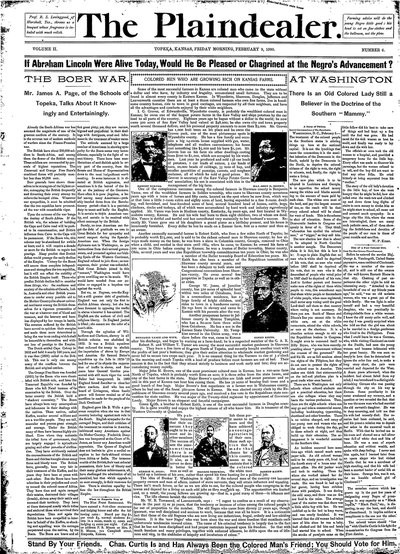
Page text (machine-generated)
VOLUME II.
If Abraham Lin
THE BOE
Mr. James A. Page
Topeka, Talks A
ingly and En
Already the South-African war has assumed the magnitude of one of the greatest conflicts of the century. It is the severest test of modern methods of warfare since the Franco-Prussian war. The British have about 200,000 soldiers in South-Africa, and among them the flower of the British army. These soldiers are commanded by generals of highest reputations. The Transvaal and Orange Free State's combined forces will probably number less than 90,000 men.
Boer generals have shown themselves to be strategists of the highest order, entrapping the British frequently and thwarting their every attempt to relieve the besieged cities. Whatever our sympathies, it must be admitted that the two republics have prosecuted the war with remarkable vigor.
Upon the outcome of the war hangs the destiny of South-Africa. If the British win, the scheme of building the Cape and Cairo road will be pushed to its consummation, and British influence from Cairo to the Cape will be paramount. If the Boers win, this scheme may be abandoned for awhile at least; and it will require a decade or more for the British to regain lost prestige. Many predict that British defeat would presage the early decline of the Empire. Victory for the Boers will assure them complete independence and strengthen the two republics, but it will not affect the stability of the British Empire itself. Those who predict British decline fail to consider three things, viz.: the readiness and anxiety of the colonists of Canada, India, Australia and other British possessions to render every possible aid to the Mother Country: the almost universal sentiment among the British themselves for a vigorous prosecution of the war at whatever cost of blood and treasure, and the bravery and heroism displayed by her troops in battle. The reverses suffered by the British have served to quicken their energies and made them more determined to bring the war to an ending which shall be honorable to themselves and without loss of prestige to the Empire.
The Dutch settled Cape Colony in 1652 and held it nearly 150 years, and it was then (1806) ceded to the British. This war is only one among many of the conflicts between the British and original settlers.
The Orange Free State was founded (1835) by the Boers who were dissatisfied with British rule, and later the Transvaal Republic was founded by Boers who left Natal because of its annexation by the British. Over the latter country the British hold a "shadowy suzerainty." The Boers have always been very unscrupulous and inhumane in their dealings with the natives. These natives, called Kaffirs, number several millions and are a war-like people. They are tall, muscular and possess great strength and courage. Under the British many of them have become highly civilized. Even where they maintain the tribal form of government, they are largely engaged in agriculture grazing and other pursuits of civilization. They have stubbornly resisted the encroachments of the British and Boers and this has brought about many fierce and bloody wars. The British have, generally, been very fair in their treatment of the Kaffirs, and for years they have been at peace with each other. But the Boers have been relentless in their prejudice and cruelty toward the colored races of Africa. They have time and again ravaged their estates, destroyed their villages (kraals), driven away their cattle and annexed their territory. They have at times destroyed nearly whole tribes and enslaved those who survived their depredations. Time and again the British have been compelled to interfere in behalf of the Kaffirs, so shocking and appalling were the outrages perpetrated upon the natives, by the Boers. The Boers are brave and af-
The Plaindealer.
fect great piety; yet, they are narrow, bigoted and prejudicial in their dealings with foreigners, cruel and inhumane in the treatment of weaker races. The attitude assumed by a large number of Americans in showing sympathy for the Boers seems very inconsiderate, especially in the light of recent history. There have been manifestations of anti-British spirit in every part of the country, from the Senate and House of Representatives down to the most insignificant ward-meeting. In some instances it is directed at British aggression, and sometimes it is the hatred of the Irish or the jealousy of the Germans. More often it is pure jingoism, a belief among many Americans—probably handed down from the Revolutionary period—that it is a patriotic duty to taunt and bully the English. It is certain to tickle American vanity, and certain to be received with silent contempt by the British.
Surely, no true American can forget the debt of gratitude we owe to Great Britain for her sympathy and moral support during the Spanish-American war. When the foreign diplomats met in Washington, as per instructions from their several governments, and protested against our kicking Spain off the Western Continent, England refused to join them; as consequence, their protest was unheeded. Had Great Britain joined in this "concert," Washington would have given unwilling ear to its music. We would have receded from our position or engaged in a hopeless war against the world.
But we, as Negroes, owe the English a still greater debt of gratitude. England was not only the first to abolish African slavery, but she has been foremost in opposing the traffic in slaves wherever it has existed. The English are the authors of civil and religious liberty. In England justice is blind; she cannot see the color of a man's skin.
Through the agitation of Wilberforce and Clarkson, slavery in all British colonies was abolished in 1833. It was a British squadron that enforced the treaty to abolish the importation of slaves by Europe and America. Sir Samuel Baker's expedition up the Nile in 1870-'73 had for one of its objects the suppression of traffic in slaves, and four years later General Gordon prosecuted with still more vigor the work Baker had inaugurated. In 1893 England forced Zanzibar to close her slave markets. And who has not heard of Livingston, whose lonely grave will forever remind us of the sacrifices he made for the people of the Dark Continent?
England gave Ida B. Wells a generous reception when she was in that country lecturing against mob rule in the South. English sympathy for the outraged Negro, and their criticism of the treatment he receives in America, imbittered many Americans against the Mother Country. Frederick Douglass was banqueted at the Court of St. James, an honor any American would appreciate. The Queen of England does not hesitate to give a cordial reception to her dark-skinned visitors from Africa or India. The immense wealth of the British,their vast colonial possessions, their love of liberty and their many glorious achievements, all, have challenged the admiration of all mankind, but that which appeals to us most strongly, is their reverence for law. There is absolute equality before the law throughout the British Empire.
The Blue Front Restaurant. We have opened a first-class restaurant and lodging house and offer the following rates: Board per day $1, per week $3, normal students $2; two in a room, meals 15 cents and lodging 25 cents per night. Call on or address P. B. Moore or Mrs. P. B. Moore, 711 Campbell street, Emporia, Kansas.
TOPEKA, KANSAS, FRIDAY MORNING, FEBRUARY 9, 1800.
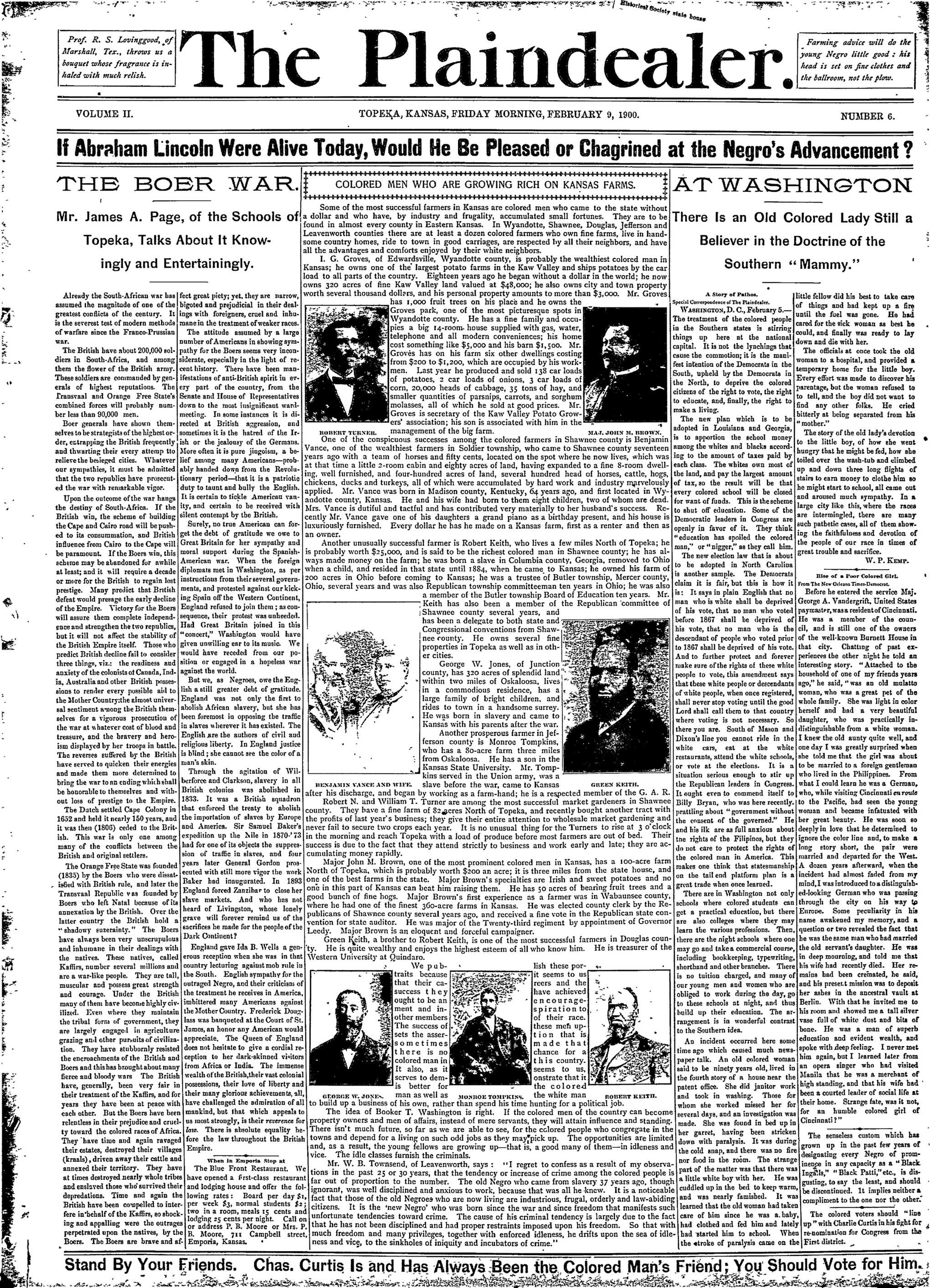
COLORED MEN WHO ARE GROWING RICH ON KANSAS FARMS.
Some of the most successful farmers in Kansas are colored men who came to the state without a dollar and who have, by industry and frugality, accumulated small fortunes. They are to be found in almost every county in Eastern Kansas. In Wyandotte, Shawnee, Douglas, Jefferson and Leavenworth counties there are at least a dozen colored farmers who own fine farms, live in handsome country homes, ride to town in good carriages, are respected by all their neighbors, and have all the advantages and comforts enjoyed by their white neighbors.
I. G. Groves, of Edwardsville, Wyandotte county, is probably the wealthiest colored man in Kansas; he owns one of the largest potato farms in the Kaw Valley and ships potatoes by the car load to all parts of the country. Eighteen years ago he began without a dollar in the world; he now owns 320 acres of fine Kaw Valley land valued at $48,000; he also owns city and town property worth several thousand dollars, and his personal property amounts to more than $3,000. Mr. Groves
has 1,000 fruit trees on his place and he owns the Groves park, one of the most picturesque spots in Wyandotte county. He has a fine family and occupies a big 14-room-house supplied with gas, water, telephone and all modern conveniences; his home cost something like $5,000 and his barn $1,500. Mr. Groves has on his farm six other dwellings costing from $200 to $1,200, which are occupied by his workmen. Last year he produced and sold 138 car loads of potatoes, 2 car loads of onions, 3 car loads of corn, 20,000 heads of cabbage, 35 tons of hay, and smaller quantities of parsnips, carrots, and sorghum molasses, all of which he sold at good prices. Mr. Groves is secretary of the Kaw Valley Potato Growers' association; his son is associated with him in the management of the his farm.
One of the conspicuous successes among the colored farmers in Shawnee county is Benjamin Vance, one of the wealthiest farmers in Soldier township, who came to Shawnee county seventeen years ago with a team of horses and fifty cents, located on the spot where he now lives, which was at that time a little 2-room cabin and eighty acres of land, having expanded to a fine 8-room dwelling, well furnished, and four-hundred acres of land, several hundred head of horses, cattle, hogs, chickens, ducks and turkeys, all of which were accumulated by hard work and industry marvelously applied. Mr. Vance was born in Madison county, Kentucky, 64 years ago, and first located in Wyandotte county, Kansas. He and his wife had born to them eight children, two of whom are dead. Mrs. Vance is dutiful and tactful and has contributed very materially to her husband's success. Recently Mr. Vance gave one of his daughters a grand piano as a birthday present, and his house is luxuriously furnished. Every dollar he has he made on a Kansas farm, first as a renter and then as an owner.
Another unusually successful farmer is Robert Keith, who lives a few miles North of Topeka; he is probably worth $25,000, and is said to be the richest colored man in Shawnee county; he has always made money on the farm; he was born a slave in Columbia county, Georgia, removed to Ohio when a child, and resided in that state until 1884, when he came to Kansas; he owned his farm of 200 acres in Ohio before coming to Kansas; he was a trustee of Butler township, Mercer county, Ohio, several years and was also Republican township committee ten years in Ohio; he was also
BENJAMIN VANCE AND WIFE slave before the war, came to Kansas GREEN KEITH. after his discharge, and began by working as a farm-hand; he is a respected member of the G. A. R.
alter his discharge, and began by working as a farm-hand; he is a respected member of the G. A. K. Robert N. and William T. Turner are among the most successful market gardeners in Shawnee county. They have a fine farm of 82 acres North of Topeka, and recently bought another tract with the profits of last year's business; they give their entire attention to wholesale market gardening and never fail to secure two crops each year. It is no unusual thing for the Turners to rise at 3 o'clock in the morning and reach Topeka with a load of produce before most farmers are out of bed. Their success is due to the fact that they attend strictly to business and work early and late; they are accumulating money rapidly.
Major John M. Brown, one of the most prominent colored men in Kansas, has a 100-acre farm North of Topeka, which is probably worth $200 an acre; it is three miles from the state house, and one of the best farms in the state. Major Brown's specialties are Irish and sweet potatoes and no one in this part of Kansas can beat him raising them. He has 50 acres of bearing fruit trees and a good bunch of fine hogs. Major Brown's first experience as a farmer was in Wabaunsee county, where he had one of the finest 360-acre farms in Kansas. He was elected county clerk by the Republican of Shawnee county several years ago, and received a fine vote in the Republican state convention for state auditor. He was major of the Twenty-third regiment by appointment of Governor Leedy. Major Brown is an eloquent and forceful campaigner.
Green Keith, a brother to Robert Keith, is one of the most successful farmers in Douglas county. He is quite wealthy and enjoys the highest esteem of all who know him. He is treasurer of the Western University at Ouindaro.
We pub-traits because that their ca-success they ought to be an ment and in-other members. The success of sets the asser-sometimes there is no colored man in It also, as it serves to dem-is better for man as well as to build up a business of his own, rather than spend his time hunting for a political job.
MONROE TOMPKINS.
lish these por-it seems to us reers and the have achieved encourag-espiration to of their race. these men u-p-tion that is made that chance for a this country. seems to us, onstrate that it the colored the white man
ROBERT KEITH.
The idea of Booker T. Washington is right. If the colored men of the country can become property owners and men of affairs, instead of mere servants, they will attain influence and standing. There isn't much future, so far as we are able to see, for the colored people who congregate in the towns and depend for a living on such old jobs as they may pick up. The opportunities are limited and, as a result, the young fellows are growing up—that is, a good many of them—in idleness and vice. The idle classes furnish the criminals.
Mr. W. B. Townsend, of Leavenworth, says: "I regret to confess as a result of my observations in the past 25 or 30 years, that the tendency or increase of crime among the colored people is far out of proportion to the number. The old Negro who came from slavery 37 years ago, though ignorant, was well disciplined and anxious to work, because that was all he knew. It is a noticeable fact that those of the old Negroes who are now living are industrious, frugal, orderly and law-abiding citizens. It is the 'new Negro' who was born since the war and since freedom that manifests such unfortunate tendencies toward crime. The cause of his criminal tendency is largely due to the fact that he has not been disciplined and had proper restraints imposed upon his freedom. So that with much freedom and many privileges, together with enforced idleness, he drifts upon the sea of idleness and vice, to the sinkholes of iniquity and incubators of crime."
J.
ROBERT TURNER. manage
One of the conspicuous s
Vance, one of the wealthiest
years ago with a team of hori
at that time a little 2-room cali
ing, well furnished, and four-h
chickens, ducks and turkeys, al
applied. Mr. Vance was born
andotte county, Kansas. He a
Mrs. Vance is dutiful and tactif
cently Mr. Vance gave one of
luxuriously furnished. Every o
an owner.
Another unusually successf
is probably worth $25,000, and
ways made money on the farm
when a child, and resided in the
200 acres in Ohio before com
Ohio, several years and was als
```markdown
```
BENJAMIN VANCE AND WIFE after his discharge, and began Robert N. and William T. county. They have a fine farm the profits of last year's business never fail to secure two crops e in the morning and reach Toppe success is due to the fact that
Reith has also been a member of Shawnee county several years, and has been a delegate to both state and Congressional conventions from Shawnee county. He owns several fine properties in Topeka as well as in other cities. George W. Jones, of Junction county, has 320 acres of splendid land within two miles of Oskaloosa, lives in a commodious residence, has a large family of bright children, and rides to town in a handsome surrey. He was born in slavery and came to Kansas with his parents after the war.
Another prosperous farmer in Jefferson county is Monroe Tompkins, who has a 80-acre farm three miles from Oskaloosa. He has a son in the Kansas State University. Mr. Tompkins served in the Union army, was a slave before the war, came to Kansas
PETER H.
MAJ. JOHN M. BROWN.
Shawnee county is Benjamin to Shawnee county seventeen where he now lives, which was handed to a fine 8-room dwell- head of horses, cattle, hogs, work and industry marvelously ago, and first located in Wy-ildren, two of whom are dead. so her husband's success. Redday present, and his house is first as a renter and then as new miles North of Topeka; he in Shawnee county; he has al-ity, Georgia, removed to Ohio Kansas; he owned his farm of latter township, Mercer county, ten years in Ohio; he was also of Education ten years. Mr. the Republican committee of
GREEN KEITH.
elected member of the G. A. R. market gardeners in Shawneeently bought another tract with wholesale market gardening and the Turners to rise at 3 o'clock farmers are out of bed. Their back early and late; they are ac
Special Correspondence of the Plaindealer.
WASHINGTON, D.C., February 5.—The treatment of the colored people in the Southern states is stirring things up here at the national capital. It is not the lynchings that cause the commotion; it is the manifest intention of the Democrats in the South, upheld by the Democrats in the North, to deprive the colored citizens of the right to vote, the right to educate, and, finally, the right to make a living.
The new plan which is to be adopted in Louisiana and Georgia, is to apportion the school money among the whites and blacks according to the amount of taxes paid by each class. The whites own most of the land, and pay the largest amount of tax, so the result will be that every colored school will be closed for want of funds. This is the scheme to shut off education. Some of the Democratic leaders in Congress are openly in favor of it. They think "education has spoiled the colored man," or "nigger," as they call him.
The new election law that is about to be adopted in North Carolina is another sample. The Democrats claim it is fair, but this is how it is: It says in plain English that no man who is white shall be deprived of his vote, that no man who voted before 1867 shall be deprived of his vote, that no man who is the descendant of people who voted prior to 1867 shall be deprived of his vote. And to further protect and forever make sure of the rights of these white people to vote, this amendment says that these white people or descendants of white people, when once registered, shall never stop voting until the good Lord shall call them to that country where voting is not necessary. So there you are. South of Mason and Dixon's line you cannot ride in the white cars, eat at the white restaurants, attend the white schools, or vote at the elections. It is a situation serious enough to stir up the Republican leaders in Congress. It ought even to commend itself to Billy Bryan, who was here recently-prattling about "government without the consent of the governed." He and his ilk are as full anxious about the rights of the Filipinos, but they do not care to protect the rights of the colored man in America. This makes one think that statesmanship on the tail end platform plan is a great trade when once learned.
There are in Washington not only schools where colored students can get a practical education, but there are also colleges where they may learn the various professions. Then, there are the night schools where one may go and take a commercial course, including bookkeeping, typewriting, shortband and other branches. There is no tuition charged, and many of our young men and women who are obliged to work during the day, go to these schools at night, and thus build up their education. The arrangement is in wonderful contrast to the Southern idea.
An incident occurred here some time ago which caused much newspaper talk. An old colored woman said to be ninety years old, lived in the fourth story of a house near the patent office. She did janitor work and took in washing. Those for whom she worked missed her for several days, and an investigation was made. She was found in bed up in her garret, having been stricken down with paralysis. It was during the cold snap, and there was no fire nor food in the room. The strange part of the matter was that there was a little white boy with her. He was cuddled up in the bed to keep warm, and was nearly famished. It was learned that the old woman had taken care of him since he was a baby had clothed and fed him and lately had started him to school. When the stroke of paralysis came on the
Farming advice will do the young Negro little good : his head is set on fine clothes and the ballroom, not the plow.
NUMBER 6.
Advancement?
HINGTON
Colored Lady Still a Doctrine of the
'Mammy.'
little fellow did his best to take care of things and had kept up a fire until the fuel was gone. He had cared for the sick woman as best he could, and finally was ready to lay down and die with her.
The officials at once took the old woman to a hospital, and provided a temporary home for the little boy. Every effort was made to discover his parentage, but the woman refused to tell, and the boy did not want to find any other folks. He cried bitterly at being separated from his "mother."
The story of the old lady's devotion to the little boy, of how she went hungry that he might be fed, how she toiled over the wash-tub and climbed up and down three long flights of stairs to earn money to clothe him so he might start to school, all came out and aroused much sympathy. In a large city like this, where the races are intermingled, there are many such pathetic cases, all of them showing the faithfulness and devotion of the people of our race in times of great trouble and sacrifice.
Before he entered the service Maj. George A. Vandergrift, United States paymaster, was a resident of Cincinnati. He was a member of the council, and is still one of the owners of the well-known Burnett House in that city. Chatting of past experiences the other night he told an interesting story. "Attached to the household of one of my friends years ago," he said, "was an old mulatto woman, who was a great pet of the whole family. She was light in color herself and had a very beautiful daughter, who was practically indistinguishable from a white woman. I knew the old aunty quite well, and one day I was greatly surprised when she told me that the girl was about to be married to a foreign gentleman who lived in the Philippines. From what I could learn he was a German, who, while visiting Cincinnati en route to the Pacific, had seen the young woman and became infatuated with her great beauty. He was soon so deeply in love that he determined to ignore the color line and, to make a long story short, the pair were married and departed for the West. A dozen years afterward, when the incident had almost faded from my mind, I was introduced to a distinguished-looking German who was passing through the city on his way to Europe. Some peculiarity in his name awakened my memory, and a question or two revealed the fact that he was the same man who had married the old servant's daughter. He was in deep mourning, and told me that his wife had recently died. Her remains had been cremated, he said, and his present mission was to deposit her ashes in the ancestral vault at Berlin. With that he invited me to his room and showed me a tall silver vase full of white dust and bits of bone. He was a man of superb education and evident wealth, and spoke with deep feeling. I never met him again, but I learned later from an opera singer who had visited Manila that he was a merchant of high standing, and that his wife had been a courted leader of social life at their home. Strange fate, was it not for an humble colored girl of Cincinnati?
The senseless custom which has grown up in the past few years of designating every Negro of prominence in any capacity as a "Black Ingalls," "Black Patti," etc., is disgusting, to say the least, and should be discontinued. It implies neither a compliment to the one nor the other.
The colored voters should "line up" with Charlie Curtis in his fight for re-nomination for Congress from the First district.
ANNOUNCEMENTS
W. E. Pagan.
W. E. Fagan announces his candidacy for Probate Judge. Subject to Republican primaries.
M. Snattinger.
We are authorised to announce the candidacy of M. Snattinger for Councilman from the Third ward, subject to the Republican primaries.
P. H. Forbes.
We are authorised to announce P. H. Forbes as a candidate for Third ward Councilman, subject to the Republican primaries.
H. J. Bevelle.
I hereby announce myself a candidate for the office of Probate Judge of Shawnee county, Kansas. Subject to the Republican primaries when held this spring
H. J. Bevelle.
CHIEF RAMSEY and his force of police are undertaking a task which, if successful, will forever endear them to the respectable people of this city. It is more to be desired than the closing of the joints. It is stopping the practice of a lot of lazy loafers insulting ladies as they pass along the streets. It is high time that something should be done in this direction. It is almost impossible for a respectable lady to pass along Kansas avenue without being assailed by profane and obscene language, and another thing especially true, is the attitude of a class of white toughs toward colored ladies. A prominent colored lady was followed up one of our public streets a few days ago by a big, burly white tough, who persisted in leering into her face and otherwise indulging in indecent remarks. The colored ladies should carry a small bottle of vitiol and throw it into the faces of some of these toughs, and it would be a material aid to Chief Ramsey in his work of preserving order.
THE following story is taken from The New Orleans Times-Democrat, and very aptly illustrates how easy it is for a white man to discover that he is not the "whole show:"
"It itakes some time to learn the social ropes in Central America," remarked a gentleman in the banana trade, and a stranger is very apt to put his foot in it. The first time I ever went to the country myself was as the representative of an American machinist house. There was a good field for us in one of the republics, but the tariff is prohibitive, and I concluded to go over to the capital and have an interview with the Minister of Agriculture, hoping to persuade him to recommend a reduction. I spoke pretty Olldoennold Spanish, but was otherwise green as a gourd, and as soon as I arrived I made a beeline for the administration building. While I was cooling my beaks in an ante-room, waiting for a chance to speak to somebody in authority and ascertain how the minister could be seen, a very black, fat little Negro waddled in, wearing what I took to be a species of livery. He had exactly what the act of an impudent, over-fed house servant, and he looked me over in a way that made my blood boil. "He boy!" I said, sharply, "how long must I wait here?" "How should I know?" he replied in Spanish; "if it doesn't suit you get out." He chuckled at his spoke, and his ansac up infurred me that I lost my head. Jumping up, I seized him by the collar and the slack of his absurd embroidered trousers and propelled him肌虎-fashion through the open door. "There, you black scoundrel!" I exclaimed, "go and send somebody after my card!" The little fat darky was so amazed he couldn't utter a word. He simply gasped and disappeared. Half a minute later a squad of soldiers was in placed me under arrest, and I learned that my friend in the embroidered pantaloons was the Minister of Public Instruction. I will have you to imagine my feelings. It took three hours of solid talk from both the American and British Consult to get me out of the scrape, and, incidentally, I made a groveling apology. Of course I didn't dare to introduce the machinery proposition after such a debut, so my trip was a flat failure. As I said before, it takes some time for a stranger to grasp the etiquette of these "furren" parts."
GEO. KLIEN & CO.,
MAKERS OF
High-Grade Buggy
and Team Harness.
...Repairing Promptly Executed....
18 Kansas Ave. Topeka, Kan.
Tom Logan Writes.
Foreign Correspondence of The Plaandealer.
SYDNEY, Australia, December 20.—Twenty-thousand miles from the scenes of my boyhood days, and feeling just a trifle homesick. I permitted my thoughts to wander back, and the following jokes, concerning a few of my dearest friends, were permitted to recall themselves to memory, and knowing they would be appreciated, I jot them down and send you.
PAUL JONES, KANSAS CITY, KAS.
Once upon a time Jones lost a case which had been tried before three judges, one of whom was esteemed, an able jurist and the other two only second-rate lawyers who owed their positions more to a judicious use of "election boodle" than to brains. As before stated, Jones lost the case and Nelson Crews and the writer were "roasting" Paul upon his failure to secure an acquittal.
"Why," says he, "who could have won that case when there were a hundred judges on the bench?"
"A hundred! There were only three."
"No, no," says Jones, "there were one and two ciphers; isn't that a hundred?"
LETT BROTHERS, ATCHISCN, KAS.
In 1896 a convention of Mystic Shriners was being held in Kansas City, and 'Gene and Arthur Lett came as delegates from Atchison. They came under certain instructions, and the grand council had about decided to grant the concession when Arthur, in an attempt to clinch matters, secured the floor and made a speech that completely upset everything and caused them to lose the object in view, as the committee, literally taxing Arthur's expression, returned an adverse report. On the way home to dinner, 'Gene was heard to chastise Arthur as follows :
"See here, Art., you are a donkey; why didn't you keep quiet instead of making that asinine speech? You are a donkey, and I am telling you as a brother?"
GUY OVERALL, OMAHA, NEBR.
About 5 years ago a party of K. C. young bloods journeyed one night to Olathe, Kansas, to attend an evening dress ball; among the number was Guy Overall. Arriving there about 9 o'clock, the party were surprised to learn that the ball had been postponed and a protracted meeting was taking place instead. Those in charge of the meeting were expecting a certain young divine from Kansas City to assist in the crusade against sin, but the aforesaid clergyman unfortunately missed the train. Jimmie Baker and Eddie Page suggested, as a lark, that Guy impersonate the young evangelist. With the assurance that they would stand by him, Guy consented. The old-fashioned pulpit had a high desk over which the red head of poor Guy was hardly visible. "Rev. Overall" announced the text, "I am the light of the world." Just then a voice shouted from near the door:
"Bro. deacon, push him up higher; don't let him burn in his socket!" [N. B.—It's worth your life to call Guy "Rev."]
NELSON C. CREWS, KANSAS CITY, MO.
Mr. Crews had an occasion to address a Sunday school at Gallatin, Mo., and anyone who knows Nelson, also knows that Nelson takes an indescribable joy in being handy around children.
Well, you can imagine the surprise of Mr. Crews, while waiting for his train, to notice that the most attentive scholars of a few hours ago were busy desecrating the Sabbath in a game of baseball! Walking over to the crowd he laid aside his coat and vest, called the boys around him, and proceeded to lecture them upon the Ten Commandments, especially the Fourth. The boys seemed much impressed and promised to mend their ways. When Crews picked up his vest, his watch was missing. It had been stolen while he was lecturing the wicked boys. In its place was a piece of paper on which was written:
"Watch and pray."
J. H. CHILDERS, TOPEKA, KAS.
Several years ago Mr. Childers bought a piece of property (his present home) at 1038 Pine street, Topeka. "Jasper" would not rest contented until I had gone out to Lonelyville and inspected his home. He was quite particular to impress that the agent guaranteed the place would double in value in three years.
Two years ago I remarked :
"Jasper', you told me this place would double its value in three years; that was five years ago, and now you can't sell it for half what you paid for it."
Childers's proverbial wit came to the rescue, and he replied quickly : "Yes, it has doubled in value; but, you see, I paid four times as much for it as it was worth."
DR. S. H. THOMPSON, KANSAS CITY, KS Doc. Brown, the champion cake-
walkef of Missouri, once, in an inglorious attempt to land Dr. Thompson, said : "No, sah, Mistah Logans, isn't no real doctah. I'se only a doctah by name, sah. But Doctah Thompson, of Wyandotte, sah, is my ijeal doctor, sah. He done treated ober six-hundred people dis year, sah, and ob de thirteen dat died, nary one of dem died from de complaint dat he was doctahing dem for, sah."
EDWIN H. HACKLEY, DENVER, COLO. When Rev. John Turner was pastor of Allen Chapel, Kansas City, Mo., we were rehearsing the cantata, "Esther." While awaiting the arrival of Mrs. Georgiana Cox, the organist, some of the ladies requested Mr. Hackley to play a selection on the organ. As Ed, had but recently arrived in K. C., he could not refuse. He began to play "A Life on the Ocean Wave," and everyone walked out of the parsonage. Hackley felt aggrieved thereat, but George W. Teeters, who took the part of Modercai, quickly explained matters by saying:
"Hackley, you are wonderful; you played so realistically that they all felt seasick."
PROF. J. D. BOWSER, KANSAS CITY, MO.
Years ago, when Prof. and Mrs. Bowser taught school in a half-brick, half-frame one-story building on Walnut street between Tenth and Eleventh, the professor was giving directions for standing erect. (Many of my old schoolmates will remember this incident).
"Stand with your heels together, toes turned outward, making an angle of forty degrees," said he. We all complied except poor Andrew Green, now deceased. Andrew looked bewildered.
"Well, Andy, don't you know what I mean? Do you know what a degree is?"
Andrew replied: "Yes, sir, Mr. Bowser—sixty-nine and one-fourth miles!" TOM LOGAN.
The Troubadours.
The Atchison Globe says the Troubadours, at the head of whom is Sissieretta Jones, gave the best performance of any colored troupe visiting Atchison this year. You will please take out your memorandum and observe that Williams and Walker visited Atchison the 17th of last month. The Globe is saying a great deal, but it is generally correct. Ralph Tennal, who does the leg work for that paper, is a singer in an Atchison church choir, and Ed. Howe, the horse editor, at one time tooted a horn in a Falls City (Nebr.) brass band. Therefore, The Globe is an authority on music—vocal and instrumental.
The Atchison paper claims the show was good almost throughout, but seems to regret that Mrs. Jones got "foxy" in her singing, and says the audience was enthusiastic principally when she sang Negro melodies. Every white audience is enthusiastic when Negroes chant, in their weird way, Negro melodies, whether they can sing or not. Negro melodies are suggestive of slavery and servitude.
We don't really know what The Globe intends by its use of the word "foxy," but we presume it is applied to the selections from "Il Trovatore" and Tannhauser which Mrs. Jones and her company sang. If this be true, surely Ed. Howe did not write the article; for, when there is grand opera in Kansas City or St. Louis, Ed. Howe is the first man out of Kansas to hear it. He appreciates grand opera the same as he does a brass band with the clarionet out of it. Sissieretta Jones interprets grand opera about as affectively as Melba, Calve or Nordica, for whose notes one is compelled to pay from five to ten dollars, while some of them were interpreted in Atchison Monday night for 25, 35 and 50 cents!
It may be the case, however, that the white people are at last getting indignant because the colored folks on the stage are usurping their rights, in the manner that they are interpreting grand opera and using grea-paints so effectively that some of the women almost as darkly colored as Erebus are made to look like white. But, then, the whites are putting on curly wigs, doing rag-time and imitating Negroes generally. It's hoss and hoss.
The Globe says of Williams and Walker that Bert. Williams was the funniest colored man ever seen in Atchison, and that George Walker seemingly was with the show to advertise its prosperity, he appeared so often, and each time in a different suit of clothes. Mattie Wilkes, though a star, was not mentioned individually.
The Globe said of Sissieretta Jones that she is the sweetest-voiced singer in her race. The Globe is correct—it is an excellent judge—but it might have gone farther and said that her voice is as melodious and as pleasing as that of any singer of any race.
* * *
It is more a sign that a person is going to use carbolic acid in a bath, to take off dirt, than that he would use it with suicidal intent.
* * *
Why do singers wear low-neck dresses? Is it to permit their auditors to observe how their breasts heave when they register a difficult note?
* * *
As soon as a girl gets to sliding on the downward grade, the women folks suddenly discover that they have suspected "she wasn't real bright, anyway."
\* \* \*
It is a sign of declining womanhood when the women pay the men's way to the opera, considering that it is not Leap Year, and particularly when the men refuse to accept the invitation.
* * *
About the only consolation a homely woman receives in return for her possession of a handsome husband, is to hear other women pass compliments upon his looks, that she might get jealous.
* * *
As the cycle of years revolves, it is observed that if three men can get together, and organize themselves into a grand M. W. M., a grand M. W. S. and a grand M. W. T., and elect themselves annually, they are entitled to a 33rd degree, and can control a lodge.
Education is a good thing to have. It is what the Negro race in its present condition needs, but much depends upon the sort of education. The average girl prefers the attentions of a guitar-playing youth who has no visible means of support, and travels on his shape, to those of a carpenter or blacksmith. It seems to be a question of fine clothes and supposed learning.
The result is that the non-working man, aft r he marries, has to be supported by his wife. There is a sort of education that is to be kept far from our schools. It utterly spoils people. A girl pounding at the piano or giggling at the gate with an idle dude, and the mother at the washtub or cook stove, is a sorry sight. When it makes both vain and lazy, it ruins them.
The thing of filling our boys with Greek and Latin is a criminal waste of time and money. There is no real need of it. The child should understand the fundamental principles of a common-school education, then let him or her take the hand-training. It's not necessary, however, that young people may know how to do any given thing—as carpentry, blacksmithing, printing, sewing, cooking—but that they may know the value of work. Hand-training quickens the mental faculties that no sort of mere text-book drill awakens, and this is one of its chief blessings. Hand-education helps to keep the brain balanced.
There are some old fogies who will have no industrial teaching in their schools. We have some such in Lexington, who, in order to make
the unlettered parents believe that they are learned, tell them that work-teaching and book-teaching cannot go on together. Such teachers are absolutely too ignorant to understand that the greater the educational needs of any people, the greater their need of not only being taught books, but of being taught to make a living.
We have in The Standard office a boy of 15 who goes to school in the forenoon and works in the afternoon. He is well up in the comm n-school branches and understands the rudiments of Latin, rhetoric and algebra, but the knowledge he gains as a typesetter, deciphering, punctuating and correcting the spelling of scores of different kinds of manuscripts, the privilege of reading over two-hundred newspapers from the leading citizens of the land, the instructions given him in both the press and composing rooms, correcting proof, and coming in contact with prominent men from all over the country, is worth more to the boy in six weeks than the Latin he learns in the schools in six years.
In fact, this young printer is better posted on general affairs than are some teachers, for they read nothing but the ordinary text-book and rarely come in contact with any one except their pupils. There is absolutely nothing in the Latin business in the common school but a waste of public money and stunting the growth of the child. Latin is a dead language. Let it sleep. No nation speaks it now. The mental discipline it affords can be obtained in the great scramble for daily bread. As a foundation for English, if a boy enters a trade or profession, requiring it, he can study Latin privately after leaving the public school, or in some institution of higher learning, but do not force it on bim otherwise.
Race War--The Color Labor Line.
At this time the Southern states are in revolt—in almost an open war with the colored population. Booker T. Washington, now the Fred. Douglass of his race, in a late address showed the ever-increasing slaughter. It is simply appalling, and is arousing the nation. Millions of people are already involved, and it is time to throw sentiment to the winds and look the conditions squarely in the face. Party politics, as now trending, will never settle the question.
The Blue and the Gray are reunited. The politicians who shouted rebel brigadier and waved the bloody shirt in Congress for thirty years, now fraternalize with ex-Confederates and help to decorate the graves and honor the memory of traitors who died fighting the old flag and trying to destroy the Union. The men who wept over Mason and Dixon's Line, at their national convention in St. Louis, had to quarter their colored delegates in railroad cars rather than eat with them at the hotels where colored cooks prepared the food and colored waiters brought it to the table. Even President McKinley, in his speeches, for political effect, has folded to his bosom the fragments of the Southern Confederacy, cooed over it; and yet the killing of colored postmasters, the insulting of colored troops, the wholesale assaulting, murdering and burning of colored citizens untried in the civil courts, prove that the same spirit of race hatred rules in the South today as in the days of slavery and rebellion.
There is vastly more politics in this race war than many are willing to admit. It is high time to emphasize the application of Articles 13, 14 and 15 of the American National Constitution in the protection from mobocracy the colored people of this country. The plantation stores and rent system of the South is as oppressive as the old slave system. The Negro and poor white man always comes out in debt.
It is now the color-labor line. The same principles applied in the mines and factories of the North and East are bearing the same fruit—are making serfs and slaves of the white laboring population. The "servant girl," "hired man," "factory girl," and "coachman" in Maine and Massachusetts are as thoroughly barred from the drawing-room and society circles as any Negro in Georgia or Mississippi. Is it any wonder the working people of aristocratic New York and staid New England are no longer enthusiastic over the learned ebullitions of a George W. Cable or an Albion W. Torgue? The labor line in the fashionable Northeast is at this moment as marked as the color line in Dixie, and the blue blood of Boston and Lowell as much stirred when a leading society girl marries the "coachman" or the "hired man," as are the first families of Virginia, when a white Southern belle marries a mulatto. The same old gray-headed man who cried down the Dred Scott Decision as unconstitutional, because it declared the slave had no
THE,GREAT
SOUTHWEST SYSTEM,
States of Kansas, Missouri, Nebraska,
and the Indian Territory.
Passenger Trains are run on this line
between Kansas City and St. Louis.
OUS
Hot Springs
Of Arkansas
BY this LINE
Traveling the States of Kansas, Missouri, Nebraska, Colorado, Cansas, and the Indian Territory. Five (5) Daily Passenger Trains are run on this line in each direction, between Kansas City and St. Louis.
Are reached ONLY by this LINE
H.C. TOWNSEND, G.P. & T.A.,
ST, LOUIS, MO.
F. E. NIPPS, Agent,
TOPEKA, KAS.
to $50.
s $100
ments
month-
Kansas City, Mo.
Opposite old Cable Power House
Two blocks from Armour's Packing House
Watches, Clocks and Jewelry
Repaired Correctly.
Send in Your Description.
[Please remember the request of THE PLAINDEALER of a few weeks ago for a description of the city in which you live from youthful readers. We want each city represented. The best description from each city will be printed.]
Abraham Lincoln's Birthday.
Monday, February 12, is the anniversary of Abraham Lincoln's birthday, and as he is a prominent figure in American Negro history, a brief mention will not be inappropriate.
His career shows that—
"Honor and shame from no condition rise. Act well your shame, there all the honor lies."
The story of his humble birth, amid lowly surroundings, is familiar to all our young readers. The most humble school boy and girl of today are surrounded with advantages and luxuries that, in his youth, he ne'er dreamed of.
But his was the sterling qualities that make "a man."
He was truthful, honest, industrious and brave. Many anecdotes are told of him illustrating these virtues.
rights the owner was bound to respect now harp anarchist at all who object to the infamous Graduated Income Tax Decision that says the poor white and colored man have no rights the rich are bound to respect. The working man will soon be as thoroughly ostracised and subjugated in the North and East as in the South, and the same conditions are fast obtaining in the West. The whole object is to keep the working people in poverty and abject subordination, and appropriate the results of their labor. If the millions of colored people of the South do not combine and organize for self-protection, they will be wiped from the face of the earth; and if the laborers and producers of the North and West do not come together politically and battle for their rights, they will be ground to powder. How many mechanics, artisans and contractors are today working for nothing, or at a loss, because of the rise in the price of material since undertaking jobs? Let the millions of white and colored working people break every political slate in the state and the nation that does not represent their cause and their interests. Let us have ample discussion of these vital matters.
W. M. BUTLER.
MISSOURI
PACIFIC
RAILWAY
Traveling the States of K
Colorado, Cansas, and the B
Five (5) Daily Passenger
in each direction, between
The Famous
Hot
Are reached ONLY by t
H. C. T
F. E. NIPPS, Agent,
TOPEKA, KAS.
For Sale Real Estate
Have a good two story house, 5 rooms, 1 lot, $375, East Seventh street.
1 lot, 2 rooms and basement, (fair condition) $160.
East Thirteenth street, over 2 hundred good residences.
Properties in all parts of the city ranging from 300 to $3,000.
North Topeka lots $25 to $75.
Lowman Hill lots $35 to $50.
Washburn College lots $100 each. Small cash payments and balance on popular monthly plan.
18 acres, good 3 room cottage, $500, 2½ miles North of city.
We have good large farms and ranches to sell or trade.
R. O. Hilliard,
413 Kansas Ave.; Room 4.
When a mere boy he acquired a reputation for industry and truthfulness, and was so honest that he was called "Honest Abe."
At a time in the nation's crisis, when to stand up for "right" meant danger and death, Lincoln was brave enough to assert the truth and defend it.
These four qualities are within the reach of all our boys and girls, and are "Character Builders." Even a child is known by his acts. Be honest in thought and deed; speak and act the truth; be industrious and brave; and even though you may never have an opportunity to become famous, you will not have lived in vain. Opportunities show the greatness of men. Our race needs great men—men who are honest, brave and true.
"There's a good time coming; Let us aid it all we can— Every woman, every man— The good time coming. Smallest helps if rightly given Make the impulse stronger, 'Twil be strong enough some day, Help a little longer."
O. A. H.
THE city council loses a good man in the resignation of Col. Burgess.
THE organization of Curtis clubs goes on in the face of all opposition.
GOVERNOR TAYLOR, of Kentucky, can well afford to allow the Democratic robbers to have all the rope they want. The usual result will follow.
EVERY ward in Topeka has a strong Curtis club among the colored voters. Now, let every town in the district do likewise, and the result will be beyond question.
THE OLD-FASHIONED GIRL.
She's only an "old-fashioned girl," she says
(It is enough to disgrace!)
An "old fashioned girl" with womanly ways,
And a bimone and womanly face:
A girl who is innocent, modest and sweet,
Who is sensible, honey and true—
The kind that will surely be obsolete
In another short year or two.
S. isn't amotious for questionable fame,
She doesn't ape man in her dress,
She doesn't read books that have a bad name,
Nor herd her "news" in the press;
She doesn't use slang nor smoke cigarettes,
Nor loudly expound "Woman's Rights."
She shuns all the fads of the "fashioned sets,"
And "home" is her chief of delights.
She's only an "old fashioned girl," you see,
And not in the least "up-to-date."
But she is the kid of a girl for me,
And the kind that I want for a mate.
I know it's very "old-fashioned" to say
your wife is a "saint from above—"
But I own an am fond of her "old fashioned" way,
And proud of her "old-fashioned" love!
—ACTRESS GARRISON in St. Louis Republic.
Missouri Pacific Route
IE
You wish to see a beautiful display of Fine ewelry, look into J. A. Wilson's show window.
AND
If you want bargains in WATCHES, CLOCKS or JEWELRY of any sort for your own use or to make Christmas presents of, step inside and buy at prices to suit your pocket.
REMEMBER
That J. A. Wilson is Kansas City's Pioneer Negro Jeweler, is known as "The Reliable Jeweler" and is found at 116 West Ninth Street,
BARGAINS IN EVERYTHING
Persons from a distance will have
their car fare refunded if purchase is
made.
FRANK HERALD,
ATTORNEY-AT-LAM.
Room 313, Long Building,
515 Main Street, KANSAS CITY, MO
KANSAS PACKING HOUSE MARKET, Whoelsale and Retail. Fresh and sugar cured Meats. SCHMIDT BRO'S : : : 306 E. SECOND ST.
PRIDE OF POTTERY KENT No 26 meets 1st and d Saturday afternoon of each month at No. 909 North Kansas avenue. Mrs. Ida M. Jordan, Q. M., Miss Anna Reynold, C. R.
MAUDONIA TABERNACLE No. 98, U. K. T. Hall 609 N. Kansas Avenue. Meets 1st and 3rd Thursdays of each month. Mrs. Ida M. Jordan, G. P.; Miss Mary Anna Webster, C. R.
FOR RENT—Unfurnished rooms at 112, 114 East Seventh street. Call at THE PLAINDEALER office.
The Dyson restaurant, located at 440 Minnesota avenue, Kansas City, Kas., is the best restaurant in that city.
The Dyson restaurant, located at 440 Minnesota avenue, Kansas City, Kas., is the best restaurant in that city.
NOTICE—All correspondents for THE PLAINDEALER will kindly collect all subscriptions in their respective cities, and kindly remit same to the office.
PERSONAL NOTES.
Miss Lulu Smith has recovered from her illness.
Miss Hattie Moss has returned home, from college.
George Washington is visiting his family in Speed, Kansas.
Mrs. Maggie Moss is quite ill at her home on Fifteenth street.
Mrs. Samuel Higgins is expected home from Chicago at any time.
The Imperial Art club met last Saturday with Mrs. W. I. Jamison.
Mr. and Mrs. Manning are the proud parents of a boy baby, born Friday.
Ben Gaines has returned home, from Chicago, where he has been the past year.
Warren Scott, of Chicago, was in the city Sunday, the guest of relatives and friends.
Charles French and wife left Saturday, to visit friends in St. Louis and Chicago.
Mrs. Eliza Merriman and grand- daughter, Miss Vera, have returned from Pittsburg, Pa.
M. D. Jones and wife, of North Topeka, were callers at THE PLAIN- DEALER office Tuesday.
Mrs. Alice Keith-Holloway and daughter, Hazel, of Horton, are visiting Mrs. Robert Keith.
Daniel Williamson, of Leavenworth, was in the city this week attending the miners' convention.
The Owls will dance in the hall at 618 Kansas avenue February 14. Music by Steinberg's orchestra.
Lawyer T. W. Bell and Grand Master Dennis Jones, of Leavenworth, were in the city Tuesday.
Thomas W. Logan will be glad to hear from his friends. Address him care of Hotel Criterion, Sydney, N. S.W.
John Patterson, who has been the stenographer the past three years in the probate judge's office, has been let out.
Mrs. Florence Foster, of Ottawa, came up this week to visit her sisters, Mesdames W. J. Johnson and Georgia McCoy.
Tom McAdoo and Epp Love will leave Sunday, for Indianapolis, Ind., where they will work for the Hub Clothing company.
Tennis Young, the only son of Mr. and Mrs. Sheldon Young, died at their home Sunday morning and was buried Monday afternoon.
Mrs. Georgia McCoy left Tuesday morning for her home in Lewistown, Montana, after two weeks of enjoyment among relatives and friends.
The ladies of the Church Aid association of the New Hope Baptist church will give their weekly reception Saturday night at the building, corner of Thirteenth and Quincy. Come out and help them in our efforts. Admission free.
The Ivy club is the name of a new club now being organized in the city. The last meeting was with Mr. and
Mrs. J. H. Guy, 234 Topeka avenue, where a constitution and by-laws were adopted. Next meeting will be with Mr. and Mrs. W. I. Jamison on Thursday evening.
The Dumas club met last Friday with Mrs. William Wilson. 228 Kansas avenue. All reported a pleasant time, and a delightful lunch was served. The club adjourned to meet Friday, February 16, at the residence of Mrs. Katie Teate, 926 West street, North Topeka.
There is not a cleverer young man in Topeka than Simon Jordan, clerk in a Topeka pharmacy. He is probably as widely known as any other Topeka young man because of his courtesy and gentlemanliness toward everybody—both friend and foe. He is a Topekan to the bone—stands up for Topeka, her manufactories, her institutions of industry generally, and her girls particularly. He is Simon pure; little but loud.
Mrs. Anna Howard and Miss Eliza Britt entertained a few friends Thursday evening of last week at the home of Miss Britt in honor of Mrs. Georgia McCoy, who, for the past two weeks, has been visiting her sister, Mrs. W. J. Johnson, at 1303 Kansas avenue. Those present were Mr. and Mrs. G. A. Bigbee, Mr. and Mrs. William Hatcher, Mr. snd Mrs. W. J. Johnson, Mrs. Georgia McCoy, Dr. W. E. Jackson, Mrs. Laura Harris, Mrs. W. Jenkins, Mrs. M. Bradshaw, Robert Edwards, Mrs Anna Howard and Eliza Britt. An excellent lunch was served and the party had a very enjoyable time till a late hour.
Death of Mrs. Pinkston.
Death is always an unwelcome visitor, but his intrusion into the Pinkston family seemed especially untimely. Although it was generally known that Mrs. Pinkston was dangerously ill, when the news of her death spread throughout the city Tuesday morning, January 30, it gave a shock which none were prepared to receive. Mrs. Pinkston had lived in the city twenty-two years, coming here with her mother and other relatives when a young girl. Nearly fifteen years ago she became the wife of Kirk K. Pinkston. The marriage proved to be a very happy one, and nine bright children had come to fill their home with joy and sunshine. Mrs. Pinkston was a model wife and mother. She believed in giving her family her best service and her time was spent in that capacity. Her life was that of a consistent Christian. She had a very pleasing manner, was kind and affectionate to her children, who were very much devoted to her. There was every reason that she should wish her life prolonged, yet when she saw that the end was near, no murmur or complaint was heard. She died as she had lived—calmly, peacefully, and surrounded by family and friends. The funeral services were held in Shiloh Baptist church. Rev. Grant preached a splendid sermon, portraying the noble character of the deceased, and drawing many valuable lessons from her life. Revs. Foster and Ransom also made appropriate remarks upon the occasion.
Mrs. Pinkston's mother and sister who were in New Mexico arrived in time for the funeral.
BUSINESS ESTABLISHED OVER
30 YEARS.
RAYMOLD & WHITLOCK
99 & ICI FOURTH AVENY.
MASONIC GOODS
FOR BLUE LODGE
CHAPTER & COMMANDERY
KNIGHTS TEMPLAR UNIFORMS
SEND FOR CATALOGUES &
GOODS FOR ALL SOCIETIES.
BUY OF THE MAKERS
99 & 101 Fourth Avenue,
NEW YORK CITY.
PATENTS
quickly secured. FEE DUE WHEN PATENT OBTAINED
patent number: 44. FACE BOOK FREES. Contains reference and SIX INFO-ATION D-3-Write Ar SPECIFIC OFFER.
L. B. M. L. B. WASHINGTON, D.C.
Church Directory.
SHILLIH BAPTIST CHURCH.
Corner Twelfth and Buchanan, Services, 11 a. m. and 12 p.; Sunday school, 3 p.; Superintendent, Henry Mowroe; pastor, W. L. Grant, residence, Twelfth and Buchanan.
ASHERY CHAPEL (METHODIST EPSICOPAL).
Van Buren between Laurent and Noral, Services, 11:00 a. m. and 1:30 p.; Sunday school, 3:00 a. m.; Superintendent, R. J. Norman; pastor, D. J. Mitchell.
ST JOHN A. M. E. CHURCH.
Corner Seventh and Topeka avenue, Services, 11:00 a. m. and 1:30 p.; Superintendent, R. H. Wade; pastor, R. J. Ranson. Residence, Hill W. Seventh street.
FIRST AFRICAN BAPTIST CHAPEL.
First street Between Madison and Jefferson, Services, 11:30 a. m. and 8 p.; Sunday school, a. m. Superintendent, Wm. Stewart; pastor, F. D. Olden. Residence, 11:30 Jefferson.
ST. MARK A. M. E. CHURCH II.
Borries, 11 a.m. and 7:30 p.m. Sunday school,
1:30 p.m. Sup.Indent, M. S. Wins; Pastor,
M. Wootton.
ST SIMON EPISCOPAL MISSION.
Corner Seventh and West Avenue, Serv-
tries 4:30 p.m. Sunday school, 9:15 a.m. at
Wednesday, 7:30 p.m. Main Laundry
victor.
SECOND CHRISTIAN CHURCH
West Fourth Street, 31 Bake school, 10 a.
meeting, 11 a.m. (Church service
served). Miss Mary Jamison, superintendent
& C. Duke pastor.
AMAN
#QUOITUATED WITH THE GEOGRAPHY OF THE COUNTRY WAS
OBTAIN MUCH INFORMATION FROM A STUDY OF THIS MAP OF THE
MONT.
Y. L. LOMBERT
W. M. MORRIS
W. M. MORRIS
GREAT
ROCK ISLAND
ROUTE
Chicago, Rock Island & Pacific Rv.
For Tickets, Maps, Folders, or desired information, apply at any Coupon Ticket Office, or address E. ST. JOHN. JOHN SEBASTIAN, Genl Manager. JOHN SEBASTIAN, Tit & Fees, Art. GENL MANAGER. CHICAGO, IL.
Wonderful Discovery
BEFORE AND AFTER TREATMENT.
OZONIZED OX MARROW
COPYRIGHTED.
The only safe preparation in the world that must be used to treat the skin of a Warranted harmless. Get the genuine, as it never fails. Cornell & Beck Mayerer. Only 60 cents. Sold by dealers or send ns. 500 for nationwide delivery. We stock a money order, as we do not send goods (C.O.D.) to OX MARROW Co. in Washington St., CHICAGO.
VICK'S
Now reaw, contain *Colored Plates* ounces of Illustration, and *Flower Culture* and over 100 plants in Gardening and Flower Culture and over 100 plants all in *Jewelz and Vegetable* grown with *Plant* and *Bulb*. can be procured, who orders of each. This mail booked free on receipt of 100 orders sent. Every interested in a garden or who desires good from seed should have this work written out. Buy only VICK'S seeds at HEADCARTERS.
JAMES VICK. SEEDSMAN.
"Newspaper Advertising"
A BOOK OF 26 PAGES DEVOTED TO THE
SUBJECT OF
NEWSPAPER ADVERTISING.
Every Advertiser, whether an experienced
or only an intending one, should possess a
copy. Sent post-paid on receipt of 30 cents.
GEO. P. ROWELL & CO.,
Newspaper Advertising Bureau,
10 SPRICE ST. NEW YORK
PARTIAL LIST OF PERIODICALS
We Club With.
INTERIOR, Chicago, W. $2.70
Newba, with this paper. 3.15
PRESBYTERIAN
INTER-OCEAN, Chicago, W.$1.40
Clubbed with this paper, $1.10
REPUBLICAN
UNION SIGNAL, Chicago $1.57
Clubbed with this paper, $1.30
EMPERANCE
OUR YOUNG FOLKS MONTHLY, $1.45
Clubbed with this paper,
$1.45
SUBSCRIBE AT ONCE AT THE OFFICE OF
THE 'PLAINDEALER.
Texas Chair Car Line
THE MKT AND
MISSOURI, KANSAS&TEXAS RAILWAY.
Wagner Buffet Sleeping Cars
AND
FREE RECLINING CHAIR CARS
On All Trains.
THE BEST ROUTE FOR ALL PORTS IN
Kansas, Indian Territory, Texas, Mexico
And the Pacific Coast.
TEACHING
Denison, Sherman, Greenvilla
Dalias, Ft. Worth, Hillsboro,
Waxahachio, Waco, Temp.
Lelton, Taylor, Gainesville,
Lockhart, Henrietta, San Marcos
La Grange, Denton, Alvarado,
HOUSTON, GALVESTON, AUSTIN
AND SAN ANTONIO.
Greatest Retail
Store in the West.
109 DEPARTMENTS--STOCK, $1,250,000
FLOOR AREA, NEARLY 7 ACRES.
Dry Goods--Millinery--Lad's Suits--Notions--Boy's
Clothing--Wiz Furious' jig--Shoes--Jewelry--
Silverware--Looks--Turtles--Osprey--Wall
Paper--Hardware--Gadgets--New Tea Room
Why You Should Trade Here—
The assortment is the greatest for the Wrist-
under one roof.
One order-one check—one shipment will fit it
out compete.
We buy cash—cash our prices are con-
temporarily the lowest.
Money refunded on unsatisfactory goods—if
returned at once
Hadware 125-page illustrated Catalogue just
out of press-free by mail.
Come to the Big Store if you can.
You will be made welcome. If you can't
send for our new catalogue-free by mail.
Emery, Bird, Thayer & Co.,
BUCCHER804 TO
Bullone Moore Enterprises
NASA CITY, MO.
TEETH
WITHOUT PLATES
THE FINEST DENTAL OFFICE
IN KANSAS.....9
Gold (Town and Bridge Work Teeth without
Plates, the finest work in the city for $ a tooth
other dental charges $3 and $ d $10 a tooth.
Best Set of Teeth, B. B. Whitee, ... $50 and $70
Gold Fillings.....$1.00 oz.
Ammg film.....50 cents
Gold and Platina.....75 cents
Enamel Fillings.....50 cents
All work guaranteed for 10 years.
W. B. EYANS, D. B. Mlager.
TESTIMONIAL.
TOPPLEL KUARAH November 23, 1988
Dr. KUARAH tests the teeth of a fully
drilled test to the fact that I have had a full
upper set of Teeth mule by you twelve year-ear-
long. I will be able to see the teeth in the
period.
O. H. MUZLE Letter Carrier
DR. BAYLES'
Carbolated Catarrh Cure.
None Genuine without the above Trade Mark on each wrapper.
Price, 50 Cents.
The enclosed Powder prepares one pint of the Remedy ready for use, simply by dissolving in add water.
Full directions inside.
J. S. HARD & CO., Decatur, Ill., Manufacturers & Proprietors.
The Star Grocery
WHEN YOU TRADE your Premium Stamps to us for Merchandise, you know that you get 100 cents on the dollar in value. When you exchange for Premiums, you know that you don't get 25 cents on the dollar in value. So why not bring them here? We want them, and will pay at the rate of 20c per 100 for Green and 15c per hundred for Blue ones.
TOMORROW—2 Blue Stamps with every 10-Cent Purchase except Sugar.
2 pkgs. Scotch Oats. .15
Pettijohn's Breakfast Food, per pkg. .10
Over Baked Oats, per pkg. .10
Fresh Baked Ginger Snaps per lb .25
Barnes' Old Glory Coffee per lb .25
Queen Olives, per bottle. .10
Pet Mustard, Cat or Dog, each. .10
7½-lb sack pure Santos Coffee. 1.00
Navel Sweet Oranges, per dozen .10
Hart Peas, per can. .10
2 lb Tomatoes, per can. .05
Our Lilac Brand of Fancy Maine
Eastern Table Plums, per can. .10
6 lbs California Prunes. .25
Fancy large Cal Peaches, per lb .10
1 lbs California Raisins. .10
1 lbs pkg. Seeded Raisins. .10
Fancy Evaporated Apricots, per lb. .15
3 cans Anderson Jams. .25
18 lbs finest California Granulated Sugar. 1.00
20 lbs Brown Sugar. 1.00
1 lbs pkg. Graham or Oat Meal Crackers. .10
Sugar Corn, Succotash and Lima Beans, bestthe grades put up—10c Per can.....
BETHANY No. T. 618 Kansas avenue. Meets 2nd and 4th Thursday of each month. Mrs. Sarah Owens, royal matron; Miss Maggie Baas, 86c.
K. P. EXCISION No. 3. 422 Kansas avenue. Meets 1st and 3rd Thursday of each month. W. W. Plumb, C. G. W.; A. J. Jordan, K. R. and S. PRINCE ALBERT COURT No. 85. 422 Kansas avenue. Meets 1st and 3rd afternoon Mrs. J. Vernella, W. G.; Mrs. Mary King, R. of D.
LAURE HOUSEHOLD OF BUTH No. 498. G. U. of O. P. 108. Eighth St. Meets 1st and 3rd Wednesday of each month. W. Jackson, N. M. G.; Mrs. A. J. Cowherd, W. R.
SHAWNEE LODGE NO. 192. G. U. of O. P. 108. Eighth St. Meets 1st and 3rd Wednesday of each month. J. Waddington, N. G.; J. A. Benson, P. S.
HOUSEHOLD OF BUTH No. 165. G. U. of O. F. 108. Eighth St. Meets 2nd and 4th Wednesday of each month. M. M. Faker, M. N. G.; E. A. Carson, W. B.
EXODUS LODGE NO. 204. G. U. of O. F. 108. Eighth St. Meets 2nd and 4th Monday of each month. G. T. Odell, N. G.; W. D. Cooper, P. S.
MYSA CHAPTER No. 5. 730 W. Kansas Ave. Meets 2nd and 4th Wednesday of each month. M. M. D. Jones, E. M.; Nettico McFeary, secretary.
LODGE No. 3, F. G. I. B. 8. 420 Kansas Ave. Meets 1st and 3rd Tuesday of each month. Henry Scales, president; David Woodal, becy.
BRANCH LODGE No. 3, F. G. I. R. 8. 420 Kansas Ave. Meets 2nd and 4th Thursday of each month. Mrs. Angeline Williams, Pres.
FT. PILLOW POST No. 321, 618 Kansas Avenue. Meets 1st and 3rd Friday of each month. George Waters, Q. M.; W. M. Smith, post commander.
DAUGHTERS OF LIBERTY. 116 E. SIAM. Meets 1st and 3rd Thursday of each month. Mrs. Emma Gaines, president; Mrs. E. Bob, Sec.
KNIGHTS OF LABOR (SUNNY SIDE TEMPLE) No. 69. 112 E. Sixth. Meets 1st and 3rd Thursday of each month. Ranson Taylor, chief mentor; Andrew Herald, chief scribe.
DAUGHTERS OF TABERNACLE (PEARLY
Rock Lodge) No. 77. Meets 1st and 3rd
Wednesday of each month. Mrs. Annika
Pickens,
High Priestess; Mrs. Susie Richardson,
Secretary.
WESTERN SUN TABERNACLE No. 19.
Meets 1st and 3rd Fridays of each month. Mrs.
Susie Richardson, High Priestess; Louisa
Wellford, Secretary.
THE FIRST UNION BENEVOLET Lodge of
Washington, High Priestess; Louisa
Wellford, Secretary.
THE FIRST UNION BENEVOLET Lodge of
Washington, High Priestess; Louisa
Wellford, Secretary.
THE FIRST UNION BENEVOLET Lodge of
Washington, High Priestess; Louisa
Wellford, Secretary.
Union Pacific.
IN EFFECT ON AND AFTER JANUARY 22,
1898.
WEST BOUND.
DENVER & PACIFIC COAST LIMITED.
No. &.
Leave Kansas City.....10 40 p m
Arrive Topeka.....12 20 p m
Leave Topeka.....12 20 p m
LIMITED, No. L.
Leave Kansas City.....8 40 p m
Arrive Topeka.....8 40 p m
Leave Topeka.....8 40 p m
JUNCTION CITY LOCAL PASSEYER,
No. &.
Leave Kansas City.....4 50 p m
Arrive Topeka.....8 10 p m
Leave Topeka.....8 25 p m
Arrive Topeka.....5:20 a.m
Leave Topeka.....7:25 a.m
Arrive Kansas City.....7:25 a.m
KANSAS CITY LOCAL PASSENGER, No. &
Arrive Topeka.....8:45 a.m
Leave Topeka.....8:20 a.m
Arrive Kansas City.....10:20 a.m
Our Cults Talk
THE
WILLIAMSON
HAFFNER
ENGRAVING CO.
DENVER
E AND RETAIL,
112 East Sixth Street.
Queensware and Tinware.
or Premium Stamps to us for
that you get 100 cents on the
change for Premiums, you know
in the dollar in value. So why
nt them, and will pay at the rate
15c per hundred for Blue ones.
every 10-Cent Purchase except Sugar.
Eastern Table Plums, per can...
6 lbs California Prunes.....
Fancy large Cal Peaches, per lb
3 lbs California Raisins.....
1 lb pkg. Seeded Raisins.....
Fancy Evaporated Apricots,
per lb.
3 cans Anderson Jams.....
18 lbs finest California Granu-
lated Sugar .1.00
20 lbs Brown Sugar .1.00
1-lb pkg. Graham or Oat Meal
Crackers .1.00
1-lb pkg. Kennedy's City Soda
Crackers .1.00
1-lb Log Cabinof Brownies .1.00
• RAILROAD TIME TABLE.
Santa Fe' Route.
IN EFFECT JANUARY 22nd, 1932
WEST BOUND.
FAST MAIL, NO. 115, DAILY.
Leave Kansas City .3.30 a m
Arrive Topeka .4.00 a m
Gate Toppeka .4.00 a m
ARKANSAS CITY LOCAL EXPRESS-OK
LAHOMA AND TEXAS EXPRESS.
Delivery No. 115.
Leave Kansas City. 8:20 a.m
Arrive Topeka. 10:27 a.m
Leave Topeka. 10:40 a.m
DENVER, UTAH & TEXAS VESTIBULED
EXPRESS, Daily, No. &
Leave Kansas City. 9:55 a.m
Arrive Topeka. 11:45 a.m
Leave Topeka. 12:50 p.m
MEXICO, CALIF. EXPRESS, Daily,
Leave Topeka. 12:50 p.m
Arrive Topeka. 13:30 p.m
Leave Topeka. 12:50 p.m
KANSAS CITY AND TOPEKA PLUG.
Daily, No. 109.
(Between Kansas City and Topeka only.)
Leave Topeka. 4:50 p.m
Arrive Topeka. 4:90 p.m
KANSAS, TEXAS AND OKLAHOMA NIGHT
EXPRESS, Dairy, No. 7.
Leave Kansas City ..... 9:20 p m
Arrive Topeka ..... 11:30 p m
Leave Topeka ..... 11:45 p m
MANHATTAN ACCOMMODATION.
Leave Toptail (ex. Sunday), 8:00 a.m.
TRAIN No. 3, TUESDAY, THURSDAY,
SUNDAY, CALIFORNIA, LIMITED
SUNDAY-CALIFORNIA LIMITED.
Arrive Topeka.....11.05 a m
Leave Topeka.....11.12 a m
EAST BOUND.
NO. 118, KANSAS CITY PASSENGER.
Arrive Topeka.....8.45 p m
Leave Topeka.....8.20 p m
Arrive Kansas City.....10.35 p m
KANSAS CITY LOCAL, Daily, No. 11.4
Arrive Topeka.....1.20 p m
Leave Topeka.....1.05 p m
Arrive Kansas City.....4.15 p m
CHICAGO VESTIBULED (LIMITED.)
Daily, No. 4.
Arrive Topeka.....4.50 p m
Leave Topeka.....4.05 p m
Leave Kansas City.....4.15 p m
MO. RIVER NIGHT EXPRESS, Daily, No. 8.
Arrive Topeka.....4.05 p m
Leave Topeka.....4.15 p m
Arrive Kansas City.....6.30 a d
ATLANTIC EXPRESS, Daily, No. 2.
Arrive Topeka
4:50 a.m
Arrive Kansas City
7:50 a.m
TOPEKA & K. C. PLUG, Daily, No. 110.
(Between Topeka and Kansas City only.)
Leave Topeka
arrive Kansas City
MANHATTAN ACCOMMODATION.
Arrive Tepeka (ex. Sunday) ..... 8:45 p.m
BET. TOPEKA, ATCHISON & ST. JOE, DAY
EXPRESS, Dally, No. 10. 10:45
Leave N. Joseph ..... 8:05 a.m
Leave M. Joseph ..... 8:05 a.m
Arrive Tepeka ..... 10:45
NIGHT EXPRESS, Daily, No. 106.
Leave St. Joseph
Leave Athison
Arrive Topeka
MORNING EXPRESS, Dally, No. 103.
Leave Topeka. 4:55 a.m.
Arrive Atchison. 6:45 a.m.
Arrive St. Joseph. 7:40 a.m.
EVENNING EXPRESS, Daily, No. 106.
Leave Topeka ..... 4:00 p.m
Arrive Atchison ..... 8:00 p.m
Arrive St. Joseph ..... 7:00 p.m
L. T. & S. W. R. E., Westbound, No. 101.
Leave Leavenworth (ex. Sunday) 4:40 p.m
Leave Oakloosa 4:40 p.m
Arrive Topeka 7:15 p.m
L. T. & S. W. R. E., Eastbound, No. 102.
Arrive Topeka (ex. Sunday) 7:30 a.m
Arrive Leavenworth 10:30 a.m
Rock Island Route.
IN EFFECT JANUARY 14th, 1891.
(1) Daily.
(b) Daily, except Saturday.
(d) Daily, except Monday.
ROCK ISLAND WESTBOUND—TEXAS EX-
PRESS, No. 18.
Leave Kansas City 18:55 a.m
Arrive Topeka 12:50 p.m
ST. JOSEPH & TOPEKA EX, No. 139.
Leave M. Joseph 9:30 a.m
Arrive Topeka 12:45 p.m
NIGHT COLORADO FLYER, No. 92.
Leave Kansas City 6:20 p.m
Arrive Topeka 8:10 p.m
Arrive Topeka 8:10 p.m
NIGHT TEXAS EXPRESS, No. 20.
Leavenau City, CA 9:00 p.m
Virginia Topeka, KY 10:30 p.m
Kansas City, KY 8:00 p.m
NORTHWESTERN EXPRESS, No. 22.
Leavenau Joseph, KY 8:00 p.m
Virginia Topeka, KY 8:00 p.m
GOLD LAND-EASTBOUND LIMITED
EXPRESS, No. 22.
TOUKKA & ST. JOSEPH EL. No. 14a.
12 p.m.
Arrive at Joseph.
12 p.m.
EASTERN EX. AND MAIL, No. 4d.
Arrive Topeka ..... 4:25 p.m
Leave Topeka ..... 8:10 a.m
Arrive Kansas City ..... 7:15 a.m
COLORADO-KANSAS CITY FLYER, No. 10a
Arrive Kansas City ..... 9:15 a.m
Arrive Kansas City ..... 9:15 a.m
EXPRESS AND MAIL, No. 36a.
Leave Topeka ..... 7:31 a.m
Arrive St. Joseph ..... 10:40 a.m
THE FREEMAN A Nations Negro News paper. It is conceded to be the leading race in the world. No expense is spared by the publisher INDIANAPOLIS, in ideal home journal. More special contributor than any two other Negropapers. We want an active agent in every town and city. Add: The Freeman, Indianapolis. IND
OFFICE HOURS:
7 TO 9 A. M.
12 TO 2 P. M.
I. A. SHIELDS, M. D.
Office, 1331 Van Buren.
Special Attention to Ladies.
J. M. KNIGHT,
UNDERTAKER AND EMBALMER.
MRS LUCY MESSER-DAVIS,
FIANO LESSONS.
At Home, 116 East 7th St
9 to 10 a. m. 6 to 7 p. m.
Located at—
706 EAST 12th STREET,
KANSAS CITY, -- MISSOURI,
is one of the best Restaurants
in the city.
OFFICE HOURS:
8 to 10 A.M.
3 to 5 P.M.
O. A. TAYLOR, M. D.
PHYSICIAN AND SURGEON
Calls answered day and night.
Telephone, 696. 226j Kansas Ave
OFFICE HOURS:
9 to 11 A.M.
3 to 5 P.M.
7 to 9 P.M.
WM. E. JACKSON, M. D.
Shampooing and Face Massage Mrs. Hattie E. Van Vleck,
Hair to match all Complexions.
SWITCHES AND HAIR JEWELRY
220 East Fifth Street, TOPKIA, KANSAS
Practices in all courts. Special attention given criminal cases.
W. I. JAMISON,
ATTORNEY-AT-LAW.
Office. 117 W. Fifth St.
A. M. THOMAS,
ATTORNEY-AT-LAW,
'Phone, 299.
413 Kansas Avenue,
Rooms 4 and 5. Topeka, Kan
OFFICE HOURS:
8 to 10 A.M.
3 to 5 P.M.
C. SUMNER SUNDAY.
PHYSICIAN AND SURGEON
Calls Promptly Answered.
Telephone 558.
Facts That
Every Patriot
and Voter
Ought to Know.
Facts That
Every Patriot
and Voter
Ought to Know.
Ready
January 1st.
THE 1900
WORLD ALMANAC
AND ENCYCLOPEDIA
Containing Full Information Upon All Statistical Facts and Figures.
Every Politician Will Want a Copy.
The New Congress.
Over 600 Pages.
A Complete Guide to the Forthcoming Elections of 1900.
SPECIAL FEATURES.
The South African War; War in the Philippines; The International Peace Congress; Our Naval and Military Establishments; The Samoan Settlement; The Great Trusts and Their Capitalization, and many other subjects of equally vital interest.
A complete History of each of
the Ships in the American
Navy, by Edgar Stanton Mac-
lay, Historian U.S. Navy.
THE STANDARD
AMERICAN ANNUAL.
Price
25cts.
Postpaid to any address.
THE WORLD,
Fulton Edge, New York.
Price 25cts.
Winfield.
Tob. Work, who left Kansas about eight years ago and went to Rhode Island, has returned to his home in Arkansas City. He brought a herd of horses from that place Monday. Al. Bass was up from Arkansas City Tuesday. Sadie Shaw, who had been visiting her father and friends during the past month, returned to Kansas City the first of the week.
Rev. Bandy was was up from Arkansas City the first of the week, on business connected with the Baptist church. By good management, we are glad to learn that the church debt has been reduced to $150, which the members expect to pay soon. George Banks, George Mack, John Reddy and C. C. Vandement were taken to the penitentiary the first of the week. They were sentenced sometime ago, but were held here on account of the quarantine at the pen.
Rev. Ross left the first of the week for Oswego. He was called there on account of the death of his sister-in-law.
Allen Brown and wife celebrated the fifth anniversary of their wedding Tuesday night.
C. P. McMahan's wife is reported quite sick.
Wichita.
M. E. Woods, of Kingman, was in the city last week.
J. W. Robinson left for Omaha Sunday, and will make that place his future home.
Frank Williams, who has been quite ill for some time, is slowly recovering.
The many friends of A. Paul will be pleased to learn that he is recovering, after an attack of la grippe for four weeks.
James A. Robinson is salesman and agent, representing the American Woolen Mills company and Warrington Woolen and Worsted Mills.
The Silver Leaf club held a reception in Peerless hall Friday evening of last week, and it was quite a delightful affair and thoroughly enjoyed by all present. Among the invited guests were Misses Lulu Thompson, Lulu Parks, Sallie Rawles, Carrie Vernon, Addie Williams, Agnes Gilbert, Daisy Bradford, Lizzie Felix, Carrie Bradford, May Simmons, Anna Holbert, Etta Kelly, Alice Clark, Lela Crouch, Grace Baker, Winnie Ray, Blanche Alexander, Gertrude Bivens; Messrs F. Buford, 'Gene White, Thomas Parks, B. Vernon, W. Holbert, Syl. Griggs, J. Scaggs, Fred. Williams, J. Hodson, R. Garrett, R. Pierce, A. Buford, Thomas Anderson, John Edington, John Gilbert, Oscar Thompson, Wesley Rawles.
Newton.
Rev. Brown, of Topeka, who so ably assisted Rev. L. Palmer last week in the revival meetings, went to Hutchinson Saturday to hold his second quarterly meeting. The church is still alive and all its members have been made to rejoice.
The meeting at the Second Baptist church is still in progress and it is said they are doing a good work.
Mrs. J. M. and Carl J. Gross took lunch at A. J. Tandy's last Wednesday.
W. L. Phenix, formerly an employee of B. Lantry & Sons, of Strong City, has decided to make Newton his future home. He has purchased a half interest in the blacksmith shop known as Hodson and Lewelling; the firm will be in the future Hodson and Phenix. This will make one of the strongest firms in this line in the city, as he is a first-class workman.
Jesse S. Clements, of Paducah, Ky., is at the home of his sister, Mrs. Gross. He said as far as he had seen, Kansas is alright. He is from the Eastern part of Kentucky, and the snow has been their constant visitor.
Dr. Grant Brown, of Atchison, visited friends here last week.
Miss Dora Hudspeth, of Osawkie, was visiting relatives here last week.
Henry Hyman and Mrs. Hattie Smith were united in the sacred bonds of matimony at the residence of the bride Thursday evening, Feb. 1, Rev. Tutt officiating.
"Two minds with but a single thought,
Two hearts that beat as one."
Our teacher, Miss Zalian Martin, is on the program for the 10th inst., for the Teachers' Institute.
Miss Mamie Vann is on the sick list this week.
A supposed case of small-pox is attracting the attention of the citizens of Valley Falls. A few quarantines have been made among both white and colored. It is hoped that the epidemic will spread no farther.
Rev. T. W. Fulghem is still in Lincoln, Nebr., conducting a series of meetings, which have been in progress more than two weeks. It is reported that many have embraced a hope in Christ.
Miss Oliver, of Lexington, Mo., visited friends and relatives here last week.
North Topeka.
Rev. E. C. Stoner has been called by the members of B street Baptist church to serve them as pastor.
Mrs. Bettie Harris died at her home, 931 Western avenue, Saturday at 4:30 p. m. She had suffered from paralysis since August. Owing to a case of small-pox in the house, she had to be buried at night. The Union Benevolent lodge paid the burial expenses, as she was a member of it. She leaves four girls, one son and a host of friends to mourn her death.
Rebecca Bledsoe is on the sick list.
George Turner, brother to W. T. and R. Turner, died at their home, one mile East of this side of the Kaw, Thursday of last week. The funeral services were conducted at the house by Rev. G. D. Olden. The Woman's Board of the missionary convention of the Northwestern district will meet with the Second Baptist church in Olathe, on the 16th inst. A great entertainment will be given and a nice program will be rendered. Selection, choir; paper, "Missions and the Bell," Mrs. S. J. Robbins, Olathe; paper, Misses A. E. Fontroy, Garden City; select reading, Delia Johnson, Olathe; vocal trio, Sarah, Ellen and Isaac Clark, Olathe; paper, Mrs. Julia Roberson, Leavenworth; address, H. I. Monroe, Topeka; recitation, Misses May Jones, Olathe; instrumental duet, Sadie Phillips and Lulu Johnson, Olathe; recitation, Mesdames Inez Wilson, Atchison; paper, Ida Frazier, Wichita; bass solo, Rev. E. C. Stoner, Topeka; recitation, Misses Lydia Crump, Olathe; instrumental solo, Lucy J. Bledsoe, Topeka; paper "Missions," Sydney Johnson, Olathe; declamation, Mrs. M. D. Jones, Topeka; recitation, James Johnson, Olathe; remarks, J. E. Lewis, Wichita.
Ottawa.
John Lillard and wife entertained at six o'clock tea Friday evening of last week Misses Modie Jackson, Lottie and Rosa Gray.
Mrs. Rhoda Lillard left for Kansas City Thursday, where she will join her husband, who is attending the Quindaro Institute.
Rev. Guy left for Ft. Scott Monday, to spend the week with his family.
Cinderella Gray, who is in North Platte, Nebr., reports a
The revival meetings of The Island are still continuing.
Atchison.
The Golden Tent, led by Mrs. Harriet Montgomery, is the leading juvenile society in the city.
A letter from Capt. Wm. H. Hawkins shows that he arrived with his regiment safely into Manila, and, after a little rest, they will be pushed to the front.
Atchison
Some of the white politicians say the colored man has no right to change of choice, even from the party. The free colored men say to such men, "Go to the ____."
A Negro is a "good Negro," with Mayor Donald, as long as he can "boss" him. When he cannot "boss" him, he takes the streets to malign him. We will lay for you, Donald, when you "stick" your head up again.
We point to Sadie Stone with pride, as an example of modesty.
Isaac Logan departed this life at 7:30 Saturday morning, from an attack of epilepsy. He leaves a daughter, son and many warm friends to mourn his death.
Rev. J. W. Wilson has returned from Muchakinock, Iowa.
A colored man's head is very thick when he falls out with another colored man over a white man's office. Ask Brother Phillips about it.
There will be a Ross-White wedding on the 15th, at the bride's residence.
A man on Seventh street whipped his wife Tuesday of last week, and got a "free ride." She says he did it for nothing. They have "patched" the peace, and are now having a little "honey-moon." One man advised another to put carbolic acid on his corn to take them off, and the acid came near taking the toe off. Mr. Monday is talking very much about a wife.
The Willing Workers Literary society is working in full blast in the A. M. E. church The Boer-British war was ably discussed Wednesday evening. Next Wednesday evening the subject will be, "Resolved, That the Philippine Islands are and should be ours." Those who don't pay their subscriptions to THE PLAINDEALER, we will be compelled to stop your paper. You read the paper, say it is alright, and why not settle?
There will be a big masquerade party on the 22nd, in True Eleven hall.
- Lizzie Donaldson has left for an extended visit in St. Louis.
Ethel Hunt has returned from Omaha.
Blossy Harper and Ethel Porter are the happy recipients of a piano, each from her parents.
Arkansas City.
We are having spring-like weather now and wheat looks nicely.
Those who had the chickenpox here are getting along nicely, and we are all feeling better.
Rev. Clark closed the protracted meeting last week.
W. M. Keller is on the sick list, but not with the so-called chicken-pox. There has not been one case so far among the Negroes of this city.
G. O. Smothers is on the sick list
Wamego.
Ed. Gilbert visited our city a few days ago.
James Beck is at his home from the University.
Some of our people think THE PLAINDEALER should have a good, lively agent, who would talk the paper up to some of our white friends. They would read the paper more if they knew of it.
Hutchinson.
Mrs. Browder, of Great Bend, is visiting friends in the city, the guest of Mrs. George Sanders.
Joseph Banks, of Garden City, was a visitor in the city last week.
Mrs. T. T. Thomas, on East Second avenue, has purchased a handsome new piano.
Rev. Raimey preached a soul-stirring sermon to a limited audience Thursday evening of last week.
There are three things that will help the Negro in making himself an honored race: First, love and respect; second, unity; third, obedience to God. Observe these things, and the race will make a swifter progress in the upward path, and room will be made for them beside the Anglo-Saxon; but it takes time and patience.
The "Black Patti" Troubadours played here on the night of the 25th ult., and the "400" turned out in fine style.
The Tabernacle Baptist church gave an entertainment on the 26th of last month.
Mrs. Johnson, of Cleo Springs, Oklahoma, is visiting her son and daughter, James Johnson and Mrs. Mary Waters.
Rev. C. W. Wilson, the evangelist, is in the city assisting Rev. Raimey in the revival.
Mesdames J. Lee and Pinkie Anthony have gone to Strong City on a visit, while Mrs. Lee's mother, Mrs. Dobbins, is still visiting in the city, the relative of Mrs. Mattie Anthony and Indiola Morris.
St. Louis.
St. Louis, Mo., Feb. 6.—Dr. Preston opened the revival in St. Paul A. M. E. church in the beginning of the New Year, with the customary large crowd, and has been entertaining vast numbers of people during the ensuing weeks. He has been ably assisted by the Rev. Mrs. Jackson, a traveling evangelist, from the South. Since the commencement of the revival services, there has been a very large number of joiners, and equally as large a number of penitents on the anxious seat, while the manifestation of spiritual anxiety has been incessant on the part of the mourners. The spiritual work of the church is, beyond doubt, of the very best. The services are most impressively conducted, and at no time has there been a lagging or latency among the people; and this assertion is true of all—the young and old—the aristocratic and refined as well
as others. It is an evident fact that when the Spirit gets into the hearts of the people, His power is great enough to move all who are within His sphere of influence, and this truth is being demonstrated in St. Paul. While the spiritual work is an unparalleled success, the financial labors are equally as good, and the current expenses, notes and liabilities of the church are met with a promptitude and punctuality that would be surprising to those unacquainted with the character and efficiency of the pastor and members of St. Paul. The government of the church is excellent. All departments of the church are moving in unison and harmony with no thunder clouds to mar the brightness and radiance of the glorious work now being done for the Celestial City. The outlook is for as successful a year as ever in the history of the church; and harvest will be a great one for the Lord's Vineyard. In the midst of all, Dr. Preston stands calm, serene, dignified, a Napoleon of church government and ecclesiastical leadership.
Holton.
Bettie Daniels gave a birthday supper Wednesday evening, January 24, to a few of her friends. All gave presents, that being her 49th birthday.
The wife of Bobbie May will leave in a few days for her old home in Livingstone, Ala., where she will visit one of her sons. She leaves all of her property in care of her son, Robert Brooks.
Bert. Lee and Fred. Parks returned from Kansas City on the 30th of last month. Report a nice time.
S. T. Brown is in Horton looking after business.
M. A. G. Martin has purchased two very fine corner lots on Washington avenue, in Vetter's Third Addition to the city of Holton. These lots sold for $250 each a few years ago.
The Congressional convention will be held in Atchison March 20. It is hoped that our race will have a fair representation. Let us look after this.
Rev. H. H. Williams is on the sick list.
There was great interest taken in the debate Tuesday evening of week before last. Rev. R. C. Lee lectured on the following subject : "What Class Brings About Trouble in the Country ?" There was an election of officers last Tuesday evening. All members and a great many visitors were present.
For the short time A. D. Riley has been teaching in Sunday school, the school has gained rapidly.
H. B. Reed, of Kansas City, is visiting friends here.
Fred. Holton, of Salina, is here visiting his sister, Ellen Holton.
Every reader will renew his subscription to this paper, and do all he can to make it much larger.
A surprise party was given "on" Rev. and Mrs. R. C. Lee Wednesday evening, January 31. Their table was laden with many nice things to eat, and the Rev. and wife were very happy to know that they would have so many good things for breakfast.
Kansas City, Kas.
James Reddie died at his home here Wednesday of last week at the ripe old age of 110 years. He came here shortly after the Civil War and has lived here ever since.
Frances Tribul has been on the sick list.
George Walker's attorneys failed to secure a new trial, so
Jackets, Capes and Skirts
Balance of our Cape, plain, cloth plush, boucle and golf, have been reduced to prices that will close them out at once. We will soon have cold weather and there is no more opportune time than the present to buy a $7.50 garment for $4.90 or a $5.00 one for $2.75. Reductions on the higher priced numbers in even greater proportions.
Special Values...
Black Boucle Jackets at.....
Kersey and Beaver Jackets in b
colors at.....
This mild winter has had its effect on
goods. We don't intend to carry ou
and see what
Low Prices.....
we are making on them. Co
Muffs, etc., etc.
S. BARNUM
Dry Goods and Carpet Co
Jackets at.....3.19-$4.20
Beaver Jackets in blue and black
4.68-6.80-$8.50
ter has had its effect on the sale of fur
don't intend to carry ours over. Come
S.....
kking on them. Collarettes, Boas,
e.
Black Boucle Jackets at.....3.19-$4.20
Kersey and Beaver Jackets in blue and black
colors at.....4.68-6.80-$8.50
This mild winter has had its effect on the sale of fur
goods. We don't intend to carry ours over. Come
and see what
we are making on them. Collarettes, Boas, Muffs, etc., etc.
he was sentenced to 5 years in the state penitentiary.
ELEGANT AND USEFUL
Prof. Milton Collins has accepted the position as teacher in Lincoln school to fill the vacancy caused by the resignation of Prof. H. C. Dwiggins, who received a notification Thursday of last week of his appointment as postal clerk at the stockyards. The churches of our city are still holding revivals with remarkable success.
THE JOHNSON REVOLVING BOOK CASE.
WITH INDEPENDENT SURREYS ADVANTABLE TO BOOKS
ON ANY HEIGHT.
A SUPER PRESENT.
The opening of the new State Industrial and Theological Department in Western University has caused an unflux of students that far exceeded the expectations of those who were the jubilant over its present enrolment. The Normal Department has the largest attendance at the present time than ever before, and the several branches of the Industrial Department are filled daily with students who are enthusiastic; yet back of the enthusiasm is the realistic part of the work that speaks volumes for the future success of the Negro.
Lawyers, Clergymen, Physicians, Editors, Bankers, Teachers, Montessori Schools, and all who read Books.
CHEAPEST I STRONGEST I BESTI
Stade of iron, finished in black, with beautiful gilt erasurement, it cannot warp, check, split, get out of order, or wear out. Each shelf, 18 square, will hold more books in less space than any other device.
No. 1. For Table, to hold 1 tier of books. $10.00
2x, 2ters 12.00
2, Floor, 2 12.00
2, 4 15.00
4, 4 15.00
The best size for general use is No. 3.
Shipped, carefully packed, on receipt of price.
SATISFACTION GUARANTEED.
Descriptive price 11 containing testimonials Free.
Illustrated Catalogue of Stationery and Novellets, nearly 200 pages, on receipt of 25 cents.
ANDERSON & KRUM STATIONERY CO.
7 Bond Street, New York, N.Y.
Gem Piano and Organ Co.
Gem Piano and Organ Co.
The party given in honor of Lena Walters Thursday of last week, was one of the greatest society events of the season. Among the presents received was a piano from her parents.
Beautiful New Upright Piano, Rosewood
Carpenter 94155
Send for Reepepive
Catalogue
It will pay you to ex-
aminate the interior
before paying double
our price for one not
nearly so good.
A collection of Pianos
have met with the
popularity of these in-
ternational SALES. Our increase
fature of Pianos and O
to the oldest and most popular scientific and art
curation of any paper of its class in the world. Full
Illustrated. Best class of Wood Entrance-
ment. Price $3 a year. Four months trial, $1.
MUNN & CO., PUBLISHERS & BROADWAY, N.Y.
ARCHITECTS & BUILDERS
Edition of Scientific American.
A great resource. Each leaves contained color-
graphic maps of country and city residences
or public buildings. Numerous envir-
onmental photos. Includes contempo-
late building. Price $25 a year.
Is a copy. MUNN & CO., PUBLISHERS.
DATENTS
may be purchased
an annual experience and have made over
200 applications. Used for handbook. Corres-
pondence strictly confidential.
Washington, Warren Co., N. J., U. S. A.
In case your mark is not registered in the Pat
ent notice, apply to MH for registration.
Be sure to hand for Handbook.
COPYRIGHTS for books, charts, to
quickly procured. Address
to: MH, 12345 Main Street, New York, NY 10001.
THE LIGHT RUNNING
NEW HOME
SEWING MACHINE
PERFECT IN EVERY PARTICULAR.
NEVER OUT OF ORDER.
NEW HOME SEWING MACHINE G. ORANGE MASS.
CHICAGO - 30 UNION SQUARE, NX - DALLAS.
ILL. ATLANTA, GA.
TEX.
ST. LOUIS, MO.
FINE SALE $1.00
SANDFRANCET, REAL
HUMPHREYS'
SPECIFICS are scientifically prepared Remedies; have been used for half a century with entire success.
"77" for GRIP.
Bold by Druglists, or sent prepaid on receipt of price,
Mc, or & for $1, (may be assorted, except $2, $1, six only,
by Humpanny's Manual (Enlarged & Revised) MAILING TO THE
THE PIRISY'S MED, CO., 111 & 113 William St., FY 1980
Worth of Property
in my hand for disposal, for sale; and of which
order foreclosure. It principally is owned by Eas-
y anxious to sell on reasonable terms. I have
is in all parts of the city, which can be bought al-
As this property has been placed in my hands
to wind it up in short order. Houses range from
in easy terms; also I have beautiful residences
$7,000 situated in the most beautiful part of the
you might desire.
ter of large and small farms near the city of Tosee of in all parts of the state.
$200,000 Worth of
Has been placed in my hand for disposal part has be n taken under foreclosure. It print tern Firms who are very anxious to sell on m beautiful houses and lots in all parts of the city most at your own price. As this property has be for sale recently. I wish to wind it up in short or $500, to $1,000. each on easy terms; also I ranging from $1,000 to $7,000 situated in the m city, residences which you might desire.
We have a number of large and small far peka, and farms to dispose of in all parts of the
$200,000 Worth of Property
Has been placed in my hand for disposal, for sale; and of which part has been taken under foreclosure. It principally is owned by Eastern Firms who are very anxious to sell on reasonable terms. I have beautiful houses and lots in all parts of the city, which can be bought almost at your own price. As this property has been placed in my hands for sale recently, I wish to wind it up in short order. Houses range from $500. to $1,000. each on easy terms; also I have beautiful residences ranging from $1,000 to $7,000 situated in the most beautiful part of the city, residences which you might desire.
We have a number of large and small farms near the city of Topeka, and farms to dispose of in all parts of the state.
J. H. B. TAYLOR,
SCIENTIFIC AMERICAN
ESTABLISHED 1845
ICNN & CO., Patient Solicitors
GENERAL OFFICE: 311 BROADWAY, N
1- Pervas, Congestions, Inflammation.
2- Worms, Worm Fever, Worm Colic.
3- Tetrach, Colic Crying, Wakefulness.
4- Diarrhea, of Children or Adults.
5- Neuralgia, Toothache, Faceache.
6- Headaches, Sick Headache, Vertigo.
7- Dyspnea, Bliennes, Constipation
8- Whiten, Too Poor Periods.
9- Crops, Laryngitis, Hoarseness.
10- Salt Rheum, Erykulose, Eruptions.
11- Rheumatism, or Rheumatism Pain.
12- Catarrh, Inducance, Cold in the Head
13- Whooching Cough.
14- Kidney Disease.
15- Uterous Debilities.
16- Urinary Tract Infection.
17- Sore Throat, Quinny, Diphtheria.
119 West Fifth Avenue,
PHONE NO. 689.
619 Kansas Ave.
FOR THE OFFICE,
ESTABLISHED 1859.
New Up-
lowwood
by 1853.
descriptive
port to ex-
tremely
double
or one not
and
or Frances
with the
Write us and we will
take pleasure in giving all
the information desired
by you.
Instruments are
warranted for NIX EARNS
and are sent anywhere on
13 day test trial.
Royal Gum Organ, Solid
Gum without tassel, for
only $39.
Send for Illustrated Cat-
alogue.
Please mention, thus
TOPEKA, KANSAS.
See
a
4 Gresrnert
eS
ss