Plaindealer
Friday, February 16, 1900
Topeka, Kansas
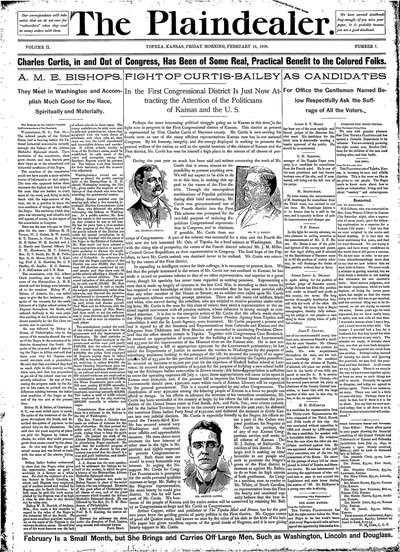
Page text (machine-generated)
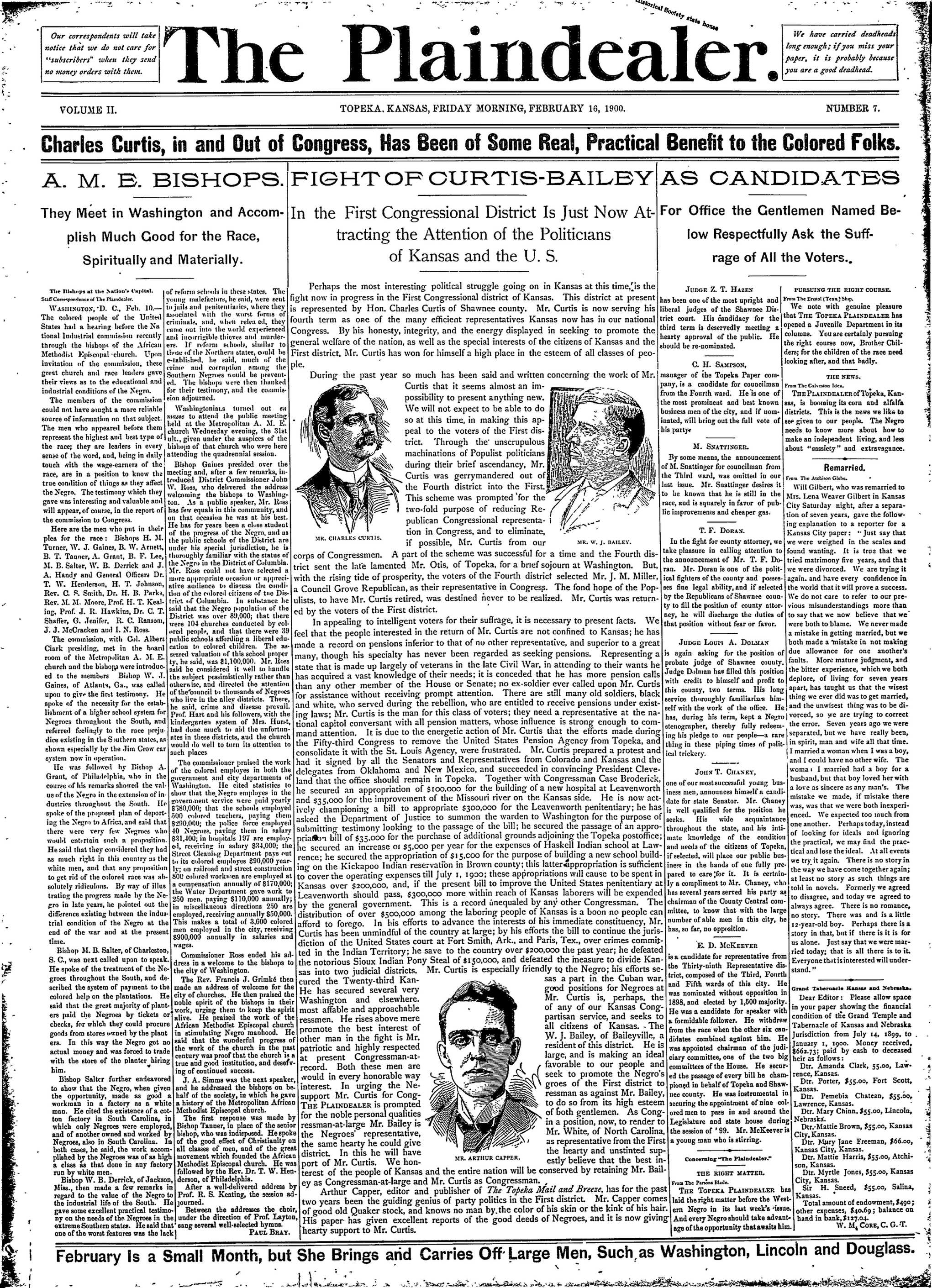
Charles Curtis, in and Out of Congress, Has Been of Some Real, Practical Benefit to the Colored Folks.
They Meet in Washington and Accomplish Much Good for the Race, Spiritually and Materially.
Our correspondents will take notice that we do not care for "subscribers" when they send no money orders with them.
VOLUME II.
Charles Curtis, A. M. E. B They Meet in Washing plish Much Good Spiritually and
The Bishops at the Nation's Capital. Staff Correspondence of the Plaidealer. WASHINGTON, D. C., Feb. 10.—The colored people of the United States had a hearing before the National Industrial commission recently through the bishops of the African Methodist Episcopal church. Upon invitation of the commission, these great church and race leaders gave their views as to the educational and industrial conditions of the Negro.
The members of the commission could not have sought a more reliable source of information on that subject. The men who appeared before them represent the highest and best type of the race; they are leaders in every sense of the word, and, being in daily touch with the wage-earners of the race, are in a position to know the true condition of things as they affect the Negro. The testimony which they gave was interesting and valuable and will appear, of course, in the report of the commission to Congress.
Here are the men who put in their plea for the race: Bishops H. M. Turner, W. J. Gaines, B. W. Arnett, B. T. Tanner, A. Grant, B. F. Lee, M. B. Salter, W. B. Derrick and J. A. Handy and General Officers Dr. T. W. Henderson, H. T. Johnson, Rev. C. S. Smith, Dr. H. B. Parks, Rev. M. M. Moore, Prof. H. T. Kealing, Prof. J. R. Hawkins, Dr. C. T. Shaffer, G. Jenifer, R. C. Ransom, J. J. McCracken and I. N. Ross.
The commission, with Col. Albert Clark presiding, met in the board room of the Metropolitan A. M. E. church and the bishops were introduced to the members Bishop W. J. Gaines, of Atlanta, Ga., was called upon to give the first testimony. He spoke of the necessity for the establishment of a higher school system for Negroes throughout the South, and referred feelingly to the race prejudice existing in the Southern states, as shown especially by the Jim Crow car system now in operation.
He was followed by Bishop A-Grant, of Philadelphia, who in the course of his remarks showed the value of the Negro in the extension of industries throughout the South. He spoke of the proposed plan of deporting the Negro to Africa, and said that there were very few Negroes who would entertain such a proposition. He said that they considered they had as much right in this country as the white men, and that any proposition to get rid of the colored race was absolutely ridiculous. By way of illustrating the progress made by the Negro in late years, he pointed out the difference existing between the industrial condition of the Negro at the end of the war and at the present time.
Bishop M. B. Salter, of Charleston, S. C., was next called upon to speak. He spoke of the treatment of the Negroes throughout the South, and described the system of payment to the colored help on the plantations. He said that the great majority of planters paid the Negroes by tickets or checks, for which they could procure goods from stores owned by the planters. In this way the Negro got no actual money and was forced to trade with the store of the planter hiring him.
Bishop Salter further endeavored to show that the Negro, when given the opportunity, made as good a workman in a factory as a white man. He cited the existence of a cotton factory in South Carolina, in which only Negroes were employed, and of another owned and worked by Negroes, also in South Carolina. In both cases, he said, the work accomplished by the Negroes was of as high a class as that done in any factory run by white men.
Bishop W. B. Derrick, of Jackson, Miss., then made a few remarks in regard to the value of the Negro to the industrial life of the South. He gave some excellent practical testimony on the needs of the Negroes in the extreme Southern states. He said that one of the worst features was the lack
February Is a S
The Plaindealer.
of reform schools in these states. The young malefactors, he said, were sent to jails and penitentiaries, where they associated with the worst forms of criminals, and, when released, they came out into the world experienced and incorrigible thieves and murderers. If reform schools, similar to those of the Northern states, could be established, he said, much of the crime and corruption among the Southern Negroes would be prevented. The bishops were then thanked for their testimony, and the commission adjourned.
Washingtonians turned out enmasse to attend the public meeting held at the Metropolitan A. M. E. church Wednesday evening, the 31st ult., given under the auspices of the bishops of that church who were here attending the quadrennial session.
Bishop Gaines presided over the meeting and, after a few remarks, introduced District Commissioner John W. Ross, who delivered the address welcoming the bishops to Washington. As a public speaker, Mr. Ross has few equals in this community, and on that occasion he was at his best. He has for years been a close student of the progress of the Negro, and as the public schools of the District are under his special jurisdiction, he is thoroughly familiar with the status of the Negro in the District of Columbia. Mr. Ross could not have selected a more appropriate occasion or appreciative audience to discuss the condition of the colored citizens of the District of Columbia. In substance he said that the Negro population of the District was over 89,000; that there were 104 churches conducted by colored people, and that there were 39 public schools affording a liberal education to colored children. The assessed valuation of this school property, he said, was $1,100,000. Mr. Ross said he considered it well to handle the subject pessimistically rather than otherwise, and directed the attention of the council to thousands of Negroes who live in the alley districts. There, he said, crime and disease prevail. Prof. Hart and his followers, with the kindergarten system of Mrs. Hurt had done much to aid the unfortunates in these districts, and the church would do well to turn its attention to such places
The commissioner praised the work of the colored employees in both the government and city departments of Washington. He cited statistics to show that the Negro employees in the government service were paid yearly $380,000; that the schools employed 500 colored teachers, paying them $290,000; the police force employed 40 Negroes, paying them in salary $31,400; in hospitals 197 are employed, receiving in salary $34,000; the Street Cleaning Department pays out to its colored employees $90,000 yearly; on railroad and street construction 800 colored workmen are employed at a compensation annually of $170,000; the Water Department gave work to 250 men. paying $110,000 annually; in miscellaneous directions 250 are employed, receiving annually $50,000. This makes a total of 3,600 colored men employed in the city, receiving $900,000 annually in salaries and wages.
Commissioner Ross ended his address in a welcome to the bishops to the city of Washington.
The Rev. Francis J. Grimké then made an address of welcome for the city of churches. He then praised the noble spirit of the bishops in their work, urging them to keep the spirit alive. He praised the work of the African Methodist Episcopal church in stimulating Negro manhood. He said that the wonderful progress of the work of the church in the past century was proof that the church is a true and good institution, and deserving of continued success.
J. A. Simms was the next speaker, and he addressed the bishops on behalf of the society, in which he gave a history of the Metropolitan African Methodist Episcopal church.
The first response was made by Bishop Tanner, in place of the senior bishop, who was indisposed. He spoke of the good effect of Christianity on all classes of men, and of the great movement which founded the African Methodist Episcopal church. He was followed by the Rev. Dr. T. W. Henderson, of Philadelphia. After a well-delivered address by Prof. R. S. Keating, the session adjourned. Between the addresses the choir, under the direction of Prof. Layton, sang several well-selected hymns.
TOPEKA, KANSAS, FRIDAY MORNING, FEBRUARY 16, 1900.
In the First Congressional District Is Just Now Attracting the Attention of the Politicians of Kansas and the U.S.
Perhaps the most interesting political struggle going on in Kansas at this time, is the fight now in progress in the First Congressional district of Kansas. This district at present is represented by Hon. Charles Curtis of Shawnee county. Mr. Curtis is now serving his fourth term as one of the many efficient representatives Kansas now has in our national Congress. By his honesty, integrity, and the energy displayed in seeking to promote the general welfare of the nation, as well as the special interests of the citizens of Kansas and the First district, Mr. Curtis has won for himself a high place in the esteem of all classes of people.
During the past year so much has been said and written concerning the work of Mr.
corps of Congressmen. A part of the scheme was successful for a time and the Fourth district sent the late lamented Mr. Otis, of Topeka, for a brief sojourn at Washington. But, with the rising tide of prosperity, the voters of the Fourth district selected Mr. J. M. Miller, a Council Grove Republican, as their representative in Congress. The fond hope of the Populists, to have Mr. Curtis retired, was destined never to be realized. Mr. Curtis was returned by the voters of the First district.
In appealing to intelligent voters for their suffrage, it is necessary to present facts. We feel that the people interested in the return of Mr. Curtis are not confined to Kansas; he has made a record on pensions inferior to that of no other representative, and superior to a great many, though his specialty has never been regarded as seeking pensions. Representing a state that is made up largely of veterans in the late Civil War, in attending to their wants he has acquired a vast knowledge of their needs; it is conceded that he has more pension calls than any other member of the House or Senate; no ex-soldier ever called upon Mr. Curtis for assistance without receiving prompt attention. There are still many old soldiers, black and white, who served during the rebellion, who are entitled to receive pensions under existing laws; Mr. Curtis is the man for this class of voters; they need a representative at the national capitol conversant with all pension matters, whose influence is strong enough to command attention. It is due to the energetic action of Mr. Curtis that the efforts made during the Fifty-third Congress to remove the United States Pension Agency from Topeka, and consolidate it with the St. Louis Agency, were frustrated. Mr. Curtis prepared a protest and had it signed by all the Senators and Representatives from Colorado and Kansas and the delegates from Oklahoma and New Mexico, and succeeded in convincing President Cleveland that the office should remain in Topeka. Together with Congressman Case Broderick, he secured an appropriation of $100,000 for the building of a new hospital at Leavenworth and $35,000 for the improvement of the Missouri river on the Kansas side. He is now actively championing a bill to appropriate $300,000 for the Leavenworth penitentiary; he has asked the Department of Justice to summon the warden to Washington for the purpose of submitting testimony looking to the passage of the bill; he secured the passage of an appropriation bill of $35,000 for the purchase of additional grounds adjoining the Topeka postoffice; he secured an increase of $5,000 per year for the expenses of Haskell Indian school at Lawrence; he secured the appropriation of $15,000 for the purpose of building a new school building on the Kickapoo Indian reservation in Brown county; this latter appropriation is sufficient to cover the operating expenses till July 1, 1920; these appropriations will cause to be spent in Kansas over $200,000, and, if the present bill to improve the United States penitentiary at Leavenworth should pass, $300,000 more within reach of Kansas laborers will be expended by the general government. This is a record unequaled by any other Congressman. The distribution of over $500,000 among the laboring people of Kansas is a boon no people can afford to forego. In his efforts to advance the interests of his immediate constituency, Mr. Curtis has been unmindful of the country at large; by his efforts the bill to continue the jurisdiction of the United States court at Fort Smith, Ark., and Paris, Tex., over crimes committed in the Indian Territory; he save to the country over $200,000 the past year; he defeated the notorious Sioux Indian Pony Steal of $150,000, and defeated the measure to divide Kansas into two judicial districts. Mr. Curtis is especially friendly to the Negro; his efforts se
terest of the people of Kansas and the entire nation will be conserved by retaining Mr. Bailey as Congressman-at-large and Mr. Curtis as Congressman.
Arthur Capper, editor and publisher of The Topeka Mail and Breeze, has for the past two years been the guiding genius of party politics in the First district. Mr. Capper comes of good old Quaker stock, and knows no man by the color of his skin or the kink of his hair. His paper has given excellent reports of the good deeds of Negroes, and it is now giving hearty support to Mr. Curtis.
MR. CHARLES GREER
MR. CHARLES CURTIS.
corps of Congressmen. A part of district sent the late lamented Mr. with the rising tide of prosperity, a Council Grove Republican, as solicitors, to have Mr. Curtis retired, led by the voters of the First district. In appealing to intelligent we feel that the people interested in made a record on pensions inform many, though his specialty has state that is made up largely of has acquired a vast knowledge of than any other member of the for assistance without receiving and white, who served during theing laws; Mr. Curtis is the man tional capitol conversant with almand attention. It is due to the Fifth-third Congress to reconsolidate it with the St. Louis had it signed by all the Senate delegates from Oklahoma and land that the office should remain he secured an appropriation of and $35,000 for the improvemently championing a bill to app asked the Department of Justice submitting testimony looking to priaon bill of $35,000 for the p he secured an increase of $5,000 rence; he secured the appropriating on the Kickapoo Indian res to cover the operating expenses. Kansas over $200,000, and, if Leavenworth should pass, $300 by the general government. The distribution of over $500,000 a afford to forego. In his effort Curtis has been unmindful of the diction of the United States coated in the Indian Territory; he the notorious Sioux Indian Ponsas into two judicial districts.
cured the Twenty-third Kan-He has secured several very Washington and elsewhere, most affable and approachable ressmen. He rises above mere promote the best interest of other man in the fight is Mr. patriotic and highly respected at present Congressman-at-record. Both these men are would in every honorable way interest. In urging the Nesupport Mr. Curtis for CongTHE PLAINDEALER is prompted for the noble personal qualities ressman-at-large Mr. Bailey is the Negroes' representative, the same hearty he could give district. In this he will have port of Mr. Curtis. We hon-
terest of the people of Kansas ey as Congressman-at-large an Arthur Capper, editor an two years been the guiding go of good old Quaker stock, and His paper has given exceller hearty support to Mr. Curtis.
Curtis that it seems almost an impossibility to present anything new. We will not expect to be able to do so at this time, in making this appeal to the voters of the First district. Through the unscrupulous machinations of Populist politicians during their brief ascendancy, Mr. Curtis was gerrymandered out of the Fourth district into the First. This scheme was prompted for the two-fold purpose of reducing Republican Congressional representation in Congress, and to eliminate, if possible, Mr. Curtis from our
apart of the scheme was successful for and Mr. Otis, of Topeka, for a brief stupefy, the voters of the Fourth district, as their representative in Congress, retired, was destined never to be real at district.
Agent voters for their suffrage, it is needed in the return of Mr. Curtis are now inferior to that of no other representative. It has never been regarded as seeking of veterans in the late Civil War, edge of their needs; it is conceded that of the House or Senate; no ex-soldier living prompt attention. There are being the rebellion, who are entitled to woman for this class of voters; they need with all pension matters, whose influence to the energetic action of Mr. Curtis to remove the United States Pension Louis Agency, were frustrated. Mr. Senators and Representatives from New and New Mexico, and succeeded in remain in Topeka. Together with a portion of $100,000 for the building of a cement of the Missouri river on the bank to appropriate $300,000 for the Lea Justice to summon the warden towing to the passage of the bill; he secured the purchase of additional grounds ad $5,000 per year for the expenses of the appropriation of $15,000 for the purpose of an reservation in Brown county; this licenses till July 1, 1900; these appropriated, if the present bill to improve them, to $300,000 more within reach of Kansas. This is a record unequaled by a 1,000 among the laboring people of Kansas efforts to advance the interests of his of the country at large; by his efforts lies court at Fort Smith, Ark., and Perry; he save to the country over $200,000 in Pony Steal of $150,000, and defeatedicts. Mr. Curtis is especially friend.
M.
MR. ARTHUR CAPPER. Kansas and the entire nation will be co- large and Mr. Curtis as Congressman. or and publisher of The Topeka M- ing genius of party politics in the Fi- and knows no man by the color of excellent reports of the good deeds of- cris.
MR. W. J. BAILEY.
for a time and the Fourth dissojourn at Washington. But, just selected Mr. J. M. Miller, m. The fond hope of the Populized. Mr. Curtis was return- necessary to present facts. We not confined to Kansas; he hasitative, and superior to a great ing pensions. Representing a in attending to their wants he that he has more pension calls ever called upon Mr. Curtis still many old soldiers, black to receive pensions under existed a representative at the nance is strong enough to com- that the efforts made during Agency from Topeka, and Curtis prepared a protest and Colorado and Kansas and the in convincing President Cleve-Congressman Case Broderick, a new hospital at Leavenworth Kansas side. He is now actavenworth penitentiary; he has Washington for the purpose of cured the passage of an approdojining the Topeka postoffice; Haskell Indian school at Law of building a new school build-latter appropriation is sufficientiations will cause to be spent in the United States penitentiary atansas laborers will be expended any other Congressman. The Kansas is a boon no people can his immediate constituency, Mr. ts the bill to continue the jurisaris, Tex., over crimes commit-000 the past year; he defeated the measure to divide Kanly to the Negro; his efforts se-
sas a part in the Cuban war, good positions for Negroes at Mr. Curtis is, perhaps, the of any of our Kansas Cong-partisan service, and seeks to all citizens of Kansas. The W. J. Bailey, of Baileyville, a resident of this district. He is large, and is making an ideal favorable to our people and seek to promote the Negro's groes of the First district to ressman as against Mr. Bailey, to do so from its high esteem of both gentlemen. As Congin a position, now, to render to Mr. White, of North Carolina, as representative from the First the hearty and unstinted suprely believe that the best in
conserved by retaining Mr. Bail- Mail and Breeze, has for the past first district. Mr. Capper comes of his skin or the kink of his hair of Negroes, and it is now giving e Men, Such as
For Office the Gentlemen Named Below Respectfully Ask the Suffrage of All the Voters.
JUDGE Z. I. HAZES has been one of the most upright and liberal judges of the Shawnee District court. His candidacy for the third term is deservedly meeting a hearty approval of the public. He should be re-nominated.
C. H. SAMPSON.
manager of the Topeka Paper company, is a candidate for councilman from the Fourth ward. He is one of the most prominent and best known business men of the city, and if nominated, will bring out the full vote of his party
M. SNATTINGER.
By some means, the announcement of M. Snattinger for councilman from the Third ward, was omitted in our last issue. Mr. Snattinger desires it to be known that he is still in the race, and is squarely in favor of public improvements and cheaper gas.
T. F. DORAN.
In the fight for county attorney, we take pleasure in calling attention to the announcement of Mr. T. F. Doran. Mr. Doran is one of the political fighters of the county and possesses fine legal ability, and if selected by the Republicans of Shawnee county to fill the position of county attorney, he will discharge the duties of that position without fear or favor.
JUDGE LOUIS A. DOLMAN
is again asking for the position of probate judge of Shawnee county. Judge Dolman has filled this position with credit to himself and profit to this county, two terms. His long service thoroughly familiarizes himself with the work of the office. He has, during his term, kept a Negro stenographer, thereby fully redeeming his pledge to our people—a rare thing in these piping times of political trickery.
JOHN T. CHANEX.
one of our most successful young business men, announces himself a candidate for state Senator. Mr. Chaney is well qualified for the position he seeks. His wide acquaintance throughout the state, and his intimate knowledge of the condition and needs of the citizens of Topeka, if selected, will place our public business in the hands of one fully prepared to care for it. It is certainly a compliment to Mr. Chaney, who has several years served his party as chairman of the County Central committee, to know that with the large number of able men in this city, he has, so far, no opposition.
E. D. McKEEVER
is a candidate for representative from the Thirty-ninth Representative district, composed of the Third, Fourth and Fifth wards of this city. He was nominated without opposition in 1898, and elected by 1,500 majority. He was a candidate for speaker with a formidable follower. He withdrew from the race when the other six candidates combined against him. He was appointed chairman of the judiciary committee, one of the two big committees of the House. He secured the passage of every bill he championed in behalf of Topeka and Shawnee county. He was instrumental in securing the appointment of nine colored men to pass in and around the Legislature and state house during the session of '99. Mr. McKeever is a young man who is stirring.
Concerning "The Plaindealer."
THE TOPEKA PLAINDEALER has laid the right matter before the Western Negro in its last week's issue. And every Negro should take advantage of the opportunity that awaits him.
We have carried deadheads long enough; if you miss your paper, it is probably because you are a good deadhead.
NUMBER 7.
Colored Folks.
CODIDATES
gentlemen Named Be- y Ask the Suff- the Voters.
PURSUING THE RIGHT COURSE
From The Emuol (Tenn.) Ship.
We note with genuine pleasure
that THE TOPEKA PLAINDEALER has
opened a Juvenile Department in its
columns. You are certainly pursuing
the right course now, Brother Childs;
for the children of the race need
looking after, and that badly.
THE NEWS.
From The Galveston Idea.
THE PLAINDEALER Of Topeka, Kansas, is booming its corn and alfalfa districts. This is the news we like to see given to our people. The Negro needs to know more about how to make an independent living, and less about "sassiety" and extravagance.
Remarried.
From The Atchison Globe.
Will Gilbert, who was remarried to Mrs. Lena Weaver Gilbert in Kansas City Saturday night, after a separation of seven years, gave the following explanation to a reporter for a Kansas City paper: "Just say that we were weighed in the scales and found wanting. It is true that we tried matrimony five years, and that we were divorced. We are trying it again, and have every confidence in the world that it will prove a success. We do not care to refer to our previous misunderstandings more than to say that we now believe that we were both to blame. We never made a mistake in getting married, but we both made a mistake in not making due allowance for one another's faults. More mature judgment, and the bitter experience, which we both deplore, of living for seven years apart, has taught us that the wisest thing we ever did was to get married, and the unwisest thing was to be divorced, so we are trying to correct the error. Seven years ago we were separated, but we have really been, in spirit, man and wife all that time. I married a woman when I was a boy, and I could have no other wife. The woman I married had a boy for a husband, but that boy loved her with a love as sincere as any man's. The mistake we made, if mistake there was, was that we were both inexperienced. We expected too much from one another. Perhaps today, instead of looking for ideals and ignoring the practical, we may find the practical and lose the ideal. At all events we try it again. There is no story in the way we have come together again, at least no story as such things are told in novels. Formerly we agreed to disagree, and today we agreed to always agree. There is no romance no story. There was and is a little 12-year-old boy. Perhaps there is a story in that, but if there is it is for us alone. Just say that we were married today; that is all there is to it. Everyone that is interested will understand."
Grand Tabernacle Kansas and Nebraska
Dear Editor: Please allow space in your paper showing the financial condition of the Grand Temple and Tabernacle of Kansas and Nebraska Jurisdiction from July 14, 1899, to January 1, 1900. Money received, $662.73; paid by cash to deceased heir as follows:
Dtr. Amanda Clark, 55.00, Lawrence, Kansas.
Dtr. Porter, $55.00, Fort Scott, Kansas.
Dtr. Pemebia Chatean, $55.00, Lawrence, Kansas.
Dtr. Mary Chinn, $55.00, Lincoln, Nebraska.
Dtr. Mattie Brown, $55.00, Kansas City, Kansas.
Dtr. Mury Jane Freeman, $66.00, Kansas City, Kansas.
Dtr. Mattie Harris, $55.00, Atchison, Kansas.
Dtr. Myrtle Jones, $55.00, Kansas City, Kansas.
Sir H. Sneed, $55.00, Salina, Kansas.
Total amount of endowment, $490; other expenses, $40.69; balance on hand in bank, $127.04.
coln and Douglass.
Published az Topeka, Kansas, Shawnee county, very friday morning, by The Plaindealer Publishing or company, 114 E. Seventh street.
As a supplement to G. W. Gross's splendid article on the unexampled opportunities for acquiring wealth in the West, THE PLAINDEALER reproduced last week an article from The Mail and Breeze, telling of another side of the Negro problem. We have maintained from our first edition that the solution of the so-called race problem in this country is for the great mass of Negroes to withdraw as much as possible from the cities and towns, and, by giving careful attention to farming, develop with the least friction. We do not believe, nor do we desire to be understood as advocating this move, with a view of entirely obliterating all trace of race prejudice. There is a natural prejudice between the various elements of God's family, which no amount of education and wealth seems to be able to destroy. But this condition can be reduced. We believe that in America, where the abolition of Negro slavery is but an event of yesterday, the prejudice between the two races is so strong that several generations must pass away before the Negro will be given a place in the commercial and political and social worlds, which our national constitution guarantees to human beings. In the meantime the Negro must do something. He must be contributing his share to bring about favorable results.
---
The results of Negro farmers are of far more benefit to the race than those living in large cities, as will be readily seen by comparing the facts in this article with the known conditions in cities. The names and records of successful Negro farmers should be, as the editor of The Mail and Breeze justly and wisely says, "an inspiration" to the many hundreds of Negro boys who find their ambition circumscribed and repressed in cities and towns. There could be nothing of greater benefit to the race than to have a hundred colored boys and young men start out this spring with determination to win a place as successful farmers and stock-raisers. If many young men who leave our public schools to be lost in the maelstrom of the political and professional arenas, should turn their attention to agricultural pursuits, there would be a remarkable increase in the number of successful Negroes.
preferring the city to the farm is due to our faulty education. The race places a premium on empty professional titles, and every Negro boy leaves school with the well-developed idea that he has been especially called of God to preside in the presidential chair or serve in the legislative hall. We venture the assertion that there is more real, tangible wealth represented in the few Negro farmers than can be found among any class of professional Negroes in the country, and these are but a few of the Negroes who are digging a good name for the race as well as wealth out of Kansas soil. But, still there is room for thousands more who want to work. We constantly complain because the foreigner apparently makes greater headway than the Negro in acquiring lands, homes, and consequently wealth. Watch these foreigners: where do they go? Where do they settle? On the farms and in the rural districts, where the opportunity to purchase lands and houses is greatest. They constantly deny themselves luxuries and pleasures that absorb thousands of the hard-earned dollars of the Negro.
Just now so much talk is being indulged in regarding the Anglo-Boer war, that Mr. James A. Page, by request of THE PLAINDEALER last week, prepared a brief review of the causes leading up to the events now occurring in South Africa. The Negroes of America are undoubtedly interested in this sanguinary struggle, apart from the fact that it is occurring on the now no longer "Dark Continent." The attitude of the various nations who are undertaking to gobble up this dark morsel is necessarily of much importance to the race. It will be clearly seen that human slavery—and that of Negroes—has always been the cause of trouble between the Boers and Britons. In all these contentions Britain has sided with the Negro, and it is noticeable the enthusiastic loyalty of the East Indian population at this time. The dark-skinned Englishmen of Calcutta, Bombay, Australia and New Zealand, are vicing with their flaxen-haired brother in contributing men and supplies to maintain national honor. This is due to the fact that England makes Englishmen of her colonists and not slaves. The trouble in Egypt growing out of the withdrawal of English troops for South African troubles, should not be construed as an indication that the great kingdom of England is crumbling. It should be the prayer of every Negro that England should be victorious.
A JIM CROW hotel over at Anderson, Indiana, the other day refused to entertain Booker T. Washington, the foremost Christian worker of America, because he is black. The ease with which states are passing Jim Crow laws is an inducement for the refusal of Negroes from the peanut stands up. Under the circumstances we wonder what Jesus would do. Probably Reverend Sheldon will explain this in his special edition of The Daily Capital.
It is said that "rats" will leave a sinking ship" this rather homely old aphorism is aptly illustrated in the scrambling of Pops from the rickety old bulk of Populism. The announcement of the leaving of the water-soaked old hulk by G. C. Clemens would indicate that the future existence of the Democratic ally is to be brief.
PATRON people object to the school houses being used for political meetings. Negroes should object to their churches being used for the same purpose.
We want men in the city council who are not opposed to public improvement. We want a Greater Topeka.
GEO. KLIEN & CO.,
Nicodemus.
George W. Ellis secured a divorce for Mrs. Burton, of this city.
The Douglass Literary met Friday in the school building and rendered an excellent program. The subject of the debate was, "Resolved, That Webster was a greater man than Clay." Affirmative, F. J. Barker, John Clark; negative, G. W. Ellis, James Kirtley. The judges were L. Vanduevall, J. Clark and Willis Lee Decision in favor of the negative.
The Masons are making quite an improvement on their building. J. Vaughn, treasurer of the School Board, and Mr. Thomas, trustee, have been busy repairing the porch.
Nicodemus appears to be improving in buildings.
Within a short time a large dry goods store will be opened in the city, owned by S. M. Smith, and to be managed by F. J. Barker and himself. This is a valuable institution to the business enterprise of Nicodemus, and it is believed that it will be a financial success.
Hon. George W. Jones, of Hill City, is expected in the city this week. In his splendid discharge of his duty before the District court last week, he elicited general and favorable comment.
G. W. Ellis, teacher in the city school, dismissed school last week to attend to some legal business.
In the near future there will be, under the auspices of the Douglass Literary, an Epworth League in the city school building. Hon. C. W. Smith, judge of the District court, will be the orator of the occasion. Judge Smith is very popular in Nicodemus, and a large and enthusiastic audience will greet him. The proceeds of this entertainment will be for the benefit of the school literary of Nicodemus. Every one is invited to come. Admission free.
F. T. Fletcher and George Moore are attending court this week.
Garden City.
M. P. Berry was in Newton a few days last week, and on his return, stopped and spent a day in Great Bend with Moses Johnson, an old resident of Garden City.
Rev. A. L. Voorhies, of Topeka, came in last week to assist Rev. Wright in a revival meeting.
Mrs. Lena Lewis has been very sick, but is much improved.
Mrs. Charles Pennington has been visiting her son, Jack, in Chicago, and other relatives in Missouri. She will return home soon.
TELLS ITS OWN STORY!
George Walker, the Leavenworth Negro who attempted an assault on Miss Edna Perkins near Turner, Wyandotte county, was convicted, the jury being out only fifteen minutes. Lincoln McKee, the officer who arrested Walker and at the preliminary gave damaging evidence against him, told a different story at the formal trial. After he left the witness stand, he committed suicide. [After sending poor George Walker to hell, Lincoln McKee is in all likelihood there himself today.]
Traveling the States of Kansas, Missouri, Nebraska, Colorado, Cansas, and the Indian Territory. Five (5) Daily Passenger Trains are run on this line in each direction, between Kansas City and St. Louis. The Famous
Holton.
MISSOURI
PACIFIC
RAILWAY
Traveling the States of I
Colorado, Kansas, and the E
Five (5) Daily Passenger
in each direction, between
The Famous
Hotel
Are reached ONLY by
H.C. T
F. E. NIPPS, Agent,
TOPEKA, KAS.
IE
mson,
with
learn-
cause
You wish to see a beautiful display
of Fine ewelry, look into J. A. Wil-
son's show window,
AND
If you want bargains in WATCHES,
CLOCKS or JEWELRY of any sort for
your own use or to make Christmas
presents of, step inside and buy at
prices to suit your pocket.
AND
REMEBER
That J. A. Wilson is Kansas City's Pioneer Negro Jeweler, is known as "The Reliable Jeweler" and is found at 116 West Ninth Street, Kansas City, Mo.
Opposite old Cable Power House
Two blocks from Armour's Packing House
Watches, Clocks and Jewelry Repaired Correctly.
BARGAINS IN EVERYTHING
Persons from a distance will have their car fare refunded if purchase is made.
For Sale
Real Estate
Have a good two story house, 5 rooms, 1 lot, $375, East Seventh street.
than
each in
ater of
lets to
Rap-
ggie is
will be
Valley
Baptist
prom-
as an-
cidate
dist
ost of
1 lot, 2 rooms and bas-
ment, (fair condition) $160.
East Thirteenth street, over
2 hundred good residences.
Properties in all parts of the
city ranging from 300 to $3,000.
North Topeka lots $25 to
$75.
Lowman Hill lots $35 to $50.
Washburn College lots $100
cach. Small cash payments
and balance on popular monthly
plan.
18 acres, good 3 room cott
tage, $500, 2 1/2 miles North or
city.
We have good large farms
and ranches to sell or trade.
R. O. Hilliard,
413 Kansas Ave., Room 4.
Missouri Pacific Route
THE.GREAT SOUTHWEST SYSTEM, States of Kansas, Missouri, Nebraska, and the Indian Territory. Passenger Trains are run on this line between Kansas City and St. Louis.
Hot Springs
Of Arkansas
BY this LINE
H.C. TOWNSEND, G.P. & T.A.,
ST. LOUIS, MO.
Descriptive of Emporia.
Emporia, the county seat of Lyon county, is beautifully located in a valley between the Neosho and Cottonwood rivers, and about six miles above the junction of the two rivers. Emporia is about two-miles square and has 10,000 inhabitants, of whom about 900 are colored. The principal business streets are Commercial and Merchant and Fifth and Sixth avenues. At the North end of Commercial street is the Kansas State Normal, where all boys and girls should go, in order that they may become smart men and women. About 2,000 attend the Normal, of whom 15 are colored. Two colored have graduated from this school, who are Gaither Page and John Smith; one of the next colored graduates will be Ethel Stafford, a resident of this city. About one mile West of the city is the College of Emporia, where we expect to attend when we shall have finished our studies in the city schools. There are also eight ward school-buildings and a large High school. About 2,000 boys and girls attend the city schools. On Merchant street is the Whitley hotel and an opera house; on Fifth avenue are the Hotel Wigwam, the freight depot and four churches. The pretty residence streets are Union, State and Twelfth,
On these streets are some of the prettiest residences in the state. Emporia is especially noted for her well-kept houses, lawns parks and streets. A number of colored people own comfortable and pleasant homes, and have splendid occupations. Emporia has a foundry, ice plant, electric light plant, two flour mills, a Santa Fe round house and a creamery. The reservoir is three miles Northwest of town, and has one of the largest pumping engines in the state. Emporia should be the best town in the state, as there are twenty-five churches, four of which are colored. The C. M. E. church is on East street, of which Rev. C. C. Mitchell is pastor. The Baptist church, a beautiful brick, is located on Commercial street, two blocks from the Normal. The Christian church is on Eighth avenue and Congress street, with Rev. F. G. Barr, the energetic pastor.
Yours for success.
Capability
Capability means power. The man or the woman who is capable of doing something that others cannot do, has more power along that line of work. The fewer the number of capable people in any line, the greater their power, and the more valuable they are to the world. Rare gems are most valuable. Capable men and women occupy the highest positions and command the greatest salaries.
How may capability be acquired? First, by careful attention to details. It is the many little trifles that make woman or man the harmonious whole. Landseer, the great animal painter, owed much of his success to carefulness of detail. He had a knowledge of zoology and mathematics that brought accuracy to his paintings, so that in the eyes of both artists and zoologists his works stand the test of criticism. Second, next to the carefulness of detail, cones a versatility of work. All art is interdependent on other work. One-sided training of faculties is poor training. A thorough knowledge of the line of work you wish to attain requires a knowledge of other work. A mechanic needs to know something of the history of mechanics and its relations to art. A musician requires a knowledge of mathematics. A physician or surgeon is benefited by a knowledge of drawing.
Third, by disdaining not the day of small things. Make use of small opportunities. A debating club has often been the stepping-stone to oratory for young men. Public speaking is often a severe trial. To express with ease and grace the eloquent thoughts that often arise, is very embarrassing to one unaccustomed to speaking in public. Every intelligent youth can learn in a debating club to express himself clearly and forcibly, and when the lesson is learned, it is not forgotten. Make use of suggestions. Education is largely grasping a suggestion and making the most of it. Out of the common incidents of daily life, arise our greatest inventions, most beautiful poems and best institutions.
What an important little month is February! It marks the birthdays of the heroes—Lincoln and Washington; the poets, Longfellow and Lowell; and of Benjamin Franklin, the inventor. It is also the month of that patron saint so dear to young people—St. Valentine. Altogether, it a very important little month. O. A. H.
The next feature of THE PLAIN-DEALER will be pictures of the five prettiest colored girls in Kansas.
The articles appearing in the children's column, supposed to have been written by the Brownies themselves, are so nicely arranged that we suspect their parents composed them for the youngsters.
Dr. O. A. Taylor, Topeka's popular physician will read a paper on "The Uses of Morphine" before the Topeka Academy of Medicine. Dr. Taylor enjoys the honor of being the only Negro member. He is enjoying phenomenal success in the practice of his chosen profession. During the present small-pox epidemic, Dr. Taylor has treated over 205 cases.
Pianoforte recital Tuesday evening, February 27, at 618 Kansas avenue, by Miss Lucy J. Bledsoe. This will be the first of a series of recitals to be given by Miss Bledsoe, whose ability to entertain needs no mention in Topeka. She will be assisted by Messrs. Franc D. Glenn and Roscoe D. Guy. Let the public show its appreciation for home talent by giving Miss Bledsoe a good house. Those who fail to hear her will miss a musical treat.
Rev. W. S. Blake, of Newport, Arkansas, has just closed an interesting series of meetings in the Shiloh Baptist church. He will visit Olathe, Kansas, en route to his home, having received a call to the pastorate of that church during the past two weeks. It is hoped that he will return here in the near future. Rev. Grant says that he and Rev. Blake did evangelical work together in Southwest Missouri about twelve years ago. They received more than one-thousand members into the churches of the state.
The Ladies' Church Aid association of the New Hope Baptist church was very pleasantly entertained at the residence of Mrs. Anna Howard last Saturday evening. During the evening the following officers were elected for the ensuing year: Mrs. Ella Middleton, president; Mrs. Anna Howard, vice-president; Mrs. Sallie Roundtree, second vice-president; Miss Della Crabb, secretary; Miss Enola Bu-
An exchange asks: What is the reason so many girls do not marry? and then answers the question thus: Well, some girls are too ambitious; they want a rich or a famous husband, and will not marry for love in a cottage. Again, some girls are shy and constrained, so afraid of seeming to run after men that they go to the opposite extreme, and almost repel them. They show to the worst advantage in company, and though nice, intelligent girls, they are ignored and passed by. Others are overlooked because they will not give men even ordinary encouragement; indeed, if they find themselves caring for one man more than another among their acquaintances, a mistaken pride prevents them from showing it, not because they are stupid, but because of an unfortunate temperament which they cannot overcome. Then, there are those girls who are so clever, such universal favorites, so much in demand for every occasion, that at length they awaken to the fact that in enjoying society as a whole, they have overlooked the individual; their youth and heyday has passed by and they have a string of admirers, but not a lover among them.
Rev. Adam S. Green, A. M., B. D., has been the guest of Rev. W. L. Grant during the past three weeks. There is a movement on foot to have Prof. Green establish an Academy of Languages. Such a school, it is contended, would afford ample opportunity to make a special study of the Spanish, German and French languages, Greek, Latin and Hebrew being made a specialty. The classics and sciences would appeal to a large number of students who are compelled, for many reasons, to leave High school. Again, there are many who fail to make their grades, who would profit by such a school. Prof. Green is a thorough scholar, having spent twenty-two years in school. He finished the college preparatory course at Roger Williams University, Nashville, in 1881. Two years later he entered Colby University, Waterville, Me., the foremost university of that grand old state, and was graduated from the College Department with high honors in 1887. He took the post-graduate course two years later. In 1890 he entered Newton Theological Seminary, Newton Center, Mass., taking the full course which included studies of the semitic and sanscrit languages. He graduated second in his class in 1893. It is intimated on high authority that but for colorphobia Mr. Green would have been appointed assistant teacher of languages in the seminary, one of the most renowned in the world. His association with such men as Drs. Boardman, Pepper, Wayland, Hoyt, Profs. Jones and R. Harper assures his competency implied in the success which we trust will follow the establishment of the proposed school here in Topeka. We are certain the intellectual status of our people warrant a hearty support of such an institution, and cordially solicit any standard which will disseminate knowledge among the people.
MUSES OF A PLAINDEALER.
A girl with crude features trying to look sad and pensive, reminds one of a sick calf.
The cold wave blew up so suddenly, it didn't give the "oldest settler" time to think up an 1806 cold weather lie.
As a rule, the woman who thinks herself clever relates her love troubles to nearly everybody except the man she loves.
There is nothing in "getting even" but hatred. It is better to wait and have a good laugh. There is no truer saying than that "He who laughs last, laughs best."
Certain women, in filing their claims of marriage, demand men who "know more than they do." In that case, many a certain woman should pick up most any old kind of man, and trot along to the altar.
After people grow older, and more ignorant, they are very indignant when a child plays truant and misses a day from school, when they could have gone much longer, with profit to themselves and their associates and neighbors.
** **
\*\*\*
* * *
Some women who make a specialty of displaying their busts in low
Washington, D. C., Jan. 29, 1900. Dear Sir: There are several measures pending before Congress that are of especial interest to the colored people. I assure you that I will gladly co-operate with your champion upon the floor of Congress, Mr. White, of North Carolina, who is my friend and serves with me upon the committee of agriculture. Mr. White is the oly colored member of the Fifty-sixth Congress and is a very able and valued member.
I hope I may have your support in the contest between Mr. Curtis and myself. I feel I have the equity upon my side. I have lived in the district twenty years. Mr. Curtis has lived in the district less than two years, and when the Republicans carry the state, Shawnee county will be put back into the Fourth district to make that district Republican.
I shall be glad to have any suggestions from you, or your friends, regarding measures that are pending before Congress. I will appreciate your very valuable support, and whenever I can serve you in any way while in Washington, I want you to feel at perfect liberty to call upon me.
Yours truly, W. J. Bailey.
It will be interesting to review the public record of Mr. Curtis in the interest of the colored men.
Of course it is still fresh in the minds of Kansans how Mr. Curtis came on here to Washington in August, 1898, to secure, and did secure, the order from the War Department to have the Twenty-third regiment sent to Cuba.
Through Mr. Curtis's efforts the following men have secured and now hold places under the government: Paul Bray, Fred. Hedge, Albert Barton, George Lewis, Mr. Williams and Mr. Brooks.
In addition to these gentlemen, Charles Charles was given a place, upon the joint recommendation of Senator Baker and Mr. Curtis.
Never before in history have there been so many colored people holding places from Kansas, and Mr. Curtis's work in their behalf is well known.
Why Men Remain Bachelors.
From a St. Louis Paper
At a well-known club the subject of "Why men remain bachelors" came up for discussion. The majority of those present came to the conclusion that our extravagant style of living, as compared with that of former times, is one of the effective influences. The cost of supporting a wife and family is much larger than it used to be, and this feature of the matter often causes hesitation on both sides. The young people are disinclined to start in an humble way and gradually improve their situation. They want all their parents have, without waiting and striving for it.
Has Returned.
TOPEKA, Kansas, February 12. Mrs. Maggie Matley, of 1155 Clay street, has returned from Vicksburg, Miss. where she has been visiting relatives and friends for the past eight weeks. She was interviewed by a PLAINDEALER reporter and makes the following statement:
"Our people have made wonderful progress in the past ten years throughout the entire city of Vicksburg as well as the surrounding county, both financially and educationally. 'A number of gentlemen of color own several residences in the city and are renting them for neat little sums. W. H. Jefferson, a brother to our Lee Jefferson, owns, manages and controls one of the largest undertaking establishments in the city. The Vicksburg college, a building managed exclusively by colored teachers, is one of the largest school buildings in the city. There are twelve teachers employed in this building alone. As for her society and entertaining, Vicksburg has no equal. On Monday, February 6, we were highly entertained by Mrs. W. H. Jefferson in such a manner and style that no one knows how to arrange except Mrs. Jefferson. Those present were Mesdames O. Thornton, Colorado; M. E. Matley, Kansas; C. J. Foster, S. J. Perkins, W. E. Turner, O. Amos, R. H. Brooks, P. C. Copelain, J. H. Jefferson, all of Vicksburg.
"In the evening of the same date we were entertained from 8 to 11:30 by Mr. and Mrs. P. C. Copelain. There we had the pleasure of meeting some of the representative men of Vicksburg and vicinity. Those present were Dr. C. A.
Hutchinson
Mrs. Robert Stemmons has arrived from Lawrence, where she has been visiting her parents at 918 Penn. avenue.
Rev. Raimey and wife were called away by telegram to Burlingame Tuesday night to the bedside of their son, George, who is reported at the point of death.
Miss Bizer, of Olathe, is in the city visiting her grandmother, Mrs. Gracia, and cousin, Mrs. Cunningham.
Rev. J. M. Brown, presiding elder of the C. M. E. church, left this morning for home.
The C. M. E. church is progressing very nicely.
Will Frazier was in the city today, visiting his father and mother and the guest of Misses Dora Brooks and Belle Coleman. He returned to his home Monday morning.
The smallpox scare is turning out to be the measles.
Girls, take warning, and stop hanging around the Santa Fe depot, as it looks very bad and it may cause serious trouble to you and parents.
The ladies of the Household of Ruth gave a supper the evening of the 8th. Supper was served in royal style. Oysters were served fried and in soup. The ladies were Mesdames Ollie Hurston, Eddie Harris, Florence Crow, Blanche Tyler; Harrison Harris, Charles Frazier, Riley Hurston.
There is quite a controversy over Rev. Wilson among some of the ladies here; it is which shall and which shall not.
Mexico. Mo.
Scott Settles, who is working near Chicago, Ill., spent several days at home with friends. Mr. Settles likes the state of Illinois and speaks as though he may locate in that part of the country. The great union entertainment between the St Luke's Methodist church and the Second Baptist church, Feb. 5, was a grand success. The principal feature of the evening was to elect a queen. Each church nominated a queen, Ruth Scott for the Methodist church and Mabel Johnson for the Baptist church. The girl receiving the greatest number of votes was to be "crowned." Each side worked faithfully to beat. Never before in the last 12 or 15 years have the people worked so hard and spent money so freely as they did at the union festival. Both nominees for queen were dressed in white organdies, and looked like wax figures, and both were anxiously waiting to see if she was queen. The polls were closed at 11 o'clock. The table waiters and other friends became very nervous and excited, and almost forgot their work while waiting for the returns of the election. About 11:20 the returns were that Mabel Johnson had $33.20 worth of votes, as each vote cost 5 cents. Ruth Scott, the Methodist nominee, received $24.30 worth of votes. The Methodists were sorry to be beaten, but as they have beaten the other side twice before, they stood it fairly well. This was a money-raising contest; over $100 was taken in between the two churches. The Methodist cleared $50, an expense
North Topeka.
Mrs. Bettie Harris died at her home, 931 Western avenue, Saturday afternoon of week before last, at 4 o'clock.
The literary, which is held in Mt. Olive Baptist church every Tuesday evening, is proving to be a success. The program, which was rendered Tuesday; evening of last week, was quite interesting: Paper, Lizzie Hatton; select reading, Lelah Norman; current topics, Mrs. Samuel Payne. The debate was quite interesting, and the same subject was debated again Tuesday evening. The subject was, "Which causes more prejudice, servitude or color?" Affirmative, Harry Seigle and Samuel Payne; negative, Mrs. Sherman Trotter and Benjamin Payne
Rebecca Bledsoe is on the sick list.
The Northwestern Missionary Baptist board meets in Olathe today.
Mary Pedro is sick again.
Ethel Gaines left Saturday of week before last for Chicago.
Asca Norell is sick with the small-pox.
Callie Birdwhistle is attending Prof. Stevens's Industrial school.
JOHN C. TULLOCH,
whose announcement for councilman from the Sixth ward is found else where in this issue, has been a resident of Topeka for nearly twenty years. He has been actively engaged in business. For several years he was connected with the Green Coal company. He is now connected with the Webster-Tulloch Coal company. Mr. Tulloch has never been a claimant for public office, and only announces himself at this time at the earnest solicitation of many of his business friends and neighbors. He is a man of excellent business capacity and just the kind of a man the city will need in the council at this time. He is liberal, progressive and heartily in favor of public improvement, of parks and streets.
SCIENTIFIC AMERICAN
PUBLISHED 1845
In the name and good public science and mechanical paper published and has the latest circulation of any paper of its class in the world. The most recent editions are published weekly. Send for specimen price. Price $2.00. MUNN & CO., PUBLISHERS, 31 Broadway, N.Y.
ARCHITECTS & BUILDERS
Edition of Scientific American.
A great success. Each issue contains colored lithographic pages, and covers numerous buildings. Numerous engravings and full plane and specifications for the use of modern contemporary data. Data a copy. MUNN & CO., PUBLISHERS.
DATENTS
may be secured by application to MUNN & CO., who have had over 80 years' experience and have 80,000 applications for American and foreign patients. Send for Handbook. Correspondence may be made to MUNN & CO., Trade Marks.
In case your mark is not registered in the Patent Office, apply to MUNN & Co., and procure immediate publication for books, charts, maps, quickly procured. Address
MUNN & CO., Patent Solicitors.
GENERAL OFFICE 31 Broadway, N.
Wonderful Discovery
BEFORE AND AFTER TREATMENT.
OZONIZED OX MARROW
COPYRIGHTED.
The only safe preparation in the world that makes curly hair straight. But the genius, as it never fails. Made only by the Ozonized Ox Marrow Company. Only 60 cemes. Sold by dealers or used by B.I.4.0 for three bottles, express pale, may be purchased order, or given paid and proofs. C.O.D. Write your name and address directly to OZONIZED OX MARROW, 15 WASHINGTON ST., CAMDON.
$200,000 Worth of Property
Has been placed in my hand for disposal, for sale; and of which part has be $e_n$ taken under foreclosure. It principally is owned by Eastern Firms who are very anxious to sell on reasonable terms. I have beautiful houses and lots in all parts of the city, which can be bought almost at your own price. As this property has been placed in my hands for sale recently, I wish to wind it up in short order. Houses range from $500, to $1,000, each on easy terms; also I have beautiful residences ranging from $1,000 to $7,000 situated in the most beautiful part of the city, residences which you might desire.
We have a number of large and small farms near the city of Topeka, and farms to dispose of in all parts of the state.
KANSAS PACKING HOUSE MARKET, Whoelsale and Retail. Fresh and sugar cured Meats. SCHMIDT BRO'S : : : 306 E. SECOND ST.
Arkansas City.
The weather is very cold.
Presiding Elder Brody this quarterly meeting his day and Monday night was a success, spiritually financially. There were two persons added to the church were baptized.
Mrs. W. M. Keller in the sick list.
Mrs. G. W. Smother. The temperance society are having a great rally intemperance every nine week.
Frank West is able to again.
The people of this city repairing and building them before the spring-rush mess is on, and many are doing the same; for one of the best towns in Frankfort.
We are always glad THE PLAINDEALER. Ma said they intend to have and see them.
The members of the Church are having much with their protracted with Rev. J. W. Wilson head. His brother, J. D. of St. Joseph, has been him in the meeting. He Chicago a few days ago.
FRANK HERALD
ATTORNEY-AT-LA
Room 313, Long Building,
615 Main Street, KANSAS
$200,000
Has been placed in part has been taken under certain Firms who are very beautiful houses and lots in most at your own price. A for sale recently. I wish to $500. to $1,000. each on ranging from $1,000 to $7,750. city, residences which you We have a number of peka, and farms to dispose.
J.
119 West Fifth Ave
PHONE NO. 682
KANSAS PARK
Whoe
Fresh and
SCHMIDT BRO
Kellam's,
711 K
City and Coun
Kellam Boo
TOMB OF THE MAYOR
of the old
at churches
and attend
old man
Side, died
and was
The ser-
ilohil Bap-
special Devel-
Red Men's
February
plies were
furnished
bulged until
club was or-
the best peo-
nice affair.
e to attend
being out
last term
cold here.
rocks held
here Sun-
nights, which
fully and fi-
re five per-
church, and
is still on
others are ill.
societies here
ally against
night this
to be out
city are re-
heir houses
h for busi-
ny Negroes
for this is
406 Kansas A
MRS LUCK
FIANC
At Home,
9 to 10 a.m.
The C
706 EAST
KANSAS
is one of the
OFFICE HOUSES
8 to 10 A.M.
3 to 5 P.M.
O. A.
Physi
Calls answere
Telephone, 69
OFFICE HOUSES
9 to 11 A.M.
3 to 5 P.M.
7 to 9 P.M.
W.M. E.
Physi
Office
Shampooe
Mrs. Hail
H
M
Hair to mat
SWITCHES
220 East Fife
Practices in
courts. Spee
attention giv
criminal ca
W.
Office, 11
MRS LUCY MESSER-DAVIS, PIANO LESSONS.
At Home, 116 East 7th St
9 to 10 a. m. 6 to 7 p. m.
The Chicago Cafe,
—Located at—
706 EAST 12th STREET,
KANSAS CITY, -- MISSOURI,
is one of the best Restaurants
in the city.
OFFICE HOURS:
8 to 10 A. M.
3 to 5 P. M.
O. A. TAYLOR, M. D.
PHYSICIAN AND SURGEON
Calls answered day and night.
Telephone, 696. 2261 Kansas Ave
OFFICE HOURS:
9 to 11 A. M.
3 to 5 P. M.
7 to 9 P. M.
WM. E. JACKSON, M. D.
PHYSICIAN AND SURGEON.
Office, 117 West Fifth St
Shampooing and Face Massage.
Mrs. Hattie E. Van Vleck,
Hair Dresser and
Manufacturer.....
Hair to match all Complexions.
SWITCHES AND HAIR JEWELRY
220 East Fifth Street, TOPEKA, KANSAS
Practices in all
courts. Special
attention given
criminal cases.
W. I. JAMISON,
ATTORNEY-AT-LAW.
Office, 117 W. Fifth St.
A. M. THOMAS,
ATTORNEY-AT-LAW,
'Phone, 290.
413 Kansas Avenue,
Rooms 4 and 5. 'Topeka, Kan
C. M. E. M. success
meal meeting,
session at the
D. Wilson,
when assisting
He left for
too.
OFFICE HOUSE
8 to 10 A.M.
3 to 5 P.M.
C. SUM
PHYSIC
Calls Prom
Telep
ALD,
LAM.
ING.
AS CITY, Mo
The Chief Ch
hair; noother
great anathe
its life hard, a
our Beef Marri
never failed to
involve her
eily hale. Sec
prepaid on rec
CHICAGO HAIR POX
D Worth of off
in my hand for disposal,
under foreclosure. It pr
ery anxious to sell on ree
s in all parts of the city, w
As this property has be
to wind it up in short ord
easy terms; also I have
$7,000 situated in the mos
you might desire.
oer of large and small farm
use of in all parts of the st
OFFICE HOURS:
8 to 10 A.M.
13 to 5 P.M.
C. SUMNER SUNDAY.
PHYSICIAN AND SURGEON
Calls Promptly Answered.
Telephone 558.
The Chief Charm of Beauty is healthful, hair no other feature lends to the face so great an attraction. If your hair is loosing its life, hard dry, breaking off, falling out, our Beet Marrow Hair Rounde, which has never failed to straighten curly hair, will invigorate, produce abundance of soft, silky hair, Zc and Zc, at elevating, of best prepaid on receipt of price. Agents wanted, CHICAGO HAIR POWDER CO., 177 Aberdeen St., Chicago, IL.
Birth of Property
for disposal, for sale; and of which cure. It principally is owned by Easo sell on reasonable terms. I have of the city, which can be bought alpteryx has been placed in my hands in short order. Houses range from; also I have beautiful residences in the most beautiful part of the siire.
and small farms near the city of To-parts of the state.
J. H. B. TAYLOR.
Avenue, TO
689.
PACKING HOUSE
Boelsale and Re
and sugar cure
O'S : : : 306 E.
HOUSE MARKET,
and Retail.
r cured Meats.
: 306 E. SECOND ST.
Avenue.
TOPEKA, KANSAS.
ext = ? a NS oer
certaes cal, Jats chwtile Sheaves « Sie 4 Ua weg newedttsdgen oi ee . . Pa &
Kansas City, Mo.
AMES. REDEEM EER ME Re
‘Walnut street, is convalescent,
vafter a severe illness of two
weeks.
Mrs. Dan. Wilson entertained
+ the East Side Whist club at her
- hofne Saturday afternoon of last
week. A delightful mean was
served, and cvery one voted
Mrs. Willis an ideal hostess.
Victeria Overall, who has al-
ready won fame as an operatic
star, is now rehearsing her part
in a new play written especially
for her. Her many friends and
admirers anxiously look forward
to the carly presentation of the
new play.
Mrs. Wm. Fairfax, ene o!
Kansas City’s popular society
women, is. unfortunately _ still
confined to her room by illness.
Mrs. Lulu Lee expects to re-
join her husband, who is engag-
ed in business in Omaha.
Wallace Dean, the well-known
caterer and all-round hotel man,
who has been confined to his
home by a severe cold, is able
to resume his duties.
Mrs. Millie Smith, of 534
Cherry street, who has been in
a precarious condition as the re-
sult of vaccination, is now much
improved.
Mrs. James Creiws hus just re-
covered from her recent indispo-
sition, which proves the excel-
lence of her liege lord as anurse.
The ladies of St. Augustine
Episcopal church are preparing
an elaborate public entertain-
ment after Easter. It goes with-
out saying that it will be some-
thing worth attending.
Josie Jones, sister to Mrs. Le-
na Jordan, of this city, is win-
ning laurels as a vocalist, with
the Blind Boone Concert com-
pany.
Mrs. Wm. Bell is out again,
after a slight illness.
Kirk Ford, the general dispen-
ser of liquid refreshments on
Missouri avenue and Oak streets,
is quite sick.
Nine cases of small-pox were
reported Tuesday, two of which
were white people, making, in
all, about forty of that race out
of a total of one-hundred and
fifty cases reported by the health
authorities, .
Hon. Nelson C. Crews, clerk
of police court, left for St. Louis
Friday morning to attend a meet-
ing of the Republican state com-
mittze, of which he is a member.
Lincoln's birthday anniversa-
ry was duly celebrated here on
last Monday evening. in Vine-
yard’s hall, by the rendition of
this program: Invocation, Rev.
FL Jj. Peck; music; ** Abra-
ham Lincoln,"" . Major Wm,
Warner ; ‘‘ The Negro as a Cit-
izen,'’ Col. W. W. Morgan ; du-
et, Mesdames Shaffer and Day ;
“The Negro as an Educator,”’
President J. H. Jackson of Lin-
coln Institute; ‘‘Fred. Doug-
lass,’” President W. T. Vernon
of Western University ; music;
“The Negro as a Politician,"
Hon. Nelson C. Crews; ‘ The
Negro as a Soldier,”’ A. A. Jones ;
music; ‘*The Negro and the
Law,"’ Judge Charles E. Burn
ham; music, refreshments, dan
cing. The commiteesin-charg
was composed of J. £. Harris
Inhwu R. Rone and T. WY Gnen.
Wamego,
Rev. Saunders preached an
interesting sermon Sunday in
the M. E. church,
Mrs. D. E. Nichols is on the
sick list.
D. E. Nichols is quarantined
in Manhattan.
There is condesirable discus-
sion concerning the death of one
Mr. Nichols, who is supposed to
have died from hemorrhage.
The health officers say it was
rine the city to the farm is due
ir Ity adisn--* Ty
smnall-pox! aft buried the body] W
at midnight wan
Allen is once more the Star|chu1
Laundry man. last
Lane Beck is working at his] brin
trade—stone cutting and ma- one,
sonry—in Ellis. =. girl
Henry Buckner, a well-known R
horseman of Topeka, is doing Gra
some fine work on horses at this |!" u
ema E
Holliday.
There was quite an excite-
ment here a few days ago, the
cause of which was that Gloster
Holland recently passed through
here on horseback with a wagon
wheel on his head and shoulders.
E. H. Graves is stillill. He is
visited by his father, Charlie
Graves, from Arkansas City.
A suggestion to all legal voters
for nest presidential election :
Just think for a moment of the
party that removed the ‘‘ yoke”
off the colored race February
22, 13862.
Mrs. McCallop was visiting
Saturday afternoon.
Luda Mitchell was entertained
by C. H. McCallop Sunday aft-
‘ernoon.
D. J. McCallop was in town
Saturday and Sunday.
Eli Anderson is expecting to
remove soon.
Jacob Berry is erecting a beau-
tifal residence on South Twelfth
strect.
Jackson Strong is a merry
hunter.
Dover Ransom, the young
bachelor, lives East of town.
Alex. Mitchell killed eight rab-
bits during the snow.
Mrs. Harris, the wife of Dan-
iel Harris, has returned from
Kansas City.
Elijah Anderson has been
quite ill.
Eugene Blair is known to be
the greatest hunter of the coun-
try. Itis also thought by many
that he will graduate this ses-
sion.
Mrs. Rachel Blair was enter-
tained by Dick Napa Malvin
Saturday morning of last week.
He says ‘* business is business,’’
and he cannot afford to lose
time ; she mwus¢ tell him ‘* straight
goods.”’
Harrison Olden is thg mail-
carrier of the town, and what he
doesn't know, isn’t worth know-
ing.
Isaac Manilove is very ill.
Harvey Mitchell is the best
horse trader in town.
_ Henry Strong fas almost re-
covered from the accident that
joccurred to him a few days ago.
Bruce Mitchell is the swellest
young man in town.
Daniel Harris will soon learn
how to trade if he gets his head
“‘ bumped '’ a few more times.
Mrs. McCallop is one of the
talking ladies of the country.
J. H. Lyons has entered the
Lincoln school at Kansas City,
Mo. £
Foster Holland, one of the
members of the School Board o!
district No. 100, was badly
frightened by his dog.
Dogs are dying to a rapid ex-
tent throughout the country.
The report which has been cir.
culated that the small-pox was ir
town is untrue.
E. H. Graves is very much im.
proved.
Manhattan.
Manhattan is quite safe: sc
far, the small-pox has not, a:
yet, made its appearance here.
but quite a number of people
| Manhattan is quite safe: so
far, the small-pox has not, as
yet, made its appearance here ;
but quite a number of people
have been ig bed on account of
their arms.
Marion Wright has been quite
ill, but is now improving ; also
Thomas Ashby and Gilbert Har-
tison. :
The M. E. church is engaged
in a revival meeting, but with no
great success. Rev. Gillemn,
presiding elder, was with them
one week, But now they have a
woman preacher—Miss Susie
Rhodes, of Kansas City. She is
on her way to Colorado Springs ;
her sister, Miss Woods, will ac-
company her there. '
a
¢ 1900... ° ¢ 1900....
: THE PLAINDEALER for t i Give a cash yearly sub-
this year has begun “F scription-Get the benefit
i serles of features, - + ; ‘of them.
PH EEE PEPE rhe eritt$ PEE Ht eet
I H E | | | |
ae PEA Sas ee ES) SSS SSS
Fe \ ants Bane k
i You to be good, :
i. You to live a good Christian, 5 i
i. You to quit wagging a gossip’s tongue, By
i ; You to stand by your friends, :
3 You to “turn down ” your enemies, f
"| . . You to be industrious, : 3
g You to work hard, Cl
Py You to save your money, and, finally, Fe
A ants aann :
3
i: You to pay usa yearly subscription, not yy a
Ry with your mouth, but with your pocketbook. a
Fe 3
8
Our
3 on
B aE
; Will please zof snd the names of any more
“subscribers” to this paper unless they
send a money order with each name. We
ie don’t want mouth subscribers that talk a z
a naner to death>
| Who was the young man who
wanted to change fifty cents in
church Sunday morning before
last and Sunday night forgot to
bring it back to church? Some
one said because he had his
girl with him. .
R. P. Porter and Charles
Graves are the neatest bachelors
in the city.
Etta Pitts has been on the sick
list.
The Second Baptist church
closed its revival meeting with
one convert, but with a very
good attendance. Last year
it had twelve converts, of whom
seven are still holding on to the
“Horn of the Altar.’’ But we
are more than proud of that aa
ber, especially Rev. A. L. Voor-
mig
Rev. Cox, of Ellsworth,
preached in the Mt. Zion church
Sunday before last.
Rev. C. O. Smith was here
Sunday before last on mission
purposes.
Carnaveaux, the mind reader,
with the Carnaveaux company,
created quite an excitement here.
Rev. W. W. Stewart preached
in the Second Baptist church
Tuesday night of last week.
Perry. 0. T.
Enitor PLAINDEALER : —Please
allow space in your columns to
say somethiug about our great
mission worker, Mrs. Lou. Cox,
of Topeka, Kansas, formerly of
Olathe, Kansas, who hasbeen on
the sick list the past week, but
glad to say she is fast improv-
ing, having had an attack of
pneumonia. We hope to see
such. an able woman up again.
Mrs. Cox has been the first to offer |
and establish the Great Woman's
Home and Forcign Mission
Work, which the women all over
this country are engaged in. Ske
is the Mother Missionary, and
established *the mission work in
Kansas and then in Oklahoma,
and as she was the first general
missionary in the above named
aces, we think we should let
the readers of this paper know
that Mother Cox is here with us.
She has done a great work in our
churches, and we hold our be-
loved sister in high esteem. The
great work that God has planted
through Mrs. Cox, has opened
the eyes of many. Before she
came with the good tidings for
the women, they were idle, but
all are at work for the Master.
The missionary meeting was held
in Rev. S. M. Washington's
church January 1; subject,
**The work for another year
must begin today.’’ Mrs. Cox
delivered a lecture in each of the
colored churches from three to
four times, and every time she
talked on a new subject... She
has the best series of lectures on
“« Mission Work’’ we ever heard
from any worker in the field.
The whole town of Perry has
been stirred up. Sister Cox is
always welcome in our midst,
and we would like to have her
stay with us another month. All
the people have been benefited
jby her mission work. She in-
|troduced many plans for the
| Christian women to work by.
She is an ideal missionary.
Kansas City, Kas.
EE et ete , SEH eee
f 1900... i $1900... i
: THE PLAINDEALER for i Give a cash yearly sub-
i this year has begun a Pe sctiptlon--Get the benefit
_, Serles of features. ~ of them.
Mollie Murphy died at her
home Saturday evening.
The city was visited with a
hard snow storm Monday.
The young men of W. U. had
a spirited debate; subject, ‘*Re-
solved, That President McKin-
ley’s Philippine policy is a wide-
awake one.’’ Affirmative won.
The friends of D. W. White
have groomed and started him
in the race for the nomination of
councilman from the Second
ward. He is one of our leading
business men and deserves the
nomination.
The wife of Joseph Bell was
taken seriously ill Sunday after-
noon while returning from
church to her home.
Lincoln's birthday was fitting-
ly observed by the Negroes of the
two Kansas Cities. Speeches by
eloquent orators were made by
both sides of the Kaw.
Some of our musicians and
lovers of music attended the per-
formance of Paderewski. _
les
we
eee
Beeee
ee
weeping
7 .
a
=
aes
ae
Ofek
=
ee